Chapter I · Why I went to Great Salt Lake City.—The various Routes.—The Line of Country traversed.—Diaries and Disquisitions. (continued 3)
Reading edition
Past the Court-house and Scott’s Bluffs. August 13th.
At 8 A.M., after breaking our fast upon a tough antelope steak, and dawdling while the herdsman was riding wildly about in search of his runaway mules—an operation now to become of daily occurrence—we dashed over the Sandy Creek with an élan calculated to make timid passengers look “skeery,” and began to finish the rolling divide between the two forks. We crossed several arroyos and “criks” heading in the line of clay highlands to our left, a dwarf sierra which stretches from the northern to the southern branch of the Platte. The principal are Omaha Creek, more generally known as “Little Punkin,”[49] and Lawrence Fork.[50] The latter is a pretty bubbling stream, running over sand and stones washed down from the Court-house Ridge; it bifurcates above the ford, runs to the northeast through a prairie four to five miles broad, and swells the waters of old Father Platte: it derives its name from a Frenchman slaughtered by the Indians, murder being here, as in Central Africa, ever the principal source of nomenclature. The heads of both streams afford quantities of currants, red, black, and yellow, and cherry-sticks which are used for spears and pipe-stems.
After twelve miles’ drive we fronted the Court-house, the remarkable portal of a new region, and this new region teeming with wonders will now extend about 100 miles. It is the mauvaises terres, or Bad lands, a tract about 60 miles wide and 150 long, stretching in a direction from the northeast to the southwest, or from the Mankizitah (White-Earth) River, over the Niobrara (Eau qui court) and Loup Fork to the south banks of the Platte: its eastern limit is the mouth of the Keya Paha. The term is generally applied by the trader to any section of the prairie country where the roads are difficult, and by dint of an ill name the Bad lands have come to be spoken of as a Golgotha, white with the bones of man and beast. American travelers, on the contrary, declare that near parts of the White River “some as beautiful valleys are to be found as any where in the Far West,” and that many places “abound in the most lovely and varied forms in endless variety, giving the most striking and pleasing effects of light and shade.” The formation is the pliocene and miocene tertiary, uncommonly rich in vertebrate remains: the mauvaises terres are composed of nearly horizontal strata, and “though diversified by the effects of denuding agencies, and presenting in different portions striking characteristics, yet they are, as a whole, a great uniform surface, gradually rising toward the mountains, at the base of which they attain an elevation varying between 3000 and 5500 feet above the level of the sea.”
The Court-house, which had lately suffered from heavy rain, resembled any thing more than a court-house; that it did so in former days we may gather from the tales of many travelers, old Canadian voyageurs, who unanimously accounted it a fit place for Indian spooks, ghosts, and hobgoblins to meet in powwow, and to “count their coups” delivered in the flesh. The Court-house lies about eight miles from the river, and three from the road; in circumference it may be half a mile, and in height 300 feet; it is, however, gradually degrading, and the rains and snows of not many years will lay it level with the ground. The material is a rough conglomerate of hard marl; the mass is apparently the flank or shoulder of a range forming the southern buttress of the Platte, and which, being composed of softer stuff, has gradually melted away, leaving this remnant to rise in solitary grandeur above the plain. In books it is described as resembling a gigantic ruin, with a huge rotunda in front, windows in the sides, and remains of roofs and stages in its flanks: verily potent is the eye of imagination! To me it appeared in the shape of an irregular pyramid, whose courses were inclined at an ascendable angle of 35°, with a detached outwork composed of a perpendicular mass based upon a slope of 45°; in fact, it resembled the rugged earthworks of Sakkara, only it was far more rugged. According to the driver, the summit is a plane upon which a wagon can turn. My military companion remarked that it would make a fine natural fortress against Indians, and perhaps, in the old days of romance and Colonel Bonneville, it has served as a refuge for the harried fur-hunter. I saw it when set off by weather to advantage. A blazing sun rained fire upon its cream-colored surface—at 11 A.M. the glass showed 95° in the wagon—and it stood boldly out against a purple-black nimbus which overspread the southern skies, growling distant thunders, and flashing red threads of “chained lightning.”
I had finished a hasty sketch, when suddenly appeared to us a most interesting sight—a neat ambulance,[51] followed by a fourgon and mounted soldiers, from which issued an officer in uniform, who advanced to greet Lieutenant Dana. The traveler was Captain, or rather Major Marcy, who was proceeding westward on leave of absence. After introduction, he remembered that his vehicle contained a compatriot of mine. THE COMPATRIOT.The compatriot, whose length of facial hair at once told his race—for
“The larger the whisker, the greater the Tory”—
was a Mr. A——, British vice-consul at * * *’s, Minnesota. Having lately tried his maiden hand upon buffalo, he naturally concluded that I could have no other but the same object. Pleasant estimate, forsooth, of a man’s brain, that it can find nothing in America worthy of its notice but bison-shooting! However, the supposition had a couleur locale. Every week the New York papers convey to the New World the interesting information that some distinguished Britisher has crossed the Atlantic and half crossed the States to enjoy the society of the “monarch of our prairies.” Americans consequently have learned to look upon this Albionic eccentricity as “the thing.” That unruly member the tongue was upon the point of putting in a something about the earnest, settled purpose of shooting a prairie-dog, when the reflection that it was hardly fair so far from home to “chaff” a compatriot evidently big with the paternity of a great exploit, with bit and bridle curbed it fast.
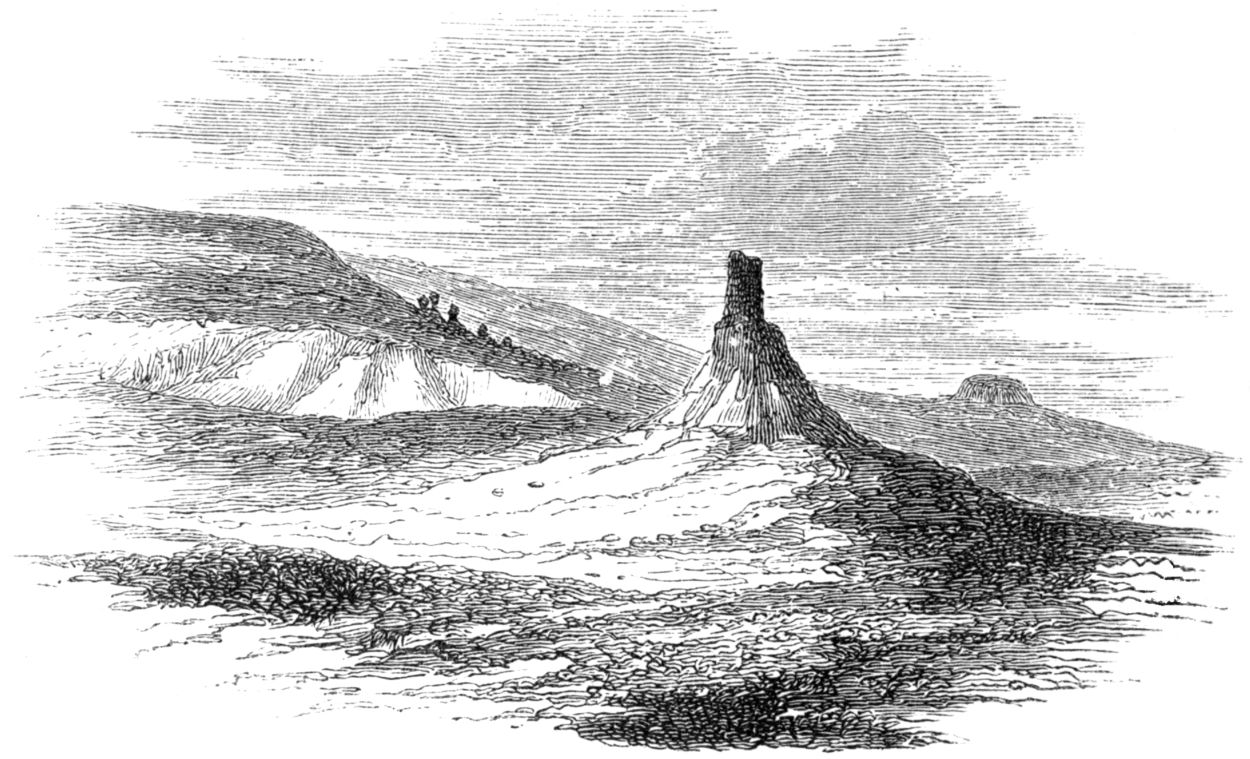
CHIMNEY ROCK.
Shortly after “liquoring up” and shaking hands, we found ourselves once more in the valley of the Platte, where a lively green relieved eyes which still retained retina-pictures of the barren, Sindh-like divide. The road, as usual along the river-side, was rough and broken, and puffs of simoom raised the sand and dust in ponderous clouds. At 12 30 P.M. we nooned for an hour at a little hovel called a ranch, with the normal corral; and I took occasion to sketch the far-famed Chimney Rock. The name is not, as is that of the Court-house, a misnomer: one might almost expect to see smoke or steam jetting from the summit. Like most of these queer malformations, it was once the knuckle-end of the main chain which bounded the Platte Valley; the softer adjacent strata of marl and earthy limestone were disintegrated by wind and weather, and the harder material, better resisting the action of air and water, has gradually assumed its present form. Chimney Rock lies two and a half miles from the south bank of the Platte. It is composed of a friable yellowish marl, yielding readily to the knife. The shape is a thin shaft, perpendicular and quasi conical. Viewed from the southeast it is not unlike a giant jack-boot based upon a high pyramidal mound, which, disposed in the natural slope, rests upon the plain. The neck of sandstone connecting it with the adjacent hills has been distributed by the floods around the base, leaving an ever-widening gap between. This “Pharos of the prairie sea” towered in former days 150 to 200 feet above the apex of its foundation,[52] and was a landmark visible for 40 to 50 miles: it is now barely 35 feet in height. It has often been struck by lightning; imber edax has gnawed much away, and the beginning of the end is already at hand. It is easy to ascend the pyramid; but, while Pompey’s Pillar, Peter Botte, and Ararat have all felt the Anglo-Scandinavian foot, no venturous scion of the race has yet trampled upon the top of Chimney Rock. Around the waist of the base runs a white band which sets off its height and relieves the uniform tint. The old sketches of this curious needle now necessarily appear exaggerated; moreover, those best known represent it as a column rising from a confused heap of boulders, thus conveying a completely false idea. Again the weather served us: nothing could be more picturesque than this lone pillar of pale rock lying against a huge black cloud, with the forked lightning playing over its devoted head.
After a frugal dinner of biscuit and cheese we remounted and pursued our way through airy fire, which presently changed from our usual pest—a light dust-laden breeze—into a Punjaubian dust-storm, up the valley of the Platte. We passed a ranch called ROBIDOUX’ FORT.“Robidoux’ Fort,” from the well-known Indian trader of that name;[53] it is now occupied by a Canadian or a French Creole, who, as usual with his race in these regions, has taken to himself a wife in the shape of a Sioux squaw, and has garnished his quiver with a multitude of whitey-reds. The driver pointed out the grave of a New Yorker who had vainly visited the prairies in search of a cure for consumption. As we advanced the storm increased to a tornado of north wind, blinding our cattle till it drove them off the road. The gale howled through the pass with all the violence of a khamsin, and it was followed by lightning and a few heavy drops of rain. The threatening weather caused a large party of emigrants to “fort themselves” in a corral near the base of Scott’s Bluffs.
The corral, a Spanish and Portuguese word, which, corrupted to “kraal,” has found its way through Southern Africa, signifies primarily a square or circular pen for cattle, which may be made of tree-trunks, stones, or any other convenient material. The corral of wagons is thus formed. The two foremost are brought near and parallel to each other, and are followed by the rest, disposed aslant, so that the near fore wheel of the hinder touches the off hind wheel of that preceding it, and vice versâ on the other side. The “tongues,” or poles, are turned outward, for convenience of yoking, when an attack is not expected, otherwise they are made to point inward, and the gaps are closed by ropes and yoke and spare chains. Thus a large oval is formed with a single opening fifteen to twenty yards across; some find it more convenient to leave an exit at both ends. In dangerous places the passages are secured at night either by cords or by wheeling round the near wagons; the cattle are driven in before sundown, especially when the area of the oval is large enough to enable them to graze, and the men sleep under their vehicles. In safer travel the tents are pitched outside the corral with their doors outward, and in front of these the camp-fires are lighted. The favorite spots with teamsters for corraling are the re-entering angles of deep streams, especially where these have high and precipitous banks, or the crests of abrupt hills and bluffs—the position for nighting usually chosen by the Australian traveler—where one or more sides of the encampment is safe from attack, and the others can be protected by a cross fire. As a rule Indians avoid attacking strong places; this, however, must not always be relied upon; in 1844 the Utah Indians attacked Uintah Fort, a trading-post belonging to M. A. Robidoux, then at St. Louis, slaughtered the men, and carried off the women. The corral is especially useful for two purposes: it enables the wagoners to yoke up with ease, and it secures them from the prairie traveler’s prime dread—the stampede. The Western savages are perfectly acquainted with the habits of animals, and in their marauding expeditions they instinctively adopt the system of the Bedouins, the Gallas, and the Somal. Providing themselves with rattles and other implements for making startling noises, they ride stealthily up close to the cattle, and then rush by like the whirlwind with a volley of horrid whoops and screams. When the “cavallard” flies in panic fear, the plunderers divide their party; some drive on the plunder, while the others form a rear-guard to keep off pursuers. The prairie-men provide for the danger by keeping their fleetest horses saddled, bridled, and ready to be mounted at a moment’s notice. When the animals have stampeded, the owners follow them, scatter the Indians, and drive, if possible, the madriña, or bell-mare, to the front of the herd, gradually turning her toward the camp, and slacking speed as the familiar objects come in sight. Horses and mules appear peculiarly timorous upon the prairies. A band of buffalo, a wolf, or even a deer, will sometimes stampede them; they run to great distances, and not unfrequently their owners fail to recover them.
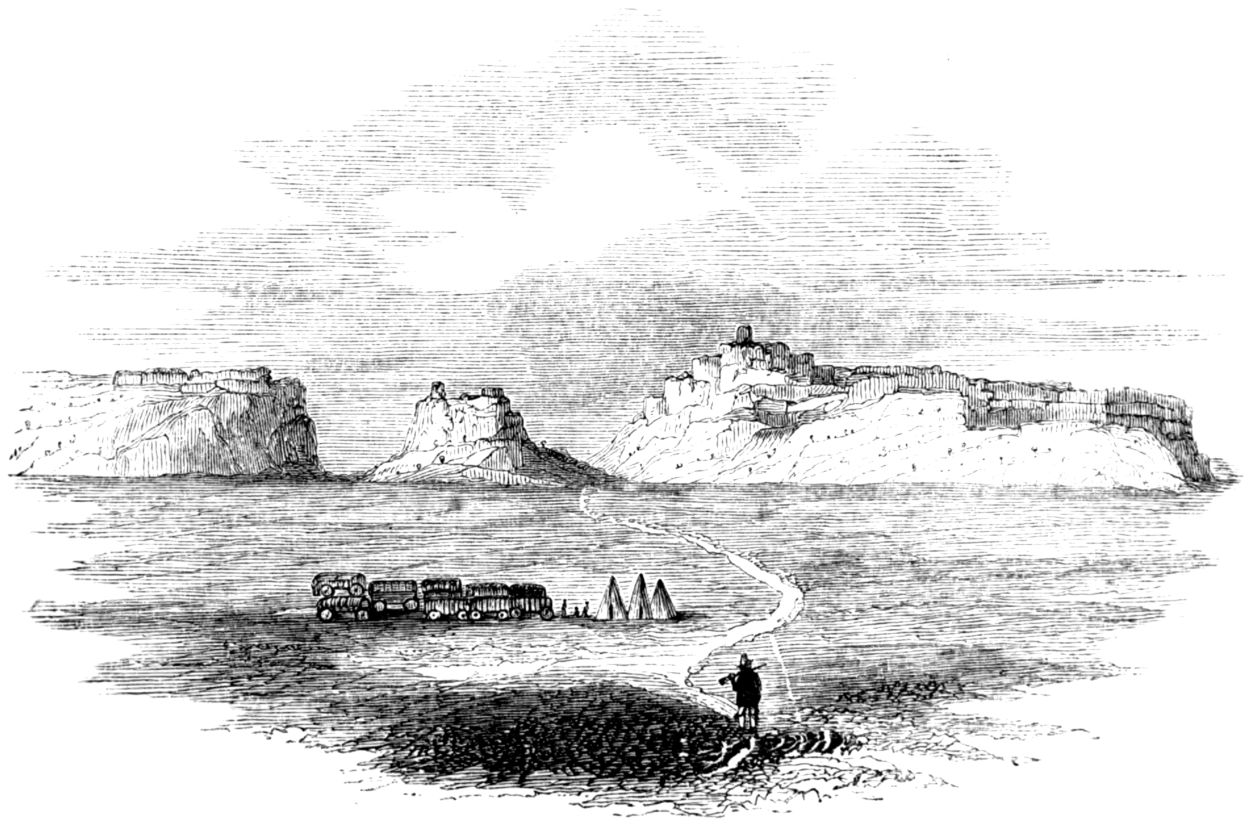
SCOTT’S BLUFFS.
SCOTT’S BLUFFS.“Scott’s Bluffs,” situated 285 miles from Fort Kearney and 51 from Fort Laramie, was the last of the great marl formations which we saw on this line, and was of all by far the most curious. In the dull uniformity of the prairies, it is a striking and attractive object, far excelling the castled crag of Drachenfels or any of the beauties of romantic Rhine. From a distance of a day’s march it appears in the shape of a large blue mound, distinguished only by its dimensions from the detached fragments of hill around. As you approach within four or five miles, a massive medieval city gradually defines itself, clustering, with a wonderful fullness of detail, round a colossal fortress, and crowned with a royal castle. Buttress and barbican, bastion, demilune, and guard-house, tower, turret, and donjon-keep, all are there: in one place parapets and battlements still stand upon the crumbling wall of a fortalice like the giant ruins of Château Gaillard, the “Beautiful Castle on the Rock;” and, that nothing may be wanting to the resemblance, the dashing rains and angry winds have cut the old line of road at its base into a regular moat with a semicircular sweep, which the mirage fills with a mimic river. Quaint figures develop themselves; guards and sentinels in dark armor keep watch and ward upon the slopes, the lion of Bastia crouches unmistakably overlooking the road; and as the shades of an artificial evening, caused by the dust-storm, close in, so weird is its aspect that one might almost expect to see some spectral horseman, with lance and pennant, go his rounds about the deserted streets, ruined buildings, and broken walls. At a nearer aspect again, the quaint illusion vanishes; the lines of masonry become yellow layers of boulder and pebble imbedded in a mass of stiff, tamped, bald marly clay; the curtains and angles change to the gashings of the rains of ages, and the warriors are metamorphosed into dwarf cedars and dense shrubs, scattered singly over the surface. Travelers have compared this glory of the mauvaises terres to Gibraltar, to the Capitol at Washington, to Stirling Castle. I could think of nothing in its presence but the Arabs’ “City of Brass,” that mysterious abode of bewitched infidels, which often appears at a distance to the wayfarer toiling under the burning sun, but ever eludes his nearer search.
Scott’s Bluffs derive their name from an unfortunate fur-trader there put on shore in the olden time by his boat’s crew, who had a grudge against him: the wretch, in mortal sickness, crawled up the mound to die. The politer guide-books call them “Capitol Hills:” methinks the first name, with its dark associations, must be better pleasing to the genius loci. They are divided into three distinct masses. The largest, which may be 800 feet high, is on the right, or nearest the river. To its left lies an outwork, a huge, detached cylinder whose capping changes aspect from every direction; and still farther to the left is a second castle, now divided from, but once connected with the others. The whole affair is a spur springing from the main range, and closing upon the Platte so as to leave no room for a road.
After gratifying our curiosity we resumed our way. The route lay between the right-hand fortress and the outwork, through a degraded bed of softer marl, once doubtless part of the range. METEOROLOGICAL PHENONMENON.The sharp, sudden torrents which pour from the heights on both sides, and the draughty winds—Scott’s Bluffs are the permanent head-quarters of hurricanes—have cut up the ground into a labyrinth of jagged gulches steeply walled in. We dashed down the drains and pitch-holes with a violence which shook the nave-bands from our sturdy wheels.[54] Ascending, the driver showed a place where the skeleton of an “elephant” had been lately discovered. On the summit he pointed out, far over many a treeless hill and barren plain, the famous Black Hills and Laramie Peak, which has been compared to Ben Lomond, towering at a distance of eighty miles. The descent was abrupt, with sudden turns round the head of earth-cracks deepened to ravines by snow and rain; and one place showed the remains of a wagon and team which had lately come to grief. After galloping down a long slope of twelve miles, with ridgelets of sand and gravel somewhat raised above the bottom, which they cross on their way to the river, we found ourselves, at 5 30 P.M., once more in the valley of the Platte. I had intended to sketch the Bluffs more carefully from the station, but the western view proved to be disappointingly inferior to the eastern. After the usual hour’s delay we resumed our drive through alternate puffs of hot and cold wind, the contrast of which was not easy to explain. The sensation was as if Indians had been firing the prairies—an impossibility at this season, when whatever herbage there is is still green. It may here be mentioned that, although the meteorology of the earlier savans, namely, that the peculiar condition of the atmosphere known as the Indian summer[55] might be produced by the burning of the plain-vegetation, was not thought worthy of comment, their hypothesis is no longer considered trivial. The smoky canopy must produce a sensible effect upon the temperature of the season. “During a still night, when a cloud of this kind is overhead, no dew is produced; the heat which is radiated from the earth is reflected or absorbed, and radiated back again by the particles of soot, and the coating of the earth necessary to prevent the deposition of water in the form of dew or hoar-frost is prevented.” According to Professor Henry, of Washington, “it is highly probable that a portion of the smoke or fog-cloud produced by the burning of one of the Western prairies is carried entirely across the eastern portion of the continent to the ocean.”
Presently we dashed over the Little Kiowa Creek, forded the Horse Creek, and, enveloped in a cloud of villainous musquetoes, entered at 8 30 P.M. the station in which we were to pass the night. It was tenanted by one Reynal, a French Creole—the son of an old soldier of the Grand Armée, who had settled at St. Louis—a companionable man, but an extortionate: he charged us a florin for every “drink” of his well-watered whisky. The house boasted of the usual squaw, a wrinkled old dame, who at once began to prepare supper, when we discreetly left the room. These hard-working but sorely ill-favored beings are accused of various horrors in cookery, such as grinding their pinole, or parched corn, in the impurest manner, kneading dough upon the floor, using their knives for any purpose whatever, and employing the same pot, unwashed, for boiling tea and tripe. In fact, they are about as clean as those Eastern pariah servants who make the knowing Anglo-Indian hold it an abomination to sit at meat with a new arrival or with an officer of a “home regiment.” The daughter was an unusually fascinating half-breed, with a pale face and Franco-American features. How comes it that here, as in Hindostan, the French half-caste is pretty, graceful, amiable, coquettish, while the Anglo-Saxon is plain, coarse, gauche, and ill-tempered? The beauty was married to a long, lean down-Easter, who appeared most jealously attentive to her, occasionally hinting at a return to the curtained bed, where she could escape the admiring glances of strangers. Like her mother, she was able to speak English, but she could not be persuaded to open her mouth. This is a truly Indian prejudice, probably arising from the savage, childish sensitiveness which dreads to excite a laugh; even a squaw married to a white man, after uttering a few words in a moment of épanchement, will hide her face under the blanket.
The half-breed has a bad name in the land. Like the negro, the Indian belongs to a species, sub-species, or variety—whichever the reader pleases—that has diverged widely enough from the Indo-European type to cause degeneracy, physical as well as moral, and often, too, sterility in the offspring. These half-breeds are, therefore, like the mulatto, quasi-mules. The men combine the features of both races; the skin soon becomes coarse and wrinkled, and the eye is black, snaky, and glittering like the Indian’s. The mongrels are short-lived, peculiarly subject to infectious diseases, untrustworthy, and disposed to every villainy. The half-breed women, in early youth, are sometimes attractive enough, uniting the figure of the mother to the more delicate American face; a few years, however, deprive them of all litheness, grace, and agility. They are often married by whites, who hold them to be more modest and humble, less capricious and less exacting, than those of the higher type: they make good wives and affectionate mothers, and, like the Quadroons, they are more “ambitious”—that is to say, of warmer temperaments—than either of the races from which they are derived. The so-called red is a higher ethnic type than the black man; so, in the United States, where all admixture of African blood is deemed impure, the aboriginal American entails no disgrace—some of the noblest of the land are descended from “Indian princesses.” The half-breed girls resemble their mothers in point of industry, and they barter their embroidered robes and moccasins, and mats and baskets, made of bark and bulrush, in exchange for blankets, calicoes, glass beads—an indispensable article of dress—mirrors, needles, rings, vermilion, and other luxuries. The children, with their large black eyes, wide mouths, and glittering teeth, flattened heads, and remarkable agility of motion, suggest the idea of little serpents.
The day had been fatiguing, and our eyes ached with the wind and dust. We lost no time in spreading on the floor the buffalo robes borrowed from the house, and in defying the smaller tenants of the ranch. Our host, M. Reynal, was a study, but we deferred the lesson till the next morning.
To Fort Laramie. 14th August.
M. REYNAL.M. Reynal had been an Indian trader in his youth. Of this race there were in his day two varieties: the regular trader and the coureur des bois, or unlicensed peddler, who was subject to certain pains and penalties. The former had some regard for his future; he had a permanent interest in the Indians, and looked to the horses, arms, and accoutrements of his protégés, so that hunting might not flag. The bois brûlé peddler, having—like an English advertising firm—no hope of dealing twice with the same person, got all he could for what he could. These men soon sapped the foundation of the Indian’s discipline. One of them, for instance, would take protection with the chief, pay presents, and by increasing the wealth, enhance the importance of his protector. Another would place himself under the charge of some ambitious aspirant to power, who was thus raised to a position of direct rivalry. A split would ensue; the weaker would secede with his family and friends, and declare independence; a murder or two would be the result, and a blood-feud would be bequeathed from generation to generation. The licensed traders have ever strenuously opposed the introduction of alcohol, a keg of which will purchase from the Indian every thing that is his, his arms, lodge, horses, children, and wives. In olden times, however, the Maine Liquor Law was not, as now, in force through the territories. The coureur des bois, therefore, entered the country through various avenues, from the United States and from Mexico, without other stock in trade but some kegs of whisky, which he retailed at the modest price of $36 per gallon. He usually mixed one part of fire with five of pure water, and then sold a pint-canful for a buffalo robe. “Indian liquor” became a proverbial term. According to some travelers, a barrel of “pure Cincinnati,” even after running the gauntlet of railroad and lake travel, has afforded a hundred barrels of “good Indian liquor.” A small bucketful is poured into a wash-tub of water; a large quantity of “dog-leg” tobacco and red pepper is then added, next a bitter root common in the country is cut up into it, and finally it is colored with burnt sugar—a nice recipe for a morning’s headache! The only drawback to this traffic is its danger. The Indian, when intoxicated, is ready for any outrageous act of violence or cruelty; vinosity brings out the destructiveness and the utter barbarity of his character; it makes him thirst tiger-like for blood. The coureur des bois, therefore, who in those days was highly respected, was placed in the Trader’s Lodge, a kind of public house, like the Iwanza of Central Africa, and the village chief took care to station at the door a guard of sober youths, sometimes habited like Europeans, ready to check the unauthorized attempts of ambitious clansmen upon the whisky-vendor’s scalp. The Western men, who will frequently be alluded to in these pages, may be divided, like the traders, into two classes. The first is the true mountaineer, whom the platitude and tame monotony of civilized republican life has in early youth driven, often from an honored and wealthy family, to the wilds and wolds, to become the forlorn hope in the march of civilization. The second is the offscouring and refuse of the Eastern cities, compelled by want, fatuity, or crime to exile himself from all he most loves. The former, after passing through the preliminary stage greenhorn, is a man in every sense of the term: to more than Indian bravery and fortitude, he unites the softness of woman, and a child-like simplicity, which is the very essence of a chivalrous character; you can read his nature in his clear blue eyes, his sun-tanned countenance, his merry smile, and his frank, fearless manner. The latter is a knave or a fool; it would make “bad blood,” as the Frenchman says, to describe him.
M. Reynal’s history had to be received with many grains of salt. The Western man has been worked by climate and its consequences, by the huge magnificence of nature and the violent contrasts of scenery, into a remarkable resemblance to the wild Indian. He hates labor—which poet and divine combine to deify in the settled states—as the dire effect of a primeval curse; “loaf” he must and will; to him one hour out of the twenty-four spent in honest industry is satis superque. His imagination is inflamed by scenery and climate, difficulty and danger; he is as superstitious as an old man-o’-war’s-man of the olden school; and he is a transcendental liar, like his prototype the aborigine, who in this point yields nothing to the African negro. I have heard of a man riding eighty miles—forty into camp and forty out—in order to enjoy the sweet delights of a lie. His yarns and stories about the land he lives in have become a proverbial ridicule; he will tell you that the sun rises north of what it did se puero; he has seen mountains of diamonds and gold nuggets scattered like rocks over the surface of our general mother. I have been gravely told of a herd of bison which arrested the course of the Platte River, causing its waters, like those of the Red Sea, to stand up, wall fashion, while the animals were crossing. Of this Western order is the well-known account of a ride on a buffalo’s horns, delivered for the benefit of a gaping world by a popular author of the yellow-binding category. In this age, however, the Western man has become sensitive to the operation of “smoking.” A popular Joe Miller anent him is this: A traveler, informed of what he might educe by “querying,” asked an old mountaineer, who shall be nameless, what difference he observed in the country since he had first settled in it.
“Wal, stranger, not much!” was the reply; “only when I fust come here, that ’ere mountain,” pointing to the tall Uinta range, “was a hole!”
Disembarrassing M. Reynal’s recital of its mask of improbabilities and impossibilities, remained obvious the naked fact that he had led the life of a confirmed coureur des bois. The French Canadian and Creole both, like the true Français de France, is loth to stir beyond the devil-dispelling sound of his chapel-bell; once torn from his chez lui, he apparently cares little to return, and, like the Englishman, to die at home in his own land. The adventurous Canadians—in whom extremes meet—have wandered through the length and breadth of the continent; they have left their mark even upon the rocks in Utah Territory. M. Reynal had quitted St. Louis at an early age as trader, trapper, every thing in short, provided with a little outfit of powder, ball, and whisky. At first he was unfortunate. In a war between the Sioux and the Pawnees, he was taken prisoner by the latter, and with much ado preserved, by the good aid of his squaw, that useful article his scalp. Then fickle fortune turned in his favor. He married several wives, identified himself with the braves, and became a little brother of the tribe, while his whisky brought him in an abundance of furs and peltries. After many years, waxing weary of a wandering life, he settled down into the somewhat prosaic position in which we had the pleasure of finding him. He was garrulous as a veteran soldier upon the subject of his old friends the trappers, that gallant advance guard who, sixty years ago, unconsciously fought the fight of civilization for the pure love of fighting; who battled with the Indian in his own way, surpassing him in tracking, surprising, ambuscading, and shooting, and never failing to raise the enemy’s hair. They are well-nigh extinct, those old pioneers, wild, reckless, and brave as the British tar of a century past; they live but in story; their place knows them no longer; it is now filled by the “prospector.” Civilization and the silk hat have exterminated them. How many deeds of stern fight and heroic endurance have been ignored by this world, which knows nothing of its greatest men, carent quia vale sacro! We talk of Thermopylæ and ignore Texas; we have all thrilled at the account of the Mameluke Bey’s leap; but how many of us have heard of Major Macculloch’s spring from the cliff?
Our breakfast was prepared in the usual prairie style. First the coffee—three parts burnt beans, which had been duly ground to a fine powder and exposed to the air, lest the aroma should prove too strong for us—was placed on the stove to simmer till every noxious principle was duly extracted from it. Then the rusty bacon, cut into thick slices, was thrown into the fry-pan: here the gridiron is unknown, and if known would be little appreciated, because it wastes the “drippings,” which form with the staff of life a luxurious sop. Thirdly, antelope steak, cut off a corpse suspended for the benefit of flies outside, was placed to stew within influence of the bacon’s aroma. Lastly came the bread, which of course should have been “cooked” first. The meal is kneaded with water and a pinch of salt; the raising is done by means of a little sour milk, or more generally by the deleterious yeast-powders of the trade. The carbonic acid gas evolved by the addition of water must be corrected, and the dough must be expanded by saleratus or prepared carbonate of soda or alkali, and other vile stuff, which communicates to the food the green-yellow tinge, and suggests many of the properties of poison. A hundred-fold better, the unpretending chapati, flapjack, scone, or, as the Mexicans prettily called it, “tortilla!” The dough, after being sufficiently manipulated upon a long, narrow, smooth board, is divided into “biscuits” and “dough-nuts,”[56] and finally it is placed to be half cooked under the immediate influence of the rusty bacon and graveolent antelope. “Uncle Sam’s stove,” be it said with every reverence for the honored name it bears, is a triumph of convenience, cheapness, unwholesomeness, and nastiness—excuse the word, nice reader. This travelers’ bane has exterminated the spit and gridiron, and makes every thing taste like its neighbor: by virtue of it, mutton borrows the flavor of salmon trout, tomatoes resolve themselves into greens. I shall lose my temper if the subject is not dropped.
We set out at 6 A.M. over a sandy bottom, from which the musquetoes rose in swarms. After a twelve-mile stretch the driver pointed out on the right of the road, which here runs between high earth-banks, a spot still infamous in local story. At this place, in 1854, five Indians, concealing themselves in the bed of a dwarf arroyo, fired upon the mail-wagon, killing two drivers and one passenger, and then plundered it of 20,000 dollars. “Long-chin,” the leader, and the other murderers, when given up by the tribe, were carried to Washington, D. C., where—with the ultra-philanthropy which has of modern days distinguished the “Great Father’s” government of his “Poor Children of the Plains”—the villains were liberally rewarded and restored to their homes.[57] To cut off a bend of the Platte we once more left the valley, ascended sundry slopes of sand and clay deeply cut by dry creeks, and from the summit enjoyed a pretty view. A little to the left rose the aerial blue cone of that noble landmark, LARAMIE PEAK.Laramie Peak, based like a mass of solidified air upon a dark wall, the Black Hills, and lit up with the roseate hues of the morning. The distance was about sixty miles; you would have guessed twenty. On the right lay a broad valley, bounded by brown rocks and a plain-colored distance, with the stream winding through it like a thread of quicksilver; in places it was hidden from sight by thickets of red willow, cypress clumps, and dense cool cotton-woods. All was not still life; close below us rose the white lodges of the Ogalala tribe.
INDIAN VILLAGES.These Indian villages are very picturesque from afar when dimly seen dotting the verdure of the valleys, and when their tall white cones, half hidden by willow clumps, lie against a blue background. The river side is the savages’ favorite site; next to it the hill foot, where little groups of three or four tents are often seen from the road, clustering mysteriously near a spring. Almost every prairie-band has its own way of constructing lodges, encamping and building fires, and the experienced mountaineer easily distinguishes them.
The Osages make their lodges in the shape of a wagon-tilt, somewhat like our gipsies’ tents, with a frame-work of bent willow rods planted in the ground, and supporting their blankets, skins, or tree-basts.
The Kickapoos build dwarf hay-stack huts, like some tribes of Africans, setting poles in the earth, binding them over and lashing them together at the top; they are generally covered with clothes or bark.
The Witchetaws, Wakoes, Towakamis, and Tonkowas are described by the “Prairie Traveler” as erecting their hunting lodges of sticks put up in the form of the frustrum of a cone, and bushed over like “boweries.”
All these tribes leave the frame-work of their lodges standing when they shift ground, and thus the particular band is readily recognized.
The Sacs, Foxes, Winnebagoes, and Menomenes build lodges in the form of an ellipse, some of them 30-40 feet long, by 14-15 wide, and large enough to shelter twenty people permanently, and sixty temporarily.[58] The covering is of plaited rush-mats bound to the poles, and a small aperture in the lodge acts as chimney.
The Delawares and Shawnees, Cherokees and Choctaws, prefer the Indian pal, a canvas covering thrown like a tente d’abri over a stick supported by two forked poles.
The Sioux, Arapahoes, Cheyennes, Utahs, Snakes, Blackfeet, and Kiowas use the Comanche lodge covered with bison skins, which by dressing become flexible as canvas. They are usually of a shining white, save where smoke-stained near the top; the lodges of great chiefs are sometimes decorated with horizontal stripes of alternate black and white, and ornamented with figures human and bestial, crosses, circles, and arabesques. The lodge is made of eight to twenty-four straight peeled poles or saplings of ash, pine, cedar, or other wood, hard and elastic if possible, about 20 feet long; the largest marquees are 30 feet in diameter by 35 feet high, and are comprised of 26-30 buffalo skins; and they are sometimes planted round a “basement” or circular excavation two or three feet deep. When pitching, three poles lashed to one another with a long line, somewhat below the thinner points, are raised perpendicularly, and the thicker ends are spread out in a tripod to the perimeter of the circle which is to form the lodge floor; the rest of the poles are then propped against the three first, and disposed regularly and equidistantly to make a steady and secure conical frame-work. The long line attached to the tripod is then wound several times round the point where the poles touch, and the lower end is made fast to the base of the lodge, thus securing the props in position. The covering of dressed, hairless, and water-proof cow-buffalo hide—traders prefer osnaburg—cut and sewn to fit the frame like an envelope, and sometimes pinned together with skewers, is either raised at first with the tripod, or afterward hoisted with a perch and spread round the complete structure. It is pinned to the ground with wooden pegs, and a narrow space forms a doorway, which may be closed with a blanket suspended from above and spread out with two small sticks. The apex is left open with a triangular wing or flap, like a lateen sail, and is prevented from closing by a pole inserted into a pocket at the end. The aperture points to windward when ventilation is required, and, drawing like a wind-sail, it keeps the interior cool and comfortable; when smoke is to be carried off, it is turned to leeward, thus giving draught to the fire, and making the abode warm in the severest weather; while in lodges of other forms, you must lie down on the ground to prevent being asphyxiated. By raising the lower part so as freely to admit the breeze, it is kept perfectly free from musquetoes, which are unable to resist the strong draught. The squaws are always the tent-pitchers, and they equal Orientals in dexterity and judgment. Before the lodge of each warrior stands his light spear, planted Bedouin-fashion in the ground, near or upon a tripod of thin, cleanly-scraped, wands, seven to eight feet long, which support his spotless white buffalo-skin targe, sometimes decorated with his “totem”—we translate the word “crest”—and guarded by the usual prophylactic, a buckskin sack containing medicine. Readers of “Ivanhoe”—they are now more numerous in the New than in the Old Country—ever feel “a passing impulse to touch one of these spotless shields with the muzzle of the gun, expecting a grim warrior to start from the lodge and resent the challenge.” The fire, as in the old Hebridean huts, is built in the centre of the hard dirt floor; a strong stick planted at the requisite angle supports the kettle, and around the walls are berths divided by matted screens; the extremest uncleanliness, however, is a feature never absent. In a quiet country these villages have a simple and patriarchal appearance. The tents, which number from fifteen to fifty, are disposed round a circular central space, where animals can be tethered. Some have attached to them corrals of wattled canes, and a few boast of fields where corn and pumpkins are raised.
The Comanche lodge is the favorite tenement of the Canadian and Creole voyageurs, on account of its coolness or warmth when wanted, its security against violent winds, and its freedom from musquetoes. While traveling in an Indian country they will use no other. It has been simplified by Major H. H. Sibley, of the United States Army, who has changed the pole frame-work for a single central upright, resting upon an iron tripod, with hooks for suspending cooking utensils over the fire; when folded up, the tripod admits the upright between its legs, thereby reducing the length to one half—a portable size. THE “SIBLEY TENT.”The “Sibley tent” was the only shelter of the United States Army at Fort Scott, in Utah Territory, during the hard winter of 1857-8, and gave universal satisfaction. The officers still keep to the old wall-tent. This will, however, eventually be superseded by the new form, which can accommodate comfortably twelve, but not seventeen, the usual number allotted to it. Captain Marcy is of opinion that of the tents used in the different armies of Europe, “none in point of convenience, comfort, and economy will compare with the ‘Sibley tent’ for campaigning in cold weather.” In summer, however, it has, like all conical tents, many disadvantages: there is always a loss of room; and for comfortably disposing kit—chair, table, and camp couch—there is nothing equal to the wall-tent. The price of a “Sibley,” when made of good material, is from $40 to $50 (£8-£10), and it can be procured from Baltimore, Philadelphia, and New York.
At 10 20 A.M. we halted to change mules at Badeau’s Ranch, or, as it is more grandiloquently called, “Laramie City.” The “city,” like many a Western “town,” still appertains to the category of things about to be; it is at present represented by a single large “store,” with out-houses full of small half-breeds. The principal articles of traffic are liquors and groceries for the whites, and ornaments for the Indians, which are bartered for stock (i. e., animals) and peltries. The prices asked for the skips were from $1-$1 30 for a fox or a coyote, $3 for wolf, bear, or deer, $6-$7 for an elk, $5 for a common buffalo, and from $8 to $35 for the same painted, pictographed, and embroidered. Some of the party purchased moccasins, for which they paid $1-$2; the best articles are made by the Snakes, and when embroidered by white women rise as high as $25. I bought, for an old friend who is insane upon the subject of pipes, one of the fine marble-like sandstone bowls brought from the celebrated Côteau (slope) des Prairies, at the head of Sioux River—
“On the mountains of the Prairie, On the Great Red Pipe-stone Quarry.”
This instrument is originally the gift of Gitchie Manitou, who, standing on the precipice of the Red Pipe-stone Rock, broke off a fragment and moulded it into a pipe, which, finished with a reed, he smoked over his children to the north, south, east, and west. It is of queer shape, not unlike the clay and steatite articles used by the Abyssinians and the Turi or Sinaitic Bedouins. The length of the stick is 23 inches, of the stem 9·50, and of the bowl 5 inches; the latter stands at a right angle upon the former; both are circular; but the 2·75 inches of stem, which project beyond the bowl, are beveled off so as to form an edge at the end. The peculiarity of the form is in the part where the tobacco is inserted; the hole is not more than half an inch broad, and descends straight without a bulge, while the aperture in the stem is exactly similar. The red color soon mottles and the bowl clogs if smoked with tobacco; in fact, it is fit for nothing but the “kinnikinik” of the Indians. To prepare this hard material with the rude tools of a savage must be a work of time and difficulty; also the bowls are expensive and highly valued: for mine I paid $5, and farther West I could have exchanged it for an Indian pony.
Having finished our emplettes at M. Badeau’s, we set out at 11 30 P.M. over a barren and reeking bit of sandy soil. Close to the station, and a little to the right of the road, we passed the barrow which contains the remains of Lieutenant Grattan and his thirty men. A young second lieutenant of Irish origin and fiery temper, he was marching westward with an interpreter, a small body of men, and two howitzers, when a dispute arose, it is said, about a cow, between his party and the THE BRULÉS AND GENERAL HARNEY.Brûlés or Burnt-Thigh Indians. The latter were encamped in a village of 450 to 500 lodges, which, reckoning five to each, gives a total of 2200 to 2500 souls. A fight took place; the whites imprudently discharged both their cannon, overshooting the tents of the enemy; their muskets, however, did more execution, killing Matriya, “the Scattering Bear,” who had been made chief of all the Sioux by Colonel Mitchell of the Indian Bureau. The savages, seeing the fall of Ursa Major, set to in real earnest; about 1200 charged the soldiers before they could reload; the little detachment broke, and not a man survived to tell the tale. The whites in the neighborhood narrowly preserved their scalps—M. Badeau owned that he owed his to his Sioux squaw—and among other acts of violence was the murder and highway robbery which has already been recounted. Both these events occurred in 1854. As has been said, in 1855, General W. S. Harney, who, whatever may be his faults as a diplomatist, is the most dreaded “Minahaska”[59] in the Indian country, punished the Brûlés severely at Ash Hollow. They were led by their chosen chief Little Thunder, who, not liking the prospect, wanted to palaver; the general replied by a charge, which, as usual, scattered the “chivalry of the prairies” to the four winds. “Little Thunder” was solemnly deposed, and Mato Chigukesa, “Bear’s Rib,” was ordered to reign in his stead; moreover, in 1856, a treaty was concluded, giving to whites, among other things, the privilege of making roads along the Platte and White-Earth Rivers (Mankisita Wakpa—Smoking-earth Water) to Forts Pierre and Laramie, and to pass up and down the Missouri in boats. Since that time, with the exception of plundering an English sportsman, Sir G—— G——, opposing Lieutenant Warren’s expedition to the Black Hills, and slaughtering a few traders and obscure travelers, the Brûlés have behaved tolerably to their pale-face rivals.
As we advanced the land became more barren; it sadly wanted rain: it suffers from drought almost every year, and what vegetable matter the soil will produce the grasshopper will devour. Dead cattle cumbered the way-side; the flesh had disappeared; the bones were scattered over the ground; but the skins, mummified, as it were, by the dry heat, lay life-like and shapeless, as in the Libyan Desert, upon the ground. This phenomenon will last till we enter the humid regions between the Sierra Nevada and the Pacific Ocean, and men tell wonderful tales of the time during which meat can be kept. The road was a succession of steep ascents and jumps down sandy ground. A Sioux “buck,” mounted upon a neat nag, and wrapped up, despite sun and glare, as if it had been the depth of winter, passed us, sedulously averting his eyes. The driver declared that he recognized the horse, and grumbled certain Western facetiæ concerning “hearty-chokes and caper sauce.”
In these lands the horse-thief is the great enemy of mankind; for him there is no pity, no mercy; Lynch-law is held almost too good for him; to shoot him in flagrante delicto is like slaying a man-eating Bengal royal tiger—it entitles you to the respect and gratitude of your species. I asked our conductor whether dandiness was at the bottom of the “buck’s” heavy dress. “’Guess,” was the reply, “what keeps cold out, keeps heat out tew!”
At 12 15 P.M., crossing Laramie’s Fork, a fine clear stream about forty yards broad, we reached Fort Laramie—another “fort” by courtesy, or rather by order—where we hoped to recruit our exhausted stores.
The straggling cantonment requires no description: it has the usual big flag, barracks, store-houses, officers’ quarters, guard-houses, sutlers’ stores, and groceries, which doubtless make a good thing by selling deleterious “strychnine” to passing trains who can afford to pay $6 per gallon.
Fort Laramie, called Fort John in the days of the American Fur Company, was used by them as a store-house for the bear and buffalo skins, which they collected in thousands. The old adobe enceinte, sketched and described by Frémont and Stansbury, soon disappeared after the place was sold to the United States government. Its former rival was Fort Platte, belonging in 1842—when the pale face first opened this road—to Messrs. Sybille, Adams, and Co., and situated immediately on the point of land at the junction of Laramie Fort with the Platte. The climate here is arid and parching in summer, but in winter tolerably mild, considering the altitude—4470 feet—and the proximity of the Black Hills; yet it has seen hard frost in September. It is also well defended from the warm, moist, and light winds, which, coming from the Mexican Gulf, cause “calentures” on the lower course of the river. The soil around the settlement is gravelly and sterile, the rocks are sand, lime, and clay, and there is a solitary, desolate look upon every thing but the bright little stream that bubbles from the dark heights. The course is from S.W. to N.E.: about half way it bifurcates, with a right fork to the west and main fork east, and near Laramie it receives its main affluent, the Chugwater.
My companion kindly introduced me to the officer commanding the fort, Colonel B. Alexander, 10th Infantry, and we were at once made at home. The amiable mistress of the house must find charitable work enough to do in providing for the wants of way-worn friends who pass through Laramie from east to west. We rested and dined in the cool comfortable quarters, with only one qualm at heart—we were so soon to leave them. On these occasions the driver seems to know by instinct that you are enjoying yourself, while he, as an outsider, is not. He becomes, therefore, unusually impatient to start; perhaps, also, time runs more rapidly than it is wont. At any rate, after a short two hours, we were compelled to shake hands with our kind and considerate hosts, and to return to limbo—the mail-wagon.
From Fort Laramie westward the geological formation changes; the great limestone deposits disappear, and are succeeded by a great variety of sandstones, some red, argillaceous, and compact; others gray or yellow, ferruginous, and coarse. Pudding-stones or conglomerates also abound, and the main chain of the Laramie Mountains is supposed to be chiefly composed of this rock.
Beyond the fort there are two roads. The longer leads to the right, near the Platte River. It was formerly, and perhaps is still, a favorite with emigrants. We preferred the left, which, crossing the edges of the Black Hills, is rough and uneven, but is “some shorter,” as the guide-book says, than the other. The weather began to be unusually disagreeable with heat and rain-drops from a heavy nimbus, that forced us to curtain up the rattling vehicle; perhaps, too, we were a little cross, contrasting the present with the past—civilized society, a shady bungalow, and wonderfully good butter. At 4 P.M., following the Platte Valley, after two hours’ drive we halted to change mules at Ward’s Station, alias the “Central Star,” where several whites were killed by the Sioux in 1855, among them M. Montalan, a Parisian.
Again we started for another twenty-five miles at 4 P.M. The road was rough, and the driver had a curious proclivity for losing the way. I have often found this to be the case after passing through a station. There was little to remark, except that the country was poor and bad, that there was clear water in a ravine to the right, and that we were very tired and surly. But as sorrow comes to an end as well as joy, so, at 9 30 P.M., we drove in, somewhat consoled, to HORSESHOE STATION.Horseshoe Station—the old Fer à Cheval—where one of the road agents, Mr. Slade, lived, and where we anticipated superior comfort.
We were entichés by the aspect of the buildings, which were on an extensive scale—in fact, got up regardless of expense. An ominous silence, however, reigned around. At last, by hard knocking, we were admitted into a house with the Floridian style of veranda previously described, and by the pretensions of the room we at once divined our misfortune—we were threatened with a “lady.” The “lady” will, alas! follow us to the Pacific; even in hymns we read,
“Now let the Prophet’s heart rejoice, His noble lady’s too.”
Our mishap was really worse than we expected—we were exposed to two “LADIES.”“ladies,” and of these one was a Bloomer. It is only fair to state that it was the only hermaphrodite of the kind that ever met my eyes in the United States; the great founder of the order has long since subsided into her original obscurity, and her acolytes have relapsed into the weakness of petticoats. The Bloomer was an uncouth being; her hair, cut level with her eyes, depended with the graceful curl of a drake’s tail around a flat Turanian countenance, whose only expression was sullen insolence. The body-dress, glazed brown calico, fitted her somewhat like a soldier’s tunic, developing haunches which would be admired only in venison; and—curious inconséquence of woman’s nature!—all this sacrifice of appearance upon the shrine of comfort did not prevent her wearing that kind of crinoline depicted by Mr. Punch upon “our Mary Hanne.” The pantalettes of glazed brown calico, like the vest, tunic, blouse, shirt, or whatever they may call it, were in peg-top style, admirably setting off a pair of thin-soled Frenchified patent-leather bottines, with elastic sides, which contained feet large, broad, and flat as a negro’s in Unyamwezi. The dear creature had a husband: it was hardly safe to look at her, and as for sketching her, I avoided it, as men are bidden by the poet to avoid the way of Slick of Tennessee. The other “lady,” though more decently attired, was like women in this wild part of the world generally—cold and disagreeable in manner, full of “proper pride,” with a touch-me-not air, which reminded me of a certain
“Miss Baxter, Who refused a man before he axed her.”
Her husband was the renowned Slade:
“Of gougers fierce, the eyes that pierce, the fiercest gouger he.”
His was a noted name for “deadly strife;” he had the reputation of having killed his three men; and a few days afterward the grave that concealed one of his murders was pointed out to me. This pleasant individual “for an evening party” wore the revolver and bowie-knife here, there, and every where. He had lately, indeed, had a strong hint not to forget his weapon. One M. Jules, a French trader, after a quarrel which took place at dinner, walked up to him and fired a pistol, wounding him in the breast. As he rose to run away Jules discharged a second, which took effect upon his back, and then, without giving him time to arm, fetched a gun and favored him with a dose of slugs somewhat larger than revolver bullets. The fiery Frenchman had two narrow escapes from Lynch-lawyers: twice he was hung between wagons, and as often he was cut down. At last he disappeared in the farther West, and took to lodge and squaw. The avenger of blood threatens to follow him up, but as yet he has taken no steps.
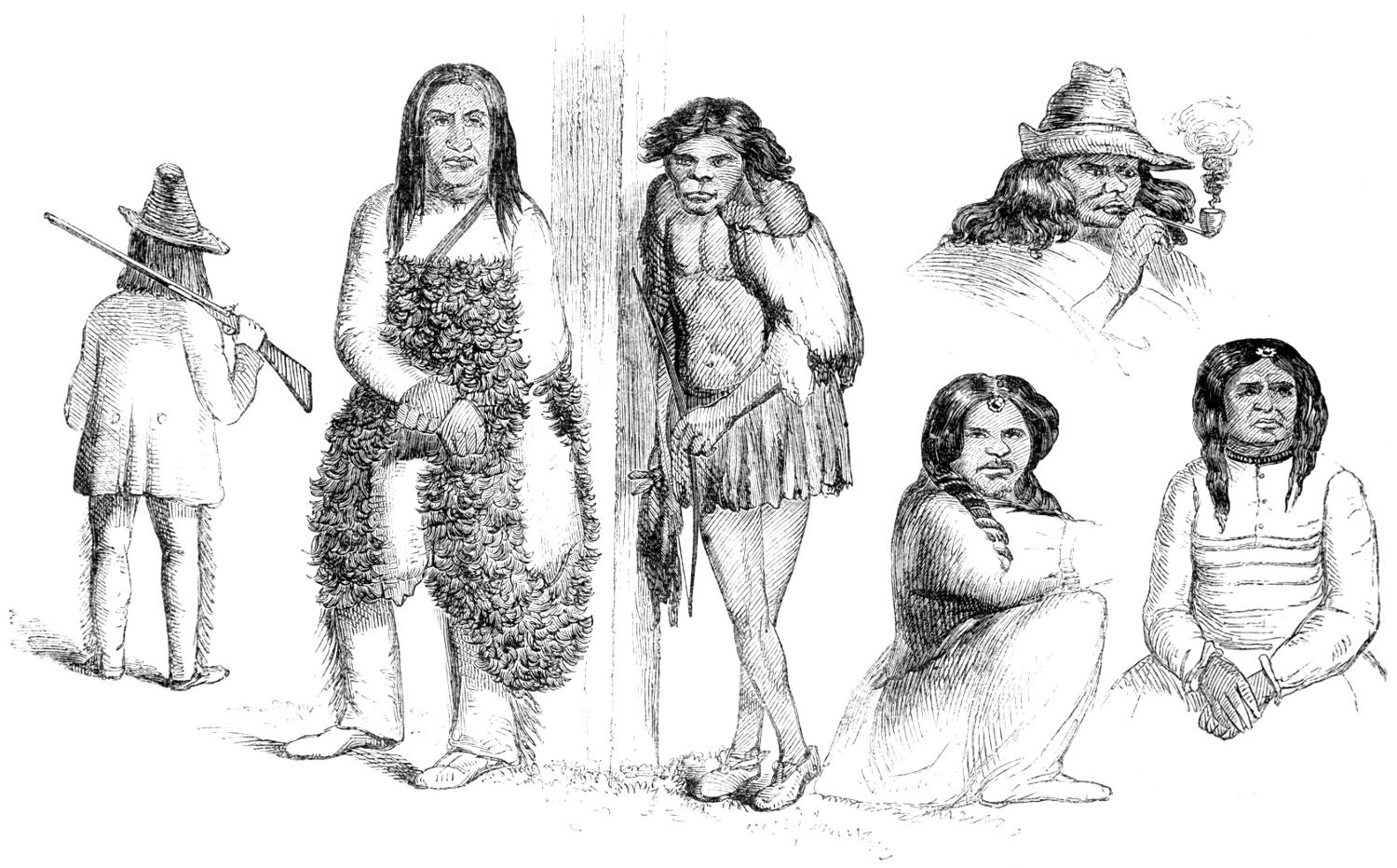
INDIANS.
The Western Swell. The Sioux. The old Shoshonee. The Arapaho. Jake the Shoshonee. The Crow.
Jake the Shoshonee.
The Western Swell.
The Sioux.
The old Shoshonee.
The Arapaho.
The Crow.
It at once became evident that the station was conducted upon the principle of the Western hotel-keeper of the last generation, and of Continental Europe about A.D. 1500—the innkeeper of “Anne of Geierstein”—that is to say, for his own convenience; the public there was the last thing thought of. One of our party who had ventured into the kitchen was fiercely ejected by the “ladies.” In asking about dormitories we were informed that “lady travelers” were admitted into the house, but that the ruder sex must sleep where it could—or not sleep at all if it preferred. We found a barn outside: it was hardly fit for a decently brought-up pig; the floor was damp and knotty; there was not even a door to keep out the night breeze, now becoming raw, and several drunken fellows lay in different parts of it. Two were in one bunk, embracing maudlingly, and freely calling for drinks of water. Into this disreputable hole we were all thrust for the night: among us, it must be remembered, was a federal judge, who had officiated for years as minister at a European court. His position, poor man! procured him nothing but a broken-down pallet. It was his first trip to the Far West, and yet, so easily are Americans satisfied, and so accustomed are they to obey the ridiculous jack-in-office who claims to be one of the powers that be, he scarcely uttered a complaint. I, for one, grumbled myself to sleep. May gracious Heaven keep us safe from all “ladies” in future! better a hundred times the squaw, with her uncleanliness and civility.
We are now about to leave the land of that great and dangerous people, the Sioux, and before bidding adieu to them it will be advisable to devote a few pages to their ethnology.