THE MUTINY OF THE BOUNTY.
Reading edition
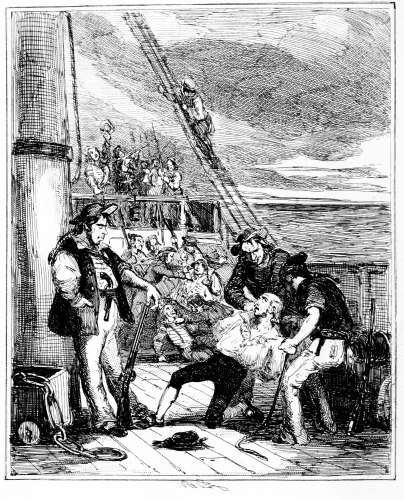
THE case of the mutineers of the Bounty has always attracted considerable attention. The Bounty was an armed vessel, commanded by Capt. Bligh, which quitted England in the autumn of 1789, for the purpose of making discoveries, and of trading among the Southern Islands; and having visited the Friendly and the Otaheitan Islands in the South Pacific Ocean, in the month of May 1790, she set sail on her way back to England. On the 27th of that month they lost sight of land; and up to that time there had been nothing in the conduct of the crew or petty officers which could induce a supposition that any disorder was likely to take place. The mid watch was duly relieved; but at daybreak on the following morning the cabin of the captain was forcibly entered by the officer of the watch, Fletcher Christian, who held the rank of master’s mate, and who had previously been considered a good and faithful seaman, aided by three others, who dragged their commander on deck, threatening instant death if he dared to speak. The captain exerted all his eloquence to bring back the mutineers to their duty, but his exertions were of no avail, and he soon afterwards found the peaceful part of the crew and the officers brought upon deck and pinioned. The mutineers told them that they need hope for no escape by employing violence, for that all the muskets were charged; and they corroborated their assertions by exhibiting an armed body of their own number with muskets and fixed bayonets. The captain at once perceived that he was in the power of his men; and his doubts as to his fate were speedily put an end to by his seeing the long-boat lowered over the side, which he and his fellows, to the number of eighteen, were commanded to enter, no other nourishment being afforded them but about one hundred and forty pounds of bread, thirty pounds of meat, a gallon and a half of rum, an equal quantity of wine, and a few gallons of water. A compass and quadrant were seized by the captain as his unfortunate companions were entering the boat; and as soon as he had taken his place, the mutineers gave three cheers, and stood away, as they said, for Otaheite.
Captain Bligh on taking muster of the remains of his crew left to him, found that he had in his boat the boatswain, the carpenter, the gunner, the surgeon’s-mate, two midshipmen, and one master’s-mate, with Mr. Nelson the botanist, and a few inferior officers. After a short consultation, it was deemed expedient to put back to the Friendly Islands; and having reached the coast of one of them, they landed, in hopes of improving their stock of provisions. For several days they continued unmolested; but at length, on the 30th of April, they were attacked by the natives with such violence
The Mutiny of the Bounty. p. 329

that one man was killed, and several wounded. They were, therefore, compelled immediately to sheer off; and it became now the subject of inquiry and deliberation as to what should be their next place of destination. Otaheite was proposed, as it was supposed that the natives would be friendly to them; but the apprehension of falling in with the Bounty determined them against this course; and with one assent they made up their minds to shape their course for Timor, a settlement belonging to the Dutch.
To effect this enterprise they were compelled to calculate the distance with a view to the apportionment of their provisions; and having discovered that it was near four thousand miles, they agreed that their rations should not exceed an ounce of bread and a gill of water a day for each man. Upon this scanty allowance they subsisted without any other nourishment until the 6th of June, when they made the coast of New Holland, and collected a few shell-fish; and with this small relief they held on their way to Timor, which they reached on the 12th, after being forty-six days in a crazy open boat, so confined in its dimensions as to prevent any of them lying down for repose, and without the least awning to protect them from the rain, which fell almost incessantly for forty days; a heavy sea and squally weather augmenting their misery during a considerable part of the time.
On their reaching Timor, they received every assistance from the governor; and having remained until the 20th of August to recruit their strength, they procured a vessel, in which they took their passage to Batavia. They reached that port on the 2nd of October, and from thence they immediately embarked for the Cape of Good Hope. Captain Bligh quitted the Cape in the month of December, and having reached England, he communicated the particulars of the mutiny to the Admiralty, and H. M. S. the Pandora was immediately despatched in search of the mutineers.
It was not until the 25th of April 1792, that despatches were received from Captain Edwards, stating that on the Pandora appearing off Otaheite, two men swam from the shore, and solicited to be taken on board. They proved to be two of the Bounty’s mutineers, and gave intelligence where fourteen of their companions were concealed on the island. A part of the Pandora’s crew were sent in search of them; and after some resistance they were taken and brought prisoners on board.
It then turned out that Christian had taken upon himself the command of the Bounty immediately on the captain’s having quitted her, and that his crew consisted of twenty-five men. When the Pandora arrived, Christian, with the other nine mutineers, had previously sailed in the Bounty to some remote island, and every exertion to discover their retreat proved ineffectual. On her return home, the Pandora struck upon a reef of rocks in Endeavour Straits. Her crew escaped from their perilous situation to an island in the Straits, except thirty-three men, and three of the Bounty’s people, who perished by the boat oversetting. Captain Edwards was reduced to the necessity of sending one of his officers and some seamen in a small boat to Timor, which they were fourteen days in reaching, and where a vessel was procured, which proceeded to the assistance of the remainder of the crew.
So much had the mutineers of the Bounty conformed to the custom and manners of Otaheite, that when two men of Christian’s crew swam off to the Pandora, they were so tattooed, and exhibited so many other characteristic stains, that on being first received on board, the Pandora’s people took them for natives of the island. The names of the above metamorphosed mutineers were, Peter Heywood, a midshipman, and Joseph Coleman, the armourer; the latter of whom, Captain Bligh observes, “was detained by Christian contrary to his inclination.”
On the 12th of September a court-martial commenced on board the Duke, in Portsmouth harbour, on Joseph Coleman, Charles Norman, Thomas Mackintosh, Peter Heywood, Isaac Morris, John Millward, William Muspratt, Thomas Birkett, Thomas Ellison, and Michael Burn. The evidence for the prosecution closed on Friday night, the 14th, and the Court indulged the prisoners till Monday to give in their defence; and on Tuesday took the whole into their consideration, when they were pleased to pass sentence of death on Heywood, Morris, Millward, Muspratt, Birkett, and Ellison, the two first of whom the Court recommended to mercy. Coleman, Norman, Mackintosh, and Burn were acquitted, and discharged.
On the 29th of October, Millward, Birkett, and Ellison, were executed on board the Brunswick: Heywood and Morris were pardoned, in compliance with the recommendation of the Court.