JAMES HARDY VAUX, TRANSPORTED FOR PRIVATELY STEALING.
Reading edition
THE adventures of James Hardy Vaux are not inferior in interest to those of the renowned Guzman d’Alfarache, or Lazarillo de Tormes, and like those celebrated rogues, in order that the public may profit by his example, he has given the world a narrative of his exploits, in which philosophers may read the workings of an unprincipled conscience, the legislator may discover the effect of the existing laws upon the mind of a criminal, and by means of which the citizen may learn to detect the frauds by which he is so constantly, and, but too frequently, so successfully beset. So excellent a moral is to be derived from the memoirs of this criminal, well written as they appear to be, that we shall furnish the reader with occasional extracts from them, giving an abridgment of those portions of them which present features of less interest.
James Hardy Vaux was born at Guildford, in the county of Surrey, in the year 1782, where his father, who was a foreigner, lived in the service of a Mr. Sumner, as cook and house-steward. It appears that the mother of this unfortunate man was born of highly respectable parents, her father being a Mr. Lowe, a solicitor in London, and that her marriage with her husband took place much against the wishes of her friends. In 1785, Mr. Lowe retired from business, and going to live in the country, he took with him his little grandson, whom he treated with parental fondness; sent him to school, and gave him a liberal education, such as to qualify him for his own profession. Mrs. Vaux’s first imprudence had partially alienated the affections of her parents, and her subsequent conduct did not tend to restore their good opinion. Young Vaux, therefore, was entirely abandoned to the care of his grandfather and grandmother, and he complains that his natural parents never treated him with anything like a proper affection.
After six years’ residence in the country, Mr. Lowe was prevailed upon to live with his daughter and son-in-law, who had recently commenced the hat business at Great Turnstile, Holborn. Young Vaux, being at this time nine years old, was sent to a respectable boarding-school at Stockwell; and after three years he returned to his grandfather, who had quitted, in consequence of family disagreements, the house of his son-in-law, and then resided in one of the squares. Mrs. Lowe’s health declining, the family removed to Wisbeach, Cambridgeshire, where they continued for some time, and then returned to their original residence in Shropshire, young Vaux being now fourteen years of age. Here he became acquainted with the son of John Maultrie, Esq., a resident in the vicinity, and, on that youth’s removal to college, his father proposed to pay for Vaux to accompany him; but his indecision and obstinacy rendered the proffered kindness of no avail. The army or navy was his ambition; but, as his grandfather would not consent to his entering either of these professions, the desire was abandoned, and, after much hesitation, he was ultimately bound an apprentice to Parker and Co. linen-drapers, at Liverpool.
As this step may be called his first entrance into life, we will let him speak for himself, as his conduct in his first situation clearly indicates his character, while it forcibly reminds youth of the danger they run in yielding to the first incentives to crime. “I was now,” said Hardy Vaux, “turned of fourteen; my health and constitution good, my spirits elevated, and I felt all those pleasing sensations which naturally arise in a youthful mind, happy in conscious innocence, and flattered by the prospect of rising to honourable independence. The gaiety and bustle of this beautiful and improving borough at once charmed and amused me; I spent a week in viewing the public buildings, the environs, &c.; but, above all, my admiration was excited by the numerous and capacious docks, by which ships of large burden are admitted, as it were, into the heart of the town, and discharge their rich and varied cargoes with surprising facility, which are deposited in spacious warehouses, of amazing extent, and from twelve to fourteen stories high, with which these noble docks are nearly surrounded.
“The opportunities I had, during my residence in Liverpool, of viewing the daily arrivals and sailings of merchant ships to and from all parts of the world, particularly the Guineamen, which formed a remarkably fine class of vessels, revived the latent desire I had for a seafaring life; and I wanted but little incitement, had the smallest opportunity offered, to take French leave of my masters, and gratify my rambling propensity. However, the bustle in which I was continually involved, and the new scenes of amusement which every succeeding day presented, suppressed the inclination for a time; but that it was not totally subdued will be seen hereafter. The establishment and economy of our house were upon the most regular plan; the former consisted of six apprentices (myself among the number), and four assistants at very liberal stipends, besides, a nephew of the elder partner, who superintended the whole and officiated in the counting-house; there were also several porters and other subordinates, for all of whom full employment was found. Being the junior apprentice, it was my province to polish the counters, trim the lamps, carry out small parcels, and to perform other inferior duties; when disengaged from which, I assisted in waiting on retail customers and making myself otherwise useful behind the counter. We had a plentiful table appropriated to us, to which we retired in turn during the hours of business, commodious and airy chambers, and, in short, we enjoyed every comfort we could desire. For the first month of my probation I behaved extremely well, and by my quickness and assiduity gained the good opinion of my employers, who wrote of me in the most favourable terms to my friends in Shropshire; nor did my expenses exceed my allowance for pocket-money, which was fully adequate to every rational enjoyment.
“Among my fellow-apprentices was a young man named King, some years older than myself, with whom, from a similarity of sentiment, I formed a close intimacy. He was of an excellent disposition, but a great lover of pleasure; and as his servitude was far advanced, and his prospects peculiarly flattering, he was under very little restraint, but gave the rein to his passion for dissipation. His expenses were profuse, but whether he indulged in them at the expense of his probity I could never ascertain. He soon introduced me to several young men of his own stamp, and I became in a short time as great a rake as the best of them: nor was our conversation confined to our own sex, scarcely a night passing without our visiting one or other of those houses consecrated to the Cyprian Goddess, with which the town of Liverpool abounds. In such a course of life, it is not likely that I could submit to limited hours: my companions and I seldom returned home before midnight, and sometimes not until the ensuing morning. Though we took measures to keep this from the ears of our employers, it could not fail to be known in time; and the consequence was a strong but tender remonstrance on my imprudence, which much affected me at the moment; but the impression was transitory and soon effaced. I plunged deeper and deeper into the vortex of folly and dissipation, until I was obliged to have recourse for advice to the Æsculapius of Gilead House. This irregular mode of life had borne hard upon my finances, and I had not, as yet, had recourse to fraud or peculation. I was liberally supplied by my relations on leaving Shropshire, and had received my first quarterly allowance; but an event, which soon followed, tempted me to the first breach of confidence and integrity. I had in my youth been passionately fond of cocking, a sport for which the county of Salop has been always famed; and, though so young, I had constantly kept several cocks at walk, unknown to my parents; so that I had acquired a considerable share of experience and knowledge on the subject. One day, when I was sent with some muslins to wait on a lady in the environs of Liverpool, near the canal, I accidentally passed a cock-pit, where a great crowd was assembled; and I understood that a grand main was about to commence. Elated at this pleasing intelligence, I hastened to execute my commission; and returning to the house, entered it, and, leaving my wrapper of goods in the care of the landlady, I ascended to the pit, and took my seat. The company was, as usual, of a motley description; but there were many genteel persons. I ventured a few trifling bets at first with various success; but at length an opportunity offering, which I considered as next to a certainty, I laid the odds to a large amount, flattering myself that, by this stroke of judgment, I should be enabled to figure away with increased éclat among my gay companions. After I had so done, greater odds were still vociferated; but in a moment the scene was changed! the fallen cock, in the agonies of death, made a desperate effort, and, rising for a moment, cut the throat of his antagonist, who was standing over him, in the act of crowing with exultation on his victory! The latter immediately fell, choked with the effusion of blood, nor did the victor survive him many moments. The whole pit resounded with acclamation, and the discord which ensued beggars description. I was not the only sufferer by this revolution of fortune; many others had laid higher odds than myself, and to a much greater amount. I was soon surrounded by my creditors, to whom I disbursed every shilling I had about me, among which were some pounds I had just received from the lady for goods, and for which I had given her a receipt. I was still something deficient, for which I pledged my honour to one of the parties, giving my address, and promising payment on an early day. I now returned home, filled with remorse and shame; but, as the first false step of a young person insensibly leads to another, I added to my guilt by concealing the affair from my employers, and directed them to book the articles the lady had selected. I had a degree of false shame about me, which rendered me incapable of confessing the truth and promising amendment, or all might still have been well. In the evening I had recourse to the bottle to drown my chagrin; and I determined to purloin a certain sum every day, in the course of my attendance on retail customers, until I had liquidated my debt of honour! Then I vowed to stop and reform. Delusive idea! how little did I then know my own weakness, or the futility of such resolutions in a young mind! And who, that once begins a career of vice, can say to himself, “Thus far will I go, and no farther?” After I had discharged my engagement I found a small sum must be raised for pocket-money, and other exigencies, as it would be above two months before I could expect a remittance.
“I therefore continued my peculation, and at length my evil genius suggested to me, that I might, by venturing a small sum, become more fortunate at the cock-pit, and repair the loss I had sustained; as miracles don’t happen every day, and the odds must win in the long run. Thus I argued with myself; and, fatally for me, I tried the experiment.
“From this moment I never missed a day’s fighting at the cock-pit; and when sent on business which required my speedy return, I could not tear myself from the spot, but frequently stayed out several hours, and, afterwards forged a lie to account for my delay. I sometimes came off a winner; but, as I was not then acquainted with the art of hedging, by which the knowing ones commonly saved themselves, I was sure to be a loser at every week’s end. But I managed matters so well, that my frequent secretions from the till were not discovered, however they might be suspected. The extensive trade of the shop rendered it next to impossible; and what I abstracted was a trifle compared to the gross receipts of the day. My continued misconduct became now the subject of frequent remonstrances on the part of Mr. Parker, the resident partner; which not having had the desired effect, that gentleman wrote to my friends, informing them in general terms that I had unhappily formed improper connexions, and that my late levity of conduct rendered me unfit to be received into their house; therefore desiring I might be recalled without delay. Mr. Parker concluded with a remark, which I shall never forget, and which was peculiarly gratifying to my grandfather’s (perhaps too partial) feelings: after expatiating on my general capacity for business, he added, ‘his smartness and activity are really wonderful.’ This letter produced a speedy answer, in consequence of which I was directed to hasten my departure, which took place in a few days, Mr. Parker giving me a great deal of wholesome advice at parting; observing that although it was not in his power to charge me with any direct criminality, my inconsiderate behaviour, and the continued excesses of my conduct, left but too much room for unfavourable conjectures.
“Behold me now returned to my grandfather, after an absence of nearly five months; and this excursion may be called my first entrance into life. I could not help blushing at the consciousness of my own unworthiness; but the blind partiality of my dear parents induced them to believe me less culpable than I really was, and to listen readily to anything I had to offer in palliation of my errors.”
Having now tasted the vicious cup of pleasure, Vaux found a village too limited a sphere for his ambition, and resolved to try his fortune in London. His grandfather, having many friends in his own profession, gave him letters of introduction, which, on his arrival in the metropolis, procured him a situation as copying clerk in a solicitor’s office. Resolving to be master of his own conduct, he did not visit the house of his father, who by this time had tried many businesses, but was unfortunate in all; but took private lodgings, and for three months conducted himself with great propriety. But, getting acquainted with several young persons of both sexes, he gradually gave way to dissipation, visited the theatres, and became irregular in his attendance at his office, in consequence of which he was formally dismissed.
Finding it still necessary to have some employment, he procured, through one of his dissipated companions, the son of a wealthy citizen, a situation, as clerk in the warehouse of Messrs. Key and Sons, wholesale stationers, in Abchurch Lane, Lombard Street, at a guinea a week. Here, however, he continued but for a short time; for he could not endure a confinement in the East End, so far from the resort of his old acquaintances, who chiefly frequented Covent Garden and the purlieus of Drury Lane.
“During an abode,” says he, “of ten months in London, as I was frequently pushed for money, I availed myself of a genteel appearance, and pretty good address; and, taking advantage of the credulity of several tradesmen in the neighbourhood, I ordered wearing apparel of various kinds, and sometimes other goods, upon credit, without much concern about the day of payment; however, I always took care to procure a bill of parcels with the articles, which precluded any charge of fraud, and left the matter, at the worst, but a debt contracted; for which, being a minor, I knew I could not be arrested. This was my first deviation from honesty since I left Liverpool. I was also frequently obliged to change my lodgings; and, as payment of my rent would have required ready money, for which I had so many other uses, I commonly decamped under favour of the night, having previously removed my effects by various stratagems. As I was ashamed to let my grandfather know the true state of my affairs, and as I really grieved at the expenses I had already caused him, which I knew had much inconvenienced him, I forbore at last to trouble him for remittances; but falsely assured him that I was doing well, and enabled to live upon the profits of my industry. I desired he would abandon the idea of articling me to the law, as the expenses attending admission had of late years been so much increased by stamp duties; and as I could, if I continued the study, at a future period, practise under the sanction of another person’s name; a custom then very prevalent, though irregular. By these assurances I quieted the good old man, and silenced any inquiries my friends might have instituted respecting me; as I now really wished to continue free from all restraint upon my person or actions, and foolishly flattered myself that I should, by some lucky event, ultimately secure the means of independence. These conjectures were, however, perfectly vague, and proceeding from no fixed idea whatever.
“On quitting my city employment, I returned to the law, for which I still retained a partiality; and obtained a more liberal salary than before in an office equally respectable. Indeed I was now become more useful, and had improved much, both in person and address, since my arrival in town.
“I was still frequently reduced to pecuniary straits, and obliged to have recourse to various expedients, known only to men of the town, for my support: some of them, indeed, were bordering on dishonesty, and none of them very honourable. But to describe them individually is impossible; and a man who lives by his wits, as the phrase is, will assure you, if called to account, that he really could not for his life tell by what distinct means he makes out a living.
“As I now wrote uncommonly fast, I quitted the station of a weekly clerk, and obtained writings to copy by the sheet, from the law-stationers, by which I could earn considerably more money; and in this employment I continued to labour diligently for several hours every day, and sometimes half the night.
“When I had a mind to relax from this occupation, and particularly if my finances were at a low ebb, I frequently resorted to the Blue Lion, in Gray’s Inn Lane, a house noted for selling fine ale, and crowded every night by a motley assemblage of visitors, among whom were many thieves, sharpers, and other desperate characters, with their doxies. I was introduced to this house (from which hundreds of young persons may date their ruin) by a fellow-clerk, who appeared to have a personal intimacy with most of these obnoxious persons; however, though I listened eagerly to their conversation, (part of which was then unintelligible to me,) and fancied them people of uncommon spirit, I was not yet sufficiently depraved to cultivate their acquaintance; but sat with a pipe in my mouth, enveloped in smoke, ruminating, like a philosopher, on the various characters who tread the great stage of life, and felt a sort of secret presentiment that I was myself born to undergo a more than common share of vicissitudes and disappointments.”
During his nightly resort to the Blue Lion he became acquainted with a young man named D——, who had been steward on board a king’s ship, but who had spent all his money, and had now resolved to go to Portsmouth, in the hope of procuring a situation similar to the one he had left. Vaux, naturally inconstant, determined on accompanying him; and, having converted most of their clothes into money, they set off on foot; but had not proceeded farther than Kingston when their cash became exhausted, and they owed a trifle to the mistress of the Eight Bells.
“In this dilemma,” says Vaux, “a sudden thought struck me. Calling for pen, ink, and paper, I told my companion I had a scheme in my head for raising a supply, but would not impart it until I had tried its success. I then drew up a sort of memorial to the following effect:—‘To the Ladies and Gentlemen of Kingston.—The writer hereof, a young man of respectable family, and good education, having, by a series of misfortunes, been reduced to the greatest distress, is now on his way to Portsmouth, in hopes of procuring a situation in the navy; but, being destitute of money for his present support, humbly solicits your charitable assistance towards enabling him to pursue his journey. To a noble mind, the pleasure of doing a good action is its own reward. The smallest donation will be gratefully received, and any lady or gentleman inclined to relieve the writer is earnestly requested to subscribe his or her name hereto.’—Having completed this production, I desired my friend to wait patiently for my return, and assured him I doubted not of bringing speedy relief. I now set out on my expedition, and immediately waited on Mr. Mayor, who was a grocer; but in this first essay I was unsuccessful. His worship declared he never encouraged applications of this sort from strangers; and desired me to go about my business. I, however, took the liberty of subscribing his name to my memorial, by way of sanction, and gave his charity credit for a donation of five shillings. Young as I was at that time, I well knew that example, in matters of this kind, goes a great way; and that many persons, without a grain of Christian benevolence in their composition, will give liberally from motives of ostentation, when they see that their neighbours have already contributed, and that their own names and donations will also be made public. I experienced the truth of this notion, for I was successful in almost every application I afterwards made. Having visited a number of genteel houses, with various success, I was on the point of returning, to impart my good luck to my companion, when, coming to a very handsome mansion-house in the suburbs of the town, I thought I ought not to omit calling, and a person at that moment passing by, I inquired whose residence it was, and which was the entrance to the premises; for the house was situated in the midst of a spacious pleasure-ground, remote from the high road, and, it being quite dusk, I had not observed any avenue by which I could gain access to it. I was informed that it was the residence of Lady W——; that a little further on I should perceive a door in the brick wall, which extended along the road-side; and that if I entered at that door, and proceeded in a straight direction, I should arrive at the servants’ hall; but my informer cautioned me to keep close to another wall on my left hand, which divided this avenue from the lawn in front of the mansion, because there was a very large and fierce dog at the upper end, but which, being chained up, could not reach me, if I followed the above directions. I thanked this obliging person, and immediately proceeded to the door described, which I entered, and walked cautiously, and not without some fear, by the wall-side, till I perceived, by the lights in the kitchen and out-offices, that I was near the premises.
“It was now very dark, and I was carefully exploring my way, my mind full of apprehensions at the thought of this terrible dog; when lo! at that instant, to my inexpressible consternation, the ferocious animal made a spring at me, and I gave myself up for dead. However, though he was certainly within a yard of me, he did me no mischief; but my alarm was so great, that, without knowing how or where to fly for refuge, I ran precipitately from the spot; and, when I recovered myself from the fright, found myself in the pleasure-ground in front of the mansion-house. It appeared that I had, without knowing, escaped through a door in the wall, which was open on my left hand at the moment I was alarmed by the dog. I was now more at a loss than ever, for I knew of no way to get out of the pleasure-ground except by the aforesaid door, and fear of the dog prevented my attempting that passage. After wandering about for a few minutes, I approached the mansion, and, going up to one of the parlour windows, which were very large, and on a level with the terrace before the house, I applied my eye to the glass, and discovered, through an aperture in the inside shutters, a numerous and splendid party of ladies and gentlemen at dinner. Having considered a moment, I determined on a very bold step, as I saw no alternative but remaining all night in the open air, exposed to the inclemency of the weather. Taking advantage of a pause in the company’s conversation, I tapped with my finger at the window, and immediately the whole party were struck with wonder. In the midst of their surprise I repeated my knock; and then, after several voices exclaiming ‘Good God! there is certainly somebody at the window,’ &c. a gentleman rose from the table, and, advancing towards me, opened first the shutters, and then the window itself, which might, in fact, be called a pair of folding-doors; and these being thrown back, I walked in with the most respectful air I could assume, and presented myself to the astonished company. Having bowed twice or thrice, and given time for their alarm to subside, I began to make my speech.
“Apologizing for my presumptuous intrusion, I stated in a concise manner the fright I had endured from the dog, my embarrassment at not being able to find means of egress from the pleasure-ground, and my having consequently taken the liberty of knocking at the window. I then presented my memorial, which was read in turn by most of the company, each of whom surveyed me with evident surprise. Having answered such queries as they thought proper to put to me, I was desired by the lady of the house to withdraw to the kitchen for a short time; and a servant was ordered to attend me thither. Here I had my story to repeat for the information of the domestics, who laughed heartily at the adventure of the dog, but afterwards seriously assured me that, had the animal not been chained, or had I approached within his reach, he would inevitably have torn me to pieces. The parlour dinner being over, and the dishes brought out, I was desired to fall to; and, being really hungry, I wanted no pressing, but selected from the variety of good things on the table a very fine buttock of beef, on which substantial fare I made a sumptuous meal. There was no scarcity of good malt liquor, and Lady W—— very kindly sent me out a pint of red port, with a particular injunction (which, by-the-by, was unnecessary) that I should eat and drink heartily.
“At length I was summoned to attend the company in the parlour; and her ladyship then expressing her concern for my misfortunes, and her anxious hope that I should speedily find an end to them, presented me with half a guinea. The rest of the party also said many handsome things, and the majority of them contributed to my relief. In addition to these favours, one of the gentlemen at the particular request of Lady W——, took the trouble to write a letter in my behalf to the captain of a man-of-war, supposed to be then lying at Portsmouth, entreating him to give me an appointment under him. Her ladyship, after obliging me to take another glass of wine, and repeating her sorrow for my distress, advised me to lose no time in prosecuting my journey, ordered a servant to conduct me to the door at which I had first entered her premises, and I took a respectful leave of this truly benevolent party.
“Returning to the Eight Bells, I imparted my adventures to my friend, who was, of course, much pleased at my success; for I had realised between four and five pounds. I found this begging scheme so productive, that I was in no hurry to pursue the Portsmouth speculation; and, as we were both satisfied with our present quarters, it was agreed that we should continue a few days longer in Kingston, in which time I proposed to follow up my success by making a regular circuit among the inhabitants, and I, in fact, determined to levy similar contributions in every town which lay in our route.
“It is to be observed that this idea of raising money was perfectly original in me, for at that time I had never heard of such a practice, but have since discovered that it is a very common expedient, and is called by those persons who live by such impositions, ‘the Letter Racket.’
“The following day I again sallied forth and met with equal success, visiting not only the houses of private persons, but even the respectable shopkeepers, &c.; and I may here state, once for all, that in the course of this as well as my subsequent speculations of the same nature, I met with various receptions according to the charitable or churlish dispositions of the people to whom I applied. Many pitied my case and cheerfully relieved me. Others expressed equal commiseration, but declined giving anything, either because ‘they never encouraged beggars,’ or ‘they had poor enough of their own to maintain.’ Some invited me into their parlours, treated me with excessive politeness, and obliged me to take refreshment at their own tables; and where there were any young ladies in the family, I was an object of particular solicitude, and the recital of my misfortunes drew many a sigh from their tender bosoms. Others desired me like the Mayor of Kingston to go about my business, and hinted that I ought to be sent to the house of correction as a vagrant. Sometimes the servants who admitted me refused to present my memorial, declaring that they had strict orders from their masters or mistresses never to trouble them on such an occasion. The donations I commonly received were from one shilling to five; sometimes, but rarely, I was presented with gold, particularly at the seats of the nobility and gentry; all which lying within a short distance of the road I travelled, I made a point of calling at; and for my information on this subject, I provided myself with a comprehensive ‘Book of Roads,’ in which those objects are correctly laid down. Some truly charitable persons, but whose means were limited, relieved me with sixpence, and of course I was bound to accept such a trifle with as much appearance of thankfulness as I would a larger sum; and frequently when I called at a farm-house by the road side, I have been compelled to take some cold meat or other eatables, which I afterwards bestowed upon the first more needy beggar I met on my way. It was my custom in general to travel on foot, making short stages, and putting up at a good inn in every town I entered, where I lived upon the best during my stay, and associated with London riders, and other respectable guests. When tired of walking. I availed myself of a passing stage-coach or return post-chaise; and my only equipage was a spare shirt, handkerchief, &c. which, with my ‘Book of Roads,’ I carried in a small bundle under my arm.”
On the evening of the second day, however, he was arrested and carried before the magistrates, charged as a rogue and vagabond. He referred the magistrates to one of his grandfather’s friends in London; and the inquiries there satisfying them, he was discharged out of custody on the second day of confinement, and hastened back to town, his companion having proceeded to Portsmouth. After spending one dissipated evening in London, he set out next day to Portsmouth; and, notwithstanding the check he had received three days earlier, he stopped in Kingston, and levied contributions, in the usual way, on the charitable inhabitants, avoiding, of course, that part of the town where he had been before. This practice he continued on the road, and after the payment of his expenses he still had 15l. in his pocket. On his reaching Portsmouth, his fervour for the navy cooled on his finding that his friend D—— had procured a situation as a merchant’s clerk, and he was, after some time, induced to enter into the service of an attorney. A short employment was quite sufficient to satisfy his industrious fit, and he soon quitted Portsmouth in disgust, and proceeded once more towards the great metropolis. There his good fortune threw before him an opportunity, which steadiness on his part only required to render most advantageous. Dining one day at the Saracen’s Head, Snow Hill, he entered into conversation with a gentleman named Kennedy, a surgeon in the navy, who, pleased with his manner and address, procured for him an appointment as midshipman on board the Astrea frigate. Delighted with the prospect of at length entering the navy, he wrote to his grandfather, who immediately furnished him with 100l. to purchase an outfit. On the voyage he became weary of his position as a midshipman, and the captain being in want of a clerk, he tendered his services and was accepted. At the conclusion of a long cruise in the northern latitudes, the vessel made for England; and on their arrival in the Thames, Vaux proceeded to London. He there met with a dashing Cyprian, and unmindful of the future, he remained with her until all his money was spent; and then he found that his vessel had sailed, carrying with her his clothes, books, and all the little property of which he was possessed. Now, driven to the greatest distress, he had recourse to the gaming-table, where for a short time he contrived, by associating with professed gamblers, to procure a precarious existence. But the summer approaching and dupes becoming fewer, he obtained by application to Messrs. Dalton and Edwards, King’s Bench Walk, a situation as clerk at one pound a week, with Mr. Dalton, a solicitor, of Bury St. Edmund’s. “Upon the whole,” says he, “this was one of the most agreeable employments I ever engaged in; and, had I prudently retained it for a few years, there is no doubt I should have met with the most liberal encouragement from my employer. But my natural inconstancy still prevailed; and I had been but a few weeks at Bury, before I grew tired of the country, and thought of nothing but returning to London, with such spoil as I could obtain from the credulity of the tradesmen in the town. With this view I bespoke clothes, boots, linen, and other articles at various shops, informing the parties that I should expect credit till the expiration of my quarter, to which, on account of the respectable gentleman I served, they readily consented. As soon as any of these goods were brought home, I immediately packed them up in small portable parcels, which I sent up to London by the coach, consigned to a pawnbroker with whom I was on intimate terms; desiring him to receive and keep them safe until he saw me. I also coached off, in the same clandestine manner, such of my own apparel, &c. as I had in my trunk, in which, to prevent discovery, I deposited stones or bricks to preserve its gravity. By these means I had nothing to impede my sudden departure, when rendered necessary by the arrival of the expected quarter-day.
“I must here observe, to meet any surprise the reader might feel on the subject, that, as I had never at this time been connected with downright thieves, so I had never yet committed an actual theft, save the embezzlement of money at Liverpool; (which indeed the law has lately made a felonious taking;) though I therefore scrupled not at practising a fraud, I was not yet sufficiently depraved to commit a robbery. This will account for my not robbing the premises of Mr. Dalton, which, at a subsequent period of my life, would have been my primary object, as I had access to every part of the house, and have frequently viewed with longing eyes the servant cleaning a handsome service of plate in the pantry.
“I had now been about two months at Bury, and had no intention of absconding till the expiration of the third; when an accidental event induced me to hasten my departure. One afternoon Mr. Dalton had written several letters in the office, and the footman being elsewhere engaged, he requested me to drop them in the post-office in my way home. I accordingly brought them out in my hand, and happening inadvertently to cast my eye on the superscriptions, I perceived that one was addressed to Mr. Lyne, tailor, Cecil Street, Strand, London. Being curious to know what correspondence Mr. Dalton could have with a tailor, I opened this letter, and found the contents to the following effect:—‘Mr. Lyne,—By the waggon which goes from hence on Monday next, and arrives at the Blue Boar in Bishopsgate Street on Wednesday night, I shall send you a portmanteau corded and sealed, but not locked, containing two coats, sixteen waistcoats, fourteen pair of breeches, and a suit of uniform of the City Light Horse. Most of these articles are nearly as good as new; but, as they have now become unfashionable, I desire you will dispose of them to the best advantage, on my account, and send me down by the same conveyance two suits made in the present taste,’ &c.
“It immediately struck me, that, if I took measures accordingly, I might arrive in town time enough to intercept and obtain this trunk from the inn; for which purpose I put this letter in my pocket, and the others in the post-office. The next day, happening to go into Mr. Dalton’s kitchen, I there saw the portmanteau corded up, and directed; and, on questioning the servant in a careless manner about it, he informed me that he was going to carry it to the inn, the following evening, in readiness for the departure of the waggon. The same afternoon it happened (which was a most fortunate circumstance for me) that Mr. Dalton again begged of me to put some letters in the post-office, which he had not done above twice or thrice since I came into his service. Looking at these letters, I saw, to my surprise, another addressed to Mr. Lyne as before, which, eagerly opening, I found was to mention something Mr. Dalton said he had forgot in his letter of the preceding day. I immediately destroyed this second letter, which, had it come to hand, might have frustrated my design.
“I now prepared matters for eloping, and sent off the remainder of my effects by the coach, as before; but my good fortune produced another windfall, of which I had no expectation. The day before my intended departure, I was walking in the Market-place with a young man, who was clerk to another attorney in the town; and, the conversation turning upon watches, my companion observed that, if I wished to purchase one, he would introduce me to a maker of his acquaintance, who would use me well on his account. I took him at his word, and begged he would immediately do so. We were then within a few doors of the shop, into which we entered; and I perceived over the window in large characters, ‘Lumley and Gudgeon, watchmakers.’ I laughed inwardly at the singularity of the latter name, which I considered ominous of my success in the imposition I meant to put upon him. After a short preliminary conversation, my acquaintance, having business to do, took his leave, and Mr. Gudgeon himself proceeded to show me several watches. I informed him that I wished to have a good one, but my circumstances would not allow me to go to a high price. Mr. Gudgeon assured me it was better to have a good one at once, and recommended me to a very handsome gilt watch, capped and jewelled, and his own make, which he said he could warrant to perform well, and for which he asked me eight guineas. I replied that, as my weekly salary from Mr. Dalton was but one pound, I could not afford to give so much, and began to examine others of a cheaper kind, but still letting him see that I had a strong inclination for the one he had recommended. This induced him to repeat his praises of the latter, and to press me with greater energy to fix upon it. I at length (with a show of much reluctance) suffered myself to be persuaded; but I begged leave to observe, that as I was influenced in everything by the advice of my good master, Mr. Dalton, I would not venture to make so extensive a purchase without his approbation: that, if he would therefore entrust me with the watch, I would consult Mr. Dalton, and give him (Mr. Gudgeon) a decisive answer the next morning: this he declared himself willing to do, on which I took both the watch and my leave together, and returned home.
“The next morning I attended the office as usual, but of course took no notice to Mr. Dalton of the affair in hand. During the space of time I allotted myself for dinner, I again called on Mr. Gudgeon, and told him that I would keep the watch, provided he should receive the payment by instalments, as I could not afford to pay the whole price at once. I therefore proposed to give him the ensuing Saturday one or two guineas, as I should find most convenient, and to pay him half-a-guinea a week afterwards, until the whole was liquidated. To this he readily agreed, and, having fitted a key to the watch, he begged leave to show me some chains and seals. Of the former he had none but gilt ones: I selected one of the neatest, and a handsome gold seal. I then desired to have a bill of parcels of the whole, observing that, whenever I paid a sum upon account, Mr. Gudgeon could make a memorandum of it at the bottom by way of receipt. Having obtained this, I departed, promising to be punctual in paying my first instalment on the day appointed. This took place on Tuesday, the portmanteau being now on its way to London; and the same evening I quitted my lodgings privately, leaving nothing behind but a trunk, containing brick-bats and stones, and walked by moonlight to a village four miles distant, through which the stage-coach was to pass next morning at seven o’clock. I procured some supper at a decent public-house, and retired to rest, desiring to be called in time for the coach. At the expected hour the stage made its appearance, in which I seated myself, and about eight the same evening arrived at the Blue Boar, just two hours after the waggon, which I perceived standing in the yard.”
He received the portmanteau with little difficulty, and having disposed of its contents in various ways, lived upon the produce for five or six weeks, at the termination of which he thought it right to look out for a new situation. He found one in the office of Mr. Preston, solicitor; and with the imprudence of dishonest persons, entered upon it, though the office was next door to Dalton and Edwards, who had sent him down to Bury St. Edmund’s. He was soon recognised by a clerk of Messrs. Dalton and Edwards, and, being called into the parlour by Mr. Preston one morning, he was surprised at seeing his late master, who snatched the watch out of his fob, and promised to restore it to the owner. Vaux was then taken into custody; but a friend of his grandfather having come forward, and indemnified Mr. Dalton for his loss, he was suffered to go at large, on a promise that he would quit London, where he was likely to come to disgrace and infamy, and endeavour to obtain employment in the country.
The country had no charms for him, however, and he set about procuring a situation in some retail shop in town, for the sole purpose of embezzling the receipts. In consequence of an advertisement in a newspaper, he applied to a Mr. Gifford, the keeper of a masquerade warehouse, and there he obtained employment upon a forged representation of his good character. He did not fail at this place in collecting a good booty, and having at length, by means of stealing goods from the shop, and embezzling money which he had received on his master’s account, secured about sixty pounds’ worth of property, he suddenly absconded and commenced a round of dissipation and gaiety. He had been at large scarcely a fortnight, however, before he was taken into custody at the instance of his late master, and upon his prosecution was committed to the quarter sessions, but there his good fortune aided him, and in consequence of some informality in the proceedings, he was acquitted.
Upon a second appearance at the same bar he was not quite so successful; and it appears that having been detected in the act of picking pockets with a companion named Bromley, they were both secured, and having been convicted, they were on the 23rd September, 1800, sentenced to seven years’ transportation. Vaux was sent to Port Jackson in the following May, and there he was assigned to a Mr. Baker, a storekeeper at Hawkesbury, about twenty-six miles from Paramatta, who appointed him his clerk. In consequence of his good conduct during the ensuing three years, he was promoted to a place in the secretary’s office, in Sydney, but there, conspiring with his fellows, in the commission of various frauds, he was discovered and sentenced to be worked in a road-gang. During two months he continued in Sydney in this degraded condition, but then he was drafted to Castle Hill, a plantation twenty-four miles in the interior, and there, after about ten months’ service, he was appointed clerk to the superintendant of the works. Having subsequently served the office of clerk to the magistrates at Paramatta, he at length, on the 10th February, 1807, returned to England. There he found a woeful change had taken place, his father and his grandmother being dead; and all served to remind him of the sinful course of life he had led, and of his fallen condition. All his resolutions against returning to a dishonest mode of living were however unavailing, and at length he became a professed and a professional thief. In order the better to carry on his new trade, he associated himself with some fellows of dissolute habits, but at length meeting with his old friend Bromley, he resolved to quit his new companions and to pursue his avocation with one accomplice only.
In reference to his future proceedings he says, “Having withdrawn myself from my late companions, I now became very circumspect in my proceedings; and as Bromley had neither the appearance nor the manners of a gentleman, I only made use of him occasionally in the course of my practice, keeping him in the back-ground to receive and carry any articles which I purloined, and never suffering him to converse with or approach me, except in private. I generally spent the mornings, that is from about one to five o’clock P.M. (which are the fashionable hours for shopping) in visiting the shops of jewellers, watchmakers, pawnbrokers, &c. Having conceived hopes that this species of robbery would turn to a good account, and depending upon my own address and appearance, I determined to make a circuit of the town, and not to omit a single shop in either of those branches; and this scheme I actually executed so fully, that I believe I did not leave ten shops untried in all London, for I made a point of commencing every day in a certain street, and going regularly through it on both sides of the way. My practice was to enter a shop and request to look at gold seals, chains, brooches, rings, or any other small articles of value; and, while examining them, and looking the shopkeeper in the face, I contrived by sleight of hand to conceal two or three (sometimes more) in the sleeve of my coat, which was purposely made wide. On some occasions I purchased a trifling article to save appearances; at other times I took a card of the shop, promising to call again; and, as I generally saw the remaining goods returned to the window, or place from whence they were taken, before I left the shop, there was hardly a probability of my being suspected, or of the property being missed. In the course of my career I was never once detected in the fact, though, on two or three occasions so much suspicion arose, that I was obliged to exert all my effrontery and to use very high language, in order, as the cant phrase is, to bounce the tradesman out of it; and my fashionable appearance, and affected anger at his insinuations, had always the effect of convincing him that he was mistaken, and inducing him to apologise for the affront put upon me. I have even sometimes carried away the spoil notwithstanding what had passed; and I have often gone a second and third time to the same shop, with as good success as at the first. To prevent accidents, however, I made it a rule never to enter a second shop with any stolen property about me; for, as soon as I quitted the first, I privately conveyed my booty to Bromley, who was attending my motions in the street, and herein I found him eminently useful. By this course of depredation I acquired on the average about ten pounds a week, though I sometimes neglected shopping for several days together. This was not, indeed, the only pursuit I followed, but was my principal morning’s occupation; though, if a favourable opportunity offered of getting a guinea by any other means, I never let it slip. In the evenings I generally attended one of the theatres, where I mixed with the best company in the boxes, and, at the same time that I enjoyed the amusements of the place, I frequently conveyed pocket-books, snuff-boxes, and other portable articles, from the pockets of their proprietors into my own. Here I found the inconvenience of wanting a suitable companion, who might have received the articles I made prize of, in the same manner as Bromley did in the streets; but though I knew many of the light-fingered gentry, whose appearance fitted them for my company, yet, their faces being well known to the police-officers, who attended the theatres, they would not have been suffered to enter the house: and herein I possessed an advantage which many of these gentry envied me; for being just arrived in England, and a new face upon the town, I carried on my depredations under the very noses of the officers without suspicion. Having, therefore, at first no associate, I was obliged to quit the theatre, and conceal my first booty in some private spot, before I could make (with prudence) a second attempt. Upon the whole, I was very successful in this pursuit also, at least as to the number of articles I filched; and had their value been reasonably proportionate to what I expected, I need not long have followed so hazardous an employment. I have very frequently obtained nine or ten pocket-books, besides other articles in an evening; and, these being taken from gentlemen evidently of fortune and fashion, I had reason to expect I should some time meet with a handsome sum in bank-notes: but fortune did not favour me therein, for, during near twelve months’ almost nightly attendance at one or other of the public places, I never found more than twenty pounds in a book, and that only on one occasion. I several times got five, ten, or eleven pounds, but commonly one, two, or three pounds; and most generally four books out of five contained nothing but letters, memorandums, and other papers useless to me. At the same time I knew frequent instances of the common street pickpockets getting a booty of fifty, one hundred, and sometimes three or four hundred pounds. However, I never failed to pay the expenses of the night; and if I gained nothing, I enjoyed at least a fund of amusement, which was to me the highest gratification. It sometimes happened that the articles I got (particularly pocket-books) were advertised by the losers, within a few days, as “Lost,” and a reward offered for their restoration: where this reward was worth notice, I frequently restored the property by means of a third person whom I could confide in, and whom I previously tutored for the purpose.
“In the mean time, the manner in which I spent my life, abstracted from the disgraceful means by which I supported myself, was (as I have formerly hinted) perfectly regular and inoffensive. Though I lived by depredation, yet I did not, like the abandoned class of common thieves, waste my money and leisure time in profligate debauchery, but applied myself to the perusal of instructive and amusing books, my stock of which I daily increased. I occupied genteel apartments in a creditable house, the landlord of which understood me to hold a situation under government; and every part of my conduct at home tended to confirm his opinion of my respectability. I was scrupulously exact in paying my rent, as well as the different tradesmen in the neighbourhood with whom I had occasion to deal; nor did I ever suffer any person of loose character to visit me, but studiously concealed from those of my acquaintance my place of residence. I was sometimes, indeed, so imprudent as to resort, for company’s sake, to some of those public-houses frequented by thieves and other dissolute characters, the landlord of which is himself commonly an experienced thief, or returned transport. When I had a mind to relax a little, or grew tired of domestication, I disguised my appearance as much as I could, and repaired to a house of this description, sometimes taking my Dulcinea with me, whom I shall shortly introduce to the reader, and whose person and dress I was not a little proud of exhibiting in public. This fondness for flash-houses, as they are termed, is the rock on which most persons who live by depredation unhappily split, and will be found in the sequel to have brought me to my present deplorable condition; for the police-officers, or traps, are in the daily habit of visiting these houses, where they drink with the thieves, &c., in the most familiar manner; and, I believe, often obtain secret information by various means from some parties respecting the names, characters, pursuits, &c., of others. By this imprudent conduct I also became personally known to many of the officers, which was productive of great danger to me in the exercise of my vocation; whereas, had I avoided such houses, I might have remained unknown and unsuspected by them for a series of years.”
The Dulcinea alluded to above was an unhappy girl of the town, whom he took into keeping, and afterwards married. This poor creature behaved to him in the most exemplary manner, and proved by her conduct that she was worthy of a better fate.
Going one day to a public meeting at the Mermaid Tavern, Hackney, he picked a gentleman’s pocket of a silver snuff-box, which he handed to the landlady. The box was missed by the owner, and on Vaux claiming it, he was taken into custody; but such is the glorious uncertainty of the law, that he was acquitted on his trial, contrary to his own expectation.
“The next adventure,” says Vaux, “I shall have occasion to relate, more fully confirms the justice of the remark, that the connexions formed by persons during temporary confinement in a gaol commonly lead to further acts of wickedness, and frequently entail on the parties a more severe
The Flash Ken. P. 486

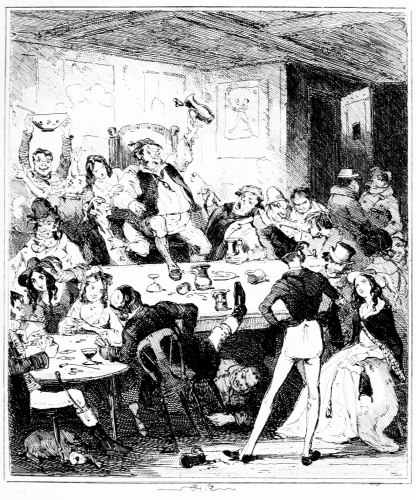
punishment than that which they have just escaped. This was exactly my unhappy case, and I now come to the most fatal era of my eventful life.
“In the same ward with myself were confined two brothers, very genteel young men, who had been recently cast for death for privately stealing some valuable rings, &c., from the shop of a jeweller in Leadenhall Street. As a conformity of character, or similarity of pursuits, is the strongest source of friendship, so these persons and myself had become very intimately acquainted. In the course of our frequent conversations on the subject with which we were all three alike most conversant, the brothers informed me that they had, like myself, made a successful tour of the jewellers’ shops in London: and on our comparing notes as to the particular persons we had robbed, or attempted to rob, they pointed out about half-a-dozen shops, which, it appeared, I had omitted to visit, arising either from their making no display of their goods, or from their being situated in private streets, where I had no idea of finding any such trades. Though at that time neither they nor myself entertained much hope of my acquittal, it was agreed that, in the event of my being so fortunate as to recover my freedom, I should pay my respects to the several tradesmen I had so overlooked; and I promised, in case I was successful, to make them a pecuniary acknowledgment in return for their information. At the moment of my joyful departure from Newgate, they accordingly furnished me with a list of the shops in question, and gave me full instructions and useful hints for my guidance therein. They particularly pointed out a Mr. Bilger, a goldsmith and jeweller of the first eminence in Piccadilly. This gentleman, they assured me, I should find, in the technical phrase, a good flat. They advised me to bespeak a diamond ring, or similar article, and to request a sight of some loose diamonds, for the purpose of selecting such stones as I might wish to have set, informing me that he was generally provided with a large quantity, which he would not fail to show me, and that I might with ease purloin a good number of them. A day or two after my release I made the prescribed experiments, and was fortunate enough to succeed pretty well at nearly every shop; but I reserved Mr. Bilger for my final essay, as he was the principal object of consideration, and from whom I expected to obtain the most valuable booty. On the day se’nnight after my trial at the Old Bailey, I prepared in due form to pay him a visit. About five o’clock in the evening I entered his shop, dressed in the most elegant style, having a valuable gold watch and appendages, a gold eye-glass, &c. I had posted my old friend and aid-de-camp, Bromley, at the door, in order to be in readiness to act as circumstances might require, and particularly to watch the motions of Mr. Bilger and his assistants on my quitting the premises. On my entrance Mrs. Bilger issued from a back parlour behind the shop, and, politely inquiring my business, I told her I wished to see Mr. Bilger; she immediately rang a bell, which brought down her husband from the upper apartments. He saluted me with a low bow, and handed me a seat. I was glad to find no other person in the shop, Mrs. Bilger having again retired. I now assumed the air of a Bond Street lounger, and informed Mr. Bilger that I had been recommended by a gentleman of my acquaintance to deal with him, having occasion for a very elegant diamond ring, and requested to see his assortment. Mr. Bilger expressed his concern that he happened not to have a single article of that description by him, but, if I could without inconvenience call again, he would undertake in one hour to procure me a selection from his working jeweller, to whom he would immediately despatch a messenger. I affected to feel somewhat disappointed, but looking at my watch, after a moment’s reflection, I said, ‘Well, Mr. Bilger, I have an appointment at the Cannon Coffee-house, which requires my attendance, and if you will without fail have the articles ready, I may probably look in a little after six.’ This he promised faithfully to do, declaring how much he felt obliged by my condescension; and I sauntered out of the shop, Mr. Bilger attending me in the most obsequious manner to the outer door. After walking a short distance, Bromley tapped me on the shoulder, and inquired what conduct I meant next to pursue; for he had viewed my proceedings through a glass-door in the shop, and saw that I had not executed my grand design. I related to Bromley the result of my conversation with Mr. Bilger, and added that I meant to retire to the nearest public-house, where we could enjoy a pipe and a glass of negus until the expiration of the hour, to which I had limited myself. We accordingly regaled ourselves at a very snug house, nearly opposite Bilger’s, until about half-past six, when I again repaired to the scene of action, leaving Bromley, as at first, posted at the door. Mr. Bilger received me with increased respect, and, producing a small card box, expressed his sorrow that his workmen had only been enabled to send three rings for my inspection; but that, if they were not to my taste, he should feel honoured and obliged in taking my directions for having one made, and flattered himself he should execute the order to my satisfaction. I proceeded to examine the rings he produced, one of which was marked sixteen guineas, another nine guineas, and the third six guineas. They were all extremely beautiful; but I affected to consider them as too paltry, telling Mr. Bilger that I wanted one to present to a lady, and that I wished to have a ring of greater value than the whole three put together, as a few guineas would not be an object in the price. Mr. Bilger’s son, who was also his partner, now joined us, and was desired by his father to sketch a draught in pencil of some fancy rings, agreeable to the directions I should give him. The three rings I had viewed were now removed to the end of the counter next the window, and I informed the young man that I wished to have something of a cluster, a large brilliant in the centre, surrounded with smaller ones; but repeated my desire that no expense might be spared to render the article strictly elegant, and worthy a lady’s acceptance. The son having sketched a design of several rings on a card, I examined them with attention, and appeared in doubt which to prefer, but desired to see some loose diamonds, in order to form a better idea of the size, &c. of each ring described in the drawing. Mr. Bilger, however, declared he had not any by him. It is probable he spoke the truth: or he might have lost such numbers by showing them, as to deter him from exhibiting them in future. Without having made up my mind on the subject, I now requested to see some of his most fashionable brooches or shirt-pins. Mr. Bilger produced a show-glass, containing a variety of articles in pearl, but he had nothing of the kind in diamonds. I took up two or three of the brooches, and immediately sunk a very handsome one, marked three guineas, in my coat sleeve. I next purloined a beautiful clasp for a lady’s waist, consisting of stones set in gold, which had the brilliancy and appearance of real diamonds, but marked only four guineas. I should probably have gone still deeper, but at this moment a lady, coming in, desired to look at some ear-rings, and the younger Mr. Bilger immediately quitted his father to attend upon her at the other end of the shop. It struck me that now was my time for a decisive stroke. The card containing the diamond rings, procured from the maker, lying very near the show-glass I was viewing, and many small articles irregularly placed round about them, the candles not throwing much light upon that particular spot, and Mr. Bilger’s attention being divided between myself and the lady, to whom he frequently addressed himself, I suddenly took the three rings from the card, and committed them to my sleeve to join the brooch and lady’s clasp; but had them so situated that I could in a moment have released and replaced them on the counter, had an inquiry been made for them. I then looked at my watch, and, observing that I was going to the theatre, told Mr. Bilger that I would not trouble him any further, as the articles before me were too tawdry and common to please me, but that I would put the card of draughts in my pocket-book; and, if I did not meet with a ring of the kind I wanted before Monday or Tuesday, I would certainly call again and give him final directions. I was then drawing on my gloves, being anxious to quit the shop while I was well; but Mr. Bilger, who seemed delighted with the prospect of my custom, begged so earnestly that I would allow him to show me his brilliant assortment of gold watches that I could not refuse to gratify him, though I certainly incurred a great risk by my compliance. I therefore answered, ‘Really, Mr. Bilger, I am loath to give you that unnecessary trouble, as I have, you may perceive, a very good watch already, in point of performance, though it cost me a mere trifle—only twenty guineas; but it answers my purpose as well as a more valuable one. However, as I may probably, before long, want an elegant watch for a lady, I don’t care if I just run my eye over them.’ Mr. Bilger replied that the greater part of his stock were fancy watches, adapted for ladies; and he defied all London united to exhibit a finer collection. He then took from his window a show-glass, containing about thirty most beautiful watches, some ornamented with pearls or diamonds, others elegantly enamelled, or chased in the most delicate style. They were of various prices, from thirty to one hundred guineas; and the old gentleman rubbing his hands with an air of rapture, exclaimed, ‘There they are, sir; a most fashionable assortment of goods; allow me to recommend them, they’re all a-going, sir—all a-going.’ I smiled inwardly at the latter part of this speech, and thought to myself, ‘I wish they were going, with all my heart, along with the diamond rings.’ I answered they were certainly very handsome, but I would defer a minute inspection of them till my next visit, when I should have more time to spare. These watches were ranged in exact order, in five parallel lines; and between each watch was placed a gold seal or other trinket appertaining to a lady’s watch. It was no easy matter, therefore, to take away a single article without its being instantly missed, unless the economy of the whole had been previously deranged. I contrived, however, to displace a few of the trinkets, on pretence of admiring them, and ventured to secrete one very rich gold seal, marked six guineas. I then declared I could stay no longer, as I had appointed to meet a party at the theatre; but that I would certainly call again in a few days, and lay out some money in return for the trouble I had given. Mr. Bilger expressed his thanks in the most respectful terms, and waited upon me to the door, where he took leave of me with a very low congé, à la mode de France, of which country he was a native. I now put the best foot foremost, and having gained a remote street, turned my head, and perceived Bromley at my heels, who seized my hand, congratulating me on my success, and complimenting me on the address I had shown in this exploit; for he had witnessed all that passed, and knew that I had succeeded in my object, by the manner in which I quitted the shop. He informed me that Mr. Bilger had returned to his counter, and, without attending to the arrangement of the articles thereon, had joined his son, who was still waiting upon the lady, and that he, Bromley, had finally left them both engaged with her.”
Such was his rapacity, that he renewed his visit to Mr. Bilger’s shop; but the reception he met satisfied him that he was suspected. He, however, left an order for a splendid ring; and, while the jeweller’s son, as Vaux thought, was taking down his directions, he was only writing a description of his person, and a handbill in a few days was widely circulated among the pawnbrokers, peace-officers, &c. A day or two after Vaux called at Turner’s—a pawnbroker, in Brydges Street, Covent Garden—to redeem some article he had pledged, when he saw such manœuvres in the shop as induced him to make a precipitate retreat, and go into concealment.
At length, “necessity,” as he says himself, forced him out; and, the first night, he stole, from a shop in Ludgate Street, property to the amount of four or five pounds, with which he was so much pleased that he returned for his wife, and took her out to walk. Contrary to her earnest remonstrance, they went to a flash-house, near Clare Market, where the landlord betrayed him into the hands of justice, and he was hurried off to the watch-house. Next day he underwent an examination at Bow Street, and was remanded. During the interval between his first and second appearance he had completely metamorphosed his person by cutting his hair and whiskers, and putting on a mean suit of clothes. But all would not do; he was recognised through his disguise, and fully committed. His trial came on at the Old Bailey, February the 15th, 1809, and, the facts being sworn to, he was found guilty—death. His sentence was afterwards commuted to transportation for life, preparatory to which he was conveyed on board the Retribution hulk at Woolwich.
“I had now,” says Vaux, “a new scene of misery to contemplate; and, of all the shocking scenes I had ever beheld, this was the most distressing. There were confined in this floating dungeon nearly six hundred men, most of them double-ironed, and the reader may conceive the horrible effects arising from the continual rattling of chains, the filth and vermin naturally produced by such a crowd of miserable inhabitants, the oaths and execrations constantly heard among them; and, above all, from the shocking necessity of associating and communicating more or less with so depraved a set of beings. On arriving on board, we were all immediately stripped, and washed in large tubs of water; then, after putting on each a suit of coarse slop clothing, we were ironed, and sent below, our own clothes being taken from us, and detained till we could sell or otherwise dispose of them, as no person is exempted from the obligation to wear the ship-dress. On descending the hatchway, no conception can be formed of the scene which presented itself. I shall not attempt to describe it; but nothing short of a descent to the infernal regions can be at all worthy of a comparison with it. I soon met with many of my old Botany Bay acquaintances, who were all eager to offer me their friendship and services,—that is, with a view to rob me of what little I had; for in this place there is no other motive or subject for ingenuity. All former friendships or connexions are dissolved, and a man here will rob his best benefactor, or even messmate, of an article worth one halfpenny. Every morning, at seven o’clock, all the convicts capable of work, or, in fact, all who are capable of getting into the boats, are taken ashore to the Warren, in which the Royal Arsenal and other public buildings are situated, and are there employed at various kinds of labour, some of them very fatiguing; and, while so employed, each gang of sixteen or twenty men is watched and directed by a fellow called a guard. These guards are most commonly of the lowest class of human beings; wretches devoid of all feeling; ignorant in the extreme; brutal by nature, and rendered tyrannical and cruel by the consciousness of the power they possess: no others, but such as I have described, would hold the situation, their wages being not more than a day-labourer would earn in London. They invariably carry a large and ponderous stick, with which, without the smallest provocation, they will fell an unfortunate convict to the ground, and frequently repeat their blows long after the poor sufferer is insensible. At noon the working party return on board to dinner, and at one again go on shore, where they labour till near sun-set. On returning on board in the evening, all hands are mustered by a roll, and the whole being turned down below, the hatches are put over them, and secured for the night. As to the food, the stipulated ration is very scanty, but of even part of that they are defrauded. Their provisions, being supplied by contractors, and not by government, are of the worst kind, such as would not be considered eatable or wholesome elsewhere; and both the weight and measure are always deficient. The allowance of bread is said to be about twenty ounces per day. Three days in the week they have about four ounces of cheese for dinner, and the other four days a pound of beef. The breakfast is invariably boiled barley, of the coarsest kind imaginable; and of this the pigs of the hulk come in for a third part, because it is so nauseous that nothing but downright hunger will enable a man to eat it. For supper, they have, on banyan days, burgoo, of as good a quality as the barley, and which is similarly disposed of; and on meat days, the water in which the beef was boiled is thickened with barley, and forms a mess called ‘smiggins,’ of a more detestable nature than either of the two former! The reader may conceive that I do not exaggerate when I state that among the convicts the common price of these several eatables is,—for a day’s allowance of beef, one halfpenny;—ditto, of cheese, one halfpenny;—ditto, of bread, three-halfpence; but the cheese is most commonly so bad that they throw it away. It is manufactured, I believe, of skimmed milk, for this particular contract. The beef generally consists of old bulls or cows who have died of age or famine; the least trace of fat is considered a phenomenon, and it is far inferior upon the whole to good horse-flesh. I once saw the prisoners throw the whole day’s supply overboard the moment it was hoisted out of the boat, and for this offence they were severely flogged. The friends of these unhappy persons are not allowed to come on board, but must remain alongside during their visit; the prisoners are, it is true, suffered to go into their boat, but a guard is placed within hearing of their conversation; and if a friend or parent has come one hundred miles, they are not allowed above ten minutes’ interview: so that, instead of consolation, the visit only excites regret at the parties being so suddenly torn asunder. All letters, too, written by prisoners, must be delivered unsealed to the chief mate for his inspection, before they are sent ashore; and such as he thinks obnoxious are of course suppressed. In like manner, all letters received from the post-office are opened and scrutinised. If I were to attempt a full description of the miseries endured in these ships, I could fill a volume; but I shall sum up all by stating that besides robbery from each other, which is as common as cursing and swearing, I witnessed among the prisoners themselves, during the twelvemonth I remained with them, one deliberate murder, for which the perpetrator was executed at Maidstone, and one suicide; and that unnatural crimes are openly committed.”
From the misery of the hulks he was removed on the 15th of June 1810, for the second time, to Botany Bay. His wife, who had all along manifested the utmost attention, was prevented by a succession of unfortunate circumstances from seeing him previous to his departure; nor does it appear that he knew what become of her afterwards. On the 16th of the following December, the transport arrived at Sydney Cove, where Vaux found that the report of his exploits in London had preceded him. He endeavoured to make interest with the governor, in the hope of being employed as a clerk; but this being his second visit, he was listened to with distrust, and was sent up the country to a settler, who used him with great barbarity. To escape from this tyranny Vaux feigned himself sick, and thus procured his removal to the hospital, from which he was discharged in a month, and appointed overseer to a town gang. He now resolved to lead a correct life, and establish, if possible, a character for himself, seeing, as he says, the necessity of good conduct, from the consequences that invariably attend on an improper one. If we believe him, he adhered firmly to his vows of rectitude; but his notorious character operated against him, and he fell a victim to prejudice and the depravity of a youth, who was a veteran in iniquity. This young villain’s name was Edwards. He was servant to Mr. Bent the judge-advocate, from whom he purloined bills and money. Vaux, suspecting his dishonesty, warned him of his danger; but the artful thief accounted for his being so flush in money by the presents he was in the habit of receiving from his master’s visitors.
One evening he came running into Vaux’s lodgings, and requested of him to keep some articles and parcels which he put into his hand. Vaux at first refused, but was ultimately prevailed on to keep them for a few minutes. Edwards had scarcely departed when he thought he did wrong, and acquainted his landlord with the transaction. That person desired him to go immediately and deliver the property up to the judge-advocate in a public manner, as the only way left him to escape being implicated with Edwards, and with this advice Vaux resolved to comply, but having stopped first to smoke a pipe, before he had finished it, two officers entered and apprehended him. His conduct was open, and his landlord deposed in his favour; but Edwards accused him, in revenge for giving up the property, of being an accomplice, and he was finally banished to the Coal River, where he continued doing all kind of work for two years, after which he was permitted to return to Sydney, where he was once more placed in the town-gang.
Again he renewed his vows of rectitude, but was unable to obtain any station less degrading than the one in which he was placed. The picture before him was disheartening in the extreme—an exile for life—and compelled to labour at the basest and lowest employment of mankind. A British sailor took compassion on him and offered, in 1814, to conceal him in his vessel, until she should sail, and he embraced the generous proposal; but after lying close and undiscovered for four days, some one on board gave information, and the unfortunate wretch was dragged ashore, punished with fifty lashes, and sentenced to transportation to the Coal River for one year.
“In a few days,” says he in his Memoirs, “I was accordingly embarked with eleven other prisoners, and a second time landed at Newcastle, from whence I had been absent nearly twelve months. On my arrival, it happened that the storekeeper of that settlement was in want of a clerk, and he applying to the commandant for me, I was appointed to that situation, in which I still continue; and having scrupulously adhered to my former vows of rectitude, and used every exertion to render myself serviceable to my employer, and to merit his good opinion as well as that of the commandant. I have had the satisfaction to succeed in these objects; and I am not without hope that, when I am permitted to quit my present service and return to Sydney, my good conduct will be rewarded with a more desirable situation. I have now been upwards of seven years a prisoner, and, knowing the hopeless sentence under which I labour, I shall, I trust, studiously avoid in future every act which may subject me to the censure of my superiors, or entail upon me a repetition of those sufferings I have already too severely experienced. I have thus described (perhaps too minutely for the reader’s patience) the various vicissitudes of my past life. Whether the future will be so far diversified as to afford matter worthy of being committed to paper, either to amuse a vacant hour, or to serve as a beacon which may warn others to avoid the rocks on which I have unhappily split, is only known to the great Disposer of events.”
The “Memoirs written by himself,” from which we have extracted the most interesting passages, here terminate.
We have been the more willing to give the adventures of this notorious villain, as he gives them,—although we confess that we are of opinion that there is some exaggeration in what he states—because, however great may be the depravity, of which he admits he was guilty, his punishments and his miseries convey a moral, most forcibly depicting the danger of such a line of conduct as he adopted. His memoirs were written by himself in the year 1816, and were published in London in about three years afterwards. Of his subsequent career we know little, but we learn by recent accounts received from Sydney, that this hoary old sinner, at the age of fifty-seven, has been convicted and sentenced to an imprisonment of two years’ duration, upon a charge of indecently assaulting a girl of tender age. Whatever may have been his course of life in later years, however frightful may have been his career of sin in his younger days, we hold that this new offence, of which he has been found guilty, is the crowning crime of the whole; and we regret that the human heart should have arrived at such a degree of profligacy as to admit the guilt of youth, and to be unable to withstand its temptation, in old age.