JEREMIAH GRANT EXECUTED FOR BURGLARY.
Reading edition
THE exploits of this celebrated Irish freebooter gained for him a notoriety almost equal to that of his successor Captain Rody. Grant was the son of a poor peasant in the Queen’s County, and early evinced a predilection for a life of idleness. His progress in literature amounted to what his countryman shot at, “nothing at all;” but his fertile genius obviated his misfortune in being supremely ignorant of reading and writing, and his daring spirit triumphed over all minor obstacles. Having reached the age of nineteen his “public life” began, for at that time he commenced his depredations upon his fellow-countrymen in the capacity of a highwayman, and his daring, and the fame of his exploits, in the course of the ensuing two years gained him so much celebrity among others of the same character, that at twenty-one he was chosen “captain” of a select band of “gentlemen” who “followed the road.”
His depredations for several years were confined to his native county, and there his improvident liberality secured him the esteem and blessings of the lower orders, while the terror of his name and the dread of his
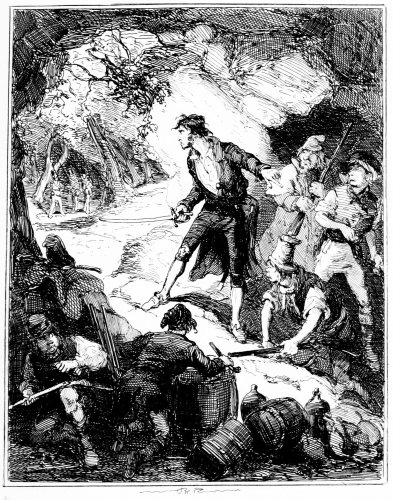
Discovery of Captain Grant and his band. P. 576

vengeance kept those of a higher rank in complete subjection to his authority.
Like Rob Roy, he levied an annual tax on the farmers, which they cheerfully paid, as it secured them from the nocturnal visits of his followers; and the Captain was so rigid a disciplinarian, that any dereliction of duty in this respect was punished with a heavy hand. His exploits soon became too notorious, however, to pass unnoticed by the authorities, and large rewards were offered for his apprehension; but, although he was as well known as the “Hill of Howth,” he was to be seen at every fair and pattern in the country, and had a more numerous acquaintance than the village doctor. At every farmer’s table he was welcome, and the cottages that gave him shelter were sure of reward; for he freely shared the contributions he obtained with danger.
With the ladies he was a second Macheath, and more wives than one claimed him for their husband; and it is reported that he was frequently complimented on his person and manner, by the mistresses of those houses which he visited without the formality of an invitation. But it must be observed that he never forgot his accustomed humanity and politeness; and, unless when attacked by the police, he never did an individual a personal injury. His behaviour always evinced a degree of refinement above his education and birth; and even those who suffered from his depredations never spoke of him but as an “accomplished villain.”
His character at length grew so notorious in the Queen’s County, that a consultation of magistrates was held for the purpose of devising means for his apprehension, and in consequence of the measures they adopted several of Grant’s followers were brought to justice, and died, as their Captain expressed it, of the “gallows fever.” For some time his knowledge of the country, and the partiality of the peasantry towards him, aided him in evading the pursuit which was made after him; but a traitor was found, and Grant was delivered into the hands of the Philistines.
The gentry of the country, and ladies of the first rank, crowded to the jail of Maryborough to see the “bold outlaw;” and it was supposed that their impertinent curiosity so much affected his sensibility, that he took his departure one night from prison, through a window, having first contrived to cut the bars that guarded it.
Dreading another specimen of the rudeness of the Irish aristocracy, he prudently resolved to leave the Slieve-bloom mountains, and with the remnant of his banditti, he removed to the wood of Killoughram, in the county of Wexford, within four miles of the town of Enniscorthy. Here he continued for some time, and made frequent visits to the neighbouring towns, where he was known by the name of Cooney.
In the March of 1816 he made a journey to his native county, where he robbed the house of Thomas Cambie, Esq., of money and plate to a large amount. Mrs. Cambie was at home, and he behaved with so much politeness, that she ordered him supper and wine. The captain being impatient of delay, applied his teeth to extract a cork from a bottle; upon which the mistress observed “it was a pity to spoil his fine white teeth,” and immediately stood up and procured him a corkscrew. Grant, on his departure, took the liberty of borrowing Mr. Cambie’s horse and gig, in which he rode to his retreat in the wood of Killoughram.
The Captain’s occasional depredations in the county of Wexford excited great alarm, for a robbery there then was a thing of very rare occurrence. Notice was at length given of the banditti retreat, and Archibald Jacob marched the military out of Enniscorthy and surrounded the wood. Some of the soldiers and yeomanry penetrated the fastness, and in the thickest part of the shade they discovered the “Robber Chief,” and five of his followers, on a bed of straw, in a romantic cave. The freebooters defended themselves with desperate valour, and before they surrendered, wounded five of the military. After they were secured, their retreat was found to contain all the necessary implements for housebreaking, and abundance of arms. The captain was committed to Wexford jail in the name of Cooney; but the evidence against him being doubtful, it was apprehended that he would be acquitted, when, unfortunately for him, it was discovered that he was the celebrated Captain Grant. The jailor of Maryborough now claimed his body, and he was forthwith transmitted to his former abode, only just in time, as it was eventually found out, to prevent his again escaping from the jail in which he was confined, in obedience to and in conformity with a plan which had been matured, and which was to be put into operation on the very night on which he was removed.
His trial came on at Maryborough, August the 16th 1816, when he was found guilty of the burglary in Mr. Cambie’s house. To the question “What reason he had why judgment and sentence of death should not be passed on him?” he replied in the most firm, collected, and, indeed, feeling manner, “My lord, I only beg of the Court some short time to arrange things before my departure for another place; not in the idle hope of escape or pardon, but to make restitution to the persons who have suffered by my bad line of life. I have been visited in my cell by some blessed people, who have, thank God, given this turn to my mind, and to which I implore your lordship’s attention.”
Sentence was then immediately passed upon him; but in obedience to his request, his execution was deferred until the 29th of August, when he met his fate with decent fortitude and pious resignation.