JOHN TERRY AND JOSEPH HEALD. EXECUTED FOR MURDER.
Reading edition
THESE villains were executed for the wilful murder of a poor old woman, named Elizabeth Smith, aged sixty-seven years; their object being to possess themselves of a small sum of money, known to have been recently before transmitted to her by her son.
Their trial came on at York, on Friday the 18th of March 1803; and the indictment alleged the murder to have been committed at Flaminshaw, near Wakefield, in the same county.
It appeared that the deceased was a respectable woman, who obtained an humble living by disposing of the produce of two cows which she possessed. Misfortune, however, fell upon her, and her cows died; but through the instrumentality of her neighbours a subscription was raised for her, by which one cow was purchased. Her son, who was engaged in a decent way of life at Leeds, sent her eighteen guineas to buy another; and this was the bait by which the wretched men, whose crime we are about to describe, were allured. On the morning of the 14th of January 1803, the poor old woman was found to have been murdered in her own house, under circumstances of very great barbarity; and suspicion having fallen upon the prisoners, they were taken into custody. Terry then, driven by remorse, made a confession to Shaw and Linley, the constables by whom he had been secured. He said that he and Heald, having determined upon the perpetration of the murder, agreed to meet outside the house of the deceased at about one o’clock on the morning of the 14th of January. They met in accordance with their appointment; and Heald having first entered the house, by making his way through the first-floor window, with his (Terry’s) assistance, he directly afterwards placed something against the side of the house by means of which he was enabled to follow him. On their gaining the room of Mrs. Smith, they found that she had been alarmed by the noise which they had made, and was getting up; but they directly attacked her, and knocked her down; and when Heald had struck her several blows, he took out a razor. The deceased was now still on the ground, and he (Terry) held her head, while Heald cut her throat; but at length his fingers being wounded, he called to his companion to desist, as they had done enough, and proposed that they should go and see if all was safe. He then ran down stairs, but returning in a few moments, he found that Heald had got the old woman into another room, and was beating her over the head with a pair of tongs. Upon seeing him, he struck her no more, and then they directly secured the money and made off. From the evidence of the constables it further appeared that Heald, on hearing the confession of the other prisoner, upbraided him for deceiving him, and added, “Thou knowest I was not with thee.” Terry answered, “Thou knowest there is a God above, who knows all;” and upon Heald remarking, “Thou hadst better lay it upon somebody else,” he replied, “I will not hang an innocent man; thou knowest there were but us two, and God for our witness.”
This, together with some other circumstances of suspicion, proved against the two prisoners, constituted the evidence against them; and the jury returned a verdict of Guilty. Sentence of death was then immediately
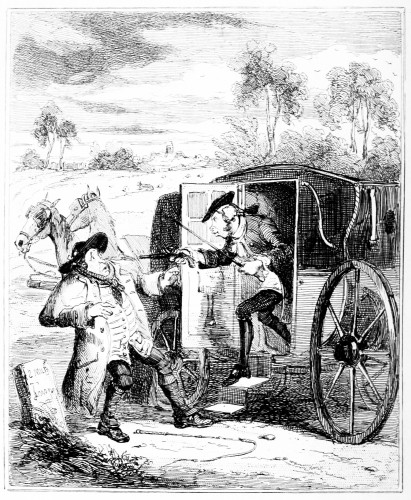
John Smith robbing a Hackney Coachman. p. 379.

passed, and was ordered to be put into execution on the following Monday; but in the mean time a most extraordinary change took place in the demeanour of the prisoner Terry.
Upon his being attended by Mr. Brown, the Ordinary, he asserted that Heald was not guilty, and that if he were hanged, he should be guilty of two murders instead of only one. He entreated that the clergyman would endeavour to procure the respite of his fellow-prisoner, and declared that he could not bear to be hanged with an innocent man. The whole of the circumstances were in consequence submitted to the consideration of the learned judge; and every measure of precaution was instantly taken by that learned individual to prevent the occurrence of an event which might deprive an innocent person of life; but as it was found that Heald made no attempt to join in the protestations of his companion, and further that the whole of Terry’s conduct appeared to arise from a desire only that the execution should be respited, and that his declarations were contradictory and evidently devoid of truth, the law was ordered to take its course.
On the way from his cell to the scaffold Terry appeared to be in the highest state of excitement; and upon his appearance on the platform, he exhibited a most extraordinary degree of stubbornness. He shouted to the mob assembled, that they were going to hang an innocent man, and even made an effort to escape, by jumping from the ladder placed against the gallows, and which he was only prevented from doing by the clergyman, who seized him by the collar. He then renewed his protestations of his own guilt, and the innocence of his companion; and in spite of the entreaties of the clergyman, and of Heald, that he would allow him the benefit of the prayers, he continued to make the most clamorous resistance to the execution of the sentence. By the united exertions of five men, he was at length dragged to the drop, and the rope was forced over his head; but in his efforts he tore off the cap; and at the moment at which the platform sunk, he made a spring, and throwing himself towards the side of the gallows, got his foot upon the beam, and caught the corner-post with his arm. In this dreadful situation he supported himself for about a minute, when he was forced off by the executioner, and then, with his face uncovered, he was left suspended. In a few moments both he and his companion in crime were lifeless.