Captain Mayne Reid (continued 4)
Reading edition
The sham-barricader accepted the gold coins passed into his palm; and with a salute such as might have been given by the boatswain of a buccaneer, he slouched back through the half-opened doorway, and disappeared.
Other couriers continued to come and go, most in military costumes, delivering their divers reports—some of them in open speech, others in mysterious undertone—not a few of them under the influence of drink!
On that day the army of Paris was in a state of intoxication—ready not alone for the suppression of a riot they had been told to prepare for; but for anything—even to the slaughter of the whole Parisian people!
At 3 p.m. they were quite prepared for this. The champagne and sausages were all consumed. They were again hungry and thirsty, but it was the hunger of the hell-hound, and the thirst of the bloodhound.
“The time has come!” said De M— to his fellow-conspirators. “We may now release them from their leash! Let the gun be fired?”
Chapter Thirty One.
In the Hotel de Louvre.
“Come, girls! It’s time for you to be dressing. The gentlemen are due in half an hour.”
The speech was made in a handsome apartment of the Hotel de Louvre, and addressed to two young ladies, in elegant dishabille, one of them seated in an easy chair, the other lying full length upon a sofa.
A negress, with chequered toque, was standing near the door, summoned in to assist the young ladies in their toilet.
The reader may recognise Mrs Girdwood, daughter, niece, and servant.
It is months since we have met them. They have done the European tour up the Rhine, over the Alps, into Italy. They are returning by way of Paris, into which capital they have but lately entered; and are still engaged in its exploration.
“See Paris last,” was the advice given them by a Parisian gentleman, whose acquaintance they had made; and when Mrs Girdwood, who smattered a little French, asked, Pourquoi? she was told that by seeing it first she would care for nothing beyond.
She had taken the Frenchman’s hint, and was now completing the programme.
Though she had met German barons and Italian counts by the score, her girls were still unengaged. Nothing suitable had offered itself in the shape of a title. It remained to be seen what Paris would produce.
The gentlemen “due in half an hour” were old acquaintances; two of them her countrymen, who, making the same tour, had turned up repeatedly on the route, sometimes travelling in her company. They were Messrs Lucas and Spiller.
She thought nothing of these. But there was a third expected, and looked for with more interest; one who had only called upon them the day before, and whom they had not seen since the occasion of his having dined with them in their Fifth Avenue house in New York.
It was the lost lord.
On his visit of yesterday everything had been explained; how he had been detained in the States on diplomatic business; how he had arrived in London after their departure for the Continent, with apologies for not writing to them—ignorant of their whereabouts.
On Mr Swinton’s part this last was a lie, as well as the first. In the chronicles of the time he had full knowledge of where they might have been found. He had studiously consulted the American newspaper published in London, which registered the arrivals and departures of transatlantic tourists, and knew to an hour when Mrs Girdwood and her girls left Cologne, crossed the Alps, stood upon the Bridge of Sighs, or climbed to the burning crater of Vesuvius.
And he had sighed and burned to be along with them, but could not. There was something needed for the accomplishment of his wishes—cash.
It was only when he saw recorded the Girdwood arrival in Paris, that he was at length enabled to scrape together sufficient for the expenses of a passage to, and short sojourn in, the French capital; and this only after a propitious adventure in which he had been assisted by the smiles of the goddess Fortune, and the beauty of his beloved Fan. Fan had been left behind in the London lodging. And by her own consent. She was satisfied to stay, even with the slender stipend her husband could afford to leave for her maintenance. In London the pretty horse-breaker would be at home.
“You have only half an hour, my dears!” counselled Mrs Girdwood, to stimulate the girls towards getting ready.
Cornelia, who occupied the chair, rose to her feet, laying aside the crochet on which she had been engaged, and going off to be dressed by Keziah.
Julia, on the sofa, simply yawned.
Only at a third admonition from her mother, she flung the French novel she had been reading upon the floor, and sat up.
“Bother the gentlemen?” she exclaimed, repeating the yawn with arms upraised. “I wish, ma, you hadn’t asked them to come. I’d rather have stayed in all day, and finished that beautiful story I’ve got into. Heaven bless that dear Georges Sand! Woman that she is, she should have been a man. She knows them as if she were one; their pretensions and treachery. Oh, mother! when you were determined on having a child, why did you make it a daughter? I’d give the world to have been your son!”
“Fie, fie, Jule! Don’t let any one hear you talk in that silly way!”
“I don’t care whether they do or not. I don’t care if all Paris, all France, all the world knows it. I want to be a man, and to have a man’s power.”
“Pff, child! A man’s power! There’s no such thing in existence, only in outward show. It has never been exerted, without a woman’s will at the back of it. That is the source of all power.”
The storekeeper’s relict was reasoning from experience. She knew whose will had made her the mistress of a house in the Fifth Avenue; and given her scores, hundreds, of other advantages, she had never credited to the sagacity of her husband.
“To be a woman,” she continued, “one who knows man and how to manage him, that is enough for me. Ah! Jule, if I’d only had your opportunities, I might this day have been anything.”
“Opportunities! What are they?”
“Your beauty for one.”
“Oh, ma! you had that. You still show it.”
To Mrs Girdwood the reply was not unpleasant. She had not lost conceit in that personal appearance that had subdued the heart of the rich retailer; and, but for a disinheriting clause in his will, might have thought of submitting her charms to a second market. But although this restrained her from speculating on matrimony, she was still good for flattery and flirtation.
“Well,” she said, “if I had good looks, what mattered they without money? You have both, my child.”
“And both don’t appear to help me to a husband—such as you want me to have, mamma.”
“It will be your own fault if they don’t. His lordship would never have renewed his acquaintance with us if he didn’t mean something. From what he hinted to me yesterday, I’m sure he has come to Paris on our account. He almost said as much. It is you, Julia, it is you.”
Julia came very near expressing a wish that his lordship was at the bottom of the sea; but knowing how it would annoy her mother, she kept the sentiment to herself. She had just time to get enrobed for the street; as the gentleman was announced. He was still plain Mr Swinton, still travelling incognito, on “seqwet diplomatic business for the Bwitish Government.” So had he stated in confidence to Mrs Girdwood.
Shortly after, Messrs Lucas and Spiller made their appearance, and the party was complete.
It was only to be a promenade on the Boulevards, to end in a little dinner in the Café Riche, Royale, or the Maison Doré.
And with this simple programme, the six sallied forth from the Hotel de Louvre.
Chapter Thirty Two.
On the Boulevards.
On the afternoon of that same Second of December, a man, sauntering along the Boulevards, said to himself:
“There’s trouble hanging over this gay city of Paris. I can smell mischief in its atmosphere.”
The man who made this remark was Captain Maynard. He was walking out alone, having arrived in Paris only the day before.
His presence in the French metropolis may be explained by stating, that he had read in an English newspaper a paragraph announcing the arrival of Sir George Vernon at Paris. The paragraph further said, that Sir George had returned thither after visiting the various courts of Europe on some secret and confidential mission to the different British ambassadors.
Something of this Maynard knew already. He had not slighted the invitation given him by the English baronet on the landing-wharf at Liverpool. Returning from his Hungarian expedition, he had gone down to Sevenoaks, Kent. Too late, and again to suffer disappointment. Sir George had just started for a tour of travel on the Continent, taking his daughter along with him. He might be gone for a year, or maybe more. This was all his steward could or would tell.
Not much more of the missing baronet could Maynard learn in London. Only the on dit in political circles that he had been entrusted with some sort of secret circular mission to the European courts, or those of them known as the Great Powers.
Its secrecy must have been deemed important for Sir George to travel incognito. And so must he have travelled; else Maynard, diligently consulting the chronicles of the times, should have discovered his whereabouts.
This he had daily done, making inquiries elsewhere, and without success; until, months after, his eye fell upon the paragraph in question.
Had he still faith in that presentiment, several times so confidently expressed?
If so, it did not hinder him from passing over to Paris, and taking steps to help in the desired destiny.
Certain it was still desired. The anxiety he had shown to get upon the track of Sir George’s travel, the haste made on discovering it, and the diligence he was now showing to find the English baronet’s address in the French capital, were proofs that he was not altogether a fatalist.
During the twenty-four hours since his arrival in Paris, he had made inquiries at every hotel where such a guest was likely to make stay. But no Sir George Vernon—no English baronet could be found.
He had at length determined to try at the English Embassy. But that was left for the next day; and, like all strangers, he went out to take a stroll along the Boulevards.
He had reached that of Montmartre as the thought, chronicled above, occurred to him.
It could scarce have been suggested by anything he there saw. Passing and meeting him were the Parisian people—citizens of a free republic, with a president of their own choice. The bluff bourgeois, with sa femme linked on his left arm, and sa fille, perhaps a pretty child, hand-led, on his right. Behind him it might be a brace of gaily-dressed grisettes, close followed by a couple of the young dorés, exchanging stealthy glance or bold repartee.
Here and there a party of students, released from the studies of the day, a group of promenaders of both sexes, ladies and gentlemen, who had sallied out to enjoy the fine weather, and the walk upon the broad, smooth banquette of the Boulevard, all chatting in tranquil strain, unsuspicious of danger, as if they had been sauntering along a rural road, or the strand of some quiet watering-place.
A sky over them serene as that which may have canopied the garden of Eden; an atmosphere around so mild that the doors of the cafés had been thrown open, and inside could be seen the true Parisian flaneur—artists or authors—seated by the marble-topped table, sipping his eau sucré, slipping the spare sugar lumps into his pocket for home use in his six francs-a-week garret, and dividing his admiration between the patent-leather shoes on his feet and the silken-dressed damsels who passed and repassed along the flagged pavement in front.
It was not from observation of these Parisian peculiarities that Maynard had been led to make the remark we have recorded, but from a scene to which he had been witness on the preceding night.
Straying through the Palais Royal, then called “National,” he had entered the Café de Mille Colonnes, the noted resort of the Algerine officers. With the recklessness of one who seeks adventure for its own sake, and who has been accustomed to having it without stint, he soon found himself amidst men unaccustomed to introductions. Paying freely for their drinks—to which, truth compels me to say, as far as in their purses they corresponded—he was soon clinking cups with them, and listening to their sentiments. He could not help remarking the recurrence of that toast which has since brought humiliation to France.
“Vive l’Empereur!”
At least a dozen times was it drunk during the evening—each time with an enthusiasm that sounded ominous in the ears of the republican soldier. There was a unanimity, too, that rendered it the more impressive. He knew that the French President was aiming at Empire; but up to that hour he could not believe in the possibility of his achieving it.
As he drank with the Chasseurs d’Afrique in the Café de Mille Colonnes, he saw it was not only possible but proximate; and that ere long Louis Napoleon would either wrap his shoulders in the Imperial purple or in a shroud.
The thought stung him to the quick. Even in that company he could not conceal his chagrin. He gave expression to it in a phrase, half in soliloquy, half meant for the ear of a man who appeared the most moderate among the enthusiasts around him.
“Pauvre France!” was the reflection.
“Pauvre France!” cried a fierce-looking but diminutive sous-lieutenant of Zouaves, catching up the phrase, and turning toward the man who had given utterance to it.
“Pauvre France! Pourquoi, monsieur?”
“I pity France,” said Maynard, “if you intend making an Empire of it.”
“What’s that to you?” angrily rejoined the Zouave lieutenant, whose beard and moustache, meeting over his mouth, gave a hissing utterance to his speech. “What does it concern you, monsieur?”
“Not so fast, Virocq!” interposed the officer to whom Maynard had more particularly addressed himself. “This gentleman is a soldier like ourselves. But he is an American, and of coarse believes in the republic. We have all our political inclinings. That’s no reason why we should not be friends socially—as we are here!”
Virocq, after making a survey of Maynard, who did not quail before his scrutiny, seemed contented with the explanation. At all events, he satisfied his wounded patriotism by once more turning to the clique of his comrades, tossing his glass on high, and once more vociferating “Vive l’Empereur!”
It was the remembrance of this scene of last night that led Maynard to reflect, when passing along the Boulevard, there was mischief in the atmosphere of Paris.
He became more convinced of it as he walked on toward the Boulevard de Bastille. There the stream of promenaders showed groups of a different aspect: for he had gone beyond the point where the genteel bourgeoisie takes its turn; where patent-leather boots and eau sucré give place to a coarser chassure and stronger beverage. Blouses were intermingled with the throng; while the casernes on both sides of the street were filled with soldiers, drinking without stint, and what seemed stranger still, with their officers along with them!
With all his republican experience—even in the campaign of Mexico even under the exigencies of the relaxed discipline brought about by the proximity of death upon the battle-field, the revolutionary leader could not help astonishment at this. He was still more surprised to see the French people along the street—even the blouses submitting to repeated insults put upon them by those things in uniform; the former stout, stalwart fellows; the latter, most of them, diminutive ruffians, despite their big breeches and swaggering gait, looking more like monkeys than men.
From such a scene, back toward Montmartre he turned with disgust.
While retracing his steps, he reflected:
“If the French people allow themselves to be bullied by such bavards as these, it’s no business of mine. They don’t deserve to be free.”
He was on the Boulevard des Italiens as he made this reflection, heading on for the widening way of the Rue de la Paix. He had already noticed a change in the aspect of the promenaders.
Troops were passing along the pavement; and taking station at the corners of the streets. Detachments occupied the casernes and cafés, not in serious, soldier-like sobriety, but calling imperiously for refreshments, and drinking without thought or pretence of payment. The bar-keeper refusing them was threatened with a blow, or the thrust of a sabre!
The promenaders on the pave were rudely accosted. Some of them pushed aside by half-intoxicated squads, that passed them on the double-quick, as if bent on some exigent duty.
Seeing this, some parties had taken to the side streets to regain their houses. Others, supposing it only a soldierly freak—the return from a Presidential review—were disposed to take it in good part; and thinking the thing would soon be over, still stayed upon the Boulevard.
Maynard was among those who remained.
Interrupted by the passing of a company of Zouaves, he had taken stand upon the steps of a house, near the embouchure of the Rue de Vivienne. With a soldier’s eye he was scrutinising these military vagabonds, supposed to be of Arab race, but whom he knew to be the scourings of the Parisian streets, disguised under the turbans of the Mohammed. He did not think in after years such types of military would be imitated in the land he had left behind, with such pride in its chivalry.
He saw that they were already half-intoxicated, staggering after their leader in careless file, little regarding the commands called back to them. Out of the ranks they were dropping off in twos and threes, entering the cafés, or accosting whatever citizen chanced to challenge their attention.
In the doorway where Maynard had drawn up, a young girl had also taken refuge. She was a pretty creature and somewhat elegantly dressed; withal of modest appearance. She may have been “grisette” or “cocotte.” It mattered not to Maynard, who had not been regarding her.
But her fair proportions had caught the eye of one of the passing Zouaves; who, parting from the ranks of his comrades, rushed up the steps and insisted upon kissing her!
The girl appealed to Maynard, who, without giving an instant to reflection, seized the Zouave by the collar, and with a kick sent him staggering from the steps.
A shout of “Secours!” traversed along the line, and the whole troop halted, as if surprised by a sudden assault of Arabs. The officer leading them came running back, and stood confronting the stranger.
“Sacré!” he cried. “It’s you, monsieur! you who go against the Empire!”
Maynard recognised the ruffian, who on the night before had disputed with him in the Café de Mille Colonnes.
“Bon!” cried Virocq, before Maynard could make either protest or reply. “Lay hold upon him, comrades! Take him back to the guard-house in the Champs Elysées. You’ll repent your interference, monsieur, in a country that calls for the Empire and order. Vive l’Empereur!”
Half a dozen crimson-breeched ruffians springing from the ranks threw themselves around Maynard, and commenced dragging him along the Boulevard.
It required this number to conquer and carry him away.
At the corner of the Rue de la Paix a strange tableau was presented to his eyes. Three ladies, accompanied by three gentlemen, were spectators of his humiliation. Promenading upon the pavement, they had drawn up on one side to give passage to the soldiers who had him in charge.
Notwithstanding the haste in which he was carried past them, he saw who they were: Mrs Girdwood and her girls—Richard Swinton, Louis Lucas, and his acolyte, attending upon them!
There was no time to think of them, or why they were there. Dragged along by the Zouaves, occasionally cursed and cuffed by them, absorbed in his own wild rage, Maynard only occupied himself with thoughts of vengeance. It was to him an hour of agony—the agony of an impotent anger!
Chapter Thirty Three.
A Nation’s Murder.
“By Jawve!” exclaimed Swinton. “It’s that fellaw, Maynard. You remember him, ladies? The fellaw who, at Newpawt, wan away after gwosely insulting me, without giving me the oppawtunity of obtaining the satisfaction of a gentleman?”
“Come, come, Mr Swinton,” said Lucas, interposing. “I don’t wish to contradict you; but you’ll excuse me for saying that he didn’t exactly run away. I think I ought to know.”
The animus of Lucas’s speech is easily explained. He had grown rather hostile to Swinton. And no wonder. After pursuing the Fifth Avenue heiress all through the Continental tour, and as he supposed with fair prospect of success, he was once more in danger of being outdone by his English rival, freshly returned to the field.
“My deaw Mr Lucas,” responded Swinton, “that’s all vewy twue. The fellaw, as you say, wote me a lettaw, which did not weach me in proper time. But that was no weason why he should have stolen away and left no addwess faw me to find him.”
“He didn’t steal away,” quietly rejoined Lucas.
“Well,” said Swinton, “I won’t argue the question. Not with you, my deaw fwend, at all events—”
“What can it mean?” interposed Mrs Girdwood, noticing the ill feeling between the suitors of Julia, and with the design of turning it off. “Why have they arrested him? Can any one tell?”
“Pawhaps he has committed some kwime?” suggested Swinton.
“That’s not likely, sir,” sharply asserted Cornelia.
“Aw—aw. Well, Miss Inskip, I may be wong in calling it kwime. It’s a question of fwaseology; but I’ve been told that this Mr Maynard is one of those wed wepublicans who would destwoy society, weligion, in shawt, evewything. No doubt, he has been meddling heaw in Fwance, and that’s the cause of his being a pwisoner. At least I suppose so.”
Julia had as yet said nothing. She was gazing after the arrested man, who had ceased struggling against his captors, and was being hurried off out of sight.
In the mind of the proud girl there was a thought Maynard might have felt proud of inspiring. In that moment of his humiliation he knew not that the most beautiful woman on the Boulevard had him in her heart with a deep interest, and a sympathy for his misfortune—whatever it might be. “Can nothing be done, mamma?”
“For what, Julia?”
“For him,” and she pointed after Maynard. “Certainly not, my child. Not by us. It is no affair of ours. He has got himself into some trouble with the soldiers. Perhaps, as Mr Swinton says, political. Let him get out of it as he can. I suppose he has his friends. Whether or not, we can do nothing for him. Not even if we tried. How could we—strangers like us?”
“Our Minister, mamma. You remember Captain Maynard has fought under the American flag. He would be entitled to its protection. Shall we go the Embassy?”
“We’ll do nothing of the kind, silly girl. I tell you it’s no affair of ours. We shan’t make or meddle with it. Come! let us return to the hotel. These soldiers seem to be behaving strangely. We’d better get out of their way. Look yonder! There are fresh troops of them pouring into the streets, and talking angrily to the people?”
It was as Mrs Girdwood had said. From the side streets armed bands were issuing, one after the other; while along the open Boulevard came rolling artillery carriages, followed by their caissons, the horses urged to furious speed by drivers who appeared drunk!
Here and there one dropped off, throwing itself into battery and unlimbering as if for action. Before, or alongside them, galloped squadrons of cavalry, lancers, cuirassiers, and conspicuously the Chasseurs d’Afrique—fit tools selected for the task that was before them.
All wore an air of angry excitement as men under the influence of spirits taken to prepare them for some sanguinary purpose. It was proclaimed by a string of watchwords passing occasionally between them, “Vive l’Empereur! Vive l’armée! À bas les canailles de députés et philosophes!”
Each moment the turmoil increased, the crowd also augmenting from streams pouring in by the side streets. Citizens became mingled with the soldiery, and here and there could be heard angry shouts and speeches of remonstrance.
All at once, and as if by a preconcerted signal, came the crisis. It was preconcerted, and by a signal only entrusted to the leaders.
A shot fired in the direction of the Madeleine from a gun of largest calibre, boomed along the Boulevards, and went reverberating over all Paris. It was distinctly heard in the distant Bastille, where the sham barricades had been thrown up, and the sham-barricaders were listening for it. It was quickly followed by another, heard in like manner. Answering to it rose the shout, “Vive l’République—Rouge et Démocratique!”
But it was not heard for long. Almost instantaneously was it drowned by the roar of cannon, and the rattling of musketry, mingled with the imprecations of ruffians in uniform rushing along the street.
The fusillade commencing at the Bastille did not long stay there. It was not intended that it should; nor was it to be confined to the sans culottes and ouvriers. Like a stream of fire—the ignited train of a mine—it swept along the Boulevards, blazing and crackling as it went, striking down before it man and woman blouse and bourgeoise, student and shopkeeper, in short all who had gone forth for a promenade on that awful afternoon. The sober husband with wife on one arm and child on the other, the gay grisette with her student protector, the unsuspicious stranger, lady or gentleman, were alike prostrated under that leaden shower of death. People rushed screaming towards the doorways, or attempted to escape through side streets. But here, too, they were met by men in uniform. Chasseurs and Zouaves, who with foaming lips and cheeks black from the biting of cartridges, drove them back before sabre and bayonet, impaling them by scores, amidst hoarse shouts and fiendish cachinnation, as of maniacs let forth to indulge in a wild saturnalia of death!
And it continued till the pave was heaped with dead bodies, and the gutters ran blood; till there was nothing more to kill, and cruelty stayed its stroke for want of a victim!
A dread episode was that massacre of the Second of December striking terror to the heart, not only of Paris, but France.
Chapter Thirty Four.
“I’ll Come to you!”
In the balconied window of a handsome house fronting on the Tuileries Gardens were two female figures, neither of which had anything to pronounce them Parisian. One was a young girl with an English face, bright roseate complexion, and sunny hair; the other was a tawny-skinned mulatto.
The reader will recognise Blanche Vernon and her attendant, Sabina.
It was not strange that Maynard could not find Sir George at any of the hotels. The English baronet was quartered as above, having preferred the privacy of a maison meublée.
Sir George was not at home; and his daughter, with Sabina by her side, had stepped out upon the balcony to observe the ever-changing panorama upon the street below.
The call of a cavalry bugle, with the braying of a military band, had made them aware that soldiers were passing—a sight attractive to women, whether young or old, dark or fair.
On looking over the parapet, they saw that the street was filled with them: soldiers of all arms—infantry, cavalry, artillery—some halted, some marching past; while officers in brilliant uniforms, mounted on fine horses, were galloping to and fro, vociferating orders to the various squadrons they commanded.
For some time the young English girl and her attendant looked down upon the glittering array, without exchanging speech.
It was Sabina who at length broke silence.
“Dey ain’t nowha longside ow British officas, for all dat gildin’ an’ red trowsas. Dey minds me ob a monkey I once see in ’Badoes dress’ up soja fashion—jes’ like dat monkey some o’ ’em look?”
“Come, Sabby! you are severe in your criticism. These French officers have the name of being very brave and gallant.”
The daughter of Sir George Vernon was a year older than when last seen by us. She had travelled a great deal of late. Though still but a child, it was not strange she should talk with the sageness of a woman.
“Doan blieve it,” was the curt answer of the attendant. “Dar only brave when dey drink wine, an’ gallant when de womans am good-looking. Dat’s what dese French be. Affer all dey’s only ’publicans, jess de same as in dem ’Meriky States.”
The remark seemed to produce a sudden change in the attitude of the young girl. A remembrance came over her; and instead of continuing to gaze at the soldiers below, she stood abstracted and thoughtful.
Sabina noticed her abstraction, and had some suspicion of what was causing it. Though her young mistress had long since ceased to be a communicative child, the shrewd attendant could guess what was passing through her thoughts.
The words “Republic” and “America,” though spoken in Badian patois, had recalled incidents, by Blanche never to be forgotten.
Despite her late reticence on the subject of these past scenes, Sabina knew that she still fondly remembered them. Her silence but showed it the more.
“’Deed yes, Missy Blanche,” continued the mulatto, “dem fellas down dar hab no respeck for politeness. Jess see de way dey’s swaggerin’! Look how dey push dem poor people ’bout!”
She referred to an incident transpiring on the street below. A small troop of Zouaves, marching rapidly along the sidewalk, had closed suddenly upon a crowd of civilian spectators. Instead of giving fair time for the latter to make way, the officer at the head of the troop not only vented vociferations upon them, but threatened them with drawn sword; while the red-breeched ruffians at his back seemed equally ready to make use of their bayonets!
Some of the people treated it as a joke, and laughed loudly; others gave back angry words or jeers; while the majority appeared awed and trembling.
“Dem’s de sojas ob de ’public—de officas, too!” exultingly pursued the loyal Badian. “You nebba see officas ob de Queen of England do dat way. Nebba!”
“No, nor all republican officers, Sabby. I know one who would not, and so do you.”
“Ah! Missy Blanche; me guess who you peakin’ of. Dat young genlum save you from de ’tagin’ ob de steama. Berry true. He was brave, gallant offica—Sabby say dat.”
“But he was a republican!”
“Well, maybe he wa. Dey said so. But he wan’t none ob de ’Meriky ’publicans, nor ob dese French neida. Me hear you fadda say he blong to de country ob England.”
“To Ireland.”
“Shoo, Missy Blanche, dat all de same! Tho’ he no like dem Irish we see out in de Wes’ Indy. Dar’s plenty ob dem in ’Badoes.”
“You’re speaking of the Irish labourers, whom you’ve seen doing the hard work. Captain Maynard—that’s his name, Sabby—is a gentleman. Of course that makes the difference.”
“Ob course. A berry great diff’rence. He no like dem nohow. But Missy Blanche, wonda wha he now am! ’Trange we no mo’ hear ob him! You tink he gone back to de ’Meriky States?”
The question touched a chord in the bosom of the young girl that thrilled unpleasantly. It was the same that for more than twelve months she had been putting to herself, in daily repetitions. She could no more answer it than the mulatto.
“I’m sure I cannot tell, Sabby.”
She said this with an air of calmness which her quick-witted attendant knew to be unreal.
“Berry trange he no come to meet you fadda in de big house at Seven Oak. Me see de gubnor gib um de ’dress on one ob dem card. Me hear your fadder say he muss come, and hear de young genlum make promise. Wonda wha for he no keep it?”
Blanche wondered too, though without declaring it. Many an hour had she spent conjecturing the cause of his failing to keep that promise. She would have been glad to see him again; to thank him once more, and in less hurried fashion, for that act of gallantly, which, it might be, was the saving of her life.
She had been told then that he intended to take part in some of the revolutions. But she knew that all these were over; and he could not be now engaged in them. He must have stayed in England or Ireland. Or had he returned to the United States? In any case, why had he not come down to Sevenoaks, Kent? It was but an hour’s ride from London!
Perhaps in the midst of his exalted associations—military and political—he had forgotten the simple child he had plucked from peril? It might be but one of the ordinary incidents of his adventurous life, and was scarce retained in his memory?
But she remembered it; with a deep sense of indebtedness—a romantic gratitude, that grew stronger as she became more capable of appreciating the disinterestedness of the act.
Perhaps all the more, that the benefactor had not returned to claim his reward. She was old enough to know her father’s position and power. A mere adventurer would have availed himself of such a chance to benefit by them. Captain Maynard could not be this.
It made her happy to reflect that he was a gentleman; but sad to think she should never see him again.
Often had these alternations of thought passed through the mind of this fair young creature. They were passing through it that moment, as she stood looking out upon the Tuileries, regardless of the stirring incidents that were passing upon the pavement below.
Her thoughts were of the past: of a scene on the other side of the Atlantic; of many a little episode on board the Cunard steamer; of one yet more vividly remembered, when she was hanging by a rope above angry hungering waves, till she felt a strong arm thrown around her, that lifted her beyond their rage! She was startled from her reverie by the voice of her attendant, uttered in a tone of unusual excitement.
“Look! Lookee yonder, Missy Blanche! Dem Arab fellas hab take a man prisoner! See! dey fotch im this way—right under de winda. Poor fella! Wonda what he been an’ done?” Blanche Vernon bent over the balcony, and scanned the street below. Her eye soon rested on the group pointed out by Sabina.
Half a dozen Zouaves, hurrying along with loud talk and excited gesticulation, conducted a man in their midst. He was in civilian dress, of a style that bespoke the gentleman, notwithstanding its disorder.
“Some political offender!” thought the daughter of the diplomatist, not wholly unacquainted with the proceedings of the times.
It was a conjecture that passed, quick as it had come; but only into a certainty. Despite the disordered dress and humiliating position of the man the young girl recognised her rescuer—he who, but the moment before, was occupying her thoughts!
And he saw her! Walking with head erect, and eyes upturned to the heaven he feared not to face, his glance fell upon a dark-skinned woman with a white toque on her head, and beside her a young girl shining like a Virgin of the Sun!
He had no time to salute them. No chance either, for his hands were in manacles!
In another instant he was beneath the balcony, forced forward by the chattering apes who were guarding him.
But he heard a voice above his head—above their curses and their clamour—a soft, sweet voice, crying out: “I’ll come to you! I will come!”
Chapter Thirty Five.
To the Prison.
“I’ll come to you! I will come!”
True to the intention thus proclaimed, Blanche Vernon glided back into the room; and, hastily laying hold of hat and cloak, was making for the stair.
“You mad, missa!” cried the mulatto, throwing herself into the doorway with the design of intercepting her. “What will you fadda say? Dat’s danger outside ’mong dem noisy sojas. For lub ob de good Jesus, Missy Blanche, doan tink ob goin’ down to de ’treet?”
“There’s no danger. I don’t care if there is. Stand out of the way, Sabby, or I’ll be too late. Stand aside, I tell you!”
“Oh, Mass Freeman!” appealed Sabina to the footman, who had come out of his ante-chamber on hearing the excited dialogue, “you see what you young misress agoin’ to do?”
“What be it, Miss Blanche?”
“Nothing, Freeman; nothing for Sabby to make so much of. I’m only going to find papa. Don’t either of you hinder me!”
The command was spoken in that tone which the servants of England’s aristocracy are habituated to respect; and Blanche Vernon, though still only a child, was accustomed to their obedience.
Before Freeman could make reply, she had passed out of the room, and commenced descending the escalier.
Sabina rushed after, no longer with the design of intercepting but to accompany her. Sabby needed no bonnet. Her white toque was her constant coiffure, outdoors as in. Freeman, laying hold of his hat, followed them down the stair. On reaching the street, the young girl did not pause for an instant; but turned along the footway in the direction in which the prisoner had been conducted. Soldiers were still passing in troops, and citizens hurrying excitedly by, some going one way, some another. Dragoons were galloping along the wide causeway, and through the Tuileries Gardens; while the court inside the iron railing was alive with uniformed men.
Loud shouting was heard near at hand, with the rolling of drums and the sharp calling of trumpets.
Further off, in the direction of the Boulevards, there was a constant rattling, which she knew to be the fire of musketry, mingled with the louder booming of cannon!
She had no knowledge of what it could all mean. There were always soldiers in the streets of Paris and around the Tuileries. The marching of troops with beating drums, screaming bugles, and firing of guns, were things of every day occurrence; for almost every day there were reviews and military exercises.
This only differed from the rest in the more excited appearance of the soldiery, their ruder behaviour toward the pedestrians who chanced in their way, and the terrified appearance of the latter, as they rushed quickly out of it. Several were seen hastening, as if for concealment or refuge. The young girl noticed this, but paid no regard to it. She only hurried on, Sabina by her side, Freeman close following.
Her eyes were directed along the sidewalk, as if searching for some one who should appear at a distance before her. She was scanning the motley crowd to make out the Zouave dresses.
An exclamation at length told that she had discovered them. A group in Oriental garb could be distinguished about a hundred yards ahead of her. In their midst was a man in civilian costume, plainly their prisoner. It was he who had tempted her forth on that perilous promenade.
Whilst her eyes were still on them, they turned suddenly from the street, conducting their captive through a gateway that was guarded by sentinels and surrounded by a crowd of soldiers—Zouaves like themselves.
“Monsieur!” said she, on arriving in front of the entrance, and addressing herself to one of the soldiers, “why has that gentleman been taken prisoner?”
As she spoke in his own tongue the soldier had no difficulty in understanding her.
“Ho—ho!” he said, making her a mock salute, and bending down till his hairy face almost touched her soft rose-coloured cheek, “My pretty white dove with the chevelure d’or, what gentleman are you inquiring about?”
“He who has just been taken in there.”
She pointed to the gateway now closed.
“Parbleu! my little love! that’s no description. A score have been taken in there within the last half-hour—all gentlemen, I have no doubt. At least there were no ladies among them.”
“I mean the one who went in last. There have been none since.”
“The last—the last—let me see! Oh, I suppose he’s been shut up for the same reason as the others.”
“What is it, monsieur?”
“Par dieu! I can’t tell, my pretty sunbeam! Why are you so interested in him? You are not his sister, are you? No; I see you’re not,” continued the soldier, glancing at Sabina and Freeman, becoming also more respectful at the sight of the liveried attendant. “You must be une Anglaise?”
“Yes, I am,” was the reply.
“If you’ll stay here a moment,” said the Zouave, “I’ll step inside and inquire for you.”
“Pray, do, monsieur!”
Drawing a little to one side, with Sabina and Freeman to protect her from being jostled, Blanche waited for the man’s return.
True to his promise he came back; but without bringing the required information.
He could only tell them that “the young man had been made prisoner for some political offence—for having interfered with the soldiers when upon their duty.”
“Perhaps,” added he, in a whisper, “monsieur has been incautious. He may have called out, ‘Vive la République!’ when the parole for to-day is ‘Vive l’Empereur!’ He appears to be an Anglais. Is he a relative of yours, mam’selle?”
“Oh, no!” answered the young girl, turning hastily away, and without even saying “merci” to the man who had taken such trouble to serve her.
“Come, Sabina, let us go back to the house. And you, Freeman, run to the English Embassy! If you don’t find papa there, go in search of him. All over Paris if need be. Tell him he is wanted—that I want him. Bring him along with you. Dear Freeman! promise me you will not lose a moment’s time. It’s the same gentleman who saved my life at Liverpool! You remember it. If harm should come to him in this horrid city—go quick, sir! Take this! You may need a coach. Tell papa—tell Lord C—. You know what to say. Quick! quick!”
The handful of five-franc pieces poured into his palm would of itself have been sufficient to stimulate the footman; and, without protest, he started off in the direction of the English Embassy.
His young mistress, with her attendant, returned to the maison meublée—there to await the coming of her father.
Chapter Thirty Six.
To the Embassy.
“Corneel! are you the woman to go with me?”
The question was from Julia Girdwood to her cousin, after their return to the Hotel de Louvre. They were alone in their chambre de coucher, still shawled and bonneted, as they had come in from their promenade:
Mrs Girdwood, yet engaged with the trio of gentlemen, was in a reception-room below. “Where?” asked Cornelia.
“Where! I’m astonished you should ask! Of course after him!”
“Dear Jule! I know what you mean. I was thinking of it myself. But what will aunt say, if we so expose ourselves? There’s danger in the streets. I believe they were firing upon the people—I’m sure they were! You hear the shooting now? Isn’t that the roaring of cannon? It sounds like it!”
“Don’t be a coward, cousin! You remember a roaring loud as that against the rocky cliffs of Newport! Did he hold back when we were in danger of our lives? Perhaps we may save his!”
“Julia! I did not think of holding back. I’m ready to go with you, if we can do anything for him. What do you propose?”
“First, find out to where they have taken him. I’ll know that soon. You saw me speak to a commissaire!”
“I did. You put something into his hand?”
“A five-franc piece for him to follow the Zouaves, and see where they took their prisoner. I promised him twice as much to come back and make report. I warrant he’ll soon be here.”
“And what then, Julia? What can we do?”
“Of ourselves, nothing. I don’t know any more than yourself why Captain Maynard has got into trouble with these Parisian soldiers. No doubt it’s on account of his republican belief. We’ve heard about that; and God bless the man for so believing!”
“Dear Julia! you know how I agree with you in the sentiment!”
“Well—no matter what he’s done. It’s our duty to do what we can for him.”
“I know it is, cousin. I only ask you what can we do?”
“We shall see. We have a Minister here. Not the man he should be: for it’s the misfortune of America to send to European Governments the very men who are not true representatives of our nation. The very opposite are chosen. The third-rate intellects, with a pretended social polish, supposed to make them acceptable at kingly courts—as if the great Republic of America required to be propped up with pretension and diplomacy. Corneel! we’re losing time. The man, to whom we perhaps both owe our lives, may be at this moment in danger of losing his! Who knows where they’ve taken him? It is our duty to go and see.”
“Will you tell aunt?”
“No. She’d be sure to object to our going out. Perhaps take steps to hinder us. Let us steal downstairs, and get off without telling her. We needn’t be long absent. She’ll not know anything about it till we’re back again.”
“But where do you propose going, Julia?”
“First, down to the front of the hotel. There we shall await the commissaire. I told him the Hotel de Louvre; and I wish to meet him outside. He may be there now. Come, Corneel!”
Still in their promenade dresses, there was no need of delay; and the two ladies, gliding down the stone stairway of the Louvre Hotel stood in the entrance below. They had no waiting to do. The commissaire met them on the steps, and communicated the result of his errand.
His account was simple. Accustomed only to speculate upon what he was paid for, he had observed only to the limits of the stipulation. The Zouaves had carried their prisoner to a guardroom fronting the Tuileries Gardens, and there shut him up. So the commissary supposed.
He had made memorandum of the number, and handed it over to the lady who commissioned him, receiving in return a golden coin, for which no change was required.
“That will do,” muttered Julia to her cousin, as they sallied forth upon the street, and took their way toward the unpretentious building that over the door showed the lettering, “U.S. LEGATION.”
There, as everywhere else, they found excitement—even terror. They had to pass through a crowd mostly composed of their own countrymen.
But these, proverbially gallant towards women, readily gave way to them. Who would not to women such as they?
A Secretary came forth to receive them. He regretted that the Minister was engaged.
But the proud Julia Girdwood would take no denial. It was a matter of moment—perhaps of life and death. She must see the representative of her country, and on the instant!
There is no influence stronger than woman’s beauty. Perhaps none so strong. The Secretary of Legation succumbed to it; and, disregarding the orders he had received, opened a side door, and admitted the intercessors to an interview with the Ambassador.
Their story was soon told. A man who had borne the banner of the Stars and Stripes through the hailstorm of more than one battle—who had carried it up the steep of Chapultepec, till it fell from his arm paralysed by the enemy’s shot—that man was now in Paris—prisoner to drunken Zouave soldiers—in peril of his life!
Such was the appeal made to the American Minister.
It needed not such beautiful appellants. Above the conservatism of the man—after all only social—rose the purer pride of his country’s honour.
Yielding to its dictates, he sallied forth, determined upon doing his duty.
Chapter Thirty Seven.
Death upon the Drum-Head.
“I’ll come to you! I will come!”
Proud was the heart of the prisoner, as he heard that cheering speech, and saw whence it had come. It repaid him for the insults he was enduring.
It was still ringing sweetly in his ears, as he was forced through a doorway, and on into a paved court enclosed by gloomy walls.
At the bottom of this, an apartment resembling a prison-cell opened to receive him.
He was thrust into it, like a refractory bullock brought back to its pen, one of his guards giving him a kick as he stepped over the threshold.
He had no chance to retaliate the brutality. The door closed upon him with a clash and a curse—followed by the shooting of a bolt outside.
Inside the cell all was darkness; and for a moment he remained standing where the propulsion had left him.
But he was not silent. His heart was full of indignation; and his lips mechanically gave utterance to it in a wild anathema against all forms and shapes of despotism.
More than ever did his heart thrill for the Republic; for he knew they were not its soldiers who surrounded him.
It was the first time he had experienced in his own person the bitterness of that irresponsible rule confined to the one-man power; and better than ever he now comprehended the heart-hatred of Roseveldt for priests, princes, and kings!
“It’s plain the Republic’s at an end here?” he muttered to himself after venting that anathema upon its enemies.
“C’est vrai, monsieur,” said a voice, speaking from the interior of the cell. “C’est fini! It ends this day!”
Maynard started. He had believed himself alone.
“You French speak?” continued the voice. “Vous êtes Anglais?”
“To your first question,” answered Maynard, “Yes! To your second, No! Je suis Irlandais!”
“Irlandais! For what have they brought you here? Pardonnez-moi, monsieur! I take the liberties of a fellow-prisoner.” Maynard frankly gave the explanation.
“Ah! my friend,” said the Frenchman, on hearing it, “you have nothing to fear then. With me it is different.” A sigh could be heard closing the speech. “What do you mean, monsieur?” mechanically inquired Maynard. “You have not committed a crime?”
“Yes! A great crime—that of patriotism! I have been true to my country—to freedom. I am one of the compromised. My name is L—.”
“L—!” cried the Irish-American, recognising a name well-known to the friends of freedom. “Is it possible? Is it you! My name is Maynard.”
“Mon Dieu!” exclaimed his French fellow-prisoner. “I’ve heard of it! I know you, sir!”
Amidst the darkness the two met in mutual embrace, mutually murmuring those cherished words, “Vive la république!”
L— added, “Rouge et démocratique!”
Maynard, though he did not go thus far, said nothing in dissent. It was not time to split upon delicate distinctions!
“But what do you mean by speaking of your danger?” asked Maynard. “Surely it has not come to this?”
“Do you hear those sounds?” The two stood listening.
“Yes. There is shouting outside—shots, too. That is the rattle of musketry. More distant, I hear guns—cannon. One might fancy an engagement!”
“It is!” gravely responded the Red Republican. “An engagement that will end in the annihilation of our freedom. You are listening to its death-knell—mine, too, I make no doubt of it.”
Touched by the serious words of his fellow-captive, Maynard was turning to him for an explanation, when the door was suddenly thrown open, discovering a group outside it. They were officers in various uniforms—chiefly Zouaves and Chasseurs d’Afrique.
“He is in here,” cried one of them, whom Maynard recognised as the ruffian Virocq.
“Bring him out, then!” commanded one with the strap of a colonel upon his shoulders. “Let his trial proceed at once!”
Maynard supposed it to be himself. He was mistaken. It was the man more noted than he—more dangerous to the aspirations of the Empire. It was L—.
A large drum stood in the open courtyard, with half a dozen chairs around it. On its head was an inkstand, pens, and paper. They were the symbols of a court-martial.
They were only used as shams. The paper was not stained with the record of that foul proceeding. The pen was not even dipped in the ink. President and members, judge, advocate, and recorder, were all half-intoxicated. All demanded blood, and had determined on shedding it.
Of the trial, informal as it was, Maynard was not a spectator. The door had been re-closed upon him; and he stood listening behind it.
Not for long. Before ten minutes had elapsed, there came through the keyhole a simple word that told him his fellow-prisoner was condemned. It was the word “Coupable!”
It was quick followed by a fearful phrase: “Tires au moment!” There were some words of remonstrance which Maynard could hear spoken by his late fellow-prisoner; among them the phrase, “C’est un assassinat!”
They were followed by a shuffling sound—the tread as of a troop hurrying into line. There was an interval of silence, like a lull in the resting storm. It was short—only for a few seconds.
It was broken by a shout that filled the whole court, though proceeding only from a single voice! It was that shout that had more than once driven a king from his throne; but was now to be the pretext for establishing an Empire!
“Vive la république rouge!” were the last words of the heroic L—, as he bared his breast to the bullets of his assassins!
“Tirez!” cried a voice, which Maynard recognised as that of the sous-lieutenant Virocq; its echo around the walls overtaken and drowned by the deadly rattle it had invoked!
It was a strange time for exultation over such a dastardly deed. But that courtyard was filled with strange men. More like fiends were they as they waved their shakoes in air, answering the defiance of the fallen man with a cry that betokened the fall of France! “Vive l’Empereur!”
Chapter Thirty Eight.
The Two Flags.
Listening inside his cell, hearing little of what was said, but comprehending all, Maynard had become half frantic.
The man he had so lately embraced—whose name he had long known and honoured—to be thus hurried out of the world like a condemned dog!
He began to believe himself dreaming!
But he had heard the protesting cry, “C’est un assassinat!”
He had repeated it himself striking his heels against the door in hopes of effecting a diversion or delay.
He kept repeating it, with other speeches, till his voice became drowned in the detonation of that death-dealing volley.
And once again he gave utterance to it after the echoes had ceased, and the courtyard became quiet. It was heard by the members of the court-martial outside.
“You’ve got a madman there!” said the presiding officer. “Who bit, Virocq?”
“One of the same,” answered the sous-lieutenant of Zouaves. “A fellow as full of sedition as the one just disposed of.”
“Do you know his name?”
“No, Colonel. He’s a stranger—a foreigner.”
“Of what country?”
“Anglais—Américain. He’s been brought in from the Boulevards. My men took him up, and by my orders.”
“For what?”
“Interfering with their duty. That isn’t all. I chanced to see him last night in the Café de Mille Colonnes. He was there speaking against the government, and expressing pity for poor France.”
“Indeed!”
“I should have answered him upon the spot, mon Colonel, but some of ours interfered to shield him, on the excuse of his being a stranger.”
“That’s no reason why he should be suffered to talk sedition here.”
“I know it, Colonel.”
“Are you ready to swear he has done so?”
“I am ready. A score of people were present. You hear how he talks now?”
“True—true!” answered the President of the court. “Bring him before us! His being a stranger shan’t shield him. It’s not a time to be nice about nationalities. English or American, such a tongue must be made silent. Comrades!” continued he in a low tone to the other members, “this fellow has been witness to—you understand? He must be tried; and if Virocq’s charges are sufficient, should be silenced. You understand?”
A grim assent was given by the others, who knew they were but mocking justice. For that they had been specially selected—above all, their president, who was the notorious Colonel Gardotte.
Inside his cell Maynard could hear but little of what was said. The turbulence was still continued in the streets outside—the fusillade, and the firing of cannon. Other prisoners were being brought into the courtyard, that echoed the tread of troops and the clanking of steel scabbards. There was noise everywhere.
Withal, a word or two coming through the keyhole sounded ominous in his ears. He had seen the ruffian Virocq, and knew that beside such a man there must be danger.
Still he had no dread of being submitted to any very severe punishment—much less a trial for his life. He supposed he would be kept in prison till the émeute had passed over, and then examined for an act he was prepared to justify, and for which military men could not otherwise than acquit him. He was only chafing at the outrage he had endured, and the detention he was enduring. He little knew the nature of that émeute, nor its design.
In his experience of honest soldiery, he was incapable of comprehending the character of the Franco-Algerine brigands into whose hands he had fallen.
He had been startled by the assassination—for he could call it by no other name—of his fellow-prisoner. Still the latter had stood in a certain relationship to the men who had murdered him that could not apply to himself. Moreover, he was a stranger, and not answerable to them for his political leanings. He should appeal to his own country’s flag for protection.
It did not occur to him that, in the midst of a revolution, and among such reckless executioners, no flag might be regarded.
He had but little time to reflect thus. While he was yet burning with indignation at the atrocious tragedy just enacted, the door of his cell was once more flung open, and he was dragged out into the presence of the court.
“Your name?” haughtily demanded the President Maynard made answer by giving it. “Of what country?”
“An Irishman—a British subject, if you prefer it.”
“It matters not, monsieur! All are alike here; more especially in times like these. We can make no distinction among those who sow sedition. What is your accusation, Lieutenant Virocq?” With a tissue of falsehoods, such as might have brought blushes to the cheek of a harlot, the Zouave officer told his story.
Maynard was almost amazed with its lying ingenuity. He disdained to contradict it.
“What’s the use, messieurs?” he said, addressing himself to the court. “I do not acknowledge your right to try me—least of all by a drum-head court-martial. I call upon you to suspend these proceedings. I appeal to the Embassy of my country!”
“We have no time for application to Embassies, monsieur. You may acknowledge our right or not—just as it pleases you. We hold and intend exercising it. And notably on your noble self.”
The ruffian was even satirical.
“Gentlemen,” he continued, addressing himself to the other members, “you’ve heard the charge and the defence. Is the accused guilty, or not?”
The vote was taken, beginning with a scurvy-looking sous-lieutenant, the junior of the court. This creature, knowing what was expected of him, pronounced:
“Coupable!”
The terrible word went round the drum, without a dissentient voice, and was quick followed by the still more terrible phrase, pronounced by the President:
“Condamné à mort!”
Maynard started, as if a shot had been fired at him. Once more did he mutter to himself:
“Am I dreaming?”
But no, the bleeding corpse of his late fellow-prisoner, seen in a corner of the yard, was too real. So, too, the serious, scowling faces before him, with the platoon of uniformed executioners standing a little apart, and making ready to carry out the murderous decree!
Everything around told him it was no dream—no jest, but a dread appalling reality!
No wonder it appalled him. No wonder that in this hour of peril he should recall those words late heard, “I’ll come to you! I will come!” No wonder his glance turned anxiously towards the entrance door.
But she who had spoken them came not. Even if she had, what could she have done? A young girl, an innocent child, what would her intercession avail with those merciless men who had made up their minds to his execution?
She could not know where they had taken him. In the crowded, turbulent street, or while descending to it, she must have lost sight of him, and her inquiries would be answered too late!
He had no hopes of her coming there. None of ever again seeing her, on this side the grave!
The thought was agony itself. It caused him to turn like a tiger upon judge and accuser, and give tongue to the wrath swelling within his bosom.
His speeches were met only with jeers and laughter.
And soon they were unheeded. Fresh prisoners were being brought in—fresh victims like himself, to be condemned over the drum!
The court no longer claimed his attendance.
He was left to Virocq and his uniformed executioners.
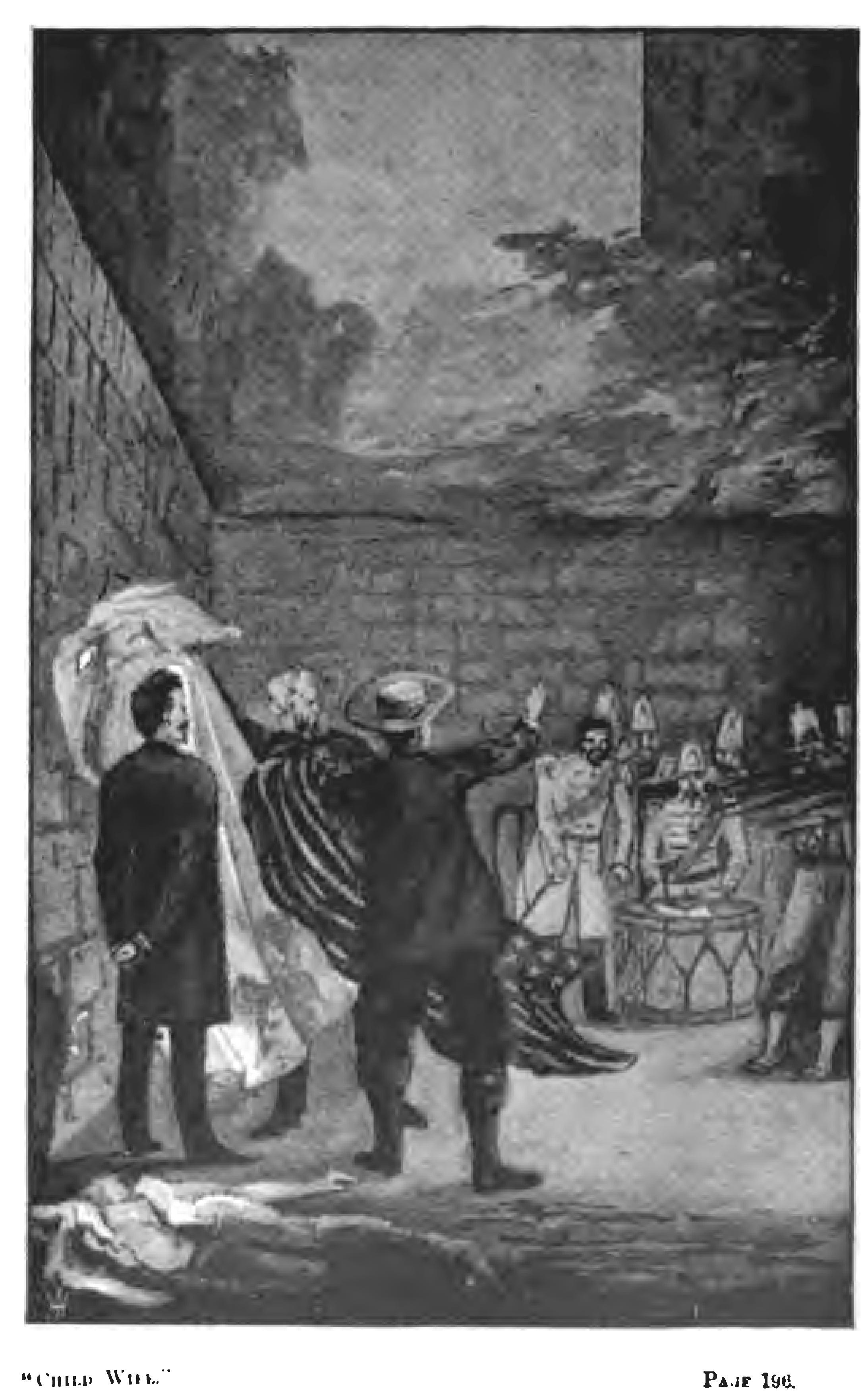
Two of these laying hold, forced him up against the wall, close to the corpse of the Red Republican.
He was manacled, and could make no resistance. None would have availed him.
The soldiers stood waiting for the command “Tirez!”
In another instant it would have been heard, for it was forming on the lips of the Zouave lieutenant.
Fate willed it otherwise. Before it could be given, the outer door opened, admitting a man whose presence caused a sudden suspension of the proceedings.
Hurrying across the courtyard, he threw himself between the soldiers and their victim, at the same time drawing a flag from beneath his coat, and spreading it over the condemned man.
Even the drunken Zouaves dared not fire through that flag. It was the Royal Standard of England!
But there was a double protection for the prisoner. Almost at the same instant another man stepped hastily across the courtyard and flouted a second flag in the eyes of the disappointed executioners!
It claimed equal respect, for it was the banner of the Stars and Stripes—the emblem of the only true Republic on earth.
Maynard had served under both flags, and for a moment he felt his affections divided.
He knew not to whom he was indebted for the last; but when he reflected who had sent the first—for it was Sir George Vernon who bore it—his heart trembled with a joy far sweeter than could have been experienced by the mere thought of delivery from death!
Chapter Thirty Nine.
Once More in Westbourne.
Once more in the British metropolis, Mr Swinton was seated in his room.
It was the same set of “furnished apartments,” containing that cane chair with which he had struck his ill-starred wife.
She was there, too, though not seated upon the chair.
Reclined along a common horse-hair sofa, with squab and cushions hard and scuffed, she was reading one of De Kock’s novels, in translation. Fan was not master of the French tongue, though skilled in many of those accomplishments for which France has obtained special notoriety.
It was after breakfast time, though the cups and saucers were still upon the table.
A common white-metal teapot, the heel of a half-quartern loaf, the head and tail of a herring, seen upon a blue willow pattern plate, told that the meal had not been epicurean.
Swinton was smoking “bird’s-eye” in a briar-root pipe. It would have been a cigar, had his exchequer allowed it.
Never in his life had this been so low. He had spent his last shilling in pursuit of the Girdwoods—in keeping their company in Paris, from which they, as he himself, had just returned to London.
As yet success had not crowned his scheme, but appeared distant as ever. The storekeeper’s widow, notwithstanding her aspirations after a titled alliance, was from a country whose people are proverbially “cute.” She was, at all events, showing herself prudent, as Mr Swinton discovered in a conversation held with her on the eve of their departure from Paris.
It was on a subject of no slight importance, originating in a proposal on his part to become her son in-law. It was introductory to an offer he intended making to the young lady herself.
But the offer was not made, Mrs Girdwood having given reasons for its postponement.
They seemed somewhat unsubstantial, leaving him to suppose he might still hope.
The true reason was not made known to him, which was, that the American mother had become suspicious about his patent of nobility. After all, he might not be a lord. And this, notwithstanding his perfect playing of the part, which the quondam guardsman, having jostled a good deal against lords, was enabled to do.
She liked the man much—he flattered her sufficiently to deserve it—and used every endeavour to make her daughter like him. But she had determined, before things should go any further, to know something of his family. There was something strange in his still travelling incognito. The reasons he assigned for it were not satisfactory. Upon this point she must get thoroughly assured. England was the place to make the inquiry, and thither had she transported herself and her belongings—as before, putting up at the aristocratic Clarendon.
To England Swinton had followed, allowing only a day to elapse.
By staying longer in Paris, he would have been in pawn. He had just sufficient cash to clear himself from the obscure hotel where he had stopped, pay for a Boulogne boat, and a “bus” from London Bridge to his lodgings in far Westbourne, where he found his Fan not a shilling richer than himself. Hence that herring for breakfast, eaten on the day after his return.
He was poor in spirits as in purse. Although Mrs Girdwood had not stated the true reason for postponing her daughter’s reception of his marriage proposal, he could conjecture it. He felt pretty sure that the widow had come to England to make inquiries about him.
And what must they result in? Exposure! How could it be otherwise? His name was known in certain circles of London. So also his character. If she should get into these, his marriage scheme would be frustrated at once and for ever.
And he had become sufficiently acquainted with her shrewdness to know she would never accept him for a son-in-law, without being certain about the title—which in her eyes alone rendered him eligible.
If his game was not yet up, the cards left in his hand were poor. More than ever did they require skilful playing.
What should be his next move?
It was about this his brain was busy, as he sat pulling away at his pipe.
“Any one called since I’ve been gone?” he asked of his wife without turning toward her.
Had he done so, he might have observed a slight start caused by the inquiry. She answered, hesitatingly:
“Oh! no—yes—now I think of it I had a visitor—one.”
“Who?”
“Sir Robert Cottrell. You remember our meeting him at Brighton?”
“Of course I remember it. Not likely to forget the name of the puppy. How came he to call?”
“He expected to see you.”
“Indeed, did he! How did he know where we were living?”
“Oh, that! I met him one day as I was passing through Kensington Gardens, near the end of the Long Walk. He asked me where we were staying. At first I didn’t intend telling him. But he said he wanted particularly to see you; and so I gave him your address.”
“I wasn’t at home!”
“I told him that; but said I expected you every day. He came to inquire if you had come back.”
“Did he? What a wonderful deal he cared about my coming back. In the Long Walk you met him? I suppose you have been showing yourself in the Row every day?”
“No I haven’t, Richard. I’ve only been there once or twice—You can’t blame me for that? I’d like to know who could stay everlastingly here, in these paltry apartments, with that shrewish landlady constantly popping out and in, as if to see whether I’d carried off the contents of our trunks. Heaven knows, it’s a wretched existence at best; but absolutely hideous inside these lodgings!”
Glancing around the cheaply-furnished parlour, seeing the head and tail of the herring, with the other scraps of their poor repast, Swinton could not be otherwise than impressed with the truth of his wife’s words.
Their tone, too, had a satisfying effect. It was no longer that of imperious contradiction, such as he had been accustomed to for twelve months after marriage. This had ceased on that day when the leg of a chair coming in contact with his beloved’s crown had left a slight cicatrice upon her left temple—like a stain in statuary marble. From that hour the partner of his bosom had shown herself a changed woman—at least toward himself. Notwithstanding the many quarrels, and recriminative bickerings, that had preceded it, it was the first time he had resorted to personal violence. And it had produced its effect. Coward as she knew him to be, he had proved himself brave enough to bully her. She had feared him ever since. Hence her trepidation as she made answer to his inquiry as to whether any one had called.
There was a time when Frances Wilder would not have trembled at such a question, nor stammered in her reply.
She started again, and again showed signs of confusion, as the shuffling of feet on the flags outside was followed by a knock at the door.
It was a double one; not the violent repeat of the postman, but the rat-tat-tat given either by a gentleman or lady—from its gentleness more like the latter.
“Who can it be?” asked Swinton, taking the pipe from between his teeth. “Nobody for us, I hope.”
In London, Mr Swinton did not long for unexpected visitors. He had too many “kites” abroad, to relish the ring of the doorbell, or the more startling summons of the knocker.
“Can’t be for us,” said his wife, in a tone of mock confidence. “There’s no one likely to be calling; unless some of your old friends have seen you as you came home. Did you meet any one on the way?”
“No, nobody saw me,” gruffly returned the husband.
“There’s a family upstairs—in the drawing-rooms. I suppose it’s for them, or the people of the house.”
The supposition was contradicted by a dialogue heard outside in the hall. It was as follows:
“Mrs Swinton at home?”
The inquiry was in a man’s voice, who appeared to have passed in from the steps.
“Yis, sirr!” was the reply of the Irish janitress, who had answered the knock.
“Give my card; and ask the lady if I can see her.”
“By Jove! that’s Cottrell!” muttered the ex-guardsman, recognising the voice.
“Sir Robert Cottrell” was upon the card brought in by the maid-of-all-work.
“Show him in?” whispered Swinton to the servant, without waiting to ask permission from Fan; who, expressing surprise at the unexpected visit, sprang to her feet, and glided back into the bedroom.
There was a strangeness in the fashion of his wife’s retreat, which the husband could scarce help perceiving. He took no notice of it, however, his mind at the moment busied with a useful idea that had suddenly suggested itself.
Little as he liked Sir Robert Cottrell, or much as he may have had imaginings about the object of his visit, Swinton at that moment felt inclined to receive him. The odour of the salt herring was in his nostrils; and he was in a mood to prefer the perfume that exhales from the cambric handkerchief of a débonnaire baronet—such as he knew Sir Robert to be.
It was with no thought of calling his quondam Brighton acquaintance to account that he directed the servant to show him in.
And in he was shown.
Chapter Forty.
A Cautious Baronet.
The baronet looked a little blank, as the open parlour door discovered inside a “party” he had no intention of calling upon.
Accustomed to such surprises, however, he was not disconcerted. He had some knowledge of the ex-guardsman’s character. He knew he was in ill-luck; and that under such circumstances he would not be exactingly inquisitive.
“Aw, Swinton, my dear fellaw,” he exclaimed, holding out his kid-gloved hand. “Delighted to see you again. Madam told me she expected you home. I just dropped in, hoping to find you returned. Been to Paris, I hear?”
“I have,” said Swinton, taking the hand with a show of cordiality.
“Terrible times over there. Wonder you came off with a whole skin?”
“By Jove, it’s about all I brought off with me.”
“Aw, indeed! What mean you by that?”
“Well; I went over to get some money that’s been long owing me. Instead of getting it, I lost what little I carried across.”
“How did you do that, my dear fellaw?”
“Well, the truth is, I was tempted into card-playing with some French officers I chanced to meet at the Mille Colonnes. It was their cursed écarté. They knew the game better than I; and very soon cleared me out. I had barely enough to bring me back again. I thank God I’m here once more; though how I’m going to weather it this winter, heaven only knows! You’ll excuse me, Sir Robert, for troubling you with this confession of my private affairs. I’m in such a state of mind, I scarce know what I’m saying. Confound France and Frenchmen! I don’t go among them again; not if I know it.”
Sir Robert Cottrell, though supposed to be rich, was not accustomed to squandering money—upon men. With women he was less penurious; though with these only a spendthrift, when their smiles could not be otherwise obtained. He was one of those gallants who prefer making conquests at the cheapest possible rates; and, when made, rarely spend money to secure them. Like the butterfly, he liked flitting from flower to flower.
That he had not dropped in hoping to find Mr Swinton, but had come on purpose to visit his wife, the craven husband knew just as well as if he had openly avowed it. And the motive, too; all the more from such a shallow excuse.
It was upon the strength of this knowledge that the ex-guardsman was so communicative about his financial affairs. It was a delicate way of making it known, that he would not be offended by the offer of a trifling loan.
Sir Robert was in a dilemma. A month earlier he would have much less minded it. But during that month he had met Mrs Swinton several times, in the Long Walk, as elsewhere. He had been fancying his conquest achieved, and did not feel disposed to pay for a triumph already obtained.
For this reason he was slow to perceive the hint so delicately thrown out to him.
Swinton reflected on a way to make it more understandable. The débris of the frugal déjeuner came to his assistance.
“Look!” said he, pointing to the picked bones of the herring with an affectation of gaiety, “look there, Sir Robert! You might fancy it to be Friday. That fine fish was purchased with the last penny in my pocket. To-morrow is Friday; and I suppose I shall have to keep Lent still more austerely. Ha! ha! ha!”
There was no resisting such an appeal as this. The close-fisted aristocrat felt himself fairly driven into a corner.
“My dear fellaw!” said he, “don’t talk in that fashion. If a fiver will be of any service to you, I hope you will do me the favour to accept it. I know you won’t mind it from me?”
“Sir Robert, it is too kind. I—I—”
“Don’t mention it. I shouldn’t think of offering you such a paltry trifle; but just now my affairs are a little queerish. I dropped a lot upon the last Derby; and my lawyer is trying to raise a further mortgage on my Devonshire estate. If that can be effected, things will, of course, be different. Meanwhile, take this. It may pass you over your present difficulty, till something turns up.”
“Sir Robert, I—”
“No apology, Swinton! It is I who owe it, for the shabby sum.”
The ex-guardsman ceased to resist; and the five-pound note, pressed into his palm was permitted to remain there.
“By the bye, Swinton,” said the baronet, as if to terminate the awkward scene by obliging the borrower in a more business-like way, “why don’t you try to get something from the Government? Excuse a fellaw for taking the liberty; but it seems to me, a man of your accomplishments ought to stand a chance.”
“Not the slightest, Sir Robert! I have no interest; and if I had, there’s that ugly affair that got me out of the Guards. You know the story; and therefore I needn’t tell it you. That would be sure to come up if I made any application.”
“All stuff, my dear fellaw! Don’t let that stand in your way. It might, if you wanted to get into the Household, or be made a bishop. You don’t aspire to either, I presume?”
The ex-guardsman gave a lugubrious laugh.
“No!” he said. “I’d be contented with something less. Just now my ambition don’t soar extravagantly high.”
“Suppose you try Lord —, who has Government influence? In these troublous times there’s no end of employment, and for men whose misfortunes don’t need to be called to remembrance. Yours won’t stand in the way. I know his lordship personally. He’s not at all exacting.”
“You know him, Sir Robert?”
“Intimately. And if I’m not mistaken, he’s just the man to serve you; that is, by getting you some appointment? The diplomatic service has grown wonderfully, since the breaking out of these revolutions. More especially the secret branch of it. I’ve reason to know that enormous sums are now spent upon it. Then, why shouldn’t you try to get a pull out of the secret service chest?”
Swinton relit his pipe, and sat cogitating.
“A pipe don’t become a guardsman,” jokingly remarked his guest. “The favourites of the Foreign Office smoke only regalias.”
Swinton received this sally with a smile, that showed the dawning of a new hope.
“Take one?” continued the baronet, presenting his gold-clasped case.
Swinton pitched the briar-root aside, and set fire to the cigar.
“You are right, Sir Robert,” he said; “I ought to try for something. It’s very good of you to give me the advice. But how am I to follow it? I have no acquaintance with the nobleman you speak of; nor have any of my friends.”
“Then you don’t count me as one of them?”
“Dear Cottrell! Don’t talk that way! After what’s passed between us, I should be an ungrateful fellow if I didn’t esteem you as the first of them—perhaps the only friend I have left.”
“Well, I’ve spoken plainly. Haven’t I said that I know Lord — well enough to give you a letter of introduction to him? I won’t say it will serve any purpose; you must take your chances of that. I can only promise that he will receive you; and if you’re not too particular as to the nature of the employment, I think he may get you something. You understand me, Swinton?”
“I particular! Not likely, Sir Robert, living in this mean room, with the remembrance of that luxurious breakfast I’ve just eaten—myself and my poor wife!”
“Aw—by the way, I owe madam an apology for having so long neglected to ask after her. I hope she is well?”
“Thank you! Well as the dear child can be expected, with such trouble upon us.”
“Shall I not have the pleasure of seeing her?”
The visitor asked the question without any pretence of indifference. He felt it—just then, not desiring to encounter her in such company.
“I shall see, Sir Robert,” replied the husband, rising from his chair, and going toward the bedroom. “I rather suspect Fan’s en dishabille at this hour.”
Sir Robert secretly hoped that she was. Under the circumstances, an interview with her could only be awkward.
His wish was realised. She was not only en dishabille, but in bed—with a sick headache! She begged that the baronet would excuse her from making appearance!
This was the report brought back from the bedroom by her go-between of a husband. It remained only for the visitor to make good his promise about the letter of introduction.
He drew up to the table, and wrote it out, currente calamo.
He did not follow the usual fashion, by leaving the envelope open. There was a clause or two in the letter he did not desire the ex-guardsman to become acquainted with. It concluded with the words: “Mr Swinton is a gentleman who would suit for any service your lordship may be pleased to obtain for him. He is a disappointed man...”
Wetting the gum with the tip of his aristocratic tongue, he closed the envelope, and handed the epistle to his host.
“I know,” said he, “Lord A— will be glad to serve you. You might see him at the Foreign Office; but don’t go there. There are too many fellaws hanging about, who had better not know what you’re after. Take it to his lordship’s private residence in Park Lane. In a case like yours, I know he’d prefer receiving you there. You had better go at once. There are so many chances of your being forestalled—a host of applicants hungering for something of the same. His lordship is likely to be at home about three in the afternoon. I’ll call here soon after to learn how you’ve prospered. Bye, my dear fellaw! good-bye!”
Re-gloving his slender aristocratic fingers, the baronet withdrew—leaving the ex-guardsman in possession of an epistle that might have much influence on his future fate.