Captain Mayne Reid (continued 3)
Reading edition
It was at a time, however, when the word rebel was synonymous with patriot; before it became disgraced by that great rebellion—the first in all history sinful and without just cause—the first that can be called inglorious.
Then the term was a title to be proud of—the thing itself a sacred duty; and inspired by these thoughts, he looked before him without fear, and behind with less regret.
It would not be true to say, that he was altogether indifferent to the scenes receding from his view. Many bonds of true friendship had been broken; many hands warmly shaken, perhaps never to be grasped again!
And there was one severance, where a still tenderer tie had been torn asunder.
But the spasm had passed some time ago—more keenly felt by him on the deck of that steamer leaving the harbour of Newport.
A week had elapsed since then—a week spent amidst exciting scenes and in the companionship of kindred spirits—in the enrolling-room surrounded by courageous filibusters—in the Bairisch beer-saloons with exiled republican patriots—amidst the clinking of glasses, filled out of long-necked Rhine wine bottles, and quaffed to the songs of Schiller, and the dear German fatherland.
It was fortunate for Maynard that this stormy life had succeeded the tranquillity of the Newport Hotel. It enabled him to think less about Julia Girdwood. Still was she in his mind, as the steamer left Staten Island in her wake, and was clearing her way through the Narrows.
But before Sandy Hook was out of sight, the proud girl had gone away from his thoughts, and with the suddenness of thought itself!
This quick forgetfulness calls for explanation.
The last look at a land, where a sweetheart has been left behind, will not restore the sighing heart to its tranquillity. It was not this that had produced such an abrupt change in the spirit of the lover.
No more was it the talk of Roseveldt, standing by his side, and pouring into his ear those revolutionary ideas, for which the Count had so much suffered.
The change came from a cause altogether different, perhaps the only one capable of effecting such a transformation.
“Un clavo saca otro clavo,” say the Spaniards, of all people the most knowing in proverbial lore. “One nail drives out another.” A fair face can only be forgotten by looking upon one that is fairer.
Thus came relief to Captain Maynard.
Turning to go below, he saw a face so wonderfully fair, so strange withal, that almost mechanically he stayed his intention, and remained lingering on the deck.
In less than ten minutes after, he was in love with a child!
There are those who will deem this an improbability; perhaps pronounce it unnatural.
Nevertheless it was true; for we are recording an actual experience.
As Maynard faced towards the few passengers that remained upon the upper deck, most of them with eyes fixed upon the land they were leaving, he noticed one pair that were turned upon himself. At first he read in them only an expression of simple curiosity; and his own thought was the same as he returned the glance.
He saw a child with grand golden hair—challenging a second look. And this he gave, as one who regards something pretty and superior of its kind.
But passing from the hair to the eyes, he beheld in them a strange, wondering gaze, like that given by the gazelle or the fawn of the fallow-deer, to the saunterer in a zoological garden, who has tempted it to the edge of its enclosure.
Had the glance been only transitory, Maynard might have passed on, though not without remembering it.
But it was not. The child continued to gaze upon him, regardless of all else around.
And so on till a man of graceful mien—grey-haired and of paternal aspect—came alongside, caught her gently by the hand, and led her away, with the intention of taking her below.
On reaching the head of the stairway she glanced back, still with that same wildering look; and again, as the bright face with its golden glories sweeping down behind it, disappeared below the level of the deck.
“What’s the matter with you, Maynard?” asked the Count, seeing that his comrade had become suddenly thoughtful. “By the way you stand looking after that little sprout, one might suppose her to be your own!”
“My dear Count,” rejoined Maynard, in an earnest, appealing tone, “I beg you won’t jest with me—at all events, don’t laugh, when I tell you how near you have hit upon my wish.”
“What wish?”
“That she were my own.”
“As how?”
“As my wife.”
“Wife! A child not fourteen years of age! Cher capitaine! you are turning Turk! Such ideas are not becoming to a revolutionary leader. Besides, you promised to have no other sweetheart than your sword! Ha—ha—ha! How soon you’ve forgotten the naiad of Newport!”
“I admit it. I’m glad I have been able to do so. It was altogether different. It was not true love, but only—never mind what. But now I feel—don’t laugh at me, Roseveldt. I assure you I am sincere. That child has impressed me with a feeling I never had before. Her strange look has done it. I know not why or wherefore she looked so. I feel as if she had sounded the bottom of my soul! It may be fate, destiny—whatever you choose to call it—but as I live, Roseveldt, I have a presentiment—she will yet be my wife!”
“If such be her and your destiny,” responded Roseveldt, “don’t suppose I shall do anything to obstruct its fulfilment. She appears to be the daughter of a gentleman, though I must confess I don’t much like his looks. He reminds me of the class we are going to contend against. No matter for that. The girl’s only an infant; and before she can be ready to marry you, all Europe may be Republican, and you a Présidant! Now, cher capitaine! let us below, else the steward may have our fine Havanas stowed away under hatches; and then such weeds as we’d have to smoke during the voyage!” From sentiment to cigars was an abrupt change. But Maynard was no romantic dreamer; and complying with his fellow-traveller’s request, he descended to the state-room to look after the disposal of their portmanteaus.
Chapter Twenty One.
A Short-Lived Triumph.
While the hero of C— was thus starting to seek fresh fame on a foreign shore, he came very near having his escutcheon stained in the land he was leaving behind him!
At the time that his name was a shout of triumph in noisy New York, it was being pronounced in the quiet circles of Newport with an accent of scorn.
By many it was coupled with the word “coward.”
Mr Swinton enjoyed his day of jubilee.
It did not last long; though long enough to enable this accomplished card-player to make a coup.
From the repute obtained by the sham challenge, aided by the alliance of Louis Lucas, he was not long in discovering some of those pigeons for whose especial plucking he had made the crossing of the Atlantic.
They were not so well feathered as he had expected to find them. Still did he obtain enough to save him from the necessity of taking to a hack, or the fair Frances to a mangle.
For the cashiered guardsman—now transformed into a swindler—it promised to be a golden time. But the promise was too bright to be of long continuance, and his transient glory soon became clouded with suspicion; while that of his late adversary was released from the stigma that for a time had attached to it.
A few days after Maynard had taken his departure from New York, it became known why he had left so abruptly. The New York newspapers contained an explanation of this. He had been elected to the leadership of what was by them termed the “German expedition”; and had responded to the call.
Honourable as this seemed to some, it did not quite justify him in the eyes of others, acquainted with his conduct in the affair with Swinton. His insult to the Englishman had been gross in the extreme, and above all considerations he should have stayed to give him satisfaction.
But the papers now told of his being in New York. Why did Mr Swinton not follow him there? This, of course, was but a reflection on the opposite side, and both now appeared far from spotless.
So far as regarded Maynard, the spots were at length removed; and before he had passed out of sight of Sandy Hook, his reputation as a “gentleman and man of honour” was completely restored.
An explanation is required. In a few words it shall be given.
Shortly after Maynard had left, it became known in the Ocean House that on the morning after the ball, and at an early hour a strange gentleman arriving by the New York boat had made his way to Maynard’s room, staying with him throughout the day.
Furthermore, that a letter had been sent addressed to Mr Swinton, and delivered to his valet. The waiter to whom it had been intrusted was the authority for these statements.
What could that letter contain?
Mr Lucas should know, and Mr Lucas was asked.
But he did not know. So far from being acquainted with the contents of the letter in question, he was not even aware that an epistle had been sent.
On being told of it, he felt something like a suspicion of being compromised, and at once determined on demanding from Swinton an explanation.
With this resolve he sought the Englishman in his room.
He found him there, and with some surprise discovered him in familiar discourse with his servant.
“What’s this I’ve heard, Mr Swinton?” he asked upon entering.
“Aw—aw; what, my deaw Lucas?”
“This letter they’re talking about.”
“Lettaw—lettaw! I confess supweme ignowance of what you mean, my deaw Lucas.”
“Oh, nonsense! Didn’t you receive a letter from Maynard—the morning after the ball?”
Swinton turned white, looking in all directions except into the eyes of Lucas. He was hesitating to gain time—not with the intention of denying it. He knew that he dare not.
“Oh! yas—yas!” he replied at length. “There was a lettaw—a very queaw epistle indeed. I did not get it that day till after yaw had gone. My valet Fwank, stoopid fellow! had thrown it into a cawner. I only wed it on the following mawning.”
“You have it still, I suppose?”
“No, indeed I lit my cigaw with the absawd epistle.”
“But what was it about?”
“Well—well; it was a sort of apology on the part of Mr Maynard—to say he was compelled to leave Newport by the evening bawt. It was signed by his fwend Wupert Woseveldt, calling himself a Count of the Austwian Empire. After weading it, and knowing that the writer was gone, I didn’t think it wawth while to twouble you any fawther about the disagweeable business.”
“By Gad! Mr Swinton, that letter’s likely to get us both into a scrape!”
“But why, my deaw fellow?”
“Why? Because everybody wants to know what it was about. You say you’ve destroyed it?”
“Tore it into taypaws, I ashaw you.”
“More’s the pity. It’s well-known that a letter was sent and delivered to your servant. Of course every one supposes that it came to your hands. We’re bound to give some explanation.”
“Twue—twue. What daw you suggest, Mr Lucas?”
“Why, the best way will be to tell the truth about it. You got the letter too late to make answer to it. It’s already known why, so that, so far as you are concerned, the thing can’t be any worse. It lets Maynard out of the scrape—that’s all.”
“Yaw think we’d better make a clean bweast of it?”
“I’m sure of it. We must.”
“Well, Mr Lucas, I shall agwee to anything yaw may think pwopaw. I am so much indebted to yaw.”
“My dear sir,” rejoined Lucas, “it’s no longer a question of what’s proper. It is a necessity that this communication passed between Mr Maynard and yourself should be explained. I am free, I suppose, to give the explanation?”
“Oh, pawfectly free. Of cawse—of cawse.”
Lucas left the room, determined to clear himself from all imputation.
The outside world was soon after acquainted with the spirit, if not the contents of that mysterious epistle; which re-established the character of the man who wrote, while damaging that of him who received it.
From that hour Swinton ceased to be an eagle in the estimation of the Newport society. He was not even any longer a successful hawk—the pigeons becoming shy. But his eyes were still bent upon that bird of splendid plumage—far above all others—worth the swooping of a life!
Chapter Twenty Two.
The Conspiracy of Crowns.
The revolutionary throe that shook the thrones of Europe in 1848 was but one of those periodical upheavings occurring about every half-century, when oppression has reached that point to be no longer endurable.
Its predecessor of 1790, after some fitful flashes of success, alternating with intervals of gloom, had been finally struck down upon the field of Waterloo, and there buried by its grim executioner, Wellington.
But the grave once more gave up its dead; and before this cold-blooded janissary of despotism sank into his, he saw the ghost of that Liberty he had murdered start into fresh life, and threaten the crowned tyrants he had so faithfully served.
Not only were they threatened, but many of them dethroned. The imbecile Emperor of Austria had to flee from his capital, as also the bureaucratic King of France. Weak William of Prussia was called to account by his long-suffering subjects, and compelled, upon bended knees, to grant them a Constitution.
A score of little kinglets had to follow the example; while the Pope, secret supporter of them all, was forced to forsake the Vatican—that focus and hotbed of political and religious infamy—driven out by the eloquent tongue of Mazzini and the conquering blade of Garibaldi.
Even England, secure in a profound indifference to freedom and reform, trembled at the cheers of the Chartists.
Every crowned head in Europe had its “scare” or discomfiture; and, for a time, it was thought that liberty was at length achieved.
Alas! it was but a dream of the people—short-lived and evanescent—to be succeeded by another long sleeps under an incubus, heavier and more horrid than that they had cast off.
While congratulating one another on their slight spasmodic success, their broken fetters were being repaired, and new chains fabricated, to bind them faster than ever. The royal blacksmiths were at work, and in secret, like Vulcan at his subterranean forge.
And they were working with a will, their object and interests being the same. Their common danger had driven them to a united action, and it was determined that their private quarrels should henceforth be set aside—to be resuscitated only as shams, when any of them required such fillip to stimulate the loyalty of his subjects.
This was the new programme agreed upon. But, before it could be carried out, it was necessary that certain of them should be assisted to recover that ascendency over their people, lost in the late revolution.
Sweeping like a tornado over Europe, it had taken one and all of them by surprise. Steeped in luxurious indulgence—in the exercise of petty spites and Sardanapalian excesses—confident in the vigilance of their trusted sentinel, Wellington—they had not perceived the storm till it came tearing over them. For the jailor of Europe’s liberty was also asleep! Old age, with its weakened intellect, had stolen upon him, and he still dotingly believed in “Brown Bess,” while Colt’s revolver and the needle-gun were reverberating in his ears.
Yes, the victor of Waterloo was too old to aid the sons of those tyrant sires he had re-established on their thrones.
And they had no other military leader—not one. Among them there was not a soldier, while on the side of the people were the Berns and Dembinskys, Garibaldi, Damjanich, Klapka, and Anglo-Hungarian Guyon—a constellation of flaming swords! As statesmen and patriots they had none to compete with Kossuth, Manin, and Mazzini.
In the field of fair fight—either military or diplomatic—the despots stood no chance. They saw it, and determined upon treachery.
For this they knew themselves provided with tools a plenty; but two that promised to prove specially effective—seemingly created for the occasion. One was an English nobleman—an Irishman by birth—born on the outside edge of the aristocracy; who, by ingenious political jugglery, had succeeded in making himself not only a very noted character, but one of the most powerful diplomatists in Europe.
And this without any extraordinary genius. On the contrary, his intellect was of the humblest—never rising above that of the trickster. As a member of the British Parliament his speeches were of a thoroughly commonplace kind, usually marked by some attempted smartness that but showed the puerility and poverty of his brain. He would often amuse the House by pulling off half-a-dozen pairs of white kid gloves during the delivery of one of his long written-out orations. It gave him an air of aristocracy—no small advantage in the eyes of an English audience.
For all this, he had attained to a grand degree of popularity, partly from the pretence of being on the Liberal side, but more from paltering to that fiend of false patriotism—national prejudice.
Had his popularity been confined to his countrymen, less damage might have accrued from it.
Unfortunately it was not. By a professed leaning toward the interests of the peoples, he had gained the confidence of the revolutionary leaders all over Europe; and herein lay his power to do evil.
It was by no mere accident this confidence had been obtained. It had been brought about with a fixed design, and with heads higher than his for its contrivers. In short, he was the appointed political spy of the united despots—the decoy set by them for the destruction of their common and now dreaded enemy—the Republic.
And yet that man’s name is still honoured in England, the country where, for two hundred years, respect has been paid to the traducers of Cromwell!
The second individual on whom the frightened despots had fixed their hopeful eyes was a man of a different race, though not so different in character.
He, too, had crept into the confidence of the revolutionary party by a series of deceptions, equally well contrived, and by the same contrivers who had put forward the diplomatist.
It is true, the leaders of the people were not unsuspicious of him. The hero of the Boulogne expedition, with the tamed eagle perched upon his shoulder, was not likely to prove a soldier of Freedom, nor yet its apostle; and in spite of his revolutionary professions, they looked upon him with distrust.
Had they seen him, as he set forth from England to assume the Presidency of France, loaded with bags of gold—the contributions of the crowned heads to secure it—they might have been sure of the part he was about to play.
He had been employed as a dernier ressort—a last political necessity of the despots. Twelve months before they would have scorned such a scurvy instrument, and did.
But times had suddenly changed. Orleans and Bourbon were no longer available. Both dynasties were defunct, or existing without influence. There was but one power that could be used to crush republicanism in France—the prestige of that great name, Napoleon, once more in the full sunlight of glory, with its sins forgiven and forgotten.
He who now represented it was the very man for the work, for his employers knew it was a task congenial to him.
With coin in his purse, and an imperial crown promised for his reward, he went forth, dagger in hand, sworn to stab Liberty to the heart!
History records how faithfully he has kept his oath!
Chapter Twenty Three.
The Programme of the Great Powers.
In a chamber of the Tuileries five men were seated around a table.
Before them were decanters and glasses, wine bottles of varied shapes, an épergne filled with choice flowers, silver trays loaded with luscious fruits, nuts, olives—in short, all the materials of a magnificent dessert.
A certain odour of roast meats, passing off under the bouquet of the freshly-decanted wines, told of a dinner just eaten, the dishes having been carried away.
The gentlemen had taken to cigars, and the perfume of finest Havana tobacco was mingling with the aroma of the fruit and flowers. Smoking, sipping, and chatting with light nonchalance, at times even flippantly, one could ill have guessed the subject of their conversation.
And yet it was of so grave and secret a nature, that the butler and waiters had been ordered not to re-enter the room—the double door having been close-shut on their dismissal—while in the corridor outside a guard was kept by two soldiers in grenadier uniform.
The five men, thus cautious against being overheard, were the representatives of the Five Great Powers of Europe—England, Austria, Russia, Prussia, and France.
They were not the ordinary ambassadors who meet to arrange some trivial diplomatic dispute, but plenipotentiaries with full power to shape the destinies of a continent.
And it was this that had brought together that five-cornered conclave, consisting of an English Lord, an Austrian Field-Marshal, a Russian Grand Duke, a distinguished Prussian diplomatist, and the President of France—host of the other four.
They were sitting in conspiracy against the peoples of Europe, set free by the late revolutions—with the design to plot their re-enslavement.
Their scheme of infamy had been maturely considered, and perfected before adjourning to the dinner-table.
There had been scarce any discussion; since, upon its main points, there was mutual accord.
Their after-dinner conversation was but a résumé of what had been resolved upon—hence, perhaps, the absence of that gravity befitting such weighty matter, and which had characterised their conference at an earlier hour.
They were now resting over their cigars and wines, jocularly agreeable, as a band of burglars, who have arranged all the preliminaries for the “cracking of a crib.”
The English lord seemed especially in good humour with himself and all the others. Distinguished throughout his life for what some called an amiable levity, but others thought to be an unamiable heartlessness, he was in the element to delight him. Of origin not very noble, he had attained to the plenitude of power, and now saw himself one of five men entrusted with the affairs of the Great European Aristocracy, against the European people. He had been one of the principal plotters—suggesting many points of the plan that had been agreed upon; and from this, as also the greatness of the nation he represented, was acknowledged as having a sort of tacit chairmanship over his fellow-conspirators.
The real presidency, however, was in the Prince-President—partly out of regard to his high position, and partly that he was the host.
After an hour or so passed in desultory conversation, the “man of a mission,” standing with his back to the fire, with hands parting his coat tails—the habitual attitude of the Third Napoleon—took the cigar from between his teeth, and made résumé as follows:—
“Understood, then, that you, Prussia, send a force into Baden, sufficient to crush those pot-valiant German collegians, mad, no doubt, from drinking your villainous Rhine wine!”
“Mercy on Metternich, cher Président. Think of Johanisberger!”
It was the facetious Englishman who was answerable for this.
“Ya, mein Prinz, ya,” was the more serious response of the Prussian diplomatist. “Give ’em grape, instead of grapes,” put in the punster. “And you, Highness, bind Russia to do the same for these hog-drovers of the Hungarian Puszta?”
“Two hundred thousand men are ready to march down upon them,” responded the Grand Duke.
“Take care you don’t catch a Tartar, mon cher altesse!” cautioned the punning plenipotentiary.
“You’re quite sure of Geörgei, Marshal?” went on the President, addressing himself to the Austrian.
“Quite. He hates this Kossuth as the devil himself; and perhaps a little worse. He’d see him and his Honveds at the bottom of the Danube; and I’ve no doubt will hand them over, neck and crop, as soon as our Russian allies show themselves over the frontier.”
“And a crop of necks you intend gathering, I presume?” said the heartless wit.
“Très bien!” continued the President, without noticing the sallies of his old friend, the lord. “I, on my part, will take care of Italy. I think I can trust superstition to assist me in restoring poor old Pio Nono.”
“Your own piety will be sufficient excuse for that, mon Prince. ’Tis a holy crusade, and who more fitted than you to undertake it? With Garibaldi for your Saladin, you will be called Louis of the Lion-heart!”
The gay viscount laughed at his own conceit; the others joining him in the cachinnation.
“Come, my lord!” jokingly rejoined the Prince-President, “it’s not meet for you to be merry. John Bull has an easy part to play in this grand game!”
“Easy, you call it? He’s got to provide the stakes—the monisch. And, after all, what does he gain by it?”
“What does he gain by it? Pardieu! You talk that way in memory of your late scare by the Chartists? Foi d’honnête homme! if I hadn’t played special constable for him, you, cher vicomte, instead of being here as a plenipotentiary, might have been this day enjoying my hospitality as an exile!”
“Ha—ha—ha! Ha—ha—ha!”
Grave Sclave, and graver Teuton—Russia, Prussia, and Austria—took part in the laugh; all three delighted with this joke at the Englishman’s expense.
But their débonnaire fellow-conspirator felt no spite at his discomfiture; else he might have retorted by saying:
“But for John Bull, my dear Louis Napoleon, and that service you pretend to make light of, even the purple cloak of your great uncle, descending as if from the skies, and flouted in the eyes of France, might not have lifted you into the proud position you now hold—the chair of a President, perhaps to be yet transformed into the throne of an Emperor!”
But the Englishman said naught of this. He was too much interested in the hoped-for transformation to make light of it just then; and instead of giving rejoinder, he laughed loud as any of them.
A few more glasses of Moët and Madeira, with a “tip” of Tokay to accommodate the Austrian Field-Marshal, another regalia smoked amidst more of the same kind of persiflage, and the party separated.
Two only remained—Napoleon and his English guest.
It is possible—and rather more than probable—that two greater chicanes never sat together in the same room!
I anticipate the start which this statement will call forth—am prepared for the supercilious sneer. It needs experience, such as revolutionary leaders sometimes obtain, to credit the scoundrelism of conspiring crowns; though ten minutes spent in listening to the conversation that followed would make converts of the most incredulous.
There was no lack of confidence between the two men. On the contrary, theirs was the thickness of thieves; and much in this light did they look upon one another.
But they were thieves on a grand scale, who had stolen from France one-half of its liberty, and were now plotting to deprive it of the other.
Touching glasses, they resumed discourse, the Prince speaking first:
“About this purple robe? What step should be taken? Until I’ve got that on my shoulders, I feel weak as a cat. The Assembly must be consulted about everything. Even this paltry affair of restoring the Pope will cost me a herculean effort.”
The English plenipotentiary did not make immediate reply. Tearing a kid glove between his fingers, he sat reflecting—his very common face contorted with an expression that told of his being engaged in some perplexing calculation.
“You must make the Assembly more tractable,” he at length replied, in a tone that showed the joking humour had gone out of him.
“True. But how is that to be done?”
“By weeding it.”
“Weeding it?”
“Yes. You must get rid of the Blancs, Rollins, Barbes, and all that canaille.”
“Eh bien! But how?”
“By disfranchising their sans culottes constituency—the blouses.”
“Mon cher vicomte! You are surely jesting?”
“No, mon cher prince. I’m in earnest.”
“Sacré! Such a bill brought before the Assembly would cause the members to be dragged from their seats. Disfranchise the blouse voters! Why, there are two millions of them?”
“All the more reason for your getting rid of them. And it can be done. You think there’s a majority of the deputies who would be in favour of it?”
“I’m sure there is. As you know, we’ve got the Assembly packed with the representatives of the old régime. The fear would be from the outside rabble. A crowd would be certain to gather, if such an act was in contemplation, and you know what a Parisian crowd is, when the question is political?”
“But I’ve thought of a way of scattering your crowd, or rather hindering it from coming together.”
“What way, mon cher!”
“We must get up the comb of the Gallic cock—set his feathers on end.”
“I don’t comprehend you.”
“It’s very simple. On our side we’ll insult your ambassador, De Morny—some trifling affront that can be afterward explained and apologised for. I’ll manage that. You then recall him in great anger, and let the two nations be roused to an attitude of hostility. An exchange of diplomatic notes, with sufficient and spiteful wording, some sharp articles in the columns of your Paris press—I’ll see to the same on our side—the marching hither and thither of a half-dozen regiments, a little extra activity in the dockyards and arsenals, and the thing’s done. While the Gallic cock is crowing on one side of the Channel, and the British bull-dog barking on the other, your Assembly may pass the disfranchising act without fear of being disturbed by the blouses. Take my word it can be done.”
“My lord! you’re a genius!”
“There’s not much genius in it. It’s simple as a game of dominoes.”
“It shall be done. You promise to kick De Morny out of your court. Knowing the reason, no man will like it better than he!”
“I promise it.”
The promise was kept. De Morny was “kicked out” with a silken slipper, and the rest of the programme was carried through—even to the disfranchising of the blouses.
It was just as the English diplomat had predicted. The French people, indignant at the supposed slight to their ambassador, in their mad hostility to England, lost tight of themselves; and while in this rabid condition, another grand slice was quietly cut from their fast attenuating freedom.
And the programme of that more extensive, and still more sanguinary, conspiracy was also carried out to the letter.
Before the year had ended, the perjured King of Prussia had marched his myrmidons into South Germany, trampling out the revived flame of Badish and Bavarian revolution; the ruffian soldiers of the Third Napoleon had forced back upon the Roman people their detested hierarch; while a grand Cossack army of two hundred thousand men was advancing iron-heeled over the plain of the Puszta to tread out the last spark of liberty in the East.
This is not romance: it is history!
Chapter Twenty Four.
A Treacherous Staging.
Men make the crossing of the Atlantic in a Cunard steamer, sit side by side, or vis-à-vis, at the same table, three and sometimes four times a day, without ever a word passing between them, beyond the formulary “May I trouble you for the castors?” or “The salt, please?”
They are usually men who have a very beautiful wife, a rich marriageable daughter, or a social position of which they are proud.
No doubt these vulnerable individuals lead a very unhappy life of it on board ship; especially when the cabin is crowded, and the company not over select.
This occurs on a Cunarder only when the Canadian shopkeepers are flocking for England, to make their fall purchases in the Manchester market. Then, indeed, the crossing of the Atlantic is a severe trial to a gentleman, whether he be English or American.
The Cambria was full of them; and their company might have tried Sir George Vernon, who was one of the assailable sort described. But as these loyal transatlantic subjects of England had heard that he was Sir George Vernon, late governor of B—, it was hands off with them, and the ex-governor was left to his exclusiveness.
For the very opposite reason was their company less tolerable to the Austrian Count; who, republican as he was, could not bear the sight of them. Their loyalty stank in his nostrils; and he seemed to long for an opportunity of pitching one of them overboard.
Indeed there was once he came near, and perhaps would have done so, but for the mediation of Maynard, who, although younger than the Count, was of less irascible temperament.
Roseveldt was not without reason, as every American who has crossed in a Cunard ship in those earlier days may remember. The super-loyal Canadians were usually in the ascendant, and with their claqueries and whisperings made it very uncomfortable for their republican fellow-passengers—especially such republicans as the scene upon the Jersey shore had shown Maynard and Roseveldt to be. It was before the establishment of the more liberal Inman line; whose splendid ships are a home for all nationalities, hoisting the starry flag of America as high as the royal standard of England.
Returning to our text; that men may cross the Atlantic in the same cabin, and dine at the same table, without speaking to one another, there was an instance on board the Cambria. The individuals in question were Sir George Vernon and Captain Maynard.
At every meal their elbows almost touched; for the steward, no doubt by chance, had ticketed them to seats side by side.
At the very first dinner they had ever eaten together a coldness had sprung up between them that forbade all further communication. Some remark Maynard had made, intended to be civil, had been received with a hauteur that stung the young soldier; and from that moment a silent reserve was established.
Either would have gone without the salt, rather than ask it of the other!
It was unfortunate for Maynard, and he felt it. He longed to converse with that strangely interesting child; and this was no longer possible. Delicacy hindered him from speaking to her apart; though he could scarce have found opportunity, as her father rarely permitted her to stray from his side.
And by his side she sat at the table; on that other side where Maynard could not see her, except in the mirror!
That mirror lined the length of the saloon, and the three sat opposite to it when at table.
For twelve days he gazed into it, during the eating of every meal; furtively at the face of Sir George, his glance changing as it fell on that other face reflected from the polished plate in hues of rose and gold. How often did he inwardly anathematise a Canadian Scotchman, who sat opposite, and whose huge shaggy “pow” interposed between him and the beautiful reflection!
Was the child aware of this secondhand surveillance? Was she, too, at times vexed by the exuberant chevelure of the Caledonian, that hindered her from the sight of eyes gazing affectionately, almost tenderly, upon her?
It is difficult to say. Young girls of thirteen have sometimes strange fancies. And it is true, though strange, that, with them, the man of thirty has more chance of securing their attention than when they are ten years older! Then their young heart, unsuspicious of deception, yields easier to the instincts of Nature’s innocency, receiving like soft plastic wax the impress of that it admires. It is only later that experience of the world’s wickedness trains it to reticence and suspicion.
During those twelve days Maynard had many a thought about that child’s face seen in the glass—many a surmise as to whether, and what, she might be thinking of him.
But Cape Clear came in sight, and he was no nearer to a knowledge of her inclinings than when he first saw her, on parting from Sandy Hook! Nor was there any change in his. As he stood upon the steamer’s deck, coasting along the southern shore of his native land, with the Austrian by his side, he made the same remark he had done within sight of Staten Island.
“I have a presentiment that child will yet be my wife!”
And again he repeated it, in the midst of the Mersey’s flood, when the tender became attached to the great ocean steamer, and the passengers were being taken off—among them Sir George Vernon and his daughter—soon to disappear from his sight—perhaps never to be seen more.
What could be the meaning of this presentiment, so seemingly absurd? Sprung from the gaze given him on the deck, where he had first seen her; continued by many a glance exchanged in the cabin mirror; left by her last look as she ascended the steps leading to the stage-plank of the tender—what could be its meaning?
Even he who felt it could not answer the question. He could only repeat to himself the very unsatisfactory rejoinder he had often heard among the Mexicans, “Quien sabe?”
He little thought how near that presentiment was of being strengthened.
One of those trivial occurrences, that come so close to becoming an accident, chanced, as the passengers were being transferred from the steamer to the “tug.”
The aristocratic ex-governor, shy of being hustled by a crowd, had waited to the last, his luggage having been passed before him. Only Maynard, Roseveldt, and a few others still stood upon the gangway, politely giving him place.
Sir George had stepped out upon the staging, his daughter close following; the mulatto, bag in hand, with some space intervening, behind.
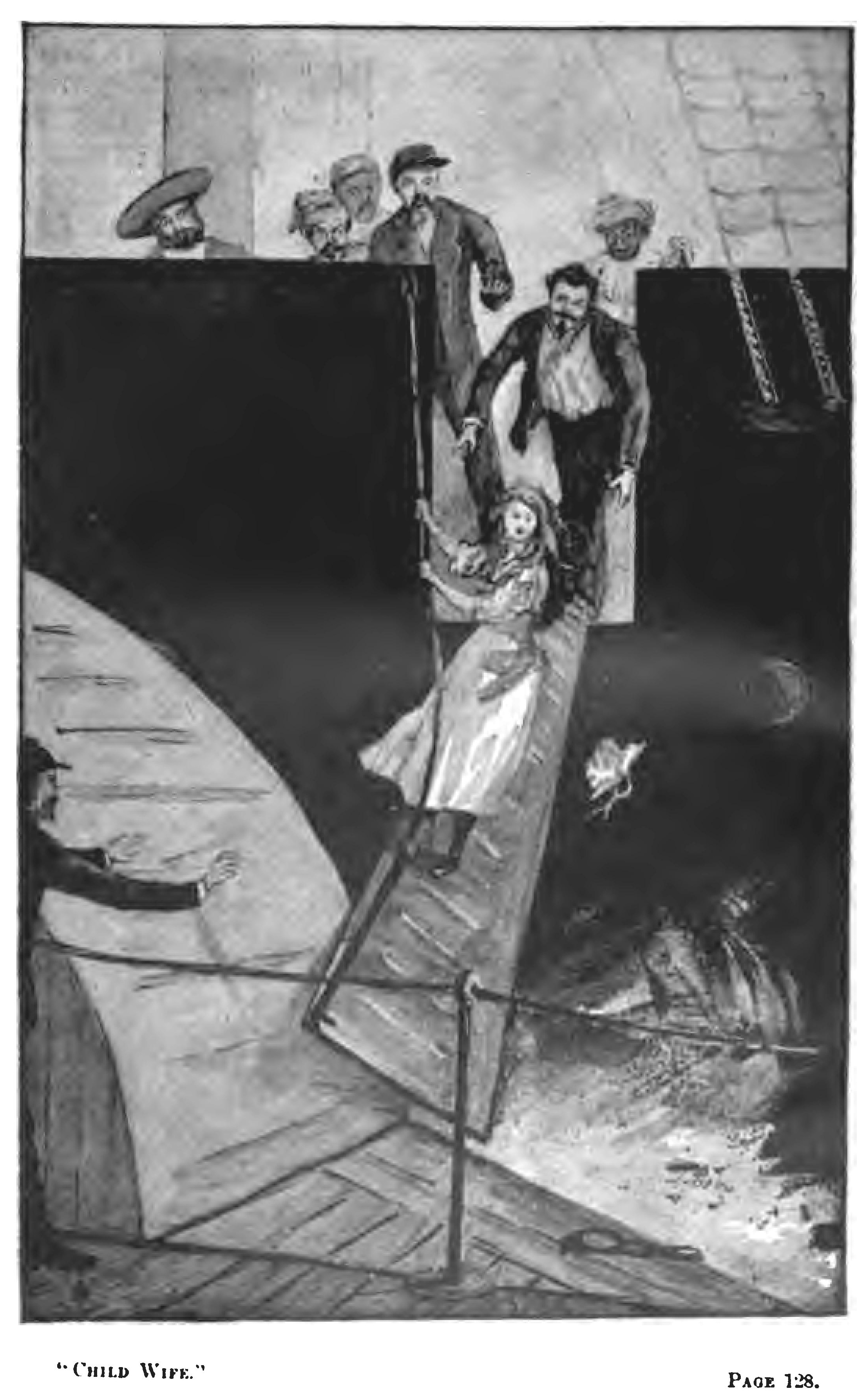
A rough breeze was on the Mersey, with a strong quick current; and by some mischance the hawser, holding the two boats together, suddenly gave way. The anchored ship held her ground, while the tug drifted rapidly sternward. The stage-plank became slewed, its outer end slipping from the paddle-box just as Sir George set foot upon the tender. With a crash it went down upon the deck below.
The servant, close parting from the bulwarks, was easily dragged back again; but the child, halfway along the staging, was in imminent danger of being projected into the water. The spectators saw it simultaneously, and a cry from both ships proclaimed the peril. She had caught the hand-rope, and was hanging on, the slanted plank affording her but slight support.
And in another instant it would part from the tender, still driving rapidly astern. It did part, dropping with a plash upon the seething waves below; but not before a man, gliding down the slope, had thrown his arm around the imperilled girl, and carried her safely back over the bulwarks of the steamer!
There was no longer a coldness between Sir George Vernon and Captain Maynard; for it was the latter who had rescued the child.
As they parted on the Liverpool landing, hands were shaken, and cards exchanged—that of the English baronet accompanied with an invitation for the revolutionary leader to visit him at his country-seat; the address given upon the card, “Vernon Park, Sevenoaks, Kent.”
It is scarce necessary to say that Maynard promised to honour the invitation, and made careful registry of the address.
And now, more than ever, did he feel that strange forecast, as he saw the girlish face, with its deep blue eyes, looking gratefully from the carriage-window, in which Sir George, with his belongings, was whirled away from the wharf.
His gaze followed that thing of roseate hue; and long after it was out of sight he stood thinking of it.
It was far from agreeable to be aroused from his dreamy reverie—even by a voice friendly as that of Roseveldt!
The Count was by his side; holding in his hand a newspaper.
It was the Times of London, containing news to them of painful import.
It did not come as a shock. The journals brought aboard by the pilot—as usual, three days old—had prepared them for a tale of disaster. What they now read was only its confirmation.
“It’s true!” said Roseveldt, pointing to the conspicuous capitals:
THE PRUSSIAN TROOPS HAVE TAKEN RASTADT! THE BAVARIAN REVOLUTION AT AN END!
As he pointed to this significant heading, a wild oath, worthy of one of Schiller’s student robbers, burst from his lips, while he struck his heel down upon the floating wharf as though he would have crushed the plank beneath him.
“A curse!” he cried, “an eternal curse upon the perjured King of Prussia! And those stupid North Germans! I knew he would never keep his oath to them?”
Maynard, though sad, was less excited. It is possible that he bore the disappointment better by thinking of that golden-haired girl. She would still be in England; where he must needs now stay.
This was his first reflection. It was not a resolve; only a transient thought.
It passed almost on the instant, at an exclamation from Roseveldt once more reading from the paper:
“Kossuth still holds out in Hungary; though the Russian army is reported as closing around Arad!”
“Thank God?” cried Roseveldt; “we may yet be in time for that!”
“Should we not wait for our men? I fear we two could be of slight service without them.”
The remembrance of that angelic child was making an angel of Maynard!
“Slight service! A sword like yours, and mine! Pardonnes moi! Who knows, cher capitaine, that I may not yet sheathe it in the black heart of a Hapsburg? Let us on to Hungary! It is the same cause as ours.”
“I agree, Roseveldt. I only hesitated, thinking of your danger if taken upon Austrian soil.”
“Let them hang me if they will. But they won’t, if we can only reach Kossuth and his brave companions, Aulich, Perezel, Dembinsky, Nagy, Sandor, and Damjanich. Maynard, I know them all. Once among these, there is no danger of the rope. If we die, it will be sword in hand, and among heroes. Let us on, then, to Kossuth!”
“To Kossuth!” echoed Maynard, and the golden-haired girl was forgotten!
Chapter Twenty Five.
The Fifth Avenue House.
The Newport season was over. Mrs Girdwood had returned to her splendid mansion in the Fifth Avenue, soon to receive a visitor, such as even Fifth Avenue houses do not often entertain—an English lord—Mr Swinton, the nobleman incog., had accepted her invitation to dinner.
It was to be a quiet family affair. Mrs Girdwood could not well have it otherwise, as the circle of her acquaintance fit to meet such a distinguished guest was limited. She had not been long in the Fifth Avenue house—only since a little before the death of her late husband, the deceased storekeeper, who had taken the place at her earnest solicitations.
In fact it was whispered that the grand mansion had caused his death. It was too splendid for comfort—it required a complete change in his habits; and perhaps he was troubled about the expense, which was wholesale, while he had been all his life accustomed to the retail.
From whatever cause, his spirits sank under its lofty ceilings, and after wandering for three months through the spacious apartments, listening to his own lonely tread, he lay down upon one of its luxurious couches and died!
It was more cheerful after his demise; but as yet unvisited by the élite. Mr Swinton was the first of this class who was to stretch his limbs under the Girdwood mahogany; but then he was at the head of it. A good beginning, reflected widow Girdwood.
“We shall have no one to meet you, my lord. We are too busy in preparing for our voyage to Europe. Only the girls and myself. I hope you won’t mind that.”
“Pway madam, don’t mention it. Yaw own intewesting family; just the sort of thing I take pleasyaw in. Nothing baws me more than one of those gweat pawties—gwand kwushes, as we call them in England.”
“I’m glad of it, my lord. We shall expect you then on next Tuesday. Remember, we dine at seven.”
This brief dialogue occurred in the Ocean House at Newport, just as Mrs Girdwood was getting into the hack to be taken to the New York boat.
Tuesday came, and along with it Mr Swinton, entering the Fifth Avenue mansion at 7 p.m., punctual to his appointment. The house was lit up brilliantly, and in the same style was the guest got up, having dressed himself with the greatest care. So, too, the hostess, her daughter, and niece.
But the dining party was not yet complete; two others were expected, who soon came in.
They were Mr Lucas and his acolyte, also returned to New York, and who, having made Mrs Girdwood’s acquaintance at Newport, through the medium of Mr Swinton, were also included in the invitation.
It made the party compact and in proportion; three ladies, with the same number of gentlemen—the set of six—though perhaps in the eyes of the latter their hostess was de trop. Lucas had conceived thoughts about Julia, while his friend saw stars in the blue eyes of Cornelia. All sorted together well enough; Mr Swinton being of course the lion of the evening. This from his being a stranger—an accomplished Englishman. It was but natural courtesy. Again, Mrs Girdwood longed to make known how great a lion he was. But Mr Swinton had sworn her to secrecy.
Over the dinner-table the conversation was carried on without restraint. People of different nations, who speak the same language, have no difficulty in finding a topic. Their respective countries supply them with this. America was talked of; but more England. Mrs Girdwood was going there by the next steamer—state-rooms already engaged. It was but natural she should make inquiries.
“About your hotels in London, Mr Swinton. Of course we’ll have to stop at an hotel. Which do you consider the best?”
“Clawndon, of cawse. Clawndon, in Bond Stweet. Ba all means go there, madam.”
“The Clarendon,” said Mrs Girdwood, taking out her card-case, and pencilling the name upon a card. “Bond Street, you say?”
“Bond Stweet. It’s our fashionable pwomenade, or rather the stweet where our best twadesmen have their shops.”
“We shall go there,” said Mrs Girdwood, registering the address, and returning the card-case to her reticule.
It is not necessary to detail the conversation that followed. It is usually insipid over a dinner-table where the guests are strange to one another; and Mrs Girdwood’s guests came under this category.
For all that, everything went well and even cheerfully, Julia alone at times looking a little abstracted, and so causing some slight chagrin both to Lucas and Swinton.
Now and then, however, each had a glance from those bistre-coloured eyes, that flattered them with hopes for the future.
They were dread, dangerous eyes, those of Julia Girdwood. Their glances had come near disturbing the peace of mind of a man as little susceptible as either Louis Lucas or Richard Swinton.
The dinner-party was over; the trio of gentlemen guests were taking their departure.
“When may we expect you in England, my lord?” asked the hostess, speaking to Mr Swinton apart.
“By the next steamaw, madam. I wegwet I shall not have the pleasyaw of being your fellaw passengaw. I am detained in this countwy by a twifle of business, in connection with the Bwitish Government. A gweat baw it is, but I cannot escape it.”
“I am sorry,” answered Mrs Girdwood. “It would have been so pleasant for us to have had your company on the voyage. And my girls too, I’m sure they would have liked it exceedingly. But I hope we’ll see you on the other side.”
“Undoubtedly, madam. Indeed, I should be vewy misewable to think we were not to meet again. You go diwect to London, of cawse. How long do you pwopose wemaining there?”
“Oh, a long time—perhaps all the winter. After that we will go up the Rhine—to Vienna, Paris, Italy. We intend making the usual tour.”
“You say you will stop at the Clawndon?”
“We intend so, since you recommend it. We shall be there as long as we remain in London.”
“I shall take the libawty of pwesenting my wespects to you, as soon as I weach England.”
“My lord! we shall look for you.”
The drawing-room door was closed, the ladies remaining inside. The three gentlemen guests were in the entrance hall, footman and butler helping them to hat and surtout. Though they had not come in, all three went out together.
“Where now?” asked Lucas, as they stood upon the flags of the Fifth Avenue. “It’s too early to go to bed.”
“A vewy sensible obsawvation, fwiend Lucas!” said Swinton, inspired by a free potation of the widow’s choice wines. “Where do yaw say?”
“Well, I say, let’s have some sport. Have you got any money upon you, Mr Swinton?”
Mr Lucas was still ignorant that his companion was a lord.
“Oh, yas—yas. A thousand of your demmed dollars, I believe.”
“Excuse me for putting the question. I only asked in case you might require a stake. If you do, my little pile’s at your service.”
“Thanks—thanks! I’m weady for spawt—stake all pawvided.”
Lucas led the way, from the Fifth Avenue to Broadway, and down Broadway to a “hell;” one of those snug little establishments in an off-street, with supper set out, to be eaten only by the initiated.
Swinton became one of them. Lucas had reasons for introducing him. His reflections were:
“This Englishman appears to have money—more than he knows what to do with. But he didn’t drop any of it in Newport. On the contrary, he must have increased his capital by the plucking of certain pigeons to whom I introduced him. I’m curious to see how he’ll get along with the hawks. He’s among them now.”
The introducer of Swinton had an additional reflection suggested by the remembrance of Julia Girdwood.
“I hope they’ll get his dollars—clear him out, the cur—and serve him right too. I believe he’s a devilish schemer.” The wish had jealousy for its basis.
Before the gambler proclaimed his bank closed for the night, the false friend saw the realisation of his hopes.
Despite his customary astuteness, the ex-guardsman was not cunning in his cups. The free supper, with its cheap champagne, had reduced him to a condition of innocence resembling the pigeons he was so fain to pluck, and he left the hawks’ nest without a dollar in his pocket!
Lucas lent him one to pay for the hack that carried him to his hotel; and thus the two parted!
Chapter Twenty Six.
Eljen Kossuth!
An autumn sun was just rising over the plains of the yellow Theiss, when two travellers, issuing from the gates of the old fortified city of Arad, took their way toward the village of Vilagos, some twenty miles distant.
It is scarce necessary to say they were on horseback. Men do not journey afoot on the plains of the “Puszta.”
Their military costume was in keeping with the scene around. Not as it would have been in its normal and usual state, with the ihaz quietly attending his swine drove, and the csiko galloping after his half-wild colts and cattle. For Arad was now the headquarters of the Hungarian army, and the roads around it hourly echoed the tread of the Honved, and hoofstroke of the hussar.
The patriot force of less than thirty thousand men had moved upon Vilagos, there to meet the Austro-Russian advance, of just four times their number; Geörgei the commanding general on one side, and Rüdiger on the other.
The two horsemen had reached Arad but the night before, coming from the West. They had arrived too late to go out with the patriot troops, and seemed now hurrying on to overtake them.
Though in uniform, as we have already said, it was not that belonging to any branch of the Hungarian service. No more did it resemble any one of the varied military costumes worn by the allied enemy. Both were habited very much alike; in simple undress frocks of dark-blue cloth, with gold-lace pantaloons of brighter blue, and banded forage-caps.
With Colt’s revolver pistols—then an arm scarce known—worn in a holstered waistbelt, steel sabres hanging handy against their thighs, and short Jäger rifles slung, en bandolier; behind them, the dress looked warlike enough; and, on whatever side, it was evident the two travellers intended fighting.
This was further manifest from their anxious glances cast ahead, and the way they pressed their horses forward, as if fearing to be too late for the field.
They were of different ages; one over forty, the other about twenty-five.
“I don’t like the look of things about Arad,” said the elder, as they checked up for a time, to breathe their horses.
“Why, Count?” asked his companion.
“There seems to be a bad electricity in the air—a sort of general distrust.”
“In what, or whom?”
“In Geörgei. I could see that the people have lost confidence in him. They even suspect that he’s playing traitor, and has thoughts of surrendering to the enemy.”
“What! Geörgei—their favourite general! Is he not so?”
“Of the old army, yes. But not of the new levies or the people. In my opinion, the worst thing that could have happened to them is his having become so. It’s the old story of regulars versus volunteers. He hates the Honveds, and Kossuth for creating them, just as in our little Mexican skirmish, there was a jealousy between West Pointers and the newly-raised regiments.
“There are thousands of donkeys in Hungary, as in the United States, who believe that to be a soldier a man must go through some sort of a routine training—forgetting all about Cromwell of England, Jackson of America, and a score of the like that might be quoted. Well, these common minds, running in the usual groove, believe that Geörgei, because he was once an officer in the Austrian regular army, should be the trusted man of the time; and they’ve taken him up, and trusted him without further questioning. I know him well. We were at the military school together. A cool, scheming fellow, with the head of a chemist and the heart of an alchemist. Of himself he has accomplished nothing yet. The brilliant victories gained on the Hungarian side—and brilliant have they been—have all been due to the romantic enthusiasm of these fiery Magyars, and the dash of such generals as Nagy Sandor, Damjanich, and Guyon. There can be no doubt that, after the successes on the Upper Danube, the patriot army could have marched unmolested into Vienna, and there dictated terms to the Austrian Empire. The emperor’s panic-stricken troops were absolutely evacuating the place, when, instead of a pursuing enemy, news came after them that the victorious general had turned back with his whole army, to lay siege to the fortress of Ofen! To capture an insignificant garrison of less than six thousand men! Six weeks were spent in this absurd side movement, contrary to the counsels of Kossuth, who had never ceased to urge the advance on Vienna. Geörgei did just what the Austrians wanted him to do—giving their northern allies time to come down; and down they have come.”
“But Kossuth was Governor—Dictator! Could he not command the advance you speak of?”
“He commanded it all he could, but was not obeyed. Geörgei had already sapped his influence, by poisoning the minds of the military leaders against him—that is, the factious who adhered to himself, the old regulars, whom he had set against the new levies and Honveds. ‘Kossuth is not a soldier, only a lawyer,’ said they; and this was sufficient. For all their talk, Kossuth has given more proofs of soldiership and true generalship than Geörgei and his whole clique. He has put an army of two hundred thousand men in the field; armed and equipped it. And he created it absolutely out of nothing! The patriots had only two hundred pounds weight of gunpowder, and scarce such a thing as a gun, when this rising commenced. And the saltpetre was dug out of the mine, and the iron smelted, and the cannon cast. Ay, in three months there was a force in the field such as Napoleon would have been proud of. My dear captain, there is more proof of military genius in this, than in the winning of a dozen battles. It was due to Kossuth alone. Alone he accomplished it all—every detail of it. Louis Kossuth not a general, indeed! In the true sense of the word, there has been none such since Napoleon. Even in this last affair of Ofen, it is now acknowledged, he was right; and that they should have listened to his cry, ‘On to Vienna!’”
“Clearly it has been a sad blunder.”
“Not so clearly, Captain; not so clearly. I wish it were. There is reason to fear it is worse.”
“What mean you, Count?”
“I mean, treason.”
“Ha!”
“The turning back for that useless siege looks confoundedly like it. And this constantly retreating down the right bank of the Theiss, without crossing over and forming a junction with Sandor. Every day the army melting away, becoming reduced by thousands! Sacré! if it be so, we’ve had our long journey for nothing; and poor liberty will soon see her last hopeless struggle on the plains of the Puszta, perhaps her last in all Europe! Ach!”
The Count, as he made this exclamation, drove the spur hard against the ribs of his horse, and broke off into a gallop, as if determined to take part in that struggle, however hopeless.
The younger man, seemingly inspired by the same impulse, rode rapidly after.
Then gallop was kept up until the spire of Vilagos came in sight, shooting up over the groves of olive and acacia embowering the Puszta village.
Outside on the skirts of the far-spreading town they could see tents pitched upon the plain, with standards floating over them—cavalry moving about in squadrons—infantry standing in serried ranks—here and there horsemen in hussar uniforms hurrying from point to point, their loose dolmans trailing behind them. They could hear the rolling of drums, the braying of bugles, and, away far beyond, the booming of great guns.
“Who goes there?” came the abrupt hail of a sentry speaking in the Magyar tongue, while a soldier in Honved dress showed himself in the door of a shepherd’s hut. He was the spokesman of a picket-guard concealed within the house.
“Friends!” answered the Austrian Count, in the same language in which the hail had been given. “Friends to the cause: Eljen Kossuth!”
At the magic words the soldier lowered his carbine, while his half-dozen comrades came crowding out from their concealment.
A pass to headquarters, obtained by the Count in Arad, made the parley short, and the two travellers continued their journey amidst cries of “Eljen Kossuth!”
Chapter Twenty Seven.
The Broken Swords.
In half an hour afterwards, Count Roseveldt and Captain Maynard—for it was they who were thus rapidly travelling—reached Vilagos, and passed on to the camp of the Hungarian army.
They halted near its centre, in front of the marquee occupied by its commander-in-chief. They had arrived just in time to witness a remarkable scene—none more so on military record.
Around them were officers of all ranks, and of every conceivable arm of service. They were standing in groups talking excitedly, now and then an individual crossing hastily from one to the other.
There was all the evidence of warlike preparation, but as if under some mysterious restraint. This could be read in scowling looks and mutinous mutterings.
In the distance was heard the continuous roaring of artillery.
They knew whence it came, and what was causing it. They knew it was from Temesvar, where Nagy Sandor, with his attenuated corps of heroes, was holding the large army of Rüdiger in check.
Yes, their brilliant and beloved comrade; Nagy Sandor, that splendid cavalry officer—before whom even the beau sabreur of France sinks into a second place—was fighting an unequal fight!
It was the thought of this that was causing the dark looks and angry mutterings.
Going up to a group of officers, the Count asked for an explanation. They were in hussar uniforms, and appeared to be more excited than the others.
One of them sprang forward, and grasped him by the hand, exclaiming:
“Roseveldt!”
It was an old comrade, who had recognised him.
“There’s some trouble among you?” said the Count, scarce staying to return the salutation. “What is it, my dear friend?”
“You hear those guns?”
“Of course I do.”
“It’s the brave Sandor fighting against no end of odds. And this scheming chemist won’t give us the order to go to his assistance. He stays inside his tent like some Oracle of Delphi. Dumb, too, for he don’t make a response. Would you believe it, Roseveldt; we suspect him of treason?”
“If you do,” responded the Count, “you’re great fools to wait for his bringing it to maturity. You should advance without his orders. For my part, and I can speak, too, for my comrade here, I shan’t stay here, while there’s fighting farther on. Our cause is the same as yours; and we’ve come several thousand miles to draw swords in it. We were too late for the Baden affair; and by staying here with you we may again get disappointed. Come, Maynard! We have no business at Vilagos. Let us go on to Temesvar!”
Saying this, the Count strode brusquely back toward his horse, still under the saddle, the captain keeping pace with him. Before they could mount, there arose a scene that caused them to stand by their stirrups, holding their bridles in hand.
The hussar officers, among whom were several of high rank, generals and colonels, had overheard the speeches of Roseveldt. The Count’s friend had made them acquainted with his name.
It needed not for them to know his title, to give influence to what he had said. His words were like red-hot cinders pitched into a barrel of gunpowder, and almost as instantaneous was the effect.
“Geörgei must give the order?” cried one, “or we shall advance without it. What say you, comrades?”
“We’re all agreed!” responded a score of voices, the speakers clutching at their sword-hilts, and facing toward the marquee of the commander-in-chief.
“Listen?” said their leader, an old general, with steel-grey moustaches sweeping back to his ears. “You hear that? Those are the guns of Rüdiger. Too well do I know their accursed tongues. Poor Sandor’s ammunition is all spent. He must be in retreat?”
“We shall stop it!” simultaneously exclaimed a dozen. “Let us demand the order to advance! To his tent, comrades! to his tent!”
There could be no mistaking which tent; for, with the cry still continuing, the hussar officers rushed toward the marquee—the other groups pouring in, and closing around it, after them.
Several rushed inside; their entrance succeeded by loud words, in tones of expostulation.
They came out again, Geörgei close following. He looked pale, half-affrighted, though it was perhaps less fear than the consciousness of a guilty intent.
He had still sufficient presence of mind to conceal it.
“Comrades!” he said, with an appealing look at the faces before him, “my children! Surely you can trust to me? Have I not risked my life for your sake—for the sake of our beloved Hungary? I tell you it would be of no use to advance. It would be madness, ruin. We are here in an advantageous position. We must stay and defend it! Believe me, ’tis our only hope.”
The speech so earnest—so apparently sincere—caused the mutineers to waver. Who could doubt the man, so compromised with Austria?
The old officer, who led them, did.
“Thus, then!” he cried, perceiving their defection. “Thus shall I defend it!”
Saying this, he whipped his sabre from its sheath; and grasping it hilt and blade, he broke the weapon across his knee—flinging the fragments to the earth!
It was the friend of Roseveldt who did this.
The example was followed by several others, amidst curses and tears. Yes; strong men, old soldiers, heroes, on that day, at Vilagos, were seen to weep.
The Count was again getting into his stirrup, when a shout, coming from the outer edge of the encampment, once more caused him to keep still. All eyes were turned toward the sentry who had shouted, seeking the explanation. It was given not by the sentinel, but something beyond.
Far off, men mounted and afoot were seen approaching over the plain. They came on in scattered groups, in long straggling line, their banners borne low and trailing. They were the débris of that devoted band, who had so heroically held Temesvar. Their gallant leader was along with them, in the rear-guard—still contesting the ground by inches, against the pursuing cavalry of Rüdiger!
The old soldier had scarce time to regret having broken his sword, when the van swept into the streets of Vilagos, and soon after the last link of the retreating line.
It was the final scene in the struggle for Hungarian independence!
No; not the last! We chronicle without thought. There was another—one other to be remembered to all time, and, as long as there be hearts to feel, with a sad, painful bitterness.
I am not writing a history of the Hungarian war—that heroic struggle for national independence—in valour and devotedness perhaps never equalled upon the earth. Doing so, I should have to detail the tricks and subterfuges to which the traitor Geörgei had to resort before he could deceive his betrayed followers, and, with safety to himself, deliver them over to the infamous enemy. I speak only of that dread morn—the 6th day of October—when thirteen general officers, every one of them the victor in some sternly contested field, were strung up by the neck, as though they had been pirates or murderers!
And among them was the brave Damjanich, strung up in spite of his shattered leg; the silent, serious Perezel; the noble Aulich; and, perhaps most regretted of all, the brilliant Nagy Sandor! It was in truth a terrible taking of vengeance—a wholesale hanging of heroes, such as the world never saw before! What a contrast between this fiendish outpouring of monarchical spite against revolutionists in a good cause, and the mercy lately shown by republican conquerors to the chiefs of a rebellion without cause at all!
Maynard and Roseveldt did not stay to be spectators of this tragical finale. To the Count there was danger upon Hungarian soil—once more become Austrian—and with despondent hearts the two revolutionary leaders turned their faces towards the West, sad to think that their swords must remain unsheathed, without tasting the blood of either traitor or tyrant!
Chapter Twenty Eight.
A Tour in Search of a Title.
“I’m sick of England—I am!”
“Why, cousin, you said the same of America!”
“No; only of Newport. And if I did, what matter? I wish I were back in it. Anywhere but here, among these bulls and bull-dogs. Give me New York over all cities in the world.”
“Oh! I agree with you there—that do I—both State and city, if you like.”
It was Julia Girdwood that spoke first, and Cornelia Inskip who replied.
They were seated in a handsome apartment—one of a suite in the Clarendon Hotel, London.
“Yes,” pursued the first speaker; “there one has at least some society; if not the élite, still sufficiently polished for companionship. Here there is none—absolutely none—outside the circle of the aristocracy. Those merchants’ wives and daughters we’ve been compelled to associate with, rich as they are, and grand as they deem themselves, are to me simply insufferable. They can think of nothing but their Queen.”
“That’s true.”
“And I tell you, Cornelia, if a peeress, or the most obscure thing with ‘Lady’ tacked to her name, but bows to one of them, it is remembered throughout their life, and talked of every day among their connections. Only think of that old banker where mamma took us to dine the other day. He had one of the Queen’s slippers framed in a glass case, and placed conspicuously upon his drawing-room mantelshelf. And with what gusto the old snob descanted upon it! How he came to get possession of it; the price he paid; and his exquisite self-gratulation at being able to leave it as a valued heirloom to his children—snobbish as himself! Faugh! ’Tis a flunkeyism intolerable. Among American merchants, one is at least spared such experience as that. Even our humblest shopkeepers would scorn so to exhibit themselves!”
“True, true!” assented Cornelia; who remembered her own father, an humble shopkeeper in Poughkeepsie, and knew that he would have scorned it.
“Yes,” continued Julia, returning to her original theme, “of all cities in the world, give me New York. I can say of it, as Byron did of England, ‘With all thy faults, I love thee still!’ though I suspect when the great poet penned that much-quoted line, he must have been very tired of Italy and the stupid Countess Guiccioli.”
“Ha—ha—ha!” laughed the Poughkeepsian cousin, “what a girl you are, Julia! Well, I’m glad you like our dear native New York.”
“Who wouldn’t, with its gay, pleasant people, and their cheerful give and take? Many faults it has, I admit; bad municipal management—wholesale political corruption. These are but spots on the outward skin of its social life, and will one day be cured. Its great, generous heart, sprung from Hibernia, is still uncontaminated.”
“Hurrah! hurrah!” cried Cornelia, springing up from her seat and clapping her little hands. “I’m glad, cousin, to hear you speak thus of the Irish!”
It will be remembered that she was the daughter of one.
“Yes,” said Julia, for the third time; “New York, of all places, for me! I’m now convinced it’s the finest city in the world!”
“Don’t be so quick in your conclusions, my love! Wait till you’ve seen Paris! Perhaps you may change your mind!”
It was Mrs Girdwood who made these remarks, entering the room at the conclusion of her daughter’s rhapsody.
“I’m sure I won’t mother. Nor you neither. We’ll find Paris just as we’ve found London; the same selfishness, the same social distinctions, the same flunkeyism. I’ve no doubt all monarchical countries are alike.”
“What are you talking about, child? France is now a republic.”
“A nice republic, with an Emperor’s nephew for its President—or rather its Dictator! Every day, as the papers tell us, robbing the people of their rights!”
“Well, my daughter, with that we’ve got nothing to do. No doubt these revolutionary hot-heads need taming down a little, and a Napoleon should be the man to do it. I’m sure we’ll find Paris a very pleasant place. The old titled families, so far from being swept off by the late revolution, are once more holding up their heads. ’Tis said the new ruler encourages them. We can’t fail to get acquainted with some of them. It’s altogether different from the cold-blooded aristocracy of England.”
The last remark was made in a tone of bitterness. Mrs Girdwood had been now several months in London; and though stopping at the Clarendon Hotel—the caravanserai of aristocratic travellers—she had failed to get introduction to the titled of the land.
The American Embassy had been polite to her, both Minister and Secretary—the latter, noted for his urbanity to all, but especially to his own countrymen, or countrywomen, without distinction of class. The Embassy had done all that could be one for an American lady travelling without introductions. But, however rich and accomplished, however beautiful the two girls in her train, Mrs Girdwood could not be presented at Court, her antecedents not being known.
It is true a point might have been strained in her favour; but the American ambassador of that day was as true a toad-eater to England’s aristocracy as could have been found in England itself, and equally fearful of becoming compromised by his introductions. We need not give his name. The reader skilful in diplomatic records can no doubt guess it.
Under these circumstances, the ambitious widow had to submit to a disappointment.
She found little difficulty in obtaining introductions to England’s commonalty. Her riches secured this. But the gentry! these were even less accessible than the exclusives of Newport—the J.’s, and the L.’s, and the B.’s. Titled or untitled, they were all the same. She discovered that a simple country squire was as unapproachable as a peer of the realm—earl, marquis, or duke!
“Never mind, my girls!” was her consolatory speech, to daughter and niece, when the scales first fell from her eyes. “His lordship will soon be here, and then it will be all right.”
His lordship meant Mr Swinton, who had promised to follow them in the “next steamaw.”
But the next steamer came with no such name as Swinton on its passenger list, nor any one bearing the title of “lord.”
And the next, and the next, and some half-dozen others, and still no Swinton, either reported by the papers, or calling at the Clarendon Hotel!
Could an accident have happened to the nobleman, travelling incognito? Or, what caused more chagrin to Mrs Girdwood to conjecture, had he forgotten his promise?
In either case he ought to have written. A gentleman would have done so—unless dead.
But no such death had been chronicled in the newspapers. It could not have escaped the notice of the retail storekeeper’s widow, who each day read the London Times, and with care its list of arrivals.
She became at length convinced, that the accomplished nobleman accidentally picked up in Newport, and afterwards entertained by her in her Fifth Avenue house in New York, was either no nobleman at all, or if one, had returned to his own country under another travelling name, and was there fighting shy of her acquaintance.
It was but poor comfort that many of her countrymen—travellers like themselves—every day called upon them; among others Messrs Lucas and Spiller—such was the cognomen of Mr Lucas’s friend, who, also on a tour of travel, had lately arrived in England.
But neither of them had brought any intelligence, such as Mrs Girdwood sought. Neither knew anything of the whereabouts of Mr Swinton.
They had not seen him since the occasion of that dinner in the Fifth Avenue house; nor had they heard of him again.
It was pretty clear then he had come to England, and was “cutting” them—that is, Mrs Girdwood and her girls.
This was the mother’s reflection.
The thought was enough to drive her out of the country; and out of it she determined to go, partly in search of that title for her daughter she had come to Europe to obtain; and partly to complete, what some of her countrymen are pleased to call, the “Ewropean tower.”
To this the daughter was indifferent, while the niece of coarse made no objection.
They proceeded upon their travels.
Chapter Twenty Nine.
The Lost Lord.
Ten days after Mrs Girdwood had taken her departure from the Clarendon Hotel, a gentleman presented himself to the door-porter of that select hostelry, and put the following inquiry:
“Is there a family stopping here, by name Girdwood—a middle-aged lady, with two younger—her daughter and niece; a negro woman for their servant?”
“There was such a fambly—about two weeks ago. They’ve paid their bill, and gone away.”
The janitor laid emphasis on the paying of the bill. It was his best evidence of the respectability of the departed guests.
“Do you know where they’ve gone?”
“Haven’t an idea, sir. They left no address. They ’pear to be Yankees—’Mericans, I mean,” said the man, correcting himself, in fear of giving offence. “Very respectable people—ladies, indeed—’specially the young ’uns. I dare say they’ve gone back to the States. That’s what I’ve heerd them call their country.”
“To the States! Surely not?” said the stranger, half questioning himself. “How long since they left the hotel?”
“About a fortnight ago—there or thereabout. I can look at the book and tell you?”
“Pray do!”
The Cerberus of the Clarendon—to an humble applicant for admission into that aristocratic establishment not much milder than he of the seven heads—turned into his box, and commenced examining the register of departures.
He was influenced to this civility by the aspect of the individual who made the request. To all appearance a “reg’lar gentleman,” was the reflection he had indulged in.
“Departures on the 25th,” spoke he, reading from the register: “Lord S— and Lady S—; the Hon. Augustus Stanton; the Duchess of P—; Mrs Girdwood and fambly—that’s them. They left on the 25th, sir.”
“The 25th. At what hour?”
“Well, that I can’t remember. You see, there’s so many goin’ and comin’. From their name being high up on the list, I d’say they went by a mornin’ train.”
“You’re sure they left no note for any one?”
“I can ask inside. What name?”
“Swinton—Mr Richard Swinton.”
“Seems to me they inquired for that name, several times. Yes, the old lady did—the mother of the young ladies, I mean. I’ll see if there’s a note.”
The man slippered off towards the office, in the interior of the hotel; leaving Mr Swinton, for it was he, upon the door-mat.
The countenance of the ex-guardsman, that had turned suddenly blank, again brightened up. It was at least gratifying to know that he had been inquired for. It was to be hoped there was a note, that would put him on their trace of travel.
“No, not any,” was the chilling response that came out from the official oracle. “None whatever.”
“You say they made inquiries for a Mr Swinton. Was it from yourself, may I ask?” The question was put seductively, accompanied by the holding out of a cigar-case.
“Thank you, sir,” said the flattered official, accepting the offered weed. “The inquiries were sent down to me from their rooms. It was to ask if a Mr Swinton had called, or left any card. They also asked about a lord. They didn’t give his name. There wasn’t any lord—leastwise not for them.”
“Were there any gentlemen in the habit of visiting them? You’ll find that cigar a good one—I’ve just brought them across the Atlantic. Take another? Such weeds are rather scarce here in London.”
“You’re very kind, sir. Thank you!” and the official helped himself to a second.
“Oh, yes; there were several gentlemen used to come to see them. I don’t think any of them were lords, though. They might be. The ladies ’peared to be very respectable people. I d’say highly respectable.”
“Do you know the address of any of these gentlemen? I ask the question because the ladies are relatives of mine, and I might perhaps find out from some of them where they are gone.”
“They were all strangers to me; and to the hotel. I’ve been at this door for ten years, and never saw one of them before.”
“Can you recollect how any of them looked?”
“Yes; there was one who came often, and used to go out with the ladies. A thick-set gent with lightish hair, and round full face. Sometimes there was a thin-faced man along with him, a younger gent. They used to take the two young ladies a-ridin’—to Rotten Row; and I think to the Opera.”
“Did you learn their names?”
“No, sir. They used to go and come without giving a card; only the first time, and I didn’t notice what name was on it. They would ask if Mrs Girdwood was in, and then go upstairs to the suite of rooms occupied by the fambly. They ’peared to be intimate friends.”
Swinton saw he had got all the information the man was capable of imparting. He turned to go out, the hall-keeper obsequiously holding the door.
Another question occurred to him.
“Did Mrs Girdwood say anything about coming back here—to the hotel I mean?”
“I don’t know, sir. If you stop a minute I’ll ask.”
Another journey to the oracle inside; another negative response.
“This is cursed luck!” hissed Swinton through his teeth, as he descended the hotel steps and stood upon the flags below. “Cursed luck!” he repeated, as with despondent look and slow, irresolute tread he turned up the street of “our best shopkeepers.”
“Lucas with them to a certainty, and that other squirt! I might have known it, from their leaving New York without telling me where they were going. They must have followed by the very next steamer; and, hang me, if I don’t begin to think that that visit to the gambling-house was a trap—a preconceived plan to deprive me of the chance of getting over after her. By the living G— it has succeeded! Here I am, after months spent in struggling to make up the paltry passage money! And here they are not; and God knows where they are! Curse upon the crooked luck!”
Mr Swinton’s reflections will explain why he had not sooner reported himself at the Bond Street hotel, and show the mistake Mrs Girdwood had made, in supposing he had “cut” them.
The thousand dollars deposited in the New York faro bank was all the money he had in the world; and after taking stock of what might be raised upon his wife’s jewellery, most of which was already under the collateral mortgage of the three golden globes, it was found it would only pay ocean passage for one.
As Fan was determined not to be left behind—Broadway having proved less congenial than Regent Street—the two had to stay in America, till the price of two cabin tickets could be obtained.
With all Mr Swinton’s talent in the “manipulation of pasteboard,” it cost him months to obtain them.
His friend Lucas gone away, he found no more pigeons in America—only hawks!
The land of liberty was not the land for him. Its bird of freedom, type of the falcon tribe, seemed too truly emblematic of its people—certainly of those with whom he had come in contact—and as soon as he could get together enough to pay for a pair of Cunard tickets—second-class at that—he took departure for a clime more congenial, both to himself and his beloved.
They had arrived in London with little more than the clothes they stood in; and taken lodgings in that cheap, semi-genteel neighbourhood where almost every street, square, park, place, and terrace, has got Westbourne for its name.
Toward this quarter Mr Swinton turned his face, after reaching the head of Bond Street; and taking a twopenny “bus,” he was soon after set down at the Royal Oak, at no great distance from his suburban domicile.
“They’re gone!” he exclaimed, stepping inside the late taken apartments, and addressing himself to a beautiful woman, their sole occupant.
It was “Fan,” in a silk gown, somewhat chafed and stained, but once more a woman’s dress! Fan, with her splendid hair almost grown again—Fan no longer disguised as a valet, but restored to the dignity of a wife!
“Gone! From London, do you mean? Or only the hotel?” The question told of her being still in her husband’s confidence. “From both.”
“But you know where, don’t you?”
“I don’t.”
“Do you think they’ve left England?”
“I don’t know what to think. They’ve left the Clarendon on the 25th of last month—ten days ago. And who do you suppose has been there—back and forward to see them?”
“I don’t know.”
“Guess!”
“I can’t.”
She could have given a guess. She had a thought, but she kept it in her own heart, as about the same man she had kept other thoughts before. Had she spoken it, she would have said, “Maynard.”
She said nothing, leaving her husband to explain. He did so, at once undeceiving her.
“Well, it was Lucas. That thick-skulled brute we met in Newport, and afterwards in New York.”
“Ay; better you had never seen him in either place. He proved a useless companion, Dick.”
“I know all that. Perhaps I shall get square with him yet.”
“So they’ve gone; and that, I suppose, will be the end of it. Well, let it be; I don’t care. I’m contented enough to be once more in dear old England!”
“In cheap lodgings like this?”
“In anything. A hovel here is preferable to a palace in America! I’d rather live in a London garret, in these mean lodgings, if you like, than be mistress of that Fifth Avenue house you were so delighted to dine in. I hate their republican country?”
The sentiment was appropriate to the woman who uttered it.
“I’ll be the owner of it yet,” said Swinton, referring not to the country, but the Fifth Avenue house. “I’ll own it, if I have to spend ten years in carrying out the speculation.”
“You still intend going on with it then?”
“Of course I do. Why should I give it up?”
“Perhaps you’ve lost the chance. This Mr Lucas may have got into the lady’s good graces?”
“Bah! I’ve nothing to fear from him—the common-looking brute! He’s after her, no doubt. What of that? I take it he’s not the style to make much way with Miss Julia Girdwood. Besides, I’ve reason to know the mother won’t have it. If I’ve lost the chance in any other way, I may thank you for it, madam.”
“Me! And how, I should like to know?”
“But for you I might have been here months ago; in good time to have taken steps against their departure; or, still better, found some excuse for going along with them. That’s what I could have done. It’s the time we have lost—in getting together the cash to buy tickets for two.”
“Indeed! And I’m answerable for that, I suppose? I think I made up my share. You seem to forget the selling of my gold watch, my rings and bracelets—even to my poor pencil-case?”
“Who gave them to you?”
“Indeed! it’s like you to remember it! I wish I had never accepted them.”
“And I that I had never given them.”
“Wretch!”
“Oh! you’re very good at calling names—ugly ones, too.”
“I’ll call you an uglier still, coward!”
This stung him. Perhaps the only epithet that would; for he not only felt that it was true, but that his wife knew it.
“What do you mean?” he asked, turning suddenly red.
“What I say; that you’re a coward—you know you are. You can safely insult a woman; but when a man stands up you daren’t—no, you daren’t say boo to a goose. Remember Maynard?”
It was the first time the taunt had been openly pronounced; though on more than one occasion since the scenes in Newport, she had thrown out hints of a knowledge of that scheme by which he had avoided meeting the man named. He supposed she had only suspicions, and could know nothing of that letter delivered too late. He had taken great pains to conceal the circumstances. From what she now said, it was evident she knew all.
And she did; for James, the waiter, and other servants, had imparted to her the gossip of the hotel; and this, joined to her own observation of what had transpired, gave the whole story. The suspicion that she knew it had troubled Swinton—the certainty maddened him.
“Say that again!” he cried, springing to his feet; “say it again, and by G—, I’ll smash in your skull?”
With the threat he had raised one of the cane chairs, and held it over her head.
Throughout their oft-repeated quarrels, it had never before come to this—the crisis of a threatened blow.
She was neither large nor strong—only beautiful—while the bully was both. But she did not believe he intended to strike; and she felt that to quail would be to acknowledge herself conquered. Even to fail replying to the defiance.
She did so, with additional acerbity.
“Say what again? Remember Maynard? I needn’t say it; you’re not likely to forget him!”
The words had scarce passed from her lips before she regretted them. At least she had reason: for with a crash, the chair came down upon her head, and she was struck prostrate upon the floor!
Chapter Thirty.
Inside the Tuileries.
There is a day in the annals of Paris, that to the limits of all time will be remembered with shame, sorrow, and indignation.
And not only by the people of Paris, but of France—who on that day ceased to be free.
To the Parisians, more especially, was it a day of lamentation; and its anniversary can never pass over the French capital without tears in every house, and trembling in every heart.
It was the Second of December, 1851.
On the morning of that day five men were met within a chamber of the Tuileries. It was the same chamber in which we have described a conspiracy as having been hatched some months before.
The present meeting was for a similar purpose; but, notwithstanding a coincidence in the number of the conspirators, only one of them was the same. This was the president of the former conclave—the President of France!
And there was another coincidence equally strange—in their titles; for there was a count, a field-marshal, a diplomatist, and a duke, the only difference being that they were now all of one nation—all Frenchmen.
They were the Count de M., the Marshal Saint A., the Diplomatist La G., and the Duke of C.
Although, as said, their purpose was very similar, there was a great difference in the men and their mode of discussing it. The former five have been assimilated to a gang of burglars who had settled the preliminaries for “cracking a crib.” Better might this description apply to the conspirators now in session; and at a still later period, when the housebreakers are about entering on the “job.”
Those had conspired with a more comprehensive design—the destruction of Liberty throughout all Europe. These were assembled with similar aim, though it was confined to the liberties of France.
In the former case, the development seemed distant, and would be brought about by brave soldiers fighting on the battle-field. In the latter the action was near, and was entrusted to cowardly assassins in the streets, already prepared for the purpose.
The mode by which this had been done will be made manifest, by giving an account of the scenes that were passing in the chambers occupied by the conspirators.
There was no persiflage of speech, or exchange of light drolleries, as in that conclave enlivened by the conversation of the English viscount. The time was too serious for joking; the occasion for the contemplated murder too near.
Nor was there the same tranquillity in the chamber. Men came and went; officers armed and in full uniform. Generals, colonels, and captains were admitted into the room, as if by some sign of freemasonry, but only to make reports or receive orders, and then out again.
And he who gave these orders was not the President of France, commander-in-chief of its armies, but another man of the five in that room, and for the time greater than he!
It was the Count de M.
But for him, perhaps, that conspiracy might never have been carried to a success, and France might still have been free!
It was a strange, terrible crisis, and the “man of a mission,” standing back to the fire, with split coat tails, was partially appalled by it. Despite repeated drinks, and the constant smoking of a cigar, he could not conceal the tremor that was upon him.
De M— saw it, and so did the murderer of Algerine Arabs, once strolling-player, now field-marshal of France.
“Come!” cried the sinful but courageous Count, “there must be no half measures—no weak backslidings! We’ve resolved upon this thing, and we must go through with it! Which of you is afraid?”
“Not I,” answered Saint A.
“Nor I,” said La G—, ci-devant billiard-sharper of Leicester Square, London.
“I’m not afraid,” said the Duke. “But do you think it is right?”
His grace was the only man of the five who had a spark of humanity in his heart. A poor weak man, he was only allied with the others in the intimacy of a fast friendship.
“Right?” echoed La G—. “What’s wrong in it? Would it be right to let this canaille of demagogues rule Paris—France? That’s what it’ll come to if we don’t act. Now, or never, say I!”
“And I!”
“And all of us?”
“We must do more than say,” said De M—, glancing toward the tamer of the Boulogne eagle, who still stood against the fire-place, looking scared and irresolute. “We must swear it!”
“Come, Louis!” he continued, familiarly addressing himself to the Prince-President. “We’re all in the same boat here. It’s a case of life or death, and we must stand true to one another. I propose that we swear it!”
“I have no objection,” said the nephew of Napoleon, led on by a man whom his great uncle would have commanded. “I’ll make any oath you like.”
“Enough!” cried De M—, taking a brace of duelling pistols from the mantelshelf and placing them crosswise on the table, one on top of the other. “There, gentlemen! There’s the true Christian symbol, and over it let us make oath, that in this day’s work we live or die together?”
“We swear it on the Cross!”
“On the Cross, and by the Virgin!”
“On the Cross, and by the Virgin!”
The oath had scarce died on their lips when the door was once more opened, introducing one of those uniformed couriers who were constantly coming and going.
They were all officers of high rank, and all men with fearless but sinister faces.
“Well, Colonel Gardotte!” asked De M—, without waiting for the President to speak; “how are things going on in the Boulevard de Bastille?”
“Charmingly,” replied the Colonel. “Another round of champagne, and my fellows will be in the right spirit—ready for anything!”
“Give it them! Twice if it be needed. Here’s the equivalent for the keepers of the cabarets. If there’s not enough, take their trash on a promise to pay. Say that it’s on account of—Ha! Lorrillard!”
Colonel Gardotte, in brilliant Zouave uniform, was forgotten, or at all events set aside, for a big, bearded man in dirty blouse, at that moment admitted into the room.
“What is it, mon brave?”
“I come to know at what hour we are to commence firing from the barricade? It’s built now, and we’re waiting for the signal?”
Lorrillard spoke half aside, and in a hoarse, hurried whisper.
“Be patient, good Lorrillard?” was the reply. “Give your fellows another glass, and wait till you hear a cannon fired in front of the Madeleine. Take care you don’t get so drunk as to be incapable of hearing it. Also, take care you don’t shoot any of the soldiers who are to attack you, or let them shoot you!”
“I’ll take special care about the last, your countship. A cannon, you say, will be fired by the Madeleine?”
“Yes; discharged twice to make sure—but you needn’t wait for the second report. At the first, blaze away with your blank cartridges, and don’t hurt our dear Zouaves. Here’s something for yourself, Lorrillard! Only an earnest of what you may expect when this little skirmish is over.”