A Scene in Park Lane. (continued 3)
Reading edition
“Sir Robert!”
“Don’t be offended, my dear fellow. That isn’t what I mean. The reason why I’ve made the offer is because I know you can’t get real champagne in this neighbourhood—not nearer than Winckworth’s. Now, it so happens, that they are my wine merchants. Let me send to them. It isn’t very far. Your servant, in a hansom cab, can fetch the stuff, and be back in fifteen minutes. But to get the right stuff he must order it for me.”
Sir Robert’s host was not the man to stand upon punctilios. Good champagne was not so easily procured—especially in the neighbourhood of Saint John’s Wood. He knew it; and, surrendering his scruples, he rang the bell for the servant, permitting Sir Robert to write out the order. It was carte blanche, both for the cab and champagne.
In less than twenty minutes the messenger returned, bringing back with him a basket of choice “Cliquot.”
In five minutes more a bottle was uncorked; and the three sat quaffing it, Swinton, his wife, and the stingy nobleman who stood treat—not stingy now, over that which promised him a pleasure.
Chapter Sixty Eight.
An Irksome Imprisonment.
Succeeding his castigation, it was all of a week before Mr Swinton could make appearance upon the streets—during daylight.
The discoloration of his cheeks, caused by the horsewhip, was slow of coming out; and even the oyster kept on for twenty-four hours failed to eliminate the purple crescent under his eye.
He had to stay indoors—sneaking out only at night.
The pain was slight. But the chagrin was intolerable; and he would have given a good sum out of his spy pay to have had revenge upon the man who had so chastised him.
This was impossible; and for several reasons, among others, his ignorance of whom it was. He only knew that his chastiser had been a guest of Kossuth; and this from his having come out of Kossuth’s house. He had not himself seen the visitor as he went in; and his subordinate, who shared with him the duplicate duty of watching and dogging, did not know him. He was a stranger who had not been there before—at least since the establishment of the picket.
From the description given of his person, as also what Swinton had himself seen of it through the thick fog—something, too, from what he had felt—he had formed, in his own mind, a suspicion as to whom the individual was. He could not help thinking of Maynard. It may seem strange he should have thought of him. But no; for the truth is, that Maynard was rarely out of his mind. The affair at Newport was a thing not easily forgotten. And there was the other affair in Paris, where Julia Girdwood had shown an interest in the Zouaves’ captive that did not escape observation from her jealous escort.
He had been made aware of her brief absence from the Louvre Hotel, and conjectured its object. Notwithstanding the apparent slight she had put upon his rival in the Newport ball-room, he suspected her of a secret inclining to him—unknown to her mother.
It made Swinton savage to think of it; the more from a remembrance of another and older rivalry, in which the same man had outstripped him.
To be beaten in a love intrigue, backed out in a duel, and finally flogged with a horsewhip, are three distinct humiliations any one of which is enough to make a man savage.
And Swinton was so, to the point of ferocity.
That Maynard had done to him the two first, he knew—about the last he was not so certain. But he conjectured it was he who had handled the horsewhip. This, despite the obscurity caused by the fog, and the crape masking the face of his chastiser.
The voice that had accosted him did not sound like Maynard’s, but it also may have been masked.
During the time he was detained indoors, he passed a portion of it in thinking of revenge, and studying how he was to obtain it.
Had his patron seen him, as he sat almost continually behind the Venetian, with his eyes upon Kossuth’s gate, he would have given him credit for an assiduous attention to his duties.
But he was not so honest as he seemed. Many visitors entered the opposite house—some of them strange-looking characters, whose very stride spoke of revolution—entered and took departure, without being dogged.
The spy, brooding over his own private resentment had no thoughts to spare for the service of the State. Among the visitors of Kossuth he was desirous of identifying Captain Maynard.
He had no definite idea as to what he would do to him; least of all that of giving him into custody. The publicity of the police court would have been fatal to him—as damaging to his employer and patron. It might cause exposure of the existence of that spy system, hitherto unsuspected in England. The man, who had got out of the hansom to horsewhip him, must have known that he was being followed, and wherefore. It would never do for the British public to know it Swinton had no intention of letting them know; nor yet Lord —, and his employer. To the latter, calling occasionally of evenings, he told the same story as that imparted to Sir Robert Cottrell—only with the addition that, the footpads had set upon him while in the exercise of his avocation as a servant of the State!
The generous nobleman was shocked at his mishap; sympathised with him, but thought it better to say nothing about it; hinted at an increase of pay; and advised him, since he could not show himself during daylight on the streets, to take the air after night—else his health might suffer by a too close confinement.
The protégé accepted this advice; several times going out of an evening, and betaking himself to a Saint John’s Wood tavern, where “euchre” was played in the parlour. He had now a stake, and could enjoy the game.
Twice, returning home at a late hour, he found the patron in his own parlour, quietly conversing with his wife. His lordship had simply called up to inquire after his health; and having also some instructions to communicate, had been impatiently awaiting his return.
The patron did not say impatiently. He would not have been so impolite. It was an interpolation proceeding from the lips of “Fan.”
And Swinton saw all this; and much more. He saw new bracelets glistening upon his wife’s wrist, diamond drops dangling from her ears, and a costly ring sparkling upon her finger—not there before!
He saw them, without inquiring whence they had come. He cared not; or if he did, it was not with any distaste at their secret bestowal. Sir Robert Cottrell saw them, with more displeasure than he.
Chapter Sixty Nine.
The Cabriolet.
There was but one thing for which Richard Swinton really now cared. He liked “euchre”; he would have relished revenge; but there was a thought to which both these enjoyments had become subservient.
It was a passion rather than thought—its object, Julia Girdwood.
He had grown to love her.
Such a man might be supposed incapable of having this passion. And in its purity, he was so.
But there is love in more ways than one; and in one of them the ex-guardsman’s heart had got engaged; in other words, he had got “struck.”
It was love in its lowest sense; but not on this account weakest.
In Swinton it had become strong enough to render him regardless of almost everything else. Even the villainous scheme, originally contrived for robbing Julia Girdwood of her fortune, had become secondary to a desire to possess himself of her person.
The former was not lost sight of; only that the latter had risen into the ascendant.
On this account, more than any other, did he curse his irksome indoor life.
It occurred just after that pleasant dinner-party, when he supposed himself to have made an impression. It hindered him from following it up. Six days had elapsed, and he had seen nothing of the Girdwoods. He had been unable to call upon them. How could he with such a face, even by explaining the damage done to it? Either way the thing was not to be thought of; and he had to leave them uncalled upon.
He fretted meanwhile, longing to look once more upon Julia Girdwood. Cards could not cure him of it, and what he saw, or suspected, in the conduct of his own wife, made him lean all the more to his longings; since the more did he stand in need of distraction.
He had other thoughts to distress him—fancies they might be. So long without seeing her, what in the meantime was transpiring? A beautiful woman, with wealth, she could not be going on unnoticed? Sure to be beset with admirers; some of them to become worshippers? There was Lucas, one of the last already; but Swinton did not deign to think of him. Others might make appearance; and among them one who would answer the conditions required by her mother before permitting her to marry.
How could he tell but that a real lord had already trumped up on the tapis; and was at that moment kneeling upon one of the Clarendon carpets, by the selvedge of her silken skirt?
Or if not a lord, might not Maynard be there, unknown to the mother?
Swinton had this last fancy; and it was the least pleasant of all.
It was in his mind every day, as he sat by the window, waiting till the skin of his face should be restored to its natural colour.
And when this at length came to pass, he lost not another day, but proceeded to call upon the Girdwoods.
He went in tip-top style. His spy pay, drawn from such a generous patron, afforded it. No swell upon the streets was dressed in better fashion; for he wore a Poole coat, Melnotte boots, and a hat of Christy’s make.
He did not walk, as on his first call at the Clarendon.
He was transported thither in a cabriolet, with a high-stepping horse between the shafts, and a top-boot tiger on the stand-board.
Mrs Girdwood’s apartments in the aristocratic hotel commanded a window fronting upon Bond Street. He knew that his turn-out would be seen.
All these steps had been taken, with a view to carrying on the cheat.
And the cabriolet had been chosen for a special purpose. It was the style of vehicle in vogue among distinguished swells—notably young noblemen. They were not often seen upon the streets; and when seen attracting attention, as they should—being the handsomest thing upon heels.
During one of her moments of enthusiasm, he had heard Julia Girdwood say she should like to have a ride in one of them. He was just the man to drive her: for while a guardsman he had often handled the ribbons of a drag; and was esteemed one of the best “whips” of his time.
If he could only coax Julia Girdwood into his cabriolet—of course also her mother to permit it—what an advantage it would give, him! An exhibition of his skill; the opportunity of a tête-à-tête unrestrained—a chance he had not yet had; these, with other contingencies, might tend to advance him in her estimation.
It was a delicate proposal to make. It would have been a daring one, but for the speech he had heard suggesting it. On the strength of this he could introduce the subject, without fear of offending.
She might go. He knew she was a young lady fond of peculiar experiences, and not afraid of social criticism. She had never submitted to its tyranny. In this she was truly American.
He believed she would go, or consent to it; and it would be simply a question of permission from the mother.
And after their last friendly interview, he believed that Mrs Girdwood would give it.
Backed by such belief there could be no harm in trying; and for this the cabriolet had been chartered.
Buoyant of hope, Mr Swinton sprang out of the vehicle, tossed the reins to his tiger, and stepped over the threshold of the Clarendon.
Chapter Seventy.
A Skilful Driver.
“Mrs Girdwood at home?” he asked, addressing himself to the janitor of the hotel.
“I’ll see, sir,” answered the man, making him an obsequious bow, and hurrying away to the office.
The hall-keeper remembered the gent, who carried such good cigars, and was so liberal with them. He had been pleased with his appearance then. He liked it better now in a new coat, unquestionably a Poole, with pants, boots, and tile to correspond. Besides, he had glanced through the glass-door, and seen the cabriolet with its top-booted tiger. To the owners of such he was instinctively polite; but more so to Mr Swinton, remembering his choice cigars.
The ex-guardsman waited for his return with some anxiety. The cabriolet, tiger included, had cost him a “sov.” It would be awkward, if the twenty shillings had been laid out in vain.
He was relieved at the return of the Clarendon Cerberus.
“Mrs Girdwood and fambly are in, sir. Shall I send up your card?”
“Please do.”
And Swinton, drawing out the bit of pasteboard, handed it over to the official.
A servant more active upon his limbs carried it upstairs.
“Nice lady, sir, Mrs Girdwood?” remarked the hall-keeper, by way of “laying pipe” for a perquisite. “Nice fambly all on ’em; ’specially that young lady.”
“Which of them?” asked Swinton, thinking it no harm to strengthen his friendship with the official. “There are two.”
“Well, both on ’em for that matter, sir. They be both wonderful nice creeturs.”
“Ah! true. But you’ve expressed a preference. Now which may I ask, is the one you refer to as specially nice?”
The janitor was puzzled. He did not know which it would be most agreeable to the gentleman to hear praised.
A compromise suggested itself.
“Well, sir; the fair un’s a remarkable nice young lady. She’s got sich a sweet temper, an’s dreadfully good-lookin’, too. But, sir, if it come to a question of beauty, I shed say—in course I ain’t much of a judge—but I shed say the dark ’un’s a splendiferous creetur!”
The janitor’s verdict left his judgment still somewhat obscure. But Mr Swinton had no time to reflect upon it Mrs Girdwood not caring for expense, occupied a suite of apartments on the first floor; and the messenger soon returned.
He brought the pleasing intelligence, that the gentleman was to be “shown up.”
There was an empressement in the servant’s manner, that told the visitor he would be made welcome.
And he was; Mrs Girdwood springing up from her seat, and rushing to the door to receive him.
“My lord! Mr Swinton, I beg your pardon. A whole week, and you’ve not been near us! We were all wondering what had become of you. The girls here, had begun to think—shall I say it, girls?”
Both Julia and Cornelia looked a little perplexed. Neither was aware of what she had “begun to think” about the absence of Mr Swinton.
“Aw—do tell me, by all means!” urged he, appealing to Mrs Girdwood. “I’m vewy much intewested to know. It’s so kind of the young ladies to think of me at all—a paw fawlorn bachelor!”
“I shall tell you then, Mr Swinton, if you promise not to be offended!”
“Offended! Impawsible?”
“Well, then,” continued the widow, without thinking more of the permission asked of “her girls,” “we thought that some terrible affair had happened. Excuse me for calling it terrible. It would only be so to your numerous lady friends.”
“What, pway?”
“That you’d been getting married!”
“Mawied! To whom?”
“Oh, sir; you need scarcely ask. Of course to the Honourable and very beautiful Miss Courtney.”
Swinton smiled. It was a smile somewhat resembling a grin. A terrible affair had happened to him; but not quite so bad as being married to the Honourable Geraldine Courtney—otherwise Kate the coper!
“Aw, ladies!” he replied in a self-deprecating tone, “you do me too much honaw. I am far from being a favowite with the lady in question. We are no gweat fwiends, I ashaw you.”
The assurance seemed gratifying to Mrs Girdwood and a little to Julia. Cornelia did not appear to care for it, one way or the other.
“Fact is,” continued Swinton, following up the advantage gained by the incidental allusion to the Honourable Geraldine, “I’ve just this moment come from qua’lling with her. She wished me to take her out faw a dwive. I wefused.”
“Refused!” exclaimed Mrs Girdwood, in surprise. “Oh! Mr Swinton! Refused such a beautiful lady. So accomplished too! How could you?”
“Well, madam, as I’ve told you, Miss Courtney and I are not bwother and sister. Besides, I dwove her out yesterday, and that should pwead my excuse. To-day I ordered my horse—my best one—just faw a special purpose. I hope I shall not be disappointed?”
“What purpose?” inquired Mrs Girdwood, her visitor’s remark having suggested the question. “Excuse me, sir, for asking.”
“I hope, madam, yaw will excuse me for telling yaw. In a conversation that occurred some days ago, yaw daughter expressed a wish to take a wide in one of our English cabwiolets. Am I wight, Miss Girdwood?”
“True,” assented Julia, “I did. I have a curiosity to be driven behind one of those high-stepping steeds!”
“If yaw will do me the fayvaw to look out of this window, I think yaw will see one that answers the descwiption.”
Julia glided up to the window; her mother going along with her. Miss Inskip did not stir from her seat.
Swinton’s turn-out was seen upon the street below: a cabriolet with a coat of arms upon the panel—a splendid horse between the shafts, pawing the pavement, chafing his bit, flinging the froth over his shining counter, and held in place by a miniature groom in top-boots and buckskins.
“What a pretty equipage?” exclaimed Julia. “I’m sure it must be pleasant to ride in?”
“Miss Girdwood; if yaw will do me the honaw—”
Julia turned to her mother, with a glance that said: “May I?”
“You may,” was the look given back by Mrs Girdwood. How could she refuse? Had not Mr Swinton denied the Honourable Geraldine, and given the preference to her daughter? An airing would do her good. It could do her no harm, in the company of a lord. She was free to take it.
Mrs Girdwood signified her consent; and Julia hastened to dress for the drive.
There was frost in the air; and she came back from her room enveloped in costly furs.
It was a cloak of sea-otter, coquettishly trimmed, and becoming to her dark complexion. She looked superb in it.
Swinton thought so, as with hopeful heart, but trembling hand, he assisted her into the cabriolet!
The drive was round the Park, into Kensington Gardens, and then back to the Clarendon.
But not till after Mr Swinton had passed along Park Lane, and stopped at the door of a great nobleman’s residence.
“It is very wude of me, Miss Girdwood,” said he, “but I have a call to make on his lawdship by appointment; and I hope yaw will kindly excuse me?”
“By all means,” said Julia, delighted with her accomplished cavalier, who had shown himself such a skilful driver.
“One moment—I shall not allow his lordship to detain me more than a moment.”
And Swinton sprang out; surrendering the reins to his groom, already at the horse’s head.
He was true to his promise. In a short time he returned—so short, that his lordship could scarce have done more than bid him the time of day.
In truth he had not seen the nobleman, nor intended seeing him either. It was a counterfeit call; and went no further than a word or two exchanged with the house steward inside the hall.
But he did not tell this to his fair companion in the cabriolet; and she was driven back into Bond Street, and landed triumphantly at the Clarendon, under the eyes of her mother, admiring her from the window.
When that lady had an account of the drive in general, but more especially of the call that had been made, her respect for Mr Swinton was still further increased. He was surely the thing sought for! And Julia began to think so too.
Chapter Seventy One.
A Quiet Hotel.
By the drive Swinton believed himself to have achieved a grand success; and he determined to lose no time in following it up.
The ground seemed now well under him—enough to support him in making the proposal so long deferred.
And in less than three days from that time, he called at the Clarendon, and made it.
Favoured by an opportunity in which he found her alone, it was done direct to the young lady herself.
But the answer was not direct—nor definite in any way. It was neither a “yes” nor a “no.” He was simply referred to her mother.
The equivocation was not exactly to his taste. It certainly seemed strange enough. Still, though a little chagrined, he was not altogether discomforted by it; for how could he anticipate refusal in the quarter to which he had been referred?
Obedient to the permission given him, he waited upon Girdwood mère; and to her repeated the proposal with all the eloquent advocacy he could command.
If the daughter’s answer had not been definite, that of the mother was; and to a degree that placed Mr Swinton in a dilemma.
“Sir!” said she, “we feel very much honoured—both myself and daughter. But your lordship will excuse me for pointing out to you, that, in making this proposal, you appear to have forgotten something.”
“Pway what, madam, may I ask?”
“Your lordship has not made it in your own name; nor have you yet told us your title. Until that is done, your lordship will see, how absurd it would be for either my daughter, or myself, to give you a decisive answer. We cannot!”
Mrs Girdwood did not speak either harshly, or satirically. On the contrary, she unburdened herself in the most conciliatory tone—in fear of offending his lordship, and causing him to declare “off.”
She was but too anxious to secure him—that is, supposing him to be a lord. Had she known that he was not, her answer would have been delivered in very different terms; and the acquaintance between her and Mr Swinton would have ended, with as little ceremony as it had begun.
It seemed on the edge of such termination, as the pseudo-lord, stammering in his speech, endeavoured to make rejoinder.
And not much farther off, when this was made, and the old excuse still pleaded for preserving that inexplicable incognito!
Swinton was in truth taken by surprise; and scarce knew what to say.
But the American mother did; and in plain terms told him, that, until the title was declared, she must decline the proffered honour of having him for a son-in-law!
When it was made known, he might expect a more categorical answer.
Her tone was not such as to make him despair. On the contrary, it clearly indicated that the answer would be favourable, provided the conditions were fulfilled.
But then, this was sufficient for despair. How was he to make her believe in his having a title?
“By possessing it?” he said to himself, as, after the fruitless interview, he strode off from the Clarendon Hotel. “By possessing it,” he repeated. “And, by heavens! I shall possess it, as sure as my name’s Swinton!”
Farther on he reflected:
“Yes! that’s the way. I’ve got the old rout in my power! Only needs one step more to secure him. And he shall give me whatever I ask—even to a title!”
“I know he can’t make me a lord; but he can a knight or a baronet. It would be all the same to her; and with ‘Sir’ to my name, she will no longer deny me. With that, I shall get Julia Girdwood and her two hundred thousand pounds!”
“By heaven! I care more for her, than her money. The girl has got into my heart. I shall go mad, if I fail to get her into my arms?”
Thus wildly reflecting, he continued to traverse the streets: down Bond Street, along Piccadilly, into the neighbourhood of Leicester Square.
As if the devil had turned up to aid him in his evil designs, an episode occurred in exact consonance with them. It seemed an accident—though who could tell that it was one; since it might have been prearranged?
He was standing by the lamp-post, in the centre of the Piccadilly Circus, when a cab drove past, containing two fares—a lady and gentleman.
Both were keeping their faces well back from the window; the lady’s under a thick veil; while that of the gentleman was screened by a copy of the Times newspaper held cunningly in hand, as if he was intensely interested in the perusal of some thundering leader!
In spite of this, Swinton recognised the occupants of the cab—both of them. The lady was his own wife; the gentleman his noble patron of Park Lane!
The cab passed him, without any attempt on his part to stay it. He only followed, silently, and at a quick pace.
It turned down the Haymarket, and drew up by the door of one of those quiet hotels, known only to those light travellers who journey without being encumbered with luggage.
The gentleman got out; the lady after; and both glided in through a door, that stood hospitably open to receive them.
The cabman, whose fare had been paid in advance, drove immediately away.
“Enough!” muttered Swinton, with a diabolical grin upon his countenance. “That will do. And now for a witness to make good my word in a court of—Ha! ha! ha! It will never come to that.”
Lest it should, he hastened to procure the witness. He was just in the neighbourhood to make such a thing easy. He knew Leicester Square, its every place and purlieu; and among others one where he could pitch upon a “pal.”
In less than fifteen minutes’ time, he found one; and in fifteen more, the two might have been seen standing at the corner of — Street, apparently discussing of some celestial phenomenon that absorbed the whole of their attention!
They had enough left to give to a lady and gentleman, who shortly after came out of the “quiet hotel”—the lady first, the gentleman at an interval behind her.
They did not discover themselves to the lady, who seemed to pass on without observing them.
But as the gentleman went skulking by, both turned their faces towards him.
He, too, looked as if he did not see them; but the start given, and the increased speed at which he hurried on out of sight, told that he had recognised at least one of them, with a distinctness that caused him to totter in his steps!
The abused husband made no movement to follow him. So far he was safe; and in the belief that he—or she at least—had escaped recognition, he walked leisurely along Piccadilly, congratulating himself on his bonne fortune!
He would have been less jubilant, could he have heard the muttered words of his protégé, after the latter had parted from his “pal.”
“I’ve got it right now,” said he. “Knighthood for Richard Swinton, or a divorce from his wife, with no end of damages! God bless the dear Fan, for playing so handsomely into my hand! God bless her?”
And with this infamy on his lips, the ci-devant guardsman flung himself into a hansom cab, and hastened home to Saint John’s Wood.
Chapter Seventy Two.
Wanted—A Master!
Having changed from soldier to author, Maynard was not idle in his new avocation.
Book after book came from his facile pen; each adding to the reputation achieved by his first essay in the field of literature:
A few of the younger spirits of the press—that few addicti curare verbis nullius magistri—at once boldly pronounced in their favour: calling them works of genius.
But the older hands, who constitute the members of the “Mutual Admiration Society”—those disappointed aspirants, who in all ages and countries assume the criticism of art and authorship—could see in Maynard’s writings only “sensation.”
Drawing their inspiration from envy, and an influence not less mean—from that magister, the leading journal, whose very nod was trembling to them—they endeavoured to give satisfaction to the despot of the press, by depreciating the efforts of the young author.
They adopted two different modes of procedure: Some of them said nothing. These were the wiser ones; since the silence of the critic is his most eloquent condemnation. They were wiser, too, in that their words were in no danger of contradiction. The others spoke, but sneeringly and with contempt. They found vent for their spleen by employing the terms “melodrama,” “blue-fire,” and a host of hackneyed phrases, that, like the modern slang “sensational,” may be conveniently applied to the most classic conceptions of the author.
How many of the best works of Byron, Shakespeare, and Scott, would escape the “sensation” category?
They could not deny that Maynard’s writings had attained a certain degree of popularity. This had been achieved without their aid. But it was only evidence of the corrupted taste of the age.
When was there an age, without this corrupted taste?
His writings would not live. Of that they were certain!
They have lived ever since; and sold too, to the making of some half-dozen fortunes—if not for himself, for those upon whom he somewhat unwarily bestowed them.
And they promise to abide upon the bookshelves a little longer; perhaps not with any grand glory—but certainly not with any great accumulation of dust.
And the day may come, when these same critics may be dead and the written thoughts of Mr Maynard be no longer deemed merely sensations.
He was not thinking of this while writing them. He was but pursuing a track, upon which the chances of life had thrown him.
Nor was it to him the most agreeable. After a youth spent in vigorous personal exertion—some of it in the pursuit of stirring adventure—the tranquil atmosphere of the studio was little to his taste. He endured it under the belief that it was only to be an episode.
Any new path, promising adventure, would have tempted him from his chair, and caused him to fling his pen into the fire.
None offered; and he kept on writing—writing—and thinking of Blanche Vernon.
And of her he thought unhappily; for he dared not write to her. That was a liberty denied him; not only from its danger, but his own delicate sense of honour.
It would have been denied him, too, from his not knowing her address. He had heard that Sir George Vernon had gone once more abroad—his daughter along with him. Whither, he had not heard; nor did he make much effort to ascertain. Enough for him that abroad or at home, he would be equally excluded from the society of that young creature, whose image was scarce ever absent from his thoughts.
There were times, when it was painfully present; and he sought abstraction by a vigorous exercise of his pen.
At such times he longed once more to take up the sword as a more potent consoler; but no opportunity seemed to offer.
One night he was reflecting upon this—thinking of some filibustering expedition into which he might fling himself—when a knock came to his door, as of some spirit invoked by his wishes.
“Come in!”
It was Roseveldt who answered the summons.
The Count had become a resident of London—an idler upon town—for want of congenial employment elsewhere.
Some fragment of his fortune still remaining, enabled him to live the life of a flaneur, while his title of nobility gave him the entrée of many a good door.
But, like Maynard, he too was pining for an active life, and disgusted to look daily upon his sword, rusting ingloriously in its sheath!
By the mode in which he made entry, something whispered Maynard, that the time had come when both were to be released from their irksome inaction. The Count was flurried, excited, tugging at his moustache, as if he intended tearing it away from his lip!
“What is it, my dear Roseveldt?”
“Don’t you smell gunpowder?”
“No.”
“There’s some being burnt by this time.”
“Where?”
“In Milan. The revolution’s broke out there. But I’ve no time to talk to you. Kossuth has sent me for you post-haste. He wants you to come at once. Are you ready?”
“You’re always in such haste, my dear Count. But when Kossuth commands, you know my answer. I’m ready. It only needs to put on my hat.”
“On with it then, and come along with me!”
From Portman Square to Saint John’s Wood is but a step; and the two were soon traversing the somewhat crooked causeway of South Bank.
When close to Kossuth’s residence they passed a man who stood, watch in hand, under a street-lamp—as if trying to ascertain the time of night.
They knew he was shamming, but said nothing; and went on, soon after entering the house.
Kossuth was within; and along with him several distinguished Hungarians.
“Captain Maynard!” he exclaimed, stepping out of the circle, and saluting his new-come guest.
Then taking him aside, he said:
“Look at this!”
While speaking, he had placed a slip of paper in Maynard’s hands. It was written in cipher.
“A telegram?” muttered the latter, seeing the hieroglyphics.
“Yes,” said Kossuth, proceeding to translate and explain them. “The revolution has broken out in Milan. It is a rash affair, and, I fear, will end in defeat—perhaps ruin. Mazzini has done it, in direct opposition to my wishes and judgment Mazzini is too sanguine. So are Turr and the others. They count on the Hungarian regiments stationed there, with the influence of my name among them. Giuseppe has taken a liberty with it, by using an old proclamation of mine, addressed to those regiments, while I was still prisoner at Kutayah. He has put it forth at Milan, only altering the date. I wouldn’t so much blame him for that, if I didn’t believe it to be sheer madness. With so many Austrians in the garrison at Milan—above all, those hireling Bohemian regiments—I don’t think there’s a chance of our success.”
“What do you intend doing, Governor?”
“As to that, I have no choice. The game’s begun, and I must take part in it, coûte que coûte. This telegram is from my brave Turr, and he thinks there’s a hope. Whether or no, it will be necessary for me to go to them.”
“You are going then?”
“At once—if I can get there. Therein, my dear sir, lies the difficulty. It is for that I have taken the liberty of sending for you.”
“No liberty, Governor. What can I do for you?”
“Thanks, dear captain! I shall waste no words, but say at once what I want with you. The only way for me to get to Milan is through the territory of France. I might go round by the Mediterranean; but that would take time. I should be too late. Across France then must I go, or not at all.”
“And what is to hinder you from travelling through France?”
“Louis Napoleon.”
“True, he would—I need not have asked the question.”
“He’d be sure to place me under arrest, and keep me so, as long as my liberty is deemed dangerous to the crowned conspirators. He has become their most trusted tipstaff and detective. There’s not one of his sergents-de-ville who has not got my portrait in his pocket. The only chance left me, to run the gauntlet through France, is to travel in disguise. It is for that I want you.”
“How can I assist you, my dear Governor?”
“By making me your servant—your valet du voyage.” Maynard could not help smiling at the idea. The man who had held mastery over a whole nation, who had created an army of two hundred thousand men, who had caused trembling throughout the thrones of Europe—that man to be obsequiously waiting upon him, brushing his coat, handing him his hat, and packing his portmanteau!
“Before you make answer,” continued the ex-Dictator of Hungary, “let me tell you all. If taken in France, you will have to share my prison; if upon Austrian territory, your neck, like my own, will be in danger of a halter. Now, sir, do you consent?” It was some seconds before Maynard made reply; though it was not the halter that hindered him. He was thinking of many other things—among them Blanche Vernon.
Perhaps but for the reminiscence of that scene under the deodara, and its results, he might have hesitated longer—have even turned recreant to the cause of revolutionary liberty!
Its memory but stimulated him to fresh efforts for freedom, and without staying longer, he simply said: “I consent?”
Chapter Seventy Three.
Purchasing a Passport.
Twenty-four hours must elapse before Kossuth and his companion—or rather Captain Maynard and his servant—could set out on their perilous expedition.
It was of rigorous necessity that a passport should be obtained—either from the consular agent of France, or the British Foreign Office; and for this purpose daylight would be needed—in other words, it could not be had before the next day.
Kossuth chafed at the delay; and so, too, his new master—cursing, not for the first time, the vile system of passports.
Little thought either, that this delay was a fortunate thing for them—a circumstance to which they were perhaps indebted for the saving of their lives!
Maynard preferred taking out the passport from the French consular agency. This, on account of less trouble and greater despatch, the British Foreign Office, in true red tape style, requiring the applicant to be known! Several days are often consumed before John Bull, going abroad, can coax his minister to grant him the scrap of paper necessary to his protection!
He must be first endorsed, by a banker, clergyman, or some other of the noted respectabilities of the land! John’s master don’t encourage vagabondage.
The French passport agent is more accommodating. The meagre emolument of his office makes the cash perquisite a consideration. For this reason the service is readily rendered.
Maynard, however, did not obtain the document without some difficulty. There was the question of his servant, who ought to have been there along with him!
The flunkey must present himself in propria persona! in order that his description should be correctly given upon the passport.
So said the French functionary in a tone of cold formality that seemed to forbid expostulation!
Although Maynard knew, that by this time, the noble Magyar had sacrificed his splendid beard, his fine face was too well-known about London to escape recognition in the streets. Especially would it be in danger of identification in the French consular office, King William Street, either by the passport agent himself or the half-score of lynx-eyed spies always hanging around it.
Kossuth’s countenance could never be passed off for the visage of a valet!
But Maynard thought of a way to get over the difficulty. It was suggested by the seedy coat, and hungry look, of the French official.
“It will be very inconvenient,” he said. “I live in the West End, full five miles off. It’s a long way to go, and merely to drag my servant back with me. I’d give a couple of sovereigns to be spared the trouble.”
“I’m sorry,” rejoined the agent, all at once becoming wonderfully civil to the man who seemed to care so little for a couple of sovereigns. “It’s the regulation, as monsieur must know. But—if monsieur—”
The man paused, permitting the “but” to have effect.
“You would greatly oblige by saving me the necessity—”
“Could monsieur give an exact description of his servant?”
“From head to foot.”
“Très bien! Perhaps that will be sufficient.” Without farther parley, a word-painting of the ex-dictator of Hungary was done upon stamped paper.
It was a full-length portrait, giving his height, age, the hue of his hair, the colour of his skin, and the capacity in which he was to serve.
From the written description, not a bad sort of body-servant should be “James Dawkins.”
(This is an actual fact. I still have in my possession the passport. E.R.)
“Exceedingly obliged, monsieur!” said Maynard, receiving the sheet from the agent, at the same time slipping into the hand that gave it a couple of shining sovereigns. Then adding, “Your politeness has saved me a world of trouble,” he hastened out of the office, leaving the Frenchman in a state of satisfied surprise with a grimace upon his countenance that only a true son of Gaul can give.
Early in the afternoon of that same day, master and man were quite ready to start.
The portmanteaus were packed, their travelling gear arranged, and tickets had been secured for the night mail, via Dover and Calais.
They only waited for the hour of its departure from London.
It was a singular conclave—that assembled in one of the rooms of Kossuth’s residence in Saint John’s Wood.
It consisted of eight individuals; every one of whom bore a title either hereditary or honourably acquired.
All were names well-known, most of them highly distinguished. Two were counts of Hungary, of its noblest blood—one a baron of the same kingdom; while three were general officers, each of whom had commanded a corps d’armée.
The seventh, and lowest in rank, was a simple captain—Maynard himself.
And the eighth—who was he?
A man dressed in the costume of a valet, holding in his hand a cockaded hat, as if about to take departure from the place.
It was curious to observe the others as they sate or stood around this semblance of a lacquey; counts, barons, and generals, all like him, hats in hand; not like him intending departure. They were only uncovered out of respect!
They talked with him in a tone not obsequious, though still in the way one speaks to a superior; while his answers were received with a deference that spoke of the truest esteem!
If there ever was proof of a man’s greatness, it is when his associates in prosperity honour him alike in the hour of his adversity.
And such was the case with the ex-dictator of Hungary, for it is scarce necessary to say that the disguised valet was Kossuth.
Even in those dark dreary hours of his exile, when his cause seemed hopeless, and the cold world frowned scornfully upon him, he might be seen surrounded, not by a circle of needy sycophants, but the noblest blood of Hungary, all deferent, all with hats in hand, honouring him as in that hour when the destinies of their beloved country, as their own, were swayed by his will!
The writer of this tale has witnessed such a scene, and regards it as the grandest triumph of mind over matter, of truth over charlatanism, that ever came under his eyes.
The men now assembled around him were all in the secret of Kossuth’s design. They had heard of the insurrectionary rising at Milan. It was the subject of their conversation; and most of them, like Kossuth himself, were making ready to take part in the movement.
Most, too, like him, believed it to be an imprudent step on the part of Mazzini—for it was Mazzini who was citing it. Some of them pronounced it madness!
The night was a dark one, and favourable for taking departure. It needed this; for they knew of the spies that were upon them.
But Maynard had taken precautions to elude the vigilance of these cur dogs of despotism.
He had designed a ruse that could not be otherwise than successful. There were two sets of portmanteaus—one empty, to leave Kossuth’s house in the cab that carried the captain and his servant. This was to draw up at the north entrance of the Burlington Arcade, and remain there until its hirers should return from some errand to the shops of that fashionable promenade.
At the Piccadilly entrance another hansom would be found, holding the real luggage of the travellers, which had been transported the night before to the residence of the soldier-author.
They would be sharp detectives whom this scheme would not outwit.
Cunning as it was, it was never carried out. Thank God it was not!
From what became known afterward, both Kossuth and Captain Maynard might well repeat the thanksgiving speech.
Had they succeeded in running the gauntlet of the English spies, it would have been but a baneful triumph. In less than twenty hours after, they would have been both inside a French prison—Kossuth to be transferred to a more dangerous dungeon in Austria; his pretended master, perhaps, to pine long in his cell, before the flag of his country would be again extended for his extradition.
They did not enter upon the attempt; not even so far as getting into the cab that stood waiting at Kossuth’s gate. Before this preliminary step was taken, a man rushing into the house prevented their leaving it.
Chapter Seventy Four.
A Sham Insurrection.
It was Count Roseveldt who caused the change of programme, of which an explanation is needed.
Shortly before, the Count, forming one of the circle around Kossuth, had slipped quietly away from it—sent forth by Kossuth himself to reconnoitre the ground.
His knowledge of London life—for he had long lived there—caused him to be thus chosen.
The object was to discover how the spies were placed.
The dark night favoured him; and knowing that the spies themselves loved darkness, he sauntered toward a spot where he supposed they might be found.
He had not been long in it, when voices in conversation admonished him that men were near. He saw two of them.
They were approaching the place where he stood.
A garden gate, flanked by a pair of massive piers, formed a niche, dark as the portals of Pluto.
Into this the Count retreated; drawing himself into the smallest dimensions of which his carcase was capable.
A fog, almost palpable to the feel, assisted in screening him.
The two men came along; and, as good luck would have it, stopped nearly in front of the gate.
They were still talking, and continued to talk, loud enough for Roseveldt to hear them.
He did not know who they were; but their conversation soon told him. They were the spies who occupied the house opposite Kossuth—the very individuals he had sallied forth in search of.
The obscurity of the night hindered him from having a view of their faces. He could only make out two figures, indistinctly traceable through the filmy envelope of the fog.
But it mattered not. He had never seen these spies, and was, therefore, unacquainted with their personal appearance. Enough to hear what they were saying.
And he heard sufficient for his purpose—sufficient to keep him silent till they were gone; and then bring him back with an excited air into the circle from which he had late parted.
He burst into the room with a speech that caused astonishment—almost consternation!
“You must not go, Governor?” were the words that proceeded from his lips.
“Why?” asked Kossuth, in surprise, the question echoed by all.
“Mein Gott!” responded the Austrian. “I’ve learnt a strange tale since I left you.”
“What tale?”
“A tale about this rising in Milan. Is there on the earth a man so infamous as to believe it?”
“Explain yourself, Count!”
It was the appeal of all present.
“Have patience, gentlemen! You’ll need it all, after hearing me.”
“Go on!”
“I found there forbans, as we expected. Two of them were in the street, talking. I had concealed myself in the shadow of a gateway; opposite which the scoundrels shortly after came to a stand. They did not see me; but I saw them, and, what’s better, heard them. And what do you suppose I heard? Peste! you won’t one of you believe it!”
“Tell us, and try!”
“That the rising in Milan is a sham—a decoy to entrap the noble Governor here, and others of us into the toils of Austria. It has been got up for no other purpose—so said one of these spies to the other, giving the source whence he had his information.”
“Who?”
“His employer, Lord —.”
Kossuth started. So did his companions; for the information, though strange to them, was not by any means incredible.
“Yes?” continued Roseveldt; “there can be no doubt of what I tell you. The spy who communicated it to his fellow gave facts and dates, which he must have derived from a certain source; and for my own part I was already under the belief that the thing looked like it. I know the strength of those Bohemian regiments. Besides there are the Tyrolese sharpshooters—true body-guards of a tyrant. There could have been no chance for us, whatever Guiseppe Mazzini may think of it. It’s certainly intended for a trap; and we must not fall into it. You will not go, Governor?”
Kossuth looked around the circle, and then more particularly at Maynard.
“Do not consult me,” said the soldier-author. “I am still ready to take you.”
“And you are quite sure you heard this?” asked the ex-Governor, once more turning to Roseveldt.
“Sure, your Excellency. I’ve heard it plain as words could speak. They are yet buzzing in my ears, as if they would burn them?”
“What do you say, gentlemen?” asked Kossuth, scrutinising the countenances of those around him. “Are we to believe in an infamy so atrocious?”
Before reply could be made, a ring at the gate-bell interrupted their deliberations.
The door opened, admitting a man who came directly into the room where the revolutionists were assembled.
All knew him as Colonel Ihasz, the friend and adjutant of Kossuth.
Without saying a word, he placed a slip of paper in the ex-Governor’s hands.
All could see it was the transcript of a telegraphic message.
It was in a cipher; of which Kossuth alone had the key.
In sad tone, and with trembling voice, he translated it to a circle sad as himself:
“The rising has proved only an ‘émeute.’ There has been treachery behind it. The Hungarian regiments were this morning disarmed. Scores of the poor fellows are being shot. Afazzini, myself, and others, are likely to share the same fate, unless some miraculous chance turns up in our favour. We are surrounded on all sides; and am scant escape. For deliverance must trust to the God of liberty.
“Turr.”
Kossuth staggered to a seat. He seemed as though he would have fallen on the floor!
“I too invoke the God of Liberty!” he cried, once more starting to his feet, after having a little recovered himself. “Can He permit such men as these to be sacrificed on the altar of Despotism?—Mazzini, and still more, chivalrous Turr—the bravest, the best, the handsomest of my officers?”
No man, who ever saw General Turr, would care to question the eulogy thus bestowed upon him. And his deeds done since speak its justification.
The report of Roseveldt had but foreshadowed the terrible disaster, confirmed by the telegraphic despatch.
The Count had spoken in good time. But for the delay occasioned by his discovery, Kossuth and Captain Maynard would have been on their way to Dover; too late to be warned—too late to be saved from passing their next night as guests of Louis Napoleon—in one of his prisons!
Chapter Seventy Five.
A Statesman in Private Life.
Wrapped in a richly-embroidered dressing-gown, with tasselled cap set jauntily on his head—his feet in striped silk stockings and red morocco slippers—Swinton’s noble patron was seated in his library.
He was alone: soothing his solitude with a cigar—one of the best brand, from the vuelta-de-abajo.
A cloud upon his brow told that his spirit was troubled.
But it was only a slight ruffle, such as might spring from some unpleasantness. It was regret for the escape of Louis Kossuth, from the toils that had been set for him, and set according to his lordship’s own suggestions.
His lordship, along with other crown-commissioned conspirators, had expected much from the émeute at Milan. With all their cunning had they contrived that sham insurrection, in the hopes of getting within their jailors’ grasp the great leaders of the “nationalities.”
Their design was defeated by their own fears. It was a child whose teeth were too well grown to endure long nursing; and, before it could be brought to maturity, they were compelled to proclaim it a bastard.
This was shown by their sudden disarming of the Hungarian regiments, and the arrest of such of the compromised as had too rashly made appearance upon the spot.
There were shootings and hangings—a hecatomb. But the victims were among the less prominent men of revolutionary record; while the great chiefs succeeded in making good their escape.
Mazzini, the “untakeable,” got clear in a manner almost miraculous; and so too the gallant Turr.
Thanks to the electric wires, whose silent speech even kings cannot control, Kossuth was spared the humiliation of imprisonment.
It was the thought of this that shadowed the spirit of Swinton’s patron, as he sate reflecting upon the failure of the diabolical scheme.
His antipathy to the Magyar chief was twofold. He hated him diplomatically, as one whose doctrines were dangerous to the “divine right” of kings. But he had also a private spite against him; arising from a matter of a more personal kind. For words uttered by him of an offensive nature, as for acts done in connection with his employment of the spies, Kossuth had called him to account, demanding retraction. The demand was made in a private note, borne by a personage too powerful to be slighted. And it elicited a reluctant but still truckling apology.
There were not many who knew of this episode in the life of the ex-dictator of Hungary, so humiliating to the nobleman in question. But it is remembered by this writer; and was by his lordship, with bitterness, till the day of his death.
That morning he remembered it more bitterly than ever; for he had failed in his scheme of revenge, and Kossuth was still unharmed.
There was the usual inspiration given to the newspapers, and the customary outpouring of abuse upon the head of the illustrious exile.
He was vilified as a disturber, who dared not show himself on the scene of disturbance; but promoted it from his safe asylum in England. He was called a “revolutionary assassin!”
For a time there was a cloud upon his name, but not for long. To defend him once more appeared Maynard with his trenchant pen. He knew, and could tell the truth.
He did tell it, hurling back his taunt upon the anonymous slanderer, by styling him the “assassin of the desk.”
In fine, Kossuth’s character came out, not only unscathed, but, in the eyes of all true men, stood clearer than ever.
It was this that chafed the vindictive spirit of his lordship, as he sate smoking an “emperor.”
The influence of the nicotian weed seemed gradually to tranquillise him, and the shadow disappeared from his brow.
And he had solace from another source—from reflection on a triumph achieved; not in the fields of diplomacy or war, but the court of Cupid. He was thinking of the many facile conquests he had made—consoling himself with the thought, that old age has its compensation, in fame, money, and power.
More particularly was his mind dwelling on his newest and latest amourette, with the wife of his protégé, Swinton. He had reason to think it a success; and attributing this to his own powers of fascination—in which he still fancifully believed—he continued to puff away at his cigar in a state of dreamy contentment.
It was a rude disturber to his Sardanapalian train of thought, as a footman gliding into the room, placed a card in his hand that carried the name of “Swinton.”
“Where is he?” was the question curtly put to the servant. “Drawin’-room, your ludship.”
“You should not have shown him there, till you’d learnt whether it was convenient for me to receive him.”
“Pardon, your ludship. He walked right in ’ithout bein’ asked—sayin’ he wished very partickler to speak with your ludship.”
“Show him in here, then?” The flunkey made obeisance, and withdrew. “What can Swinton want now? I have no business with him to-day; nor any more, for that matter, if I could conveniently get rid of him. Walked straight in without being asked! And wishes particularly to speak with me! Rather cool that!”
His lordship was not quite cool himself, while making the reflection. On the contrary, a sudden pallor had shown itself on his cheeks, with a whiteness around the lips, as when a man is under the influence of some secret apprehension.
“I wonder if the fellow has any suspicion—”
His lordship’s reflection was stayed by the entrance of the “fellow” himself.
Chapter Seventy Six.
A Modest Demand.
The aspect of his protégé, as he stepped inside the room, was anything but reassuring to the sexagenarian deceiver.
On the contrary, his pale cheeks became paler, his white lips whiter. There was something in the ex-guardsman’s eye and air that bespoke a man having a grievance!
More than that, a man determined on its being righted. Nor could his lordship mistake that it was against himself. The bold, almost bullying, attitude of his visitor, so different from that hitherto held by him, showed that, whatever might be his suit, it was not to be pressed with humility.
“What is it, my dear Swinton?” asked his scared patron, in a tone of pretended conciliation. “Is there anything I can do for you to-day? Have you any business?”
“I have; and a very disagreeable business at that.” In the reply, “his lordship” did not fail to remark the discourteous omission of his title.
“Indeed?” he exclaimed, without pretending to notice it. “Disagreeable business? With whom?”
“With yourself, my lord.”
“Ah! you surprise—I do not understand you, Mr Swinton.”
“Your lordship will, when I mention a little circumstance that occurred last Friday afternoon. It was in a street south side of Leicester Square.” It was as much as his lordship could do to retain his seat. He might as well have risen; since the start he gave, on hearing the name, told that he knew all about the “little circumstance.”
“Sir—Mr Swinton! I do not comprehend you!”
“You do—perfectly?” was Swinton’s reply, once more disrespectfully omitting the title. “You should know,” he continued, “since you were in that same street, at the same time.”
“I deny it.”
“No use denying it. I chanced to be there myself, and saw you. And, although your lordship did keep your lordship’s face well turned away, there can be no difficulty in swearing to it—neither on my part nor that of the gentleman who chanced to be along with me; and who knows your lordship quite as well as I.”
There was title enough in this speech, but coupled with too much sarcasm.
“And what if I was in — Street at the time you say?” demanded the accused in a tone of mock defiance.
“Not much in that. — Street’s as free to your lordship as to any other man. A little more free, I suspect. But then, your lordship was seen to come out of a certain house in that respectable locality, followed by a lady whom I have also good reason to know, and can certainly swear to. So can the friend who was with me.”
“I cannot help ladies following me out of houses. The thing; I presume, was purely accidental.”
“But not accidental her going in along with you—especially as your lordship had shown her the courtesy to hand her out of a cab, after riding some way through the streets with her! Come, my lord, it’s of no use your endeavouring to deny it. Subterfuge will not serve you. I’ve been witness to my own dishonour, as have several others besides. I seek reparation.”
If all the thrones in Europe had been at that moment tumbling about his ears, the arch-conspirator of crowned heads would not have been more stunned by the délabrement. Like his celebrated prototype, he cared not that after him came the deluge; but a deluge was now threatening himself—a deep, damning inundation, that might engulf not only a large portion of his fortune, but a large measure of his fame!
He was all the more frightened, because both had already suffered from a shock somewhat similar.
He knew himself guilty, and that it could be proved!
He saw how idle would be the attempt to justify himself. He had no alternative but to submit to Swinton’s terms; and he only hoped that these, however onerous, might be obtained without exposure.
The pause that had occurred in the conversation was positively agonising to him. It was like taking the vulture from his liver, when Swinton spoke again, in a tone that promised compromise.
“My lord,” he said, “I feel that I am a dishonoured man. But I’m a poor man, and cannot afford to go to law with your lordship.”
“Why should you, Mr Swinton?” asked the nobleman, hastily catching at the straw thus thrown out to him. “I assure you it is all a mistake. You have been deceived by appearances. I had my reasons for holding a private conversation with the lady you suspect; and I could not just at the moment think of anywhere else to go.”
It was a poor pretence; and Swinton received it with a sneer. His lordship did not expect otherwise. He was but speaking to give his abused protégé a chance of swallowing the dishonour.
“You’re the last man in the world,” he continued, “with whom I should wish to have a misunderstanding. I’d do anything to avoid it; and if there be any service I may render you, name it. Can you think of anything I may do?”
“I can, my lord.”
“What is it you would wish?”
“A title. Your lordship can bestow it?” This time the nobleman started right out of his chair, and stood with eyes staring, and lips aghast. “You are mad, Mr Swinton!”
“I am not mad, my lord! I mean what I say.”
“Why, sir, to procure you a title would create a scandal that might cost me my reputation. The thing’s not to be thought of. Such honours are only bestowed upon—”
“Upon those who do just such services as I. All stuff, my lord, to talk of distinguished services to the State. I suppose that’s what you were going to say. It may do very well for the ears of the unwashed; but it has no meaning in mine. If merit were the means of arriving at such distinction, we’d never have heard of such patents of nobility as Lord B—, and the Earl of C—, and Sir H. N—, and some threescore others I could quote. Why, my lord, it’s the very absence of merit that gave these gentlemen the right to be written about by Burke. And look at Burke himself, made ‘Sir Bernard’ for being but the chronicler of your heraldry. Pretty, pretty service to the State, that is! I’m sure I’ve as good right as he.”
“I don’t deny that, Mr Swinton. But you know it’s not a question of right, but expediency.”
“So be it, my lord. Mine is just such a case.”
“I tell you I dare not do it.”
“And I tell you, you dare! Your lordship may do almost anything. The British public believe you have both the power and the right, even to make the laws of the land. You’ve taught them to think so; and they know no better. Besides, you are at this moment so popular. They think you perfection!”
“Notwithstanding that,” rejoined his lordship, without noticing the sneer, “I dare not do what you wish. What! get you a tide! I might as well talk about dethroning the queen, and proclaiming you king in her stead.”
“Ha! ha! I don’t expect any honour quite so high as that I don’t want it, your lordship. Crowns, they say, make heads uneasy. I’m a man of moderate aspirations. I should be contented with a coronet.”
“Madness, Mr Swinton!”
“Well; if you can’t make me a lord like yourself, it’s within bounds for me to expect a baronetcy. I’ll even be content with simple knighthood. Surely your lordship can get me that?”
“Impossible!” exclaimed the patron, in an agony of vexation. “Is there nothing else you can think of? A post—an office?”
“I’m not fit for either. I don’t want them. Nothing less than the title, my lord.”
“It’s only a title you want?” asked the nobleman, after a pause, and as if suddenly impressed with some idea that promised to serve him. “You say you’re not particular? Would that of a Count satisfy you?”
“How could your lordship procure that? There are no Counts in England?”
“But there are in France.”
“I know it—a good many of them; more than have means to support the titles.”
“Never mind the means. The title will secure them to a man of your talents. You may be one of the number. A French Count is still a Count. Surely that title would suit you?”
Swinton seemed to reflect.
“Perhaps it would. You think your lordship could obtain it for me?”
“I am sure of it. He who has the power to bestow such distinctions is my intimate personal friend. I need not tell you it is France’s ruler.”
“I know it, my lord.”
“Well, Mr Swinton; say that a French countship will satisfy you, and you shall have it within a week. In less time, if you choose to go to Paris yourself.”
“My lord, I shall be too glad to make the journey.”
“Enough, then. Call upon me to-morrow. I shall have a letter prepared that will introduce you, not only to the Emperor of France, but into the ranks of France’s nobility. Come at ten o’clock.”
It is scarce necessary to say that Swinton was punctual to the appointment; and on that same day, with a heart full of rejoicing, made the journey from Park Lane to Paris.
Equally delighted was his patron at having secured condonation at such a cheap rate, for what might otherwise have proved not only a costly case but a ruinous scandal.
In less than a week from this time, Swinton crossed the threshold of the South Bank Villa, with a patent of countship in his pocket.
Chapter Seventy Seven.
The Count De Valmy.
If ever Mrs Girdwood had a surprise in her life, it was when Mr Swinton called at the Clarendon Hotel, and asked if she and her girls would accept an invitation to a reception at Lord —’s.
The entertainment was at the residence in Park Lane. The storekeeper’s widow gave her consent, without consulting her girls; and the invitation came on a sheet of tinted paper, bearing the well-known crest.
Mrs Girdwood went to the reception, the girls along with her; Julia carrying twenty thousand dollars’ worth of diamonds upon her head and shoulders.
Otherwise they were as well-dressed as any British damsel who presented herself in his lordship’s drawing-rooms; and among these were the noblest in the land.
So far as appearance went, the American ladies had no need to be ashamed of the gentleman who escorted them. Though to them but plain Mr Swinton, Mrs Girdwood was subjected to a fresh shock of surprise, when the noble host, coming up to the group, accosted him as “My dear Count,” and begged an introduction to his companions.
It was gracefully given; and now for the first time in her life was Mrs Girdwood certain of being surrounded by true titled aristocracy.
There could be no deception about the people of that party, who were of all ranks known to “Burke’s British Peerage.” Nor could there be any doubt now, that Mr Swinton was a “somebody.”
“A count he is, and no mistake!” was Mrs Girdwood’s muttered soliloquy. “He isn’t a lord; he never said he was one. But a count’s the same thing, or the next to it.
“Besides, there are counts with great estates—far greater than some lords. Haven’t we heard so?”
The question was in a side whisper to Julia, after all three had been introduced to their august entertainer.
Just then Julia had no opportunity of making answer to it, for the noble host, whose guests they were, was so condescending as to chat with her; and continued chatting such a long time, that the Count appeared to be getting jealous of him! As if observing this, his lordship withdrew, to extend a like courtesy to the twenty other beautiful young damsels who graced the reception,—leaving the Girdwood group to their own and their Count’s guidance for the remainder of the evening.
Receptions do not last more than a couple of hours, beginning at ten and breaking up about twelve, with light refreshments of the “kettle-drum” kind, that serve, very unsatisfactorily, for supper.
In consequence, the Count de Valmy (for such was Mr Swinton’s title) invited the ladies to a petit souper of a more substantial kind, at one of the snug refectories to be found a little farther along Piccadilly. There, being joined by the other count—met by them at Mr Swinton’s dinner-table, and who on this occasion was unaccompanied by his countess—they passed a pleasant hour or two, as is usually the case at a petit souper.
Even the gentle Cornelia enjoyed herself though not through the company of the two counts. She had met a gentleman at the reception—a man old enough to have been her father—but one of those noble natures with which the heart of a young confiding girl readily sympathises. They had chatted together. He had said some words to her, that made her forget the disparity of years, and wish for more of his conversation. She had given consent to his calling on her, and the thought of this hindered her from feeling forsaken, even when the Count de Valmy confined his attention to her cousin, and the married count made himself amiable to her aunt!
The Champagne and Moselle were both of best quality; and Mrs Girdwood was induced to partake of both freely, as was also her daughter.
The two counts were agreeable companions—but more especially he who had so long passed as Mr Swinton, and who was no longer careful about keeping up his incognito.
It ended in Mrs Girdwood’s heart warming towards him with the affection of a mother; while Julia’s became almost softened to that other affection which promised to bestow upon her the title of “Countess.”
“What could be better, or prettier?” thought she, repeating the words of her willing mother. A stylish countess, with a handsome count for husband—dresses and diamonds, carriages and cash, to make the title illustrious!
Of the last the count himself appeared to have plenty; but whether or no, her mother had given promise that it should not be wanting.
And what a grand life it would be to give receptions herself—not only in great London, but in the Fifth Avenue, New York!
And then she could go back to Newport in the height of the fashionable season; and how she could spite the J—’s, and the L—’s, and the B—’s; make them envious to the tips of their fingers, by flaunting herself before their faces as the “Countess de Valmy!”
What if she did not love her count to distraction! She would not be the first—not by millions—who had stifled the cherished yearnings of a heart, and strained its tenderest chords, to submit to a marriage de convenance!
In this mood Swinton found her, when, under his true and real name, he once more made his proposal.
And she answered it by consenting to become the Countess de Valmy.
Chapter Seventy Eight.
Contemplating a Canal.
Swinton’s triumph seemed complete.
He already had a title, which no one could take from him—not even he who had bestowed it.
He possessed both the patent and parchments of nobility; and he intended taking care of them. But he still wanted fortune; and this seemed now before him. Julia Girdwood had consented to become his wife, with a dower of 50,000 pounds, and the expectation of as many thousands more!
It had been a rare run of luck, or rather a chapter of cunning—subtle as fiendish.
But it was not yet complete. The marriage remained to be solemnised. And when solemnised, what then?
The sequel was still in doubt, and full of darkness. It was darkened by dangers, and fraught with fears.
If Fan should prove untrue? True to herself but untrue to him? Supposing her to become stirred with an instinct of opposition to this last great dishonour, and forbid the banns? She might act so at the eleventh hour; and then to him, disappointment, disgrace, ruin!
But he had no great fear of this. He felt pretty sure she would continue a consenting party, and permit his nefarious scheme to be consummated. But then? And what then?
She would hold over him a power he had reason to dread—a very sword of Damocles!
He would have to share with her the ill-gotten booty—he knew her well enough for this—submit to her will in everything, for he knew also that she had a will—now that she was re-established on the ride of Rotten Row as one of its prettiest horse-breakers.
There was something, beside the thought of Fan’s reclaiming him, that vexed him far more than the fear of any mulct. He would be willing to bleed black-mail to any amount convenient—even to the half of Julia Girdwood’s fortune, to insure his past wife keeping quiet for ever.
Strange to say, he had grown to care little for the money; though it may not appear strange when the cause is declared.
It will only seem so, considering the character of the man. Wicked as Swinton was, he had fallen madly in love with Julia Girdwood—madly and desperately.
And now on the eve of possessing her, to hold that possession as by a thread, that might be cut at any moment by caprice.
And that caprice the will of an injured wife! No wonder the wretch saw in his future a thorny entanglement—a path, if bestrewed with flowers, beset also by death’s-heads and skeletons!
Fan had helped him in his scheme for acquiring an almost fabulous fortune; at a touch she could destroy it.
“By heaven! she shall not!” was the reflection that came forth from his lips as he stood smoking a cigar, and speculating on the feared future. Assisted in conception by that same cigar, and before it was smoked to a stump, he had contrived a plan to secure him against his wife’s future interference in whatever way it might be exerted.
His scheme of bigamy was scarce guilt, compared with that now begotten in his brain.
He was standing upon the edge of the canal, whose steep bank formed the back inclosure of his garden. The tow-path was on the other side, so that the aqueous chasm yawned almost directly under his feet.
The sight of it was suggestive. He knew it was deep. He saw it was turbid, and not likely to tell tales.
There was a moon coursing through the sky. Her beams, here and there, fell in bright blotches upon the water. They came slanting through the shrubbery, showing that it was a young moon, and would soon go down.
It was already dark where he stood in the shadow of a huge laurustinus; but there was light enough to show that with a fiend’s face he was contemplating the canal.
“It would do!” he muttered to himself; “but not here. The thing might be fished up again. Even if it could be made to appear suicide, there’d be the chance of an identification and connection with me. More than chance—a dead, damnable certainty.
“That would be damnable! I should have to appear at a coroner’s quest to explain.
“Bah! what use in speculating? Explanation, under the circumstances, would be simply condemnation.
“Impossible! The thing can’t be done here!
“But it can be done,” he continued; “and in this canal, too. It has been done, no doubt, many a time. Yes, silent sluggard! if you could but speak, you might tell of many a plunge made into your sluggish waves, alike by the living and the dead!
“You will suit for my purpose; but not here. I know the place, the very place—by the Park Road bridge.
“And the time, too—late at night. Some dark night, when the spruce tradesmen of Wellington Road have gone home to the bosom of their families.
“Why not this very night?” he asked himself, stepping nervously out from the laurustinus, and glaring at the moon, whose thin crescent flickered feebly through cumulus clouds. “Yonder farthing dip will be burnt out within the hour, and if that sky don’t deceive me, we’ll have a night dark as doom. A fog, too, by heavens!” he added, raising himself on tiptoe, and making survey of the horizon to the east. “Yes! there’s no mistake about that dun cloud coming up from the Isle of Dogs, with the colour of the Thames mud upon it.
“Why not to-night?” he again asked himself, as if by the question to strengthen him in his terrible resolve. “The thing can’t wait. A day may spoil everything. If it is to be done, the sooner the better. It must be done!
“Yes, yes; there’s fog coming over that sky, if I know aught of London weather. It will be on before midnight God grant it may stay till the morning!”
The prayer passing from his lips, in connection with the horrid scheme in his thoughts, gave an expression to his countenance truly diabolical.
Even his wife, used to see the “ugly” in his face, could not help noticing it, as he went back into the house—where she had been waiting for him to go out for a walk.
It was a walk to the Haymarket, to enjoy the luxuries of a set supper in the Café d’Europe, where the “other count,” with the Honourable Geraldine, and one or two friends of similar social standing, had made appointment to meet them.
It was not the last promenade Swinton intended to take with his beloved Fan. Before reaching the Haymarket, he had planned another for that same night, if it should prove to be a dark one.
Chapter Seventy Nine.
A Petit Souper.
The supper was provided by “Kate the coper,” who had lately been “in luck”; having netted handsomely on one of her steeds, sold to a young “spoon” she had recently picked up, and who was one of the party.
The “coped” individual was no other than our old friend Frank Scudamore, who, by the absence of his cousin abroad, and her benign influence over him, had of late taken to courses of dissipation.
The supper given by Kate was a sort of return to her friend Fan for the dinner at the McTavish villa; and in sumptuousness was a spread no way inferior.
In point of time it might have been termed a dinner; for it commenced at the early hour of eight.
This was to give opportunity for a quiet rubber of whist to be played afterward, and in which “Spooney,” as she called young Scudamore—though not to his face—was expected to be one of the corners.
There was wine of every variety—each of the choicest to be found in the cellars of the café. Then came the cards, and continued till Scudamore declared himself cleared out; and then there was carousal.
The mirth was kept up till the guests had got into that condition jocularly called “How come you so?”
It applied alike to male and female. Fan, the Honourable Geraldine, and two other frail daughters of Eve, having indulged in the grape juice as freely as their gentlemen fellow-revellers.
At breaking up, but one of the party seemed firm upon his feet. This was the Count de Valmy.
It was not his habit to be hard-headed; but on this occasion he had preserved himself, and for a purpose.
Busy with their own imbibing, nobody noticed him secretly spilling his liquor into the spittoon, while pretending to “drink fair.”
If they had, they might have wondered, but could not have guessed why. The fiend himself could not have imagined his foul design in thus dodging the drink.
His gay friends, during the early part of the entertainment, had observed his abstraction. The Honourable Geraldine had rallied him upon it. But in due time all had become so mellow, and merry, that no one believed any other could be troubled with depression of spirits.
An outside spectator closely scrutinising the countenance of Mr Swinton might have seen indications of such, as also on his part an effort to conceal it His eyes seemed at times to turn inward, as if his thoughts were there, or anywhere except with his roystering companions.
He had even shown neglectful of his cards; although the pigeon to be plucked was his adversary in the game.
Some powerful or painful reflection must have been causing his absent-mindedness; and it seemed a relief to him when, satiated with carousal, the convives gave tacit consent to a general débandade.
There had been eight of the supper party, and four cabs, called to the entrance door of the café, received them in assorted couples.
It was as much as most of them could do to get inside; but aided by a brace of Haymarket policemen, with a like number of waiters out of the hotel, they were at length safely stowed, and the cabs drove off.
Each driver obeyed the direction given him, Scudamore escorting home the Honourable Geraldine, or rather the reverse; while Swinton, in charge of his tipsy wife, gave his cabman the order—
“Up the Park Road to Saint John’s Wood.”
It was spoken, not loudly, but in a low muttered voice, which led the man to think they could not be a married couple.
No matter, so long as he had his fare, along with a little perquisite, which the gentleman gave him.
Swinton’s weather prophecy had proved true to a shade. The night was dark as pitch, only of a dun colour on account of the fog.
And this was so thick that late fashionables, riding home in their grand carriages, were preceded each carriage by a pair of linkmen.
Along Piccadilly and all through Mayfair, torches were glaring through the thick vapour; the tongues of their bearers filling the streets with jargon.
Farther on across Oxford Street there were fewer of them; and beyond Portman Square they ceased to be seen altogether—so that the cab, a four-wheeler, containing the Count de Valmy and his countess, crept slowly along Baker Street, its lamps illuminating a circle of scarce six feet around it.
“It will do,” said Swinton to himself, craning his neck out of the window, and scrutinising the night.
He had made this reflection before, as, first of his party, he came out on the steps of the Café d’Europe.
He did not speak it aloud, though, for that matter, his wife would not have heard him. Not even had he shouted it in her ear. She was asleep in a corner of the cab.
Before this she had been a “little noisy,” singing snatches of a song, and trying to repeat the words of an ambiguous jeu d’esprit she had heard that evening for the first time.
She was now altogether unconscious of where she was, or in what company—as proved by her occasionally waking up, calling out “Spooney!”—addressing her husband as the other count, and sometimes as “Kate the coper!”
Her own count appeared to be unusually careful of her. He took much pains to keep her quiet; but more in making her comfortable. She had on a long cloth cloak of ample dimensions—a sort of night wrapper. This he adjusted over her shoulders, buttoning it close around her throat that her chest should not be exposed to the fog.
By the time the cab had crawled through Upper Baker Street, and entered the Park Road, Fan had not only become quiet, but was at length sound asleep; her tiny snore alone telling that she lived.
On moved the vehicle through the dun darkness, magnified by the mist to twice its ordinary size, and going slow and silent as a hearse.
“Where?” asked the driver, slewing his body around, and speaking in through the side window.
“South Bank! You needn’t go inside the street. Set us down at the end of it, in the Park Road.”
“All right,” rejoined the Jarvey, though not thinking so. He thought it rather strange, that a gent with a lady in such queer condition should desire to be discharged in that street at such an hour, and especially on such a night!
Still it admitted of an explanation, which his experience enabled him to supply. The lady had stayed out a little too late. The gent wished her to get housed without making a noise; and it would not do for cab wheels to be heard drawing up by “the door.”
What mattered it to him, cabby, so long as the fare should be forthcoming, and the thing made “square”? He liked it all the better, as promising a perquisite.
In this he was not disappointed. At the corner designated, the gentleman got out, lifting his close muffled partner in his arms, and holding her upright upon the pavement.
With his spare hand he gave the driver a crown piece, which was more than double his fare.
After such largess, not wishing to appear impertinent, cabby climbed back to his box; readjusted the manifold drab cape around his shoulders; tightened his reins; touched the screw with his whip; and started back towards the Haymarket, in hopes of picking up another intoxicated fare.
“Hold on to my arm, Fan!” said Swinton to his helpless better half as soon as the cabman was out of hearing. “Lean upon me. I’ll keep you up. So! Now, come along!”
Fan made no reply. The alcohol overpowered her—now more than ever. She was too tipsy to talk, even to walk; and her husband had to support her whole weight, almost to drag her along. She was quite unconscious whither. But Swinton knew.
It was not along South Bank; they had passed the entrance of that quiet thoroughfare, and were proceeding up the Park Road!
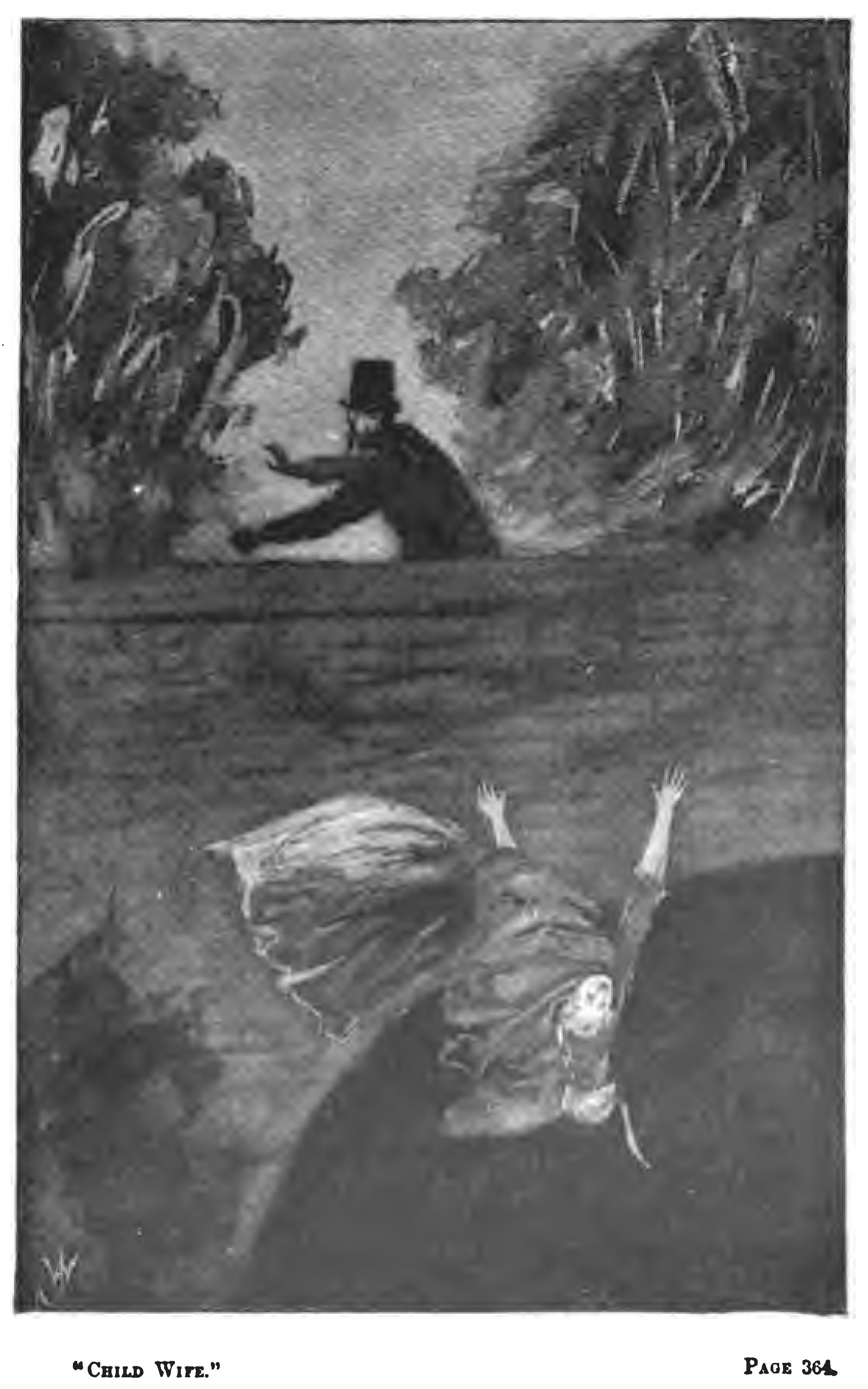
And why? He also knew why.
Under the Park Road passes the Regent’s Canal, spanned by the bridge already spoken of. You would only know you were crossing the canal by observing a break in the shrubbery. This opens westward. On the east side of the road is the park wall rising high overhead, and shadowed by tall trees.
Looking towards Paddington, you see an open list, caused by the canal and its tow-path. The water yawns far below your feet, on both sides draped with evergreens; and foot-passengers along the Park Road are protected from straying over by a parapet scarce breast-high.
Upon this bridge Swinton had arrived. He had stopped and stood close up to the parapet, as if for a rest, his wife still clinging to his arm.
He was resting; but not with the intention to proceed farther. He was recovering strength for an effort so hellish, that, had there been light around them, he and his companion would have appeared as a tableau vivant—the spectacle of a murderer about to despatch his victim! And it would have been a tableau true to the life; for such in reality was his design!
There was no light to shine upon its execution; no eye to see him suddenly let go his wife’s arm, draw the wrapper round her neck, so that the clasp came behind; and then, turning it inside out, fling the skirt over her head!
There could be no ear to hear that smothered cry, as, abruptly lifted in his arms, she was pitched over the parapet of the bridge! Swinton did not even himself stay to hear the plunge. He only heard it; indistinctly blending with the sound of his own footsteps, as with terrified tread he retreated along the Park Road!
Chapter Eighty.
On the Tow-Rope.
With difficulty cordelling his barge around the Regent’s Park, Bill Bootle, the canal boatman, was making slow speed. This because the fog had thickened unexpectedly; and it was no easy matter to guide his old horse along the tow-path.
He would not have attempted it; but that he was next morning due in the Paddington Basin; where, at an early hour, the owner of the boat would be expecting him.
Bill was only skipper of the craft; the crew consisting of his wife, and a brace of young Bootles, one of them still at the breast. Mrs B, wearing her husband’s dreadnought to protect her from the raw air of the night, stood by the tiller, while Bootle himself had charge of the tow-horse.
He had passed through the Park Road Bridge, and was groping his way beyond, when a drift of the fog thicker than common came curling along the canal, compelling him to make stop.
The boat was still under the bridge; and Mrs Bootle, feeling that the motion was suspended, had ceased working the spokes. Just at this moment, both she and her husband heard a shuffling sound upon the bridge above them; which was quick followed by a “swish,” as of some bulky object descending through the air!
There was also a voice; but so smothered as to be almost inaudible!
Before either had time to think of it, a mass came splashing down upon the water, between the boat and the horse!
It had struck the tow-rope; and with such force, that the old machiner, tired after a long spell of pulling, was almost dragged backwards into the canal.
And frighted by the sudden jerk, it was as much as Bootle could do to prevent him rushing forward, and going in head foremost.
The difficulty in tranquillising the horse lay in the fact that the tow-rope was still kept taut by some one who appeared to be struggling upon it, and whose smothered cries could be heard coming up from the disturbed surface of the water!
The voice was not so choked, but that Bootle could tell it to be that of a woman!
The boatman’s chivalrous instincts were at once aroused; and, dropping the rein, he ran back a bit, and then sprang with a plunge into the canal.
It was so dark he could see nothing; but the half-stifled cries served to guide him; and swimming towards the tow-rope, he discovered the object of his search!
It was a woman struggling in the water, and still upon its surface.
She was prevented from sinking by her cloak, which had swished over on one side of the tow-rope as her body fell upon the other.
Moreover she had caught the rope in her hands, and was holding on to it with the tenacious grasp of one who dreads drowning.
The boatman could not see her face, which appeared to be buried within the folds of a cloak!
He did not stay to look for a face. Enough for him that there was a body in danger of being drowned; and throwing one arm around it, with the other he commenced “swarming” along the tow-rope in the direction of the barge!
Mrs B, who had long since forsaken the tiller, and was now “for’ard,” helped him and his burden aboard; which, examined by the light of the canal-boat lantern, proved to be a very beautiful lady, dressed in rich silk, with a gold watch in her waistbelt, and a diamond ring sparkling upon her fingers!
Mrs Bootle observed that beside this last, there was another ring of plain appearance, but in her eyes of equal significance. It was the hoop emblematic of Hymen.
These things were only discovered after the saturated cloak had been removed from the shoulders of the half-drowned woman; and who, but for it and the tow-rope, would have been drowned altogether.
“What is this?” asked the lady, gasping for breath, and looking wildly around. “What is it, Dick? Where are you? Where am I? O God! It is water! I’m wet all over. It has nearly suffocated me! Who are you, sir? And you, woman; if you are a woman? Why did you throw me in? Is it the river, or the Serpentine, or where?”
“’Taint no river, mistress,” said Mrs Bootle, a little nettled by the doubt thrown upon her womanhood, “nor the Sarpentine neyther. It’s the Regent Canal. But who ha’ pitched you into it, ye ought best to know that yourself.”
“The Regent’s Canal?”
“Yes, missus,” said Bootle, taking the title from his wife; “it’s there you’ve had your duckin’—just by the Park Road here. You come switching over the bridge. Can’t you tell who chucked you over? Or did ye do it yerself?”
The eyes of the rescued woman assumed a wandering expression, as if her thoughts were straying back to some past scene.
Then all at once a change came over her countenance, like one awaking from a horrid dream, and not altogether comprehending the reality!
For a moment she remained as if considering; and then all became clear to her.
“You have saved me from drowning,” she said, leaning forward, and grasping the boatman by the wrist.
“Well, yes; I reckon you’d a-goed to the bottom, but for me, an’ the old tow-rope.”
“By the Park Road bridge, you say?”
“It be right over ye—the boat’s still under it.” Another second or two spent in reflection, and the lady again said:
“Can I trust you to keep this a secret?” Bootle looked at his wife, and Mrs B back at her husband, both inquiringly.
“I have reasons for asking this favour,” continued the lady, in a trembling tone, which was due not altogether to the ducking. “It’s no use telling you what they are—not now. In time I may make them known to you. Say you will keep it a secret?”
Again Bootle looked interrogatively at his wife; and again Mrs B gave back the glance.
But this time an answer was secured in the affirmative, through an act done by the rescued lady.
Drawing the diamond ring off her finger, and taking the gold watch from behind her waistbelt, she handed the first to the boatman’s wife, and the second to the boatman himself—telling both to keep them as tokens of gratitude for the saving of her life!
The gifts appeared sufficiently valuable, not only to cover the service done, but that requested. With such glittering bribes in hand, it would have been a strange boatman, and still stranger boatman’s wife, who would have refused to keep a secret, which could scarce compromise them.
“One last request,” said the lady. “Let me stay aboard your boat till you can land me in Lisson Grove. You are going that way?”