Volume 2 — CHAPTER VI. (continued 2)
Reading edition
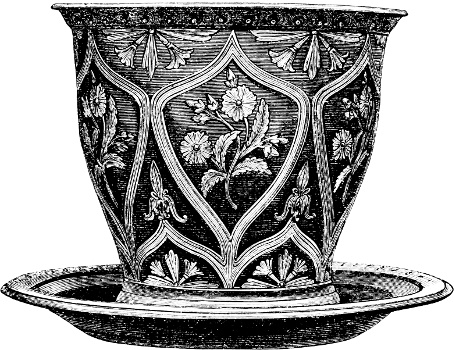
Fig. 440.
The mark of the firm upon the printed goods was formerly W & B, W B, or W B & S, in addition to the name of the pattern. The present mark on both earthenware and porcelain is—

Fig. 442.
Fig. 441.
The impressed marks are the Staffordshire knot (Fig. 442), enclosing the initials W B; and the name BROWNFIELD.
The firm does a large home trade, as well as an export one to Denmark, France, Germany, Holland, Russia, Italy, Spain, Portugal, United States and other parts of America, Canada, Australia, New Zealand, India, and other countries. The manufactory is very extensive; upwards of five hundred persons being employed.
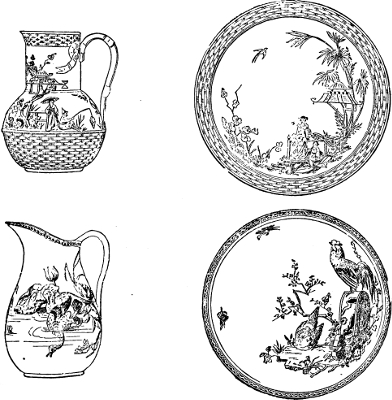
Figs. 443 to 446.
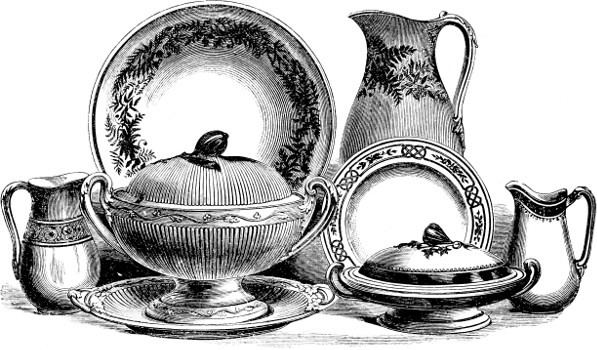
Figs. 447 to 453.
T. Furnival & Sons.—This firm (who occupy two old manufactories, viz., those formerly belonging to Adams and to Blackwell) has been established about thirty years, and ranks high as manufacturers of white granite and vitrified ironstone, and decorated toilet wares, for the United States and Canadian markets, to which they ship large quantities of goods, as they do also printed goods to the continental markets. For the home trade Messrs. Furnival & Sons produce, in their beautiful “patent ironstone,” dinner and other services of various qualities in point of decoration. Among their more recent “specialities” are dinner services, &c, of rich Italian design (made for Pellatt & Wood), plain white, with a china-like surface and glaze; the ornamentation, which is indented, is produced from an embossed mould, the lines being as fine and delicate as if cut in by the graver, so as to have the appearance of chasing; and the lines being filled with glaze the surface is still even. Other noted patterns are the “Dresden Flute” and “Lemon Knob” services. In crested services for the home markets a large and satisfactory trade is done. Another noticeable feature is the happy combination in services of transfer printing, hand painting, enamelling and gilding; some of the services, those decorated with grasses and insects especially, are of high artistic order, and show how advantageously the two processes can be combined. Our engraving shows a group of articles produced at that manufactory, which are remarkable for their elegant forms and for the simple beauty of their decorations. Another engraving exhibits a remarkably elegant flower-pot and stand, with relief figures and other decorations. But these are not a tithe of the beautiful articles produced by Messrs. Furnival. Among the more successful of their productions are the “Swan” and “Nautilus” toilet services, which are of great beauty. The body of the former ewer is oviform, with bulrush decorations in relief; the neck, mouth, and handle make a well-formed swan. These are produced in white, heightened with gold, and enamelled in colours. The “Nautilus” pattern has the mouth of the ewer formed of a nautilus shell and the handle of coral, while the decorations are sea-weeds, true to nature, both in modelling and in colour. The mark of the firm is simply FURNIVAL impressed in the ware.
In connection with these works Mr. F. J. Emery, the then cashier to the firm, introduced, a few years ago, a method of crayon drawing and painting on the bisqué surface of earthenware and china. This beautiful process, which is especially applicable to tiles for fire-places, &c., but is also admirably adapted for the decoration of ordinary articles, has become much in repute, and exquisite drawings have been made in it by some of the first artists of the time, as well as by lady and other amateurs. The bisqué articles, and prepared crayons and colours, were supplied by Mr. Emery, who afterwards became a partner with Mr. E. Clarke at Longport.
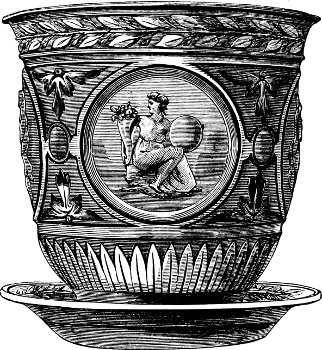
Fig. 454.
Bates & Bennet (formerly John & Robert Godwin), are manufacturers of general earthenware of ordinary quality, the principal productions being what is called “Imperial measure ware” for the home markets.
Abbey Pottery.—(H. Meakin, late Edward Pearson.)—These works were, it is said, established in 1703. White granite ware, for the American markets only, has of late years been produced.
Villa Pottery.—This manufactory for general earthenware was carried on at the beginning of the present century, by Mr. Warburton. From about 1835 it was carried on by Messrs. Jones & Walley till 1850, from which time, until 1865, Mr. Edward Walley continued it. In the latter year it passed into the hands of Messrs. Wood, Son, & Co., its present proprietors, who confine themselves to the production of plain white granite ware for the American and other foreign markets. The mark is the Royal Arms and name of the firm.
Cobridge Works.—Established in 1836 by Messrs. Wingfield Harding & Charles Cockson, under the firm of Harding & Cockson, who produced ordinary china goods. In 1856, on the death of Mr. Harding, the business was continued, until 1861, by his sons, W. M. and J. B. Harding, in partnership with Mr. Cockson; and from 1862 to 1865 by Mr. Charles Cockson alone, during the whole of which time china was produced. In 1866 Elijah and David Chetwynd became partners, the firm being then Cockson & Chetwynd. In 1873 Mr. Cockson died, and the business was continued by his widow under the same style till 1876, when the former retired, and it again changed to Cockson & Seddon. In 1866 the making of china was discontinued and the manufacture of white granite ware, for the American trade, substituted. The mark is the Royal Arms and the name “Imperial Ironstone China, Cockson & Chetwynd,” or “Cockson & Seddon.”
Cobridge Works.—Messrs. Henry Alcock & Co., at these extensive works, which were formerly carried on by John Alcock, manufacture white granite ware exclusively for the American markets.
Elder Road Works.—This pottery has been worked by Messrs. Meakin & Co. since 1865, and is capable of turning out about 2,500 crates of ware annually. The productions are entirely confined to the white granite ware for the United States.
Warburton.—Pot works were established here by John Warburton very early in the last century; after his death they were continued by his widow, Ann Warburton. They are stated to have made white stoneware for Holland and the Continent, and to have ultimately brought over some workmen from Delft. Jacob Warburton, the son, succeeded to the business, and died in 1826, at the ripe age of eighty-four. His son, Peter Warburton, was one of the partners of the New Hall China Works (which see); to him is said by Shaw to belong the credit of printing in gold, and to his mother that of first using soda. In 1810, Peter Warburton took out a patent for “a new method of decorating china, porcelain, earthenware, and glass, with native, pure or adulterated, gold, silver, platina, or other metals, fluxed or lowered with lead or any other substance, which invention or new method leaves the metals after being burned in their metallic state.”
Daniel.—Ralph Daniel, a potter at Cobridge, employed in the early part of last century some workmen from Delft, and, to keep their process secret, started works at Bagnall for them. About 1743 he introduced the use of plaster of Paris moulds, such as he found were being used in France.
The potters at Cobridge in 1843 were Wood and Brownfield, John and George Alcock, Francis Dillon, Elijah Jones, Stephen Hughes and Co., Benjamin Endon Godwin, John Mayer Godwin and James Godwin, John and Robert Godwin, George and Ralph Leigh, and Coxon, Harding, and Co. Potteries also, early in last century, existed at Holden Lane, at Milton, and at Sneyd Green.
Other potters at one time or other at Cobridge are N. Dillon, R. Stevenson, Mansfield & Hackney, and Rathbone, Hill & Co.
Other manufacturers are W. E. Cartledge, Bournes Bank; W. Holdcroft; Hope and Carter; Thos. Hughes; Maddock & Co., formerly Maddock and Gater; C. Meakin; Oulsnam and Son; Pope and Co.; and Wade and Colclough.
In 1770 (Feb. 4th), the following Staffordshire potters signed an agreement as to prices:—John Platt, John Lowe, John Taylor, John Cobb, Robt. Bucknall, John Daniel, Thos. Daniel, junr., Richd. Adams, (Dr.) Saml. Chatterley, Thos. Lowe, John Allen, Wm. Parrott, Jacob Warburton, Warburton and Stone, Jos. Smith, Joshua Heath, John Bourn, Jos. Stephens, Wm. Smith, Jos. Simpson, John Weatherby, J. and Rd. Mare, Nicholas Poole, John Yates, Chas. Hassells, Ann Warburton and Son (T. Warburton), Wm. Meir. Other potters were Chas. and Ephraim Chatterley, W. Mellor, and Whithead.