Volume 2 — CHAPTER III.
Reading edition
Derby—Cock-pit Hill—Mayer—Heath—Derby China—Andrew Planché—Duesbury and Heath—William Duesbury—Purchase of the Chelsea Works—Weekly Bills—Show Rooms in London—Sales by Candle—Changes in Proprietorship—Bloor—Locker—Stevenson & Co.—Hancock—Painters and Modellers—Spengler—Coffee—Askew—Billingsley—Pinxton—Nantgarw—Swansea—Other Artists employed at Derby—Cocker and Whitaker’s China Works, &c., &c.
Derby.
Cock-pit Hill.—There is nothing yet known as to the time when these works were first established. It is certain that at a tolerably early period coarse brown ware was made here, of much the same general character as that made at Tickenhall and by the Tofts, but researches have as yet failed to bring to light any particulars regarding them. There is a positive certainty that the Mayer or Mier family were potters in Derby for more than one generation. A John Mier—an ancestor probably of the Mayers or Meers, of Staffordshire—was a pot-maker in 1721. Some vessels bearing his name are extant. One of these, a posset-pot, bears the words IOHN MIER MADE THIS CUP 1721. Another has been described as “a three-handled pot that holds about two gallons, which is said to have been made at these pot works.” It is of coarse brown ware, glazed, and bears the words:—
“Drink be merry and mary God Bles creae George & Queen ann John Mier made this cup 1708.”
Another, a large pitcher in my own possession, traditionally said to have been made in Derby, bears the initials I S between the date 1720 (Fig. 42), and below the I S the letters D F, about which it is perhaps scarcely worth hazarding a conjecture. It is 16½ inches in height, and is of dark brown glazed ware. The name best known in connection with these works is that of Heath, and they were carried on by this family for a considerable number of years. How, or when, the works came into the hands of the Heaths, remains to be discovered. In 1772, in some very curious and unique MS. “Lists of Gent., &c., in Derby, 1772,” in my own possession, occurs in one, under “Cock-pitt Hill,” “Mayer Mr..... pott merchant,” and in another, “Cock-pitt Hill,” “Mr. Mayer ..... pott merchant.” In the same list, dealers are put down as keeping a “pott shop,” while Mayer is returned as a “pott merchant.” In this same list “John Heath” is entered as an “Alderman;” and “Mr. Chris. Heath” as a “Comon Council Man.”
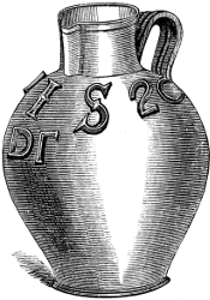
I S 2 DF
Fig. 42.
On the 1st of January, 1756, a draft of an agreement was drawn up “between John Heath, of Derby, in the County of Derby, gentleman; Andrew Planche, of ye same place, china maker; and Wm. Duesberry, of Longton, in ye County of Stafford, enameller,” by which they became “co-partners together as well in ye art of making English china as also in buying and selling of all sorts of wares belonging to ye art of making china” for ten years, with power on Heath’s part to extend for another ten years. In this agreement, the original MS. of which is in my own possession, Heath (who, it will be seen, is described as a “gentleman,” while the others are respectively described by their trades of “china maker” and “enameller”) agrees to pay in £1,000 to the concern, as his share “as stock,” “to be used and employ’d in common between them for ye carrying on ye said art of making china wares,”[7] for which he was to receive one-third of the profits till the principal sum of £1,000 be paid back.
One of the clauses in this agreement is as follows:—“Also it is agreed between ye sd parties to these Presents that ye sd Copartners shall not at any time hereafter use or follow ye Trade aforesaid or any other Trade whatsoever during ye sd Term to their private Benefit and advantage.” From this it would seem that John Heath could not at that time be carrying on the Cock-pit Hill Works. There is nothing to show that this deed was ever legally executed, and two years later—in 1758—I find him named as one of the proprietors of the Cock-pit Hill Works, along with two partners, “William Butts, gentleman,” and “Thomas Rivett, Esquire”—Butts, I presume, being the practical man of the concern. The document in which this appears is in my own possession, and is a commitment of a man named John Lovegrove, one of the workmen “at their pottery in the said Borough of Derby,” for running away from his said service. The commitment is as follows:—
“Borough of Derby.
“To the constables of the said borough of Derby and to each and every of them and also to the Keeper of the House of Correction for the said borough.
“Whereas Information and complaint hath been made before me Samuel Crompton Esquire Mayor and one of his Majesties Justices of the peace for the said Borough by William Butts of the said Borough Gent upon his oath that John Lovegrove was on the Thirteenth day of January last duly hired as a Labourer and Servant to the said William Butts and to Thomas Rivett Esquire and John Heath Gent for one year then next ensuing to work at their Pottery in the said Borough of Derby and that the said John Lovegrove hath departed and run away from his said service, his said year not being expired, And Whereas in pursuance of the Statute in that case made and provided, I have had the said William Butts and John Lovegrove before me and have duly examined the Proofs and allegations of both the said parties touching the matter of the said Complaint and upon due consideration had thereof have adjudged and determined and do hereby adjudge and determine the said Complaint to be true. These are therefore to Command you the said constables and each and every of you forthwith to convey the said John Lovegrove to the said House of Correction for the said Borough of Derby and to Deliver him to the Keeper thereof together with this warrant. And I do hereby Command you the said Keeper to receive the said John Lovegrove into your Custody in the said House of Correction there to remain and be corrected and held to hard Labour for the space of from the Date hereof and for your so doing this shall be your sufficient Warrent Given under my Hand and seal the .”
It will be seen that this commitment is not dated, but I am enabled to fix it with certainty to 1758. Samuel Crompton was Mayor of Derby in 1758, 1767, 1777 (to complete the year of office of Robert Hope, deceased), 1782, and 1788, and High Sheriff of the County in 1768, while holding office as Mayor. There is nothing in the commitment to show to which of these years of Crompton’s Mayoralty it can be assigned, but as Thomas Rivett, one of the partners named in it, died in 1763, it leaves no doubt that 1758 is the correct date. This Thomas Rivett, one of the partners, was Mayor of Derby in 1715 and 1761, and High Sheriff of the County in 1757. In 1747 he was elected Member of Parliament for the Borough of Derby in room of John Stanhope, deceased, and served till 1754. He died in 1763, and was buried in All Saints’ Church. John Heath was Mayor in 1763 and 1772, and his son, Christopher Heath, was Mayor in 1774.
The works were situated on Cock-pit Hill, at the commencement of Siddal’s Lane. The site is still known as the “Pot Yard.” It is distinctly marked on some of the old maps of Derby, and appears to have stood immediately opposite the “Cock-pit” itself—an octagonal building, with a spire-roof terminated with a vane. Buildings existed on this spot as early as 1610, and at that time probably were employed for the making of the rough ware of the period. In the last century they seem to have formed three sides of a quadrangle, and to have been of considerable extent. In 1772 it is thus spoken of in “A Short Tour in the Midland Counties;” after speaking of the china works, the writer says:—“Here is also a pottery, and I was showed an imitation of the Queen’s ware, but it does not come up to the original, the produce of Staffordshire.”
In 1780, in consequence of the failure of the Heaths (who were bankers and men of property, besides one of them being at one time the partner of Duesbury, and, later, the owners of these pot works), the Cock-pit Hill Pottery sold off its stock of goods. The following is one of the announcements of this sale.—
“To the Merchants, Traders, and Dealers in Earthenware.
“To be Sold without Reserve (and considerably under the usual wholesale prices) at the Derby Pot Manufactory a large quantity of Earthenware, being the whole stock in trade of that great and extensive Factory commonly known by the name of the Derby Pot Works, consisting of an assortment of Enamelled, and Blue and White useful China, a large quantity of Enamelled Creamware and plain Cream Tea-table-ware, a great quantity of White Stone and Brown ware.
“N.B.—The aforesaid Earthenware, &c., will be opened for sale on the 4th and 6th of April and continued every Tuesday and Thursday until the whole is disposed of; on which days (but no other in the week) a proper person will attend the sale. The Earthenware will be sold in different lots, and is well worth the notice of Pot Carriers in and about the neighbourhood of Coleorton Moor. No less a quantity than two horse loads will be sold to any one person.”
In the same year, 1780, a sale of “a large quantity of earthern and china ware from the Pot Works on Cock-pit Hill, in Derby, being the stock-in-trade of Messrs. John and Christopher Heath, of Derby, bankrupts,” was advertised to take place by auction at the King’s Head Inn, Derby. The works were carried on for a year or two by the assignees of Messrs. Heath, but in 1782 “a lease of the Pot Works situate on Cock-pit Hill, in Derby, twelve years after which have yet to come, and unexpired, at Lady Day next, at the yearly rent of £6, and the lessee has a right by the lease to take away the buildings (except only leaving a fence-wall), and except a barn that was built on the premises before the lease was granted,” was advertised for sale by auction, along with other property, by the Heaths, “at the house of Mr. George Wallis (being the New Inn, in Derby), on Tuesday, 12th March.” The lease, however, does not seem to have found a purchaser, for in the Derby Mercury of March, 1785, another sale is announced “in Messrs. Heath’s bankruptcy,” in lots, of “the materials of some buildings at the late Pot Works on Cock-pit Hill, in Derby, consisting of brick, tile, and timber; also some old iron, old lead, Hopton stone, a quantity of deal boards, and some lumber.”
Although these works were very extensive, and produced a large quantity of goods of various kinds during the Heaths’ time, but few specimens can, unfortunately, be correctly appropriated. This, of course, is owing to the fact that no mark was used by the owners of the works, and therefore, doubtless, scores of examples pass as “early Staffordshire,” and as the productions of other places. Three or four well-authenticated pieces, however, may be named. The first is a jug in my own possession. It is of the “imitation of the Queen’s ware,” alluded to in a previous page, and bears on one side, within a border of foliage, the quaint and characteristic drinking inscription, “One Pot more and then, why what then, why another Pot.” On the other side and front, within one continuous border, is a blacksmith busy at his forge, working the immense bellows with his left hand, and holding the iron in the fire with his right; while in front is a youth standing by the anvil waiting, as a “striker”; tools and other things lying about; and the inscription, “Thos. Burton, Winster, 1778.” This jug was made at the Cock-pit Hill Works, for Mr. Thomas Burton, a blacksmith, of Winster, whose name it bears, and who is represented at his forge, and from his family passed into my own hands. It is engraved, Fig. 43.
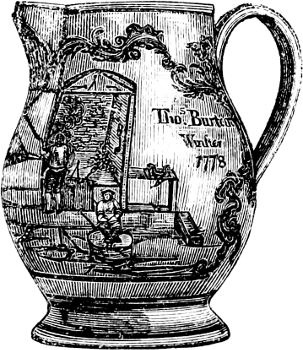
Fig. 43.
Another excellent example belonged to my friend, the late Mr. Lucas. It is a teapot, of the same kind of ware, and bears on one side the words, “Harper for ever fow play and now fair dealing”—probably in commemoration of the contested election of 1768, when Sir Henry Harpur was defeated by Godfrey Clarke, Esq.
Derby China.
It is no little thing to say of Derby that the town in which the silk manufacture of England first took its rise—for here the first silk-mill ever built in this kingdom was erected by John Lombe; in which the cotton trade made its first gigantic stride—for here Arkwright and Strutt completed their invention for spinning, and within a few miles erected the first cotton-mill in England; in which the hosiery trade was first brought to perfection—for here Strutt invented his famed “Derby Ribbed Stocking Machine,” and carried on his manufacture of those articles; and in which many other branches of manufacture have also had their rise—should likewise have been one of the few places, and one of the first, in which the manufacture of porcelain was matured, and in which the biscuit was first invented. But so it is, and it is no little for Derby to be proud of, that these branches of industry, which are among the most important in the kingdom, should have had their birth, and in their infancy been carefully nurtured, within its boundaries. The stories of Lombe and his silk, Arkwright and Strutt and their cotton, and Jedediah Strutt and his stockings, have been often told, and will bear telling again and again; but that of Duesbury and his china has never been fully told, and it was only by the most laborious research that I was enabled, in 1862, to tell it, and to show to what an extent the manufacture, under the care of three generations of one family, was carried. That information I now, after many years of patient research, considerably amplify. Alas! that so important, so beautiful a branch of Art should ever have been allowed to decay in the town by which it has so long been fostered.
One of the earliest printed notices of the Derby China Works occurs in a scarce old book, “A Short Tour in the Midland Counties of England performed in the summer of 1772, together with an account of a similar excursion undertaken September, 1774.” It is as follows:—
“The manufacture of porcelain employs, in all, near a hundred men and boys; several of the painters earn a guinea and a half per week. Mr. Duesbury (who has also bought the manufactory at Chelsea) is every day bringing the art nearer to that perfection at which it has arrived in other countries. Derby porcelain is at present by no means contemptible: figures and other ornaments are among their most capital articles. Here is also a pottery, and I was showed an imitation of the Queen’s ware, but it does not come up to the original, the produce of Staffordshire.”
In the “Poll Book” of 1775, when Christopher Heath was Mayor of Derby, the following names occur:—
Bakewell, Thomas, Derby, Pot-man.
Dewsberry, William, Derby, China-man.
Hill, Joseph, Derby, China-man.
Needham, Henry, Derby, Pipe-maker.
Simpson, Moses, Derby, Potter.
Strong, Benjamin, Derby, Pipe-maker.
Wood, William, London, China-man.
Withers, Robert, Rotherham, Potter.
Mosley, Thomas, Derby, Potter.
Bray, who wrote his “Tour” in the year 1777, says, speaking of Derby:—
“The china manufactory is not less worthy of notice. Under the care of Mr. Duesberry it does honour to this country. Indefatigable in his attention, he has brought the gold and blue to a degree of beauty never before obtained in England, and the drawing and coloring of the flowers are truly elegant. About one hundred [this number is in his second edition corrected to seventy] hands are employed in it, and happily many, very young, are enabled to earn a livelihood in the business.”
Dr. Johnson visited the Derby China Works in 1777, and the following is Boswell’s note on the visit:—
“When we arrived at Derby Dr. Butter accompanied us to see the manufactory of China there. I admired the ingenuity and delicate art with which a man fashioned clay into a cup, a saucer, or a teapot, while a boy turned round a wheel to give the mass rotundity. I thought this as excellent in its species of power as making good verses in its species. Yet I had no respect for this potter. Neither, indeed, has a man of any extent of thinking for a mere verse-maker, in whose numbers, however perfect, there is no poetry, no mind. The china was beautiful; but Dr. Johnson justly observed it was too dear; for that he could have vessels of silver of the same size, as cheap as what were here made of porcelain.”
Pilkington, in his “View of the Present State of Derbyshire,” published in 1789, says:—
“About forty years ago the manufacture of porcelain was begun by the late Mr. Duesbury. This ingenious artist brought it to such perfection as, in some respects, to equal the best foreign china. The ornamental part of the business was at first almost solely attended to. But the foreign demand being much interrupted by the last war, the proprietor turned his thoughts to the manufacture of useful porcelain. At this work a very rich and elegant dessert service, consisting of one hundred and twenty pieces, was lately made for His Royal Highness the Prince of Wales. The number of hands at present employed by Mr. Duesbury is seventy-two, and the manufacture is in a flourishing state.”
William Hutton, the historian of his native town and of Birmingham, who wrote his “History of Derby” in 1791, says:—
“Porcelain began about the year 1750. There is only one manufactory, which employs about seventy people. The clay is not of equal fineness with the foreign, but the workmanship exceeds it. The arts of drawing and engraving have much improved within these last thirty years. The improvements of the porcelain have kept pace with these. They adhere to nature in their designs, to which the Chinese have not attained. A dessert service of one hundred and twenty pieces was recently fabricated here for the Prince of Wales. The spot upon which this elegant building stands, which is internally replete with taste and utility, was once the freehold of my family. It cost £35, but the purchaser, my grandfather’s brother, being unable to raise more than £28, mortgaged it for £7. Infirmity, age, and poverty, obliged him to neglect the interest, when, in 1743, it fell into the hands of my father as heir-at-law, who, being neither able nor anxious to redeem it, conveyed away his right to the mortgagee for a guinea.”
And again, in his MS. “History of the Hutton Family,” 1799,[8] he says, speaking of John Hutton:—
“He was the man who purchased the house east of St. Mary’s Bridge, now the China Works, for £35, but being master of only £28, mortgaged the premises to Mr. Crompton, a banker, for the other seven. He becoming old and poor, and inheriting the supineness of the Hutton family, suffered the trifling interest to remain unpaid till the mortgagee seized the premises. The freehold in 1743 fell into the hands of my father, as heir-at-law, who assigned over his interest to Mr. Crompton for a guinea.”
The manufactory was situated on the Nottingham Road, near St. Mary’s Bridge, in a locality then named Suthrick, or Southwark. On its site, in 1845–6, the Roman Catholic nunnery of St. Marie, designed by Pugin, was erected, but this has now, like the China Works, become “a thing of the past”—the nunnery having been purchased by the Midland Railway Company, and taken down in 1863. Hutton’s remark as to this site being his patrimony, is very curious, and adds an increased interest to the locality. The very premises he speaks of were those first occupied for the making of porcelain, and, curiously enough, they were opposite to Lombe’s silk-mill, from which they were divided by the road and the broad expanse of water of the River Derwent.
It is generally believed that in 1750, perhaps a little earlier, the manufacture of china first sprang into existence in Derby—about a year or so before the works at Worcester were established; and there is a tradition that the first maker was a Frenchman, who lived in a small house in Lodge Lane, and who modelled and made small articles in china, principally animals—cats, dogs, lambs, sheep, &c.—which he fired in a pipe-maker’s oven in the neighbourhood, belonging to a man named Woodward. There were, at this time, as I have shown, some pot works on Cock-pit Hill, which afterwards belonged to Alderman Heath, a banker; and the productions of this French refugee, or rather son of a French refugee, having attracted notice, an arrangement was made between him and Heath and Duesbury, by which the manufacture of porcelain was to be carried on jointly. This man’s name, to whom I take it belongs the absolute honour of commencing the Derby China Works, was Andrew Planché; and I am enabled to arrive at this conclusion by means of a draft of a deed now in my possession, by which a partnership for ten years was entered into by the three already named. In this arrangement I apprehend Planché found the knowledge of mixing bodies and glazes, Heath the money (£1,000), and Duesbury the will, ability, and skill to carry out the scheme. These articles of agreement are as follows:—
“Articles of Agreement between John Heath of Derby in the County of Derby Gentleman, Andrew Planche of ye same Place China Maker & Wm Duesberry of Longton in ye County of Stafford Enamellor. Made and enter’d into the 1st of Jany 1756.
“First it is agreed by ye said John Heath Andrew Planche & Wm Duesberry to be Copartners together as well in ye Art of making English China as also in buying and selling of all sorts of Wares belonging to ye Art of making China wch said Copartnership is to continue between them from the Date of these Presents for & during ye Term of Ten years from thence & then fully to be compleated & ended And to that end He ye said John Heath hath ye day of ye date of these Presents deliver’d in as a Stock ye sum of One Thousand Pounds to be used & employ’d in Common between them for ye carrying on ye sd Art of making China Wares And that one third share of Profits arising therefrom It is mutually agreed between all ye sd parties shall be receiv’d by & paid to ye said John Heath till ye said Prinl Sum of £1000 be paid in Also it is agreed between ye sd parties to these Presents that ye sd Copartners shall not at any time hereafter use or follow ye Trade aforesaid or any other Trade whatsoever during ye sd Term to their private Benefit and advantage. And also that ye sd Copartners shall during ye said Term pay and discharge equally and proportionably between them all expenses they shall be at in managing ye Art and Trade aforesaid[F1: period?] And also that all Gain or Profit that shall arise from ye Art & Trade aforesaid during ye said Term shall be divided between them ye sd Copartners Share and Share alike And likewise that all such Losses as shall happen by bad Debts Ill Commodities or otherwise shall be borne equally between them And it is further agreed by ye sd Parties that there shall be kept during ye sd Term Just & True Books of Accounts to wch sd Books any of ye sd Copartners shall have free access without Interruption of ye other And it is further agreed that at any time hereafter at ye request of ye said John Heath New Articles shall be made & an additional Term of years not less than Ten shall be added with such alterations and additions as may be found necessary And that ye said Copartners shall from time to time communicate to each other every Secret of ye said Art And that ye said John Heath shall have it in his power to appoint any other Person to Act for him if he should chuse so to do wch Person shall be as fully impowered to Act with regard to all Covenants herein contained as ye sd John Heath himself. Witness our hands the Day & Year above written.”
These articles are not signed, and as in no instance which has come under my notice the name of Planché again appears—and as I can only trace the firm as that of “Duesbury and Heath”—I fear one is driven to the inference that the usual fate of clever men awaited Andrew Planché, and that when his knowledge was fully imparted, he was, from some cause or other, discarded by those who had taken him in hand. At all events, this is the only instance in which his name appears in any of the papers connected with the works which I have examined. Of Planché, however, whom I was the first to discover and note in 1862, but who, despite all I had written, was spoken of by Mr. A. Wallis, eight years later, as “an apocryphal French refugee,”[9] I am enabled to give some additional particulars.
Andrew Planché was one of the five sons of Paul Planché, a French refugee, by his first wife, Marie Anne Fournier, also a refugee, whom he married in 1723. Andrew was born on the 14th, and baptized on the 24th, of March, 1727–8, and his youngest brother was Jacques Planché (born in 1734), who married his cousin (the only daughter of Antoine Planché by his wife Mary, daughter of Herr Abraham Thomas and his wife Catherine), and was father of my old and valued friend, J. R. Planché, F.S.A., the well-known dramatist and antiquary. This fact I brought to his knowledge in 1862, and again when he was writing his interesting “Recollections,” in which he has embodied some of the information I supplied him with. Through the re-marriage of their father, the two boys, Andrew and Jacques, had early to shift for themselves; the latter made his way to Geneva, where he learned the business of watch-making, and the former, I believe, went into Saxony, and there learned the art of making porcelain at Dresden. How he came to Derby is at present a mystery, but he was there at all events as early as, if not earlier than, 1751. This is proved, as I shall presently show, by the birth of one of his sons. In 1751 he would be 23 years of age, and was living in the parish of St. Alkmund, in Derby. The following entries are extracted from the parish register of St. Alkmund’s:—
1751. Sept. 21. Baptized Paul Edmund, the son of Andrew Planché and Sarah his wife.
1754. 12 Oct. Bap. James, the son of Andrew Planché and Sarah his wife.
1754. Dec. 10. Buried James, the son of Andrew Planché and Sarah his wife.
1756. March 4. Bap. James, the bastard son of Andrew Planché and Margaret Burroughs.
1756. July 3. Bap. William, the son of Andrew Planché and Sarah his wife.
That Andrew Planché was not very strict in his morals is revealed by these extracts, which show that in 1756 he had two sons baptised within four months of each other, the first by a young woman named Margaret Burroughs, and the second by his wife. This was the year, 1756, in which the articles of agreement were drawn up. What became of Planché after he left Derby is not known. He appears to have been a very erratic individual, and his whereabouts uncertain. He was living at Bath at the ripe age of 76, in 1804, and died there soon afterwards. At all events, I have proof that he was in Derby eight years—how much longer I know not—and I have also, as will be seen, indisputable proof that William Duesbury had no connection with Derby till 1755–6, the date of the deed I have printed above.
When Duesbury, whether in conjunction with Planché and Heath or not, commenced business, it appears to have been in the small premises which had not long before been relinquished for a guinea by the father of William Hutton; and in them was thus commenced, in a very small way, that manufacture of porcelain which afterwards grew to so immense an extent. In the year 1756 the draft of agreement was drawn up, and the ware made at the manufactory must soon have found a ready sale, for in the course of a very few years Mr. Duesbury was carrying on a good trade, had a London house for the sale of his productions, and became a thriving and well-to-do man.
William Duesbury was of Longton Hall, in the county of Stafford, and was the son of William Duesbury, currier, of Cannock, in the same county, who in 1755, as is evidenced by the original deed in my possession, made over to him his household furniture, leather, implements of trade, and other effects, on condition that he should find him “during the term of his natural life, good and sufficient meat, drink, washing, and lodging, wearing apparel, and all other necessaries whatsoever.” The following is a verbatim copy of this curious deed, from the original. It is fully stamped, signed, and attested, and runs as follows:—
“This Indenture made the Twenty-seventh day of September in the twenty-ninth Year of the reign of King George the second over Great Britain and so forth and in the Year of our Lord One Thousand Seven Hundred and fifty-five Between William Duesbury of Cannock in the County of Stafford Currier of the one part and William Duesbury of Longton Hall in the Parish of Stoke-upon-Trent in the said County of Stafford Son of the said William Duesbury of the other part Witnesseth that for and in Consideration of the natural Love and affection which he the said William Duesbury hath and beareth to the said William Duesbury the younger And of the Covenant or Agreement hereinafter contained on the part and behalf of the said William Duesbury the younger to be done and performed and of the Sum of Five Shillings of lawful British Money to the said William Duesbury in hand paid by the said William Duesbury the younger at or before the execution of these presents the receipt whereof is hereby acknowledged He the said William Duesbury Hath given granted bargained and sold and by these presents Doth give grant bargain and sell unto the said William Duesbury the younger All and singular the Household Goods Leather Implements of Trade and all other the goods Chattles and Personal Estate of him the said William Duesbury situate and being at Cannock aforesaid or elsewhere in the said County of Stafford and every of them and every part thereof And all the Estate right title Interest & property claim and demand whatsoever both in Law and Equity of the said William Duesbury of in or unto the same every or any part thereof To have and To hold take retain and enjoy the said Household Goods Leather Implements of Trade and every of them And all other the goods Chattles and personal Estate above given granted bargained and sold or mentioned and intended so to be with their appurtenances unto the said William Duesbury the younger his Extors. admors. & assigns from henceforth absolutely and for ever to his and their own Use and benefit And the said William Duesbury for himself his Extors. & admors. doth covenant promise and grant to and with the said William Duesbury the younger his Extors. admors. & assigns that he the said William Duesbury his Extors. & admors or some of them All and singular the said Goods Chattles and personal Estate above given granted bargained and sold or mentioned & intended so to be to the said William Duesbury the younger his Extors. & admors. against all Men shall and will warrant & for ever defend And the said William Duesbury hath put the said William Duesbury the younger into possion. of all & singular the said Goods and Chattles by delivering him one Pewter Plate in the name of all and singular the said Goods and Chattles at the execution of these presents And This Indenture further witnesseth And the said William Duesbury the younger in Consideration of the Premises for himself his Heirs Extors. & admors. doth covenant promise grant and agree to and with the said William Duesbury his Extors. & admors. That he the said William Duesbury the younger his Heirs Extors. and admors. or some of them shall and will from time to time and at all times hereafter find and provide for the said William Duesbury during the term of his natural Life good & sufficient meat drink washing and Lodging wearing apparel and all other necessaries whatsoever at the proper Costs and Charges of him the said William Duesbury the younger his Heirs Extors. Admors. or assigns In witness whereof the said Parties to these presents have hereunto set their Hands and Seals the day & year first above written.
Sealed and delivered
in the presence of
William Duesbury.

Mary Knight.
Jo: Knight.
William Duesbury.
I next find William Duesbury, the enameller, of Longton, entering into partnership with Heath and Planché on the first January in the year following his executing this deed for the maintenance of his father; and entries in the family Bible prove that at this time he removed to Derby, to carry on his newly-acquired business “in ye art of making English china, as also in buying and selling of all sorts of wares belonging to ye art of making china.” The partnership deed bearing date the first of January, 1756, shows that the negotiations must have been made in the previous year, 1755, and as the deed of gift from his father is dated September 27th of that year, it is evident that the one was consequent on the other, and that the arrangement with his father was the result of his determination to come to Derby. The father lived until 1768, and died and was buried in Derby. In the parish register is the entry, “1768. Buried, Mr. Duesbrie, March 17.”
William Duesbury was born on the 7th of September, 1725, and married Sarah James, of Shrewsbury (who was born on the 12th of August, 1724). In 1755 he was residing at Longton, as an enameller on china ware, &c., and in 1756 removed to Derby to carry on the porcelain works there. By his wife Sarah, who died on the 14th of September, 1780, and was buried at St. Alkmund’s Church, Derby, he had several children. These were, so far as I have been able to ascertain, William, born in London in 1752, and died there in infancy; Anne, born at Longton, Oct. 3, 1754, who became the wife of Richard Egan, linendraper, of London, and afterwards china, earthenware, and glass dealer, of Bath; Mary, born in London, in 1753, but baptised at St. Alkmund’s, Derby, who died in infancy; another Mary, born at Derby, Nov., 1756, and died in 1783; Sarah, born in 1758, and died an infant; another Sarah, born in 1759, and buried in 1767; Dorothea, born in 1761, who married the Rev. John Chawner, of Church Broughton, in 1786; William, born in 1763, who succeeded his father; and James, born in 1765, who, after an erratic and evidently misunderstood and unfortunate life, died in obscurity. Mr. Duesbury himself, after a long and useful life, in the course of which he not only established the Derby China Works, but became the purchaser of those of Chelsea, Bow, Vauxhall, and Kentish Town, died at Derby, and was buried at St. Alkmund’s Church, in that town, on the 2nd of November, 1786.
William Duesbury, son and successor of the last named, was born at Derby, and baptised at St. Alkmund’s Church there, March 1, 1763. On the 4th of January, 1787, he married Elizabeth, daughter of William Edwards, Esq., solicitor, of Derby, the lady having three days before completed her twentieth year. By her he had issue three sons—William, who succeeded him; Nathaniel, who died in 1809, aged 19; and Frederick, who became an eminent physician in London—and two daughters, viz., Sarah, who remained unmarried, and died in 1875; and Anne Elizabeth, who became the wife of Francis Jessop, Esq., solicitor, of Derby. So far it has been necessary to summarise this bit of family genealogy, but the remainder will form a part of the thread of the history of the works.
The manufacture of china under the first William Duesbury must have rapidly risen into eminence, for in 1763, in an account of “goods sent to London,” no less than forty-two large boxes appear at one time to have been despatched to the metropolis, and the proceeds, I presume, of the sale of a part of them, on the 2nd of May, in that year, amounted to no less a sum than £666 17s. 6d. It is very interesting, at this early period of the art, to be enabled to say of what varieties of goods the consignment to London consisted, and I therefore give the list of contents of some of the boxes entire, and also a few items from others. I do this the more readily because it has been recently said by the writer to whom I have already alluded, “We doubt very much whether the higher sorts of fine porcelain (figures, vases, &c.) were made upon the Nottingham Road until the purchase of the Chelsea Works in 1769 and the commencement of what is called the Chelsea-Derby period, which lasted until 1785 or 1786.”
Box No. 41 contained—
8 Large Flower Jarrs, at 21s.
3 Large Ink Stands, at 42s.
1 Small ditto, at 24s.
4 Large Britanias, at 36s.
6 Second-sized Huzzars, at 12s.
4 Large Pidgeons, at 7s.
12 Small Rabbets, at 2s.
12 Chickens, at 2s.
16 Small Baskets, at 2s. 6d.
Box No. 31—
4 Large Quarters, at 40s.
4 Shakespeares, at 42s.
6 Miltons, at 42s.
24 Bucks, on Pedestals, at 2s. 6d.
Box No. 29—
4 Large Quarters, at 40s.
2 Jupiters, at 68s.
2 Junos.
5 Ledas, at 36s.
1 Europa, at 36s.
2 Bird-catchers, at 10s. 6d.
12 Sixth-sized Solid Baskets.
18 Second-sized Boys, at 1s. 6d.
Box No.11—
24 Enammelled, round, fourth-size, open-worked Baskets.
12 Blue ditto.
12 Open-worked Spectacle Baskets.
9 Second-size Sage-leaf boats.
There were also, of various sizes, blue fluted boats, Mosaic boats, sage-leaf boats, potting pots, caudle cups, blue strawberry pots, fig-leaf sauce boats, octagon fruit plates, vine-leaf plates, coffee cups, flower vases, standing sheep, feeding sheep, cats, sunflower blows, pedestals, honeycomb jars, coffee pots, blue guglets and basins to ditto; butter tubs, Chelsea jars, tea pots, honeycomb pots, figures of Mars and Minerva, sets of the Elements, Spanish shepherds, Neptune, the Muses, bucks, tumblers, roses, Jupiter, Diana, boys, garland shepherd, Spaniards, Chelsea-pattern candlesticks, Dresden ditto, jars and beakers, polyanthus pots, &c., &c.
It is worthy of note that at this time, although much within the ten years stipulated for the partnership, the name of William Duesbury alone usually occurs. It is true that in some instances “Duesbury and Co.,” and “Duesbury and Heath,” are met with, but these are the exception. The works at Derby continued now rapidly to extend, and fresh articles and subjects were being continually added to those already made. The best available talent was got together, apprentices were taken to the modelling, the painting, the making or “repairing” of china, and other parts of the manufacture, and it was soon found advisable to have a regular warehouse in London.
The mark used in the earliest days of the works is not certain, but I believe, and I have reason for that belief, that it was simply the letter , which, would stand either for “Duesbury” or for “Derby;” probably in gold. The figures and groups, too, were numbered and registered for reproduction.

On the 17th of August, 1769, Mr. Duesbury arranged for the purchase of the Chelsea China Works, their purchase being completed on the 5th of February, 1770, when a payment of £400, in part of the purchase-money, was made by Mr. Duesbury, who thus, as the proprietor of the Derby and the Chelsea Works, became the largest manufacturer in the kingdom.[10] The history of the Chelsea Works has already been fully given in the first volume of this work, and therefore it is only necessary here to say, that in 1862, in my paper on the Derby China Works, in the Art Journal, I was for the first time enabled to state the fact that Mr. Duesbury purchased “the Chelsea Porcelain Manufactory, and its appurtenances and lease thereof,” on the 5th of February, 1770, and that it was covenanted to be assigned over to him on or before the 8th of that month; the date of the arrangement to purchase being August 17th, 1769. For some few years, then, Mr. Duesbury carried on both establishments, and subsequently removed the models and some of the workmen to Derby, where also he removed such of the models, &c., from Bow, which had likewise come into his possession. The purchase of the Chelsea Works soon entailed upon him the commencement of some heavy law proceedings which lasted many years. The cause of these proceedings was the attempt at recovery of a quantity of goods claimed by Duesbury as a part of his purchase, being goods made by Spremont, and of his material, but which were afterwards sold, it was said, wrongfully, by Francis Thomas, to a person named Burnsall. The action was commenced in 1770, and in 1771 Mr. Spremont, the old proprietor of the Chelsea Works, died. The proceedings, however, continued for several years.
During the time Mr. Duesbury carried on the Chelsea Works, from February 1770 to 1773, the “weekly bills” are now in my possession, and are particularly interesting as showing the nature of the articles then made, and the names of the painters and others employed, and the amount of wages they earned. The following examples will be read with interest. The first I give is quite one of the early ones—of the same month in which the works were delivered over to Duesbury:—
1770. A Weekly Bill at Chelsea from the 24 of March to the 31.
£ s. d.
Barton, 6 days att 3s. 6d. 1 1 0
Boyer, 6 days att 3s. 6d. 1 1 0
3 dozen of Seals of the Lambs, made overtime 0 3 6
3 dozen of Lyons, ditto 0 3 6
Roberts, 6 days att 2s. 6d. 0 15 0
Piggot, 6 days att 1s. 9d. 0 10 6
Ditto, Taking Care of the Horse on Sunday 0 1 6
Inglefield, 6 days at 1s. 8d. 0 10 0
£4 6 0
Work done this Week at Chelsea—
6 Large Ornement Pedistols for the Grand Popore.
5 Large Popore Perfume Pots to Ditto.
1 Square Perfume Pot Deckarated with heads of the 4 seasons.
Roberts, Making Cases hall the week.
Piggot, Working the hors in the Mill, and fettling of rims.
Inglefield, Pounding of the glass, and cutting of wood.
Recd. of Mr. Duesbury in full of all Demands for self and the a Bove.
Richd. Barton.
1770. A Weekly Bill at Chelsea from Decr. 1 to the 8.
£ s. d.
Boarman,[11] 6 days att 5s 3d. 1 11 6
Wolliams, 6 days att 4s. 6d. 1 7 0
Jenks, 6 days att 3s. 6d. 1 1 0
Boyer, 6 days att 3s. 6d. 1 1 0
Barton, 6 days att 3s. 6d. 1 1 0
Roberts, 3 days att 2s. 6d. 0 7 6
Piggott, 6 days att 1s. 9d. 0 10 6
Ditto, Sunday, taking care of the Horse 0 1 6
Inglefield, 6 days att 1s. 8d. 0 10 0
Overtime by Barton and Boyer, 10 Globe Cover Jarrs 0 10 0
72 Seals painted in Mottords[12] by Boarman and Wolliams 0 7 6
42 Seals, painted by Jinks at 2d. each, figures 0 7 0
A Letter from Darby 0 0 5
2 Tons of fine clay Shipping to Darby 2 7 0
And 1 Ton to Chelsea of Corse 0 17 0
A Letter to Darby 0 0 1
Tax’s of the Factory 2 0 3
Turpentine for the Painters 0 0 6
Peaper for the Use of the factory 0 0 4
£14 1 1
Deduct for 2 Tun Clay[13] 2 7 0
£11 14 1
Rec. of Mr. Duesbury in full of all demands for Self and the a Bove.
Exd. and Ent.
Richd. Barton.
Amongst other interesting entries from week to week in the bills, I have chosen a few examples to illustrate the kind of work then carried on in this factory.
£ s. d.
Paid for the Plaister Mould from Darby, the 9 of August 0 0 6
Paid for a box from Darby 0 0 6
Overwork by Barton and Boyer, 2 Junquill Beakers 0 4 0
And 1 Vincent Pattern Perfume Pot 0 1 6
Seals painted by Jinks, 33 Lambs 1½d. 0 4 1½
33 Covers Painted Overtime by Jinks at 1½d. each 0 4 1⅓
Cord[14] for the Kilns 1 17 4
Overtime by Boyer and Barton, 5 Sweet Meat Basons at 1s. each 0 5 0
——4 hart shaped Perfume Pots with handles, at 1s. 3d. each 0 5 0
1 Cupid Forgin Harts at 1s. 3d. 0 1 3
Overtime, Painting by Jinks 2 dozen of Tom titts at 1½d. each 0 3 0
Seals made overtime 3 dozen Chineas Men with a Bird 0 3 6
3 dozen Cupids as a Backus 0 3 6
24 Strawberry Compotiers made with the Darby clay.
1 dozen and 6 Cupid Booted and Spurd 0 1 9
1 dozen and 6 Harts on a Cushin 0 1 9
1 dozen and 6 Cupid as a Doctor 0 1 9
1 dozen and 6 Turks a Smokin 0 1 9
1 dozen and 6 Shepherds Shearing of Sheep 0 1 9
12 Tooth Picks with Head of Turk and Companions, painted with emblematick Mottoes, ditto at 1s. 6d. 0 18 0
Examples of this kind[15] could be multiplied to any extent, but to bring the extracts a little later down in date, I shall content myself by giving the “weekly bill at Chelsea from June 19 to the 26, 1773,” to show that the same hands, with the addition of a modeller named Gauron, were still employed:—
£ s. d.
Gauron, 5¾ days at 8s. 9d. 2 10 3½
Boreman, 5¼ days at 5s. 3d. 1 7 7
Woolams, 5½ days at 4s. 6d. 1 4 9
Jenks, 6 days at 3s. 6d. 1 1 0
Snowden, 6 days at 3s. 6d. 1 1 0
Boyer, 6 days at 3s. 6d. 1 1 0
Barton, 6 days at 3s. 6d. 1 1 0
Roberts, 6 days at 2s. 6d. 1 15 0
Painting, overwork, Smelling Bottles of boys catching Squirrel at 1s. 3d. 0 2 6
2 Ditto, with a Bird’s Nest at 1s. each 0 2 0
1 Ditto, Piping with a Dog at 1s. 0 1 0
1 Ditto, Double Dove 0 1 0
Mottoing 60 Seals at 1¼d. each 0 6 3
Modling Clay 0 0 6
A Parsel 0 0 2
A Letter 0 0 1
£10 15 1¾
Recd. of Mr. Duesbury in full of all demands for Self and the a Bove.
Richd. Barton.
Before Mr. Duesbury purchased the Chelsea works the mark of that manufactory was an anchor, and to this Mr. Duesbury added the letter D ; and the mark now known as distinguishing the “Derby Chelsea” ware was thus—generally in gold. Examples of this period are of comparative rarity, and are eagerly sought after by collectors.


Fig. 45.
In 1772, in the very curious MS. “Lists of Gent., &c., in Derby, 1772,” in my own possession (a list prepared for official purposes over elections), are the following entries under “Southwark,” as that part of Derby was called. In one:—
Duesbury, Mr. Wm China Manufacturer.
Steer, Mr. John At to China Manufactory.
Wood, Mr. Wm Do.
and in the other list:—
Mr. Duesbury China Manufacturer.
Mr. Wm Wood Clerk to Do.
Mr. John Steer Do.
In June, 1773, Mr. Duesbury took the lease of premises (late the Castle Tavern) in Bedford Street, Covent Garden, for a warehouse for his Derby and Chelsea ware, and here, with this William Wood as his agent (afterwards succeeded by J. Lygo), he exhibited and kept a large stock of his manufactures, and carried on, in conjunction with his two works, a very thriving and lucrative trade. Here he issued a “List of the principal additions made this year to the new invented Groups, Jars, Vases, Urns, Beakers, Cups, Chalices, &., of Mr. Duesbury’s Derby and Chelsea Manufactory of Porcelaines, Biscuits, and China Ware, both Ornamental and Useful.” This “list” is printed in small quarto. Among the articles enumerated, one hundred and twenty-three in number, the following will be sufficient to show their beautiful and elaborate nature, and the amount of labour and artistic skill which they exhibited:—
“1. Their present majesties, the king and queen, and royal family, in three grouped pieces of biscuit. The centre piece represents the king in a Vandyke dress, on a blue and gold basement, supported by four lions leaning on an altar richly ornamented in blue and gold, with hanging trophies of the polite arts and sciences. The crown, munde, and sceptre reposing on a cushion, of crimson, embroidered, fringed, and tapelled in gold. 14 inches.
“42. A large beaker, sky-blue ground spotted in white; two dolphins, lion footed, standing on white goats’ heads, form the two anses in crimson and white edged with gold, the mouth of the beaker and the top of the vase are furrowed with twisted crenures in white and gold; the zone of the top is adorned with golden lions, turned toward white and gold marks; the rim of the cup part is foliated and crenulated friese, white and gold, with detached patera, the pediment striped with gold in alternate triangles, the foot covered with gilt leaves; the pedestal in white and gold has four white sphinxes for angular supporters, over which runs a gold festoon fixed to the surbase; the whole, with the pedestals, 20 inches.
“105. A white gallon cask, with gold edged hoops, adorned with four trophies of music emblems of love, in chiaro-oscuro, surmounted by a young coloured Bacchus, sitting on the bung tasting a grape, of which he holds a basket full between his legs, and a cup in his left hand, the barrel is made to turn round on a pivot fixed in an ormolu pediment, a satyr’s mask holds an ormolu cock in his mouth, which opens and shuts by a spring. 18 inches.”
The works at Chelsea were not finally discontinued until the year 1784, when they were destroyed by Mr. Duesbury, the kilns and every part of the work pulled down, and what was available sent down to Derby. The removal of the kilns, and the work of demolition, was entrusted to Robert Boyer, the painter, &c., the old and faithful servant whose name appears in the “weekly bills” above given; and when his work was done he removed to Derby at twenty-five shillings per week in place of a guinea, with house rent free, and fire as heretofore.[16] It is also worthy of remark that Mr. Duesbury purchased the Bow business, and owned the pottery at Pedlar’s Acre, at Lambeth, the rents of which he assigned in 1781.
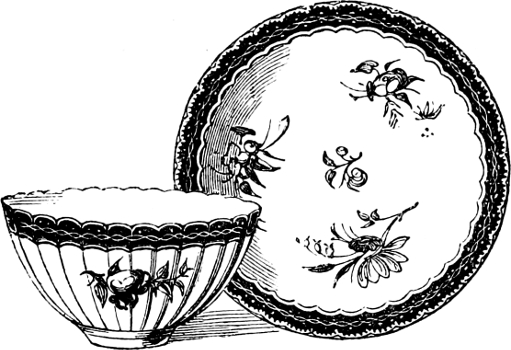
Fig. 46.
Periodical sales of stock were held in London by Mr. Duesbury, and judging by the catalogues of “Sales by Auction” by Messrs. Christie and Ansell, of Pall Mall, and “Sales by Candle,” by Mr. Hunter, the articles sent up for the purpose were excellent examples of the manufacture, and just such as were likely to be sought after by the traders—the “chinamen” of London. The descriptions of the goods were of much the same character as in the “list” referred to, with this addition, that in the late catalogues the price (the trade price possibly) was attached to each article. I have by me the priced catalogues of several years’ sales, and it is highly interesting to examine them, and to see the prices the different articles realised at the sales. They give, perhaps, one of the best insights into the porcelain trade of that period of anything I have seen. A few items, taken at random, from some of these catalogues, will be useful to the collector. The “Catalogue of an elegant and extensive assortment of Derby and Chelsea Porcelaine” for sale on May 10th, 1781, and four following days, has a long and full title-page, and occupies thirty-two octavo pages. The company were invited to this sale by cards, of which the following is a copy:—
“At Messrs Christie and Ansell’s great Room, next Cumberland House, Pall Mall, will be sold by Auction on Tuesday next, the 7th of May 1782, and the Four following Days, an elegant and extensive Assortment of the Derby and Chelsea Porcelain, consisting of Table and Desert Services, Tea and Coffee Equipages, Biscuit Ornaments, &c., &c.
“To be viewed on Saturday the 4th of May, and till the Sale (Sunday excepted), which will begin each Day at 12 o’clock.
“N.B.—Mr. Duesbury flatters himself the Produce of his Manufactory this Year will be found far superior to any Thing he has ever yet exhibited, and therefore humbly hopes he shall experience the wonted generous Countenance of the Nobility, and his Friends in general, whose Patronage (with the highest Sense of Gratitude) he will be ever studious to deserve.”
The following are a few of the lots offered. It was a five days’ sale, and there were 529 lots in all. The figures I have placed in brackets, thus [ ] are the prices the lots realised at this sale:—
A complete set of tea china, waved, shank’d, enamel’d with a border of green flowers and gold edge, 41 pieces. [£3 3s.]
Six French-shape chocolate-cups and saucers, enamel’d with festoons of green husks and pink and gold border. [18s.]
One small-size group representing Music, in biscuit. [21s.]
One pair of element-groups representing Air and Water, and 4 standing seasons, in ditto (biscuit). [£1 18s.]
An elegant Etruscan-shape vase, enamel’d in compartments with a figure of Shenston, and fine blue ground striped with gold.
One set of five beautiful vases, enamel’d in compartments with landscapes and figures, richly finished with green and gold.
A beautiful dejune, enamel’d in compartments with Cupids and striped with gold.
A beautiful large group of figures of the three Virtues, in biscuit. [30s.]
A beautiful desert-service, enamel’d with coloured flowers and fine blue and gold leafage border, consisting of 24 plates, 2 large oblong compotiers, 1 ditto with a foot, 2 heart-shape, 4 round, and 4 square ditto, 1 pair cream-bowls, covers, stand, and spoons.
One beautiful vase, enamel’d in compartments with a landscape on one side and Romeo and Juliet on the other, richly finished with chas’d and burnish’d gold.
One pair of ewer-shape vases, enamel’d in compartments with figures and richly gilt.
An elegant inkstand, fine blue and gold. [10s. 6d.]
One group of Jason and Medea before Diana.
One set of (three) vases, beautifully painted in compartments with jett figures, and richly finished with chas’d and burnish’d gold. [£7.]
One pair of Etruscan-shape vases, enamel’d with trophies and figures richly gilt.
A beautiful dejune, enamel’d with vases, &c., rich, finished with fine blue and gold. [63s.]
Six caudle cups, covers and stands, peacock pattern, white and gold. [25s.]
A superb and elegant pair of caudle cups, covers and stands, enamel’d in compartments with figures and striped with gold.
One pair of small foxes, in biscuit. [10s.]
A figure of Time and a set of the Seasons, enamel’d. [35s.]
One small group representing Music, 1 pair Sportsman and Companion, 4 small groups, and 4 small flower vases, in biscuit. [£2 6s.]
One pair of Dragon candlesticks, green and gold.
A beautiful three-quart punch-bowl, enamel’d with flowers and rich blue and gold border [17s.]
One superb and elegant vase with therms, beautifully enamel’d with figures, the Three Graces on one side and a landscape on the other, in compartments, enriched with chased and burnished gold, and 2 ewer-shape vases to match, figure of Virtue on one side and Prudence on the other.
One pair of basket-work antique-handled vases, enamel’d with figures, Pomona and Prudence on one side and a landscape on the other, in compartments, gilt to match.
One beautiful large group of two Virgins awaking Cupid, in biscuit. [42s.]
One ditto to match of two Bacchants dressing Pan with a garland of flowers.
One pair of beautiful groups representing Poetry and Music, in biscuit.
One set of figures, the four quarters and four small groups, in biscuit. [30s.]
One large punch-bowl, enamel’d with festoons of coloured flowers and gold edge. [12s.]
One large perfume-vase, beautifully painted in figures in compartments representing Eneas meeting Venus before he enters Carthage, richly gilt.
One pair of large beakers to match, enamel’d in compartments with figures, on one side Bacchus and Ariadne, and on the other Venus and Adonis, richly gilt.
A very rich and beautiful compleat desert service, enamel’d with different vases, festoons of green husks, and fine blue and gold, consisting of 24 plates, 2 large oblong compotiers, 1 ditto with a foot, 4 round, 2 heart-shape, 4 oval, 4 oblong ditto, and a pair of cream-bowls, covers, stands, and spoons. [£22 1s.]
Four pierced desert flower-vases, 1 pair fitting figures, and 4 shooting Cupids, in biscuit.
One pair of fox-hunters’ cups.
A very beautiful Seve-pattern compleat desert service, enamel’d with roses, fine mosaic border, richly finished with chased and burnish’d gold, consisting of 24 plates, 3 oblong compotiers, 2 heart-shape, 4 round, 4 square, 4 small oblong ditto, and a pair cream-bowls, covers, stands, and spoons. [£25 4s.]
One pair of sitting religious figures, in biscuit. [9s.]
One pair Satyr-head drinking-mugs, enamell’d and gilt. [8s.]
One beautiful figure of Shakespear, in biscuit, and fine blue and gold pedestal. [21s.]
One pair large rummers, enamel’d with festoons of coloured flowers, and gilt. [6s. 6d.]
Two large leaves, 4 small ditto, and one round fruit-dish. [13s.]
One group of 3 boys playing at hazard, and one ditto of a galanter show, in biscuit.
Six Egg-spoons, 6 artichoke-cups, and 6 asparagus-servers, enamel’d, fine blue and white. [9s.]
One sett of 3 vases, enamel’d with birds and gilt.
One large-size group representing Poetry and Music, in biscuit. [22s.]
One pair of large gardeners, 2 pair of muses, and 4 small flower-vases in ditto.
An elegant stand for different cheeses and butter, enamel’d with vazes and fine mazarine blue and gold (rivetted). [21s.]
1 sett of 5 elegant jars, enamel’d in compartments with groups of natural flowers and fine blue and gold.
A beautiful large group of 3 graces and 2 cupids, supposed to be crowning her Majesty with garland of flowers, in biscuit.
One pair of element groups, 1 pair of large fruit and flower figures, and one pair figures representing earth and water, in ditto. [42s.]
A neat chimney-piece embellished with composition ornaments.
Six beautiful coffee or chocolate cups and saucers, enamel’d with Cupids, fine blue ring and gilt.
A very rich and beautiful desert-service, enamel’d with roses and fine mazarine blue and gold border, consisting of 24 plates, 2 large oblong compotiers, 1 ditto with a foot, 2 heart-shape, 4 oval, 4 octagon, and 4 shell-shape ditto, and a pair of cream bowls, covers, stands, and spoons. [£28 7s.]
One beautiful group of 2 Virgins awaking Cupid, and a ditto of 2 bacchants dressing Pan with a garland of flowers, in biscuit. [£3 18s.]
One superb and elegant vase with therms, beautifully enamel’d with figures of wisdom and Vigilance on one side, and a landscape on the other in compartments, and richly ornamented with fine blue and gold, 2 ewer-shape vases to match, figure of Virtue on one side and fortitude on the other, with landscape and fine blue and gold.
One pair of elegant tripods richly ornamented with fine blue and gold.
One pair of beautiful antique lamps.
One beautiful vase, enamel’d in compartments, with a figure of rhetoric and a landscape enrich’d with gold stripes.
Two Neptune-head drinking-mugs.
One figure of Andromache weeping over the ashes of Hector, and one pair of Madona groups, in biscuit.
A large dove-house ornamented with natural flowers and richly gilt.
One large oval-shape vase and two egg-shape, enamel’d with Cupids gathering the vintage, richly finished with burnished gold.
One pair of elegant figures, Bacchus and Ariadne, 1 pair sportsman and companion, and 1 pair harlequin and columbine, in biscuit. [37s.]
One group of 4 Cupids, in biscuit. [17s.]
Four pierced flower vases, 2 pair gardeners, and 1 pair small dancing groups in ditto. [34s.]
A superb and elegant large vase with therms, beautifully enamel’d with figures of the three Graces on one side and a landscape on the other, 1 pair of ewer-shape vases to match, figure of Virtue and History on one side and landscapes on the other, in compartments, enrich’d with chased and burnished gold.
One pair of Egg-shape vases to match, enamel’d with figures of Prudence and Rhetoric.
Four small desert flower-vases, in biscuit. [9s.]
A beautiful group of 4 Cupids, 2 pair of small music figures, 1 pair French shepherds, and 4 small vases, in biscuit. [£2 3s.]
One pair large dancing groups, in biscuit. [24s.]
A pair of uncommonly large octagon jars (near 2 feet high) decorated with natural flowers and finely enamel’d with figures, landscapes, &c., richly ornamented with chased and burnish’d gold, the figures represent a votaress of Bacchus and Innocence washing her hands at an altar.
Six breakfast basons and saucers, enamel’d with green festoons and gold edges.
One pair of large perfume-vases, enamel’d with flowers, ornamented with dogs, rabbits, &c., and gilt.
An elegant Seve-pattern complete desert-service, enamel’d with roses and rich mosaic and gold border, consisting of 3 dozen plates, 2 large oblong compotiers, 4 round, 2 heart-shape, 4 large square, 4 small oblong, and one large ditto with a foot for the center, and a pair of cream-bowls, covers, stands, and spoons. [£30 9s.]
One pair groups, the arts and sciences, and a pair large gardeners, in biscuit. [30s.]
One superb and elegant large vase with therms, enamel’d in compartments with figures, the three Graces, enrich’d with chas’d burnish’d and gold. [£8 8s.]
One pair of beautiful oval jars to match, the figures represent Apollo and Agrippina lamenting over the ashes of Germanicus. [£6 6s.]
One of pair small enamel’d foxes. [10s.]
A pair of hares’ heads, enamel’d, after nature. [10s.]
Three elegant vases, enamel’d with rose-coloured figures from Ovid, and enriched with gold. [£9 19s. 6d.]
One pair large dogs, enamel’d.
A desert-service, enamel’d with roses, festoons of green husks, and pink and gold border, consisting of 24 plates, 3 large oblong compotiers, 4 round, 2 heart-shape, and 4 small oblong ditto, and a pair of cream-bowls, covers, stands, and spoons. [£13 2s. 6d.]
Six elegant ice cream cups, enamel’d with festoons of red husks, and fine blue and gold.
Two pair of large boys riding on dolphin and fawn, in biscuit.
One of these sale catalogues, at the risk of occupying much space, I here reprint entire, because I conceive nothing could more completely show the character of the goods, ornamental as well as useful, which at that time were the staple productions of the Derby works. It cannot, I opine, but be of immense use to collectors in assisting them to correctly appropriate and date their examples. The catalogue which I now reprint (one of several years in my possession) is of folio size, and occupies twelve pages. The selling prices are printed in the catalogue; the prices realised at the sale, however, were not, on the average, more than one-half the printed ones. The proceeds of the whole sale was £276 4s. It is of the year 1785. The title-page is as follows:—
“Four Months Promp.——CHINA, for SALE, by the CANDLE, at Mr. William Duesbury’s Warehouse, in Bedford-Street, Covent-Garden, On Wednesday the 9th, and Thursday the 10th of March, 1785, at Six of the Clock in the Afternoon, A very good Assortment of Derby Figures and Candlesticks, compleat Tea and Desert Services, Caudle and Chocolate Cups, &c. of the newest and best Patterns. To be viewed on Monday and Tuesday, and ‘till the Time of Sale. To be Sold by Auction by WILLIAM HUNTER, Sworn Broker, No. 59, New Bond-Street.—Printed by Joseph Good, Stationer, &c., No. 79, Fleet Street.”
At the back of the title are the conditions, thus:—
“Bedford-Street, Covent-Garden, March 9, 1785.—Conditions of the Sale.—I. The Goods are all to be taken away without any Allowance at the Buyer’s Expence, on or before the 14th day of March, 1785, and paid for on delivery.—II. Buyer’s Notes, approved of by the proprietor, will be taken payable four Months after date.—III. The Proprietor will allow a discount of 2½ per Cent. to those who chuse to pay ready money.—IV. Such goods as shall not be taken away as aforesaid, the Proprietor shall be at liberty to re-sell without further notice, either by public sale or private contract; and all losses attending such re-sale shall be made good by the respective Buyer or Buyers at this Sale.—V. If any dispute shall arise between any Bidders concerning any lot, such lot to be put up again.—VI. The Buyer to pay Six-pence per lot deposit, in order to bind the bargain, which is not returnable.”
Then follows:—
A CATALOGUE, &c.
LOT. £ s. d.
1 A Tythe pig group, 1 pair of large gardeners, 1 pair of Jupiter and Juno, 1 pair of Harlequin and Columbine, and 2 pair of basket boys 3 11 0
2 A set of 3 jars, decorated with natural flowers, and gilt
3 Five dozen of small boys
4 A pair of large singers, 1 pair of sitting pipe and guitar figures, 1 pair of less ditto, 1 pair of sporting figures, and 12 boys 3 17 0
5 A compleat set of tea china, double shape, enameled with roses, festoons of green husks, and purple and gold border, 40 pieces 5 5 0
6 Two Cupid groups, 1 pair of large Bacchus and Ariadne, 1 pair of pheasant figures, and 12 boys 5 14 0
7 Six double shape caudle cups and stands, enameled with Dresden flowers, and gilt
8 A pair of figures Shakspeare and Milton 3 3 0
9 Two second size Dianas, 1 pair of piping shepherds, 1 pair of large gardeners, 1 pair of sporting figures, and 1 pair of Mars and Venus 4 15 0
10 Two breakfast sets, enameled fine blue and white, 15 pieces each 3 5 0
11 A figure of Andromache, 1 pair of figures Diana and Apollo, 1 pair of boys riding on goat and panther, and 2 pair of small singers 6 1 6
12 A very elegant compleat set of tea china, Devonshire shape, enameled with roses, and richly finished with fine blue and gold, 41 pieces 10 10 0
13 A pair of figures Andromache and Plenty, 1 pair of haymakers, 1 pair of Mars and Minerva, and 2 basket boys 4 15 0
14 A pair of Madona groups, and 2 pair of sitting fruit and flower figures 3 6 0
15 Twelve very elegant cups and saucers, slop bason, cream ewer, and 4 plates 6 13 0
16 A large pastoral group, and 1 pair of groups Poetry and Music 5 15 6
17 Five dozen of small boys
18 A beautiful breakfast set, fluted, enameled fine blue and gold, 18 pieces 3 18 0
19 A pair of grotesque Punches, 1 pair of sitting figures, 1 set of standing seasons, and 1 pair of gardeners 3 15 0
20 Two groups of the four seasons, 2 pair of fruit and flower figures 4 18 0
21 A compleat set of tea china, plain shape, enameled, fine blue and gold border, the Prince of Wales’s pattern, 41 pieces 8 8 0
22 A breakfast set handled cups, small waved flute, 18 pieces 2 0 0
23 Twelve French shape cups and saucers, ditto 2 2 0
24 A pair of figures Diana and Apollo, and 1 set of small elements 4 10 0
25 A set of large antique seasons, 1 pair of large singers, 1 pair of pipe and guitar figures, and 2 pair of basket boys 4 1 0
26 A compleat set of tea china, white and gold, 41 pieces
27 Six very elegant caudle cups covers and stands, enameled with flowers and fine blue and gold 6 0 0
28 A group of Poetry, 1 pair of Mars and Venus candlesticks, 1 pair of piping shepherds, and 1 pair of boys riding on goat and panther 4 12 0
29 A pair of large pipe and guitar candlesticks, 1 pair of garland shepherds, and 1 pair of large pipe and guitar figures 4 0 0
30 A figure of Falstaff, a figure of Neptune, 1 pair of large gardeners, and 2 figures of Prudence 5 4 0
31 A very capital compleat set of tea china, fluted, richly enameled with fine blue and gold, 41 pieces 14 14 0
32 A compleat set of tea china, waved shanked, enameled with roses, festoon of red husks, and green and gold border, 41 pieces
33 A group of Jason and Medea before Diana, and 1 pair of groups, Poetry and Music 5 5 0
34 A figure of Diana, two pair of pheasant figures, 1 pair of boys riding on goat and panther, 3 pair of small music figures, and 4 busts 5 5 0
35 Six half-pint basons and stands, slop bason, sugar box, cream ewer, and 2 plates, enameled fine blue and white 2 6 0
36 A beautiful compleat desert service, enameled with roses, and fine blue and gold borders, consisting of 24 plates, 13 comporteers, 1 pair of cream bowls, covers, stands, and spoons 26 5 0
37 A figure of Justice, 1 set of small elements, 1 pair of Cupids, and 12 boys 4 8 0
38 A group of Jason and Medea before Diana, 1 pair of pipe and guitar candlesticks, and 2 pair of haymakers 4 17 0
39 A pair of figures Shakspeare and Milton, and a figure of Mr. Garrick 4 14 6
40 An elegant compleat set of tea china, new shape, white and gold, 41 pieces 8 8 0
41 A figure of Andromache, 1 pair of Bacchus and Ariadne, 1 pair of pipe and guitar figures, and 1 pair of fruit and flower 4 15 0
42 A pair of Madona groups, a pair of large gardeners, and 1 pair of sitting figures 4 8 0
43 A very elegant bason and ewer, richly ornamented with fine blue and gold 2 10 0
44 A compleat set of tea china, Devonshire shape, enameled with roses, festoons of red husks, and green and gold borders, 41 pieces 5 5 0
45 A pair of pipe and guitar candlesticks, one pair of Mars and Venus figures, 1 pair of pipe and tabor, 1 pair of sporting figures, and 1 pair of small pipe and guitar 4 9 0
46 A pair of Mars and Venus candlesticks, 2 pair of sacrifice figures, 6 Cupids, and 12 small boys 4 0 0
47 A group of Poetry, and 1 pair of figures Andromache and Plenty 4 7 0
48 A beautiful dejune, enameled fine blue and gold 3 13 6
49 A compleat set of tea china, waved shanked, enameled with festoons of coloured flowers, and green and gold border, 41 pieces 6 6 0
50 A figure of Falstaff, 1 pair of grotesque Punches, 1 set of Seasons, and 1 pair of Cupids riding on goat and panther 4 11 0
51 Two Cupid groups, 2 pair of large music figures, 4 seasons, and 4 busts 5 8 0
52 A large figure of Britannia, 1 figure of Justice, and 1 figure of Falstaff 4 19 0
53 A very elegant breakfast set of plain shanked, enameled fine blue and gold, 18 pieces 4 9 0
54 A ditto 4 9 0
55 A tythe pig group, 1 set of standing seasons, 1 pair of Mars and Minerva, 1 pair of large gardeners, and 12 small boys 4 3 0
56 A pair of Madona groups, 2 pair of sacrifice figures, 1 small group, and 3 pair of small music figures 5 3 0
57 A compleat set of tea china, new embossed, enameled with a fine blue and gold border (the Queen’s pattern) 41 pieces 6 6 0
58 Six caudle cups, covers and stands, ditto 3 12 0
59 A pair of large groups 4 4 0
60 A pair of groups, Poetry and Music, and 1 pair of boys riding on goat and panther 4 7 0
61 Two figures of Diana, 1 pair of sitting pipe and guitar figures, and 2 pair of music figures 4 13 0
62 A very elegant compleat set of tea china, fluted, richly ornamented with fine blue and gold, 41 pieces 14 14 0
63 A figure of Falstaff, 2 pair of Cupids, 1 set of standing seasons, and 12 small boys 3 15 0
64 A compleat desert service, enameled fine old japan pattern, consisting of 24 plates, 13 comporteers, and 1 pair of cream bowls, covers, stands, and spoons 20 0 0
65 A large pastoral group, 2 figures of Diana, and 1 pair of large singers 5 5 0
66 A pair of groups, Poetry and Music, and 1 pair of large pipe and guitar figures 4 4 0
67 A very elegant set of tea china handled cups, white and gold, 41 pieces 8 18 6
68 A group of the Virtues, and 1 ditto of the quarters 4 4 0
69 Five dozen of small boys
70 A compleat set of tea china, fluted, enameled fine blue and gold, 41 pieces
71 A set of small elements, 2 pair of large gardeners, 1 pair of sporting figures, and 3 pair of basket boys 5 3 0
72 Two sets of breakfast sets, small waved flute, enameled fine blue and white, 17 pieces each 3 19 0
73 A compleat set of tea china, waved shanked, white and gold, 41 pieces
74 A pair of spring candlesticks, 1 pair of boys ditto, 1 pair of haymakers, 1 pair of Mars and Venus figures, 1 pair of small singers, and 2 pair of buck and doe 4 10 0
75 Six Devonshire shape caudle cups, covers, and stands, enameled fine green and gold 3 12 0
76 Two figures of Neptune, 3 pair of large fruit and flower figures, 6 squarrels, and 12 boys 5 16 0
77 A set of 3 vauses, enameled with flowers, and green and gold
78 A pair of figures Andromache and Plenty, and 1 pair of large pipe and guitar candlesticks 4 12 0
79 A very elegant compleat set of tea china, peacock pattern, enameled fine blue and gold, 41 pieces 11 11 0
80 A tythe pig group, 1 pair of Jupiter and Juno, 2 pair of Harlequin and Columbine, 1 set of standing seasons, and 12 small boys 4 11 0
81 A pair of groups, Poetry and Music, and 1 pair of boys riding on goat and panther 4 7 0
82 A breakfast set of bell-shape cups with handles, enameled fine blue and gold, 18 pieces 3 13 0
83 A ditto 3 13 0
84 A set of elements, 1 pair of singers, and 1 pair of Mars and Venus figures 5 8 0
85 A pair of figures Shakspeare and Milton 3 3 0
86 A compleat set of tea china, white and gold, 41 pieces
87 A group of 2 Baccants, 1 figure of Andromache, and 1 figure of Neptune 4 14 0
88 A figure of Diana, 2 pair of sitting pipe and guitar figures, 1 set of grotesque seasons, 1 pair of Jupiter and Juno, and 12 boys 4 8 0
89 A pair of Madona groups, 1 set of quarters, and 2 pair of basket boys 4 4 0
90 A pair of figures Andromache and Plenty, and a pair of pipe and guitar chandeliers 4 18 0
91 A figure of Falstaff, 1 set of small elements, 2 Cupids and 2 pair of sporting figures 4 14 0
92 Five dozen of small boys
93 A group of 3 virgins distressing Cupid, and 2 Cupid groups 5 16 0
94 A figure of Diana, 1 pair of haymakers, 2 pair of small gardeners, 5 desert gardeners, 4 busts, and 12 boys 3 4 0
95 A tythe pig group, 1 pair of sitting pipe and guitar figures, 1 pair of Harlequins, and 3 pair of basket boys 3 2 0
96 A group of Poetry, 2 pair of small elements, and 1 pair of sitting pipe and guitar figures 4 11 0
97 A figure of Justice, 1 pair of piping shepherds, 1 set of standing seasons, and 1 pair of grotesque figures 4 12 0
98 A pair of large groups 4 4 0
99 A pair of Madona groups, 2 pair of sitting fruit and flower figures, and 3 pair of small music figures 4 7 0
100 A pair of figures Diana and Apollo, 2 pair of large gardeners, and 1 pair of sitting figures 4 14 0
101 A set of large French seasons
102 A pair of pipe and guitar candlesticks, 1 pair of spring ditto, and a set of standing seasons 3 3 0
103 Æsculapius and Hygiæa, 1 pair of sacrifice figures, 4 pair of small Turks, 2 pair of salutation figures, 2 basket boys, 13 birds, 2 dogs, and 4 boys
104 A group of Poetry, 2 pair of sporting figures, and 1 pair of boys riding on goat and panther 4 2 0
105 A pair of large ice-pails, white and gold 5 5 0
106 A group of Jason and Medea, 1 pair of large singers, 1 pair of Mars and Minerva, and 2 pair of basket boys 5 1 0
107 A compleat set of tea china, white and gold, 41 pieces
108 A group of Poetry, 8 antique seasons, 1 pair of sitting figures, 1 pair of music figures, and 12 boys 4 14 0
109 Four elegant broth basons, covers, and stands, enameled fine blue and gold pearl border 3 0 0
110 A pair of Madona groups, 1 pair of Jupiter and Juno, and a set of sitting seasons 4 1 0
111 Twenty-two sundry small figures
112 A beautiful bason and ewer, and 2 punch jugs, with covers, enameled fine blue and gold 3 18 0
113 A large pastoral group, 4 antique seasons, and a pair of large gardeners
114 A pair of groups Poetry and Music, and a pair of boys riding on goat and panther 4 7 0
115 A breakfast set, small flute, enameled with a fine blue and gold pearl border, 18 Pieces 4 3 0
116 A compleat set of tea china, new embossed, enameled with a fine blue and gold border, 41 pieces 6 6 0
117 A pair of figures Andromache and Plenty, a pair of Cupids, and 2 pair of sitting pipe and guitar 4 13 0
118 Five dozen of small boys
119 A compleat desert service, enameled, fine old Japan pattern, consisting of 24 plates, 13 comporteers, and 1 pair of cream bowls, covers, stands, and spoons 26 5 0
120 A figure of Falstaff, 2 pair of Bacchus and Ariadne, and 1 pair of boys riding on goat and panther 5 18 0
121 Twelve new shape cups and saucers, 1 slop bason, sugar-box, cream ewer, and plate, enameled with fine blue springs, and narrow blue border 2 0 0
122 A very elegant compleat set of tea china handled cups, richly enameled with fine blue and gold scrole border, 41 pieces 12 12 0
123 A group of the virtues, 1 pair of large Bacchus and Ariadne, 1 pair of haymakers, and 1 pair of sitting figures 5 3 0
124 A tythe pig group, a set of standing seasons, a pair of Cupids, a pair of gardeners, and 3 pair of basket boys 4 2 0
125 Twelve chocolate cups and saucers, enameled with festoons of green husks, and pink and gold border 3 18 0
126 A beautiful dejune, enameled, with vauses, &c. and fine blue and gold 4 4 0
127 A pair of figures Shakspeare and Milton, and a pair of sitting pipe and guitar figures 4 4 0
128 A figure of Falstaff, and a set of elements 4 5 0
129 Two breakfast sets, enameled fine blue and white 4 6 0
130 A pair of pipe and guitar candlesticks, and a pair of spring ditto 2 3 0
131 Six elegant caudle cups, covers, and stands, enameled fine blue and gold
132 Two breakfast sets, enameled fine blue and white, 18 pieces each 4 6 0
133 Two Cupid groups, a pair of singers, and a pair of boys riding on goat and panther 4 11 0
134 A figure of Falstaff, 4 small elements, and 2 pair of Jupiter and Juno 4 13 0
135 A beautiful compleat set of tea china, enameled with festoons of gold husks, and fine blue and gold border (Prince of Wales’s pattern) 10 10 0
136 A pair of large groups 5 15 0
137 A pair of figures Shakspeare and Milton 3 2 0
138 Six elegant caudle cups, covers, and stands, enameled fine blue and gold
139 A breakfast set, enameled with blue and gold springs, and blue and gold border, 18 pieces 3 13 0
140 A pair of large pipe and guitar candlesticks, and a set of small French seasons 3 18 0
141 A tythe pig group, 1 pair of large gardeners, 2 pair of sitting pipe and guitar figures, and 3 pair of basket boys 3 14 0
142 A compleat set of tea china, white and gold
143 A season group, 1 pair of Bacchus and Ariadne, and 3 odd figures
144 A pair of large Bacchus and Ariadne, 1 pair of boys riding on goat and panther, 1 pair of large fruit and flower figures, 3 pair of small ditto, and 1 pair of basket boys 4 16 0
145 A compleat set of tea china, peacock pattern, enameled green and gold, 41 pieces 8 8 0
146 Four caudle cups, covers, and stands, enameled with roses, festoons, and purple and gold border 2 8 0
147 Two large pastoral groups 4 4 0
148 A pair of figures Andromache and Plenty, and 1 pair of grotesque Punches 3 17 0
149 Five dozen of small boys
150 A elegant compleat set of tea china, white and gold, 41 pieces
151 A group of Jason and Medea before Diana, 1 pair of large singers, 1 pair of large gardeners, and 1 pair of sporting figures 4 13 0
152 A large pastoral group, and 1 pair of pipe and guitar candlesticks 3 17 6
153 A beautiful compleat desert service, enameled with roses and fine blue and gold borders, consisting of 24 plates, 13 comporteers, and 1 pair of cream bowls, covers, stands, and spoons 26 5 0
154 A figure of Andromache, a pair of antique seasons, a pair of Bacchus and Ariadne, a pair of sacrifice figures, and a pair of fruit and flower 4 13 0
155 A compleat set of tea china, white and gold, 41 pieces
156 Five dozen of small boys
157 A large group of three virgins, a pair of large seasons, and 2 pair of music figures
158 Six chocolate cups and saucers, enameled with fine blue and gold borders, and 6 ditto, enameled with Dresden flowers and gold edge 3 6 0
159 Four basons, covers, and stands, enameled with red husks, and fine blue and gold border 3 3 0
160 A group of Baccants, and 2 pair of large elements 5 14 0
161 A pair of figures Andromache and Plenty, and 2 pair of sporting figures 4 4 0
162 A compleat desert service, enameled fine old blue and gold Japan pattern, consisting of 24 plates, 13 comporteers, and a pair of cream bowls, covers, stands, and spoons 18 18 0
163 A pair of Mars and Venus candlesticks, 2 pair of haymakers, and 1 set of quarters 4 6 0
164 A very elegant compleat set of tea china, enameled with roses, and fine blue and gold border, 41 pieces 8 8 0
165 Twelve breakfast basons and stands, slop bason, sugar box, and 12 bread and butter plates, white and gold 4 10 0
166 A tythe pig group, 2 pair of small singers, 2 pair of sporting figures, and 3 pair of basket boys 3 16 0
167 A group of three virgins, a pair of large seasons, and a pair of Bacchus and Ariadne 5 15 6
168 A compleate set of tea china, enameled fine blue and gold, 41 pieces
169 A group of the quarters, 1 pair of large elements, and 6 antique seasons 4 18 0
170 A pair of Madona groups, and 2 pair of Mars and Minerva 3 18 0
171 A compleat set of tea china, white and gold dontel edge, 41 pieces 4 4 0
172 A Cupid group, a pair of season groups, and 2 pair of small Bacchus and Ariadne 5 0 0
173 Five dozen of small boys
174 A very elegant compleat set of tea china, fluted, richly enameled with fine blue and gold, 41 pieces 14 14 0
175 A pair of pipe and guitar chandeliers, 1 pair of garland shepherds, and 1 pair of French shepherds 4 2 0
176 A pair of Welch taylors, 2 pair of sporting figures, 2 pair of small gardeners, and 1 set of sitting seasons 4 8 0
177 A compleat desert service, enameled with groups of flowers, and fine blue and gold vini border, consisting of 24 plates, 13 comporteers, and 1 pair of cream-bowls and stands 25 0 0
178 A pair of figures Andromache and Plenty, 1 pair of fruit flower figures, and 1 pair of sacrifice figures 4 2 0
179 A figure of Diana, 1 pair of sitting pipe and guitar figures, 2 pair of Harlequin and Columbine, and 2 pair of basket boys 3 19 0
180 An elegant compleat set of tea china, 41 pieces
181 A group of the 4 seasons, 1 set of French seasons, 2 antique seasons, and 6 small Turks
182 A Cupid group, 1 pair of Bacchus and Ariadne, 6 antique seasons, and 12 boys
183 A set of 5 large vauses, enameled compartments, with figures, and richly gilt
184 A group of poetry, and 1 pair of large figures 3 6 0
185 A pair of groups Poetry and Music, and 4 odd figures
186 Five dozen of small boys
187 A tythe pig group, 1 set of standing seasons, 1 pair of sitting figures, and 2 pair of small gardeners 3 11 0
188 A pair of boy candlesticks, 2 pair of large gardeners, 1 pair of sitting pipe and guitar figures, and 2 pair of small fruit and flower 3 18 0
189 Sundries
190 Ditto
191 Ditto
192 Ditto
193 Ditto
194 Ditto
195 Ditto
196 Ditto
197 Ditto
198 Ditto
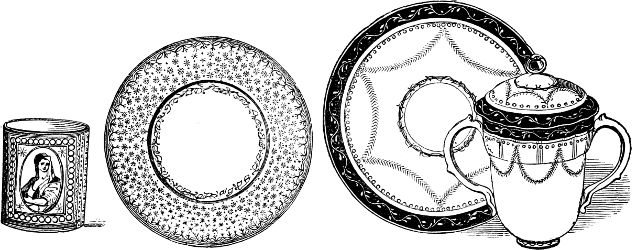
Figs. 47 to 50.—From the Museum of Practical Geology.
A few months before Mr. Duesbury’s death—which, as I have stated, took place in November, 1786—he took his son William into partnership, and the business was carried on under the style of “Messrs. William Duesbury and Son.” It thus appears upon the title-pages of the sale catalogue of 22nd September in that year, but is altered back to “Mr. William Duesbury” alone in that for 21st December following. For some years before the death of his father the younger Mr. William Duesbury had devoted himself untiringly to the advancement of the works. No man could have been more highly respected, both by his workmen and by all who knew or had dealings with him at home and abroad, than was this second William Duesbury, and under his care the works continued to grow in importance with an astonishing rapidity, and soon became by far the most prosperous and most successful in the kingdom. The connection which had previously been formed with the principal families, from royalty downwards, spread and increased, and among the hundreds of names of purchasers on the sale sheets and other papers, I come across, at random, those of the King, the Queen, the Prince of Wales (afterwards George IV.), who was a large customer for dessert, tea, coffee, and other services; the Duchess of Devonshire, William Pitt, Sir Hugh Pallisser, the Margravine of Anspach, the Duke of Northumberland, Lord Howe, and indeed almost every title then in the peerage. Besides this, several ladies of distinction painted groups of flowers and other pictures on porcelain, supplied to them for the purpose by Mr. Duesbury, who afterwards fired and finished them for their own special use. Of these ladies, Lady Margaret Fordyce, Lady Plymouth, and Lady Aubrey executed some beautiful drawings, which probably may still remain in their families. Lord Lonsdale also had twenty-four plates painted with landscapes in Cumberland, from his own sketches, and many other noblemen and gentlemen did the same; many sets of china being painted with views of different parts of the estates of those for whom they were manufactured. Bronze figures of horses—probably originally belonging to the famous Duke of Newcastle, whose work on Horsemanship is the finest ever produced—were lent to Mr. Duesbury from Welbeck Abbey; and Lady Spencer also sent some choice moulds for working from. Altogether the Derby works, during the latter part of the first Mr. Duesbury’s time, and during the life of his son, were, as I have said, the most successful, the best conducted, and the most fashionable establishment of the kind in the kingdom.
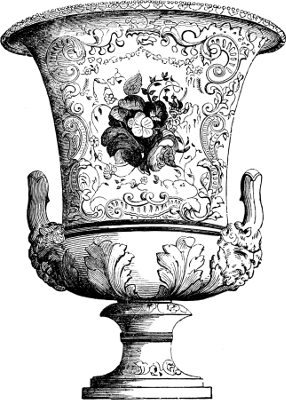
Fig. 51.—“King’s vase,” Museum of Practical Geology.
Constant application to business, and the wear and tear of the brain from incessant anxieties, about 1795 made such fearful inroads on the health of Mr. Duesbury, that he was induced by his friends to take into partnership a Mr. Michael Kean, a very clever miniature painter, an Irishman by birth, who brought his talents to bear on the works, and by his skill in designing and drawing added much to the beauty of the articles manufactured. His connection however, seems to have been a source of still greater anxiety to Mr. Duesbury, whose mind gradually gave way under his load of care. In 1796 Mr. Duesbury died, and after a time Mr. Kean (who had for a time the management of the business for the widow and her young family) married the widow, but not long after, from reasons into which it is needless to enter, as they do not affect the narrative, withdrew hastily from the concern, and the works were then continued for, and afterwards by, the third William Duesbury. Mrs. Duesbury, by her second marriage (with Michael Kean) had a family of five children. She died in 1829, after having passed a not altogether happy life. This third William Duesbury (grandson of the founder of the works) was the eldest son of William Duesbury by his wife, Elizabeth Edwards. He was born in 1787, and on the 26th September, 1808, married Annabella, daughter of William E. Sheffield, Esq., of the Polygon, Somers Town, London, and for a time the concern was carried on under the firm of “Duesbury and Sheffield.”
In 1815, Mr. Duesbury leased the premises to Mr. Robert Bloor, who had been a clerk to his father, and had carried on the business during Mr. Duesbury’s minority, and the entire concern ultimately passed into his hands, and was carried on by him for the first few years with much judgment and skill.
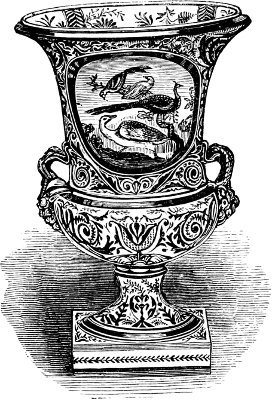
Fig. 52.
Before Mr. Bloor’s time it had been the constant plan of the Duesburys—so worthily tenacious were they of their reputation, and of keeping up the high and unblemished character of their works—to allow none but perfect goods to leave their premises, and no matter how costly the article, or how trivial the fault (frequently so trivial as to be only perceptible to the most practised eye), all goods which were not perfect were stowed away in rooms in the factory, and had accumulated to an enormous extent. When Mr. Bloor took the concern, this stock of seconds goods became an almost exhaustless mine of wealth to him. Having to pay the purchase money by instalments, he found the easiest method of doing so was to finish up these goods, take them to different large towns, and there sell them by auction, and also to have sales at the manufactory; one of these sales, in 1822, continued twenty-five days. By this means Mr. Bloor amassed large sums of money, as the “Derby china” found ready and liberal purchasers wherever it was thus offered. This system, however, though it had a temporary good, produced a lasting evil. The temptation to produce large quantities of goods specially for auction sale was so great as not to be withstood, and as by this means they were disposed of “with all their imperfections thick upon them,” less care was devoted to their manufacture, and the decline of the works, principally from this cause, commenced.
Mr. Robert Bloor was assisted in his works by his brother Joseph, by whom the “mixing” was mainly done, and from 1828, when Mr. Robert Bloor’s health began to fail, they were carried on for him by a manager named Thomason. The two brothers died within a short time of each other. Robert, who had lost his mind for many years before his decease, died in 1845, and Joseph the year following. The works then passed into the hands of Mr. Thomas Clarke, who had married a grand-daughter of Robert Bloor’s, who discontinued them, and sold most of the models, &c., to the Staffordshire manufacturers—the greater bulk going into the hands of Mr. Boyle, a manufacturer, of Fenton, who was son of Mr. John Boyle, and for a short time before his death a partner with the Wedgwoods. The final dissolution of the old works took place in 1848, when a number of the workmen naturally migrated into Staffordshire and Worcestershire.
At this time, however, several of the old hands—actuated by the laudable desire of securing the continuance of a business which for a century had been so successfully carried on, and of continuing it as one of the trades of their native town—clubbed together (to use a characteristic expression), and commenced business on their own account. They each and all threw into the common stock what knowledge, experience, money, and tools, &c, they possessed, took premises in King Street (on the site of old St. Helen’s Nunnery), and under the name of “Locker and Co.” commenced making “Derby china,” and adopted, very properly, a distinctive mark, which shows this epoch in the works. It is a somewhat curious circumstance, that on the site of the old china works the modern Roman Catholic nunnery of S. Marie was erected; while on the site of the old nunnery of St. Helen, the present china works are now carried on. Great difficulties were encountered by this band of workmen, but their zeal and determination overcame them.