Volume 2 — CHAPTER III. (continued 2)
Reading edition
Mr. Locker (who was a native of Blackfordby, and had been clerk and warehouseman at the old works in the latter part of their existence) died in 1859, and the works were next conducted under the style of “Stevenson and Co.,” and “Stevenson, Sharp, and Co.,” till the death of Mr. Stevenson, when the style was changed to that of “Hancock and Co.,” and the works are now continued by Mr. Sampson Hancock, and bid fair, if not to rival the early glory and success of the works, at least to do credit to the town of Derby, in which they are situated. Some of the productions are highly creditable to the taste and skill of the men, and show that “ye art of making English china,” imparted to William Duesbury in 1756, is not forgotten, but remains with his successors to the present day.
One of the last large services made by Bloor was a magnificent dessert made for her present Majesty, and some large additions to that set, and pieces for replacing, have been from time to time made by the present owners of the works, which are still therefore as fully entitled to the name of “Royal” works as any of their predecessors. The marks used by these later firms will be found engraved on page 93; I give them to complete the chronological series. The name of Courtney, which appears on one of these marks, was Bloor’s agent.
Having now gone through the History of the works, it only remains to speak of the artists employed, and of one branch of the manufacture, that of “Biscuit,” which requires more than a passing notice. This material was a discovery of, and quite peculiar to, the Derby Works, and the secret of its composition is still preserved. To it the beautiful material Parian thus owes its origin. One of the Derby workmen having engaged himself to Mr. Copeland, was trying experiments to recover the secret of the biscuit composition, when instead of it he produced accidentally that which has been named “Parian,” and in which all the exquisitely beautiful figures and groups that characterise their, and other equally admirable, productions have since, with modifications and improvements, been worked. It is pleasant thus to know, that although the art of making Derby biscuit figures has been discontinued, the Parian has sprung from it, and was first produced by a Derby man. Nothing could exceed the sharpness and beauty of the biscuit figures as produced in the best days of the Derby Works, and some examples, for delicacy and fineness of modelling, and for sharpness of touch, have never, in any ceramic material, been surpassed, or scarcely equalled.
Transfer printing on china appears to have been introduced at Derby in 1764—some years before even Wedgwood printed his own ware, but while he was in the habit of sending it off to Liverpool to be printed by Messrs. Sadler and Green. The process, however, did not obtain much favour at Derby, and Mr. Duesbury evidently found it better, and more satisfactory, to adhere to hand-work in all his goods. The person who introduced the process, and whom he engaged to carry it on, was Richard Holdship, of Worcester, who, by deed, covenanted for the sum of £100 paid down, and a yearly sum of £30 so long as the works continued on his process, to impart in writing to Messrs. Duesbury and Heath his secret process for making china according to proofs already made by him at the Derby Works; to supply them with all sufficient quantities of soapy rock at fair prices; and to print all the china or porcelain ware which might have occasion to be printed. The engagement with Holdship lasted, at all events, many years, but during that time the printing evidently was not much followed, as in his letters to his employers he is constantly complaining of having no work for his presses, and in having no goods made according to his process. He had an assistant named William Underwood, and in one of his letters he values his press at ten guineas in cash, and his copper-plates at a large amount, while he says “for his process for Printing Enamell and Blew, he hath been offered several Hundred Pounds.” His stock of enamel colours, 151 lbs. in weight, he offers to sell for £35. It is needless to write more in this place of Holdship’s connection with Derby, as I have already given more full particulars in the first volume, page 232. At one time John Lodge, the eminent engraver, engraved some plates for printing at Derby. The following is his bill for some engraving done in 1771:—
Mr. Deusberry Dr. to John Lodge,
£ s. d.
Engraving a Plate of Chinese Figures 0 10 6
Copper to do. 0 2 6
To Engraving Eight Borders 0 16 0
Copper to do. 0 1 11
To Engraving two Plates for Cups and Saucer 1 1 0
Copper 0 4 5
To Engraving two Plates for Cup and Saucer 1 1 0
Copper to do. 0 2 4
To Engraving two Plates for Small China 1 4 0
Copper to do. 0 5 10
£5 9 6
Sept. 28, 1771.
Recd. the Contents in full of all demands, John Lodge.
Fruit dishes, and other articles were at one time made with open-work reticulated rims or sides; a raised “Dresden” flower being placed on each of the outer sections in much the same manner as was characteristic of one period of Worcester work. These were made both in blue and white, and in enamel; they are somewhat scarce.
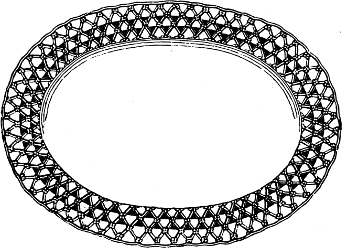
Fig. 53.
In 1789 Mr. Duesbury endeavoured to introduce batt-printing into his manufactory, and for that purpose prevailed on his former assistant, J. Hancock, then in Staffordshire, to inquire into and describe to him the process. I must not omit to say that earthen ware, called the “Cream Ware,” very closely resembling Wedgwood’s celebrated “Queen’s Ware,” was made at Derby for a short time, and was of great beauty. Specimens of this ware are of great rarity.
In 1790 Mr. Duesbury invented a machine for exhibiting the contraction of earthen bodies when in the fire; this he had constructed by Spooner and Son.

Figs. 56 to 58.
The marks used at the Derby China Works may be thus briefly summarised. The simple writing letter is said to have been the first mark used by William Duesbury. The , which stands either as the initial of Derby or of Duesbury, conjoined with the anchor of Chelsea is the distinctive mark of the Chelsea-Derby period—the period when William Duesbury, who had purchased the Chelsea works, carried on both the manufactories, and, later, produced goods at Derby from the Chelsea moulds. Two or three varieties of this mark, according to the taste or whim of the workmen, occur (see Figs. 56, 57, and 58).
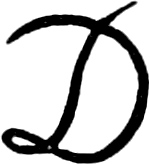


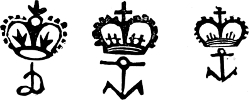
Figs. 59 to 61.
Two other marks, the one a surmounted by a crown, and the other an anchor, similarly surmounted, are said to have denoted respectively the articles made at this period at Derby and at Chelsea (Figs. 59 to 63). Now and then the first of these is met with in connection with the anchor (Fig. 63).

Figs. 62 to 67.
The most usual mark is that of the letter D, with crossed swords, dots, and crown, of which several varieties occur. Sometimes the initial is the writing letter , and sometimes a Roman capital D, and the crown also varies according to the caprice of the painter. Figs. 64 to 67 show some of the varieties.

Fig. 68.
A variety of this, in which a and a are conjoined, denotes the period when the works, in their later days, were carried on by Duesbury and Kean. It was, however, only very sparsely used. For some years, at all events up to about 1825 or 1830, Mr. Bloor continued to use the old mark of the Duesburys—the crown, cross daggers with dots, and D beneath—but about that period discontinued it, and adopted instead a mark with his own name (Fig. 68). It is well to note, that down to the discontinuance of the old mark, it had invariably been done with the pencil, by hand, but that those adopted by Mr. Bloor were printed ones. The first printed mark I believe to be Fig. 69, and somewhat later the same was used, but slightly larger in size (Fig. 71). Other marks are shown on the engravings. Figs. 74 and 75 have an old English surmounted by a crown; another (Fig. 76) a crown, with a riband bearing the word DERBY in Roman capitals beneath it.



Figs. 69 to 73.

Figs. 74 to 78.
Other marks, said to have been for one purpose or other—of course as imitations—used at Derby, are the following:—
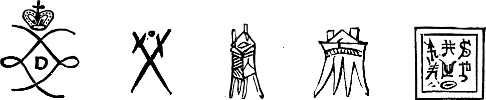
Figs. 79 to 84.
In my own possession is a design, in pencil, by Mr. Duesbury, by his own hand, for a mark, which I engrave on Fig. 84, although I believe it was never adopted. At all events I have failed in discovering a single specimen so marked. Mrs. Palliser, however, engraves a mark as occurring on a cup and saucer, which somewhat assimilates to it. She also gives, from a specimen in her own possession, the word in writing letters. This, she states, occurs “in black on a biscuit statuette;” but I fear the mark has been added at a later date. Another mark, which has been described to me, but of which I have not seen an example, is very similar to Fig. 84, but has the cross daggers and crown added, with the encircling words “DUESBURY, DERBY,” Fig. 85. It may be well, en passant, to notice a mark which appears on one of the copper-plates of the Caughley works (see Vol. I., p. 273). It is an anchor over the word “Derby.” As the initials RH conjoined also appear along with the anchor and word “Worcester,” and may mean either R. Hancock or Richard Holdship, the probability is they belong to the latter (who was connected with the Derby works), and that the anchor was adopted in allusion to his name, hold ship—a very clever and ingenious device. Another variety belonging to Mr. Robinson differs slightly from these.

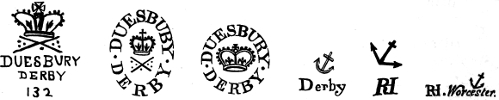
Figs. 84 to 89.
On some services, notably on the royal service, mentioned on page 88, Mr. Bloor had his name painted in full—

Messrs. Robert Bloor & Co., 34, Old Bond Street,
on the back of plates, &c. The “Co.” in this instance was Mr. Thomas Courteney, the London agent, through whom the order was procured. His place of business was 34, Old Bond Street, and many of the goods afterwards made for him bore the accompanying mark, Fig. 91. Messrs. Locker & Co., at the modern King Street works, used the mark, Fig. 92, and their successors, Stevenson, Sharp, and Co., the next one. The next firm, Stevenson and Hancock, used, in accordance with my suggestion, and a sketch I made for them, in 1862, the old Derby mark of the crown, crossed daggers, dots, and letter , with the initials of the firm S. H. (for Stevenson and Hancock); this is still continued by the present sole proprietor, Sampson Hancock—the letters S. H. being, fortunately, his own initials.

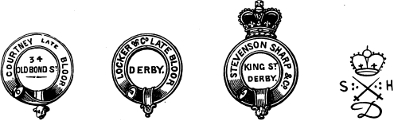
Figs. 91 to 94.
Of the artists employed at the Derby China Works, the principal modellers appear to have been Spengler, Stephan, Coffee, Complin, Hartenberg, Duvivier, Webber, and Dear, and many others, including Bacon the sculptor, were employed in London, and the models sent down to the works.
Of the painters, the principal ones were Bowman, who was originally of Chelsea, afterwards of Derby, and then again of London, and who was one of the best flower and landscape painters of his day; Billingsley, who received instruction from Bowman, and whose flower pieces have certainly never been surpassed, or even equalled; Hill, a famous painter of landscapes, who delighted in sylvan scenery; Brewer, also an excellent landscape and figure painter, and whose wife, Bernice Brewer, was also a painter; Pegg, who surpassed in faithful copying of nature, in single branches and flowers, and in autumnal borders; Samuel Keys, a clever ornamentalist, who ended his days in the employ of Mintons; Steel, who excelled all others in painting fruit; John Keys, a flower painter; Cotton and Askew, two highly-gifted painters of figures; Webster, Withers, Hancock (two, uncle and nephew), Bancroft and others as flower painters; Lowton, clever at hunting and sporting subjects; and Robertson, at landscapes.[17] But besides these, there were many other really clever artists employed. It is pleasant, too, to know, that “Wright, of Derby,” the celebrated portrait painter, the contemporary and fellow pupil with Reynolds, lent his powerful aid on some occasions,[18] in supplying drawings and giving advice, as did also De Boeuff, Bartolozzi, Sanby, Glover, and many others of eminence; and it is also interesting to add, that one of the Wedgwood family, Jonathan Wedgwood, was at one time employed at Derby. The draft of agreement between himself and William Duesbury, dated 1772, is in my own possession, and by it he binds himself for three years to work at “the arts of repairing or throwing china or porcelaine ware,” for the sum of fourteen shillings per week. A few brief notes upon some of the artists of the Derby works will doubtless be of service to collectors; I therefore dot down the following memoranda:—
J. J. Spengler, a Frenchman, had been occasionally employed in London by Mr. Duesbury to model figures for him, and in 1790, on the recommendation of Mr. Vulliamy, entered into an agreement to come to Derby. Mr. Wallis, in his not very reliable account of the Derby China Works, to which I have before referred, says Spengler “was brought to Derby from London by Mr. Kean,” but this is an error. He was in Derby years before Mr. Kean had any connection with the works. The original agreements, dated July 13 and September 15th, 1790, are in my own possession (as are also a number of original letters, accounts, and other documents connected with him), and is as follows:—
“A Copy.
“A Memorandum.
London, July 13, 1790.
“That the Bearer, Mr. J. Spengler, has agreed to come down to the Manufactory at Derby, to work as Modeller, &c, and to receive for the first month after the rate of three Guineas per week, and his expenses paid down by the Coach. His hours of work is to be from Seven o’clock in the morning till the rest of the People in the Manufactory give Over work in the Evening. It is further agreed on, that after the expiration of the first Month, if the parties like each other and they agree for a fixed time to come, The bearer, Mr. J. Spengler, is then only to receive after the rate of two pounds ten shillings per week from the first day he began to work in the manufactory.
“Witness: (Signed) “For Mr. W. Duesbury.
“B. Vulliamy. “J. Spengler. “J. Lygo.”
He accordingly came to Derby and a more full agreement was drawn up in September. On the 15th of that month he drew up and signed a memorandum to the effect that as he knew nothing either of the laws or language of England, he was to go to London to cause to be examined the agreement made between himself and “Monsieur Duesbury Maitre de la fabrique de Porcelaine a Derbey,” and should it be found right, to return at once to Derby and sign and execute it; Mr. Duesbury agreeing to pay the expenses of the journey and half the loss of time at the rate fixed in the agreement. This memorandum, which is well written, but in wretched French, is signed by “J. Spengler” and by “Mr. Duesbury” thus:—
“Sep. 15th, ’90. As far as I can understand the French Language, I conceive the above to be right.
Wm Duesbury.”
Spengler first went down to Derby in the beginning of August, 1790, soon after the date of the agreement of July 13th (having just previously modelled a “Figure of Astronomy, in London,” for which Mr. Duesbury paid him ten guineas, and for extra time expended over it at Derby, in finishing, an additional two and a half guineas), and his first pieces of work were “Figure with a Vase (Morning),” and its companion, a “Figure with a Vase (Noon),” for each of which he was paid seven guineas; and the “Three Graces,” for the time expended on which he was paid six guineas.[19] Before long, unpleasantness arose through Spengler’s inattention to work, breach of contracts, and getting into debt, and in 1792 he left Derby surreptitiously. Proceedings were taken by Mr. Duesbury; his goods (the inventory of which, dated March 18th, is before me) were sold; and he was captured at Ramsgate, and placed in the King’s Bench Prison. The result of law proceedings was that Spengler entered into a fresh agreement with Mr. Duesbury (I have the draft) by which he covenanted “Not to lose more time in any one week than half a day, sickness excepted, under the penalty of paying after the rate of 7s. per day to Mr. D., Mr. S. to continue to serve Mr. D. to the best of his skill (without working for any other person) until he shall have paid Mr. D. the ballance due to him, and all lawful expences; Mr. D. receiving two-thirds of his earnings, Spengler to have liberty to attend any number of hours (that the manufactory is open for others) over and above those work’d by himself and the rest of the other hands for overtime, and to receive in the same proportion for such time as for the regular day’s time,” and so on. He was, evidently, for the purpose of carrying out the agreement, bailed out of the King’s Bench by a friend, whose letters I possess, but by November of the same year had again left his employment.[20]
Spengler was then again in the King’s Bench, from which, on the 31st of January, after other correspondence, he wrote a very pathetic letter (in French, as all his letters are) to Mr. Duesbury, and ultimately it appears that an arrangement was come to for him to work in London. In 1794, fresh arrangements were again in progress (Spengler, who was living at Chelsea, in the meantime having continued to work for Mr. Duesbury), and much correspondence took place; the result being that in February, 1795, Spengler returned to Derby, under a fresh agreement, which, as it contains much valuable information as to figures and groups, and prices for modelling them, I give entire:—
“Heads of an Agreement to be enterd into between Wm. Duesbury of Derby in the County of Derby & J. J. Spengler, Modeller, Viz.:—
“J. J. S. to serve Wm. D. his Exs. Adms. or Asss. in his Manufactory at Derby for so long as W. D. his Exs. Adms. or Asss. shall have occasion for the assistance of J. J. S. W. D. his Exs. Adms. & Asss. reserving to themselves the power of Terminating this Agreement by giving J. J. S. 1 Month’s notice at any time. J. J. S. to have the like power of Terminating it at any time by giving 1 Ms. notice unless he shall not be able in that time to complete any Set of work he may have undertaken in which case J. J. S. to stop with W. D. his Exs. Adms. or Asss. till such work is so finishd if required by W. D. his Exs. Adms. or Asss.
“W. D. having been a great looser by J. J. S. under a former Agreement, it is now agreed that W. D. his Exs. Adms. or Asss. shall have the liberty to pay J. J. S. for his Work either by the day at four shillings pr day of 10 hours (to be the same hours which other Workmen work for a day from time to time in the Porcn. Manufactory at Derby) or by the piece as aftermentiond at their option when any piece of Work shall be finished.
“The prizes for each Male or Female Human Figure to be Modeld by J. J. S. from any sketch either on paper or in Clay &c. as highly finished as the Russian Shepherd Group—Palemon & Lavinia Group—Blind Beggar & Daughter Do. modeld for W. D. by J. J. S. some time since to be
£ s. d.
If 4 Inches high & not exceding 5 In. 6 6
„ 5 „ „ 6 „ 8 0
„ 6 „ „ 7 „ 11 6
„ 7 „ „ 8 „ 13 6
„ 8 „ „ 9 „ 16 0
„ 9 „ „ 10 „ 18 6
„ 10 „ „ 11 „ 1 1 0
„ 11 „ „ 12 „ 1 4 0
„ 12 „ „ 13 „ 1 8 0
„ 13 „ „ 14 „ 1 13 0
„ 14 „ and so on in proportion.

„ 15 „
„ 16 „
„ 17 „
„ 18 „
Intermediate Sizes in proportion.
“J. J. S. to go to Derby at his own expence & to begin work in 28 Days after his signing this Engagement. In the mean time Mr. Lygo to pay him from the Time he signs this Agreemt. 5/- pr. Week to be repaid by J. J. S. by Weekly Stoppages of Eight Shillings.
“J. J. S. in all other particulars to work at & be subject to the same rules, orders, & regulations as the rest of the Workmen of the Manufactory at Derby.
“All Sketches to be made whether in Clay or on paper, &c., under the direction of Mr. D. his Exs.] Adms. or Asss]. by the day without limitation of time. J. J. S. to do the best he can in this particular to dispatch business.
“J. J. S. & W. D. agree hereby to execute regular articles of agreements conformable to the above specified heads so soon as the same can conveniently be prepared, under the Penelty of One Hundred Pounds. Signd this 10th day of Jany 1795.
“SPENGLER
“Witness—Joseph Lygo.”
“Modeler.
In a letter dated February 3, 1795, it is said “Spangler will set off for Derby tomorrow, he intends walking as it will not be so expensive and he may as well be walking to Derby as stay here doing nothing.” How long he remained in Derby after this I have not ascertained but as Mr. Duesbury died the following year, and things went very awkwardly, it is probable he did not long remain.
Pierre Stephan, another Frenchman, was for some years a modeller and china maker at Derby, and produced many lovely groups and single figures. He removed to Jackfield, where he commenced a small pot-works, producing not only earthenware, but encaustic tiles. His son, Mr. Peter Stephan, is, at the time I write, a skilled modeller at the Coalport China Works. (See page 305, vol. I.) By articles of agreement entered into on the 17th September, 1770, “between Peter Stephane of Derby in the County of Derby, Modeler and China or Porcelaine Repairer of the one part and William Duesbury of the same place China or Porcelain Manufacturer of the other part” he binds himself for three years “to employ himself in the art of Modelling and Repairing China or Porcelaine Ware” at £2 12s. 6d. per week. The agreement is signed “Pierre Stephan” and “William Duesbury,” and is attested by “Constantine Smith,” “Friederick Decuber,” and “Thos. Morgan, Junr.”—names which will be found noticed elsewhere. In 1795 Stephan was at Shelton, and while there continued to model for and send moulds to Mr. Duesbury.
Fidele Duvivier, a Frenchman, entered into an engagement with the elder Mr. Duesbury in 1769. The agreement (duly signed by both Duesbury and Duvivier, and attested by “John Bosher” and “S. Horrocks,”) is dated 31st October, 1769, and is “between Fidelle Duvivier of the borough of Derby China or Porcelain Painter,” and “William Duesbury of the same place China or Porcelain Manufacturer,” and covenants that the former shall, for four years from that date, “diligently and faithfully according to the best and utmost of his skill and knowledge, exercise and employ himself in the Art of Painting China or Porcelain Ware,” for the weekly wages of 24s.; Mr. Duesbury agreeing, at the end of that time, to give him an additional five guineas “in case he shall merit the same.” He became the principal flower painter at the Derby Works, and his style was much followed by the later painters. Duvivier remained some years at Derby, and then left, being afterwards employed at Wedgwood’s and various other places. In 1790, being then employed at the New Hall Works (which see), he wrote the following letter to the then Mr. Duesbury, and in consequence, I believe, he returned for a time to Derby:—“Hanley green, the 1 novebr 1790, Mr. Dousbery, Sir,—take the liberty Adressing you with a few lines, as mine Engegement in the new Hal Porcelaine manufatory is Expierd, and the propriotors do not intend to do much more in the fine line of Painting, therefor think of Settling in new Castle under lime being engag’d to teech Drowing in the Boarding School at that place, one School I have at Stone, so as to have only three days to Spare in the week for Painting, wich time Could wish to be employ’d by you preferable to eany other fabricque, because you like and understand good work, as am inform’d, my painting now to watt I did for your father is quit diferent but without flatering my Self, Hope to give you Satisfaction, in Case you Schould like to inploy me, Sir,—your anser will much oblige your Humble Servant, Duvivier P.S. the conveyance would be much in fevoir for to Send the ware to and from as ther is a waggon Every week from darby to new Castle”
William J. Coffee, a modeller, who “made his mark” at Derby, was the son of William Coffee, who worked either at Hempel’s or Triquet’s pottery at Chelsea, and afterwards entered into domestic service in a gentleman’s family. Coffee was, I believe, brought up to some branch of the business with his father at these Chelsea works, and was afterwards employed at Coade’s Lambeth Pottery.[21] He first came down to Derby, I believe, about the year 1791, and agreements were entered into between him and Mr. Duesbury. I believe he at first came as a kiln-man. He does not, as a modeller, seem to have made much head-way at first, and even in 1794 the London agent wrote, “I do not much admire Mr. Coffee’s modelling from what I have yet seen. The figure No. 359 is one of the most stupid looking things I ever saw, and the figure of Apollo in group No. 379 is very vulgar about the bosom, for sure never such bubbys was seen and so much exposed—the design is pretty enough.” Soon after this a fresh agreement was entered into as to prices to be paid for figures according to size by the piece, or at day’s wages; Mr. Duesbury covenanting to have the option of paying him after the rate of 3s. 6d. per day for each day of 10 hours that he works at the manufactory, “or at the rate of 7s. for any single human figure of 6 inches high, whether standing or in any other action, which if standing would be 6 inches high; and that all figures shall be roughed out naked in correct proportions before draped;” three pence for every half inch additional in height being paid, and so on. On the 30th of January, 1795, a fresh agreement was entered into:—“Memorandum—Whereas Heads of an Agreement between Wm. Coffee and Wm. Duesbury were Executed by W. C. and W. D. wherein 6 Months notice was agreed upon between them when either wished to close the Agreement—It is hereby agreed between W. D. and W. C. that the said Agreement shall be cancell’d, and this Agreement stand in its place viz—W. C. shall Modell for W. D. untill the 6th of July next at the prizes which shall be paid by W. D. to the Modeller he has now engaged to come down who is to have 4s. pr. day for such work as he shall do by the day and various prizes by the piece in proportion to their value when he works by the piece in lieu of by the day—NB—This Agreement is not to be construed to imploy that W. D. has agreed to raise W. C.’s wages by the day above 3s. 6d. when he shall chuse to imploy W. C. by the day in preferance to his working by the piece—Signed this 30th of Jany. 1795. NB—W. C. remarks, that he would wish to know before he begins any piece of work whether the said work is to be Executed by him by the day or by the piece, W. D. certifies by this proviso that such was always his intention—W. Coffee, W. Duesbury, Witness, Charles King.”
In the same year Coffee left Derby, and engaged himself with Sir Nigel Gresley, Bart., and Mr. Adderley, at their china works at Burton-on-Trent,[22] and immediately wrote as follows to Mr. Duesbury:—“Burton on Trent J 4 1795, Sir,—My being your Debtor makes it my Duty to inform you immediately of my arrival here and likewise of my engagement with Sir Nigel Gresley and Mr Adderley lest you should suppose that I had forgot the Obligation I lie under to you—but am extremely sorry to understand that you meant to injure me respecting my Business as that would totally deprive my honest intention of paying you, the mode of which I shall be happy to submit to your own satisfaction when I wait on you, I intend as soon as possible.—I am sir your h servant, W. Coffee.” To this Mr. Duesbury returned a manly letter, denying the imputation, asking for the name of Coffee’s informant, and assuring him that he has only to make the mode of repayment quite convenient to himself. In the same year the father of Coffee thus wrote:—“London Sepr 9th 1795, Sir,—My Son since He left you has been at Work near your Manufactory for Sir Nigel Gresley which He says He inform’d you of at the time—having finished all there was to do there He is now return’d to London and out of Employ. As I was very sorry for his leaving you and severely reflected on Him for it—He now assures me that He shou’d be extremely happy to serve you again—for a constancy if you thought proper under an Article for a Term of Years—at the lower rate of 18 or 17 Shillings pr week—He gave Sir Nigel the greatest satisaction both in His behaviour and in His Business—as a proof of which Sir Nigel has offer’d to give Him the best of Characters at any time it shou’d be requir’d of Him—therefore Sir you cou’d be satisfied in that respect at any time you pleas’d—hoping whatever may have happen’d at any time disagreeable your goodness will forget—Your condescention in favouring me with an Answer directly will much oblige Sir Your most humble Servant William Coffee P.S. He is wiling to repair or do what work you think proper. I will attend Mr Ligo hopeing your kind Answer.” The result was that Coffee returned to Derby; worked at the china factory as of old; and afterwards commenced business on his own account in Derby. Here he produced terra-cotta figures of considerable merit and in tolerable variety. Of these, a wolf, a lion, a dog, and others are strikingly good. He stamped his productions with his name, “W. COFFEE, DERBY,” and occasionally the number, or the date. He also gave lessons in modelling, and turned his attention to oil-painting and sculpture. His statue of Æsculapius, on the roof of the Infirmary at Derby, was his principal work. It was executed in or about 1810.
Richard Askew was employed at the Chelsea works when taken to by Duesbury, and came from there to Derby in 1772. His name occurs regularly in the “weekly bills” at Chelsea where he received 4s. 2d. a-day wages. The following is an account for extra work done by him:—
£ s. d.
2 Perfume pots in figuars 1 16 0
2 Row wagons in figuars 1 10 0
£3 6 0
Recid. £2 2s.
April the 30, 1771.
Richard Askew.
Robert Askew, his son, was employed at Derby in 1772, and in that year, along with John Laurence, absconded from his employment, and was advertised three different times in the Birmingham newspapers. In 1794 Askew, “enamel painter of Birmingham,” was living in Birmingham (at 8, Friday Street), and on the 2nd of August an agreement was drawn up, by which he bound himself “to work by the piece in lieu of the day, and at prizes mentioned in the ajoining list;” the subjects to be executed in the best manner in his power, and not agreeable to the coffee cans already executed, viz., Duke of York, King and Queen of France, and Spinning Wheel, &c., but in quality and effect equal to the Cupids on two flower pots by James Banford having R. Askew’s name written upon them (to prevent a mistake in alluding to them) in ink, subscribed this day in presence of Mr. C. King. The list of prices by the piece, attached to the draft of the agreement, is of great interest, but too long to insert. The coffee cans here named were some then recently painted by Askew, and as the bill for them contains many curious items and much valuable information on the Art-productions of that day, I give it entire. This bill, and many others which are still extant, show that Askew was the principal figure-painter employed at the Derby China Works. It is headed, “Mr. Wilm. Duesbury, Deptur to Richd. Askew, July 1794.”
£ s. d.
“a coffe can, with the king of france, one days work 0 5 3
a coffe can, with the Queen of france, one day 0 5 3
a coffe can, with a woman spining, one Day 0 5 3
a coffe can, with the head of the Duke of york, one day 0 5 3
2 coffe cans, with cupeds, tow Days & a half 0 13 1
a cadle cup, with a woman & child, tow days 0 10 6
a cadle cup, with a begar-Girl & child, tow days 0 10 6
a coffe can, a woman holding flowers siting, a day & half 0 7 10
a flower Pot, with a woman & child, tow days 0 10 6
a cadle cup, with a woman & a Lion, tow days 0 10 6
2 coffe cans, figuors of fath & hope, to days & a half 0 13 1
a cadle cup, with the fourting-teller, three and a half days 0 18 4
a coffe can, with the head of the Prince of Wails, tow days 0 10 6
a coffe can, with a Girl & bird, one Day & a half 0 7 10
2 coffee cans, with cupids, tow Days and a half 0 13 1
a cadle cup, with a woman siting at Woark, tow days 0 10 6
a cadle cup, with Doatage and beauty, three days 0 15 9
a cadle cup, with Age and youth, three Days 0 15 9
2 coffe cans, with cupieds, tow Days and a half 0 13 1
a coffe can, with a man & woman offiring to Cuped, 3 days & a half 0 18 4
a coffe can, with cupied chiding Venus, 3 days & a half 0 18 4
2 cadle cups, first & scount lasson of love, Eaght Days 2 2 0
a Plate, with a head, half a Day 0 2 7
a cup & scarcer, with landsceps, one Day 0 5 3
a coffe can, with a Girl & a Rabbet, tow Days 0 10 6
a coffe can, with bebe & Eagle, tow Days 0 10 6
2 coffe cans, with the Prince of Wails & Dutches of york, 4 days 1 1 0
a coffe can, with maid of Corinth, four Days 1 1 0
a coffe can, with love sleeps, four Days 1 1 0
a coffe can, with sapho & cuped, 3 Days & a half 0 18 4
a coffe can, with a offering to cuped, 3 Days & a half 0 18 4
for Drawings, tow Days & a half 0 13 1
a cup & sacer, in brown, half a day 0 2 7
a coffe can, in brown, half a Day 0 2 7
a Plate, with Plamon & lavinea, 3 Days 0 15 9
2 coffe cans, with single figuars, tow Days 0 10 6
a Plate, with a cupied & Emblems, tow Days & half 0 13 1
12 Tea cups, in brown figuars, three Days & a half 0 18 4
a Plate, with a cupied only, a Day & a half 0 7 10
8 coffe cans, single figuars, Eight Days 2 2 0
2 coffe cans, with figuars, Day & a half Each 1 11 6
4 coffe cans, with the four Elements, 4 Days Each 4 4 0
to three weekes Drawing of cupieds 4 14 6
4 coffe cans, with figuars, a Day & half Each 1 3 7
4 coffe cans, with figuars, a Day & half Each 1 10 6
a coffe can, with the Duke o york, tow Days 0 10 6
a Pair, with figuars, 5 Days 1 6 3
2 chamber Pots, with cupieds in the inside, 4 days 1 1 0
a coffe can, with the Prince of Wails 0 10 6
to Drawing of cupieds, 5 Days 1 6 3
a stand, with cupieds, in Rose couler, Day & half 0 7 10
a cram Pot, in Do, half a Day 0 2 7
a cram Pot, with figuar in brown, half a Day 0 2 7
4 coffe cans, with dancing figuars, 5 Days 1 6 3
4 coffe cans, with the Elements, 4 Days 4 4 0
a cadle cup, with a woman & children a brakefarst, 3 Days & half 0 18 4
a cadle cup in Do, at supper, 3 Days & a half 0 18 4
a stand, a tay Pot, 2 coffe cans, a sugar Bason and cram Pot, work warry heily & neatly finishd by Pertickler Desier, 5 weekes 7 17 6
5 cups, in landskips, 2 Days 0 10 6
£61 0 4
the subjects on the stad, 3 womans & cupied tyde to a tree.
on the coffe cans, to woman offereng to Pan & to woman awaking of cupied.
on the Tea Pot, maid of Corinth & love sleeps.
on the sugar-Bason, Euphorsnay & cuped.
on the crame Pot, a flying cupied.
Dilevered October the 3, 1795.
£ s. d.
1. 2 coffe cans, with the King & Queen of france 0 10 0
2. 1 Do, with the duke of yorke 0 5 0
3. 1 Do, with the spining weele 0 3 0
4. 2 Do, with Cupets 0 10 0
5. 1 cadle cup, with a woman & child 0 7 0
6. 1 Do, with Begar Girl & child 0 7 0
7. 1 coffe cup, with a woman siting 0 5 0
8. a flower Pot, with a woman & cupet 0 9 0
9. a Cadle cup, with Hosea & a Leon 0 7 0
10. 2 coffe cans, with hope & fath 0 10 0
11. a cadle cupe, with the fortin teller 0 14 0
12. a coffe can, with a head of the Prince of Wales 0 7 6
13. a coffe can, with a Girl & bird 0 5 0
14. a cadle cup, with a woman siting at work 0 7 0
15. a cadle cup, with doatage & beauty 0 12 0
16. Do, with age and youth 0 12 0
17. 2 coffe cans, with cupets 0 10 0
18. 2 cadle cups, first & secont leson of love 1 8 0
19. 2 coffe cans, with venus and cupet & sacrafise to love 1 10 0
20. a Plate, with hand 0 2 0
21. a cup & saucer, with Landsceps 0 6 0
22. 2 coffe cans, hebe & the child & rabbet 0 18 0
23. 2 coffe cans, with heads of the Prince of Wales & Dss of York 0 15 0
24. a coffe can, with the maid of corneth 0 15 0
25. a coffe can, with love slepes 0 15 0
26. a coffe can, with sappho to Phaon 0 15 0
27. a coffe can, with offering to cupet 0 15 0
28. for Drawings 0 12 0
Deliverd. November the 26, 94. £15 11 6
Richard Askew.
William Billingsley, whose name is more intimately mixed up with the history of porcelain than most of his contemporaries, was a china painter of unusual excellence, and a practical maker as well. Like many another man of genius, he was, however, unstable and erratic in his movements; but to this very quality we are indebted for the establishment of more than one eminent manufactory. To him and his practical skill is due the establishment of china-works at Pinxton, at Mansfield, at Nantgarw, and at Swansea, and to some extent the improvement of the ware at Coalport and at Worcester, as well as much of the high class of decoration at the old Derby Works; and he has thus “left his mark” on the history of Ceramic Art. Billingsley was a man of great genius, of extraordinary talent, of extreme ability as an artist, and of skill as a practical potter; but wanting stability, he became but a living illustration of the adage which says “a rolling stone gathers no moss.” He settled only for a very short time anywhere before he again moved; but wherever he did remain, if only for a short time, he left the impress of his name and the most indisputable evidence of his skill behind him. William Billingsley was the eldest son of William and Mary Billingsley, of the parish of St. Alkmund, Derby. He was baptized in that church on the 12th of October, 1758. The following is the entry of his birth:—“1758, Oct. 12, Baptized, William, the son of—Billingsley and—his wife.” Other entries in the register show that the names of his parents were “William” and “Mary.” His father died in March, 1770, when he was only twelve years of age.[23] Four years afterwards, on the 26th of September, 1774, when sixteen years of age, he was bound apprentice to William Duesbury. In the indenture he is described as “William Billingsley, son of Mary Billingsley, of Derby, in the county of Derby,” and he is bound apprentice for five years to “William Duesbury, of Derby aforesaid, China or Porcelain Maker,” to “learn the Art of Painting upon China or Porcelain Ware.” He was to receive as wages five shillings per week for the whole time of his servitude; not an advancing scale year by year as was usual. The indenture is signed by “William Billingsley,” “Mary Billingsley,” and “Wm. Duesbury,” in the presence of “Wm. Clarke.” To Mr. Duesbury he served the full time of his apprenticeship, during which time he received considerable instruction as a painter, from Zachariah Boreman,[24] one of the best artists of the old Chelsea Works, who had removed with those works to Derby. On the 4th of November, 1780, William Billingsley, then just over twenty-two years of age, married, at St. Alkmund’s Church, Derby, Sarah Rigley, of that parish, by whom he had several children, three of whom were baptised at St. Alkmund’s Church. On the expiration of his apprenticeship, William Billingsley continued in the service of Mr. Duesbury, and by his extreme skill as a flower-painter became the best artist in that line of decoration. In 1785, Mr. Duesbury died; and the business was carried on by his son, with whom Billingsley and other artists remained for some years. Soon after this time some correspondence having taken place between Mr. Duesbury and Mr. Coke concerning the properties of a bed of clay at Pinxton, in Derbyshire, which it was considered would be useful for the manufacture of china, trials were made, which ultimately resulted in Billingsley making an arrangement with Mr. Coke for the establishment of a manufactory at that place (see Pinxton).
Billingsley’s name frequently occurs in papers and memoranda relating to the Derby China Works in my possession, and certain patterns and designs in the old pattern-books of the works are distinguished as “Billingsley’s flowers.” As it is highly interesting to know what artists and other principal “hands” were employed at the same time as, and worked along with, William Billingsley, I give the following copy of a document relating to the keeping of the men employed on one part of the works from entering any other part:—“Derby China Manufactory, 23rd Nov., 1787. If any person in Future, either within the working Hours or at any other time, is seen or discover’d in the Rooms, Kilns, Apartments, or other Premises of the other (not having any proper Business relative to his particular Occupation there) he will positively be fined the sum of five Shillings. The Fines (if any are incur’d) to be put into the Box of Donations at pay time, on the Saturday after the detection.
“J. Duesbury.
Boreman.
Smith.
Billingsley.
Stables.
Jno. Yates.
Wm. do.
Longdon.
Tayler.
Blood.
Cooper.
Butler.
Soar.
Dickinson.
Kay.
Fogg.
Webster.
Clarke.
Barton.
Mason.
M. do.
Atkins.
Wedgwood.
Ash.
Morledge.
Watthews.
Lawrence.
Whitaker.
Porter.
T. Moore.
Shipley.
B. Orme.
——-[26]
Wells.
Keen.
Parish.
Spooner.
Son.
Wardle.
Rogers.
Musgrove.
Morrell.
Robins.
Horsley.
Green.
Lovegrove.
Whitiall.
G. Holmes.
Hill.
Farnsworth.
Whitaker.
Laurance.
Atkins.
Morledge.
Wedgwood.
Ash.
Wathews.
Ball.
Thos. Soare.[27]
Jos. Stables.
Wm. Cooper.
Jno. Yates.
Wm. Billingsley.
Jno. Blood.
Wm. Yates.
Wm. Longdon.
Wm. Taylor.
Jno. Buttler.
Wm. Smith.
Z. Boreman.”
Again, in 1788:—
“In November last notice was given that persons of one branch of the manufactory were not to go into the premises of the other, unless they had real business there relative to theire particular occupation, notwithstanding which the practice is still by some Individuals continued. Notice is therefore hereby finally given, that if any person in future (having received this Notice) shall intrude themselves contrary to this injunction they will positively be fined 5 shillings.
“Sept. 24th, 88.
“Boreman.
Billingsley.
Jno. Yates.
Wm. do.
Taylor.
Smith.
Borton.
T. Rogers.
T. Simes.
Webster.
Soare.
Stables.
Cooper.
Josph. Doe.
Longdon.
Blood.
Buttler.
Key.
Fogg.
Clarke.
Dickinson.
M. Mason.
Shirley, Arthr.”
The following is also an interesting document, signed by Billingsley along with other artists:—“From the many injuries done to the trade by employing Women in Painting of China, &c., Particularly not being employ’d in London in any Painting or Gilding Shop whatsoever, we hope you will not withstand Granting us the favour of their not being employ’d here.
“Edwd. Withers.
Samuel Keys.
Jno. Brown.
Wm. Cooper.
Wm. Longdon.
Wm. Yates.
Thos. Rogers.
Benj. Brocklesby.
Jos. Stables.
Billingsley.
Soare.
Jno. Yates.
Wm. Taylor.”
In this matter of opposition to the employment of women Billingsley seems, later on, to have relented, as will be seen by the following very nice letter from Bernice Banford, one of the female painters employed, and wife of one of the men:—“Sir, I hope you will excuse me for takeing the liberty to trouble you again, as my motive for writeing is to Return you thanks for the Favour you was pleased to confer in allowing me some work. I have only painted 4 Dozen and 3 plates, at 3d. each, which I believe is Charged Right, but know not whether I am so happy to merit your approbation in the Performance. Mr. John Duesbury would have sent me more work, but Mr. Banford Declin’d it till your return, as all the men (Mr. Bilinsley and Mr. Complin Excepted) treated him in a very unbecoming manner, and even threaten’d him if the work was continu’d to me, which would at this time be of the greatest service to my Family, and should be very happy to contribute to its support. Pardon me, Sir, if I presume to say I am certain one word from you would ease their Doubts and effectually silence them. I am, Sir, with the greatest Respect, your Obliged, Humble Servt., Bernice Banford.—March ye 3.”
Billingsley appears to have been paid from about £1 10s. to £2 per week at the Derby China Works, and several of his accounts and receipts are in my possession. In one of these (September 23rd, 1793), the balance due to him being £34 7s. 2d., he asks for “a draft on London for £30 at twenty-one days’ date,” on account, as usual, and acknowledges to having “lost some little time, which in some degree differs from our agreement, but it has been a matter of necessity, not choice;” and states that as he shall “in the course of a fortnight quit the public business,”—he at this time, as I gather, being landlord of a public-house (the “Nottingham Arms” in Bridgegate, Derby)—he shall be able to make up the time so lost. Again, receipts in 1793–4–5, show that he was still at that time in Mr. Duesbury’s employ in Derby. It may be well, before proceeding further, to say that, from a curious draft of an order to the painters employed at the Derby China Works, in my own possession, William Billingsley’s number which he was supposed from that time (not long before he left) to mark on such pieces as he painted was 7. The document is so curious, and will be so interesting to collectors, that I give it entire. It is as follows, and is in the second William Duesbury’s own handwriting:—
“Every Painter to mark underneath each Article he may finish, the number corresponding to his name, and any other mark which may be required, in such manner as he may be directed (viz.):—
Thos. Soar 1
Jos. Stables 2
Wm. Cooper 3
Wm. Yates 4
Jno. Yates 5
6
William Billingsley 7
Wm. Longdon 8
Wm. Smith 9
Jno. Blood 10
Wm. Taylor (except on blue and white) 11
Jno. Duesbury 12
Jos. Dodd 13
The Painter in fine blue, and in laying grounds to use for his mark the like colours.
Ditto, in other colours Orange-red.
Ditto, in Gold Purple.
“On omission of the above Injunctions, for the first Offence (after this public notice), the person so offending shall forfeit to the Box which contains donations for the Manufactory at large, one-fourth of the value of the Article or Articles found to be deficient in marking; for the second, one-half of the value; and for the third, the whole of the value, and discharged the Manufactory. And if any Painter is found working at any hour contrary to those already appointed for Business, without Permission or Orders, such person shall, for the first offence forfeit to the Box 6d.; for the second, 1s.; for the third, 2s., and so on, doubling each time.”
In 1795 Billingsley determined upon bringing his connection with the Derby China Works to an end, and for that purpose gave notice to his employer, Mr. Duesbury. Knowing how ill he could be spared from the decorative part of the manufactory, his employer endeavoured to retain his services, and, not unnaturally, put various obstacles in the way of his leaving Billingsley; however seems to have determined on the removal, and much to his credit that that removal should be an honourable one. The following letter shows his determination:—
“Sir,—From the circumstance that occurr’d when I was last in Conversation with you, I am induc’d to take this mode of informing you of my opinion on the subject then in question. My opinion is, that I have fulfill’d the warning[28] I gave (my reasons in support of which it is not necessary to advance at this time). But as I am inform’d that you believe I have some further time to work for you before the Warning is fulfill’d—namely, to make up the time I lost in the six months I was under warning, and as it is my wish to leave no ground for dissatisfaction, I take this opportunity of informing you that I am willing to come and Work that time according to that opinion of the case. If the foregoing is according to your opinion and desire, your being so kind as to send me advise to that effect at any time in the course of a week, and likewise the time I have to work according to the rule and opinion above stated, I will attend your works accordingly. If I do not hear from you in the course of the time above stated, I must then conclude that you are satisfy’d, and the information that I have receiv’d is without foundation. I am, Sir, your Humble Serv., Wm. Billingsley.—Derby, Oct. 14, 1796.”
Shortly before this time Mr. Joseph Lygo, the London agent and manager of the business of the Derby China Works, wrote to his employer, Mr. Duesbury:—“I hope you will be able to make a bargain with Mr. Billingsley for him to continue with you, for it will be a great loss to lose such a hand, and not only that, but his going into another factory will put them in the way of doing flowers in the same way, which they are at present entirely ignorant of.” Despite all this, Billingsley left the Derby China Works, where he had been apprenticed, and in which he had worked for twenty-two years, and in 1796 commenced, for or with Mr. Coke, a small manufactory at Pinxton, near Alfreton. Here his practical skill stood him in good service, and the experiments he had long tried in china bodies were brought to bear satisfactory results. He succeeded in producing a granular body (the fracture having much the appearance of fine loaf-sugar), very soft, but of extreme beauty. Here Billingsley remained for about four years only, removing in 1800 to Mansfield, where he started a small concern, which he continued for about three or four years longer. Having once become unsettled by his removal from Derby, Billingsley does not appear ever afterwards to have rested long in any one place. In 1804 he is stated to have commenced, or joined, some small china works at Torksey in Lincolnshire; and a few years later he appears to have started a china manufactory at Wirksworth in Derbyshire—no doubt being in part actuated in locating himself there through the fact of the existence of a beautiful white clay being found in connection with the lead mines at Brassington and other places in its neighbourhood. In 1811 Billingsley removed to Worcester, where he engaged himself with Messrs. Flight and Barr, of the Worcester China Works. Here, as in some of his other migrations, he was accompanied by his son-in-law, George Walker, the husband of his daughter Sarah. Of the engagement of these two at Worcester, Mr. Binns says: “In 1811, Billingsley, the Derby artist, came to Worcester. As a clever flower-painter, he was no doubt an acquisition, but that does not appear to have been the object of his visit. Billingsley knew something of making porcelain, and was possessed of a receipt which there is no doubt he valued very highly. From Messrs. Flight and Barr’s letter to Mr. Dillwyn, it would appear that he had endeavoured to introduce this special body at Worcester, but we do not think he was allowed to interfere to any extent in the manufacturing department. Walker, Billingsley’s companion and son-in-law, introduced a more important invention to the Worcester Works in the reverberating enamel kiln. These kilns had been in use in London and at Derby, but were now for the first time built at Worcester. Up to this time iron muffles were used, but from their arrangement requiring a preparatory kiln or muffle, after the same manner as the annealing oven of a glass-house, they were most objectionable, the ware having to be removed from one to the other whilst very hot. Previous to this iron muffle, a more original muffle still was used. The description given to us quite accords with the engraving in Biancourt, with the exception of the arrangement of the fire. In the old Worcester kilns the space between the bricks and the iron case was filled with small pieces of charcoal, and when the iron cover was finally placed, it was also covered with charcoal; the fire was then applied to the centre of the cover, and gradually extended all over and down the sides until it got to the bottom; the object of this arrangement was to get an equal heat all over, which would not have been the case had the bottom been heated first. The method of building these new enamel kilns was kept as a great secret, Walker always working by night. He built them both for Messrs. Flight and Barr and Messrs. Chamberlain.” After remaining two years only at Worcester, in 1813 Billingsley and Walker (the former under a name he had for cogent reasons assumed—that of Beeley, this name being a contraction of his own B[illings]ley, or B’ley, otherwise Beeley) left that place and went to Nantgarw, a small, out-of-the-way village in Glamorganshire, near Pontypridd, where they established themselves and commenced making china. From here they sent up a specimen of their ware to Government,[29] to show their special body, and to seek Government aid; and the Board of Trade, through Sir Joseph Banks, requested Mr. Dillwyn, of the Swansea pot-works, to visit Nantgarw and report on the quality of the ware. This visit of Mr. Dillwyn’s resulted in his entering into an arrangement with Billingsley and Walker to transfer themselves and their works to Swansea, where he built a small manufactory for them, closely adjoining his other works. Not long after this Mr. Dillwyn received a notice from Messrs. Flight and Barr, of Worcester, informing him that Billingsley and Walker “had clandestinely left their service,” and warning him not to employ them. This occurred, I believe, in about two years from the time of founding the Swansea China Works, and on Mr. Dillwyn being assured by Messrs. Flight and Barr that china with the granulated body could not be made to be commercially successful, he gave up the manufacture, and dismissed Billingsley and Walker, who then at once returned to Nantgarw, where they resumed their manufacture of china, and produced many beautiful services and pieces, which now fetch remarkably high prices. The productions of this small manufactory having found their way into some of the best London dealers’ hands, Mr. Rose, of the Coalport China Works, feeling that the Nantgarw trade, if allowed to continue, would seriously affect his business, went over to Nantgarw, and after some negotiation, made a permanent engagement with Billingsley and Walker, and bought up from them at once their stock, their moulds, and their receipt for the body, and removed them and all their belongings (as he did also those of Swansea) to Coalport. Thus the manufacture of Nantgarw porcelain, just as it was approaching perfection and becoming known, was, unfortunately, at once and for ever closed.
William Billingsley remained at Coalport[30]—living in a small cottage a short distance on the Shiffnal Road—for the rest of his days, which, however, were but few in number. In 1827 or 1828 (I am uncertain which), this remarkable man—one of the most remarkable in the whole line of English potters, and one to whose artistic genius the exquisite decorations of some of the Derby and of the Worcester productions are indebted, and to whose practical skill and life-long energies so many important factories owed their origin—passed away in complete obscurity and in much greater poverty than his talents deserved.
George Walker, after the death of William Billingsley, removed with his family to America, where he founded and built a manufactory in New Troy, which he called “Temperance Hill Pottery,” at which he and his family were, I am enabled to add from reliable information, working to great advantage a few years ago, and where, I believe, they still continue.
Jonathan Wedgwood, “of the Borough of Derby, China or Porcelain Repairer or Thrower,” was employed for some time at the Derby Works. On the 2nd of December, 1772, articles of agreement[31] were drawn up between him and William Duesbury, by which he was to serve Mr. Duesbury for three years “in the Arts of Repairing or Throwing China or Porcelain Ware,” at the weekly wages of fourteen shillings “for every whole week” he “shall work according to the usual hours of Repairing at the said Wm Duesbury’s Manufactory in Derby aforesaid.” In the contested election of 1776, a John Wedgwood, son of William Wedgwood, of St. Peter’s Parish, Derby, claimed, through apprenticeship, to be admitted and vote as a freeman, and before the Committee of the House of Commons, was accordingly admitted. By the registers of St. Alkmund’s, Derby, it appears that a Jonathan Wedgwood was married on the 12th November, 1785—thirteen years after the date of this agreement—to Mary Stenson; and that three years before this time, 22nd Sept. 1782, an Amy Wedgwood was married to Abijah Tyrrell, both of that parish. The probability is that the Jonathan Wedgwood whose agreement I have quoted was born at Ellenborough in 1735; that he migrated to Burslem (where one of his children was born in 1757), and afterwards to Derby; and the Jonathan and Amy, whose marriages are noted, were his son and daughter. His name appears as one of the workmen in 1787.
Other artists, &c., were as follows:—
John Ash, a thrower and presser in 1794.
Joseph Bancroft, who belonged to the old Derbyshire family of Bancroft, of Swarkestone and elsewhere, was apprenticed at the Derby Works, and became a proficient in painting flowers, birds, insects, and shells. He did not remain long after the expiration of his apprenticeship, but worked for Copelands and others, and lastly for Minton’s, in whose employ he died.
James Banford, of London, a clever painter, was employed from 1790 till 1795. He removed from London to Derby in the middle of 1790, his wife, Bernice Banford, and family following him in August of that year. He appears, from penitent letters, to have been, like many of the other hands, addicted to drinking, and to have been of improvident habits. In one of his letters (Feb. 1, 1794) he says, “I cannot help informing you that I have been dissatisfied some time at the difference of wages between Mr. Boreman and self. I am not conceited of my work, but every man knows what he is capable of doing, and in any line of painting china except landscapes, I have the advantage of Mr. B. Cannot help observing that in the landscape line, when there is anything minute or requires neatness, my optic nerves are to be strained for 18s. pr week less, and tim’d to ten hours each day at the manufactory.”
Bernice Banford, wife of James Banford, china painter, was also employed as a painter, but at her own house or lodgings. She had a somewhat unsteady husband and a family to look after, and seems to have been a great help to them. Here is her first letter, asking for work, showing that she had been employed at Wedgwood’s works in London; and another letter by her, when objection was taken to her being so employed, is given on page 103. “Sir, I beg pardon for addressing you on a Subject which nesessety oblidge’s me to which is to Solicit the favour of a little work in the painting way at home, I was brought up to the business at Mr. Wedgwoods manufactory in London, and flatter my Self I should be able to do the Slightest paterns on China. I would Sir very willinly Contribute any thing towards the Suport of my family, and to assist my Husband to pay Some Debts which we owe in Derby, which if I Should be so happy to obtain Such a favour I Doubt not but we Should be soon able to Effect and do better for our Family than at present. if Sir you would please to take it into Consideration by Permiting me a little work, you would for Ever oblidge, Sir your Hume Sert, Bernice Banford.”
W. Barker, formerly of London, was employed between six and seven years at the Derby Works, and left them in March, 1795.
Richard Barton, the manager at Chelsea (it is he who makes out all the “weekly bills” and receives and pays) was a modeller. In 1773 “Barton, modling 2 small antiquit vauses, £1 1s.”
John Blood was an apprentice at the Derby works, and became a clever painter.
Robert Blore, a late apprentice at the Derby works, afterwards for a time produced on his own account small figures, vases, &c., at a small place in Bridge Gate; he removed into Staffordshire.
Zachariah Boreman, one of the old Chelsea painters, employed by Spremont, and afterwards by Duesbury, and came down to Derby on the closing of those works, was for some time employed. In 1784 he left Derby and returned to London; but about 1794 fresh articles of agreement were entered into, and a supplemental agreement drawn up same day covenanted that “wherever three shillings and sixpence per day occurs in the aforesaid agreement, the words ‘seven shillings’ shall be inserted in Z Boreman’s agreement, when regularly executed on stamps.” He was to employ himself in painting, and in improving the enamel colours, &c. He is said to have died in London in 1810.
R. B. Bowman, of Goswell Street, London, was engaged by articles of agreement, dated May 6th, 1793, to come down to Derby, and agreed to be there in three weeks from the 12th of that month. A week afterwards, however, he begged to have the agreement cancelled, as he had had “a beneficial offer in London, in the engraving branch,” at 30s. a week.
George Bradbury, son of William Bradbury, of Little Chester, Labourer, was bound apprentice on the 10th of March, 1765, for seven years, to “William Duesbury of Derby aforesaid (altered by the pen to “in the said county”) China or Porcelain Maker,” “to learn the Art of Repairing China or Porcelain Ware.” (The indenture is printed on a skin of parchment; the name “William Duesbury, of Derby, China or Porcelain ,” being printed with the rest, and a blank left for writing in “maker,” “painter,” or the like.)
Thomas Brentnall, a flower-painter.
John Brewer, an artist of repute in London, who had previously, as early as 1782, been employed by Mr. Duesbury, was engaged by him in 1795, and removed with his family to Derby. He was engaged to paint figures, animals, landscapes, and flowers by the piece, a schedule of prices being drawn up for that purpose; and to be assured that he should not have less than a guinea and a half a week for the first year, and two guineas afterwards. Until his engagement with Mr. Duesbury he had not painted on china, and therefore had to make himself acquainted with the art after his arrival. Brewer later on gave lessons in drawing in Derby, and in 1811 held an exhibition of his drawings:—
“Mr. Brewer most respectfully informs the Nobility, Gentry, Clergy, and others in Derby and its vicinity, that he has arranged for their inspection his Specimens of Water-colour Paintings as an Exhibition, consisting of more than two hundred different Subjects, many of them quite new, and the whole designed and painted by himself, which he hopes during the interval of time not given to the festival will afford an agreeable change of amusement. May be viewed from 8 in the morning until dark at his house near St. Mary’s Bridge, Bridge Gate, Derby. Admittance—Ladies and Gentlemen 1s., Children half price. Mr. Brewer’s pupils free, also purchasers of Drawings.”
Finished from April 29th.
2 Coffee cans and stands, Shipping N 1
6 Plates of plants 2
4 Comports of Landscapes 3
6 Comports of plants 4
2 Comports of plants 5
2 Coffee Cans Moonlight and fire 6
2 Coffee Cans and stands Birds 7
2 Tea pots Landscapes from Gilpin 8
1 Dejuneé of Birds 9
20 Plates of Rose border 10
1 Cream jug of Birds 11
1 Sugar bason Do. 12
2 Cabinet cups 1st and 2d Lesson of Love 13
12 Coffee cups of Landscapes 14
12 Plates of Landscapes 15
3 Comports Do. 16
1 Tea pot of Birds 17
83 Pieces to Septbr. 8th.
In hand.
2 Comports of plants.
4 Plates of do.
4 Coffee Cans of flowers.
1 Dejuneé of Ships.
1 Comport of Landscape, finished.
1 Cream jug Birds
1 Tea pot Do.
12 Saucers Landscapes.
2 Cans shipping.
1 Cream jug Do.
1 Sugar Bason Do.
30 Sept. 8th.
Jno. Brewer.
Robert Brewer is stated to have been a brother to John Brewer. He was a pupil of Paul Sanby. On leaving the Derby works he commenced practising as a drawing master, and died in 1857.
Benjamin Brocklesby, son of John Brocklesby, of Derby, labourer, was apprenticed, for seven years, on the 16th of September, 1783, to learn “the Art or Business of Painting Porcelain or China Ware.” On the 24th of August, 1787 (Mr. Duesbury, to whom he had been apprenticed, having died on the 30th October, 1786) he absconded, and on the 13th January, 1789, a warrant was issued for his apprehension, and endorsed to be executed in Middlesex and Westminster.
George Broughton, a painter.
Thomas Broughton, painter, 1776.
Joseph Bullock, son of Joseph Bullock, of the borough of Derby, Framework Knitter, was bound apprentice on the 23rd September, 1765, by the same printed indentures “to learn the Art of Painting upon China or Porcelain ware.”
Sebastian Clais, a Frenchman, was employed as a painter about 1772–9.
James Clarke, a painter and gilder, was apprenticed, and for nearly 30 years remained, at the works.
William Cleavey was also an apprentice, and became a flower-painter.
George Cocker, born in Derby in 1794, was apprenticed at the Derby Works about 1808, as a figure maker, and continued to work there till 1817, when he removed to Coalport, where he is said to have been much employed in making raised flowers. He next, in connection with two partners, also workmen, commenced a small manufactory at Jackfield, which, however, was closed in a few months. He then got employment at the Worcester works, and in 1821 returned to Derby and again worked at the Derby China Works till 1826. In that year he left, and in partnership with another of the “hands,” Thomas Whitaker, commenced a china manufactory in Friar Gate, Derby, under the style of “Cocker and Whitaker.” The following is the announcement of the opening of these works:—
“DERBY.—NEW CHINA WORKS, For the Manufacture of Porcelain Figures, Ornaments, &c.—MESSRS. COCKER and WHITAKER beg most respectfully to inform the nobility, gentry, and the public, that they have commenced the above business in Friar Gate, Derby, where they manufacture, and have now ready for inspection, and sale, a numerous assortment of Goods in Biscuit and Enamel, such as they hope will be found not inferior to anything of the kind at present produced in this kingdom.
“Messrs. C. and W. have also a variety of TEA and DESSERT SERVICES of modern and approved patterns; and by arrangements already made, and a strict attention to the orders with which they may be favoured, they hope to obtain the honor of that patronage they now venture to solicit, and which it will ever be their most earnest endeavour to merit.
“N.B.—Ladies or Gentlemen may have Figures, Ornaments, &c. executed from models or drawings of their own.
“Friar Gate, Derby, Feb. 28, 1826.”
Their place of business was at the bottom of Friar Gate, near St. Werburgh’s church; Cocker living on the opposite side of the street, a little higher up, where he erected a kiln and all the necessary appliances. The business, however, did not answer well; the partnership with Whitaker was terminated; and in 1840 Cocker removed with his family to London. Here, in Chenies Street, Tottenham Court Road, he carried on his business of china figure making, and had a small shop in Regent’s Quadrant for their sale. This again not answering, he, in 1853, obtained an engagement with Messrs. Minton and removed to Stoke-upon-Trent, where he died, at the age of 74, in 1868, His figures and busts, of which he produced a goodly variety, were of small size, and were produced both in biscuit and painted. They were very clever and meritorious. He also made, rather extensively, as they met a ready sale, small baskets of beautifully-formed raised flowers; and brooches and other trinkets in the same way. In these he was assisted by his sons, daughters, and nephew. Groups of animals were also produced.
George Complin was one of the most noted painters at the works, many of his landscapes being of high character. He must have been an old man in 1794, for in one of his letters (Sept. 18) of that year he says, “I think my hair admits of more respect.” In the same letter he speaks of his employment, “the variety I do, and the variableness of the work.”
William Cooper was a clever flower painter, 1770–76.
William Cooper, son of Sarah Cooper, of Derby, was apprenticed for seven years on the 1st of January, 1777, to learn the “Art of Painting upon China or Porcelain Ware.” His father also, I believe, had been employed at the works about 1770, to his death, in 1776.
William Corden, born at Ashbourne, 28th Nov. 1797, and was apprenticed to the Derby China Works in 1811. He remained some time after the conclusion of his apprenticeship, and then commenced as a miniature and portrait painter. In 1829 he was employed in painting portraits at Windsor Castle, and from that time continued to receive royal commissions. In 1843 he was employed to paint by the Queen, and in the following year was sent by the Prince Consort to the Castle of Rosenau, in Coburg, to copy family portraits for him. He died at Nottingham, 18th June 1867. A workman named Corden was also connected with the Liverpool pot-works.
William Cotton, a painter of landscapes and rural scenes, in the early part of this century.
William Cresswell, a flower-painter.
J. Deare was a modeller of considerable note, in London, and was employed by Duesbury to model various groups and figures in 1784.
William Dexter, a fruit, flower, and bird painter; became a noted enamel painter and draughtsman. He died in 1860, and his wife—Mrs. Dexter—was the celebrated costume lecturer on “Bloomerism.”
Richard Dodson, a clever painter of birds, was the son of William Dodson, one of the late foremen.
William Dixon, a painter of humorous figure subjects.
John Duesbury, overlooker and private timekeeper.
Elin was a painter and gilder from 1786 to 1795.
J. Farnsworth was an apprentice, and remained when out of his time. He died in 1822.
John Frost, son of William Frost, of Nottingham, was bound apprentice to Edward Phillips, “China or Porcelain Painter,” on the 16th of April, for seven years, “to learn the art of Painting upon Porcelain ware,” and on the 25th of February in the following year (1771) he was transferred, by fresh indenture, to Mr. Duesbury.
William Gadsby, of Little Chester, mould maker, bound himself by agreement, dated September 2, 1772, for four years (“in the Art of Making Molds”), at ten shillings per week; Mr. Duesbury, in addition, agreeing “to give William Gadsby a Waggon Load of Coals at the end of every year.”
William Hall, a flower-painter.
John Hancock, son of George Hancock, of Derby, was bound apprentice for seven years, on the 29th of September, 1769, “to learn the Art of Painting upon China or Porcelain or China Ware;” to receive 1s. 6d. a week for the first year, 2s. for the second, 2s. 6d. for the third, 3s. for the fourth, 4s. for the fifth, 5s. for the sixth, and 6s. for the seventh year. He became a very clever and successful flower painter. From Derby he is said to have gone to Swansea for a time, and from thence to have removed into Staffordshire. In 1786–7, he was settled at Hanley, where he seems to have remained many years, and occasionally supplied Mr. Duesbury with enamel colours. He had a brother (probably George Hancock) working for Mr. Duesbury in 1790. To him is due the invention of gold, silver, and steel lustre, which, according to his own account, written when at the age of 89, he first put in practice at Spode’s manufactory. After working at many places—Spode’s, Turner’s, and others—Hancock, about 1816, was engaged by Messrs. Wedgwood as colour-maker and manager of one of the departments of their works. He died in 1847, in the 90th year of his age. Some receipts of his and of Aaron Hancock are given in Shaw’s Chemistry. His five sons were all brought up to their father’s business.
J. Hancock, jun. There appears to have been a second J. Hancock, who was an apprentice and who absconded. He is described as “5 ft. 5½ inches high; dark brown long hair; between 18 and 19 years of age; had on a dark blue coat with yellow metal buttons (rather too short for him), velvet breeches, and either a striped velvet waistcoat, or red and white washing waistcoat.”
George Hancock, second son of John Hancock, removed to Derby in 1819, and became a painter at the Derby works; and in 1820 his elder brother, John, also was there engaged as a colour maker and painter. He died in 1840. George Hancock is said for a time to have been employed by Billingsley at Pinxton and at Mansfield. In 1835 he removed to Burton-on-Trent, having been engaged by Mr. Edwards for those works. After many changes he died in 1850. These two were uncles of Mr. Sampson Hancock, the proprietor of the present Derby China works, whose father was James Hancock. William Hancock, a son of the younger John, was one of the last apprentices at the Derby works, and is now one of the most successful designers in the potteries.
William Hand, a handler and presser.
Francois Hardenburg (lodged with a Mrs. Johnson), as he spelled it himself, or Heartenburg, as it was spelled by Mr. Duesbury, was a modeller in Derby in 1788 and 1789; having previously been employed at Caughley. On the 8th of December in the latter year, he was dismissed through repeated “idleness and ignorance.” “Brosley, February 16th, 1789. Hond Sir, I take the Libberty of wrightng to you not knowing aney other Name to truble in what I ham going to aske I am a pirson in bunisness was a frend and trusted Frances Hartinbirg. When at Mr. Turners Manufactory it was not in His power to pay me before he Left, but Promised to returne some as soon as he got worke as it is more than I Can afford to loose Shall Esteeme it as a great favor if you will be so good as to give leafe for one of your Servants to answer this to let me know if he is there or not as he is not so gratfull to answer aney letter That is sent to him. And ham Sir your Most Obed. and Humbe. Sarvt., Ann Oakes. P.S. plest to Direct for Me at the Tirkes armes, near Jacfield in Brosley, Shropshire.” He afterwards resided in London.
John Haslem, a very late painter of flowers, figures, and animals.
John Henson, one of the last apprentices, became a partner with Mr. Hancock, in the present works in King Street; he died in 1873.
Hickey,—“A Monsr Monsr Hickey, pres l’Hotel d’Angleterre a Bruxelles,”—entered into negotiations with Mr. Duesbury in 1792; the correspondence having gone on since 1789. He was “a native of Ireland,” “a man of reputation,” and a clever painter, and “the first china burner in the world, who understands the whole from the beginning to the end; if he (Mr. Duesbury) would establish a Saxon manufactory,” &c.
Hill, a native of Warwickshire (commonly known by the soubriquets of “Jockey Hill,” and “The Flying Painter,” through his partiality for horses and horse-racing), a landscape and flower painter of considerable note. After leaving Derby he settled in London as a buyer and seller of old Government stores, and died there about 1827.
James Hill, one of the latest apprentices, became a clever flower-painter. At the close of the works he became one of the partners at the King Street works, and died in 1854.
Holland, a flower painter.
William Holmes, a modeller of small animals.
William Horsley, kiln man or labourer, and private timekeeper, 1794.
David Keen “Fire-men,” all bound themselves by agreement for three years each, on the 2nd September, 1772, to employ “themselves in glazing and burning of Porcelain, or in such other branch of the business” as Mr. Duesbury might think proper to employ them in, at six shillings per week each.
Joseph Hall
Jacob Spooner
Robert Woodward
Thomas Wardle
Samuel Weaver
William Whitehall
John Butler
Willam Yates
Samuel Key, son of Thomas Key, of Derby, who let out horses for hire, was, in 1785, apprenticed to Mr. Duesbury, and died in 1850, in his 80th year. He was a painter of considerable skill, especially in the fashionable Dresden style. After leaving Derby, he worked for Minton’s at Stoke-upon-Trent. He drew up a MS. account of the old Derby China Works, from memory, in 1837, of which he seems to have made two or three copies; one of these is in my own possession. Three of his sons, John, a flower-painter; Edward, a modeller; and Samuel, also a modeller; were apprenticed at the works. The latter became a famous modeller, and his statuettes of theatrical celebrities and others were of a high order and became popular. He removed into Staffordshire.
John Key, son of Samuel Key, also an apprentice, was a clever painter of flowers, and afterwards a teacher of drawing, but died young. His brother Samuel is a clever modeller.
Joseph Lakin was employed in 1789.
John Lawrence, “repairer,” was one of the earlier hands, and in 1772 he, along with Robert Askew the younger, absconded while under articles of agreement, and was advertised in the Birmingham papers. On April 11, 1790, he wrote, “I now am in employ for Mr. Turner, the Salop china manufactory.” This was after he left Derby. In July of the same year, dating from “Broasley, July 12, 1790,” he desires letters to be addressed to him “at the China Works, near Bridgnorth, Shropshire.”
Stephen Lawrence was a clever moulder of ornamental ware.
Cuthbert Lawton, or Lowton, was a painter of figures and general subjects, including hunting scenes, which are said to have been his forte.
Leonard Lead, of Belper, “wood collier,” executed articles of agreement on the 20th May, 1790, by which he bound himself to “burn, manufacture, and convert into charcoal in a good and workmanlike manner, all the cord wood which he the said William Duesbury shall have occasion to have converted into charcoal;” not to work for any one else when he has any in hand for him; and to be paid 7d. a quarter for every quarter of charcoal so made. In this he continued till 1795, when Mr. Duesbury finally gave up the use of charcoal. In a letter of Lead’s he says that “for generations back, both of father’s side and mother’s, have followed the above-mentioned business” of “coaling and cording line”—i.e., charcoal burning. A son of his, of the same name, was, I believe, apprenticed at the works as a flower-painter.
William Longdon, sen., was a china painter of considerable note at the Derby Works.
William Longdon, jun., son of William Longdon, sen., china painter, became an apprentice to Mr. Duesbury, July 5th, 1790, “for painting or embellishing porcelain or earthenware.” In an order in bastardy in 1799, he is described as a “china-painter.”
John Lovegrove (the same as named on page 58 in my notice of the Cock-pit Hill Works), Edmund Hopkinson, and Joseph Kirkland, gilders.
William Lovegrove entered into an agreement to work for Duesbury.
Daniel Lucas, a landscape and general painter, died in 1867. His sons, John, William, and Daniel, were all apprenticed at the Derby works.
Maclachlan, a painter of landscapes.
Thomas Mason, of Derby, “China or Porcelain repairer,” bound himself by an agreement, dated September 2, 1772, for four years to Mr. Duesbury, at one guinea per week; Mr. Duesbury, by an additional clause, promising “to make Thomas Mason a present of five guineas at the end of each year over and above what is specified in the articles (according to his service).” Later on a Thomas Mason was a timekeeper.
M. Mason was an apprentice to Mr. Duesbury as a painter. He left Derby and engaged himself to Mr. Barr of Worcester, in October, 1792.
George Mellor, whose forte was painting flowers and insects, was an apprentice but left and went to Pinxton. After that he was employed at Coalport, and then in Staffordshire, but returned to the Derby works. He died in 1861. His son, George Mellor (now of London), was also a painter and gilder, as likewise was his daughter Sarah.
William Moore, Edward Belfield, John Morledge, Thomas Trundell, and Joseph Shipley, were throwers in 1774–6.
John Morlidge, son of William Morlidge, of Derby, hatter, was apprenticed for seven years, on the 21st August, 1777, “to learn the Art of Repairing of China or Porcelain Ware.”
Mullins, a figure and landscape painter, was engaged for one year certain to come down from London in 1795, to paint in enamel on porcelain by the piece, at a fixed scale of charges, on which for the first month he was to have 20 per cent., and the second month 10 per cent. additional. The prices, in the original list in my possession, are very curious.
John Musgrove, kiln man and labourer about 1796.
William Pegg, a Quaker, was a remarkable man in more ways than one. He was a tolerably clever painter, but of a very erratic and changeable character, and a religious enthusiast; indeed, judging from his writings, there can be but little doubt that he was not in all things perfectly sane. He wrote a singular account of himself, “Traits in the singular life of that persecuted man, for his obedience to the Truth, Wm Pegg, who joined the Society of the People called Quakers in the year 1800,” in which he traced his descent from Abraham, “who is said to be the Father of the Faithful,” because his family were of the seed of Esau, red; and that on his mother’s side he was descended from Ishmael, because she (his mother) and “all her kin are swarthy and marked with a brown freckle.” William Pegg was the son of Thomas Pegg, of Etwall, near Derby, who was a gardener at Etwall Hall, and a member of the parish choir, where he played the hautboy; from here he removed to Whitmore, in the Staffordshire pottery district. William Pegg was born in 1775, and two years afterwards his father removed to Shelton, where, at the age of ten, William Pegg was sent to work at a pottery. At fourteen he was put to learn the painting on china and earthenware, and when of age removed to Derby, and engaged himself at the china works till he was twenty-three, when he gave it up, and took to the stocking frame, at which he worked at one place or other for twelve years. He then, in 1812, returned to his old occupation, “making drawings and pictures and painting china,” till 1820, when he again gave it up, and commenced a small shop. He married Anne Hendley of Derby in 1814, and died in 1851. Pegg was a clever painter of flowers, and his productions had the merit of being, in almost every instance, painted from nature.
Thomas Pegg, a brother of William Pegg, was one of the gilders for many years.
William Pegg, of a different family, was an apprentice at the works in the beginning at the present century, but left, and became a clever designer for calico printers.
Robert Pennington, painter, 1775.
Edward Phillips, of Derby, “China or Porcelain Painter,” by agreement entered into September 2, 1772, bound himself as a china painter, at twenty-five shillings per week. He afterwards, I believe, removed into Staffordshire, where he carried on business on his own account.
John Porter, son of Elizabeth Porter, of Spoondon, widow, was apprenticed for seven years, on the 7th of April, 1777, “to learn the Art of Painting upon China or Porcelain Ware.”
Henry L. Pratt, a landscape painter, was apprenticed at the Derby works, and afterwards, employed in Staffordshire. He became a clever artist in oil, and died in 1873.
E. Prince, a landscape painter.
Richard Roberts, one of the Chelsea workmen, under Duesbury at Chelsea, was a soldier and pensioner at Chelsea Hospital, and was allowed occasional furlough to paint at Derby. Mr. Duesbury endeavoured to procure his discharge, so that he might remain with him. Here is one of the orders regarding him: “By Order of Sir George Howard, K.B., General of His Majesty’s Forces, and Governor of the Royal Hospital at Chelsea. Permit the Bearer, Richard Roberts, a pensioner in the above-said Hospital to pass from hence to Darby in Darbyshire, for the space of Two Months from the Date hereof, and then to return to the above-said Hospital. He behaving as becomeith. Given under my hand this first Day of Decr. 1781.
“L. Grant, Adjt.”
George Robertson, a landscape painter, died in 1835.
Robinson, a landscape painter.
John Rockley, labourer; agreement for three years, from 1795 and forward, at 9s. per week to be employed in the kilns, or in any other manner.
Thomas Rodgers was employed, at all events, from 1778 in which year his wages were raised a shilling per week. He received this addition for three years (£7 16s.) in January, 1782, after that, till 1793, he received an addition of 3s. a week.
Thomas Rogers, timekeeper and labourer, 1780–95.
Jonathan Rose, a painter, came from London to Derby in 1780, and was employed some time.
James Rowse, a late flower-painter. Now employed at the King Street Works.
Sartine was a modeller in London, employed by Duesbury in 1790, on the recommendation of Vulliamy, to model figures.
Charles Sheen, a clever thrower and presser, formerly of Worcester, and in 1791, at the New Hall works at Shelton, was engaged for Derby.
Thomas Simes (or Sims) was an apprentice, from the age of 11 to 21, to Mr. Duesbury; in 1792 he absconded, and a warrant was issued for his apprehension, and endorsed for the county of Stafford.
Mundy Simpson, a gilder and general painter.
William Slater, born at South Normanton, was an apprentice at the Pinxton works, but came to Derby in 1813. He was a good general painter. He died in Staffordshire in 1867. Two of his sons, William and Joseph, were apprenticed at the Derby works. They and their sons rank among the best painters in the Staffordshire potteries.
Constantine Smith, of Derby, in the county of Derby, preparer of colours and porcelain painter and enameller, was one of the best “hands” at the Derby works. On the 28th of October, 1773, his son William Smith was bound apprentice to him.
William Smith, who had on the 28th October, 1773, been bound apprentice to his father, Constantine Smith, to learn “the art of preparing colours, and Painting and Enameling Porcelain,” agreed with Mr. Duesbury, to whom he had “finished his time,” and been since employed, in 1790, to employ himself “in preparing enamel colours, painting china, or otherwise at the discretion of Mr. Duesbury.” Up to this time he had been receiving a guinea a week, but on the signing of this fresh agreement Duesbury was to pay him £10 down, and to raise his wages to 25s.
Joseph Smith was a landscape painter; he had 7s. a dozen for painting teas No. 115 in 1792.
William Smith, son of Hannah Smith, of Derby, agreed “to make colours for painting on china or porcelain ware,” and by covenant entered into on the 23rd of November, 1778, agreed as follows:—“I do hereby promise to pay to my mother, Hannah Smith, weekly, and every week, out of the wages I may get under Messrs Duesbury & Co., the sum of eighteen shillings, to commence from this date and expire the 28th October, 1780. Witness my hand, this 23d Novr 1778.—W. Smith.”
Thomas Soare was an apprentice to Duesbury, and afterwards employed by him. He was son of —— Soare, of Little Chester, and was a clever gilder and arabesque painter. After leaving the China Works, Thomas Soare commenced, in 1810, a small business on his own account. The following is his advertisement, copied from the “Derby Mercury” of April 5th, 1810:—“Enamelled China.—Thomas Soare, with the greatest respect, begs to inform the Nobility, Gentry, and Public at large that he enamels Dessert, Breakfast, and Tea Services with Arms, Crests, Cyphers, &c., in the most elegant manner and on the most reasonable terms. His long experience in the Derby Porcelain Manufactory encourages him to look with confidence for support, which it will be his study to deserve and his pride to acknowledge. N.B.—Ladies instructed to Paint china at their own apartments, on reasonable terms. Navigation Row, near St. Mary’s Bridge, Derby.”
Thomas Southall, “son of Humphrey Southall, of the Borough of Derby, Pincher,” was apprenticed on the 25th of December (Christmas Day) 1772, for seven years “to learn the Art of Painting upon China or Porcelain Ware.”
J. Stables, a clever gilder, was employed for very many years.
John Stanesby, a flower painter in the latter days of the works.
Thomas Steele, one of the later and more celebrated painters of flowers and fruit, in the latter of which he excelled. He died in 1850, in his 79th year. Three of his sons, Edwin, Horatio, and Thomas, were apprenticed at the works.
Martin Stephens, then of Duke Street, St. James’s, London, signed articles of agreement in 1794.
Francis Stone, a skilled workman, was employed at all events from 1770 to 1772, and probably much longer.
Joseph and Thomas Tatlow were late apprentices and became clever painters.
Taylor, at first a blue painter, afterwards became a clever arabesque and Indian pattern painter. He painted the centres of a service of plates for Mr. Digby in 1784.
James Turner, a late flower-painter.
S. or J. Vidal, a painter, who, in August, 1793 till May, 1795, was living at “No. 1, Grosvenor Row, near the Bun-house, Chelsea,” arranged, in the latter year, to leave London for Derby “for six months every year, from June to January.” In 1793, he had sent specimens of his flower-painting to Mr. Duesbury, and in doing so said, “As I have not painted anything on china in this country, I am for that reason induced to show what I am capable of doing in that line, being perfectly master of the employment and direction of employing the colors, having painted for about eleven years in the Porcelaine line,” &c.