Volume 2 — CHAPTER IV.
Reading edition
Chesterfield—Caskon—Heathcote—Brampton—Posset Pots—Puzzle Jugs—Welshpool and Payne Potteries—The Pottery—Walton Pottery—Wheatbridge Pottery—Alma, Barker, and London Potteries—Whittington—Bromley—Jewitt—Newbold—Eckington—Belper—Codnor Park—Denby—Bournes Pottery—Shipley—Alfreton—Langley Mills—Ilkeston—Pinxton—Pinxton China—China Tokens—Wirksworth—Dale Abbey—Repton—Encaustic Tiles—Tile Kilns, London—Tickenhall—Kings Newton—Burton-on-Trent—Swadlincote Potteries—Church Gresley Potteries—Gresley Common—Woodville—Hartshorne, &c.—Wooden Box—Rawdon Works—Pool Works—Coleorton—&c., &c.
Chesterfield.
The earliest potter in Chesterfield of whom there is any record is William Caskon, or Kaskon, who died 8th Henry VIII. (1517), and the next is Ralph Heathcote, who was both a potter, brazier, and bell-founder. This Ralph Heathcote, who had married Elizabeth, daughter of John Tomson (or Tomason, as it is variously spelled), brazier, of Chesterfield, became by will of his father-in-law (will dated October 1, 1496) executor. Tomson lived in Saltergate, in a house previously held by William Forneday and Margaret his wife, which was surrendered to him in 1483. This house was afterwards, in 1501, released to “Ralph Heathcote, of Chesterfield, Potter.” This is evidenced by two deeds, one by Thomas Moore, of Cuttethorpe, releasing the messuage in Saltergate to “Ralph Hethcote, of Chesterfield, Potter”; and the other from Thomas Moore, of Cuttethorp, and James Moore, of Syrley Grange, “to Ralph Hethecote, of Chesterfield, Potter,” a bond for £20 to secure peaceable possession of the messuage in the Saltergate, Chesterfield, late in the occupation of John Tomson, deceased, and W. Forneby, deceased.”
It is evident, from a deed of 8th Henry VIII. (1517), that Ralph Heathcote took to the trade and goods of William Caskon, potter, of Chesterfield, in that year. The deed is a receipt from “Isabel Kaskon, ye daughter of William Caskon, of Chesterfield, Potter, lately deceased,” to “Rauff Hethcote, of ye same place, brasier, for her child’s part of the goodes and money of the said William Caskon.”
In 1557–8 Robert Parker, of Chesterfield, gent., and Mary, his wife, son and heir of George Parker, deceased, of the one part, and Rauf Heathcott, of Chesterfield, potter, of the other part, released a tenement in Saltergate, and lands at Tapton Lane.
The manufacture of pottery continued uninterruptedly from Heathcote’s time downwards, although the names of the potters are not always to be found. In a scarce little book, entitled “A Short Tour in the Midland Counties of England performed in the Summer of 1772,” the following interesting notice of Chesterfield occurs:—
“Chesterfield is a large town; but, as I passed through, I saw nothing uncommon but the ugly church; it is old and built of bad stone, but rendered most disgusting by its wooden spire (covered with lead) being so much warped that I discovered its crookedness at three miles distance. In the town is a manufacture of pots. At Asher and many villages in the neighbourhood camomile is much cultivated.”
Pilkington, who wrote in 1789, says, speaking of the manufactures of Chesterfield:—
“Nor should it be omitted, that a large quantity of coarse earthenware is manufactured here. In this business three potteries are worked, which afford employment to about sixty hands.”
Sir Richard Phillips, who wrote his “Tour” in 1828, says, speaking of Chesterfield:—
“There are some potteries in this neighbourhood which employ about 200 persons, at wages of from 10s. to 13s. per week, and for better workmen, from 18s. to 25s. The description of manufacture is exclusively brown ware, except in one instance, which includes black also. The number of potteries is ten, and the larger part is for home consumption, though a small proportion is sent to the Dutch market.”
Brampton.
The manufacture of brown ware at Brampton has probably been established a couple of centuries. In the early part of the present century there were here six earthenware manufactories, which were carried on by the following persons:—Mrs. Blake (this now forms part of the works of Mr. Matthew Knowles); Mr. William Briddon (now continued by his son); Mr. Luke Knowles (now forming part of Mr. Matthew Knowles’ works); Mr. Thomas Oldfield (now continued by his nephew, Mr. John Oldfield); Mr. John Wright (now discontinued; it stood on what is now the site of the present rectory of St. Thomas’s Church); and that of Edward Wright and Son (still carried on by the family). At the present time there are eight manufactories, which will be separately spoken of presently. At these, brown ware of a remarkably hard and durable quality, and stoneware of the most impervious character, are made in great perfection and in immense quantities. The clays principally used are “Stone Edge,” or “Lidd clay,” found at East Moor, or Wadshelf, about three miles away, and “Brampton clay,” found in the immediate neighbourhood.
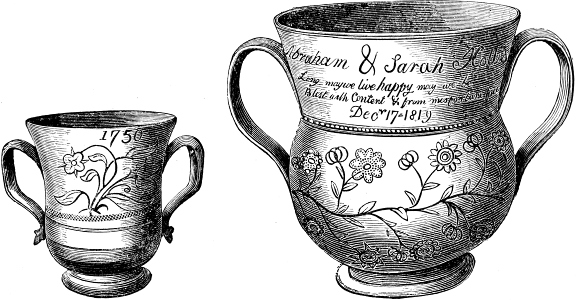
Figs. 95 and 96.
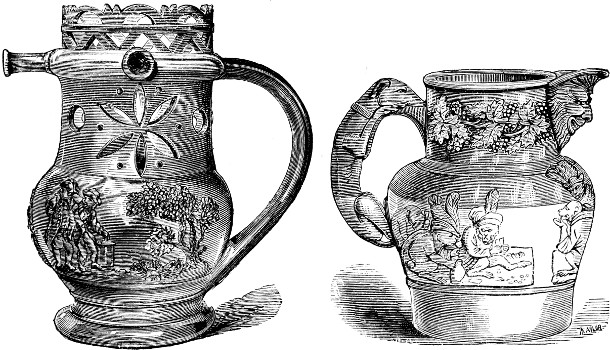
Figs. 97 and 98.
At Brampton, “posset pots” have, for some centuries, been, and still continue to be, made. Of these some notice is already given in vol. i., pp. 107 , 108 , and 418. The two here engraved (Figs. 95 and 96) show their general form; the one is dated 1750 and the other 1819. I have myself examples as late as 1874. Usually the name of the parties for whom they are made are incised in same manner as the pattern.
Another marked feature of Brampton, or “Chesterfield Ware,” has for a long period been the “puzzle jugs” there made. These, which are still produced on the old models, as well as in more modern applications of the principle, are made in a variety of shapes and of various sizes. In some the perforations in the neck and rim are more elaborate and intricate than in others, and some have three, five, or seven spouts. Commonly, as in Fig. 97, they are ornamented with figures or other designs in relief, but sometimes are plain.
Another usual class of design is that which includes jugs, mugs, and other vessels whose handles (Fig. 98) are formed of more or less cleverly modelled greyhounds. Some of the larger of these mugs have two, others three, and others four, handles thus formed.
The Welshpool and Payne Potteries.—These works, belonging to Messrs. Matthew Knowles and Son, are among the largest in Brampton. They embrace the old works carried on last century by Mr. Blake, and afterwards by his widow, and those of Mr. Luke Knowles, with considerable additions. They came into the hands of Mr. Matthew Knowles about 1840, and were by him considerably enlarged. Recently he has been joined in partnership by his son, under the style of “Matthew Knowles & Son,” and the works were again in 1875 very much extended. At these works all the general descriptions of brown and stone ware goods are produced; but an immense number of articles are made for the Australian, Russian, African, and Jamaica markets, as well as for the home trade. Among the articles produced in large quantities at these works are stoneware spirit-bottles, and spirit kegs and barrels, which are much esteemed for their hardness and durability and their fine quality; ginger-beer bottles, both in stone ware and brown ware; jam jars, for wholesale preserve manufacturers (such as Grey, Dennett & Co., and others), in gallon and half-gallon sizes, in brown ware glazed inside, forming one of the staple productions of Mr. Knowles, and of which, with one exception, he is the only maker in the district; stew and sauce pots; fruit and other jars; flat dishes; turtle and beef pots; bowls and collanders; tobacco-jars, highly ornamented; “Punch” jugs of striking design, “hunting” jugs, “game” jugs, and other jugs designed and modelled with great taste; puzzle-jugs; posset-pots; candlesticks of classical design and good execution; bread-baskets; toast-racks; tea-kettles; flower-pots and vases; foot and carriage warmers; grotesque tobacco-pipes, and a large variety of other goods, besides the usual domestic vessels, are made at these works, and are as good as the common nature of the material will admit. The filters made by Mr. Knowles, of which he produces a large number, are of excellent construction, and of good design. They are among the best produced, and being in the fine deep rich colour of the “Chesterfield ware,” are very effective, and perhaps more pleasing in appearance than many others in the “Bristol ware,” &c. In china clay ware also a large variety of articles of remarkably good quality are made. It may be well to add that at these works the clay is prepared by steam. It is “blunged,” and then passed through a fine sieve, driven at considerable speed on a large flat iron boiler, heated by steam, where it is boiled to a proper stiffness. It is then passed through a pug-mill, and is ready for use. Mr. Knowles’s are the only works in Brampton where this process is adopted.
“The Pottery.”—These works were established, in 1810, by “Messrs. Oldfield, Madin, Wright, Hewitt & Co.,” by whom they were carried on. After various changes and retirements, Mr. John Oldfield became, in 1838, sole proprietor of the works, and under his name they continue at the present time. The works have from time to time been considerably extended; they are now nearly the largest in the district, and employ a large number of hands. The goods manufactured are the usual descriptions known as “New Brampton” or “Chesterfield ware,” or, as more frequently falsely called in the London and other markets, “Nottingham ware,”—a remarkably hard, compact, and durable salt-glazed brown ware; and stoneware, which is dipped in different “slips.” In “brown ware,” the principal goods produced are dishes and bowls of various kinds; turtle, beef, butter, Dutch, stew, sauce, and other pots; bottles and jars of all shapes and sizes, and for all uses; pitchers and jugs in endless variety; churns: milk-pans and pancheons; nappies and porringers; tea and coffee-pots; Welsh trays; carriage and feet-warmers; hare-pans and dog-troughs; spirit and wine-barrels and kegs; figured flower-pots and stands; scent jars; “hunting,” “cottage,” “tulip,” and other figured jugs and mugs; moulds for puddings, blanc-mange, jellies, &c., of great beauty and of excellent and even artistic design, and many other articles. In “antique ware,” Mr. Oldfield makes remarkably effective and well-designed hunting, game, cottage, tulip, and other jugs; figured Stilton-cheese stands; fruit-dishes and trays; tea and coffee-pots; tobacco-pots, some of which, with goblet and candlestick, are very striking; watch-stands; “Toby Fill-pot” jugs; small figures of stags, dogs, &c.; grotesque and twisted pipes; puzzle-jugs, &c. In stoneware many articles are also produced, the great bulk being bottles and spirit kegs of various kinds and of every size, from one pint up to ten or more gallons in capacity; and sanitary goods.
Filters also form a staple branch of the manufacture, and these are filted up on an exceedingly good principle, with vegetable charcoal, sand, &c., on the premises, and are supplied in large quantities both at home and for exportation. The manufacture of filters was here commenced in 1826.
The clays used and the processes observed in the manufacture may be briefly alluded to as follows:—
Five kinds of clay are here used, viz., Barclay, which is procured from Stanedge, near Wingerworth. This clay is used to make the arches which are technically called “Bars,” and two of them form nearly a semicircle that spans from side to side of the ovens and whereon the pots are placed. Setting-clay is a clay that is found on the peat-moss, near Stanedge, and is quite of a sandy nature: it acquires the name from its being rolled by the hands into “nobs” and placed upon the “Bars” to “set” the pots upon; unless this was used, the pots would have to be broken to get them off the “Bars.” The Lidd-clay (what is commonly called Fire-clay) is used in the lower parts of the “Ovens” or “Kilns,” because of its being stronger to resist the fire; this clay is procured from Loads, near Holymoorside, about two miles from Brampton. The next clay is the Brampton-clay which is burnt in the upper portion of the “Ovens,” because it will not stand the amount of fire that the Lidd-clay will, although it is of a much closer body, and, when glazed, will resist the action of any acids. Mixed-clay is burnt in the middle portion of the “Ovens;” it is, as its name implies, a mixture of the Brampton and Lidd-clay, of each about equal portions to suit the fire or heat in that portion of the ovens.
At these works spirit bottles of a similar character to the one engraved on Fig. 105 were made. One was a representation of Lord Brougham, with the words, “The true Spirit of Reform.”
Among the marks used by this firm are—
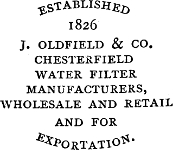
ESTABLISHED 1826 J. OLDFIELD & CO. CHESTERFIELD WATER FILTER MANUFACTURERS, WHOLESALE AND RETAIL AND FOR EXPORTATION.
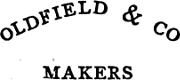
OLDFIELD & CO MAKERS
OLDFIELD & CO. CHESTERFIELD.
J. OLDFIELD.
Figs. 99 to 102.
The Walton Pottery was built by William Briddon, the grandfather of the present proprietor, in 1790, and at his death was continued by his son, William Briddon. This gentleman died in 1848, and was succeeded by his son, William Briddon, the present proprietor. It has consequently, from the first to the present moment, been carried on by three generations of William Briddons. The goods made are brown ware and stoneware in all their varieties. In these are produced stew, souse, turtle, beef, and butter pots; jugs of every variety; preserve and pickle jars; pancheons, bowls, and cullenders; porringers and patty-pans; bottles of every conceivable size and shape; filters; spirit-barrels and kegs; foot-bottles and carriage-warmers; tea and coffee-pots; twisted and grotesque pipes, and many other articles. In quality they are much the same as those of other Brampton manufactories.
Wheatbridge Pottery.—These works have been in the family of their present proprietor for three generations. They are now carried on by Mrs. J. Walton Wright, the widow of the late proprietor. The staple trade of the manufactory is general brown ware for the Dutch markets.
The Alma Pottery was commenced by its present proprietor, Mr. Samuel Lowe, and his then partners, about 1852. After a few years Mr. Lowe’s two partners withdrew from the concern, and it has continued in his hands solely to the present time. The goods produced are the same general kinds, both of wares and articles, as the other Brampton potteries. In brown ware and in stoneware Mr. Lowe produces filters, bottles of every kind and size, jugs and mugs, jars of various descriptions, and all the articles usually produced in these wares, and of the same general quality as those of other works in the district.
Barker Pottery
, belonging to Mr. Henry Briddon. Here all the usual articles in brown ware are made.
The Pottery of Mr. William Briddon, Jun., produces the usual kinds of wares, and most of the articles, of the district.
The London Pottery, belonging to Messrs. F. Lipscombe & Co., of London, was established by them for the purpose of manufacturing their filters.
Whittington.
At Whittington, pot works have existed from an early date, and are still continued. At these much good ware and many specialities of design, &c., were produced; it is only necessary to premise that the goods are commonly known by the general term of “Chesterfield ware” or “Nottingham ware”—it being a fact that London houses still sell, and persist in calling, the products of these Derbyshire works by the latter name.
The Whittington Potteries[32] are of very old establishment, having been in existence since about the middle or latter end of the seventeenth century, if not longer. Here the ordinary brown ware of the period was manufactured; the ware being of extreme hardness and closeness of texture, and having a rich warm reddish-brown colour. About the year 1800, and for some years later, the works, which were near the race-course, were held by Mr. William Bromley, who, in addition to the ordinary brown ware, made also a white, or cream-coloured, earthenware of fine quality. In this fine body he manufactured dinner, tea, and other services, principally decorated, in the prevailing manner, with transfer-printing in blue. He also practised batt-printing for some of his goods. Mr. Bromley also made some experiments in, and succeeded in producing, a very good china ware, but he did not prosecute this branch of manufacture to any extent. At that time, when Mr. Bromley was making the fine earthenware, and was experimenting on porcelain bodies, my late father, Mr. Arthur Jewitt, then a young man, was residing at Brampton, and was in habits of close intimacy with him. My father being a man of scientific, as well as of high literary attainments, and being, moreover, a good artist, took considerable interest in his friend Mr. Bromley’s manufacture, and at his own house at Brampton entered with spirit into a series of experiments in enamelling and enamel-printing, and in other processes for decorating the wares. For this purpose he caused to be erected in his own house two enamel kilns, one of which he had constructed on the ordinary simple principle of heating, and the other on the spiral principle. He also fitted up, for the purpose of these private experiments, a small printing-room, and here, being, as I have said, a good artist, he tried various processes for transferring aquatints and etchings (which he etched and prepared himself) by the batt-process, both on to the biscuit and on to the white glazed ware. By this process he produced many remarkably successful transfers; but, like the boy who dug up the seeds in his garden day by day, to see if they were sprouting, and so killed them, he was always so impatient to see the result of his experiments that he did not wait for the fire in the kilns to die out, but opened the doors, and so frequently spoiled all the pieces. Sufficient, however, remained each time to show that he was right in his experiments, and that his trials were all that could be desired.
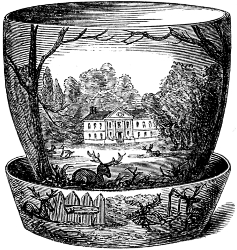
Fig. 103.
Besides transfer-printing, he tried some interesting experiments in surface-painting on the biscuit. Only one example of this ware is known to exist, and this fortunately is now in my own possession. It is here engraved (Fig. 103). It bears a view of (I believe) Renishaw Hall, and part of the park, with deer, &c. The body is extremely light, and the painting highly artistic. It is simply surface-painted on the biscuit. It is a small flower-pot, or “bow-pot,” and saucer, and is only 3⅜ inches in height.
These experiments are highly interesting in connection with the Whittington and Brampton potteries. They were very successful, and showed that had my father devoted his time and his talents to the process, great results would have been achieved. As it was, he prosecuted his inquiries as an amateur only, and from a simple love of the art, and his name, until I made it known in the Art-Journal a few years ago, has never been publicly associated with the fictile history of the country. I felt that it was due to the memory of one of the most talented of men, and the best of parents, that I should place his name on record in connection with an art in which, for a short time, in midst of a busy literary life,[33] he took such a lively interest.
Mr. Bromley continued the works for some years, when they changed hands. He was a man of great ability and of much spirit, and did more to further the standard of excellence of the works in his district than any of his contemporaries. He had three sons, Rev. Samuel Bromley, who was a poet of no ordinary stamp, and was a Baptist missionary to Jamaica and other countries; Joseph Bromley, who entered the army; and the Rev. James Bromley, whose name is well known in connection with the Wesleyan persuasion. The works afterwards belonged to Messrs. Robert Bainbrigge & Co. The pot-works at Whittington, in the early part of the present century, were carried on by Mr. William Johnson and Mr. Aaron Madin. At the present time there are two manufactories at this place; viz. those of Mr. Samuel Lancaster, successor to Mr. Madin, and Mr. James Pearson.
Stone Bottle Works.—These works, at Whittington Moor, were established in 1818 by Mr. Aaron Madin, and they are now carried on in his name by his son-in-law, Mr. Samuel Lancaster. The goods produced are in stoneware, brown ware, and coarse black ware. The stoneware is made of fire-clay, found underneath the Tupton coal-measures at Brampton and elsewhere, and glazed with the usual compound of flint, Paris white, Cornwall stone, barytes, and ground glass. It is of good quality, and very hard and durable. The ground ware is, as is usual in the district, salt-glazed; and the black ware, which is made of the common brick-clay, is glazed chiefly with lead-ore. The goods produced are the usual domestic and other articles made in the neighbourhood, and their quality is equal to most others.
Whittington Pottery.—At these works, belonging to Mr. James Pearson, the usual classes of goods, as made at the other potteries of the district, are produced.
Whittington Moor Pottery.—Mr. S. Lancaster (late A. Madin) has a manufactory of coarse pancheon ware at this place; the body, as usual, coarse red outside, and lined with a black glaze inside.
Newbold.
There is a manufactory of coarse brown ware—pancheons, bread-pans, stein-pots, &c.,—carried on by Mr. W. Sharratt at this place. The productions are of much the same character as those of Whittington Moor, Tickenhall, &c.
Eckington.
Pilkington in 1789 says, “A manufacture of sickles is carried on. There are also two potteries in the town.”
Belper.
About the middle or towards the latter part of last century, a small manufactory of common coarse brown ware existed here, and about 1800 Mr. William Bourne took to the works carried on by Messrs. Blood, Webster, and Simpson, at Belper Pottery. Mr. William Bourne, sen., was, it appears, very much engaged in the business of the then new canal. Letters of his, and of his son, William Bourne, jun., in which reference is made to his connection with the canal, and show business transactions between them and Mr. Duesbury of the Derby China Works, are in my own possession. Mr. Bourne carried on the manufacture of salt-glazed blacking, ink, ginger-beer, and spirit bottles. The ordinary brown ware, produced from a less vitreous clay, found on the spot, consisted of bowls, pans, pancheons, dishes, pitchers, and all the commoner varieties of domestic vessels, and these were of excellent and durable quality. The stoneware bottles, &c., were made from a finer and more tenacious bed of clay, at Denby, a few miles distant. The finer, or figured wares, were made from clay procured from Staffordshire. By Mr. Bourne all these descriptions of goods were made, but he principally confined himself to the manufacture of stoneware bottles of various kinds. A good antique-shaped hunting jug, and other similar articles, with figures in relief, was also extensively made. In 1812, Mr. Joseph Bourne (son of William Bourne) took to the Denby Pottery (which see) then carried on by Mr. Jäger, and the two works were carried on simultaneously until 1834, when the Belper Pottery was finally closed, the workpeople, plant, and business being removed to Denby, and incorporated with those works, and the premises converted into cottages. From that time no pottery has been made at Belper. The site of the works was at Belper-Gutter, and “Pot-House Lane,” the name of one of the streets, perpetuates the manufacture.

BELPHER & DENBY BOURNES POTTERIES DERBYSHIRE
Fig. 104.
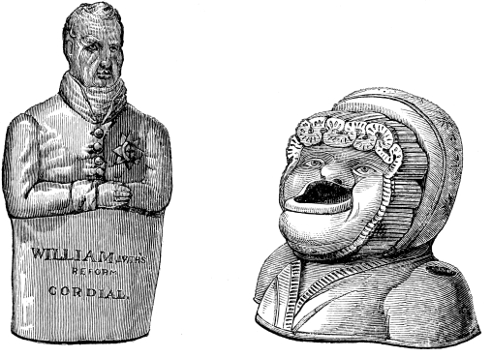
WILLIAM, IV,TH’S REFORM CORDIAL.
Figs. 105 and 106.
The mark used while these works were carried on in conjunction with those at Denby was this; and it may be well to remark that a series of political bottles, bearing representations of various Reform leaders, were made. On these the head of the individual—the King, Sir Francis Burdett, Earl Grey, or whomsoever was intended—formed the neck of the bottle, and the arms and bust the shoulder; political references, and the name of the political leader, were impressed on the clay. One of these, which represents the King (William IV.) is engraved on Fig. 105. It bears in front the words “WILLIAM IV.’S REFORM CORDIAL,”—the “cordial” being the brandy or other spirit it was intended to contain. Another is a representation, in smaller form, of Lord John Russell (afterwards Earl Russell); it bears, in front, the name “LORD JOHN RUSSELL,” and on a scroll which he holds in his hand are inscribed the words, “THE TRUE SPIRIT OF REFORM.” At the back is the mark Fig. 104. At these works too, I believe, quaintly designed inkstands, of which Fig. 106 is an example, were made. The projecting lower jaw formed the well for the ink, while holes on the shoulders served for places to put the pens in when not in use. They were made of the ordinary vitrified stoneware.
In 1827 a coarse-ware pottery was carried on here by Mr. Heapey.
Codnor Park.
The pottery at Codnor Park was built in the year 1820, by the world-renowned Butterley Iron Company, the owners of the famed iron works of Butterley and Codnor Park. At this time the Butterley works were under the management of the late Mr. William Jessop, son of one of the partners, and afterwards senior partner of the firm. Some years before this time the Company had constructed a large cast-iron bridge for the Nabob of Oude, and on its despatch a brother of Mr. William Jessop accompanied it to India to superintend its erection, taking with him several workmen, among whom was an engine-fitter named William Burton. From some cause or other the bridge was not erected by the Nabob, and after remaining several years in India, the parties returned to England. On their return, this William Burton was induced to commence the pottery, and having engaged a skilled workman from the Brampton Potteries, near Chesterfield, he commenced operations in 1821. The pottery was situated near the Codnor Park Iron Works, from which it took its name, and pretty close to the Butterley Canal, and was successfully carried on for several years. Sir Richard Phillips, in his “Tour,” in 1828, thus notes the pottery:—
“Over near Codnor Castle, I viewed a rough and ill-built manufactory, where they turn and bake those opaque bottles used for ginger-beer, soda-water, liquid blacking, &c. About 50 women and children finish 100 gross per day, and they sell the pints at 15d. and 16d. per doz., and all pints at 2s., and quarts at 3s. 6d. They are made of the clay of the vicinity, and the agent for selling them is Kemp, in Milk Street, London. They are harder and less liable to burst than glass bottles.”
In 1832, Mr. Burton having got into pecuniary difficulties, the works were closed. After remaining unworked for many months, the concern was, in 1833, taken by Mr. Joseph Bourne, of the Denby Pottery. They gave employment to about sixty persons.
The Codnor Park Works were carried on by Mr. Bourne until 1861, when they were finally closed, and the workmen, plant, &c. were transferred to the Denby Works, where additional work-rooms had been erected for their accommodation.
The clay was of a similar kind to that used at Denby, but owing to a larger impregnation of iron the ware produced therefrom was not equal in appearance to that made at Denby, though the bottles were highly vitreous, and had an extensive sale. This clay was obtained at Cupet Green, in the immediate neighbourhood, and the coal from Birchwood Colliery. (The hard coal is the only kind adapted for burning in the salt-glazed kilns.) London was the chief market, the crates being forwarded by canal.
The classes of goods produced at Codnor Park were all the usual classes of household vessels, and also stoneware bottles of various kinds, and of all sizes up to six gallons, and pans, bowls, jugs, pitchers, and other articles. Besides these, however, a remarkably fine, compact, light, and delicate buff-coloured terra-cotta was produced. In this were made butter-coolers, vases of various kinds, flower-baskets and pots, ewers, spill-cases, and numberless other articles. Many of these were of excellent design, and beautifully decorated with foliage and other ornaments in relief. Puzzle-jugs, &c. were also made of this material, and surface-painted with a peculiar mottled effect. The mark during Mr. Burton’s time was his name and “Codnor Park,” or simply the name “Wm. Burton,” impressed on the clay. The manufacture of ordinary household earthenware was discontinued when Mr. Bourne took to the concern, his operations being confined to the manufacture of bottles. For some of this information I am indebted to Mr. Humphrey Goodwin (through Mr. Bourne of Codnor Park), who was connected with the works from their opening in 1821 until their close.
Denby.
The “Denby Pottery” is situated in the parish of Denby, seven miles from Derby and two from Ripley,—a village memorable as being the birthplace of Flamstead, the astronomer,—in the midst of the rich ironstone and coal-fields of Derbyshire, the former of which are said to have been regularly worked from the time of the Romans.[34] The works were commenced in 1809 by a Mr. Jäger, on the estate of W. Drury Lowe, Esq., where, some time before, a valuable and extensive bed of clay had been found to exist. This clay, previous to the establishment of the Denby Works, was used at the Belper Pottery, for the manufacture of stoneware ink, blacking, and other bottles. The Denby clay was also supplied to the Derby China Works, in considerable quantities, where it was used for saggers, and for a few other articles which were produced. In 1812, Mr. Joseph Bourne, son of William Bourne, of the Belper Pottery, succeeded Mr. Jäger, and the Belper and Denby works were carried on simultaneously until 1834, when the Belper Works were discontinued, and the plant and workpeople removed to Denby. The works were at this time much increased, and gradually extended their operations. In 1833, the Codnor Park Works (which see) passed into the hands of Mr. Bourne, and were carried on by him, along with those of Denby, until 1861, when they were closed, and the workpeople, plant, &c., as in the case of the Belper Works, removed to Denby. Considerable additions were made for this increase of workpeople, and the manufactory was much extended. In 1845, Mr. Bourne also became possessed of the Shipley Pottery (which see), and in 1856 removed those works to Denby. With the Denby Pottery are therefore incorporated those of Belper, Codnor Park, and Shipley.
Mr. Joseph Bourne having taken his son, Joseph Harvey Bourne, into partnership, the business was carried on under the style of Joseph Bourne and Son, and has so continued until the present day. Joseph Bourne died in 1860, and his son in 1869, and the works are still carried on, under the old trading style, by the family. In 1851 a medal was awarded to Mr. Bourne for his stone bottles.
In addition to the extensions required from time to time at Denby to provide for these continual augmentations arising from the closing of the smaller works, the business has so extended as to necessitate considerable additions and improvements. Excellent machinery has been applied to the blunging and other processes, and instead of the old process of getting rid of the water from the slip by evaporation, the clay is obtained therefrom by the patented process invented by Messrs. Needham and Kite, Vauxhall, London, ten of their presses being employed, turning out at least 25 tons per day of workable clay. The class of ware produced has not varied to any extent, though an advance in shape and quality is evident from a comparison with some of the earlier specimens extant. The great bulk of the stoneware produced by Messrs. Bourne and Son is the kind known as the salt-glazed stoneware, which, on account of its peculiar vitreous and non-absorbent qualities, is in great demand not only in the home market, but in all parts of the world. About the year 1836 a considerable change was made in the size and form of the salt-glazed kilns, and for these improvements Mr. Joseph Bourne obtained a patent. The old kilns were only half the height of the present ones, and had each five chimneys. To these, what may be called an upper storey has been added, and, while the lower half is fired by mouths opening into the kiln and the flame passing perpendicularly up the kiln, the upper portion is fed by fires passing out of the kiln by means of flues at the side, and the modern kilns have only one chimney, thus securing a better consumption of smoke and lessening the objectionable results which would follow from such a dense volume of smoke proceeding from a low chimney. Since this patent was taken out an additional improvement has been made by the erection on the top of each kiln of a separate small oven, in which biscuit or terra-cotta fancy articles can be burnt, these being simply burnt by the heat passing up the chimney and from the top of the kiln, but no flame or salt-glaze reaching the goods. Much thought and care as well as considerable expense have been expended during the last twenty years to perfect the manufacture of telegraph insulators, and the very large business transactions in this department proves that the enterprise of the firm has not been fruitless.
Messrs. Bourne and Son have for many years possessed the exclusive right to manufacture Mr. Varley’s Patent Double V. Insulators, and since the transfer of the telegraphs to the Government, the firm have executed immense quantities for that department of the public service. A demand having recently arisen for white-glazed ink and other bottles, additional appliances have been provided on the most approved and modern principles, which have enabled the firm to produce a class of ware of this description unrivalled alike for its excellence and appearance.
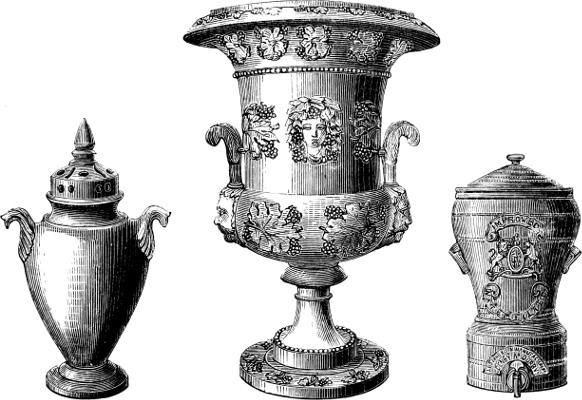
Figs. 107 to 109.
The main productions of the works are as follows:—
In bottles, which are the staple production, almost every variety are manufactured in large quantities both in the patented vitreous stone, and white glazed, varieties of ink-bottles of every shape and size are made by thousands weekly, as are also ale, porter, ginger-beer, blacking, fruit, and every other kind of bottles. Spirit and other liquor bottles, with handles, up to a very large size, are also made. Feet-warmers, carriage-warmers, and medical appliances, with or without patent screw stoppers; spittoons, tobacco-jars, churns, mortars and pestles, pipkins, bird fountains, inkstands, feeding-bottles, candlesticks, pork-pie moulds, and every variety of domestic vessels, are made. Druggists’ shop-jars, snuff-jars, spirit-barrels, pudding-moulds, &c., many of them highly ornamented, are also made. The filters are of excellent construction, and good form, and are made to purify from 5 to 30 gallons per day each.
“Hunting Jugs”—a name by which a certain class of jugs with raised ornaments consisting of hunting subjects, sometimes a stag, at others a fox, chased by horsemen and dogs; and with other relief subjects of trees, bee-hives, windmills, and men seated smoking or drinking, &c., are called—are made here to a great extent, and of the hardest and most durable quality, and with an excellent glaze. Some of these are made with greyhound handles of very clever and effective design, of the class shown on Fig. 98. Upright jugs, or canettes, of the same general character, are also made, as are also plain jugs. Jars, too, are a staple branch of the Denby manufacture, and for preserves, pickles, jellies, marmalades, &c., are considered to be of the best quality. They are made of the most approved shapes, and of every variety of size, covered and uncovered; one great advantage of this make being the great width of the mouth, ensuring cleanliness, and preventing the waste that occurs with an overhanging shoulder. The same remark holds good with regard to the stew-pots.
In terra-cotta, which is of a remarkably light and fine quality, and of a warm buff colour, many elegant articles are made. These are flower vases of various designs, lotus vases, garden and other vases, wine-coolers, water-bottles, ewers with snake handles, flower-stands, Stilton-cheese stands and trays, fern stands, fonts, Indian scent jars, butter coolers, mignionette boxes, and many other articles of artistic excellence.
The marks used by the Denby Pottery are as follows:—
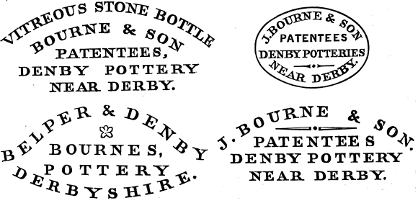
Figs. 110 to 113.
VITREOUS STONE BOTTLE BOURNE & SON PATENTEES, DENBY POTTERY NEAR DERBY.
BELPER & DENBY BOURNES, POTTERY DERBYSHIRE.
J. BOURNE & SON. PATENTEES DENBY POTTERIES NEAR DERBY.
J. BOURNE & SON. PATENTEE S DENBY POTTERY NEAR DERBY.
But besides these, which, by the way, are only used upon some of the goods, the great bulk being made without any mark at all, there are others which it is not necessary to particularise.
Shipley.
These works were commenced about 1825 on the estate of Edward Miller Mundy, Esq., of Shipley Hall, by whom the buildings were erected, in consequence of the discovery of valuable beds of clay. They were first carried on by some working potters from the Staffordshire district, and the ordinary classes of goods in “cane” or “yellow” ware were produced, as were also Rockingham ware tea-pots and other articles. These were made to a considerable extent, and of good quality, but the works did not answer. They were next taken by a Mr. Waite, a blacking manufacturer, from London, who commenced making stoneware bottles for his own blacking, and other articles of general use. Eventually, in 1845, the works passed into the hands of Mr. Bourne, of the Denby pottery, and were carried on by him. The clay at Shipley was of two kinds—one was obtained from the hard seam coal after the coal was worked, at a depth of 250 yards. This was of a beautiful and extremely fine quality, but was of itself difficult to work owing to a want of tenacity. It was found, however, that by using in equal proportions this clay and another known as the Waterloo seam, which was about 100 yards from the surface, an excellent body was produced. At this period the coal mines on the estate furnished saline and chalybeate waters, which were much in repute; and bottles, specially designed for these waters, were made in large quantities at these works. Some of these bottles are still preserved, and are of excellent material. They bear impressed on the side a garter ribbon, on which are the words enclosing the name SHIPLEY SALINE WATER in three lines. In 1856 the Shipley pottery was closed; the workmen, plant, &c., being removed to, and incorporated with, the Denby pottery.

Alfreton.
During the last, and the early part of the present century, brown ware of common quality, and red-ware pancheons, &c., were made at Alfreton, but have long been discontinued. Pilkington, who wrote in 1789, says, “There are also here six malt offices, and two potteries of the brown earthen ware.” The site of the last of these pot sheds, I am informed by Mr. Rowbottom, was purchased, in 1845, by the Gas Company, for their works, and during the progress of building, &c., only the commonest brown ware was seen.
Crich.
Somewhat extensive pot works existed here, on Morewood Moor, in the middle and latter part of last century, or probably much earlier. In 1763 they belonged to a Mr. Thomas Dodd, who in that year became bankrupt. The estates were somewhat extensive, and their sale—land and houses, &c.—covered three days. The sale was “at the house of Mr. Jonathan Kendall, known by the sign of the Peacock, near Alfreton, in Derbyshire.” The following is a copy of the description of the lots in which the pot works occur:—
Lot 1. A large commodious Dwelling House, called Crich Pot House, standing in Wheatcroft, within the said parish of Crich, together with the Garden, walled round, and planted with Wall Fruit, and a Summer House within; and all the Outhouses, Barns, Stables, Cowhouses, Workrooms, Pot furnace, Warehouses and other Edifices therto belonging. And also those six several closes or parcels of enclosed land lying and being in Wheatcroft aforesaid, therto adjoining and belonging, containing by estimation about 38 acres, and being tythe free and paying a chief rent of Two pence halfpenny per ann. And also the Potter’s Clay upon all the commons or waste grounds within the Manor of Lea (within which Manor the before mentioned premises lie), all which are now in the occupation of Mr. Thomas Wheldon, or his assigns.
Lot 2. A Leasehold estate for the reversion of a term of 99 years, which commenced at Lady Day, 1744, of one acre of Land to be fenced out of the South-east corner of a certain Close in Wheatcroft aforesaid, commonly called Agnes, otherwise Annis Bottom, under the yearly rent of one pound. Upon which said acre of Land there is now built and standing a good new Pot House, with Workrooms, Pot furnace, Warehouses, and all other Edifices and Apartments necessary for a Pottery, now also in the possession of the said Mr. Wheldon.
Lot 3. A Close (being formerly three Closes) in Plaistow, within the parish of Crich aforesaid, containing about 8 acres, being tythe free, together with a Windmill, Kiln for drying Corn, and Blacksmith’s Shop, standing thereupon, being only separated from the fold-yard of the aforesaid house, called Crich Pot-house, by a narrow Lane (called Dark Lane) which said Close pays a Chief rent of £6 per ann., and is now in the holding of the said Mr. Wheldon.
Lot 4. A Dwelling House with a Barn and Cowhouse, and two Closes of Land adjoining, tythe free, in Plaistow aforesaid, containing about five acres, paying only a Chief rent of 4d. per ann., and now in the occupation of John Bacon and Mr. Thomas Wheldon.
Lot 5. A Messuage, House, Barn, and Stable, Two Cowhouses, and other Edifices in Wheatcroft aforesaid, and also a large Orchard, planted with Fruit Trees, and six several Closes therto belonging, tythe free, containing about 18 acres, formerly in the holding of William Street, deceased, paying a Chief rent of Two pence halfpenny per ann., and subject to an annuity of Twenty shillings a year, payable thereout to the Vicar of Crich, for the time being. N.B.—There’s a large quantity of Potter’s Clay in this Farm.
“The Potters’ Clay Delph,” or “Delph of Pot Clay,” is also stated to go through two other of the lots.
Mr. Robinson, who has searched into matters regarding the Crich Pottery, gives me the following particulars. They were situated near the “Pot-House Farm,” as the place is still called. The buildings still remain and are known as the “Pot-House Hillocks.” After the bankruptcy of Thomas Dodd, the works were carried on by George Bacon, and at his death passed into the hands of his son, Edward Bacon, who gave up the earthenware manufacture and converted the place into a brickyard; this also he closed about 1810. Of the ware made here, which appears to have been brown ware, like that of Brampton, nothing reliable is known. A posset-pot, formerly belonging to the landlord of the Horse and Groom, a public-house a mile off, is said to be an undoubted example; it bears the names of the then landlord and his wife—“John and Mary Wood, 1794.” A spill-board weight, bearing on one side the date 1760, with initials, and on the other the initials G B (supposed to be George Bacon) and a fleur-de-lis, is also supposed to have been made here.
Langley Mills.
Langley Mill Pottery.—This pottery was established by its present owner, Mr. James Calvert, in 1865, and was the first established in the neighbourhood. The productions are vitrified stoneware of similar character and quality to that of Messrs. Bourne at Denby. In this ware a large trade is done in ginger-beer, ink, beer, and other bottles, and all the usual domestic vessels—jars, pitchers, hot-water bottles, foot-warmers, jugs, mugs, &c.—are produced from clay found in the neighbourhood. The works are extensive and well arranged, consisting of three kilns for brown ware and one for Bristol ware.
Ilkeston.
The “Ilkeston Potteries” were established by the late Mr. George Evans in 1807, and were carried on by him until his decease, in 1832, when he was succeeded by his son, Mr. Richard Evans, the present sole proprietor of the concern. At first, and during the lifetime of Mr. George Evans, Derbyshire stone bottles alone were made, and these are still manufactured to a large extent. By the present proprietor the buildings have been considerably increased, and a general pottery added for the production of useful articles in stoneware and ornamental terra-cotta goods. The present productions of the works are in stoneware bottles, jars, pans, &c., of all sizes and of every usual form; filters of an improved construction; carriage, foot, and other warmers; sanitary pipes, and ware of every kind, &c., &c.; and in terra-cotta, vases, pedestals, flower and tree boxes and pots, garden-edgings, chimney-tops, &c., of various designs, and all the more usual productions of fire-clay goods.
Pinxton.
The village of Pinxton (a large parish in East Derbyshire, close on the borders of Nottinghamshire) is principally inhabited by colliers and other “hardy sons of toil,” who work in the ironstone mines and at the furnaces of the neighbourhood. The manor belongs to the family of Coke, the same family as the Cokes of Trusley and the Cokes of Melbourne, and to one of this family, John Coke, Esq., the establishment of the china works is owing. Mr. John Coke was the youngest brother of D’Ewes Coke, Esq., the lord of the manor; the second brother being Sir William Coke, Judge of the Supreme Court, Ceylon, who died at Trincomalee, in Ceylon. The present head of the family is Lieut.-Col. E. T. Coke, of Debdale. Mr. John Coke, who was born in 1775, passed several of the early years of his life at Dresden, and there, doubtless, acquired that love for porcelain ware which induced him to commence the manufactory at Pinxton on his return to this country. Having an idea that some clays found on the family estates near Pinxton might be made available for the manufacture of china ware, Mr. Coke entered into correspondence with Mr. Duesbury, of the Derby China Works, and sent him samples of his clays for trial and experiment. Whatever encouragement or otherwise he received from Mr. Duesbury—and I have reason to believe that encouragement was not given—the result of his own convictions and his own trials, &c., determined Mr. Coke on starting the works, and he ultimately made an engagement with William Billingsley, of the Derby China Works (which see, page 102); and having built a somewhat large and very conveniently arranged factory, commenced the manufacture of china ware in 1796.
William Billingsley was the son of William and Mary Billingsley, of the parish of St. Alkmund, Derby. In 1774 he was apprenticed by his widowed mother to Mr. Duesbury, the proprietor of the Derby China Manufactory, for five years, “to learn the art of painting upon china or porcelain ware,” as I have already shown in my notice of Billingsley on page 101, ante. In 1796 he left the Derby China Works, where he had been employed for the long period of twenty-two years, and removed to Pinxton, occupying, with his wife, his wife’s mother, and two daughters, a part of the factory built by Mr. Coke. Here Billingsley succeeded in producing that beautiful granular body which he afterwards perfected at Nantgarw and at Swansea; and here, too, stimulated by Mr. Coke’s good taste, he introduced faultless forms in his services and a high style of excellence in decoration. He brought with him several experienced workmen and artists from the Derby Works, and took into the factory, and instructed, several young people of Pinxton and its neighbourhood. His own time was thus so fully occupied with the management of the works, with the arrangement of the concern, and with the “overlooking” of the persons employed, that, unfortunately, his own skill and his own splendid colouring of roses and other flowers were lost to the manufacture; and thus we do not find that the expressed fear of his late Derby employers that “his going into another factory will put them in the way of doing flowers in the same way, which they are at present entirely ignorant of,” was sustained. In fact, while employed by Mr. Duesbury, Billingsley was in every way master of the art he had been taught; and he had acquired a peculiar method—entirely peculiar to himself—of painting roses which, with his free and truly artistic grouping and harmonious arrangement of colours, made his pieces so much sought after, that orders were constantly sent in for objects “painted with Billingsley’s flowers.” At this period of course his whole time was devoted to painting, and his heart was in his work. After leaving his employer, his attention was naturally, in the new sphere in which he found himself at Pinxton, almost wholly given to the practical instead of the Art portion of the establishment, and thus none, or scarcely any, of the known examples of Pinxton china bear evidence of being his handiwork. Indeed, it is not too much to say that, from the time when he closed his connection with the Derby Works, his Art-skill declined, but his manufacturing skill became more and more apparent.
The works at Pinxton were built by the side of the canal, and the workshops formed three sides of a square. These are still in existence at the present day, and are shown in the accompanying vignette, from a sketch made for the purpose. They are now converted into cottages, and are occupied by colliers and others. The kilns, &c., have entirely disappeared. The place and cottages are still called “China Square,” or “Factory Square.”
Through some misunderstanding or other, the arrangement between Messrs. Coke and Billingsley was not of long duration, and in a very few years—probably about 1800 or 1802—Billingsley left the place and removed to Mansfield, where, it is said, he for some time occupied himself in decorating and finishing china ware which he bought in the white state in Staffordshire. He afterwards, as I have already shown, removed to Torksey, Worcester, Nantgarw, Swansea, and Coalport, and died about 1827 or 1828.
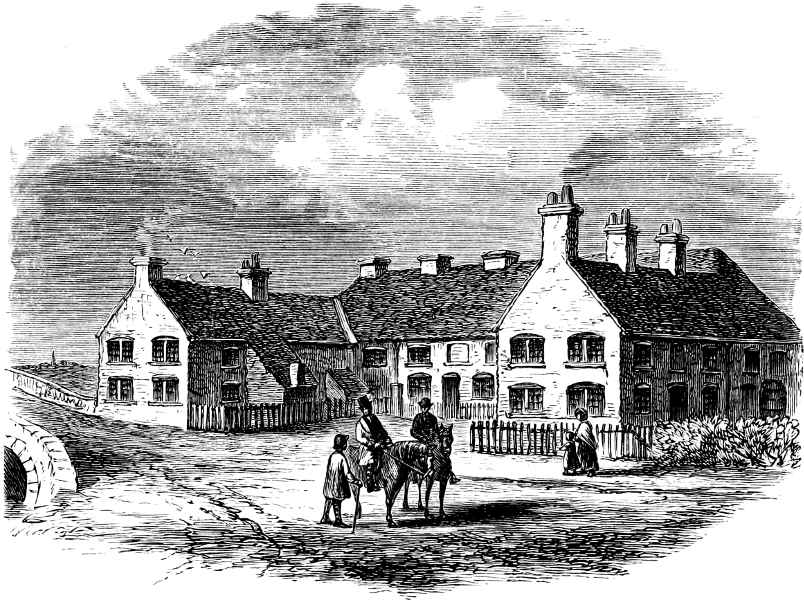
Fig. 114.
Mr. Coke married in 1806 and settled at Debdale Hall, where he died in 1841, in his sixty-sixth year, leaving his estates to Lieut.-Col. Coke, their present possessor. At Debdale are preserved, with religious care, some of the finest examples ever made at Pinxton. These pieces were brought there by the founder of the works, Mr. John Coke just spoken of, and have remained there ever since. They consist of large semicircular spill-stands, mugs, &c., beautifully painted with views, one of which, a view of the family seat of Brookhill Hall, is remarkably fine. Some of the stands are grounded in the Dresden canary colour, and the whole are very choice and unique examples of Pinxton porcelain.
The group of china here engraved is a selection of pieces made during Billingsley’s time at Pinxton. The pieces are all remarkable for the beauty of the body and of the glaze, and some of them are also noticeable for the excellence of the gilding. The coffee-pot in the centre is one of a set bearing, in oval borders, views of different places either in Derbyshire or elsewhere. These landscapes are excellently painted, of a peculiar brownish effect which pervades the whole colouring, by James Hadfield, who was the best landscape painter at the works. The views on the pieces which have come under my notice are of local and other places: for instance, Pinxton Church, Darley Hall, Hartington Bridge, Ashwood Dale, Buxton, Wingerworth Hall, Tong Castle, Saltram, Menai Straits, Wanstead Church, Frog Hall, Caerphilly Castle, &c. The teapot and stand are of elegant shape, unusually narrow and carefully gilt; the stand is of peculiar form. The cup and saucer have the “Derby sprig” (Tournay sprig), as it is frequently called. The coffee-mug and flower-pot tell their own tale.
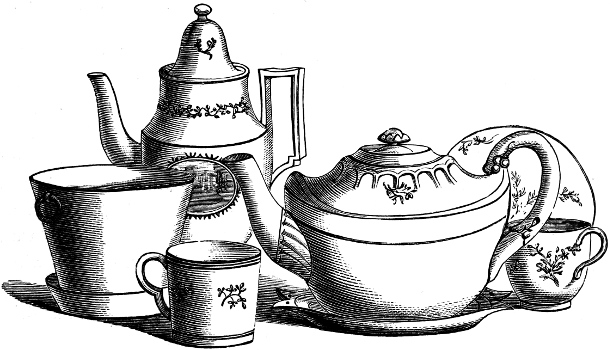
Fig. 115.
After the close of Billingsley’s connection with the Pinxton Works they were carried on by Mr. Coke with the assistance of a Mr. Banks. Afterwards Mr. Coke took Mr. John Cutts to manage the concern, and he became a partner in the works. In the later part of the time the manufactory was carried on by Cutts alone. At the close of the Pinxton Works, which took place about 1818, Mr. Cutts removed into Staffordshire—fixing himself at Lane End—where he commenced business; at first buying ware in the white and finishing it for sale. In 1811, Davies says, “There is a considerable porcelain manufactory at Pinxton, which finds employment for several hands.”
After Billingsley’s removal from Pinxton the character of the ware underwent a change. The granular body of which I have spoken as produced, and afterwards brought to such perfection, by him, was his own secret, and he zealously kept it. On leaving Pinxton this secret, naturally, went with him, and, of course, the goods produced after that time were of a different and much inferior body. The later ware approached pretty closely the ordinary china body of the time, and had a slightly bluish tint in the glaze. The decoration was also, as a rule, not equal to what it had been in the earlier days of the factory.
Among the workmen brought from Derby along with Billingsley, were Thomas Moore, a clever thrower; Ash, also a clever thrower and turner, and many others of repute. Among the painters, &c., were James Hadfield, a good landscape painter; Edward Rowland, a landscape painter; Morrell, who painted landscapes and flowers; Richard Robins, from London; William Alvey, and others, including Slater and Marriott. Alvey left Pinxton about 1803, and became master of Edingley School, near Southwell, where he died in 1867, aged about eighty-three. He had a numerous family, some of whom re-settled at Pinxton. Alvey was held in high respect at Edingley, and was possessed of remarkable natural gifts; he was an excellent musician, a clever draughtsman and colourist, a first-rate mathematician, a splendid penman, a very fair land-surveyor, and a poet of no mean order. He was fond of drawing and painting to the last.
No especial mark was used at the Pinxton Works. The number of the pattern was occasionally given, and sometimes a workman’s mark was added; and although other marks were used, none seem to have been adopted as distinctive of the works. A writing letter and a Roman capital letter P have both been noticed as occurring on isolated specimens. A tea service, named to me by Capt. G. Talbot Coke, bears, however, inside the lid of the teapot, the word Pinxton, written in gold letters. The service is of a beautifully clear white china, with broad edges of burnished gold; a handsome arabesque border of red, blue, and gold ornamenting each piece.

One peculiarity connected with the Pinxton China Works remains to be noticed: it is the issuing of china tokens, i.e., tokens representing different values of money, made of china, and payable as money among the workpeople and others, including shopkeepers. These were issued in a time of difficulty, so that they were only temporary conveniences, and thus they possess great interest. They were of two distinct kinds. The general form was a circular disc of white china, thicker in the middle than at the edges—in fact, exactly of the form of a common magnifying glass—and bore on the obverse a figure of 5 in the centre, and the words, “Let the Bearer have in goods five shillings,” in four lines across. On the reverse a similar figure 5 and the words, “which place to account with John Coke, Pinxton. Decr. 24th, 1801,” in five lines across. The writing is in blue, and the tokens are well glazed. They were issued of various values, as 10s., 7s. 6d., 5s., 3s. 6d., 1s. 6d., and 1s. respectively. The one here engraved belongs to W. S. Coke, Esq., of Brookhill, and I am indebted for it to his nephew Capt. J. Talbot Coke. Others bore, as shown on the next engraving, simply the figure of value, gilt or painted on an oval disc. These tokens were used as promissory notes, and when returned to the works by their holders their value in money was given for them, and they were broken up and destroyed. They were payable in and around Pinxton, on one side as far as Sutton, but their payment did not extend to Mansfield. They were called “Mr. Coke’s coin,” or “Chainé money” (china money), in the provincialism of the locality.[35]
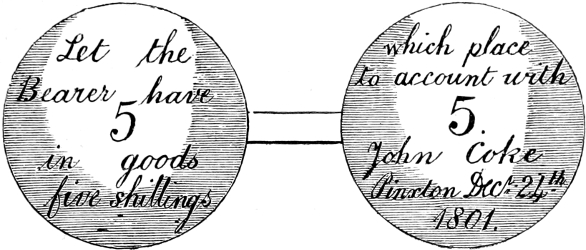
Let the Bearer have 5 in goods five shillings
which place to account with 5 John Coke Pinxton Decr 24th 1801.
Fig. 116.
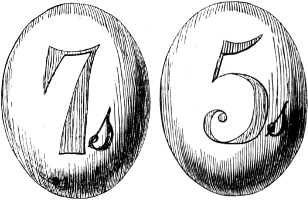
7s. 5s.
Figs. 117 & 118.
It is pleasant to see how the memory of the old china works at Pinxton is cherished by its inhabitants of the present day, among whom some of the people who worked there are still, at a ripe old age, living. One of these, in her eighty-fifth year, who began to work at the factory when but a child of some eleven years of age (at that time named Elizabeth Smith), and became ultimately the chief burnisher of the works, was, when I saw her a few years back, in full possession of all her faculties, and delighted in describing, with marvellous accuracy, all the processes employed. To her wonderful memory, and to that of others, as well as to documents and long personal research, I owe the information which I, in 1868, for the first time, gave in the Art-Journal, and now repeat, in regard to this interesting manufactory.
Wirksworth.
Wirksworth is much more intimately mixed up with the history of the Ceramic Art than is usually imagined, and yet but little is known of the works which were there carried on, or of their productions. Dugdale, in 1799, says, “About forty years ago, a manufacture of porcelain was attempted, but it proved unsuccessful.... It was in the Holland Manor House that the unsuccessful manufacture of porcelain was attempted;” and Davis, in 1811, repeats the same thing: “In the Holland Manor House the manufacture of porcelain was attempted, about forty years ago, but proving unsuccessful, it was relinquished.” Holland House, where this manufacture was carried on, was the Manor House of the manor of Holland, otherwise Richmonds, which was given by Thomas, Earl of Lancaster, to Sir Robert Holland, in which family it remained until the attainder of Henry Holland, Duke of Exeter, in 1461; it afterwards belonged to Margaret, Countess of Richmond and Derby, and was subsequently granted by the Crown to Ralph Gell. In 1745, Philip Gell leased the manor to “Robert Atkinson and Francis Parry, of Lincoln’s Inn, gentlemen,” and to “Andrew Wilkinson, of Boroughbridge, com. York, Esq., and Thomas Wilkinson, Esq., brother of the said Andrew Wilkinson.” In 1777 it was “leased by Philip Gell, Esq., of Hopton, to Richard Arkwright, of Cromford, cotton merchant.”
In this latter lease (dated 6th November, 1777), the china works are thus named: “All those several messuages, tenements, or dwelling-houses, and all other buildings, warehouses, workshops, and appurtenances, situate, standing, and being in Wirksworth, in the said county of Derby, heretofore used for the making and manufacturing of China Ware, and now in the tenure or occupation of the said Philip Gell, his assignee or assigns, tenant or under-tenants.” So that at that time the first china works had probably ceased to be in operation. In 1793, by deed dated 1st November, Richard Arkwright, Esq., assigned the remainder of the lease to Charles Hurt, Esq., of Wirksworth, in the following words: “All those several messuages, tenements, or dwelling-houses, and all other the buildings, warehouses, workshops, and appurtenances, situate, standing, and being in Wirksworth, heretofore used for ye making and manufacturing of china, but now for picking cotton.”
My late friend, Mr. T. N. Ince, to whom Wirksworth is indebted for much patient research into its early history, thus wrote to me regarding the china works, having at my request turned his attention to the matter:—“I much regret that I did not extract from the original deed of co-partnership, which I once had in my hands, at least its date, parties, and the like. My opinion is that it was begun about the middle of last century, and did not continue more than a few years. I know the Hurts of Alderwasley, Gells of the Gatehouse and Hopton, Sir Thomas Burdett of Foremark, and many others were partners—nearly the same who were partners in the English and Welsh Mineral Company, of whose concerns were many papers in a bundle in my grandfather and father’s office, labelled ‘Tissington v. Burdett and others;’ and amongst them, Mr. Julius Cæsar Robiglio, of Hopton, gentleman, who was said to have been present at a duel in Italy, in which the then Philip Gell of Hopton slew his antagonist and fled to England with Mr. Cæsar Robiglio, who, I have heard my mother say, was a most gentlemanlike man. He died at Hopton, and was buried at Wirksworth or Carsington. The premises called ‘China House Yard’ were afterwards the property of the late Charles Hurt, Esq., senr. His son, Charles Hurt, junr., died in 1834, on whose death it was sold to the late Mr. John Wilson, maltster; whose son, Mr. Daniel Wilson, wine merchant, is the present owner.” Mr. Wilson, who has examined his title deeds specially for me, tells me they contain no information as to the china works.
Some years ago, during excavations which were being made, portions of saggers and of china were found; some of these are in my own possession.
It is said that after leaving Pinxton and other places, Billingsley attempted to establish china works here; being probably led to do so by the fact of felspar being abundant in the neighbourhood. Of this, however, there is no proof. Earthenware is also said at one time to have been made here; but of this, also, there is no proof.
Dale Abbey.
Encaustic paving tiles were made here, within the grounds of the abbey, in the fourteenth century. The remains of the kiln in which they were fired were discovered some years back, and in and around it were several tiles and fragments of tiles.
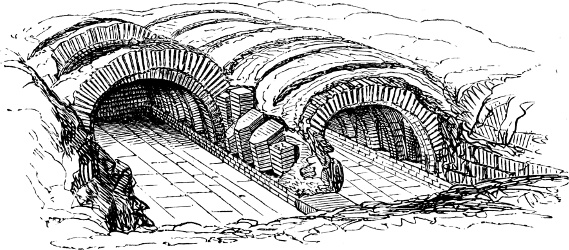
Fig. 119.
Vol. II.
Plate I.
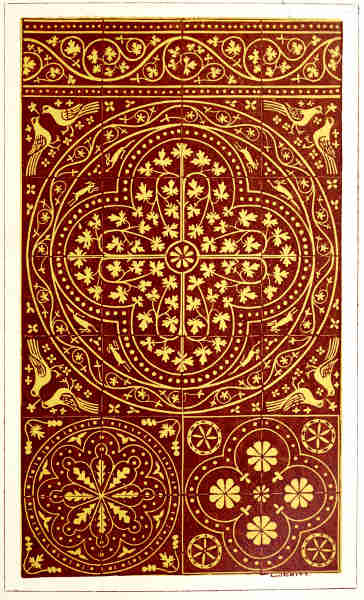
MEDIÆVAL PAVING TILES MADE AT REPTON.
Repton.
Encaustic tiles were made here in the fourteenth century, and the kiln in which they were fired, and a vast number of unfinished tiles and fragments of tiles, were discovered in 1866. The site of the tile works was within the old abbey walls, and was accidentally brought to light by the boys of Repton School, who were busying themselves in levelling a piece of land for their cricket ground. During their work they came upon patches of a stiff red clay with fragments of tiles; and, presently afterwards, found some regular layers of them, face downwards. Next they came upon masses of brickwork, which, upon careful clearing, turned out to be a kiln for the firing of the tiles. Of this, and of the tiles found within and around it, I made careful measurements and drawings, and some of these are shown on the accompanying engravings.[36] The kiln, Fig. 119, consisted of two series of arches (each series consisting of six arches alternating with the same number of openings) over what may be termed two vaults, each 7 feet 6 inches long, by 2 feet 6 inches wide, and about 1 foot 10 inches in height. The arches were formed of chamfered bricks or tiles, those composing the actual arch measuring 7¼ inches in breadth at the square, or upper end; 2¾ inches in breadth at the lower end; 7¼ inches in length; 4½ inches in length on the square sides; 3½ on the chamfer; 1¼ inches in thickness at the upper end: and three quarters of an inch in thickness at the lower end. The basement, four inches in thickness, was formed of bricks or tiles. Upon this were built up, at distances of 4½ inches apart, the chamfered bricks from which the arches sprung, these being placed broadends together and so forming an hexagon. Between these the remainder of the wall, to a level with the top of the arches, was formed of encaustic tiles, which being 4½ inches square exactly fill up the width. These encaustic tiles, some hundreds in number, were of various patterns, but evidently unfinished, being quite soft and pliable. The floor of the vault was paved with tiles, and at the entrance was a stone wall on either side, and against the wall-pier was placed the curious relief tile, Fig. 120.
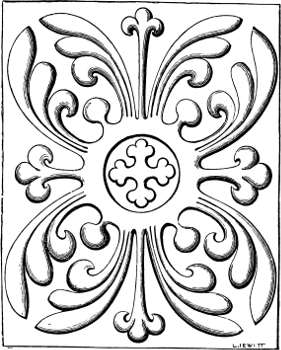
Fig. 120.
The tiles and fragments of tiles exhibit some examples different in form, as well as in material and in design, from any others which have come under my notice. One of these, on Fig. 121 (repeated so as to form the complete pattern in a lozenge), is of very light stone-coloured clay. The foliated pattern is in very high and bold relief, and the whole face of the tile is covered with a rich green glaze. It measures 10 inches on its angles, and 14 inches from point to point on its base, and it is 1¾ inches thick. Fig. 120 is of the same material and general character; the pattern in high relief, and the face covered with green glaze. It measures 8 inches by 6½, and is 1¾ inches thick. Another green glazed tile, also with the pattern in relief, is shown on Fig. 123. Its design, which is extremely elegant, consists of the crowned initial of the blessed Virgin, each limb of the letter M terminating in a crowned letter A and foliage. This, I take it, simply means “Ave, Maria.”

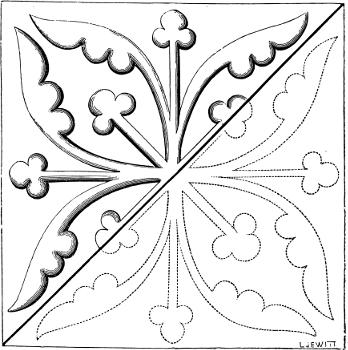
Fig. 121.
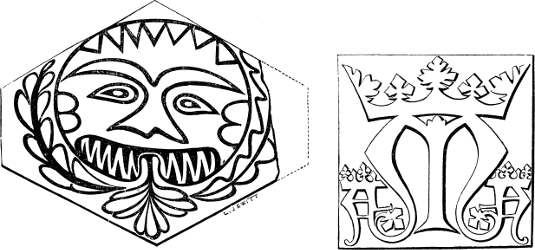
Figs. 122 and 123.
Vol. II.
Plate II.
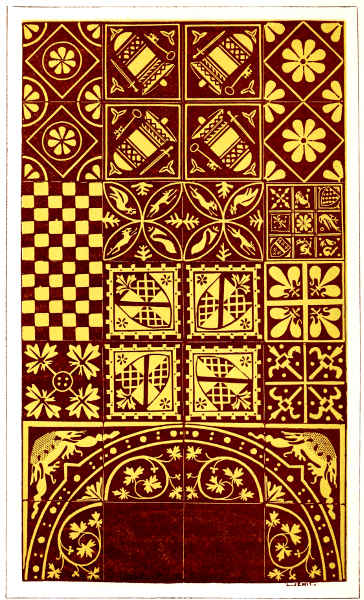
MEDIÆVAL PAVING TILES MADE AT REPTON.
Vol. II.
Plate III.
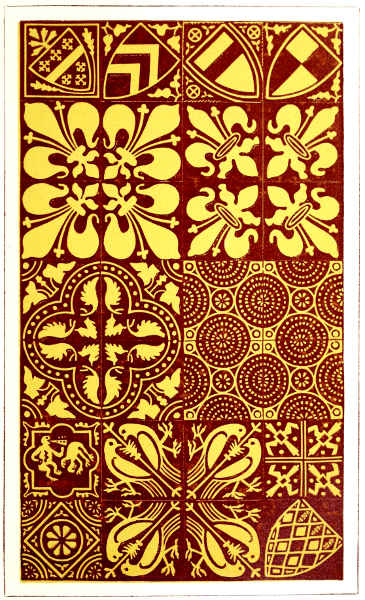
MEDIÆVAL PAVING TILES FOUND AT WIRKSWORTH.
Of the ordinary class of red and yellow tiles, a very large variety of patterns was found. These consisted of single, four, nine, and sixteen tile patterns of great beauty, and, in many cases, unusual intricacy; border tiles of strikingly beautiful design; heraldic tiles representing the armorial bearings of many local families of note, as well as those of the monarch, &c.; alphabet tiles, bearing the entire alphabet in Lombardic capitals; and grotesque, astronomical, and other devices. Some of these are represented on plates I. and II., and it is worthy of remark, as showing the extent to which this manufacture was carried by the monks at Repton, that tiles still existing in, or exhumed on the sites of, many of the old churches and religious houses of this and the adjoining counties, are identical with those discovered in this kiln, and are therefore proved to be of Repton make.
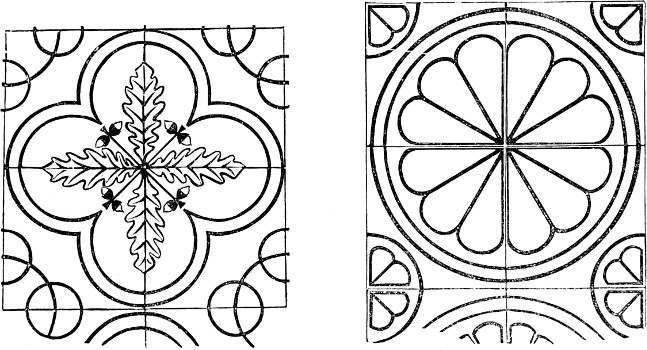
Figs. 124 and 125.
Another description (to which the same remark will also apply) of tiles found in this kiln is very peculiar. On these, the pattern, in sharp and tolerably fine lines, is simply indented, or incised, into the soft clay, and not filled in with “slip.” These, which for convenience I will call “incised tiles,” are of dark blue or black colour. Some of these patterns will be found in Figs. 124 and 125. Another very singular unique tile of this class is given of its full size on Fig. 122. It bears a head within a wreath, and is covered with green glaze. Another curious and unique tile, in which the simple device of four saltires within a square has been literally cut into the clay, not impressed, was also found.
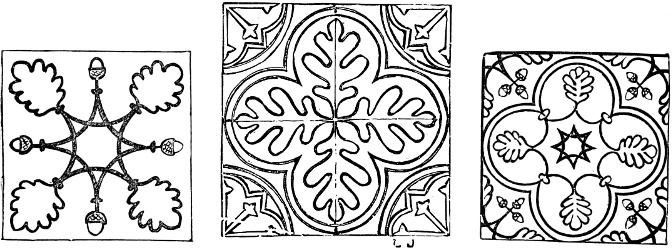
Figs. 126 to 128.
Having described the Repton kiln it will be well in the present chapter to give some few particulars of other remains of a like kind. In 1833, my late friend, Mr. H. Eginton, discovered a tile kiln on land formerly belonging to the Priory of Great Malvern. It consisted of two semicircular arches, strongly built, separated from each other by a thick and massive wall or pier. The length of the kiln was 35 feet, and the width of the openings 2 feet 3 inches. In each of the archways was a flooring of stone, about two feet from the ground, composed of three slabs in width; the centre one serving as a key-stone to the others, but more especially, in my opinion, so arranged as to allow the fumes of the charcoal to have proper access to the chamber where the tiles were placed. The place for the fire was on the ground, beneath this elevated flooring, and the earth from long action of the heat had become of extreme hardness, and had all the appearance of a thick pavement of limestone. There was no aperture for smoke, so that the process was literally that of the “smother kiln.” The arches were double, the outer being constructed of tiles, the inner of bricks, which from long action of the fire had become completely vitrified. The flooring on which the tiles were placed for burning was two inches in thickness, and at the time of the discovery a number of the tiles were found lying in their places as they did when the fire smouldered away beneath them four centuries before. The kiln was placed seven feet under ground—most probably to prevent injury to the structure from expansion by heat—and was firmly backed and bedded in with blocks of Malvern ragstone. The tiles found were identical with some of those now remaining in Great and Little Malvern churches. Another kiln was discovered in 1837, at St. Mary Witton, near Droitwich. It consisted of arched chambers similar to those at Malvern, and separated from each other in like manner by a strong intermediate central wall or pier. The arches were 2 feet 2 inches in height, 2 feet 4 inches in width, and of several feet in length, and were partly composed of tiles, partly of brick, and highly vitrified with the heat. In them, as at Malvern, a considerable quantity of charcoal was found. Other remains of kilns have been discovered in Wiltshire, in Sussex, and in Staffordshire, and in the latter county the family name of Telwright, or Tilewright, doubtless taking its origin from makers of tiles, is one of great antiquity.
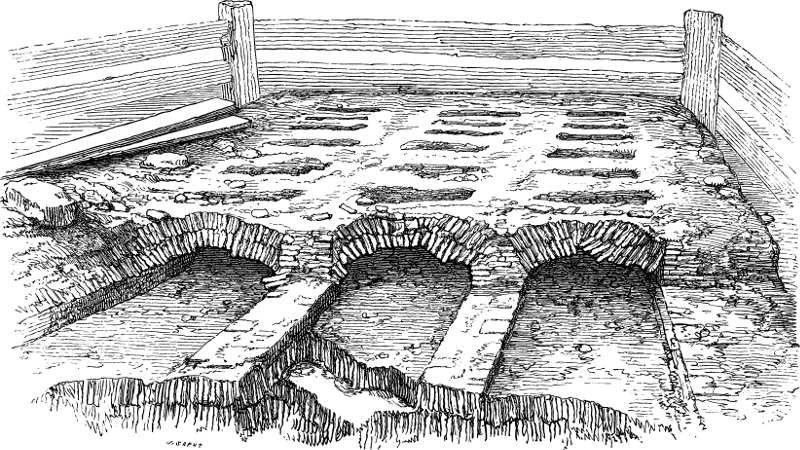
Fig. 129. Tile Kiln Discovered near Farringdon Road, London.
Another remarkably interesting kiln was discovered in London in the course of excavations in forming the Metropolitan Railway, close to the Farringdon Street Station. The kiln, which rests upon the natural bed of clay of the locality, was found about fourteen feet below the surface level of Turnmill Street, or the natural bank of the Fleet River. Over it was an immense accumulation of rubbish, doubtless caused by the Great Fire of London. An account of this kiln has been drawn up by my friend Mr. J. E. Price, to whom I am indebted for the view of the kiln engraved on Fig. 129. It was about 16 feet long and 10 feet wide, and consisted of three parallel arches, which averaged 2 feet wide by 1 foot high, separated from each other by a pier of about 1 foot in width. These arches constituted the furnaces, and supported a level floor, which was pierced, at equal distances, with a series of openings each 2 feet long by 5 inches wide. Through these the heat would rise from below for firing the tiles. On the spaces between the apertures the tiles were probably placed for burning. There were thirty of these openings remaining, though in some instances the intervening spaces had fallen away. The entire structure is composed of plain tiles, similar to those used for roofing purposes.
Little Chester.
A manufactory of coarse brown ware formerly existed at Little Chester near Derby. Fragments of various fictile vessels of much the same character as the Tickenhall dishes, and also of the same kind as the Chesterfield brown ware, have from time to time been found, as well as remains of a potter’s kiln. Nothing, however, is known regarding it.
Tickenhall.
A pottery existed at this place, as early, at all events, as the reign of Queen Elizabeth; probably much earlier. This is incontestably proved by remains which have from time to time been exhumed on the spot. There can, therefore, be no doubt that pottery has for more than three centuries been uninterruptedly made at this place. In 1650, Philip Kinder, in his collections towards a History of Derbyshire, preserved in the Bodleian Library, thus wrote:—“Numa Pompilius here might have learn’t his ‘Straine of Frugalities’! Here are your best Fictilias made you; earthern vessels, potts, and pancions, at Tycknall, and carried all East England through.” This is the earliest mention of Tickenhall pottery I have met with.
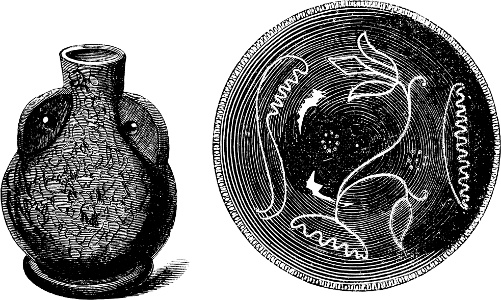
Figs. 130 and 131.
Pilkington (1789) says:—“Formerly a very large quantity of earthen ware was manufactured at this place; but lately the business has very much declined. It is said, that, since the land in the neighbourhood has been enclosed, it has been difficult to meet with proper clay.”
The ordinary coarse domestic vessels—“potts and pancions” as they are called by Kinder—were made, but beyond these there were many highly-decorated ones, with human heads for handles, &c.; some fragments of these are in the possession of Sir John Harpur Crewe, Bart., of Calke Abbey, to whom Tickenhall belongs. The ware was coarse, but very hard, the colour a dull brown, nearly black, in some instances with a yellow slip. Sometimes, however, it was of the ordinary red colour. A mediæval pitcher, or jug, in my own possession, which was dug up here in the course of draining operations on the site of the old works, has the body of deep red clay, very hard and compact, and its upper part is covered with a dark glaze; it has been much blistered in firing. In Sir John Crewe’s possession is a pilgrim’s bottle, found here, of the ordinary shape. It is shown on Fig. 130. He has also portions of two others, the most perfect fragment being nearly black, and the other of a reddish brown colour. Of these several other fragments have been found.
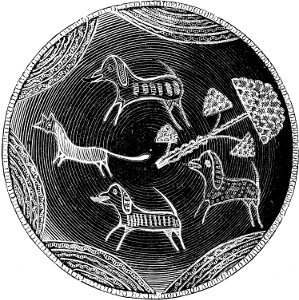
Fig. 132.
Two apparently well-authenticated examples of bowls, in the possession of Mr. W. Bemrose, jun., and formerly belonging to Mr. J. J. Briggs, are shown on Figs. 131 and 132. They are of the ordinary class of earthenware (like those of the Tofts, Taylors, &c.), of a dark brown or chocolate colour, well glazed, and ornamented with a white slip. The larger one bears a very rude representation of a fox-hunt—a fox and three dogs, and a tree. The smaller one bears a somewhat gracefully thrown lily, and other ornaments. Another example, in my own collection, is the candlestick engraved on Fig. 138. It is of precisely the same kind of ware, with white slip ornaments. The decoration of the base will be seen to bear a strong resemblance to the outer ornament of the large bowl.
Perhaps among the most interesting of existing examples are the fragments engraved on Figs. 133 to 136. These are in the possession of Sir John Crewe, Bart., and are undoubtedly authentic, having been dug up on the spot. They are heads formed of a buff clay and “touched” with a darker slip. Figs. 133 and 136 show the front and back of the principal of these fragments. The head-dress and ruff indicate the period to be at all events about the reign of Mary or Elizabeth. Fig. 134 bears the plaited cap of the same period. They are all engraved of the full size. It will be seen on reference to Figs. 137 and 139 that, in general character, these heads bear a marked resemblance to some which were found in 1854 on the site of a mediæval potwork on the North Cliff at Scarborough. Another vessel there found is engraved in vol. i., Fig. 299.
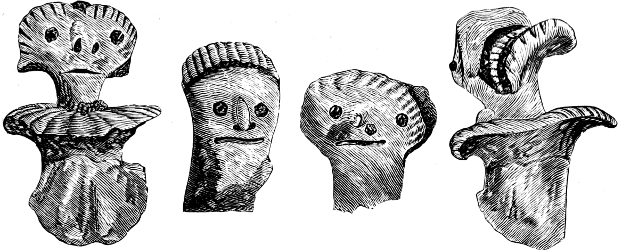
Figs. 133 to 136.
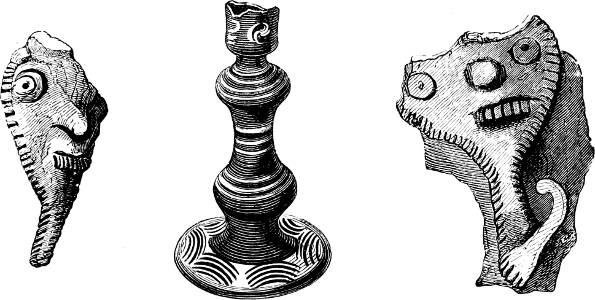
Figs. 137 to 139.
Kings Newton.
At this pleasant little village (so celebrated for its hall, now in ruins, where Charles I. passed a night, and as being the place from which the family of Hardinge, now represented by “Baron Hardinge, of Kings Newton,” takes its origin) one of the finest assemblages of examples of Anglo-Saxon Ceramic Art has been brought to light,[37] and here, in recent times, pottery of a good quality and excellent character has been made. The Anglo-Saxon urns[38] were, there can be no possible doubt, made from the same bed of clay from which the modern specimens have been produced, but it seems not to have been worked in intermediate times. About 1852 Mr. Henry Orton (brother to James Orton, author of “The Three Palaces,” “Excelsior,” &c., and himself a writer of no mean repute under the nom de plume of “Philo”), then of the Chauntry House, Kings Newton, considering the bed of clay at this place well adapted for useful and ornamental purposes, erected workshops, sheds, and kilns, and commenced the manufacture of garden-vases, chimney-tops, flower-boxes and pots, brackets, and a large variety of other articles. These he produced both in their natural colour and surface-painted and gilded, and many of them were of excellent design. From one of the beds of clay a fine red terra-cotta was produced, and from another a fine buff colour was made. Mr. Orton was so impressed with the importance of these beds for ceramic purposes, that he caused a number of domestic and ornamental articles to be made in the Staffordshire potteries from Kings Newton clay, and the results were highly satisfactory. Circumstances, however, occurred which prevented his plans being matured, and after a large expenditure of time and money on his part they were abandoned. The place is now carried on as a steam brick yard, and the clay is of so good and tenacious a quality that the maker stamps the name of KINGS NEWTON on each brick produced.
Of the articles made from this clay (which, being very few, are now of the utmost rarity), I possess examples. One of these is a butter-cooler, with perforated cover and twisted handles, formed of red unglazed clay of remarkably fine and compact character. Another is a pressed jug, with groups of relief flowers, in a chocolate-coloured clay; partly lined with white slip inside, and glazed in its natural colour. The other examples are a terra-cotta flower-vase and stand of fine light buff-coloured clay, and a two-handled goblet or drinking-cup, silver lustred, and of excellent quality. This is made of the brown, or chocolate, clay. The probability is that some day these clays may be turned to better account than that of making bricks for railway tunnels.
Burton-upon-Trent.
In 1794 a manufactory was established in the neighbourhood of Burton-on-Trent by Sir Nigel Gresley, Bart., of Drakelow, and C. B. Adderley, Esq., of Hams Hall (ancestor of the present statesman, the Right Honourable C. Adderley, M.P.), who died in 1826. In June, 1795, William Coffee, one of the modellers at the Derby china works, was engaged for these works. On page 98 I have given a copy of a letter relating to this engagement; and another letter, also in my possession, dated “Burton on Trent, June 4th, 1795,” says, “Sir,—My being your debtor makes it my duty to inform you immediately of my arrival here, and likewise of my engagement with Sir Nigel Gresley, and Mr. Adderley, lest you should suppose I had forgot the obligation I lie under to you,” etc. The works were, I have ascertained, situated “within fifty yards of Gresley Hall, near the village and castle of Gresley, in the county of Derby,” with also a place in Burton itself. From some cause or other the project did not answer the expectations of Sir. N. Gresley and Mr. Adderley, and about the year 1800 the works passed from them into the hands of Mr. William Nadin, the father of Mr. Joseph Nadin of Arthurlie, Burton-on-Trent. Mr. Nadin only carried on the manufactory for four or five years, when, it having proved a failure, he discontinued it, and was succeeded by Mr. Burton, of Linton, Derbyshire, who continued the works for a few years and then closed them.
During Mr. Nadin’s time the usual classes of ordinary Staffordshire wares were made, as also was china. In the latter, one great speciality was boots, shoes, and slippers, which were extensively produced, and variously ornamented. His now aged son, Mr. J. Nadin, wrote me, in reference to these, “My father made a large number of china boots and shoes, and I well remember when about six years old, walking up to my ankles into a pond of water in a pair of these boots (Wellington in shape).” He also tells me that when his father “had these works, he received an order for a magnificent dinner-service—the price was fixed at £700—for Queen Charlotte, through Colonel Desbrow, her Chamberlain, but he was never able to execute it, as the china always came out of the ovens cracked and crazed, though he employed the very best men he could obtain.” The Duke of Kent is said to have paid the works a visit, accompanied by Colonel Desbrow. No examples of the productions of these are, so far as my inquiries go, now known to be in existence.
About 1832 Mr. William Edwards, a solicitor, of Derby (brother-in-law of the second Mr. William Duesbury of the Derby china works), in conjunction with a Mr. Tunnicliffe, commenced an earthenware (yellow ware) manufactory at the Hay, Burton-on-Trent. Later on the manufacture of china or “artificial marble” was commenced; workmen having been brought from the Potteries and from Derby. The works, which were in High Street, only continued in operation for a very few years, and the productions were not marked. Mr. Edwards, in his ornamental ware, confined himself mainly to the production of figures, but they were, both commercially and artistically, complete failures. “Mr. Edwards’s artificial marble gods and goddesses, made at the Burton-on-Trent works, came out of the oven with their limbs twisted into every conceivable form.” On Mr. Edwards’s failure the works were closed, and he removed to Butt House, near Woodville, at that time known as Wooden Box. Mr. Edwards employed some really good workmen, amongst whom was a clever modeller named Wornell, who, besides, was an excellent stuffer of birds. Some good examples of Wornell’s work are in the possession of Mr. Abram Bass, by whom much of this information has kindly been supplied to me.
Swadlincote.
Swadlincote Potteries.—The works of Messrs. Sharpe, Brothers, and Co. were established, and erected, by the late Mr. Thomas Sharpe, in 1821, and were carried on by him, alone, as “Thomas Sharpe” until 1838, in which year he died. They were then continued by his brothers under the style of “Sharpe, Brothers, and Co.,” under which firm they are still carried on; the sole proprietor being the last surviving brother, Mr. Edmund Sharpe. The productions of the firm are the same as those of the general district, viz., the “Derbyshire Ironstone Cane (or Yellow) Ware” (a name by which this ware has for upwards of a century been known, and which is the speciality of the district); buff drab ware, fire-proof ware, Rockingham ware, mottled ware, and black lustre ware. In “Derbyshire Ironstone” plain and pressed jugs and mugs; bowls of various kinds; ewers and basins, tea-pots, cups, and jars of various kinds; beef, jelly, bread, stew, and other pans; and every description of household vessels are made, as they are also in the buff drab ware. In the Rockingham, mottled, and black lustre wares, tea and coffee pots in endless variety of patterns, “Bohemian,” “American,” “Rebecca,” “Shakspere,” “Fuchsia,” “Ivy,” “Chinese,” “Cottage,” “Mandarin,” “Royal Flute,” “Gipsy,” &c., &c.; pressed and plain jugs and mugs of good designs; and many other useful articles are made. Blue printed goods are also produced.
Among many ornamental specialities of these works may be named the “Toby Fill-pot” jugs, which are made in both coloured and Rockingham ware, on much the same model as the older jugs of that name; one is shown on Fig. 140.
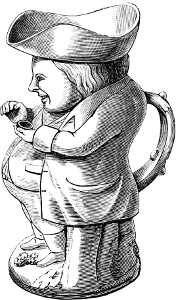
Fig. 140.
Sanitary earthenware is a great speciality of these works, and is produced in cane-colour, white, and blue printed varieties, as well as, occasionally, of a highly decorative character. In these, plug-basins, closet-basins with Sharpe’s Patent Direct Action, requiring no fans, but acting on the principle of a hollow rim with graduated perforations; traps, cabinet wash-hand stands of excellent and convenient construction, and other articles, are extensively made. Besides the Home trade, Messrs. Sharpe export in large quantities to Canada, the United States, Nova Scotia, South Africa, New Zealand, India, Australia, Africa, the Sandwich Islands, Germany, Holland, Russia, Prussia, Hungary, &c.
The mark used by Mr. Thomas Sharpe was simply the name Thomas Sharpe, or T. Sharpe, impressed in the ware. That of the present firm is the monogram S. B. and Co. within a wreath of oak and ivy, and the words Sharpe’s Patent, as here engraved.
SHARPES PATENT SB
Fig. 141.
Swadlincote Pottery.—These works were established in 1790 by the late Mr. John Hunt, of Swadlincote, and were, after his death, continued by Mr. Thomas Woodward, whose son, Mr. James Woodward, is their present proprietor. They were at first small, but being the first of the kind in the place soon got into repute, and fire bricks were constantly being fetched by cart to Leicester, Derby, Wirksworth, &c. Fire bricks, fire clay, for Sheffield steel works crucibles, and iron furnaces, were the sole productions till 1859, when the manufacture of sewage pipes, terra-cotta chimney-pots, vases, &c., was added, and since then marble, white, and cane-coloured sanitary earthenware has been introduced, and is largely made. In this department lavatory and closet fittings of every variety are produced. Some of the constructions are peculiar to these works, and are—especially the patent “Wash-out” arrangement,—in high repute. Majolica and Rockingham ware are also largely made. The mark adopted by Mr. Woodward is “the anchor, with a portion of cable twisted round it, forming a monogram of J. W.,” as engraved on Fig. 142.
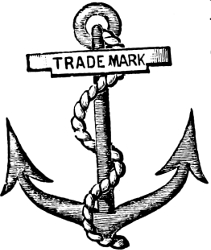
TRADE MARK
Fig. 142.
Swadlincote Mills.—Established by Moses Cartwright about 1837, but now carried on by Mr. Edward Grice, who produces all the usual sanitary and terra-cotta goods of the district.
Waterloo Pottery.—This pottery was established by Messrs. Robinson and Rowley in 1815, and has been successively worked since their time by Mr. Robinson alone, Mr. James Staley, and Messrs. Staley Brothers. From these last the works passed in 1875 to Messrs. Mason and Adcock, the present proprietors. They produce, extensively, all the usual descriptions of Derbyshire cane ware, yellow ironstone, and buff, Rockingham, and mottled wares. No mark is used.
Old Midway Pottery.—Established many years ago by a Mr. Granger, these works passed from him to Mr. Richard Staley, sen., and they are now carried on by Messrs. Richard Staley, John Staley, and John Brookes, under the style of “Richard Staley and Sons.” The operations of the firm are confined to Derbyshire fire-proof cane ware, Rockingham ware, and buff ware; and in these they produce all the usual domestic and other articles. The mark is the name, with the word “Fireproof” added upon dishes, &c.
Church Gresley.
Church Gresley Pottery.—These works were originally built about the year 1790, by a Mr. Leedham, for the purpose of manufacturing coarse ware wash-pans. About 1816 Mr. W. Bourne bought the works, enlarged them, and commenced the manufacture of Derbyshire ironstone cane ware, which has been made here ever since. Since Mr. Bourne’s time the works have been carried on successively by Mr. Edwards (see Burton-on-Trent), Messrs. Shaw and Harrison, and Mr. Henry Wileman, at whose decease in 1864 they were taken by Mr. T. G. Green, the present proprietor.
Cane-coloured ironstone, Rockingham, mottled, black lustre, buff, and other wares are made; and at an adjoining manufactory, built by Mr. Green in 1871, ordinary earthenware, painted, lined, sponged, and cream colour, and other wares are made in all the usual services and domestic articles. Mr. Green has taken out patents for a process of moulding earthenware, and for a bat-making machine.
Commonside Pottery.—These works are of old establishment. At first the commonest description of earthenware was made, and afterwards Mr. Edward Grice carried them on for the manufacture of sanitary goods and chimney-pots. From him they passed, in 1873, into the hands of Messrs. Mason, Gough, and Till. In 1874 Mr. Mason left the firm, and the style since then has been “Till and Gough.” Yellow, Rockingham, and buff wares are made of the usual quality, and in the same general variety of articles, as in the other Derbyshire potteries. No mark is used.
Commonside Works.—Mr. Edward Grice, who, after leaving the above, established these works in 1867, manufactures sanitary and terra-cotta goods of various kinds.
Hill Top Works.—These were established in 1810, by Mr. John Cooper, who was afterwards joined in partnership by Mr. Massey, and afterwards by Mr. Banks, the firms being successively “John Cooper,” “Cooper and Massey,” and “Cooper and Banks.” They next belonged to Mr. Henry Ansell. The sole proprietor now is Mr. Nehemiah Banks. The wares produced are the ordinary “Derbyshire Ironstone Cane Ware,” buff ware, Rockingham ware, and black lustre ware. In these all the usual household articles are produced in large quantities for home and foreign markets. Horticultural ware is also largely made; the garden, sea-kale, and other pots, and seed-pans, &c., being of superior quality.
Hillside Works.—These are devoted to the manufacture of fire-clay goods.
Other manufactories in the district are Mr. R. Quinton’s brown ware and stone-bottle works; Mr. E. Jones’s pancheon and flower-pot works, and the works of Mr. W. Cotterell.
About 1846, Mr William Edwards, formerly of Derby, and later of Burton-on-Trent, commenced a yellow-ware manufactory at Ashby Holes, Gresley Common, which he carried on for a few years. (See Burton-on-Trent.)
Woodville, or Wooden Box, Hartshorne, Gresley, &c.
Woodville, the modern and more euphonious name given to the village of “Wooden Box,” is five and a half miles from Burton-on-Trent. The original name arose from an old wooden “box,” or hut, which formerly stood on the site of the present toll-house, where a man used to sit to collect toll, but which was afterwards burned down. The original “box,” it may be added, was an old port-wine butt, from Drakelow Hall, and in this the collector, Diogenes-like, spent his days. In 1800 only two houses existed here, the “Butt House,” belonging to the then Earl Ferrars and the residence of his son Lord Tamworth, and a farmhouse. On this farm some valuable beds of clay were found to exist, and a Mr. Peake, from the Staffordshire pottery district, established a small manufactory on the spot. From this manufactory the trade of the district has entirely taken its rise, and it is now noted for extensive manufactories of Derbyshire ironstone ware; cane-coloured, Rockingham, black, buff, and brown wares; sanitary goods, terra-cotta, &c. Its inhabitants are principally potters and colliers, and it has risen to the importance of being a parish of itself—part of the parish of Hartshorne, in Derbyshire, and of Ashby-de-la-Zouch, in Leicestershire, being taken for the purpose—the main, or High, street separating those two counties. Near Woodville is the modern hamlet of Albert village, and it has a branch-line on the Midland Railway.
The Hartshorne Potteries were established in 1818 by Mr. Joseph Thompson, the father of the present proprietors, Richard and Willoughby Thompson, who now trade under the style of “Thompson Brothers.” The goods made by this firm are Derbyshire ironstone-ware, brown stoneware, cane ironstone ware, buff stoneware, yellow ironstone ware (enamelled white inside), and black and Rockingham wares, and terra-cotta goods. Sanitary and drain-pipes, flooring and other tiles, fire-bricks and building bricks, &c., are also produced. The former mark of this pottery was—
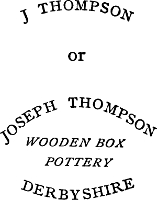
J THOMPSON
or
JOSEPH THOMPSON WOODEN BOX POTTERY DERBYSHIRE
Hartshorne Pottery.—These works were established about 1790 by James Onions, who was succeeded by Luke Copeland. The works were next carried on by Messrs. Read, Malkin and Co., and afterwards by Read and Malkin only, and next by G. S. Read alone, who continued proprietor for thirty or forty years. Mr. Read died in January, 1860, and in March of the same year the concern passed into the hands of its present owner, Mr. J. B. Rowley. The goods produced are “Derbyshire Ironstone” or cane-coloured ware, Rockingham ware, Mottled ware, Buff ware, and Black Lustre ware of the usual quality and character. In these, bowls of various kinds, jugs of all descriptions, jars, dishes, tea and coffee-pots, mugs, and almost every article for domestic use, are extensively made.
Woodville Tile Works.—At these works, established by Messrs. Barry and Co., sanitary goods and geometric and other tiles are made. The tiles are “encaustic, mosaic, geometrical, and white-glazed tiles for baths, &c.,” of average quality. In terra-cotta, vases, chimney-tops, and other ornamental goods are produced, as are also fire-backs for stoves, &c.
Woodville Pottery.—This manufactory was established in 1833 (in which year it was built) by Messrs. Thomas Hall and William Davenport, both of whom are now deceased. In 1858 the works passed into the hands of Messrs. Thomas Betteridge and Thomas Nadin. In 1863 Mr. Nadin retired from the concern, which, from that time to the present, has been carried on solely by Mr. Thomas Betteridge. The goods produced are the usual classes of Derbyshire cane-coloured ironstone, Rockingham, mottled, and buff wares of the district. In these all the ordinary articles—jugs, tea and coffee-pots, dishes and bowls, jars, and other domestic vessels—are made in considerable quantities. The quality is that of the entire district.
Albion Works.—The Albion Fire Clay Works, established by the present proprietors, Messrs. Hosea Tugby & Co., produce all the usual fire-clay goods, bricks, tiles, &c. The firm have patented a “continuous direct action kiln.”
Woodville Potteries.—These works were established about 1810 by the late Mr. Watts, who was joined in partnership by his relative, Mr. Cash, and it has remained in the same family to the present day. The present proprietors are Mr. William Cash and his son Mr. Thomas Cash, who still trade under the style of “Watts and Cash.” The productions of this pottery are the Derbyshire “ironstone” or “yellow” ware, buff-coloured ware, Rockingham ware, &c., of the ordinary qualities, in which all the usual varieties of domestic vessels, services, &c., are largely manufactured, principally for the American and other foreign markets. The local clay from which these goods are produced “is peculiar to this district, and is not found precisely the same anywhere else;” it was not brought into use for ceramic purposes until the establishment of these works.
The Rawdon Pottery was built by the fourth Marquess of Hastings, on whose estate it was situate, and was first worked by John Hall, who was succeeded, on his failure, by John Brunt, who carried it on until his death. He was succeeded by his son, Mr. Thomas Brunt, who, however, did not succeed in the business, and in 1861 the works passed into the hands of the present proprietors, Messrs. Smith, Dooley, and Co. The goods produced are the usual varieties of articles in “Derbyshire Ironstone,” or cane-coloured ware, Rockingham ware, buff ware, and cream-coloured ware.
The “Pool Works” for terra-cotta fire-bricks and sanitary tubes, at Woodville, near Burton-on-Trent, were established about the year 1830, by the late Mr. Joseph Walker Bourne, yellow earthenware manufacturer, of Church Gresley, who purchased the property of the late Sir Roger Gresley, Bart., of Drakelow Hall, Derbyshire, and established the works for the manufacture, on a small scale, of fire-bricks for his earthenware manufactory. After the death of Mr. Bourne, in 1840, the present proprietor, Mr. Edward Ensor, then of Lyme Regis, Dorsetshire, purchased the business, and the year following sent his second son, Henry Loader Ensor, at the age of fourteen years, to learn, and eventually manage, the business. At that time the works consisted of a 4-horse power condensing engine to grind and prepare the fire-clay; two small hovels or sheds, and two small brick-kilns, covering an extent of 4,000 yards, the whole make not exceeding 20,000 bricks per week, and only seven men and six boys being employed. The market for the bricks was the local earthenware manufactories and collieries, and a few towns in the immediate neighbourhood; the bricks being carted to the Ashby and Burton Canals. About that time, the clay being found suitable for making crucibles for steel refiners at Sheffield, their manufacture was introduced into that market, and has gradually grown into a very important branch of the trade of the district. In 1845 Mr. Ensor, senr., came to live in his present residence, Gresley Cottage, and took the active management of the business. In 1846 the Midland Railway opened the line from Burton to Leicester, with branches to Woodville and Swadlincote, thus opening up a means of cheaper transit for the valuable productions of the neighbourhood. From this time the different manufactories and collieries greatly increased, and other branches of the trade were started, such as salt-glazed sanitary pipes and terra-cotta chimney-tops, &c. About 1850 Mr. Ensor purchased the Pool property from Mr. Mammatt, and soon after this his eldest son, Edward, having returned from South Africa, took part in the management of the business. In 1864, Mr. Ensor having seen the Hoffman Patent Brick Kiln at Wakefield, and being struck with the saving of fuel effected in burning common bricks, purchased the right of the sole use of the patent in this district, and erected kilns, drying-sheds, &c., intending to burn all his goods by this system, but found it essential to introduce many improvements and alterations, as the Hoffman system, although well adapted for common red bricks (which require little heat), was not adapted to fire-brick and terra-cotta, which requires very great heat. Mr. Ensor succeeded in inventing a process by which he retained the heat so effectively that 3 cwt. of small coal more successfully burnt 1,000 bricks than 20 cwt. of good rough coal did in the most approved old-fashioned kilns. At this time, i.e. in 1865, the works consisted of four high-pressure engines for grinding and preparing the clay for the different branches of the manufactory. The machinery for grinding the fire-clay was two pairs of iron rollers and pug mill; that for the terra-cotta clay was different, and consisted of edge runners of great weight revolving in an iron pan, to reduce the clay into a fine powder before passing through sieves and the pug mill. At this time Carr’s “Patent Disintegrator,” for mixing and reducing manures, &c., was seen by Mr. Ensor, to whom it occurred it might be adapted to this process, and he erected one, adding to it many improvements, and eventually so constructed it that it is now the most valuable clay reducer ever used. The machine is circular, made of iron, and consists of four rows of bars, each running in opposite directions at the speed of 400 revolutions per minute; the clay being put in the centre, is forced out through the bars, thus reducing it into the finest powder, and pulverising from 50 to 150 tons in a day of 10 hours, according to the texture of the clay. About 1868, through an itinerant firebrand causing a strike amongst the colliers of the district, and thus almost stopping the different trades of the district through want of coal, and its consequent high price, experiments were tried by Edward Ensor, jun., who ultimately patented “a process for an improved system of burning all kinds of earthenware, salt-glazed, sanitary, and terra-cotta goods, fire, blue, and common bricks, tiles, &c., lime, and other commodities.” A kiln on this principle was erected, and has been a perfect success, and is still in use at these works for burning salt-glazed sanitary goods, and at several other manufactories for bricks, in each case effecting a saving of 75 per cent. in fuel and in labour. The works at the present time occupy an area of 40,000 yards, and employ about 290 persons. Another patent adopted at these works is the “Patent Wire Rope Tramway” for conveying any material any distance up to one mile over hilly or broken ground; which has been so improved as to be made to drain the pits of water by pumping, hoisting the clay out of the pits from a depth of about 20 yards to the surface, and conveying it to the machinery for making up into bricks, and to the railway for conveyance to the different steel-melting districts. The fire-bricks made here are sent to every quarter of the globe, being largely used by Government on colonial military stations in the erection of cooking-ranges, ovens, and boilers; and for sugar refineries in China and the East, as well as for glass, earthenware, gas, iron and steel works in our own country. Fire-place backs are also extensively made. The salt-glazed sanitary goods are of excellent and durable quality, and, being highly vitrified in the body, are capable of withstanding the action of the acids in sewage, &c. In terra-cotta, the only art-branch carried on at the Pool Works, vases, tazzas, pedestals, brackets, trusses, and ornamental bricks are produced, many of which are of very good design; the colour is a light stone.