THE CAMBRIDGE, ELY, AND KING'S LYNN ROAD (continued 5)
Reading edition
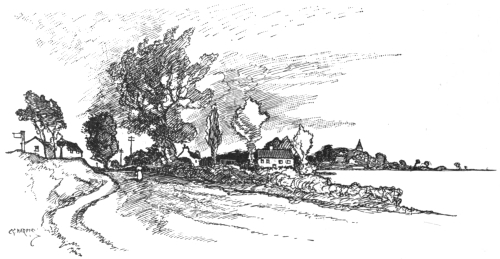
SOUTHERY FERRY.
No local patriot he. He was born here, married in the old church forty years ago, and went away to live in Sheffield. "Ah! that is a place," says he. That is a phrase capable of more than one interpretation, and we feelingly remark, having been there, that indeed a place it is. His regretful admiration of Sheffield is so mournful that we wonder why he ever left.
The road between Southery and Hilgay dips but slightly and only for a short distance, proving the accuracy, at this point at least, of Dugdale's map showing the Fen-islands of Hilgay and Southery conjoined. They are divided by the long, straight, and narrow cut called "Sam's Cut Drain," crossed here at Modney Bridge. Here the true Fenland begins only to be skirted, and hedgerows once more line the way, a sign that of itself most certainly proclaims fields enclosed and cultivated in the long ago. The ditches, too, are dry, and not the brimming water-courses they have been these last twenty-five miles. Moreover, here is hedgerow timber: ancient elms and oaks taking the place of the willows and poplars that have been our only companions throughout a whole county. They have not consciously been missed, but now they are come again, how fresh and dear and welcome they are, and how notable the change they produce!
Between Hilgay and that old farmhouse called "Snore Hall," from an absurd tradition that King Charles once slept there, we cross the river Wissey and the Catchwater Drain. The road between is still known as "the Causeway," and, with the succeeding village of Fordham, teaches in its name a lesson in old-time local geography.
In 1809, when that old tourist, William Gilpin, passed this way, Hilgay Fen extended to one thousand acres. According to the picturesque story told him, the district was periodically visited, every six or seven years, by an innumerable host of field-mice, which began to destroy all vegetation and would have laid everything bare but for a great flight of white horned-owls that, as if by instinct, always arrived at such times from Norway and, immediately attacking the mice, destroyed them all, when they disappeared as suddenly as they had come.
XLV
Ryston Station, between Ryston Park and Fordham, marks the neighbourhood of a very interesting spot, for Ryston, though a place of the smallest size and really but a woodland hamlet, is of some historic note, with "Kett's Oak," or the Oak of Reformation, standing in the Park, as a visible point of contact with stirring deeds and ancient times. It is a gigantic tree with hollow trunk and limbs carefully chained and bound together, and marks one of the encampments of the Norfolk peasantry in Kett's Rebellion of 1549. This was a popular outbreak caused by the lawless action of the Norfolk gentry of that time in enclosing wastes and common lands. "The peasant whose pigs and cow and poultry had been sold, or had died because the commons where they had once fed were gone; the yeoman dispossessed of his farm; the farm-servant out of employ because where once ten ploughs had turned the soil, one shepherd watched the grazing of the flocks; the artisan smarting under the famine prices the change of culture had brought—all these were united in suffering, while the gentlemen were doubling, trebling, quadrupling their incomes, and adorning their persons and their houses with splendour hitherto unknown."
The outbreak began at Attleborough in June 1549, and a fortnight later there was fighting at Wymondham, where the country-folk, led by Robert Kett, a tanner, of that place, destroyed many illegal fences. Thence, headed by Kett and his brother William, an army of sixteen thousand peasants marched to Mousehold Heath, overlooking Norwich, where their greatest camp was pitched. Under some venerable tree in these camps Robert Kett was wont to sit and administer justice, and Conyers, chaplain to the rebel host, preached beneath their shade while the rising of that memorable summer lasted. Never were the demands of rebellion more reasonable than those put forward on this occasion. They were, that all bondsmen should be made free, "for God made all free with His precious bloodshedding"; that all rivers should be made free and common to all men for fishing and passage; that the clergy should be resident, instead of benefices being held by absentees; and, in the interest of tenants' crops, that no one under a certain degree should keep rabbits unless they were paled in, and that no new dove-houses should be allowed. That last stipulation sounds mysterious, but it referred to a very cruel grievance of olden times, when only the Lord of the Manor might keep pigeons and doves, and did so at the expense of his tenants. The manorial pigeon-houses often seen adjoining ancient Hall or old-world Grange are, in fact, relics of that time when the feudal landowner's pigeons fattened on the peasants' crops.
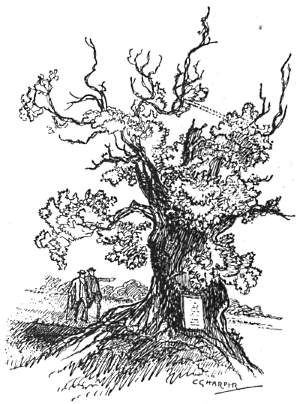
KETT'S OAK.
The story of how the people's petition was disregarded, and how the city of Norwich was taken and retaken with much bloodshed, does not belong here. The rebellion was suppressed, and Robert and William Kett hanged, but the memory of these things still lingers in the rural districts, and everyone in the neighbourhood of Ryston knows "Ked's Oak," as they name it. There were Pratts of Ryston Hall then, as now, and old legends still tell how Robert Kett seized some of the Squire's sheep to feed his followers, leaving this rhymed note in acknowledgment—
"Mr. Prat, your shepe are verry fat, And wee thank you for that. Wee have left you the skinnes To buy your ladye pinnes And you may thank us for that."
Some of the insurgents were hanged from this very tree, as the rhyme tells us—
"Surely the tree that nine men did twist on Must be the old oak now at Ryston."
The present Squire has recorded these things on a stone placed against the trunk of this venerable relic.
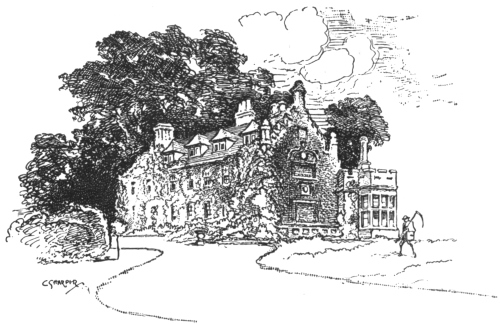
DENVER HALL.
Denver, which presently succeeds Fordham and Ryston, is remarkable for many things. Firstly, for that beautiful old Tudor mansion, Denver Hall, by the wayside, on entering the village; secondly, for the semicircular sweep of the high road around the church; and, thirdly, for the great "Denver Sluice" on the river Ouse, a mile away. This is the massive lock that at high tide shuts out the tidal waters from flooding the reclaimed Fens, and at the ebb is opened to let out the accumulated waters of the Ouse and the innumerable drains of the Great Level. The failure of Denver Sluice would spell disaster and ruin to many, and it has for that reason been specially protected by troops on several occasions when Irish political agitators have entered upon "physical force" campaigns, and have been credited with a desire to blow up this main protection of two thousand square miles of land slowly and painfully won back from bog and waste.
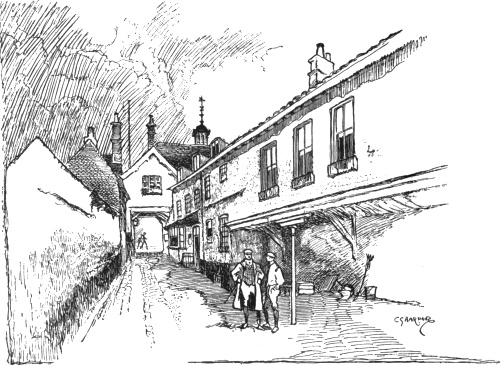
THE CROWN, DOWNHAM MARKET.
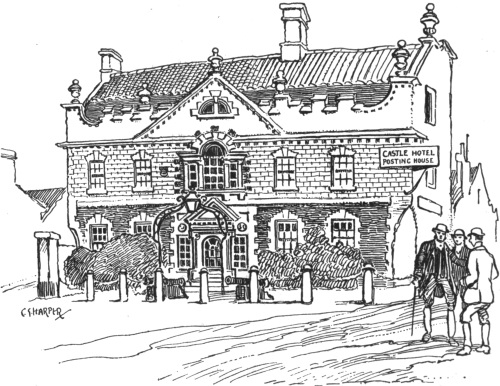
THE CASTLE, DOWNHAM MARKET.
Denver gives its name to a town in America—Denver, Colorado—and has had several distinguished natives; but, despite all these many and varied attributes of greatness, it is a very small and very modest place, quite overshadowed by the little town of Downham Market, a mile onward. Downham, as Camden informs us, obtains its name from "Dun" and "ham," signifying the home on the hill; and the ancient parish church, which may be taken as standing on the site of the original settlement, does indeed rise from a knoll that, although of no intrinsic height, commands a vast and impressive view over illimitable miles of marshland. It is not a church of great interest, nor does the little town offer many attractions, although by no means unpleasing.
They still point out the house where Nelson once went to school; and two old inns remain, very much as they were in coaching days. In the Crown yard you may still look up at the windows of the room where the magistrates were sitting on that day in 1816 when the rioters made them fly.
Villages on these last twelve miles between Downham and Lynn are plentiful. No sooner is the little town left behind than the church of Wimbotsham comes in sight, with that of Stow Bardolph plainly visible ahead. Both are interesting old buildings, with something of almost every period of architecture to show the curious. Beyond its church, and a farmstead or two, Wimbotsham has nothing along the road, but Stow Bardolph is a village complete in every story-book particular. Here is the church, and here, beneath a spreading chestnut (or other) tree the village smithy stands; while opposite are the gates of the Park and the shady avenue leading up to the Hall where, not Bardolphs nowadays, but Hares, reside in dignified ease; as may be guessed from the village inn, the Hare Arms, with its armorial sign and motto, Non videre, sed esse—"not to seem, but to be," the proud boast or noble aspiration of the family. Almshouses, cottages with pretty gardens, and a very wealth of noble trees complete the picture of "Stow," as the country-folk solely know it, turning a bewildered and stupid gaze upon the stranger who uses the longer title.
The pilgrim through many miles of fen revels in this wooded mile from Stow Bardolph village to Hogge's Bridge, where the road makes a sharp bend to the left amid densely overarching trees, commanding a distant view of Stow Bardolph Hall at the farther end of a long green drive. South Runcton Church, standing lonely by the road beyond this pretty scene, is an example of how not to restore a pure Norman building. It still keeps a very beautiful Norman chancel arch, but the exterior, plastered to resemble stone, is distressing.
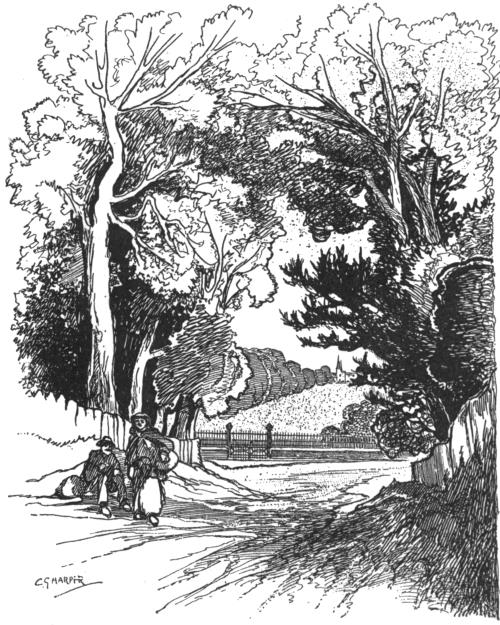
HOGGE'S BRIDGE, STOW BARDOLPH.
At Setchey, originally situated on a navigable creek of the river Nar and then named Sedge-hithe, or Seech-hithe—meaning a sedge and weed-choked harbour—we are come well within the old Dutch circle of influence over local building design. There are still some characteristic old Dutch houses at Downham; and Lynn, of course, being of old a port in closest touch with Holland, is full of queer gables and quaint architectural details brought over from the Low Countries. Here at Setchey, too, stands a very Dutch-like old inn—the Lynn Arms.
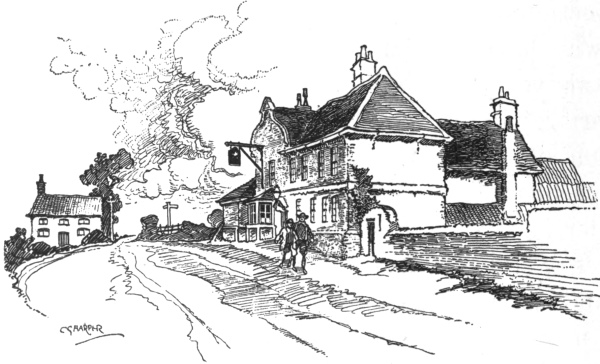
THE LYNN ARMS, SETCHEY.
Commons—"Whin Commons" in the local phrase—and the scattered houses of West Winch, lead on to Hardwick Bridge, where, crossing over the railway, the broad road bends to the right. There, facing you, is an ancient Gothic battlemented gatehouse, and beyond it the long broad street of a populous town: the town of King's Lynn.
XLVI
There is a tintinnabulary, jingling sound in the name of Lynn that predisposes one to like the place, whether it be actually likeable or not. Has anyone ever stopped to consider how nearly like the name of this old seaport is to that of London? Possibly the conjunction of London and Lynn has not occurred to any who have visited the town, but to those who have arrived at it by the pages of this book, the similarity will be interesting. The names of both London and Lynn, then, derive from the geographical peculiarities of their sites, in many respects singularly alike. Both stand beside the lower reaches of a river, presently to empty itself into the sea, and the ground on which they stand has always been marshy. At one period, indeed, those were not merely marshes where Lynn and London now stand, but wide-spreading lakes—fed by the lazy overflowings of Ouse and Thames. The Celtic British, who originally settled by these lakes, called them llyns, and this ancient seaport has preserved that prehistoric title in its original purity, only dropping the superfluous "l"; but London's present name somewhat disguises its first style of Llyn dun, or the "hill by the lake"; some inconsiderable, but fortified, hillock rising above the shallow waters.
When the Saxons came, Lynn was here, and when the Norman conquerors reached the Norfolk coast they found it a busy port. To that early Norman prelate, Herbert de Losinga, a tireless builder of churches throughout East Anglia, the manor fell, and the town consequently became known for four hundred and thirty years as Lynn Episcopi. It was only when the general confiscation of religious property took place under Henry the Eighth that it became the "Kings Lynn" it has ever since remained.
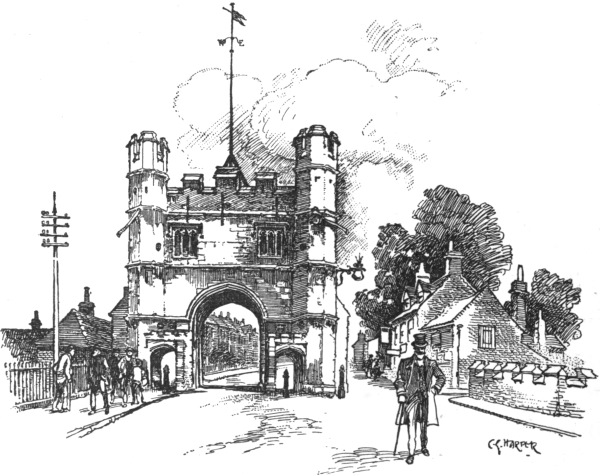
THE SOUTH GATES, LYNN.
To the "average man," Lynn is well known. Although he has never journeyed to it, he knows this ancient seaport well; not as a port or as a town at all, but only as a name. The name of Lynn, in short, is rooted in his memory ever since he read Hood's poem, the "Dream of Eugene Aram."
Aram was no mere creation of a poet's brain, but a very real person. His story is a tragic one, and appealed not only to Hood, but to Bulwer Lytton, who weaved much romance out of his career. Aram was born in 1704, in Yorkshire, and adopted the profession of a schoolmaster. It was at Knaresborough, in 1745, that the events happened that made him a wanderer, and finally brought him to the scaffold.
How a scholar, a cultured man of Aram's remarkable attainments (for he was a philologist and student of the Celtic and Aryan languages) could have stooped to commit a vulgar murder is not easily to be explained, and it has not been definitely ascertained how far the motive of revenge, or in what degree that of robbery, prompted him to join with his accomplice, Houseman, in slaying Daniel Clarke. The unfortunate Clarke had been too intimate a friend of Aram's wife, and this may explain his share in the murder, although it does not account for Houseman's part in it. Clarke was not certainly known to have been murdered when he suddenly disappeared in 1745, and when Aram himself left Knaresborough, although there may have been suspicions, he was not followed up. It was only when some human bones were found in 1758 at Knaresborough that Houseman himself was suspected. His peculiar manner when they were found, and his assertions that they "could not be Dan Clarke's" because Dan Clarke's were somewhere else, of course led to his arrest. And, as a matter of fact, they were not Clarke's, as Houseman's confession under arrest sufficiently proved.
Whose they were does not appear. He told how he and Aram had killed that long-missing man and had buried his body in St. Robert's Cave; and, on the floor of that place being dug up, a skeleton was in due course discovered.
Aram was traced to King's Lynn and arrested. Tried at York, he defended himself with extraordinary ability, but in vain, and was sentenced to death. Before his execution at York he confessed his part, and so to this sombre story we are at least spared the addition of a mystery and doubt of the justice of his sentence.
Hood's poem makes Aram, conscience-struck, declare his crime to one of his Lynn pupils, in the form of a horrible dream. How does it begin, that ghastly poem? Pleasantly enough—
"'Twas in the prime of summer time, An evening calm and cool; And four-and-twenty happy boys Came bounding out of school."
The Grammar School of those young bounders was pulled down and rebuilt many years ago, and so much of association lost.
"Pleasantly shone the setting sun Over the town of Lynn,"
but Eugene Aram, the Usher, on this particular evening,
"Sat remote from all, A melancholy man."
Presently, Hood tells us, he espied, apart from the romping boys, one who sat and "pored upon a book." This morbid youngster was reading the "Death of Abel," and Aram improved the occasion, and "talked with him of Cain." With such facilities for entering intimately into Cain's feelings of blood-guiltiness, he conjured up so many terrors that, if we read the trend of Hood's verses correctly, the boy thought there was more in this than the recital of some particularly vivid nightmare, and informed the authorities, with the well-known result—
"Two stern-faced men set out from Lynn, Through the cold and heavy mist, And Eugene Aram walked between, With gyves upon his wrist."
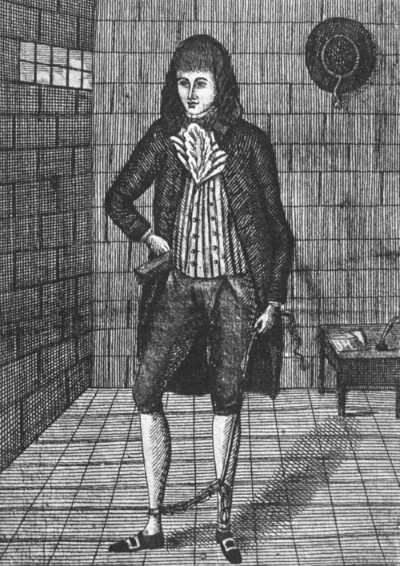
JOSEPH BEETON IN THE CONDEMNED CELL.
Twenty-five years later, Lynn turned off a local criminal on its own account, Joseph Beeton being executed, February 22, 1783, on the spot where a few weeks previously he had robbed the North Mail, on what is called the "Saddlebow Road." This spot, now commonplace enough, was long marked by a clump of trees known as "Beeton's Bush." An old engraving shows poor Joseph in the condemned hold, and represents him of an elegant slimness, heavily shackled and wearing what, under the circumstances, must be described as an extraordinarily cheerful expression of countenance. A contemporary account of his execution makes interesting, if gruesome, reading—
"The culprit was conveyed from Lynn Gaol in a mourning coach to the place of execution near the South Gates, and within a few yards of the spot where the robbery took place, attended by two clergymen:—the Rev. Mr. Horsfall and the Rev. Mr. Merrist. After praying some time with great fervency, and a hymn being sung by the singers from St. Margaret's Church, the rope was fixed about his neck, which was no sooner done than he instantly threw himself off and died amidst the pitying tears of upwards of 5000 spectators. His behaviour was devout and excellent. This unfortunate youth had just attained his 20th year, and is said to have been a martyr to the villainy of a man whom he looked upon as his sincere friend. Indeed, so sensible were the gentlemen of Lynn that he was betrayed into the commission of the atrocious crime for which he suffered by the villainy of this supposed friend, that a subscription was entered into and money collected to employ counsel to plead for him at his trial."
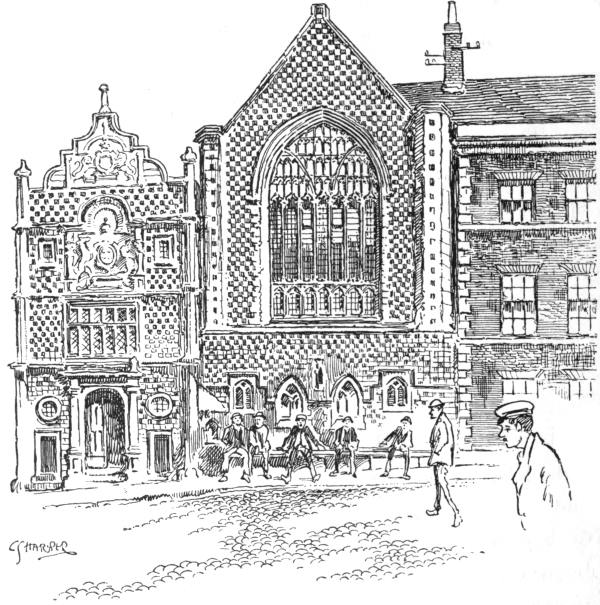
THE GUILDHALL, LYNN.
The barbarous method of execution in those days placed the condemned in the dreadful alternative of slow strangulation, or what was practically suicide. To save themselves from the lingering agonies of strangulation, those who were possessed of the slightest spirit flung themselves from the ladder and so ended, swiftly and mercifully.
The old account of Beeton's execution ends curiously like a depraved kind of humour: "The spirit of the prisoner, the constancy of his friends, and the church-parade made bright episodes in a dreadful scene."
XLVII
It is a long, long way from the entrance through the South Gates, on the London road, into the midst of the town, where, by the Ouse side, along the wharves of the harbour, and in the maze of narrow streets between the Tuesday and the Saturday market-places, old Lynn chiefly lies. In the Tuesday market-place, Losinga's great church of St. Margaret stands; that church whose twin towers are prominent in all views of the town. Many of the old merchants and tradesmen lie there, but many more in the vast church of St. Nicholas, less well known to the casual visitor. On the floor of that noble nave, looked down upon by the beautiful aisle and clerestory windows, and by the winged angels that support the open timber roof, you may read the epitaphs of many an oversea trader and merchant prince, as well as those of humbler standing. Crusos are there, and among others a certain Simon Duport "Marchand, Né en l'Isle de Ré en France," whose epitaph is presented bi-lingually, in French and English, for the benefit of those not learned in both. That of "Mr. Thomas Hollingworth, an Eminent Bookseller," is worth quoting. He, it appears, was "a Man of the Strictest Integrity In His Dealings and much esteemed by Gentlemen of Taste For the neatness and Elegance of his Binding."
The merchants of Lynn are an extinct race, and most of their old mansions are gone. Yet in the old days, when Lynn supplied seven counties with coals, timber, and wine from the North of England, from the Baltic, and from many a port in Holland, France, Italy, and Spain, to be a Lynn merchant was no mean or inconsiderable thing. They lived, these princely traders, in mansions of the most noble architectural character, furnished with the best that money could buy and hung with tapestry and stamped leather from the most artistic looms and workshops of France and Spain. It never occurred to them that trade was a thing despicable and to be disowned. Instead of disconnecting themselves from their business, they lived with it; their residences and their warehouses in one range of buildings.
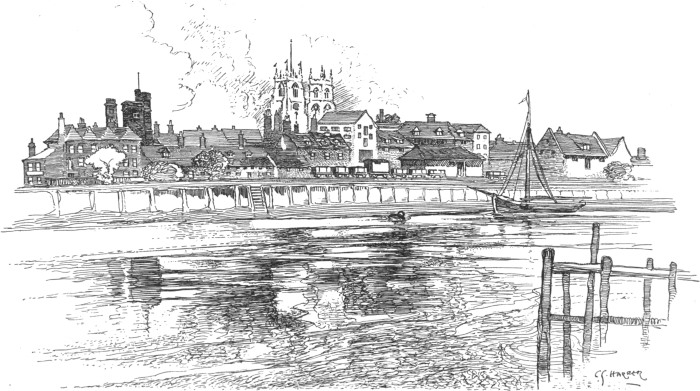
THE TOWN AND HARBOUR OF LYNN, FROM WEST LYNN.
A typical mansion of this old period is Clifton's House. The Cliftons and their old business are alike gone, and many of the beautiful fittings of their mansion have been torn out and sold, but the house itself stands, a grand memorial of their importance and of the patronage they and their kind extended to art. It faces Queen Street, at the corner of King's Staith Lane, and its courts and warehouses extend back to those quays where Clifton's ships, richly laden, once came to port from many a foreign clime. How anxiously those vessels were awaited may perhaps be judged from the tall red-brick tower rising in many storeys from the first courtyard, and commanding panoramic views down the river, out to the Wash, and away to the open sea at Lynn Deeps; so that from the roof-top the coming of Clifton's argosies might early be made known.
This house owes its fine Renaissance design to a Lynn architect whose name deserves to be remembered. Henry Bell, who built it in 1707, and whose works still enrich the town in many directions, flourished between 1655 and 1717. To him is due the beautiful Custom House overlooking the river and harbour, a work of art that in its Dutch-like character seems to have been brought bodily from some old Netherlands town and set down here by the quay. It was built as an Exchange, in the time of Charles the Second, whose statue still occupies an alcove; but very shortly afterwards was taken over by the Customs.
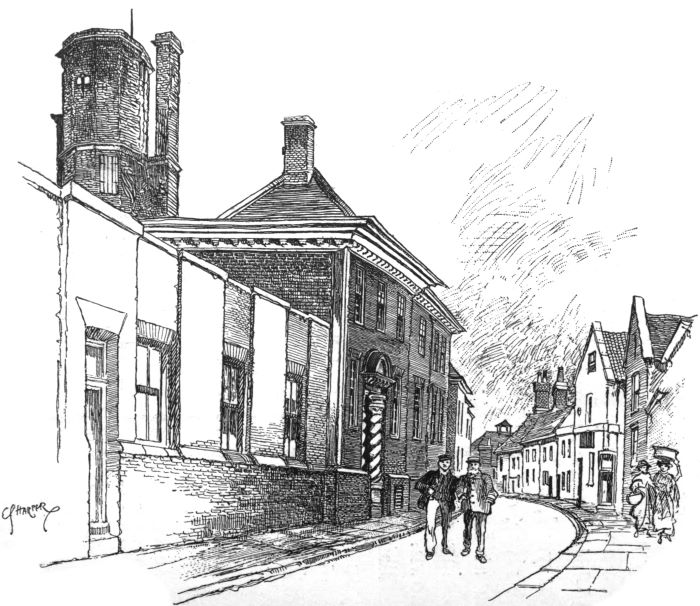
"CLIFTON'S HOUSE."
The great Tuesday market-place was once graced by a Renaissance market-cross from Bell's designs, but it was swept away in 1831. The Duke's Head Hotel, so originally named in honour of James, Duke of York, is another of Bell's works, not improved of late by the plaster that has been spread entirely over the old red-brick front.
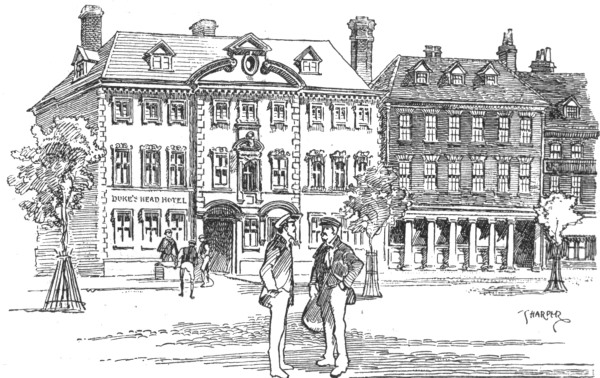
THE DUKE'S HEAD, LYNN.
The Duke's Head was in coaching days one of those highly superior houses that refused to entertain anyone who did not arrive in a carriage, or, at the very least of it, in a post-chaise. The principal inns for those plebeian persons who travelled by coach were the Globe and the Crown. It was to the Crown that old Thomas Cross and his "Lynn Union" came. It is still standing, in Church Street, over against the east end of St. Margaret's Church, but in a pitifully neglected and out-at-elbows condition, as a Temperance House, its white plastered front, contemporary with the coaching age, even now proclaiming it to be a "Commercial and Family Hotel."
The coaching age ended, so far as Lynn was concerned, in 1847, when the East Anglian Railway, from Ely to Lynn, with branches to Dereham, Wisbeach, and Huntingdon, was opened. It was an unfortunate line, an amalgamation of three separate undertakings: the Lynn and Dereham, the Ely and Huntingdon, and the Lynn and Ely Railways. By its junction with the Eastern Counties, now the Great Eastern, at Ely, a through journey to London was first rendered possible. Three trains each way, instead of the twenty now running, were then considered sufficient for all needs. They were not, at that early date, either swift or dignified journeys, for engine-power was often insufficient, and it was a common thing for a train to be stopped for hours while engine-driver and stoker effected necessary repairs. It was then, and on those not infrequent occasions when trains ran by favour of the sheriff, accompanied by a "man in possession" and plastered with ignominious labels announcing the fact, that passengers lamented the coaches. The East Anglian Railway, indeed, like the Great Eastern, which swallowed it, had a very troubled early career.
Lynn in those early years of innovation still retained many of its old-world ways. It was a sleepy time, as Mr. Thew, who has written his reminiscences of it, testifies. For police the town possessed one old watchman, who bore the old East Anglian name of Blanchflower, and patrolled the streets "with one arm and a lantern." The posting of letters was then a serious business, calling for much patience, for you did not in those days drop them into a letter-box, but handed them through a window at which you knocked. When the clerk in charge, one John Cooper, had satisfied his official dignity and kept you waiting long enough, he was graciously pleased to open the window and receive the letters. The successor to this upholder of official traditions, was one Charles Rix, addicted to declaiming Shakespeare from his window.
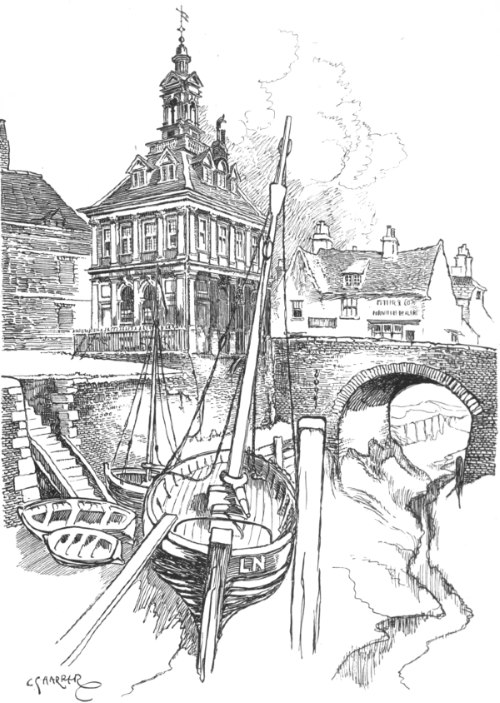
THE CUSTOM-HOUSE, LYNN.
The postmaster of Lynn at this easy-going time was Mr. Robinson Cruso, who also filled the miscellaneous occupations of auctioneer and estate agent, and wine and spirit merchant, and was a member of the Town Council. He was a descendant of an old Lynn family, many of whose representatives lie in the church of St. Nicholas. This Cruso (they spelled their name without the "e") was an upholsterer, and born ten years after Defoe's famous book was published; hence the "Robinson." There are still a number of the name in Norfolk and Suffolk.
XLVIII
We must now make an end. Of Lynn's long municipal history, of the treasures stored in its ancient Guildhall, of King John's disastrous journey from the town across the Wash; of many another stirring scene or historic pile this is not the place to speak. The Story of the Road is told, and, that being done, the task is completed; but it is not without regret that a place like Lynn, so rich in picturesque incident, is thus left. Many a narrow, cobbled lane, lined with quaint houses, calls aloud to be sketched; there, too, are the ancient Red Mount Chapel, in the lovely park-like "walks" that extend into the very heart of the town, and the ancient Greyfriars Tower to be noted; but Lynn has been, and will be again, the subject of a book entirely devoted to itself.
One pilgrimage, however, must be made ere these pages close: to Islington, four miles away on the Wisbeach road, for it is to that secluded place the sweet old ballad of the "Bailiff's Daughter of Islington" refers, and not to the better known "merry Islington" now swallowed up in London.
The ballad of the "Bailiff's Daughter" is of unknown origin. It is certainly three hundred years old, and probably much older; and has survived through all those centuries because of that sentiment of true love, triumphant over long years and distance and hard-hearted guardians, which has ever appealed to the popular imagination. Who was that Marshland bailiff and who the squire's son we do not know. It is sufficient to be told, in the lines of the sweet old song, that
"There was a youth, and a well belovèd youth, And he was a Squire's son; He loved the Bailiff's daughter dear That lived at Islington."
She was coy and reluctant and rejected his advances; so that, in common with many another, before and since, love-sickness claimed him for its own. Then, for seven long years, he was sent away, bound apprentice in London. Others in those circumstances would have forgotten the fair maid of Islington, but our noble youth was constancy itself, and, when his seven years had passed, came riding down the road, eager to see her face again. With what qualities of face and head and heart that maid must have been endowed!
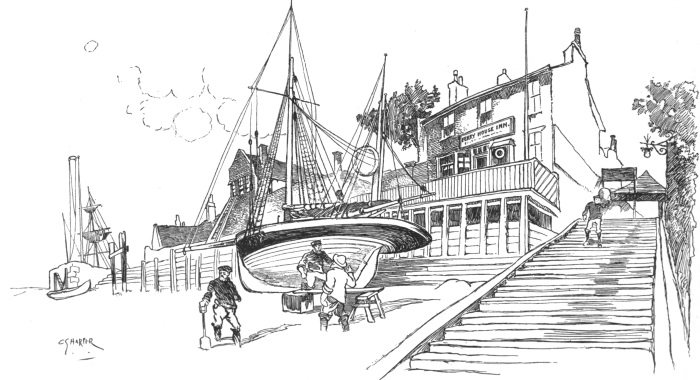
THE FERRY INN, LYNN.
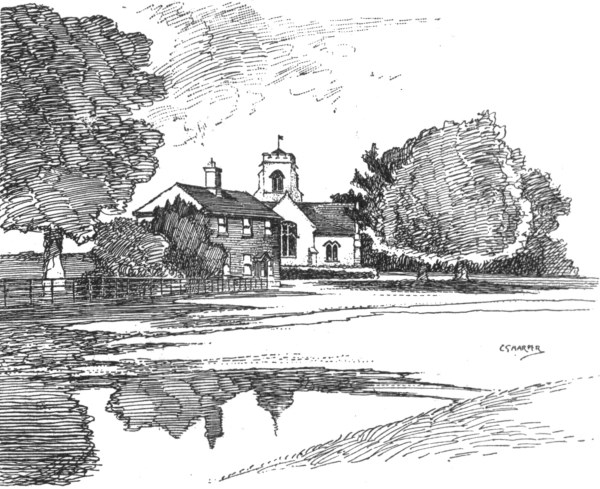
ISLINGTON.
Meanwhile, if we read the ballad aright, no one else came a-courting. Seven years mean much in such circumstances, and our maid grew desperate—
"She pulled off her gown of green, And put on ragged attire, And to fair London she would go, Her true love to enquire. And as she went along the high road The weather being hot and dry, She sat her down upon a green bank, And her true love came riding by. She started up, with a colour so red, Caught hold of his bridle rein; 'One penny, one penny, kind sir,' she said, 'Will ease me of much pain.' 'Before I give you a penny, sweetheart, Pray tell me where you were born.' 'At Islington, kind sir,' said she, 'Where I have had many a scorn.' 'Prythee, sweetheart, then tell to me, Oh, tell me whether you know The Bailiff's Daughter of Islington?' 'She is dead, sir, long ago.' 'If she be dead, then take my horse, My saddle and bridle also; For I will into some far countrye Where no man shall me know.' 'Oh, stay, oh stay, thou goodly youth, She is standing by thy side; She is here alive, she is not dead, But ready to be thy bride.'"
I cannot read those old lines, crabbed and uncouth though they be, without something suspiciously like a mist before the eyes and a certain difficulty in the throat. "God forbid I should grieve any young hearts," says Miss Matty, in Cranford. Sentiment will have its way, deny it though you will.
Islington itself is, for these reasons, a place for pious pilgrimage. And a place difficult enough to find, for it is but an ancient church, a Park and Hall, and two cottages, approached through a farmyard. That is all of Islington, the sweet savour of whose ancient story of true love has gone forth to all the world, and to my mind hallows these miles more than footsteps of saints and pilgrims.
THE END