THE CAMBRIDGE, ELY, AND KING'S LYNN ROAD (continued 3)
Reading edition
"The Backs" are the peculiar glory of Cambridge, and he who has not seen them has missed much. They are the back parts of those of the colleges—Queens, King's, Clare, Trinity, and John's—whose courts and beautiful lawns extend from the main street back to the Cam, that much-abused and much idealised stream.
"The Cam," says a distinguished member of the University, with a horrid lack of enthusiasm for the surroundings of Alma Mater, "is scarcely a river at all; above the town it is a brook; below the town it is little better than a sewer." Can this, you wonder, be the same as that "Camus, reverend sire," of the poets; the stream that "went footing slow, His mantle hairy and his bonnet sedge."
That, undoubtedly, is too severe. Above the town it is a brook that will at any rate float such craft as Cambridge possesses, and has shady nooks like "Paradise" and Byron's Pool, where the canoe can be navigated and bathing of the best may be found; and now that Cambridge colleges no longer drain into the river, the stream below town does not deserve that reproach. Everything, it seems, depends upon your outlook. If you are writing academic odes, for example, like Gray's, you praise the Cam; if, like Gray again, writing on an unofficial occasion, you enlarge upon its sluggish pace and its mud. Gray, it will be observed, could be a dissembling poet. His "Installation Ode," as official in its way as the courtly lines of a Poet Laureate, pictures Cambridge delightfully, in the lines he places in the mouth of Milton—
"Ye brown, o'er-arching groves, That contemplation loves, Where willowy Camus lingers with delight! Oft at the blush of dawn I trod your level lawn— Oft wooed the gleam of Cynthia, silver bright, In cloisters dim, far from the haunts of Folly, With Freedom by my side, and soft-eyed Melancholy."
Few lines in the whole range of our poetry are so beautiful as these.
But Gray's own private and unofficial idea of the Cam was very different. When he took the gag off his Muse and allowed her to be frank, we hear of the "rushy Camus," whose
"... Slowly-winding flood Perpetual draws his humid train of mud."
Yet "the Backs" give a picture of mingled architecture, stately trees, emerald lawns, and placid stream not to be matched anywhere else: an ideal picture of what a poet's University should be. If, on entering the town from Trumpington Street, you turn to the left past the Leys School, down the lane called Coe Fen, you come first upon the Cam where it is divided into many little streams running and subdividing and joining together again in the oozy pasture of Sheep's Green, and then to a water-mill. Beyond that mill begin "the Backs," with Queens' College, whose ancient walls of red brick, like some building of romance, rise sheer from the water. From them springs a curious "mathematical" wooden bridge, spanning the river and leading from the college to the shady walks on the opposite side.
With so dreamy and beautiful a setting, it is not surprising that Cambridge, although the education she gave was long confined largely to the unimaginative science or art of mathematics, has been especially productive of poets. Dryden was an alumnus of Trinity; Milton sucked wisdom at Christ's; Wordsworth, of John's, wrote acres of verse as flat as the Cambridgeshire meads, and much more arid; Byron drank deep and roystered at King's; and Tennyson was a graduate of Trinity. Other poets owning allegiance to Cambridge are that sweet Elizabethan songster, Robert Herrick, Marlowe, Waller, Cowley, Prior, Coleridge, and Praed. Poetry, in short, is in the moist relaxing air of Cambridge, and in those
"... brown o'er-arching groves That contemplation loves."
Cambridge would stand condemned were poets its only product. Fortunately, as some proof of the practical value of an University education, it can point to men like Cromwell, Pitt, and Macaulay, whose strenuous lives have in their several ways left a mark on the nation's history. Though one be not a champion of Cromwell's career, yet his savagery, his duplicity, his canting hypocrisy fade into the background and lose their significance beside the firmness of purpose, the iron determination and the wise policy that made England respected and feared abroad under the rule of the Protector. The beheading of a King weighs little in the scale against the upholding of the dignity of the State; and though a sour Puritanism ruled the land under the great Oliver, at least the guns of a foreign foe were never heard in our estuaries under the Commonwealth, as they were heard after the Restoration. Cambridge gives no sign that she is proud of Oliver, neither does Sidney Sussex, his old college. But if Cambridge be not outwardly proud of Old Noll, she abundantly glories in William Pitt. And rightly, too. None may calculate how the equation stands: how greatly his natural parts or to what extent his seven years of University education contributed to his brilliant career; but for one of her sons to have attained the dignity of Chancellor of the Exchequer at twenty-three years of age, to have been Prime Minister at twenty-five, the political dictator of Europe and the saviour of his country, is a triumph beyond anything they can show on the Isis. The Pitt Press, the Pitt Scholarship, the Pitt Club, all echo the fame of his astonishing genius.
XXIV
The impossibility of giving even a glimpse of the principal colleges of Cambridge in these pages of a book devoted to the road will be obvious. Thus, the great quads of Trinity, the many courts of John's, Milton's mulberry tree at Christ's, the Pepysian Library of Magdalen, and a hundred other things must be sought elsewhere. Turn we, then, to further talk of Thomas Hobson, the carrier and livery-stable keeper of "Hobson's Choice," who lies in an unmarked resting-place in the chancel of St. Benedict's Church, hard by the Market Hill. Born in 1544, he was not a native of Cambridge, but seems to have first seen the light at Buntingford, his father's native place. Already, in that father's time, the business had grown so profitable and important that we find Hobson senior a treasurer of the Cambridge Corporation; and when he died, in 1568, in a position to leave considerable landed and other property among his family. To Thomas, his more famous son, he bequeathed land at Grantchester and the waggon and horses that industrious son had been for some years past driving between Cambridge and London for him, with the surety and regularity of the solar system. "I bequeath," he wrote, "to my son Thomas the team-ware that he now goeth with, that is to say, the cart and eight horses, and all the harness and other things thereunto belonging, with the nag, to be delivered to him at such time and when as he shall attain and come to the age of twenty-five years; or £30 in money, for and in discharge thereof."
And thus he continued to go once a week, back and forth, for close upon sixty-three years, riding the nag and its successors beside the waggon that ploughed its ponderous way along the heavy roads. An ancient portrait of him, a large painting in oil, is now in the Cambridge Guildhall, and inscribed, "Mr. Hobson, 1620." This contemporary portrait has the curious information written on the back, "This picture was hung up at Ye Black Bull inn, Bishopsgate, London, upwards of one hundred years before it was given to J. Burleigh 1787."
Hobson scarce fitted the picture of the "jolly waggoner" drawn in the old song. Have you ever heard the song of the "Jolly Waggoner"? It is a song of lightly come and lightly go; of drinking with good fellows while the waggon and horses are standing long hours outside the wayside inn, and consignees are waiting with what patience they may for their goods. A song that bids dull care begone, and draws for you a lively sketch of the typical waggoner, who lived for the moment, whistled as he went in attempted rivalry with the hedgerow thrushes and blackbirds, spent his money as he earned it, and had a greeting, a ribbon, and a kiss for every lass along the familiar highway.
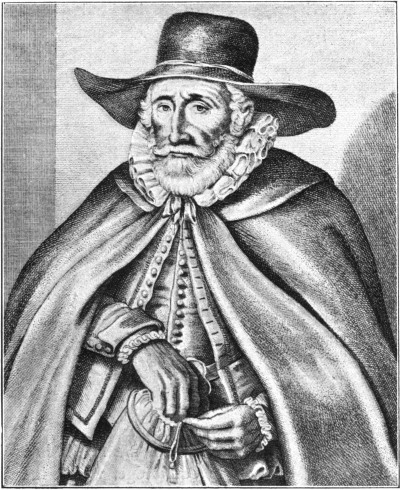
HOBSON, THE CAMBRIDGE CARRIER.
"Laugh not to see so plain a man in print; The Shadow's homely, yet ther's something in't. Witness the Bagg he wears, (though seeming poore) The fertile Mother of a hundred more; He was a thriving man, through lawfull Gain, And wealthy grew by warrantable paine, Then laugh at them that spend, not them that gather, Like thriveing Sonnes of such a thrifty Father."
It is a song that goes to a reckless and flamboyant tune, an almost Handelian melody that is sung with a devil-may-care toss of the head and much emphasis; a rare, sweet, homely old country ditty—
"When first I went a-waggoning, a-waggoning did go, I filled my parents' hearts with sorrow, trouble, grief, and woe; And many are the hardships, too, that since I have gone through. Sing wo! my lads, sing wo! Drive on, my lads, heigh-ho! For who can live the life that we jolly waggoners do? It is a cold and stormy night: I'm wetted to the skin, But I'll bear it with contentment till I get me to my inn, And then I'll sit a-drinking with the landlord and his kin. Sing wo! my lads, etc. Now summer is a-coming on—what pleasure we shall see! The mavis and the blackbird singing sweet on every tree. The finches and the starlings, too, will whistle merrily. Sing wo! my lads, etc. Now Michaelmas is coming fast—what pleasure we shall find! 'Twill make the gold to fly, my lads, like chaff before the wind. And every lad shall kiss his lass, so loving and so kind. Sing wo!" etc.
And so forth.
Hobson was not this kind of man. He had his horse-letting business in Cambridge, where, indeed, he had forty saddle-nags always ready, "fit for travelling, with boots, bridle, and whip, to furnish the gentlemen at once, without going from college to college to borrow"; but he continued throughout his long life to go personally with his waggon, and died January 1st, 1631, in his eighty-sixth year, of the irksome and unaccustomed inaction imposed upon him by the authorities, who forbade him to ply to London while one of the periodical outbreaks of plague was raging in the capital. Dependable in business as Hobson was, he prospered exceedingly, and amassed a very considerable fortune, "a much greater fortune," says one, "than a thousand men of genius and learning, educated at the University, ever acquired, or were capable of acquiring." This is not a little hard on the learned and the gifted, by whose favour and goodwill he prospered so amazingly. For, be it known, he was not merely and solely a carrier; but the carrier, especially licensed by the University, and thus a monopolist. Those were the days before a Government monopoly of the post was established, and one of Hobson's particular functions was the conveying of the mails. He was thus a very serious and responsible person.
You cannot conceive Hobson "carrying on" like the typical "jolly waggoner." Look at the portrait of him, taken from a fresco painted on a wall of his old house of call, the Bull, in Bishopsgate Street. A very grave and staid old man it shows us; looking out upon the world with cold and calculating eyes, deep-set beneath knitted brows, and with a long and money-loving, yet cautious, nose. His hand is unwillingly extracting a guinea from a well-filled money-bag, and you may clearly see from his expression of countenance how much rather he would be putting one in.
Yet in his last years he appeared in the guise of a benefactor to the town of Cambridge, for in 1628 he gave to town and University the land on which was built the so-called "Spinning House," or, more correctly, "Hobson's Workhouse," where poor people who had no trade might be taught some honest one, and all stubborn rogues and beggars be compelled to earn their livelihood. A bequest providing for the maintenance of the water-conduit in the Market Place kept his memory green for many a long year afterwards. It remained a prominent object in the centre of the town until 1856, when it was removed; but the little watercourses that of old used to run along the kennels of Cambridge streets still serve to keep the place clean and sweet.
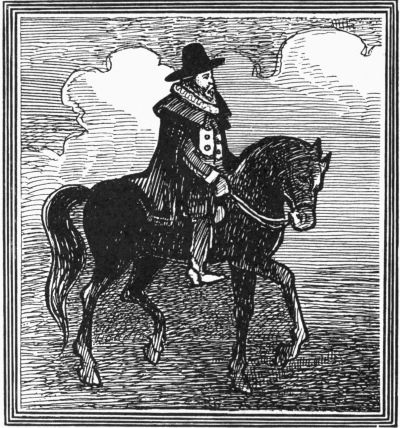
HOBSON. [From a Painting in Cambridge Guildhall.]
It cannot be too strongly insisted upon that Hobson, although he fared the road personally, and attended to every petty detail of his carrying business, was both a very wealthy and a very important personage. The second condition is not necessarily a corollary of the first. But Hobson bulked large in the Cambridge of his time. Indeed, as much may be gathered from the mass of literature written around his name. In his lifetime even, some compiler of a Commercial Letter Writer, for instructing youths ignorant of affairs, could find no more apt and taking title than that of Hobson's Horse Load of Letters, or Precedents for Epistles of Business; and poets and verse-writers, from Milton downwards, wrote many epitaphs and eulogies on him. Milton, who had gone up to Christ's College in 1624, was twenty-three years of age when Hobson died, and wrote two humorous epitaphs on him, more akin to the manner of Tom Hood than the majestic periods usually associated in the mind with the style commonly called "Miltonic.". "Quibbling epitaphs" an eighteenth century critic has called them. But you shall judge—
"On the University Carrier, who sickened in the time of the Vacancy, being forbid to go to London by reason of the Plague.
Here lies old Hobson: Death hath broke his girt, And here, alas! hath laid him in the dirt; Or else, the ways being foul, twenty to one He's here stuck in a slough and overthrown. 'Twas such a shifter that, if truth were known, Death was half glad when he had got him down; For he had any time this ten years full Dodged with him betwixt Cambridge and the Bull; And, surely, Death could never have prevailed, Had not his weekly course of carriage failed; But, lately, finding him so long at home, And thinking now his journey's end was come, And that he had taken up his latest inn, In the kind office of a Chamberlain Showed him his room where he must lodge that night, Pulled off his boots, and took away the light: If any ask for him, it shall be said, 'Hobson hath supped, and's newly gone to bed.'"
The subject seems to have been an engrossing one to the youthful poet, for he harked back to it in the following variant:—
"Here lieth one who did most truly prove That he could never die while he could move; So hung his destiny, never to rot While he might still jog on and keep his trot, Made of sphere-metal, never to decay Until his revolution was at stay! Time numbers motion, yet (without a crime 'Gainst old truth) motion numbered out his time; And, like an engine moved with wheel and weight, His principles being ceased, he ended straight. Rest, that gives all men life, gave him his death, And too much breathing put him out of breath; Nor were it contradiction to affirm Too long vacation hastened on his term; Merely to drive the time away he sickened, Fainted and died, nor would with ale be quickened. 'Nay,' quoth he, on his swooning bed outstretched, 'If I may not carry, sure I'll ne'er be fetched; But vow' (though the cross Doctors all stood hearers) 'For one carrier put down, to make six bearers.' Ease was his chief disease, and, to judge right, He died for heaviness that his cart went light; His leisure told him that his time was come, And lack of load made his life burdensome; That even to his last breath, (there be that say't,) As he were pressed to death, he cried 'More weight!' But, had his doings lasted as they were, He had been an immortal Carrier. Obedient to the moon, he spent his date In course reciprocal, and had his fate Linked to the mutual flowing of the seas; Yet, strange to think, his wain was his increase; His letters are delivered all and gone; Only remains this superscription."
The next example—an anonymous one—makes no bad third—
"Here Hobson lies among his many betters, A man unlearned, yet a man of letters; His carriage was well known, oft hath he gone In Embassy 'twixt father and the son: There's few in Cambridge, to his praise be't spoken, But may remember him by some good Token. From whence he rid to London day by day, Till Death benighting him, he lost his way: His Team was of the best, nor would he have Been mired in any way but in the grave. And there he stycks, indeed, styll like to stand, Untill some Angell lend hys helpyng hand. Nor is't a wonder that he thus is gone, Since all men know, he long was drawing on. Thus rest in peace thou everlasting Swain, And Supream Waggoner, next Charles his wain."
The couplet printed below touches a pretty note of imagination, and is wholly free from that suspicion of affected scholarly superiority to a common carrier, with which all the others, especially Milton's, are super-saturated—
"Hobson's not dead, but Charles the Northerne swaine, Hath sent for him, to draw his lightsome waine."
Charles's Wain, referred to in these two last examples, is, of course, that well-known constellation in the northern heavens usually known as the Great Bear, anciently "Charlemagne's Waggon," and more anciently still, the Greek Hamaxa, "the Waggon."
Coming, as might be expected, a considerable distance after Milton and the others in point of excellence, are the epitaphs printed in a little book of 1640, called the Witt's Recreations, Selected from the Finest Fancies of the Modern Muses. Some of them are a little gruesome, and affect the reader as unfavourably as though he saw the authors of these lines dancing a saraband on poor old Hobson's grave—
"Hobson (what's out of sight is out of mind) Is gone, and left his letters here behind. He that with so much paper us'd to meet; Is now, alas! content to take one sheet. He that such carriage store was wont to have, Is carried now himselfe unto his grave: O strange! he that in life ne're made but one, Six Carriers makes, now he is dead and gone."
XXV
The Market Hill is, as already hinted, the centre of Cambridge. The University church is there. There, too, the stalls of the Wednesday and Saturday markets still gather thickly, and on them the inquisitive stranger may yet discover butter being sold, as from time immemorial, by the yard. Here a yard of butter is the equivalent of a pound, and the standard gauge of such a yard—the obsolete symbol of a time when the University exercised jurisdiction over the markets as well as over the students—is to this day handed over to the Senior Proctor of the year on his taking office. It is a clumsy cylinder of sheet iron, a yard in length and an inch in diameter. A pound of butter rolled out to this measurement looks remarkably like a very yellow candle of inordinate length.
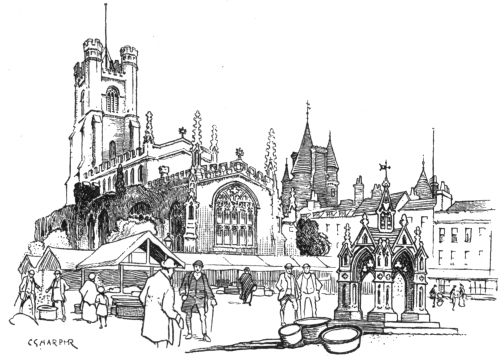
MARKET HILL, CAMBRIDGE.
Hobson's Conduit, as already noted, once stood in the centre of this market-place. When his silent, hook-nosed Majesty, William the Third, visited Cambridge in 1689, the Conduit was made by the enthusiastic citizens to run wine. Not much wine, though, nor very good, we may surely suppose, for the tell-tale account-books record that it cost only thirty shillings!
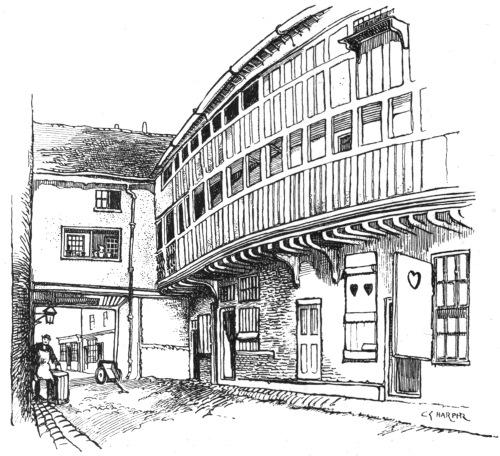
THE FALCON, CAMBRIDGE.
Few of the old coach-offices or inns stood in this square, but were—and are now—to be found chiefly in the streets leading out of it. The Bull, anciently the Black Bull, still faces Trumpington Street; the Lion flourishes in Petty Cury; the old Three Tuns, Peas Hill, is now the Central Temperance Hotel; and the Blue Boar, in whose archway an unfortunate clergyman, the Reverend Gavin Braithwaite, was killed in 1814 when seated on the roof of the Ipswich coach, still faces Trinity Street. The Sun, however, in Trinity Street, where Byron and his cronies dined and caroused, is no more; and of late years the Woolpack and the Wrestlers, both very ancient buildings, have been demolished. Foster's Bank stands on the site of one and the new Post Office on that of the other. For a while the remains of the galleried, tumbledown Falcon, stand in a court off Petty Cury; the inn in whose yard Cambridge students entertained and shocked Queen Elizabeth with a blasphemous stage travesty of the Mass. In Bridge Street stands the Hoop, notable in its day, and celebrated by Wordsworth—
"Onward we drove beneath the Castle; caught, While crossing Magdalen Bridge, a glimpse of Cam; And at the Hoop alighted, famous inn."
Beyond the Hoop, the quaintly-named Pickerel Inn stands by Magdalen, or Great Bridge, just as it did in days when the carriers dumped down their loads here, to be transferred to the passage-boats for Ely and Kings Lynn. In Benet Street the Eagle, once the Eagle and Child, still discloses a courtyard curiously galleried, and hard by is the old Bath Hotel. This list practically exhausts the old coaching inns, but of queer hostelries of other kinds there are many, with nodding gables and latticed windows, in every other lane and by-way. Churches, too, abound. Oldest among these is St. Sepulchre's, one of the four round churches in England; a dark Norman building that in the blackness of its interior accurately figures the grimness of the Norman mind.
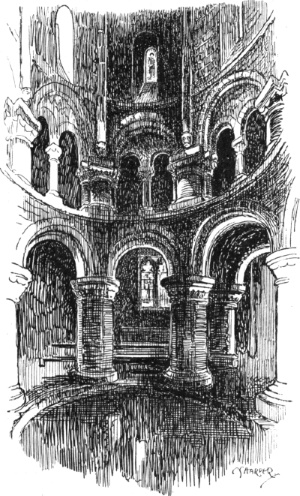
INTERIOR OF ST. SEPULCHRE'S CHURCH.
XXVI
Cambridge, now a town abounding in and surrounded by noble trees, was originally a British settlement, placed on that bold spur of high ground, rising from the surrounding treeless mires, on which in after years the Romans established their military post of Camboricum, and where in later ages William the Conqueror built his castle. The great artificial mound, which, like some ancient sepulchral tumulus, is all that remains to tell of William's fortress and to mark where Roman and Briton had originally seized upon this strategic point, crowns this natural bluff, overlooking the river Cam. Standing on it, with the whole of Cambridge town and a wide panorama of low-lying surrounding country disclosed, it is evident that this must have been the place of places for many miles on either hand where, in those remote days, the river could be crossed. Everywhere else the wide-spreading swamps forbade a passage; and, consequently, those who held this position, and could keep it, could deny the whole country to the passage of a hostile force from either side. Whether one enemy sought to penetrate from London to Ely and Norfolk, or whether another would come out of Norfolk into South Cambridgeshire or Herts, he must first of necessity dispose of those who held the key of this situation. The Romans, before they could subdue the masters of this position, experienced, we may well believe, no little difficulty; and it is probable that the perplexity of antiquaries, confronted by the existence of a Roman camp or station here, and of another three miles higher up the Cam at Grantchester, may be smoothed out by the very reasonable explanation that Grantchester was the first Roman camp over against the British stronghold at Cambridge, and that, when the Romans had made themselves masters of Cambridge, that place remained their military post, while Grantchester became a civil and trading community and a place of residence.
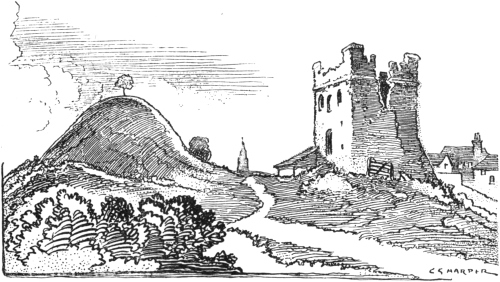
CAMBRIDGE CASTLE A HUNDRED YEARS AGO.
Both place-names derive from this one river, masquerading now as the Granta and again as the Cam, but by what name the Romans knew Grantchester we do not know and never shall.
At Roman Camboricum those ancient roads, the Akeman Street and the Via Devana, crossed at right angles, meeting here on this very Castle hill: the Via Devana on its way from Colchester to the town of Deva, now Chester; the Akeman Street going from Branodunum, now Brancaster, on the coast of Norfolk, to Aquæ Solis, the Bath of our own day.
Cambridge Castle, built in 1068 by William the Conqueror to hold Hereward the Saxon and his East Anglian fellow-patriots in check, has entirely disappeared. It never accumulated any legends of sieges or surprises, and of military history it had none whatever. It was, therefore, a castle of the greatest possible success; for, consider, although the first impulse may be to think little of a fortress that can tell no warlike story, the very lack of anything of the kind is the best proof of its strength and fitness. It is not the purpose of a castle to invite attacks, but by its very menace to overawe and terrify. Torquilstone Castle and the story of its siege and downfall, in the pages of Ivanhoe, make romantic and exciting reading; but, inasmuch as it fell, it was a failure. That Cambridge Castle not only never fell, but was not even menaced, is the best proof of its power.
These great fortresses, with their stone keeps and spreading wards and baileys, dotted here and there over the land, rang the knell of English liberties. "New and strong and cruel in their strength—how the Englishman must have loathed the damp smell of the fresh mortar, and the sight of the heaps of rubble, and the chippings of the stone, and the blurring of the lime upon the greensward; and how hopeless he must have felt when the great gates opened and the wains were drawn in, heavily laden with the salted beeves and the sacks of corn and meal furnished by the royal demesnes, the manors which had belonged to Edward the Confessor, now the spoil of the stranger; and when he looked into the castle court, thronged by the soldiers in bright mail, and heard the carpenters working upon the ordnance—every blow and stroke, even of the hammer or mallet, speaking the language of defiance."
William himself occupied his castle of Cambridge on its completion in 1069, and from it he directed the long and weary military operations against Hereward across the fens toward the Isle of Ely, only twelve miles away. From his keep-tower he could see with his own eyes that Isle, rising from the flat, on the skyline, like some Promised Land, but two years were to pass before he and his soldiers were to enter there; admitted even then by treachery.
From the Castle Mound the Cam may be seen, winding away through the flats into the distant haze. Immediately below are Parker's Piece, and Midsummer and Stourbridge Commons; this last from time beyond knowledge the annual scene of Stourbridge Fair. "Sturbitch" Fair, as the country-folk call it, existed, like the University itself, before history came to take note of it. When King John reigned it was already an important mark, and so continued until, at the Dissolution of the Monasteries, its rights and privileges were transferred to the Corporation of Cambridge.
Whether the story of its origin be well founded, or merely a picturesque invention, it cannot be said. It is a story telling how a Kendal clothier, at date unknown, journeying from Westmoreland to London, his pack-horses laden with bales of cloth, found the bridge over the Cam at this point broken down, and, trying to ford the river, fell in, goods and all. Struggling at last to the opposite bank, and fishing out his property, he spread his cloth to dry on Stourbridge Common, where so many of the townsfolk came to see it and to bid that in the end he sold nearly all his stock, and did much better than if he had gone on to London. The next year, therefore, he took care—not to fall into the Cam again—but to make Cambridge his mart. Other trades then became attracted to the place where he found business so brisk, and hence (according to the legend) the growth of a fair in its prime comparable only with that greatest of all fairs—the famous one of Nijni-Novgorod.
To criticise a legend of this kind would be to take it too seriously, else, among many things that might be inquired into would be the appearance at Cambridge of a traveller from Westmoreland bound for London. He must have missed his way very widely indeed!
The Fair still lasts three weeks, from 18th September to 10th October, but it is the merest shadow of its former self. The Horse Fair, on the 25th September, is practically all that remains of serious business. In old times its annual opening was attended with much ceremony. In those days, before the computation of time was altered, and Old Style became changed for New, the dates of opening and closing were 7th and 29th September. On Saint Bartholomew's Day the Mayor and Corporation rode out from the town to set out the ground, then cultivated. By that day all crops had to be cleared, or the stall-holders, ready to set up their stalls and booths, were at liberty to trample them down. On the other hand, they were under obligation to remove everything by St. Michael's Day, or the ploughmen, ready by this time to break ground for ploughing, had the right to carry off any remaining goods. Stourbridge Fair was then a town of booths. In the centre was the Duddery, the street where the mercers, drapers and clothiers sold their wares; and running in different directions were Ironmongers' Row, Cooks' Row, Garlick Row, Booksellers' Row, and many another busy street. In those times the three weeks' turnover of the various trades was calculated at not less than a quarter of a million sterling. The railways that destroyed the position of Lynn, Ely, and Cambridge as distributing places along the Cam and Ouse, have wrought havoc with this old-time Fair.
XXVII
Through Chesterton, overlooked by the Castle and deriving its name from it, the road leaves Cambridge for Ely, passing through the village of Milton, where the Fenland begins, or what is more by usage than true description so-called now the Fens are drained and the land once sodden with water and covered with beds of dense reeds and rushes made to bear corn and to afford rich pasture for cattle. This is the true district of the "Cambridgeshire Camels," as the folk of the shire are proverbially called. The term, a very old one, doubtless took its origin in the methods of traversing the Fens formerly adopted by the rustic folk. They used stilts, or "stetches," as they preferred to call them, and no doubt afforded an amusing spectacle to strangers, as they straddled high above the reeds and stalked from one grassy tussock to another in the quaking bogs.
There is a choice of routes at Milton, the road running in a loop for two miles. The left-hand branch, through Landbeach, selected by the Post Office as the route of its telegraph-poles, might on that account be considered the main road, but the right-hand route has decidedly the better surface. Midway of this course, where the Slap Up Inn stands, is the lane leading to Waterbeach, a scattered village near the Cam, much troubled by the floods from that stream in days gone by.
Something of what Waterbeach was like in the eighteenth century may be gathered from the correspondence of the Rev. William Cole, curate there from 1767 to 1770. Twenty guineas a year was the modest sum he received, but that, fortunately for him, was not the full measure of his resources, for he possessed an estate in the neighbourhood. The value of his land could not have been great, and may be guessed from his letters. Writing in 1769, he says: "A great part of my estate has been drowned these two years: all this part of the country is now covered with water and the poor people of this parish utterly ruined." And again in 1770: "This is the third time within six years that my estate has been drowned, and now worse than ever." Shortly after writing that letter he removed. "Not being a water-rat," he says, "I left Waterbeach," and went to the higher and drier village of Milton, two miles away.
Waterbeach long retained its old-world manners and customs. May Day was its greatest holiday, and was ushered in with elaborate preparations. The young women collected materials for a garland, consisting of ribbons, flowers, and silver spoons, with a silver tankard to suspend in the centre; while the young men, early in the morning, or late at night, went forth into the fields to collect emblems of their esteem or disapproval of the young women aforesaid. "Then," says the old historian of these things, "woe betide the girl of loose habits, the slattern and the scold; for while the young woman who had been foremost in the dance, or whose amiable manners entitled her to esteem, had a large branch or tree of whitethorn planted by her cottage door, the girl of loose manners had a blackthorn at hers." The slattern's emblem was an elder tree, and the scold's a bunch of nettles tied to the latch of the door.
After having thus (under cover of darkness, be it said) left their testimonials to the qualities or defects of the village beauties, the young men, just before the rising of the sun, went for the garland and suspended it in the centre of the street by a rope tied to opposite chimneys. This done, sunrise was ushered in by ringing the village bells. Domestic affairs were attended to until after midday, and then the village gave itself up to merrymaking. Dancing on the village green, sports of every kind, and kiss-in-the-ring were for the virtuous and the industrious; while the recipients of the elders, the blackthorns, and the nettles sat in the cold shade of neglect, wished they had never been born, and made up their minds to be more objectionable than ever. Such was Waterbeach about 1820.
Some thirty years later the village acquired an enduring title to fame as the first charge given to that bright genius among homely preachers, Charles Haddon Spurgeon. It was in 1851, while yet only in his seventeenth year, that Spurgeon was made pastor of the Baptist Chapel here. Already his native eloquence had made him famed in Colchester, where, two years before, he had first spoken in public. The old thatched chapel where the youthful preacher ministered, on a stipend of twenty pounds a year, almost identical with that enjoyed by the Reverend William Cole, curate in the parish church eighty years before, has long since disappeared, destroyed by fire in 1861; and on its site stands a large and very ugly "Spurgeon Memorial Chapel" in yellow brick with red facings. Scarce two years and a half passed before the fame of Spurgeon's eloquence spread to London, and he was offered, and accepted, the pastorate of New Park Street Chapel, Southwark, there to fill that conventicle to overflowing, and presently draw all London to Exeter Hall. Even at this early stage of his wonderful career there were those who dilated upon the marvel of "this heretical Calvinist and Baptist" drawing a congregation of ten thousand souls while St. Paul's and Westminster Abbey resounded with the echoing footsteps of infrequent worshippers; but Spurgeon preached shortly afterwards to a congregation numbering twenty-four thousand, and maintained his hold until the day of his death, nearly forty years after. Where shall that curate, vicar, rector, dean, bishop, or archbishop of the Church of England be found who can command such numbers?
That his memory is held in great reverence at Waterbeach need scarce be said. There are still those who tell how the "boy-preacher," when announced to hold a night service in some remote village, not only braved the worst that storms and floods could do, but how, finding the chapel empty and the expected congregation snugly housed at home, out of the howling wind and drenching rain, he explored the place with a borrowed stable-lantern in his hand, and secured a congregation by dint of house-to-house visits!
XXVIII
The left-hand loop, through Landbeach, if an inferior road, has more wayside interest. Landbeach is in Domesday Book called "Utbech," that is to say Outbeach, or Beach out (of the water). "Beach" in this and other Fenland instances means "bank"; Waterbeach being thus "water bank." Wisbeach, away up in the extreme north of the county, is a more obscure name, but on inquiry is found to mean Ousebank, that town standing on the Ouse in days before the course of that river was changed. Landbeach Church stands by the wayside, and has its interest for the ecclesiologist, as conceivably also for those curious people interested in the stale and futile controversy as to who wrote Shakespeare's plays; for within the building lies the Reverend William Rawley, sometime chaplain to Bacon, and not only so, but the author of a life of him and the publisher of his varied acknowledged works. He, if anyone, would have known it if Bacon had been that self-effacing playwright, so we must needs think it a pity there is so little in spiritualism save idiotic manifestations of horseplay and showers of rappings in the dark; otherwise the obvious thing would be to summon Rawley's shade and discreetly pump it.
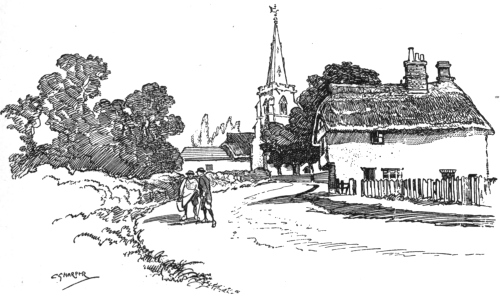
LANDBEACH.
Beyond Landbeach, close by the fifty-sixth milestone from London, the modern road falls into the Roman Akeman Street, running from Brancaster (the Roman "Branodunum") on the Norfolk coast, through Ely, to Cambridge, to Dunstable, and eventually, after many leagues, to Bath. Those who will may attempt the tracing of it back between this point and Cambridge, a difficult enough matter, for it has mostly sunk into the spongy ground, but here, where it exists for a length of five miles, plain to see, it is still a causeway raised in places considerably above the levels, and occasionally showing stretches of imposing appearance. It remains thus a striking monument to the surveying and engineering skill of that great people, confronted here in far-off times with a wilderness of reeking bogs. The object in view—to reach the coast in as straight a line as possible—meant wrestling with the difficulties of road-making in the mixed and unstable elements of mud and water, but they faced the problem and worked it out with such completeness that a solid way arose that only fell into decay when the civilisation they had planted here, on the rim and uttermost verge of the known world, was blotted out. Onwards as far as Lynn a succession of fens stretched for sixty-five miles, but so judiciously did the Romans choose their route that only some ten miles of roadway were actually constructed in the ooze. It picked a careful itinerary, advancing from isle to isle amid the swamps, and, for all its picking and choosing of a way, went fairly direct. It was here that it took the first plunge into the sloughs and made direct, as a raised bank, through them for the Ouse, where Stretham Bridge now marks the entrance to the Isle of Ely. How that river, then one of great size and volume, was crossed we do not know. Beyond it, after some three miles of floundering through the slime, the causeway came to firm ground again where the village of Stretham (its very name suggestive of solid roadway) stands on a rise that was once an island. Arrived at that point, the road took its way for ten miles through the solid foothold of the Isle of Ely, leaving it at Littleport and coming, after struggling through six miles of fen, to the Isle of Southery. Crossing that islet in little more than a mile, it dipped into fens again at the point now known as Modney Bridge, whence it made for the eyot of Hilgay. Only one difficulty then remained: to cross the channel of the Wissey River into Fordham. Thenceforward the way was plain.
We have already made many passing references to the Fens, and now the district covered in old times by them is reached, it is necessary, in order to make this odd country thoroughly understood, to explain them. What are the Fens like? The Fens, expectant reader, are gone, like the age of miracles, like the dodo, the pterodactyl, the iguanodon, and the fancy zoological creatures of remote antiquity. Ages uncountable have been endeavouring to abolish the Fens. When the Romans came, they found the native tribes engaged upon the task, and carried it on themselves, in succession. Since then every age has been at it, and at length, some seventy or eighty years ago, when steam-pumps were brought to aid the old draining machinery, the thing was done. There is only one little specimen of natural fen now left, and that is preserved as a curiosity. But although the actual morasses are gone, the flat drained fields of Fenland are here, and we shall presently see in these pages that although the sloughs are in existence no longer, it is no light thing in these districts to venture far from the main roads.
No one has more eloquently or more truly described the present appearance of the Fen country than Cobbett. "The whole country," he says, "is as level as the table on which I am now writing. The horizon like the sea in a dead calm: you see the morning sun come up, just as at sea; and see it go down over the rim, in just the same way as at sea in a calm. The land covered with beautiful grass, with sheep lying about upon it, as fat as hogs stretched out sleeping in a stye. Everything grows well here: earth without a stone so big as a pin's head; grass as thick as it can grow on the ground."
The Fenland has, in fact, the wild beauty that comes of boundless expanse. Only the range of human vision limits the view. Above is the summer sky, blue and vast and empty to the sight, but filled to the ear with the song of the soaring skylark, trilling as he mounts higher and higher; the sound of his song diminishing as he rises, until it becomes like the "still small voice of Conscience," and at last fades out of hearing, like the whisper of that conscience overwrought and stricken dumb.
These levels have a peculiar beauty at sunset, and Cambridgeshire sunsets are as famous in their way as Cambridge sausages. They (the sunsets, not the sausages) have an unearthly glory that only a Turner in his most inspired moments could so much as hint at. The vastness of the Fenland sky and the humid Fenland atmosphere conspire to give these effects.
The Fenland is a land of romance for those who know its history and have the wit to assimilate its story from the days of fantastic legend to these of clear-cut matter-of-fact. If you have no reading, or even if you have that reading and do not bring to it the aid of imagination, the Fens are apt to spell dulness. If so, the dulness is in yourself. Leave these interminable levels, and in the name of God go elsewhere, for the flatness of the Great Level added to the flatness of your own mind will in combination produce a horrible monotony. On the other hand, if some good fairy at your cradle gave you the gift of seeing with a vision not merely physical, why, then, the Fenland is fairyland; for though to the optic nerve there is but a level stretching to the uttermost horizon, criss-crossed with dykes and lodes and leams of a severe straightness, there is visible to the mind's eye, Horatio, an ancient order of things infinitely strange and uncanny. Antiquaries have written much of the Fens, but they do not commonly present a very convincing picture of them. They tell of Iceni, of Romans, fierce Norsemen marauders, Saxons, Danes, and the conquering Normans, but they cannot, or do not, breathe the breath of life into those ancient peoples, and make them live and love and hate, fight and vanquish or be vanquished. The geologists, too, can speculate learnedly upon the origin of the Fens, and can prove, to their own satisfaction at least, that this low-lying, once flooded country was produced by some natural convulsion that suddenly lowered it to the level of the sea; but no one has with any approach to intimacy with the subject taken us back to the uncountable æons when the protoplasm first began to move in the steaming slime, and so conducted us by easy stages through the crucial and hazardous period when the jelly-fish was acquiring the rudiments of a backbone (if that was the order of the progress) to the exciting era when the crocodile played the very devil with aboriginal man, and the rhinoceros and the hippopotamus wallowed in the mud. The Iceni are very modern, compared with these very ancient inhabitants, and have done what those inarticulate protoplasms, neolithic men and others, could not do; that is, they gave their names to many places in these East Anglian shires, and a title that still survives to a great road. Look on any map of East Anglia and the surrounding counties and you shall see many place-names beginning with "Ick": Ickborough, Ickworth, Ickleton, Icklington, Ickleford, and Ickwell.
These are the surviving names of Icenian settlements. There is a "Hickling" on the Broads, in Norfolk, which ought by rights to be "Ickling"; but the world has ever been at odds on the subject of aspirate or no aspirate, certainly since the classic days of the Greeks and the Romans. Does not Catullus speak of a certain Arrius who horrified the Romans by talking of the "Hionian Sea"? and is not Tom Hood's "Ben Battle" familiar? "Don't let 'em put 'Hicks jacet' there," he said, "for that is not my name."
When the Romans came and found the Iceni here, the last stone-age man and the ultimate crocodile (the former inside the latter) had for ages past been buried in the peat of the Fens, resolving into a fossil state. The Iceni probably, the purposeful Romans certainly, endeavoured to drain the Fens, or at least to prevent their being worse flooded by the sea; and the Roman embankment between Wisbeach and King's Lynn, built to keep out the furious wind-driven rollers of the Wash, gave a name to the villages of Walsoken, Walton, and Walpole (once Wall-pool). When the Romano-British civilisation decayed, the defences against the sea decayed with it, and the level lay worse flooded than before. Far and wide, from Lynn, on the seacoast in the north, to Fen Ditton, in the south, almost at the gates of Cambridge; from Mildenhall in the east, to St. Ives and Peterborough in the west, a vast expanse of still and shallow water covered an area of, roughly, seventy miles in length and thirty in breadth: about 2100 square miles. Out of this dismal swamp rose many islands, formed of knobs of the stiff clay or gault that had not been washed away with the surrounding soil. It was on these isles that prehistoric man lived, and where his wretched wattle-huts were built beside the water. He had his dug-out canoe and his little landing-stage, and sometimes, when his islet was very diminutive and subject to floods, he built his dwelling on stakes driven into the mud. In peaceful and plenteous times he sat on his staging overhanging the water, and tore and gnawed at the birds and animals that had fallen to his arrow or his spear. Primitive man was essentially selfish. He first satisfied his own hunger and then tossed the remainder to his squaw and the brats, and when they had picked the bones clean, and saved those that might be useful for fashioning into arrow-heads, they threw the remains into the water, whence they sent up in the fulness of time an evil smell which did not trouble him and his in the least, primitive as they were in every objectionable sense of the word.
Relics of him and his domestic odds and ends are often found, ten feet or so beneath the present surface of the land. His canoe is struck by the spade of the gaulter, his primitive weapons unearthed, his dustbin and refuse-heap turned over and examined by curious antiquaries and naturalists, who can tell you exactly what his menu was. Sometimes they find primitive man himself, lying among the ruins of his dwelling, overwhelmed in the long ago by some cataclysm of nature, or perhaps killed by a neighbouring primitive.
To these isles in after centuries, when the Romans had gone and the Saxons had settled down and become Christians, came hermits and monks like Guthlac, who reared upon them abbeys and churches, and began in their several ways to cultivate the land and to dig dykes and start draining operations. For the early clergy earned their living, and were not merely the parasites they have since become. These islands, now that the Fens are drained, are just hillocks in the great plain. They are still the only villages in the district, and on those occasions when an embankment breaks and the Fens are flooded, they become the islands they were a thousand years ago. The very names of these hillocks and villages are fen-eloquent, ending as they do with "ey" and "ea," corruptions of the Anglo-Saxon words "ig," an island, and "ea," a river. Ely, the largest of them, is said by Bede to have obtained its name from the abundance of eels, and thus to be the "Eel Island." There are others who derive it from "helig," a willow, and certainly both eels and willows were abundant here; but the name, in an ancient elision of that awkward letter "h," is more likely to come from another "helig," meaning holy, and Ely to really be the "holy island."
Other islands, most of them now with villages of the same name, were Coveney, Hilgay, Southery, Horningsea, Swavesey, Welney, Stuntney, and Thorney. There was, too, an Anglesey, the Isle of the Angles, a Saxon settlement, near Horningsea. A farm built over the site of Anglesey Abbey now stands there.
But many Fenland place-names are even more eloquent. There are Frog's Abbey, Alderford, Littleport, Dry Drayton and Fenny Drayton, Landbeach and Waterbeach. Littleport, really at one time a port to which the ships of other ages came, is a port no longer; Fenny Drayton is now as dry as its fellow-village; and Landbeach and Waterbeach are, as we have already seen, not so greatly the opposites of one another as they were.
XXIX
A great part of the Fens seems to have been drained and cultivated at so early a time as the reigns of Stephen and Henry the Second, for William of Malmesbury describes this as then "the paradise of England," with luxuriant crops and flourishing gardens; but this picture of prosperity was suddenly blotted out by the great gale that arose on the morrow of St. Martin 1236, and continued for eight days and nights. The sea surged over the embankments and flowed inwards past Wisbeach, and the rivers, instead of flowing away, were forced back and so drowned the levels. Some attempts to reclaim the land were made, but a similar disaster happened seventeen years later, and the fen-folk seem to have given up all efforts at keeping out the waters, for in 1505 we find the district described as "one of the most brute and beastly of the whole realm; a land of marshy ague and unwholesome swamps." But already the idea of reclamation was in the air, for Bishop Morton, in the time of Henry the Seventh,—a most worshipful Bishop of Ely, Lord Chancellor too, churchman, statesman, and engineer,—had a notion for making the stagnant Nene to flow forth into the sea, instead of doubling upon itself and seething in unimaginable bogs as it had done for hundreds of years past. He cut the drain that runs from Stanground, away up in the north near Peterborough, to Wisbeach, still known as Morton's Leam, and thus began a new era. But though he benefited the land to the north-west of Ely, the way between his Cathedral city and Cambridge was not affected, and remained in his time as bad as it had been for centuries; and he, like many a Bishop before him and others to come after, commonly journeyed between Ely and Cambridge by boat. Our road, indeed, did not witness the full activity of the good Bishop and his successors. Their doings only attained to great proportions in the so-called Great Level of the Fens, the Bedford Level, as it is alternatively called, that stretches over a district beginning eight miles away and continuing for sixteen or twenty miles, by Thorney, Crowland, and Peterborough. This map, from Dugdale's work, showing the Fens as they lay drowned, and the islands in them, will give the best notion of this curious district. You will perceive how like an inland sea was this waste of mud and water, not full fathom five, it is true, but less readily navigable than the sea itself. Here you see the road from Cambridge to Ely and on to Downham Market pictured, with no great accuracy, you may be sworn, and doubtless with as much margin of error as it is customary to allow in the somewhat speculative charts of Arctic continents and regions of similarly difficult access. In this map, then, it will be perceived how remote the Bedford Level lies from our route. Why "Bedford Level," which, in point of fact, is in Cambridgeshire and not in Bedfordshire at all? For this reason: that these are lands belonging to the Earls (now Dukes) of Bedford. To the Russells were given the lands belonging to Thorney Abbey, but their appetite for what should have been public property was only whetted by this gift, and when in the reign of Charles the First proposals were made to drain and reclaim 310,000 acres of surrounding country, they, in the person of Francis, the then Earl, obtained of this vast tract no less than 95,000 acres. It is true that this grant was made conditional upon the Earl taking part in the drainage of the land, and that it was a costly affair in which the smaller adventurers were ruined and the Earl's own resources strained; but in the result a princely heritage fell to the Bedfords.
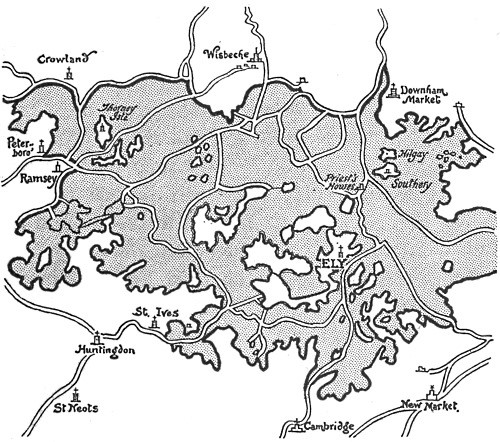
THE FENS. [After Dugdale.]
The great engineering figure at this period of reclamation was the Dutchman, Cornelius Vermuyden, who began his dyking and draining under royal sanction and with Bedfordian aid in 1629. Vermuyden's is a great figure historically considered, but his works are looked upon coldly in these times, and it is even said that one of the principal labours of modern engineers has been to rectify his errors. That view probably originated with Rennie, who in 1810 was employed to drain and reclaim the extensive marshland between Wisbeach and Lynn, and was bound, in the usual professional manner, to speak evil things of one of the same craft. There was little need, though, to be jealous of Vermuyden, who had died obscurely, in poverty and in the cold shade of neglect, some hundred and fifty years before. Vermuyden, as a matter of course, employed Flamands and Hollanders in his works, for they were not merely his own countrymen, but naturally skilled in labour of this technical kind. These strangers aroused the enmity of the Fenmen, not for their strangeness alone, but for the sake of the work they were engaged upon, for the drainage of the Fens was then a highly unpopular proceeding. The Fenmen loved their watery wastes, and little wonder that they did so, for they knew none other, and they were a highly specialised race of amphibious creatures, skilled in all the arts of the wild-fowler and the fisherman, by which they lived. Farming was not within their ken. They trapped and subsisted upon the innumerable fish and birds that shared the wastes with them; birds of the duck tribe, the teal, widgeon, and mallard; and greater fowl, like the wild goose and his kind. For fish they speared and snared the eel, the pike, and the lamprey—pre-eminently fish of the fens; for houses they contrived huts of mud and stakes, thatched with the reeds that grew densely, to a height of ten or twelve feet, everywhere; and as for firing, peat was dug and stacked and burnt. Consider. The Fenman was a product of the centuries. His father, his grandfather, his uttermost ancestors, had squatted and fished and hunted where they would, and none could say them nay. They paid no rent or tithe to anyone, for the Fens were common, or waste. And now the only life the Fenman knew was like to be taken from him. What could such an one do on dry land? A farmer put aboard ship and set to navigate it could not be more helpless than the dweller in those old marshes, dependent only upon his marsh lore, when the water was drained off and the fishes gone, reed-beds cut down, the land cultivated, and the wild-fowl dispersed. The fears of this people were quaintly expressed in the popular verses then current, entitled "The Powte's Complaint." "Powte," it should be said, was the Fen name for the lamprey—
"Come, brethren of the water, and let us all assemble To treat upon this matter, which makes us quake and tremble; For we shall rue, if it be true the fens be undertaken, And where we feed in fen and reed they'll feed both beef an bacon. They'll sow both beans and oats where never man yet thought it; Where men did row in boats ere undertakers bought it; But, Ceres, thou behold us now, let wild oats be their venture, And let the frogs and miry bogs destroy where they do enter. Behold the great design, which they do now determine, Will make our bodies pine, a prey to crows and vermine; For they do mean all fens to drain and waters overmaster, All will be dry, and we must die, 'cause Essex Calves want pasture. Away with boats and rudders, farewell both boots and skatches, No need of one nor t'other; men now make better matches; Stilt-makers all and tanners shall complain of this disaster, For they will make each muddy lake for Essex Calves a pasture. The feather'd fowls have wings, to fly to other nations, But we have no such things to help our transportations; We must give place, O grievous case! to horned beasts and cattle, Except that we can all agree to drive them out by battle."
Other verses follow, where winds, waves, and moon are invoked in aid, but enough has been quoted to show exactly how affairs stood at this juncture. But the Fenmen were not without their defender. He was found in a certain young Huntingdonshire squire and brewer, one Oliver Cromwell, Member of Parliament for Huntingdon, reclaimed from his early evil courses, and now, a Puritan and a brand plucked timeously from the burning, posing as champion of the people. Seven years past this draining business had been going forward, and now that trouble was brewing between King and people, and King wanted money, and people would withhold it, the popular idea arose that the Fens were being drained to provide funds for royal needs. Cromwell was at this time resident in Ely, and seized upon the local grievances and exploited them to his own end, with the result that the works were stopped and himself raised to the extreme height of local popularity. But when the monarchy was upset and Cromwell had become Lord Protector, he not only authorised the drainage being resumed, but gave extreme aid and countenance to William, Earl of Bedford, sending him a thousand Scots prisoners from Dunbar, as pressed men, practically slaves, to work in his trenches. Appeal from Philip drunk to Philip sober is a famous remedy, but appeal to Oliver, besotted with power, must have seemed helpless to our poor Fen-slodgers, for they do not seem to have made resistance, and the work progressed to its end.
XXX
If most of those who have described Fenland have lacked imagination, certainly the charge cannot be brought against that eighth-century saint, Saint Guthlac, who fled into this great dismal swamp and founded Crowland Abbey on its north-easterly extremity. Crowland has nothing to do with the Ely and King's Lynn Road, but in describing what he calls the "develen and luther gostes" that made his life a misery, Guthlac refers to the evil inhabitants of the Fens in general. Precisely what a "luther" ghost may be, does not appear. A Protestant spook, perhaps, it might be surmised, except that Lutheran schisms did not arise for many centuries later.
Saints were made of strange materials in ancient times, and Guthlac was of the strangest. Truth was not his strong point, and he could and did tell tales that would bring a blush to the hardy cheek of a Sir John Mandeville, or arouse the bitter envy of a Munchausen. But Guthlac's character shall not be taken away without good cause shown. He begins reasonably enough, with an excellent descriptive passage, picturing the "hideous fen of huge bigness which extends in a very long track even to the sea, ofttimes clouded with mist and dark vapours, having within it divers islands and woods, as also crooked and winding rivers"; but after this mild prelude goes on to make very large demands upon our credulity.
He had a wattle hut on an island, and to this poor habitation, he tells us, the "develen and luther gostes" came continually, dragged him out of bed and "tugged and led him out of his cot, and to the swart fen, and threw and sunk him in the muddy waters." Then they beat him with iron whips. He describes these devils in a very uncomplimentary fashion. They had "horrible countenances, great heads, long necks, lean visages, filthy and squalid beards, rough ears, fierce eyes, and foul mouths; teeth like horses' tusks, throats filled with flame, grating voices, crooked shanks, and knees big and great behind." It would have been scarce possible to mistake one of these for a respectable peasant.
After fifteen years of this treatment, Guthlac died, and it is to be hoped these hardy inventions of his are not remembered against him. No one else found the Fens peopled so extravagantly. Only the will-o'-wisps that danced fitfully and pallid at night over the treacherous bogs, and the poisonous miasma exhaled from the noxious beds of rotting sedge; only the myriad wild-fowl made the wilderness strange and eerie.
Guthlac was the prime romancist of the Fens, but others nearly contemporary with him did not altogether lack imagination and inventive powers; as where one of the old monkish chroniclers gravely states that the Fen-folk were born with yellow bellies, like frogs, and were provided with webbed feet to fit them for their watery surroundings.
Asthma and ague were long the peculiar maladies of these districts. Why they should have been is sufficiently evident, but Dugdale, who has performed the difficult task of writing a dry book upon the Fens, uses language that puts the case very convincingly. He says, "There is no element good, the air being for the most part cloudy, gross, and full of rotten harrs; the water putrid and muddy, yea, full of loathsome vermin; the earth spungy and boggy." No wonder, then, that the terrible disease of ague seized upon the unfortunate inhabitants of this watery waste. Few called this miasmatic affection by that name: they knew it as the "Bailiff of Marshland," and to be arrested by the dread bailiff was a frequent experience of those who worked early or late in the marshes, when the poisonous vapours still lingered. To alleviate the miseries of ague the Fen-folk resorted to opium, and often became slaves to that drug. Another very much dreaded "Bailiff" was the "Bailiff of Bedford," as the Ouse, coming out of Bedfordshire, was called. He of the marshland took away your health, but the flooded Ouse, rising suddenly after rain or thaw, swept your very home away.
Still, in early morn, in Wicken Fen, precautions are taken by the autumn sedge-cutter against the dew and the exhalations from the earth, heavy with possibilities of marsh fever. He ties a handkerchief over his mouth for that purpose, while to protect himself against the sharp edges of the sedge he wears old stockings tied round his arms, leather gaiters on his legs, and a calfskin waistcoat.
The modern Fen-folk are less troubled with ague than their immediate ancestors, but the opium habit has not wholly left them. Whether they purchase the drug, or whether it is extracted from the white poppies that are a feature of almost every Fenland garden, they still have recourse to it, and "poppy tea" is commonly administered to the children to keep them quiet while their parents are at work afield. The Fenlanders are, by consequence, a solemn and grim race, shaking sometimes with ague, and at others "as nervous as a kitten," as they are apt to express it, as a result of drugging themselves. Another, and an entirely innocent, protection against ague is celery, and the celery-bed is a cherished part of a kitchen-garden in the Fens.
One of the disadvantages of these oozy flats is the lack of good drinking-water. The rivers, filled as they are with the drainings of the dykes and ditches, can only offer water unpleasant both to smell and taste, if not actually poisonous from the decaying matter and the myriad living organisms in it; and springs in the Fens are practically unknown. Under these circumstances the public-houses do a good trade in beer and spirits.
XXXI
Cambridgeshire is a singularly stoneless country, and in the Fens there is not so much as a pebble to be found. Thus it has become a common jest of the Cambridgeshire farmers to offer to swallow all the stones you can pick up in their fields. Farm horses for this reason are never shod, and it sounds not a little strange and uncanny to see one of the great waggon-horses plodding along a Fenland "drove," as the roads are named, and to hear nothing but the sound of his bells and the indistinct thudding of his shoeless feet in the dust or the mud, into whichever condition the weather has thrown the track.
A Fenland road is one thing among others peculiar to the Fens. It is a very good illustration of eternity, and goes on, flat and unbending, with a semi-stagnant ditch on either side, as far as eye can reach in the vast solitary expanse, empty save for an occasional ash-tree or group of Lombardy poplars, with perhaps a hillock rising in the distance crowned by a church and a village. No "metal" or ballast has ever been placed on the Fenland drove. In summer it is from six to eight inches deep in a black dust, that rises in choking clouds to the passage of a vehicle or on the uprising of a breeze; in winter it is a sea of mud, congealed on the approach of frost into ruts and ridges of the most appalling ruggedness. The Fen-folk have a home-made way with their execrable "droves." When they become uneven they just harrow them, as the farmer in other counties harrows his fields, and, when they are become especially hard, they plough them first and harrow them afterwards; a procedure that would have made Macadam faint with horror. The average-constituted small boy, who throws stones by nature, discovers something lacking in the scheme of creation as applied to these districts. Everywhere the soil is composed of the ancient alluvial silt brought down to these levels by those lazy streams, the Nene, the Lark, the Cam, and the Ouse, and of the dried peat of these sometime stagnant and festering morasses. Now that drainage has so thoroughly done its work, that in ardent summers the soil of this former inland sea gapes and cracks with dryness, it is no uncommon sight to see water pumped on to the baking fields from the leams and droves. The earth is of a light, dry black nature, consisting of fibrous vegetable matter, and possesses the well-known preservative properties of bog soil. Thus the trees of the primeval forest that formerly existed here, and were drowned in an early stage of the world's history, are often dug up whole. Their timber is black too, as black as coal, as may be seen by the wooden bridges that cross the drains and cuts, often made from these prehistoric trees.
Here is a typical dyke. Its surface is richly carpeted with water-weeds, and the water-lily spreads its flat leaves prodigally about it; the bright yellow blossoms reclining amid them like graceful naiads on fairy couches. But the Fenland children have a more prosaic fancy. They call them "Brandy-balls." The flowering rush, flushing a delicate carmine, and the aquatic sort of forget-me-not, sporting the Cambridge colours, are common inhabitants of the dykes; and in the more stagnant may be found the "water-soldier," a queer plant without any roots, living in the still slime at the bottom until the time comes for it to put forth its white blossoms, when it comes to "attention" in the light of day, displays its fleeting glory, and then sinks again, "at ease," to its fetid bed. There is a current in the dykes, but the water flows so imperceptibly that it does not deflect the upstanding spikes of the daintiest aquatic plant by so much as a hair's-breadth. Indeed, it would not flow at all, and would merely stagnate, were it not for the windmill-worked pumps that suck it along and, somewhere in the void distance, impel it up an inclined plane, and so discharge it into the longer and higher drain, whence it indolently flows into one of the canalised rivers, and so, through a sluice, eventually finds its way into the sea at ebbtide.
The means by which the Fens are kept drained are not without their interest. A glance at a map of Cambridgeshire and its neighbouring counties will show the Great Level to be divided up into many patches of land by hard straight lines running in every direction. Some are thicker, longer, and straighter than others, but they all inter-communicate, and eventually reach one or other of the rivers. The longest, straightest, and broadest of these represents that great drain already mentioned, the Old Bedford River, seventy feet wide and twenty-one miles long; cut in the seventeenth century to shorten the course of the Ouse and to carry off the floods. Others are the New Bedford River, one hundred feet in width, cut only a few years later and running parallel with the first; Vermuyden's Eau, or the Forty Foot Drain, of the same period, feeding the Old Bedford River from the Nene, near Ramsey, with their tributaries and counter-drains. The North Level cuts belong principally to the early part of the nineteenth century, when Rennie drained the Wisbeach and Lynn districts.
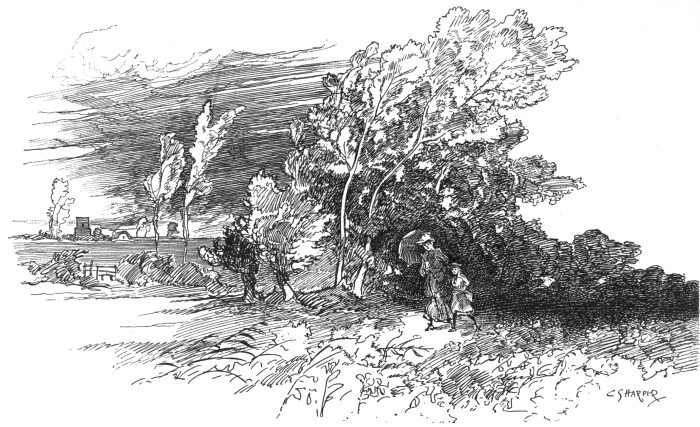
A WET DAY IN THE FENS.
The main drains are at a considerably higher level than the surrounding lands, the water in them only prevented from drowning the low-lying fields again by their great and solid banks, fourteen to sixteen feet high, and about ten feet in breadth at the top. These banks, indeed, form in many districts the principal roads. Perilous roads at night, even for those who know them well, and one thinks with a shudder of the dangers encountered of old by local medical men, called out in the darkness to attend some urgent case. Their custom was—perhaps it is in some places still observed—to mount their steady nags and to jog along with a lighted stable-lantern swinging from each stirrup, to throw a warning gleam on broken bank or frequent sunken fence.
At an interval of two miles along these banks is generally to be found a steam pumping-engine, busily and constantly occupied in raising water from the lodes and dykes in the lower levels and pouring it into the main channel. The same process is repeated in the case of raising the water from the field-drains into the smaller dykes by a windmill or "skeleton-pump," as it is often called. It is a work that is never done, but goes forward, year by year, and is paid for by assessments on the value of the lands affected by these operations. Commissioners, themselves local landowners and tenants, and elected by the same classes, look after the conduct and the efficiency of the work, and see that the main drains are scoured by the "scourers"; the banks duly repaired by the "bankers" and the "gaulters"; the moles, that might bring disaster by burrowing through them, caught by the "molers"; and the sluices kept in working order. The rate imposed for paying the cost of these works is often a heavy one, but the land is wonderfully rich and productive. Nor need the Fenland farmer go to extraordinary expense for artificial manure, or for marling his fields when at length he has cropped all the goodness out of the surface soil. The very best of restoratives lies from some five to twelve feet under his own land, in the black greasy clay formed from the decaying vegetable matter of the old forests that underlie the Fens. A series of pits is sunk on the land, the clay obtained from them is spread over it, and the fields again yield a bounteous harvest.
Harvest-work and farm-work in general in the Fens is in some ways peculiar to this part of the country, for farm-holdings are large and farmsteads far between. The practice, under these conditions, arose of the work being done by gangs; the hands assembling at break of day in the farmyard and being despatched in parties to their distant day's work in hoeing, weeding, or picking in the flat and almost boundless fields; returning only when the day's labour is ended. Men, women, and children gathered thus in the raw morning make a picture—and in some ways a pitiful picture—of farming and rustic life, worthy of a Millet. But our Millet has not yet come; and the gangs grow fewer. If he does not hasten, they will be quite gone, and something characteristic in Fenland-life quite lost. A Fenland farm-lass may wear petticoats, or she may not. Sometimes she acts as carter, and it is precisely in such cases that she sheds her feminine skirts and dons the odd costume that astonishes the inquisitive stranger new to these parts, who sees, with doubt as to whether he sees aright, a creature with the boots and trousers of a man, a nondescript garment, half bodice and half coat with skirts, considerably above the knees, and a sun-bonnet on her head, working in the rick-yards, or squashing heavily through the farmyard muck. Skirts are out of place in farmyards and in cattle-byres, and the milkmaid, too, of these parts is dressed in like guise. If you were to show a milkmaid in the Fens a picture illustrating "Where are you going to, my pretty maid?" in the conventional fashion, she would criticise very severely, as quite incorrect, the skirted figure of a poet's dream usually presented. She saves her skirts and her flower-trimmed hat for Sundays.
XXXII
And now we must come from the general to the especial; from Fens and Fen-folk in the mass to a bright particular star.
The greatest historical figure along the whole course of this road is that of Hereward the Wake, the "last of the English," as he has been called. "Hereward," it has been said, means "the guard of the army," while "the Wake" is almost self-explanatory, signifying literally the Wide Awake, or the Watchful. He is thought to have been the eldest son of Leofric, Earl of Mercia, and of the famous Godiva, and to have been banished by his father and outlawed. Like objects dimly glimpsed in a fog, the figure of Hereward looms gigantic and uncertain through the mists of history, and how much of him is real and how much legendary no one can say. When Hereward was born, in the mild reign of Edward the Confessor, the Anglo-Saxons who six hundred and fifty years before had conquered Britain, and, driving a poor remnant of the enervated race of Romanised Britons to the uttermost verge of the island, changed the very name of the country from Britain to England, had themselves degenerated. The Saxons were originally among the fiercest of savages, and derived their name from the "sæxe," or short sword, with which they came to close and murderous combat; but the growth of civilisation and the security in which they had long dwelt in the conquered island undermined their original combativeness, and for long before the invasion of England by William the Conqueror they had been hard put to it to hold their own against the even more savage Danes. Yet at the last, at Hastings under Harold, they made a gallant stand against the Normans, and if courage alone could have won the day, why then no Norman dynasty had ever occupied the English throne. The Battle of Hastings was only won by superior military dispositions on the part of William. His archers gained him the victory, and by their disconcerting arrow-flights broke the advance of the Saxons armed with sword and battle-axe.
That most decisive and momentous battle in the world's history was lost and won on the 14th day of October 1066. It was followed by a thorough-going policy of plunder and confiscation. Everywhere the Saxon landowners were dispossessed of their property, and Normans replaced them. Even the Saxon bishops were roughly deprived of their sees, and alien prelates from over sea took their place. The Saxon race was utterly degraded and crushed, and to be an Englishman became a reproach; so that the Godrics, Godbalds, and Godgifus, the Ediths, the Alfreds, and other characteristic Saxon names, began to be replaced by trembling parents with Roberts, and Williams, and Henrys, and other names of common Norman use.
Now, in dramatic fashion, Hereward comes upon the scene. Two years of this crushing tyranny had passed when, one calm summer's evening in 1068, a stranger, accompanied by only one attendant, entered the village of Brunne, in Lincolnshire, the place now identified with Bourne; Bourne and its Teutonic original form of Brunne meaning a stream. It was one of his father's manors. Seeking, unrecognised, shelter for the night, he was met by lamentations, and was told that Leofric, the great Earl, was dead; that his heir, the Lord Hereward, was away in foreign parts; and that his younger brother, now become heir, had only the day before been foully murdered by the Normans, who had in derision fixed his head over the doorway. Moreover, the Normans had seized the house and the manor. "Alas!" wailed the unhappy Saxon dependants, "we have no power to revenge these things. Would that Hereward were here! Before to-morrow's sunrise they would all taste of the bitter cup they have forced on us."
The stranger was sheltered and hospitably entertained by these unhappy folk. After the evening meal they retired to rest, but their guest lay sleepless. Suddenly the distant sounds of singing and applause burst on his ears. Springing from his couch, he roused a serving-man and inquired the meaning of this nocturnal merrymaking, when he was informed that the Norman intruders were celebrating the entry of their lord into the patrimony of the youth they had murdered. The stranger girded on his weapons, threw about him a long black cloak, and with his companion repaired to the scene of this boisterous revelry. There the first object that met his eyes was the head of the murdered boy. He took it down, kissed it, and wrapped it in a cloth. Then the two placed themselves in the dark shadow of a doorway whence they could command a view into the hall. The Normans were scattered about a blazing fire, most of them overcome with drunkenness and reclining on the bosoms of their women. In their midst was a jongleur, or minstrel, chanting songs of reproach against the Saxons and ridiculing their unpolished manners in coarse dances and ludicrous gestures. He was proceeding to utter indecent jests against the family of the youth they had slain, when he was interrupted by one of the women, a native of Flanders. "Forget not," she said, "that the boy has a brother, named Hereward, famed for his bravery throughout the country whence I come, ay, and even in Spain and Algiers. Were he here, things would wear a different aspect on the morrow."
The new lord of the house, indignant at this, raised his head and exclaimed, "I know the man well, and his wicked deeds that would have brought him ere this to the gallows, had he not sought safety in flight; nor dare he now make his appearance anywhere this side the Alps."
The minstrel, seizing on this theme, began to improvise a scurrilous song, when he was literally cut short in an unexpected manner—his head clove in two by the swift stroke of a Saxon sword. It was Hereward who had done this. Then he turned on the defenceless Normans, who fell, one after the other, beneath his furious blows; those who attempted to escape being intercepted by his companion at the door. His arm was not stayed until the last was slain, and the heads of the Norman lord and fourteen of his knights were raised over the doorway.
The historian of these things goes on to say that the Normans in the neighbourhood, hearing of Hereward's return and of this midnight exploit, fled. This proves their wisdom, at the expense of their courage. The Saxons rose on every side, but Hereward at first checked their zeal, selecting only a strong body of relations and adherents, and with them attacking and slaying those of the Normans who dared remain on his estates. Then he repaired to his friend Brand, the Saxon Abbot of Peterborough, from whom, in the Anglo-Saxon manner, he received the honour of knighthood. After suddenly attacking and killing a Norman baron sent against him, he dispersed his followers, and, promising to rejoin them in a year, sailed for Flanders. We next hear of Hereward in the spring of 1070, when he appears in company with the Danes whom William the Conqueror had allowed to winter on the east coast. Together they raised a revolt, first in the Humber and along the Yorkshire Ouse; and then they are found sacking and destroying Peterborough Abbey, by that time under the control of the Norman Abbot Turold. A hundred and sixty armed men were gathered by the Abbot to force them back to their lair at Ely, but they had already left. With the advent of spring Hereward's Danish allies sailed away, rich in plunder, and he and his outlaws were left to do as best they could. For a year he remained quiet in his island fastness, secured by the trackless bogs and fens from attack, while the discontented elements were being attracted to him. With him was that attendant who kept the door at Bourne: Martin of the Light Foot was his name. Others were Leofric "Prat," or the Cunning, skilful in spying out the dispositions of the enemy; Leofric the Mower, who obtained his distinctive name by mowing off the legs of a party of Normans with a scythe, the only weapon he could lay hands on in a hurry; Ulric the Heron, and Ulric the Black—all useful lieutenants in an exhausting irregular warfare. Greater companions were the Saxon Archbishop Stigand, Bishop Egelwin of Lincoln, and the Earls Morcar, Edwin, and Tosti. All these notables, with a large following, flocked into the Isle of Ely, as a Camp of Refuge, and quartered themselves on the monks of the Abbey of Ely. There they lay, and constituted a continual menace to the Norman power. Sometimes they made incursions into other districts, and burnt and slew; at others, when hard pressed, they had simply to retire into these fens to be unapproachable. None among the Norman conquerors of other parts of the land could cope with Hereward, and at last William, in the summer of 1071, found it necessary to take the field in person against this own brother to Will-o'-the-Wisp. His plan of campaign was to attempt the invasion of the Isle of Ely simultaneously from two different points; from Brandon on the north-east, and from Cottenham on the south-west. The Brandon attempt was by boat, and soon failed: the advance from Cottenham was a longer business. Why he did not advance by that old Roman road, the Akeman Street, cannot now be explained. That splendid example of a causeway built across the morasses must still have afforded the better way, even though the Romans who made it had been gone six hundred years. But the Conqueror chose to advance from Cambridge by way of Impington, Histon, and Cottenham. It is, of course, possible that the defenders of the Isle had destroyed a portion of the old road, or in some way rendered it impracticable. His line of march can be traced even to this day. Leaving the old coaching road here at Cottenham Corner, we make for that village, famed in these days for its cream cheeses and grown to the proportions of a small town.[1] It was here, at Cottenham and at Rampton, that William collected his invading force and amassed the great stores of materials necessary for overcoming the great difficulty of entering the Isle of Ely, then an isle in the most baulking and inconvenient sense to an invader. Before the Isle could be entered by an army, it was necessary to build a causeway across the two miles' breadth of marshes that spread out from the Ouse at Aldreth, and this work had to be carried out in the face of a vigorous opposition from Hereward and his allies. It was two years before this causeway could be completed. Who shall say what strenuous labour went to the making of this road across the reedy bogs; what vast accumulations of reeds and brushwood, felled trees and earth? The place has an absorbing interest, but to explore it thoroughly requires no little determination, for the road that William made has every appearance of being left just as it was when he had done with it, more than eight hundred years ago, and the way from Rampton, in its deep mud, unfathomable ruts and grassy hollows, soddened for lack of draining, is a terrible damper of curiosity. The explorer's troubles begin immediately he has left the village of Rampton. Turning to the right, he is instantly plunged into the fearful mud of a mile-long drove described on the large-scale Ordnance maps as "Cow Lane," a dismal malebolge of black greasy mud that only cattle can walk without difficulty. The unfortunate cyclist who adventures this way and pushes on, thinking these conditions will improve as he goes, is to be pitied, for, instead of improving, they go from bad to worse. The mud of this horrible lane is largely composed of the Cambridgeshire clay called "gault," and is of a peculiarly adhesive quality. When he is at last obliged to dismount and pick the pounds upon pounds of mud out of the intimate places of his machine, his feelings are outraged and, cursing all the road authorities of Cambridgeshire in one comprehensive curse, he determines never again to leave the highways in search of the historic. A few yards farther progress leaves him in as bad case as before, and he is at last reduced to carrying the machine on his shoulder, fearful with every stride that his shoes will part company with his feet, withdrawn at each step from the mud with a resounding "pop," similar to the sound made by the drawing of a cork from a bottle. But it is only when at last, coming to the end of Cow Lane and turning to the left into Iram Drove, he rests and clears away the mud and simultaneously finds seven punctures in one tyre and two in the other, that his stern indignation melts into tears. The wherefore of this havoc wrought upon the inoffensive wheelman is found in the cynical fact that although Cow Lane never receives the attentions of the road-repairer, its thorn-hedges are duly clipped and the clippings thrown into what, for the sake of convenience, may be called the road.
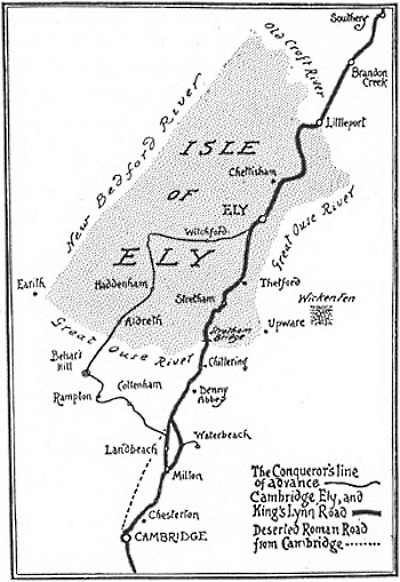
THE ISLE OF ELY AND DISTRICT.
The geographical conditions here resemble those of Muckslush Heath in Colman's play, and although Iram Drove is paradise compared with what we have already come through, taken on its own merits it is not an ideal thoroughfare. One mile of it, past Long Swath Barn, brings us to the beginning of Aldreth Causeway, here a green lane, very bumpy and full of rises and hollows. Maps and guide-books vaguely mention Belsar's Hill near this point, and imaginative guides who have not explored these wilds talk in airy fashion of it "overlooking" the Causeway. As a matter of fact, the Causeway is driven squarely through it, and it is so little of a hill, and so incapable of overlooking anything, that you pass it and are none the wiser. The fact of the Causeway being thus driven through the hill and the ancient earthworks that ring around six acres of it, proves sufficiently that this fortress is much more ancient than William the Conqueror's time. It is, indeed, prehistoric. Who was Belsar? History does not tell us; but lack of certain knowledge has not forbidden guesswork, more or less wild, and there have been those who have found the name to be a corruption of Belisarius. We are not told, however, what that general—that unfortunate warrior whom tradition represents as begging in his old age an obolus in the streets of Constantinople—was doing here. But the real "Belsar" may perhaps have been that "Belasius, Præses Militum versus Elye," mentioned in the "Tabula Eliensis," one of William's captains in this long business, from whom descended the Belasyse family.
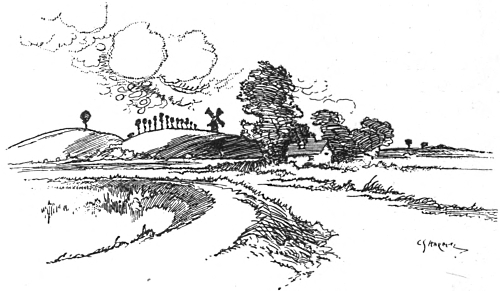
ALDRETH CAUSEWAY AND THE ISLE OF ELY.
Two miles of green lane, solitary as though foot of man had not passed by for years, lead down to the Ouse. Fens spread out on either hand—Mow Fen, Willingham Fen, Smythy Fen, Great North Fen—fens everywhere. It is true they are now chiefly cultivated fields, remarkable for their fertility, but they are saved from being drowned only by the dykes and lodes cut and dug everywhere and drained by the steam pumping-station whose chimney-shaft, with its trail of smoke, is seen far off across the levels. In front rises the high ground of the Isle of Ely, a mile or more away across the river: high ground for Cambridgeshire, but likely, in any other part of England, to be called a low ridge. Here it is noticeable enough of itself, and made still more so by a windmill and a row of tall slender trees on the skyline. A new bridge now building across the Ouse at this point is likely to bring Aldreth Causeway into use and repair again. On the other shore, at High Bridge Farm, the Causeway loses its grassy character, becoming a rutted and muddy road, inconceivably rugged, and so continuing until it ends at the foot of the rising ground of Aldreth. Drains and their protecting banks lie to the left of it; the banks used by the infrequent pedestrians in preference to the Causeway, low-lying and often flooded.
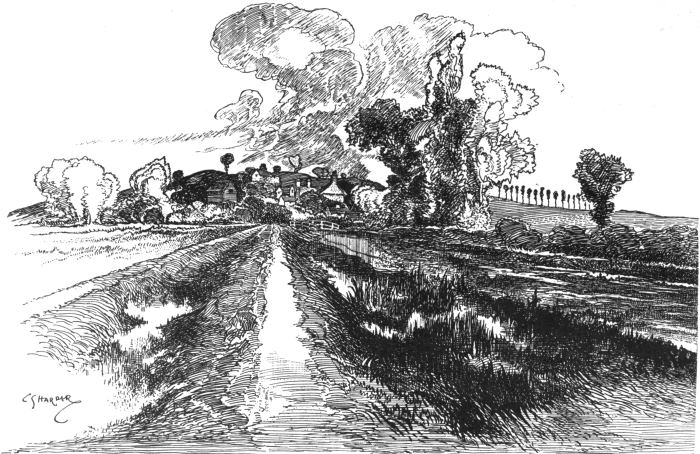
ALDRETH CAUSEWAY.
XXXIII
This, then, was the way into that Isle of Refuge to which the Normans directed their best efforts. At the crossing of the Ouse, the fascines and hurdles, bags of earth and bundles of reeds, that had thus far afforded a foundation, were no longer of use, and a wooden bridge had of necessity to be constructed in the face of the enemy. Disaster attended it, for the unlucky timbering gave way while the advance was actually in progress, and hundreds were drowned. A second bridge was begun, and William, calling in supernatural aid, brought a "pythonissa"—a sorceress—to curse Hereward and his merry men and to weave spells while the work was going forward. William himself probably believed little in her unholy arts, but his soldiers and the vast army of helpers and camp-followers gathered together in this unhealthy hollow, dying of ague and marsh-sickness, and disheartened by failure and delay, fancied forces of more than earthly power arrayed against them. So the pythonissa was provided with a wooden tower whence she could overlook the work and exercise her spells while the second bridge was building. Fishermen from all the countryside were impressed to aid in the work. Among them, in disguise, came Hereward, so the legends tell, and when all was nearly done, he fired the maze of woodwork, so that the sorceress in her tower was sent, shrieking, in flames to Ahrimanes, and this, the second bridge, was utterly consumed. Kingsley, in his very much overrated romance of Hereward the Wake, makes him fire the reeds, but the Fenland reed does not burn and refuses to be fired outside the pages of fiction.
It was at last by fraud rather than by force that the Isle of Ely was entered. A rebel earl, a timorous noble, might surrender himself from time to time, and most of his allies thus fell away, but it was the false monks who at last led the invader in where he could not force his way. Those holy men, with the Saxon Abbot, Thurston, at their head, who prayed and meditated while the defenders of this natural fortress did the fighting, came as a result of their meditations to the belief that William, so dogged in his efforts, must in the end be successful. He had threatened—pious man though he was—to confiscate the property of the monastery when he should come to Ely, and so, putting this and that together, they conceived it to be the better plan to bring him in before he broke in; for in this way their revenues might yet be saved. It is Ingulphus, himself a monk, who chronicles this treachery. Certain of them, he says, sending privily to William, undertook to guide his troops by a secret path through the fens into the Isle. It was a chance too good to be thrown away, and was seized. The imagination can picture the mail-clad Normans winding single file along a secret path among the rushes, at the tail of some guide whose life was to be forfeit on the instant if he led them into ambush; and one may almost see and hear the swift onset and fierce cries when they set foot on firm land and fell suddenly upon the Saxon camp, killing and capturing many of the defenders.