THE CAMBRIDGE, ELY, AND KING'S LYNN ROAD (continued 4)
Reading edition
But history shows the monks of Ely in an ill light, for it really seems that William's two years' siege of the Isle might have been indefinitely prolonged, and then been unsuccessful, had it not been for this treachery. Does anyone ever stop to consider how great a part treachery plays in history? It was the monks who betrayed the Isle, otherwise impregnable, and endless in its resources, as Hereward himself proved to a Norman knight whom he had captured. He conducted his prisoner over his water-and-morass-girdled domain, showed him most things within it, and then sent him back to the besieging camp to report what he had seen. This is the tale he told, as recorded in the Liber Eliensis:—
"In the Isle, men are not troubling themselves about the siege; the ploughman has not taken his hand from the plough, nor has the hunter cast aside his arrow, nor does the fowler desist from beguiling birds. If you care to hear what I have heard and seen with my own eyes, I will reveal all to you. The Isle is within itself plenteously endowed, it is supplied with various kinds of herbage, and in richness of soil surpasses the rest of England. Most delightful for charming fields and pastures, it is also remarkable for beasts of chase, and is, in no ordinary way, fertile in flocks and herds. Its woods and vineyards are not worthy of equal praise, but it is begirt by great meres and fens, as though by a strong wall. In this Isle there is an abundance of domestic cattle, and a multitude of wild animals; stags, roes, goats, and hares are found in its groves and by those fens. Moreover, there is a fair sufficiency of otters, weasels, and polecats; which in a hard winter are caught by traps, snares, or any other device. But what am I to say of the kinds of fishes and of fowls, both those that fly and those that swim? In the eddies at the sluices of these meres are netted innumerable eels, large water-wolves, with pickerels, perches, roaches, burbots, and lampreys, which we call water-snakes. It is, indeed, said by many that sometimes salmon are taken there, together with the royal fish, the sturgeon. As for the birds that abide there and thereabouts, if you are not tired of listening to me, I will tell you about them, as I have told you about the rest. There you will find geese, teal, coots, didappers, water-crows, herons, and ducks, more than man can number, especially in winter, or at moulting-time. I have seen a hundred—nay, even three hundred—taken at once; sometimes by bird-lime, sometimes in nets and snares." The most eloquent auctioneer could not do better than this, and if this knight excelled in fighting as he did in description, he must have been a terrible fellow.
It is pleasant to think how the monks of Ely met with harder measures than they had expected. William was not so pleased with their belated submission as he was angered by their ever daring to question his right and power. Still, things might have gone better with them had they not by ill-luck been at meals in the refectory when the King unexpectedly appeared. None knew of his coming until he was seen to enter the church. Gilbert de Clare, himself a Norman knight, but well disposed towards the monks, burst in upon them: "Miserable fools that you are," he said, "can you do nothing better than eat and drink while the King is here?"
Forthwith they rushed pellmell into the church; fat brothers and lean, as quickly as they could, but the King, flinging a gold mark upon the altar, had already gone. He had done much in a short time. Evidently he was what Americans nowadays call a "hustler," for he had marked out the site for a castle within the monastic precincts, and had already given orders for its building by men pressed from the three shires of Cambridge, Hertford, and Bedford. Torn with anxiety, the whole establishment of the monastery hasted after him on his return to Aldreth, and overtook him at Witchford, where, by the intercession of Gilbert de Clare, they were admitted to an audience, and after some difficulty allowed to purchase the King's Peace by a fine of seven hundred marks of silver.
Unhappily, their troubles were not, even then, at an end, for when on the appointed day the money, raised by the sacrifice of many of the cherished ornaments of the church, was brought to the King's officers at Cambridge, the coins were found, through some fraud of the moneyers, to be of light weight. William was studiously and politically angry at what he affected to believe an attempt on the part of the monks to cheat him, and his forbearance was only purchased by a further fine of three hundred marks, raised by melting down the remainder of the holy ornaments. The quality of William's piety is easily to be tested by a comparison of the value of his single gold mark, worth in our money one hundred pounds, with that of the one thousand silver marks, the sum total of the fines he exacted. A sum equal to thirty thousand pounds was extracted from the monastery and church of Ely, and forty Norman knights were quartered upon the brethren; one knight to each monk, as the old "Tabula Eliensis" specifies in detail.
XXXIV
What in the meanwhile had become of Hereward? What was he doing when these shaven-pated traitors were betraying his stronghold? One would like to find that hero wreaking a terrible vengeance upon them, but we hear of nothing so pleasing and appropriate. The only vengeance was that taken by William upon the rank and file of the rebels, and that was merely cowardly and unworthy. It was not politic to anger the leaders of this last despairing stand of the Saxons, and so they obtained the King's Peace; but the churls and serfs felt the force of retribution in gouged eyes, hands struck off, ears lopped, and other ferocious pleasantries typical of the Norman mind. Hereward who, I am afraid, was not always so watchful as his name signifies, seems to have found pardon readily enough, and one set of legends tells how at last he died peacefully and of old age in his bed.
Others among the old monkish chroniclers give him an epic and more fitting end, in which, like Samson, he dies with his persecutors. They marry him to a rich Englishwoman, one Elfthryth, who had made her peace with the King, and afterwards obtained pardon for her lover. But the Normans still hated him, and one night, when his chaplain Ethelward, whose duty was to keep watch and ward within and without his house and to place guards, slumbered at his post, a band of assassins crept in and attacked Hereward as he lay. He armed himself in haste, and withstood their onslaught. His spear was broken, his sword too, and he was driven to use his shield as a weapon. Fifteen Frenchmen lay dead beneath his single arm when four of the party crept behind him and smote him with their swords in the back. This stroke brought him to his knees. A Breton knight, one Ralph of Dôl, then rushed on him, but Hereward, in a last effort, once more wielded his buckler, and the Englishman and the Breton fell dead together.
However, whenever, or wherever he came to his end, certainly the great Hereward was laid to rest in the nave of Crowland Abbey, but no man knows his grave. Just as the bones and the last resting-place of Harold at Waltham Abbey have disappeared, so the relics of "the Watchful," that "most strenuous man," that hardy fighter in a lost cause, are scattered to the winds.
There are alleged descendants of Hereward to this day, and a "Sir Herewald Wake" is at the head of them; but we know nothing of how they prove their descent. "Watch and pray" is their motto, and a very appropriate one, too; although it is possible that Hereward's praying was spelt with an "e," and himself not so prayerful as predatory.
Hereward, the old monkish chroniclers tell us, was "a man short in stature but of enormous strength." By that little fragment of personal description they do something to wreck an ideal. Convention demands that all heroes be far above the height of other men, just as all knights of old were conventionally gentle and chivalric and all ladies fair; though, if history do not lie and limners painted what they saw, the chivalry and gentleness of knighthood were as sadly to seek as the loving-kindness of the hyæena, and the fair ladies of old were most furiously ill-favoured. Hereward's figure, without that personal paragraph, is majestic. The feet of him squelch, it is true, through Fenland mud and slime, but his head is lost in the clouds until this very early piece of journalism disperses the mists and makes the hero something less of the demi-god than he had otherwise been.
The name of Hereward's stronghold offers a fine blue-mouldy bone of contention for rival antiquaries to gnaw at. In face of the clamour of disputants on this subject, it behoves us to take no side, but just to report the theories advanced. The most favoured view, then, is that "Aldreth" enshrines a corruption of St. Etheldreda's name,—that Etheldreda who was variously known as St. Ethelthryth and St. Audrey,—and that it was originally none other than St. Audrey's Hythe, or Landing, on this very stream of Ouse, now much shrunken and running in a narrow channel, instead of spreading over the country in foul swamps and unimaginable putrid bogs. "Aldreche"—the old reach of this Ouse—is another variant put forward; but it does not seem to occur to any of these disputants that, at anyrate, the termination of the place-name is identical with that in the names of Meldreth and Shepreth, where little streams, the mere shadows and wraiths of their former selves, still exist to hint that it was once necessary to ford them, and that, whatever the first syllable of Meldreth may mean, "reth" is perhaps the Celtic "rhyd," a ford, and Shepreth just the "sheep ford."
But whatever may have been the original form of Aldreth's name, the village nowadays has nothing to show of any connection with St. Etheldreda, save the site only of a well dedicated to her, situated half-way up the steeply rising street. It is a curious street, this of Aldreth, plunging down from the uplands of the Isle into the peat and ooze that William so laboriously crossed. Where it descends you may still see the stones with which he, or others at some later time, paved the way. For the rest, Aldreth is one long street of rustic cottages very scattered and much separated by gardens: over all a look of listlessness, as though this were the end of the known world, and nothing mattered very much. When a paling from a garden fence falls into the road, it lies there; when the plaster falls from a cottage wall, no one repairs the damage; when a window is broken, the hole is papered or stuffed with rags: economy of effort is studied at Aldreth.
The curious may still trace William's route through the Isle, to Ely city. It is not a straight course. Geographical conditions forbade it to be so, and I doubt not, that if the road were to make again, they would still forbid; for to rule a straight line across the map from Aldreth to Ely is to plunge into hollows where water still lies, though actual fens be of the past. His way lay along two sides of a square; due north for three miles and almost due east for a like distance, along the track pursued nowadays by the excellent road uphill to where the mile-long and populous village of Haddenham stands on a crest, and down again and turning to the right for Witchford, whence, along a gentle spur, you come presently into Ely.
XXXV
Returning to the high road at Cottenham Corner, and passing the junction of the road from Waterbeach, we come presently, at a point six and a half miles from Cambridge, to a place marked "Dismal Hall" on large-scale Ordnance maps. Whatever this may have been in old days, it is now a small white-brick farmhouse, called by the occupier "The Brambles," and by the landlord "Brookside." The name perhaps derived originally from some ruined Roman villa whose walls rose, roofless and desolate, beside the ancient Akeman Street. It is a name belonging, in all probability, to the same order as the "Caldecotes" and "Coldharbours," met frequently beside, or in the neighbourhood of, Roman ways; places generally conceded to have been ruined houses belonging to that period. The modern representative of "Dismal Hall" stands beside a curiously small and oddly-shaped field, itself called "Dismal"; triangular in form and comprising only two acres.
Half a mile beyond this point, a pretty group of cottages marks where the way to Denny Abbey lies to the right across a cow-pasture. A field-gate whose posts are the battered fragments of some Perpendicular Gothic pillars from that ruined monastery, crowned incongruously with a pair of eighteenth-century stone urns, clearly identifies the spot. There has been a religious house of sorts on this spot since eight hundred years ago, and most of the remains are of the Norman period, when a settlement of Black Monks from Ely settled here. In succession to them came the Knights Templars, who made it a preceptory, and when their Order was suppressed and ceased out of the land, in consequence of its corruption and viciousness, the nuns of St. Clare were given a home in these deserted halls. Close upon four hundred years have gone since they, too, were thrust forth, and it has for centuries past been a farmhouse. Indeed, if you regard Denny Abbey, as also many another, in anything else save a conventional light, you will see that it was really always a farm. What else than a farm was the great Abbey of Tintern, and what other than farmers those Cistercian monks who built it and cultivated those lands, the godless, growing fearful and in expiatory mood, had given them? So also with the Benedictines, the Templars, and the Clares who succeeded one another here. You may note the fact in their great barns, and in the fields they reclaimed. To-day, groups of buildings of uncertain age, as regards their outer walls, enclose littered rick-yards, but the dwelling-house, for all the uninteresting look of one side, shows, built into its inner face, the sturdy piers and arches of one of the aisles; and the otherwise commonplace hall and staircase of the interior are informed with a majestic dignity by two columns and a noble arch of the Norman church. A large and striking barn, approached and entered across a pig-haunted yard rich in straw and mud, proves, on entering, to be a beautiful building of the Decorated period, once the refectory.
Leaving Denny Abbey behind, we come to Chittering, a place unknown to guide-books and chartographers. We need blame neither the one nor the other for this omission, for Chittering is remarkable for nothing but its insignificance and lack of anything that makes for interest. It consists, when you have counted everything in its constituent parts, of two lonely public-houses, the Traveller's Rest and the Plough and Horses, a grotesquely unbeautiful Baptist Chapel and a school, five or six scattered cottages, and one new house, entrenched as it were in a defensive manner behind a sedgy and duckweedy drain. It is here, at a right-hand turning, that the exploratory cyclist turns off for Wicken Fen, the last remaining vestige of the natural Fenland that once overspread the greater part of the county. In Wicken Fen, a square mile of peaty bog and quaking morass, where the reeds still grow tall, and strange aquatic plants flourish, the rarer Fenland lepidoptera find their last refuge. Dragon-flies, in glittering panoply of green-and-gold armour and rainbow-hued wings, flash like miniature lightnings over the decaying vegetation, and the sulphur-coloured, white-and-scarlet butterflies find a very paradise in the moist and steamy air. Wicken Fen is jealously preserved in its natural state, and is a place of pilgrimage, not only for the naturalist, with his butterfly-net and his collecting-box, but for all who would obtain some idea of what this country was like in former ages. At the same time it is a place difficult to find, and the route to it a toilsome one. The Fens express flatness to the last degree, it is true, but, even though they be drained, they are not easy to explore. Mountain-ranges are, indeed, not more weariful than these flats, where you can never make a straight course when once off the main roads, but are compelled by dykes and drains to make for any given point by questing hither and thither as though following the outlines of the squares on a chessboard. The distance to Wicken Fen, measured from Chittering in a direct line on the map, is not more than four miles. Actually, the route is nearly eight.
We have already seen what a Fenland drove is like. To such a complexion does this treacherous by-way descend in less than a quarter of a mile, bringing the adventurer into an apparently boundless field of corn. If the weather has recently been wet, he is brought to a despairing pause at this point, for the rugged drove here becomes a sea of a curious kind of black buttery mud, highly tenacious. The pedestrian is to be pitied in this pass, but the cyclist is in worse case, for his wheels refuse to revolve, and he finds, with horror, his brake and his forks clogged with the horrible mess, and his mud-guards become mud-accumulators instead. To shoulder his machine and carry it is the only course. If, on the other hand, the weather be dry, with a furious wind blowing, the mud becomes dust and fills the air with a very respectable imitation of a Soudan sandstorm. In those happy climatic conditions when it is neither wet nor too dry, and when the stormy winds have sunk to sleep, the way to Wicken Fen, though long and circuitous, loses these terrors. At such times the ditchers may be seen almost up to their knees in what looks like dry sand, hard at work clearing out the dykes and drains choked up by this flying dust, and it becomes of interest to examine the nature of this curious soil. A handful, gathered at haphazard, shows a kind of black sand, freely mixed with a fine snuff-coloured mixture of powder and minute fibrous shreds; pulverised peat from the vanished bogs and morasses that once stewed and festered where these fields now yield abundant harvests. This peaty soil it is that gives these fields their fertility, for, as Sir Humphry Davy once said, "A soil covered with peat is a soil covered with manure."
It is a curious commentary on the fame of Wicken Fen as an entomologist's paradise, and on its remoteness, that all the ditchers and farming-folk assume the stranger who inquires his way to it to be a butterfly-hunter.
At last, after crossing the railway to Ely, making hazardous passage over rickety plank-bridges across muddy dykes, and wending an uncertain way through farmyards inhabited by dogs keenly desirous of tearing the infrequent stranger limb from limb, the broad river Cam is approached, at Upware. Upware is just a riverside hamlet, remote from the world, and only in touch with its doings on those occasions when boating-parties from Ely or Cambridge come by on summer days.
On the opposite shore, across the reedy Cam, stands a queer building, partly ferry-house, partly inn, with the whimsical legend, "Five Miles from Anywhere. No Hurry," painted on its gable. The real sign of Upware Inn, as it is generally called, is the "Lord Nelson," but this knowledge is only acquired on particular inquiry, for signboard it has none.
The roystering old days at Upware are done. They came to an end when the railway between Cambridge, Ely, and Kings Lynn was opened, and coals and heavy goods no longer went by barge along the Ouse and Cam. In that unregenerate epoch, before modern culture had reached Cambridge, and undergrads had not begun to decorate their rooms with blue china and to attempt to live up to it, the chief delight of Cambridge men was to walk or scull down to Upware and have it out with the bargees. Homeric battles were fought here by the riverside in those days of beef and beer, and it was not always the University man who got the worst of it in these sets-to with or without the gloves. In the last days of this Philistine era the railway navvy came as a foeman equally well worth the attention of young Cambridge; and thus, in a final orgie of bloody noses and black eyes, the fame of Upware culminated. When the navvy had completed his work and departed, the bargee went also, and peace has reigned ever since along the sluggish reaches of the Cam. There are, it is true, a few of the barging craft and mystery still left along this waterway, but, beyond a singular proficiency in swearing, they have nothing in common with their forebears, and drink tea and discuss social science.
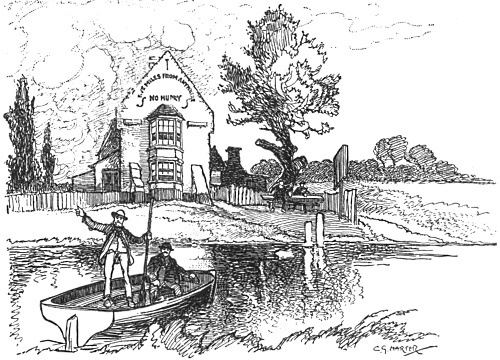
UPWARE INN.
In those old robustious days—famous once, but now forgot—flourished the Republic of Upware, a somewhat blackguardly society composed chiefly of muscular undergrads. Admission to the ranks of this precious association was denied to none who could hit hard and drink deep. In the riverside field that still keeps its name of "Upware Bustle," the Republic held many of its drunken, uproarious carouses, presided over by the singular character who called himself, not President, but "King of Upware." Richard Ramsay Fielder, this pot-house monarch, "flourished," as histories would say, circa 1860. He was an M.A. of Cambridge, a man of good family and of high abilities, but cursed with a gipsy nature, an incurable laziness, and an unquenchable thirst: the kind of man who is generally, for his sake and their own, packed off by his family to the Colonies. Fielder perhaps could not be induced to cross the seas; at anyrate, he enjoyed an allowance from his family, on the degrading condition that he kept himself at a distance. He earned the allowance loyally, and found the society that pleased him most at Upware and in the inns of the surrounding Fenland villages; so that on leaving the University he continued to cling to the neighbourhood for many years, becoming a hero to all the dissolute youngsters at Cambridge. He it was who originally painted the apt inscription, "Five Miles from Anywhere," on the gable-wall of this waterside inn, his favourite haunt, where he lounged and smoked and tippled with the bargees; himself apeing that class in his dress: coatless, with corduroy breeches and red waistcoat. A contemporary sketch of him tells of his thin flowing hair of inordinate length, of his long dirty finger-nails, and of the far from aromatic odour he gave forth; and describes his boating expeditions. "He used to take about with him in his boat an enormous brown-ware jug, capable of holding six gallons or more, which he would at times have filled with punch, ladling it out profusely for his aquatic friends. This vast pitcher or 'gotch,' which was called 'His Majesty's pint' ('His Majesty' in allusion to his self-assumed title), had been made to his own order, and decorated before kilning with incised ornaments by his own hand. Amongst these figured prominently his initials 'R. R. F.' and his crest, actual or assumed, a pheon, or arrow-head." Alluding to his initials, he would often playfully describe himself as "more R. than F.," which means (is it necessary to explain?) "more rogue than fool." Eccentric in every way, he would change his quarters without notice and without reason, and would remain in bed, smoking and drinking, for weeks together.
This odd character lingered here for some years after the bargees had gone, and into the time when even the most rowdy of Cambridge undergraduates began to find it "bad form" to booze and be hail-fellow with the village rapscallions of Fenland. Then Fielder himself "forswore sack and lived cleanly"; or at anyrate deserted his old haunts. Report tells how he died at last at Folkestone, in comfortable circumstances and in a quite respectable and conventional manner.
XXXVI
Upware Inn has lost a great deal of its old-time look. With something akin to melancholy the sentimental pilgrim sees a corrugated iron roof replacing the old thatch of reeds, characteristic of Fenland. The great poplar, too, has had its curious spreading limb amputated: that noble branch whereon the King of that Republic sat on summer evenings and held his disreputable Court. But not everything is modernised. The Cam is not yet bridged. You still are ferried across in an uncouth flat-bottomed craft, and they even yet burn peat in the domestic grates at Upware, so that links yet bind the present with the past. Peat is the traditional fuel of the Fens, largely supplanted nowadays by coal, but should coal become permanently dear, these Cambridgeshire villages would, for sake of its cheapness, go back to peat and endure its acrid smell and dull smouldering humour in place of the brightness of a coal fire. At Wicken Fen the peat is still forming: perhaps the only place in England where the process is going on. It is still three miles from Upware to this relic of the untamed wilderness, past Spinney Abbey, now a farmhouse with few or no relics of the old foundation to be seen. It was in this farmstead that Henry Cromwell, one of the Protectors sons, lived in retirement. He was visited here one September day in 1671 by Charles the Second, come over from Newmarket for the purpose. What Charles said to him and what Henry Cromwell replied we do not know, and imagination has therefore the freer rein. But we spy drama in it, a "situation" of the most thrilling kind. What would you say to the man who had murdered—judicially murdered, if you like it—your father? Charles, however, was a cynic of an easy-going type, and probably failed to act up to the theatrical requirements of the occasion. At anyrate, Henry Cromwell was not consigned to the nearest, or any, dungeon. Nothing at all was done to him, and he died, two years later, at peace with all men. He lies buried in the little church of Wicken, and was allowed to rest there.
Wicken Fen is just beyond this abbey farmstead. You turn to the right, along a green lane and across a field, and there you are, with the reeds and the sedge growing thick in the stagnant water, water-lilies opening their buds on the surface, and a lazy hum of insects droning in the still and sweltering air. The painted lady, the swallow-tail, the peacock, the scarlet tiger, and many other gaily-hued butterflies float on silent wings; things crawl and creep in the viscous slime, and on warm summer days, after rain, the steam rises from the beds of peat and wild growths as from some natural cookshop. Old windmill pumps here and there dot the banks of the fen, and in the distance are low hills that form, as it were, the rim of the basin in which this relic is set.
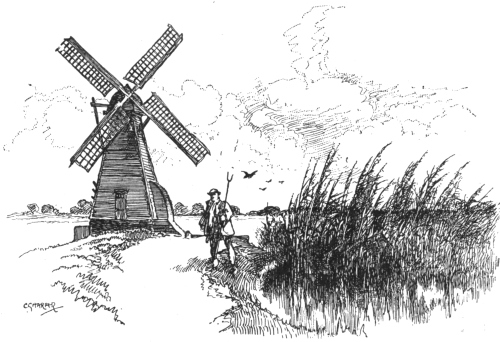
WICKEN FEN.
Away in one direction rises the tall majestic tower of Soham Church, deceiving the stranger into the belief that he is looking at Ely Cathedral, and overlooking what are now the pastures of Soham Fen; in the days of King Canute that inland sea—that mare de Soham—which stretched ten miles wide between Mildenhall and Ely. It was across Soham Mere that Canute came voyaging by Ely, rowed by knights in his galley, when he heard, while yet a long way off, the sound of melody. Bidding his knights draw nearer to the Isle, he found the music to be the monks in the church singing vespers. The story is more than a legend, and is alluded to in the only surviving stanza of an ancient song—
"Merie sungen the Muneches binnen Ely Tha Cnut Ching rew therby. Roweth cnites noer the lant, And here we thes Muneches saeng."
It is a story that well pictures the reality—-the actual isolation—of the Isle, just as does that other, telling how that same Canute, coming again to Ely for Christmas, found the waters that encompassed it frost-bound, but so slightly that crossing the ice was perilous in the extreme. He was thus of necessity halted on the shores of the frozen mere, and until they found one Brithmer, a Saxon cheorl of the Fen, skilled in Fen-lore and able to guide the King and his train across the shallow places where the ice lay thick and strong, it seemed as though he and his retinue would be unable to keep the Feast of the Nativity in Ely. Brithmer was a man of prodigious bulk, nicknamed "Budde," or "the Fat," and where he led the way in safety men of ordinary weight could follow without fear. So Canute followed in his sledge, with his Court, and kept Christmas on the Isle. As for Brithmer, who had performed this service, he was enlarged from serfdom to be a free man, and loaded with honours. Indeed, he was probably only known as "the Fat" before this time, and was doubtless called Brithmer, which means "bright mere," after this exploit.
XXXVII
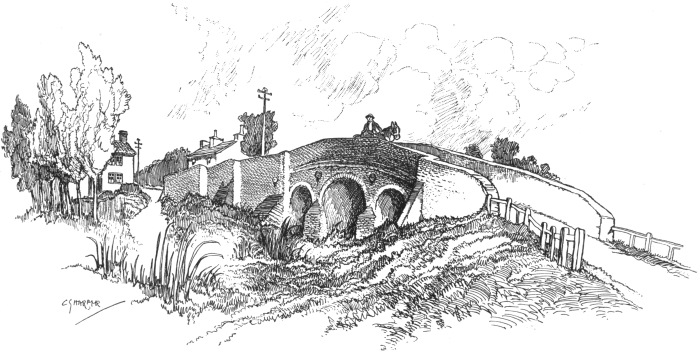
Returning to the old coach road from this expedition, and coming to it again with a thankful heart, we presently come to Stretham Bridge, a narrow old hunch-backed brick structure spanning the Great Ouse, or Old West River, and giving entrance to this Isle of Ely, of which already we have heard so much, and will now hear more. The sketch-map that has already shown the Conqueror's line of march indicates also the size and shape of the Isle: the physical Isle. For there are really two, the physical and the political. The last-named comprises the whole of the northern part of Cambridgeshire, from this point along the Ouse to Upware, and thence, following the Cambridgeshire border, round to Littleport and Tydd St. Giles in the north, by the neighbourhood of Crowland and Peterborough, and so down to the Ouse again at Earith, Aldreth, and Stretham Bridge. It is still a political division, and has its own government, under the style of the County Council of the Isle of Ely. The real geographical Isle—the one sketched in the map—is much smaller; only one-third the size of the other; measuring in its greatest length and breadth but some twelve and eight miles, and bounded by the Great Ouse from Earith to Upware, by Cam and Little Ouse to Littleport, and thence by the Old Croft River to the New Bedford River, returning along that cut to Earith.
As you approach Stretham Bridge along this old causeway the Isle is plain to see in front, its gentle hills glimpsed between the fringe of willows and poplars that now begin to line the way. No one has bettered the description Carlyle wrote of the Fen-country seen from this causeway that was once the Akeman Street; and no one can better it. "It has a clammy look," he says, clayey and boggy; the produce of it, whether bushes and trees or grass and crops, gives you the notion of something lazy, dropsical, gross. From the "circumfluent mud," willows, "Nature's signals of distress," spring up by every still slime-covered drain: willows generally polled and, with that process long continued, now presenting a very odd and weird appearance. The polled crown of an ancient willow bears a singularly close resemblance to a knuckly fist, and these, like so many gnarled giant arms of bogged and smothered Goliaths thrust upwards in despair, with clenched and imprecatory hands, give this road the likeness of a highway into fairyland whose ogres, under the spell of some Prince Charming, have been done to death in their own sloughs. Pollards, anathema to Cobbett, are in plenty in these lowlands, but it must not be thought that because of them, or even because Carlyle's description of the country is so apt, it is anything but beautiful. Only, to see its beauties and appreciate them, it is necessary here, more than elsewhere, to have fine weather.
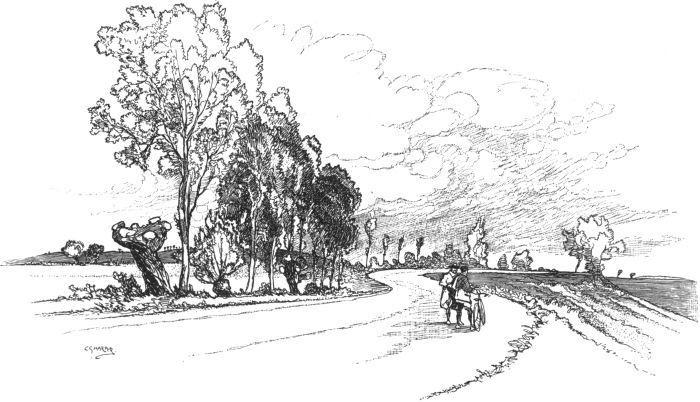
A FENLAND ROAD: THE AKEMAN STREET NEAR STRETHAM BRIDGE.
Stretham Bridge, that makes so great a business of crossing the Ouse, seems an instance of much ado about nothing, for that river, "Great Ouse" though it be named, is very much to seek in summer, trickling away as it does between tussocks of rough grass. The Great Ouse is not of the bigness it once boasted, in days before the Old and New Bedford Rivers were cut, two hundred and sixty years ago, to carry its sluggish waters away by a direct route to the sea, and the fair-weather pilgrim marvels at the bridge and at the great banks he sees stretching away along its course to protect the surrounding lands from being flooded. That they are needed is evident enough from the care taken to repair them, and from a sight of the men digging hard by in the greasy gault to obtain the repairing materials. These are the "gaulters" and the "bankers" of Fenland life. It was one of these who, as a witness in some cause at the Cambridge Assizes, appearing in his working clothes, was asked his occupation. "I am a banker, my Lord," he replied. "We cannot have any absurdity," said Baron Alderson testily; to which the man answered as before, "I am a banker"; and things were at cross-purposes until the meaning of the term was explained to the Court.
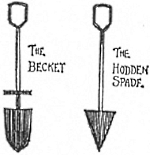
HODDEN SPADE AND BECKET.
The local occupations all have curious names, and the inhabitants of the Fens in general were long known as "Fen-slodgers," a title that, if indeed unlovely, is at least as expressive of mudlarking as it is possible for a word to be. You picture a slodger as a half-amphibious creature, something between a water-sprite and a sewer-man, muddy from head to foot and pulling his feet out of the ooze as he goes with resounding "plops," like the noise made in drawing the cork of a bottle. But if the Fenman did not quite fill all the details thus conjured up, he was, and is still, a watery kind of creature; half-farmer, half-fisherman and wild-fowler. He is sometimes a "gozard," that is to say, a goose-ward or goose-keeper. This occupation does not seem to have given an abiding surname, as many others have done, and you may search in many directories for it without avail, although the Haywards, the Cartwrights, and the Cowards are prominent enough. The Fenman digs his land with a becket or a hodden spade. The design of the first-named goes back to Roman times, and is seen figured on columns and triumphal arches in the Imperial City, just as it is fashioned to-day. It is this form of spade that is alluded to in such wayside tavern-signs as the Plough and Becket, apt to be puzzling to the uninitiated. When the Fenland rustic, weary of the daily routine, wants a little sport or seeks to grace his table with fish, he goes "dagging for eels" along the rivers and the drains, "leams," "lodes," or "eaus" (which he calls "ees") with a "gleve," which, translated into ordinary English, means an eel-spear, shaped very like Neptune's trident.
STRETHAM BRIDGE.
XXXVIII
Crossing Stretham Bridge, with Stretham Common on the right and Stretham village two miles ahead, the Akeman Street appears to be soon lost, for the way is crooked, and much more like a mediæval than a classic road. Indeed, the entrance to Stretham is by two striking right-angle turns and a curve past a low-lying tract called Beggars' Bush Field.
"Beggars' Bush" is so frequent a name in rural England[2] that it arouses curiosity. Sometimes these spots bear the unbeautiful name of "Lousy Bush," as an apt alternative. They were probably the lurking-places of mediæval tramps. The tramp we have always had with us. He, his uncleanliness and his dislike of work are by no means new features. Only, with the increase of population, there is naturally a proportional increase in the born-tired and the professional unemployed. That is all. So long ago as Queen Elizabeth's time legislation was found necessary to suppress the tramp. The Elizabethan statute did not call him by that name: they were not clever enough in those times to invent so descriptive a term, and merely called him a "sturdy rogue and vagrant." Of course he was not suppressed by the hardness, the whips and scorpions, of the Elizabethans, but endured them and the branded "R" and "V," and sporting them as his trade-marks, went tramping to the end of his earthly pilgrimage. These are the "strangers" whom you will find mentioned in the burial registers of many a wayside parish church; the "strangers" found dead on the road, or under the "Beggars' Bushes," and buried by the parish.
It was the indiscriminate almsgiving of the religious houses—the Abbeys and the Priories of old—that fostered this race of vagrom men and women, the ancestors of the tramps of to-day. Like the Salvation Army in our times,—either better or worse, whichever way you regard it,—they fed, and sometimes sheltered, the outcast and the hungry. Only the hungry are not fed for nothing, nor without payment sheltered by the Salvationists. They purchase food and lodging off the Army for a trifle in coin or by a job of work: the monks exacted nothing in return for the dole or the straw pallet that any hungry wretch was welcome to. Thus, throughout the land a great army of the lazy, the unfortunate, and the afflicted were in mediæval times continually tramping from one Abbey to another. Sometimes they stole, oftener they begged, and they found the many pilgrims who were always making pilgrimage from one shrine to another handy to prey upon. Ill fared the straggler from the pilgrim train that wound its length along the ancient ways; for there were those among the vagrom gang who would not scruple to rob or murder him, and that is one among many reasons why pilgrimage was made in company.
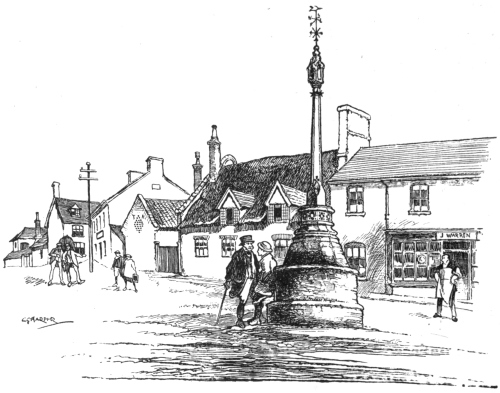
Stretham village, it is scarce necessary in these parts to say, is set on a hill, or what in the Fens is by courtesy so-called. No village here has any other site than some prehistoric knob of clay that by strange chance raised itself above the ooze. The site of Stretham, being in the Isle of Ely, was an isle within an isle. Still one goes up to and down from it. Still you see ancient houses there with flights of steps up to the front doors, so hard put to it were the old inhabitants to keep out of the way of the water; and even yet, when you are come to the levels again, the houses cease and no more are seen until the next rise is reached, insignificant enough to the eye, but to the mind stored with the old lore of the Fens significant of much. Stretham is a large village. It does not run to length, as do places in other parts of the country situated, like it, on a great road. They commonly consist of one long street: Stretham, built on the crown of a hill, has odd turns and twists, and streets unexpectedly opening on either hand as the explorer advances, and is, so to speak, built round and round itself. In its midst, where the road broadens into as wide a space as a village squeezed on to the crown of an island hilltop could anciently afford, stands a market cross.
You may seek far and wide for information about this cross, but you will not find. All we know is that, by its look, it belongs to the fifteenth century, and we may shrewdly suspect that the nondescript plinth it stands upon replaces a broad approach of steps. When the steps were taken away is a matter as unknown as the history of the cross itself; but if we do not know the when, we at least, in the light of Stretham's circumstances, know the why. The street was inconveniently narrowed by them.
STRETHAM.
The fine church stands to the left of the road by the cross, and is adjoined by an ancient vicarage. At the top of the main street, where the village ends, the traveller obtains his first glimpse of Ely Cathedral, four miles away. It must have been here, or close by, that Jack Goodwin, guard on the Lynn "Rover," about 1831, met Calcraft the hangman, for he tells how the executioner got up as an outside passenger "about four miles on the London side of Ely," to which city he had been paying a professional visit, to turn off an unhappy agricultural labourer sentenced to death for incendiarism, then a capital offence. Calcraft had been at considerable pains to avoid recognition, and had appeared in the procession to the scaffold on Ely Common as one of the Sheriff's javelin-men. Probably he feared to be the object of popular execration.
When he mounted the coach, he was dressed like a Cambridgeshire farmer, and thought himself quite unknown. Goodwin took charge of his baggage, comprising a blue bag, half a dozen red cabbages, and a piece of rope—the identical rope that had put an end to the unhappy wretch of the day before. He then offered him a cigar (guards were fine fellows in their way) and addressed Calcraft by name.
The hangman replied that he was mistaken. "No, no," said Goodwin, "I am not; I saw you perform on three criminals at the Old Bailey a few weeks ago."
That, of course, was conclusive, and they chatted more or less pleasantly; although, to be sure, the conversation chiefly turned on Mr. Calcraft's professional experiences. He told Goodwin, when he left, that "if ever he had the pleasure of doing the job for him, he would soap the rope to make it as comfortable as possible."
XXXIX
There is little or nothing to say of the way into Ely, and only the little village of Thetford, and that to one side of the road, intervenes. Nothing distracts the attention from the giant bulk of the Cathedral.
How shall we come into Ely? As archæologists, as pilgrims spiritually inclined and chanting a sursum corda as we go, or shall we be gross and earthly, scenting lamb and green peas, spring duckling and asparagus from afar, for all the world like our hearty grandfathers of the coaching age, to whom the great white-faced Lamb Inn, that is still the principal hostelry of this city, appealed with much more force than that great grey religious pile? We will to the Lamb, which is not a difficult house to find, and in fact presents itself squarely and boldly as you enter. "Come," it seems to say, "you are expected. The cloth is laid, you shall dine royally on Ely delicacies. This is in no traditional way the capital of the Fens. Our ducklings are the tenderest, our asparagus the most succulent, there never were such eels as those of Ouse; and you shall conclude with the cream-cheese of Cottenham." Is an invitation so alluring to be despised?
It is strange to read how Thomas Cross in his Autobiography of a Stage Coachman devotes pages to an elaborate depreciation of the Lamb in coaching times. From a "slip of a bar," with a netful of mouldy lemons hanging from the ceiling, to the catering and the appointments of the hostelry, he finds nothing good. But who shall say he was not justified? Lounging one day in this apology for a bar, there entered one who was a stranger to him, who asked the landlady what he could have for dinner. "Spitchcocked eels and mutton chops," replied the hostess, naming what were then, and are still, the staple commodities. The stranger was indignant. Turning to Cross, he said, "I have used this house for five-and-twenty years and never had any other answer."
Presently they both sat down to this canonical dinner in a sparsely-furnished room. The stranger cleaned his knife and fork (brought into the room in a dirty condition) by thrusting them through the soiled and ragged tablecloth. The sherry was fiery, if the port was good; and for gooseberry tart they had a something in a shallow dish, with twenty bottled gooseberries under the crust. The good cheer of the Lamb was then, it seems quite evident, a matter of conventional belief rather than of actual existence.
It has been already said that nothing distracts the attention of the traveller on approaching the city. Ely, indeed, is nearly all Cathedral, and very little of that which is not can claim any interest. It is true that six thousand five hundred people live in Ely, but the figures are surprising. Where do these thousands hide themselves? The streets are not so many, and even at that are all emptiness, slumber, and yawns. The shopkeepers (who surely keep shop for fun) come to their doors and yawn, and regard the stray customer with severity; the Divinity students yawn, and the Dean and the Cathedral staff yawn horribly at the service they have gone through so many times and know by heart. The only place where they don't yawn is the railway station, down below by the Ouse, by whose banks you get quite the finest near view of the Cathedral. Ely, in short, lives chiefly by and on the Cathedral. If there had never been a cathedral here, it would have been a village the size of Stretham. Perhaps to that size it will even yet decline.
"Ely," wrote Cobbett eighty years ago, "is what one may call a miserable little town; very prettily situated, but poor and mean. Everything seems to be on the decline, as, indeed, is the case everywhere where the clergy are masters." True enough, enterprise and industry are deadened in all such places; but this bull-headed old prevaricator, in proceeding to account for the decay, furiously assaults the Protestant religion, and pretends to find it responsible. It is true that the cleric is everywhere a brake on the wheels of progress, but what religion plunges its adherents in so abject a condition of superstitious dependence as the Roman Catholic creed? Cobbett on Ely is, in short, a monument of blundering clap-trap.
"Arrived at Ely," he says, "I first walked round the beautiful cathedral, that honour to our Catholic forefathers and that standing disgrace to our Protestant selves. It is impossible to look at that magnificent pile without feeling that we are a fallen race of men. You have only to open your eyes to be convinced that England must have been a far greater and more wealthy country in those days than it is in these days. The hundreds of thousands of loads of stone of which this cathedral and the monasteries in the neighbourhood were built must all have been brought by sea from distant parts of the kingdom.[3] These foundations were laid more than a thousand years ago; and yet there are vagabonds who have the impudence to say that it is the Protestant religion that has made England a great country."
Here we have Cobbett, who ought to have known better, and did actually know, repeating the shambling fallacy that the architectural art of the Middle Ages was so artistic because it was inspired by religion, and that its artistry decayed by consequence of the Reformation. Such an argument loses sight of the circumstance that edifices dedicated to religious use were not the only large or beautiful buildings erected in those ages, and that those who wrought upon secular castle or manor-house wrought as well and as truly as those who reared the soaring minster or noble abbey. And whence came the means wherewith to build cathedrals like this of Ely? Did they not derive from the lands settled upon monasteries by those anxious only to save their own souls, and by others who sought thus to compound for their deeds of blood or infamy? And is it possible to think without aversion of a Church that, accepting such gifts, absolved the givers in consideration of them?
Life is endeavour; not all cloistered prayer. He prays best whose prayers are an interlude of toil; and so, when we read Cobbett's long account of the wretched condition of Ely Cathedral, of its "disgraceful irrepair and disfigurement," and of the two old men who on a week-day afternoon formed the whole of the congregation, coupled with his regretful surmise that in Catholic times five thousand people would have been assembled here, we are apt to think that sparse congregation a very healthy sign, and that even those two old men would have been better employed out in the workaday world. He would be a Goth who should fail to perceive the beauty of Ely Cathedral and of its like, but those noble aisles, those soaring towers tell a tale of an enslaved land, of fettered souls, of a priestcraft that sought to rule the State, as well as to hold the keys of Heaven and of Hell. No man, whether he be Pope, Archbishop, or merely the Boanerges of some hideous Bethel, has the right to enslave another's soul. Let even the lovely cathedrals of our land be levelled in one common ruin if the sight of them harks us back to Popery, for in that harking back England would be utterly undone.
But since the saving common-sense of the Englishman can never again permit him to deliver up his soul into another's keeping, and since it follows naturally from this that the Romanising tendencies of our clergy must of necessity lead nowhere and bear no fruit, it becomes possible to look with a dispassionate eye upon these architectural relics of discredited beliefs.
Why was the Cathedral built here? That is a long story. It originated in the monastery founded on this spot in A.D. 673 by Etheldreda, daughter of Auna, King of the East Angles. Etheldreda has long since been canonised, and it behoves us to deal as gently as may be with a saint; but she was, if the chroniclers tell truth, an eccentric and original creature, twice wed by her own consent, and yet vowed to a life-long chastity. Her first husband was one Tondbert, a kinglet of the Gyrvians or Fen-folk, a monarch of the mudlarks, ruling over many miles of reed and sedge, in whose wastes Ely was centred. He gave his Queen this Isle, and died. For five years she remained a widow and then married again; this time a sturdier and less manageable man, King Egfrid of Northumbria. He respected her vows for twelve years, but when at last she took the veil in the north of England and fled from her Northumbrian home he took the only way open in the seventh century of asserting conjugal rights, and pursued her with an armed force. When, however, he arrived at the monastery of Coldingham she was gone, and I do not think Egfrid ever saw her again, or wanted to, for that matter. We will not follow Etheldreda in her long and adventurous journey to Ely, whither she had fled, nor recount the many miracles that helped her on the way. Miracles were cheap at that period, and for at least four hundred years to come were freely invented and elaborated by monkish chroniclers, who were the earliest novelists and writers of fairy tales, in the scriptorium of many a monastery.
XL
In the year 673, then, behold the ecstatic Etheldreda come out of many perils to Ely. Here, where she thought the Isle lifted its crest highest above the waters, she founded a mixed monastery for monks and nuns. At this point the ground is one hundred and nine feet above sea-level: at Haddenham, the crowning crest is but thirteen feet higher. Here she ruled as Abbess for six years, when she died, and was succeeded by her sister, the sainted Sexburga. It was Sexburga who, sixteen years from this time, determined to honour Etheldreda to the best of her ability, bethought her of translating the body from the humble graveyard of the monastery to the church itself. She sent forth a number of the brethren on a roving commission to find a block of stone for a coffin, and as stone of any kind is the least likely thing to find for many miles around Ely, theirs looked to be a long and difficult quest. They had, indeed, wandered as far as the ruins of Roman Cambridge before they discovered anything, but there they found a magnificent sarcophagus of white marble, which they joyfully brought back, and in it the remains of Etheldreda, entire and incorrupt, were laid.
In 870, the time of the fourth Abbess, St. Withburga, a great disaster befell the monastery of Ely. For years past the terror of the heathen Vikings, the ruthless Danes and Jutes from over sea, had been growing. Wild-eyed fugitives, survivors of some pitiless massacre of the coastwise settlements by these pirates, had flung themselves, exhausted, upon the Isle, and now the peril was drawing near to this sanctuary. A special intercession, "Deliver us, O Lord, from the Northmen," distinguished morning and evening office, but the prayer was unanswered. Presently along the creeks came the beaked prows of the ruthless sea-rovers, and the monastery was sacked and burnt and all upon the Isle slain. That is history. To it the old chronicler must needs put a clinching touch of miraculous vengeance, and tells how a bloodstained pirate, thinking the marble shrine of St. Etheldreda to be a treasure-chest, burst it open. "When he had done this there was no delay of Divine vengeance, for immediately his eyes started miraculously from his head, and he ended there and then his sacrilegious life."
Before many years had passed, a new monastery was founded upon the blackened and bloodstained ruins of the old. This was a College of Secular Clergy, patronised by King Alfred. It was succeeded by a new foundation, instituted by Ethelwold, Bishop of Winchester, who made it a Benedictine House; but even of that we have no trace left, and the church under whose roof Canute worshipped and Edward the Confessor was educated was swept away in the great scheme of rebuilding, entered upon by Simeon, the first Norman Abbot, in 1080. Twenty-six years later the relics of St. Etheldreda were translated to the choir just completed. The translation took place on October 17th, a day ever afterwards, while the Roman Catholic religion prevailed, celebrated by a religious festival and a secular fair. Pilgrims flocked throughout the year to St. Audrey's shrine, but many thousands assembled on her feast-day, and, that no doubt should rest upon their pilgrimage, purchased such favours and tokens as "St. Audrey's chains," and images of her. The chains were lengths of coloured silks and laces, and were, like most articles sold at the stalls, cheap and common. From them, their vulgar showiness, and their association with the Saint, comes the word "tawdry."
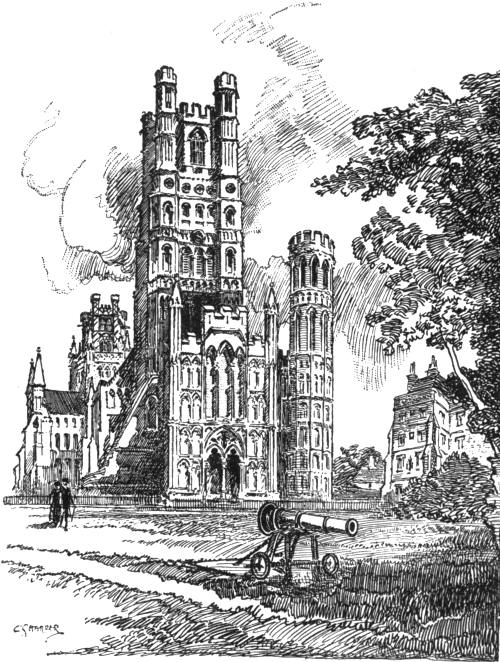
Two years after this translation of St. Audrey, the Abbey Church was made the Cathedral of the new diocese of Ely, carved out of the vast See of Lincoln. Of the work wrought by Abbot Simeon and his successor, Richard, the great north and south transepts alone remain. The choir they built was replaced in the thirteenth century by that lovely Early English work we now see; the nave they had not reached. This is a work of some sixty years later than their time, and is one of the finest examples of late Norman architecture in the country. The Norman style went out with a blaze of architectural splendour at Ely, where the great west front shows it blending almost imperceptibly into Early English. It is a singular architectural composition, this western entrance and forefront of Ely Cathedral; the piling up to a dizzy height of a great tower, intended to be flanked on either side by two western transepts each ending in a smaller tower. The north-western transept fell in ruins at some unknown period and has never been rebuilt, so that a view of this front presents a curiously unbalanced look, very distressing to all those good folk whose sensibilities would be harrowed if in their domestic establishment they lacked a pendant to everything. To the housewife to whom a fender where the poker is not duly and canonically neighboured by the tongs looks a debauched and sinful object; to the citizen who would grieve if the bronze or cut-glass lustre on one side of his mantel-shelf were not matched on the other, this is a sight of the most dolorous sort. It must have been to soothe the feelings of all such that a sum of £25,000 was appealed for when Sir Gilbert Scott was restoring the Cathedral, many years ago, and its rebuilding was proposed. The money was not forthcoming, the work was not done, and so Scott did not obtain the £2500 commission. Scott's loss is our gain, for we are spared one more example of his way with old cathedrals.
THE WEST FRONT, ELY CATHEDRAL.
The ruins of the missing transept are plain to see, and a huge and ugly buttress props up the tower from this side; but, were that building restored, we should only have again, in its completeness, a curiously childish design. For that is the note of this west front and of this great tower, rising in stage upon stage of masonry until the great blocks of stone, dwarfed by distance, look like so many courses of grey brick. So does a child build up towers and castles of wooden blocks.
We must, however, not accuse the original designers of the tower of this mere striving after enormous height. The uppermost stage, where the square building takes an octagonal form, is an addition of nearly two hundred years later, when the nice perceptions and exquisite taste of an earlier period were lost, and size was the goal of effort, rather than beauty. Those who built at that later time would have gone higher had they dared, but if they lacked something as artists, they must at least be credited with engineering knowledge. They knew that the mere crushing weight of stone upon stone would, if further added to, grind the lower stages into powder and so wreck the whole fabric. So, at a height of two hundred and fifteen feet, they stayed their hands; but, in earnest of what they would have done, had not prudence forbade, they crowned the topmost battlements with a tall light wooden spire, removed a century ago in one of the restorations. It was from the roof of this tower, in 1845, that Basevi, an architect interested in a restoration then in progress, fell and was killed.
The octagonal upper stage of this great western tower was added in the Decorated period, about 1350, when the great central octagon, the most outstanding and peculiar feature of the Cathedral, was built. Any distant view of this vast building that commands its full length shows, in addition to the western tower, a light and fairylike lantern, like some graceful coronet, midway of the long roof-ridge, where choir and nave meet. This was built to replace the tall central tower that suddenly fell in ruins in 1332 and destroyed much of the choir. To an architect inspired far above his fellows fell the task of rebuilding. There are two works among the whole range of ancient Gothic art in these islands that stand out above and beyond the rest and proclaim the hand and brain of genius. They are the west front of Peterborough Cathedral and the octagonal lantern of Ely. We do not know who designed Peterborough's daring arcaded front, but the name of that resourceful man who built the great feature of Ely has been preserved. He was Alan of Walsingham, the sacrist and sub-prior of the monastery. He did not build it in that conventional and deceitful sense we are accustomed to when we read that this or that mediæval Abbot or Bishop built one thing or another, the real meaning of the phrase being that they provided the money and were anything and everything but the architects. No: he imagined it; the idea sprang from his brain, his hands drew the plans, he made it grow and watched it to its completion.
No man dared rebuild the tower that had fallen; not even Alan, or perhaps he did not want to, being possessed, as we may well believe, by this Idea. What it was you shall hear, although, to be sure, no words have any power to picture to those who have not seen it what this great and original work is like. The fallen tower had been reared, as is the manner of such central towers, upon four great pillars where nave and choir and transepts met. Alan cleared the ruins of them away, and built in their stead a circle of eight stone columns that not only took in the width of nave and the central alleys and transepts and choir that had been enclosed by the fallen pillars, but spread out beyond it to the whole width of nave aisles and the side aisles of choir and transepts. This group of columns carries arches and a masonry wall rising in octagonal form above the roofs, and crowned by the timber structure of the lantern itself. The interior view of this lantern shows a number of vaulting ribs of timber spreading inwards from these columns, and supporting a whole maze of open timber-work pierced with great traceried windows and fretted and carved to wonderment. The effect is as that of a dome, "the only Gothic dome in the world" as it has been said. How truly it is a "lantern" may be seen when the sun shines through the windows and lights up the central space in the great church below. Puritan fury did much to injure this beautiful work, and its niches and tabernacles, once filled with Gothic statuary, are now supplied with modern sculptures, good in intention but a poor substitute. The modern stained-glass, too, is atrocious.
To fully describe Ely Cathedral in any but an architectural work would be alike impossible and unprofitable, and it shall not be attempted here: this giant among English minsters is not easily disposed of. For it is a giant. Winchester, the longest, measuring from west front to east wall of its Lady Chapel five hundred and fifty-five feet, is but eighteen feet longer. Even in that particular, Ely would have excelled but for the Lady Chapel here being built to one side, instead of at the end, owing to the necessity that existed for keeping a road open at the east end of the building.
Like the greater number of English minsters, Ely stands in a grassy space. A triangular green spreads out in front, with the inevitable captured Russian gun in the foreground, and the Bishop's Palace on the right. By turning to the south and passing through an ancient gateway, once the entrance to the monastery, the so-called "Park" is entered, the hilly and magnificently wooded southern side of what would in other cathedral cities be named the "Close," here technically "the College," and preserving in that title the memory of the ancient College of Secular Clergy which ruled sometime in that hundred years between A.D. 870 and 970.
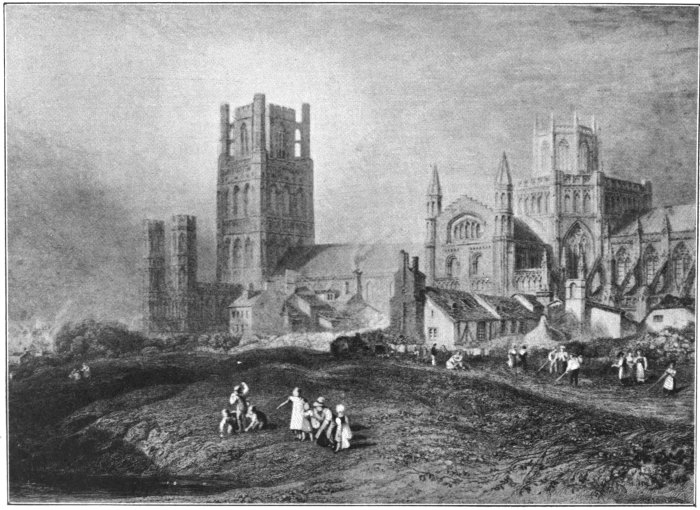
It was from this point of view, near the ancient mound of "Cherry Hill," the site of William the Conquerors Castle, that Turner painted his picture. Many remains of the monastic establishment are to be seen, built into charming and comfortable old houses, residences of the Cathedral dignitaries. Here are the time-worn Norman pillars and arches of the Infirmary, and close by is the Deanery, fashioned out of the ancient thirteenth-century Guesten Hall. Quiet dignity and repose mark the place; every house has its old garden, and everyone is very well satisfied with himself. It is a pleasant world for sleepy shepherds, if a sorry one for the sheep.
XLI
Let them sleep, for their activity, on any lines that may be predicated from past conduct, bodes no one good. Times have been when these shepherds themselves masqueraded as wolves, acting the part with every convincing circumstance of ferocity. The last of these occasions was in 1816. I will set forth in detail the doings of that time, because they are intimately bound up with the story of this road between Ely and Downham Market.
ELY CATHEDRAL. [After J. M. W. Turner, R.A.]
It was not until after Waterloo had been fought and Bonaparte at last imprisoned, like some bottle-imp, at St. Helena, that the full strain of the past years of war began to be felt in its full severity. It is true that for years past the distress had been great, and that to relieve it, and to pay for Imperial needs, the rates and taxes levied on property had in many places risen to forty and even forty-eight shillings in the pound, but when military glory had faded and peace reigned, internal affairs grew more threatening. Trade was bad, harvests were bad, wheat rose to the unexampled figure of one hundred and three shillings a quarter, and any save paper money was scarce. A golden guinea was handled by many with that curiosity with which one regards some rare and strange object. Everywhere was the one-pound note, issued for the purposes of restricting cash payments and restoring credit; but so many banks issuing one-pound notes failed to meet their obligations that this medium of exchange was regarded with a very just suspicion, still echoed in the old song that says—
"I'd rather have a guinea than a one-pound note."
Everyone at this period of national exhaustion was "hard up," but worse off than any were the unfortunate rural folk—the farm-labourers and their like.
The agricultural labourer is now an object of solicitude, especially at election times. There are, in these happy days, always elections; elections to Parliament, elections to parish and other councils, always someone to be elected to something, and as our friend Hodge has oftentimes a vote to give his best friend, his welfare is greatly desired. But at this unhappy time of which we have been speaking, Hodge had no vote and, by consequence, no friends. His wages, when he could get any work, ranged from seven to nine shillings a week, and the quartern loaf cost one shilling and sixpence. Tea was eight shillings a pound, sugar one shilling, and other necessaries at famine prices. How, then, did Hodge live? It is a difficult question to answer. In many cases the parish made him an allowance in augmentation of wages, but it need scarce be added that this extraordinary system did not help him much. Indeed, the odd idea of financially relieving a man in work tended directly to injure him, for it induced the farmers to screw him down by a corresponding number of shillings. This difficulty of answering the question of how Hodge managed to exist was felt by himself, in the words of a doleful ballad then current—
"Eighteen pence for a quartern loaf, And a poor man works for a shilling: 'Tis not enough to find him bread, How can they call it living?"
Observe: Hodge did not ask for anything more than to be allowed to live. It is not a great thing to ask. His demand was for his pay to be raised to the equivalent of a stone of flour a day; eleven shillings a week. He desired nothing to put by; only enough to fill the hungry belly. No one paid the least heed to his modest wants. Rather did events grind him and his kind deeper into the dust. Many rustics in those days, when half the land was common fields, kept geese. Some, a little better off, had a cow. Fine pasturage was found on these commons. But towards the end of the eighteenth century, and well on into the nineteenth, there began, and grew to enormous proportions, a movement for enclosing the commons. Most of them are gone now. Very early in this movement Hodge began to feel the pinch, and, when his free grazing was ended, was provided with a grievance the more bitter because entirely new and unusual.
All over the country there were ugly disturbances, and at last the stolid rustics of the Fens began to seethe and ferment. Still no one cared. If Hodge threatened, why, a troop or so of Yeomanry could overawe him, and were generally glad of the opportunity, for those yeomen were drawn from the squirearchy and the farming classes, who regarded him as their natural slave and chattel. To no one occurred the idea of relieving or removing these grievances.
At last the starving peasantry of these districts broke into revolt. The village of Southery seems to have been the origin of the particular disturbance with which we are concerned. One May day the farm-labourers assembled there to the number of some eight hundred, and marched to Downham Market, nearly seven miles distant, calling at the farms on the way and bringing out the men engaged on them. Arrived at Downham, they numbered fifteen hundred; a very turbulent and unruly mob, ready for any mischief. The first to feel their resentment were the millers and the bakers, who had put up the price of flour and bread. Their mills and shops were sacked and the contents flung into the roadway, so that the streets of the little town were ankle-deep in flour, and loaves were kicked about like footballs. The butchers suffered next, and by degrees the whole shopkeeping fraternity. It is not to be supposed that the inns were let alone. Determined men stormed them and brought out the beer in pails. At one inn—the Crown—the local magistrates were holding their weekly sitting, and with some difficulty escaped from an attack made upon them. Their escape enraged the rioters, who redoubled their energies in wrecking the shops, and were still engaged upon this pastime when the magistrates returned, either at the head, or perhaps (counsels of prudence prevailing) in the rear, of a troop of Yeomanry. The Riot Act was read while the air was thick with stones and brickbats, and then the Yeomanry fell upon the crowds and belaboured them with the flat of their swords. The net results of the day were streets of pillaged shops, and ten men and four women arrested by the special constables who had hastily been sworn in. A renewal of the riot was threatened the next morning, and only stopped by the release of these prisoners and an agreement among employers to advance the rate of wages.
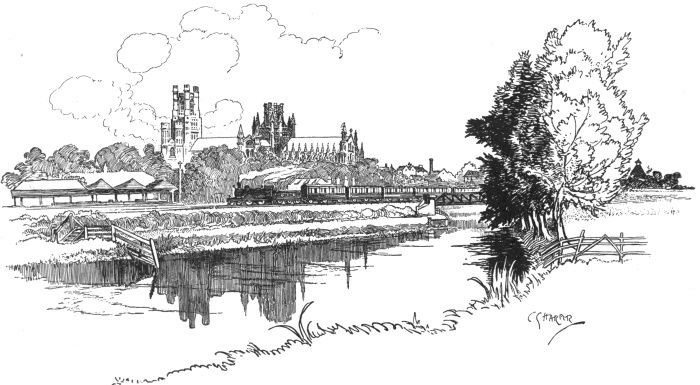
ELY, FROM THE OUSE.
This first outbreak was no sooner suppressed than another and much more serious one took place at Littleport. Gathering at the Globe Inn one morning to the number of a hundred and fifty, armed with cleavers, pitchforks, and clubs, the desperate labourers set out to plunder the village. At their head marched a man bearing a pole with a printed statement of their grievances flying from it. The first object to feel their rage was a shop kept by one Martin, shopkeeper and farmer. Martin attempted to buy them off with the offer of a five-pound note, but they took that and burst into the shop as well, smashing everything and carrying off tea and sugar. An amusing side to these incidents is seen in an account telling how one plunderer staggered away with a whole sugarloaf, and how a dozen of Martin's shirts, "worth a guinea apiece," as he dolefully said afterwards, disappeared in the twinkling of an eye.
Then they visited a retired farmer and demolished his furniture. He had a snug hoard of a hundred guineas tucked away in an old bureau. Alas! when these men of wrath had gone, the guineas were found to have gone with them. And so forth, throughout the long day.
XLII
Night at last shuts down on Littleport. The village is in deshabille: furniture lying broken in the streets, the household gods defiled, the beer-barrels of all the public-houses run dry. Every oppressor of the poor has been handsomely served out, and, incidentally, a good many unoffending people too: for a mob maddened with the sense of wrongs long endured is not discriminating. One there is, however, not yet punished. This is the vicar, conspicuous earlier in the day, alternately threatening and cajoling, but, many hours since, prudently retired to his vicarage. With a savage growl, they invest the house and batter at the door, demanding money. The vicar offers two one-pound notes; scornfully rejected, and ten pounds at the very least is demanded. He refuses, and to his refusal he adds the folly of presenting a pistol at the heads of these furious men; a pistol instantly snatched from his hands and like to be used against him. From this very patent danger and the sudden dread of murder he runs; runs upstairs to his wife and daughters, and presently they are out somewhere at the back door, all flying together,—the women, as I gather, in their nightgowns,—making for Ely, where they arrive at midnight.
Meanwhile, all this night, Littleport is trembling: the shopkeepers, the farmers, anyone who has anything to lose, with fear: those who have nothing to lose, something even to gain, with certain wild hopes and exaltations. Not without fear, they, either; for it is a brutal Government with which, in the end, they must reckon. So far, these wild despairing folk have had no leader, but now they turn to one well-known to sympathise with them: one John Dennis, an innkeeper and small farmer, and by consequence of the hated class of oppressors. By conviction, however, he sides with them: a very Saul among the prophets. To him, late at night, they come. He is abed and asleep, but they rouse him. Will he lead them to Ely on the morrow, to urge their needs and their desperate case upon the authorities?
He will not: it is useless, he says. Nay, but you must, you shall, say they, else we will shoot you, as one forsworn.
So poor Dennis, whose fate is sealed from this hour, leaves his bed and dresses himself, while the excited peasantry loot all Littleport of its gunpowder, bullets, and small shot, used in wild-fowling. Some sixty muskets and fowling-pieces they have found, and eight of those curious engines of destruction called "punt-guns" or "duck-guns." A gun of this kind is still used in duck-shooting. It has a barrel eight feet long, with two inches bore, and is loaded with three-quarters of a pound of shot and about an ounce of gunpowder. It is mounted on a swivel, generally at the end of a punt.
Guns of this calibre they have mounted in a farm-waggon, drawn by two horses, and at the back of the waggon they have placed a number of women and children: with some idea of moving hearts, if not by fear of their quaint artillery, at least in pity for their starving families. It is daybreak when at last they set out on the five miles to Ely, a band of two hundred, armed with muskets, fowling-pieces, scythes, pitchforks, clubs, and reaping-hooks. Ely has heard something of this projected advance, and sends forth three clerical magistrates and the chief constable to parley and ask the meaning of this unlawful assembly. The meaning, it seems, is to demand wages to be fixed at not less than two shillings a day, and that flour shall be sold at not more than two shillings and sixpence a stone. Meanwhile, the duck-guns look these envoys in the eyes perhaps a little more sternly than we are disposed nowadays to credit. At anyrate, the magistrates temporise and promise to inquire into these things. They retire to the Cathedral precincts to consult, and—ah! yes, will these demonstrators please go home?
No; they will not do anything of the kind. Instead, they advance into the Market Square, where their battery is wheeled, pointing up the High Street, much to the consternation of the citizens, firmly persuaded that this is the end of all things and now busily engaged in secreting their little hoards, their silver spoons and precious things, in unlikely places. The rioters, conscious of having easily overawed the place, now determine to put it under contribution, beginning with those who have ground the faces of the poor—the millers and their kind. Dennis, armed with a gun, and at the head of a threatening crowd, appears before the house of one Rickwood, miller. "They must have fifty pounds," he says, "or down come house and mill." Little doubt that they mean it: in earnest thereof, observe, windows are already smashed. Bring out those fifty sovereigns, miserable ones, before we pull the house about your ears!
They send off to the bank accordingly; Mrs. Rickwood going in haste. On the way she meets the Bank Manager, a person who combines that post with the civil overlordship of Ely. He is, in point of fact, the chief constable. Something grotesquely appropriate, if you think of it, in these two posts being in the hands of one man. "They shall not have a penny," he stoutly declares, assisting Mrs. Rickwood from the crowds that beset her; but certain blows upon head and body determine him to be more diplomatic, and after some parley he agrees to pay the fifty pounds in cash to those who constitute themselves leaders of three divisions of rioters. These three men alone, representing Ely, Littleport, and Downham, shall be admitted to the bank, and each shall—and does actually—receive one-third of that sum, signing for it. Resourceful manager! They are paid the coin, and sign: they might as well have signed their death-warrants, for those signatures are evidence of the very best against them when proceedings shall subsequently be taken.
Other houses are visited and people terrified, and then they are at a loss for what next. You cannot make a revolution out of your head as you go on: what is needed is a programme, some definite scheme, and of such a thing these poor wretches have no idea. So, gradually, as afternoon comes on, they disperse and fall back upon discontented Littleport, just before the arrival of a troop of the 18th Dragoons and a detachment of the Royston Volunteer Cavalry, sent for to Bury St. Edmunds and Royston by the magistrates who had in the early morning parleyed with the rioters. Ely is saved!
We—we the authorities—have now the upper hand, and mean to be revenged. On the morrow, then, behold the military, with the Prebendary of Ely, Sir Bate Dudley, and many gentlemen and persons of consideration, invading Littleport and wilfully stirring up again the excitement that had spent itself. Rumours of this advance have been spread, and on entering the village they find the men of the place hidden behind doors and windows, whence they fire with some effect, wounding a few. The soldiers return the fire, and one man is killed and another pitifully mangled. The rest flee, soldiers and magistracy after them, hunting for some days in fen and dyke, and taking at last seventy-three; all marched into Ely and clapped in gaol, there to await the coming of the Judge presiding over the Special Assize appointed to try them.
The proceedings lasted six days, opened in state by a service in the Cathedral: an exultant service of thanksgiving to God for this sorry triumph. To it the Judge and his javelin-men went in procession, behind the Bishop, and escorted by fifty of the principal inhabitants carrying white wands. The Bishop himself, the last to wield the old dual palatine authority of Church and State, was preceded by his butler, bearing the Sword of State that symbolised the temporal power; and as he entered the Cathedral the organ burst forth in the joyful strains of Handel's anthem: "Why do the heathen rage and the people imagine a vain thing?" with its triumphant chorus, "Let us break their bands asunder!"
Nothing else so well portrays the unchristian savagery of the time as the doings of this prelate—let us record his name, Bishop Bowyer Edward Sparke, that it may he execrated—a veritable Hew-Agag-in-pieces-before-the-Lord, who preached earthly vengeance and spiritual damnation to the three-score and thirteen in prison close by. Truly, a wolf sent to shepherd the flock.
Those were times when to steal to the value of forty shillings, and to steal to the value of a shilling, accompanied by violence, were capital offences. Five of the prisoners, convicted on these counts, were sentenced to be hanged, and five were transported for life. To the others were dealt out various terms of imprisonment. Chief among the ill-fated five was John Dennis, the leader, somewhat against his own judgment, of the outbreak. His, we must allow, is a figure tragical above the rest, touched with something like the dignity of martyrdom. They hanged him and the four others, in due course, on Ely Common, on a day of high holiday, when three hundred wand-bearers and bodies of troops assembled to protect the authorities and to see execution done. It may be read, in old records, how the whole of the city was searched for a cart to take the condemned men to the scaffold, and how at last five pounds was paid for the use of one; so there was evidently a public opinion opposed to this policy of bloodshed. Let us not seek to discover who was that man who took those five pounds, and with the taking of them sold his immortal soul.
The victims of the combined fear and rage of the authorities were buried in one common grave in the churchyard of St. Mary's, hard by the great Cathedral's western front, and on the wall of that church-tower was placed the tablet that may still be seen, recording that—
"Here lye in one grave the bodies of William Beamiss, George Crow, John Dennis, Isaac Harley, and Thomas South, who were all executed at Ely on the 28th day of June 1816, having been convicted at the Special Assizes holden there of divers robberies during the riots at Ely and Littleport in the month of May in that year. May their awful fate be a warning to others!"
There is no place more sacred to me in the whole of Ely than this humble and neglected spot, where these men, victims of this pitiful tragedy in corduroy and hobnailed boots, martyrs to affrighted and revengeful authority, lie. It is a spot made additionally sad because the sacrifice was sterile. Nothing resulted from it, so far as our human vision can reach. Bishop Sparke and Prebendary Sir Bate Dudley and the host of Cathedral dignitaries continued to feast royally, to clothe themselves in fine raiment, and to drink that old port always so specially comforting to the denizens of cathedral precincts; and every night the watchman went his rounds, as even now, in our time, he continues to do, calling the hours with their attendant weather, and ending his cry with the conventional "All's Well!"
To the soldiers employed in the unwelcome task of suppressing these disturbances and of shooting down their fellow-countrymen, no blame belongs: they did but obey orders. Yet they felt it a disgrace. The 18th Dragoons had fought at Waterloo the year before, and one of the troopers who had come through that day unscathed received in this affair a wound that cost him his arm. He thought it hard that fate should serve him so scurvy a trick. But among the soldiery employed was a Hanoverian regiment, whose record is stained deeply and foully with the doings of one German officer. Patrolling Ely in those tempestuous days, his company were passing by the old Sextry Barn, near the Cathedral, when he heard a thatcher employed on the roof call to his assistant in the technical language of thatchers "Bunch! bunch!" He was merely asking for another bundle of reeds, but the foreign officer, not properly understanding English, interpreted this as an insult to himself, and ordered his men to fire. They did so, and the unfortunate thatcher fell upon the open doors of the barn, his body pierced by a dozen bullets. There it hung, dropping blood, for three days, the officer swearing he would serve in the same way anyone who dared remove it.
XLIII
Those days are far behind. When Bishop Sparke died in 1836, the temporal power was taken away from the See, and his Sword of State was buried with him: a fitting piece of symbolism. These memories alone are left, found only after much diligent and patient search; but with their aid the grey stones and the soaring towers of Ely, the quiet streets, and the road on to Littleport, take on a more living interest to the thoughtful man, to whom archæology, keenly interesting though it be, does not furnish forth the full banquet of life.
Save for these memories, and for the backward glance at the Cathedral, looming dark on the skyline, much of the way to Littleport might almost be called dull. A modern suburb called "Little London" has thrown out some few houses in this direction during the last century, but why or how this has been possible with a dwindling population let others explain, if they can do so. At anyrate, when the Reverend James Bentham, the historian, was Canon here, from 1737 to 1794, no dwellings lined the way, for he planted a mile-long avenue of oaks where these uninteresting houses now stand. A few only of his trees remain, near the first milestone; a clump of spindly oaks, more resembling elms in their growth, and in midst of them a stone obelisk with a Latin inscription stating how Canon James Bentham, Canon of the Cathedral Church of Ely, planted them in 1787, his seventieth year, not that he himself might see them, but for the benefit of future ages. The Latin so thoroughly succeeds in obscuring this advertisement of himself from the understanding of the country-folk that the obelisk is generally said to mark the grave of a favourite racehorse!
The descent from the high ground of the Isle begins in another half mile from this point. Past Chettisham Station and its level crossing, standing solitary on the road, we come down Pyper's Hill, at whose foot is the field called, on the large Ordnance maps, "Gilgal." Why so-called, who shall say? Did some old landowner, struck perhaps by its situation near the verge of this ancient Fen-island, name this water-logged meadow after that biblical Gilgal where the Israelites made their first encampment across the Jordan, and where they kept their first Passover in the Land of Canaan? It may be, for we have already seen how that Norman knight, shown the riches of the Isle of Ely by Hereward, described it even as another Canaan, a land figuratively flowing with milk and honey.
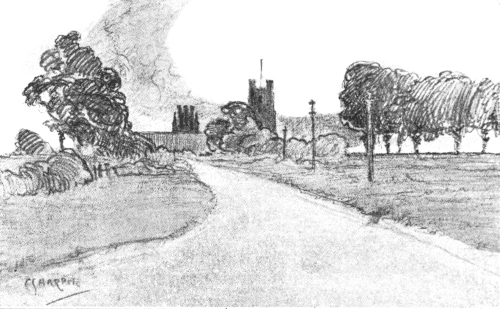
ELY CATHEDRAL, FROM THE LITTLEPORT ROAD.
An old toll-house still stands here by the wayside and heralds the approach to Littleport, whose name, preparing the stranger for some sleepy, old-world decayed creek-side village, with rotting wharves and a general air of picturesque decrepidness, ill fits the busy, ugly place it is. Littleport is more populous than Ely. It stands at the confluence of the Great Ouse and the Old Croft rivers, and at the lower end of its long, long gritty streets, lined with whitey-grey brick houses, the road is bordered by yet another stream—the "Holmes River." Indeed, speaking of its situation in the Fens and by these waters, Carter, the eighteenth-century historian of Cambridgeshire, tells us that in his time it was "as rare to see a coach there as a ship at Newmarket." Much of its recent prosperity derives from the factories of the prominent London firm of hosiers and clothiers, "Hope Brothers," established here. The church and the adjoining vicarage, where the rioters of 1816 so terrified the clergyman and his family, stand on an elevated site behind the main street. There was, until recent years, when it was built up, a passage through the tower, said to have been a short cut to the Fenland. If this was its real purpose, it vividly shows how little solid ground there was here in old days. The tower top, too, has its story, for it burnt a nightly beacon in those times; a light in beneficent competition with the marshland Jacks-o'-Lantern, to guide the wanderer to the haven where he would be.
It must not be forgotten that Littleport is a place famed in the annals of a certain sport. It is not a sport often to be practised, for a succession of open winters will render the enjoyment of it impossible, and its devotees stale and out of form. It is the healthful and invigorating sport and pastime of skating. Nowhere else in all England is there such a neighbourhood as this for skating and sliding, for when the flooded fields of winter are covered with a thin coating of ice you may skate pretty well all the way to Lynn on the one hand and to Peterborough on the other. The country is then a vast frozen lake. Indeed, years before skating was a sport it had been a necessity; the only way by which a Fenman could travel from place to place in a hard winter. That is why Fenland skaters became such marvellous proficients, rivalling even the Dutchmen. Who that knows anything of skating and skating-matches has not heard of those champions of the Fens, "Turkey" Smart and "Fish" Smart? And Littleport even yet takes the keenest of interest in skating carnivals, as the traveller along the roads in midsummer may see, in the belated bills and placards relating to them that still hang, tattered and discoloured, on the walls of roadside barn and outhouse. Reading them, he feels a gentle coolness steal over him, even on a torrid afternoon of the dog-days.
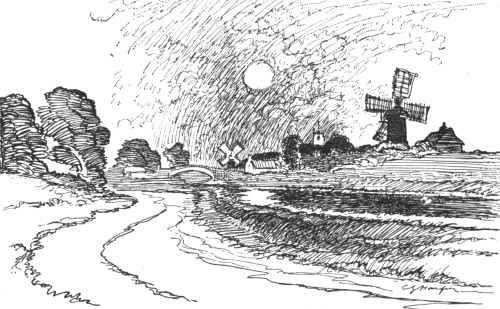
LITTLEPORT.
One leaves Littleport by a bridge, a single-span iron bridge of great width, that crosses the Great Ouse. As you cross it, the way to Mildenhall lies straight and flat, as far as eye can see, ahead. When that picturesque tourist, William Gilpin, visited Mildenhall a century ago, he found little to say in its praise, and of the scenery all he can find to record is that the roads were lined with willows whose branches were hung with slime.
Our way is not along the Mildenhall road, but by the left-hand track following the loops and windings of the Ouse; flat, like that other way, but by no means straight. It is a road of the most peculiar kind, somewhat below the level of that river and protected from it by great grassy banks, in some places from twelve to fourteen feet high. Windmills are perched picturesquely on the opposite shore, patient horses drag heavy barges along the stream, and the sodden fields stretch away on the right to infinity. Houses and cottages are few and far between; built below the river banks, with their chimney-pots rarely looking over them.
The reclaimed Fens being themselves things of recent history, there are few houses in the Fenland, except on the islands, and these few are comparatively modern. A cottage or a farmstead in these levels may be a weather-boarded affair, or it may be of brick, but it is always built on timber piles, for there is no other way of obtaining a sure foundation; and a frequent evidence of this is the sight of one of the older of these buildings, perched up at an absurd height through the gradual shrinkage of the land in consequence of the draining away of the water and the wasting of the peat. This subsidence averages six feet over the whole extent of the Fens, and in some places is as much as eight or nine feet. As a result of this, a man's front door, once on a level with the ground, is often approached by a quite imposing flight of steps, and instances are not unknown where a room has been added underneath the original ground floor, and a two-floored cottage promoted by force of circumstances to the dignity of a three-storeyed residence.
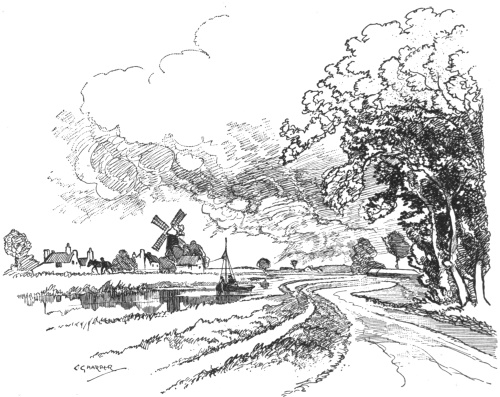
THE RIVER ROAD, LITTLEPORT.
A brick building in these districts is apt to be exceedingly ugly. For one thing, it has been built within the severely utilitarian period, and is just a square box with a lid for roof and holes for doors and windows. For another, the brick, made of the local gault, is of the kind called by courtesy "white," but really of a dirty dough-like hue: distressing to an artist's eye.
XLIV
Brandon Creek bridge, where the Great Ouse and the Little Ouse and Crooked Dyke pour their waters into one common fund, and send it crawling lazily down to Lynn, marks the boundaries of Cambridgeshire and Norfolk. On the hither side you are in the territory of the Cambridgeshire Camels, and on the thither are come into the land of the Norfolk Dumplings.
It is here, at this meeting of the waters, that "Rebeck, or Priests' Houses," is marked on the maps of Speed and Dugdale, and attributed to the thirteenth century, but what this place was, no man knoweth. It has clean vanished from sight or knowledge, and the houses of Brandon Creek hamlet afford no clue, being wholly secular and commonplace, from the inn that stands at the meeting of the rivers to the humble cottages of the bankers and the gaulters.
Southery Ferry is but a little distance ahead, to be recognised by the inn that stands on the river bank. It is a lonely ferry, and little wonder that it should be, considering the emptiness of the country on the other side,—all fens at the Back of Beyond, to whose wastes cometh the stranger never, where the bull-frogs croak, the slodger slodges among the dykes, and the mists linger longest.
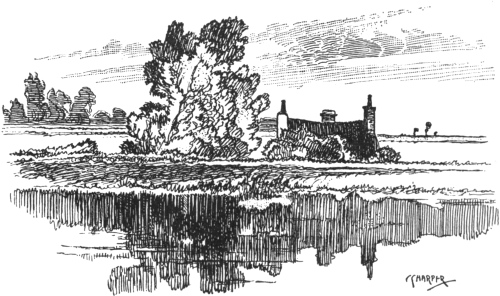
THE OUSE.
Away ahead sits Southery village, enthroned upon its hillock, once an island in the surrounding fen, and still, in its prominence against the skyline, telling its story plain for all to learn. Even if it were not thus evident from Southery Ferry how the village of old sat with its feet in the mud and its head on the dry land, at least the pilgrim's wheels presently advise him in unmistakable fashion that he is on an ascent. There is little in the village itself to interest the stranger. The spire so picturesquely crowning the hill in the distant view is found on close acquaintance to be that of a modern church, filled with the Papistical abominations commonly found in these days of the forsworn clergy of the Church of England. The old church of St. Mary, disused forty years ago, and now in ruins, stands at a little distance, in a bend of the road, overlooking many miles of what was once fen. There it stands in its heaped-up graveyard, a shattered and roofless shell of red-brick and rubble walls, thickly overgrown with ivy, and neighboured by an old windmill as battered and neglected as itself. From a field-gate overlooking the levels you see, in the distance, the high ground about Thetford, and, near at hand, an outlying part of Southery called Little London. An old inhabitant shares the field-gate and the outlook with the present writer, and surveys the many miles with a jaundiced eye. He remembers those lands below, when he was a boy, all swimming with water. Now they are drained, and worth ever so much an acre, "'cause they'll, as you might say, grow anything. But a man can't earn mor'n fourteen shillun a week here. No chance for nobody."