THE CAMBRIDGE, ELY, AND KING'S LYNN ROAD (continued 2)
Reading edition
As this, so far as Royston, was a part of the original great post-road to Scotland, many royal and noble processions, besides that attendant on the obsequies of Queen Eleanor, passed of necessity through Waltham Cross, and the coaching and posting traffic was of huge dimensions, up to the last days of the road.
Royal processions and progresses have a way, as you read them, of being insufferably dull; hedged about with formula and rule and precedent surrounding the gilded and be-crowned fetish for the time being, who, generally wrapped up warm in selfishness and greed, and dealing out lies and condescension, passes by and affords no interest or amusement to later generations, who merely yawn when they read of the dusty old properties, the tinsel and the gold lace. It is otherwise when the faults and foibles of the fetish are known and can be displayed to show that a monarch is, after all, human; and sometimes even a very poor specimen of humanity. James the First (of England and Sixth of Scotland, as the tender susceptibilities of Scots put it) came up this way to his Kingdom of England, on Elizabeth's death in 1603. He had set out from Edinburgh on the 5th of April, and only arrived in London on the 7th of May. Abundant and overbrimming loyalty had kept him long on the road. The noblemen and gentry of the shires lavished attentions on James and his following, and festive gatherings enlivened every manor-house on the way. Many a squire loaded his estates with encumbrances, in his anxiety to royally entertain the new sovereign and his numerous suite, and the story told of one of their halting-places very eloquently illustrates the sacrifices made. After staying some days with his host, the King remarked upon the disappearance of a particularly fine herd of cattle he had noticed in the park on his arrival, and asked what had become of them? As a matter of fact, they had been all slaughtered for the use of James's hungry Scots, and his host unwillingly told him so. "Then," said the King ungraciously, "it is time we were going"; and so, when the food was exhausted, they went.
So prodigal was the display made for him that James might almost have thought the country tired of Elizabeth's long rule, and glad to welcome a new monarch. He conferred titles with a lavish hand as he went, and knights-bachelors sprouted up in every town and village like mustard-and-cress after a dewy evening. He came across the Border mild enough, but by degrees rid himself of the humility proper to a King of Scots, and as King of England assumed an imperious air not even inferior to that of Henry the Eighth himself. Such an air sat ill upon James, at once constitutionally weak in body and simultaneously timid and braggart in disposition. The "British Solomon" his toadies called him, and indeed he was in many ways the Superior Person. Educated in all the 'ologies, and accounting himself in especial a master of theology and demonology, he was learned and superstitious at once. Witchcraft he firmly believed possible, and made it a capital offence, and was thus the prime cause of many an ill-favoured old woman or eccentric person being cruelly put to death as warlocks and wizards. The Duke of Sully, better informed than James's satellites, or more candid, pronounced him "the wisest fool in Europe."
At no place was the new monarch so lavishly entertained as at Theobalds, the princely residence of Lord Burleigh, whose estates bordered the road between Waltham Cross and Cheshunt. Who was the original owner of Theobalds, history does not tell us. Doubtless some Saxon notable, Theobald by name, thus immortalised in unilluminative fashion. In the late Elizabeth's time it had been acquired by the great Cecil, dead some six years before the coming of this northern light. Cecil's son, only less great than his father, now ruled, and received James right nobly in those magnificent halls his sire had added, where Elizabeth herself had been royally entertained. Four days he stayed, hunting and feasting, and left with so profound an admiration of the place that he never rested until he had exchanged the Royal Palace of Hatfield for it. Cecil made no bad bargain in the transfer, and in addition secured much favour and many added dignities, ending as Earl of Salisbury.
James's passion for the chase explains his eagerness to secure Theobalds, surrounded in those times by far-reaching and ancient woodlands. Epping Forest and the woods of Waltham lay for miles to the east, and the green alleys of Enfield Chase and Northaw (really "north holt," i.e. north wood) to the south and the north-west.
The figure of James is thus prominent on this part of the road. By no means an imposing figure, this King, as he reels in his saddle, or shambles rather than walks, his weak knees threatening a collapse, his thin yellow beard scarce disguising a chin striking the mean between obstinacy and weak irresolution; his wide-staring, watery, light-blue eyes rimmed with red eyelids; and lips running with the thin slobber of the drunkard, or rather of the inveterate tippler, not honestly drunken but grown maudlin, babbling and bubbling like a spring. This poor creature, who pretends to Right Divine, has the tense nerves of a hare; a hunted, hare-like glance too, when not primed and blusterous with Greek wine. He has a ludicrously acute sense of personal danger, and yet chases the deer a-horseback, seated on a padded saddle and plentifully equipped with drink. I see him very plainly, though much of the great domain of Theobalds be disparked, and landmarks grown dim and confused, hunting and halloing in the greenwood, and cursing and raving like a madman when the quarry escapes him—forgetful, in the excitement of the moment, of the Solomonic character he has to sustain—and falling out of his saddle and biting the grass in frenzy.
But James's domestic character bears more scrutiny than that of many of his predecessors. He would have pleased Mr. Squeers, for his "morrils" (in the common and restricted sense) were distinctly good—much better than those of the Hebrew Solomon.
It is quite evident that James delighted in his nickname and failed to discover any hidden vein of sarcasm in it, for in one of the extravagant masques he gave in honour of his father-in-law, Christian the Fourth of Denmark, at Theobalds, he took the part of that incarnation of Wisdom. Conceive the gorgeousness and the scandal of the occasion. Royal James as Solomon, and no less royal Christian, his part not stated, seated on a throne awaiting the Queen of Sheba, coming to offer precious gifts: attendant upon her, Faith, Hope, and Charity. The Queen of Sheba, sad to say, had taken too much to drink, and, there being no one to advise her to "Mind the step!" she tripped over the throne and shot all the gifts, some very treacly and sticky, into the lap of his Danish majesty, who rose and essayed a dance with her, but fell down and had to be taken off to bed, like many a jolly toper before and since. Then the Three Virtues, hiccoughing and staggering, tried their parts, but nature forbade, and they retired very sick. The spectacle of the drunken endeavouring to carry off the drunk must have been vastly entertaining to His Majesty, himself too well seasoned to be quite helpless. It seems probable that, picking an unsteady way among the courtiers who strewed the floor, he saw himself to bed without the aid of chamberlains and grooms-in-waiting and their kind.
James the First and Sixth died at Theobalds in 1625, in the fifty-ninth year of his age, cut off in part by the agency of Greek wine. The halls where he revelled, and where between whiles he piously translated the Psalms, are gone, dismantled under the rule of the Commonwealth, a period especially fatal to Royal Palaces. The site of the Palace is commemorated by "Theobalds Square." The modern mansion of Theobalds is a mile distant.
XIII
An inn bearing the odd name of the Roman Urn stands by the wayside on entering the hamlet of Cheshunt called Crossbrook Street. An urn in a niche of the wall over the front door bears the inscription "Via Una," and is witness to the finds of Roman remains close by. It gives point to the old belief that Cheshunt itself was a station on that Roman road, the Ermine Street.
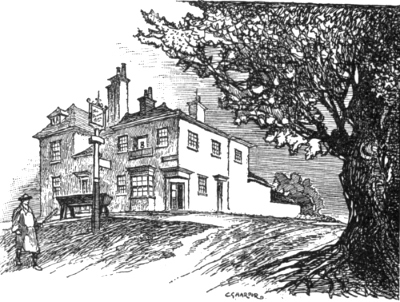
THE ROMAN URN, CHESHUNT.
Turners Hill, Cheshunt, and Cheshunt Wash are all one loosely-joined stretch of houses: recent houses, houses not so recent, dignified old mansions, and undignified second- and third-rate shops. It is an effect of shabbiness, of a halting two ways, between remaining as it was and developing into a modern suburb. The road itself shares this uncertainty, for it is neither a good country highway nor a decent town street, being bumpy macadam and gravel alternating, and full of holes. Cheshunt's modern fame is for roses, and the nurseries where they are cultivated spread far and wide. Its ancient fame was not so pleasing, for the Wash, when the Lea was in flood, made Cheshunt a place to be dreaded, as we learn from the diary of Ralph Thoresby, who travelled prayerfully this way between 1680 and 1720. Coming up from Yorkshire to London on one occasion, he found the washes upon the road near Ware swollen to such a height that travellers had to swim for their lives, one poor higgler being drowned. Thoresby prudently waited until some country-people came and conducted him over the meadows, to avoid the deepest part of Cheshunt Wash. Even so, he tells how "we rode to the saddle-skirts for a considerable way, but got safe to Waltham Cross."
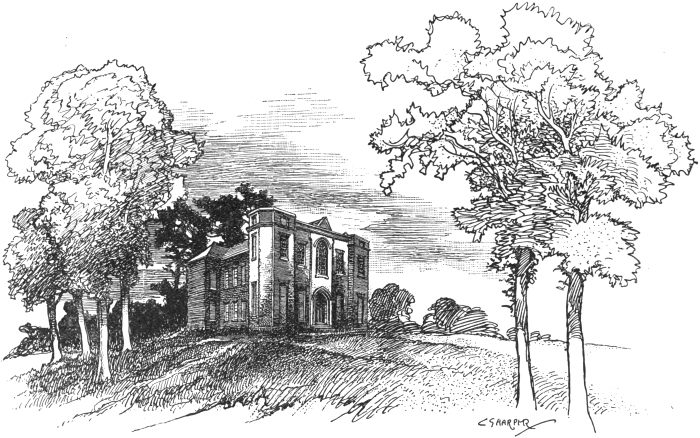
CHESHUNT GREAT HOUSE.
Cheshunt possesses a local curiosity in the shape of "Cheshunt Great House," a lonely mansion of red brick, standing in a meadow within what was once a moated enclosure. It is a gloomy old place belonging to the time of Henry the Seventh, but altered and patched to such a degree that even the genuine parts of it look only doubtfully authentic. A large central hall with hammer-beam carved roof is the feature of the interior, hung with tapestry, suits of armour, and portraits of historic personages, in which are mixed together real antiquities and forgeries of such age that they even are antique. Among them is a rude and battered rocking-horse, said to have been used by Charles the First when an infant.
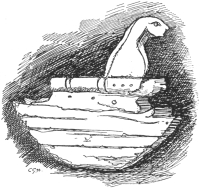
CHARLES THE FIRST'S ROCKING-HORSE.
Obviously Cheshunt Great House should be haunted, and is! Cardinal Wolsey's is the unquiet shade that disturbs the midnight hours beneath this roof, lamenting the more or less authentic murders he is said to have perpetrated here. There is not, of course, the slightest foundation for these wild stories, and the great Cardinal, so far as Cheshunt is concerned, leaves the court without a stain on his character.
But we must hasten onward to Ware, halted, however, in half a mile, at Turnford, a place forgotten by most map-makers. Writers of guide-books, too, pass it coldly by. And indeed, if you be of the hurrying sort, you may well pass and never know the individual existence of the hamlet; so close are Cheshunt on the one hand and Wormley on the other. As the poet remarks—
"Full many a flower is born to blush unseen And waste its sweetness on the desert air";
and Turnford is a modest place, consisting, all told, of an old residence or so, a farmstead, and the Bull Inn: the sign showing a bull's head with a remarkably coy expression. One no longer splashes through the ford that gave the place its name; a bridge has long since replaced it.
Why, it may be asked, linger over Turnford? Because here, in some lowly cot not now to be identified, somewhere about the year 1700, was born, of the usual poor but honest parents, one who might have been truly great in his profession had not the accursed shears of Fate cut him off before he had time to develop himself. I speak of "Dr." William Shelton, apothecary and highwayman. William was at an early age apprenticed to an apothecary at Enfield, and presently distinguished himself in an endeavour to elope with the apothecary's sister, an elderly charmer by no means averse from being run away with. The attempt miscarried, and our poor friend was soundly cudgelled for his pains. His second enterprise, the carrying off of a widow's daughter, was more fortunate. The runaways were married at the Fleet, and afterwards settled at Enfield, where, with the aid of his wife's fortune, Shelton eked out a living while trying to develop a practice. Tiring, after a while, of this, he obtained an appointment as surgeon in Antigua, but although generally liked in that island, he was obliged to return home on account of some wild escapades. He then settled in succession at Buntingford and Braughing, but doctors were at a discount at those places, and so, like many another wild spirit, he took to the road. A good horse and a reliable pair of pistols did more for him than his dispensary, and he prospered for a little while. There is no knowing to what eminence he might have risen—for he robbed with grace and courtesy—had not the authorities seized him one evil day. He made a dignified exit at Tyburn in 1732.
At Wormley, a roadside village of nondescript character, the New River is crossed, bringing us into Broxbourne, lying in a dip of the road, with that famous Cockney resort, Broxbourne Gardens, off to the right, by the river Lea. The Gardens themselves are as popular as ever, but the medicinal spring—the "rotten-egg water" is the eloquently descriptive name of it—has fallen into neglect.
The traveller along the highroad has left Broxbourne behind before he has quite discovered he has reached it, and comes into Hoddesdon unawares. Broxbourne, where the "brocks," or badgers, were once plentiful enough to give a name to the little stream running into the Lea, is indeed a much more shy and retiring place than those who on Saturdays, Sundays, and Mondays visit the tea-gardens aforesaid have any idea of. This is by way of a testimonial. Hoddesdon, too, which to be sure is not a tiny village like Broxbourne, but quite a little town, is altogether delightful. It has not been modernised, and its inhabitants still obtain their water in pailsful from the public pump in the middle of the broad street, which remains much as it was when the Cambridge "Telegraph" came through, and when the Newmarket and Bishop Stortford traffic branched off to the right in the midst. To this day most of its old inns remain, clustering round the fork of the roads: the Bull, its gabled porch and projecting sign quickening the traveller's pace as he sees it afar; the Salisbury Arms, the Maiden's Head, the Swan.
The Bull is a famous house, finding, as it does, a mention in Prior's "Down Hall." It was in 1715 that Matthew Prior, one of the most notable poets of his day, and sometime Ambassador at the Court of Versailles, travelled this road to Down Hall, near Hatfield Broadoak. His "chariot" halted at the Bull, as he tells us—
"Into an old inn did this equipage roll, At a town they call Hodsdon, the sign of the Bull, Near a nymph with an urn that divides the highway, And into a puddle throws mother of tea."
Nymph and urn and puddle are gone long since, and where they were placed there stands at this day the ugly modern building that Hoddesdon folk call the "Clock House": really a fire-engine house with a clock-tower; the tower surmounted by a weather-vane oddly conjoining the characteristics of a fiddler, a sagittarius, and a dolphin. Inquiry fails to discover what it symbolises. Before ever the nymph or the present building occupied this site, there stood here the wayside chapel of St. Catherine, whose ancient bell hangs in the clock-tower.
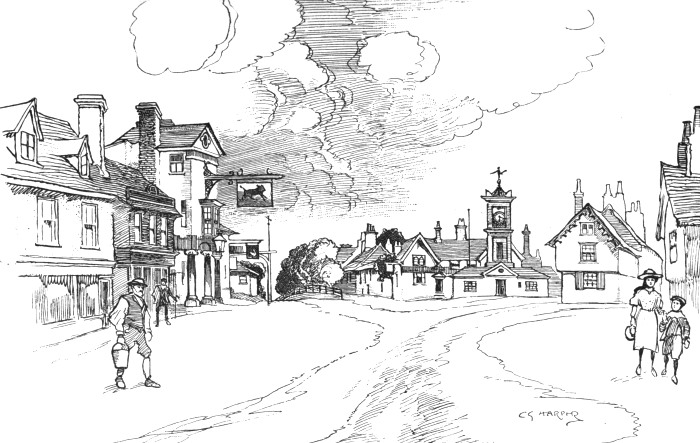
HODDESDON.
Prior writes as though the Bull had long been familiar to him, but his intimate touches of the life and character of an inn came, doubtless, from his own youthful observation; for his uncle had been landlord of the Rummer at Charing Cross, where as a boy he had been a waiter and general help. Doubtless he had heard many an old frequenter of the Rummer put questions similar to these he asks:—
"'Come here, my sweet landlady! how do you do? Where's Cic'ly so cleanly, and Prudence, and Sue? And where is the widow that lived here below? And the other that sang, about eight years ago? And where is your sister, so mild and so dear, Whose voice to her maids like a trumpet was clear?' 'By my troth,' she replies, 'you grow younger, I think. And pray, sir, what wine does the gentleman drink? But now, let me die, sir, or live upon trust, If I know to which question to answer you first, For things since I saw you most strangely have varied— The ostler is hanged, and the widow is married; And Prue left a child for the parish to nurse; And Cic'ly went off with a gentleman's purse; And as to my sister, so mild and so dear, She has lain in the churchyard full many a year.'"
What a sorry catalogue of changes and disasters!
A mile or more distant, along the Bishop Stortford road, is the gatehouse of the famous Rye House, its clustered red-brick chimneys and thick walls still left to remind the historically-minded of that Rye House Plot of 1681 which was to have ended Charles the Second, and his brother, the Duke of York, on their way past from Newmarket to London. Although the Bishop Stortford road does not concern us, the house is alluded to in these pages because it now contains that notorious piece of furniture, the Great Bed of Ware.
Hoddesdon gives place to Amwell, steeply downhill. The village is properly "Great Amwell," but no one who knows his Lamb would think of calling it so, although there is a "Little Amwell" close at hand. To the Lambs it was just "Amwell," and that is sufficient for us. Moreover, like so many places named "Great," it is now really very small. It is, however, exceedingly beautiful, with that peculiarly park-like beauty characteristic of Hertfordshire. The old church, also of the characteristically Hertfordshire type, stands, charmingly embowered amid trees, on a bank overlooking the smoothly-gliding stream of the New River, new-born from its source in the Chadwell Spring, and hurrying along on its beneficent mission toward the smoke and fog of London. Two islands divide the stream; one of them containing a monument to Sir Hugh Myddelton, and a stone with lines from Scott, the "Quaker poet of Amwell," commencing—
"Amwell, perpetual be thy stream, Nor e'er thy spring be less."
An aspiration which, let us hope, will be fulfilled.
XIV
Although to hurry past spots so interesting and so beautiful looks much like the act of a Vandal, our business is with the road, and linger we must not; and so, downhill again, by the woods of Charley—or "Charl-eye" as the country folk insist on calling them—we come to a vantage-point overlooking Ware; an old town of many maltings, of the famous Bed aforesaid, and of Johnny Gilpin's ride. Fortunate are those who come thus in view of Ware upon some still golden afternoon of summer, when the chimes from the old church-tower are spelling out the notes of that sentimental old song, "Believe me, if all those endearing young charms." Time and tune conspire to render Ware romantic.
The town takes its name from the weir or dam built across the Lea by invading Danes in the year 896. Coming up the Lea in a great flotilla of what historians call ships, more correctly perhaps to be named sailing-barges, they halted here, and, designing a fort beside the dam they built, imagined themselves secure. Around them in the Lea valley between Ware and Hertford stretched the great lake their dam had created, and all King Alfred's men could not by force dislodge them.
Can you not find it possible to imagine that great King—that King truly great in counsels both of war and peace, that contriver and man of his hands—on these Amwell heights and looking down upon that Danish fortress and its ceinture of still water, with twice a hundred prows lying there, proudly secure? Truly, despite the dark incertitude of history on these doings, we may clearly see that monarch. He knits his brows and looks upon the country spread out beneath him: just as you may look down to-day upon the valley where the Lea and the railway run, side by side. He—we have said it with meaning—is a contriver; has brains of some quality beneath that brow; will not waste his men in making glorious but wasteful attacks upon the foe: they shall work—so he wills it—not merely fight; or, working, fight the better for King and Country. Accordingly, his army is set to digging a great channel down this selfsame valley; a channel whose purport those Danes, lying there, do by no means comprehend; nor, I think, many even in this host of the great Alfred himself; for the spy has ever watched upon the doings of armies, and he who keeps his own counsel is always justified of his reticence.
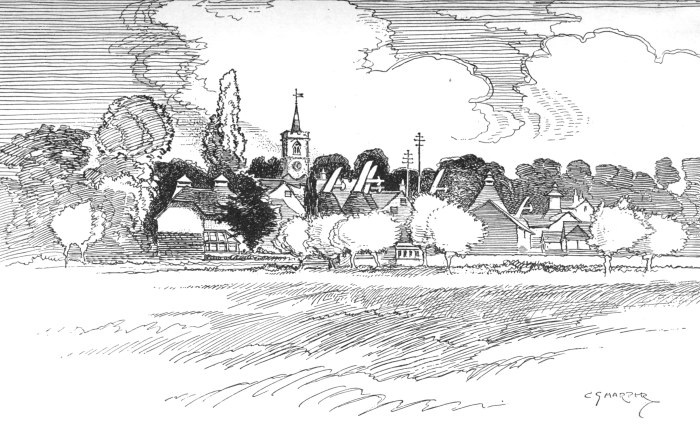
WARE.
This great ditch, then, excavated over against the camp and harbour of the sea-rovers, is therefore inexplicable, and doubtless the subject of much jest among the enemy: jesting that dies away presently, when, the excavation completed, it is found to touch the river above and below the weir, and indeed to be designed to drain away the Lea from its old channel and so steal away those cherished water-defences.
With what rejoicings Alfred turned the stream into this artificial course we know not, nor anything of the Saxon advance when the old channel ran dry and the Danish war-fleet presently lay stranded; the black hulls canted in all manner of ridiculous and ineffective angles; the sails with the cognisance of the raven on them flapping a farewell to the element they were to know no more. Only this we know, that the Danish host were forced to fly across the country to Cambridge and the fens; those unfailing resorts of fugitives in the long ago.
Alfred probably burnt the deserted fleet; but there may yet lie, somewhere in this pleasant valley between Hertford and Ware, deep down in immemorial ooze and silt, the remains of those hapless craft.
Ware, seen from a distance, is a place of singular picturesqueness; its Dutch-like mass of mellow red roofs endowed with a skyline whose fantastic appearance is due to the clustered cowls of the fourscore malthouses that give the old town a highly individual character. Here, as elsewhere, the sunset hour touches the scene to an unearthly beauty: only here those slanting cowls assume the last note of melodramatic significance, to which, ordinarily, in the broad eye of day, they are by no means entitled; being just so many ventilators to buildings in whose dark recesses is carried on the merely commercial work of drying the malt of which it is fondly assumed our beer is made.
The town, when you come to it, resolves itself into zigzag streets, coal-dust, and bargees. It is a very back-door kind of entrance you find, coming downhill, past a railway goods-yard and a smelly waterside with wharves and litter, where solemn horses stolidly drag barges and railway-trucks, and modern Izaak Waltons, sublime in faith, diligently "fysshe with an angle," with ill results. What they seek, these hapless sportsmen, is known only to themselves. Is it the festive tiddler, dear to infantile fisherfolk, or do they whip the water for the lordly trout, the ferocious pike, the grey mullet, or the carp? I know not; but what they find is the Old Boot, the discarded hat, the derelict gamp; in short, the miscellaneous floatable refuse of Hertford. To see one of these brothers of the angle carefully playing what ultimately discloses itself as a ragged umbrella affords one of the choicest five minutes that life has to offer.
Crossing an iron bridge over this fishful stream, you are in Ware. To the left stands the old Saracen's Head, now a little out of date and dreamy, for it is the veritable house where the principal coaches changed horses, and it has remained outwardly the same ever since. Here it was that the Great Bed of Ware stood for many years, conferring fame upon the town until 1869, when it was spirited away to the Rye House, there to be made a show of.
He who would correctly rede the riddle of the Great Bed would be a clever man, for its history is so confounded with legend that to say where the one begins and the other ends is now impossible. The Bed is a huge four-poster of black oak, elaborately carved with Renaissance designs, and is now twelve feet square, having been shorn of three feet of its length by a former landlord of the Saracen's Head. The date, 1463, painted on the head is an ancient and impudent forgery intended to give verisimilitude to the legend of this monumental structure's origin. This story tells how it was the work of one Jonas Fosbrooke, a journeyman carpenter, who presented it to Edward the Fourth "for the use of the royal family or the accommodation of princes, or nobles, or for any great occasion." The King, we are told, was highly pleased with this co-operative bedstead, and pensioned the ingenious Fosbrooke for life; but history, curiously, fails to tell us of royal or any other families herding together in this way. The legend then goes on to tell how, not having been used for many years by any noble persons, it was put to use when the town was very full of strangers. These unfortunate plebeian persons found it anything but a bed of roses, for they were tormented throughout the night by the snobbish and indignant ghost of Jonas, who objected to anyone beneath the rank of a knight-bachelor sleeping in his bed, and savagely pinched all who could not claim gentility. This weird ghost-story was probably invented by the landlords of the several inns in which the Bed has been housed to account for a vigorous and hungry race of fleas that inhabited the old four-poster, and must have been originated at a very early date, for on it hangs the story of Harrison Saxby, Master of Horse to Henry the Eighth. Saxby fell violently in love with the daughter of a miller near Ware, and swore he would do anything to win her from her many other suitors. The King, passing through the town, heard of this and promised to give her (those were autocratic times!) to him who should sleep in the Great Bed, and, daring all that the ferocious apparition of Fosbrooke could do, should be found there in the morning. All save the valorous Saxby held back, but he determined that no disembodied spirit should come between him and his love, and, duly tucked in, was left to sleep—no, not to sleep, for the powers of darkness were exalted to considerable purpose in the night, and when day dawned the rash Saxby was discovered on the floor, covered with bruises. If we seek rather the practical joker than the supernatural visitant to poor Saxby, we shall probably be on the right quest.
The Great Bed was not always housed at the Saracen's Head. Coming originally from Ware Priory, it was next at the Crown, where it remained until that old house was pulled down, in 1765, being in turn transferred to the Bull.
Ware was always a place of great traffic in the long ago. Railways have altered all that, and it is now a gracious old town, extraordinarily rich in the antique entries of ancient hostelries disappeared so long since that their very signs are forgot. As you go along its High Street there are between twenty and thirty of these arched entries countable, most of them relics of that crowded era of road-faring when Ware was a thoroughfare town at the end of a day's journey from London on the main road to the North. It was, in the words of an Elizabethan poet, "the guested town of Ware," and so remained for centuries, even when day's journeys grew longer and longer, and until the road became an obsolete institution. Some of these entries, on the other hand, always were, and others early became, features in the warehouse premises of the old maltsters, for Ware has ever been a place dedicated to the service of John Barleycorn.
Long centuries ago, ere railways were dreamt of, this was the great warehousing place of the malt from five neighbouring counties. It came in vast quantities by road and by river from up country, and was stored here, over against the demands of the London brewers; being sent to town chiefly by the river Lea. The Lea and its ready passage to London built up this distinctive trade of Ware: the railway destroyed it, and the maltsters' trade exists here nowadays only because it always has been here and because to utterly kill its local habitation would be perhaps impossible. But it is carried on with a difference, and malt is not so much brought and warehoused here as made on the spot. Many of the old houses in which the old-established maltsters reside, adjoining their own warehouses, in the good old style absolutely obsolete in other places, are of early eighteenth century date, and rich in exquisite moulded plaster ceilings and carved oak panelling. One at least dates back to 1625, and is nothing less in appearance than the home of an old prince of commerce.
To have an opportunity of inspecting this is a privilege not lightly to be valued. On one side of the entry, and over the archway, is the residence, and on the other the old-world counting-house, with a narrow roadway between for the waggons to and from the maltings at the farther end. The maltings themselves are rebuilt and fitted with modern appliances, but they strike the only note out of key with the general harmony of the place, and, even so, they are not altogether unpleasing, for they are earnest of trade still brisk and healthy, in direct descent from days of old. Beyond the maltings are old walled gardens where peaches ripen, and velvet lawns and queer pavilions overhanging the river Lea: the whole, from the entry in the High Street, down the long perspective to the river, embowered in flowers.
For the rest, Ware commands much interest, not greatly to be enlarged upon here. The church-tower, rising nobly above the roof-tops of the town, amid a thickly clustered group of oast-house cowls, the interior of the building, noble beyond the common run; the so-called "John Gilpin's House"; the river scenery up the delightful valley to Hertford: all these things are to be seen and not adequately written about in this place.
XV
Uphill goes the road out of Ware, passing the Royston Crow Inn and some old cottages on the outskirts. The two miles between this and Wade's Mill form the dividing-line between the valleys of the Lea and the Rib, and consequently the way, after climbing upwards, has to go steeply down again. The Sow and Pigs is the unusual name of an inn standing on the crest of the hill before descending into Wade's Mill. Who was Wade of the mill that stands to this day in the hollow where the little stream called the Rib runs beneath the highway? History, imperial, national, or parochial, has nothing to tell us on this head. Perhaps—nay, probably—there never was a Wade, a person so-named; the original mill, and now the hamlet that clusters in the bottom, taking its name from the ford—the ford, or water-splash, or "wade"—that was here before ever a bridge was built. The parish of St. Nicholas-at-Wade, beside the channel that formerly divided the Isle of Thanet from Kent, obtained its name from the ford at that point, and in like manner derives the name of Iwade, overlooking the King's Ferry entrance to Sheppey.
The hamlet of Wade's Mill is a product of the coaching age. Before folks travelled in any large numbers there stood only the mill in the hollow; but, as road-faring progressed, there at length rose the Feathers Inn beside the way, and by degrees a dozen or so cottages to keep it company. Here they are still; standing, all of them, in the parish of Thundridge, whose old church, a mile distant, is now in ruins. The new church is built on the height overlooking Wade's Mill, and may be noticed in the illustration on the following page.
Steeply rising goes the road out of this sleepy hollow; passing, when half-way up the hill, a mean little stone obelisk perched on a grassy bank. This is a memorial to Thomas Clarkson, a native of Wisbeach, and marks the spot where in his youth he knelt down and vowed to dedicate his life to the abolition of the slave trade. It was placed here in 1879 by Arthur Giles Puller, of Youngsbury, in the neighbourhood. Clarkson was born in 1760, the son of the Rev. John Clarkson, Headmaster of Wisbeach Free Grammar School. He graduated at Cambridge in 1783, and two years later gained the first prize in the Latin Essay competition on the subject of "Slavery and Commerce of the Human Species, particularly the African." This success finally fixed his choice of a career, and he forthwith set afoot an agitation against the slave trade. In an introduction to the wealthy William Wilberforce, he succeeded in enlisting the support of that philanthropist, to whom the credit of abolishing the nefarious traffic is generally given. A Committee was formed to obtain the passing of an Abolition Bill through Parliament; an object secured after twenty years' continued agitation and strenuous work on the platform. Clarkson's health and substance were alike expended in the effort, but he was not eventually without reward for his labours, a recompense in subscriptions to which he seems to have looked forward in quite a business-like way; more soothing than Wordsworth's pedestrian sonnet beginning—
"Clarkson, it was an obstinate hill to climb; How toilsome, nay, how dire it was."
Doubtless he argued the labourer was worthy of his hire.
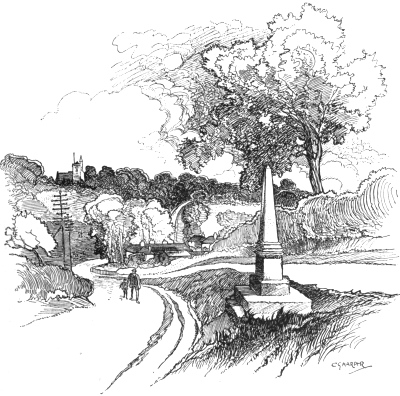
CLARKSON'S MONUMENT.
Abolition in the West Indian Islands followed, and then the Emancipation Act of 1833, liberating 800,000 slaves and placing the sum of twenty millions sterling, as compensation, into the pockets of Liverpool, Bristol, and Glasgow slave-owners. That sturdy beast of burden, the British taxpayer, of course paid for this expensive burst of sentiment. Clarkson, already an old man, and weary with his long labours, received the Freedom of the City of London in 1839, and died in his eighty-seventh year, in 1846.
Midway between the hamlets of High Cross and Collier's End, at the second of the two left-hand turnings sign-posted for "Rowney Abbey and the Mundens," is the other hamlet of Standon Green End—if the two cottages and one farmhouse in a by-lane may so be dignified. Some three hundred yards along this lane, in the centre of a meadow, stands the singular monument known in all the country round about as the "Balloon Stone," a rough block of sandstone, surrounded by an iron railing, placed here to record the alighting on this spot of the first balloon that ever ascended in England. Tradition still tells of the terror that seized the rustics when they saw "a summat" dropping out of the sky, and how they fled for their lives.
On lifting a hinged plate, the astonishing facts of this antique æronautical adventure may be found duly set out in an amusingly grandiloquent inscription, engraved on a bronze tablet let into the upper part of the stone—
"Let Posterity Know And Knowing be Astonished That On the 15 Day of September 1784 Vincent Lunardi of Lucca in Tuscany The first Aerial Traveller in Britain Mounting from the Artillery Ground in London And Traversing the Regions of the Air For Two Hours and Fifteen Minutes, In this Spot Revisited the Earth. On this Rude Monument For Ages be Recorded That Wondrous Enterprise Successfully atchieved By the Powers of Chemistry And the Fortitude of Man That Improvement in Science Which The Great Author of all Knowledge Patronising by His Providence The Invention of Mankind Hath graciously permitted To their Benefit And His own Eternal glory."
"This Plate A facsimile of the Original One was placed here in the month of November 1875 by Arthur Giles Puller of Youngsbury."
Collier's End is a wayside hamlet of a few timber-framed and plaster cottages, leading to Puckeridge, where the ways to Cambridge divide: one going by Buntingford, Royston, and Melbourn; the other by Braughing, Barkway, Barley, and Fowlmere, meeting again at Harston in another nineteen miles. Away to the left, between Collier's End and Puckeridge, is St Edmund's College, a Roman Catholic seminary.
Puckeridge itself, standing where the roads branch, grew in the old road-faring days from a tiny hamlet to be considerably larger than its mother-parish of Standon, a village nearly two miles distant, to the right-hand. That it developed early is quite evident in its two old inns, the fifteenth century Falcon, and the Old George, scarcely a hundred years younger.
XVI
We will first take the right-hand road to Cambridge, by Barkway, for that would appear in early days to have been the favourite route. Braughing, the first village on this route, is soon reached, lying down below the highway beside the river Rib, with the usual roadside fringe of houses. The local pronunciation of the place-name is "Braffing."
The road now begins to climb upwards to the crest of the Chilterns at Barley, passing the small hamlets of Quinbury and Hare Street, and through a bold country of rolling downs to Barkway, whose name, coming from Saxon words meaning "a way over the hill," is descriptive of its situation. Few signs of habitation are seen on the way, and those at great distances; Great and Little Hormead and Ansty peering down upon the road from distant hillsides.
Since the coaches left the road, Barkway has gone to sleep, and dreams still of a bygone century. At the beginning of its broad street there stands the old toll-house, with the clock even yet in its gable that marked the flight of time when the Cambridge "Telegraph" passed by every day, at two o'clock in the afternoon; and old houses that once were inns still turn curiously gabled frontages to the street. The Wheatsheaf, once the principal coaching house, still survives; outside it a milestone of truly monumental proportions, marking the thirty-fifth mile from London. It stands close upon six feet in height, and besides bearing on its face a bold inscription, setting forth that it is thirty-five miles from London and sixteen from Cambridge, shows two shields of arms, one of them bearing a crescent, the other so battered that it is not easily to be deciphered. This is one of a series of milestones stretching between this point and Cambridge; a series that has a history. It seems that Dr. William Mouse, Master of Trinity Hall, and a Mr. Robert Hare, left between them in 1586 and 1599 the sum of £1600 in trust to Trinity Hall, the interest to be applied to mending the highway along these sixteen miles; as the Latin of the original document puts it, "in et circa villam nostram Cantabrigiæ præcipue versus Barkway." Whatever Trinity Hall may have done for the repair of the road in the hundred and twenty-six years following the bequest, there were certainly no milestones along its course until 1725, when Dr. William Warren, the then Master, set up on October 20th the first five, starting from the church of Great St. Mary in Cambridge Market Square. On the 25th June, in the following year, another five stones were placed in continuation, and the next year another five. The sixteenth was not placed until 29th May 1728. Of this series the fifth, tenth, and fifteenth were about six feet in height, with the Trinity Hall arms carved on them; in heraldic jargon described as "sable, a crescent in fess ermine, with a bordure engrailed of the second." The others were originally small, with merely the number of miles engraved on them, but were replaced between 1728 and 1732 by larger stones, each bearing the black crescent; as may be seen to this day.
These stones, very notable in themselves, and more so from the open and exposed character of the road, have not only the interest of the circumstances already narrated, but gain an additional notability in the fact that, excluding those set up by the Romans, they are the earliest milestones in England. Between Roman times and the date of these examples the roads knew no measurement, and miles were a matter of repute. It was not until the Turnpike Act of 1698 that, as part of their statutory obligations, Turnpike Trusts were always bound not only to maintain the roads on which they collected tolls, but to measure them as well, and to set up a stone at every mile.
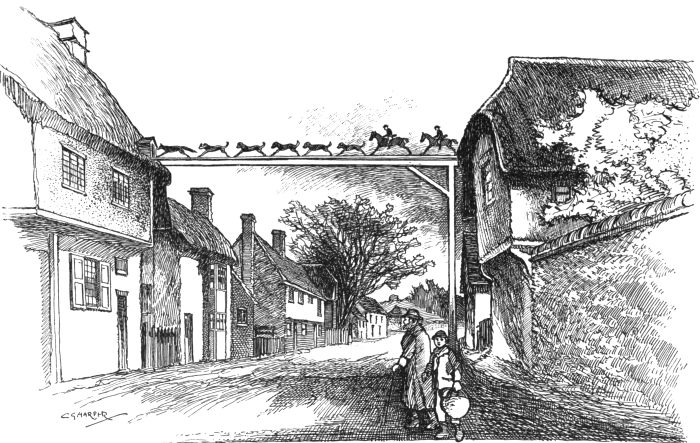
BARLEY.
The road between Barkway and Barley is a constant succession of hills; steep descents, and correspondingly sharp rises, with the folds of the Chilterns, bare in places and in others heavily wooded, rising and falling for great distances on either hand. It was while ascending Barkway Hill on the up journey that the "Lynn Union," driven by Thomas Cross, was involved in a somewhat serious affair. Three convicts were being taken to London in charge of two warders, and the whole party of five had seats on the roof. As the coach slowed to a walking pace up the ascent, one of the gaol-birds quietly slipped off at the back, and was being followed by the other two when attention was drawn to their proceedings. The principal warder, who was on the box-seat, was a man of decision. He drew a pistol from his pocket, and, cocking it, said, "If you do not immediately get up I'll shoot you!" The one who had already got down, thereupon, with a touching faith in the warder's marksmanship, returned to his place, and the others remained quiet. They finished the remainder of the journey handcuffed. It is, indeed, surprising that they were not properly secured before.
The road on to Barley is of a switchback kind, finally rising to the ridge where Barley is perched, overlooking a wild treeless country of downs. Barley is a little village as thoroughly agricultural as its name hints, and consists of but a few houses, mostly thatched, with a not very interesting church on a by-way, and a very striking inn, the Fox and Hounds, on the main road. It is the sign of the inn, rather than the house itself, that is so notable, for it is one of those gallows signs, stretching across the road, that are now becoming so few. The illustration sufficiently describes its quaint procession of fox, hounds, and huntsmen, said to have been placed here in allusion to a fox that took refuge in a dog-kennel of the inn.
If the name of Barley hints strongly of agricultural pursuits, it does not by any means derive it from that kind of grain. Its earliest Saxon name is "Berle," coming from the words "beorh" and "lea," and meaning a cleared space in a forest. Barley, in fact, stands on the final ridge where the Chiltern Hills end and the East Anglian heights and the forest of Essex begin, overlooking a valley between the two where the trees fell back and permitted a way through the primeval woods.
The restored and largely rebuilt church contains little of interest, but in the churchyard lies one whose career claims some notice. There the passing stranger may see a simple stone cross, bearing the words, "Heinrich, Count Arnim. Born May 10th, 1814. Died October 8th, 1883." Beside him lies his wife, who died in 1875. The story of Count Arnim is one of political enthusiasms and political and personal hatreds. One of the greatest nobles in conservative Germany, he early developed Radical ideas, and joined Kossuth in his struggle for Hungarian liberty, refusing to desert that ill-fated cause, and disregarding the call of his own country to arms. The neglect of this feudal duty rendered his vast estates liable to forfeiture, and placed him in danger of perpetual confinement in a military prison; a danger aggravated by the personal and bitter animosity of the all-powerful Bismarck, and the hatred of the relatives of two antagonists whom he had slain in duels. To escape this threatened lifelong imprisonment he fled to England, and, after much privation, established a school of fencing and physical exercise, under the assumed name of Major Loeffler. In the meanwhile he had married a German governess. His association with Barley arose from the then Rector resorting to his school for a course of exercise, and becoming in time a fast friend, to whom the Count disclosed his identity. The Rector interested himself in Arnim's fortunes, and went so far as to write to the German Emperor on behalf of his son, then growing to manhood. As a result of these efforts young Arnim was permitted to enter the German Army and to enjoy his father's estates. Unfortunately his mother accompanied him, and as, according to the savage notions of German society, she was not of noble birth and not ennobled by marriage, she was restricted to the servants' hall at every place her son visited, while he was received in the highest circles. Count Arnim had, in his long residence in England, adopted the sensible views prevailing here, and indignantly recalled his son. "I would rather," he said in a noble passage, "I would rather have my son grow up a poor man in England, in the service of his adopted country, than as a rich man in the service of his Fatherland, where he would have to be ashamed of his mother."
It was his friendship with the Rector that made the Count choose this as the resting-place of his wife and himself. His body was brought by train to Buntingford, and thence by road, being buried by the light of torches at midnight, after the old German custom.
XVII
A mile beyond Barley the road leaves Hertfordshire and enters Essex, but passes out of that county again and enters Cambridgeshire in another two miles. Midway, amid the solemn emptiness of the bare downs, the Icknield Way runs as a rugged chalk-and-grass track athwart the road, neighboured by prehistoric tumuli. Amidst all these reminders of the dead-and-gone Iceni, at the cross-roads to Royston and Whittlesford, and just inside the Cambridgeshire border, stands a lonely inn once known as the Flint House. Beside it is one of the Trinity Hall milestones, with the crescent badge of the college, and hands with fingers like sausages pointing down the weirdly straight and empty roads.
The two miles of road through Essex long bore the name of the "Recorder's Road." It seems that when in 1725 an Act of Parliament was obtained for mending the then notoriously bad way from Cambridge to Fowlmere and Barley "in the counties of Cambridgeshire and Hertfordshire," the fact that two miles lay in Essex was overlooked. In consequence of this omission nothing was done to the Essex portion, which became almost impassable for carriages until the then Recorder of Cambridge, Samuel Pont, obtained the help of several of the colleges, and at last mended it.
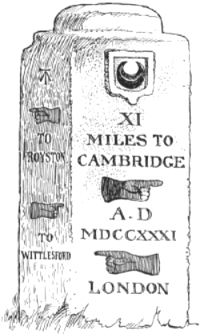
A MONUMENTAL MILESTONE.
It is a good enough road now, though passing through very exposed and open country, with tumuli, the solemn relics of a prehistoric race, forming striking objects on the bare hillsides and the skyline. In cosy and sheltered contrast with these comes the village of Fowlmere, snugly nestled amid the elms and poplars aptly named "Crows' Parlour."
Fowlmere is a very Proteus in the spelling of its name. In Domesday Book it is set down as "Fugelesmare," and has at any time since then been written in half a dozen different ways, in which "Foulmere" and "Fowlmere" are the most prominent. Old-time travellers, who found the road inexpressibly bad, adopted the first of these two styles, and thought the place well suited with a name: others—and among them local patriots—adopted the variant less expressive of mud and mire. In so doing they were correct, for the village takes its name from a marshy lake or mere, thickly overgrown with reeds in ancient times, in whose recesses myriads of wild-fowl found a safe harbourage. Even when the nineteenth century had dawned the mere was still in existence, and wild-fowl frequented it in some numbers. To-day it is but a spot where watercress grows and the grass springs a thought more luxuriant than elsewhere.
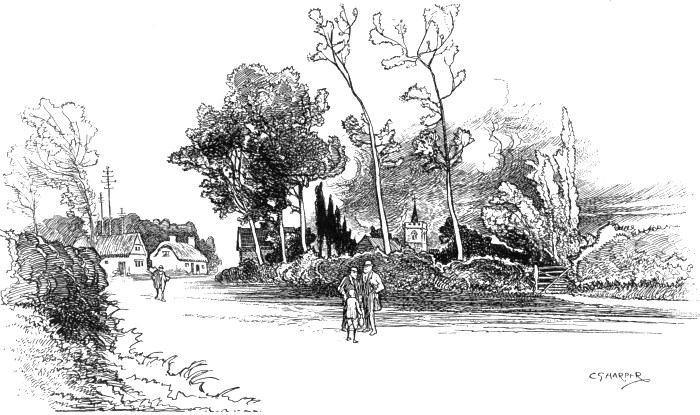
FOWLMERE: A TYPICAL CAMBRIDGESHIRE VILLAGE.
Here we are on the track of Samuel Pepys, who makes in his Diary but a fleeting appearance on this road,—a strange circumstance when we consider that he was a Cantab. It is, however, an appearance of some interest. In February 1660, then, behold him rising early, taking horse from London, and setting out for Cambridge, in company with a Mr. Pierce, at seven o'clock in the morning, intending to make that town by night. They rode twenty-seven miles before they drew rein, baiting at Puckeridge,—doubtless at that old house the Falcon,—the way "exceeding bad" from Ware. "Then up again and as far as Fowlmere, within six miles of Cambridge, my mare almost tired."
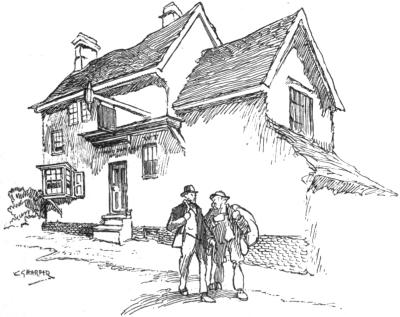
THE CHEQUERS, FOWLMERE.
Almost! Good Heavens! he had ridden the poor beast forty-six miles. At anyrate, if the mare was not quite tired, Samuel at least was, and at Fowlmere he and Mr. Pierce stayed the night, at the Chequers. An indubitable Chequers still stands in the village street, but it is not the house under whose roof the old diarist lay, as the inscription, "W.T., Ano Dom. 1675," on the yellow-plastered front sufficiently informs us. The next morning Samuel was up betimes, and at Cambridge by eight o'clock.
Thriplow Heath once stretched away between Fowlmere and Newton, our next village, but it is all enclosed now, and cultivated fields obscure that historic portion of the Heath where, in June 1647, Cromwell's troops, victorious over the last struggles of the Royalists, assembled and sent demands to the Parliament in London for their long overdue pay. A striking position, this. The Parliament had levied war upon the King and had brought him low, and now the hammer that had shattered his power was being threatened against itself. Cromwell and a military dictatorship loomed ominous before my lords and gentlemen of Westminster, and they hastily sent down two months' pay, with promises of more, to avert Cromwell's threat that he would seize the captive King, and, placing him at the head of the army, march upon London. That payment and those promises did not suffice, and how Cornet Joyce was sent across country from this point, with a troop of horse, to seize Charles from the custody of the Parliamentary Commissioners at Holmby House is a matter of history, together with the military usurpation that did actually follow.
Newton village itself has little interest, but a small hillside obelisk on the right calls for passing notice. It marks the spot where two friends were in the habit of meeting in the long ago. The one lived at Newton and the other at Little Shelford. Every day for many years they met at this spot, and when one died the survivor erected this memorial. The left-hand hillside also has its interest, for the commonplace brick building on the hilltop is all that remains of one of a line of semaphore telegraph stations in use between London and Cambridge over a hundred years ago. A descending road brings us from this point to a junction with the Royston route to Cambridge, at Harston.
XVIII
The Royston route to Cambridge now demands attention. Harking back to Puckeridge, we have by this road certainly the most difficult way, for eight of the eleven miles between Puckeridge and Royston lead, with few and unimportant intervals, steadily uphill, from the deep valley of the Rib up to the tremendous and awe-inspiring climax of Royston Downs; from whose highest point, on Reed Hill, the road drops consistently for three miles in a staggering descent into Royston town.
At West Mill, where the valley opens out on the left, the road continues on the shoulder of the hill, with the village and the railway lying down below; a sweetly pretty scene. West Mill is a name whose sound is distinctly modern, but the place is of a venerable age, vouched for by its ancient church, whose architecture dates back to the early years of the thirteenth century. It is the fashion to spell the place-name in one word—Westmill—an ugly and altogether objectionable form.
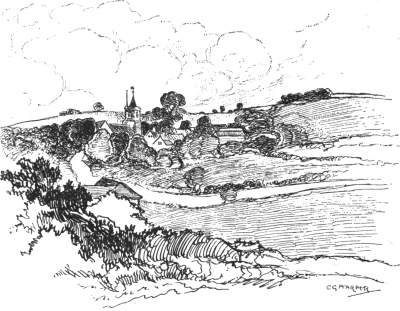
WEST MILL.
Buntingford succeeds to West Mill. A brick bridge crossing a little river, an old red-brick chapel bulking large on the left hand, a long, long street of rustic cottages and shops and buildings of more urban pretensions, and over all a sleepy half-holiday air: that is Buntingford. It is difficult to take Buntingford seriously, even though its street be half a mile in length, for its name recalls that hero of nursery rhyme, that Baby Bunting whose father went a-hunting, and went to buy a rabbit-skin to put the Baby Bunting in. Buntingford, for all the length of its long street and the very considerable age of it, is but a hamlet of Layston, close upon a mile distant. That is why Buntingford has no old parish church, and explains the building of the red-brick chapel aforesaid in 1615, to the end that the ungodly might have no excuse for not attending public worship and the pious might exercise their piety without making unduly long pilgrimage. "Domus Orationis" is inscribed on the gable-wall of the chapel, lest perhaps it might be mistaken for some merely secular building; an easy enough matter. Behind it, stands the little group of eight almshouses built in 1684 by Dr. Seth Ward, "born in yis town," as the tablet over the principal door declares; that Bishop of Salisbury who lent his carriage-horses to King James's troops to drag the ordnance sent against the Monmouth rebels on Sedgemoor.
Layston Church stands in a meadow, neglected, and with daylight peering curiously through its roof; and the village itself has long disappeared.
The fifteen miles between Wade's Mill and Royston, forming the "Wade's Mill Turnpike Trust," continued subject to toll long after the railway was opened. With the succeeding trusts on through Royston to Kirby's Hut and Caxton, on the Old North Road, and so on to Stilton, it was one of the earliest undertakings under the general Turnpike Act of 1698, and, like them, claimed direct descent from the first turnpike gates erected in England in 1663, under the provisions of the special Act of that year, which, describing this "ancient highway and post-road" to the North as almost impassable, proceeded to give powers for toll-gates to be erected at Stilton and other places.
To this particular Trust fell the heavy task of lowering the road over the London Road hill, the highest crest of the Downs; a work completed in 1839, at a cost of £1723, plus £50 compensation paid to a nervous passenger on one of the coaches who jumped off the roof while it was crossing a temporary roadway and broke his leg. The tolls at this time were let for £4350 per annum.
Reed Hill, to which we now come, passing on the way the hamlets of Buckland and Chipping, commands the whole of Royston Downs, a tract of country whose bold, rolling outlines are still impressive, even though the land be enclosed and brought under cultivation in these later years. This chalky range is a continuation of the Chiltern Hills, and gives Royston, lying down below in the deep hollow, a curiously isolated and remote appearance. Indeed, whether it be the engineering difficulties in tunnelling these heights, or whether the deterrent cause lies in rival railway politics, or in its not being worth while to continue, the branch of the Great Eastern Railway to Buntingford goes no farther, but comes ingloriously to a terminus in that little town; while the Great Northern Railway reaches Royston circuitously, by way of Hitchin and Baldock, and artfully avoids the heights.
A wayside inn—the Red Lion—crowns the summit of Reed Hill, and looks out upon vast distances. The Red Lion himself, a very fiercely-whiskered vermilion fellow projecting over the front door of the house, and looking with an agonised expression of countenance over his shoulder—passant regardant, as the heralds say—hails from Royston itself, where he occupied a similar position in front of the old coaching-inn of the same name. Alas! when old coaching days ended and those of railways dawned, the Red Lion at Royston, ever in the forefront of coaching affairs in the town, was doomed. The High Street knows it no more, and the Bull reigns in its stead as the principal house.
These windy downs, now robbed of much of their wildness of detail, but losing nothing of their bold outline, long harboured two forms of wild life not commonly found elsewhere. The Royston Crow, indeed, still frequents this range of hills; and on some undisturbed slopes of turf the wandering botanist is even yet rewarded in his Eastertide search for the Anemone Pulsatilla, the Pasque Flower. The Royston Crow, the Corvus cornix of ornithologists, is a winter visitor from Sweden and Norway, and is known in other parts of the country as the "hooded crow." He is distinguished from his cousin corvi by his grey head and back, giving him an ancient and venerable appearance. He is not a sociable bird, and refuses to mix with the blackbirds, the thrushes, and his kindred crows, who, for their part, are content to leave him alone, and doubtless rejoice when in April he wings his way to northern latitudes.
The Pasque Flower, so named from the paschal season of its blossoming, affects the windiest and most unlikely situations in chalk and limestone pastures, and thrives where it might be supposed only the coarsest grasses would grow. In these exposed places its purple blooms flourish. They nestle close to the ground, and are only to be easily discovered by the expert. Do not attempt to transplant this wild beauty of the downs. You may dig roots with the greatest care, and cherish them as tenderly as possible; but, torn from its stern surroundings and lapped in botanical luxury, the Pasque Flower droops and dies.
XIX
Royston stands where the Ermine Street and the Icknield Way intersect one another. To old Cobbett, travelling with a censorious eye upon men and things and places in the early years of the nineteenth century, it appeared to be "a common market-town. Not mean, but having nothing of beauty about it." This is not a very shrewd or illuminating opinion, because, while it is true that Royston is not beautiful on the one hand, nor exactly mean on the other, this description is not quite descriptive, and fails to explain where the town stops short of beauty or of meanness. Royston, in fact, is a little grim, and belies the preconceived notion of the expectant traveller, who, doubtless with some wild idea of a connection between Royston and roystering, is astonished at the grave, almost solemn, look of its narrow streets. The grim shadow of the Downs is thrown over the little town, and the houses huddle together as though for company and warmth.
There are those to whom the place-name suggests a Norman-French derivation—Roy's ton, or the King's Town,—but although the name arose in Norman times, it had a very different origin from anything suggested by royal patronage. Eight hundred years ago, when this part of the country remained little but the desolate tract the fury of the Conqueror had made it, the Lady Rohesia, wife of the Norman lord of the manor, set up a wayside cross where the roads met. The object of this cross does not clearly appear, but it probably filled the combined purpose of a signpost and wayside oratory, where those who fared the roads might pray for a happy issue from the rigours of their journey. At anyrate, the piety of the Lady Rohesia (or Roesia, for they were very uncertain about their h's in those times) has kept her name from being quite forgot, preserved as it is in Royston's designation; but it is not to be supposed that the pilgrims, the franklins, and the miscellaneous wayfarers along these roads tortured their tongues much with this awkward word, and so Rohesia's Cross speedily became known as "Roise's," just as to the London 'bus-conductors High Holborn has become "'iobun." A town gathered in course of time round the monastery—"Monasterium de Cruce Roesiæ"—founded here a century after this pious lady had gone her way. Monastery and cross are alike gone, but the parish church is the old priory church, purchased by the inhabitants for public worship when the monastic establishment was dissolved, and Royston Fair, held on 7th July in every year, is a reminiscence of that old religious house, for that day is the day of St. Thomas à Becket, in whose honour it was dedicated. As "Becket's Fair" this annual celebration is still known.
For centuries afterwards Royston was a town and yet not a parish, being situated in portions of the five adjoining parishes of Melbourn, Bassingbourn, Therfield, Barley, and Reed; and for centuries more, after it had attained parochial dignity, its chief cross street, Melbourn Street, divided the place into two Roystons—Royston, Hertfordshire, and Royston, Cambridgeshire. The doings of one with the other afford amusing reading: how a separate workhouse was established and separate assessments made for each parish, and how at length, in 1781, an Act was passed for consolidating the two for local government purposes; all these inconvenient and absurdly conflicting jurisdictions of parishes and counties being eventually swept away in 1895, when the Cambridgeshire portion of Royston was transferred to Hertfordshire, the whole of the town now being in that county.
They still cherish the memory of King James the First at Royston, though the open Heath where he hunted the hare is a thing of the past, and the races and all the ancient jollifications of that time are now merely matters for the antiquary. Where the four roads from the four quarters of the compass still meet in the middle of the town stood the old Palace. Its remains, of no very palatial appearance, are there even yet, and form private residences. Close by is that prime curiosity, Royston Cave. James and his courtiers and all their gay world at this corner never knew of the Cave, which was only discovered in 1742. It is a bottle-shaped excavation in the chalk, situated immediately under the roadway. Its age and original purpose are still matters in dispute. Whether it was excavated to serve the purpose of dust-bin to a Roman villa, or was a flint quarry, we shall never know, but that it certainly was in use by some religious recluse in the twelfth century is assured by the curious rough carvings in the chalk, representing St. Catherine, the Crucifixion, mitred abbots, and a variety of subjects of a devotional character. The hermit whose singular piety led him to take up his abode in this dismal hole must have had great difficulty in entering or leaving, for it was then only to be approached by plunging as it were into the neck of the bottle. The staircase by which visitors enter was only made in modern times.
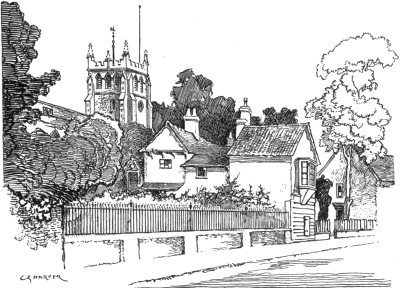
A QUAINT CORNER IN ROYSTON.
The old Red Lion at Royston has already been mentioned as having ceased to be. It was kept for many years in the eighteenth century by Mrs. Gatward, a widow, assisted in the posting and coaching business attached to the house by her two sons. One of them came to a terribly tragic end. What induced him to turn highwayman we shall never know; but he took to the road, as many a roving blade in those times did. Perhaps his life lacked excitement. If that were so, he took the readiest means of adding variety to existence, for he waylaid the postboy carrying His Majesty's Mails on the North Road, between Royston and Huntingdon, and robbed the bags. There was in those times no method of courting death with such success as robbing the mails, and accordingly young Gatward presently found himself convicted and cast for execution. They hanged him in due course and gibbeted his body, pursuant to the grim old custom, near the scene of his crime. The story of this unhappy amateur highwayman is told—and, a tale of horror it is—by one Cole, a diligent antiquary on Cambridgeshire affairs, whose manuscript collections are in the British Museum. Hear him: "About 1753-54, the son of Mrs. Gatward, who kept the Red Lion at Royston, being convicted of robbing the mail, was hanged in chains on the Great Road. I saw him hanging, in a scarlet coat, and after he had hung about two or three months it is supposed that the screw was filed which supported him, and that he fell in the first high wind after. Mr. Lord, of Trinity, passed by as he lay on the ground, and, trying to open his breast, to see what state his body was in, not being offensive, but quite dry, a button of brass came off, which he preserves to this day, as he told me at the Vice-Chancellor's, Thursday, June 30th, 1779. I sold this Mr. Gatward, just as I left college in 1752, a pair of coach horses, which was the only time I saw him. It was a great grief to his mother, who bore a good character, and kept the inn for many years after."
This account of how a malefactor's body might lie by the roadside, the sport of any wayfarers idle curiosity, gives no very flattering glimpse of this England of ours a hundred and fifty years ago. Yet these were the "good old times."
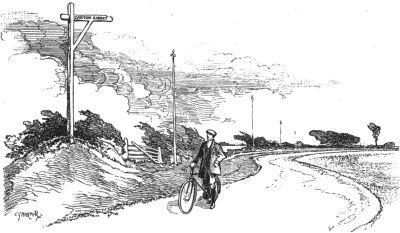
CAXTON GIBBET.
The story goes that the agonised mother of the gibbeted man secretly conveyed his body to the inn and gave it decent, if unconsecrated, burial in the cellar. His brother, James Gatward, was for many years afterwards part proprietor of the London, Royston, and St. Ives coach, running past the gibbet.
Caxton Gibbet, where Gatward's body hung in chains, is still marked by a tall post standing on a mound by the wayside, on the North Road, thirteen miles from Royston. It is a singularly lonely spot, even though a public-house with the gruesome name of the Gibbet Inn stands close by. A mile distant is the village of Caxton, with its old coaching-inns converted into farmhouses; the only other places on the twelve miles being the old Hardwicke Arms Posting House and the gates of Wimpole Park at Arrington Bridge, and the solitary "Old North Road" railway station.
Royston's old inns have lost much of their old-time air. Among them, the George possessed one of those old "gallows" signs crossing the road in a fashion similar to that of the Fox and Hounds at Barley, but, somewhere towards the close of the eighteenth century, it fell at the moment when a London-bound waggoner was passing beneath, and killed him. Since then such signs have not been in favour in the town.
XX
Royston has of late years spread out largely to the north, over those grassy heaths where James hunted. Looking back when midway between the town and Melbourn, this modern growth is readily noted, for the houses of it are all of Cambridgeshire white brick. At this distance they give a singularly close imitation of a tented military camp.
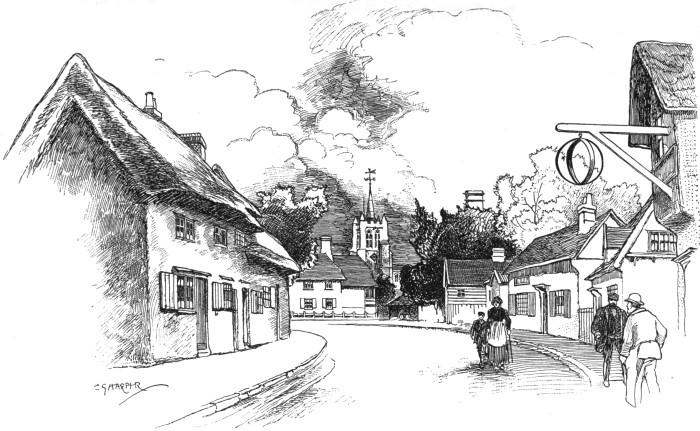
MELBOURN.
Melbourn—why not spelled with a final 'e,' like other Melbournes, is a mystery no inquiry can satisfy—is a large village of much thatch. Especially is the grey-green velvety moss on the thatch of a row of yellow plaster cottages beyond the church a thing of beauty, however rotten the thatch itself may be. Melbourn has a beautiful church and church-tower, seen in the accompanying picture, but its other glory, the Great Elm that for many centuries spread a shade over the road by the church, is now only a memory,—a memory kept green by the sign of the inn opposite. Everyone in Melbourn lives on fruit. In other words, this is a great fruit-growing district. This village and its neighbour, Meldreth, specialise in greengages, and from the railway station that serves the two, many hundreds of tons of that fruit are despatched to London in the season. These terms are perhaps vague, but they are reduced to a more definite idea of the importance of the greengage harvest when some returns are noted. From Melbourn station, then, thirty tons a day is an average consignment. Little wonder, then, that when one has come down from the bleak downs and heaths of Royston to these sheltered levels, the swelling contours of the windy pastures and breezy cornfields give place to long lines of orchards.
Cambridgeshire very soon develops its flat and fenny character along this route, and Melbourn left behind, the road on to Cambridge is a dead level. The low church-tower just visible to a keen eye, away to the left, among some clustered trees, is that of Shepreth. Shepreth hides its modest self from the road: let us take the winding by-way that leads to it and see what a purely agricultural Cambridgeshire village, set down in this level plain, and utterly out of touch with the road, may be like. It needs no great exercise of the deductive faculty to discover, on the way to Shepreth, that it is not a place of great or polite resort, for the lane is a narrow and winding way, half muddy ruts and half loose stones. Beside it crawls imperceptibly in its deep, ditch-like bed, overhung by pollard willows, a stream that takes its rise in the bogs of Fowlmere. By what lazy, snakish windings it ultimately finds its way into the Cam does not concern us. Here and there old mud-walled cottages, brilliantly white-washed and heavily thatched, dot the way; the sum total of the village, saving indeed the church, standing adjoining a farmyard churned into a sea of mud.
The appearance of Shepreth Church is not altogether prepossessing. The south aisle has been rebuilt in white brick, in a style rivalling the worst efforts of the old-time chapel-builder; and the old tower, whose upper stages have long fallen in ruin, shows in the contorted courses of its stonework how the building has sunk and settled in the waterlogged soil.
Beyond this soddened village, coming to the highroad again, the station and level-crossing of Foxton are reached; the situation of Foxton itself clearly fixed by the church-tower, rising from the flat fields on the right, half a mile away. There is something of a story belonging to this line of railway from Royston to Shepreth, Foxton, Shelford, and Cambridge. As far as Shepreth it is a branch of the Great Northern, anxious in the long ago to find a way into Cambridge and so cut up the Great Eastern's trade. The Great Eastern could not defeat the scheme altogether, but stopped it at Shepreth, to which point that line was opened in 1848. This was awkward for the Great Northern, brought to a halt seven miles from Cambridge, at a point which may, without disrespect to Shepreth, well be called "nowhere in particular." But the Great Northern people found a way out of the difficulty. Parliament, in the interests of the Great Eastern, would not permit them to build a railway into Cambridge, but no one could forbid them conveying passengers by coach along these last few miles. And so, for close upon four years, Great Northern passengers left the trains at Shepreth and were conveyed by a forty minutes' coach journey the rest of the way. Thus, along these few miles at anyrate, coaching survived on the Cambridge road until 1851, when the Great Eastern built a short line from Shelford to Foxton and Shepreth, to join the Great Northern branch, allowing running-powers to that Company into Cambridge station.
Harston village succeeds to Foxton. Its present name is a corruption of "Harleston," which itself was a contraction of "Hardeliston." It stands at a bend of the road, with a very small village green and a very large church to the left, and the long village street of small cottages and large gardens following the high road, and bringing the traveller presently to an inn—the Old English Gentleman—where the Barkway route to Cambridge meets this; both thenceforward joining forces for the remaining four miles and a half. Hauxton Church starts up on the right, by the Granta, which comes down from Audley End and is crossed here, over a little bridge, the only striking object in what has now become a very desolate road, so lonely and empty that an occasional thorn-tree, rising from the dwarf hedges of the immense flat fields, becomes quite companionable, and a distant clump of leafy elms a landmark. Those distant trees mark where Trumpington village church lies hid, and, if the horizon ahead be closely scanned, the long line of King's College Chapel will presently be seen. We are coming at last into Cambridge.
XXI
The entrance to Cambridge town through Trumpington is singularly noble and dignified. This is an age when almost every ancient town or city is approached through a ring of modern suburbs, but Cambridge is one of the few and happy exceptions. You cannot enter Oxford by the old coach road from London without passing through the modern suburb of St. Clements, whose mean street pitifully discounts the approach to the city over Magdalen Bridge; but at first, when nearing Cambridge, nothing breaks the flat landscape save the distant view of King's College Chapel, that gigantic pile of stone whose long flat skyline and four angle-turrets so wrought upon Ruskin's feelings that he compared it with a billiard-table turned upside down. It is not because of the great Chapel that the entrance to Cambridge is noble: it will add nothing to the beauty of the scene until that day—perhaps never to come—when the building shall be completed with a stately belltower after the design contemplated by its founder, Henry the Sixth. No; it is rather by reason, firstly, of the broad quiet rural village street of Trumpington, set humbly, as it were, in the gates of learning, and secondly of the still broad and quiet, but more urban, Trumpington Road that follows it, that Cambridge is so charmingly entered. A line of old gabled cottages with old-fashioned gardens occupies either side of the road; while an ancient mansion or two, together with the village church, are hid, or perhaps glimpsed for a moment, off to the left, where a by-road goes off, past the old toll-house, to Grantchester. This is Trumpington. In that churchyard lies a remarkable man: none other, indeed, than Henry Fawcett—we will not call him by his title of "Professor," for that seems always so blatant a dignity—who died at Cambridge in 1884, thus ending a life that had risen triumphant above, surely, the keenest affliction Fate can inflict. Completely blinded in youth by an accident of the most deplorable kind, he yet lived to fill a career in life and politics apparently denied by loss of sight. The text on his gravestone—a garbled passage from Exodus, chap. xiv. ver. 15—is singularly appropriate: "Speak unto the people, that they go forward."
It is down this leafy by-way, past the church, that one finds Grantchester Mill, a building generally thought to occupy the site of that "Trumpington Mill" made famous in one of Chaucer's Canterbury Tales.
For Trumpington has a certain literary fame, in association with Chaucer's "Reeve's Tale":—
"At Trompington, not fer fro Cantebrigge, Ther goth a brook, and over that a brigge, Upon the whiche brook ther stont a melle."
The "Reeve's Tale" is not precisely a part of Chaucer to be discussed in every drawing-room, and is indeed a story well calculated to make a satyr laugh and the judicious grieve. Therefore, it is perhaps no great pity that the mill stands no longer, so that you cannot actually seek it out and say, "Here the proud Simon, the 'insolent Simkin,' ground the people's corn, taking dishonest toll of it, and hereabouts those roystering blades of University scholars, Allen and John, played their pranks." Grantchester Mill is a building wholly modern.
It is a grave and dignified road, tree-shaded and echoing to the drowsy cawing of rooks (like tired professors weary of lecturing to inattentive classes), that conducts along the high road through Trumpington village to the beginnings of the town. Here, by the bridge crossing the little stream called the "Vicar's Brook," one mile from Great St. Mary's Church, the very centre of Cambridge, stands the eight-foot high milestone, the first in the series set up between Cambridge and Barkway in the early years of the eighteenth century, and paid for out of "Dr. Mouse's and Mr. Hare's Causey Money." This initial stone cost £5, 8s. The arms of Dr. Mouse may still be traced, impaling those of Trinity Hall.
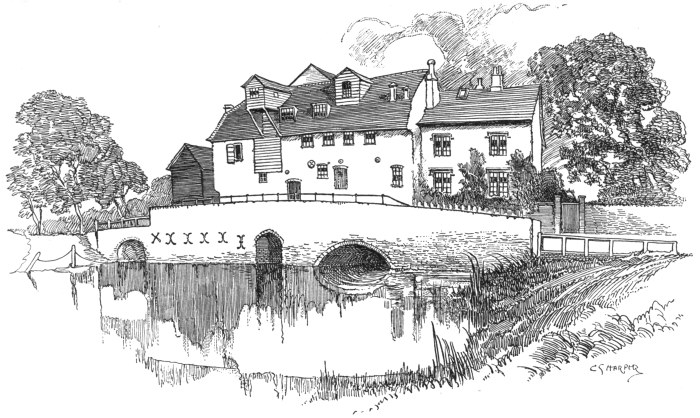
TRUMPINGTON MILL.
Beyond this hoary but little-noticed relic begin the Botanic Gardens, and beside them runs or creeps that old Cambridge water-supply, the "little new river," brought in 1610 from the Nine Wells under yonder gentle hills that break the flatness of the landscape away on the right.
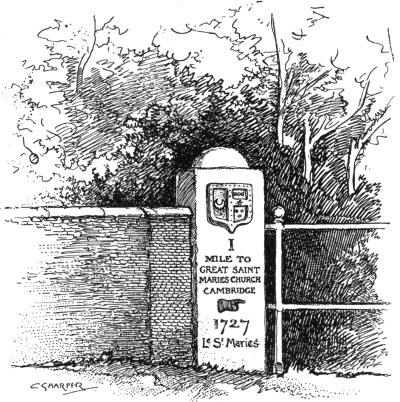
THE FIRST MILESTONE FROM CAMBRIDGE.
The idea of bringing pure water into Cambridge originated, in 1574, with a certain Dr. Perne, Master of Peterhouse; its object both to cleanse the King's Ditch, "which," says Fuller, "once made to defend Cambridge by its strength, did in his time offend it with its stench," and to provide drinking water for the University and town. This clear-running stream has an interest beyond its local use, for the cutting of its course was designed by Edward Wright, of Gonville and Caius College, who also drew the plans for Sir Hugh Myddleton's "New River," whose course so closely neighbours this old road between Ware and London.
The Conduit—"Hobson's Conduit," as it is called—that once stood on Market Hill, was removed in 1854, and now stands at the very beginning of Cambridge, where Trumpington "Road" becomes "Street," at the head of this open stream.
The Nine Wells are not easy to find. They are situated near the village of Great Shelford, under a shoulder of the Gog Magog Hills, and are approached across two rugged pastures, almost impracticable in wet weather. The term "wells" is misleading. They are springs, found trickling feebly through the white clay in the bed of a deep trench with two branches, cut in the hillside. Above them stands a granite obelisk erected by public subscription in 1861, and setting forth all the circumstances at great length. The term "Nine Wells" is not especially applied to this spot, but is used throughout Cambridgeshire for springs, whatever their number. A similar custom obtained in classic Greece, but the evidence by which our Cambridgeshire practice might possibly be derived from such a respectable source, and so be linked with the Pierian spring and the Muses Nine, is entirely lacking.
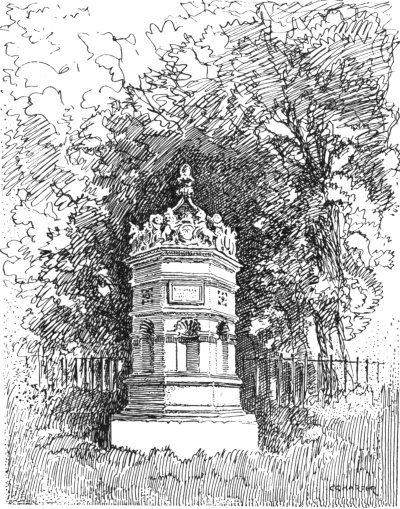
HOBSON'S CONDUIT.
The Gog Magogs—"the Gogs," as the country-folk irreverently abbreviate their mysterious name—are the Cambridgeshire mountains. They are not particularly Alpine in character, being, indeed, just a series of gently rising grassy downs, culminating in a height of three hundred feet above sea-level. No one will ever be able to explain how these very mild hills obtained their terrific title; and Gog and Magog themselves, mentioned vaguely in Revelations, where the devil is let loose again after his thousand years' imprisonment in the bottomless pit, are equally inexplicable.
The crowning height of the Gog Magogs was in Roman times the summer camp of a cohort of Vandals, quartered in this district to overawe the conquered British. It was then the policy of Rome, as it is of ourselves in India and elsewhere at the present day, to enrol into her service the strange tribes and alien nations she had conquered, and to bring them from afar to impress her newest subjects with the far-reaching might and glory of the Empire. This Vandalian cohort was formed from the barbarian prisoners defeated on the Danube by Aurelian, and enlisted by the Emperor Probus. The earthworks of their camp are still traceable within the grounds of the mansion and estate of Vandlebury, on the hilltop, once belonging to the Duke of Leeds. From this point of view Cambridge is seen mapped out below, while in other directions the great rolling fields spread downwards in fold upon fold. Immense fields they are, enclosed in the early years of last century, when Cambridgeshire began to change its immemorial aspect of open treeless downs, where the sheep grazed on the short grass and the bustard still lingered, for its present highly cultivated condition. Fields of this comparatively recent origin may generally be recognised by their great size, in striking contrast with the ancient enclosures whose area was determined by the work of hand-ploughing. These often measure over half a mile square, and mark the advent of the steam-plough.
XXII
The old Cambridge water-supply, meandering down from the hills, has induced a similar discursiveness in these last pages. Onward from Trumpington Road it runs in a direct line to the Conduit, and our course shall, in sympathy, be as straight.
The Fitzwilliam Museum is the first public building to attract notice on entering the town: a huge institution in the classic style, notable for the imposing Corinthian columns that decorate its front; its effect marred by the stone screen that interrupts the view up the noble flights of steps. "The Fitzbilly," as all Cambridge men know it, derives from the noble collections of art objects and antiquities, together with great sums of money, left to the University in 1816 by a Lord Fitzwilliam for the establishment of a museum and art gallery. It was completed some forty years ago, and has since then been the great architectural feature in the first glimpse of Cambridge. The coloured marble decorations and the painting and gilding of the interior are grandiose rather than grand; and although the collections, added to by many later bequests, contain many priceless and beautiful objects, the effect of the whole is a kind of mental and optical indigestion caused by the "fine confused feeding" afforded by the very mixed arrangement of these treasures,—a bad arrangement, like that of an overgrown private collection, and utterly unsuited for public and educational needs. You turn from a manuscript to a picture, from a picture to a case of china, from that to missals, and so all through the varied incarnations of art throughout the centuries.
Just beyond the Fitzwilliam Museum comes Peterhouse College, the oldest of all the colleges in the University. To understand something of the meaning of the colleges and their relation to the supreme teaching and governing body, it will be necessary to recount, as briefly as may be, the circumstances in which both University and Colleges had their origin.
The origin of Cambridge University, as of that of Oxford, is of unknown date, and the manner of its inception problematical. Who was the great teacher that first drew scholars to him at this place? We cannot tell. That he was a Churchman goes without saying, for the Church, in the dark ages when learning began to be, held letters and culture in fee-simple. Nor can we tell why Cambridge was thus honoured, for it was not the home, like Ely, Crowland, or Thorney, of a great monastic establishment, whence learning of sorts radiated. One of the untrustworthy early chroniclers of these things gives, indeed, a specific date to the beginnings of the University, and says that Joffrid, Abbot of Crowland, in 1110 sent monkish lecturers to the town; but the earliest record, beyond which we must not go into the regions of mere surmise, belongs to a hundred and twenty-one years later, when royal regulations respecting the students were issued. Already a Chancellor and a complete governing body appear to have been in existence. It is arguable that a century and more must have been necessary for these to have been evolved from the earliest days of a teaching body; but these affairs are for pundits. Such special pleaders as John Caius and Thomas Key, who fought with great bitterness and amazing pertinacity in the sixteenth century on the question as to whether Oxford or Cambridge were the older of the two, had the hardihood to trace them back to astonishing lengths. According to Caius, arguing for Cambridge, it was one Cantaber, a Spanish prince, who founded the University here in the very remote days when Gurguntius was King of Britain. To this prince he traces the name of the town itself, and I think that fact alone serves to discredit anything else he has to say.
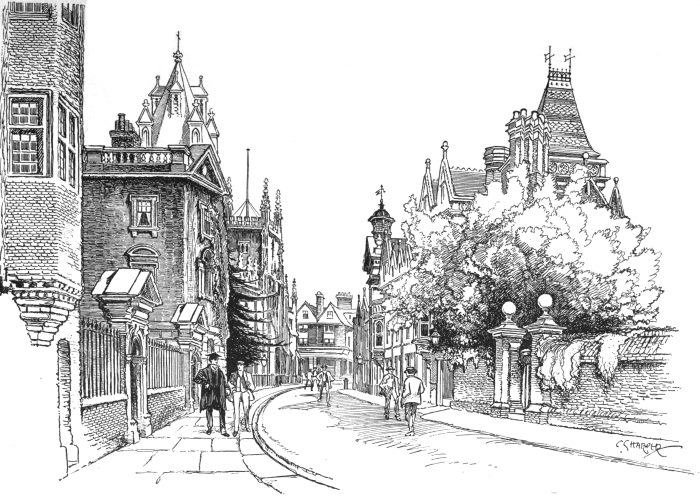
TRUMPINGTON STREET, CAMBRIDGE.
But no matter when and how the University originated. To those early teachers came so many to listen in the one room or hall, that probably constituted the original University, that the town did not suffice, to accommodate them, and, both for the sake of convenience and discipline, the first college was founded, as primarily a lodgment or hostel for the scholars. As their numbers continually grew, and as benefactors began to look with increasing kindliness upon learning, so were more and more colleges added.
The first of all the colleges was, as already stated, this of Peterhouse, founded so far back as 1280 by Hugh de Balsham, Bishop of Ely. It was at first established in the Hospital of St. John the Evangelist, near by, but was removed, only six years later, to the present site, for convenient access to the Church of St. Peter. It is to the fact that the chancel of this church was used as its chapel that the college owes its official but rarely heard title of "St. Peter's." In 1352 St. Peter's Church was given a new consecration, and has ever since been known as St. Mary the Less. Meanwhile, in 1632, the college built a chapel of its own.
Peterhouse has points of interest other than being the first of the colleges. It has nurtured men not only of distinction, but of fame. Men so opposite in character as the worldly Cardinal Beaufort—the great Cardinal who figures in Shakespeare—and the pious Archbishop Whitgift were educated here; and in later times that great man of science, Lord Kelvin; but perhaps the most famous of all is Gray, the poet, whose "Elegy Wrote in a Country Churchyard" has done more to endear him to his country than the acts of any statesman or divine.
Peterhouse does not present a cheerful front to the street. It is heavy and gloomy, and its buildings, as a whole, do not help out the story of its age. The chapel, whose weather-vane bears the emblem of a key, an allusion to St. Peter, stands recessed behind the railings that give upon the street, and blocks the view into the first of the three quads. It is flanked on one side by the venerable brick building seen on the extreme left of the illustration representing Trumpington Street, and on the other by a great ugly three-storeyed block of stone, interesting only because the rooms overlooking the street on the topmost floor were those occupied by Gray. They are to be identified by iron railings across one of the windows. A story belongs to these rooms. Gray, it seems, lived long in them as a Fellow of his College, and might have eked out his morbid life here, dining according to habit in Hall, and then, unsociable and morose, retiring to his elevated eyrie, reading the classics over a bottle of port. Gray had a very pretty taste in port, but it did not suffice to make him more clubbable. His solitary habits, perhaps, were responsible for a morbid fear of fire that grew upon him, and increased to such a degree that he caused the transverse bars, that still remain, to be placed outside his window overlooking the churchyard of Little St. Mary's, and kept in constant readiness a coil of rope to tie to them and so let himself down in case of an alarm. His precautions were matters of common knowledge, and at last his fears were taken advantage of by a band of skylarking students, who placed a bath full of water beneath his rooms one winter night and then, placing themselves in a favourable position for seeing the fun, raised cries of "Fire!"
Their best expectations were realised. The window was hurriedly flung up, and the frenzied poet, nightcapped and lightly clad, swiftly descended into the bath, amid yells of delight. These intimate facts seem to hint that Gray had not endeared himself to the scholars of Peterhouse. This practical joke severed his connection with the college, for he immediately removed across the street, to Pembroke.
Pembroke is prominent in this view down the long, quiet, grave street; and the quaint turret of its chapel, built by Sir Christopher Wren, is very noticeable. Gravity is, we have said, the note here, and so solid a quality is quite in order, for Trumpington Street and the road beyond have ever been the favourite walks of dons and professors, walking oblivious to their surroundings in what we are bound to consider academic meditation rather than that mere mental vacuity known as absent-mindedness. There is a story told of the late Professor Seeley exquisitely illustrating this mental detachment. It is a story that probably has been told of many earlier professors, to be re-incarnated to suit every succeeding age: a common enough thing with legends. It seems, however, that the late Professor of History was walking past the Conduit one fine day, speculating on who shall say what abstruse matters, when a mischievous boy switched a copious shower of water over him from the little stream in the gutter. The Professor's physical organism felt the descending drops, some lazy, unspeculative brain-cell gave him the idea of a shower of rain, and he immediately unfurled his umbrella, and so walked home.
Next the new buildings of Pembroke, over against Peterhouse, the Master of that college has his residence, behind the high brick walls of a seventeenth century garden. On the left hand are Little St. Mary's, a Congregational Church, and the church-like pinnacled square tower of the Pitt Press, all in succession. Beyond, but hid from this view-point by a gentle curve of the street, are "Cats," otherwise St. Catherine's, and Corpus; and then we come to that continuation of Trumpington Street called "King's Parade," opposite King's College. Here we are at the centre of Cambridge, with Market Hill opening out on the right and the gigantic bulk of King's College Chapel on the left, neighboured by that fount of honour, or scene of disgraceful failure, the beautiful classic Senate House, where you take your degree or are ignominiously "plucked."
In midst of Market Hill stands the church of Great St. Mary's, the University Church. Town and University are at this point inextricably mixed. Shops and churches, colleges, divinity schools and Town Hall all jostle one another around this wide open space, void on most days, but on Saturday so crowded with the canopied stalls of the market that it presents one vast area of canvas. Few markets are so well supplied with flowers as this, for in summertime growing plants are greatly in demand by the undergrads to decorate the windows of their lodgings. This living outside the colleges is, and has always been, a marked feature of Cambridge, where college accommodation has never kept pace with requirements. It is a system that makes the town cheerful and lively in term, but at vacation times, when the "men" have all "gone down," its emptiness is correspondingly noticeable. To "go down" and to "come up" are, by the way, terms that require some little explanation beyond their obvious meaning of leaving or of arriving at the University. They had their origin in the old-standing dignity of Alma Mater, requiring that all other places should be considered below her—even the mighty Gog Magogs themselves. From Cambridge to London or elsewhere is therefore a [Greek: katabasis]—a going downward.
The Cambridge system of lodging out does not make for discipline, and creates a lamentable laxity in a man keeping his proper quota of chapels. To attend chapel at an early hour of the morning seems much more of an infliction when living in the freedom of lodgings than when in the cloistered shades of a college quad, and has led to many absences, summonses before the Dean, and mild lectures from that generally estimable and other-worldly personage. You, in the innocence of your heart and your first term, advance the excuse that late study makes it difficult to always keep chapels. Observe that it is always midnight study, never card-parties and the like, and never that very natural disinclination to turn out of bed in the morning that is answerable for these backslidings. All very specious and unoriginal, and that Dean has heard it all before, so many times, and years and years ago, from men now gone into the world and become middle-aged. Why, in his own youth he gave and attended parties, and missed chapels, and made these ancient blue-mouldy prevarications to the Dean of his college,—and so back and back to the infinities. Is he angry: does he personally care a little bit? Not at all. It is routine. "Don't you think, young man," he says, in his best pulpit-cum-grandfather style, "don't you think that if you were to try to study in the morning it would be much better for your health, much better in every way than reading at night? When I was your age I studied at night. It gave me headaches. Now try and keep chapel. It is so much better to become used to habits of discipline. They are of such value to us in after life"—and so forth.
XXIII
Cambridge is often criticised because it is not Oxford. As well might one find fault with a lily because it is not a rose. Criticism of this kind starts with the belief that it is a worse Oxford, an inferior copy of the sister University. How false that is, and how entirely Cambridge is itself in outward appearance and in intellectual aims need not be insisted upon. It is true that Trumpington Street does not rival "the High" at Oxford, but it was not built with the object of imitating that famous academic street; and if indeed the Isis be a more noble stream than the Cam, Oxford at least has nothing to compare with the Cambridge "Backs."