Front matter (continued 7)
Reading edition
And what he bore as he kept the faith! It tore his nerves to tatters. One incident as an example:
He was invited to address a convention of the Afro-American Association, which was holding its biennial meeting in Washington in May. He accepted the invitation with very great pleasure. It gave him the opportunity he desired. The negroes had been talking to him or at him for months: and he had somewhat to say to them. He welcomed the chance to say it. He was full of his speech, and was intending to be very emphatic. It was his day to talk.
But the distinguished chairman of the convention who introduced him thought that it was his day to talk. He presented Mr. Phillips in fifteen minutes of perfervid oratory, sonorous, unctuous, and filled with African imagery. He recited a brief history of the President's life, lauded him as Civilian, Soldier, and Chief Executive, credited to him about every good thing that had come to the human race since he was inducted into office, and crowned him as the negro's Friend, Champion and Hope. He detailed the evidence of Mr. Phillips' love for the negro race, and hailed him as the true and great Exemplar of the Genuine Brotherhood of Man.
"Yes, my Brothers," the orator-chairman swept volubly to his conclusion, "this great man who holds the Stars of Our Flag in his right hand and in his left hand the Golden Sceptre of Supreme Authority and Power in this Peerless Nation has proved himself beyond any Question or Peradventure the very Apostle and Archetype of Equality and Fraternity in this land of theoretical Freedom and Equal Rights. In each of the three great departments of our life he has practised that Equality and Fraternity. In the civil administration of this Great Government he has called to his assistance black men of Mighty Brain-Power to advise with him about his policies of Statecraft and they have spoken Words of Wisdom to him. In the military department he has appointed to an officer's commission under the Stars and Stripes a brave young negro, a Gentleman, a Scholar, a Soldier, who will reflect Honour upon the Star-Spangled Banner and show the world that the Negro is a Patriot and a Fighter. And more than that, my Brothers! As the crowning act of his Fearless Career the Honourable and Honoured Gentleman who will address you has openly recognized the negro's rightful place in the Homes of this Country, for he has admitted the race as an Equal into the Holy of Holies of his own domestic life, and furnished supreme and convincing proof of his love for black men by freely giving his tender and gentle daughter, the Fairest among Ten Thousand and the One Altogether Lovely, over into the arms and affections of that same young Negro Soldier! Connubial Bliss knows no Colour Line, my Brothers! May the union be blessed with—"
But fifteen hundred lusty black throats, not able longer to choke down their cheers, were wildly, exultingly screaming "Phillips! Phillips!! Phillips!!!" The chairman said a few more words in pantomime and gave Mr. Phillips the right to speak.
Mr. Phillips was very slow in coming to his feet. The speech that he had purposed to make was gone—all gone. The chairman's last words like a chemical reagent, had turned his every though to vitriol, and he was all afire with the impulse to pour it burning and blistering down their open throats.
He stood impassive with tight-shut lips while they cheered and cheered and cheered. In the fires that scorched his spirit, personal and political ambition shrivelled into a cinder and was entirely consumed. A second term—the honour, the approval, the country's weal—might sink into the Pit rather than that he would blacken his soul even by tacit assent to such a monstrous, awful lie! Given Helen freely to a negro's arms!—he would blast that lie with—
But Helen! in the tumult he thought of her. And the tenderness of his love for her made him to tremble. In a moment a war was on within him, and the struggle between his pride and his love shook him as with an ague.
But he knew the end from the beginning. As the cheering died away Helen dominated his thoughts as she dominated his heart,—and he did make a speech to the convention. It was not a forcible speech nor a very long speech, for a man cannot think about one thing and discourse very effectively about another. It was on the order of a prayer-meeting talk, consisting mainly of platitudes and good advice. When it was finished he went directly home and lay down on a couch to rest, for he was tired, mortally tired.
From that day forth Mr. Phillips was in terror of his negro allies. He made no other addresses to them. But he could not escape them. The negro papers called on the race to rally to the Phillips standard. This the joyful blacks construed to mean that they must form themselves in squads and go over to Washington and tell Mr. Phillips about it personally. Many were the delegations from political clubs and orders and associations of all black sorts that called to pay their respects and assure the President of their loyal support and good wishes; and despite all his forehandedness and precautions it was a very dull day when he was not openly hailed as a brother to the race by virtue of the affinity in Helen's choice of a mate. He was not permitted to forget Helen's plight for an hour,—if he had chosen to forget.
Indeed, however, he had lost the zest of thinking about anything else. True, he fought his political battle with energy to the finish, and gave it the best thought his brain could furnish—but that was because he was a born fighter and knew not how to be a laggard: the burden of his voluntary, uncompelled thinking was of Helen, and it grew larger and larger upon his mind. And the more he thought of her, the more he would think of her: and the tragedy of her mating loomed more darkly hopeless and appalling before his face, until his days became one long prayer for a miracle of deliverance.
In his meditations he suffered the tortures of a lost soul. He was too brave a man to shirk his accountability for Helen's undoing. In moments of solitude when he was most racked with remorse and wildly despairing he would cry out against the fatal interpretation she had put upon his words and his deeds—"I did not mean that, I did not mean that, oh my daughter, my little girl, my little girl!"—but these moments of self-excusing were only the wild cries of unbearable agony. In composed self-confession he accused himself—with a bitterness that had in it the bitterness of death—and in the genuineness of his penitence he might have proclaimed his error and put his countrymen on guard: if only Helen must not know!
* * * * *
Summer was come and the convention was less than two weeks away when Mr. Phillips' first political lieutenant came back from a trip to New York with the very definite news for his chief that even if at that late day he would promise to be more considerate of the business interests of the country the nomination might yet be his. Mr. Phillips promptly sent his answer to the railroad president who had presumed to speak for Business that he "would see the business interests damned before he would make any such promise." ...
Three days before the convention met, Mr. Phillips received a letter written in pencil in a weak and uncertain handwriting.
"We have named the boy Hayne Phillips. When are you coming to see us? Daddy dear, it tires me so to write. I love you. HELEN."
CHAPTER XXXVII
The Mr. Phillips who on July the 3d, 191-, alighted from the car at the little station that served the Stag Inlet folks was a very different figure of a man from the vigorous person who on a day in the preceding October had taken the train there to go back to his work in Washington.
There was now no spring in his step, no quickness in his movement. He was plainly fatigued and preoccupied, and he was alone. There was no member of his family with him, nor any of them, except Hayward, to meet him at the station. A single secretary followed him at some little distance as he walked down the platform mechanically raising his hat and smiling at the half score of persons who had stopped to see him take his carriage. He climbed up beside Hayward into the single-seated affair the negro was driving, nodded to the secretary to follow him in the formal and stately victoria that was waiting, and with a parting lift of his hat left the small crowd staring at him as he drove away.
The onlookers commented, as onlookers will, upon everything that struck their eyes in the simple proceeding. They wondered why he appeared so listless and careworn. They wondered why he crowded into the narrow buggy instead of taking the roomy carriage. They wondered why none of his daughters nor his wife accompanied him—why he looked just a little bit carelessly dressed—and what had become of his swinging, buoyant stride—and whether he was altogether in good health and—well, they left no question unasked, no surmise unturned.
Mr. Phillips had very little to say to Hayward during the drive to Hill-Top. He really desired to say nothing, but it was impossible to ignore all the demands of gentlemanly politeness and interest in his son-in-law's family.
"How is Helen?" he asked after a long while.
"Not so very well yet, sir," answered Hayward. "She doesn't seem to regain her strength very rapidly."
A very much longer silence.
"And the baby?"
"The finest boy in the world, sir—you ought to see him—strong and healthy, with lungs like a steam piano."
Mr. Phillips made no comment. Hayward looked round at him.
"He's not very pretty, sir—no really young baby is, I'm told—but the nurse says it's unusual the way he notices things already. I know all new fathers are said to talk like that about the first baby, but really I think he must be an exception, sir. I think he'll be a credit to his name—which is the most I could say for him."
Mr. Phillips acknowledged the compliment by nothing further than a lifting of his chin—-which Hayward had no means of interpreting. Having exhausted the subject and not being encouraged to proceed, the young father became silent—and Mr. Phillips was glad. He had not chosen to ride with Hayward for the pleasure of his conversation, but for the benefit of the onlookers at the railway station; and, having asked the questions absolutely demanded by the occasion, he did no more.
* * * * *
Mr. Phillips waited in the library till he should be told that his daughter and grandson were ready to receive him. Not in the lull before the battle of Valencia did he so prepare himself for a trial of his nerves and his courage. His courage was of the same old sort, but his nerves were sadly shaken by the cumulative happenings of the last half year; and with Helen's happiness as the ruling purpose of his life he felt almost afraid to trust himself before her eyes in the ordeal through which he must pass. Perhaps she might still be unable to read his dissembling. God save them both if she should read him truly.
The nurse came in to tell him that Mrs. Graham was waiting to see him. Hayward had intended to witness that meeting, but there was something in the father's manner as he passed him in the hall which caused him to forego his purpose. Mr. Phillips followed the nurse into the darkened room. Helen half rose to a sitting posture and clasped her white arms about his neck and sobbed in nervous joy.
"Oh, daddy, you have come!" she said brokenly—and for a long time neither spoke.... "I thought you would never come! I have wanted to see you so. I've been so lonely, daddy. Where are mamma and Elise that they have deserted me?"
Mr. Phillips as he bent down over her almost lifted her out of bed in the force and tenderness of his embrace. The pitiful little cry of loneliness almost tore his heart-strings out of him.
"Your mother has not been strong enough to come, precious heart, and Elise has to stay at her side to care for her. When Dr. Hamilton prescribed Virginia Springs for her in April he thought that two months of rest would restore her to strength. Last winter was a very trying season, and your mother was more broken than usual by its burdens. The doctor tells me that she is recuperating very slowly, almost too slowly, but that rest and absolute quiet and freedom from excitement is the only thing that will cure her. I saw them a week ago to-day—I wrote you—and they sent their love to you. They hope to see you before very long."
"Elise might have come, papa. She has written to me quite regularly—but she might have come if only for two or three days—so that I could see some of you"—and her mouth quivered into another muffled sob.
"No, no, child, she could not leave her mother—you cannot imagine how near your mother has been to collapse—they would not write you for fear that you would worry too much about it—and she is still very weak—nothing seems to benefit her much—the doctor can hardly find the cause of her continued weakness—and perfect rest is the only thing that can help her back to health. So Elise must be there to relieve her from every exertion and effort and be a companion to her, for my visits are necessarily brief. They love you, little girl, as always—though they haven't been permitted to be with you. Katherine is too young to have come, of course, and she would have been more of a care than a comfort, anyway."
"Oh, yes, she's young, but she would have been somebody. The last month has been the longest month, daddy, that I ever lived in all my life—"
"Well, well, little girl," the father said soothingly as he smoothed the hair on her temple, "don't cry any more. The waiting is over now and we won't be away from you so long again. I could not get away from Washington a day earlier. I have been very busy, you know—doubly busy with the official work and the political campaign too."
"Oh, yes, daddy, I want to ask you. Are you going to get the renomination?" There was an excitement in Helen's question that her father saw was unusual for her, with all her characteristic interest in his political fortunes.
"Why child, I—I think so. We'll know certainly in a very short time now. The convention is in session and they will have the first ballot to-morrow, I think."
"But do you really think you will win, daddy? Is there no danger of losing?"
"I really think I'll win, little woman; but you know politics is a most uncertain thing."
"Then you do think there is some danger! Oh, daddy, is what I've done going to hurt you?" There was distress in her accents.
"What you've done?"
"Yes, daddy. It never occurred to me till yesterday. I've seen very little of the papers since we've been up here, but none of them had ever mentioned such a thing—until last night in the very first one the nurse would let me look at even for a minute it said that 'just how many or just how few votes the President will lose in the convention because of his daughter's having married a negro it is impossible at this time to forecast. Southern delegations this year are unusually uncertain quantities.' It said just that, daddy—and oh, I'm so sorry if—"
"Oh, no—no—child. You haven't hurt me, my chance of renomination, in the least. The idea is ridiculous. Haven't you learned by this time that the papers will say anything? They must say something, you know; and when they haven't anything sensible to say they are compelled to say things that are absurd. Suppose the Southern delegates are uncertain. They always have been, except when the machine had them tied hard and fast. Don't distress your heart about political rumours, little girl. I'll win all right. I've never failed in my life."
"Oh, I'm so glad if it is false, daddy. It would break my heart if I thought I had done anything to defeat you. I wish there were no Southern delegates—and no Southern people, with their bigoted notions!"
"You are forgetting, little woman, that your grandmother was a South Carolinian—and the dearest, gentlest soul! If she could have lived to know you she would have loved you more than any other girl in all the world, I think. And you would have loved her, Helen.... Don't quarrel with the Southern people. Their ideas about the—about the negro are in the blood, and cannot be eradicated in two or three generations."
Helen began to speak and turned her face casually toward the baby lying tucked in on the far side of the bed—when her father snatched the conversation suddenly from her and, taking it thoroughly in hand, gave her little time except to listen.
The blow had fallen! And with all his preparation he was unprepared! Helen was confused and bewildered by the incoherency of his talk, by his hurried, disjointed speeches, by his half-made questions. He was making a blind effort to put off and push back the inevitable. His eyes had grown accustomed to the subdued light of the room and as his vision became clear his heart almost ceased to beat. The baby! In that half light was revealed the darkness of the little fellow's face!—many, many shades darker than the face of Hayward Graham: and the spectral fear that had been with Mr. Phillips at noonday, at morning, at evening, at all the midnights through the last months, was now a real, weakening, flesh-and-blood terror.
With a hope that was faltering indeed had he prayed for the miracle that might deliver Helen entirely from the consequences of her thoughtless folly, but with all his faith had he besought a merciful Heaven that the child which would come to her should not fall below a fair average of its parental graces. Even that were a torture, that were horrible enough: that Helen's gentle blood should be evenly mixed and tainted with a baser sort. But this recession below the father's type!—this resurgence of the negro blood, with its "vile unknown ancestral impulses!"—there came to him an almost overpowering desire, such as had come of late with increasing frequency but never with such physical weakness as now: the desire to lie down at full length and to rest.
As he talked volubly and scatteringly to Helen, his shaking soul cried against fate. Why should Nature have chosen his Helen, the very flower of his heart, as a subject upon which to demonstrate her eccentric laws! Why, oh—but he must keep his tongue going to distract Helen from his distress—why, oh, why should atavism have thought to play its tricks and assert its prerogative here! Were there not enough other mongrel children in all the earth through whom heredity could establish her heartless caprices without the sacrifice of Helen and of Helen's baby! Oh, the sarcasm of pitiless Chance, that the most dear, the very highest, should be sacrificed to establish the law of the Persistence of the Lowest in the blood of men! Surely, in this lesson, that law had been taught at an awful cost: and, as if to show that it had been taught beyond cavil, there was poked out from under the white coverlet a tight-shut baby fist that was almost black.
* * * * *
All things human must have an end,—and Mr. Phillips' subterfuge was very human. His expedients finally failed, he had not a word more to say: and yet he was no nearer being prepared for the inevitable than before. The supreme test was come, and his spirit cowered before it. For the first time in his life he greeted flight as a deliverer, and decided to run away from danger.
"Well, little woman, I must go and rid myself of the dust of travel;" and he was half way to the door when Helen's weak voice arrested him.
"Are you not going to notice the baby, daddy?"
The pathos in that trembling question would have called him to go against all the Furies. Turning, he hesitated an instant, of which the double would have been fatal: but he saved the moment from disaster.
"Dear me, I was about forgetting the youngster."
He walked quickly around the bed and sat down beside the boy. Pulling the covering a little away, he took the tiny hand in his, and grandfather and grandson looked for the first time each into the face of the other.
It was a negro baby: the colour that was of Ethiopia, the unmistakable nose, the hair that curled so tightly, the lips that were African, the large whites of the eyes. Verily a negro baby: and yet in an indefinable way a likeness to Helen, a caricature of Helen, a horrible travesty of Helen's features in combination with—with whose? Not Hayward Graham's. But whose, then? Helen's and whose? ... Mr. Phillips could not answer his own question—he had never seen Guinea Gumbo.
In a moment the smaller hand closed over the man's finger as if in approval; but the man straightened up as if to get a freer breath, and glanced involuntarily at the pale mother. Her eyes were painfully intent upon him. Driving himself, he turned. Murmuring a nursery commonplace, he leaned over and kissed the little darkey as tenderly as he might.
There was no escape from Helen's eyes. He prayed that she had not seen that his were shut when he kissed her son—it was his only concession to himself.
With another pat or two of the small fist he stood up by the bedside, bracing his knees against the rail that he might stand steadily. The fever was not yet gone from Helen's eyes. She had smiled when he caressed the boy, but she was yet expectant. On her father's verdict hung all her hopes, and his face for once in her life she was unable to read. She was vaguely uneasy. His manner was inscrutable, and she had never seen him look just like that. Their eyes met, and the unconscious pleading in hers would have wrung any verdict from him.
"He's a fine boy, isn't he, little woman? ... So strong and healthy looking.... Shakes hands as if he meant it.... And he looks somewhat like you, missy. That will be the making of him.... But I must go now,"—and he went rather precipitately.
"And will you hurry back to us, daddy?" Helen called to him.
"Yes, child; I'll hurry back," he answered,—as he hurried away.
His secretary handed him a telegram. He took the yellow envelope and, without so much as glancing at it, went into the library and shut the door.
* * * * *
Very late in the afternoon the library door was opened, without invitation from within. Mr. Phillips was sitting in a chair with his arms upon his desk and his face upon his arm—dead.
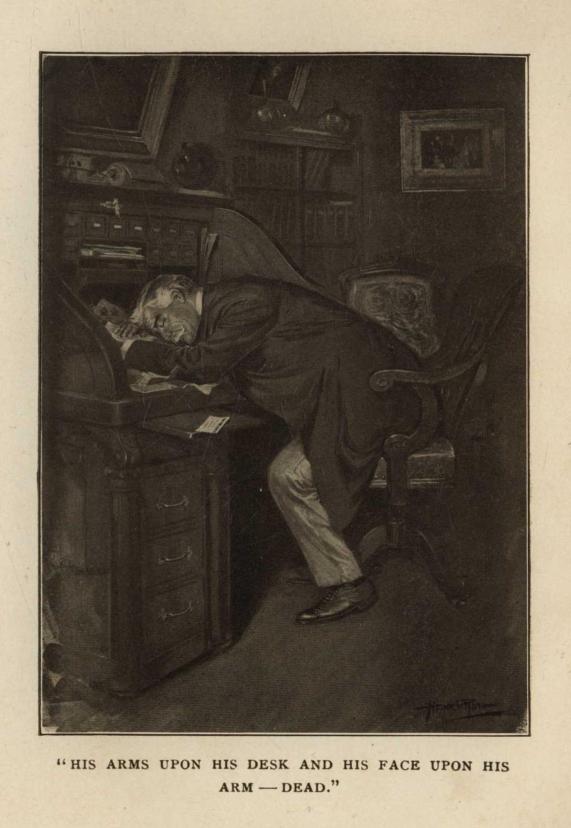
"HIS ARMS UPON HIS DESK AND HIS FACE UPON HIS ARM—DEAD."
CHAPTER XXXVIII
Again, and of necessity, is the reader cited to the newspapers of the time.
It is not meet that the passing of a chief magistrate of this nation should be passed over quickly or lightly in any history. The people stopped to mourn, to cast up his life in total, and pay respect to its multiplied excellences, to study his virtues as if in hope to reincarnate them, and to glory in his life as a common possession of his country. And yet this narrative may not pause to pay befitting tribute to him, nor to detail the tides of grief that swept the hearts of his countrymen with his outgoing, or the stateliness and grandeur of the ceremonies with which they committed his body to the ground. We may not here give the comprehensive view, for our canvas is not broad enough. Let it be said only that he died as he had lived: a gentleman brave and tender,—honest to his undoing, but dead without having known defeat,—faithful to his love for Helen even to the death, yet making no plaint against love.
The physicians ascribed the President's death to heart failure,—which meant little more than that he was dead. They ventured to say that the heart failure had been superinduced by overwork. This verdict doubtless would have stood if a newspaper man the first at Hill-Top had not chanced to hear of a telegram.
The telegram could not be found although the secretary searched diligently for it. The energetic reporter conceived that that statement was a subterfuge which in some way betokened a lack of confidence in his discretion, and, besides, it smacked of mystery for a telegram to evaporate into thin air in a dead man's hand. Put on his mettle thus, he made it his business to know what was in that telegram. Being an old telegraph man himself, he hied him down to the station and made himself pleasant and useful to the youngish man in charge.
President Phillips had intended to await the decision of the convention in Washington, and all telegraphic arrangements for convention bulletins had been made accordingly. At the last moment Helen's trembling little letter had changed his purpose, and he had slipped quietly off to Hill-Top, notifying only Mr. Mackenzie how to communicate with him directly.
The moment the President's death had flashed upon the wires, the capacity of the little Stag Inlet office became sadly overtaxed. The perspiring and flustered operator was very grateful for the assistance of the kindly newspaper man who modestly proffered his help in getting the deluge of messages speedily copied, enveloped, addressed and dispatched. Once having his hand on the copy-file it was an easy thing for the good Samaritan to get the full text of the last message that had gone to Hill-Top.
He could not decide whether it was so very valuable now that Mr. Phillips was dead; but he sent it to his paper along with his other stuff, riding a dozen miles in a midnight search for an open telegraph key. Much pride he had in his achievement when he added to his news report a statement to his managing editor that the text of the telegram was a "beat" for his paper and might be displayed as "exclusive." But his feelings were very much hurt next day that they should have published his find under a Chicago dateline and robbed him of his glory.
THE PRESIDENT DIES OF A BROKEN HEART
He Takes the Telegram which Tells of Defeat and Is Seen No More Alive
Chicago, July 3d—After a conference of the leaders of the Phillips cohorts this afternoon the following telegram was sent to the President at Stag Inlet: "We are moving heaven and earth; but the forces of evil are too many for us. First ballot to-morrow."
The news column was after that fashion. The leading editorial was a scream under the caption, "The Trusts Have Murdered Him!"
Mr. Mackenzie, who had sent the telegram, was mortally angry that the odium of actual defeat from which death had relieved his friend should have been fixed thus upon his memory. He was offended almost beyond endurance with his confidential clerk despite that young man's violent disclaimer of responsibility for the leak; but he was most enraged at the diabolical discretion of the managing editor of The Yellow in omitting the name of the sender of the telegram: which would necessitate that he admit having sent it before he could demand to know whence the paper had knowledge of it.
The convention took a recess for ten days, and, upon reassembling after Mr. Phillips' burial, passed by a unanimous vote a set of resolutions that lifted him to the stars and gave him place among the gods. Then it set out upon a long round of balloting; and without being altogether conscious of the reasons and causes impelling, it finally nominated a "safe" man for President.
* * * * *
Helen could not attend her father's funeral. Pitifully weakened by the awful shock of his sudden passing, she cried out with all her remaining strength to be carried in to look upon his face in death. Her physician's consent after long refusal was due to his kindliness of heart, and the result vindicated his professional judgment, in that it came frightfully near to taking her life.
In utter desolation of spirit was she left when they had taken the great man out of the house upon his stately procession to Washington and the grave. Her husband was unfailing in devoted and anxious attendance, but she was listless to his tenderest efforts to console her. Elise's letters, coming now every day from the bedside of the prostrated mother, Helen read faithfully to the last word, and really tried to take comfort and courage from them, but they could not get down, it seemed, to touch and dissolve the cold mists of desolation in the deeps of her heart. Her father, the stay and fixative of her life, was gone: and there was nothing now to give her footing upon the earth. No one to interpret life, to give meaning to life, to give purpose to life, to give value to life. The days might as well move backward as forward. They appeared not to be moving at all. There was no one to give them direction. He toward whom or from whom or about whom the days had always turned as a sort of first cause or incarnation of the reason and sense of things, was gone: and she was in chaos.
With her weakness of body, her mental processes were weak, and her mind did not take vigorous hold of things: but, confidently as it had followed her father's sentimental speeches about the negro race and loyally as she would defend and abide his words and the consequences of them, she could not control her thinking, even in its weakness, and put down the thoughts which her every look upon her baby brought to disturb her. Very slowly the natural spring and rebound of youth brought her out of her physical relapse, and yet more slowly out of her mental depression. But, even as strength of body and mind returned, there came more insistently the questioning that could not be answered.
In her heart she had always glorified mother-love. In the days and weeks before the baby's coming she had revelled in the dreams of motherhood, and her heart had been overcharged with love and visions of it.
But this little fellow was not the baby of her dreams. Never in all the hundred varied pictures her heart had painted had there been a child like him. He was not of her mind, surely; and vaguely uneasy and distressed was she that he was not of her kind. Nervously she swung between the moments when pent-up mother-love swept away all questions and poured itself out upon her little son in fullness of tenderness, and the other moments of revulsion when she could not coerce her rebellious spirit.
Feverishly in the doubting moments would she repeat over and over her father's brief words of assurance. Hungrily had she awaited them before he had come to look upon the boy, greedily had she seized upon them when he had pronounced a favourable judgment, and longingly she wished now that he could come back to reinforce them and reassure her faint confidence that all was well. Not finding a sufficient volume of testimony in the few words he had spoken in that last interview, she supplemented them with all she could recall of everything she had ever heard him say about the excellence of the negro race, and added to that all the nurse had to say of the proverbial uncomeliness and possibilities of phenomenal "come out" in very young babies: and for days her pitiful daily mental task was to lie with closed eyes and interminably to construct and reconstruct of these things an argument to prop up her ever-wavering faith.
* * * * *
Hayward Graham was a man of too much intelligence not to see the uncertainty of his wife's attitude toward the boy. He was of too much white blood in his own veins not to have suffered measurably the same torments because of the baby's recession in type. What Mr. Phillips had said of it, he did not know, and dared not ask Helen. In all kindliness of purpose he encouraged her to believe The Yellow's theory that her father's heart had broken under defeat. He did not know that she was agonizingly fearful of having contributed to that defeat.
* * * * *
Helen was rummaging through her father's desk in the library. With the first escape from the prison-house of her bedroom, her feet had turned instinctively toward the workshop which had been the scene of Mr. Phillips' labours at Hill-Top, and the scene also of much that had been joyous in her association with him. But even as she idly tumbled the odds and ends of papers about—in solemn and fascinated inspection, for that they seemed in a way to breathe his spirit and to invoke his presence—the undercurrent of her mind was busy as ever with its never-ending task.
She turned up a small package of notes marked "Cincinnati speech," and examined them absent-mindedly; but found nothing that caught her interest. Tossing them back in the desk, she picked up a letter addressed to her father in her own hand. She recognized a rambling and rollicking message she had sent to him more than a year before. From the appearance of the envelope she judged that he must have carried it in his pocket awhile. She had a little cry when she came to the characteristic closing sentence: "Daddy, I want to see you so bad." That had been a simple message of love. Now it was the cry of her heart's loneliness and need.
* * * * *
Dabbing at her eyes with her handkerchief, she pulled out from the bottom of the drawer an unbound section of the Congressional Record, from which protruded a slip of paper. Opening it at this marker, she saw a blue pencil-mark which indicated the beginning of a speech before the Senate by Mr. Rutledge. Half-way down the second column her father had made the marginal comment "good." Further along was a blue cross without explanatory note. Still further, "very good." With such commendations in her father's own words she began to read what Mr. Rutledge had to say.... For a short space she noticed her father's occasional marginal notes, favourable or critical, and the more frequent non-committal blue cross. It appeared that he had contemplated preparing an answer of some sort. Very soon Helen became so interested that she saw only the text.
* * * * *
With faster beating heart and breath that came more irregularly she was drawn irresistibly along. It was an answer to her soul's cry for a word; and whether true or false, welcome or unwelcome, she could not but listen to that answer with quickening pulse as it ran hurriedly under her eyes. Long before she reached the end her anger was ablaze and her fears a-tremble, but she could not throw the speech from her unfinished. Almost in a frenzy of excitement and resentment she rushed along to the very last word: and with a gasping cry of horror and wrath grabbed at the desk-drawer with the intention to hurl the pamphlet viciously back into it. She caught the slide instead, and pulled that out with a jerk. Lying on the slide was a telegraph envelope which her violence threw on the floor. With another impatient trial she slammed the pamphlet into the drawer, and mechanically picked up the telegram.
It was addressed to "The President, Hill-Top." Turning it over to take out the message, she found it sealed. Instinctively she hesitated a moment, long enough for the question to come, "Why is it unopened?" Then she tore the end off the envelope.
The message read, "We are moving heaven and earth but the forces of evil are too many for us. First ballot to-morrow," and was signed by Mr. Mackenzie.
She read it over and over, stupidly at first, for her mind was excited by other things. Then the meaning of it began to be appreciated, and her heart sank. Confirmation of the newspaper story! The telegram had been sent! And her father had been defeated, and death alone had saved him from the damning ballot! Defeated, yes, really defeated!—and she had contributed, if only a mite, to that defeat which broke his heart! Guilty—guilty! She bowed her head in grief and agonized self-condemnation....
But no:—she started up—the telegram! He had not read it! Had he read it?—she caught up the envelope and examined it feverishly.... It could not have been opened—it had not been opened! He had not read it—he did not know! He had not known of his defeat—he had not died of his defeat—and she had not helped to send him to his death! Oh the joy of this acquittal!—and she held the envelope as one under sentence might clasp a reprieve, and almost caressed it as she made sure of its testimony in her behalf.
When she had assured herself that the envelope had not been opened, the burden upon her heart would have been lifted entirely if the telegram had not confirmed the fact of his defeat. He had not died because of defeat, and she was acquitted therefore of his death, yet she was acutely sensible of the fact that he had gone to his grave in the shadow of defeat, and that death alone had saved him from the shameful actuality.
This was gall and wormwood to her, for his name could never be flung free of that shadow. The very time and manner of his going-out had fixed failure eternally upon him. Oh why, her heart cried, could he not have died before or lived beyond it? Why had he died then? Mr. Mackenzie might have been mistaken, or the sentiment might have changed with the balloting, victory have come out of defeat and his fame have been without a cloud upon it. Oh, why had he not lived?—lived to outlive that one reverse—lived to overwhelm his enemies in another trial, lived to put those hateful Southern delegates again under heel? Why had he died so inopportunely? ... Why had he died at all? ... Why had he died? ... How could death have taken him so quickly and so unawares? He had gone briskly out of her room with the promise on his lips to hurry back. He had kissed the baby and said it looked like her.... Yes, said it looked like her—the baby—
Hurriedly she snatched the Congressional Record out of the drawer into which she had angrily flung it! Breathlessly she turned the pages to see what comment he had made upon that last part of Rutledge's speech.
Mr. Phillips had put but one marginal note against all that fearful presentation. Opposite the words, "when the blood of your daughter ... is mixed with that of one of this race, however 'risen,' redolent of newly applied polish," etc., Helen saw the single written word, "unthinkable."
Unthinkable! Quickly she searched again that portion of the speech that had given supreme offence—and found nothing. Nothing beside the word "unthinkable." No denial had her father entered that "vile unknown ancestral impulses, the untamed passions of a barbarous blood would be planted in the Anglo-Saxon's very heart" by such unions as hers. No hint of his thought as to a "mongrel progeny." No answer to the question, "How shall sickly sentimentalities solace your shame if in the blood of your mulatto grandchild the vigorous red jungle corpuscles of some savage ancestor shall overmatch your more gentle endowment...?" A free expression, critical or approving, of the first half of the speech; but silence, an awful silence, when it comes to this part so pertinent to her situation. Silence!—for the reason that her situation is UNTHINKABLE!
In an illuminating flash she sees the Truth—sees all the minute incidents of the past months, the looks, the gestures, the things unsaid, which, unnoted by her at the time, were yet registered in her subconsciousness, and which make so plain, now that she reads them aright, all her father's thoughts and sufferings and sacrifice from the moment when he had cried, "But a negro, Helen! How could you!" until the time he had rushed away after kissing her negro baby—rushed away to die! .... She knew! ... Despoiled herself!—polluted her blood beyond cleansing!—brought to life a mongrel fright, and brought to death her father!—with a scream of horror she staggered to her feet.... At the door she met the nurse, who was hurrying to her, still holding in her arms the baby whom she had not tarried to put down.
"Take it away! Take it away!" shrieked Helen, pushing it from her so violently as to hurl it from the nurse's arms, and staggered on through the hall, out the door, and down the path toward the lake.
CHAPTER XXXIX
The candidates for the Senate were come to Spartanburg in their canvass of the State before the primary election. The campaign was about half finished and had already reached the very personal stage of discussion so dear and so interesting to the South Carolina heart. LaRoque, Rutledge, Preston and Darlington were all out after Mr. Killam's scalp, and that gentleman was making it sufficiently entertaining for the four of them and for the crowds who flocked to hear.
Major Darlington and "Judge" Preston were running each in the hope that "something might happen:" Mr. Rutledge and Colonel LaRoque each in an effort to poll the largest vote next to Mr. Killam and thus be left to try conclusions alone with the old man in a second primary—provided the four of them in an unformulated coalition could keep the old man from winning out of hand in the first trial.
At the hotels on the Saturday morning of the Spartanburg meeting, each of the candidates was surrounded by a coming and going crowd of his admirers and supporters and persons curious to see what he looked like. Senator Killam, as by right, was the centre of the largest interest. Nearest about him were his most trusted lieutenants in the county, who did not come and go with the changing crowd but stood by to whisper confidences to the Senator, to receive his more intimate disclosures, and to present formally sundry citizens who desired to shake the great man's hand and be called by name.
A little further removed from the Senator's person were the inevitable two or three of that super-admiring yokel type which, too ignorant, unwashed and boorish to stand in the Very Presence, is yet vastly joyed to hang about, open-mouthed and open-eared, in the immediate neighbourhood of greatness, in the hope to be counted in among its entourage. Still further out the curious viewed "the old man" from a respectful distance and commented upon him, freely and respectfully or otherwise, as freeborn American citizens are wont to do. The while the crowd shifted and eddied, came and went. As about Senator Killam, so in less degree moved the tides about the other aspirants.
"Senator," asked one of the inner circle in a quiet moment, "what do you think of our chances with the national ticket?"
"Not so good as they'd have been with Phillips against us," answered Mr. Killam.
"Oh, of course not," said the questioner, glad to display his political wisdom, "I've told the boys all along that we could have beaten Phillips with that nigger son-in-law of his sure as shootin'."
"That's where you are mistaken," replied the Senator oracularly. "We might have beaten Phillips if we had nominated a dyed-in-the-wool corporation law-agent like they have now put up against us; but the nigger son-in-law wouldn't have cut any ice. I believe at heart they don't like that any more than we do, but if the Trusts would have permitted it they would have put Phillips and his nigger back there just to show us they could do it.... They've got a lot of fool notions about 'justice to the nigger' that make me sick.... Justice to the nigger is to make him know his place and teach him to be happy in it; but the Yankees haven't got the sense to see it. Rutledge, even, had a lot of that damn nonsense in his speech on the Hare Bill. Half of what he said was very good, if he had only voted accordingly and left out all that rot about educating the nigger.... How in the devil he got his ideas I can't see. He didn't inherit 'em, for his aristocratic old daddy thought it was a dangerous thing to educate the lower classes of white folks."
"You are not worrying yourself much about Rutledge in this race, are you, Senator?"
"No, no, he'll never hear the gun fire. Why man, he's neither one thing nor the other. Some of his ideas about the nigger will make any white man mad, and yet nobody ever did make a more forcible protest against Phillips' nigger luncheon, nor paint a more horrible picture of miscegenation.... Strange thing about that, too,"—the Senator lowered his voice to reach only the inmost circle, and the yokels almost dislocated their necks in attempts to burglarize his confidence—"do you know it was whispered that Rutledge was engaged to Phillips' oldest daughter"—the Senator's voice dropped still lower—"no doubt, they say, that he is, or was, very much in love with her."
The smaller circle exchanged glances of interest, and a smile went round.
"Gosh, isn't that a situation!" said one of them.
"Yes, but don't mention it," Mr. Killam requested.
"Certainly not."
* * * * *
"What was it he told 'em?" asked one of the unwashed of his more fortunately placed fellow.
"I didn't ketch it all," replied the other, proud nevertheless to possess even a fragment of a state secret.
* * * * *
The crowd was far too large for the Spartanburg court-house, so the public discussion was had under the oaks of Burnett Park. An improvised platform of planks laid upon empty boxes lifted the candidates high into view of the assembled Spartans, who stood without thought of fatigue for six hours and listened to the merry war of words, and encouraged, interrogated, cheered and howled at the speakers in good old primary campaign fashion.
The primary campaign is inherently prolific of heat and hate: for the candidates, being agreed on political principles, are driven perforce to the discussion of personal records and foibles. This campaign had developed the most friction between Mr. LaRoque and Mr. Killam, these two having been long in public life and having accumulated the usual assorted odds and ends of memories they would desire to forget.
In the very beginning of the canvass the Senator and the Colonel had rushed through Touchstone's category from the Retort Courteous to the Quip Modest, the Reply Churlish, the Reproof Valiant, the Countercheck Quarrelsome, the Lie with Circumstance, and had pulled up on the very ragged edge of the Lie Direct. There they had hung for days, while an appreciative public feigned to wait in breathless suspense for the moment when the unequivocal words "You are a liar" should precipitate a tragedy and the coroner count one of the gentlemen out of the race. At many of the meetings, the reports had it, were the people "standing on the crust of a muttering volcano," or in tense situations where "a single spark to the powder" would have—played hell; and especially at Gaffney on the preceding day, so the newspapers said, was the feeling so bitter and the words so caustic that partisans of Killam and LaRoque, "desperate men who would shoot at the drop of a hat, had stood with bated breath, hand on pistol, imminently expectant of the fatal word that should cause rivers of blood to flow."
Non-residents who occasionally read of the South Carolina campaigns and have formed the idea that they are things of blood, battle, murder and sudden death, may be somewhat relieved and reassured to learn that in the last thirty years not a single volcano has erupted, not a powder-mine has exploded, not a teaspoonful of blood have all the candidates together shed—notwithstanding the fact that a fiery Lie Direct has more than once been pitched sputtering hot into the powder of these debates. Let timid outsiders not be too much overwrought, therefore, because of these bated breaths and hands full of pistols,—it is just a cute way the good South Carolinians have of manifesting an interest in the proceedings.
The Spartanburg debate drew itself along after the usual fashion. There was plenty of noise, gesticulation and heat, and the usual allotment of "critical moments" when "tragedy was miraculously averted" by the "marvelous self-control and cool head of the Honourable" Thomas, Richard or Henry.
Senator Killam followed Colonel LaRoque, and long before he had finished, the crust over the volcano had been worn thinner than ever, the crowd was in a tumult, and no man could have made an altogether coherent speech to it.
The Senator had not referred to Rutledge in his talk, but at the end of it, as Rutledge was to follow him, he introduced him to the people as "my young friend who believes it is possible for a negro to become the equal of a white man." It had been Mr. Killam's studied practice to ignore Rutledge and treat his candidacy as a harmless youthful caper, and he usually referred to his former colleague briefly in the very words in which he then presented him to the assembled Spartans.
Mr. Killam's shrewd but unfair characterization of him gave Rutledge a fine opening for a speech, but it gave him no little trouble also, for the Senator always appeared to make the statement casually with an air that said it didn't make the slightest difference anyway what the young Mr. Rutledge thought; and it was a difficult thing for Rutledge to straighten the matter out without magnifying the gravity of the charge.
Rutledge was quite able to take care of himself in any controversy where calm and intelligent reason was the arbiter, but it requires a peculiar order of ability to be master of such assemblies as was gathered there. While far from being a novice or a failure at stump-speaking, Rutledge was not in Senator Killam's class at that business. He had not learned that, whatever else it may be, and however much it may be such incidentally, a stump-speech is not primarily an appeal to reason. He took too much pains to be perfectly accurate, consistent and logical in all the details of his argument. He dealt too much in argument. His reasoning was excellent—as far as he was permitted to deliver it; but many of his choicest webs of logic were demolished half-spun by the irrelevant, irreverent, impertinent questions yelled at him by the crowd.
It takes a shifty man to accept all these challenges and turn them to his own account. Rutledge was well aware of that fact, but it was not for that reason alone that he ignored them as far as possible. He had started out on the campaign with the high purpose and resolve to pay his countrymen the compliment to talk to them as to men who think, and he had held as religiously to that ideal as his countrymen would permit.
Like the other three he was addressing himself principally to the record and claims of Mr. Killam, and the Killam partisans, already fomented by LaRoque's speech, were in a ferment of disorder. In a perfect shower of interruptions Rutledge had held his way unturned and apparently unnoticing when—
"You want to marry ol' Phillips' oldes' daughter, don't yuh?" split the air like the crack of a bull-whip.
Rutledge, hand uplifted in the middle of a sentence, stopped so quickly, so astonished, that he forgot to lower his arm.
"Um-huh! Thought that'd fetch yuh! When're yuh goin' to marry the nigger's sister?"
Before Rutledge could locate the disturber the crowd was in an uproar.
"Kill him!" "Kick him out!" "Hit him in the head with an axe!"—these were only a few of the cries that tore themselves through the pandemonium.
Rutledge stood, pale with passion, while the outburst spent itself. It seemed a very long time.
"My fellow countrymen," he said, when his voice could be heard—and at the sound of it the assemblage became very quiet—"I will answer my unknown and unseen questioner as though he were a man and not a dog. I have not the honour or the hope to be engaged to Miss Phillips; but, if I had, I would account myself most fortunate. So much for the question.... As for the man who asked it, we certainly have come upon strange times in South Carolina, my countrymen, if the names of women are to be bandied in political debates. It has not surprised me to see you rebuke it. By your quick indignation at such an outrage you have spontaneously vindicated the good name of your State. The dog who made this attack cannot be of South Carolina. If born so he is a degenerate hound. You have no part with him: and before you kick him out there is only left for you to inquire whose collar he wears. What master has fed him and trained him and taught him this trick, and secretly has set him on to make this attack? That is the only question, my countrymen: Whose hound dog is this?"
"Rutledge! Rutledge! Hurrah for Rutledge!" "Kick him out!" "Shoot the dog!" "Tie a can to his tail!" "Who's lost a dog?" "Hurrah for Rutledge!" Rutledge's supporters bestirred their lungs to make the most of the situation.
"You go to hell! Hurrah for Killam!"—the defiant voice was the voice of the offender.
Senator Killam sprang to his feet with the bound of a panther.
"Say, you!"—he leaned far over the edge of the platform and shook his fist in a towering rage at his admirer who now stood revealed—"I give you to understand that I don't want the support of any such damn scoundrel as you or any of your folks, you infernal—" but bless you, though the Senator was screaming his denunciation, the rest of it was lost to history in the war of applause in which "Killam!" and "Rutledge!" seemed to bear about equal weight. The deafening crash of sound seemed to double when Mr. Killam, ceasing his screaming pantomime, stepped quickly over to Rutledge and extended his hand, which Rutledge took and shook with warmth as the old man spoke something that of course the crowd could not hear.
* * * * *
After the speaking was finished, Rutledge went back to his hotel, and, taking from the clerk a bundle of mail that had been forwarded to him, climbed up to his room to look it over.
The third letter he opened was in a plain business envelope with typewritten address. He read:
"Unspeakably false? No, no, Evans, I am not false. I have not been false: for I love you. Such a long time I have loved you. Sometimes I have believed you loved me, and sometimes I have doubted; but I do not doubt since you told me to-night I was unspeakably false. Shame on you to swear at your sweetheart so!—and bless you for saying it, for now I know. O why did you not say it earlier so that I might not have misread you? I thought you felt yourself committed, and must go on: that your love was dead, but honour held you. You looked so distressed, dear heart, that I was misled. Forgive me. And do not think I do not know your distress. I, too—but no, I must not. I love you, I cannot do more. In your rage were you conscious that your kiss fell upon my lips, dearest? Blind you were when you said I was unspeakably false—"
CHAPTER XL
Elise Phillips had not stirred from Virginia Springs since coming there with her mother and two little sisters early in April. Her father had visited them regularly each week-end except when imperative official duties forbade, and had suggested at his almost every coming that Elise take some little outing from her mother's bedside. Elise would not go. She was as constant in ministering to her mother as was the nurse in charge.
Not even when her father died did she go to look upon him in farewell, for she was momentarily fearful lest her mother go away also for ever. It was a forced choice between the claims of the living and the dead. Her heart was torn with a distressing sense of her father's loneliness in death—going to his grave in state, thousands following his catafalque—and yet not a single member of his family beside him: her mother and Helen prostrated, Katherine and May too very young, and she herself drawn on the rack of a divided duty.
Her daily life had been secluded and monotonous, except in the moments when her cumulating sorrows were so poignant that they drove out monotony. With religious regularity and with tenderest love—as for a wayward unfortunate child—she had written to Helen at Hill-Top, and at the private hospital in which she was now detained, until the physician in charge had requested that she discontinue her letters except at such times as he should advise.
Only in the last fortnight, since her mother was beginning slowly to recover strength, had Elise given the slightest heed to her physician's orders that she herself take some appreciable outdoor exercise and care of her health. Few of the summer visitors stopping at the one hotel of the quiet resort ever had a glimpse of her, for the reason that the cottage taken by Mrs. Phillips was quite removed and secluded. The few friends who did see her remarked upon her loss of flesh and added beauty.
Elise was never beautiful after an assertive, flamboyant fashion, but was of that sublimated type of loveliness that, stealing slowly and softly in upon the senses, at last holds them rapt before the Rare Vision: Woman in Excelsis. Now, however, vigils and griefs had touched her face and form with a spirituelle quality not ordinarily possessed by them, and this ethereal effect caught the eye more quickly, and revealed at once the fine and exquisite modelling of her beauty.
She had seen and heard very little of Rutledge for half a year. During the remainder of the Washington season after Helen's marriage was announced she had bravely kept up appearances by missing none of the functions and gayeties that had claim upon her time and interest, and on one or two occasions had been face to face with him and exchanged brief but formal salutations. Since she had been at Virginia Springs an occasional brief press notice of the South Carolina senatorial campaign was all the word she had of him except a couple of lines in a letter from Lola Hazard in May.
On the Sunday morning after the Spartanburg meeting, at about the usual hour of eleven o'clock, the boy brought the Washington papers. As Elise sat down in the shadow of the porch and unfolded The Post she experienced the most acute sensations of interest that had stirred her for months. Over and again she read that Mr. Rutledge had neither "the honour nor the hope to be engaged to" her.
After the first surprise, came anger. The publicity was very offensive; and, beyond that, the denial itself was to be resented. As she understood it, no gentleman has the right to deny an engagement to any lady—that was the woman's privilege: and for the man's denial to savour of meeting an accusation—unpardonable!
But he had said "the honour:" oh, yes, of course; she admitted the word was all right, but at best it was such a formal word: and it might have been sarcasm—she could hardly imagine it other—for had he not told her she was unspeakably false? If she only could have heard how he said it! ... "Nor the hope:" worse still, he was trying to purge himself of the very slightest mental taint of guilt. It was an utter repudiation of her—in the face of the mob, he had not even the hope—very well, let it be so—doubtless his political career and a South Carolina mob was what he had in mind when he had said to her, "It is better so." ... "Would account himself most fortunate:" oh, certainly, Elise sneered, make a brave show of gallantry, but be particular to have the mob understand that you have not even the hope (by which it will understand desire)—it will be better so, for the politician.... Resentment possessed Elise.
This state of mind did abide with her—on through luncheon, and after. She thought of little else.
As evening approached she took Katherine and May for a stroll. Following the roadway some little distance toward the hotel, the three turned into a well-defined path leading up the hill that robbed the cottagers of their sunsets.
With an open prospect toward the east, the Virginia Springs folk might have all the glories of the morning as the free gift of God; but to possess the sunsets they must pay tribute of breath and strength in a climb of what the low-country visitors called "the mountain." The long ridge was really not of montane height, but was sufficiently uplifted to stay the feet of all except such as "in the love of Nature hold communion with her visible forms."
Once on top, however,—with its broad, open, wind-swept reaches rolling down to the wide river valley on the west and southwest, with a sweep of vision over the lower hills and lowlands to the north, east and south, and in the west across the river to the far-lying mountains showing under the afternoon sunlight only their smoky heads indistinct above the white haze that veiled the foothills: one had measurably the sensation of standing on top of the world.... The climb was a favourite diversion of Elise, and the red-splashed and golden sunsets and the sense of physical and spiritual uplift, a passion with her.
Before they reached the summit on this summer afternoon, the little May was sufficiently exercised, and wished to return. Permitting her and Katherine to go back alone, Elise climbed on to the top of the hill. and sitting down in her favourite seat, looked steadily into the west—into the future—into her heart.... Pride is inherently not a bad thing. Nor are its works always evil. Elise's pride in her love finally rebelled against her evil thinking of her lover. It preferred to think good of him, and it began to construct a defence of him.... First it set up that she had refused him pointblank, had denied her own love, and that after such a dismissal she certainly could demand from him nothing in the way of loyalty. Further, before dismissing him she had led him on to hope, no doubt about that; and in the light of her conduct his denunciation was just: she had mocked him—he was justified in thinking she was unspeakably false. What right, then, had she now to demand of his love that it should be loyal, that it should sacrifice his political future, that it should confess to a hope,—or even to a desire, if he had so meant it? Her heart admitted she was estopped.... Yet it could not be content and dismiss the matter from her thinking.... Had he meant to deny desire in denying hope? She asked herself the question.... Could one negative hope without admitting desire? ... Is there not desire in the dead as in the living hope? Do not hope and hopeless premise desire? ... Elise's mind was wandering in the maze of the psychology of hope, when she looked about to see coming up toward her the man.
* * * * *
Rutledge caught a train Washington bound in thirty minutes after reading Elise's fragment of a letter. He sent a telegram to his campaign manager, Robertson: "I am called north on business. Will miss Greenville meeting. Represent me there. It is probable I can make Laurens meeting Tuesday."
The hurry of his departure over, he sat in the Pullman and persuaded himself that he was undecided as to what he should do and was giving a judicial consideration to the advisability of marrying a woman sister-in-law to a negro: but the while he thought he was debating the matter Kale Lineberger was whisking the New York and New Orleans Limited along the curves of the Big Thicketty and across the bridges of the Broad and the Catawba—speeding him on toward the girl—as fast as an expert handling of throttle, lever and "air" could turn the driving-wheels of the mammoth "1231" and keep her feet on the rails....
As Rutledge in the cool of Sunday morning stepped from the rear sleeper, Jim McQueen climbed down from the engine, oil-can in hand.
"Well," said Jim, taking a look at his watch, "here's one Southern train under a Washington shed on time,—if I do say it, as shouldn't." ... Rutledge had not lost ten seconds in his coming to Elise.
Buying a copy of The Mail from a boy, he took a cab to his lodgings. From habit he looked first at the editorials. Turning then to the first page he saw under a modest headline an accurate account of the yesterday's episode at Spartanburg, and his statement that he was not engaged to Miss Phillips. He read it over a second time. Then, as if by the recurrence of a lapsed instinct, unthinkingly he turned the leaves and was reading an item on the "society page."
"Virginia Springs, Va.—Her physician states that Mrs. Hayne Phillips is recovering very slowly from the effects of the terrible shock caused by Mr. Phillips' death, and will hardly be strong enough to be removed to her home in Cleveland before the first of October."
Rutledge had been buried in South Carolina politics for ten weeks and in that time had not seen the Virginia Springs date-line sometime so familiar to him. Of course, he thought, Elise is with her mother! and from the dating-stamp on that letter he had carelessly assumed she was in Washington. He turned back a page and glanced hurriedly at a railroad time-card, then at his watch.
"Here," he called sharply to the cabby, who jerked up his horse, "you've but three minutes to get me back to the station—get a move on!" ... Out of the cab through the waiting-room and at the gate he rushed. The placid keeper barred the way.
"C. & O. west!" snapped Rutledge.
"Gone." The gateman seemed to be thinking of something else.
"How long since?"
"Half minute. Lynchburg, yes, madam—third track."
"When's the next?" Rutledge demanded impatiently.
"Three-eighteen. Don't block the way."
* * * * *
Desiring to avoid interviews and interviewers, Rutledge drove to his sleeping quarters and shut himself in for the seven or eight hours wait. His fever of impatience had time to rise and fall many times before the hour and minute of 3:18 came slowly and grudgingly to pass. He had so desired to tell Elise that he had come without delay.
It was very late in the afternoon when he reached the Virginia Springs hotel. He was somewhat undecided how to proceed: whether to ask Elise's permission to call or to present himself unannounced, whether to inquire of the clerk in the crowded lobby the way to the Phillips' cottage or to acquire the information more quietly. He noted that not less than half a dozen men within ear-shot of the clerk's desk were at the moment reading various papers that had Elise's name and his own in display type on their front pages.
As he came down from his room after hurriedly making himself presentable he met at the foot of the stairs Mr. Sanders, the managing owner of The Mail. He was surprised, but annoyed more than surprised—for he must be deferential to his chief,—and another precious half-hour was consumed in the effort to pull himself away without giving offence. His only compensation for the delay was in learning casually from Mr. Sanders where to seek the Phillips cottage.
Finally shaking himself loose, he set out with more impatience than haste to find Elise. When he had gotten beyond the eyes of the people in the hotel he put some little speed into his steps. He was striding along rapidly when just in front of him Katherine and May Phillips came down out of the hill path into the road.
"Isn't this Katherine Phillips?" he asked, overtaking them.
"Yes," said Katherine, looking doubtfully at him.
"Well," said Rutledge, hesitating a moment, "you permitted me to shake hands with you once. I'm Mr. Rutledge. Do you remember?"
"Yes," said Katherine, though with a shade of uncertainty in her tone.
"That's good. And who is this?"
"May," said Katherine.
"Why, certainly. I might have guessed." Rutledge extended his hand and the little girl took it in simple confidence. "And where are you two little ladies going, if I may ask?"
"Elise sent us home," said May, permitting him still to hold her fingers.
"And where is she?" Involuntarily Rutledge almost came to a halt as he asked the question.
"Way up on the mountain." May waved her small arm indefinitely back the way they had come.... Rutledge's steps became slower and slower.
"Well, young ladies, I'm glad to have met you. I must be getting back. I suppose you can get home safe."
"Oh, yes," said Katherine. "It's not far."
"So? Well, good-bye."
"Good-bye," said the little girls.
Rutledge's steps quickened as he came to the path and turned hurriedly up the hill.
* * * * *
Your woman of the world is marvelous in her self-possession. In a moment of complete abandon to thoughts of her love and her lover, Elise looked about and saw the man coming to her. With her mind so intent upon him that she wavered for a moment in doubt lest his appearing was an hallucination, her manner of greeting him was the perfection of indifferent politeness—neither warm nor frosty.
"Good afternoon, Mr. Rutledge. What wind blows you across the world to-day?"—she seemed to know that he was just passing across the hill.
With her heart-revealing letter in his pocket—nay more, committed every word to memory in his heart—Rutledge was taken aback by the casual way in which she spoke to him. He knew, of course, that she had not mailed him the letter and was not aware that he had it; yet on the basis of the letter he had conceived words he would say to her and she to him: but not a word he had prepared was possible at the moment.
"I am—I came—I have an appointment with Mr. Sanders, the owner of The Mail—at the hotel—at half past eight." The appointment had been made ten minutes ago. It was the only wind he could think of that was blowing him across the world.
The man's confusion and seriousness and conscientious statement of detail ordinarily would have amused Elise; but she had not for months been in a mood to be amused.
A moment later Rutledge was laughing inwardly at himself, his confusion gone, his self-possession perfect. His prosaic accounting for his presence smothered the tiny romantic flame that had kindled in Elise's bosom, and she in turn was taken aback: and the man saw, and knew, and laughed unholily. Not even the most observing eye, fairly limited, would have detected the effect upon her; but he had an unfair advantage—for had he not her letter at that moment snuggled up close to his heart?
His laugh was not out-breaking, but the girl saw embarrassment drop as a cloak from his manner, and a flicker of amusement in his eyes; and the quickness of the change was a bit bewildering to her. The word upon her lips was stayed as she looked steadily at him as if for an explanation.
Rutledge spoke first,—but he did not presume upon his unfair advantage. All the tenderness of his soul was bowing before the clear-eyed young woman as she stood there so adorable, swinging her black hat in her hand, the light hill-breeze stirring the loose strands of sunlit hair about her temples and the folds of her simple summery mourning dress. If he had obeyed the impulse he would have knelt to kiss the hem of that dress. Emboldened by the words of her letter, he could not even then with unseemly assurance come to her heart to possess it. Confidently as he came to claim it, he drew near to her love as one whose steps approach a shrine.
"It is a very pleasant surprise to find you up here," he said. "And this view is a surprise also—a revelation. They did not tell me at the hotel that such an one was to be had from this hill."
Elise was deceived by his words, and convinced that the merest chance had appointed this meeting: and yet she could not dismiss from her mind the question, "Why did he walk so straight at me as he came up the hill?" His words, however, put the situation on an impersonal basis and her reply in kind established the conventional status.
They talked of indifferent things, and she was speaking of the splendour that was flaming in the west when the man's impatience broke the bands he had put upon it.
"Elise, I love you, and I want you to be my wife." It was abrupt but it was in tones of humble entreaty.
Taken completely unawares, Elise turned quickly about from the sunset to look at him. Her gray eyes weighed his truth in the balance for five seconds. His manner was softened and natural, his face and attitude spoke love in every line. Her eyes dropped before his, and a rich colour came to her throat, cheek and temple as she turned again to the golden west.
Rutledge made a step toward her as if to take her. Her hand went up to stay him, though the lovelight was on her face.
"Don't," she said gently. She was disposed to play with her happiness, to hold him at arm's length. "Why do you come to me again, Mr. Rutledge? You have had my answer once, and it must have convinced you." Her words and her manner were contradictory, and Rutledge was confused. "You plead without hope. You told the people yesterday that you had not even the hope to be engaged to me. Why pursue a hopeless—no, no, don't!" she again commanded as, ignoring her words, he moved to answer her smile.
"And it's better so, Mr. Rutledge. You yourself have said it; and you can hardly expect me to gainsay it."
Despite the smile on her face this was a shot that went home, and it put Rutledge on the defensive.
"You could hardly expect me to say less, Elise, after your denial of your love for me."
"My love for you? Of all the presumption!"
Elise caught her breath at this rejoinder, but it only gave zest to the game and she tilted her chin mockingly at him.
Rutledge, with some deliberation, took from an inside coat pocket a letter, and handed it to her. She glanced at it in astonished surprise, and her face went hard.
"Where did you get this?" she cried.
"In the mail, yesterday afternoon. Elise, I didn't delay a moment in coming to you. It came—"
"So this is what brought you!"
"Yes. I—"
"And you thought I sent it?"—her voice was as hard as her eyes were cold.
"No. But you wrote it, and—"
"Did I?"
"Didn't you?"
"What a question!—and you came because you thought a lady called. Certainly you did! You Southerners are so abominably gallant.... You have acquitted yourself very handsomely, Mr. Rutledge. I congratulate you. You have thoroughly vindicated your claim to the name of 'gentleman'—'Southern gentleman,' if the term is of more excellence. Assuredly nothing further is required of you. I ex—"
"Elise, you wrote that letter."
"No."
"Elise!"
"Stop. Don't touch me!"—but his left arm went determinedly about her, and only with both hands could she hold his right hand away.
"You wrote that letter, Elise; and you love me."
"No—never—no!" ... Her physical resistance seemed a match for his strength.
"It is useless, Elise," he said to her as with tense muscles he strove to subdue her will and her wilful pride. "I have always loved you, and now that I know you love me nothing shall divide us. Why should you hold out against love?"
But Elise's resistance was fixed and set. Rutledge pleaded and begged and made love to her with all the tenderness of his heart and the energy of his passion for her, and exerted his physical strength to break down her defence.
"Tell me that you wrote it, sweetheart," he implored and besought her again and again: but she only shook her head in dissent. He exhausted every prayer and plea without avail.
Desperately resolved to win at any cost, he could only hold her fast and swear in his heart she should not escape him. Finally he called upon all his muscular power to crush her into surrender, and mercilessly bore in upon her.
Elise bore out against him with all her strength. Her face became first crimson and then pale with the effort. Her teeth bit into her lips. Her breathing became fast and faster. But her will would not bend. The man's brute force was almost vicious in its unrestraint. A tear was forced through her tight-shut lashes, but her chin was still uplifted in defiance when—
"You hurt me, Evans," she said, as her resistance collapsed and her face fell hidden against his breast.
"And you wrote the letter, Elise?" he contended, broken-hearted that he had hurt her, but holding her fiercely yet.
"Yes, dear;"—and he is holding her so tenderly now.
* * * * *
Weakly she stood, held close within his arms, until her exhaustion passed, while he murmured to her the gentle nothings which have been messengers of love in all ages. Very gently then she freed herself from his embrace, permitting him still to hold her fingers.
"Let your own lips tell me you love me, Elise."
She looked up at him from under drooping lashes. Her mental decision came before her actual complaisance. She revelled for a time in the ecstasy of her mental abandon to love, and trembled in the very joy of it.
"Yes, yes, I love you,"—and with closing eyes she lifted her face in surrender. A long, long caress intoxicates them, and then, as if in expiation for the blessed delirium of it—
"But not while Helen—not until Helen—oh, it is too horrible to wait for your own sister to die!"—and she is crying her heart out against his shoulder.
Rutledge waited till her tears were spent, and then tenderly he protested.
"But Elise, you will not make any such decree as that. There's no need that we should wait on Helen's account."
"Not while she lives, not while she lives," Elise repeated, looking into his eyes. "I cannot permit your love to bring you to—"
"My love is all-sufficient, Elise; and all else is nothing since you love me. Do not let your pride defeat us of our happiness, sweetheart. Already it—"
"Pride? I have no pride any more for you, my dear. I do not conceal my heart's love nor its woes from you. I believe that love alone, not noblesse, brings you to me now. I love you, yes, I love you, but my love forbids that I should marry you and destroy your career and your mother's happiness."
"My mother! What do you know of that?"
"It is so, then! I knew it, Evans;—prescience, I suppose. I am a granddaughter of South Carolina, you know. I know in my own heart what her sorrow would be."
"No, no, Elise, you misjudge my mother. She would love you as she loves me."
"Love me, yes—as well as even now I love—your mother. I believe it and am glad, Evans. But, with all her loving, she could not put away shame and grief. I know, dear, I know. She would love me and—curse me."
"No, no, you do not know. I am willing to speak for my mother. She will—"
"But who can speak for the voters in the coming election? No, Evans, I must not! It would defeat you. Your sacrifice would be too great!"
"There would be no sacrifice. You are worth it all to me, dearest heart—and more. And beside, I do not think the voters of my State would—"
"Wait," said Elise. "Answer me—and answer me truly, for remember my pride is gone and only love is in my heart. Will you win the Senatorship?"
"The prospect is quite alluring," the man replied. "The betting is 2 to 1 that the first primary will not elect, and 9 to 10 that I will defeat Mr. Killam in the second. Robertson really seems to be convinced that I am to succeed."
"Oh, how good that is! I pray for you—but would it not cost you votes, maybe the election, to marry me?—to be engaged to me, even? Do not deceive me. Have you not thought of the hurt it would do your chance of success? Truth and honour, now,—as I love you."
In the face of that sacred obligation Rutledge hesitated an instant.
"Thought of it, yes," he said at last, "but—"
"Then the danger is something considerable. I knew it. My letter's coming was untimely, thanks to the unknown person who mailed it to you. No, my dear, I will not marry you. I will not engage myself to you. I will not defeat you."
Rutledge gathered her to himself again, confident to crush her opposition by brute mastery as before. But there was no physical opposition to be mastered now.
"It is useless," she said wearily. "I love you too much to marry you now, Evans."
"Now?" repeated Rutledge. "If not now, when?"
"Or to engage myself to you."
Her impassive manner was tantalizingly irritating to him as he laid under tribute every resource of his mind and heart to overturn her decision. Her non-resisting resistance was proof against attack. It was like fighting a fog. Seemingly it offered no opposition, and yet when he had exhausted himself in attempts to brush it aside, it was there, filling all space.
"No, no!" she cried out at last, thoroughly aroused by his passionate plea for their happiness; "go! it is sinful even to dream of being happy while one's sister is so wretched—and I will not have your blood upon my hands—nor your mother's curse upon me!"
Rutledge gazed steadily at her a few moments,—and for an answer drew out his watch to see what the hour was.
"Kiss me good-bye," she said, holding her lips up. to him simply as a child.
Taking her hands and drawing them to his heart he bent his head down to hers as reverently as if that gentle, lingering kiss were a sacrament. Turning away, he went swiftly down the path he had come.
Elise sat down upon the boulder from which she had risen at his coming. With her arms clasping her knees, her head was bowed above them, and her shoulders drooped in abject hopelessness.
Looking up at the sound of his steps returning, she half turns to motion him away.
"No, no. It means only that I no longer dissemble before you. Go. There is no hope." And as he obeys she settles back motionless again into that living statue of Despair.
* * * * *
When Mrs. Hazard read in that Sunday's paper an account of the Spartanburg meeting she was dismayed. She had been on the qui vive for nearly a week, though not looking to the newspapers for information. Rutledge's repudiation of Elise angered her.
Monday's papers, however, brought her better temper. She laughed softly as she read among the Virginia Springs items that Mr. Rutledge had arrived there on Sunday afternoon. She was somewhat mystified, though, by the fact that Mr. Rutledge had been so hopeless on Saturday afternoon,—and she was struck with consternation when at last she happened upon a local item which said Mr. Rutledge had passed through the city Sunday night on his return to South Carolina.
"I think she might have written me!" she said when Monday's noon mail brought no letter from her friend.
"I'm going to run over to see Elise this afternoon, if I can catch the train," she told her husband at luncheon; and at 3:18 she was on the way. A wreck ahead of them put her at the Virginia Springs hotel about bed-time.
* * * * *
"How did you get here? I'm so glad to see you!" Elise exclaimed when Lola appeared at the cottage next morning.
"Came last night," Lola said, giving her a hug, "but a miserable wreck held us up till long after dark. I would have come directly here even then, but I did not know how your mother was."
"She is much better," Elise said. "Come right in to see her."
Lola loved Mrs. Phillips very heartily, but she felt that Elise was precipitate in taking her immediately to her mother's room. She went along, of course, and sat down and talked to the two of them for an hour or more. There seemed to be no end to the things they discussed,—the more interminable they were because of the fact that Mrs. Hazard had not made her journey for the pleasure of a general conversation.
She could not understand why Elise did this thing. She tried to read the young lady's reason in her face, but that told nothing. It had not the elation that bespoke a heart joyous in its love. Neither, in the conventional gayety of the three-cornered conversation, did it betray a heart that was desolate. The only thing certain was Elise's evident avoidance of a tête-à-tête with her best friend.
It came to pass Mrs. Phillips had to dismiss them on the plea of exhaustion. Lola apologized profusely. Elise felt guilty, but she asked for no pardon.
The young women went out on the broad veranda. Elise offered Lola the hammock; but Mrs. Hazard was unconsciously too intent upon a present purpose to assume such a purposeless attitude. She took a rocking-chair, but she did not rock. As Elise arranged herself in the hammock, her friend bethought herself as to how she should begin her inquiries. She thought best not to display too minute an acquaintance with the situation.
Elise had indeed some curiosity to know how Rutledge had come into possession of the letter, and believed that Lola could throw light on that matter. But to ask about it was too much like opening the grave of love: and she recoiled. Looking at her face in repose, Lola was convinced that things had gone wrong. This made her take the more thought for an opening.
In the hush before the talk would begin, the boy brought the morning's paper. Lola, seated nearest the steps, took it from his hand. She did not have to unfold it to read what was of supreme interest. As she read, her eyes danced. Half finished, she glanced from the paper to Elise, whose face was apathy clothed in flesh. Lola sought the paper again, feeling that the spooks were playing a trick upon her. It was very plain reading, however. She crushed the paper in her lap, and studied the profile of the girl in the hammock.
"Elise!" she called, still feeling that the spooks had her.
Elise slowly turned toward her a listless face,—which, indeed, took on some life at sight of Mrs. Hazard's excitement.
"What is it?" she asked.
"Oh, full of all guile and subtlety!" Lola exclaimed with a gasp. "Well, I have never!"
Elise looked at her inquiringly.
"Listen, miss; while I read you the news."
Lola picked up the paper and took time to smooth out its wrinkles.
"Don't be impatient, my lady.... Now. Here is the paragraph. It is part of a special despatch from Greenville, South Carolina. You have no idea where that is, of course; but listen:
"Ex-Senator Rutledge spoke last. He had just arrived from Washington, unexpectedly, on a delayed train, and had not had time to brush the coal-dust from his clothes. He made the usual forcible speech with which he has dignified the campaign. At the end of it he said: 'My fellow countrymen, I must be honest and candid with you. At the Spartanburg meeting day before yesterday, in answer to the question of a disreputable dog, I said that I had neither the honour nor the hope to be engaged to the eldest daughter of the late President Phillips. That was the exact truth, my countrymen. To-day I tell you that I do have the happiness to be engaged to Miss Elise Phillips and that we will be married on the last Thursday in next March.'"
There was no apathy in Elise's profile when Lola looked up from her reading. The girl had covered her face with her hands, and flood upon flood of colour was racing over it.
"Is that 'the exact truth, my countrymen?'" Lola demanded, standing over the hammock.
"Yes," Elise said, "why not?"—and Lola grabbed her with a joyful shout.
"Don't make such a fuss," Elise sputtered from out the smother of Mrs. Hazard's kisses, "for I haven't told mamma yet."
* * * * *
"—And look here," a radiant Elise demanded when the two of them had become somewhat composed, "I want to know how it came about that a letter I wrote and burned should have—"
"Stop, stop, honey; I will not answer.... But I do think it is a very bad Samaritan who will not help Dan Cupid when he's in trouble."
CHAPTER XLI
The communications between Hayward Graham and the physician in charge of the private hospital in which Helen was detained had become caustic. So much so, that the great specialist had asked Graham to remove her from his care. This Hayward was unable to do. Mrs. Phillips was paying the hospital fees and expenses, and Hayward felt that he could not keep his wife in proper and befitting manner even if she were altogether sane and sound in health. He had no means with which properly to provide for her if she was really in such a condition as the physician declared.
Not being willing or able to assume responsibility for her removal, he was all the more angered at what he believed to be the eminent alienist's positive misrepresentation of the gravity of Helen's ailment and his unwarranted and cavalier treatment of him, her husband. Provoked beyond endurance he went at last to the hospital.
"Mr. Hayward Graham? Yes. Well, come right into my office. Now, what may I do for you?"
"Your last letter about my wife, doctor, was very unsatisfactory," said Hayward, "and I came to see about it. Surely she cannot be so ill as you report. When you admitted her you said she would recover her health in a very short time."
"Excuse me, Mr. Graham; but if you wish to take issue with me as to your wife's condition, I will have to insist on the request in my letter of yesterday—that you remove her at once," the physician said with decision.
"I do not desire to do that," Graham replied; "but I cannot understand what has happened here to change her prospects of recovery, of which you were so confident when you admitted her. Besides that I do not see why you forbid me to communicate with her. She is certa—"
"Wait a moment, Mr. Graham. You must understand that in our prejudgment of these cases we do not arrogate to ourselves infallibility; but that in our treatment of them we do demand for ourselves absolute authority to say what shall and what shall not be done, and the very strictest obedience to that. This is a very peculiar case. It has one element that is altogether unique. Never before have I met it in my practice or seen it in the books. I am doing the best I can with it, and if you do not de—"
"That is not it, doctor. I have no suggestions to make to you as to the proper treatment, nor any objection, indeed, to complying with any reasonable restriction; but when you say that I shall not see or communicate with my wife at any time, it seems unreasonable. Does she have no lucid intervals in which I might see her? Does she never think or speak of me—never write to me?"
"Yes, Mr. Graham, she has lucid intervals. She speaks of you at times, oftentimes. And she writes to you occasionally, but I have decided that it would not—"
"Has written to me? And you have not sent me the letters? Surely, surely, doctor, I am not crazy, that you should withhold letters from me! Have you the letters? Has she written often?"
"She has written often; but only on two occasions was there anything except disjointed sentences. She—"
"And when was that? And where are the letters?"
"I have them," replied the doctor, "but I do not think that—"
"I demand to see them, sir! I'm not in your hospital for treatment!"
"Very well," said the doctor, "I'll get them for you."
He went to a filing cabinet and took out a package of papers and came back across the room with two sheets of paper which he handed to Hayward, and watched him as he read them.
The first was as sweet and gentle and loving a letter as the heart of man could desire. Some of the references in it were a little bit obscure and inaccurate, but Hayward was too much elated with the tender, petting things it said to notice trifles so inconsequential. He revelled in it like a hungry man at a feast. He gulped down its sweetness ravenously: and took the second. What! The first sentence was the jab of a misshapen barb—and every following sentence a twisting of that barb in the flesh.