Front matter (continued 6)
Reading edition
When Evans became convinced that the fates were against him on that evening, he set definite plans in order for the next.
"Mrs. Hazard tells me that you are to be with her to-morrow evening," he said to Elise, with something of that abruptness. "May I not call upon you there? There is something I wish very much to tell you, and the crowd here is always too great."
Elise looked up at him quickly. The something he wished to tell her was to be read in his face, but she could not presume to assume it had been said. The man waited quietly for his answer.
"Why, certainly, yes, I will be very glad to see you," she said in a tone of conventional politeness; but assuredly, Rutledge thought, the light in her gray eyes was not discouraging.
"But I must be going now, if you will take me back," she said; and they turned to go up the hall. A lumbering crash and a stifled little cry changed their purpose.
Three minutes before, they had seen Helen and Harry Lodge turn a corner in the hall and pass round behind some of the overflowing greenery which almost shut off a side entrance. Lodge was as intent upon the pursuit of Helen as Rutledge of Elise, and was making more of his opportunities. Helen was welcoming any excitement that carried her out of herself. With Lodge's pushfulness and her indifference to consequences, it did not take long to bring the issue to a point. From her manner Harry did not gather the faintest idea of losing. She listened to his speeches with a smile which was not in the least false but none the less deceiving. She did not offer the slightest objection to his wooing nor put the smallest obstruction in the way of it. In his enthusiasm he developed an eloquence, and, taking her unresisting hand, he rushed along to the climax of a rapturous declaration.
"—And will you be my wife?" he asked, with his arm already half about her.
"No," Helen answered dispassionately, drawing herself back from him as if his meaning were but just now made clear to her: but that "no" came too late.
A pair of eyes in which the lightnings had gathered and gone wild had looked upon the whole of this tender scene except the last moments of it. Hayward Graham felt the devils in the blood of all his ancestors white and black cry to be uncaged as he looked upon Lodge in his ecstasy of love-making, and when Lodge took Helen's hand and it was not withdrawn, the devils broke the bars.
"So," cried Hayward in his soul, "it's for you—to resign her to your arms—that I am asked to die! No! If I may not possess her, not you, you hound!"
A door was wrenched open and Lodge had only time to straighten himself before he was knocked senseless by the infuriated husband.
Hayward drew himself up, terrible, before his wife, and Helen in the moment of recognition threw herself into his arms with a glad cry.
"Oh, you have come at last!" she moaned. "You got my letter at last and have come to me!"
"No. What letter?" asked Hayward—but as he asked it Helen was pushing herself from him as savagely as she freely had thrown herself to him. Her ear had caught the sound of people approaching. Hayward was too confused to notice that. He was in consternation at the lightning change from love to aversion, and clung to her desperately.
A second later he was lying prone upon the floor with Evans Rutledge standing above him, murder in his eyes. He made a wild attempt to rise, when another terrific blow from Rutledge's arm sent him again to the floor. The hall was in an uproar, and a couple of palms were knocked aside as President Phillips burst into the midst of the mêlée in time to restrain another smash from Rutledge's clenched fist.
"In the name of God, what's the row?" he asked.
"This nigger has assaulted Miss Helen," said Rutledge, gasping and choking with fury.
Mr. Phillips trembled with a fearful passion, but, seeing Helen apparently unhurt, pulled himself down to a terrible quiet.
"Get up," he growled to Hayward. "Now"—when the footman was on his feet—"what have you to say for yourself?"
Hayward looked for the hundredth part of a second in Helen's eyes.
"I have no excuse," he answered simply.
Only silence could greet such an admission. For five seconds the silence and the stillness were torturing.
As Mr. Phillips moved to speak, Helen took two quick steps to the negro's side. His renunciation, his silent, unhesitating committal of the issue—of his life—to her decision, had touched her heart.
"I am his wife," she said, as she took his hand and turned to face the circle of her friends.
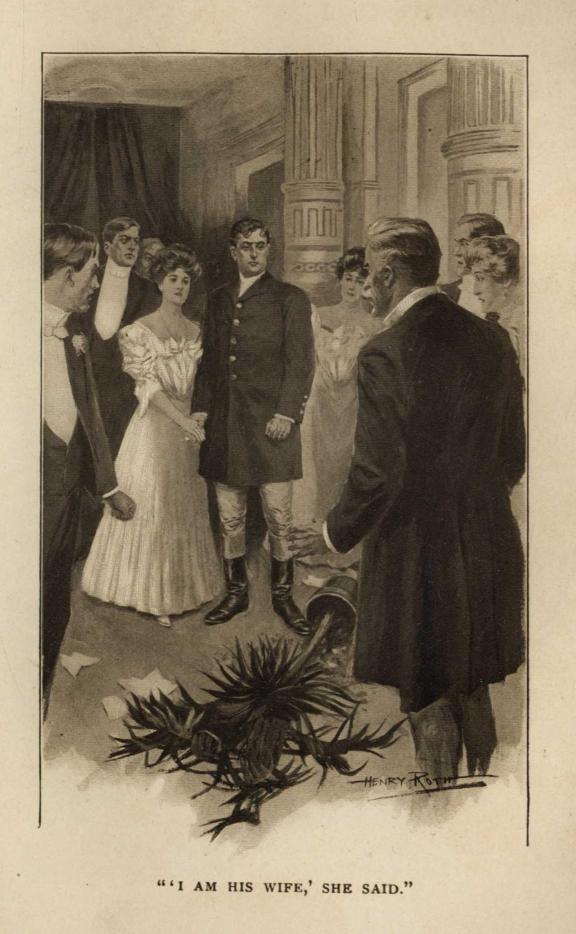
"'I AM HIS WIFE,' SHE SAID."
CHAPTER XXXII
Helen's announcement was made quietly, without any melodramatic display.
In the circle immediately surrounding her and her husband were her father and mother, Elise and Evans Rutledge, and Hal Lodge but just now coming to his senses and his feet. Behind these were Mrs. Hazard, Captain Howard, Senator Richland, and a gathering of other excited guests. For a space after Helen's speech the scene was steady and fixed as for a flashlight picture, and was photographed on Elise's brain: the incredulity on her father's face—the horror on that of Evans Rutledge—the perfectly restrained features of Howard—the quickly suppressed smile of Richland as he glanced at Evans in lightning comprehension of all the situation meant—the ghastly pallor of Mrs. Phillips as she sank voiceless in a dead faint—
"No—o!"
The harshly aspirated protest of Mr. Phillips was propelled from his lungs with a burst of indignant anger, but drawn out at the end into a pathetic quaver—and the scene dissolved.
Rutledge caught and lifted Mrs. Phillips whose collapse was unnoticed by her husband in his transfixed stare at Helen, and pushing back through the crowd was about to place her upon a settle in the hall; but at Elise's bidding he carried her up the broad stairs and left her in the care of her daughter and Lola Hazard. There could be no good-bye said—no time for it; but at the glance of dismissal Elise gave him from her mother's bedside—at the look of suffering in her eyes—his heart was like to burst.
Down-stairs the confusion was painful. The guests were hesitating between being accounted so ill-bred as to stare at a family scene, and running away from it as from a scourge.
To her father's unsteady denial Helen repeated her simple statement: "I am his wife."
"Since when?" Mr. Phillips demanded.
"A year ago last October."
The father looked about him as for help.
"Come along with me," he said. "Both of you. Good night, ladies and gentlemen," he added to the hesitating guests—and there was a breath of relief and a scattering for home.
* * * * *
With his hand upon Helen's arm, and Hayward following, President Phillips led the way to his offices.
"I am not to be disturbed," he told a servant after he had stopped at the door and waved Helen and Hayward into the room. "Ask Mrs. Phillips if she will please come here."
Entering, he motioned Hayward to a chair, and, taking Helen with him, went into the inner office and closed the door behind him.
"Now, my child," he said, with a break in his voice despite every effort to keep it steady, "tell me all about this, and we—we'll find a way out."
He patted her hand reassuringly.
"There's no way out, papa. I loved Hayward, and I married him."
"No, no, child, not love. You were infatuated—he was a footman and you are—"
"He was a gentleman," interrupted Helen.
"In a way, perhaps, but uncultured and common—how could—"
"He is a Harvard man," Helen cut in again, "a man of intelligence and education. He is—"
"But a weakling—no genuine Harvard man could be a menial—a flunkey—"
"He's not a weakling, papa. He stooped to the service for love of me. He loved me long before we came here—when he was a student at Harvard. It was so romantic, papa—he saw me first at a football game and he has loved me from that day. He was the hero of the game and he has yet the Harvard pennant I gave him—and, oh, he's a greater hero than that, papa—he was a soldier and he was the trooper that—wait a moment." Helen ran to the door.
"Here, Hayward, give me the knife," she called; and she came running back, holding it out to her father.
"The knife that the trooper stole!" she said, with a pitiful little attempt at gayety in her voice and face.
"What's that?" her father asked harshly.
"Why, papa, you surely don't forget the knife I gave you on your birthday? The one that was taken by the trooper who rescued you at Valencia?"
The light of understanding came to her father's eyes.
"Well, Hayward was the man, papa! He it was who saved your life to us—oh, how I have loved him for that! Just think, daddy dear, how often you have told me what a heroic thing it was—and for such a long time I have known it was Hayward and wanted so to tell you, but I couldn't."
"Why couldn't you?" demanded her father.
"Well, I found it out by accident when he caught me off my falling horse—there it is again, papa—he saved my life as well as yours—it was just the grandest thing the way he did it!—no wonder I have loved and married him—he's the sort that can take care of a woman—enough different from Bobby Scott, who couldn't stay in his own saddle!"
"But Mr. Scott is of an excellent family—distinguished for generations—while Hayward is a nobody—a—a nothing—no family and no recognized personal distinction or merit of his own—the commonest circus clown can ride a horse, my child."
"But he is personally distinguished, papa; and you have approved his merit by making him a lieutenant of cavalry."
"When? How?" the father asked.
"He is John H. Graham, papa—John Hayward Graham; and there can be no denying his fitness or ability, for you have certified to both."
Mr. Phillips saw he was estopped on that line; but it only made him angry and stirred his fighting blood.
"That's the reason," Helen continued, "that Hayward wouldn't let me tell you who he was or thing about his service to you. He wanted to obtain his commission absolutely on his merit and without appealing to your gratitude—wasn't it noble of him?"
A grunt was all the answer Helen got to her question.
"But his people, who are they? What sort of a family have you married into? Do you know?" Mr. Phillips demanded sharply.
"He lives with his mother—his father is dead—oh, I wish you could hear him tell about his father and mother, and his grandfather—it's just beautiful. I don't know whether he has any other relatives,—but that doesn't make any difference. I am not married to them, papa, and he's not responsible for his people but must be judged by his own personal character and excellence!"
In this last speech of Helen, Mr. Phillips thought he caught an echo of something he had heard himself say, and he winced a little: but it only added a spark more to his anger.
"But he's so far below you socially, Helen. You cannot be happy with him! You must remember that you are the President's daughter and—"
"And my husband," interrupted Helen, "is of the one order of American nobility—a man! I've thought about all that—the man's the thing, you said, papa—and besides, an army officer has no social superiors."
There was no mere echo in Helen's defence now. It was plain fighting her father with his own words: and it irritated him beyond endurance. His wrath burst through and threw off the shell of theories and sentiment which he had built up around himself and the man's real self spoke.
"But he's a negro, Helen! A negro! How could you!"
"A negro, papa?" Helen questioned in unmixed surprise. "What has that to do with it? He's the finest looking man in Washington if he is—and didn't you tell Elise that that was nothing more than a colour of skin?—that the man was the thing?—that a—that a—negro must stand or fall upon his own merit and not upon his colour or caste?—and did you not say to Mr. Mackenzie that colour has nothing to do with a man's acceptability in your house?—and that—"
"Oh, my God! yes, my child, but I did not mea—you are too young, too young to be married, my child,—too young and too—yes, too young, and we must annul this marriage—yes, we must annul it, we must annul it—we can annul it without trouble, don't worry about it, child, don't worry—we can annul it, and—for you are too young, my little girl, my little girl, my little girl!"
At sight of her father's tears, and the trembling that shook him as he sank down in a chair, Helen's combative attitude began to melt and her eyes to fill.
"Yes, little girl, don't worry," he said, drawing her tenderly down within his arms, "don't worry, and we will have it annulled in short order."
"It's too late, papa," she spoke against his shoulder.
"No, no, precious heart, it's not too late—we can have it annulled—don't cry, and don't worry, we can have it annulled."
"But, papa," she said again as she pushed herself back so that he looked her full in the face, "it's too late, I tell you! It's—too—late!"—and with outburst of weeping she curled herself up against him.
With a dry sob of comprehension her father gathered her close to his heart.
* * * * *
For a long time after he heard the voices cease Hayward Graham waited in Mr. Phillips' outer office to learn his fate. He had caught some of the excited discussion—enough to be convinced of his father-in-law's opposition; but he could not be sure of the details. A servant had come in to say that Mrs. Phillips could not come to the office, and had knocked softly on the inner door several times while the discussion was at its warmest. Failing to get an answer, he had left his message with Hayward and retired. When the voices were quiet and the inner room became silent Hayward was on the qui vive for developments; and stood facing the door in a fever of expectation.... His fever, however, had time to burn itself out.... In that long silence President Phillips fought his greatest battle.... The issue was predestined, of course. In his heart there was no passion at all comparable to his love for Helen, and that love won over all obstacles.... He saw clearly in what measure he was responsible for her undoing; and he came squarely to the mark with a courage that would face all odds for his little girl—that would face a frowning world, a laughing, a mocking world—that would face his own soul even to the death—that her gentle heart might not be troubled.... He held her while her sobs shook themselves out, and then on and on he held her, close and warm, as if he would never again let her out of his sheltering arms,—while he gazed over her bowed head into the dying fire, and fixed and fortified his resolution.
At last Graham summoned courage to knock upon the door. President Phillips started as from a reverie.
"Come in," he said, rising unsteadily and placing Helen gently on her feet, his arm still about her.
"Why, certainly, Hayward, come in,"—and then he added after a short pause: "Helen has told me all about it, and, while I can't approve of the clandestine marriage, I shall do what I can to make my little girl happy—yes, I'll do what I can to make her happy.... And since this has been such an—unusual—evening I'll ask you to go now and come back to-morrow morning."
Hayward delivered the belated message from Mrs. Phillips, stood for a moment uncertain whether Helen would speak to him, and then turned to go.
"And do not wear your livery in the morning, Hayward," said Mr. Phillips.
"Very well, sir," said Hayward, as he withdrew.
CHAPTER XXXIII
When President Phillips came out of his office after dismissing Hayward, he found a score of reporters and newspaper correspondents fighting for places at the great front door. They were awaiting with what patience they could Mr. Phillips' pleasure in giving to the public an authoritative statement of his daughter's marriage.
The President, after he had obtained from Helen the details of time and place, and other items of interest, gave the press men the story. He customarily had his secretary to make statements to the newspaper people, but he chose to do this for himself: in his infinite loyalty to his little girl he was taking the situation by the horns. There was no elation in his manner, but there certainly was nothing to indicate his slightest objection to Helen's marriage, nor to Hayward Graham as his son-in-law. He gave a short sketch of that young man's life and excellences. He stated that he had not known Graham was either his footman or his daughter's husband when he had nominated him for a lieutenancy in the cavalry. He did not state that Graham had carried him off the battlefield at Valencia.
When he had finished with the men of the pencil Mr. Phillips went back to his office for Helen, and they sought the mother's room together. With another flood of tears Helen dropped on her knees by her mother's bed.
This scene was hardly less a trial for the father than had been the travail of his own soul. Here also must he win if he would save his child's happiness: and so, amid the tears and the sobs of the mother and daughters, and with misgivings and dread in his own heart, at first unflinchingly, then more zealously, and at last of necessity reserving nothing, he excused, and upheld, and vindicated, Helen.
Mrs. Phillips was too heart-broken to utter a word in opposition or condemnation, and Elise did not open her lips to speak. It was against accusing silence, therefore, and upbraiding tears, that the father made his desperate defence.... Such a debate can never be brought to any real finish; and it was at last only in exhaustion, Helen of nerves, her father of words, and Elise and her mother of lamentation, that the distressed family found peace—enough at least to permit of dispersal to their rooms for the night.
Elise was bowed down in grief for Helen, and for Helen she wept upon her pillow till the fountain of tears was dry: but even then there was no sleep for her. Her mind was painfully alive to her own personal problems, and her brain was awake the night long although weariness held her scalded eyelids down. The incident of the evening, like an electric storm, had clarified the haze of uncertainty for her heart—but only to plunge it into a more intense perplexity.
No longer unchoosing, her heart had spoken its choice. It were better had it never spoken at all; but there could be no mistaking its decree—she loved Evans Rutledge. As she had looked upon the three men who loved her in that brief time when Helen proclaimed her husband, she had known: and she had known that not for her was the man who in the fleetest moment could smile while her heart was breaking; nor for her that other, who, with his alien point of view, was untouched with her distress, and who with his perfect breeding—she resented it—could be so contained, so unmoved, in a situation which brought anguish to her. In the throes of that anguish her soul had turned, unerring, to its affinity in suffering, to the heart that understood and wept, not in a ready sympathy for her pain, but in the pains of a common grief.
In such manner Elise accounted for the reading of her heart's message. She believed that it had been undecipherable, confused, until that evening. Yet in all her distress then, and in the heartaches afterward resulting from its choosing, she was strangely happy because her heart had been true to the fancy of its earlier years, had been faithful to its first girlish inclination to love, had not misled her, had not been fickle in any degree, or false. She told herself with a tremor of rapturous, prideful humility that one man had been the master of her love from the beginning.
Thinking on it as she lay unsleeping through the night, she more than once forgot her tears and was lost in the transport of loving. She petted and caressed her heart for its constancy. She made excuses for its indecision in that long time when the man's love had seemed unworthy. She murmured tender things to it because it had prevailed, even though with a hesitating loyalty, against her head's capricious disapproval.
In her wanderings back and forth through the desert of her miseries on that night, she straggled back many times to this oasis of her love and stopped to soothe her troubled heart with its upspringing freshnesses.... And yet a wildness of perplexity was set about her, and she could not find a way out. She knew that Rutledge loved her—had loved her from the time he declared it on the flood-beaten rock in the St. Lawrence till the moment of his tender unspoken good-night three hours ago. That his love could not be shaken by any act not her own, she verily believed. But would he have loved her?—would he have dared to love her?—could he, with his blood-deep, immutable ideas, could he have loved her?—if he had known that his love would bring him to this unspeakable extremity, to this heart-breaking dilemma, where he must be traitor to himself and to her—or become brother-in-law to a negro?
Yes, he would have loved her—her of all women—despite the slings and arrows of the most outrageous fortune, her heart told her: but, with prescience of such calamity, would he have spoken his love?—would he have asked for that interview for to-morrow evening that he might tell it to her again? Was he not even now regretting that appointment? Was he not even now pitying his love for her? She must know. But how could she know? By what means could she learn the truth? ... Way there was none: and yet she must know. Doubt, uncertainty, here would be unendurable—and implacable for she could no longer find peace in indifference. She loved Evans Rutledge, and her love would fight, was fighting, desperately for its own.... But again, her own must be worthy, without compulsion, or she would repudiate it. Her heart's tenderness, virgin, single, measureless, she held too precious to barter for a love, withal sincere and beautiful, which were weighted with a minim of regret or limitation. Rather would she crush back its fragrance eternally in her own bosom, than dishonour it by exchange for less than the highest.... Yes, she must know.... And she could not know.... And the morning came, bringing no relief for heart or brain....
Mr. Phillips was at some pains to intimate to his wife and Elise what he thought a proper pride demanded in the way of the "front" they should show to the public. Queer that he should have thought it necessary: but, unhappy man, he spoke out of his fears for his own steadiness. Elise, at least, had no need for his admonitions. Her pride was the pride of youth: the pride which finds all sufficiency in itself, and needs not the prop of outward circumstance which age requires to hold its chin in air.
It was this pride which gave Elise some hesitation in deciding what she should do with her promise to see Rutledge that evening. Pride said: "Meet him as if nothing has happened to disturb the serenity of your life. Do not show—to him, of all men—chagrin at this episode en famille." But pride said: "No! Recall that engagement. Do not appear to hold him by so much as a hair. His love must be undistrained!"
She wavered between these conflicting demands of a consistent self-respect until the middle afternoon. Then the pride of her love overmastered the pride in her pride: and she wrote Rutledge a short note.
"MY DEAR MR. RUTLEDGE:—I find it necessary to change my plans for this evening. This will prevent my seeing you at Mrs. Hazard's as I promised. I am very sorry.
"Sincerely,
"ELISE PHILLIPS."
This was her afternoon at home; and after having dispatched the message to Rutledge Elise gave her mind over as far as might be to receiving her callers. They were more numerous than usual, despite many notable absences, and before they fairly well had begun to crowd in she realized that she was on parade. Oh, the duplicity of women! How they chirruped and chattered about every imaginable thing under heaven, while they listened and looked for only one thing: to find out what Helen's family really thought of her marriage.
This was not Mrs. Phillips' afternoon, nor Helen's and they did not appear—to have done so would have been to overdo composure: and so it was that Elise alone fenced with the dear, dear procession of sensation hunters who passed in and out of her doors. The women came in such flocks that she really did not have time to be embarrassed, for the sympathetic creatures who showed a disposition to sidle up close to her and begin with low-voiced confidences covert attacks upon her reserve were quite regularly bowled over by their oncoming followers before they could get their sly little schemes of investigation well going. It became fascinating to her to watch them defeat each other's plans, and she was somewhat regretful when they stopped coming. They stopped quite suddenly, for the reason that, in eagerness to see for herself, every daughter of Eve among them had made the White House the first stopping-place in her round of visits for the afternoon.
When the women were all come and gone, save two who evidently were trying to sit each other out, Captain Howard was announced. Elise was unfeignedly glad to see him and in a few minutes the two contesting ladies departed and left the Englishman and the girl together.
Captain Howard's coming was very refreshing, and Elise was grateful. He was the only person she had seen that day who did not seem to be conscious of the electric condition of the atmosphere, and she sat down to talk to him with a feeling of genuine relief and pleasure. His conversation began easily and unconstrainedly and ran along the usual lines with all freedom. As chance demanded he spoke of Helen several times in connection with one small matter, and another, and his manner of doing it was positively restful.
Elise felt so comfortable sitting there talking to him that for the first time she was impressed to think that it might be a nice thing to have him always to come and sit beside her and make her forget that things went wrong. The unfluttered ease and peacefulness of his manner and his words appealed very strongly to her distressed heart, and it warmed toward him in simple gratefulness.
Captain Howard was not without knowledge of the tense situation created by the announcement of Helen Phillips' marriage. He read the newspapers and could not but know that a tremendous sensation was a-blow. He was himself excited by the affair—in a steady-going fashion. It was as if a princess of the blood had eloped and married a—say a tradesman—or, maybe, a gentleman—of course it was sensational.
In his amorous state of mind, however, the captain thought kindly of the wealth of love which had inspired the young woman with such a sublime contempt for rank—for that very real and very puissant divinity, Rank. He also had shaken himself sufficiently free from the shackles of provincialism to be able to recognize the effect of democratic ideas in making possible and permissible such an event. Affairs of this sort could not be entirely unlooked for in a genuinely democratic society; and, since the President acquiesced in his daughter's choice and had no regrets, there was no more to be said. Altogether Captain Howard viewed the matter very calmly and philosophically.
Having this attitude, he had no hesitation after a time in speaking directly of Helen's marriage and its dramatic announcement. He was a gentleman in every instinct, was Captain Howard; and there could not be the slightest offence taken by Elise at his natural and sympathetic interest in what he considered a most romantic episode. But while one may not be offended or resentful, one may become nauseated. Captain Howard did not know of the chill of disgust and horror that was creeping over the girl's heart, nor notice the silence to which she was come. Her friendliness had been so graciously simple and so promising that his purpose had been formed and he was moving straight toward it, not noticing her silence further than to be glad she was saying nothing to create a diversion.... Elise felt that if she spoke she would be very, very rude.
* * * * *
"—And your America, Miss Phillips, is assuredly the natural home of Romance. Here every man is a peer in posse, and every woman a princess incognita—and possibility keeps pace with imagination. In England a footman is a footman to the end of his life. Here the footman of yesterday is the President's son-in-law to-day, and may himself be the ruler of his people to-morrow! Can life hold more for a man? The right to aspire and the luck to win!—and to win not only the recognition which his personal merits deserve, but that supreme gift which no man could deserve: your beautiful sister's love! It is almost unthinkable to an outsider like me, but it is glorious! Yes, your America is the Land of Romance!"
This all sounded very well, but Elise's nerves were on the ragged edge. She knew if she spoke it would be to cry out: "Yes, a rank outsider! Oh, why can't you drop that subject before I scream!"
But Captain Howard had only finished the preliminaries. He continued:
"And in this land, Miss Phillips, where a man may hope for anything, I, too, have taken courage to aspire to the highest, and—"
"A note for you, Miss Elise; the messenger is waiting," a servant said.
Excusing herself to Howard, Elise read.
"MY DEAR MISS PHILLIPS:—If I may not see you to-night, may I not see you to-morrow afternoon—or evening? Or day after to-morrow? When?
"Sincerely yours,
"EVANS RUTLEDGE."
Elise read this over several times, and gazed idly at the paper for some time longer. She quite forgot the waiting messenger and Captain Howard. At last she thought, "On his own head be the result!" and sat down at a daintily carved desk to write.
"MY DEAR MR. RUTLEDGE:—The disturbance of my programme for the evening seems to have been largely imaginary. I will be very glad to see you at Mrs. Hazard's as at first agreed.
"Sincerely,
"ELISE PHILLIPS."
When she had given her answer to the servant Elise came back to Captain Howard with a commonplace question which made for naught all his words up to that point. He realized he must make a new beginning if he would tell her what he wished. Her face and mood had changed and he saw that her thoughts were elsewhere. After several attempts to pull the conversation back into the old channel he gave it up and retired, mentally cursing his luck and hoping for a more auspicious occasion.
* * * * *
Elise awaited Rutledge's coming at Lola Hazard's with some trepidation. She was uncertain of herself. She did not know what she would do. Being assured of what Rutledge would say to her, under ordinary conditions she would have been elusive for a season, and finally have surrendered when overtaken. But with outside circumstance warring against her love, she felt wildly impelled to let herself go, to fling restraint to the winds and give her heart's impulse free rein. Delicious were the tremors of anticipation with which she waited to hear again words of tenderness from him. Overflowing was her heart with tender response. His insistence on the meeting when she had given him an opportunity to avoid it, proved his faith was fast. He had met the supreme test for a Southern white man: he loved her more than his caste. In her own spirit she knew the agony of his trial. How sweet to surrender to such a love! How tenderly she could reward it! She longed to meet it with a frank and blissful confession. So, she was in some trepidation: she was afraid she might not be properly reserved.
Lola Hazard came into the sitting-room and found Elise sitting before the open grate.
"Honey," she said, slipping an arm about the girl's waist, "you look positively glorious to-night. I never saw you half so pretty. What have you done to yourself? Your eyes are brilliants, and your colour is—delicious!"
"I have been looking at the fire," said Elise in explanation.
"The pictures you saw must be very pleasing," Lola answered. "I hope they'll all come true. But before we begin to discuss that, let me tell you that Mr. Rutledge asked to call this evening, and he may be here any moment."
"Yes," said Elise, "I know. He told me last night."
"Oh, he did, did he? Well, I promised him if he came early he might have ten minutes for his very own to talk to you to-night. I hope you—"
"He may have ten minutes—and as many—more—as—he—wants," said Elise brazenly.
"Oh, you darling!" Lola gave her a squeeze. "No wonder you are beautiful. It will make any woman heavenly, and you are such a help to it!"
"What is it?" asked Elise.
"Love," replied Mrs. Hazard.
CHAPTER XXXIV
"Come along back to my own little parlour, Mr. Rutledge. Elise has been singing for me, and we'll not let her stop for awhile yet."
Elise was not expecting Rutledge to be brought in there, and was still sitting at the piano idly weaving the chords into soft and improvised harmonies when he spoke. She slipped from the stool quickly, shook hands with him in an embarrassed way, and crossed the room to sit down.
"Oh, no, please do not leave the piano," Rutledge pleaded, "now that I have just discovered you are a musician."
"I am not a musician, Mr. Rutledge; certainly not for the public."
Rutledge drew himself up as if offended.
"I have been called names variously in my time, Miss Phillips, but never till this moment 'the public.' I resent it as an aspersion—I am not 'the public'—and demand an abject apology. Think of all the horrible things 'the public' is—and are!"
"And you a politician!" exclaimed Elise. "You would be lost for ever if those words were quoted against you. Senator Killam would give a thousand dollars for them. See—I hold your fate in my hands—"
Rutledge's eyes leaped to hers with a quick look that confused her, and she hurried to cut off his words.
"—But—oh, mercy, I'm—I'm sorry, and I retract if it was really as bad as that. The public is really awful, I suppose. I humbly apologize for the aspersion."
"Then bring forth fruits meet for repentance by returning at once to that piano stool."
"But I'm such a very amateurish singer, Mr. Rutledge. I fear you will—"
"And I am an amateur listener, the most humbly appreciative, uncritical soul on earth. Please sing. Mrs. Hazard, if you have any influence with this administration will you not use it here?"
"Authority is better than influence," said Lola. "Elise, march to that piano."
Elise complied with an exaggerated air of obedience.
"Since I am singing under orders, I will sing only according to orders. What shall it be?"
"Sing My Rosary," said Lola. "That's an old one—and the dearest."
"I commend to you Mrs. Hazard for sentiment, Mr. Rutledge. Her honeymoon is not yet on the wane." Having thus made Lola responsible for the song, Elise sang it without further delay or hesitation.
When she had well begun to sing Rutledge recalled having heard that song a long time before. It had not impressed him.
Elise sang simply. The fullness of her low voice and the clearness of her words, together with the unaffected "heart" in her singing, left her nothing to be desired as a singer of ballads. As Evans listened to the song of sentiment of Mrs. Hazard's choosing he reformed his opinion of it. Always hitherto he had deemed sentiment an effervescence—refreshing at times as apollinaris, but none the less an effervescence—and the words of My Rosary a fair type of it:
"The hours I spent with thee, dear Heart,
Are as a string of pearls to me.
I count them over, every one apart,
My rosary, my rosary.
"Each hour a pearl, each pearl a prayer
To still a heart in absence wrung—
I tell each bead unto the end
And there a cross is hung.
"Oh memories that bless and burn,
Oh barren gain, and bitter loss.
I kiss each bead, and strive at last to learn
To kiss the cross, Sweetheart,
To kiss the cross."
But with Elise sitting there before him, a vision of loveliness and grace entirely, appealingly feminine, "the lady" all gone, and the girl—the woman—unaffected, natural, singing of love with such an air of truth and faith: sentiment became a very real thing to Rutledge.... When she finished he was silent. To comment would have been to comment on Elise, and for her every drop of his blood was singing, "I love you, I love you." He felt that if he spoke to her he must crush her in his arms and tell her so.
"That is a song according to my notion," said Lola. "No mésalliance of sentiment and melody there, such as you often see. The words and the music made a love-match—they were born for each other. Who wrote it, Elise?"
"I forget—if I ever knew," said Elise.
"Woman, of course," Lola continued; and Rutledge interpolated "Why?"
"Because a woman always mixes her religion with her love—if she has any religion. A man may have one or the other, or both, but he never confuses them."
"Pardon me for taking issue with you, Mrs. Hazard; but with many a man his love for a woman is his only religion."
"Which means, Mr. Rutledge, that he has love—not religion."
As Rutledge turned to Mrs. Hazard Elise had the first opportunity to look at him unobserved. She saw that his face had less colour than usual, that his manner seemed to lack its accustomed spontaneity, that there was a tired look about his eyes—which provoked in her heart a fleeting maternal impulse to lay her hand upon them. She watched him furtively and became convinced that he was in some measure distressed. At first it rather amused her and flattered her vanity to think that he was approaching her with a becoming self-distrust. As she studied him longer, however, she began to doubt the reason for his constraint.
Lola Hazard turned from her discussion with Rutledge to give Elise another song, and the young woman at the piano sang three or four while Rutledge listened in appreciative silence. Before the last was finished Mrs. Hazard was gone to receive other guests.
"Now will you not sing one of your own choosing?" asked Rutledge.
"I have no choice;" said Elise, "but this occurs to me." She sang him Tosti's Good-bye.
If she put more of the spirit in that song than into the others it was not because she felt its pertinence to the present status of her love. But through the wakeful night, and all the day long till Rutledge's note had come, the words of that Good-bye had come and gone through her brain with passionate realism:
"Falling leaf and fading tree,
Lines of white on a sullen sea,
Shadows rising on you and me—"
her heart had sung its "good-bye for ever" with all the smothered passion of renunciation. So, in the very moment of blissful waiting for the telling of his love, she could sing to Rutledge with all the wildness of farewell which so short a time since had wrung her spirit.
She struck the last chord softly, and, after holding down the keys till the strings were dumb, dropped her hands in her lap. She did not look up, but she knew that Rutledge's gaze was upon her. She waited for a space unspeaking, without lifting her eyes—and realized that she had waited too long.... The silence was eloquent; and with every moment became more significant. She tried to look up, but could not. She knew that the situation had gotten beyond her in that careless ten seconds, and that if she looked up now she was lost.... She sat as if under a spell—and waited for Rutledge to move or to speak.... After an age he was coming toward her.... And he was so very slow in coming. Her heart was thumping suffocatingly, her breathing in suspense.... He did not speak as he came to her.... She felt he was very near.... Still unspeaking—was he going to take her in his arms? ... Her head drooped lower over the keyboard....
Oh, why did he not take her in his arms.
"Elise, I love you. I've always loved you."
Elise's eyes were upon the idle hands in her lap; and her heart had stopped to listen. Rutledge's sentences were broken and jerky. She had never heard him speak in that fashion.
"I've loved you always, Elise, and once I was rash enough to think—you loved me. My presumption was fitly punished.... Now I have only—hope. In the last few months you—have been so—gracious that—I have been led to think you—wait, wait till I have done—so gracious that I have been led to think—not that you love me, but at least that I—do not excite your antipathy—as for a long time it seemed.... So now I have only hope—but such a hope, Elise—a hope that is—beyond words, for my love is such. My love is—I love you, Elise—I love you as—as my father loved my mother."
Elise slowly raised her eyes to his. There was no smile upon her face, but as she turned it to him it was ineffably sweet, and a smile was in her heart. But she was startled by his look. His was not the face of a lover, whether triumphant, despondent, hopeful or militant. She did not know that he had not been able to banish his mother from his thought for a waking moment since he parted with her at her mother's bed-side the night before.
"Will you—be my wife, Elise?"
Never before in all the world was that question asked in such a voice. Its tone like a dagger of ice touched the girl's heart with a deadly chill. She looked steadily and long into his eyes. At last with a little shiver she murmured inaudibly "noblesse oblige"—and answered his question:
"No, Mr. Rutledge, I will not be your wife."
Her words were as cold as her heart, and her self-possession as cold as either. She was surprised that her answer did not bring the faintest shadow of relief to Rutledge's drawn face—rather a greater distress. A tingle of fire shot through her bosom. (It was not too late—oh why did he not take her in his arms.)
"No, I will not be your wife," she repeated slowly. (It was not yet too late—oh why—) "I am deeply sensible of the honour you—"
"Stop! Don't say that! In God's name don't say that! Don't add mockery to—"
"Mr. Rutledge!"
For the moment Rutledge forgot that there was any person in the world other than Elise and himself.
"You have mocked me—you have played with me! And—"
"Will you please go, Mr. Rutledge!"
"Played with me—yes—as if I were the simplest—oh well, I have been—and you—you have been—you are—an artist. Tell me that you do not love me, that you have only laughed at me. Tell me!" he sneered.
"Go, I say! Oh, can't you go!"
"Yes, I'll go—when you say it. Tell me! Do you love me—have you ever loved me?—the veriest little bit?"
"Never. Not the veriest little bit," she said, looking straight at him.
"That's it!—the truth at last—spoken like a m—like a lady!"—he bowed mockingly at her—"and it proves you are false—false, do you understand?—unspeakably false! And I have loved you like m—but very well, it's better so—perhaps."
He turned to go; but turned quickly about.
"I'll kiss you once if I swing for it!—for what I thought you were"—and, for a moment robbed by anger of his sense of proprieties, with unpardonable roughness he crushed and kissed her, flung her violently from him, and went, without looking back at her.
* * * * *
Mrs. Hazard, looking across the shoulders of a knot of her guests, caught a glimpse of Rutledge as he passed down the hall toward the outer door. She waited a minute or more for him to reappear, and when he had not done so she lost interest in the people and things about her. At the first possible moment she sought Elise, and found her again sitting before the grate. Lola came into the room so quickly and quietly that Elise had not time to dissemble, if she had wished to do so. Her head was thrown back against the chair and both hands covered her face. Lola took her wrists and against some little resistance pulled her hands away.
"Elise?" she said.
"He does not love me," Elise replied, defensively, without opening her eyes.
"Didn't he tell you?"
"Oh, yes," the answer came wearily; "he told me; but he told me because he thought he had given me to expect it. It was noblesse oblige—not love."
"Noblesse fiddlesticks! I don't believe a word of it."
"Oh well," said Elise, looking up, "he said it was just as well that I refused him, there's no mistaking that."
"Oh, certainly, after you refused him. What did you expect?"
"I expected him to—no, I didn't. I didn't expect anything. Southern men are so—" Elise stopped. She was about to be unjust to Rutledge.
"But come, let's go," she said, rising from her chair. "Are all the people here?"
"All except Senator Richland, and he never fails me," Lola answered.
"I don't want to see that man to-night," said Elise; and yet she joined the other guests appearing nothing other than her usual self save for the added brightness of her eyes, and when Senator Richland managed finally to isolate her she gave him quite the most interesting twenty minutes of his life.
When the company was broken up, Elise, who was stopping over night with Lola, avoided the customary heart to heart talk by asking for a pen and paper with which to write a letter. Mrs. Hazard was consumed with desire to hear all about it, but she deferred her inquiries with good grace as she argued that a note written by Elise at such an unearthly hour could be only to Rutledge, and must, therefore, be important.
Elise shut herself in her room and, pitching the paper on the dressing-table, sat down to think. For nearly an hour she sat without turning a hand to undress, trying to unravel the tangled skein of her heart's affairs and see a way out; but she could not get her thoughts to the main issue. Like a fiery barrier to her thinking was the man's burning denunciation: "You are false—unspeakably false!" It had rung in her ears all the evening, and however she tried she could not get away from it. At last she began hurriedly to undress, but before that process was half finished she brushed the toilet articles from a corner of the dressing-table, drew up a chair, and began to write.
"Unspeakably false? No, no, Evans, I am not false. I have not been false: for I love you. Such a long time I have loved you. Sometimes I have believed you loved me, and sometimes I have doubted; but I do not doubt since you told me to-night I was unspeakably false. Shame on you to swear at your sweetheart so!—and bless you for saying it, for now I know. O why did you not say it earlier so that I might not have misread you? I thought you felt yourself committed, and must go on: that your love was dead, but honour held you. You looked so distressed, dear heart, that I was misled. Forgive me. And do not think I do not know your distress. I, too—but no, I must not. I love you, I cannot do more. In your rage were you conscious that your kiss fell upon my lips, dearest? Blind you were when you said I was unspeakably false.—"
She had written rapidly and almost breathlessly while the impulse was warm within her heart. She paused for a moment—held the pen poised as if uncertain what to say next—hesitated as to how to say it—next, as to whether to say it—laid the pen down and picked up the sheet to read what she had written. A blush came to her cheeks as she read, and at the end she dropped her face upon her arm on the table and suffered a revulsion of shame for her unmaidenliness. She tried hard to justify her writing and had all but succeeded when Rutledge's words, "It is better so," put all her love's excuses to final rout. She took the written sheet and went across to drop it on the smoldering fire. But her resolution failed her: she felt that it would be to burn her very heartbeats if she gave these words to the flames.
Going again to the dressing-table she laid the letter upon the scattered sheets of paper to await a more mature decision, and, hurriedly disrobing, went to bed.
She found it very hard to go to sleep. Even in the dark she could feel the continuing blushes in her cheeks as she thought of what she had written. Finally in desperation she tumbled up and in the dim glow of the coals in the grate crossed the room to the dressing-table, snatched up and crumpled in her hand the disturbing letter, hurriedly gathered up the remaining sheets of paper and chucked them in the table drawer, walked quickly over and dropped the offending tender missive upon the coals and went to bed again in the light of its destruction. A very long time after its last gleam was dark and dead she found the sleep she sought.
CHAPTER XXXV
It is not within the province of this chronicle to recall the sensational excitement that swept the nation in those days further than as it affected the persons mentioned in this narrative. The details of that sensation, the screams, the howls, the jeers, the predictions, the warnings, the laments, the philosophizings, a newspaper-reading people but too well remember. They have no proper place of rehearsal in this history; and if they had, a comprehensive statement which would present the matter fairly to those who come after would be too voluminous for the plan upon which this book is projected.
In that time of tumult and of trial Mr. Phillips stood indeed alone. If he had braced himself firmly in his determination to save Helen's happiness at all cost, it was well: for his trial was to the uttermost. Although it would have crushed any other than his adamantine will, the storm-beaten father withstood, as one accustomed to do battle, the pressure from without: but the rebellion of his own soul was an unrelieved tragedy that shook him day and night with its terror. If his love for Helen had not approached the infinite, surely in the shrieking revulsion of his spirit he would have cast her off. There was a demand from loud-mouthed people the nation over that he should disown her and drive her into the outer darkness. Some relief there was in that demand, for it only stirred the combative in his nature. The yells and hoots aroused his fighting blood. But the silence, the unspeaking horror—as if in the presence of death—in which sober-minded friend and foe stood aghast and looked upon Helen's plight, made his courage faint and tremulous. It was so awfully akin to the sickening horror and silence in his own heart.
He was indeed alone; and in that loneliness it was given to him to teach to himself the far bounds of a father's love. If he only could have fought something!—or somebody! If he only openly could have snapped his fingers in the face of public opinion, in the teeth of his own mutinous soul—openly—and told them he cared more for Helen's untroubled laugh than for them all, and be damned to 'em! If he only could have died! But no: he must stand and be still to the most thankless task that ever called for a hidden loyalty. Helen must not know of the travail of his love, lest that defeat love's purpose. It was too late, too late, for knowledge to do other than tear her heart-strings out, blight her young soul, and write Remorse eternally upon her life. She must never know how much he loved her!
There was no lack of personal—and professing—-friends to stand more or less loyally beside the father in that time, but their support was wormwood to him. From the very few who were altogether sincere he turned in aversion even as he suffered their commendations, while for the insincere and sycophantic he had a doubly unspeakable contempt; and that disgust and scorn was agony, for that he must swallow it and belie his own spirit as he listened to these friends.
His private correspondence furnished him as little comfort. Some persons there were—and a few of these men and women of repute—who wrote to him letters that should have been consoling, for they agreed very heartily with his view, or what they thought was his view, and commended him without stint for his attitude: but never an one spoke of the sacrificial love of a father for his daughter—justice to the negro was their theme. Upon such letters from men—it would have surprised the writers much to hear it—he uttered maledictions profane; while, for the one woman who thus approved him, he forebore profanity, but relieved his wrath with a volcanic "Freak!"
From the time the announcement burst upon the public the President was overwhelmed with a flood of newspaper comment, most of it harsh, the best of it deprecatingly sympathetic, none, except that from negro papers, uncritical. Very shortly the clippings bureau which served him was ordered to discontinue everything referring to Mrs. Hayward Graham's marriage.
Mr. Phillips did not give that order because he was too weak to stand criticism. Far from it. He was schooled to conflict, and knew the rules. He had never asked concession from an opponent in all his life of struggle, and he would have scorned to ask it then, even with the uncounted odds against him. His critics might have shrieked till the crack o' doom and he would have listened without a quiver of his resolution.
But the impartial bureau had sent, among an avalanche of criticism, an appreciation in the form of the following editorial clipped from the columns of The Star of Zion:
"The dramatic culmination of the beautiful romance in which Miss Helen Phillips, daughter of the President of the United States, proudly proclaims herself the wife of Mr. John Hayward Graham, and the graceful acquiescence of the bride's distinguished father in his beautiful daughter's love-match, is but another proof of the rapid coming of the negro race into its own as the recognized equal of any race of men on earth. Mr. Graham's career is an inspiration to his people, for it teaches the rising generation of negro boys and girls that they need no longer live Within the Veil, that in the most enlightened minds there is no longer a silly prejudice against colour, but that if the young negro will only make the most of himself and his opportunities he will be graciously received as an equal, as a member, in the proudest families in this mighty nation.—"
President Phillips read just that much of that editorial. Then went the order to shut off the press clippings.
It required all the father's self-control to dissemble in Helen's presence and he feared that he would be unable to keep the truth from her. It was fortunate for the girl that her condition demanded seclusion and that her removal from Washington took her away from the danger of enlightenment. At her father's instance preparations were hurried with all speed, and she and her husband went to Hill-Top for their belated honeymoon and a stay indefinite....
Hayward Graham would have been a paragon if he had conducted himself with entire discretion when the limelight first was turned upon him. The colour of his skin was not responsible for his foolish mistakes in those first days. Any footman so suddenly elevated to that pinnacle likely would have made them. One of his errors of judgment was serious. That was his continued offence against the dignity of Henry Porter. The withering letter he had written in answer to the old man's apology was of itself enough to call up the devil in old Henry's heart; but that doubtless would have been forgotten had Hayward remained in obscurity.
To dispute with the President the title to a son-in-law, however, was a distinction too fascinating to the negro magnate. He had already been to Bob Shaw's office for a tentative discussion of the law in his case and was just coming away when he ran plump into Hayward on the sidewalk. A judicious condescension on the young man's part even then might have placated him, but instead an evil spirit called to Hayward's memory his first meeting with Porter, the insufferable affront, and his own oath to even the score. Too strong in Hayward's heart was the temptation to "take it out of him for keeps" then and there. At the worst, though, he hardly did more than any gentleman would do upon meeting another who had driven him from his house.
"Mr. Hay— Mr. Graham!" said Porter, hardly knowing himself whether he intended to be polite or other, but having a general purpose to fetch the young fellow up roundly for that letter.
"I believe I don't know you," said Hayward, stopping and observing him coolly for two seconds, and turning away to continue his journey up the street.
Now, to those of his race, Henry Porter was a "figure" on the streets of Washington, and Graham was by that time almost as well known as the President himself. There were but four people who could have witnessed the meeting of these celebrities. These were three negroes of low degree loafing along the sidewalk and a dago pushing a cart just outside the curb.
At his rebuff Henry Porter gave a gasp, swallowed it, and looked around to see who had seen him. The "common niggers" at his elbow snickered, and as they passed on burst out into loud guffaws.
"Um-huh! Tried to butt into the White House, but Mister Graham he don't know him! Can't interdoose 'im! Too black! Law-dee, didn't he th'ow 'im down!"
Henry Porter heard enough of this. He rapidly retraced his steps to Shaw's office.
"Here, Mr. Shaw, you can jist git them papers out this evenin'. There's no use waitin'."
"All right, Mr. Porter," said Shaw, who didn't favour the idea but was too much afraid of his client to refuse. "But wouldn't to-morrow do as well? We could think it over a little further."
"No, suh, Mr. Shaw. We don't wait till no to-morrer. We don't think about that damn young nigger no mo' till we take him with the papers and let him think about hisself awhile. Can't you git 'em served on him this evenin'?"
"If he's to be found in the city," said Shaw.
"Oh, he's to be found all right. I saw him goin' up the street jist awhile ago. You jist git them papers out and have 'em served on him this evenin' and no mistake about it."
"All right, if you say so," Shaw consented.
"Well, I say so—and I can pay the damage," said the irate client with emphasis, and stalked out of the office, only to stick his head back into the door with the last injunction:
"This evenin' now, and no mistake about it!"
* * * * *
As chance ordained, Henry Porter did not go amiss in his haste to have the summons served on Graham. It was late in the afternoon and less than four hours before the former footman and his wife were scheduled to leave the city for Stag Inlet that the officer served the paper.
A bomb exploding under Hayward's feet could not have been so unexpected by him. As the officer read the summons and its import broke upon his mind he felt, for the first time in his life, physical weakness in the presence of danger. It staggered him to think of possible results. He had no feeling of guilt: but an awful fear.
President Phillips had passed out of the White House for his regular constitutional while the process was being served, and recognized the officer by his badge and Graham's excitement by the look on his face, but had not stopped to inquire what the trouble was,—for which Graham was profoundly thankful, as it gave him time to catch his breath.
Think as he would, no way of escape could Graham conceive. Being virtually without money, he could not hope in four hours to bring Henry Porter to terms and avoid a publication of the scandal. Exactly what the old man had in mind, anyway, was uncertain, excruciatingly uncertain. The precise nature of the complaint did not appear from the summons. As the suit was based on a lie, it well might be any sort of a lie. But surely, surely, he thought, no woman would falsely speak disgrace to herself. He had had a genuine respect for Lily Porter's character. She had been the best of them all, with the highest ideas and the highest ideals. He would have sworn that she could not have lent herself to a thing of this sort. But since she had been willing to do so at all, to what lengths might she not go? What was the limit they had set? To what public disgrace were they trying to bring him? To what awful lie must he make answer?
As he thought of it the keen sense of his peril, the disgrace, the loss of his commission, and his helplessness, became well-nigh unbearable. If Henry Porter could only have known the extremity of torture he had inflicted in thus making the young fellow "think about hisself awhile," his wrath might have been appeased.
Hayward trembled to think of the moment when the public should know of this suit, but he quaked in absolute terror as he thought of Mr. Phillips' hearing it. And Helen!—what must he do to save her from this shame?—he gladly at the moment could have strangled Old Henry.... But heroics would do no good. He was helpless, bound hand and foot. If he could be saved, if Helen was to be saved, there was but one arm that had the power: her father's. Perhaps, perhaps, with all his attributes of strength and force, he might be able to bring the vengeful negro capitalist to terms. Whatever his terror of Mr. Phillips, he must tell him.... And what were done must be done quickly.
* * * * *
"I would like to speak with you a moment, sir, about a—a matter," said Hayward to the President as soon as he returned from his walk.
Mr. Phillips could tell with half an eye that it was a matter of some moment. He led the way to his private office.
"Well, what is it, Hayward? You look excited."
Mr. Phillips spoke very kindly, for he did so with studied purpose. It was necessary that he keep that purpose continually and consciously before him. For Hayward the footman he had had quite a high regard: as he had for any man or thing that was efficient. For the negro as his son-in-law, he could not bring himself to consider him with any toleration, nor did he lie to his soul by telling it he wished to. For the negro as a mate for Helen, every rebellious, tortured nerve and fibre of the man was an eternal, agonized protest. It was indeed very necessary that he keep his kindly purpose always consciously before him.
"What is it?" he asked again.
"I had a paper—a summons, I believe they call it—served on me this afternoon," Hayward stumbled along to say; and then stopped, uncertain how to go at it.
"Well. And what's the trouble?"
"I don't know, sir, exactly what's the trouble; or, rather, I would say I didn't know there was any trouble."
"Then what's it about? Who is it that's suing you? What does the summons say?"
"The summons doesn't say what the trouble is about." Graham was dodging in spite of himself.
"But who is the person that is suing you?" Mr. Phillips questioned again testily.
"The summons says 'Lily Porter, by her father and next friend, Henry S. Porter, against John Hayw—"
"Says what? A WOMAN?"
President Phillips jumped to his feet and went pale as ashes. Graham, dry-lipped, could only nod his head weakly in affirmation. For five seconds Mr. Phillips was speechless. Then words came back, along with a rush of blood to his face that looked to burst it. So terrible was his wrath, the killing look in his eyes, that Graham instinctively squared away to defend himself from bodily injury. Such a torrent, such a blast, of withering, blistering profanity, wild, incoherent, unutterable, he never had listened to in all his life. Try as he would to interpose a word, an explanation, a defence, his efforts only drove the father to more abandoned fury. After a dozen fruitless attempts he realized there was nothing to do but wait for the furor to burn itself out. To the young man, conscious of the passing of precious time, it seemed that his anger would never cool. When the President showed the first signs of exhaustion he took courage to speak again.
"I swear to you, sir, the young woman has no cause to complain of me. I have done her no—"
"Oh of course not, of course not," said Mr. Phillips in the most bitingly sarcastic tone. "Of course not, of course not! But who the devil is she?"
"Miss Lily Porter, daughter of Henry S. Porter—Black Henry the newspapers sometimes call him. Perhaps you have heard—"
"What! That nigger? Not a nigger woman! But of cour—oh my God, Helen, how can I pr—" but he choked for a moment in livid anger before he writhed into another frenzy, that was as volcanic, as horrible, and as pitiable as it is unprintable. He cursed, he raved, he choked, he tore wildly at his collar for breath.
It was frightful to look upon, and if Graham had feared for his own safety in the first outburst, he feared for Mr. Phillips' life in the last. It looked as if in the violence of his wrath he would burst a blood-vessel. Graham was in mortal fear that he would die in his tracks, and tried desperately to reinforce his denial of guilt as the only possible relief for his father-in-law's dementia, but all his attempts only inflamed Mr. Phillips the more. The negro seemed not to know that it was not a question of his guilt or innocence that was tearing the father's vitals and threatening his reason, but shame—insufferable shame!
After an age, it seemed to Graham, Mr. Phillips became calmer. His son-in-law, wholly at a loss what to say or do, started out of the door in search of a clearer atmosphere and a chance to regain his scattered faculties. The President looked around and saw him beating a retreat.
"Come back here!" he ordered sharply. "We can't leave this thing like this! Something must be done with it at once, or the scandal will be all over the—" He trembled with the passion of another outburst, but controlled himself by a mighty effort.
"I swear to you no scandal may rightly be laid at my door," said Graham with some dignity. The outrageous injustice of the thing gave him a little of the dignity of righteousness.
"Scandal doesn't depend on truth or falsehood, so we needn't discuss that now." Mr. Phillips cut him off short. "What we must do is to stop this scandal, for scandal it will be if it gets to the public. Where does this—this Porter live? How far from here?"
"About fifteen minutes drive, sir."
"Well—er—send Mr. O'Neill here—in a hurry."
Graham, glad to get action on himself, was out of the room and back with the secret service man in less than a minute. In that short space the President had taken a grip on his self-control.
"Here, O'Neill, take Hayward with you to show you the house, and go fetch Henry Porter up here to see me. He's not to be arrested, mind you, but is to come to see me at my request at once, and nobody is to know. And he is not to speak to anybody or see anybody, not even Hayward here, before you bring him to me. So get along and get him here as soon as you can. No force, remember; but he is to come along, at my request." ...
O'Neill and Hayward hurried out, and, finding a street cab, lost no time in getting to Henry Porter's house. On the way Hayward gave the officer some idea of the man he was to deal with and, bringing him to the door, left him to his own devices and himself took a car back home. When Old Henry came to the door O'Neill told him half a dozen lies in half as many minutes, and at the end of the time he had the worthy coloured gentleman safely in the cab and on the way to the White House.
The President was waiting for him, and when the two fathers were alone together he went at him with a directness calculated to take the negro's breath. Black Henry was much awed, in fact well-nigh overcome by the situation, and he was hardly in condition to make the most of his opportunities; but his native shrewdness did not entirely forsake him. In the drive to the White House he had had time to think it over, and he had concluded that the President wanted to see him very much or he would not have sent for him. He tried to keep that in mind all the time the negotiations were pending. It helped in some degree to steady his shaking confidence in himself.
"You are Henry S. Porter, I believe?" There was an accusing quality in the voice.
"Yes, suh."
"The father of Lily Porter who has instituted a suit against my—against Hayward Graham?" The tone was more accusing.
"Yes, suh." Black Henry wished the suit hadn't been instituted. But he remembered again he had been sent for and he braced up a little.
"Now what is the nature of that suit?" The President was somewhat in fear of his own question, for all his bravado of manner.
"Breach o' promise," Henry answered shortly.
"Anything else?"
"Nothin' but breach o' promise to my daughter Lily. He was engaged to her and married your daughter, or was already married to her, I don' know which."
For five seconds a murderous passion all but got control of Mr. Phillips' will. He turned away and closed his eyes tight till he had subdued it.
"What evidence have you that he was engaged to your daughter?"
Henry Porter knew he was a fool to give away his case to the opposition, but the President's eyes and manner were too compelling for him.
"My daughter says so and—and I've seen enough myself, and besides that he has written letters to her. I reckon we've got evidence enough all right."
"Well, I have evidence that there is not a word of it true, and I sent for you to tell you you'd better drop it. You'll find it a profitless—more than that—a very expensive undertaking."
The last statement was unfortunate. It struck fire in Old Henry's pet vanity.
"Oh, I guess I can stan' the expense all right," he rejoined with the oddest possible mixture of deference and defiance.
"You can, can you!" said Mr. Phillips sharply, his anger beginning to redden. "But I tell you again you can't get a verdict from the courts—no, sir, not for a cent—so what's the use?"
"I don't need the money." ... Clearly Mr. Phillips had given the purse-proud old darkey the wrong cue.
"Then what the devil are you after?"
"That young nig—young man is mos' too sassy. He's got to know his place."
"His place!" Mr. Phillips' face was again twisted in wrath. But wrath could not serve Helen's cause. He stifled it.
"Yes; he mus'n' come flyin' roun' my daughter for fun, and then go off when he fin's somebody mo' to his notion, and th'ow his impidence in my face."
Through all his blinding anger Mr. Phillips could see clearly enough to realize that it was indeed not a matter of money, but of insult. He was more and more inclined to believe Hayward's statement that there was little or no basis for the suit. But that didn't help matters in the least.
"Now look here, Porter," he said in his most vigorous and decided manner, "I am convinced your claim has no real basis in fact, but is the outcome of pique pure and simple. Nevertheless, it must be settled here, to-night; and I'm willing to see that you don't lose any money in the way of expenses and lawyer's fees for the procedure so far. To that end I will have Hayward pay you a thousand dollars if you will withdraw the suit to-night. What do you say?"
"I don' need the money," said Porter in maddening reiteration. "Besides that I don' know what my lawyer will charge." At the mention of money, however, the sharp-dealing old negro felt a little more at ease and interested in the discussion.
"Who is your lawyer?"
"Mistuh Shaw—Mistuh Robert Shaw."
"Robert Shaw. Is he the Shaw that wants that special solicitorship in the treasury department? A negro?"
"Yes, suh, a negro; but I don' know about the treasury department."
"Well, he's the man, I have no doubt—Robert Shaw, a negro lawyer. Now let me tell you. I had had some idea of giving him the place he asks for, but I say right now if he's inclined to be a fool in a matter of this sort he's not the man the government wants. If he gets his fee he will be well enough satisfied, won't he? He's not the fool kind that wants to advertise himself in a sensational suit, is he?"
"No, suh, no, suh! Mistuh Shaw is a ve'y nice young man, suh. He ain't no fool, suh."
"Well, he would be if he disobeyed your wishes and mine in this matter. I think I can speak for him myself. Now what do you say? A thousand dollars?"
Involving Shaw in the affair was most fortunate for Mr. Phillips. With Hayward out of the running, Henry Porter now looked with much assurance upon Shaw as a son-in-law. That financial-political combination between himself and Shaw was again his pet dream as before Hayward's interference. With Black Henry the controversy was really settled and he was ready to compromise. The smaller purpose was lost in the presence of the master passion. But his personal pride and cupidity were aroused. If his hoped-for son-in-law Shaw was going to get both honour and revenue out of this thing, he himself ought not to fall too far behind.... And again he remembered that he had been sent for.
"Of cou'se I don' need the money," he said once more, "but if money is to settle it I think five thousan' 'd be little enough. We was suin' for twenty-five."
"Five thousand the devil! I'll not pay it. It's outrageous!"
"Well, suh, I don't need the m—"
"Ah, shut that up, for heaven's sake! What's the best you'll do? Speak out now in a hurry."
"Well, suh, five thousan' is mighty little considerin' the standin' of the pahties. As my lawyer, Mistuh Shaw, said, the standin' of the pahties calls for big damages. My daughter and your son-in-law are up in the pic—"
"Hold on!" said Mr. Phillips. "You can stop that argument right there. Will you take five thousand and shut the thing up?"
"Well, suh, as I said, I don' need—"
"Will you take the five thousand?" The President's eyes had a dangerous blaze in them.
"Yes, suh."
"That settles it. Now get right out after that lawyer of yours at once, to-night, and have him withdraw those papers and destroy them—or no, better than that, you bring them here to me to-morrow—no, bring them to-night—I'll wait for you. And hurry, will you please, for I'm quite busy and must be rid of this as quickly as possible. I'll look for you within an hour."
* * * * *
Mr. Phillips could not have been very busy, for he did nothing but walk the room till Porter returned. And two hours had passed before that time.
"I'm sorry to keep you waitin' so long, suh," the negro apologized; "but me and Mistuh Shaw had to hunt up the officer to git the papers. It was so late when he served 'em he couldn' retu'n 'em to court to-night, and he was holdin' 'em over in his pocket till mornin'."
"Thank Heaven for that. Did you tell him to keep his mouth shut?"
"Yes, suh."
"And will he do it?"
"I think he will, suh. Mistuh Shaw fixed him. He's a frien' of Mistuh Shaw."
"Well, he'd better. I'll hold Shaw responsible for him. Let me see the papers.... Yes, this is all right.... Now here's ten dollars and a receipt for that much in full of all claims for breach of promise and so forth you and your daughter have against Hayward Graham. You just sign the receipt, and I'll pay you the balance of the five thousand to-morrow—there's not a tenth of that sum in the house to-night. You'll take my promise for the balance, won't you?"
"Yes, suh—oh yes, suh," said Mr. Porter, his manner showing his full appreciation of the fact that between gentlemen of standing the ordinary strict rules of business could be waived with perfect safety. With all his discernment, however, he saw nothing more in this proceeding than his trusting Mr. Phillips for $4,990 till the morning.
* * * * *
When he was ushered into the President's office the next morning Henry Porter received from Mr. Phillips' own hands the $4,990 in currency of the highest denominations fresh from the treasury. He verified the correctness of the amount almost at a glance.
"I'll give you a receipt, suh," he said.
"Oh, no, don't trouble; the receipt for ten dollars in Hayward Graham's name in settlement of the claim for breach of promise answers every purpose legally."
As he spoke the President smiled in a satisfied way, and it occurred to Black Henry that a ten dollar breach of promise suit would be quite a contemptible and ridiculous affair if it got to the newspapers.
"And now, Mr. Porter," said Mr. Phillips, anxious as ever to make every bid for silence, "you can see that, adding force to your contract, every consideration of decency and self-respect demands that not the slightest whisper of this matter shall reach the public. The highest consideration I have not hitherto referred to. That is your daughter's good name. It could only do injury to her reputation—injury, and nothing but injury. I am indeed surprised that she was so unwise, that she had the disposition to bring this suit and bring herself into what would have been such unfavourable public notice."
"Well, suh, Mistuh Shaw said she wouldn't like it, and I had a hard time makin' him bring the suit. He said she wou—"
"Didn't she instigate it?" asked Mr. Phillips.
"No, suh—that she didn'. Fact is I've been fraid to tell her about it—fraid she'd make me stop it, she thinks such a heap of Mistuh Hayward.... But we've got it all settled satisfact'ry now and there ain't no reason why she sh'd ever know it happened, suh. Good mornin', Mistuh President."
"You old scoundrel!"—when Mr. Porter had closed the door behind him.
CHAPTER XXXVI
In trying to be philosophical Rutledge took what comfort he could from Elise's "no" in the fact that he would be less distracted from the work of his campaign against Senator Killam. He gave all his energies to that task, which promised to tax his resources to the utmost if he would hope to win. The owners of The Mail were more than willing that he should make the attempt. His temporary stay in the Senate had given the paper a very considerable shove toward the front rank in prominence and authority in affairs political, and there was nothing to be lost by a tilt with that most picturesque figure in national politics, Senator Killam.
Let it be understood, however, that Rutledge did not run simply to advertise himself or his paper. His unfailing friend Robertson wrote to him: "There is a very real opposition to Senator Killam growing up in the State, although at this time its force and numbers are very difficult to compute with accuracy. Your admirable conduct of yourself in your short trying-out has commended you to those who are looking for a leader of conceded ability yet not identified with any of the petty factions in State politics nor with any of the local issues upon which the party is divided and dissentient. Your friends think you fill all the requirements in the broader sense and, besides, that you are the antipode of all things peculiarly, personally and offensively Killamic."
Although they were of the same broad political creed, the stage of antagonism to which he and Senator Killam had come during the younger man's short term in the Senate bordered on the acute. It had reached the point where they were studiously polite to each other. Senator Killam did not usually trouble himself to be civil to any person who aroused his antipathy, but he had the idea that it would be conceding too much to young Rutledge's importance to show any personal unfriendliness to him. Nevertheless, with all their outward show of friendliness, they were both out for blood: Rutledge, because of the many of the older man's taunts and sarcasms which still rankled in his memory; and Senator Killam, because, whatever the time and whoever his opponent, he always gave a correct imitation of being out for the blood of any man that opposed him.
Rutledge had already begun to be very busy with his campaign before his decisive conversation with Elise. When, some ten days later, he received a letter from his mother in which she set out to discuss his admiration for Elise in light of Helen's marriage, he found himself entirely too pressed for time to do more than read the opening sentences, and lay it reverently away.
He tried to forget Elise,—as many another lover has done before him, and with about the usual lack of success. For the remainder of the Washington season he cut all his social engagements that were not positively compelling and fortunately did not chance to see her again but twice before he went South to take an active hand in the primary campaign.
On those two occasions she exhibited the perfection of impersonal interest, but Rutledge, remorseful for his indefensible behaviour toward her at Mrs. Hazard's, was conscious that, curiously enough to him, her gentle dignity had not the faintest trace of offence. It seemed rather to hold an elusive though palpable element of friendliness. This was puzzling, but he did not attempt to explain it to himself. He had suffered enough from the riddle of her moods, and he was afraid to try to explain it. He was convinced that she was not for him—had she not told him so?—and that, having lost her, it was imperative that he think no more about her lest he lose everything else he had set to strive for. So he strove only to lose the disquieting thought of her out of his work.
President Phillips, also, in those days was attempting to flee his thoughts in a wilderness of work. Unlike Rutledge, with him there was a tax upon heart as well as brain in the political task before him. Rutledge could not feel aggrieved if the people of his State declined to send him to the Senate, for by no merit or custom had he a pre-eminent claim upon them. Defeat, however disappointing, could bring him no heart-burning.
Mr. Phillips, however, was asking no more than was his due: renomination at the hands of his party. By every consideration both of merit and custom it was his due. His official record was efficiency, faithful execution, striking ability and uncompromising honesty. But by very virtue of his honesty and ability he had gone up against the two powers in this country that go furthest to make or unmake Presidents: law-breaking corporations and machine politicians. The Greed and The Graft could never be at ease while a Fearless Honesty abode in the White House. They long had planned to displace Mr. Phillips.
The fight was not an open one, with each army aligned under its own banners. It was a night attack where the clash and the struggle could be heard and felt but the assailants could not be distinguished and called by name. Mr. Phillips could well imagine who were the leaders of his enemies, but they were too shrewd as yet to openly declare their opposition.
The consummate skill with which the campaign was conducted made it appear that there was a growing manifestation of the people's disapproval. The boomlets of a dozen or more favourite sons were assiduously cultivated each in its limited field—but all by the master hand. The favourite sons as a rule deprecated the mention of their names and waived it aside as unworthy of serious thought; but it takes a very great or a very small man to recognize his own unfitness for the presidency of the nation,—and modesty would permit no favourite son to say he was too big for the office.
Mr. Phillips was not of the holy sort that is above using some of the traditional methods of the politician. With good conscience he could drive men to righteousness when necessity demanded it: and believing that his own re-election would be for the country's weal he would not have hesitated perhaps to turn the power of the administration to that purpose if he had not been measurably handicapped.
He was an honest man—as his predecessors in office had been. He desired—as they had desired before him—to give the country a clean and honest lot of officials to administer its interests. But, unlike some of the Presidents gone before, he had made extraordinary personal efforts to see and know for himself that the men of the government corps were of honest purposes at heart and honest practices in office. Result: many and many a cog-wheel, great and small, in the machine had been broken and thrown into the scrap pile.
Therefore the machine silently prayed for deliverance from this Militant Honesty in the executive office, and, with its praying, believed—first article in the creed of Graft: Heaven helps those who help themselves—to deliverance as well as to the public money. So, there was no pernicious activity in Mr. Phillips' behalf among the office-holding class. The defection from his support was impalpable but none the less assured. He could not put his finger upon the men and say "Here are the deserters," for they had not as yet, at four months before the convention, declared against him. But they were not throwing up their hats for him. It was apathy that presaged disaster.
And Greed had so quietly and effectively extended its propaganda that "vested" interests began to think they "viewed with alarm" Mr. Phillips' activities. They were persuaded that he had already gone to the limit in bringing to book the methods of Capital and of Business, and were asked to note that not even yet was there the faintest hint of a promise that he would not run amuck amongst them. They preferred to defeat him in the convention. If not, they would defeat him at the polls. With them there was no sentiment about it. They simply wanted no more of him. They desired a "safe" man.... Few times in the political history of this nation has Money failed to get what it really truly wanted.
Finished politician that he was, Mr. Phillips could read the signs clear. He knew that his political death was being plotted, had been plotted for months. In the consciousness of his official rectitude and efficiency, and with confidence in the discernment and appreciation of his countrymen, for a long time he had thought contemptuously of the plotters. At length, however, his trained eye had caught the flash of real danger: and his heart was oppressed. Not that overweening ambition made him crave continuance in his exalted office and sicken at the thought of denial. It was not that: not the loss of a double meed of honour in a second term. No; it was the threatened loss of his first term, of the four years already gone, with their unstinted expenditure of energy and honest purpose, brain-fag and strain of heart. To be disapproved, discredited, by the people for whom he had given the very essence of his life! Keener than the sting of ingratitude, even, was the sense of possible loss. Four years for naught! four years for naught!—if the people should repudiate him. He trembled to think it was possible for him to fail of renomination. He was fighting for his life: for the life he had already given to his country in that four years.
As the weeks and months wore on toward summer he felt that he was losing strength with every sunset. The Southern delegations, makers of so many second terms, were being sent to the national convention uninstructed. That was not conclusive; but it was ominous, for any administration having Mr. Phillips' political faith that cannot hold the delegations from that section is politically in a bad way.
Plausible explanations were offered, assuredly: "Southern delegates have so regularly worn the administration label that they have lost influence and self-respect"—"This time it is unnecessary. There is only one real candidate and they must all vote for him"—"It is better not to appear to endorse the negro luncheon too vigorously, for the negro in the South does not count any more and some of the tenderfoot white recruits might desert." The explanations did appear to explain it; but Mr. Phillips knew that Money and the Machine were taking his Southern delegates from him.
And the Southern delegates were not the only ones that were going wrong. The Trusts and the Grafters were throwing Northern and Western delegations into confusion. Beyond that, the Southern country was somewhat surprised to hear that a negro son-in-law to the Presidency was a little too strong even for Northern stomachs, and that some Northern white folks were making bold to say so.
Hayward Graham's commission? The opposition in the Senate did not have the slightest difficulty in holding it up. Mr. Phillips with unflinching courage unhesitatingly used every whit of his power and influence to have that commission confirmed. He had nominated Hayward because he believed him worthy; and he said to the Senators with a touch of humour, but with much emphasis nevertheless, that being his son-in-law ought not to be held to the negro's discredit. He said many other things, for he was really very much in earnest: but the Senate was non-committal. It postponed consideration of Mr. Hayward Graham for days, and weeks, and finally adjourned without a vote upon him. That ended it.... With a show of grim determination the President stated that he would send the nomination to the next session, but he knew when he said it that Helen's husband would never be a lieutenant of cavalry in the United States Army.
Let it not be inferred that, as the matter is thus dismissed briefly here, there was little or no discussion of it. This entire volume would not compass a tenth of what was said about it, and the reader who cares for details must seek the files of the newspapers of the period. There is not space here even for a digest of all that talk.
* * * * *
Mr. Phillips could ill brook defeat. In his thinking there were few things worse than failure. So it was that, while in the desperate fight he was making he did nothing unconscionable, he did stand for some things nauseating to him.
It was necessary that in the North he hold the full negro vote, which was the balance of power in several States. It certainly looked an easy thing to do. And it was easy—to everybody concerned except Mr. Phillips. The negro race rallied to him with an enthusiasm that was surpassing even for those emotional folk. The overflowing, smothering approbation which they heaped upon him was loud-mouthed, unceasing, extravagant. Yet it took all his self-control to receive it with any show of satisfaction. In fact on several occasions he was almost goaded to break with his negro allies for good and all. In some of those moments he easily could have done so—as far as personal reasons held him. The personal pride in being decorated with a second term was not always a match or antidote for his personal humiliation and suffering under the mouthings and love-makings of the admiring black men. But a rupture, and a declaration of his real sentiments, meant not alone his defeat: it meant the success of the enemies of honest government: it meant that, his tongue once unloosed, Helen must know—and her heart would break. So he held his peace, and let the negroes say on with their fulsome friendlinesses.