Front matter (continued 2)
Reading edition
He was indeed playing upon every chord of popular feeling and seeking the favour of every man with a ballot. He had always fought to win in every contest he had entered, from single-stick to war, and he made no exception of this race for the chieftaincy of the Republic. It was to be expected, therefore, that the large negro vote in pivotal States, as well as his natural love of justice and his admiration for a brave soldiery, would lead him to pay enthusiastic and deserved tribute to the negro troops who had served in the Venezuelan campaign. He paid these tributes religiously and brilliantly in every speech he made, but always in general and impersonal terms and without a hint of his own debt to a corporal of the 10th Cavalry. There was no need for such minutiæ of course, for that was a purely personal affair between him and an unknown negro who might be dead and buried for all he knew; while, besides, a recital of these unimportant details would necessitate a fruitless revision of other incidental ideas now pleasantly fixed in the public mind. He sometimes entertained his wife and daughters with the story of how a trooper of the 10th had saved his life, but never did he sound the personal note in public.
Colonel Phillips made votes with every speech and it looked as if he would win. He deserved to win, for he was honest, capable, clean. As election day drew near the opposing candidate received a confidential letter from his campaign manager in which that veteran politician said:
"I have lost and won many hats in my political career, but this is the first time I have ever been called upon to fight a hat—just a hat—to settle a Presidency. This is a hat campaign; and you have evidently made the mistake of going bareheaded all your life. You seem, too, to have limited yourself to a home-grown ancestry. The Colonel is simply wearing a hat and claiming kin with everything from a Plymouth Rock rooster to a palmetto-tree. The newspapers are getting on my nerves with their unending references to that campaign-hat and Phillips' ding-dong about the unity and virility of American blood and his mother's being a South Carolinian."
* * * * *
"The cards are running against us."
CHAPTER VII
Colonel Phillips' daughters were enjoying life to the full in their long summer outing on the St. Lawrence. The older, Elise, had just finished with the schools and was free from many of the restraints which the strict and old-fashioned ideas of her mother had put upon her during her girlhood, and was filled with a lively enjoyment of her first untrammelled association with the males of her kind. Helen was still a girl, and her mother yet threw about her all the guards and fences that properly hedge about the days of maidenhood. But this did not in the slightest check the flow of Helen's joy in life, for the matter of sex in her associates was not an element in her happiness. Boy or girl, it mattered not to her, if her fellow in the hour's sport was quick-witted, quick-moving and mischief-loving. The extent of her thoughts of love was that it and its victims were most excellent objects of banter and ridicule; and she found the incipient affair between Elise and Evans Rutledge a source of much fun.
"Are you a hero?" she once asked Mr. Rutledge solemnly.
"Not to my own knowledge," Rutledge answered. "Why?"
"Because if you are you may be my brother sometime. Elise likes you a little, I think, and she thinks your hair would curl beautifully if you didn't crop it so close—but you will have to be a hero. You needn't fear Mr. Morgan. He failed to be a hero when he had the chance, and now his chance is gone. Nobody but a hero can interest Elise for keeps."
"When did Morgan have his chance?" asked Rutledge, amused at the mischief-maker's plain speaking.
"He went to Venezuela in papa's regiment, but never had a shot fired at him the whole time he was gone. That's what he did. Elise cannot love a man like that."
"Perhaps it was not his fault. He may have been detailed to such duties as kept him away from the shots."
"Yes, I think he says he was; but what of that? He wasn't in the fighting, and that's what it takes to make a hero. Oh, I wish I were a man. I would ride a horse and hunt lions and tigers, and I would have gone to the war in Venezuela and nobody's orders would have kept me from the firing-line—I believe that's what papa calls it—the place where all the fun and danger is. When papa talks about it I can hear my heart beat. Elise says she wouldn't be a man for anything; but I've heard her say that she could love a man if he was a man—brave and strong—you know—a man who did things. I would prefer to do the things myself. I wouldn't love any man I ever saw—unless he was just like papa. What regiment were you in, Mr. Rutledge?"
"I wasn't in any regiment," said Rutledge meekly.
"What! Didn't you volunteer?" asked Helen in surprise.
"I did not volunteer"—a trifle defiantly.
"Why?" Helen demanded scornfully. "If I had a brother and he had failed to volunteer I would never have spoken to him again! I thought all South Carolinians were fighters."
"I had other things to attend to," said Rutledge shortly. "Where is Miss Phillips this afternoon?"
"She's out on the river with Mr. Morgan. They will not be back till dinner, so you would just as well sit down here and talk to me.... But I'm sorry you didn't volunteer—you will never be my brother now.... And I was beginning to like you so much."
"I thank you, little girl, for your attempt to think well of me. I see that I have sinned past your forgiveness in not being a hero. Remember that it is only because ninety and nine men are commonplace that the hundredth may be a hero. I am one of the ninety and nine that make the hero possible—a modest king-maker, in a way. A hero must have some one else to fight for, or die for, or live for. He cannot do these things for himself, for that would make him anything but a hero. So you see that the second person is as necessary to the process of hero-making as the hero himself. It's all in the process and not in the product, anyway. It's the hero in act and not in fact, in the making and not in the taking, that enjoys his own heroism and is worth our interest. While he is making himself he thrills with the effort and with the uncertainty as to whether he will get a commission, a lathe-and-plaster arch, or a court of inquiry; and we the ninety and nine, we thrill with the gambling fever and make wagers that his trolley will get off the wire. But when he gets himself done—clean done, so to speak, wrapped in tinfoil and ready for use—then there is nothing left for the hero to do but to pose and await our applause—which is most unheroic; and we, after one whoop, forget him in the excitement of watching the next candidate risk his neck. Besides, the hero's work in hero-making is temporary and limited, for he stops with making one; but we, when we have finished with one, turn to the making of another, and our work is never done. While I am not even one hero, I have helped to make a hundred. Come now—you are generous and unselfish—which would you most admire, one finished hero listening for applause, or a hero-maker, who, without reward or the hope of reward, modestly and continuously assists in thus bringing glory to an endless procession of his fellows?"
"You think you are brilliant, Mr. Rutledge," answered Helen with an impatient toss of her head, "but you can't confuse me by any such talk as that. You needn't think you will be able to persuade Elise by any long jumble of words that you are greater than a hero. A king-maker!" She laughed mockingly at him.
"Don't fear that I will use any sophistry or doubtful method to become your brother," Rutledge rejoined amusedly. "I have only one thing to tell Miss Phillips."
"And what is that?" asked Helen with interest.
"I am inexpressibly pained to refuse your lightest wish," said Rutledge grandiloquently, "but to grant your request would be—telling; and I may—not tell,—perhaps,—even Miss Phillips."
"Do not suffer so," said Helen with an assumption of great indifference. "I don't care to hear it."
"Yes, I predict that you will be delighted to listen to it when it is told to you," said Rutledge confidently. "And it will be beyond doubt. But you are too young to hear such things yet. Be patient. You'll get older if you live long enough."
It fretted Helen to be told that she was young, as she was told a dozen times a day—not that she disliked her youth, but because of the suggestion that she was not free to do as she pleased; and her eyes began to flash at Rutledge's taunt and her mind to form a suitable expression of resentment—when that gentleman walked away from her smiling at her petulant anger.
Evans Rutledge had more interest in Helen's words about her sister than he showed in his manner or conversation. He had not told Elise what his heart had told him for many days past, though she did not need spoken words to know. He, manlike, thought that he was keeping this knowledge of his supreme affection for her a secret in his own soul, to be delivered as a startling and effective surprise when an impressive and strategic opportunity should come to tell her of it. She, womanlike, read him as easily as a college professor is supposed to read Greek, and concerned herself chiefly with feigning ignorance of his interest in her.
Elise's true attitude toward Rutledge was a sort of neutrality. She was neither for him nor against him. She was attracted by everything she saw or knew of him, and looked upon him with that more than passing interest which every woman has for a man who has asked or will ask her to be his wife.
On the other hand she was decided she could not accept Rutledge. She had but crossed the threshold of her unfettered young womanhood, and her natural and healthy zest in its pleasures overcame any natural impulse to choose a mate. Added to this were the possibilities held out in her romantic imagination as the increasing newspaper prophecies concerning her father induced day-dreams of court-like scenes and princely suitors when she should be the young lady of the White House, the most exalted maiden in great America, with the prerogative of a crown princess. A temporary prerogative surely, but well-nigh irresistible when combined with the compelling charm of American womanhood, that by right of genius assumes the high positions for which nature has endowed the gentlewomen of this republic, and by right of fine adaptability and inborn queenliness establishes and fortifies them, as if born to the purple, in the social high places of older civilizations.
Elise Phillips, with all her democratic training, with her admirable good common sense, with her adorable kindliness of heart and friendliness of spirit for every man and woman of high or low degree, with her sincere admiration for true manliness and pure womanliness unadorned by any tinsel of arbitrary rank, with all her contempt for the shams and pretences of decayed nobilities parading dishonoured titles, was yet too much a woman and too full of the romantic optimism of life's spring-time not to dream of princely youths wearing the white flower of blameless lives who would come in long procession to attend her temporary court.
And in that procession as it even now passed before her imagination, she kept watch for him,—the ideal of her maiden soul, the master of her virgin heart;—him, with the blue eyes and flaxen hair and the commanding figure that looked down upon all other men;—him, with the look and gesture of power that men obeyed and women adored, and that became tender and adoring only for her;—him, with a rank that made him to stand before kings with confidence, and a clean life that might stand before her white soul and feel no shame;—him, with a strength and courage that failed not nor faltered along the rocky paths by which the laurel and Victoria Crosses grow, and that yet would falter and tremble with love in her presence. Oh, the wonderful dreams of Youth! How real they are, and how powerful in changing the issues of life and of death.
Had Rutledge taken counsel of his mother or heeded her disapprobation of Miss Elise Phillips, he would have saved himself at least from the pain of a flouted love; and if he could have made his heart obey his mother's wish he would have avoided the stress of many heartaches and jealousies, and of slow-dying hope.
Mrs. Rutledge had her young womanhood in the heart-burning days of the Great War, and the partisan impress then seared into her young soul was ineradicable. She had a youth that knew fully the passions and the sorrows of that awful four years of blood and strife: for every man of her house, father and five brothers, had she seen dead and cold in their uniforms of gray; and her antipathy for "those people" who had sent anguish and never-ending desolation into her life might lie dormant if memory was unprovoked, but it could never change nor lose its sharp vehemence.
She had objected to Elise from the moment her son showed a fancy for her, and began quietly to sow in his mind the seeds she hoped would grow into dislike and aversion. She told him that "those people," as she invariably called persons who came from that indefinite stretch of country which her mind comprehended in the term "the North," were "not of our sort,"—that they were intelligent and interesting in a way;—that Elise Phillips was unquestionably fascinating to a young man, that her money had given her a polish of mind and manner that was admittedly attractive; but that she was not fitted to be the life companion of a man whose culture and gentlemanliness was not a product of schools and of dollars but a heritage from long generations of gentle ancestors who had bequeathed to him converging legacies of fine and gentle breeding.
Evans Rutledge, however, was of a new day; and his mother's theory that good blood was a Southern and sectional product found no place in his thought. He was tender, however, and considerate of his mother's prejudices, and was never so rude as to brush them aside contemptuously. He always treated them with deference and tried always to meet them with some show of reason. In the case of Elise Phillips he sought to placate his mother's whim and capture her prejudice by tacitly agreeing to the general proposition while excepting Elise from it by the use of Colonel Phillips' well-worn statement that his mother was a South Carolinian.
"That makes Miss Phillips a granddaughter of South Carolina," said Rutledge to his mother; "and surely there cannot be much degeneracy in two generations,—especially when the Southern blood was of the finest strain."
Mrs. Rutledge admitted that the argument was not without force, but solemnly warned her son there was no telling when the common strain might crop out.
"What's bred in the bone will come out in the blood," she said, "and bad blood is more assertive than good."
Evans loved his mother better than any other soul except Elise, and he would go far and deny himself much to obey even her most unreasonable whim, but his love for Elise was too fervid a passion to be stifled for the sake of a war-born prejudice. He would win her; yes, he must win her; and he waited only the winning moment to plead openly for his happiness.
CHAPTER VIII
It was a morning in late September that Elise and Rutledge went for their last canoe ride on the mighty river. Mrs. Phillips and her daughters were to leave for home on an early afternoon train, and Mrs. Rutledge and Evans for Montreal an hour later.
It was a day to live. By an occasional splash of yellow or red among the green that lined the riverside and clothed the diminutive island in the stream, Summer gave notice that in thirty days Nature must find another tenant; and a taste of chill in the air was Winter's advance agent looking over the premises and arranging to decorate them in the soberer grays and browns for the coming of his serious and mighty master.
The lassitude of the hot days was gone, and life and impulse were in the autumn breeze. There was not a suggestion of melancholy or decay or death in earth, air or sky. It was more as if a strong man was risen from drowsy sleep and stretching his muscles and breathing a fresh air into his lungs for a day of vigorous doing. Not exhaustion but strength, not languor but briskness, not the end but the beginning, was indicated in every breath and aspect of Nature.
It was a morning not to doubt but to believe: and Rutledge felt the tightening spring in mind and body and heart, and the bracing influence made his love and his hopes to vibrate and thrill. As with easy strokes he sent the canoe through the water he drank in the fresh beauty of Elise as an invigorating draught. She was so en rapport with the morning and the sunlight and the life as she sat facing and smiling upon him, her cheeks aglow with health and her face alight with the exquisite keenness of joy in living, that she seemed to him the incarnate spirit of the day.
The crisp tingle in the air was not without its spell upon Elise. No blood could respond more quickly than hers to Nature's quickening heart-beats, and it sang in her pulses with unaccustomed sensations that morning. She looked upon Rutledge as he smartly swung the paddle, and was struck with the strength he seemed to possess without the coarse obtrusion of muscle. She accredited the easiness of his movements to the smooth water, in which he had kept the canoe because of his desire to be as little distracted as possible from contemplation of Elise's charms and graces. The swing of his body and arms was as graceful as if he had learned it from a dancing-master, and there was a touch of daintiness about it which was his only personal trait that Elise had positively designated in her mind as not belonging to her ideal man. She did not object to it on its own account, but surmised it might have its origin in some vague unmanly weakness—and weakness in a man she despised.
She had talked to him of a score of things since they had embarked, passing rapidly from one to another in order to keep him away from the one subject he seemed attracted to from any point of the conversational compass. At the moment she had been so clearly impressed with his almost feminine gracefulness the conversation was taking a dangerous swerve, she thought; and for a minute she was at a loss how to divert the course of language from the matter nearest his heart. In a blind effort to do so she unthinkingly challenged him to prove his sterner strength which she had never seen put to the test.
"It's easy going here, isn't it?" she said. "What a pity we couldn't have one visit to the island before we go away."
"Do you wish to go there?" asked Rutledge.
"I would like to," she replied, "but of course we cannot attempt it without an experienced canoe-man. It is about time for us to return; don't you think so?"
"That depends on whether you really want to go to the island," returned Rutledge, who was quick to see and resent the intimation that he was not equal to the business of putting her across the racing water between them and the small cluster of trees and shrubs growing among a misshapen pile of rocks nearly across the river.
"I am told no one but these half-breed guides have ever tried the passage," he continued. "Not because it is so very dangerous, I suppose, but because it is too small to attract visitors to try the rough water."
"They can get to it easily from the other side, can't they? It seems so near to that," said Elise.
"No. Jacques tells me that the narrow water on the other side runs like a race-horse, and has many rocks to smash the canoe. Even going from this side I would prefer to leave you here, Miss Phillips, and of course that would make the visit without inducement to me."
"You allow your carefulness of me and your politeness to me to reason you out of the danger," said Elise, without any sinister purpose; but Rutledge recalled Helen Phillips' words about Elise and heroes, and became uncomfortable.
"I used them to reason you out of the danger," he replied. "If the argument does not appeal to you I am ready for your orders."
"Then let's go over," said Elise, prompted half by the challenge in his eyes and half by her subconscious desire to see him vindicate his feminine grace.
"I admit I am a coward," Rutledge remarked as he turned the canoe toward the island.
"Oh, if you confess to being afraid!" said Elise in mingled surprise and pity. "I certainly cannot insist. Let's return to the hotel."
"You mistake me," Rutledge replied as he sent the light craft on toward the rapids. "My cowardice is in permitting you to bully me into carrying you into some danger. I should have the courage to refuse."
"You would have me believe in your courage, then, whether you choose danger or avoid it. That is artful," Elise rejoined.
The word "artful" nettled Rutledge, and he put his resentment into the strokes which sent the canoe forward. If Elise Phillips could believe of him that he would attempt to establish a reputation for courage by a trick of words, words would be inadequate, of course, to defend him from the imputation. There was no chance now to convince her, he thought, save to try the passage. So, despising the weakness which would not let him point the canoe homeward, he set his strength against the increasing current, and soon lost thought of the argument in the zest of sparring with the river.
Elise became absorbedly interested in the contest and in his handling of the boat. The interest of both became more and more intense as the water began to slap the canoe viciously and toss them with careless strength. A wave rolling over a sunken rock rushed upon them with a gurgle and swash and passed under the canoe with a heave and splash that tilted them uncomfortably and threw a hatful of water over the side. Another came with a more impatient toss, and Elise crouched upon the seat to preserve her equilibrium. Rutledge looked round at her face, which was unsmiling but without fear, and asked:
"Shall we go back?"
"No," the girl answered.
They soon found that the water was swifter than they had judged it from the shore, and that they had not put across far enough up-stream to make the island easily. They were nearing it, but the current was becoming boisterous and they were drifting faster and faster down-stream. Swifter water and rougher met the canoe at every paddle-stroke. Rutledge with his back to Elise dropped on one knee in the water in the canoe bottom and gave every energy to his work. If Elise had not been with him he would have liked nothing better.
As for the girl, she would not insist on this wild ride again, but, being in, she was having many thrills of pleasure. Rutledge's manner gave her confidence that they would reach the island, but with how much discomfiture she was as yet uncertain. She was drenched with water from the slapping waves and the swiftly flying paddle, which was Rutledge's only weapon against the wrath of the river. She saw in his resolute efforts that their situation was at least serious if not dangerous, and she hardly took her eyes from him; but with her closest scrutiny she did not detect the slightest indecision or apprehension.
Only once did fear come to her, and that but for a moment. The struggle was now quick and furious. They were in the mad whirl of crushing water that tore alongside the island and was ripped and ground among the bullying rocks. She heard Rutledge stifle a cry as he sent the canoe out with a back-stroke that almost threw her overboard, and the rioting current slammed them past a jagged vicious-looking rock just under the river's surface which would have smashed their cockle-shell to splinters. When she looked down upon it as they were shot past she thought for an instant of death and dead men's bones. Then—
"Out! Quick—now!" yelled Rutledge, as with a strength that seemed as much of will as of muscle, he shoved the canoe's nose up against the island and held it for a moment against the fury of the water.
Elise rose at his sharp command and leaped lightly out upon a bare rock, giving the canoe a back kick which sent it swinging around broad across the current. As it swung off Rutledge, seeing no favourable place below him to make another landing, quickly gave his end of the boat a cant toward the island, dropped the paddle in the canoe, grabbed the mooring chain and jumped for the land. He jumped and alighted unsteadily but without further mishap than so far capsizing the canoe that it shipped enough water to more than half submerge it and threaten to sink it. With his effort to draw it up on the rock and save it from sinking entirely, the water in the canoe rushed to the outer end, sending that completely under and floating the paddle out and away. He yanked the canoe up on the island and, turning, looked straight into Elise's eyes for ten seconds without speaking.
"Why don't you say it?" the young woman asked with amused defiance.
"Say what?" inquired Rutledge.
"What you are dying to tell me."
"I love you," answered Rutledge simply.
"Oh! You—you—impudent—you horrible!" cried Elise with a gasp. "To presume I would invite you to tell me—that! How dare you!"
"I dare anything for you," said Rutledge. "I love you and—"
"Stop! Not another word on that subject—lest your presumption become unbearable! You know very well, Mr. Stupidity, that I expected you to say 'I told you so.'"
"I have told you—so—your—exp—"
"Stop, I say! I will not listen to another word. Your persistence is almost—insulting!"
"Insulting!" said Rutledge in amazement. "Then pardon me and I'll not offend again;" and he turned to take a look at the fast-riding paddle as it turned and flashed far down the river.
Elise was glad of the chance to gather her wits together and prepare a defence against this abrupt method of wooing. Indeed she was on the defensive against her own heart. One fact alone, however, would justify her deliberation: that she was not certain of her own mind. Friendship may halt and consider, admiration may sit in judgment; but love that questions, or is of two minds, or hesitates, is not love.
She turned away from him and the river to give attention to this new problem which was of more immediate interest to her than the question of how they were to get away from the island. Rutledge came to her after awhile.
"Miss Phillips," he said, "I have the honour to report that, while we are prisoners on this island now, our imprisonment will not be lengthy. Fortunately I saw Jacques on the other side of the river and made him understand, I think, that we have lost our paddle. At any rate he put off toward the hotel at great speed, and will be down with another canoe I hope before you become tired of your island." And he added, as if to relieve the tense situation: "While we wait I shall be glad to show you over the premises and to talk about anything that you may prefer to discuss."
Elise could not tell from the formal manner of Rutledge's words whether he was really offended or humourously stilted in his speech. She could be as coldly polite as any occasion demanded; but, believing that she had effectually put an end to his love-making for the day, she met his formality of manner in her naturally charming and friendly spirit.
"Sit down here then, and tell me where you learned to handle a canoe. I did not know canoeing was a Southern sport."
"It is not," Rutledge said, taking the place she gave him at her feet. "I was never in a canoe till I came here this summer."
"Now, Mr. Rutledge, don't ask too much of credulity. One surely cannot become skilful without practice."
"I did not mean that I have never been on the water before," said Rutledge; "but in my country we do not have these curved and graceful canoes. We navigate our rivers with the primitive dugout or pirogue. I have used one of those on my father's Pacolet plantation since I was a boy. The dugout is made by hollowing out a section of a tree. That makes the strongest and best boat, for it never leaks or gets smashed up. It is very narrow and shallow, however, and it takes some skill to handle it in a flood."
"Were you ever in a flood?—a worse flood than this?" asked Elise.
"Yes. When our little rivers get up they are as bad as this or worse. I have seen them worse. During the great flood on the Pacolet some years ago, when railroad bridges, mill dams, saw-mills, cotton mills, houses, barns, cotton bales, lumber, cattle, men, women and children were all engulfed in one watery burial, the little river was for six hours a monster—a demon."
"Tell me about that," Elise said; and to entertain her Rutledge told her at length the story of that cataclysm of piedmont South Carolina. He went into the details without which such description is only awful, not interesting. Many were the incidents of heroism and hairbreadth escapes and unspeakable calamity which he related; and he told the stories with such vividness of portraiture, dramatic fire and touches of pathos that, with the roar of many waters actually pounding upon her ear-drums, Elise could close her eyes and see the scenes he depicted.
In looking upon the pictures he drew with such living interest she found herself straining her tight-shut eyes in search of his figure among the throng that lined the river-bank or fought the awful flood. Time after time as he described an act of heroic courage in words that burned and glowed and crackled with the fire that could stir only an eye-witness or an actor in the unstudied drama he was reproducing, she would clothe the hero with Rutledge's form, identify his distinctive gestures and movement and catch even the tones of his voice as it shouted against the booming of the waters: but with studied regularity and distinctness Rutledge at some point in every story, incidentally and apparently unconsciously, would make it plain that the hero of that incident was a person other than himself.
He might have told her, indeed, many things to his own credit: especially of a desperate ride and struggle in one of those dugouts which he had volunteered to make in order to prevent an old negro man adrift on a cabin-top from going over Pacolet Dam Number 3, where so many unfortunates went down and came not up again; but at no time could Elise infer from his speech that he was the hero of his own story. Her word "artful" still rankled in his memory, and he swore to his own soul that she should never, never hear him utter a word that might show he possessed or claimed to possess courage.
The only method by which Elise could deduce from his words the conclusion that Rutledge was of courageous heart was that courage seemed such a commonplace virtue among the people of his section that he probably possessed his share of it. Her curiosity was finally aroused to know whether by any artifice she might induce him to tell of his own exploits, which his very reticence persuaded her must be many and interesting, and she brought all her powers into play to draw him out: but to no purpose. She refrained from any direct appeal to him in fear that a personal touch might turn the conversation along dangerous lines; and Rutledge, having been properly rebuked, waited for some intimation of permission before presuming to discuss other than impersonal themes.
While indeed it only confirmed her woman's intuition, Elise was unconsciously happier because of Rutledge's blunt statement of his love, for it made certain a fact that was not displeasing to her. Yet she would hold him at arm's length, for she could with sincerity bid him neither hope nor despair. The glamour of her day-dreams made the reading of her heart's message uncertain. Rutledge had not the glittering accessories that attended the wooer of her visions; and yet as he talked to her she was mentally placing him in every picture her mind drew of the future, and was impressed that whether in the soft scenes where knightly gallantry and grace wait upon fair women, or in the stern dramas where bitter strength of mind and heart and body is poured out in libation to the god of grinding conflict, he, in every scene, looked all that became a man.
Rutledge's flow of narrative and Elise's absent-minded reverie were broken in upon by the hail of Jacques, who was approaching them from almost directly up-stream. His canoe was doing a grapevine dance as he pushed it yet farther across the river and dropped rapidly down to a landing on the far side of the island.
"Sacre! Wrong side!" he exclaimed when he came across and saw where Rutledge had pulled his canoe out of the water. "Here I lose two canoe sometime. How you mek him land?"
Rutledge did not answer the question but set about getting his canoe across the island to the point designated by Jacques as the place for leaving it. He had no desire to stay longer since all hope of further tête-à-tête with Elise was gone; and in a few minutes they were ready to embark.
"No hard pull, but kvick paddle lak feesh-tail," said Jacques in explaining the course by which they were to return, the which was plainly beset with numberless rocks and shoals.
"Sweem out seex times befor I lairn road," he added as a comforting proof of the thoroughness of his knowledge. The return was a simple matter of dropping off from the far side of the island, floating down a few rods, and then picking along through the rocks across the river as the canoe gathered speed down-stream.
"Miss Phillips," Rutledge said when they were ready, "perhaps you had better take ship with Jacques. He knows the road."
Their rescuer looked pleased at the honour, and turned to pull his canoe within easier reach.
"No, thank you," she said to Rutledge. "I prefer to go with you."
Rutledge caught his breath at the loyalty and the caress in her voice, and ungratefully wished Jacques at the bottom of the river. He handed her into his canoe with a tenderness that was eloquent; and Jacques, seeing through the game which robbed him of the graceful young woman for a passenger, put off just ahead of them, saying:
"I go fairst. Follow me shairp."
It was no easy task to follow that canoe; and Elise, as she watched the precision with which Rutledge used the "kvick paddle lak feesh-tail," was convinced that such skill had not gone to waste at the Pacolet flood. As she looked at him when the rough water was past and he was sending the canoe up the river with even swing again, graceful as before, her eyes had a light in them that would have gladdened his heart to see.
They landed near the hotel and hurried straight to it upon Elise's plea that she was late and must hurry to dress for her train. Rutledge walked beside her down the long hall of the hotel, and at the foot of the stairway, feeling that opportunity was slipping past him, he stopped her short with—
"Your answer, Elise! In heaven's name, your answer!"
Elise was again startled by his abruptness, and her unrestrained heart's impulse sent a look of tenderness to her eyes that would have crowned Rutledge's life with all happiness, had not that glamour of her daydreams, fateful, insistent, overclouded and banished it in a moment. She looked at him confusedly a moment more, then took a quick step away from him, hesitated, and, turning quickly, said:
"There is no answer,"—and fled up the stairs.
Rutledge turned away dazed by the reply to his heart's question. "There is no answer!"—as if he were a "Buttons" who had carried to her ladyship an inconsequential message which deserved no reply. He could not get his mind to comprehend the import of it; and he was walking back down the hallway with a vexed frown upon his face trying to untangle his thoughts, when Helen Phillips passed him and, seeing him in such a mood after his parting ride with Elise, prodded him with—
"None but heroes need apply, Mr. Rutledge. I warned you."
Rutledge passed on with an irritated shrug of the shoulders; and Helen, laughing, ran to tease Elise for a history of the morning's ride and the reason "why Mr. Rutledge is so grumpy." Little satisfaction did she get from Elise, however, for that young woman evinced as much of reticence as Rutledge had shown of irritation.
"I told him none but heroes need apply," laughed Helen.
"What do you know of heroes?" asked Elise with a snap.
CHAPTER IX
Within a week after Evans Rutledge and Elise Phillips parted at the St. Lawrence resort, the newspapers told the people that at a Saratoga restaurant Colonel Phillips and his wife and daughter, and Doctor Martin, a negro of national reputation, had sat down to dine together. It was soon after this that one evening, at his home in Cleveland, Ohio, Colonel Phillips happened upon a mixed quartette (all negroes) who had been brought over from New York to sing at a sacred concert in one of the fashionable churches, but who could not obtain what they considered a respectable lodging-place. With characteristic impulsiveness the Colonel, who heard of it, invited the two men and two women up to his house and entertained them overnight.
On those occasions Mrs. Phillips had shown unmistakable opposition to the acts of her liege lord. Elise had more than seconded her mother in haughty indignation; though with her superb training in obedience she could not be openly rebellious. When he had brought the quartette into his home Mr. Phillips could not fail to see the pain in his wife's eyes as she asked:
"Was that necessary?"
"Why, can you not see," he replied with some hot feeling in his tones, "that it was the only thing to be done? They are very respectable people, all of them. They are intelligent and well-bred, as you can see. Why should the simple matter of colour alone keep me from doing what I just as quickly might have done for a white man?"
The unconscious humour of this way of putting it did not reach Mrs. Phillips, and the Colonel's tone and manner, not his words, kept her silent when he had finished. She could not quarrel with him; and he thought he had answered her reason, though he admitted inwardly that her prejudices were unconverted. Nevertheless he did not open the discussion again.
Helen, however, naturally siding with her father, did not hesitate to bring it up repeatedly, and youthfully to descant at length and with some elaboration of ideas on the propriety and admirableness of her father's act. Mrs. Phillips, with the sole purpose of preserving parental discipline and not wishing even slightly to encourage insubordination, had very little to say to Helen about it; while Elise answered all the younger girl's effusions with sniffs of disdain.
* * * * *
These incidents and Elise's womanly perversity and curiosity really gave Evans Rutledge a great opportunity if he only could have read the portents of circumstance and calculated to a nicety the eccentricity of a woman's heart. The entertainment of negro guests at the mansion of an aspirant for the presidency was given wide publicity by the press and was the subject of universal though temporary notice by newspapers and editorial writers of every class. Rutledge, in his capacity as Washington representative of a half-dozen newspapers over the country, contributed his share to the general chorus of comment.
When Elise read in a Cleveland paper a clipping accredited to "Evans Rutledge in Chicago American," she suddenly became desirous of seeing that young man again. The sentiments, stripped of the tartness in their expression and a seeming lack of appreciation of her distinguished father's dignity, were so in accord with hers that she was startled at the exact coincidence of thought—while still resentful of the free and fierce criticism.
Resentment and thoughts of coincidences were pushed out of her mind, however, by the question, "Would he tell me again he loves me?" This was both a personal and a sentimental question and was therefore of chief interest to her woman's mind. Not that she had a whit more of love for him than upon that last day upon the St. Lawrence—oh, no; but his love for her? his willingness to avow it? was it still hers? was it ever hers really?—for not a word or a line had he addressed to her since the day they fought the river. She would confess to a slight curiosity and desire to meet him when she should go to Washington on that promised visit to Lola DeVale.
Rutledge assuredly had escaped none of the untoward influences which the Phillips-negro incidents might have had upon his love for Elise. His good mother religiously attended to the duty of impressing upon him the disgraceful horrors of those affairs. She found no words forceful enough properly to characterize them, though she applied herself with each new day to the task. What might have been the result if her son's heart had been inclined to fight for the love of Elise of course cannot be known. His mother's philippics effected nothing, for the good reason that he had lost hope of winning Elise before the negro incidents occurred, and the personal turn his mother gave them was only tiresome to him. Elise's last words to him, "There is no answer," had put their affair beyond the effect of anything of that sort. She had not only refused him, but had flouted him, treated him with contempt: yes, had said to him in effect that his proffer of love was not worth even a negative answer. He had gone over every incident of their association, and, with a lover's carefulness of detail, had considered and weighed her every word and look and gesture; and, with a lover's proverbial blundering, had found as a fact the only thing that was not true.
* * * * *
When Elise came to Washington on her visit Rutledge knew of course that she was in town, and he kept his eyes open for her. His pride would not let him call upon her, for he had meditated upon her treatment of him till his grievance had been magnified many fold and his view had become so distorted that in all her acts he saw only a purpose to play with his heart. Yet, he wished to see her, wished very much to see her—doubtless for the same reason that a bankrupt will look in upon "the pit" that has gulfed his fortune.
They met unexpectedly at Senator Ruffin's, where only time was given them to shake hands in a non-committal manner before Mrs. Ruffin sent them in to dinner together. If each had spoken the thoughts in the heart a perfect understanding would have brought peace and friendship at least, but no words were spoken from the heart. All of their conversational sparring was of the brain purely. They fenced with commonplaces for some little time, each on guard. Rutledge, without a thought of Doctor Martin or the negro quartette, formed all of his speeches for the ear of a woman who had mocked his love; while Elise talked only for the man who had written the article in the Chicago American. She saw the change in his manner, in his polite aloofness, his insincere, careless pleasantries.
"It is delightfully kind of you, Miss Phillips, to come over and give Washington some of those thrills with which you have favoured Cleveland."
"What is the answer?" asked Elise blankly.
"My meaning is no riddle surely," said Rutledge. "The Cleveland newspaper reporters have taught us to believe that you are the centre of interest in that city and that, as one signing himself 'Q' wrote in yesterday's Journal,—something to the effect that you radiate a sort of three-syllable waves which make the younger men to thrill and the old beaux to take a new lease on life. When I read that, I could see a lot of small boys crowding around an electric machine, all wanting to get a touch of the current but fearful of being knocked endways."
"Now diagnose the form of your dementia," said the girl. "You not only read but you believe the statements of the penny-a-liners. Your case is hopeless."
"I must read somewhat of such things—to know my craft. I must believe somewhat of them—to respect my craft."
"Is either knowledge or respect necessary, Mr. Rutledge? The craft is admitted; but I had thought the purpose of all this craft was the penny-a-line,—not knowledge or truth—which are not only incidental but often unwelcome. Why read or believe the line after the cent has been paid?"
"You are unmerciful to us, Miss Phillips. It is true every news item of interest has its money value for a newspaper man, but you must understand that we try to use them honestly and say no more than we feel—often far less than we feel."
Rutledge's manner was serious when he had finished; and Elise, feeling sure that the same incident was in his mind as in hers, had it on her tongue's end to reply with spirit and point, when he continued lightly:
"But that is shop. It is good of you to come over now and gradually accustom us to those Q-waves instead of giving us the sudden full current when Colonel Phillips rents the White House. You will not care if some few become immune before that time, for there will be no end of rash youths to get tangled up with the wires."
Elise had not been a woman if Rutledge's impersonal "we" and "us" and suggestion of persons immune to her charms had not piqued her. He need not put his change of heart so bluntly, she thought. Yet what incensed her was not the loss of his love, but that that love had been so poor and frail a thing.
"I am glad you guarantee a full supply of the raw material, Mr. Rutledge. It is a very interesting study, I think, to watch the effect of the—current—on youths of different temperaments: on the black-haired, black-eyed one who raves and swears his love—to two women in the same month; or the light-haired, blue-eyed one who laughs both while the current is on and when it is off; or the red-headed lover who will not take 'no' for an answer; or the gray-eyed, brown-haired man who would appear indifferent while his heart is consuming with a passion that changes not even when hope is gone. I will depend on you to see that they all come along, Mr. Rutledge—even to that young Congressman over there who is so devoted to Lola," she added in an undertone, "if he can be persuaded to change his court."
"Oh, he will come. His present devotion does not signify. There is nothing true but Heaven," Rutledge replied, not to be outdone in cynicism by this young woman who had quite taken his breath away with her impromptu classification of lovers. His own hair was black and his eyes, like hers, were gray; and he saw she was making sport of him under both categories and yet betraying not her real thought in the slightest degree.
"Beware, Mr. Rutledge. Only woman may change her mind. Men must not usurp our prerogative."
"True," said Rutledge; "but a man does not know his mind or his heart either till he's forty. He is not responsible for the guesses he makes before that time. After that, he knows only what he does not want which is much; and, if undisturbed, can enjoy a negative consistency and content."
"I may not defend the sex against such an able and typical representative," said Elise as the diners arose.
Neither of these wholesome-minded young people had any taste for such a fictitious basis of conversation; but each was on the defensive against the supposed attitude of the other, and the moment their thoughts went outside conventional platitudes they were given an unnatural and cynical twist. Both felt a sense of relief when the evening was past. But despite this condition, which prevailed during Elise's visit, Rutledge could not put away the desire to see as much of her as an assumption of indifference would permit, if only with the unformulated hope that he might catch unawares if but for a moment the unstudied good camaraderie and congenial spirit which had won his heart on the St. Lawrence. But the sensitive consciousness of one or the other ever had been present to exorcise the natural spirit from their conversations.
Rutledge lived bravely up to his ideas of what a proper pride demanded of him, but his assumption of indifference was sorely tried from their first meeting at Senator Ruffin's. The mischief began with Elise's offhand little discourse on the colour of eyes and hair as indicia of the traits and fates of lovers—particularly with her statement that a red-headed man will not take a woman's "no" for an answer. The point in that which irritated the cuticle of Mr. Rutledge's indifference was that Mr. Second Lieutenant Morgan had a head of flame.
Now man—natural man—usually has the intelligence to know when a thing is beyond his reach, and the philosophy to content himself without it. He rejoices also in his neighbour's successes. But natural man, with all his intelligence and all his philosophy and all his brotherly love, cannot look with patience or self-deceit upon another's success or probable success where he himself, striving, has failed. In the whole realm of human experience there are exceptions to this rule perhaps; but in the tropical province of Love there is none. There a man may conclude that the woman he wants would not be good for him, even perforce may decide he loves her not: but the merest suggestion of another man as a probable winner will surely bring his decision up for review—and always to overrule it. So with Rutledge: from the moment of Elise's unstudied remark he conceded to his own heart that his indifference was the veriest sham and pretence—while still a pretence necessary to his self-respect.
CHAPTER X
Hayward Graham, with an honourable discharge from the service of the United States buttoned up in his blouse, was taking a look at Washington before going back to re-enlist. He liked the army life, with all its restrictions; and having by his intelligence and aptitude attained the highest non-commissioned rank, he was optimistic enough to believe he could win a commission before another term of enlistment expired. In this hope he was not without a fair idea of the obstacle which his colour placed in the path of his ambition; but in weighing his chances he counted much on the friendliness of the newly inaugurated executive for the negro race generally, and most of all on the President's according his deserts to a man who had saved his life. He would keep his identity in that respect a secret till the time was ripe, so that the President's sense of obligation, if it existed, might not be dulled by the granting of any premature favours—and then he would see whether gratitude would make a man do justice.
He had more than a month yet in which to re-enlist without loss of rank or pay, and his visit to Washington was intended to be short, as he had several other little picnics planned with which to fill out his vacation. He had been there ten days or more and he had walked and looked and lounged till he was thoroughly tired of the city and was decided to leave on the morrow.
But that last afternoon he saw Helen Phillips. Her carriage was driven slowly across the sidewalk in front of him to enter the White House grounds. The sudden quickening of his pulses at sight of her was unaccountable to him. His gaze followed her as she went away from him, and for the first time in months he remembered in dumb pain he was a negro. He tried to separate the thought of his blood from his thought of the young woman, and to put the first and its unpleasantness out of his mind while he enjoyed the latter and its association with his college victory and his patriotic enthusiasms: but he could not think of her without that indefinable and subconscious heartache.
When he came to his lodgings and opened up the afternoon paper, the only item among all the notes of interest that had the power to catch or hold his thought for a moment was a brief statement to the effect that the veteran White House coachman was dead. Hayward sat and turned this over in his mind a few minutes and then asked himself "Why not?"
Next morning he applied for the vacant position of coachman to the President. With the purpose to conceal his identity during his little adventure, as he thought of it, he gave only his Christian names: John Hayward. With similar purpose he had dressed himself in civilian clothes; but these could not conceal his magnificent lines, and, though another employee had been given the dead coachman's place, Hayward's fine appearance was so much in his favour that he was engaged as footman on trial. This was really better suited to his wishes than the other. He had not foregone his army ambition in a night, but neither had he been able to resist the temptation to spend a short time—the remainder of his furlough at least—where he could see something of the young woman who was so closely associated in his mind with the events in his life that were worth while.
Hayward was not in love with Helen Phillips in any sense—at least not in the ordinary sense; for that undefined pain, a dumb monitor of the impossible, kept him hedged away from that. On the other hand, to his mite of natural feeling of inferiority was added the respect for rank and dignity which his army life had hammered into him; and his attitude toward her was the devotion which a loyalist peasant soldier might have for the daughter of his king. He wished to be near her, to serve her; and he counted himself fortunate that this opportunity had come to him.
—And a superb footman he made, having every aptitude and manner both of mind and body for form and show; and being relieved of any humiliation of spirit by his secret feeling that he had set himself to guard and serve a crown princess.
A superb footman he made—and a new-rich Pittsburger offered him double wages to enter his service. The sneer with which Hayward told him that he was not working for money ever will be a riddle to that Pittsburg brain.
A superb footman he made; and with the added distinction of the President's livery he always drew attention and comment. The veteran Senator Ruffin was entertaining a few friends with reminiscences once when Hayward passed. One of the party said: "Look at that footman. Phillips has a fine eye for form, hasn't he?"
"Yes," Senator Ruffin answered, "if he saw him before he employed him, which he very likely did not.
"But do you know," he went on, "I never see that nigger but I think of John Hayward of whose last speech in Congress I was telling some of you yesterday. The nigger has his figure and carriage, even the set and toss of his head, about everything save his colour. The first time I saw him get down from the Phillips' carriage I thought of John Hayward, who is dead these fifty years.
"There was a man for you, gentlemen. No more knightly spirit was ever carried in a kinglier figure of a man. He was just out of college when I was a boy, but I can remember that even then John Hayward was a toast and a young man of mark down in Carolina. Our fathers' plantations adjoined, and he was the first man that ever stirred in my boyish heart the sentiment of hero-worship. The Haywards were men of note in my State in that day as in this, and young John Hayward's future was as brilliant and well-assured as wealth, fine family, abounding talent, high purpose and personal force of character could make it."
—"But we lost him. A former half-Spanish, half-devil overseer on his father's plantation, who had been discharged because of his cruelty and general wickedness, had bought a small farm near the elder Hayward's place, and was trying to establish himself as a land and slave holder. This overseer came back from one of his periodical trips bringing with him one of the likeliest mulatto girls, as I remember it now, that I ever saw. All the neighbours knew he could have no good purpose in buying her, for he needed no house-girl to keep dressed up in calico as he began to keep her. It was but a few days before reports of his terrible cruelty to her began to be circulated by both negroes and white people, who heard her screams as he whipped her day and night.
"Late one afternoon, a week perhaps after he had brought her home, John Hayward and Dick Whitaker were riding through the overseer's farm and heard the girl scream. John, who was acquainted with the situation, said, 'Come on, Dick, let's go up and stop that;' and put his horse at the little gate and was pounding on the overseer's door before Dick could reply.
"The sound of blows ceased and the overseer came and opened the door, revealing the girl crouched down on the floor moaning and sobbing. When the slave-driver saw it was John his eyes snapped in wrath.
"'What do you want?' he demanded.
"'I want you to quit whipping that nigger,' said John.
"'You go to hell,' retorted the overseer. 'I'll whip my slaves whenever they won't work like I—'
"'Oh, master, I work, I work,' protested the girl to John.
"'Shut up! you—' began the overseer.
"'Yes, I know you work,' said John to the girl; and he turned to the man, 'and I know—everybody knows—what your purpose is, you fiend! My God, it is crime enough for such as you to own the bodies of women without your tearing their souls!'
"'Get off my land, damn you!' ordered the overseer; and then, as if to show his contempt for Hayward and Whitaker, he turned again to begin flogging the cowering girl, saying: 'She's my property, and the law gives me the right to make her obey!'
"'Stop!' thundered John, laying his hand on his pistol as the slave-driver raised his arm to strike. 'You son of hell! The man who puts the weight of his hand on a woman, even his wife, to make her obey his passions, deserves to die!'
"Whitaker said it was all over before he could slide from his horse. The overseer struck the girl a vicious cut as John was speaking, and his whip was descending again when John's pistol flashed and the brute dropped to the floor with a ball through his brain...."
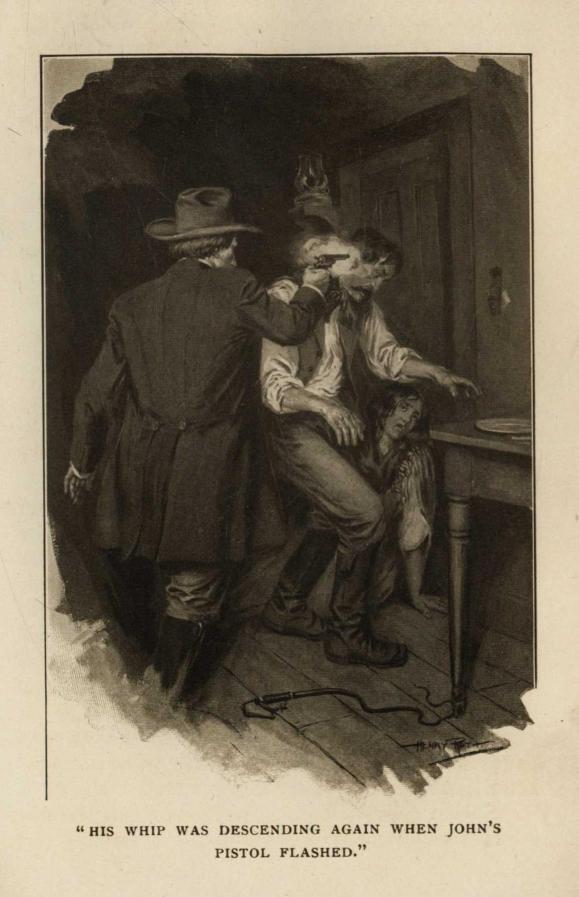
"HIS WHIP WAS DESCENDING AGAIN WHEN JOHN'S PISTOL FLASHED."
"That was why my State lost John Hayward," the Senator continued after a pause. "It was seen at once that he must not come to trial. While the plea of self-defence can always be set up, the fact that John had killed the overseer in his own house and after being ordered out, would have made the law quite too risky. But beyond that it would have been necessary, in order that the jury's sympathy might override the law, to make such a presentation of the proper limitations, and the abuses and horrors, of slave management as would be clearly inimical, if not actually dangerous, to public order and safety.
"So the State lost John Hayward," the Senator rambled on. "He exiled himself less for his own safety than for the sake of a system for which he had no sympathy, but in which seemed to be bound up the peace and happiness, the very existence, of his people.... He went away, but the shadow of the Black Peril was upon his life to the end.... He went to Massachusetts, located in Boston, and began to practise law. He was successful from the beginning, though he always spent everything he made. He married a most lovable and beautiful woman of the finest family, and life again promised all he had once seemingly lost.... He had been in Congress two terms when I was first elected to the House. Mrs. Hayward was the most gracious lady I ever knew, and they made my first years here at Washington altogether enjoyable, for they knew everybody that was worth knowing and were great entertainers. I remember that as a young bachelor Congressman I used to think that if I only had John Hayward's constituency and a wife the equal of his in beauty, intelligence and diplomacy, I could be President without trouble.... We served together in Congress till the beginning of the Great War. It was just before the outbreak that that fateful shadow fell again upon him. His son—named for him: John Graham Hayward—a boy that I had watched grow up from a lad and loved as my own, was a student at Harvard and had acquired many ideas of which his father had no knowledge, and which would have startled him—with all his well-known anti-slavery sentiments. The boy's mother looked on the negro race purely from a missionary standpoint, and had never given a serious thought, I am sure, to the negro's social status.
"You perhaps may imagine the shock that came to John Hayward on going home late one afternoon to dinner to find already seated at his table his wife, his son, and a young negro about his son's age whom the boy had brought in to dine with him.... John told me about it a few months afterward, and even then, with all his heart-break, his eyes would blaze with an insane anger as he thought of that nigger at his table.... He looked at the three for a moment; and then he said things that blasted his home. He kicked the nigger incontinently out of his house, and was beside himself in the furious wrath he hurled upon his wife and son. The boy resented his outburst, especially because of its cruel effect upon the mother. The father in uncontrollable anger at his son's resentful opposition ordered him to leave his roof, and told him that he was unworthy of the name of Hayward and had disgraced it beyond repair. The boy replied with spirit that he would not carry the name of Hayward away from the house, but would renounce both the house and it then, there and for ever, and walked out of the door.... On his knees did John implore his wife's forgiveness, and receive it; but neither father nor mother ever saw the boy again.... John tried, I think, to learn his whereabouts, and was driven to desperation as he met failure at every point. The moment the call came for troops, he resigned his seat in Congress, volunteered in a Massachusetts regiment and was killed at Bull Run....
"As he was lost to his native State, so he was lost to the nation—because the baleful shadow of the Black Peril seemed to be upon his life.... Heaven save my people—nine-tenths of whom, like him, would deal with the negro in justice and righteousness and helpfulness—from the stress and the blood of an open conflict against social equality with the negro race, and from the further unspeakable, unthinkable horror of defeat in such a conflict if it shall come upon them."
CHAPTER XI
There can be no doubt Hayward found scant recompense for his first month's service as part of the White House ménage. The money consideration of that service, as he told the gentleman from Pittsburg, he valued as nothing; and yet it was the money that held him over beyond the time limit he had set for his little adventure and his return to the army. He put his eyes on Helen but twice during the month, and that only for a moment, and he had taken his leave of Washington in less than a fortnight if his training in the service had not accustomed him to bear monotony with patience.
Before his time was up, however, a letter from his mother told him that she was hardly able longer to bear the burden of her own support or even to supplement his contributions by any appreciable efforts of her own. Too long and too closely indeed had she striven in his behalf, and the overwork was demanding its pound of flesh in severe and relentless compensation. Hayward thought he saw the hand of a kindly Providence in having already provided him with a wage sufficient to keep both his mother and himself from want—which his soldier's pay would not have accomplished; and he postponed his military ambition and brought her to Washington, where he might look after her comfort more carefully and less expensively. Very grateful was he for an opportunity to care and provide for her whose devotion he had always known, but the heroism and stress of whose struggles and the wonders of whose money-working he was beginning to appreciate only since leaving the all-providing care with which she and the quartermaster had hedged him about from the morning of his birth till ninety days ago.
While his intelligence, his spirit, his cultivated ideals would not let him rest in entire content as a menial—a footman to however high a personage—Hayward yet found his first real basis of self-respect in the consciousness of his responsibility for his mother's support and happiness, and in the feeling that he was equal to the duty so plainly laid upon him. However he had no thought but that his present work was temporary; and, to satisfy his taste for mental recreation and improvement as well as to have a definite purpose in his mental pursuits, he began in his spare hours to study the books that pertained to his proposed life-work as an officer of the army.
His first summer in Washington added no little to his stock of that knowledge which men acquire not out of books but at first hand. He had seen as an onlooker something of life on both sides of the earth, and had acquired more of the spirit of a cosmopolite than nine-tenths of the statesmen who foregathered in the nation's capital to formulate world-policies: and yet of the actual conditions of life, of living, which affected him as a bread-winner, as a social unit, as one having a part in the Kingdom of the Spirit, he was at the very beginning of knowledge when he donned the White House livery. His effervescence of interest in Helen Phillips in great measure subsided, naturally, among the many new problems that came to meet him, and with his frequent commonplace beholding of her.
He soon was brought to realize that rigid limitations were upon him not only by the colour-line which was drawn straight as a knife's edge from top to bottom of Washington, but by fences and barriers inside the confines of his own race against which he stumbled repeatedly and blindly before he dreamed they existed. On several occasions he had met with slight rebuffs in his friendly advances to persons of his own colour, and ascribed them to ill-temper or uncouth manners; but he finally received a jolt which waked him up—in this fashion:
He dropped in at the most imposing negro church in the city one Sunday evening, and heard a young woman of comely face and person, dressed in perfect taste, sing a solo which, in the sentiment and the purity and pathos of the singer's voice, met his idea of all that is exquisite in song. When the service was finished he spoke to a well-groomed man past middle age who had sat beside him.
"The young lady who sang did it with marvellous taste and beauty. She knows both how to sing and what to sing; and since I'm at it I may as well say that she's no-end good-looking."
The older man could not conceal his satisfaction and interest, for he had expended many dollars on the singer.
"I'm delighted you think so," he returned. "My daughter has had great advantages and she ought to sing well."
"Your daughter?" said Hayward. "You should be very proud of her. Will you not introduce me to her? I'd like to thank her for my share. I am John Hayward"—and feeling some identification was necessary—"footman at the White House."
"Excuse me, suh," said the other, with but a very slightly overdone manner; "we don't introduce strangers to our families—specially footmen."
The father's manner was not intended to be offensive, but his answer verily exploded in Hayward's face. Thanks to the younger man's training he did not wince or change countenance, but he was so bursting full of wrath that he never knew whether any further word was spoken between them. He moved with the throng toward the door, but stepped into a vacant pew for fear he would run over some one in furious impatience. True it was that in his attempt to volunteer three years before, he had been roughly impressed with the idea that there was some recognized difference between a white man and a negro, and in his association with the rough troopers of the 10th Cavalry he had become in a measure converted to the correctness of the proposition generally: "but," he thought in infuriated scorn, "I'm as good as any nigger that ever drew breath! A footman, am I?"—and he threw back his head with pride as he recalled his answer to the man from Pittsburg—but dropped it again with some humility at the thought that he was now a footman for the money it brought. At the door he spoke to an usher.
"Who was the young woman who sang?"
"Miss Porter—old Henry Porter's daughter."
"So the old scoundrel is Washington's richest negro," he thought. "Well, his manners and his money are not well matched. I'll even the score with him yet."
After the first heat of his resentment was off he admitted that his request to be presented to the negro magnate's daughter was abrupt, informal and unwarranted, perhaps, but he argued and insisted that old Porter ought to have seen that his unconventional request was an impulsive outcome of his admiration for the girl's singing, and at least have been a little more gracious in his refusal. No, he would not forgive the manner of it; and when he remembered the song and its delight to his senses he found it about as hard to forgive the refusal itself.
Not in three years, except for an occasional moment of patriotic uplift, had his soul had a taste of something to drink—till he heard that song. His spiritual sense had virtually lain dormant those three years in the monotonous round of his world-circling outpost duty. In successive enlistments he might indeed altogether have stifled it, while perfecting his intelligence, courage, strength and skill as a soldier: for the only possibility—and there is only possibility, no certainty or even probability—of spiritual uplift incident to the profession of arms, is that of developing a surpassing, unselfish love of the flag. This sentiment in its pure fulness of bloom is of the spirit, and is an exalted virtue; but not all even of the heroes whose ashes the nations keep have appropriated to their souls, untainted with selfish or fleshly impulse, this the very flowering recompense of their travail and heroism.
Hayward had enlisted at the bidding of the most admirable impulses and had made an excellent soldier; but the monotonous round of garrison duty after the brief war was ended had benumbed his purely patriotic motive, and left only a great desire for personal advancement. In the dull grind his very highest nature had become stagnated; and it was with the joy of one first awakened to unforeseen possibilities that he felt reawakened within him by that one song desires not of the flesh but of the spirit so long stupefied and unfed.
As he became acutely conscious of his need in this behalf, he was more seriously regretful than before that an acquaintance with the singer who had revivified his finer sensibilities might not be had to satisfy in a measure the need which her singing had recreated. Under the impulse of such desires he set about seeking associates, friendships, wherefrom he might appropriate to himself his God-given share in the kingdom of the Mind. In his quiet and unobtrusive search for friends among his race who would be congenial and satisfy the craving of his higher nature for companionship, success came with starving sloth. Most of the negroes with whom he came at first in contact were of an order of intelligence so far below his own that they met not in any degree the demand from within him, and the few that possessed the intelligence were so unbearable in manner that he found little pleasure in them.
He had held aloof from the troopers of the 10th with the certain feeling that they were below his type and below the type of the best negroes he knew must exist somewhere: but he came to doubt the correctness of his own estimate in his search for congenial spirits in Washington. Educated negroes? Yes, there were many that had seen as much of the schools as he, and more. Men of money? Yes, scores of negroes who could buy him ten times over with a month's income. And yet it seemed that he could not happen upon any in his limited and slowly growing acquaintance who did not in some way offend his tastes.
CHAPTER XII
When the heat of summer came down upon Washington, President Phillips' wife and daughters fled to the shades of the family summer home, "Hill-Top," at Stag Inlet on Lake Ontario. There, in a roomy, rambling old house set back on the low wooded bluffs which enclose in more than half-circle the peaceful little bay, he and his wife and daughters, with a few congenial but not too closely situated neighbours, passed the hot days of summer, and stayed on usually into the red-splashed autumn, when the little cove put on its most inviting dress and brewed its most exhilarating air.
It was Hayward's fortune to be carried to the Inlet with the family carriage and horses for the summer outing. He was happy enough to be quit of brick walls and asphalt pavements for a time, and to get into God's out-of-doors, for whose open air he had become so hungry in a few short months. His duties were not very onerous, and he had much time to employ himself with his own pleasures. One form which this took was in learning to handle the various kinds of diminutive water-craft with which his master's family and their neighbours helped to while away their summer vacations. Before the summer was over he was a fairly good fisherman, a safe skipper on any small sail-craft used in the inlet, and a devoted and skilful driver of the gasoline, naphtha and electric launches of which the cottagers had quite a number. He was quick and adept at any and everything that came to his hand, and so careful and entertaining of the children of the near-by families whom he met and amused when they came down to play by the water's edge, that he came to be quite in demand as one servant who "knew how" and could be depended upon in any circumstances.
Helen Phillips was still a girl, natural, ingenuous, untouched by pride or affectation. She looked forward with some zest of anticipation to the time of her début two winters to come; but was well content to have that time approach without haste. She evinced much interest in the plans that her mother and Elise made and re-made, discarded and revised for the social campaign of the next winter, and many lively and original suggestions did she make offhand and unasked. But as for her own personal plans she gave them no thought a day's time ahead. She was quite willing to receive her pleasures in the order chance ordained.
"I am so glad to get away from Washington and back to Hill-Top," she wrote to her Cleveland chum. "It was awful dull down there. Five whole days in the week I had to spend trying to catch the style dispensed at a Finishing School for Young Ladies there, where it is possible to take lady-like sips and nibbles at literature and music and art and things like that, but where the real purpose seems to be to teach young women to descend from a carriage gracefully. Just think! Another whole year of finishing touches will have to be applied to me before Miss Eugenia can in good conscience certify that I may be depended upon properly to arrange myself upon a chair in case it ever becomes necessary for me to sit down."
Helen's tastes were along lines widely different from the Finishing School's curriculum. She preferred above all things else a talk or a walk, a ride or a romp with her father. She had no brother to share her pranks and enthusiasms, her little sister Katherine was much too young to be companionable, and her father was her necessary and natural ally. Him did she not only love, but him did she glorify. Tall and straight, seemingly lacking in flesh but tough as whip-cord, with a patrician face, prematurely gray hair and moustache, Helen thought he was the model of all manly beauty. None in life or in fiction was to her thinking so brave or strong or good as he. Being in her esteem strong in body, unerring in wisdom, pure in purpose, fearless in spirit, he touched the periphery of her ideal of manhood at every point. Her mother and Elise often were amused at her headlong championship of him upon the slightest intimation of criticism, and rightfully were astonished at her information upon public questions as they affected or were connected with his political fortunes or good name. Helen devoured the newspapers (a limited number it is true) with no other purpose, seemingly, than to know what people said of him. Of those that favoured him and his policies she thought well, and mentally commended their good taste and excellent sense: but those that criticized! Woe to them had she had power to utter condemnation!
* * * * *
One morning in midsummer Hayward brought the saddle-horses to the door for the father and daughter to take a canter and prove Helen's new mount before the mother and Elise were up. They were about ready to be off when a telegram was brought out to Mr. Phillips by the operator who had an office in the house.
"I was ordered not to wake you, sir, but to give it to you at once when you were up."
Mr. Phillips read it over slowly. Then he turned to Helen.
"Well, little girl, you must miss your ride again. I'm sorry, but it can't be helped."
"Oh, no, papa! Let the country go play till we come back. You promised me this ride sure when we missed the last one."
"Can't do it, little woman. Take the horses back, Hayward," he said, and turned to follow the telegraph man. But seeing the great disappointment in Helen's face, he called to the man.
"Here, Hayward. Get into a proper coat and on my horse and see that Miss Helen has her gallop round the Inlet and back without damage. Can you ride?"
"Yes, sir," answered Hayward.
"I thought so. You seem to be able to do everything else. Now you are fixed up, old girl," he said as he chucked Helen under the chin. "Don't let the mare all the way out. You don't know her yet,"—and he was gone.
Most of Helen's pleasure in the ride was lost with her father's absence, and yet there was much enjoyment in it for her. She felt the liberty to choose her own road, and decided to do a little exploring. She set out at a good canter, with Hayward swinging along a protective distance in the rear; and with the exercise her spirits rose and she gave herself up to the full joy of it. She forgot her father's injunction and sent the mare along several stretches of road with little restraint.
Hayward, on Mr. Phillips' favourite saddler, was having the time of his life, and for himself wished nothing better than that his young mistress would keep up the pace; though he did not altogether approve of her speeding down-hill. He did not like the way the mare managed her feet on the down grades. When Helen pulled up to ask him where a certain road led, he spoke, unconsciously with decision, out of his experience, but with all deference, and said:
"Pardon me, Miss Helen, but it is a little dangerous the speed with which you ride down-hill. I'm afraid your mount is not so sure-footed as she might be.... This road you speak of leads out by Mr. Radwine's cottage into the Lake Drive. It is worse riding than those you have tried."
Helen thought Hayward's apprehensions were creatures of his discomfort in keeping pace with her, and she was nothing more than amused at his attempts to limit the speed to his abilities under pretence of care for her safety. She thought she would give him one more shaking-up to tell her father about—and plunged off down the Radwine road, leaving him to follow as best he might.
Hayward had passed over that cross-road but a few days earlier and he knew its present condition. Helen heard him call to her, but her spirit of mischief was fully aroused at the thought of his bumping along after her, and she gave the mare free rein.
They were going down a longer and steeper hill than any they had passed, near the foot of which the summer rains had washed out the roadway. Hayward, knowing of this dangerous place ahead, and seeing that it was impossible to stop the young woman in his front before she reached it, sent Prince William after the mare under pressure of the spur and with the hope to come up with her in time. He arrived on the very moment of fate. The thundering horse tore alongside the flying mare just as she reached the washed-out road. Either through feminine excitability at being overtaken or because of the defective foot action Hayward had noted, the mare, when she struck the rough road, stumbled and went down. In that instant the open-eyed Prince William cleared the washout with a magnificent stride, and the ex-cavalryman swept his right arm about Helen and lifted her out of the saddle.
Slowly reining in his horse, Hayward brought him to a standstill and gently lowered his astonished young mistress to the ground. She was almost too overcome to stand, and walked unsteadily a few steps before she recovered herself. Hayward had thrown himself off Prince William and was leading him back down the road to where the mare had fallen. She had already picked herself up, minus a saddle and plus a few bruises, and was standing in the road comparatively unhurt but shaking as with an ague.
Hayward approached her quietly and she came eagerly up to him as if to escape from her fears. He looked her over carefully, and finding no serious damage done, set himself about brushing the dust from her with wisps of weeds and grass. Helen came down while he worked with the mare, and watched him some minutes without speaking. She hardly could think of anything civil to say. She knew that she had disobeyed orders and that he had warned her—and that made her angry. The very silence of the man became irritating to her.
When he had done all he could to put the mare in order he picked up Helen's saddle and started to put it on, but stopped to ask whether he should exchange mounts with her.
"No," his young mistress replied. "I've ridden her here and I will ride her home."
The negro put her saddle on the mare while the girl looked on. When he came to buckle the girth he found that the leather tongue was torn off. He lengthened the girth on the other side and proceeded to bore with his pocket-knife a new hole in the short broken tab. Helen's eyes fell at length on the knife. She looked at it uncertainly a few moments, and then lost interest in everything else. Finally she could keep quiet no longer.
"Where did you get that knife, Hayward?" she asked with something like accusation in her voice.
"Miss Helen, I got this knife in—that is, this knife belongs to—"
"Wait a moment," interrupted Helen. "Let me see it.... Yes, it's the same. I gave my father this knife on his birthday four years ago. I had the carving done at Vantine's. How long have you had it?"
"Miss Helen, I have had it long before I entered your father's service. I—"
"Yes, I know; but just how long have you had it, Hayward?"
"Well, Miss Helen, to be accurate, I've had it three years and—four months."
"Hayward, were you ever in the army—the cavalry—the 10th Cavalry?"
"Yes, Miss Helen."
"You were in the battle of Valencia?"
"Yes, Miss Helen."
"You took this knife from an officer whose life you had saved, didn't you?"
"Yes, Miss Helen."
"Papa says the negro trooper saved his life and stole his knife."
"But I did not steal the knife, Miss Helen—I did not know I had it till two months after the battle, when they gave me back my clothes in the hospital. There was—"
"That stealing part is one of papa's jokes, Hayward. But you didn't know it was papa, did you?"
"Yes, Miss Helen. I knew him when I saw him fall."
"What? And you've never let him know? Why have you kept it secret?"
Hayward did not answer. She continued.
"He would be very grateful. He does not know who it was, for I've heard him say so. All that he knows is that it was a trooper of the 10th."
She stopped and waited for an answer, but he stood in silent indecision as to what he should say to her. If he should now disclose himself the President would doubtless weaken the force of his obligation by giving him in token of his gratitude some appointment which not only would fall far short of the lieutenant's commission to which he aspired, but also would remove him from the young woman who in the last minute had become so simply and earnestly sympathetic in her manner. He weighed the pros and cons quickly.
"Why haven't you told him?" persisted Helen.
"I have preferred not, Miss Helen. In fact there are reasons why I cannot—must not—now."
"What reasons?" demanded Helen.
"Please, Miss Helen, I cannot tell you—nor him."
"You are not ashamed of it, surely?"
"No, Miss Helen. I would do it again this morning—willingly—at any cost to myself. But do not ask me to tell of it."
Helen regarded him narrowly for a minute in silence.
"And you kept me from—death—also. Am I not to tell him of that either?"
"Please no, Miss Helen. If I have done you a service and you think it worth reward, I ask that you repay me by telling no one that I am either your father's rescuer or your own."
Mystery always annoyed Helen unbearably, and she looked at Hayward as if uncertain whether to peremptorily demand his secret or to inform him she herself would acquaint her father with the facts he sought to conceal. Hayward saw something of her purpose in her eyes, and pleaded with her.
"Miss Helen, I beg you. My reasons are imperative—and honourable. When the time comes that I may I will gladly tell your father, but if now you would do me the greatest favour you will say nothing of it."
While Hayward was speaking it occurred to Helen that she willingly would have her father remain in ignorance of her disobedience and reckless riding and its consequent narrowly averted disaster. This consideration, together with Hayward's earnestness in his mystifying request, finally prevailed upon her.
"Very well, Hayward, if you insist. You only will be the loser. It is puzzling to me.... But tell me about your rescue of papa."
Hayward, glad to buy her silence, gave her a modest account of his very creditable bit of heroism, and in response to Helen's interested questioning he was still recounting incidents of the battle and his hospital experiences when they reached the Lake Drive and quickened their pace into a fast canter for home. They arrived and alighted and Hayward got the horses away to the stable without any one's seeing the dust-splashed mare.
Helen could hardly contain herself with her knowledge, but she was as scrupulously honest as she was impulsive, and stood by her promise not to divulge the footman's secret. She vainly tried to imagine some satisfactory explanation of his strange request, but could conceive none that seemed plausible. She finally came to believe that he was a heroic soul whom some implacable misfortune had denied the right to the fruits of his heroism, and in her heart she pitied him.
Hayward was not certain just how far his young mistress credited him with good and honest reasons for wishing his identity to remain undisclosed to her father. He feared that she must think any reason inadequate. He was very much afraid that in all her interested inquiries she would discover that he was not using his real name. If she became possessed of that knowledge she doubtless would think the circumstance sufficiently suspicious to warrant her laying all the facts before her father. This matter of his name perplexed him no little. He gladly would have Helen acquainted with the facts relating to the crimson pennant, and yet he must guard against it. That would reveal his masquerade, as she certainly would remember the name of the Harvard man who had saved his college from defeat. He heartily regretted the excess of caution which had made him place himself in this dilemma.
* * * * *
In the long and lazy summer days that came after that morning's ride Helen was given without seeking it some little opportunity to question the footman about the ever interesting matter of her father's rescue and allied incidents of battle and campaign. Her father insisted, on a few occasions when he could not accompany her, on her riding alone, with Hayward as a guard. In her sailing parties, also, in which Hayward was usually skipper of sailboat or launch, she was thrown occasionally with him alone before she had picked up, or after she had dropped off, her guests at the several landings around the Inlet.
She had a child's interest in listening to the ex-trooper's reminiscences of the battle of Valencia, the Venezuelan campaign, and of his world's-end following of the flag. The footman, never for a moment lacking in deference or presuming upon the liberty of speech allowed him, was an entertaining talker. He had used his eyes and his ears in his journeyings through the earth, and the lively imagination characteristic of his race and his negro knack of mimicry, together with his intelligence and his ability to use the English language with precision and skill, made him a raconteur of fascinating charm. Helen quite often wished to acquaint her father and mother and Elise with some of the things he recounted to her, but the tales were always so mixed in with his experiences as a soldier that she could not re-relate them without breaking her promise to respect his secret....
And thus the summer days dragged slowly to an end, with Helen and her footman becoming at odd times better acquainted with the thoughts and personal views each of the other on a wider and ever wider range of subjects. Helen was too unsophisticated in her thought to notice anything unusual in a lackey's being possessed of Hayward's intelligence and ease of manner. The ever present mystery of his refusal to exploit his heroic deeds dwarfed or overshadowed all other questions that might have arisen in her mind as to anything out of the ordinary in him. She did believe that he was suffering some sort of martyrdom in silence, and her womanly sympathy grew stronger as she knew more of him. Not for a moment was the relation of mistress and man lost sight of by either; but the revelation of the real woman and man, each to other, went steadily on.