Front matter (continued 3)
Reading edition
CHAPTER XIII
The era of good feeling seemed to have been ushered in along with Mr. Phillips' inauguration. The country was prosperous to a degree. Labour was receiving steady employment and a fair wage and uttered no complaint. Capital was adding surplus to per cent., and was content. The Cuban skirmish with Spain and the trial-by-battle with Germany had cemented again in blood the sections divided by the Great War—so closely indeed that nobody, not even Presidents on hand-shaking junkets, thought to mention it. Any sporadic "waver of the bloody shirt" was considered an anachronism and laughed at as a harmless idiot. It was true that the negro question, being present in the flesh and incapable of banishment, was yet a momentous problem: but it was considered in cooler temper as being either a national or a local question—not sectional in any sense.
President Phillips in his first message to Congress, as in his inaugural address, felicitated his countrymen upon the unity of the American people and the American spirit, and on both occasions gave a new rhetorical turn and oratorical flourish to the statement that his father was from Massachusetts and his mother a South Carolinian. In sections of the South where his party was admittedly effete or undoubtedly odorous he hesitated not to appoint to office men of political faith radically differing from his own—and all good citizens applauded. Partisanry was settling itself down for a good long sleep, and strife had ceased. The lion and the lamb were lain down together, and there was none that made afraid in all the holy mountain of American good-will and fair prospect.
Into this sectionally serene and peaceful situation, which Mr. Phillips deemed largely the result of his personal effort as a non-sectional American executive, he deliberately or impulsively pitched an issue which set one-third of his admiring countrymen by the ears.
The good commonwealth of Mississippi was in a state of upheaval. A peaceable revolution was being attempted there which would have changed the essential nature and purpose of the State government. Incited by the wordy eloquence of a provincial governor, with a few scraps of statistics gone mad, good men, honest men, men of intelligence were seriously considering the proposition to so amend the State constitution as to put upon the negro in his ignorance and poverty the whole burden of his own education—by a division of the school fund between the races in proportion to the taxes each paid to the State.
This reactionary and truly astonishing proposition of Governor Wordyfellow was commonly known as the Wordyfellow Idea. It was giving great concern to the sober statesmanship of the entire nation, North and South—indeed greater concern to the thoughtful men of the South who realized its momentous import, its far-reaching effect upon Southern white people, than to the thoughtful outsiders who viewed it philosophically as having a speculative interest but no actual part in its settlement or effects.
The proposition to so divide the school funds indeed found its most violent and active opposition, as it found its strongest advocates, not only among the men of the South but even in the very State of Mississippi itself. The fact soon developed that this was to be the greatest political battle that was to be fought concerning the negro. All prior conflicts had been white man against negro. This was white man against white man, with the negro as an interested onlooker.
The lines were drawn roughly with the church, the schools and the independent press allied against the politicians, the political press and the less intelligent citizenship. Notable individual exceptions there were to this alignment—which all men remember—but the line of cleavage, taking it by and large, was as stated. Though the matter of an actual constitutional revision was presented as yet only to the people of Mississippi, the battle was being waged in serious purpose to a no less actual finish in every State from the Potomac to the Rio Grande.
It was into this situation, fraught with dire possibilities of course, but full of promise to the negro's friends, that the new President projected his impulsive and forceful personality. Anxious as always to be in the fight and leader in the fight, he set about to devise some plan for helping along the black man's cause. That he might do this more intelligently he conferred often with his most trusted advisers.
It was on the occasion of the memorable Home-Coming Week at Cleveland in 191- that he held the famous conference which gave that great civic celebration a fixed place in history. He stood loyally by his home city in its effort to enjoy and advertise itself, for he betook himself and family and several friends, including two members of his cabinet, away from busiest Washington for two days, and opened up his Cleveland home at great expense for that brief stay.
Doctor Woods, a negro of national reputation, also claimed Cleveland as his birthplace, and he had journeyed thither from afar to swell the throng of loyal sons of the city, and had brought with him Doctor Martin, now a bishop of the A.M.E. Zion Church, to add dignity and strength to the negro end of the programme. Meeting officially with these two dignitaries of colour suggested to Mr. Phillips a discussion of the Wordyfellow disturbance, and he called an impromptu consultation.
In between the review of a morning parade and luncheon, therefore, on the second day of his stay, he sandwiched this hurried conference. At it, beside Martin and Woods, were Secretary of the Navy Mackenzie, whose wisdom seemed to cover all politics and statecraft, and the Secretary of Agriculture, Baxter—himself a Mississippian, but thoroughly opposed to the Mississippi governor's policy.
The conference, which was held at Mr. Phillips' home, rejoiced his heart. He was pleased at the favourable reports which Bishop Martin and Doctor Woods gave of the situation in the several Southern States. He accepted with approval the suggestions of the sapient Mackenzie; and when he saw with what earnestness and vigour and assured personal knowledge of the situation Baxter was putting his energies into the fight and predicting victory even in Mississippi, his enthusiasm knew no bounds. The conference was of such interest that luncheon was announced before a definite plan of action was threshed out.
"By George, I'm hungry as a wolf!" exclaimed Mr. Phillips. "Come along to the dining-room, gentlemen, and we'll wind this thing up while we replenish our stores."
While this invitation was quite unexpected by the bishop and Doctor Woods, it completely confounded Secretary Baxter who was right in the middle of a little speech when the interruption and invitation came. He looked confused for a moment, and began mumbling some excuse as Mr. Phillips held open the door and his other guests passed out into the hall.
"Oh, you don't have to go," said Mr. Phillips. "Come on and finish up your idea. I know you have no other engagement, for you were to lunch with me to-day to discuss that Williams matter."
The Secretary of Agriculture saw he was caught, and his manner changed in a moment as he decided to meet the issue squarely.
"You will please excuse me, Mr. President," he said formally and finally.
"Why, Baxter, surely I do not have to explain to you that—"
"You certainly do not, Mr. President," interrupted the Secretary. "Good morning, gentlemen,"—and he bowed himself out.
President Phillips turned in ill-restrained anger and followed his guests to the dining-room. They found Mrs. Phillips and Helen awaiting them. With these Mr. Mackenzie shook hands, and to them the President introduced Doctor Woods. The bishop was already acquainted, and spoke of the dinner at the Saratoga restaurant.
Mrs. Phillips had long been accustomed to the surprises her husband made for her, and had too good control of her faculties to show any annoyance on beholding her unexpected and unwelcome guests.
Any possible shade of restraint in her manner would not have been noticed, however, in the general feeling of constraint which Mr. Baxter's abrupt departure had left on Mr. Phillips and his other guests. The host set himself to the task of throwing off this feeling by plunging volubly into a résumé of the discussion they had been having. His vigour and enthusiasm were such that by their very physical force he was bringing a wholesome situation to pass, when Elise came humming down the hall with Lola DeVale, stopped short in the doorway—and turned quickly back.
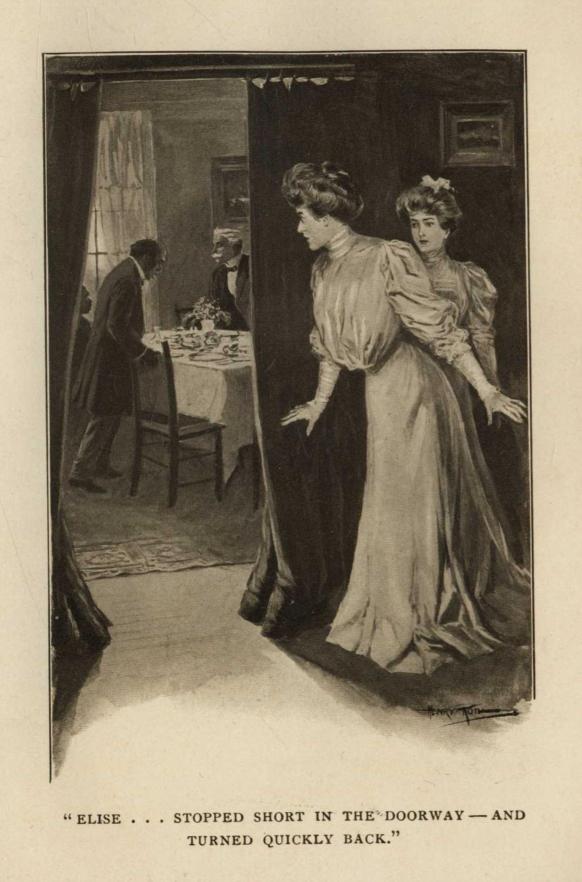
"ELISE ... STOPPED SHORT IN THE DOORWAY—AND TURNED QUICKLY BACK."
While there was nothing unusual or pointed in Elise's manoeuvre her father felt and resented her protest. He talked away for a few minutes in nervous hope that his supposition was wrong and that she would come and bring Lola in to lunch. When she did not his choler rose at this open mutiny in his own household, and he awkwardly tossed the ball of conversation to Mackenzie and busied himself keeping his indignation within bounds.
From this point the meal progressed uncertainly. In the midst of the embarrassment of it all there was brought to the President a note, upon opening which he read:
"SIR:—I have the honour to present my resignation as Secretary of Agriculture, to take effect at the earliest moment you may be able to relieve me of the duties of the office.
"With assurances of my highest consideration and sincerest good wishes for yourself and the success of your administration, I am
"Your obedient servant,
"W. E. BAXTER."
At the bottom of the page there was added:
"P.S.—I am willing to assign any plausible reason for this resignation that you may desire, or that may suggest itself to you as likely to relieve you of any embarrassment as a result of it. W.E.B."
Mr. Phillips punctuated his first hasty perusal of the note with a snort of contempt, and checked an outburst of sarcastic, wrathful comment to read it over a second time. Fortunately at this moment Bishop Martin and Doctor Woods rose and apologized for having to withdraw in order to catch a train.
Their host was loth to have them go, and expressed regret that they had not been able to arrive at some definite plan of campaign. He asked that they inform him if they should come to Washington, so that he might discuss the subject further with them. Expressing their great pleasure that the chief executive took such a lively and intelligent interest in the weal and progress of their race, the two negro worthies withdrew, Mrs. Phillips dismissing them with a formal bow and smile and Helen, following her father, giving them a cordial hand-shake as they retired.
When they had gone Mr. Phillips thrust the letter of resignation at Mackenzie, and exploded:
"Mac, just read that! The provincial, patronizing, postscript-writing popinjay! Could you have imagined the impudence of it! Does not wish me to be embarrassed as a result of his quitting us—the conceited ass! I wonder if he thinks I care a rap, or that the people care, for his cheap little melodramatics. I might have known that it was too much to have expected a sensible secretary from that cursed negro-phobia State! But he was so strongly pressed for a cabinet appointment, and really did appear to be such a strong fellow. I might have guessed his apparent excellences were too good to be true! Oh, but the patronizing insolence of his offer to hush it up for us! I swear it's unbearable. Damn the superior high-and-mighty airs these Southerners assume! My mother was a South Carolinian, but I can't feel a sympathetic tremor in my blood for any such damnable bigotry. I'll give Mr. Baxter and all his hide-bound, moss-backed, supercilious gang to know that this is one administration that proposes to make a democratic government a reality in this democratic country. A man shall be measured by the essential qualities of manhood he possesses, and dealt with accordingly, whatever his position, pull, size, sentiments, claims or colour! What do you think of that infernal note?"
"He does show great consideration for us—distinguished consideration, I may say. He will not tell it on us," sarcastically commented Mackenzie.
"The devil take his distinguished consideration!" snapped Mr. Phillips. "I'll accept his little resignation before he can wink, and give the papers a full statement of the circumstances just as they occurred. I'll show the upstart what a small potato he is—damn his impudence! And then just to think, Mac, of the inexpressible insult in refusing to lunch with persons that I deem worthy to dine with my wife and daughters! It really makes it almost too damnably personal to be overlooked. He must understand that respectability, presentability, acceptability, in my home is a matter that is as sacred to me as such things are to him with all his Bourbon notions!—but thank God he may understand also that such acceptability is based on true merit, and that a man's colour has absolutely nothing to do with it.... Come along with me to the library and we will accept this little resignation before it gets cold, and have it at his hotel before he gets cold!"
CHAPTER XIV
Mrs. Phillips, ill at ease during the luncheon, had taken the opportunity to retire offered by the departure of the negro guests, and had taken Helen with her; but that young lady, feeling the electric condition of the atmosphere and full of lively curiosity, had returned to hover around the dining-room door and learn what all the row was about. She heard her father's outburst with great interest—being no little shocked at his sulphurous words, but no less deeply concerned at the suggestion of embarrassment to him politically, and forcibly and enthusiastically impressed with his fine scorn of subterfuge and manly decision to fight out his battles in the open.
When President Phillips came in to dinner and asked for his daughters, their mother told him Helen was in her room and Elise had gone driving with Lola. "I did not like Elise's conduct at lunch. It was too pointed, entirely too pointed. I shall talk to the young lady very plainly."
"Now, Hayne, don't worry the child with this affair. It is bad enough as it is. I hope—"
"Bad enough as it is! Why, one would think you wished to resign also. Were you insulted, too?"
"Not insulted, Hayne; but ever since you sent me to the pinelands of North Carolina that winter for Elise's throat I have not been able to think of a negro as I did before—and Elise feels the same way, I know. It is so plain down there: the negroes are so many and so—different. I can't receive them with any sort of pleasure. Just think of what the Southern papers will have to say. The awful things they said about your negro quartette were almost unbearable, and I know that was mild to what this will be. I do wish you had not brought them in to lunch, Hayne."
"Why, May, you are surely not going over against me with those supercilious Southern fanatics?"
"Hayne! That is almost insulting. You know that I am for you against the world, whatever comes. No one, not even Elise or Helen, has ever heard me offer the least criticism of anything you have done—and no one ever will, my dearest"—she spoke simply and earnestly as she held her hands up toward him in a gesture eloquent of abiding love—"but I cannot have pleasure in receiving negroes. I have seen the negro as he really is, and I cannot feel that some soap and water and a silk hat make a—"
"Stop, May, right there"—Mr. Phillips' arms went about his wife in tenderness as he placed a hand upon her lips. "Listen to me. You dear women are creatures of impulse and sentiment—and thank Heaven for that, too: for when the time ever comes that you shall judge men from your heads instead of your hearts, woe to us!"—and he kissed her hair in reverent gentleness—-"but—"
"Well, this is an idyllic scene!" exclaimed Elise, coming into the room with Helen. "It is better than a play. Daddy dear, you do it beautifully. You should have gone on the stage."
Mr. Phillips' state of mind, his bottled-up vexation because of Elise's behaviour at luncheon, his impatience at the interruption of his conversation with his wife at the point where she seemed to have made out her case against him and before he had opportunity to demolish her sentiment with masculine logic, added to Elise's lightness of manner and speech, which nettled him in his serious concern over Baxter's resignation, were, all together, too much for moderation.
"Now look here, young lady," he growled out ungraciously, "you have presumed entirely too much upon your privileges to-day. When did you become too good to dine with people your mother and sister were entertaining?"
"Why, papa!" the girl exclaimed in amazement at the roughness of his manner;—but the sternness of his face did not relax, and she stumbled along seeking some excuse. "Lola and I did not want any lunch, and all those men—"
"Stop! Don't be a dodger! You know very well, miss, that you declined to lunch because Bishop Martin and Doctor Woods were there. Now you must understand that I am as regardful of your honour as you are, that my life is at your service to protect it against the slightest affront, but that I will not be sponsor for any silliness, and will certainly not overlook or permit any high-flown impertinence that affronts me in the presence of guests of my choosing. What do you suppose Mr. Mackenzie thinks of your high-and-mighty rebuke to him for sitting at my table in that company? He must feel very properly subdued, I suppose you think. And the bishop and Doctor Woods—they are doubtless overcome with humiliation because of your refusal to meet them."
He dropped his overbearing manner as Elise's face turned from crimson to white and her lips began to tremble—for he was a tender-hearted and gallant gentleman.
"Now let me say once for all, my daughter, that I must be the judge of who is a proper person to be entertained in this household, and I want no more such exhibitions of filial disrespect as you made to-day. I think no explanation is due: but I will tell you that one of the gentlemen who lunched with us to-day is a bishop in his church and a leader of ten million citizens of this country, while Doctor Woods is a graduate of Harvard and Heidelberg, a man whose learning is surpassed by that of very few men in America, and is the very best type of his own race and a creditable product of any race. Both these gentlemen are entirely worthy of your highest respect."
"But, papa, they are negroes!" said Elise, emboldened to attempt a defence when her father dropped his browbeating tone and assumed to address her reason.
"Negroes?—and what of that? It is not the first time a negro has lunched with a President of the United States. Calm your misgivings by remembering that it is assuredly safe, either socially or politically, to follow any precedent set by Mr. Roosevelt. But further, my daughter, what does the term 'negro' impute to these men more than a colour of skin? Nothing. My child, 'the man's the thing,'—his colour is absolutely nothing. A negro must be judged individually, by his own character and ability—you judge white men so. He is not responsible for the whole race, but for himself, and must stand or fall upon his individual merit and not upon his colour or caste. It is the glory of our America that it has but one order of nobility—a man; and when that order is abolished or others established our democratic institutions will be a hollow pretence and our decadence have set in. Heaven defend a daughter of mine should be either dazzled by a tinselled rank or class pretension, or fail to appreciate simple, genuine, personal excellence."
Elise was glad enough her father had calmed down and branched off into generalities. She was discreetly, not impudently, silent, and took the first opportunity to retire.
* * * * *
On that afternoon Elise had met Evans Rutledge and had really found pleasure in his friendliness. She speculated whether his manner would have been quite so cordial if he had known of the luncheon then but two hours past. She had seen no little of him in a casual way since living in Washington, for he was an acceptable visitor at most of the desirable places. With repeated meetings they had come to an unspoken truce, Elise being impelled to friendly simplicity by her very nature, and Rutledge by the love which would not permit him to deny himself any opportunity to be near her despite some rebellious notions of self-respect.
Rutledge's vacillation of mind concerning Elise was evidenced by his presence in Cleveland. It comported very well with his former status as a freelance correspondent that in search of "copy" he should have followed the President out to Ohio, but he confessed to himself that it was somewhat below the dignity of his present position and standing as an editorial writer that he should have asked for the assignment as news representative allotted to his paper on the Presidential special. He called himself a fool, and—thought of many situations that might happen to evolve themselves on the train.... They didn't evolve.
Only one paltry three minutes' talk with Elise did he win for all his journeying. He had stood by her carriage that afternoon as she waited for Lola DeVale in front of Vantine's, and they had talked in the unaffected manner of the first days of their acquaintance until Lola came out and invited him to join them on an evening at the end of the week at an informal gathering of young people at her home in Washington. He had accepted with what he afterward thought was childish and compromising eagerness.
"I like that Mr. Rutledge so much. I invited him for you, Elise," Lola said as they drove homeward.
"Why for me?" asked Elise.
"Perhaps I should say because of you. Can't you see the reason in his eyes every time he looks at you? I can."
"You are mistaken there, my dear. I happen to know that Mr. Rutledge loves, or once loved, a young woman who has greatly disappointed him."
"How?"
"He has learned that her family—and perhaps she—is impossible."
"How did you know of his love for the girl?"
"He told me himself," Elise answered with a nonchalant air that proved her an actress of the finest art.
"He did! You were playing with fire, Elise. The sympathetic 'other girl' is always in a dangerous role. Did he tell you of his disappointment also?"
"Oh, no. But that was—and is—evident."
"But the girl? Was she really—nice—better than her people?"
"Yes. No—yes—that is, nice. Of course you know Mr. Rutledge would not love a woman who was not—nice."
"Oh, certainly; but if he was really disappointed in her, all the more reason he might find a solace in your smiles."
"It was her family rather than herself, I think. He is uncertain about her—is afraid to love her."
"He does seem to have an uncertain look at times that has puzzled me. I think you are responsible for some of his uncertainty, however; or perhaps the other girl makes him uncertain about you. If it were not for her you would have to look to your defences.... He must have loved her very much or he could not stand the temptation you are to him.... I'm glad you've solved the riddle, but very sorry you told me. I have liked Mr. Rutledge; but I despise any man who would not brush aside all obstacles to marry the woman he loves and who loves him. Don't you?"
"Oh," said Elise uncertainly, "but, really, it was—it may have been—because she did not love him. I do not think he lacks courage—exactly. He simply would not—pursue—the young woman because her father's—because the—the obstacle was—seemed—insurmountable,—but really I must not be violating confidences. There is no reason why you should not at least respect him, Lola. His course is not without some justification, for the objection, from his point of view, is—vital."
"But what if the girl loves him? Does she love him?"
"Really, Lola, he—he did not inform me—whether she does or not. He has not made the slightest reference to the subject, nor spoken the smallest of confidences to me since that summer on the St. Lawrence.... I think he regrets ever having told me anything about his—heart's affairs. I suppose I should not repeat them—they were spoken under peculiar circumstances."
"There is nothing peculiar, my dear. It is easy to see why a man who is not free to make love to you will choose the next best thing and talk of love with you.... You would better be careful of Mr. Rutledge, however, for I fear his loyalty to that first love totters on its throne every time he looks into your gray eyes. You must not shatter his faith in his own faithfulness."
CHAPTER XV
The second morning's papers were aflame with the news of it! President Phillips, true to his outspoken character, himself had called in the Associated Press representative immediately on his return to Washington and dictated a concise statement of all the circumstances leading to Mr. Baxter's resignation. The Secretary's house was besieged by reporters, but all were referred to the White House for information. The daily newspapers featured the item in every conceivable style of display head-lines, and the affair was a nine-day sensation in Washington and a reverberating tempest throughout the South.
Evans Rutledge by the force of his genius, his wide knowledge of men and affairs and the accuracy of his political information had gone rapidly toward the front rank in his profession. He was now the leading editorial writer on the Washington Mail, an anti-administration organ.
Of that paper Elise sought the first issue with surreptitious eagerness. She picked it up fully expecting to read quite the most scathing philippic she had ever seen in print. She was surprised to find that the former correspondent had put off his extravagances for a more judicial editorial manner. She recognized his work by several phrases that had been in the Chicago American article.
The editorial was severe, but dignified and fairly respectful. Rutledge commended Secretary Baxter for his prompt and emphatic refusal to lunch with a negro even though at the table of a President of the United States and at the President's personal invitation or "command." He said the fact that Mr. Phillips had intended no insult made the insult no less real; and that Baxter had done the only possible thing—the duel being no longer in vogue—declined and resigned.
He went on to say that there was an irreconcilable difference between the Northern and the Southern ideas of the social equality of the races; that the Southern man's idea was bred in the bone, and no amount of argument or abuse or lofty advice from the Northern press, or boyish impulsiveness in the President's chair, could change that idea one iota; that while their fears sometimes might be lulled to sleep, might be forgotten like other ills in the interest or excitement of other concerns, the black peril was their great Terror in both their waking and sleeping hours, and even when asleep they slept upon their arms.
Elise read that in face of this Terror all other questions were insignificant, and all arguments, prejudices, passions, loves and hates (she put her fingertip on the words) among Southern gentlemen melted away or were fused into a mighty and unalterable sentiment to go down to death rather than to permit social intermingling with the negro race.
The editorial concluded that the Southern feeling on this subject was ineradicable, and was so deep-seated and universal that it became a great Fact which any man of fair discretion and sensible purpose would have recognized and reckoned with; that no President with an abiding sense of the proprieties would have proposed the luncheon to Baxter, and no gentleman of the South would have hesitated for a moment in declining the insulting invitation. The subject was dismissed with the prediction that the cause of the negro immediate and remote would be damaged immeasurably by this act of the impulsive gentleman in the White House who would take the Southern situation by the seat of the trousers as though it were a self-willed small boy pouting in a cellar and yank it incontinently up the Phillips stairs of progress.
There was no other subject discussed in hotel lobbies, committee-rooms or wherever else two or more men were gathered together on the day after the facts were known. In the afternoon in one of the committee-rooms of the Senate, Senators Ruffin and Killam, Representatives Smith and Calhoun of Killam's State, and Representative Hazard of a New York City district, were ventilating their views on the matter when Rutledge joined them, on the hunt for Calhoun.
The comments on the President's negro luncheon were all adverse, though expressed in terms of varying elegance and force from the keen and polished irony of Mr. Ruffin to Mr. Killam's brutal outbursts and picturesque profanity. Mr. Hazard, not having the same sectional view-point as the others, though of the same political creed, was an interested listener. Senator Ruffin referred to the editorial in The Mail and drew Evans into the discussion.
The young man, glad to be untrammelled by editorial discretion, gave free rein to his indignation, but in deference to Mr. Hazard's presence was careful to make some allowance and excuses for the opinion of Northern people on the matter of social amenities to negroes. However, to compensate for this concession and leave no doubt of his opinion, he was even more picturesque than Mr. Killam, if not so profane—and consequently more forcible, Hazard thought—in paying his respects to Mr. Phillips' negro policy.
But Senator Killam resented even the suggestion of excuse for Northern opinion, and opened up an even more choice and outrageous assortment of profanity and invective. Rutledge, Calhoun and Senator Ruffin were ashamed at his disregard of ordinary decencies, while Hazard assumed a look of polite amusement. Mr. Killam's satellite, Smith, however, was vastly tickled at his master's performance, and took pains to show his surpassing admiration. Smith was a raw-boned, half-washed giant with long hair that never knew a shampoo, who owed his election to Congress to a gift of stump-speaking and a consistent devotion to Senator Killam's political fortunes. He usually kept quiet when his chief was there to speak. He did so on that afternoon till, carried away by Mr. Killam's extravagances about niggers in white dining-rooms, he blurted out:
"Yes; I suppose now Miss Elise Phillips will be getting sweet on Doctor Woods. The nig—"
Smash!
Rutledge struck him on the point of the jaw and he fell in an awkward heap between a chair and the wall. He was up in a moment growling like a mastiff, but was restrained by Calhoun and Hazard. Rutledge was standing perfectly still, his thumbs in his trousers pockets, showing no excitement save in the glint of his eye. Smith was muttering his desire to fight it out. He could not talk plainly, for the blow had unhinged his loosely clacking jaw. Hazard, Killam and Calhoun held him by force till he was quiet. It would have been impossible to prevent his forcing a further clash perhaps if Senator Ruffin had not insisted on ending the matter just there.
"Gentlemen!" he said, "this must stop right here. None of us can afford to pursue the miserable affair further. We should all be ashamed that a young lady's name has been used in this discussion at all, and especially in such a manner was it unpardonable! Mr. Smith certainly forgot himself; and while Mr. Rutledge acted from a chivalrous impulse he will learn when he is older that a blow usually advertises rather than suppresses an insult to a woman."
It began to dawn upon Mr. Smith by this time that he had committed a woeful breach of good manners, and with a parvenu's awe of "propriety" he was more than anxious to have the affair hushed up. None the less did he wish to keep secret his knockdown. He got out as quietly as possible in search of a surgeon. Rutledge retired with Calhoun, who slapped him on the back as they went down the corridor and whispered, "Good old boy! Served him right, the damn dog."
Senator Ruffin sent for the attendant who had left the committee-room as soon as quiet was restored, and bought his silence with a five-dollar bill. This honest man was true to his promise to keep his mouth shut, but he overlooked informing the Senator that he had already given the first of his co-labourers he met in the hall a fragmentary account of the mix-up. He had given the names only of Senators Ruffin and Killam, as he did not know the others, all of whom he thought were members of the Lower House.
The reporters were on the trail in an hour. They interviewed the Senators, but these were dumb. They found that the Senate attendant who had his information second-hand was the only source of news supply. What this fellow lacked in knowledge, however, he supplied out of his imagination; and the details grew and multiplied as different reporters interviewed him. At best there was much to be supplied by the young gentlemen of the press, and the result was as many different stories as there were men on the job. The nearest any of them got to the truth was to say that two Congressmen had been discussing the negro question and had come to blows because some woman's name had been dragged in, and that one had broken the other's jaw. This much in the evening papers.
By the next morning the newspaper ferrets had located all the actors and eye-witnesses and gave their names to the public. Fortunately the attendant had not caught Smith's remark but only his rebuke by Senator Ruffin. So that the public knew only that Evans Rutledge had unset or broken the jaw of Congressman Smith because of some improper use of a young lady's name. Whose, none of the gentlemen would say.
* * * * *
Evans Rutledge was in a fever of anxiety lest that name should get to the public. He was sure that he could not face Elise again if it did. Senator Ruffin's rebuke had sunk deep into his heart and he felt more guilty than Smith. He looked over the morning and evening papers very carefully to see whether they had discovered the young woman, before he finally decided to go to Senator DeVale's as he had promised Lola. When he arrived he found, beside Elise, only Alice Mackenzie, Hazard and young MacLane, an under-secretary of the British embassy. Others who were to come failed to appear.
Elise was not pleased with the situation. She was quite willing to be ordinarily civil to Mr. Rutledge, but she knew that nothing could separate MacLane and Alice Mackenzie, and that Hazard had known Lola so long and had proposed to her so regularly and insistently that he was for her or for nobody. It looked a little too much, therefore, as if she had chosen Evans for her very own for the evening. She did not want him to think such a thing possible. She remembered his point-blank editorial utterance that those small sentiments—loves and hates—melted away before exhibitions of social equality with negroes—so at least she construed it—and she could not but resent it, though she would not admit she troubled herself to do that.
"Now, young people," said Lola, "as the programme has been spoiled we will make this an evening of do-as-you-please."
"Good, very good," commented Hazard. "In that case you will please to come over here and take this chair and let's finish that conversation we were having last night when the unpronounceable Russian took you away from me."
"I am afraid that conversation is a serial story," she laughed, taking the chair he placed for her.
MacLane asked Alice Mackenzie some vague question about a song, which only she could interpret, and they by common impulse went through the wide door to the piano in the back parlour, where after she had hummed a short love ballad for him to piano accompaniment they dropped into a pianissimo duet of love without accompaniment.
Elise, feeling that she was being thus thrown at Mr. Rutledge's head, came to the mark with spirit and kept him guessing for an hour. She resented his possible inference that she had chosen him for an evening's tête-à-tête, and set about to show him that such was not the fact by a display of perversity and brilliance which dazzled while it irritated him. She would assume for a moment an intimately friendly, even confiding, manner that like the breath of the honeysuckle at his Pacolet plantation home would set his senses a-swim,—and in the next moment chill his glowing heart with the iciest of conventional reserve or answer his sincerest speeches with the light disdain and indifference of a mocking spirit. At one time she would kindle his admiration for her quickness of thought and keenness of repartee; and again appear so dull and careless that he must needs explain his own essays at wit.
Her caprices, so plainly intentional yet inexplicable, exasperated him almost to the point of open rebellion, and the more evident his perturbation became, the more spirit she put into the game. She won him back from a half-dozen fits of resentful impatience to the very edge of intoxication,—only to bait him again more outrageously.
Lola DeVale, perfectly familiar with the theme of Oliver Hazard's serial, found time even while admiring Hazard's ability to decorate his story in ever-changing and ever pleasing colours, to note that Elise was giving Rutledge a tempestuous hour.
"It's a shame for her to treat him so," she said to Hazard, interpreting her meaning by a nod toward Elise and Evans.
"I hadn't noticed. What's she doing to him?"
"I believe he loves her, and she has been treating him shamefully all evening."
"So that was it," murmured Hazard. "She certainly ought to be good to him."
"Beg pardon, I didn't understand you," said Lola.
"I said she ought to be good to him."
"I heard that. But the other remark you made?"
Hazard caught himself, and looked at Lola steadily. "I was so bold as to express an opinion—which had not been requested—and to aver that—she—er—ought to be good to him," he repeated with an over-done blankness of countenance.
"You come on," said Lola as she rose. "We are going to scare up something for you people to eat," she remarked to the others.
"Now, sir," she said when she had gotten him into the dining-room, "I'll see what sort of a reporter I could be. Stand right there, and look at me. Now.—why did Mr. Rutledge knock Congressman Smith down? No, no, stand perfectly still—and no evasion."
"What are you talking about?" asked Hazard.
"Don't be silly," the girl said impatiently. "I read something more than the society and fashion columns in the newspapers. Tell me. Why did he break Mr. Smith's jaw?—who was the young lady?—and what did Mr. Smith say of her? I know it was Elise; but tell me about it—and hurry, for those people are getting hungry."
"I must not tell that, Lola," Hazard answered her seriously.
"A man should have no secrets from his—proposed—wife."
"Make it promised wife and I'll agree," Hazard replied eagerly, taking her hand.
"No; we'll leave it proposed awhile longer," she answered him archly. "I've become so accustomed to it that way that I'd hate to change it." The smile she gave him as she slowly drew away her hand would have bribed any man to treason.
"But we will compromise it," Lola continued. "I will be real careful of your honour. I'll ask you a question, and if the answer is yes you needn't answer it. Now—was it not an insult to Elise that Mr. Rutledge resented?"
"Lola, when you said that word wife a moment since you were—heavenly."
"Hush your nonsense, Ollie.... I knew it was Elise when you said that thing in the parlour.... Did Mr. Rutledge really break his jaw?"
"Oh, it was beautiful, beautiful," said Hazard with enthusiasm. "Such a clean left-hander! Dropped him like a beef—he's big as two of Rutledge—in a wink—before he could finish his sentence,—the low-bred dog! Yes, beautifully done, beaut—"
"Here they come," said Lola. She was busily breaking out the stores from the sideboard when Elise and Rutledge appeared.
"Here, Mr. Hazard, take this dish in to that mooning young couple in the back parlour. And you, Mr. Rutledge, just force them to eat enough of these pickles to keep their tempers in equilibrium."
* * * * *
"Oh, my dear," she exclaimed when the two men were gone, "I've discovered the name of the young woman Mr. Rutledge fought for. Ollie let it get away from him—not the name, but I figured it out. And for whom do you suppose it was?"
"I haven't the slightest idea," answered Elise in all truthfulness.
"Of all women you should. I told you I could see it in his eyes,"' laughed Lola.
"Not for me?" Elise cried in genuine surprise.
"For you."
"What did the man say?" she asked quickly.
"Some caddish thing, of course. Men are so nasty. I didn't have time to get the particulars before you and Mr. Rutledge followed us in here. But Ollie says it was just b-e-a-u-t-iful the way Mr. Rutledge dropped him—and he's three times as big as Mr. Rutledge, too—"
"We've tried moral suasion, strategy, force, every expedient," interrupted Hazard as he and Rutledge came back into the dining-room, "but the Scotch lass and her laddie positively decline to be fed by us. They are fully supplied by their own ravings—ho! don't throw that salad at me!"
"Here, take a dose of celery quick—a biblical pun like that is a too serious tax upon the simple Congressional brain," said Lola.
Hazard looked foolish, and he felt like a fool; but what real manly lover outside the story-books was ever else than foolish when love's fit was upon him?
None of the quartette in the dining-room was the least bit hungry, and it was but a very few moments till the young hostess led the way back to the parlour, Elise and Rutledge following slowly. When they reached the stairway Elise seated herself on the third step and by the gesture with which she arranged her skirts invited Evans to a seat below her.
"Look at that," said Lola to Hazard, glancing over her shoulder as they passed into the parlour. "Now she's going to be good to him."
"In the name of heavens, woman, you didn't tell her!"
"Why not? She's the very one that ought to know. She will not inform the reporters."
"But what will she think of me?" asked Hazard in some concern.
"You? Why, you don't count! You are only a pawn in their game." As his eyes flashed she added, with a bewildering tilt of her chin: "I promise to make good all your losses."
"May my losses prosper!" prayed Hazard audibly.
* * * * *
Elise used a makeshift conversation with Rutledge till she heard the humming accents of the others well going, and then—
"Mr. Rutledge," she said. "I wish to speak to you of your defence of my name when that Mr. Smith—"
The suddenness of it routed all Rutledge's cool senses.
"Oh, Miss Phillips," he broke in, "I am so sorry that I should have done anything to accentuate that abominable fellow's remark. I am so heartily ashamed of my unpardonable boyish thoughtlessness and lack of consideration that I cannot find words to express my contempt for myself," etc., to the same effect, without giving Elise a chance to speak, till she was surprised in turn, then amused, then annoyed. Finally, in order to bring him to a reasonable coherency, she interrupted his self-denunciations.
"What did Mr. Smith say of me, Mr. Rutledge?"
"I can't repeat that to you, Miss Phillips."
"You must if the words are decent. Tell me at once. I must know."
"He simply coupled your name with that of—Doctor Woods—the negro who—lunched at your home in Cleveland."
Evans forced out the last half-dozen words with a visible effort—which the girl may have misinterpreted.
"Oh!" She dropped her face in her hands. She had not dreamed of that explanation. But she gathered herself in a moment. Every pennyweight of her admirable pride came to her support. At the mention of "negro luncheon" she was on guard against Rutledge, her kindly purpose forgotten. She sat straight up and with a perfect dignity said:
"I thank you, Mr. Rutledge, for your well-meant efforts in my behalf, but my father is abundantly able both to choose the guests who shall dine at his table, and to protect my name, whenever indeed it shall need a champion." She closed the discussion by rising.
Evans did not tarry long. He was too badly scattered. The other guests soon followed, except Elise, who remained overnight at Lola's insistence.
"Come right up to my room and tell me all about it.... What did you do to that miserable man? You ought to be spanked, Elise."
"I did nothing to him."
"And why didn't you? I said to Ollie when you sat down on the stairs, 'Now she's going to be good to him.' Did you tell him you knew?"
"Yes."
"What did he say?"
"He—apologized," said Elise with a nervous laugh.
"Apologized! For mercy's sake!—and what else?"
"I accepted his apology—on condition he would not do it again;" and she broke out into real mirth at sight of Lola's scandalized face.
CHAPTER XVI
If The Mail's editorial was conservative, other papers were not so respectful. It was worse even than Mrs. Phillips had predicted. All over the South the papers ran the whole gamut of indignation and abuse from lofty scorn all the way down to plain editorial fits. The entire Southern press, Democratic, Republican, and Independent, except a few sheets edited by negroes, were of one mind on the subject of negroes dining with white men. Papers that had supported Mr. Phillips heartily were all severe, some of them bitter, in their denunciations.
The Wordyfellow element in the school-fund fight welcomed the President's act as a boon from heaven. They raised a howl that was heard in every nook and corner of the Southland, and that by the very thundering shock of its roar broke through and drove back the forces of the negro's friends. The weak-willed were borne down and the timid and the doubting were carried away by the purely physical force of noise or by having lashed to fury their sometimes latent but ever-present terror of the Black Peril. And not only the weak, indeed, and the timid and the doubting went in crowds to the Wordyfellow camp, but strong men, fearless men, men of the most philanthropic impulses toward the negro race, men who had fought openly and ably the Wordyfellow propaganda, became silent and began to waver, or deserted the negro's cause and unhesitatingly espoused the other side.
In vain did the negro's staunchest friends proclaim their indignation at the President's lunching with Bishop Martin and Doctor Woods, and try to convince their people that the South should be true to its own interests and do simple justice to the negro despite any act of his fool friends. It was useless. The Southern people—the floating vote, the balance of power—were in no mood to draw fine distinctions, nor to listen to theories in face of facts. A careless hand had struck the wavering balance, and the beam went steadily down.
Reports of defections began to come rapidly to Mr. Phillips. Those from the negroes in the South told of the losses faithfully, but gave any other than the true reason for the change of sentiment; while letters from his white advisers told him more or less plainly that his negro luncheon had done the damage and that the cause was as good as lost.
These reports roused the President's fighting blood. He sent for Mackenzie.
"Read that stack of letters, Mac, and you will see that the negroes in the South are in a fair way to be trampled to death. Now I must head this thing off, and I want your help. I am determined to defeat that Wordyfellow movement if there is power in the Federal government. I'll not be content to have the laws annulled by the Federal Supreme Court after they are passed, even if that can be done. We must find some way to win this fight in the elections and thus give the lie to these prophecies that that luncheon has lost the battle."
So he and the astute Mackenzie rubbed their heads together for a week: and finally came to a remedy so simple that they were ashamed not to have thought of it at once. Simple indeed—if they could apply it. In less than another week, Mr. Hare, the recognized administration mouthpiece in the House, introduced a bill appropriating moneys from the national treasury to the States in proportion to population for purposes of public education. The milk in this legislative cocoanut was a provision that the money apportioned to each State should be so distributed among the individual public schools of the State that, when taken together with the State's own appropriation, all the schools in the State should be open for terms of equal length.
From statistics carefully compiled in the office of the Commissioner of Education Mr. Phillips and Mr. Mackenzie had calculated the amount of the appropriation so that if the Southern States adopted the Wordyfellow plan the negro race would get virtually the whole of the appropriation from the national government.
Elise Phillips, persuading herself that she was on the lookout for reasons to despise Mr. Rutledge, regularly read the editorial column of The Mail.
There one morning she learned that "the immediate effect of the introduction of the Hare Bill in the House has been to transfer the fight from the South to Washington. True, the Wordyfellow speakers and press have raised a more ear-splitting howl, and opened up with every gun of argument, appeal, abuse, expletive and rant; but they see clearly that this bill if passed will bring all their schemes to naught, and that the issue has been taken out of their hands. It is tantalizingly uncertain to them whether the bill will become a law; for there are many incidental questions and considerations which complicate the issue here at Washington. But all men know that when Mr. Phillips sets his head for anything he will move heaven and earth to attain it. Few doubt his power to whip many Representatives and Senators into line or his readiness to wield the whip if the fate of any pet measure demands it. There is much of the Jesuit in Mr. Phillips' philosophy of life and action. When he believes a thing is right he believes that no squeamish notion should prevent his bringing it to pass. Keep your eyes on him! It is always interesting to see how he does it."
"Pity he is not a Senator!" Elise commented with scornful impatience as she threw the paper down, "that papa might whip him into becoming modesty!"
* * * * *
At the moment Elise was so delivering her mind, a telegraph boy was handing Rutledge a message. He tore it open and read:
"COLUMBIA, S.C, Jan. 9th, 191-.
"EVANS RUTLEDGE,
"Washington, D.C.
"Exactly how old are you and where do you vote?
"W. D. ROBERTSON."
Evans looked around behind the telegraph-sheet as if seeking an explanation. He gazed quizzically at the messenger-boy, but that young gentleman only grinned and then looked solemn.
"Well," Evans muttered, "what the devil's up Robbie's back now?"
He sat down and thought the thing over awhile. Then he constructed a reply.
"WASHINGTON, Jan. 9th, 191-.
"W. D. ROBERTSON, Atty.-General,
"Columbia, S.C.
"Your telegram received. If it is official I decline to answer. Entre nous I will be thirty-one on the 29th of February at something like twenty minutes past three in the morning—they didn't have a stopwatch in the house. I vote in Cherokee County, Pacolet precinct, generally of late in a cigar-box in the shed-room of Jake Sims's store where Gus Herndon used to run a barber-shop when you and I were young, Maggie. Why? EVANS RUTLEDGE."
"Send that collect, youngster. We'll make old Robbie pay for his impertinence."
"Look here, sonny," he called to the boy who had gotten out the door, "bring any answer to that down to the Capitol. I am going to have a look at the Senate."
He was sitting beside Lola DeVale in the members' gallery when the answer came.
"COLUMBIA, S.C, Jan. 9th, 191-.
HON. EVANS RUTLEDGE,
"Washington, D.C.
"Nothing much. The governor of South Carolina simply did not feel like giving a United States Senatorship either to a boy or to a man from another State. He is just mailing your commission as Jones's successor. Don't decline it before you hear the whole story. Congratulations to you.
"W. D. ROBERTSON."
"This has 'an ancient and fish-like smell.' Read it," Rutledge said to Lola when he had recovered from his astonishment sufficiently to speak.
She took the telegram and while she was trying to interpret its import Senator Killam came hurriedly into the gallery and seized upon Rutledge.
"I got a telegram from the governor half an hour ago and have been trying to find you ever since," he exclaimed. "He has appointed you—oh, you have heard, I see. Well, come right down with me. I want to present you to your colleagues."
Evans could doubt no longer, and Lola DeVale had grasped the meaning of it.
"I am so glad to be the first to congratulate you," she said, and he felt the sincerity of her good wishes in her warm hand-grasp. Then Senator Killam carried him off.
* * * * *
"I know it came 'like a bolt from the blue' to you," Robertson wrote to him; "but the whys and wherefores need not mystify you. There cannot be the slightest doubt of your ability to fill the office—full to the brim; and the rest is easy. You know the old man fully intended all along to contest for the place with Jones, whose term would have expired with the old man's term as governor. Jones's demise, however, presented a problem to him that has driven him to the verge of lunacy for a week. He couldn't give himself the commission, of course. He couldn't resign and get it, for the lieutenant-governor has been the avowed supporter of LaRoque for the Senatorship. He couldn't give it to LaRoque or Pressley, for the three of them are too evenly matched.... When he finally came to the idea of appointing some one to fill the vacancy who was clearly not in the running so that the primaries might settle it among the three of them, I suggested you. He jumped at the idea.... The old man has every reason to feel kindly toward you both for your father's sake and for your own excellent work's sake, and he does not doubt your friendliness to himself.... You will have less than six months in which to make a name for yourself, but—perhaps—who can tell? ... I wish I had such an opportunity. I am heartily glad you have it."
* * * * *
Senator Rutledge was pitched right into the middle of the fight on the Hare Bill—and fight it was for him. Senator Killam essayed to take the young man under his wing and chaperone his conduct according to his ideas of the political proprieties, but he found that the junior Senator had a mind of his own, and could not be managed, overawed or bullied. This roused Mr. Killam's ire at once. He wasn't accustomed to it. The dead Senator Jones had never had the effrontery to think for himself; and for this youngster to presume to walk alone was more than Mr. Killam could forgive.
Solely because of Mr. Killam's personal attitude and treatment of him, Rutledge wished it were over and done with long before the finish; but he never lost his nerve.
* * * * *
It seemed that the suspense would be ended quickly when the House under pressure of the rules passed the Hare Bill almost without debate: but when it came before the Senate it was evident at once that those dignitaries would take abundance of time to consider it,—if for no other reason than to prove to themselves they were the greatest deliberative body on earth.
However, with all the Senate's deliberation the very frenzy of the Wordyfellow crowd's screams evidenced their realization that their game was balked—and that, too, in a manner that was maddening: for it left them not the frenzied pleasure of fighting their precious battle against the negro out to the end and going down to harmless defeat in pyrotechnic glory. No; it placed them in a dilemma where they must humiliate themselves by a surrender before the battle, or fight it to a barren victory at the polls, which would not only bring actual benefit to the negro in the South but also give to the Northern States the lion's share of a large appropriation.
Facing this dilemma, they lost heart if they lost nothing of noise. In all of the interested States except Mississippi serious discussion of the question grew less and less rapidly, and was postponed until after the Senate should vote. In Mississippi, however, the tension was increased by the Senate's deliberation because the date set for the election on the proposed Wordyfellow amendment to the State constitution was some time before the Senate would be forced to vote. The Mississippians could not decide for their lives whether they preferred to vote on their amendment first or have the Senate vote first on the bill. With a faint hope that the bill might not pass, they were in obvious difficulties in either case.
Southern Senators were overwhelmed with all manner of conflicting and confusing petitions, and as a result about one half of them favoured the bill for one reason or another, while the other half more or less bitterly opposed it. The discussion, when the bill finally came out of committee, took the widest range,—from the constitutional objections raised by the Texas Senator (whose State, having a large school-fund income, did not need the appropriation) and the savage attacks upon the negro race generally by Senator Killam, to the purely pro-educational reasoning of most of the supporting Senators from the South—among whom was Senator Ruffin—and the pro-negro speech of the young Senator Rutledge.
The adjective pro-negro may give an erroneous impression of Senator Rutledge's ideas. The term is the Senator's own. From his speech in full in the Congressional Record the reader may determine for himself whether the term is apt.
CHAPTER XVII
Senator Rutledge gave notice that on February 23d he would address the Senate on the Hare Bill. On that day the galleries were crowded to hear him, his State's delegation in the House was present in a body, accompanied by many other representatives from North and South. No one knew how he would vote, for he had listened much and talked little. He said:
"Mr. President: There have been many terms used on this floor and in the public prints since this bill was introduced, by which to distinguish and define and lay open to public view the motives which are supposed to lie behind the votes that will be cast for and against it.
"We have heard 'unconstitutional,' 'anti-negro,' 'pro-educational,' 'watch-dog of the treasury,' and others equally descriptive if less parliamentary. I have not heard 'pro-negro.'
"So, to save my friends—and enemies, if I have any—the trouble of search and imaginings, I adopt that term, 'pro-negro,' as descriptive of my attitude toward the matters affected by this bill.
"It is an open secret, Mr. President, that this measure, which bears the non-committal title of 'an act to promote education' is a White House production designed and introduced for the single purpose of defeating what is known as the Wordyfellow school-fund movement in the South generally, more specifically now in the State of Mississippi. Because I think it will accomplish that purpose, both general and special,—because I am 'for the negro,'—for him on his own account,—for his elevation as a race to the highest level which his essential nature in the purposes of God will permit him to attain,—because I believe the success of the Wordyfellow movement would mean his degradation, his hopeless continuance in his present low estate,—because, in a word, I am pro-negro; I shall vote for this bill.
"I should despise myself, sir, if I had within me other sentiments toward any man or race of men, and I feel, therefore, that it is not unbecoming in me to arrogate to myself the pure unselfishness of this motive. And yet, sir, if the love of one's race may be called a selfish passion, I must confess that right alongside of this unselfish desire for the negro's welfare, there lies in my heart a selfish passion for the progress, the multiplying prosperity and more abounding happiness of my own people, the white men and women of the South, which desire also with no less power but indeed with compelling forcefulness bids me to oppose the Wordyfellow idea with every faculty and expedient, and therefore to vote for this measure.
"I wish to make it clear at the outset that, while I shall heartily support this White House bill, I give not the slightest credit to the President for having prepared it and sent it here. He deserves none. The bill is a necessity, and as such I vote for it: but the President is the one man who has made it a necessity.
"If he had not injected into the situation his negro luncheon (and to that I will pay my respects before I have finished), my people would have defeated the Wordyfellow movement; for the battle was going our way. It is as little as President Phillips can do now to suggest this method, expensive though it is, to repair the damage he has done the negro's cause in the South. He comes praying us to pay the negro out of the difficulty in which he has involved him, and as friends of the negro there is nothing for us to do but furnish the money, however much we may deplore the Executive folly that makes the outlay imperative.
"Now, Mr. President, let us inquire directly into the merits of the Wordyfellow plan. The proposed amendment to the constitution of Mississippi provides that the school fund shall be divided between the white and negro schools in proportion to the taxes paid to the State by each of the two races for school purposes. As there are six negroes to four whites in the State, and as the negroes pay less than ten per cent of the school taxes, such a division of the school fund will give the white children thirteen days' schooling to the negro's one.
"Such a proposition is illogical, pernicious, insane.
"Look at the logic of it. Governor Wordyfellow defends the general proposition by some scattering statistics which prove to his mind that education generally is not good for the negro; but he justifies the division of the school fund on the basis of contribution upon the supposed principle that the negro will get back all that he pays in and therefore cannot rightly demand more.
"That so-called principle will not hold water a moment. I would say to the gentlemen from the South, Mr. President,—to those who are supporting the Wordyfellow propaganda—that if they proceed on that theory they must give to every man what he pays into the treasury: which means that the State must expend more for the tuition of the sons of the rich than the sons of the poor. If every man has a right to demand for his own children the taxes he pays for school purposes, then the State has no right to tax one man to educate another's child—and the promoters of this idea have pulled down the whole public school system about their ears.
"If such a division is proposed on the ground that no sort of education is good for the negro, and we believe that, then let us take away from the negro by constitutional amendment all the money collected from him by the State for school purposes and give it to the white children. That would be logical, that would be sensible, that would be Scriptural. Let us be logical and sensible and fearless about this matter.
"But I cannot think these leaders of the Wordyfellow forces believe that, Mr. President, though I fear that they have persuaded thousands of their less intelligent following to believe it thoroughly. No, you do not believe it; but you do believe that some particular kinds of education—literary education, for example—is positively harmful to the negro, while some other particular sort—industrial education, perhaps—is beneficial and would uplift the negro race.
"If you admit that,—and it has been conceded on this floor by some of the leaders of the Wordyfellow movement that industrial education is good for the negro and will make a better man and a better citizen of him; then in face of the appalling menace of his ignorance and depravity which have been painted in such lurid colours here, let us by constitutional amendment give him more than his per capita share of the school tax. Yes, let us give to him proportionately in keeping with our keenest fears, our wildest terror, of the Black Peril—all if need be—to educate him in that particular line that will uplift him and make a safe citizen of him, in order that we may save ourselves alive and escape the woes of that peril. All education administered by the State is given in the exercise of a sort of quasi police power—to protect itself from the violence of ignorance: and we would be well within an ancient principle if we should lay out extraordinary funds to police the black cesspools that threaten our civic life.
"It is clearly demonstrable, therefore, that upon any theory of the negro's inability or limited ability to be benefited by education, or upon the assumption of its positive hurtfulness to him, the Wordyfellow amendment is absolutely illogical. The whole Wordyfellow proposition is based upon a false assumption in the first place, and the Wordyfellow remedy does not have the merit of being true even to the fictitious Wordyfellow premises. For all this agitation against the education of the negro race proceeds upon the theory that the negro is not altogether a man, that he is without the one aptitude common to all other peoples, white, yellow or red—the disposition to be uplifted in civilization by the spread of a higher intelligence among his race.
"That theory, Mr. President, is false! And while I believe the great majority of my people reject it despite the insistence with which it has been in small measure openly, in large measure indirectly, presented to them for acceptance, I have thought it worth while to inquire closely and specifically into the effect of the higher literary education upon the black men and women who have been so fortunate as to acquire it. I give to the Senators not only as the result of my investigation but as the result of my personal observation as a man brought up in the South, my sincere opinion that education of the negro in the usual literary studies from the kindergarten to the college, as well as along industrial lines, is as a rule beneficial and uplifting to him.
"It is true that a smattering of education in some instances gives a negro the idea that he is to get a living without work, and that such notions would not be wholesome if prevailing among a population which must do manual labour. This need not alarm us, however; for it is not an unusual thing for a college education to give a white boy the same notion. We do not limit his education on that account. In the post-graduate school of Hard Knocks he always finds out—and no less surely will the negro boy of similar delusion learn—especially as education becomes more and more a possession of the masses and not a privilege of the few—that the great majority of men, whether black or white, lettered or unlettered, must work, and work with their hands.
"Let me add, lest I be misunderstood, that while I believe the negro race as a race will be hewers of wood and drawers of water for generations to come, and that education will be beneficial to them as a toiling class, I am not of those who believe that when by education you spoil a negro field-hand you have committed a crime. I have no sympathy with a sentiment that would confine any man to a limited though respectable and honourable work when he has within him the aspiration and the ability to serve his race and his time in broader fields.
"Those, in a nutshell, Mr. President, are the primary reasons why I am opposed to the Wordyfellow movement, and shall vote for this bill. The secondary reasons are hardly less forceful.
"I want this bill passed and passed quickly in order to avoid the pernicious incidental effects of the agitation of this question among my people. It has bred and is breeding antagonisms between the white and black races in the South such as did not result from the horrors of reconstruction or the excitement of negro disfranchisement. In those issues the negro truthfully was told and well may have believed that the white man was driven to protect himself against the ignorance and depravity of the black. In this case, however, the negro feels, and rightly, that the white man would condemn him perpetually to that ignorance and depravity. From the negro's view-point the white man's motive is now what it never was before: base, worse than selfish, wantonly, vindictively cruel.
"Again the propagation of the Wordyfellow idea teaches incidentally that in this democratic country, where by the very nature of our institutions the welfare of each is the welfare of all, where forsooth a Christian civilization has reached its highest development, even here, the strong may desert the weak and leave them to their own pitiful devices and defences.
"It teaches also the doctrine—more potent for evil—that the government may take note of racial classes for the purpose of dealing out its favours and benefits with uneven hands, preferring one to the other. If it may do this when the class differences are racial, it is but half a step to the proposition that it may do so when the differences exist whether they be racial or other. It takes no seer to see that after that proposition—no, with that proposition—comes the deluge.
"Such, Mr. President, are some, not all, of the incidental effects of the propagation of the Wordyfellow idea which clearly and with vast conservatism may be called pernicious. But there is yet another effect which will be inevitable upon the adoption of the Wordyfellow plan, and which has been in large measure produced already by the discussion of it, in the light of which deliberate advocacy of the Wordyfellow idea fairly may be called insane; and that is the severing of all bonds of sympathy and good-will between the races when the negro is told by white men, 'Here, take the pitiful portion that is yours, and go work out your own bitter, black salvation, alone—if you can.'
"All this agitation, all our concern, is predicated upon the deadly menace which this people, numbering one-third of the population of the South and gathered in many sections in overwhelming majorities, is to our civic and industrial happiness and progress: and it does seem the sheerest insanity to sever the bonds of sympathy and helpfulness which now bind the races together, surrender all our interest and right to control in the method of the negro's uplifting, and leave him to develop along any haphazard or dangerous lines without sympathy, respect, or regard for us, our ideas, or our ideals.
"The negro has been enough of a problem and a terror to my people with all our ability to control him through his ignorance, his fears, his affection and his respect for us. We have been careless at times perhaps as to how we made use of these instruments for his management. The more fools we if we now throw away his affection and his respect, cut loose from him entirely, and leave him to develop under teachers of his own race who with distorted vision or prejudiced heart will replace his ignorance with a knowledge at least of his brute strength, and cancel his fears with hate.
"My people give freely hundreds of thousands of dollars yearly to the degraded of other lands in whom they have only the interest which Christians have in universal humanity, and they place in the calendar of the saints the names of the godly men and women who go to work personally to uplift the heathen. I do not think that in their cool senses their Christian impulses, to which is added the motive of self-interest, will permit them to cut off their contributions to and support of any instrumentality which will elevate the degraded in their own land whose depravity is so pregnant with dire possibilities to them. I pray the day to come when, among my people, it shall be thought just as praiseworthy, as noble, as saintly for a Southern white man to give his life and energies to the personal instruction, uplifting and redemption of the negroes in America as of the negroes in Africa or the heathen in any land.
"That prayer, Mr. President, which is sincerely from my heart, brings me to the discussion of President Phillips' negro policy. I shall not expect to see the prayer answered so long as the Chief Executive of this nation shows a disposition to deal so carelessly, so arbitrarily, with such cock-sure flippancy, with the convictions, prejudices if you will, of the brave and generous people who are face to face in their race problem not with a far-away academic question about which they may safely speculate and theorize, but face to face with a present, tangible, appalling issue in whose solution is life or death to them.
"To my people the consequences are so vital that they sometimes are led perhaps beyond what is really necessary in the way of defence,—for any sane man prefers to be doubly guarded against death. So it has been that while they are not favourable to the Wordyfellow plan they have been stampeded to it by the Phillips negro luncheon.
"Let me explain that when I speak of the President's negro policy I do not mean to include his appointments of negroes to office. I think we of the South have in these matters to some extent confused the issues, and proportionately weakened our position before the outside public. Not that I approve of appointing negroes to office in the South, for I do not. I think the weight of all considerations is against it. But the considerations either for or against it are considerations of expediency. They are not vital. If the President wishes to vindicate his negro appointments on the ground that his appointees are of his party, the best men of his party, and fairly efficient,—let him. Such reasons have been given for political appointments time out of mind, although they are not conclusive in any case and especially not in the matter of negro office-holding in the South. But let him not go into cheap heroics such as were indulged in by a recent negro appointee, who tragically exclaimed that if his appointment was not confirmed his race would be set back thirty years!
"Such rant is only ridiculous. Office-holding is not a recognized or an actual instrumentality for uplifting or civilizing a people; and it is not a theory of this or any other form of government that its mission or method is to uplift its citizenship, white or black, by making place-holders of them. It is not closing any legitimate door of hope to negro or white man to refuse him a Presidential appointment. The 'door of hope,' whatever else it may be to white or black, is not the door to a government office.
"The real basis of the race issue, Mr. President, has nothing to do with politics or political appointments, with office-getting or office-holding. If by some trick of chance a negro—some prodigy lofty in character and in the science and wisdom of statecraft—were President of this nation to-day, and were by unanimous consent a model Executive, the real race problem would not be affected a feather's weight. The world must understand that the Southern white people in the measures they have taken and will take to protect themselves against the negro are impelled by weightier considerations than the pre-emption of the dignities or emoluments of politics. It is true that they have taken the governments of the Southern States into their own hands, away from negro majorities in many sections. It may be true that in order to do this they have nullified provisions of the Federal constitution. But they have done so from no such small motive as a desire to hold public office.
"My people have all respect for the wisdom of the makers of the constitution, who framed an instrument perfectly suited to the conditions as they existed at the time and continued to exist for eighty years, prescribing the method of majority rule for a people who were of an approximately equal civic intelligence and virtue. But when the conditions were changed and a vast horde of illiterate and—in the hands of unscrupulous leaders—vicious voters were added to the electorate, stern necessity forbade them longer to give a sentimental support to so-called fundamental principles in the constitution and permit ignorance to rule intelligence and vice to rule virtue.
"The 'fundamental principles' in that constitution, Mr. President, are nothing more or less than wisely conceived policies which were tried, proved, and found good under the conditions for which they were devised. The 'fundamental principle' upon which the race problem of the South may be solved will have been discovered with certainty only after a solution has been accomplished by the conscientious effort and best thought of Southern white men.
"And they will solve this problem. It can never be settled, of course, till Southern white men acquiesce in its settlement. They will settle it in righteousness and will accept with gratefulness any suggestion which their fellow countrymen have to offer in a spirit of sympathy and helpfulness. But it may as well be understood that any such exhibition as the President's negro luncheon, which affronts the universal sentiment of the final arbiters of this question, must necessarily put further away the day of settlement. The negro problem cannot be worked out by any simple little rule o' thumb, and the negro will always be the loser by any such melodramatic display of super-assertive backbone and misinformed conscience.
"The President would settle this matter upon a purely theoretical academic basis, this matter that in its practical effects will not touch him nor his family nor his section, but will affect vitally the happiness, the lives, the destiny of a chivalrous people whose ideas, traditions, sentiments and convictions he carelessly ignores or impetuously insults. Such exhibitions do not become a brave man. They betoken, rather, a headstrong man, an inconsiderate man, a thoughtless man, a fanatical man. It does seem that President Phillips would have learned wisdom from the experience of his illustrious predecessor, President Roosevelt, who did somewhat less of this sort of thing once—and only once.
"Mr. President, it has been repeatedly said that the hostility of the white people of the South to social intermingling with the negro race is an instinct—a race instinct. I do not so consider it,—and for two reasons: first, because many men of Anglo-Saxon blood—and of these President Phillips is the most conspicuous example—do not have such an instinct; second, because instinct is not the result of reason, while the Southern white man's opposition to social recognition of the negro is defensible by the purest, most dispassionate reason. These convictions are so well fixed in the Southern mind that they may appear to be instinctive and measurably serve the purpose of instinct; but the vital objections of my people to intermingling socially with the negro are not founded in any race antipathy, whim, pretence, or prejudice. They are grounded in the clearest common sense, and as such only do I care to present or defend them.
"In face of the disaster to be averted, I could wish that it were an instinct; for instinct does not fail in a crisis. But men are more than beasts: the power to rise is given to them conditioned upon the chance to fall. So in this race matter: instinct does not forbid a white man to marry a black woman; instinct—more's the horror!—does not forbid a white woman to wed a negro man. For this reason it is—for the very lack of a race instinct is it—that the social intermingling of the white and black races, as advocated and practised by President Phillips, would inevitably bring to pass an amalgamation of the races with all its foul brood of evils.
"President Phillips, living in a section of the country where negroes are few—especially such as are of sufficient intelligence to be interesting to a man of his attainments—does not dream of amalgamation. I would not insult him by assuming such a thing. And yet upon a superficial estimate of conditions in the South he gives us this impulsive exhibition of what in one of his high official position is criminal carelessness.
"The positive element of crime in it is not in the affront which a Presidential negro luncheon puts upon Southern sentiment, but in the suggestion to Southern and Northern people alike that a social intermingling of the races—which means amalgamation, however blind he may be to the fact—is the solution of the race problem. The crime would be complete in all its horror if the South, if the nation, should follow his lead and achieve the logical result of his teaching.
"From long and intimate acquaintance with the negro's character, my people know that the Phillips negro luncheon stimulates not the negro's ambition and endeavour to improve himself as it tickles and arouses his vanity. When the ordinary darkey hears of it he thinks it not a recognition of the superior abilities of Bishop Martin and Doctor Woods, but a social recognition of the negro race; and forthwith deems himself the equal of the white man and desires unutterable things. And not without reason.
"The black people appreciate what the President's act means for them. They do not misinterpret its tendency. A prominent negro said in a recent mass meeting in Richmond: 'No two peoples having the same religion and speaking the same tongue, living together, have ever been kept apart. This is well known and is one of the reasons why the dominant race is crushing out the strength of the negro in the South. I am afraid we are anarchistic and I give warning that if this oppression in the South continues the negro must resort to the torch and the sword, and that the Southland will become a land of blood and desolation.'
"This inflammatory utterance indicates the interpretation put by negroes upon President Phillips' open-dining-room-door policy, and the nature of the hopes and aspirations it arouses in the black man's heart. And the serious thing is the element of truth in the negro's erroneous statement. It is true as gospel that no two races of people, living together, have ever intermingled socially without amalgamating. It is hardly necessary to cite evidence of that fact or to give the reasons underlying it. It might be taken as axiomatic that social intermingling means amalgamation.
"If men and women were attracted to each other and loved and mated because of equal endowments of virtue, or intelligence, or beauty, or upon any basis of similar accomplishments, tastes, or mental, moral or physical excellences, then a gulf-stream of Anglo-Saxon blood might flow unmixed and pure through a sea of social contact with the negro race; but until love and marriage are placed among the exact sciences, social intermingling of races will ever result as it ever has resulted: in the general admixture of racial bloods.
"When racial barriers are broken down and it is proper for negroes and whites to associate freely and intimately, when you—white men—receive negroes on a plane of social equality, your women will marry them, your sons will take them to wife. Shall you say to your daughter of the negro whom you receive in your home: 'He is an excellent man but—do not marry him'? Shall you say to your son enamoured of a quadroon: 'She is a very worthy young woman and an ornament to our circle of friends, but—I have chosen another wife for you'? When did such considerations ever guide or curb the fancy of the youthful heart or diminish the travel to Gretna Green? No, the line never has been drawn between free social intercourse and intermarriage; and while the Southern people believe they could draw that line if any people could, they do not propose to make any reckless experiments where all is to be lost and nothing gained.
"A president of one of our great universities is quoted as saying: 'The Southern white sees a race danger in eating at the same table with a negro; he sees in being the host or the guest of a negro an act of race infidelity. The Northern white sees nothing of the kind. The race danger does not enter into his thoughts at all. To be the host or the guest of a negro, a Mexican or a Japanese would be for him simply a matter of present pleasure, convenience or courtesy. It would never occur to him that such an act could possibly harm his own race. His pride of race does not permit him to entertain such an idea. This is a significant difference between Northern white and Southern white.'
"In noting significant differences between Northern white and Southern white this authority must have been advertent to the fact that the pride of race of his 'Northern white' does not prevent them from furnishing the overwhelming majority of interracial marriages with negroes, as well as with Chinese, Japanese and every other alien race—this, too, with a very small negro population. If the negroes were proportionately as numerous in the North as in the South and such sentiments prevailed, how long, with interracial marriages increased in numbers in proportion to opportunity, would there be an Anglo-Saxon 'Northern white' to have a pride of race? If with these facts before his eyes the distinguished educator sees no race danger in the social mingling of white and black people, it easily may be inferred that he sees no objection to amalgamation.
"The Southern white man does see a race danger in these social amenities, Mr. President; for he cannot view amalgamation or the faintest prospect of it with any sentiment save horror: and he fortifies himself against that danger not only with the peculiar pride of race—of which he has a comfortable supply—but with every expedient suggested by his common sense, his experience, and by the horrible example which that distinguished educator's 'Northern white' has furnished him.
"In providing against this danger my people are moved from without by the sight of no occasional negro such as at odd times crosses this New Englander's vision, nor from within by any unreasonable or jealous hatred of the negro such as has characterized certain 'Northern whites' from the time they burned negro orphan asylums in resentment at being drafted to fight their country's battles down to this good day when they mob a negro for trying to do an honest day's work. No! the Southern white man is driven to his defences by a sentiment void of offence toward the negro, and by the daily impending spectacle of black, half-barbarous hosts who menace the Anglo-Saxon civilization of the South and of the nation.
"President Phillips has modestly borrowed from one of his predecessors words with which to defend his social amenities to negroes. He quotes and says he would 'bow his head in shame' were he 'by word or deed to add anything to the misery of the awful isolation of the negroes who have risen above their race.' Two things may be said of that, Mr. President: first, isolation has been the price of leadership in all ages, and the negroes who are the pioneers of their race in their long and painful journey upward may not hope to escape it: second, the President's borrowed sentimental reason cuts the ground from under his feet, for that forcible Rooseveltian phrase, 'the misery of the awful isolation of black men who have risen above their race,' concedes the premises on which the South's contention is based, since it admits there is such a great gulf between the negro race and the risen negro that his isolation fitly may be described in the words 'misery,' 'awful.' It is a peculiar order of Executive intellect and sensibility that can have such a keen sense of the misery which association with the lowly of his own race brings to an educated negro—who cannot in the very nature of things have put off all his hereditary deficiencies and tastes in a generation; and that yet seems not to be touched with any sense of the unspeakable misery such association and its inevitable consequences would have for my people—his Anglo-Saxon brethren—who, if there be any virtue in the refining processes of civilization, any redemptive power in the Christian religion, any progression in the purposes of God in the earth, are a thousand years ahead of the negro—any negro—in every racial excellence.
"Oh, but, you say, President Phillips means for us to associate only with those who are worthy, those who have 'risen.' Even that would be fatal, Mr. President. Beyond the truth already stated that considerations of merit will be forgotten and brushed aside if the social racial barrier is broken down at any point, and that social intermingling inevitably leads to intermarriage, there is a greater fact, a deeper truth, underlying this question. That fact, that truth, is that in estimating the result of mixing racial bloods not the man only and his personal accomplishments or individual culture must be considered, but his heredity, his race peculiarities and proclivities, every element that has gone into his blood.
"An occasional isolated negro may have broken the shackles of ignorance, measurably and admirably brought under control the half-savage passions of his nature, acquired palpable elegances of person and manner, and taken on largely the indefinable graces of culture: yet beneath all this creditable but thin veneer of civilization there slumber in his blood the primitive passions and propensities of his immediate ancestors, which are transmitted through him as latent forces of evil to burst out in his children and grandchildren in answer to the call of the wild. A man is not made in one generation or two. Every man gets the few ruling passions of his life from the numberless endowments of a hundred progenitors, and these few show out, while scores of others run so deep in his blood that they never crop out in his deeds but pass quietly on as static forces of good or evil to his children and their children before rising to the surface as dynamics in life and character.
"A Northern gentlewoman in a recent magazine article, defending her willingness to offer social courtesies to a prominent negro, speaks of him as one 'of whom an exquisite woman once said he has the soul of a Christian, the heart of a gentleman, and the eyes of the jungle.' That illustrates the idea perfectly, Mr. President,—the eyes of the jungle. Despite the fact that it is easier to breed up physical than temperamental qualities in man or beast, easier to breed out physical than mental or moral or spiritual blood-traits, this negro, with all his culture, with a large mixture of white blood in his veins, has yet in his very face that sinister mark—the eyes of the jungle: and in his blood who shall say what jungle passions, predilections and impulses, nobly and hardly held in check, that hark back to the African wilds from which they are so lately transplanted.
"A negro—any primitive being—may be developed mentally in one or two generations to the point where a certain polish has been put upon his mind and upon his manners; his purposes may be gathered and set toward the goal of final good; the whole trend of his life may be set upward: but there is yet between his new purposes and the savagery of the primitive man in him a far thinner bulwark of heredity than protects a white man from the elemental brute and animal forces of his nature. A number of educated negroes in this country to-day are superior in culture of mind and in personal morals to many white men, but even these individual shining lights of the negro race do not possess the power to endow their offspring so favourably as white men of less polish but longer seasoned hereditary strength of mental and moral fibre.
"It always offends a proper sense of decency to hear the suggestion that the negro may be bred up by crossing his blood with that of white men,—for the obvious reason that with our ideas of morals the most common principles of the breeder's art cannot be applied to the problem: but one single fact which eliminates such cold-blooded animal methods from our consideration is that when animals are cross-bred it is in the hope and for the purpose of combining mutually supplementary elements of strength and of eliminating supplementary weaknesses; while in this race matter the Anglo-Saxon is the superior of the negro in every racial characteristic—in physical strength and grace, in mental gifts and forces, and in spiritual excellence. Even if amalgamation did the very best that could be expected of it, it offers to the world nothing and to the white man less than nothing: for it would be a compromise, a striking of an average, by which naught is added to the total: it would pull down the strong to upraise the weak, degrade the superior to uplift the inferior: it would be a levelling process, not a method of progress. And yet amalgamation does not even that much, for it does not make an average-thick, even-thick retaining wall of culture between the hybrid product and the weaknesses of his mottled ancestry. There are always blow-holes in this mongrel culture, for heredity does not work by averages. It is an elusive combination of forces whose eccentricities and resultants cannot be formulated, calculated, or fore-determined. It is certain only that by no mere manipulation of it can the slightest addition be made to the stock of ancestral virtues. Only slow processes working in each individual through generation after generation can add increments of strength to racial fibre.