PART II. DESCRIPTIONS OF SPECIES.
Reading edition
The Swallow-tail (Papilio machaon).
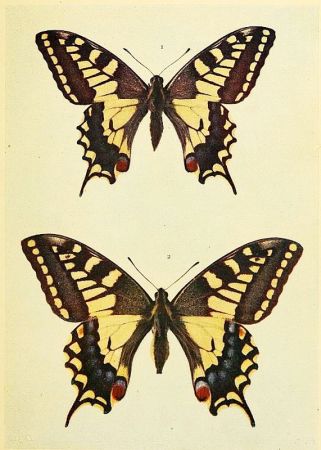
The Swallow-tail butterfly is the only British member of the extensive and universally distributed sub-family Papilioninæ, which includes some of the largest as well as the most handsome kinds of butterfly. Our species has yellow wings ornamented with black, blue, and red, and is an exceedingly attractive insect. The black markings are chiefly a large patch at the base of the fore wings, this is powdered with yellow scales; a band, also powdered with yellow, runs along the outer or hind portion of all the wings. There are also three black spots on the front or costal margin, and the veins are black. The bands vary in width, and that on the hind wings is usually clouded more or less with blue. At the lower angle of the hind wings there is a somewhat round patch of red, and occasionally there are splashes of red on the yellow crescents beyond the band. The male and female are shown on Plate 2.
The eggs are laid on leaflets of the milk parsley (Peucedanum palustre), which in the fenny home of the butterfly is perhaps the chief food-plant of the caterpillar. This is one of the few eggs of British butterflies that I have not seen. Buckler says that it is globular in shape, of good size, greenish yellow in colour when first laid, quickly turning to green, and afterwards becoming purplish.
The caterpillar when full grown, as figured on Plate 1, is bright green with an orange-spotted black band on each ring of the body, and blackish tinged with bluish between the rings. The head is yellow striped with black. When it first leaves the egg-shell, which it eats, the caterpillar is black with a noticeable white patch about the middle of the body. After the third change of skin it assumes the green colour, and at the same time a remarkable V-shaped fleshy structure of a pinkish or orange colour is developed. This is the osmaterium, and is said to emit a strong smell, which has been compared to that of a decaying pine-apple. The organ, which is extended in the figure of the full-grown caterpillar, is not always in evidence, but when the caterpillar is annoyed the forked arrangement makes its appearance from a fold in the forepart of the ring nearest the head. Other food-plants besides milk parsley are angelica (Angelica sylvestris), fennel (Fœniculum vulgare), wild carrot (Daucus carota), etc. From eggs laid in May or June caterpillars hatch in from ten to twelve days, and these attain the chrysalis state in about six or seven weeks. If the season is a favourable one, that is fine and warm, some of the butterflies should appear in August, the others remaining in the chrysalids until May or June of the following year; a few may even pass a second winter in the chrysalis. Caterpillars from eggs laid by the August females may be found in September, nearly or quite full grown, and chrysalids from October onwards throughout the winter. They are most frequently seen on the stems of reeds, but they may also be found on stems or sprays of the food-plants, as well as on bits of stick, etc. It would, however, be practically useless to search for the late chrysalids as the reeds are usually cut down in October, when the fenmen keep a sharp look-out for them, and few are likely to escape detection in any place that would be accessible to the entomologist.
Larger Image
Pl. 2.
Swallow-tail Butterfly.
1 male; 2 female.
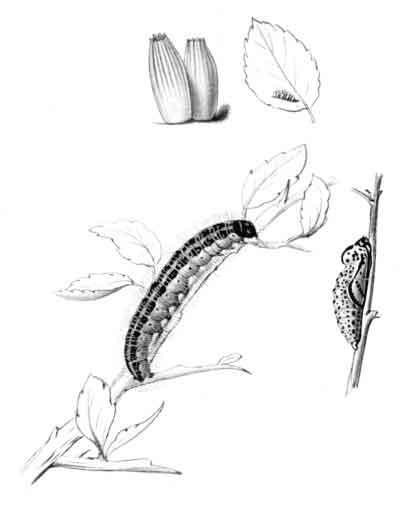
Pl. 3.
Black-veined White Butterfly.
Eggs, natural size and enlarged; caterpillar and chrysalis.
On Plate 1 three forms of the chrysalis are shown. The figures are drawn from specimens collected in Wicken Fen in October, 1905. Occasionally a much darker, nearly black, form is found.
This butterfly was known to Petiver and other early eighteenth-century entomologists as the Royal William. There is every reason to believe that at one time it was far more widely distributed in England than it now is. Stephens, writing in 1827, states that it was formerly abundant at Westerham, and gives several other localities, some very near to London.
During the last twenty-five years or so, the butterfly has been seen on the wing, from time to time, in various parts of the Southern and Midland counties. Caterpillars have also been found at large in Kent. Possibly attempts may have been made to establish the species in certain parts of England, and the presence of odd specimens in strange places may thus be accounted for. Or such butterflies may have escaped from some one who had reared them.
On the Continent the butterfly is common in woods as well as in meadows, and even on mountains up to an elevation of 5000 feet. It occurs also, but less commonly, at much higher altitudes. It therefore seems strange that in England it should be confined to the low-lying fens of Norfolk and Cambridgeshire. Such is the case, however, and a journey to one or other of its localities will have to be made by those who wish to see this beautiful creature in its English home.
It may be added that the geographical range of the butterfly extends eastwards through Asia as far as Japan. A form, known as the Alaskan Swallow-tail, is found in Alaska.
The following ten species belong to the Pierinæ, another sub-family of Papilionidæ.
The Black-veined White (Aporia cratægi).
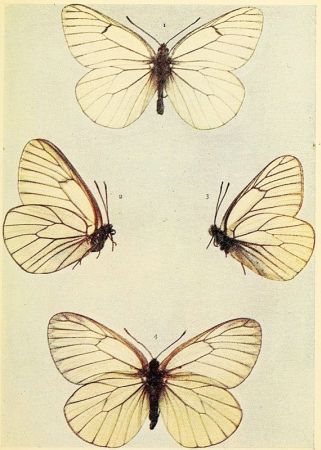
The Black-veined White (Plate 4) may be at once recognized by its roundish white wings and their conspicuous veins, which latter are black in the male butterfly, and in the female brownish on the main ones (nervures) and black on the branches (nervules). As the scales on the wings are denser in the male than in the female, the former always appears to be the whiter insect. On the outer margin of the fore wings there are more or less triangular patches of dusky scales, and these in occasional specimens are so large that their edges almost or quite meet, and so form an irregular, dusky border to the fore wings. These patches are also present on the hind wings, but are not so well defined. Sometimes the patches are absent from all the wings. The fringes of the wings are so short that they appear to be wanting altogether. The early stages are figured on Plate 3.
The egg is upright and ribbed from about the middle to the curiously ornamented top, which appears to be furnished with a sort of coronet. The colour is at first honey-yellow, then darker yellow, and just before the caterpillar hatches, greyish. The eggs are laid in a cluster on the upper side of a leaf of sloe, hawthorn, or plum, etc., in the month of July.
The caterpillar when full grown is tawny brown with paler hairs arising from white warts; the stripes along the sides and back are black. The under parts are greyish. The head, legs, and spiracles are blackish. Caterpillars hatch from the egg in August, and then live together in a common habitation which is formed of silk and whitish in colour. They come out in the morning and again in the evening to feed, but a few leaves are generally enclosed in their tenement. In October they seem to retire for the winter and reappear in the spring. During May they become full grown and then enter the chrysalis state. The butterflies are on the wing at the end of June and in July.
Larger Image
Pl. 4.
Black-veined White Butterfly.
1, 2 male; 3, 4 female.
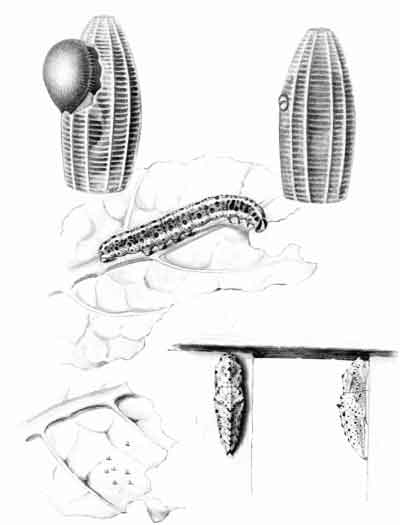
Pl. 5.
Large White Butterfly.
Eggs, natural size and enlarged; caterpillar and chrysalids.
The chrysalis is creamy white, sometimes tinged with greenish, and dotted with black.
This butterfly was mentioned as English by Merret in 1667, and by Ray in 1710. Albin in 1731, who wrote of it as the White Butterfly with black veins, figures the caterpillar and the chrysalis, and states that caterpillars found by him in April turned to chrysalids early in May and to butterflies in June. Moses Harris in 1775 gave a more extended account of the butterfly's life-history, and what he then wrote seems to tally almost exactly with what is known of its habits to-day. This species has seemingly always been somewhat uncertain in its appearance in England. Authors from Haworth (1803) to Stephens (1827) mention Chelsea, Coombe Wood in Surrey, and Muswell Hill in Middlesex, among other localities for the butterfly. It has also been recorded at one time or another, between 1844 and 1872, from many of the Midland and Southern counties. In 1867 it was found in large numbers, about mid-summer, in hay fields in Monmouthshire. The latest information concerning the appearance of the species in South Wales relates to the year 1893, when several caterpillars and four butterflies were noted on May 22 in the Newport district. At one time it was not uncommon in the New Forest, but no captures of the butterfly in Hampshire have been recorded during the last quarter of a century. At the present time it is probably most regularly obtained in a Kentish locality, presumably in the Isle of Thanet, which is only known to a few collectors. It may be mentioned that some thirty years ago caterpillars of the Black-veined White could be obtained from a Canterbury dealer at a few shillings per gross.
The species is widely distributed, and often abundant, on the Continent, and its range extends through Western and Northern Asia to Yesso, Northern Japan.
The Large White (Pieris brassicæ).
This butterfly is probably almost as familiar to those who dwell in towns as it must be to those who live in the country. It is perhaps unnecessary to describe it in any detail, and it may therefore suffice to say that it is white with rather broad black tips to the fore wings; there are some black scales along the front margin of these wings, and on the basal area of all the wings. The male has a black spot on the front margin of the hind wings, and the female has, in addition, two roundish black spots on the fore wings, with a black dash from the lower one along the inner margin.
As there is a rather important difference between the specimens of the spring (vernal) and the summer (æstival) broods, figures of a male and a female of each brood, and showing the upper and under sides, are given. Those on Plate 6 represent the spring form, which was at one time considered to be a distinct species, and named chariclea by Stephens. Plate 9 shows the summer form. The chief point of difference is to be noted in the tips of the fore wings, which in the spring butterflies are usually, but not invariably, greyish; in the summer butterflies the tips are black, as a rule, but not in every case.
Occasionally the black on tip of the fore wing in the female is increased in width, and from it streaks project inwards towards the upper discal spot. In some examples of the male there is a more or less distinct blackish spot on the disc of the fore wings. Very rarely the ground colour is creamy or sulphur tinted.
The greenish tinge about the veins, sometimes seen in these butterflies, is due to some accidental cause, probably injury to the veins.
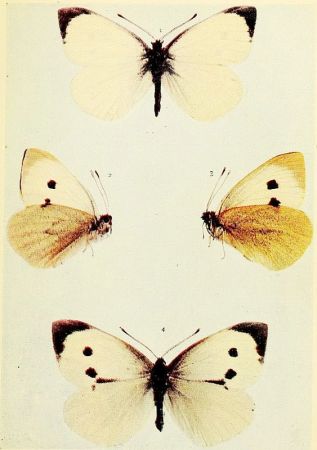
Larger Image
Pl. 6.
Large White Butterfly (Spring Brood)
1, 2 male; 3, 4 female.
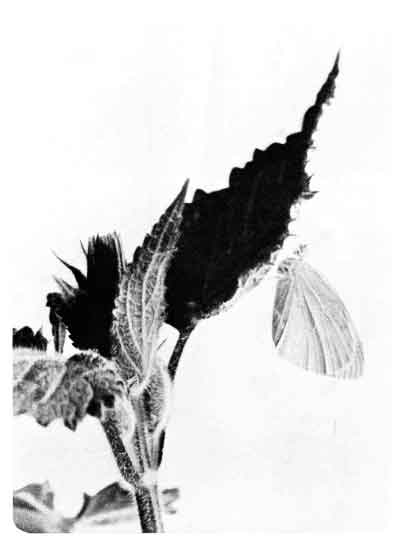
Pl. 7.
Small White Butterfly
Resting.
The egg is yellowish in colour, somewhat skittle-shaped, and very prettily ribbed and reticulated. On Plate 5 there are two figures of the egg from enlarged drawings by Herr Max Gillmer, to whom I am greatly indebted for the loan of them. In the figure on the right, the dark spot at the shoulder of the egg represents the head of the young caterpillar, and in that on the left is seen the caterpillar about to come out of the egg. The head is already out, and the jaws have left their mark on the egg-shell. Most caterpillars of the Whites, as well as those of other butterflies, devour their egg-shells.
The eggs are laid in batches of from six to over one hundred in each batch. They are placed on end, and on either side of a leaf, chiefly cabbage. Herr Gillmer writes that he watched a female depositing her eggs on a leaf of white cabbage in the hot sunshine, and found that she laid twenty-seven in about nine minutes. A previous observer had timed a female, and noted that she produced eggs at the rate of about four in the minute. Caterpillars hatch from the egg in about seven days in the summer. The caterpillar (Plate 5) when full grown is green tinged with blue or grey above, and greenish beneath. There are numerous short whitish hairs arising from little warts on the back and sides; the lines are yellow. The caterpillars feed in July, and sometimes again in September and October, on all plants of the cabbage tribe, and also on tropæolum and mignonette. A number of these caterpillars may often be seen crowded together on a cabbage leaf, and they sometimes abound to such an extent that much loss is sustained by growers of this most useful vegetable. A peculiarity of these caterpillars is that even when not numerous, their presence is indicated by an evil smell that proceeds from them. The unpleasantness of the odour is greatly intensified if the caterpillars are trodden upon.
The chrysalis (Plate 5) is of a grey colour, more or less spotted with black and streaked with yellow. It is often to be seen fixed horizontally under the copings of walls, the top bar of a fence, or a window-sill; but it sometimes affects the upright position when fastened in the angle formed by two pales. A position that affords some measure of protection from weather is generally selected.
Although this butterfly is almost annually to be seen, in greater or lesser numbers, throughout the country, it is occasionally scarce, either generally or in some parts of the British Islands. For example, during the past year (1905) it was abnormally plentiful in Ireland, but at the same time comparatively rare in England. It is a migratory species, and no doubt its abundance in any year in these islands is dependent on the arrival of a large number of immigrants. Possibly in some years none of the migrant butterflies reach our shores, and that it is largely to this failure the rarity of the species in such years is to be attributed. Caterpillars resulting from alien butterflies may absolutely swarm in the autumn of one year, but the eccentricities of an English winter may be too much for the vitality of such of them as escape their enemies, Apanteles glomeratus, and other so-called "ichneumons," and reach the chrysalis state. So, with immigration on the one hand and destructive agencies on the other, it may be understood how it comes about that the Large White is sometimes abundant and sometimes scarce.
This species seems to range over the whole of the British Islands, with the exception, perhaps, of the Shetlands. Abroad, it has been found in all parts of the Palæarctic Region, except the extreme north, and Eastern Asia.
The Small White (Pieris rapæ).
The Small White butterfly (Plate 11) is, perhaps, more often in evidence then its larger kinsman just referred to. It also is a migrant, and although it never seems to be absent from these islands, in its proper season, its great increase in numbers in some years is almost certainly due to the arrival of immigrants.
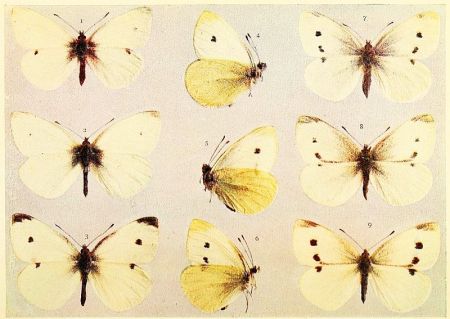
The spring form of this butterfly, named metra by Stephens, who, together with others, considered it a good species, has the tips of the fore wings only slightly clouded with black; and the black spots near the centre of the wings are always more or less faint in the male. Sometimes the central spot and also the blackish clouding of the tip are entirely absent. The summer brood, on the other hand, has fairly blackish tips and distinct black spots—one in the male and three in the female, the lower one lying on the inner margin. Occasionally examples of this flight bear a strong resemblance to the Green-veined White, the next species. The wings are sometimes, chiefly in Ireland, of a creamy colour, more especially in the female, or, more rarely, of a yellowish tint. In North America, where this species was accidentally or intentionally introduced some years ago, bright yellow forms are not uncommon in some localities, and the variety is there known as novangliæ.
In certain favourable years a partial third brood has occurred, but such specimens are often small in size.
The egg (Plate 8) is at first pale greenish, but later on it turns yellowish, and this tint it retains until just before the caterpillar hatches out.
The caterpillar when full-grown has a brownish head and a green body; the latter is sprinkled with black and clothed with short blackish hairs emitted from pale warts. There is a yellowish line on the back, and a line formed of yellow spots on the side. It feeds on most plants of the cabbage tribe, and in flower gardens on mignonette and nasturtiums. It is often attacked by parasites, and especially by the Apanteles, referred to as destructive to caterpillars of the Large White.
The chrysalis may be of various tints, ranging from pale brown, through grey to greenish; the markings are black, but these are sometimes only faint. It is to be found in similar situations to those chosen by the caterpillar of the last species, but often under the lower rail of a fence or board of a wooden building. Where caterpillars have been feeding in a garden, they often enter greenhouses, among other places, to pupate; and where these structures are heated during the winter, the butterflies sometimes emerge quite early in the year. Distributed throughout the British Islands, except the Hebrides and Shetlands. It is common over the whole of Europe, and extends through Asia to China and Japan. In America, where it was introduced into the United States some forty-five years ago, it has now spread northwards into Canada, and also southwards.
The Green-veined White (Pieris napi).
This butterfly is not often seen away from its favourite haunts in the country; these are woods, especially the sunny sides, leafy lanes, and even marsh land. As in the case of the two Whites previously noticed, there are always two broods in the year. The first flight of the butterflies is in May and June, occasionally as early as April in a forward season. These specimens have the veins tinged with grey and rather distinct, but are not so strongly marked with black as those belonging to the second flight, which occurs in late July and throughout August. This seasonal variation, as it is called, is also most clearly exhibited on the under side. In the May and June butterfly (Plate 13, left side) the veins below are greenish-grey, and those of the hind wings are broadly bordered also with this colour. In the bulk of the July and August specimens (Plate 13, right side) only the nervures are shaded with greenish-grey, and the nervules are only faintly, or not at all, marked with this colour.
Now and then a specimen of the first brood may assume the characters properly belonging to the specimens of the second brood; and, on the other hand, a butterfly of the second brood may closely resemble one of the first brood. As a rule, however, the seasonal differences referred to are fairly constant. By rearing this species from the egg it has been ascertained that part (sometimes the smaller) of a brood from eggs laid in June attains the butterfly stage the same year, and the other part remains in the chrysalis until the following spring, the butterflies in each set being of the form proper to the time of emergence.
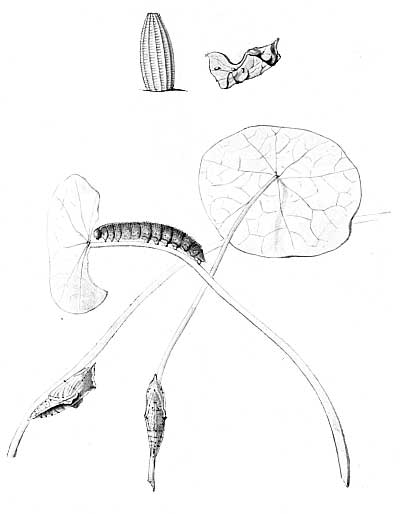
Pl. 8.
Small White Butterfly.
Eggs, natural size and enlarged; caterpillar and chrysalids.
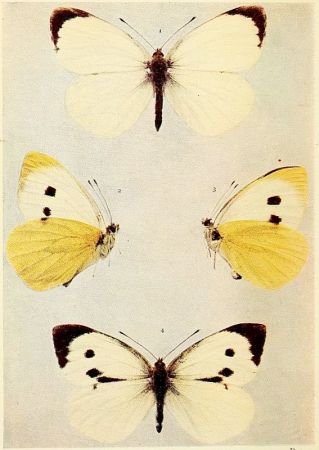
Larger Image
Pl. 9.
Large White Butterfly (Summer Brood).
1, 2 male; 3, 4 female.
The strongly-marked specimens (Plate 14) are from Ireland, and are of the first or spring brood. The seasonal variation in this species is not so well defined in Ireland as in England.
A form of variation in the female, and most frequent perhaps in Irish specimens, is a tendency of the spots on the upper side of the fore wings to spread and run together, and so form an interrupted band.
Specimens with a distinct creamy tint on the wings are sometimes met with, but such varieties, as well as yellow ones (var. flava, Kane), are probably more often obtained in Ireland and Scotland than in England. Occasionally male specimens of the second brood have two black spots on the disc of the wing. Some forms of this butterfly have been named, and these will now be referred to.
Sabellicæ (Petiver), Stephens, has been considered as a species distinct from P. napi, L. Stephens ("Brit. Entom. Haust.," I. Pl. iii., Figs. 3, 4) figured a male and a female as sabellicæ, which he states differs from napi in having shorter and more rounded yellowish-white wings. No locality or date is given in the text (p. 21) for the specimens figured; but referring to another example which he took at Highgate on June 4, he says that it agrees with his Fig. 2. Probably, however, it was his second figure that he intended, the Fig. 4 of the plate, which is a female. This is rather more heavily marked with dusky scales than is usual in specimens of the first brood, at least in England, although it agrees in this respect with some Irish June examples. Fig. 3 represents a male which certainly seems to be referable to the spring form. Most authors give sabellicæ; as belonging to the summer flight, but this does not seem to be correct.
Var. napææ is a large form of the summer brood, occurring commonly on the Continent, in which the veins on the under side of the hind wings are only faintly shaded with greenish-grey. Occasionally specimens are taken in this country in August, which both from their size and faint markings on the under side seem to be referable to this form.
Var. bryoniæ is an Alpine form of the female, and in colour is dingy yellow or ochreous, with the veins broadly suffused with blackish grey, sometimes so broadly as to hide the greater part of the ground colour. This form does not occur in any part of the British Islands, but some specimens from Ireland and from the north of Scotland somewhat approach it.
All the early stages are shown on Plate 10.
The egg is of a pale straw colour when first laid, but it soon turns to greenish, and as the caterpillar within matures, the shell of the egg becomes paler. The ribs seem to be fourteen in number.
The eggs are laid singly on hedge garlic (Sisymbrium alliaria) and other kinds of plants belonging to the Cruciferæ. The egg in the illustration was laid on a seed-pod of hedge garlic, but the caterpillar that hatched from it was reared on leaves of garden "nasturtium" and wallflower.
The caterpillar when full grown is green above, with black warts, from which arise whitish and blackish hairs. There is a darker line along the back, and a yellow line low down on the sides. Underneath the colour is whitish-grey. The spiracular line is dusky, but not conspicuous, and the spiracles are blackish surrounded with yellow. It has been stated that caterpillars fed upon hedge garlic and horseradish produce light butterflies, and that those reared on mignonette and watercress produce dark butterflies. Barrett mentions having reared a brood of the caterpillars upon a bunch of watercress placed in water and stood in a sunny window, but he does not refer to anything peculiar about the butterflies resulting therefrom. He states, however, that from eggs laid in June the earliest butterfly appeared within a month, and the remainder by the middle of August, only one remaining in the chrysalis until the following June.
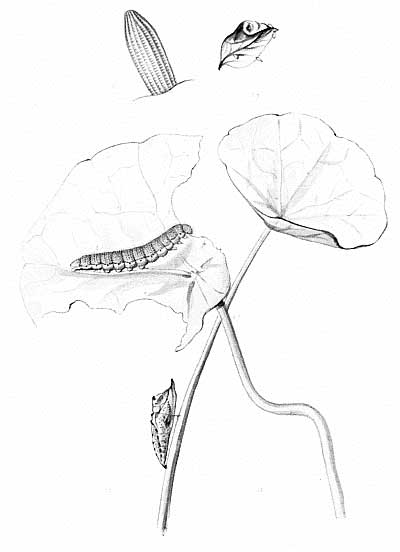
Pl. 10.
Green-veined White Butterfly.
Eggs, natural size and enlarged; caterpillar and chrysalis.
Larger Image
Pl. 11.
Small White Butterfly.
1, 2, 4 male (spring), 3 do. (summer); 5, 7, 8 female (spring),
6, 9, do. (summer).
Caterpillars may be found in June and July and in August and September.
The chrysalis is green in colour, and the raised parts are yellowish and brown. This is the most frequent form, but it varies through yellowish to buff or greyish, and is sometimes without markings.
Generally distributed throughout the British Islands, but its range northwards does not seem to extend beyond Ross.
In Europe it is generally common, and extends through Western and Central Asia to Siberia, and, according to Leech, is found in North Japan. In Amurland and Corea it is represented by the form orientis, Oberth. It occurs in North-West Africa, the Canary Isles, and the Azores. In America it is found in the Northern States and in California.
The Bath White (Pieris daplidice).
The Bath White (Plate 14) is such a rare visitor to this country, that any one who captures a specimen may congratulate himself on the event. During the whole of the last century not more than sixty specimens seem to have been recorded as taken in England, and ten of these were captured between 1895 and the present time. Nearly all of these were netted on the south or south-eastern coast, and in the months of July or August, but chiefly the latter. The occurrence of specimens in May or June appears to be quite exceptional.
Although it might be passed over for a Green-veined White, or other common butterfly, when seen on the wing, it is very different from any of our other species when seen at close quarters. In the greenish mottling of the under side of the hind wings, the male has some likeness to the female Orange-tip, but on the Bath White the green is heavier and less broken up. On the upper side of the fore wings the black markings comprise a spot, sometimes divided, at the end of the cell, and a patch on the tips of the wings; the latter enclose spots of the ground colour. The markings of the under side show through blackish on the upper side of the hind wings. The female differs from the male in having a black spot between veins 1 and 2 of the fore wings, and the markings of the hind wings are blacker, especially on the outer area.
The egg is stated by Buckler to be of a bright pinkish-red colour, agreeing in this respect, as well as in size, with the anthers of the flowers of mignonette, upon which plant it is laid in an upright position. The shape is compared to that of an acorn without the cup, and it has twelve or fourteen rather prominent ribs.
The full-grown caterpillar is bluish-grey, dotted with glossy black warts, from each of which there is a short blackish hair. The lines along the back and sides are yellow, or white spotted with yellow. Head yellowish, dotted with black, and hairy. August and September. It feeds on garden as well as wild mignonette (Reseda).
The chrysalis is at first similar in colour to the caterpillar, but it afterwards becomes whitish. It has numerous black dots, and is marked with yellow along the sides and on the back of the thorax.
The above descriptions are abridged from Buckler's more detailed account of the life-history of this species. Of the caterpillars resulting from thirty-three eggs, only two attained the chrysalis state, in September. One of these turned black and died in November, and from the other a butterfly emerged in the following June. The figures of caterpillar and chrysalis on Plate 12 are from Buckler's "Larvæ."
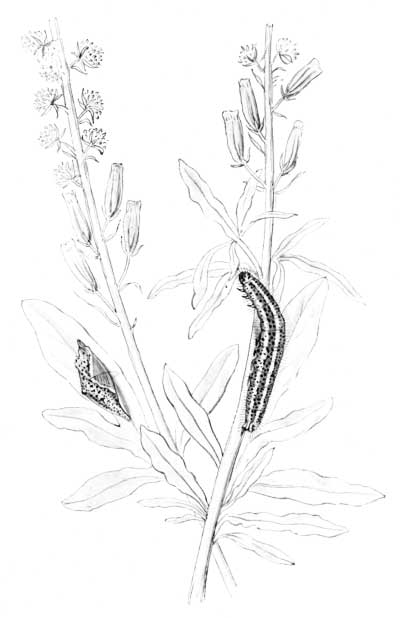
Pl. 12.
Bath White Butterfly.
Caterpillar and chrysalis (after Buckler).
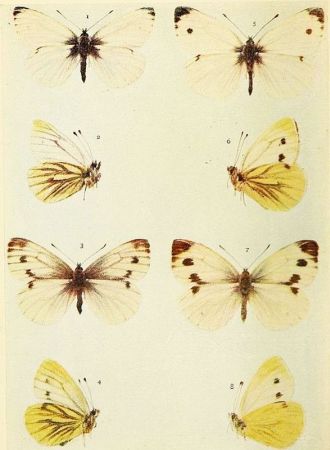
Larger Image
Pl. 13.
Green-veined White Butterfly.
1, 2 male (spring), 5, 6, do. (summer); 3, 4 female (spring), 7, 8 do. (summer).
It has been suggested that specimens taken in July and August are the offspring of immigrants that arrive here in May, but there is no conclusive evidence of this. It has, however, been proved that our climate is not suitable for the permanent establishment of the species here.
The earliest writers on English insects called this butterfly "Vernon's Half Mourner," or "The Greenish Half Mourner." It was first mentioned by Petiver, some two hundred years ago, and about that time only two British specimens were known. One of these was taken in Cambridgeshire, and one at Hampstead. According to Lewin, who wrote about it in 1795, the name "Bath White" was given to the butterfly "from a piece of needlework executed at Bath by a young lady, from a specimen of this insect, said to have been taken near that place." In 1796 Donovan only knew of the Bath specimen; and in 1803 Haworth mentions a faded specimen taken in June at Gamlingay in Cambridgeshire.
The species is more or less common in many parts of Europe, but it seems to be most at home and abundant in the south. Its range extends to North Africa, Madeira, the Canary Isles, and the temperate parts of Asia, including Northern China and Corea.
The Orange-tip (Euchloë cardamines).
This butterfly (Plate 17), as its name suggests, has a large patch of orange colour on the outer third of its white, or creamy white, fore wings, and the extreme tip is blackish; at least, this is so in the male. The female is without the orange patch, and this is replaced by a smaller one of blackish-grey. The lower portion of this patch is broken up by the ground colour, and by white spots on the outer margin and around the tips of the wings. The hind wings, in both sexes, appear to be dappled with greyish-green, and this is caused by the green marking on the under surface of the wings showing through. Some specimens, chiefly from Ireland, have all the wings in the male, and the hind wings in the female, distinctly tinged with yellow. The discal black spot varies in size and in shape; often it is roundish, and sometimes it is crescent-like. It is always larger in the female than in the male, and may be entirely absent in the latter sex; but this probably occurs very rarely. Usually the orange patch of the male extends very near to the inner angle of the wing, but sometimes it is continued through to this point. It ranges in colour from deep to pale orange, and occasionally to almost yellow. Small specimens, some not more than one inch and a quarter in expanse, occur from time to time. In these dwarfs the orange patch does not reach beyond the black discal spot, which in normal specimens it usually does. This small form has been considered a distinct species, and the name hesperidis has been proposed for it. Female specimens with splashes or streaks of the male colour on the upper or the under sides have been noted not infrequently; and more rarely specimens with one side entirely male and the other entirely female have been taken.
The egg (Plate 15), when freshly laid, is whitish, faintly tinged with greenish; it soon changes to yellow, and, later on, turns orange and then dark violet. When the latter colour appears, the little caterpillar may be expected to hatch out very shortly. The eggs are placed upright on the foot-stalks of the flowers, and may be readily found in June by searching the blossom-clusters of hedge-mustard or cuckoo-flower.
The caterpillar, when mature, is dull bluish-green, with raised dots and warts; from the former arise whitish hairs, and from the latter longer blackish hairs. There is a white line, or stripe, along the sides, and the underparts of the body are greener than the back. Both in colour and marking the caterpillar agrees so closely with the seed-pods of its food-plant that its detection is not always easy. A peculiarity in very young caterpillars of this species, and also those of some of the "Whites," is, that the hairs are forked at the tips, and bear globules of moisture thereon (see figure and remarks on p. 3).
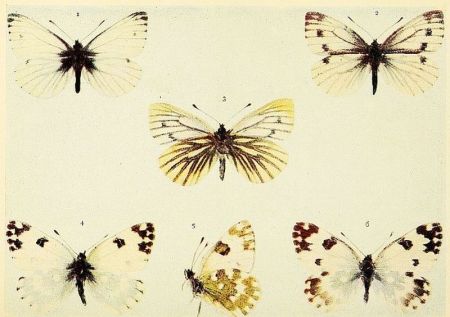
Larger Image
Pl. 14.
Green-veined White (Irish).
1 male; 2, 3 female.
Bath White.
4, 5 male; 6 female.
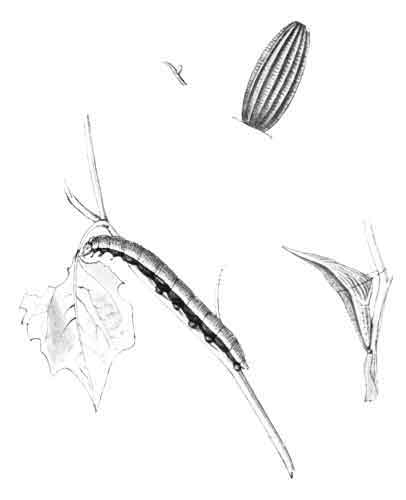
Pl. 15.
Orange-tip Butterfly.
Egg, natural size and enlarged; caterpillar and chrysalis.
The caterpillars feed in June and July on lady's smock or cuckoo-flower (Cardamine pratensis), charlock (Brassica sinapistrum), hedge-mustard (Sisymbrium officinale), garlic mustard (S. alliaria), rock-cress (Arabis), horseradish (Cochlearia armoracia), dame's violet (Hesperis matronalis), watercress (Nasturtium officinale), etc.
The chrysalis, as will be seen from the figure (Plate 15), is curiously elongated, and tapers towards each end; the outline of the back is curved, and the wing-cases bulge out into an angle about the middle of the under side. The colour is pale grey or whitey-brown, sometimes with a strong rosy tinge; the back is speckled with brownish, and has an olive-grey dorsal line, and the veins of the wings are well defined. This stage lasts, as a rule, from August of one year until May of the following year. When the chrysalis is first formed, it is green, with the wing-cases brighter, and this colour is sometimes retained. It has been stated that the chrysalids assume the colour of their immediate surroundings, and this may be so; but all that I have had under observation were of the colours described above, although some were fastened to green stem, others to muslin, and others, again, to glass.
Towards the end of May and in June is the usual time for this butterfly to be on the wing. It has, however, been noticed as early as about the middle of April, and as late as the middle of July, and rarely in August and September. The specimens, seen in the last-mentioned months, may have represented a second brood, and, if so, a very unusual event. Possibly, however, they may have been specimens whose emergence had for some reason not understood, been retarded. There is at least one record of the insect remaining in the chrysalis for two winters.
Although generally distributed throughout England, Wales, and Ireland, and occurring in Scotland as far north as the Caledonian Canal, it seems to be more common in some districts than in others. Abroad, its range extends over Europe, and through Asia as far east as Amurland and China.
The Wood White (Leucophasia sinapis).
The graceful little butterfly figured on Plate 19 is creamy white, with a rather square black or blackish spot on the tip of the fore wings of the male. In the female the spot is reduced to some blackish scales on and between the veins. Occasionally there is a second brood in the year, and the specimens of this flight have smaller and rounder black spots in the males, and almost none at all in the females. Specimens of the female sex entirely devoid of black marking are referable to var. erysimi (see fourth figure in second row, Plate 16). Series of each brood are shown on Plate 16, which is reproduced from a photograph by Mr. Hamm. The lower specimen in each series has been reversed to show the seasonal variation of the under side. The row of specimens on the left are of the first brood, and the second and last examples in this series show the characters of var. lathyri—black tips to the fore wings, and dusky band-like shades on the hind wings; the under sides of the hind wings dull greenish—to which form a good many of our spring specimens belong. The specimens of the second generation are referable to var. diniensis. The species is sometimes referred to Leptosia, Hüb.
The egg, which is figured on Plate 18, is yellowish-white in colour; it is ribbed, and rather glassy in appearance. The caterpillars have been known to hatch out about a week after the eggs were laid.
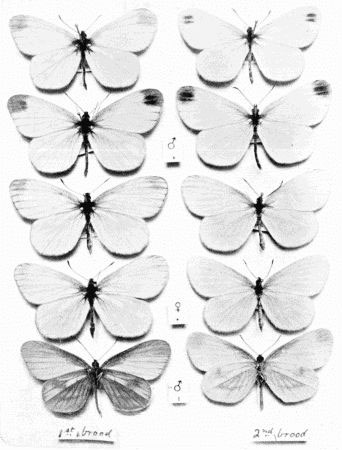
Larger Image
Pl. 16.
Wood White Butterfly.
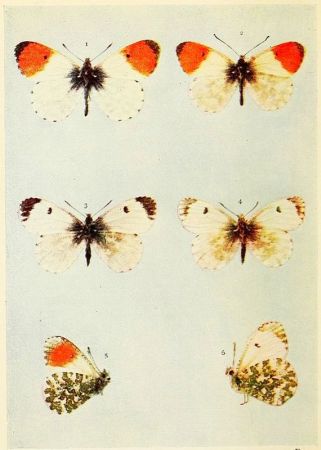
Larger Image
Pl. 17.
Orange-tip Butterfly.
1, 5 male; 2 do. (Irish); 3, 6 female; 4 do. (Irish).
The caterpillar when full grown is, according to Hellins, "a beautiful green, the front segments minutely dotted with black; dorsal line darker green, edged with yellowish-green; spiracular line distinct, of a fine clear yellow, edged above with darker green; spiracles indistinguishable." The chrysalis in shape is something like that of the last species, but the back is not curved, and the ends are less tapered. The colour is a "lovely delicate green; the abdomen rather yellowish; just in the spiracular region there runs all round the body a stout pink rib, enclosing the greenish spiracles; from this a strong pink line branches off, bordering the outer edge of the wing-case, and the nervures of the wings themselves are delicately outlined in pink" (Hellins). Sometimes the chrysalids are green without marking.
Mr. A.M. Montgomery, who on one occasion had four batches of eggs, and the subsequent caterpillars, under observation, states that the caterpillars hatched about June 2 from eggs laid about May 22. Pupation took place about July 3, and, except from one batch that remained for the winter in the chrysalids, the butterflies emerged between July 16 and 22. The food-plant in this case was bird's-foot trefoil (Lotus corniculatus). The yellow pea (Lathyrus pratensis) is a favourite pabulum, but the caterpillar will also eat a vetch (Vicia cracca), and probably many other plants belonging to the order Leguminosæ. Caterpillars from the July butterflies would feed in August and September.
This fragile-looking little species is somewhat local, but is not altogether uncommon in some of its particular haunts. As its English name implies, the butterfly is fond of the woods, or, perhaps, is rather more partial to their shady rides and margins. On dull or wet days, it settles on the under side of a leaf. The first brood is on the wing in May, and the second—when this occurs, which is not every year—in July and August. In Ireland, where it is abundant in the south and west, there seems to be only one flight, and this is in June. It may be well to remember that this butterfly does not like the pill-box, and will not settle down quietly therein.
Possibly the Wood White had a much more general distribution in England at one time than it now seems to have. It was not uncommon in parts of Sussex some years ago, but there appears to be no record of its occurrence there now. It is certainly much scarcer in the New Forest than it used to be. However, it is still to be found, no doubt, in many parts of England and Wales, but chiefly perhaps in the counties of Berkshire, Devonshire, Cornwall, Worcestershire, Herefordshire, Lancashire, and Cumberland. Also in the south and west of Ireland. It occurs throughout Europe, Western and Central Asia, and its range extends eastwards through Siberia, Amurland, China, and Corea to Japan.
The Pale Clouded Yellow (Colias hyale).
This usually scarce butterfly (Plate 21) is of a primrose-yellow colour in the male, and, as a rule, almost white in the female; sometimes the latter sex is of the yellow male colour. The outer margin of the fore wings is broadly black in both sexes, but there are some more or less united spots of the ground colour in the black towards the tips of the wings, and below vein 3 the black is usually confined to the outer margin. There is a black spot near the middle of the wing, and some blackish dusting quite near the base of the wing. The hind wings have a pale orange central spot, sometimes two spots, and the blackish border on the outer margin is generally narrow, and often interrupted or broken up into spots. The fringes of all the wings are pinkish, as also are the antennæ. The egg is pearly yellowish-white when first laid; a few days later the top becomes transparent, white, and glassy, shading downwards into yellow, and then clear rosy orange; the base is pale, but less transparent than the top. It has a number of transverse ribs, ranging from nineteen to twenty-two. Before the caterpillar hatches out, the egg changes to a purplish leaden colour.
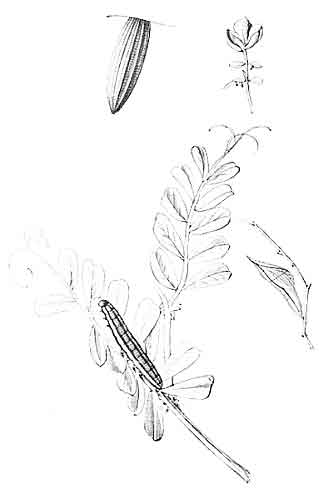
Pl. 18.
Wood White Butterfly.
Eggs, natural size and enlarged; caterpillar (after Buckler) and chrysalis.
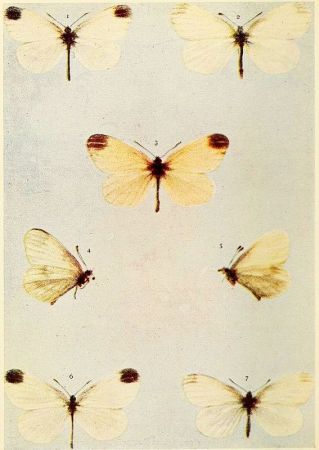
Larger Image
Pl. 19.
Wood White Butterfly.
1, 4, 6 male; 3 do. (var.); 2, 5, 7 female.
The caterpillar in October, before hibernation, is about a quarter of an inch long, and deep clover-green in colour; it has a number of pale, shining warts along the back, from each of which there is a moderately long black bristle, and there is a pale yellowish-white stripe above the black spiracles. The head is pale ochreous green, with warts and bristles as on the body. It rests upon a pad of silk spun on the centre of a leaflet. When full grown the colour is clear light green, but has a darkish velvety appearance, due to the entire surface being densely sprinkled with black warts, the bristles from the warts on the back are black, and those on the lower surface are white, the line above the spiracles, which are white outlined with black, is made up of lemon-yellow, orange-vermilion, and orange with an upper border of white. The head, claspers, and legs are green. It feeds in June, and again in August, on clover, trefoil, etc. The figure on Plate 20 is after Hübner.
The chrysalis is very similar to that of the Clouded Yellow, the chief differences are that the head-beak of the present species is straight instead of being slightly upturned, and the tip of the wing-case extends further down the body.
The above particulars of the early stages of the Pale Clouded Yellow are adapted from Mr. Frohawk's account of the life-history of the species (Entomologist, 1892 and 1893).
From eggs laid in September by a captured female, Mr. Williams reared two butterflies in November of the same year. Other caterpillars from the same batch of eggs hibernated and recommenced feeding in the spring, but failed to attain the chrysalis state. Young caterpillars from eggs obtained in August were successfully hibernated by Mr. Carpenter, and many of these produced butterflies in the following May.
In rearing this species from eggs laid in the autumn, a fairly dry treatment appears to be the best. Protect the young caterpillars from frost, and do not water the plants during the winter. When they become active again, about February, transfer them to other growing plants, which should be kept ready for the change. Do not water the plants much, or wet the foliage at all, and keep a sharp look-out for earwigs.
It seems pretty clear that this species passes the winter as a caterpillar, and from the evidence available it appears equally certain that the caterpillars would not survive an ordinary winter in this country. Possibly, however, in very mild winters, or in certain warm nooks on the south coast, some may be able to exist until the spring, and then complete their growth and reach the butterfly state. In such native-born butterflies the ancestral migratory habit may be lost, owing to climate, and they would not, therefore, wander far from the spot where they emerged from the chrysalis, but found a colony, which probably would be cleared off sooner or later by the severity of an English winter.
The Pale Clouded Yellow was not mentioned as an English butterfly until Lewin wrote about it in 1795. He states that he only met with it "in the Isle of Sheppey and on a hilly pasture-field near Ospringe in Kent." He seems to have noted it in different years at both places. Stephens, in 1827, referred to it as a rare British species, and from that date until 1867 it seems to have been common only in 1835, 1842, 1857, and 1858. In 1868 it was abundant in the southern and eastern counties, and was observed as far north as Lancashire and Yorkshire, also in Ireland. It was common on the south coast in 1872, and rather more so in 1875, when it spread into Essex and Suffolk, and also inland. Until 1875 the butterflies seem only to have been noticed in the autumnal months, but in that year specimens had been seen in May and June. In 1876 the species was pretty plentiful, but after that date it did not again occur in numbers until 1892, when it was recorded from most of the southern and eastern counties. In 1893 one or two specimens were reported as seen in April or May, but less than a dozen were recorded as captured during the autumn of that year. Not much was seen of the butterfly again until 1899, when a score or so were recorded from Kent. Two or three specimens were seen on the south coast in June, 1900, and the species was plentiful in the autumn of that year in many parts of the country. Single specimens were seen in June, 1901, and in the autumn the butterfly was again fairly common in several southern counties, and abundant in parts of Essex. In 1902 a male was taken near Dartford in March, and one example in May in a locality where two specimens had been captured on October 20 of the previous year; six males and one female were obtained between June 27 and July 12 at Sheerness. The summer of 1902 was a cold one, and, with the exception of four specimens at Folkestone in August, the species was not again seen during that year or the following one; but in 1904 a good many specimens were secured at Chatham in September, and one or two at Margate in August.
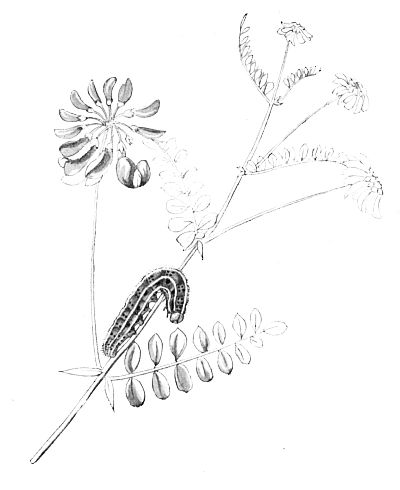
Pl. 20.
Pale Clouded Yellow Caterpillar.
(After Hübner.)
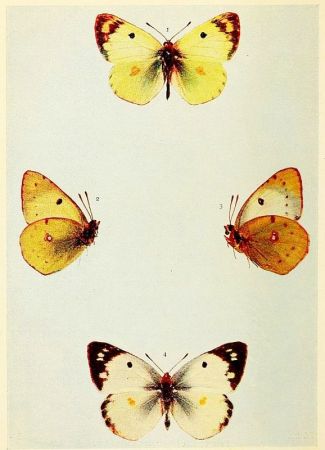
Larger Image
Pl. 21.
Pale Clouded Yellow.
1, 2 male; 3, 4 female.
When it occurs in this country the butterfly should be looked for in clover and lucerne fields.
Common throughout the Palæarctic Region. It is probably a species of Eastern origin, but with a tendency to spread westward.
The Clouded Yellow (Colias edusa).
In its typical colouring—orange with broad black borders—this butterfly (Plate 22) will be recognized the first time it is seen. Both sexes have a black spot about the centre of the fore wings, and a deep orange spot near the middle of the hind wings—the latter is subject to variation in size and shape. The female usually has the black borders spotted with yellow, but in some examples these spots are almost (Plate 24, Fig. 1) or quite absent. Another form of the female, known as var. helice (Plate 24, Fig. 2), has the orange colour replaced by yellowish-white, and in some years is not altogether uncommon. Between this yellowish-white at one end of the colour range and the typical orange at the other, specimens showing all the intermediate shades have been obtained, chiefly by rearing the butterflies from eggs laid by a female helice. One of these intergrades will be seen on Plate 24, Fig. 3. The males vary, especially bred ones, from "deep rich orange to the palest chrome yellow; the marginal bands also vary in width; in many examples the yellow nervules run through the borders of all the wings. A large proportion of the males have the hind wings shot with a beautiful amethystine blue" (Frohawk).
The egg (Plate 23) is oval, tapering towards each end, very pale yellowish in colour at first, but afterwards becoming darker yellow, and then pink. The eggs are laid, as shown in the figure, on the upper side of a leaf of clover or lucerne, sometimes singly, but often in small batches.
The caterpillar when full grown is deep green with minute black dots, from which fine hairs arise, and a pink-marked yellow, or whitish, spiracular line. The head is also green, rather downy, and small in size. When first hatched the caterpillar is brownish, but soon changes to greenish. It feeds on clover (Trifolium), trefoil (Lotus), melilot (Melilotus), etc., in June and again in September or October.
The chrysalis is yellowish-green above, somewhat paler below; the wing-cases are rather deeper in tint than the thorax and back, and have a central black speck and a row of slender marks at the edges. The body is marked with a splash of reddish and tiny black dots on the under side. The beak-like projection from the head is dark green above and yellow beneath.
The figures of the caterpillar and the chrysalis are taken from Buckler's "Larvæ of British Butterflies," and the descriptions of these stages by the same author have been followed.
The Clouded Yellow has a great fancy for clover or lucerne fields, and should be looked for in such places in August and September. It is not very difficult to rear from the egg, so that if a female is captured in August (the spring ones should not be taken), it would be a good plan to try to induce her to lay some eggs. The best method to succeed in this is to pot up a growing plant of clover, and over this place a glass cylinder with a muslin cover. (See further directions in the Introduction, page 28.)
This butterfly, which was known, to the earliest English authors as the "Saffron" or "Spotted Saffron," has always, no doubt, been erratic and uncertain in its appearance in this country, sometimes becoming increasingly abundant for three, four, or even five years in succession, and then scarce or entirely absent for similar periods. The most recent years of plenty, or when it was fairly common, were 1877, "the great Edusa year," 1892, 1893, 1894, 1895, 1899, 1900, and 1902. In some of these years the Pale Clouded Yellow was also common.
In some of the warmer countries that this butterfly inhabits it has certainly three, and possibly four, broods in the year. It is therefore conceivable that at times its increase in numbers may become very great in some particular area. At such times swarms of the surplus butterfly population set out to seek fresh fields and pastures new. Some portion of these flights reach our country from time to time, and this probably always occurs in the spring of the year. The weather conditions being favourable, the offspring of the visitors put in a welcome appearance in the autumn, and not only gladden the heart of the entomologist, but add a charm to the countryside which every one can appreciate.
The butterfly has probably occurred, at some time or other, in almost every county in England and Wales, Ireland and Scotland, extending even to the Orkney Islands (1877).
Its home appears to be in North Africa and South Europe, whence it spreads over the greater part of Europe and Western Asia.
Note.—According to Kirby, this butterfly should be called Eurymus hyale, Linn., and the Pale Clouded Yellow be known as Eurymus kirbyi, Lewis.
The Brimstone (Gonepteryx rhamni).
This butterfly (Plate 26) has the tips of the fore wings sharply pointed, and there is a rather acute angle about the middle of the outer margin of the hind wings. The colour of the male is bright sulphur yellow, with a central orange spot on each wing, that on the hind wings usually the largest; there is also a rusty dot at the outer end of the upper veins and along the front margin of the fore wings towards the tip. The female is greenish yellow, and is marked similarly to the male. In both sexes the horns (antennæ) are reddish, and the long silky hair on the thorax is a noticeable character. It is probably this insect to which the name "butter-coloured fly," contracted into butterfly, was first given; anyway, it is the only species to which the name applies so well.
The egg. If the under sides of the leaves of buckthorn (Rhamnus catharticus) or of the berry-bearing alder (R. frangula) are examined in May or June, the eggs of this butterfly may be found thereon. They are often placed on a rib of the leaf, but sometimes they are laid as shown in the illustration (Plate 25). At first the colour is pale greenish and rather glossy, but it soon changes to yellowish, and later on, when the caterpillar has formed inside, to a dull purplish-grey.
The caterpillar when full grown is green, merging into bluish-green on the sides, thickly powdered with shining black specks. There is a pale line on each side below the spiracles. It feeds in June and July on both kinds of buckthorn, and will generally be found resting along the main rib of a leaf.
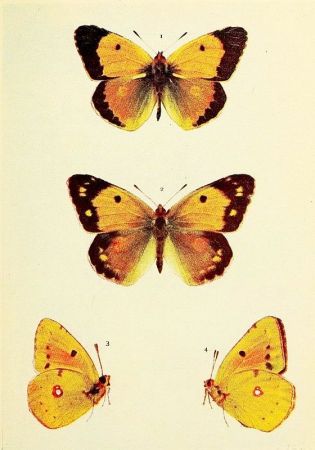
Larger Image
Pl. 22.
Clouded Yellow.
1, 3 male; 2, 4 female.
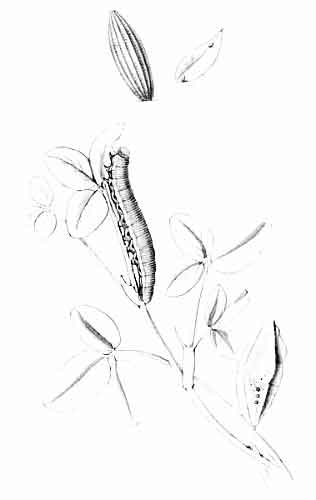
Pl. 23.
Clouded Yellow.
Eggs, natural size and enlarged; caterpillar and chrysalis.
The chrysalis is bluish-green in colour and of a curious shape. The sharp yellowish and brown beak-like projection in front and raised brownish bases of the wing-covers, together with the humped thorax, somewhat resemble a bird's head when seen from the front. Then, again, the enlarged wing-cases, which are rather greener than the other parts, in conjunction with the general outline, give a very good imitation of a curled leaf.
The butterfly is very constant as regards colour and marking, but occasionally the fore wings may be more or less suffused with orange, and in this respect assumes the coloration of the South European species known as G. cleopatra. The attempt has been made to establish the last-named butterfly in Ireland, but the experiment seems to have been only partially successful. Sometimes female specimens are found to have splashes of the male colour on their wings. Occasionally their colour is intermediate between their own proper tint and that of the male, and more rarely the wings on one side may be yellow, as in the male, while those on the other side are greenish, as in the female. Such specimens are termed gynandrous examples, and sometimes hermaphrodites. The latter, however, is not correct.
An unusual variation of the butterfly is shown on Plate 27. This has large oval pale brownish-orange marks on the under side of the wings. It was taken in the New Forest.
The Brimstone butterfly enjoys a longer existence in the perfect state than any of the other British species, with the exception, perhaps, of the Tortoiseshells and their allies. It leaves the chrysalis at the end of July or beginning of August, and is usually quite common during the latter month. After this it takes up its winter quarters, from which, however, it may be tempted to come out whenever the day is sufficiently warm and sunny for it to indulge in a few hours' flight. The fine condition of some of the specimens that are seen in May or June has suggested the possibility of such specimens having remained in the chrysalis during the winter, but it is not at all probable that they do so. It may be seen any sunny day from March, or even February, to June in almost every English and Welsh county where its food-plant grows, and locally in Ireland. The best time to take specimens is in the autumn, when they are often to be seen in numbers flying along the rides in or on the outskirts of woods, and also in clover fields.
Distributed over the whole of temperate Europe, and extending through Asia to the far east and to North Africa.
The thirty butterflies now to be considered belong to the Nymphalidæ, which has a larger membership than any other family of butterflies. It is divided into several sub-families, but only four of these concern us; these are Apaturinæ (1 species), Nymphalinæ (17 species), Danainæ (1 species), and Satyrinæ (11 species). The next butterfly is our only representative of Apaturinæ.
The Purple Emperor (Apatura iris).
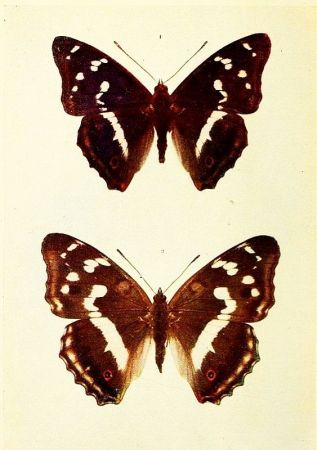
On account of its large size and the beautiful purple sheen over its brownish-black velvety wings, this butterfly (Plate 29) is always counted a prize by the collector. It is, however, only the male that dons the purple, and he only when seen from the proper angle. The female is without the purple reflection and her wings are browner, but the white spots on the fore wings and the white bands on the hind wings are rather wider than those of the male. Above the anal angle of the hind wings, in both sexes, there is a black spot, ringed with tawny and sometimes centred with white, and a tawny mark on veins 1 and 2. As will be seen on turning to the figures on Plate 31, the under side of this butterfly is exceedingly pretty. On the same plate there is a figure of the rare variety known as iole (for the loan of which I am indebted to Mr. Sabine), in which most of the white spots are absent or obscured. Intermediates between this extreme form and the type also occur, but all such aberrations are uncommon.
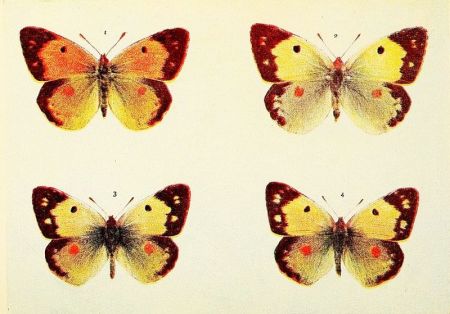
Larger Image
Pl. 24.
Clouded Yellow.
1 Female aberration; 2, 3, 4 var. helice.
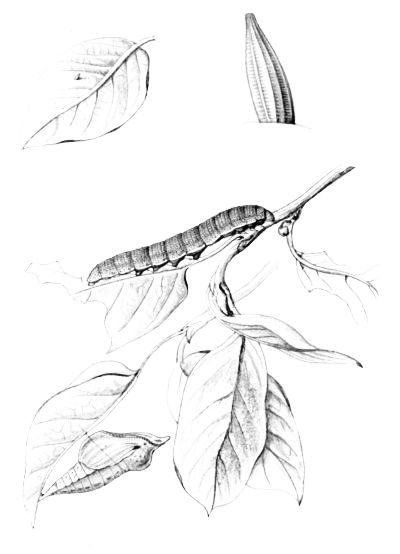
Pl. 25.
Brimstone Butterfly.
Egg, natural size and enlarged; caterpillar and chrysalis.
The egg (Plate 28) may be looked for in August on the upper surface of a leaf of the sallow (Salix caprea). According to Buckler, it is pale olive green in colour, and cylindrical in shape; the height from base to top being about equal to the width through from side to side. It has about fourteen ribs.
The caterpillar in October, just before hibernation, is dingy green roughened with numerous whitish warts from which arise short bristles, some of the latter appearing to be tinged with reddish, and those along the sides longer than those on the upper part of the body; the straight lines along the back and the oblique ones on the sides are yellowish. The head and the two horn-like projections, reminding one of the horns of a slug, are reddish-grey and covered with warts and bristles. The anal points (tails), which lie close together, are tipped with reddish. It should be mentioned here that on emerging from the egg the young caterpillar is without horns; these are not developed until the first skin is thrown off, which event happens from eight to twelve days after hatching.
The full-grown caterpillar is green, merging into yellowish towards the anal points (tails); the oblique stripes on the sides are yellowish, edged with reddish. The individual depicted on the plate took up a position for change to the chrysalis on June 6. It spun a mat of silk to the under side of a sallow leaf, and the next day it was found suspended by the claspers, which were grasping the silken mat. On the fourth day the chrysalis was fully developed, and from this a male butterfly emerged on June 24, an unusually early date.
The chrysalis is whitish, more or less tinged with green, but having the oblique lines on the sides whitish; the veins of the wings also show up whitish.
The caterpillar was well known to entomologists in this country as far back as 1758, when, in May, four were obtained from sallow at Brentwood in Essex. It usually occurs on sallow, but an instance is recorded of it refusing to eat this plant; it would probably have starved if willow, upon which it fed up, had not been substituted. A full-grown caterpillar was on one occasion found at Raindene in Sussex on poplar, which is a well-known food of the species on the Continent. Now and then a full-grown caterpillar has been met with in October, and Buckler reared two in the autumn from the egg almost to the chrysalis stage, but they died before the change was effected.
As befits his rank, the Emperor has lofty habits, and after quitting the clump of sallow bushes, among which its transformations from egg to the perfect insect were effected, it resorts to the oak trees, around which it flies in July, and, when not so engaged, rests on a leaf of the higher branches. To capture the butterfly, when seen at such times, is not altogether an easy matter, as for the purpose the net must be affixed to the end of a pole about 14 or 15 feet in length. The insect's rather depraved taste for the juices of animal matter, in a somewhat advanced stage of decay, is a fact well known to the professional collector and others who have taken advantage of it to the monarch's destruction. This method of attracting a butterfly for the purpose of capture is, however, not exactly to be commended. It surely is a greater pleasure to show one's friends a single specimen that has been captured by dexterity with the net, than to exhibit fifty that were secured by a device which is not only unsavoury, but unsportsmanlike. The female, however, is not to be allured; she must be sought among the sallows, and when seen is not easy to net, as she skims away over the tops of the bushes and is difficult to follow.
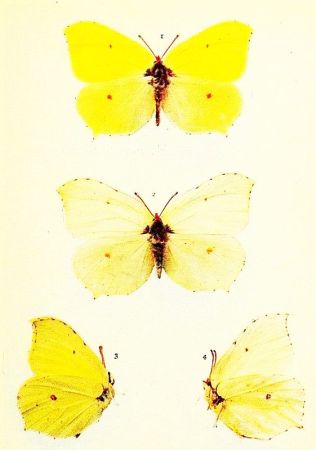
Larger Image
Pl. 26.
Brimstone Butterfly.
1, 3 male; 2, 4 female.
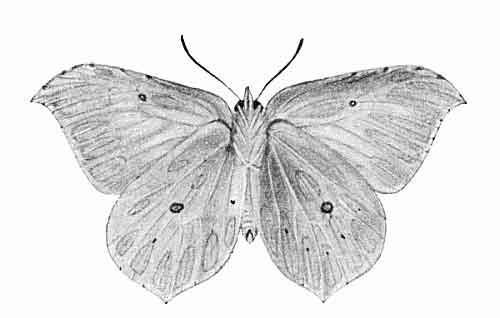
Brimstone Butterfly. Underside (aberration).
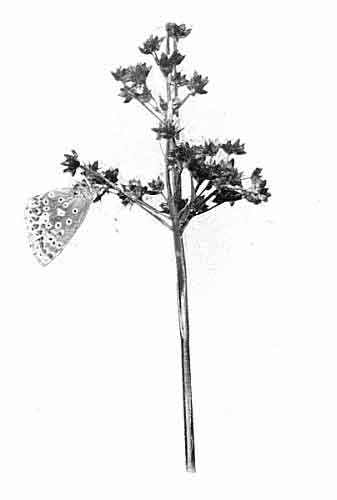
Pl. 27.
Common Blue. At rest.
Although most certainly not so common or so generally distributed as in former times, the butterfly still occurs in the larger oak woods in most of the midland, western, and southern counties of England, but is, perhaps, most frequent in Lincolnshire and Northamptonshire. In Wales it is found in Monmouthshire. It has not been recorded from Scotland, and only doubtfully from Ireland.
In Central Europe it is often abundant, and its range extends eastward into Amurland, Central and Western China.
Now follow seventeen butterflies of the sub-family Nymphalinæ.
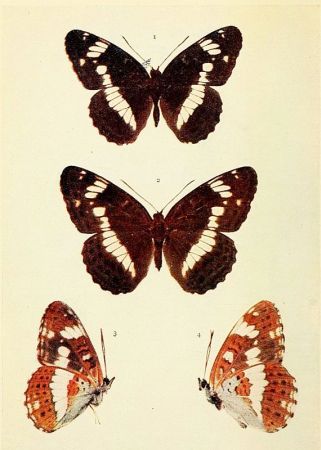
The White Admiral (Limenitis sibylla).
The "White Admirable Butterfly," as it was called by some of the older English entomologists, needs only to be seen to be at once recognized (Plate 33). The white markings on its blackish wings are somewhat similar to those of the Purple Emperor. As in that butterfly, so, too, in this, the most beautiful ornamentation is found on the under side. The shape of the wing is, however, very different in the two butterflies, and there is no probability of confusing one with the other. A somewhat uncommon form is shown on Plate 31 (also kindly loaned by Mr. Sabine); this is var. nigrina. Intermediates also occur, but these, too, are also rather rare. The eggs, which I have not seen, are stated to hatch in about fourteen days, and are laid in July. They have been described as pale green in colour, and of the shape of an orange, but flatter at the base and top.
The caterpillar (Plate 30) when full grown is dark green on the back and lighter on the sides, roughened with yellow dots, and with a yellow-marked white line above the feet. The bristly spines are reddish with pinkish tips, and those on the second, third, fifth, tenth, and eleventh rings are longer than the others. The first ring seems to be without spines, but the brownish head is set with short ones, two on the crown being rather longer and blacker than the others, and are inclined backwards.
In the autumn, when still quite tiny, it constructs a winter retreat (hibernaculum) (Plate 30) by fastening a growing leaf of sallow to a twig with silken threads, and then, using more silk, it draws the edges of the leaf together, and so forms a secure chamber wherein it can rest until the following spring, when it quits the domicile and sets to work on the tender foliage around it. At this time the caterpillar is brownish in colour. The chrysalis is of the remarkable shape shown on the plate. It is brownish, with purplish or olive tinge; behind the rounded hump there is a patch of bright green, and above the wing-cases a beautiful golden sheen. There are also other metallic spots and dots on various parts. Altogether, it is one of the prettiest of British butterfly chrysalids.
I am tempted here to quote Buckler's excellent description of the pupation of this species, as it will serve to show the remarkable method by which caterpillars are able to perform a seemingly impossible feat; that is, to get absolutely free of the old skin whilst hanging head downwards from the silken pad or button to which they attach themselves by the anal claspers when preparing to pupate.
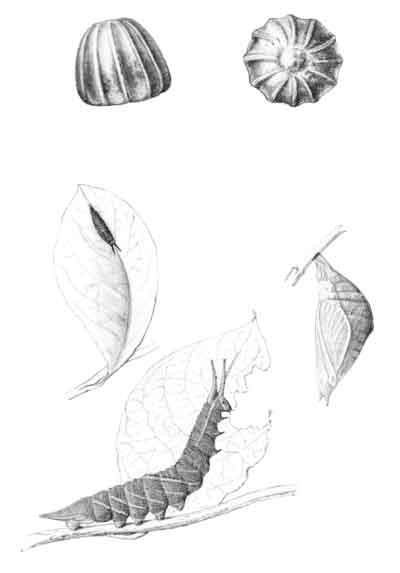
Pl. 28.
Purple Emperor.
Egg enlarged; young and full-grown caterpillars; chrysalis.
Larger Image
Pl. 29.
Purple Emperor.
1 male; 2 female.
"When full fed the larva becomes rapidly paler, and then suspends itself by the anal prolegs to a stem of the honeysuckle or other surface, and hangs with its body downwards in a sinuous curve, with its head bent a little upwards, facing the abdomen; it then remains motionless for three days, becoming whitish on the abdomen, and remaining very pale green on the thoracic segments. In the course of the third day the creature seems to wake up, unbends its head, swings itself to and fro a few times, then stretches itself downwards in a long attenuated line, which causes a rupture of the skin close to the head; the skin then is seen slowly to ascend, exposing the bare and soft shining parts below, from which a flat and forked pair of horns grow out perceptibly as one beholds this wonderful process; the skin continues to glide slowly upwards, and as the soft parts become exposed, they are seen to swell out laterally, and to assume the very singular projections so characteristic of this chrysalis, the skin of the old head gliding up the belly marks the progress of the disclosure, as the colour of the old and new surfaces is at this time alike, the new being, however, rather more shining and transparent. Occasionally during the bulging out of the soft parts, a kind of convulsive heave or two occurs, but otherwise it remains still until the creature is uncovered as far as the ninth or tenth segment; it then curves its anal extremity by a sudden twist laterally, and in a moment dexterously withdraws the tip of the anal segment from the larval prolegs by an opening on the back of the skin at that part. At this critical moment one has time to see that the naked shining point is furnished with black hooks, and to apprehend a fall; but in another moment the pupa has forcibly pressed the curved tip with its hooks against the stem close to the previous attachment of the anal prolegs, and now it is strongly and firmly fixed. The creature now seems endowed with wonderful power and vigour; it swings boldly to and fro, and undulates itself as if to gain longer swings, when presently the old skin that remains is seen to burst away and fall off, the chrysalis gradually becoming quiescent, the entire metamorphosis, from the first waking to the last movement, occupying nearly seven minutes. In sixteen days the perfect insect emerged."
Linnæus in 1767 wrote of the sexes of this butterfly as sibylla, or rather sibilla, and camilla, but, as Kirby points out, three years earlier the same author had given the butterfly the name camilla. It is probable, therefore, that the latter name will have to be adopted for our butterfly. Certain it is that the older British authors—Donovan, Haworth, Stephens, etc., knew our species as camilla. The species known on the Continent as camilla, and which, owing to the confusion of names has been supposed to be British, will have to be called drusilla, according to Kirby.
This species seems to be pretty much restricted to the southern and eastern counties of England. In the New Forest, Hampshire, it is often exceedingly abundant in July. So long ago as 1695 the butterfly was known to occur in Essex, and the species is found in some woods in that county at the present time. It has, however, quite disappeared from several woodland localities in Kent and Sussex, where it formerly occurred. It has been recorded from Shropshire and also from Worcestershire, but both these counties appear to be beyond the normal range of the species.
Almost all writers on our butterflies, from Haworth downwards, have commented on the graceful flight of the White Admiral as it skims aloft and alow through the woodland glades. This elegance of motion is still retained even when the wings become sadly torn and frayed, probably by contact with twigs and thorns.
Widely distributed throughout Central Europe. It is also found in Amurland, Corea, and Japan.
The Comma (Polygonia c-album).
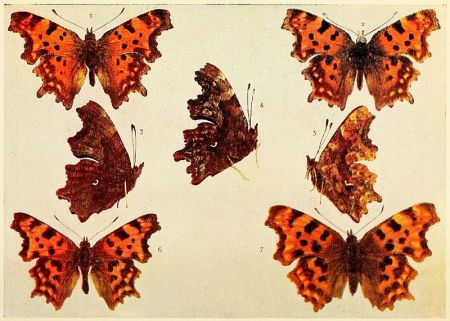
The peculiar shape of the wings of this butterfly (Plate 35) might cause it to be mistaken for a very tattered example of one of the Tortoiseshells. The irregular contour of the outer edges of the wings is, however, quite natural, and is subject to some variation in its jaggedness. Their colour is deep tawny or fulvous, with brownish borders on their outer margin. On the fore wings there are three black spots on the front or costal area, and below the first, which is often divided, there is a roundish black spot (sometimes double) just above the inner margin; two, sometimes three, other spots lie between this and the third costal spot. On the hind wings there are three black spots on the basal half, and a series of pale fulvous spots before the brownish border; these are inwardly edged with brownish, and sometimes this edging is united with the marginal border. Similar spots are, in some specimens, present in a like position on the fore wings also. On the under side the wings are of various shades of brown, sometimes variegated with whitish, or yellowish, and greenish, the latter often conspicuous; other specimens are paler on the outer half than on the basal half, and, except occasionally having a series of greenish or dusky spots on the outer area, are without marking. These differences occur in both sexes. The white comma or c mark, placed about the middle of the under side of the hind wings, is rather stronger in the variegated specimens; but it varies, generally, in shape as well as in size.
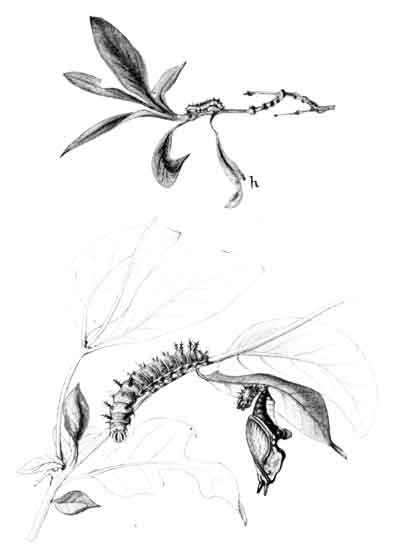
Pl. 30.
White Admiral.
Young caterpillar with hibernaculum (h); caterpillar and chrysalis.
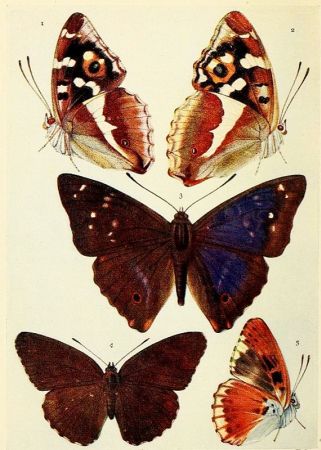
Larger Image
Pl. 31.
1, 2 Purple Emperor; 3 var. iole.
4, 5 White Admiral, var. nigrina.
Var. hutchinsoni, Robson, which has been renamed pallida and lutescens, differs from the typical form in having the ground colour much lighter and brighter on the upper side and ochreous on the under side. It is shown on Plate 35. The outline of the wings of this form, which occurs in June and July, is said to be less jagged, and this may be so as a rule, but it certainly is not always the case. Possibly this is "The Pale Comma" of Petiver.
There are two broods of this species in the year, but the first or summer flight of butterflies seems to depend upon a favourable season, as also does the second or autumnal brood, at least as regards the number of butterflies representing it. The late butterflies hibernate and reappear in April, or even March, of the following year. It has been stated that all the specimens appearing in the spring are of the form with plain under sides.
From eggs laid between April 27 and May 6, Miss E. Hutchinson, writing in 1887, says caterpillars hatched between 5 and 11. They were "fed" on currant and nettle mixed, and were full grown from June 17th till the 23rd. The first butterfly emerged on June 26, and the last on July 3, and all were very fine and of the pale summer variety. Two of the insects paired on June 30, and the female commenced laying on July 1, and continued doing so till the 10th, when there were 120 ova. Unfortunately, a very cold spell of weather began on July 12, and more than half the eggs perished. The butterflies resulting from the remainder appeared during August, from the 17th to the 27th, but they would not pair, probably because, although they had emerged at an early date, they properly belonged to the autumnal flight.
In 1894 Mr. Frohawk reared 200 of these butterflies from 275 eggs laid by a female between April 17 and June 1 of that year. The caterpillars were supplied with nettle only. The first butterfly emerged on June 30, and the last on August 2. Of the whole number forty-one were of the light fulvous form, var. hutchinsoni, and all the others of the dark or typical form. With few exceptions, the light-coloured butterflies were the first to emerge, and the major portion of these during early July, and before any examples of the dark form had come out.
The egg is at first green in colour with ribs whiter, but changes before the caterpillar hatches out to yellowish. In confinement the female butterflies deposit their eggs singly or in chains of three or four; probably the latter is the usual method of laying the eggs under natural conditions.
The caterpillar when full grown is black, netted with greyish; the spines on the second to fifth rings inclusive are yellowish, and those on the back of the other rings are white; the back from ring 6 to ring 10 inclusive is broadly white, marked with black, and the upper surface of the other rings is more or less yellowish. The head is black, marked with ochreous; the crown is lobed, and on each lobe is a short club-like knob.
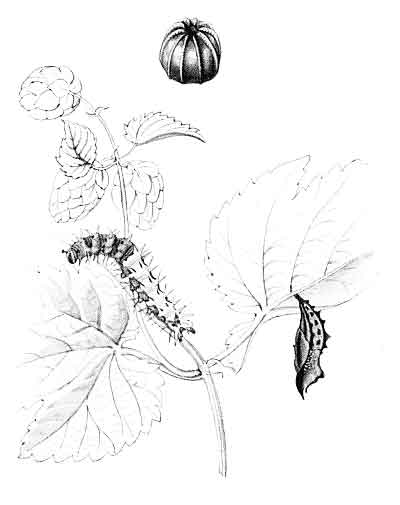
Pl. 32.
Comma Butterfly.
Egg enlarged; caterpillar and chrysalis.
Larger Image
Pl. 33.
White Admiral.
1, 3 male; 2, 4 female.
The chrysalis is brownish tinged with pink; the wing-cases and the rings of the body are edged with blackish; there is a greyish line along the back of the body and a brownish stripe along the spiracles; at the point where the body joins the thorax there are some silvery or golden spots. The figures of caterpillar and chrysalis on Plate 32 are after Buckler.
This butterfly seems to have disappeared from many localities in England where it formerly flourished. About seventy or eighty years ago, for example, it was plentiful in Epping Forest, in Herts, and in Dorset. During the last half-century or so it has been common in certain parts of many of the counties from Somerset to Durham and Cumberland, but seems to have occurred only sparingly or singly in Norfolk, Suffolk, Essex, Kent, Sussex, Hants, Wilts, and Devon. It still occurs now and then in the Dover district, the most recent record being of one taken in October, 1894; and it was reported from North Staffordshire in 1893. Probably it is now almost entirely confined to favoured districts embraced within the area represented by the counties of Herefordshire, Worcestershire, and Monmouthshire, whence it may occasionally stray into the adjoining counties, or even further afield.
This butterfly is often associated with hop gardens, but it is by no means restricted to such places. The usual food-plants of the caterpillars are hop (Humulus lupulus), nettle (Urtica dioica), and currant (Ribes), but it is reported to eat gooseberry (R. grossularia) and elm (Ulmus).
Abroad it has a very wide distribution in Europe, and extends through Asia to Japan.
The Large Tortoiseshell (Vanessa polychloros).
Apart from its larger size, and somewhat different outline, this butterfly may be known from the Small Tortoiseshell by its duller colour, which is brownish-orange; on the fore wing there are, as a rule, no blue crescents in the hind marginal border, but there is an extra black spot placed between veins 1 and 2; on the hind wings a black spot on the front area represents the black basal area seen on the Small Tortoiseshell; and this is an important point of difference, although the two species are not likely to be confused when both are well known. The blue spots referred to as not usually present on the fore wings are stated to occur in specimens emerging from chrysalids that have been kept in a rather cold temperature for a certain length of time.
An aberration known as testudo has the black spots of the fore wings united, and forming blotches on the front and inner areas; the ground colour of the fore wings is lighter, and the hind wings are blacker. This form occurs at large on the Continent, but it is rare; it has also been produced in the course of temperature experiments.
The only eggs of this butterfly that I have been able to obtain are the batch figured on Plate 34. These were purplish with whitish ribs, but no caterpillars hatched from them. Hellins, who squeezed a few eggs from a freshly killed female, states that the colour apparently is a dull green. The ribs vary from seven to nine in number.
The caterpillar in the adult stage is black, with a speckled dark ochreous band traversed by a black central line on the back; the sides are dappled with ochreous grey; the under parts are brown dappled with darker, and merging into the black. The spines are dark ochreous tipped with black, and the head is shiny black and bristly. (The figure is after Buckler.)
These caterpillars live in large companies, often at the top of a high elm tree, from which they may be dislodged by a well-aimed stick, if this happens to be heavy enough to jar the branch when it reaches the mark. Besides elm trees (Ulmus), they also may be found on willow and sallow (Salix), aspen and poplar (Populus), white-beam (Pyrus aria), and various fruit trees, especially cherry. Occasionally they have been found on nettle, but the butterflies from these were small in size. June is the best month for them.
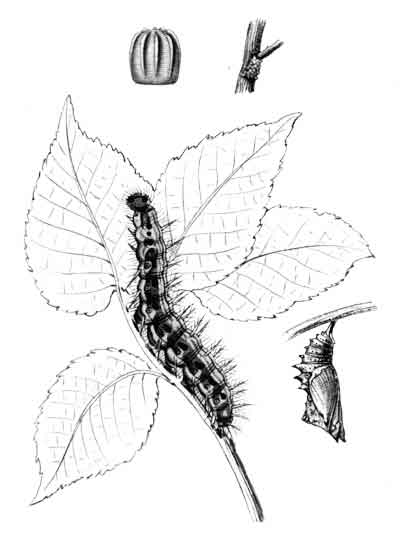
Pl. 34.
Large Tortoiseshell.
Eggs, natural size and enlarged; caterpillar and chrysalis.
Larger Image
Pl. 35.
Comma Butterfly.
1, 2, 3, 4, 5, 6 male; 7 female (var. hutchinsoni).
The chrysalis (Plate 34) is greyish, tinged with pink or reddish, sprinkled with greenish, and shaded with brown and black; the back of the body nearest the thorax is adorned with golden spots. I once obtained a number of these chrysalids in July at Mill Hill; they were found suspended by the tail from the edges of boards that formed a rickety old cart-shed standing at one end of a field and beneath an elm tree.
Although this butterfly is often common in the caterpillar state, the perfect insect, which emerges in July and August, is more frequently seen in the spring after hibernation than before that event. It probably establishes itself in suitable quarters, in old trees, faggot stacks, barns, etc., for its long rest during the winter, at an early period after emerging from the chrysalis.
No doubt large numbers are destroyed by their great enemies, the parasitic flies, chiefly perhaps the Hymenopterous Apanteles. An observer states that from fifty chrysalids only one butterfly resulted, all the others were found to be filled with parasites. In another case of one hundred caterpillars, some collected when quite small, only one was not "ichneumoned."
These butterflies, in common with most other Vanessids, do not pair until the spring, but Barrett cites an instance of caterpillars, from eggs laid by a female in early September, being reared until about 1/2 inch in length, when they apparently laid up for hibernation.
Lanes margined with trees, especially elms, or the verges of woods, are the most likely places in which to find the butterfly. At one time and another it has been observed in nearly every county of England and Wales, and also in some parts of Scotland, but not in Ireland. It appears to be more or less common in all counties around London, extending to Somerset in the west; to Cambs, Norfolk, and Suffolk in the east; and to Northampton and Warwick in the Midlands.
Abroad it is found throughout the greater part of Europe, Asia Minor, and eastward to the Himalayas.
The Small Tortoiseshell (Vanessa urticæ).
This butterfly is one of the most ubiquitous as well as prettiest that we have in this country. Its reddish-orange colour, marked with yellow patches, black spots, and blue crescents, gives it a charming appearance as it sits on a flower, or even on the ground, with wings fully expanded to the sunlight. When the wings are closed up, however, the butterfly seems to disappear, as the under side of the wings is quite sombre in colour. The only bright spot on the under side is the yellowish central area of the fore wing, and when the wings are held erect over the insect's back this is not seen, but only the tips of these wings, which are of the same dull colour as the hind wings.
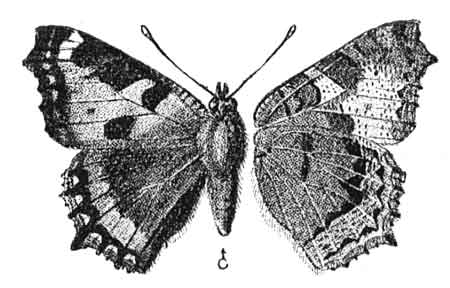
Fig. 22.
The ground colour is subject to modification as regards the shade of red in the orange, and this may be intense or reduced to just a mere tinge. Specimens have been taken on the wing in which the colour was some shade of buff, and the same kind of colour change will sometimes result from an over-long exposure to the action of ammonia. The black markings vary in size, and sometimes those on the costal area are more or less connected or even confluent (Fig. 22); a greater or lesser amount of blackish suffusion on the hind wings (Fig. 23) generally accompanies confluence of the costal spots on fore wings. The two black spots between veins 2 and 4 occasionally enlarge and unite, or, on the other hand, they decrease in size to vanishing point. Some specimens have black scales between the second costal spot and the black spot on the inner margin, and the space between these two spots may be entirely covered with black and so form a central transverse band (var. polaris). A modification of this form is shown on Plate 38, lower figure. The yellow patch between the second and third costal black spots is sometimes continued right across the wings to the yellow spot on the inner margin, and in this respect resembles an Indian form of the species named ladakensis. Dwarf specimens result, in most cases, when the caterpillars have fed on hop (Humulus); at least, this is so in confinement.
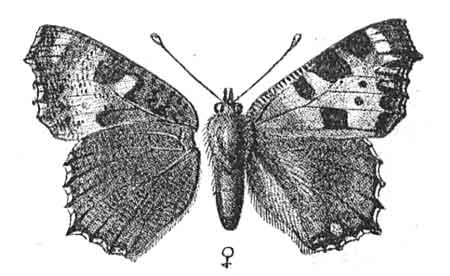
Fig. 23.
The egg is at first green, but after a time becomes tinted with yellow and the ribs stand out clear and transparent. The eggs are laid in a cluster on the under side of a terminal leaf of a nettle plant in May and again in July.
The adult caterpillar is yellowish, closely covered with black speckling and short hairs; there is a black line down the centre of the back, and this is bordered on each side by the clear ground colour. The spiracles are black ringed with yellow, and there is a yellowish line above them. The yellowish spines have black tips. Head black, hairy, and speckled with yellow. Individuals of another company were almost entirely black, the spines alone being tinged with yellow. These caterpillars are gregarious from the time they hatch from the egg until about the last stage.
The chrysalis is most often of some shade of grey and sometimes tinged with pinkish. The points on the upper parts of the body are in some examples metallic at the base, and occasionally the metallic lustre spreads over the thorax and other parts as well.
There are two broods in the year, one in June, the other in August and September. The latter brood, or at least some of the butterflies, hibernate and reappear in the earliest sunny days of spring. They have been seen on the wing as early as January and February (1896), and as late as December.
The geographical range of this species extends through Europe and Asia to Japan.
The Peacock (Vanessa io).
Unlike the last species referred to, this handsome butterfly is more frequently seen in the autumn than after hibernation. It is not likely to be mistaken for any other kind, for on its brownish-red velvety wings it bears its own particular badge, the "peacock eyes." The marks on the hind wings are more like the "eyes" on the tail feathers of the peacock than are those on the fore wings, and the brownish-red on these wings is confined to a large patch below the eye-mark, the remainder being blackish, powdered with yellow scales on the basal area. Some specimens have a blue spot below the "eye" on the hind wings, and the name cyanosticta has been proposed for this form by Raynor. The under side is blackish, with a steely sheen, and crossed by irregular black lines; the fore wings are tinged with brown on the inner area, and the central dot and a series of dots beyond are ochreous; the hind wings have an ochreous central dot.
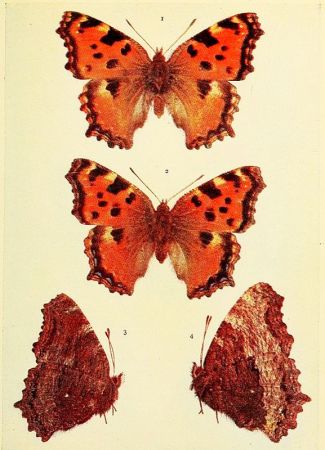
Larger Image
Pl. 36.
Large Tortoiseshell.
1, 3 male; 2, 4 female.
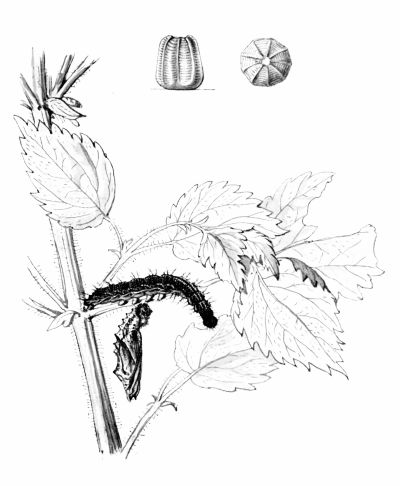
Pl. 37.
Small Tortoiseshell.
Eggs enlarged; caterpillar and chrysalis.
In a state of nature the butterfly seems little given to variation. In rearing from the caterpillar, however, some curious aberrations occasionally crop up. In my early days of collecting I raised a number of specimens from caterpillars selected from a large brood; every one of these butterflies was of a dull brownish colour and had a greasy semi-transparent appearance. I regret to add that I set them all at liberty as they did not come up to my, then, standard of what a Peacock butterfly should be. Now and then specimens are bred from collected caterpillars, in which the eye spots are represented by a broad white cloud-like suffusion on the fore wings, and by a pale roundish patch on the hind wings; in conjunction with this the black costal spots of the fore wings are all more or less united (see Plate 41). This extreme variety is known in the vernacular as the "Blind Peacock," and as ab. belisaria in science; between it and the typical form there are all kinds of intermediate modifications, and one of these is also shown on the plate referred to. It may be interesting to remark that similar varieties have been produced by subjecting the chrysalids at a particular period to a very low temperature. Readers who may wish to know more about "Temperature Experiments" are referred to a pamphlet on the subject by Dr. Max Standfuss.
The egg, an enlarged figure of which will be found on Plate 39, is olive green in colour, and has eight ribs, which start just above the base and turn over the top. The eggs are laid in April or May in batches on the upper part of nettle plants and under the young leaves.
The mature caterpillar is velvety black with white dots, and the divisions between the rings of the body are well marked. The spines are black and rather glossy, and besides this clothing, the body is also provided with short hair which gives the velvety appearance. The head and a plate on the next ring, also the legs, are shining black; the prolegs are blackish, tipped with yellowish. When quite young they are greenish-grey, and although hairy are without spines. The caterpillars usually feed in companies in June and July on the common stinging nettle. They have also been found on hop. Once or twice I have reared caterpillars of this butterfly, and also those of the Small Tortoiseshell and the Red Admiral, on hop, but the result has been disappointing, as the specimens produced were always small in size. The individuals for these experiments were obtained from nettle, and were generally about half grown at the time they were put on the hop diet.
The chrysalis is figured on Plate 39. Its colour may be pale greenish, greyish, pale brown, or brownish-grey, but is usually stippled with blackish, especially the antennæ and the outline of the wing-cases. Some of the points on the thorax and the ring, or rings, next to it have a metallic lustre. Two chrysalids among those resulting from my hop-fed caterpillars were more or less suffused with the metallic sheen. It does not seem to be very clearly known where the caterpillars retire to for pupation. Those that I have found have been under a tent-like arrangement of the lower nettle leaves. In confinement, however, I have noted that in a roomy cage they all go to one end of it and suspend themselves from the roof; in a large flower-pot they crowd together in much the same way.
The butterfly is on the wing in August and September, and frequents all and every kind of ground where flowering plants, especially the taller kinds, are available; clover fields are attractive, and so also are orchards. It passes the winter in some hollow tree trunk, wood stack, or possibly buildings of some kind, and in the spring it again comes forth. March and April are the usual months for its reappearance, but in 1900 it was seen flying over the snow on February 17. The time last mentioned is probably an unusual one, but it is interesting to note that a very similar observation was made by Harris, who in 1778 wrote in his remarks on this butterfly, "I have seen them flying in February, when the snow has been on the ground."
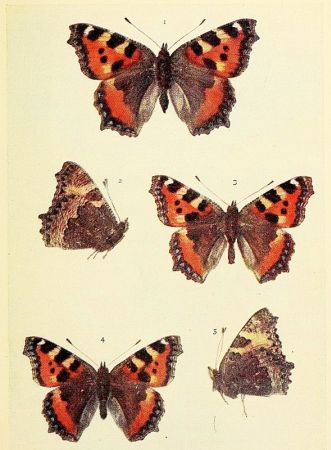
Larger Image
Pl. 38.
Small Tortoiseshell.
1, 2 female; 3, 5 male; 4 var.
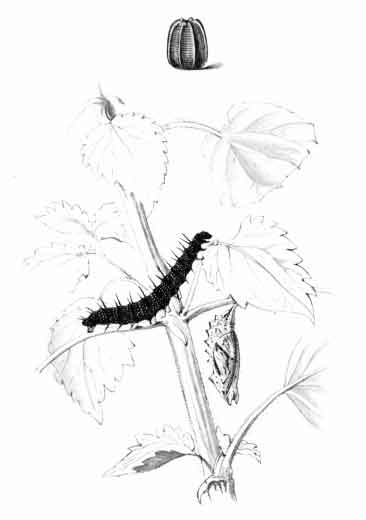
Pl. 39.
Peacock Butterfly.
Egg enlarged; caterpillar and chrysalis.
Usually the Peacock butterfly assumes the perfect state but once in the year. There is, however, a record of half-grown caterpillars being found in September, and that these produced butterflies in due course.
Although not always abundant, the butterfly is to be, or has been, found in almost every part of the kingdom, excepting perhaps north of the Caledonian Canal in Scotland. Around Bishop Auckland and in other parts of the county of Durham, and also in Northumberland, it was common some forty years ago, but it seems to be hardly ever seen there now. The same applies to other northern localities where it was once plentiful. Its distribution includes the whole of Europe, Asia Minor, Siberia, Amurland, Corea, and Japan.
The Camberwell Beauty (Vanessa antiopa).
This is a large and handsome insect; its chocolate-brown wings are bordered with ochreous speckled with black scales. The border is variable in width, and this is occasionally so wide that it partly or completely hides the blue spots, which in the ordinary form are placed on a dark band just before the ochreous border. Such specimens are known as var. hygiæa or var. lintneri (Plate 41); but in the former form the yellow spots on the front edge of the fore wing are absent, and in the latter variety these spots are sometimes united and form a blotch. One authority states that the proportion of these extreme variations in nature is about 1 in 500. The same form may be produced by subjecting summer chrysalids to a temperature of about 110° Fahr. during three to five consecutive days, the chrysalids being placed in this heat four times a day, and for a period of one hour each time. Dr. Max Standfuss, who has made many experiments with this and other butterflies, states that the result of such treatment as that adverted to, and as regards this species, has been the production of as many as seven of the varieties among forty specimens. It would seem probable, then, that the varieties occurring in the open are from chrysalids that received a greater amount of heat than those that produce the ordinary butterfly.
It has been stated that the borders are ochreous, but this only applies to the specimens seen in the summer or early autumn. The butterflies hibernate, and when they leave their winter retreats in the spring, the colour of the border is considerably paler and often even white. For some time it was considered that white borders were a peculiarity of the British Camberwell Beauty and stamped it a genuine native. Probably there are some who may still hold this opinion. An example of each form is represented on Plate 43, the upper one was taken in the spring, and the other in the autumn. Both belong to Mr. J.A. Clark, to whom I am indebted for their loan.
The egg is at first deep ochreous yellow, changing through olive brown to red brown, and a day or two before the larva hatches out becoming leaden grey. The ribs, which are eight or nine in number, are most prominent below the top, and disappear before the base is reached. The eggs are laid on twigs or stems in small batches of 30 or 40 up to large ones of 150 to 250.
The caterpillar has been described by Mr. Frohawk, who gives a full account of the life-history of this species in the Entomologist for 1902 and 1903. The following is an abridgement of his description.
The head is bilobed, having a deep notch on the crown, and of a dull black colour, covered with black warts, each emitting a white hair. The ground colour of the body is deep velvety black, and densely sprinkled with pearl-white warts, each emitting a fine white hair, some being of considerable length, and the majority slightly curved. Down the centre of the back is a series of rich deep rust-red shield-like markings, which commences on the third segment and terminates on the eleventh segment. In the centre of the anal segment is a shining black dorsal disc, much resembling the head; the legs are black and shining, and the four pairs of prolegs are rust colour, with a polished band above the feet, and the anal pair are black with pale reddish feet.
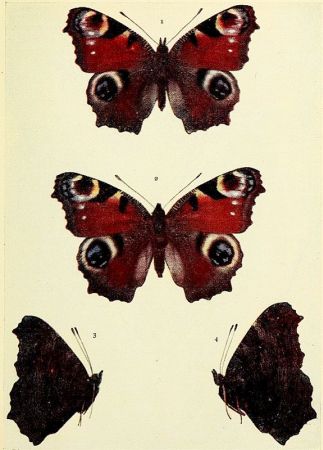
Larger Image
Pl. 40.
Peacock Butterfly.
1, 3 male; 2, 4 female.
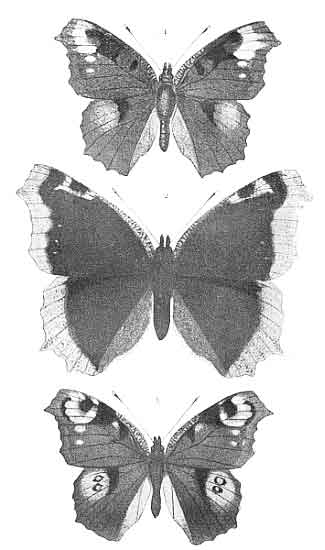
Pl. 41.
1, 3 Peacock vars.; 2 Camberwell Beauty var.
The caterpillars feed on sallow, willow, birch, and elm. They cover the leaves of their food-plant with a silken web and live thereon in companies, and do not separate until about to prepare for the chrysalis state.
The chrysalis. The dorsal half of the head and wing points are black, and the ventral half orange. Some of the points on the body are tipped with orange. The whole surface is finely and irregularly furrowed and granulated. The ground colour is pale buff, covered with fine fuscous reticulations. The entire surface is clothed with a whitish-powdery substance, giving a pale lilac or pinkish bloom to the chrysalis, which, however, is easily rubbed off, the chrysalis then assuming a brownish hue. Our figure of the chrysalis is after Holland.
Mr. Frohawk, who had female butterflies living under observation for about three months, states that eggs were laid in April, May, and June. Caterpillars from the first batch of 192 eggs hatched early in May, nineteen days after they were laid. These were full grown by June 20, and entered the chrysalis state soon after. The butterflies from these commenced to emerge about the middle of July.
He says: "Both sallow and willow are equally suitable food for the larvæ, and birch is readily eaten, even when willow has formed the sole food until the last stage; they will feed on elm. Nettle was not appreciated, and not touched by them during the last two or three stages."