PART II. DESCRIPTIONS OF SPECIES. (continued 4)
Reading edition
Figures of the early stages will be found on Plate 111.
The egg is greenish-white, becoming rather greener in tint towards the top, which is depressed; the netting is whitish and shining, and somewhat rougher on the sides than towards and on the top.
Buckler describes the full-grown caterpillar as deep, full green in colour, covered with tiny black speckles, bearing little black bristles, which are longest on the dorsal humps and on the yellow-edged ridge above the spiracles; on the top of each of the eight pairs of dorsal humps is a deep bright yellow longitudinal dash, somewhat wider behind than in front; these dashes form in effect two yellow stripes interrupted by the deeply sunk segmental divisions; the line along the back is darker than the ground colour, and the spiracles are black. The head is dark brown, and there are two yellow dots on the first ring of the body near the head.
The chrysalis, when first formed, is greenish-brown with the wing-cases greenish, the whole afterwards becomes ochreous; the thorax and wing-cases are rather glossy, and the body is slightly hairy. Buckler states that some of his caterpillars buried themselves about half an inch deep in the loose soil, and formed a weak sort of cocoon; others, not having been supplied with soil that could be so easily penetrated, retired under the stems of their food-plants, and in angles formed by the branching stems spun a few weak threads to keep themselves in place.
The food-plant is the horseshoe vetch (Hippocrepis comosa). From eggs laid in August, the caterpillars appear to hatch towards the end of September, but do not feed up until the spring. Butterflies from these caterpillars are on the wing between the middle of May and the middle of June, thus occupying about nine months in passing through the various stages from egg to perfect insect. From eggs laid in May and June the butterflies appear in August and September. Although it is found in similar kinds of situations to those affected by the last species, and sometimes on the same grounds, it is more local, and almost confined to the counties of Kent, Surrey, and Sussex. It is, however, rather common at Ventnor and in some other parts of the Isle of Wight, and is found near Winchester. Barrett states that it is abundant at Corfe Castle, Dorset, and gives as localities for the butterfly Wotton-under-Edge, and near Bristol, near Torquay, Sidmouth, and Seaton. Its range abroad extends through Central and Southern Europe, to Armenia, Northern Asia Minor, and Western Kurdistan. It is also found in North-West Africa, where the males are greenish-blue with conspicuous black spots on the outer margins of the hind wings; this is the var. punctifera.
The Holly Blue (Cyaniris argiolus).
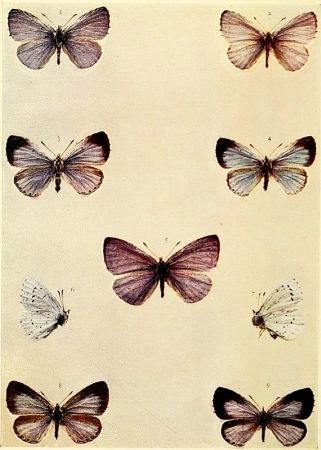
About the beginning of the eighteenth century this butterfly (Plate 113) was known as the "Blue Speckt," but Harris, in 1775, changed the name to the "Azure Blue." The male is a pretty lilac-tinged blue, with a narrow black edging on the outer margin of the fore wings, often only in evidence towards the tip, and a narrow black line on the outer margin of the hind wings. The white fringes of the fore wings are distinctly marked with black at the ends of the veins. The female is of the same shade of blue, or sometimes much paler (var. clara, Tutt), with a broad blackish border on the outer margin of the fore wings extending along the front margin to about the middle; this border varies in width and seems to be wider in summer specimens than in those of the earlier flight; the discal mark on the fore wings is black, but this is sometimes very faint; there is a series of black dots on the outer margin of the wings.
Larger Image
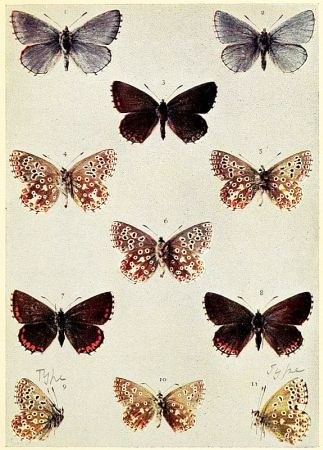
Pl. 110
Adonis Blue.
1, 2, 4, 5, 9 male; 3, 6, 7, 8, 10, 11 female.
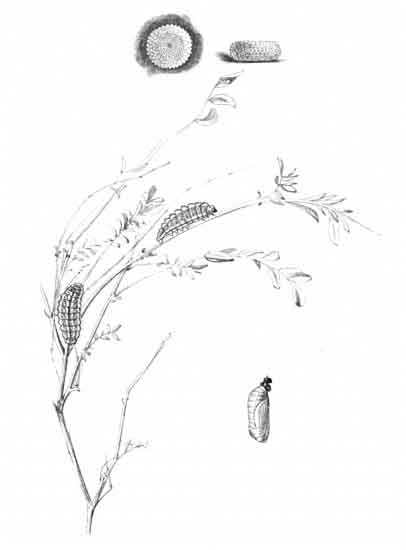
Pl. 111
Adonis Blue.
Eggs, natural size and enlarged; caterpillars and chrysalis.
Although the colour of the upper side is somewhat like that of the Common Blue, it should not be confused with that species, as the under side is very different both as regards the colour, which is bluish-white, and the arrangement of the black spots. On the outer margins of the wings in some specimens there are more or less distinct traces of blackish crescents.
There is no considerable variation in this species, but the spots on the under side are subject to slight modification in the matters of size and shape; the borders also vary in width, and in the female the blue area is thus sometimes much restricted. A gynandrous specimen has been recorded, in which the right side is male.
The egg (Plate 112) is described as whitish or bluish-green in colour.
The full-grown caterpillar has a blackish head, the body is bright yellowish-green with paler lines; eight rings from and including the second are crested with two ridges of humps, between which lies the sunk dorsal space; the whole skin of the body is velvety, with its surface thickly covered with yellowish warty granules, each bearing a minute bristly white hair. Sometimes the humps and the middle of the back are marked with rose-pink.
The chrysalis is pale brownish-ochreous with a thin blackish-brown line on the back of the brown freckled thorax; the body is marked with rather blotchy arrow-head dashes, and some larger dark brown blotches; the wing-cases are pale greyish freckled and outlined with brown, their surface is smooth and rather more glistening than the other parts, which are thickly studded with fine, short, brownish bristles. (Adapted from Buckler.)
The following is a brief summary of a paper by Mr. R. Adkin (Proc. S. Lond. Ent. and Nat. Hist. Soc. for 1896), in which he gives a most interesting account of the earlier stages of the second brood of this species.
At the time when the butterflies of the second brood are on the wing, the flower-buds of the ivy (Hedera helix) are still young, and form compact heads. The butterfly, having selected one of these heads, settles upon its top, closes her wings over her back, and bending her abdomen down and round underneath the buds, affixes an egg to the under side of one of the slender single bud-stalks. In about a week the eggs hatch. The young larva which in colour matches the buds very closely, rests on the bud-stalk with its anterior segments, which completely cover its head, pressed closely against the bud, and looks so exactly like a slight swelling of the upper part of the stalk as to make detection a matter of great difficulty, even with the aid of a fairly powerful lens. The larva is very sluggish in its habits, seldom leaving the head of the buds on which it is hatched, so long as sufficient food remains for its nourishment, or occasionally when about to change its skin. It appears to feed only at night, and its manner of feeding, which is the same throughout its life, is to eat a round hole through the outer shell of a bud, and pressing its head forward through it to clear out the soft inside of the bud. In from four to six weeks it is full-fed; it then quits the buds, and attaches itself by slender threads to a leaf, and in a few days becomes a pupa, in which state it passes the winter.
Normally the eggs of the spring butterflies are laid on the under side of the calyces of flower-buds of holly (Ilex). The caterpillars feed on the flower-buds and also on the young green berries. They are full grown in about a month, change to chrysalids, and the butterflies emerge in July and August. Among other pabula that have been mentioned are the flowers of dogwood (Cornus sanguinea), berry-bearing alder (Rhamnus frangula), and spindle (Euonymus europæus).
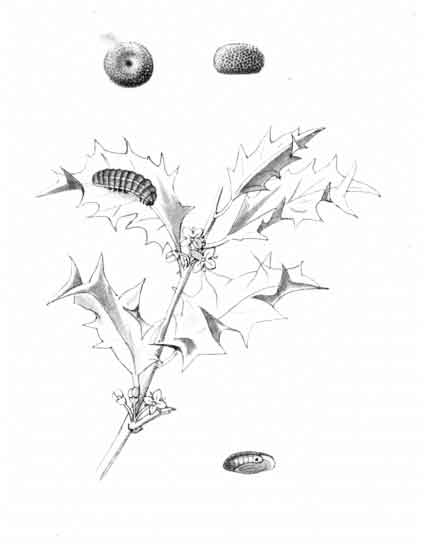
Pl. 112.
Holly Blue.
Eggs enlarged; caterpillar and chrysalis.
Larger Image
Pl. 113.
Holly Blue.
1, 2, 6 male: 3, 4, 7 female (spring); 5 male; 8, 9 female (summer).
In confinement the caterpillars will eat young leaves of holly and probably of ivy also, but where flower-buds are available they prefer them and ignore the tender leaves.
The Rev. Gilbert Raynor, on May 18, 1901, observed a female deposit an egg on an unopened flower-bud of rhododendron in his garden; and he also mentions that he beat a number of the caterpillars of all sizes from holly during the first week of July in the same year.
Mr. Dennis reported that on October 9, 1902, all stages of the species were to be found at Earl's Colne, Essex.
Butterflies of the first flight are usually to be seen in April and May, and of the second, which is perhaps only partial and may not be represented at all, in July and August. Specimens have been observed as early as the last week of March, and, as adverted to above, as late as October. For a few years in succession the species may become increasingly numerous, and then suddenly become quite scarce for a year or two. Most probably this is the result of favourable or unfavourable weather conditions.
The taller hollies, where these grow in gardens, open woody places, on hillsides, or even in hedgerows, are frequented by these butterflies in the spring; and the ivy-clad walls, etc., are their haunts in the summer.
The species is widely distributed, and often common, over the whole of the south of England and Wales. North of the Midlands, as well as in Ireland, it is more local, and occurs, I believe, only in the first brood. Possibly in the South of Ireland there may be a second brood. Barrett states that there is no reliable record for Scotland.
Abroad, its range extends throughout Europe and Northern Asia, except the Polar Regions, to China and Japan. It also occurs in North Africa.
The Small Blue (Zizera minima).
The butterfly on Plate 115 is sometimes referred to as the "Bedford Blue" and also as the "Little Blue."
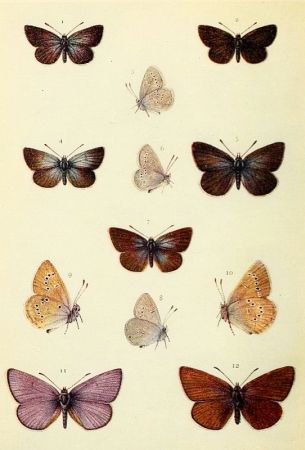
Both sexes are blackish, or sooty-brown; the male is powdered, more or less, with silvery-blue scales. The under side is greyish-white with a tinge of blue at the base of each wing, but chiefly on the hind pair; the spots are black encircled with white. As will be seen on turning to the plate, there is variation in size. Fig. 5 represents a giant race occurring in some localities, and the particular specimen depicted was taken, with many others, on the coast near Lymington, Hants; it seems to be referable to var. alsoides, Gerhard. Variation on the under side is usually in the direction of complete absence of spots, but Mr. Joy has recorded a specimen with the spots on the hind wings extended into streaks of considerable but varying length.
Figures of the early stages will be found on Plate 114.
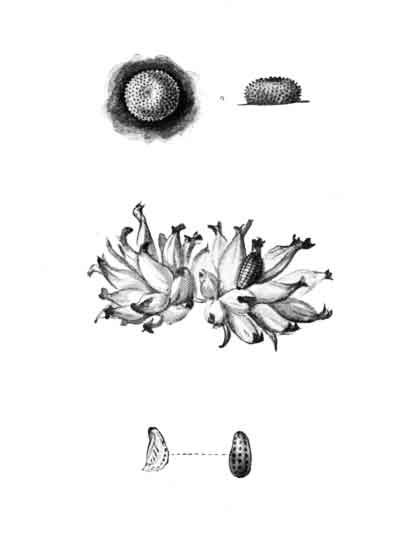
The egg is pale greenish in colour, netted with whitish; it is laid in June on the calyx of a flower-bud, generally low down, of the kidney-vetch (Anthyllis vulneraria).
According to Buckler, caterpillars hatched on June 21 from eggs laid between the 16th and 18th of that month, and at once commenced to feed on the flowers of the kidney-vetch, and made their way to the seed, for which they evinced a marked preference. When full grown, the caterpillar is brownish, sometimes tinged with pink. The fine bristles are dark brown; there is a darker line along the middle of the back, and a line of dark marks on each side. The head is black and shining.
The chrysalis is described by Buckler as "dirty whitish-grey, approaching to drab, palest on the back of the abdomen, greyish on the head and thorax, both of which are marked with a black dorsal stripe, which is a little interrupted; on either side is a subdorsal row of short slanting black dashes. The pale ground colour is sprinkled with some very minute black specks. The head, thorax, and abdomen are hairy with bristly whitish hairs." Although the caterpillars feed up rather quickly and are full grown and apparently ready to assume the chrysalis state, they do not effect the change until the following May or June.
Pl. 114.
Small Blue.
Eggs, natural size and enlarged; caterpillar and chrysalids.
Larger Image
Pl. 115.
Small Blue. 1 male; 2, 3 female; 4, 5, 6, 7, 8 male vars.
Mazarine Blue. 9, 11 male; 10, 12 female.
The butterfly emerges in about three weeks, so it will be seen that this species continues the caterpillar existence for something over ten months.
On the Continent there are two broods of the butterfly, and in England there appears to be a partial second flight in some years, as, for instance, in 1901, when captures in August were reported from Herts, Kent, Surrey, and Wilts. Its haunts are warm and sunny grassy hollows and slopes, and it is often common in such places on the chalk hills in the south, from the end of May to the end of June. According to Barrett it is scarce in the Eastern Counties; widely distributed but local in the Midland and Western Counties, even to Devon, and in Wales, where chalk or limestone is found; also in extremely restricted localities in Yorkshire, Lancashire, Cumberland, and Durham, and in various places in Scotland, extending as far north as Aberdeen. In Ireland it is much more plentiful, especially on the limestone of the west and on the coast hills near Belfast, and even frequents the sand-hills of the Dublin coast.
It is widely spread over Europe, except the Polar parts, and, apparently, the south of Portugal and Spain; its range extends eastward to Amurland, Mongolia, and China.
The Mazarine Blue (Nomiades semiargus).
The male is dull purplish-blue, narrowly bordered with blackish on the outer margin; the female is dark brown. On the underside both sexes are pale greyish-brown, with a bluish tinge at the base; there is a black discal spot and a series of black spots beyond, all ringed with white.
The egg is described as being white in colour and small, and round in shape.
The caterpillar is of a dingy yellowish-green, with darker lines on the back and sides; there are fine hairs on the body, and the head and spiracles are dark brown (Rühl).
It feeds in July and August on the flowers and seeds of thrift (Armeria vulgaris), kidney-vetch (Anthyllis vulneraria), and melilot (Melilotus officinalis).
The chrysalis is rather oval in shape, pale olive-green in colour when first formed, in September, but olive-brown later; it is attached by the tail to a stalk of the food-plant and has a silken girdle (Rühl).
This butterfly (Plate 115) is the cymon of Lewin, who, writing in 1795, considered it very rare. In 1828 Stephens refers to it as scarce and local, "found in chalky districts in Norfolk, Cambridge, Yorkshire, and Dorsetshire; also near Brockenhurst and Amesbury, Hants; and on Windlesham Heath, Surrey, towards the end of May and of July." Newman (1871) adds Warwickshire, Herefordshire, Gloucestershire, Monmouthshire, Glamorganshire, Somersetshire, and Lincolnshire. Curtis gives Leicestershire and Worcestershire. It seems to have been fairly common, and even plentiful in some years around Glanville's Wotton, Dorset, but has not been seen in that district since 1841; at Wotton-under-Edge, Gloucester, it was not uncommon up to 1858; as late as 1864 it occurred at Epworth, North Lincolnshire. Probably the latest captures in Britain were the specimens taken in Glamorganshire in the years 1874-77. Tutt mentions that the butterfly was taken near Cuxton in Kent, some thirty-five years ago, but it has not since been seen in that locality.
Occurs in May and June and again in July and August over the greater part of Europe; its range extends to Asia Minor, and eastward to Siberia, Mongolia, and Amurland.
Pl. 116.
Large Blue.
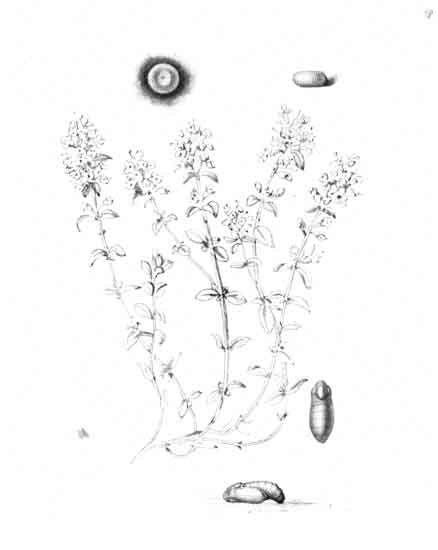
Egg, natural size and enlarged; chrysalis.
Larger Image
Pl. 117.
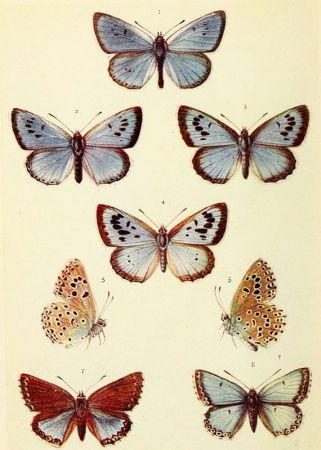
Large Blue. 1, 5 male; 2, 3, 4, 6 female.
Chalkhill Blue vars. 7 female; 8 do. var. syngrapha.
The Large Blue (Nomiades arion).
The butterfly on Plate 117, Figs. 1-6, is the largest "Blue" found in this country. All the wings on the upper side are deep blue, and their outer margins are bordered with blackish; the discal spot, and a row of spots beyond, are black; the hind wings have a row of black dots on the outer margin, and sometimes, and especially in the female, there is a series of black dots just beyond the central area; the fringes are white. The under side is greyish tinged with blue towards the base of each wing, but covering nearly the whole of the basal third of the hind pair; the spots are black ringed or edged with white; on the fore wings there are two in the discal cell and a row of six beyond; on the hind wings there are four or five before the discal spot, and a series of seven beyond; all the wings have a double marginal series, and some black dots at the ends of the nervules. Sometimes the wings have a purplish tinge, and this is more usually so in Gloucestershire specimens. The chief variation is in the number and the size of the spots; these are occasionally only faintly in evidence, but more rarely perhaps those beyond the discal spot on the fore wings are of large size and bar or wedge-like in shape; the smaller cell-spot is often absent. A dwarf form is stated to occur at times in all localities.
The complete life-history of this species has yet to be ascertained; no one seems to be acquainted with the caterpillar after hibernation. Pretty much all that is known of the early stages has been worked out by Mr. Frohawk, who has published some very interesting accounts of his observations in the Entomologist for 1899 and 1903, and from these the following details have been obtained.
The egg (Plate 116) is bluish-white in colour, and is laid singly among the buds of wild thyme (Thymus serpyllum).
Caterpillars hatched on July 10 from eggs received the previous day; they were placed upon thyme blossoms and soon commenced to feed, one being observed to eat its way into the base of the calyx so that the forepart of the caterpillar was hidden. In its colouring and downy covering the caterpillar so closely resembles the flower-buds of the thyme that it is very difficult to detect. After the third moult (July 26) the colour is a uniform, dull, ochreous-pink; there are four rows of long curved hairs, each row composed of a single hair on each ring from the fourth to the ninth inclusive; the first three rings have each a set of three subdorsal hairs, those on the first ring curving forwards; the bases of the hairs resemble glass-like pedestals with fluted sides. The head is ochreous with dark brown markings in front. The caterpillar at this stage develops an aversion to thyme or any other plant offered to it, and seems to be anxious to hide itself in the ground.
The chrysalis, which is figured on Plate 116 (after Frohawk), is ochreous when first formed, but becomes darker gradually; the wing-cases, however, remain of the original colour, but their hind margins darken. From a chrysalis found on July 12 the butterfly emerged on July 16.
There is some evidence in favour of the supposition that this caterpillar is in some way dependent upon ants for nourishment after the third moult, if not before, but what the exact requirement may be is not known. Probably the circumstances connected with the discovery of the chrysalis in 1905 by Messrs. Frohawk & Rayward may afford a valuable clue to the direction in which their future investigation will have to be conducted. We may hope, therefore, that the mystery that has so long hung over the last stages of the caterpillar will be solved before very long.
Lewin (1795) and Donovan (1796) both refer to this as a rare English butterfly. The former states that it is on the wing in July, and is found on high chalky lands in different parts of the kingdom, having been taken on the cliffs in the neighbourhood of Dover, Marlborough Downs, the hills near Bath, and near Clifden in Bucks.
Stephens, in 1828, wrote of it as "an insect of great rarity." He mentioned the localities given by the older authors, and added that it had been taken in the Mouse's Pasture, near Bedford, in rocky situations in North Wales, and had been plentiful near Winchester.
Newman (1871) wrote, "Its 'metropolis,' if I may borrow an expression from the revered fathers of British entomology, is in South Devon; it has occurred in some abundance in Somersetshire, and on the Cotswold Hills in Gloucestershire; from Gloucestershire we ascend to a Midland county, Northamptonshire, in which county (at Barnwell Wold) a considerable number have been taken." One specimen was reported from Charmouth in Dorsetshire, and the butterfly has also been recorded from Herefordshire, but these are matters of ancient history. At the present time the species is only to be found in limited numbers in the Cotswolds; it seems to have become much rarer than formerly in its South Devon locality, i.e. Bolthead, near Plymouth; one never hears of it now from Clovelly, in North Devon, where, according to Dale, it was once reported to be abundant. In 1891 Messrs. Waterhouse obtained a fine series of specimens in West Cornwall, and since that time the district has been annually visited by an increasing number of entomologists. Judging from the "big bags" that are made each year it would seem that the butterfly has a very strong and widely distributed settlement in those parts.
Abroad it is distributed throughout Europe, except the Polar and the south-western parts, and is also found in Armenia, Bithynia, and South Siberia.
Our next species belongs to the Nemeobiinæ, a sub-family of Lemoniidæ = Erycinidæ. Only one member of the family is known to occur in Europe; this is Nemeobius lucina.
As the fore legs of the male butterfly are aborted, and are therefore useless for walking, the species would seem to come near the Nymphalidæ, in which the fore legs of the butterflies, in both sexes, are reduced. In its early stages, however, the species seems to be most nearly related to the Lycænidæ.
The Duke of Burgundy Fritillary (Nemeobius lucina).
This butterfly is figured on Plate 120. The male is black, with three transverse tawny bands on the fore wings; these are crossed by the black veins, and so form series of irregular spots. Those on the outer margin have black centres; on the hind wings there are three or four tawny spots on the disc, and a series of black centred tawny spots on the outer area. The female is similar to the male, but the tawny markings are wider, so that the fore wings appear to be of this colour, with a black patch at the base, two black irregular lines, and a series of black spots on the outer margin. On the under side of the hind wings there are two transverse series of whitish spots, and a series of black spots on the outer margin. The wings of this sex are always broader than those of the male, and the apex of the fore wings is not so distinctly pointed. Variation is not usually of a very pronounced character, and in a general way it consists mainly in a greater or lesser amount of black in the male, and this more particularly on the hind wings, and an increase in the tawny colour in the female; in the latter sex, outer marginal black spots are sometimes absent from all the wings. Barrett mentions two extreme aberrations. In one, a female, the usually dark spaces, bands, and veins are of an exceedingly pale brown, suffused with fulvous, so as to be comparatively indistinct; another example, a male, has the basal area of the fore wings pale, and the first transverse dark band absent.
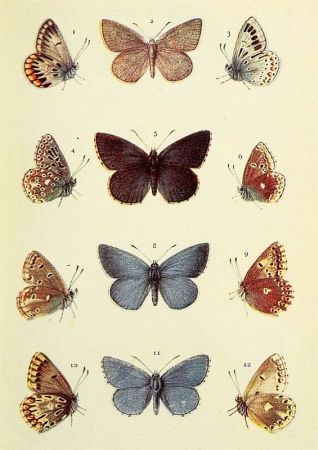
Larger Image
Pl. 118.
1, 3 Common Blue vars., male; 6 do. female.
2, 5, 8, 11 Adonis Blue vars., male; 4, 7, do. female.
9, 10 Chalkhill Blue vars., female; 12 do. male.
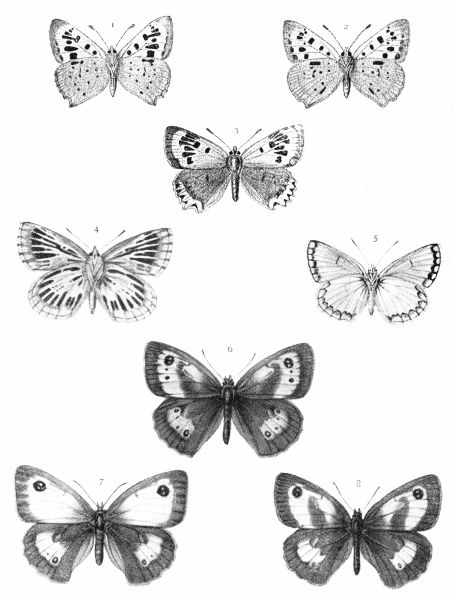
Pl. 119.
1, 2, 3 Small Copper vars.; 4 Adonis Blue var.
5 Common Blue var.; 6, 7, 8 Gatekeeper vars.
The eggs of this species are to be found at the end of May on the under sides of the leaves of the cowslip (Primula veris), sometimes as many as ten on one leaf, but as a rule there will only be one or two on a plant. When laid, the egg is very glassy in appearance, but it gradually turns to a pinkish-grey; and when the caterpillar is formed inside, the shell becomes transparent, and its occupant can be clearly seen. It eats a considerable portion of the shell in making its exit therefrom, and afterwards consumes the remainder of the shell. When in its last skin the caterpillar is brown, covered with short whitish hair, among which are some longer dark brown or blackish hairs; the lines on the back and sides are blackish, and there are black dots on the front part of each segment or ring. Head, honey brown, notched on the crown; eyes and jaws, brownish. It feeds from June to August on cowslip, but will also eat primrose (Primula vulgaris), and hides among dead and withered leaves beneath the food-plant (Plate 121).
The chrysalis is pale whity-brown, hairy above, with black dots; head and the upper edge of the wing-cases streaked with black.
Occasionally a few butterflies emerge in August, but they usually remain in the chrysalis until May or June.
This is a woodland species, and prefers the sunny but sheltered nooks and glades, but also resorts to the broader rides and pathways. Flowers do not seem to have any strong attraction for it, but it may often be seen sitting on the foliage of a bush or sapling tree. It appears to be pretty widely distributed, although to a certain extent local, throughout the southern half of England, but seems to have almost or quite disappeared from the counties of Cambridgeshire, Suffolk, and Essex. Dumfries is the only locality in Scotland from which it has been reported.
Its distribution abroad is limited to Central Europe, Denmark, Livonia, Southern Sweden, Central Spain, North Italy, and the Balkans.
Now follow the Skippers (Hesperiidæ), of which kind of butterfly we have eight species in England. Of these the first two belong to the Hesperiinæ and the others to the Pamphilinæ.
The Grizzled Skipper (Hesperia malvæ).
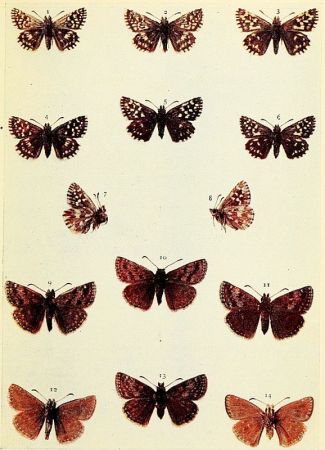
The wings of the butterfly figured on Plate 122 are blackish, ornamented with numerous white spots, which are more or less square in shape, on the fore wings. The fringes are chequered black and white.
The male differs from the female in having the front edge of the fore wings folded towards the base, and these wings have scattered greyish scales on the basal area; the central series of spots on the hind wings are also more in evidence, and not infrequently unite and become band-like. Variation consists in modification of the markings, chiefly in a tendency of the spots to run together, culminating in var. taras, Bergstr., in which the white spots of the fore wings are confluent and form a large blotch. This variety was figured by Petiver in 1717, but was not named by Bergsträsser until 1780. Haworth described it as lavateræ, and Newman figured it under the same name.
On a small plant of Alpine strawberry, sent by the Rev. Gilbert Raynor, were three eggs of this butterfly. These were pale green in colour, ribbed, and delicately netted with cross-lines. On June 26, three caterpillars were noticed on the upper side of the leaves, each on a separate leaf, and under cover of a few coarse silken threads. They were pale steely-grey, with black heads, and plates on the first and last segments of the body.
As the supply of strawberry foliage was failing, the caterpillars were given bramble on July 21, and the next day each was found enclosed in a sort of envelope formed of a bramble leaf. They were then seemingly in their last skin, whitish-green in colour, and covered with short whitish hair; a whitish edged dark olive-brown line along the back, and similar lines on the sides; between the rings the colour was pale ochreous. The date of pupation was not noted, but on September 9, one of the spun-together bramble leaves was opened, and a chrysalis found within. This was pale brown, with dark brown or blackish marks along the back and sides; the head and back were covered with dense pale reddish-brown bristles; the wing, leg, and antennæ cases were greenish, smooth, and shaded with brownish. Between the head and first ring of the body above there was a deep furrow, with a black-centred white spot on each side of it (Plate 123).
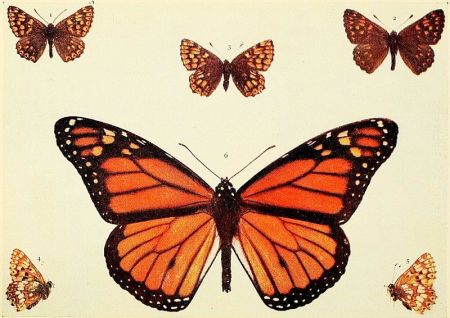
Larger Image
Pl. 120.
Duke of Burgundy Fritillary. 1, 2, 4 male; 3, 5 female.
Milkweed Butterfly. 6 male.
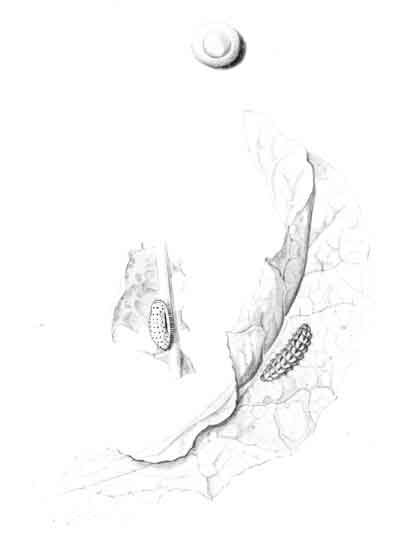
Pl. 121.
Duke of Burgundy Fritillary.
Egg enlarged; caterpillar and chrysalis.
Besides the plants adverted to above, the caterpillars will eat raspberry (Rubus idæus) and cinquefoil (Potentilla fragariastrum and P. reptans).
The butterfly is pretty generally distributed in Great Britain, but does not seem to be common in Ireland, as Kane only mentions two examples, from Killarney. It is found in May and June on chalk downs and other hillsides, especially in the hollows and sheltered nooks, also in and around woods, and in rough fields. On dull days and at night it may be found sitting, with the wings erect over the back, on various seed-heads, etc.
The species is double brooded on the Continent, and occasionally a few butterflies will appear in August, but such emergences depend on a combination of favourable circumstances. In very forward seasons it has been seen on the wing during the last week in April.
Its range extends over Europe and into Northern Asia.
As Barrett refers to the capture in Norfolk (May or June, 1860) of several specimens of the Central and South European species, H. alveus, Hüb., it maybe well to mention it here, if only for the purpose of quoting his remarks thereon. After detailing the facts connected with the occurrence, he states, "It seems undesirable now to introduce the species to a place in the British list, but rather to record the captures in question as specimens accidentally introduced with plants, or else the result of a very exceptional act of migration."
The Dingy Skipper (Thanaos tages).
The wings are fuscous, with darker fuscous transverse bands on the middle third of the fore wings; the space between these is sometimes, and in both sexes, whitish; there are some whitish spots on the outer band, usually towards the costa, but occasionally on the middle also, and a series of white points on the outer margin of all the wings. The hind wings have a whitish discal dot and a band beyond the middle, which is almost parallel with the outer margin. The male has a well-marked fold on the costa (Plate 122).
The egg is whitish-green when freshly laid; it afterwards changes in colour to orange. The caterpillar is yellowish-green with a darker line along the back and a paler line on each side; the spiracles are red and edged with whitish. The head is pale brown, striped and marked with purplish-black. The body, together with the head, is covered with a short whitish pile. It feeds on bird's-foot trefoil (Lotus corniculatus) from June until August, when it hibernates. I have not seen the chrysalis, but it has been described as dark green with the body tinged with rosy red.
The butterfly is on the wing in May and June; in some seasons it has been seen as early as the end of April. Very occasionally, perhaps, there is a partial second flight in August. It has been reported as plentiful at Lyme Regis in August.
I took one or two specimens about the middle of August, 1903, in the New Forest district, and in the same month of 1905 one of two caterpillars sent to me by Dr. Chapman pupated in August, and the butterfly emerged some time in the autumn, as I found it dead in the box early in October. Both the caterpillars had spun together sprays of the food-plant as shown in the figure, Plate 123. One was removed for its portrait to be taken, and it was supposed that the other bundle contained a caterpillar also, and was not examined.
Larger Image
Pl. 122.
Grizzled Skipper. 1, 2, 7 male; 4, 5, 8 female; 3 var. male; 6 do. female.
Dingy Skipper. 9, 10, 12 male; 11, 13, 14 female.
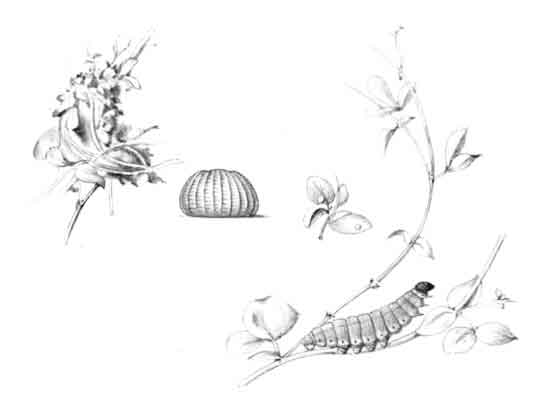
Dingy Skipper.
Eggs, natural size and enlarged; caterpillar and its shelter.
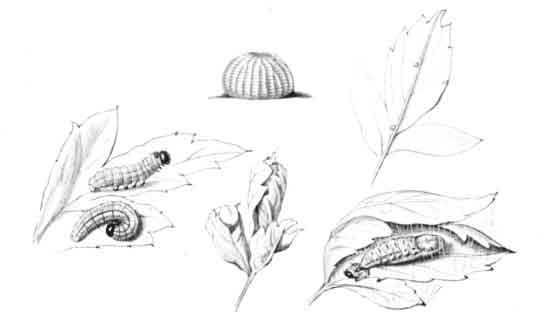
Pl. 123.
Grizzled Skipper.
Eggs, natural size and enlarged; caterpillar and shelter; chrysalis in cocoon.
The butterfly affects open places in, or the edges of, woods in chalky districts, also the slopes of chalk downs and other hillsides, as well as railway banks and even rough fields. It evidently delights in sunshine, and may often be seen basking on a stone or the bare earth. When at rest at night or on dull days it sits on a dead seed-head or grass glume, with the wings closed down over its back like a noctuid moth, and is then difficult to detect until the eye becomes accustomed to its appearance. It is widely distributed in Great Britain, but it is more at home on chalk and limestone than elsewhere. In such localities as the fens of Norfolk and Cambridge it is scarce, and seems to have a rather limited distribution in Ireland, in which country Galway is its headquarters, according to Kane.
Abroad, it is found throughout Europe, and its range extends to Western Asia.
The Small Skipper (Adopæa thaumas).
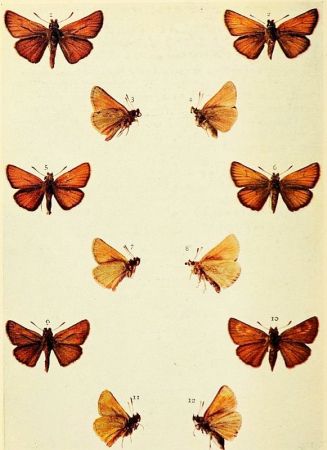
All the wings are brownish-orange, with the veins darker and becoming black towards the outer margins, especially on the fore wings. The male has a black sexual mark (Plate 125).
Except that the colour varies in the direction of a pale golden tint there is little in the way of aberration in this butterfly. At least one gynandrous specimen has been recorded.
The following descriptions of the early stages (Plate 124), as well as the figures of the caterpillar and the chrysalis, are from Buckler's "Larvæ of British Butterflies":—
The egg "is of a long oval figure, half as long again as wide, the shell glistening, devoid of ribs or reticulation; at first white, then turning dull yellowish, and at last paler again, with the dark head of the caterpillar showing through. The young caterpillar eats part of the empty egg-shell."
The full-grown caterpillar is of a delicate light green, the stripe along the back is rather bluish-green, with paler green central and side lines; the spiracles are flesh-coloured, and below these there is a somewhat creamy-white stripe. The head is deeper green than the body, and roughened with minute points. It feeds in June on Holcus lanatus, Brachypodium sylvaticum, and probably other kinds of soft grasses, and its assimilation, both in colour and texture, with the blades of grass is remarkable. Before changing to the chrysalis it encloses itself within two or sometimes three leaves of the grass, joined together longitudinally by lacing or spinning with white silk, the edges more or less close to each other, and becomes completely hidden.
The chrysalis is secured in the silken chamber, head upward, by an oblique cincture behind the thorax, and the anal tip fastened by a fan-like spread of fine hooks at the extremity fixed in the silk. The colour is similar to that of the caterpillar, and the lines are fairly in evidence. Caterpillars that spun up on June 18 to 23 produced butterflies on July 15 and 16.
Hellins states that eggs were laid in a row in a folded blade of grass about July 29, and that the caterpillars hatched out on August 12.
According to Hawes, the caterpillar of this species does not hatch from the egg until the following spring.
Although it does not seem to be very plentiful in fenlands, this butterfly certainly has a partiality for damp places, whether in the rides, or on the sides of woods, on hill slopes, or waste ground. Wherever there is a fairly large growth of the taller soft grasses that the caterpillars feed upon, there the butterfly may be found in July and August throughout the greater part of England and Wales. Reported from the Edinburgh district in Scotland; and in Ireland from Powerscourt and near Cork.
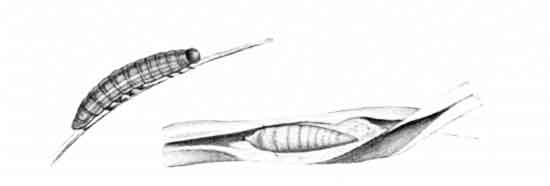
Small Skipper.
Caterpillar and chrysalis.
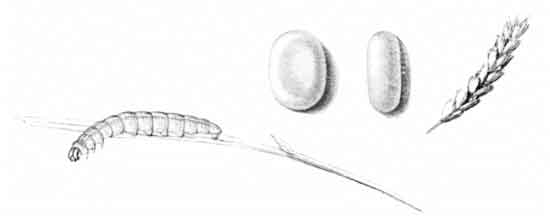
Essex Skipper.
Eggs, natural size and enlarged; caterpillar.
Pl. 124.
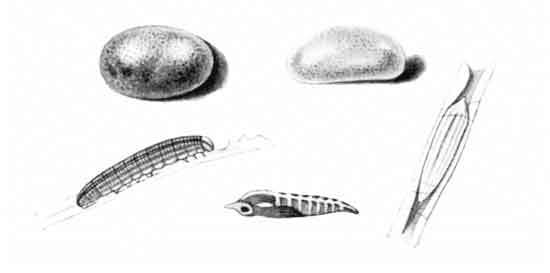
Lulworth Skipper.
Eggs enlarged; caterpillar and chrysalis.
Larger Image
Pl. 125.
Small Skipper. 1, 3 male; 2, 4 female.
Essex Skipper. 5, 7 male; 6, 8 female.
Lulworth Skipper. 9, 11 male; 10, 12 female.
The Essex Skipper (Adopæa lineola).
This butterfly is very like the Small Skipper, but may be separated from it, in both sexes, by the black under sides of the knobs of the antennæ. The black sexual mark in the male is finer, shorter, and much less oblique (Plate 125).
The egg (Plate 124) is pale greenish-yellow, oval in shape, flattened above and below; the top is slightly depressed. The eggs are deposited in July or August, in dried grass seed-heads and inside the sheath of a leaf, and the caterpillars, according to Hawes, do not hatch until April.
The caterpillar is green, with the incisions between the rings yellowish; there is a darker green stripe on the back, and the lines on the sides are yellow. The head is pale brown and striped with darker brown. It feeds from April to June on coarse grasses, such as Triticum repens. When full grown "it spins together the stems of the grass low down, with a network of white silk for pupation" (Hawes). The chrysalis is described as being long, yellowish-green in colour, and retaining the dark dorsal stripe seen in the caterpillar.
No doubt this butterfly has been with us all the time, but it appears to have escaped detection until the year 1888, when Mr. Hawes, in July of that year, met with it in Essex. He, however, did not then consider the three specimens that he had taken with A. thaumas anything more than queer varieties of that species, and it was not until January, 1890, that the fact of A. lineola being British was published. Since that time this Skipper has been found in a great many parts of Essex, but chiefly along the coast, and in such localities as Benfleet, Canvey, Dovercourt, Shoeburyness, Southend, etc. At Hadleigh it is often very abundant. Other localities are Sheerness, Cliffe, and Gravesend, in Kent. It has also been reported from near Sudbury, and from Harwich, and Chappel in Suffolk; from Ashton Wold in Northamptonshire. In 1898 five specimens, identified by the Rev. Gilbert Raynor, were taken near Bedford. Barrett, who mentions Wicken Fen and Burwell among other localities, says that it has a "partiality for the embankments which protect the cultivated land from the inroad of the high tides which flood the salt marshes. Here it flits about, or sits on the coarse seaside grasses or on blossoms of thistle, or Lotus corniculatus, indicating rather sluggish habits, yet flying swiftly when disturbed. Further inland it seems to frequent chalky hillsides and marshes." It is on the wing in July and August.
The species is found in all parts of the Palæarctic Region except the most northern and the Canary Isles.
The Lulworth Skipper (Adopæa actæon).
Compared with the other two species on Plate 125, the coloration of this butterfly is somewhat dingy; it is, however, enlivened, especially in the female, by a short dash and a curved series of orange spots in the upper half of the fore wings. The male has a black sexual mark which is very similar to that of the Small Skipper. There seems to be very little to note in variation, except that the orange markings referred to are subject to modification, and in the male may be altogether absent. An example taken at Swanage, in 1903, had the wings on the left side male, and those on the right side female.
The egg, figured, from a photograph, on Plate 124, is whitish, faintly tinged with yellowish.
The mature caterpillar is pale greyish, or yellowish, green, with the dorsal vessel darker, and edged with a slender pale yellow line on either side, and enclosing a pale longitudinal line along its middle. A narrow yellowish line runs above on the side and a broader one below. The two dorsal lines are prolonged as far as the middle of the head, and run to the end of the flat anal shield, which is narrowly edged with pale yellow. The head is greenish with two yellowish lines. The two snow-white patches on the under side of the ninth and tenth rings of the body are conspicuous as in lineola, sylvanus, and comma. This white substance is spread out at the tail end of the caterpillar of actæon, when it has formed its chrysalis case (Zeller).
Buckler, referring to four caterpillars found on Brachypodium sylvaticum, June 11, states that they completed their growth on a diet of Triticum repens. They ate out wedge-shaped portions from the sides of the grass blades, and when they had finished their repast, they crawled down to the middle of the blade, and there spun a coating of white silk from one side to the other, causing the two edges of the blade to draw together a little, and then in the silk-lined hollow they rested until hunger obliged them to ascend the blade again for another meal. About June 23 they had ceased to feed, and were beginning to fasten themselves within more closely constructed retreats, formed where two blades of grass obliquely crossed each other. The colour of the chrysalis is similar to that of the caterpillar, and the lines are faintly traceable. The butterflies appeared July 14 to 18, emerging at night, and ready for flight in the morning.
This insect received its English name in 1832, when it was first discovered in this country at Lulworth Cove, in Dorsetshire. It has since been found to occur at Durdle Cove, and the Burning Cliff, Weymouth, and the latter locality appears to be its most eastern limit. Its range extends westward along the coast of Dorsetshire and Devonshire to Sidmouth, Seaton, and Torquay; and there are records of its having been observed in Cornwall. According to Mr. E.R. Bankes, as quoted by Barrett, this butterfly is not confined to the coast line in Dorset, but is to be found in two or three spots along the chalk range of the Purbeck Hills, at a distance of four or five miles from the sea. He also states that the species is only single brooded, that the best time for it is from the beginning of July to the middle of August, and that the food-plant of the caterpillar is Brachypodium pinnatum.
The blossoms of rest-harrow (Ononis arvensis) are said to be the particular vanity of the butterfly, and it is seldom found visiting any other flower. Abroad the species is not especially attached to the sea-coast, but occurs inland throughout Central and Southern Europe, its range extending to Asia Minor and Syria, and also to North-West Africa.
The Large Skipper (Augiades sylvanus).
The male has the discal area of the fore wings bright fulvous, and the outer area broadly brown; the sexual mark is black; the hind wings are tinged with fulvous on the disc, and have brighter fulvous spots. The female is brown with a fulvous discal wedge on the fore wings, and an angulate series of fulvous spots beyond; hind wings as in the male, but spots rather more defined. In some examples of this sex the spots on the fore wings are confluent, and the discal area is then fulvous as in the male (Plate 126).
The egg is whitish or greenish-white, and is laid on a blade of grass. Hellins states that from eggs laid about July 1 the caterpillars hatched on July 13; they chose cocks-foot grass (Dactylis glomerata) for food, and rested in the middle of a blade, fastening its edges across with five or six distinct little ropes of white silk.
The young caterpillar figured on Plate 127 was on September 11 about half an inch in length, and had been removed from the grass tube, also shown, to be figured; the head was then pale brown, bordered and lined with purplish brown; the body was darkish green, paler on the last ring, and with darker lines on the back and sides. After hibernation (the figure of this stage of the caterpillar is from Buckler), in May, the caterpillar is about one inch long, pale green in colour; the skin is thickly covered with very short dark brown bristles, "the head dirty white with a dark brown stripe down the outer edge of each lobe, the neck whitish-green" (Hellins).
The chrysalis was formed in the grass cocoon shown with it. The general colour was brown with the wing-cases darker, and a darker suffusion on the back.
The egg-laying of this butterfly has been observed by Mr. Ullyett, who states that the female, having selected a suitable grass-stem, deposits eggs in a line in a sheath formed by the leaf round the stem. The caterpillars hibernate in tubes of grass, and feed up in the spring.
This butterfly has been supposed to be double brooded, but there does not seem to be any direct evidence that this is so. It is on the wing in grassy places on the slopes of downs and other hillsides, also in rides, and on the margins of woods, from early June until well into July, and sometimes even later in the year. It is found in most of our English counties, and also in Scotland, south of the Forth. In Ireland it is not uncommon in a meadow in Lord Kenmare's demesne, Killarney, and has been recorded from the Morrough of Wicklow.
Abroad its distribution extends through Europe and Northern Asia to China and Japan, and also to North Africa.
The Silver-spotted Skipper (Augiades comma).
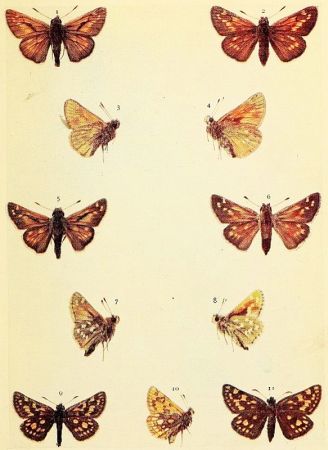
This butterfly is very similar on the upper side to the Large Skipper, but the spots, especially those nearest the front edge of the fore wings, are yellower. On the under side the greenish tinge of the ground colour, and the silvery spots, make the identification quite easy. The black sex mark in the male is very similar to that of the last species (Plate 126).
The males vary a little in the width of the marginal border, and in some females there is almost as much fulvous on the discal area of the wings as in the male; in the darkest females the spots always appear paler than in fulvous specimens. On the under side the ground colour is sometimes olive-brown rather than green.
The following account of the life-history of this butterfly is adapted from Mr. Frohawk's article on the subject published in the Entomologist for 1901:—
In August, whilst watching some of the butterflies on the wing over a patch of chalky ground covered with a short dense growth of various grasses, etc., he noted a female hovering close over the plants. Presently it settled on a tuft of hair grass (Aira cæspitosa), and after walking over and among it a little time, she curved her abdomen down, and deposited a single egg on one of the fine hair-like blades, or, rather, spines, and close by, within an inch, another egg was found. Afterwards some plants of this grass were potted up, and some females placed on them. These deposited a large number of eggs upon the grass-stems and blades.
The egg when newly laid is pearl white with the slightest yellowish-green tinge, which very gradually turns deeper in colour, assuming a pale straw-yellow on the sixth day, and so it remains until January, when it becomes paler.
The caterpillar hatches out at the end of March or early in April. It does not eat the empty egg-shell, but directly after leaving the egg it starts spinning the fine grass together into a somewhat dense cluster an inch or two above the ground. In this compact shelter the larva lives and feeds upon the grass surrounding it, remaining almost always completely hidden. Sometimes as many as three or four live together. When full grown and about one hundred days old, the caterpillar is of a dull olive-green colour, with a black collar on the first ring, and the entire surface densely sprinkled with minute shining black warts, each emitting a tiny amber-coloured spine with a cleft knobbed apex. The head is blackish marked with ochreous lines. It still resides in a tube of grass spun closely together, and feeds on any other kind of grass that happens to be interwoven with the Aira. Just before pupation the caterpillar often crawls restlessly about, but in some instances it does not leave its place of feeding, and spins a strong, coarse network cocoon among the grass close to the ground, weaving the gnawed loose pieces of grass with the fine stems and blades, and therein pupates during the latter part of July.
Larger Image
Pl. 126.
Large Skipper. 1, 3, male; 2, 4 female.
Silver-Spotted Skipper. 5, 7 male; 6, 8 female.
Chequered Skipper. 9, 10 male; 11 female.
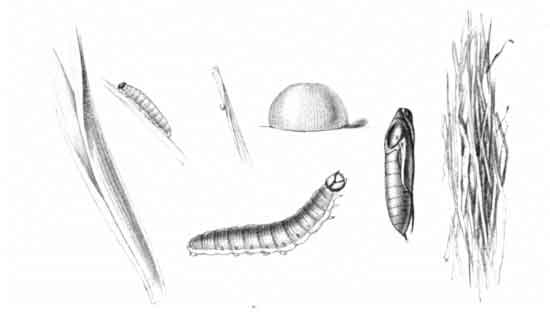
Large Skipper.
Egg, natural size and enlarged; caterpillars, chrysalis and cocoon.
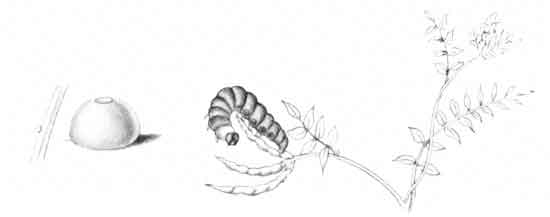
Silver-spotted Skipper.
Egg, natural size and enlarged; caterpillar.
Pl. 127.
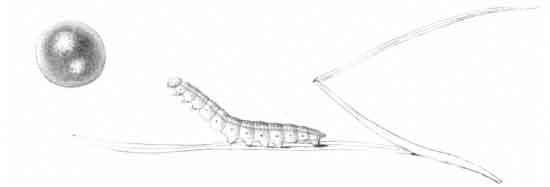
Chequered Skipper.
Egg enlarged and caterpillar.
The chrysalis is secured in the cocoon by hooks at the tail and by hooked bristles on the head; the head and thorax are pale olive mottled with blackish; the body olive, spotted with dark olive, and inclining to yellow on the ventral surface; below each spiracle is a short longitudinal mark; the spiracles are amber-brown.
The butterfly is to be found in August on most of our chalk hills, but has not been recorded from either Scotland or Ireland.
It is a very quick flyer and difficult to capture when on the wing, but it is fond of sitting on low-growing thistles, and is then sometimes easy to take. Abroad it occurs throughout Europe and Northern Asia to China and Japan.
The Chequered Skipper (Carterocephalus palæmon).
The well-defined yellow or orange spots on the blackish-brown ground colour distinguish this butterfly from all other British Skippers.
The variation is only of a minor kind, and chiefly in the direction of an increase or a decrease in the number and the size of the spots. Occasionally those on the central area of the fore wings are much enlarged and more or less confluent; and the spots on the outer margin of the hind wings are sometimes very small or entirely absent.
The following particulars of the early stages are abstracted from Mr. Frohawk's life-history of the species (Entomologist, 1892):—
Living females received in June were placed on a growing plant of brome grass (Bromus asper), and a few eggs were deposited, some upon the blades of grass, others upon the gauze-covered glass jar in which the plant was placed; they were laid singly, firmly adhering to whatever laid upon. The first lot of eggs were deposited on June 14. The egg has a pearly appearance, being whitish or yellowish-white in colour. Ten days after the egg is deposited the young caterpillar emerges by eating away the crown. Soon after hatching out the young caterpillar makes a little tubular dwelling, drawing together the edges of the grass-blade by spinning about three or four stout cords of silk, which quickly contract, causing the edges to draw together, and sometimes to overlap, forming a compact short tube; generally before spinning it nibbles off the extreme edge of the blade where the silk is afterwards attached. It feeds upon the blade both above and below its abode, devouring so much that frequently only the midrib of the blade remains, and the tube only just long enough to conceal it; it then shifts its quarters, and prepares a new home.
On October 3, when one hundred and one days old, the caterpillar was pale primrose-yellow, and the stripes of a slightly darker hue, the white lateral line showing clearly, and spiracles brownish; the head pale buff with a faint lilac tinge, with a black patch above the mouth and brownish at the sides. In the previous stage the caterpillar was whitish-green with a rather dark green line along the middle of the back, this line bordered on each side by an almost white, very fine line, followed by alternate darker and lighter lines, the lightest being extremely fine; "then a subdorsal darker green line, bordered laterally by a conspicuous whitish line, which is again bordered below by a paler and indistinct green line, and a very faint spiracular whitish stripe, on which the spiracles are placed; they are white, outlined by a dark but indistinct ring; the under surface is whitish-green."
About the middle of October the hibernaculum was formed by spinning two blades of grass together at the edges, so making a tube, in which the caterpillar remained during the winter. On March 21 it left its retreat, but did not seem to feed, and generally remained quiet, lying along a grass-blade. On April 3 "it had drawn together with silk six blades of grass at the ends, forming a tent-like structure, and along the surface of one of the broadest a little carpet of silk was spun, upon which it rested with its head uppermost; a silk cord also encircled its body round the fourth segment." It assumed the chrysalis state on April 8, and had then passed two hundred and eighty-nine days in the caterpillar condition. The chrysalis measures five-eighths of an inch in length, is fairly cylindrical, but tapering to the tail. "Dorsal view: the head is pointed in front in the form of a short conical beak; the eyes are rather prominent; the thorax is swollen in the middle, the widest part, and then gradually tapers towards the last segment, which is elongated and flattened. Lateral view: the beak is slightly upturned, the thorax convexed, and the segment next to the thorax is rather swollen in the middle, so forming a rather decided depression at the base of the thorax, where the silken cord passes round; the body gradually tapering to the last segment, which terminates in a long compressed curved process furnished with long hooks; the wing-cases extend down two-thirds its length, and only very little, if at all, swollen; the antennæ and legs are but feebly modelled; the tongue is well defined, it is dusky at the base, blending into black at the apex; the colour is of a very pale primrose-yellow, shading into pearly grey, and semi-transparent on the head, wings, and flap; a dark medio-dorsal line commences at the base of the beak, and passes down the entire length, gradually fading off in the anal extremity; it is blackest on the head and first abdominal segment, and palest on the thorax, where it is light brown; there are two rust-red subdorsal lines, which run parallel from the base of the antennæ to the last segment; another similar line, united along the inner margin of the wing, passes over two spiracles, and then runs parallel with the subdorsal lines.... The antennæ and wings are faintly outlined with dusky brown. In general appearance and colouring the pupa closely resembles a piece of dead withered grass."
A female butterfly emerged on May 20, the transformation from egg to perfect insect thus occupying about eleven months. This local butterfly is on the wing in June; sometimes it is seen in the latter part of May, and, more rarely perhaps, in July.
This species appears to have been first noticed as an inhabitant of Britain in 1798, in which year specimens were taken in Clapham Park Wood, Bedfordshire, by Dr. Abbott, who, four years later, also reported the butterfly from White Wood, Gamlingay, Cambridgeshire. In 1823 it was found to occur at Castor Hanglands, near Peterborough; and in 1841 Doubleday met with it, in large numbers, in Monk's Wood, Huntingdonshire. Among other localities from which it has been reported are Ropsley Wood, near Grantham, Notts, and Wychwood Forest, Oxfordshire.
In its special localities, which, at the present time, are chiefly the larger woods in Lincolnshire, Northamptonshire, and Buckinghamshire, it frequents the flowers of ground ivy (Nepeta glechoma) and of the bugle (Ajuga reptans).
Abroad it is locally common in various parts of Central Europe; also occurs in Finland, Central and Northern Russia, Dalmatia, Piedmont, and in Labrador, and other parts of North America.