PART II. DESCRIPTIONS OF SPECIES. (continued 3)
Reading edition
The egg is pale green when first laid, and in shape it is almost spherical, but rather higher than broad; it is finely ribbed and reticulated, but unless examined through a lens it appears to be quite smooth.
The caterpillar when full grown is whitish-green, dotted with white. From the larger of these dots on the back arise greyish bristles; the three lines on the back (dorsal and subdorsal) are whitish, edged with dark green; the line on the sides (spiracular) is white, fringed with greyish hairs; anal points green, hairy, extreme tips white. Head larger than the first ring (1st thoracic segment), green dotted with white and hairy, jaws marked with brownish. It feeds on grasses.
The chrysalis is green, with yellow-tinted white markings on the edge of the wing covers and ridges; the spots on the body are yellowish, or sometimes white. Occasionally the chrysalids are blackish, with white or yellow points on the body.
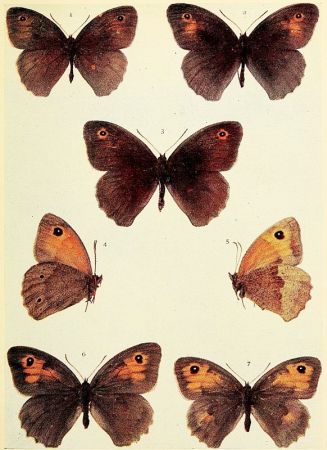
Larger Image
Pl. 84.
Meadow Brown.
1, 2, 3, 4 male; 5, 6, 7 female.
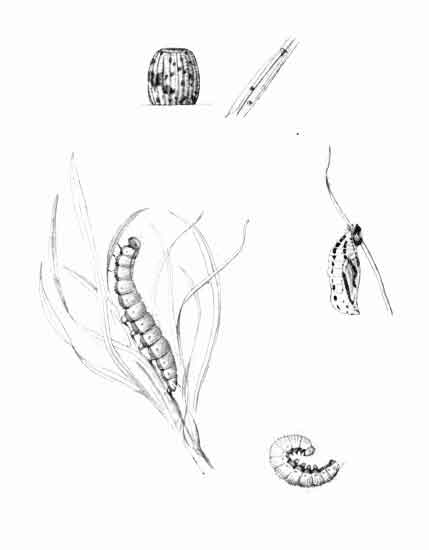
Pl. 85.
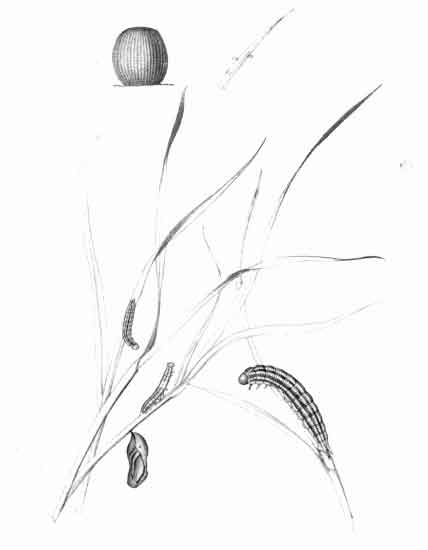
Meadow Brown.
Eggs, natural size and enlarged; caterpillars and chrysalis.
There are certainly two broods of this butterfly in the season, and in favourable years there may be three broods. In an ordinary way the first flight is in May and June, and the second flight in July and August. The caterpillars feed on Poa annua, Dactylis glomerata, etc. Those hatched in autumn hibernate more or less completely, and become full grown in early or late spring according to the season. Sometimes, however, they seem to feed during the winter, and assume the chrysalis in March. Probably it is from such precocious caterpillars that the butterflies sometimes seen in April result.
The Speckled Wood, it was noted, prefers shady places; the present butterfly is more partial to sunshine and plenty of it. As its English name suggests, it is fond of basking on walls, but it does this also on dry hedge banks, sides of gravel pits, tree-trunks—in fact, wherever it can enjoy the full sunshine. It is not at all shy, and will be pretty sure to introduce itself to the notice of the collector as soon as he enters its domain. Although it now seems to be absent from certain districts in which it was once abundant, it may still be regarded as a generally common species in England and Wales, and even plentiful, in some years, in the southern, eastern, and western counties; it appears to be more local in North England. In Scotland it seems fairly distributed, and not scarce in the south; its range extends to Aberdeenshire. Kane states that it is everywhere abundant throughout Ireland. Abroad it is common throughout Europe, except the extreme north, and extends into North Africa, Asia Minor, and Armenia.
The Meadow Brown (Epinephele ianira).
The female is the jurtina of Linnæus, and as he described this sex before the male, under the impression that they were distinct species, the law of priority, we are told, must be observed and the earlier name be adopted.
This fuscous-brown butterfly of the meadows is marked, especially in the female, with dull orange. The male, of which sex three specimens are shown (Plate 84, Figs. 1-3), has a broad black sexual brand on the central area of the fore wings, and a white pupilled black spot towards the tips of the wings; this spot is usually encircled with orange, and there is often more or less of this orange colour below it (Fig. 2 typical). The under side of the fore wings is orange with the costa narrowly, and the outer margin broadly, greyish-brown to match with the colour of the under side of the hind wings. The female is without the black brand, and is more ornamented with orange, which generally forms a broad patch on the outer area of the fore wings (Fig. 6), but it is sometimes continued inwards, so that almost the whole of the discal area—that is, nearly all but the margins, appears to be orange (Fig. 7); the hind wings have an indistinct paler band on the outer area, and this is sometimes suffused or clouded with orange. On the under side the pale band is more defined (Fig. 5). The apical spot of fore wings is sometimes double, and a tendency to this variation is shown in Fig. 6, but in the complete form there are two white dots (bi-pupillated). At the other extreme, and generally in the male, the apical spot is entirely absent (var. anommata), or is greatly reduced in size, and is without the white pupil. Spots on the under side are as often absent as present. They may be from one to five in number, and either simply black dots or ringed with orange, as in Fig. 4. Occasionally the orange on the upper side of the female gives place to a pale straw or even whitish colour; and on the under side to whitish-grey.
Not infrequently a greater or lesser area of the wings is "bleached," and this seems to be due to absence of pigment in the scales on such parts. This bleaching may affect the whole or a portion of one wing only, or it may take the form of symmetrical blotches on each wing. All such abnormal specimens of this, and of other species similarly affected, are certainly of value to those who are interested in teratology, but they seem to be out of place in a collection of butterflies where the aim should be to show the true variation of species rather than "freaks," which are the result of accident or disease.
The egg, laid on a blade of grass as shown (Plate 85), is upright and ribbed; the top is flattened, with an impressed ring thereon. Colour, whitish-green inclining to brownish-yellow as it matures, and marked with purplish-brown.
The caterpillar is bright green, clothed with short whitish hairs; there is a darker line down the back, and a diffused white stripe on each side above the reddish spiracles; the anal points are white. Head rather darker green, hairy.
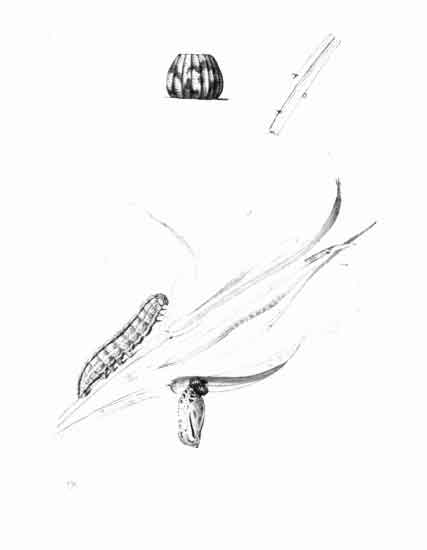
Pl. 86.
Gatekeeper.
Eggs, natural size and enlarged; caterpillar and chrysalis.
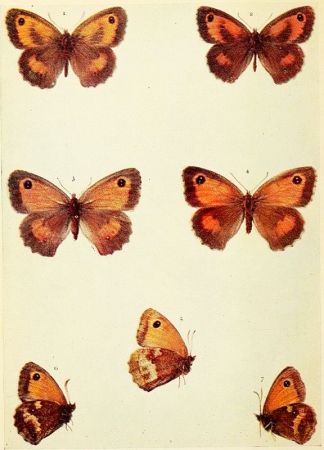
Larger Image
Pl. 87.
Gatekeeper.
1, 2, 6, 7 male; 3, 4, 5 female.
The chrysalis is pale green, marked with brownish on the wing-covers, the thorax is spotted with blackish, and the points on the body are brownish. Suspended, and with the old skin attached, as shown in the figure.
From its wide distribution and general abundance, this may be said to be our commonest butterfly. It appears to be always on the wing, in dull weather as well as in sunshine, and, except for a short interval in early August, it is to be seen in hayfields, open places in woods, on grassy slopes, or borders of highways and byways from June to September.
Although quite fresh specimens are fuscous-brown, the butterfly, after a short time on the wing, loses the dusky tinge and becomes brown. It is, therefore, always desirable to rear specimens for the cabinet from caterpillars. These feed on grasses of various kinds in May, are easily managed, and may be found in most hay meadows at night, when, of course, a lantern will be needed to throw a light on the business of collecting them.
The not infrequent occurrence of fresh specimens in the autumn is strong presumptive evidence of at least an occasional second brood. Perhaps, as has been suggested by Mr. R. Adkin, "a late emergence of Epinephele ianira is the rule rather than the exception," especially in the warmer parts of the country.
The butterfly is found throughout England and Wales, Ireland, and Scotland, including Isles of Lewis and Orkney. Abroad it occurs in all parts of Europe except the most northern, Asia Minor, Armenia, North Africa, and the Canary Isles.
The Gatekeeper (Epinephele tithonus).
Other English names in use at the present time for this butterfly (Plate 87) are "Small Meadow Brown," "Hedge Brown," and "Large Heath," but the latter is more often applied to another species which will be referred to later. Petiver called it the "Hedge Eye."
The general colour is brownish-orange, and the margins are fuscous-brown; there is a black spot towards the tips of the fore wings, and this, as a rule, encloses two white dots; one or both of these dots sometimes absent in the male. The male differs from the female in its rather smaller size, and in having a fuscous band on the central area; the latter is broadest towards the inner margin, and in this part are some patches of blackish androconial scales or plumules; at the upper end of the band there is sometimes a fuscous cloud. Occasionally, one or more small black spots, some with white pupils, are present below the apical one. Four such spots are rare, but specimens with one or with two are not uncommon. There is usually a white-pupilled black spot towards the anal angle of the hind wing, but I have several males and females that are without this spot. Sometimes there are as many as four spots on the hind wings, but this is perhaps exceptional (Plate 113, Fig. 5). On the under side of the hind wings there are often two white dots, sometimes ringed with black, towards the costa, and two or three other similar dots towards the anal angle; but the number of dots may be reduced to two, one of which is near the costa, or be increased to six. Colour changes, similar to those in the last species, occur, and the orange colour, in both sexes, may be replaced by yellow (var. mincki, Seebold), or by white (var. albida, Russell, Plate 119, Figs. 6, 7). Such aberrations are very local and rare; a few have been obtained on chalk hills in South Hampshire.
In an extraordinary aberration, taken in Sussex in 1897, the whole of the dark brown colour of margins and band is replaced by pale pinkish-ochreous, but the normal brownish orange remains. Other somewhat similar specimens have been recorded.
The egg (Plate 86) is pale yellowish when first laid, becoming lighter and irregularly blotched with reddish-brown, the upper blotches forming a sort of band round the egg; as the caterpillar matures the shell assumes a darker tinge, inclining to slaty, and the markings are less distinct.
The caterpillar, when full grown, is pale ochreous, clothed with short pale hair, and freckled with brownish; the line down the back is darker, one on each side is paler, and that above the feet is yellowish. The head is rather darker than the body, marked with brownish, and bristly.
According to Hellins, the newly hatched caterpillar is whitish-grey, with rusty yellow lines on the back. In October, after the first moult, it becomes green with a brownish head. In April the body is greenish-grey, and the head pale greenish-brown. At the end of April it moults for the last time, and is then pale ochreous generally, but some caterpillars are darker than this, and some paler with a greenish-grey tinge.
The chrysalis is whitish-ochreous, with dark brown streaks on the wing-covers and some brownish spots and clouds on the back and sides. Suspended from stem or blade of grass; the old skin remains attached.
The caterpillars feed at night on grasses, such as Poa annua, Triticum repens, and Dactylis glomerata, from September to June. The butterfly is on the wing in July and August. Although these butterflies may be seen, sometimes in considerable numbers, where the rides are grassy, in woods, they are perhaps more attached to hedgerows. Bramble flowers are their special attraction, but they are not indifferent to the blossoms of the wood sage (Teucrium scorodonia) or of marjoram (Origanum vulgare).
Pretty generally distributed throughout England, it is often exceedingly plentiful in the south and also in South Wales. In Scotland the butterfly seems to be common in Kircudbrightshire, but not common in other southern counties up to Argyle and Fife. Kane says that in Ireland it is almost confined to the southern counties.
Abroad it is found throughout Europe, except the North-East, and its range extends into Northern Asia Minor.
The Ringlet (Aphantopus hyperanthus).
The sombre-looking butterfly, of which several figures will be found on Plate 89, has been known by its present English name since 1778, the year in which Moses Harris published "The Aurelian." The Latin specific name was written hyperantus by Linnæus, but Esper corrected this to hyperanthus. It has, however, been supposed that Linnæus really intended to have written hyperanthes (a son of Darius), and this form of the name has been used, but Esper's emendation is here adopted.
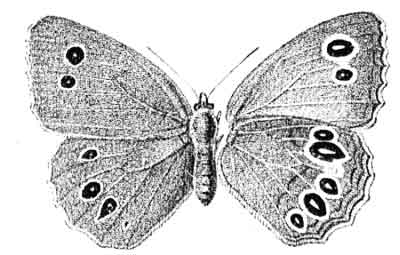
Fig. 27.
Var. lanceolata.
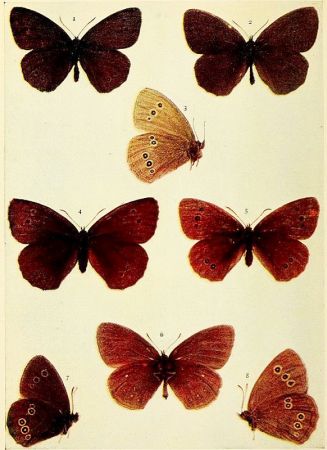
All the wings are sooty-brown, the male when quite fresh appearing almost black, and the sexual brand is then difficult to see; there are one or more black spots with pale rings, and sometimes white pupils, on the fore wings, but these are always more prominent in the female than in the male; in the latter sex they may be entirely absent. On the under side there are generally two, sometimes three, ocellated spots on the fore wings, and there are five such spots on the hind wings, the two nearest the costa being double, and not very infrequently there is a smaller spot near or attached to the lower edge of the double one. In the matter of size of the spots on the under side there is a wide range of variation, and at one end of this is var. lanceolata, Shipp, and at the other var. obsoleta, Tutt, in which not a trace of any of the spots remains. Specimens with a varying number of white dots, with or without yellow rings, are usually referred to var. arete, but Fig. 6 on the Plate represents a modification of this variety, known as cœca.
>
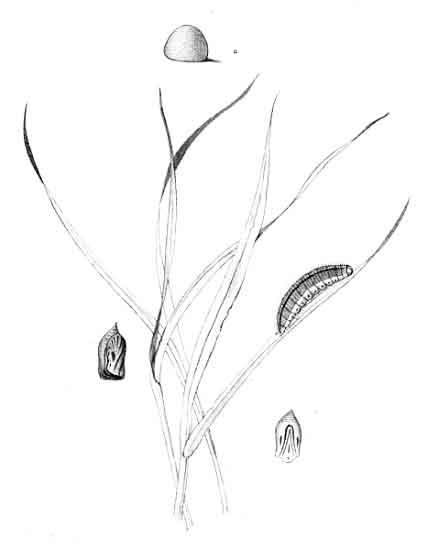
Pl. 88.
Ringlet.
Egg, natural size and enlarged; caterpillar and chrysalids.
Larger Image
Pl. 89.
Ringlet.
1, 2, 3, 7 male; 4, 5, 8 female; 6 var. cæca, male.
Occasionally, on the under side, there are transverse lines on the outer half of all the wings, and the space between these lines is suffused with whitish. The specimen showing these lines faintly (Fig. 3 on the Plate) is from North Cumberland.
The early stages are figured on Plate 88.
The egg is yellowish-white at first, but soon turns to a pale brown. As will be seen on comparing the enlarged figure of this egg with those of the two previous species, it is quite different in shape, and is pitted rather than ribbed. The eggs are not attached to anything, but are allowed to fall down among the roots of the grass over which they are deposited.
The caterpillar is described by Newman as pale wainscot brown in colour, with a darker line down the back, and the head has three broad, slightly darker but faint, stripes on each cheek. According to others it is ochreous or brownish-grey, with a dark brown line on the back, a pale one with darker edge on the sides, and a whitish stripe above the feet.
The chrysalis is ochreous-brown sprinkled with reddish-brown, and marked with brown on the wing-covers. It lies low down among the tufts of grass. The figures of caterpillar and chrysalis are from Buckler's "Larvæ of British Butterflies."
The caterpillars feed upon various grasses, including Poa annua and Dactylis glomerata, growing about damp places in woodland districts. They emerge from the egg in August, feed leisurely until October, when they appear to hibernate. In March they resume feeding, but do not attain full growth until June. The butterflies are on the wing in July and August, and frequent lanes and the outskirts of woods. They usually fly along the shady side, but they are not averse to the nectar of the bramble blossom, and I have seen them taking a sip here and there although they were fully exposed to sunshine all the time.
Wherever there are suitable haunts the butterfly may be found throughout the greater part of England and Wales. It seems, however, to have disappeared from some districts in Lancashire and Yorkshire where it was formerly common. It is fairly plentiful in most of the southern counties of Scotland, and its range extends north to Aberdeen. In Ireland it is abundant in the south and the west, and seems to occur in most suitable places; also common in certain localities in Donegal and Antrim. Abroad it is distributed through Europe and Northern Asia eastward to Japan.
The Large Heath (Cœnonympha typhon).
The butterfly now to be considered is a most variable one, both as regards colour and marking. Several of the varieties have been named, and in the time of Haworth down to Stephens, and even much later, at least three of these were regarded as distinct species. In the present day, however, it is generally accepted that all the varieties are forms of one species, although two local races are recognized.
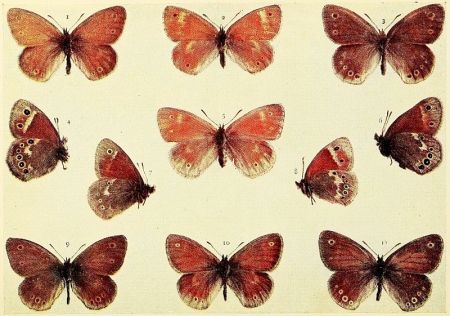
The typical form is typhon, Rottemburg, and polydama (The Marsh Ringlet) of Haworth (Plate 90, Figs. 1, 2, 5, 7-11). The colour ranges from darkish-brown to a pale tawny; there is an ochreous ringed black spot towards the tips of the fore wings, sometimes another similar spot above the inner angle, and occasionally when both spots are present there is an ochreous spot between them; the hind wings have from one to three of these spots, but a larger number than three is exceptional. The under side of the fore wings is either bright or dull fulvous, and the spots are pretty much as above, but with white pupils, and there is a whitish band before them; the under side of the hind wings is olive brown on the basal two-thirds, covered with pale hair, and the outer third is brownish merging into greyish on the outer margin; an irregular white or whitish band limits the two areas; there are six ochreous ringed black spots, with white pupils, but they are always rather small in size. The female is much paler than the male.
This is the usual form in Northumberland, Cumberland, Yorkshire, and Ireland; it also occurs in Lancashire, Westmoreland, and the South of Scotland.
Var. philoxenus, Esper. This is davus (Small Ringlet), Haworth, and rothliebii, Newman (Plate 90, Figs. 3, 4, 6).
On the upper side the colour is dark brown in the male and rather paler in the female; the spots are very distinct, ringed with fulvous; those on the hind wings are generally three in number, and often five or six; on the under side, the bands are whiter, and often broader, and the spots are very black, large, and conspicuous.
This form is found on some of the mosses in Lancashire and Westmoreland, in Delamere Forest, Cheshire, and in North Shropshire; but the most characteristic examples of the form are chiefly obtained in the first-named county, from which it was first made known, in 1795, as the "Manchester Argus," or "Manchester Ringlet."
Var. scotica, Staudinger (laidion, Staud., but not of Borkhausen), Pl. 90, Figs. 1, 2, 4, 5♂, 3♀, is the typhon of Haworth, as stated by Newman; the latter author, however, figures it as davus, Fabricius, which is doubtful.
The ground colour is pale tawny, sometimes suffused with brownish, greyish on the margin, and broadly so on the outer area of the hind wings; the spots are often absent, and when present are rarely very distinct. The female is much paler than the male. The under side of the hind wings is somewhat similar to that of the typical form, but sometimes the whole area is a uniform greyish; the spots are only rarely at all distinct, and then only one, or perhaps two, on a wing, and not infrequently they are entirely absent. This form occurs in Scotland, especially in Aberdeenshire and Sutherlandshire, also in the Isle of Arran, in the Orkney and Shetland Isles, and in the Outer Hebrides. Kane states that he has met with single specimens at "Killarney, Westmeath, Galway, and Sligo."
In some localities, such as Carlisle, Rotherham, and others in Yorkshire, forms intermediate between the type and var. philoxenus are found; modifications of the type form in the direction of var. scotica occur in Cumberland, Northumberland, and Co. Leitrim, in Ireland; and forms approaching the type more nearly than var. scotica are met with in the Glasgow district, and at Pitcaple in Aberdeenshire.
The egg is very pale greenish-yellow at first, but the green fades, brownish blotches appear, and some dark markings appear around the upper part a short while before the caterpillar hatches out. It is finely scored almost from the base to the top, which is depressed, and has a raised boss in the centre, as in the egg of the Small Heath.
From some eggs sent to me in July, caterpillars hatched in August. They fed on ordinary meadow grass, and in September were figured, when they were about half an inch in length. Head shallowly notched in front, green, roughened with whitish dots, eyes and jaws brownish. Body green, roughened with white dots, with darker line down the back, and paler, almost white lines along the sides, anal projections reddish (these were greenish when younger).
The figure of the full-grown caterpillar is after Buckler, who describes it as "of a bright green, with dark bluish-green dorsal line, edged with pale lemon-yellow, the subdorsal and spiracular lines are of the same pale yellow, but the subdorsal is edged above with dark bluish-green, and between these two lines is an interrupted streak of a darker colour, posteriorly with a slight tinge of reddish or pink, and the caudal fork is tipped with pink."
Larger Image
Pl. 90.
Large Heath.
1, 3, 4, 6 male, 2 female (Delamere); 7, 9 male, 5 female (Arran);
8 male (N. Salop); 10 do. (Ireland); 11 do. (Carlisle).
Pl. 91.
Large Heath.
Eggs, natural size and enlarged; caterpillars and chrysalis.
The chrysalis is bright green, with brown streaks on the edges and centre of the wing-covers, and at the tip of the tail, turning dark brown just before the butterfly emerges. (Figure and description after Buckler.)
The eggs are laid in July on blades of grass, and the caterpillars hatch out in that month and August. The food of the caterpillars is said to be the beaked-rush (Rhynchospora alba); those that I had from Witherslack eggs fed well upon ordinary grass until October, but they died during the winter. After hibernation they recommence feeding, and are full grown in May and June, when they pupate, and the butterflies appear at the end of June and in July.
Barrett, writing of the butterfly in all its forms, says, "Its most southern known locality in England is Chartley Park, Derbyshire, and it is common in all 'mosses' of Lancashire and Cheshire—all moors about Grange, and in Chat Moss, Risley Moss, Rixton Moss, Simondswood, Lindon Moss, and Carrington Moss, as well as at Delamere Forest. In Yorkshire abundant in Thorne Waste, not scarce in Wensleydale, and found on Cottingham Moor, Hatfield Moors, and elsewhere. Northward it is found in all suitable mosses and moors in Durham, Westmoreland, and Cumberland, but seems to have been exterminated in Northumberland."
In Scotland it appears to be pretty generally distributed, and occurs up to an elevation of some 2000 feet. Kane states that in Ireland it is widely spread throughout, on the bogs and mountains. It is stated to have occurred in North Wales a long time ago, but there are no recent records from that country. Abroad it is found in Central and Northern Europe, extending to Lapland, and through Northern Asia to Amurland. In North America it is represented by two forms, which are not quite like any of those occurring elsewhere.
The Small Heath (Cœnonympha pamphilus).
To the ancient fathers the male of the butterfly on Plate 92 was known as the "Selvedged Heath Eye," and the female was called the "Golden Heath Eye." Harris figured it as "The Small Heath," or "Gatekeeper;" the latter name being now associated with another species, it may be allowed to drop out in the present connection.
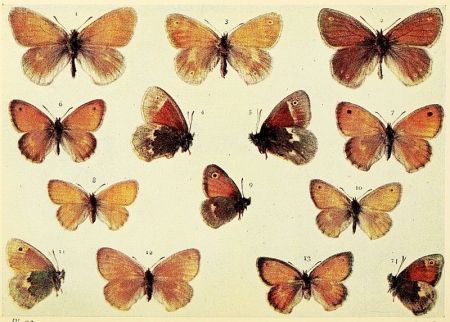
The wings are pale tawny, with a brownish or greyish-brown border, of variable width, on all the wings, and stronger in the male than the female; there is a black spot towards the tip of the fore wing. The under side resembles that of the last species in some degree, but the eyed spots of the hind wings are not always prominent, often only white dots, and may be absent altogether (Fig. 9).
Variation in this species is extensive, but not striking. The tint of the ground colour may be reddish or yellowish; occasionally brownish or greyish-brown specimens of the male occur, and more rarely purplish-brown examples of the same sex have been found. Females, in all cases paler, and generally larger than the male, are sometimes whitish-ochreous in colour, and, very rarely, yellowish-white. The brown border is also a variable character, and may be very dark and broad (var. lyllus), or reduced to linear proportions. The apical spot on the fore wings may be of fair size and very black, very pale and indistinct (Figs. 8, 12), or entirely absent; it does not seem to be pupilled with white (as it is on the under side), but sometimes there is a pale speck in the centre. On the under side of the hind wings there is variation in the width of the central whitish band-like patch, in some specimens with unusually dark ground colour this patch is very broad; in other examples, of normal coloration, the band is complete, and extends to the inner margin. The white dots that normally do duty as ocelli are not infrequently set in reddish-brown spots, and then become rather more noticable (Fig. 14). This form is var. ocellata, Tutt.
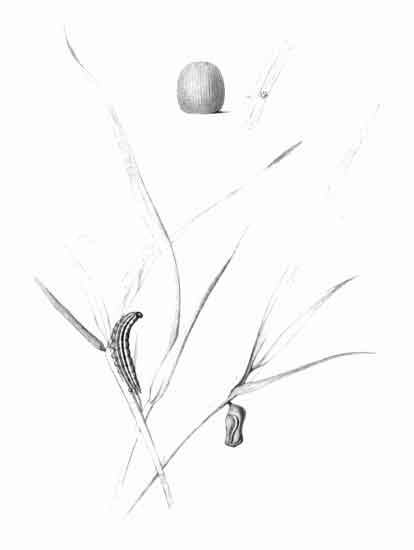
The egg is green at first, afterwards becoming whitish or bone-colour; later on a brownish irregular ring appears a little above the middle, and there are various brownish freckles. It is finely ribbed, and the top is depressed, forming a hollow with a central boss. Laid in a cluster of four on a blade of grass, but this may have been accidental. Others were deposited singly on muslin and on fine grass, all in mid-June. The caterpillar is of a clear green colour, "with darker green dorsal stripe, and a spiracular stripe not so dark; the anal points pink" (Hellins).
The chrysalis is of "a delicate pale rather yellowish-green, with a faintly darker green dorsal stripe, the edge of the projecting wing-covers on each side whitish, outlined with a streak of reddish-brown; the abdomen freckled very delicately with paler green; the tip of the anal point, with a short streak of brownish-red on each side; the wing-cases faintly marked with darker green nervures" (Buckler).
The figures of caterpillar and chrysalis on Plate 93 are from Buckler's "Larvæ of British Butterflies."
Some caterpillars, from eggs laid in May or June, become full-grown in four or five weeks, and appear as butterflies in August, but others do not complete their growth until the following spring. Just exactly what happens in the case of eggs from autumn females does not seem to be very definitely ascertained. It has, however, been stated that caterpillars hatching from eggs laid in August, attain the size of the slow-growing contingent from May eggs, and then hibernate. Probably, therefore, it is these that produce the July butterflies, and if so, the succession of emergences may be something in this way: May and June butterflies from May and June eggs (twelve months' cycle), July butterflies from August eggs (eleven months cycle), August and September butterflies (partial second brood) from May and June eggs (four months' cycle).
This interesting little butterfly is to be seen almost everywhere, but it is perhaps most frequently to be found in grassy places in lanes, on heaths and downs, railway banks, in rough meadows, etc. It occurs on mountains even up to an elevation of 2000 feet. When flying in company with the blues and coppers, all frolicking together over some patch of long grass, the colour combination has an exceedingly pleasing effect. They rest by day, and sleep at night on grass or rushes.
A common species throughout England and Wales, Ireland and Scotland, as far north as Nairn, also in the Outer Hebrides. Abroad its distribution extends over Europe to South-West Siberia, Central and North-East Asia, Asia Minor, and North Africa.
We now arrive at the Hairstreaks, Coppers, and Blues. These belong to the Lycænidæ, a very large family of butterflies which is represented in all parts of the globe. There are eighteen species in Britain, but at least one of these is extinct and another is supposed to be so; two are very rare, and the chances of meeting with either are probably about equal.
The Brown Hairstreak (Zephyrus betulæ).
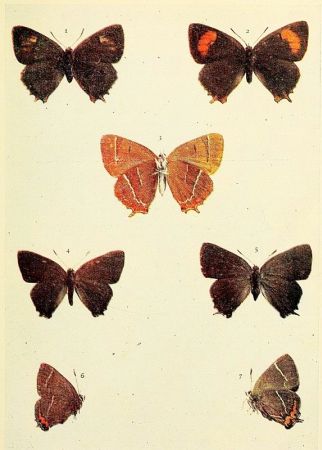
The butterfly is represented on Plate 94, Figs. 1-3. The male is blackish-brown with a faint greyish tinge, and there is a conspicuous black bar at the end of the discal cell of the fore wing, followed by a pale cloud; there are two orange marks at the anal angle of the hind wings. The female is blackish-brown, and has the black bar at end of the cell, and an orange band beyond; there are usually three orange marks on the hind wings at the anal angle, but sometimes there are only two. The under side of the male is ochreous, but that of the female is more orange; the fore wings have the black bar edged on each side with white, and there is a white-edged, brownish triangular streak beyond, the outer margin is tinged with reddish; on the hind wings there are two white irregular lines and the space between them is brownish, the outer margin is reddish, becoming broadly so towards the anal angle, where there is a black spot. Variation is not of a very striking character. The shade following the black bar at end of the discal cell on the fore wings in the male is sometimes yellowish tinged, not infrequently fairly large, and with two smaller spots below it. More rarely all three spots are distinctly ochreous-yellow (var. spinosæ, Gerhard). A similar aberration, but with the marks white instead of yellow, has been named pallida, Tutt. The orange band in the female varies in width and in length; occasionally it extends well below vein 2, and into the discal cell within the black bar. I have one specimen in which the band is broken up into three parts, and the upper one of these is but little wider than the same spot in var. spinosæ, the other two being almost exactly of the same size as in that variety.
Larger Image
Pl. 92.
Scotch Large Heath. 1, 2, 5 male; 3, 4 female.
Small Heath. 6, 9, 10, 14 male; 7, 8, 11, 12, 13 female.
Pl. 93.
Small Heath.
Eggs, natural size and enlarged; caterpillar and chrysalis.
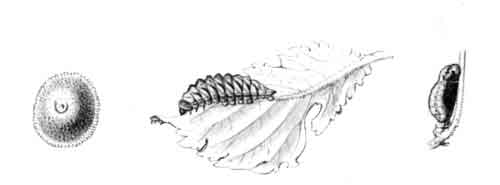
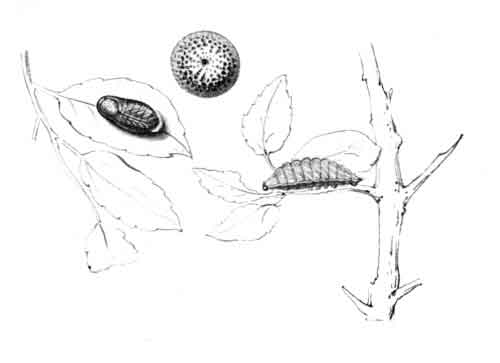
The life-history is figured on Plate 95—the lower set of figures.
The egg is described by Newman "as a depressed sphere and white," and he states, "it is attached to the twigs of blackthorn (Prunus spinosa) in the autumn, often as late as the end of September or beginning of October; it is not hatched until the spring."
The caterpillar is bright pale green, and the lines on the back and sides are yellowish, as also are the oblique streaks on the sides and the border of the ridge above the feet. There are some bristles along the ridge on the back and also on that above the feet. It feeds on blackthorn in May and June, and will eat the foliage of almost any kind of plum. I have reared fine specimens from caterpillars which fed on greengage.
The chrysalis is pale reddish-brown with a dark line down the middle of the back and some pale oblique streaks on each side; the wing-cases are freckled with darker brown. Barrett, quoting Fenn, says, "Suspended by the tail and a silken girth to the stem of the food-plant close to the ground." Those that I have seen pupated on or under leaves, and so far as I could observe without any girth, and certainly not suspended.
Nearly two hundred years ago the male of this butterfly was known as the Brown Hairstreak, whilst the female was called the Golden Hairstreak. The caterpillar seems to have been observed in quite early times. It has always been a local species, and although it appears to frequent hedgerows occasionally, its haunts generally are open grounds in the neighbourhood of woods, where blackthorn or sloe is plentiful. August and September are the months for the butterfly, but it does not seem to be very often observed on the wing, even in places where the caterpillars are known to occur. When seen it is generally high up on, or around, some oak tree. Occasionally, however, it visits the bramble blossoms, and at such times becomes a fairly easy prey. The caterpillar is obtained by beating sloe bushes.
Barrett, who seems to have worked out its distribution in England and Wales pretty closely, remarks, "In the eastern counties it has been taken occasionally in Norfolk and Suffolk, more frequently in Essex, where, in Epping Forest, it has been fairly common; also in Cambridgeshire, Huntingdonshire, and Northamptonshire, in some plenty. In very few localities in Kent, Sussex, Hants, and Dorset; rarely in Gloucestershire, and possibly Somerset; but found in many Devonshire localities, especially in the sheltered valleys around the Dartmoor range, and in the charmingly wooded districts about Axminster and Sidmouth; becoming common towards Dartmouth. It has also been found commonly near Marlborough, Wilts, and plentifully in some parts of North Wales; apparently rare in South Wales, but certainly existing in some parts of the wooded districts skirting Milford Haven. Also recorded from Worcestershire, and Cannock Chase in Staffordshire; and northward in the favoured districts of Grange and Silverdale in North Lancashire, and Witherslack in Westmoreland." As Surrey is not quoted in the foregoing, it may be mentioned as one of the counties in which the species is found. In Ireland Kane says that it is "abundant in certain localities in Munster; and in Co. Galway at Claring Bridge, and Oranmore; Cork; Killoghrum Wood, Enniscorthy; Blarney, Killarney."
Larger Image
Pl. 94.
Brown Hairstreak. 1, male; 2, 3 female.
White-letter Hairstreak. 4, 6 male; 5, 7 female.
Pl. 95.
White-letter Hairstreak. Egg enlarged; caterpillar and chrysalis.
Brown Hairstreak. Egg enlarged; caterpillar and chrysalis.
It is distributed throughout Central and Northern Europe, except the Polar region, and its range extends through Northern Asia to Amurland, Ussuri, and China.
The Purple Hairstreak (Zephyrus quercus).
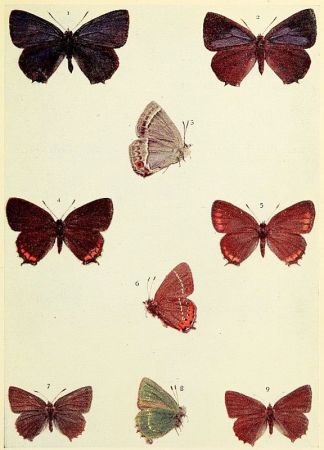
The butterfly (figured on Plate 96) has the sexes differently ornamented, as in the last species. The male is strongly tinged with purplish-blue, the veins are blackish; the outer margin of the fore wings are narrowly, and the costa and outer margin of the hind wings are broadly, bordered with black. The female is purplish-black, with two patches of bluish-purple in the discal cell and space below; often there is a smaller patch of the same colour between them, the whole forming a large blotch interrupted by the blackish veins. Under side greyish with blackish shaded white lines; two or three blackish clouds on the outer margin of fore wings above the inner angle; these are sometimes edged with orange; a black spot on anal angle of the hind wings, with an orange one above it, and a black-centred orange spot between veins 2 and 3.
Variation in this species is exceptional. An aberration known as bella, Gerhard, has a yellowish mark at end of the cell on the upper side of the fore wings, and at least one such variety has been taken in England. Sometimes the blotch on the female is rather blue than purple; a male specimen with blue streaks on the costa of the fore wings has been recorded, and Barrett mentions a gynandrous specimen in which the right side was that of the male.
The egg is pale brown tinged with pink, and over this is a whitish network. The caterpillar is reddish-brown and downy; a black line along the back has a whitish edge, and there are whitish oblique stripes, with blackish edge, on each side of the central line; the segmental divisions are well marked, and the spiracles are blackish with pale rings. The head, which, when the caterpillar is resting, is hidden within the first body ring, is brownish and glossy, and there is a greyish shield-like mark on the second ring. The chrysalis is red-brown, with darker freckles; the body is downy, and there are traces of oblique marks thereon. It does not appear to be fastened by the tail, but the cast larval skin remains attached; there are a few strands of silk around and about the chrysalis, but these are very flimsy, although they hold it in position on the ground or under a leaf.
The eggs are laid in July or August on twigs of oak, but the caterpillars, it is said, do not hatch out until the following spring. In May and early June the caterpillars are full grown, and may be obtained by beating or jarring the branches of oak trees in places where the butterfly is known to occur. They have also been found on sallow.
This species frequents oak woods, or the borders thereof, in July and August, and is often more easy to see than to capture, as it has a tantalizing trick of flying around the upper branches of the trees. Occasionally it resorts to lower growing aspens, probably to feast on the honey dew, the secretions of Aphides, with which the leaves are often covered in hot summers. It seems to be pretty generally distributed in all parts of England and Wales, and in Scotland as far north as Ross. In Ireland it appears to be more local, and has only been recorded from the east and south.
It is found in all parts of Europe, except the northern.
Larger Image
Pl. 96.
Purple Hairstreak. 1 male; 2, 3 female.
Black Hairstreak. 4, 6 male; 5 female.
Green Hairstreak. 7 male; 8, 9 female.
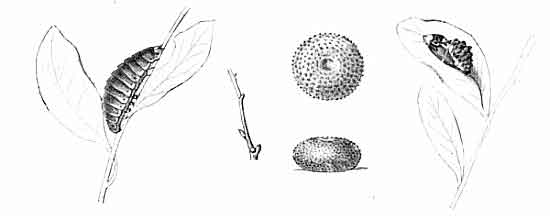
Black Hairstreak. Eggs, natural size and enlarged; caterpillar and chrysalis.
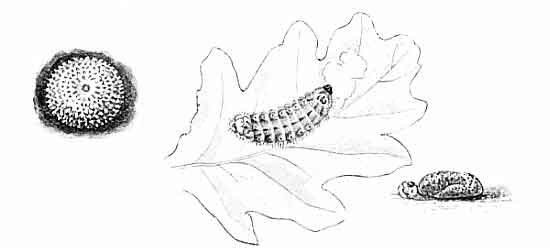
Purple Hairstreak. Egg enlarged; caterpillar and chrysalis.
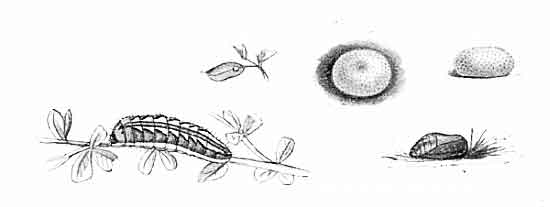
Pl. 97.
Green Hairstreak. Eggs, natural size and enlarged; caterpillar and chrysalis.
The Black Hairstreak (Thecla pruni).
This butterfly is figured on Plate 96. In colour it is dark brown or, when quite fresh, brownish-black; there are some orange marks on the outer margin of the hind wings, and these are most distinct in the female, in which sex there are orange spots on the fore wings also. The male has a pale sexual mark at the end of the cell of the fore wings, but this is less distinct than in the following species. The under side is brown, with a bluish-white interrupted transverse line on each wing, that on the hind wings angled before reaching the inner margin. All the wings have an orange band on the outer margin, but on the fore wings of the male this is often indistinct; there are some white-edged black spots before it, and, on the hind wings, beyond it also.
The eggs are laid in July on the twigs of blackthorn, but the caterpillars do not hatch until the following spring. The egg figured on Plate 97 was reddish-brown and appeared rather shiny. The caterpillar is described as yellowish-green, with a darker green furrow and purplish ridges along the back; the latter are edged with whitish and the divisions between the rings are yellowish. The head is pale brown. The chrysalis, which is attached by the tail and has a silken thread around it, is black, marked on the head and body with yellowish-white.
The caterpillars feed on blackthorn (Prunus spinosa) in a state of nature, but will eat the leaves of damson in confinement. They may be obtained in May, in their particular haunts, by beating sloe bushes with a beating tray, or an inverted open umbrella, held under to intercept the evicted caterpillars, etc.
This butterfly was not known as British until 1828, when a number of specimens were captured at Monkswood in Huntingdonshire. These were sold by the captor as T. w-album, which was then called the Black Hairstreak. As soon as the mistake was detected, it was given out that the specimens had been taken in Yorkshire, but this was only a ruse, as T. pruni has never occurred in that county. It is confined, so far as Britain is concerned, to three or four of the midland counties. "Mr. Herbert Goss, who has found it at Barnwell Wold, and in other wooded districts of Northamptonshire, at intervals, for more than twenty years past, says that it is fond of sitting on the flowers of privet (Ligustrum), and of Viburnum lantana, in the woods, and sometimes is to be found in numbers. Its time of emergence is very variable, apparently regulated by the lateness of the spring—from June 17th to the first week in July. Reared specimens made their appearance from June 13th to 27th. He writes, 'It was the greatest possible pleasure to see them walking about the table while I was at breakfast.' In 1858 it was found commonly at Kettering, and in 1859 at Oundle, and has been recorded at Warboys Wood, Huntingdonshire, and in Buckinghamshire. One specimen was taken at Brandeston, Suffolk, by the Rev. Joseph Green; and Mr. Allis found it commonly in the Overton Woods and about St. Ives. There is also a record in Monmouthshire, which may require confirmation. This butterfly does not appear to be losing ground in this country, its fondness for trees and lofty bushes rendering it difficult to capture" (Barrett).
A writer in the Entomologist for 1874 mentions Linford Woods, in Bucks, as a locality where he had observed several specimens, mostly females, on flowers of privet.
It is found throughout the greater part of Europe and also in Amurland and Corea.
The White Letter Hairstreak (Thecla w-album).
The male of this butterfly (Plate 94) is blackish, with a small whitish sex mark at end of the discal cell of the fore wing; there is a small orange spot at the anal angle of the hind wings. The female agrees in colour with the male, but the tails are longer, and there is no sex mark on the fore wings. The under side is brownish, with a white line on each wing, that on the hind wings forming a W before the inner margin; the hind wings have a black-edged orange band on the outer margin which is finely tapered towards the costa. Captured specimens are usually browner than those that are reared from caterpillars.
The species does not exhibit much tendency to variation. The white lines on the under side may be rather broad or very narrow, and that on the hind wings is sometimes so broken up towards the inner margin that the W character disappears; when absence of the anal orange spots on the upper side is associated with the broken line, the form is known as butlerowi. I have several males without the W, and some of these have the orange spot above, whilst others are without it. Barrett refers to a specimen in which there is "on the under side an extension of white colour from the white line towards the margin, in the fore wings forming a broad wedge-shaped band, but in the hind wings occupying the whole space from the white line to the orange band."
The egg has been described as whitish in colour, and in shape something like an orange with a depression on the top. The eggs are laid on twigs of elm in July, and, according to some writers, remain thereon throughout the winter. The caterpillar when full grown is yellowish-green and covered with short hairs; the ridges on the back are yellowish, and there are oblique whitish streaks on each side of the darker dorsal line. The head is black. When about ready to assume the chrysalis state, the whole body becomes purplish-brown. The chrysalis is brownish, sometimes tinged with purple; covered with tiny bristles except on the blackish wing cases, and there are two purplish lines on the back. It is attached by the tail, and has a strand or two of silk around it, generally on the under side of a leaf.
In a state of nature the caterpillar feeds on wych-elm (Ulmus montana), but it will eat the leaves of the common elm (Ulmus campestris). It is to be obtained in May and June by beating wych-elms in localities where the butterfly is known to occur.
The butterfly is on the wing in July, and usually disports itself around the elm trees, but it is fond of bramble blossoms, and may often be netted when feasting on those flowers. It is a local species, but, as a rule, plentiful enough in its localities. It is rare in Hampshire and Dorsetshire, scarce in Sussex, and not found in many parts of Kent. Ripley, in Surrey, was a well-known locality for it in the early part of the last century, and the caterpillars were found there commonly quite recently. In Essex it is generally common near Maldon. And, according to Barrett, it is "plentiful in various parts of Suffolk; very scarce in Norfolk; found more or less plentifully in Herts, Hants., Cambs., and Northamptonshire; very rare in Nottinghamshire; but again to be found in North Lincolnshire; and common in several localities near Doncaster, Barnsley, and elsewhere in Yorkshire. This appears to be its northern limit, and in this respect it contrasts curiously with Thecla betulæ [The Brown Hairstreak], since it extends farther north in the east than that species; yet in the west is recorded no farther than Cheshire and Shropshire, where I found it thirty-five years ago upon Benthall Edge. In Herefordshire it is recorded but rarely; more commonly in Worcestershire; also in Derbyshire and Needwood Forest, Staffordshire; common around Burton-on-Trent and elsewhere in Leicestershire; and in Oxfordshire, Bucks, and Berks. But its metropolis seems to be Wiltshire, where Mr. Perkins has found it around Marlborough and Savernake in thousands, as well as in Gloucestershire." It has also been obtained in Monmouthshire, but its extreme western limit seems to be Weston-super-Mare, Somersetshire. Abroad it is widely distributed in Europe, except the extreme north and south-west; its range extends into Asia Minor, and to Amurland and Japan.
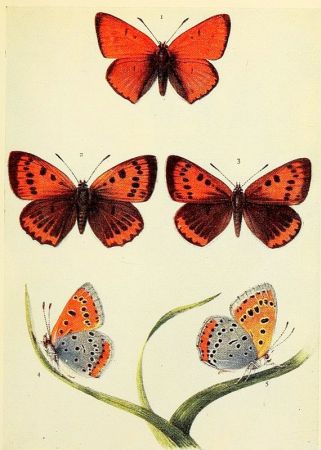
Larger Image
Pl. 98.
Large Copper.
1, 4, male; 2, 3, 5 female.
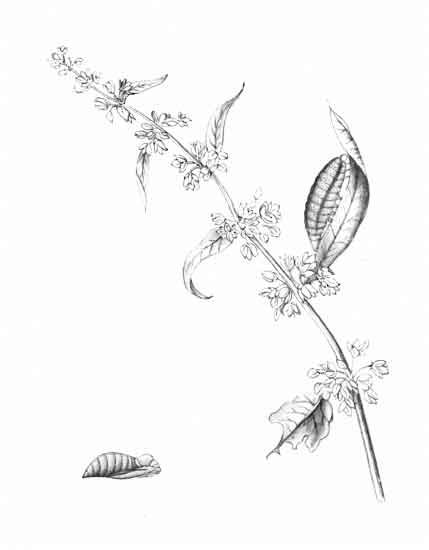
Pl. 99.
Large Copper.
Caterpillar and chrysalis.
Thecla spini and T. ilicis, two species of Hairstreak butterflies belonging to Central and Southern Europe, have been mentioned as occurring in Britain by some of the earlier authors. There is not, however, the slightest reason to suppose that either of them ever occurred naturally in this country.
The Green Hairstreak (Callophrys rubi).
Both sexes of this butterfly (Plate 96) are brown with a faint golden tinge above, and green on the under side. The male has a dark, or, when the plumules are dislodged, pale sexual mark, which is oval in shape, and placed at the upper corner of the discal cell in the fore wings. Occasionally there are some orange scales at the anal angle of the hind wings, and more rarely, and in the female, at the extremities of veins two and three also. On the under side of some specimens, chiefly from Northern localities, there is a transverse series of white dots across all the wings; more often these are confined to the hind wings, and sometimes they are almost or quite absent from all the wings. Now and then the under side of the hind wings is found to be brown in colour, and this change in colour has been ascribed to the action of moisture. The life-history is figured on Plate 97.
The egg is greenish, reticulated with paler or with whitish-green; the reticulation is somewhat rough on the side, but becomes finer towards and on the top, which has the centre hollowed. Laid on the petals of the common furze (Ulex europæus), and on leaves of rock-rose (Helianthemum chamæcistus).
The caterpillar feeds in June and July. It is pale green, with a darker line along the back, and yellow oblique stripes on the sides. Among the plants that it has been found upon, or is known to eat, are dyer's greenweed (Genista tinctoria), needle furze (G. anglica), broom (Cytisus scoparius), dwarf furze (Ulex nanus), whortleberry (Vaccinium myrtillus); also the berries of buckthorn (Rhamnus), making holes through which the contents of the berry is extracted; buds of bramble (Rubus), and of dogwood (Cornus sanguinea), are also attacked in a similar way.
The chrysalis is clothed with tiny hairs, and when freshly formed is green in colour, but becomes purplish-brown after a time. It appears to be unattached to anything. I think, however, that there are generally a few strands of silk around or about it, but these are so easily broken when the chrysalids are removed that they escape observation. May and June are the months for the butterfly, which occurs in various kinds of situations, such as the outskirts of woods, high hedgerows, hill slopes, and boggy heaths. I once saw it in abundance about the entrance from Lynton to the Valley of Rocks. Its resemblance on the under side to the leaves on which it perches is as baffling to the collector as is the resting habit of the Grayling butterfly previously referred to. It seems to be pretty generally distributed throughout the kingdom, but is rather more local in Ireland than elsewhere, and it has not yet been recorded from the Orkney or Shetland Isles. Its range extends throughout the Palæarctic Region.
The Large Copper (Chrysophanus dispar).
The brilliant butterfly, figured on Plate 99, is of a coppery orange colour. In the male the fore wings have two black dots in the discal cell, the outer one linear, and the outer margin is narrowly blackish; the hind wings have a linear black mark in the cell, and the outer margin is narrowly edged with blackish and dotted with black. The female is more conspicuously marked with black; there are two, sometimes three, spots in the cell of the fore wings, and a transverse series of seven or eight beyond; the outer margin is broadly bordered with black, and there are generally two spots above the inner angle; the hind wings have a black spot in the cell, and a series of black spots beyond, but the whole basal three-fourths of these wings is often deeply suffused with blackish; the outer margin is bordered and spotted with black. The sexes are much alike on the under side, and have reddish-orange fore wings with bluish grey outer margins, and black spots as on the upper side of the female; the hind wings are bluish-grey, powdered with bluish towards the base, and with whitish ringed black spots; five of these spots are before the linear discal mark, and a series of nine or ten beyond; an orange band on the outer margin has black dots on each edge.
Except as regards the size and the shape of the spots, especially in the female, there appears to have been but little variation noted in this species in England.
The two fine female specimens figured on the plate have a more or less distinct wedge-shaped black spot in the basal end of the discal cell of the fore wings. Dale mentions that he has an "almost entirely black" example of the female in his collection.
The var. rutilus, which is the continental form of our butterfly, is smaller in size, as a rule, the spots are not so large, and the orange band is always narrower on the under side of the hind wings. It has been averred that some of the British specimens are referable to this form.
Newman, writing about 1870, gave the following life-history details:—"The egg is laid on the leaves of the great water-dock (Rumex hydrolapathum) during the month of August, and the young caterpillars (never, to the best of my belief, observed) probably emerge during the following month, and hibernate very early at the base of the petioles.
"The caterpillar is full fed in June, and then lies flat on the dock-leaf, rarely moving from place to place, and, when it does so, gliding with a slug-like motion, the legs and claspers being entirely concealed. The head is extremely small, and can be completely withdrawn into the second segment: the body has the dorsal surface convex, the ventral surface flat; the divisions of the segments are distinctly marked, the posterior margin of each slightly overlapping the anterior margin of the next, and the entire caterpillar having very much the appearance of a Chiton; the sides are slightly dilated, the legs and claspers are seated in closely approximate pairs, nearly on a medio-ventral line. The colour is green, scarcely distinguishable from that of the dock-leaf; there is an obscure medio-dorsal stripe, slightly darker than the disk, and in all probability due to the presence of food in the alimentary canal. The chrysalis is obese, blunt at both extremities, attached by minute hooks at the caudal extremities, and also by a belt round the waist." Newman adds, "My acquaintance with the caterpillar and chrysalis was made very many years ago in Mr. Doubleday's garden at Epping, where the very plant of Rumex hydrolapathum, on which the caterpillars fed, is still in existence."
The caterpillar was described by Stephens, in 1828, as somewhat hairy, bright green, with innumerable white dots. The same author states that the chrysalis was "first green, then pale ash-coloured, with a dark dorsal line and two abbreviated white ones on each side, and, lastly, sometimes deep brown."
The figure of the caterpillar on Plate 98 is after Westwood, and that of the chrysalis after Newman ("Grammar of Entomology").
Although he refers to it as "hippothoë," the Large Copper seems to have been known to Lewin (1795), as he states that specimens had been taken in Huntingdonshire. Haworth (1803) mentions its occurrence in the fens of Cambridgeshire, and Stephens, twenty-five years later, wrote:—"This splendid insect appears to be confined to the fenny counties of Cambridge and Huntingdon, with the neighbouring ones of Suffolk and Norfolk, unless the account of its capture in Wales by Hudson be admitted; but this may probably be the following species [hippothoë], which may, moreover, eventually prove synonymous with Ly. dispar. In the first two localities it appears to occur in great profusion, as several hundred specimens have been captured within these last ten years by the London collectors, who have visited Whittlesea and Yaxley Meres, during the month of July, for the sole purpose of obtaining specimens of this insect."
Pl. 100.
Small Copper.
Egg, natural size and enlarged; caterpillars and chrysalids.
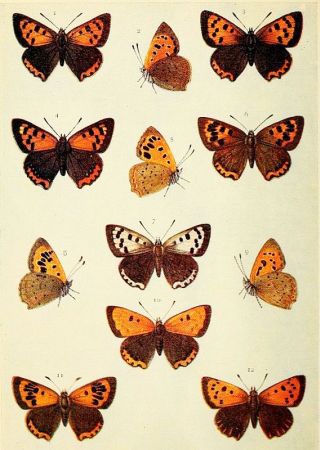
Larger Image
Pl. 101.
Small Copper.
1, 2 Typical male; 3 typical female; 4, 5, 6, 8, 9, 10, 11, 12
varieties; 7 var. schmidtii.
Dale states that "the latest capture, consisting of five specimens, appears to have been made in Holme Fen, by Mr. Stretton either in 1847 or 1848."
There is evidence that floods, which were not uncommon in the home of the Large Copper, were not really injurious to the butterfly, and therefore the occasional submergence of its feeding grounds can hardly have been the cause of its almost sudden destruction. It seems more probable that its disappearance was due to the draining of the fens, and at least it is significant that the two events were almost coincident.
There are records of the butterfly having been taken in various odd localities since it was last seen in fenland, but the latest of those dates back to the year 1865. There seems to be no question that the butterfly is now extinct in England, and, lamentable to relate, the chief locality where we can hope to secure a specimen or two for our collection is in the neighbourhood of Covent Garden, where the only requirement for the capture will be a well-lined purse.
The continental form rutilus is found in Germany, France, Northern Italy, South-Eastern Europe (except Greece), Northern Asia Minor, Armenia, and the Altai. The Asian form auratus occurs in South-Eastern Siberia, Amurland, Corea, Northern China, and Amdo.
Four other kinds of "Coppers" have been reported as occurring in England: these are Chrysophanus hippothoë and C. virgaureæ, both of which have even had English names bestowed upon them, to wit, the Purple-edged Copper and the Scarce Copper; C. gordius, and C. circe (dorilis). These are only mentioned to afford an opportunity for saying that there does not appear to be the least reason for considering either of them to be a British butterfly. Kirby, Barrett, and others, however, think it possible that the first two may have inhabited England in ancient times.
The Small Copper (Chrysophanus phlæas).
This little butterfly is very smart, in activity as well as appearance. In colour it is very similar to the last species, but both sexes are spotted with black on the fore wings, the outer series of six spots forming a very irregular row; the hind wings are black, with a wavy orange-red band on the outer margin.
There is considerable variation, and it is, therefore, deemed advisable to give a number of figures representing some of the more striking aberrations. The three figures at the top of Plate 101 depict the normal male and female; the latter sex is Fig. 3. For the loan of the other specimens (Figs. 4-12) my thanks are due to Mr. E. Sabine, who has a very fine and extensive series of varieties of this butterfly. Other examples of aberration on the under side are shown on Plate 119. Blue spots are sometimes found on the hind wings; these are placed near the orange-red band, and occasionally they attain a good size. Specimens much suffused with blackish sometimes occur; these are referable to var. eleus, which is the usual summer form in some of the warmer countries abroad. A very rare form is that known as schmidtii (Fig. 7), in which the ground colour of the fore wings and the band on the hind wings are silvery white instead of orange or coppery-red. A modification of this form which is hardly less rare has a creamy tint. Straw-coloured or pale golden specimens are rather more frequently met with. The colour of the hind wings in fresh specimens is sometimes steely-grey, but blackish is the more usual hue; the band on the outer area, which as a rule agrees in colour with the fore wings, varies in width a good deal, and occasionally is more or less obscured by the blackish ground colour. The arrangement, size, and shape of the black spots, both above and below, are subject to much vagary, sometimes of a very striking kind, as, for example, when the spots of the outer series on the fore wings are united with the discal pair and form a large irregular blotch. A remarkable specimen taken some years ago in the Isle of Wight had a small patch of copper with a black spot in it on the under side. This gave one the idea of a clumsy attempt at patching, but as I happened to take that particular specimen, I know that it had not been tampered with. Gynandrous specimens of this butterfly sometimes occur, but these are very rare.
The egg is of a yellowish-white colour at first, and afterwards becomes greyish; the pattern on the shell, which resembles network, is always whiter.
The caterpillar is green and similar in tint to the leaf of dock or sorrel upon which it feeds. It is clothed with short greyish hair which arises from white dots; the dorsal line is brownish-olive, and the ring divisions, especially along the back, are well defined. Head very small, pale brownish, marked with blackish, drawn into the first ring of the body when resting. The legs and prolegs are tinged with pink, and sometimes the body is marked with pink.
The chrysalis is pale brown, sometimes tinged with greenish, and freckled with darker brown; there is a dark line along the middle of the thorax and body, the wing cases are streaked with blackish, and the body is dotted with black. Attached by the tail and loose silken threads around the body to a leaf or stem.
There seem to be three broods of this species in most years: the first is on the wing in May, sometimes in April; the second in July or early August; and the third in early October. It is not a difficult species to rear from the egg, and as varieties appear to be most frequent in the third brood, the eggs should be obtained from females of the second brood. Dock and sorrel (Rumex) are the food-plants of the caterpillar, and these are most useful in a growing condition.
The butterfly frequents all kinds of open situations, and is fond of basking upon flowers, more particularly those of the Compositæ, from which vantage ground it dashes with great alertness at any other small butterfly that may happen to fly that way. Whether these seeming attacks are really due to pugnacity, as has been stated by some writers, or are merely of a sportive character, is not altogether clear. As, however, the meeting of the two butterflies usually results, when both are Small Coppers, in a series of aërial evolutions by the pair, it would seem that there is a good deal of playfulness in the business. After the gambol is over, one butterfly may dart off with the other in hot pursuit, and then both move so rapidly that their course is difficult to follow. If the butterfly intercepted happens to be a Blue or a Small Heath, the Copper returns to the flower from which it started, and prepares for another raid when the opportunity offers. It occurs throughout the United Kingdom, but in Scotland it does not extend northwards beyond the Caledonian Canal.
Abroad it is found throughout the Palæarctic Region, and is represented in North America by the form hypophlæas.
The Long-tailed Blue (Lampides bœticus).
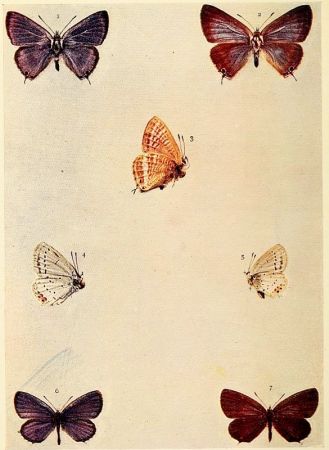
The male is purplish-blue suffused with fuscous, especially on all margins except the inner one; there are two velvety black spots encircled with pale blue at the anal angle of the hind wings, and a slender black tail, tipped with white, appears to be a continuation of vein 2. The under side is grey-brown, with numerous white wavy lines and broader streaks; there is a whitish band on each wing before the outer margin, and black spots as above, but these are ringed with metallic blue.
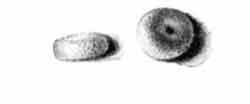
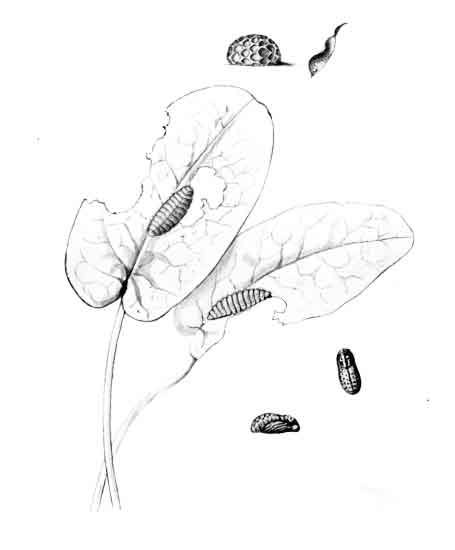
Short-tailed Blue. Eggs enlarged.
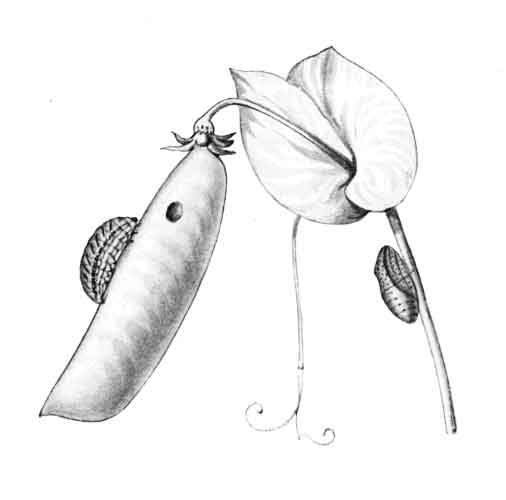
Pl. 102.
Long-tailed Blue. Caterpillar and chrysalis (after Millière).
Larger Image
Pl. 103.
Long-tailed Blue.
1 male; 2, 3 female.
Short-tailed Blue.
4, 6 male; 5, 7 female.
I have not seen any of the early stages of this butterfly. The caterpillar, which feeds upon the green seeds in pods of the Leguminosæ, including the garden pea and the lupine, is figured on Plate 102. It is described as being green or reddish-brown in colour, with a dark stripe on the back, double oblique lines on the sides, and a white line below the yellow spiracles; head black. The chrysalis is of a red or yellowish colour, and dotted with brown. It has a silken girdle and is said to be attached to a stem, as shown in the figure, but probably it is more often fixed up among the withered leaves of the food-plant. Two of the earliest known British specimens of this butterfly were taken by the late Mr. Neil McArthur on August 4th and 5th, 1859, on the Downs at Brighton; the third example was captured by Captain de Latour at Christchurch, where it was flying about a plant of the everlasting pea in his garden on August 4th of the same year. Newman has noted that in that particular year the butterfly was very abundant in the Channel Islands and on the coast of France. No other specimen seems to have been observed in England until 1879, in which year one was taken at Freshwater in the Isle of Wight on August 23rd. In 1880 a specimen was captured in a garden near Bognor, Sussex, on September 12th. On October 2nd, 1882, one was obtained at West Bournemouth. Three were netted in 1893, one of these in late August, and one in the third week of September, both in Sussex; the third was taken in Kent (inland) in September. In 1899 a specimen was found at Winchester on September 1st, and one at Deal on the 16th of the same month; each of these, curiously, was sitting on a window. On August 2nd, 1904, one example was taken in a garden near Truro, Cornwall. In addition to the above, single specimens have been reported as taken at Brighton, July, 1890, and at Heswell, Cheshire, in 1886 or 1887.
It will thus be seen that the occurrence of this butterfly in England is exceedingly infrequent. The species is common in Africa and in Southern Europe; thence it extends eastward through Asia to China and Japan, and southwards to Australia. It is also found in the Sandwich Islands. It is believed to be migratory in its habits, and it is supposed that the occasional specimens that arrive in this country come to us viâ the west coast of Europe.
In its proper home there is a succession of broods of the butterfly, and if by chance a few females were to visit this country in the early summer, they most probably would lay eggs, and the caterpillars resulting from these would almost certainly be able to feed up and attain the perfect state here. So far there is no reason to suppose that the caterpillar has ever occurred in England.
The Short-tailed or Bloxworth Blue (Cupido argiades).
The interesting little butterfly represented on Plate 103 was not known to occur in Britain until 1885, when the Rev. O. Pickard Cambridge made the startling announcement that his sons had captured two specimens, a female on August 18th, and a male on August 20th of that year, the scene of capture being Bloxworth Heath, Dorset. Shortly after this fact was made public the Rev. J.S. St. John added a record of two males that he had discovered in a small collection of Lepidoptera made by Dr. Marsh, who stated that he had taken the specimens of C. argiades in 1874, close to a small quarry near Frome. In addition to these a specimen, also recorded by Mr. Cambridge, was taken at Bournemouth in August, 1885; one is reported to have been captured at Blackpool, about 1860; and one at Wrington, about twelve miles north of Bristol, in 1895 or 1896.
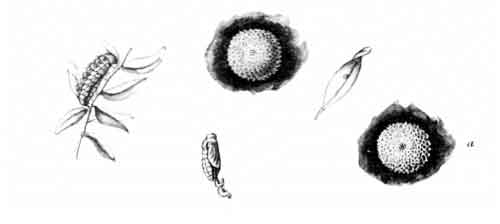
Brown Argus.
Egg, natural size and enlarged; caterpillar and chrysalis;
(a) Egg of "Scotch Argus" enlarged.
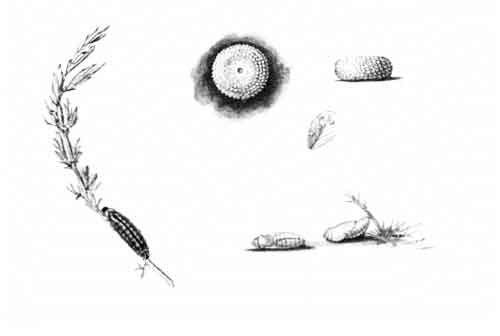
Pl. 104.
Silver-studded Blue.
Eggs, natural size and enlarged; caterpillar and chrysalids.
Larger Image
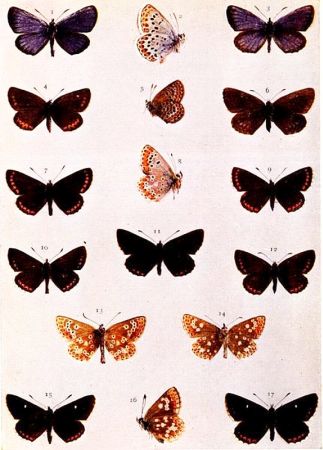
Pl. 105.
Silver-studded Blue. 1, 2, 3 male; 4, 5, 6 female.
Brown Argus. 10, 12 male; 7, 8, 9 female; 11, 13, 14
male (Durham); 15 male, 16, 17 female (Scotland).
The following details of the early stages are obtained from Mr. Frohawk's life-history of the species published in the Entomologist for October, 1904. The egg (Plate 102, figured from a photomicrograph by Mr. Tonge) is of a pale greenish-blue, but varies both in the extent of the ground colour and in the structure of the reticulations, which are white, resembling frosted glass.
The full-grown caterpillar (August 23rd) measures 3/8 inch in length. It is of the usual wood-louse shape, with only a very shallow furrow on the back, bordered on each side by a fringe of spinous bristles, which vary in length; the whole surface is densely studded with shorter but similarly formed whitish or brownish bristles. The ground colour is pale green, with a darker green stripe along the centre of the back, and fainter green oblique stripes on the sides. The head is black and shining, and is hidden under the first ring when the caterpillar is not feeding or moving about.
The caterpillars hatched on July 30th, from eggs that were laid in the South of France on July 24th, and were reared on bird's-foot trefoil (Lotus corniculatus), of which they ate the flowers, seeds, and leaves.
The chrysalis, which is attached to the food-plant by a silk pad at the tail and a thread round the body, is pale green and very finely reticulated; the wing-cases are rather whiter green, sprinkled with minute black specks, and the veins are white; there is a blackish line along the centre of the back, but this is only well defined on the head and thorax. The whole surface, except the wings, is sprinkled with slightly curved and moderately long white hairs.
The butterfly emerges in about ten to fourteen days, according to temperature.
The male is violet-blue with the veins rather darker; the outer margin is narrowly bordered with blackish, and there are some black dots on the outer margin of the hind wings; the fringes are white, and there is a slender tail on the hind wings. The female is brownish, tinged with violet towards the base; the hind wings have black spots on the outer margin, and some of these are inwardly edged with orange; the tails are slightly longer than those of the male.
All the available information concerning the occurrence of this species in England has already been given. No doubt the localities from which specimens were recorded have been closely investigated during the past twenty years, but no further captures of this butterfly have been recorded. This seems to indicate that it is not really indigenous, but that its presence here may possibly have been due to accidental introduction.
The spring form, polysperchon, is smaller than the specimens occurring in the summer, but so far that form has not been seen in England.
The species is widely distributed over Central and Southern Europe, and its range extends through Northern Asia to Amurland, Corea, and Japan. It is also represented in Northern and Central America by var. comyntas, and has been recorded from Australia.
The Silver-studded Blue (Lycæna argus = ægon).
The male of this butterfly (Plate 105) is purplish-blue with a black border on the outer margins, and sometimes black dots on that of the hind wings. The female is sooty-brown, powdered to a greater or lesser extent with blue scales on the basal area; there is generally a series of orange marks forming a more or less complete band on the outer margin of the hind wings, and sometimes on the fore wings also. The under side is bluish-grey in the male, and brownish-grey in the female; the black spots are ringed with white, and on the fore wings there is one at the end of the discal cell and a series of seven beyond; the hind wings have from three to five spots before the discal spot, and a curved series of seven beyond; there is a black-edged orange band on all the wings, and beyond this on the hind wings there is a series of metallic blue centred spots; hence the English name of the butterfly, given to it by Moses Harris, which is certainly more suitable than Petiver's "Lead Argus."
In a general way the male is rather larger than the female, but this is not invariably the case. The colour of the male varies in shade, and very occasionally, perhaps, is of a lilac tint; the border varies in width, and is sometimes reduced to a mere line. In the female the orange marks may be of a brownish or yellowish tint, and now and then there may be a series of wedge-shaped blue spots above these marks on the hind wings. On the under side there is a good deal of modification of the black spots as regards size and shape, and occasionally there is at least one extra spot on the fore wings placed between the discal spot and the base of the wing; white markings sometimes appear on the fore wings between the outer series of black spots and the orange band, and with this there is generally a white band in a similar position on the hind wings. Female specimens with splashes of the male colour on one or more of the wings have been obtained, and, more rarely, examples entirely male on one side and female on the other have been recorded.
Frohawk states that the egg both in colour and texture, resembles white porcelain; "all the depths produce a deep purplish-grey shade. The ova are deposited singly, and adhere firmly to the receptacle."
Caterpillars hatched out from eggs, laid the previous summer, on April 1st to 3rd. They were reared on gorse (Ulex europæus), pupated towards the end of June, and the first butterfly, a male, appeared on July 10th.
The caterpillar figured on Plate 104, when full grown, was reddish-brown, finely dotted with white, and from each dot a tiny hair arose; the stripe on the back and line on the side were black edged with white, head black and shining. This caterpillar was found on the last day of May, crawling on the ground under heather at Oxshott. It was then about half-grown, and was reared on heather, pupated in due course, and produced a female butterfly on July 11th.
The chrysalis, of which two figures are given, had a pale brownish and rather shining head; the body was brown with a darker line on the back; the thorax and wing-cases dull yellowish-green, the former rather glossy. It was placed in an angle formed by a side and the floor of the cage, lying quite flat and secured by silken threads, which, owing to position, I was unable to examine. Some of the caterpillars that Mr. Frohawk reared were pale green with a dark purplish stripe on the back. Another food-plant is bird's-foot vetch (Ornithopus perpusillus).
The butterfly is on the wing in July and August, and seems to be more often found on sandy heaths than elsewhere. It is especially common, in some years, in the heather-clad districts of Surrey and Hampshire, as well as other counties in England. In Norfolk and Suffolk it is said to be common, but scarce in Gloucestershire and Somersetshire. Its range extends through the greater part of England and Wales, and into Scotland as far as Perthshire. Specimens from the northwest coast of Wales are said to be larger than those from inland localities.
As regards Ireland, there is only Birchall's record, "The Murrough of Wicklow, and near Rostrevor," in evidence of the butterfly occurring in that country at all.
Abroad, it appears to range pretty well over the whole of Europe, and through Asia eastward to Siberia, Corea, and Japan.
The Brown Argus (Lycæna astrarche).
Fore wings blackish or sooty-brown with a black discal spot, and a row of reddish-orange spots on the outer margin of all the wings; the fringes are white, sometimes with blackish interruptions. The under side is greyish or greyish-brown, and the black spots are distinctly ringed with white. On the fore wing there are seven of these spots, one at the end of the cell, and the others in an irregular series beyond; the last in this series is sometimes double, or it may be absent. On the hind wings the spots comprise a series of four preceding the white discal mark, and a series of seven beyond; the second spot in this series is placed directly under the first, forming a colon-like mark, and this character will help to distinguish the Brown Argus from the blackish or brown females of the next species.
The female has larger orange markings, and the outline of the fore wings is rather rounder on the outer margin, otherwise the sexes are very similar.
The orange spots referred to in the male are sometimes absent towards the tips of the fore wings, and in this respect lead up to the form known as the Durham Argus (var. salmacis, Stephens), which is blackish above and ochreous-brown below; the black spots on the under side are much smaller then in typical specimens, and some may be absent altogether. The male has a black discal spot, and the female a white one, on the upper side of the fore wings; the hind wings have a red or orange band on both surfaces. Sometimes the male also has a white spot on the fore wings. Specimens with the orange spots on upper side almost entirely absent are referable to var. allous.
Artaxerxes is the form occurring in Scotland, and is known as the "Scotch White Spot." Both sexes have a conspicuous white discal spot on the fore wings, and the spots on the under side are white, and rarely centred with black. In var. quadripuncta, Tutt, all four wings have a white discal spot above. Occasionally an odd specimen with white discal spots is found in the south.
Figures of the butterfly will be found on Plate 105, and of its life history on Plate 104; the upper egg is that from a typical female, and the lower one was laid by a female artaxerxes.
The egg, which is whitish, with a faint greyish tinge, is laid on the upper side of a young leaf of the rock-rose (Helianthemum chamæcistus). The caterpillar has a black shining head; the body is green with whitish hairs, a pinkish line along the back, a whitish one bordered with pinkish along the sides; the green colour becomes dingy as the caterpillar matures. The chrysalis is obscure yellowish-green, the front of the thorax is edged with pinkish, and there are bands of the same colour on the back and sides of the body; the thorax and the wing-cases are rather glossy. Held in position by a few silken threads between leaves of the food-plant.
The ordinary form of the butterfly is on the wing in May and June, and again in August. It is widely distributed throughout the southern half of England, and also in Wales.
Although chiefly associated with rock-rose, especially in chalky districts, it occurs too among stork's-bill (Erodium cicutarium), upon which plant the caterpillar also feeds, in sandy places inland as well as on the coast.
Caterpillars from the first flight of butterflies may be found in July, and those from the second flight hibernate and feed up in April.
The butterfly has a marked liking for roosting on the flower stems of long grasses, and quite a number may often be found resting together towards sundown, or on dull days, in sheltered hollows. Sometimes several specimens of this species and of the Common Blue may be found on the same perch. It is rather less frequently seen in the Midland counties, but it is more or less common in some parts of Derbyshire, Yorkshire, and Lancashire.
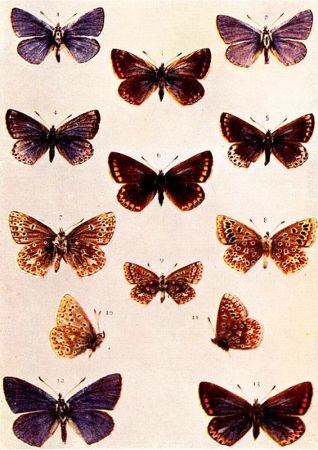
Larger Image
Pl. 106.
Common Blue.
1, 2, 7, 10, 12 male; 3, 4, 5, 6, 8, 9, 11, 13 female.
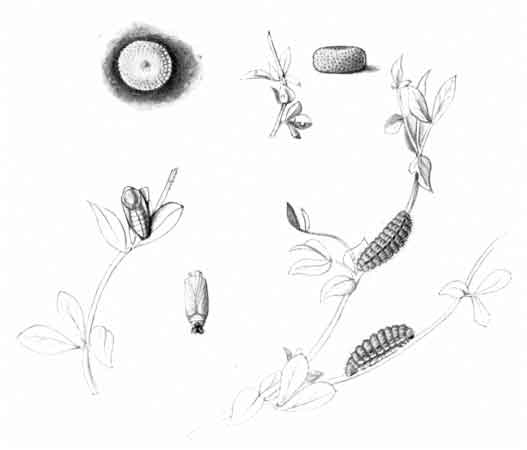
Pl. 107.
Common Blue.
Eggs, natural size and enlarged; caterpillars and chrysalids.
The intermediate form, salmacis and its modifications, is found in the neighbourhood of Richmond, Yorks, and thence northward to the Scottish border.
Var. artaxerxes occurs in Scotland from Roxburgh to Aberdeenshire on the east, and from Dumfries to the Clyde on the west. Kane records four specimens from Co. Galway, and these are all that are known of the species from Ireland. This form, together with the var. salmacis, are not found anywhere outside the United Kingdom, and, it may be added, the latter appears to be getting scarce—at least, in some of its old haunts in Durham.
The species is distributed throughout the Palæarctic Region, except the Polar parts.
The Common Blue (Lycæna icarus).
The male is blue, with either a tinge of violet or mauve in its composition. Sometimes, though rarely, it assumes the brighter shade of the Adonis Blue. All the wings are very narrowly edged with black on the outer margins; the veins are generally pale, shining blue, sometimes becoming blackish towards the outer margins, and occasionally continued into the fringes, but not to their tips. The female is most often brown, with some blue scales on the basal area of all the wings; there is a black discal spot on the fore wings, and a series of orange crescents before a row of black spots on the outer margin; the hind wings have an outer marginal row of black spots, edged outwardly with white and inwardly with orange.
On Plate 106, Fig. 1 represents a typical male, and Fig. 3 a typical female, whilst the normal under sides of the sexes are shown in Figs. 10 and 11. The size of this butterfly ranges from one inch and a half to three-quarters of an inch. The large specimens at the bottom of the plate are from Scotland.
Scotch and Irish males often have some black spots on the outer margin of the hind wings, as in Fig. 2, but this is from Ventnor in the Isle of Wight. The female is sometimes of a uniform brown coloration, devoid of blue scales, and, with the exception of slight traces of orange on the outer margin of the hind wings, entirely without marking. On the other hand, this sex is sometimes almost as blue as the male in colour (var. cærulea), but the discal spot, outer marginal borders, and orange markings are present. Occasionally the orange spots give place to yellow ones. The discal spot on the fore wings may be encircled with bluish-white scales, and now and then this spot on all the wings is surrounded very distinctly with bluish-white. I have seen the latter form from Durham and Ireland only, but it probably occurs in other parts of the kingdom.
Quite a number of gynandrous specimens of this species have been recorded, some of them being male on the right side and female on the left, in others the reverse was the case.
On the under side the male is greyish and the female brownish, consequently the white rings around the black spots show up more distinctly in the latter sex. A not uncommon aberration is without spots between the discal spot and the base of the fore wing; this is known as icarinus. Another form that occurs fairly often has the lower basal spot united with the last spot of the outer series, as in Fig. 9, this is ab. arcua, and a modification, with the junction bar-like instead of arched, has been named melanotoxa. Very rarely the whole of the under side, except the outer margins, is free of spots (Plate 119). A specimen exhibiting aberration in this direction is shown on Plate 118, Fig. 6, whilst Figs. 1 and 3 show modifications of what is known as the streaked form.
I am indebted to Mr. E. Sabine, of Erith, for the loan of all the fine aberrations of the Blues figured on Plate 118.
On Plate 107 will be found figures of the early stages.
The egg, which is usually laid on the upper side of a terminal leaf of bird's-foot trefoil (Lotus corniculatus) or on rest-harrow (Ononis spinosa), is whitish-green in colour, netted with glossy white.
The caterpillar is green, covered with short brownish hairs, with which are mixed some longer ones; it is wrinkled on the side, ridged on the back, and the line along the middle of the back is darker. Head black and glossy.
The chrysalis is green, with the head, wing-cases, and sometimes the hinder parts of the body, tinged with buff; thorax brighter green, rather shiny; a darker line down the centre of the body.
The plants mentioned, and especially rest-harrow, are known to be the food of the caterpillar, but eggs have also been found, in Scotland, on red clover, plantain, burnet saxifrage, and yarrow. The caterpillars are to be found, after hibernation, in April, and a second brood in June and July. Those feeding on rest-harrow seem to prefer the blossom.
This caterpillar is stated to form a cocoon, but the only approach to any such structure made by the seven individuals I had under observation was in the case of two caterpillars that pupated among leaves of Lotus, which were drawn together by the slenderest of threads. Four effected the change at the bottom of the cage and seemed to be quite free, one had climbed to the leno top of the cage and there spun a silken carpet under itself, which drew the leno together, and so formed a shallow cave in which the chrysalis rested. In every case the cast skin was attached to the tail, and so remained after the butterflies emerged.
The butterfly is to be found almost everywhere in the country, and its distribution extends throughout the United Kingdom, except, perhaps, the Shetland Isles. There appears to be only one flight in the north of Scotland and Ireland, and this occurs in June and July. In England there are two broods, and in some years probably three in the southern counties. It may be seen on the wing, in greater or lesser numbers, all through the season from May to September.
Abroad, the range extends over the whole of Europe to North Africa, and through Western and Northern Asia to Amurland and China.
The Common Blue, as well as the Chalk Hill and the Adonis Blues, are to be found, often commonly and sometimes in large numbers, in their favourite haunts. Each of them is subject to a considerable range of variation on the under side, and this seems to be of a similar character in all. Very striking aberrations are, perhaps, not often obtained, but still many modifications are to be found, and the possibility of a really good thing turning up, induces one to give attention to the business of overhauling these butterflies. A very good method of conducting this kind of work is to first ascertain the places where they chiefly congregate, and then to visit there on dull days or late in the afternoon, when the butterflies are asleep or, at all events, resting. They can then be easily examined as they sit on the long grass stems, etc. (Plate 27), but only the under sides can be viewed in this way. So to avoid passing over a good upper-side variety, it will be needful to take each specimen between the finger and thumb of the right hand, seizing the closed wings gently, but firmly, near their base, and then quickly secure the thorax from underneath with thumb and index finger of the left hand, when the upper as well as the under side becomes available for inspection. There is no reason whatever to damage the insects in any way, and those that are not required may be set free again none the worse for their short detention. Work against the wind, and to avoid a second interview, turn rejected specimens to the rear.
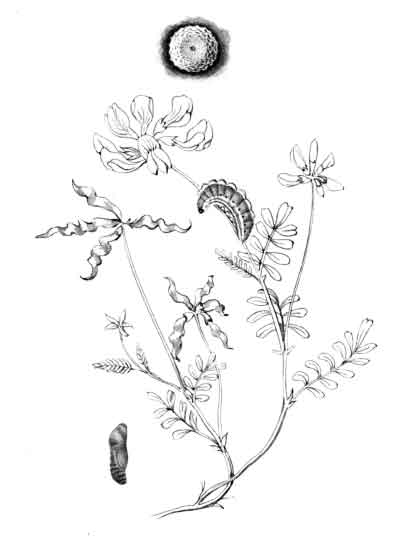
Pl. 108.
Chalkhill Blue.
Egg enlarged; caterpillar and chrysalis.
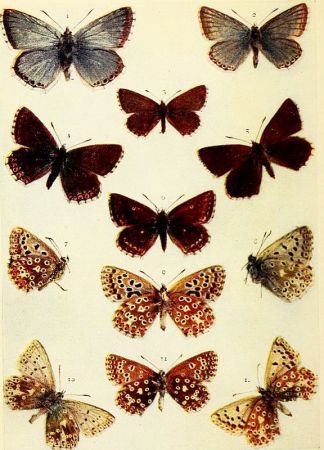
Larger Image
Pl. 109.
Chalkhill Blue.
1, 2, 8, 10 male; 3, 4, 5, 6, 7, 9, 11, 12 female.
The Chalk Hill Blue (Lycæna corydon).
Although this butterfly (Plate 109) is, in England, fairly constant in the matter of colour, and, as regards the male especially, differences in tint are noticeable when series from various localities are ranged side by side. Silvery-blue perhaps best expresses the general colour of the male on the upper surface, sometimes very pale, and sometimes faintly tinged with greenish. The blackish border on the outer margin of the fore wings varies in width and in intensity; often there are indications of eyed spots on this margin, and occasionally these spots are quite distinct, although the whitish rings are not always clearly outlined. The black border on the outer margin of the hind wings is often narrow and external to a series of white-edged black spots, but sometimes it is broad and obscures the spots; orange markings rarely appear on this margin, but such aberrations have been taken on the Dorset coast. The fringes are white chequered with blackish on the fore wings, but with seeming continuation of the veins through those of the hind wings. The female is sooty-brown above, with a black discal spot on the fore wings, and sometimes on the hind wings also, and these spots may be ringed with blue or bluish-white; the outer marginal borders are hardly darker, and those on the fore wings are limited by a wavy pale line, which may be faintly or strongly marked with orange, but orange marking on these wings is rather the exception than the rule; on the outer margin of the hind wings there are some black spots, edged outwardly with white and inwardly with orange. The fringes are white chequered with brown, and those of the fore wings are tinged with brown. There are generally some blue scales at the base of the fore wings and over a larger portion of the basal area of the hind wings, but occasionally the whole discal area of the hind wings (Fig. 7, Plate 117), or of all the wings, var. syngrapha (Fig. 8, Plate 117), is of the male colour. The former is from Eastbourne and the latter from Wiltshire. They are rather uncommon varieties, but intermediate forms are more often met with in the same localities as well as in other parts of England where the species occurs.
On the coast of Dorsetshire a very unusual form occurs. The border of the outer margin is white instead of the usual black or blackish; the inner limit of this border is, on the fore wings, defined by a dusky shade, and the black nervules break up the border into six spots; on the hind wings four or five of the white spots are centred with black dots. The female has a similar border, but on the hind wings it is inwardly edged with orange. It has been named var. fowleri, and I have seen one example of this form without black dots in the marginal white spots of the hind wings. On the under side variation is on somewhat similar lines to that adverted to in the last species. On Plate 109, Fig. 8 represents the typical under side of the male, and Fig. 7 that of the female. It will be noticed that the male is greyer than the female. Some of the ordinary aberrations are shown on the same plate, and some rarer ones will be found on Plate 118, and of these Fig. 12, if without the basal spot on the fore wings, would represent var. lucretia.
For figures of the early stages see Plate 108; that of the caterpillar is after Buckler. The egg is flat on the top, with a slightly darker pit in the centre (the micropyle); the sides are rounded, netted, and studded, and the colour whitish-green. The above short description was taken from one of a few eggs of this butterfly sent me in August last by Mr. Ovenden, and the same egg has been figured.
Mr. Frohawk has described the egg more fully in the Entomologist for 1900. With reference to the egg-laying of the butterfly he writes: "On August 13th, 1900, I watched several females in the act of depositing, on various stems of the usual stunted herbage to be found growing on chalk downs. They frequently crawled among the plants for a distance of about a couple of feet, occasionally curving the abdomen downwards among the small plant-stems and grasses, and here and there depositing an egg. I therefore dug up portions of the turf, potted it, and placed a couple of females on each lot; they deposited ova on the 14th and 15th, on the stems of various plants; a few were laid upon the brown dead trefoil leaves, as well as on the living leaves; but the site generally chosen is the intermingled stems of both plants and grasses. Another female, placed upon a similar pot of plants, deposited about fifty ova on September 10th, nearly all being placed upon the stems, and a few upon the under side of the leaves of rock-rose; in all cases the eggs are deposited singly."
The caterpillars do not hatch out until the following spring. According to Buckler and Hellins, the only difference between the caterpillar of this butterfly and that of the next species, Adonis, is that the latter "has its ground colour deeper green, with the hairs or bristles black, while Corydon has the ground colour of a lighter, brighter green (a green with more yellow in its composition), and the hairs light brown."
The butterfly is common and often abundant in July and August, chiefly the latter month, on chalk downs in Oxfordshire, Buckinghamshire, Berkshire, Kent, Surrey, and Sussex; it is also found in the Newmarket district of Cambridgeshire and on one chalk hill in Norfolk, according to Barrett, who adds: "on the oolite as well as the chalk in Wilts, Dorset, Gloucestershire, and Somerset; and on limestone at Grange and Silverdale in North Lancashire, in Lincolnshire, Westmoreland, and Cumberland. It has also been taken in Essex, Hants, Cornwall, and in one locality in Glamorganshire."
Mr. Sydney Webb has stated that a dwarf form occurs pretty regularly in a valley about two miles east of Dover, but that it only appears to be found at odd times in other parts of England.
Abroad, the species is found in Central Europe, also in the Pyrenees, Aragonia, and the Balkan Peninsula.
The Adonis Blue (Lycæna bellargus).
The butterfly on Plate 110 is the Clifden Blue of Moses Harris (1775), so named because it was said to have been first observed at Clifden in Bucks. The male is of a beautiful bright blue colour, but as in the same sex of the previous two species, it is not quite constant in tint. In some specimens we find a distinct mauve shade, and in others, but more rarely, the blue colour is tinged with greenish (Plate 118, Fig. 11): the veins become distinctly black on the outer margins, and appear to run through the white fringes on all the wings. Often there are black dots on the outer margin of the hind wings. The female is dark brown, sometimes slaty-black, with orange spots or crescents on the outer margins; these are often only faintly in evidence on the fore wings, and sometimes this is the case on the hind wings also; there is a black discal spot on the fore wings, and the fringes of all the wings are white chequered with black. The bases of the wings are powdered with blue, but this is more noticeable on the hind wings. On the under side the fore wings of the male are greyish, and the hind wings greyish-brown; all the wings of the female are brownish, with a faint grey tinge in some specimens; the ornamentation is very similar to that of the Common Blue. The two figures on Plate 110, showing specimens with the wings closed, represent typical male and female, and the other figures of under sides on this plate exhibit minor aberrations from typical lines; examples of the more extreme variations will be found on Plate 118, where also are figured some uncommon aberrations in the colour of the male on the upper side.
There is often a tendency in the female to assume the colour of the male, and this is usually seen on the hind wings, but occasionally on the fore wings also. In the extreme form of this phase of variation, var. ceronus, the whole of the upper surface, with the exception of the orange-spotted borders, is almost as blue as that of the male. This is a parallel aberration to that of the Chalk Hill Blue known as syngrapha, but it seems to be somewhat rarer in this country.