PART II. DESCRIPTIONS OF SPECIES. (continued 2)
Reading edition
This butterfly appears to have first attracted the attention of the earlier British entomologists about the middle of the eighteenth century. Stephens, writing in 1827, remarks that "about sixty years since it appeared in such prodigious numbers throughout the kingdom, that the entomologists of that day gave it the appellation of the Grand Surprise." Harris figured the butterfly under the name mentioned by Stephens, and it has also been referred to by others as the "Willow Beauty" and the "White Petticoat." Newman called it the "White-bordered;" and from this, as well as from his description of the butterfly, it would seem that he had not seen any specimen, caught in Britain, with ochreous borders. Such specimens have most certainly been captured in these islands, and occasionally in some numbers, as, for example, in the autumns of 1872 and 1880. In the former year the butterflies were seen or taken in a great many parts of the kingdom. The single specimens that are taken now and then in the spring have hibernated, and possibly they may have just come over from the Continent. It is, however, equally possible that they may have arrived in the country the previous autumn and passed the winter here. After the invasion in the autumn of 1872, specimens were observed in January, March, and April, 1873, at places widely apart. In 1881 single specimens were taken in April in Surrey, Kent, and Brecknockshire; and in Essex and at Hampstead in August. One or two specimens were taken in the summer or autumn of the years 1884 to 1887 inclusive. In 1888 two were captured in Essex in May; and in August, three in Kent, one each Surrey, Hants, and Isle of Wight; and one in Kent in September. In 1889 a specimen was taken in Surrey in April, one in Kent, and one in Cambs in May; a few also in the autumn of that year. In 1891 a specimen was seen at Balham in September. In 1893 one was taken in Epping Forest in April, and one in South Devon in August. Single specimens were noted in Oxfordshire, Lincolnshire, Berwick, and the Isle of Skye, in September, 1896, and one at Epsom in December of that year. In 1897 one was recorded from Yorks (August), and one from Norfolk (September); and in May, 1898, one was taken at Norwich. One or two were observed in August or September, 1898 and 1899; and in 1900 there seems to have been an invasion, on a small scale, of this butterfly in August into some of the eastern and southern counties of England. It extended westward to Somersetshire, and northward to Roxburghshire. A few were taken in various southern localities, including south-east and north London, in August and September of 1901. A specimen occurred in the Isle of Wight in September, 1903, and one in September, 1904; and in the latter year one was captured in August at Raynes Park in Surrey. In 1905 one butterfly was taken at Harrow, Middlesex, on July 27; one at Norwich on August 26, and one in Suffolk on September 29.
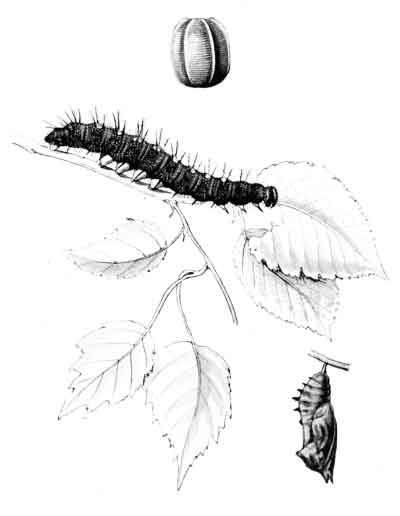
Pl. 42.
Camberwell Beauty.
Egg enlarged; caterpillar and chrysalis.
Larger Image
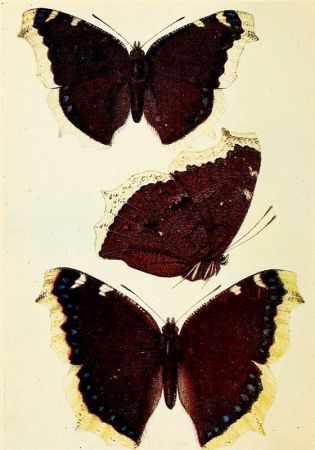
Pl. 43.
Camberwell Beauty.
A full record of this fine butterfly in the British Islands would occupy too much space, but the details given above will show something of its erratic occurrence since 1880. It visits Ireland occasionally, but there are no recent reports of its having been seen there.
Kane, in his Catalogue of the Lepidoptera of Ireland, mentions a specimen taken in Co. Kerry, July 21, 1865; one from near Belfast [in 1875?]; and a third example seen by a friend "many years ago" near Trillick, Co. Tyrone. The latter was "settled on the roadside, but not captured, it being Sunday."
Distributed throughout the temperate parts of the Northern Hemisphere, it is common in the Scandinavian Peninsula, whence probably our specimens came; also in Germany. In some parts of the Continent it is, however, almost as uncertain in its occurrence as in England.
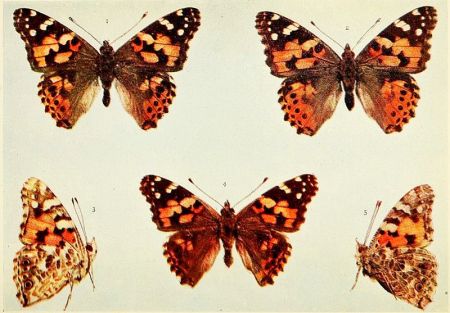
The Painted Lady (Pyrameis cardui).
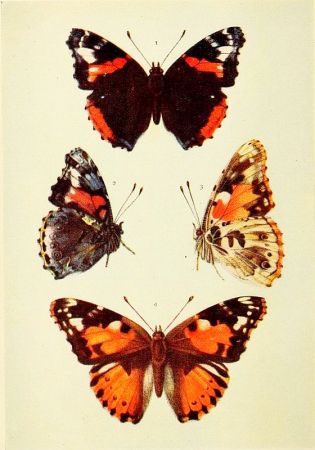
The usual colour of this butterfly is tawny-orange, but in some specimens, especially fresh ones, there is a tinge of pink, or a rosy flush; the markings are black, and there are some white spots towards the tips of the fore wings. The black markings on the hind wings are subject to variation in size, and sometimes they run one into the other. Occasionally this union of the spots is accompanied by blackish suffusion spreading more or less over the entire surface of the wings, so that they appear blackish with tawny-orange patches or clouds. A somewhat peculiar variety of the species, kindly lent by Mr. J.A. Clark, is shown on Plate 49. Specimens of this form, or some modification of it, have been obtained in England, but very rarely. Similar examples have also been found in other parts of the globe. Fig. 24 represents another interesting aberration of this butterfly.
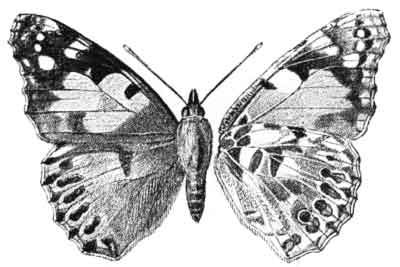
Fig. 24.
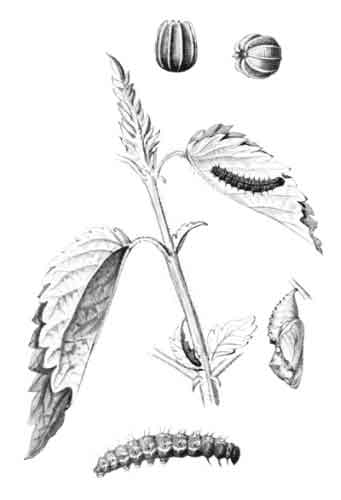
The egg is at first green, and gradually becomes darker. It is strongly ribbed from the base to the top, where the ribs become finer and turn over towards the central hollow, at the bottom of which is the micropyle. The fine cross-ribs form slight bosses at their junction with the upright ribs. The eggs are laid on the leaves of the thistle, but usually only one on a leaf.
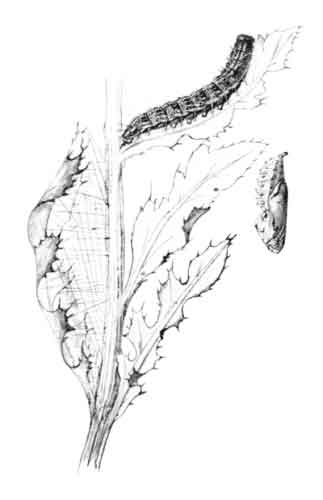
Pl. 44.
Painted Lady.
Caterpillar, chrysalis and protection-web.
Larger Image
Pl. 45.
Painted Lady.
1, 3, 4 male; 2, 5 female.
The caterpillar is rather stout for its length. It has a dark greyish head, which is covered with short bristles. The ground colour of the body varies from greyish-green and ochreous-grey to blackish, and in the darker colour is generally freckled with paler, sometimes yellowish. There is a black line along the back, often edged with yellowish, and sometimes much broken up; the lines on the sides are yellowish, but not always distinct; the line below the yellow-ringed black spiracles, however, is generally broad and yellowish in colour. Although thistles (Carduus) appear to be the plants most frequently eaten by these caterpillars, they have sometimes been found feeding upon mallow (Malva), burdock (Arctium), viper's bugloss (Echium), and even nettle (Urtica). They commence life by fixing up the edges of a leaf so as to form a sort of pocket in which to conceal themselves, but as they eat away the fleshy part of the leaf their retreat is easily detected. The hiding-place, or dining-room, of a full-grown caterpillar is shown on the plate; change to the chrysalis is often effected in a somewhat similar structure.
The chrysalis is grey, ochreous-grey, or greenish; shaded or striped with brownish. The raised points are burnished, and according to the way light falls on them appear golden or silvery. This metallic effect is also seen on other parts of the chrysalis, but chiefly on the back.
This butterfly is a notorious migrant. Its proper home is probably in Northern Africa, and there it, at times, becomes so exceedingly numerous that emigration is possibly a necessity in the interests of future generations of the species. Whatever the cause of their leaving may be, there is no doubt about the fact that the butterflies do quit the land of their birth in great swarms. Almost any part of the world may become the dumping-ground of this surplus stock. Our own islands are frequently favoured in this way, and it is most likely that if this were not so, this pretty butterfly would not be so common throughout Great Britain as it is in some years. The natural habit of the species is to go on reproducing its kind throughout the year, and those individuals that arrive here most certainly endeavour to do this in their new home. Unfortunately our climate is not, as a rule, a suitable one for those caterpillars which hatch from the egg late in the season, and although some may complete their growth, and even attain the perfect state, the butterfly, so far as is known, does not hibernate as do the Tortoiseshells and the Peacock. It may therefore be assumed that the specimens seen in May or June of any year are not native born, but early immigrants, and that it is from such aliens that the caterpillars and butterflies observed later in the year are descended.
A curious habit of the Painted Lady, and also of the Red Admiral, is that of continuing on the wing long after other kinds of butterfly have retired to their resting-places for the night. Both have been seen flying about at dusk, and have been recorded as attracted by light on more than one occasion.
It has been noted that these butterflies, in early summer, usually occur singly, and seem to become attached to some short stretch of ground, over which they career to and fro with almost mechanical regularity. They may be struck at with the net again and again, but do not desert their beat. Even if caught and released again they appear to be undismayed, and resume their interrupted patrol either at once or very shortly afterwards. The later butterflies also are not afraid of the net, and will repeatedly return to some favourite perch after being struck at and missed.
Although the butterfly has been observed, sometimes in abundance, in every part of the British Islands, even to the Shetlands, its occurrence in any given locality is always uncertain. In some years it may be fairly common in the early part of the year and very scarce later on.
Pl. 46.
Red Admiral.
Eggs enlarged; young and adult caterpillars; chrysalis.
Larger Image
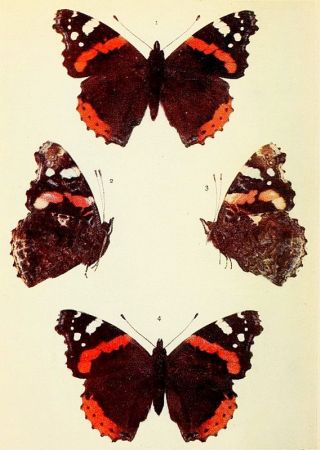
Pl. 47.
Red Admiral.
1, 2 male; 3, 4 female.
A North American species, Pyrameis virginiensis (huntera), has been once or twice, since 1828, reported as captured in England, but its occurrence in this country can only be regarded as accidental.
The Red Admiral (Pyrameis atalanta).
The vivid contrast of black and scarlet in this butterfly will certainly arrest the attention of even the least observant. But Nature, ever excellent in her colour schemes, has toned down the glare of the scarlet bands by the addition of some splashes and dots of white above them on the fore wings, and some dots of black on those of the hind wings. Then, by way of a finish, there is a delicate tracing of blue along the outer margin of the fore wings, and a touch of the same colour at the angle of the hind wings, the scalloped margins of all the wings being white relieved by black points. On the under side the combination of colour on the fore wings is much the same as above, but there is also some blue tracing on the central area, and the tips harmonize with the hind wings, which are mottled with various shades of brown, traversed by wavy black lines, and have a more or less square pale spot on their front edges.
The ordinary variation in this butterfly consists of slight differences in the tone of the red markings, which ranges from the normal scarlet in one direction to almost crimson, and in the other to orange-yellow. The bands on the fore wings may be broken up into two, or sometimes three, distinct parts; and a specimen with the bands of hind wings marked with yellow has been noted. There is often a white dot in the bands of the fore wings, and this occurs in both sexes.
A somewhat rare variety is represented on Plate 49. It was reared from one of three caterpillars casually picked up at Erith, and is now in Mr. Sabine's collection. Somewhat similar specimens have been figured elsewhere. One of these was bred from a caterpillar found at Ashton in 1867, and another was captured in Jersey in 1893. All these varieties seem to be modifications of the form named klemensiewiczi by Schille, and which was figured by Esper as a variety of atalanta in 1777. This form has also resulted from temperature experiments on the chrysalis, of the kind previously adverted to.
The egg when first laid is green in colour, but as the caterpillar matures within the colour changes to greenish-black, with the ten ribs showing up more or less transparent. The egg is laid in an upright position on nettle leaves and young shoots, but not in batches like those of the Tortoiseshell, etc.
The caterpillar varies in colour. Some are blackish freckled with white, with two yellow stripes, sometimes broken up, on the sides; and the rows of branched spines yellow, except those nearest the head, which are black or tipped with black. Others are greyish, or grey marked with yellowish-green. Others, again, are dark brownish, with the spines on the back pale, and those on the sides black; or all the spines may be shining black (Hellins).
The chrysalis is greyish, prettily ornamented with gold along the centre of the back and on the thorax and head. The projections are also tinged with metallic gloss. It is generally suspended under a canopy of nettle leaves.
The caterpillars do not live in companies like those of the Peacock and Tortoiseshells, but each individual constructs for itself a kind of tent (see Plate 48) by spinning together the leaves of its food-plant, the common stinging-nettle. Although the caterpillar is well concealed in such hiding-places when newly made, it "gives itself away" when it has partly consumed its home. It has been found on pellitory (Parietaria officinalis), and also on hop (Humulus); but I have found that caterpillars fed on hop alone always produce small butterflies.
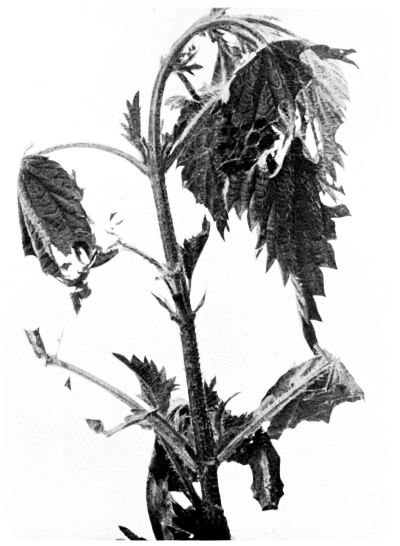
Pl. 48.
Red Admiral.
Caterpillar's shelter-tent, and chrysalis.
Larger Image
Pl. 49.
1, 2 Red Admiral var.
3, 4 Painted Lady var.
The caterpillars, which in a state of Nature are often badly "ichneumoned," have been noted in England as early as the end of June and as late as October. In the South of Europe they have been seen in February.
The butterflies seen in spring and early summer, up to, say, the beginning of July, are supposed to have wintered in this country, but there is no positive evidence, that I can find, that the butterfly does hibernate here. It is, however, most probable that they are arrivals from abroad. The species is found throughout Europe and North Africa, Northern Asia, and North America, and it may be suspected of migration, although there is, perhaps, not such conclusive evidence on this point as in the case of its cousin, the Painted Lady.
Anyway, unless we admit immigration, it seems difficult to understand why this butterfly should suddenly become common in some British localities from which it has been almost or quite absent for several years. Again, we rarely hear of butterflies moving about at night, but the Red Admiral, as well as the Painted Lady, are known to do this. If it does hibernate in this country it is very late in taking up winter quarters, as it is seen on the wing at the end of October, and sometimes even in November; it has also been known to emerge from the chrysalis in the latter month. It does not appear in the spring with other hibernating species, and is rarely seen before the end of May, but June seems to be about the normal time.
In the autumn it is fond of making excursions into the flower garden and the orchard, where it takes toll from flower and fruit, an over-ripe pear or plum being its special weakness. The blossoms of ivy, hop, thistle, teazle, etc., are attractive, but a tree-stem that has been bored by the caterpillar of the goat moth will be visited by nearly every Red Admiral in the district. One observer mentions that he once saw quite thirty of these butterflies gathered around one wounded birch tree on Wimbledon Common. There was not room for all to imbibe at the same time, but those unable to satisfy their desire at the moment were content to sit around and await a favourable opportunity of joining in the feast. The seductive fluid obtained from such trees is evidently more potent than the nectar from flowers, as under its influence the insect is so listless that it may be taken up between the finger and thumb.
Its range extends throughout the British Islands, and seems to be very similar to that of the Painted Lady.
The Silver-washed Fritillary (Argynnis paphia).
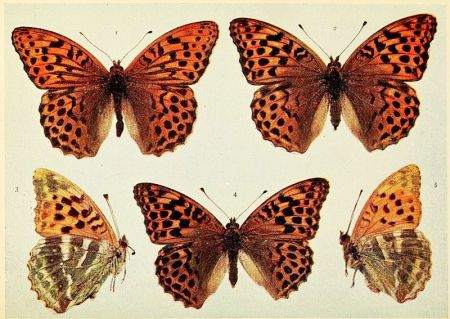
The wings of this fine butterfly are fulvous, with the veins and spots black; the spots on the hind wings are band-like, and the central spots on the fore wings are sometimes connected. The female is paler than the male, and is without the heavy black scales (androconia) on veins 1, 2, and 3; the basal third of the fore wing, and a larger area of the hind wing, tinged with greenish. The form of the female with all the wings greenish is the var. valesina (Plate 52), and between this and the type there are various intergrades, one of which is shown on the plate. Specimens with white spots on the fore wings, and chiefly in the males, are sometimes not uncommon in the New Forest, as, for instance, in the year 1893, when quite a large number were secured. Very much more rarely white spots occur on all the wings (Plate 57, Fig. 1). In a very remarkable male specimen, taken in the New Forest in 1881, the central area of all four wings is black, and the veins beyond are broadly edged with the same colour. A curious female aberration has the central black spots much reduced or absent, whilst those on the outer margin are united, and form elongate blotches between the veins, the upper one being wedge-shaped. Aberrations of the valesina form, similar to that figured on Plate 57, Fig. 2, and Fig. 25 on next page, are not often met with; the ground colour is greenish, but much suffused and clouded with black. Now and then gynandrous specimens are obtained, the one side normal male and the other side typical female, or var. valesina.
The egg when newly laid, in July, is whitish tinged with green, ribbed, and cross-furrowed, the alternate ribs not extending to the top. As the caterpillar matures, the egg-shell appears blackish and the ribs hoary.
The caterpillar when full grown is velvety black with two bright yellow lines along the back; the spines are of a reddish-ochreous colour with the extreme tips and branches black. There are only two on the first ring, and these are inclined forward over the head. The chrysalis is of a pale ochreous colour, streaked and mottled with brownish; the hollow part of the back has a brilliant golden sheen, and the points on the rest of the body are gold tipped. Suspended by the anal hooks to a silken pad spun on a twig, rock, or other object in the vicinity of its feeding-place, it is capable of much activity in the way of wriggling when touched, and displays the beauty of its metallic adornment to the greatest advantage when so engaged.
The caterpillar hatches in August, and after eating its egg-shell and nibbling a leaf or two of dog-violet (Viola canina), goes into winter quarters whilst in its second skin, and consequently very small; the spines, which are such an imposing feature of the adult caterpillar, have not yet appeared. In April, after feeding again, it moults the second time, and the spines are then disclosed.
Sometimes caterpillars continue to feed in the autumn instead of hibernating. This, at least, has happened to Mr. Frohawk on two occasions, notably in 1893, when he had several individuals of a brood, from eggs laid by a female of the valesina form, that departed from the usual custom of their kind by feeding and growing until they eventually passed through all the stages and emerged perfect butterflies in September and October of that year. Something similar occurred in a brood that he was rearing in the autumn of 1895, but on this occasion only one caterpillar continued to feed beyond the normal time.
The English name by which we now know this, the largest of the six British Argynnids, seems to have been given to it by Moses Harris in 1778. Sixty years or so before that date it was called the "Greater Silver-streaked Fritillary." Fortunately, in this case, as in others where the vulgar tongue is entomologically concerned, the law of priority does not apply, so that the name Silver-washed, which so well expresses the underside ornamentation, may be retained.
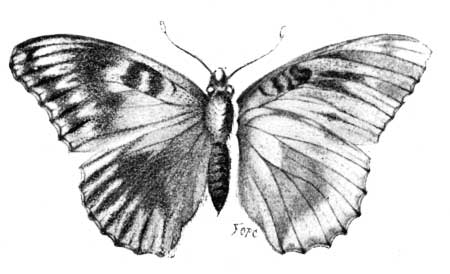
Fig. 25.
Aberration of var. valesina.
The butterfly is probably to be found in most of the Southern English and Welsh counties, especially where there are extensive woods. In North Devon, however, it occurs in places where there is not much in the way of woodland. It is abundant in the New Forest, and also in some parts of Ireland. Although it has been observed as far north as the Clyde, it is scarce in North England and Scotland. The valesina form is to be seen, in July and August, in the New Forest every year, and sometimes in numbers. This variety has been reported from Kent, Sussex, Devon, and Dorset; also from "near Reading" and "the border of Hertfordshire."
Larger Image
Pl. 50.
Silver-washed Fritillary.
1, 3 male; 2, 4, 5 female.
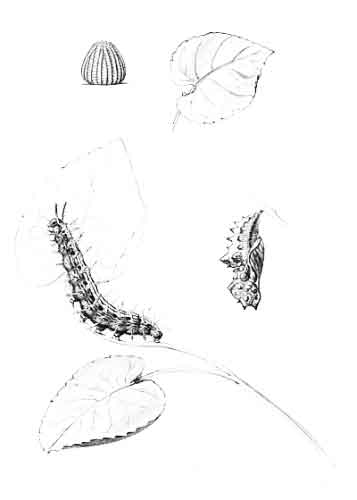
Pl. 51.
Silver-washed Fritillary.
Egg, natural size and enlarged; caterpillar and chrysalis.
Abroad, the typical form is distributed through Europe and Asia to China, Corea, and Japan. The valesina variety is uncommon in Northern Europe, but in some parts of China it seems to be the dominant form.
The High Brown Fritillary (Argynnis adippe).
Bright fulvous with black spots and veins. The female is not so bright in tint as the male, and is without the thick patch of scales on veins 2 and 3. The series of black spots parallel with the outer margin of the fore wing are normally six in number, but the third is usually small and sometimes absent, whilst the fourth and fifth are often much larger than others of the series. In the corresponding row on the hind wing the first and third spots are sometimes wanting. On the under side the silvery spots are generally as seen in Plate 54, but they are subject to modification, and not infrequently are absent from the tips of the fore wings, and sometimes from the outer margin of the hind wings also. A very rare aberration has the central area of the fore wings black on the upper and under sides; the hind wings are black above with fulvous lunules on the outer margin, and the silvery spots on the under side are reduced to five, and these are confined to the basal area. In another remarkable form the hind wings above are similar to the last-mentioned variety, but on the under side the silvery spots on the basal half are united and form a large patch, which is divided by the nervures, and there are no silvery spots on the outer margin. The variety shown on Plate 57 has the under side of the hind wings buff in colour, the markings on the outer margin are reddish-brown with a few silvery scales towards the anal angle, and the basal silvery spots are confluent, agreeing in the latter character with the preceding variety, and also with var. charlotta of the next species. In var. cleodoxa the spots on the under side are yellowish instead of silvery, but the red spots on the outer area are sometimes silver centred; this form is only rarely found in Britain. Possibly some of the reputed British examples of A. niobe may have been referable to cleodoxa, but what appears to be more certain is that the actual occurrence of niobe in England is exceedingly doubtful.
The egg when newly laid is yellowish-green; it afterwards turns pink, and then rosy red; during the winter it changes to greyish or bluish-green. As a rule, the eggs are laid at the end of July, and the caterpillars do not hatch until the following March or early in April. In 1893, however, Mr. Frohawk had a few caterpillars hatch out between the middle of August and September 20, from a number of eggs laid at the end of June. One of these, fed up, pupated on October 13, and the butterfly emerged on November 21. The majority of the eggs remained over to the following spring. According to an observation made by Mr. W.H.B. Fletcher, the caterpillar is fully formed soon after the egg is laid, but remains within the shell all the winter.
The caterpillar, which feeds upon dog-violet, and also the sweet violet, is figured on Plate 53. The head is pinkish-brown, covered with short greyish bristles. Body black, incrusted with ochreous grey on the sides, and on the back marked with ochreous grey on the hinder half of each ring; dorsal line white. The branched spines are pinkish-brown.
The chrysalis is deep brown, freckled with paler; points along the back of the body brilliant greenish-golden, as also are the four points on the thorax. The wing-cases are rather paler. The foregoing brief description was taken on July 10, and the butterfly emerged five days afterwards.
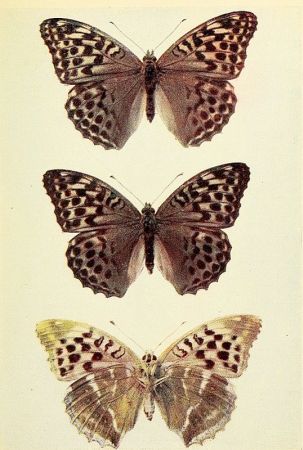
Larger Image
Pl. 52.
Greenish Silver-washed Fritillary.
Var. valesina, female.
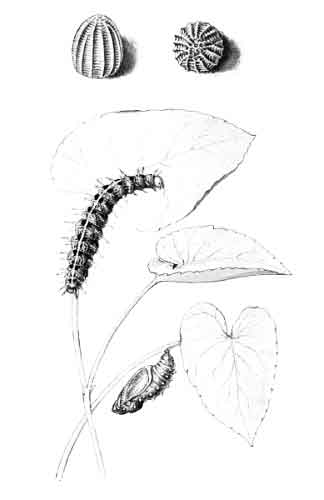
Pl. 53.
High Brown Fritillary.
Eggs enlarged; caterpillar and chrysalis.
Barrett says, "Apparently found in most of the larger woods of the southern counties, from Kent, Essex, Suffolk, and Norfolk on the east, to Devonshire, Glamorganshire, and Merionethshire on the west; also in similar situations through the north-western counties and the more sheltered woods of the Midlands to Herefordshire, Shropshire, Derbyshire, and Lincolnshire. Found in several localities in Yorkshire, in the favoured Grange and Silverdale districts of Lancashire, and near Lake Windermere in Westmoreland, its extreme northern boundary being reached in Cumberland."
It is widely distributed over Europe, and its range extends into Asia Minor and Amurland. In China and Japan it is represented by various forms, the commonest of which is var. locuples.
The Dark Green Fritillary (Argynnis aglaia).
This butterfly is bright fulvous in the male, paler in the female; the latter sex is blackish towards the base, and has paler spots on the outer margin. The black marking is pretty much as in the previous species, but the male has the black scales (androconia) on veins 1 and 2, and these are less conspicuous. The basal two-thirds of the hind wings is greenish on the under side. The silvery spots are arranged in fairly regular series, and there are no silvery centred red spots between the two outer series. The blackish crescents on the outer margin of the fore wings are edged with silver, but this is chiefly towards the tips of the wings.
There is some variation in the tone of the ground colour, lighter or darker than normal in both sexes; the female seems to be the most variable in this respect, and sometimes, especially in the north, examples of this sex are much suffused with blackish or greenish-black. Occasionally the colour is quite pale, as shown in the middle figure on Plate 61, and sometimes it is clouded with greyish. The black spots are apt to run together, and so form bands and blotches. An example of this kind of aberration is shown on the plate.
Var. charlotta differs very little from the type on the upper side, but on the under side of the hind wings the basal silvery spots are united, as shown in the upper reverse side figure on the plate. This variety was known to the entomologist of Haworth's time as the "Queen of England Fritillary," and there is a figure of it in Sowerby's "British Miscellany," which was published in 1806.
The egg is yellowish when first laid, and a day or two afterwards violet-brown rings appear above the base and the apical half. It is ribbed and finely cross-ribbed, and some of the ribs are continued to the truncate and slightly depressed top.
When full grown the caterpillar is shining purplish-grey, thickly mixed with velvety black; the grey is most in evidence between the rings and along the lower part of the sides. There is a yellow stripe along the middle of the back, and this has a central black line of irregular width; along the lower part of the sides there is a row of reddish spots, and these are connected by a fine yellowish line. The black spines are branched, and, except on the first three rings, which have only two rows, arranged in three rows on each side of the yellow stripe. The head is glossy black, and, like the body, hairy. (Adapted from Buckler.)
It feeds in May and June on dog-violet, and has been reared on garden pansy. The chrysalis has the head, thorax, and wing-cases black, very glossy, and marked with pale brownish; the body is pale brownish, and the points black. Suspended in a tent-like arrangement of leaves.
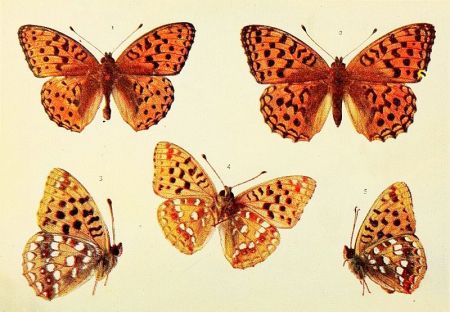
Larger Image
Pl. 54.
High Brown Fritillary.
1, 4, 5 male; 2, 3 female.
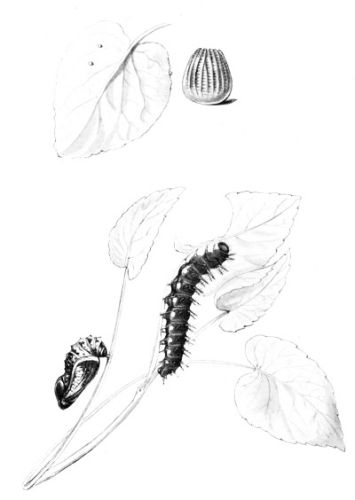
Pl. 55.
Dark Green Fritillary.
Eggs, natural size and enlarged; caterpillar and chrysalis.
Moorlands, downs, sea-cliffs, and flowery slopes are the kind of situations most to the fancy of this agile butterfly. It is on the wing in July and August, and is much more easily seen than caught. However, it is rather fond of perching on the taller kinds of thistles, and is then not difficult to capture, if quietly approached. It is common locally in most of the English and Welsh counties. In Ireland it seems to be chiefly attached to the coast, and is plentiful in some of its localities. In Scotland it occurs in many suitable districts, but Skye is the only one of the isles from which it has been reported. Its distribution extends through Europe and Asia to Amurland, China, and Japan.
The Queen of Spain Fritillary (Argynnis lathonia).
In shape and in general appearance this butterfly is not unlike a small example of the Silver-washed Fritillary; the large silvery, or sometimes pearly, blotches on the under side of the hind wings at once reveal its higher British rank. When flying it has a curious resemblance to the Wall, and sometimes it has been taken when the captor supposed that he was netting a specimen of that plebeian butterfly. The black markings on the upper side vary somewhat in size, and occasionally those on the front area, or those on the inner area of the fore wings, are more or less confluent; very rarely the wings are suffused with a steely-blue or bronze colour. The specimens occurring in this country do not, however, exhibit so much variation as has been observed in this butterfly abroad.
I have not seen any of the early stages. The figures of the caterpillar and the chrysalis (Plate 58) are after Hübner, and the following descriptions of the egg and other stages are adapted from the detailed life-history of the species by Mr. Frohawk, published in the Entomologist for 1903:—
"The egg is one-fortieth of an inch high, of a rather straight-sided conical form, widest at the base, where it is smooth and rounded off at the edge. There are about forty longitudinal keels, irregularly formed and of different lengths, some not reaching halfway up the side, and others running the entire length from base to crown, where they terminate abruptly, and form a series of triangular peaks round the summit surrounding the granulated micropyle; the spaces between the keels are finely ribbed transversely. When first laid it is of a very pale lemon-yellow colour, inclining to ochreous, appearing almost white in certain lights; the colour gradually deepens, becoming yellower with a greenish tinge. On the fifth day the crown of the egg assumes a dull grey, finally changing to a lilac-grey."
The female butterfly, when placed in the sunshine, laid about a hundred eggs during the day—August 7. These were mostly placed singly on the leaves or other parts of a plant of heart's-ease (Viola tricolor), but some were laid on the gauze cover of the cage. All the caterpillars hatched out on August 14.
The caterpillar when full grown is velvety black, densely sprinkled with tiny white dots, each bearing a black bristle; there are six rows of spines, which are of various shades of brown with yellowish bases and shining black bristles; along the back there are two white streaks on the fore part of each ring, and white warts emitting black bristles on the hind part. The head is amber-coloured above, but black below, and is covered with bristles like the body.
The chrysalis has the head, thorax, and wing-cases shining olive-brown; the body chequered and speckled with olive-brown, ochreous, black, and white. The spiracles are black and conspicuous, and the points on the body are amber-coloured. The thorax and first two body rings have brilliant burnished silver-gilt ornamentation.
The butterflies commenced to emerge on September 25, and between that date and the 28th ten came out. Although he succeeded in rearing almost all the caterpillars to the chrysalis, no less than eighty died in this stage, and he states that "there is no doubt that the late autumn English climate is quite unsuited for the existence of this species," as well as for others that come to us from abroad.
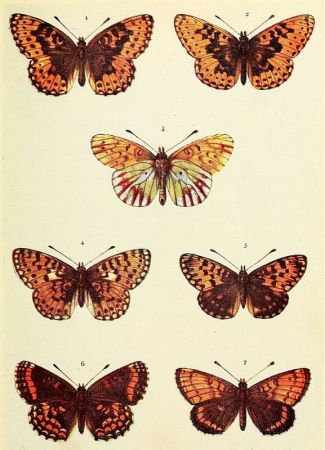
Larger Image
Pl. 56.
1, 2, 3 Pearl-bordered Fritillary vars.
4, 5 Small Pearl-bordered Fritillary vars.
6, 7 Heath Fritillary vars.
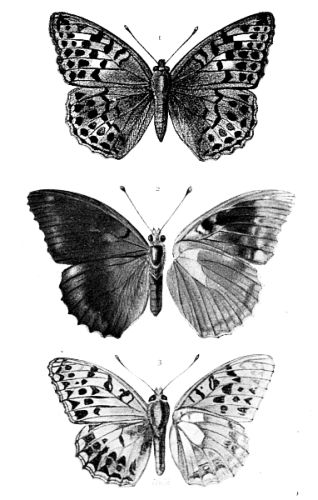
Pl. 57.
1, 2 Silver-washed Fritillary vars.
3 High Brown Fritillary var.
Moses Harris, in 1775, gave this butterfly the name "Queen of Spain;" it had been known to English entomologists from 1710 until then as the "Lesser Silver-spotted Fritillary." Gamlingay in Cambridgeshire seems to have been the only British locality in which it had been observed until 1795, when Lewin mentions a specimen taken in a Borough (London) garden in August. All the Cambridge specimens had been captured in the month of May. Stephens, writing in 1828 ("Ill. Brit. Ent. Haust.," i. 37), says—
"Previously to the year 1818, few cabinets possessed even a single specimen; and from the very few known instances of its capture (six only, according to Mr. Haworth), there is reason to believe that some of the specimens at that time [1803] placed in collections were foreign; but in the above remarkable year for the appearance of certain papilionaceous insects, this species occurred simultaneously in several, and very distant, parts, having been taken in August by Mr. Haworth at Halvergate, in Norfolk; by Mr. Vigors in Battersea-fields; by myself at Dover, and, during that and the following month, near Colchester; Birchwood, Kent; and Hertford in plenty by others. At the latter place I saw several specimens, but was not fortunate enough to secure any."
The butterfly has been taken, chiefly odd specimens, in many of the eastern and southern counties, from Norfolk to Dover, and almost always in the autumn. It has also occurred at Scarborough (1868), and at least once in Ireland (1864).
The neighbourhood of Dover seems to have always been the most favoured locality, and no less than twenty-five specimens were captured there in 1882. Several examples were also obtained at Dover in 1883, and a single specimen in other parts of Kent in 1884 and 1885. The most recent records are—Brighton, one example in 1892; Clifton, one in July, 1898; Christchurch, one in August, 1899; Poole, one in 1901. There does not seem to be any authentic record of the caterpillar having been observed in Kent or any other British locality in which the butterfly has been noted. This may possibly be due to its love of concealment.
There are two flights of the butterfly in the year, one in the spring and the other in the autumn.
Females from the Continent may arrive on our east or south coasts in May, and deposit eggs from which the autumn butterflies are developed. Some of these might wander farther inland, but eggs would almost certainly be laid on the spot. The fate of the caterpillars from autumnal eggs would depend on the winter; if mild they, or at least some of them, might manage to get through and attain the butterfly state about May, but their doing so is rather doubtful.
The species is widely distributed and often common on the Continent, and its range extends to Persia, Northern Asia, and North Africa. In Eastern Asia it is represented by var. isœa.
The Pearl-bordered Fritillary (Argynnis euphrosyne).
Some authors consider the smaller Fritillaries to be generically separable from the larger kinds, and place this and the next species in the genus Brenthis, whilst the Queen of Spain is referred to the genus Issoria, Hübner. Here, however, they are retained in Argynnis.
In colour and in the marking of the upper side the Pearl-bordered is very like the High Brown, but, as will be seen from the figures, it is much smaller in size, and the ornamentation on the under side is different. There is one silvery spot at the base of the hind wings, a larger one about the middle of the wings, and a row of spots on the outer margin. The female is rather larger than the male, and darker at the bases of the wings.
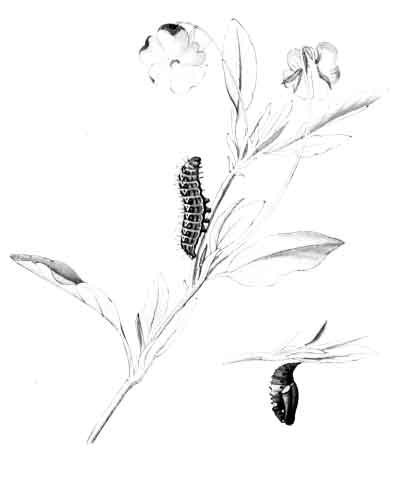
Pl. 58.
Queen of Spain Fritillary.
Caterpillar and chrysalis.
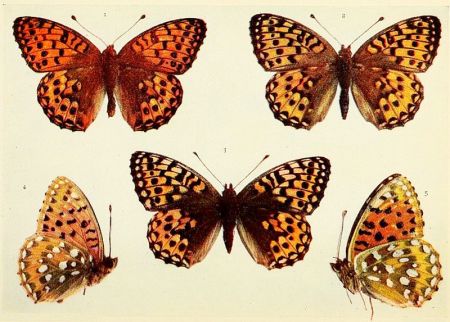
Larger Image
Pl. 59.
Dark Green Fritillary.
1, 4 male; 2, 3, 5 female.
Variation on the upper side consists of more or less black suffusion on the basal or general area of the wings, and an increase in the size of the black spots, resulting in the formation of bands or patches; or the black spots may be much reduced in size, and some of them entirely absent. Some of the more striking kinds of aberration, both above and below, are represented on Plate 56, Figs. 1-3, and Plate 65, Figs. 1-4. The usual colour is sometimes replaced by buff, and this may be yellowish or whitish in tint; occasionally white spots appear on the wings. The life-history of this butterfly is depicted on Plate 60.
The egg, which is laid in May or June, is whitish-green at first, and afterwards turns brownish. It is distinctly ribbed, and the top is somewhat rounded and hollowed in the centre.
The full-grown caterpillar is black, and the numerous minute hairs with which it is clothed give it a velvety appearance. There is a greyish-edged black line down the middle of the back, and the spines on each side of this are whitish or yellowish, with the tips and the branches black; all the other spines are black. A greyish stripe runs along the lower part of the sides, and this is traversed from the fourth to the last ring by a blackish line. Head black, shining, downy, and slightly notched on the crown. The natural food-plant is dog-violet (Viola canina), but the caterpillar will also eat garden pansy, and has been known to nibble a leaf of primrose. It retires for hibernation when quite small, and recommences to feed in March.
The chrysalis is brownish, with the raised parts of the thorax and head greyish; the body is paler brown, and the points thereon are blackish.
This butterfly seems to be fairly common in woods throughout England and Wales, and it is often abundant in some of the more extensive woodlands, especially in the southern counties. It used to be plentiful in Northumberland and Durham, but has become scarcer in those counties, and in some others in the north of England. It occurs in Scotland, and is not uncommon in Sutherlandshire, but Kane does not include it in his Irish catalogue.
Clearings in woods are generally the best places in which to find this pretty little Fritillary; but it also seems to have a fondness for the margins of brooks and rills, where these run through or by the sides of woods. Usually it is on the wing in May or June, but sometimes, in early seasons, it puts in an appearance at the end of April. To entomologists of a bygone age it was known as the "April Fritillary," but this name would hardly be a suitable one for it in the present day. Very rarely a few specimens have been taken in August; and there is at least one record of caterpillars that had ceased feeding in July, in the usual way, and were apparently settled down for hibernation, suddenly arousing from their slumbers, and completing their growth in August.
Abroad, the species is distributed throughout Europe, except the extreme south, and extends into Armenia, Northern Asia Minor, the Altai, and Amurland. It is stated to be double-brooded on the Continent.
The Small Pearl-bordered Fritillary (Argynnis selene).
This butterfly differs from the last one referred to in having a rather deeper colour on the upper side, and heavier black markings on the outer margin of the hind wings. The female is slightly more orange in tint, and has a series of pale spots on the outer margin of each wing. On the under side the red markings are browner in tint, and there are more silvery spots on the hind wings. Variation in colour and marking is similar to that mentioned under the Pearl-bordered. On Plate 66 a white spotted female and a specimen with the hind wings clouded with black are represented. These are rather uncommon aberrations. The life-history of this species is figured on Plate 62.
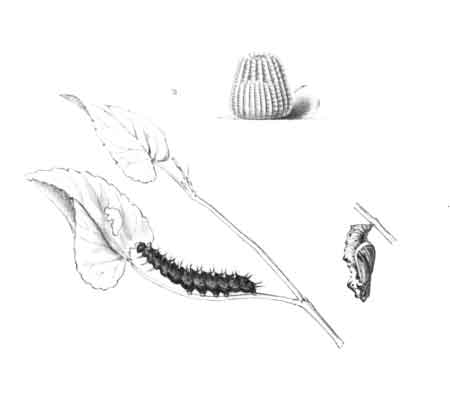
Pl. 60.
Pearl-bordered Fritillary.
Egg, natural size and enlarged; partly grown caterpillar; chrysalis.
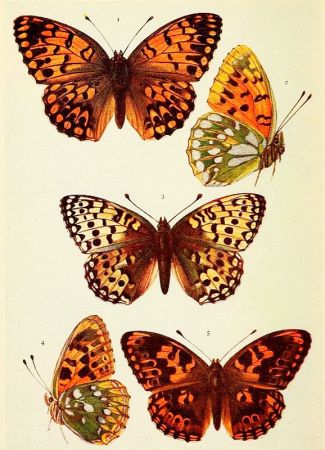
Larger Image
Pl. 61.
Dark Green Fritillary vars.
1, 2, 4, 5 male; 3 female.
The egg is at first greenish, then yellowish, and afterwards greyish, and then becoming blackish towards the hollowed top. The ribs seem to be eighteen or twenty in number; laid in June or July on plants of dog-violet. On emerging from the egg the young caterpillar devours most of the shell. It is then of a pale olive colour with brownish warts, from each of which there is a pale and rather long jointed bristle; the head is black. The full-grown caterpillar is smoky pink and velvety-looking. There is a brownish line along the middle of the back. The spines are "ochreous in colour, tinged with pink, and beset with fine pointed black bristles." The upper ones are rather stouter than the others, and the pair on the first ring, the only spines on this ring, are rather more than twice the length of the others, and are directed forward over the head, thus giving the appearance of a pair of horns; the second and third rings have each four spines, which are rather finer than those on the rest of the body, which are arranged in six rows. A pale pinkish stripe runs along the lower part of the body; just above the feet. Head black and notched on the crown (Buckler). The chrysalis is brown on the thorax and the body; the wing-cases are more ochreous and marked with black near the edge. There is a black V-mark on the thorax, with a silvery spot on each side, one silvery spot on each side of the head, and other metallic spots on the body near the thorax (Buckler).
On the Continent there are two broods of the butterfly, and specimens are occasionally seen in August in this country; one of these late examples, taken by Mr. Barker in 1881, is shown on the plate (Fig. 6). Sometimes one or two caterpillars of a brood in confinement will feed up and attain the perfect state in August instead of settling down with their companions for hibernation.
The butterfly in June and July frequents similar places to those favoured by the Pearl-bordered, and its distribution in Britain is somewhat similar, although it is a more local species. It seems, however, to be commoner in Scotland than the Pearl-bordered, and has been recorded at least once from Ireland.
Its range abroad extends farther east, as it is found in Corea.
The Heath Fritillary (Melitæa athalia).
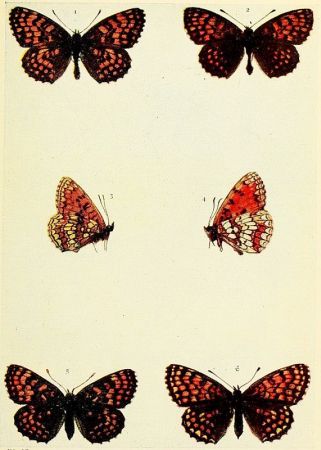
The ground colour of this butterfly, sometimes called the "Pearl-bordered Likeness" or "May Fritillary," is brownish-orange, and the markings are black or blackish; the bases of the wings are clouded with blackish, and the fringes are white checkered with black.
The ground colour varies in tint, and may be pale tawny or deep reddish. The black markings are subject to modification in two directions; in one leading up to almost complete disappearance from the central area, and in the other they are much intensified and greatly obscure the ground colour. Sometimes the whole of the wings, with the exception of a series of orange spots on the outer area, are blackish. This form is known as var. navarina. The left-hand figure at the bottom of Plate 68 shows an aberration approaching this form, whilst the right-hand figure comes close to var. corythalia. Specimens with all the wings thinly marked with black, as in the fore wing of the variety last referred to, would be referable to var. obsoleta.
According to Barrett, specimens from Essex have the ground colour on the under side of the hind wing much yellower than are the same parts in specimens from Sussex. I have not noticed this, but some Essex examples that I have seen were much darker and more heavily marked with black on the upper side, and especially on the hind wings, than any that I have seen from other parts of England, except, perhaps, a few individuals from North Devonshire. These Essex specimens reminded me very much of M. dictynna, a Continental species, with which, it appears, the Heath Fritillary was confounded by some of the old authors.
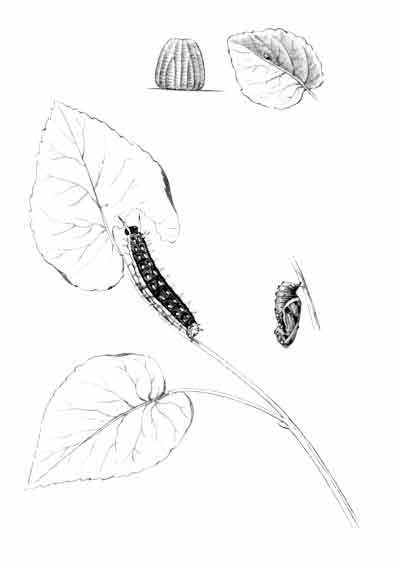
Pl. 62.
Small Pearl-bordered Fritillary.
Egg, natural size and enlarged; caterpillar (after Buckler), and chrysalis.
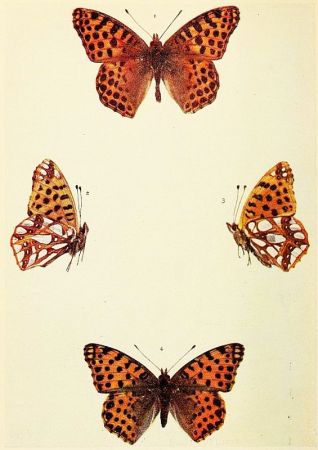
Larger Image
Pl. 63.
Queen of Spain Fritillary.
1, 2 male; 3, 4 female.
There is a good deal of variation on the under side, but chiefly of a minor character, and most often unconnected with variation on the upper side. The following are more important varieties.
Var. tessellata, the Straw May Fritillary of Petiver, and figured by him in 1717 and by Stephens in 1827, has the under side of the hind wings entirely straw-coloured with black veins. There are three large squarish yellow spots on the basal area, outlined in black; a yellow central band, margined and traversed by black lines. On the outer margin there is a series of yellow crescents, outlined in black.
Var. eos of Haworth (the Dark Underwing Fritillary) is the pyronia of Hübner and Stephens, and a modification of var. corythalia, Hübn. On the under side the fore wings are fulvous, and have two black spots in the discal cell, and a black band, intersected by the veins, on the central area. On the hind wings the basal third is fulvous with eight black spots; the central area is whitish intersected by the black veins. On the yellow-tinged whitish outer area there is a series of black-margined orange crescents; a row of black lunules precedes a thin black line on the outer margin.
The egg is upright, ribbed, and pale whitish-green in colour. As the caterpillar matures the shell becomes greyish. The eggs were laid in a cluster on a leaf of cow-wheat (Melampyrum pratense) as shown in the figure, but failed to hatch.
The full-grown caterpillar is black on the back, becoming olive tinged on the sides and olive-brown underneath; the divisions between the rings are olive. The whole of the upper surface, except a line along the middle of the back, is dotted with white, and there are eleven white-tipped orange or yellowish spines on each ring, except the last two and the three nearest the head; the first and the last each have four spines, the third has eight, and the second and the eleventh have each ten spines. The head is black marked with white, and is clothed with short, stiff, black hair or bristles (Buckler). The chrysalis is pale whitish-ochreous, the markings on the wing-cases are black, and those on the other parts are orange and black.
Cow-wheat appears to be the chief food of the caterpillar, but it will also eat, and has been found on, foxglove (Digitalis purpurea) and woodsage (Teucrium scorodonia). Plantain is also said to be a food-plant, but Buckler says that his caterpillars would not eat this. The caterpillars are rather shy in their habits, and, except when the sun is shining brightly, require to be carefully looked for among their food-plant and the dead leaves, etc., around. They hatch from the egg in July, feed for a few weeks, and then hibernate in companies under a web. In April and May they become active again, feed up quickly, and appear as butterflies in June and early July.
The species is, unfortunately, becoming scarcer in England than it used to be. It seems quite to have disappeared from some of the districts in which it was formerly common. No doubt in one or two of its old and well-known localities the butterflies, and perhaps the caterpillars also, have been too freely taken, and its natural enemies have probably completed the business. Clearings in woods or heathy borders of woods are the kind of places this species appear to prefer. Its headquarters in any given locality seems to be changed from time to time, so that the exact spot where it will occur next year cannot be predicted from this year's observations.
The butterfly seems to be unknown in Scotland, and has only been recorded from Killarney in Ireland. In England it is to be found in the counties of Essex, Kent, Surrey, and Devonshire.
Its geographical distribution extends through Europe into Asia Minor, East Siberia, and Northern Amurland. In Corea and Japan it is represented by a larger form known as var. niphona.
The Glanville Fritillary (Melitæa cinxia).
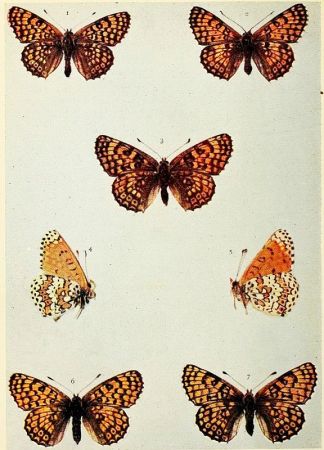
This butterfly is bright brownish-orange with black markings, as shown on Plate 71. The under side of the hind wings and the tips of the fore wings are very pale yellowish; the former with two black-margined brownish-orange bands, and lines of black dots; the tip of the fore wing is also dotted and marked with black. The female is slightly paler, and the markings are often blurred.
There is variation in the black markings on the upper side. Sometimes these are enlarged, but more often they are much reduced, and the central one may be completely absent from all the wings. Connected with the suppression of the middle black line above there is usually aberration on the under side of the hind wings also, where the central area is clear of black dots, and the basal area is fulvous, edged and marked with black. Two very remarkable aberrations are represented on Plate 65, Figs. 7, 8.
The eggs, which are yellowish-white, and sometimes tinged with green, are laid in a cluster on the under side of the tip of a leaf of the narrow-leafed plantain (Plantago lanceolata). The caterpillars hatch in July and August, and hibernate in companies under a web. The mature caterpillar is black with white dots, and black bristles arising from greenish warts. The red head, which is notched on the crown, and the red fore legs distinguish this at once from the caterpillars of the Heath, or the Marsh Fritillary. It feeds in early spring on plantain, but seems to prefer Plantago maritima to P. lanceolata when both are present.
The chrysalis is brownish in colour, and is ornamented with orange on the thorax, and with orange points and black marks on the body. It may be found in April and early May suspended from the lower parts of the stems of the plantain or other plants around. Newman states that he found "dozens of the chrysalids in company," but I have only occasionally met with them, and always singly.
Quite early in the eighteenth century this butterfly had only been observed in England in Lincolnshire, where, according to Ray, it was common, and in a wood at Dulwich. Petiver, who mentioned the last-named locality, calls it the "Dullidge Fritillary." Wilkes in 1773 wrote of it as the "Plantain Fritillary," although he gives clover and grass, as well as plantain, as the food of the caterpillar. Moses Harris in the Aurelian (1779) calls the butterfly the "Glanville Fritillary," and states that it was named after Lady Glanville, who was interested in butterflies, and whose will was disputed on that ground. This fact will serve to show that entomology as a pursuit was not much in vogue at that time, and that those who collected butterflies, etc., were apt to be regarded by their friends as being—well, just a "wee bit daft."
Both Wilkes and Harris, it may be remarked, seem to have been acquainted with the caterpillar of this species as well as with that of the Marsh Fritillary, and there seems little reason, therefore, to suspect that they confused the two species. The localities given by the earlier authors appear, however, to suggest that the butterfly they wrote about may have been the Marsh Fritillary; but there is no direct evidence of this.
Stephens in 1827 ("Illustrations of British Entomology," Haustellata, vol. i. p. 34) wrote—
"This is a very local species, and is found in meadows by the sides of woods; in Wilkes' time it was not uncommon in Tottenham wood; recently the places where it has been chiefly observed have been near Ryde and the Sandrock Hotel, Isle of Wight; in the latter place in plenty: also at Birchwood, and near Dartford and Dover, and in a wood near Bedford. I believe that it has been found in Yorkshire."
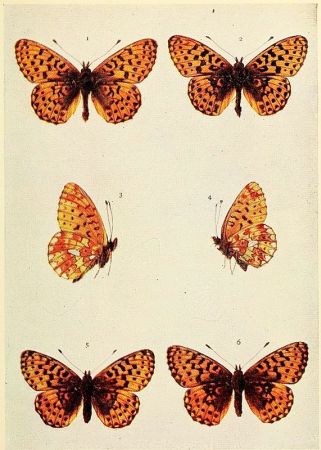
Larger Image
Pl. 64.
Pearl-bordered Fritillary.
1, 2, 3 male; 4, 5, 6 female.
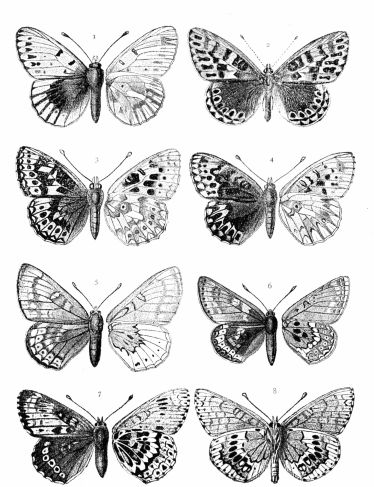
Larger Image
Pl. 65.
1, 2, 3, 4 Pearl-bordered Fritillary vars.
5, 6 Marsh Fritillary vars.
7, 8 Glanville Fritillary vars.
There is no doubt that between 1858 and 1863 the butterfly was more or less common on parts of the Kentish coast between Folkestone and Sandgate, but it seems to be equally certain that the species has long been absent from that part of England as well as from other localities that have been mentioned, except the Isle of Wight, where it is still to be found. It flies in May and June, and seems to have a preference for the rougher parts of the undercliff; but I have seen butterflies and caterpillars too on the higher slopes of St. Boniface. Whenever the caterpillars are met with, it will be well to remember that only the full-grown ones should be taken, as the smaller ones do not thrive very well in confinement. A little self-denial in this matter will bring its own reward in the shape of fine specimens for the cabinet, and the pleasant reflection that the useless sacrifice of a number of caterpillars has been avoided.
The butterfly is widely spread and generally common on the Continent, and in the Channel Islands it is plentiful in Alderney and Guernsey. Its range extends into Asia Minor, Central Asia, and Siberia.
The Marsh Fritillary (Melitæa aurinia).
This species, of which several forms are represented on Plate 73, is subject to considerable variation in depth of colour, and also in size and intensity of the markings, in all localities. The varieties here referred to are more or less characteristic of the countries in which they occur. To mention all the forms, or even those to which varietal names have been given, would occupy more space than is available for the purpose.
Reddish-orange or bright tawny, veins black, breaking up the yellow or yellowish transverse bands; there are three or four transverse black lines, the first and second, counting from the base of the wing, not always distinct; basal area more or less suffused with black. On the under side the fore wings are fulvous, with faint traces of the upper-side markings; the hind wings are rather redder, especially on the outer half, and have yellowish markings, comprising some spots towards the base of the wings, a band beyond the middle, a series of black centred spots, and crescents on the outer margin. The above applies more particularly to the form of the butterfly occurring in England and Wales.
The Irish form known as præclara has the transverse band straw-coloured, the red colour is more vivid, and the black veins and cross-lines heavier; the area nearest the base of the wings is often blacker.
In a form occurring in Scotland, and known as var. scotica, the black is still more intense, and the straw-coloured markings are dull in colour.
The egg is pale brownish and very glossy. It appears smooth towards the rounded base, but is ribbed from just before the middle to the top. The eggs are laid in batches on leaves of scabious, chiefly the Devil's bit (Scabiosa succisa).
The full-grown caterpillar is black, with a number of tiny whitish dots, each bearing a short black hair; short black spines are arranged in nine rows from ring four, the first ring is only hairy, the second and third have each two spines. The head is black, with a groove down the front and short hairs on the sides. The true legs are black, and the false legs and the under parts of the body are dull rust-coloured. The caterpillars hatch from the egg in June or July, and towards the end of August they construct silken webs, in which they establish themselves for hibernation. Early in March they recommence feeding, and under the influence of much sunshine feed up quickly. Besides wild scabious, they will eat honeysuckle and the garden kinds of Scabiosa. The chrysalis is pale buff, with orange points on the body; the wing-cases are marked with black and orange. The chrysalids are suspended from a silken web, which is attached to a leaf or drawn-together leaves. The early stages are figured on Plate 70.
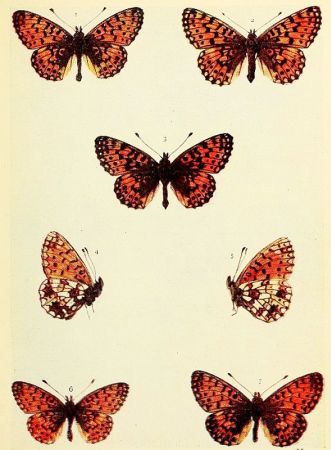
Larger Image
Pl. 66.
Small Pearl-bordered Fritillary.
1, 3, 4 male; 6 do. (second brood); 7 do. var.; 2, 5 female.
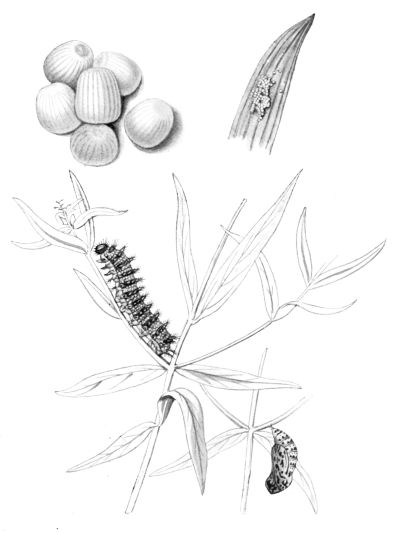
Pl. 67.
Heath Fritillary.
Eggs, natural size and enlarged; caterpillar (after Buckler), and chrysalis.
Kane (Catalogue of the Lepidoptera of Ireland), referring to this species, remarks: "This butterfly has been known to increase so prodigiously that whole fields and roads became blackened by the moving myriads of larvæ. An instance of this was observed by the Rev. S.L. Brakey, near Ennis, Co. Clare, where he drove out to see a reported 'shower of worms,' and found as above described, the larvæ being so multitudinous in some fields that the black layer of insects seemed to roll in corrugations as the migrating hosts swarmed over each other in search of food. The imagines that resulted from the starved survivors were extremely small and faded in colour."
These caterpillars are destroyed in great numbers by Hymenopterous parasites, chiefly Apanteles, and it is almost certain that a large percentage of those collected will prove to have been stung.
The butterfly is on the wing in May and June, and seems to affect damp meadows, marshy ground on the sides of hills, and such kind of places. It does not necessarily occur wherever its food-plant is abundant, but scabious is always found to be present in the haunts of the butterfly; so if we know that the insect occurs in a particular district we should probably get a clue to its exact whereabouts by noting the likely places in that district where the food-plant flourishes.
Although it has seemingly disappeared from various English localities where it was formerly common, the butterfly may be found in many parts of the British Islands, but it is local and does not occur northwards much beyond the Caledonian Canal.
Abroad it spreads over Europe to Northern Africa, and its range extends eastward through Asia to Amurland and Corea.
The fine butterfly next in order is regarded as a member of the Danainæ by most authors. Although its generic position seems to be established, its proper place in the classification of butterflies is still unfixed; and even the question of its trivial or specific name is not finally settled. According to Kirby, this butterfly is Anosia menippe, Hübner, and not the true Papilio plexippus of Linnæus, nor the P. archippus of Cramer. American authors, however, consider it to be the Linnean plexippus, and give menippe Hb. as a synonym. The species is here retained in Danainæ, but Holland places it in Euploeinæ and Skinner in the Family Lymnadidæ.
The Milkweed Butterfly (Anosia plexippus).
The butterfly figured on Plate 120 is brownish-orange, with black veins and margins on all the wings. White spots are arranged in double rows on the black outer margin of each wing, and there are seven other rather larger white spots on the black apical patch of the fore wings. The male has a patch of black scales, covering the scent pouch, close to vein 2 on the hind wings.
The egg is long, oval in shape, with over twenty low upright ridges and many cross-lines; is of a pale green colour; and is laid singly on the food-plant of the caterpillar (various kinds of milkweed, especially the commonest kind, Asclepias cornuti), and usually upon the under surface of the upturned apical leaves near the middle. The egg state lasts only about four days (Scudder). The caterpillar has the head smooth and rounded, yellow, conspicuously banded with black. Body cylindrical, tapering a little in front, naked, but with two pairs of long and very slender black thread-like filaments, one pair, the longer, on the second thoracic, the other on the eighth abdominal segment. The body is white, with numerous slender black and yellow, and especially black, transverse stripes, repeated with considerable regularity on each of the segments, so that there are nowhere any broad patches of colour (Scudder).
Larger Image
Pl. 68.
Heath Fritillary.
1, 2, 3 male; 4, 5, 6 female.
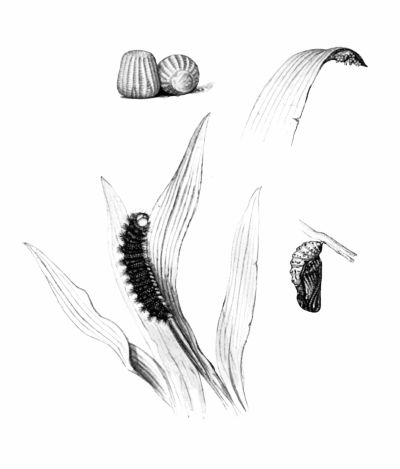
Pl. 69.
Glanville Fritillary.
Eggs, natural size and enlarged; caterpillar and chrysalis.
The chrysalis is stout and not elongated, largest in the middle of the abdomen; where it is transversely ridged; elsewhere it is smooth and rounded, with no striking prominences, but with little conical projections at most of the elevated points, like those which half encircle the body at the abdominal ridge, all of a golden colour except the latter, which are situated in a tri-coloured band, black in front, nacreous in the middle, and gilt behind (Scudder).
According to Dr. Holland, "the butterfly is considered to be polygoneutic, that is to say, many broods are produced annually; and it is believed by writers, that with the advent of cold weather these butterflies migrate to the South [in America], the chrysalids and caterpillars which may be undeveloped at the time of the frosts are destroyed, and that when these insects reappear, as they do every summer in North America, they represent a wave of immigration coming northward from the warmer regions of the Gulf States. It is not believed that any of them hibernate in any stage of their existence. This insect sometimes appears in great swarms on the eastern and southern coasts of New Jersey in late autumn. The swarms pressing southward are arrested by the ocean." Within quite recent years it seems to have effected a settlement in Australia, "and has thence spread northward and westward, until in its migrations it has reached Java and Sumatra, and long ago took possession of the Philippines. Moving eastward on the lines of travel, it has established a more or less precarious foothold for itself in Southern England.... It is well established at the Cape Verde Islands, and in a short time we may expect to hear of it as having taken possession of the continent of Africa, in which the family of plants upon which the caterpillars feed is well represented."
So far as is shown by the published records, the actual number of specimens of the Milkweed, or, as it is sometimes called, Monarch butterfly, seen or caught in England between 1876, in which year it was first observed in this country, and the present time, does not much exceed thirty, and about one-third of these were obtained in September, 1885. In 1876 single specimens were captured at Neath, S. Wales; Hayward's Heath and Keymer, Sussex; and Poole, Dorset. In 1896 single specimens were reported as seen at Lymington, Hants, in May; Newlands Corner, Surrey, in July; and the Lizard, Cornwall, in September. The years in which the butterfly has been noticed in Britain are 1876, 1881, 1884, 1885, 1886, 1887, 1890, and 1896. It was first observed on the Continent in 1877, when, according to Barrett, a specimen was taken in La Vendée, France. In 1886, when half a dozen were recorded from England, single specimens were obtained in Guernsey, and at Oporto and Gibraltar. "More recently," Barrett states, "Mr. H.W. Vivian found it, I believe not uncommonly, in the Canaries, and very kindly brought me a specimen."
There seems to be no question that the species is migratory in its habits, but exactly how it reaches this country is not definitely known. Neither is it known whether the species, having arrived, is able to reproduce its kind here. From the fact of its recurrence in England for four years in succession, the possibility of its breeding in this country might be assumed. One objection to any such inference, however, is that it is a many-brooded species, but, with the exception of two records in 1896, all British specimens were captured or seen in August, September, or October, and none seem to have been observed in the earlier months of those years in which the autumnal butterflies were obtained.
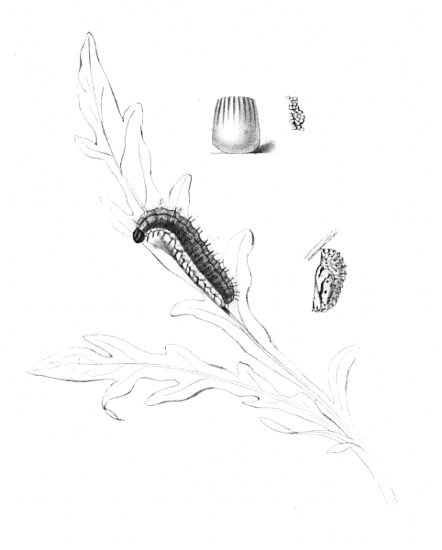
Pl. 70.
Marsh Fritillary.
Eggs, natural size and enlarged; caterpillar (after Buckler) and chrysalis.
Larger Image
Pl. 71.
Glanville Fritillary.
1, 2, 4 male; 3, 5, 6, 7 female.
The Milkweeds (Asclepias) are not indigenous plants, but, as pointed out by the late Mr. J. Jenner Weir, A. purpurescens and A. tuberosa are hardy in this country. He endeavoured to ascertain whether these plants, or either of them, were grown in any of the gardens in the Cornish locality where four fresh specimens were captured in September, 1885. I do not find that the desired information was furnished. Recently I have ascertained that A. cornuti, which grows to a height of four feet, is used as a border plant in some parts of England. It is commonly known as Swallow-wort, and is esteemed for its fragrant pale purple flowers.
We now come to the Satyrinæ, which, as regards the number of species belonging to it, is a very large sub-family. In Great Britain, however, there are but eleven species, and although some of these are rather local, none are really scarce, and most are common.
The Marbled White (Melanargia galatea).
Older English names for the butterfly figured on Plate 75 are "Our Half-mourner" (Petiver, 1717), "The Marmoris" (Wilkes), and "The Marmoress" (Harris). The ground colour is white or creamy white, and the markings are black. On the under side the markings are similar in design to those on the upper side, but much fainter: the eye spots, which are not always in evidence above, are well defined below, and especially so on the hind wings. The female is generally whiter and larger than the male, and has the basal half of the costa, or front margin of the fore wing ochreous brown, and the markings on the under side of the hind wings are tinged with the same colour.
Variation consists chiefly of increase or decrease in the size of the black markings. At least one specimen is known in which all the wings are uniform smoky black. This is in the collection of Mr. A.B. Farn, and was captured near Rochester, Kent, in 1871. Between this extreme and specimens with the black markings of typical proportions there are various modifications; but striking aberrations are rare in this country. Sometimes there is entire or partial absence of black pigment. A remarkable example of this kind of aberration, taken on the cliffs between Dover and Walmer some years ago, is described as of a clear milky-white colour, and has not, either on the upper or under side of the wings, the smallest speck of black. The ground colour is sometimes decidedly yellow, and very occasionally brownish.
The life-history of this butterfly is figured on Plate 74.
The egg is whitish, opaque, with a dark speck on the apex; base flattened and slightly hollowed; finely reticulated, but without distinct striations or anything resembling ribs. The eggs are laid in July, and are not attached to anything.
The caterpillar when full grown, is whity-brown in colour with brownish lines. The head is brown, tinged with pink, and the tail-like points on the last ring are pink. The head, as well as the body, is clothed with short hair.
The chrysalis is also whity-brown with a pinkish tinge, browner speckling on the wing cases, and the body is marked down the back with yellow.
Hellins says, "It hibernates when very small, becomes full fed in June, and changes to a pupa without suspending itself in any way, or making a cocoon; I think it would hide itself, as my examples did; I found they had got among the thick moss with which I had furnished the bottom of their cage, and apparently made little hollows for themselves by turning round."
Cock's-foot grass (Dactylis glomerata) and cat's-tail grass (Phleum pratense) are given as food-plants, but the caterpillars in confinement seem to eat any kind of grass that is supplied.
The butterfly is found in most of the Midland counties and in nearly all of the Southern ones, but is especially common on the chalk downs of the South-west. It does not occur in Ireland or Scotland, and seems to be absent from the Northern counties of England except Yorkshire. In the last-named county it was supposed to be extinct, but during the past ten years it has been observed at Sledmere, and near Scarborough and Helmsley. It is also reported to be not uncommon in three localities not far from York.
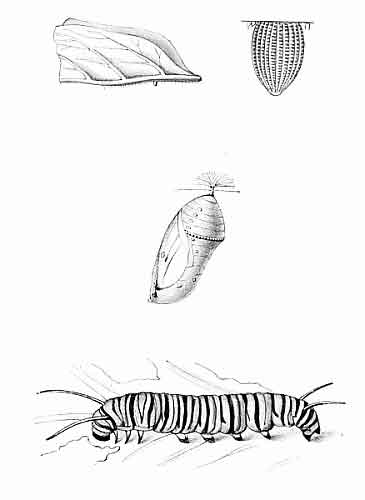
Pl. 72.
Milkweed Butterfly.
Egg, natural size and enlarged; caterpillar and chrysalis (after Smith).
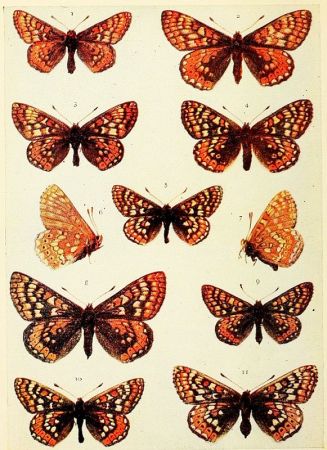
Larger Image
Pl. 73.
Marsh Fritillary.
1, 3, 5, 9, 10 male; 2, 4, 6, 7, 11 female.
1, 2, 4, 6, 7, 9 English; 8 Welsh; 3, 5, 10, 11 Irish.
The butterflies usually affect broken ground, rough fields, grassy slopes near woods, or even sunny banks on the edges of cornfields. Occasionally an odd specimen or two may be met with here and there, but as a rule they seem to keep pretty much together, so that when one comes upon a colony of these butterflies, the selection of a series on the spot is quite an easy matter, and can be effected without destroying a single specimen over and above the required number.
Abroad, this species is abundant in Central and Southern Europe, and its range extends to Northern Asia Minor and Armenia.
The Small Mountain Ringlet (Erebia epiphron).
The typical form of this butterfly, epiphron, Knock, has the tawny bands unbroken on the fore wings, and almost so on the hind wings; the black dots on the hind wings of the female are often pupilled with white, and more rarely this is so in the male also. It has been stated that specimens occur in Perthshire which exhibit these characters. All the British examples of the Small Mountain Ringlet that I have seen are referable to the form known as cassiope, Fab. (Plate 77). The tawny, or orange, bands are rarely so entire on the fore wings as in epiphron, and are generally rather narrower; and that on the hind wing is broken up into three or four rings. The black dots are usually smaller and without white pupils. The female is somewhat larger and the bands or rings paler.
Variation in the markings is extensive. The bands on the fore wings become less and less complete, until they are reduced to a series of mere rings around the black dots. The black dots decrease in size and in number until they, together with the tawny marking, entirely disappear, and a plain blackish-brown insect only remains. This extreme form has been named obsoleta, Tutt. The earliest rings to vanish seem to be the third on the fore wings and the first on the hind wings. Similar modifications occur on the under side also, but there may be aberration on the upper side of a specimen, and not, or at least not in the same way, on the under side.
The egg, when first laid, is yellow, changing afterwards to fawn colour with darker markings, especially towards the top. It is laid in July on blades of grass. The larva hatches in about sixteen days.
The young caterpillar, before hibernation in October, is greenish, with darker green and yellow lines. Head brownish. Feeds in July and after hibernation on various grasses, among which Poa annua, Festuca ovina, Aira præcox, and A. cæspitosa have been specified as eaten by caterpillars in confinement. A distinct preference, however, has been shown for mat grass (Nardus stricta), and it has been suggested that this may be the natural food. The full-grown caterpillar appears to be undescribed.
The chrysalis is described by Buckler as being "little more than three-eighths of an inch in length, rather thick in proportion, being less dumpy in form than hyperanthus, but more so than blandina. The colour of the back of the thorax and wing cases is a light green, rather glaucous; the abdomen a pale drab or dirty whitish; a dark brown dorsal streak is conspicuous on the thorax, and there is the faintest possible indication of its being continued as a stripe along the abdomen. The eye-, trunk-, antenna-, and leg-cases are margined with dark brown, and the wing nervures are indicated by the same colours."
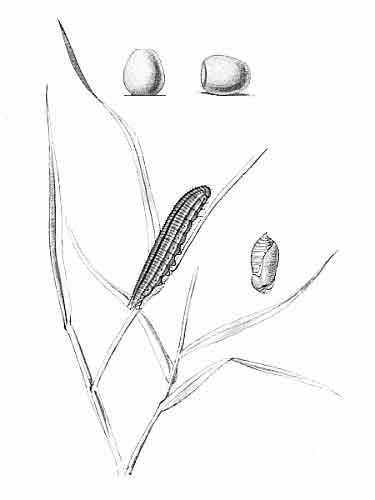
Pl. 74.
Marbled White.
Eggs enlarged, caterpillar and chrysalis.
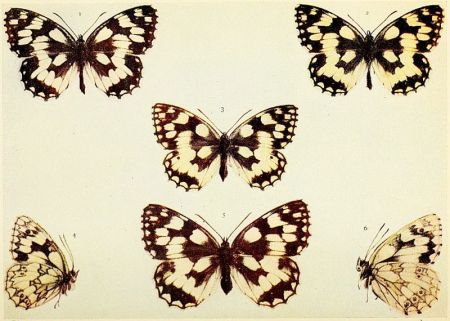
Larger Image
Pl. 75.
Marbled White.
1, 2, 4 male; 3, 5, 6 female.
As is indicated by its English name, this interesting little butterfly only frequents high ground, and is rarely found below about 1500 feet. All its English localities are in the lake district of Cumberland and Westmoreland. It seems to like boggy ground, and in such places on Gable Hill, Red Skrees, and at Langdale Pikes, among others, it is not uncommon. Previous to 1809 the species was unknown to occur in Britain, but in June of that year specimens were captured by Mr. T. Stothard on the mountains at Ambleside. Haworth, in 1812, referred to these specimens as from Scotland, but the butterfly was not taken in that country until 1844, when it was discovered by Mr. R. Weaver in Perthshire. It is now known to occur, sometimes in abundance, on Ben Nevis and other adjacent hills, also in suitable spots and the proper elevation around Lochs Rannoch and Vennachar, as well as in the Tay district and Argyleshire.
In Ireland it was taken by Mr. E. Birchall, in June, 1854, in a grassy hollow about halfway up the Westport side of Croagh Patrick. About five years ago Mr. W.F. de Vismes Kane met with the butterfly on Nephin, Mayo, and he mentioned a specimen believed to have been taken on the hilly slopes on the eastern shores of Lake Gill, Sligo.
Abroad the species is found in mountainous parts of South Germany, Switzerland, France, North and Central Italy. The typical form, epiphron, is more especially obtained in the Hartz and Alsatian Mountains, Silesia, Hungary, and Bulgaria.
The Scotch Argus (Erebia æthiops = blandina).
The butterfly figured on Plate 77 is deep velvety brown, appearing almost black in very fresh male specimens. There is a broad fulvous band on the outer area, but not reaching either the costa or the inner margin; it is contracted about the middle, the upper part encloses two white pupilled black spots, and the lower part has one such spot. The hind wings have a narrow fulvous band, usually enclosing three white pupilled black spots. The under side is more distinctly brown and not velvety, band of fore wings similar to above; the hind wings have a greyish band beyond the middle, with three small white pupilled black spots on its outer edge; the basal area is often greyish also. The female is generally less dark and velvety, the bands are rather wider, more orange in colour, and the white pupils of the spots are more conspicuous; on the under side the alternate dark and pale bands are more striking, and sometimes the grey colour is replaced by ochreous, which seems to constitute the aberration named ochracea, Tutt. The spots on the fore wings, upper side, are often increased to four by the addition of a small one between those previously mentioned. More rarely there is an extra spot above the upper pair, and still less frequently, and in the female sex, an additional pair is found below the usual lower spot, thus making six in all. On the other hand, the only spots in evidence may be the pair in the upper part of the band. The spots on the hind wings range in number from two to five, but occasionally all are absent. The fulvous bands on the fore wings may be reduced to rings around the upper and lower spots respectively, and altogether wanting on the hind wings. Such an aberration would be referable to obsoleta, Tutt, which is considered to be very rare. There are many other modifications, but these mentioned will serve to show the variable character of this local butterfly.
The egg is ochreous white, or bone colour, finely freckled with pale brown or pinkish-brown; it has a number of ribs, and is also reticulated.
The caterpillar in its last skin is pale drab, the warts pale whitish-brown, emitting short tapering bristles; dorsal stripe blackish-brown, enclosed by two paler drab lines; subdorsal stripe paler drab, becoming narrow towards the anal point, edged above with a greenish-brown thread, and below with blackish or brownish dashes, that almost form a continuous line; below this come two thin pale lines, above the lower of which are the circular black spiracles; the under parts and the legs are of a somewhat warmer tint of the ground colour of the back. It changed on June 22nd to a pupa, unattached, but placed in an upright position amongst the grass near the ground.
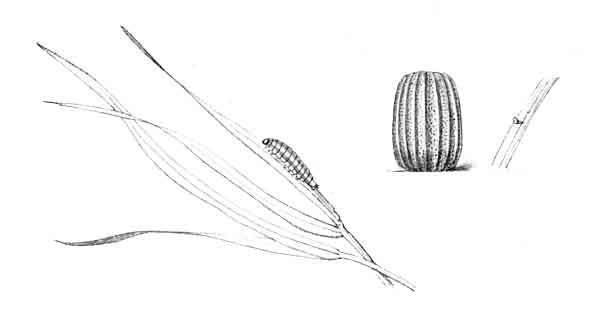
Small Mountain Ringlet.
Egg, natural size and enlarged; young caterpillar.
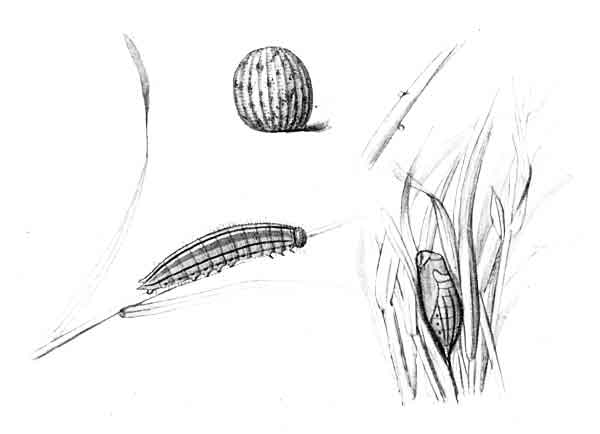
Pl. 76.
Scotch Argus.
Eggs, natural size and enlarged; caterpillar and chrysalis.
Larger Image
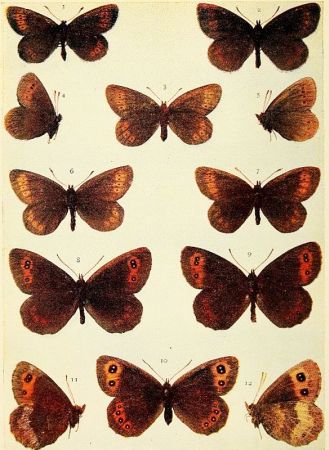
Pl. 77.
Small Mountain Ringlet.
1, 4 male; 3 female (English); 2, 5, 6, 7 male (Scotch).
Scotch Argus.
8, 11 male (Scotch); 9 do. (English); 10, 12 female (Scotch).
The chrysalis has the body ochreous, with a darker stripe down the back, and other lines; the eye covers are black, and the thorax, antennæ cases, and wing covers are dingy, dark purplish-brown.
The above descriptions of caterpillar and chrysalis are adapted from Buckler, whose figures of these stages are also reproduced on the plate.
Aira præcox, A. cæspitosa, and Poa are the grasses that seem to be the food of the caterpillar.
Mr. Haggart, of Galashiels, who had exceptional opportunities for observing the habits of this butterfly in its natural home, gives a most interesting account of it in the Entomologist for November, 1895. He writes—
"The haunt of this species is, almost without exception, the margin of a plantation or wood where the different species of Poa grow abundantly, and always situated in such a position as to receive the first rays of the rising sun. This last-mentioned fact is so plainly evident, that the least observant cannot fail to notice it. The insect is truly sun loving, and no collector need go in search of it with any thought of success if the day be dull.
"It is most interesting to observe the extreme sensibility of the insect to shine and shade. A very good day to illustrate this is one when heavy clouds at intervals obscure the sun; the moment it disappears so also does the butterfly, and no sooner does it shine forth again than, as if by magic, scores of the insect are on the wing.
"The under side of the insect bears a marked resemblance to that of a dead leaf, and I have often watched the males being deceived by withered leaves lying among the moss. They would flutter down quite close to the leaf, immediately rise with a disappointed air and fly a little further, only to be deceived again and again.
"The ova are deposited amongst the Poa grass, and hatch in September. Towards the end of October the larvæ go down and hibernate throughout the winter and spring, coming up to feed again in May; they are generally full-fed about the end of June; and the insect appears in July or August. The larvæ are nocturnal feeders, coming up to feed on the grass just about dusk. The method of procuring the larvæ is by no means enviable, even to the most ardent entomologist, as in the uncertain light it necessitates crawling on one's hands and knees amongst the grass, and there is always the risk of grasping those little brown slugs in mistake, which resemble the larvæ very much in shape and colour. No artificial light can be used, as the larvæ immediately drop down amongst the grass if this is done. The only alternative, therefore, is to use one's eyes to the best advantage until the darkness makes that impossible.
"They are not difficult to rear in confinement if the larvæ are kept properly supplied with food."
This butterfly, which as a British species was discovered in the Isle of Arran in 1804, only occurs in the north of England and in Scotland. Its localities in the latter country are Glen Tilt and other valleys in the Perthshire highlands, Strathglass in Inverness, Altyre woods at Forres; Selkirk, Roxburgh, and various parts of Argyleshire; around the Lowther Hills, Dumfrieshire; also in Arran and the Isle of Skye. In most of the places it is plentiful. In England it occurs in the counties of Durham, Westmoreland, Cumberland, Lancashire, and Yorkshire. It is common in Castle Eden Dene, Durham; at Grassington, in Yorkshire; at Witherslack and Arnside, in Westmoreland; and at Grange and Silverdale, in Lancashire.
Abroad, it is distributed through Central and Southern Europe, and its range extends into Northern Asia Minor, Kurdistan, and Armenia; the Altai and South Siberia.
It may be noted here that E. ligea was supposed to have been taken in Arran at the same time as E. blandina, that is in 1804. If this were so, it would seem that the captor must have exterminated the species, for, although the island has often been closely explored, no one has been able to detect the "Arran Brown" again.
The Grayling (Satyrus semele).
On the upper side, this butterfly (Plate 78) is brown, more or less suffused with black, and this is especially noticeable on the outer area of the wings in the male, where it obscures the ochreous or rust-coloured bands, which in the female are almost free from the suffusion. The fore wings have two black spots, the upper one generally, and the lower often, pupilled with white. On the hind wings the bands are clear of blackish suffusion to a greater or lesser extent, and there is one black spot towards the anal angle which may be pupilled with white. Apart from its larger size and brighter bands, the female may be distinguished from the male by the absence of the blackish brand on the disc of the fore wings. On the under side, the fore wings are ochreous, tinged with orange on the basal half or two-thirds; hind wings are greyish, with darker markings, and an irregular white or whitish band beyond the middle.
Variation is largely confined to the under side of the hind wings, and these wings, as well as the costal edge and the tips of the fore wings, are coloured and marked, in various localities that the butterfly affects, so that the insects may be protected from their enemies when resting.
On the upper side of the fore wings an additional spot is sometimes present below one or other of the usual ones. The bands of the wings are pale ochreous in some examples, and rust-coloured in others; but it is not unusual for a specimen with ochreous bands on the fore wings to have rust-coloured bands on the hind wings, or ochreous bands with rust-coloured patches on the outer portion; these patches are most frequently triangular in shape, and placed between the veins. Gynandrous specimens also occur, but very rarely.
The egg is of a dull creamy tint, ribbed, and with a slight depression on the top. The eggs were laid early in August, on blades and stems of a kind of grass; also on the leno covering, and the sides of the glass jar in which the female butterfly was enclosed.
The caterpillar when full grown "is drab, delicately mottled, with longitudinal stripes broadest along the middle segments, viz. a dorsal stripe of olive-brown, very dark at the beginning of each segment, with a thin edging of brownish-white. Along the subdorsal region are three stripes, of which the first is composed of a double narrow line of yellowish-brown, the second wider of the mottled ground colour, edged with paler above and with white below; the third of similar width is of a dark grey-brown, edged above with black. The spiracular stripe is broader and of nearly equal width, pale ochreous-brown, edged with brownish-white both above and below; the spiracles are black. The head is brown, and the principal stripes of the body are delicately marked with darker brown" (Buckler).
The chrysalis is described as "obtuse, rounded, tumid, and smooth, the abdominal rings scarcely visible, and wholly of a deep red mahogany colour." It was "in a hollow space a quarter of an inch below the surface, the particles of sand and earth very slightly cohering together, and close to the roots of the grass, yet free from them." The figures of caterpillar and chrysalis are drawn from those in Buckler's "Larvæ of British Butterflies."
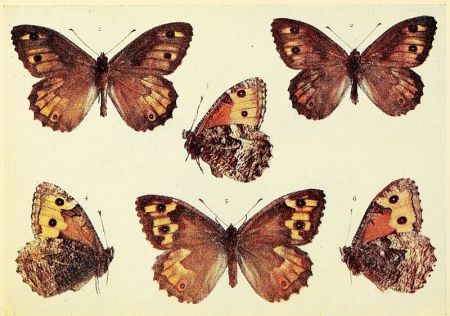
Larger Image
Pl. 78.
Grayling Butterfly.
Males, 1, 3 (Chalk), 2 (Heath); females, 4 (Heath); 5, 6 (Chalk).
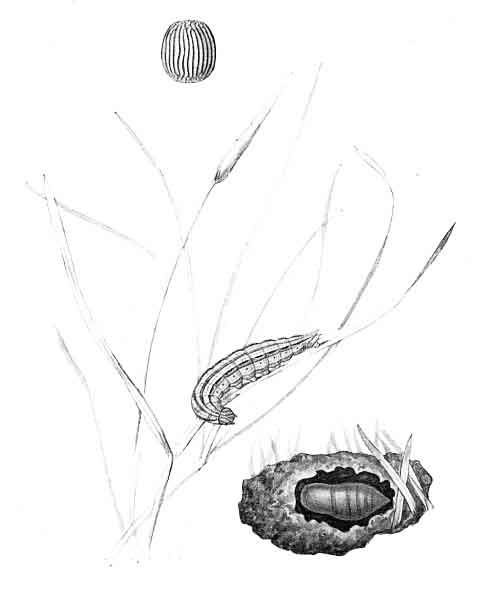
Pl. 79.
Grayling Butterfly.
Egg enlarged; caterpillar and chrysalis (both after Buckler).
The caterpillars hatch in August, hibernate when quite small, and feed up in the spring and early summer. They live upon grasses, such as Triticum repens, Aira cæspitosa, and A. præcox.
The butterfly delights in sitting rather than flying about cliffs and sand-hills, heaths and downs, stony hillsides, dry fields, and even open woodlands. It is fond of sunning itself on rocks, and by some of the old Aurelians it was called the "Rock Underwing," no doubt in reference to the pattern and colour of the under side. It was also known as the "Tunbridge Grayling" some two hundred years ago, when it was said to be "very rare about London." It has long since been ascertained to occur in almost every county in England and Wales, as far north as Sutherlandshire in Scotland, and is widely distributed in Ireland.
On the chalk downs and cliffs the butterfly has the under side of its hind wings so admirably agreeing in colour and marking with the soil, etc., that although one may watch it settle a few yards ahead, it is not to be seen when one reaches the spot. Whilst we are intent on the search the insect starts up, flies a short distance, and there repeats the disappearing butterfly trick. The same remarks apply to those Graylings that affect peaty or sandy heaths, etc. When the butterfly alights on the ground—and it rarely gets on the wing unless disturbed—it immediately closes its wings, and then allows them to fall more or less on one side, so that the whole of one hind wing is presented to view. It is said to have a fancy for the resinous sap that oozes from pine trees, and has also been observed to visit the trunks that have been "sugared."
Abroad, it is found commonly throughout the temperate parts of Europe, North Africa, and Northern and Western Asia.
The Speckled Wood (Pararge egeria).
Quite early in the eighteenth century Petiver met with the butterfly shown on Plate 80 at Enfield, so he figured it as the "Enfield Eye" in that curious old book entitled "Papiliorium Britanniæ Icones." Later on, Wilkes named the butterfly the "Wood Argus," thus indicating its favourite haunts, as well as a prominent character in its ornamentation. Harris changed the name to the "Speckled Wood Butterfly," which seems even more suitable.
The general colour is blackish-brown, and the spots are yellowish. The fore wings have one white-pupilled black eye spot towards their tips, and the hind wings have three such eye spots on the outer area. The male has a long oblique patch of blackish scales on the middle of the fore wings, which is, perhaps, more easily detected if the insect is held up to the light. The female is usually slightly larger than the male, the wings rather rounder, and the yellowish spots, are, as a rule, distinctly larger. The typical or southern form of this butterfly has the spots of a tawny colour, but it does not occur in Britain. Our form, in all its modifications, belongs to egerides, Staudinger. Occasionally, in the south of England, specimens are found in which the spots are tinged with fulvous; others have almost white spots. The spots are sometimes much reduced in size in the male, or greatly enlarged in the female.
The egg is pale greenish, finely reticulated; as the caterpillar matures within, the shell becomes less glossy than at first, and the upper part is blackish.
The caterpillar has a green head, which is larger than the first ring of the body (1st thoracic), covered with short fine whitish hairs, with which are mixed a few dark hairs. The body is rather brighter green, with darker lines, edged with yellowish, along the back and sides; the skin is transversely wrinkled, the rings being subdivided, and the whole of the body is clothed with fine whitish hair and a few dark hairs arising from warts; the anal points are whitish and also hairy. It feeds on various grasses, among which are Triticum repens and Dactylis glomerata.
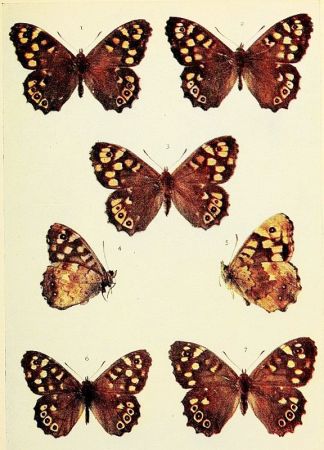
Larger Image
Pl. 80.
Speckled Wood.
Spring Brood: 1, 2 male; 3, 5 female. Summer brood: 4, 6 male; 7 female.
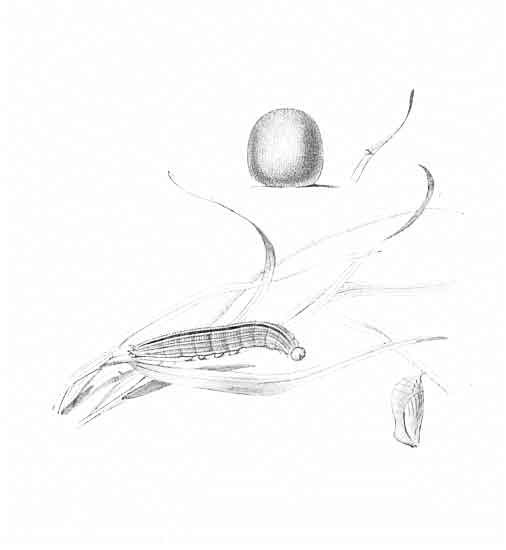
Pl. 81.
Speckled Wood.
Egg, natural size and enlarged; caterpillar and chrysalis.
The chrysalis is pale green, tinged with yellowish or whitish; the edges of the wing covers are brown, and there are whitish dots on the body. According to Hellins the colour varies, and green chrysalids may be covered all over with very fine smoky freckles. Barrett states that they are occasionally brownish with darker brown lines. Suspended by the cremaster from a silken pad.
From eggs laid in early May butterflies were reared at the end of June; and from eggs laid at the end of June butterflies resulted during middle August. Early July eggs produced perfect insects in early September, and from caterpillars fed up in October butterflies were obtained in November. These observations were not all made in the same year.
Barrett writes, "In the south of Surrey in 1862, the first emergence took place in April in abundance, these specimens became worn and disappeared, and a second emergence took place at the end of May, a third at the end of July, and a fourth in September; the next year the first emergence was in the third week in March, and again four broods were observed, but this is not the case every year, three emergences being probably the rule."
Mr. Joy has recorded that of caterpillars, resulting from a pairing induced in captivity, in August, eighty per cent. hibernated as pupæ, twenty per cent. as half-fed caterpillars. Butterflies from the winter pupæ emerged in May, but the caterpillars that had gone through the winter in that state did not produce butterflies until June. Possibly something of this sort occurs in the open, and we may suppose that the early and late spring butterflies are not separate broods, but early and late emergences of one brood. Butterflies seen on the wing in November may be a few individuals that, owing to favourable weather, have emerged from chrysalids which under ordinary conditions would have remained as such during the winter.
Shady lanes, rides in woods, as well as the borders of the same, are its favourite haunts. It is not a sun-loving butterfly, but is generally found to frequent places where the sun's rays are more or less intercepted by a leafy screen. It seems to be more abundant in wet seasons than in dry ones. It is generally distributed throughout England and Wales, but more plentiful in southern and western counties than in the eastern and northern. In Ireland, Kane says, it is "everywhere abundant and double brooded." It is local in Scotland, and rare north of the Caledonian Canal.
Abroad our form of the butterfly egerides is found commonly in Central and Northern Europe, except in the extreme north, and in Northern Asia Minor and Armenia. The typical form, egeria proper, occurs in South-Western Europe, North Africa, and Syria.
The Wall Butterfly (Pararge megæra).
The butterfly now under consideration is figured on Plate 82. It is bright fulvous in colour, with blackish-brown veins, margins, and transverse lines. There is one white pupilled black spot on the fore wings, and four of such spots on the outer area of the hind wings; the fourth, which is generally blind, is placed at the end of the series near the anal angle. The male has a very conspicuous sexual brand on the central area. The under side of the fore wings is paler than above, but the markings are similar, except that the brand is absent and the margins are greyer; the hind wings on the under side are greyish marked with brown and traversed by dark lines; there is a row of six eyed spots on the outer area; that nearest the anal angle is double. The female has more ample wings, and as the brand is absent on the fore wings in this sex, the central black transverse lines are more distinct.
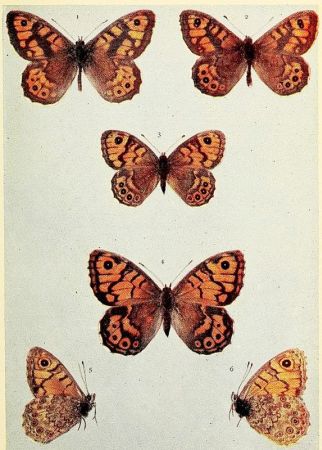
Larger Image
Pl. 82.
Wall Butterfly.
1, 2, 5 male; 3, 4, 6 female.
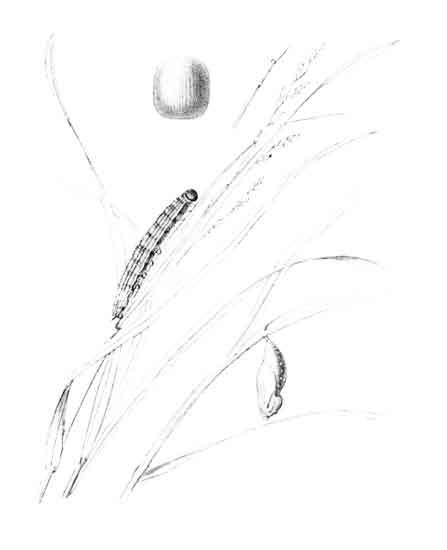
Pl. 83.
Wall Butterfly.
Eggs, natural size and enlarged; caterpillar and chrysalis.
Variation is chiefly in the size of the eyed spots; sometimes the apical one of the fore wings has a smaller one attached to its lower margin, or in the interspace (i.e. between the veins) above it or below it; or both extra spots, which are usually without white pupils, may be present. Very rarely the apical spot may be almost absent on one fore wing, but well defined on the other. The central transverse lines on the fore wings of the female are sometimes broad, and very occasionally the space between the lines is blackish; blackish-banded male specimens are also found in some localities, such as the slopes of Dartmoor, Devon, as mentioned by Barrett.
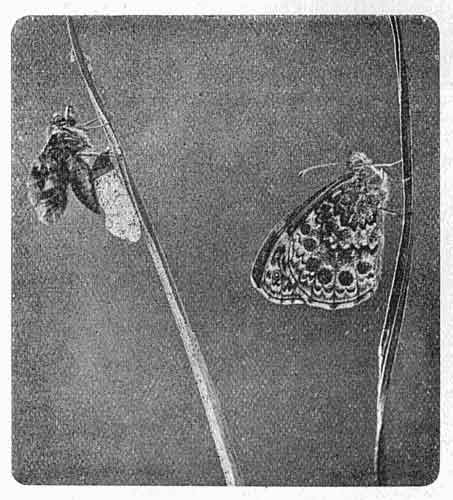
Fig. 26.
The Wall Butterfly just emerged from the Chrysalis, and with wings distended.
The ground colour varies in tint, darker or lighter than normal, but specimens of a bright golden yellow-brown, straw colour, or whitish are known to occur, although such extreme aberrations are exceptional.