Part 2 — ❧ CORRESPONDENCE ❧
Reading edition
MR. JULIUS WERNHER’S TITIAN
SIR,
One of your subscribers in Venice has drawn my attention to an article in your magazine (April number, p. 185), written by Mr. Herbert Cook, and illustrating a magnificent portrait by Titian, in the possession of Mr. Julius Wernher. Your subscriber tells me that similarly insufficiently described Italian portraits are not uncommon in English private collections, though, of course, not through the fault of the collectors, as it is impossible to obtain sufficient information from printed books only. We here in Venice are naturally better off, and the public and private archives and the manuscripts in the libraries offer much material to one who is experienced to handle it, and yield in most cases sufficient information. So your subscriber has asked me to show in the case of this Giacomo Doria what we can achieve here. ¶ To the student of palaeography it is not a matter of opinion, but of certainty, that the inscription reads: Giacomo Doria quondam Agostini, that means Giacomo Doria, son of the late Agostino. The dress is not the habit of an Augustinian friar. In the famous concert by Giorgione, in the Palazzo Pitti, the ecclesiastic playing the clavi-cembalo is an Augustinian; he is clean shaven, has the large tonsure, and wears a mozetta. It is impossible to decide by looking at the reproduction alone whether Giacomo wears Venetian or Genoese dress, everything being entirely black. According to Crollalanza’s ‘Dizionario storico-blasonico,’ there were two families of the name of Doria—one in Genoa, and one in the Veneto. Mr. Cook has not been able to decide to which branch Giacomo belonged. ¶ Now Signor Comm. Carlo dei Conti Bullo, at Venice, has a private archive containing many important documents concerning the history of the town of Chioggia. These documents show that the war between Venice and Genoa, called the war of Chioggia, led to the settlement of several important Genoese families in Chioggia. Amongst these are mentioned the Bonivento, the Cibo, the Gandolfo and the Doria. ¶ The Chioggia branch of the Doria family still exists; its present head is Signor Giovanni Battista Doria, a draughtsman in the Genio Civile in Venice. This gentleman has in his possession a genealogical tree, compiled and signed by two canons of the cathedral of Chioggia, which proves his descent from Victor, son of Giovanni, born in the year 1480, and founder of the Chioggia branch. But in this tree no Giacomo di Agostino occurs. Now Signor Doria has another tree, although not a signed one, which shows how Victor di Giovanni is attached to the main trunk of the family in Genoa. In this tree the looked-for Giacomo di Agostino occurs; he is therefore a Genoese and not a Venetian. ¶ We give here the interesting part of this tree:
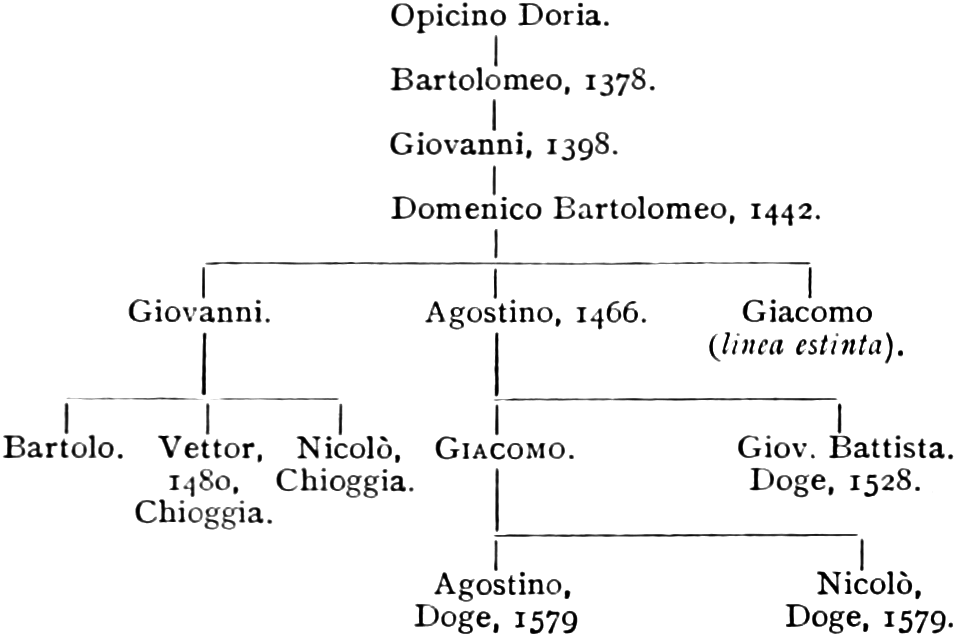
We see from this tree that Giacomo was a man of eminence, a brother of a doge, and the father of two doges of the republic of Genoa. His personality is of particular interest to the Germans, as his nearest relations play an important part in Schiller’s great tragedy, ‘The Conspiracy of Fiesco.’ His cousins Vettor and Nicolò settled in Chioggia, and, probably on the occasion of a visit to his relatives, Titian painted his portrait. Signor Doria is not certain as to the signification of the dates occurring in this tree, probably they mean the year of birth. Mr. Cook puts the portrait about the year 1523, but I am afraid it will have to be put to a considerably later date. ¶ This is all we can do in Venice; for further information about Giacomo one would have to search the documents in the archives of Genoa. ¶ Curiously enough, Mr. Cook has not a word to say about the arms which one can faintly recognize in the upper left-hand corner of the reproduction. I give below the arms of the Genoese Dorias, and those of the Dorias of Chioggia. ¶ From what I am able to make out, the arms represented on the picture are the Genoese arms. I shall be happy to search for arms occurring on Italian portraits in English collections, and collect information about the persons represented, if printed books fail to give the necessary help.
Yours truly, GIOVANNI DE PELLEGRINI.
Studio Araldico, Campo San Maurizio, Venice.
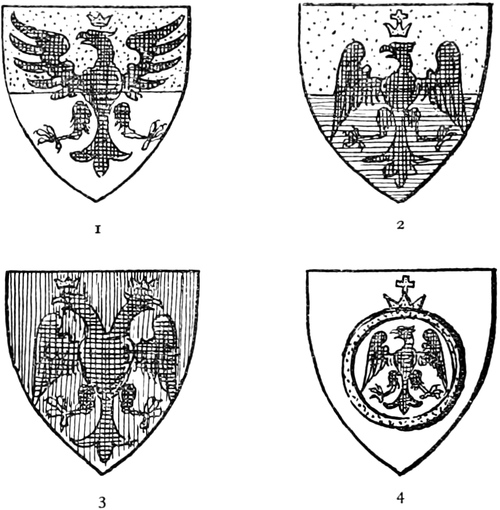
No. 1 is the shield of the Dorias of Genoa, taken from ‘Il Annuario della Nobiltà Italiana.’
Nos. 2, 3, 4 are shields of the Dorias of Chioggia; No. 2 is carved on a house in the calle di S. Nicolò at Chioggia; No. 3 is carved in the town hall of Chioggia and on a house on the Canal Lombardo; No. 4 is carved in marble on a chimney of the casa Doria at S. Andrea. All three shields are given in the Ravagnan MS. belonging to the municipality of Chioggia.
Walker & Cockerell Ph. Sc.
The Great Executioner, from the mezzotint by Prince Rupert after Spagnoletto, in the collection of His Majesty the King.
⇒ LARGER IMAGE