INTRODUCTION
Reading edition
This is the story of a great inventor, the most conspicuous figure of the age of electricity.
The story is largely autobiography, for, through the author's association with Mr. Edison, it has been possible often to obtain his own narrative of his life. For nearly thirty-one years the author has had the privilege of a connection with Mr. Edison and the Edison companies, and at present he is acting as Mr. Edison's assistant. Every page of the book has been read by Mr. Edison himself, and it is published with his approval as the authoritative story of his life to the present time.
It is probably as a worker of wonders, an interpreter of the secrets of Nature, an actual wizard of science, that Edison fascinates the imagination of almost every boy. In this picture of the actual facts of the inventor's life the reader will find that while Edison is just as great as imagined, yet this greatness has not been reached by chance, but honestly earned by the hardest kind of hard work and the most intense and earnest application. The wonderful things that he has accomplished have been the things that he purposely set out to do, and are not the result of some happy thought, or blind luck, or chance.
There has been but little abatement in Mr. Edison's activities. The flight of time has not dimmed his vivid imagination; has brought no change to his clear broad mental vision; nor has his capacity for intensive, forceful work perceptibly lessened. There is no telling what other inventions he may yet make to benefit the world, but if he never added anything to what he has already done, his life and achievements afford the telling of one of the most remarkable stories in the history of the world.
The author has had the honor and pleasure of assisting in the preparation of a large and comprehensive biography entitled, Edison: His Life and Inventions, by Frank L. Dyer and T. Commerford Martin, published by the publishers of the present volume. He gratefully acknowledges the fact that certain features of this book have been adapted from the pages of that elaborate biography. For the permission to do this he tenders his thanks to his friends Frank L. Dyer and the late T. Commerford Martin.
William H. Meadowcroft.
THE BOYS' LIFE OF EDISON
I THE EARLY DAYS OF ELECTRICITY
This is the life story of the greatest of inventors in the field of electricity. It is true that Thomas A. Edison has helped the progress of the world by many other inventions and discoveries quite outside of electricity, but it is in this field that he is best known. Now, in this age of electricity, it happens very fortunately that a close personal association with Mr. Edison makes it possible at last to tell younger readers the real story of Mr. Edison's life, partly in his own words. It has been a life full of surprises as well as of great achievements, and one of the surprises which we meet at the start is that, unlike Mozart, who showed his musical genius in infancy, and unlike others devoted to one thing from the outset, Edison took up electricity almost by accident.
Yet this is not so strange when we think how little electricity there was to take up in the middle of the nineteenth century. Electricity was not studied in the schools. It was not a separate art or business. Men of science had occupied themselves with electricity for a long time, but they really did not know as much about it as a bright boy in the upper grammar grades to-day. Speaking in a very general way, we may say that simple frictional electricity[1] was an old story, that Franklin had discovered the identity of electricity and lightning, and that Galvani had discovered in 1790 and Volta had developed in 1801 the generating of electric currents from batteries composed of zinc and copper plates immersed in sulphuric acid.
But it was not until 1835, only twelve years before Edison was born, that Samuel F. B. Morse applied electrical currents to the sending of an alphabet of dots and dashes by wire. Thus it was in the infancy of telegraphy that Edison first saw the light.
Telegraph apparatus in those early days was of a crude and cumbersome kind—quite different from that which young students experiment with at the present time. For instance, the receiving magnets of the earliest telegraphs, which performed the same office as the modern sounders, weighed seventy-five pounds instead of a few ounces.
It was a very difficult undertaking for Morse to establish the telegraph after he had invented it. It was such a new idea that the public could not seem to understand its use and possibilities. People would not believe that it was possible to send messages regularly over a long stretch of wire, and, even if it were possible, that it would be of much use anyway. It took him a long time to raise money to put up a telegraph line between Baltimore and Washington. Before this, he had offered to sell the whole invention outright to the United States Government for one hundred thousand dollars; but the Government did not buy, as the invention was not thought to be worth that much money.
In 1847, the year Edison was born, there were only a few telegraph circuits in existence. The farthest line to the west was in Pittsburgh, Pennsylvania. It was in this early telegraph office that Andrew Carnegie was a messenger boy. We could name a great many more notable men in our country who began their careers in a similar way, or as telegraph operators, in the early days of telegraphy, but space forbids.
Within a few years after Edison was born there came a great boom in telegraphy, and new lines were put up all over the country. Thus, by the time he had grown to boyhood the telegraph was a well-established business, and the first great electrical industry became a pronounced success.
There were no other electrical industries at this time, except electro-plating to a limited extent. The chief reason of this was probably that the only means of obtaining electrical current was by means of chemical batteries, as mechanical generators had not been developed at that time.
While the principles of the dynamo-electric machine had been discovered, and a few of these machines and small electric motors had been made by scientists, in the middle of the nineteenth century such machines were little more than scientific toys, and not to be compared with the generators of modern days.
Edison, therefore, was born at the very beginning of "The Age of Electricity," which can be said to have actually begun about 1840, or soon after.
It is not too much to say that the many important and practical inventions that he has since contributed to the electrical arts have had no small weight in causing the present time to be known as "The Age of Electricity."
II EDISON'S FAMILY
Had there not been a family difference of opinion about the War of Independence, we might never have had Edison the great inventor.
The first Edisons in this country came over from Holland about the year 1730. They were descendants of a family of millers on the Zuyder Zee, and when they came to America they first settled near Caldwell, New Jersey.
Later on they removed to some land along the Passaic River. It is a curious and interesting coincidence that a hundred and sixty years later Mr. Edison established the home he now occupies in the Orange Mountains, which is in the same general neighborhood.
The family must have gotten along well in the world, for we find the name of Thomas Edison, as a bank official on Manhattan Island, signed to Continental currency in 1778. This was Mr. Edison's great-grandfather, who lived to be one hundred and four years of age.
It will be seen from the date, 1778, that this was during the time of the War of Independence. This Thomas Edison was a stanch patriot, who thoroughly believed in American independence. He had a son named John, who differed with his father in political principles and favored a continuance of British rule.
After the war was over John left the country, and, with many other Loyalists, emigrated to Nova Scotia and settled there. While he still lived there a son was born to him, at Digby, in 1804. This son was named Samuel, who became the father of Thomas Alva Edison, the inventor.
Seven years later John Edison, as a Loyalist, became entitled under the laws of Canada to a grant of six hundred acres of land, and moved westward with his family to take possession of it. He made his way through the State of New York in wagons drawn by oxen to the township of Bayfield, in upper Canada, on Lake Huron, and there settled down.
Some time afterward John Edison moved from Bayfield to Vienna, Ontario, on the northern bank of Lake Erie. As will be understood from the above, he was the grandfather of Mr. Edison, who gives this recollection of the old man in those early Canadian days:
"When I was five years old I was taken by my father and mother on a visit to Vienna. We were driven by a carriage from Milan, Ohio, to a railroad, then to a port on Lake Erie, thence by a canal-boat in a tow of several miles to Port Burwell, in Canada, across the lake, and from there we drove to Vienna, a short distance away. I remember my grandfather perfectly as he appeared at one hundred and two years of age, when he died. In the middle of the day he sat under a large tree in front of the house, facing a well-traveled road. His head was covered completely with a large quantity of very white hair, and he chewed tobacco incessantly, nodding to friends as they passed by. He used a very large cane, and walked from the chair to the house, resenting any assistance. I viewed him from a distance, and could never get very close to him. I remember some large pipes, and especially a molasses jug, a trunk, and several other things that came from Holland."
John Edison was long-lived, like his father, and died at the age of one hundred and two. Little is known of the early manhood of his son Samuel (Thomas A. Edison's father), until we find him keeping a hotel at Vienna, and in 1828 marrying Miss Nancy Elliott, who was a school-teacher there.
He was six feet in height, and was possessed of great strength and vigor. He took a lively share in the troublous politics of the period.
In 1837 the Canadian Rebellion broke out. The cause of it was the same as that which led to the War of Independence in America—taxation without representation.
Samuel Edison was so ardently interested and of such strong character that he became a captain in the insurgent forces that rallied under the banners of Papineau and Mackenzie.
The rebellion failed, however, and those who had taken part in it were severely dealt with. Many of the insurgents went in exile to Bermuda, but Samuel Edison preferred the perils of a flight to the United States. He therefore departed from Canada with his wife, hurriedly and secretly.
There was a romantic and thrilling journey of one hundred and eighty-two miles toward safety. The country through which they passed was then very wild and infested with Indians of unfriendly disposition, and the journey was made almost entirely without food or sleep.
They arrived safely in the United States, however, and, after a few years spent in various towns along the shores of Lake Erie, finally came to Milan, Ohio, in 1842. Here they settled down and made their home, for the place gave great promise of abundance of business and prosperity.
In those days railroads were few and far between, and there was none near Milan. The great quantities of grain that were grown in the surrounding country were sent to Eastern ports by sailing vessels over the lake. Milan was connected by a wide canal with the Huron River, which emptied into Lake Erie. Thus the town became a busy port, with grain warehouses and elevators, at which as many as twenty sailing vessels were loaded in a single day.
There also sprang up a brisk ship-building industry, for which the abundant forests of the region supplied the necessary lumber.
You will see, therefore, that Mr. Edison's father gave evidence of shrewd judgment when he decided to make his permanent home at Milan, for there was plenty of occupation, with every prospect of prosperity. He was always ready to look on the brightest side of everything, and could and did turn his hand to many occupations.
He decided to make his chief business the manufacture of shingles, for which there was a large demand, both in the neighborhood and along the shores of the lake. The shingles were made mostly of Canadian wood, which was imported for the purpose. They were made entirely by hand and of first-class wood, and so well did they last that a house in Milan on which these shingles were put in 1844 was still in excellent condition forty-two years later. Samuel Edison did well in this business and employed a number of men.
In a few years after the family had made their home at Milan, Thomas Alva Edison was born there, on February 11, 1847.
His mother was an attractive and highly educated woman, and her influence upon his disposition has been profound and lasting. She was born in Chenango County, New York, in 1810, and was the daughter of the Rev. John Elliott, a Baptist minister, and descendant of an old Revolutionary soldier, Capt. Ebenezer Elliott, of Scotch descent.
The Elliott family was evidently one of considerable culture and deep religious feeling, for two of Mrs. Elliott's uncles and two brothers were also in the Baptist ministry. As a young woman she became a teacher in the public high school at Vienna, Ontario, and thus met her husband, who was residing there.
The Edison family consisted of three children, two boys and a girl. Besides Thomas Alva, there was an elder brother, William Pitt, and a sister named Tannie. Both brother and sister had considerable ability, although in different lines. William Pitt Edison was clever with his pencil, and there was at one time an idea of having him become an art student; but evidently the notion was not carried out, for later in life he was manager of the local street-railway lines at Port Huron, Michigan, in which he was heavily interested.
This talent for sketching seems to run in the family, for Thomas A. Edison's first impulse in discussing any mechanical question is to take up the nearest piece of paper and make drawings. Scarcely a day passes that this does not happen. His immense number of note-books contain thousands of such sketches.
His sister, who in later life became Mrs. Tannie Edison Bailey, had, on the other hand, a great deal of literary ability, and spent much of her time in writing.
As a child the great inventor was not at all strong, and was of fragile appearance. His head was well shaped but very large, and it is said that local doctors feared he might have brain trouble.
On account of his supposed delicacy, he was not allowed to go to school at as early an age as is usual. And when he did go, it was not for a long time. He was usually at the foot of his class, and the teacher had spoken of the boy to a school inspector as being "addled."
Perhaps the reader can imagine the indignation of his mother on hearing of this teacher's report. She had watched and studied her boy closely, and knew that he had a mind unusually receptive and mental powers far beyond those of other children. So she resolved to take him out of school and educate him herself.
It was fortunate that Mr. Edison had a mother who was not only loving, observing, and wise, but at the same time well informed and ambitious. From her experience as a teacher, she was able to give him an education better than could be had in the local schools of that day.
Under her care the boy formed studious habits and a taste for good literature that have lasted to this day. He is a great reader, and what has once been read by him is never forgotten if it is in any way useful.
When Edison was a child he was deeply interested in the busy scenes of the canal and grain warehouses, and particularly in the ship-building yards.
He asked so many questions that he fairly tired out his father, although the older man had no small ability. It has been reported that other members of the family regarded the boy as being mentally unbalanced and likely to be a lifelong care to his parents.
Even while he was quite a young child his mechanical tendencies showed themselves in his fondness for building little plank roads from the pieces of wood thrown out by the ship-building yards and the sawmills. One day he was found in the village square laboriously copying the signs of the stores.
To this day Mr. Edison is not inclined to accept a statement unless he can prove it for himself by experiment. Once, when he was about six years old, he watched a goose sitting on her eggs and saw them hatch. Soon after he was missing. By and by, after an anxious search, his father found him sitting in a nest he had made in the barn filled with goose and hen eggs he had collected, trying to hatch them out.
His remarkable memory was noticeable even when he was a child, for before he was five years old he had learned all the songs of the lumber gangs and of the canal men. Even now his recollection goes back to 1850, when, as a child three or four years old, he saw camped in front of his home six covered wagons, "prairie schooners," and witnessed their departure for California, where gold had just been discovered.
Another of his recollections of childhood is of a sadder nature. He went off one day with another boy to bathe in the creek. Soon after they entered the water the other boy disappeared. Young Edison waited around for about half an hour, and then, as it was growing dark, went home, puzzled and lonely, but said nothing about the matter. About two hours afterward, when the missing boy was being searched for, a man came to the Edison home to make anxious inquiry of the companion with whom he had last been seen. Edison told all the circumstances with a painful sense of being in some way guilty. The creek was at once dragged, and then the body was recovered.
Edison himself had more than one narrow escape. Of course, he fell into the canal and was nearly drowned—few boys in Milan worth their salt omitted that performance. On another occasion he fell into a pile of wheat in a grain elevator and was almost smothered. Holding the end of a skate-strap, that another lad might cut it with an ax, he lost the top of a finger. Fire also had its peril. He built a fire in a barn, but the flames spread so rapidly that, although he escaped himself, the barn was wholly destroyed. He was publicly whipped in the village square as a warning to other youths. Equally well remembered is a dangerous encounter with a ram which attacked him while he was busily engaged digging out a bumblebee's nest near an orchard fence, and was about to butt him again when he managed to drop over on the safe side and escape. He was badly hurt and bruised, and no small quantity of arnica was needed for his wounds.
Meanwhile railroad building had been going on rapidly, and the new Columbus, Sandusky & Hocking Railroad had reached Milan and quickly deprived it of its flourishing grain trade. The town, formerly so bustling and busy, no longer offered to so active a man as Mr. Edison's father the opportunity of conducting a prosperous business, so he decided to move away. He was well-to-do, but he determined to do better elsewhere. In 1854 he and his family removed to Port Huron, Michigan, where they occupied a large Colonial house standing in the middle of an old Government fort reservation of ten acres, overlooking the St. Clair River just after it leaves Lake Huron.
The old house at Milan where Mr. Edison was born is still in existence, and is occupied at this time (1911) by Mr. S. O. Edison, a half-brother of Edison's father, and a man of much ability.
This birthplace of Edison still remains the plain, substantial brick house it was originally, one-storied, with rooms finished on the attic floor.
III EDISON'S EARLY BOYHOOD
It was when he was about seven years old that Edison's parents moved to Port Huron, Michigan, and it was there, a few years later, that he began his active life by becoming a newsboy.
With his mother he found study easy and pleasant. The quality of the education she gave him may be judged from the fact that before he was twelve years old he had studied the usual rudiments and had read, with his mother's help, Gibbon's Decline and Fall of the Roman Empire, Hume's History of England, Sear's History of the World, Burton's Anatomy of Melancholy, and the Dictionary of Sciences.
They even tried to struggle through Newton's Principia, but the mathematics were too much for both teacher and student. To this day Edison has little personal use for arithmetic beyond that which is called "mental." He said to a friend, "I can always hire some mathematicians, but they can't hire me."
His father always encouraged his literary tastes, and paid him a small sum for each book which he mastered. Although there is no fiction in the list, Edison has all his life enjoyed it, particularly the works of such writers as Victor Hugo. Indeed, later on, when he became a telegraph operator, he was nicknamed by his associates "Victor Hugo Edison"—possibly because of his great admiration for that writer.
When he was about eleven years old he became greatly interested in chemistry. He got a copy of Parker's School Philosophy, an elementary book on physics, and tried almost every experiment in it. He also experimented on his own account. It is said that he once persuaded a boy employed by the family to swallow a large quantity of Seidlitz powders in the belief that the gases penetrated would enable him to fly. The awful agonies of the victim attracted attention, and Edison's mother marked her displeasure by an application of the switch kept behind the old Seth Thomas "grandfather's clock."
It was as early as this that young Alva, or "Al," as he was called, displayed a passion for chemistry, which has never left him. He used the cellar of the house for his experiments and collected there no fewer than two hundred bottles from various places. They contained the chemicals with which he was constant experimenting, and were all marked "Poison," so that no one else would disturb them.
He soon became familiar with all the chemicals to be had at the local drug stores, for he did not believe the statements made in his books until he had tested them for himself.
Edison used such a large part of his mother's cellar for this, his first laboratory, that, becoming tired of the "mess," she once ordered him to clear out everything. The boy was so much distressed at this that she relented, but insisted that he must keep things under lock and key when he was not there.
Most of his spare time was spent in the cellar, for he did not share to any extent in the sports of the boys of the neighborhood. His chum and chief companion at this time was a Dutch boy, much older than himself, named Michael Oates, who did chores around the house. It was Michael upon whom the Seidlitz powder experiment was tried.
As Edison got deeper into his chemical studies his limited pocket-money disappeared rapidly. He was being educated by his mother, and, therefore, not attending a regular school, and he had read all the books within reach. So he thought the matter out and decided that if he became a train newsboy he could earn all the money he wanted for his experiments and also get fresh reading from papers and magazines. Besides, if he could get permission to go on the train he had in mind, he would have some leisure hours in Detroit and would be able to spend them at the public library free of charge. His parents objected, particularly his mother, but finally he obtained their consent.
It has been thought by many people that his family was poor, and that it was on account of their poverty that young Edison came to sell newspapers on the train. This is not true, for his father was a prosperous dealer in grain and feed, and was also actively interested in the lumber industry and other things. While he was not rich, he made money in his business, and, having a well-stocked farm and a large orchard besides, was in comfortable circumstances. Socially the family stood high in the town, where at the time many well-to-do people resided.
It was of his own choice and because of his never-satisfied desire for experiment and knowledge that Edison became a newsboy.
In 1859, when he was twelve years old, he applied for the privilege of selling newspapers on the trains of the Grand Trunk Railroad between Port Huron and Detroit. After a short delay the necessary permission was obtained.
Even before this he had had some business experience. His father had laid out a "market-garden" on the farm, and young Edison, at eleven years of age, and Michael Oates had worked in it pretty steadily. In the season the two boys would load up a wagon with onions, lettuce, peas, etc., and drive through the town to sell their produce. As much as $600 was turned over to Mrs. Edison in one year from this source.
Edison was industrious, but he did not take kindly to farming. He tells us about this himself:
"After a while I tired of this work. Hoeing corn in a hot sun is unattractive, and I did not wonder that boys had left the farm for the city. Soon the Grand Trunk Railroad was extended from Toronto to Port Huron, at the foot of Lake Huron, and thence to Detroit, at about the same time the War of the Rebellion broke out. By a great amount of persistence I got permission from my mother to go on the local train as newsboy. The local train from Port Huron to Detroit, a distance of sixty-three miles, left at 7 A.M. and arrived again at 9.30 P.M. After being on the train for several months, I started two stores at Port Huron—one for periodicals and the other for vegetables, butter, and berries in the season. These were attended by two boys, who shared in the profits. The periodical store I soon closed, as the boy in charge could not be trusted. The vegetable store I kept up for nearly a year. After the railroad had been opened a short time they put on an express, which left Detroit in the morning and returned in the evening. I received permission to put a newsboy on this train. Connected with this train was a car, one part for baggage and the other part for United States mail, but for a long time it was not used. Every morning I had two large baskets of vegetables from the Detroit market loaded in the mail car and sent to Port Huron, when the boy would take them to the store. They were much better than those grown locally, and sold readily. I never was asked for freight, and to this day cannot explain why, except that I was so small and industrious and the nerve to appropriate a United States mail car to do a free freight business was so monumental. However, I kept this up for a long time, and in addition bought butter from the farmers along the line and an immense amount of blackberries in the season. I bought wholesale and at a low price, and permitted the wives of the engineers and trainmen to have the benefit of the discount. After a while there was a daily immigrant train put on. This train generally had from seven to ten coaches, filled always with Norwegians, all bound for Iowa and Minnesota. On these trains I employed a boy who sold bread, tobacco, and stick candy. As the war progressed the daily newspaper sales became very profitable, and I gave up the vegetable store."
This shrewd commercial instinct, and the capacity for carrying on successfully several business undertakings at the same time, were certainly remarkable in a boy only thirteen years old. And now, having had a glimpse of Edison's very early youth, let us begin a new chapter and follow his further adventures as a newsboy on a railway train.
IV THE YOUNG NEWSBOY
Edison's train left Port Huron at seven o'clock in the morning and arrived at Detroit in about three hours. It did not leave Detroit again until quite late in the afternoon, arriving at Port Huron about nine-thirty at night. This made a long day for the boy, but it gave him an opportunity to do just what he wanted, which was to read, to buy chemicals and apparatus, and to indulge in his favorite occupation—chemical experimentation.
The train was made up of three coaches—baggage, smoking, and ordinary passenger. The baggage-car was divided into three compartments—one for trunks and packages, one for the mail, and one for smoking.
As there was no ventilation in this smoking-compartment, no use was made of it. It was therefore turned over to young Edison, who not only kept his papers there and his stock of goods as a "candy butcher," but he also transferred to it the contents of the precious laboratory from his mother's cellar. He found plenty of leisure on the two daily runs of the train to follow up his study of chemistry.
His earnings on the train were excellent, for he often took in eight or ten dollars a day. One dollar a day always went to his mother, and, as he was thus supporting himself, he felt entitled to spend any other profit left over on chemicals and apparatus. Detroit being a large city, he could obtain a greater variety there than in his own small town. He spent a great deal of time in reading up on his favorite subject at the public library, where he could find plenty of technical books. Thus he gave up most of his time and all his money to chemistry.
He did not confine himself entirely to chemistry in his reading at the Detroit public library, but sought to gain knowledge on other subjects. It is a matter of record that in the beginning of his reading he started in with a certain section of the library and tried to read it through, shelf by shelf, regardless of subject.
Edison went along in this manner for quite a long time. When the Civil War broke out he noticed that there was a much greater demand for newspapers. He became ambitious to publish a local journal of his own. So his little laboratory in the smoking-compartment received some additions which made it also a newspaper office.
He picked up a second-hand printing-press in Detroit and bought some type. With his mechanical ability, it was not a difficult matter to learn the rudiments of the printing art, and as some of the type was kept on the train he could set it up in moments of leisure. Thus he became the compositor, pressman, editor, proprietor, publisher, and newsdealer of the Weekly Herald. The price was three cents a copy, or eight cents a month for regular subscribers and the circulation ran up to over four hundred copies an issue. Only one or two copies of this journal are now to be found.
It was the first newspaper in the world printed on a train in motion. It received the patronage of the famous English engineer, Stephenson, and was also noted by the London Times. As the production of a boy of fourteen it was certainly a clever sheet, and many people were willing subscribers, for, by the aid of the railway telegraph, Edison was often able to print late news of local importance which could not be found in regular papers, like those of Detroit.
Edison's business grew so large that he employed a boy friend to help him. There was often plenty of work for both in the early days of the war, when the news of battle caused great excitement.
In order to increase the sales of newspapers, Edison would telegraph the news ahead to the agents of stations where the train stopped and get them to put up bulletins, so that, when the stations were reached, there would usually be plenty of purchasers waiting.
He recalls in particular the sensation caused by the great battle of Shiloh, or Pittsburg Landing, in April, 1862, in which both Grant and Sherman were engaged, in which the Confederate General Johnston was killed, and in which there was a great number of men killed and wounded.
The bulletin-boards of the Detroit newspapers were surrounded by dense crowds, which read that there were about sixty thousand killed and wounded, and that the result was uncertain. Edison, in relating his experience of that day, says:
"I knew if the same excitement was shown at the various small towns along the road, and especially at Port Huron, the sale of papers would be great. I then conceived the idea of telegraphing the news ahead, went to the operator in the depot, and, on my giving him Harper's Weekly and some other papers for three months, he agreed to telegraph to all the stations the matter on the bulletin-board. I hurriedly copied it, and he sent it, requesting the agents to display it on the blackboards used for stating the arrival and departure of trains. I decided that, instead of the usual one hundred papers, I could sell one thousand; but not having sufficient money to purchase that number, I determined in my desperation to see the editor himself and get credit. The great paper at that time was the Detroit Free Press. I walked into the office marked 'Editorial' and told a young man that I wanted to see the editor on important business—important to me, anyway.
"I was taken into an office where there were two men, and I stated what I had done about telegraphing, and that I wanted a thousand papers, but only had money for three hundred, and I wanted credit. One of the men refused it, but the other told the first spokesman to let me have them. This man, I afterward learned, was Wilbur F. Storey, who subsequently founded the Chicago Times and became celebrated in the newspaper world. With the aid of another boy I lugged the papers to the train and started folding them. The first station, called Utica, was a small one, where I generally sold two papers. I saw a crowd ahead on the platform, and thought it was some excursion, but the moment I landed there was a rush for me; then I realized that the telegraph was a great invention. I sold thirty-five papers there. The next station was Mount Clemens, now a watering-place, but then a town of about one thousand population. I usually sold six to eight papers there. I decided that if I found a corresponding crowd there the only thing to do to correct my lack of judgment in not getting more papers was to raise the price from five cents to ten. The crowd was there, and I raised the price. At the various towns there were corresponding crowds. It had been my practice at Port Huron to jump from the train at a point about one-fourth of a mile from the station, where the train generally slackened speed. I had drawn several loads of sand to this point to jump on, and had become quite expert. The little Dutch boy with the horse met me at this point. When the wagon approached the outskirts of the town I was met by a large crowd. I then yelled: 'Twenty-five cents apiece, gentlemen! I haven't enough to go around!' I sold out, and made what to me then was an immense sum of money."
But this and similar gains of money did not increase Edison's savings, for all his spare cash was spent for new chemicals and apparatus. He had bought a copy of Fresenius's Qualitative Analysis, and, with his ceaseless testing and study of its advanced problems, his little laboratory on the train was now becoming crowded with additional equipment, especially as he now added electricity to his studies.
"While a newsboy on the railroad," says Edison, "I got very much interested in electricity, probably from visiting telegraph offices with a chum who had tastes similar to mine."
We have already seen that he was shrewd enough to use the telegraph to get news items for his own little journal and also to bulletin his special news of the Civil War along the line. To such a ceaseless experimenter as he was, it was only natural that electricity should come in for a share of his attention. With his knowledge of chemistry, he had no trouble in "setting up" batteries, but his difficulty lay in obtaining instruments and material for circuits.
To-day any youth who desires to experiment with telegraphy or telephony can find plenty of stores where apparatus can be bought ready made, or he can make many things himself by following the instructions in Harper's Electricity Book for Boys. But in Edison's boyish days it was quite different. Telegraph supplies were hard to obtain, and amateurs were usually obliged to make their own apparatus.
However, he and his chum had a line between their homes, built of common stove-pipe wire. The insulators were bottles set on nails driven into trees and short poles. The magnet wire was wound with rags for insulation, and pieces of spring brass were used for telegraph keys.
With the idea of securing current cheaply, Edison applied the little he knew about static electricity, and actually experimented with cats. He treated them vigorously as frictional machines until the animals fled in dismay, leaving their marks to remind the young inventor of his first great lesson in the relative value of sources of electrical energy. Resorting to batteries, however, the line was made to work, and the two boys exchanged messages.
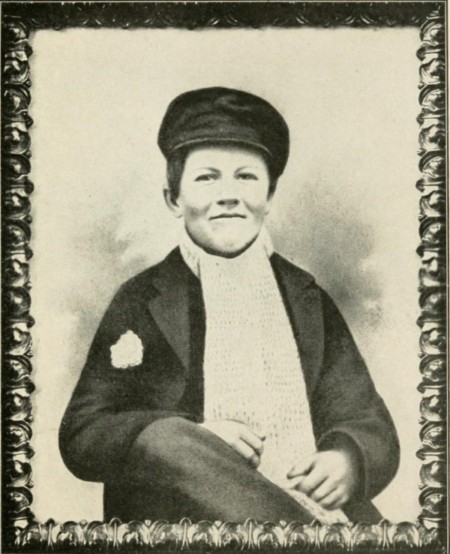
EDISON WHEN ABOUT FOURTEEN OR FIFTEEN YEARS OF AGE
Edison wanted lots of practice, and secured it in an ingenious manner. If he could have had his way he would have sat up until the small hours of the morning, but his father insisted on eleven-thirty as the proper bed-time, which left but a short interval after a long day on the train.
Now, each evening, when the boy went home with newspapers that had not been sold, his father would sit up to read them. So Edison on some excuse had his friend take the papers, but suggested to his father that he could get the news from the chum by telegraph bit by bit. The scheme interested the father, and was put into effect, the messages over the wire being written down by Edison and handed to the old gentleman to read.
This gave good practice every night until twelve or one o'clock, and was kept up for some time, until the father became willing that his son should sit up for a reasonable time. The papers were then brought home again, and the boys practised to their hearts' content, until the line was pulled down by a stray cow wandering through the orchard.
Now we come to the incident which may be regarded as turning Edison's thoughts more definitely to electricity. One August morning, in 1862, the mixed train on which he worked as newsboy was doing some shunting at Mount Clemens station. A laden box-car had been pushed out of a siding, when Edison, who was loitering about the platform, saw the little son of the station agent, Mr. J. U. Mackenzie, playing with the gravel on the main track, along which the car, without a brakeman, was rapidly approaching.
Edison dropped his papers and his cap and made a dash for the child, whom he picked up and lifted to safety without a second to spare, as the wheel struck his heel. Both were cut about the face and hands by the gravel ballast on which they fell.
The two boys were picked up by the train-hands and carried to the platform, and the grateful father, who knew and liked the rescuer, offered to teach him the art of train telegraphy and to make an operator of him. It is needless to say that the proposal was most eagerly accepted.
Edison found time for his new studies by letting one of his friends look after the newsboy work on the train for part of the trip, keeping for himself the run between Port Huron and Mount Clemens. We have already seen that he was qualified as a beginner, and, besides, he was able to take to the station a neat little set of instruments he had just finished at a gun shop in Detroit.
What with his business as newsboy, his publication of the Weekly Herald, his reading and chemical and electrical experiments, Edison was leading a busy life and making rapid progress, but unexpectedly there came disaster, which brought about a sudden change. One day, as the train was running swiftly over a piece of poorly laid track, there was a sudden lurch, and a stick of phosphorus was jarred from its shelf, fell to the floor and burst into flame.
The car took fire, and Edison was trying in vain to put out the blaze when the conductor rushed in with water and saved the car. On arriving at the next station the enraged conductor put the boy off with his entire outfit, including his laboratory and printing-plant.
The origin of Edison's deafness may be told in his own words: "My train was standing by the platform at Smith's Creek station. I was trying to climb into the freight car with both arms full of papers when the conductor took me by the ears and lifted me. I felt something snap inside my head, and my deafness started from that time and has ever since progressed."
"This deafness has been a great advantage to me in various ways. When in a telegraph office I could hear only the instrument directly on the table at which I sat, and, unlike the other operators, I was not bothered by the other instruments. Again, in experimenting on the telephone, I had to improve the transmitter so that I could hear it. This made the telephone commercial, as the magneto telephone receiver of Bell was too weak to be used as a transmitter commercially. It was the same with the phonograph. The great defect of that instrument was the rendering of the overtones in music and the hissing consonants in speech. I worked over one year, twenty hours a day, Sundays and all, to get the word "specie" perfectly recorded and reproduced on the phonograph. When this was done I knew that everything else could be done—which was a fact. Again, my nerves have been preserved intact. Broadway is as quiet to me as a country village is to a person with normal hearing."
But we left young Edison on the station platform, sorrowful and indignant, as the train moved off, deserting him in the midst of his beloved possessions. He was saddened, but not altogether discouraged, and after some trouble succeeded in making his way home, where he again set up his laboratory and also his printing-office. There was some objection on the part of the family, as they feared that they might also suffer from fire, but he promised not to bring in anything of a dangerous nature.
He continued to publish the Weekly Herald, but after a while was persuaded by a chum to change its character and publish it under the name of Paul Pry, making it a journal of town gossip about local people and their affairs and peculiarities.
No copies of Paul Pry can now be found, but it is known that its style was distinctly personal, and the weaknesses of the townspeople were discussed in it very freely and frankly by the two boys. It caused no small offense, and in one instance Edison was pitched into the St. Clair River by one of the victims whose affairs had been given such unsought publicity.
Possibly this was one of the reasons that caused Edison to give up the paper not very long afterward. He had a great liking for newspaper work, and might have continued in that field had it not been for strong influences in other directions. There is no question, however, that he was the youngest publisher and editor of his time.
V A FEW STORIES OF EDISON'S NEWSBOY DAYS
The Grand Trunk Railroad machine shops at Port Huron had a great attraction for young Edison. The boy who was to have much to do with the evolution of the modern electric locomotive in later years was fascinated with the mechanism of the steam locomotive. Whenever he could get the chance he would ride with the engineer in the cab, and he liked nothing better than to handle the locomotive himself during the run. Edison's own account of what happened on of these trips is very laughable. He says:
"The engine was one of a number leased to the Grank Trunk by the Chicago, Burlington & Quincy. It had bright brass bands all over the woodwork, was beautifully painted, and everything was highly polished, which was the custom up to the time old Commodore Vanderbilt stopped it on his roads. It was a slow freight train. The engineer and fireman had been out all night at a dance. After running about fifteen miles they became so sleepy that they couldn't keep their eyes open, and agreed to permit me to run the engine. I took charge, reducing the speed to about twelve miles an hour, and brought the train of seven cars to her destination at the Grand Trunk junction safely. But something occurred which was very much out of the ordinary. I was greatly worried about the water, and I knew that if it got low the boiler was likely to explode. I hadn't gone twenty miles before black, damp mud blew out of the stack and covered every part of the engine, including myself. I was about to awaken the fireman to find out the cause of this, when it stopped. Then I approached a station where the fireman always went out to the cow-catcher, opened the oil-cup on the steam-chest, and poured oil in. I started to carry out the procedure, when, upon opening the oil-cup, the steam rushed out with a tremendous noise, nearly knocking me off the engine. I succeeded in closing the oil-cup and got back in the cab, and made up my mind that she would pull through without oil. I learned afterward that the engineer always shut off steam when the fireman went to oil. This point I failed to notice. My powers of observation were very much improved after this occurrence. Just before I reached the junction another outpour of black mud occurred, and the whole engine was a sight—so much so that when I pulled into the yard everybody turned to see it, laughing immoderately. I found the reason of the mud was that I carried so much water it passed over into the stack, and this washed out all the accumulated soot."
One afternoon, about a week before Christmas, the train on which Edison was a newsboy jumped the track. Four old cars with rotten sills went all to pieces, distributing figs, raisins, dates, and candies all over the track. Hating to see so much waste, the boy tried to save all he could by eating it on the spot, but, as a result, he says, "our family doctor had the time of his life with me."
Another incident, which shows free and easy railroading and Southern extravagance, is related by Edison, as follows:
"In 1860, just before the war broke out, there came to the train one afternoon in Detroit two fine-looking young men, accompanied by a colored servant. They bought tickets for Port Huron, the terminal point for the train. After leaving the junction just outside of Detroit, I brought in the evening papers. When I came opposite the two young men, one of them said, 'Boy, what have you got?' I said, 'Papers.' 'All right.' He took them and threw them out of the window, and, turning to the colored man, said, 'Nicodemus, pay this boy.' I told Nicodemus the amount, and he opened a satchel and paid me. The passengers didn't know what to make of the transaction. I returned with the illustrated papers and magazines. These were seized and thrown out of the window, and I was told to get my money of Nicodemus. I then returned with all the old magazines and novels I had not been able to sell, thinking perhaps this would be too much for them. I was small and thin, and the layer reached above my head, and was all I could possibly carry. I had prepared a list, and knew the amount in case they bit again. When I opened the door all the passengers roared with laughter. I walked right up to the young men. One asked me what I had. I said, 'Magazines and novels.' He promptly threw them out of the window, and Nicodemus settled. Then I came in with cracked hickory nuts, then popcorn balls, and, finally, molasses candy. All went out of the window. I felt like Alexander the Great!—I had no more chances! I had sold all I had. Finally I put a rope to my trunk, which was about the size of a carpenter's chest, and started to pull this from the baggage-car to the passenger-car. It was almost too much for my strength, but at last I got it in front of those men. I pulled off my coat and hat and shoes and laid them on the chest. Then the young man asked, 'What have you got, boy?' I said, 'Everything, sir, that I can spare that is for sale.' The passengers fairly jumped with laughter. Nicodemus paid me $27 for this last sale, and threw the whole out of the door in the rear of the car. These men were from the South, and I have always retained a soft spot in my heart for a Southern gentleman."
While Edison was a newsboy on the train a request came to him one day to go to the office of E. B. Ward & Co., at that time the largest owners of steamboats on the Great Lakes. The captain of their largest boat had died suddenly, and they wanted a message taken to another captain who lived about fourteen miles from Ridgeway station on the railroad. This captain had retired, taken up some lumber land, and had cleared part of it. Edison was offered fifteen dollars by Mr. Ward to go and fetch him, but as it was a wild country and would be dark, Edison stood out for twenty-five dollars, so that he could get the companionship of another lad. The terms were agreed to. Edison arrived at Ridgeway at 8.30 P.M., when it was raining and as dark as ink. Getting with difficulty another boy to volunteer, he launched out on his errand in the pitch-black night. The two boys carried lanterns, but the road was a rough path through dense forest. The country was wild, and it was quite usual to see deer, bear, and coon skins nailed up on the sides of houses to dry. Edison had read about bears, but couldn't remember whether they were day or night prowlers. The farther they went, the more afraid they became, and every stump in the forest looked like a bear. The other lad proposed seeking safety up a tree, but Edison objected on the plea that bears could climb, and that the message must be delivered that night to enable the captain to catch the morning train. First one lantern went out, then the other. Edison says: "We leaned up against a tree and cried. I thought if I ever got out of that scrape alive I would know more about the habits of animals and everything else, and be prepared for all kinds of mischance when I again undertook an enterprise. However, the intense darkness dilated the pupils of our eyes so as to make them very sensitive, and we could just see at times the outline of the road. Finally, just as a faint gleam of daylight arrived, we entered the captain's yard and delivered the message. In my whole life I never spent such a night of horror as that, but I got a good lesson."
An amusing incident of this period is told by Edison. "When I was a boy," he says, "the Prince of Wales, the late King Edward, came to Canada (1860). Great preparations were made at Sarnia, the Canadian town opposite Port Huron. About every boy, including myself, went over to see the affair. The town was draped in flags most profusely, and carpets were laid on the cross-walks for the Prince to walk on. There were arches, etc. A stand was built, raised above the general level, where the Prince was to be received by the Mayor. Seeing all these preparations, my idea of a prince was very high; but when he did arrive I mistook the Duke of Newcastle for him, the Duke being a fine-looking man. I soon saw that I was mistaken, that the Prince was a young stripling, and did not meet expectations. Several of us expressed our belief that a prince wasn't much after all, and said that we were thoroughly disappointed. For this one boy was whipped. Soon the Canuck boys attacked the Yankee boys, and we were all badly licked. I, myself, got a black eye. That has always prejudiced me against that kind of ceremonial and folly."
Many years afterward, when Edison had won fame by many inventions, including his electric-light system, and had been awarded the Albert Gold Medal by the Royal Society of Arts, it was this same prince who wrote a graceful letter which accompanied the medal.
Here is another of Mr. Edison's stories:
"After selling papers in Port Huron, which was often not reached until about nine-thirty at night, I seldom got home before eleven or eleven-thirty. About half-way home from the station and the town, within twenty-five feet of the road, in a dense wood, was a soldiers' graveyard, where three hundred soldiers were buried, due to a cholera epidemic which took place at Fort Gratiot, near by, many years previously. At first we used to shut our eyes and run the horse past this graveyard, and if the horse stepped on a twig my heart would give a violent movement, and it is a wonder that I haven't some valvular disease of that organ. But soon this running of the horse became monotonous, and after a while all fears of graveyards absolutely disappeared from my system. I was in the condition of Sam Houston, the pioneer and founder of Texas, who, it was said, knew no fear. Houston lived some distance from the town, and generally went home late at night, having to pass through a dark cypress swamp over a corduroy road. One night, to test his alleged fearlessness, a man stationed himself behind a tree, and enveloped himself in a sheet. He confronted Houston suddenly, and Sam stopped and said: 'If you are a man, you can't hurt me. If you are a ghost, you don't want to hurt me. And if you are the devil, come home with me; I married your sister!' "
We have already seen that Edison was of an exceedingly studious nature and full of ambition to work, experiment, and hustle. The serious side of his nature did not, however, wholly prevail. He had a keen enjoyment of a joke, even as he has now, and in his boyhood days had no particular objection if it took a practical form. The following, as related by him, is one of many:
"After the breaking out of the War there was a regiment of volunteer soldiers quartered at Fort Gratiot, the reservation extending to the boundary line of our house. Nearly every night we would hear a call such as 'Corporal of the Guard No. 1.' This would be repeated from sentry to sentry, until it reached the barracks, when Corporal of the Guard No. 1 would come and see what was wanted. I and the little Dutch boy, upon returning from the town after selling our papers, thought we would take a hand at military affairs. So one night, when it was very dark, I shouted for Corporal of the Guard No. 1. The second sentry, thinking it was the terminal sentry who shouted, repeated it to the third, and so on. This brought the corporal along the half mile, only to find that he was fooled. We tried him three nights; but the third night they were watching, and caught the little Dutch boy, took him to the lock-up at the fort, and shut him up. They chased me to the house. I rushed for the cellar. In one small compartment, where there were two barrels of potatoes and a third one nearly empty, I poured these remnants into the other barrels, sat down, and pulled the empty barrel over my head, bottom up. The soldiers had awakened my father, and they were searching for me with candles and lanterns. The corporal was absolutely certain I came into the cellar, and couldn't see how I could have gotten out, and wanted to know from my father if there was no secret hiding-place. On assurance of my father, who said that there was not, he said it was most extraordinary. I was glad when they left, as I was cramped, and the potatoes that had been in the barrel were rotten and violently offensive. The next morning I was found in bed, and received a good switching on the legs from my father, the first and only one I ever received from him, although my mother kept behind the old Seth Thomas clock a switch that had the bark worn off. My mother's ideas and mine differed at times, especially when I got experimenting and mussed up things. The Dutch boy was released next morning."
It may have seemed strange to you, on reading this and the previous chapter, that a lad so young as Edison was during the newsboy period—from about twelve to fifteen years of age—should have been allowed such wide liberty. An extensive traveler for those days, going early and returning late, an experimenter in chemistry, a publisher, printer, newsdealer, amateur locomotive engineer, and what not, covered a large range of experience and action for one so youthful.
To others of the family than his mother he was accounted a strange boy, some believing him to be mentally unbalanced. His mother, however, understood that his was no ordinary mind, for she had studied him thoroughly. While she watched him closely, she allowed him the widest possible sphere of action and encouraged his ever increasing studies.
A member of the family, in talking recently with the writer, said that when any one expressed nervousness about young Edison during his absences she would say: "Al is all right. Nothing will happen to him. God is taking care of him."
VI THE YOUNG TELEGRAPH OPERATOR
After Edison's expulsion from the train with his laboratory and belongings, his career as a newsboy came to a sudden close. But, while he felt some disappointment, he was not discouraged and was none the less busy. As we have seen, he published his local paper for a while and also continued his chemical experiments at home. In addition, he plunged deeply into the study of telegraphy under Mr. Mackenzie's tuition.
Edison took to telegraphy enthusiastically, giving to it no less than eighteen hours a day. After some months he had made such progress that he put up a telegraph line from the station to the village, about a mile distant, and opened an office in a drug store; but the business there was very light and the office was not continued long.
A little later he became the regular operator at Port Huron. The office was in the store of a Mr. M. Walker, who sold jewelry and also newspapers and periodicals. Edison was to be found at the office both day and night, and slept there.
He says: "I became quite valuable to Mr. Walker. After working all day I worked at the office nights as well, for the reason that 'press reports' came over one of the wires until 3 A.M., and I would cut in and copy it as well as I could, to become proficient more rapidly. The goal of the rural telegraph operator was to be able to take press. Mr. Walker tried to get my father to apprentice me at twenty dollars per month, but they could not agree. I then applied for a job on the Grand Trunk Railroad as a railway operator, and was given a place, nights, at Stratford Junction, Canada."
Many years afterward Mr. Walker described the boy of sixteen as engrossed intensely in his experiments and scientific reading. The telegraph office was not a busy one, but sometimes messages taken in would remain unsent while Edison was in the cellar busy on some chemical problem.
He would be seen at times reading a scientific paper and then disappearing to buy a few sundries for experiments. Returning from the drug store with his chemicals, he would not be seen again until required by his duties, or until he had found out for himself, if possible, the truth of the statement he had been reading. If wanted for his experiment, he did not hesitate to make free use of the watchmaker's tools that lay on the table in the front window. His one idea was to do quickly when he wanted to do; and this tendency is still one of his marked characteristics.
The telegrapher's position at Stratford Junction, Canada, was taken by Edison in 1863, when he was sixteen years old, and paid him twenty-five dollars per month. In speaking of it he has since remarked that there was little difference between the telegraph of that time and that of to-day. He says: "The telegraph men couldn't explain how it worked, and I was always trying to get them to do so. I think they couldn't. I remember the best explanation I got was from an old Scotch line repairer employed by the Montreal Telegraph Company, which operated the railroad wires. He said that if you had a dog like a dachshund, long enough to reach from Edinburgh to London, if you pulled his tail in Edinburgh he would bark in London. I could understand that, but I never could get it through me what went through the dog or over the wire."
Edison was ever keenly anxious to add to his stock of experimental apparatus, as an incident of this period shows: "While working at Stratford Junction," he says, "I was told by one of the freight conductors that in the freight-house at Goodrich there were several boxes of old broken-up batteries. I went there and found over eighty cells of the well-known Grove nitric-acid battery. The operator there, who was also agent, when asked by me if I could have the electrodes of each cell, which were made of sheet platinum, gave his permission readily, thinking they were of tin. I removed them all, and they amounted to several ounces in weight. Platinum even in those days was very expensive, costing several dollars an ounce, and I owned only three small strips. I was overjoyed at this acquisition, and those very strips and the reworked scrap are used to this day in my laboratory, over forty years later."
It was while he was employed as a night operator at Stratford Junction that Edison's inventiveness was first displayed. In order to make sure that the operators were not asleep they were required to send the signal "6" to the train despatcher's office every hour during the night. Now, Edison spent all day in study and experiment, but he needed sleep, just as any healthy youth does, and so he made a small wheel with notches on the rim and attached it to the clock and line. At night he connected it with the circuit, and at each hour the wheel revolved and automatically sent in the dots required for "sixing."
The invention was a success, but the train despatcher soon noticed that frequently, in spite of the regularity of the report, Edison's office could not be raised even if a message were sent immediately after. An investigation followed, which revealed this ingenious device, and he received a reprimand.
A serious occurrence that might have resulted in accident drove him soon after from Canada, although the youth could hardly be held to blame for it. Edison says: "This night job just suited me, as I could have the whole day to myself. I had the faculty of sleeping in a chair any time for a few minutes at a time. I taught the night yardman my call, so I could get half an hour's sleep now and then between trains, and in case the station was called the watchman would awaken me. One night I got an order to hold a freight train, and I replied that I would. I rushed out to find the signalman, but before I could find him and get the signal set the train ran past. I ran to the telegraph office, and reported that I could not hold her. The train despatcher, on the strength of my message that I would hold the train, had permitted another to leave the last station in the opposite direction. There was a lower station near the junction, where the day operator slept. I started for it on foot. The night was dark, and I fell into a culvert and was knocked senseless."
Fortunately, the two engineers saw each other approaching and stopped in time to prevent an accident. Edison, however, was summoned to the general manager's office to be tried for neglect of duty. During the trial two Englishmen called, and while they were talking with the manager the youthful operator slipped out, jumped on a freight train going to Sarnia, and was not happy until the ferry-boat from Sarnia had landed him safe on the Michigan shore.
The same winter, of 1863-64, while at Port Huron, Edison had a further opportunity of showing his ingenuity. An ice-jam had broken the telegraph cable laid in the bed of the river across to Sarnia, and communication was interrupted. The river is three-quarters of a mile wide, and could not be crossed on foot, nor could the cable be repaired.
Edison suggested using the steam whistle of a locomotive to give the long and short signals of the Morse code. An operator on the Sarnia shore was quick enough to understand the meaning of the strange whistling, and thus messages were sent in wireless fashion across the ice-floes in the river.
Young Edison had no inclination to return to Canada after his late experience there. He decided, however, that he would stick to telegraphy as a business, and, after a short stay at home in Port Huron, set out to find work as an operator in another city. And thus he commenced the roaming and drifting life which in the next five years took him all over the Middle States.
At this time the Civil War was in progress, and many hundreds of skilled operators were at the front with the army, engaged exclusively in government service. Consequently there was a great scarcity of telegraphers throughout all the cities and towns of the country. For this reason it was not difficult for an operator to get work wherever he might go. Thus one might gratify a desire to travel and get experience without running much risk of privation.
There were a great many others besides Edison who wandered about from city to city, working awhile in one place and drifting to another. As a rule, they were bright, happy-go-lucky fellows, full of the spirit of good comradeship, and willing to share bed, board, and pocket-money with those who might temporarily be less fortunate than themselves.
Many of them used telegraphy as a stepping-stone to better themselves in life, while others, unfortunately, became dissipated, and, becoming unreliable through drink, could not hold a position for long. Had Edison been by nature less persistent and industrious than he was, this miscellaneous companionship might have tended to wreck his career, but all through his life, from boyhood, he has been particularly abstemious and has had a contempt for the wastefulness of time, money, and health entailed by the drink habit.
Throughout this period of his life Edison, although wandering from place to place, never ceased to study, explore, and experiment. Referring to this beginning of his career, he mentions a curious fact that throws light on his ceaseless application. "After I became a telegraph operator," he says, "I practised for a long time to become a rapid reader of print, and got so expert I could sense the meaning of a whole line at once. This faculty, I believe, should be taught in schools, as it appears to be easily acquired. Then one can read two or three books in a day, whereas if each word at a time only is sensed reading is laborious."
During this wandering period of his life Edison made many friends, one of the earliest of whom was Milton F. Adams, who had a strange career. Of him Edison says: "Adams was one of a class of operators never satisfied to work at any place for any great length of time. He had the 'wanderlust.' After enjoying hospitality in Boston in 1868-69, on the floor of my hall bedroom, which was a paradise for the entomologist, while the boarding-house itself was run on the Banting system of flesh reduction, he came to me one day and said: 'Good-by, Edison, I have got sixty cents, and I am going to San Francisco.' And he did go. How, I never knew personally. I learned afterward that he got a job there, and then within a week they had a telegraphers' strike. He got a big torch and sold patent medicine on the streets at night to support the strikers. Then he went to Peru as partner of a man who had a grizzly bear which they proposed entering against a bull in the bull-ring in that city. The grizzly was killed in five minutes, and so the scheme died. Then Adams crossed the Andes, and started a market report bureau in Buenos Ayres. This didn't pay, so he started a restaurant in Pernambuco, Brazil. There he did very well, but something went wrong (as it always does to a nomad), so he went to the Transvaal, and ran a panorama called 'Paradise Lost' in the Kaffir kraals. This didn't pay, and he became the editor of a newspaper; then he went to England to raise money for a railroad in Cape Colony. Next I heard of him in New York, having just arrived from Bogota, United States of Columbia, with a power of attorney and two thousand dollars from a native of that republic, who applied for a patent for tightening a belt to prevent it from slipping on a pulley—a device which he thought a new and great invention, but which was in use ever since machinery was invented. I gave Adams then a position as salesman for electrical apparatus. This he soon got tired of, and I lost sight of him."
VII ADVENTURES OF A TELEGRAPH OPERATOR
The first position that Edison took after leaving Canada so hurriedly was at Adrian, Michigan, and of what happened there he tells a story typical of his wanderings for several years to come.
"After leaving my first job at Stratford Junction I got a position as operator on the Lake Shore & Michigan Southern at Adrian, Michigan, in the division superintendent's office. As usual, I took the 'night trick,' which most operators disliked, but which I preferred, as it gave me more leisure to experiment. I had obtained from the station agent a small room, and had established a little shop of my own. One day the day operator wanted to get off, and I was on duty. About nine o'clock the superintendent handed me a despatch which he said was very important, and which I must get off at once. The wire at the time was very busy, and I asked if I should break in. I got orders to do so, and, acting under those orders of the superintendent, I broke in and tried to send the despatch; but the other operator would not permit it, and the struggle continued for ten minutes. Finally I got possession of the wire and sent the message. The superintendent of telegraph, who then lived in Adrian and went to his office in Toledo every day, happened that day to be in the Western Union office up-town—and it was the superintendent I was really struggling with! In about twenty minutes he arrived, livid with rage, and I was discharged on the spot. I informed him that the general superintendent had told me to break in and send the despatch, but the general superintendent then and there repudiated the whole thing. Their families were socially close, so I was sacrificed. My faith in human nature got a slight jar."
From Adrian Edison went to Toledo, Ohio, and secured a position at Fort Wayne, on the Pittsburg, Fort Wayne & Chicago Railroad. This was a "day job," and he did not like it. Two months later he drifted to Indianapolis, arriving there in the fall of 1864, when for the first time he entered the employ of the Western Union Telegraph Company, with which in later years he entered into closer relationship. At this time, however, he was assigned to duty at Union Station, at a salary of seventy-five dollars a month.
He did not stay long in Indianapolis, however, leaving in February, 1865, and going from there to Cincinnati. This change was possibly caused by one of his early inventions, which has been spoken of by an expert as probably the most simple and ingenious arrangement of connections for a repeater.
His ambition was to take "press report," which would come over the wire quite fast, but finding even after considerable practice, that he "broke" frequently, he adjusted two embossing Morse registers—one to receive the press matter and the other to repeat the dots and dashes at a lower speed, so that the message could be copied leisurely. Hence, he could not be rushed or "broken" in receiving, while he could turn out copy that was a marvel of neatness and clearness. This went well under ordinary conditions, but when an unusual pressure occurred he fell behind, and the newspapers complained of the slowness with which the reports were delivered to them. As to this device, Mr. Edison said recently: "Together we took press for several nights, my companion keeping the apparatus in adjustment and I copying. The regular press operator would go to the theater or take a nap, only finishing the report after 1 A.M. One of the newspapers complained of bad copy toward the end of the report—that is, from 1 to 3 A.M.—and requested that the operators taking the report up to 1 A.M., which were ourselves, take it all, as the copy then was perfectly unobjectionable. This led to an investigation by the manager, and the scheme was forbidden.
"This instrument many years afterward was applied by me to transferring messages from one wire to any other wire simultaneously or after any interval of time. It consisted of a disk of paper, the indentations being formed in a volute spiral, exactly as in the disk phonograph to-day. It was this instrument which gave me the idea of the phonograph while working on the telephone."
Arriving in Cincinnati, Edison got employment in the Western Union Commercial Telegraph Department at sixty dollars per month. Here he made the acquaintance of Milton F. Adams, referred to in the preceding chapter. Speaking of that time, Mr. Adams says:
"I can well recall when Edison drifted in to take a job. He was a youth of about eighteen years, decidedly unprepossessing in dress and rather uncouth in manner. I was twenty-one, and very dudish. He was quite thin in those days, and his nose was very prominent, giving a Napoleonic look to his face, although the curious resemblance did not strike me at the time. The boys did not take to him cheerfully, and he was lonesome. I sympathized with him, and we became close companions. As an operator he had no superiors, and very few equals. Most of the time he was 'monkeying' with the batteries and circuits, and devising things to make the work of telegraphy less irksome. He also relieved the monotony of office work by fitting up the battery circuits to play jokes on his fellow-operators, and to deal with the vermin that infested the premises. He arranged in the cellar what he called his 'rat paralyzer,' a very simple contrivance, consisting of two plates insulated from each other and connected with the main battery. They were so placed that when a rat passed over them the fore feet on the one plate and the hind feet on the other completed the circuit, and the rat departed this life, electrocuted." Shortly after Edison's arrival in Cincinnati came the close of the Civil War and the assassination of President Lincoln. One of Edison's reminiscences is interesting as showing the mechanical way in which some telegraph operators do their work. "I noticed," he says, "an immense crowd gathering in the street outside a newspaper office. I called the attention of the other operators to the crowd, and we sent a messenger boy to find the cause of the excitement. He returned in a few minutes and shouted, 'Lincoln's shot!' Instinctively the operators looked from one face to another to see which man had received the news. All the faces were blank, and every man said he had not taken a word about the shooting. 'Look over your files,' said the boss to the man handling the press stuff. For a few moments we waited in suspense, and then the man held up a sheet of paper containing a short account of the shooting of the President. The operator had worked so mechanically that he had handled the news without the slightest realization of its significance."
Edison's diversions in Cincinnati were characteristic of his life before and since. He read a great deal, but spent most of his leisure time experimenting. Occasionally he would indulge in some form of amusement, but this was not often. At this time he and Adams were close friends, and Mr. Adams remarks: "Edison and I were fond of tragedy. Forrest and John McCullough were playing at the National Theater, and when our capital was sufficient we would go to see those eminent tragedians alternate in Othello and Iago. Edison always enjoyed Othello greatly. Aside from an occasional visit to the Loewen Garten, 'over the Rhine,' with a glass of beer and a few pretzels consumed while listening to the excellent music of a German band, the theater was the sum and substance of our innocent dissipation."
While Edison was in Cincinnati there came one day a delegation of five trade-union operators from Cleveland to form a local branch in Cincinnati. The occasion was one of great conviviality. Night came and many of the operators were away. The Cleveland wire was in special need, and Edison, almost alone in the office, devoted himself to it all through the night and until three o'clock next morning, when he was relieved. He had been previously getting eighty dollars a month, and added to this by copying plays for a theater.
His rating was that of a "plug," or inferior operator, but having determined to become a first-class operator, he had kept up a practice of going to the office at night to take "press," acting willingly as a substitute for any operator who wanted to get off for a few hours—which often meant all night.
Thus he had been unconsciously preparing for the special ordeal which the conviviality of the trade-unionists had brought about.
Speaking of that night's work, Edison says: "My copy looked fine if viewed as a whole, as I could write a perfectly straight line across the wide sheet, which was not ruled. There were no flourishes, but the individual letters would not bear close inspection. When I missed understanding a word there was no time to think what it was, so I made an illegible one to fill in, trusting to the printers to sense it. I knew they could read anything, although Mr. Bloss, an editor of the Inquirer, made such bad copy that one of his editorials was pasted up on the notice board in the telegraph office with an offer of one dollar to any man who could 'read twenty consecutive words.' Nobody ever did it. When I got through I was too nervous to go home, and so I waited the rest of the night for the day manager, Mr. Stevens, to see what was to be the outcome of this union formation and of my efforts. He was an austere man, and I was afraid of him. I got the morning papers, which came out at 4 A.M., and the press report read perfectly, which surprised me greatly. I went to work on my regular day wire to Portsmouth, Ohio, and there was considerable excitement, but nothing was said to me, neither did Mr. Stevens examine the copy on the office hook, which I was watching with great interest. However, about 3 P.M. he went to the hook, grabbed the bunch and looked at it as a whole without examining it in detail, for which I was thankful. Then he jabbed it back on the hook, and I knew I was all right. He walked over to me, and said: 'Young man, I want you to work the Louisville wire nights; your salary will be one hundred and twenty-five dollars.' Thus I got from the plug classification to that of a 'first-class man.'"
Not long after this promotion was secured Edison started again on his wanderings. He went south, while his friend Adams went north, neither one having any difficulty in making the trip. He says: "The boys in those days had extraordinary facilities for travel. As a usual thing it was only necessary for them to board a train and tell the conductor they were operators. Then they could go as far as they liked. The number of operators was small, and they were in demand everywhere."
Edison's next stopping place was Memphis, Tennessee, where he got a position as operator. Here again he began to invent and improve on existing apparatus, with the result of being obliged once more to "move on." He tells the story as follows: "I was not the inventor of the auto-repeater, but while in Memphis I worked on one. Learning that the chief operator, who was a protégé of the superintendent, was trying in some way to put New York and New Orleans together for the first time since the close of the war, I redoubled my efforts, and at two o'clock one morning I had them speaking to each other. The office of the Memphis Avalanche was in the same building. The paper got wind of it and sent messages. A column came out in the morning about it; but when I went to the office in the afternoon to report for duty I was discharged without explanation. The superintendent would not even give me a pass to Nashville, so I had to pay my fare. I had so little money left that I nearly starved at Decatur, Alabama, and had to stay three days before going on north to Nashville. Arrived in that city, I went to the telegraph office, got money enough to buy a little solid food, and secured a pass to Louisville. I had a companion with me who was also out of a job. I arrived at Louisville on a bitterly cold day, with ice in the gutters. I was wearing a linen duster and was not much to look at, but got a position at once, working on a press wire. My traveling companion was less successful on account of his 'record.' They had a limit even in those days when the telegraph service was so demoralized."
After the Civil War was over the telegraph service was in desperate condition, and some of Mr. Edison's reminiscences of these times are quite interesting. He says: "The telegraph was still under military control, not having been turned over to the original owners, the Southern Telegraph Company. In addition to the regular force, there was an extra force of two or three operators, and some stranded ones, who were a burden to us, for board was high. One of these derelicts was a great source of worry to me personally. He would come in at all hours and either throw ink around or make a lot of noise. One night he built a fire in the grate and started to throw pistol cartridges into the flames. These would explode, and I was twice hit by the bullets, which left a black-and-blue mark. Another night he came in and got from some part of the building a lot of stationery with 'Confederate States' printed at the head. He was a fine operator, and wrote a beautiful hand. He would take a sheet of paper, write capital 'A,' and then take another sheet and make the 'A' differently; and so on through the alphabet, each time crumpling the paper up in his hand and throwing it on the floor. He would keep this up until the room was filled nearly flush with the table. Then he would quit.
"Everything at that time was 'wide open.' Disorganization reigned supreme. There was no head to anything. At night myself and a companion would go over to a gorgeously furnished faro-bank and get our midnight lunch. Everything was free. There were over twenty keno-rooms running. One of them that I visited was in a Baptist church, the man with the wheel being in the pulpit and the gamblers in the pews.
"While there, the manager of the telegraph office was arrested for something I never understood, and incarcerated in a military prison about half a mile from the office. The building was in plain sight from the office and four stories high. He was kept strictly incommunicado. One day, thinking he might be confined in a room facing the office, I put my arm out of the window and kept signaling dots and dashes by the movement of the arm. I tried this several times for two days. Finally he noticed it, and, putting his arm through the bars of the window, he established communication with me. He thus sent several messages to his friends, and was afterward set free."
Another curious story told by Edison concerns a fellow operator on night duty at Chattanooga Junction at the time he was at Memphis: "When it was reported that Hood was marching on Nashville, one night a Jew came into the office about eleven o'clock in great excitement, having heard the Hood rumor. He, being a large sutler, wanted to send a message to save his goods. The operator said it was impossible—that orders had been given to send no private messages. Then the Jew wanted to bribe my friend, who steadfastly refused, for the reason, as he told the Jew, that he might be court-martialed and shot. Finally the Jew got up to eight hundred dollars. The operator swore him to secrecy and sent the message. Now, there was no such order about private messages, and the Jew, finding it out, complained to Captain Van Duzer, chief of telegraphs, who investigated the matter, and while he would not discharge the operator, laid him off indefinitely. Van Duzer was so lenient that if an operator was to wait three days and then go and sit on the stoop of Van Duzer's office all day he would be taken back. But Van Duzer swore that if the operator had taken eight hundred dollars and sent the message at the regular rate, which was twenty-five cents, it would have been all right, as the Jew would be punished for trying to bribe a military operator; but when the operator took the eight hundred dollars and then sent the message deadhead he couldn't stand it, and he would never relent."
A third typical story of this period relates to a cipher message for General Thomas. Mr. Edison narrates it as follows: "When I was an operator in Cincinnati, working the Louisville wire nights for a time, one night a man over on the Pittsburg wire yelled out: 'D. I. cipher,' which meant that there was a cipher message from the War Department at Washington, and that it was coming, and he yelled out 'Louisville.' I started immediately to call up that place. It was just at the change of shift in the office. I could not get Louisville, and the cipher message began to come. It was taken by the operator on the other table, direct from the War Department. It was for General Thomas, at Nashville. I called for about twenty minutes and notified them that I could not get Louisville. I kept at it for about fifteen minutes longer, and notified them that there was still no answer from Louisville. They then notified the War Department that they could not get Louisville. Then we tried to get it by all kinds of roundabout ways, but in no case could anybody get them at that office. Soon a message came from the War Department to send immediately for the manager of the Cincinnati office. He was brought to the office and several messages were exchanged, the contents of which, of course, I did not know, but the matter appeared to be very serious, as they were afraid of General Hood, of the Confederate Army, who was then attempting to march on Nashville; and it was important that this cipher of about twelve hundred words or so should be got through immediately to General Thomas. I kept on calling up to twelve or one o'clock, but no Louisville. About one o'clock the operator at the Indianapolis office got hold of an operator who happened to come into his office, which had a wire which ran from Indianapolis to Louisville along the railroad. He arranged with this operator to get a relay of horses, and the message was sent through Indianapolis to this operator, who had engaged horses to carry the despatches to Louisville and find out the trouble, and get the despatches through without delay to General Thomas. In those days the telegraph fraternity was rather demoralized, and the discipline was very lax. It was found out a couple of days afterward that there were three night operators at Louisville. One of them had gone over to Jeffersonville and had fallen off a horse and broken his leg, and was in a hospital. By a remarkable coincidence another of the men had been stabbed in a keno-room, and was also in a hospital, while the third operator had gone to Cynthiana to see a man hanged and had got left by the train."
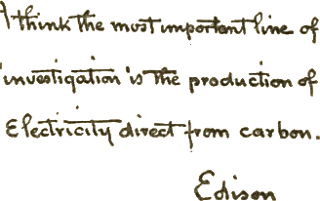
From Memphis Edison went to Louisville. Here he remained for about two years. It was while he was there that he perfected the peculiar vertical style of writing which has since been his characteristic style. He says of this form of writing, an example of which is given above: "I developed this style in Louisville while taking press reports. My wire was connected to the 'blind' side of a repeater at Cincinnati, so that if I missed a word or sentence, or if the wire worked badly, I could not break in and get the last words, because the Cincinnati man had no instrument by which he could hear me. I had to take what came. When I got the job the cable across the Ohio River at Covington, connecting with the line to Louisville, had a variable leak in it, which caused the strength of the signaling current to make violent fluctuations. I obviated this by using several relays, each with a different adjustment, working several sounders all connected with one sounding-plate. The clatter was bad, but I could read it with fair ease. When, in addition to this infernal leak, the wires north to Cleveland worked badly it required a large amount of imagination to get the sense of what was being sent. An imagination requires an appreciable time for its exercise, and as the stuff was coming at the rate of thirty-five to forty words a minute, it was very difficult to write down what was coming and imagine what wasn't coming. Hence it was necessary to become a very rapid writer, so I started to find the fastest style. I found that the vertical style, with each letter separate and without any flourishes, was the most rapid, and that, the smaller the letter, the greater the rapidity. As I took on an average from eight to fifteen columns of news report every day, it did not take long to perfect this method."
The telegraph offices of those early days were very crude as compared with the equipments of modern times. The apparatus was generally in a very poor condition, and the wiring was of a haphazard kind. The conditions during the time of the Civil War all tended to demoralization, both of operators and apparatus.
Indeed, the following story, related by Edison, illustrates the lengths to which telegraphers could go at a time when they were in so much demand: "When I took the position there was a great shortage of operators. One night, at 2 A.M., another operator and I were on duty. I was taking press report, and the other man was working the New York wire. We heard a heavy tramp, tramp, tramp on the rickety stairs. Suddenly the door was thrown open with great violence, dislodging it from one of the hinges. There appeared in the doorway one of the best operators we had, who worked daytime, and who was of a very quiet disposition except when intoxicated. He was a great friend of the manager of the office. His eyes were bloodshot and wild, and one sleeve had been torn away from his coat. Without noticing either of us, he went up to the stove and kicked it over. The stove-pipe fell, dislocated at every joint. It was half full of exceedingly fine soot, which floated out and completely filled the room. This produced a momentary respite to his labors. When the atmosphere had cleared sufficiently to see he went around and pulled every table away from the wall, piling them on top of the stove in the middle of the room. Then he proceeded to pull the switchboard away from the wall. It was held tightly by screws. He succeeded, finally, and when it gave way he fell with the board, and, striking on a table, cut himself so that he soon became covered with blood. He then went to the battery-room and knocked all the batteries off on the floor. The nitric acid soon began to combine with the plaster in the room below, which was the public receiving-room for messengers and bookkeepers. The excess acid poured through and ate up the account-books. After having finished everything to his satisfaction, he left. I told the other operators to do nothing. We would leave things just as they were, and wait until the manager came. In the meantime, as I knew all the wires coming through to the switchboard, I rigged up a temporary set of instruments so that the New York business could be cleared up, and we also got the remainder of the press matter. At seven o'clock the day men began to appear. They were told to go downstairs and await the coming of the manager. At eight o'clock he appeared, walked around, went into the battery-room, and then came to me, saying: 'Edison, who did this?' I told him that Billy L. had come in full of soda-water and invented the ruin before him. He walked back and forth about a minute, then, coming up to my table, put his fist down, and said: 'If Billy L. ever does that again I will discharge him.' It was needless to say that there were other operators who took advantage of that kind of discipline, and I had many calls at night after that, but none with such destructive effects."