INTRODUCTION (continued 4)
Reading edition
We cannot enter into all the details of the numerous inventions and improvements that Edison has introduced into his cement plant during the last eight or nine years. It is sufficient to say that by his persistent and energetic labors during that period he has raised his plant from the position of a newcomer to the rank of the fifth largest producer of cement in this country.
A remarkable instance of the power of Edison's memory may be related here. Some years ago, when the cement plant was nearly finished and getting ready to start, he went up to look it over and see what needed to be done.
On the arrival of the train at ten-forty in the morning he went to the mill, and, starting at one end, went through the plant to the other end, examining every detail. He made no notes or memoranda, but the examination required all day.
In the afternoon, at five-thirty, he took a train for home, and on arriving there a few hours later got out some note-books and began to write from memory the things needing change or attention. He continued on this work all night and right along until the next afternoon, when he completed a list of nearly six hundred items. This memory "stunt" was the more remarkable because many of the items included all the figures of new dimensions he had decided upon for some of the machinery in the plant.
Each item was numbered consecutively, and the list copied and sent up to the superintendent, who was instructed to make the changes and report by number as they were done. These changes were made and their value was proven by later experience.
Edison's achievements have made a deep impression on the cement industry, but it is likely that it will become still deeper when his "Poured Cement House" is exploited.
A few years ago he conceived the idea of pouring a complete concrete house in a few hours. He made a long series of experiments for producing a free-flowing combination of the necessary materials, and at length found one that satisfied him that his idea was feasible, although experts said it could not be done.
His plan is to provide two sets of iron molds, one inside the other, with an open space between. These molds are made in small pieces and set up by being bolted together. When erected, the concrete mixture is poured in from the top in a continuous stream until the space between the molds is filled.
The pouring will be done in about six hours, after which the molds will be left in position about four days in order that the concrete may harden. When the molds are removed there will remain standing an entire house, complete from cellar to roof, with walls, floors, stairways, bath and laundry tubs, all in one solid piece. These houses, when built in quantity, can be produced at a very moderate cost.
Mr. Edison intends this house for the workingman, and in its design has insisted on its being ornamental as well as substantial. As he expressed it: "We will give the workingman and his family ornamentation in their house. They deserve it, and besides, it costs no more after the pattern is made to give decorative effects than it would to make everything plain."
XX MOTION-PICTURES
Through his invention and introduction of the phonograph and of his apparatus for taking and exhibiting motion-pictures Edison has probably done more to interest and amuse the world than any other living man. These two forms of amusement have more audiences in a week than all the theaters in America in a year.
It is a curious fact that while instantaneous photography is necessary to produce motion pictures, the suggestion of producing them was made many years before the instantaneous photograph became possible.
One of the earliest efforts in this direction was made before Edison was born, and shown by a toy called the Zoetrope, or "Wheel of Life." A number of figures showing fractional parts of the motion of an object—such, for instance, as a boy skating—were boldly drawn in silhouette on a strip of paper. This paper was put inside an open cylinder having small openings around its circumference. The cylinder was mounted on a pivot, and, when revolved, the figures on the paper seemed to be in motion when viewed through the openings.
The success of this and similar toys, as well as of modern motion-pictures, depends upon a phenomenon known as the "persistence of vision." This means that if an object be presented to the vision for a moment and then withdrawn, the image of that object will remain impressed on the retina of the eye for a period of one-tenth to one-seventh of a second.
If, for instance, a bright light be moved rapidly up and down in front of the eye in a dark room it appears not as a single light, but as a line of fire, because there is not time for the eye to lose the image of the light between the rapid phases of its motion. For the same reason, if a number of pictures exactly alike were rapidly presented to the eye in succession it would seem as if a single picture were being viewed.
Thus, if a number of photographs, say at the rate of fifteen per second, be taken of a moving object, each successive photograph will show a fraction of the movements. Now if these photographs be thrown on a screen in the same order and at the same rate at which they were taken the movements of the object would apparently again take place, because the eye does not have time to lose the image of one fractional movement before the next follows.
One of the earliest suggestions of reproducing animate motion was made by a Frenchman named Ducos about 1864. He was followed by others, but they were all handicapped by the fact that dry-plates and sensitized film were entirely unknown, and the wet plates then used were entirely out of the question for the development of a practical commercial scheme.
The first serious attempt to secure photographs of objects in motion was made in 1878 by Edward Muybridge. At this time very rapid wet-plates were known. By arranging a line of cameras along a track and causing a horse in trotting past them to strike wires or strings attached to the shutters, the plates were exposed and a series of clear instantaneous photographs of the horse in motion was obtained.
Positive prints were made which were mounted in a modified form of Zoetrope and projected upon a screen. The horse in motion was thus reproduced, but, differing from the motion-pictures of to-day, always remained in the center of the screen in violent movement and making no progress.
Early in the 'eighties dry-plates were introduced, and other experimenters took up the work, but they were handicapped by the fact that plates were heavy and only a limited number could be used. This difficulty may be easily understood when it is realized that a modern motion-picture reel lasting fifteen minutes comprises about sixteen thousand separate and distinct photographs. The impossibility of manipulating this large number of glass plates to show one motion-picture play will be seen at once.
This was the condition of the art when Edison entered upon the work. He himself says, "In the year 1887 idea occurred to me that it was possible to devise an instrument which should do for the eye what the phonograph does for the ear, and that by a combination of the two all motion and sound could be recorded and reproduced simultaneously."
Two very serious difficulties lay in the way, however—first, a sensitive surface of such form and weight as could be successively brought into position and exposed at a very high rate; and, secondly, the making of a camera capable of so taking the pictures. Edison proved equal to the occasion, and, after an immense amount of work and experiment, continuing over a long period of time, succeeded in producing apparatus that made modern motion-pictures possible.
In his earliest experiments a cylinder about the size of a phonograph record was used. It was coated with a highly sensitized surface, and microscopic photographs, arranged spirally, were taken upon it. Positive prints were made in the same way, and viewed through a magnifying-glass. Various forms of this apparatus were made, but all were open to serious objections, the chief trouble being with the photographic emulsion.
During this experimental period the kodak film was being developed by the Eastman Kodak Company, under the direction of Mr. George Eastman. Edison recognized that in this product there lay the solution of that part of the problem. At first the film was not just what he required, but the Eastman Company after a time developed and produced the highly sensitized surface that Edison sought.
It then remained to devise a camera by means of which from twenty to forty pictures per second could be taken. Every user of a film camera can appreciate the difficulty of the problem. A long roll of film must pass steadily behind the lens. At every inch it must be stopped, the shutter opened for the exposure, and then closed again. The film must be advanced say an inch, and these operations repeated twenty to forty times a second throughout, perhaps, a thousand feet of film.
Who but an Edison would assume that such a device could be made, and with such exactness that each picture should coincide with the others? After much experiment, however, he finally accomplished it, and in the summer of 1889 the first modern motion-picture camera was made. From that day to this the Edison camera has been the accepted standard for securing pictures of objects in motion.
The earliest form of exhibiting apparatus was known as the kinetoscope. It was a machine in which a positive print from the negative roll of film obtained in the camera was exhibited directly to the eyes through a peep-hole. About 1895 the pictures were first shown through a modified form of magic lantern, and have so continued to this day. The industry has grown very rapidly, and for a long time the principal American manufacturers of motion-pictures paid a royalty to Edison under his basic patents.
The pictures made in the earliest days of the art were simple and amusing, such as Fred Ott's sneeze, Carmencita dancing, Italians and their performing bears, fencing, trapeze stunts, horsemanship, blacksmithing, and so on. No attempt was made to portray a story or play. The "boys" at the laboratory laugh when they tell of a local bruiser who agreed to box a few rounds with "Jim" Corbett in front of the camera. When this local "sparring partner" came to face Corbett he was so paralyzed with terror he could hardly move.
These early pictures were made in the yard of Edison's laboratory at Orange, in a studio called the "Black Maria." It was made of wood, painted black inside and out, and could be swung around to face the sunlight, which was admitted by a movable part of the roof.
This is all very different in these modern days. The studios in which interior motion-pictures are made are expensive and pretentious affairs. An immense building of glass, with all the properties and stage settings of a regular theater, are required. Of course many of the plays are produced out of doors, in portions of the country suited to the story.
All the companies producing motion-pictures employ regular stock companies of actors and actresses, selected especially for their skill in pantomime, although, as may be suspected, in the actual taking of the pictures they are required to carry on an animated dialogue as if performing on the real stage. This adds to the smoothness and perfection of the performance.
Motion-picture plays are produced under the direction of skilled stage-managers who must be specially trained for this particular business. Their work is far from being easy, for an act in a picture-play must be exact and free from mistakes, and must take place in a very short time. For instance, an act in such a play may take less than five minutes to perform, but it must be carefully rehearsed for several weeks beforehand.
There is plenty of scope for patience and ingenuity in taking motion-picture plays. If trained children or animals are required they must be found or trained; and all the resources of trick and stop photography are called upon from time to time as the occasion requires.
Edison has always held to his idea of a combination of the phonograph and motion-picture. Some time ago he said, "I believe that in coming years, by my own work and that of Dickson, Muybridge, Marey, and others who will doubtless enter the field, grand opera can be given at the Metropolitan Opera House in New York without any material change from the original, and with artists and musicians long since dead."
This prediction has been partly fulfilled, for Edison's successful talking motion-pictures marked the beginning of the "talkies" which are flourishing to-day.
XXI EDISON INVENTS A NEW STORAGE BATTERY
Many an invention has been made as the result of some happy thought or inspiration, but most inventions are made by men working along certain lines, who set out to accomplish a desired result. It is rarely, however, that man starts out deliberately, as Edison did, to invent an entirely new type of such an intricate device as a storage battery, with only a vague starting point.
Previous to Edison's work the only type of storage battery known was the one in which lead plates and sulphuric acid were employed. He had always realized the value of a storage battery as such, but never believed that the lead-acid type could fulfil all expectations because of its weight and incurable defects.
About the time that he closed the magnetic iron ore concentrating plant (in the beginning of the present century) Edison remarked to Mr. R. H. Beach, then of the General Electric Company: "Beach, I don't think nature would be so unkind as to withhold the secret of a good storage battery if a real earnest hunt for it is made. I'm going to hunt." And before starting he determined to avoid lead and sulphuric acid.
Edison is frequently asked what he considers to be the secret of achievement. He always replies, "Hard work, based on hard thinking." He has consistently lived up to this prescription to the utmost.
Of all his inventions it is doubtful whether any one of them has called forth more original thought, work, perseverance, ingenuity, and monumental patience than the one we are now dealing with. One of his associates who has been through the many years of the storage-battery drudgery with him said: "If Edison's experiments, investigations, and work on this storage battery were all that he had ever done, I should say that he was not only a notable inventor, but also a great man. It is almost impossible to appreciate the enormous difficulties that have been overcome."
From a beginning which was made practically in the dark, it was not until he had completed more than ten thousand experiments that he obtained any positive results whatever. Month after month of constant work by day and night had not broken down Edison's faith in success, and the failure of an experiment simply meant that he had found something else that would not do, thus bringing him nearer the possible goal.
After this immense amount of preliminary work he had obtained promising results in a series of reactions between nickel and iron, and was then all afire to push ahead. He therefore established a chemical plant at Silver Lake, New Jersey, and, gathering around him a corps of mechanics, chemists, machinists, and experimenters, settled down to one of his characteristic struggles for supremacy. To some extent it was a revival of the old Menlo Park days and nights.
The group that took part in these early years of Edison's arduous labors included his old-time assistant, Fred Ott, together with his chemist, J. W. Aylsworth, as well as E. J. Ross, Jr.; W. E. Holland, and Ralph Arbogast, and a little later W. G. Bee, all of whom grew up with the battery and devoted their energies to its commercial development.
One of these workers, relating the strenuous experiences of these few years, says: "It was hard work and long hours, but still there were some things that made life pleasant. One of them was the supper-hour we enjoyed when we worked nights. Mr. Edison would have supper sent in about midnight, and we all sat down together, including himself. Work was forgotten for the time, and all hands were ready for fun. I have very pleasant recollections of Mr. Edison at these times. He would always relax and help to make a good time, and on some occasions I have seen him fairly overflow with animal spirits, just like a boy let out of school. He was very fond of telling and hearing stories, and always appreciated a joke. After the supper-hour was over, however, he again became the serious, energetic inventor, deeply immersed in the work in hand."
Another interesting and amusing reminiscence of this period of activity has been told by another of the family of experimenters: "Sometimes when Mr. Edison had been working long hours he would want to have a short sleep. It was one of the funniest things I ever witnessed to see him crawl into an ordinary roll-top desk and curl up and take a nap. If there was a sight that was still more funny, it was to see him turn over on his other side, all the time remaining in the desk. He would use several volumes of Watts' Dictionary of Chemistry for a pillow, and we fellows used to say that he absorbed the contents during his sleep, judging from the flow of new ideas he had on waking."
Such incidents as these serve merely to illustrate the lighter moments that relieved the severe and arduous labors of the strenuous five years of the early storage-battery work of Edison and his associates. Difficulties there were a-plenty, but these are what Edison usually thrives on. As another coworker of this period says: "Edison seemed pleased when he used to run up against a serious difficulty. It would seem to stiffen his backbone and make him more prolific of new ideas. For a time I thought I was foolish to imagine such a thing, but I could never get away from the impression that he really appeared happy when he ran up against a serious snag."
It would be out of the question in a book of this kind to follow Edison's trail in detail through the innumerable twists and turns of his experimentation on the storage battery, for they would fill a big volume. The reader may imagine how extensive they were from the reply of one of his laboratory assistants, who, when asked how many experiments were made on the storage battery since the year 1900, replied: "Goodness only knows! We used to number our experiments consecutively from one to ten thousand, and when we got up to ten thousand we turned back to one and ran up to ten thousand again, and so on. We ran through several series—I don't know how many, and have lost track of them now, but it was not far from fifty thousand."
The mechanical problems in devising this battery were numerous and intricate, but the greatest difficulty that Edison had to overcome was the proper preparation of nickel hydrate for the positive and iron oxide for the negative plate. He found that comparatively little was known by manufacturing chemists about these compounds. Hence it became necessary for him to establish his own chemical works and put them in charge of men specially trained by himself.
After an intense struggle with these problems, lasting over several years, the storage battery was at length completed and put on the market. The public was ready for it and there was a rapid sale.
Continuous tests of the battery were carried on at the laboratory, as well as practical and heavy tests in automobiles, which were kept running constantly over all kinds of roads under Edison's directions. After these tests had been going on for some time the results showed that occasionally a cell here and there would fall short in capacity.
This did not suit Edison. He was determined to make his storage battery a complete success, and after careful thought decided to shut down until he had overcome the trouble. The customers were satisfied and wanted to buy more batteries, but he was not satisfied and would sell no more until he had made the battery perfect.
He therefore shut down the factory and went to experimenting once more. The old strenuous struggle set in and continued nearly three years before he was satisfied beyond doubt that the battery was right. In the early summer of 1909 Edison once more started to manufacture and sell the batteries, and has since that time continued to supply them as quickly as they are made. At the present writing the factory is running day and night in attempting to keep up with orders.
One of the principal troubles of the earlier cells was a lack of conductivity between the nickel hydrate and the metal tube in which it was contained. Edison had used graphite to obtain this conductivity, but this material proved to be uncertain in some cases. After a long course of study and experiment he solved this problem in a satisfactory manner by using flakes of pure nickel, which he obtained by a most fascinating and ingenious process.
A metallic cylinder is electroplated with alternate layers of copper and nickel, one hundred of each. The combined sheet, which is only as thick as a visiting-card, is stripped off the cylinder and cut into tiny squares of about one-sixteenth of an inch each. These squares are put into a bath which dissolves out the copper. This releases the layers of nickel, so that each of these squares becomes one hundred tiny sheets, or flakes, of pure metallic nickel, so thin and light that when they are dried they will float in the air. These flakes are automatically pressed into the positive tubes with the nickel hydrate in an ingenious machine which had to be specially invented for the purpose.
Not only was this machine specially invented, but it was necessary to invent and design practically all the other machinery that it was necessary to use in manufacturing the battery. Thus, we see that in this, as in many other of Edison's inventions, it is not only the thing itself that has been invented, but also the special machinery and tools to make it.
The principal use that Edison has had in mind for his storage battery is the transportation of freight and passengers by truck, automobile, and street-car. Although at the time of writing this book the improved battery has been on the market a little over two years, great strides have been made in carrying his ideas into effect.
The number of trucks and automobiles using Edison's storage battery already run into the thousands, with more orders than can be immediately filled.
XXII EDISON'S MISCELLANEOUS INVENTIONS
Thus far the history of Edison's career has fallen naturally into a series of chapters each aiming to describe a group of inventions in the development of some art. This plan has been helpful to the writer and probably useful to the reader.
It happens, however, that the process has left a vast mass of discovery and invention untouched, and it is now proposed to make brief mention of a few of the hundreds of things that have occupied Edison's attention from time to time.
Beginning with telegraphy, we find that Edison did some work on wireless transmission. He says: "I perfected a system of train telegraphy between stations and trains in motion, whereby messages could be sent from the moving train to the central office; and this was the forerunner of wireless telegraphy. This system was used for a number of years on the Lehigh Valley Railroad on their construction trains. The electric wave passed from a piece of metal on top of the car across the air to the telegraph wires, and then proceeded to the despatcher's office. In my first experiments with this system I tried it on the Staten Island Railroad and employed an operator named King to do the experimenting. He reported results every day, and received instructions by mail; but for some reason he could send messages all right when the train went in one direction, but could not make it go in the contrary direction. I made suggestions of every kind to get around this phenomenon. Finally I telegraphed King to find out if he had any suggestions himself, and I received a reply that the only way he could propose to get around the difficulty was to put the island on a pivot so it could be turned around. I found the trouble finally, and the practical introduction on the Lehigh Valley road was the result. The system was sold to a very wealthy man, and he would never sell any rights or answer letters. He became a spiritualist subsequently, which probably explains it."
The earlier experiments with wireless telegraphy were made at Menlo Park during the first days of the electric light, and it was not until 1886 that Edison had time to spare to put the system into actual use. At that time Ezra T. Gilliland and Lucius J. Phelps, who had experimented on the same lines, became associated with him in the work.
Although the space between the train and the pole line was not more than fifty feet, Edison had succeeded at Menlo Park in transmitting messages through the air at a distance of five hundred and eighty feet. Speaking of this and of his other experiments with induction telegraphy by means of kites, he said, recently: "We only transmitted about two and one-half miles through the kites. What has always puzzled me since is that I did not think of using the results of my experiments on 'etheric force' that I made in 1875. I have never been able to understand how I came to overlook them. If I had made use of my own work I should have had long-distance wireless telegraphy."
These experiments of 1875, as recorded in Edison's famous note-books, show that in that year he detected and studied some then unknown and curious phenomena which made him think he was on the trail of a new force. His representative, Mr. Batchelor, showed these experiments with Edison's apparatus, including the "dark box," at the Paris Exposition in 1881. Without knowing it, for he was far in advance of the time, Edison had really entered upon the path of long-distance wireless telegraphy, as was proven later when the magnificent work of Hertz was published.
When Roentgen made the discovery of the X-ray in 1895 Edison took up experimentation with it on a large scale. He made the first fluoroscope, using tungstate of calcium for the screen. In order to find other fluorescent substances he set four men to work and thus collected upward of eight thousand different crystals of various chemical combinations, of which about eighteen hundred would fluoresce to the X-ray. He also invented a new lamp for giving light by means of these fluorescent crystals fused to the inside of the glass. Some of these lamps were made and used for a time, but he gave up the idea when the dangerous nature of the X-ray became known.
It would be possible to go on and describe in brief detail many more of the hundreds of Edison's miscellaneous inventions, but the limits of our space will not permit more than the mere mention of a few, simply to illustrate the wide range of his ideas and work. For instance:
A dry process of separating placer gold; the rapid disposal of heavy snows in cities.
Experiments on flying machines with an engine operated by explosions of guncotton.
The joint invention, with M. W. Scott Sims, of a dirigible submarine torpedo operated by electricity.
Pyromagnetic generators for generating electricity directly from the combustion of coal.
Pyromagnetic motors operated by alternate heating and cooling.
A magnetic bridge for testing the magnetic qualities of iron.
A "dead-beat" galvanometer without coils or magnetic needle.
The odoroscope, for measuring odors; preserving fruit in vacuo; making plate glass; drawing wire.
Metallurgical processes for treatment of nickel, gold, and copper ores.
From first to last Edison has filed in the United States Patent Office more than fourteen hundred applications for patents. Besides, he filed some one hundred and twenty caveats, embracing not less than fifteen hundred additional inventions. The caveat has now been abolished in patent-office practice, but such a document could formerly be filed by an inventor to obtain a partial protection for a year while completing his invention. As an example of Edison's fertility and the endless variety of subjects engaging his attention the following list of matters covered by one of his caveats is given. All his caveats are not quite so full of "plums," but this is certainly a wonder:
Forty-one distinct inventions relating to the phonograph, covering various forms of recorders, arrangement of parts, making of records, shaving tool, adjustments, etc.
Eight forms of electric lamps using infusible earthy oxides and brought to high incandescence in vacuo by high potential current of several thousand volts; same character as impingement of X-rays on object in bulb.
A loud-speaking telephone with quartz cylinder and beam of ultra-violet light.
Four forms of arc-light with special carbons.
A thermostatic motor.
A device for sealing together the inside part and bulb of an incandescent lamp mechanically.
Regulators for dynamos and motors.
Three devices for utilizing vibrations beyond the ultra-violet.
A great variety of methods for coating incandescent lamp filaments with silicon, titanium, chromium, osmium, boron, etc.
Several methods of making porous filaments.
Several methods of making squirted filaments of a variety of materials, of which about thirty are specified.
Seventeen different methods and devices for separating magnetic ores.
A continuously operative primary battery.
A musical instrument operating one of Helmholtz's artificial larynxes.
A siren worked by explosion of small quantities of oxygen and hydrogen mixed.
Three other sirens made to give vocal sounds or articulate speech.
A device for projecting sound-waves to a distance without spreading, and in a straight line, on the principle of smoke-rings.
A device for continuously indicating on a galvanometer the depths of the ocean.
A method of preventing in a great measure friction of water against the hull of a ship and incidentally preventing fouling by barnacles.
A telephone receiver whereby the vibrations of the diaphragm are considerably amplified.
Two methods of "space" telegraphy at sea.
An improved and extended string telephone.
Devices and method of talking through water for a considerable distance.
An audiphone for deaf people.
Sound-bridge for measuring resistance of tubes and other materials for conveying sound.
A method of testing a magnet to ascertain the existence of flaws in the iron or steel composing the same.
Method of distilling liquids by incandescent conductor immersed in the liquid.
Method of obtaining electricity direct from coal.
An engine operated by steam produced by the hydration and dehydration of metallic salts.
Device and method of telegraphing photographically.
Carbon crucible kept brilliantly incandescent by current in vacuo for obtaining reaction with refractory metals.
Device for examining combinations of odors and their changes by rotation at different speeds.
It must be borne in mind that the above and hundreds of others are not merely ideas put in writing, but represent actual inventions upon which Edison worked and experimented. In many cases the experiments ran into the thousands, requiring months for their performance.
To describe Edison's mere ideas and suggestions for future work would of itself fill a volume. These are written in his own handwriting in a number of large record-books which he has shown to the writer. Judging from a hasty inspection, there is enough material in these books to occupy the lifetime of several persons.
The immense range of Edison's mind and activities cannot well be described in cold print, but can only be adequately comprehended by those who have been closely associated with him for a length of time, and who have had opportunity of studying his voluminous records.
XXIII EDISON'S METHOD IN INVENTING
If one were allowed only two words with which to describe Edison it is doubtful whether a close examination of the entire dictionary would disclose any others more suitable than "experimenter-inventor." These would express the overruling characteristics of his eventful career.
His life as child, boy, and man has revealed the born investigator with original reasoning powers, unlimited imagination, and daring method. It is not surprising, therefore, that a man of this kind should exhibit a ceaseless, absorbing desire for knowledge, willing to spend his last cent in experimentation to satisfy the cravings of an inquiring mind.
There is nothing of the slap-dash style in Edison's experiments. While he "tries everything," it is not merely the mixing of a little of this, some of that, and a few drops of the other, in the hope that something will come of it. On the contrary, his instructions are always clear-cut and direct, and must be followed out systematically, exactly, and minutely, no matter where they lead nor how long the experiment may take.
Unthinking persons have had a notion that some of Edison's successes have been due to mere dumb fool luck—to fortunate "happenings." Nothing could be farther from the truth, for, on the contrary, it is owing almost entirely to his comprehensive knowledge, the breadth of his conception, the daring originality of his methods, and minuteness and extent of experiment, combined with patient, unceasing perseverance, that new arts have been created and additions made to others already in existence.
One of the first things Edison does in beginning a new line of investigation is to master the literature of the subject. He wants to know what has been done before. Not that he considers this as final, for he often obtains vastly different results by repeating in his own way the experiments of others.
"Edison can travel along a well-used road and still find virgin soil," remarked one of his experimenters recently, who had been trying to make a certain compound, but with poor success. Edison tried it in the same way, but made a change in one of the operations and succeeded.
Another of the experimental staff says: "Edison is never hindered by theory, but resorts to actual experiment for proof. For instance, when he conceived the idea of pouring a complete concrete house it was universally held that it would be impossible because the pieces of stone in the mixture would not rise to the level of the pouring-point, but would gravitate to a lower plane in the soft cement. This, however, did not hinder him from making a series of experiments which resulted in an invention that proved conclusively the contrary."
Having conceived some new idea and read everything obtainable relating to the subject in general, Edison's fertility of resource and originality come into play. He will write in one of the laboratory note-books a memorandum of the experiments to be tried, and, if necessary, will illustrate by sketches.
This book is then given to one of the large staff of experimenters. Here strenuousness and a prompt carrying on of the work are required. The results of each experiment must be recorded in the notebook, and daily or more frequent reports are expected. Edison does not forget what is going on, but in his daily tours through the laboratory keeps in touch with the work of all the experimenters. His memory is so keen and retentive that he is as fully aware of the progress and details of each of the numerous experiments constantly going on as if he had made them all himself.
The use of laboratory note-books was begun early in the Menlo Park days and has continued ever since. They are plain blank-books, each about eight and a half by six inches, containing about two hundred pages. At the present time there are more than one thousand of these books in the series. On their pages are noted Edison's ideas, sketches, and memoranda, together with records of countless thousands of experiments made by him or under his direction during more than thirty years.
These two hundred thousand or more pages cover investigations into every department of science, showing the operations of a master mind seeking to surprise Nature into a betrayal of her secrets by asking her the same question in a hundred different ways. The breadth of thought, thoroughness of method, infinite detail, and minuteness of investigation proceeding from the workings of one mind would surpass belief were they not shown by this wonderful collection of note-books.
A remark made by one of the staff, who has been experimenting at the laboratory for over twenty years, is suggestive. He said: "Edison can think of more ways of doing a thing than any man I ever saw or heard of. He tries everything and never lets up, even though failure is apparently staring him in the face. He only stops when he simply can't go any farther on that particular line. When he decides on any mode of procedure he gives his notes to the experimenter and lets him alone, only stopping in from time to time to look at the operations and receive reports of progress."
The idea of attributing great successes to "genius" has always been repudiated by Edison, as evidenced by his historic remark that "genius is one per cent, inspiration and ninety-nine per cent, perspiration." Again, in a conversation many years ago between Edison, Batchelor, and E. H. Johnson, the latter made allusion to Edison's genius, when Edison replied:
"Stuff! I tell you genius is hard work, stick-to-it-iveness, and common sense."
"Yes," said Johnson, "I admit there is all that to it, but there's still more. Batch and I have those qualifications, but, although we knew quite a lot about telephones, and worked hard, we couldn't invent a brand-new non-infringing telephone receiver as you did when Gouraud cabled for one. Then, how about the subdivision of the electric light?"
"Electric current," corrected Edison.
"True," continued Johnson; "you were the one to make that very distinction. The scientific world had been working hard on subdivision for years, using what appeared to be common sense. Results, worse than nil. Then you come along, and about the first thing you do, after looking the ground over, is to start off in the opposite direction, which subsequently proves to be the only possible way to reach the goal. It seems to me that this is pretty close to the dictionary definition of genius."
It is said that Edison replied rather incoherently and changed the topic of conversation.
This innate modesty, however, does not prevent Edison from recognizing and classifying his own methods of investigation. In a conversation with two old associates a number of years ago he remarked: "It has been said of me that my methods are empirical. That is true only so far as chemistry is concerned. Did you ever realize that practically all industrial chemistry is colloidal in its nature? Hard rubber, celluloid, glass, soap, paper, and lots of others, all have to deal with amorphous substances, as to which comparatively little has been really settled. My methods are similar to those followed by Luther Burbank. He plants an acre, and when this is in bloom he inspects it. He has a sharp eye, and can pick out of thousands a single plant that has promise of what he wants. From this he gets the seed, and uses his skill and knowledge in producing from it a number of new plants which, on development, furnish the means of propagating an improved variety in large quantity. So, when I am after a chemical result that I have in mind I may make hundreds or thousands of experiments out of which there may be one that promises results in the right direction. This I follow up to its legitimate conclusion, discarding the others, and usually get what I am after. There is no doubt about this being empirical; but when it comes to problems of a mechanical nature, I want to tell you that all I've ever tackled and solved have been done by hard, logical thinking." The intense earnestness and emphasis with which this was said were very impressive to the auditors.
If, in following out his ideas, an experiment does not show the results that Edison wants, it is not regarded as a failure, but as something learned. This attitude is illustrated by his reply to Mr. Mallory, who expressed regret that the first nine thousand and odd experiments on the storage battery had been without results. Edison replied, with a smile: "Results! Why, man, I have gotten a lot of results! I have found several thousand things that won't work."
Edison's patient, plodding methods do not always appear on the note-books. For instance, a suggestion in one of them refers to a stringy, putty-like mass being made of a mixture of lampblack and tar. Some years afterward one of the laboratory assistants was told to make some and roll it into filaments. After a time he brought the mass to Edison and said:
"There's something wrong about this, for it crumbles even after manipulating it with my fingers."
"How long did you knead it?" asked Edison.
"Oh, more than an hour," was the reply.
"Well, keep on for a few hours more and it will come out all right," was the rejoinder. And this proved to be correct.
With the experimenter or employee who exercises thought Edison has unbounded patience, but to the careless, stupid, or lazy person he is a terror for the short time they remain around him. Once, when asked why he had parted with a certain man, he said: "Oh, he was so slow that it would take him half an hour to get out of the field of a microscope."
Edison's practical way of testing a man's fitness for special work is no joke, according to Mr. J. H. Vail, formerly one of the Menlo Park staff. "I wanted a job," he said, "and was ambitious to take charge of the dynamo-room. Mr. Edison led me to a heap of junk in a corner and said: 'Put that together and let me know when it is running.' I didn't know what it was, but received a liberal education in finding out. It proved to be a dynamo, which I finally succeeded in assembling and running. I got the job."
A somewhat similar experience is related by Mr. John F. Ott, who, in 1869, applied for work. This is the conversation that took place, led by Edison's question:
"What do you want?"
"Work."
"Can you make this machine work?" (exhibiting it and explaining its details).
"Yes."
"Are you sure?"
"Well, you needn't pay me if I don't."
And thus Mr. Ott went to work and accomplished the results desired. Two weeks afterward Edison put him in charge of the shop. From that day to this, Mr. Ott has remained a member of Mr. Edison's staff.
Examples without number could be given of Edison's inexhaustible fund of ideas, but one must suffice by way of example. In the progress of the ore-concentrating work one of the engineers submitted three sketches of a machine for some special work. They were not satisfactory. He remarked that it was too bad there was no other way to do the work. Edison said, "Do you mean to say that these drawings represent the only way to do this work?" The reply was, "I certainly do." Edison said nothing, but two days afterward brought in his own sketches showing forty-eight other ways of accomplishing the result, and laid them on the engineer's desk without a word. One of these ideas, with slight changes, was afterward adopted.
This chapter could be continued to great length, but must now be closed in the hope that in the foregoing pages the reader may have caught an adequate glance of Mr. Edison at work.
XXIV EDISON'S LABORATORY AT ORANGE
If Longfellow's youth "Who through an Alpine village passed" had been Edison, the word upon his banner would probably not have been "Excelsior" but "Experiment." This seems to be the watchword of his life, and is well illustrated by a remark made to Mr. Mason, the superintendent of the cement works: "You must experiment all the time; if you don't the other fellow will, and then he will get ahead of you."
For some years after closing the little laboratory in his mother's cellar Edison made a laboratory of any nook or corner and experimented as long as he had a dollar in his pocket. The first place he began to do larger things was in Newark, where he established his first shops.
While life there was very strenuous, he tells of some amusing experiences: "Some of my assistants in those days were very green in the business. One day I got a new man and told him to conduct a certain experiment. He got a quart of ether and started to boil it over a naked flame. Of course it caught fire. The flame was about four feet in diameter and eleven feet high. The fire department came and put a stream through the window. That let all the fumes and chemicals out and overcame the firemen.
"Another time we experimented with a tubful of soapy water and put hydrogen into it to make large bubbles. One of the boys, who was washing bottles in the place, had read in some book that hydrogen was explosive, so he proceeded to blow the tub up. There was about four inches of soap in the bottom of the tub, which was fourteen inches high, and he filled it with soap-bubbles up to the rim. Then he took a bamboo fish-pole, put a piece of lighted paper at the end and touched it off. It blew every window out of the place."
We have seen that Edison moved to Menlo Park, where he had a very complete laboratory, in which he brought out a large number of important inventions. After a time, however, this establishment was outgrown and lost many of its possibilities, and he began to plan a still greater one which should be the most complete of its kind in the world.
The Orange laboratory, as was originally planned, consisted of a main building two hundred and fifty feet long and three stories in height, together with four other structures, each one hundred by twenty-five feet and only one story in height. All these were substantially built of brick. The main building was divided into five chief divisions—the library, office, machine-shops, experimental and chemical rooms, and stock-rooms. The small buildings were to be used for various purposes.
A high picket fence, with a gate, surrounded these buildings. A keeper was stationed at the gate with instructions to admit no strangers without a pass. On one occasion a new gateman was placed in charge, and, not knowing Edison, refused to admit him until he could get some one to come out and identify him.
The library is a spacious room about forty by thirty-five feet. Around the sides of the room run two tiers of gallery. The main floor and the galleries are divided into alcoves, in which, on the main floor, are many thousands of books. In the galleries are still more books and periodicals of all kinds, also cabinets and shelves containing mineralogical and geological specimens and thousands of samples of ores and minerals from all parts of the world. In a corner of one of the galleries may be seen a large number of magazines relating to electricity, chemistry, engineering, mechanics, building, cement, building materials, drugs, water and gas power, automobiles, railroads, aeronautics, philosophy, hygiene, physics, telegraphy, mining, metallurgy, metals, music, and other subjects; also theatrical weeklies, as well as the proceedings and transactions of various learned and technical societies. All of these form part of Mr. Edison's current reading. At one end of the main floor of the library, which is handsomely and comfortably furnished, is Mr. Edison's desk, at which he may usually be seen for a while in the early morning hours or at noon looking over his mail.
The centre of the library is left open for the reception of visitors, and one corner is partitioned off to provide a private office for Mr. Edison's son, Charles, who is the President and active manager of the various Edison industries. Directly opposite to the entrance-door is a beautiful marble statue representing the supremacy of electric light over gas. This statue was purchased by Mr. Edison at the Paris Exposition in 1889.
A glance at the book-shelves affords a revelation of the subjects in which Edison is interested, for the titles of the volumes include astronomy, botany, chemistry, dynamics, electricity, engineering, forestry, geology, geography, mechanics, mining, medicine, metallurgy, magnetism, philosophy, psychology, physics, steam, steam-engines, telegraphy, telephony, and many others. These are not all of Edison's books by any means, for he has another big library in his house on the hill.
Turning to pass out of the library, one's attention is arrested by a cot standing in one of the alcoves near the door. Sometimes during long working hours Mr. Edison will throw himself down for a nap. He has the ability to go to sleep instantly, and, being deaf, noises do not disturb his slumber. The instant he awakes he is in full possession of his faculties and goes "back to the job" without a moment's hesitation.
Immediately outside the library is the famous stock-room, about which much has been written. Edison planned to have in this stock-room some quantity, great or small, of every known substance not easily perishable, together with the most complete assortment of chemicals and drugs that experience and knowledge could suggest. His theory was, and is, that he does not know in advance what he may want at any moment, and he planned to have anything that could be thought of ready at hand.
Thus, the stock-room is not only a museum, but a sample-room of nature, as well as a supply department. At first glance the collection is bewildering, but when classified is more easily comprehended.
The classification is natural, as, for instance, objects pertaining to various animals, birds, and fishes, such as skins, hides, hair, fur, feathers, wool, quills, down, bristles, teeth, bones, hoofs, horns, tusks, shells; natural products such as woods, barks, roots, leaves, nuts, seeds, gums, grains, flowers, meals, bran; also minerals in great assortment; mineral and vegetable oils, clay, mica, ozokerite, etc. In the line of textiles, cotton and silk threads in great variety, with woven goods of all kinds, from cheese-cloth to silk plush. As for paper, there is everything in white and color, from thinnest tissue up to the heaviest asbestos, even a few newspapers being always on hand. Twines of all sizes, inks, wax, cork, tar, rosin, pitch, asphalt, plumbago, glass in sheets and tubes, and a host of miscellaneous articles are revealed on looking around the shelves, as well as an interminable collection of chemicals including acids, alkalies, salts, reagents, every conceivable essential oil, and all the thinkable extracts. It may be remarked that this collection includes the eighteen hundred or more fluorescent salts made by Edison during his experiments for the best material for a fluoroscope in the early X-ray period. All known metals in form of sheet, rod, and tube, and of great variety in thickness, are here found also, together with a most complete assortment of tools and accessories for machine-shop and laboratory work.
The list above given is not by any means complete. In detail it would stretch out to a rather large catalogue. It is not by any means an idle collection, for a stock clerk is kept busy all the day answering demands upon him.
Beyond the stock-room is a good-sized machine-shop, well equipped, in which the heavier class of models and mechanical devices are made. Attached to these are the engine-room and boiler-room. Above, on the second floor, is another machine-shop, in which is carried on work of greater precision and fineness in the construction of tools and experimental models.
There are many experimental rooms on the second and third floors of the laboratory building. In these the various experimenters are at work carrying out the ideas of Mr. Edison on the great variety of subjects to which he is constantly devoting his attention. One cannot go far in the upper floors without being aware that efforts are being made to improve the phonograph, for the sounds of vocal and instrumental music can be heard from all sides.
On the third floor the visitor may see a number of glass-fronted cabinets containing a multitude of experimental incandescent lamps, and an immense variety of models of phonographs, motors, telegraph and telephone apparatus, and a host of other inventions, upon which Mr. Edison's energies have at one time or other been bent. Here are also many boxes of historical instruments and models. In fact, this hallway, with its variety of contents, may well be considered a scientific attic.
In the early days of the Orange laboratory some of the upper rooms contained cots for the benefit of the night-workers. In spite of the strenuous nights and days the spirit of fun was frequently in evidence. One instance will serve as an illustration.
One morning about two-thirty the late Charles Batchelor said he was tired and would go to bed. Leaving Edison and the others busily working, he went out and returned quietly in slippered feet, with his night-gown on, the handle of a feather-duster down his back with the feathers waving over his head, and his face marked. With unearthly howls and shrieks, a l'Indien, he pranced about the room, incidentally giving Edison a scare that made him jump up from his work. He saw the joke quickly, however, and joined in the general merriment caused by this prank.
A description of the laboratory building would be incomplete without mention of room Number 12. This is one of Edison's favorite rooms, where he may frequently be found seated at a plain table in the center of the room deeply intent on one of his numerous problems. It is a plain little room, but seems to exercise a nameless fascination for him.
Passing out of the building, we come to the four smaller buildings, which are known as Numbers One, Two, Three, and Four. The building Number One is called the galvanometer room. Edison originally planned that this should be used for the most delicate and minute electrical measurements. He went to great expense in fitting it up and in providing a large number of costly instruments, but the coming of the trolley near by a few years afterward rendered the room utterly useless for this purpose. It is now used as an experimental room, chiefly for motion-picture experiments.
Building Number Two is quite an important one. As the visitor arrives at the door he is quite conscious that it is a chemical-room. Here a corps of chemists is constantly kept busy in carrying out the various experiments Mr. Edison has given them to perform. This room is also one of his special haunts. He may be seen here very frequently experimenting in person, or seated at a plain little table figuring out some new combination that he has in mind.
A chemical store-room and a pattern-maker's shop occupy building Number Three, while Number Four, which was formerly used for ore concentrating experiments, is now used as a general stock-room.
We have only attempted to afford the reader a passing glance of this interesting laboratory, which for many years has been the headquarters of Edison and the central source of inspiration for the great industries he has established at Orange. Around it are grouped a number of immense concrete buildings in which the manufacture of phonographs, motion-pictures, and storage batteries is carried on, giving employment to as many as four thousand people during busy times.
Needless to say, the laboratory has many visitors. Celebrities of all kinds and distinguished foreigners are numerous, coming from all parts of the world to see the great inventor and the scene of his activities.
XXV EDISON HIMSELF
Let us turn from what Edison has done to what Edison is. It is worth while to know "the man behind the guns." Who and what is the personal Edison?
Certainly there must be tremendous force in a personality which has been one of the most potent factors in bringing into existence new industries now capitalized at tens of billions of dollars, earning annually sums running into billions, and giving employment to an army of more than two million people.
It must not be thought that there is any intention to give entire credit to Edison for the present magnificent proportions of these industries. The labors of many other inventors and the confidence of capitalists and investors have added greatly to their growth. But Edison is the father of some of these arts and industries, and as to some of the others it was the magic of his touch that helped make them practicable.
How then does Edison differ from most other men? Is it that he combines with a vigorous body a mind capable of clear and logical thinking, and an imagination of unusual activity? No, for there are others of equal bodily and mental vigor who have not accomplished a tithe of his achievements.
We must answer then, first, that his whole life is concentrated upon his work. When he conceives a broad idea of a new invention he gives no thought to the limitations of time, or man, or effort. Having his body and mind in complete subjection through iron nerves, he settles down to experiment with ceaseless, tireless, unwavering patience, never swerving to the right or left nor losing sight of his purpose. Years may come and go, but nothing short of success is accepted.
A good example of this can be found in the development of the nickel pocket for the storage battery, an element the size of a short lead-pencil. More than five years were spent in experiments costing upward of a million dollars to perfect it. Day after day was spent on this investigation, tens of thousands of tubes and an endless variety of chemicals were made, but at the end of five years Edison was as much interested in these small tubes as when the work was first begun.
So far as work is concerned, all times are alike to Edison, whether it be day or night. He carries no watch, and, indeed, has but little use for watches or clocks except as they may be useful in connection with an experiment in which time is a factor. The one idea in mind is to go on with the work incessantly, always pushing steadily onward toward the purpose in view, with a relentless disregard of effort or the passage of time.
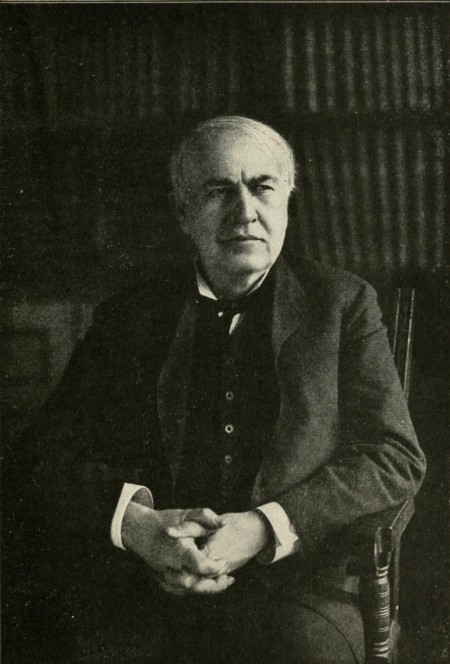
THOMAS ALVA EDISON—1911
A second and very marked characteristic of Edison's personality is an intense and courageous hopefulness and self-confidence, into which no thought of failure can enter. The doubts and fears of others have absolutely no weight with him. Discouragements and disappointments find no abiding place in his mind. Indeed, he has the happy faculty of beginning the day as open-minded as a child, yesterday's discouragements and disappointment discarded, or, at any rate, remembered only as useful knowledge gained and serving to point out the fact that he had been temporarily following the wrong road.
Difficulties seem to have a fascination for him. To advance along smooth paths, meeting no obstacles or hardships, has no charm for Edison. To wrestle with difficulties, to meet obstructions, to attempt the impossible—these are the things that appear to give him a high form of intellectual pleasure. He meets them with the keen delight of a strong man battling with the waves and opposing them in sheer enjoyment.
Another marked characteristic of Edison is the fact that his happiness is not bound up in the making of money. While he appreciates a good balance at his banker's, the keenness of his pleasure is in overcoming difficulties rather than the mere piling up of a bank account. Had his nature been otherwise, it is doubtful if his life would have been filled with the great achievements that it has been our pleasure to record.
In a life filled with tremendous purpose and brilliant achievement there must be expected more or less of troubles and loss. Edison's life has been no exception, but, with the true philosophy that might be expected of such a nature, he remarked recently: "Spilled milk doesn't interest me. I have spilled lots of it, and, while I have always felt it for a few days, it is quickly forgotten, and I turn again to the future."
Edison to-day has a fine physique, and, being free from serious ailments, enjoys a vigorous old age. His hair has whitened, but it is still abundant, and though he uses glasses for reading, his gray-blue eyes are as keen and bright and deeply lustrous as ever, with the direct, searching look in them that they have ever worn.
Edison in his 'eighties still has a fine physique, weighs over one hundred and sixty-five pounds, and has varied little as to weight in the last forty years. He is very abstemious, hardly ever touching alcohol and caring little for meat. In fact, the chief article of his diet is warm milk, which he finds satisfactory for his need.
He believes that people eat too much, and governs himself accordingly. His meals are simple, small in quantity, and take but little of his time at table. If he finds himself varying in weight he will eat a little more or a little less in order to keep his weight constant.
As to clothes, Edison is simplicity itself. Indeed, it is one of the subjects in which he takes no interest. He says: "I get a suit that fits me, then I compel the tailors to use that as a jig, or pattern, or blueprint, to make others by. For many years a suit was used as a measurement; once or twice they took fresh measurements, but these didn't fit, and they had to go back. I eat to keep my weight constant, hence I never need changed measurements."
This will explain why a certain tailor had made Edison's clothes for twenty years and had never seen him.
In 1873 Mr. Edison was married to Miss Mary Stilwell, who died in 1884, leaving three children—Thomas Alva, William Leslie, and Marion Estelle.
Mr. Edison was married again in 1886 to Miss Mina Miller, daughter of Mr. Lewis Miller, a distinguished pioneer inventor and manufacturer in the field of agricultural machinery, and equally entitled to fame as the father of the "Chautauqua idea," and the founder with Bishop Vincent of the original Chautauqua, which now has so many replicas all over the country. By this marriage there are three children—Charles, Madeline, and Theodore.
For over twenty years Edison's happy and perfect domestic life has been spent at Glenmont, a beautiful property in Llewellyn Park, on the Orange Mountain, New Jersey. Here, amid the comforts of a beautifully appointed home, in which may be seen the many decorations and medals awarded to him, together with the numerous souvenirs sent to him by foreign potentates and others, Edison spends the hours that he is away from the laboratory. They are far from being idle hours, for it is here that he may pursue his reading free from interruption.
His hours of sleep are few, not more than six in the twenty-four, and not as much as that when working nights at the laboratory. In a recent conversation a friend expressed surprise that he could stand the constant strain, to which Edison replied that he stood it easily, because he was interested in everything. He further said: "I don't live with the past; I am living for to-day and to-morrow. I am interested in every department of science, art, and manufacture. I read all the time on astronomy, chemistry, biology, physics, music, metaphysics, mechanics, and other branches—political economy, electricity, and, in fact, all things that are making for progress in the world. I get all the proceedings of the scientific societies, the principal scientific and trade journals, and read them. I also read some theatrical and sporting papers and a lot of similar publications, for I like to know what is going on. In this way I keep up to date, and live in a great, moving world of my own, and, what's more, I enjoy every minute of it."
In conversation Edison is direct, courteous, ready to discuss a topic with anybody worth talking to, and, in spite of his deafness, an excellent listener. No one ever goes away from him in doubt as to what he thinks or means, but, with characteristic modesty, he is ever shy and diffident to a degree if the talk turns on himself rather than on his work.
He is a normal, fun-loving, typical American, ever ready to listen to a new story, with a smile all the while, and a hearty, boyish laugh at the end. He has a keen sense of humor, which manifests itself in witty repartee and in various ways.
In his association with his staff of experimenters the "old man," as he is affectionately called, is considerate and patient, although always insisting on absolute accuracy and exactness in carrying out his ideas. He makes liberal allowance for errors arising through human weakness of one kind or another, but a stupid mistake or an inexcusable oversight on the part of an assistant will call forth a storm of contemptuous expression that is calculated to make the offender feel cheap. The incident, however, is quickly a thing of the past, as a general rule.
If there is anything in heredity, Edison has many years of vigor and activity yet before him. What the future may have in store in the way of further achievement cannot be foreshadowed, for he is still a mighty thinker and a prodigy of industry and hard work.
XXVI EDISON'S NEW PHONOGRAPH
As related in a preceding chapter of this work, the first commercial phonograph was of the wax cylinder type. Celluloid afterwards superceded wax as a material for the cylinder record, because of its indestructibility. Edison's work on the disc phonograph and record, invented by him in 1878, is related in the following pages.
From the time of his conception of the phonograph in 1877 to the present day Edison has had a deep conviction that people want good music in their homes. That this is not a conviction founded upon commercialism may be appreciated on reading his own words: "Of all the various forms of entertainment in the home, I know of nothing that compares with music. It is safe and sane, appeals to all finer emotions, and tends to bind family influences with a wholesomeness that links old and young together. If you will consider for a moment how universally the old 'heart songs' are loved in the homes, you will realize what a deep hold music has in the affections of the people. It is a safety-valve in the home."
Throughout the years that followed the advent of the earlier type of phonograph with the cylindrical wax records Edison never lost sight of his determination to make it a more perfect instrument, for, of all the children of his brain, the phonograph seems to be the one he loves most. He is the most severe critic of his own work and is never content with less than the best obtainable.
Thus it came about that, some thirteen years ago, having reached the apex of his dissatisfaction with what he thought were the shortcomings of the phonograph and records of that time, he began work on a long-cherished plan of refining the machine and the records so that he could reproduce music, vocal and instrumental, with all its original beauty of tone and sweetness—in fact, a true "re-creation." As the world knows, he has succeeded.
With his characteristic vigor and earnestness Edison plunged into this campaign, fully realizing the immense difficulties of the task he had undertaken. In order to accomplish the desired end he must, in the first place, devise entirely new types of recorder and reproducer which would have essentially different characteristics from any then in existence. In addition to this, an entirely new material must be found and adapted for the surface of the records, a material pliable, indestructible, and, above all, so exceedingly smooth that there should be no rasping, scratching sounds to mar the beauty of the music.
In planning this campaign Edison had decided to return to the disc type of machine and record, which he had invented away back in 1878, and which he now took up again, as it would afford him the greatest scope for his latest efforts.
While simultaneously carrying on a formidable line of experiments to produce the desired material for the records he labored patiently through the days and away into the nights for many months in evolving the new recorder and reproducer, pausing only to snatch a few hours of sleep, which sometimes would be taken at home and at other times on a bench or cot in the laboratory. After some thousands of experiments, extending over a period of more than ten months and conducted with the never-wearying patience so characteristic of him, he perfected his recorder and the diamond-point reproducer which gave him the results for which he strove so many years. This was on the eve of his departure for Europe in August, 1911.
When Edison thinks he has perfected any device his next step is to find out its weakness by trying his best to destroy it. Illustrative of this there may be quoted two instances of severe tests in connection with his alkaline storage battery. After completing it he rigged up a device by means of which a set of batteries were subjected to a series of 1,700,000 severe bumps in the effort to destroy them. When this failed, they were mounted on a heavy electric car, which was propelled with terrific force a number of times against a heavy stone wall, only to show that they were proof against injury by any such means.
His new phonograph reproducer was not exempted from this policy of attempted destruction, and before leaving for Europe he gave instructions for a grilling test, which was, of course, carried out faithfully, but the diamond point was found to be uninjured after playing records more than four thousand times. With such results he deemed it a safe proposition.
On his return from Europe in October, 1911, Edison resumed his attack on the evolution of the new indestructible disc record with a smooth surface, the main principles of which had been determined upon before his departure. In addition, there arose the problem of manufacturing such records in great quantities. The difficulties that confronted him completely baffle description. The whole battle was carried on with the aid of powerful microscopes, which even at their best would fail to reveal the obscure cause of temporary discomfiture. Differences in material, dirt, dust, temperature, water, chemical action, thumb marks, breath marks, cloth and brush marks, and a host of major and minor incidentals, were patiently and painstakingly investigated with a thoroughness that is almost beyond belief to the layman.
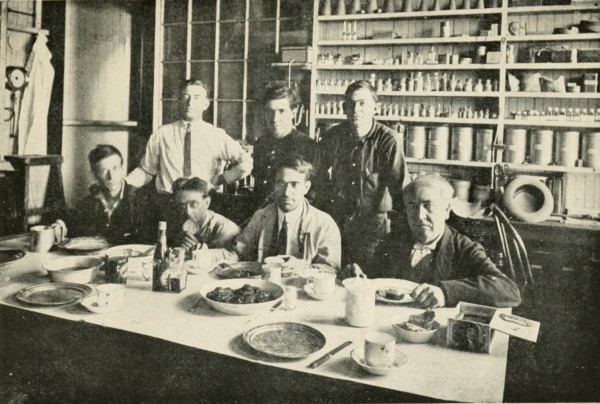
Day and night the work was carried on incessantly. During the height of the investigation, toward the close of this five-year campaign, Edison and a few of his faithful experimenters—facetiously called "The Insomnia Squad"—stayed steadily at the works for a period of over five weeks—eating, drinking, working, and sleeping (occasionally) there. During that time Edison went home only four or five times, and then merely to change his clothing. He and the men slept for short periods in the works or in the library, on benches and tables, resuming their labors immediately on waking up. Edison had arranged for an abundant supply of good substantial food which they themselves cooked, hence the inner man was well cared for. The wives of the men came around at intervals with changes of clothing for their husbands. This intense application to work left no time for shaving, with the result that all hands might well have been taken for a gang of traditional pirates from their unkempt appearance.
They were all happy, however, and, strange to say, all increased in weight, although a contrary result might naturally have been expected. The intense work has never ceased, but there has been no similar protracted siege since, as the main principles were practically settled at that time. The foregoing instance has been merely mentioned to illustrate the fierce vigor with which Edison works when he is seeking to complete one of his inventions. He has been, and still is, prosecuting his labors with the same energy to bring about the utmost perfection that is possible.
He has not confined his work to the refinement of the merely mechanical parts, such as the instrument and the records, but during the last ten years he has devoted an immense amount of time to music itself. Becoming convinced that the public desired really beautiful music, he set himself to a thorough study of the subject, not only of compositions, but also of the human voice, its powers and limitations, and of different effects of various styles of orchestration. He determined to hear for himself music of all kinds, and with this object in view hired a number of sight-reading players and singers to render musical selections by the hour.
"THE INSOMNIA SQUAD"—Copyright by Thomas A. Edison
In the past ten years he has heard upward of twenty-five thousand compositions of a wide range, from grand opera to ragtime. As he hears them he indicates his opinions, which range from "beautiful" to "punk," according to his idea of availability for the phonograph. An elaborate card system preserves these indications for further application in selecting music for the phonograph.
It might seem dogmatic to have the reproduction of musical compositions depend upon his opinion, but it must be said that he is not entirely committed to such drastic measures if there is a real demand for some musical selection which does not seem to merit his good opinion. His decision as to a composition is not based on a merely personal whim or fad, but upon his opinion of it from the standpoint of an inventor. He has said to the writer more than once: "There is invention in music just as much as in the arts. Composers such as Verdi, Rossini, Bellini, Donizetti were inventors. They did not copy, nor did some of the other great composers. But the rank and file of musicians are not inventors; they have copied the ideas of the others, consciously or unconsciously. If you will sit down for a few hours and have a lot of miscellaneous compositions played you will be convinced of it."
Edison has had no musical training, as the term is generally understood, and the writer must confess that before hearing the above expression he failed to comprehend the true basis of the inventor's opinions of the various compositions played or sung for him. On several occasions he therefore arranged (unknown to Edison) to have one or more compositions played or sung again after a lapse of some weeks, to see whether or not there would be any similarity of opinion to that first indicated. In every case Edison's judgment was practically, and in some cases precisely, the same as before, thus proving that the opinion first given was not merely a whim, but was based upon some definite line of thought in the inventor's brain.
His excursion into the musical realm has also included the personal hearing of many singers so as to determine their fitness for making phonograph records. This proved to be a wonderfully interesting field of investigation, and he has given a great deal of time to it, listening critically to each voice, good, bad, or indifferent, and patiently writing out his criticism in each case. Not only has he heard a large number of singers who have visited the laboratory for the purpose, but he also had a representative scouring Europe for voices several years ago. This man visited the principal cities and towns of Europe and took phonograph records of the voices of the operatic and other prominent singers in each place and shipped them over to Edison, who listened to each one and recorded his opinion in a series of note-books kept for the purpose. He has in the laboratory at Orange nearly two thousand voice records of this kind. All this is done with the object of securing the really best voices in the world. Probably this is the most unique "voice library" in existence.
He is very deaf, but has a wonderfully acute inner ear, which, being protected by his deafness from the ordinary sounds of life, will catch minute imperfections that are imperceptible to the person of ordinary hearing. In listening to a voice he uses a peculiarly shaped horn which is held close to the ear, and such is the acuteness of his hearing that he at once distinguishes minute changes of register, extra waves, tremolo, non-periodic vibrations, and other minor defects that detract from the true beauty of vocal sounds. In addition, he can immediately recognize the number of overtones and rate of tremolo, which may afterward be verified by a microscopic examination of a record of the same voice.
Edison contends that the phonograph will give the "acid test" of a voice, for it will record nothing more and nothing less than what is in the voice itself, and the record is unchangeable. In his judgment, operatic voices are not necessarily the most perfect ones, for, as he says: "the vocal cords of opera singers are always at the straining-point. They usually sing on roomy stages in large theaters with a large orchestra in front of them, and their voices must go out above all these instruments so as to be heard to the farthest limits of the house. Consequently, they are always doing their utmost and their vocal cords become adapted to heavy work only. People often wonder why their favorite operatic singers do not charm them as much in concert or through the phonograph as they did at the opera, but do not stop to think of the difference between the opera-house and the concert-hall or parlor. I don't mean to say a word of detraction in regard to operatic singers, for I have a great admiration for their wonderful art and for many of their voices, and a great number of them have now recognized the value of special effort to acquire the distinct art and technique of singing for the phonograph (which is a parlor instrument), and have made some really beautiful records."
The writer was one day discussing with Edison the temperament of singers generally and the good opinion that each one usually has of his or her own voice irrespective of any artistic use he or she could make of it. He said: "I don't see what they have to be conceited about. The Almighty has given them a little piece of meat in their throats that differs slightly from the corresponding piece of meat in somebody else's throat. They can take no credit for that, but if they use their brains to interpret and perfect the use of what has been given them, they have accomplished something. What I want is voices that will stand the test of the phonograph and give permanent pleasure to people, irrespective of stage environment, or the press agent, or pleasing personality."
This chapter could be extended to a great length in setting forth the results of Edison's deep study of music which he undertook solely for the purpose of bringing his latest achievement up to the high standard which he set for it so many years ago, but enough has been said to indicate the immense amount of work he has done and the trend of his ideas. That he has been able, amid the round of his multitudinous duties and work, which occupy his time and attention from sixteen to eighteen hours a day, to delve into the subject so profoundly and to evolve ideas that are confessedly awakening the musical world is sufficient to indicate that in spite of his years and herculean labors in the past he has not lost any of the vim or pertinacity that have so distinguished him in days gone by.
XXVII EDISON'S WORK DURING THE WAR
With the shattering of the world's peace by the great conflict which commenced on July 28, 1914, there came a universal disturbance of industrial conditions. The Edison industries were not exempt.
Edison's activities during the years of the war were of the same intensely vigorous and energetic nature so characteristic of him throughout his busy life. His work during this period is divisible into two distinct sections: first, the working out of processes and the design and construction of nine chemical and two benzol plants to supply chemicals and materials greatly needed by our country; and, second, his war work for the United States government. We will discuss these in the above order.
For many years before the war America had been a large importer of raw materials and manufactured products from England, Germany, and other European countries. Among these may be mentioned potash, dyes, carbolic acid, aniline oil, and other coal-tar products. After hostilities began the activities of the Allied fleets prevented all exportations by Germany and the Central Powers. On the other hand, England and her allies placed embargoes on the exportation from their countries of all materials and products which could be used for food or munitions of war.
Thus there suddenly came a great embarrassment to numerous American industries. By reason of our continued importation for many years our country had become dependent upon Europe for supplies of various products and had made practically no provision for the manufacture of these products within our own borders.
Inasmuch as our narrative concerns Edison and his work, we shall not attempt to name all the industries thus affected, but will confine ourselves to a mention of the items relating to his own needs and of those which he promptly took steps to produce for the relief of many industries and for the general good of the country. These items were carbolic acid, aniline oil, myrbane, aniline salts, acetanilid, para-nitro-acetanilid, paraphenylenediamine, para-amidophenol, benzidine, benzol, toluol, xylol, solvent naphtha, and naphthaline flakes.
Edison's principal requirements were potash for his storage battery and carbolic acid and paraphenylenediamine for use in the manufacture of disc phonograph records. After a great deal of experimenting he found that caustic soda could be used in his storage battery and therefore employed it until new supplies of potash were obtainable.
Carbolic acid and paraphenylenediamine had been previously imported from England and Germany and as there was practically none produced in the United States and no possibility of substituting other products Edison realized that he would be compelled to manufacture them himself, as the source of supply was cut off. He, therefore, as usual, gathered together all available literature and plunged into a study of manufacturing processes and quickly set his chemists to work on various lines of experiment.
Having decided through these experiments on the process by which he would manufacture carbolic acid synthetically, Edison designed his first plant, gathered the building material and apparatus together and instructed his engineers to rush the construction as fast as possible. By working gangs of men twenty-four hours a day the plant was rapidly completed and on the eighteenth day after the work of construction was begun it commenced turning out carbolic acid. Within a month this plant was making more than a ton a day and gradually increased its capacity until, a few months afterward, it reached its maximum of six tons a day.
It soon became publicly known that Edison was manufacturing carbolic acid, and he was overwhelmed with offers to purchase the excess over his own requirements. The demand for carbolic acid became so great that he decided to erect a second plant. This was quickly constructed and its capacity, which was also six tons per day, was contracted for before the plant was fully completed. It is interesting to note that the army and navy departments of the United States were among the first to make long contracts with Edison for his carbolic acid, from which they made explosives that were badly needed.
We must digress here to show an emergency that had arisen during the early days of the first carbolicacid plant. There had come about a serious shortage of benzol, which is a basic material in the manufacture of synthetic carbolic acid. Benzol is a product derived from the gases arising from the destructive distillation of coal in coke ovens. At the time of which we are writing (beginning of 1915) there was only a comparatively small quantity of benzol produced in the United States.
Mr. Edison realized that without a continuous and liberal supply of benzol he would be unable to carry out his project of producing carbolic acid in large quantities. He had also been approached by various textile manufacturers to make aniline oil, which was essential to their continuance in business, and of which there was practically no supply in the country. Without it he could not make paraphenylenediamine. Benzol is also a basic material in making aniline oil.
Therefore, it became doubly important to arrange for an adequate and continuous supply of benzol. Edison made a study of the methods and processes of producing benzol and then made proposals to various steel companies to the effect that he would, with their permission, erect a benzol plant at their coke ovens, operate the same at his own expense, and pay them a royalty for every gallon of benzol, toluol, xylol, or solvent naphtha taken from their gases. Such arrangement would not only meet his requirements, but at the same time would give the steel companies an income from something which they had been allowing to pass away into the air. He succeeded in making arrangements with two of the companies—namely, the Cambria Steel Company at Johnstown, Pennsylvania, and the Woodward Iron Company, Woodward, Alabama.
Ordinarily, it requires from nine to ten months to erect a benzol plant, but before making his proposal to the steel companies Edison had worked out a plan for erecting a practical plant within sixty days, and had laid it out on paper. He was sure of his grounds, because from his vast experience he knew where to pick up the different pieces of apparatus in various parts of the country.
The contract for his first benzol plant at Johnstown, Pennsylvania, was signed on January 18, 1915, and the actual work was begun an hour after the contract was signed, with the final result that in forty-five days afterward the benzol plant was completed and commenced working successfully. The second plant, at Woodward, Alabama, was completed within sixty days after breaking ground, the two weeks difference in time being accounted for by the fact that Woodward was farther away from the base of supplies and there were delays in railroad transportation of materials.
Being sure, through these contracts, of a continuous supply of benzol, Edison designed a plant for making aniline oil. By working gangs of men day and night, the erection of this plant was completed in forty-five days. The capacity of the plant, four thousand pounds per day, was fully contracted for by anxious manufacturers long before the machinery was in place.
Let us now consider Edison's work on paraphenylenediamine. This is a chemical product which is largely used in dyeing furs black. America had imported all her requirements from Germany, but within a few months after the beginning of hostilities the visible supply was exhausted and no more could be expected during war-times. Fur-dyers were in despair. This product being also absolutely essential in the manufacture of phonograph records, Edison worked out a process for making it, and as his requirements were very moderate he established a small manufacturing plant at the Orange laboratory and soon began to produce about twenty-five pounds a day. In some way the news reached the ears of many desperate fur-dyers, and Edison was quickly besieged with most urgent requests for such portion of his output as could be spared. Fortunately, a small proportion of the output was available and was distributed daily in accordance with the necessities of those concerned. This small quantity being merely a drop in the bucket, the fur-dyers earnestly besought Edison to establish a larger plant and supply them with greater quantities of paraphenylenediamine, as their business had come almost to a standstill for lack of it. He, therefore, designed and constructed rapidly a larger plant, which, when put into operation, was soon producing two hundred to three hundred pounds a day, thus saving the situation for the fur-dyers. The capacity of this plant was gradualy increased until it turned out upward of a thousand pounds a day, of which a goodly proportion was exported to Europe and Japan.
Lack of space has prevented the narration of more than a mere general outline of some of Edison's important achievements during part of the war years along chemical and engineering lines and in furnishing many of the industries of the country with greatly needed products that, for a time at least, were otherwise unobtainable. Much could be written about his work on producing myrbane, aniline salts, acetanilid, para-nitro-acetanilid, para-amido-phenol, benzidine, toluol, xylol, solvent naphtha, and naphthaline flakes—how his investigations and experiments on them ran along with the others, team fashion, so to speak, how he brought the same resourcefulness and energy to bear on many problems, and how he eventually surmounted numerous difficulties—but limitations of space forbid. Nor can we make more than a mere passing mention of the assistance he gave to the governments in the quick production of toluol and in furnishing plans and help to construct and operate two toluol plants in Canada. Suffice it to say that his achievements during this episode in his career were fully in accord with the notable successes he had already scored. It may be noted that in the three years following 1914 others went into the business of manufacturing the above chemicals, and as they installed and operated plants and furnished supplies needed in the industries Edison withdrew and shut down his special plants one after another.
Let us now take a brief glance at the patriot-inventor at work for his government in war-times and especially during the last two years of the Great War.
In the late summer of 1915 the Secretary of the Navy, Hon. Josephus Daniels, communicated to Mr. Edison an idea he had conceived of gathering together a body of men preeminent in inventive research to form an advisory board which should come to the aid of our country in an inventive and advisory capacity in relation to war measures. In this communication Secretary Daniels made an appeal to Edison's patriotism and asked him to devote some of his effort in the service of the country and also to act as chairman of the board. Although he was already working about eighteen hours a day, Edison signified his consent. In the fall of 1915 the board was organized and subsequently became known as the Naval Consulting Board of the United States. Mr. Edison was at first chairman and subsequently became president of the board.
The history of the work and activities of the board is too extensive to be related here in detail and can only be hinted at. Indeed, it is the subject of a separate volume which is being published by the Navy Department. We shall, therefore, confine our narrative to the story of Edison's work.
In December, 1916, Secretary Daniels expressed a desire that Mr. Edison visit him in Washington for an important conference. At that time it seemed almost inevitable that the United States would be drawn into the conflict with Germany sooner or later, and at the conference Secretary Daniels asked Edison to devote more of his time to the country by undertaking experiments on a series of problems, a list of which was handed to him.
Edison signified his assent, agreeing to give his whole time to the government without charge, and returned to his laboratory. He immediately put everything else aside, and with characteristic enthusiasm and energy delved into the work he had undertaken. The problems referred to covered a wide range of the sciences and arts, and time being an essential element, he added to his laboratory staff by gathering together from various sources a number of young men, experts in various lines, to assist him in his investigations.
Inasmuch as Edison's war work for the government occupied his entire time for upward of two years, it is manifestly out of the question to narrate the details within the limits of a chapter. We must, therefore, be content to itemize the principal problems upon which he occupied himself and assistants and as to which he reported definite results to Washington. The items are as follows:
Locating position of guns by sound-ranging.
Detecting submarines by sound from moving vessels.
Detecting on moving vessels the discharge of torpedoes by submarines.
Quick turning of ships.
Strategic plans for saving cargo boats from submarines.
Collision mats.
Taking merchant-ships out of mined harbors.
Oleum cloud shells.
Camouflaging ships and burning anthracite.
More power for torpedoes.
Coast patrol by submarine buoys.
Destroying periscopes with machine-guns.
Cartridge for taking soundings.
Sailing-lights for convoys.
Smudging sky-line.
Obstructing torpedoes with nets.
Under-water search-light.
High-speed signaling with search-lights.
Water-penetrating projectile.
Airplane detection.
Observing periscopes in silhouette.
Steamship decoys.
Zigzagging.
Reducing rolling of warships.
Obtaining nitrogen from the air.
Stability of submerged submarines.
Hydrogen detector for submarines.
Induction balance for submarine detection.
Turbine head for projectile.
Protecting observers from smoke-stack gas.
Mining Zeebrugge harbor.
Blinding submarines and periscopes.
Mirror-reflection system for warships.
Device for look-out men.
Extinguishing fires in coal bunkers.
Telephone system on ships.
Extension ladder for spotting-top.
Preserving submarine and other guns from rust.
Freeing range-finder from spray.
Smudging periscopes.
Night glass.
Re-acting shell.
It will be seen that Mr. Edison's inventive imagination was permitted a wide scope. He fairly reveled in the opportunity of attacking so many difficult problems and worked through the days and nights writh unflagging enthusiasm. He committed his business interests to the care of his associates, and during the two years of his work for the government kept in touch with his great business interests only by means of reports which were condensed to the utmost. In addition, for two successive winters, he gave up his regular winter vacation on his Florida estate, usually a source of great enjoyment to him. But it was all done willingly and without a word of regret or dissatisfaction so far as the writer's knowledge goes.