INTRODUCTION (continued 5)
Reading edition
Although we cannot take space to discuss the above items in detail, the reader will probably have a desire to know something of Edison's work in regard to the submarines.
In view of the vast destruction of shipping, perhaps it is not an overstatement to say that the most vital problem of the late war was to overcome the menace of the submarine. Undoubtedly there was more universal study and experiment on means and devices for locating and destroying submarines than on any other single problem.
The class of apparatus most favored by investigators comprised various forms of listening devices by means of which it was hoped to detect and locate by sound the movement of an entirely submerged submarine. The difficulties in obtaining accurate results were very great even when the observing vessel was motionless, but were enormously enhanced on using listening devices on a vessel under way, on account of the noises of the vessel itself, the rushing of the water, and so on.
Edison's earliest efforts were confined to the induction balance, but after two months of intensive experimenting on that line he gave it up and entered upon a long series of experiments with listening devices, employing telephones, audions, towing devices, resonators, etc. The Secretary of the Navy provided Edison with a 200-foot vessel for his experiments, and in the summer and fall of 1917 they had progressed sufficiently to enable him to detect sounds of moving vessels as far distant as five thousand yards. This, however, was when the observing vessel was at anchor. The results with the vessel under way, at full speed, were not poor.
Having pushed the possibilities along this line to their reasonable limit, Edison was of the opinion that this plan would not be practical and he turned his thoughts to another solution of the problem—namely, to circumvent the destructive operation of the submarine and avoid the loss of ships. He had discovered in his experimenting that the noise made by a torpedo in its swift passage through the water was very marked and easily distinguishable from any other sound.
With this fact as a basis, Edison, therefore, evolved a new plan, which had two parts: first, to provide merchant-ships with a listening apparatus that would enable them, while going at full speed, to hear the sound of a torpedo as soon as it was launched from a submarine; and, second, to provide the merchant-ships with means for quickly changing their course to another course at right angles. Thus, the torpedo would miss its mark and the merchantship would be saved. If another torpedo should be launched, the same tactics could be repeated.
His further investigations were conducted along this line. After much experimenting he developed a listening device in the form of an outrigger suspended from the bowsprit. This device was so arranged that it hung partly in the water and would always be from 10 to 20 feet ahead of the vessel, but could be swung inboard at any time. The device was about 20 feet long and about 16 inches in width and was made of brass and rubber. It contained brass tubes, with a phonograph diaphragm at the end which hung in the water. The listening apparatus was placed in a small room in the bow of the vessel. There were no batteries used. With this listening apparatus, and while the vessel was going full speed, moving boats 1,000 yards away could be easily heard in rough seas. This meant that torpedoes could be heard 3,000 yards away, as they are by far the noisiest craft that "sail" the ocean.
The second step in Edison's plan—namely, the quick changing of a ship's course, was accomplished with the "sea anchor." This device consists of a strong canvas bag which is attached to a ship by long ropes. When thrown overboard the bag opens, fills with water, and acts as a drag on a ship under way. Edison's plan was to use four or more sea anchors simultaneously. In a trial made with a steamship 325 feet long, draught 19 feet 6 inches, laden with 4,200 tons of coal, by the use of four sea anchors, the vessel going at full speed, was turned at right angles to her previous course with an advance of only 200 feet, or less than her own length. This means that if an enemy submarine had launched a torpedo against the ship while she was on her original course it would have passed by without harming her, thus making submarine torpedo attack of no avail. It may be noted parenthetically that this apparatus has its uses in the merchant-marine in peacetimes. For instance, should the look-out on a steamship running at full speed sight an iceberg 300 or 400 feet ahead this device could be instantly put into use and the ship could be turned quickly enough to avoid a collision.
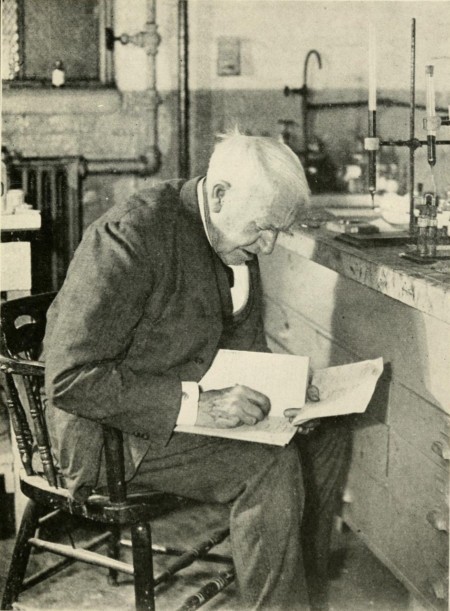
EDISON AT WORK ON RUBBER EXPERIMENTS. FROM A MOVING PICTURE TAKEN DECEMBER, 1928
There is only space for a passing mention of the immense amount of data which Edison gathered, tabulated, and charted in his study and evolution of strategical plans suggested by him to the government in the line of lessening the destruction by submarines. He spent day and night for several months with a number of assistants working out these plans. It is not possible to make more specific mention of them here, as they are too voluminous for these pages.
With this tremendous amount of work pressing on him he retained his accustomed good health and buoyancy, due, undoubtedly, to his cheerful spirit, philosophical nature, and abstemious living. Soon after the armistice was signed his experimental work for the government came to an end, and he then switched back to the general supervision of his business interests and to his ceaseless experiments through which he is continually making improvements and refinements in the products of the large industries which he established and in which he is so greatly interested.
Mention should also be made of another extensive project he has undertaken, and that is the production of rubber from plants, weeds, bushes, shrubs, etc., grown in the United States. This he speaks of as "emergency" rubber, to be resorted to in case our country should ever be embarrassed in obtaining a supply of rubber from present sources. This is a tremendous problem, but he is applying to its solution the same resourceful powers that have characterized his previous endeavors.
Herein, and in the development of new ideas, lies Edison's daily work and pleasure, and although he is in his eighties at this writing, with still boundless energy, it may be said of him
"Age cannot wither him, nor custom stale His infinite variety."