INTRODUCTION (continued 3)
Reading edition
The principle involved in Edison's carbon-transmitter gave birth to another interesting device called the microphone, by means of which the faintest sounds could be very plainly heard. For instance, the footsteps of a common house-fly make a loud noise when the hearing is assisted by the microphone. As every one knows, the microphone is universally used in our modern radio.
This invention was claimed at the time for Professor Hughes, of England. Whatever credit might be due to him for the form he proposed, a standard history ascribes two original forms of the microphone to Edison, and he himself remarks: "After I sent one of my men over to London especially to show Preece the carbon transmitter, when Hughes first saw it, and heard it—then within a month he came out with the microphone, without any acknowledgment whatever. Published dates will show that Hughes came along after me."
The carbon transmitter has not been the only way in which Edison has utilized the peculiar property that carbon possesses of altering its resistance to the passage of current according to the degree of pressure brought to bear on it.
For his quadruplex system he constructed a rheostat, or resistance box, with a series of silk disks saturated with plumbago and well dried. The pressure on the disks can be regulated by an adjustable screw, and in this way the resistance of the circuit can be varied.
He also developed a "pressure," or carbon, relay, by means of which signals of variable strength can be transferred from one telegraphic circuit to another. The poles of the electromagnet in the local or relay circuit are hollowed out and filled up with carbon disks or powdered plumbago.
If a weak current passes through the relay the armature will be but feebly attracted and will only compress the carbon slightly. Thus the carbon will offer considerable resistance and the signal on the local sounder will be weak.
If, on the contrary, the incoming current be strong, the armature will be strongly attracted, the carbon will be more compressed, thus lowering the resistance and giving a loud signal on the local sounder.
Another beautiful and ingenious use of carbon was made by Edison in an instrument invented by him called the tasimeter. This device was used for indicating most minute degrees of heat, and was so exceedingly sensitive that in one case the heat of rays of light from the remote star Arcturus showed results.
The tasimeter is a very simple instrument. A strip of hard rubber rests vertically on a platinum plate, beneath which is a carbon button, under which again lies another platinum plate. The two plates and the carbon button form part of an electric circuit containing a battery and a galvanometer. Hard rubber is very sensitive to heat, and the slightest rise of temperature causes it to expand, thus increasing the pressure on the carbon button. This produces a variation in resistance shown by the swinging of the galvanometer needle.
This instrument is so sensitive that with a delicate galvanometer the heat of a person's hand thirty feet away will throw the needle off the scale.
XII MAKING A MACHINE TALK
If one had never heard a phonograph, it would seem as though it would be impossible to take some pieces of metal and make a machine that would repeat speaking, singing, or instrumental music just like life.
So, before the autumn of 1877, when Edison invented the phonograph, the world thought such a thing was entirely out of the question. Indeed, Edison's own men in his workshop, who had seen him do some wonderful things, thought the idea was absurd when he told them that he was making a machine to reproduce human speech.
One of his men went so far as to bet him a box of cigars that the thing would be an utter failure when finished, but, as every one knows, Edison won the bet, for the very first time the machine was tried it repeated clearly all the words that were spoken into it.
A story has often been told in the newspapers that the invention was made through Edison's finger being pricked by a point attached to a vibrating telephone diaphragm, but this is not true.
The invention was not made through any accident, but was the result of pure reasoning, and in this case, as in many others, fact is more wonderful than fiction. Mr. Edison's own account of the invention of the phonograph is intensely interesting.
"I was experimenting," he says, "on an automatic method of recording telegraph messages on a disk of paper laid on a revolving platen, exactly the same as the disk talking-machine of to-day. The platen had a spiral groove on its surface, like the disk. Over this was placed a circular disk of paper; an electromagnet with the embossing point connected to an arm travelled over the disk, and any signals given through the magnets were embossed on the disk of paper. If this disk was removed from the machine and put on a similar machine provided with a contact point the embossed record would cause the signals to be repeated into another wire. The ordinary speed of telegraphic signals is thirty-five to forty words a minute; but with this machine several hundred words were possible.
"From my experiments on the telephone I knew of the power of a diaphragm to take up sound vibrations, as I had made a little toy which when you recited loudly in the funnel would work a pawl connected to the diaphragm; and this, engaging a ratchet-wheel, served to give continuous rotation to a pulley. This pulley was connected by a cord to a little paper toy representing a man sawing wood. Hence, if one shouted: 'Mary had a little lamb,' etc., the paper man would start sawing wood. I reached the conclusion that if I could record the movements of the diaphragm properly I could cause such records to reproduce the original movements imparted to the diaphragm by the voice, and thus succeed in recording and reproducing the human voice.
"Instead of using a disk I designed a little machine, using a cylinder provided with grooves around the surface. Over this was to be placed tin-foil, which easily received and recorded the movements of the diaphragm. A sketch was made, and the piece-work price, eighteen dollars, was marked on the sketch. I was in the habit of marking the price I would pay on each sketch. If the workman lost, I would pay his regular wages; if he made more than the wages, he kept it. The workman who got the sketch was John Kruesi. I didn't have much faith that it would work, expecting that I might possibly hear a word or so that would give hope of a future for the idea. Kruesi, when he had nearly finished it, asked what it was for. I told him I was going to record talking, and then have the machine talk back. He thought it absurd. However, it was finished; the foil was put on; I then shouted 'Mary had a little lamb,' etc. I adjusted the reproducer, and the machine reproduced it perfectly. I was never so taken back in my life. Everybody was astonished. I was always afraid of things that worked the first time. Long experience proved that there were great drawbacks found generally before they could be made commercial; but here was something there was no doubt of."
No wonder that John Kruesi, as he heard the little machine repeat the words that had been spoken into it, ejaculated in an awe-stricken tone: "Mein Gott im Himmel!" No wonder the "boys" joined hands and danced around Edison, singing and shouting. No wonder that Edison and his associates sat up all night fixing and adjusting it so as to get better and better results—reciting and singing and trying one another's voices and listening with awe and delight as the crude little machine repeated the words spoken or sung into it.
The news quickly became public, and the newspapers of the world published columns about this wonderful invention. Mr. Edison was besieged with letters from every part of the globe. Every one wanted to hear this machine; and in order to satisfy a universal demand for phonographs to be used for exhibition purposes he had a number of them made and turned them over to various individuals, who exhibited them to great crowds around the country. These were the machines in which the record was made on a sheet of tin-foil laid around the cylinder.
They created great excitement both in America and abroad. The announcement of a phonograph concert was sufficient to fill a hall with people who were curious to hear a machine talk and sing.
In the next year, 1878, Edison entered upon his experiments in electric lighting. His work in this field kept him intensely busy for nearly ten years, and the phonograph was laid aside as far as he was concerned.
He had not forgotten it, however, for he had fully realized its tremendous possibilities very quickly after its invention. This is shown by an article he wrote for the North American Review, which appeared in the summer of 1878. In that article he predicted the possible uses of the phonograph, many of which have since been fulfilled.
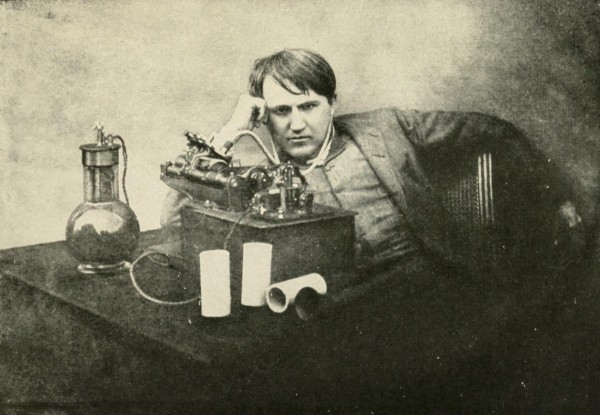
MR. EDISON AT THE CLOSE OF FIVE DAYS AND NIGHTS OF CONTINUED WORK IN PERFECTING THE EARLY WAX-CYLINDER TYPE OF PHONOGRAPH—JUNE 16, 1888 This is the longest continuous session of labor he ever performed.
In 1887, having finished the greatest part of his work on the electric light, he turned to the phonograph once more. Realizing that the tin-foil machine was not an ideal type and could not come into common use, he determined to re-design it, and make it an instrument that could be handled by any one.
This meant the design and construction of an entirely different type of machine, and resulted in the kind of phonograph with which every one is familiar in these modern days. One of the chief differences was the use of a wax cylinder instead of tin-foil, and, instead of indenting with a pointed stylus, the record is cut into the wax with a tiny sapphire, the next hardest jewel to a diamond.
Into his improvements of the phonograph Mr. Edison has put an enormous amount of time and work. He has never lost interest, but has worked on it more or less through all the intervening years up to the present time. Even during recent years he has expended a prodigious amount of energy in improving the reproducer and other parts, spending night after night, and frequently all night, at the laboratory.
Inasmuch as great quantities of phonographs were sold, requiring millions of records, one of the difficulties to be overcome was to make large numbers of duplicates from an original record made by a singer, speaker, or band of musicians.
This difficulty will be perceived when it is stated that the record cut into the wax cylinder is hardly ever greater than one-thousandth of an inch deep, which is less than the thickness of a sheet of tissue paper, and in a single phonograph record there are many millions of sound-waves so recorded.
Through endless experiments of Edison and his working force, and with many ingenious inventions, however, these difficulties were overcome one by one.
It may be added that the phonograph was an invention so absolutely new that when Mr. Edison applied for his original patent, in 1877, the Patent Office could not find that any such attempt had ever before been made to record and reproduce speech or other sounds, and the patent was granted immediately. He has since taken out more than one hundred patents on improvements.
The original patent has long since expired, and many kinds of talking-machines are now made by others also, but they all operate on the identical principle which Edison was the first to discover and put into actual practice.
XIII A NEW LIGHT IN THE WORLD
In these modern times an incandescent electric lamp is such an every-day affair as to be a familiar object even to a small child. But only a few years ago—a little over thirty—the man who proposed and invented it was derided in the newspapers, and called a madman and a dreamer.
If among Edison's numerous inventions there should be selected one or a class that might be considered the greatest, it seems to be universal opinion that the palm would be awarded to the incandescent lamp and his complete system for the distribution of electric light, heat, and power. These inventions as a class, and what has sprung from them, have brought about most wonderful changes in the world.
The year 1877 was a busy one at Edison's laboratory at Menlo Park. He was engaged on the telephone, on acoustic electric transmission, sextuplex telegraphs, duplex telegraphs, miscellaneous carbon articles, and other things. He also commenced experimenting on the electric light.
Besides, as we have seen in the previous chapter, he invented the phonograph. The great interest and excitement caused by the latter invention took up nearly all of his time and attention for many months, and, indeed, up to July, 1878. He then took a vacation and went out to Wyoming with a party of astronomers to observe an eclipse of the sun and to make a test of his tasimeter.
He was absent about two months, coming home rested and refreshed. Mr. Edison says: "After my return from the trip to observe the eclipse of the sun I went with Professor Barker, professor of physics in the University of Pennsylvania, and Dr. Chandler, professor of chemistry in Columbia College, to see Mr. Wallace, a large manufacturer of brass in Ansonia, Connecticut. Wallace at this time was experimenting on series arc lighting. Just at that time I wanted to take up something new, and Professor Barker suggested that I go to work and see if I could subdivide the electric light so it could be got in small units like gas. This was not a new suggestion, because I had made a number of experiments on electric lighting a year before this. They had been laid aside for the phonograph. I determined to take up the search again and continue it. On my return home I started my usual course of collecting every kind of data about gas; bought all the transactions of the gas engineering societies, etc., all the back volumes of gas journals, etc. Having obtained all the data, and investigated gas-jet distribution in New York by actual observations, I made up my mind that the problem of the subdivision of the electric current could be solved and made commercial."
The problem which Edison had undertaken to solve was a gigantic one. The arc light was then known and in use to a very small extent, but the subdivision of the electric light—as it was then called—had not been accomplished. It had been the dream of scientists and inventors for a long time.
Innumerable trials and experiments had been made in America and Europe for many years, but without success. Although a great number of ingenious lamps had been made by the foremost inventors of the period, they were utterly useless as part of a scheme for a system of electric lighting. In fact, these efforts had been so unsuccessful that many of the leading scientists of the time, even as late as 1879, declared that the subdivision of the light was an impossibility.
The chief trouble was that the early experimenters did not conceive the idea of a system, and worked only on a lamp. They all seemed to have the idea that an electric lamp was the main thing and that it should be of low resistance and should be operated on a current of very low voltage, or pressure. They, therefore experimented on lamps using short carbon rods or strips for burners, which required a large quantity of current.
Electric lighting with this kind of lamp was indeed a practical impossibility. The quantity of current required for a large number of them would have been prodigious, giving rise to tremendous problems on account of the heating effects. Besides, the most fatal objection was the cost of copper for conductors, which for a city section of about half a mile square would have cost not less than a hundred million dollars, on account of the enormous quantity of current that would be required.
Mr. Edison realized at the beginning that previous experimenters had failed because they had been following the wrong track. He knew that electric lighting could not be a success unless it could be sold to the public at a reasonable price and pay a profit to those who supplied it. With such lamps as had been proposed, requiring such an enormous outlay for copper, this would have been impossible. Besides, there would not have been enough copper in the world to supply conductors for one large city.
Edison did what he has so often done before and since. He turned about and went in the opposite direction. He reasoned that in order to develop a successful system of electric lighting the cost of conductors must come within very reasonable limits. To insure this, he must invent a lamp of comparatively high resistance, requiring only a small quantity of current, and with a burner having a small radiating surface.
Having the problem clearly in mind, Edison went to work in the fall of 1878 with that enthusiastic energy so characteristic of him. His earliest experiments were made with carbon as the burner for his lamp. In the previous year he had also experimented on this line, beginning with strips of carbon burned in the open air, and then in vacuo by means of a hand-worked air-pump. These strips burned only a few minutes. On resuming his work in 1878 he again commenced with carbon, and made a very large number of trials, all in vacuo. Not only did he try ordinary strips of carbonized paper, but tissue-paper coated with tar and lampblack was rolled into thin sticks, like knitting-needles, carbonized and raised to the white heat of incandescence in vacuo.
He also tried hard carbon, wood carbon, and almost every conceivable variety of paper carbon in like manner. But with the best vacuum that he could then get by means of the ordinary hand-pump the carbons would last at the most only from ten to fifteen minutes in a state of incandescence.
It was evident to Edison that such results as these were not of commercial value. He feared that, after all, carbon was not the ideal substance he had thought it was for an incandescent lamp-burner. The lamp that he had in mind was one which should have a tough, hair-like filament for a light-giving body that could be maintained at a white heat for a thousand hours before breaking.
He therefore turned his line of experiments to wires made of refractory metals, such as platinum and iridium, and their alloys. These metals have very high fusing points, and while they would last longer than the carbon strips, they melted with a slight excess of current after they had been lighted but a short time.
Nevertheless, Edison continued to experiment along this line, making some improvements, until about April, 1879, he made an important discovery which led him to the first step toward the modern incandescent lamp. He discovered that if he introduced a piece of platinum wire into an all-glass globe, completely sealed and highly exhausted of air, and passed a current through the platinum wire while the vacuum was being made the wire would give a light equal to twenty-five candle-power without melting. Previously, the same length of wire would melt in the open air when giving a light equal to four candles.
He thus discovered that the passing of current through the platinum while the vacuum was being obtained would drive out occluded gases (i.e., gases mechanically held in or upon the metal). This was important and soon led to greater results.
Edison and his associates had been working night and day at the Menlo Park laboratory, and now that promising results were ahead their efforts went on with greater vigor than ever. Taking no account of the passage of time, with an utter disregard of meal-times, and with but scanty hours of sleep snatched reluctantly at odd periods, Edison labored on, and the laboratory was kept going without cessation.
Following up the progress he had made, Edison made improvement after improvement, especially in the line of high vacua, and about the beginning of October had so improved his pumps that he could produce a vacuum up to the one-millionth part of an atmosphere. It should be understood that the maintaining of such a high vacuum was only rendered possible by Edison's invention of a one-piece all-glass globe, hermetically sealed during its manufacture into a lamp.
In obtaining this perfection of vacuum apparatus Edison realized that he was drawing nearer to a solution of the problem. For many reasons, however, he was dissatisfied with platino-iridium filaments for burners, and went back to carbon, which from the first he had thought of as an ideal substance for a burner.
His next step proved that he was correct. On October 21, 1879, after many patient trials, he carbonized a piece of cotton sewing-thread bent into a loop or horseshoe form, and had it sealed into a glass globe from which he exhausted the air until a vacuum up to one-millionth of an atmosphere was produced. This lamp, when put on the circuit, lighted up brightly to incandescence and maintained its integrity for over forty hours, and lo! the practical incandescent lamp was born. The impossible, so called, had been attained; subdivision of the electric current was made practicable; the goal had been reached, and one of the greatest inventions of the century was completed.
Edison and his helpers stayed by the lamp during the whole forty hours watching it, some of the men making bets as to how long it would burn. It may well be imagined that there was great jubilation throughout the laboratory during those two days of delight and anxiety.
But now that the principle was established work was renewed with great fervor in making other lamps. A vast number of experiments were made with carbons made of paper, and the manufacture of lamps with these paper carbons was carried on continuously. A great number of these were made and put into actual use.
Edison was not satisfied, however. He wanted something better. He began to carbonize everything that he could lay hands on. In his laboratory note-books are innumerable jottings of the things that were carbonized and tried, such as tissue-paper, soft paper, all kinds of cardboards, drawing paper of all grades, paper saturated with tar, all kinds of threads, fish-line, threads rubbed with tarred lampblack, fine threads plaited together in strands, cotton soaked in boiling tar, lamp-wick, twine, tar and lampblack mixed with a proportion of lime, vulcanized fiber, celluloid, boxwood, cocoanut hair and shell, spruce, hickory, baywood, cedar, and maple shavings, rosewood, punk, cork, bagging, flax, and a host of other things.
He also extended his searches far into the realms of nature in the line of grasses, plants, canes, and similar products, and in these experiments at that time and later he carbonized, made into lamps, and tested no fewer than six thousand different species of vegetable growths.
At this time Edison was investigating everything with a microscope. One day he picked up a palm-leaf fan and examined the long strip of cane binding on its edge. He gave it to one of his assistants, telling him to cut it up into filaments, carbonize them, and put them into lamps.
These proved to be the best thus far obtained, and on further examination Edison decided that he had now found the best material so far tried, and a material entirely suitable for his lamps.
Within a very short time he sent a man off to China and Japan to search for bamboo, with instructions to keep on sending samples until the right one was found. This man did his work well, and among the species of bamboo he sent was one that was found satisfactory. Mr. Edison obtained a quantity of this and arranged with a farmer in Japan to grow it for him and to ship regular supplies. This was done for a number of years, and during that time millions of Edison lamps were regularly made from that particular species of Japanese bamboo.
Mr. Edison did not stop at this, however. He was continually in search of the best, and sent other men out to Cuba, Florida, and all through South America to hunt for something that might be superior to what he was using. Another man was sent on a trip around the world for the same purpose.
Some of these explorers met with striking adventures during their travels, and all of them sent vast quantities of bamboos, palms, and fibrous grasses to the laboratory for examination, but Edison never found any of them better for his purposes than the bamboo from Japan.
In this remarkable exploration of the world for such a material will be found an example of the thoroughness of Edison's methods. He is not satisfied to believe he has the best until he has proved it, and this search for the best bamboo was so thorough that it cost him altogether about one hundred thousand dollars.
In the meantime he was experimenting to manufacture an artificial filament that would be better than bamboo. He finally succeeded in his efforts, and brought out what is known as a "squirted" filament. This was made of a cellulose mixture and pressed out in the form of a thread through dies. This kind of filament has gradually superseded the bamboo in the manufacture of lamps.
We have been obliged to confine ourselves to a very brief outline history of the invention and development of the incandescent lamp. To tell the detailed story of the intense labors of the inventor and his staff of faithful workers would require a volume as large as the present one.
All that could be done in the space at our disposal was to try and give the reader a general idea of the clear thinking, logical reasoning, endless experimenting, hard work, and thoroughness of method of Edison in the creation of a new art.
XIV MENLO PARK
In the history of the world's progress, Menlo Park, New Jersey, will ever be famous as the birthplace of the carbon transmitter, the phonograph, the incandescent lamp, the commercial dynamo, and the fundamental systems of distributing electric light, heat, and power.
In this list might also be included the electric railway, for while others had previously made some progress in this direction, it was in this historic spot that Edison did his pioneer work that advanced the art to a stage of practicability.
The name of Menlo Park will not have as striking a significance to the younger readers as to their elders whose recollections carry them back to the years between 1876 and 1886. During that period the place became invested with the glamor of romance by reason of the many startling and wonderful inventions coming out of it from time to time.
Edison worked there during these ten years. He had adopted Invention as a profession. As we have seen, he had always had a passion for a laboratory. Thus, from the little cellar at Port Huron, from the scant shelves in a baggage car, from the nooks and corners of dingy telegraph offices, and the grimy little shops in New York and Newark, he had come to the proud ownership of a real laboratory where he could wrestle with Nature for her secrets.
Here he could experiment to his heart's content, and invent on a bolder and larger scale than ever before. All the world knows that he did.
Menlo Park was the merest hamlet, located a few miles below Elizabeth. Besides the laboratory buildings, it had only a few houses, the best-looking of which Edison lived in. Two or three of the others were occupied by the families of members of his staff; in the others boarders were taken.
During the ten years that Edison occupied his laboratory there, life in Menlo Park could be summed up in one short word—work. Through the days and through the nights, year in and year out, for the most part, he and his associates labored on unceasingly, snatching only a few hours of sleep here and there when tired nature positively demanded it. Such a scene of concentrated and fruitful activity the world has probably never seen.
The laboratory buildings consisted of the laboratory proper, the library and office, a machine shop, carpenter shop, and some smaller buildings, and, later on, a wooden building, which was used for a short time as an incandescent lamp factory.
Here Edison worked through those busy years, surrounded by a band of chosen assistants, whose individual abilities and never-failing loyalty were of invaluable aid to him in accomplishing the purposes that he had in mind.
As to these associates, we quote Mr. Edison's own words from an autobiographical article in the Electrical World of March 5, 1904: "It is interesting to note that in addition to those mentioned above (Charles Batchelor and Francis R. Upton), I had around me other men who ever since have remained active in the field, such as Messrs. Francis Jahl, William J. Hammer, Martin Force, Ludwig K. Boehm, not forgetting that good friend and co-worker, the late John Kruesi. They found plenty to do in the various developments of the art, and as I now look back I sometimes wonder how we did so much in so short a time."
To this roll of honor may be added the names of a few others: The Carman brothers, Stockton L. Griffin, Dr. A. Haid, John F. Ott (still with Mr. Edison at Orange), John W. Lawson, Edward H. Johnson, Charles L. Clarke, William Holzer, James Hippie, Charles T. Hughes, Samuel D. Mott, Charles T. Mott, E. G. Acheson, Dr. E. L. Nichols, J. H. Vail, W. S. Andrews, and Messrs. Worth, Crosby, Herrick, Hill, Isaacs, Logan, and Swanson.
To these should be added the name of Mr. Samuel Insull, who, in 1881, became Mr. Edison's private secretary, and who for many years afterward managed all his business affairs.
Mr. Insull's position as secretary in the Menlo Park days was not a "soft snap," as his own words will show. He says: "I never attempted to systematize Edison's business life. Edison's whole method of work would upset the system of any office. He was just as likely to be at work in his laboratory at midnight as midday. He cared not for the hours of the day or the days of the week. If he was exhausted he might more likely be asleep in the middle of the day than in the middle of the night, as most of his work in the way of invention was done at night. I used to run his office on as close business methods as my experience admitted, and I would get at him whenever it suited his convenience. Sometimes he would not go over his mail for days at a time, but other times he would go regularly to his office in the morning. At other times my engagements used to be with him to go over his business affairs at Menlo Park at night, if I was occupied in New York during the day. In fact, as a matter of convenience I used more often to get at him at night as it left my days free to transact his affairs, and enabled me, probably at a midnight luncheon, to get a few minutes of his time to look over his correspondence and get his directions as to what I should do in some particular negotiation or matter of finance. While it was a matter of suiting Edison's convenience as to when I should transact business with him, it also suited my own ideas, as it enabled me after getting through my business with him to enjoy the privilege of watching him at his work, and to learn something about the technical side of matters. Whatever knowledge I may have of the electric light and power industry I feel I owe it to the tuition of Edison. He was about the most willing tutor, and I must confess that he had to be a patient one."
It must not be supposed that the hard work of these times made life a burden to the small family of laborers associated with Edison. On the contrary, they were a cheerful, happy lot of men, always ready to brighten up their strenuous life by the enjoyment of anything of a humorous nature that came along.
Often during the long, weary nights of experimenting Edison would call a halt for refreshments, which he had ordered always to be sent in at midnight when night work was in progress. Everything would be dropped, all present would join in the meal, and the last good story or joke would pass around.
Mr. Jehl has written some recollections of this period, in which he says: "Our lunch always ended with a cigar, and I may mention here that although Edison was never fastidious in eating, he always relished a good cigar, and seemed to find in it consolation and solace.... It often happened that while we were enjoying the cigars after our midnight repast, one of the boys would start up a tune on the organ and we would sing together, or one of the others would give a solo. Another of the boys had a voice that sounded like something between the ring of an old tomato-can and a pewter jug. He had one song that he would sing while we roared with laughter. He was also great in imitating the tin-foil phonograph. When Boehm was in good humor he would play his zither now and then, and amuse us by singing pretty German songs. On many of these occasions the laboratory was the rendezvous of jolly and convivial visitors, mostly old friends and acquaintances of Mr. Edison. Some of the office employees would also drop in once in a while, and, as every one present was always welcome to partake of the midnight meal, we all enjoyed these gatherings. After a while, when we were ready to resume work, our visitors would intimate that they were going home to bed, but we fellows could stay up and work, and they would depart, generally singing some song like 'Good-night, Ladies!'... It often happened that when Edison had been working up to three or four o'clock in the morning he would lie down on one of the laboratory tables, and with nothing but a couple of books for a pillow, would fall into a sound sleep. He said it did him more good than being in a soft bed, which spoils a man. Some of the laboratory assistants could be seen now and then sleeping on a table in the early morning hours. If their snoring became objectionable to those still at work, the 'calmer' was applied. This machine consisted of a Babbitt's soap-box without a cover. Upon it was mounted a broad ratchet-wheel with a crank, while into the teeth of the wheel there played a stout, elastic slab of wood. The box would be placed on the table where the snorer was sleeping and the crank turned rapidly. The racket thus produced was something terrible, and the sleeper would jump up as though a typhoon had struck the laboratory. The irrepressible spirit of humor in the old days, although somewhat strenuous at times, caused many a moment of hilarity which seemed to refresh the boys, and enabled them to work with renewed vigor after its manifestation."
The "boys" were ever ready for a joke on one of their number. Mr. Mackenzie, who taught Edison telegraphy, spent a great deal of time at the laboratory. He had a bushy red beard, and was persuaded to give a few hairs to be carbonized and used for filaments in experimental lamps. When the lamps were lighted the boys claimed that their brightness was due to the rich color of the hairs.
The history of the busy years at Menlo Park would make a long story if told in full, but only a hint can be given here of the gradual development of many important inventions. These include the innumerable experiments on the lamp, on different kinds and weights of iron for field magnets and armatures, on magnetism, on windings and connections for field magnets and armatures, on distribution circuits, control, and regulation, and so on through a long list.
All these things were new. There was nothing in the books to serve as a guide in solving these new problems, but Edison patiently worked them out, one by one, until a complete system was the result of his labors.
Menlo Park was historic in one other particular. It was the very first place in the world to see incandescent electric lighting from a central station.
The newspapers had been so full of the wonderful invention that there was a great demand to see the new light. Edison decided to give a public exhibition, and for this purpose put up over four hundred lights in the streets and houses of Menlo Park, all connected to underground conductors which ran to the dynamos in one of the shop buildings.
On New Year's Eve, 1879, the Pennsylvania Railroad ran special trains, and over three thousand people availed themselves of the opportunity to witness the demonstration. It was a great success, and gave rise to a wide public interest.
Edison's laboratory at Menlo Park had never suffered for lack of visitors, but now it became a center of attraction for scientific and business men from all parts of the world. Pages of this book could be filled with the names of well-known visitors at this period, but it would be of no practical use to give them; besides we must now pass on to the time when the light was introduced to the world.
XV BEGINNING THE ELECTRIC LIGHT BUSINESS
The close of the last two chapters found us attending the birth of an art that was then absolutely and entirely new—the art of electric lighting by incandescent lamps. It will now be interesting to take a brief glance at the way in which it was introduced to the world.
Edison invented not only a lamp and a dynamo, but a complete system of distributing electric light, heat, and power from central stations. This included a properly devised network of conductors fed with electricity from several directions and capable of being tapped to supply current to each building; a lamp that would be cheap, lasting, take little current, be easy to handle, and each to be independent of every other lamp; means for measuring electricity by meter; means for regulating the current so that every lamp, whether near to or far away from the station, would give an equal light; the designing of new and efficient dynamos, with means for connecting and disconnecting and for regulating and equalizing their loads; the providing of devices that would prevent fires from excessive current, and the providing of switches, lamp-holders, fixtures, and the like.
This was a large program to fill, for it was all new, and there was nothing in the world from which to draw ideas, but Edison carried out his scheme in full, and much more besides. By the end of 1880 he was ready to launch his electric light system for commercial use, and the Edison Electric Light Company, that had been organized for the purpose, rented a mansion at No. 65 Fifth Avenue, New York, to be used for offices. Edison now moved some of his Menlo Park staff into that city to pursue the work.
Right at the very beginning a most serious difficulty was met with. None of the appliances necessary for use in the lighting system could be purchased anywhere in the world.
They were all new and novel—dynamos, switchboards, regulators, pressure and current indicators, incandescent lamps, sockets, small switches, meters, fixtures, underground conductors, junction boxes, service boxes, manhole boxes, connectors, and even specially made wire. Not one of these things was in existence; and no outsider knew enough about such devices to make them on order, except the wire.
Edison himself solved the difficulty by raising some money and establishing several manufacturing shops in which these articles could be made. The first of all was a small factory at Menlo Park to make the lamps, Mr. Upton taking charge of that branch.
For making the dynamos he secured a large works on Goerck Street, New York, and gave its management to Mr. Batchelor. For the underground conductors and their parts a building on Washington Street was rented and the work done under the superintendence of Mr. Kruesi. In still another factory building there were made the smaller appliances, such as sockets, switches, fixtures, meters, safety fuses and other details. This latter plant was at first owned by Mr. Sigmund Bergmann, who had worked with Edison on telephones and phonographs, but later Mr. Edison and E. H. Johnson became partners.
Still another difficulty presented itself. There were no men who knew how to do wiring for electric lights, except those who had been with Edison at Menlo Park. This problem was solved by opening a night-school at No. 65 Fifth Avenue in which a large number of men were educated and trained for the work by Edison's associates. Many of these men have since become very prominent in electrical circles.
Thus, in planning these matters, and in guiding the operations in these four shops in New York, and with all the work he was doing on new experiments and inventions there and at Menlo Park, and in making preparations for the first central station in New York City, Edison was a prodigiously busy man. He worked incessantly, and it is safe to say that he did not average more than four hours' sleep a day.
He was the center and the guiding spirit of those intensely busy times. The aid of his faithful associates was invaluable in the building up of the business, but he was the great central storehouse of ideas, and it is owing to his undaunted courage, energy, perseverance, knowledge and foresight, that the foundations of so great an art have been so well laid.
As has been well said by Major S. B. Eaton, who was president and general manager of the Edison Electric Light Company in its earliest years: "In looking back on those days and scrutinizing them through the years, I am impressed by the greatness, the solitary greatness, I may say, of Mr. Edison. We all felt then that we were of importance, and that our contribution of effort and zeal was vital. I can see now, however, that the best of us was nothing but the fly on the wheel. Suppose anything had happened to Edison? All would have been chaos and ruin. To him, therefore, be the glory, if not the profit."
Early in 1881 comparatively few people had seen the incandescent light. In order to make the public familiar with it, the Edison company equipped its office building with fixtures and lamps, the latter being lighted by current from a dynamo in the cellar. In the evenings the house was thrown open to visitors until ten or eleven o'clock. Thousands of people flocked to see the new light, which in those days was regarded as wonderful and mysterious, for while the lamps gave a soft, steady illumination, there was no open flame, practically no heat, no danger of fire, and no vitiation of air. For the most part of four years the writer spent his evenings receiving these visitors if no important business was in progress at the moment.
Mr. Edison and his shops had scarcely time to get well on their feet before a rush of business set in. How this business rapidly developed and grew until it became of very great magnitude is a matter of history, which we shall not attempt to relate here.
Some idea of this wonderful development, as it has gone on through the years that have passed since 1880, may be formed when it is stated that at this time there are more than one hundred millions of incandescent lamps in daily use in the United States alone. Every one of these lamps and the fundamental principles upon which they are operated rest upon the foundations which Edison laid so well.
One of Mr. Edison's interesting stories of the early days relates to the making of the lamps. He says:
"When we first started the electric light we had to have a factory for manufacturing lamps. As the Edison light company did not seem disposed to go into manufacturing, we started a small lamp factory at Menlo Park with what money I could raise from my other inventions and royalties and some assistance. The lamps at that time were costing about one dollar and twenty-five cents each to make, so I said to the company: 'If you will give me a contract during the life of the patents I will make all the lamps required by the company and deliver them for forty cents.' The company jumped at the chance of this offer, and a contract was drawn up. We then bought at a receiver's sale at Harrison, New Jersey, a very large brick factory building which had been used as an oil-cloth works. We got it at a great bargain, and only paid a small sum down, and the balance on mortgage. We moved the lamp works from Menlo Park to Harrison. The first year the lamps cost us about one dollar and ten cents each. We sold them for forty cents; but there were only about twenty or thirty thousand of them. The next year they cost us about seventy cents, and we sold them for forty. There were a good many, and we lost more money the second year than the first. The third year I succeeded in getting up machinery and in changing the processes, until it got down so that they cost somewhere around fifty cents. I still sold them for forty cents, and lost more money that year than any other, because the sales were increasing rapidly. The fourth year I got it down to thirty-seven cents, and I made all the money in one year that I had lost previously. I finally got it down to twenty-two cents, and sold them for forty cents; and they were made by the million. Whereupon the Wall Street people thought it was a very lucrative business, so they concluded they would like to have it, and bought us out.
"When we formed the works at Harrison we divided the interests into one hundred shares or parts at one hundred dollars par. One of the boys was hard up after a time, and sold two shares to Bob Cutting. Up to that time we had never paid anything, but we got around to the point where the board declared a dividend every Saturday night. We had never declared a dividend when Cutting bought his shares, and after getting his dividends for three weeks in succession he called up on the telephone and wanted to know what kind of a concern this was that paid a weekly dividend. The works sold for $1,085,000."
We have been obliged to confine ourselves to a very brief and general description of the beginnings of the art of electric lighting, but this chapter would not be complete without reference to Edison's design and construction of the greatest dynamo that had ever been made up to that time.
The earliest dynamos he made would furnish current only for sixty lamps of sixteen candle-power each. These machines were belted up to an engine or countershaft. He realized that much larger dynamos would be needed for central stations, and in 1880 constructed one in Menlo Park, but it was not entirely successful.
In the spring of 1881, however, he designed a still larger one, to be connected direct to its own engine and operated without belting. Its capacity was to be twelve hundred lamps, instead of sixty.
At that time such a project was not dreamed of outside the Edison laboratory, and once more he was the subject of much ridicule and criticism by those who were considered as experts. They said the thing was impossible and absolutely impracticable.
Such opinions, however, have never caused a moment's hesitation to Edison when he has made up his mind that a thing can be done. He calmly went ahead with his plans, and although he found many difficulties, he overcame them all. He worked the shops night and day, until he had built this great machine and operated it successfully.
The dynamo was finished in the summer of 1881. At that time there was in progress an international Electrical Exposition in Paris, at which Edison was exhibiting his system of electric lighting. He had promised to send this great dynamo over to Paris.
When the dynamo was finished and tested there were only four hours to take it and the engine apart and get all the parts on board the steamer. Edison had foreseen all this, and had arranged to have sixty men get to work all at once to take it apart. Each man had written instructions just what to do, and when the machine was stopped every man did his own particular work and the job was quickly accomplished.
Arrangements had been made with the police for rapid passage through the streets from the shops to the steamship. The trucks made quick time of it, being preceded by a wagon with a clanging bell. Street traffic was held up for them, just as it is for engines and hose-carts going to a fire. The dynamo and engine got safely down to the dock without delay and were loaded on the steamer an hour before she sailed.
This dynamo and engine weighed twenty-seven tons, and was then, and for a long time after, the eighth wonder of the scientific world. Its arrival and installation in Paris were eagerly watched by the most famous scientists and electricians in Europe.
XVI THE FIRST EDISON CENTRAL STATION
From the beginning of his experiments on the electric light Edison had one idea ever in mind, and that was to develop a system of lighting cities from central stations. His plan was to supply electric light and power in much the same way that gas is furnished.
He never forsook this idea for a moment. Indeed, it formed the basis of all his plans, although the scientific experts of the time predicted utter failure. While the experiments were going on at Menlo Park he had Mr. Upton and others at work making calculations and plans for city systems.
Soon after he had invented the incandescent lamp he began to take definite steps toward preparing for the first central station in the city of New York. After some consideration, he decided upon the district included between Wall, Nassau, Spruce and Ferry Streets, Peck Slip and the East River, covering nearly a square mile in extent.
He sent into this district a number of men, who visited every building, counted every gas-jet and found out how many hours per day or night they were burned.
These men also ascertained the number of business houses using power and how much they consumed. All this information was marked in colored inks on large maps, so that Edison could study the question with all the details before him.
All this work had taken several months, but, with this information to guide him, the main conductors to be laid in the streets of this district were figured, block by block, and the results were marked upon the maps. It was found, however, that the quantity of copper required for these conductors would be exceedingly large and costly, and, if ever, Edison was somewhat dismayed.
This difficulty only spurred him on to still greater effort. Before long he solved the problem by inventing the "feeder and main" system, for which he signed an application for patent on August 4, 1880.
By this invention he saved seven-eighths of the amount of copper previously required. So the main conductors were figured again, at only one-eighth the size they were before, and the results were marked upon enormous new maps which were now prepared for the actual installation.
It should be remembered that from the very start Edison had determined that his conductors should be placed underground. He knew that this was the only method for permanent and satisfactory service to the public.
Our young readers can scarcely imagine the condition of New York streets at that time. They were filled with lines of ugly wooden poles carrying great masses of telegraph, telephone, stock ticker, burglar alarm and other wires, in all conditions of sag and decay. The introduction of the arc-lamp added another series of wires which with their high potentials carried a menace to life. Edison was the first to put conductors underground, and the wisdom of so doing became so clear that a few years later laws were made compelling others to do likewise.
But to return to our story. Just before Christmas in 1880 the Edison Electric Illuminating Company of New York was organized, and a license was issued to it for the use of the Edison patents on Manhattan Island.
The work for the new station now commenced in real earnest. A double building at 255 and 257 Pearl Street was purchased, and the inside of one half was taken out and a strong steel structure was erected inside the walls.
Work on the maps and plans for the underground network of conductors was continued at Menlo Park. Mr. Edison started his factories for making dynamos, lamps, underground conductors, sockets, switches, meters, and other details. Thus, the wheels of industry were humming merrily in preparation for the installation of the system. Every detail received Edison's personal care and consideration. He had plenty of competent men, but he deemed nothing too small or insignificant for his attention in this important undertaking.
In the fall of 1881 the laying of the underground conductors was begun and pushed forward with frantic energy. Here again Edison left nothing to chance. Although he had a thousand things to occupy his mind he also superintended this work. He did not stand around and give orders, but worked with the men in the trenches day and night helping to lay tubes, filling up junction boxes, and taking part in all the infinite detail.
He would work till he felt the need of a little rest. Then he would go off to the station building in Pearl Street, throw an overcoat on a pile of iron tubes, lie down and sleep a few hours, rising to resume work with the first gang.
It is worth pausing just a moment to glance at this man taking a fitful rest on a pile of iron pipe in a dingy building. His name is on the tip of the world's tongue. Distinguished scientists from every part of Europe seek him eagerly. He has just been decorated and awarded high honors by the French government. He is the inventor of wonderful new apparatus and the exploiter of novel and successful arts. The magic of his achievements and the rumors of what is being done have caused a wild drop in gas securities and a sensational rise in his own electric-light stock from one hundred dollars to thirty-five hundred a share. Yet these things do not at all affect his slumber or his democratic simplicity, for in that, as in everything else, he is attending strictly to business, "doing the thing that is next to him."
The laying of the underground conductors was interrupted by frost in the winter of 1881, but in the following spring the work was renewed with great energy until there had been laid over eighty thousand feet. In the mean time the buildings of the district were being wired for lamps, and the machine-works had been busy on the building of three of the "Jumbo" dynamos for the station. These were larger than the great dynamo that had been sent to Paris.
These three dynamos were installed in the station, and the other parts of the system were completed. A bank of one thousand lamps was placed in one of the buildings; and in the summer a whole month was spent in making tests of the working of the system, using this bank of lamps instead of sending current out to customers' premises. Edison and his assistants made the station their home during this busy month. They even slept there on cots that he had sent to the station for this purpose.
The system tested out satisfactorily, and finally, on September 4, 1882, at three o'clock in the afternoon, the station was started by sending out current from one of the big dynamos through the conductors laid in the streets, and electric light was supplied for the first time to a number of customers in the district.
The station was now started and everything went well. New customers were added daily, and very soon it became necessary to supply more current. This called for the operation of two dynamos at one time. As this involved new problems, Edison chose a Sunday to try it, when business places would be closed. We will let him tell the story. He says: "My heart was in my mouth at first, but everything worked all right.... Then we started another engine and threw the dynamos in parallel. Of all the circuses since Adam was born, we had the worst then! One engine would stop, and the other would run up to about a thousand revolutions, and then they would see-saw. The trouble was with the governors. When the circus commenced the gang that was standing around ran out precipitately, and I guess some of them kept running for a block or two. I grabbed the throttle of one engine, and E. H. Johnson, who was the only one present to keep his wits, caught hold of the other, and we shut them off."
One of the gang that ran, but, in this case, only to the end of the room, afterward said: "At the time it was a terrifying experience, as I didn't know what was going to happen. The engines and dynamos made a horrible racket, from loud and deep groans to a hideous shriek, and the place seemed to be filled with sparks and flames of all colors. It was as if the gates of the infernal regions had been suddenly opened."
Edison attacked this problem in his strenuous way. Although it was Sunday, he sent out and gathered his men and opened the machine-works to make new appliances to overcome this trouble.
Space will not permit of telling all the methods he applied until the difficulty was entirely conquered. It was only a short time, however, before he was able to operate two or any number of dynamos all together as one, in parallel, without the least trouble.
This early station grew and prospered, and continued in successful operation for more than seven years, until January 2, 1890, when it was partially destroyed by fire. This occurrence caused a short interruption of service, but in a few days current was again supplied to customers as before, and the service has never since ceased.
Increasing demands for service soon afterward led to the construction of other stations on Manhattan Island, until at the present time the New York Edison Company (the successor to the Edison Electric Illuminating Company of New York) is operating over forty stations and sub-stations. These supply current for about 800,000 customers, wired for 17,000,000 incandescent lamps and for about 1,300,000 horse-power in electric motors.
The early success of the first central station in New York led to the formation of new companies in other cities, and the installation of many similar plants. The business has grown by leaps and bounds, until at the present time there are many thousands of central stations spread all over the United States, furnishing electric light, heat, and power, chiefly by use of the principles elaborated so many years ago by Mr. Edison.
We ought to mention that this tremendous growth has also been largely due to another invention made by him in 1882, called the "three-wire system." Its value consists in the fact that it allowed a further saving of sixty-two and one-half per cent, of copper required for conductors. This invention is in universal use all over the world.
It may be mentioned here that at the opening ceremonies of the Electrical Exposition in New York, on October 11, 1911, the leading producers and consumers of copper presented Mr. Edison with an inscribed cubic foot of that metal in recognition of the stimulus of his inventions to the industry. The inscription shows that the yearly output of copper was 377,644,000 pounds at the time of Edison's first invention in 1868, and in October, 1911, the yearly output had increased to 1,910,608,000 pounds.
XVII EDISON'S ELECTRIC RAILWAY
It is quite likely that many of our young readers have never seen a horse-car. This is not strange, for in a little over twenty years the victorious trolley has displaced the old-time street-cars drawn by one or two horses. Indeed, a horse-car is quite a curiosity in these modern days, for such vehicles have almost entirely disappeared from the streets.
The first horse railroad in the United States was completed in 1827, and it was only seven years afterward that a small model of a circular electric railroad was made and exhibited by Thomas Davenport, of Brandon, Vermont. Other inventors also worked on electric railways later on, but they did not make much progress, because in their day there were no dynamos, and they had to use primary batteries to obtain current. This method of generating current was far too cumbersome and expensive for general use.
In 1879, after dynamos had become known, the firm of Siemens exhibited at the Berlin Exhibition a road about one-third of a mile in length, over which an electric locomotive hauled three small cars at a speed of about eight miles an hour.
This was just before Edison had developed the efficient commercial dynamo with low-resistance armature and high-resistance field, which made it possible to generate and use electric power cheaply. Thus we see that Edison was not the first to form the broad idea of a electric railway, but his dynamo and systems of distribution and regulation of current first made the idea commercially practicable.
When Edison made his trip to Wyoming with the astronomers in 1878 he noticed that the farmers had to make long hauls of their grain to the railroads or markets. He then conceived the idea of building light electric railways to perform this service.
As we have already noted, he started on his electric-light experiments, including the dynamo, when he returned from the West. He had not forgotten his scheme for an electric railway, however, for, early in 1880, after the tremendous rush on the invention of the incandescent lamp had begun to subside, he commenced the construction of a stretch of track at Menlo Park, and at the same time began to build an electric locomotive to operate over it.
The locomotive was an ordinary flat dump-car on a four-wheeled iron truck. Upon this was mounted one of his dynamos, used as a motor. It had a capacity of about twelve horse-power. Electric current was generated by two dynamos in the machine-shop, and carried to the rails by underground conductors.
The track was about a third of a mile in length, the rails being of light weight and spiked to ties laid on the ground. In this short line there were some steep grades and short curves. The locomotive pulled three cars; one a flat freight-car; one an open awning-car, and one box-car, facetiously called the "Pullman," with which Edison illustrated a system of electromagnetic braking.
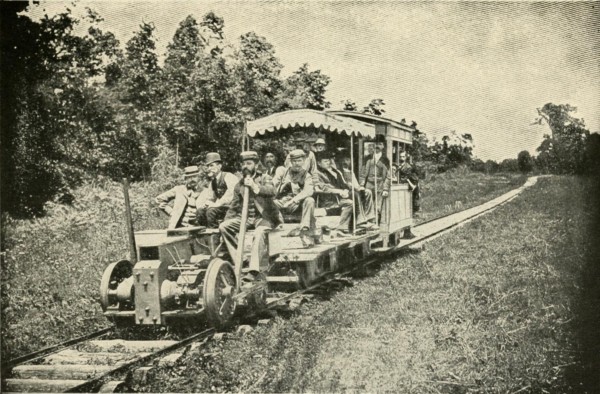
THE EDISON ELECTRIC RAILWAY AT MENLO PARK—1880
On May 13, 1880, this road went into operation. All the laboratory "boys" made holiday and scrambled aboard for a trip. Things went well for a while, but presently a weakness developed and it became necessary to return the locomotive to the shop to make changes in the mechanism. And so it was for a short time afterward. Imperfections of one kind and another were disclosed as the road was operated, but Edison was equal to the occasion and overcame them, one by one. Before long he had his locomotive running regularly, hauling the three cars with freight and passengers back and forth over the full length of the track. Incidentally, the writer remembers enjoying a ride over the road one summer afternoon.
The details of the various improvements made during these months are too many and too technical to be given here. It is a fact, however, that at this time Edison was doing some heavy electric railway engineering, each improvement representing a step which advanced the art toward the perfection it has reached in these modern days.
The newspapers and technical journals lost no time in publishing accounts of this electric railroad, and once again Menlo Park received great numbers of visitors, including many railroad men, who came to see and test this new method of locomotion.
Of course, in operating this early road there were a few mishaps, fortunately none of them of a serious nature. In the correspondence of the late Grosvenor P. Lowry, a friend and legal adviser of Mr. Edison, is a letter dated June 5, 1880, giving an account of one experience. The letter reads as follows: "Goddard and I have spent a part of the day at Menlo, and all is glorious. I have ridden at forty miles an hour on Mr. Edison's electric railway—and we ran off the track. I protested at the rate of speed over the sharp curves, designed to show the power of the engine, but Edison said they had done it often. Finally, when the last trip was to be taken, I said I did not like it, but would go along. The train jumped the track on a short curve, throwing Kruesi, who was driving the engine, with his face down in the dirt, and another man in a comical somersault through some underbrush. Edison was off in a minute, jumping and laughing, and declaring it a most beautiful accident. Kruesi got up, his face bleeding, and a good deal shaken; and I shall never forget the expression of voice and face in which he said, with some foreign accent: 'Oh yes! pairfeckly safe.' Fortunately no other hurts were suffered, and in a few minutes we had the train on the track and running again."
This first electric railway was continued in operation right along through 1881. In the fall of that year Edison was requested by the late Mr. Henry Villard to build a longer road at Menlo Park, equipped with more powerful locomotives, to demonstrate the feasibility of putting electric railroads in the Western wheat country.
Work was commenced at once, and early in 1882 the road and its equipment were finished. It was three miles long, and had sidings, turn-tables, freight platform and car-house. It was much more complete and substantial than the first railroad. There were two locomotives, one for freight and the other for passenger service.
The passenger locomotive was very speedy and hauled as many as ninety persons at a time. Many thousands of passengers traveled over the road during 1882. The freight locomotive was not so speedy, but could pull heavy trains at a good speed. Taken altogether, this early electric railway made a great advance toward modern practice as its exists to-day.
There are many interesting stories of the railway period at Menlo Park. One of them, as told by the late Charles T. Hughes, who worked with Edison on the experimental roads, is as follows: "Mr. Villard sent J. C. Henderson, one of his mechanical engineers, to see the road when it was in operation, and we went down one day—Edison, Henderson, and I—and went on the locomotive. Edison ran it, and just after we started there was a trestle sixty feet long and seven feet deep, and Edison put on all the power. When we went over it we must have been going forty miles an hour, and I could see the perspiration come out on Henderson. After we got over the trestle and started on down the track Henderson said: 'When we go back I will walk. If there is any more of that kind of running I won't be in it myself.'"
The young reader, who is now living in an age in which the electric railway is regarded as a matter of course, will find it difficult to comprehend that there should ever have been any doubt on the part of engineering experts as to the practicability of electric railroads. But in the days of which we are writing such was the case, as the following remarks of Mr. Edison will show: "At one time Mr. Villard got the idea that he would run the mountain division of the Northern Pacific Railroad by electricity. He asked me if it could be done. I said: 'Certainly; it is too easy for me to undertake; let some one else do it.' He said: 'I want you to tackle the problem,' and he insisted on it. So I got up a scheme of a third rail and shoe and erected it in my yard here in Orange. When I got it all ready he had all his division engineers come on to New York, and they came over here. I showed them my plans, and the unanimous decision of the engineers was that it was absolutely and utterly impracticable. That system is on the New York Central now, and was also used on the New Haven road in its first work with electricity."
Mr. Edison knew at the time that these engineers were wrong. They were prejudiced and lacking in foresight, and had no faith in electric railroading. Indeed, these particular engineers were not by any means the only persons who could see no future for electric methods of transportation. Their doubts were shared by capitalists and others, and it was not until several years afterward that the business of electrifying street railroads was commenced in real earnest.
In the mean time, however, Edison's faith did not waver, and he continued his work on electric railways, making innumerable experiments and taking out a great many patents, including a far-sighted one covering a sliding contact in a slot. This principle and many of those covered by his earlier work are in use to-day on the street railways in large cities.
The early railroad at Menlo Park has gone to ruin and decay, but the crude locomotive built by Edison has become the property of the Pratt Institute, of Brooklyn, New York, to whose students it is a constant example and incentive.
Down to the present moment Edison has kept up an active interest in transportation problems. His latest work has been in the line of operating street-cars with his improved storage battery. During the time that this book has been in course of preparation he has given a great deal of time to this question.
Some years ago there were a number of street-cars in various cities operated by storage batteries of a class entirely different from the battery invented by Edison. We refer to storage batteries containing lead and sulphuric acid. These were found to be so costly to operate and maintain that their use was abandoned.
Mr. Edison's new nickel and iron storage battery with alkaline solution has been found by practical use to be entirely satisfactory for operating street-cars, not only at a low cost, but also with ease of operation and at a trifling expense for maintenance. Of course there have been many problems, but he has surmounted the principal difficulties, and there are now quite a number of street-cars operated by his storage battery in various cities. These cars are earning profits and their number is steadily increasing.
XVIII GRINDING MOUNTAINS TO DUST
On walking along the sea-shore the reader may have noticed occasional streaks or patches of bluish-black sand, somewhat like gunpowder in appearance. It is carried up from the bed of the sea and deposited by the waves on the shore to a greater or lesser extent on many beaches.
If a magnet be brought near to this "black sand" the particles will be immediately attracted to it, just as iron filings would be in such a case. As a matter of fact, these particles of black sand are grains of finely divided magnetic iron in a very pure state.
Now, if we should take a piece of magnetic iron ore in the form of a rock and grind it to powder the particles of iron could be separated from the ground-up mass by drawing them out with a magnet, just as they could be drawn out of a heap of seashore sand. If all the grains of iron were thus separated and put together, or concentrated, they would be called concentrates.
During the last century a great many experimenters besides Edison attempted to perfect various cheap methods of magnetically separating iron ores, but until he took up the work on a large scale no one seems to have realized the real meaning of the tremendous problems involved.
The beginning of this work on the part of Edison was his invention in 1880 of a peculiar form of magnetic separator. It consisted of a suspended V-shaped hopper with an adjustable slit along the pointed end. A long electromagnet was placed, edgewise, a little below the hopper, and a bin with a dividing partition in the center was placed on the floor below.
Crushed ore, or sand, was placed in the hopper. If there was no magnetism this fine material would flow down in a straight line past the magnet and fill the bin on one side of the partition. If, however, the magnet were active the particles of iron would be attracted out of the line of the falling material, but their weight would carry them beyond the magnet and they would fall to the other side of the partition. Thus, the material would be separated, the grains of iron going to one side and the grains of rock or sand to the other side.
This separator, as afterward modified, was the basis of a colossal enterprise conducted by Mr. Edison, as we shall presently relate. But first let us glance at an early experiment on the Atlantic seashore in 1881, as mentioned by him. He says:
"Some years ago I heard one day that down at Quogue, Long Island, there were immense deposits of black magnetic sand. This would be very valuable if the iron could be separated from the sand. So I went down to Quogue with one of my assistants and saw there for miles large beds of black sand on the beach in layers from one to six inches thick—hundreds of thousands of tons. My first thought was that it would be a very easy matter to concentrate this, and I found I could sell the stuff at a good price. I put up a small magnetic separating plant, but just as I got it started a tremendous storm came up, and every bit of that black sand went out to sea. During the twenty-eight years that have intervened it has never come back."
In the same year a similar separating plant was put up and worked on the Rhode Island shore by the writer under Mr. Edison's direction. More than one thousand tons of concentrated iron ore of fine quality were separated from sea-shore sand and sold. It was found, however, that it could not be successfully used on account of being so finely divided. Had this occurred a few years later, when Edison invented a system of putting this fine ore into briquettes, that part of the story might have been different.
Magnetic separation of ores was allowed to rest for many years after this, so far as Edison was concerned. He was intensely busy on the electric light, electric railway, and other similar problems until 1888, and then undertook the perfecting and manufacturing of his improved phonograph, and other matters. Somewhere about 1890, however, he again took up the subject of ore-separation.
For some years previous to that time the Eastern iron-mills had been suffering because of the scarcity of low-priced high-grade ores. If low-grade ores could be crushed and the iron therein concentrated and sold at a reasonable price the furnaces would be benefited. Edison decided, after mature deliberation, that if these low-grade ores were magnetically separated on a colossal scale at a low cost the furnace-men could be supplied with the much-desired high quality of iron ore at a price which would be practicable.
He appreciated the fact that it was a serious and gigantic problem, but was fully satisfied that he could solve it. He first planned a great magnetic survey of the East, with the object of locating large bodies of magnetic iron ore. This survey was the greatest and most comprehensive of the kind ever made. With a peculiarly sensitive magnetic needle to indicate the presence of magnetic ore in the earth, he sent out men who made a survey of twenty-five miles across country, all the way from lower Canada to North Carolina.
Edison says: "The amount of ore disclosed by this survey was simply fabulous. How much so may be judged from the fact that in the three thousand acres immediately surrounding the mills that I afterward established at Edison, New Jersey, there were over two hundred million tons of low-grade ore. I also secured sixteen thousand acres in which the deposit was proportionately as large. These few acres alone contained sufficient ore to supply the whole United States iron trade, including exports, for seventy years."
Given a mountain of rock containing only one-fifth to one-fourth magnetic iron, the broad problem confronting Edison resolved itself into three distinct parts—first, to tear down the mountain bodily and grind it to powder; second, to extract from this powder the particles of iron mingled in its mass; and third, to accomplish these results at a cost sufficiently low to give the product a commercial value.
From the start Edison realized that in order to carry out this program there would have to be automatic and continuous treatment of the material, and that he would have to make the fullest possible use of natural forces, such as gravity and momentum. The carrying out of these principles and ideas gave rise to some of the most brilliant engineering work that has ever been done by Edison. During this period he also made many important inventions, of which several will now be mentioned.
As he proposed to treat enormous masses of material, one of the chief things to be done was to provide for breaking the rock and crushing it to powder rapidly and cheaply. After some experimenting, he found there was no machinery to be bought that would do the work as it must be done. He was therefore compelled to invent a series of machines for the purpose.
The first of these was an invention quite characteristic of Edison's daring and boldness. It embraced a gigantic piece of mechanism, called the "Giant Rolls," which was designed to break up pieces of rock that might be as large as an ordinary upright piano, and weighing as much as eight tons.
A pair of iron cylinders five feet long and six feet in diameter, covered with steel knobs, were set fifteen inches apart in a massive frame. The rolls weighed about seventy tons. By means of a steam engine these rolls were revolved in opposite directions until they attained a peripheral speed of about a mile a minute. Then the rocks were dumped into a hopper which guided them between the rolls, and in a few seconds, with a thunderous noise, they were reduced to pieces about the size of a man's head. The belts were released by means of slipping friction clutches when the load was thrown on the rolls, the breaking of the rocks being accomplished by momentum and kinetic energy.
The broken rock then passed through similar rolls of a lesser size, by means of which it was reduced to much smaller pieces. These in their turn passed through a series of other machines in which they were crushed to fine powder. Here again Edison made another remarkable invention, called the "Three-High Rolls," for reducing the rock to fine powder. The best crushers he had been able to buy had an efficiency of only eighteen per cent, and a loss by friction of eighty-two per cent. By his invention he reversed these figures and obtained a working efficiency of eighty-four per cent, and reduced the loss to sixteen per cent.
The problems of drying and screening the broken and crushed material were also solved most ingeniously by Edison's inventive skill and engineering ability, and always with the idea and purpose in mind of accomplishing these results by availing himself to the utmost of one of the great forces of Nature—gravity.
The great extent of the concentrating works may be imagined when we state that two hundred and fifty tons of material per hour could be treated. Altogether, there were about four hundred and eighty immense magnetic separators in the plant, through which this crushed rock passed after going through the numerous crushing, drying, and screening processes.
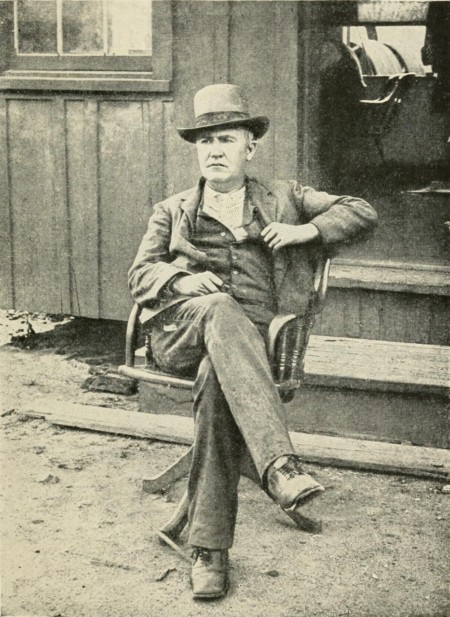
EDISON AT THE OFFICE DOOR OF THE ORE-CONCENTRATING PLANT AT EDISON, NEW JERSEY, IN THE 'NINETIES
If it had been necessary to transfer this tremendous quantity of material from place to place by hand the cost would have been too great. Edison, therefore, designed an original and ingenious system of mechanical belt conveyors that would automatically receive and discharge their loads at appointed places in the works, covering about a mile in transit. They went up and down, winding in and out, turning corners, delivering material from one bin to another, making a number of loops in the drying-oven, filling up bins, and passing on to the next one when full. In fact, these conveyors in automatic action seemed to play their part with human intelligence.
We have been able to take only a passing glance at the great results achieved by Edison in his nine years' work on this remarkable plant—a work deserving of most serious study. The story would be incomplete, however, if we did not mention his labors on putting the fine ore in the form of solid briquettes.
When the separated iron was first put on the market it was found that it could not be used in that form in the furnaces. Edison was therefore obliged to devise some other means to make it available. After a long series of experiments he found a way of putting it into the form of small, solid briquettes. These answered the purpose exactly.
This called for a line of new machinery, which he had to invent to carry out the plan. When this was completed, the great rocks went in at one end of the works and a stream of briquettes poured out of the other end, being made by each briquetting machine at the rate of sixty per minute.
Thus, with never-failing persistence, infinite patience, intense thought and hard work, Edison met and conquered, one by one, the difficulties that had confronted him. Furnace trials of his briquettes proved that they were even better than had been anticipated. He had received some large orders for them and was shipping them regularly. Everything was bright and promising, when there came a fatal blow.
The discovery of rich Bessemer ore in the Mesaba range of mountains in Minnesota a few years before had been followed by the opening of the mines there about this time. As this rich ore could be sold for three dollars and fifty cents per ton, as against six dollars and fifty cents per ton for Edison's briquettes, his great enterprise must be abandoned at the very moment of success.
It was a sad blow to Edison's hopes. He had spent nine years of hard work and about two millions of his own money in the great work that had thus been brought to nought through no fault of his. The project had lain close to his heart and ambition, indeed he had put aside almost all other work and inventions for a while.
For five of the nine years he had lived and worked steadily at Edison (the name of the place where the works were located), leaving there only on Saturday night to spend Sunday at his home in Orange, and returning to the plant by an early train on Monday morning. Life at Edison was of the simple kind—work, meals, and a few hours' sleep day by day, but Mr. Edison often says he never felt better than he did during those five years.
After careful investigations and calculations it was decided to close the plant. Mr. W. S. Mallory, his close associate during those years of the concentrating work, says: "The plant was heavily in debt, and, as Mr. Edison and I rode on the train to Orange, plans were discussed as to how to make enough money to pay off the debt. Mr. Edison stated most positively that no company with which he had been personally actively connected had ever failed to pay its debts, and he did not propose to have the concentrating company any exception.
"We figured carefully over the probabilities of financial returns from the phonograph works and other enterprises, and, after discussing many plans, it was finally decided that we would apply the knowledge we had gained in the concentrating plant to building a plant for manufacturing Portland cement, and that Mr. Edison would devote his attention to the developing of a storage battery which did not use lead and sulphuric acid.
"He started in with the maximum amount of enthusiasm and ambition, and in the course of about three years we succeeded in paying off the indebtedness of the concentrating works.
"As to the state of Mr. Edison's mind when the final decision was reached to close down, if he was specially disappointed there was nothing in his manner to indicate it, his every thought being for the future."
In this attitude we find a true revelation of one conspicuous trait in Mr. Edison. No one ever cried less over spilled milk than he. He had spent a fortune and had devoted nine years of his life to the most intense thought and labor in the creation and development of this vast enterprise. He had made many remarkable inventions and had achieved a very great success, only to see the splendid results swept away in a moment. He did not sit down and bewail his lot, but with true philosophy and greatness of mind applied himself with characteristic energy to new work through which he might be able to open up a more promising future.
XIX EDISON MAKES PORTLAND CEMENT
Long before Edison ever thought of going into the manufacture of cement he had very pronounced opinions of its value for building purposes. More than twenty-five years ago, during a discussion on ancient buildings, he remarked: "Wood will rot, stone will chip and crumble, bricks disintegrate, but a cement and iron structure is apparently indestructible. Look at some of the old Roman baths. They are as solid as when they were built."
With such convictions, and the vast fund of practical knowledge and experience he had gained at Edison in the crushing and handling of enormous masses of finely divided material, it is not surprising that he should have decided to engage in the manufacture of cement.
He was fully aware of the fact that he was proposing to "butt into" an old-established industry, in which the principal manufacturers were concerns which had been in business for a long time. He knew there were great problems to be solved, both in manufacturing and selling the cement. These difficulties, however, only made the proposition more inviting to him.
Edison followed his usual course of reading up all the literature on the subject that he could find, and seeking information from all quarters. After thorough study he came to the conclusion that with his improved methods of handling finely crushed material, and with some new inventions and processes he had in mind, he could go into the cement business and succeed in making a finer quality of product. As we shall see later, he "made good."
This study of the cement proposition took place during the first few months of his experimenting on a new storage battery. In the mean time Mr. Mallory had been busy arranging for the formation of a company with the necessary money to commence and carry on the business. One day he went to the laboratory and told Mr. Edison that everything was ready and that it was now time to engage engineers to lay out the works.
To this Edison replied that he intended to do that himself, and invited Mr. Mallory to go with him to one of the draughting-rooms up-stairs. Here Edison placed a sheet of paper on a draughting-table and immediately began to draw out a plan of the proposed works. He continued all day and away into the evening, when he finished; thus completing within twenty-four hours the full lay-out of the entire plant as it was subsequently installed. If the plant were to be rebuilt to-day no vital change would be necessary.
It will be granted that this was a remarkable engineering feat, for Edison was then a newcomer in the cement business. But in that one day's planning everything was considered and provided for, including crushing, mixing, weighing, grinding, drying screening, sizing, burning, packing, storing, and other processes.
From one end to the other the cement plant is about half a mile long, and through the various buildings there passes, automatically, each day a vast quantity of material under treatment. In practice this results in the production of more than two and a quarter million pounds of finished cement every twenty-four hours.
Not only was all this provided for in that one day's designing, but also smaller details, such, for instance, as the carrying of all steam, water and air pipes and electrical conductors in a large subway extending from one end of the plant to the other; also a system by which the ten thousand bearings in the plant are oiled automatically, requiring the services of only two men for the entire work.
Following this general outline plan of the whole plant by Edison himself there came the preparation of the detail plans by his engineers. As the manufacture of cement also involves the breaking and grinding of rocks, the scheme, of course, included using the giant rolls and other crushing, drying, and screening machinery invented by him for the iron-concentrating work, as mentioned in our last chapter.
No magnetic separator is necessary in cement-making, but there were other processes to provide for that did not occur in concentrating iron ore. One of them relates to burning the material, which is one of the most important processes in manufacturing cement.
Perhaps it may be well to state for the information of the reader that in cement-making, generally speaking, cement-rock and limestone in the rough are mixed together and ground to a fine powder. This powder is "burned" in a kiln and comes out in the form of balls, called "clinker." This again is crushed to a fine powder, which is the cement of commerce.
It will be seen, therefore, that the quantity of finished cement produced depends largely upon the capacity of the kilns. When Edison first thought of going into cement-making he expected to use the old style of kilns, which were about sixty feet long and six feet in diameter, and had a capacity of turning out about two hundred barrels of clinker every twenty-four hours. He is never satisfied, however, to take the experience of others as final, and thought he could improve on what had been done before.
He discussed the project with Mr. Mallory, who says: "After having gone over this matter several times, Mr. Edison said, 'I believe I can make a kiln which will give an output of one thousand barrels in twenty-four hours.' Although I had then been closely associated with him for ten years and was accustomed to see him accomplish great things, I could not help feeling the improbability of his being able to jump into an old-established industry—as a novice—and start by improving the 'heart' of the production so as to increase its capacity four hundred per cent. But Mr. Edison went to work immediately and very soon completed the design of a new type of kiln which was to be one hundred and fifty feet long and nine feet in diameter, made up in ten-foot sections of cast iron bolted together and arranged to be revolved on fifteen bearings. He had a wooden model made, and studied it very carefully through a series of experiments. These resulted so satisfactorily that this form was finally decided upon, and ultimately installed as part of the plant.
"Well, for a year or so the kiln problem was a nightmare to me. We could only obtain four hundred barrels at first, but gradually crept up through a series of heart-breaking trials until we got over eleven hundred barrels a day. Mr. Edison never lost his confidence throughout the trials, but on receiving a disappointing report would order us to try it again."
Although the older cement manufacturers predicted utter failure, they have since recognized the success of Edison's long kiln, and it is now being used quite generally in the trade.
Another invention of minor nature but worthy of note relates to the weighing of the proportions of cement-rock and limestone. In most cases the measurement is usually by barrow loads, but Edison determined that it must be done accurately to the pound, and devised a means of doing it automatically, for, as he remarked, "The man at the scales might get to thinking of the other fellow's best girl, so fifty or a hundred pounds of rock, more or less, wouldn't make much difference to him."
With Edison's device the scales are set at certain weights and the materials are fed from hoppers. The moment the scale-beam tips an electrical connection automatically stops the feed and no more can be put on the scale until the load is withdrawn.
Another and important new feature introduced by Edison was in raising the standard of fine grinding of cement ten points above the regular standard of seventy-five per cent, through a two-hundred-mesh screen. By reason of the great improvement he had made in grinding machinery he could grind cement so that eighty-five per cent, passed through a two-hundred-mesh screen. As cement is valuable in proportion to its fineness, it will be seen that he has thus made an advance of great importance to the trade.