THE STORM-CHILD
Reading edition
There was tranquillity in the warm lodge of Waumdisapa, chief of the Tetons. It was always peaceful there for it is the duty of a head man to render his people harmonious and happy—but it was doubly tranquil on this midwinter day, for a mighty tumult had arisen in the tops of the tall willows, and across the grass of the bleak plain an icy dust was wildly sliding. Nearly all the men of the band were in camp, so fierce was the blast.
Waumdisapa listened tranquilly to the streams of snow lashing his tepee’s cap and felt it on his palm as it occasionally sifted down through the smoke-vent, and said, “The demons may howl and the white sands slide—my people are safe here behind the hills. With food and plenty of blankets we can wait.”
Hour by hour he smoked, or gravely meditated, his mind filled with the pursuits and dangers of the past. Now and again as an aged wrinkled warrior lifted the door-flap he was invited to enter to partake of tobacco and to talk of the gathering spirits of winter.
In a neighboring lodge the chief’s wife was at work beside her kettle singing a low song as she minded her fire, and through the roaring, whistling, moaning riot of the air-sprites other women could be heard cheerfully beating their way from fire to fire. A few hunters were still abroad, but no one was alarmed about them. The tempest was a subject of jest and comparison with other days. No one feared its grim power. Was it not a part of nature, an enemy always to be met!
Suddenly the sound of a moaning cry broke in upon the chief’s meditation. The tent-door was violently thrown up and with a hoarse wail, Oma, a young widow, entered the lodge, and threw herself before the feet of Waumdisapa. “My baby! My little boy is lost in the snow. O father, pity me—help me!”
Quickly the chief questioned her. “Where?”
“Out there!” she motioned with her hand—a wild gesture toward the bleak remorseless north. “I was with my brothers hunting the buffalo—the storm came on—my baby wandered away from the camp. We could not find him. They came away—taking me, too. They would not let me stay. Send hunters—find him. Take pity on me, my father!”
The chief turned to her brothers (who had followed her and were looking on with sad faces) and said, “Is this true?”
“It is!” they said. “We were in temporary camp. We were resting. The tempest leaped upon us. All was in confusion. The baby wandered away—the snow must have covered him quickly. We could not find him though we searched hard and long. The storm grew. Some of us came on to bring the women and children to camp. Three of us, my brothers and I, remained to look for the boy. We could not find him. He is buried deep in the snow.”
The chief, touched by the woman’s agony, rose in reproof. “Go back!” he said, sternly. “Take other of the young men. Cover every foot of ground near your camp.”
“The night is coming.”
“No matter—search!” commanded the chief.
A party of braves was soon made up. As they rode away into the blast Oma wished to go with them, but the chief prevented her.
All the afternoon she remained in the chief’s lodge crowding close to his feet—listening, moaning, waiting. She was weak with hunger, and shivering with cold, but she would not eat, would not go to her silent and lonely fireplace.
“No, no, father, I will stay with you,” she said.
Swiftly the darkness fell upon the camp. The cold intensified. The tempest increased in violence, howling above the willows like an army of flying demons. The snows beat upon the stout skins of the lodges and fell in heaps which grew ever higher, but the mothers of the camp came one by one, young and old, to comfort the stricken one, speaking words of cheer.
“They will bring him.”
“The brave hunters will find your boy.”
“They know no fear.”
“They have sharp eyes.”
“Their hearts are warm.”
“They will rescue him.”
Nevertheless, two by two the hardy trailers returned, cold, weary, covered with ice, their faces sad, their eyes downcast. “Blackness is on the plain,” they reported. “Nothing moves but the snow. We have searched hard. We have called, we have listened close, no voice replies. Nothing is to be seen, or heard.”
With each returning unsuccessful scout the mother’s grief and despair deepened. Heartbroken, she lay prone on the ground, her face in the dust, while the sorrowful songs of the women went on around her. Truly hers was a piteous plight.
“To lose one’s only child is sad. She has no man. She is alone.”
“The sun-god has forsaken her,” said one old woman. “He is angry. She has neglected some sacrifice.”
At last Hacone, the bravest, most persistent scout of all, one who loved Oma, came silently in and dropped exhausted beside the chieftain’s fire.
“Night, black stranger, has come,” he said, “I can search no longer. Twice I lost my way, twice my horse fell. Blinding was the wind. My breath was taken. Long I looked for the camp. The signal fires guided me. Dead is the child.”
With a whimper of anguish the poor mother fell back upon the floor and lay as one dead, hearing no sound. All night long her low moans went on—and the women who lifted and bore her away sang songs of grief with intent to teach her that sorrow was the lot of all women and that happiness was but a brief spot of sunlight in a world of shadow.
II
The morning broke at last, still, cold, clear, and serene. The tall trees stood motionless to the tips as though congealed into iron, and the smoke of each fire rose slow as though afraid to leave the tepee’s mouth. Here and there an old woman scurried about bearing fuel. The dogs slunk through the camp whining with cold—holding up their half-frozen feet. The horses uneasily circled, brushing close against each other for warmth. Indeed it was a morning of merciless cruelty—the plain was a measureless realm of frost.
In Oma’s tent physical agony was added to grief, or so it seemed, but in truth the mother knew only sorrow. She was too deeply schooled by the terrors of the plains not to know how surely the work of the winter demon had been done. Somewhere out there her sweet little babe was lying stiff and stark in his icy bed—somewhere on the savage and relentless upland his small limbs were at the mercy of the cold.
One by one her friends reassembled to help her bear her loss—eager to offer food, quick to rebuild her fire—but she would not listen, could not face the cheerful flame. Meat and the glow of embers were of no avail to revive her frozen, hopeless heart.
The chief himself came at last to see her—to inquire again minutely of her loss. “We will seek further,” he said. “We will find the boy. We will bring him to you. Be patient.”
Suddenly a shout arose. “A white man! a white man!” and the warning cry carried forward from lip to lip announced the news to Waumdisapa.
“A white man comes—riding a pony and bearing something in his arms. He is within the camp circle!”
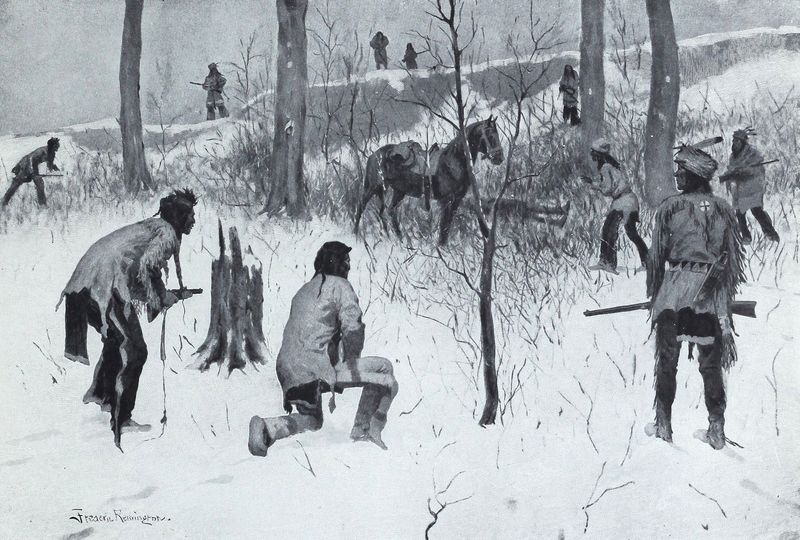
Footprints in the Snow
To an old hunter, footprints in the snow are as an open book, and it was by these “signs” on the trail that the buffalo hunters knew the Sioux had crawled in upon the dispatch-bearer as he rested in a timbered bottom and poured in the bullets that put an end to his career. To the trooper, the plains white with snow had seemed lonely indeed, but, as he well knew, one could not, in those days, trust the plains to be as lonely as they looked, what with the possibility of Mr. Sitting Bull or Mr. Crazy Horse, with a band of his braves, popping out of some coulee, intent upon taking the scalp of any chance wayfarer.
Illustration from
WHEN A DOCUMENT IS OFFICIAL
by
Frederic Remington
Originally published in
Harper’s Magazine
,
September, 1899
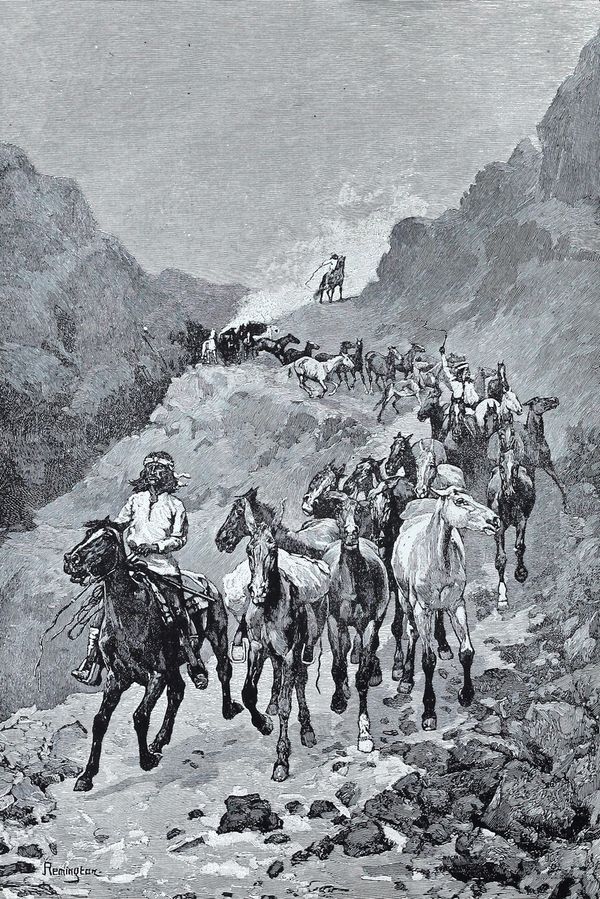
Geronimo and His Band Returning from a Raid in Mexico
Leaving their reservation under such leaders as Geronimo, the Apache Indians, in the period 1882-86, used to take refuge in the Sierra Madre Mountains, and from this stronghold raid the settlements in Mexico and Arizona.
Illustration from
BORDER TROUBLES
by
William M. Edwardy
Originally published in
Harper’s Weekly
,
August 18, 1888
“Bring him to me!” commanded Waumdisapa. “I will know his errand.”
To all this Oma paid little heed. What to her was any living creatures now that she was utterly bereaved?
But the wail of a child pierced her heart and she sprang up, listened intently, just as a smiling young white man, carrying a bundle in his arms, entered the door and nodding carelessly to the chief, said in Sioux, “Here’s a little chap I found in the snow last night. I reckon it belongs here.”
The frenzied mother leaped toward him and snatched the babe from his arms. Her cry of joy was sweet to hear, and as she cuddled the baby close, the hunter’s brown face grew very tender—though he laughed.
“I reckon that youngster’s gone to the right spot, chief. I thought he belonged to your band.”
Then Waumdisapa shook him by the hand and commanded him to sit. “Go shelter the white man’s horse,” he said, to his people, “and let a feast be cried, for the lost child is found. This warm-hearted stranger has brought the dead to life, and we are all glad.”
The hunter laughed in some dismay, and put away the food which the women began to press upon him. “I must go, chief. My people wait. I do not deserve this fuss.”
“I will send a messenger to say you are here. They shall also come to our feast.”
“They may kill your messenger for we are at war.”
The chief considered. “Write large on a piece of paper. Say that we are at war no more. This deed has made us friends. You are one of us—we will honor you. We cannot let you go. See the mother’s joy? She wishes to thank you!”
It was true. Oma, holding her child in her arms, was kneeling before the young hunter, her face upturned in gratitude. She caught his hand and kissed it, pressing it to her cheek.
“You are a good man. You have a brave warm heart. You have restored my child. I love you. I will love all white people hereafter. Stay and feast with us for I am very happy.”
Flushed with embarrassment the young man shrank away. “Don’t do that! I have done very little. Any white man would have acted the same.”
But the people of the snow would not have it so. Smilingly they laid hands upon him and would not let him go. “No, you must remain and dance with us. We will send for your companions—we will write a new treaty of peace. Our gratitude shall make us brothers.”
Like a flower that springs up in the wet grass after a rain the mother’s head lifted and her face shone with joy. The child was untouched of frost, not even a toe had been pinched, and he fell asleep again as soon as he was fed. Then Oma laid him down and came to flutter about his rescuer with gestures of timid worship. She smiled with such radiance that the young man wondered at the change in her, and her ecstasy awoke his pity. Then the chief said:
“See! Oma is a widow. She already loves you. Stay with us and take her to wife.”
Then the youth grew more uneasy than ever and with hesitation said: “No, chief, I can’t do that—far away among the white villagers is a girl who is to be my wife. I cannot marry anyone else. I have made a vow.”
The gentle old chief did not persist, but the women perceived how Oma’s gratitude grew and one of them took the hunter by the sleeve and while Oma stood before him in confusion said: “See! You have made her very happy. She desires to show you how much she owes to you—stay and be happy.”
He shook them off, but in no unkindly way. “No,” he repeated. “I must go,” and stepped toward the door of the lodge, strangely moved by the passion of this primitive scene. These grateful women moved him but he looked not back.
Waumdisapa followed him. “Friend, tell me your name.”
“Your people call me ‘Blazing Hand,’” returned the young man.
“Hah!” shouted the chief in surprise. “Blazing Hand! you are much admired among my men. You are swift to shoot.”
Blazing Hand! The name ran from lip to lip, for they had all heard of this reckless and remorseless young outlaw. More eagerly than ever they crowded to see him—but the chief after a moment regained his calm dignity of manner. “Blazing Hand, you have befriended my people before. Now we are doubly anxious to have you remain with us....”
The young man lifted the door-flap. “Addios,” he said, fixing his eyes on Oma.
She plucked her child from its bed and ran toward him. “I have heard your name. It shall remain in my ears while I live and I will teach my child that he may say it after I am dead.”
Waumdisapa called to his scouts: “See that this man is guided safely to his fellows. And let no one molest him. Henceforth we are brothers. He and his may hunt and trap where they choose on Teton land.”
The light was gray on the face of Oma as the stranger rode away—but the voice of her babe comforted her. Her smile came back and she said: “Perhaps the kind hunter will return. The face of Blazing Hand will live forever in my heart.”
THE BLOOD LUST