THE SILENT EATERS (continued 3)
Reading edition
They were dancing in a great circle, some sixty men and women, their hands interlacing, their eyes on the ground. Each dancer wore a plain buckskin shirt without ornament. No one carried a weapon of any kind. They had deliberately gone far back of the white man, discarding all things on which his desolating hand had been laid. On each head (even of the women) waved an eagle plume, the sacred feather, and all were painted with a red paint, which the Mato had brought with him—a sacred paint he called it. Around them were many others, watching, and here and there on the ground lay those who were entranced.
Just as I came up the song ended and Mato, who stood in the circle, lifted a peculiar wand in his hand and cried out like a priest: “Think hard only of that which you wish to see in your sleep, and it will be given to you. The old shall be young and the sick shall be made well. Put away all anger and hatred and turn your thoughts to the Messiah in the west who listens to all his children.”
Then some one started another song and they began again to dance. I looked for the chief, and saw him sitting in the shadow of a small tree close to the circle of dancers. My father, Slohan, Circling Hawk, and another whom I do not recall, sat with him. They were all very grave and very intent. They hardly saw me and my task grew heavy and hard.
I motioned to my father and he came out, and I said: “I am from the agency. I am hungry and so is my horse.”
He sent a boy with my pony and took me to his tepee near by, and there I ate some bread and meat in silence. When I had finished I began: “Father, I have come to stop the dance and to put the priest away.”
My father looked troubled. “Do you come from the agent?”
“Yes, he has heard of the dance and his orders are to stop it.”
“My son, all that is bad. It makes my heart sore. Do not speak to the chief now. Wait till evening, when he is weary. The agent is wrong. There is no harm in this dance. Has not the Messiah said, ‘Do not strike anyone; leave all punishment to the Great Spirit?’ Go back and tell the agent there is no harm in it.”
I did not listen well, for the song outside was wilder and sadder each moment. They were dancing very fast now, and the ground, bare and very dry, had been tramped into dust, fine as flour, and this rose from under their feet like smoke, half concealing those on the leeward side. All were singing a piteous song of entreaty. The women’s voices especially pierced me with their note of agonized appeal. It was a song to make me shudder—the voice of a dying people crying out for life and pleading for the return of the happy past. I could not understand how the white men could listen to it and not be made gentle.
The chief gazed intently at the circle. He seemed waiting in rigid expectancy, his face deeply lined and very sad. He looked like one threescore and ten sitting so. It was plain that he did not yet permit himself to believe in the message. He, too, felt the pain and weariness of the world, but still he could not join in the song. His mind was too clear and strong to be easily confused.
The interest was now very great. Waves of excitement seemed to run over the circle and those who watched. Shouts mingled with the singing. The principal song, which they repeated endlessly, was the Messiah’s promise of eternal life:
“There the Father comes, There the Father comes, Speaking as he flies. Calling, as he comes, this joyous word, ‘You shall live again,’ he calls, ‘You shall live beyond the grave,’ He is calling as he comes.”
Many did not sing; they only cried out for help, entreating to be shown those who had died. “Oh, hear me! Great Spirit, let me see my little one—my boy; let me hear his voice,” pleaded one woman, and her voice shook me till my hair moved as if a spirit passed.
Some of the women’s faces were distorted with grief, and a kind of nervous action which they could not control seized upon them. One by one as they began to show this tension, Mato and his helpers confronted them, waving before their eyes a feather on a wand and uttering a hoarse chant, monotonous and rapid, “Ha—ha—ha—ha—ha—hah!” until the frenzied one, convulsed and dreaming, fell into the ring and lay stiff and stark in the dirt.
But the ring did not halt. The fall of each new convert seemed to add new vigor to the song, for each hoped to be the next one smitten. Suddenly Shato, dropping the hands of those dancing near him, flung his hands to the sky with a gesture as if he would tear the sun from its place. The hooked intensity of his fingers was terrible to see. He remained fixed in that way, rigid as iron, yet standing on his feet firm as an oak. No one touched him; on the contrary, all were careful not to disturb those who were in trance. Another man stood at bay, buffeting the dancers to keep them from trampling upon his wife, who, being sick of some wasting disease, had joined the circle, seeking health of the Great Spirit.
As I looked my heart contracted. It seemed that I was looking upon the actual dissolution—the death pangs—of my race. My learning was for the moment of no avail. I shook like a reed in the gust of this primeval passion. Was it insanity or was it some inexplicable divine force capable in very truth of uniting the quick and the dead in one convulsive, rapturous coalition?
A thrill of momentary belief swept over me. Was it not better to end it all, to die and go with all my people to the happy hunting grounds! The white man’s world, what was it but a world of care and grief?
The songs continued, but they grew quieter. Several of those who called loudest now lay silent in the dust. Those who circled and sang were keener of eye and calmer of feature. These were they who reasoned, and to them the trance could not come. I began to see that those who had taken on the dream were not the most intelligent but the most emotional men and women of my tribe, those who were weakened by the loss of dear ones.
The song was no longer a cry—it had beautiful words. It grew more joyous:
“Do you see the world a-coming? A new serener world is near. The eagle brings the message to our tribe. Thus the Father sayeth. Covering all the plain they come, The Buffalo and elk and deer. The crow has brought the message to the tribe. Thus the Father sayeth, Thus he gives us cheer.”
At the end of this song, four times repeated, the dancers unclasped hands and sat down on the earth. As they did this the chief arose and, stepping into the circle, took a seat near Mato, who arose and, lifting his hands to the west, again prayed silently for a moment, then said:
“My friends, you see the words of the Messiah are true words. Many are asleep. They will return soon and tell us of their good journey to the spirit world. Ever since the Messiah talked to me I have thought upon what he said and I see only good in it. It is a sweet religion. The white man’s religion is not for us. Its words are all strange. It deals with unknown animals and tells of far-off countries. The names of the chiefs we do not understand, but this new religion all can understand. It is filled with familiar words. It is for us. Our Messiah has told us that all our dead are to come back to the earth, and as the earth is too small for such a throng he must remove the white man. He will also bring heaven down to make the world wider, and then all the red men will be able to dwell together in friendship. There will be no more war, only hunting and feasting and games. This good world will come to us if we do as he commands.”
At this moment Chasing Hawk, who acted as usher, brought to the circle a woman who had just wakened out of a trance. Her face was shining with happiness, but her tongue was thick, she could barely make herself heard. As she spoke the chief listened intently.
“What did you see?” asked Mato.
“I saw my little one,” she replied.
“Where was he? What was he doing?”
“He was playing in the grass, in a beautiful country. My grandmother was near, cooking for him.”
Mato called her answers aloud to all who listened, and everyone crowded near to hear the glories of the land from which her spirit had returned. Cries of joy arose in swift echo of the priest’s shouting, but the chief’s face remained gravely meditative.
When this woman was led away Eagle Holder, another dreamer, came into the circle, one who needed no crier. He was a proud orator. Reaching out his hand in a gesture of exultation, he cried:
“In my sleep I saw a vast eagle coming toward me. He came rushing; the noise of his wings was like a storm, his eyes were red like the moon at dusk. As he came near I caught him by the neck, and with a rush he carried me away.” Cries of astonishment broke forth. “He swept away with me high up and toward the east; the wind cried about my ears and for a time I could see nothing; all was mist. At last he began to circle and I looked away and I saw the new land of the Messiah.” (“Hah! Hah!” called the people.) “It was a prairie country” (the women began to sing) “with countless buffalo feeding” (“Ah! Ah!”) “and lakes with great white birds sailing about. On the bank of the lake was a circle of tepees and they were made of skins whitened by clay, and they were very large and clean and new. A hunting party was just riding forth; they were very happy and sang as they went.”
He paused abruptly, while the women wailed in rapture. At last he continued: “Then the eagle entered a cloud and I saw no more. I woke and found myself here on the ground.”
This story, magnificently told though it was, affected the hearers less than the shining, ecstatic face of the mother who had seen her spirit child. Her slow, dreamy utterance was more eloquent than the vivid gestures and musical voice of Eagle Holder.
One by one others awoke and told of meeting friends and revisiting old scenes. Some told of people they had never met in life, and minutely described lodges they had never entered. These stories awoke wild cries of amazement and joy. It was plain that many believed. I had not seen my people so happy since I was a child, before the battle of the Big Horn.
At last when all had spoken they arose and joined hands and began singing once more; then the chief rose and left the circle, and I, intercepting him, said: “Chief, I bring a message to you.” He made a motion which means follow, and I accompanied him to his tepee, which he loved because of its associations with old days, and to which he went for meditation and council.
It would be wrong if I did not confess that I knew the chief distrusted me, for he did. After I had taken my position under the agent he was less free to speak his mind to me, and this was a grief to me. My father saw us go and joined us, and I was glad of his presence. His kind old face made it easier for me to begin.
The chief took his seat at the back of the lodge and said: “Speak. I listen.”
“Sire,” I said, “the agent has heard bad things of this dance on other reservations, and some days ago he sent policemen down here to forbid it. He now hears it is still going on and he has sent me to say that Mato, the messenger, must go away and the dance must stop.”
I could see the veins of his neck fill with hot blood as he listened, and when I had finished he said: “Are we dogs to be silenced by kicking! You say to the agent that the white men have beaten us and left us naked of every good thing, but they shall not take away our religion. I will not obey this command! I have said it!”
Here my father broke in, saying to me: “You yourself have told me that you saw among the white people dreams like this. Why do they seek to prevent us? You have read us the white man’s sacred Big Book, and you say it is full of medicine dreams. Why should we not dream also?”
I then replied: “I do not come commanding these things. It is the agent who says them. Do not blame me.”
The chief, who had regained his composure, interposed quietly: “My son, you are right. We should not blame you, but the one who sent you. Therefore I say take these words to the agent: ‘I will not give up the dance.’”
In the hope of persuading him, I asked: “Do you believe in the dance?”
“I do not know,” he replied. “I am watching, I am listening. It is like the white man’s religion—very wonderful and very difficult to believe. I wish to try it and see. The white men are very wise, yet their preachers say that the sun stood still for Joshua, and Christ, their great Medicine Man, healed the lame and raised the dead.”
“But that was long ago,” I hastened to say.
“If such wonders happened then they can happen now,” he answered. Then he passionately broke forth: “I desire this new earth. My people are in despair, their hearts are utterly gone. We need help. My warriors will soon be like the Chinaman at the fort, fit only to wash windowpanes. Our rations are being cut off. What is there to look forward to? Nothing. I saw in the east many poor people. They worked very hard and wore ragged clothes. All were not rich and happy. Among the white men my people would be only other poor people, ragged and hungry, creeping about, eating scraps of food like hungry curs. I fear for them, therefore my ears are open to the words of this new religion which assures me that the old world—the world of my fathers—is to return. You say the agent is displeased. Is there anything I can do which does not displease him? The white men have their religion—they pray and sing. Why should not we sing if we have heart to do so? Go ask him if he is afraid that the Messiah has come of a truth, and that the white man is to be swept away.”
“He thinks it is a war dance,” I said. “He is afraid it will stir up strife.”
“Go tell him what you have seen. Say to him that it is a peaceful dance. There are no weapons here; there is no talk of fighting. It is a magical prayer. Mato says those who lie out there are with the spirits. You heard them tell what they saw. If these tales are true and if we could all be as they, then would the white man’s world indeed vanish like smoke and the pasture of the buffalo come again. It is strange—that I know—but the white man’s religion is also very hard to believe. The priest will tell you stories just as wonderful, and the preacher, too. Their Messiah was born in a stable among cattle; ours appears among the mountains. Their Christ rose from the dead. So does ours. Their Christ came to the poor people, so they say. Are we so despised of God that we cannot have our Messiah, too? I do not say all this is true, I only wish to test it and see.”
I could see that his clear mind could not accept the new religion, yet his heart desired it deeply. Once he had said: “I do not understand your Christ and his teaching. I must have time to think; I will not be pushed into it,” and as he had often reproved his people for saying yes to everything the white man said, so now he was equally cautious, only he was older, with a deeper longing to be comforted.
My task was only half completed and I said: “Chief, the agent told me to say to you, ‘Put Mato away.’ I beg you to come with me and meet the agent and explain to him the meaning of the dance, and then maybe he will not insist on this inhospitable thing.”
The chief’s face grew very stern. “The agent is a dog! He insults me. I will not see him! If he wishes to talk with me let him come here. I am waiting.”
My father made me a sign to go, and I went away. I could hear them conversing in low voices, but I could not understand what they said. At last my father called, and I went in again.
The chief looked less grim of lip and said to me, “Very well, Mato will go to-night.”
“Good,” I said. “At ten o’clock to-night Bull Head and I will come to take them across the river.”
My father and I went out and left him sitting alone.
When I returned at ten o’clock with Bull Head the chief’s lodge was filled with people. The women were weeping and the men were sullen. As I entered the tepee Mato was speaking. The chief sat smoking, with his eyes fixed on the floor. The priest was saying:
“You see how it is! The red man can keep nothing from the white man, who is jealous even of our religion. Washington would deprive us of our dreams. The agent is a wolf. Nevertheless, I will go, for my mission here is fulfilled. I have spoken the words of the Father; I have taught you the ceremonials. Henceforth you can test for yourself the truth of the word.” Then standing erect and in line the six messengers of the Messiah lifted the palms of their hands toward the west and prayed silently. A little later they began to sing this song:
“My children take this road, My children go this way, Says our Saviour. It is a goodly road, Says the Father; It leads to joyous lands, Says the Father.”
As they sang the people began to cry out, “Stay and tell us more,” but Mato led the way out of the lodge.
As I stood at the door, ready to follow him, the chief stood upon his feet, with a look on his face which silenced every one who saw it; it was fierce, yet it was exalted. Holding his pipe in his outstretched hands, his beloved pipe which he had carried since his first chieftainship, he said: “Here break I my peace pipe. If this religion is true then there is no more war. If it is not true, then I wish to die as a warrior dies, fighting!” With a gesture he snapped the stem in pieces. All the people cried out, and with a heart cold with fear I went forth into the night.
My chief’s last war with the white invader had begun.
XII THE CHIEF PROPOSES A TEST
Meanwhile the dance was going on not only among all the Sioux, but among the Cheyenne, Arapahoe, and Shoshone peoples, and the settlers of many states were greatly alarmed. They pretended to believe the ceremonial was warlike. They knew nothing of the songs or prayers. Cowboys, drunk and desiring a little amusement, raced into the border towns shouting, “The Sioux are on the warpath!” and whole settlements, frenzied with fear, fled to the east, crying loudly for the government to send troops. “Stop this outbreak,” became the demand.
All this pressure and excitement made our situation worse. Those who believed said, “You see how it is, the white people are afraid of our religion; they are seeking to prevent the coming of the new world”; and those reckless ones who were willing to fight cried out: “Make ready. Let us war!”
Letters and telegrams poured in upon the agent at the Standing Rock, asking for a true statement of affairs. To all these he replied, “There is no danger, these Indians are peaceful”; but he took occasion in his answers to defame my chief.
In this he overshot his mark, for in calling The Sitting Bull a man of no force, a liar, and a coward, he became unreasonable. To fear a man so small and mean was childish. He also misstated the religion of the dance. He sneered at my father and others as “Indians lately developed into medicine men,” and ended by saying, “The Sitting Bull is making rebellion among his people.” Forgetting all the favorable reports he had many times made of my chief, he falsely said, “The Sitting Bull has been a disturbing element ever since his return in 1883.”
What could such a man know of the despair into which my people had fallen? He was hard, unimaginative, and jealous of his authority. He was also a bigot and it is hard for anyone not a poet or philosopher to be just to a people holding a different view of the world. Race hatred and religious prejudices stand like walls between the red man and the white. The Sioux cannot comprehend the priest and the priest will not tolerate the Sioux. Our agent became angry, arrogant, and unreasonable. He felt that his government was in question. His pride was hurt.
For a few days after I reported the departure of Mato all was quiet and the agent believed that the frenzy was over so far as his wards were concerned. He was only anxious that The Sitting Bull and his followers should not know how deeply their dances had stirred the settlements. Nevertheless, the chief knew, and it helped him to retain some faith in the magic he was testing. He did not refer to the breaking of his peace pipe, but he declined to give up the dance.
To his friend, John Carignan, the teacher, he said: “The agent complains that I feed my cattle to those who come to dance. What does it matter? If the buffalo come back I will not need them. If the new religion is a lie then I do not care to raise cattle. The Great Spirit has sent me a message. He has said, ‘If you wish to live join the dance I have given.’ Whether this message is true or not I cannot yet tell. I am seeking proof.”
Against the bitter words of the agent I will put the words of John Carignan, who kept the school near The Sitting Bull’s home. This man speaks our language. “I knew the chief well,” he said, “and I saw no evil in him. He was an Indian, but I can’t blame him for that.”
During this troublesome period my chief went often to see the teacher of his children. Jack was the one white man with whom he could talk freely, and together they argued upon the new religion. Jack liked my chief and told me so one day as we were discussing the agent’s attitude toward the dance. “Often the chief came to eat with my family and he has always borne himself with dignity and honor. I have always found him considerate and unassuming.”
“Our religion seems foolish to you, but so does yours to me,” my chief said. “The Baptists and Methodists and Presbyterians and Catholics all have a different God. Why cannot we have one of our own? Why does the agent seek to take away our religion? My race is dying. Our God will soon die with us. If this new religion is not true, then what does it matter? I do not know what to believe. If I could dream like others and visit the spirit land myself, then it would be easy for me to believe, but the trance does not come to me. It passes me by. I help others to see their dead, but I am not aided.”
“That is it precisely,” replied the teacher. “See the kind of men who go into the trance. Your strong, clear-headed men do not believe.”
“That is true,” the chief admitted, “but I am hoping some of my head men may yet enter the trance. Perhaps we do not know how to prepare the way.”
By this he meant that they had not learned how to hypnotize, for that is what the dance became. It was like a meeting of spiritualists who sit for visions. It was like the revival meetings of the Free Methodists or the old-time Shakers or Quakers. My friend Davies wrote me a long letter wherein he said: “It is foolish, as you say, but no more absurd to my mind than scores of other forms of religious ecstasy. My advice is let it run; it will wear itself out. Movements of this kind grow by opposition.”
All that he said was true, but, like the chief, I could not help hoping something would happen, for when they sang their songs warmed my heart and made my learning of little weight. The painted arrows, the fluttering feathers, the symbolic figures—every little thing had its appeal to me. When they raised their quivering palms in the air and cried to the Messiah in the west, I could scarcely restrain myself from joining in their supplication. This may seem strange, but it is true and you will never comprehend this last despairing cry of my race if I do not tell you the truth.
We believed in what we were. We had the pride of race. We were fulfilling our destiny as hunters and freemen. Do you think that in ten years you can make my proud people bow the neck to the scourge of a white man’s daily hatred? Is the Great Spirit a bungler? Does he draw a figure on the earth, only to wipe it away as a child writes upon a slate?
“Why are we so thrust upon and degraded? It must be that we have angered the Great Spirit. We must go back to the point wherein our old trail is found,” so my father argued.
The line that divides the mysterious and the commonplace is very slender, in the minds of my people. You do not realize that. They take up a cartridge. How wonderful it is! How is it made? A knife—what gives the point its gleam and its spring? The grass blade, what causes it to thrust from the earth? The clouds, where do they go—what are they? To the west of us is the Crow country; beyond that, who knows? You must put yourself in the place of those who think in this way before you judge them harshly. Many of these things I now understand, but I do not know why men are born and why they die. I do not know why the sun brings forth the grass.
My chief comprehended more than most men of his tribe, but to him the world was just as mysterious as to me. It did him no good to study the white man’s religions. They were so many and so contradictory that he was confused. He had always been a prayerful man—and had kept the Sun Dance, and all the ceremonials of the Uncapappas carefully. He was a grave soul, doing nothing thoughtlessly. He always asked the Great Spirit for guidance, yet he was never a medicine man, as the white men say. He did not become so during this dance. He helped to hypnotize the dancers, but so did others; that did not mean that they were priests or medicine men—it only meant they had the power to induce these trances.
It was a time of great bewilderment, of question and of doubt. No one thought of the present; all were dreaming of the past, hoping to bring the past. The future was black chaos unless the Great Spirit should restore their world of the buffalo.
The dance went on with steadily growing excitement. The autumn remained very mild and favorable to the ceremony, and yet there were fewer people in it than the agent supposed. Those most active continued to be the mourners. Those who had lost children crowded to the dance, as white people go to spiritualistic seances, in the hope of touching the hands of their babes and hearing the voices of their daughters. They sincerely believed that they met their dead and they deeply resented the brutal order of the agent who would keep them from this sweet reunion.
It was deeply moving to look upon their happy faces as they stood and called in piercing voices: “I saw my child—my little son. He was playing with his small bow and arrows. I called him and he ran to me. He was very happy with his grandfather. The sun was shining on the flowers and no one was hungry. My boy clung to my hand. I did not wish to come back. Oh, teach me the way to go again!”
I think the number of those who believed that the new world of the buffalo was coming, that the white man would be swept away, were few, but hundreds considered it possible to go to the spirit land and see those who were dead, and they resented, as my chief, the interference of the government. There was nothing worth while left in the world but this, and they used bitter words when they were commanded to lay this comforting faith aside. “Why should our spirit meetings be taken from us?” they asked of me.
In spite of the wind, the dust, and the blazing October sun, a veil of mysterious passion lay over the camp. The children were withdrawn from school to participate in the worship. Nothing else was talked of. During the day, as the old chiefs counciled, the women gathered together and told their experiences. There were deceivers among those who took part in this, and many who were self-deceived, but for the most part they were in deadly earnestness; the exultation on their faces could not be simulated. They moved in a cloud of joyous memories, with no care, no thought of the Great Father’s commands. They were borne above all other considerations but this—“How may we bring back the vanished world of the fathers?”
Up at the agent’s office was an absolutely different world. There hate and cynical coarseness ruled. To go from the dance to the agent was a bitter experience for me. I was forced into deception. No one dared to speak of the dance, except in terms of laughter or disbelief. All the renegades in the pay of the government joined in the jests and told ribald stories of the chief and of the ceremonies. They could not understand what it meant. As for me, I said little, but I foresaw trouble for my people and sorrow for myself.
The chief clerk hated me and all Indians. He was a most capable man, but sour and sullen to everyone who did not appeal to him. He had no children, no wife, and no faith. His voice was a snarl, his face a chill wind. He never spoke to an Indian that he did not curse. The agent was not so, but he was a zealot impatient of the old, eager to make a record for himself and the post. Loyal to the white man’s ideal, he was unsympathetic and harsh and materialistic in dealing with the traditional prejudices of my race.
He sent for Jack, the teacher, and asked him to come up and talk with him. “Tell me all about it,” he said, “What is the meaning of it?”
In reply Jack said, soberly: “They are very much in earnest about this new religion of theirs, but they are peaceable. The Sitting Bull talked with me a long time yesterday, and I found it a hard matter to meet his arguments, which he bases on the miracles of the Bible. The dancers are told to lay aside all that the white man has made and fix their minds on what they wish to see most of all. They go into a trance and lie for hours. When they wake they are very happy. They come and tell me their dreams and some of them are very beautiful. My advice is to let them alone. It is a craze like the old-fashioned Methodist revival. It will die out as winter comes on.”
This testimony by a man who understood our language and was in daily contact with The Sitting Bull band led the agent to pursue a calmer course. He decided to wait the ebbing of the excitement.
Unfortunately, a long letter he had written to Washington about “the Messiah craze” was given to the reporters, and the daily papers were instantly filled with black headlines introducing foolish and false accounts of what was taking place. Writers hurried to the Standing Rock and wired alarming reports of what they heard, and all this reacted unfavorably upon the dancers.
The agent then laid the burden of the blame upon my chief. “He is a reactionary,” he said; “he is a disturber and has been from the first. He has opposed every treaty and has insisted at all times on being treated as a chief,” and in all his letters and talks he continued to speak ill of him.
He sent word by me and by Jack, saying to The Sitting Bull: “Come to the agency. I want to talk with you. Stop this foolish dance and come here and camp for a while where I can talk with you. The white people are alarmed and you must stop this dance.”
The chief, embittered by the agent’s attack upon him, refused to go to the Standing Rock. “I am not a dog to be whistled at. I will not go to the agent to be insulted and beaten,” and he called his old guard of “Silent Eaters” around him. “The agent threatens to imprison me and break up the dance. If he comes to fight he will find us ready.”
Day by day the feeling between the agency and its police on the one side, and the chief and the dancers on the other, got more alarming, and the agent was obliged to send many telegrams to Washington and the outside world to quiet the fears of the settlers, and at last he decided to go down to Rock Creek and see for himself what was going on. He should have done so before.
He asked me to go as interpreter, and this I did, but very reluctantly, for it put me too much on his side.
He planned to come upon the scene of the dance suddenly, and many were dancing as we rode up to the outer circle of lodges. The word went about that the agent was come, but no one stopped dancing on that account. They were too much in earnest to give heed to any authority. Some of those to whom he called replied with words of contempt, defying his command, and I, who knew the terrible power of the President’s army, trembled as I saw the face of the agent blacken.
“What foolery!” he said to me. “This has got to stop! Go tell The Sitting Bull to come to me.”
I made my way to where the chief sat, and told him what the agent had demanded.
I could see that he associated me with the renegades who fawned upon the agent, and he listened to what I said with cold, stern face. I pleaded with him to do as he was commanded. I informed him of the fury of fear which had fallen upon the settlers and I warned him that the soldiers would come to put a stop to the dance.
To all this he made no reply other than to say: “Since the agent has come to see me, tell him I will talk with him in the morning. I am busy now. I cannot leave the dance.”
The agent was furious when I told him this, and as we drove off down to the school muttered a threat, “I’ll make him suffer for this, the insolent old dog.” We found Carignan, the teacher, almost alone at the school. The Sitting Bull had said: “If this religion is true, then it is more important than your books,” and had told his people to withdraw their children from their studies. “If the white man’s world is coming to an end, of what use is it to learn his ways?” he argued.
To Carignan the agent talked freely of the chief. “He must be brought low,” he declared, wrathfully. “His power must be broken. I will see him in the morning and give him one more chance to quit peaceably. If he does not I will arrest him. He will find he can’t run this reservation.”
To this Carignan replied: “I don’t think he means to make trouble, but he is profoundly interested in this new religion. I think he will yield to reason.”
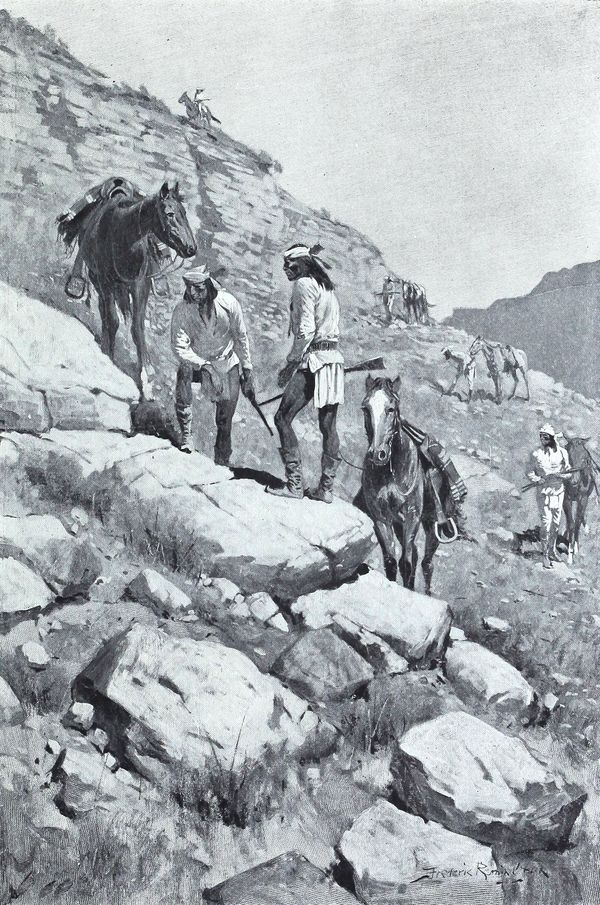
Scouts
These Indian scouts are on the trail of a Chiricahua Apache named Massai, famous in the ’nineties as the wildest and most cruel of the Apaches. So crooked was Massai’s trail that even the Indians themselves could not follow it.
Illustration from
MASSAI’S CROOKED TRAIL
by
Frederic Remington
Originally published in
Harper’s Magazine
,
January, 1898
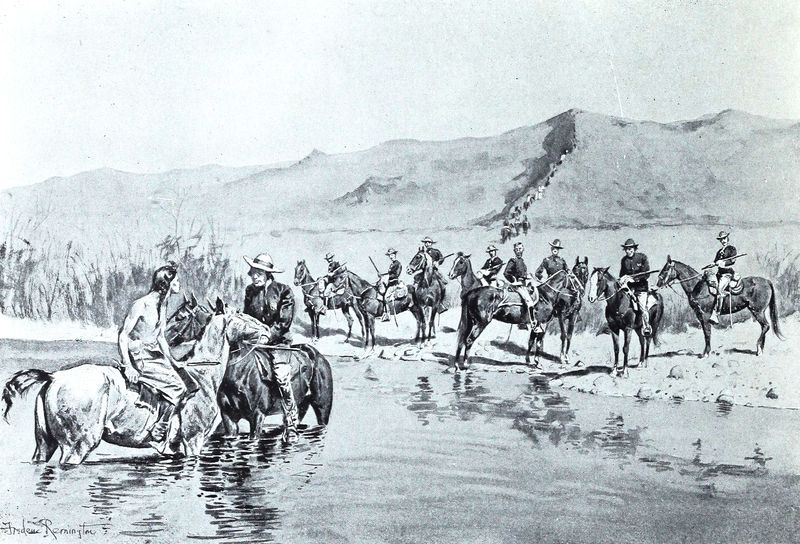
On the Little Big Horn
When Cheschapah, son of the aged Crow chief, Pounded Meat, became a medicine man and aspired to leadership of the tribe, a party of Sioux came on a visit to the Crows. Fearing that the feasting and eloquence of Cheschapah might turn their thoughts to war, troops were sent to bring the visitors home. The Sioux started for home meekly enough, but Cheschapah, with a yelling swarm of his young friends, began to buzz about the column, threatening to attack the troopers who had so rudely broken up their dinner party, and did not desist even when the soldiers had forded the river. Whereupon the chief of the Crow police rode out to Cheschapah, commanding him to turn back, and received for an answer an insult that with Indians calls for blood. But for old chief Pounded Meat, who then rode out to his son and cowed him with a last flare of command, firing would have begun then and there.
Illustration from
LITTLE BIG HORN MEDICINE
by
Owen Wister
Originally published in
Harper’s Magazine
,
June, 1894
There had already been a great deal of talk of the War Department sending someone to quiet the disturbance, and this the agent did not relish. He had been an Indian agent for many years and prided himself on knowing how to handle his people, and was especially anxious to keep the chief authority entirely in his own hands. Poor and despised as The Sitting Bull had become, even the agent considered it an honor to arrest and imprison him. Furthermore, I could see that he did not care to attempt this except as a last resort.
The following morning the agent, Carignan, and myself went up to see The Sitting Bull. He was in his tepee, smoking beside a small smoldering fire. He was very cold and quiet, and looked tired and weak. His hair parted in the middle and the sad look of his face made him resemble an old woman. To me he was only a tragic wraith of his former self. His eyes were dull and heavy. He was a type of my vanishing race as he sat there, and my heart went out to him.
He greeted us with a low word and shook hands. We all sat about in the lodge. Few people were stirring.
“Tell the chief I have come to talk with him about this dance,” began the agent.
I told the chief, and he said: “Speak on, my ears are open.”
“Tell him I hear he is dancing this foolish dance almost every day, making his people tired, so that they neglect their cattle and have taken their children from school. Tell him that all the people are getting excited. Therefore, Washington says the dance must stop!” continued the agent.
I told the chief this. His face did not change, but his eyes fired a little. “Are the white people afraid of this new religion? Why do they wish to stop it?” he scornfully asked, in answer.
“Say to him that I do not fear the dance—I consider it foolish—but I do not want him wasting the energies of the people. He must stop it at once!”
To this the chief replied: “I am a reasonable man and a peacemaker. I do not seek trouble, but my people take comfort in this dance. They have lost many dear ones and in this dance they see them again. Whether it is true or not I have not yet made up my mind, but my people believe in it and I see no harm in it.” Here he paused for a moment. “I have a proposition to make to you,” he said firmly. “This new religion came to me from the Brulé Reservation; they got it from the west. The Mato and Kios claim to have seen the Messiah. Let us two, you and I, set forth together with intent to trail down this story of the Messiah. If, when we reach the last tribe in the land where the story originated, they cannot show us the Messiah or give us satisfactory proof, then we will return and I will tell my people that they have been too credulous. This report will end the dance forever. It will not do to order my people to stop; that will make them sure the dance is true magic.”
The chief was very serious in this offer. He knew that he could not, by merely ordering it, stop the dance; but if he should go on this journey with the agent and make diligent inquiry, then he could on his return speak with authority. He made this offer as one reasonable man to another, and, had the agent met him halfway or even permitted him to send my father or Slohan, the final tragedy might have been averted, but the agent was too angry now to parley. His answer was contemptuous.
“Tell him I refuse to consider that. It is as crazy as the dance. It would only be a waste of time.”
I urged him to accept, for in the months to follow the excitement would die out, but he would not listen.
“I will not consider it. It would be like trying to catch up the wind that blew last year. I do not care to argue here. Tell him to come to my house to-morrow and I will give him a night and a day to prove to me that he is not a foolish old man, chasing a will-o’-the-wisp.”
To this the chief replied: “Are there miracles only in the white man’s religion? I hear you believe there was once a great flood and all the people were drowned but a man and a woman, who took all the animals, male and female, into a big steamboat. When did this happen? How do you know it? Is the ghost dance more foolish? Are my people to be without a religion because it does not please the white man?”
To this the agent answered, impatiently: “I refuse to debate. I have orders to stop the dance, and these orders must be carried out. Tell him to come to the agency to-morrow and we will talk it out there. I can’t do it now.”
To my surprise, the chief pacifically responded: “I will come. My people are few and feeble, I do not wish to make trouble. Let us speak wisely in this matter. You are angry now and my people are excited. I will come and we will talk quietly together.”
But the faces of the old guard were dark, and Black Bull, who stood near, cried out, saying: “Let us alone. We will not give up the dance. We are afraid. Send the coyote away! Is The Sitting Bull afraid?”
This touched the chief to the quick, and he said, “I am not, but I do not desire trouble.”
My father spoke and said: “Do not go. The white man will imprison you if you do.”
Black Bull again shouted: “The white man is a liar! His tongue is double. He has set a trap. Will you walk into it?”
The chief turned to me. “Is this true? Have they talked of putting me in prison?”
I could not deny this, and while I sat in silence, seeking words which would not inflame him, Catch the Bear said: “I have heard that they have planned to kill you. Do not go to the agency.”
The chief was now convinced that the agent and myself had come to entice him into a snare. He rose, and his face took on the warrior’s lionlike look as he said: “I will not go to the agency. I will not die in prison. If I am to die it will be here, as a soldier, on the spot where I was born.”
Even then the agent could have won him by pacific speech, but he too was angry, and he said: “I give you till to-morrow morning to decide. If you do not come to the agency I will send the police and take you.” He then went back to the school.
To Carignan he said, as he got into his wagon: “You had better send all your people up to the post. I am going to arrest The Sitting Bull to-night and it may make trouble,” and in this spirit he drove away.
XIII THE CHIEF PLANS A JOURNEY
That was a dark night in The Sitting Bull’s camp. The women were weeping and the men, with faces sullen and fierce, gathered in solemn council. Black Wolf, Catch the Bear and The Two Strike loudly advocated resistance, their hot hearts aflame, but the chief kept on smoking his pipe, which is the sign of indecision. He was still the peacemaker and concerned over the welfare of his people.
When he spoke he said: “To fight now is to die. The white man will crush us like flies. I know that for I have seen his armies. The happy hunting grounds are as near to me as to any of you, but I am not ready to die. I have thought deeply over the matter, and I have resolved not to fight, for unless we intend to kill all our children and so leave no one to follow us, the white man will visit his hate on those who remain. If the agent comes with his renegades to arrest me I will resist to the death, but if the soldiers come for me I will go with them, for they have the hearts of warriors and know how to treat a chief. This is my decision; but whatever comes, let no one interfere in my behalf, for to do so would only mean bloodshed, and that will do no good. I am your head—they will visit their punishment on me. I will meet them alone.”
Thereupon he spoke to his “Silent Eaters” and said: “Put sentinels on the hills and keep watch on all that is done at the agency. Let no spy approach us.”
The dance went on after that in a sort of frenzy, as if desperate by need. The cries of those who prayed were heart-breaking to hear. “O Great Spirit, save us; bring the happy land quickly, ere the white man slays us,” this they wailed over and over again, for the days were fleet and the wolves of winter near.
When the chief did not appear as he had promised, then the agent drew a dead line between the agency and the camp, and brought into play the forces of hunger and cold. He sent word to all the Grand River people, commanding them to move up and go into permanent camp near the agency. “Those who do not come will be cut off from their rations.” And to his clerk he said: “That will show the old chief’s followers where they stand.”
The effect of this order cannot be overstated. The north wind was now keen, and the people had little meat and no meal. They were dependent on the agency issue for their daily food. They were forbidden to leave the reservation to hunt and there was very little game left anywhere. This order drew the line sharply between those who had faith in the dance and those who only pretended to sympathize with it. To remain was to starve and freeze; to go was to acknowledge the final supremacy of the white man and all he stood for. Such was the desolating decision thrust upon them.
When the order reached The Sitting Bull’s camp the dancers were thrown into confusion. A hurried council was called and the leaders were soon decided on the question of giving up the dance. Most of them at once said: “It is of no use. The Great Spirit has not heard us. There is but one thing to do. Let us obey the agent. To fight is foolish.”
There were others who said: “What does a few months of life in captivity matter? Let us dance, and if the white man comes to fight let us all die like braves.” And as they spoke the women began to sing old battle songs, urging resistance to the invaders. “We can starve and die, for when we die we go to the happy land. A little pain and all is over. Let us fight!”
As soon as the chief had thought the matter out he said: “So long as I have cattle or money you shall be fed,” but he had little left. He had already given all he had.
I do not know the mind of my chief at this point. I think that at times when his indignation mounted high he, too, said: “Let us fight to the death. The happy hunting grounds are near. They await us. Why do we continue in our hunger and despair?” And then, as some good man spoke to him, recalled to him the friends he had among the palefaces, he had a gleam of hope, and recalled his bitter words.
That he was not afraid I know. Death held nothing appalling. Life offered little. Why should he fear to die? He was fifty-six years old and his days were nearly done. Furthermore, he could not look into the future without pain, for he saw his people slaves or vagabonds among an alien race.
During these weeks fear and hate of him revived among the settlers in all the Western states and the papers were filled with demands for his death. The near-by white settlers called loudly for troops, and some of those to the north went so far as to patrol the borders of the reservation in order to meet the warriors of The Sitting Bull when they broke forth in war array. They were glad of an excuse to utter their charges against us as cumberers of the earth, which they desired. Feeling the millions of their fellows back of them and knowing that troops were near, they were very brave.
In spite of the agent’s cruel order, a large number of the sternest warriors of the Uncapappas remained at Rock Creek, and when he saw this he was afraid to carry out his plan for arresting the chief. With intent to league himself with cold and snow, he waited for winter to fall, keeping vigilant eye on the War Department, lest the Secretary should steal away the honor of arresting the chief. He was not anxious to invite interference on the part of the military. “I can take care of the reservation,” he repeated to the commander of the post.
The chief understood his feeling and said to my father: “I will obey the orders of the great war chief, but I will not be ordered about by this agent. He has used me like a dog. The Great Father at Washington said to me: ‘Sitting Bull, you are the head of the Sioux nation, and I hold you responsible for the conduct of your people. Keep the peace.’ I promised him that I would do this, but the agent has always turned his back to me or has thrown words at me that are like stones or mud. He has lied about me and his letters have made the settlers angry. He now wishes to shut me up merely that he can smile and say: ‘I am a great chief; I have conquered The Sitting Bull.’ This I will not permit him to do.”
Therefore, his armed sentries continued to ride the buttes surrounding the camp. No one could come within twenty miles of his camp without seeing shadowy horsemen appear and disappear on the high hills. Every blanket concealed a weapon, while the dance went on almost day and night, and one by one his cattle were killed and eaten, till at last all were gone.
My own position became each day more intolerable. Within my heart opposing passions warred. Here were my brothers about to fight their last battle—persisting in a defiance which was as insane as their religion. I could not deceive myself. The instant I returned to the white men and the sight of my books I acknowledged the tragic desperation of my people. The dance became merely another of the religious frenzies which wise men say have attacked the human race, at intervals, for ten thousand years. A letter from The Blackbird said: “Keep away, Philip. Don’t mix in that mess. You can do no good. Your letter makes it evident that a tragic end is inevitable. You have done all you can. Throw in your lot with the white man. On the whole, the white man has the organization for the new conditions. To die with your people would be superb, but it would be wasteful. Don’t do it, my boy. Use your best influence against violence, but avoid danger. There is work for you to do in helping your people bridge the chasm between their mode of life and ours.”
I told him that I was already denounced as a coward and a traitor to my race. He replied: “No matter; ten years from now those who are still alive will see you in the light of a wise leader.” And in the spirit of this letter I sent word to my chief, saying that it was best to accept the agent’s rule.
The department did not like to be called rash; it feared the influence of the Indians’ friends in the East and so it hesitated, and these days of waiting were days of torture to us all. I could not look any man in the face. I went about my duties as if I, too, were in a trance. I really could have been called a spy, for when one of the scouts of my father asked me what was going on at the agency I told him I was under suspicion by both races and knew not where to turn for comfort.
The agent required my presence in his office each day, and to see my father and my chief meant a night ride of nearly eighty miles. This I dared not attempt, for the chief now reasoned that I had surely gone over to the enemy and I was certain he would not let me come to him. I was despised and rejected of both white man and red man, and had no one to comfort me.
The weather continued mild. Each day I searched the sky for signs of a storm. If only a tempest of snow would sweep over us it would stop the dancing, it would cool the fury of anger, and yet when the hate and contempt of the white man broke forth in my presence I hoped that my chief would fight. Better to die like the lion than live like a trapped wolf.
Meanwhile the chief and his little band continued to test the new religion, but the Chief was not satisfied.
“Why do these visions come only to the women and weak men? Why do they not come to my ‘Silent Eaters?’ Why does it not happen that I can go and see these things and return?”
He was growing weary of his prison and longed for the bright world where the spirits were. At last he came to a great resolution. He determined to leave the reservation and visit The Kicking Bear in order to learn more of the Messiah. He wished to know whether any new revelation had been made to other tribes. He had exhausted the value of the phenomena in his own camp and remained unconvinced.
He said: “The agent is going to send for me soon. I may go to the agency and I may not. No matter. You must not get into trouble on my account.”
Can you imagine what it means to a chief, when his proud, free race sinks to the position of beggars and children, forbidden to trade, forbidden to hunt, forbidden to make presents, ordered into line like cattle, debarred from amusement like convicts, and condemned to wear the white man’s cast-off clothing?
“If this religion is true, then we may hope. If it is not, then all is over,” he said. “I will myself go seek those who saw the wonder worker. Perhaps I shall find him and he will take pity on us and save us from destruction. Wait patiently till I return, for then you will know the truth.”
He arranged to leave at daybreak, and his guard was to follow him later to see that he was not mistreated. There were not many of the “Silent Eaters” now, but they were ready to go where he went, and die with him if need rose.
I do not pretend to follow the turnings of his mind, but I think he had resolved to leave the reservation even at the risk of being arrested and brought back by the police, considering that the word and the promise he sought to verify were worth more than anything else on the earth.
It must have been in some such mood that he prepared for his long journey, while still the dance went on, and the white people accused him of leading a revolt.
XIV THE DEATH OF THE CHIEF
The news of the chief’s intended departure, which was brought to the agent by a spy, decided him to act at once. In accordance with instructions from the department he went to Colonel Drum, the commander of the garrison, and arranged to seize the chief before he rose the next morning. The native police were to make the arrest, but the troops were to be within supporting distance and to share in the honor!
The leaders of the police were enemies of the chief. The Shave Head was especially malignant. The reason was this: When The Sitting Bull visited the Crows in 1884 Shave Head accompanied him. During a dance one night the Crows grossly insulted the visitors and Shave Head wished to kill them, but the chief counseled mild speaking. “We must not quarrel,” he said, and went away. Shave Head was very angry, and for his forbearance called The Sitting Bull a coward, when, as a matter of fact, a single gesture by this reckless fool might have involved the whole camp in an uproar. Thereafter he lost no opportunity for insulting and annoying the chief, who bore it patiently, knowing that a harsh word in reply would only make matters worse.
Big Head, the lieutenant of police, was also opposed to the chief; in truth the entire force was carefully chosen from those hangers-on at the agency or from the Yanktonaise, ready, under the white man’s pay, to act against the chief, whose contempt for such traitors and weaklings was well known. In the days of The Sitting Bull’s power these factions existed. The Gall and The Gray Bear were jealous of his great fame, although The Gall never became actually disloyal. The Gray Bear did and lost no chance of doing his old chief harm. It is a disgraceful thing to say of my people, but some of them, for a new uniform and twenty dollars, would kill their blood relatives. Witness the so-called “scouts” of the army in Arizona.
My father says that The Sitting Bull advised against all violence, but I must admit that his supporters were armed and that they had sworn to protect him against mistreatment. Perhaps he accepted their loyalty gratefully, and when he decided to go forth on his search for the Messiah they asked to go with him in a body.
It would not seem strange to me if he had decided never to be taken from his people alive.
He was growing old, and to suffer exile would be to die lingeringly. How much he knew of the agent’s plan to imprison him I do not know, but I have heard him assert his right (which the commissioner had orally given him) to come and go as any other citizen of the state. As chief man of his nation he considered it a gross injustice to be told, “You shall not cross this line.” “So long as I go peaceably and feed myself I do not see what right the agent has to object. Washington has said it and I go.”
On the night before his departure he addressed the “Silent Eaters.” “Be peaceful, do nothing harsh,” he said; “wait for my return. I go to visit Mato. Perhaps he has a new message for us. Perhaps he has again visited the Messiah. If he has not, then we will go together.”
He was at the dance till midnight and, being weary was still sleeping soundly when just before dawn Bull Head and seven other renegades gathered silently round his bed.
As Bull Head laid a hand on him the chief opened his eyes and quietly asked. “What do you want?”
“Be silent. The agent wants you to come to him,” Bull Head replied in a low voice. “Get up quickly.”
The chief lay for a time in thought. He saw the armed men and knew them to be enemies. Across the room his wife was sleeping with her children. Resistance would mean death. He did not wish to die in her presence.
“Very well,” he said, calmly, “I will go.” He partly rose. “But I must dress. It is cold, I wish to wear my new overcoat. Let me wake my wife to fetch it.”
Bull Head, less savage than Shave Head, said: “Good. We will wait,” but as the wife realized what these men had come to do she began to wail, “They will take him away,” and this wakened the children, who also began to cry.
Soon many feet were heard running rapidly. Catching up their blankets and concealing their rifles beneath their garments, the “Silent Eaters” came hurrying to the rescue, not knowing what was happening, but ready for battle.
The whole camp was in a tumult before Bull Head could rush The Sitting Bull to the threshold.
One of the first of the old guard was The Bear Catcher, a man of fiery resolution, who cried out in a loud voice: “They are taking our chief. Let us prevent them.”
Bull Head replied: “The agent has ordered it. Keep away!”
Bear Catcher again cried: “Let us stop this thing,” and, flinging aside his blanket, leveled his rifle at Bull Head and fired. The renegade fell, but in falling shot the chief. At almost the same instant Shave Head, recreant dog, seized the opportunity to put a bullet into the great heart of my chief, who fell and died without speaking a word, while the battle went on above his prostrate body.
For a time nothing could be heard but the shouts of the warring ones and the crack of their guns. When it was ended eight of the “Silent Eaters” lay dead beside their chief, and with them fell four renegades who went to their tragic end under a mistaken call of duty—to be forever execrated for slaying their chief at the white man’s command.
Taking shelter in the house, the other traitors killed the mute son of the chief and were about to be burned out by the “Silent Eaters” when the sound of a cannon on the hill announced the coming of the soldiers. The renegades were saved by the bluecoats.
It is well that the body of my chief fell into the hands of his honorable enemies, for it was being mutilated when the colonel interfered. There were Sioux warriors so misbegotten that they were ready to crush the dead lion’s helpless head, but the white commander of the garrison took every precaution that the bones of the chief should lie undisturbed in death.
The post surgeon at Fort Yates received the body and prepared it for burial. In the afternoon of the following day it was sewn up in canvas and placed in a coffin and buried in the northeast corner of the military cemetery, without ceremony and with few to mourn, though far away my people were waiting in unappeasable grief over the passing of their great leader.
And so it is that in spite of vandal white men and traitorous reds the dust of my chieftain lies undisturbed in a neglected corner of a drear little military graveyard, near the Great Muddy River which was the eastern boundary of his lands. The sod is hot with untempered sun in summer, and piled with snow in winter, but in early spring the wild roses bloom on the primeval sod above his bones. No hand cares for the grave, no one visits it, and yet, nevertheless, the name written on that whitewashed board is secure on the walls of the red man’s pantheon, together with that of Red Jacket and Tecumseh, Osceola and Black Hawk. Civilization marches above his face, but the heel of the oppressor cannot wear from the record of his race the name of “Ta-tank-yo-tanka,” The Sitting Bull.
He epitomized the epic, tragic story of my kind. His life spanned the gulf between the days of our freedom and the death of every custom native to us. He saw the invader come and he watched the buffalo disappear. Within the half century of his conscious life he witnessed greater changes and comprehended more of my tribe’s tragic history than any other red man.
These are the words of my father, the chief of the “Silent Eaters,” and his voice was tremulous as he spoke them: “Ta-tank-yo-tanka was a great chief and a good man. He had nothing bad about him. He was ever peacemaker, and just and honorable in his dealings. He cared only for the good of his people. He was unselfish and careful of others. He will grow bigger like a mountain as he recedes into the past. He was chief among red men and we shall never see his like again. If the Great Spirit does not hate his red children, our Father is happy in the home of the spirits—the land of the returning buffalo.”
THE END