THE SILENT EATERS (continued 2)
Reading edition
All agreed to this plan, and as the boat neared the fort the chief gave the word, and we were scattered, tense with resolution, ready to begin our death struggle should the vessel pass beyond the line. No one faltered. Nearer and nearer we floated, and all were expecting the signal when the boat signaled to the shore and stopped. The soldiers never knew how close they came to death on that day.
Again we went into camp under guard, well cared for by the soldiers. The officers all treated The Sitting Bull with marked respect and during the day the colonel himself came to sit and smoke and talk with us.
Of him the chief abruptly asked, “Am I to be kept here all my life?”
“No. After a while you are to be sent back north. As soon as you are prepared to sign a peace and after the anger of the whites dies out. I do not hate you. Come and talk to me whenever you feel lonesome, I will do all I can to make your stay pleasant.”
To this The Sitting Bull replied: “Your kindness makes my heart warm. It gives me courage to tread the new paths that lie before me. I am very sad and distrustful, for I am like a man who enters a land for the first time. It is not easy for me to sit down as a prisoner and dream out the future. It is all dark to me. You are my friend. You are wise and your words have helped me. If we could have the aid of men like you, the new road would be less fearsome to our feet.”
The young officers came and asked us many questions about our ways of camping, our methods of fighting, and so on, and the chief was always ready to talk. Sometimes I pretended not to understand English in order that I might the better know what was being said, and often I heard white people tell ridiculous things.
“Is that The Sitting Bull? Why, he looks like an old woman. He can’t be a warrior.” Others remarked, “What a sad face he has!” and this was true, for he had grown old swiftly. He brooded much and there were days when he spake no word to any one, not even to my father.
These were days of enlightenment to me, as well as to my chief, but they brought no sign of hope. My father was a kind man, naturally cheerful and buoyant, and his eyes were quick to see all that the white man did. He comprehended as well as my chief the overwhelming power of the white man, but he was less tenacious of the past. “It is gone,” he repeated to me privately. “The world of our fathers is swallowed up. Go you, my son, and learn of the white man the secret power that enables him to make carts and powder and rifles. How can we fight him when we must trade with him to win his wonder-working arms and ammunition?”
And so when one of the officers, Lieutenant Davies, saw me holding a scrap of paper and asked me if I could read, I told him I could. Thereafter he gave me books and helped me to understand them. We called him “Blackbird,” because his mustaches were dark and shaped like the wings of a bird. I came to love this man, for he was the best paleface I ever knew. He did not condemn us because we were red. He did not boast and he was a soldier. He talked much with The Sitting Bull, and his speech did more to change my chief’s mind than that of any other man.
“Submit to all that the White Father demands,” he advised, “for so it is ordered in the world. It is not a question of right, or of the will of the Great Spirit,” he went on; “it is merely a question of cannon and food.” There was something appalling in the way in which he said these things. He did not believe in any Great Spirit. I could not understand his religion, but his mind was large and his heart gracious.
“Knowledge is power,” he said to me. “Study, acquire wisdom, the white man’s wisdom, then you will be able to defend the rights of your people,” and his words sank deep into my heart.
For two years we lived here under his influence, until one day the order came for us to go back up the river, and with glad hearts we obeyed.
It was in the spring and there was joy in our blood, for these years of close captivity had made the promise of life on the reservation seem almost like freedom. We went back laughing for joy, and when we again came in sight of the hill above the Standing Rock my father lifted his hands in prayer and the women sang a song of joy. As soon as we were released my chief called his old guard about him, and said:
“My sons, my mind has changed. We are now entering upon a new life. The white man’s trail is broad and dusty before us. The buffalo are entirely gone and we must depend on the fruit of the earth. You observe that The Eagle Killer, The Fire Heart and many of our people have oxen and wagons. If they did not come into possession of these things by shooting them out of the sky, I think we shall be able to acquire similar goods for ourselves. The white people have promised that so long as grass grows and water runs we shall be unmolested here. Let us live in peace with our neighbors.”
The Sitting Bull was chief because he could do many things, and, though he was now a captive with his people, his power and influence remained. His “Silent Eaters” gathered round him and to them his words were law. The agent also, for a time, treated him with consideration, and was very friendly. They spoke often together.
We were at once given oxen and carts and located near the agency, where we lived for a year, but the chief longed to return to the Grand River, his native valley, and finally the agent gave his consent, and we moved to the river flat, just where the Rock Creek comes in. Here he built a little log cabin and settled down to live like a white man, but I could see that his heart was ever soaring to the hills of the West and his thoughts were busy with the past. Truly it was strange to see Gall and Crane and Slohan sitting in a small cabin, talking of the brave, free days of old.
VI IN CAPTIVITY
Of what took place on the reservation during the next four years I know but little directly, for I went away to Washington to study with Lieutenant Davies, who was assigned to duty in the War Department, and I did not return to the Standing Rock for many years. I heard now and then from my father, who wrote through my friend Louie Primeau. He told me that the chief was living quietly at Rock Creek, but that he was opposing every attempt of the white man to buy our lands.
My father complained also of the decreasing rations and said: “The agent’s memory is short; he has forgotten that these rations are in payment for land. He calls them gifts.” My mother sent word that my little sister had died and that many were sick of lung diseases. “We are very cold and hungry in the winter,” she said, and my heart bled with remorse, for I was warm and well fed.
I would have returned at once had not my friend Davies told me to stay on and learn all I could. “Go to the top,” he said. “Do not halt in the middle of the trail. You will need to be very wise to help your people.”
He was a philosopher. He had no hate of any race. He looked upon each people as the product of its conditions, and he often said, “The plains Indian was a perfect adaptation of organism to environment till the whites disturbed him.”
His speech and his thought are in all that I write. He taught me to put down my words simply and without rhetoric. He gave me books to read that were both right and honest, and in all things he was truthful. “Your life can never be happy,” he said. “You will always be a red man in the clothing of the whites, but you will find a pleasure in defending your people. Your race needs both historian and defender. Your whole life should be one of teaching your people how to live and how to avoid pain. I am not educating you to be happy. There can be no shirking your duty. On the contrary, I believe your only way to secure a moment’s peace of mind after you return to your tribe is to help them bear their burdens.”
He warned me of the change which had come to me, as to them. “Your boyish imagination idealized your people and the life they led. You saw them under heroic conditions. They are now poor and despairing and you will be shocked at their appearance and position under the agent, but do not let this dismay you. The race is there beneath its rags and dirt, a wonderful race.”
I shall never forget those long talks we had in his study, high up in his little house, for he was not rich. Sometimes I could not sleep for the disturbing new thoughts which he gave me. Often he nullified all the teaching of the schools by some quiet remark.
“I counsel you to be a Sioux, my boy,” he repeated to me one night after I had been singing some of our songs for a group of his friends. “You can never be a Caucasian. There are dusky corners in your thought. The songs you sang to-night made your heart leap with memories of the chase. A race is the product of conditions, the result of a million years of struggle. I do not expect a red man to become a white man. Those who do, know nothing of the human organism. On the surface I can make some change; but deep down your emotions, your superstitions are red and always must be; that is not a thing to be ashamed of.”
I am giving this glimpse into my school days in order that my understanding of my chief and my race may appear plain. It is due to my good friend Davies, the noblest white I ever knew. I want everyone to know how much I owe to him.
It was strange to me and very irritating to find what false ideas of us and of our chief the Washington people held. When it became known that I was a Sioux and had been with The Sitting Bull, many were eager to question me about him, but I refused to do more than say: “We fought for our lands as Washington fought for his. Now you confine my chief as if he were a wolf. But he is a wise and gentle man, a philosopher, therefore he has laid his hands to the plow. His feet are in the white man’s road.”
This story is not of me, else I could tell you how beautiful some of the white women came to seem to me, and one small girl, fair as a spring flower, ensnared my heart and kept me like an eagle bound to my perch—only I did not struggle against the golden cord that bound me. It was all very strange to me, for I still loved a girl of my own race, who sent me presents of moccasins and who wrote through Louis to say she was waiting for me. It was strange, I say—for my heart clung to Anita, also, she was so fair and slender and sweet. She was associated with all the luxury and mystery of the white man’s life. She called to me in new ways—ways that scared me—while Oma spoke to something deeper in me—something akin to the wide skies, the brown hills, the west wind, and the smell of the lodge fire.
How it would have ended I don’t know, had not my friend Davies been sent again into the West. His going ended my stay in the East. Without him I was afraid to remain among the white people.
“The time has come for you to return, Iapi,” he said to me. “The white men are moving to force a treaty upon the Sioux, and now is your time to help them.”
It was very hard to say good-by to my friend, and harder yet to my Anita, who loved me, but who told me she could not go with me, though she wished to do so. “I cannot leave my poor mother, who is sick and poor,” she said.
I was not very wise, but I knew that I had no place, not even a lodge, in which to keep her, and so I said: “I will go on before you and prepare a place for you, and then sometime you will come and you will help me to teach my people how to live?”
To this she gave me promise and I went away very sad, for it seemed a long way from Standing Rock to Washington, and especially to a poor Sioux who knew of no way to earn money.
Some friends joined with my friend, the white soldier chief, to buy some clothes for me, and a few presents for my father and mother, and so, with a heart so big I thought it would burst within me, I took the cars for the West.
I sat without moving for hours—all night long—while the terrible engine of the white man’s fashioning sped into the darkness. At dawn I looked out anxiously to see if the land were familiar, but it was not. Only on the third day did it begin to awaken echoes in my brain. My command of English words will not permit me to express the wild thrill of my heart as I looked out of my window and saw again the wide-lying plains of Dakota, marked by the feet of the vanished buffalo. I was getting home!
Five years is a long time when it involves such mental changes as had come to me. It seemed that half a lifetime had passed since I sorrowfully took the steamer to go down the river to learn the white man’s language. I was a wild-eyed, long-haired lad then. Now I was returning, clipped and clothed like a white man, yet in my heart a Sioux.
There were changes in the country, but not so great as I had expected. Even the white man makes but little mark on these arid levels. The cabins were grayer, the fields a little larger, that was all. After dispossessing my people and destroying the buffalo, the white settlers had discovered that it was a grim country for their uses. Their towns seemed small and poor and sad.
My heart came into my throat as I crossed the Cannonball and entered upon Sioux land and saw the yellowed tepees of our cousins, the Yanktonaise, scattered irregularly along the river. This was still the land of my fathers; this much we had retained of all the bright world which had been ours in the olden, splendid days!
It was in June and the grass was still green. Herds of ponies were feeding on the swells, and one of the horses I drove lifted his head and neighed; he, too, remembered the old freedom. The sky blazed with light and the hills quivered as if in ecstasy of living. The region was at its best, delusively beautiful. I knew its moods. I knew how desolate and pitiless those swells could be in midwinter, how dry and hot of breath in July.
As we topped the hill I met a man driving a small team to a heavy wagon. He wore a wide hat which lay on his shoulders, and big smoked goggles hid his eyes. As he came opposite I perceived that he was a Sioux, and I called to him in my native tongue.
“Wait, my friend. Where are you going so fast?”
He turned his big glasses on me and said:
“First of all, who are you that speak Lakota so badly?”
“I am Iapi, the son of Shato.”
“Ah!” he exclaimed, with a smile. “In that case you are getting back from school? I know you, for I am Red Thunder!”
Red Thunder! I was silent with astonishment. A picture of him as I saw him in 1876 rose in my mind. Tall and lithe he was then, with keen, fierce eyes, the leader of the war faction among the Yanktonaise, a wonderful horseman, reckless and graceful. Now here he sat in a white man’s wagon, bent in the shoulders and clad in badly fitting agency clothing. My heart was sick as I said:
“Friend, you are changed since the council on the Powder River. I did not know you.”
He took off his glasses and put aside his hat; his smile also passed away. He looked away to the west:
“My son, that is long ago and Red Thunder’s blood is no longer made from buffalo meat. His muscles are weak. He prefers to sit in his wagon and drive his ponies. The Great Spirit has forgotten his red children and the White Father is in command over us. I do the best I can. The old trails are closed; only one remains—the one made by Washington.”
I drove on, my exultation utterly gone. If Red Thunder was of this bitter mood, how would I find the Uncapappas who had been the conservatives of the tribe?
I passed close by some of the cabins and they disheartened me, they were so small and dirty. I was glad to see that some of them still retained the sweat lodge. Each home consisted of a shack and two or three tepees of canvas, and women were cooking beneath bowers made of cottonwood as of old. Their motions, and the smell of smoke, awoke such memories in me that I could hardly keep from both shouting and weeping.
The farther I went the more painful became the impression made upon me by these captives. They were like poor white farmers, ragged, dirty, and bent. The clothes they wore were shoddy gray and deeply repulsive to me. Their robes of buffalo, their leggins of buckskin, their beaded pouches—all the things I remembered with pride—had been worn out (or sold). Even the proud warriors of my tribe were reduced to the condition of those who are at once prisoners and beggars. My heart was like lead as I reached the agency.
It hurt me to do so, but I reported at once to the agent and asked leave to visit my father and mother.
“They are expecting you,” he said. “You’ll find them camped just beyond the graveyard.”
I am glad that I saw my father and mother first in their tepee. My mother was cooking beneath a little shed of canvas. I called to her, and when she looked at me, without knowing me, something moved deep down in my heart. How brown and old and wrinkled she looked! Then I said, “Don’t you know me, mother!”
Then her voice rose as she came hurrying to me, calling: “My son! My son has returned.”
She took my hand, not daring to put her arms around me, for I looked, she said, exactly like the white man, but I pressed her hands, and then, while she sang a little song of joy, my father came out of his lodge and came slowly toward me.
I will not dwell on this meeting. I inquired at once concerning our chief. “He is still living in the same place near Rock Creek, and wishes to see you at once,” said my father. “The white men are trying to get our land again and the chief wants to have a talk about it with you.”
“Let us go down and see him to-night,” I replied, and for this reason we broke camp and started away across the plains.
It was a strange thing to me to help my father harness a team to a wagon. He whom I had seen a hundred times riding foremost in the chase, whom I had watched at break of day leading a band of scouts up the steep side of a sculptured butte, or with gun in hand guarding The Sitting Bull as he slept, was now a teamster, and I, clothed in the white man’s garments, was sad and ashamed. I could not but perceive that we were both more admirable as red warriors than as imitation Saxon farmers. That is my red blood, you see.
But my father was proud of me and of my power to converse with the agent. “My son,” he said, “our hearts are big because you are back with us. Now this is your duty. You must listen to all that the commissioners say and tell us minutely so that we may not be deceived. We hear that a big council sent out the papers which Washington wishes us to put our mark on, but The Sitting Bull and most of our head men are agreed that we will never do so. Once before, three years ago, they tried to get us to sell, but when the white men grew angry and said, ‘If you don’t do this we will take your lands anyway!’ The Sitting Bull rose and said, ‘You are crazy,’ and with a motion of his hand broke up the council and we all went away. Now the traitorous whites are coming again and we need you to listen and tell us what they say.”
I knew of the council he spoke of—General Logan was the man who had threatened them—but I had not heard that the chief had dismissed the sitting. It showed me that The Sitting Bull was still chief. This I remarked.
“Yes,” said my father, “he is head man of all the Sioux even yet, but the agent has set his hand against him. He gives favor to The Grass and The Gall and The Gray Eagle, who are all jealous and anxious to be set above The Sitting Bull. The agent has become bitter toward our chief because he will not do as he says, and because our father works always for the good of his people. He does nothing for himself alone, like many others.”
As we came to the top of the hill and looked into the valley my father pointed at a small two-room log cabin and said, “There he lives, The Sitting Bull.”
The chief was in a big tepee which stood near the house, and as we entered we found him entertaining Slohan and Katolan. He was seated in the center, cutting tobacco, while his guests ate from a dish of bread and meat. As I stood in the presence of these my honored leaders my heart swelled with longing for the good old time. Here was the dignity and the courtesy of the days of the buffalo. The chief was partly in white man’s dress, but his hair was worn as of old and his gestures were those of a gentle host. His dignity, as well as the gravity of all the men, impressed me deeply.
He did not at first recognize me, but greeted my father, who, turning to me, said, “This is my son, returned from Washington.”
Then the chief smiled, and cried out: “Ho, my son! I am glad to see you. I have heard you were coming. You look so like a white man my eyes were blinded. You must tell me all you have done and all you have heard.”
I shook hands with each of the old men and took a seat near the chief, to whom I said: “Is all well with you? Does the agent treat you fairly?”
His face darkened, but he filled his pipe before he replied. “The agent is no longer my friend. He orders me about as if I were a dog. He refuses me permission to leave the reservation and checks me in every way. I think he means to break me, but he will never set his foot on my neck.”
I was eager to understand the situation, and I listened carefully while the others talked of the many injustices under which they suffered. The chief urged me to write to Washington to have things changed.
I agreed to do so, but promised nothing more, for I well knew such letters might work harm to those I loved. I foresaw also that my position in my tribe was to be most difficult.
“We are ready to live the new life,” declared the chief, “but we cannot farm the soil as the agent wishes. Go look at our fields. Each year they are burned white by the sun. The leaves of the corn are even now rolled together. The wheat is beginning to dry up. There is no hay and our rations are being cut down.”
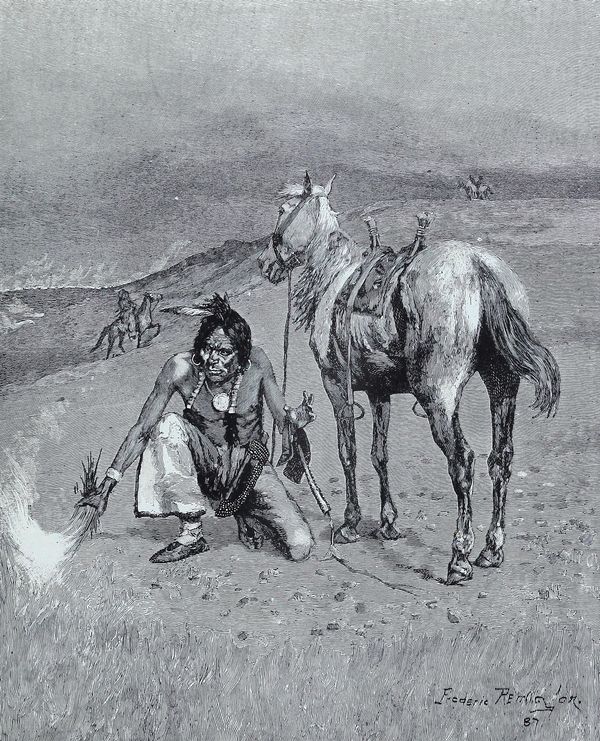
Burning the Range
Taught by experience that burning the grass insures its better growth, we are here shown Indians in the act of burning their range. In a day or two after the fire sweet, succulent grasses spring up again, and then the hard-worked Indian ponies revel for a short season on the tender herbage.
Illustration from
BURNING THE RANGE
Originally published in
Harper’s Weekly
,
September 17, 1887
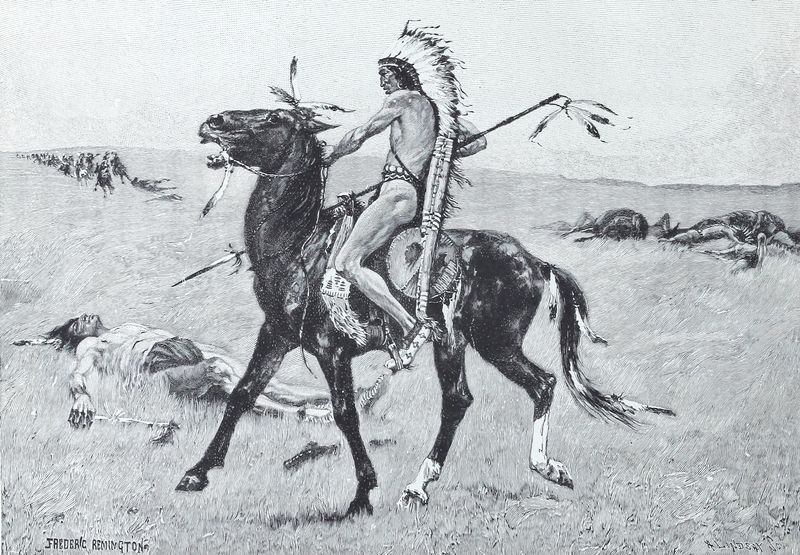
An Old-Time Northern Plains Indian
In order to claim a scalp, the warrior must give the dead man the coup. In the illustration the Indian is in the act of doing this. In olden times the coup was a stab with a weapon, but in later times the Indians were provided with coup sticks. Whoever first strikes the victim with the coup can rightfully claim the scalp.
Illustration from
SOME AMERICAN RIDERS
by
Colonel Theodore Ayrault Dodge, U.S.A.
Originally published in
Harper’s Magazine
,
May, 1891
I could see that he had no heart in his farming. The life was too hard and too bitter. He was indeed like a chained eagle who sits and dreams of the wide landscape over which he once floated in freedom. He had thrown his influence in the right scale, but he was critical and outspoken upon all debatable questions, and this had come to anger the agent, who was eager to push all the people into what he called “self-supporting ways.” This the chief did not oppose, though he could not live in the white man’s country. “It makes me both weary and sorrowful,” he said.
It did not take me more than a day to see that I was between two fires. My friends were all among those whom the agent called “The irreconcilables,” and my chief was relying upon me to help them defeat the treaty for their lands, at the same time that the agent expected me to be a leader of the progressive party. It was not easy to serve two masters, and I was forced to be in a sense double tongued, which I did not like.
The agent was outspoken against my chief. “The old man is spoiled by newspaper notoriety,” he said to me. “His power must be broken. He is a great and dangerous reactionary force and he and all the old-time chiefs must be stripped of their power and made of no account before the tribe can advance. He must be taught that I am the master here and that no redskin has any control.”
To this I made no reply, for I could not agree with him. A man who is a chief by virtue of his native ability cannot be degraded and made of no account. The Sitting Bull was a chief by force of character. As of old he worked for the good of his people. If he saw a wrong he went forthwith to the agent and asked to have it righted. This angered the agent, for he considered the chief officious. He was jealous of his position as “little father.” He was a good man, but he was opinionated and curt and irascible. He gave no credit to my chief. When the others made him spokesman of their council he would not listen to him. “He is a disturber,” he said.
Now there are certain record books in the office in which copies of all letters are kept, and when I found this out I took time to read all that the agent had written of the chief. My position as issue clerk permitted me the run of the office, and so when no one was near I read. I wished to know what had taken place during the five years of my absence.
At first the agent wrote well of the chief. In reply to inquiries he said: “Sitting Bull is living here quietly and is getting ahead nicely. He is quiet and inoffensive, though proud of his fame as a chief.” A year later he wrote of him, “His influence is nonprogressive, but believers in him are few, while many Indians are his enemies.”
This I found to be true. Chief Gall and John Grass were both honored at his expense. The Grass was a man of intelligence and virtue who had early allied himself with the white man. He was a leader of those who saw the hopelessness of remaining in the ways of the fathers, and naturally the agent treated him with marked courtesy. In answer to a letter asking the names of the chief men of the tribe he named John Grass first, Mad Bear second, The Gall third—and ignored the chief entirely.
The Gall, already jealous of the great fame of The Sitting Bull, was easily won over to the side of the agent. He was a vigorous, loud-voiced man, brave and manly, but not politic. He had not entirely broken with his old chief, but he accepted position under the agent and listened to dispraise of The Sitting Bull from the agent’s point of view.
With all his gentleness of manner, the old fire was in The Sitting Bull, for he said to me, when speaking of the attack of Shell Fish on him: “I am here, old and beaten—a prisoner subject to the word of a white master, but no man shall insult me. I will kill the man who strikes me. What is death to me? I will die as I have lived, a chief.” For the most part he was so quiet and unassuming that he was overlooked. He never thrust himself forward; he dreamed in silence.
He had visited the white man’s world several times, but these visions had not helped him; they had, indeed, thrown him into profound despair. “What can we do in strife with these wonder-working spirits?” he asked. “It is as foolish as trying to fly with the eagles. The white man owns all the productive land. What can we do farming on this hard soil? What are we beside these swarming settlers? We are as grasshoppers before a rushing herd of buffalo.”
He did not care to look out of the car windows on these journeys. He and his warriors sat in silence or sang the songs of the chase and the victorious homecoming, trying to forget the world outside.
“Nothing astonished them and nothing interested them very much,” said Louis to me in speaking of his trip to Washington. “The chief was at a great disadvantage, but he seldom made a mistake. He was Lakota and made no effort to be anything else.”
The chief at last said, in answer to all similar requests, “I do not care to be on show.”
He was very subjective. He had always been a man of meditation and prayer, and had scrupulously observed the ceremonials of his tribe. Now when he saw no hope of regaining his old freedom he turned his eyes inward and pondered. He was both philosopher and child. Nature was mysterious, not in the ultimate as with the educated man, but close beside him as with a boy. The moon, the clouds, the wind in the grass, all these were to him things inexplicable, as, indeed, they are to the greatest white men; only to my chief they came nearer some way.
Often during these days I saw him sitting at sunset on his favorite outlook—a hill above his cabin—a minute speck against the sky, deeply meditating upon the will of the Great Spirit, and my heart was filled with pain. I, too, mourned the world that was passing so swiftly and surely.
VII HE OPPOSED ALL TREATIES
During my absence the white settlers had swept across the ancient home of the Dakotas and were already clamoring for the land on which Sitting Bull dwelt, and he was deeply disturbed. He knew how rapacious these plowmen were and he was afraid of them. To his mind our home was pitifully small as it stood, and he urged me to look into this threatened invasion at once.
I did so, and reported to him that a commission was already on its way to see us and that they would soon issue a call for us.
Throwing off his lethargy, he became once more “the treaty chief.” Calling a council of all the head men he said to them:
“It will be necessary to choose speakers to represent us at this meeting. It is not wise that I should be one of these. Let us council upon what we are to do, name our speakers, and be ready for the commission when it comes.”
So they chose John Grass, Mad Bear, Chief Gall, and Big Head to speak, and went a few days later to meet the commissioners.
My people asked for their own interpreter, Louis Primeau, whom they trusted, and the council began with everybody in good humor. The commissioners rose one after the other and made talk and gave out many copies of the treaty. Then the council adjourned.
That night the head men all met at the lodge of the chief. I read the treaty to him, and so did Louie. Again The Sitting Bull said: “The pay is too small, and, besides, they have changed our boundaries. Do not sign.” And so when we assembled the next day our speakers declined to sign and the commissioners were much disappointed. They argued long and loud, to no effect.
It was explained to us again that the Government proposed to set aside five great reservations, one for the Ogallallahs, one for the Brulés, one for the Crow Creek people, one for the Cheyenne River people, and that the lines were fixed for the great Sioux nation at the Standing Rock. The north boundary was the Cannonball River; on the south, the Moreau; but to the west it extended only eighty miles.
Speaking to his head men, our chief said: “Who made that line on the west? Was it a white man or an Indian? They say the lines of the old treaties, whether fixed by the red man or the white man, must stand. But I do not grant that treaty. It was stolen from us. We have paid for all they have done for us, and more. They have never fulfilled a treaty. See the pitiful small land that is left us. Do not sign. If you sign we are lost.”
The commissioners, hitherto displeased, now became furious. They accused The Sitting Bull of intimidating the people. They raged and expostulated. They wheedled and threatened, but the chief shook his head and said: “Do not sign. This man is talking for the white man’s papers, and not for us. He uses many words, but he does not deceive me. Do not listen to him.” And they laughed at the false speaker.
At last Gall, who sat beside the chief, spoke. “We are through. We are entirely finished.”
Then The Sitting Bull rose and said: “We have spoken pleasantly and have reached this point in good humor. Now we are going home,” and made a sign and the council broke up in confusion.
The treaty was not signed and The Sitting Bull was made to bear the blame of its defeat. As for me, I exulted in his firmness, his self-control, and his simple dignity. He was still the chief man of treaties.
But the white people did not give up. They never recede. The defeat of the Democrats made a different Congress and a new attempt was at once made to get a treaty. Profiting by the mistakes of the other commissions, they did not come to the Standing Rock first (they feared the opposition of The Sitting Bull); they went to the lower reservations and secured all the Santees, all the “breeds,” and members of other tribes, men whom my people did not recognize as belonging to us. The news of this made my chief very angry. “The white men have no sense of justice when they deal with us,” he said, bitterly. “They are mad for our lands. They will do anything to steal them away.”
When the commissioners appeared at the Standing Rock they were triumphant through General Crook. Rations were short and the people were hungry and General Crook took advantage of this. He was lavish of beef issues during the treaty. On the third day he said, gruffly: “You’d better take what we offer. Congress will open the reservation, anyhow.”
Each night, as before, The Sitting Bull stood opposed to the treaty. “It is all we have,” he said, despairingly. “Once we had a mighty tract; now it is little. You have bought peace from the whites by selling your lands; now when you have no more to sell what will you do? I have never entertained a treaty from the whites. I am opposed to this. I will not sign. Our lands are few and they are bad lands. The white men have shut us up in a desert where nothing lives, yet it is our last home. Will you break down the walls and let the white man sweep us away? You say we will have a great deal of money in return. How has it been in the past? How has the government fulfilled its obligations? Congress cuts down our rations at will; what they owe us does not matter. You have seen how difficult it is to raise food here. We need every blanket’s breadth of our land if we are to live. I am getting to be an old man; a few years and I will be with my fathers; but before I go I want to see my children provided for. Let the government pay us what they owe us in cattle and we will then be able to live. I will not sign.”
That night John Grass gave way. The commission convinced him that this treaty was the best that could be secured. A new council was hastily called in order to get The Grass to sign, and my chief was not informed of it till the hearing was nearly over.
As he came into the room he was both angry and despairing, and demanded a chance to speak. “I have kept in the background so far,” he said. “Now I wish to be heard——”
But they were afraid of him and refused to hear him. “We want no more speaking. John Grass come forward and sign!”
Grass went forward. The Sitting Bull cried out in a piercing voice: “Do not sign! Let everybody follow me.”
At his command all his old guard rose and went away, but John Grass took the pen and signed. He was the man of the hour; he represented a compromise policy. He was willing to be the white man’s tool. And I, sitting there as interpreter, powerless to aid my chief in his heroic fight for the remnant of the empire that was ours, could only bow my head in acknowledgment of the wisdom of the majority—for I knew the insatiable white man better than John Grass. To have rejected the treaty would have but delayed the end.
My chief went to his lodge, still the Uncapappa, still unsubdued, representing all that was distinctive and admirable in the old life of the chase; but he knew now that the white man possessed the earth.
“This is now the end,” he said, sorrowfully, to my father. “Nothing remains to us but a home in the Land of the Spirits.”
VIII THE RETURN OF THE SPIRITS
The year that followed the signing of this treaty was a dark one for The Sitting Bull. Even those who had been most clearly acquiescent in the white man’s way grew sad.
You must remember that my people, the Uncapappas, are the westernmost branch of the great Sioux nation and had known but little of the white man up to the time of their surrender in 1880. We knew nothing of tilling the soil. We were essentially buffalo hunters and had been for many generations. The Yanktonaise, the Minneconjous, had far greater knowledge of the white man’s ways. In the days when they occupied the whole of the upper Mississippi Valley we still kept our western position, always among the buffalo and the elk. Our tepees were still made of skins.
Can you not see that these horsemen of the plains—these wandering, fearless, proud hunters—even under the best conditions would have found it very hard to give up the roving life of the chase and settle down to the planting of corn and squashes?
It is easy to clip the wings of eagles, but it is not of much avail to beat them and give command that they instantly become geese. Under every fostering condition it would have been difficult for Slohan and Gall and Sitting Bull to become farm laborers.
I call upon you to be just to my great chief, for he honestly tried to take on this new life. I assert that no man of his spirit and training could have done more. He tried hard to be as good as his word; for witness I call the agent himself who in those early days said of him: “The Sitting Bull is living here peaceably and doing well.” Even up to the month of November in 1888, the year of the first commission, he praised him. It was afterward that the agent changed his mind and began to abuse him. I will tell presently why this was so.
You see the white people allowed us no time to change. We had been many centuries forming habits which they insisted should be broken instantly. They cut us off from our game. They ordered us to farm, and this without knowing the character of our reservation. The soil of this country is very hard and dry and the climate is severe. It is high, upland prairie cut by a few thin, slow streams which lie in deep gullies. The upland grows a short, dry grass, and there are many years when it is dry as hay in early June. It is good for pasture, but it makes very little hay for winter. It is a drought country; for the most part the crops burn up under the fierce sun and the still more savage wind. In winter it is a terrible place to live unless one is sheltered by the cottonwood and willow groves on the river. It was given us originally because they thought it useless to the plowmen.
On this stern land the white man set my people and said, in a terrible voice, “Farm or die!” We tried, but year by year the trial ended in failure. Wrong implements were given us, great plows which our ponies could not draw, and bad seeds, and this outlay exhausted our annuity and cut us off from cattle issues. Our friends among the white people early began to see the folly of trying to force us to till this iron soil, and urged the issue of cattle, but the giving of useless things was thereupon taken as an excuse for not issuing stock, and when at last they were sent—a few cows and sheep—too few to be of any use, they were used as warrant to cut down our rations, which (as the chief constantly asserted) were not a gratuity, but a just payment.
They had never been enough even when they were honestly and fully issued, and when the quality was bad or the issue cut down many of them were actually hungry for three days in the week. You may read in one of the great books of the government these words: “Suddenly and almost without warning they were called upon to give up all their ancient pursuits and without previous training settle down to agriculture in a land largely unfitted for such uses. The freedom of the chase was exchanged for the idleness of the camp. The boundless range abandoned for the circumscribed reservation, and abundance of plenty supplanted by limited and decreasing subsistence and supplies. Under these circumstances it is not in human nature not to be discontented and restless, even turbulent and violent.” So said the Commissioner of Indian Affairs.
In spite of all these things I assert my people were patient. The Sitting Bull was careful to do nothing which would harm his people, and often he walked away in silence from the agent’s harsh accusation.
Hunger is hard to bear, but there were many other things to make life very barren and difficult. Around us to north and east and west the settlers were swarming. Our reservation seemed such a little thing in comparison with our old range—like a little island in great water. Every visit our head men made to the east or the west taught them the gospel of despair. The flood of white men which had been checked by the west bank of the Missouri now flowed by in great streams to the west and curled round to the north. Everywhere unfriendly ranchers set up their huts. They all wore guns, while we were forbidden to do the like. They hated us as we hated them, but they had all the law on their side.
Thus physically we were being submerged by the rising tide of an alien race. In the same way our old customs and habits were sinking beneath the white man’s civilization. One by one our songs were dying. One by one our dances were being cut off by the government, and our prayers and ceremonies, sweet and sacred to us, were already discountenanced or positively forbidden. Our beautiful moccasins were tabooed, our buckskin beaded shirts replaced by ragged coats. Our women were foolish in the dress of cheap white women. We became a tribe of ragamuffins like the poor men whom the newspapers make jokes about and call “hoboes.”
Let me tell you farther. You cannot understand my people if you consider the white man’s religion and the white man’s way of life the only ones sanctioned by the Great Spirit.
My friends in Washington, the men with whom I studied, gave me this thought. There is good in all religions and all races and I am trying to write of the wrongs of my people from that point of view. The Sitting Bull loved the old life, but he often said: “We were living the life the Great Spirit outlined for us. We knew no other. If you can show us that your manner of life is better, that it will make us happier, then we will come to your way,” and for a time he thought that perhaps the white man’s way of life was nearer to the Great Spirit’s will; but when he was cold and hungry he felt the injustice of this superior race, and doubted.
We all saw that as the years went on and the old joys slipped away no new ones came to take their places, while want, a familiar foe, remained close to every fireside. Our best thinkers perceived that fine large houses and nice warm clothing were unattainable to vast numbers of the white men, “how then can the simple red man hope to win them?” They began to say: “We have given our freedom, our world, our traditions, for a dark cabin, hard, cruel boots, the settler’s contempt, and the soldier’s diseases.” “Our race is passing away. The new conditions destroy us. If we cannot persist as Sioux, why persist at all? There are enough white beggars in the world, why add ourselves to the army of the poor?”
It was for this reason that the chief opposed the treaty subdividing the reservation. “Our strength is in being a people. As individuals the white man will spit on us.” When the treaty was about to be executed a white man said to him: “What do you Indians think of it?”
He drew himself up and the old-time fire flamed in his eyes as he said: “Indians! There are no Indians left but me.” But later he said, sadly: “It is impossible for me to change. I cannot sign, but my children may sign if they wish.”
Just at this time our cattle began to die of a strange disease and our children were seized by a mysterious malady which the white people call grippe, but for which we had no name. We were without medicine to counteract these fevers, and the agency doctor could not do much for us. Our children died in hundreds. This was terrible. It seemed that all were to be swept away.
Bishop Hare and General Miles both saw and reported upon these conditions, and I wrote to all my friends in agony of haste, but the government was slow to act in our need, though it was ever in haste to cut up our land and give it away. No one cared what became of us. We had no votes, we could not help any man to office. All promises were neglected, and to add to our misery it was said the new administration would still further reduce our payments and the rations which were our due. When this news came to us it seemed as if the very earth on which we stood was sinking beneath our feet. The old world of the buffalo, the free life of the past, became each day more beautiful as the world about us, the prison in which we lived, grew black with the clouds of despair.
In this moment of hopeless misery—this intolerable winter of tragic dejection—there came to my people the rumor of something very wonderful. A messenger to my chief said that far in the west, at the base of a vast white mountain, a wondrous medicine man had descended from a cloud to meet and save the red men. Just as Christ came long ago to the Jews, so now the Great Spirit had sent a messenger to the red people to bring back the old world of the buffalo and to repeople its shining vistas with those who had died. So they said, “By faith and purity we are to again prevail over that earth.”
It was a seed planted at the right time in the right soil. In the night of his despair my chief listened to the message as to a sweet story, not believing it, yet eager to hear more.
The herald of the new faith was a Brulé, who ended by saying: “The Kicking Bear, one of our chiefs, is gone to search into the beginning of this story. He it was who sent me to you. He wished me to acquaint you with what he had heard.”
“When he returns,” replied the chief, “tell him I wish to talk with him of this strange thing.”
A report of this man’s message spread among the people and many believed it. We began to hear obscurely about a new dance which some of the people at Rosebud and Pine Ridge had adopted—a ceremony to test the faith of those who believed—a medicine dance to bring back the past—and the people brooded upon the words of the Brulé, who said that the world of the buffalo was to be restored to them and all the old customs and joys brought back.
It was a magical thought. Their deep longing made it expand in their minds like a wonderful flower, and they waited impatiently the coming of the herald.
You must not forget that every little word my people knew of the Christian religion prepared them for this miraculous change. The white man’s religion was full of miracles like this. Did not Christ raise men from the dead? Was he not born of a Virgin and did he not change water into wine? The wise men of the Bible, we were told, were able to make the sun stand still, and once the walls of a great city crumbled before the magic blast of rams’ horns. Many times we had heard the preachers, the wise men of the white men, say: “By faith are mountains removed,” therefore our minds were prepared to believe in the restoration of the world of the buffalo. Was it not as easy for the Great Spirit as to make the water cover the highest mountains? My friend the Blackbird used to say “Every race despises the superstitions of others, but clings to its own.” I am Sioux, I could not help being thrilled by this story.
My brain responded to every story the old man told. I saw again the splendid reaches of the plain. I rode in the chase of the buffalo. I heard the songs of rejoicing as the women hung the red meat up to dry. I played again among the lodges. Yes, it was all very sweet to dream about, but I said to the chief: “I have been among the white people; I have studied their books. The world never turns backward. We must go on like the rivers, on into the mystery.”
“We will see,” he answered. “I have often reproved you for saying, ‘Yes, yes,’ to all that the white man says. This may be all a lie. The Kicking Bear has gone forth into the west to meet this wonder worker. When he returns we will council upon his report. Till then we will do nothing.”
But no power could prevent the spread of the story and its dream among my people. They were quick to seize and build upon this slender promise. Can you not understand our condition of mind? Imagine that a great and powerful race had appeared from over the sea and had driven your people from their ancestral lands, on and on, until at last only a handful of you remained. Imagine this handful corralled in a small, bleak valley cut off from all natural activities, its religions tabooed, its dances and ceremonies forbidden, hungry, cold, despairing. Could you then be logical and reasonable and completely sane?
If my race had been a servile race, ready to play the baboon, quick to imitate, then it would not have vanished, as it has, in war and famine. We are freemen. We had always been unhampered by any alien laws. We moved as we willed, led by the buffalo, directed by the winds, cowering only before the snows. Therefore, we resented the white man’s restrictions. We had the hearts of eagles in our cages, and yet, having the eyes of eagles and the brains of men, we came at last to see the utter futility of struggle. We lost all faith in physical warfare and sat down to die. As a race we were resigned to death, and in this night of our resignation the star of prophecy rose. We turned toward the mystic powers for aid.
IX THE MESSAGE OF KICKING BEAR
One October day in 1890 a party of Brulé Sioux from the Cheyenne River agency came riding down into the valley of the Grand River, inquiring for The Sitting Bull. As they were passing my father’s lodge he came out and stopped them.
“What do you want of The Sitting Bull?” he asked, with the authority of one of the old-time “Silent Eaters.”
“We bring a message to him,” replied the head man. “I am Kicking Bear. Take us to him without delay.”
The chief at this time lived with his younger wife in a two-room log house (a cabin for his first wife stood near) and as the strangers came to the door they were accosted by an old woman who was at work about the fire under an open lodge. In answer to my father’s inquiry for the chief she pointed toward a large tepee standing behind the house, and, turning aside, my father lifted the door-flap and entered. The chief was alone, smoking his pipe in grave meditation.
“Father,” said my sire, “here are some men from the Cheyenne River to see you.”
“I am Kicking Bear,” said the visitor, “for whom you sent.”
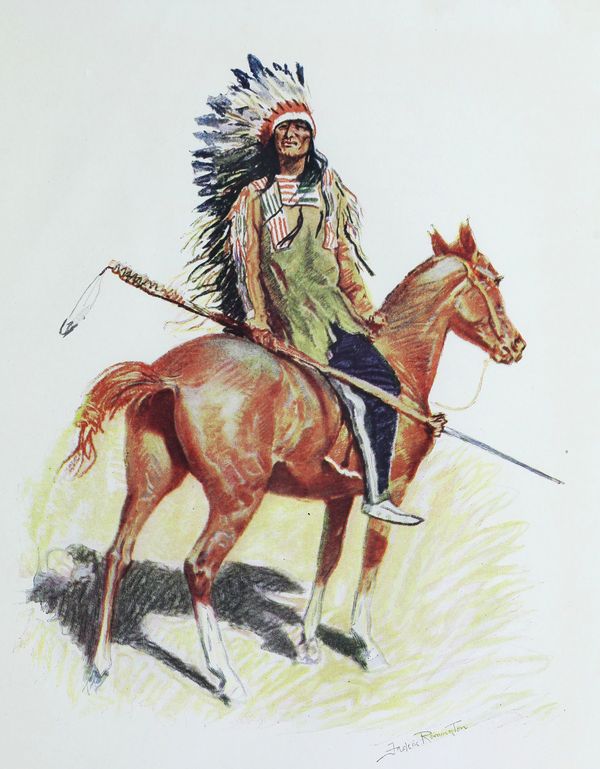
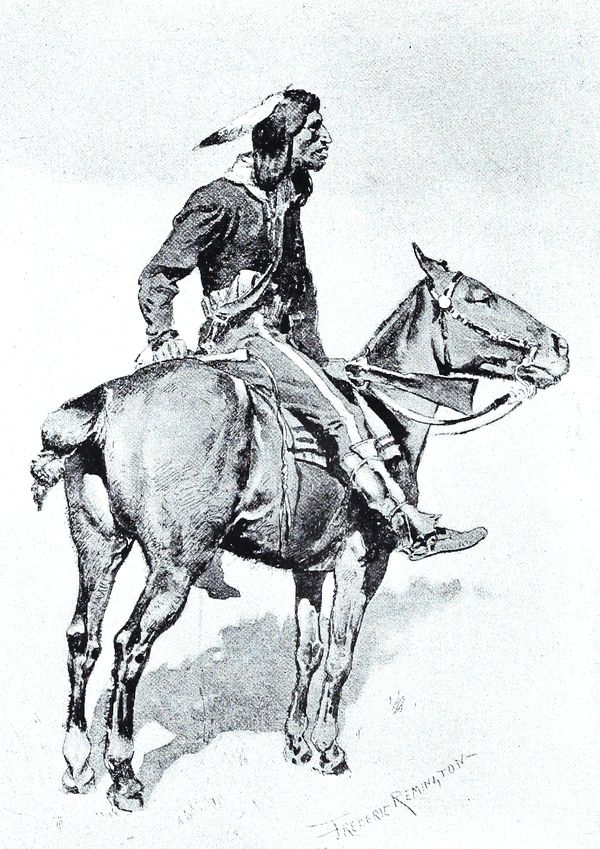
An Indian Chief
Illustration from
A BUNCH OF BUCKSKINS
by
Frederic Remington
Originally published by
R. H. Russell
,
1901
The chief greeted his visitors with gentle courtesy and motioned them to their seats. “My friends, I am glad to see you. You are hungry. Rest and eat. When you are filled and refreshed we will talk.” Then calling to his wife to put food before the guests, he smoked quietly while they ate. When they were satisfied and all were composed and comfortable he said to Kicking Bear: “Now, my friend, my ears are open.”
The visitor’s voice was full of excitement, but well under control at first. He said:
“My friend, we all know you; your fame is wide. You are the head of all our people. We know it. You have always been true to the ways of the fathers. You fought long and well against the coming of the whites. Therefore I come to you. This is the story: The first people to know of the Messiah on earth were the Shoshones and the Arapahoes. A year ago Good Thunder, the Ogallallah, hearing of this wonderful story, took four of his friends and went to visit the place where the wonder-working Son of the Great Spirit was said to be. He was gone many days, but at last he sent word that he had found the Messiah, that he was among those who eat fish, far toward the high white mountains, and he asked that I come and bear witness. Thereupon I also went—with much fear. After many days I found the place. It was deep in a strange country—a desert country. Many people were camped there. All tongues were spoken, yet all were at peace. It was said that sixteen different tribes were present, and that they had all come, as I had done, to know the truth. No one thought of war. All strife was put away.”
The Sitting Bull listened with half-closed eyes, weighing every word. It was plain, my father told me, that Kicking Bear was struggling to control his emotion. One by one the chief’s family gathered around the tepee to listen. It was a momentous hour.
“They put up robes in a circle to make a dancing place,” resumed the messenger, “and we all gathered there about sundown. It was said that the Messiah was ready to appear and teach us a new religion. Just after dark some one said, ‘There is the Great Father.’ I looked and saw him sitting on one side of the circle. I did not see him come. I do not know how he got there. The light of the fire fell on him and I saw him plainly. He was not so dark as a red man, but he was not a white man. He was a good-looking person with a kind, wise face. He was dressed in white and had no beard or mustache. One by one all the chiefs drew near to greet him. I went with the others, but when I came near I bowed my head; his eyes were so keen they blinded me. Then he rose and began to sing, and those who had been there before, began to dance in the new ceremony.
“When we stopped dancing for a little while he spoke, saying, ‘My children, I am glad to have you here. I have a great deal to say to you. I am the Son of the Great Spirit, sent to save you from destruction.’ We were very still as he spoke; no one whispered; all listened. He spoke all languages, so that we could understand. ‘I am the Creator of this earth and everything you see about you. I am able to go to the world of the dead, and I have seen all those you have lost. I will teach you to visit the ghost world also; that is the meaning of the dance. Once long ago I came to the white people, but they misused me. They put nails in my feet. See the scars!’ And he held up his hands and we saw the scars.”
The Sitting Bull gave a startled exclamation: “Hoh! You saw the scars!”
“I saw them plainly,” the Kicking Bear solemnly replied, as words of wonder ran round the tepee, “and all my friends saw them as plainly as I. Then the Messiah said: ‘I found my white children bad and I returned to the Great Spirit, my Father. I told them that after many hundreds of years I would return. Now am I returned, but this time I come to the red people.’
“‘I come to teach you a new religion and to make you happy. I am to renew the earth, which is old and worn out. If you follow my teaching, if you do as I bid you, I will bring to pass marvelous things. This is the message of my Father the Creator. He has been displeased with his children. He has turned his face away from the red people for many years. If you had remained true to the ways of the fathers these misfortunes would not have come upon you. You would not now be shut up by the white man, you would be free and happy as of old. But the heart of the Great Spirit is again soft toward you and he bids me say, “If you will live according to the ways of the Saviour whom I have sent among you I will again smile upon you. I will cause the white man to disappear from the earth, together with all the marks he has made with the plow and the ax. I will cause the old world to come back. It will slide above the present earth as one hand slides above the other; the white man and all his works will be buried and the red man will be caught up in the air and put down on this old earth as it returns, and he will find the buffalo and the elk, the deer and the antelope, feeding as of ancient days on the rich grass. The rifle will be no longer necessary nor the white man’s food or clothing. All will be as it was in the days of our fathers. No one will grow old, no one will be sick, no one will die. All will be glad and happy once more.”’”
As he talked The Kicking Bear grew greatly excited. He rose and his voice rang loud and clear. The women began to moan, but the Chief sat still, very still; his time to speak had not yet come.
The Kicking Bear went on. “He commanded that we put all evil thoughts aside. We must not fight or take from one another any good thing. We must be friends with everyone—with the white man, too. Our hearts must be clean and good.
“He also taught us the dance and new methods of purification, and these he commanded me to carry to you.” In this way The Kicking Bear ended, addressing the chief: “This is the message, father, and this is the promise: If all the red people unite, casting away all that is of the white man, praying and purifying themselves, then will the old world come back—the old happy world of the buffalo, and all the dead ones of our race will return, a mighty host, driving the buffalo before them.”
The chief sat in silence for a long time, and when he spoke his voice was very quiet, with a sad cadence. “This would please me well. But how do I know that it is not a lie? What proof is there that all these good things will come to pass? The invader is strong. I have given up war because I know it is foolish to fight against him. I have seen his land to the east. I know that he has devoured forests and made corn to grow where deep waters once rolled. He is more numerous than the buffalo ever were. All the red men of all the plains and hills cannot defeat him. It is hopeless to talk of driving him back.”
“That is true,” replied The Kicking Bear, “but you have heard how the white man’s Bible speaks of these things. In the olden time, they say, when the people despaired of weapons and war they began to pray to their Great Spirit, and he sent unseen powers to help them. They tell of cities that fell at sound of a trumpet. We are to fight no more with weapons. It is of no avail to use the ax. We must please the Great Spirit; we must beseech him to turn his face upon us again and our enemies will melt away.”
“But what proof is there of this? It is all a tale. It is as the sound of a pleasant breeze in the trees.”
“The proof is in this,” earnestly replied The Kicking Bear. “In this dance, men are able to leave the body and fly far away and look upon the spirits of the dead, and to ride the old-time plains in pursuit of the buffalo. I have myself seen this old world waiting to be restored. Let us call a council. Let us dance and some of your own people—perhaps The Sitting Bull himself—will be able to leave the body and visit the wonderful world of the spirit and return to tell the people of it! Let us dance; the proof will come.”
To this the chief made cautious reply: “We will not be hasty. Remain with us and we will talk further of these things.”
To Slohan he said: “This man talks well. He claims to have been in the west and to have seen the Messiah; yet we must be careful. We will look minutely into the matter. We must not seem foolish.” Then he turned again to the Brulé. “When is this good change to come to us?”
“The Father said that if all his words are obeyed he will cause the new earth to come with the springing grass.”
“Do you believe this story?” asked the chief, pointedly.
“Yes.”
“What causes your belief?”
The Kicking Bear became deeply moved; his voice trembled as he replied: “Because since I touched his hand I have been out of the body many times. I too have visited the spirit world, and I too have seen the dead, and I have seen the buffalo and the shining new world, more beautiful than the old. Since my return I often see the Saviour in my sleep. I know that through him you and all your tribe can fly to the spirit world and see your friends. Therefore have I come that I may teach you the songs and the dances which bring the trance and the vision.”
“You speak of the destruction of the white people. How is that to be brought about?” asked the chief.
“All by great magic. War is useless. All who believe must wear an eagle plume, and when the new earth comes sliding over the old, those who wear the sacred feather will be caught up and saved, while the white man and all those who reject the Father’s message will be swept down and buried deep.” Then the messenger cried out with passion: “Father, they are all dancing—the Piutes, the Shoshones, the Ogallallahs, the Cheyennes—all the people. Hear me! I bring a true message! Listen, I implore!”
He began to sing, and his companions joined him. The song they sang was strange to my father, and very, very sad—as dolorous as the wind in the bare branches of the elm tree. It was not a war song; it was a mourning cry that made all hearts melt. As they sang, Kicking Bear began to tremble, and then his right arm began to whirl about wildly as if it were a club. Then he fell stiffly to the ground like a man in a fit.
The Sitting Bull rose up quickly. “Hah! What is the meaning of this?” he asked, looking about him warily.
“He has gone into a trance,” said one of the others. “He is even now in the spirit world. Do not touch him.”
For a long time the messenger lay as if dead and no one dared disturb him. My chief sat smoking, patiently waiting for Kicking Bear to speak. At last he came to life again and sat up. “I have seen the Father,” he said, with shining face, “and he has given me a sign. He has made my left hand stronger than the strongest man. Come and see!” He held out his hand and my father took it, but it scared him and he flung it away from him. It made his muscles contract and his flesh sting as if needles had been thrust into it. Then The Bear cried out: “See! I am telling the truth. I have seen the Messiah. He has given me an arm of power for a sign. He told me to return and teach The Sitting Bull the new religion.” He laid hold of a heavy white cup. “See the sign?” he cried, and ground the cup to pieces on his hand.
The Sitting Bull was deeply troubled. “We will talk of this to-morrow,” and he went away profoundly stirred by what he had seen.
The next morning he called a council of his close friends, and at last sent for Kicking Bear, and said: “Your story is sweet in our ears. It may be true. I do not think so, but we will try. We have come to the time when all weapons are useless. We are despairing and weak. Guns are of no avail. The Great Spirit has certainly turned his face away. It may be that prayer and song will cause him to smile upon us again. You may teach us the dance.”
X THE DANCE BEGINS
So it was that in the prepared soil of my people’s minds this seed of mystery fell. It was not a new religion; it was indeed very old. Many other races had believed it; the time was come for the Sioux to take it to themselves. In their despair they greedily seized upon it. In their enforced idleness they welcomed it.
Swiftly the news flew, wildly exaggerated, of course. It was said that the Messiah had sent a message direct to the chief, and that a sign had been given to the courier which had convinced my father and many others—though The Sitting Bull yet doubted.
Uncapappas are like any other folk. There are excitable ones and doubting ones, those who believe easily and those who are disposed to prove all things. Many old women with sons and daughters lately passed to the spirit land laid hold upon this news with instant belief. Winter was coming again; food was scarce; the children were ailing; life was joyless and held no promise of happier things. So, as among the white people, the bereaved were quick to embrace any faith which promised reunion.
At last men of keener intelligence, like my father, considered it, saying: “It may be true. The white man had a Saviour. Why should not the Great Spirit send one to us? We can at least examine into this man’s story. We can go and see the dance.”
Others, who had outgrown the faith of their fathers, and who had also rejected the Christian religion, smiled and said, “It is foolish!” Nevertheless, curious to see what was done, they loitered near to look on and laugh.
Last of all were those who brooded bitterly upon the past—the chained lions who had never accepted the white man’s dominion, who feared nothing but captivity, and who sat ever in their tepees with their blankets around them smoking, ruminating, reliving the brave, ancient days. “We are prisoners,” they said. “We are not allowed to leave the narrow bounds of our bleak reservation. We can neither hunt nor visit our friends. What is the use of living? Why not die in battle? Is it not better to be slain and pass at once to the spirit land than to die of starvation and cold? We know the fate of the dead cannot be worse than our lot here.”
In the light of memory the country of their youth was a land of waving grass, resplendent skies, rippling streams, shining tepees, laughter, song, and heroic deeds. In dreams they were once more young scouts, selected for special duty. In dreams they rode again over the boundless swelling plain, hunting the great black cattle of the wild. They lay in wait for the beaver beside streams without a name. They sat deep in pits, hearing the roaring rush of the swooping eagle, and always when they woke to reality they found themselves ragged beggars under the control of a white man, betrayed and forgotten by their recreant allies.
What had they retained of all this mighty heritage? A minute patch of barren ground and the blessed privilege of working like a Chinaman or a negro. Of all the old-time adventurous, plentiful, and peaceful life the white settlers had bereft them. Mile by mile the invaders had eaten up the sod. The buffalo, the elk, the beaver had disappeared before their guns. Stream after stream they had bridged and in the valleys they had set their fences. The agent always talked as though every red man who wished could have a large house and fruit trees and pleasant things, but it was quite certain now that nothing remained for these proud hunters of the bison but a practical slavery to the settler; to clean the dung from the white man’s stables was their fate.
With this view the “Silent Eaters” had most sympathy. In the days immediately following their return from the north they had caught some of the enthusiasm of their teachers. They, too, had hoped for some of the good things of the white man’s civilization.
The Sitting Bull himself had been hopeful. He had spoken bravely to them advising them to set their feet in the white man’s road; but as the years passed one by one he had felt with ever-increasing bitterness the checks and constraints of his warden. He had seen sycophants and hypocrites exalted and his own wishes thwarted or treated with contempt and his face had grown ever sadder and sterner. When he looked into the future he saw the almost certain misery and final extinction of his race, so inevitably he, too, had turned his eyes inward to dream of the past. Having no hope of earthly things, he was now, in spite of himself, allured by the stories of this Saviour in the West. Certainly he could not forbid his people this comfort.
He had, too, the natural pride of the leader. He considered himself as he was, the head man of his tribe, and it hurt him to find himself completely shorn of command. The agent now deliberately humiliated him, ignoring his suggestions and misrepresenting him among the white men. “These old chiefs must give way,” he said. “If we are to civilize these Indians, all of the old tribal government must be torn up.” And in this he had the support of many friends of my race.
One of the most serious differences existing at this time lay in The Sitting Bull’s refusal to recognize the authority of the agent’s native police. “I am still the head of my tribe,” he proudly said. “I do not need your help in order to keep the peace.”
Then the agent very shrewdly appointed those who were jealous of the chief to be the heads of his police force, and so made sure of them in case of trouble. The chief was made to look and feel like a man living by sufferance, while renegades whom he despised and recreants whom he hated were put in power over him. Yet he was bearing all this quietly; he had even submitted to personal abuse, rather than prove a disturber.
This message from the Messiah came, therefore, just at a time when the chief and his “Silent Eaters” were suffering their final degradation at the hands of the agent. It was hard to die at this time like outcast dogs, with no hope for their people. They could not understand why they should be made the target of the agent’s malice. They had the pride of leadership. It was honorable to be a chief. The qualities which went to make a chieftain were not mean; they were noble. Why should other and lower men be placed in contemptuous authority over them?
And so these proud spirits shut their eyes to the future and longed, as no white man can ever know, for the glorious days of the buffalo.
For three days The Kicking Bear instructed the few who believed, preparing them for the dance. “You must cast aside everything that the white man has brought to you,” he said. “The Messiah commands that all metals be thrown away. Lay down all weapons, for this is a dance of peace. It is needful that you dress as in the olden time before the invader came. Let each one who dances and accepts the word of the Father wear a white eagle plume, for this will be a sign when the new earth comes. You will be caught up into the clouds by reason of your faith, while all others will perish. You must purify yourselves, also, by use of the sweat lodge, and after the dance you must bathe in clear, cold water. During this time you must put away all anger and harshness and speak kindly to all persons. Thus says the Father.”
There was something lofty in all this and it moved men very deeply and the chief listened intently to it all.
On the third night of his preaching I was present, for my father had sent for me to come. After drawing from me a promise to tell no white man, he described all that had happened. I was not at first impressed. “It is foolish,” I said.
“Nevertheless you must come and see this man. He is a wonderful magician. I do not understand him.”
The meeting took place in the chief’s tepee, which was large and strong. As I entered I saw many men and women sitting just outside the door in little groups, but only about fifteen people had been invited to join the circle which I soon found was formed to rehearse some of the ceremonial songs of the Messiah. A small, clear fire glowed in the center of the lodge, and the chief’s strong face was fixed in its place at the back of the lodge. On his right was The Kicking Bear. On his left was a vacant place; this my father took. At a sign from the chief I sat next my father.
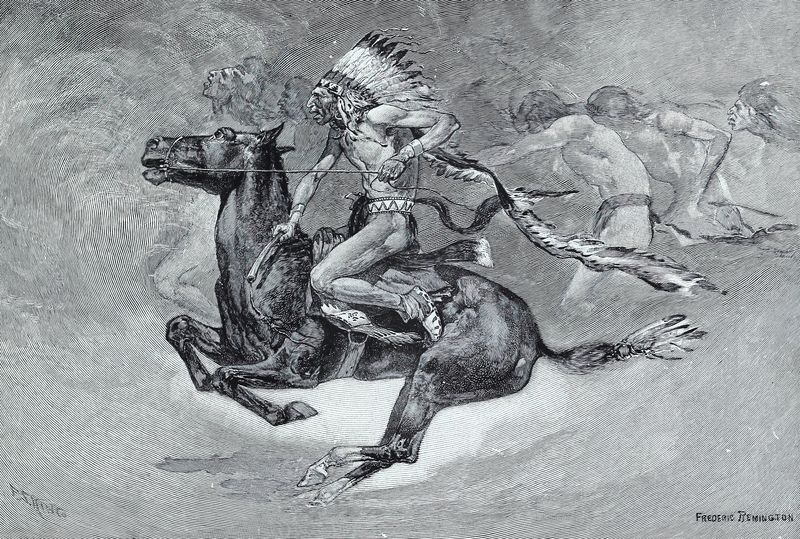
A Fantasy from the Pony War Dance
Among the many interesting features of the pageant given on special occasions by the Blackfoot Indians on their reservation in Canada, the most spectacular is the Pony War Dance, or the Departure for Battle. In this scene about sixty young men take part, riding horses as wild as themselves. The acting is fierce—not like the conduct of a mimic battle on our stage—but performed with the desperate zest of men who hope for distinction in war.
Illustration from
CHARTERING A NATION
by
Julian Ralph
Originally published in
Harper’s Magazine
,
December, 1891
Chis-Chis-Chash Scout On the Flanks
The Cheyenne, or—to use the name the Cheyennes apply to themselves—the Chis-Chis-Chash, scouts belonged to the corps from Pine Ridge organized on that reservation, and, with other Cheyennes from Tongue River, rendered valuable service to Uncle Sam during the Sioux outbreak of 1890 in South Dakota. In December of that year these brave Indians had many a skirmish with the savage Sioux, who, clothed in the ghost shirt, went on the warpath, taking refuge in the Bad Lands—a region that seemed made for stratagem and murder, with nothing to witness its mysteries but the cold blue winter sky.
Illustration from
LIEUTENANT CASEY’S LAST SCOUT
by
Frederic Remington
Originally published in
Pony Tracks
, Harper & Brothers, 1895
Shortly after our entry the chief lit his pipe, and after offering it to the Earth Spirits and to the Spirits Above, handed it to his visitor. The Bear made the same offering, and after smoking passed it on. So it went round the circle. When the chief had it in his hands once more, The Kicking Bear and his five companions rose and, stretching their hands to the west, stood still while The Bear prayed:
“O great spirit in the west Our Father, Take pity on us. We are poor and weak. Send us good tidings. Help us to see the good land. Help us to see our loved ones.”
Then he began singing a song—a song of promise—and these were the words:
“The Father says so, He has promised surely You shall see your dead once more. They will come to life again. You shall see your kindred Of the spirit land. This the Father saith To his faithful ones.”
This song moved me, though I was a doubter. It was sung with great vigor and earnestness. It was the opening song of the dance, The Bear explained to us, and then all sat down, and one by one the visitors took up and sang the songs they had learned. There were many of them and they were based upon the same idea—that of a resurrection of the dead, the renewal of the worn-out old earth and the return of the buffalo.
As they sang my head was filled with many great but confused thoughts. In that light, with those surroundings, any magic seemed possible. It was thus that the disciples of Christ of Galilee came together and talked of his message. I had listened often to the white man’s religion, and yet the hymns of the martyrs could not move me as did these songs. The past and the present fused together strangely in my mind as the ancient shining winds blew and the old rejoicing days came back.
You shall reset the tepees. You shall eat pemmican once more. You shall hang up the buffalo meat. And there shall be plenty everywhere. You shall live and not die in the old world which returns anew. You shall chase the buffalo. You shall gayly race on the bright prairie.
These were the promises of the songs, and as the visitors sang my despairing people became like little children; their hearts melted, they laughed and wept and shouted in time to the music. Some strange power seemed to go with the motions of The Bear’s hands. We all seemed to be looking upon the very scenes of which he sang, and my throat closed with an emotion I could not control.
An old man, called Looking Eagle, suddenly rose and, stretching forth his hands, cried out in a thrilling voice:
“I see it—the new land! I can see the buffalo feeding in myriads. It is Spring and the grass is new. My father stands at the door of his lodge. He calls with his hand. My mother is there. Ho! I come, my father.”
Then he fell on the ground and The Kicking Bear and his friends joined hands and, breaking into a song which made my own heart leap, they began to dance in a circle about the fire:
“The whole world of the dead is returning. Our nation is coming, is coming, is coming. The eagle has brought us the message, Bearing the word of the Father— The word and the wish of the Father. Over the glad new earth they are coming, Our dead come driving the elk and the deer. See them hurrying the herds of the bison. This the Father has promised, This the Father has given.”
One by one those sitting gave way and rose and joined the dance, till only the chief, Slohan, and I remained seated. My father joined them at the last, and outside the tepee the voices of women could be heard catching and trying the song. It was agonizing to hear. It strained every heart to bursting with longing and sadness.
Suddenly The Bear’s head began to rock violently from side to side; it seemed as if it would wrench itself from its place. His eyes set in a dreadful stare, his mouth fixed in a horrible gape. Then shaking himself free, he fell close to the fire, face downward.
The others danced for a little while longer, then took seats and waited for the return of the spirit of their priest. Looking Eagle still slept.
The Sitting Bull sat in silence, smoking gravely, slowly, but his hand trembled. It was plain that he, too, longed to believe in the dance, but he could not. My own nerves were quivering with the excitement and I waited with almost breathless eagerness for the waking of the sleepers.
It was a long time—it seemed that it was nearly morning—when The Bear began to stir again and to rub his eyes as if wakened from sleep. He was very quiet and his voice was gentle as he said: “I have been with the Father. He gave me another message to The Sitting Bull. This it is: ‘All the people to the South are dancing my dance. Will the chief of all the Sioux walk behind his nation?’”
Then the chief said, “When my son there,”—he touched my arm—“or one of my trusted warriors can go to the spirit world and return to tell me it is true, then I may believe. If this religion is true all other deeds are worthless. Bring me proof. My ears are open, my eyes are not yet dim. If these songs are true, then I shall weep no more. If they are not true, then I wish to die. Let us hold a dance to-morrow.” And with a sign he dismissed us, but he himself remained alone with Looking Eagle, who still lay motionless where he had fallen.
XI THE BREAKING OF THE PEACE PIPE
A knowledge of the dance spread like flame throughout all the Grand River district, and young and old began to flock to The Sitting Bull’s camp, eager to hear more, eager to experiment. “We also wish to see our friends who have gone before us,” they said. “We wish to hear what they say. Teach us the way of the trance.”
I felt the influence of their thought very strongly what time I sat among them, but afterward, when I had returned to the agency, it appeared but the rankest folly, and when others asked me about it I always said: “It is but a foolish thing; do not value it.” But my words did not check the wave of belief in it.
While no special pains were taken to conceal the fact from the white people, it was several days before the agent had any knowledge of Kicking Bear or his mission. This agent, let me say, was a good man, but jealous of his authority, and when he learned that the chief had himself invited The Kicking Bear into the reservation he was angry and said, “I won’t have any of this nonsense here,” and calling Crow, lieutenant of the police, he said: “Crow, go down to The Sitting Bull’s house and tell him this Kicking Bear and Messiah business must stop. Put Kicking Bear off the reservation at once!”
I was very much alarmed by the order, and waited anxiously to learn what the chief would say. I feared his revolt.
The next day the Crow returned from Rock Creek like a man walking in his sleep. He could give the agent no intelligible account of himself or of what he had seen. “He is a wonder worker,” he repeated, “I couldn’t put him away. When he took my hand I was weak as a child. I saw the dance, and when he waved a feather I became dizzy, I fell to the ground, and my eyes were turned inward.”
The agent stared at him as if he were crazy; then he turned to me and said: “Iapi, I wish you’d go down and see what all this hocus-pocus means. Take a couple of policemen with you and make sure that they start this mischief maker on his way home. And tell The Sitting Bull that I want to see him. Say to him the agent expects him to fire Kicking Bear off the reservation.”
I did not tell him that I already knew what was being done. I felt that if some one must carry such a message to the chief it was well for me to do it, for he was in no mood to be reproved like a boy. I took no policemen, but rode away alone with many misgivings.
No sooner had I passed the fort than I regretted my acceptance of the mission. After all, I was Uncapappa and I honored my chief. Whenever I entered the shadow of a tepee I was no longer alien; I fused with my tribe. The gravity and order of my chieftain’s lodge were pleasant to me, and the sound of the women’s songs melted my bones. I was not white; I was red. Acquiring the language of the conquering race had not changed my heart.
For all these reasons I saw that I was set forth on a dishonorable mission. To speak the words of the agent were impossible to me. When I met Circling Thunder, an old playmate of mine, and learned that many were dancing, my face stiffened. I had hoped to be able to have a word with the chief in private.
“Do you believe in it?” I asked.
My friend shook his head. “I don’t know. Many claim to have visited the spirit world—and Looking Eagle brought back a handful of pemmican, so they say. The buffalo were thick over there and the people were very happy.”
“How do you know it was pemmican?”
“I tasted it.”
“Perhaps it was only beef.”
“It may be so,” he said, but his eyes were still dim with dream.
Many of those whom I met were in this state of doubt. They wished to be convinced. It was so sweet to dream of the old-time world, and yet they could not quite believe it. They stood too near the stern reality of hunger and cold, and yet my people are a race of seers. To them the dream has not yet lost its marvelous portent. In time of trouble they go upon the hills and wait for the vision which shall instruct and comfort them.
In my youth I had shared in these beliefs. I had had my days of fasting and prayer; yes, I too had entered the sleep which reveals. I had met and talked with birds and animals, and once I felt the hand of my dead mother move in my hair. I had fasted until I could walk among the painted tepees of the spirit world and I had gazed on the black herds of buffalo.
My training among scholars had given me a new understanding of these conditions, but I could not impart my knowledge to my people. My wisdom was accounted alien and therefore to be distrusted. Of what avail to argue with them when the frenzy was upon them?
It was brilliant October, very warm and hazy, and our cruel, treacherous land was indolently beautiful. The sky was without cloud—a whitish blue—and the plain, covered with tawny short grass on the uplands, and with purple and golden garments of blue-joint in the hollows, seemed to lift on every side like a gigantic bowl. My horse’s hoofs drummed on the dry sod as I hurried forward.
This is an inexorable land—a land in which man should be free to migrate like the larks or the buffalo. In the old days we never thought of living on these high, wind-swept spaces. They were merely our hunting grounds. Our winter camps were always beside the river, behind the deep banks, in the shelter of the oaks and cottonwoods. In those days the plain seemed less ferocious than now, when we are forced to cross it in all kinds of weather, poorly clothed. In the days of the buffalo we chose our time and place to migrate; now we were fastened to one spot like chained coyotes.
As I came to the hill which overlooked the wooded flat I saw a great many tepees set about the chief’s cabin, and I perceived also that the dance was going on. Occasionally a cry reached me, pulsing faintly through the hazy air. In some such way, perhaps, the white fisher folk of Galilee drew together to greet the coming of their Messiah. Was this Saviour of the west any more incredible than Christ?
So I mused as I rode slowly down the hill. What if it were all true? The white man who claims to know all things believes in his Bible and his Bible is full of miracles.
Soon I could hear the song. It was the sad song I had heard them sing in the chief’s tepee. It was in most violent opposition to the sunlit earth and the soft caressing wind, and reached my heart like the wail of a mourning woman. Soon I was near enough to hear the wistful words. It was all of entreaty:
“Our Father, we come. We come to you weeping. Take pity on us, O Father. We are poor and weak, Without you we can do nothing. Help us, O Father. Help us to see the old world, The happy hunting ground of the buffalo, The glorious land of our childhood. Hear us, Great Spirit.”