THE SILENT EATERS
Reading edition
I THE BEGINNINGS OF POWER
I was born a soldier. I have lived thus long. In despite of all, I have lived thus long. ——Sioux War Song.
One day in 1854, while the Uncapappas, a branch of my father’s people, were camped in pursuit of buffalo on a tributary of the Platte River, a half-breed scout came into the circle from the south, bearing a strange message. He said: “The great war chief of the whites is coming with beads and cloth and many good things. He desires all the red men to meet him in a council of peace. He is sorry that we are at war. Therefore, he is inviting all your chieftains to his lodge to receive presents and to smoke.”
Up to this time the Uncapappas had never made talk with the soldiers, and many, like myself, had never seen a white man. Our home lay to the east and north of the Black Hills, far away from contact with the settlers. Of them we had heard, but only remotely. Many of our own men had never seen a French trapper. Our lives still went on as they had been going since the earliest time.
We followed the buffalo wherever they went within the limits of the hunting grounds which we claimed. On the east were our cousins, the Yanktonaise and Minneconjous. To the north of the Cannonball lived the Rees and Mandans; to the northwest, across the Powder River lurked the Crows, our ever-ready enemies. On the headwaters of the Arkansaw the Utes, a powerful mountain people, dwelt. The Comanches and many other unknown folk held the country far, far to the south, while to the east lay a land more mysterious than any other, for it was said that both white men and red men claimed it and warred for the mastery of it. Of the rest of the world most of us knew nothing; all was dark as a cave inhabited by bats and serpents.
Therefore, when the messenger had made his plea the chiefs called a great council to ponder this new and important matter. At this time the four head men, the civic chiefs, of my people, were The Four Horns, The Red Horn, The Running Antelope and The Loud-Voiced Hawk. These men had full power to call a convention and all the people came together obediently and some of the boys, like myself, crept near to listen.
It was in early summer. The grass was new and sweet; the buffalo were fat, the horses swift, and each day was a feast, with much dancing, and we lads raced horses when the old men would permit. Not one of all our tribe had care as a bedfellow at this time. Even the aged smiled like children.
In those days the plains were black with buffalo and the valleys speckled with red deer and elk, and no lodge had fear of hunger or frost. In winter we occupied tepees of thick warm fur with the edges fully banked with snow and we were not often cold. We had plenty of buckskin to wear and no one went unsatisfied. You would look long to find a people as happy as we were, because we lived as the Great Spirit had taught us to do, with no thought of change.
Nevertheless, our wise men had a foreboding of coming trouble, and when The Hawk, who was a very old man, rose in the council to speak, his face was deeply troubled. Once he had been ready of speech, but his tongue now trembled with age and his shoulders weighed heavy upon his lungs, for he coughed twice before he could begin.
“My friends, listen to me. I am an old man. I shall not be able to meet in council again. The rime of many winters has stiffened my lips, but I am glad this matter has come up now. My heart is full of things to tell you. My children, I have had a dream. Last night I went forth on the hill to pray and as I prayed I grew weary and fell asleep, and I saw a great council such as that the Graybeard now asks us to attend. I beheld much food and many blankets given away, and then a great fight began. A cloud of thick smoke arose. There were angry confusion and slaying and wailing in the midst of the smoke, so that my limbs seemed rooted to the ground in my fear. Now I know this dream was intended for a warning. Beware of those who come bringing gifts. They seek to betray you.” With uplifted hand he faced all the people and called again, very loud, “Beware of those who bring presents, for they will work sorrow among you.”
Then he sank back exhausted and all the chiefs were silent, but The Hawk’s wife began to sing a sad song, and as she sang, one by one the other chiefs rose and said: “The Hawk is wise. We will not go to meet this man. We will not take his presents. He comes like a Comanche disguised as a wolf. We will be as cunning as he. Why should he offer presents unless he wishes to gain an advantage of us?”
At last a young warrior, a grave man of gentle and serious face, stood in his place and said: “My father, I am a young man. I have seen only twenty-two winters and perhaps you will not listen to me, but I intend to speak, nevertheless. I have always listened when my elders have spoken, and especially have I opened my ears when strangers from the East came to our lodges. Your decision is wise. It is well to have nothing to do with these deceitful ones. Listen now to my request. I desire to be the chief soldier in this matter. If you wish to oppose the givers of gifts and the policy which goes with their refusal, place the matter in my hands and I will see that your desires are carried out.”
The firm, courageous bearing of this youth pleased the elders, and after deliberation they said: “It is well. We will make you our executive in this matter. You shall be Chief Soldier of Treaties.”
In this way was my chief Ta-Tank-io-Tanka, The Sitting Bull, made what you would call “Secretary of War” over seven hundred lodges of my people. He had already attained rank as a valiant but not reckless warrior. The Rees knew him, and so did the Crows. He came of good family, though his father was only a minor chief. His uncle was Four Horns, and his grandfather, The Jumping Bull, was an active and powerful man whose influence undoubtedly was of use to the young chief. His name had never been borne by any other man of his tribe. At fourteen he had counted coup on a Crow. He had been wounded in the foot while dashing upon an enemy, and he still walked with a slight limp. He was active, unassuming, and capable of many things.
But his fame as a peacemaker had already far outrun his renown as a warrior. He had been made a chief by the Ogallallahs because of his firm sense of justice. Only a year before this time a band of the young warriors of his own tribe had stolen from their cousins a herd of horses while the two tribes were camped side by side, and The Sitting Bull, having heard of this, went to the young men and said:
“We do not make reprisals upon our friends. We only take from our enemies,” and thereupon had led the horses back to their owners.
In return for this good deed the Ogallallahs had made him a chief among them, though he took no part in their councils.
He was a natural leader and a persuasive orator. A chief among my people, you know, is a peacemaker, and The Sitting Bull was always gentle of voice. If he saw two men squabbling he parted them and said: “Do not make war among yourselves. What is the matter? Tell me your dispute.” Sometimes he would say: “Here is a horse for each of you. Go and wrangle no more.” When he was very successful in the hunt he always went about the camp, and wherever a sick man or an aged woman lived, there he left a haunch of venison or some buffalo meat. This made him many friends. He did not desire riches for himself, but for his tribe.
Therefore nearly all the tribesmen were glad when he was made treaty chief and given the charge of all such matters. He was at once what the white people would call Secretary of State and of War.
Immediately after his election he called the treaty messenger into his lodge and said: “Return to those that sent you and say this: ‘The Uncapappas have no need of your food or clothing. The hills are clouded with buffalo, the cherries are ripening in the thickets. When we desire any of the white man’s goods we will buy them. Go in peace.’”
In this way the white men first heard of The Sitting Bull.
Yes, in those wondrous days my people were many and powerful. The allied tribes of Sioux (as you white men call them) held all the land from Big Stone Lake westward to the Yellowstone River and south to the Platte—that is to say, all of what you call South Dakota, part of Wyoming, and half of Nebraska. We often went as far as the Rocky Mountains in our search for food, for the buffalo were always shifting ground. As the phantom lakes of the plain mysteriously appear and disappear, so they came and went.
Where the bison were, there plenty was; we had no fear. But they roamed widely. For these reasons my people required much territory, and, though the wild cattle were many, we were sometimes obliged to enter the lands of our enemies to make our killing, and these expeditions were the causes of our wars with the Crows on the west and with the Comanches on the south. However, these wars were not long or bloody. For the most part we lived quietly, peacefully, with only games to keep our sinews tense.
In the expeditions which followed The Sitting Bull’s promotion he became the executive head. He was chief of police by virtue of his office, and his was the hand which commanded tranquillity and order in the camp. Whenever a messenger entered the circle the sentinels brought him directly to the chief’s lodge and there waited orders. No one thought of stepping between The Sitting Bull and his duties, for, though so quiet, he could be very stern.
He laid aside all weapons—for this is the custom among the chiefs—and carried only his embroidered pipe-bag and his fan, nothing more. His face was always calm and his voice gentle. He seemed to have no thought of self, but spoke always of the welfare of his tribe. When a question came to him for decision he said: “This is good for my people. We will do it.” Or, “This is bad for my people. We will refuse.” He raised himself by building upon the welfare of his race.
It was for this reason he refused again to meet General Harney in 1855 at Fort Pierre. He knew something then of the floods of white men pouring into Iowa and Minnesota. He had his spies out and was aware of every boat that came up the Missouri. He already possessed a well-defined policy. To every trader he said: “Yes, I am glad to see you. My people have skins to sell and tobacco and ammunition to buy. This exchange is good. Come and trade.” But to the messenger of the white men’s government he said: “I do not want your presents. My young men earn their goods by hunting. We are not in need of treaty makers.”
So it was that his fame spread among the border men and he came to be called a fierce warrior, ever ready to kill, when the truth is he protected those who came to his camp; even the spies of Washington had reason to thank The Sitting Bull for his clemency.
The years passed pleasantly and my tribe had little foreboding of danger. Our game remained plentiful and, though the rumors of the white man’s coming thickened, the people paid little heed to them, though the chiefs counciled upon it gravely. Then one day came the news that the Dakotas, our cousins, were at war with the whites. Soon after this, word came that they had been driven out of their land into our territory. Then it was that the Uncapappas first began to know the power of the invaders. I was but a lad, but I remember well the incredulous words of my father and mother when the story of the battles first were told at our fireside. The head men were uneasy and The Sitting Bull seemed especially gloomy and troubled.
In council he said: “Our brothers have been wrong. They should not make war upon the white man. He has many things that we need—guns and cloth and knives. We should be friendly with him. I do not make war on him, though I fear his presents and stop my ears to his promises. I forecast that we shall be pushed out.”
The news came to us also at this time that the white men were fighting among themselves far to the south, but we never met anyone who had seen this with his own eyes. We had no clear conception of what lay to the east of us. We only knew that the Chippewas lived there and many whites who were friendly with them, but no one of all our wise old men could tell us more.
Once I heard the chief say: “I do not understand why the white man leaves his own land to invade ours. It must be a sad country with little game, and if he came here only to hunt or trade we would make him welcome—but I fear he comes to steal our hunting grounds away. If he is in need and comes peaceably, let him share our buffalo. There is enough to feed all the world.”
Meanwhile the four head chiefs were growing old and lethargic, and so, naturally, step by step, The Sitting Bull came to be the head of all our band. He drew toward him all those who believed in living the simple life of our ancestors far away from all enemies. With songs and dances and feasts we marked the seasons, living peacefully for the most part, except now and then when a small party was sent out against the Crows or the Mandans, till in the 110th mark of my father’s winter count—that is in 1869—the whites established a trading post at the Grand River and put some soldiers in it and sent out couriers to all the Sioux tribes to assemble there for a council. The time had come (as it afterward appeared) when the settlers wanted to inhabit our lands.
This, I think, was the first time the chief clearly understood the attitude of the government toward him. Another day marks the beginning of the decline of my people.
I remember well the coming of that messenger. I was awakened by the sound of a horse’s feet, and, looking out of the tepee, I saw a small man on a big horse—bigger than any I had ever seen before. Warriors were surrounding him, asking, “Who are you?”
“Take me to The Sitting Bull,” he said, and just then the chief looked from his lodge and said, “Bring him to me.”
He was brought and set before The Sitting Bull, and they looked at each other for a time in silence. I was peering in under the side of the lodge and could not see the chief’s face, but the stranger smiled and said: “Are The Sitting Bull’s eyes getting dim that he does not know his old playmate?”
“The Badger,” replied the chief. Then he smiled and they shook hands. “You are changed, my friend; you were but a boy when we played at hunting in The Cave Hills.”
“That is true,” replied the man, who was a French half-breed. “I do not blame you for looking at me with blind eyes. I would not have known you. I have a message for you.”
“Bring food for our brother,” commanded the chief, and after The Badger had eaten the chief said, “Now tell me whence you come and why are you here?”
“That is a long tale,” said The Badger. “It is a story you must think about.”
And so for three days The Badger sat before the chief and they talked. And each night the camp muttered gravely, discussing the same question. The chief’s face grew sterner each day. He smoked long and there were times when his eyes rested on the ground in a silence of deep thought while The Badger told of the mighty white man—of his wonderful deeds, of his armies, of his iron horses, of all these things which we afterward saw for ourselves. He went farther. He told us of the white man’s government which was lodged in a great village made of wood and stone. He said the white men were more numerous than the buffalo and that their horses were plenty as prairie dogs. “You do well, my friend, not to go to war against these people. They are all-conquering. What can you do against magicians who create guns and knives and powder?”
“I have no hate of them,” replied the chief. “All I ask is to be let alone.”
“Listen, my friend. This is what the white man is doing. A great chief, whose name is Sheridan, followed by many warriors, is killing or subduing all the red people to the south. He has broken the Comanches; the Kiowas and Pawnees—all bend the neck to him. Ferocious leaders have been sent out from Washington with orders to gather all your race into certain small lands and there teach them the white man’s way. Whether they wish to do so or not does not matter. They must go or be blown to pieces by his guns. My friend, that is what they mean to do with you. They want you to come to the mouth of Grand River and to the Standing Rock, there to give up your hunting and learn the white man’s way. The great war chief of the whites has said it.”
The chief’s eyes flamed. “And if I refuse?”
“Then he will send a long line of his horsemen to fetch you.”
The chief grimly smiled. “Hoh! Well, go back and tell them to come. The Sitting Bull has got along very well in the ways of his fathers thus far and in those ways he will continue. The land is wide to the west and game is plenty.”
But The Badger then said: “My brother, you know me well. We can speak plainly. The white chief sent me, I say that now. He asked me to come, and I did so. I came as a friend in order that you might not be deceived. I tell you the truth—the white man is moving westward, like a feeding herd of buffalo, slow but sure. His heart is bitter toward us and we must keep silence before him. He wants all the land east of the Missouri and south of the Black Hills. He demands that you give it up.”
My chief was sitting in his soldiers’ lodge; few were there. My father was looking in at the door and I, a lad, was beside him. I saw the veins swell out in the chief’s neck as he rose and spoke: “My friend, out there” (he swept his hand to the west) “is our land, a big open space covered with game. Go back to your friends, the white men, and say that The Sitting Bull is Uncapappa and free to do as he wills. He chooses to live as his fathers lived. As the Great Spirit made him, so he is, and shall remain.”
II POLICY AND COUNCIL
Nevertheless The Badger’s talk had enlightened my chief. He pondered deeply over his words and came at last fairly to understand the white man’s demands. He lived by planting; the red man by hunting. The palefaces said: “The red man has too much land. We will take part of it for ourselves. In return we will teach him how to plant and make bread and clothing.” But they did not stop there. They said if the red man does not wish to be a planter and wear our clothing we will send out soldiers with guns and make him do our will.
The chief’s first duty was to reject these terms, and this he did; but a second messenger came bringing tobacco and round disks of bread. The chief ground the tobacco under his heel and his soldiers spun the bread down the hill into the river. The emissary stood by and saw this merry game and was wise enough to remain silent.
Once a courier who would not cease talking when commanded by the chief was whipped out of the village. So it came to be that this great camp on the Little Missouri was called “The Hostile Camp of Sitting Bull.”
You have heard those who now deride my chief and say that he was no warrior, that he was a coward, a man of no account; but they are ignorant fools who say this. Go read in the books of the agent at Standing Rock; there you will find records of the respect and fear in which the agents of Washington held my chief in those days. You may read there of seven messengers who were sent out to tell “Sitting Bull and his irreconcilables they must come in and disarm”—and if you read on you will learn how these spies came straggling back without daring to utter one word of the government’s commands to my chief.
They lied about him, the cowardly whelps, and said he threatened them. In truth, they sneaked into his presence and said nothing. In this way the agent got a false impression of the chief, and reported that he was at war with the whites, which was not true.
The Sitting Bull was now both Secretary of War and commander-in-chief of all those who believed in the ways of the fathers. He drew men to him by the boldness and gentleness of his words. His camp was the refuge of those who declined to obey the agents of the white man’s government. The circle of his followers each year widened and his fame spread far among the white men who hated him for the lands he held.
But while my chief was thus holding hard to the ancestral customs, like a rock in a rushing stream, our cousins, the Yanktonaise and the Ogallallahs, were slowly yielding to the power of Washington. Like the Wyandottes, the Miamis and the Illini, they were retiring before the wonder-working plowmen.
In the autumn of the year 1869 the agent again sent out a call for us to come and join another peace council. Washington wanted to buy some more of our land. Of course The Sitting Bull refused, and gave commands that no one leave his camp, except such messengers as he sent to check the vote for a treaty. “I have made a vow and I will never treat with you,” he said.
In spite of all this a minority of the Sioux nation, weak, cowardly souls, pieced out with half-breeds and rank outsiders, (like the Santees who had no claim to be counted), made a treaty wherein they basely ceded away, without our consent, a large strip of our land in Dakota, and fixed upon certain small tracts which were to be held perpetually as reservations for all the allied tribes of Sioux. The Uncapappas were both sad and furious, but what could they do?
The establishment of the agency at Grand River followed this, and many of the Yanktonaise moved in and began to accept the white man’s food and clothing in payment for their loss of freedom.
I do not blame these men now. They were afraid, they were overawed by the white men, but they had no power to make such a treaty binding on us, and my chief, being very sad and very angry, said: “Fools! They have sold us to our enemies in a day of fear.”
Our world began, at that moment, to fade away, for as the fort and agencies grew in power along the Missouri, as they put forth their will against my people, two great parties were formed. There were many who said: “The white man is the world conqueror; we must follow his trail,” but those who said, “We will die as we have lived—red men, free and without fear,” came naturally to the lodge of my chief and gladly submitted to his leadership. Go read in the records of the War Department, whether this is true or false. You do not need a red man’s accusation to prove the perfidy of Congress.
My chief’s policy remained as before. “Do not make war on the whites, but keep our territory clear of the Crows and Mandans.”
He had surrounded himself with a band of trusted warriors whom he used as a general uses the members of his staff. They were his far-reaching eyes and ears. They brought him news of distant expeditions. They kept order in the camp and protected him from the jealousy of subordinate chiefs—for you must know there had grown up in the hearts of lesser men a secret hate of our leader. This bodyguard of the chief was called “The Silent Eaters,” because they met in private feasts and talked quietly without songs or dancing, whereas all the others in the tribe danced and made merry. With these “Silent Eaters” the chief freely discussed all the great problems which arose.
My father was one of these and the chief loved him. To him The Sitting Bull spoke plainly. “Why should we go to a reservation and plow the hard ground,” he said, “when the buffalo are waiting for us in the wild lands? We owe the white man nothing. We can take care of ourselves. We buy our guns and ammunition; we pay well for them. We are on the earth which the Great Spirit gave to us in the beginning. Its fruit is ours, its wood and pasturage are ours. Let the white men keep to their own. Why do they trouble us? Do they think the Great Spirit a fool, that he creates people without reason?”
He knew all that went on at the agency. He heard that leaders in opposition to his ways, the ways of our fathers, were rising among the renegades who preferred to camp in idleness beside the white man’s storehouse. He knew that they were denouncing him, but he did not retaliate upon them. “I do not shed blood out of choice, but of necessity,” he said. “I ask only leave to live as my father lived. The white man is cunning in the making of weapons, but we are the better hunters. We will trade our skins for knives and powder. So far all is well.”
But you know how it is, the white men would not keep to their own. They came into our lands, and when our young warriors drove them out all white men cursed The Sitting Bull. This the chief did not seek; it was forced upon him.
I will tell you how this came about.
In 1873 the government, being moved by those who seek gold, sent a commission to meet with my chief, saying, “We desire to buy the Black Hills.”
“I do not care to sell,” he replied, and they went away chagrined. Soon after this our scouts came upon a regiment of cavalry spying round the hills. They came from the west, and Black Wolf, the leader of the scouts, asked, “What are you doing here?”
The captain laughed and mocked him and said, “We ride because our horses are fat and need exercise.”
These words, when repeated to my chief, disturbed him deeply. “We must watch these men. They are spies of those who wish to steal the Black Hills as the plowmen have already taken the land east of the Missouri. We can not afford to move again. It is necessary to make a stand.”
Then General Custer—“Long Hair”—was sent on an expedition into the hills and the whole tribe became very anxious; even those who had accepted the agent’s goods and lived slothfully at the Standing Rock began to take alarm. They plainly felt at last the white man pushing, pushing from the east.
Those who went away to see came back reporting that the settlers were thick beyond numbering on the prairies and that all the forests were being destroyed by them. They were plowing above the graves of our sires, whose bones were being flung to the wolves. Steamboats hooted along the rivers and iron horses ran athwart the most immemorial trails. Immigrants were already lining the great muddy river with forts and villages, and some were looking greedily at the Black Hills, in which the soldiers had reported gold.
My people considered Custer’s expedition an unlawful incursion on their lands, just as, far to the south, so our friends the Ogallallahs reported, other white men without treaty were moving westward, building railways and driving the buffalo before them. It was most alarming.
The Sitting Bull listened to these tales uneasily, hoping his messengers were misled. He feared and hated the more fiercely all messengers who came thereafter, bringing gifts, and the commission which entered his camp in 1875 found him very dark of face and very curt of speech. Never was he less free of tongue.
They said, “We come to buy the hills.”
He replied, “I do not care to sell.”
“We will pay well for the loan of the peaks—the high places where the gold is.”
“I cannot lend; the hills belong to my people,” he said.
“We are your friends. You had better sell, for if you don’t the white men will take the hills without pay. They are coming in a flood. Nothing can stop them; their eyes are fixed. You are fighting a losing battle.”
“I will not sell,” he answered, and turned on his heel, and they too went away without success.
To his “Silent Eaters” he said that night: “So long as the buffalo do not leave us we are safe. It cannot be that the Great Spirit will permit the white men to rob us of both our lands and our means of life. He made us what we are, and so long as we follow our ancient ways we are good in his sight.”
Nevertheless, his friends saw that he was greatly troubled. The white hunters were then slaughtering the buffalo for the robes. They were killing merely for the pleasure of killing. The herds were melting away like clouds in the sky, their bones covered the plain, and my chief began to fear that the commissioner had told the truth. He began to doubt the continuance of his race.
III THE BATTLE OF THE BIG HORN
In the spring of 1876, as your count runs, news came to us that the troops were fighting our brethren, and soon afterward some Cheyennes came to our camp and warned the chief, “The soldiers of Washington are marching to fight you. They intend to force you to go to the reservation.”
The Sitting Bull was deeply moved by this news. “Why do they do this? I am not at war with them. They are not good to eat. I kill only game—the beasts that we need for food. I am always for peace. You who know me will bear witness that I take most joy in being peacemaker. I mediate gladly. Now I will make a sign. To show them that we do not care to fight I will move camp. Let us go deep into the West where the soil is too hard for the plow, far from the white man, and there live in peace. It is a land for hunters; those who plant the earth will never come to dispossess us.”
After a long discussion his plan was decided upon. It was a sorrowful day for us when we were commanded to leave our native hills and go into a strange land, far from the graves of our forefathers. Songs of piercing sadness rang through the lodges when the camp police went about ordering the departure, and some of the chieftains wished to stay and fight.
“We are surrendering our land to the enemy,” they said. “We are throwing part of our people to the wolf in order to preserve the rest.”
“The land is wide and empty to the west,” urged the chief. “Washington will now be satisfied. He has eaten hugely of our hunting ground; his greed will now be appeased. He will not follow us into the mysterious sunset, because his plow is useless there.”
Our camp at this time was in the Cave Hills between the Grand River and the headwaters of the Moreau, and in a great procession we set forth to the west, moving steadily till we reached the Powder River Valley. There we met three hundred lodges of the Cheyennes under the command of Crazy Horse, American Horse, and Two Moon.
To us American Horse said: “We are ready to fight. General Crook is at war upon us, but we have beaten him once and we can do it again. Now we will go with you and camp with you and battle when the time comes. Our fortunes shall be yours. Whatever happens, we will share it with you.”
“There will be no need to war,” said my chieftain, solemnly. “We have given up our land, we are going far into the west beyond even the Crow country where the buffalo are. Our enemy will not follow us there.”
Crazy Horse shook his head. “He will come, this white man. He trails us wherever we go. He has no more pity than the wolf. He has made a vow to sweep us from the earth.”
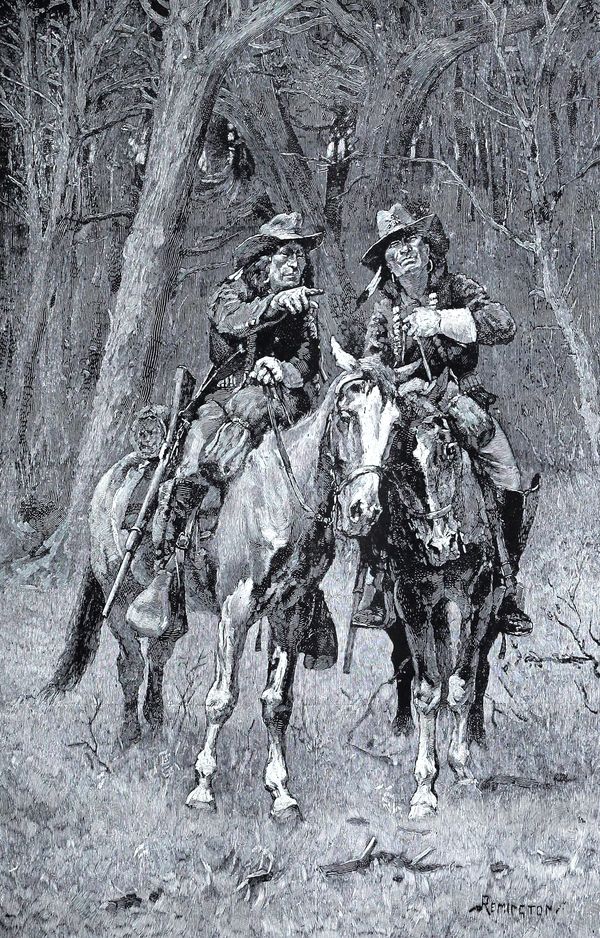
Cheyenne Scouts Patrolling the Big Timber of the North Canadian, Oklahoma Illustration from CHEYENNE SCOUTS IN OKLAHOMA Originally published in Harper’s Weekly, April 6, 1889
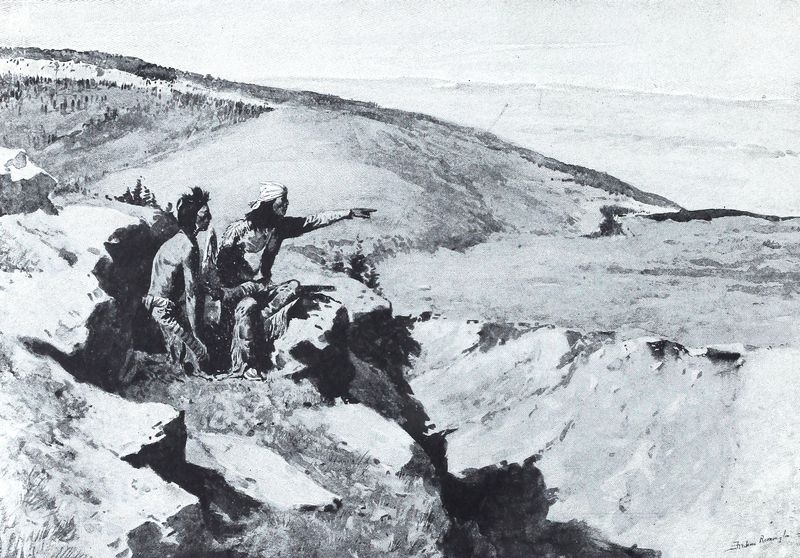
Indians Reconnoitering from a Mountain-top
The keen eye of the Indian is able to distinguish objects even in such an extensive view as this appears to be. To the white man, however, the Western landscape—red, yellow, blue, in a prismatic way, shaded by cloud forms and ending among them—appears as something unreal.
Illustration from
SUN-DOWN’S HIGHER SELF
by
Frederic Remington
Originally published in
Harper’s Magazine
,
November, 1898
Our camp was very large and my chief was in the fullness of his command. Some of the Ogallallahs had joined us before and with the Cheyennes we were nearly fifteen hundred lodges. We made no effort at concealing our trail. We moved in a body, and where we went we left a broad and dusty road. We trailed leisurely up the Yellowstone to the mouth of the Rosebud and up the Rosebud to the head of a small creek which emptied into Greasy Grass Creek (a stream which the whites call the Little Big Horn) at a point where there was plenty of wood and good grazing.
The chief as he looked down upon this valley said: “It is good. We will camp here,” and to this they all agreed. It was indeed a beautiful place. I was but a lad, but I remember that beautiful scene, finer than anything in all our own lands. Hunting parties were at once sent out to find the buffalo, and some of the chief’s “Silent Eaters” mounted the hills to spy backward on our trail.
The hunters reported the country clear of foes and buffalo near, and as the spies brought no news of invaders the people threw off all care. With feasts and dances they began to celebrate their escape from the oppressor. We were beginning the world anew in this glorious country.
One day in midsummer—I remember it now with beating heart—just in the midst of our preparation for a dance, the cry arose: “The white soldiers—they are coming! Get your horses!”
I remember clearly the very instant. I was sitting in my father’s lodge, painting my face for the dance, when this sound arose. The shouting came from the camp of The Gall, whose lodges stood at the extreme south end of the circle. From where I stood I could see nothing, but as I ran up the west bank to find my horse I detected a long line of white soldiers riding swiftly down the valley from the south. They came like a moving wall and the sun glittered on their guns as they reloaded them. Before them the women and children were fleeing like willow leaves before a November wind.
My heart was beating so hard I could scarcely speak. I was but a boy and had never seen a white soldier, yet now I must fight. All around me were hundreds of other young men and boys roping, bridling, and mounting the plunging ponies.
As we came sweeping back my father passed us, leading the white horse of the chief, and as we came near the headquarters tent the chief came out wearing a war-bonnet and carrying his saddle. This he flung on his horse, and when he was mounted my father and his guard surrounded him and they rode away. My father took my horse and I saw neither him nor the chief till night. I heard that he tried to check the battle, but the young men of Chief Gall’s camp had routed the enemy’s column before he reached there and the soldiers were spurring their horses into the river and dashing up the hills in mad effort to get away.
The camp was a mighty whirlpool of confusion. The women were taking down the lodges, weeping and singing, the old men and boys were roping the horses together, and the ground was covered with a litter of blankets, saddles, pouches, and other things which escaped notice or seemed unimportant, and all the time we could hear the rapid cracking of the guns and it seemed as if we were all to be killed. No one knew how many soldiers there were. All seemed lost, our shining, peaceful world about to be shattered and destroyed.
I ran to catch another horse, and when I was mounted and once more in sight of the valley it was almost deserted. The women and children were all gathered in throngs on the west bank, straining their eyes toward the cloud of smoke which marked the retreat of soldiers to the southeast, singing songs of prayer and exaltation.
Suddenly a wild cry arose, and looking where an old woman pointed, I saw on the bare crest of the hill to the east a fluttering flag. A moment later four horsemen appeared, then four more, and so in column of fours they streamed into view, a long line of them.
“Go tell the warriors,” screamed my mother to me, and, lashing my pony, I started down the slope diagonally toward a body of our soldiers who were returning from pursuit of the other soldiers.
They were warned by some one nearer to them than I. I saw them turn and spur their horses in a wild race along the river bank. I had no weapon, but I kept on till I joined the rear rank. There were hundreds in this charge.
You have heard that my people ambushed Custer. This is a lie. The place where he stood to view our camp was a hill as bare as your hand. He saw us, knew how many we were, and rode to meet us. It was an open attack on our part. Chief Gall led his band up a steep ravine and swept round behind the troopers, each man clinging to the far side of his horse and shooting beneath his neck.
You have heard it said that we outnumbered Custer ten to one. This, too, is false. We had less than twelve hundred warriors, counting old and young. We had old-fashioned guns—many of our men had only clubs or arrows or lances. Many were boys like myself, with not even a club. We were taken unawares, not they. They had the new magazine rifles and six-shot revolvers. They were all experienced warriors, while we were not; indeed most of our men had never been in battle before and they had no notion of discipline. Each man fought alone, without direction. We were a disorderly mass of excited men. Everybody gave orders; no one was leader. That is the way of my people. We have no commander-in-chief. We fight in bands. Chief Gall led one charge, the daughter of Old Horse led another, American Horse led a third, and so it proceeded as a mob goes to war.
I could not see much of what followed, for a great cloud of dust and smoke covered the hill. Nobody had any clear idea of the battle. It was very hot and we took no notice of time, but it must have been about half past ten when the fight began. It did not last very long.
Once as I dashed near I caught a glimpse of the white soldiers, some kneeling, some standing, with their terrible guns ever ready, crack—crack—crack, while our warriors circled around them, dashing close in order to fire and retreating to reload. It seemed that some of the soldiers ran out of ammunition early, for they sat holding their guns without firing.
The fire was slackening as I rode down to the river to drink, and when I returned all was still and the smoke was slowly drifting away. Once or twice a band of young braves dashed in close to the last group of tangled bodies, and when no weapon flashed back they dismounted to peer about, looking for Long Hair.
We did not know then that General Custer had cut his hair short, and we all took the body of a man with long black hair to be the chief. I now see that we were mistaken. He was a scout. Some of the men stripped the bodies of the white men of their clothes, while others moved about, counting the dead. There were not many red men killed. Our manner of fighting saved us from heavy loss. You have heard that our soldiers mangled the dead. This is not true. Some crazy old women and a few renegades did so, but our chiefs did not countenance this. You call this a “massacre,” but to us it was a battle, honorable to us as to the bluecoats.
The chief’s “Silent Eaters” rode forth among the old men and women and commanded them to camp again. This they did, but in a different place, farther down the river, near where the Crow agency now stands.
The chief was very sorrowful, for he realized the weight of this battle. Foolish ones rode about exulting, but he rebuked them. “This is all bad. The Great Father at Washington will now be very angry, for we have killed his soldiers. The war chief will come against us with greater fury than ever. We cannot remain here.”
I was told that he did not visit the field of the dead. I do not know the truth of this, but he sat in his lodge, pondering, while Gall and his men held Reno prisoner on the hill. It was only a matter of wearing them out and then the whole army would be defeated, so the foolish ones said.
All the chiefs met in council at sunset, and The Sitting Bull said: “We cannot afford to make war on the white soldiers. They are too many and too brave. My heart is heavy with this day’s work. It is our first battle with the bluecoats and I now look to see all their war chiefs assemble against us. We must leave this place. There is no refuge for us here. We must go farther into the unknown world to the west. In ancient days our people migrated and now our turn has come.”
There was little sleep that night. All through the long hours the wail of the grief-stricken ones went on, and over the field of the dead the “war women” ran frenzied with grief, mutilating the bodies of their enemies. It was a night to make a boy grow old. My father said: “All hope of ever seeing our ancient home is gone. Henceforth we must dwell in the lands of our enemies.” And his face filled one with despair. I wept with my mother.
Early next day the mass of our warriors swept out against Reno, and he, too, would have perished like Custer but that the chief’s ever-watchful spies from a distant butte caught and flashed forward these terrifying signs.
“More soldiers are coming up the river—a mighty host in steamboats.”
Then the chief sent forth his camp soldiers among the lodges with this news and with orders to get ready to move instantly. Couriers rushed away to the hills to recall those who were besieging Reno. The women and old men again hurriedly packed the lodges, whilst we lads gathered up the ponies, and at last, following the old chiefs and The Sitting Bull, we streamed away up the river toward the mountains, leaving the field to our enemy’s scouts, but on every hill stood a “Silent Eater,” and through them we had knowledge of each movement of those who rescued Reno and buried the dead.
We camped that night in the hills far toward some great shining, snowy peaks, the like of which we had never seen.
The troops which were under command of General Terry did not stay long. They did not even look about very closely. They were afraid they might find us, I think. They hurriedly buried the dead and retreated quickly down the Big Horn to the Yellowstone, followed by our scouts, who reported every movement to The Sitting Bull.
This retreat of Terry made many of our leaders bold, and some of them, like The Gall, wished to pursue and strike again, but my chief opposed that. It is true he gave orders to return to the mouth of what is now Reno Creek, but he did this because in our haste we had left many ropes and saddles and other things lying scattered on the grass, and we needed them. This was the third day after the battle and no enemy was in sight.
On this night the chiefs counciled again and The Sitting Bull advised flight. “Let us set our breasts to the west wind and not look back,” he said. “The white man fills the East. Toward the setting sun are the buffalo. Let us make friends with all our red brethren and go among them, and live in peace.”
But the old men were timid. They said: “We do not know the land to the west; it is all very strange to us. It is said to be filled with evil creatures. The mountains reach to the sky. The people are strong as bears and will destroy us. Let us remain among the Crows whom we know. Let us make treaty with them.”
To this the chief at last agreed, and gave orders to be ready to march early the next morning. “When a man’s heart beats with fear it is a good thing to keep moving,” he said to my father.
Thus began a retreat which is strange to tell of, for we retraced our trail over the low divide back into the valley of the Rosebud, and so down the Yellowstone to the Missouri, ready to enter upon our exile. It was all new territory to most of us. Our food was gone, and when our hunters brought news of buffalo ahead we rushed forward joyously, keeping to the north, and so entered the land of the Crows.
Meanwhile the white soldiers had also retreated. They didn’t know where we were. Perhaps they were afraid we would suddenly strike them on the flank. Anyhow, they withdrew and filled the East (as I afterward learned) with lies about us and our chiefs. They said the chief had four thousand warriors, that he was accompanied by a white soldier, and many other foolish things.
Our people rejoiced now, and at The Sitting Bull’s advice our band broke up into small parties, the better to hunt and prepare meat for winter. It was easier to provide food when divided into small groups, and so my chief’s great “army,” as the white men called it, scattered, to meet again later.
It must have been in October that we came together, and in the great council which followed, the chief announced that the white soldiers were coming again and that it was necessary to push on to the north. This was on the Milk River, and there you may say the last stand of the Sioux took place—for it was in this council that the hearts of the Ogallallahs, our allies, weakened. One by one their orators rose and said: “We are tired of running and fighting. We do not like this cold northland. We do not care to go farther. The new white-soldier chief is building a fort at Tongue River. He has many soldiers and demands our surrender. He has offered to receive us kindly.”
My chief rose and with voice of scorn said: “Very well. If your hearts are water, if you desire to become white men, go!” And they rose and slipped away hastily and we saw them no more.
Then the Cheyennes said: “We, too, have decided to return to our own land. We dread the desolate north.”
Then my chief was very sad, for the Cheyennes are mighty warriors. “Very well, my brothers,” he replied. “You came of your own accord and we will not keep you. We desire your friendship. Go in peace.”
So they left us. We were now less than half of our former strength, but we faced the north winds with brave hearts—even the women sang to cheer our way.
We were near the Missouri when Miles, the white chief, suddenly threw himself in our way and demanded a council.
A battle would have been very unequal at this time, for our warriors were few and our women and children many; therefore, The Sitting Bull and five chiefs went forth to meet Miles and his aides.
Perhaps you have read the white man’s side of this. I will tell you of the red man’s part, for my father rode beside our chief at this time.
Colonel Miles had over four hundred men and a cannon. His men were all armed perfectly, while we had less than a thousand men and boys, and many of even the men had no guns at all. We were burdened with the women and children, too.
Six white men met The Sitting Bull and his five braves. My father was one of these men and he told me what took place.
The chief rode forward slowly, and as he neared the white chief he greeted him quietly, then lifted his hands to the sky in a prayer to the Great Spirit. “Pity me, teach me. Give me wise words,” he whispered.
“Which of you is The Sitting Bull?” asked Colonel Miles.
“I am,” replied the chief.
“I am glad to meet you. You are a good warrior and a great leader.”
To this my chief abruptly replied: “Why do you remain in my country? Why do you build a camp here?”
Thereupon Miles sternly answered: “We are under orders to bring you in. I do not wish to make war on you, but you must submit and come under the rule of the department at Washington.”
The Sitting Bull made reply quietly, but with emphasis: “This country belongs to the red man and not to the white man. I do not care to make war on you. My people are weary of fighting and fleeing.”
“Why do you not come in and live quietly on your reservation at the Standing Rock?”
“Because I am a red man and not an agency beggar. The bluecoats drove us west of the Missouri, they robbed us of the Black Hills, they have forced us to take this land from the Crows, but we wish to live at peace. You have no right to come here. You must withdraw all your troops and take all settlers with you. There never lived a paleface who loved a redskin, and no Lakota ever loves a paleface. Our interests are directly opposed. Only in trade can we meet in peace. I am Uncapappa and I desire to live the ways of my fathers in the valleys which the Great Spirit gave to my people. I have not declared war against Washington, but I will fight when you push me to the wall. I do not like to be at strife. It is not pleasant to be always fleeing before your guns. This western world is wide; it is lonely of human life. Why do you not leave it to us? All my days I have lived far from your people. All that I got of you I have paid for. My band owes you nothing. Go back to the sunrise and we will live as the Great Spirit ordained that we should do.”
General Miles was much moved, but said: “I want you to go with me to meet the Great Father’s representatives and talk with them.”
“No,” my chief replied. “I am afraid to do that, now that we have had a battle with your soldiers. We went far away and your warriors followed us. They fell upon us while we were unprepared. They shot our women and children and they burned our tepees. Then we fought, as all brave men should, and we killed many. I did not desire this, but so it came about. Do not blame me.”
The white chief was silent for a time, then he said: “If you do not give up your arms and come upon the reservation I will follow you and destroy you.”
At this my chief broke forth: “My friend, we had better quit talking while we are good-natured.” Then lifting his arm in a powerful gesture, he uttered a great vow: “So long as there is a prairie dog for my children, or a handful of grass for my horses, The Sitting Bull will remain Uncapappa and a freeman.” And he turned his horse about and returned to our lines.
During this time our spies had discovered the guns which Miles had pointed at the chief, and knew that the soldiers were ready to shoot our envoys down.
When the chief was told this he said: “No matter. We have held up our hands to the Great Spirit; we must not fire the first shot.”
He was anxious for peace, for, while he was still the leader of many men, he knew something of the power of the War Department and he feared it. All that night he sat in council with the chiefs, who were gloomy and disheartened. Next morning, hearing that General Miles was coming toward his camp, The Sitting Bull sent out a white flag and asked for another talk. This Colonel Miles granted and they met again. My chief said:
“We have counseled on the matter and we have decided on these terms. We ask the abandonment of this our country by your soldiers. We ask that all settlements be withdrawn from our land, except trading posts, and our country restored to us as it was before the white settlers came. My people say this through me.”
To this Miles harshly replied: “If you do not immediately surrender and come under the rule of the reservations, I will attack you and pursue you till you are utterly destroyed. I give you fifteen minutes to decide. At the end of that time I open fire.”
Then the heart of my chief took flame. Shaking his hand at the soldiers, he whirled his horse, and came rushing back, shouting: “Make ready! The white soldiers are about to shoot!”
Under his orders I and other lads rushed to the front and began to fire the grass, thus making a deep smoke between us and the enemy. While the women hurriedly packed the tepees the men caught their horses. All was confusion and outcry. But our warriors held the enemy in check so that we got our camp out of harm’s way. We were afraid of the big gun; we had little fear of the horsemen and their carbines.
For two days Miles pushed us and we gave way. The white historians are always ungenerous, if not utterly false. They do not give my people credit. Consider our disadvantages. Our women and children were with us and must be protected. It required many of the young men to take care of our ponies and the camp stuff. We were forced to live on game and game was scared away, while the white soldiers had rations and the best of horses. The country was not a good one for us. Hour by hour Miles pushed us, and in spite of all the skill of our chiefs, we lost most of our ponies and a great deal of our food and clothing, and our people became deeply disheartened. The rapid-fire gun of the white soldiers terrified us—and though the earth grew blacker and darker, we fled northward.
At last, on the third day, decisive council took place among the chiefs. The Sitting Bull and The Gall said, “We will not surrender!” But many of the lesser ones cried out: “What is the use? The white man is too strong. The country grows more barren, the game has fled. Let us make peace. Let us meet Miles again.”
But my chief indignantly refused. “Are we coyotes?” he said. “Shall we slink into a hole and whine? You Yanktonaise and Minneconjous have eaten too much white man’s bread. It has taken the heart out of you. Do you wish to be the sport of our enemies? Then go back to the agencies and grow fat on the scrap they will throw to you. As for me, I am Uncapappa, I will not submit. I owe the white race nothing but hatred. I do not seek war with Miles, but if he pursues me I will fight. My heart is hot that you are so cowardly. I will not take part in this peace talk. I have spoken.”
Once again he rose, and spoke with the most terrible intensity, struggling to maintain his supremacy over his sullen and disheartened allies, but all in vain. He saw at last that his union of forces had been a failure, and, drawing his “Silent Eaters” around him, he sent criers through the camp calling on all those who wished to follow him to break camp.
It was a solemn day for my race, a bitter moment for my chief. He saw his bond of union crumbling away, becoming sand where he thought it steel. When Crazy Horse and the Cheyennes fell behind he could not complain, for they were but friends who had formed a temporary alliance, but the desertion of the Yanktonaise was a different matter. They were of his blood and were leaving us, not to fight, but to surrender. They were deserting us and all that we stood for. And my chief’s heart was very sore as he saw them ride away. Less than two hundred lodges went with The Sitting Bull; the others surrendered.
It took heroic courage to set face to the north at that time of the year. The land was entirely unknown even to our guides, and the winter was upon us. It was treeless, barren, and hard as iron. As the snows fell our sufferings began. I have read the white historians’ account of this. I have read in Miles’s book his boasting words of the heroism of the white troops as they marched in pursuit of us in the cold and snow, but he does not draw attention to the fact that my chief and his people traversed the same road in the same weather, with scanty blankets and no rations at all. According to his own report his troops outnumbered us, man, woman, and child, and yet he did not reach, much less capture, a man of us.
Our side of all this warfare has never been told. You have all the newspapers, all the historians. Your officers dare not report the true number of the slain, and they always report the red men to be present in vast number. It would make the world smile to know the truth. You glorify yourselves at our cost, and we have thus far had no one to dispute you. I am only a poor “Injun,” after all, and no one will read what I write, but I say the white soldiers could never defeat an equal number of my people on the same terms.
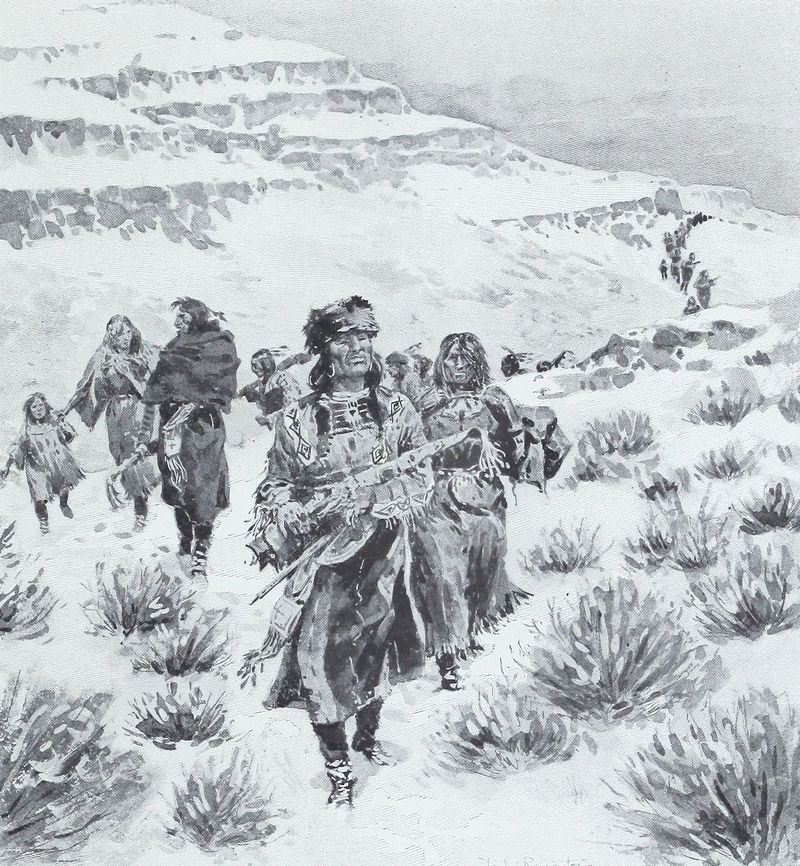
The Brave Cheyennes Were Running Through the Frosted Hills
This is Dull Knife’s band of Northern Cheyennes, known as the Spartans of the plains. And deservedly were they called a Spartan band, for, relentlessly pursued by cavalry troops for over ten days, these gallant warriors fought to their last nerve, making their last stand only when nature itself was exhausted.
Illustration from
A SERGEANT OF THE ORPHAN TROOP
by
Frederic Remington
Originally published in
Harper’s Magazine
,
August, 1897
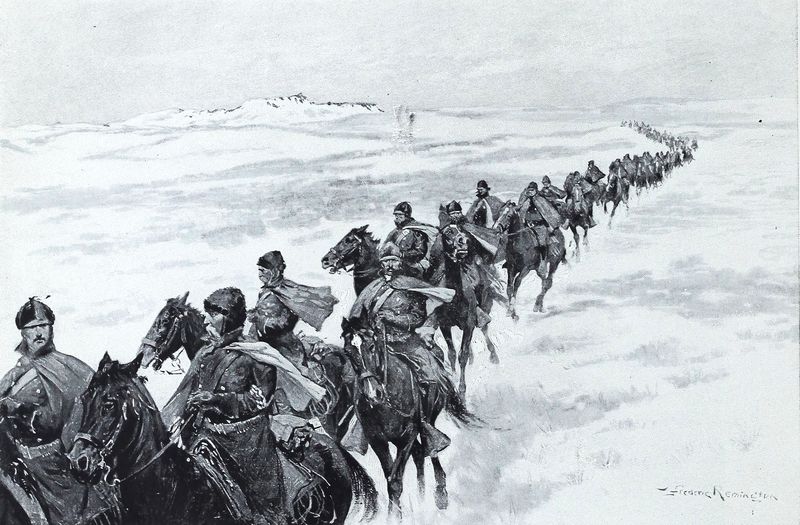
Campaigning in Winter
A body of United States cavalry in winter rig in pursuit of a band of Minneconjous Sioux, who had left their agency and were making for the camp of the hostiles in the Bad Lands.
Illustration from
A SERGEANT OF THE ORPHAN TROOP
by
Frederic Remington
Originally published in
Harper’s Magazine
,
August, 1897
Our moccasins grew thin with our hurrying. We were always cold and hungry. No wood could be found. We burned our lodge poles. Our horses weakened and died and we had no meat. The buffalo had fled, there were no antelope, and the wind always stung—yet we struggled on, cold, hungry, hearing the wails of our children and the cries of our women, pushing for a distant valley where our scouts had located game.
At last the enemy dropped behind and we went into camp near the mouth of the Milk River on the Big Muddy, and soon were warm and fed again, but our hearts were sore for the unburied dead that lay scattered behind us in the snow. Do you wonder that our hate of you was very great?
There we remained till spring. The soldiers had been relentless in pursuit until the winter shut down; after that they, too, went into camp and we lived in peace, recuperating from our appalling march. And day by day The Sitting Bull sat in council with his “Silent Eaters.”
Our immediate necessities were met, but the chief’s heart was burdened with thought of the future. All our allies had fallen away. The Cheyennes and Ogallallahs were bravely fighting for their land in the south, but the Yanktonaise and Minneconjous, our own blood, with small, cold hearts, were sitting, self-imprisoned, in the white man’s war camp.
You must not forget that we had no knowledge of geography such as you have. We knew only evil of the land that lay to the north and west of us. We were like people lost in the night. Every hill was strange, every river unexplored. On every hand the universe ended in obscurity, like the lighted circle of a campfire. A little of the earth we knew; all the rest was darkness and terror.
We could not understand the government’s motives. Your war chief’s persistency and his skill scared us. We were without ammunition, we could neither make powder nor caps for our rifles, and our numbers were few. Miles had the wealth of Washington at his back. This you must remember when you read of wars upon us. Where we went our women and children were obliged to go, and this hampered our movements. What would Miles have done with five hundred women and children to transport and guard?
All these things made further warfare a hopeless thing for us, for we were dependent upon our enemy for ammunition and guns, without which the feeding of our people was impossible. To crown all our troubles, the buffalo were growing very wild and were retreating to the south.
Up to this time we had only temporary scarcity of food, but now, when we could not follow the buffalo in their migrations, my chief began to see that they might fail us at the very time we most needed them. “Surely the Great Spirit has turned his face from us,” he said, as his scouts returned to say the buffalo were leaving the valley.
If you were to talk for a day, using your strongest words, you could not set forth the meaning of the buffalo to my people at this time. They were our bread and our meat. They furnished us roof and bed. They lent us clothing for our bodies. The chase kept us powerful, continent, and active. Our games, our dances, our songs of worship, and many of our legends had to do with these great cattle. They were as much a part of our world as the hills and the trees, and to our minds they were as persistent and ever-recurring as the grass.
To say “The buffalo will fail” was like saying “The sun will rise no more.” Our world was shaken to its base when a red man began even to dream of this. We spoke of it with whispered words.
“To go farther north is to say farewell to the buffalo,” the chief said to my father—and in this line you may read the despair of the greatest leader my tribe has produced. To go north was to face ever-deepening cold in a gameless, waterless, treeless land; to go south was to walk into the white chief’s snare.
One day as the old men sat in council a stranger, a friendly half-breed from the north, rose and said:
“My friends, I have listened to your stories of hard fighting and running, and it seems to me you are like a lot of foxes whose dens have been shut tight with stones. The hunters are abroad and you have no place of refuge. Now to the north, in my country, there is a mysterious line on the ground. It is so fine you cannot see it; it is finer than a spider’s web at dusk; but it is magical. On one side of it the soldiers wear red coats and have a woman chief. On the other they wear blue coats and obey Washington. Open your ears now—listen! No blue soldier dares to cross that line. This is strange, but it is true. My friends, why do you not cross this wonder-working mark? There are still buffalo up there and other game. There is a trader not three days’ ride from here, one who buys skins and meat. There you can fill your powder cans and purchase guns. Come with me. I will show the way.”
As he drew this alluring picture loud shouts of approval rang out. “Let us go!” they said one by one. “We are tired of being hunted like coyotes.”
The chief smoked in silence for a long time, and then he rose and his voice was very sad as he chanted: “I was born in the valley of the Big Muddy River. I love my native land, I dread to leave it, but the pale soldiers have pushed us out and we are wanderers. I have listened to our friend. I should like to believe him, but I cannot. White people are all alike. They are all forked and wear trousers. They will treat us the same no matter what color of coats they wear. If any of you wish to go I will not hinder. As for me, I am not yet weak in the knees, I can still run, and I can still fight when need comes. I have spoken.”
Part of the people took the advice of the Cree and went across the line, but The Sitting Bull remained in the valley of the Missouri till the spring sun took away the snow.
IV DARK DAYS OF WINTER
I shall never forget that dreadful winter. It seems now like one continuous whirling storm of snow filled with wailing. We were cold and hungry all the time, and the white soldiers were ever on our trail. Many died and the cries of women never ceased. It was as if the Great Spirit had forgotten us.
The chief, satisfied at last that the Cree had told the truth and despairing of the future, turned his little band to the north, and in the early spring crossed the line near the head of Frenchman’s Creek and camped close to the hill they call Wood Mountain, where the redcoats had a station and a small store. No one would have known this small, ragged, sorrowful band as “the army of The Sitting Bull.”
My father was a great man—as great in his way as his chieftain—but he was what you call a philosopher. He spoke little, but he thought much, and one day soon after this he called me to him and said: “My son, you have seen how the white man puts words on bits of paper. It is now needful that some one of us do the same. We are far from our home and kindred. You must learn to put signs on paper like the white man in order that we may send word to those we have left behind. I have been talking with a black-robe (a priest) and to-morrow you go with him to learn the white man’s wonderful sign language.”
My heart froze within me to hear this, and had I dared I would have fled out upon the prairie; but I sat still, saying no word, and my father, seeing my tears, tried to comfort me. “Be not afraid, my son. I will visit you every day.”
“Why can’t I come home each night?” I asked.
“Because the black-robe says you will learn faster if you live with him. You must travel this road quickly, for we sorely need your help.”
He took me to Father Julian and I began to read.
We lived here peacefully for two years. The Cree had told us the truth. General Miles dared not cross the line, but he chased my people whenever they ventured over it. At Wolf Point, on the Missouri, was a trader who spoke our language (he had an Indian wife) and with him my chief often talked. He had spies also at Fort Peck, which was an agency for the Assiniboines, and so knew where the soldiers were at all times.
I had a friend, a Cree, who could read the papers, and from them I learned what the white people said of us. Through him I heard that many people sympathized with The Sitting Bull and declared that it was right to defend one’s native land.
These words pleased the chief, but it made two of his head men bitter. They grew jealous because their names were not spoken by the white man, and they would have overthrown my chief if they dared, but now the “Silent Eaters” came to his aid. With them to guard him, the chief could treat the jealous ones with contempt. Wherever he went my father and others of his bodyguard went with him, so that no traitor could kill him and sell his head to the white people.
The redcoats liked my chieftain well. He was always just and peaceful. If a reckless young man did a wrong thing against the settlers The Sitting Bull punished him and said: “A righteous man does not strike the hand which saves him from the wolf. No one can steal from these our friends and not be punished.”
Once when he went to visit the trader at Wolf Point I went with him, and was present at a long talk which they held. The trader gave us a tent and some food and at night when we had eaten he came and sat down to smoke.
“Sitting Bull,” he began, “I cannot understand you. I cannot see as you do. We white people look ahead, we ask ourselves what is going to happen in the future; but you seem to go on blindly. My friend, what do you intend to do?”
The chief considered this carefully, but said nothing.
The trader went on: “The buffalo will soon be gone—you can see that. The cold is killing them and the guns of the white hunters crack, crack all the time. What will you do when they are gone?”
The chief broke forth passionately: “I did not leave the Black Hills of my own will; the soldiers pushed me out. I loved my home, but the paleface came and with his coming all the old things began to change. I kept out of his way, I did not seek war with him, but he never slept till he drove me among the redcoats. The redcoats do not say much to us, but what they speak is fair and straight. So long as a gopher remains on the plains I will stay and I will fight. All my life I have been a man of peace, but now my back is to the rock; I shall run no more. I am not afraid to die and all my warriors are of my mind.”
The trader replied: “Your people are poor and suffering. The Canadian government cannot help you. Our Great Father is rich. He will take care of you and your people. Why don’t you do as the Yanktonaise did—go to a reservation and settle down.”
“Because I am a red man. If the Great Spirit had desired me to be a white man he would have made me so in the first place. He put in your heart certain wishes and plans, in my heart he put other and different desires. Each man is good in His sight. It is not necessary for eagles to be crows. Now we are poor, but we are free. No white man controls our footsteps. If we must die we will die defending our rights. In that we are all agreed. This you may say to the Great Father for me.”
The trader waited till the chief’s emotion passed away, and then he said: “Look you, my friend, all white men are not your enemies. There are many who are on your side.”
“I cannot trust them. A few months ago some men came professing friendship; they offered me land and a house, but I fear all those who come bearing gifts. I will trade; I will not take gifts. I do not make war; I only defend my women and children as you would do.”
The trader rose. “Very well. I have said all I care to say on that head, but I shall be glad to see you at any time and I wish to trade with you.”
“Will you trade guns?”
“No, I can’t do that.”
“If we kill game we must have guns.”
“I know that, but I fear the soldiers as well as you, chief. They tell me not to sell you guns, and I must obey.”
The Sitting Bull rose and took from his side his embroidered tobacco pouch.
“You are of good heart and I will trade with you.” He handed the pouch to the trader, for this is an emblem of respect among my people, and they shook hands and parted. If all men had been like this man, we would not now be an outcast race.
All that autumn while I studied the white man’s books my people camped not far away and traded at Wolf Point. It was well they did, for the winter set in hard. The cold became deadly and they had few robes. They were forced to sell all they had to buy food and ammunition. It is a terrible thing to be hungry in a land of iron. Do you wonder that we despaired?
Just when the winter was deep with snow a messenger came to warn us that a great military expedition was on its way to catch The Sitting Bull and his people. The chief immediately gave orders to pack, and with stern face again led the way to the north across the Great Divide. The white soldiers had plenty of blankets and food. They followed us hard. The storms were incessant. The snow, swept to and fro by the never-resting wind, blinded the eyes of the scouts and path finders.
Oh, that terrible march! In the gullies the horses floundered and fell to rise no more. There was no tree to shelter a tepee, no fuel for our fire. Women froze their arms and breasts, and little children died of cold and hunger. The camp grew each day more silent. The dogs were killed for food, and each night the lodge poles were cut down to make kindling, till each tepee became like a child’s toy. The guides lost their way in the storm and the whole camp wandered desperately in a great circle. My words cannot picture to you the despair and suffering of that march.
When at last they came into the old camp at Wood Mountain they were bleeding, ragged, and hollow eyed with hunger. The Sitting Bull looked like an old man. The commander hardly recognized him, so worn and broken was he, and I, who remembered him as the proud leader of two thousand lodges of people, was made sorrowful and bitter by the change in his face.
That winter was the coldest known to my people. They sat huddled over their camp fires in the storms, while hunters ranged desperately for game. The redcoats helped us as much as they could, and strangers far away, hearing of our need, sent a little food and some clothing, but, in spite of all, many of our old people died.
Hunting parties rode forth desperately to the south, and some of them never returned. The buffalo were few and very, very distant, and our scouts from the Yellowstone reported whole herds already frozen. Myriads were starving because of the deep snow. “By spring none will remain,” they said. “Surely the Great Spirit has turned his face away from his red sons.”
The sufferings of the children broke the proud hearts of the chiefs. One by one they began to complain. Some of them reproached The Sitting Bull and there were those who would have delivered his head to the white men, but were prevented by the “Silent Eaters,” who were ever watchful.
Many now said: “Let us go back. The buffalo are gone. We are helpless and our children starve while our brethren at the Standing Rock have plenty and are warm. We are tired of fighting and fleeing. The Great Spirit is angry with us. He has withdrawn his favor and we must do as Washington wishes. We must eat his food and do his work. He is all powerful. It is useless to hold out longer.”
To all this the chief made no reply, but brooded darkly, talking only in the soldier’s lodge. His mind was busy with the problems of life and death which the winter wind sang into his ears.
From my warm home with the priest, from the comfort and security which I was just beginning to comprehend and enjoy, I went now and again into the camp, and the pity of it was almost more than I could bear. No one talked, no one sang, no one smiled. It was like some dreadful dream of the night.
What could I do? I had nothing. I ate, but I could not carry food to my chief. I had warm clothing, but I could not lend it to my father. Though hardly more than a boy, my heart was big as that of a man. I began to understand a little of the mighty spread of the white man’s net, and yet I dared not tell the chief my secret thought.
How can I make you understand? Can you not see that we were facing the end of our world? My chief was confronting captivity and insult and punishment. His bright world of danger and freedom and boundless activity was narrowing to a grave, and only the instinctive love of life kept him and his “Silent Eaters” from self-destruction. In all the history of the world there has been no darker day for a race than this when midwinter fell upon us in that strange land of the north.
V THE CHIEF SURRENDERS HIMSELF
The first days of spring were worse than the winter. Rain and sleet followed each other, and the few remaining buffalo seemed to sink into the ground, so swiftly they disappeared. White people read in papers of wars and elections and the price of wheat; our news came by brave runners, and their tales were ever of the same dole.
“What of the buffalo? Where are the buffalo? Are the buffalo starving?” The answers always were the same. “The buffalo are gone. We are lost!”
The report of our desperate condition went out over the world and sympathetic people came to urge us to surrender. One messenger, a priest, a friend of General Sherman, the great war chief, came, and The Sitting Bull called a council to sit with him, and some Canadian officers also were there.
After they had all finished speaking, The Sitting Bull replied: “I am ready to make a peace. But as for going to Standing Rock, that is a question I must consider a long time. I am no fool. I know that the man who kills me will be rewarded and I do not intend to be taken prisoner. I have long understood the power of the whites. I am like a fly in a mountain stream when compared with this wonderful and cruel race. I do not care to have my head sold to make some man-coyote rich. Now this is my answer: I will make a peace. I will keep my people in order but I will not go to the Standing Rock. My children can go if they think best.”
The council broke up at this point, but in private the chief said to a friend: “The Gall is going back, so is The Polar Bear and many others. I shall soon be alone. Black Moon, Running Crane, all are deserting me, but I shall remain; I will not return to die foolishly for the white man’s pleasure.”
All took place as he foresaw. Chief Gall went south and surrendered. So did Red Fish and The Crane. Only a few remained, among them my father and Slohan.
The chief was pleased to know I was getting skilled in the white man’s magic. “I need an interpreter, one I can trust,” he said to me. “Go on in the road you have taken.”
One day as he sat smoking in his tepee I heard him singing in a low voice the “Song of the Chieftains,” but he had changed it to a sad ending:
“I was born a soldier— I have lived thus long. Ah, I have lived to spend my days in poverty.”
It broke my heart to look upon him sitting there. I had seen him when he was the master spirit of the whole Sioux nation—a proud and confident chief. Now he hovered above his fire, singing a death song, surrounded by a little circle of ragged lodges. Yet I could not blame his followers. They surrendered, not to the white man, but to the great forces of hunger and cold.
If you ask what defeated The Sitting Bull, I will answer, “The passing of the buffalo.” If you ask what caused him to surrender his body to the whites, I will say his tender heart. You hear officers boast of conquering Sitting Bull, but the one who brought him to the post was his daughter. The love of the parent for the child is strong in my race; it is terrible. Sitting Bull was a chief, stern and resolved, but he was a father also.
One day a letter came to the British officer from a friend of my chieftain, who said, “Tell The Sitting Bull that the white men have put his daughter in irons.”
This daughter, his best-beloved child, had left the camp, lured away by her lover, and the chief did not know where she was. His heart was bleeding for her, and now when he heard this letter read his indignation was very great. “Is it so?” he cried out. “Do they make war on a poor weak girl? I will go to her. I will kill her captors. I will die beside her.”
That night he called the remnant of his band together and said, “My children, you know that the white men have tried often to get me to go south to act their pleasure, but I have always refused. Now they have taken my daughter, a weak girl with no power to defend herself. They have put irons on her feet and on her hands. At last I must go south. I must follow her. I wish to find her and to kill those who have abused her. I do not want you to go with me. I go alone to suffer whatsoever comes to me.”
Then his people all said, “No, we will go with you.”
He replied: “Friends, you have stayed too long with me. If you wish to go I cannot refuse, but the road is dark and dangerous; whereto it leads I cannot tell.”
We made ready at once to go with him, and though our hearts were filled with fear, we were also glad. “We’re going home,” the women sang. For the last time he gave orders to break camp in Canadian territory, and led the way across the invisible wonderful line into the land of the bluecoats.
His following was very small now. Only his wives and sons and a few of the more loyal of the “Silent Eaters” remained. Many of even this bodyguard had gone away, but those who remained were doubly faithful, and on them he relied to resent any indignity. “If we are assaulted let us die fighting, as becomes warriors,” he said, and all the men responded firmly, “Aye, that will we.”
Do you think it an easy thing to set your face toward the land of your deadly foes, with only a handful of warriors to stand between you and torture? Yet this is what my chieftain did. He knew the hate and the fear in which the white man held him, for I could now read to him and report to him what was said. He was aware of the price on his head and that many men were eager to put him in chains; yet he went.
“I shall go to the white soldiers,” he said. “They will know about my daughter. They are warriors, and warriors respect a chieftain.”
Small as his escort was, the commander at Fort Buford respected it. He received The Sitting Bull like a chief, and said, “I have orders to take you as military prisoner to Fort Yates.”
“I know the road home,” my chief haughtily replied. Then he handed his gun to me and added, in a milder tone: “I do not come in anger toward the white soldiers. I am very sad. My daughter went this road. Her I am seeking. I will fight no more. I do not love war. I never was the aggressor. I fought only to defend my women and children. Now all my people wish to return to their native land. Therefore I submit.” My heart ached to hear him say this, but it was true.
The colonel was very courteous. “You shall be treated as one soldier treats another,” he said. “In two days a boat will come to take you back to your people at Standing Rock. It is easy to ride on a boat and you will have plenty to eat and I will send a guard to see that you are not harmed by anyone.”
Thereupon he showed us where to camp and issued rations to us, and, as we were all hungry, his kindness touched our hearts.
On the second day he came to see the chief again: “The boat has come to carry you to Standing Rock. I hope you will go quietly and take your place among your people who are living on their ancient hunting grounds near the Grand River.”
“I do not wish to be shut up in a corral,” replied The Sitting Bull. “It is bad for the young men to be fed by the agent. It makes them lazy and drunken. All the agency Indians I have ever seen were worthless. They are neither red warriors nor white farmers. They are neither wolf nor dog. But my followers are weary of being hungry and cold. They wish to see their brothers and their old home on the Missouri, therefore I bow my head.”
Soon after this we went aboard the ship and began to move down the river.
Some of us hardly slept at all, so deeply excited were we by the wonder of the boat, but the chief sat in silence, smoking, speaking only to remark on some change in the landscape or to point out some settler’s cabin or a herd of cattle. “Our world—the Indian’s world—is almost gone,” he muttered. But no one knew as well as I how deeply we were penetrating the white man’s civilization.
We all became excited as the boat neared Bismarck, for there stood a large village of white people and men and women came rushing out to see us. They laughed and shouted insulting words to the chief, and some of them called out, “Kill ’em!” The soldiers who guarded us kept them back and we went on unharmed, but I could see that the sight of this throng of palefaces had again made my chief very bitter.
I shall never forget the strange pain at my heart as we neared the high bluff which hides Fort Yates. I did not know how near we were till the old men pointed out the landmarks and began to sing a sad song:
“We are returning, my brothers— We are coming to see you, But we come as captives.”
At last we came in sight of the fort, where a great crowd of people stood waiting to see us. It seemed as if all the Sioux tribes were there, all my chief’s friends and all his enemies. Some laughed, some sang, some shouted to us. All on board were crazy with joy, but the chief did not change countenance; only by a quiver of his lips could his feelings be read. We saw The Gall and The Running Antelope and The Crow’s Mane and many more of our friends. There were tears on the cheeks of these stern warriors and their hands were outstretched to greet us.
But the chief and my father were taken from the boat under military guard and no one was allowed to come near them. My mother and sister put up our tepee surrounded by the soldiers. Only a few were permitted to come in and see us.
The chief inquired anxiously for his daughter. One day she came, and when she passed into her father’s lodge her face was hidden in her hands, her form shook with weakness. I could not hear what the chief said to her, for his voice was low and gentle, but when I saw her next she was smiling. He had forgiven her and was made happy by her promise to stay with him.
He was greatly chagrined to find himself held a prisoner in the face of all his people, and yet this care of his person—this fear of him on the white man’s part—made some of his subordinates still more jealous of his eminence. They were forgotten, while many strangers came from afar and gave my chief many silver pieces for his photograph. His fame was greater than even I could realize, and chiefs who had no reason to hate him began to speak against him. “Why should the white people send him presents?” they asked, and began to belittle his position in the tribe.
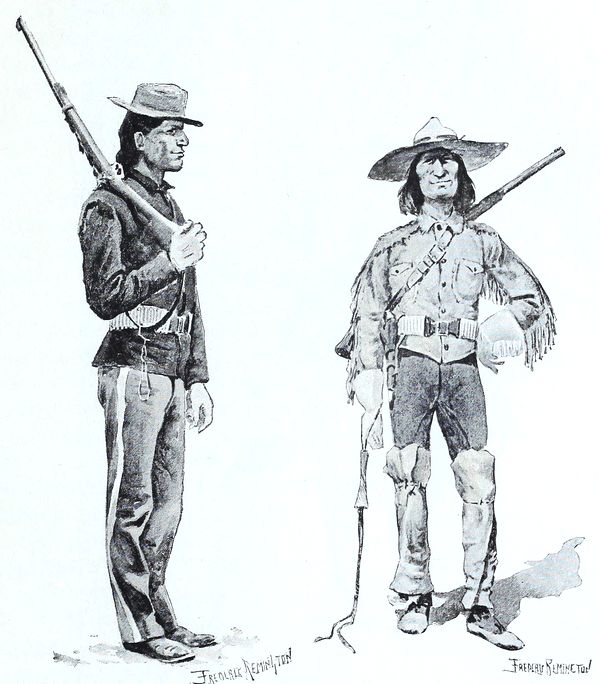
Indians as Soldiers
To the Indian, it was the soldier—the man in blue uniform—not the civil agents sent out from Washington to dole out bad and insufficient rations to a conquered race, that represented courage, justice, and truth. Consequently the Indians took great pride in being soldiers, and experience has shown that they make not only the most efficient but also the most faithful of scouts and the best possible material for light, irregular cavalrymen.
Illustrations from
INDIANS AS IRREGULAR CAVALRY
by
Frederic Remington
Originally published in
Harper’s Weekly
,
December 27, 1890
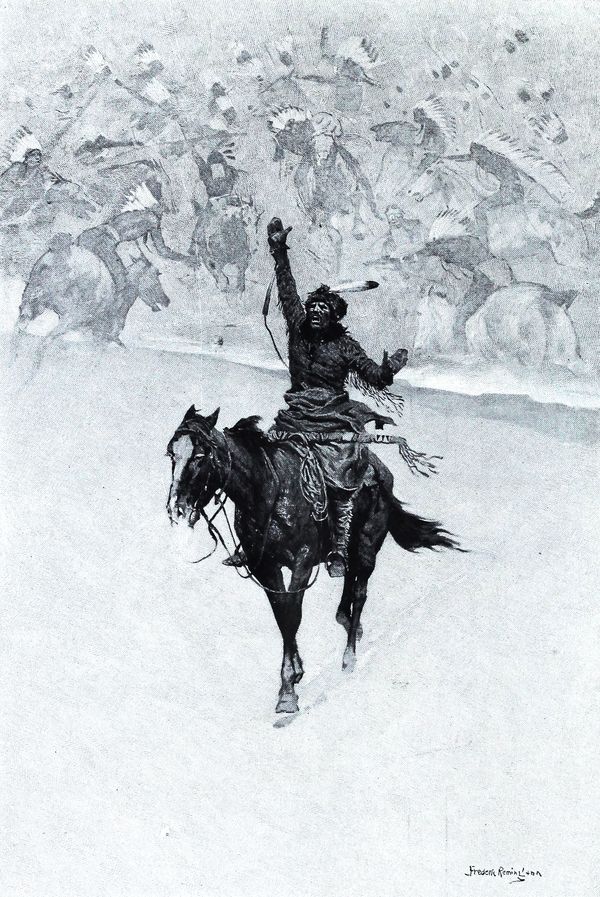
An Indian Dream
Illustration from
HOW ORDER No. 6 WENT THROUGH
by
Frederic Remington
Originally published in
Harper’s Magazine
,
May, 1898
I do not think my chief counseled evil during this time, but it could not be said that he was submissive. He merely waited in his tepee the action of his captors. The news that he got of the condition of the reservation was not such as to encourage him and the roar of his falling world was still in his ears. He was not yet in full understanding of the purpose of Washington. “I do not know whether I am to live or die,” he said to my father. “Whatsoever my fate, I am happier, now that I have seen my child.”
After some three weeks of this confinement we were startled by an order to break camp and get on board the boat again. “You are to go to Fort Randall as military prisoners,” the agent explained to me. “Tell them these are my orders.”
When I told the chief he was greatly troubled and, calling his “Silent Eaters” about him, he said: “This may mean that they are going to take us into the mysterious East to kill us in sport, or to starve us in prison, far from our kind. Now listen, be ready! Our reservation ends at Fort Randall. If they attempt to carry us beyond that point let each man snatch a soldier’s gun and fight. Let no one cease battle till the last man of us is killed. I am old and broken, but I am still a chief. I will not suffer insult and I will not be chained like a wolf for the white man’s sport.”