Subfamily V. ANTILOPINÆ. (continued 5)
Reading edition
Gazella dama, Fitz. SB. Wien, lix. pt. 1, p. 158 (1869); Brooke, P. Z. S. 1873, p. 547; Jent. Cat. Ost. Leyd. Mus. (Mus. Pays-Bas, ix.) p. 137 (1887); id. Cat. Mamm. Leyd. Mus. (op. cit. xi.) p. 169 (1892); Lyd. Horns and Hoofs, p. 235 (1893).
Antilope ruficollis, H. Sm. Griff. An. K. iv. p. 205 (1827).
Gazella ruficollis, Gray, Ann. Mag. N. H. (1) xviii. p. 231 (1846); id. Knowsl. Men. p. 5 (1850); id. P. Z. S. 1850, p. 114; id. Cat. Ung. B. M. p. 60 (1862); Temm. Esq. Zool. Guin. p. 193 (1853); Gray, Cat. Rum. B. M. p. 39 (1872); id. Hand-l. Rum. B. M. p. 108 (1873); Ward, Horn Meas. (1) p. 117 (1892), (2) p. 159 (1896).
Antilope (Dama) addra, Benn. P. Z. S. 1833, p. 2; id. Tr. Z. S. i. p. 7 (1833); Less. Compl. Buff. x. p. 288 (1836); Gerv. Dict. Sci. Nat., Suppl. i. p. 261 (1840); Reichenb. Säug. iii. p. 116, pi. xxxv. fig. 207 (1845).
Antilope dama, var. orientalis, Sund. Pecora, K. Vet.-Ak. Handl. 1845, p. 266 (1847); id. Hornschuch’s Transl., Arch. Skand. Beitr. p. 262; id. Reprint, p. 82 (1848).
Vernacular Names:—Addra in Dongola (Hemprich & Ehrenberg); Ariel or Rīl in Arabic (Heuglin).
Size large, form graceful. Colour nearly all over white, the only parts which are of the usual rufous shade being the neck and anterior back, the sides and rump gradually shading off into white. Head and ears white, a faint rufous tinge on the centre line of the face. Neck deep rufous all round, except for a white spot on its anterior surface. Lower part of fore legs faintly rufous, rest of limbs and whole of tail white. Knee-brushes present.
Skull, basal length in an immature male 8·85 inches, greatest breadth 4·15, muzzle to orbit 5·3.
Horns of male thick, curved strongly backwards below, then hooked inwards and forwards above. Horns of female almost equally long, but comparatively thin, slightly curved, and not hooked terminally.
Hab. Dongola and Sennaar.
In concluding our account of the true Gazelles we come, at the end of the list, to a small but attractive group of three species which are closely related to one another, and take each other’s places as representatives in the different countries where they have been found. These three Antelopes are certainly nearly allied, and it is by no means improbable that, although all the accessible specimens known to us are distinguishable, intermediate forms will ultimately be found to link them together. It is especially likely that this will prove to be the case with the two western species, G. dama and G. mhorr. All the three species of this group are exceedingly rare in collections, and we have been able to obtain but very little information about them, and very little material for comparison, the British Museum being badly off for specimens of all of them. It is to be hoped, however, that the prospective opening of the Soudan, by France on one side and England on the other, will lead to an increase of our knowledge of this group of Antelopes, and of the many other interesting forms of the great North-African desert.
We will commence our account of these three Gazelles with the one which inhabits the eastern part of the Soudan, where our own countrymen may soon be expected to meet with it.
The first notice of the existence of a species of this form in North-eastern Africa appears to have been given by Lichtenstein, who read a paper on the Antelopes of Northern Africa before the Academy of Sciences of Berlin on March 11th, 1824. Amongst the four Antelopes discussed in this learned treatise, which was mainly based upon the specimens sent to the Royal Collections by the well-known travellers Hemprich and Ehrenberg from Dongola and Sennaar, were several representatives of the present species which Lichtenstein not unnaturally referred to the Antilope dama of Pallas. The same course was pursued by Hemprich and Ehrenberg themselves, who shortly afterwards published full descriptions and figures of it in their ‘Symbolæ Physicæ.’ They inform us that they met with specimens of this Antelope in Southern Dongola in the month of July 1822, and hunted it along with the Addax and Leucoryx, which occurred in the same district. They found it plentiful in herds and easy of access, even without the use of horses. Like the other species mentioned, it feeds principally on the acacias. They did not meet with this Antelope until they arrived at 20° N. lat. going south, after which they found it abundant. The Arabs, who much esteem the flesh and sell it when dried, call it “Addra.” It did not appear to approach the banks of the Nile, but kept entirely to the desert and to the valleys which traverse it, especially to the Chor-el-Lebben.
Not far from the same date another distinguished German traveller and naturalist, Rüppell, whose name we have already had frequent occasion to mention, also met with this Antelope. Rüppell sent his specimens to Frankfort-on-the-Main, where they were described and figured by Cretzschmar on the part of the Senckenbergian Society of Naturalists in 1826. Cretzschmar also referred these specimens to Antilope dama; but Hamilton Smith, after examining them in the Senckenbergian Museum, came to the correct conclusion that they belonged to a different species, on which he proposed to bestow the name Antilope ruficollis. We must therefore use Gazella ruficollis as the correct scientific designation of this animal. A third German naturalist, Heuglin, who has recorded his experiences of this species, tells us that he met with it, generally in pairs or small families, and often mixed up with herds of other Gazelles, in the desert districts of Dongola and Kordofan, where it is known to the Arabs as the “Adra” or “Ledra.” From this native name, Bennett, in his memoir on Gazella mhorr, to which we shall presently refer, proposed to call the present species Antilope addra, but, as has been already stated, Hamilton Smith’s name has precedence.
Gazella ruficollis is, we regret to say, represented in the British Museum by two specimens only, neither of which is suitable for exhibition in the Gallery. One of these is a stuffed female from Sennaar, received from the Stockholm Museum, in exchange, in 1846, and the other an imperfect skin of a male from Kordofan, purchased of a dealer in 1848.
We are not aware that this Gazelle has ever been brought to Europe alive.
Our figure (Plate LXXI.) has been drawn from the stuffed female in the British Museum.
September, 1898.
105. THE DAMA GAZELLE. GAZELLA DAMA (Pall.).
Le Nanguer, Buff. Hist. Nat. xii. p. 213, pl. xxxiv. (1764), whence
Antilope dama, Pall. Misc. Zool. p. 5 (1766); id. Spic. Zool. fasc. i. p. 8 (1767), fasc. xii. p. 13 (1777); Müll. Natursyst. Suppl. p. 53 (1776); Erxl. Syst. R. A. p. 280 (1777); Zimm. Spec. Zool. Geogr. p. 541 (1777); id. Geogr. Gesch. ii. p. 114 (1780); Gatt. Brev. Zool. i. p. 81 (1780); Herm. Tabl. Affin. Anim. p. 108 (1783); Schreb. Säug. pl. cclxiv. (1785); Bodd. Elench. Anim. p. 141 (1785); Gmel. Linn. S. N. i. p. 183 (1788); Kerr, Linn. An. K. p. 308 (1792); Donnd. Zool. Beytr. i. p. 623 (1792); Link, Beytr. Nat. ii. p. 98 (1795); Bechst. Syst. Uebers. vierf. Th. ii. p. 643 (1800); Shaw, Gen. Zool. ii. pt. 2, p. 359 (1801); Turt. Linn. S. N. i. p. 112 (1802); G. Cuv. Dict. Sci. Nat. ii. p. 243 (1804); Desm. N. Dict. d’H. N. (1) xv. p. 334, xxiv. Tabl. p. 32 (1804); Tiedem. Zool. i. p. 408 (1808); Licht. Mag. nat. Freund. vi. p. 170 (1814); G. Fisch. Zoogn. iii. p. 409 (1814); Afz. N. Act. Ups. vii. p. 220 (1815); Desm. N. Dict. d’H. N. (2) ii. p. 189 (1816); G. Cuv. R. A. i. p. 263 (1817); Goldf. Schr. Säug. v. p. 1199 (1818); Schinz, Cuv. Thierr. i. p. 394 (1821); Desm. Mamm. ii. p. 458 (1822); H. Sm. Griff. An. K. iv. p. 206, v. p. 330 (1827); Less. Man. Mamm. p. 375 (1827); J. B. Fisch. Syn. Mamm. p. 463 (1829); Less. Compl. Buff. x. p. 288 (1836); Oken, Allg. Nat. vii. p. 1375 (1838); Laurill. Dict. Univ. d’H. N. i. p. 616 (1839); Less. N. Tabl. R. A., Mamm. p. 177 (1842); Reichenb. Säug. iii. p. 115 (1845).
Cerophorus (Cervicapra) dama, Blainv. Bull. Soc. Philom. 1816, p. 75.
Cemas dama, Oken, Lehrb. Nat. iii. pt. 2, p. 741 (1816).
Gazella dama, Gray, Ann. Mag. N. H. (1) xviii. p. 231 (1846); id. Knowsl. Men. p. 5 (1850); id. P. Z. S. 1850, p. 114; Scl. List An. Z. S. (8) p. 142 (1883); Kohl, Ann. Mus. Wien, i. p. 79, pl. v. fig. 2 (skull) (1886) (partim); Ward, Horn Meas. (1) p. 116 (1892), (2) p. 158 (1896).
Antilope (Dama) nanguer, Benn. P. Z. S. 1833, p. 2; id. Trans. Z. S. i. p. 7 (1833); Gerv. Dict. Sci. Nat. Suppl. i. p. 261 (1840); Less. N. Tabl. R. A., Mamm. p. 177 (1842).
Gazella nanguer, Fitz. SB. Wien, lix. pt. 1, p. 158 (1869).
Antilope mhorr, var. β, Wagn. Schr. Säug. Suppl. iv. p. 410 (1844), v. p. 404 (1855).
Gazella mohr, Gray, Cat. Rum. B. M. p. 39 (1872) (partim); Brooke, P. Z. S. 1873, p. 648 (partim).
Antilope dama, var. occidentalis, Sund. Pecora, K. Vet.-Ak. Handl. 1845, p. 266 (1847); id. Hornschuch’s Transl., Arch. Skand. Beitr. ii. p. 262; Reprint, p. 82 (1848).
Vernacular Name:—Nanguer in Senegal (Buffon).
Size about as in G. ruficollis and G. mhorr. Markings throughout very much as in the next species, Gazella mhorr, but the white of the rump-patch, although less than in G. ruficollis, where it spreads all over the body, is considerably more extended, uniting on the thighs with the white of the sides of the belly, and therefore cutting off the dark colour of the outer sides of the hind limbs from that of the back. Other characters very much as in G. mhorr.
Hab. Senegal and Gambia.
Passing now to the western end of Northern Africa we find this group of Antelopes represented by the “Dama” Gazelle, a species which has been known to naturalists ever since the time of Buffon. By him it was described and figured in the twelfth volume of his ‘Histoire Naturelle,’ under the name of “Le Nanguer” the appellation stated by Adanson to be given to it in Senegal. Upon the “Nanguer” of Buffon, Pallas in 1766 established his Antilope dama, so that there can be no question as to Gazella dama being the correct name of the representative species of this group in Senegal. But whether Pallas was right in assigning the term “dama” of Pliny to the present animal is a matter open to much question. The late Mr. E. T. Bennett has discussed this subject in his article on the Mhorr Antelope published in the first volume of the Zoological Society’s ‘Transactions,’ to which we may refer our readers. But there can be little doubt that the ordinary “Dama” of the Romans was not the present animal, but the well-known Fallow-Deer, Cervus dama.
For many years the naturalists following Buffon and Pallas gave us no further information concerning this Antelope, and merely copied what their predecessors had said of it. Sundevall, in his well-known treatise on the “Pecora,” united the three members of this group together under “Antilope dama,” designating the forms of Morocco and Senegal as “var. occidentalis,” and stating that he had examined a specimen of it in the Frankfort Museum. If the locality and the references given by Rüppell in his catalogue of the Senckenbergian Collection are correct, the specimen in that collection must be the “Mhorr” of Morocco, and not the “Nanguer” of Senegal. We are told by Gray (‘Gleanings from the Knowsley Menagerie,’ p. 5) that the Frankfort specimen was originally received from the Zoological Society of London.
Among the numerous Antelopes procured from the Gambia for the Derby Menagerie by Lord Derby’s agent Whitfield were several examples of this species. Dr. Gray, in the letterpress to the ‘Gleanings,’ tells us that at the time of his writing (April 1850) there was a fine male of Gazella dama living at Knowsley, and that a female, procured by the same collector, which died on its passage home, was preserved in the British Museum. This specimen, a skin of an immature animal, is still in the Museum, to which it was presented by the Earl of Derby, and, strange to say, is still the only example of this Antelope in the National Collection.
In 1865 a pair of this Gazelle (as recorded in the Society’s ‘Proceedings,’ 1865, p. 675) were acquired by the Zoological Society of London, from the Zoological Gardens, Antwerp. About the same period Sclater recollects having seen other examples of this Antelope in the Antwerp Gardens, but does not remember to have noticed them in any other of the continental Gardens which he has visited from time to time for many years.
In some MS. notes on the Antelopes of the Gambia which Sir Robert Llewelyn, K.C.M.G., the Governor of the Colony, has kindly sent to Sclater, “the Springbuck,” or “Kongko-tong” of the Mandingos, is stated to be “common all over the south bank of the river.” This “Springbuck” can be hardly any other Antelope than the present species. If such is the case, it is remarkable that a beautiful animal, so abundant in a British Colony a few days’ steam from our shores, should be still so little known in our Museums and Menageries.
September, 1898.
THE BOOK OF ANTELOPES, PL. LXXII.
Wolf del. J. Smit lith.
Hanhart imp.
The Mhorr Gazelle.
GAZELLA MHORR.
Published by R. H. Porter.
106. THE MHORR GAZELLE. GAZELLA MHORR (Benn.). [PLATE LXXII.]
Nanguer, F. Cuv. H. N. Mamm. (fol.) iv. livr. 67 (1833) (nec Buff.).
Antilope (Dama) mhorr, Benn. P. Z. S. 1833, p. 1 (Mogador); id. Tr. Z. S. i. p. 7, pl. i. (1833); Gerv. Dict. Sci. Nat. Supp. i. p. 261 (1840).
Antilope mhorr, Waterh. Cat. Mamm. Mus. Z. S. (2) p. 41 (1838); Rüpp. Verz. Senck. Mus. p. 38 (1842); Wagn. Schr. Säug. Supp. iv. p. 410 (1844) (partim); Reichenb. Säug. iii. p. 116, pl. xxxv. fig. 212 (1845); Schinz, Syn. Mamm. ii. p. 426 (1845); id. Mon. Antil. p. 25, pl. xxvi. (1848).
Nanger mhorr, Lataste, Mamm. Barb. (Act. Soc. Linn. Bord. xxxix.) sep. cop. p. 173 (1885).
Antilope mhoks, Less. Compl. Buff. x. p. 288 (1836).
Gazella mohr, Gray, Ann. Mag. N. H. (1) xviii. p. 231 (1846); id. Knowsl. Men. p. 5 (1850); id. P. Z. S. 1850, p. 114; id. Cat. Ung. B. M. p. 59 (1852); Gerr. Cat. Bones Mamm. B. M. p. 233 (1862); Fitz. SB. Wien, lix. pt. 1, p. 158 (1869); Gray, Cat. Rum. B. M. p. 39 (1872); id. Hand-l. Rum. B. M. p. 108 (1873); Brooke, P. Z. S. 1873, p. 548 (in part.); Kohl, Ann. Mus. Wien, i. p. 78 (1886); Flow. & Lyd. Mamm. p. 342 (1891); Jent. Cat. Mamm. Leyd. Mus. (Mus. Pays-Bas, xi.) p. 168 (1892); Lyd. Horns and Hoofs, p. 235 (1893).
Gazella mohrr, Temm. Esq. Zool. Guin. p. 193 (1853).
Vernacular Name:—Mhorr, in Morocco (Bennett).
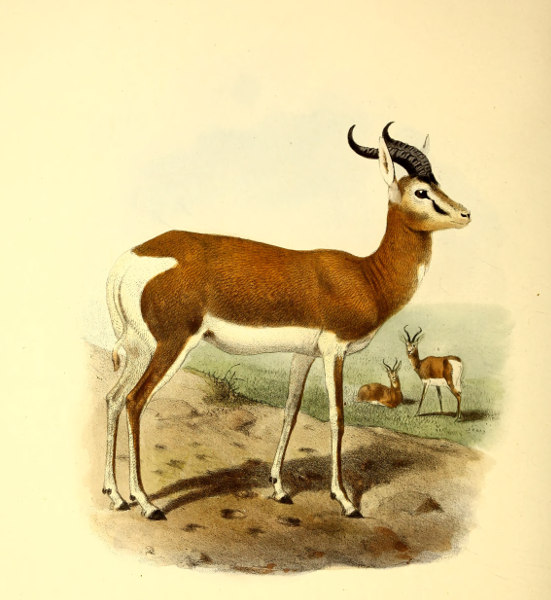
Size large, height of a male not fully adult 35½ inches. General colour dull rufous or rufous-fawn, becoming a deeper and richer rufous anteriorly. Face, cheeks, and chin whitish or whitish-fawn, the forehead beneath the horns and an inconspicuous dark cheek-streak blackish. Neck deep rufous, a conspicuous white spot on its front surface. No dark or light lateral bands present, nor pygal bands. White of belly extending rather high up on the sides, the line of white passing across the outer sides of the forearms on to the chest, where it contrasts conspicuously with the dark red of the neck. White of rump much as in G. soemmerringi, including the tail, and extending angularly forwards on each side into the body-colour, but not uniting with the belly-colour across the outer sides of the thighs. All the boundary-lines between the rufous and white well defined. Knee-brushes small. Tail white, a small brownish or fawn-coloured tuft at its extremity.
Horns of male thick, strongly bent backwards below, recurved upwards and forwards above.
Female. Similar to the male, but horns shorter and thinner.
Hab. South-western Morocco.
The last species of the group, and also of the genus Gazella, is the Mhorr, the Moroccan representative of the Dama Gazelle, to which, as we have already stated, it is very closely allied. Indeed, we have not inconsiderable doubts as to their real specific distinctness. Southern Morocco and Senegal approach so nearly together that it is not likely prima facie that the Gazelles of their deserts would be specifically different.
The well-known zoologist, Mr. E. T. Bennett, who was Secretary to the Zoological Society of London in its early days, was the first describer of the “M’horr” as distinct from Gazella dama, and brought his account of it before a Meeting of that Society on January 8th, 1833. His full memoir on this subject was afterwards published in the Society’s ‘Transactions,’ where it occupies the first pages of the first volume of that standard work.
Bennett’s observations were made on two specimens of this Gazelle which were presented, while living, to the Zoological Society by Mr. E. W. A. Drummond-Hay, C.M.Z.S., then British Consul-General at Tangier, for whom they had been procured by Mr. E. W. Willshire, C.M.Z.S., British Vice-Consul at Mogador. Bennett also had before him a third specimen in the shape of an imperfect skin of this Antelope, also presented to the Society by Mr. Drummond-Hay. All these specimens are stated to have been brought “from the territories of the Sheik of Wednoon, twelve days’ journey inland from the latter place”; but, in spite of the expression “inland,” we suppose “Ouednoon,” as it should be more correctly written, to be the valley of the River Noon in the extreme southern coast district of Morocco, opposite the Canary Islands.
In the article in question, which is accompanied by an excellent coloured figure of the “M’hoor,” Bennett informs us that this Antelope “is regarded in the kingdom of Morocco as an exceedingly rare animal,” and continues as follows:—
“Mr. Willshire states that the one earliest obtained by him was the first individual of the race which had been seen in Mogador. It is highly esteemed, according to Mr. Drummond-Hay, on account of its producing the bezoars, so precious in Oriental medicine, which are known in Morocco as the Baid-al-Mhorr, or eggs of the M’horr. Mr. Hay conjectures that Baid-Mhorr may possibly be the source whence, rather than from the Persian Pazahar, the name of Bezoar has sprung. It is pretended that two of these calculous concretions are met with in the intestines of every individual of the race, but none were found in that which died in the Society’s collection, and which, as is stated by Mr. Spooner and Mr. Langstaff, who examined it after death, agreed in its visceral anatomy with the Antelopes in general.”
About the same time as the Zoological Society’s specimens arrived in England it would appear that living examples of the same Antelope reached the Jardin des Plantes at Paris. One of these, an immature female, was figured by Geoffrey St.-Hilaire and F. Cuvier on the 375th plate of their ‘Histoire Naturelle des Mammifères.’ In the letterpress accompanying this plate we are informed that two young living examples (male and female) had been received there, and that the female had lived in good health for two years without changing her colour, only varying in the size of her body and in the shape of her horns. The authors inform us that when the “Nanguers” arrived at Paris they had only very short horns, about 4 or 5 inches in length, which were at that period strongly and uniformly curved towards the front. The male having died when young did not change the character of his horns, but those of the female having had time to develop became recurved behind and divergent one from the other. These Gazelles had neither tear-bags nor knee-brushes. When the figure was drawn the female stood about 2 feet 10 inches in height, but seemed to be not fully grown.
The authors of the ‘Histoire Naturelle des Mammifères’ refer these specimens to the “Nanguer” of Buffon, and do not say from what country they were received, but from their figure and description there can be no doubt that they belonged to the Gazella mhorr of Morocco and not to the true G. dama of Senegal, if these two species are held to be distinct.
The only example of Gazella mhorr in the British Museum is the mounted adult male from Morocco presented to the Zoological Society by Mr. Willshire in 1833, and formerly in that Society’s collection. It is no doubt the specimen from which Bennett’s figure in the ‘Transactions’ was taken, and is also, we believe, the original of our illustration (Plate LXXII.), which was put upon the stone by Mr. Smit under the direction of the late Sir Victor Brooke. Further information concerning this and other animals of Southern Morocco is much required, but until the present political conditions of that country are altered we are hardly likely to obtain it.
September, 1898.
Genus VII. AMMODORCAS.
Type.
Ammodorcas, Thos. P. Z. S. 1891, p. 207 A. clarkei
Size medium, about as in middle-sized Gazelles. Neck slender and rather elongated, but not so much as that of Lithocranius. Tail long, reaching nearly to the hocks. No Gazelline body-markings present, but the head with typically Gazelline streaks and bands. False hoofs small.
Skull long and low, approaching in shape that of Lithocranius, but less modified. Shallow anteorbital fossæ present. Premaxillæ reaching nasals. Premolars 3/3, the anterior in each jaw unusually small.
Horns of medium length, evenly divergent, curved upwards and forwards throughout their length, except just at their bases. Female hornless.
Range of the Genus. Restricted to Somaliland.
One species only.
THE BOOK OF ANTELOPES, PL. LXXIII.
J Smit del et lith
Hanhart imp.
The Dibatag.
AMMODORCAS CLARKEI.
Published by R. H Porter
107. THE DIBATAG. AMMODORCAS CLARKEI (Thos.). [PLATE LXXIII.]
Cervicapra clarkei, Thos. Ann. Mag. N. H. (6) vii. p. 304 (1891).
Gazelle from Somaliland allied to Lithocranius, Scl. P. Z. S. 1891, p. 197.
Ammodorcas clarkei, Thos. P. Z. S. 1891, p. 207, pls. xxi. & xxii. (head and skull); Scl. P. Z. S. 1892, p. 101; Ward, Horn Meas. (1) p. 128 (1892), (2) p. 173 (1896); Lyd. Horns and Hoofs, p. 240 (1893); Scl. P. Z. S. 1892, pp. 101 & 118; Swayne, P. Z. S. 1895, p. 318 (habits); id. Seventeen Trips to Somaliland, p. 310 (1895); Hoyos, Zu den Aulihan, p. 181 (1895); Elliot, Publ. Chicago Mus., Zool. i. p. 124 (1897).
Vernacular Name:—Dibatag of Somalis (Clarke, Swayne, and others).
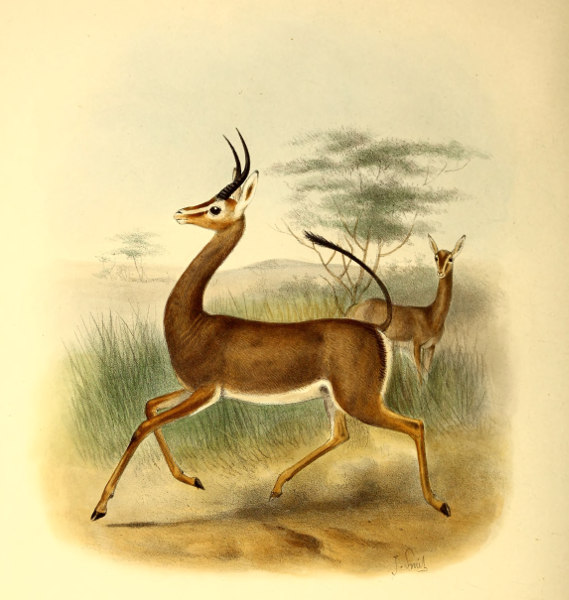
Height at withers about 31 inches. General colour of body dark purplish rufous, no dark or light lateral or pygal bands present. Head with handsome sharply-defined Gazelline markings; the central facial band rich fulvous rufous, no darker spot on muzzle; light facial streaks long, sharply defined, and extending to the sides of the muzzle, pure white; areas round eyes and ears also whitish, though not sharply defined, connected with each other and continuous with the white facial streaks. Dark facial streaks present but not prominent. Back of ears dull whitish. Chin and interramia white. Cheeks below white markings, throat, and whole of neck dark purplish rufous, continuous with the back. Belly pure sharply-defined white, but on the chest this colour is broken by two projections running down from the dark throat-colour on each side of the middle line to between the elbows. Limbs, except their inner sides above, coloured like the back, but gradually passing lower down into fulvous instead of rufous. Knee-brushes present but small. Back of hams white, the white not projecting into the dark body-colour. Tail long, well-haired, but not crested, blackish above and below, except just at its base.
Skull-dimensions in an adult male:—Basal length 7·5 inches, greatest breadth 3·7, muzzle to orbit 4·2.
Horns attaining about 11 or 12 inches in length; their basal halves broadly ringed, their long forwardly-directed terminal halves smooth and evidently corresponding to the short smooth recurved tips of ordinary Gazelline horns.
Female. Similar to the male, but without horns.
Hab. Eastern parts of Central Somaliland, restricted to the Dolbahanta and Marehán countries S.E. of Berbera.
We now conclude the long series of Gazelles with three abnormal forms, each constituting a genus of itself, which, curiously enough, are all restricted to N.E. Africa. As regards the first two of them there can be no question, we believe, of their close alliance to the Gazelles, Ammodorcas being, in several respects, intermediate between Gazellla and Lithocranius, and leading on to that most specialized form of the group. About the correct position of the Beira, however, there is considerable doubt, and it is quite possible that a more natural place for it in the Antelopine series may be hereafter discovered.
The Dibatag, or Clarke’s Gazelle, was first met with by the sportsman and naturalist whose name it bears in 1890, during his exploring trip into the Dolbahanta and Marehán country south-east of Berbera. Writing to Thomas about his discovery, Mr. T. W. H. Clarke (of Secheron, Battery Point, Hobart, Tasmania) says (see P. Z. S. 1891, p. 209):—
“I saw this Gazelle for the first time on December 17th, 1890, about three hours from ‘Bairwell,’ or about one day from ‘Buroa Well, Habergerhagi’s country,’ and afterwards on the road all the way into the Marehan district, 8° N., 47° E. I killed a male, and found one of the horns broken off close to the skull, which had apparently been done a year or so ago.
“They are very graceful animals, with a long neck and well-proportioned head and horns; the body is rather slender, but considerably larger than in Gazella spekei, about the size of a female G. walleri. The legs are long and slender; the hoofs are not so triangular as those of G. spekei, and small for the size of the animal. They have small ears and a long upper lip, just like those of G. walleri or a Giraffe. The horns are of the shape of a sickle, and less than 12 inches in length, the longest, out of the eleven males killed, measuring 11 inches. The tail, from what I remember, is about 12 or 13 inches in length, very thin, and thinly covered with black hair about 1 inch long.
“The colour of the body in this Antelope is like that of the neck, of a kind of pink-fawn, but the belly is whitish and the tail black. The face resembles that of G. walleri, only G. walleri has no white in front of the eye.
“When running, or rather jumping, these Gazelles look very peculiar; their long neck and head being thrown back and the tail thrown forward, so that there appears to be only a foot between head and tail. The country they are mostly found in is of low thorn-bush and sandy; they do not seem to like the big bushes, though at times they are found there. In this respect they differ from G. walleri, this species liking many bushes to go and rest in.
“The new Gazelle is to be found one day’s journey from Buroa Wells, at an elevation of 3100 feet, to the Marehan country (800 feet) (general course about S. by E.), and is there more numerous than any other kind of game, excepting G. soemmerringi; but the latter is found only in the open country.
“Several times I observed the new Gazelle and G. walleri feeding together, but I never saw more than eight in a bunch, and on that occasion there was a male G. soemmerringi with them.”
Mr. Clarke’s skulls of this Antelope, which were at the time without head-skins, having been submitted to Thomas for examination by Messrs. Rowland Ward and Co. (to whom Mr. Clarke had sent for preservation his specimens of Antelopes obtained during this expedition), were, on account of the shape of the horns, not unnaturally supposed to belong to a new species of Reedbuck, and named “Cervicapra clarkei”—a mistake which Thomas corrected in his later paper. Very shortly after Mr. Clarke’s specimens had been sent to Europe Capt. Swayne purchased of an Arab in the market at Berbera two pairs of horns of this Antelope with the head-skins attached, and, seeing that they belonged to a new species, sent them to Sclater. Sclater exhibited these specimens at a meeting of the Zoological Society on March 17th, 1891, and pointed out their Gazelline affinities, but finding that they belonged to the same species as that just named by Thomas handed them over to the latter for further examination.
In his paper upon this subject, which was read at the same meeting of the Zoological Society, Thomas took the opportunity of describing the whole series of Mr. Clarke’s Antelopes, which were eight in number. For Clarke’s Gazelle, of which, with the aid of the head-skins and the cleaned skulls, he had no difficulty in recognizing the true affinities, he established the new generic term “Ammodorcas,” and added a full description of this remarkable form, illustrated by two plates, one of which, by the kind permission of the Zoological Society, we are enabled to copy in the present work.
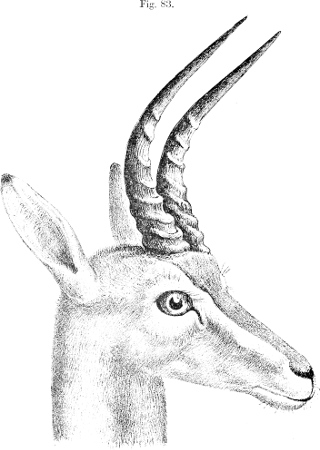
Fig. 83.
Head of the Dibatag, ♂.
(From P. Z. S. 1891, pl. xxi.)
As already pointed out, it is evident that in its skull-characters Ammodorcas is intermediate between Gazella and Lithocranius, while in the shape of its horns it is absolutely different from all other Gazelline genera.
Capt. Swayne, who has had the unequalled experience of seventeen visits to Somaliland, writing in 1894, says:—
“I have been singularly unfortunate with this Antelope, never having been in the country where it is found till I went to the Nogal Valley some three years ago. At that time the Jilal, or dry season, was at its height, and all the game was scarce and shy, so I never got a Dibatag till June 1893, when on my return journey from Ogádén, across the waterless plateau, I made a détour of several days to the east on purpose to shoot one for my collection.
“I searched for Dibatag at Tur, a jungle due south of the Toyo grass plains, the distance being some eighty miles from Berbera, and was lucky in getting one good buck and picking up two pairs of horns. Although I saw a good many, all were wild and shy. This is their extreme western limit, and they never by any chance, I believe, come so far south as the Gólis Range. Farther east, towards Buró, they are more plentiful and less shy.
“Dibatag are very difficult to see, their purplish-grey colour matching with the high durr grass in the glades where they are found. The glossy coat, shining, reflects the surrounding colours, making it sometimes almost invisible; and at the best of times its slender body is hard to make out. I have often mistaken female Waller’s Gazelles for Dibatag, and once shot one of the former in mistake for the latter. The habits and gait are much the same, save that the Dibatag trots off with head held up, and the long tail held erect over the back nearly meeting the head, while Waller’s Gazelle trots away with its head down and its short tail screwed round. Like Waller’s Gazelle the Dibatag goes singly or in pairs, or small families up to half a dozen.
“As in the case of Waller’s Gazelle, the Dibatag is enabled by its long neck and rather long upper lip to reach down branches of the mimósa bushes from a considerable height. The shape of head and way of feeding of both Antelopes are Giraffe-like, and I have seen both standing on the hind legs, fore-feet planted against the trunk of a tree, when feeding. I have seen Dibatag feeding both on thorn bushes and on the durr grass. Both Waller’s and Clarke’s Antelopes can live far from water. The country most suitable for Dibatag is jungle of the khansa or umbrella mimósa, alternating with glades of durr grass which grows about six feet high. The females are hornless. The Dibatag is a very graceful Antelope, standing higher than an Indian Blackbuck, but weighing probably a good deal less.”
Another well-known explorer of Somaliland, Mr. G. Percy V. Aylmer, kindly sends us the following field-notes on this species:—
“Ammodorcas clarkei, the Debbertag of the Somali, one of the most beautiful and interesting of the rare Antelopes of that country, is, I believe, exceedingly local. From the reports of Messrs. Gillett, Pease, and other travellers, and my own experience, I should roughly describe the range of these Antelopes as contained within North latitude 8° to 9° 30´, and East longitude 44°, to an unknown distance towards the east. Morning and evening (within the above limits) they may be found feeding in the open grass-covered plains which are dotted with small scrubby bushes, patches of tall durr-grass, and immensely tall white-ant hills. During the heat of the day they retire to the shade of some solitary tree, where the dark mouse-colour of their backs makes them particularly hard to pick out. Here they stand motionless throughout the hot hours, apparently drowsy, but in reality alert, and watching the landscape with the keenest eyes for signs of danger from man, or the deadliest of all their enemies—the leopard. In the opinion of the Midgan (the Somāli hunting tribe) these are the wariest of Antelope, and I have always had great difficulty in getting within shot, partly because of the open nature of their feeding-ground, but principally on account of their watchfulness and keenness of vision at unusually great distances. On one occasion, being lucky enough to get within 100 yards of two, and finding them to be a female and calf, I contented myself with watching; and for upwards of half an hour, whilst they fed, not two consecutive mouthfuls were taken without the head being sharply raised and a suspicious glance taken all round. In preference they feed upon the small bushes, their long necks enabling them to reach up to the young shoots, like Waller’s Gazelle, although they appear to choose a less thorny variety. I have met with them occasionally singly, generally in twos or threes, and once only as many as five together. When disturbed they stand rigid, head upraised, ears erect, tail stiffening, and the instant they begin to run the tail (which is unusually long) stands up perpendicularly, presenting, as they gallop away with their springy bounding action, rather the appearance of a yawl’s mizzen-mast in a sea-way. Thus they make a particularly difficult mark for the disgusted stalker, who, exhausted by a long and arduous crawl through the scanty cover, probably gets nothing but the flukiest of snap-shots at the coveted specimen.”
Through the kind intervention of Mr. Pease we have also received some interesting particulars as to a wider range of the “Dibatag” from Lieut. R. Ward Jackson, of the 11th Hussars, who, accompanied by Capt. M. S. Wellby, has recently penetrated far into the eastern interior of the Somaliland peninsula. Mr. Jackson writes as follows:—
“In my journey I first saw Dibatag between Bair and Kirrit. They appear to be scattered all over the country between Bair and Hodayu, and I found them most plentiful about 25 miles from Kirrit. There Wellby shot three and wounded a fourth in one day, but, as a rule, I saw two or three each day in a march of about 20 miles.
“Travelling eastward from Hodayu they gradually appeared to grow less plentiful, and the last record I have of having seen one was about 150 miles from Hodayu. After this I saw no more until between Dagha Dalola and Mudug, about 130 miles from the former, in the Mijourten country. Here I was surprised to find them again very plentiful for three days, and I saw a few on the following three days, after which they again ceased. A week afterwards I found them again plentiful in the Marehan country, gradually diminishing in numbers as we travelled south; the last I saw was about 40 miles before we struck the Webbe Shebeyli. On the homeward journey I came across an odd pair now and then in the south of the Ogaden country. I have marked very roughly (see map, fig. 84) the belts within which I found them most plentiful. I do not remember having seen more than eight together. In the Mijourten and Marehan country I have found them quite close to Barao, and most plentiful in country where there was very good grazing of ‘gillop,’ ‘jalaalo,’ and a fine feathery grass. The country between Bair and Hodayu resembled the Haud. As regards the description of the Dibatag, I can add nothing to that contained in Swayne’s ‘Seventeen Trips in Somaliland.’”
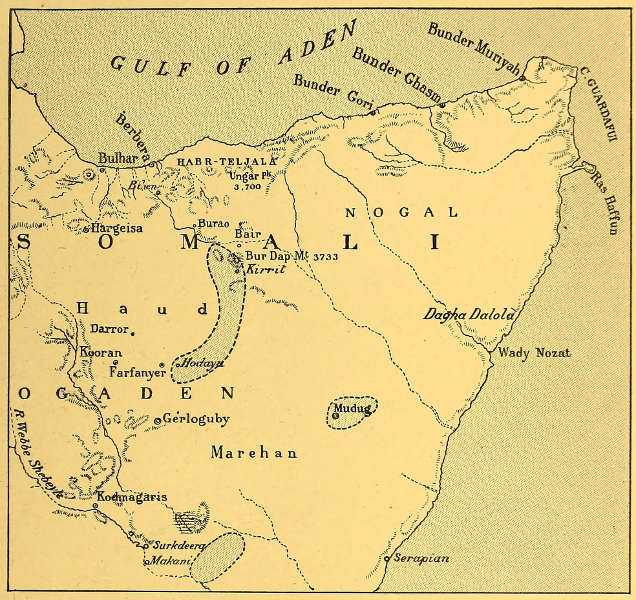
Fig. 84.
Map of Somaliland (showing the localities of the Dibatag).
The specimens of Ammodorcas clarkei in the British Museum consist of a head-skin with its skull from Burao Wells, presented by Mr. T. W. H. Clarke (the type of the species), and a stuffed male, the skins of a male and two females and their skulls from the same district, obtained in his second expedition, and presented by the same donor. There are also a skin and skeleton of a female from Darror Wells, on the Haud, presented by Mr. Ford G. Barclay, and the skull of a male from near the Bur Dap Mountain, Central Somaliland, presented by Col. A. Paget.
Our illustration of the male of this Gazelle, with the female in the distance (Plate LXXIII.), has been drawn and put on the stone from the specimens in the British Museum.
[Since this was written we have received from Dr. Matschie, through Herr Oscar Neumann, the interesting information that the Dibatag occurs in the Kilimanjaro district of German East Africa, a considerable extension of its previously known range.]
September, 1898.
Genus VIII. LITHOCRANIUS.
Type.
Lithocranius[16], Kohl, Ann. Mus. Wien, i. p. 79 (1886) L. walleri.
Size about as in the larger Gazelles. Form very peculiar, owing to the great elongation of the neck, which gives almost a Giraffe-like appearance to the animal. Limbs also very long; false hoofs quite minute. Colouring of the head less typically Gazelline than in Ammodorcas, but a modification of the light lateral body-line present.
Skull (see fig. 85, p. 231) excessively long and low, the cranial part behind the horns particularly lengthened; the bones of this part very solid and stony. Bullæ low and opaque. A shallow anteorbital fossa present. Premaxillæ not reaching the nasals. Lower jaw slender and delicate. Premolars 3/3, the anterior one above almost as large as the second.
Horns thick, oval in section, very closely ringed, curved backwards as in many species of Gazella for the greater part of their length, their middle portion more or less lyrate, as in Gazella dorcas, their tips recurved upwards or forwards. Female hornless.
Range of the Genus. Somaliland and British East Africa.
One species only.
THE BOOK OF ANTELOPES, PL. LXXIV.
J Smit del et lith.
Hanhart imp.
The Gerenuk.
LITHOCRANIUS WALLERI.
Published by R H Porter.
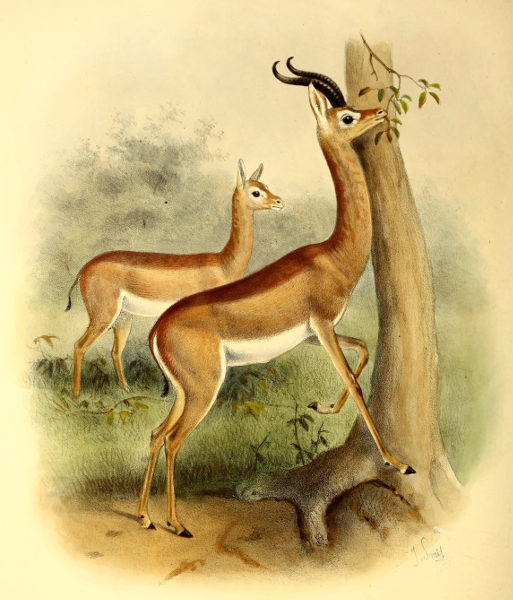
108. THE GERENUK. LITHOCRANIUS WALLERI (Brooke). [PLATE LXXIV.]
Gazella walleri, Brooke, P. Z. S. 1878, p. 929, pl. lvi. (skull); Scl. P. Z. S. 1884, p. 538, pl. xlix. (head and skin); Phillips, P. Z. S. 1885, p. 931; Scl. in James’s Unknown Horn of Africa, p. 262, pl. i. (1888); Hunter, in Willoughby’s E. Afr. p. 289 (1889); Flow. & Lyd. Mamm. p. 342 (1891); Inverarity, Journ. Bombay N. H. Soc. vi. p. 459 (1891).
Lit(h)ocranius (Gazella) walleri, Kohl, Ann. Mus. Wien, i. p. 79, pl. v. fig. 3, and pl. vi. fig. 1 (skull) (1886) (Somaliland).
Lithocranius walleri, Thos. P. Z. S. 1891, p. 207; Scl. P. Z. S. 1892, p. 101; Swayne, P. Z. S. 1892, p. 305; Ward, Horn Meas. (1) p. 134 (1892), (2) p. 175 (1896); Lyd. Horns and Hoofs, p. 241 (1893); Jackson, in Badminton Big Game Shooting, i. p. 307 (head) (1894); Scl. P. Z. S. 1893, pp. 101 & 118; Swayne, P. Z. S. 1895, p. 305 (habits); id. Seventeen Trips to Somaliland, p. 312 (1895); Matsch. Säug. Deutsch-O.-Afr. p. 132 (1895); Hoyos, Zu den Aulihan, p. 180, pl. x. fig. 4 (1895); Thos. Ann. Mus. Genov. (2) xvii. p. 107 (1896); Rhoads, P. Ac. Philad. 1896, p. 519; Elliot, Publ. Chicago Mus. Zool. i. p. 226 (1897).
Vernacular Name:—Gerenuk of Somalis (Swayne and others).
Height at withers 39 inches in an old male. General colour of back rich chestnut rufous, sharply bounded on the upperside of each flank by the very distinct light lateral line, which passes below imperceptibly into fawn-colour, much paler than the dorsal colour, no trace of a dark lateral line being present. The fawn-colour also extends on to the crown, all round the neck, on the shoulders, hips, and down the limbs. Central line of face deep rufous; area round eye whitish, sometimes extended forwards as a light final streak towards the muzzle, but more often stopping just anterior to the openings of the lacrymal glands. Backs of ears pale fawn-colour; area round their bases but little lighter than rest of head. Fawn-colour of throat projecting down on to chest, as in Ammodorcas clarkei. Outer sides of limbs pale fawn throughout. Tail about 10 inches in length, rufous-fawn like the body basally above, whitish below, the tip tufted with black; on each side of its base the white of the hams, which is very narrow, runs up as a pointed projection into the dark body-colour.
The skull of an old male measures 8·75 inches in basal length, the greatest breadth being 3·8, and the muzzle to orbit 4·7.
The horns of good specimens attain 15 or 16 inches in length round the curves, but southern specimens, those from East Africa, have not, as a rule, such fine horns as those from Somaliland.
Female. Similar to the male, but without horns.
Hab. Somaliland, and thence southwards to the Tana Valley, and the Kilimanjaro district of British East Africa.
This Antelope was first made known to science by the late Sir Victor Brooke in 1878 in the last of the many excellent articles which he published in the Zoological Society’s ‘Proceedings.’ His description was based on two skulls with horns attached to them which were lent to him for examination by Mr. Gerald Waller, F.Z.S., at whose request they were named by Brooke after Mr. Waller’s brother, “who lost his life in Africa.”
Although it is not so stated by Brooke (who was presumably ignorant of the fact), Mr. Waller’s specimens of this Antelope are now known to have been given to him by Sir John Kirk, at that time H.B.M. Consul at Zanzibar. In reply to enquiries Sir John kindly informs us that these skulls were procured by hunters in his employment on the coast near the River Juba in Southern Somaliland. Sir John subsequently shot specimens of it himself in the same district (where at that period it was very common), and also brought living examples of it away to Zanzibar.
In his description Brooke pointed out that, as is well shown in the accompanying figure (p. 231), which has been copied from the plate that illustrates his paper, the skull of this Gazelle, besides its general depression, stands widely apart from those of all other species of the group in the enormous backward prolongation of the occiput—“an extension gained principally by the great size of the occipital bone and the prominence of the occipital crest.” This divergence was so remarkable that Brooke doubted “whether the species should not constitute the type of a new subgenus.” As we shall see later, Brooke’s views have been fully justified by what has taken place since a close acquaintance with the structure of this singular Antelope has been acquired.
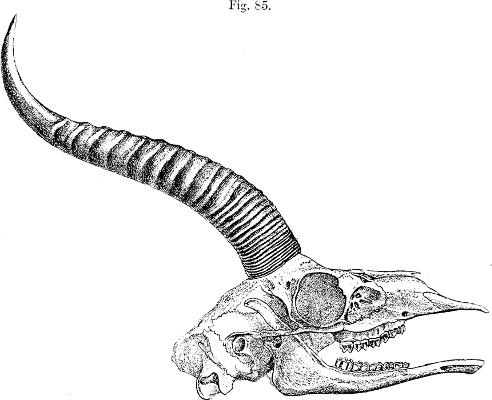
Fig. 85.
Skull of the Gerenuk.
(From Brooke, P. Z. S. 1878, pl. lvi.)
It was six years after the publication of Brooke’s paper before any additional information concerning this strange Antelope was obtained. In November 1884 Sclater brought before the notice of the Zoological Society a series of flat skins of Mammals, prepared by the natives of Somaliland, which had been lent to him for examination by Mr. C. Hagenbeck, of Hamburg. Amongst these were two skins, at first believed to belong to a new Gazelle, but which, after much research and mainly by the aid of a mounted head obtained in Somaliland by the late Mr. F. L. James, he was enabled to prove must belong to the same Antelope on the skull of which Gazella walleri had been founded. The skins were at once distinguishable by the well-defined dark brown dorsal stripe which, as we now know, forms such a noticeable feature in the present species. Further evidence of the identity of the Somaliland Antelope with Gazella walleri was obtained by the comparison of Mr. James’s specimen with one of the typical skulls of the last-named species. They differed little, except in the slightly larger size of the northern specimen and in some other minor characters. It was thus first shown that the range of Waller’s Gazelle extends to Northern Somaliland, but we now know that the “Gerenuk,” as the Somalis call it, is one of the most abundant game-animals of that favoured land.
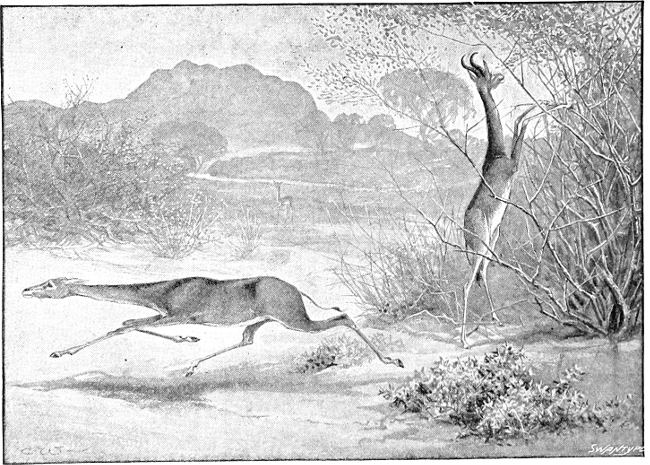
Fig. 86.
Sketch of Gerenuk, ♂ and ♀, in characteristic attitudes.
(From Neumann’s ‘Elephant-Hunting,’ p. 81. Lent by Messrs. Rowland Ward & Co.)
Capt. Swayne sums up his long acquaintance with this Antelope as follows:—
“The Gerenúk is the commonest and most widely distributed of the Somáli Antelopes except the little Sakáro, which springs up like a hare from every thicket.
“The long neck of the Gerenúk, the large giraffe-like eyes, and long muzzle are peculiar to it and the Dibatag (Ammodorcas clarkei). The Gerenúk is more of a browser of bushes than a grass-feeder, and I have twice shot it in the act of standing on the hind legs, neck extended, and fore feet against the trunk of a tree, reaching down the tender shoots, which could not be got in any other way. Thus not only the appearance, but the habits of the Gerenúk are giraffe-like. The skull extends far back behind the ears, like that of a camel.
“It is found all over the Somali country in small families, never in large herds, and generally in scattered bush, ravines, and rocky ground. I think it subsists almost entirely on bushes, as it is constantly found in places deserted by Oryx and all other Antelopes because there is no grass. Perhaps the Gadabursi country is the best ground for it, but the Gerenúk is almost ubiquitous and need not be specially looked for. I have never seen it in the cedar-forests which crown Gólis, nor in the treeless plains which occur in the Haud. It is not necessarily found near water,—in fact, it is generally met with on stony ground, where there is a sprinkling of thorn-jungle.
“The gait of this Antelope is peculiar, and when first seen a buck will generally be standing motionless, head well up, looking at the intruder, and trusting to its invisibility. Then the head dives under the bushes, and the animal goes off at a long crouching trot, stopping now and again behind some bush to gaze. It seldom gallops, and its pace is never very fast. In the whole shape of the head and neck, with its extended muzzle and slender lower jaw, there is a marked resemblance between the Gerenúk and the Dibatag. The texture of the coat is much alike in both. The horns of immature buck Gerenúk have almost exactly the same shape as those of the Dibatag. Their average length when fully grown is about 13 inches. The females are hornless; they sometimes lose or desert their young ones, as I have now and then come on fawns living alone in the jungle. The Gerenúk stands a good deal higher than an Indian Blackbuck, but would be of about the same weight.”
Mr. Frederick Gillett, F.Z.S., who accompanied Dr. Donaldson Smith during the first part of his expedition to Lake Rudolph, has kindly drawn up for us the following notes on Waller’s Gazelle:—
“This Gazelle is more like Clarke’s Gazelle than any other in Somaliland, not only on account of its long neck, but because of its habits. Never is it found out on the open plains, so much frequented by Soemmerring’s Gazelle, but it prefers the dense Khansa jungles, or, like Clarke’s Gazelle, the high durr-grass of parts of the Haud. Sometimes it is found in company with, or rather in the same neighbourhood as, Gazella soemmerringi, in more or less open country amongst the Khansa-bush and big aloes. It is usually seen in small families of not more than a dozen, but never in herds. It relies on its sharp eyesight and long neck for its safety, standing motionless amongst the bush or grass watching for an enemy. Most of the Somalis dislike its flesh, not so, however, the Lion and Leopard, and many a Waller’s Gazelle is stalked and killed by them. Its native name in Somaliland is ‘Gerenook,’ and in the Arusa Galla country ‘Googoofto.’ In the latter country it is very common, inhabiting the jungles frequented by Elephants and Lesser Koodoos. It is the most ubiquitous of all the Antelopes of this part of Africa, and it is a very common sight to see a buck with its fore legs, like a goat, high up the trunk of a Galol-tree nibbling the small green leaves. The female is hornless, whilst the horns of a good male measure from 14 to 15 inches. Its legs are extremely slender. When disturbed it runs with its long neck stretched out as near the ground as possible, so that it can never be mistaken for a Clarke’s Gazelle, as the latter always holds its head erect and its tail well over its back, and springs instead of runs. The young are born, I believe, early in the year; but I have never seen a really young one, although I have been in the country every month in the year except May and June. On December 8th, 1894, I was stalking an Oryx when a female Waller’s Gazelle ran almost on to me pursued by a male; they did not see me, but turned and ran back, and then again came towards where I was lying, still without seeing me. After they had gone I crawled on, when for the third time they returned and this time saw me. I remained motionless on one knee; the female retired to a bush, and the male with its neck stretched at its full length came cautiously towards me till within 25 yards, and then gave three or four snorts. As it was the Oryx I was after I now moved and they at once trotted off.”
We copy an account of the native mode of capture of this Gazelle from Messrs. Parkinson and Dunbar’s narrative of their journey in Northern Somaliland in 1896 (Geogr. Journ. xi. p. 25):—
“We found here (on the Bur Dab range) an old man living entirely alone, subsisting on gum and snared game. He was very clever at catching ‘Gerenok,’ or Waller’s Gazelle, by means of a cord made of the fibre of the ‘hig’ aloe. At one end of the cord a running noose, 6 inches in diameter, was laid round the rim of a cup-shaped hole scooped in the ground, and supported by a series of small pegs. Near the noose was attached a fine but strong thread, the other end of which was fastened to a springy branch of a tree bent down for the purpose. The noose was prevented from being dragged out of the hole by two pieces of wood laid crosswise. The loose end of the cord was either tied to an adjacent tree or pegged firmly to the ground, and all traces of the trap neatly covered with leaves and sand. The Gazelle is, of course, caught by the leg, and once the noose is drawn tightly round above the hoof there is no escape; but it must need large experience of the haunts of the game to know where to set these gins. The old man had thirty or forty constantly set, and said he got a Gazelle once every four or five days.”
Mr. Alfred Pease has kindly summarized his field-notes on the Gerenuk in the following paragraphs:—
“The Gerenuk is the commonest and most evenly distributed of all the Somali Antelopes, if we exclude the little Dik-diks, but it is by no means the least interesting. It is as peculiar as it is beautiful. At rest it is graceful, when running grotesque, and when feeding most curious in its pose. But its colouring of red and purple-grey, its reach of view, and its motions all wonderfully facilitate its power of escaping observation. At 300 yards I have often had my eye on them feeding, unable almost to distinguish them from their likeness to stems of trees and dead thorn. They are tree-feeders, and their length of leg, body, and giraffe-like necks enable them to crop the leaves from bush-trees at a great height from the ground. When thus occupied in browsing they are often absolutely vertical, and for minutes together motionless, save for the lips and head, which are buried in the foliage. The male alone carries horns, varying in length and circumference, which reach, in fine specimens, 15½ inches measured along the curve. The female is smaller and slighter than the male. On being disturbed they often remain so motionless that it is difficult to detect them in the bush, and when they make off they do so very quickly, and are immediately transformed from tall elegant animals with heads proudly carried to clumsy crouching fugitives with outstretched heads and necks. I have noticed when in flight they generally take a line more or less parallel to the hunter, as if they did not consider it safe to lose all knowledge of their pursuer’s whereabouts in the bush. With this object apparently they will usually keep the crest of a ridge or rise till they have put a considerable distance between themselves and their enemy. They go singly or in bands, but most commonly there are two, three, or more together. I have never seen more than fifteen in one band, and in that case twelve out of the fifteen were females. There is no part of Somaliland that I have visited where they are not common. In 1897 I saw some within five miles of Berbera, in 1896 and 1897 in the maritime plains, in the Golis, on the Haud, in distant Ogaden, and far Bourha, but nowhere more numerous than in the Godabürsi country. They are easily killed by anyone who can shoot standing up, as the long-line shot at the perpendicular, even when as narrow as that of a Gerenuk’s chest and neck, is a comparatively easy one, and no very nice judgment of range is necessary. Their meat is generally despised by the Somalis, but eaten by the Midgans; but to my own taste it is not very much less nice or more nasty than most other Antelope flesh. The Somalis have an expression ‘Gerenuk,’ which is derived from their opinion as to the merits of its flesh, as it is generally considered nasty meat, yet not actually forbidden, and occasionally even relished by individual Somalis. The word is used constantly as an interjection to express dissent, either in chaff or contempt, in the sense: ‘That may do for you, but it won’t do for me!’”
We subjoin Mr. E. N. Buxton’s lively account of his experiences with this Antelope, extracted from the second series of ‘Short Stalks’:—
“The long-necked ‘Gerenook’ is a bush-feeder, like the Giraffe, and is built on the same lines, except that the males carry curved horns. The body is on the scale of a small Fallow-deer, but such is its length of leg and neck that the head, when the animal is on guard, is held over six feet from the ground. They are generally found in small families of three or four. The bright chestnut back makes it fairly easy to see them even among the bushes. On the other hand, its sharp sight and length of neck give it a conspicuous advantage against pursuers. At the first sign of danger the Gerenook slinks behind the bushes, and peeps over the tops as from a small watch-tower. Imagine the strategical advantage you would have in guerilla-warfare if you could screw your head on to your umbrella and gently elevate it till it looked over the parapet, especially if your eyes were placed quite at the top. If they think themselves followed, down go their heads nearly to the ground and they retreat at a slouching trot, keeping completely out of sight. If you can manage to catch sight of one of these animals before he sees you, and that is seldom, do not shoot him, but watch him feeding. You will not have such a chance at the Zoo, for this species has never been brought alive to Europe. When he has consumed what he can reach in a normal attitude he rears up and stands on his hind legs, assuming a perfectly erect position. With the fore feet, which are carried level with the cheeks, he holds the boughs down, and assists his balance. If he happens to be facing you, so as to show his white belly, the appearance is particularly odd, being that of a tall brown man clad in a white apron.”
It will be recollected that Lithocranius walleri, although actually better known to us from Somaliland, was originally discovered in the southern part of its range, in British East Africa. Here, according to Mr. Hunter, it is “very rare in the Kilimanjaro district, though numerous up the Tana River.” Lieut v. Höhnel, who accompanied Count Teleki’s expedition to Lake Rudolph, informs us that it is common also on the Upper Tana, between Hameye and the mouth of the Mackenzie River, but that none were found on the Guaso Nyiro. Mr. Jackson, in the first volume of ‘Big Game Shooting,’ writes as follows concerning the habits of this species in British East Africa:—
“The East-African Waller’s Gazelle is very much smaller than that found in the Somali country. There is no mistaking this Antelope for any other, on account of its extraordinarily long and thin neck, which in the case of a fully adult buck, killed by myself at Merereni, was only 10 inches in circumference. Two females measured only 7 inches each round the neck. When walking and seen at a distance these animals look not unlike pigmy Giraffes, as they carry their long necks stretched out at an angle. They frequent the open bush fringing the outskirts of dense thickets, into which they at once retreat on being disturbed. Their note of alarm is a low short ‘buzz’! This Gazelle is essentially a bush-feeder. At Merereni I once watched a doe feeding on a small-leaved bush not unlike the privet in appearance, and several times I saw her rear up on her hind legs, bend down a branch with her fore legs, and feed on the leaves in this upright position like a goat. This quaint-looking little Antelope, like the Bushbuck, is apt to haunt one particular spot, and may be seen in or quite near to it for weeks together. They are very shy and not easy to stalk, and, as they have a happy knack of hiding behind bushes in the most effective manner, they are not easy to see.”
The Gerenuk was well represented in the collection of Mammals obtained by Mr. D. G. Elliot in the course of his recent expedition to Somaliland, and a series of specimens of this Antelope obtained on that occasion has been mounted in characteristic attitudes in one of the large show-cases of the Field-Columbian Museum at Chicago. Mr. Elliot has kindly sent us some photographs of this interesting group, which show the male, female, and young, and their peculiar manner of feeding.
The Gerenuk is represented in the British Museum by a fine mounted pair obtained by Herr Menges in the neighbourhood of Berbera, from which our illustration of both sexes (Plate LXXIV.) has been prepared by Mr. Smit. There are also four other skins of both sexes, purchased of Herr Menges, and the skin figured by Sclater (P. Z. S. 1884, pl. xlix.), which was presented to him by Herr Hagenbeck, but was likewise originally procured by Herr Menges. In the National Collection there are also a skin and skull of a male of this Antelope from Burao Wells, Somaliland, presented by Mr. T. W. H. Clarke, another skin and skull from the hills south of Berbera, presented by Capt. J. R. Harkness, R.A., and a mounted skeleton from Somaliland, obtained by purchase.
From the southern part of its range the British Museum has one of the original skulls from the River Juba district upon which the species was founded, and three skulls and some separate horns from the extreme south of the Somali coast, obtained by Sir John Kirk.
September, 1898.
Genus IX. DORCOTRAGUS.
Type.
Dorcatragus, Noack, Zool. Auz. xvii. p. 202 (1894) D. megalotis.
Size very small, smaller than in any Gazelle. Ears large. Tail short. False hoofs minute; horny part of main hoofs short, but the internal pad to the hoof broad and thick; position of limbs in standing almost as in Oreotragus. No Gazelline head-markings, but a dark lateral band present on the sides of the body.
Skull broad and short. Nasals short and premaxillæ long, the structure in this region recalling that in Madoqua. Anteorbital region with a very small and shallow lacrymal fossa. Bullæ large and inflated. Premolars 3/3, the anterior very large.
Horns short, straight or faintly curved forwards, not unlike those of Raphiceros, and quite different from those of any true Gazelle. Female hornless.
Range of the Genus. Restricted to Somaliland.
One species only.
THE BOOK OF ANTELOPES, PL. LXXV.
Smit del. et lith.
Hanhart imp.
The Beira.
DORCOTRAGUS MEGALOTIS.
Published by R. H. Porter.
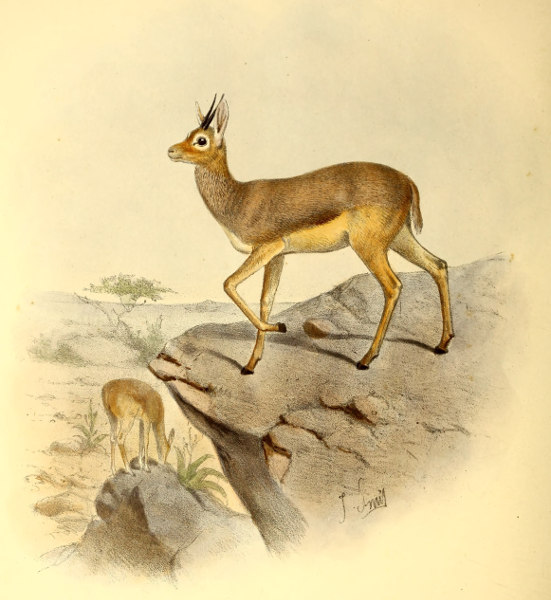
109. THE BEIRA. DORCOTRAGUS MEGALOTIS (Menges). [PLATE LXXV.]
Behra, Menges, Peterm. Mitth. xxxi. p. 454 (1885) (Hekebo plateau).
Beira, Scl. P. Z. S. 1892, pp. 102, 118; Swayne, P. Z. S. 1892, p. 308.
Oreotragus megalotis, Menges, Zool. Anz. xvii. p. 131 (1894); Swayne, Seventeen Trips to Somaliland, p. 321 (1895).
Dorcotragus megalotis, Noack, Zool. Anz. xvii. p. 202 (1894); Hoyos, Zu den Aulihan, p. 186 (1895); Elliot, Publ. Chicago Mus. Zool. i. p. 135 (1897) (Hargeisa).
Vernacular Name:—Beira of Somalis (Swayne).
Size about as in the Steinbok or Grysbok; height at withers 20 inches in an adult male. General colour of neck and back a peculiar purplish grey, very finely grizzled with white, the extreme tips of the hairs being this latter colour. Scarcely a trace of a light lateral band, but a distinct dark one present, brownish, passing quite across the shoulder, and extending behind on to the sides of the rump. Belly not, as is usual, pure white throughout, but only white on the axillæ and groins, the remainder pale yellowish fawn, or even orange-fawn, this colour also extending on to the outer sides of the forearms and thighs; rest of limbs becoming darker fulvous to the hoofs. Head bright fulvous, quite different to the neck; area round eyes white, but no Gazelline facial streaks present. Tail short and rather bushy, coloured like the back, without darker tip.
Measurements of an old male skull:—Basal length 5·35 inches, greatest breadth 3·15, muzzle to orbit 3·2.
Horns ordinarily from 4 to 5 inches in length, the longest in the British Museum collection, one of Capt. Swayne’s, attaining 5½ inches.
Hab. Northern Somaliland; hills along the northern edge of the Haud.
On several occasions during the many years in which Sclater’s excellent correspondent Captain H. G. C. Swayne, R.E., was engaged on his various explorations and expeditions in Somaliland, he wrote about a “small red Antelope” found in the mountains which had the habits of a “Klipspringer,” but, according to native testimony, was of quite a different species. The existence of the same animal had also been recorded as long ago as 1885 under the name “Behra,” by Herr Josef Menges, in an account of his fourth journey in Somaliland, published in Petermann’s ‘Mittheilungen.’ Herr Menges met with the “Behra” on the Hekebo plateau (about 10° S. lat. and 44° 40´ E. long.), and had at one time a young living specimen of it in his possession.
After Herr Menges the “Behra” or “Beira,” as it is now usually called, after its Somali name, seems to have been first actually seen by Lieut. E. J. Swayne, of the Indian Staff Corps, Capt. Swayne’s brother, when he was in the Gadabursi country in the autumn of 1891. He observed two of them among very rugged hills, but failed to get a shot at them. He described them to Capt. Swayne as being “reddish Antelopes, rather larger than the Klipspringer, with small straight horns, which bounded away among the rocks in exactly the same manner as the Klipspringer.”
Capt. Swayne was much excited about this discovery, and promised Sclater to do all he could to procure specimens of the animal. On his last trip to Somaliland he was assured by his Somalis that he would find the “Beira” on Waggar Mountain, near the south-eastern extremity of the Golis range, but he had not time to go there. On leaving Berbera, however, Capt. Swayne exhorted his men to proceed to the mountains themselves and to endeavour to procure some specimens of the Beira, offering them a handsome reward for good heads and skulls of a male and female, and leaving instructions to his agents there to pay the men and to forward the specimens.
Early in 1894 the much-wished-for skins were obtained by the faithful Somalis and forwarded to Sclater by Captain Swayne. We were proceeding to describe and figure them in the Zoological Society’s ‘Proceedings,’ when we found that we had been anticipated by Herr Menges, who had just described the species in the ‘Zoologischer Anzeiger,’ and given it the name “Oreotragus megalotis.” It has, however, certainly but a very remote connection, except as regards its habits, with the Klipspringer (Oreotragus), and Dr. Noack was quite justified in proposing for it the new and appropriate term Dorcatragus (δορκας, an Antelope, and τραγος, a Goat), which he did in the same periodical shortly afterwards. Dr. Noack based his article upon two specimens, male and female, which he had then lately received from Herr Menges for examination.
The next traveller in Somaliland to encounter this rare Antelope was, we believe, Capt. P. Z. Cox, who, writing to Dr. Günther from Berbera in April 1895, gave an account of the circumstances under which he obtained a female example of the Beira for the British Museum:—
“I was returning from a short trip in the interior, upon duty and pleasure combined—I was about 50 miles from Berbera; the country I was travelling through was level plain, with occasional flat-topped tablelands, with steep sides rising sheer out of the general level of the surrounding country. I was passing the foot of one of these large plateaux on 29th March, with my Somali Shikari, in search of game, and remarked to him that there was a rare Klipspringer said to be found on these plateaux, and that I thought I would scale the steep side and just see what there was at the top.
“Accordingly we toiled up the face of the tableland and reached the top. It was simply a large stretch of perfectly flat ground covered with large, loose, black, burnt-up stones, with an occasional green bush to vary the monotony. The extent of the plateau was about a mile in length by half a mile broad. We had a very tiring tramp over this course, shingle from end to end of it, and just as we reached the further end, where there was a little fringe of green bushes, we espied several Antelope browsing about 300 yards from us. I could not quite make out what they were, and expected them to be some young animals of the Greater Koodoo; but directly my Shikari saw them he said, ‘Do you know what those are, Sir? they are “Bahra”; I have only seen them once before, and no sportsman has ever shot them.’
“There was no cover between us and them, and it was impossible to stalk them from where we were, so we made a long detour below the crest of the plateau expecting that we could come up within shot on the other side of the animals; but it was impossible to move without displacing stones and making a noise, and when we emerged above the crest again it was only to see five Antelopes streaming over the plateau in the direction we had just come from. Under such circumstances Klipspringer would have separated and taken to the rocks on the steep sides of the plateau, whereas these animals kept in a herd together and galloped away over the flat just as a herd of Gazelle would do.
“I was much disappointed at not getting a shot, but I was sure they would not leave the plateau, and determined to leave no stone unturned to come up with them. We tramped on in the direction they had gone, and after going about half a mile caught sight of them again; but they had seen us first, and were going hard at about 250 yards when we saw them. It would have been a very fluky shot, and I held my hand. I could now distinguish four females and one buck, which appeared to have horns exactly like a Gazelle, between 8 and 10 inches long.
“When they were fairly under weigh we got a bush between us and them, and hurried after them as quick as we could. After a few moments, as luck would have it, they all stopped in a bunch and turned round with their heads towards us at about 300 yards. I could not distinguish the buck at the moment, as they were standing among bushes and were not distinct, but I aimed at one which turned partially broadside and fired. The animal fell dead, and the other four streamed away out of sight. On running up I found that it was a female that I had killed, and I am sorry to say that on grallocking her we found an almost mature embryo inside her. I was unable to preserve this as I had no spirit with me, but the fact shows that the animal killed was an adult.
“I took careful measurements on the spot, and found the height at shoulder 23 inches; distance from the nose to the root of the tail 33; the tail including 2-inch hair 5½; the length of ears in front 6¼, and their breadth 2¾.”
Sir Edmund Loder has kindly favoured us with the following field-notes on the Beira:—
“Mr. Percy Aylmer heard of this Antelope on the stony foot-hills in Gubau (N. of Hargaisa), and saw it on one of the isolated foot-hills to the south of Gau Libah. Mr. A. E. Pease and I found it on another detached hill about 20 miles west of this. This particular hill was extremely rough and rugged, covered with loose boulders, making walking and silent stalking extremely difficult. This hill was also frequented by Gumbouri (Wild Asses, Equus somalicus), which, from their large size, were easily seen. The case was, however, very different with the ‘Baira,’ which, at a comparative short distance, seemed to melt out of sight immediately they stopped moving, and indeed when they were in motion it was rather the moving black shadow cast by a tropical sun that caught the eye than the animal itself. They were observed by us in bands of seven, three, and three. In the two lots of three which I saw there was what I take to be one adult male with each. The only record of height that I can lay my hand on at this moment is that of an adult female, which measured at the shoulder 2 feet 2 inches; probably the male would be an inch higher.
“The whole colour of this Gazelle is very beautiful in its tints of buff, purple, fawn, and grey and white; but what struck us most was their ears and hoofs. The ears, besides being very large and ornamental, are remarkable for the distinct rayed marking on the inside. The hoofs are well worth a special drawing, as they differ from those of any other Antelope with which I am acquainted. They are very much hollowed out, as is very noticeable in the track which they leave. The foot of the stuffed specimen in the Natural History Museum is filled up with some black substance which does not seem to me to be natural.”
The accompanying view of the head is enlarged from a photograph of this Antelope kindly sent to us by Sir Edmund Loder.
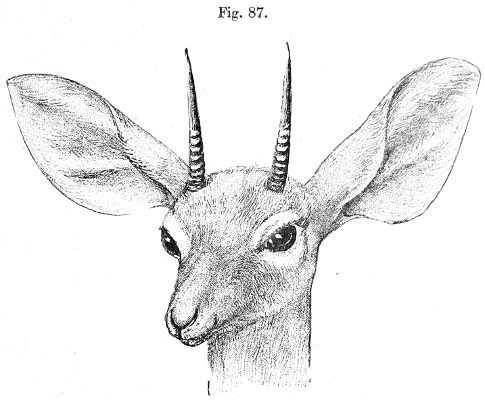
Fig. 87.
Front view of the head of the Beira.
During Mr. D. G. Elliot’s East-African expedition of 1896, Mr. Akeley, one of his party, obtained two examples of this Antelope on Nasr Hablod Mountain, near Hargeisa, in nearly the same district as that just described by Sir Edmund Loder. These specimens are now in the Field-Columbian Museum at Chicago.
The British Museum contains a mounted specimen of an adult male of the Beira (from which our figure, Plate LXXV., has been prepared by Mr. Smit) and a skin of a female of the same species purchased of Herr Menges, besides the two skins obtained by the Somalis for Capt. Swayne, as above mentioned, which have been presented to the Museum by Sclater. It contains also a skin and complete skeleton of a female of this Antelope presented by Capt. P. Z. Cox, as described above.
September, 1898.