Subfamily V. ANTILOPINÆ. (continued 2)
Reading edition
Antidorcas euchore, Sund. Pecora, K. Vet.-Ak. Handl. 1845, p. 271 (1847); id. Hornschuch’s Transl., Arch. Skand. Beitr. ii. p. 267; Reprint, p. 87 (1848); Gray, P. Z. S. 1850, p. 116; id. Cat. Ung. B. M. p. 63 (1852); Gerr. Cat. Bones Mamm. B. M. p. 233 (1862); Blyth, Cat. Mamm. Mus. As. Soc. p. 171 (1863); Fitz. SB. Wien, lix. pt. 1, p. 158 (1869); Gray, Cat. Rum. B. M. p. 40 (1872); id. Hand-l. Rum. B. M. p. 109 (1873); Jent. Cat. Ost. Leyd. Mus. (Mus. Pays-Bas, ix.) p. 169 (1887); id. Cat. Mamm. Leyd. Mus. (op. cit. xi.) p. 137 (1892).
Antilope saccata, Bodd. Elench. Anim. p. 142 (1785).
Capra pygargus, Thunb. Resa, ii. p. 28 (1789), Engl. Transl. ii. p. 24 (1793).
Antilope pygarga, Thunb. Mém. Ac. Pétersb. iii. p. 315 (1811) (and no doubt of many other earlier authors; nec Pall.).
Antilope saltans, Kerr, Linn. An. K. p. 312 (1792).
Antilope saltatrix, Link, Beytr. p. 79 (1795) (nec Bodd.).
Antilope saliens and A. dorsata, “Lac.,” Desm. N. Dict. d’H. N. (1) xxiv. Tabl. p. 33 (1804).
Vernacular Names:—Springbuck of English; Springbok or Prongbok of Dutch; Tsebe (A. Smith) or Umegi (Drummond) of Kaffirs. Insaypee of Bechuanas; Eetsaypee of Makalakas (Selous).
Height at withers 31 or 32 inches. General colour bright rufous fawn; a strongly marked, dark, lateral band present, as in many Gazelles. Face pure white, a narrow fawn-coloured line running forwards to the muzzle from the openings of the anteorbital glands on each side. Crown and centre of forehead fawn-coloured like the neck and back. Ears long and pointed, their backs white or pale fawn. Posterior back with a strongly contrasted pure white line, the white hairs of which are placed in a fold of the skin, which fold is everted when the animal is excited, and then forms a prominent white crest; rump white, in continuation with the dorsal line; tail also white basally, black and crested terminally. Belly pure white. Limbs fawn-coloured externally, white on their inner sides and behind.
Skull-dimensions of a male:—Basal length 7·8 inches, greatest breadth 3·7, muzzle to orbit 4·7.
Horns attaining a length of about 14 or 15 inches round the curves, one specimen being recorded as long as 19 inches.
Female similar to male, but horns smaller and not so strongly ringed at the base.
Hab. South Africa, south of the Zambesi, extending northwards on the west to Mossamedes.
The Springbuck is, no doubt, very closely allied to the Gazelles; but in view of its peculiar dentition, which, as we have pointed out above (p. 53), is unique in the bovine family, and of the remarkable dorsal fold of skin, which is not found in any of its allies, we have thought it advisable to adopt for it the generic term Antidorcas, first provisionally suggested for it by Sundevall in 1847, and subsequently employed by many naturalists. The locality of the Springbuck is also quite distinct from that of the typical Gazelles, which are essentially a northern group, no true Gazellæ being met with until we advance as far north as German East Africa.
This Antelope, with its bright colour and lively movements, as may be easily imagined, quickly attracted the notice of the early Dutch settlers at the Cape and received from them the appropriate name of “Springbok,” from the extraordinary springs and leaps which it makes in running. The first scientific account of it published appears to be that given by Allamand in Schneider’s edition of the ‘Histoire Naturelle’ of Buffon, published at Amsterdam about 1778. In the fourth volume of the ‘Supplement’ of this rather rare work, for the privilege of consulting which we are much indebted to Sir Edmund Loder, will be found (under the head of an addition to the article on Gazelles issued in the twelfth volume of the original work) described and figured “La Gazelle à bourse sur le dos,” as Allamand named the Springbuck. Allamand informs us that his figure and description (which unmistakably relate to this animal) were taken from a specimen then living in the menagerie of the Prince of Orange, which had been brought from the Cape by Capt. Gordon, and was the only survivor of twelve examples of this animal with which Captain Gordon had started for Europe.
Upon Allamand’s “Gazelle à bourse” Zimmermann, in the second volume of his ‘Geographische Geschichte,’ issued in 1780, established his Antilope marsupialis, adding a Latin diagnosis and a shortened translation of Allamand’s description. In the meantime, however, another name seems to have been proposed for the same animal by Forster, who, as we are informed by Zimmermann in the third volume of his ‘Geographische Geschichte,’ had called the Springbuck Antilope euchore. This no doubt was done in the famous ‘Descriptiones Animalium,’ which, although generally accessible in manuscript to the naturalists of the day, and frequently quoted by them, was not published until 1844. However, as Forster’s name for the Springbuck has been accepted nearly universally by subsequent naturalists, we do not now propose to change the name by which this animal has been known for so many years.
The immediately succeeding writers added little or nothing to our knowledge of this Antelope until about 1829, when Lichtenstein, in the second number of his ‘Darstellung der Thiere,’ gave coloured figures of both its sexes under the name “Antilope euchore, Forster,” from specimens in the Berlin Museum procured by him or his assistants in Cafferland.
A few years later Cornwallis Harris visited South Africa. In his great work on the results of his journey subsequently published, this celebrated sportsman and naturalist devotes his third plate to the illustration of a group of Springbucks, which he describes at the period of his writing (1840) as then still abundant in the Colony and “distributed over the arid plains beyond it in unlimited herds.” “Amongst the many striking novelties,” Cornwallis Harris writes, “which present themselves to the eye of the traveller in Southern Africa there are, perhaps, few objects more conspicuous or more beautiful than the dancing herds of graceful Springbucks which speckle the broad plains of the interior.”
“Matchless in the symmetry of its form, the Springbok is measurelessly the most elegant and remarkable species of the comprehensive group to which it pertains. The dazzling contrast betwixt the lively cinnamon of its back and the snowy whiteness of the lower parts is agreeably heightened by the intensely rich chestnut bands which traverse the flanks—its dark beaming eye, with its innocent and lamb-like expression of face, and the showy folds of gossamer on the haunches—displayed or concealed at the animal’s volition—combining to render it one of the most beautiful objects in the animal creation. As the traveller advances over the trackless expanse, hundreds of this delicately formed antelope bound away on either side of his path with meteor-like and sportive velocity, winging their bird-like flight by a quick succession of those singularly elastic leaps which have given rise to its colonial appellation, and which enable it to surpass, as well in swiftness as in grace, almost every other mammiferous quadruped.
“But although frequently found herding by itself, the Springbok is usually detected in the society of Gnoos, Quaggas, Ostriches, or Blesboks. Fleet as the wind, and thoroughly conscious of its own speed, it mingles with their motley herds, sauntering about with an easy careless gait, occasionally with outstretched neck approaching some coquettish doe, and spreading its own glittering white folds so as to effect a sudden and complete metamorphosis of exterior from fawn-colour to white. Wariest of the wary, however, the Springboks are ever the first to take the alarm, and to lead the retreating column. Pricking their taper ears, and elevating their graceful little heads upon the first appearance of any strange object, a dozen or more trot nimbly off to a distance, and having gazed impatiently for an instant to satisfy themselves of the actual presence of an enemy,—putting their white noses to the ground, they begin, in colonial phraseology, to ‘pronken’ or make ‘a brave show.’ Unfurling the snowy folds on their haunches so as to display around the elevated scut, a broad white gossamer disk, shaped like the spread tail of a peacock, away they all go with a succession of strange perpendicular bounds, rising with curved loins into the air, as if they had been struck with battledores—rebounding to the height of ten or twelve feet with the elasticity of corks thrown against a hard floor; vaulting over each other’s backs with depressed heads and stiffened limbs, as if engaged in a game of leap-frog; and after appearing for a second as if suspended in the air,—clearing at a single spring from ten to fifteen feet of ground without the smallest perceptible exertion. Down come all four feet together with a single thump, and nimbly spurning the earth beneath, away they soar again, as if about to take flight—invariably clearing a road or beaten track by a still higher leap than all—as if their natural disposition to regard man as an enemy indicated them to mistrust even the ground upon which he had trodden.
“The ‘trek bokken’—as the Colonists are wont to term the immense migratory swarms of these antelopes which, to the destruction of every green herb, occasionally inundate the abodes of civilization—not only form one of the most remarkable features in the Zoology of Southern Africa, but may also be reckoned amongst the most extraordinary examples of the fecundity of animal life. To form any estimate of their numbers on such occasions would be perfectly impossible—the havoc committed in their onward progress falling nothing short of the ravages of a wasting swarm of locusts.
“Pouring down, like the devastating curse of Egypt, from their native plains in the interior whence they have been driven, after protracted drought and by the failure of the stagnant pools on which they have relied, whole legions of Springboks abandon the parched soil and throng with one accord to deluge and lay waste the cultivated regions around the Cape. So effectually does the van of the vast column destroy every vestige of verdure, that the rear is often reduced to positive starvation.
“Ere the morning’s dawn cultivated fields, which the evening before appeared proud of their promising verdure, despite of every precaution that can be taken, are reaped level with the ground; and the grazier, despoiled of his lands, is driven to seek pasture for his flocks elsewhere, until the bountiful thunder-clouds re-animating nature restore vegetation to the burnt-up country. Then these unwelcome visitors whose ranks, during their short but destructive sojourn, have been thinned both by man and beast, retire instinctively to their secluded abodes, to renew their depredations when necessity shall again compel them.”
Although not still met with in the countless thousands described by Cornwallis Harris, the Springbuck, we are pleased to be able to say, is even now abundant in many parts of the Cape Colony, and Springbuck shooting is still one of the recognized sports of its inhabitants and of visitors to Southern Africa who go in search of game. Mr. H. A. Bryden, in his well-known volume ‘Kloof and Karroo,’ devotes a whole chapter to the delights of Springbuck shooting, and tells us that of late years large tracts of waste land in the Colony have been fenced in in order to preserve these Antelopes. For example, as the ‘Graaf Reinet Advertiser,’ of November 1886, informs us, Shirlands, the property of Mr. John Priest, of that district, was, twelve to thirteen years ago, a piece of waste land abandoned to squatters. Now there are 16,000 morgen (more than 32,000 acres) fenced in with wire. Within this fence there are fully a thousand Springboks where formerly only a few remained “harassed and hunted to death by impoverished lazy squatters.”
In the Cape Colony Mr. W. L. Sclater, the Director of the South African Museum, Cape Town, kindly informs us that in the west of the Colony the Springbuck is met with in Namaqualand, Clanwilliam, Beaufort West, Prince Albert, and the adjoining districts. In the middle of the Colony it is found in Uitenhaag, Graaff Reinet, Colesberg, Albert, and Queenstown, but is rare in East Albany. On the north it occurs in Great Namaqualand and Damaraland, also in Kimberley, Barkly West, and Herbert. But it must be understood that it is mostly confined in all these districts to those farms of the Dutch and English settlers where it is preserved, and that permission to shoot it must on all occasions be obtained. The same is the case in the Orange Free State and Transvaal. In Bechuanaland, being wholly unprotected, the Springbuck has in recent years been much shot down, except on the open arid flats north and south of the Botletle and the neighbourhood of the great Makari-kari Salt-pan, where Messrs. Nicolls and Eglington say it still roams in large herds.
As regards the northern limit of the Springbuck, it certainly does not cross the Zambesi in any place so far as we have been able to ascertain.
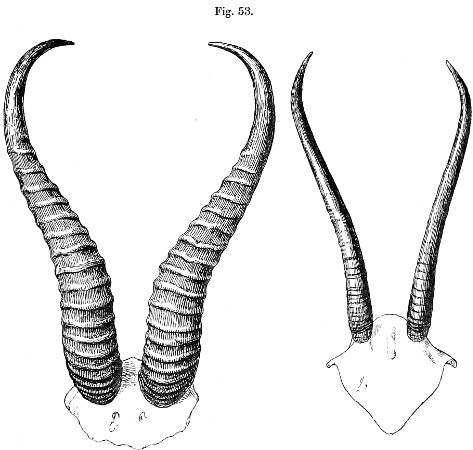
Fig. 53.
Horns of Springbuck, ♂ and ♀.
Mr. F. C. Selous (P. Z. S. 1881, p. 757) says that its northern range is bounded on the east by the thick forests which run east and west south of the Mababe River. Westwards, as already stated, it occurs in the district of Lake Ngami and throughout Damaraland up to the Portuguese province of Mossamedes, whence specimens have been forwarded to the Lisbon Museum by their energetic collector M. d’Anchieta.
Writing quite recently to Sclater, Mr. J. ffolliott Darling gives the following notes:—
“The Springbuck does not range up so far north as Mashonaland; but I have shot them in Griqualand West, the Transvaal, and the Orange Free State, also in Bechuanaland, where the most northerly point I found them in 1890 was south of the Macloutsie River in the British Protectorate. I was for several years in various parts of Griqualand East, but never saw a Springbuck, though there are large flats suitable for them, on which Oribis abound.
“When protected they become very numerous, so much so as to scarcely leave any grass for the sheep in some places; one farmer told me that he reckoned that the Springbok cost him £200 a year.
“One curious thing, well known to hunters, but I do not recollect ever seeing it in print, is that the white patch of hair on the back smells like honey.
“I have several times coursed Springbuck with good greyhounds, but never caught one; they weary out the dogs playing before starting to run. If one buck be found by himself greyhounds can catch him; but some people say that if you find one alone it means that he is sick, and that is the reason that he can be caught. I know some prominent coursing men do not like their dogs to run after Springbuck, as too frequent failures to kill discourage the dogs, and often when run into they will turn and fight the greyhound, which, if timid, may be spoiled thereby and become afraid to attack other antelopes.
“However, one friend, in whom I have every reliance, told me that a large and very strong greyhound of his on one occasion separated a fine Springbuck ram from a small herd and killed him single-handed.
“Of course the jumping powers of this buck are well known and how they will skip across a road 50 ft. wide without any trouble. The habit of spreading out the hair on the back, so as to expose the white patch more prominently when frightened, is very curious, as in the case of being hunted by dogs it makes the animal more easily perceived and followed in long grass or scrub.”
White and Albino varieties are not so frequently met with amongst the Bovidæ as in some other groups of mammals. But the ‘Johannesburg Times’ of January 22nd, 1897, informs us that a perfectly white Springbuck, caught in the Orange Free State, and supposed to be about eleven months old, was at that time being exhibited in Johannesburg by Messrs. Colquhoun and Hill, of Jeppe Street. Such a novelty as a white Springbuck was previously quite unknown in the Transvaal. This communication was sent to us accompanied by a photograph of the animal taken from life, from which it would appear that its colour was absolutely of a spotless white.
The Springbuck, although not unfrequently seen in the Zoological Gardens of Europe, is, as might be supposed, from its free and active habits, somewhat impatient of captivity and does not thrive in confinement except in occasional instances. The Zoological Society acquired their first specimen (by purchase) on July 9th, 1852, and, as will be seen by reference to their published Lists of Animals, others have been subsequently received at short intervals since that date. At the time we are writing there is a fine pair in the Society’s Gardens, deposited by H.R.H. the Prince of Wales in March, 1893, which are still doing well. Dr. Wünderlich, Director of the Zoological Garden of Cologne, has kindly furnished us with notes upon a pair of this Antelope which he bought on the 13th May, 1896, from Herr Reiche, of Alfeld. They bred on the 24th May last year, and after a period of 171 days a young one of the female sex was born on the 12th November last. The young one at birth was 45 cm. (about 17¾ English inches) in height, and generally of a yellowish-grey colouring. The side stripe was rather darker, but by no means so clearly defined as it is in the adult animal. The under surface and inner sides of the limbs were white, as in the adult. On the face a dark stripe from the eye to the corner of the mouth was visible, but the cheeks and chin generally were yellowish grey like the sides of the body. The little animal did well in company with its mother at first, and after 15 days began to eat corn. Unfortunately, however, it did not continue to thrive, and died on December 21st, when about 40 days old.
The flesh of the Springbuck is much esteemed by the epicures of the Cape Colony, and has been occasionally brought to London in a refrigerator for consumption here. In the ‘Field’ for 1892 (vol. lxxx. p. 390) will be found an account of its successful importation by Messrs. Brooks, of Leadenhall Market, and of the high appreciation it met with by those who tried the “venison,” which was pronounced to be “in good condition, not the least high, and tasting not unlike Chamois.”
Our figure of the adult male Springbuck, with a herd of these animals in the distance, has been prepared by Mr. Smit from an original sketch by Wolf, which is now in the possession of Sir Douglas Brooke, and has been kindly lent to us for examination.
There is a good stuffed specimen of an adult male Springbuck in the Gallery of the British Museum. It was obtained by Mr. F. C. Selous at Mahemfontein, in the Orange Free State, in 1896, and was presented to the collection by that gentleman. From a pencil-note on the back of Mr. Wolf’s sketch it would appear to have been taken from a specimen of the head of this species formerly exhibited in the same Museum. The National Collection has also some skins, skulls, and horns of the Springbuck from various parts of South Africa; but good skulls of this Antelope are still desiderata to the National Collection, and a series of them, with dates and localities, would be much appreciated.
August, 1897.
Genus VI. GAZELLA.
Type.
Gazella, Licht. Mag. nat. Freund. Berl. vi. pp. 152 & 171 (1814) G. subgutturosa[3].
Dorcas, Gray, Med. Repos. xv. p. 307 (1821) G. dorcas
Dama, Benn. Tr. Z. S. i. p. 7 (1833) G. dama
Leptoceros, Wagn. Schr. Säug. Suppl. iv. p. 422 (1844) G. leptoceros
Procapra, Hodgs. J. A. S. B. xv. p. 334 (1846) G. picticaudata
Tragops, id. op. cit. xvi. p. 11 (1847) G. bennetti
Tragopsis, Fitz. SB. Wien, lix. p. 157 (1869) G. bennetti
Eudorcas, id. tom. cit. p. 159 (1869) G. “lævipes”
Korin, Gray, Cat. Rum. B. M. p. 39 (1872) G. rufifrons
Nanger, Lataste, Mamm. Barb. (Act. Bord. xxxix.), sep. cop., p. 173 (1885) G. mhorr
Size medium, but with a considerable range of variation. General form normal; the muzzle simple, neither expanded as in Pantholops nor elongated as in Saiga; the neck of ordinary length, and the back without any evertible fold as in Antidorcas. Coloration ordinarily sandy, with a white belly, the face generally marked with dark and light streaks; streaks also generally present on the flanks and rump. Knee-brushes usually present. Tail short or of medium length.
Skull generally with shallow anteorbital fossæ corresponding to the anteorbital glands, but occasionally—in the procaprine section—without any trace of them. Premolars 3/3, as usual in the Bovines.
Horns generally present in both sexes, the females of the first four species alone being without them. In the male the horns are strong, prominently ribbed, and generally of medium length, about the length of the head, but occasionally considerably longer. With the exception of their tips they are curved backwards, so as to be convex forwards below, while their ends are commonly more or less recurved forwards or upwards. The degrees of curvature seem to be fairly constant within the species, and to afford very fair specific characters. On the other hand, in the female the horns are slender, straighter, and shorter than in the male, very variable in direction, and as a rule showing little of the characteristic curvature peculiar to the male of each species, although there is a certain correspondence between the lengths of the horns in the two sexes.
Range of the Genus. Northern and Eastern Africa, and Western and Central Asia to Mongolia and British India.
The genus Gazella contains the great majority of the members of the present subfamily, and forms a very natural and easily defined group. All the species are lightly built and delicate animals, and are among the best known of all the Antelopes, on account of their beauty and the fact that they are common in confinement, so that every zoological garden is always well provided with examples of them. In the Zoological Society’s Gardens at the present time no less than ten species are represented.
The genus Gazella was always a favourite one with Sir Victor Brooke, who devoted much time to its elucidation, and published in 1873 a monograph of it, which up to the present time has been the standard work on the subject. From this monograph we venture to quote the following paragraphs which explain the nomenclature of the characteristic markings of the Gazelles: they also give an indication of the difficulties to be met with in working out a genus which, while the largest contained in the present work, is remarkable for the close resemblance of the different species to one another and for the absence of characters which will enable them to be readily separated:—
“For the sake of convenience, and the avoidance of constant repetition, and also to throw into relief the traces of genetic affinity afforded by coloration, I will describe the typical ground-plan which may be seen underlying each variation, the uniformity of the arrangement of the more salient and characteristic markings (where they appear) throughout the group clearly showing the existence of such a plan. To each of these more prominent features, indicating what may be provisionally called generic coloration, I will apply a definite name, which I shall make use of in the following descriptions.
The anterior facial region in Gazelles, from the base of each horn to the muzzle, is cut off from the sides of the face on both sides by white streaks, which, starting externally to the base of each horn, run downwards to within two inches of the nostrils; the former I shall call the ‘central facial band,’ the latter the ‘light facial streaks.’ From the corner of the suborbital gland, running downwards immediately below the light facial streak, and of about equal width, is a dark line; this I shall refer to as the ‘dark facial streak.’ Bordering the white of the belly on each side, and extending from above and behind the ulna to above and in front of the patella, are two bands, the lower of which is darker, the upper lighter than the colour of the back and flanks. The former I shall speak of as the ‘dark lateral band,’ the latter the ‘light lateral band.’ Lastly, bordering the white of the rump is frequently seen a narrow indefinite darkish band, which may be conveniently called the ‘pygal band.’ The difficulty of expressing differences dependent to a large extent upon shades of colour and texture of hair sufficiently sharply to give a just impression of the effect produced by such differences upon the eye may cause the distinction of some of the forms below mentioned to appear doubtful. I can only say that upon occasions when I have had ample opportunity of subsequently verifying my identification, I have never experienced any difficulty in referring specimens entirely new to me to their proper name and habitat. The descriptions must be taken as applying to thoroughly typical specimens, the intensity of the markings and length and curvature of the horns being subject to great individual variation.”
Since Sir Victor Brooke wrote his monograph of the Gazelles, many species only known to him by descriptions or by imperfect specimens have become represented in our National Museum by complete examples, while several additional species have been discovered. Our arrangement of the species is therefore necessarily different from his, but is, we fear, still very far from being perfect, as more and better specimens of most of the forms are still wanted before their exact geographical distribution, their extent of variation, and their true relationships to each other can be satisfactorily worked out.
As already noted, we have removed from the genus Gazella, under the name Antidorcas, the South-African Springbuck, which Sir Victor Brooke included in it. This being eliminated, the 25 species which we are prepared to recognize as distinct may be arranged as follows:—
A. Tail quite short. No Gazelline face-markings. Females without horns.
a. Horns strongly curved backwards. Skull 7 in. or less in basal length.
a1. Horns not hooked at tip. (Tibet.) 82. G. picticaudata.
b1. Horns hooked at tip. (Mongolia.) 83. G. przewalskii.
b. Horns but little curved backwards, not hooked at tip. Skull about 9 in. in basal length. (N. China.) 84. G. gutturosa.
B. Tail of average length, its terminal half generally more or less crested with black. Face-markings present. Females (except in G. subgutturosa) with horns.
a. Upper part of face white (at least in old age), interrupting the central facial band.
a1. No horns in female: size larger. (Central and Western Asia.) 85. G. subgutturosa.
b1. Horns present in female: size smaller. (Arabia.) 86. G. marica.
b. Central dark facial band uninterrupted by white above. Horns present in the female.
a1. Dark colour of back not invaded by white of rump.
a2. Dark lateral band indistinctly marked, not strong and blackish.
a3. Tip of horns slightly curved inwards or upwards, not bent in to a right angle.
a4. Horns of medium length.
a5. Horns truly lyrate, the middle portion twisted outwards, the tips reapproaching each other. (Algeria, Egypt, Palestine.) 87. G. dorcas.
b5. Horns not truly lyrate, more or less evenly diverging upwards.
a6. Top of muzzle ordinarily with a black spot on it.
a7. Nose simple.
a8. Larger: hair rough. (Algeria.) 88. G. cuvieri.
b8. Smaller: hair smooth: darker. (Arabia.) 89. G. arabica.
c8. Smaller: hair smooth: lighter. (India and S. Persia.) 90. G. bennetti.
b7. Nose with a flabby corrugated elevation on it. (Somaliland.) 91. G. spekei.
b6. Top of muzzle without a black spot. (Somaliland.) 92. G. pelzelni.
b4. Horns long and very slender. Colours very pale. (Algeria and Egypt.) 93. G. leptoceros.
b3. Tip of horns hooked inwards or upwards, nearly or quite to a right angle.
a4. General colour pale fawn, the lateral band and other markings also fawn. (Nubia.) 94. G. Isabella.
b4. General colour brownish fawn, the lateral band blackish. (Muscat.) 95. G. muscatensis.
b2. Dark lateral band black and strongly marked.
a3. Horns abruptly hooked inwards at the ends. (Abyssinia.) 96. G. tilonura.
b3. Horns not abruptly hooked at end.
a4. No nose-spot; face uniform rufous.
a5. Size smaller. (Senegambia.) 97. G. rufifrons.
b5. Size larger. (Algeria.) 98. G. rufina.
b4. Nose-spot black. (Masai-land.) 99. G. thomsoni.
b1. Dark colour of back more or less invaded by white of rump.
a2. A dark pygal band present.
a3. Dark colour of back continued in middle line on to the top of the tail. Size smaller. (E. African Coast.) 100. G. petersi.
b3. Dark colour of back shut off from tail, which is enclosed in the white anal disk. Size larger.
a4. Dark lateral bands obsolete, or, in youth, present below the light lateral band only. (Interior of East Africa.) 101. G. granti.
b4. Dark bands present both above and below the light lateral band, uniting with each other behind. (Northern British E. Africa.) 102. G. notata.
b2. No dark pygal band.
a3. Tail black-tipped. Horns hooked inwards. (Abyssinian Coast and Somaliland.) 103. G. soemmerringi.
b3. Tail all white, or merely tipped with fawn. Horns hooked upwards and forwards.
a4. Neck and anterior back alone rufous; lines of demarcation indistinct. (Kordofan.) 104. G. ruficollis.
b4. Rufous extending over body and flanks, well defined from the white.
a5. Sides of thighs white, the rufous of body not joining that of hind legs. (Senegal.) 105. G. dama.
b5. Sides of thighs and legs rufous, continuous with that of body. (Morocco.) 106. G. mhorr.
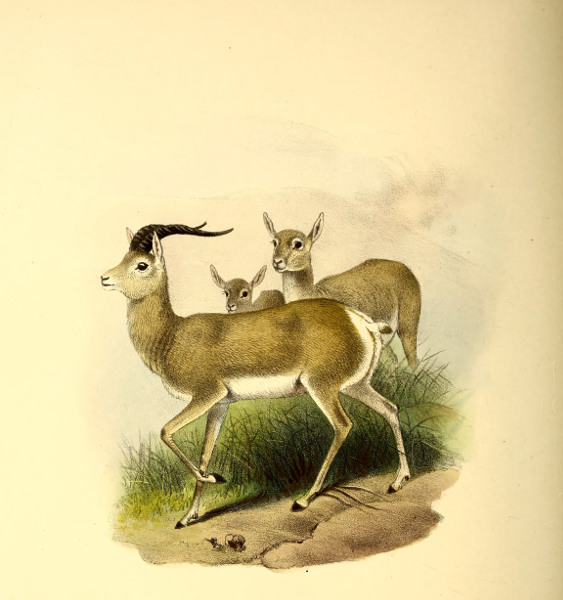
THE BOOK OF ANTELOPES, PL. LII
Wolf del Smit lith
Hanhart imp
The Tibetan Gazelle.
GAZELLA PICTICAUDATA.
Published by R. H. Porter
82. THE TIBETAN GAZELLE. GAZELLA PICTICAUDATA (Hodgs.). [PLATE LII.]
Procapra picticaudata, Hodgs. J. A. S. B. xv. p. 334, pl. ii. (1846), xvi. p. 696 (1847); Blyth, J. A. S. B. xvi. p. 725 (1847); Gray, P. Z. S. 1850, p. 116; Horsf. Cat. Mamm. Mus. E. I. C. p. 169 (1851); Gray, Cat. Ung. B. M. p. 55 (1852); Hooker, Himalayan Journ. ii. p. 157 (1854); Adams, P. Z. S. 1858, p. 523; Gerr. Cat. Bones Mamm. B. M. p. 232 (1862); Blyth, Cat. Mamm. Mus. As. Soc. p. 173 (1863); Gray, P. Z. S. 1867, p. 245, fig. (skull); Fitz. SB. Wien, lix. p. 161 (1869); Kinloch, Large Game Shooting, p. 10 (1869); Blanf. J. A. S. B. xli. pt. 2, p. 39 (1872); Gray, Cat. Rum. B. M. p. 38 (1872); id. Hand-l. Rum. B. M. p. 105 (1873); Przewalski, Mongolia (Russian ed.), pl. i. figs. 2 & 3 (♂ ♀) (1875); Blanf. P. Z. S. 1876, p. 634; Jent. Cat. Ost. Leyd. Mus. (Mus. Pays-Bas, ix.) p. 136 (1887); id. Cat. Mamm. Leyd. Mus. (op. cit. xi.) p. 167 (1892).
Antilope picticaudata, Wagn. Schr. Säug. Suppl. v. p. 408 (1855); Przewalski, Mongolia (Morgan’s Engl. Transl.), ii. p. 208 (1876).
Gazella picticaudata, Brooke, P. Z. S. 1873, p. 547; Sternd. Mamm. Ind. p. 467 (1884); W. Scl. Cat. Mamm. Ind. Mus. ii. p. 161 (1891); Blanf. Faun. Brit. Ind., Mamm. p. 529 (1891); Flow. & Lyd. Mamm. p. 342 (1891); Ward, Horn Meas. (1) p. 120 (1892), (2) p. 161 (1896); Blanf. P. Z. S. 1893, p. 449; Lyd. Horns and Hoofs, p. 183 (1893); Percy, Badm. Big Game Shooting, ii. p. 342 (1894).
Vernacular Names:—Ragoa and Goa (Hodgson); Ata-dzeren (Przewalski); all of the Tibetans.
Height at withers about 25 inches. Fur close and thick. General body-colour pale fawn, darkening posteriorly and becoming almost rufous brown along the edges of the white anal patch. No lateral nor pygal bands. Face without any trace of the ordinary Gazelline markings, coloured like the body, or the top of the muzzle sometimes brown; hairs on the sides of the muzzle elongated, so as to form a sort of lateral tuft, which extends backwards under the eyes. Ears short, narrow, pointed, well haired, coloured like the body. Rump with a prominent white patch surrounding the base of the tail. Tail quite short, projecting little beyond the fur, its end black or dark fawn. Limbs white or very pale fawn; no knee-tufts.
“In the summer the coat is short and of a slaty grey colour” (Brooke).
Skull rather broad in proportion to its length. Anteorbital fossæ practically obsolete. Nasals broad behind, evenly tapering forwards. Basal length 6·4 inches, greatest breadth 3·75, muzzle to orbit 4·0.
Horns slender, of median length, much compressed laterally, very closely ringed. With the exception of their tips (2–3 inches), after starting vertically, they curve evenly and strongly backwards, diverging laterally but little. Tips gently curved upwards and slightly inwards, reapproaching each other above to a certain extent.
Female. Similar to the male but without horns.
Hab. Plateau of Tibet and adjoining districts of Central Asia.
Like many other Himalayan and Tibetan animals this Antelope first became known to science from the researches of the great Indian naturalist and antiquarian, Bryan Houghton Hodgson, British Resident at the capital of Nepal. Hodgson described it in 1846, in the ‘Journal of the Asiatic Society of Bengal,’ as Procapra picticaudata, and gave a very recognizable figure to accompany his letterpress. He wrote of it as follows:—
“The exceedingly graceful little animal, which is the subject of our present description, is called by the Tibetans Rágóá, or Góá simply, and they allege that it is found generally throughout the plains of middle and eastern Tibet. But those plains, it must be remembered, are, for the most part, broken by deep ravines or low bare hills, and it is in such situations, more especially, that the Góá dwells, either solitarily or in pairs, or at most in small families, never in large flocks. The species is said to breed but once a year, and to produce ordinarily but one young one at birth, rarely two; and it is added that it browses rather than grazes, preferring aromatic shrubs and shoots to grass, of which latter, indeed, its habitat is nearly void. I have not heard that the Góá is ever tamed, but it is killed for the sake of its flesh, which is esteemed excellent, and is free from all caprine odour, even in the mature males.”
Hodgson also entered into the structural peculiarities of this Antelope, which he described at full length. It is quite evident that, as pointed out by him, the present Gazelle, as also the two allied species (G. przewalskii and G. gutturosa), present certain points of difference from the rest of the group, and that there was, therefore, some justification for Hodgson’s proposal of the generic term “Procapra,” although we do not think it necessary to use it. These three species agree among themselves in the females not possessing horns, in the absence of anteorbital glands, and the corresponding absence of a fossa in the skull, in having no brushes on the knees, and in several other characters, which show that they are really more closely connected to each other than to the more typical Gazelles. Nevertheless we think that, on the whole, it is best to include them in the genus Gazella, as no one of these characters is absolutely confined to them. Thus G. subgutturosa, often, though wrongly, placed with them, has no horns in the female, while in other characters it is a true Gazella, and several species besides these three are without knee-brushes, while the anteorbital fossæ in others are so shallow as to be practically non-existent.
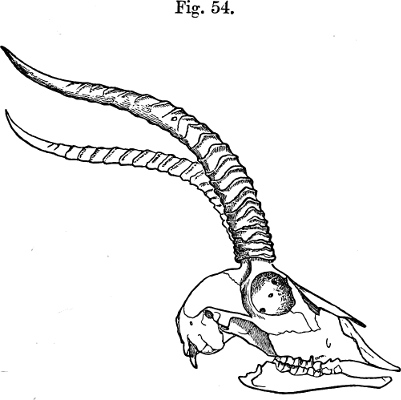
Fig. 54.
Skull and horns of the Tibetan Gazelle.
(P. Z. S. 1867, p. 245.)
Soon after his discovery of the Goa, Hodgson forwarded specimens of it to the British Museum, and the species was included in Gray’s catalogues as Procapra picticaudata. Under this name also Gray figured a skull and pair of horns of this Gazelle in 1867, in order to point out its differences from the allied Asiatic form, Gazella gutturosa. This figure (fig. 54, p. 73), by the kind permission of the Zoological Society of London, we are now able to reproduce.
In October 1849, Sir Joseph Hooker, as related in his ‘Himalayan Journals’ (ii. p. 157), met with the Goa feeding on the short grass near the Cholamoo Lake in Sikim, at an elevation of 17,000 feet above the sea-level, and in other adjoining localities on the Donkia Pass between Sikim and Tibet. Through his kindness and that of his publishers we are enabled to introduce the illustration of this striking scene (fig. 55) prepared for his well-known work.
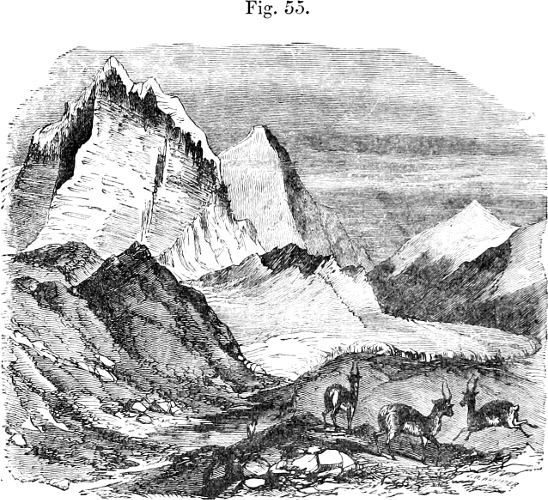
Fig. 55.
Goa Antelopes on the Donkia Pass.
(Hooker’s ‘Himalayan Journals,’ ii. p. 139.)
Other travellers and sportsmen have also noticed the Goa or Tibetan Gazelle in Ladak and on the frontiers of Tibet. But by far the most complete account of the habits and ways of life of this Antelope is that given by Major-General Kinloch in the various editions of his excellent work on Large-Game Shooting in Tibet.
To the east of Ladak, General Kinloch tells us, in the country that lies between the Upper Indus and the Sutlej, are vast expanses of undulating hills and valleys of great elevation utterly destitute of forest and with but scanty indications of vegetation. The greater part of these wild uplands would appear at first to be a perfect desert, but, as a matter of fact, on closer inspection, it will be found that there is hardly a slope, however rocky, or an expanse of sand, however thirsty-looking, where an occasional tuft of grass or bunch of sweet-scented herb may not be found, while wherever streams of water exist their banks are often ornamented by the greenest of turf and studded with flowers of the most brilliant hues. This bleak country, General Kinloch continues, the elevation of which varies from 13,000 to 18,000 feet, is the home of the Goa, which is to be found there scattered about in small parties usually varying from two or three to about a dozen in number, and in certain localities is decidedly plentiful. They are not generally very shy, but will seldom allow the hunter to approach openly within shot.
In 1866 General Kinloch made an expedition to the Tsomoriri Lake in this district, mainly with a view of hunting the Goa. We subjoin an account of his adventures, extracted from his work:—
“In 1866 I went to the Tsomoriri Lake and Hanlé, the Goa being one of my principal inducements to go there. I was accompanied by a friend, and on the 2nd of June we pitched our camp at the corner of the lake and ascended the plateau above. We had not gone far before we discovered some animals feeding at a distance, and the telescope showed them to be Goa. We made a most careful stalk, and got within easy shot, but the small size of the animals deceived us in our estimate of distance, and we both missed. Soon afterwards we saw some more Goa, but I again missed a fair chance. We then separated, but I could see nothing for a long time; at length I caught a glimpse of the heads of two or three Goas just as they were disappearing over a ridge; I followed them, and shot a doe through the body as it was galloping away. A greyhound which I had with me gave chase, and ran into it after a long course. The next day I determined to kill a buck, so I ascended the plateau very early in the morning; I soon discovered some Goa at a great distance, but after stalking to within seventy yards, I found that they were all does and young ones. I therefore would not fire at them, but lay watching the graceful little animals with much interest. Before long they caught sight of me, but being unable to make me out distinctly, they advanced towards me, occasionally rising on their hind legs to obtain a better view. I at length arose and showed myself, upon which they made off. Further on I found some does, and shortly afterwards three bucks, but in a place where they could not be stalked, so I sent a man round to drive them. The driver failed, the Goas going off in the wrong direction, but the man who went after them informed me that he had seen five others, and pointed out the direction in which they had gone. I crossed the plain, and saw them on the slopes at the other side, and after a détour, found myself on the hill-side straight above them. I watched them for some time as they fed along the foot of the hill: at last they approached a deep but narrow ravine which ran down the hill; I entered this, which afforded me capital cover, and on reaching the plain and looking over the bank, I saw the Goas quietly feeding within about a hundred yards. Resting my rifle on the bank, I fired very steadily at the best buck, but to my surprise missed with both barrels, owing to over-estimating the distance. Dropping behind the bank, I reloaded, and on again looking over was astonished to see the Goas still feeding in the same place. I was more successful this time, wounding one with the first barrel, and killing another with the second. Even now the Goas did not move far, and I had time to fire two more bullets, which, however, missed. Meanwhile I had sent a man to bring my dog, and on his arrival I slipped him at the Goas, but the wounded one seemed to recover completely, and it soon distanced the greyhound. The one I had killed had a very beautiful pair of horns.”
Besides the experiences of the travellers and sportsmen from the Indian side, the only published record concerning the Tibetan Gazelle, so far as we know, is that of the great Russian explorer Przewalski, who, after treating of the “Orongo” of Northern Tibet (Pantholops hodgsoni), mentions the present species as being found in the same district, and there known to the Mongols as “Ata-dzeren,” or Little Antelope[4]. Przewalski, who met with this animal near the headwaters of the Tatong-gol, in Northern Tibet, and, as he believes, also in the highlands of Kan-su in China, describes its habits as follows:—
“Like the Orongo it frequents elevated plains, preferring, however, the valleys in the mountains where water is abundant. Yet its habits are very different from the Orongo’s, and it is without exception the most graceful and the swiftest of the antelopes of Mongolia and Northern Tibet. It generally moves in small herds of from five to seven (seldom as many as twenty), though solitary males are often seen. It is extremely wary, especially in those districts where it has learnt to fear man; on the banks of the Muruiussu it is a little less timid. Its swiftness is amazing; it bounds along like an india-rubber ball, and when startled seems absolutely to fly. During their breeding-season, which begins towards the close of December and lasts a month, the males chase one another from their herds, but we never saw them fighting like the Orongo, nor did we ever hear them utter any sound other than a snort on seeing a man; and the does when startled gave a short loud cry. They scrape themselves trenches a foot deep, in which they lie at night (and probably during the day), and in these we found heaps of their droppings.
“This little antelope is more difficult to shoot than the Orongo, besides being much scarcer and extremely tenacious of life. Its ashy-grey colour, exactly resembling the soil, renders it almost invisible at a distance, and it is only by its conspicuous white rump, and its snort, that you are able to discover its presence.”
There are many specimens of this Antelope in the British Museum presented by Mr. Hodgson, amongst which is the type of the species. There are also in the National Collection skulls from Kumaon and other localities presented by Mr. A. O. Hume, C.B.; from the Changchenmo Valley, Ladak, presented by Mr. R. Lydekker; and from the confines of Tibet north of Sikim, collected by Mandelli and presented by Dr. W. T. Blanford, F.R.S.
There is also a good series of specimens of this Gazelle in the Museum of the Academy of Sciences of St. Petersburg, obtained by the Russian explorers in Northern Tibet and in the mountains of Nan-shan.
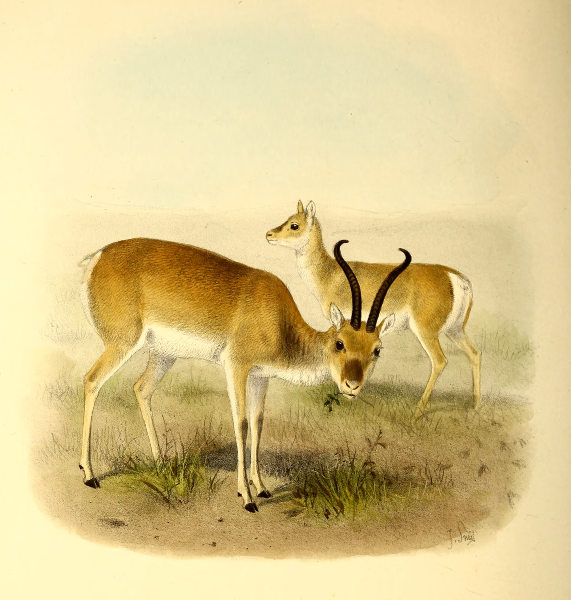
Our figure (Plate LII.), which has been put on the stone by Mr. Smit from a sketch prepared for Sir Victor Brooke by Mr. Wolf, represents a male and two females of this species, probably the specimens in the British Museum.
January, 1898.
THE BOOK OF ANTELOPES PL. LIII.
J Smit del, et lith.
Hanhart imp.
Przewalski’s Gazelle.
GAZELLA PRZEWALSKII.
Published by R H Porter
83. PRZEWALSKI’S GAZELLE. GAZELLA PRZEWALSKII, Büchn. [PLATE LIII.]
Antilope gutturosa, Przewalski, Mongolia (Russian ed.), p. 18, pl. i. fig. 1 (♂) (1875); id. op. cit. Morgan’s Engl. Transl. i. pp. 20 & 28 (1876).
Antilope cuvieri, Przewalski, Cat. Coll. (Russian) p. 110 (1888) (nec Ogilb.).
Gazella przewalskii, Büchn. Mélang. Biol. xiii. p. 164 (1890).
Vernacular Name:—Dzéren of Mongols (Przewalski)—applied to all the Gazelles of Central Asia.
Size rather greater than in G. picticaudata. General colour deep fawn in summer, pale finely grizzled fawn in winter. Sides of neck (at least in winter) and top of muzzle slaty brown; no ordinary gazelline face-markings. Ears short, acutely pointed[5]; coloured like the back. Rump with the white of the anal region running up on to the upper surface, divided in its centre by a narrow fawn-coloured line running from the back on to the tail. Tail very short, hidden in the fur; fawn along its top, inconspicuously pale brown at its tip. Front of limbs more or less brownish; no knee-tufts.
Skull short and stoutly built. No anteorbital fossæ. Nasals broad and short; premaxillæ not reaching up to the latter, the nasal opening unusually large and broad. Basal length of an adult male 7 inches, greatest breadth 3·8, muzzle to orbit 4.
Horns of median length and thickness, much compressed laterally; with the exception of their terminal two inches, they are evenly curved backwards and divergent outwards, the divergence increasing above; tips abruptly hooked inwards and slightly upwards, at a sharper angle with the rest of the horn than a right angle.
Female. Similar to the male, but without horns.
Hab. Mongolia; Koko Nor, northern part of Kan-su, and Ordos.
Przewalski’s Gazelle, which has been most appropriately named after the famous explorer who discovered it, was first described and figured by Przewalski himself in 1876, but erroneously confounded with the allied form G. gutturosa. Twelve years later, it appears, Przewalski discovered his error, and proposed to rename the animal Antilope cuvieri. But this specific term properly belongs to another species which had been described by Ogilby many years previously. Under these circumstances Dr. Büchner in his account of the Mammals of the Kan-su Expedition of Messrs. Potanin and Beresowski, proposed that this Gazelle should in future be known as Gazella przewalskii—Przewalski’s Gazelle.
In the English translation of Przewalski’s ‘Mongolia’ the habits of this species are described as follows:—
“These antelopes are gregarious, their herds sometimes numbering several hundreds or even thousands in those parts where food is plentiful, but they are most frequently seen in smaller numbers of from fifteen to thirty or forty head. Although they avoid the neighbourhood of man, they always select the best pasturages of the desert, and, like the Mongols, migrate from place to place in search of food, sometimes travelling great distances, especially in summer, when the drought drives them to the rich pasture-lands of Northern Mongolia, and as far as the confines of Trans-Baikalia. The deep snows of winter often compel them to travel several hundred miles in search of places almost or entirely free from snow. These animals belong exclusively to the plains, and carefully avoid the hilly country, but sometimes appear in the undulating parts of the steppe, particularly in spring, attracted by the young grass, which shoots up under the influence of the sun’s warmth. They shun thickets and high grass, excepting at the time of parturition, which is in May, when the doe seeks the covert to conceal her new-born offspring. But a few days after their birth the fawns follow their mothers about everywhere, and soon rival the fleet-footedness of their sires. They very seldom utter any sound, though the males occasionally give a short loud bleat. Nature has endowed them with excellent sight, hearing, and smell; their swiftness is marvellous and their intelligence well developed, qualities which prevent their falling so easy a prey as they otherwise would to their enemies—man and the wolf.
“The Mongols, armed with their poor matchlocks, hunt the dzerens in the following way. In those parts of the steppe where these antelopes abound they dig small pits at certain distances apart. These holes at first excite mistrust, so the animals are left alone for some weeks to get used to them. The hunters then repair to their allotted stations, and conceal themselves in the pits, while others make a wide circuit to windward and drive the herd towards the ambush. No gun is fired till they are within a distance of fifty paces or even less. The drivers must know their business and be thoroughly familiar with the habits of the animal, otherwise their labour will be lost. They must never gallop suddenly up to the herd—because if they do the antelopes almost always escape. The usual plan is to make a circuit round the herd, slowly narrowing the circle with repeated halts, or else to ride on one flank at a foot’s pace, gradually edging the herd towards the ambush.
“Towards the end of summer the dzerens are very fat, and are eagerly hunted by the Mongols for the sake of their delicate flesh, and also for their skins, which are made into winter clothing. The nomads, however, rarely wear the skins themselves, but sell them to Russian merchants at Urga and Kiakhta. Dzerens are also snared in traps made in the shape of a shoe of tough grass. When caught by the leg in one of these the animal lames itself in its struggles to get free, and becomes unable to move.”
Besides the Russian explorers already mentioned, the only traveller, so far as we are aware, that has met with Przewalski’s Gazelle in its native wilds is the well-known explorer Mr. St. George Littledale, F.R.G.S., who brought home a skin and skull of this species from his adventurous journey across Central Asia in 1893, and presented them to the British Museum. In the narrative of Mr. Littledale’s expedition, which is contained in the third volume of the ‘Geographical Journal’ (p. 465), will be found an allusion to this Antelope as observed by him near the Lake Koko Nor. The north shore of this lake, first seen by Mr. Littledale on the 3rd of August, 1893, was flat and swampy, and there were many of these antelopes feeding on it in company with Wild Asses (Equus kiang). In some MS. notes with which Mr. Littledale has kindly favoured us on this subject it is stated that he first saw examples of this Gazelle south of the Nan-Shan mountains in about lat. 38° 30´ N. and long. 96° 30´ E. On that occasion, he says, they were high up above the party, and nearly all males, but, as Mr. Littledale was then expecting an attack from the Tanguts, he did not like to leave the caravan to try after them. As the valley of the Buhain-Gol (the river which flows into Lake Koko Nor) was descended, the old males became scarcer, and round the lake, where he procured the specimen now in the British Museum, there were large bands of females accompanied by young males.
Besides Mr. Littledale’s specimens already mentioned, the British Museum contains a beautiful pair of this Antelope obtained in exchange from the Museum at St. Petersburg, from which our figures representing both sexes (Plate LIII.) have been prepared by Mr. Smit. It will be observed at once that though in its general form and coloration this species is somewhat similar to G. picticaudata, the shape of its horns is quite different, and readily distinguishes this species from its allies.
When at St. Petersburg in August 1897, Sclater had the opportunity of examining, under the kind guidance of Herr Büchner, the fine series of specimens of this Antelope in the Zoological Museum of the Imperial Academy of Sciences of that city. The specimens had been obtained in the region of the Koko Nor, in the most northern part of the Chinese province of Kan-su, and in Ordos, which is the country encompassed by the great northern bend of the River Hoang-Ho. In the southern part of this district Przewalski’s Gazelle was met with in great numbers during the Kan-su expedition already mentioned, and many specimens of it were obtained for the Imperial Museum at St. Petersburg.
January, 1898.
THE BOOK OF ANTELOPES, PL. LIV
Wolf del J Smit lith.
Hanhart imp.
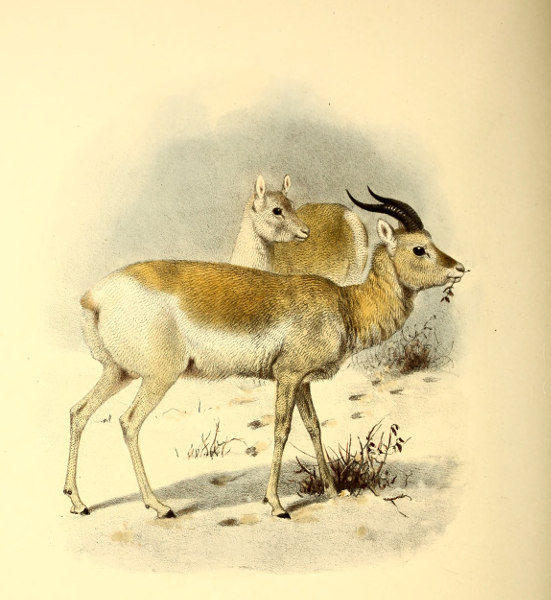
The Mongolian Gazelle
GAZELLA GUTTUROSA
Published by R H Porter
84. THE MONGOLIAN GAZELLE. GAZELLA GUTTUROSA (Pall.). [PLATE LIV.]
Caprea campestris gutturosa, J. G. Gmel. N. Comm. Petrop. v. p. 347, pl. ix. (1760).
Antilope gutturosa, Pall. Spic. Zool. fasc. xii. p. 46, t. ii. (1777); Zimm. Geogr. Gesch. ii. p. 120 (1780); Herm. Tabl. Affin. Anim. p. 108 (1783); Bodd. Elench. Anim. p. 143 (1785); Schreb. Säug. pl. cclxxv. (1787); Gmel. Linn. S. N. i. p. 186 (1788); Kerr, Linn. An. K. p. 310 (1792); Donnd. Zool. Beytr. i. p. 627 (1792); Latham & Davis, Faunula Indica, p. 4 (1795); Link, Beytr. Nat. ii. p. 99 (1795); Bechst. Uebers. vierf. Th. ii. p. 645 (1800); Shaw, Gen. Zool. ii. pt. 2, p. 342 (1801); Turt. Linn. S. N. i. p. 113 (1802); G. Cuv. Dict. Sci. Nat. ii. p. 228 (1804); Desm. N. Dict. d’H. N. (1) xxii. p. 499, xxiv. Tabl. p. 33 (1804); Pall. Zoogr. Ross.-As. i. p. 251 (1811); Licht. Mag. nat. Freund. Berl. vi. p. 171 (1814); G. Fisch. Zoogn. iii. p. 431 (1814); Afzel, N. Act. Ups. vii. p. 220 (1815); Desm. N. Dict. d’H. N. (2) ii. p. 182 (1816); G. Cuv. Règne Anim. i. p. 260 (1817); Goldf. Schr. Säug. v. p. 1221 (1818); Schinz, Cuv. Thierr. i. p. 387 (1821); Desmoul. Dict. Class. i. p. 441 (1822); Desm. Mamm. ii. p. 452 (1822); H. Sm. Griff. An. K. iv. p. 229, v. p. 336 (1827); Less. Man. Mamm. p. 371 (1827); J. B. Fisch. Syn. Mamm. p. 458 (1829); Oken, Allg. Nat. vii. p. 1267 (1838); Laurill. Dict. Univ. i. p. 615 (1839); Gerv. Dict. Sci. Nat. Suppl. i. p. 260 (1840); Less. N. Tabl. R. A., Mamm. p. 176 (1842); Wagn. Schr. Säug. Suppl. iv. p. 416 (1844), v. p. 408 (1855); Reichenb. Säug. iii. p. 104, pl. xxxi. fig. 180 (1845); Schinz, Syn. Mamm. ii. p. 409 (1845); id. Mon. Antil. p. 11, pl. x. (1848); Sund. Pecora, K. Vet.-Ak. Handl. 1845, p. 270 (1847); id. Hornschuch’s Transl., Arch. Skand. Beitr. ii. p. 266; Reprint, p. 86 (1848); Gieb. Säug. p. 312 (1853); Radde, Ost-Sibirien, p. 254, pl. xi. fig. 1 (1862); Brehm, Thierl. iii. p. 201 (1880).
Cerophorus (Antilope) gutturosa, Blainv. Bull. Soc. Philom. 1816, p. 75.
Cemas gutturosa, Oken, Lehrb. Nat. iii. pt. 2, p. 737 (1816).
Gazella gutturosa, Gray, Ann. Mag. N. H. (1) xviii. p. 231 (1846); id. List Ost. B. M. p. 56 (1847); id. Knowsl. Men. p. 3 (1850); Brooke, P. Z. S. 1873, p. 546; Flow. & Lyd. Mamm. p. 342 (1891); Ward, Horn Meas. (1) p. 119 (1892), (2) p. 160 (1896); Lyd. Horns and Hoofs, p. 182 (1893); Percy, Badm. Big Game Shooting, ii. p. 341 (1894).
Procapra gutturosa, Gray, P. Z. S. 1850, p. 115; id. Cat. Ung. B. M. p. 54 (1852); Gerr. Cat. Bones Mamm. B. M. p. 232 (1862); Gray, P. Z. S. 1867, p. 244, fig. (skull); Fitz. SB. Ak. Wien, lix. p. 161 (1869); Gray, Cat. Rum. B. M. p. 37 (1872); id. Hand-l. Rum. B. M. p. 105 (1873); Flow. & Gars. Cat. Coll. Surg. ii. p. 266 (1884); Jent. Cat. Ost. Leyd. Mus. (Mus. Pays-Bas, ix.) p. 136 (1887); id. Cat. Mamm. Leyd. Mus. (op. cit. xi.) p. 167 (1892).
Chinese Antelope, Penn. Syn. Mamm. p. 35 (1771).
Antilope tzeiran, Zimm. Spec. Zool. Geogr. p. 543 (1777).
Antilope orientalis, Erxl. Syst. R. A. p. 288 (1777); Gatt. Brev. Zool. i. p. 82 (1780); Desm. N. Dict. d’H. N. (1) xxiv. Tabl. p. 33 (1804).
Vernacular Names:—Dzéren of Mongols, the male Scharcholdsi, the female Ohno, the kid Ingdacha. Hoang-yang (Yellow Goat) of Chinese. Tzonrah (♂) and Vgovóh of Tanguts (Pallas).
Size fairly large; height at withers rather over 30 inches; form stout and thick. General colour fawn, paler than in most of the other species, but the rump and sides are white, as is the whole of the limbs. Gazelline face-markings absent; top of the muzzle browner than the rest of the head; sides of the muzzle and cheeks white. Ears short but pointed, thickly furred, their backs pale fawn, nearly white. No lateral bands, either dull or light. No knee-brushes. Tail very short, white, its tip brown.
According to Radde all the parts which are fawn in winter are in summer of an intense isabel-yellow.
Skull long and narrow, with a heavy muzzle. Anteorbital fossæ obsolete. Nasals long and broad. Basal length (in a not fully adult specimen) 9 inches, greatest breadth 4·1, muzzle to orbit 5·5.
Horns short in proportion to the size of the animal; heavily and closely ringed; basally they are parallel to each other, diverging above, with their tips again gently curved in towards each other.
Female. Similar, but without horns.
Hab. Northern and Eastern Mongolia, and southern borders of Russian Transbaikalia.
The great traveller and naturalist, Peter Simon Pallas, whose name we have already often mentioned in the course of this work, was the first technical describer of this Antelope, although he was by no means its discoverer, for he himself quotes previous references to it in the works of older authors. But Pallas, in the Supplement to his memoir on the Antelopes, published 1777, gave us the first scientific description of it, and selected for it the appropriate scientific name gutturosa, by which it has been ever since known. According to Pallas, the first Europeans to become acquainted with this Gazelle were the Jesuit missionaries in China, one of whom, Pereira, as quoted by Witsenius, mentions it as a Chinese animal; while Du Halde, in his great work upon China, describes it, under the name “Hoang-yang” or Capra flava, as wandering about in large flocks in the deserts of Mongolia. Further accounts of this Antelope were subsequently given by Messerschmidt and Gmelin in the Commentaries of the St. Petersburg Academy. These are also quoted by Pallas, who himself met with this animal on the upper course of the River Onon, on the southern frontiers of Transbaikalia. Pallas concludes his history of this species with a lengthened description of its external form and anatomy, and gives an uncoloured figure, in which the peculiar swollen condition of the throat in the male in the breeding-season (whence it was termed gutturosa) is correctly shown.
Pallas’s posthumous work, ‘Zoographia Rosso-Asiatica,’ contains little more than a summary of his previous account of this animal.
The numerous authors who followed Pallas added little or nothing to our knowledge of the Mongolian Gazelle, and were content to base their notices of it almost entirely upon his publications. It is not, in fact, until we come to nearly modern days that we obtain any further original information concerning this animal.
Dr. Gustav Radde, now Director of the Museum at Tiflis, made extensive journeys in South-eastern Siberia, under the patronage of the Imperial Geographical Society of Russia, in 1855 and the three following years, and amassed large zoological collections. One of the volumes of his ‘Reisen im Süden von Ost-Sibirien,’ published at St. Petersburg in 1862, is devoted to an account of the Mammals of South-eastern Siberia, and is, and will long remain, our standard work on this subject. Dr. Radde brought home five good specimens of this Antelope, and commences his account of it with accurate descriptions of its summer and winter pelages. He adds a detailed description of its skull and dentition, and compares them at length with those of Gazella subgutturosa.
As regards its distribution in the present epoch, Dr. Radde points out that, like the Dziggetai (Equus hemionus) and the Argali Sheep (Ovis ammon), the Mongolian Gazelle has retreated to the south and east from the Russian frontiers since the days of Pallas. There are at present only two places on the southern borderlands of Transbaikalia in which this Antelope remains during the summer and breeds every year. One of these is a district east of the Dsŭn-tarei which is seldom entered even by the shepherds of the Cossacks. It is an uninhabited and rather mountainous country, without wood or bushes, varied by salt-and some freshwater lakes, and covered only with yellow Elymus-grasses. The other district, which is of a similar character, lies north of the left bank of the Argunj, where this river enters into the Russian territories between the border-posts of Soktui and Abagaitui.
Dr. Radde gives the following account of the habits of this animal as observed by himself and as obtained from the reports of the natives in 1856:—
“About the middle of June the doe produces generally two young ones which remain quiet for three days, but after that are strong enough to follow the mother wherever she goes. If caught when young they quickly become tame. Shortly after my arrival at Zagan-olui in May 1856 I saw a fawn of this Antelope feeding with the sheep and goats without requiring any particular attention.
“In summer these Antelopes are seldom hunted because they are only occasionally to be found, but they are much pursued during the early winter. There are, however, but few good Antelope-hunters, especially amongst the Russians. Various methods are adopted to get within shot. So long as no snow has fallen the Antelopes usually proceed about midday in small flocks to the freshwater lakes, where they break the thin ice with their hoofs in order to drink. They select the same spot every day for this purpose, and there it is that the hunter makes his hiding-place. Driven on to the thin ice, the Antelopes often fall through and thus become an easy prey.
“The ordinary way of hunting these Antelopes requires two sportsmen, one of whom acts as driver for the other. One of the hunters, as soon as he sees the Antelopes at a distance of 4 or 5 versts, lies down flat behind a marmot’s hillock, or finds some other hiding-place amongst the grass, and holds his gun ready, whilst the other makes a long circuit and drives the Antelopes towards his companion. The flying Antelopes generally depart in a line; but the old males do not always keep in front, an old female sometimes occupying that position. Pursued by the driver, the frightened animals proceed sometimes at a walk, at other times in a hasty gallop, during which they occasionally utter a sharp clear cry. When they come within range the driver imitates the call of a raven or the howl of a wolf to awake the attention of the animals and to allow the shooter to choose out his victim more readily. The Tunguts of the Steppes are especially skilled in finding and pursuing the Antelopes, and even the young maidens of these tribes take part in the chase. At one of the border-posts there was a celebrated hunter who in many winters had obtained as many as 200 of these Antelopes, which at this season go about in large herds. They are occasionally so crowded together, as this hunter assured me, that he had sometimes killed three and even four individuals with one bullet.
“In what large numbers this Antelope sometimes assembles I was able to convince myself in October 1856, when I was on the other side of the Argunj in Mongolian territory, for their tracks and their droppings were so numerous that it appeared as if some thousands of sheep had gone by.
“The winter pelts of this Antelope make very warm and durable coats (locally called dachas), which are worn with the hair outside: the hair is not so brittle as that of the Roe. They are valued at about one and a half roubles apiece. The flesh of this Antelope is very palatable and the old bucks in the autumn become extraordinarily fat.”
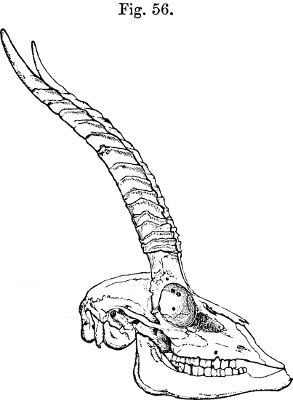
Fig. 56.
Skull and horns of the Mongolian Gazelle.
(P. Z. S. 1867, p. 245.)
In 1867 Dr. Lockhart brought home with him from Pekin two skulls of this Antelope and presented them to the British Museum. Dr. Gray read some notes on them at a meeting of the Zoological Society of London in February of that year. These notes were subsequently published in the ‘Proceedings,’ accompanied by an outline figure of one of the heads, which, by the kind favour of the Society, we are enabled to reproduce. Dr. Lockhart gave to Dr. Gray the following information as to this Antelope:—
“The animal to which they belong is called Hwang-Yang, the Yellow or Imperial Sheep. It is brought into Peking from Mongolia in large numbers in a frozen state, and sold for food. The flesh is much esteemed for its fine flavour and tenderness, and is eagerly purchased both by natives and foreigners.
“The European gentlemen in Peking used to go into Mongolia on shooting-expeditions for the purpose of hunting the Hwang-Yang. The animal, however, is very wary and generally keeps a long way out of range, so that the hunters are not very successful. It is considered a great feat to kill one of them.”
Besides an adult stuffed specimen of this species in the British Museum, stated, but probably erroneously, to have come from the Kirghiz Steppes, there are several skins and skulls in the collection obtained by the late Consul R. Swinhoe at Pekin, besides the two heads and horns already spoken of as brought home by Dr. Lockhart.
Our illustration (Plate LIV.), which represents both sexes of this Antelope, was put upon the stone by Mr. Smit from a sketch drawn by Mr. Wolf for the late Sir Victor Brooke. We have no record of what were the exact specimens figured.
January, 1898.
THE BOOK OF ANTELOPES, PL. LV.
J. Smit del. et lith.
Hanhart imp.
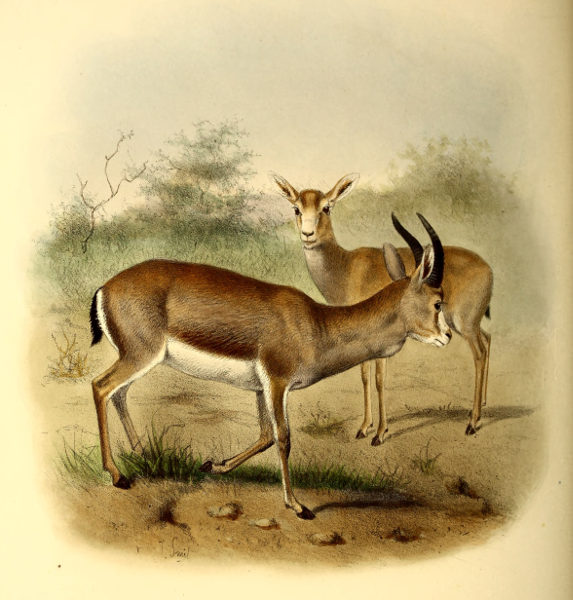
The Persian Gazelle.
GAZELLA SUBGUTTUROSA.
Published by R. H. Porter.
85. THE PERSIAN GAZELLE. GAZELLA SUBGUTTUROSA (Güld.). [PLATE LV.]
Antilope subgutturosa, Güld. Act. Ac. Sc. Imp. Petrop. 1778, pt. i. p. 251 (1780); Schreb. Säug. pl. cclxx. B (1785); Gmel. Linn. S. N. i. p. 186 (1788); Kerr, Linn. An. K. p. 311 (1792); Donnd. Zool. Beytr. i. p. 628 (1792); Link, Beytr. Nat. ii. p. 99 (1795); Bechst. Uebers. vierf. Thierr. ii. p. 645 (1800); Shaw, Gen. Zool. ii. pt. 2, p. 343 (1801); Turt. Linn. Syst. Nat. p. 113 (1802); G. Cuv. Dict. Sci. Nat. ii. p. 227 (1804); Pall. Zoogr. Ross.-As. i. p. 252 (1811); Afzel. N. Act. Ups. vii. p. 220 (1815); Desm. N. Dict. d’H. N. (2) ii. p. 185 (1816); Goldf. Schr. Säug. v. p. 1196 (1818); Desm. Mamm. ii. p. 454 (1822); H. Sm. Griff. An. K. iv. p. 210, v. p. 331 (1827); Less. Man. Mamm. p. 373 (1827); J. B. Fisch. Syn. Mamm. p. 460 (1829); Hohenacker, Bull. Soc. Mosc. 1837, viii. p. 137 (Transcaucasia); Ménétriés, Cat. rais. Zool. Caucase, p. 24 (borders of Caspian Sea); Less. Compl. Buff. x. p. 287 (1836); Oken, Allg. Naturg. vii. p. 1268 (1838); Gerv. Dict. Sci. Nat., Suppl. i. p. 261 (1840); Démidoff, Voy. Russ. Mérid. iii. p. 61 (1840) (Transcaucasia); Eichwald, Faun. Caspio-Caucas. p. 39 (1841); Less. N. Tabl. R. A., Mamm. p. 176 (1842); Wagn. Schr. Säug. Suppl. iv. p. 406 (1844), v. p. 404 (1855); Schinz, Syn. Mamm. ii. p. 402 (1845); Reichenb. Säug. iii. p. 114, pl. xxxiv. (1845); Sund. Pecora, K. Vet.-Ak. Handl. 1845, p. 269 (1847); id. Hornschuch’s Transl., Arch. Skand. Beitr. ii. p. 265; Reprint, p. 85 (1848); Gieb. Säug. p. 307 (1853); De Fil. Viagg. in Persia, p. 344 (1865); Fitz. SB. Wien, lix. p. 160 (1869).
Antilope (Gazella) subgutturosa, Licht. Mag. nat. Freund. vi. p. 171 (1814).
Cerophorus (Gazella) subgutturosa, Blainv. Bull. Soc. Philom. 1816, p. 75.
Gazella subgutturosa, Gray, List Mamm. B. M. p. 160 (1843); id. Ann. Mag. N. H. (1) xviii. p. 231 (1846); Hutt. J. A. S. B. xv. p. 151 (1846) (Candahar); Gray, Knowsl. Men. p. 4 (1850); id. P. Z. S. 1850, p. 113; id. Cat. Ung. B. M. p. 58 (1852); Temm. Esq. Zool. Guin. p. 193 (1853); Blyth, Cat. Mamm. Mus. As. Soc. p. 172 (1863); Wolf, Zool. Sketches, pl. xxii.; Scl. P. Z. S. 1869, p. 602; Blanf. Zool. Abyss, p. 261, pl. i. fig. 4 (horns) (1870); Gray, Cat. Rum. B. M. p. 38 (1872); id. Hand-l. Rum. B. M. p. 107 (1873); Blanf. P. Z. S. 1873, p. 313 (distribution); Brooke, P. Z. S. 1873, p. 545; Przewalski, Mongolia (Russian ed.), pl. i. fig. 2 (1875); id. Morgan’s Engl. Transl. i. p. 207 (1876); Blanf. E. Persia, ii. p. 91 (1876); Severtz. Ann. Mag. N. H. (4) xviii. p. 170 (1876); Danf. & Alst. P. Z. S. 1877, p. 276 (Tigris); iid. P. Z. S. 1880, p. 55; Scl. List An. Z. S. (8) p. 141 (1883), (9) p. 155 (1896); Sterndale, Mamm. Ind. p. 466 (1884); Scl. P. Z. S. 1886, p. 2; Scully, J. A. S. B. lvi. pt. 2, p. 76 (1887); Jent. Cat. Ost. Leyd. Mus. (Mus. P.-B. ix.) p. 136 (1887); Thos. Linn. Trans. (2) v. p. 64 (1889); Büchn. Mél. Biol. xiii. p. 160 (1890); W. Scl. Cat. Mamm. Calc. Mus. ii. p. 160 (1891); Blanf. Faun. Brit. Ind., Mamm. p. 528 (1891); Jent. Cat. Mamm. Leyd. Mus. (Mus. P.-B. xi.) p. 168 (1892); Ward, Horn Meas. (1) p. 118 (1892), (2) p. 159 (1896); Lyd. Horns and Hoofs, p. 180 (1893); Percy, Badm. Big Game Shooting, ii. p. 342 (1894); Satunin, Zool. JB. Syst. ix. p. 310 (1896) (Transcaucasia).
“Antilope dorcas, var. persica, Rüpp.,” Gray, List Mamm. B. M. p. 160 (1843).
Gazella subgutturosa, var. yarkandensis, Blanf. J. A. S. B. xliv. pt. 2, p. 112; id. Yark. Miss., Mamm. p. 88, pl. xv. (1879).
Gazella hillieriana et G. mongolica, Heude, Mém. Hist. Nat. Chine, ii. p. 245, pls. xxxvi. & xxxvii. (1894).
Vernacular Names:—Dshairan (Pallas), Ahu (Blanford) of Persians; Karakeuruk (= Black-tail) of Khirghiz Tartars (Pallas); Kik (or Sai-kik) and Tairan of Turkis of Yarkand (Blanford).
Size medium, height at withers about 26–27 inches. General colour dark sandy fawn. Face-markings indistinct, the central band visible in youth gradually interrupted and replaced by white as age advances. Dark facial streaks in front of eyes present, but little defined. An anteorbital gland present. Larynx swollen, forming a peculiar projection in front of the neck. Ears of medium length, pointed, their backs short-haired even in winter, pale fawn. Dark lateral band not, or scarcely, darker than the back, from which it is separated by an indistinct light lateral band. Pygal band present, not strongly marked. Tail 8 or 10 inches long, crested, black. Knee-brushes present, brown or black.
Skull stoutly built; nasals broad and short; anteorbital fossa well marked. Basal length 8 inches, greatest breadth 3·8, muzzle to orbit 4·6.
Horns of medium length, thick, evenly diverging from each other as they curve backwards; their tips decidedly, though not abruptly, bent inwards and slightly upwards.
Female similar to the male, but without horns, or occasionally with minute rudiments of them.
Hab. Western Asia from Asia Minor and Caucasia in the west to Turkestan, Yarkand, and Mongolia in the east.
The Persian Gazelle, as it is commonly called, is by no means restricted to Persia, but, as we shall presently show, has a wide range through the steppes of Central Asia from the borders of Asia Minor to Northern China. It was first made known to science by Anton Güldenstädt, an enterprising Russian traveller and naturalist of the last century, who met with it in 1772 in the course of his explorations of the countries adjacent to the Black and Caspian Seas. Güldenstädt wrote an elaborate description of it in 1878 in a memoir published two years later in the ‘Acta’ of the Imperial Academy of Sciences of St. Petersburg, and named it “subgutturosa,” “because its throat protruded slightly, but not so much as in Antilope gutturosa.” Pallas, who also observed this Antelope during his travels in Central Asia, included it under Güldenstädt’s name in his ‘Zoographia Rosso-Asiatica.’
After Güldenstädt and Pallas several other Russian naturalists—Hohenacker, Nordmann, and Eichwald—recorded this Gazelle as being met with on the plains of Transcaucasia. Ménétriés, in his memoir on the Zoology of the Caucasus published in 1832, tells us that at that period it was very common, especially in winter, on the vast steppes bordering the Caspian between Baku and Kur, whence, as Herr Büchner has kindly informed us, it extends up the valley of the Kur nearly to Tiflis. Satunin, our most recent authority on the Mammals of this district, states that he found it throughout the steppes of Eastern Transcaucasia, and especially numerous on the Mugan Steppe. Whether this is the Gazelle found on the upper plains of the Tigris and Euphrates, as reported by Danford from hearsay, seems to be uncertain, though it probably penetrates into the highlands of Asiatic Turkey adjacent to Mount Ararat, and is certainly found in the valley of the Araxes.
In Persia, Dr. Blanford tells us, in his volume on the zoology of that country, G. subgutturosa is the Gazelle of the highlands, and is found in almost all the valleys and plains from about 3000 to about 7000 feet above the sea-level, ranging higher in winter and lower in summer, but keeping generally within the limits mentioned. It is unknown in the plains of Mesopotamia, and on the lower ground along the Persian Gulf and the Arabian Sea.
Dr. Blanford adds the following notes from the pen of the late Sir Oliver St. John, who was very well acquainted with Persia and its animals:—
“This is the common Gazelle of Persia, and is found everywhere away from the forests of the Caspian and the shores of the Persian Gulf, in which last locality it is replaced by another species (probably G. bennetti). Like the Wild Ass, it especially affects the neighbourhood of the salt deserts. It appears to retire generally to the valleys at the base of hills to breed, and is most commonly seen in small parties of three to half-a-dozen. I do not remember ever having seen twenty together. The fleetest greyhounds cannot come up with the Gazelle when it gets a fair start, but when suddenly roused from a hollow, or when the ground is heavy after rain, good dogs will often pull down males.”
Dr. Blanford has included this Gazelle in the ‘Fauna of British India,’ because, as ascertained by the late Sir Oliver St. John, it occurs in Pishin north of Quetta, now in British territory, though it is not met with in any other part of the Indian Empire.
Throughout the sandy plains along the northern boundary of Afghanistan this Gazelle is abundant. Dr. J. E. T. Aitchison, who accompanied the Commission for the delimitation of the Afghan boundary in 1884, tells us that it was occasionally seen along the whole route from Quetta to Khusan. In the low hills and great gravel plains of the valley of the Hari-rud they were observed everywhere, but were very wary and difficult of approach. In June 1885, at Chinkilok, to the north-west of Herat, between that city and the range of the Parapomisus, Dr. Aitchison caught a young female Gazelle of this species about a day old, and subsequently, on his way home through Persia, obtained three others of about the same age. These four Gazelles, as we have been told, were carried many hundred miles through Persia in large covered baskets on each side of two camels, and were commonly believed by the natives to be Dr. Aitchison’s four wives, the baskets being of the same fashion as those generally used in that country for the conveyance of women! Dr. Aitchison brought his four pets safely home to the Zoological Society’s Gardens, where they throve well and bred in 1887, 1888, and in several succeeding years. Two of the males of this family, born in the Society’s Menagerie in 1892 and 1894, are still living there.
According to Herr Büchner, who has kindly supplied us with some valuable notes on the Asiatic Gazelles, this species is found in suitable localities all over the Transcaspian Provinces of Russia, and ranges northwards to the steppes between the Caspian and the Aral, and eastwards to Lake Balkash. Far beyond this it extends across the southern portions of the great Desert of Gobi into the Chinese Provinces of Zaidam, Alaschan, and Ordos.
On crossing the high range north of the Hindu Koosh into Eastern Turkestan a Gazelle very similar to the Persian Gazelle is met with. Six examples of this form were obtained by the naturalists of the Second Yarkand Mission in 1873–74, and were described by Dr. Blanford in his memoir on the Mammals of that Mission. Dr. Blanford says that it is perhaps a question whether the Eastern Turkestan Gazelle should not be raised to the rank of a species. It differs principally from the typical form in the very much darker markings on the face and in the much smaller degree to which the horns diverge. The size appears rather larger than that of the typical Persian form. But as there are some variations in the face-markings of Persian specimens, Dr. Blanford has considered it better to regard the Yarkand race as only a variety, which he has proposed to call Gazella subgutturosa yarkandensis. Of this subspecies an excellent coloured figure, drawn by Smit, is given in the above-named work. It represents both sexes, and shows the black markings on the face very distinctly.
As pointed out by Dr. Blanford, it is nearly certain that the Gazelle to which Shaw refers, in his volume on ‘High Tartary, Yarkand, and Kashgar’ (page 221), as having been brought to him at Yarkand, and of which he says the Yarkand name is “saikeek,” was of the present species—that is, of the local form Gazella subgutturosa yarkandensis.
We have already mentioned the four living examples of this Gazelle brought to London by Dr. Aitchison and presented to the Zoological Society’s Collection. These, however, were not the first specimens of this animal brought to England alive. As long ago as 1852 females of the present species were obtained from Bussorah on the Persian Gulf and presented to the Society by Alderman Finnis, and in 1869 examples from the same country were given to the collection by the late Mr. T. K. Lynch, F.Z.S. Other specimens, mostly from the same country, were received in subsequent years[6]. The examples of this animal just spoken of as being the first to arrive in England formed the subjects of a beautiful drawing by Mr. Wolf, a coloured lithograph taken from which has been published in the first volume of Wolf and Sclater’s ‘Zoological Sketches’ (plate xxii.).
Our figures of this species for the present work (Plate LV.) have been prepared by Mr. Smit from the descendants of the animals brought by Dr. Aitchison from Northern Persia, now living in the Society’s Gardens.
The series of specimens of this species in the British Museum comprises a skull from near Ispahan in Persia, presented by Dr. W. T. Blanford, F.R.S.; a head-skin and some horns from Gulran and Galicha, on the Afghan frontier, collected by Dr. Aitchison during the Afghan Boundary Commission; and some skins and skulls from the Saiar Mountains, Altai, presented by Mr. St. George Littledale. There are likewise a skin from the River Aksu, in Chinese Turkestan, presented by Major C. S. Cumberland, and several fine skulls and pairs of horns from the plains of Yarkand, obtained by the late Mr. Dalgleish, and presented to the Museum by Mr. A. C. Hume, C.B. All these last-named specimens represent the Yarkand subspecies, Gazella subgutturosa yarkandensis.
January, 1898.
THE BOOK OF ANTELOPES, PL. LVI.
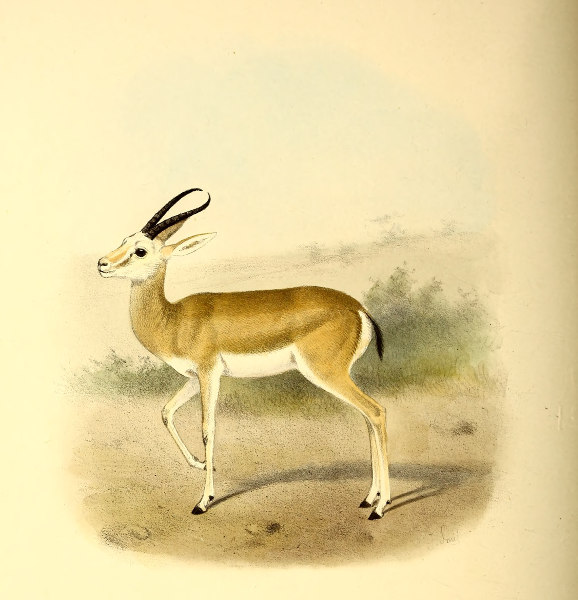
J. Smit del. et lith.
Hanhart imp.
The Marica Gazelle.
GAZELLA MARICA.
Published by R. H. Porter.
86. THE MARICA GAZELLE. GAZELLA MARICA, Thos. [PLATE LVI.]
Gazella bennetti, Scl. List Vert. An. Z. S. 1896, p. 155, ex. f. (err.).
Gazella marica, Thos. Ann. Mag. N. H. (6) xix. p. 162 (1897).
Vernacular Name:—Reem of Arabs of Nejd (Jayakar).
Closely allied to G. subgutturosa, with which it shares the substitution of white for the dark colour of the central facial band, the general plan of coloration, and the curvature of the horns. Size, however, very markedly smaller. General colour pale fawn. Facial markings almost obsolete; when distinguishable they are only of the general body-colour and very slightly defined from the paler bands between them. Ears long, their backs whitish fawn. Pale lateral band scarcely visible; dark lateral band and pygal band pale brown, little marked, scarcely darker than the dorsal colour. Limbs whitish throughout; distinct knee-tufts present.
Skull and horns, so far as the male is concerned, very much as in G. subgutturosa, although much smaller. Basal length of skull (in an old male) 6·1 inches, greatest breadth 3·15, muzzle to orbit 3·45.
Female. Similar, but horns only from 3 to 5 inches in length, slender, straight or slightly curved.
Hab. Arabian Desert, from Nejd in Central Arabia to Western Oman.
This little Gazelle is a recent discovery of Surgeon Lieut.-Col. A. S. G. Jayakar, C.M.Z.S., who has been for many years resident at Muscat in the service of the British Indian Government. Surgeon Jayakar, whose magnificent collections of Muscat fishes are known to all ichthyologists, has during the past years collected and presented to the National Museum several consignments of mammals from this little-known country. Of these Thomas published an account in the ‘Proceedings’ of the Zoological Society for 1894, the most remarkable of them being a new Wild Goat, from the Akhdar Range behind Muscat, which was named Hemitragus jayakari after its discoverer. In 1897 the British Museum received from Surgeon Jayakar another consignment of mammals collected at Muscat within the previous two years. In this last series, besides the Oman specimens which were referable to species already recorded in Thomas’s paper, there were several skins and skulls of the present Gazelle, obtained from the Nejd or Nedsched Desert in the interior of Arabia. Thomas established his Gazella marica upon these examples.
In a letter addressed to Thomas, Dr. Jayakar says that four of the “Reem Gazelles” were from the Nejd Desert and one from Dahireh, the north-western district of Oman. “It is probable,” he continues, “that the species extends down to the desert behind Oman, as that is continuous with the Nejd Desert.” Surgeon Jayakar subsequently presented to the Museum a sixth (female) specimen from Aboor near Adam in Oman.
The Marica Gazelle is clearly a close relative of the Persian Gazelle, which it seems to represent in Arabia. But it is considerably smaller in size, paler in colour, and is nearly free from face-markings, besides having horns in the female sex. This last point is interesting, as it shows how little importance, in a generic sense, should be attributed to the presence or absence of horns in the female of an Antelope; for it appears that this species, in which the horns are present in the female, is unquestionably more nearly related to one in which the horns are absent in the female than to the group of Gazella dorcas, in which the horns are developed in both sexes.
In February, 1892, the Zoological Society of London received as a gift from Lt.-Col. Talbot, then British resident at Muscat, along with a Beatrix Antelope (Oryx beatrix), a small female Gazelle, with the information that it had been obtained from the Bahrein Islands, in the Persian Gulf. Sclater was at first much puzzled to give a name to this Gazelle, but after some hesitation came to the conclusion that it might be a small female of the Indian Gazella bennetti, which is known to extend along the coast of Baluchistan nearly to the Persian Gulf, and accordingly entered it in the Society’s Register[7] under that name. This animal, however, which is still living in the Society’s Gardens, is undoubtedly a female of the present species. On reference to the late Theodore Bent’s paper on the Bahrein Islands (P. R. G. S. xii. p. 8, 1890) it will be found stated that on the desert which occupies the greater part of the largest island of the group “a small Gazelle is abundant,” and is often hunted by the Bahreini Arabs with hawk and hounds. There can be little doubt that this Gazelle is G. marica.
Our illustration of the Marica Gazelle (Plate LVI.) has been taken by Mr. Smit from the typical specimen from Nejd in the British Museum, and represents an adult male.
January, 1898.
THE BOOK OF ANTELOPES PL. LVII.
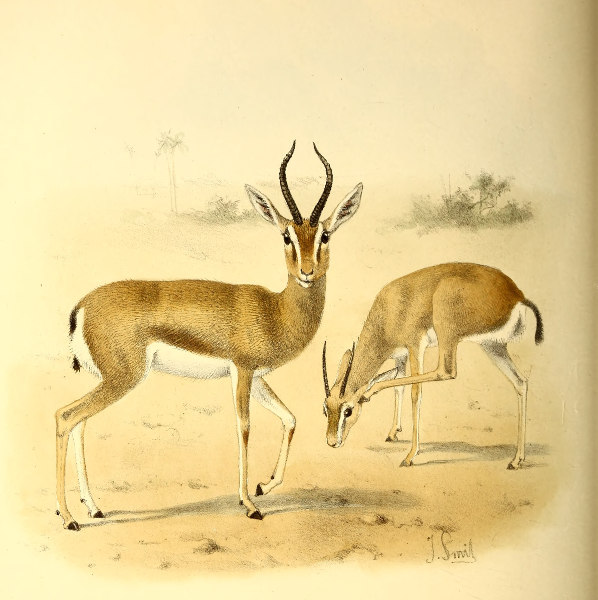
Wolf del J Smit lith
Hanhart imp.
The Dorcas Gazelle.
GAZELLA DORCAS.
Published by R. H. Porter
87. THE DORCAS GAZELLE. GAZELLA DORCAS (Linn.). [PLATE LVII.]
Gazella africana, cornibus brevibus, Ray, Quadr. p. 80 (1693), whence
Capra dorcas, Linn. Syst. Nat. (10) i. p. 69 (1758), (12) i. p. 96 (1766).
Antilope dorcas, Pall. Spic. Zool. i. p. 11 (1767), xii. p. 15 (1777); Müll. Natursyst. Suppl. p. 54 (1776); Erxl. Syst. R. A. p. 285 (1777); Zimm. Spec. Zool. Geogr. p. 543 (1777); id. Geogr. Gesch. ii. p. 117 (1780); Gatt. Brev. Zool. i. p. 82 (1780); Herrm. Tab. Aff. Anim. p. 108 (1783); Schreb. Säug. pl. cclxix. (1785); Bodd. Elench. Anim. p. 142 (1785); Gmel. Linn. S. N. i. p. 187 (1788); Kerr, Linn. An. K. p. 313 (1792); Donnd. Zool. Beytr. i. p. 630 (1792); Link, Beytr. Nat. ii. p. 99 (1795); G. Cuv. Tabl. Élém. p. 163 (1798); Bechst. Uebers. vierf. Thierr. ii. p. 644 (1800); Lac. Mém. de l’Inst., Sci. Phys. iii. p. 498 (1801); Shaw, Gen. Zool. ii. pt. 2, p. 350 (1801); Turt. Linn. S. N. i. p. 113 (1802); G. Cuv. Dict. Sci. Nat. ii. p. 225 (1804); Desm. N. Dict. d’H. N. (1) xxiv. Tabl. p. 32 (1804); Tied. Zool. i. p. 409 (1808); Licht. Mag. nat. Freund. vi. p. 168 (1814); G. Fisch. Zoogn. iii. p. 426 (1814); Afz. N. Act. Ups. vii. p. 220 (1815); Blainv. Bull. Soc. Philom. 1816, p. 75; Desm. N. Dict. d’H. N. (2) ii. p. 183 (1816); G. Cuv. Règne Anim. i. p. 259 (1817); Schinz, Cuv. Thierr. i. p. 386 (1821); Desm. Mamm. ii. p. 453 (1822); Desmoul. Dict. Class. d’H. N. i. p. 440 (1822); Less. Man. Mamm. p. 372 (1827); H. Sm. Griff. An. K. iv. p. 212, v. p. 332 (1827); J. B. Fisch. Syn. Mamm. p. 459 (1829); Less. Compl. Buff. x. p. 286 (1836); Oken, Allg. Naturg. vii. p. 1369 (1838); Laurill. Dict. Univ. d’H. N. i. p. 614 (1839); Less. N. Tabl. R. A., Mamm. p. 176 (1842); Forst. Descr. Anim. p. 386 (1844); Wagn. Schr. Säug. Suppl. iv. p. 405 (1844), v. p. 403 (1855); Schinz, Syn. Mamm. ii. p. 398 (1845); Sund. Pecora, K. Vet.-Ak. Handl. 1845, p. 267 (1847); id. Hornschuch’s Transl., Arch. Skand. Beitr. ii. p. 263; Reprint, p. 83 (1848); Schinz, Mon. Antil. p. 3, pl. i. (1848); Gieb. Säug. p. 305 (1853); Heugl. Ant. u. Buff. N.O.-Afr. (N. Act. Leop. xxx. pt. 2) p. 5 (1863) (in part); id. N.O.-Afr. ii. p. 99 (1877); Brehm, Thierl. iii. p. 205 (1880).
Cemas dorcas, Oken, Lehrb. Nat. iii. pt. 2, p. 737 (1816).
Dorcas dorcas, Gray, Med. Repos. xv. p. 307 (1821).
Gazella dorcas, Og. P. Z. S. 1836, p. 137; Gray, List Mamm. B. M. p. 160 (1843); id. Ann. Mag. N. H. (1) xviii. p. 231 (1846); id. List Ost. B. M. p. 56 (1847); id. Knowsl. Men. p. 4, pl. iii. (1850); id. P. Z. S. 1850, p. 112; id. Cat. Ung. B. M. p. 55 (1852); Temm. Esq. Zool. Guin. p. 193 (1853); Loche, Cat. Mamm. Algérie, p. 13 (1858); Tristram, Gt. Sahara, p. 387 (1860); Gerr. Cat. Bones Mamm. B. M. p. 232 (1862); Blyth, Cat. Mamm. Mus. As. Soc. p. 172 (1863); Loche, Expl. Alg., Mamm. p. 67 (1867); Fitz. SB. Wien, lix. pt. 1, p. 159 (1869); Gray, Cat. Rum. B. M. p. 38 (1872); id. Hand-l. Rum. B. M. p. 106 (1873); Brooke, P. Z. S. 1873, p. 537; Danf. & Alst. P. Z. S. 1877, p. 276 (Asia Minor); iid. P. Z. S. 1880, p. 55; Scl. List Vert. An. Z. S. (8) p. 140 (1883), (9) p. 154 (1896); Flow. & Gars. Cat. Coll. Surg. ii.p. 263 (1884); Lataste, Mamm. Barb. (Act. Soc. Linn. Bord. xxxix.) sep. cop. p. 171 (1885); id. Mamm. Tunisie, p. 36 (1887); Jent. Cat. Ost. Leyd. Mus. (Mus. Pays-Bas, ix.) p. 136 (1889); W. Scl. Cat. Mamm. Calc. Mus. ii. p. 157 (1891); Ward, Horn Meas. (1) p. 114 (1892), (2) p. 157 (1896); Jent. Cat. Mamm. Leyd. Mus. (Mus. Pays-Bas, xi.) p. 167 (1892); Lyd. Horns and Hoofs, p. 180 (1893); Thos. P. Z. S. 1894, p. 467 (Algeria); Scl. P. Z. S. 1895, p. 523 (Egypt); Pease, P. Z. S. 1896, p. 812 (range in Algeria); Whitaker, P. Z. S. 1896, p. 815 (range in Tunis).
La Gazelle, Buff. Hist. Nat. xii. p. 249, pl. xxiii. (1764), whence
Antilope gazella, Pall. Misc. Zool. p. 7 (1766); Bodd. Elench. Anim. p. 140 (1785); Kerr, Linn. An. K. p. 316 (1792); Donnd. Zool. Beytr. i. p. 638 (1792); Latham & Davies, Faunula Indica, p. 4 (1795); Bechst. Uebers. vierif. Thierr. ii. p. 642 (1800); Shaw, Gen. Zool. ii. pt. 2, p. 316 (1801); Turt. Linn. Syst. Nat. i. p. 114 (1802) (nec Capra gazella, Linn.).
Le Kevel, Buff. Hist. Nat. xii. p. 258, pl. xxvi. (1764), whence
Antilope kevella, Pall. Misc. Zool. p. 7 (1766); id. Spic. Zool. i. p. 12 (1767), xii. p. 15 (1777); Müll. Natursyst. Supp. p. 54 (1776); Erxl. Syst. R. A. p. 287 (1777); Zimm. Spec. Zool. Geogr. p. 543 (1777); id. Geogr. Gesch. ii. p. 117 (1780); Gatt. Brev. Zool. i. p. 82 (1780); Schreb. Säug. pl. cclxx. (1785); Bodd. Elench. Anim. p. 142 (1785); Gmel. Linn. S. N. i. p. 187 (1788); Kerr, Linn. An. K. p. 313 (1792); Link, Beytr. Nat. ii. p. 99 (1795); Shaw, Gen. Zool. ii. pt. 2, p. 351 (1801); Desm. N. Dict. d’H. N. (1) xii. p. 380 (1803), xxiv. Tabl. p. 33 (1804); G. Fisch. Zoogn. iii. p. 436 (1814); Desm. N. Dict. d’H. N. (2) ii. p. 184 (1816); H. Sm. Griff. An. K. iv. p. 213, v. p. 332 (1827).
Cerophorus (Gazella) kevella, Blainv. Bull. Soc. Philom. 1816, p. 75.
Cemas kevella, Oken, Lehrb. Nat. iii. pt. 2, p. 738 (1816).
Gazella kevella, Jard. Nat. Misc. (1) vii. p. 208, pl. xxvi. (1842).
La Corine, Buff. Hist. Nat. xii. p. 261, pl. xxvii. (1764), whence
Antilope corinna, Pall. Misc. Zool. p. 7 (1766); Erxl. Syst. R. A. p. 291 (1777); Zimm. Geogr. Gesch. ii. p. 118 (1780); Schreb. Säug. pl. cclxxi. (1785); Bodd. Elench. Anim. p. 143 (1785); Gmel. Linn. S. N. i. p. 188 (1788); Kerr, Linn. An. K. p. 313 (1792); Link, Beytr. Nat. ii. p. 99 (1795); Bechst. Uebers. vierf. Thierr. ii. p. 645 (1800); Desm. N. Dict. d’H. N. (1) vi. p. 219 (1803), xxiv. Tabl. p. 33 (1804); G. Fisch. Zoogn. iii. p. 430 (1814); Desm. N. Dict. d’H. N. (2) ii. p. 184 (1816); Goldf. Schr. Säug. v. p. 1193 (1818); H. Sm. Griff. An. K. iv. p. 214, v. p. 333 (1827).
Cerophorus (Gazella) corinna, Blainv. Bull. Soc. Philom. 1816, p. 75.
Cemas maculata, Oken, Lehrb. Nat. iii. pt. 2, p. 738 (1816).
Gazella dorcas sundevalli, Fitz. SB. Wien, lix. pt. 1, p. 159 (1869).
Vernacular Names:—Rhozal or Hemar of Arabs of Algeria (Pease); Ghasala of Arabs (Tristram).
Size small; height at withers 21–22 inches. General colour pale fawn, rather variable in tone. Facial markings distinct; central band rufous fawn; streaks from eye to mouth brownish fawn, contrasting with the white bands between them. Ears long, whitish fawn behind. Light lateral band present, but not strongly marked; dark lateral band brown, considerably darker than the back, but not black. Pygal band indistinct. Knee-tufts present.
Skull rather lightly built; nasals narrow; anteorbital fossæ large and deep. Basal length 6·6 inches, greatest breadth 3·35, muzzle to orbit 3·55.
Horns of medium length, but quite different in their shape to those of any other species, although the difference is not very easy to explain. Primarily it may be said that they are flattened laterally, are evenly divergent as they curve backwards, reapproach terminally, and have their tips bent upwards in a well-marked curve. But in addition to this simple curvature, the middle portion of each horn is lyrated outwards, so that the longest diameter of the horn-section above is quite in a different plane to what it is at the base; it is in consequence of this lyration that the horns, apart altogether from the curved tips, reapproach each other terminally, while in all other species such reapproach as occurs is entirely due to the incurving of the tips. The lyration and curvature of the horns are well shown in our figure (p. 108), and a comparison of it with those of GG. przewalskii, marica, tilonura, and soemmerringi will show how different the method of terminal approximation is in this species as compared with them.
Female. Similar to the male, but horns slender, slightly curved, from one-half to three-fourths the length of those of the male.
Hab. Morocco and Algeria, and extending through Egypt into Palestine and Syria.
Like other Antelopes known to Linnæus, the Dorcas Gazelle was placed by the great founder of systematic nomenclature in the genus Capra, and called Capra dorcas. The specific term selected was taken from the Greek, in which language it signifies primarily a wild goat or fawn, and subsequently the name of a woman, being, as we know from a familiar passage in the New Testament, the equivalent of the Syriac “Tabitha.” The term “dorcas,” however, according to good authorities, was also applied to the present animal by Ælian and other ancient writers. Linnæus based his Capra dorcas upon the Gazella africana of Ray’s ‘Synopsis of Quadrupeds,’ which there can be little doubt was intended for the present species, although it has been supposed by some authors to be rather applicable to the Bubal (Bubalis boselaphus).
In his memoir on the Antelopes, published at Berlin in 1767, Pallas placed Antilope dorcas eighth in the list, basing it on Buffon’s “La Gazelle,” which it is evident, both from the figure and the description, was taken from a specimen of the present animal.
Besides “La Gazelle” in the twelfth volume of his ‘Histoire Naturelle,’ Buffon also described and figured another Antelope, “Le Kevel,” of which he does not state the locality. Some authors have been disposed to refer Buffon’s Kevel to the larger Antelope of Algeria, which is generally called Gazella cuvieri. But Buffon’s description of the colour of the face and the length he attributes to the ears, as likewise his phrase that the Kevel is “plus petit que la Gazelle,” taken together form conclusive evidence against this view, and there can practically be no doubt that Buffon’s “Kevel” was a small individual of Gazella dorcas.