Subfamily V. ANTILOPINÆ. (continued 4)
Reading edition
“Starting in the evening for the lower ground, which is studded with small bushes (for when pitching the tents we purposely kept at a good distance from the feeding-ground), we soon found spoor, but none very promising; a buck and two does had been there two nights before. A small desert plant, much resembling our English Red Cranesbill (Geranium sanguineum), was pointed out to me by the Arabs as a favourite food of the Gazelles. Finding a spot where the spoor led to one of these plants, and the plant evidently having been nibbled at, we decided to put a trap near it. The Arab sat down and made a hole, using his deep ring to keep its sandy walls intact, so that he now had a hole resembling exactly in size and depth a golf-hole with basket-work sides, within four or five inches of the plant.
“Taking now the thorny ring he places it on the hole, which it should exactly cap. He now powders up some camel-dung and drops it carefully over the thorns in the ring, which being close together hold it up, so that soon nothing can be seen of the thorns. The use of the dried dung is, to hold up the sand which hides the trap. The hemp rope, now made into a slip-noose, is put round the top ring, and the stick to which it is attached buried in the sand. The whole is now carefully covered with sand. One of the shikaries laid his traps so successfully that it was almost impossible to find one again unless a Gazelle was caught in it. The marks like those of a Gazelle made by the fingers over the trap add to the deception. It is curious to remark that a Gazelle will rarely walk over an impression left by either beast or man in the sand.
“When the Gazelle comes in the evening to feed, its foot slips through the top ring in the centre where the thorns meet, and so to the bottom of the hole. The top ring is now fixed round the Gazelle’s leg, at the height of the depth of the hole, the spiky thorns entering the skin. This ring also holds up the hemp rope, which the Gazelle, in endeavouring to kick off the thorny ring that pricks it, draws tight, generally over the knee.
“The Gazelle starts off, dragging after it the date-stick, attached to the rope. The swinging stick makes it impossible for the animal to get away at any pace, as, twisting round one leg or the other, it throws the Gazelle to the ground continually.
“The spoor of the trapped Gazelle with the marks of the swinging stick are easily found, and the animal tracked down until in sight, when a trained greyhound will soon catch and hold it until his master comes up.
“During November and December the Gazelles are caught when fawns by trained hounds, and this is the simplest method; but it can only be practised during two months, as it takes a very good dog to catch a Gazelle when more than this age.
“During the eight days I was in the desert, though unsuccessful in trapping any, I saw several very fine specimens of Loder’s Gazelle.”
In August 1896 a fine adult living female of this Gazelle was received by the Society as a present from Mr. A. R. Birdwood, of Cairo—no doubt obtained in the same locality as that explored by Mr. Bramley. Mr. Birdwood wrote subsequently to Sclater concerning this Gazelle as follows:—
“I am pleased that you have found the Gazelle a real acquisition to your Gardens. I succeeded in securing you a very fine male the other day, but it died almost at once from the effects of the trap used by the Bedouins!
“With regard to the statement that this Gazelle does not drink water, my theory is that it may be true that water is not always obtainable where it is, and that in that case it makes shift with the succulent desert plants that are to be found even in the most arid, seemingly waterless, and barren plains! Of these desert plants, I have collected more than sixty varieties from the limestone hills of Mariout, in the arid stretches running from Wady Natron to Wady Siwa, and in the still more unfavourable ground of the dunes that intersect the road running from Fayoum to the oases of Farafseh and Dakleh. All have the same characteristic succulence, and one, known to the Bedouins as ‘broth of the Gazelle’ (which looks more like a bundle of dry thorns than anything else), is most delightfully aromatic (when snapped off) as well as succulent! These seeming deserts after a rain are plains of verdure, but in a few months return to their primitive wildness.”
So far as we know, besides the original specimens of G. leptoceros received at Paris in 1884, the female presented to the Zoological Society by Mr. Birdwood is the only example of this Gazelle that has reached the Menageries of Europe alive. By the kindness of the Zoological Society we are able to give a copy of Mr. Smit’s drawing of the head of this animal.
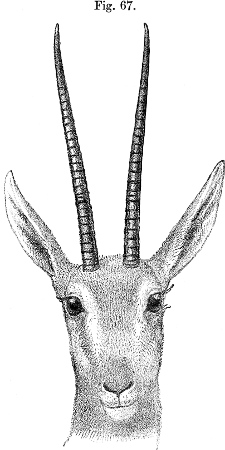
Fig. 67.
Front view of head of a female Loder’s Gazelle.
(P.Z.S. 1896, p. 781.)
But the identity of the Egyptian Gazella leptoceros with the Algerian G. loderi is perhaps not yet exactly certain, although we have combined the English name of the latter with the scientific name of the former.
On comparing specimens from Tunis and Algeria with others from Egypt, the size of the former is slightly greater, the markings are even less defined than in Egyptian examples, the horns are less closely ringed, the nasal bones are markedly longer, the nasal opening is both longer and broader, and the premaxillæ articulate less broadly with the sides of the nasal bones.
An old male is 26 inches in height at the withers, and the skull-measurements of the type are:—Basal length 6·75 inches, greatest breadth 3·35, muzzle to orbit 4.
These differences seem to be quite constant, so far as we have materials for comparison, and we therefore think that as the Algerian form has had a name given to it, it may be provisionally retained as a subspecies, at least until these characters are shown to be variable. The accompanying figure, for the use of which we are indebted to the kindness of the Zoological Society, gives a side view of the skull and horns of the Algerian form.
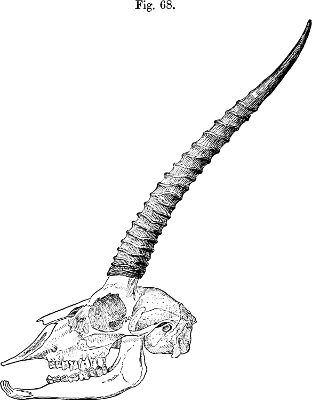
Fig. 68.
Skull of Gazella leptoceros loderi, ♂.
(P.Z.S. 1894, p. 471.)
Our representations of this Gazelle (Plate LXIII.) have been prepared by Mr. Smit—that of the male (front figure) from a mounted specimen in the British Museum obtained by Mr. J. I. S. Whitaker in the Tunisian Sahara, and presented by him in 1894; that of the female from the example from Egypt living in the Zoological Society’s Gardens.
In the British Museum are likewise the typical skin and horns of Gazella loderi obtained by Sir Edmund Loder in the desert about a hundred miles south of Biskra, some frontlets and horns from Biskra, presented by Mr. Rowland Ward, and a skin and skull of a female from Tunis, presented by Mr. J. I. S. Whitaker along with the male now mounted. The example of Gazella leptoceros typica sent to Sclater by Mr. Birdwood is also now in the National Collection. We have also to thank Dr. J. Anderson, F.Z.S., for the loan of a skin and skull of an old male of the Egyptian form of this Gazelle obtained near the Natron Lakes in Egypt.
May, 1898.
THE BOOK OF ANTELOPES, PL. LXIV.
Wolf del J Smit lith
Hanhart imp.
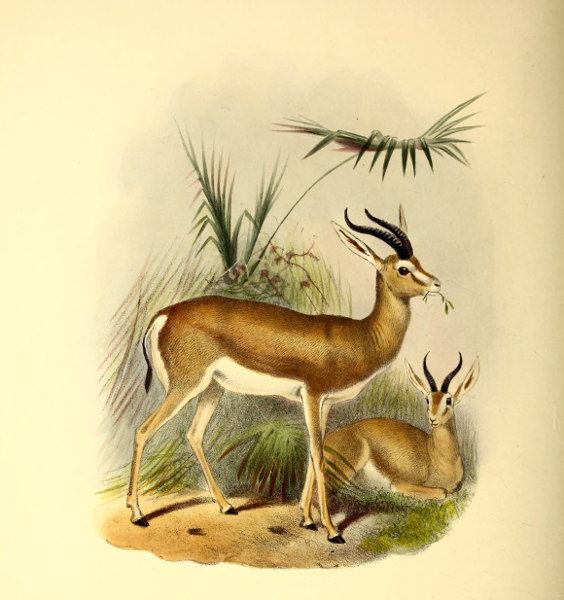
The Isabella Gazelle.
GAZELLA ISABELLA.
Published by R.H. Porter.
94. THE ISABELLA GAZELLE. GAZELLA ISABELLA, Gray. [PLATE LXIV.]
Antilope dorcas, Licht. Darst. Säug. pl. v. (1827)?
Gazella dorcas, Blanf. Zool. Abyss, p. 261, pl. i. fig. 1 (1870).
Gazella isabella, Gray, Ann. Mag. N. H. (1) xviii. pp. 214 & 231 (1846); id. Knowsl. Men. p. 4 (1850); id. P. Z. S. 1850, p. 113; id. Cat. Ung. B. M. p. 57 (1852); Gerr. Cat. Bones Mamm. B. M. p. 233 (1862); Fitz. & Heugl. SB. Wien, liv. pt. 1, p. 591 (1866); Fitz. SB. Wien, lix. pt. 1, p. 158 (1869); Gray, Cat. Rum. B. M. p. 38 (1872); id. Hand-l. Rum. B. M. p. 107 (1873); Brooke, P. Z. S. 1873, p. 539; Huet, Bull. Soc. Acclim. 1887, p. 65; W. Scl. Cat. Mamm. Calc. Mus. ii. p. 157 (1891); Ward, Horn Meas. (1) p. 116 (1892), (2) p. 158 (1896).
Antilope isidis, Sund. Pecora, K. Vet.-Ak. Handl. 1845, p. 267 (1847); id. Hornschuch’s Transl., Arch. Skand. Beitr. ii. p. 263; Reprint, p. 83 (1848).
Height at withers about 25 inches. General colour pale fawn, rather variable in tone, sometimes tending towards brownish. Light lateral band very indistinct; dark band generally fawn like the back, occasionally darker, almost smoky brown. Central dark facial band deep rufous, a darker nasal patch often developing in old individuals. Light facial streak well defined, white. Pygal band almost obsolete, little or not darker than the back.
Skull rather variable in the shapes of the nasal bones and premaxillæ. That of a male measures 6·55 inches in basal length, greatest breadth 3·1, muzzle to orbit 3·65.
Horns of male, as well figured by Blanford under the name of G. dorcas, evenly diverging and curving backwards for four-fifths their length, their tips strongly bent inwards and upwards nearly or quite to a right angle.
Female. Similar to the male, but the horns slender, scarcely ridged, their tips curved inwards rather than upwards; in length nearly equal to those of the male.
Hab. Coast-lands of the Red Sea from Suakin to Massoua, and over the interior to Bogos, Barca, and Taka.
It is possible that the Gazelles described and figured by Lichtenstein in the first part of his ‘Darstellung der Thiere’ as “Antilope dorcas,” which were stated to have been procured by Hemprich and Ehrenberg in Sennaar, may have belonged to the present species. Sundevall certainly considered them to be referable to a species distinct from the true Gazella dorcas, and proposed to call them “isidis,” from Lichtenstein’s vernacular name “Isis Antelope.” But this identification is by no means certain, and, at all events, the name “isabella,” under which this Gazelle was shortly diagnosed by the late Dr. Gray in 1846, will take precedence of Sundevall’s appellation. Gray’s description is very short, and does not allude to the shape of the horns, which are one of the most characteristic features of this species. His type specimen is still in the British Museum. It is an immature male, mounted, and stated to have been received from “Abyssinia,” though Gray in later papers gives “Egypt” and “Cordofan” as the localities for his G. isabella.
Heuglin, in his various memoirs on the Antelopes of N.E. Africa, did not keep G. isabella separate from G. dorcas, and united their localities. Sir Victor Brooke, in his monograph of the Gazelles, though he divides them and says that “amongst the smaller Gazelles no two species could produce two more dissimilar animals than typical specimens of G. dorcas and G. isabella,” states his conviction that “every intermediate degree between them will be found represented in intermediate localities.” It is indeed true that G. isabella is a very inconstant species and requires further careful study.
There can be no doubt that Dr. Blanford’s Gazella dorcas, in his volume on the ‘Geology and Zoology of the Abyssinian Expedition,’ is what we here call G. isabella. The figure of its horns (op. cit. plate i. fig. 1) shows the characteristic twist inwards at the upper end. Moreover, a skull of a male (from Zoulla) and a skull and skin of a female (from Amba), obtained by him during the expedition, and now in the British Museum, are evidently referable here. Mr. W. L. Sclater has also catalogued four heads in the Calcutta Museum, obtained by Mr. Blanford on the same occasion, as G. Isabella. Mr. Blanford gives us the following field-notes on the present species:—
“So far as my observation extends, neither this nor Bennett’s Gazelle are ever seen in large flocks, like the animals of the Springbok group. Usually both are seen solitary or in parties of from two to five together, inhabiting thin bushes, generally on broken ground. They feed much upon the leaves of bushes. The male has a peculiar habit when surprised of standing still and uttering a short sharp cry. Like most Antelopes, they keep much to the neighbourhood of some particular spot. After long observation, I am convinced that Bennett’s Gazelle never drinks, and all that I could ascertain of the present Gazelle leads to the same conclusion in its case.”
In our efforts to obtain further information about the Isabella Gazelle, we did not fail to apply to the officers of the Anglo-Egyptian garrison at Suakin for a set of specimens of it for the National Collection. In reply to our requests Major Sparkes, Surgeon-Capt. Fleming, and Lieut. Carleton were kind enough to send to the British Museum five examples of it; but we cannot say that the examination of these specimens has enabled us altogether to understand this very difficult species. Of the five examples from that locality, three have and two have not a black nasal patch, while the dark lateral band in some is fairly distinct and in others almost obsolete. It is thus evident that these characters, of systematic importance elsewhere, are not, in G. isabella, even of local constancy.
Among the Gazelles registered in the Zoological Society’s ‘List of Animals’ (1896) as received during the past twelve years there have been several which, doubtless, should have been referred to the present species, but have been entered under Gazella dorcas. Amongst these may be specified an example presented by Commander W. Crofton, R.N., in July 1890 (specimen e), a female presented by Col. Holled Smith, C.B., in July 1892 (specimen g), and a pair (h, i) received on deposit in May 1894.
After the arrival of these specimens from Suakin, Mr. A. Thomson, the Head-Keeper, called Sclater’s attention to their differences from the ordinary G. dorcas. They were of a more reddish colour, and had a broad and somewhat distinct side-stripe and a blackish nasal spot, in addition to other smaller differences.
Besides the specimens of this Gazelle in the British Museum which we have already referred to, there is a mounted male from the Anseba River, formerly in Sir Victor Brooke’s collection, and presented to the Museum by Sir Douglas Brooke. We believe that our coloured figure (Plate LXIV.), which was prepared by Mr. Smit under Sir Victor’s superintendence, was taken from this specimen.
May, 1898.
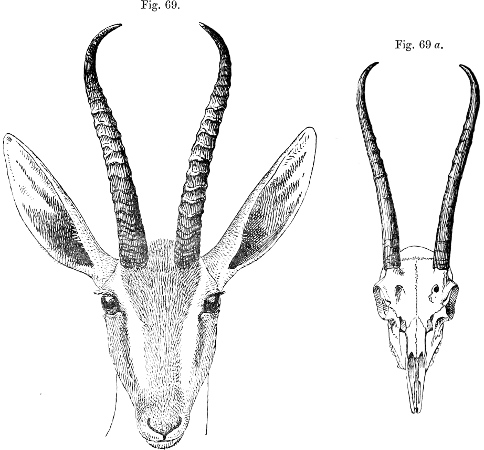
Fig. 69. Fig. 69a.
Heads of Isabella Gazelle, ♂ & ♀.
(From specimens in B. M.)
THE BOOK OF ANTELOPES, PL. LXV
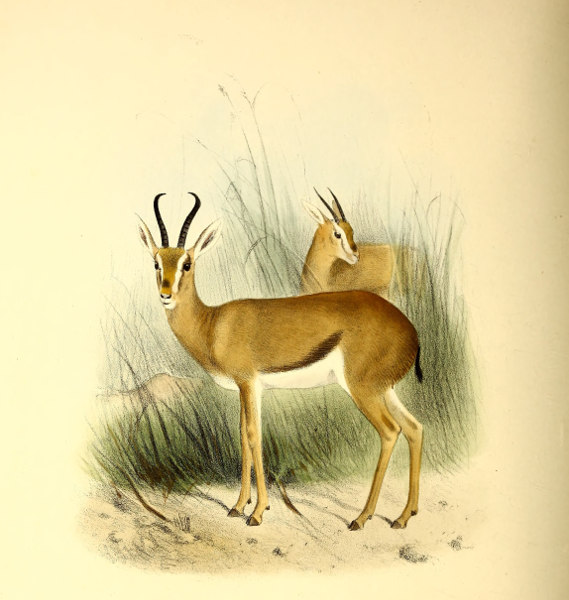
Wolf del. J. Smit lith.
Hanhart imp
The Muscat Gazelle.
GAZELLA MUSCATENSIS.
Published by R. H. Porter.
95. THE MUSCAT GAZELLE. GAZELLA MUSCATENSIS, Brooke. [PLATE LXV.]
Gazella muscatensis, Brooke, P. Z. S. 1874, p. 141, pl. xxii.; Scl. List An. Z. S. (8) p. 141 (1883); id. (9) p. 155 (1896); Lyd. Horns and Hoofs, p. 179 (1893); Thos. P. Z. S. 1894, p. 451.
Size small, height at withers 21–22 inches. General colour dark rufous fawn, darker than in any other species except G. arabica, which it much resembles in colour. Light lateral band scarcely or not perceptible; dark lateral band blackish, its upper edge little defined. Central facial band dark rufous, a distinct blackish patch over the nasals; light facial streak narrow, well defined, dark band below it not defined from the general colour of the cheeks. Knee-tufts present, brownish. Limbs darker in colour than usual, being only white on the inner sides of the forearms and thighs.
Skull very similar to that of G. isabella. Premaxillæ scarcely touching nasals. Basal length in an old female 5·7 inches, greatest breadth 2·9, muzzle to orbit 3·6.
Horns of males curved like those of G. isabella, but decidedly shorter, not or little longer than the skull.
Female. Similar to the male, but the horns slender, scarcely ringed, nearly as long as those of the other sex.
Hab. Oman, Eastern Arabia.
On the 15th of August, 1873, the Zoological Society of London received as a present from Major C. B. Euan Smith (now Col. Sir Charles B. Euan Smith, K.C.B.) a male Gazelle which he had brought with him from Muscat. On September 20th of the same year a female, obviously of the same species and obtained at the same place, was received by the Society on deposit from Mrs. Harris, then of Limefield, Kirkby Lonsdale. Sir Victor Brooke having then lately published his well-known monograph of the Gazelles in the Zoological Society’s ‘Proceedings,’ and being specially interested in the group, Sclater lost no time in calling Sir Victor’s attention to these animals, with which he was much delighted. Sir Victor described them as belonging to a new species at the meeting of the Zoological Society on Feb. 27, 1874, under the name Gazella muscatensis, and pointed out the clear differences which separated them from G. arabica, which up to that time he had believed to be the only Gazelle met with in any part of Arabia.
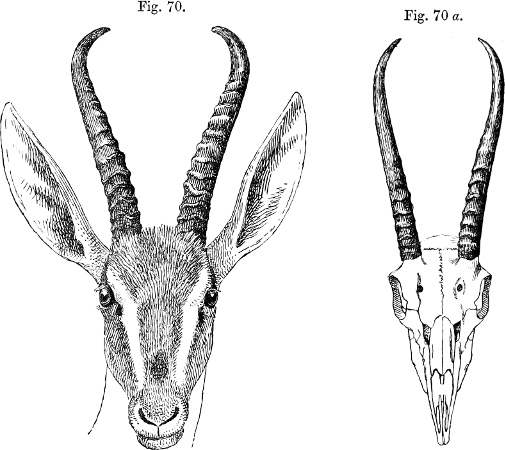
Fig. 70. Fig. 70 a.
Heads of Muscat Gazelle, ♂ & ♀.
(From specimens in B. M.)
Instead of the massive, nearly straight, non-lyrate horns of G. arabica, Sir Victor showed that the new species had rather slender horns, compressed from side to side and distinctly lyrate, with their points turned boldly forwards and inwards. In general appearance also the Muscat Gazelles differed from G. arabica in their long and soft coats of a silvery-grey colour, instead of the short close-set pelage of a rich grizzled bay. From G. dorcas, to which they bore more resemblance, the Muscat species was recognizable by its smaller size, its different colour, and by the intensity of the facial and lateral markings.
Sir Victor’s paper on this new Gazelle was illustrated in the ‘Proceedings’ by a good coloured plate drawn by Keulemans, in which, however, the general colour is made rather too dark.
In 1874 a second male specimen of this well-marked species was presented to the Zoological Society’s Menagerie by Mr. J. H. Bainbridge, and in October 1881 a pair of the same Gazelle were presented by the late Lord Lilford. These last bred a young one, which was born in the Society’s Gardens on the 6th of March, 1882.
No more examples of the Muscat Gazelle reached the Regent’s Park after this date until 1894, when a female of this species was obtained “in exchange,” and a pair were received “on deposit” from the Hon. Walter Rothschild, F.Z.S. The male of this pair is still living in the Society’s Menagerie.
The only other specimens of the Muscat Gazelle ever received in Europe, so far as we know, are five examples in the British Museum, presented to that Institution by Dr. A. S. G. Jayakar, of whose many and valuable contributions to science we have already spoken[14]. Among the several consignments of the Mammals of Oman sent home by Dr. Jayakar, of which Thomas has given an account in the Zoological Society’s ‘Proceedings’ for 1894, were five examples of this Gazelle collected in 1892 and 1893 in several localities in Oman—Khode and Barkah-al-moze, and in Sharkeeyeh, the eastern part of that country. These specimens agree very closely with the type of the species as described by Sir Victor Brooke, which is also in the National Collection.
Our figures of both sexes of this Gazelle (Plate LXV.) have been prepared by Mr. Smit from the specimens in the British Museum.
May, 1898.
THE BOOK OF ANTELOPES, PL. LXVI.
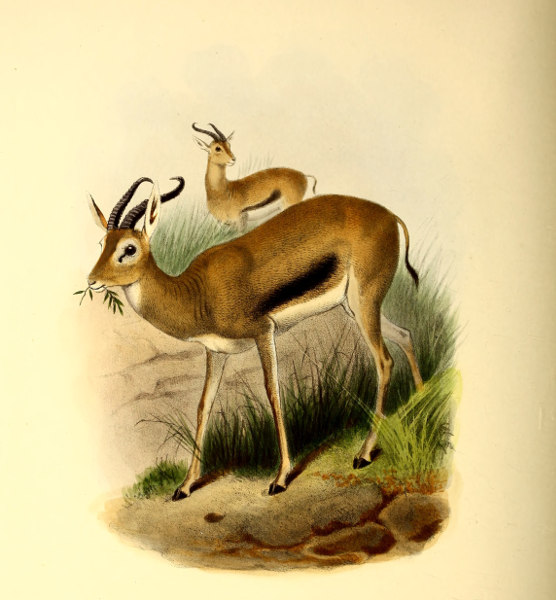
Wolf del. J. Smit lith.
Hanhart imp.
Heuglin’s Gazelle.
GAZELLA TILONURA.
Published by R.H.Porter.
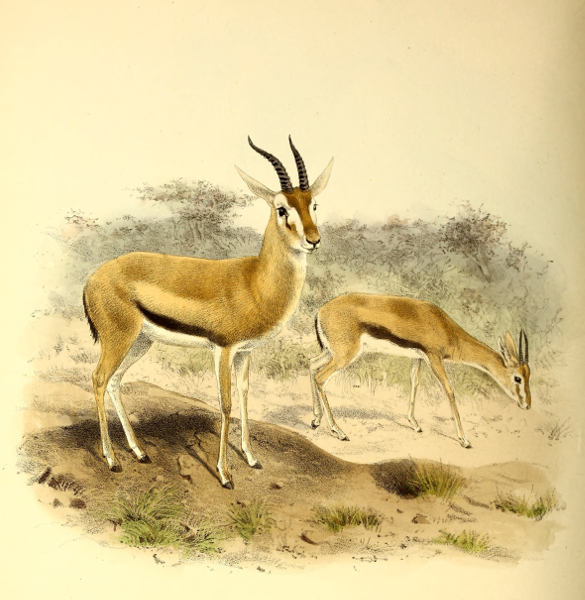
96. HEUGLIN’S GAZELLE. GAZELLA TILONURA (Heugl.). [PLATE LXVI.]
Antilope melanura, Heugl. Ant. u. Büff. N.O.-Afr. (N. Act. Leop. xxx. pt. 2) p. 6 (1863) (nec Bechstein, 1799).
Gazella melanura, Fitz, SB. Wien, lix. pt. 1, p. 159 (1869).
Antilope tilonura, Heugl. Reise Weiss. Nil, p. 315 (1869); id. Reise N.O.-Afr. ii. p. 101 (1877).
Gazella tilonura, Ward, Horn Meas. (1) p. 126 (1892), (2) p. 170 (1896); Lyd. Horns and Hoofs, p. 233 (1893).
Gazella lævipes, Brooke, P. Z. S. 1873, p. 541 (nec Sund.).
Vernacular Name:—Tel-badu in Tigré (Heuglin).
Height at withers about 27 inches. General colour deep sandy. Central facial band but little more rufous than the back; no black patch on muzzle. Light facial streak scarcely or not perceptible on sides of muzzle; the area round the eye dull whitish, not sharply defined. Back of ears scarcely lighter than nape. Light lateral band present, not strongly defined. Dark lateral band black, strongly marked, though narrower than in G. thomsoni; a sandy line present between it and the white of the belly. No dark pygal band. Tail sandy at base, the remainder black. Knee-brushes present, dark sandy.
Horns not, or little, longer than the head, lyrate, parallel at base, curving outwards above and then abruptly twisted inwards towards each other at the tip, the ends each forming a sharp hook, similar to that found in G. soemmerringi, but even more strongly bent inwards.
Hab. Bogosland, North-east Africa.
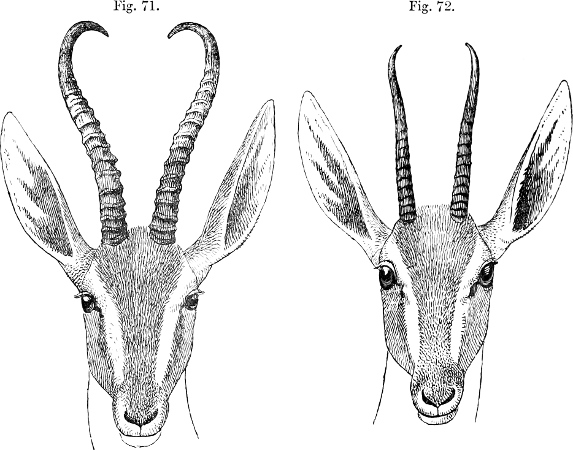
Fig. 71. Fig. 72.
Heads of Heuglin’s Gazelle, ♂ & ♀.
(From specimens in B. M.)
What little we know of this Gazelle is chiefly due to the researches of the late Baron Theodor von Heuglin, an energetic collector and observer of the Mammals and Birds of North-eastern Africa, whose name we have already had frequent occasion to mention in the pages of this work. In the absence of any better designation, we have selected “Heuglin’s Gazelle” as its English name, which is so far applicable that, besides being its first describer, Heuglin is the only naturalist that has recorded observations on it as met with in its native wilds. Heuglin passed several months in the fertile territory of Bogos, north of Abyssinia (now, we believe, included in the Italian colony of “Eritrea”), when attached to the German expedition sent out in search of the much-lamented traveller Dr. Eduard Vogel. He thoroughly explored this country, which is traversed by the River Anseba, and discovered many new birds and mammals, which were subsequently described in his various works. Amongst the mammals was the present species of Gazelle, which he met with only “on the bushy plains round Ain-Saba from 3000 to 5000 feet above the sea-level, in small families of from three to six individuals.” In his original description Heuglin called this Gazelle Antilope melanura, but subsequently altered its specific name to “tilonura,” there having been already an Antilope melanura of Bechstein, which term is, however, a useless synonym of the Oribi (Ourebia scoparia). We have not been able to discover what the term “tilonura” means, but follow the change, which has been adopted by Sir Victor Brooke and other authors.
Little more, we regret to say, can be told of this beautiful species, which is readily distinguishable amongst its congeners by its broad black lateral stripe and lyre-shaped horns with incurved points. Sir Victor Brooke gave a figure of it from a stuffed specimen in his own collection to illustrate his article on the Gazelles in the Zoological Society’s ‘Proceedings’ for 1873. Our figure (Plate LXVI.), which was prepared by Smit under the direction of Sir Victor Brooke, was probably taken from the same specimen, now in the British Museum, to which it has been presented by Sir Douglas Brooke. It was obtained in Bogosland by Essler about 1872. Four other examples of this Gazelle procured at the same time by the same collector are also in the National Collection. From two of these the accompanying illustrations of the head and horns (figs. 71 & 72, p. 160) have been prepared by Mr. Smit.
May, 1898.
THE BOOK OF ANTELOPES, PL. LXVII.
Wolf del. J. Smit lith.
Hanhart imp.
The Red-fronted Gazelle.
GAZELLA RUFIFRONS.
Published by R. H Porter
97. THE RED-FRONTED GAZELLE. GAZELLA RUFIFRONS, Gray. [PLATE LXVII.]
Le Kevel, F. Cuv. H. N. Mamm. (fol.) i. livr. 1, pl. 368 (1818); Corine, ii. livr. 36, pl. 369 (1822), and Corine jeune, iv. livr. 72, pl. 370 (1842).
Gazella rufifrons, Gray, Ann. Mag. N. H. (1) xviii. pp. 214 & 231 (1846); id. Knowsl. Men. p. 5, pl. iv. (1850); id. P. Z. S. 1850, p. 115; id. Cat. Ung. B. M. p. 60 (1852); id. Cat. Rum. B. M. p. 39 (1872); id. Hand-l. Rum. B. M. p. 108 (1873); Brooke, P. Z. S. 1873, p. 540; Scl. List An. Z. S. (8) p. 140 (1883); Lyd. Horns and Hoofs, p. 232 (1893); Ward, Horn Meas. (2) p. 159 (1896).
Antilope lævipes, Sund. Pecora, K. Vet.-Ak. Handl. 1845, p. 266 (1847); id. Hornschuch’s Transl., Arch. Skand. Beitr. ii. p. 262; Reprint, p. 82 (1848) (ex Kevel and Corine, F. Cuv., nec Buff.); Wagn. Schr. Säug. Suppl. v. p. 404 (1855).
Gazella lævipes senegalensis, Fitz. SB. Wien, lix. p. 159 (1869).
Vernacular Name:—Seni, on the Gambia (Whitfield fide Gray).
Size medium, form comparatively rather stout. General colour deep sandy rufous, brightening into rich rufous on the forehead and muzzle. Nose-spot blackish. White facial streaks well defined, dark cheek-stripes rufous. Light lateral band broad, sandy buff, about the colour of the shoulders, sharply defined from the colour of the back; dark lateral band narrow, black, sharply defined, very prominent, succeeded below by a narrow edging of sandy. Knee-tufts absent. Tail blackish, except just at the base above, where it is sandy.
Skull of medium build; nasals rather broad and short, broadened behind; nasal opening long and narrow, the upper line of the premaxillæ straighter and less concave than usual. Dimensions of a slightly immature male:—Basal length 7 inches, greatest breadth 3, muzzle to orbit 3·95.
Horns rather short in proportion to the size of the animal, evenly divergent, slightly curved backwards below and forwards above, heavily ringed except for the terminal two or three inches.
Female. Similar to the male, but the horns straight, slender, and less ringed; those of an adult rather less than six inches in length.
Hab. Senegal and Gambia.
The existence of a Gazelle of the group allied to Gazella dorcas in West Africa was first made known to us by the authors of the great folio work called ‘Histoire Naturelle des Mammifères,’ issued at Paris, in which the figures were taken mostly from living specimens. In one of the early livraisons of this publication, in which French names only are primarily used, this species was referred to the “Kevel” of Buffon, and under this name a young male was figured, stated to have been brought to France from Senegal. In a later livraison two young specimens of the same species, also from Senegal, were figured as the “Corine” of Buffon, which was declared to be identical with the “Kevel.” We have, however, already shown (under the head of Gazella dorcas) that both these terms of Buffon are referable to the last-named species, and that neither these terms nor the scientific names founded upon them can be properly used for any other species. Hence it follows that the first scientific name that can be employed for this Gazelle is Gazella rufifrons of Gray, under which term it was curtly described by that author in the ‘Annals and Magazine of Natural History’ for 1846. Shortly after that period the same species was figured in ‘Gleanings from the Knowsley Menagerie’ by Waterhouse Hawkins, whose well-drawn plate contains portraits of two males, a female, and a young one of the present species.
As the drawings in the ‘Gleanings’ were not in all cases taken from animals living in Lord Derby’s Menagerie, some of them having been prepared from specimens in the British Museum, it is nearly certain that this was the case in the present instance. It will be observed that Gray in his description mentions almost exactly such a series as being in the Museum as is drawn in the ‘Gleanings,’ and it is not probable that a similar set should also have been living at Knowsley at the same time.
All the specimens mentioned by Gray, with one exception, are still in the National Collection, and, as “co-types” of the species, show clearly to what animal the name “rufifrons” should be applied.
In 1847, in his excellent essay on the “Pecora,” the late Professor Carl J. Sundevall established an “Antilope lævipes” basing it primarily on the figures of Geoffrey St.-Hilaire and Fr. Cuvier in the ‘Histoire Naturelle des Mammifères,’ of which we have already spoken. It is obvious, therefore, that Sundevall’s term “lævipes” is an absolute synonym of “rufifrons,” though he gives as his principal example a specimen from Sennaar in the Stockholm Museum. But, nevertheless, there would appear to be a closely allied species living in East Africa, which Heuglin, in his first work (‘Antilopen und Büffel’), referred to Antilope leptoceros, but which he subsequently in 1877 (‘Reise in Nordost-Afrika’) treated of under Sundevall’s name “Antilope lævipes.” Heuglin states that this Gazelle, of which the native name is “Abu-el-Harabat,” is found in Nubia, Kordofan, Sennaar, and Taka, as also near Suakin and on the plains of the Beni Amer, ascending to a height of about 1500 feet above the sea-level. Heuglin specially alludes to the want of knee-tufts in his Antilope lævipes, which is the case also in Gazella rufifrons. What this East-African Antelope of Sundevall and Heuglin may be we are quite unable to decide, not having been able to examine East-African specimens. It is possible, however, that it may be Gazella rufina, which we shall presently speak of.
Of the examples of this Gazelle formerly in the Knowsley Menagerie we have already written. The Zoological Society of London have also, on several occasions, received living examples of this species from the West Coast of Africa. The first of these recorded of late years was purchased in August 1865, and the second, a female, in 1869. In June 1895 a female Gazella rufifrons was placed under the Society’s care by the Hon. W. Rothschild, F.Z.S., and is still living in the Gardens. In May of last year a fine living pair of this species were received by the Zoological Society from a London dealer and subsequently purchased. It is from this pair that the accompanying figures of both sexes of this beautiful Gazelle (Plate LXVII.) have been prepared by Mr. Smit. These animals are still living in the Society’s Gardens. They stand about 24 inches in height at the shoulder, the male being slightly the taller of the two. Both male and female have a slight blackish nose-spot, as shown in our figures. The knee-brushes are quite imperceptible in these three specimens, and the knees are perfectly smooth.
May, 1898.
98. THE RUFOUS GAZELLE. GAZELLA RUFINA, THOS.
Gazella rufina, Thos. P. Z. S. 1894, p. 467 (fig., skull).
Antilope lævipes, Sund. K. Vet.-Ak. Handl. 1845, p. 266 (1847), form α, ex Sennaar; id. Hornschuch’s Transl., Arch. Skand. Beitr. ii. p. 262; Reprint, p. 82 (1848); Heuglin, Ant. u. Büff. N.O.-Afr. (N. Act. Leop. xxx. pt. 2) p. 6; id. Reise N.O.-Afr. ii. p. 100 (1877).
Antilope leptoceros, Heugl. Ant. u. Büff. p. 7 (err.).
Closely similar in all respects to G. rufifrons, but decidedly larger, the colour throughout particularly rich and brilliant. Light facial streaks not white but sandy, and little different to the general colour of the cheeks. In the single specimen known (a tanned skin), the hairs along the centre of the back and on the sides of the rump are peculiarly waved, but how far this may be due to the preparation of the skin we are unable to say. Knee-brushes dull rufous.
Skull conspicuously larger and heavier than that of G. rufifrons. Anteorbital fossæ larger and deeper. Nasal opening shorter and broader in proportion to the general size, and the upper line of the premaxillæ more curved. Basal length of the type, an old male, (circa) 8·05 inches, greatest breadth 3·86, muzzle to orbit 4·9.
Horns of male short and heavy, their curvature and proportional length about as in G. rufifrons; those of the type are 11·6 inches in length on their anterior curve.
Hab. Interior of Algeria (?).
After his return from Algeria in 1894, Sir Edmund Loder, as we have already stated, placed the whole of his series of specimens of Gazelles from that country in Thomas’s hands for examination. Besides examples of the two previously known Algerian species—Gazella dorcas and G. cuvieri—Thomas found that two other species, hitherto apparently unrecognized, were represented in the collection. Of one of these, which Thomas named G. loderi, we have treated under the head of G. leptoceros. Of the other, to which we now propose to refer, only a single specimen, consisting of a skin and a skull, was in the series. This, however, was of so entirely a different character from the three others above-mentioned that Thomas found it necessary to refer it to a new species, which he proposed to call G. rufina, from its generally bright, rich rufous colour. The specimen not having been obtained in the field, but having been purchased at a shop in Algiers (in the spring of 1877), cannot have any certain locality assigned to it; but in all probability it was brought from somewhere in the interior, as it is hardly likely that such an object would have been imported into Algiers from a distant country.
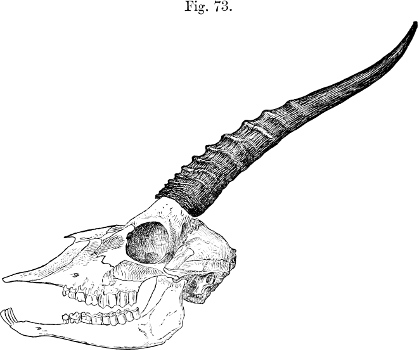
Fig. 73.
Skull of Rufous Gazelle.
(P. Z. S. 1894, p. 468.)
There can be no doubt that, as stated above, Gazella rufina is most nearly allied to G. rufifrons of Senegal, from which, however, we have already stated its points of difference. Sir Edmund Loder has had a water-colour drawing of the typical specimen prepared by Smit, which has much assisted us in our study of it. It is obviously a larger and more richly coloured animal than G. rufifrons, and its skull, of which, by the kindness of the Zoological Society, we are enabled to give the figure that originally appeared in their ‘Proceedings’ (fig. 73, p. 168), is remarkable for its stout and heavy build and short nasal opening. The only conjecture we can make respecting this somewhat problematical species is that it may possibly be the same as Gazella lævipes of Sundevall and Heuglin from North-east Africa, of which we have spoken in our article on Gazella rufifrons. It may be remarked that Sundevall, in his account of Antilope lævipes (K. Vet.-Akad. Handl. 1845), has noted the existence, in the Paris Museum, of specimens from Algeria of a Gazelle which he considers identical with his species, form α (from Sennaar), and which he separates from form β (from Senegal) on account of the want of the blackish nose-spot. But even if such shall turn out eventually to be the case, the present species will still retain the name “rufina,”—“lævipes,” as we have already pointed out, being correctly treated of as a synonym of G. rufifrons.
Sir Edmund Loder has most liberally presented the typical specimen of Gazella rufina to the British Museum.
May, 1898.
THE BOOK OF ANTELOPES, PL. LXVIII
J. Smit lith.
Hanhart imp.
Thomson’s Gazelle.
GAZELLA THOMSONI.
Published by R. H. Porter.
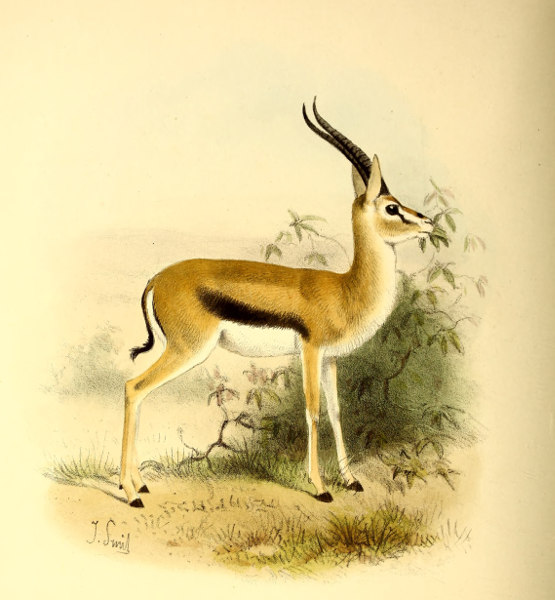
99. THOMSON’S GAZELLE. GAZELLA THOMSONI, Günth. [PLATE LXVIII.]
Gazella thomsoni, Günth. Ann. Mag. N. H. (5) xiv. p. 427 (1884) (fig., horns); Thomson, Masai-land, p. 536 (1885) (fig., horns); Hunter in Willoughby, E. Africa, p. 289 (1889); Ward, Horn Meas. (1) p. 133 (1892), (2) p. 171 (1896); True, P. U.S. Nat. Mus. xv. p. 473, pl. lxxvii. (1892) (Taveta); Lyd. Horns and Hoofs, pp. 236, 239 (1893) (fig., horns); Lugard, E. Africa, i. p. 534 (1893); Jackson, in Badm. Big Game Shooting, i. pp. 285 & 298 (1894); Scott Elliot, P. Z. S. 1895, p. 340; Matsch. Säug. Deutsch-O.-Afr. p. 130 (1895); Rhoads, P. Ac. Philad. 1896, p. 519; Jackson, P. Z. S. 1897, p. 434.
Height at shoulders about 25 inches. General colour deep sandy rufous, all the markings well developed and sharply defined. Central facial band deeper rufous, a black patch present on the top of the muzzle. Light facial streaks pure white, extending quite to the muzzle and surrounding the eye; darker cheek-streaks blackish. Light lateral band present, though not very much paler than the back. Dark lateral band deep black, greatly developed, very broad, sharply defined above and below, extending on to the outer side of the elbow; no sandy streak between it and the white of the belly. Pygal band small, blackish. Ears rather short. Tail sandy at its base above, the remainder black. Knee-brushes present, sandy or whitish.
Skull with short, broad, and quadrangular nasals, nearly as broad as long; premaxillæ straight, scarcely concave above, broadly articulating with nasals. Basal length of skull of a male 7·7 inches, greatest breadth 3·6, muzzle to orbit 4·25.
Horns rather like those of G. bennetti on a large scale, little divergent, sometimes even quite parallel, evenly but very slightly curved backwards for seven-eighths of their length, their tips gently recurved upwards and forwards. In length, over the front curve, they attain to about 14 or 15 inches, the record being 15½.
Female. Similar to the male, but with the horns rudimentary, much smaller than in other African Gazelles; only from 3 to 6 inches in length, of about the thickness of a cedar pencil, smooth and unridged, and in direction crooked and irregular.
Hab. Interior of British and German East Africa, from Lake Rudolph south to Irangi.
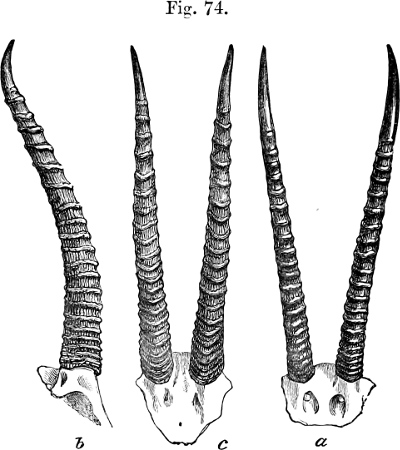
Fig. 74.
Horns of Thomson’s Gazelle, ♂.
(Ann. Mag. N. H. (5) xiv. p. 427.)
The name of Joseph Thomson, the African traveller, will always rank among the foremost of those who in the second half of this century have striven to open the Dark Continent to civilized man, and have lost their lives at an early age by violence or disease in consequence. Thomson was, moreover, one of the very few amongst African explorers who had never shed the blood of a native, nor even, we believe, during his many journeys, fired a shot in self-defence. Thomson’s name has been worthily associated with the present Gazelle, of which he was the discoverer during his expedition through Masai-land to Lake Victoria in 1883 and 1884, and of which he first brought back specimens to Europe.
Thomson, as we are informed by Dr. Günther, who described this Gazelle as Gazella thomsoni in June 1884 from two frontlets presented by Thomson to the British Museum, met with it on his way up the country from the plains near Kilimanjaro to Lake Baringo, at various elevations under 6000 feet. Dr. Günther, we may remark, in his description and figure of these horns fell into a not unnatural error in treating the more slender pair (fig. 74a, p. 172) as those of a female. But, as we have already stated, the horns are always abnormally small in the doe of this Gazelle, and sometimes, it is said, altogether wanting. The slenderer pair of horns shown in Dr. Günther’s figures, which we have been kindly allowed to reproduce in this work, are, like the stouter pair, doubtless those of a male.
In his volume ‘Through Masai-land,’ Thomson does not appear to have made any reference to this Gazelle, except by repeating the figures of the horns (p. 536) already published by Dr. Günther. Thomson had intended, we believe, to put his notes on the animals and plants collected and observed during this expedition into an Appendix, which, however, from pressure of other matters, was never written.
After Thomson himself, the next earliest information obtained concerning this Gazelle appears to be that collected by Sir John Willoughby’s hunting-party in 1886–87. In the Appendix to ‘East-Africa and its Big Game,’ Mr. Hunter writes of it as follows:—
“This Gazelle, discovered by Mr. J. Thomson during his trip through Masai-land in 1883, was found in large numbers in the plains in the Masai country to the south-west of Kilimanjaro, and we also came across it on the borders of the Masai country at the south end of Kyulu mountain, but it is not met with on the south side of the mountain between these two points. I have seen these Gazelles mixing with Gazella granti, the female of which, at long range, though larger, is easily mistaken for a male G. thomsoni, both having the broad black stripe on the side. They are generally seen in small herds of one male to about ten females.”
In the first volume of ‘Big Game Shooting,’ of the Badminton Library, Mr. F. J. Jackson, than whom no one can be better qualified to speak of East-African Antelopes, gives us his experiences with the present species in the following words:—
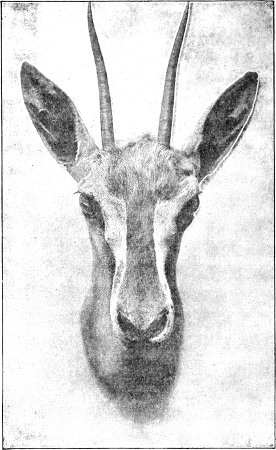
Fig. 75.
Front view of head of Thomson’s Gazelle, ♀.
(Neumann’s ‘Elephant-Hunting,’ p. 11.)
“In habits G. thomsoni is very like G. granti, but, as a rule, is found in rather larger herds. Single bucks of this species are, however, more often seen than single bucks of G. granti. At Lake Naivasha, in July 1890, I saw a large herd of some sixty head, composed entirely of does, and in the same place, in September of the previous year, I saw a herd of some thirty or forty beasts, every one of which was a buck; but I do not think that this can be taken as evidence that the bucks and does separate at certain seasons of the year, as on the same days on which I saw these two herds I also saw others in which the bucks and does were together. Thomson’s Gazelle is a confiding little beast, and, except in places close to a well-beaten caravan-route, where it has been constantly shot at, can be easily approached within 120 yards with ordinary care and perseverance, even in the most open and covertless spots. These beasts appear to be confined almost entirely to the Masai country, as I have not heard of their having been seen east of the Sigarari plains to the south of Kilimanjaro, or south of the Useri river and the headwaters of the Tsavo. I saw none at Njemps near Lake Baringo, or in Turkwel and Ngaboto in the Suk country, though G. granti was plentiful in all these places.”
Writing subsequently in the Zoological Society’s ‘Proceedings’ on the Antelopes of the Mau District of British East Africa, Mr. Jackson says that this Gazelle does not, as he believes, extend beyond a few miles north of Lake Nakuru. He adds that “the females are horned, whatever may be said to the contrary.” With this view Mr. Arthur H. Neumann, one of our most recent explorers in British East Africa, quite agrees. In his lately published volume on ‘Elephant-Hunting’ in that Protectorate, Mr. Neumann gives a figure of the head of a female Thomson’s Gazelle, which, by his kindness and that of his publishers, Messrs. Rowland Ward & Co., we are enabled to reproduce (fig. 75, p. 174): this shows that the horns are present in that sex of G. thomsoni, though in a much more dwarfed condition than in most of its allies. Mr. Neumann also claims to have met with this Gazelle much further north than its range is usually held to extend. This was in the district of Kisima, south of the Lorogi Mountains and north of Lake Naivasha.
Col. Lugard, who has had great experience in East-African game-shooting, has stated[15] that he had never met with a horned female of Thomson’s Gazelle. A letter lately received from our much-valued correspondent, Mr. S. L. Hinde of the B.E.A. Medical Service, in response to enquiries on this point, endeavours to explain this diversity of opinion as follows:—
“With reference to the statement that the female Thomson’s Gazelle has no horns, I can, perhaps, give some explanation. The horns of the female of this species (see the skulls given by me to the British Museum) are very frail, crooked, and generally malformed. A good pair would be about five inches long; but a very slight blow will break or knock off these horns. Four or five females of this Gazelle that I have shot have knocked off one or both horns when falling to the shot or in their subsequent struggles.
“A doe of this species born in the fort at Kikuyu developed horns; but in play with the rest of the herd of five, knocked them off when they were not more than two inches long, and when I last saw her there were two warty scars where the horns had been. I should think that a similar accident is probably a very common occurrence among the wild herds; so much so, that I should not be surprised to see a herd of does ‘without horns.’ The yearling fawns running with their mothers would have horns not more than half an inch long, and therefore invisible. If a man, for any reason, were to shoot a doe out of such a herd he would probably choose the largest animal. Afterwards, if the question were raised, he would say that he saw a herd of does of Thomson’s Gazelle absolutely hornless, and on shooting one found there were only little marks on the head where the horns would have been if the animal had had any.
“I have myself seen hundreds of these Gazelles in Ukambaui, some without horns, some with one, and some with both horns. Of those I have shot or seen shot myself, two were without horns, one had one horn about three inches long, and four had both horns averaging three and a half inches in length, while two had horns about three-quarters of an inch long.”
Passing on to German East Africa we find, from Dr. Matschie’s volume on the Mammals of that country, that Thomson’s Gazelle was met with by Herr Oscar Neumann at various points on his journey north from Tanga to the Victoria Lake. Mount Gurui, Lake Manyara, Ndalalani on the Natron Lake, and the district between Guasso Nyiro and Ngare Dobasch are specially mentioned, but north and west of the latter locality Herr Neumann did not find it. It was also obtained near Mount Meru by Herr v. Höhnel, and in Northern Irambi by Herr Stuhlmann.
We are not aware that examples of Thomson’s Gazelle have ever been brought to Europe alive; but it would appear that young individuals of this species are often captured and kept in confinement in British East Africa. The late Capt. B. L. Sclater, R.E., who made the road from Kibwesi to Port Victoria in 1895–97, in his letters written home refers to several such cases, and Lieut. G. E. Smith, R.E., who was second in command of Capt. Sclater’s party, kindly sends us the following notes about them:—“Early in January 1896 Capt. Sclater obtained from the Masai two young Thomson’s Gazelles, which were fed by hand and throve well. They became quite tame and used to run about the camp and play with a puppy. One of them subsequently ran away, but the other remained with the camping-party for nearly a year.” At Kikuyu, Lieut. G. E. Smith saw a pair of Thomson’s Gazelles then fully grown, having been in possession of Mr. Hall, the Resident, for more than two years. The buck was rather fierce and apt to attack natives with his horns. Major Eric Smith, we are told, also generally had two or three of these Gazelles scampering about his station at Naivasha very tame.
Our figure of the male of this Antelope (Plate LXVIII.) has been prepared by Mr. Smit from a mounted specimen in the British Museum presented by Mr. F. J. Jackson. There are also in the Museum a second mounted specimen of a male presented by Mr. H. C. V. Hunter and the skull of a male from Lake Naivasha presented by Col. Lugard. Besides these the Museum contains two frontlets with horns, being the typical specimens obtained by Thomson, and some skins and skulls of both sexes from Machakos, presented by Mr. S. L. Hinde, as already mentioned in his letter.
May, 1898.
THE BOOK OF ANTELOPES, PL LXIX
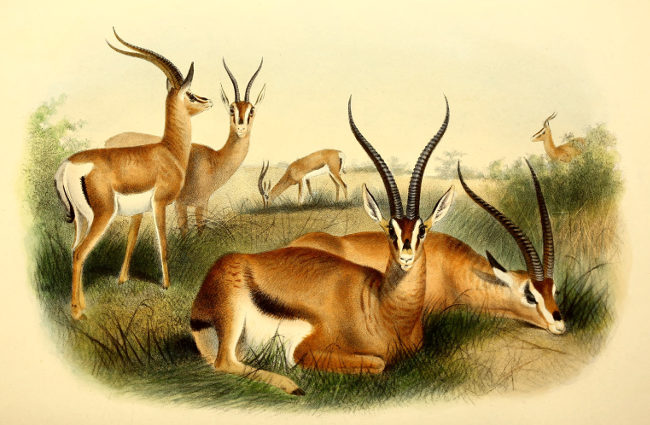
Wolf del J Smit lith
Hanhart imp
Grant’s Gazelle.
GAZELLA GRANTI.
Published by R. H. Porter
100. GRANT’S GAZELLE. GAZELLA GRANTI, Brooke. [PLATE LXIX.]
New Antelope, Ugogo, Speke, Journ. of Disc. p. 61 (1863).
Antilope soemmerringii?, Speke, P. Z. S. 1863, p. 3 (Ugogo).
Gazella granti, Brooke, P. Z. S. 1872, p. 601, pl. xli.; id. P. Z. S. 1873, p. 550; Scl. P. Z. S. 1875, p. 527, pl. lix. (Viv. Soc. Zool.); Brooke, P. Z. S. 1878, p. 723 (figs., head); Scl. List An. Z. S. (8) p. 142 (1883); Pagenst. JB. Mus. Hamb. ii. p. 38 (1884); Johnston, Kilimanjaro Exp. p. 394 (1886); Hunter, in Willoughby, E. Africa, p. 289 (1889); Flow. & Lyd. Mamm. p. 342, fig. 2 (head) (1891); Ward, Horn Meas. (1) p. 104 (1892), (2) p. 148 (1896); True, P. U. S. Nat. Mus. xv. p. 473 (1892); Lyd. Horns and Hoofs, p. 236 (1893); Lugard, E. Afr. i. p. 534 (1893); Jackson, in Badm. Big Game Shooting, i. p. 298 (1894); id. P. Z. S. 1897, p. 453; Matsch. Säug. Deutsch-Ost-Afr. p. 131 (1895); Donaldson Smith, P. Z. S. 1895, p. 868; A. Neumann, Elephant-Hunting in E. Africa, pp. 9, 10 (figs., horns, ♂ ♀) (1898).
Vernacular Names:—Swara (Jackson) and Njéra (Stuhlmann) in Swahili.
Size large; height at withers about 34 inches. Fur close and short. General colour fawn, rather variable in tone. Lateral bands, both light and dark, usually very indistinct, often scarcely perceptible; but, on the other hand, occasionally well developed, especially in young animals. Central facial band richer fawn, approaching rufous; a brownish spot present on the muzzle. Light facial streaks white, sharply defined, running up over the eyes to the horns. Below these the dark facial bands are almost imperceptible, scarcely or not at all darker than the fawn-coloured cheeks and neck. Rump with the white of the hams very broad, extended upwards, and uniting across the base of the tail, so that the latter is quite separated from the dark body-colour; laterally the white penetrates angularly into the body-colour, overhanging the top of the pygal band, which is generally well-defined. Outer sides of limbs fawn, without blacker markings. Knee-brushes present, dark fawn. Tail above white for its basal half; black and crested terminally.
Skull stout and heavy, nasal opening broad. In that of an adult male the basal length is 9·75 inches, greatest breadth 4·4, muzzle to orbit 5·3.
Horns very long, longer and more powerful than in any other Gazelle; evenly but slightly curved backwards below, and gently recurved forwards terminally; sometimes but slightly divergent, but more often, especially in specimens from Kilimanjaro, they spread widely above, approaching each other again at their tips. Their section at base is a long oval, very different from the nearly circular section found in G. soemmerringi.
Female. Similar to the male, but the horns slender, nearly circular in section, more strongly ridged than in the females of most Gazelles; about two-thirds in length of those of the male.
Hab. Eastern Africa, from the district of Lake Rudolph, southwards to Ugogo.
Grant’s Gazelle, which has been appropriately named after one of its discoverers, is pre-eminent, even in this ornamental genus, for its size and elegance, and is, in fact, generally allowed to be one of the most beautiful species of the whole group of Antelopes. Speke and Grant left Zanzibar on the well-known expedition during which the efflux of the Nile from Lake Victoria was discovered, in September 1860. Starting from Bagamoyo on the opposite coast, and passing through Usagara, they arrived about two months later in Ugogo, then under the rule of a native chief called Magomba. It was in December 1860 during their stay at this place, where they were long detained by the drunken chief and his wazir, that Speke first met with the present Antelope. In the ‘Journal’ of his travels Speke tells us that while kept waiting to arrange the amount of his “hongo” he took the time out in the jungles very profitably, “killing a fine buck and doe Antelope of an unknown species.” “These animals,” he continues, “are of much about the same size and shape as the common Indian Antelope, and like them roam about in large herds, the most marked difference between the two being in the shape of their horns, and in their colour, in which in both sexes the Ugogo Antelopes rather resemble the Gazella picticaudata of Tibet, except that the former have dark markings on the face.”
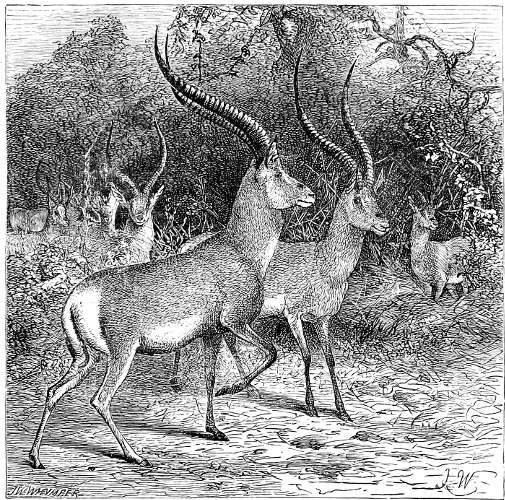
Fig. 76.
Grant’s Gazelle, Ugogo.
(From Speke’s ‘Journal of Discovery,’ p. 61.)
The original woodcut of Speke’s ‘Journal,’ drawn by Wolf, as shown by his initials, we have now the pleasure of reproducing by the kind favour of the publishers of that work. It was no doubt executed under Speke’s direction, and, although not quite satisfactory according to our present knowledge of the animal, gives several views of the shape and size of the horns of Grant’s Gazelle.
Although Speke in his ‘Journal’ writes of the Ugogo Antelope as being undoubtedly new, he was at first evidently by no means certain about this point, as in a letter addressed to Sclater from Kazeh, in February 1861, he referred it doubtfully to Gazella soemmerringi. But in a footnote to this letter (which was published in the ‘Proceedings’ of the Zoological Society for January 1863) Sclater stated his conviction that, so far as could be determined from the rough sketch of the horns which accompanied the letter, the Ugogo Antelope was certainly new, and he added that the late Dr. Gray was of the same opinion.
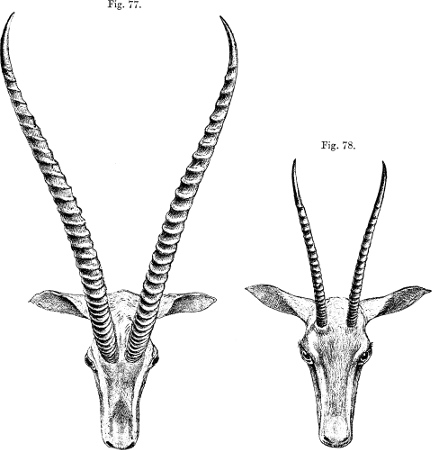
Fig. 77. Fig. 78.
Heads of Grant’s Gazelle, ♂ & ♀.
(From Mr. Jackson’s specimens.)
The box containing the specimens of the new Gazelle from Ugogo having been unfortunately lost on its journey to the coast, Sclater was unable to give any account of this animal in his paper on the Mammals collected and observed during the East-African Expedition, in the ‘Proceedings’ of the Zoological Society for 1864. The subject therefore was delayed until 1872, when Sir Victor Brooke, who was at that time busy upon the Antelopes, obtained from Col. Grant and Capt. Speke the careful sketches of the heads and skins of this animal which the travellers had made in their note-books. The examination of these sketches confirmed Brooke in the opinion that the Antelope represented by them was undoubtedly new to science; and consequently on April 16th of that year Sir Victor read a communication to the Zoological Society in which he proposed to name the new Gazelle after Grant, Speke’s name in this group of animals having been already commemorated by the Gazella spekei of Blyth and the Tragelaphus spekei of Sclater. Sir Victor gave as good a description of the new Antelope as he could from the notes before him, especially alluding to the extraordinary development of its horns, which attained dimensions nearly double those of any other Gazelle known to him. Brooke’s paper, which is accompanied by a beautiful coloured figure of the new Antelope, prepared by Wolf from Speke’s sketches, states that Col. Grant, who had supplied him with copious extracts from his note-books, informed him that this species was only met with during their expedition in Western Kinyenye, in Ugogo. The country inhabited by it he described as low-lying sandy plains, dotted over in some places with euphorbias, dwarf acacias, and stunted baobabs. The chief peculiarity of this district, owing doubtless to its comparatively low level, was the great accumulation of salt, which had of course a marked effect on the vegetation. Water at all times of the year was very scarce there, and often entirely absent, the little found being brackish and undrinkable.
In 1875 the Zoological Society received as a present from Sir John Kirk, then British Consul-General at Zanzibar, a living female Grant’s Gazelle, which, however, was unfortunately in very poor condition and died shortly after its arrival in London. The acquisition of this animal was announced by Sclater in a report on the additions to the Society’s Menagerie read on November 2nd of that year, and was accompanied by a figure of it drawn from the stuffed specimen by Mr. Smit. So far as we know, this is the only individual of Grant’s Gazelle that has ever reached Europe alive.
It will be observed that the original place of discovery of Grant’s Gazelle was in what is now German East Africa. In this country, according to Herr Matschie, it has an extensive range over the whole western portion of the colony, extending up to Mpapwa, in which district several sportsmen have met with it, and through Irangi on to Lake Victoria on the borders of British territory. Over this country it has been found in many localities by Fischer, Neumann, and Stuhlmann. Throughout these districts it appears to resort principally, as stated by Grant, to the more open sandy plains, which are thinly covered with euphorbias and other trees, especially where a saline vegetation is prevalent.
In the eastern districts of British East Africa, Grant’s Gazelle appears to be not less prevalent in similar spots. Mr. Hunter, in his Appendix to Willoughby’s ‘East Africa,’ tells us that during his expedition in 1888 it was found to be common everywhere in the open plains near Kilimanjaro, one male being generally accompanied by from 10 to 15 females. It was at that time most common in the direction of Useri. The longest pair of horns obtained by the party measured 30 inches in length, but 27 inches were considered to constitute a big head. The best female’s head obtained measured 17 inches along the inside curve. Dr. Abbott, during his expedition to Kilimanjaro, as recorded by Mr. True, obtained a good series of specimens of this Antelope, which are now in the United States National Museum. Capt. F. D. Lugard, in his volumes on ‘The Rise of our East-African Empire,’ writes of Grant’s Gazelle as being “a model of symmetry,” while “its large and massive horns are most beautiful in their curve and are carried most gracefully.” He continues as follows:—
“Grant’s Gazelle is always found on the open plains and in rocky ground far from water, and never near forest. Both sexes are horned; the female carries thin but long horns (up to 17 inches in length), the points, as is the case in all horned female Antelopes, turning inwards, the curve being more or less lyre-shaped. I have weighed a male and found it weigh 115 lbs. without the stomach; female 65 lbs. The horns of the male measure up to 30 inches and are about 7 inches in circumference at the base. They are annulated, black in colour, and bend backwards and then forwards at the tip. Anything above 25 inches would be a ‘good head.’”
Another excellent authority on the Antelopes of British East Africa, Mr. F. J. Jackson, in a recent article on the subject, writes as follows:—
“Grant’s Gazelle ranges north into Turkwel and the Sak country, but is not found on the Mau plateau. At Njemps and Baringo, and in Turkwel, this Gazelle is considerably smaller than those found further south at Naivasha and on the Athi plains. At Njemps I shot the largest buck out of a herd of thirty, in which there were three or four other bucks. It was an old beast, in good condition, but only weighed 135 lbs. with horns 20 inches. To show the differences in size I append some measurements for comparison:—
G. granti, ♂. Njemps (21.9.96). G. granti, ♂ (two). Gil-Gil River, Lake Naivasha (2.1.96). G. granti, ♂. Gil-Gil River, Lake Naivasha (4.4.96).
ft. in. ft. in. ft. in. ft. in.
Total length 5 3 5 8 5 7 5 7
Height at shoulder 2 11 3 1½ 3 2½ 3 0½
Depth of chest 1 1½ 1 3 1 4 1 3
Circumference of chest 2 9 3 1 3 3 3 1
„ haunch 3 0 — — 3 5
„ loins 2 3 2 9 2 10 2 7½
„ throat 1 6 1 8 1 8 1 6
„ neck 1 8 2 0½ 2 1 1 10½
Tail 10½ 11 10 10
Horns 20 28¼ 27 24
Weight 135 lbs. 158 lbs. 167 lbs. 166 lbs.”
Dr. Donaldson Smith has recorded the existence of this Gazelle “in great numbers” all along his route homewards from Lake Rudolph on the northern bank of the Tana. But these animals may possibly have belonged to the next species Gazella petersi. Dr. Donaldson Smith also met with Grant’s Gazelle in the Boran country “a little west of 39° W.L.,” and found it “extending as far north as 6° N.L.” Mr. Cavendish likewise obtained examples of this Gazelle during his recent expedition to Rudolphia.
There is a good mounted specimen of an adult male of this Antelope in the Gallery of the British Museum, obtained by Mr. F. J. Jackson in the Kilimanjaro district of British East Africa and presented by him. Mr. Jackson has also given the Museum a fine skull of an adult male from the same locality, and has placed at the service of the Museum three other mounted heads of this Antelope. The National Collection also contains skulls of an adult pair of Grant’s Gazelle from Kilimanjaro presented by Mr. W. Carlisle Fraser, and several skulls and skins of different ages from Machakos, collected and presented by Mr. S. L. Hinde. Besides these some skulls and skins obtained during the Cavendish expedition to Lake Rudolph, and presented by Mr. H. S. H. Cavendish and Mr. H. Andrew, have lately been added to the series.
Our illustration of this beautiful Antelope (Plate LXIX.), which shows the horns of the male in various attitudes, was prepared by Mr. Wolf under Sir Victor Brooke’s directions and drawn upon the stone by Mr. Smit. We are not sure as to the specimens from which it was taken.
September, 1898.
101. PETERS’S GAZELLE. GAZELLA PETERSI, Günth.
Gazella granti, Peters, MB. Ak. Berl. 1879, p. 832, pl. v. (skull).
Gazella petersi, Günth. Ann. Mag. N. H. (5) xiv. p. 428 (1884); Lyd. Horns and Hoofs, p. 238 (1893); Jackson, in Badm. Big Game Shooting, i. p. 299 (1894); A. Neumann, Elephant-Hunting in E. Africa, pp. 9, 10 (figs., horns, ♂ ♀) (1898).
Gazella grantii var. gelidjiensis, Noack, Zool. Gart. xxviii. p. 277 (1887).
Vernacular Name:—Sala (Swahili) (Fischer).
Size large; height at withers about 33 inches. General colour and markings practically identical with those of the last species, Gazella granti, with the exception that the white rump-patch is of much less extent. This patch, which in G. granti is very broad, and projects prominently forward on each side, overhanging the dark pygal band, and passes across above the tail, separating that organ entirely from the dark dorsal colour, is in G. petersi divided above into two portions by an extension of the body-colour which runs down on to and along the top of the tail. Laterally the white is much narrower, and encroaches much less on the body-colour above, scarcely or not at all overhanging the pygal band.
Skull rather smaller than in G. granti, and the nasal opening rather narrower. Basal length in a male 9·3 inches, greatest breadth 4·2, muzzle to orbit 5·4.
Horns similar to those of G. granti, but smaller and more uniformly parallel, never widely divergent above. Horns of female about two-thirds the length of those of the male, slender and comparatively straight.
Hab. Coast-districts of British East Africa, from Mombasa northwards to beyond the Tana.
In a communication made to the Royal Academy of Sciences of Berlin in October 1879 the former Director of the Berlin Museum, the late Dr. Wilhelm Peters, gave an account of the specimens of Mammals collected in East Africa in 1878 by the well-known traveller Dr. G. A. Fischer. Amongst these were the skull and skin of a young male Gazelle obtained at Gelidja, near the mouth of the Osi and Tana Rivers, on June 27th, and stated to be called there by the Swahilis and Wapakomos “Sala.” Peters added to his paper on this subject an excellent lithographic plate of the skull and horns in question, which he referred, without much doubt, to Gazella granti, remarking, however, that the nose-spot was not well defined, and that the horns were straight at the base and not curved.
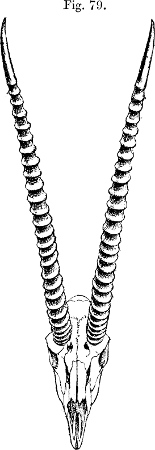
Fig. 79.
Skull and horns of Peters’s Gazelle, ♂.
(From one of Mr. Jackson’s specimens in the British Museum.)
In 1884 Dr. Günther, commenting on Peters’s figure of this supposed Gazella granti, stated that in his opinion it “clearly belonged to a distinct species. It resembled somewhat Gazella thomsoni in the slight degree in which the horns diverge from each other; but their annulated portion was almost straight, and the annuli themselves were much further apart, much fewer in number (about twelve), and lower towards the hinder part of the horn. The base of the bony core showed a bossy swelling, which was different from that of Gazella granti, and entirely absent in Gazella thomsoni.” This species Dr. Günther proposed to call Gazella petersi.
There has, however, been much doubt raised by subsequent authorities as to the validity of this species, and although we have given a separate heading to Gazella petersi we have had considerable hesitation as to whether it ought not to be regarded rather as a local subspecies of G. granti, to which it is closely allied in all essential characters. But since we have as yet seen no specimens absolutely intermediate between the two, so far as the rump-markings are concerned, we have thought it advisable to keep them provisionally separate. At the same time we shall be in no way surprised if such specimens should occur, in which case the two forms will have to be united. As regards the skulls, no constant or tangible difference can be made out, although those of G. petersi can usually be distinguished by their smaller size, narrower nasal opening, and shorter and less divergent horns.
Mr. F. G. Jackson, in ‘Big Game Shooting,’ gives us the following account of this Gazelle and his experiences with it:—
“Gazella petersi (known to the Swahilis also as ‘Sala’) may be a local variety of G. granti rather than a distinct species. It used to be plentiful at Merereni on the British East African coast, and is still found further inland in the Galla country. It is certainly a smaller beast than Gazella granti from Kilimanjaro and Machakos, but in other respects is almost identical, excepting in the shape and size of the horns, which I have never known to exceed 22 inches in length measured along the curve. The horns are also straighter, and have not nearly such a pronounced backward curve as those of G. granti, neither do they diverge towards the points so much, being rarely more than seven or eight inches apart at the widest parts. Gazella petersi is found in the small open plains and open scrub.”
In the gallery of the British Museum there is a good mounted specimen of the adult male of this species, also another younger specimen from the “Mainland opposite Zanzibar,” and a third from “Mombasa,” besides two skulls (♂ and ♀) from “South Somaliland,” all presented by Sir John Kirk. These were formerly labelled G. granti, but must be referred to G. petersi if the species are kept separate. There is also in the Museum a fine skin and skull of a male G. petersi from near Mount Pika-pika, about 40 miles from Mombasa, presented by Mr. L. E. Caine. It would appear, therefore, that the range of G. petersi until lately extended all along the coast of British East Africa, though it has now perhaps been nearly shot out in the southern parts.
The British Museum has likewise three skulls of this Gazelle from the Tana River presented by Mr. F. J. Jackson, to whom we are also much indebted for the loan of two other representative heads of this species from Merereni, south of Formosa Bay.
September, 1898.
102. THE BANDED GAZELLE. GAZELLA NOTATA, THOS.
Gazella grantii notata, Thos. Ann. Mag. N. H. (6) xx. p. 479 (1897); A. Neumann, Elephant-Hunting in E. Africa, p. 238 (1898).
Only known from a single flat skin, without the head. Fur unusually long and shaggy. Size about as in G. granti, and general body-markings as in that species, but all much intensified. Dark and light lateral bands much longer and broader, the former nearly black and reaching forwards on to the shoulder, and backwards nearly to the white rump-mark; the latter pale buff, and succeeded above by a second dark band, lighter than the main lateral band, but distinctly darker than the centre of the back. This second dark band united with the other behind the posterior end of the light band. Pygal band black and very strongly defined.
Horns said by the discoverer to have been like those of G. granti.
Hab. Western slope of the Loroghi Mountains, British East Africa.
In Mr. Arthur H. Neumann’s recently published volume on ‘Elephant-Hunting in East Equatorial Africa’ there will be found an account of his adventurous journey to Lake Rudolph, during which, on more than one occasion, he made his camp for some months at El Bogoi, a place situated east of the Loroghi Mountains, in rather higher than 1° N. lat., which was a favourite station for elephants. While at this place in October 1895 Mr. Neumann, accompanied by his native attendants, made an excursion over the Loroghi range, and encamped close to the edge of the open country on their western slope, at an elevation reckoned to be about 5500 feet above the sea-level, at a place called in the map attached to his narrative Kisima. Here, on taking a stroll into the open, he “shot a brace” of what he at first supposed to be Grant’s Gazelles; but on examination he found that they differed from the Grant’s Gazelles of the other side of the range, and of everywhere else that he had been, “in having longer hair, and dark bands on the sides,” while the “shade on the back” was also deeper than in the common kind. On one of the skins thus obtained and presented to the British Museum (see fig. 80), Thomas has based his subspecies “Gazella grantii notata.”
For much the same reasons as in the case of G. petersi, that is because no intermediate examples were yet known, we decided, when drawing up our Synopsis of Gazelles (above, p. 69), to give a separate heading to this form.
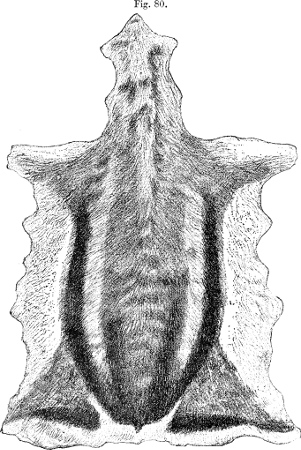
Fig. 80.
Skin of the Banded Gazelle.
But since our Synopsis was prepared, Lord Delamere has sent home some skins which are, to a certain extent, intermediate between G. granti and G. notata in the development of the dark markings, and which, therefore, support Thomas’s original view that the latter should be looked upon as a subspecies of the former. Yet, on the whole, Lord Delamere’s skins are more like G. granti than G. notata, especially in the character of their fur, so that they may be provisionally assigned to the older known form, leaving the exact status of G. notata to be settled when further materials are available.
Thomas stated, in his original description of G. notata, that this Gazelle had also been obtained by Mr. H. S. H. Cavendish, that traveller having supposed that he recognized in the typical skin of G. notata a Gazelle which he had met with during his journey to Lake Rudolph. This supposition, however, has been proved to be mistaken, as the Gazelle in question when brought home turned out to belong to G. thomsoni—an animal up to that date unknown to Mr. Cavendish. Mr. Neumann, the donor of the typical skin of G. notata to the British Museum, remains, therefore, the only sportsman who has yet met with this handsome form, concerning which we hope to receive further information before long.
September, 1898.
THE BOOK OF ANTELOPES, PL. LXX.
Wolf del. J. Smit lith.
Hanhart imp.
Soemmerring’s Gazelle.
GAZELLA SOEMMERRINGI.
Published by R. H. Porter.
103. SOEMMERRING’S GAZELLE. GAZELLA SOEMMERRINGI (Cretzschm.). [PLATE LXX.]
Antilope soemmerringii, Cretzschmar, Atl. Rüpp. Reise, p. 49, pl. xix. (♂) (1826); J. B. Fisch. Syn. Mamm. p. 462 (1829); Rüpp. N. Wirb. Abyss. p. 25 (1835); Less. Compl. Buff. x. p. 287 (1836); Waterh. Cat. Mamm. Mus. Z. S. (2) p. 40 (1838); Laurill. Dict. Univ. d’H. N. i. p. 616 (1839); Gerv. Dict. Sci. Nat. Suppl. i. p. 261 (1840); Less. N. Tabl. R. A. Mamm. p. 176 (1842); Rüpp. Verz. Senck. Mus. p. 38 (1842); Sund. K. Vet.-Ak. Handl. 1842, p. 201 (1843); Wagn. Schr. Säug. Suppl. iv. p. 415 (1844), v. p. 405 (1855); Reichenb. Säug. iii. p. 114, pl. xxxiv. fig. 205 (1845); Schinz, Syn. Mamm. ii. p. 403 (1845); Sund. Pecora, K. Vet.-Ak. Handl. 1845, p. 266 (1847); id. Hornschuch’s Transl., Arch. Skand. Beitr. ii. p. 262; id. Reprint, p. 82 (1848); Schinz, Mon. Antil. p. 7, pl. v. (1848); Gieb. Säug. p. 308 (1853); Heugl. Faun. roth. Meer, Peterm. Mitth. 1861, p. 16; id. Ant. u. Buff. N.O.-Afr. (N. Act. Leop. xxx. pt. 2) p. 7 (1863); id. N.O.-Afr. ii. p. 102 (1877); Hartm. Z. Ges. Erdk. Berl. iii. p. 254 (1868).
Gazella soemmerringii, Jard. Nat. Libr. (1) vii. p. 215, pl. xxviii. (1842); Gray, List Mamm. B. M. p. 161 (1843); id. Ann. Mag. N. H. (1) xviii. p. 231 (1846); id. Knowsl. Men. p. 5 (1850); id. P. Z. S. 1850, p. 114; id. Cat. Ung. B. M. p. 59 (1852); Temm. Esq. Zool. Guin. p. 193 (1853); Scl. P. Z. S. 1867, p. 817, pl. xxxvii. (yg.); Fitz. SB. Wien, lix. pt. 1, p. 158 (1869); Blanf. Zool. Abyss. p. 260 (1870); Scl. P. Z. S. 1871, p. 701 (Suez?); Gray, Cat. Rum. B. M. p. 39 (1872); id. Hand-l. Rum. B. M. p. 107 (1873); Brooke, P. Z. S. 1873, p. 549; Scl. List An. Z. S. (8) p. 142 (1883); Lort Phillips, P. Z. S. 1885, p. 932; Jent. Cat. Ost. Leyd. Mus. (Mus. Pays-Bas, ix.) p. 137 (1887); id. Cat. Mamm. Leyd. Mus. (op. cit. xi.) p. 169 (1892); Thos. P. Z. S. 1891, p. 210; W. Scl. Cat. Mamm. Calc. Mus. ii. p. 161 (1891); Scl. P. Z. S. 1892, p. 100; Swayne, P. Z. S. 1892, p. 305; Jent. Cat. Mamm. Leyd. Mus. (Mus. Pays-Bas, xi.) p. 169 (1892); Ward, Horn Meas. (1) p. 108, (2) p. 150 (1896); Lyd. Horns and Hoofs, p. 236 (fig., head) (1893); Swayne, P. Z. S. 1895, p. 305 (habits); id. Seventeen Trips to Somaliland, p. 314 (1895); Donaldson Smith, P. Z. S. 1895, p. 868 (Juba R.); Hoyos, Zu den Aulihan, p. 179, pl. x. fig. 6 (1895); Thos. Ann. Mus. Genov. (2) xvii. p. 107 (1896); Elliot, Publ. Chicago Mus., Zool. i. p. 122 (1897).
Antilope soemmerringii berberana, Matsch. SB. nat. Freund. 1893, p. 65; Rhoads, P. Ac. Philad. 1896, p. 519.
Vernacular Names:—Arab or Harab at Massowa, Bus-Adu in Danakil, Om-Sabah in Arabic (Heuglin); Aoul of Somalis (Swayne).
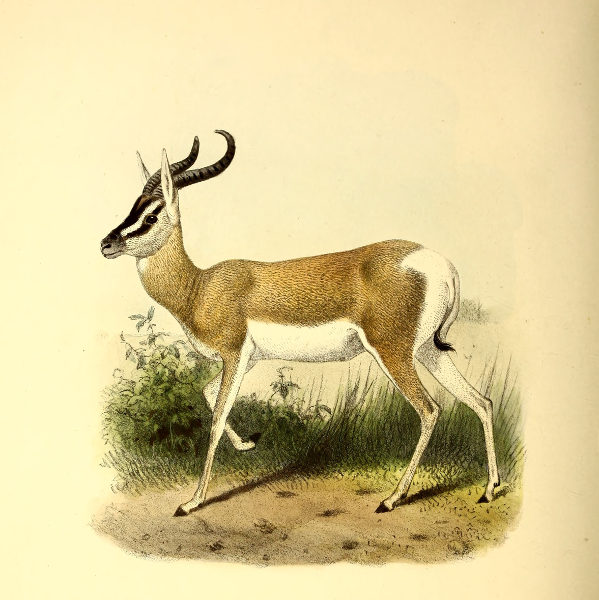
Size large, height at withers 35½ inches in an old male of the Somali subspecies. General colour very pale fawn, and very uniform everywhere, as there are neither light nor dark lateral bands nor any pygal bands. Central facial band black or blackish fulvous, contrasting markedly with the white lateral facial streaks. Dark facial streaks also black, but very narrow. Sides of muzzle black, continuous with the central facial band. Back of ears whitish, margined and tipped with black. White of rump very broad and extended, projecting far into the body-colour, which it broadly shuts off from the tail. The latter is white basally, black tufted terminally. Knee-brushes present, whitish or fawn.
Basal length of skull 8·85 inches, greatest breadth 4·2, muzzle to orbit 5·4.
Horns long, nearly circular in section, heavily ringed. In the typical subspecies they are but little divergent for their basal half, but then curve widely outwards above, their tips being again abruptly hooked inwards so as to point almost directly towards each other. In the Somali subspecies their length is greater and their divergence is quite even, not increasing above, so that their upper portions are not nearly so widely separated; their tips also hook rather forwards, and not so directly inwards.
Female similar to the male, but the horns much thinner and less rough, though almost as long as those of the male. In both of the subspecies their curvature is closely similar to that found in their respective males.
Hab. Coastland of Red Sea from Suakin south to Tajurah (subspecies typica); Northern Somaliland (subspecies berberana).
This fine Gazelle was one of the many discoveries made in North-east Africa by the great traveller and naturalist Edouard Rüppell, and was first described and figured by Cretzschmar in the ‘Atlas’ which illustrated the zoological portion of Rüppell’s ‘Reise.’ The species was dedicated to Ritter Samuel Thomas von Soemmerring, on the occasion of that savant attaining the fiftieth year of his Doctorate—an event which was celebrated by the Senckenbergian Naturalists’ Society of Frankfort-on-the-Main on the 7th of April, 1828. The original specimens were procured by Rüppell on the eastern slope of the Abyssinian coast-range, and were deposited along with all his other collections in the Senckenbergian Museum. In a résumé of his knowledge of the East-African Antelopes contained in a subsequent work on the Vertebrates of Abyssinia, Rüppell tells us that he only met with this species in the bush-clad valleys of the Abyssinian coast, but that it was said to occur also on the large island of Dahalak off Massowah. It was generally observed in small families, which, however, sometimes congregated into larger herds.
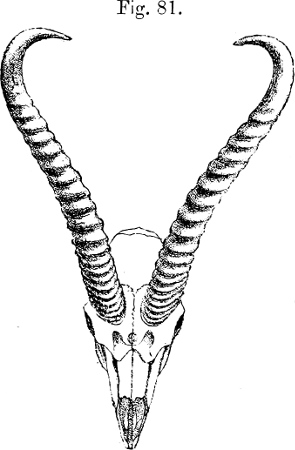
Fig. 81.
Skull and horns of Gazella soemmerringi typica (male).
(From a specimen in the British Museum.)
Heuglin, another good authority on the animals of North-east Africa, informs us that this Antelope extends along the coast of the Red Sea from 20° N. latitude southwards to the Danakil country, and that it is also found in valleys of the Baraka and Atbara in the interior, and extends up to the neighbourhood of Berber, but is not so plentiful here as in the coast-districts.
Dr. W. T. Blanford, who accompanied the British Abyssinian Expedition of 1867–68 as naturalist, found this Antelope abundant on the coast of the Red Sea near Annesley Bay and Massowah, but states that it never ascends the hills. It was met with principally in the low bush and acacia-scrub in herds varying in size from a few individuals up to one hundred or more. A very large number, he adds, were shot by the sportsmen of the Expedition, who found the flesh excellent eating.
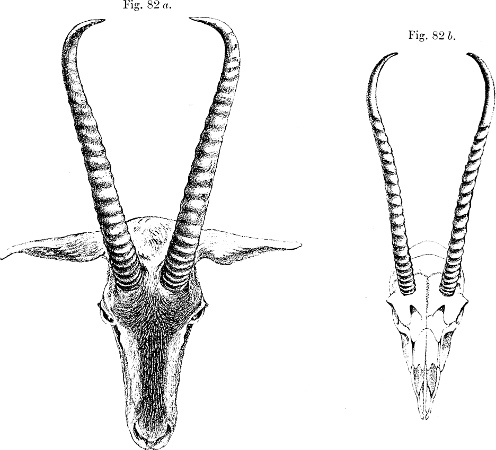
Fig. 82a. Fig. 82b.
Horns of Gazella soemmerringi berberana, ♂ & ♀.
(From specimens in the British Museum.)
Examples of Gazella soemmerringi are recorded by Sundevall as being contained in the extensive collections received by the Stockholm Museum which were made by the Swedish traveller Hedenborg in Sennaar, but the exact localities are not specified.
So much is all we have to say about the smaller and typical form of this species originally discovered by Rüppell. But about the larger subspecies of Northern Somaliland, which has been named berberana by Herr Matschie, we are able to give greater details from information supplied by the many naturalists and sportsmen who have of late years visited the country which it inhabits. Although it does not appear that there is any discontinuity between the ranges of these two forms, and it is quite likely that intermediate specimens may occur where the two forms meet, we cannot but allow that Herr Matschie was justified in assigning a subspecific name to the Southern form. Not only is the latter a larger and finer animal with longer horns, but the curvature of its horns is, as we have already pointed out, so different that, so far as our experience goes, there can be no difficulty in distinguishing the two forms by this character alone.
Capt H. G. C. Swayne, R.E., in his ‘Seventeen Expeditions to Somaliland,’ writes thus of Gazella soemmerringi:—
“Five years ago, when I was staying in the quarters at Bulhár, the Aoul could be seen from the bungalow grazing out on the plain. The Bulhár Maritime Plain used to be full of them, but they have been so persecuted by sportsmen that they have now retired to some distance.
“The Aoul weighs about the same as the Gerenúk, but has a shorter neck and a more clumsy-looking head, and is altogether a coarser animal. It is a grass-feeder, and lives in the open plains or in scattered bush, and never in thick jungle, and prefers tolerably flat ground. The white hind-quarters can be seen from a great distance, making a herd of Aoul look like a flock of sheep in the haze of the plains. I have never seen them in the cedar-forests on the top of Gólis, but in the hartebeest-ground to the south they are common. They are often met with in large herds along with the hartebeests, and are very common all over the Haud and Ogádén and near the Webbe.
“They are, I think, the most stupid and easy to shoot of all the Somáli Antelopes, and their habits are identical with those of the Indian Blackbuck, but they are not equal to it in beauty and grace of movement. Aoul often make long and high jumps when going away, presumably to look over the backs of the others; they look something like specimens of the Cape Springbuck which I have seen in England. I have never observed them spring vertically to a great height, as the Indian Blackbuck does. They are inquisitive like the Hartebeests, and will follow a caravan in the open, and if fired at they make off across the front, stretching themselves out at racing speed, and drawing up in a troop now and then to gaze.”
Captain R. H. Light, of the Indian Staff Corps, who visited Somaliland in 1891, and has kindly furnished us with some field-notes on its Antelopes, writes that this Gazelle is found there in couples, and also in herds of fifty or more, and generally frequents plains with slight coverts. They are not usually difficult of approach, and out of a large herd he has shot four, one after the other, within a mile of ground, the herd moving off at every shot, but allowing him to approach again. At 150 yards distance or so Capt. Light says it is very hard to distinguish a buck from a doe of this Antelope, the size of the body being the same, and the slight differences in the thickness of the horns and neck being hardly perceptible. Their gait is longer and slower than that of Pelzeln’s Gazelle, but still not awkward like that of the “Gerenuk” (Lithocranius walleri).
Mr. F. Gillett, F.Z.S., who accompanied Dr. Donaldson Smith during the first portion of his journey to Lake Rudolph, and made other expeditions in Somaliland, has favoured us with the following notes on this species:—
“Gazella soemmerringi is the common Gazelle of the interior of Somaliland, supplanting the two Gazelles G. spekei and G. pelzelni, which inhabit the country lying to the south of the Golis Mountains and the barren ground along the coast respectively. Its native name is ‘Aoul,’ and it is found in the open plains, as a rule in herds of from four to sixty beasts, although occasionally I have come across an old buck by himself. On July 14th, 1894, I saw a small herd of these Gazelles about long. 44° 30´ E. and lat. 9° 48´ N., which is the most northerly point at which I have found them, whilst to the east they are not met with till even farther south. Herds of Speke’s Gazelle are seen in company with Soemmerring’s Gazelle as far south as lat. 9° 6´ N., after which Gazella soemmerringi is alone found.
“Whilst in the Haud in 1894 I saw Oryx, and Waller’s, Speke’s, and Soemmerring’s Gazelles all together at the same time. The Soemmerring’s Gazelles prefer the open plains, although they are also found in bushy park like country, but never in the Khansa forests like Gazella walleri. When sighting anything strange they bunch together and stare; they are the least timid besides being the most plentiful of the Somali Antelopes, but in the open plains they will often allow you to walk past them at 200 yards distance, whilst any Oryx that are with them decamp long before. The horns of the female are much more slender than those of the male, they are also shorter and more irregular.
“The flesh of this Gazelle is preferred by the Somalis to any other, and on several occasions I have been asked by sick men to shoot one for them, especially in cases of fever, when it is considered to be very strengthening. When in the Arusa Galla country in 1894–5 I did not come across this Gazelle between the Webbe Shabeyli and long. 40° 30´ E., lat. 7° N.; in fact once across the Webbe I did not meet it again till my return to Somaliland, the country beyond being absolutely unsuited to it. In the Aulihan district opposite Bari, however, I met with it on the farther side of the Webbe.
“In February 1897, whilst camping in the Haud along with Mr. Percy V. Aylmer, we met with examples of this Gazelle at least 35 miles from the nearest water as the crow flies. As it was the dry season these animals could have obtained no moisture except dew unless they travelled that distance. Although at present the most plentiful, this, I fear, will be one of the first of the Antelopes of Somaliland to disappear, and the Reservation, as now laid down, will be of little or no use in protecting it.”
To Mr. Alfred E. Pease, M.P., F.Z.S., we are greatly indebted for the following notes on his experiences with this Antelope.—
“Soemmerring’s Antelope is widely distributed throughout Somaliland. In the following notes my remarks are confined to my own personal observations of this species during two expeditions. The first was in the north-western corner of the British Somali Protectorate, the second across the Haud into Ogaden and the country south of Harrar frequented by the Rer Mellingowr Ogaden. The average height of an adult male Soemmerring’s Gazelle is about 35 inches at the shoulder, with a girth behind the elbow of 32 inches. Unfortunately I never weighed any specimen. In colour they are amongst the most beautiful of the African Antelopes, and to see large herds of them moving about as the first bright gleams of the sun in the early morning touch them is one of the prettiest of the many charming sights that meets the traveller’s eye in this part of Africa. Their colour is an extremely rich clear pale orange on the body, spread evenly over the back, flanks, and running in narrowing bands down the four legs; this colour is set off by a wide margin of snowy white, which not only covers the whole of the belly and inner side of the legs, but which cuts back into the rump, so that when the Gazelle is standing with its tail towards you, you see little else but the snowy stern. Their heads are beautifully marked, the pervading tint forming the groundwork being of a slightly browner and fainter hue than the body, relieved by an almost black band running down from between the horns to the nostrils, and covering both sides of the nose and facial ridge; a short band, also very distinct, of the same colour runs down the tear-mark below the eye. In old bucks these dark stripes are often very nearly jet-black; in younger males and females the colouring varies from pale to dark brown. The throat is sometimes white, and when not altogether so, generally wears a more or less distinct crescent of white about two-thirds down the lower part of the underside of the neck. Both males and females carry heavy horns for animals of their size. The female’s horns are quite as long as, and perhaps slightly longer in proportion to their age than, the male’s, but they are weaker and less regular, though almost as deeply notched and annulated as in the buck. In general form they may be described as lyrate in a front view; the tips often point exactly towards each other, being separated sometimes two inches, sometimes even more than six. Sometimes the tips point backwards, and sometimes distinctly forwards.
“The ‘Aoul,’ as the Somalis call this Antelope, is almost ubiquitous in Somaliland. I have seen it within a few hours of Bulhar and Berbera on the maritime plain, whilst in 1896 we observed herds of it on the prairies to the south of the Elmas Mountains. Once in the mountains, whether in the ranges of the Gadabürsi country or of the Golis, you lose it and do not find it again, unless it be in some interlying plain, till you reach the region of the Haud. On the great prairies of the Haud I have seen an astonishing number of great herds from a single point of view. When travelling with Mr. E. N. Buxton and Mr. A. E. Leatham we first came on to the great Marar Prairie these Gazelles were seen in incredible quantities, and not having been hunted by even the Midgans (who devoted their time to pursuing the Oryx with their dogs and poisoned arrows) I found them astonishingly tame, so much so that after securing two or three specimens I never had the heart to betray their confidence, and have often walked past them in the thin bush that lines the northern edge of the plain within 20 paces, and on some occasions so near that I could almost have touched them with a long stick. At such times they have just lifted their heads till I had passed, and on looking back they had resumed feeding within a minute. I mention this as it is so very much in contrast with my experience when crossing the Toyoo Plain to the east in December 1896, when, though there were vast numbers of them, they were most extraordinarily wild and went off full gallop if you came within 400 yards of them. This was no doubt the result of having been shot at by English shikaris, who often take this route into Ogaden. On the Ogaden side of the Haud we found them frequently both in the long dhur grass, the home of the Dibatag (Ammodorcas clarkei), and also in open glades in the regular bush. When we were west of Milmil we came across these Gazelles occasionally till we reached the neighbourhood of the Tug Sulul; but I do not remember seeing them again in the more broken country that lies west of this Tug, and which continues practically hilly right up to the mountains of Bourka. From what I have been able to observe of the habits of this Antelope, I should think the traveller might expect to find it in any part of this corner of Africa where there are grass plains or where the bush is level and not too thick. It seems to thrive as well at sea-level as on the Haud at an elevation of 5000 feet.
“In the larger herds (say from 40 to 150 or more) the sexes are generally mixed, with a large preponderance of females. Some large herds are all females. Small herds may be either mixed, or all females, or all bucks. I do not call to mind having seen more than 14 old bucks alone together. The solitaires are, as a rule, old bucks, though you do not often see one quite alone at any distance from a herd. I have seen Speke’s Gazelle on the Toyoo Plain feeding in the same herd as the Aoul, and the latter are frequently in the company of the Hartebeest. The ‘Aoul’ is, in my opinion, identical with the Ariel, which is common in Abyssinia and the neighbourhood of Suakin, but it appears to diminish in size somewhat to the north.”
Of the typical form of this Antelope the British Museum possesses an adult male specimen (mounted, but not exhibited), obtained by Esler in the Bogos country, and purchased in 1873, also a female from Sennaar received from the Stockholm Museum, in exchange, in 1846—probably one of those collected by Hedenborg. It has likewise a young male from Abyssinia procured by Rüppell, the original discoverer of the species, and received in exchange from the Frankfort Museum; a skull of a male obtained by Mr. W. Jesse during the Abyssinian Expedition; and several heads and skins from Suakin collected and presented by Major W. Sparkes, of the Welsh Regiment, now attached to the Egyptian army.
Of the southern subspecies, Gazella soemmerringi berberana, the National Collection possesses a stuffed adult male specimen obtained on the Shebeyli River, Somaliland, and presented by Col. Arthur Paget, who has also given to the Museum two heads (male and female) from the Bourdap Mountains in the same country. In the British Museum there are likewise a mounted head and skins of both sexes of this Antelope collected by Capt. Swayne in Somaliland and presented by Sclater.
The first living examples of Soemmerring’s Gazelle received by the Zoological Society were purchased of a dealer in August 1867. The announcement of their arrival, which appeared in the ‘Proceedings’ for November 14th of that year, was accompanied by a beautiful lithographic plate of the young pair drawn by Mr. Wolf. In 1871 a fine young male example of this Antelope was presented by Mr. Charles McIver, Jun., with the information that the specimen had been obtained in the desert on the Red Sea coast about 100 miles south of Suez. If this was correct, the range of this Antelope would appear to extend considerably further north than we know of upon any other authority. Other specimens of this Antelope were obtained in 1877, 1879, 1892, and 1895, including a fine pair from Suakin presented by Col. Holled Smith, C.B., in July 1892. At the present moment, also, there is a fine male of this Antelope in the Society’s Gardens, obtained by purchase in 1897.
Our representation of this Antelope (Plate LXX.) was drawn by Mr. Wolf under Sir Victor Brooke’s directions, and put upon the stone by Smit. It is that of an adult male example, but we unfortunately do not know from what specimen it was taken.
September, 1898.
THE BOOK OF ANTELOPES, PL. LXXI
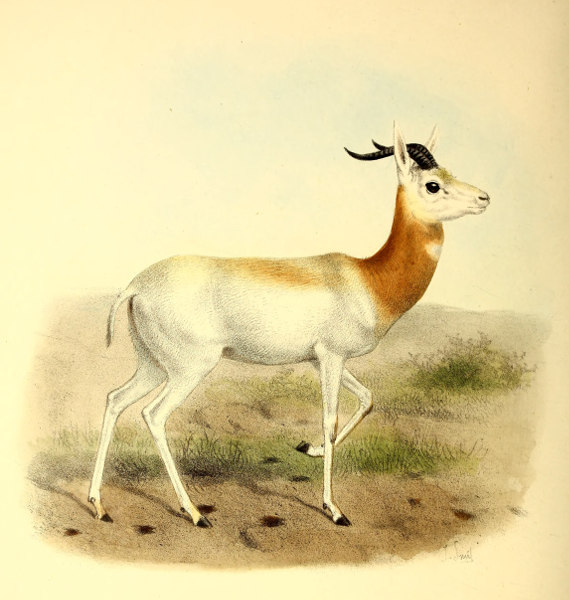
J. Smit del. et lith.
Hanhart imp.
The Red-necked Gazelle.
GAZELLA RUFICOLLIS.
Published by R. H. Porter.
104. THE RED-NECKED GAZELLE. Gazella Ruficollis (Ham. Smith). [Plate LXXI.]
Antilope dama, Licht. Abh. Ak. Berl. 1824, p. 226 (1826) (nec Pall.); id. Darst. Säug. pls. iii. (ad. & jr. ♂), iv. (♀ & jr.) (1827); Cretzschm. Atl. Rüpp. Reis. pp. 39 & 43, pls. xiv.-xvi. (1826) (Abyssinia); H. Sm. Griff. An. K. v. p. 331 (1827) (partim); Hempr. & Ehr. Symb. Phys., Mamm. pl. vi. (1828), text (1833) (Dongola); Rüpp. N. Wirb. Abyss. p. 25 (1835); Waterh. Cat. Mamm. Mus. Z. S. (2) p. 41 (1838); Rüpp. Verz. Senck. Mus. p. 38 (1842); Sund. K. Vet.-Ak. Handl. 1842, p. 201 (1843); Wagn. Schr. Säug., Suppl. iv. p. 408 (1844), v. p. 404 (1855); Schinz, Syn. Mamm. ii. p. 424 (1845); id. Mon. Antil. p. 25, pi. xxvi. (1848); Gieb. Säug. p. 308 (1853); Heugl. Ant. u. Büff. N.O.-Afr. (N. Act. Leop. xxx. pt. 2) p. 6 (1863); Hartm. Z. Ges. Erdk. Berl. iii. p. 253 (1868); Heugl. N.O.-Afr. ii. p. 103 (1877).