Subfamily V. ANTILOPINÆ. (continued 3)
Reading edition
A third name invented by Buffon for one of the Gazelles, “La Corine,” has likewise been the source of some confusion. His figure and description were taken from a female animal at one time living in the park of Saint Cloud, but its locality was not given. Owing to the fact that some horns, brought home by Adanson from Senegal, were subsequently referred to Buffon’s “Corine,” the name Gazella corinna (founded upon Buffon’s “Corine”) has been sometimes applied to the Gazella rufifrons of Senegal. But, so far as we can judge from Buffon’s figure and description, the real type of Buffon’s “Corine” must have been merely an ordinary female of Gazella dorcas, although there is some difficulty on the subject in consequence of the discrepancy between Buffon’s figure and his description. As Thomas has shown in his observations upon this point (P. Z. S. 1894, p. 469), it seems that a wholly satisfactory determination of Buffon’s “Corine” is barely possible.
It is manifest, however, that the names “kevella” and “corinna” cannot be safely assigned to any other Gazelle than Gazella dorcas.
The many systematists whose works we have quoted above in our list of synonyms added very little to our knowledge of this Gazelle beyond the fact that it was supposed to be distributed all over North Africa from Morocco to Egypt and to be also found in Palestine and Syria. It is only quite recently that we have ascertained some precise facts respecting the ranges of this and other Gazelles in the countries above mentioned, and even now our information on this subject is by no means perfect.
Commencing with Morocco, there is no doubt, we believe, from the testimony of various travellers, that a small Gazelle of this group does occur in the interior of that country and that it is probably of this species, but we have never had an opportunity of examining Moroccan specimens. In Algeria we have more definite information available.
From the days of Shaw the “Common Gazelle” has been recognized as an inhabitant of the “Barbary States.” The French naturalist Loche included it in his catalogue of 1858, but is not clear in distinguishing it from its allied species. Canon Tristram, in the ‘Great Sahara,’ published two years later, informs us that this Gazelle is found in small troops in every portion of the Sahara, and is the principal large game to be depended on for food, especially in the neighbourhood of the dayats beyond Laghouat, where pasturage is abundant. The fawns are dropped in the early summer, and follow the dam until towards the end of the autumn. The Bedouin gather the droppings, which have a strong aromatic scent, to mix with snuff.
In the pages of the ‘Exploration Scientifique de l’Algérie’ devoted to Mammals, likewise from the pen of Loche, we find a little more information concerning the Algerian Gazelles, but it does not appear that Loche was at all clear in discriminating the various species that are there met with.
Good and precise information has, however, been given us on this subject by Mr. Alfred E. Pease, M.P., in his article on the “Antelopes of the Aures and Eastern Algerian Sahara,” published in the Zoological Society’s ‘Proceedings’ for 1896, the principal portion of which we must quote at full length:—
“It is with great respect and diffidence that I object to the Dorcas being described (see P. Z. S. 1894, p. 467) as ‘the common Gazelle of the Algerian Sahara generally,’ for the Dorcas is not met with in the Sahara proper, so far as I can learn, and in the Eastern Algerian Sahara at least is not to be found south of lat. 33°. The Dorcas in the Eastern Province and in Tunisia is the common Gazelle of the plains immediately south of the Aures Range, which form a sort of transitional zone between the mountains and the Sahara proper. Roughly speaking, this Gazelle is confined to a belt of country not more than 120 or 150 miles wide (and generally very much narrower). It may be found in plains, or even in low hills, within the southern mountain-chains, and on or near some of the sand-dunes on the confines of the Chotts. I have frequently seen it in the neighbourhood of the Chotts, but once into the Oued Souf and sand desert and all trace of it is lost and the Rhime takes its place. In the district of Sef el Menadi, where I have been twice with Sir E. G. Loder, and where he secured the first specimen of the Gazelle (the Rhime) which now bears his name, we found both Rhime and Dorcas on the same ground; and this place may be marked as the most northern limit which the Rhime ever inhabits, as it never leaves the sand, I think, whilst the Dorcas does not go much further south than this. Probably there are several of these isolated islands of sand where the Rhime may be found.
“The best male Dorcas that I have shot had horns a little over 31 cm. in length, the best female 25 cm. (measured along the curve).
“They vary a good deal in colour according to the ground they frequent, and there is a slight variety among members of the same band. In 1893 there was on the plain of Aïn Naga a pure white one, no doubt an albino; but though my hunter had frequently seen it, he was never able to find it for me.”
Passing on to the Beylik of Tunis, we have excellent notes on the Gazelles of this country drawn up by Mr. Joseph I. S. Whitaker, F.Z.S., published in the same volume of the Zoological Society’s ‘Proceedings.’ Mr. Whitaker writes of this Gazelle as follows:—
“The common Dorcas Gazelle is to be met with throughout the greater part of Central and Southern Tunisia, frequenting the vast semi-desert plains abundant in those districts, but not the more sandy inland country of the extreme south of the Regency, where it is replaced by another species. So far as I can ascertain, the Dorcas Gazelle never occurs in the Tell country; but I have observed it in the neighbourhood of Kairouan, which is probably the extreme northern limit of the range of this species in the Regency. On the extensive plains to the west of Gafsa I have found it particularly abundant; and I understand it is plentiful in the neighbourhood of the Chott Djerid, and throughout a considerable portion of the coast-country of the south, but not in the true desert further inland, where sand-dunes take the place of the stony scrub-covered plains. It may occasionally stray into the sand country, but this is exceptional.
“In winter the Dorcas Gazelle congregates in large herds, often numbering over one hundred individuals; but in spring these herds break up, and one then meets with the Gazelles in small parties or singly. The female G. dorcas, I am told, gives birth to but one young one at a time, and this generally in the month of April.
“The horns of this species vary considerably both in size and in shape. As a rule, those of the adult male are stout, deeply annulate, and lyrate, measuring from 10 to 13 inches in length along the front curve; those of the female are much shorter, straighter, smoother, and more slender.
“I may here mention that I have specimens of the Dorcas Gazelle from the country south of the Chott Djerid, which are somewhat paler in colour than the ordinary form. No doubt this variation in colouring is due to some difference in the nature of the soil and surroundings of the districts from whence these particular specimens came.”
So little is known of the natural history of Tripoli and Barca that we can only presume that the Dorcas Gazelle ranges through these countries on its way to Egypt, where it is well known to be abundant in the Western Desert. Sclater examined large numbers of both sexes of this species in the Zoological Garden of Gizeh near Cairo in 1895 from this locality[8], and several specimens from the same source have been received in exchange by the Zoological Society of London. Our figures of both sexes of the Dorcas Gazelle (Plate LVII.) have been prepared by Mr. Smit from examples thus obtained.
In the eastern desert of Egypt the Dorcas Gazelle appears in these days to be not nearly so common. Mr. E. N. Buxton, who traversed the eastern desert in his expedition after Capra sinaitica, tells us that two or three Gazelles together were the most he ever saw at one time. Between the Nile and the granite mountains 80 miles to the east, a very arid district, Mr. Buxton only saw Gazelles once. They were more numerous among the foot hills of the Kettar range and the porphyry mountains, for the obvious reason that there is more vegetation there.
The Gazelles frequently depicted in the paintings of the ancient Egyptian tombs and temples were, no doubt, usually Gazella dorcas in Lower, and G. isabella in Upper Egypt, although they were probably also well acquainted with G. arabica. Dr. Hartmann in his interesting disquisition on the animals of these paintings (Zeitschr. f. Aegyptische Sprache und Alterthumskunde, 1864, p. 22) gives us the hieroglyphic symbols of the Gazelle, and its corresponding name as “Gahés.” It was evidently a common object of chase even in those days.
Crossing over into the Holy Land, we find the Dorcas Gazelle registered in Canon Tristram’s ‘Fauna and Flora of Palestine’ as met with in all suitable localities. From the same author’s ‘Natural History of the Bible’ we extract the following passages relating to this favourite animal:—
“The Gazelle (Gazella dorcas) is by far the most abundant of all the large game in Palestine; indeed it is the only wild animal of the chase which an ordinary traveller has any chance of seeing. Small herds of gazelles are to be found in every part of the country, and in the south they congregate in herds of nearly 100 together. One such herd I met with at the southern end of the Jebel Usdum, or salt mountain, south of the Dead Sea, where they had congregated to drink of the only sweet spring within several miles, Ain Beida. Though generally considered an animal of the desert and the plains, the gazelle appears at home everywhere. It shares the rocks of Engedi with the wild goats; it dashes over the wide expanse of the desert beyond Beersheba; it canters in single file under the monastery of Marsaba. We found it in the glades of Carmel, and it often springs from its leafy covert on the back of Tabor, and screens itself under the thorn bushes of Gennesaret. Among the grey hills of Galilee it is still ‘the roe upon the mountains of Bether,’ and I have seen a little troop of gazelles feeding on the Mount of Olives, close to Jerusalem itself. While in the open grounds of the south it is the wildest of game, and can only be approached, unless by chance, at its accustomed drinking-places, and that before the dawn of morning; in the glades of Galilee it is very easily surprised, and trusts to the concealment of its covert for safety. I have repeatedly startled the gazelle from a brake only a few yards in front of me, and once, when ensconced out of sight in a storax bush, I watched a pair of gazelles with their kid, which the dam was suckling. Ever and anon both the soft-eyed parents would gambol with it as though fawns themselves.”
Canon Tristram describes the mode of hunting Gazelles practised by the Arabs as follows:—
“The usual way of hunting the Gazelle is by lying in wait, either at its watering-places, which are always known to the Arabs, or in the defiles in the rocky districts. A more wholesale mode is practised in the Houran, by driving a herd into a decoy-enclosure, with a pitfall on the other side, where they are easily taken. When in company with great sheikhs, I have more than once had an opportunity of witnessing the chase of the Gazelle, after the only fashion which the high-bred Bedouin thinks sportsmanlike, viz. with the greyhound or the falcon, or more often with both combined. When the greyhound, which is the large Persian dog, with long silky ears and silky tail, is employed alone, success is very uncertain, and the ‘roe’ often ‘delivers itself from the hand of the hunter.’ When the chase is conducted with the falcon alone, the bird is trained to dash repeatedly at the head of the victim, taking an instinctive care not to impale itself on the horns (which, nevertheless, often happens), and by its feints so to delay the quarry that the horsemen are able to come up with it. But the favourite chase is by both bird and dog. The birds are first swung off at the Gazelle, and make repeated swoops, while the greyhound gains upon it and seizes it. With a well-trained bird the poor beast can rarely escape in this chase, unless he have a long start of the hunter. The flesh of the Gazelle, though of high repute, we did not find so savoury as that of the wild goat. Indeed it was generally very dry and always lean, but our taste is not that of the Arabs.”
In the desert country east of the Jordan, Canon Tristram tells us, the Dorcas Gazelle is replaced by the Arabian Gazelle (G. arabica); but a Gazelle, probably of this species, is found in the Syrian Desert north of Damascus, as testified by many writers.
In his interesting volume on ‘Palmyra and Zenobia,’ Dr. William Wright, describing his journey between Damascus and Palmyra, says:—
“We passed several gazelle-traps near Karyetan. Little walls converge to a field from a great distance, increasing in height as they approach the field. The field is walled round, leaving gaps at intervals, outside of which there are deep pits. The Gazelles, led on by curiosity, and guided by the little walls, march boldly into the field, and when they are startled, they rush out wildly in a panic, at the breaches, and tumble into the pits. Sometimes forty or fifty are taken out of a pit alive at one time.”
But, as we are informed in the valuable papers on the Mammals of Asia Minor published by Messrs. Danford and Alston in the Zoological Society’s ‘Proceedings’ for 1877 and 1880, the Dorcas Gazelle ranges far north of Syria. Danford states that it is “not uncommon” on the plain of Tchukurova and about Tarsus and Adana in the south-east of Asia Minor, and that it is “common” in the wooded valley of the Pyramus on the plain of Bazardjik and extends thence into the stony wooded uplands on the right bank of the Northern Euphrates.
When taken young, the Dorcas Gazelle is easily tamed and becomes very docile and affectionate. It is frequently kept in captivity by the Arabs and thus passes into the hands of Europeans who visit the East. As will be seen by reference to the Zoological Society’s List of Animals, specimens of this species reach the Gardens every year. But they cannot be said to thrive in the climate of England, where they miss the bright sun and dry air of their native deserts, and seldom produce young.
The series of examples of this Gazelle in the National Collection is by no means a full one, and wild-killed examples with ascertained localities from different parts of its range are much wanted. At the present time, besides a number of old specimens without localities, there are only in the collection an adult male from Biskra in Algeria presented by Sir Edmund Loder, a pair of skins from the same place presented by Messrs. Rowland Ward and Co., and a skull from Egypt presented by the late Sir Gardner Wilkinson. The accompanying illustration (fig. 57) gives a front view of a good head of this Gazelle prepared by Mr. Smit from these specimens.
January, 1898.
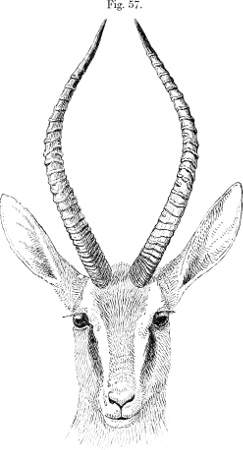
Fig. 57.
Head of the Dorcas Gazelle, ♂.
(From specimens in the British Museum.)
THE BOOK OF ANTELOPES, PL. LVIII.
J. Smit del. et lith.
Hanhart imp.
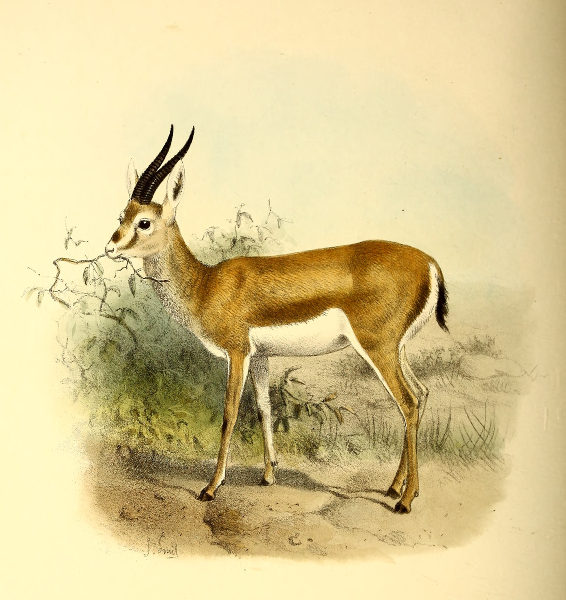
The Edmi Gazelle.
GAZELLA CUVIERI.
Published by R H Porter.
88. THE EDMI GAZELLE. GAZELLA CUVIERI (Ogilby). [PLATE LVIII.]
Kevel gris, F. Cuv. H. N. Mamm. (fol.) iii. livr. lvii. (1827), and iv. livr. lxix. (1833).
Antilope cuvieri, Og. P. Z. S. 1840, p. 34 (Mogador); Schinz, Syn. Mamm. ii. p. 399 (1845); id. Mon. Antil. pl. 2 a (1848); Fraser, Zool. Typ. pl. xvii. (1849).
Gazella cuvieri, Gray, Hand-l. Rum. B. M. p. 107 (1873); Brooke, P. Z. S. 1873, p. 542; Scl. List Vert. An. Z. S. (8) p. 140 (1883), (9) p. 154; Ward, Horn Meas. (1) p. 126 (1892), (2) p. 168 (1896); Lyd. Horns and Hoofs, p. 233 (1893); Thos. P. Z. S. 1894, p. 467; Pease, P. Z. S. 1896, p. 814; Whitaker, P. Z. S. 1896, p. 815.
Gazella dorcas, var. 3, Gray, Cat. Ung. B. M. p. 57 (1852).
Gazella cineraceus, Temm. Esq. Zool. Guin. p. 193 (1853) (from Kevel gris, F. Cuv.).
Gazella corinna, Loche, Cat. Mamm. Alg. p. 13 (1850); id. Expl. Alg., Mamm. p. 68 (1867) (nec Pall.).
Gazella kevella, Tristram, Great Sahara, p. 387 (1860); Lataste, Mamm. Barbarie (Act. Soc. Linn. Bord. xxxix.), sep. cop. p. 172 (1885); Buxton, P. Z. S. 1890, p. 363.
Vernacular Names:—Edmi of Arabs of Algeria (Pease); Edem in Tunis (Whitaker).
Size comparatively large; height at withers about 26 or 27 inches. Hair rather long, rough and coarse. General colour dull fawn. Face-markings distinct; the central facial band brownish fawn, with a black patch on the top of the nose, in front of which the muzzle is white. Ears long, pointed, their backs fawn. Dark lateral line and pygal band distinct, darker than back; light lateral line present, but little defined. Knee-brushes distinct.
Basal length of skull 7·35 inches, greatest breadth 3·6, muzzle to orbit 4·45.
Horns rather short in proportion to the size of the animal, thick, strongly ribbed, very slightly curved backwards, and but little divergent from each other; the tips slightly curved upwards and forwards.
Female. Similar, but horns shorter, slenderer, and straighter.
Hab. Morocco, Algeria, and Tunis.
The “Edmi” or Mountain Gazelle of Algeria, though it has often been confounded with the Dorcas, and has only been accurately known within the last few years, is without doubt an absolutely different species not only in structure, but in habits and mode of life. As Sir Victor Brooke has pointed out, it is easily distinguished from all its allies by its larger size, rough coat, dark colour, and long ears.
The first published information that we can certainly refer to this species is that of Frédéric Cuvier, who figured both sexes in his folio work on Mammals from specimens living in the Jardin des Plantes at Paris, but called it only “le Kevel gris,” without giving it any scientific designation.
Some time in 1839 a living female example of this Antelope was presented to the Zoological Society of London by Mr. W. Willshire, one of their corresponding members, who had procured it at Mogador. After its death in May 1840, Mr. Ogilby, who was at that time Secretary of the Society, and was specially interested in the study of mammals, brought the specimen before the notice of the Zoological Society at one of their scientific meetings, and proposed to name the species “cuvieri” after M. Frédéric Cuvier. Ogilby stated that he had observed examples of the same Gazelle in the Paris Museum, and that M. Cuvier would have described it had he, Ogilby, not done so. There can be no question therefore of Ogilby’s animal being the same as Cuvier’s “Kevel gris,” and that Gazella cuvieri is the earliest certain name to adopt for it.
In 1849 Fraser published a figure of this species in his ‘Zoologia Typica,’ taken from Ogilby’s typical specimen, which is now in the British Museum. Although imported from Mogador there can be little doubt that this example was originally obtained from the chain of the neighbouring Atlas. The Gazelles observed in the Great Atlas in company with Wild Sheep (Ovis tragelaphus) by Mr. W. B. Harris, F.R.G.S., on his journey from Morocco to Tafilat in 1893, were no doubt Gazella cuvieri.
Passing on to Algeria we find that Loche appears to have referred to this Antelope under the name Gazella corinna, and that Canon Tristram and Lataste have called it Gazella kevella. We have already shown, however, that both these names are properly to be applied to the Dorcas Gazelle.
In 1890, Mr. Edward Buxton met with this Gazelle during a shooting excursion into the Atlas, of which he has given us a most interesting account in one of the chapters of his ‘Short Stalks.’ Mr. Buxton’s principal object of pursuit on that occasion was the Aroui or Barbary Sheep (Ovis tragelaphus), but he also had the good fortune to obtain a fine head of the Mountain Gazelle, which he exhibited at a meeting of the Zoological Society on March 31st of that year (see P. Z. S. 1890, p. 363).
Mr. Buxton tells us, in the course of the remarks he made on this occasion, that the Mountain Gazelle of Algeria is “about twice the size of the Gazelle of the plains (Gazella dorcas), and has straight instead of lyre-shaped horns. It lives on the same kind of steep ground as the Aroui, perhaps at a rather lower elevation. The fact that it is essentially a mountain animal is, I think, shown by its large callous knees, like those of a London cab-horse. The Aroui has the same. They are, I think, absent in Gazella dorcas. Another feature consists in the curious hollows or pouches on each side of the testicles.”
In his ‘Short Stalks’ Mr. Buxton gives us full particulars of his adventures in obtaining the much-coveted head of this animal above referred to, and illustrates them by a beautiful picture of a group of these Gazelles drawn and engraved after his instructions by Mr. G. E. Lodge.
In his field-notes on the Antelopes of Eastern Algeria, published in the Zoological Society’s ‘Proceedings’ for 1896, Mr. A. E. Pease speaks as follows of the present species:—
“This Gazelle is by no means so rare as is generally supposed, though it is difficult to secure, its quickness and facility for eluding observation being equal almost to that of the Larrowi (Ovis tragelaphus). There is hardly a mountain in the southern ranges of the Aures where they are unknown, and I have seen them on almost every mountain from far to the N.W. of Biskra to the Tunisian frontier at Negrine. I know that they are common on the Djebel Cherchar, and I have seen them as far north as the hills and woods of Melagon, near Chelia. I have seldom seen more than eight in a herd, and far more frequently they are met with singly and in pairs, or bands of three to five. While frequenting the same difficult ground as the Larrowi, it is more usual to find them in larger numbers on those mountains which are lower than the highest. I have seen them on the plateaux and plains among the mountains, and they frequently descend at night to feed on the barley in the valleys, as also does the Larrowi. The best male horns I have measure rather more than 36 cm. along the curve.”
Crossing the frontier of Algeria into Tunis we find the Edmi Gazelle prevalent in suitable districts throughout that country. Mr. J. I. S. Whitaker, F.Z.S., who knows Tunis and its birds and mammals well, writes, in the same volume of the ‘Proceedings’ as we have quoted above, of his experiences of this animal as follows:—
“The Mountain Gazelle, the Edmi or Edem of the Arabs—the Tunisians use the latter name—is to be found sparingly on most of the mountains throughout the Tunisian Regency. Essentially a mountain species, as its name implies, it never occurs, so far as I am aware, on the plains, or at any distance from hilly country.
“I have met with the Edmi, and obtained specimens of it, on some of the higher ranges near Kasrin, in Central Tunis, and have found it in the south near Gafsa and Tamerza. In the north of the Regency it seems to occur on the mountains near Zaghouan, the extreme eastern range of the Atlas, and in the neighbourhood of Ghardimaou, on the Algerio-Tunisian frontier, from both of which places M. Blanc, the naturalist in Tunis, tells me he has received specimens in the flesh. I myself have also been offered Edmi-shooting on an estate only some twenty miles or so south of Tunis. It seems evident, therefore, that the species has a wide range in the Regency, although perhaps it is nowhere very abundant.
“The Edmi is to be found either in small herds or singly, and occasionally, though not as a rule, at a considerable elevation. On the Djebel Selloum and Djebel Semama, near Kasrin, both of which mountains are nearly 4000 feet above sea-level, I found the Gazelles about halfway up. These mountains, although steep in places and with some very rugged scarps, are in great part well-wooded with Aleppo pines, and on the lower slopes with a thick undergrowth of the usual maquis vegetation. In this brushwood the Gazelles easily escape detection and are naturally not very often seen. Although fond of cover, the Edmi will adapt itself to circumstances, and seems equally at home on the arid mountains of the south, where there is but little vegetation, and that merely of a dwarf description, affording slight shelter. In the spring, when my hunting-trips after Aoudad (Ovis tragelaphus) and Edmi have taken place, there has always been a little water on these mountains; but for some months of the year, I am told, the watercourses are dry, and the animals then, should they wish to drink, must travel some distance. That both these species, however, shift their quarters constantly I feel convinced, force of circumstances rendering them as much nomads as the Arabs themselves.
“The Edmi is very much larger than the Dorcas Gazelle, its weight being almost double. Its coat is darker in colour and with rather longer and coarser hair, while its knees, besides having very strongly developed brushes, show distinct callosities. The horns in the adult male are very stout and deeply annulated, and generally with but little curve, measuring about 13 inches, or even more in fine specimens. Those of the female are much more slender and smoother, but sometimes of fair length, some in my possession measuring 11 inches.”
Among the wood-blocks left ready for use by the late Sir Victor Brooke was a figure of a fine head of a male of this Gazelle drawn by Mr. Smit, of which we now give an impression.
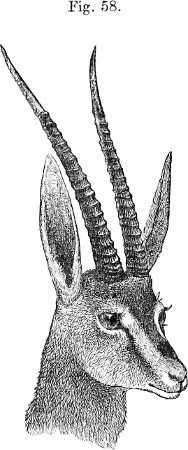
Fig. 58.
Head of Edmi Gazelle, ♂.
(Drawn by Smit under the direction of the late Sir Victor Brooke.)
The Edmi Gazelle is not often brought alive to Europe, but besides Ogilby’s type specimen, which we have already mentioned, at least three others have been exhibited at various times in the Zoological Society’s menagerie. An example of this species was first obtained in 1839, as mentioned in the Report of the Council for 1840, and another was acquired in November 1862. Others were presented by Capt. Alan Gardner, R.N., in June 1865, and by Rear-Admiral Sir William Hall, R.N., in May 1867. Sclater observed a female of this Gazelle in the Zoological Garden of Berlin in September 1897 (see P. Z. S. 1897, p. 813).
As we have already stated, the typical specimen of this Gazelle, formerly in the Zoological Society’s Collection, is now in the British Museum, as is also a stuffed female, originally presented by H.M. the Queen to the Zoological Society, but transferred to the National Collection in 1855. In the British Museum Gallery of Mammals will be found a good adult stuffed specimen of this Gazelle stated to be from near Biskra, Algeria, and presented by Mr. J. I. S. Whitaker. There are also some frontlets and horns of this species from the same locality presented by Messrs. Rowland Ward & Co.
We are greatly indebted to Sir Edmund Loder for a photograph of a head of a female of this Gazelle, taken from a specimen in his collection, which he himself shot on the 27th of February, 1893, on the Ahmar Khaddou Mountains, two days’ march east of Biskra. It shows very clearly the inferior size of the horns in this sex, and the long ears characteristic of the species.
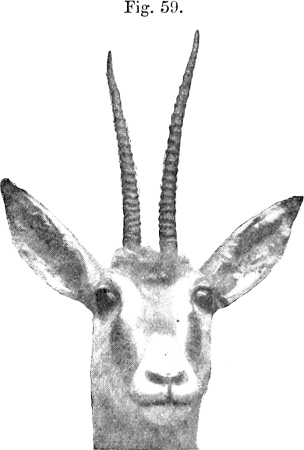
Fig. 59.
Front view of head of Edmi Gazelle, ♀.
(From a photograph.)
Our illustration of the male of this Gazelle (Plate LVIII.) has been drawn by Mr. Smit from the Algerian specimen in the British Museum above referred to.
January, 1898.
THE BOOK OF ANTELOPES, PL. LIX.
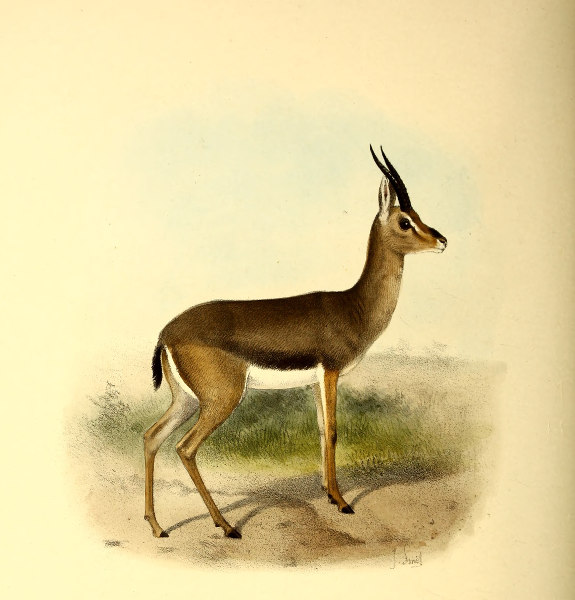
J. Smit del. et lith.
Hanhart imp.
The Arabian Gazelle.
GAZELLA ARABICA.
Published by R. H Porter.
89. THE ARABIAN GAZELLE. GAZELLA ARABICA (Licht.). [PLATE LIX.]
Antilope arabica, Licht. Darst. Säug. pl. vi. (1827); Ehrenb. Symb. Phys. Decas i. pl. v. (1828); Fisch. Syn. Mamm. p. 460 (1829); Less. Compl. Buff. x. p. 287 (1836); Waterh. Cat. Mamm. Mus. Z. S. (2) p. 40 (1838); Oken, Allg. Nat. vii. p. 1371 (1838); Gerv. Dict. Sci. Nat. Supp. i. p. 261 (1840); Less. N. Tabl. R. A. Mamm. p. 176 (1842); Wagn. Schr. Säug. Suppl. iv. p. 407 (1844), v. p. 403 (1855); Reichenb. Säug. iii. pl. xxxiii. fig. 188 (1845); Schinz, Syn. Mamm. ii. p. 399 (1845); id. Mon. Antil. p. 4, pl. ii. (1848); Gieb. Säug. p. 307 (1853); Heugl. Faun. roth. Meer, Peterm. Mitth. 1861, p. 16; id. Ant. u. Büff. N.O.-Afr. (N. Act. Leop. xxx. pt. 2) p. 5 (1863).
Gazella arabica, Temm. Esq. Zool. Guin. p. 193 (1853); Tristr. P. Z. S. 1866, p. 86; id. Faun. & Flor. Pal. p. 26 (1884) (Palestine); Fitz. SB. Wien, lix. p. 159; Blanf. Zool. Abyss, p. 261, pl. i. fig. 3 (horns) (1870); Brooke, P. Z. S. 1873, p. 544, 1874, p. 141 (fig., head); Scl. List Vert. An. Z. S. (1) p. 140 (1883), (2) p. 981 (1896); Jent. Cat. Ost. Leyd. Mus. (Mus. Pays-Bas, ix.) p. 137 (1887); W. Scl. Cat. Mamm. Calc. Mus. ii. p. 458 (1891); Jent. Cat. Mamm. Leyd. Mus. (Mus. Pays-Bas, xi.) p. 168 (1892); Ward, Horn Meas. (1) p. 114 (1892), (2) p. 156 (1896); Lyd. Horns and Hoofs, p. 179 (1893); Scl. P. Z. S. 1897, p. 812 (Hodeidah).
Antilope cora, H. Sm. Griff. An. K. iv. p. 216, v. p. 333 (1827); Less. Compl. Buff. x. p. 287 (1836).
Gazella cora, Gray, List Mamm. B. M. p. 161 (1843).
Antilope dorcas, var. δ, Sund. Pecora, K. Vet.-Ak. Handl. 1845, p. 268 (1847); id. Hornschuch’s Transl., Arch. Skand. Beitr. ii. p. 264; Reprint, p. 84 (1848).
Gazella vera, Gray, Knowsl. Men. pl. iii. (1850) (cf. Scl. P. Z. S. 1896, p. 984).
Gazella bennetti, Yerb. & Thos. P. Z. S. 1895, p. 555 (Aden).
Vernacular Names:—Ghasal of Arabs, like G. dorcas; Ariel or Aiel in Syria (Ehrenberg).
Size medium; height at withers about 24 or 25 inches. General colour dark smoky fawn, much darker than in the allied species. Facial markings distinct; central facial band dark rufous-fawn, with a black spot on the nose. Ears of medium length, brownish-fawn behind. Dark lateral and pygal bands smoky brown; light lateral band very slightly lighter than the back. Limbs more rufous than body; knee-brushes brown or black.
Skull with short broad nasals; anteorbital fossæ shallow in the only good skull available. Basal length 6·75 inches, greatest breadth 3·3, muzzle to orbit 3·7.
Horns thick and rather short, almost straight and parallel to each other, a little curved backwards below, and forwards above.
Female. Similar to the male, but horns short and straight.
Hab. Western Arabia.
Although the Arabian Gazelle was described and figured as long ago as 1827, and specimens of it are by no means rare in captivity, we have as yet received little information about its exact range and its mode of life. But the great peninsula of Arabia still remains, we must recollect, one of the largest tracts on the earth’s surface that has been least explored by scientific travellers.
Hemprich and Ehrenberg, the discoverers of this Gazelle, met with it during their travels on the eastern coast of the Red Sea, and transmitted specimens of both sexes to the Berlin Museum. Here they were first described and figured by Lichtenstein in his ‘Darstellung der Säugethiere’—a work devoted to making known the riches of the Mammal-collection of the great Institution of which he was the Director.
Following Hemprich and Ehrenberg’s MS., Lichtenstein named the species “Antilope arabica,” and a short time afterwards it was again described and figured by Ehrenberg in his ‘Symbolæ Physicæ’ under the same designation.
Ehrenberg informs us that he and his fellow-traveller Hemprich obtained their first specimens of this Gazelle at Hamam el Faraun, on the coast of the Sinaitic Peninsula between Suez and Tor, and subsequently found it abundant on the island of Farsan on the Arabian coast of the Red Sea. They also observed Gazelles which they believed to be of the same species near Baalbec in Syria, but these, we think, are more likely to have been Gazella dorcas.
Succeeding authorities have added very little to our knowledge of this Gazelle. Canon Tristram, in his ‘Fauna and Flora’ of Palestine, mentions a Gazelle occurring in the “desert-country east of the Jordan” as being probably of this species; but we believe that he did not obtain any good specimens of it. Dr. Blanford, in his volume on the ‘Geology and Zoology of Abyssinia,’ has figured (for comparison) a head of this species obtained by Captain Heysham near Mocha, S.W. Arabia; and in the Zoological Society’s ‘Proceedings’ for 1874, the late Sir Victor Brooke gave a woodcut of the head of this Gazelle, which, by the kind permission of the Society, we are enabled to reproduce.
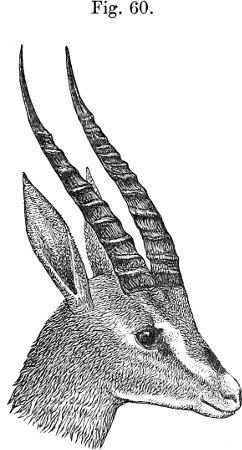
Fig. 60.
Head of Arabian Gazelle.
(P. Z. S. 1874, p. 141.)
Living examples of the Arabian Gazelle are easily obtained at Aden and at Hodeidah, Jeddah, and other Arabian ports on the Red Sea, and are often brought to Europe. We have little doubt that the Gazelles in the Derby Menagerie figured by Waterhouse Hawkins in the third plate of the ‘Gleanings,’ and there called by Lord Derby’s MS. name, Gazella vera, were of this species, though in the text they are referred to as G. dorcas and in the list of plates as G. cuvieri. The Zoological Society of London appear to have received their first specimens in 1874[9], and since that date (as will be seen by their published Lists of Animals) have acquired many examples, chiefly by presentation. At the present time there are two fine males in the Society’s Gardens, both brought from Aden and presented—one by Mr. R. G. Buchanan and the other by Mr. J. Benett Stanford, F.Z.S. From the former of these Mr. Smit’s drawing (Plate LIX.) was taken.
The British Museum has lately acquired from the Zoological Society a good male example of this Gazelle, which was obtained at Aden and brought alive to London. It has been mounted for the Mammal Gallery. The Museum also has the skull from Mocha figured by Dr. Blanford, as already mentioned, and since presented by him to the collection, and the skin of a young animal from Gilead, obtained by Canon Tristram, the determination of which is, however, somewhat doubtful.
January, 1898.
THE BOOK OF ANTELOPES, PL. LX.
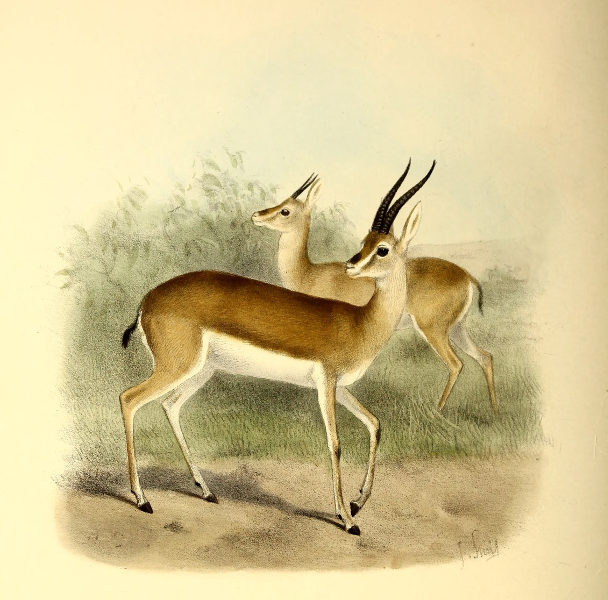
J. Smit del. et lith.
Hanhart imp.
The Indian Gazelle.
GAZELLA BENNETTI.
Published by R. H. Porter.
90. THE INDIAN GAZELLE. GAZELLA BENNETTI (Sykes). [PLATE LX.]
Antilope bennettii, Sykes, P. Z. S. 1831, p. 104; Less. Compl. Buff. x. p. 287 (1836); Waterh. Cat. Mamm. Mus. Z. S. (2) p. 40 (1838); Laurill. Dict. Univ. d’H. N. i. p. 617 (1839); Gerv. Dict. Sci. Nat. Supp. i. p. 261 (1840); Less. N. Tabl. R. A., Mamm. p. 176 (1842); Schinz, Syn. Mamm. ii. p. 400 (1845); id. Mon. Antil. pl. iii. b (1848); Reichenb. Säug. iii. p. 111 (1845); Fraser, Zool. Typica, pl. xvi. (1849); Horsf. Cat. Mamm. E. I. C. p. 166 (1851); Wagn. Schr. Säug. Supp. v. p. 405 (1855).
Gazella bennettii, Gray, List Mamm. B. M. p. 161 (1843); id. Ann. Mag. N. H. (1) xviii. p. 231 (1846); Hutton, J. A. S. B. xv. p. 150 (1846) (Neemuch); Gray, List Ost. B. M. p. 56 (1847); id. Knowsl. Men. p. 4 (1850); Temm. Esq. Zool. Guin. p. 193 (1853); Jerd. Mamm. Ind. p. 280 (1867); Blanf. J. A. S. B. xxxvi. p. 196 (1867); Kinloch, Large Game Shooting, p. 57, pl. (1869); McMaster, Notes on Jerdon, pp. 141 & 249 (1870); Blanf. Zool. Abyss. p. 261, pl. i. fig. 2 (horns) (1870); Stoliczka, J. A. S. B. xli. p. 229 (1872); Blanf. P. Z. S. 1873, p. 315 (distribution); Brooks, P. Z. S. 1873, p. 544; Blanf. E. Persia, ii. p. 91 (1876); Ball, P. A. S. B. 1877, p. 172; Scl. List Vert. An. Z. S. (8) p. 141 (1883), (9) p. 155 (1896); Flow. & Gars. Cat. Coll. Surg. ii. p. 264 (1884); Sterndale, Mamm. Ind. p. 463 (1884); Murray, Zool. Sind, p. 56 (1884); Blanf. Faun. Brit. Ind., Mamm. p. 526 (1891); W. Scl. Cat. Mamm. Calc. Mus. ii. p. 159 (1891); Jent. Cat. Mamm. Leyd. Mus. (Mus. Pays-Bas, xi.) p. 168 (1892); Ward, Horn Meas. (1) p. 124 (1892), (2) p. 166 (1896); Lyd. Horns and Hoofs, p. 175 (1893); Percy, Badm. Big Game Shooting, ii. p. 355 (1894).
Tragops bennettii, Hodgs. J. A. S. B. 1847, p. 11, & xvi. p. 695; Gray, P. Z. S. 1850, p. 116; id. Cat. Ung. B. M. p. 62 (1852); Adams, P. Z. S. 1858, p. 522 (Punjab); Gerr. Cat. Bones Mamm. B. M. p. 233 (1862); Blyth, Cat. Mamm. Mus. As. Soc. p. 173 (1863); Gray, Cat. Rum. B. M. p. 39 (1872); id. Hand-l. Rum. B. M. p. 108 (1873).
Tragopsis bennettii, Fitz. SB. Wien, lix. p. 157 (1869).
Antilope arabica, Elliot, Madr. Journ. x. p. 223 (1839) (Mahratta Country).
Gazella christii, Gray, Blyth, J. A. S. B. xi. p. 452 (1842); Hutton, J. A. S. B. xv. p. 151 (1846).
Antilope hazenna, I. Geoffr. St.-Hil. Voy. Jacq., Mamm. p. 74, Atl. pl. vi. (1844); Schinz, Mon. Ant. pl. xxi. a (1848); Wagn. Schr. Säug. Supp. v. p. 406 (1855).
Gazella hazenna, Temm. Esq. Zool. Guin. p. 193 (1853).
Tragopsis hazenna, Fitz. SB. Wien, lix. p. 157 (1869).
Gazella fuscifrons, Blanf. P. Z. S. 1873, p. 317 (fig., head ♀) (Jalk, Persia); Brooke, P. Z. S. 1873, p. 545; Blanf. E. Persia, ii. p. 92 (1876); Sterndale, Mamm. Ind. p. 465 (1884); W. Scl. Cat. Mamm. Calc. Mus. ii. p. 160 (1891).
Vernacular Names:—Chinkára, Chikára, Kol-punch in Hindustani; Phaskela in N.W. Provinces; Ask or Ast and Ahu in Baluchistan; Khazm in Brahmi; Kalsipi in Mahratta; Tiska, Budári, or Mudári in Canarese; Sank-húlé in Mysore; Porsya ♂, Chari ♀ in Baori; Burudu-jinka in Telugu; Ravine-Deer of many Anglo-Indians.
Size medium; height at withers 24 to 25 inches. General colour dull fawn. Facial markings distinct, the darker ones rufous-fawn; a black spot on the top of the nose. Ears of medium length, fawn-coloured behind. Dark lateral and pygal bands brownish fawn, scarcely darker than the back; light lateral bands scarcely perceptible; knee-brushes present.
Skull with deep anteorbital fossæ:—Basal length 7·2 inches, greatest breadth 3·45, muzzle to orbit 4.
Horns thick, heavily ribbed, close together, diverging little but evenly, gently curved backwards below and forwards at their tips.
Female. Similar to the male, but horns straight, simple, about two-thirds the length of those of the male.
Hab. Indian Peninsula, extending westwards through Baluchistan to the Persian Gulf.
Like the Lion and the Cheetah this Gazelle belongs to an Ethiopian type of mammals, and was originally, no doubt, an intruder into India from the west. But, as will be seen when we come to describe its range, it has now spread itself over the greater part of the peninsula except on the eastern side. On the west the Indian Gazelle extends far along the Mekran coast to the Persian Gulf, and there meets the Arabian Gazelle, of which it is undoubtedly a very close ally, although the latter is always much darker on the back.
Although the Indian Gazelle, or “Ravine-Deer,” as it is usually termed by Europeans, was doubtless known to the sportsmen of British India long ago, it was not made known to science until 1831, when Col. Sykes, one of the earliest pioneers in Indian natural history, described it in a communication made to the Zoological Society of London. Sykes, in his paper on the Mammals of the Deccan read before the Society in July of that year, proposed to name it Antilope bennetti, after the late Edward Turner Bennett, a well-known naturalist, who was at that time Vice-Secretary of the Society. Sykes met with this Antelope on the rocky hills of the Deccan “in groups rarely exceeding three or four in number, and very frequently solitary.” In 1849, Fraser published a figure of this species in his ‘Zoologia Typica,’ taken from one of Sykes’s male specimens in the British Museum, which is still in the National Collection, although not in the exhibition gallery. In 1844, in his description of the mammals of Jacquemont’s ‘Voyage dans l’Inde,’ Isidore Geoffr. St. Hilaire described and figured an Antilope hazenna, which he at that time considered to be different from the present animal. But there can be no doubt that Jacquemont’s specimens, which were obtained at Malwa in Central India, are the same as Gazella bennetti, and Sykes’s term being the oldest has been universally employed as the designation of this species. As we shall presently show, Gazella christii of Gray, from Sind, and Gazella fuscifrons of Blanford, from Baluchistan, are names which have been based on what are merely slightly divergent forms of Gazella bennetti.
From the researches of Elliot, Jerdon, Blyth, Blanford, and other authorities on the mammals of British India, we are now well acquainted with the range of this Gazelle in the peninsula and adjoining lands to the west. Dr. Blanford describes it as extending throughout the plains and low hills of North-western and Central India, and thence through Baluchistan to the eastern shore of the Persian Gulf. In the Indian peninsula, he continues, the Indian Gazelle ranges in suitable localities throughout the Punjab, Sind, Rajputana, the N.W. Provinces, and the whole of the Bombay Presidency with the exception of the Western Ghats and Konkan; it also occurs in Central India as far east as Palamow and Western Sargiya, and in the Central Provinces as far east as Seoni and Chánda, together with the Hyderabad territories and the Madras Presidency to a little south of the Kistna, Gazelles being found at Anantapur, south of Kurnool, and in Northern Mysore.
For an account of the habits of the Indian Gazelle and the modes of its chase, we cannot do better than refer to the last edition of General Kinloch’s ‘Large Game Shooting,’ where they are described as follows:—
“The favourite haunts of this Gazelle are extensive wastes of sandy or rocky ground, sprinkled with low bushes, and interspersed here and there with patches of cultivation. Thick jungles they avoid; and they are seldom to be met with in districts which are entirely under crop. During the daytime they resort to secluded spots where they are not subject to annoyance, and in the mornings and evenings they frequently repair to fields of young grain, sometimes in close proximity to villages.
“In some places they are extremely wild, and can only be approached by the most careful stalking; in other localities they are comparatively tame, and will allow the sportsman to walk openly to within easy range. At most times, however, they are restless little animals, continually on the move, and they have a provoking way of trotting off with a switch of their black tails the moment that they suspect danger.
“On open plains the best way of getting within shot of them is under cover of a steady shooting horse. As they afford but a small mark, and seldom remain still very long, quick as well as accurate shooting is required, and beginners in the art of rifle shooting will find them excellent practice.
“The officers of the Guides used to hawk the Gazelle in the neighbourhood of Hótó Mardán, the Falcons used for the purpose being nestling ‘charghs’ (Falco sacer). Adult caught birds cannot be trained for this sport, and the nestlings had to be obtained from the distant province of Balkh by the assistance of some of the Kábúl Sirdárs. In the present state of our relations with Áfghánístán, the Falcons cannot be procured, and the sport has, for the present at any rate, died out. The hawks alone could not kill a Gazelle, but were assisted by greyhounds, which used to pull it down after the hawks had confused and stunned it by repeated blows. I regret that I never had an opportunity of witnessing the flight, which has been described to me as very interesting and exciting.”
Dr. Blanford tells us that this Gazelle lives on grass and on the leaves of bushes, and, so far as he is aware, never drinks. “I have seen it,” he says, “in the deserts of Sind in places where the only water for twenty miles round was procured from wells; and in spots in Western and Central India where, in the hot weather, the only water to be obtained was in small pools remaining in the beds of streams. But around these pools, in which the tracks of almost every animal in the forest was to be seen, I never yet saw the very peculiarly formed tracks of the Gazelle, although it frequently abounded in the neighbourhood. The four-horned Antelope, on the other hand, drinks habitually.”
Gazella christii, which we have alluded to above as synonymous with this species, was a MS. name of the late Dr. Gray, which appears to have been first published by Blyth in 1842, and applied to a pale form of the present animal from Kutch and Sind. But more recent researches have shown that it is not properly separable from the typical Gazella bennetti.
Gazella fuscifrons, another synonym also mentioned above, was based by Dr. Blanford in 1873 on a doe with distinctly ringed horns and with portions of the face dark brown, obtained in Baluchistan. But the late Sir O. B. St. John subsequently procured what he justly concluded to be the male of this form, which, as acknowledged by Dr. Blanford himself, proved to be not distinct from Gazella bennetti. By the kindness of the Zoological Society we are enabled to reproduce Dr. Blanford’s figures of the head of Gazella fuscifrons, which, except for the slight differences above mentioned, give an equally good idea of the head of the typical G. bennetti.
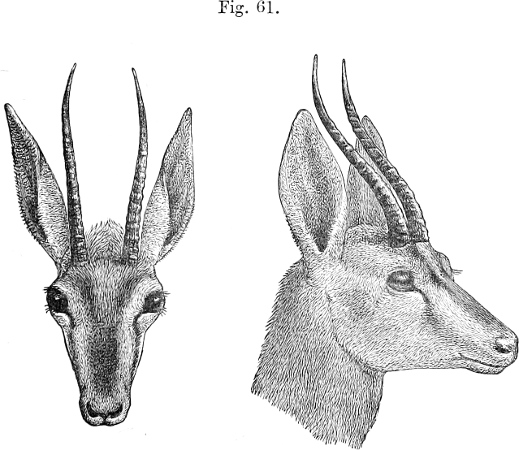
Fig. 61.
Head of Gazella fuscifrons, ♀.
(P. Z. S. 1873, p. 317.)
The Indian Gazelle is frequently brought to Europe alive, though it is not so common in our menageries as Gazella dorcas, G. subgutturosa, and some other species. According to the Zoological Society’s books, the first examples were received in 1838, and since 1860, as will be seen by the printed lists, about twelve specimens have been exhibited. A pair presented by Capt. H. J. Hope Edwards, in April 1883, bred, and the female gave birth to a young one in November of that year; but, like other Gazelles, this species does not usually thrive in the dull climate of England.
As is the case with many common animals, the British Museum does not contain a good series of this Gazelle, and specimens with exact localities from all parts of its range are much required. Besides the old mounted examples from the Deccan presented by Col. Sykes and already alluded to, it possesses only a skin from Sind received from the Karachi Museum, and several skulls and pairs of horns from the Salt Range of the Punjâb and Kelat, received in the Hume Collection.
Our figures of this species (Plate LX.) have been prepared by Mr. Smit—the male from the skin received from the Karachi Museum, and the female from Col. Sykes’s specimen.
January, 1898.
THE BOOK OF ANTELOPES, PL. LXI.
J. Smit lith.
Hanhart imp.
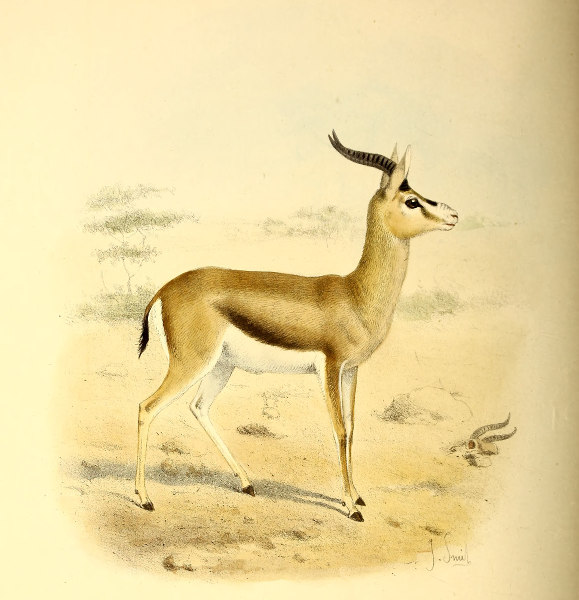
Speke’s Gazelle.
GAZELLA SPEKEI.
Published by R. H. Porter.
91. SPEKE’S GAZELLE. GAZELLA SPEKEI, Blyth. [PLATE LXI.]
Gazella, sp.?, Blyth, J. As. Soc. Beng. xxiv. p. 297 (1856).
“Gazella cuvieri, Blyth,” Speke, Rep. Zool. Coll. Somali, p. 8 (1860).
Gazella spekei, Blyth, Cat. Mamm. Mus. As. Soc. p. 172 (1863); Blanf. Zool. Abyss. p. 261, pl. i. fig. 5 (horns) (1870); Brooke, P. Z. S. 1873, p. 543; Kohl, Ann. Mus. Wien, i. p. 77, pls. iii., iv. fig. 3, & v. fig. 1 (animal & skull) (1886); Thos. P. Z. S. 1891, p. 210; W. Scl. Cat. Mamm. Calc. Mus. ii. p. 158 (1891); Scl. P. Z. S. 1892, pp. 100 & 118; Swayne, P. Z. S. 1892, p. 306; Ward, Horn Meas. (1) p. 112 (1892), (2) p. 153 (1896); Lyd. Horns and Hoofs, p. 234 (1893); Swayne, Somaliland, p. 316 (fig., head) (1895); Hoyos, Aulihan, p. 179, pl. x. fig. 3 (1895); Elliot, Publ. Chicago Mus., Zool. i. p. 120 (1897); Scl. P. Z. S. 1897, p. 920 (fig., head).
Gazella, sp. inc., Lort Phillips, P. Z. S. 1885, p. 932.
Gazella naso, Scl. P. Z. S. 1886, p. 504, pl. li. (head); id. in James’s Unknown Horn of Africa, p. 268, pl. iii. (1888).
Vernacular Name:—Dhero of Somalis (Swayne).
Size slightly greater than in G. dorcas; height at withers 23–24 inches. Body pale brownish fawn, the light lateral band but little paler than the back, then dark or dull blackish, not sharply defined. Central facial band brownish fawn; top of muzzle, over nasal bones, with a distinct blackish patch, in front of which there is a peculiar swollen and corrugated cushion of skin raised up above the level of the face, and extensible at the pleasure of the animal. Dark cheek-band narrow, indistinct, the light band above it broad and extending to the muzzle. Ears long, narrow, pointed, their backs whitish fawn. Knee-tufts present, brownish fawn. Pygal band very indistinct.
Skull with short broad nasals, the premaxillæ not or barely touching their outer corners. Basal length in an old male 6·5 inches, greatest breadth 3·35, muzzle to orbit 3·6.
Horns but slightly divergent, evenly and strongly curved backwards for three-fourths their length, their tips gently recurved upwards.
Female. Like the male, but the horns slender, little ridged, less curved, about three-fourths the length of those of the male.
Hab. Interior Plateau of Somaliland.
There can be no doubt that the two Gazelles which inhabit the maritime plain and the high inland plateau of Somaliland respectively, although they are closely allied, and have been confused together by some writers, belong to distinct species, distinguishable by well-marked characters. The Gazelle of the interior plateau, which we treat of first, when compared with that of the coast-land is at once recognizable by the generally browner colour, the darker lateral band, the black nose-spot, and above all by the wrinkled and elevated nose of the adult, which is not met with in the sister species.
Speke’s Gazelle was first discovered by the energetic African explorer, whose name it appropriately bears, during his expedition to Harar in the summer of 1854 in company with the late Capt. Sir Richard Burton[10]. Speke, who attended to the natural history of the expedition, forwarded the collections made upon this occasion to Blyth, at that time curator of the Asiatic Society’s Museum at Calcutta, and in the zenith of his zoological work. In his report upon the collection, which was published in the twenty-fourth volume of the ‘Journal of the Asiatic Society of Bengal,’ Blyth did not venture to bestow a new name on this Gazelle, although he gave an accurate description of it, and added a note (obtained from Burton) calling special attention to “the elevation of loose replicated skin upon the nose,” so that there can be no doubt as to which of the two allied species Speke’s specimens (which are still in the Calcutta Museum[11]) belong.
In the reprint of Blyth’s ‘Report,’ which was edited by Speke in 1860 after his return to this country, this Gazelle was erroneously referred to G. cuvieri of Ogilby. In 1883, however, Blyth, who had discovered that this was a mistake, proposed the name Gazella spekei for this species in his ‘Catalogue of the Mammals of the Asiatic Society’s Museum,’ and this appellation has been generally adopted for it ever since.
When the late Sir Victor Brooke wrote his Monograph of the Gazelles in 1873 Speke’s Gazelle was hardly known in this country, and Brooke was only acquainted with it from photographs of the type specimens in the Calcutta Museum. But since that date Somaliland has been fully opened to British travellers, and the numerous explorers and sportsmen who have visited that much-hunted country have brought back good sets of specimens both of Speke’s and of Pelzeln’s Gazelle, and made us well acquainted with the ranges and other peculiarities of these two species.
One of the first British travellers who visited Somaliland, and made the acquaintance of Speke’s Gazelle, was the late Mr. F. L. James, who proceeded there on a shooting-expedition in January 1884, accompanied by his brother and Mr. E. Lort Phillips[12]. Mr. Lort Phillips read some notes on the Antelopes obtained on this occasion before the Zoological Society in December 1885, and in alluding to this Gazelle called it the “Flabby-nosed Gazelle,” to which term Sclater attached a footnote stating that it was “probably of a new species,” but required further examination. This examination Sclater bestowed upon Mr. Lort Phillips’s specimens shortly afterwards (see P. Z. S. 1886, p. 504), and came to the correct conclusion that the so-called Flabby-nosed Gazelle was quite distinct from the species of the coast land. He unfortunately did not perceive that it was the species of the high plateau and not that of the coast land, which had already been named Gazella spekei by Blyth, and therefore gave it a new name, Gazella naso, under which appellation it will be found described and its characteristic head figured in Sclater’s article in the Zoological Society’s ‘Proceedings’ for 1886. But, as Thomas has subsequently shown (P. Z. S. 1891, p. 210), there can be no doubt that Gazella naso is merely a synonym of Gazella spekei.
Another well-known author, who must not fail to be quoted in any reference to the game animals of Somaliland, is Capt. H. G. C. Swayne, R.E. Capt. Swayne has made no less than seventeen trips to that attractive country, and is probably better acquainted with its larger mammals than any other living individual. In his excellent narrative of his adventures[13], Capt. Swayne has given us some capital notes on Speke’s Gazelle and its near ally Pelzeln’s Gazelle, both of which are known to the natives by the same name “Dhero.”
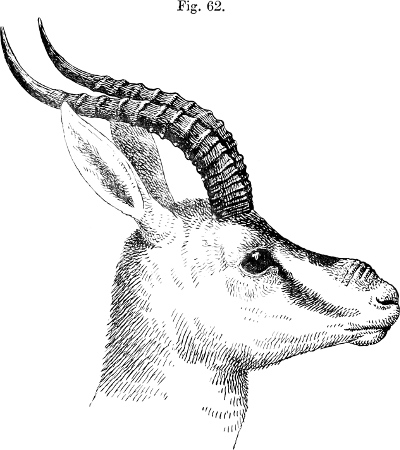
Fig. 62.
Head of adult male Speke’s Gazelle.
(Brit. Mus.)
Capt. Swayne calls the former Antelope the “Ogo, or Plateau Gazelle,” and the latter the “Guban, or Lowland Gazelle,” and describes the peculiarities of the present species as follows:—
“The Plateau Gazelle, which has the ridges of loose skin over the nose well developed, inhabits the elevated country, commencing about thirty-five miles inland. It is found south of Gólis, in Ogo and in the Haud, as well as in Ogo-Gudan, the country near Hargeisa where Guban rises gradually into Ogo.
“I have shot large numbers of Gazelles for food at various times, and have always noticed that the plateau variety has a much thicker and longer coat than the other. This is possibly the result of natural selection, as the high plains of the Ogo and the Haud, where it lives, are subject to sweeping cold winds, and the nights are very cold indeed. The altitude of these plains inhabited by the Plateau Gazelle is from three thousand to over six thousand feet, but doubtless they go much lower towards Ogádén. The great steppe of Gólis, with its prolongations east and west, which rises some forty miles inland, and separates Guban, the low coast country, from Ogo, the high interior country, forms the natural line of demarcation between these two Gazelles.”
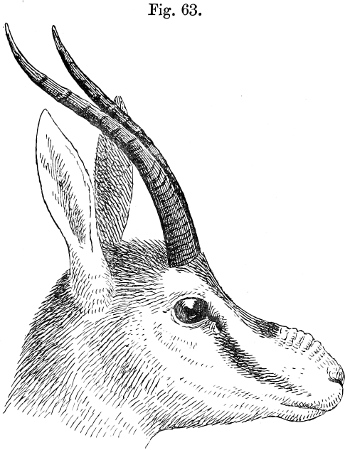
Fig. 63.
Head of adult female Speke’s Gazelle.
(Mr. F. Gillett, F.Z.S.)
A still more recent explorer of Somaliland, Mr. A. E. Pease, M.P., F.Z.S., has most kindly favoured us with some excellent notes on Speke’s Gazelle and its sister species, which we cannot do better than reproduce. Mr. Pease has also sent us along with his MS. remarks a sketch-map of the northern part of Somaliland, in which the ranges of these two species are accurately shown.
He writes as follows:—
“Speke’s Gazelle is called ‘Dhero’ by the Somalis, who do not distinguish it by name from Gazella pelzelni. It is a ‘Dhero,’ just as the other, and yet there is no Somali shikari or any other observer who cannot discriminate at a glance between these two very distinct species—distinct in colour, size, horns, and habitat, whilst the peculiar nose, covered with soft pliable folds of loose skin, of the G. spekei is alone sufficient to mark it as a species apart.
“The Speke’s or Plateau Gazelle has been termed the Mountain Gazelle by some writers; but it is not strictly a mountain Gazelle, but one that frequents the higher plains and low foot-hills north and south of the Golis. But with its distribution I will deal later.
“In colour the Speke’s Gazelles are much darker than Pelzeln’s Gazelles, the predominating colour in life being a rich strong burnt-sienna buff, distinctly darker over the back. The side-stripes are very dark brown, strongly marked, and maintaining their depth of colour to the edge of the white under the ribs and belly. The tail is a dark reddish brown, and the colour on the quarters towards the tail is of a deeper shade. The coat, though fine in texture, is very long for a Gazelle, being sometimes fully two inches long on the withers, and the stern is heavily feathered with long white hair. Altogether it is one of the most beautifully coloured of all the Gazelles. The head is also strongly marked, the deep dark brown patch on the nose and the tear-mark sprinkled with dark hairs are very distinctive. The enlargement of the nose is covered with three or four folds of loose pliable skin. The horns are more curved back and forward towards the tips than those of Pelzeln’s Gazelle, and on the average do not reach to quite the same length as in that species. Twelve inches along the curve would be an abnormally long horn for G. spekei, whilst this measurement is not uncommon in Pelzeln’s Gazelle. The female is very slightly lighter in colour, and has weak horns, reaching to about 9 inches in old ones, with slight indications of the annulations, which are deep and strong in the male.
“This Gazelle I have observed in large numbers on both sides of the Golis range. I have seen it in bands numbering from fifteen to twenty on the plateaux behind (S. of) Gan Libah and Dunanoof. In the Gadabursi country, on the northern limits of the Haud, west of Lija Uri, I have seen them frequently in small bands of from five to eight, and herds of this size may be said to be the rule in the zone north of the Golis Range and south of the Maritime Plain. I cannot call to mind having seen them much further south than the grass plains of Toyo, but there I have observed them mixed up with the Aoul or Soemmerring’s Gazelle.
“I should put down the height of this Gazelle at about 24 inches, and its weight, when living, at about 40 pounds.”
So far as we know, but one specimen of Speke’s Gazelle has as yet reached this country alive. This was a young male, presented to the Zoological Society’s Menagerie in November last year by Dr. L. de Gébert, who had obtained it at Djibutil, the French port of Abyssinia. Unfortunately it did not live long in captivity, but after its death Sclater, with Mr. F. E. Beddard’s kind assistance, was able to examine the specimen more closely. It exhibited a slight protuberance on the nose, as shown in the figure (fig. 64), which by the kindness of the Zoological Society we are enabled to reproduce on the present occasion. Underneath the skin of the nose was a slight cavity, which was easily inflated into a protuberance by blowing air into the nostrils. But dissection, which was carried out by Mr. Beddard, revealed no trace of any glandular structure.
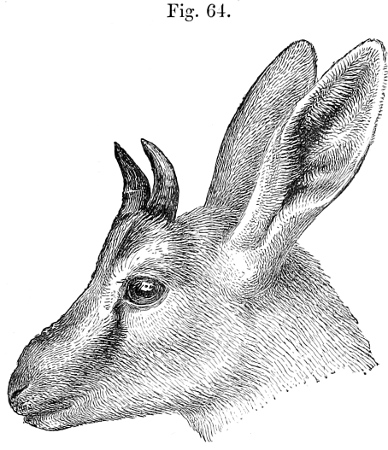
Fig. 64.
Head of young male Speke’s Gazelle.
(P. Z. S. 1897, p. 920.)
The collection of the British Museum contains a good mounted example of this Gazelle (procured from Herr Menges, and originally obtained from Gerbatir in Somaliland), from which the coloured figure (Plate LXI.) has been prepared by Mr. Smit. There is likewise in the Museum a good series of skins and skulls from different places in Somaliland collected and presented by Mr. T. W. H. Clarke, Capt. H. G. C. Swayne, R.E., Col. Arthur Paget, and Mr. Ford G. Barclay. From one of these our figure (p. 128) of a good adult head of this Gazelle has been prepared by Mr. Smit; while that of the female (p. 129) has been drawn from a mounted head kindly lent to us for that purpose by Mr. Frederick Gillett, F.Z.S.
May, 1898.
THE BOOK OF ANTELOPES, PL. LXII.
J. Smit lith.
Hanhart imp.
Pelzeln’s Gazelle.
GAZELLA PELZELNI.
Published by R. H. Porter.
92. PELZELN’S GAZELLE. GAZELLA PELZELNI, Kohl. [PLATE LXII.]
Gazella spekei, Scl. P. Z. S. 1884, p. 540; Lort Phillips, P. Z. S. 1885, p. 931 (nec Blyth).
Gazella pelzelni, Kohl, SB. zool.-bot. Ges. Wien, 1886, p. 4; id. Ann. Mus. Wien, i. p. 76, pls. iii. & iv. fig. 1 (animal & skull) (1886); Thos. P. Z. S. 1891, p. 211; Scl. P. Z. S. 1892, pp. 100 & 118; Swayne, P. Z. S. 1892, p. 306; Ward, Horn Meas. (1) p. 113 (1892), (2) p. 155 (1896); Lyd. Horns and Hoofs, p. 238 (1893); Swayne, Somaliland, p. 316 (fig., head) (1895); Hoyos, Aulihan, p. 178, pl. x. fig. 1 (1895); Elliot, Publ. Chicago Mus. Zool. i. p. 119 (1897).
Vernacular Name:—Dhero of Somalis (in common with the last species) (Swayne).
Size rather greater than in G. spekei; height at withers about 25 inches. Colour brownish fawn, rather more rufous than G. spekei. Light lateral band distinct; dark band rufous brown, similar to that of the back but rather darker in tone, not blackish. Pygal band distinct, brown. Centre of face dark fawn, without either the black spot or the pale swollen cushion characteristic of G. spekei. Dark and light cheek-bands short and indistinct. Knee-tufts dark brown.
Skull narrower than in G. spekei, and with long narrow nasals, which articulate broadly with the premaxillæ. Basal length in an old male 6·87 inches, greatest breadth 3·25, muzzle to orbit 3·75.
Horns more evenly divergent, much straighter and less curved backwards than in G. spekei, but otherwise similar. In length they attain to about 11 or 12 inches.
Female. Like the male, but the horns much smoother and slenderer, and only about three-fourths the length.
Hab. Maritime plains of Northern Somaliland.
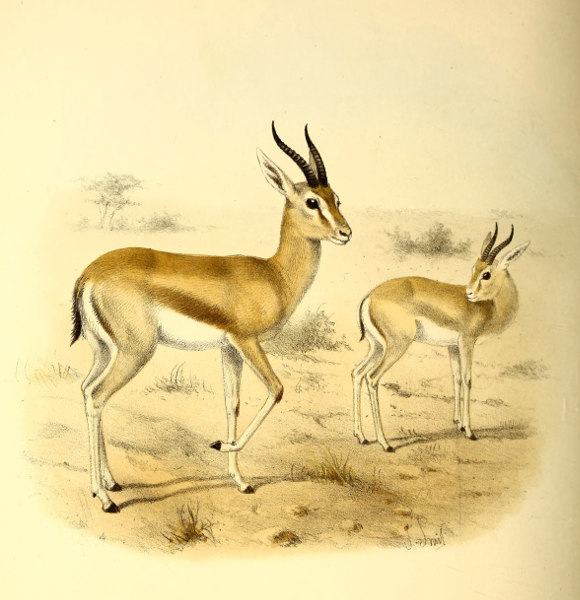
As we have already mentioned in our account of the last species, the late Mr. F. L. James and his party, who visited Somaliland in 1884, appear to have been the first to bring to England examples of the two allied Gazelles of Somaliland. Unfortunately, however, though perhaps not unnaturally, Sclater, who assisted Mr. E. Lort Phillips in the determination of the Mammals obtained during that expedition, referred the coast-land specimens to Gazella spekei, and described the examples from the high plateau as belonging to a new species, Gazella naso. About two years later, however, this error was corrected by Herr H. F. Kohl, of the Natural History Museum of Vienna, who, in an article upon new and rare Antelopes collected by Herr L. Menges in Somaliland, among which examples of both these Gazelles were comprised, rightly referred the upland species to Gazella spekei of Blyth and gave to the lowland species, then still unnamed, the title of Gazella pelzelni, after the late August von Pelzeln, a well-known naturalist, who was at that time Custos of the Imperial Museum of Natural History.
Thomas, in his article on the Antelopes collected in Somaliland by Mr. T. W. H. Clarke, published in the Zoological Society’s ‘Proceedings’ for 1891, was the first to make this matter perfectly clear, and to establish the name Gazella pelzelni as the permanent designation of the coast-land Gazelle of Somaliland. Since that date the distinctions between the two allied species have become well recognized and understood, and numerous examples of both species have been obtained by the naturalists and sportsmen who have recently visited that country.
Capt. Swayne, in his well-known work on Somaliland and its wild animals (from which, by the kind permission of Messrs. Rowland Ward & Co., the publishers, we have been allowed to borrow illustrations of the heads of both sexes of this Gazelle), tells us that the “short-coated, light-coloured Lowland Gazelle” carries rather longer horns than those of the Plateau Gazelle (Gazella spekei), which are “shorter, thicker, more curved, and better annulated.” “The habits of both,” he continues, “are nearly alike; they go in moderate-sized herds of from three to ten, and resort mostly to stony or sandy undulating ground or ravines thinly dotted over with mimosas. Both species are fond of salt and do not require water. It is hard to understand what they can pick up to eat in the wretched ground which they frequent. They have a curiosity which amounts almost to impudence, but are wonderfully on the alert, and hard to shoot, seeming to know perfectly well the range of a rifle, and presenting but a very small target.”
Capt. R. Light, writing to Sclater in 1892, tells us that when he visited Somaliland in 1891 he found this Gazelle between Berbera and Zeila, close down by the sea: “they were often observed feeding side by side with camels and flocks of sheep and goats. When startled they move off the ground in a quick trot, taking bounds over any obstacles and finally breaking into a gallop.”
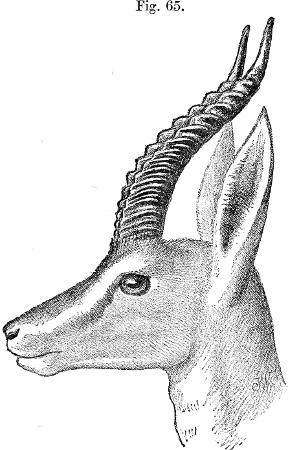
Fig. 65.
Head of Pelzeln’s Gazelle, ♂.
(From Swayne’s ‘Somaliland,’ p. 317.)
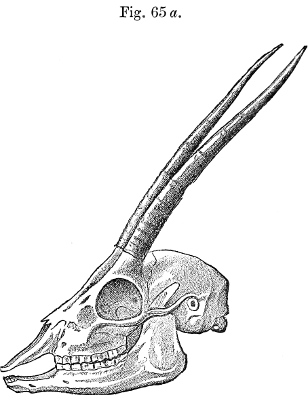
Fig. 65a.
Skull of Pelzeln’s Gazelle, ♀.
(From Swayne’s ‘Somaliland,’ p. 317.)
Mr. Pease, who has kindly supplied us with notes on this Gazelle as well as on the preceding species, writes that Pelzeln’s Gazelle is essentially the species of the maritime plain and could be seen within shot of the town of Bulhar when he was there in 1896, and within a mile or so of Berbera. “In life it appears of a light rich yellow-buff in colour, with the usual Gazelline marks rather faintly indicated. Its coat is short and fine, and its horns are straighter and longer than those of G. spekei. The horns of the female are weak and almost smooth, like those of Speke’s Gazelle.” “Within fifty miles of the sea-shore,” he continues, “this Gazelle is exceedingly numerous in suitable places. Half-a-dozen herds may be often seen at a time, but I have seldom observed more than twenty in a single band. In size G. pelzelni is larger than G. spekei, the average height being about 25 inches, while the weight of the carcase is usually a little over 40 lbs.”
Mr. D. G. Elliot, who made a successful expedition to Somaliland in 1896, for the purpose of obtaining specimens for the Field Columbian Museum of Chicago, gives us the following account of his experiences with the present species:—
“This is the Gazelle of the lowlands and is not often seen much beyond Laferug on the road to Hargeisa, where the following species begins to make its appearance. It is the larger animal of the two, and they resemble each other very much in their habits.
“Pelzeln’s Gazelle frequents dry and stony places, covered with low bushes, and it is difficult to see where or how it can obtain sufficient nourishment from the barren, forbidding districts it inhabits. It goes in small troops of from two or three to nearly a dozen individuals. I think eleven was the greatest number I ever saw together at one time. As a rule, it is not a wild creature and readily permits an approach sufficiently near to ensure a fatal shot, but of course when much hunted becomes wary. The males were often seen by themselves, and then it was not difficult to stalk them. Their horns are almost straight and annulated nearly to the tips. The female also carries horns, much straighter and much more slender than those of the male. There is considerable variation in the coloring of individuals and I hardly know what causes it. The typical style has a broad conspicuous chestnut band running lengthwise along the body just above the white of the belly. But some individuals, evidently of equal age, killed practically at the same time and in the same condition of coat, were entirely without the distinguishing mark. It may be possibly an exhibition of individual variation, for these specimens were not confined to any especial locality. I do not think, however, it was in any way an indication of age, for fully adult animals were without the stripe, neither was this peculiarity confined to either sex.”
The British Museum contains a good male specimen of Pelzeln’s Gazelle, mounted from a skin obtained by Herr Menges near Berbera in Somaliland. Mr. Smit’s figures of this species (Plate LXII.), which represent the male in two positions, have been prepared from it. The Museum also contains two skins from the plains of Berbera, collected by Capt. Swayne and originally sent home to Sclater.
May, 1898.
THE BOOK OF ANTELOPES, PL. LXIII.
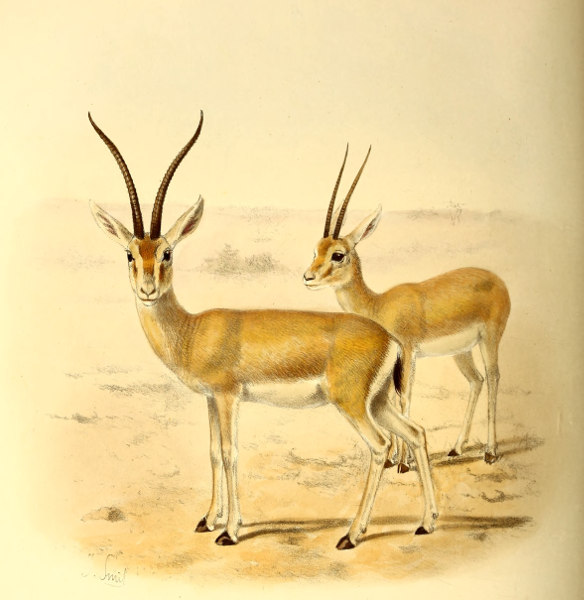
J. Smit lith.
Hanhart imp.
Loder’s Gazelle.
GAZELLA LEPTOCEROS.
Published by R. H. Porter.
93. LODER’S GAZELLE. GAZELLA LEPTOCEROS (F. Cuv.). [PLATE LXIII.]
Antilope leptoceros, Geoffr. St.-Hil. et F. Cuv. H. N. Mamm. (fol.) pls. 473, 474, livr. 72 (1842) (Sennaar?); Wagn. Schr. Säug. Suppl. iv. p. 422 (1844), v. p. 407 (1855); Schinz, Syn. Mamm. ii. p. 445 (1845); id. Mon. Antil. p. 34, pl. 38 (1848); Sund. Pecora, K. Vet.-Ak. Handl. 1845, p. 269 (1847); id. Hornschuch’s Transl., Arch. Skand. Beitr. ii. p. 265; Reprint, p. 85 (1848); Gieb. Säug. p. 309 (1853); Heugl. Reise N.O.-Afr. ii. p. 100, cum tab. (1877).
Gazella leptoceros, Temm. Esq. Zool. Guin. p. 193 (1853); Brooke, P. Z. S. 1873, p. 543; Lyd. Horns and Hoofs, p. 234 (1893).
Gazella dorcas, var. 4, Gray, Cat. Ung. B. M. p. 57 (1852).
Leptoceros abuharab et L. cuvieri, Fitz. SB. Wien, lix. pt. 1, p. 160 (1869).
Gazella loderi, Thos. Ann. Mag. N. H. (6) xiii. p. 452 (1894) (Algeria); id. P. Z. S. 1894, p. 470, pl. xxxii. (animal); Loder, P. Z. S. 1894, p. 473 (habits); Scl. P. Z. S. 1895, p. 522 (Egypt); Bramley, P. Z. S. 1895, p. 863 (Egypt); Scl. P. Z. S. 1896, p. 780 (Viv. Soc. Zool.); Pease, P. Z. S. 1896, p. 813 (Algeria); Whitaker, P. Z. S. 1896, p. 816 (Tunis); Ward, Horn Meas. (2) p. 169 (1896).
Vernacular Names:—Abu el harabat or Abu el haráb in Arabic (Heuglin); Reem of Arabs in Algeria (Loder); Ghazal abiad (White Gazelle) of Arabs in Tunis and Egypt (Whitaker & Bramley).
Height of male at withers about 25 inches. General colour very pale sandy fawn, the Gazelline markings little defined. Central facial band and darker cheek-bands sandy, not rufous, and but little contrasting with the light facial streaks. Light lateral bands scarcely perceptible, and the darker ones below them only pale sandy with a tinge of brownish, as are the pygal bands, neither being much darker than the general dorsal colour. Ears long, narrow, pointed, pale whitish buff externally. Tail sandy at base, darkening terminally to brownish black. Front of fore limbs sandy, of hind limbs whitish; knee-brushes distinct, but little darker than the general colour. Hoofs variable in shape, those of specimens from the sandy regions of the Sahara much elongated, while in other regions they are of the usual shape.
Skull of normal proportions; premaxillæ broadly articulating with nasals. Basal length in an old male 6·45 inches, greatest breadth 3·3, muzzle to orbit 3·6.
Horns of male long, about twice the length of the skull, slender, closely and heavily ringed nearly to the tip. They are very variable as to their exact curvature, but are ordinarily rather straighter than in other species, curving but slightly backwards; they are near together basally, diverging above, sometimes very widely, so as to make them resemble divergent horns of G. granti in miniature.
Female. Similar to the male, but the horns, although nearly equally long, are much slenderer and even less curved than in the male.
Hab. Sandy tracts of the interior of Algeria, Tunisia, and Western Egypt, south to Nubia and Sennaar.
The great folio work of Geoffrey St.-Hilaire and Frédéric Cuvier entitled ‘Histoire Naturelle des Mammifères,’ which was issued in livraisons from 1824 to 1842, contains a long series of coloured figures of mammals, mostly taken from examples living in the well-known Menagerie attached to the Jardin des Plantes. Amongst these in the seventy-second livraison, published in 1842, were the first descriptions and figures given of both sexes of the present Gazelle, from examples stated to have been brought from Sennaar by Burton. They had lived in the Menagerie, we are told, two years, and had bred a young one, which resembled its parents in most particulars. The appropriate scientific name “leptoceros,” from the long thin horns, had been given to this species, we are informed, by Georges Cuvier, and was adopted by the authors of the work referred to, who, however, called it at the head of their article, after their usual fashion, only by the French name “Antilope à longues cornes.”
Very little more information was acquired concerning this Gazelle for many years. Most of the systematists were entirely unacquainted with it, and could only quote the original descriptions. Sundevall and Gray considered it to be merely a variety of Gazella dorcas. Rüppell, during his extensive travels in East Africa, seems never to have come across it, and does not mention it in any of his publications.
The first author after its describers to recognize its existence was Heuglin, who in 1877, in the second volume of his ‘Reise in Nordost-Afrika,’ writes of this species, the name of which he had previously misapplied to another Gazelle, and gives a coloured figure of its head and figures of two pairs of its horns. Heuglin met with G. leptoceros in the Libyan desert of Egypt, near the Natron Lakes and the Fayoum, where he states its Arabic name is “Abu el haráb.”
Sir Victor Brooke had never seen specimens of this Gazelle, and in his ‘Monograph’ relies mainly upon Heuglin’s description.
So matters remained until recent years, when examples of this Gazelle, or of a very closely allied form, turned up unexpectedly from a new quarter.
Loche, Lataste, and other authorities on the zoology of Algeria had mentioned the existence far in the interior of that country of an Antelope called “El Rim,” and examples of the horns of a problematical Gazelle called “El Reem” had been brought to England from the shops at Biskra. In 1894 an enthusiastic sportsman and naturalist, Sir Edmund Loder, F.Z.S., resolved to make a serious attempt to discover this mysterious animal, and proceeded to Algeria for that purpose. We cannot do better than transcribe for our readers Sir Edmund’s own account of the results of this successful expedition, which was read before the Zoological Society of London on June 5th, 1894:—
“Seventeen years ago (in 1877) I bought in the bazaar at Biskra several pairs of Gazelle horns. They obviously belonged to three species: Gazella dorcas, called by the Arabs ‘Rezal’; Gazella cuvieri, which they call ‘Admi’; and a third called ‘Reem,’ which I was not able to identify with any described species. All these horns were on frontal bones only. It is very rarely that the Arabs bring in any whole skulls or skins for sale, and I have never seen anything but frontlets of the ‘Reem.’
“In 1891 and again in 1893 I went out to Algeria for the purpose of hunting Mouflon (Ovis tragelaphus).
“In 1877 I had been prevented from going after them except for a few hours at a time. On these later trips I was more successful and secured some fine male Mouflon, a female of the large Mountain Gazelle (Gazella cuvieri), and a few specimens of Gazella dorcas.
“At Biskra I again found horns of the Reem, but got no information about it except that it was reported to live in the sand. I heard a French name for it for the first time, ‘Gazelle des sables.’
“As my friend Mr. Alfred Pease was spending a second winter at Biskra and had made the acquaintance of several native hunters, I requested him to try what he could do to find out the habitat of the Reem. About Christmas-time last year he wrote to me that he believed he had reliable information that the Reem was to be found in the desert near Chegga, only about 50 kilometres south of Biskra on the caravan-route to Touggourt.
“We made arrangements for a camping trip, and I left England on February 1st, and started from Biskra with Mr. and Mrs. Alfred Pease on February 8th of this year.
“After two days’ marching we got to Chegga and made inquiries respecting the Reem. No one seemed to know anything about the animal except one Arab, who said that if we went on farther south we should come to a place called Ain Gebberah, where there were a few Reem, but if we went on still farther to Hamraia we should find the Reem in quantities.
“We therefore travelled on for two or three more days until we came to Hamraia, but on making inquiries about the Reem the answers were very unsatisfactory. We determined, however, before giving up the search, to stay here a day to hunt and see what game there was in this part of the desert.
“In the early morning of the next day Pease started off from camp with an Arab in one direction, while I went off in the other. By the evening we had covered a considerable extent of country and had used our glasses from every available rise in the ground. We saw several small herds of Gazella dorcas, but no tracks even of any other Gazelle. We did not seem to be any nearer to obtaining a Reem than when we started from Biskra.
“At night, when we got back to camp, we were told that a negro camel-herd had been there during the day, and had said that we were not at all in the right country for Reem, that he was well acquainted with the animal and knew where it was to be found. He came into camp again the next morning and told us that the Reem had long slender hoofs and tender feet, lived only in the soft sand, and would be unable to run on hard stony desert such as that round Hamraia. He said he could take us to the Reem country, in rolling sand-hills, but we should not be able to camp very near as there was no water for our horses and pack-animals.
“We agreed to go with him, and he led us a day’s march still farther south towards the Oued Souf, and then turned off the caravan-track to the east and chose a camp in the sand about an hour and a half from water. (Almost all the water in the desert is brackish and bad, but the water here was positively nasty.)
“The next morning we left camp very early on horseback, with the negro on foot and an Arab hunter riding a mule. The negro led the way at a tremendous pace, keeping up a good trot in the soft sand and sometimes running fast for a couple of miles without a stop across the dry arm of a chott, keeping us at a hand-gallop most of the time.
“After two hours and a half the negro pointed out the first track of the Reem, which is quite easily to be distinguished from that of Gazella dorcas from its much greater length. We now unsaddled the horses, tied them up, and went off in two parties to hunt for Reem. The negro led the way in front of me, going slowly and with great caution, as the Reem is extremely wary and against the nearly white sand can detect a moving object a long way off. We had not walked very far when we saw the head of a Reem looking over the top of a sand-ridge at about 300 yards distance. We stayed for a long time perfectly still behind a tuft of tall alpha grass, till at last the head disappeared. As soon as it was out of sight we ran as hard as we could across the bare sand to the top of the next ridge, and again sheltered ourselves behind a tuft of alpha. When we looked out cautiously we saw that the Reem had moved on to another sand-hill more to our left, and was again showing just the top of his head over it. We had, however, considerably reduced the distance. Again he stopped perfectly still for a long time and then turned and moved off. We ran to another ridge, and I caught sight of him trotting to the top of the sand-hill beyond at about 150 yards. At the top he turned and I fired at once and got him. A lucky shot! as the distance was long for so small an animal. It was a good male, with horns 13 inches long. I have not seen any much longer than these.
“After taking the Reem back to the place where we had left the horses, we started off again, and during the day saw several small lots containing both males and females (4, 5, and 2), but did not get a chance of another shot. Pease also saw a few.
“We hunted the sand-hills for two more days; on the third day our negro guide took us much farther from camp, running before us with surprising speed and endurance for three and a half hours before we halted and tied up our horses. In the evening, after walking all day in a hot sun and on soft sand, he showed himself still untired and ready to run at the same pace back again to camp. This remarkable man said that he had lived for seven years in the desert without sleeping in a house or tent, and had hardly tasted water, meat, or bread; during the whole of that time his food consisted of dates and camel’s milk, and he attributed his strength to this diet. The long distance of our camp from the sand-hills where the Reem is found was a great hindrance, as we could not hunt for them at the time they were feeding. By the time we got to the ground they were already lying down for the day, generally on the top of the sand-ridges, and keeping a watchful look-out. We saw several small herds each day, but neither of us ever got another chance of a shot.
“We were lucky in having calm weather, as a sand-storm in that country is a very serious matter. The air gets as thick as during a bad London fog and one cannot see even a few yards ahead, making it quite impossible to regain camp, all tracks being blotted out in a few minutes by the wind. Our experience of sand-storms was limited to one day, our last day in the desert, luckily for us well outside the region of the sand-hills, when leaving our caravan behind we rode in 50 kilometres to Biskra in the teeth of a cutting wind filled with dust and sand, an extremely painful experience; but we were in no danger of losing our way as we were then on the broad track worn by the caravans travelling between Biskra and Touggourt.
“The Reem is remarkable for its light and uniform coloration, the ordinary Gazellemarkings being hardly noticeable. The long slender hoofs are also very peculiar, reminding one of those of Tragelaphus spekii, which lives in the swamps on the borders of lakes and rivers.
“It is quite certain that the Reem can never drink, as there is no water in this country at all, except in the comparatively deep wells dug by the natives.
“The following measurements of the male Reem were taken directly after it was killed:—Height at shoulder 2 ft. 4 in.; girth at brisket 2 ft. 1 in.; length of horns 13 in. It weighed, after being brought into camp (without entrails), 34 lb. These are about the measurements and weight of Gazella dorcas.
“For comparison I give the measurements of a good male Gazella cuvieri which I killed in the mountains a few weeks after the Reem:—Height at shoulder 2 ft. 7 in.; girth at withers 2 ft. 8½ in.; weight without entrails 58 lb.
“As to the distribution of these species, I may say that Gazella cuvieri is found entirely in the mountains, never down in the true desert. It climbs like a Chamois to the tops of the highest mountains in the rockiest ground, and is often found in the juniper-forests on the mountain-slopes. These are also the haunts of the Mouflon, the two animals being constantly seen on the same ground.
“Gazella dorcas is found all over the hard stony desert and also on the foot-hills, so that it sometimes overlaps the range of the Admi. I have seen a few in the sand-hills, the true country of the Reem; but I believe that still farther south it is not found, its place being taken entirely by the Reem. I quite believe the statement of the natives that the Reem is never found off the soft sand.”
On his return home Sir Edmund Loder submitted his series of specimens of the Gazelles obtained during this and his former journeys in Algeria to Thomas, who, at the same meeting of the Zoological Society at which Sir Edmund’s notes were read, proposed to refer his examples of the “Reem” to a new species to be called Gazella loderi, after the energetic traveller who first made known its existence in Algeria.
Mr. Pease, in his notes on the Antelopes of Eastern Algeria published in the Zoological Society’s ‘Proceedings’ for 1896, gives us the following additional information:—
“The Rhime (Gazella loderi), Arab ‘El Rhime,’ Tamahaq ‘Hankut,’ is the common Gazelle of the Sahara. Enormous numbers are killed by the Arabs in the neighbourhood of Rhadamis and their skins dressed and dyed with a dye made from the rind of pomegranates and exported from Rhadamis. They are to be found throughout the region of the great Ergs and everywhere in the Sahara sands where there is vegetation sufficient to support them. The only places where they are to be met with, north of El Oued Souf, are to the south-west of Bou Chaama and near Sef el Menadi. A number of their horns are always on sale at Biskra and sometimes the skins. The male horns of the Rhime sometimes bear so close a resemblance to those of the Admi (Gazella cuvieri) that they are often sold and bought as such.”
Mr. Pease also points out that in the “Rhime” the horns in their main outline form a long evenly tapering V, whilst in the Admi the horns are more inclined to be parallel, and towards the points usually take an inward and forward turn, as shown in the diagrams (Fig. 66, a, b) which by the kindness of the Zoological Society we are able to reproduce. The annulations, also, Mr. Pease states, are deeper and more marked in the Admi, and stop more abruptly towards the points than in the “Rhime.”
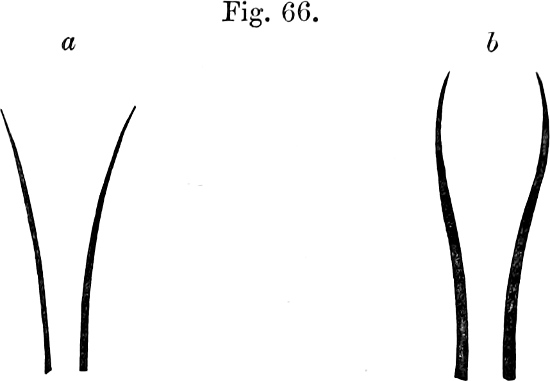
Fig. 66.
Diagram of horns of Rhime (a) and Admi (b).
(P. Z. S. 1896, p. 814.)
This Gazelle occurs also in Southern Tunis, as we learn from Mr. J. S. Whitaker, F.Z.S., who has written the following notes on it in the Zoological Society’s ‘Proceedings’:—
“This pale desert Gazelle is known to the Tunisian Arabs by the name of ‘Ghazel abied’ or ‘Resêl abied,’ meaning the White Gazelle, its Algerian name ‘Reem’ or ‘Rim’ being apparently unknown in Tunis.
“It seems to be a true desert species, never occurring out of the sand-dune country, where it replaces G. dorcas; and while the home of the latter species is the semi-desert country, with its vast stony plains, covered with scanty scrub vegetation, the habitat of G. loderi is undoubtedly the more arid region of sand wastes further south.
“Herr Spatz, who has resided for several years in the south of Tunis, and is well acquainted with this Gazelle, informs me that it is common in the inland country of the extreme south of the Regency, being first met with at about 25 to 30 miles south of the Chott Djerid. In the districts where it occurs it is plentiful, and is generally to be found in small herds; but owing to its very pale colour, which harmonizes so well with that of the desert surroundings, it is not easily distinguished at a distance, and being, moreover, extremely shy and wary, a near approach is not often possible. The nomad Arabs, however, who are nearly all sportsmen, kill a good many, and every year some 500 to 600 pairs of horns of this species are brought by the caravans coming from the interior to Gabes, where they find a ready sale among the French soldiery.
“Herr Spatz confirms what Sir Edmund Loder says of this species never drinking, and, as to its food, says it subsists on the leaves and berries of the few desert plants to be found in the sand wastes. The female of G. loderi, according to Spatz, often has two young ones at a birth, differing in this respect from G. dorcas, which seems to have but one.
“So good a description of G. loderi has been given by Mr. Thomas (P. Z. S. 1894, p. 470), that I can add nothing thereto, except it be merely to say that the coat of this Gazelle is extremely fine and short-haired, and that in the specimens which I have the knee-brushes are so slightly developed as to be scarcely noticeable or worthy of the name.”
In the spring of 1895 Sclater was in Egypt, and convinced himself that besides G. dorcas, of which there were many specimens in the Zoological Gardens at Gizeh, there were examples of both sexes of another species belonging to the group of G. leptoceros and G. cuvieri, stated to have been obtained from the Arabs of the Western Desert (cf. P. Z. S. 1895, p. 400). On receipt in London of a skin and skull of this Gazelle subsequently sent to him by Mr. Jennings-Bramley, Sclater, after comparing it with typical specimens of Gazella loderi in the British Museum, pronounced them to be of the same species. Mr. Jennings-Bramley also supplied Sclater with some excellent notes on the mode of capture of this Gazelle by the Arabs of the Western Desert of Egypt, from which we extract the following passages:—
“On the 27th of June, 1895, I started from the Pyramids in order, if possible, to catch some living specimens of Loder’s Gazelle (Gazella loderi), known to the Arabs as ‘Rasal Abiad’ (the White Gazelle), which the shikaries whom I took with me reported to be found in the desert at some thirty or forty miles distant from Cairo.
“Leaving at 4 P.M. on the 27th, we started, taking a south-easterly direction. We travelled till 12 that night, and at 4 next morning resumed our march. Soon after the sun had risen, one of the shikaries, pointing to the ground, showed what he made out to be the spoor, evidently but lately made, of a fine male Loder’s Gazelle. This, being larger than that of the Dorcas Gazelle, is very easily recognizable; the bluntness of the hoofs in the case of Loder’s Gazelle shows a marked difference. About 12 o’clock one of the camel-men called out that a Gazelle could be seen ahead, but the many heaps of white stones, scattered all over the desert, are so deceiving at a little distance that both shikaries shook their heads.
“The camel-man, however, in this case proved to be correct, as we soon noticed the Gazelle walking leisurely away. It disappeared behind a mound of sand, where it must have remained, for, on reaching the place about half an hour later, we were surprised to come suddenly on the Gazelle, now only some 200 yards off. It was a fine female, very white in colour. Not wishing to disturb any others that might be near, I did not fire. We found, however, that it was alone. At 12 o’clock or thereabouts we came upon the skirt of the plateau, from which the Fayoum can be seen, and here the shikaries decided to turn back, as they said we had passed the ‘White Gazelle ground’; so, after returning about two miles, we set up the tents and waited for the evening, the sun being so hot that it was impossible to continue our search.
“During the afternoon the two shikaries constructed traps, which we set in the evening.
“The Gazelle trap, except the small hemp-platted rope, is made entirely from the date-palm. Taking the long leaves, the shikarie first constructs by platting them together a deep ring, about 3 inches in diameter and about 4 inches deep: it should, in fact, fit well into a golf-hole and make its walls secure. He now takes an old stalk from which the dates have been picked, and separating about twenty of the fibres which compose it, and run its whole length, he twists them into a rude bracelet about three inches in diameter. Then taking three more fibres, in place of twine, he binds the ring securely; the ring or bracelet has then a form much resembling a diminutive ‘Ringold’ ring. The shikarie now breaks off the points of the date-thorns until he has about twenty-five of them 2 inches in length; these he pushes through the fibrous sides of the ring until all the points meet in the centre, so that when finished this ring has much the appearance of a small sieve. All the thorn-points overlap slightly in the centre of the ring. This ring, holding all the thorns, the deep ring of platted leaves, and a soft thick hemp rope, made by the Arab himself, by the ordinary three-plat from raw hemp (this rope, being soft, not only binds itself more securely to the Gazelle, but does not cut the skin when drawn tight), attached to a date-stick about a yard in length, are all the implements that an Arab requires to catch a Gazelle.