Volume 3 — THE KINGDOM OF THE SOUTH.
Reading edition
REHOBOAM. How a Foolish Young King Lost the Best Part of His Kingdom.
(Under the great King Solomon, the kingdom of Israel rose to the zenith of its power and glory. Its territory stretched from sea to sea, its commerce was world-wide. Jerusalem with its great temple and its luxurious palaces became a magnificent city. But even during the reign of Solomon there began to be mutterings of discontent. Solomon was a great king, but his very magnificence laid heavy burdens upon the people. Taxes must be raised, very burdensome taxes, and a great number of servants and slaves must be kept. Solomon was strong enough to prevent an open rebellion in his own day, but as soon as he died the smoldering fire burst into flame. His son Rehoboam was an arrogant and very foolish young man. The people petitioned for a redress of their grievances and a lightening of their burdens. The elders whom the king consulted advised him to listen to these reasonable requests. But he gave heed instead to the advice of young men as willful and as inexperienced as himself, and replied that he would lay heavier burdens yet upon the people.
Then the old cry of protest, "To your tents, O Israel," was raised. The people of the North seceded, and under the leadership of a man named Jeroboam, set up a kingdom of their own. This division became permanent, and was the source of endless war. Even in the time of Christ, the Samaritans, who were the {238} descendants of the people of the old Northern kingdom, and the people of the South hated each other, and had no dealings with each other.)
After the death of Solomon, Rehoboam went to Shechem: for all Israel were come to Shechem to make him king. And Jeroboam and all the assembly of Israel came, and spoke to Rehoboam, saying, "Thy father made our yoke grievous: now therefore make thou the grievous service of thy father, and his heavy yoke which he put upon us, lighter, and we will serve thee." And he said unto them, "Go away for three days, then come again to me." And the people departed.
And King Rehoboam took counsel with the old men, that had stood before Solomon his father while he yet lived, saying, "What counsel give ye me to return answer to this people?" And they spoke to him, saying, "If thou wilt be a servant to this people this day, and wilt serve them, and answer them, and speak good words to them, then they will be thy servants for ever."
But he forsook the counsel of the old men which they had given him, and took counsel with the young men that were grown up with him, that stood before him. And he said unto them, "What counsel give ye, that we may return answer to this people, who have spoken to me, saying, 'Make the yoke that thy father did put upon us lighter'?"
And the young men that were grown up with him spoke to him, saying, "Thus shalt thou say to this people that spoke to thee, saying, 'Thy father made our yoke heavy, {239} but make thou it lighter unto us'; thus shalt thou speak unto them, 'My little finger is thicker than my father's loins. And now whereas my father did load you with a heavy yoke, I will add to your yoke: my father chastised you with whips, but I will chastise you with scorpions.'"
So Jeroboam and all the people came to Rehoboam the third day, as the king bade, saying, "Come to me again the third day." And the king answered the people roughly, and forsook the counsel of the old men which they had given him; and spoke to them after the counsel of the young men, saying, "My father made your yoke heavy, but I will add to your yoke: my father chastised you with whips, but I will chastise you with scorpions."
So the king hearkened not unto the people. And when all Israel saw that the king hearkened not unto them, the people answered the king, saying, "What portion have we in David? neither have we inheritance in the son of Jesse: to your tents, O Israel: now see to thine own house, David." So Israel departed unto their tents.
But as for the children of Israel which dwelt in the cities of Judah, Rehoboam reigned over them. Then King Rehoboam sent Adoram, who was the taxgatherer; and all Israel stoned him to death. And King Rehoboam made haste to get him up to his chariot, to flee to Jerusalem. So Israel rebelled against the house of David, unto this day. And it came to pass, when all Israel heard that Jeroboam was returned, that they sent and called him unto the assembly, and made him king over all Israel: {240} there was none that followed the house of David, but the tribe of Judah only.
And when Rehoboam was come to Jerusalem, he assembled all the house of Judah, and the tribe of Benjamin, an hundred and fourscore thousand chosen men, which were warriors, to fight against the house of Israel, to bring the kingdom again to Rehoboam the son of Solomon. But the word of God came to Shemaiah the man of God, saying, "Speak unto Rehoboam the son of Solomon, king of Judah, and unto all the house of Judah and Benjamin, and to the rest of the people, saying, 'Thus saith the Lord, Ye shall not go up, nor fight against your brethren the children of Israel: return every man to his house; for this thing is of me.'"
So they hearkened to the word of the Lord, and returned and went their way, according to the word of the Lord.
And Rehoboam the son of Solomon reigned in Judah. Rehoboam was forty and one years old when he began to reign, and he reigned seventeen years in Jerusalem, the city which the Lord had chosen out of all the tribes of Israel. And Judah did that which was evil in the sight of the Lord; and they provoked him to jealousy with their sins which they committed, above all that their fathers had done.
And it came to pass in the fifth year of king Rehoboam, that Shishak king of Egypt came up against Jerusalem: and he took away the treasures of the house of the Lord, and the treasures of the king's house; he even took away all: and he took away all the shields of gold which Solomon {241} had made. And King Rehoboam made in their stead shields of brass, and committed them to the hands of the captains of the guard, who kept the door of the king's house. And it was so, that as often as the king went into the house of the Lord, the guard bore them, and brought them back into the guard chamber. And there was war between Rehoboam and Jeroboam continually. And Rehoboam died, and was buried with his fathers in the city of David.
{242}
ABIJAH. How the Second King of Judah Won a Great Victory over Jeroboam.
(For many years the two rival kings, Rehoboam and Jeroboam, fought without either gaining a decided advantage, but Rehoboam died and his favorite son, Abijah, came to the throne, who enlisted a great army and fought a decisive battle with the older king, overwhelming him in battle and taking away several cities.)
And Rehoboam appointed Abijah the son of Maacah to be chief, the prince among his brethren: for he intended to make him king. And he dealt wisely, and scattered all his sons throughout all the lands of Judah and Benjamin, unto every fenced city.
In the eighteenth year of King Jeroboam began Abijah to reign over Judah. Three years reigned he in Jerusalem: and his mother's name was Maacah the daughter of Uriel of Gibeah.
And there was war between Abijah and Jeroboam. And Abijah joined battle with an army of valiant men of war: and Jeroboam set the battle in array against him with a great host of many thousands of those who were mighty men of valor.
{243}
{244}
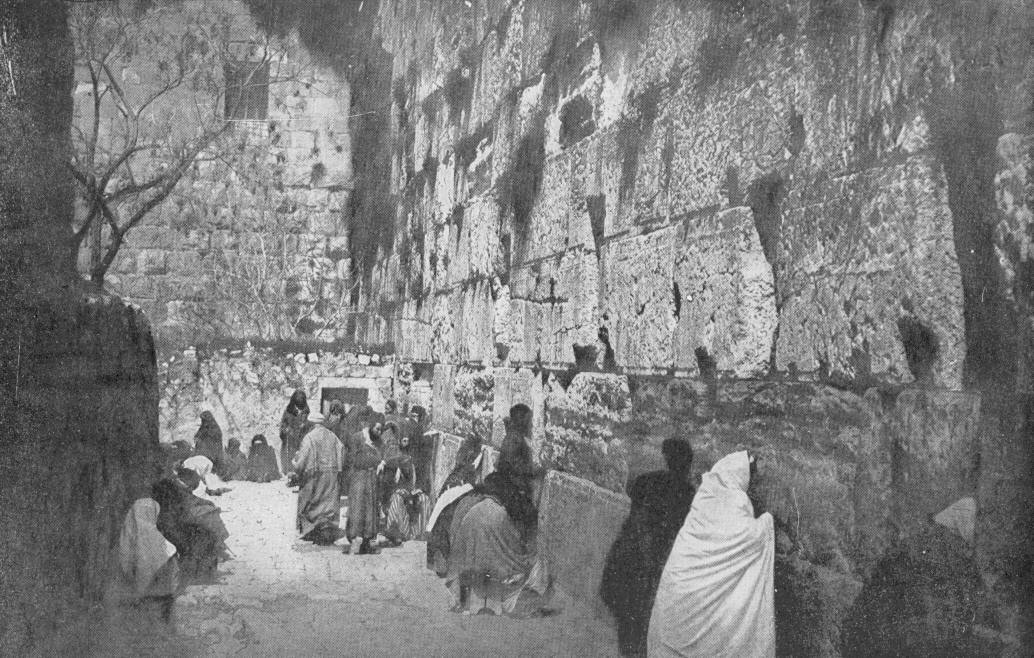
THE JEWS' WAILING PLACE, JERUSALEM. Used by special permission of the Detroit Photograph Company.
The lower courses of great stones belonged to the ancient temple, and the Jews gathered there every Friday afternoon to mourn over the fall of their city. Some of these stones are 30 feet long, 8 feet wide, and 3-1/2 feet high, weighing over 80 tons
{245}
And Abijah stood up upon Mount Zemaraim, which is in the hill country of Ephraim, and said, "Hear me, O Jeroboam and all Israel; ought ye not to know that the Lord, the God of Israel, gave the kingdom over Israel to David for ever, even to him and to his sons by a covenant of salt? Yet Jeroboam the son of Nebat, the servant of Solomon the son of David, rose up, and rebelled against his lord. And there were gathered to him vain men, who strengthened themselves against Rehoboam the son of Solomon, when Rehoboam was young and tender-hearted, and could not withstand them. And now ye think to withstand the kingdom of the Lord in the hand of the sons of David; and ye be a great multitude, and there are with you the golden calves which Jeroboam made you for gods. Have ye not driven out the priests of the Lord, the sons of Aaron, and the Levites, and have made you priests after the manner of the peoples of other lands? But as for us, the Lord is our God, and we have not forsaken him; and we have priests ministering unto the Lord, the sons of Aaron, and the Levites in their work: and they burn unto the Lord every morning and every evening burnt offerings and sweet incense: the showbread also set they in order upon the pure table; and the candlestick of gold with the lamps thereof, to burn every evening: for we keep the charge of the Lord our God; but ye have forsaken him. And, behold, God is with us at our head, and his priests with the trumpets of alarm to sound an alarm against you. O children of Israel, fight ye not against the Lord, the God of your fathers; for ye shall not prosper."
But Jeroboam caused an ambushment to come about {246} behind them: so they were before Judah, and the ambushment was behind them. And when Judah looked back, behold, the battle was before and behind them: and they cried unto the Lord, and the priests sounded with the trumpets. Then the men of Judah gave a shout: and as the men of Judah shouted, it came to pass, that God smote Jeroboam and all Israel before Abijah and Judah. And the children of Israel fled before Judah: and God delivered them into their hand. And Abijah and his people slew them with a great slaughter.
Thus the children of Israel were brought under at that time, and the children of Judah prevailed, because they relied upon the Lord, the God of their fathers. And Abijah pursued after Jeroboam, and took cities from him, Beth-el with the towns thereof, and Jeshanah with the towns thereof, and Ephron with the towns thereof.
{247}
ASA. A Good King of Judah. He Makes a League with Syria Against the Northern Kingdom.
(With the good king Asa came a time of prosperity to Judah. He fortified the cities and destroyed the idols, and won a great victory over the host of the Ethiopians. But he made one serious mistake. An enterprising king named Baasha had come to the throne in the northern kingdom, and he began to make advances against Judah. He built a fort at Ramah in a position which commanded the roads to the south. Then Asa in his fear made a league with the king of Syria. This was the beginning of those entanglements and leagues with foreign nations which finally brought disaster to both kingdoms.)
So Abijah slept with his fathers, and they buried him in the city of David, and Asa his son reigned in his stead: in his days the land was quiet ten years.
And Asa did that which was good and right in the eyes of the Lord his God: for he took away the strange altars, and the high places, and broke down the pillars, and hewed down the Asherim; and commanded Judah to seek the Lord, the God of their fathers, and to do the law and the commandment. Also he took away out of all the cities of Judah the high places and the sun-images: and the kingdom was quiet before him. And he built fenced cities in Judah: for the land was quiet, and he had no war in those years; because the Lord had given him rest.
{248}
For he said unto Judah, "Let us build these cities, and make about them walls, and towers, gates, and bars; the land is yet before us, because we have sought the Lord our God; we have sought him, and he hath given us rest on every side." So they built and prospered.
And Asa had an army of spearmen and bowmen many thousand, and all these were mighty men of valor. And there came out against them Zerah the Ethiopian with a mighty host; and he came unto Mareshah.
Then Asa went out to meet him, and they set the battle in array in the valley of Zephathah at Mareshah. And Asa cried unto the Lord his God, and said, "Lord, there is none beside thee to help, between the mighty and him that hath no strength: help us, O Lord our God; for we rely on thee, and in thy name are we come against this multitude. O Lord, thou art our God; let not man prevail against thee."
So the Lord smote the Ethiopians before Asa, and before Judah; and the Ethiopians fled. And Asa and the people that were with him pursued them unto Gerar: and there fell of the Ethiopians so many that they could not recover themselves; for they were destroyed before the Lord, and before his host; and they carried away very much booty. And they smote all the cities round about Gerar, for the fear of the Lord came upon them: and they sacked all the cities; for there was much spoil in them. They smote also the tents of cattle, and carried away sheep in abundance and camels, and returned to Jerusalem.
And the spirit of God came upon Azariah the son of {249} Oded: and he went out to meet Asa, and said unto him, "Hear ye me, Asa, and all Judah and Benjamin: the Lord is with you, while ye be with him; and if ye seek him, he will be found of you; but if ye forsake him, he will forsake you. Now for long seasons Israel hath been without the true God, and without a teaching priest, and without law: but when in their distress they turned unto the Lord, the God of Israel, and sought him, he was found by them. And in those times there was no peace to him that went out, nor to him that came in, but great vexations were upon all the inhabitants of the lands. And they were broken in pieces, nation against nation, and city against city: for God did vex them with all adversity. But be ye strong, and let not your hands be slack: for your work shall be rewarded."
And when Asa heard these words, and the prophecy of Oded the prophet, he took courage, and put away the abominations out of all the land of Judah and Benjamin, and out of the cities which he had taken from the hill country of Ephraim; and he renewed the altar of the Lord, that was before the porch of the Lord. And he gathered all Judah and Benjamin, and them that sojourned with them out of Ephraim and Manasseh, and out of Simeon: for they came to him out of Israel in abundance, when they saw that the Lord his God was with him. So they gathered themselves together at Jerusalem in the third month, in the fifteenth year of the reign of Asa. And they sacrificed unto the Lord in that day, of the spoil which they had brought, seven hundred oxen and seven {250} thousand sheep. And they entered into the covenant to seek the Lord, the God of their fathers, with all their heart and with all their soul; and that whosoever would not seek the Lord, the God of Israel, should be put to death, whether small or great, whether man or woman. And they swore unto the Lord with a loud voice, and with shouting, and with trumpets, and with cornets.
And all Judah rejoiced at the oath: for they had sworn with all their heart, and sought him with their whole desire; and he was found by them: and the Lord gave them rest round about. And also Maacah the mother of Asa the king, he removed her from being queen, because she had made an abominable image for an Asherah; and Asa cut down her image, and made dust of it, and burnt it at the brook Kidron. But the high places were not taken away out of Israel: nevertheless the heart of Asa was perfect all his days. And he brought into the house of God the things that his father had dedicated, and that he himself had dedicated, silver, and gold, and vessels. And there was no more war unto the five and thirtieth year of the reign of Asa.
In the six and thirtieth year of the reign of Asa, Baasha king of Israel went up against Judah, and built Ramah, that he might not allow any to go out or come in to Asa king of Judah.
Then Asa brought out silver and gold out of the treasures of the house of the Lord and of the king's house, and sent to Ben-hadad king of Syria, that dwelt at Damascus, saying, "There is a league between me and thee, as there was between my father and thy father: behold, I have sent thee silver and gold; go, break thy league with Baasha king of Israel, that he may depart from me."
{251}
{252}
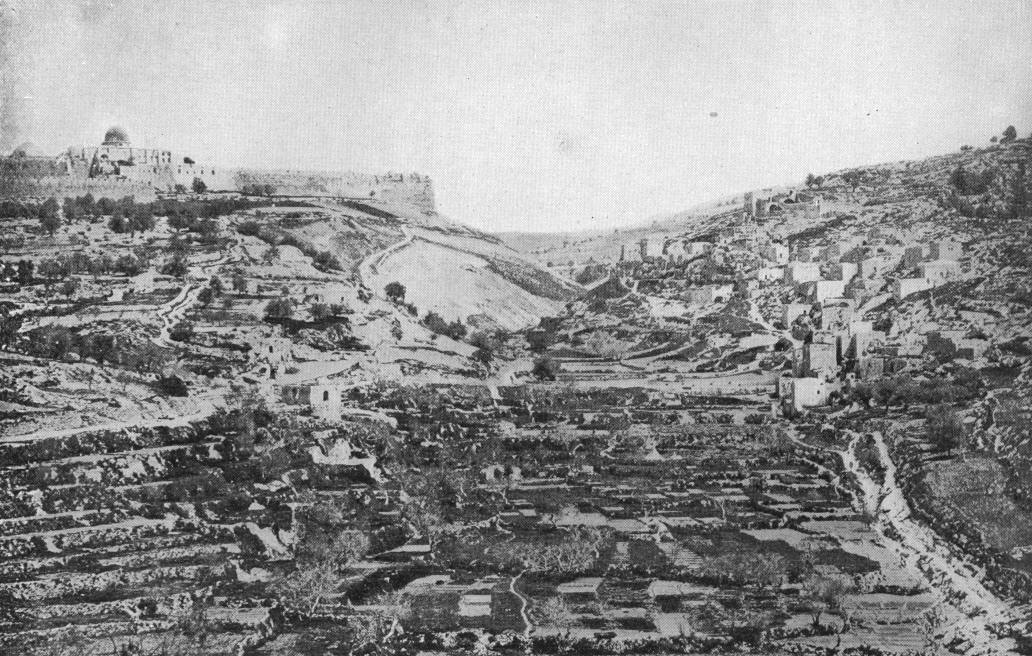
LOOKING UP THE VALLEY OF JEHOSHAPHAT, OR THE VALLEY OF KIDRON, FROM THE SOUTH. Jerusalem on the left, the foot of the Mount of Olives on the right. The cultivated land immediately in front was perhaps the place of "the king's gardens"
This valley, which separates the temple mount from the Mount of Olives, was not known as the valley of Jehoshaphat in the Bible (except in Joel 3:12, though probably another locality is there intended), but it has always been so called in later days. Perhaps it was given the name of the king because of the great victory he won over the allied forces of Ammon, Moab, and Mount Seir, in a valley which is near the Kidron as it turns toward the Dead Sea.
{253}
And Ben-hadad hearkened unto King Asa, and sent the captains of his armies against the cities of Israel; and they smote Ijon, and Dan, and Abel-maim, and all the store cities of Naphtali. And it came to pass, when Baasha heard thereof, that he left off building of Ramah, and let his work cease.
Then Asa the king took all Judah; and they carried away the stones of Ramah, and the timber thereof, wherewith Baasha had builded; and he built therewith Geba and Mizpah. And at that time Hanani the seer came to Asa king of Judah, and said unto him, "Because thou hast relied on the king of Syria, and hast not relied on the Lord thy God, therefore is the host of the king of Syria escaped out of thine hand. Were not the Ethiopians and the Lubim a huge host, with chariots and horsemen exceeding many? yet, because thou didst rely on the Lord, he delivered them into thine hand. For the eyes of the Lord run to and fro throughout the whole earth, to show himself strong in the behalf of them whose heart is perfect toward him. Herein thou hast done foolishly; for from henceforth thou shalt have wars."
Then Asa was wroth with the seer, and put him in the prison house; for he was in a rage with him because of this thing. And Asa oppressed some of the people the same time. And in the thirty and ninth year of his reign Asa was diseased in his feet; his disease was exceeding {254} great: yet in his disease he went not to the Lord, but to the physicians.
And Asa died in the one and fortieth year of his reign. And they buried him in his own sepulchers, which he had hewn out for himself in the city of David, and laid him in the bed which was filled with sweet odors and divers kinds of spices prepared by the apothecaries' art: and they made a very great burning for him.
{255}
JEHOSHAPHAT. The Story of a Good King Who Feared God and Served the Nation Well.
(Jehoshaphat was one of the wisest and best of the kings of Judah. He increased the territory of the nation greatly. He conquered Edom so that it was governed by a vassal king. By conquering this country he gained a seaport, and it is interesting to note that he fitted out a fleet of ships and attempted to revive the trade of Solomon for the gold of Ophir. The ships, however, never reached their destination. They were wrecked when starting on their first voyage, and he did not have the courage to repeat the attempt. For the first time since the reign of Solomon, there was peace between Judah and Israel. A treaty was made between the two kings, and Jehoram, heir to the throne of Judah, was married to Athaliah, daughter of King Ahab of Israel. Through this alliance it was hoped no doubt to join the two kingdoms and restore the lost glory of the past. The attempt ended in failure. Athaliah was wicked, like all the race of Ahab and Jezebel, and brought only disaster to Judah.)
And Jehoshaphat the son of Asa reigned in his stead, and strengthened himself against Israel. And he placed forces in all the fenced cities of Judah, and set garrisons in the land of Judah, and in the cities of Ephraim, which Asa his father had taken; and Jehoshaphat made peace with the king of Israel. And the Lord was with Jehoshaphat, because he walked in the first ways of his father David, and sought not the idols of Baal; but sought the God of {256} his father, and walked in his commandments, and not after the doings of Israel. Therefore the Lord established the kingdom in his hand; and all Judah brought to Jehoshaphat presents; and he had riches and honor in abundance.
Also in the third year of his reign he sent his princes, even Ben-hail, and Obadiah, and Zechariah, and Nethanel, and Micaiah, to teach in the cities of Judah; and with them the Levites; and with them Elishama and Jehoram, the priests. And they taught in Judah, having the book of the law of the Lord with them; and they went about throughout all the cities of Judah, and taught among the people. And the fear of the Lord fell upon all the kingdoms of the lands that were round about Judah, so that they made no war against Jehoshaphat. And some of the Philistines brought Jehoshaphat presents, and silver for tribute; the Arabians also brought him flocks, seven thousand and seven hundred rams, and seven thousand and seven hundred he-goats.
And Jehoshaphat waxed great exceedingly; and he built in Judah castles and cities of store. And he had many works in the cities of Judah; and men of war, mighty men of valor, in Jerusalem.
(Jehoshaphat made a league with Ahab king of Israel and they fought together a battle in which Ahab was struck by an arrow from an archer's bow and was killed.)
But Jehoshaphat the king of Judah returned to his house in peace to Jerusalem. And Jehu the son of Hanani the seer went out to meet him, and said to King Jehoshaphat, "Shouldest thou help the wicked, and love them that hate the {257} Lord? for this thing wrath is upon thee from before the Lord. Nevertheless there are good things found in thee, in that thou hast put away the Asheroth out of the land, and hast set thine heart to seek God."
And Jehoshaphat dwelt at Jerusalem: and he went out again among the people from Beer-sheba to the hill country of Ephraim, and brought them back unto the Lord, the God of their fathers. And he set judges in the land throughout all the fenced cities of Judah, city by city, and said to the judges, "Consider what ye do: for ye judge not for man, but for the Lord; and he is with you in the judgment. Now therefore let the fear of the Lord be upon you; take heed and do it: for there is no iniquity with the Lord our God, nor respect of persons, nor taking of gifts."
Moreover in Jerusalem did Jehoshaphat set the Levites and the priests, and the heads of the fathers' houses of Israel, for the judgment of the Lord, and for controversies, And they returned to Jerusalem. And he charged them, saying, "Thus shall ye do in the fear of the Lord, faithfully, and with a perfect heart. And whensoever any controversy shall come to you from your brethren that dwell in their cities, between blood and blood, between law and commandment, statutes and judgments, ye shall warn them, that they be not guilty towards the Lord, and so wrath come upon you and upon your brethren: this do, and ye shall not be guilty.
"And, behold, Amariah the chief priest is over you in all matters of the Lord; and Zebadiah the son of Ishmael, {258} the ruler of the house of Judah, in all the king's matters: also the Levites shall be officers before you. Deal courageously, and the Lord be with the good."
And it came to pass after this, that the men of Moab, and the men of Ammon, and with them some of the Ammonites, came against Jehoshaphat to battle. Then there came some that told Jehoshaphat saying, "There cometh a great multitude against thee from beyond the sea from Syria."
And Jehoshaphat feared, and set himself to seek unto the Lord; and he proclaimed a fast throughout all Judah. And Judah gathered themselves together, to seek help of the Lord: even out of all the cities of Judah they came to seek the Lord. And Jehoshaphat stood in the congregation of Judah and Jerusalem, in the house of the Lord, before the new court; and he said, "O Lord, the God of our fathers, art not thou God in heaven? and art not thou ruler over all the kingdoms of the nations? and in thine hand is power and might, so that none is able to withstand thee. Didst not thou, O our God, drive out the inhabitants of this land before thy people Israel, and gavest it to the seed of Abraham thy friend for ever? And they dwelt therein, and have built thee a sanctuary therein for thy name, saying, 'If evil come upon us, the sword, judgment, or pestilence, or famine, we will stand before this house, and before thee (for thy name is in this house), and cry unto thee in our affliction, and thou wilt hear and save.'
{259}
{260}
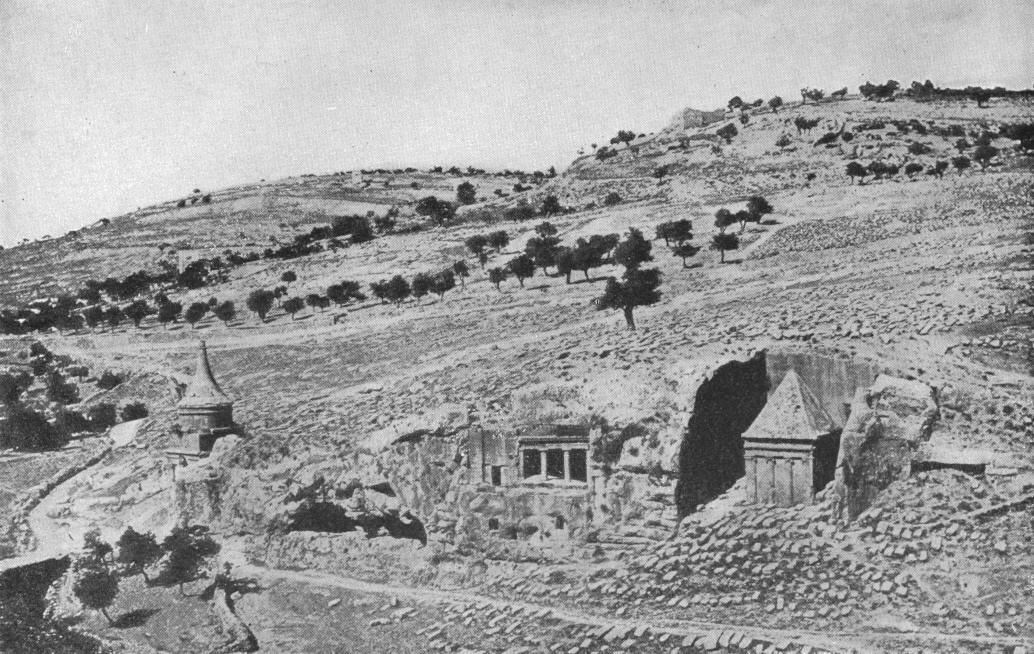
TOMBS IN THE VALLEY OF JEHOSHAPHAT. Mount of Olives in the background.
In the valley of Jehoshaphat there are many ancient tombs, and there are thousands of modern graves here also. The devout Jew earnestly desires to be buried here, as he believes that Messiah will descend on the Mount of Olives at the last day and pass through the valley on the way to his throne in the city.
{261}
And now, behold, the men of Ammon and Moab and Mount Seir, whom thou wouldest not let Israel invade, when they came out of the land of Egypt, but they turned aside from them, and destroyed them not; behold, how they reward us, to come to cast us out of thy possession, which thou hast given us to inherit. O our God, wilt thou not judge them? for we have no might against this great company that cometh against us; neither know we what to do: but our eyes are upon thee."
And all Judah stood before the Lord, with their little ones, their wives, and their children. Then upon Jahaziel the son of Zechariah came the spirit of the Lord in the midst of the congregation; and he said, "Hearken ye, all Judah, and ye inhabitants of Jerusalem, and thou King Jehoshaphat: thus saith the Lord unto you, 'Fear not ye, neither be dismayed by reason of this great multitude; for the battle is not yours, but God's. To-morrow go ye down against them: behold, they come up by the ascent of Ziz; and ye shall find them at the end of the valley, before the wilderness of Jeruel. Ye shall not need to fight in this battle: set yourselves, stand ye still, and see the salvation of the Lord with you, O Judah and Jerusalem: fear not, nor be dismayed: to-morrow go out against them; for the Lord is with you.'"
And Jehoshaphat bowed his head with his face to the ground: and all Judah and the inhabitants of Jerusalem fell down before the Lord, worshiping the Lord.
And they rose early in the morning, and went forth into the wilderness of Tekoa: and as they went forth, Jehoshaphat stood and said, "Hear me, O Judah, and ye inhabitants of Jerusalem; believe in the Lord your God, {262} so shall ye be established; believe his prophets, so shall ye prosper."
And when he had taken counsel with the people, he appointed them that should sing unto the Lord, and praise the beauty of holiness, as they went out before the army, and say, "Give thanks unto the Lord; for his mercy endureth for ever."
And when they began to sing and to praise, the Lord set liers in wait against the men of Ammon, Moab, and Mount Seir, who were come against Judah; and they were smitten. For the men of Ammon and Moab stood up against the inhabitants of Mount Seir, utterly to slay and destroy them: and when they had made an end of the inhabitants of Seir, everyone helped to destroy another. And when Judah came to the watch-tower of the wilderness, they looked upon the multitude; and, behold, they were dead bodies fallen to the earth, and there were none that escaped.
And when Jehoshaphat and his people came to take the spoil of them, they found among them in abundance both riches, and garments, and precious jewels, which they stripped off for themselves, more than they could carry away: and they were three days in taking of the spoil, it was so much. And on the fourth day they assembled themselves in the valley of Beracah; for there they blessed the Lord: therefore the name of that place was called The valley of Beracah, unto this day.
{263}
{264}
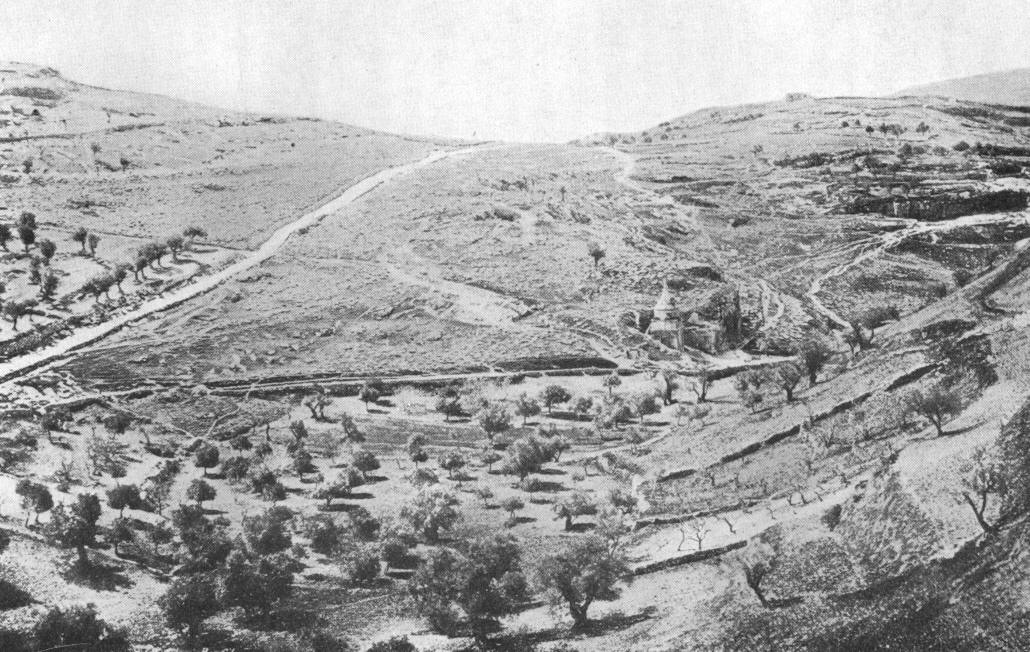
THE VALLEY OF JEHOSHAPHAT FROM THE NORTH. Road to Bethany over the Mount of Olives in the center.
This is a view of the valley from a different point of view. The road to Bethany is in the center, and the old Jerusalem-Jericho road passes the head of the valley. It was in this direction that David fled from the city at the time of the revolt of Absalom.
{265}
Then they returned, every man of Judah and Jerusalem, and Jehoshaphat in the forefront of them, to go again to Jerusalem with joy; for the Lord had made them to rejoice over their enemies. And they came to Jerusalem with psalteries and harps and trumpets unto the house of the Lord. And the fear of God was on all the kingdoms of the countries, when they heard that the Lord fought against the enemies of Israel. So the realm of Jehoshaphat was quiet: for his God gave him rest round about.
And Jehoshaphat reigned over Judah: he was thirty and five years old when he began to reign; and he reigned twenty and five years in Jerusalem: and his mother's name was Azubah the daughter of Shilhi. And he walked in the way of Asa his father, and turned not aside from it, doing that which was right in the eyes of the Lord. Howbeit the high places were not taken away; neither as yet had the people set their hearts unto the God of their fathers.
And there was no king in Edom: a deputy of Jehoshaphat was king.
Jehoshaphat made ships of Tarshish to go to Ophir for gold: but they went not; for the ships were wrecked at Ezion-geber.
Then said Ahaziah the son of Ahab unto Jehoshaphat, "Let my servants go with thy servants in the ships." But Jehoshaphat would not. And Jehoshaphat died and was buried with his fathers in the city of David his father; and Jehoram his son reigned in his stead.
[Footnote: The story of a disastrous battle which Jehoshaphat fought in company with Ahab as ally is told in connection with the Story of Ahab.]
{266}
JEHORAM. The Evil Son of a Good Father.
(Jehoram began his reign by murdering all his brothers, a not uncommon custom in those bloody days. He was completely under the influence of his wife Athaliah, daughter of that evil house of Ahab and Jezebel, from which no good ever came. He lost the kingdom of Edom which his fathers had won, and died at last a miserable death, no one wishing him to live any longer.)
Jehoram the son of Jehoshaphat reigned in his stead. And he had brethren the sons of Jehoshaphat, Azariah, and Jehiel, and Zechariah, and Azariah, and Michael, and Shephatiah: all these were the sons of Jehoshaphat king of Israel. And their father gave them great gifts, of silver, and of gold, and of precious things, with fenced cities in Judah: but the kingdom gave he to Jehoram, because he was the firstborn. Now when Jehoram was risen up over the kingdom of his father, and had strengthened himself, he slew all his brethren with the sword, and others also of the princes of Israel. Jehoram was thirty and two years old when he began to reign; and he reigned eight years in Jerusalem. And he walked in the way of the kings of Israel, as did the house of Ahab: for his wife was the daughter of Ahab: and he did that which was evil in the sight of the Lord.
Howbeit the Lord would not destroy the house of David, {267} because of the covenant that he had made with David, and as he promised to give a lamp to him and to his children alway. In his days Edom revolted from under the hand of Judah, and made a king over themselves. Then Jehoram passed over with his captains, and all his chariots with him: and he rose up by night, and smote the Edomites which compassed him about, and the captains of the chariots. So Edom revolted from under the hand of Judah, unto this day: then did Libnah revolt at the same time from under his hand: because he had forsaken the Lord, the God of his fathers. Moreover he made high places in the mountains of Judah, and led Judah astray. And there came a writing to him from Elijah the prophet, saying, "Thus saith the Lord, the God of David thy father, 'Because thou hast not walked in the ways of Jehoshaphat thy father, nor in the ways of Asa king of Judah; but hast walked in the way of the kings of Israel; and also hast slain thy brethren of thy father's house, which were better than thyself: behold, the Lord will smite with a great plague thy people, and thy children, and thy wives, and all thy substance: and thou shalt have great sickness.'"
And the Lord stirred up against Jehoram the spirit of the Philistines, and of the Arabians which are beside the Ethiopians: and they came up against Judah, and raided, and carried away all the substance that was found in the king's house, and his sons also, and his wives; so that there was never a son left him, save Ahaziah, the youngest of his sons. And after all this the Lord smote him in his bowels with an incurable disease. And he died of sore {268} diseases. And his people made no burning for him, like the burning of his fathers. Thirty and two years old was he when he began to reign, and he reigned in Jerusalem eight years: and he departed without being desired; and they buried him in the city of David, but not in the sepulchers of the kings.
{269}
AHAZIAH.
(Ahaziah, the youngest son of Jehoram, next came to the throne, for it seems that a marauding band of Arabians had actually raided Jerusalem and had slain the older children of the king. Ahaziah was a poor weak king who ruled weakly, and was killed, while on a visit to the king of Israel, by Jehu, the usurper of the throne.)
And the inhabitants of Jerusalem made Ahaziah his youngest son king in his stead: for the band of men that came with the Arabians to the camp had slain all the eldest. So Ahaziah the son of Jehoram king of Judah reigned. Twenty and two years old was Ahaziah when he began to reign; and he reigned one year in Jerusalem: and his mother's name was Athaliah the daughter of Ahab.
He also walked in the ways of the house of Ahab: for his mother was his counselor to do wickedly. And he did that which was evil in the sight of the Lord, as did the house of Ahab: for they were his counselors after the death of his father, to his destruction. He walked also after their counsel, and went with Joram the son of Ahab king of Israel to war against Hazael king of Syria at Ramoth-gilead: and the Syrians wounded Joram. And he returned to be healed in Jezreel of the wounds which they had given him at Ramah, when he fought against Hazael king of Syria. And Azariah the son of Joram king of Judah went down to see Joram the son of Ahab in Jezreel, {270} because he was sick. Now the destruction of Ahaziah was of God, in that he went unto Joram: for when he was come, he went out with Joram against Jehu the son of Nimshi, whom the Lord had anointed to cut off the house of Ahab. And the fate of Joram overtook him also, for he was slain by the hand of Jehu.
And the house of Ahaziah had no power to hold the kingdom.
{271}
ATHALIAH. How a Queen Reigned in Judah and How Jehoiada the Priest Conspired Against Her.
(In addition to her share of downright wickedness, Athaliah possessed the fierce tiger-like courage and ferocity of the race of Ahab. When she heard that her son was dead she determined immediately to murder all her unfortunate little grandchildren! She was a lovely grandmother, indeed! She carried out her determination, and killed all but one, whom she failed to find. Perhaps since she was so busy she did not miss the little fellow! At any rate his good aunt Jehosheba took little baby Joash and hid him and his nurse in a bedchamber. He was kept concealed for six years, while the ugly old grandmother ruled the nation with a rod of iron, and did all the bad and abominable things she could think of. But by and by a priest named Jehoiada thought a change would be most desirable. So he conspired against her. He took the guard secretly into the palace and showed them little Joash, who was now seven years old, and told them that he was their true king, and they all swore allegiance to him. Then, next Sabbath while the people were at worship, the guard surrounded the city with the old weapons in their hands which had been King David's, and which they had found hidden in the house of the Lord. And the priest brought out little Joash and put a crown on his head, and all the people and the soldiers clapped their hands and shouted, "God save the king!" And the wicked old queen was there, angry enough, you may be sure, and she tore her garments, and shouted shrilly, "Treason! Treason!" But the soldiers only drove her to her palace, and there they killed her, and that was the end of the evil woman, and nobody cared when she died.)
{272}
Now when Athaliah the mother of Ahaziah saw that her son was dead, she arose and destroyed all the sons of the king.
But Jehosheba, the daughter of King Joram, sister of Ahaziah, took Joash the son of Ahaziah, and stole him away from among the king's sons that were slain, even him and his nurse, and put them in the bedchamber; and they hid him from Athaliah, so that he was not slain. And he was with her hid in the house of the Lord six years: and Athaliah reigned over the land.
And in the seventh year Jehoiada sent and fetched the captains over hundreds, and of the guard, and brought them to him into the house of the Lord; and he made a covenant with them, and took an oath of them in the house of the Lord, and showed them the king's son.
And he commanded them, saying, "This is the thing that ye shall do: a third part of you, that come in on the Sabbath, shall be keepers of the watch of the king's house; and a third part shall be at the gate Sur; and a third part at the gate behind the guard: so shall ye keep the watch of the house, and be a barrier. And the two companies of you, even all that go forth on the Sabbath, shall keep the watch of the house of the Lord about the king. And ye shall compass the king round about, every man with his weapons in his hand; and he that cometh within the ranks, let him be slain: and be ye with the king when he goeth out, and when he cometh in."
{273}
{274}
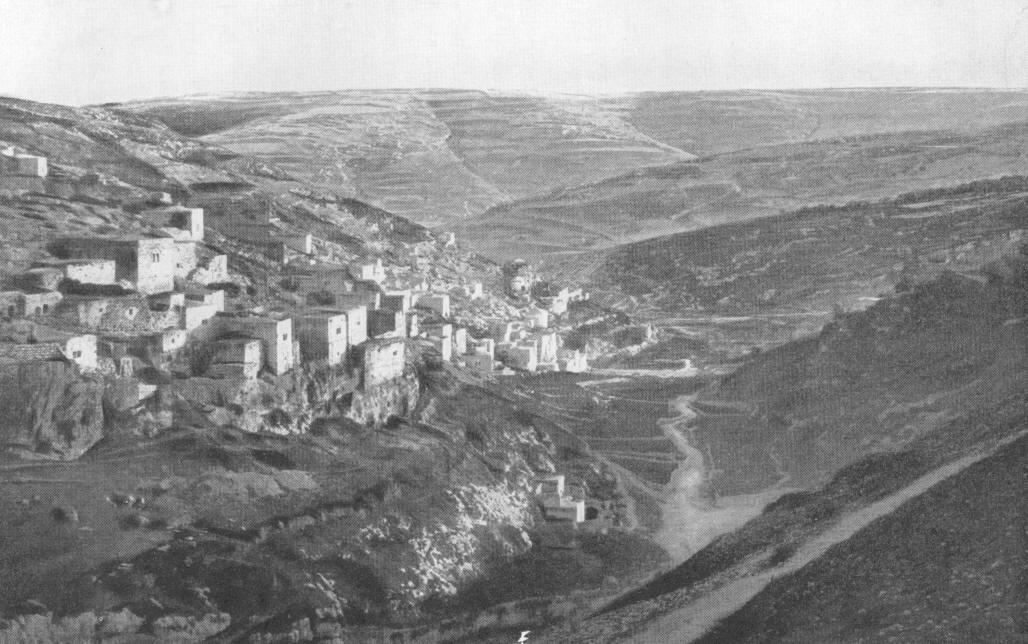
THE VALLEY OF THE KIDRON, LOOKING FROM JERUSALEM INTO THE WILDERNESS OF JUDEA. ON THE LEFT IS THE VILLAGE OF SILOAM. Used by special permission of the Detroit Photograph Company.
This is a very different view of the valley of the Kidron or the valley of Jehoshaphat from those previously shown. The village of Siloam, at the base of the Mount of Olives, is on the left and Jerusalem is out of view on the right. There is now no water in the ravine except in a very rainy season, but no doubt there was a stream in ancient times. There is a spring which rises in the valley, and which perhaps once flowed through it, but was diverted to flow through the remarkable tunnel, built probably by Hezekiah, through the ridge of the southern part of the temple hill. A very ancient inscription found at the mouth of the tunnel in 1880 confirms this view.
{275}
And the captains over hundreds did according to all that Jehoiada the priest commanded: and they took every man his men, those that were to come in on the Sabbath, with those that were to go out on the Sabbath, and came to Jehoiada the priest. And the priest delivered to the captains over hundreds the spears and shields that had been King David's, which were in the house of the Lord.
And the guard stood, every man with his weapons in his hand, from the right side of the house to the left side of the house, along by the altar and the house, by the king round about.
Then he brought out the king's son, and put the crown upon him, and gave him the testimony; and they made him king, and anointed him; and they clapped their hands, and said, "God save the king!"
And when Athaliah heard the noise of the guard and of the people, she came to the people into the house of the Lord: and she looked, and, behold, the king stood by the pillar, as the manner was, and the captains and the trumpets by the king; and all the people of the land rejoiced, and blew with trumpets.
Then Athaliah rent her clothes, and cried, "Treason, treason!"
And Jehoiada the priest commanded the captains of hundreds that were set over the host, and said unto them, "Take her forth between the ranks; and him that followeth her slay with the sword" (for the priest said, "Let her not be slain in the house of the Lord").
So they made way for her; and she went by the way of the horses' entry to the king's house: and there was she slain.
{276}
And Jehoiada made a covenant between the Lord and the king and the people, that they should be the Lord's people; between the king also and the people.
And all the people of the land went to the house of Baal, and broke it down; his altars and his images broke they in pieces thoroughly, and slew Mattan the priest of Baal before the altars. And the priest appointed officers over the house of the Lord. And he took the captains over hundreds, and the guard, and all the people of the land; and they brought down the king from the house of the Lord, and came by the way of the gate of the guard unto the king's house. And he sat on the throne of the kings. So all the people of the land rejoiced, and the city was quiet: and they slew Athaliah with the sword at the king's house.
{277}
JOASH. A King Who Failed to Continue in Well-Doing.
(For a while Joash was a very good king, but at last the wise priest Jehoiada, who had made him king, died. As soon as this restraint was removed Joash listened to the counsel of wild young princes, and so far forgot the debt of gratitude he owed to Jehoiada that he killed the son of the priest when he also reproved him for his evil deeds. In the latter part of his reign, disasters came thick and fast. The Syrians came down and swept Judah with fire and sword. They did not kill Joash, but they left him at the end of his long reign of forty years, a helpless sufferer from disease. Then the very servants of his household conspired against him and murdered him in his bed.)
Joash was seven years old when he began to reign; and he reigned forty years in Jerusalem: and his mother's name was Zibiah of Beer-sheba. And Joash did that which was right in the eyes of the Lord all the days of Jehoiada the priest.
And it came to pass after this, that Joash was minded to restore the house of the Lord. And he gathered together the priests and the Levites, and said to them, "Go out unto the cities of Judah, and gather of all Israel money to repair the house of your God from year to year, and see that ye hasten the matter." Howbeit the Levites hastened it not.
And the king called for Jehoiada the chief, and said {278} unto him, "Why hast thou not required of the Levites to bring in out of Judah and out of Jerusalem the tax of Moses the servant of the Lord, and of the congregation of Israel, for the tent of the testimony?" For the sons of Athaliah, that wicked woman, had broken up the house of God; and also all the dedicated things of the house of the Lord did they bestow upon the idols of Baal.
So the king commanded, and they made a chest, and set it without at the gate of the house of the Lord. And they made a proclamation through Judah and Jerusalem, to bring in for the Lord the tax that Moses the servant of God laid upon Israel in the wilderness. And all the princes and all the people rejoiced, and brought in, and cast into the chest, until they had made an end. And it was so, that at what time the chest was brought unto the king's office by the hand of the Levites, and when they saw that there was much money, the king's scribe and the chief priest's officer came and emptied the chest, and took it, and carried it to its place again. Thus they did day by day, and gathered money in abundance.
And the king and Jehoiada gave it to such as did the work of the service of the house of the Lord; and they hired masons and carpenters to restore the house of the Lord, and also such as wrought iron and brass to repair the house of the Lord. So the workmen wrought, and the work was perfected by them, and they set up the house of God in its state, and strengthened it. And when they had made an end, they brought the rest of the money before the king and Jehoiada, whereof were made vessels for the {279} house of the Lord, even vessels to minister, and to offer withal, and spoons, and vessels of gold and silver. And they offered burnt offerings in the house of the Lord continually all the days of Jehoiada.
But Jehoiada grew old and was full of days, and he died; an hundred and thirty years old was he when he died.
And they buried him in the city of David among the kings, because he had done good in Israel, and toward God and his house.
Now after the death of Jehoiada came the princes of Judah, and made obeisance to the king. Then the king hearkened unto them. And they forsook the house of the Lord, the God of their fathers, and served the Asherim and the idols: and wrath came upon Judah and Jerusalem for this their guiltiness. Yet he sent prophets to them, to bring them again unto the Lord; and they testified against them: but they would not give ear. And the spirit of God came upon Zechariah the son of Jehoiada the priest; and he stood above the people, and said unto them, "Thus saith God, 'Why transgress ye the commandments of the Lord, that ye cannot prosper? because ye have forsaken the Lord, he hath also forsaken you.'"
And they conspired against him, and stoned him with stones at the commandment of the king in the court of the house of the Lord. Thus Joash the king remembered not the kindness which Jehoiada his father had done to him, but slew his son. And when he died, he said, "The Lord look upon it, and require it."
And it came to pass at the end of the year, that the {280} army of the Syrians came up against him: and they came to Judah and Jerusalem, and destroyed all the princes of the people from among the people, and sent all the spoil of them to the king of Damascus. For the army of the Syrians came with a small company of men; and the Lord delivered a very great host into their hand, because they had forsaken the Lord, the God of their fathers. So they executed judgment upon Joash.
And when they were departed from him (for they left him in great diseases), his own servants conspired against him for the blood of the sons of Jehoiada the priest, and slew him on his bed, and he died: and they buried him in the city of David, but they buried him not in the sepulchers of the kings. And these are they that conspired against him; Zabad the son of Shimeath the Ammonitess, and Jehozabad the son of Shimrith the Moabitess. And Amaziah his son reigned in his stead.
{281}
AMAZIAH. A King of Judah Who Was Conquered by a King of Israel.
(The reign of Amaziah began with victory. He defeated the old foes of Judah, the Edomites, in a great battle. He was so filled with foolish pride at this success that he challenged the king of Israel to fight. The king of Israel sent his refusal to this challenge in a very clever little story of the cedar of Lebanon and the thistle. But Amaziah did not heed the warning. Jehoash of Israel came down with his fighting men and not only defeated the overconfident king but actually captured Jerusalem and tore down a part of its walls.)
Amaziah was twenty and five years old when he began to reign; and he reigned twenty and nine years in Jerusalem: and his mother's name was Jehoaddan of Jerusalem. And he did that which was right in the eyes of the Lord, but not with a perfect heart.
Now it came to pass, when the kingdom was established unto him, that he slew his servants which had killed the king his father. But he put not their children to death, but did according to that which is written in the law in the book of Moses, as the Lord commanded, saying, "The fathers shall not die for the children, neither shall the children die for the fathers; but every man shall die for his own sin."
Moreover Amaziah gathered Judah together, and ordered them according to their fathers' houses, under {282} captains of thousands and captains of hundreds, even all Judah and Benjamin: and he numbered them from twenty years old and upward, and found them three hundred thousand chosen men, able to go forth to war, that could handle spear and shield. He hired also an hundred thousand mighty men of valor, mercenaries, out of Israel for an hundred talents of silver.
But there came a man of God to him, saying, "O king, let not the army of Israel go with thee; for the Lord is not with Israel. But if thou wilt go, do valiantly, be strong for the battle: God shall cast thee down before the enemy; for God hath power to help, and to cast down."
And Amaziah said to the man of God, "But what shall we do for the hundred talents which I have given to the army of Israel?"
And the man of God answered, "The Lord is able to give thee much more than this."
Then Amaziah separated them, to wit, the army that was come to him out of Ephraim, to go home again: wherefore their anger was greatly kindled against Judah, and they returned home in fierce anger.
And Amaziah took courage, and led forth his people, and went to the Valley of Salt, and smote of the children of Seir ten thousand. And other ten thousand did the children of Judah carry away alive, and brought them unto the top of the rock, and cast them down from the top of the rock, so that they all were broken in pieces. But the men of the army which Amaziah sent back, that they should not go with him to battle, fell upon the cities of Judah, from Samaria even unto Beth-horon, and smote of them three thousand, and took much spoil.
{283}
{284}
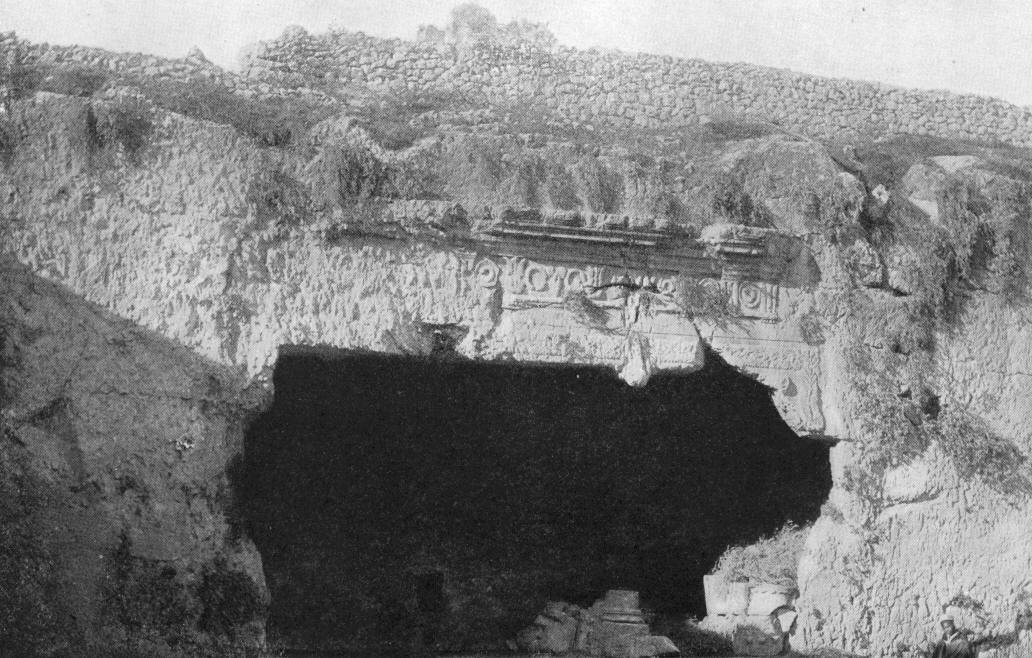
TOMBS OF THE KINGS, NORTH OF JERUSALEM. From a photograph in the possession of Rev. Louis F. Giroux of the American International College, Springfield, Mass., and used by his kind permission.
The Tombs of the Kings, so called, are hewn out of the solid rock.
{285}
Now it came to pass, after that Amaziah was come from the slaughter of the Edomites, that he brought the gods of the children of Seir, and set them up to be his gods, and bowed down himself before them, and burned incense unto them. Wherefore the anger of the Lord was kindled against Amaziah, and he sent unto him a prophet, which said unto him, "Why hast thou sought after the gods of the people, which have not delivered their own people out of thine hand?"
And it came to pass, as he talked with him, that the king said unto him, "Have we made thee of the king's counsel? forbear; why shouldest thou be smitten?"
Then the prophet forebore, and said, "I know that God hath determined to destroy thee, because thou hast done this, and hast not hearkened unto my counsel."
Then Amaziah king of Judah took advice, and sent to Joash, the son of Jehoahaz, the son of Jehu, king of Israel, saying, "Come, let us look one another in the face in battle."
And Joash king of Israel sent to Amaziah king of Judah, saying, "The thistle that was in Lebanon sent to the cedar that was in Lebanon, saying, 'Give thy daughter to my son to wife': and there passed by a wild beast that was in Lebanon, and trod down the thistle.
"Thou sayest, 'Lo, I have smitten Edom'; and thine heart lifteth thee up to boast: abide now at home; why shouldest thou meddle to thy hurt, that thou shouldest fall, even thou, and Judah with thee?"
{286}
But Amaziah would not hear; for it was of God, that he might deliver them into the hand of their enemies, because they had sought after the gods of Edom. So Joash king of Israel went up; and he and Amaziah king of Judah looked one another in the face in battle at Beth-shemesh, which belongeth to Judah.
And Judah was put to the worse before Israel; and they fled every man to his tent.
And Joash king of Israel took Amaziah king of Judah, the son of Joash the son of Ahaziah, at Beth-shemesh, and brought him to Jerusalem, and broke down the wall of Jerusalem from the gate of Ephraim unto the corner gate, four hundred cubits. And he took all the gold and silver, and all the vessels that were found in the house of God with Obed-edom, and the treasures of the king's house, the hostages also, and returned to Samaria.
And Amaziah the son of Joash king of Judah lived after the death of Joash son of Jehoahaz king of Israel fifteen years.
Now from the time that Amaziah did turn away from following the Lord they made a conspiracy against him in Jerusalem; and he fled to Lachish: but they sent after him to Lachish, and slew him there. And they brought him upon horses, and buried him with his fathers in the city of Judah.
{287}
UZZIAH. A King Who Ruled Wisely and Vigorously, But Who Was Punished Because of Irreverence.
(After the vainglorious Amaziah came Uzziah, a strong and vigorous king. He encouraged agriculture, he rebuilt the walls of Jerusalem and fortified the city in a stronger way. He dug cisterns to water the herds, and had many vineyards and orchards. He was successful in his wars and extended his territory to the west, conquering several Philistine towns. But the story goes on to say that he became so proud of his success and his strength that he attempted to usurp the work of the priests. While he was offering incense in the temple, which he had no right to do, he suddenly became a leper. After that he was forced to live in a house apart by himself while his son acted as regent for him until he died.)
And all the people of Judah took Uzziah, who was sixteen years old, and made him king in place of his father Amaziah. He built Elath, and restored it to Judah, after the king died. Sixteen years old was Uzziah when he began to reign; and he reigned fifty and two years in Jerusalem: and his mother's name name was Jechiliah of Jerusalem. And he did that which was right in the eyes of the Lord, according to all that his father Amaziah had done.
And he set himself to seek God in the days of Zechariah, who had understanding in the vision of God: and as long {288} as he sought the Lord, God made him to prosper. And he went forth and warred against the Philistines, and broke down the wall of Gath, and the wall of Jabneh, and the wall of Ashdod; and he built cities in the country of Ashdod, and among the Philistines.
And God helped him against the Philistines, and against the Arabians that dwelt in Gur-baal, and the Meunim. And the Ammonites gave gifts to Uzziah: and his name spread abroad even to Egypt, for he grew exceeding strong.
Moreover Uzziah built towers in Jerusalem at the corner gate, and at the valley gate, and at the turning of the wall, and fortified them. And he built towers in the wilderness, and hewed out many cisterns, for he had much cattle; in the lowland also, and in the plain: and he had husbandmen and vinedressers in the mountains and in the fruitful fields; for he loved husbandry.
Moreover Uzziah had an army of fighting men, that went out to war by bands, according to the number of their reckoning made by Jeiel the scribe and Maaseiah the officer, under the hand of Hananiah, one of the king's captains. The whole number of the heads of fathers' houses, even the mighty men of valor, was two thousand and six hundred. And under their hand was a trained army, three hundred thousand and seven thousand and five hundred, that made war with mighty power, to help the king against the enemy. And Uzziah prepared for them, even for all the host, shields, and spears, and helmets, and coats of mail, and bows, and stones for slinging. And he made in Jerusalem engines, invented by cunning men, to be on the towers and upon the battlements, to shoot arrows and great stones. And his name spread far abroad; for he was marvelously helped, till he was strong.
{289}
{290}
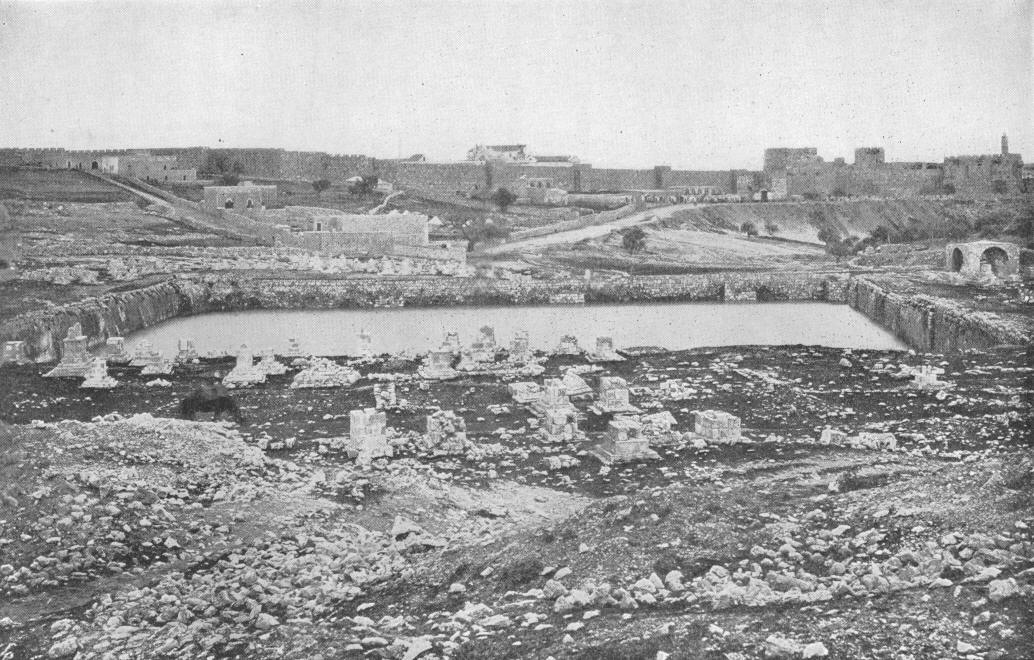
JERUSALEM, FROM THE WEST, LOOKING OVER THE POOL IN THE HEAD OF THE VALLEY OF HINNOM.
The Jaffa Gate is in the wall a little to the right of the center of the picture. The road in the center is the highway from Jaffa to Jerusalem. The pool in the center is surrounded by Mohammedan graves. The beginning of the road to Bethlehem runs from the Jaffa Gate toward the left, at the base of the wall. The high buildings towering over this road are the Tower of David, on the site of a very ancient fortress. A garrison of Turkish soldiers is still kept there.
{291}
But when he was strong, his heart was lifted up so that he did corruptly, and he trespassed against the Lord his God; for he went into the temple of the Lord to burn incense upon the altar of incense. And Azariah the priest went in after him, and with him fourscore priests of the Lord, that were valiant men: and they withstood Uzziah the king, and said unto him, "It belongeth not unto thee, Uzziah, to burn incense unto the Lord, but to the priests the sons of Aaron, that are consecrated to burn incense: go out of the sanctuary; for thou hast trespassed; neither shall it be for thine honor from the Lord God."
Then Uzziah was angry; and he had a censer in his hand to burn incense; and while he was angry with the priests, the leprosy broke forth in his forehead before the priests in the house of the Lord, beside the altar of incense. And Azariah the chief priest, and all the priests, looked upon him, and, behold, he was leprous in his forehead, and they thrust him out quickly from thence. He himself hastened also to go out, because the Lord had smitten him.
And Uzziah the king was a leper unto the day of his death, and dwelt in a separate house, being a leper; for he was cut off from the house of the Lord: and Jotham his son was over the king's house, ruling the people of the land. So Uzziah died; and they buried him with his fathers in the field of burial which belonged to the kings; for they said, "He is a leper": and Jotham his son reigned.
{292}
JOTHAM.
(Jotham reigned, it is said, sixteen years, but for all but two years he was regent in place of his father who could not occupy the throne because of his leprosy. On the whole his reign was good and he was successful in his undertakings.)
Jotham was twenty and five years old when he began to reign; and he reigned sixteen years in Jerusalem: and his mother's name was Jerushah the daughter of Zadok. And he did that which was right in the eyes of the Lord, according to all that his father Uzziah had done: howbeit he entered not into the temple of the Lord. And the people did yet corruptly.
He built the upper gate of the house of the Lord, and on the wall of Ophel he built much. Moreover he built cities in the hill country of Judah, and in the forests he built castles and towers. He fought also with the king of the children of Ammon, and prevailed against them. And the children of Ammon gave him the same year an hundred talents of silver, and ten thousand measures of wheat, and ten thousand of barley. So much did the children of Ammon render unto him, in the second year also, and in the third.
So Jotham became mighty, because he ordered his ways before the Lord his God. He was five and twenty years old when he began to reign, and reigned sixteen years in Jerusalem. And Jotham died, and they buried him in the city of David: and Ahaz his son reigned in his stead.
{293}
AHAZ.
(With Ahaz came a period of disaster for Judah. He was a thoroughly depraved character; weak, vacillating, yet obstinate and perverse. He accepted the old idol worship in all its hideous forms, even sacrificing his own children, it is said, to the awful god of fire, Moloch. During his reign the land was swept by waves of invasion, and many people were killed or carried off captive to Damascus and Samaria. He tried to make an alliance with Assyria, but this resulted in his practically becoming a vassal king. He paid a great tribute and stripped the temple bare of its ornamentation and its precious vessels to satisfy the demand.)
Ahaz was twenty years old when he began to reign; and he reigned sixteen years in Jerusalem: and he did not that which was right in the eyes of the Lord, like David his father: but he walked in the ways of the kings of Israel, and made also molten images for Baal. Moreover he burnt incense in the valley of the son of Hinnom, and burnt his children in the fire, according to the abominations of the heathen, whom the Lord cast out before the children of Israel. And he sacrificed and burnt incense in the high places, and on the hills, and under every green tree.
Wherefore the Lord his God delivered him into the hand of the king of Syria; and they smote him, and carried away of his a great multitude of captives, and brought them to Damascus. And he was also delivered into the hand of the king of Israel, who smote him with a great slaughter.
For Pekah the son of Remaliah slew in Judah an {294} hundred and twenty thousand in one day, all of them valiant men; because they had forsaken the Lord, the God of their fathers. And Zichri, a mighty man of Ephraim, slew Maaseiah the king's son, and Azrikam the ruler of the house, and Elkanah that was next to the king.
And the children of Israel carried away captive of their brethren two hundred thousand, women, sons, and daughters, and took also away much spoil from them, and brought the spoil to Samaria.
But a prophet of the Lord was there, whose name was Oded: and he went out to meet the host that came to Samaria, and said unto them, "Behold, because the Lord, the God of your fathers, was wroth with Judah, he hath delivered them into your hand, and ye have slain them in a rage which hath reached up unto heaven. And now ye purpose to keep under the children of Judah and Jerusalem for bondmen and bondwomen unto you: but are there not even with you trespasses of your own against the Lord your God? Now hear me therefore, and send back the captives, which ye have taken captive of your brethren: for the fierce wrath of the Lord is upon you."
Then certain of the heads of the children of Ephraim, Azariah the son of Johanan, Berechiah the son of Meshillemoth, and Jehizkiah the son of Shallum, and Amasa the son of Hadlai, stood up against them that came from the war, and said unto them, "Ye shall not bring in the captives hither: for ye purpose that which will bring upon us a trespass against the Lord, to add unto our sins and to our trespass: for our trespass is great, and there is fierce wrath against Israel."
{295}
So the armed men left the captives and the spoil before the princes and all the congregation. And the men who have been named rose up, and took the captives, and with the spoil clothed all that were naked among them, and arrayed them, and shod them, and gave them to eat and to drink, and anointed them, and carried all the feeble of them upon asses, and brought them to Jericho, the city of palm trees, unto their brethren: then they returned to Samaria.
At that time did King Ahaz send unto the kings of Assyria to help him. For again the Edomites had come and smitten Judah, and carried away captives. The Philistines also had invaded the cities of the lowland, and of the south of Judah, and had taken Beth-shemesh, and Aijalon, and Gederoth, and Soco with the towns thereof, and Timnah with the towns thereof, Gimzo also and the towns thereof: and they dwelt there. For the Lord brought Judah low because of Ahaz king of Israel; for he had dealt wantonly in Judah, and trespassed sore against the Lord. And Tiglath-pileser king of Assyria came unto him, and distressed him, but strengthened him not.
For Ahaz took away a portion out of the house of the Lord, and out of the house of the king and of the princes, and gave it unto the king of Assyria: but it helped him not. And in the time of his distress did he trespass yet more against the Lord, this same King Ahaz. For he sacrificed unto the gods of Damascus. And King Ahaz went to Damascus to meet Tiglath-pileser king of Assyria, and saw the altar that was at Damascus: and King Ahaz sent to Urijah the priest the fashion of the altar, and the {296} pattern of it, according to all the workmanship thereof. And Urijah the priest built an altar: according to all that King Ahaz had sent from Damascus, so did Urijah the priest make it against King Ahaz came from Damascus. And when the king was come from Damascus, the king saw the altar: and the king drew near unto the altar, and offered thereon.
And he burnt his burnt offering and his meal offering, and poured his drink offering, and sprinkled the blood of his peace offerings, upon the altar. And the brazen altar, which was before the Lord, he brought from the forefront of the house, from between his altar and the house of the Lord, and put it on the north side of his altar.
And King Ahaz commanded Urijah the priest, saying, "Upon the great altar burn the morning burnt offering, and the evening meal offering, and the king's burnt offering, and his meal offering, with the burnt offering of all the people of the land, and their meal offering, and their drink offerings; and sprinkle upon it all the blood of the burnt offering, and all the blood of the sacrifice: but the brazen altar shall be for me to inquire by."
Thus did Urijah the priest, according to all that King Ahaz commanded. And King Ahaz cut off the borders of the bases, and removed the laver from off them; and took down the sea from off the brazen oxen that were under it, and put it upon a pavement of stone. And the covered way for the Sabbath that they had built in the house, and the king's entry without, turned he unto the house of the Lord, because of the king of Assyria.
{297}
{298}
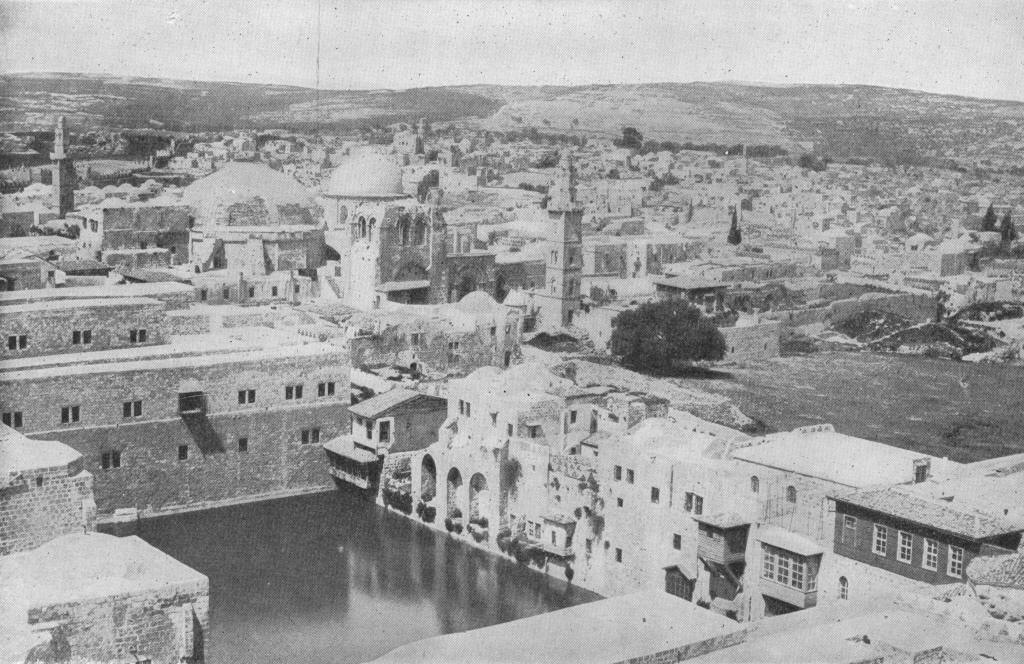
THE POOL OF HEZEKIAH IN JERUSALEM From a photograph belonging to the Forbes Library, Northampton, Mass., and used by special permission
In the East where the water supply is scanty, pools or reservoirs are made with cement floors to retain water, supplied by surface drainage, by springs, or by conduits conducting the water from a considerable distance. The water supply for Jerusalem comes from reservoirs near Bethlehem, called the "pools of Solomon." The picture shows a pool, now surrounded by houses, in Jerusalem, which is connected by tradition with the name of the great king Hezekiah. This energetic and able ruler certainly built a number of reservoirs so that the city might have water in case of siege. The underground aqueduct, 1,708 feet long, a wonderful piece of ancient engineering skill, leading from Gihon to the upper pool of Siloam, is thought by many to have been his work
{299}
HEZEKIAH.
(One of the best and most famous of all the kings of Judah was Hezekiah. He instituted great reforms and overthrew idol worship of all kinds. He even destroyed the brazen serpent made by Moses, which had become an object of worship. He was successful in his campaigns against the Philistines. He fortified Jerusalem as it had been done before. He was a lover of music and literature, and is said to have written many hymns. The greatest event of his reign was the successful defense of Jerusalem against the hordes of Sennacherib.)
Hezekiah began to reign when he was five and twenty years old; and he reigned nine and twenty years in Jerusalem: and his mother's name was Abijah, the daughter of Zechariah. And he did that which was right in the eyes of Jehovah, according to all that David his father had done. He in the first year of his reign, in the first month, opened the doors of the house of Jehovah, and repaired them.
And he brought in the priests and the Levites, and gathered them together into the broad place on the east, and said unto them, "Hear me, ye Levites; now sanctify yourselves, and sanctify the house of Jehovah, the God of your fathers, and carry forth the filthiness out of the holy place. For our fathers have trespassed, and done that which was evil in the sight of Jehovah our God, and have forsaken him, and have turned away their faces from {300} the habitation of Jehovah, and turned their backs. Also they have shut up the doors of the porch, and put out the lamps, and have not burned incense nor offered burnt offerings in the holy place unto the God of Israel. Wherefore the wrath of Jehovah was upon Judah and Jerusalem, and he hath delivered them to be tossed to and fro, to be an astonishment, and an hissing, as ye see with your eyes. For, lo, our fathers have fallen by the sword, and our sons and our daughters and our wives are in captivity for this. Now it is in my heart to make a covenant with the Lord, the God of Israel, that his fierce anger may turn away from us. My sons, be not now negligent: for the Lord hath chosen you to stand before him, to minister unto him, and that ye should be his ministers, and burn incense."
Then the Levites arose, and they gathered their brethren, and sanctified themselves, and went in, according to the commandment of the king by the words of the Lord, to cleanse the house of the Lord. And the priests went in unto the inner part of the house of the Lord, to cleanse it, and brought out all the uncleanness that they found in the temple of the Lord into the court of the house of the Lord. And the Levites took it, to carry it out to the brook Kidron. Now they began on the first day of the first month to sanctify, and on the eighth day of the month came they to the porch of the Lord; and they sanctified the house of the Lord in eight days: and on the sixteenth day of the first month they made an end.
Then they went in to Hezekiah the king within the palace, and said, "We have cleansed all the house of the {301} Lord, and the altar of burnt offering, with all the vessels thereof, and the table of showbread, with all the vessels thereof. Moreover all the vessels, which King Ahaz in his reign did cast away when he trespassed, have we prepared and sanctified; and, behold, they are before the altar of the Lord."
Then Hezekiah the king arose early, and gathered the princes of the city, and went up to the house of the Lord. And they brought seven bullocks, and seven rams, and seven lambs, and seven he-goats, for a sin offering for the kingdom, and for the sanctuary and for Judah. And he commanded the priests the sons of Aaron to offer them on the altar of the Lord. So they killed the bullocks, and the priests received the blood, and sprinkled it on the altar: and they killed the rams, and sprinkled the blood upon the altar: they killed also the lambs, and sprinkled the blood upon the altar.
And they brought near the he-goats for the sin offering before the king and the congregation; and they laid their hands upon them: and the priests killed them, and they made a sin offering with their blood upon the altar, to make atonement for all Israel: for the king commanded that the burnt offering and the sin offering should be made for all Israel. And he set the Levites in the house of the Lord with cymbals, with psalteries, and with harps, according to the commandment of David, and of Gad the king's seer, and Nathan the prophet: for the commandment was of the Lord by his prophets.
And the Levites stood with the instruments of David, {302} and the priests with the trumpets. And Hezekiah commanded to offer the burnt offering upon the altar. And when the burnt offering began, the song of the Lord began also, and the trumpets, together with the instruments of David king of Israel. And all the congregation worshiped, and the singers sang, and the trumpeters sounded; all this continued until the burnt offering was finished. And when they had made an end of offering, the king and all that were present with him bowed themselves and worshiped. Moreover Hezekiah the king and the princes commanded the Levites to sing praises unto the Lord with the words of David, and of Asaph the seer. And they sang praises with gladness, and they bowed their heads and worshiped.
Then Hezekiah answered and said, "Now ye have consecrated yourselves unto the Lord, come near and bring sacrifices and thank offerings into the house of the Lord."
And the congregation brought in sacrifices and thank offerings; and as many as were of a willing heart brought burnt offerings.
So the service of the house of the Lord was set in order. And Hezekiah rejoiced, and all the people, because of that which God had prepared for the people: for the thing was done suddenly.
And Hezekiah sent to all Israel and Judah, and wrote letters also to Ephraim and Manasseh, that they should come to the house of the Lord at Jerusalem, to keep the passover unto the Lord, the God of Israel. For the king had taken counsel, and his princes, and all the congregation in Jerusalem, to keep the passover in the second month.
{303}
{304}
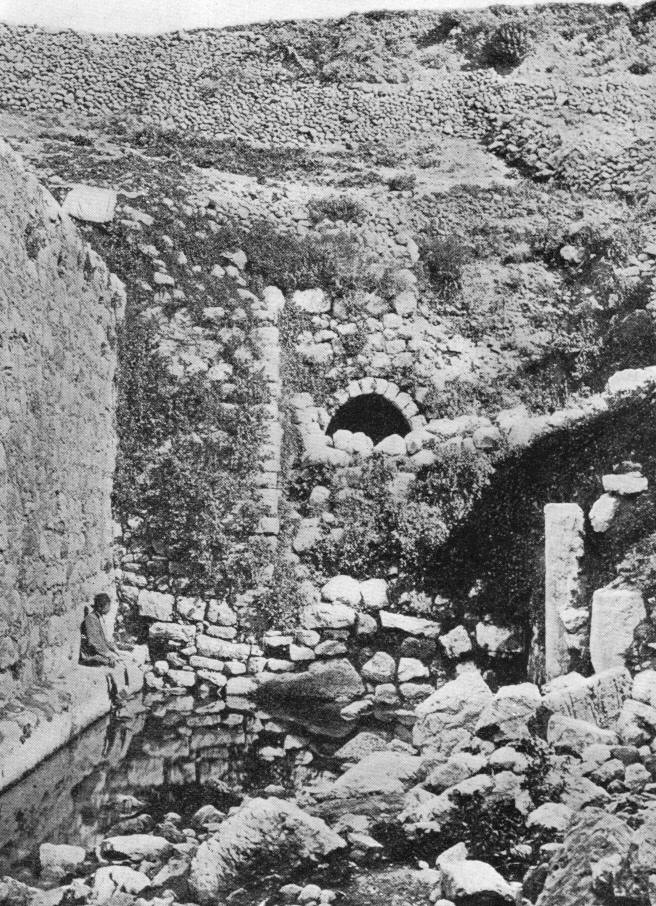
THE POOL OF SILOAM.
In connection with the "Pool of Siloam" a most interesting discovery has been made. A tunnel hewn in the rock carries the water down the west side of the Kidron Valley to a pool in the Tyropoeon, so that it might be used by the people in the lower part of the city. In June, 1880, an inscription was discovered near the mouth of this tunnel which says that the work was carried on from both ends, that the workmen met in the middle, and that the length was 1,200 cubits. It is generally supposed that the tunnel was made during the reign of King Hezekiah.
{305}
For they could not keep it at that time, because the priests had not sanctified themselves in sufficient number, neither had the people gathered themselves together to Jerusalem. And the thing was right in the eyes of the king and of all the congregation.
So they established a decree to make proclamation throughout all Israel, from Beer-sheba even to Dan, that they should come to keep the passover unto the Lord, the God of Israel, at Jerusalem: for they had not kept it in great numbers in the way it is written. So the messengers went with the letters from the king and his princes throughout all Israel and Judah, and according to the commandment of the king, saying, "Ye children of Israel, turn again unto the Lord, the God of Abraham, Isaac, and Israel, that he may return to the remnant that are escaped of you out of the hand of the kings of Assyria. And be not ye like your fathers, and like your brethren, which trespassed against the Lord, the God of their fathers, so that he gave them up to desolation, as ye see. Now be ye not stiff-necked, as your fathers were; but yield yourselves unto the Lord, and enter into his sanctuary, which he hath sanctified for ever, and serve the Lord your God, that his fierce anger may turn away from you. For if ye turn again unto the Lord, your brethren and your children shall find compassion before them that led them captive, and shall come again into this land: for the Lord your God is gracious and merciful, and will not turn away his face from you, if ye return unto him."
So the messengers passed from city to city through {306} Ephraim and Manasseh, even unto Zebulun: but they laughed them to scorn, and mocked them. Nevertheless some of the people of Asher and Manasseh and of Zebulun humbled themselves and came to Jerusalem. Also in Judah was the hand of God to give them one heart, to do the commandment of the king and of the princes by the word of the Lord. And there assembled at Jerusalem many people to keep the feast of unleavened bread in the second month, a very great congregation. And they arose and took away the altars that were in Jerusalem, and all the altars for incense took they away, and cast them into the brook Kidron. Then they killed the passover on the fourteenth day of the second month: and the priests and the Levites were ashamed, and sanctified themselves, and brought burnt offerings into the house of the Lord. And they stood in their place after their order, according to the law of Moses the man of God: the priests sprinkled the blood, which they received of the hand of the Levites. For there were many in the congregation that had not sanctified themselves: therefore the Levites had the charge of killing the passovers for everyone that was not clean, to sanctify them unto the Lord. For a multitude of the people, even many of Ephraim and Manasseh, Issachar and Zebulun, had not cleansed themselves, yet did they eat the passover otherwise than it is written. For Hezekiah had prayed for them, saying, "The good Lord pardon every one that setteth his heart to seek God, the Lord, the God of his fathers, though he be not cleansed according to the purification of the sanctuary."
{307}
And the Lord hearkened to Hezekiah, and healed the people. And the children of Israel that were present at Jerusalem kept the feast of unleavened bread seven days with great gladness: and the Levites and the priests praised the Lord day by day, singing with loud instruments unto the Lord. And Hezekiah spoke comfortably unto all the Levites that were well skilled in the service of the Lord. So they did eat throughout the feast for the seven days, offering sacrifices of peace offerings, and making confession to the Lord, the God of their fathers. And the whole congregation took counsel to keep other seven days: and they kept other seven days with gladness. For Hezekiah king of Judah did give to the congregation for offerings a thousand bullocks and seven thousand sheep; and the princes gave to the congregation a thousand bullocks and ten thousand sheep: and a great number of priests sanctified themselves. And all the congregation of Judah, with the priests and the Levites, and all the congregation that came out of Israel, and the strangers that came out of the land of Israel, and that dwelt in Judah, rejoiced. So there was great joy in Jerusalem: for since the time of Solomon the son of David king of Israel there was not the like in Jerusalem. Then the priests the Levites arose and blessed the people: and their voice was heard, and their prayer came up to his holy habitation, even unto heaven.
Now when all this was finished, all Israel that were present went out to the cities of Judah, and broke in pieces the pillars, and hewed down the Asherim, and broke down the high places and the altars out of all Judah and {308} Benjamin, in Ephraim also and Manasseh, until they had destroyed them all. Then all the children of Israel returned, every man to his possession, into their own cities. And Hezekiah appointed the courses of the priests and the Levites after their courses, every man according to his service, both the priests and the Levites, for burnt offerings and for peace offerings, to minister, and to give thanks, and to praise in the gates of the camp of the Lord. He appointed also the king's portion of his substance for the burnt offerings, to wit, for the morning and evening burnt offerings, and the burnt offerings for the Sabbaths, and for the new moons, and for the set feasts, as it is written in the law of the Lord.
Moreover he commanded the people that dwelt in Jerusalem to give the portion of the priests and the Levites, that they might give themselves to the law of the Lord. And as soon as the commandment came abroad, the children of Israel gave in abundance the first fruits of corn, wine, and oil, and honey, and of all the increase of the field; and the tithe of all things brought they in abundantly. And the children of Israel and Judah, that dwelt in the cities of Judah, they also brought in the tithe of oxen and sheep, and the tithe of dedicated things which were consecrated unto the Lord their God, and laid them by heaps. In the third month they began to lay the foundation of the heaps, and finished them in the seventh month. And when Hezekiah and the princes came and saw the heaps, they blessed the Lord, and his people Israel. Then Hezekiah questioned with the priests and the Levites concerning the heaps.
{309}
{310}
DIGGING IN THE MOUND WHICH COVERS THE ANCIENT CITY OF LACHISH. From a photograph of the Palestine Exploration Fund and used by special permission.
Lachish, a very ancient city, was captured by the Hebrews when they first came into Palestine. It was an important military post, guarding the passes into southern Judea. It was captured by Sennacherib in the great raid when he took "all the fenced cities of Judah." Assyrian sculpture has been found depicting this siege of Lachish. About 120 years later, the city was again captured by Nebuchadnezzar when he carried the people into captivity. When the people returned it was again occupied. The pictures show the excavation in the mound which covers the site of this very ancient city. In this mound there are 14 layers of ruins one above the other. Important tablets dating before the first occupation of the Hebrews have been found.
{311}
And Azariah the chief priest, of the house of Zadok, answered him and said, "Since the people began to bring the oblations into the house of the Lord, we have eaten and had enough, and have left plenty: for the Lord hath blessed his people; and that which is left is this great store." Then Hezekiah commanded to prepare chambers in the house of the Lord; and they prepared them.
After these things, and this faithfulness, Sennacherib king of Assyria came, and entered into Judah, and encamped against the fenced cities, and thought to win them for himself. And when Hezekiah saw that Sennacherib was come, and that he intended to fight against Jerusalem, he took counsel with his princes and his mighty men to stop the waters of the fountains which were without the city; and they helped him. So there was gathered many people together, and they stopped all the fountains, and the brook that flowed through the midst of the land, saying, "Why should the kings of Assyria come, and find much water?"
And he took courage, and built up all the wall that was broken down, and raised it up to the towers, and the other wall without, and strengthened Millo in the city of David, and made weapons and shields in abundance. And he set captains of war over the people, and gathered them together to him in the broad place at the gate of the city, and spoke encouragingly to them, saying, "Be strong and of a good courage, be not afraid nor dismayed for the king of Assyria, nor for all the multitude that is with him: for there is a greater with us than with him: with him is {312} an arm of flesh; but with us is the Lord our God to help us, and to fight our battles." And the people rested themselves upon the words of Hezekiah king of Judah.
After this did Sennacherib king of Assyria send his servants to Jerusalem (now he was before Lachish, and all his army with him), unto Hezekiah king of Judah, and unto all Judah that were at Jerusalem, saying, "Thus saith Sennacherib king of Assyria, Whereon do ye trust, that ye abide the siege in Jerusalem? Doth not Hezekiah persuade you, to give you over to die by famine and by thirst, saying, 'The Lord our God shall deliver us out of the hand of the king of Assyria'? Hath not the same Hezekiah taken away his high places and his altars, and commanded Judah and Jerusalem, saying, 'Ye shall worship before one altar, and upon it shall ye burn incense'? Know ye not what I and my fathers have done unto all the peoples of the lands? Were the gods of the nations of the lands any ways able to deliver their land out of my hand? Who was there among all the gods of those nations which my fathers utterly destroyed, that could deliver his people out of my hand, that your God should be able to deliver you out of my hand? Now therefore let not Hezekiah deceive you, nor persuade you on this manner, neither believe ye him: for no god of any nation or kingdom was able to deliver his people out of my hand, and out of the hand of my fathers: how much less shall your God deliver you out of my hand?"
And his servants spoke yet more against the Lord God, and against his servant Hezekiah. He wrote also letters, {313} to ridicule the Lord, the God of Israel, and to speak against him, saying, "As the gods of the nations of the lands, which have not delivered their people out of my hand, so shall not the God of Hezekiah deliver his people out of my hand."
And they cried with a loud voice in the Hebrew language unto the people of Jerusalem that were on the wall, to affright them, and to trouble them; that they might take the city.
And they spoke of the God of Jerusalem, as of the gods of the peoples of the earth, which are the work of men's hands. And Hezekiah the king, and Isaiah the prophet the son of Amoz, prayed because of this, and cried to heaven. And the Lord sent an angel, which cut off all the mighty men of valor, and the leaders and captains, in the camp of the king of Assyria. So he returned with shame of face to his own land. And when he was come into the house of his god, his own children slew him there with the sword.
Thus the Lord saved Hezekiah and the inhabitants of Jerusalem from the hand of Sennacherib the king of Assyria, and from the hand of all other, and guided them on every side. And many brought gifts unto the Lord to Jerusalem, and precious things to Hezekiah king of Judah: so that he was exalted in the sight of all nations from thenceforth.
In those days Hezekiah was sick even unto death: and he prayed unto the Lord; and he spoke unto him, and gave him a sign. But Hezekiah rendered not again {314} according to the benefit done unto him; for his heart was lifted up: therefore there was wrath upon him, and upon Judah and Jerusalem. Notwithstanding Hezekiah humbled himself for the pride of his heart, both he and the inhabitants of Jerusalem, so that the wrath of the Lord came not upon them in the days of Hezekiah.
And Hezekiah had exceeding much riches and honor: and he provided him treasuries for silver, and for gold, and for precious stones, and for spices, and for shields, and for all manner of goodly vessels; storehouses also for the increase of corn and wine and oil; and stalls for all manner of beasts, and flocks in folds.