Volume 4 — How the Lord Jesus Began to Win the Love of Many People.
Reading edition
{62}
PERSONS OF THE STORY. The LORD JESUS. John the Baptist. The Disciples of Jesus. Mary, the Mother of Jesus. Nicodemus, a great teacher at Jerusalem. A woman of Samaria. A king's officer. The Evil One. Pharisees, Sadducees. Soldiers, a wedding party, money changers, priests, Samaritans. PLACES OF THE STORY. The Jordan River. The Wilderness. Cana in Galilee. Jerusalem. Samaria. Galilee.
{63}
{64}
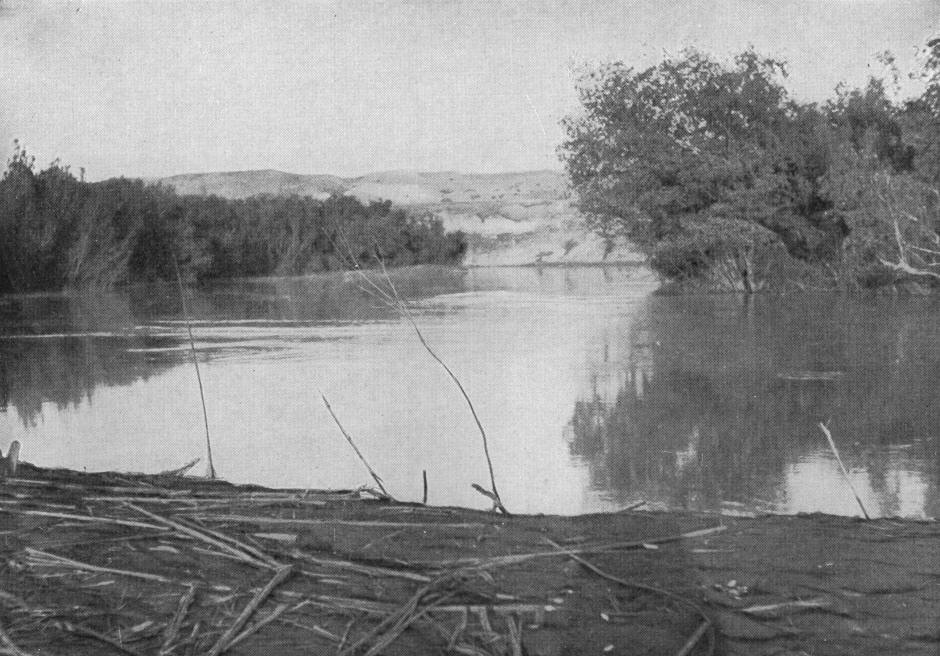
THE LOWER FORDS OF THE JORDAN. Photograph taken by Mrs. Frank L. Goodspeed of Springfield, Mass., and used by her kind permission.
This fine picture shows the traditional place of the baptism of Jesus. The river has been at flood, as often happens in its impetuous torrent, and quantities of driftwood are shown along its banks.
{65}
I THE BAPTISM OF JESUS How John Preached to the People, and How the Lord Jesus Was Baptized by Him in the River Jordan.
In those days came John the Baptist, preaching in the wilderness of Judaea, saying, "Repent ye; for the kingdom of heaven is at hand. For this is he who was spoken of by Isaiah the prophet, saying,--
'The voice of one crying in the wilderness, Make ye ready the way of the Lord, Make his paths straight.'"
Now John himself had his raiment of camel's hair, and a leathern girdle about his loins; and his food was locusts and wild honey. Then went out unto him the people of Jerusalem, and all Judaea, and all the region round about Jordan; and they were baptized by him in the river Jordan, confessing their sins.
But when he saw many of the Pharisees and Sadducees coming to his baptism, he said unto them, "Ye offspring of vipers, who warned you to flee from the wrath to come? Bring forth therefore fruit worthy of repentance: and think not to say within yourselves, 'We have Abraham to our father': for I say unto you, that God is able of these stones to raise up children unto Abraham.
{66}
"And even now is the axe laid unto the root of the trees: every tree therefore that bringeth not forth good fruit is hewn down, and cast into the fire. I indeed baptize you with water unto repentance: but he who cometh after me is mightier than I, whose shoes I am not worthy to bear: he shall baptize you with the Holy Spirit and with fire: whose fan is in his hand, and he will thoroughly cleanse his threshing-floor; and he will gather his wheat into the garner, but the chaff he will burn up with unquenchable fire."
And the multitudes asked him, saying, "What then must we do?"
And he answered and said unto them, "He that hath two coats, let him impart to him that hath none; and he that hath food, let him do likewise."
And there came also publicans to be baptized, and they said unto him, "Master, what must we do?"
And he said unto them, "Extort no more than that which is appointed you."
And soldiers also asked him, saying, "And we, what must we do?"
And he said unto them, "Do violence to no man, neither take anything wrongfully; and be content with your wages."
Then cometh Jesus from Galilee to the Jordan unto John, to be baptized by him. But John would have hindered him, saying, "I have need to be baptized by thee, and comest thou to me?"
But Jesus answering said unto him, "Permit it now: for thus it becometh us to fulfill all righteousness."
{67}
{68}
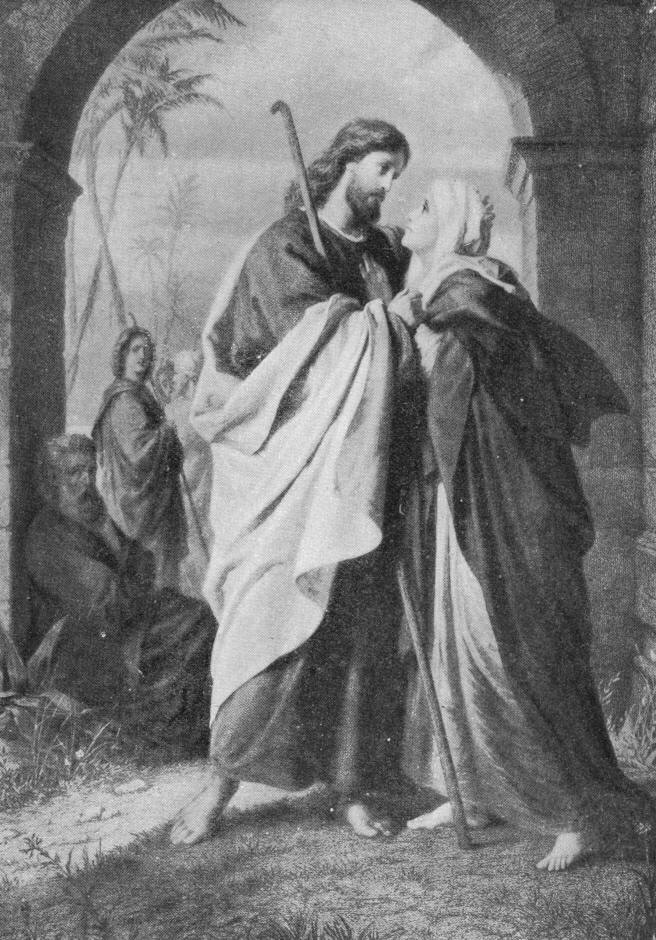
JESUS TAKING LEAVE OF HIS MOTHER. By Bernard Plockhorst
This picture shows Jesus taking leave of Mary before beginning his ministry.
{69}
Then he permitted him. And Jesus, when he was baptized, went up straightway from the water: and lo, the heavens were opened unto him, and he saw the Spirit of God descending as a dove, and coming upon him; and lo, a voice out of the heavens, saying,--
"This is my beloved Son, in Whom I am well pleased."
{70}
II THE TEMPTATION IN THE WILDERNESS. How the Lord Jesus Fought with a Great Foe.
And Jesus, full of the Holy Spirit, returned from the Jordan, and was led by the Spirit in the wilderness during forty days, being tempted of the devil. And he ate nothing in those days: and when they were completed, he hungered.
And the devil said unto him, "If thou art the Son of God, command this stone that it become bread."
And Jesus answered unto him, "It is written. 'Man shall not live by bread alone.'"
And he led him up, and showed him all the kingdoms of the world in a moment of time.
And the devil said unto him, "To thee will I give all this authority, and the glory of them: for it hath been delivered unto me; and to whomsoever I will I give it. If thou therefore wilt worship before me, it shall all be thine."
And Jesus answered and said unto him, "It is written, 'Thou shalt worship the Lord thy God, and him only shalt thou serve.'"
{71}
{72}
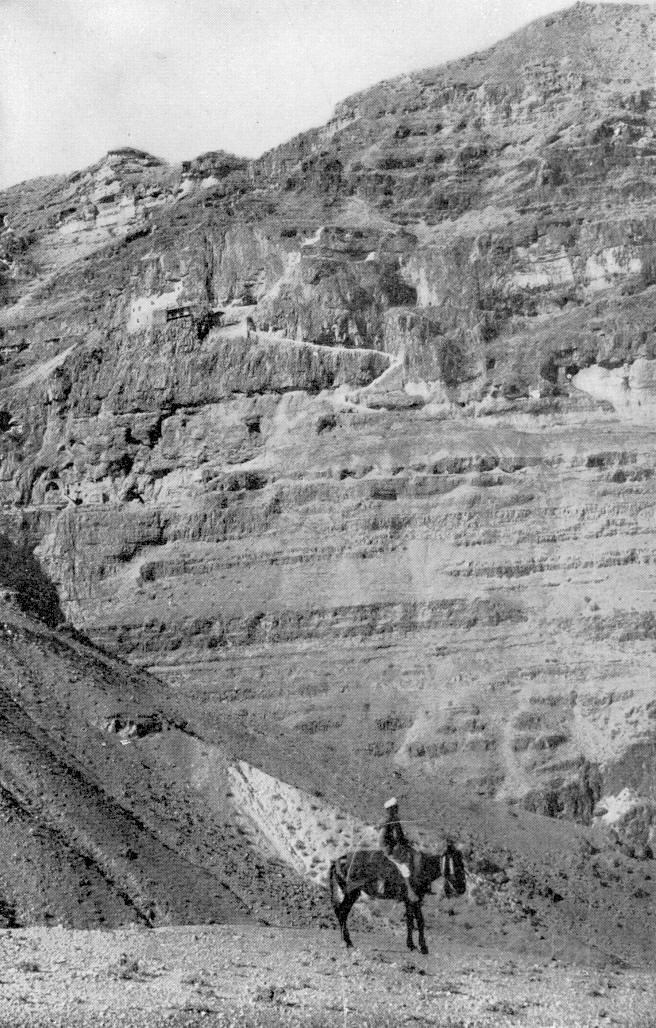
THE WILDERNESS OF THE TEMPTATION.
This wild and desolate region accords very well with our ideas of the place of the temptation of Jesus. The great cliff in the picture faces a narrow ravine not far from Jericho
{73}
And he led him to Jerusalem, and set him on the pinnacle of the temple, and said unto him, "If thou art the Son of God, cast thyself down from hence: for it is written,--
'He shall give his angels charge concerning thee, to guard thee:
and,
'On their hands they shall bear thee up, Lest haply thou dash thy foot against a stone.'"
And Jesus answering said unto him, "It is said, 'Thou shalt not tempt the Lord thy God.'"
And he was in the wilderness forty days tempted of Satan; and he was with wild beasts; and the angels ministered unto him.
{74}
III THE FIRST DISCIPLES. How the Lord Jesus Began to Win the Love of His Friends.
One day after Jesus had returned from the wilderness, where he had met the temptation, John the Baptist saw him approaching, and said, "Behold, the Lamb of God, who taketh away the sin of the world! This is he of whom I said, 'After me cometh a man which is become before me: for he was before me.' And I knew him not; but that he should be made manifest to Israel, for this cause came I baptizing with water."
Again on the morrow John was standing, and two of his disciples; and he looked upon Jesus as he walked, and said, "Behold, the Lamb of God!"
And the two disciples heard him speak, and they followed Jesus.
And Jesus turned, and beheld them following, and saith unto them, "What seek ye?"
And they said unto him, "Rabbi (that is, Master), where abidest thou?"
He saith unto them, "Come, and ye shall see."
They came therefore and saw where he abode; and they abode with him that day: it was about the tenth hoar.
One of the two that heard John speak, and followed him, was Andrew, Simon Peter's brother. He findeth first his own brother Simon, and saith unto him, "We have found the Messiah" (that is, Christ).
{75}
{76}
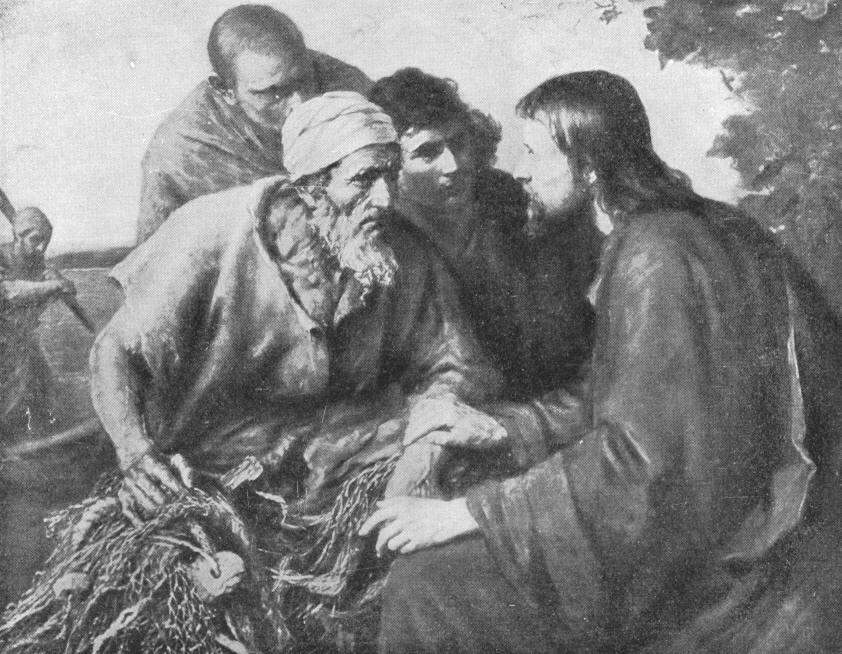
JESUS AND THE FISHERMEN. By Zimmermann
{77}
He brought him unto Jesus. Jesus looked upon him, and said, "Thou art Simon the son of John: thou shalt be called Cephas" (that is, Peter).
On the morrow he was minded to go forth into Galilee, and he findeth Philip: and Jesus saith unto him, "Follow me." Now Philip was from Bethsaida, of the city of Andrew and Peter.
Philip findeth Nathanael, and saith unto him, "We have found him, of whom Moses in the law, and the prophets, did write, Jesus of Nazareth, the son of Joseph."
And Nathanael said unto him, "Can any good thing come out of Nazareth?" Philip saith unto him, "Come and see."
Jesus saw Nathanael coming to him, and saith of him, "Behold, an Israelite indeed, in whom is no guile!"
Nathanael saith unto him, "Whence knowest thou me?" Jesus answered and said unto him, "Before Philip called thee, when thou wast under the fig tree, I saw thee."
Nathanael answered him, "Rabbi, thou art the Son of God; thou art King of Israel."
Jesus answered and said unto him, "Because I said unto thee, I saw thee underneath the fig tree, believest thou? thou shalt see greater things than these. Verily, verily, I say unto you, Ye shall see the heaven opened, and the angels of God ascending and descending upon the Son of man."
{78}
IV THE FIRST MIRACLE. How the Lord Jesus Went to a Wedding.
The third day after Jesus had started for Galilee with his new friends, there was a marriage in Cana of Galilee; and the mother of Jesus was there: and Jesus also was bidden, with his disciples, to the marriage.
And when the wine failed, the mother of Jesus said unto him, "They have no wine."
And Jesus said unto her, "Woman, what have I to do with thee? mine hour is not yet come."
His mother said unto the servants, "Whatsoever he saith unto you, do it."
Now there were six waterpots of stone set there after the Jews' custom of purifying, containing two or three firkins apiece.
Jesus said unto them, "Fill the waterpots with water." And they filled them up to the brim. And he said unto them, "Draw out now, and bear unto the ruler of the feast."
And they bore it. And when the ruler of the feast tasted the water now become wine, and knew not whence it was (but the servants which had drawn the water knew), the ruler of the feast called the bridegroom, and said unto him, "Every man setteth on first the good wine; and when men have drunk freely, then that which is worse: thou hast kept the good wine until now."
This beginning of his signs did Jesus in Cana of Galilee, and manifested his glory; and his disciples believed on him.
{79}
V AT THE PASSOVER. How the Lord Jesus Went Again to Jerusalem, What He Did, and the Friends He Made There.
And the Passover of the Jews was at hand, and Jesus went up to Jerusalem. And he found in the temple those that sold oxen and sheep and doves, and the changers of money sitting: and he made a scourge of cords, and cast all out of the temple, both the sheep and the oxen; and he poured out the changers' money and overthrew their tables; and to them that sold the doves he said, "Take these things hence; make not my Father's house a house of merchandise."
Now when he was in Jerusalem at the Passover, during the feast, many believed on his name, beholding his signs which he did.
Now there was a man of the Pharisees, named Nicodemus, a ruler of the Jews: the same came unto him by night, and said to him, "Rabbi, we know that thou art a teacher come from God: for no man can do these signs that thou doest, except God be with him."
Jesus answered and said unto him, "Verily, verily, I say unto thee, Except a man be born anew, he cannot see the kingdom of God."
{80}
Nicodemus said unto him, "How can a man be born when he is old? can he enter a second time into his mother's womb, and be born?"
Jesus answered, "Verily, verily, I say unto thee, Except a man be born of water and the Spirit, he cannot enter into the kingdom of God. That which is born of the flesh is flesh; and that which is born of the Spirit is spirit. Marvel not that I said unto thee, 'Ye must be born anew.' The wind bloweth where it listeth, and thou hearest the voice thereof, but knowest not whence it cometh, and whither it goeth: so is everyone that is born of the Spirit."
Nicodemus answered and said unto him, "How can these things be?" Jesus replied to him, "Art thou the teacher of Israel, and understandest not these things? Verily, verily, I say unto thee, We speak that we do know, and bear witness of that we have seen; and ye receive not our witness. If I told you earthly things, and ye believe not, how shall ye believe, if I tell you heavenly things? And no man hath ascended into heaven, but he that descended out of heaven, even the Son of man, which is in heaven. And as Moses lifted up the serpent in the wilderness, even so must the Son of man be lifted up: that whosoever believeth may in him have eternal life."
(This is the end of the story of the Lord Jesus and Nicodemus. What follows is added by the writer of the gospel.)
For God so loved the world, that he gave his only begotten Son, that whosoever believeth on him should not perish, but have eternal life. For God sent not the Son {81} into the world to judge the world; but that the world should be saved through him. He that believeth on him is not judged: he that believeth not hath been judged already, because he hath not believed on the name of the only begotten Son of God. And this is the judgment, that the light is come into the world, and men loved the darkness rather than the light; for their works were evil. For every one that doeth ill hateth the light, and cometh not to the light, lest his works should be reproved. But he that doeth the truth cometh to the light, that his works may be made manifest, that they have been wrought in God.
{82}
VI JESUS AT JACOB'S WELL. How the Lord Jesus Made Much of Two Days in Samaria.
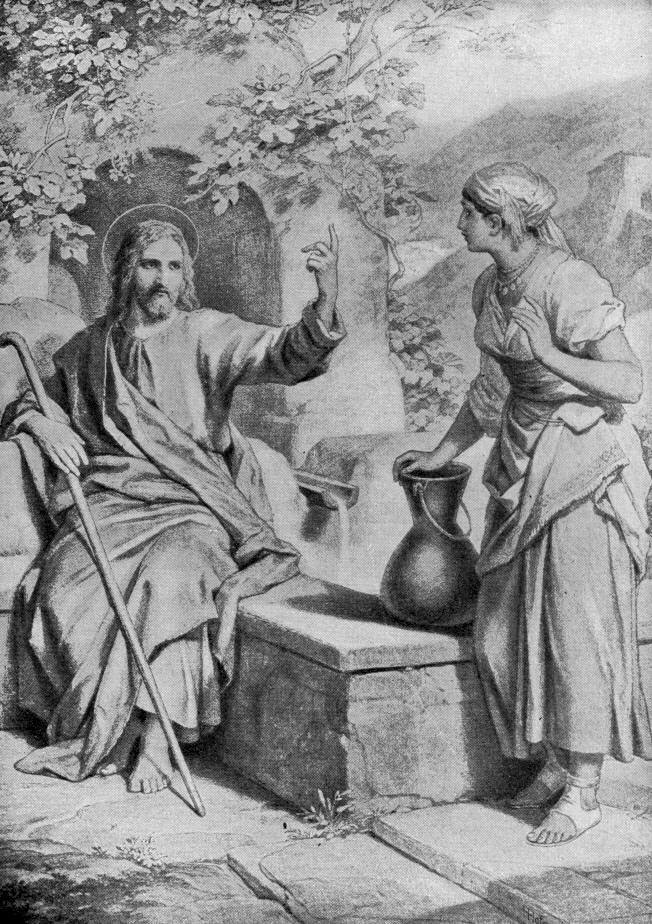
Afterward Jesus left Judaea, and departed again into Galilee. And he must needs pass through Samaria. So he cometh to a city of Samaria, called Sychar, near to the plot of ground that Jacob gave to his son Joseph: and Jacob's well was there. Jesus therefore, being wearied with his journey, sat by the well.
It was about the sixth hour. There cometh a woman of Samaria to draw water: Jesus saith unto her, "Give me to drink."
For his disciples were gone away into the city to buy food. The Samaritan woman therefore saith unto him, "How is it that thou, being a Jew, askest drink of me, which am a Samaritan woman?" (For Jews have no dealings with Samaritans.)
Jesus answered and said unto her, "If thou knewest the gift of God, and who it is that saith to thee, 'Give me to drink'; thou wouldest have asked of him, and he would have given thee living water."
The woman saith unto him, "Sir, thou hast nothing to draw with, and the well is deep. Whence then hast thou that living water? Art thou greater than our father Jacob, which gave us the well, and drank thereof himself, and his sons, and his cattle?"
{83}
{84}
JESUS AND THE WOMAN OF SAMARIA. By Heinrich Hofmann
"Sweet was the hour, O Lord! to thee At Sychor's lonely well, When a poor outcast heard thee there Thy great salvation tell. There Jacob's erring daughter found Those streams unknown before, The water brooks of life, that make The weary thirst no more."
--Sir Edward Demey
{85}
Jesus answered and said unto her, "Everyone that drinketh of this water shall thirst again: but whosoever drinketh of the water that I shall give him shall never thirst; but the water that I shall give him shall become in him a well of water, springing up unto eternal life."
The woman saith unto him, "Sir, give me this water, that I thirst not, neither come all the way hither to draw."
Jesus saith unto her, "Go, call thy husband, and come hither."
The woman answered and said unto him, "I have no husband."
Jesus saith unto her, "Thou saidst well, 'I have no husband': for thou hast had five husbands; and he whom thou now hast is not thy husband: this hast thou said truly."
The woman saith unto him, "Sir, I perceive that thou art a prophet. Our fathers worshiped in this mountain; and ye say, that in Jerusalem is the place where men ought to worship."
Jesus saith unto her, "Woman, believe me, the hour cometh, when neither in this mountain, nor in Jerusalem, shall ye worship the Father. Ye worship that which ye know not: we worship that which we know: for salvation is from the Jews. But the hour cometh, and now is, when the true worshipers shall worship the Father in spirit and truth: for such doth the Father seek to be his worshipers. God is a Spirit: and they that worship him must worship in spirit and truth."
{86}
The woman saith unto him, "I know that Messiah cometh (which is called Christ): when he is come, he will declare unto us all things."
Jesus saith unto her, "I that speak unto thee am he." And upon this came his disciples; and they marveled that he was speaking with a woman; yet no man said, "What seekest thou?" or, "Why speakest thou with her?"
So the woman left her waterpot, and went away into the city, and saith to the men, "Come, see a man, who told me all things that ever I did: can this be the Christ?"
They went out of the city, and were coming to him. In the mean while the disciples prayed him, saying, "Rabbi, eat." But he said unto them, "I have meat to eat that ye know not."
The disciples therefore said one to another, "Hath any man brought him aught to eat?"
Jesus saith unto them, "My meat is to do the will of him that sent me, and to accomplish his work. Say not ye, There are yet four months, and then cometh the harvest? behold, I say unto you, Lift up your eyes, and look on the fields, that they are white already unto harvest. He that reapeth receiveth wages, and gathereth fruit unto life eternal; that he that soweth and he that reapeth may rejoice together. For herein is the saying true, One soweth, and another reapeth. I sent you to reap that whereon ye have not labored: others have labored, and ye are entered into their labor."
And from that city many of the Samaritans believed on him because of the word of the woman, who testified, {87} "He told me all things that ever I did." So when the Samaritans came unto him, they besought him to abide with them: and he abode there two days. And many more believed because of his word; and they said to the woman, "Now we believe, not because of thy speaking: for we have heard for ourselves, and know that this is indeed the Saviour of the world."
{88}
VII THE GOOD SAMARITAN
(At another time, Jesus, who had been so kindly treated by the Samaritans, told this story to show how everyone ought to treat others kindly. This is how he happened to tell the story):--
A teacher asked Jesus, to test him, what he should do to inherit eternal life. Jesus answered, "What does the law say?"
The teacher replied, "The law says, 'Thou shalt love the Lord thy God with all thy heart, and with all thy soul, and with all thy strength, and with all thy mind; and thy neighbor as thyself.'"
And he said unto him, "Thou hast answered right: this do, and thou shalt live."
But he, desiring to justify himself, said unto Jesus, "And who is my neighbor?"
Jesus made answer and said, "A certain man was going down from Jerusalem to Jericho; and he fell among robbers, who stripped him and beat him, and departed, leaving him half dead. And by chance a certain priest was going down that way: and when he saw him, he passed by on the other side. And in like manner a Levite also, when he came to the place, and saw him, passed by on the other side. But a certain Samaritan, as he journeyed, came where he was: and when he saw him, he was moved with compassion, and came to him, and bound up his wounds, pouring on them oil and wine; and he set him on his own beast, and brought him to an inn, and took care of him.
{89}
{90}
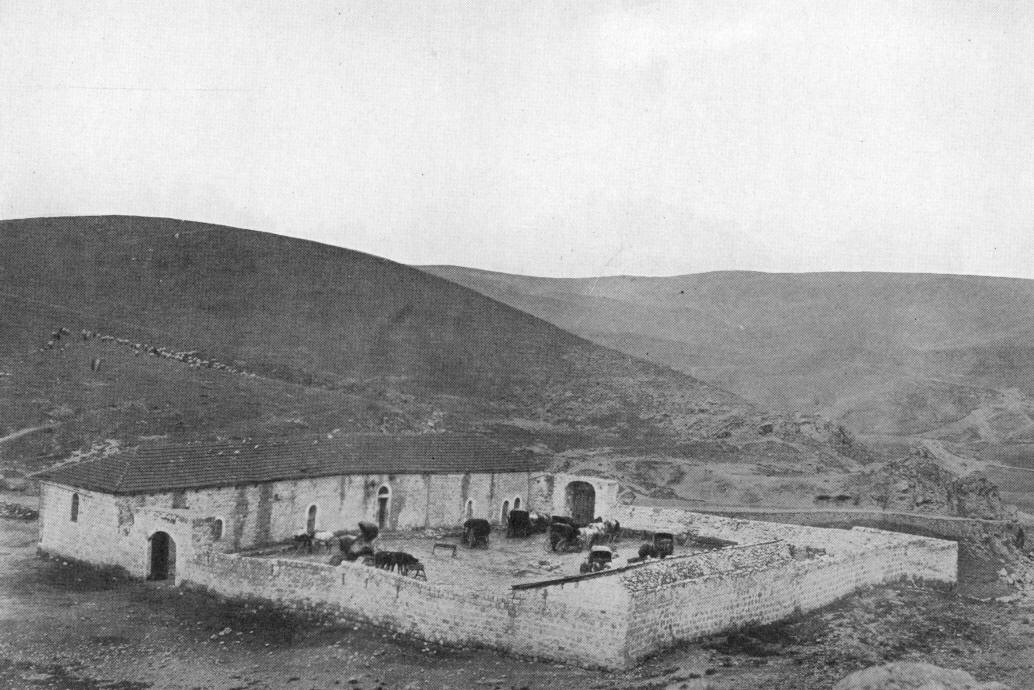
"INN OF THE GOOD SAMARITAN" From a photograph taken by Louis L. Tribus, Consulting Engineer and Commissioner of Public Works of the Borough of Richmond, City of New York, and used by his kind permission.
This is the traditional site of the "Inn of the Good Samaritan," on the pilgrim road the "Ascent of Blood," which leads from Jericho to Jerusalem. When taken upwards, a more hot and heavy way it is impossible to conceive--between blistered limestones and rocks, and in front the bare hills piled high, without shadow or verdure. There is no water from Jericho till you reach the roots of the Mount of Olives. Curious red streaks appear from time to time on the stones, and perhaps account for the sanguinary names which attach to the road,--but the crimes committed here make these doubly deserved.
{91}
And on the morrow he took out two pence, and gave them to the host, and said, 'Take care of him; and whatsoever thou spendest more, I, when I come back again, will repay thee.'
"Which of these three, thinkest thou, proved neighbor unto him that fell among the robbers?"
And he said, "He that showed mercy on him."
And Jesus said unto him, "Go, and do thou likewise."
{92}
VIII JESUS AND THE KING'S OFFICER How the Lord Jesus Went Back to Galilee, and How He Healed the Son of a King's Officer.
And after the two days in Samaria he went forth from thence into Galilee. For Jesus himself testified, that a prophet hath no honor in his own country. So when he came into Galilee, the Galilaeans received him, having seen all the things that he did in Jerusalem at the feast: for they also went unto the feast.
He came therefore again unto Cana of Galilee, where he made the water wine. And there was a certain king's officer whose son was sick at Capernaum. When he heard that Jesus had come out of Judaea into Galilee, he went unto him, and besought him that he would come down, and heal his son; for he was at the point of death. Jesus therefore said unto him, "Except ye see signs and wonders, ye will in no wise believe."
The king's officer saith unto him, "Sir, come down ere my child die."
Jesus saith unto him, "Go thy way; thy son liveth." The man believed the word that Jesus spoke unto him, and he went his way. And as he was now going down, his servants met him, saying, that his son lived. So he {93} inquired of them the hour when he began to recover. They said therefore unto him, "Yesterday at the seventh hour the fever left him."
So the father knew that it was at that hour in which Jesus said unto him, "Thy son liveth": and himself believed, and his whole house.
{94}
IX THE CHOOSING OF THE TWELVE DISCIPLES. How the Lord Jesus Gathered About Him the Men Who Were to Be His Closest Friends.
Passing along by the sea of Galilee, Jesus saw Simon and Andrew the brother of Simon casting a net in the sea: for they were fishers. And he said unto them, "Come ye after me, and I will make you fishers of men."
And straightway they left the nets, and followed him.
And going on a little further, he saw James the son of Zebedee, and John his brother, who also were in the boat mending the nets. And straightway he called them: and they left their father Zebedee in the boat with the hired servants, and went after him.
And he went forth again by the sea side; and all the multitude resorted unto him, and he taught them. And as he passed by, he saw Levi the son of Alphaeus sitting at the place of toll, and he saith unto him, "Follow me." And he arose and followed him. And it came to pass, that he was sitting at meat in his house, and many publicans and sinners sat down with Jesus and his disciples: for there were many, and they followed him. And the Pharisees, when they saw that he was eating with the sinners and publicans, said unto his disciples, "He eateth and drinketh with publicans and sinners."
{95}
And when Jesus heard it, he saith unto them, "They that are whole have no need of a physician, but they that are sick: I came not to call the righteous, but sinners."
And he went up into the mountain, and called unto him whom he himself would: and they went unto him. And he appointed twelve, that they might be with him, and that he might send them forth to preach, and to have authority to cast out demons: and Simon he surnamed Peter; and James the son of Zebedee, and John the brother of James; and them he surnamed Boanerges, which is, Sons of thunder: and Andrew, and Philip, and Bartholomew, and Matthew, and Thomas, and James the son of Alphaeus, and Thaddaeus, and Simon the Zealot, and Judas Iscariot, who also betrayed him.
{96}
The Glorious Company of the Apostles
Simon Peter. Andrew. James. John. Philip. Bartholomew. Thomas. Matthew. James "the less". Thaddaeus. Simon the Zealot. Judas Iscariot, the traitor.
{97}
Simon Peter. Brother of Andrew. Fisherman. Residence Bethsaida. One of the leaders of the apostles. Said to have founded the church at Rome and to have suffered martyrdom under Nero.
Andrew. Brother of Simon Peter. Fisherman. Residence Bethsaida. Tradition says he was crucified at Patrae by the proconsul AEgeas.
James. Brother of John. Son of Zebedee. Fisherman. Home Bethsaida. Beheaded by Herod Agrippa only fourteen years after the crucifixion. The first of the "glorious company of the apostles" to join "the noble army of martyrs."
John. "The beloved Disciple." Fisherman. Brother of James. Son of Zebedee. Home Bethsaida. Reputed author of Gospel of St. John, the Epistles of John and the Apocalypse. Said to have lived to an extreme old age, dying a natural death at Ephesus.
Philip. Fellow townsman of Peter and Andrew, and probably, like them, a fisherman. Said by tradition to have been crucified head downwards in the reign of Domitian.
Bartholomew. Native of Cana of Galilee. Tradition says that he suffered martyrdom in India.
Thomas. "The Doubter." Occupation unknown. Residence unknown. Tradition says that he was sold as a slave to an Indian merchant; that he preached the gospel there with great effect and died a natural death at an advanced age.
Matthew. "The Publican." A customs officer near Capernaum. Author of the Gospel of Matthew. Nothing is known of his subsequent life or of his death.
James. The son of Alphaeus. Called "the less." No details of his history are known.
Thaddaeus. Occupation not known. Thought to have lived at Jerusalem. Tradition says he preached the gospel in Africa. Fate unknown.
Simon, the Zealot. No details are known of his life.
Judas Iscariot. The Traitor and Betrayer of Jesus. Iscariot means "the man of Karioth." He was the only Judaean among the apostles. He committed suicide by hanging after the crucifixion.
{98}
{99}
OH, WHERE IS HE THAT TROD THE SEA?
Oh, where is He that trod the sea? Oh, where is He that spake? And demons from their victims flee, The dead their slumbers break; The palsied rise in freedom strong, The dumb men talk and sing, And from blind eyes, benighted long, Bright beams of morning spring. Oh, where is He that trod the sea? 'T is only He can save; To thousands hungering wearily, A wondrous meal He gave: Full soon, celestially fed, Their mystic fare they take; 'T was springtide when He blest the bread, 'T was harvest when He brake. Oh, where is He that trod the sea? My soul, the Lord is here: Let all thy fears be hushed in thee; To leap, to look, to hear, Be thine: thy needs He'll satisfy: Art thou diseased, or dumb? Or dost thou in thy hunger cry? "I come," saith Christ, "I come."
--Thomas T. Lynch.
{100}
JESUS, SAVIOUR, PILOT ME
Jesus, Saviour, pilot me, Over life's tempestuous sea; Unknown waves before me roll, Hiding rock and treacherous shoal; Chart and compass came from Thee: Jesus, Saviour, pilot me. As a mother stills her child, Thou canst hush the ocean wild; Boisterous waves obey Thy will When Thou say'st to them "Be still!" Wondrous Sovereign of the sea. Jesus, Saviour, pilot me. When at last I near the shore, And the fearful breakers roar 'Twixt me and the peaceful rest, Then, while leaning on Thy breast, May I hear Thee say to me, "Fear not, I will pilot thee!"
--E. Hopper.
{101}
JESUS CALLS US
Jesus calls us: o'er the tumult Of our life's wild, restless sea, Day by day His sweet voice soundeth, Softly, clearly--"Follow Me." Jesus calls us, from the evil In a world we cannot flee, From each idol that would keep us, Softly, clearly--"Follow Me." Still in joy and still in sadness We discern our own decree; Still He calls, in cares and pleasures, Softly, clearly--"Follow Me." Thou dost call us! may we ever To Thy call attentive be; Give our hearts to Thine obedience, Rise, leave all, and follow Thee.
--Mrs. Cecil Frances Alexander.
{102}
HAIL TO THE LORD'S ANOINTED.
Hail to the Lord's Anointed, Great David's greater Son; Hail, in the time appointed, His reign on earth begun! He comes to break oppression, To set the captive free, To take away transgression, And rule in equity. He comes with succor speedy To those who suffer wrong; To help the poor and needy, And bid the weak be strong; To give them songs for sighing, Their darkness turn to light, Whose souls, condemned and dying, Were precious in His sight. For Him shall prayer unceasing And daily vows ascend; His kingdom still increasing, A kingdom without end. The tide of time shall never His covenant remove; His name shall stand forever; That name to us is Love!
--James Montgomery.
{103}
How the Lord Jesus went about doing good, teaching and healing, and how He grew in favor with the people.
{104}
PERSONS OF THE STORY. The LORD JESUS. A Roman Captain and his servant. The Disciples of Jesus. Peter's mother-in-law. A widow of Nain and her son. Jairus, his wife and little daughter. John the Baptist. Herod. Herodias and her daughter. A little lad with loaves and fishes. Multitudes of people, lepers, palsied, and those having all manner of diseases. PLACES OF THE STORY. The "Mount of Beatitudes." Capernaum. The region of Galilee. The lake of Gennesaret. Gadara. The city of Nain. The Jordan. The prison in the "Black Fortress" of Machaerus. The banquet hall of Herod.
{105}
I THE SERMON ON THE MOUNT How the Lord Jesus Taught the People the Way of Right Living.
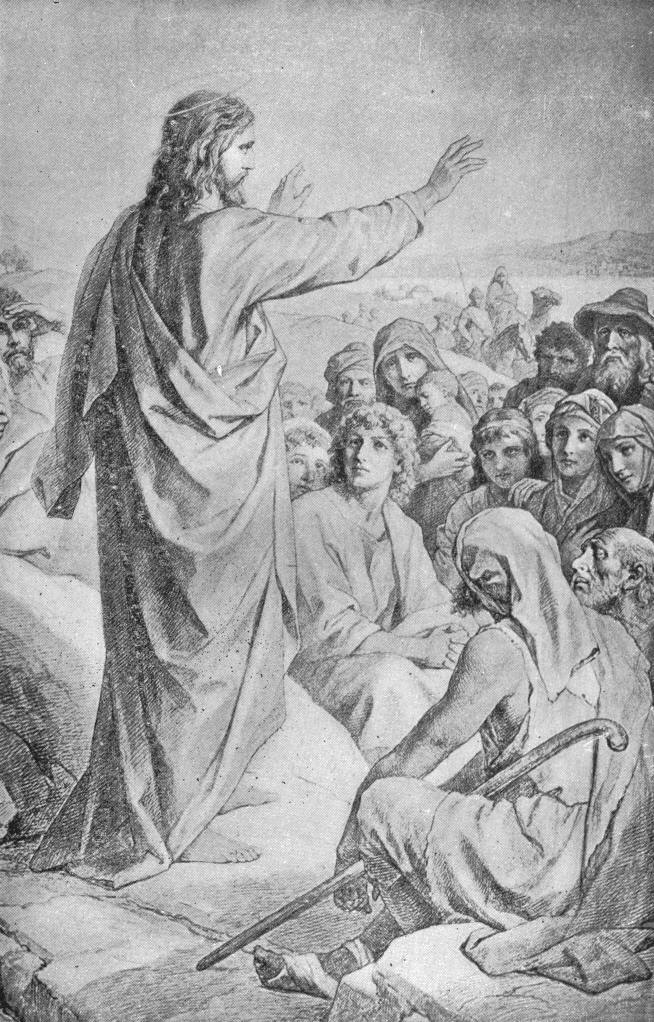
And seeing the multitudes, he went up into the mountain: and when he had sat down, his disciples came unto him: and he opened his mouth and taught them, saying,--
THE BEATITUDES.
"Blessed are the poor in spirit: for theirs is the kingdom of heaven. "Blessed are they that mourn: for they shall be comforted. "Blessed are the meek: for they shall inherit the earth. "Blessed are they that hunger and thirst for righteousness: for they shall be filled. "Blessed are the merciful: for they shall obtain mercy. "Blessed are the pure in heart: for they shall see God. "Blessed are the peacemakers: for they shall be called sons of God. "Blessed are they that have been persecuted for righteousness' sake: for theirs is the kingdom of heaven. Blessed are ye when men shall reproach you, and persecute you, and say all manner of {106} evil against you falsely, for my sake. Rejoice, and be exceeding glad: for great is your reward in heaven: for so persecuted they the prophets which were before you."
"Ye are the salt of the earth: but if the salt have lost its savor, wherewith shall it be salted? it is thenceforth good for nothing, but to be cast out and trodden under foot of men. Ye are the light of the world. A city set on a hill cannot be hid. Neither do men light a lamp, and put it under the bushel, but on the stand; and it shineth unto all that are in the house. Even so let your light shine before men, that they may see your good works, and glorify your Father which is in heaven."
THE NEW WAY OF RIGHT LIVING. Be Right in the Heart, and Not in Outward Appearance Only.
"Think not that I came to destroy the law or the prophets: I came not to destroy, but to fulfill. For verily I say unto you, Till heaven and earth pass away, one jot or one tittle shall in no wise pass away from the law, till all things be accomplished. Whosoever therefore shall break one of these least commandments, and shall teach men so, shall be called least in the kingdom of heaven: but whosoever shall do and teach them, he shall be called great in the kingdom of heaven. For I say unto you, that except your righteousness shall exceed the righteousness of the scribes and Pharisees, ye shall in no wise enter into the kingdom of heaven."
{107}
{108}
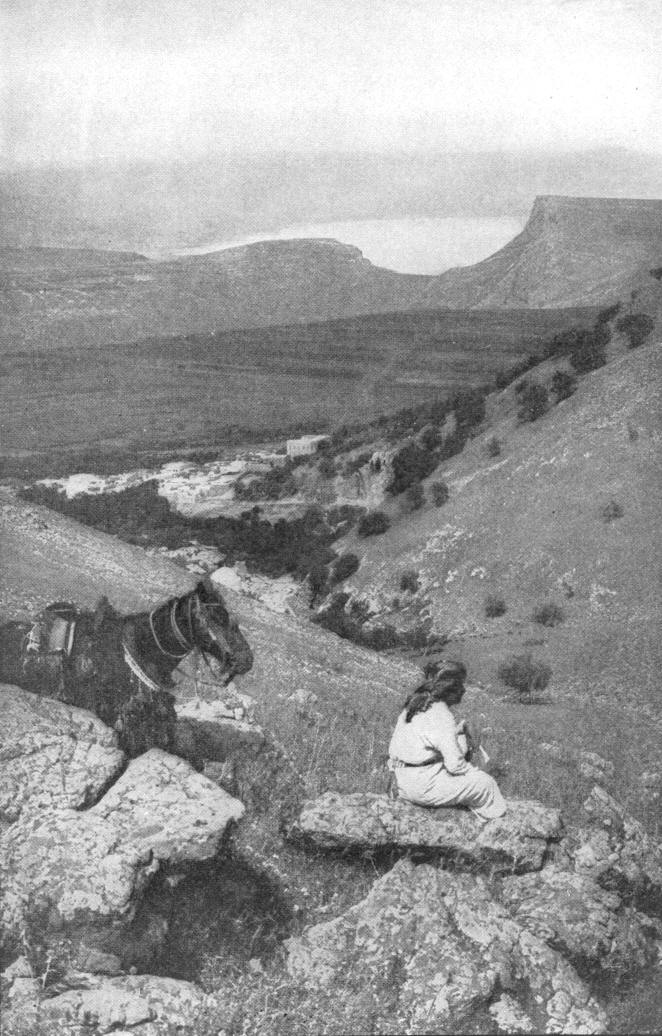
LOOKING NORTHEAST FROM THE MOUNT OF BEATITUDES TO CAPERNAUM AND THE SEA OF GALILEE. Copyright by Underwood & Underwood and used by special permission.
"Kurn Hattin," the "Horns of Hattin," a double-peaked hill four miles back from the sea and about eight miles southwest from Capernaum, is the traditional location of the mountain from which Jesus delivered the Sermon on the Mount.
{109}
It is a Sin to Get Angry.
"Ye have heard that it was said to them of old time, 'Thou shalt not kill; and whosoever shall kill shall be in danger of the judgment': but I say unto you, that every one who is angry with his brother shall be in danger of the judgment; and whosoever shall say to his brother, 'Worthless fellow,' shall be in danger of the council; and whosoever shall say, 'Thou fool,' shall be in danger of the hell of fire. If therefore thou art offering thy gift at the altar, and there rememberest that thy brother hath aught against thee, leave there thy gift before the altar, and go thy way, first be reconciled to thy brother, and then come and offer thy gift. Agree with thine adversary quickly, while thou art with him in the way; lest the adversary deliver thee to the judge, and the judge deliver thee to the officer, and thou be cast into prison. Verily I say unto thee, Thou shalt by no means come out thence, till thou hast paid the last farthing."
It is a Sin to Swear.
"Again, ye have heard that it was said to them of old time, 'Thou shalt not perjure thyself, but shalt perform unto the Lord thine oaths': but I say unto you, Swear not at all; neither by the heaven, for it is the throne of God; nor by the earth, for it is the footstool of his feet; nor by Jerusalem, for it is the city of the great King. Neither shalt thou swear by thy head, for thou canst not make one hair white or black. But let your speech be, 'Yea, yea; Nay, nay': and whatsoever is more than these is of the evil one."
{110}
It is a Sin to Be Revengeful.
"Ye have heard that it was said, 'An eye for an eye, and a tooth for a tooth': but I say unto you, Resist not evil: but whosoever smiteth thee on thy right cheek, turn to him the other also. And if any man would go to law with thee, and take away thy coat, let him have thy cloak also. And whosoever shall compel thee to go one mile, go with him two. Give to him that asketh thee, and from him that would borrow of thee turn not thou away."
It is a Sin to Think Evil of Others.
"Judge not, that ye be not judged. For with what judgment ye judge, ye shall be judged: and with what measure ye mete, it shall be measured unto you. And why beholdest thou the mote that is in thy brother's eye, but considerest not the beam that is in thine own eye? Or how wilt thou say to thy brother, 'Let me cast out the mote out of thine eye'; and lo, the beam is in thine own eye? Thou hypocrite, cast out first the beam out of thine own eye; and then shalt thou see clearly to cast out the mote out of thy brother's eye."
The Right Way is to Love Your Enemies.
"Ye have heard that it was said, 'Thou shalt love thy neighbor, and hate thine enemy': but I say unto you, Love your enemies, and pray for them that persecute you; that ye may be sons of your Father who is in heaven: for he maketh his sun to rise on the evil and the good, and sendeth rain on the just and the unjust. For if ye love them {111} that love you, what reward have ye? do not even the publicans the same? And if ye salute your brethren only, what do ye more than others? do not even the Gentiles the same? Ye therefore shall be perfect, as your heavenly Father is perfect."
The Right Way to Do Good Deeds.
"Take heed that ye do not your righteousness before men, to be seen of them: else ye have no reward with your Father who is in heaven.
"When therefore thou doest alms, sound not a trumpet before thee, as the hypocrites do in the synagogues and in the streets, that they may have glory of men. Verily I say unto you, They have received their reward. But when thou doest alms, let not thy left hand know what thy right hand doeth: that thine alms may be in secret: and thy Father who seeth in secret shall recompense thee."
The Right Way to Pray.
"And when ye pray, ye shall not be as the hypocrites: for they love to stand and pray in the synagogues and in the corners of the streets, that they may be seen of men. Verily I say unto you, They have received their reward. But thou, when thou prayest, enter into thine inner chamber, and having shut thy door, pray to thy Father who is in secret, and thy Father who seeth in secret shall recompense thee. And in praying use not vain repetitions, as the Gentiles do: for they think that they shall be heard {112} for their much speaking. Be not therefore like unto them: for your Father knoweth what things ye have need of, before ye ask him. After this manner therefore pray ye:"--
THE LORD'S PRAYER.
"Our Father which art in heaven, Hallowed be thy name. Thy kingdom come. Thy will be done In earth, as it is in heaven. Give us this day our daily bread, And forgive us our debts, As we forgive our debtors. And lead us not into temptation, But deliver us from evil: For thine is the kingdom, and the power, and the glory, for ever, Amen."
"For if ye forgive men their trespasses, your heavenly Father will also forgive you. But if ye forgive not men their trespasses, neither will your Father forgive your trespasses.
"Ask, and it shall be given you; seek, and ye shall find; knock, and it shall be opened unto you: for everyone that asketh receiveth; and he that seeketh findeth; and to him that knocketh it shall be opened. Or what man is there of you, who, if his son shall ask him for a loaf, will give him a stone; or if he shall ask for a fish, will give him a serpent? If ye then, being evil, know how to give good gifts unto your children, how much more shall your Father who is in heaven give good things to them that ask him?"
{113}
{114}
JESUS PREACHING THE SERMON ON THE MOUNT.
{115}
THE GOLDEN RULE.
"All things therefore whatsoever ye would that men should do unto you, then so do ye also unto them: for this is the law and the prophets."
The Right Way to Be Rich.
"Lay not up for yourselves treasures upon the earth, where moth and rust doth consume, and where thieves break through and steal: but lay up for yourselves treasures in heaven, where neither moth nor rust doth consume, and where thieves do not break through nor steal: for where thy treasure is, there will thy heart be also."
Trust God, and He Will Take Care of You.
"The lamp of the body is the eye: if therefore thine eye be right, thy whole body shall be full of light. But if thine eye be evil, thy whole body shall be full of darkness. If therefore the light that is in thee be darkness, how great is the darkness!
"No man can serve two masters: for either he will hate the one, and love the other; or else he will hold to the one, and despise the other. Ye cannot serve God and Mammon.
"Therefore I say unto you, Be not anxious for your life, what ye shall eat, or what ye shall drink; nor yet for {116} your body, what ye shall put on. Is not the life more than the food, and the body than the raiment? Behold the birds of the heaven, that they sow not, neither do they reap, nor gather into barns; and your heavenly Father feedeth them. Are not ye of much more value than they? And which of you by being anxious can add one cubit unto his stature? And why are ye anxious concerning raiment? Consider the lilies of the field, how they grow; they toil not, neither do they spin: yet I say unto you, that even Solomon in all his glory was not arrayed like one of these. But if God doth so clothe the grass of the field, which to-day is, and to-morrow is cast into the oven, shall he not much more clothe you, O ye of little faith?
"Be not therefore anxious, saying, 'What shall we eat?' or, 'What shall we drink?' or, 'Wherewithal shall we be clothed?' For after all these things do the Gentiles seek; for your heavenly Father knoweth that ye have need of all these things. But seek ye first his kingdom, and his righteousness; and all these things shall be added unto you. Be not therefore anxious for the morrow: for the morrow will be anxious for itself. Sufficient unto the day is the evil thereof."
God Wants Deeds, Not Words.
"Enter ye in by the narrow gate: for wide is the gate, and broad is the way, that leadeth to destruction, and many be they that enter in thereby. For narrow is the gate, and strait the way, that leadeth unto life, and few be they that find it.
{117}
"For there is no good tree that bringeth forth corrupt fruit; nor again a corrupt tree that bringeth forth good fruit. For each tree is known by its own fruit. For of thorns men do not gather figs, nor of a bramble bush gather they grapes. The good man out of the good treasure of his heart bringeth forth that which is good; and the evil man out of the evil treasure bringeth forth that which is evil: for out of the abundance of the heart his mouth speaketh.
"Not everyone that saith unto me, 'Lord, Lord,' shall enter into the kingdom of heaven; but he that doeth the will of my Father which is in heaven.
"Many will say unto me in that day, 'Lord, Lord, Did we not prophesy in thy name, And by thy name cast out demons, And by thy name do many mighty works?' And then I will profess unto them, 'I never knew you; Depart from me, ye that work iniquity.' "Everyone therefore who heareth these words of mine, And doeth them, Shall be likened unto a wise man, Which built his house upon the rock: And the rain descended, and the floods came, And the winds blew, and beat upon that house: And it fell not, for it was founded upon the rock. "And everyone who heareth these words of mine, And doeth them not, {118} Shall be likened unto a foolish man, Which built his house upon the sand: And the rain descended, and the floods came, And the wind blew, and smote upon that house; And it fell, and great was the fall thereof."
And it came to pass, when Jesus ended these words, the multitudes were astonished at his teaching: for he taught them as one having authority, and not as their scribes.
{119}
{120}
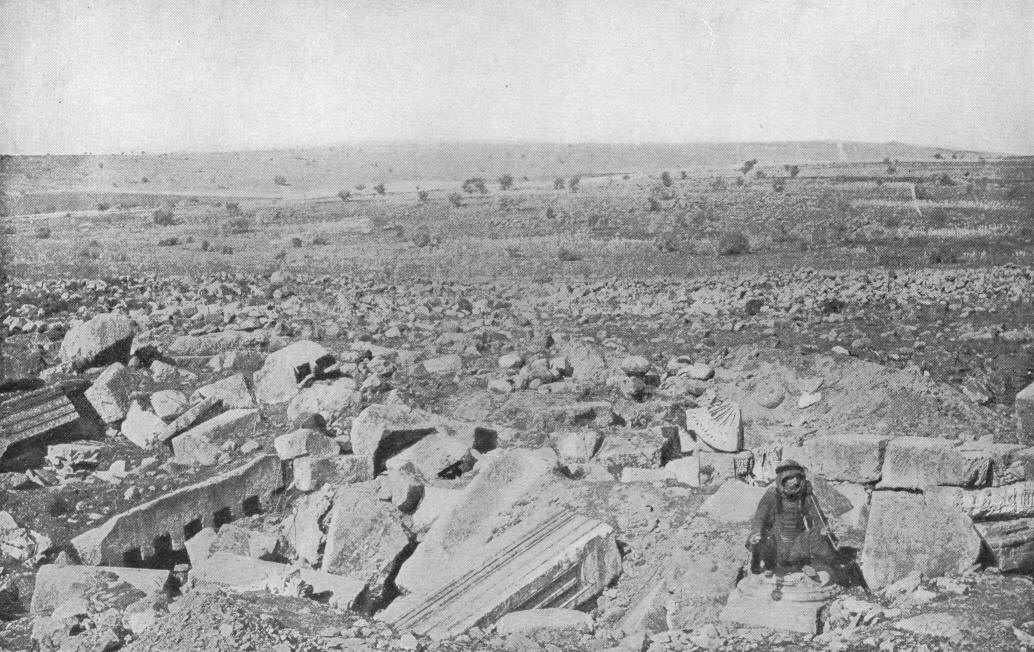
RUINS OF THE SYNAGOGUE AT CAPERNAUM. From a photograph of the Palestine Exploration Fund, and used by special permission.
{121}
II THE ROMAN SOLDIER'S FAITH How the Lord Jesus Healed the Captain's Servant.
And when he was come down from the mountain, great multitudes followed him, and he entered into Capernaum.
And a certain Roman captain's servant, who was dear to him, was sick and at the point of death. And when he heard concerning Jesus, he sent unto him elders of the Jews, asking him that he would come and save his servant.
And they, when they came to Jesus, besought him earnestly, saying, "He is worthy that thou shouldest do this for him: for he loveth our nation, and himself built us our synagogue."
And Jesus went with them. And when he was now not far from the house, the Roman captain sent friends to him, saying unto him, "Lord, trouble not thyself: for I am not worthy that thou shouldest come under my roof: wherefore neither thought I myself worthy to come unto thee: but say the word, and my servant shall be healed. For I also am a man set under authority, having under myself soldiers: and I say to this one, 'Go,' and he goeth; and to another, 'Come,' and he cometh; and to my servant, 'Do this,' and he doeth it."
And when Jesus heard these things, he marveled at {122} him, and turned and said unto the multitude that followed him, "I say unto you, I have not found so great faith, no, not in Israel."
And they that were sent, returning to the house, found the servant whole.
{123}
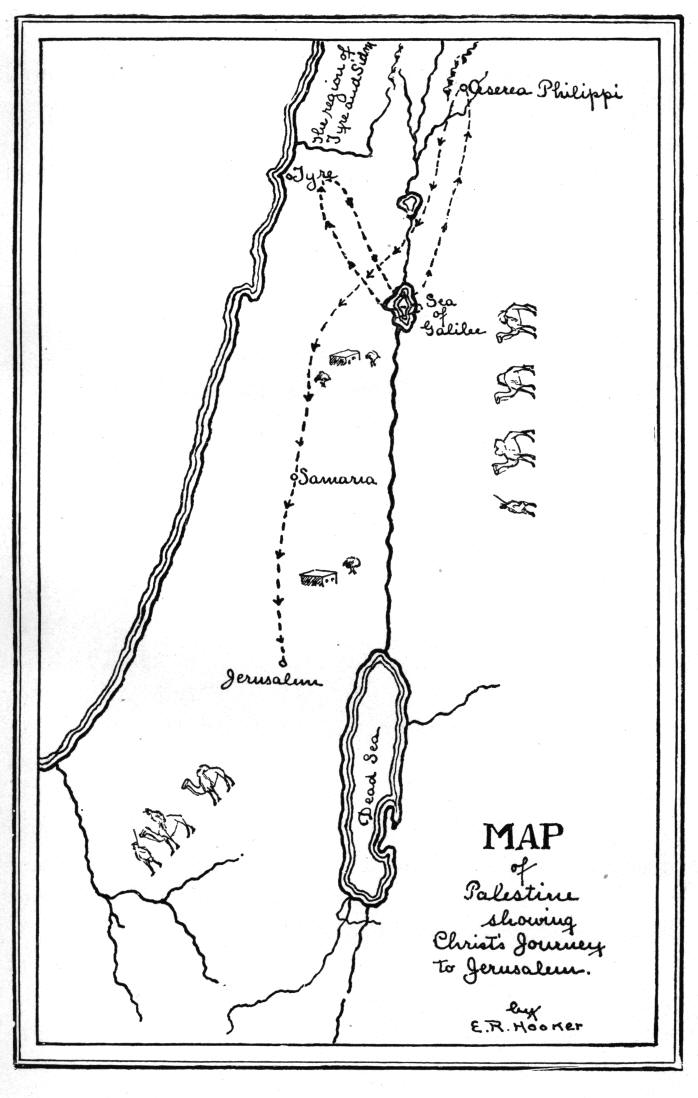
Map of Palestine showing Christ's Journey to Jerusalem. by E. R. Hooker
{124}
{125}
III DAYS OF SERVICE How the Lord Jesus Healed Many People. A Sabbath Day at Capernaum.
On the Sabbath day he entered into the synagogue and taught. And they were astonished at his teaching: for he taught them as having authority, and not as the scribes.
And there was in their synagogue a man with an unclean spirit; and he cried out, saying, "What have we to do with thee, thou Jesus of Nazareth? art thou come to destroy us? I know thee who thou art, the Holy One of God."
And Jesus rebuked him, saying, "Hold thy peace, and come out of him."
And the unclean spirit, tearing him and crying with a loud voice, came out of him.
And they were all amazed, insomuch that they questioned among themselves, saying, "What is this? a new teaching! with authority he commandeth even the unclean spirits, and they obey him."
And the news went out straightway everywhere into all the region of Galilee round about.
And when they were come out of the synagogue, they came into the house of Simon and Andrew, with James {126} and John. Now Simon's wife's mother lay sick of a fever; and they told him of her: and he came and took her by the hand, and raised her up; and the fever left her, and she ministered unto them.
And at even, when the sun set, they brought unto him all that were sick, and them that were possessed with demons. And all the city was gathered together at the door. And he healed many that were sick with divers diseases, and cast out many demons; and he suffered not the demons to speak, because they knew him.
And in the morning, a great while before day, he rose up and went out, and departed into a desert place, and there prayed. And Simon and they that were with him followed after him; and they found him, and said unto him, "All are seeking thee."
And he saith unto them, "Let us go elsewhere into the next towns, that I may preach there also; for to this end came I forth."
And he went into their synagogues throughout all Galilee, preaching and casting out demons.
Healing a Leper.
And there came to him a leper, beseeching him, and kneeling down to him, and saying unto him, "If thou wilt, thou canst make me clean."
And being moved with compassion, he stretched forth his hand, and touched him, and said unto him, "I will; be thou made clean."
And straightway the leprosy departed from him, and {127} he was made clean. And he strictly charged him, and sent him out, and saith unto him, "See thou say nothing to any man: but go thy way, show thyself to the priest, and offer for thy cleansing the things which Moses commanded, for a testimony unto them."
But he went out, and began to publish it much, and to spread abroad the matter, insomuch that Jesus could no more openly enter into a city, but was without in desert places: and they came to him from every quarter.
The Man Let Down Through the Roof.
And when he entered again into Capernaum after some days, it was noised that he was in the house. And many were gathered together, so that there was no longer room for them, no, not even about the door: and he spoke the word unto them. And they came, bringing unto him a man sick of the palsy, borne by four. And when they could not come nigh unto him for the crowd, they uncovered the roof where he was: and when they had broken through it, they let down the bed whereon the sick of the palsy lay.
And Jesus seeing their faith said unto the sick of the palsy, "Son, thy sins are forgiven."
But there were certain of the scribes sitting there, and reasoning in their hearts, "Why doth this man thus speak? he blasphemeth: who can forgive sins but one, even God?"
And straightway Jesus, perceiving in his spirit that they so reasoned within themselves, said unto them, "Why reason ye these things in your hearts? Which is easier, {128} to say to the sick of the palsy, 'Thy sins are forgiven'; or to say, 'Arise, and take up thy bed, and walk'? But that ye may know that the Son of man hath authority on earth to forgive sins (he saith to the sick of the palsy), I say unto thee, Arise, take up thy bed, and go unto thy house."
And he arose, and straightway took up the bed, and went forth before them all; insomuch that they were all amazed, and glorified God, saying, "We never saw it in this fashion."
The Two Blind Men.
And as Jesus passed by from thence, two blind men followed him, crying out, and saying, "Have mercy on us, thou son of David."
And when he was come into the house, the blind men came to him: and Jesus said unto them, "Believe ye that I am able to do this?"
They say unto him, "Yea, Lord."
Then touched he their eyes, saying, "According to your faith be it done unto you." And their eyes were opened.
And Jesus strictly charged them, saying, "See that no man know it."
But they went forth, and spread abroad his fame in all that land.
The Throngs About the Master.
And Jesus with his disciples withdrew to the sea: and a great multitude from Galilee followed: and from Judaea, and from Jerusalem, and from Idumaea, and beyond Jordan, and about Tyre and Sidon, a great multitude, {129} hearing what great things he did, came unto him. And he spoke to his disciples, that a little boat should wait on him because of the crowd, lest they should throng him: for he had healed many; insomuch that as many as had plagues pressed upon him that they might touch him. And the unclean spirits, whensoever they beheld him, fell down before him, and cried, saying, "Thou art the Son of God." And he charged them much that they should not make him known.
{130}
IV THE MIRACLE AT NAIN How the Lord Jesus Raised a Widow's Son from the Dead.
And it came to pass soon afterwards, that he went to a city called Nain; and his disciples went with him, and a great multitude. Now when he drew near to the gate of the city, behold, there was carried out one that was dead, the only son of his mother, and she was a widow: and many people of the city were with her.
And when the Lord saw her, he had compassion on her, and said unto her, "Weep not."
And he came nigh and touched the bier: and the bearers stood still. And he said, "Young man, I say unto thee, Arise." And he that was dead sat up, and began to speak. And he gave him to his mother.
And fear took hold on all: and they glorified God, saying, "A great prophet is arisen among us": and, "God hath visited his people." And this report went forth concerning him in the whole of Judaea, and all the region round about.
{131}
{132}
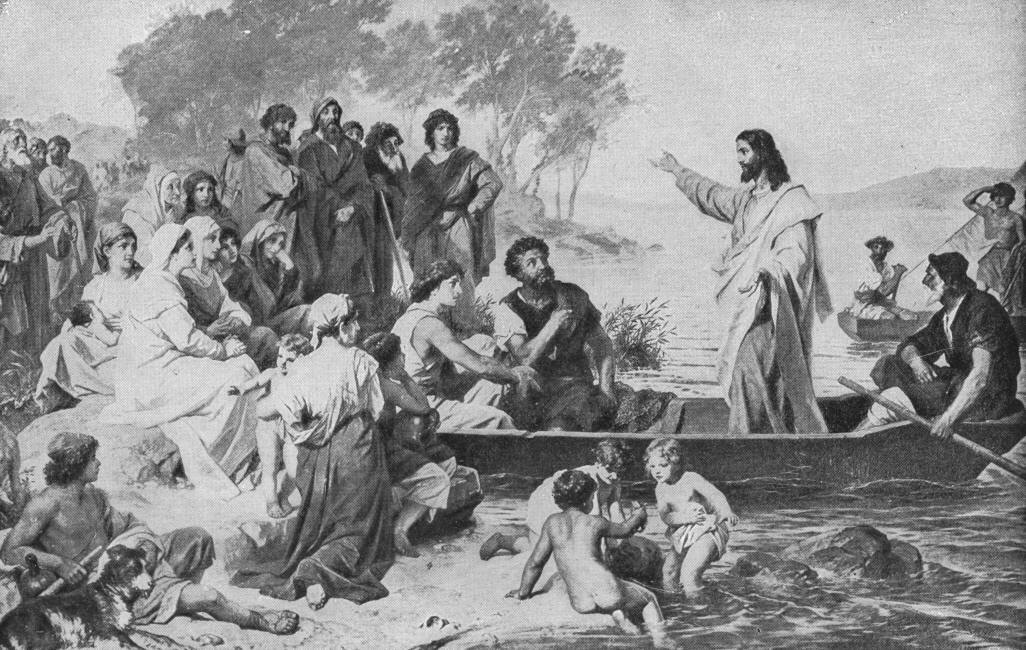
JESUS PREACHING BY THE SEASIDE
{133}
V THE GREAT TEACHER How the Lord Jesus Told the People Stories by the Sea.
And again he began to teach by the sea side. And there was gathered unto him a very great multitude, so that he entered into a boat, which was on the sea, and sat in it; and all the multitude were by the sea on the land. And he taught them many things in stories, and told them in his teaching,--
The Story of the Sower.
"Behold, the sower went forth to sow: and, as he sowed, some seed fell by the wayside, and the birds came and devoured it. And other seed fell on the rocky ground, where it had not much earth; and straightway it sprang up, because it had no deepness of earth: and when the sun was risen, it was scorched; and because it had no root, it withered away. And other seed fell among the thorns, and the thorns grew up, and choked it, and it yielded no fruit. And other seed fell into the good ground, and yielded fruit, growing up and increasing; and brought forth, thirtyfold, and sixtyfold, and a hundredfold."
And he said, "Who hath ears to hear, let him hear." (Afterward he explained the parable to them thus):--
"The sower soweth the word. And these are they by {134} the wayside, where the word is sown; and when they have heard, straightway cometh Satan, and taketh away the word which hath been sown in them. And these in like manner are they that are sown upon the rocky places, who, when they have heard the word, straightway receive it with joy; and they have no root in themselves, but endure for a while; then, when tribulation or persecution ariseth because of the word, straightway they stumble. And others are they that are sown among the thorns; these are they that have heard the word, and the cares of the world, and the deceitfulness of riches, and the lusts of other things entering in, choke the word, and it becometh unfruitful. And those are they that were sown upon the good ground; such as hear the word, and accept it; and bear fruit, thirtyfold, and sixtyfold, and a hundredfold."
The Story of the Growing Grain.
And he said, "The kingdom of God is as if a man should cast seed upon the earth; and should sleep and rise night and day, and the seed should spring up and grow, he knoweth not how. The earth beareth fruit of herself; first the blade, then the ear, then the full corn in the ear. But when the fruit is ripe, straightway he putteth forth the sickle, because the harvest is come."
The Story of the Mustard Seed.
And he said, "How shall we liken the kingdom of God? or in what story shall we set it forth? It is like a grain of mustard seed, which, when it is sown upon the earth, {135} though it he less than all the seeds that are upon the earth, yet when it is sown, groweth up, and becometh greater than all the herbs, and putteth out great branches; so that the birds of the heaven can lodge under the shadow thereof."
{136}
VI THE TEMPEST How the Lord Jesus Stilled the Storm, and Did Miracles by the Sea.
And on that day, when even was come, he saith unto them, "Let us go over unto the other side."
And leaving the multitude, they took him with them in the boat. And other boats were with him. And there arose a great storm of wind, and the waves beat into the boat, that the boat was now filling. And he himself was in the stern, asleep on the cushion: and they awake him, and say unto him, "Master, carest thou not that we perish?"
And he awoke, and rebuked the wind, and said unto the sea, "Peace, be still." And the wind ceased, and there was a great calm.
And he said unto them, "Why are ye fearful? have ye not yet faith?"
And they feared exceedingly, and said one to another, "Who then is this, that even the wind and the sea obey him?"
And they came to the other side of the sea, into the country of the Gerasenes. And when he was come out of the boat, straightway there met him out of the tombs a man with an unclean spirit, who had his dwelling in the tombs: and no man could bind him, no, not with a chain; because he had been often bound with fetters and chains, and the chains had been rent asunder by him, and the fetters broken in pieces: and no man had strength to tame him. And always, night and day, in the tombs and in the mountains, he was crying out, and cutting himself with stones.
{137}
{138}
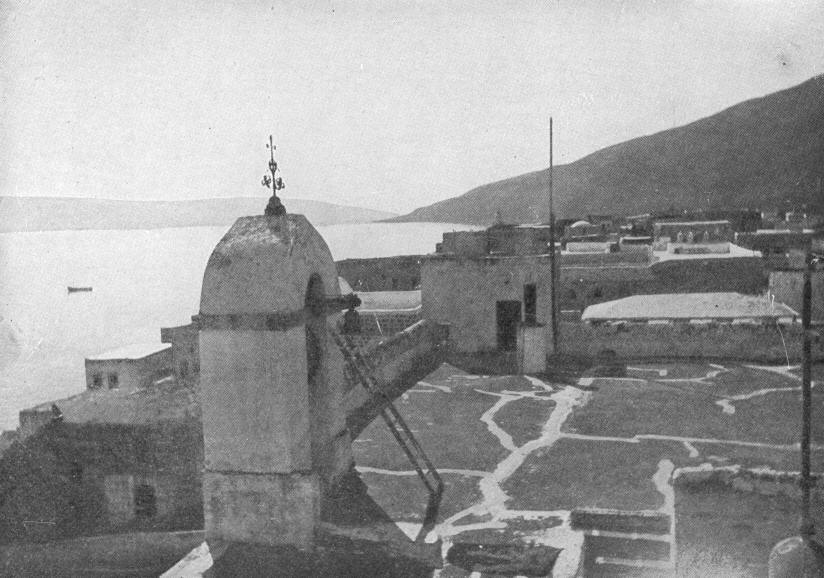
HOUSETOPS AT TIBERIAS, LOOKING OVER SEA OF GALILEE.
{139}
And when he saw Jesus from afar, he ran and bowed down to him; and crying out with a loud voice, he saith, "What have I to do with thee, Jesus, thou Son of the Most High God? I adjure thee by God, torment me not."
For he said unto him, "Come forth, thou unclean spirit, out of the man."
And he asked him, "What is thy name?"
And he saith unto him, "My name is Legion; for we are many."
And he besought him much that he would not send them away out of the country. Now there was there on the mountain side a great herd of swine feeding. And they besought him, saying, "Send us into the swine, that we may enter into them."
And he gave them leave. And the unclean spirits came out, and entered into the swine: and the herd rushed down the steep into the sea, in number about two thousand; and they were drowned in the sea.
And they that fed them fled, and told it in the city, and in the country. And they came to see what it was that had come to pass. And they came to Jesus, and beheld him who was possessed by demons sitting, clothed and in his right mind, even him that had the legion: and they were afraid. And they that saw it declared unto them what {140} had happened to him that was possessed with demons, and concerning the swine. And they began to beseech him to depart from their borders. And as he was entering into the boat, he that had been possessed with demons besought him that he might be with him. And he suffered him not, but saith unto him, "Go to thy house unto thy friends, and tell them how great things the Lord hath done for thee, and how he had mercy on thee."
And he went his way, and began to publish in Decapolis how great things Jesus had done for him: and all men marveled.
And a woman who had been an invalid for twelve years, and had suffered many things of many physicians, and had spent all that she had, and was no better, but rather grew worse, having heard the things concerning Jesus, came in the crowd behind, and touched his garment.
For she said; "If I touch but his garments, I shall be made whole." And straightway she felt in her body that she was healed of her disease.
And straightway Jesus, perceiving in himself that the power proceeding from him had gone forth, turned about in the crowd, and said, "Who touched my garments?"
And his disciples said unto him, "Thou seest the multitude thronging thee, and sayest thou, 'Who touched me?'"
And he looked round about to see her that had done this thing. But the woman fearing and trembling, knowing what had been done to her, came and fell down before him, and told him all the truth.
And he said unto her, "Daughter, thy faith hath made thee whole; go in peace, and be whole of thy disease."
{141}
VII THE LITTLE GIRL WHO DIED How the Lord Jesus Brought to Life Jairus' Little Daughter.
And when Jesus had crossed over again in the boat unto the other side, a great multitude was gathered unto him: and he was by the sea.
And there cometh one of the rulers of the synagogue, Jairus by name; and seeing him, he falleth at his feet, and beseecheth him much, saying, "My little daughter is at the point of death: I pray thee, come and lay thy hand on her, that she may be made whole, and live."
And he went with him; and a great multitude followed him, and they thronged him.
While he was on the way, they come from the ruler of the synagogue's house, saying, "Thy daughter is dead: why troublest thou the Master any further?"
But Jesus, not heeding the word spoken, saith unto the ruler of the synagogue, "Fear not, only believe."
And he allowed no man to follow with him, save Peter, and James, and John the brother of James. And they come to the house of the ruler of the synagogue; and he beholdeth a tumult, and many weeping and wailing greatly.
And when he was entered in, he saith unto them, "Why make ye a tumult, and weep? the child is not dead, but sleepeth."
{142}
And they laughed him to scorn. But he, having put them all forth, taketh the father of the child and her mother and them that were with him, and goeth in where the child was. And taking the child by the hand, he said unto her, "Talitha cumi"; that is, "Little girl, I say unto thee, Arise."
And straightway the little girl rose up, and walked; for she was twelve years old. And they were greatly amazed. And he charged them much that no man should know this: and he commanded that something should be given her to eat.
{143}
VIII LEARNING TO SERVE. How the Lord Jesus Sent His Disciples Out to Tell of Him.
And he called to him the twelve, and began to send them forth by two and two; and he gave them authority over the unclean spirits; and he charged them that they should take nothing for their journey, save a staff only; no bread, no wallet, no money in their purse; but to go shod with sandals: and, said he, "Put not on two coats."
And he said unto them, "Wheresoever ye enter into a house, there abide till ye depart thence. And whatsoever place shall not receive you, and they hear you not, as ye go forth thence, shake off the dust that is under your feet for a testimony unto them."
And they went out, and preached that men should repent. And they cast out many demons, and anointed with oil many that were sick, and healed them.
{144}
IX THE FEEDING OF THE MULTITUDE How the Lord Jesus Invited the Multitude to a Supper, and How, Having Won Great Fame, the People Would Have Made Him King, but He Refused.
And the apostles gathered about Jesus; and they told him all things, whatsoever they had done, and whatsoever they had taught.
And he saith unto them, "Come ye apart into a desert place, and rest awhile."
For there were many coming and going, and they had no leisure so much as to eat. And they went away in the boat to a desert place. And the people saw them going, and many knew them, and they ran there together on foot from all the cities, and arrived before them.
And he came forth and saw a great multitude, and he had compassion on them, because they were as sheep not having a shepherd: and he began to teach them many things. And when the day was now far spent, his disciples came unto him, and said, "The place is desert, and the day is now far spent: send them away, that they may go into the country and villages round about, and buy themselves something to eat."
But he answered and said unto them, "Give ye them to eat."
{145}
{146}
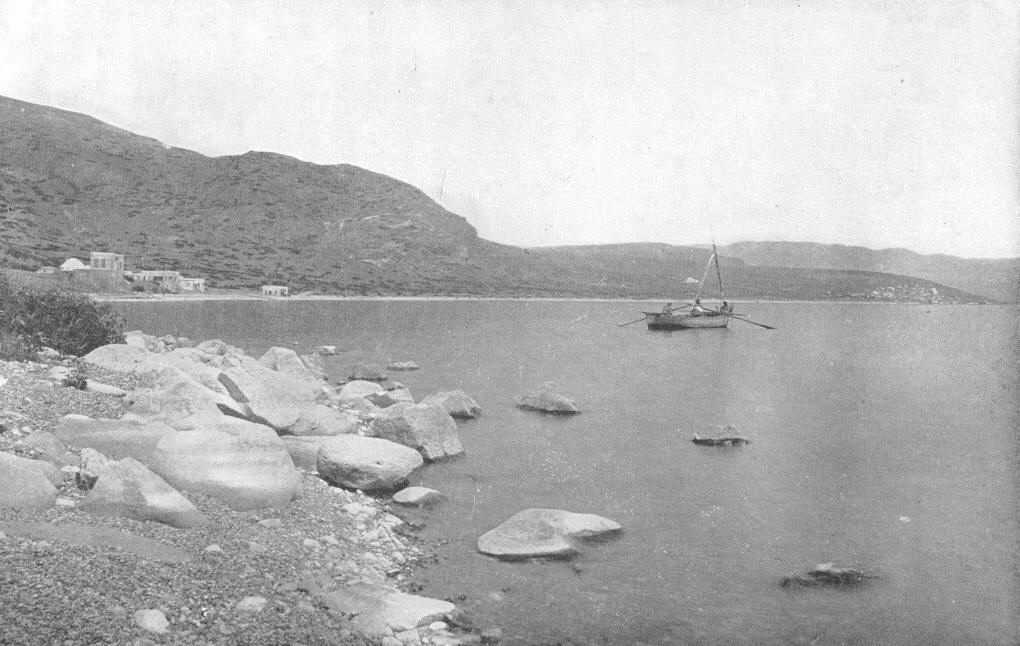
FISHING BOAT ON THE SEA OF GALILEE.
"He who shall search for cities famed of yore, Few wrecks will find on lone Tiberias' shore: Where stood tower-crowned Chorazin, men forget; A palm tree marks thy site, Gennesaret. Tiberias, Herod's pride, still flaunteth fair, But not the cross, the crescent triumphs there."
--Nicolas Michell
{147}
And they say unto him, "Shall we go and buy two hundred pennyworth of bread, and give them to eat?"
And he saith unto them, "How many loaves have ye? go and see."
One of his disciples, Andrew, Simon Peter's brother, said unto him, "There is a lad here, who has five barley loaves, and two fishes: but what are these among so many?"
And he commanded them that all should sit down by companies upon the green grass. And they sat down in ranks, by hundreds, and by fifties. And he took the five loaves and the two fishes, and looking up to heaven, he blessed, and broke the loaves; and he gave to the disciples to set before them; and the two fishes divided he among them all. And they all ate, and were filled. And they took up broken pieces, twelve basketfuls, and also of the fishes. And those who ate the loaves were five thousand men.
And straightway he told his disciples to enter into the boat, and to go before him unto the other side to Bethsaida, while he himself sent the multitude away. But when the people saw the sign which he did, they said, "This is of a truth the prophet that cometh into the world."
Jesus therefore perceiving that they were about to come and take him by force, to make him king, withdrew into the mountain himself alone.
And when even was come, the boat in which his disciples had embarked was in the midst of the sea, and he alone on the land. And seeing them distressed in rowing, for the wind was against them, about the fourth watch of the night {148} he came unto them, walking on the sea; and he would have passed by them: but they, when they saw him walking on the sea, supposed that it was a ghost, and cried out: for they all saw him, and were troubled.
But he straightway spoke with them, and said unto them, "Be of good cheer: it is I; be not afraid."
And he went into the boat with them; and the wind ceased: and they were sore amazed.
{149}
X JESUS AND JOHN THE BAPTIST. How the Heroic Friend of Jesus Was Basely Murdered, and How the Two Men Had Loved Each Other.
(Before Jesus began his preaching, a man named John had begun to tell the people that God would soon send them a great prophet. He himself seemed to the people to be like one of the old prophets. His dress and his way of living were simple, and he spoke as though God were speaking through him. How he preached, and how he baptized Jesus, telling his disciples that this was the man of whose coming he had been speaking, has all been told in a previous chapter. After the baptism John watched the career of Jesus with great interest. Before long John was seized and cast into prison. He became despondent, and began to doubt if Jesus was indeed the one of whom he was sent to tell. He sent messengers to Jesus, and Jesus sent back a comforting and reassuring message to the prisoner. Jesus loved John and spoke in the highest terms of his work and character. This chapter tells of the relations between the two men after Jesus' baptism, and how John met at last a shameful death.)
John Acknowledges the Leadership of Jesus.
After these things came Jesus and his disciples into the land of Judaea; and there he tarried with them, and baptized. And John also was baptizing in Aenon near Salim, because there was much water there: and they came, and were baptized. For John was not yet cast into prison.
{150}
There arose therefore a questioning on the part of John's disciples with a Jew about purifying. And they came unto John, and said to him, "Rabbi, he that was with thee beyond Jordan, to whom thou hast borne witness, behold, the same baptizeth, and all men come to him."
John answered and said, "A man can receive nothing, except it have been given him from heaven. Ye yourselves bear me witness, that I said, 'I am not the Christ, but, that I am sent before him.' He that hath the bride is the bridegroom: but the friend of the bridegroom, who standeth and heareth him, rejoiceth greatly because of the bridegroom's voice: this my joy therefore is fulfilled. He must increase, but I must decrease."
Imprisoned, John Begins to Lose Faith.
For a time he continued to preach good tidings unto the people; but Herod, being reproved by him for Herodias his brother's wife, and for all the evil things which Herod had done, added yet this above all, that he shut up John in prison.
And the disciples of John told him in prison of the works of Jesus. And John calling unto him two of his disciples sent them to the Lord, saying, "Art thou he that cometh, or look we for another?"
And when the men were come unto him, they said, "John the Baptist hath sent us unto thee, saying, 'Art thou he that cometh, or look we for another?'"
In that hour, he cured many of diseases and plagues and evil spirits; and on many that were blind he bestowed sight.
{151}
{152}
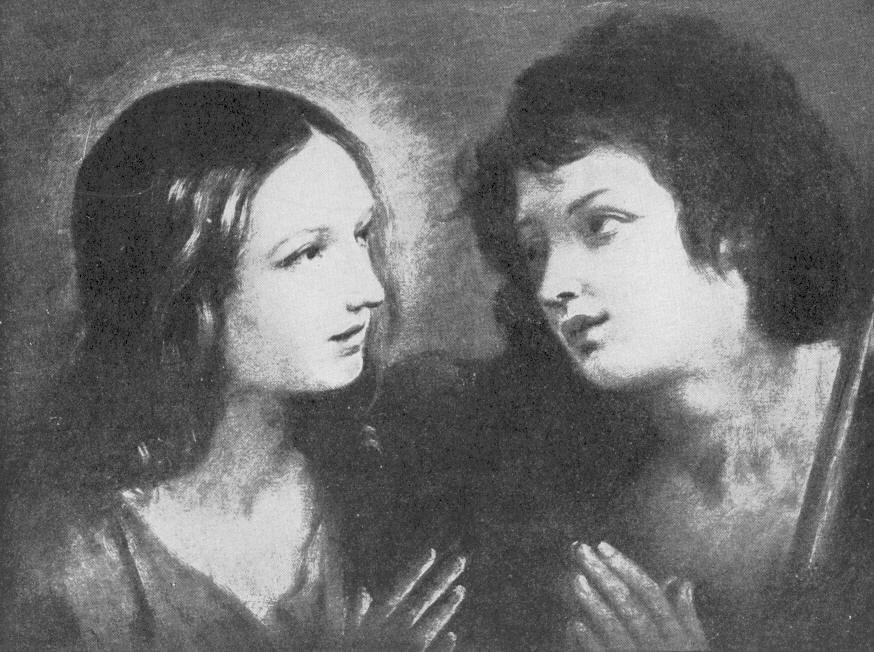
CHRIST AND JOHN THE BAPTIST. By Guido Reni (1575-1642)
{153}
And he answered and said unto them, "Go, and tell John what things ye have seen and heard; the blind receive their sight, the lame walk, the lepers are cleansed, and the deaf hear, the dead are raised up, the poor have good tidings preached to them. And blessed is he, whosoever shall find no occasion of stumbling in me."
Jesus Speaks of the Greatness of John.
And when the messengers of John were departed, he began to say unto the multitudes concerning John, "What went ye out into the wilderness to behold? a reed shaken with the wind? But what went ye out to see? a man clothed in soft raiment? Behold, those who are gorgeously appareled, and live luxuriously, are in kings' houses. But what went ye out to see? a prophet? Yea, I say unto you, and much more than a prophet. This is he of whom it is written,--
'Behold, I send my messenger before thy face, Who shall prepare thy way before thee.'
"I say unto you, Among those who are born of women there is none greater than John: yet he that is but little in the kingdom of God is greater than he."
"Whereunto then shall I liken the men of this generation, and to what are they like? They are like unto children who sit in the marketplace, and call one to another; who say, 'We piped unto you, and ye did not dance; we wailed, and ye did not weep.' For John the Baptist is come eating no bread nor drinking wine; and ye say, 'He hath a demon.' The Son of man is come eating and {154} drinking; and ye say, 'Behold, a gluttonous man, and a wine-bibber, a friend of publicans and sinners!' And wisdom is justified of all her children."
The Cruel Murder of John.
When a convenient day was come, Herod on his birthday made a supper to his lords, and the high captains, and the chief men of Galilee; and when the daughter of Herodias herself came in and danced, she pleased Herod and those who sat at meat with him; and the king said unto the maiden, "Ask of me whatsoever thou wilt, and I will give it thee."
And he swore unto her, "Whatsoever thou shalt ask of me, I will give it thee, unto the half of my kingdom."
And she went out, and said unto her mother, "What shall I ask?"
And she said, "The head of John the Baptist."
And she came in straightway with haste unto the king, and asked, saying, "I wish that thou forthwith give me in a platter the head of John the Baptist."
And the king was exceeding sorry; but for the sake of his promises, and of those who sat and feasted with him, he would not reject her. And straightway the king sent forth a soldier of his guard, and commanded to bring the head of John: and he went and beheaded him in the prison, and brought his head in a platter, and gave it to the maiden; and the maiden gave it to her mother. And when his disciples heard thereof, they came and took up his corpse, and laid it in a tomb.
{155}
O LOVE DIVINE
O Love Divine, that stooped to share Our sharpest pang, our bitterest tear, On Thee we cast each earth-born care: We smile at pain while Thou art near. Though long the weary way we tread, And sorrow crown each lingering year; No path we shun, no darkness dread, Our hearts still whispering, Thou art near! When drooping pleasure turns to grief, And trembling faith is changed to fear; The murmuring wind, the quivering leaf, Shall softly tell us, Thou art near! On Thee we fling our burdening woe, O Love Divine, for ever dear; Content to suffer, while we know, Living and dying, Thou art near!
--Oliver Wendell Holmes.
{156}
O MASTER, LET ME WALK WITH THEE
O Master, let me walk with Thee In lowly paths of service free; Tell me Thy secret; help me bear The strain of toil, the fret of care. Help me the slow of heart to move By some clear winning word of love; Teach me the wayward feet to stay, And guide them in the homeward way. Teach me Thy patience! still with Thee In closer, dearer company, In work that keeps faith sweet and strong, In trust that triumphs over wrong; In hope that sends a shining ray Far down the future's broadening way; In peace that only Thou canst give, With Thee, O Master, let me live!
--Washington Gladden.
(Used by the kind permission of the author.)
{157}
THE ELIXIR
Teach me, my God and King, In all things Thee to see, And what I do in anything To do it as for Thee. Not rudely, as a beast, To runne into an action, But still to make Thee prepossest And give it His perfection. A man that looks on glasse, On it may stay his eye, Or if he pleaseth, through it passe, And then the leav'n espie. All may of Thee partake, Nothing can be so mean Which, with his tincture (for Thy sake), Will not grow bright and clean. A servant with this clause Makes drudgery divine; Who sweeps a room, as for Thy laws, Makes that and th' action fine. This is the famous stone That turneth all to gold, For that which God doth touch and own Cannot for lesse be told.
--George Herbert.
{158}
I HEARD THE VOICE OF JESUS SAY
I heard the voice of Jesus say, "Come unto me and rest; Lay down, thou weary one, lay down Thy head upon my breast." I came to Jesus as I was, Weary, and worn, and sad; I found in Him a resting place, And He has made me glad. I heard the voice of Jesus say, "Behold, I freely give The living water: thirsty one, Stoop down, and drink, and live." I came to Jesus, and I drank Of that life-giving stream; My thirst was quenched, my soul revived, And now I live in Him. I heard the voice of Jesus say, "I am this dark world's Light; Look unto me, thy morn shall rise, And all thy day be bright." I looked to Jesus, and I found In Him my Star, my Sun; And in that light of life I'll walk Till traveling days are done.
--Horatius Bonar.
{159}
How, while He was still teaching and healing, many began to turn against Him, and He, seeing that He must suffer to save the people, took up the journey to the cross.
{160}
PERSONS OF THE STORY. The LORD JESUS. The Disciples. A man born blind. A woman who was a sinner. A Syro-Phoenician woman and her daughter. Lazarus. Mary. Martha. Zaccheus. Bartimeus. Scribes, Pharisees, lawyers. Afflicted people, little children, priests, officers. PLACES OF THE STORY. The Sea of Galilee. A rich man's feast. The country to the north of Galilee. Caesarea Philippi. The "Mount of Transfiguration." Bethany.
{161}
I THE BEGINNING OF THE END How the Lord Jesus Tried to Turn the Minds of the People to Things Higher Than Crowns and Kingdoms, and How They Could Not Understand.
When the Lord Jesus disappeared from the multitude, after he had fed them by the sea, they sought for him, and not finding him, they themselves got into the boats, and came to Capernaum, seeking Jesus. And when they found him on the other side of the sea, they said unto him, "Rabbi, when earnest thou hither?"
Jesus answered them and said, "Verily, verily, I say unto you, Ye seek me, not because ye saw signs, but because ye ate of the loaves, and were filled. Work not for the food which perisheth, but for the food which abideth unto eternal life, which the Son of man shall give unto you."
They said therefore unto him, "What must we do, that we may work the works of God?"
Jesus answered and said unto them, "This is the work of God, that ye believe on him whom he hath sent."
They said therefore unto him, "What then doest thou {162} for a sign, that we may see, and believe thee? what workest thou? Our fathers ate the manna in the wilderness; as it is written, 'He gave them bread out of heaven to eat.'"
Jesus therefore said unto them, "Verily, verily, I say unto you, It was not Moses who gave you the bread out of heaven; but my Father giveth you the true bread out of heaven. For the bread of God is he who cometh down out of heaven, and giveth life unto the world."
They said therefore unto him, "Lord, evermore give us this bread."
Jesus said unto them, "I am the bread of life: he that cometh to me shall not hunger, and he that believeth on me shall never thirst. But I said unto you, that ye have seen me, and yet believe not. All that which the Father giveth me shall come unto me; and him that cometh to me I will in no wise cast out. For I am come down from heaven, not to do mine own will, but the will of him who sent me. And this is the will of him who sent me, that of all those whom he hath given me I should lose none, but should raise them up at the last day. For this is the will of my Father, that everyone who beholdeth the Son, and believeth on him, should have eternal life; and I will raise him up at the last day."
The Jews therefore murmured concerning him, because he said, "I am the bread which came down out of heaven."
And they said, "Is not this Jesus, the son of Joseph, whose father and mother we know? how doth he now say, 'I am come down out of heaven'?"
{163}
{164}
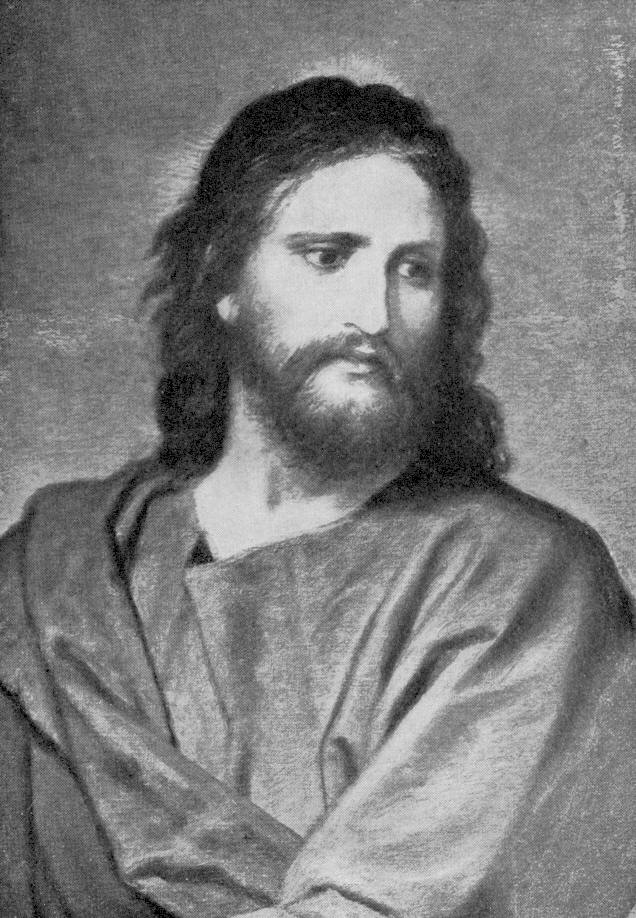
THE LORD JESUS By Heinrich Hofmann (1824-
{165}
Jesus answered and said unto them, "Murmur not among yourselves. No man can come to me, except the Father who sent me draw him: and I will raise him up in the last day. It is written in the prophets, 'And they shall all be taught of God.' Everyone that hath heard from the Father, and hath learned, cometh unto me. Not that any man hath seen the Father, save he which is from God, he hath seen the Father. Verily, verily, I say unto you, He that believeth hath eternal life. I am the bread of life. Your fathers did eat the manna in the wilderness, and they died. This is the bread which cometh down out of heaven, that a man may eat thereof, and not die. I am the living bread which came down out of heaven: if any man eat of this bread, he shall live forever: yea, and the bread which I will give is my flesh, for the life of the world."
Many therefore of his disciples, when they heard this, said, "This is a hard saying; who can hear it?"
But Jesus knowing in himself that his disciples murmured at this, said unto them, "Doth this cause you to stumble? What then if ye should behold the Son of man ascending where he was before? It is the spirit that giveth life; the flesh profiteth nothing: the words that I have spoken unto you are spirit, and are life. But there are some of you who believe not."
For Jesus knew from the beginning who they were that believed not, and who it was who should betray him.
And he said, "For this cause have I said unto you, that no man can come unto me, except it be given unto him of the Father."
{166}
Upon this many of his disciples went back, and walked no more with him. Jesus said therefore unto the twelve, "Would ye also go away?" Simon Peter answered him, "Lord, to whom shall we go? thou hast the words of eternal life. And we have believed and know that thou art the Holy One of God."
{167}
II THE ENEMIES OF JESUS How the Leaders of the People Had Already Begun to Turn Against the Lord Jesus and to Dispute His Teaching. Conflict About the Sabbath.
There was a feast of the Jews; and Jesus went up to Jerusalem.
Now there is in Jerusalem by the sheep gate a pool, which is called in Hebrew Bethesda, having five porches. In these lay a multitude of those who were sick, blind, lame, withered. And a certain man was there, who had been thirty-eight years in his infirmity. When Jesus saw him lying, and knew that he had been ill a long time, he saith unto him, "Wouldest thou be made whole?" The sick man answered him, "Sir, I have no man, when the water is troubled, to put me into the pool: but while I am coming, another steppeth down before me."
Jesus saith unto him, "Arise, take up thy bed, and walk." And straightway the man was made whole, and took up his bed and walked.
Now it was the Sabbath on that day. So the Jews said unto him who was cured, "It is the Sabbath, and it is not lawful for thee to take up thy bed."
But he answered them, "He that made me whole, the same said unto me, 'Take up thy bed, and walk.'"
{168}
They asked him, "Who is the man that said unto thee, 'Take up thy bed, and walk'?"
But he that was healed knew not who it was: for Jesus had gone away, a multitude being in the place.
Afterward Jesus findeth him in the temple, and said unto him, "Behold, thou art made whole: sin no more, lest a worse thing befall thee."
The man went away, and told the Jews that it was Jesus who had made him whole. And for this cause did the Jews persecute Jesus, because he did these things on the Sabbath. But Jesus answered them, "My Father worketh even until now, and I work."
For this cause therefore the Jews sought the more to kill him, because he not only broke the Sabbath, but also called God his own Father, making himself equal with God.
At another time he was going on the Sabbath day through the cornfields; and his disciples began, as they went, to pluck the ears of corn. And the Pharisees said unto him, "Behold, why do they on the Sabbath day that which is not lawful?"
And he said unto them, "Did ye never read what David did, when he had need, and was hungry, he, and those who were with him? How he entered into the house of God when Abiathar was high priest, and ate the showbread, which it is not lawful to eat save for the priests, and gave also to those who were with him?"
And he said unto them, "The Sabbath was made for man, and not man for the Sabbath: so that the Son of man is lord even of the Sabbath."
{169}
And he entered again into the synagogue; and there was a man there who had his hand withered. And they watched him, whether he would heal him on the Sabbath day; that they might accuse him. And he saith unto the man who had his hand withered, "Stand forth."
And he saith unto them, "Is it lawful on the Sabbath day to do good, or to do harm? to save a life, or to kill?"
But they held their peace. And when he had looked round about on them with anger, being grieved at their hard-heartedness, he said to the man, "Stretch forth thy hand." And he stretched it forth: and his hand was restored.
And the Pharisees went out, and straightway with the Herodians took counsel against him, how they might destroy him.
Conflict About the Treatment of Sinful People.
And one of the Pharisees asked him to eat with him. And he entered into the Pharisee's house, and sat down to eat.
And behold, a woman who was in the city, a sinner, when she knew that he was eating in the Pharisee's house, brought an alabaster cruse of ointment, and standing behind at his feet, weeping, began to wet his feet with her tears, and wipe them with the hair of her head, and kissed his feet, and anointed them with the ointment. Now when the Pharisee who had invited him saw it, he spoke within himself, saying, "This man, if he were a prophet, would have perceived who and what manner of woman this is who toucheth him, that she is a sinner."
{170}
And Jesus answering said unto him, "Simon, I have something to say unto thee."
And he saith, "Master, say on."
Jesus said, "A certain lender had two debtors: the one owed five hundred pence, and the other fifty. When they had nothing with which to pay, he forgave them both. Which of them therefore will love him most?"
Simon answered and said, "He, I suppose, to whom he forgave the most."
And he said unto him, "Thou hast rightly judged." And turning to the woman, he said unto Simon, "Seest thou this woman? I entered into thine house, thou gavest me no water for my feet: but she hath wet my feet with her tears, and wiped them with her hair. Thou gavest me no kiss: but she, since the time I came in, hath not ceased to kiss my feet. My head with oil thou didst not anoint: but she hath anointed my feet with ointment. Wherefore I say unto thee, Her sins, which are many, are forgiven; for she loved much: but to whom little is forgiven, the same loveth little."
And he said unto her, "Thy sins are forgiven."
And they that were at the feast with him began to say within themselves, "Who is this who even forgiveth sins?"
And he said unto the woman, "Thy faith hath saved thee; go in peace."
Conflict About the Wonderful Deeds of Jesus.
There was brought unto him one possessed with a demon, blind and dumb: and he healed him, insomuch that {171} the dumb man spoke and saw. And all the multitude were amazed, and said, "Is this the son of David?" But when the Pharisees heard it, they said, "This man doth not cast out demons but by Beelzebub the prince of the demons."
And knowing their thoughts he said unto them, "Every kingdom divided against itself is brought to desolation; and every city or house divided against itself shall not stand: and if Satan casteth out Satan, he is divided against himself; how then shall his kingdom stand? And if I by Beelzebub cast out demons, by whom do your sons cast them out? therefore shall they be your judges. But if I by the Spirit of God cast out demons, then is the kingdom of God come upon you."
{172}
III A LONG JOURNEY How the Lord Jesus Traveled to the North to be Alone with His Disciples, and How the People Still Thronged Him.
And Jesus went out thence, and withdrew into the parts of Tyre and Sidon.
And he entered into a house, and would have no one know it: but he could not be hid. Soon a woman, whose little daughter had an unclean spirit, having heard of him, came and fell down at his feet. Now the woman was a Greek, a Syrophoenician by race. And she besought him that he would cast forth the demon out of her daughter.
And he said unto her, "Let the children first be filled: for it is not fitting to take the children's bread and cast it to the dogs."
But she answered and saith unto him, "Yea, Lord: even the little dogs under the table eat of the children's crumbs."
And he said unto her, "For this saying go thy way; the demon is gone out of thy daughter."
And she went away unto her house, and found the child laid upon the bed, and the demon gone out.
And again he went out from the borders of Tyre, and came through Sidon to the sea of Galilee, through the midst of the borders of Decapolis. And they bring unto him one that was deaf, and had an impediment in his speech; and they beseech him to lay his hand upon him.
{173}
{174}
RUINS OF THE CASTLE AT CAESAREA-PHILIPPI. A magnificent fortress at the head of the Jordan.
From a photograph of the Palestine Exploration Fund, and used by special permission.
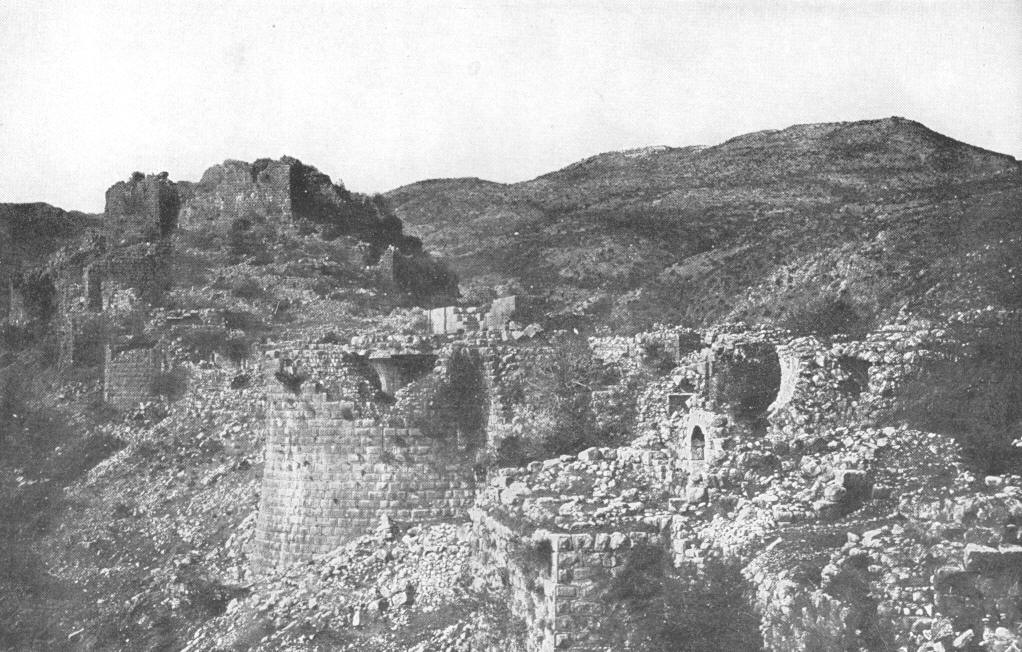
{175}
And he took him aside from the multitude privately, and put his fingers into his ears, and he spat, and touched his tongue; and looking up to heaven, he sighed, and saith unto him, "Ephphatha," that is, "Be opened." And his ears were opened, and the bond of his tongue was loosed, and he spoke plainly.
And he charged them that they should tell no man: but the more he charged them, so much the more a great deal they published it. And they were beyond measure astonished, saying, "He hath done all things well: he maketh even the deaf to hear, and the dumb to speak."
In those days, when there was again a great multitude, and they had nothing to eat, he called unto him his disciples, and saith unto them, "I have compassion on the multitude, because they continue with me now three days, and have nothing to eat: and if I send them away fasting to their home, they will faint in the way; and some of them are come from far."
And his disciples answered him, "Whence shall one be able to fill these men with bread here in a desert place?"
And he asked them, "How many loaves have ye?"
And they said, "Seven."
And he commandeth the multitude to sit down on the ground: and he took the seven loaves, and having given thanks, he broke the bread, and gave to his disciples, to set before them; and they set them before the multitude.
And they had a few small fishes: and having blessed {176} them, he commanded to set these also before them. And they ate, and were filled: and they took up, of broken pieces that remained over, seven baskets. And they were about four thousand: and he sent them away. And straightway he entered into the boat with his disciples, and came into the parts of Dalmanutha.
And the Pharisees came forth, and began to question with him, seeking of him a sign from heaven, trying him. And he sighed deeply in his spirit, and saith, "Why doth this generation seek a sign? verily I say unto you, There shall no sign be given unto this generation." And he left them, and again entering into the boat departed to the other side.
And they forgot to take bread; and they had not in the boat with them more than one loaf. And he charged them, saying, "Take heed, beware of the leaven of the Pharisees and the leaven of Herod."