PART VI. FIELD BATTERY EXERCISE.[13]
Reading edition
PART VI. FIELD BATTERY EXERCISE.[13]
STANDING DRILL.
Section. 1. Telling off the Detachments.[14]
Section 2. Posts of the Detachment.
Art. 1.—In Action.
No. 1. At the handspike.
Nos. 2, 3. Outside the wheels: with Howitzers rather in rear of the muzzle; with Guns in line with the front of the wheels.
Nos. 4, 5. In line with the breech.
No. 6. Five yards in rear of the left wheel.
No. 7. In rear of the Limber.
No. 8. Ten yards in rear of No. 6.
No. 9. Four yards in rear of the Limber.
Art. 2.—In Order of March.
No. 1. On the off-side at the wheel horses’ heads.
Nos. 2, 3. In line with the muzzle.
Nos. 4, 5. In line with the breech.
Nos. 6, 7. In line with the axletree of the Limber.
Nos. 8, 9. In line with the splinter bar.
Art. 3.—In Front.
In line, ten yards in front of the leading horses.
Art. 4.—In Rear.
In line, two yards in rear of the muzzle of the Gun.
Art. 5.—In line with the gun axletree, one yard to the right or left of the wheel.
Art. 6.—Mounted.
No. 1. On the right. } On the Gun limber.
No. 6. On the left.
No. 3. On the right. } On the Waggon limber.
No. 2. On the left.
No. 3. On the right. } On the front of the Waggon body.
No. 2. On the left.
No. 7. On the right. } On the rear of the Waggon body.
No. 8. On the left.
When there are 9 men, No. 9 between Nos. 5 and 4.
Section 3. Change of Position of Detachments.
1. Form the order of March. Nos. 1. Right face. Double march.
2. Form the order of March. Nos. 1. Left face. Double march.
3. Detachments rear. Nos. 1. Right about face. Double march. Halt. Front.
4. Detachments front. Nos. 1. Double march. Halt.
5. Detachments right. Nos. 1. Right (or left) face. Double march, front turn. Halt.
6. Detachments rear. Nos. 1. Right about face. Double march. Halt, front.
7. Detachments front. Nos. 1. Double march. Halt. Front.
Section 4. Detail of Duties in the service of Ordnance.
No. 1 Commands, and lays the Gun.
No. 2 Sponges.
No. 3 Loads, and serves ammunition.
No. 4 Serves the vent, and primes. After the discharge he clears the vent with the drift, previous to reloading.
No. 5 Fires.[15]
No. 6 Serves ammunition.
No. 7 Attends the Limber, and serves ammunition to No. 8.
No. 8 Assists No. 7.
No. 9 Attends the ammunition Waggon.
CHANGING ROUND.
No. 2 becomes No. 4. No. 8 becomes No. 6.
No. 4 ” No. 9. No. 6 ” No. 1.
No. 1 ” No. 5.
No. 9 ” No. 7. No. 5 ” No. 3.
No. 7 ” No. 8. No. 3 ” No. 2.
Exercise, with Reduced Numbers.
Nos. Retained. Distribution of duties.
1 2 3 4 5 6 7 8
1, 2 1, 4, 5 2, 3, 6
1, 2, 3 4, 5 2 3, 6
1, 2, 3, 4 1 2 3, 6 4, 5
1, 2, 3, 4, 5 1 2 3, 6 4 5
1, 2, 3, 4, 5, 6 1 2 3 4 5 6
1, 2, 3, 4, 5, 6, 7 1 2 3 4 5 6 7
1, 2, 3, 4, 5, 6, 7, 8 1 2 3 4 5 6 7 8
DISTANCES REQUIRED
for a Battery of 6 Guns (4 horses to each Carriage).
In Line, from muzzle to muzzle 15 yards.
In Column of Route 177 ”
” Sub-divisions 87 ”
” Divisions 87 ”
” Half battery 72 ”
A Gun, or Waggon, with 4 Horses covers 11 yards of ground, from front to rear.
For every additional pair of Horses 4 yards should be added.
A Battery of 6 Guns, when limbered up at full intervals, occupies from
Right to left 78 yards. Front to rear 26 yards.
On each flank, 22 additional yards should be allowed.
A battery of 6 Guns, when unlimbered for Action, at full intervals, occupies from
Right to left 78 yards. Front to rear 37 yards.
The space required for reversing a Gun with 4 Horses is 9 yards, and for a Waggon about 8 yards.
Elevation of a 9 PR Brass Field Carriage.
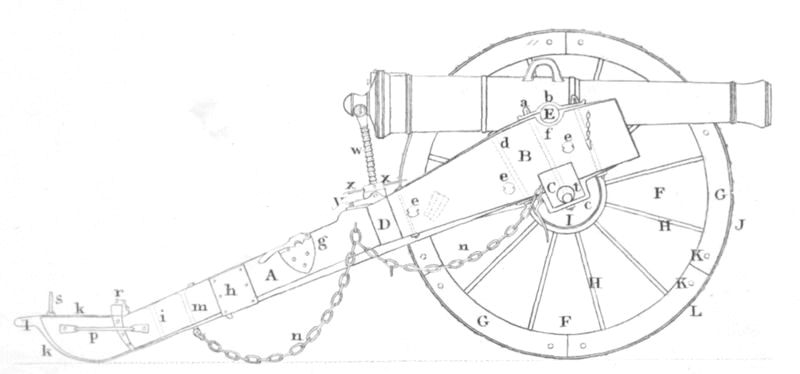
NAMES OF THE PRINCIPAL PARTS OF A FIELD GUN CARRIAGE.
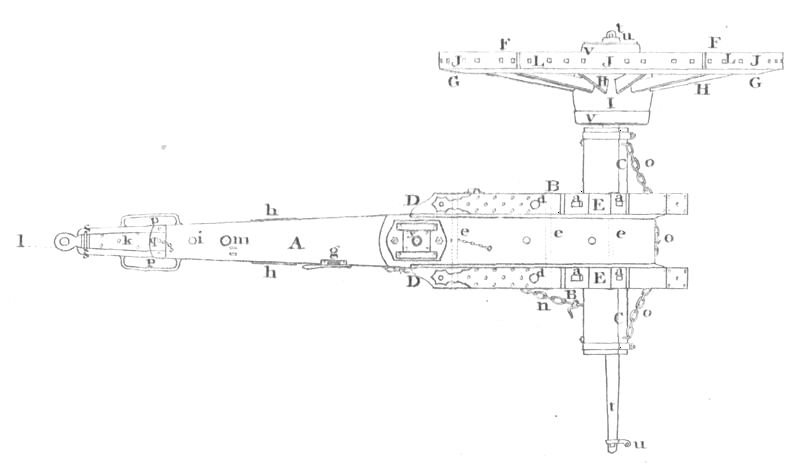
A Block, or Trail. J Tire, or Streak. g Portfire clipper. q Handspike shoe.
B Cheeks, or Brackets. K Rivets. h Locking plate. r Handspike pin.
C Axletree. L Tire, or Streak bolts. i Trail plate bolt. s Handspike ring.
D Ogee. a Eye, or Capsquare bolts. k Trail plate. t Axletree arms.
E Trunnion holes. b Capsquares. l Trail plate eye. u Dragwashers.
F Wheel. c Axletree bands. m Chain eye bolt. v Nave hoops.
G Felly. d Bracket bolts. n Locking chain. w Elevating screw.
H Spokes. e Transom bolts. o Breast, or advancing chain. x Handles of elevating screw.
I Nave. f Trunnion plates. p Trail handles. y Elevating screw box.
Plan of a 9 PR Brass Field Carriage.
Section 5. Method of performing the duties of serving ordnance.
Section 6. Ranges.
Section 7. Method of laying a piece of ordnance.
Section 8. Limbering up.
Front (rear, right, or left) limber up. | Halt: Limber up.
Section 9. Unlimbering, or coming into action.
To the front, rear, right or left. The reverse of limbering up.
Section 10. Moving with the Prolonge.
Prepare to retreat with the prolonge. Nos. 1
The battery will retire. Right about face.
Halt. Front.
Unhook Prolonge.
Prepare to advance with the prolonge. Nos. 3
Action. Drive on.
Section 11. Mounting field ordnance, with the materials belonging to the battery.
Section 12. Dismounting field ordnance, with the materials belonging to the battery.
Section 13. Shifting shafts.
Section 14. Disengaging a shaft horse, when he falls, or is disabled in action.
Section 15. Changing wheels, when the lifting jack is not at hand.
Section 16. Shifting the medium 12 pounder.
Section 17. To remove disabled field artillery.
Section 18. Exercise with Drag-ropes.
1. A light 6 pounder with its limber requires 15 men, six of whom are told off entirely for the drag-ropes, the other men at the gun also assisting in manning them: No. 9 is always in the shafts, and No. 8 at the point of the shaft, near side. A 9 pounder requires additional men, and a double set of drag-ropes.
2. The drag-rope men are numbered off from 10 upward. Nos. 10, 12, 14, are with the left drag-rope; 11, 13, 15, with the right; 10, 11, carry the drag-ropes.
3. The gun being limbered up, and the detachment and drag-rope men in the order of march, at the word “Hook on,” Nos. 8 and 9 get into their places; 10 and 11 move outside the gun detachments to the rear, and hook on to the gun drag-washers, passing the end of the drag-ropes at once to the front.
The Nos. then man the drag-ropes as follows:—Nos. 10 and 11 outside, close to the drag-washer; 2, 12, 3, and 13 the centre of the drag-rope; 4, 14, 5, and 15 the front; 6 and 7 the ends. The gun detachments inside, and the drag-rope men outside. No. 1 at the point of the shafts, off-side. At the word “Unhook,” Nos. 10 and 11 unhook, coil up the drag-ropes; and the whole then form the order of march.
4. At the word “Action,” whether to the “FRONT,” “REAR,” “RIGHT,” or “LEFT,” the drag-ropes are at once quitted; Nos. 10 and 11 unhook, and coil them up; and the whole of the drag-rope men retire with the limber, forming in front of it two deep, as they were numbered off. In limbering up, the drag-rope men form the order of march, and wait for the word to hook on.
FORMATION OF A BATTERY.
A battery of Artillery is generally composed of six pieces of ordnance, to which a Company of Artillery is attached. The number of ammunition, forge, and store waggons varies according to the nature of the ordnance.
Section 19. Fitting of saddles, bridles, harness, &c.
Section 20. Harnessing.
Section 21. Carrying forage.
Section 22. Instruction for Drivers.
Section 23. Parade, and inspection.
The Battery, limbered up, is told off by sub-divisions, divisions, and half batteries.
One gun and its waggon constitute a sub-division.
Two sub-divisions ” a division.
Three sub-divisions ” a half battery.
The battery is numbered from right to left by sub-divisions. It is then told off into three divisions. No. 1 the right; No. 2 the centre; No. 3 the left. Sub-divisions Nos. 1, 3, and 5 are also distinguished as right sub-divisions of divisions; and Nos. 2, 4, and 6 the left; the two centre sub-divisions are also to be named. It is also told off into half batteries, and these are distinguished by right, centre, and left sub-divisions of half batteries. The gun of direction should always be named. A flank gun is generally named with a battery of four guns, and the right centre gun with a battery of six guns.
Spare carriages, with the battery, form a third, and, if necessary, a fourth line, in rear. The forge and store-waggon always in the centre, and the ammunition waggons on the flanks, covering those in the front line.
Section 24. Posts, and duties of Officers, and mounted Non-commissioned officers, &c., at exercise.
Second Captain.
In line, limbered up.—One horse’s length in rear of the centre.
In column.—Two horses’ length from the centre on the reverse flank.
In action.—He assists the Captain in general superintendence.
He dresses all points of formation, gives the word “Steady,” when they have been correctly taken up, and the formation completed. When required he commands a division.
Subalterns.
In line, limbered up.—The senior on the right of the right division; the second on the left of the left division; the junior on the right of the centre division.
In column of route.—On the pivot flanks of their leading sub-divisions.
In column of divisions.—On the pivot flanks of their respective divisions.
In column of half-batteries.—The subaltern of the centre division, on the pivot flank of the leading half battery. The others continue on the same flank of their sub-divisions as when in line.
In action.—Between the guns of their divisions, a little in rear.
They command the divisions to which they are attached, dressing in line with, and close to the leaders, and always with the guns.
In shifting from one flank to the other.—It is always along the front, and at a canter; and in joining the new sub-division, the officer always turns his horse’s head inwards.
Staff Serjeants.
In line, limbered up.—The senior on the right of the marker of the right division. The junior on the left of the marker of the left division.
In column of route.—One on the reverse flank of the leading gun; the other on the pivot flank of the rear carriage.
In column of divisions.—One between the guns of the leading, the other between the guns of the rear division.
In column of half-batteries.—On the reverse flank of the waggons of each half battery.
They take up points in changes of position. In line formations, 10 yards from the flank sub-divisions; in column formations, 10 yards in front and rear. They dress the markers when there is no staff officer; and the limbers and waggons in action.
Markers.
In line, limbered up.—In line with the leaders of the waggons, and covering their officers.
In column of route.—With their leading waggons covering their officers. (Without waggons, covering their officers, and in line with the centre horses of the gun.)
In column of divisions, and half-batteries.—They cover their officers. (Without waggons, on the reverse flank of their divisions.)
In action.—Those of the right, and centre divisions on the right of the leaders of the limbers of their right sub-divisions. The marker of the left division, on the left of the leaders of the limber of the left sub-division.
They take up points in changes of position; in line formations, for the sub-division nearest the one of formation; in column formations, for the pivot sub-division.
Farriers, and Artificers.
The farrier is generally attached to the forge; but when the battery is limbered up he is in the centre, in rear of the second captain. The other artificers are told off in the gun detachments when not mounted.
Trumpeters.
In line, limbered up.—On the right of the battery, in line with it, one horse’s length distant.
In column.—One horse’s length in front.
During manœuvres.—One with the commander; the other in rear of the battery.
MANŒUVRES OF A BATTERY OF SIX PIECES.
Section 25. Battery in line.
1. To advance. Commanding officer’s word of command repeated by officers.
[16]The battery will advance—March. The officer, and marker of the sub-division of direction take up points.
2. To retire.
Right (or left) reverse—March.
3. To come into action.
Action front. Senior staff-serjeants.—Left reverse.
4. To diminish (or increase) intervals on the march.
To diminish.
Half, or quarter, intervals on—sub-division. Nos. 1. Right (or left) half turn—Trot—Front turn—Trot—(except No. 1 of the named sub-division).
To increase.
Full intervals on—sub-division.
5. To take ground to a flank.
Right (or left) take ground— March. The officers shift to the pivot flank of what will become their leading sub-divisions.
6. To make a half turn on the march.
Right (or left) half turn—March.
7. To form Column of divisions in rear of a flank.
Form column of divisions in rear of the right. Centre division—Right reverse—March—By the left—Left take ground—Halt—Dress.
March. Left division—Right reverse—March—By the left—Left half turn—Left take ground—Halt—Dress.
Form column of divisions in rear of the left. Centre division—Left reverse—March—By the right—Right take ground—Right take ground—Halt—Dress.
March. Right division—Left reverse—March—By the right—Right half turn—Right take ground—Halt—Dress.
8. To form Column of divisions in front of a flank.
Form column of divisions in front of the left— Centre division—Forward—March—Left take ground—Waggons close intervals—Right take ground—Halt—Dress.
March. Right division—Forward—March—Left half turn—Left half turn—Waggons close intervals—Right take ground—Halt—Dress.
Form column of divisions in front of the right— Centre division—Forward—March—Right take ground—Waggons close intervals—Left take ground—Halt—Dress.
March. Left division—Forward—March—Right half turn—Right half turn—Waggons close intervals—Left take ground—Halt—Dress.
9. To form Column of divisions on the centre division. This manœuvre is a combination of Nos. 7 and 8.
10. To change front to the rear. First method. By a countermarch.
The battery will change front to the rear—Guns right, Waggons left take ground—March— The officers shift to the pivot flank of their leading guns—viz., to the left of 1, 3, and 5 guns.
Right countermarch—Front turn—Halt—Dress.
Second method. On the centre.
Change front to the rear on the centre—March. Centre division—Sub-divisions inwards about wheel—March—Halt—Dress. Right division—March—Left wheel—Left wheel—Halt—Dress. Left division—March—Right wheel—Right wheel—Halt—Dress.
Third method. When at diminished intervals; on the march.
The battery will change front to the rear; on the centre. Left half battery—halt—Half batteries inwards about wheel—Forward.
11. To change front to a flank.
First method. Right (or left) back, on a flank sub-division.
Nos. 1.
Change front to the right on No. 6. March. 6. Left wheel—Left about wheel—Halt—Dress.
5. } Right reverse.
4. } Left shoulders.
3. } Right reverse.
2. } Halt—Dress.
1. }
Nos. 1.
Change front to the left on No. 1. March. 1. Right wheel—Right about wheel—Halt—Dress.
2. } Left reverse.
3. } Right shoulders.
4. } Left reverse.
5. } Halt.
6. } Dress.
For Action.
Change front to the right, on No. 6, for action. March (or change front to the left on No. 1, for action. March). The named sub-division comes into action in the new direction; the others proceed as before, and come into action to the rear.
Second method. Right (or left) forward, on a flank sub-division.
Nos. 1.
Change front to the left on No. 6. March. 6. Right wheel—Right about wheel—Halt—Dress.
5. }
4. }
3. } Right shoulders.
2. } Halt—Dress.
1. }
Nos. 1.
Change front to the right on No. 1—March. 1. Left wheel—Left about wheel—Halt—Dress.
2. }
3. } Left shoulders.
4. } Halt.
5. } Dress.
6. }
For Action.
Change front to the right on No. 1 for action— March—(or Change front to the left on No. 6, for action—March). The named sub-division comes into action in the new direction; the others proceed as before, and come into action to the front.
Third method. To the right (or left) on a central sub-division, one flank thrown forward, the other back. This is a combination of the First and Second methods.
Note.—A battery may change its front, Half right, or Half left, on the same principle as already detailed. The commanding officer’s word would be “Change front, Half right (or Half left) on—Sub-division.”
These manœuvres can be executed on the same principle, by divisions, or half batteries.
A Battery can also change front on a moveable pivot by a simple wheel.
12. To advance from a flank, in column.
Advance from the right, in column of divisions—March. Right division. Forward by the left. March.
Centre, and left divisions Right take ground. March—Left take ground.
Nos. 1.
2. } Waggon right. Waggon rear.
4. }
Advance from the left, in column of divisions—March. Left division Forward by the right—March.
Centre, and right divisions Left take ground—March. Right take ground.
Nos. 1.
5.} Waggon left. Waggon rear.
3.}
13. To advance from the centre, in double column of sub-divisions.
Advance from the centre, in a double column of sub-divisions—March. Centre division—Forward.—Trot—March. Right division—Left take ground—March. Left division—Right take ground—March.
Nos. 1.
2. } Right take ground—Trot.
1. } Right take ground.
5. } Left take ground—Trot.
6. } Left take ground.
14. To move from a flank along the front in a column of divisions.
Move from the right, along the front, in column of divisions. March. Forward—March. Left wheel.
Note.—To advance from the left, along the front, is done in the same manner.
15. To advance from a flank, in echellon of sub-divisions.
Advance from the right, in echellon of sub-divisions—March.
Advancing from the Left is done on the same principle.
Note.—A Battery in echellon of Sub-divisions, if required to change its front when in action, can do so at the word “Action left” (or right), by merely throwing the trails round, and bringing the guns into the new direction, the limbers and waggons forming in rear of their guns.
16. To advance from a flank in echellon of divisions.
Advance from the right, in echellon of divisions—March. The right division advances, the centre moves off in succession, when at its wheeling distance, in rear of the leading one. The left division follows in the same manner.
Advancing from the Left is done on the same principle.
Note.—A Battery in echellon of Divisions, if required to change its front when in action, does so as follows:—
Change front to the left, on the left guns of divisions—March. Nos. 1. 2. } 4. } Action left. 6. } 1. } Front limber up. 3. } Left wheel—Halt. 5. } Action front.
An echellon of Half batteries is formed in the same manner as that of divisions; the rear half battery must, however, keep its wheeling distance from the leading one. When in action, if the front is to be changed, it is better to do it on a centre gun.
Retirements in echellon, are done on the same principle as the advance.
17. To retire from a flank in column.
First Method.
Right division to the rear—March. Right division—Sub-divisions inwards about wheel—March.
Centre and left divisions—Forward—Right wheel—March—Right wheel.
To retire with the Left division is done on the same principle.
Second method.
Retire from the right, in column of divisions—March. Right division—Right reverse—March.
Centre, and left divisions—Right take ground—March—Right take ground.
Nos. 1.
2. } Gun left.
4. } Gun rear.
18. To retire from the centre in a double column of sub-divisions.
In order to perform this manœuvre, the battery should be reversed, and then (with waggons leading) it is performed in the same manner as the advance from the centre, in a double column.
19. To retire from a flank by alternate Half batteries, in action.
When a battery in line, in action, is ordered to retire from a flank by alternate Half batteries, the named half battery at once limbers up to the rear, retires to its distance in echellon, and comes into action. As soon as this half battery is in action, the other limbers up to the rear, retires, passes the half battery in action, and so on. The senior officer of each half battery gives the word of command.
Note.—This manœuvre would generally be practised with the prolonge.
20. To break into column to a flank.
Break into column of divisions to the right. March. Nos. 1. 1. } Right take ground. 3. } Guns front. 5. } 2. } 4. } Right wheel. 6. }
Breaking into Column to the Left can be done on the same principle.
A Column of Half batteries can be formed in the same manner; the pivot sub-divisions wheeling as before, but the others after taking ground, must incline away to gain their required intervals.
Note.—This movement would generally be employed in breaking into column from line, to march past with other troops; and with half batteries it would be done at reduced intervals.
21. To increase, and diminish the front.
First method.
From Column of route, to form Column of divisions, on the march.
Column, right in front.
Form column of divisions. Right division—Forward by the left.
Centre and left divisions.—Forward by the left. Trot—Walk.
Nos. 1.
2. }
4. } Left half turn—Trot—Front turn.
6. }
Column, left in front.
Form column of divisions. Left division—Forward by the right.
Centre and right divisions.—Forward by the right—Trot—Walk.
Nos. 1.
5. }
3. } Right half turn—Trot.
1. } Front turn.
Second method.
From Column of route, to form Column of divisions, in succession.
Column, right in front.
In succession form column of divisions. Nos. 1.
1. }
3. } Halt.
5. }
2. } Left half turn.
4. } Front turn.
6. } Halt—Dress.
Column, left in front.
In succession form column of divisions. Nos. 1.
6. }
4. } Halt.
2. }
5. } Right half turn.
3. } Front turn.
1. } Halt—Dress.
Third method.
From Column of divisions, to form Column of route, on the march.
Column right in front.
Form column of route. Centre and left divisions—Halt.
Nos. 1.
1. Forward.
3. } Forward—March.
5. }
2. } Halt—Right half turn—March.
4. } Front turn.
6. }
Column left in front.
Form column of route. Centre and right divisions—Halt.
Nos. 1.
6. Forward.
4. } Forward—March.
2. }
5. } Halt—Left half turn.
3. } March—Front turn.
1. }
22. To bring the Rear to the front, in succession, on the march.
First method. In Column of route.
Rear sub-division to the front. Nos. 1.
6. }
5. }
4. } In succession { Right half turn.
3. } { Front turn.
2. }
Second method. In Column of divisions.
Rear division to the front through the intervals. Centre and rear divisions in succession. Inwards close—Forward—Full intervals.
23. To form Line on the leading division.
Divisions right in front.
Left of the front form line—March. Centre division—Left take ground—March—Right take ground—Halt—Dress.
Left division—Left take ground—March—Right half turn—Right half turn—Halt—Dress.
Divisions left in front.
Right of the front form line—March. Centre division—Right take ground—March—Left take ground—Halt—Dress.
Right division—Right take ground—March—Left half turn—Left half turn—Halt—Dress.
On the March.
The centre and rear divisions make a half turn towards the intended line, and come up at an increased pace.
For Action.
Right (or left) of the front form line for action—March. Halt—Action front.
24. To form Line on the rear division.
Divisions right in front.
Right of the rear form line—March. Centre division—Right take ground—March—Right take ground—Right reverse—Halt—Dress.
Right division—Right take ground—March—Right half turn—Right half turn—Right reverse—Halt—Dress.
Divisions left in front.
Left of the rear form line—March. Centre division—Left take ground—March—Left take ground—Left reverse—Halt—Dress.
Left division—Left take ground—March—Left half turn—Left half turn—Left reverse—Halt—Dress.
For Action.
Right (or left) of the rear, form line for action, front—March. The standing division comes into action to the front: the others, as they arrive in line, come into action to the rear.
25. To form Line on the centre division.
This manœuvre is a combination of Nos. 23 and 24.
26. To form Line to the rear on the leading division.
Divisions right in front.
Form line to the rear, on the leading division—March. Right division—Sub-divisions inwards about wheel—March—Halt—Dress.
Centre division—Right take ground—March—Left take ground—Sub-divisions inwards about wheel—Halt—Dress.
Left division—Right take ground—March—Left half turn—Left half turn—Sub-divisions inwards about wheel—Halt—Dress.
Divisions left in front.
Form line to the rear, on the leading division—March. Left division—Sub-divisions inwards about wheel—March—Halt—Dress.
Centre division—Left take ground—March—Right take ground—Sub-divisions inwards about wheel—Halt—Dress.
Right division—Left take ground—March—Right half turn—Right half turn—Sub-divisions inwards about wheel—Halt—Dress.
27. To form Line to the rear of the rear division.
Divisions right in front.
Form line to the rear, on the rear division—March. Right division—Left wheel—March—Right shoulders—Right shoulders—Halt—Dress.
Centre division—Left wheel—March—Left wheel—Halt—Dress.
Left division—Sub-divisions inwards about wheel—March—Halt—Dress.
Divisions left in front.
Form line to the rear, on the rear division—March. Left division—Right wheel—March—Left shoulders—Left shoulders—Halt—Dress.
Centre division—Right wheel—March—Right wheel—Halt—Dress.
Right division—Sub-divisions inwards about wheel—March—Halt—Dress.
28. To form Line to the rear on the centre division.
This is a combination of Nos. 26 and 27.
29. To form Line to the reverse flank on the leading division.
Divisions right in front.
Form line to the right flank on the leading division—March. Right division—Right wheel—March—Halt—Dress. Centre, and left divisions—Left half turn—March—Front turn—Right wheel—Halt—Dress.
Divisions left in front.
Form line to the left flank on the leading division—March. Left division—Left wheel—March—Halt—Dress. Centre, and right divisions—Right half turn—March—Front turn—Left wheel—Halt—Dress.
30. To wheel into Line.
Divisions right in front.
Left wheel into line—March. Nos. 1.
1. } Sub-divisions, left
3. } wheel—Halt—Dress.
5. }
2. } Sub-divisions, right wheel—Right
4. } about wheel—Halt—Dress.
6. }
Divisions left in front.
Right wheel into line—March. Nos. 1.
2. } Right wheel.
4. } Halt—Dress.
6. }
1. } Left wheel—Left about wheel.
3. } Halt—Dress.
5. }
31. To deploy on the rear division.
Note.—All deployments are on the front base.
Divisions right in front.
Deploy on the rear division—March. Right division—Right take ground—March—Right take ground—Right reverse—Halt—Dress.
Centre division—Right take ground—March—Left take ground—Halt—March—Halt—Dress.
Left Division—Forward—March—Trot—Halt—Dress.
Divisions left in front.
Deploy on the rear division—March. Left division—Left take ground—March—Left take ground—Left reverse—Halt—Dress.
Centre division—Left take ground—March—Right take ground—Halt—March—Halt—Dress.
Right division—Forward—Trot—March—Halt—Dress.
For Action.
Deploy on the rear division, for action front—March. The Divisions all proceed as before, except that the leading division, instead of going to the rear and reversing, comes into action to the right, or left, when in its place; the other divisions come into action to the front.
32. To deploy on the Centre division.
Deploy on the centre division—March. Right division—Right take ground—March—Right take ground—Right reverse—Halt—Dress.
Centre division—Forward—Trot—March—Halt—Dress.
Left division—Left take ground—March—Right take ground—Halt—Dress.
33. To countermarch.
The Column will countermarch—Divisions by sub-divisions inwards about wheel—March—Halt—Dress. The Sub-divisions wheel about inwards, and halt on their markers. The officers moving up with their sub-divisions.
On the March.—The markers fall in rear of their officers.
34. From Double column of sub-divisions to form Line to the front.
Right and left of the front, form line—March. Nos. 1.
2. { Right half turn—Front turn.
1. { Halt—Dress.
5. { Left half turn—Front turn.
6. { Halt—Dress.
On the March.—The rear sub-divisions move up at an increased pace.
For Action.—At the word “March,” the two leading sub-divisions come into action to the front: the other sub-divisions come into action in succession as they arrive in line.
35. From Double column of sub-divisions, to form line to a flank.
Form line to the right, on the right half battery—March. Nos. 1. 3. } Right wheel—Halt—Dress.
2. } Forward—Right wheel.
1. } Halt—Dress.
4. } Forward—Right wheel.
5. } Halt—Dress.
6. }
To form Line to the left is done on the same principle.
INSPECTION, AND REVIEW.
A single Battery.
The Battery is formed in line limbered up; the detachments in the order of march.
The waggons at order—viz., ten yards in rear of their guns.
The Officers at order—viz., the Subalterns one horse’s length in front of, and in the centre of their divisions.
The second Captain on the right of the battery, in line with the Subalterns.
The Staff serjeants on the outer flanks of the waggons.
The Markers move up into the places of their officers.
The Commanding officer in the centre of the battery, one horse’s length in front of the Subalterns.
As the Inspecting Officer arrives, the Officers draw swords and salute; taking the time from the Commanding officer, whose word of command is “General salute, draw swords.” The officers then recover their swords in like manner. As soon as the inspection has been made, the Commanding officer gives the word, “Take close order—March,” when the officers and markers return to their places in line, the officers sloping their swords; and the waggons move up.
Marching past.
This may be done either by Divisions, or by Half batteries; in the latter case usually at half intervals.
The Battery will march past.
Break into column of divisions (or Half batteries at half intervals) to the right—March.
At thirty yards from the Inspecting officer, the Subaltern officers in command of divisions, or half batteries, give the word, “Take order—Eyes Right,” and move out one horse’s length in the front of, and in the centre of their divisions. In Half batteries, the two officers of the leading half battery between the guns of it; the officer of the rear half battery in front of his centre gun. The Commanding Officer two horses’ length in front of the battery, and the Second Captain in rear of the battery. The officers salute at six yards distance from the Inspecting officer, and recover their swords at ten yards past him. At twenty yards past, the Subaltern officers in command of divisions (or half batteries) give the word, “Take close order.”
In trotting past the detachments are mounted; the officers remain on the flanks, and carry swords as they pass the Inspecting officer, giving the word, “Eyes right.”
Should a battery be required to rank past, it wheels as before, until it arrives on the line of the Inspecting officer, when it halts.
The battery will rank past—March.
The battery advances in a column of route, the officers in front of the guns, the markers, staff-serjeants, and farrier in front of the waggons. The officers and drivers salute, as before. The spare carriages in rear of the divisions to which they belong: the second Captain in rear of the whole.
EQUIPMENT OF A BATTERY.
Sec. 32. Packing the Intrenching tools, Camp equipage, &c., &c.
1.—In equipping a battery for the march, the stores, intrenching tools, camp equipage, &c., are packed as follows:—
On gun limber.
Two carbines on the front of the boxes, barrels up. Two fitting ropes on the foot board. One swingletree between the foot board and the splinter bar. One felling axe on the splinter bar, edge inwards. One bill-hook under the foot board. Two spades on the sides of the boxes, and fastened to the splinter bar. One grease tin on the front of the axletree. One pickaxe under the axletree. One prolonge between the boxes, above the washer box. Two water buckets on the back of the axletree. Two corn sacks; two blankets folded (21 inches by 16), on the box lids, the blankets uppermost.
On gun carriage.
One claw hammer } On each cheek. One wrench hammer } One pair of pinchers on the cheek. One spare sponge, wadhook, and handspike, under the trail. Two camp kettles in rear of axletree.
The whole of these stores, &c., are buckled on by Nos. 1, and 6.
On waggon limber.
One picket line on the foot board. One lifting jack on the foot board. One grease tin on the front of the axletree. Two corn sacks, two blankets folded, on the box lids.
These stores are buckled on by Nos. 4, and 5.
On waggon body.
Four picket posts, two on each side of the boxes. One maul under off end of rear foot board. Spare horse-shoe box, under the front foot board. Grease magazine under near end of rear foot board. Four blankets on the box lids. One camp kettle on the rear of the axletree.
These stores are buckled on by Nos. 2, 3, 7, and 8.
18 Pounder Gun.
LIMBER.
NEAR BOX. OFF BOX.
3 solid shot, 6 solid shot. 3 solid shot,
under. under.
3 common 12 6 lb. 3 common
case, over. 6 shrapnell. cartridges case, over.
1 auger. 6 6 lb.}cartridges. 1 hammer.
1 corkscrew. 6 4½ } 6 portfires } on 1 set irons
1 clipper 6 5 oz. bursters. slow match } lid. priming.
portfire. 2 fuze boxes. MIDDLE BOX. 1 lock.
2 files. 2 fuze bags. 1 powder
1 funnel. 24 fuzes in four 4 couples. horn.
1 knife. bundles. 1 punch.
1 mallet. 1 powder horn. 2 linchpins 2 common
1 pincers. quick match. spikes.
1 rasp. needles. 2 washers. 1 spike-
1 saw. worsted. spring.
1 scissors. 6 portfires } on
2 setters. 1 saw. } lid.
1 shrapnell ┃
scraper. ┃
┃
FORE BOX.
10 sets of horse-shoes. 10 sets of horse-shoes.
6 shrapnell in two tiers. 12 solid shot.
24 fuzes in four bundles. 12 6 lb. } cartridges.
100 tubes. 5 4½ lb. }
1 spunge. 6 5 oz. bursters.
1 rammer head. 1 skein slow match.
HIND BOX.
12 solid shot.
18 6 lb. cartridges.
2 tube boxes.
2 thumb-stalls.
2 portfire sticks. 6 solid shot in two tiers.
1 skein slow match.
1 ditto Hambro’ line.
1 ditto marline.
50 cartridges flannel,
empty.
Grease magazine. 10 sets of horse-shoes.
12 Pounder Medium Gun.
LIMBER.
NEAR BOX. MIDDLE BOX. OFF BOX.
9 4 lb. cartridges.
2 fuze bags, 6 in each. 6 shrapnell shells.
Quick match. 6 4 lb. cartridges. 9 4 lb. cartridges.
5 portfires } 6 4½ oz. bursters. 7 portfires on lid.
1 saw } On lid. Quick match.
┃ 3 common case.
3 common case. ┃ 1 set irons priming.
2 fuze boxes, 6 in each. ┃ 1 punch.
┃ 100 tubes; 1 tube pocket.
┃
┃
6 solid shot, in 2 tiers. ┃ 6 solid shot, in two tiers.
1 auger, 1 corkscrew, 2 files, 1 funnel, 1 knife, 1 mallet, 2 needles, 1 pincers, 1 scissors, 1 setter, 1 oz. worsted. ┃ 1 hammer.
┃
┃ 1 tin primer.
2 portfire sticks on trail.
┃ 1 skein, slow match.
┃
┃
OFF AXLETREE BOX. ┃ NEAR AXLETREE BOX.
┃ 1 washer.
┃ 1 linchpin.
Slow match. ┃ 2 covers.
1 gun lock.
1 set irons priming. 10 flints. Slow
2 couples. match.
1 tin primer. 2 th. stalls.
2 punches.
2 spikes com.
1 do. sprg.
Medium 12 Pounder Ammunition Waggon.
LIMBER.
NEAR BOX. OFF BOX.
6 solid shot. 6 solid shot.
4 shrapnell. 8 4 lb. cartridges. 8 4 lb. cartridges.
40 fuzes, in 6 portfires, on lid. MIDDLE BOX. 6 portfires, on lid.
4 bundles. 1 tube pocket. 4 common
2 washers. 100 tubes. case.
1 sk. Hambro’ 6 shrapnell.
line. 8 4 lb. cartridges. 2 linchpins. 1 skein of
10 4½oz. bursters. 6 solid shot. slow match.
1 sk. marline. quick match. 2 couples. 8 4 lb. cartridges.
┃
FORE ┃ BOX.
15 sets of horse-shoes. ┃ 15 sets of horse-shoes.
8 shrapnell.
4 solid shot, under. 12 4 lb. cartridges. 8 solid shot.
4 shrapnell, over. 12 4½oz. bursters. 12 4 lb. cartridges.
48 fuzes, in Quick match (24 1 skein slow
4 bundles. lengths). match.
HIND BOX.
8 solid shot. 8 solid shot. 8 solid shot,
in 2 tiers.
12 4 lb. cartridges. 12 4 lb. cartridges. 1 spunge head.
1 rammer head.
50 empty flannel cartridges.
9 Pounder Gun.
LIMBER.
NEAR BOX. OFF BOX.
4 com. case. 6 solid shot. 6 solid shot. 4 com. case.
1 auger.
1 corkscrew. 8 2½lb. 8 2½lb. 1 tube
2 files. cartridges. cartridges. pocket.
1 funnel.
2 fuze boxes 6 portfires } On 6 portfires,
6 in each. 1 saw } lid. on lid.
1 knife. MIDDLE BOX. Slow match. 100 tubes.
1 mallet. 6 shrapnell. 1 heavy washer.
2 needles. 1 light washer.
1 pincers. 8 2½lb. 1 heavy linchpin. 1 tin primer.
1 saw set. cartridges. 1 light linchpin. 6 solid shot.
1 scissors. 6 3½oz. 2 couples.
1 setter. bursters. 8 2½lb. 1 hammer.
1 oz.worsted. Quick match. cartridges.
2 fuze bags, 1 rammer head.
6 in each.
┃
┃
┃
2 portfire sticks on trail.
┃
OFF AXLETREE BOX. ┃ NEAR AXLETREE BOX.
┃ 2 covers.
Slow match. ┃ 1 gun lock.
10 flints.
1 prim. irons Slow match,
1 set priming irons. 2 punches. 3 lb.
2 spikes.
1 do. spring.
1 tin primer. 1 spunge hd.
2 th. stalls.
9 Pounder Ammunition Waggon.
LIMBER.
NEAR BOX. OFF BOX.
6 solid shot. 6 solid shot.
8 2½ lb. 4 common
cartridges. 8 2½ lb. case.
4 common 6 portfires, cartridges.
case. on lid. MIDDLE BOX.
slow match. 6 portfires, 1 tube
1 washer. on lid. pocket.
6 shrapnell.
50 empty 8 2½ lb. 1 linchpin. 6 solid shot.
flannel cartridges.
cartridges. 6 3½ oz. 2 couples. 8 2½ lb.
bursters. cartridges. 100 tubes.
24 fuzes.
quick match. slow match.
┃
FORE BOX.
15 sets of horse-shoes. ┃ 15 sets of horse-shoes.
8 shrapnell.
8 solid shot.
16 solid shot. 13 2½ lb.
cartridges. 14 2½ lb.
cartridges.
9 3 lb. cartridges. 8 3½ oz. bursters.
32 fuzes, in 4
quick match. bundles.
HIND BOX.
8 solid shot. 8 solid shot.
14 2½ lb. 14 2½ lb. 16 solid shot,
cartridges. cartridges. in 2 tiers.
50 empty flannel cartridges.
1 skein marline.
1 ditto Hambro’ line.
slow match.
Light 6 Pounder Gun.
NEAR BOX. OFF BOX.
4 com. case.
1 auger. 8 solid shot. 8 shrapnell. 4 common
1 corkscrew. 8 solid shot. 8 solid shot. case.
2 files. 9 1½ lb.
1 funnel. 13 1½ lb. cartridges.
2 fuze boxes, cartridges. 11 1½ lb. 13 1½ lb. 1 tin
8 in each, 8 2½ oz. cartridges. cartridges. primer.
C. and D. bursters.
1 knife.
1 mallet. 2 fuze bags, 100 tubes. 6 portfires 1 tube
2 needles. 8 in each, on lid. pocket.
1 pincers. E. and 1 inch.
1 saw set. Slow match. 1 hammer.
1 scissors. 6 portfires} on Quick match.
1 setter. 1 saw } lid.
1 oz. worsted.
MIDDLE BOX.
1 washer.
1 linchpin.
2 couples.
1 rammer
head.
┃
2 portfire sticks on trail.
OFF AXLETREE BOX. ┃ NEAR AXLETREE BOX.
┃ 2 covers.
1 com. 1 com. 1 com. ┃ 10 flints.
case. case. case. ┃ 1 gunlock.
1 prim. irons. Slow match,
2 punches. 3 lb.
2 spikes cm.
3 solid shot. 1 do. spring.
1 spunge hd.
2 th. stalls.
Light 6 Pounder Ammunition Waggon.
LIMBER.
NEAR BOX. OFF BOX.
8 shrapnell.
8 solid shot. 8 solid shot. 8 solid shot.
11 1½ lb. 4 common
4 common cartridges. 12 1½ lb. 13 1½ lb. case,
case, 12 1½ lb. cartridges. cartridges. under.
under. cartridges. 8 2½ oz.
bursters.
4 solid 4 solid
shot, slow match. 32 fuzes, in 100 tubes. shot,
over. 4 bundles. 6 portfires, over.
6 portfires, slow match. on lid.
on lid. quick match.
MIDDLE BOX.
1 washer.
1 linchpin.
2 couples.
┃
FORE BOX:
15 sets of horse-shoes.┃ 5 sets of horse-shoes.
10 shrapnell.
16 1½ lb. cartridges. 15 solid shot.
20 solid shot, in 10 2½ oz. bursters.
2 tiers. 40 fuzes, 27 1½ lb. cartridges.
in 4 bundles.
100 tubes. 1 tube pocket.
12 1½ lb. cartridges. quick match.
6 portfires. 1 skein marline.
slow match.
HIND BOX.
15 solid shot. 10 solid shot. 30 solid shot,
in 3 tiers.
27 1½ lb. cartridges. 18 1½ lb. cartridges.
5½ lb. slow
100 empty flannel 1 skein Hambro’ line. match.
cartridges.
8 Inch Howitzer.
LIMBER.
NEAR BOX. OFF BOX.
2 common shells,
2 shrapnell. in 1 tier.
6 4 lb. cartridges. 6 4 lb. cartridges.
6 15 oz. bursters. 6 1 lb. 14 oz. bursters.
64 shrapnell fuzes, MIDDLE BOX. 2 tube pockets.
in 4 bundles. 2 thumb-stalls.
2 fuze bags. 2 couples. 100 tubes.
6 fuze boxes. 6 portfires, on lid.
6 portfires, on lid. 1 linchpin.
1 washer. 2 common 2 common
2 shrapnell, 2 shrapnell, shells, in shells, in
in 2 tiers. in 2 tiers. 2 tiers. 2 tiers.
1 skein slow 15 common
┃ match. fuzes.
┃
WAGGON BODY.
FORE BOX.
10 sets of horse-shoes. ┃ 10 sets of horse-shoes.
2 shrapnell, in 8 4 lb. cartridges. 1 shrapnell, under.
2 tiers. 1 common case,
7 15 oz. bursters. over.
2 shrapnell, in 28 shrapnell fuzes, 2 shrapnell, in
2 tiers. in 4 bundles. 2 tiers.
1 skein—match.
HIND BOX.
1 common shell,
under. 2 common shells,
1 common case, 8 4 lb. cartridges. in 2 tiers.
over.
1 common shell, 6 1 lb. 14 oz.
under. bursters. 2 common shells,
1 common case, in 2 tiers.
over. 50 empty flannel
1 skein Hambro’ cartridges. 1 skein marline.
line.
32 Pounder Howitzer.
LIMBER.
NEAR BOX. OFF BOX.
2 shrapnell. 2 common shells.
2 3 lb. cartridges. 2 3 lb. cartridges.
2 7 oz. bursters. 2 12 oz. bursters.
MIDDLE BOX.
2 common case.
4 shrapnell. 4 common shells.
4 3 lb. cartridges. 2 3 lb. cartridges. 4 3 lb. cartridges.
4 7 oz. bursters. 4 12 oz. bursters.
┃
2 portfire sticks on trail.
┃
OFF AXLETREE BOX. ┃ NEAR AXLETREE BOX.
┃
┃ Slow match.
32-Pounder Howitzer Ammunition Waggon.
NEAR BOX. OFF BOX.
12 3 lb. 4 shrapnell. 6 common 12 3 lb. 6 common
2 shrapnell, cartridges. MIDDLE shells, cartridges. shells,
in 2 tiers. BOX. in 2 in 2
10 7 oz. 2 common tiers. 12 12 oz. tiers.
bursters. case. bursters.
┃
FORE BOX.
10 sets of horse-shoes. ┃ 10 sets of horse-shoes.
6 shrapnell. 3 common shells.
6 shrapnell,
in 2 tiers. 9 3 lb. cartridges. 6 3 lb. cartridges.
12 7 oz. bursters. 3 12 oz. bursters.
HIND BOX.
3 common shells. 6 common shells.
6 common shells,
6 3 lb. cartridges. 9 3 lb. cartridges. in 2 tiers.
6 12 oz. bursters. 9 12 oz. bursters.
grease magazine. 10 sets of horse-shoes.
24-Pounder Howitzer.
LIMBER.
NEAR BOX. OFF BOX.
12 2½ lb. cartridges; 12 6 oz. bursters; 1 auger; 1 corkscrew; 1 funnel; 2 fuze boxes; 2 fuze bags, 12 fuzes in each; 50 empty flannel cartridges; 1 knife; 1 mallet; 2 needles; 1 pr. pincers; 1 saw set; 1 pr. scissors; 2 setters; 1 oz. worsted; quick match. 12 2½ lb. cartridges; 8 10 oz. bursters; 10 common fuzes; 1 pr. compasses; 2 files; 1 rasp; 1 rule; 1 scraper; 1 tube pocket; 100 tubes; 1 tin primer.
MIDDLE BOX.
4 common shells } lower
2 washers. 2 common case } tier.
12 shrapnell, in 2 tiers.
2 linchpins. 4 common shells } upper
2 common case } tier.
2 couples.
6 portfires } 6 portfires on lid.
1 saw } on lid. slow match.
1 hammer.
┃
2 portfire sticks on trail.
┃
OFF AXLETREE BOX. ┃ NEAR AXLETREE BOX.
┃
Slow match. ┃ Slow match.
┃
1 set priming irons. 1 tin primer. 1 set priming irons; 2 covers; 10 flints; 1 gunlock; 2 punches; 1 spring spike; 2 com. spikes; 2 thumb-stalls.
24-Pounder Howitzer Ammunition Waggon.
LIMBER.
NEAR BOX. OFF BOX.
12 2½ lb. cartridges. 12 2½ lb. cartridges.
12 6 oz. bursters. 8 10 oz. bursters.
48 shrapnell fuzes, 10 common fuzes.
in 4 bundles. MIDDLE BOX. 1 tube pocket.
quick match. 100 tubes.
1 washer. 4 common shells } lower
2 common case } tier.
12 shrapnell, 1 linchpin. 4 common shells } upper
in 2 tiers. 2 common case } tier.
6 portfires, on lid. 2 couples. 6 portfires on lid.
slow match.
┃
FORE BOX.
10 sets of horse-shoes. ┃ 10 sets of horse-shoes.
18 2½ lb.
cartridges.
18 6 oz. 18 shrapnell in 2 tiers.
bursters.
72 shrapnell
fuzes, in 4 1 skein of slow match.
bundles.
Quick match.
HIND BOX.
7 common shells }
2 carcasses } lower tier.
9 common shells, upper tier. 18 2½ lb.
1 skein marline. cartridges.
1 skein Hambro’ line.
1 spunge head. 16 10 oz.
1 rammer head. bursters.
50 empty flannel cartridges.
20 common fuzes.
12-Pounder Howitzer.
LIMBER.
NEAR BOX. OFF BOX.
12 shrapnell, 6 shrapnell. 2 common 12 common
in 2 tiers. 18 1¼ lb. shells shells, in 2
1 auger. cartridges. 4 common tiers.
1 corkscrew. 18 4½ oz. case. 1 compasses.
1 funnel. bursters. 18 1¼ lb. 17 common fuzes.
1 knife. 2 fuze boxes. cartridges. 2 files.
1 mallet. (C and D), 14 5 oz. 1 hammer.
2 needles. 16 in each. MIDDLE BOX. bursters. 1 rasp.
1 pr. pincers. 2 fuze bags, 1 rule.
1 saw set. (E and 1 inch,) 1 washer. 1 shell scraper.
1 pr. scissors. 18 in each. 1 linchpin. 6 portfires, slow match.
2 setters. quick match. 2 couples. on lid. 1 tin primer.
1 oz. worsted. 6 portfires, 1 saw, on lid. 100 tubes.
72 fuzes. on lid. 1 tube pocket.
┃
2 portfire sticks on trail.
OFF AXLETREE BOX. ┃ NEAR AXLETREE BOX.
┃
┃ 2 covers.
slow match. ┃ 10 flints.
1 gun lock.
1 set priming 1 prim. irons. Slow
irons. 2 punches. match.
2 com. spikes.
1 tin primer. 1 spg. spike.
2 thb. stalls.
12-Pounder Howitzer Ammunition Waggon.
LIMBER.
NEAR BOX. OFF BOX.
12 shrapnell, 6 shrapnell. 2 common 12 common
in 2 tiers. shells. shells, in
18 1¼ lb. MIDDLE BOX. 4 common 2 tiers.
72 fuzes, in cartridges. case. 17 common
4 bundles. 1 washer. 18 1¼ lb. fuzes.
18 4½ oz. 1 linchpin. cartridges. slow match.
Slow match. bursters. 2 couples. 14 4½ oz. 1 shell
bursters. scraper.
6 portfires, quick match. 6 portfires. 100 tubes.
on lid. 1 tube pocket.
┃
FORE BOX.
15 sets of horse-shoes. ┃ 15 sets of horse-shoes.
16 shrapnell, 28 1¼ 16 shrapnell,
in 2 tiers. cartridges. in 2 tiers.
8 1¼ lb.
cartridges, 32 4½ oz. 64 fuzes in 2
over. bursters. bundles.
64 fuzes in 2
bundles. quick match. slow match.
HIND BOX.
16 common 4 com. shells }
shells, in 28 1¼ lb. 4 carcasses } under.
2 tiers. cartridges. 8 common shells,
34 common above.
fuzes. 1 skein Hambro’ line.
100 flannel 28 5 oz. 1 skein marline.
cartridges, bursters. 1 rammer head.
empty. 1 spunge head.
Sec. 34. Weight of Riders, Harness, Ordnance, Carriages, &c., of a Field battery equipped.
st. lb.
{ Riding set of harness, with head-collar and chain 4 8
{ Driver, in marching order (including greatcoat and apron) 12 3
{
Lead { Total weight carried by riding horse 16 11
{
{ Off set, with head-collar, chain, &c., and man’s kitt 5 4
{ Riding set of harness, with head-collar and chain 5 0
{ Driver, in marching order (including greatcoat and apron) 12 3
{
Wheel { Total weight carried by riding horse 17 3
{
{ Off set of harness, with head-collar, chain, &c., and man’s kitt 6 2
Mounted N. C. officer’s appointments, including greatcoat, apron, and kitt 5 2
Non-commissioned officer 12 10
Total weight carried by horse 17 12
The average weight of an Artillery horse is 10 cwt. 2 qrs.
Ordnance, Carriages, and Stores.
12-pounder. 9-pounder. 24-pounder howitzer. 12-pounder howitzer. Light 6-pounder.
cwt. qrs. lb. cwt. qrs. lb. cwt. qrs. lb. cwt. qrs. lb. cwt. qrs. lb.
Gun, carriage, and limber 39 2 15 33 1 23 32 3 3 24 2 7 23 3 11
Side arms, intrenching tools, &c. 3 14 3 10 2 25 2 23 3 2
Ammunition, &c. 3 3 17 3 3 20 4 3 25 3 3 15 3 2 16
Total 44 1 18 38 0 25 38 1 25 29 0 17 27 1 1
Waggon limber & body, including spare wheel 19 1 14 19 0 26 17 0 25 17 0 25 18 2 26
Stores, intrenching tools, spare horse-shoes, &c. 4 0 7 4 0 7 4 0 7 4 0 7 4 0 7
Ammunition 11 3 26 10 3 16 12 0 5 10 1 9 10 2 8
Total 35 1 19 34 0 21 33 1 9 31 2 13 33 1 13
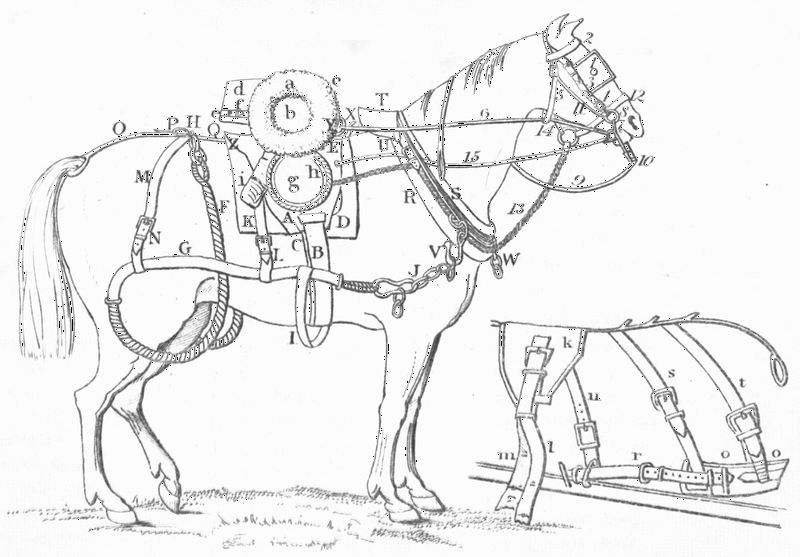
Off Leader.
Shaft Harness.
OFF LEADER
A
Pad or Off Saddle
B
Surcingle
C
Girth of the Pad
D
Pannel of D
o
E
Pad Staples
F
Trace
G
Pipe of D
o
H
Hook of D
o
I
Belly Band of D
o
J
Trace Lines
K
Bearing Strap
L
Buckling Piece of D
o
M
Hip Strap
N
Buckling Piece of D
o
O
Crupper
P
Crupper Ring
Q
Buckling Piece of Crupper
R Collar S The Hames T The Housing U The Housing Strap V Shoulder Link & Hook W Breast Chains or Links X Wither Strap Y Bearing Hook Z Cantle of Pad a Sheepskin b Valise c Baggage Strap d Mess Tin e Do. Strap f Buckle of Do g Wooden Canteen h Forage Cord i Nose Bag
THE BRIDLE.
1
Winker
2
Front or Brow Band
3
Cheek
4
Cheek Billets
5
Throat Lash
6
Bearing Rein
7
Bit
8
Cheek of D
o
9
Leading Rein
10
Bar of the Bit
11
Head-Collar
12
Nose Band
13
Collar Chain
14
Jowl Strap
15
Side Rein
SHAFT HARNESS.
k
Pad or off Saddle
l
Back Band
m
Shaft Tugs
n
Bearing Strap
o
Breeching
r
Strap of Breeching
s
Loin Strap
t
Hip Strap
Detail of a 9-Pounder Troop of Royal Horse Artillery for Active Service, with the Army in the East.
Key: A = Number of Carriages. C = Gunners. D = Drivers. E = Riding. F = Draught. G = Total.
K = Sets of Appointments N. C. Officers and Men. L = Harness Sets Double. M = Lead. N = Wheel.
Equipment. Men. Horses. L
A C D G E F G K M N
4 9-Pounder Guns 40 16 56 40 32 72 40 12 4
2 24-Pounder Howitzers 20 8 28 20 16 36 20 6 2 { Captain 1
6 Gun Ammunition Waggons 12 18 30 4 36 40 4 12 6 Officers. { Second Captain 1
5 Howitzer Ammunition Waggons 10 15 25 2 30 32 2 10 5 { Lieutenants 3
1 Store Limber Waggon . 3 3 . 6 6 . 2 1 { Assist.-Surgeon 1
1 Spare Gun Carriage . 3 3 . 6 6 . 2 1
1 Forge . 3 3 . 6 6 . 2 1 { Staff Serjeants 2
1 Rocket Carriage . 4 4 . 8 8 . 3 1 Non-Comm- { Serjeants 8
1 Store Cart . 1 1 . 2 2 . . 1 issioned { Corporals 4
1 Medicine Cart . 1 1 . 2 2 . . 1 Officers { Bombardiers 6
2 Light Forage Waggons . 4 4 . 8 8 . 2 2 and Men. { Gunners 97
3 Water Carts . 3 3 . 6 6 . . 3 { Drivers 123
. {For 2 Staff Serjeants, { Trumpeter 1
{ 2 Trumpeters,
{ 1 Farrier, . . . 8 . 8 8 . . { Farrier 1
{ 3 Shoeing-Smiths Artificers. { Shoeing-smiths 6
. {Spare Men, Officers’ { Collar-makers 3
{ Servants and Bâtmen, { Wheelers 2
{ &c., and Spare 15 44 59 6 16 22 . 4 4
{ Horses Total 259
. Officers’ Horses . . . 12 . 12 . . .
. Bât Horses . . . . 6 6 . . .
28 Total Carriages. Total 97 123 220 92 180 272 74 55 32
Detail of the Reserve of Gun and Small Arm Ammunition, Royal Horse Artillery, for Active Service with the Cavalry of the Army in the East.
Key: A = Number of Carriages. C = Gunners. D = Drivers. E = Riding. F = Draught. G = Total.
K = Sets of Appointments N. C. Officers and Men. L = Harness Sets Double. M = Lead. N = Wheel.
Distribution. Men. Horses. L
A C D G E F G K M N
12 Gun Ammunition Waggons . 36 36 . 72 72 . 24 12
6 Howitzer Ammunition Waggons . 18 18 . 36 36 . 12 6 { Captain 1
6 Carbine Ammunition Waggons . 18 18 . 36 36 . 12 6 Officers. { Second Captain 1
1 Store Limber Waggon . 3 3 . 6 6 . 2 1 { Lieutenants 4
1 Forge . 3 3 . 6 6 . 2 1 { Assist.-Surgeon 1
. 2 Portable Forges 2 . 2 2 . 2 . . .
3 Light Forage Waggons . 6 6 . 12 12 . 3 3 { Staff Serjeants 2
3 Water Carts . 3 3 . 6 6 . . 3 Non-Comm- { Serjeants 9
1 Store Cart . 1 1 . 2 2 . . 1 issioned { Corporals 6
1 Medicine Cart . 1 1 . 2 2 . . 1 Officers { Bombardiers 6
{ 2 Staff Serjeants, and Men. { Gunners 106
{ 9 Serjeants, { Drivers 146
{ 6 Corporals, { Trumpeter 1
. { 6 Bombardiers, . . . 30 . 30 30 . .
{ 3 Trumpeters, { Farrier 1
{ 1 Farrier, Artificers. { Shoeing-smiths 8
{ 3 Shoeing-Smiths { Collar-makers 4
. Servants and Bâtmen 7 7 14 . . . . . . { Wheelers 4
. Mounted Gunners 48 . 48 48 . 48 48 . .
. Spare Men 49 50 99 . . . . . . Total 300
. Spare Horses . . . 12 42 54 8 10 10
34 Total Carriages. Total 106 146 252 92 220 312 86 65 44
Detail of a 9-Pounder Field Battery, Royal Artillery, for Active Service with the Army in the East.
Key: A = Number of Carriages. C = Gunners. D = Drivers. E = Riding. F = Draught. G = Total.
H = Sets of Appointments. I = Officers. J = N. C. Officers. L = Harness Sets Double. M = Lead. N = Wheel.
Equipment. Men. Horses. H L
A C and D G E F G I J M N
4 9-Pounder Guns 40 16 56 . 32 32 . . 12 4
2 24-Pounder Howitzers 20 8 28 . 16 16 . . 6 2
6 Gun Ammunition Waggons 12 18 30 . 36 36 . . 12 6 { Captain 1
5 Howitzer Ammunition 10 15 25 . 30 30 . . 10 5 Officers. { Second Captain 1
Waggons { Lieutenants 3
1 Store Limber Waggon . 3 3 . 6 6 . . 2 1 { Assist.-Surgeon 1
1 Spare Gun Carriage . 3 3 . 6 6 . . 2 1
1 Forge . 3 3 . 6 6 . . 2 1 { Staff-Serjeants 2
1 Rocket Carriage . 4 4 . 8 8 . . 3 1 Non-Comm- { Serjeants 8
1 Store Cart . 1 1 . 2 2 . . . 1 issioned { Corporals 5
1 Medicine Cart . 1 1 . 2 2 . . . 1 Officers { Bombardiers 7
2 Light Forage Waggons . 4 4 . 8 8 . . 2 2 and Men. { Gunners } 200
3 Water Carts . 3 3 . 6 6 . . . 3 { Drivers }
. For Staff-Serjeants . . . 14 . 14 . 14 . . { Trumpeters 2
and mounted Non-Com.
Officers { Farrier 1
For Trumpeters . . . 2 . 2 . 2 . . { Shoeing-smiths 6
For Farrier . . . 1 . 1 . 1 . . Artificers. { Collar-makers 3
For Shoeing-smiths . . . 1 . 1 . 1 . . { Wheelers 2
. Spare Men, Officers’ 15 24 39 2 20 22 . 1 3 3
Servants and Bâtmen, Total 242
&c., and Spare Horses
. Officers’ Horses . . . 6 . 6 6 . . .
. Bât Horses . . . . 6 6 . . . .
28 Total Carriages. Total 97 103 200 26 184 210 6 19 54 31
9-Pounder Field Battery, Royal Artillery.—Detail of the RIGHT Division.
Key: A = Number of Carriages. B = N. C. Officers and Artificers. C = Gunners. D = Drivers. E = Riding. F = Draught.
H = Sets of Appointments. I = Officers. J = N. C. Officers. L = Harness Sets Double. M = Lead. N = Wheel.
No. 1 Sub-division.
Equipment. Men. Horses. H L
A B C D E F I J N M
2 9-Pounder Gun . 10 4 . 8 . . 1 3
3 Gun Amm. Wag. . 2 3 . 6 . . 1 2
1 Forge . . 3 . 6 . . 1 2
1 Forage Waggon . . 2 . 4 . . 1 1
1 Store Cart . . . . . . . . .
1 Water Cart . . . . . . . . .
. Staff Serjeants . . . . . . . . .
. Serjeants 1 . . 1 . . 1 . .
. Corporals . . . . . . . . .
. Bombardiers 2 . . 1 . . 1 . .
. Trumpeters 1 . . 1 . . 1 . .
. Farriers 1 . . 1 . . 1 . .
. Shoeing-smiths 1 . . . . . . . .
. Collar-maker . . . . . . . . .
. For Officers . . . 1 1 1 . . .
. Spare . 4 4 . 4 . . 1 .
9 Total. 6 16 16 5 29 1 4 5 8
No. 2 Sub-division.
Equipment. Men. Horses. H L Officers { 1st Captain (No. 2) 1
A B C D E F I J N M { Senior Lieut. (No. 1) 1
2 9-Pounder Gun . 10 4 . 8 . . 1 3 { Staff Serjeant 1
3 Gun Amm. Wag. . 4 6 . 12 . . 2 4 { Serjeants 2
1 Forge . . . . . . . . . Non-Comm- { Corporal 1
1 Forage Waggon . . . . . . . . . issioned { Bombardiers 3
1 Store Cart . . 1 . 2 . . 1 . Officers { Gunners 32
1 Water Cart . . 1 . 2 . . 1 . and Men. { Drivers 32
. Staff Serjeants 1 . . 1 . . 1 . . { Trumpeter 1
. Serjeants 1 . . 1 . . 1 . . { Farrier 1
. Corporals 1 . . 1 . . 1 . . Artificers. { Shoeing-smiths 2
. Bombardiers 1 . . . . . . . . { Collar-maker 1
. Trumpeters . . . . . . . . . Horses. { Riding 9
. Farriers . . . . . . . . . { Draught 58
. Shoeing-smiths 1 . . . . . . . . Appointments. { Officers 2
. Collar-maker 1 . . . . . . . . { N. C. Officers 7
. For Officers . . . 1 1 1 . . . Harness. { Wheel 10
. Spare . 2 4 . 4 . . . 1 { Lead 16
9 Total. 6 16 16 4 29 1 3 5 8
N. B.—The Gunners attached to first line of waggons are the Officers’ Servants and Bâtmen, viz.—2 to each sub-division. The mounted Coverers or Horseholders may be taken from either full Non-Commissioned Officers or the acting Bombardiers, of whom 12 are allowed to be made, at the discretion of the officer commanding.
9-Pounder Field Battery, Royal Artillery.—Detail of CENTRE Division.
Key: A = Number of Carriages. B = N. C. Officers and Artificers. C = Gunners. D = Drivers. E = Riding. F = Draught.
H = Sets of Appointments. I = Officers. J = N. C. Officers. L = Harness Sets Double. M = Lead. N = Wheel.
No. 3 Sub-division.
Equipment. Men. Horses. H L
A B C D E F I J N M
2 24-Pr. Howitzers . 10 4 . 8 . . 1 3
5 How. Amm. Wag. . 4 6 . 12 . . 2 4
1 Spare Gun Carriage . . 3 . 6 . . 1 2
1 Medicine Cart . . . . . . . 1 .
1 Water Cart . . 1 . 2 . 1 . .
. Serjeants 2 . . 1 . . . . .
. Corporals 1 . . 1 . . 1 . .
. Bombardiers 1 . . . . . . . .
. Wheeler (senior) 1 . . . . . . . .
. Collar-maker . . . . . . . . .
. Shoeing-smith 1 . . . . . . . .
. For Officers . . . 1 1 1 . . .
. Spare . 2 4 1 3 . 1 1 .
10 Total. 6 16 18 4 32 1 3 6 9
No. 4 Sub-division.
Equipment. Men. Horses. H L Officers. { Junior Lieut. (No. 3.) 1
A B C D E F I J N M { Assist.-Surgeon (No. 4.) 1
2 24-Pr. Howitzers . 10 4 . 8 . . 1 3 { Serjeants 4
5 How. Amm. Wag. . 6 9 . 18 . . 3 6 Non-Comm- { Corporals 2
1 Spare Gun Carriage . . . . . . . . . issioned { Bombardiers 2
1 Medicine Cart . . 1 . 2 . . 1 . Officers { Gunners 33
1 Water Cart . . . . . . . . . and Men. { Drivers 36
. Serjeants 2 . . 1 . . 1 . . { Wheeler (senior) 1
. Corporals 1 . . 1 . . 1 . . Artificers. { Collar-maker 1
. Bombardiers 1 . . . . . . . . { Shoeing-smiths 2
. Wheeler (senior) . . . . . . . . . Horses. { Riding 8
. Collar-maker 1 . . . . . . . . { Draught 62
. Shoeing-smith 1 . . 1 . . 1 . . Appointments. { Officers 2
. For Officers . . . 1 1 1 . . . { N. C. Officers 6
. Spare . 1 4 . 3 . . . 1 Harness. { Wheel 11
10 Total. 6 17 18 4 30 1 3 5 10 { Lead 19
9-Pounder Field Battery, Royal Artillery.—Detail of the LEFT Division.
Key: A = Number of Carriages. B = N. C. Officers and Artificers. C = Gunners. D = Drivers. E = Riding. F = Draught.
H = Sets of Appointments. I = Officers. J = N. C. Officers. L = Harness Sets Double. M = Lead. N = Wheel.
No. 5 Sub-division.
Equipment. Men. Horses. H L
A B C D E F I J N M
2 9-Pounder Guns . 10 4 . 8 . . 1 3
3 Gun Amm. Wag. . 4 6 . 12 . . 2 4
1 Store Limber Wag. . . . . . . . . .
1 Forage Waggon . . 2 . 4 . . 1 1
1 Rocket Carriage . . . . . . . . .
1 Water Cart . . 1 . 2 . . 1 .
. Staff Serjeant 1 . . 1 . . 1 . .
. Serjeant 1 . . 1 . . 1 . .
. Corporal 1 . . 1 . . 1 . .
. Bombardier 1 . . . . . . . .
. Wheeler . . . . . . . . .
. Collar-maker 1 . . . . . . . .
. Shoeing-smith 1 . . . . . . . .
. Trumpeters . . . . . . . . .
. For Officers . . . 1 1 1 . . .
. Spare . 2 4 1 3 . . . 1
9 Total. 6 16 17 5 30 1 3 5 9
No. 6 Sub-division.
Equipment. Men. Horses. H L
A B C D E F I J N M Officers. { 2nd Capt. (No. 5) 1
2 9-Pounder Guns . 10 4 . 8 . . 1 3 { 2nd Sen. Lieut. (6) 1
3 Gun Amm. Wag. . 2 3 . 6 . . 1 2 { Staff Serjeant 1
1 Store Limber Wag. . . 3 . 6 . . 1 2 { Serjeants 2
1 Forage Waggon . . . . . . . . . Non-Comm- { Corporals 2
1 Rocket Carriage . 3 4 . 8 . . 1 3 issioned { Bombardiers 2
1 Water Cart . . . . . . . . . Officers { Gunners 35
. Staff Serjeant . . . . . . . . . and Men. { Drivers 32
. Serjeant 1 . . 1 . . 1 . . { Trumpeter 1
. Corporal 1 . . 1 . . 1 . . { Wheeler 1
. Bombardier 1 . . . . . . . . Artificers. { Col.-maker (sen.) 1
. Wheeler 1 . . . . . . . . { Shoeing-smith 1
. Collar-maker . . . . . . . . . Horses. { Riding 9
. Shoeing-smith 1 . . . . . . . . { Draught 62
. Trumpeters 1 . . 1 . . 1 . . Appointments. { Officers 2
. For Officers . . . 1 1 1 . . . { N. C. Officers 6
. Spare . 1 4 . 3 . . 1 . Harness. { Wheel 10
9 Total. 6 16 18 4 32 1 3 5 10 { Lead 19
Detail of an 18-Pounder Field Battery, Royal Artillery, for Active Service with the Army in the East.
Key: A = Number of Carriages. C = Gunners. D = Drivers. E = Riding. F = Draught. G = Total.
H = Sets of Appointments. I = Officers. J = N. C. Officers. L = Harness Sets Double. M = Lead. N = Wheel.
Equipment. Men. Horses. H L
A C and D G E F G I J M N
4 18-Pounder Guns 56 24 80 . 48 48 . . 16 8
12 Gun Ammunition Waggons 24 36 60 . 72 72 . . 24 12 { Captain 1
2 Store Limber Waggons . 6 6 . 12 12 . . 4 2 Officers. { Second Captain 1
1 Spare Gun Carriage . 4 4 . 8 8 . . 2 2 { Lieutenants 3
1 Platform Waggon . 4 4 . 8 8 . . 2 2 { Assist.-Surgeon 1
1 Forge . 3 3 . 6 6 . . 2 1
1 Store Cart . 1 1 . 2 2 . . . 1 { Staff-Serjeants 2
1 Medicine Cart . 1 1 . 2 2 . . . 1 { Serjeants 7
2 Light Forage Waggons . 4 4 . 8 8 . . 2 2 Non-Comm- { Corporals 5
3 Water Carts . 3 3 . 6 6 . . . 3 issioned { Bombardiers 6
. For Staff-Serjeants and Officers { Gunners } 205
Non-Commissioned . . . 10 . 10 . 10 . . and Men. { Drivers }
Officers { Trumpeters 2
Trumpeters . . . 2 . 2 . 2 . .
Farrier . . . 1 . 1 . 1 . . { Farrier 1
Shoeing-Smith . . . 1 . 1 . 1 . . Artificers. { Shoeing-smiths 6
. Spare Men, Officers’ { Collar-makers 3
Servants and Bâtmen, 15 24 39 2 20 22 . 1 3 3 { Wheelers 2
&c., and Spare Horses Total 245
. Officers’ Horses . . . 6 . 6 6 . . .
. Bât Horses . . . . 6 6 . . . .
28 Total Carriages. Total 95 110 205 22 198 220 6 15 55 37
Detail of a 32-Pounder Howitzer Field Battery, Royal Artillery, for Active Service with the Army in the East.
Key: A = Number of Carriages. C = Gunners. D = Drivers. E = Riding. F = Draught. G = Total.
H = Sets of Appointments. I = Officers. J = N. C. Officers. L = Harness Sets Double. M = Lead. N = Wheel.
Equipment. Men. Horses. H L
A C and D G E F G I J M N
4 32 Pounder Howitzers 48 16 64 . 32 32 . . 12 4
12 Howitzer Ammunition Waggons 24 36 60 . 72 72 . . 24 12 { Captain 1
1 Store Limber Waggon . 3 3 . 6 6 . . 2 1 Officers. { Second Captain
1 Spare Howitzer Carriage . 4 4 . 8 8 . . 3 1 { Lieutenants 3
1 Forge . 3 3 . 6 6 . . 2 1 { Assist.-Surgeon 1
1 Store Cart . 1 1 . 2 2 . . . 1
1 Medicine Cart . 1 1 . 2 2 . . . 1 { Staff Serjeants 2
2 Flanders Waggons . 4 4 . 8 8 . . 2 2 { Serjeants 6
3 Water Carts . 3 3 . 6 6 . . . 3 Non-Comm- { Corporals 5
. For Staff Serjeants, and issioned { Bombardiers 6
Mounted Non-Com. . . . 10 . 10 . 10 . . Officers { Gunners } 182
Officers and Men. { Drivers }
Trumpeters . . . 2 . 2 . 2 . . { Trumpeters 2
Farrier . . . 1 . 1 . 1 . .
Shoeing-smith . . . 1 . 1 . 1 . . { Farrier 1
. Spare Men, Officers’ Artificers. { Shoeing-smiths 5
Servants and Bâtmen, 15 24 39 2 20 22 . 1 3 3 { Collar-makers 2
&c., and Spare Horses { Wheelers 2
. Officers’ Horses . . . 6 . 6 6 . . . Total 219
. Bât Horses . . . . 6 6 . . . .
26 Total Carriages. Total 87 95 182 22 168 190 6 15 48 29
Detail of a Reserve of Gun and Small Arm Ammunition for Active Service with the Army in the East.
Key: A = Number of Carriages. C = Gunners. D = Drivers. E = Riding. F = Draught. G = Total.
H = Sets of Appointments. I = Officers. J = N. C. Officers. L = Harness Sets Double. M = Lead. N = Wheel.
Equipment. Men. Horses. H L
A C and D G E F G I J M N
30 Ammunition { Gun 4 8 12 20 . 24 24 . . 8 4
Waggons { Howitzer 2 4 6 10 . 12 12 . . 4 2 { Captain 1
{ Small arm 24 24 72 96 . 144 144 . . 48 24 Officers. { Second Captain 1
1 Store Limber Waggon . 3 3 . 6 6 . . 2 1 { Lieutenants 3
1 Forge . 3 3 . 6 6 . . 2 1 { Assist.-Surgeon 1
1 Store Cart . 1 1 . 2 2 . . . 1
1 Medicine Cart . 1 1 . 2 2 . . . 1 { Staff-Serjeants 2
2 Light Forage Waggons . 4 4 . 8 8 . . 2 2 { Serjeants 6
3 Water Carts . 3 3 . 6 6 . . . 3 Non-Comm- { Corporals 5
. For Staff-Serjeants and issioned { Bombardiers 7
Mounted Non-Com. . . . 10 . 10 . 10 . . Officers { Gunners } 180
Officers and Men. { Drivers }
Trumpeters . . . 2 . 2 . 2 . . { Trumpeters 2
Farrier . . . 1 . 1 . 1 . .
Shoeing-smith . . . 1 . 1 . 1 . . { Farrier 1
. Spare Men, Officers’ Artificers. { Shoeing-smiths 6
Servants and Bâtmen, 12 27 39 2 18 20 . 1 2 1 { Collar-makers 3
&c., and Spare Horses { Wheelers 2
. Officers’ Horses . . . 6 . 6 6 . . . Total 220
. Bât Horses . . . . 6 6 . . . .
39 Total Carriages. Total 48 132 180 22 234 256 6 15 68 40
Detail of a Gun Ammunition Reserve for Active Service, and to be attached to the Reserve Artillery with the Army in the East.
Key: A = Number of Carriages. C = Gunners. D = Drivers. E = Riding. F = Draught. G = Total.
H = Sets of Appointments. I = Officers. J = N. C. Officers. L = Harness Sets Double. M = Lead. N = Wheel.
Equipment. Men. Horses. H L
A C and D G E F G I J M N
24 Ammunition { Gun 16 32 48 80 . 96 96 . . 32 16
Waggons { Howitzer 8 16 24 40 . 48 48 . . 16 8 { Captain 1
1 Store Limber Waggon . 3 3 . 6 6 . . 2 1 Officers. { Second Captain 1
1 Forge . 3 3 . 6 6 . . 2 1 { Lieutenants 3
1 Store Cart . 1 1 . 2 2 . . . 1 { Assist.-Surgeon 1
1 Medicine Cart . 1 1 . 2 2 . . . 1
2 Light Forage Waggons . 4 4 . 8 8 . . 2 2 { Staff-Serjeants 2
3 Water Carts . 3 3 . 6 6 . . . 3 { Serjeants 6
2 Spare Gun Carriages— . 6 6 . 12 12 . . 4 2 Non-Comm- { Corporals 5
1 Gun and 1 Howitzer issioned { Bombardiers 7
. For Staff-Serjeants and Officers { Gunners } 186
Mounted Non-Com. . . . 14 . 14 . 10 . . and Men. { Drivers }
Officers { Trumpeters 2
Trumpeters . . . 2 . 2 . 2 . .
Farrier . . . 1 . 1 . 1 . . { Farrier 1
Shoeing-smiths . . . 2 . 2 . 2 . . Artificers. { Shoeing-smiths 7
. Spare Men, Officers’ { Collar-makers 3
Servants and Bâtmen, 15 30 45 2 20 22 . 1 2 1 { Wheelers 4
&c., and Spare Horses Total 229
. Officers’ Horses . . . 6 . 6 6 . . .
. Bât Horses . . . . 6 6 . . . .
35 Total Carriages. Total 63 123 186 27 212 239 6 16 60 36
Detail of a Small Arm Ammunition Reserve for Active Service, to be attached to the Reserve Artillery with the Army in the East.
Key: A = Number of Carriages. C = Gunners. D = Drivers. E = Riding. F = Draught. G = Total.
H = Sets of Appointments. I = Officers. J = N. C. Officers. L = Harness Sets Double. M = Lead. N = Wheel.
Equipment. Men. Horses. H L
A C and D G E F G I J M N
36 Small Arm Ammunition Waggons 36 108 144 . 216 216 . . 72 36 { Captain 1
1 Store Limber Waggon . 3 3 . 6 6 . . 2 1 Officers. { Second Captain 1
1 Forge . 3 3 . 6 6 . . 2 1 { Lieutenants 3
1 Store Cart . 1 1 . 2 2 . . . 1 { Assist.-Surgeon 1
1 Medicine Cart . 1 1 . 2 2 . . . 1
2 Light Forage Waggons . 4 4 . 8 8 . . 2 2 { Staff-Serjeants 2
3 Water Carts . 3 3 . 6 6 . . . 3 { Serjeants 6
. For Staff-Serjeants and Non-Comm- { Corporals 5
mounted Non-Com. . . . 10 . 10 . 10 . . issioned { Bombardiers 7
Officers Officers { Gunners } 220
Trumpeters . . . 2 . 2 . 2 . . and Men. { Drivers }
Farrier . . . 1 . 1 . 1 . . { Trumpeters 2
Shoeing-smith . . . 1 . 1 . 1 . .
. Spare Men, Officers’ { Farrier 1
Servants and Bâtmen, 30 31 61 4 20 24 . 2 4 2 Artificers. { Shoeing-smiths 7
&c., and Spare Horses { Collar-makers 3
. Officers’ Horses . . . 6 . 6 6 . . . { Wheelers 2
. Bât Horses . . . . 6 6 . . . . Total 261
45 Total Carriages. Total 66 154 220 24 272 296 6 16 82 47
ON THE INTERIOR MANAGEMENT OF A BATTERY.
1. The greatest care should be paid to the fittings of the saddles and collars; extensive sore backs and galled shoulders arise chiefly from neglect on the march: and by prompt attention on the part of the officers, many horses may be preserved to the service, which would otherwise be disabled for months. The drivers should never be suffered to lounge in their saddles, or to sit uneven. A folded blanket under the saddle is found to be the best preventive of sore backs, as it adapts the shape of the saddle to any loss of flesh in the animal.
On long marches, the shaft horse should invariably be provided with a half blanket under the pad saddle; every driver should also have attached to his harness a pair of pads of basil leather, about six inches by four, stuffed with hair; and the moment any tenderness is perceived in a horse’s shoulder, the pressure should be relieved by placing the pads above and below the tender part.
2. On a march, there will always be an advanced and rear guard; the advanced guard of one day becoming the rear guard of the next. On arriving on the ground where the battery is to be parked, the advanced guard will immediately pitch their tent, and post sentinels. When the battery quits its ground, the non-commissioned officer of the guard is responsible that nothing be left behind.
3. When a battery is to march, the camp kettles, and everything that will not be required before morning, should be lashed on the carriages at sunset.
4. In parking guns, the usual interval is ten or twelve paces; but on a march, that everything may be better under the eye of the sentinels, the intervals may be diminished to three or four paces. The guns are to be in the first line, covered by their respective waggons; the spare ammunition and store carriages in the third line. The tents of the detachment are sometimes on the flanks of the battery, and sometimes in rear of their respective sub-divisions: the officers in rear of the battery. The horses are sometimes picketed in rear of the whole, and parallel to the line of guns, and sometimes perpendicular to this line, and on the flanks between the detachments, tents, and the carriages; but in general, the form of encamping will depend on the nature of the ground and local circumstances. In every situation the approach to the park, and the road by which the guns are brought out, should be kept clear and open.
5. If the battery is parked in hot weather, the naves of the wheels must be defended as much as possible from the effect of the sun, by sods or other covering.
6. When a battery arrives in camp, quarters, or cantonments, each non-commissioned officer will immediately examine every part of the carriages of his sub-division, especially the wheels, to the greasing of which he will attend. Any damages, to be repaired without delay, he will report to the officer of his division, who will report to the commander of the battery.
7. When a battery is in stationary quarters, there must be a weekly inspection of every part of the battery, and a parade in marching order, when circumstances will permit; at which parade, every part of the harness and appointments of gunners and drivers is expected to be in the best order. Particular attention should be paid to the state of the ammunition, which should be frequently aired; and no fresh ammunition should ever be received without being gauged to the guns.
8. The drivers must immediately report any loss or breakage of their harness; and, on the instant, make known to the non-commissioned officer of the sub-division, any gall or other hurt which may have happened to the horses committed to their charge: any neglect on this point must be punished. Airing and beating with a knotted rope the stuffing of the collars and saddles is an important part of the driver’s duty, which should never be omitted on continued marches. In camp, greasy heels are the most common disability which horses labour under; and as they proceed from cold, occasioning humours to settle, the best preventive is hand-rubbing and exercise, to keep up a circulation.
9. Unless for some particular purpose, the elevating screws should never be raised higher than the half of their length; on a march, they should be covered with a piece of canvas, or an old flannel cartridge, which will prevent their being clogged with dirt; and the travelling chain should be always applied. The pintail, and the trail plate eye, should be greased previous to marching.
10. After a field day, or an action, the bores of the guns should be washed, and then laid under metal.
11. If a wheel be so disabled as not to be worth repairing, the nave, if not damaged, should be at any rate saved. If the nave be good, a new wheel can easily be made from materials perhaps found on the spot, but it is very difficult to find a nave.
12. In marching in ordinary circumstances, the officer next for duty will always proceed in advance, to take up quarters, and to choose ground for parking, or encamping on; and the officer on duty for the day will always march in, and bring up the rear.
13. When a battery is to march, and “Boot and saddle” has been sounded, the officer of the day, the non-commissioned officers, drivers, and horses will turn out, and immediately proceed to the park and put-to; if encamped, tents to be struck, and lashed to the carriages. At the sound “Turn out,” the whole of the officers, non-commissioned officers, and gunners, repair to the park; and when the usual inspections have been made, and the regular reports delivered to the commander, the battery will be marched off.
14. Feeding will always take place three times a day at the park, under the inspection of the officer of the day; when the nose-bags have been filled by the non-commissioned officer in charge of the forage, the trumpeter is to sound “Feed,” the nose-bags are put on, and the drivers fall in, in front; after the feed, the nose-bags are rolled up and buckled on.
15. A non-commissioned officer is to have charge of and serve out the corn and forage, which for security will be deposited at the park guard; but on a march, when the corn is carried on the ammunition waggons, no more corn should be taken off the carriages than is likely to be wanted.
16. Buckets are provided for watering the horses on a march; by this means they can be watered from wells or places inaccessible to the animals, or at least to more than one or two of them at a time: but the operation is a long one. If on a march a small river or stream of water is to be forded, this opportunity of watering them, or at any rate of giving them a mouthful of water in crossing it, should be seized: it saves much time. Should the stream, however, be very rapid, or deep, or should there be troops immediately in the rear, no halt should be made in fording it.
17. The Serjeant-major is to superintend all parades and drills, under the inspection of the officer on duty. The Quartermaster serjeant is to draw provisions and forage; he is to make out returns, and have charge of the spare stores.
18. The Trumpeter is always to be quartered in the nearest billet to the commanding officer; and the men and horses of each sub-division and division to be as near together as possible. A gunner from each sub-division, or a gunner of the guard, is to be made acquainted with the quarters of the commander of the battery, that in any emergency there may be no delay in finding him out: the same applies to the officers of divisions as far as their divisions are concerned.
19. The Farrier is to report every evening to the commanding officer the state of the sick animals; and on the ——, (the particular days to be mentioned) a return, in writing, of the number of horse (and mule, if any) shoes, and quantity of horse medicines expended.
20. The senior Collar-maker, the Jobbing-smith, and the Wheeler, to make similar reports of the stores expended in their several departments: these reports to be delivered to the serjeant-major, to be laid by him before the commander of the battery.
21. The Artificers are to work as near as possible to the park guard, the non-commissioned officer of which is responsible that no work is done, or horse shod, except for the battery, without written permission from the commander.
22. The Forge, when employed, should be removed to a proper distance from the park. It should, at night, be brought back to its place, and everything arranged on it, so that, should the battery be suddenly ordered to march, there may be no delay.
LASSO.
Lasso harness consists of a brown leather surcingle, and one trace. The surcingle is rather wider than a common girth, and is composed of two pieces (joined together by rings), one of which is placed over the saddle, and the other round the belly of the horse. There are also rings at the end of the surcingle, which is drawn very firmly round the horse, and fastened tight by lapping a white leather thong (fixed at one end of the surcingle) through these rings. There are two descriptions of traces, one being 8, and the other 12 feet long. They have hooks at each end, and, when the lasso harness is made use of by cavalry, &c., to assist draught horses in moving very heavy carriages, or in dragging guns, &c., up steep hills, one of these hooks is fastened to a ring in the surcingle, and the other to the carriage, &c.
Lasso harness may be advantageously employed with all horses; even those unaccustomed to draught having been found perfectly tractable and efficient the first time they were required to draw by means of the lasso. When two horses are in draught, the traces must be inside, and each rider should keep his horse’s croup a little outwards.
EMBARKING, AND DISEMBARKING.
The following directions will be found applicable to nearly all the cases likely to occur: such as embarking, or disembarking from a beach; from a wharf; with, or without boats; in presence of an enemy, &c., &c.
Sec. 39.[17] Embarking Guns, and Carriages.
Preparations.
1. On the arrival of the battery at the place of embarkation, it is to be drawn up in as compact order as is consistent with the performance of the operations required. The horses are to be taken out; the harness taken off and packed in vats, and the stores in cases. When there are no vats and cases, the stores must be secured to the carriages or tied together: the intrenching tools may remain with the carriages. The non-commissioned officers in charge of sub-divisions will attach to their harness and stores, pieces of basil having the number of their sub-divisions written upon them. The harness for each carriage should be embarked with it.
2. The gun detachments will prepare the carriages for embarkation. They will take off the side arms and secure them together, take out the elevating screws, unkey the cap-squares, unlash the ammunition boxes, and coil up the lashing ropes. Each carriage, when called for, is to be run forward to the boat or crane; the gun is to be unlimbered and dismounted; the ammunition boxes, shafts, wheels, &c., to be taken off; the washers and linch-pins must be carefully put away in the slow match box, and in the small box between the limber boxes. Every article must be stowed away with the greatest care, and arranged so as to be got at without delay.
3. Those articles which will be the last required when disembarking are the first to be embarked. The divisions, and everything belonging to them, should be kept together as much as possible. The first to be embarked are the spare carriages and forge, which are to be stowed forward, the left division next to them, and before the main hatchway; the centre abaft the hatchway; the right under the hatchway. The whole of the guns are put together, generally in the bottom of the hold, vents turned downwards, and a fid in them, to prevent their being choked.
4. When a battery is embarked in different vessels, every part should be complete, and a proportion of general stores be on board of each. If the voyage is likely to last some days, the cartouches with the ammunition must be taken out of the boxes, and stowed in the magazine. The ammunition must be so placed that whatever part belongs to any particular carriage may be got at without difficulty. When the cartouches are not taken out, the boxes must be stowed well aft in the hold, or between decks, and they should be well covered with wadmilltilts, or hair cloths.
5. In embarking from a beach, it may be necessary to erect small sheers, made of a couple of topgallant masts, previously prepared for the purpose. In embarking from a wharf, if there are cranes, they should be made use of. If boats are employed, the loads must be regulated by the state of the weather, and distance of the vessels.
Embarking the horses.
6. When the vessels can come alongside a wharf, the horses are hoisted in by means of tackle. The slings, made of canvas, should be minutely inspected, to see that they are secure. There must be a double guy made fast to the horse’s head, one end on shore, the other on board, to keep his head steady. A shoeing-smith should be in each ship, to receive the horses.
7. A horse requires at least four men besides the driver to sling him, one on each side, one at his breast, and one behind. One end of the sling is passed under his belly, and both ends made to meet over his back; one man passes his loop through the other, it is received by the man on the other side, who hauls it through, hooking the tackle to it, both men holding up the ends of the sling. The men at the breast and behind bring their ropes round, and make them fast to the grummets. The driver holds the horse’s head, and makes fast the guys to it. The horse being previously blindfolded, the word “Hoist Away” is given, and he is hoisted on board. The sling is then taken off, and he is led to his place; the first horses being always placed forward or aft, as the ship fills; the stalls nearest the hatchway being reserved for the horses which are to be first landed.
8. The horses are to be embarked in the same order as the carriages, taking care that the officers’ and non-commissioned officers’ horses are on board with the divisions to which they belong. The farriers and shoeing-smiths should be distributed in different ships.
9. When horses are embarked in boats; sheers, or a derrick, are necessary. The head of the derrick must incline inwards when the horse is rising, but when he is high enough the head of the derrick or sheers must be forced out, to bring the horse over the boat. This applies to a beach, or wharf. Sand or straw should be put in the boats, to prevent the horses slipping. They should stand athwart, the head of one horse being on the starboard, and the head of the next on the larboard side. The drivers sit on the gunwale, or stand between the horses.
10. When horses are embarked from an open beach without any appliances, they are to be led to the boat, and the halter given to one of the men in it. The horse must then be made to walk or leap into it, the gunwale of the boat being inclined towards the shore. A quiet horse should first be embarked, and the others will more readily follow.
11. In embarking in presence of an enemy, the horses and carriages, should first be embarked, the guns being retained to the last, to repel any attack. If the position be a mile or two from the place of embarkation, it may be necessary to retain a portion of the horses.
APPLICATION OF FIELD ARTILLERY.[18]
General remarks.
1. In a defensive position, the guns of the largest calibre should be posted on the weakest points of the line, and on those from whence the enemy can be discovered at the greatest distance. Those heights on which the enemy in advancing may rest his flanks, and those from whence he may be fired upon obliquely, must also be occupied by the largest calibres.
2. In an offensive position, the guns of the heaviest calibre should be placed in such situations as will render them available, without difficulty, for any operations in advance. In heavy ground, a nine or twelve pounder battery, when coming into action, should reverse, when it will be only necessary to drop the trail, instead of carrying it round by hand.
3. The guns should be placed as much as possible under cover; this is easily done on heights, by keeping them so far back that the muzzles are only to be seen over them. By proper attention, advantage may be taken of many situations, such as banks, ditches, &c.
4. Artillery in the field should be concealed from the enemy till the very moment it is to open; the guns may be masked by being a little retired, or by being covered with troops, particularly by cavalry.