PART XII. MATHEMATICS. (continued 2)
Reading edition
3.—BY MEANS OF THE RECONNOITRING PROTRACTOR,[51]
to measure the height of an inaccessible object.
[Plate, Surveying, and Reconnoitring, Fig. 1.]
Place yourself at a convenient distance from the object whose height is required, taking care to have a good base line to the second station. Hold the protractor vertically, with a steady hand, the tube side uppermost, and bring the top of the object in a line with the centre of the tube. Allow the arm (or index) to vibrate freely, and, when steady, note the angular height of the object (shown by the edge of the index on the marginal scale of degrees). By the aid of points taken through the tube, or by pickets, then pace, or measure a base in a direct line from the object; and, when arrived at the second station, again note the angular height of the object.
Construction—
Set off the angles, and draw the respective lines, which, by their intersection, will determine the height of the perpendicular, to which the height of the protractor above the ground must be added for the altitude of the object. By using the scale of the measured base line, the height required will be ascertained, or it may be calculated by “Trigonometry, without logarithms.”—Page 303.
To measure the height of an accessible object.
[Plate, Surveying, and Reconnoitring, Fig. 2.]
At an appropriate distance from the object, take its angular height and measure the distance to its base.
Construction—
Draw a line representing this distance, at one end of which draw another line at the angle found, and at the other erect a perpendicular; the intersection of these lines will determine the altitude of the object.
To measure the vertical height of a hill, or mountain.
[Fig. 3, Plate, Surveying, and Reconnoitring.]
From a station a short distance from the hill, take, and note down its angular height; then select a rear position for a base line, using the tube of the protractor to insure a straight direction; proceed to the requisite distance on the base, and again note the altitude of the hill.
Construction—
The intersection of lines drawn from each end of the base line, at the angles found, will determine the altitude; the perpendicular height of which, added to that of the protractor above the ground, will give the altitude required.
To measure the altitude of a tower, &c., on a height.
[Fig. 4, Plate, Surveying, and Reconnoitring.]
From the first station, near the base, take the altitude of the hill, and also that of the tower above it, and note down these angles; proceed to another station in a straight line with the former one, measuring its length, and again observe the angular height of the hill, and also that of the top of the tower.
Similarly to the previously described mode, ascertain, first, the height of the hill; second, the height of the hill, and tower; deduct the first calculation from the second, which will leave the height of the tower.
In all the foregoing cases the heights may be correctly ascertained by trigonometrical calculations (vide Trigonometry, without logarithms, page 303).
4.—BY THE SHADOW OF THE OBJECT,
to ascertain the height.
Set up vertically a staff of known length, and measure the length of its shadow upon a horizontal, or other plane; measure also the length of the shadow of the object of which the altitude is required. Then, by the property of similar triangles,
As the length of the shadow of the staff is to the altitude of the staff, so is the length of the shadow of the object to the altitude of the object.
5.—WHEN THERE IS NO SHADOW,
to ascertain the height.
Place a staff (equal in length to the height of the observer’s eye) vertically at such a distance from the foot of the required altitude, that the observer, having laid himself upon his back, with his feet against the bottom of the stick, may see the top of the staff, and object in the same line. Then, by similar triangles, the height may be readily ascertained.
6.—BY MEANS OF THE TANGENT SCALE OF A GUN,
to ascertain the height of an object, the distance being known.
Lay the gun for the top of the object the height of which is required, then raise the tangent scale until the top of it, and the notch on the muzzle are in line with the bottom of the object: then, by similar triangles,
As the length of the gun is to the length of the raised part of the tangent scale, so is the distance from the gun to the object, to the height required.
Plate 2.
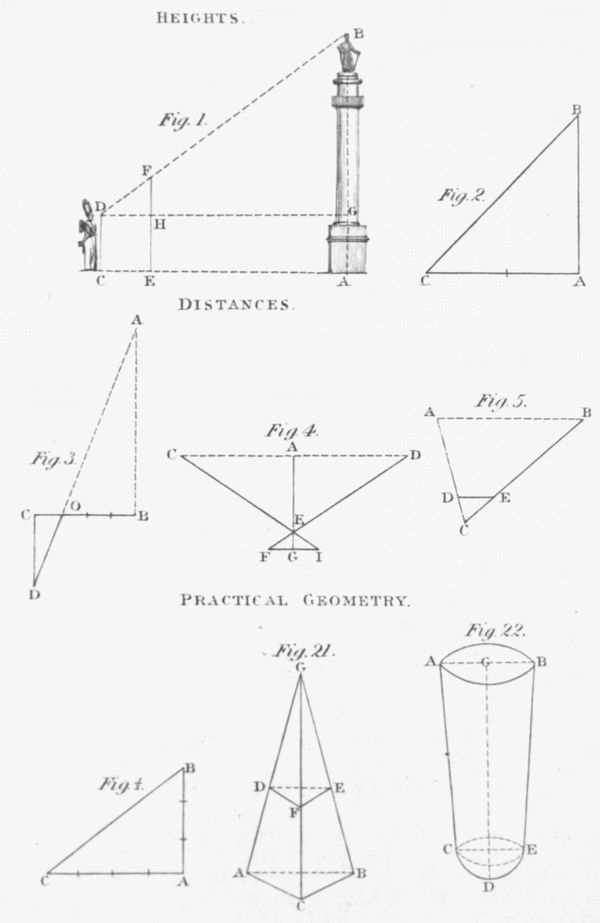
Heights. Fig. 1. Fig. 2.
Distances. Fig. 3. Fig. 4. Fig. 5.
Practical Geometry. Fig. ½. Fig. 21. Fig. 22.
7.—BY MEANS OF TWO PICKETS,
to ascertain the height of an object.
[Vide 2nd Plate, Heights, and Distances, Fig. 1.]
Let two pickets C D (4 feet), E F (6 feet), be placed with their bases in the line C A passing through A the height required, and move them nearer to, or farther from each other, until the summit B of the object is seen in the same line as D, and F, the tops of the rods. Then, by the principles of similar triangles,
As D H (= C E) : F H :: D G (= C A) : B G. To which add A G = C D for the whole height A B.
Thus, supposing C E to be 6 feet, F H 2 feet, and C A 150 feet, the proportion will be,
As 6 : 2 :: 150 : 50 feet. Then 50 + C D will be the altitude required.
DISTANCES.
1.—BY MEANS OF THE SEXTANT,[52]
to find the distance from an object, whose height is known.
Let A B represent the height of the object; C your station; and C B the distance to be found.
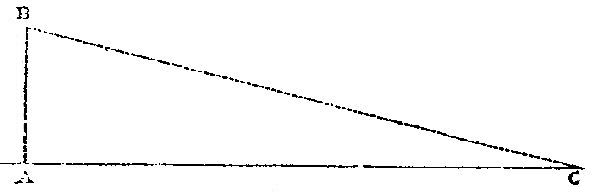
Take the angle B C A with the sextant,[52] and note it in minutes; then A B, in feet × 573 ÷ B C A, in minutes = A C in fathoms. Or A B in feet × 573 ÷ B C A, in minutes × 2 = A C in yards.
573 is a constant multiple.
This method requires no table of sines, &c., the number of minutes in the angle being used instead of the sine.
2.—BY MEANS OF A POCKET SEXTANT,
to measure inaccessible distances.
When used for taking the distance of objects, the sextant is to be held horizontally, and the quicksilvered part of the glass will be uppermost, or above the transparent part.
To ascertain the distance A B (vide Plate 2, Fig. 2), obtain, by observation, the direction A C perpendicular to A B, which is thus performed:—Set the instrument at 90°, and place yourself at the point A, with your right towards the point B; then look through the sextant, and direct a picket to be placed in the line A C at 100 yards, or feet, from you, so that the point B will appear right above it. Then set the sextant at 45°, and walk along the line towards C until you bring the points A, and B to coincide; the base and perpendicular will then be of equal length, and A C being known, or measured, the distance A B will also be ascertained. But if you cannot walk far enough to find angle C 45°, find it equal to 63° 26′, and then A C = ½ A B; at 71° 34′ = ⅓ A B; at 75° 58′ = ¼ A B; at 78° 41′ = ⅕ A B; at 80° 32′ = ⅙ A B; at 82° 52′ = ⅛ A B; and at 84° 17′ the distance will be ⅒ A B.
Should the object be far distant, it will be necessary to take a long base, and the side A B must be calculated, therefore, by trigonometry.
3.—BY MEANS OF THE PRISMATIC COMPASS,
to measure inaccessible distances.
Having fixed the instrument to the stand, place it over the station-point, spreading the legs so as to give sufficient firmness, and observing that the card is level enough to allow it to play freely; raise the prism by means of the slide, until the divisions of the compass-card are distinctly seen; then look through the slit, and turn the box round until the thread bisects the object whose distance is required; allow the card to settle, and the division on it, which coincides with the thread of the vane, will be the azimuth, or bearing of the object, reckoned from the north, or south point of the needle, when the card is divided into twice 180 degrees. The angular distance between any two objects will, of course, be the difference of their bearings; thus, suppose one to bear 15° N.E., and the other 165° S.E., the angular distance between them will be 150°.
In military sketching, the compass is often supported merely by the hands, using the little spring to check the vibrations of the card. In windy weather, the mean of these vibrations must be taken for the bearing sought.
The directions for surveying, &c., &c., by means of “The Reconnoitring Protractor,” apply similarly to the “Prismatic Compass.”
4.—BY MEANS OF “THE RECONNOITRING PROTRACTOR,”
to ascertain the distance from inacessible objects.
[Plate, Surveying, and Reconnoitring, Fig. 6.]
Select a good position for a base line; fix the protractor on the tripod at the first station, placing the instrument in a direct line between the first station and the point selected for the second station. Direct the index consecutively at the objects, the relative distances of which are to be ascertained, and note correctly their respective angles. When the object is above the horizontal line, the sliding-sight must be sufficiently raised to take its bearing; and, should the object be below the level of the protractor, its angle may be taken by observation through the upper holes of the near sight; or the feet of the tripod may be adjusted, by raising, or sinking them in the ground, so that the index may be correctly directed to the object. Then proceed to the second station, measuring, or carefully pacing the base line, at the end of which fix the protractor in a straight line between the two stations; direct the index at the objects previously noted at the first station, taking their respective angles as before.
Construction—
Draw the base of the length required, according to the scale; from each end of which set off the angles found, and draw the lines required; the intersection of these will determine the position of the several objects, and their relative distances may be ascertained by measurement on the scale of the base line; or they may be calculated trigonometrically.
5.—BY MEANS OF TWO PICKETS,
to ascertain the distance from an object.
Take two pickets of unequal lengths, drive the shortest into the ground, say close to the edge of a river; measure some paces back from it, and drive in the other, till you find, by looking over the tops of both, that your sight cuts the opposite bank. Pull up the first picket, measure the same distance from the second in any direction the most horizontal, and drive it as deep in the ground as before. Then, if you look over them again, and observe where the line of sight falls, or terminates, you will have the distance required. This method is only applicable to short distances.
6.—To ascertain the distance of the object A from B.
[Vide Plate 2, Fig. 3.]
Place a picket at B, and another at C at a few yards’ distance, making A B C a right angle, or B C perpendicular to A B.[53] Divide B C into 4, 5, or any number of equal parts, make another similar angle at C in a direction from the object, and walk along the line C D until you bring yourself in a line with the object A, and any of the divisions (say O) of the line B C. Then (having measured C D) as C O : C D :: B O : B A.
Or, as 10 : 53 :: 30 : 159 yards.
7.—To find the distance between two objects, C, and D.
[Vide Plate 2, Fig. 4.]
From any point A, taken in the line C D, erect the perpendicular A E, in which set off from A to E 40 yards, set off from E to G, in the prolongation of A E, 10 yards, at G raise the perpendicular G F, and produce it towards I, plant pickets at E, and G, then move with another picket on G F, till F is in a line with E, and D; and on the prolongation of the perpendicular F G place another picket at I in the line with E, and C: measure F I (54 yards), then—
as G E : A E :: F I : C D; Or, as 10 : 40 :: 54 : 216 yards.
8.—To find the inaccessible length, A, B, of the front of a fortification.
[Plate 2, Fig. 5.]
Plant a picket at C, from whence both points may be seen; find the lengths C A, C B (by the method in No. 5); make C E one-fourth, or any part of C B, and make C D bear the same proportion to C A: measure D E; then
as C D : D E :: C A : A B.
Nearly in the same manner the distance from B to A may be ascertained, when the point B is accessible; for having measured the line C B, and made the angle C E D equal to C B A, the proportion will be as C E : D E :: C B : B A.
9.—BY MEANS OF THE TANGENT SCALE OF A GUN,
to ascertain the distance, the height of the object at the required distance being known.
Lay the gun by the line of metal for the top of the object; then raise the tangent scale till the top of it and the notch on the muzzle are in line with the foot of the object, and note what length of scale is required.
Then,—by similar triangles—
As the length of the raised part of the tangent scale is to the length of the gun; so is the height of the distant object to the distance required.
Thus, supposing the height of the object to be 9 feet, the length of that part of the tangent scale which is raised, 3 inches, and of the gun 6 feet, the proportion will be—
As 3 : 72 :: 108 : 2592 inches, or 216 feet.
10.—BY MEANS OF THE PEAK OF A CAP,
to measure the breadth of a river.
Place yourself at the edge of one bank, and lower the peak of your cap till you find the edge of it cut the other bank, then steady your head by placing your hand under your chin, and turn round gently to some level spot of ground on your side of the river, and observe where your eyes, and the edge of the peak again meet the ground; measure the distance, which will be nearly the breadth of the river.
11.—BY THE REPORT OF FIRE-ARMS, TO ASCERTAIN THE DISTANCE OF ANY OBJECT, vide Sound, page 316.
To estimate distances, in the field.
Good eyesight recognises masses of troops at 1700 yards; beyond this distance the glitter of arms may be observed. At 1300 yards infantry may be distinguished from cavalry, and the movement of troops may be seen; the horses of cavalry are not, however quite distinct, but that the men are on horseback is clear. A single individual detached from the rest of the corps may be seen at 1000 yards, but his head does not appear as a round ball until he has approached up to 700 yards; at which distance white cross-belts, and white trousers may be seen. At 500 yards the face may be observed as a light coloured spot; the head, body, arms, and their movements, as well as the uniform, and the firelocks (when bright barrels) can be made out. At between 200 and 250 yards all parts of the body are clearly visible, the details of the uniform are tolerably clear, and the officers may be distinguished from the men.
Vide “United Service Magazine.”—No. CCCXXXI.
BY MEANS OF THE RECONNOITRING PROTRACTOR,
to traverse roads.
[Plate, Surveying, and Reconnoitring, Fig. 5.]
Fix the protractor on the tripod at the first station, placing it so that the side tube may be in a direct line with the intended second station. From each end of the tube observe the objects in sight (or place pickets) in order to secure a straight line in pacing, or measuring, from the first to the second station. Mark the distance between the stations, and place the protractor, by means of the tube, in a direct line with the first station. Then select the third station, and direct the arm or index correctly to it (using the upper holes of the near sight for a declivity, or raising the sliding-sight for an ascent); note the angle thus found, and notice the objects in front, and rear (if any, if not, place pickets) for points to enable you to pace towards, and work with accuracy at the third station. Select station 4, place the tube in line with the third, and second stations; note the bearing of No. 4, and pace the distance to it. Proceed thus from station to station, entering the angles, and distances in your note-book, as well as the offsets (which must also be carefully measured) from the lines taken, until the survey is completed.
Construction—
The day’s work will be easily plotted on paper, by setting off the angles found, and drawing lines for the measured distances, according to scale.
SOUND.
The movement communicated to the particles of air by the vibrations of a sonorous body is the cause of the sensation of sound; and it is because the particles are driven from the point of vibration in every direction, as from a centre, that the sound is perceived at once, everywhere within the surface of a sphere of a certain extent.
The velocity of sound; or the space through which it is propagated in a given time, has been differently estimated by authors who have written on this subject. Roberval states it to be at the rate of 560 feet in a second; Gassendus at 1473; Mersenne at 1474; Duhamel at 1338; Newton at 960; Derham, in whose measure Flamsteed and Halley acquiesce, at 1142. By accounts in the Memoirs of the Royal Academy of Sciences, at Paris, 1738, where cannon were fired at various distances, under many varieties of weather, wind, and other circumstances, and where the measures of the different places had been settled with the utmost exactness, it was found that sound was propagated, on a medium, at the rate of 1038 French feet in a second of time, which is equivalent to 1107 English feet, the French foot being in proportion to the English as 15 to 16.
From various experiments made with great care by Dr. O. Gregory, it has been found that sound flies through the air uniformly at the rate of about 1100 feet per second, when the air is quiescent, and at a medium temperature. At the temperature of freezing, or a little below, the velocity is about 1120. The approximate velocities under different temperatures may be found by adding to 1100 half a foot for every degree on Fahrenheit’s thermometer above the freezing point. The mean velocity may be taken at 370 yards per second, or a mile in 4-7/9 second. Hence, multiplying any time employed by sound in moving by 370, will give the corresponding space in yards, or dividing any space in yards by 370 will give the time which sound will occupy in passing uniformly over that space. If the wind blow briskly, as at the rate of 20 to 60 feet per second, in the direction in which the sound moves, the velocity of the sound will be proportionally augmented; if the direction of the wind is opposed to that of the sound, the difference of their velocities must be employed. The velocity of sound is not affected by its intensity, the smallest sound moving as rapidly as the loudest.
To ascertain the distance of any object by the report of fire-arms.
(Vide 11. Page 314.)
Multiply the number of seconds which elapse between the time of seeing the flash, and hearing the report by 1100, and the product will be the distance in feet, with sufficient accuracy for ordinary purposes. If greater accuracy be required, this rule must be modified, on account of the velocity, and direction of the wind, and state of the thermometer.
Sound will be louder in proportion to the condensation of the air. Water is one of the greatest conductors of sound; it can be heard on water nearly twice as far as upon land.
GRAVITY.
Gravity is downward pressure, or weight, being the natural tendency of all bodies towards the centre of the earth. (Vide Gravity, Motion, Forces. Page 320.)
Absolute gravity denotes the whole force with which a body tends downwards, as when the body is in empty space.
Specific gravity denotes the relative or comparative gravity of any body, in respect to that of another body of equal bulk, or magnitude.
Centre of gravity is that point in a body, or system of bodies, on which, if rested, or suspended, the whole would remain in a state of equilibrium about that point.
The centre of gravity of a circle, regular polygon, prism, cylinder, or sphere, is in its centre.
The centre of gravity of a triangle is found by bisecting any two of its sides, and drawing lines from the points of bisection to the opposite angles; the intersection of these lines will be the centre of gravity.
Force of gravity, or gravitation, is an accelerated velocity, which bodies acquire in falling freely from a state of rest.
1. The space through which a body will fall in feet, in any given time equals the product of the square of the time multiplied by 16·0833.
Example.—Required the space a falling body will pass through in five seconds?
16·0833 × 25 = 412·0825 feet.
2. The velocity in feet, which a body in descending freely will acquire in a given time, equals the product of the time in seconds multiplied by 32·1666.
Example.—What is the velocity acquired at the end of seven seconds?
32·1666 × 7 = 225·1662 feet.
3. The velocity in feet per second that a body will acquire, in falling through a given space, equals the square root of the product of the time multiplied by 64·3333.
Example.—The space through which a body has fallen is 201 feet; required its velocity at the end of the fall?
√64·3333 × 201 = √12931 = 1137 feet.
SPECIFIC GRAVITIES OF SEVERAL SOLID, AND FLUID BODIES.
Air,[54] in a mean state 1·232 Pitch 1150
Brass, cast 8000 Sand[54] 1520
Brick 2000 Silver, standard 10535
Coal[54] 1250 Steel 7850
Copper 9000 Stone, common 2520
Cork 240 Tin 7320
Clay 2160 Water,[54] rain 1000
Earth, common 1984 sea 1030
Flint 2570 Wood—alder 800
Gold, standard 18888 ash, the trunk 845
Gun metal 8784 beech 852
Gunpowder—solid 1745 elm, and larch 540
” loose 868 fir, Riga, & maple 750
Granite 3000 pine, pitch & red 660
Iron, cast 7425 oak 950
Lead 11325 walnut 671
These numbers represent the weight of a cubic foot (or 1728 cubic inches) of each of the bodies in ounces (avoirdupois).
To find the magnitude of any body from its weight.
As the tabular specific gravity of the body is to its weight in avoirdupois ounces; so is one cubic foot (or 1728 cubic inches) to its content in feet, or inches, respectively.
To find the weight of a body, from its magnitude.
As one cubic foot (1728 cubic inches) is to the content of the body; so is its tabular specific gravity to the weight of the body.
To find the specific gravity of a body.
1.—When the body is heavier than water.
Weigh it both in water, and out of water, and take the difference:
Then,—As the weight lost in water is to the whole or absolute weight; so is the specific gravity of water to the specific gravity of the body.
2.—When the body is lighter than water, so that it will not sink, annex to it another body heavier than water, so that the mass compounded of the two may sink together. Weigh the denser body, and the compound mass separately, both in water, and out of it; then find how much each loses in water, by subtracting its weight in water from its weight in air; and subtract the less of these remainders from the greater.
Then,—As the last remainder is to the weight of the light body in air; so is the specific gravity of water to the specific gravity of the body.
3.—For a fluid of any sort.
Take a piece of a body of known specific gravity, weigh it both in, and out of the fluid, finding the loss of weight by taking the difference of the two:
Then,—As the whole or absolute weight is to the loss of weight; so is the specific gravity of the solid to the specific gravity of the fluid.
To find the quantities of two ingredients in a given compound.
Take the three differences of every pair of the three specific gravities, namely, the specific gravities of the compound, and each ingredient, and multiply each specific gravity by the difference of the other two:
Then,—As the greatest product is to the whole weight of the compound; so is each of the other two products to the weights of the two ingredients.
To find the diameter of any small sphere, or globule, whose specific gravity is given (or can be found in the Table) and weight known.
Divide its weight in grains by the number expressing its specific gravity; extract the cube root of this quotient, and multiply it by 1·9612 for the diameter.
WEIGHT OF A CUBIC FOOT OF THE FOLLOWING MATERIALS,
in pounds.
Ash 49 Gravel 120
Beech 43 Granite 166
Birch 49 Brick, common 98
Box 60 Chalk 145
Cork 15 Coal, Newcastle 78
Elm 36 Antimony 418
Fir 30 Brass, cast 525
Mahogany, Spanish 50 Copper 538
Pine, red 41 Gold, pure 1203
Teak 41 Iron, cast, variable 444
Walnut 41 Lead 717
Coke 46 Silver, standard 644
Clay 125 Tin 455
Earth, loose 95
By means of the foregoing table, the weight of any quantity of the materials specified (in cubic feet) may readily be found.
MOTION, FORCES, &c.
Body is the mass or quantity of matter in any material substance, and it is always proportional to its weight, or gravity, whatever its figure may be.
Density is the proportional weight, or quantity of matter in any body.
Velocity, or celerity, is an affection of motion by which a body passes over a certain space in a certain time.
Momentum, or quantity of motion, is the power, or force, in moving bodies.
Force is a power exerted on a body to move it, or to stop it. If the force act constantly, it is a permanent force, like pressure, or the force or gravity; but if it act instantaneously, or for an imperceptibly short time, it is called impulse, or percussion, like the smart blow of a hammer.
A motive, or moving force, is the power of an agent to produce motion.
Accelerative, or retardative force, is that which affects the velocity only, or it is that by which the velocity is accelerated, or retarded.
The change, or alteration of motion by any external force, is always proportional to that force, and in the direction of the right line in which it acts.
If a body be projected in free space, either parallel to the horizon, or in an oblique direction, by the force of gunpowder, or any other impulse: it will, by this motion, in conjunction with the action of gravity, describe the curve line of a parabola.
A parabola is the section formed by cutting a cone, with a plane, parallel to the side of the cone.
Gravity (vide page 316) is a force of such a nature that all bodies, whether light or heavy, fall perpendicularly through equal spaces in the same time, abstracting the resistance of the air; as lead, and a feather, which, in an exhausted receiver, fall from the top to the bottom in the same time. The velocities acquired by descending, are in the exact proportion of the times of descent, and the spaces descended are proportional to the squares of the times, and, therefore, to the squares of the velocities. Hence, then, it follows that the weights, or gravities of bodies near the surface of the earth are proportional to the quantities of matter contained in them; and that the spaces, times, and velocities generated by gravity, have the relations contained in the three general proportions before laid down.
A body in the latitude of London falls nearly 16-1/12 feet in the first second of time, and consequently, at the end of that time, it has acquired a velocity double, or of 32⅙ feet.
The times being as the velocities, and the spaces as the squares of either; therefore,
if the times be as the Nos.
1, 2, 3, 4, 5, 6, 7, 8, 9, 10;
the velocities will also be as
1, 2, 3, 4, 5, 6, 7, 8, 9, 10;
and the spaces as their squares
1, 4, 9, 16, 25, 36, 49, 64, 81, 100;
and the spaces for each time,
1, 3, 5, 7, 9, 11, 13, 15, 17, 19.
Namely, as the series of the odd numbers, which are the differences of the squares denoting the whole spaces. So that if the first series of natural numbers be seconds of time,
namely: the times in seconds 1 2 3 4 &c.
the velocities in feet will be 32⅙ 64⅓ 96½ 128⅔, &c.
the spaces in the whole times 16 1 12 64⅓ 144¾ 257⅓, &c.
and the space for each second 16 1 12 48¼ 80 5 12 112 7 12 , &c.
of which spaces the common difference is 32⅙ feet, the natural and obvious measure of the force of gravity.
Thus, a body falling from a state of rest acquires a velocity to pass through 9 spaces in the fifth second of time; 7 in the fourth; 5 in the third; 3 in the second; and 1 in the first. Thus it is 9 + 7 + 5 + 3 + 1 = 25, which shows that the whole spaces passed through in 5 seconds equal the square of 5.
The momentum, or force, of a body falling through the atmosphere is the mass or weight, multiplied by the square root of the height it has fallen through, multiplied by 8·021.
Suppose a weight of 10 tons to be raised 9 feet, and to drop thence suddenly on a bridge; the momentum is 10 × (3 × 8·021) = 240·63 tons. That is, a weight of 10 tons, so falling, would exert as great a strain to break down the bridge, as the pressure of 240·63 tons of dead weight.
Thus, a one-ounce ball falling from a height of 400 feet, would strike the earth with a momentum of
oz. feet. oz. lb.
1 × (20 × 8·021) = 160·42 = 10·026.
By experiments to ascertain the effect of Carnot’s vertical fire, it was found that 4-oz. balls only penetrated 1 20 of an inch into deal board, and from 2 to 3 inches into meadow ground.
Amplitude signifies the range of a projectile, or the right line upon the ground, subtending the curvilinear path in which it moves.
The time of flight of different shot, and shells is equal to the time a heavy body takes to descend freely from the highest point described by the curve of the projectile.
To find the time of descent:
Divide the given height, or altitude, by 16 1 12 , and the square root of the quotient will be the time required. Thus, if the altitude is 1200 feet, and the time of descent is required,
1200 ÷ 16 1 12 = 74·61, the square root of which is 8·637, the time required.
When a body is projected vertically downwards with a given velocity, the space described is equal to the time multiplied by the velocity, together with the product of 16-1/12 by the square of the time; but, if the body is projected upwards, the latter product must be subtracted from the former.
PRACTICAL GEOMETRY.
DEFINITIONS.[55]
A line is perpendicular to another when it inclines not more on the one side than on the other, the angles on both sides being equal.
Parallel lines are those which have no inclination to each other, being everywhere equi-distant, however far produced, or extended.
An angle is the inclination, or opening of two lines, which meet in a point called the vertex, or angular point: and the two lines are called the legs, or sides of the angle.
The measure of an angle is estimated by the number of degrees contained in the arc between its two legs.
A rectilinear angle has its legs or sides, right, or straight lines.
A curvilinear angle has its legs curves.
A right angle is formed by one line perpendicular to another; the measure of which is an arc of 90°.
An acute angle is less than a right angle, or than 90°.
An obtuse angle is greater than a right angle.
An oblique angle may be either acute, or obtuse.
The circumference, or periphery of a circle is the curved line which bounds it, being everywhere equally distant from the centre. The circumference is supposed to be divided into 360 degrees (marked thus °); each degree into 60 minutes, each minute (′) into 60 seconds (″).
An arc is any part of the circumference of a circle.
A chord, or subtense, is a right line joining the extremities of an arc.
The radius of a circle is a right line drawn from the centre to the circumference.
The diameter of a circle is a right line drawn through the centre, and terminated by the circumference.
A semicircle (180°) is that part of a circle which is contained between the diameter, and half the circumference.
A quadrant is the fourth part of a circle, being contained between two radii, and an arc of 90°.
A segment is that part of a circle which is cut off by a chord.
A sector is that part of a circle contained between two radii, and an arc.
A secant is a line which cuts a circle, lying partly within, and partly without it.
A tangent is a line which touches a circle, or curve, without cutting it.
The point of contact is where a tangent touches an arc.
Triangles are figures having three sides, and three angles.
An equilateral triangle has its three sides equal.
An isosceles triangle has only two equal sides.
A scalene triangle has all its sides unequal.
A rectangular, or right-angled triangle has one of its angles a right one, or 90°; and the square of the side opposite the right angle is equal to the sum of the squares of the sides containing that angle; hence a triangle, having its sides proportional to the numbers 3, 4, 5, will be right-angled.
The hypothenuse is the side opposite the right angle in a rectangular triangle.
An obtuse-angled triangle has one of its angles obtuse.
An acute-angled triangle has all its angles acute.
The three angles of any triangle, taken together, are equal to two right angles, or 180°.
The difference of the squares of two sides of a triangle is equal to the product of their sum and difference.
The sides of a triangle are proportional to the sines of their opposite angles.
Quadrangles, or quadrilaterals, are plane figures bounded by four right lines.
A square is a quadrilateral having all its sides equal, and all its angles right angles. The diagonal of a square is equal to the square root of twice the square of its sides: and the side of the square is equal to the square root of half the square of its diagonal.
The diagonal is a right line drawn across a quadrilateral figure, from one angle to another. The sum of the squares of the two diagonals of every parallelogram is equal to the sum of the squares of the four sides.
A parallelogram is a quadrilateral, whose opposite sides are parallel.
A rectangle is a parallelogram having four right angles.
A rhomboid is an oblique-angled parallelogram.
A rhombus, or lozenge, is a quadrilateral, whose sides are all equal but its angles oblique.
A trapezium is a quadrilateral, which has none of its sides parallel to each other.
A trapezoid is a quadrilateral, which has only two of its sides parallel.
Polygons are plane figures bounded by more than four sides.
A regular polygon has all its sides, and angles equal.
The perimeter of a figure is the sum of all its sides.
To bisect—is to divide into two equal parts.
To trisect—is to divide into three equal parts.
To inscribe—is to draw one figure within another, so that all the angles of the inner figure touch either the angles, sides, or planes of the external figure.
To circumscribe—is to draw a figure round another, so that either the angles, sides, or planes of the circumscribing figure touch all the angles of the figure within it.
LINES, ANGLES, AND FIGURES.
To divide a given right line into two equal parts.
From the extremities of the line as centres, and with any opening in the compasses, greater than half the given line, as a radius, describe arcs intersecting each other above, and below the given line. A line being drawn through these intersections will divide the given line into two equal parts.
An arc of a circle is bisected in the same manner.
To bisect an angle.
From the angular point, measure equal distances on the two lines (forming the angle), and from these points, with the same distance as radius, describe arcs intersecting each other. A line drawn from their intersections to the angular point will bisect the angle.
To erect a perpendicular.
From the point A set off any length 4 times to C; from A as a centre with 3 of those parts describe an arc at B, and from C with 5 of them cut the arc at B. Draw A B, which will be the perpendicular required. Any equimultiples of these numbers, 3, 4, 5, may be used for erecting a perpendicular. Plate 2, Heights and Distances, and Practical Geometry, Fig. ½.
To erect a perpendicular.
Set off on each side of the point A, any two equal distances, A D, A E. From D and E as centres, and with any radius greater than half D E, describe two arcs intersecting each other in F. Through A, and F draw the line A F, and it will be the perpendicular required.
Fig. 1.—Plate, Practical Geometry.
To let fall a perpendicular.
From D as a centre, and with any radius, describe an arc intersecting the given line. From the points of intersection C, and E, with any radius greater than half, describe two arcs, cutting each other at F. Through D, and F draw a line, and D F will be the perpendicular required. Fig. 2.
To draw a line parallel to a given line.
From any point D in the given line with the radius D C, describe the arc C E, and from C with the same radius describe the arc D F. Take E C, and set it off from D to F. Through C, and F draw C F for the parallel required. Fig. 3.
To divide an angle into two equal parts.
From B as a centre with any radius describe an arc A C. From A, and C with any radius describe arcs intersecting each other in D. Then draw B D, and it will bisect the angle. Fig. 4.
PRACTICAL GEOMETRY.
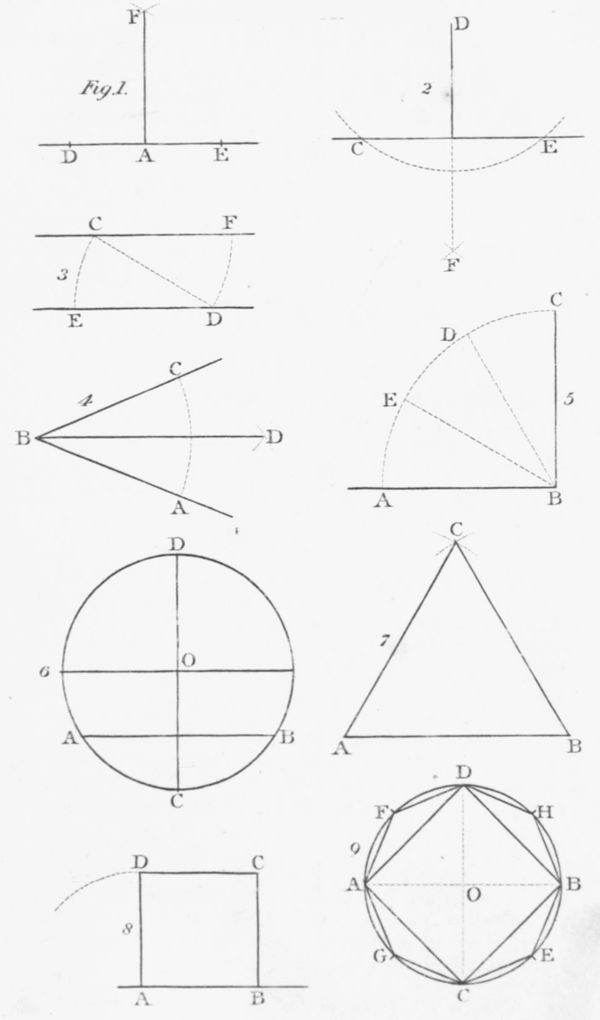
Fig. 1-9.
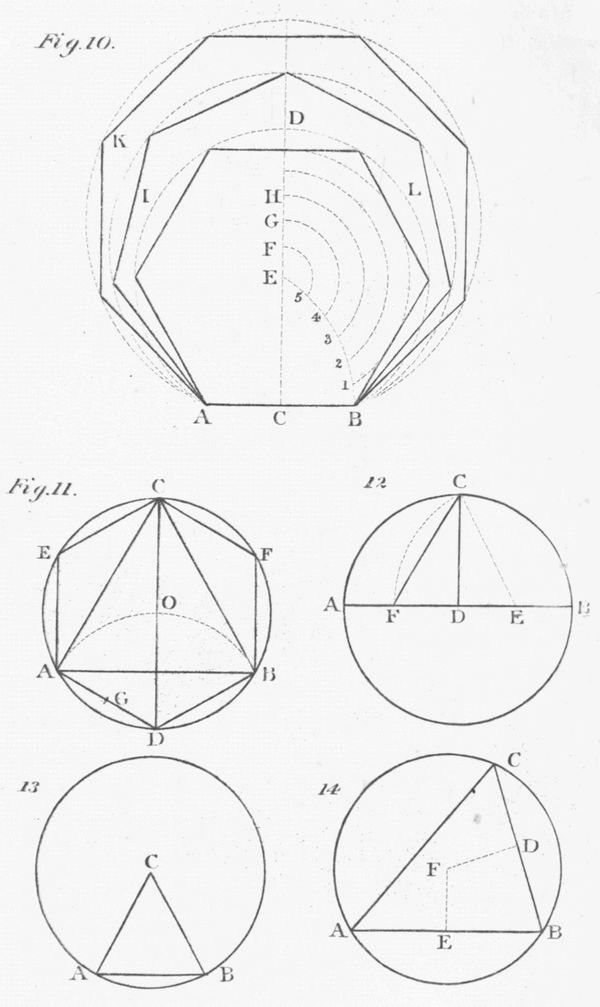
Fig. 10-14.
To divide a right angle into three equal parts.
From B as a centre with any radius describe the arc A C. From A with the radius A B cut the arc A C in D, and with the same radius from C cut it in E. Then through the intersections D, and E draw the lines B D, B E, and they will trisect, or divide the angle into three equal parts. Fig. 5.
To find the centre of a circle.
Draw any chord A B, and bisect it by the perpendicular C D. Divide C D into two equal parts, and the point of bisection O will be the centre required. Fig. 6.
To describe an equilateral triangle.
From the points A, B, as centres, and with A B as radius, describe arcs intersecting each other in C. Draw C A, C B, and the figure A B C will be the triangle required. Fig. 7.
To describe a square.
From the point B, draw B C perpendicular, and equal to A B. On A, and C, with the radius A B, describe arcs cutting each other in D. Draw the lines D A, D C, and the figure A B C D will be the square required. Fig. 8.
To inscribe a square in a circle.
Draw the diameters A B, C D perpendicular to each other. Then draw the lines A D, A C, B D, B C; and A B C D will be the square required. Fig. 9.
To inscribe an octagon in a circle.
Bisect any two arcs A C, B C of the square A B C D in G, and E. Through the points G, and E, and the centre O draw lines, which produce to F, and H. Join A F, F D, D H, &c. and they will form the octagon required. Fig. 9.
On a line to describe all the several polygons, from the hexagon to the dodecagon.
Bisect A B by the perpendicular C D. From A as a centre, and with A B as a radius, describe the arc B E, which divide into six equal parts; and from E as a centre describe the arcs 5 F, 4 G, 3 H, &c. Then from the intersection E as a centre, and with E A as a radius, describe the circle A I D B, which will contain A B six times. From F in like manner as a centre, and with F A as radius, describe the circle A K L B, which will contain A B seven times; and so on for the other polygons. Fig. 10.
To inscribe in a circle an equilateral triangle.
From any point D in the circumference as a centre, and with the radius D O of the given circle, describe an arc A O B cutting the circumference in A, and B. Through D, and O draw D C. Then, join A B, A C, B C; and the figure A B C will be the triangle required. Fig. 11.
To inscribe a hexagon in a circle.
Bisect the arcs A C, B C in E, and F, and join A D, D B, B F, &c., which will form the hexagon. Or carry the radius six times round the circumference, and the hexagon will be obtained. Fig. 11.
To inscribe a dodecagon in a circle.
Bisect the arc A D of the hexagon in G, and A G being carried twelve times round the circumference, will form the dodecagon. Fig. 11.
To inscribe a pentagon, hexagon, or decagon, in a circle.
Draw the diameter A B, and make the radius D C perpendicular to A B. Bisect D B in E. From E as a centre, and with E C as radius, describe an arc cutting A D in F. Join C F, which will be the side of the pentagon, C D that of the hexagon, and D F that of the decagon. Fig. 12.
To find the angles at the centre, and circumference of a regular polygon.
Divide 360 by the number of the sides of the given polygon, and the quotient will be the angle at the centre; and this angle being subtracted from 180, the difference will be the angle, at the circumference, required.
Table, showing the angles at the centre, and circumference.
Names. No. of Angles Angles at
sides. at centre. circumference.
Trigon 3 120° 60°
Tetragon 4 90° 90°
Pentagon 5 72° 108°
Hexagon 6 60° 120°
Heptagon 7 51° 25 5′ 7 128° 34 2′ 7
Octagon 8 45° 135°
Nonagon 9 40° 140°
Decagon 10 36° 144°
To inscribe any regular polygon in a circle.
From the centre C draw the radii C A, C B, making an angle equal to that at the centre of the proposed polygon, as contained in the preceding table. Then the distance A B will be one side of the polygon, which, being carried round the circumference the proper number of times, will complete the polygon required. Fig. 13.
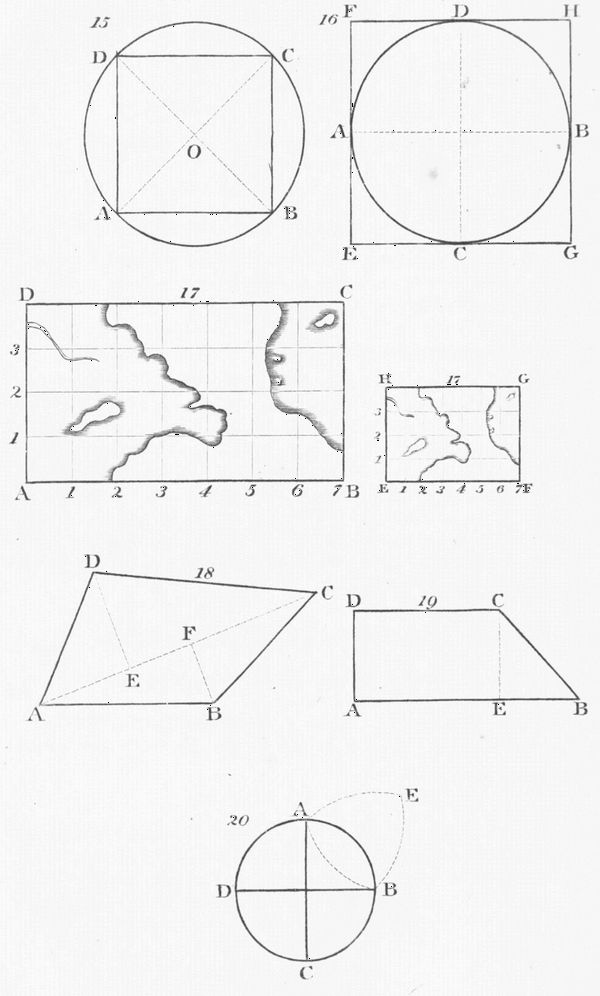
Fig. 15-20.
To circumscribe a circle about a triangle.
Bisect any two of the given sides, A B, B C by the perpendiculars E F, D F. From the intersection F as a centre, and with the distance of any of the angles, as a radius, describe the circle required. Fig. 14.
To circumscribe a circle about a square.
Draw the two diagonals A C, B D intersecting each other in O. From O as a centre, and with O A, or O B, as a radius, describe the required circle. Fig. 15.
To circumscribe a square about a circle.
Draw the two diameters A B, C D perpendicular to each other, through the points A, C, B, D, draw the tangents E F, E G, G H, F H, and E G H F will be the square required. Fig. 16.
To reduce a map, or plan, from one scale to another.
Divide the given figure A C by cross lines, forming as many squares as may be thought necessary. Draw a line E F, on which set off as many parts from the scale M, as A B contains parts of the scale N. Draw E H, and F G perpendicular to E F, and each equal to the proportional parts contained in A D, or B C. Join H G, and divide the figure E G into the same number of squares as the original A C. Describe in every square what is contained in the corresponding square of the given figure; and E F G H will be the reduced plan required. The same operation will serve either to reduce, or enlarge any map, plan, drawing, or painting. Fig. 17.
MENSURATION OF PLANES, AND SOLIDS.
Mensuration is of three kinds, viz., lineal, superficial, and solid.
Lineal measure has reference to length only.
Superficial measure (or the surface) includes length, and breadth.
Solid measure (or the content) comprehends length, breadth, and thickness.
MENSURATION OF PLANES.
The area of any plane figure is the superficial measure contained within its extremes, or bounds. This area is estimated by the number of small squares that may be contained in it, the side of these measuring squares being an inch, a foot, or any other fixed quantity, and hence the area is said to be so many square inches, square feet, &c. Vide Table, Square measure. Page 275.
To find the area of a parallelogram, whether a square, rectangle, &c.
Multiply the length by the breadth, or perpendicular height, for the area required.
Example.—Required the area of a rectangle, whose length is 9 feet, and breadth 4 feet.
9 × 4 = 36 feet. The required area, or surface.
To find the area of a triangle, its base, and perpendicular height being given.
Multiply the base by the perpendicular height, and half the product will be the area.
Example.—Required the number of square yards contained in a triangle, whose base is 20 yards, and perpendicular height 14 yards.
20 × 14 2 = 140 square yards. Area required.
To find the area of a triangle, whose three sides are given.
From half the sum of the three sides, subtract each side severally; multiply the half sum, and the three remainders together, and the square root of the product will be the area required.
Example.—Required the area of a triangle, whose sides are 50, 40, and 30 feet.
50 + 40 + 30 2 = 60, half the sum of the three sides. 60 - 30 = 30 First difference. 60 - 40 = 20 Second difference. 60 - 50 = 10 Third difference. 30 × 20 × 10 × 60 = 360000. Square root of 360000 = 600. Area required.
Two sides of a right-angled triangle being given, to find the third side.
1. When the two sides forming the right angle are given, to find the hypothenuse, or side opposite the right angle.
Take the square root of the sum of the two sides squared for the side required.
Example.—Required the length of the interior slope of a rampart, whose perpendicular height is 17 feet, and the base of the slope 20 feet.
17 × 17 = 289 20 × 20 = 400
The square root of 689 = 26·24. The length required.
2. When the hypothenuse, and one of the perpendicular sides are given.
From the square of the hypothenuse, subtract the square of the given side, and the square root of the remainder will be the side required.
Example.—The hypothenuse being 5 yards, and the base 4 yards, required the other side.
5 × 5 = 25 4 × 4 = 16
The square root of 9 = 3 yards. The side required.
To find the area of a trapezium, A B C D.
Draw the diagonal A C, upon which let fall from its opposite angles B, and D, the perpendiculars B F, D E. Find by measurement the diagonal A C, and the perpendiculars B F, D E, then multiply the sum of the perpendiculars by the diagonal, and half the product will be the area of the trapezium. Fig. 18.
Example.—Required the area of the trapezium, whose diagonal A C is 100 feet, and perpendiculars B F 30 feet, and D E 40 feet.
(30 + 40) × 100 2 = 3500 square feet. Area required.
Or, divide the trapezium into two triangles by a diagonal, then find the areas of these triangles, and add them together.
To find the area of a trapezoid, A B C D.
Multiply the sum of the parallel sides A B, D C by the perpendicular distance E C, and half the product will be the area. Fig. 19.
Example.—Required the area of the trapezoid A B C D, of which the parallel sides A B, D C are 120 feet, and 90 feet, and the perpendicular distance E C 40 feet.
(120 + 90) × 40 2 = 4200 square feet. Area required.
To find the area of an irregular figure, or polygon.
Draw diagonals dividing the figure into trapeziums, and triangles; then, having found the area of each, add them together, and the sum will be the area required.
To find the area of a figure, having a part bounded by a curve.
Draw a right line joining the extremities of the curve, then find the area of the trapezium. On the right line let fall as many perpendiculars as the several windings of the curve may require. Find their lengths, and divide their sum by the number of perpendiculars, and the quotient will be the mean breadth; which being multiplied by the length of the right line, will give the area of the curved part. This area being added to that of the trapezium will give the area of the required figure.
To measure long irregular figures.
Measure the breadth at both ends, and at several places at equal distances. Add together all these intermediate breadths, and half the two extremes, which sum multiply by the length, and divide by the number of parts for the area. If the perpendiculars, or breadths, be not at equal distances, compute all the parts separately, as so many trapezoids, and add them all together for the whole area.
Example.—The breadths of an irregular figure at five equi-distant places being 8, 2, 7, 9, 4, and the whole length 40, required the area.
8 + 4 = 12 12 ÷ 2 = 6 6 + 2 + 7 + 9 = 24 24 × 40 4 = 240. Area required.
To find the number of square acres in any of the preceding figures.[56]
Divide the superficial content in feet by 43560, and the quotient will be the number required.
To bring square chains to acres.
Of square chains strike off two decimal places to the right, and the rest of the figures will be acres.
To bring square links to acres.
Of square links cut off five of the figures on the right hand, for decimals, and the rest will be acres; then multiply these decimals by 4, for roods, cutting off five figures as before; and the decimals of these again by 40, for perches, when five figures are again to be struck off.
To find the area of a regular polygon.
Multiply the perimeter (or sum of the sides) of the polygon by the perpendicular drawn from its centre on one of its sides, and take half the product for the area.
Or, multiply the area of one of the triangles by the number of sides of the polygon, and the product will be the area of it.
Example.—Required, the area of a regular hexagon, whose side is 40 feet, and the perpendicular 34·64 feet.
40 × 6 = 240 the perimeter. 240 × 34·64 2 = 4156·8 square feet. Area required.
To find the diameter, and circumference of any circle, the one from the other.
Use either of the following proportions:
as 7 is to 22 } { so is the diameter
or as 1 is to 3·1416 } { to the circumference.
as 22 is to 7 } { so is the circumference
or, as 3·1416 is to 1 } { to the diameter.
or, instead of dividing the diameter by 3·1416, multiply it by ·3183, for the circumference.
Example 1.—Required, the circumference of a circle, whose diameter is 20 feet.
As 7 : 22 :: 20 : 62·857 feet. Circumference required.
Example 2.—Required, the diameter of a circle, whose circumference is 36 inches.
As 22 : 7 :: 36 : 11·45 inches. Diameter required.
To find the diameter of a circle, the area being given.
Divide the area by ·7854, and the square root of the quotient will be the diameter required.
Example.—Required, the diameter of a circle, whose area is 176·715 square feet.
176·715 ÷ ·7854 = 225. Square root of 225 = 15 feet. Diameter required.
To find the area of a circle.
1. Multiply half the circumference by half the diameter, or multiply the whole circumference by the whole diameter, and take ¼ of the product.
2. Or, square the diameter, and multiply that square by ·7854 for the area.
3. Or, square the circumference, and multiply that square by 0·7958.
Example 1.—Required the area of a circle, whose circumference is 55·548 inches, and its diameter 18 inches.
55·548 2 = 27·774 half circumference. 18 2 = 9 half diameter. 27·774 × 9 = 249·966, square inches. Area required.
Example 2.—Required the area of a circle whose diameter is 12 feet.
12 × 12 = 144, square of the diameter. ·7854 × 144 = 113·0976 square feet. Area required.
Example 3.—Required the area of a circle, whose circumference is 22 feet.
22 × 22 = 484. 484 × ·07958 = 38·51672 square feet. Area required.
To find the area of a circular ring,
or space included between the circumferences of two circles, the one within the other.
1. Subtract the square of the less diameter from the square of the greater, and multiply their difference by ·7854.
2. Or, find the area of each circle separately, and subtract one from the other, for the area required.
3. Or, multiply the sum of the diameters by the difference of the same, and that product by ·7854 for the area.
Example.—Required the area of a ring, the diameters of whose bounding circles are 10, and 20.
By Rule 3.
20 + 10 = 30, sum of diameters. 20 - 10 = 10, difference of diameters. 30 × 10 × ·7854 = 235·62. The area.
To find the length of any arc of a circle.
1. As 360° is to the number of degrees in the arc, so is the circumference to the length of the arc.
2. Or, multiply the degrees in the given arc by the radius of the circle, and the product by ·01745 for the length of the arc.
Example.—Rule 2.—Required the length of an arc of 30°, the radius being 9 feet.
30 × 9 × ·01745 = 4·7115. Length of arc.
To find the area of the sector of a circle.
Multiply the radius by the arc, and half the product will be the area.
Example.—Required the area of the sector, whose radius is 30 inches, and the length of the arc 36·6 inches.
36·6 × 30 2 = 549 square inches. Area required.
To find the area of the segment of a circle.
Find the area of the sector, by the preceding rule. Then find the area of the triangle formed by the chord of the segments, and the radii of the sector. Then, if the segment be less than a semicircle, subtract the area of the triangle from it; or, if the segment be greater than a semicircle, add the area of the triangle to it; for the area of the segment.
Example.—Required the area of a segment less than a semicircle, the radius being 20 inches, the chord 22·42 inches, the length of the arc 24·43 inches, and the perpendicular 16·56 inches.
24·43 × 20 2 = 244·3 square inches. Area of the sector. 22·42 × 16·56 2 = 185·6376 square inches. Area of the triangle. 244·3 - 185·6376 = 58·6624 square inches. Area required.
To find the area of a semicircle.
1. Multiply ¼ of the circumference by the radius, and the product will be the area.
2. Or, multiply the square of the diameter by ·7854, and half the product will be the area.
Example.—Rule 2.—Required the area of a semicircle, the diameter being 50 inches.
50 × 50 × ·7854 2 = 981·75 square inches. Area required.
To find the area of an ellipsis, or oval.
Multiply the longest diameter, or axis, by the shortest, then multiply the product by ·7854 for the area.
Example.—Required the area of the ellipse, whose diameters are 25 inches, and 18 inches.
25 × 18 × ·7854 = 353·43 square inches. Area required.
To find the area of a parabola, or its segment.
Multiply the base by the perpendicular height, and take two-thirds of the product for the area.
Example.—Required the area of a parabola, whose base is 20 feet, and height 12 feet.
20 × 12 = 240 ⅔ of 240 = 160 square feet. Area required.
MENSURATION OF SOLIDS.
A solid is a body containing length, breadth, and thickness.
Solids are measured by cubes, whose sides are each an inch, a foot, a yard, &c., and the solidity, capacity, or content of any figure is computed by the number of such cubes as are contained in it.—Vide Cubic measure, page 276.
A cube is a solid contained by six equal square sides.
A pyramid is a solid whose sides are all triangles meeting together in a point, the base being any plane figure whatever. It is called a triangular pyramid when its base is a triangle; a square pyramid when its base is a square, &c.
The segment of a pyramid, cone, or any other solid is a part of D E F G cut off from the top by a plane D E F, parallel to the base A B C.—Vide Fig. 21, Plate 2, Heights, Distances, and Practical Geometry.
A frustrum, or trunk, is a part A B C D E F, that remains at the bottom after the segment is cut off.
A cone is a round pyramid, of which the base is a circle.
The axis of a solid is a line from the vertex (or point) to the centre of the base, or through the centres of the two ends. When the axis is perpendicular to the base, it is a right prism, pyramid, or cone; otherwise it is oblique.
A sphere is a solid contained under one convex surface, and is described by the revolution of a semicircle about its diameter, which remains fixed.
The centre of the sphere is such a point within the solid as is everywhere equally distant from the convex surface, or circumference of it.
The diameter (or axis) of a sphere is a straight line, which passes through the centre, and is terminated by the convex surface.
A segment of a sphere is a part cut off by a plane, the section of which is always a circle, called the base of the segment.
A sector of a sphere is that which is composed of a segment (less than an hemisphere) and of a cone.
A prism is a solid, the sides of which are parallelograms, having its ends equal, and similar plane figures.
Prisms are named according to the number of angles in the base.
A cylinder is a solid, the two ends of which are circular; and it is described, or formed, by the revolution of a right-angled parallelogram about one of its sides, which remains fixed.
To find the superficies of a prism, or cylinder.
Multiply the perimeter of one end of the prism by the length, or height of the solid, and the product will be the surface of all its sides. To which add also the area of the two ends of the prism, when required.
Or, compute the areas of all the sides, and ends separately, and add them all together.
Example.—Required the surface of a cube, whose sides are each 5 inches.
5 + 5 + 5 + 5 = 20, perimeter of one end. 20 × 5 = 100, surface of sides. 5 × 5 = 25, area of one end. 100 + 25 + 25 = 150 square inches. Surface of cube.
To find the surface of a pyramid, or cone.
Multiply the perimeter of the base by the slant height, or length of the side, and half the product will be the surface of the sides; to which add the area of the base when required.
Example.—Required the upright surface of a triangular pyramid, the slant height being 20 feet, and each side of the base 3 feet.
3 + 3 + 3 = 9, perimeter of base. 9 × 20 2 = 90 feet. Surface required.
To find the surface of the frustrum of a pyramid, or cone.
Add together the perimeters of the two ends, multiply their sum by the slant height, and take half the product.
Example.—How many square feet are in the surface of the frustrum of a square pyramid, whose slant height is 10 feet, each side of the base 3 feet, and each side of the less end 2 feet.
3 + 3 + 3 + 3 = 12, perimeter of base. 2 + 2 + 2 + 2 = 8, perimeter of less end. (12 + 8) × 10 2 = 100 feet. Surface required.
To find the solid content of a prism or cylinder.
Find the area of the base, or end, and multiply it by the length of the prism, or cylinder. Fora cube, multiply its side twice by itself; and for a parallelopipedon, multiply the length, breadth, and depth together for the content.
Example.—Required the solid content of a cube, whose side is 24 inches.
24 × 24 × 24 = 13824 square inches. Content required.
To find the content of the solid part of a hollow cylinder.
From the content of the whole cylinder considered as a solid, subtract the content of the hollow part, also considered as a solid, and the difference will be the solidity required.
Example.—Required the content of the solid part of the hollow cylinder whose exterior diameter is 12 inches, the interior diameter 8 inches, and height 20 inches.
12 × 12 × ·7854 = 113·0976, area of base of cylinder. 113·0976 × 20 = 2261·952, solidity of whole cylinder. 8 × 8 × ·7854 = 50·2656, area of base of hollow cylinder. 50·2656 × 20 = 1005·312, content of hollow part. 2261·952 - 1005·312 = 1256·64 cubic inches. Solidity required.
To find the solidity of the frustrum of a cylinder.
Multiply the area of the base by half the greatest, and the least lengths, and the product will be the solidity.
Example.—Required the solidity of a frustrum, whose diameter is 24 inches, the greatest length 36 inches, and the least length 20 inches.
24 × 24 = 576. Square of the diameter. 576 × ·7854 = 452·3904. Area of the base. 452·3904 × (36 + 20) 2 = 12666·9312 Cubic inches. Solidity required.
To find the content of a pyramid, or cone.
Find the area of the base, and multiply that area by the perpendicular height, and take ⅓ of the product.
Example.—Required the solidity of a square pyramid, each side of its base being 30, and its perpendicular height 25.
30 × 30 = 900, area of base. 900 × 25 3 = 7500, solidity required.
To find the solidity of the frustrum of a cone, or pyramid.
Add into one sum the areas of the two ends, and the mean proportional between them: take ⅓ of that sum for the mean area, which multiply by the perpendicular height, or length of the frustrum.
Note.—To find a mean proportional.
As one of the sides of the base is to the homologous, or corresponding side of the other end, so is the area of the base to the mean proportional required.
Example.—Required the number of solid feet in a piece of timber, whose bases are squares, each side of the greater end being 15 inches, and each side of the less end 6 inches; also the length of the perpendicular altitude 24 feet.
15 × 15 = 225, area of the base. 6 × 6 = 36, area of the top. As 15: 6 :: 225: 90, mean proportional. 24 feet = 288 inches. (225 + 36 + 90) × 288 3 = 33696 cubic inches = 19½ cubic feet.
To find the surface of a sphere, or any segment.
Multiply the circumference of the sphere by its diameter, which will give the whole surface.
Or, square the diameter, and multiply by 3·1416. Or, square the circumference, and multiply by ·3183; or divide by 3·1416.
Note.—For the surface of the segment, or frustrum, multiply the whole circumference of the sphere by the height of the part required.
Example.—Required the superficies of a globe whose diameter is 24 inches.
24 × 24 × 3·1416 = 1809·5616 square inches.
To find the solidity of a sphere, or globe.
1. Multiply the surface by the diameter, and take ⅙ of the product.
Or, multiply the square of the diameter by the circumference, and take ⅙ of the product.
2. Cube the diameter, and multiply by ·5236.
3. Cube the circumference, and multiply by ·01688.
Example.—Required the content of a sphere, whose axis is 12.
12 × 12 × 12 × ·5236 = 904·7808. Content required.
To find the solidity of an hemisphere.
Find the solidity of the sphere, and half the content will be that of the hemisphere.
Note 1.—Any sphere, or globe twice the diameter of another contains four times the superficies, or area of the other, and eight times the solid content. Hence the superficies of spheres are as the squares, and the solidity as the cubes of their diameters.
Note 2.—The cube of the diameter of a sphere in inches, multiplied by ·00188, will give the number of imperial gallons it will contain.
To find the solid content of a spherical segment.
1. From three times the diameter of the sphere, take double the height of the segment; then multiply the remainder by the square of the height, and this product by ·5236.
2. Or, to three times the square of the radius of the segment’s base add the square of its height; then multiply the sum by the height, and the product by ·5236.
Example.—Required the content of a spherical segment 2 feet in height, cut from a sphere of 8 feet diameter.
(3 × 8) - (2 × 2) = 20 20 × 22 × ·5236 = 41·888 cubic feet. Content required.
To find the diameter of a sphere, its solidity being given.
Divide the solidity by ·5236, and take the cube root of the quotient.
Example.—The solidity of a sphere being 113·0976 solid inches, what will be its diameter?
113·0976 ·5236 = 216, the cube root of which is 6 inches, the diameter required.
To find the weight of an iron shot, its diameter being given.
Take ⅛ of the cube of the diameter, and ⅛ of that eighth, and the sum of these two quotients will be the weight in pounds.
Or, as 64 is to 9 lb. so is the diameter cubed to its weight.
Example.—Required the weight of an iron shot whose diameter is 3·5 inches?
3·5 cubed = 42·875, cube of diameter. 42·875 8 = 5·359 5·359 8 = ·669 5·359 + ·669 = 6·028 pounds. Weight required.
To find the weight of a leaden ball, its diameter being given.
Take ⅓ of the cube of the diameter, and from it subtract ⅓ of this third, and the remainder will be the weight, nearly.
Or, take 3/14 of the cube of the diameter.
Example.—What is the weight of a leaden ball whose diameter is 3·3 inches?
3·3 cubed = 35·937, cube of diameter. 35·937 3 = 11·979 11·979 3 = 3·993 11·979 - 3·993 = 7·986 pounds. Weight required.
To find the diameter of an iron shot, its weight being given.
Multiply the cube root of the shot’s weight by 1·923 for the diameter.
Pr. Cube root. Diameter.
42 3·4760, &c. { } 6·684, &c.
32 3·1748 { Multiplied } 6·103 ”
24 2·8844 { by 1·923, } 5·545 ”
18 2·6207 { diameter } 5·038 ”
12 2·2894 { of a } 4·401 ”
9 2·0800 { 1 lb. } 3·999 ”
6 1·8171 { shot. } 3·494 ”
3 1·4422 { } 2·772 ”
To find the diameter of a leaden ball, its weight being given.
To 4 times the weight add half the weight, and 3/100 of half the weight; and the cube root of this sum will be the diameter in inches, nearly.
Example.—What is the diameter of a leaden ball, whose weight is 8 pounds?
8 x 4 = 32 8 2 = 4 3 100 of 4 = ·12. 32 + 4 + ·12 = 36·12, of which the cube root is 3·3 inches, nearly. Diameter required.
To find the weight of an iron shell, its interior and exterior diameter being given.
Take 9 64 of the difference of the cubes of the external and internal diameters, for the weight of the shell in pounds.
Example.—What is the weight of a shell whose exterior diameter is 12·85 inches, and interior diameter 8·75 inches?
12·85 cubed = 2121·8241, 8·75 cubed = 669·9218. 2121·8241 - 669·9218 = 1451·9022. 9 64 of 1451·9022 = 204·1737 pounds. Weight required.
To find the quantity of powder a shell will contain.
Divide the cube of the interior diameter in inches by 57·3, and the quotient will be the weight in pounds.
Or, multiply the cube of the diameter by 11, and divide by 21 for the quantity in half ounces.
Example.—How much powder will fill a shell, whose internal diameter is 7 inches?
7 cubed = 343. 343 57·3 = 6 pounds nearly. Powder required.
To find the side of a cubical box to contain a given quantity of powder.[57]
Multiply the weight in pounds by 30, and the cube root of the product will be the side of the box in inches.
Example.—Required the side of a cubical box to hold 50 pounds of powder?
50 × 30 = 1500, the cube root of which is 11·44, which will be the side of the box in inches.
To find the quantity of powder to fill the chamber of a mortar, or howitzer.
Multiply the content of the chamber in inches by 55, and divide the product by 1728, and the quotient will be the quantity of powder in pounds.
Note.—The chamber of a mortar, or howitzer, is formed of a hollow frustrum of a right cone, and of a hollow hemisphere.
Example.—Required the quantity of powder to fill the chamber of a 13-inch mortar in which the diameter A B is 9·5 inches, the diameter C E 6·5 inches, and the length D G 21·5 inches. Vide Fig. 22. Plate 2. Heights and Distances, and Practical Geometry.
The content of the chamber must be found by finding the content of the hollow frustrum of the cone, and that of the hemisphere (vide preceding rules): which in this example will be 999·9741875.
Then 999·9741875 × 55 1728 = 31 pounds, nearly.
To find the quantity of powder to fill a rectangular box.
Divide the content (viz., length × breadth × depth) of the box in inches by 30 for the pounds of powder.
Example.—How much powder will fill a box, the length being 15 inches, the breadth 12, and the depth 10 inches.
15 × 12 × 10 30 = 1800 30 = 60 pounds. Number required.
To find the quantity of powder to fill a cylinder.
Multiply the square of the diameter by the length, then divide by 38·2 for the pounds of powder.
Example.—How much powder will the cylinder contain, whose diameter is 10 inches, and length 20 inches?
10 × 10 × 20 38·2 = 52⅓ pounds, nearly.
To find the size of a shell, to contain a given weight of powder.
Multiply the pounds of powder by 57·3, and the cube root of the product will be the diameter in inches.
Example.—Required the diameter of a shell to contain 6 lb. of powder?
6 × 57·3 = 343·8, the cube root of which is 7, the diameter required, in inches.
To find what length of a cylinder (or bore of a gun) will be filled by a given weight of powder.
Multiply the weight in pounds by 38·2, and divide the product by the square of the diameter in inches, for the length.
Example.—What length of a cylinder 8 inches in diameter will be filled with 20 lb. of powder?
20 × 38·2 8 × 8 = 11 15 16 inches.
To find the content, and weight of a piece of ordnance.
Divide the length of the gun into as many sections as may be found necessary. Find the content of each (by preceding rules) and from their sum subtract the content of a cylinder, whose length is equal to that of the bore, and its diameter equal to that of the calibre of the piece; multiply the difference (if it be a brass gun) by 5·0833, (if an iron gun) by 4·2968, and the product will be the weight in ounces.
Note.—A cubic inch of gun metal weighs 5·0833 ounces.
Ditto of cast iron 4·2968 ounces.
To find the content of a cask.
Multiply half the sum of the areas of the two interior circles, viz. at the head, and bung, by the interior length, for the content.
Or, to the area of the head add twice the area at the bung, multiply that sum by the length, and take one-third of the product.
Example.—Required the content of a cask, its greatest interior diameter being 24 inches, its least interior diameter 20 inches, and the interior length 30 inches.
24 × 24 × ·7854 = 452·3904, area of large circle. 20 × 20 × ·7854 = 314·1600, area of small circle. 452·3904 + 314·1600 2 = 383·2752, half sum.
Then 383·2752 × 30 = 11498·256, the content; which being divided by 277¼ (the number of cubic inches in a gallon) will give the number of gallons contained in the cask.
Thus 11498·256 277·25 = 41·4725, &c. Number of gallons required.
Note.-The content of any vessel in cubic feet, multiplied by 6·232 (or if in inches by ·003607) will give the number of imperial gallons it will contain.
EPITOME OF MENSURATION.
OF THE CIRCLE, CYLINDER, SPHERE, ETC.
1. The circle contains a greater area than any other plane figure, bounded by an equal perimeter, or outline.
2. The areas of circles are to each other as the squares of their diameters; any circle twice the diameter of another contains four times the area of the other.
3. The diameter of a circle being 1, its circumference equals 3·1416.
4. The diameter of a circle is equal to ·31831 of its circumference.
5. The square of the diameter of a circle being 1, its area equals ·7854.
6. The square root of the area of a circle, multiplied by 1·12837, equals its diameter.
7. The diameter of a circle, multiplied by ·8862, or the circumference multiplied by ·2821, equals the side of a square of equal area.
8. The sum of the squares of half the chord, and versed sine, divided by the versed sine, the quotient equals the diameter of the corresponding circle.
9. The chord of the whole arc of a circle taken from eight times the chord of half the arc, one-third of the remainder equals the length of the arc.
10. Or, the number of degrees contained in the arc of a circle, multiplied by the diameter of the circle, and by ·008727, the product equals the length of the arc in equal terms of unity.
11. The length of the arc of the sector of a circle multiplied by its radius, half the product is the area.
12. The area of the segment of a circle equals the area of the sector, minus the area of a triangle whose vertex is the centre; and base equals the chord of the segment.
13. The sum of the diameters of two concentric circles multiplied by their difference, and by ·7854, equals the area of the ring, or space contained between them.
14. The sum of the thickness, and internal diameter of a cylindric ring multiplied by the square of its thickness, and by 2·4674, equals its solidity.
15. The circumference of a cylinder multiplied by its length, or height, equals its convex surface.
16. The area of the end of a cylinder multiplied by its length, equals its solid content.
17. The area of the internal diameter of a cylinder multiplied by its depth, equals its cubical capacity.
18. The square of the diameter of a cylinder multiplied by its length, and divided by any other required length, the square root of the quotient equals the diameter of the other cylinder of equal solidity, or capacity.
19. The square of the diameter of a sphere multiplied by 3·1416 equals its convex surface.
20. The cube of the diameter of a sphere multiplied by ·5236, equals its solid content.
21. The height of any spherical segment, or zone, multiplied by the diameter of the sphere, of which it is a part, and by 3·1416, equals the area, or convex surface of the segment;
22. Or, the height of the segment multiplied by the circumference of the sphere of which it is a part, equals the area.
23. The solidity of any spherical segment is equal to three times the square of the radius of its base, plus the square of its height, and multiplied by its height, and by ·5236.
24. The solidity of a spherical zone equals the sum of the squares of the radii of its two ends, and one-third the square of its height, multiplied by the height, and by 1·5708.
25. The solidity of the middle zone of a sphere equals the sum of the square of either end, and two-thirds the square of the height, multiplied by the height, and by ·7854.
26. The capacity of a cylinder 1 foot in diameter, and 1 foot in length, equals 4·895 imperial gallons.
27. The capacity of a cylinder 1 inch in diameter, and 1 foot in length, equals ·034 of an imperial gallon.
28. The capacity of a cylinder 1 inch in diameter, and 1 inch in length, equals ·002832 of an imperial gallon.
29. The capacity of a sphere 1 foot in diameter, equals 3·263 imperial gallons.
30. The capacity of a sphere 1 inch in diameter, equals ·001888 of an imperial gallon.
31. Hence the capacity of any other cylinder in imperial gallons is obtained by multiplying the square of its diameter by its length; or the capacity of any other sphere by the cube of its diameter, and by the number of imperial gallons contained as above in the unity of its measurement.
OF THE SQUARE, RECTANGLE, CUBE, ETC.
1. The side of a square equals the square root of its area.
2. The area of a square equals the square of one of its sides.
3. The diagonal of a square equals the square root of twice the square of its side.
4. The side of a square is equal to the square root of half the square of its diagonal.
5. The side of a square, equal to the diagonal of a given square, contains double the area of the given square.
6. The area of a rectangle equals its length multiplied by its breadth.
7. The length of a rectangle equals the area divided by the breadth; or the breadth equals the area divided by the length.
8. The side, or end of a rectangle, equals the square root of the sum of the diagonal, and opposite side to that required, multiplied by their difference.
9. The diagonal in a rectangle equals the square root of the sum of the squares of the base, and perpendicular.
10. The solidity of a cube equals the area of one of its sides multiplied by the length of one of its edges.
11. The edge of a cube equals the cube root of its solidity.
12. The capacity of a 12-inch cube equals 6·232 gallons.
Surfaces, and solidities of the regular bodies, when the linear edge is 1.
No. of Sides. Names. Surfaces. Solids.
4 Tetrahedron 1·7320508 0·1178513
6 Hexahedron 6· 1·
8 Octahedron 3·4641016 0·4714045
12 Dodecahedron 20·6457788 7·6631189
20 Icosahedron 8·6602540 2·1816950
The tabular surface multiplied by the square of the linear edge, the product equals the surface required:
Or, the tabular solidity, multiplied by the cube of the linear edge, the product is the solidity required.
OF TRIANGLES, POLYGONS, ETC.
1. The complement of an angle is its defect from a right angle.
2. The supplement of an angle is its defect from two right angles.
3. The sine, tangent, and secant of an angle, are the cosine, cotangent and cosecant of the complement of that angle.
4. The hypothenuse of a right-angled triangle being made radii, its sides become the sines of the opposite angles, or the cosines of the adjacent angles.
5. The three angles of every triangle are equal to two right angles; hence the oblique angles of a right-angled triangle are each other’s complements.
6. The sum of the squares of the two given sides of a right-angled triangle is equal to the square of the hypothenuse.
7. The difference between the square of the hypothenuse, and given side of a right-angled triangle is equal to the square of the required side.
8. The area of a triangle equals half the product of the base multiplied by the perpendicular height;
9. Or, the area of a triangle equals half the product of the two sides, and the natural sine of the contained angle.
10. The side of any regular polygon multiplied by its apothem, or perpendicular, and by the number of its sides, half the product is the area.
Table of the areas of regular polygons whose sides are unity.
Name of polygon. No. of sides. Apothem, or perpendicular. Area, when side is one or unity. Interior angle. Central angle.
° ′ ° ′
Triangle 3 0·2886751 0·4330127 60 0 120 0
Square 4 0·5 1· 90 0 90 0
Pentagon 5 0·6881910 1·7204774 108 0 72 0
Hexagon 6 0·8660254 2·5980762 120 0 60 0
Heptagon 7 1·0382607 3·6339124 128 34 2 7 51 25 5 7
Octagon 8 1·2071068 4·8284271 135 0 45 0
Nonagon 9 1·3737387 6·1818242 140 0 40 0
Decagon 10 1·5388418 7·6942088 144 0 36 0
Undecagon 11 1·7028436 9·3656399 147 16 4 11 32 43 7 11
Dodecagon 12 1·8660254 11·1961524 150 0 30 0
The tabular area of the corresponding polygon multiplied by the square of the side of the given polygon, equals the area of the given polygon.
OF ELLIPSES, CONES, FRUSTRUMS, ETC.
1. The square root of half the sum of the squares of the two diameters of an ellipse multiplied by 3·1416 equals its circumference.
2. The product of the two axes of an ellipse multiplied by ·7854 equals its area.
3. The curve surface of a cone is equal to half the product of the circumference of its base multiplied by its slant side, to which, if the area of the base be added, the sum is the whole surface.
4. The solidity of a cone equals one-third of the product of its base multiplied by its altitude, or height.
5. The squares of the diameters of the two ends of the frustrum of a cone added to the product of the two diameters, and that sum multiplied by its height, and by ·2618, equals its solidity.
THE END.