PART I. INFANTRY EXERCISE, MOVEMENTS, &c.
Reading edition
MUSKET—FLINT LOCK.
lb. lb.
Weight of Musket 10 } 11
Do. of Bayonet 1 }
Charge, Ball cartridge 6 drams.
Blank cartridge 5 drams.
PERCUSSION SMALL ARMS.
1. Percussion Musket, Smooth-bore: 1842 Pattern.
Barrel {Length 3 ft. 3 in.
{Diameter of bore ·753 inch.
Musket {Length 4 ft. 7 in.
{Weight 10 lb. 2 oz.
Bayonet {Length beyond muzzle 1 ft. 5½ in.
{Weight 1 lb. 1 oz.
Arm complete {Length 6 ft. ½ in.
with bayonet {Weight 11 lb. 3 oz.
Bullet (Spherical) ·689 inch diameter, weight 490 grains.
Charge, 4½ drams F. G.
Sixty rounds with 75 Caps = 6 lb. 10 oz.
2. Artillery Carbine: 1853 Pattern.
Barrel {Length 2 feet.
{Diameter of bore ·577 in.
Carbine {Length 3 ft. 4½ in.
{Weight 6 lb. 7½ oz.
Sword Bayonet {Length 1 ft. 10¾ in.
beyond muzzle {Weight 1 lb. 12 oz.
Arm Complete {Length 5 ft. 3 in.
with bayonet {Weight 8 lb. 3½ oz.
The Rifling is 3 grooves and one turn, 6 ft. 6 in.[2]
Bullet {Weight 530 gr.
{Diameter ·568 in.
Charge of Powder, 2 drams F. G.
Weight of 20 Rounds, with 25 Caps = 1 lb. 11 oz. 2 drams.
3. Regulation Rifle—Musket: 1851 Pattern.
Barrel {Length 3 ft. 3 in.
{Bore ·702 in.
Rifling, 4 Grooves, one turn in 6 ft. 6 in.
Musket {Length 4 ft. 7 in.
{Weight 9 lb. 9¼ oz.
Bayonet {Length beyond muzzle 1 ft. 5½ in.
{Weight 15½ oz.
Arm complete {Length 6 ft. 0½ in.
with bayonet {Weight 10 lb. 8¾ oz.
Bullet (Minie) {Weight 696 gr.
{Diameter ·691 in.
Sixty rounds and 75 Caps = 7 lb. 0 oz. 8 drs.
Charge, 2½ drs. F. G.
4. Enfield Rifle—Musket: 1853 Pattern.
Barrel {Length 3 ft. 3 in.
{Bore ·577 in.
Three grooves, one turn in 6 ft. 6 in.
Musket {Length 4 ft. 7 in.
{Weight 8 lb. 8 oz.
Bayonet {Length beyond muzzle 1 ft. 5½ in.
{Weight 11 oz.
Complete with {Length 6 ft. 0½ in.
Bayonet {Weight 9 lb. 3 oz.
Bullet {Weight 530 gr.
{Diameter ·567 in.
Charge, 2½ drams F. G.
Sixty rounds and 75 Caps = 5 lb. 8 oz. 4 drams.
5. Victoria Carbine: (For Cavalry.)
Barrel {Length 2 ft. 2 in.
{Bore ·733 in.
Bullet (Spherical) {Weight 490 gr.
{Diameter ·689 in.
Charge, 2½ drams F. G.
Arm complete {Length 3 ft. 6 in.
{Weight 7 lb. 9 oz.
6. Naval Rifle.
1842 Pattern. Percussion musket, Rifled with 3 or 4 grooves.
Bullet (Minie), {Weight 848 gr.
with iron cup {Diameter ·746 in.
Charge, 3 drams F. G.
7. Pistol: Army pattern.
Barrel {Length 9 inches
{Weight 1 lb. 6 oz.
{Diameter of bore ·733 in.
Arm complete {Weight 3 lb. 4 oz.
{Length 1 ft. 3½ in.
Charge of Powder for Ball cartridges, 2½ drams.
Ball, Lead, the same as for the Line-pattern Musket.
BLANK CARTRIDGES.
The charge of powder for Blank cartridges, for all the above-mentioned Small arms, is the same; viz., 3½ drams.
The cartridges are made with blue paper.
MANUFACTURE OF CARTRIDGES.
The following articles are required for the manufacture of Cartridges:
Five tin measures, containing two and a half drams.
Five tin funnels. A large knife.
An iron straight edge for cutting the paper.
Five cylindrical mandrels of hard wood, to roll the cartridge.
A former, to make the hollow in the inner case, to receive the point of the bullet.
A set of tin patterns for shaping the paper.
Cartridge paper and fine white paper.
Bullets and gunpowder.
To construct the Cartridge.—Cut the paper according to the patterns, place the rectangle (fig. 9) on the little trapezium (fig. 10), the sides A B C of the rectangle coinciding with the sides A B C of the trapezium, lay the mandrel on the rectangle, parallel to the side B C, the base of the mandrel even with the side C D of the rectangle; roll the whole tightly on the mandrel; place it vertically, and fold the remainder of the trapezium paper into the hollow in the base of the mandrel; commencing with the acute angle of the trapezium, make use of the point of the former to close the folds; examine the bottom of the inner case thus formed, to see that there remains no hole for the escape of the powder when charged; introduce the point of the bullet into the aperture at the base of the mandrel; take the trapezium envelope (fig. 11), place the mandrel and bullet parallel to the side F G, the base of the bullet at half an inch from the base F H, of the envelope; press up the point of the bullet into the cavity; roll the envelope tightly on the bullet and on the mandrel; fold the remainder of the envelope on the base of the bullet, commencing with the acute angle; place the base of the cartridge on the table; withdraw the mandrel, squeezing the case of the cartridge with the left hand, and raising up the mandrel with the right hand.
To charge the cartridge, introduce the point of the copper funnel into the bottom of the case of the cartridge; pour in 2½ drams of fine grain powder from the powder-flask; withdraw the funnel, taking care that none of the powder escapes between the case and the envelope; squeeze the top of the cartridge, and twist it round.
Fig. 9. Fig. 10.
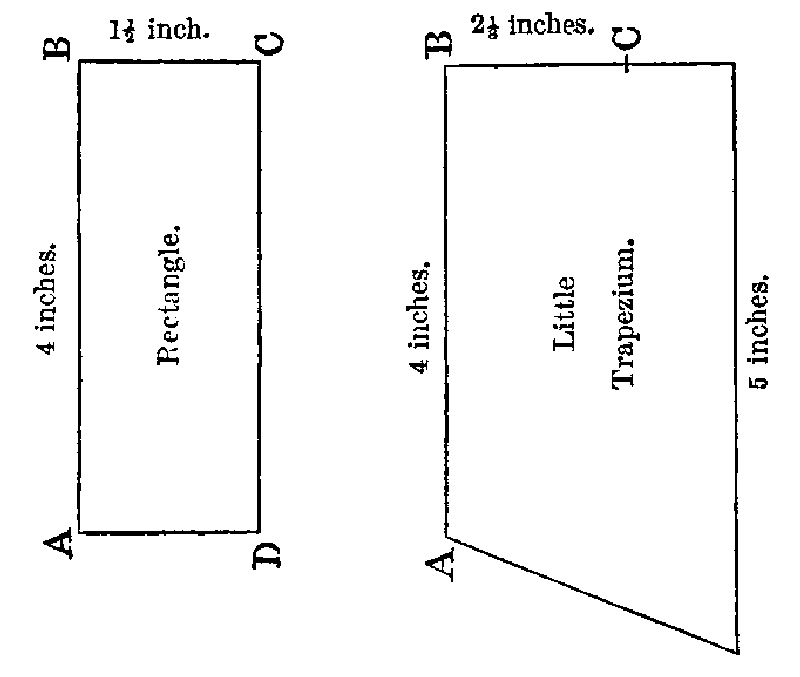
1½ inch. 4 inches. Rectangle.
2⅛ inches. 4 inches. 5 inches. Little Trapezium.
Fig. 11.
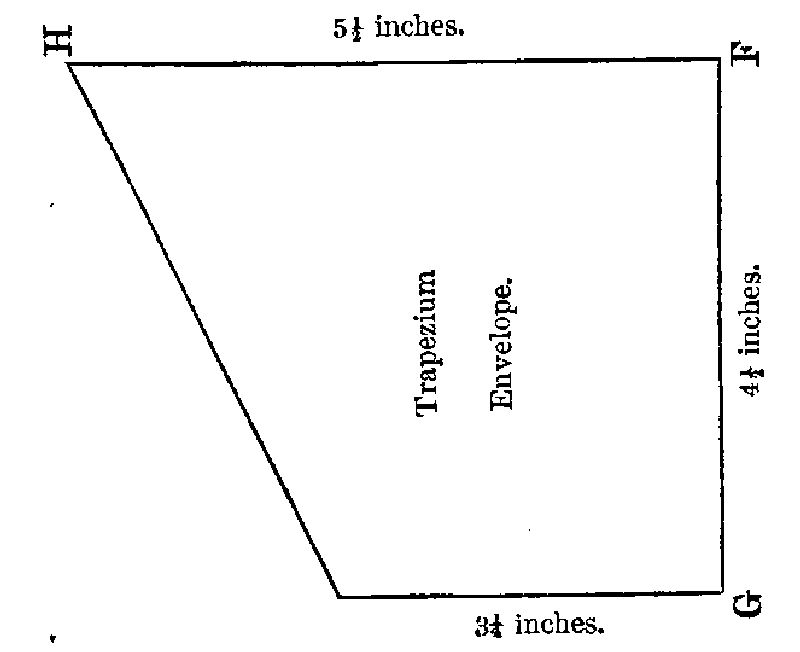
5½ inches. 4½ inches. 3¼ inches. Trapezium Envelope.
When completed, the base of the cartridge must be dipped up to the shoulder of the bullet in a pot of grease, consisting of six parts tallow to one of bees-wax.
SMALL ARM AMMUNITION.
Dimensions of Boxes.
Length, 1 ft. 4 in. Depth, 8⅝ in. Breadth, 7¼ in. including the cleat.
Weight of Boxes.
Empty, 7 lb. 6 oz.
Contents and Weight of Barrels and Boxes.
Barrel. Box.
No. of Cart-ridges. No. of Caps. Weight filled. No. of Cart-ridges. No. of Caps. Weight filled.
lb. oz. lb. oz.
Rifle Musket, Pattern 1842 500 625 79 0 .. .. ..
Rifle Musket, ” 1851 700 875 66 4 500 625 65 4
Rifle Musket, ” 1853 700 875 73 8 560 700 60 6
Artillery Carbine 800 1000 81 8 660 825 63 0
Victoria Carbine 700 875 69 0 600 750 60 8
INSTRUCTIONS FOR BROWNING GUN BARRELS.
The following ingredients, viz.:—
1½ oz. of Spirits of wine, 1½ oz. Tincture of steel, ½ oz. of Corrosive sublimate, 1½ oz. of Sweet spirit of Nitre, 1 oz. of Blue vitriol, ¾ oz. of Nitric acid.
are to be mixed and dissolved in one quart of soft water.
Previous to commencing the operation of browning, it is necessary that the barrel should be made quite bright with emery or a fine smooth file (but not burnished), after which it must be carefully cleaned from all greasiness; a small quantity of pounded lime rubbed well over every part of the barrel is best for this purpose: a plug of wood is then to be put into the nose of the barrel, and the mixture applied to every part with a clean sponge or rag. The barrel is then to be exposed to the air for twenty-four hours; after which it is to be well rubbed over with a Steel scratch-card or Scratch-brush, until the rust is entirely removed; the mixture may then be applied again, as before, and in a few hours the barrel will be sufficiently corroded for the operation of scratch-brushing to be repeated. The same process of scratching off the rust and applying the mixture is to be repeated twice or three times a day for four or five days, by which the barrel will be made of a very dark-brown colour.
When the barrel is sufficiently brown, and the rust has been carefully removed from every part, about a quart of boiling water should be poured over every part of the barrel, in order that the action of the acid mixture upon the barrel may be destroyed, and the rust thereby prevented from rising again. The barrel, when cold, should afterwards be rubbed over with linseed oil, or common oil. It is particularly directed that the use of the hard hair-brush be discontinued in browning, and the steel scratch-card or scratch-brush used in place of it, otherwise the browning will not be durable, nor have a good appearance. The browning mixture must be kept in glass bottles, as it will soon lose its virtue if kept in earthenware.
The locks are on no account to be made of the hardening colour, as the repetition of the operation of hardening has a very injurious tendency.
PERCUSSION FIRELOCKS.
Muskets with Percussion locks require to be carefully handled, to prevent the cocks being made loose, by which their direct fall on the nipples would be rendered uncertain.
They will, at all times, when unloaded, be used with the cocks down upon the nipples; but, when they are loaded, the caps, or primers, will be put on, and the muskets carried at half-cock for safety, there being then less risk of accidental explosion than with the cocks resting on the caps.
When marching with the cap on, the cock will be brought up under the arm-pit, the sling resting on the arm; but at other times the firelock may be carried with the barrel downwards, the right hand grasping the piece between the loop and swell; and the left the right arm just below the elbow.
INFANTRY EXERCISE, AND MOVEMENTS,
Extracted from
“FIELD EXERCISES AND EVOLUTIONS OF THE ARMY,”
the Parts and Sections being numbered according thereto.[3]
PACES.
Slow time, each step, 30 inches, and 75 paces in a minute.
Quick time, each step, 30 inches, and 108 paces in a minute.
Double time, each step, 36 inches, and 150 paces in a minute.
Back step, each 30 inches. Side or Closing step, 10 inches.
To calculate the number of Paces (each 30 inches) required for a given number of Files.
As a soldier occupies 21 inches, take two-thirds of the number of Files in the division, and add an inch for each File.
Table of the number of Paces corresponding to a given number of Files.
Number of Files in a Division, each occupying 21 inches. 5 15 16 18 20 30 40 50
Front of Divisions in Paces of 30 inches. P. I. P. I. P. I. P. I. P. P. P. P.
3 15 10 15 11 6 12 18 14 21 28 35
FLINT FIRELOCKS.
MANUAL EXERCISE.
1. Secure arms. 2. Shoulder arms. 3. Order arms. 4. Fix bayonets. 5. Shoulder arms. 6. Present arms. 7. Shoulder arms. 8. Port arms. 9. Charge bayonets. 10. Shoulder arms. 11. Advance arms. 12. Order arms. 13. Advance arms. 14. Shoulder arms. 15. Support arms. 16. Stand at ease. 17. Attention. 18. Carry arms. 19. Slope arms. 20. Stand at ease. 21. Attention. 22. Carry arms. 23. Order arms. 24. Unfix bayonets. 25. Stand at ease.
PLATOON EXERCISE.
As front rank standing. or, As rear rank standing. — As front rank kneeling. — As rear rank kneeling. 1. Prime, and Load. 2. Handle cartridge. 3. Prime. 4. ’Bout. 5. Draw ramrods. 6. Ram down cartridge. 7. Return ramrods. 8. As front rank, Ready. 9. Present. 10. Load. 11. Shoulder arms. As rear rank, Ready, &c.
AS A COMPANY.
Prime and Load. Company Ready. Present. At the word “Cease firing,” the Company, if made ready, receives the words, Half-cock arms. Shoulder arms. Or the word will be given to “Fire a volley; and half-cock,” (at priming position,) Shoulder arms. Shut pans.
INSPECTION OF A COMPANY.
1. Attention. 2. Fix bayonets. 3. Shoulder arms. 4. Rear rank take open order—March. 5. Open pans. 6. Slope arms. 7. Carry arms. 8. Shut pans. 9. Order arms. 10. Examine arms. 11. Return ramrods. 12. Unfix bayonets. 13. Rear rank take close order—March. 14. Stand at ease.
DISMISSAL OF A COMPANY.
Attention. Shoulder arms. Recover arms. Ease springs. Right face. Lodge arms.
PERCUSSION FIRELOCKS.
MANUAL EXERCISE.
Words of Command similar to those for Muskets with Flint locks.
THE PLATOON EXERCISE, AND DIFFERENT FIRINGS FOR THE ORDINARY OR RIFLE MUSKET.
To load from the shoulder, standing Prepare to load.
” from the Advance, standing Prepare to load.
” from the Order, standing Prepare to load.
Load.
Rod.
Home.
Return.
Cap.
As Front, or Rear rank —Yards, Ready,
Present.
Load, &c., as above.
To shoulder, when at the Capping position Shoulder arms.
To advance arms, from the Capping position Advance arms.
To make ready from the shoulder —Yards—Ready.
” from the Advance —Yards—Ready.
To fire kneeling As front rank kneeling.
—Yards—Ready.
Present.
Load, &c., as above.
Cap.
Shoulder arms.
Advance arms.
To load from the shoulder, As front rank, kneeling.
as Front Rank, kneeling Prepare to load.
To load from the Advance, As front rank, kneeling.
as Front Rank, kneeling Prepare to load.
Shoulder, or } as before
Advance arms, } directed.
As rear rank, kneeling, Yards—Ready.
Present.
Load, &c., as above.
Cap.
Shoulder, or } as before
Advance arms, } directed.
To load from the shoulder, As rear rank, kneeling,
as Rear Rank, kneeling Prepare to load.
To load from the Advance. As rear rank, kneeling,
as Rear Rank, kneeling Prepare to load.
As a Company, Load Company, at yards, Ready.
Present.
Half-cock arms.
Shoulder arms.
Firing as a wing, or as a Battalion, is performed precisely as laid down for a Company.
A Company, Wing, or a Battalion can load, or make ready from the Order with the same ease, as from the shoulder.
Trailing arms Trail arms.
Change arms.
To resist Cavalry Prepare to resist Cavalry.
Ready, &c.
FUSIL EXERCISE.
1. Secure arms. 2. Shoulder arms. 3. Order arms. 4. Fix bayonets. 5. Shoulder arms. 6. Port arms. 7. Charge bayonets. 8. Shoulder arms. 9. Support arms. 10. Stand at ease. 11. Attention. 12. Carry arms. 13. Slope arms. 14. Stand at ease. 15. Attention. 16. Carry arms. 17. Trail arms. 18. Shoulder arms. 19. Order arms. 20. Unfix bayonets. 21. Stand at ease. 22. Attention.
THE MANUAL AND PLATOON EXERCISES OF RIFLEMEN.
THE MANUAL EXERCISE.
Present arms. Shoulder arms. Order arms. Shoulder arms. Support arms. Carry arms. Trail arms. Shoulder arms. From the Order, to Trail arms. Trail arms. From the Trail, to Order arms. Order arms. Fix swords. Shoulder arms. Charge bayonets. Shoulder arms. Order arms. Unfix swords. Stand at ease.
THE PLATOON EXERCISE.
Prepare to load. Load. Rod. Home. Return. Cap. Shoulder. Make ready. Present. After firing, the rifle to be brought immediately to the position of— Prepare to load.
INSTRUCTIONS FOR AIMING WITH THE RIFLE MUSKET.
Firing at a Human figure. Firing at the Target.
At 100 yards.—Aim at the waist. Aim with the sight down, straight at the bull’s-eye.
At 150 yards.—Raise the sliding-bar, raise the sight, and aim with the 200 yards’ point at the thigh. Raise the sliding-bar, raise the sight, aim with the 200 yards’ point at the bottom of the black ring.
At 200 yards.—Aim at the waist with the 200 yards’ point. Aim at the bull’s-eye with the 200 yards’ point.
At 250 yards.—Press down the sliding-bar, aim with the 300 yards’ point at the knees. Press down the sliding-bar, aim with the 300 yards’ point six inches below the black ring.
At 300 yards.—Aim with the 300 yards’ point at the waist. Aim with the 300 yards’ point at the bull’s-eye.
At 350 yards.—Raise the sliding-bar at half distance between the 300 and 400 yards’ point, and aim at the waist. Raise the sliding-bar to half distance between the 300 and 400 yards’ point, and aim at the bull’s-eye.
From 400 yards to 800 yards.—Make use of the sliding-bar, by raising it to the respective distances, as marked on the back sight.
WORDS OF COMMAND FOR FUNERAL PARTIES.
Ranks open—Arms shouldered—Bayonets unfixed, facing the quarters of the Deceased.
When the Corpse is brought out: | Present arms—Reverse arms—Rear rank take close | order—March. Divisions, Sub-divisions, or Sections are wheeled forwards (or backwards) to form Column left in front. | Rear rank take open order—March. When arrived at the Burial-ground: | Halt—Ranks, left and right wheel—Quick | march—Halt—Inwards face—Rest upon your | arms reversed—Stand at ease. When the Corpse has passed through: | Attention—Reverse arms—Re-form Column—Ranks, | right and left wheel—Quick march—Halt, | front—March. When facing the grave: | Rest upon your arms reversed—Stand | at ease. After funeral service: | Attention—Present arms—Shoulder arms—Load | with blank cartridge—Fire three volleys | in the air—Order arms—Fix bayonets—Shoulder | arms—Rear rank take close order—March. March back to barracks, right in front.
COMPANY DRILL.
Part 2.—Section 1.—Formation of the Company.
The Company is ordered to “Fall in” at close order; is then sized from flanks to centre; and told off in Sub-divisions, and four sections. In Column of Sections, the Senior officer takes the Leading, the second senior the Third, the third Senior the Fourth, and the junior the Second section. The Company is also told off by “Threes from the right,” numbered 1, 2, 3. Should there be a blank file in telling off the company in line, it will invariably be the fourth file from the left. The Company is also told off from the right by alternate files, right, and left.
In Close order the Rear rank is one pace, in Open order two paces, and for inspection three paces, from the front rank.
S. 2. Marching to the Front.
By the right (left, or centre)—March. The Company will occasionally be ordered, to
Step out—Mark time—Step short—Open, and close ranks—Oblique—Diagonal march.
S. 3. The Side, or Closing step.
To the right (or left) close—Quick march—Halt.
S. 4. The Back step.
Step back—March.
S. 5. To form four deep.*
Form four deep—March. * In telling off the files, should the last file be a right file, the left file on its right will double in the rear of it, completing it to four deep, and leaving the other Section only two deep
Rear form four deep—March.
Right form four deep—March.
Left form four deep—March.
To re-form two deep, from each of these formations.
Front. (or Halt—Front.†) † If the Company is in movement.
S. 6. File marching.
To the left face—Quick march. Halt, Front.
From the Halt.
Advance in double files from the centre—Sub-divisions inwards face—Quick march. After facing, the leading files disengage.
Front form Company—(or, To the right form Company.) Forward. Right Sub-division—Halt, Front, Dress. The remainder of the Company march on in file, and form in succession on left of halted Sub-division.
On the March.
Advance in double files from the Centre. Sub-divisions, inwards turn—Right and left wheel.
S. 7. Wheeling from a Halt.
Right (or left) wheel—Quick march. Halt, Dress.
S. 8. Wheeling forward by Sub-divisions, from Line.
By Sub-divisions right wheel—Quick march. Halt, Dress.
S. 9. Wheeling backward by Sub-divisions, from Line.
By Sub-divisions on the left backward wheel—Quick march. Halt, Dress.
S. 10. Marching on an Alignement, in Open column of Sub-divisions.
March—(or, Quick march).
S. 11. Wheeling into Line, from Open column of Sub-divisions.
1. Halt—Left wheel into line—Quick march. Halt, Dress, Eyes front.
2. On the Moveable pivot.
Shoulders forward—Forward (or, Halt, Dress.)
S. 12. In Open column of Sub-divisions entering into a new direction on a moveable pivot.
Right (or left) shoulders forward—Forward.
S. 13. Counter-marching.
Counter-march by files.
Right (or left) face—Quick march. Halt, Front, Dress.
Counter-march by ranks.
Right and left face—Right countermarch—Quick march. Halt, Front, Dress.
S. 14. Wheeling on the centre of the Company.
Company On the centre—March. { Right } Halt, Dress.
{ Left } Wheel
{ Right about }
{ Left about }
S. 15. Diagonal march.
The pivots, or outward Files, march in the direct line to which they have faced, the others conforming to them.
S. 16. Increasing the Front of an Open column halted Right in front.
Form Company. Left Sub-division, Left half face—Quick march—Halt, Front, Dress up.
Diminishing the front of an Open column, halted.
Form Sub-divisions. Left Sub-division—Right about three-quarters face—Quick march. 2nd Senior. Halt, Front, Dress.
S. 17. Increasing the front of an Open column, on the march.
Form Company. Left Sub-division, Left half turn, Double—Front turn, Quick.
Diminishing the front of an Open column, on the march.
Form Sub-divisions. Left Sub-division, Mark time—Right half turn—2nd Senior, Front turn.
When the above movements, 16 and 17, are performed Left in front, the Words Right will be altered to Left, and Left to Right. The same directions apply to sections.
S. 18. In Open column of Sub-divisions to pass a short defile, by breaking off files.
Break off —— files. —— Files on the left, Right turn—Left wheel.
After passing the defile.—Files to the front.
S. 19. The Company in line halted, or on the march, moves to a flank in Column of sections, or Sections of threes.
Sections (or threes) right (or left) shoulders forward (if halted, Quick march—Forward.)
When Pivots are required to be accurately dressed, or when the alignement of the Company is to be preserved.
Sections (or threes) on the right (or left) backwards wheel—Quick March. Halt, Dress.
To re-form Company on the march.
Sections (or threes) right (or left) shoulders forward— * Forward—(or Halt, Dress.) * If the march is to be continued.
For accurate dressing, or when the alignement is to be preserved.
Right (or left) wheel into line—Quick march. Halt, Dress.
S. 20. Forming Company, Sub-divisions, Sections, or Sections of threes, from file marching.
Front form Company (Sub-divisions, or Sections)—*Forward. * If the march is to be continued.
Marching in file from the right, to form the Company to the Left flank.
Halt—Front.
Marching in file from the right, to form the Company to the Right flank.
On the leading file to the right form Company.
To form to the Right about.
On the leading file to the right about form Company.
S. 21. To form to either flank, from Open column of Sub-divisions.
To the Left flank.
Halt—Left wheel into line—Quick march. Halt, Dress, Eyes front.
To form the Company to its Right flank.
To the right forward form Company. Leading sub-division Left shoulders forward—Forward, Halt, Dress. 2nd Sub-division (Left oblique till clear of the right Sub-division)—Left shoulders forward—Forward, Halt, Dress up.
S. 22. Company moving to the front, to gain ground to a flank, by march in echellon, by sections.
Sections right—Forward.
To form Company—
Form Company—Forward.
S. 23. To form the Rallying square.
Form the Rallying Square. When the Square is to march—The Square will move to the front, (rear, right, or left,) Inwards Face—quick march—Halt—Prepare to resist Cavalry—Ready.* Reduce the Square—Quick march. * If ordered to fire, the Standing ranks only will commence an independent fire.
MODE TO BE OBSERVED IN DISMISSING A COMPANY OFF PARADE.
Recover arms. Right face. Lodge arms.
In turning in a Guard, or Piquet, the same mode is to be observed.
MANNER OF INSPECTING A COMPANY ON PARADE.
Attention. Fix bayonets. Shoulder arms. Rear rank take open order—March. Slope arms.
The inspection of Arms will now take place
Carry arms. Order arms. Examine arms. Return ramrods.
An inspection of the Appointments, Clothing, &c., is now to be made.
Unfix bayonets. Rear rank take close order—March. Stand at ease.
MOVEMENTS OF A BATTALION.
Part 3.—Section 1. Commands.
All words of command must be given short, quick, and loud.
S. 2. Degrees of march.
The Slow step is particularly applicable to purposes of parade, and occasionally to the march of extended lines.
The Quick march is the usual pace to be applied to all general movements of Battalions, or greater bodies, in Column, or Line.
The Double march is only to be applied to the movements of the Divisions of a battalion, except upon peculiar occasions for short distances.
S. 3. Marching in line.
The March in line is generally adopted where the country is open.
S. 4. Wheeling.
Wheels are made on a Halted pivot from Line into Column, and from Column into Line. The principle of the Moveable pivot must always be applied to the wheel of divisions marching in column. Wheels of divisions may be either made forward, or backward. In progressive movements they are to be made Forward, but particular occasions require that they should be made Backward on the pivot flank. The Backwards wheel need not, however, be practised where the ground is uneven, and the Divisions stronger than 15 or 16 files: where this is the case, the Command will be
Form open column, right (or left) in front—Right about face—Right (or left) wheel—Quick march. Halt, Front.
S. 5. Movements.
Every movement must be divided into its distinct parts, and each part executed by its cautionary and executive words of command. All field movements and firings are to be performed with fixed bayonets, except when troops are acting as Light infantry.
S. 6. The Alignement.
To march in an Alignement is to make troops march in any straight line, which joins two given points—or to form upon any such given line. When troops are to form in a straight line, two necessary points in it must always be previously ascertained. One, the point of Appui at which one flank of the Body is to be placed, and the other the distant point of formation or dressing, on which the front of the body is directed.
S. 7. Points of formation.
The line on which troops move, or are successively to form, may be taken up to any extent by the prolongation of an original short base, given in the direction which the Commander of a line will point out.
S. 8. Dressing.
The Officer in dressing is placed on that flank of his division to which the men’s eyes are turned on the word “Dress,” and from the second file from the flank of the Company towards which his wheeling flank moves from column, or his inward flank from echellon: he makes his corrections on his intermediate point. In all wheelings into line the word “Eyes Front” will be given as soon as the dressing is completed. When Officers change from one flank to the other in order to close, they will pass by the front, and repass by the rear of their Companies. On all other occasions, when it is necessary to change their flanks in line, they will pass and repass by the rear.
S. 9. Open column.
All changes of position, by means of the Open column, will be effected by the formation of a column, right or left, in front, on the named division. If on a flank division, the caution will specify whether the other flank is to be thrown back, or forward: if on a central division, the caution will in like manner specify which wing is to be thrown forward. An open column may effect a change of position upon its front, rear, or any central division by the named division wheeling up according to the front to which it is intended to change; and the other divisions facing, and filing into the new alignement.
S. 10. Column at Quarter distance, and Close column.
When Close columns are formed, the Companies or Divisions must be at one pace distance. In the wheel of a Column at quarter or close distance, the leading division acts as a moving base for the rear Companies to follow; its length of step is regulated according to the depth of the column, and when at quarter distance must be very short to enable the rear to circle simultaneously round at the usual pace. Upon the wheel being ordered, all the rear divisions make a half face to the wheeling flank; but at a quarter distance, the leading division will advance six paces on the word “Quick (or Double) March,” and will wheel round the pivot file at a shortened pace, while each succeeding division will advance, in circling round, to quarter distance, which will leave room for the rear divisions to circle into their relative positions at that distance. In wheeling on the Moveable pivot, the rear divisions make a half turn towards the shoulder brought forward, and the front division wheels and advances at a shortened pace in the new direction, the rear divisions circling round. In Close column, the supernumeraries will form on the reverse flanks of companies; and when the column marches to a flank, they will move with their companies; when the Close column is to countermarch they will remain on the reverse flank, and countermarch on their own ground. When a Column deploys on a rear division, the named division when uncovered will move up to the front (which its covering Serjeant will mark); the points, therefore, necessary for the formation of the Battalion will be taken in prolongation of these points, and the Divisions which successively move up must Halt, Front, until their front is clear.
S. 11. Echellon.
The Echellon position and movements are applicable to the oblique or direct changes of situation, which a Battalion may be obliged to make to the front or rear, or on a particular fixed division of the line. The oblique changes are produced by the wheel (less than the quarter circle) of divisions, which places them in the echellon situation. The direct changes are produced by the perpendicular and successive march of divisions from line to front or rear. In Echellon, the inner flank, (or that which first joins its preceding division when the line is to be formed forward,) is the directing one; and in Oblique echellon the wheels are made on it, into echellon—forward, and into line—backward.
Practical rule for the Battalion and Line on all occasions of Wheeling by Companies into echellon.
“Each covering Serjeant having previously placed himself before or behind a given file (the 8th) from the standing flank, will take the named number of paces from the centre of that file on the arc of the circle, and thereby become a direction for the Company to wheel up to, and halt.”
As eight paces from the eighth file complete the Quarter circle, so four paces give the One-eighth, and two paces the One-sixteenth of the circle. All changes of front by the Echellon march are performed by the forming divisions wheeling half the angle wheeled by the division to be formed upon. In all changes of position by echellon, whether direct or oblique, the leaders of companies will invariably be on that flank towards which the change of position is to be made. But in taking ground to a flank on the march, in echellon of Sub-divisions or Sections, Companies’ leaders remain in their places as when in line.
S. 12. Squares.
Squares are formed either from Line, or from Column at full, half, or quarter distance. The Hollow square, four deep, is sufficiently solid to oppose an attack of Cavalry: it possesses, at the same time the advantage of rendering the fire of all the men available to the resistance of the enemy. The Solid square should seldom be adopted, because a proportion of the men cannot give their fire. Close columns should in all cases when practicable, open therefore to quarter distance, and form Square (as in Sec. 21, No. 1, Part III.). But as every position in which a Battalion may be placed should be susceptible of ready resistance against Cavalry, the Close column can always assume an efficient posture of defence, by the six centre Companies wheeling outwards by Threes, and closing to the front, and the two rear Companies facing to the right about: the Officers and Serjeants taking post in the centre. The wing of a battalion can in like manner form the solid square from a Close column of Sub-divisions. When Cavalry is not to be resisted, it will be sufficient to form the Square two deep to the rear. The formation of Battalion squares, either from Line or Column, is to be completed as expeditiously as possible; and the Squares may afterwards be placed in direct echellon for mutual defence.
S. 13. Firings.
In all movements, Firing should commence after a formation. In firing by Companies, the Leaders will give the Word “Ready” when the previous division fires, preserving the pause of slow time between this and “Present,” the men firing when they have covered their objects. In firing by wings, one wing will receive the word “Ready,” the instant the other has completed its loading. Great care must be taken in file firing that it is not hurried, and that the men “Present” deliberately. The value of a soldier’s ammunition, and a jealousy of its expenditure without effect, must be carefully inculcated; for in proportion as a cool and well-directed fire serves to distract and throw an enemy into disorder, so is a wild, confused, and hurried fire (which is always without effect) calculated to give him confidence, and a contempt for his opponent. Soldiers should, therefore, bear in mind that nothing makes so strong an impression on an enemy, as the thinning of his ranks by a well-directed fire; and that nothing tends more to animate and encourage troops than the diminished fire from ranks so thinned; affording also the most favourable opportunity for a successful charge. In firing in square, the two front ranks are to come to the kneeling position without cocking, on preparing to receive cavalry. The standing ranks in square will fire independently from the right of faces.
Street firing.
A Column at open, half, or quarter distance, formed in a street or narrow ground where deployment is impracticable, may be required to fire previous to charging forward, or by successive divisions in retiring. It will be performed in the following manner:—
If advancing, the two front Companies only will fire in succession; the leading Company firing and loading kneeling, the second Company closing to the front, and firing standing. When the enemy’s fire has been overcome, or at any favourable moment that may present itself, the column will charge briskly forward, and make good the ground it is contending for.
In retiring, the leading division will give its fire; Slope arms; Face outwards by sub-divisions; File to the rear; Re-form Company; Load; and remain halted, until its front is again clear, or the whole column is put in motion. The moment the front of the second company is clear, it will give its fire; Face outwards by sub-divisions; and file to the rear as above directed: and so on by companies in succession: the companies thus follow each other, and when the front of the column occupies the whole breadth of the street, the outward files of companies will double in the rear, to give the companies which have fired room to pass. It must never be forgotten, in entering towns or villages occupied by the enemy, that the first thing to be done, on gaining a footing in the place, is to clear the houses on both flanks, and the column should on no account proceed through the streets without previously occupying the houses on either side; the troops employed for that purpose breaking through partition walls, or pushing on from house to house, so as to accompany the march of the main body, and protect its flanks.
FORMATION OF THE BATTALION.
When the Battalion is formed, there is to be no interval between any of the Companies, and every part of the front of the Battalion should be equally strong. The Grenadiers will be on the right, Light company on the left, the other companies from right to left. The Battalion will be told off into Right, and Left wings.
FORMATION OF THE BATTALION, AT CLOSE ORDER.
The Commanding officer is advanced in front for the general purpose of exercise when the Battalion is single; but in the March in line, and in the firings, he is in the rear of the Colours. The Lieutenant-colonel is behind the colours, twelve paces from the supernumerary rank. The 1st Major is six paces in the rear of the second Battalion company from the right flank; 2nd Major at the same distance in the rear of the second Battalion company from the left; the Adjutant at the same distance in rear of the colours. One Officer is on the right of the front rank of each company, and One on the left of the Battalion; all these are covered in the rear rank by their respective Serjeants; and the remaining Officers and Serjeants are in a third rank behind their companies. The colours are placed (both in the front rank) between the two Centre companies. The supernumerary rank is at three paces distance when in Line; and when in Column, it is at the distance of one pace.
When the Battalion takes Open order.
Rear Rank take Open Order—March. Officers of Companies and those with the Colours dress three paces in front of the Line. The 1st Major is on the right of the Officers, the 2nd Major on the left. The Adjutant on the left of the front rank. The Colonel ten paces, and the Lieutenant-colonel six paces, in front of the Colours.
When the Battalion resumes Close order.
Rear Rank take Close Order—March.
EVOLUTIONS OF THE BATTALION.
MOVEMENTS OF THE BATTALION FROM LINE.
S. 14. 1. The Battalion halted, and correctly dressed, is to advance in Line.
Commander’s Words of command. Executive Words of command, Directions, &c.
The Battalion will advance—March (or Quick march)—Halt.
2. When the Battalion is to retire.
The Battalion will retire—Right about face—Quick March.
3. While advancing in Line, the Battalion may form to either flank by the Divisions wheeling to the Bight (or Left) on the Moveable pivot, and forming on the flank Company (which will be halted in the direction of the new front) by the Echellon march of divisions.
S. 15. When a Battalion advancing in Line is to charge.
Prepare to charge—Charge—Halt.
S. 16. When a Battalion moving in Line passes a wood, &c., to Front or Rear, by the flank march of Companies in file.
1. If to pass to the Front.
From the right (or left) of Companies pass by files to the front. Companies, right (or left) turn—Right (or left) wheel.
2. If to pass to the Rear.*
From the proper right (or left) of Companies pass by files to the rear—left (or right) turn—Right (or left) wheel—Halt—Front. * The Battalion in Line having arrived at the point where it must break. Companies may also pass to the front or rear by Sections of Threes.
3. If a Battalion in first Line passes through a second, which advances and relieves it.
Pass by files to the rear—Right face—Right wheel—Quick march—Halt—Front. The relieving Battalion marches up within twelve Paces of the front Line, the Companies of which proceed to the rear through the second Line.
4. When the second Line does not advance to relieve the first.
Pass by files to the rear—Left turn—Right wheel. The first Line retires, and when within twelve paces passes through the second.
S. 17. When the Battalion advances, or retires, by half Battalion, and fires.
1. If the Battalion is in march, and advancing.
The Battalion will advance by wings. (2nd Major) Left wing, halt—March (or quick march). (Senior Major)* Right wing, halt—Ready—Present—Load—March (or quick march). (2nd Major) Left wing, halt—Ready, &c. * After having advanced 15 paces.
2. If the Battalion is in march, and retiring.
The Battalion will retire by wings. (Senior Major) Right wing, halt—Front. (2nd Major)* Left wing, halt—Front. (Senior Major) Right wing, ready—Present—Load—Right about face—March (or quick march). (2nd Major) Left wing, halt—Front. †Left wing, ready—Present—Load, &c. * After retiring 15 paces. † When Right wing has retired 15 paces.
S. 18. A Battalion in Line to move to attack, or pass a bridge, &c., to the front, from either flank, or from the centre.
1. If from a Flank, by Companies, or Sub-divisions.
Right (or left) Division to the front.—Remaining Divisions, right (or left) shoulders forward—Quick march—Forward. Rear Divisions successively—Right (or left) shoulders forward—Forward.
2. When the Column arrives near the point where the Line is to re-form.
Form line on the first Division—Remaining Divisions, right (or left) shoulders forward—Forward. Leading Division, Halt, Dress up. Remaining Divisions successively—Right (or left) shoulders forward—Forward.—Halt—Dress up—Eyes front.
3. If the advance is from the Centre.
Two centre Sub-divisions to the front. Remaining Sub-divisions, right and left shoulders forward—Quick March—Forward. Right wing Sub-divisions first throw Right shoulders, and afterwards Left shoulders forward. Left wing Sub-divisions first throw Left shoulders, and afterwards Right shoulders forward, Sub-divisions successively—Forward.
4. When the Double column arrives near the point where the Line is to be formed.
Form line on two centre Sub-divisions.—Remaining Sub-divisions, right and left shoulders forward—Forward. Remaining Sub-divisions successively—Right (or left) shoulders forward—Forward—Halt—Dress up—Eyes front.
5. To form Line to the right, from the Double column.
Form line to the right—Right wing left shoulders forward. Right wing Sub-divisions—Halt, Dress. Left wing Sub-divisions successively—Left shoulders forward—Forward—Halt, Dress up—Eyes front.
S. 19. A Battalion in Line to retire over a bridge, or defile, or retreat from a Flank or Flanks, in rear of the Centre.
1. If from a flank.
Retire by Companies (or Sub-divisions) from the left (or right) in rear of the right (or left). Left (or Right) Company—Company (or Sub-division)—Right about face—Quick march—Right (or Left) shoulders forward—Forward. When at inward flank of right (or left) Division—Right (or left) shoulders forward—Forward. The other Divisions follow in succession.
2. If the Retreat is from both flanks.
Retire from both flanks by sub-divisions in rear of the centre. Right (or left) Sub-division—Right about face—Quick march—Right (or left) shoulders forward—Forward. When arrived at the proper points—Right (or left) shoulders forward—Forward.
Remaining right, and left Sub-divisions follow in succession. Two centre Sub-divisions, when the Divisions next to them have commenced their second wheel—Right about face—Quick march.
S. 20. A Battalion in Line to march off in Column of divisions, successively to a flank.
1. If the Movement is along the rear, and from the right flank.
The Battalion will move in Column of Divisions (or Sections) from the right along the rear. Right Division (or Section)—Left face—Left wheel—Quick march—Front turn.
2. When the Movement is from the left flank.
Left Division (or Section)—Right face—Right wheel—Quick march—Front turn.
In both movements the Divisions follow in succession the leading division.
S. 21. When the Battalion, halted in Line, is to form Square on a named Company, or on two centre Sub-divisions.
1. If on a Central company.
Column at quarter distance on the right (or left) centre Company—Threes, right and left shoulders forward—Double march, When the Companies reach their places in Column, they receive successively Threes right (or left) shoulders forward—Halt, Dress.
Form square—Quick march. When the Second Company has closed upon the front Company, which stands fast— Sections outwards. The two rear Companies close up, and form the rear face of the Square, receiving Halt—Right about face. The remaining Companies wheel outwards by Sections, the rear Sections closing to the front, after the wheel.
2. If on a Flank Company, and to a flank.
Square on the right (or left) Company—Companies right (or left) shoulders forward—Double march—Forward. Leading Company—Halt. Second Company closes on it—Halt. Remainder (except the two last Companies), as they successively arrive at Quarter distance— Sections outwards. Two last Companies when closed up—Halt—Right about face.
3. When the Square is to resist Cavalry.
Prepare for Cavalry —Ready. *Kneeling ranks—Ready— Present—Load. Prepare for Cavalry (or shoulder arms). The Kneeling ranks do not cock until required to fire. The Standing ranks fire by Files. * The Kneeling ranks, when required to fire a volley.
4. To reduce the Square.
Re-form column. Quick march. Rear sections of side Faces step back to wheeling distance, pivot men facing to their proper front, and at Quick march wheel backwards—Halt, Dress. Front Company advances to quarter distance—Halt, Dress. Two rear Companies retire—Halt, Front, Dress.
5. If the Square is to be formed on the two centre Sub-divisions.
On the two centre Sub-divisions form square. The outer Sub-divisions of the two centre Companies face inwards, and leading files disengage; the two flank Companies face inwards, and the remaining Companies of the Battalion face to the right about.
Right and left shoulders forward. Quick march. No. 1, 2, 3, 6, 7, 8 Companies, Sections successively, Halt, Front. The two centre Sub-divisions close by the side step, upon the interval left by the Colours. The Sub-divisions of the two flank Companies are conducted to form the rear Face, the right Sub-division of the Grenadiers covering its left Sub-division, and the left Sub-division of the Light Company covering its right Sub-division, each receiving Halt, Right (or Left) face.
6. To reduce the Square and form Line.
Re-form line—Quick (or double) march. The flank Companies face outwards; and the rear Sub-divisions of the centre face outwards, and file into line at Quick (or double) march—Halt, Front, Dress. The two centre Sub-divisions open by the side step to right, and left. The flank Companies move in file to their respective places. The other Companies deploy by Sections and (when at their places) receive Right (or left) shoulders forward—Forward—Halt, Dress up.
7. But should it have been previously necessary to move the Square.
Form double column of Sub-divisions—Quick march. The rear Sub-divisions of the side faces fall back to Section distance, and the Pivot men face to their proper front, and at Quick march, the Sections which formed the side faces wheel backwards; and the two Sub-divisions of the front face, and four Sub-divisions of the rear face, advance to quarter distance. The Sub-divisions of front face receive—Halt. Sub-divisions of the rear face receive—Halt—Front.
8. When the Line is retiring, the Square may be formed at once without halting.
On two centre Sub-divisions form square. The two centre Sub-divisions Halt—Front. The outer Sub-divisions of centre Companies “Inwards turn,” and the formation will proceed (as directed in No. 5, Section 21) at the Double march.
S. 22. When the Battalion forms a Square, or Oblong two deep, to protect baggage, &c., against Infantry.
1. Form square, two deep, on the two centre Companies. Remaining Companies, right and left shoulders forward—Quick march. The two centre Companies stand fast, remaining Companies face to the rightabout, and at Quick march the two centre Companies (4 and 5) close inwards: the remainder right, and left shoulders forward, and move into Square. Nos. 1, 2, and 3, form the right face, 6, 7, and 8 the left face, the Grenadier, and Light Infantry the rear face of the Square, respectively receiving Halt, Front, Dress.
2. When the Square or Oblong is to march by any one face.
The square will march to the front (rear, right, or left) face.
Flank Faces—by sub-divisions on the right and left backwards wheel—Quick march. The rear face advances two paces and faces about—Halt, Dress.
Quick march. The Square marches two faces in Line, (by their centre,) and two faces in Open column of Sub-divisions.
Halt—Re-form square—Quick march. The Sub-divisions in column wheel up and form their faces, and the rear face will close up and then face about.
3. To reduce the Square.
Form line—Right and left shoulders forward—Quick march. The two centre Companies open out by the side step, to leave room for the Colours. Remaining Companies, Right (or left) shoulders forward—Forward—Halt, Dress up.
S. 23. A Battalion halted in Line, to change front to the rear upon the centre.
Change front to the rear upon the centre. Centre Companies—Right (or left) face—Right Counter-march—Quick march—Halt, Front, Dress up—Eyes front.
Remaining Companies, Threes right, and left shoulders forward—Right and left counter-march— Quick march. The Companies pass each other by the left, those of the Right wing describing a circle to allow room for the others to pass, and when in their proper position—Right (or left) shoulders forward—Forward—Halt, Dress up—Eyes front.
CHANGES OF POSITION OF THE BATTALION FROM LINE BY MOVEMENTS OF THE OPEN COLUMN ON A FIXED POINT.
S. 24. The Battalion to change position to the front on the right halted Company, by throwing forward the whole Left, and by the flank march of Companies.
1. Form open column in front of the right Company—Remaining Companies—Right face—Quick march. If the change of front is to be at right angles with the old line, the right Company stands fast; if oblique to it, that Company will wheel back on the right flank as many paces as will make it perpendicular to the new direction. Remaining Companies face to the right, and disengage to the left—Halt, Front, Dress.
Right wheel into line. Halt, Dress—Eyes front.
2. The Battalion may change its position to the Left, Right thrown forward, by the formation of the Open column in front of the left halted Company.
3. If the Change of position is effected by the formation of the Open column on a central Company, the caution will specify which flank is to be thrown forward. The Companies face inwards, and disengage.
4. When a Battalion is to change position on a flank halted Company, by throwing back the other flank.
Form open column in rear of the right (or left) Company— Remaining Companies— Right (or left) face— Quick march. Remaining Companies—Halt, Front, Dress.
Right (or left) wheel into line—Quick march. Halt, Dress—Eyes front.
ON A DISTANT POINT.
S. 25. The Battalion in line changes position by breaking into Open column, marching up in column to the point where its head is to remain, and entering the line by the flank march of Companies.
Right (or left) face—Quick march. Halt. The Battalion in Open column to form at a point where its leading flank is to be placed, receives—Halt— when its leading division is at wheeling distance short of that point.
S. 26. The Battalion formed in line, changes position by breaking into Open column, marching to a point where its head is to rest, and to which its rear divisions form, by successively passing each other, and wheeling up.
Form line to the reverse flank. Leading division—Right (or left) shoulders forward—Forward—Halt, Dress. Remaining divisions successively—Right (or left) shoulders forward—Forward—Halt, Dress up.
OPEN COLUMN MOVEMENTS.
S. 27. When the leading flank of the Column is changed by the successive march of Divisions from the rear to the front.
Halt— By successive divisions —Rear wing to the front. If Right in front; Rear Company—Right face—Quick march—Front turn. Remaining Divisions in succession, when their rear Division passes them—Right face—Quick march—Front turn. If left in front, the rear Divisions are faced to the left.
S. 28. To change the Wings of a column formed upon a road, where the space does not admit of the Flank movement.
By double files from the centre, rear wing to the front. Two centre Sections outwards wheel—Quick march.* Rear Company—Inwards face, by Files from the centre. Remaining Companies*—Halt, Dress. Rear Division when clear of the column—Form Company—Forward. Remaining Divisions in succession when clear—Inwards face—Quick march—Form Company—Forward.
S. 29. When the Column, at open, or half distance, is required to form a Square.
1. If the Square is to be formed on the front Company.
Form square upon the front Company—Quick march. (Vide S. 21, No. 2.)
2. If upon a central Company.
Form square on the right (or left) centre Company—Right (or left) wing—Right about face—Quick (or double) march. The Officer commanding the named Division, gives—Sections outwards; the rear Sections closing on the front Sections. The Left wing will close to Section distance, and the Companies receive, in succession—Sections outwards; the Right Wing will move to the Centre, rear Rank in front, and when each Company shall close up to the one preceding it, Companies 3, 4, 5, 6, Front turn, Sections outwards, and the rear Sections close to the front. Nos. 1 and 2—Halt, Front,—Nos. 7 and 8—Halt, Right about face.
3. If an Open column, moving to front, or rear in File, or Sections of Threes, be attacked by Cavalry.
If in File.
Form square on the centre—Wings inward turn—Double march. The Divisions turn to the right, and left; and if the Column be right in front, when the left centre Company has turned it receives—Sections outwards; the Wings close on the centre, at the double march, and each Company wheels outwards into Square; as in No. 2.
If the Column is moving in Sections of Threes.
Right (or left) shoulders forward. Forward—Square on the centre—Right wing, right about turn—Double. The Formation proceeds as before. The Column is re-formed as directed in S. 21, No. 4.
QUARTER DISTANCE, AND CLOSE COLUMN.
S. 30. When a Battalion forms a close, or quarter distance Column, from Line.
1. If a Close Column before, or behind, either of the flank Companies.
Form close (or quarter distance) column on —— Company, right (or left) in front—Right (or left) face—Quick march. All except the named Company—Halt, Front, Dress.
2. On a central Company.
Inwards face—Quick march. All except the named Company—Halt, Front, Dress.
In the same manner, Column may be formed from Line upon any Company facing to the rear; that Company countermarching by files, and the Wings facing outwards, and countermarching to the right, or left; and forming as before.
In all Counter-marches from Line, the Company of formation will be faced by the command of its own Officer.
3. If a Quarter distance Column upon any named Company.
Form column at quarter distance, right (or left) in front, —— on Company—Remaining Companies, threes— Shoulders forward— Quick (or double) march—Forward. Shoulders forward—Halt, Dress, as in Nos. 1 and 2. The leading threes of the Company next the one of formation must wheel upon its centre file in disengaging to the rear.
4. The Close column may be formed from Open column.
Close to the front—Quick (or double) march. Or without halting—Close to the front—Double. If on the March, Leading division—Halt. Remaining divisions successively—Halt: When on the Double march—Quick.
S. 31. When the Column, at close, or quarter distance, marches to a flank.
Column will march to the right (or left) flank—Right (or left) face—Quick march—Halt, front.
If the Column is at quarter distance, it may be marched to a flank in Sections of threes.
Threes right (or left) shoulders forward—Quick march—Forward.
S. 32. When the Column at quarter distance, moving to front, or rear, takes ground to the Right, or Left, by the Echellon march of Sections.
1. Sections right (or left)—Forward. 2. Re-form Column—Forward. Officers remain on their proper pivot flank.
Ground may be taken to a flank by the diagonal march.
Right (or left) half turn.
S. 33. When a Column halted, at Close, or Quarter distance, is to wheel on a fixed, or moveable pivot.
1. At close distance on a fixed pivot.
Column to the right (or left) wheel—Quick (or double) march—Halt. The flank file of front Company will face. Remaining Companies make a half face. Vide S. 10. No. 6.
2. At close distance on a moveable pivot.
Right (or left) shoulders forward—Halt (or forward). Rear Divisions will make a half turn to the outward flank, and circle round.
If the Column is to wheel in double time.
Double—Forward—Quick.
3. At Quarter distance on a fixed pivot.
Right (or left) wheel— Quick (or double) march—Halt. Rear Divisions half face to the wheeling flank. The front Division will advance six paces, and wheel at shortened pace round the Pivot, the rear Divisions circling round.
4. At Quarter distance on a moveable pivot.
Right (or left) shoulders forward—Double— Forward—Quick. The Front division moves round at a short pace, the pivot-man gradually advancing in the new direction.
S. 34. When a Close, or Quarter distance Column is to change its front by the wheel and countermarch of Sub-divisions round the centre.
1. If at the halt.
Counter-march by Sub-divisions round the centre—Right (or left) Sub-divisions—Right about face—Quick (or double) march—*Halt, Front, Dress. The Reverse sub-divisions face about. The whole wheel round in succession. * When the leading Sub-division is in a line upon the new front of the Column. Front applies to the Reverse sub-divisions only.
2. If the Column at Quarter distance is on the march.
Right (or left) Sub-divisions—Right about turn—Front turn—Forward.
S. 35. When a Column at close, or quarter distance, is to open out to full, or half distance, from front, or rear.
1. If from the front.
Column will open from the front—Right about face—Quick march. The requisite number of paces are counted by the leaders of each Division. Halt, Front.
2. If from the rear.
Column will open from the rear—Quick march. Each Division leader gives Halt to the Company in his front, when at the ordered distance.
DEPLOYMENTS.
Deployments are made from Column invariably on the base of the front Company; Close columns deploy in File.
S. 36. When the Battalion in column of Companies, at Close, or Quarter distance (right in front), deploys into Line.
FROM CLOSE COLUMN.
1. On the Front Company.
Deploy on the front Company—Remaining Companies, left face—Quick march. Each Company, in succession—Front turn—Halt, Dress up—Eyes front.
2. On the Rear Company.
Deploy on the rear Company—Remaining Companies, right face—Quick march. When the front of the named Company is clear, the Officer commanding it gives— Double march—Halt, Dress up—Eyes front—Remaining Companies successively —Halt, Front. When uncovered, Quick march, and when in the alignement, Halt, Dress up—Eyes front.
Deployments on a central Company are performed in a similar manner. In deploying on a rear, or central Company, the Company of formation will be moved up in Double time.
FROM QUARTER DISTANCE COLUMN.
3. When a Battalion in Column of Companies at quarter distance, right in front, deploys upon its Front division.
Deploy on the front Company—Remaining Companies, threes— Right shoulders forward —Quick (or double) march—Forward. Left shoulders forward—Forward— Halt, Dress up—Eyes front.
4. On a Rear Company.
Deploy on the rear Company—Remaining Companies, threes— Left shoulders forward —Quick march—Forward. When the Front is clear, Rear Company —Double march—Halt, Dress up—Eyes front. The other Companies successively —shoulders forward—Halt. When uncovered —Quick march—Halt, Dress up—Eyes front.
The Base points are three paces in advance of the Front Company of the Column.
ECHELLON FORMATIONS AND MOVEMENTS.
S. 37. When a Battalion from Line wheels forward by Companies, to either flank, into Echellon.
1. Companies —— paces to the —— wheel—Quick march. Halt, Dress.
2. When the Echellon thus formed marches forward, and halts.
Quick march—Halt.
S. 38. When the Battalion having wheeled from Line into Echellon, has marched, and halted, and is to form back parallel to the Line it quitted.
Wheel back into line—Quick march. Halt, Dress—Eyes front.
S. 39. When the Battalion having wheeled from Line into Echellon, has marched and halted, and is to form up oblique to the Line it quitted.
1. If the Formation is made forward.
Leading Division, —— paces right (or left) wheel— Quick march. Form line—Quick march. Leading Division—Halt, Dress—Eyes front. Remaining Divisions—shoulders forward—Halt, Dress up—Eyes front.
2. If the wheel of the leading Division exceed the number of paces which it before wheeled from Line into Echellon, the others wheel up one-half of that excess, move on, and successively dress up with it.
3. If the formation is to be on the prolongation of the front Division as it stands, the others wheel back one-half of what they originally wheeled forward, then move on, and dress up with it.
S. 40. When the Battalion formed in Line changes front on a fixed flank Company, by throwing forward the rest of the Battalion.
Change front on —— Company, right (or left) thrown forward, —— Company —— paces right (or left) wheel. Company of formation—Halt, Dress.
Remaining Companies, —— paces to the —— wheel—Quick march.* Quick march.† Remaining Companies— * Halt, Dress. † —— shoulders forward—Halt, Dress up—Eyes front.
S. 41. When the Battalion changes front on a fixed flank Company, by throwing back the rest of the Battalion.
Change front on —— Company, right (or left) thrown back. —— Company on the —— backwards wheel—Quick march—Halt, Dress.
Remaining Companies, right about face, —— paces to the —— wheel—Quick march. Halt, Dress.
Quick march (or march). —— shoulders forward—Halt, Front, Dress up—Eyes front.
S. 42. When the Battalion changes front on a central Company, by advancing one Wing, and retiring the other.
The Company of the Wing to be thrown back is wheeled backward, and the Company of the wing to be brought forward is wheeled forward; or a Central Company is wheeled upon its centre into the new direction.
—— Wing, right about face—Companies —— paces inwards wheel—Quick march. Halt, Dress.
Quick march. Companies successively—shoulders forward— and when in Line, those of the advancing Wing receive—Halt, Dress up: the retiring Wing—Halt, Front, Dress up.
S. 43. When, from Open column, the Companies wheel backward into Echellon, in order to form in Line on the front Company.
1. Form line on the leading Division. Remaining Divisions —— paces on the —— backward wheel—Quick march. Quick march. The front Company remains square to the Column, or is wheeled backward into the intended direction of the Line by its Officer. If the front Company remains square, the remaining Companies wheel back four paces, or the eighth of a circle; but if the direction be Oblique, then the remaining Companies wheel one-half the number wheeled by the front Company, in addition to the eighth of a circle—Halt, Dress. —— shoulders forward—Halt, Dress up—Eyes front.
2. If the Line be formed on the rear Company of the Column, that Company will stand fast, the others will receive.
Right about face, —— paces on the —— Backwards wheel—Quick march. Quick march. Halt, Dress. —— shoulders forward—Halt, Front, Dress up—Eyes front.
3. If the Line is to be formed on a rear Company, but facing to the Rear.
Form line on rear Company, facing to the rear. The column will counter-march. Halt, Front, Dress—Eyes front.
—Face—Quick march. Form line on the leading Division. Remaining Divisions, four paces on the —— backward wheel—Quick march.* Quick march.† * Halt, Dress. † —— shoulders forward—Halt, Dress up—Eyes front.
4. If the Line be formed on a Central Company of the Column.
Form line on the Right (or Left) centre Company, —— wing right about face—Four paces on the right (or left) backwards wheel—Quick March. All except the central Company Halt, Dress.
Quick march. Companies of Wings (except Company formed on)—— shoulders forward—Halt, Dress up—Eyes front. Or —— shoulders forward—Halt, Front, Dress up—Eyes front.
S. 44. When from Line the Companies of a Battalion march off in Echellon, successively and directly to the front; and again form Line to the front, or flank.
1. When the intention is to form Line to the front.
Advance in direct echellon of Companies from the right (or left). When the leading Division receives—Halt, the others move on, and Halt, Dress up, in line with it.
2. When the intention is to form Line to the flank.
Form line to the right (or left) flank. Leading Division—Halt, Dress—Eyes front.
By Divisions, shoulders forward—Forward. Remaining divisions—Halt, Dress up— Eyes front.
3. If a Column is to be formed to the flank, from a direct Echellon.
Form column in rear of the leading Division—Threes— Shoulders forward— Forward. —— shoulders forward—Halt, Dress.
S. 45. When a Battalion, in Echellon of Companies, halted, or in motion, is required to form square.
Companies right (or left) shoulders forward—Forward—Form square. The formation will proceed as directed in Section 29.
S. 46. When a Battalion marching in Line is to take ground to a flank by the Echellon movement of Sub-divisions, or Sections.
1. Sub-divisions (or Sections) right (or left)—Forward.
2. When sufficient ground has been taken to the flank.
Re-form line—Forward— Halt.
3. When sufficient ground has been taken in Echellon to a flank, and a forward formation of the Line is to be made.
Form line on the leading Division. The head Division is wheeled up two paces more and halted. Divisions successively —— shoulders forward. Halt, Dress up—Eyes front.
In taking ground to a flank, if a small degree of obliquity from the former position is to be taken, the Line may wheel forward by Companies; if a greater, by Sub-divisions; and if a greater still, by Sections.
LIGHT INFANTRY.
SIGNALS AND SOUNDS FOR REGULATING MOVEMENTS.
The Officers’ call—as established, and therefore not numbered.
1. To extend. 2. To close. 3. To advance. 4. To halt. 5. To fire. 6. Cease firing. 7. To retreat. 8. Assembly. 9. Incline to the right. 10. Incline to the left. 11. The alarm.
INFANTRY SWORD EXERCISE.
Words of command throughout
THE PROGRESSIVE INSTRUCTIONS OF THE DRILL.
The words in Italics are to serve as a caution only.
Section I.
EXTENSION MOTIONS, AND POSITIONS.
Attention. First extension motions.—One—Two—Three—Four—Five. First position in three motions.—One—Two—Three. Second position in two motions.—One—Two. Balance motions.—One—Two—Three—Four. First position. Third position in two motions.—One—Two. Second extension motions.—One—Two—Three. First position. Front. Stand at ease. Attention. Positions. First—Second—First—Third. First—Second—Third—Second. Single attack—Double attack. Advance—Single attack—Retire—Double attack. Front—Stand at ease.
Section II.
PREPARATORY INSTRUCTION WITH THE SWORD.
Attention. Draw swords—Return swords—Draw swords—Slope swords. Stand at ease.
Attention. Prepare for Sword exercise. Right prove distance—Slope swords. Front prove distance—Slope swords. Assault. One—Two—Three—Four—Five—Six—Seven. First Point—Two—Second Point—Two—Third Point—Two. Defend. Second—Third—Fourth—Fifth—Sixth—Seventh. Parry—Two. Slope swords. Stand at ease. Attention. Guard—Inside guard—Outside guard.
Cut one. First guard.
Cut two. Second guard.
Cut three. Third guard.
Cut four. Fourth guard.
Cut five. Fifth guard.
Cut six. Sixth guard.
Cut seven. Seventh guard.
First point. Two.
Second point. Two.
Third point. Two.
Parry. Two.
Guard. Slope swords.
Stand at ease.
Section III.
REVIEW, OR INSPECTION EXERCISE.
Attention. Prepare for Sword exercise. Right prove distance—Slope swords. Front prove distance—Slope swords. Guard—Inside Guard—Outside guard. One—Two—Three—Four—Five—Six—Seven. Points—First—Second—Third—Parry. Guard—Slope swords.
SWORD PRACTICE.
Guard. Inside, and outside Cuts.—One—Two—Three—Four—Five—Six. Inside guard. Outside Cuts.—Two—Four—Six. Outside guard. Inside Cuts.—One—Three—Five. Guard—Slope swords—Stand at ease.
Section IV.
ATTACK AND DEFENCE.
Attention. Front rank, Right about face—Prepare for Attack, and Defence. Prove distance—Slope swords. Guard—Inside guard—Outside guard. Left cheek—Right cheek—Wrist—Leg. Left side—Right side—Head. First point—Two—Third point—Two. Guard—Slope swords.
Point, and Parry.—Guard—Third point—Point. Point (continuing as long as requisite). Guard—Slope swords—Stand at ease.
Section V.
STICK DRILL.
First Practice.
Guard—Continuing the same words of command and movements as in the “Attack and Defence” in Section 4th, omitting the word “Two” in the delivery of each point.
Second Practice.
Guard—Continuing, &c., as the “Point and Parry,” but not exceeding Six points.
Third Practice.
Guard—Leg—Inside guard—Leg. Outside guard—Leg—Guard—Slope swords.
Fourth Practice.
Guard—Head—Head—Leg—Leg—Head—Head—Guard. Slope swords.
Fifth Practice.
Head—Head—Arm—Head—Head—Arm. Head—Head—Right side—Head—Head—Right side. Slope swords.
When perfect, by Word of command, the whole of this Section is to be performed in Quick time, by the drill officer naming only the practice required, but first giving the caution—Stick drill by practice divisions.
INSTRUCTIONS FOR PITCHING, AND STRIKING TENTS.
1. Whenever possible, the quartermaster, or an officer acting for him, with a non-commissioned officer and a camp colourman per company, will precede the corps to be encamped.
2. This officer will take up ground for the companies’ and the officers’ and other tents, &c., according to the directions he may have received, to conform to one or other of the methods laid down in the “Regulations for Encampments,” marking by a picket the spot to be occupied by each tent-pole, and taking care that the lines of tents are perpendicular and correctly covered.
3. Before arriving in camp the men will be told off for their several functions as pole-men, peg-men, and unpackers of tents, two men being allotted for each of these duties, and six in all for every tent. More than this number only impede each other.
Each tent requires, therefore, one section of threes to pitch, or strike it.
4. From the remainder of the company the parties will be told off for provisions, wood, water, fire, guards and pickets, and for the pitching of the officers’ orderly-room, store-room, guard-tents, &c.
To each tent, as far as possible, a non-commissioned officer will be told off.
5. It is known that the soldiers’ tent, with its cords, occupies a space of nearly 6 yards—that is, between 7 and 8 paces from pole to pole.
6. The pole-men, being stationed at the spots indicated by the pickets, the pole is lowered, and the cap of the tent fixed on, and all things prepared for the raising of the tent. On the signal, or word of command, the whole of the poles are raised together, the skirt of the tent being lifted over the poleman’s head.
7. It will be remembered, that, to insure stability, four of the cords which divide the circumference accurately into quarters, must be first made fast before any of the others.
8. Each cord must be stretched on the true prolongation of the tent seam.
9. The slides must be made fast at an equal distance from the tent and the ground peg, so as to permit shifting, as expansion or contraction of the cord ensues on atmospheric changes.
10. The non-commissioned officer sees that the door is properly placed, and attends especially to the fastenings of the first four pegs, with a view to the general uprightness of the pole and security of the tent, under the general superintendence of the company’s officers; one being stationed at the flank, the more easily to detect and correct errors.
11. In order to strike the tents, all the pegs are drawn except the four first driven, and four men place themselves at these in readiness for the signal; they draw these pegs, and hold down the tent till the signal be given.
12. On the signal, the pole-men lower the poles to the rear, and come out by the door, bringing the poles with them.
13. In rolling up the tent, the cap is turned on one side, in such a manner as shall make it visible at one end when the tent is rolled. This prevents the cap from cutting the tent.