PART XII. MATHEMATICS.
Reading edition
Mathematics is the science which treats of all kinds of quantity whatever, that can be numbered, or measured.
Arithmetic is that part which treats of numbering.
Fractions treat of broken numbers, or parts of numbers.
Algebra is the art of computing by symbols.
In this science, quantities of all kinds are represented by the letters of the alphabet.
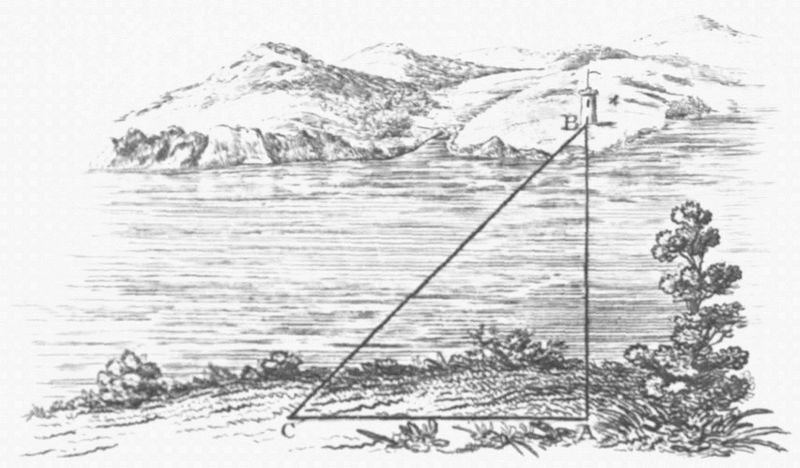
Geometry is the science relating to measurement. By the assistance of geometry, engineers, &c., conduct all their works, take the distances of places, and the measure of inaccessible objects, &c.
Characters, marks, or signs,
which are used in arithmetic, and algebra, to denote several of the operations, and propositions:
+ signifies plus, or addition, - minus, or subtraction, × multiplication, ÷ division, : :: : proportion, = equality, √ square root, ∛ cube root, 42 denotes that 4 is to be squared. 43 denotes that 4 is to be cubed.
ARITHMETIC.
REDUCTION.
Reduction is the method of converting numbers from one name, or denomination to another: or the method of finding the value of a quantity in terms of some other higher, or lower quantity.
To reduce from a higher to a lower denomination.
Rule.—Multiply the given number by as many of the lower denomination as make one of the greater;[40] adding to the product as many of the lower denomination as are expressed in the given sum.
Example.—In £6 15s. 5d., how many pence?
£. s. d.
6 15 5
20
135
12
1625 Answer.
To convert from a lower to a higher denomination.
Rule.—Divide the given number by as many of the lower denomination as are required to make one of the greater.[41] Should there be any remainder, it will be of the same denomination as the dividend.
Example.—Convert 1625 pence into pounds, shillings, and pence.
12 ) 1625 pence
20 ) 135 5
£6 15s. 5d. Answer.
THE RULE OF THREE, OR SIMPLE PROPORTION.
It is called the Rule of Three because three numbers are given to find a fourth. It is also called Simple Proportion, because the 1st term bears the same proportion to the 2nd, as the 3rd does to the 4th. Of the three given numbers, two of them are always of the same kind, or name, and are to be the 1st, and 2nd terms of the question; the 3rd number is always of the same name, or kind as the 4th, or answer sought; and in stating the question it is always to be made the 3rd term. If the answer will be greater than the 3rd term, place the least of the other two given quantities for the 1st term; but if the answer will be less than the 3rd term, put the greater of the two numbers, or quantities, for the 1st term.
Rule.—State the question according to the above directions, and multiply the 2nd and 3rd terms together, and divide this product by the 1st, for the 4th term, or answer sought.
If the 1st and 2nd terms are not of the same denomination, they must be reduced to it; and if the third term is a compound number, it must be reduced to its lowest denomination before the multiplication, or division of the term takes place.
Note 1.—The operation may frequently be considerably abridged, by dividing the 1st and 2nd, or the 1st and 3rd terms, by any number which will exactly divide them, afterwards using the quotients, instead of the numbers themselves.*
Example.—If 2 tons of iron for ordnance cost £40, how many tons may be bought for £360?
As £40 : £360 :: 2 tons : 18 tons. (Thus 360 × 2) ÷ 40 = 18. The answer. * Or thus, 9 × 2 = 18. The answer.
Note 2.—A concise method of ascertaining the annual amount of a daily sum of money.
Rule.—Bring the daily sum into pence, and then add together as many pounds, half pounds, groats, and pence, as there are pence in the daily sum, for the amount required. For leap year, add the rate for one day.
Example.—Required the annual amount of 2s. 6d. per diem.
2s. 6d. = 30d. 30 pounds.
15 = 30 half pounds.
10s. = 30 groats.
2s. 6d. = 30 pence.
Annual amount (365 days) ... £45 12s. 6d.
Note 3.—To find the amount of any number of days’ pay, the daily rate (under twenty shillings) being given.
The price of any article being given, the value of any number may be ascertained in a similar manner.
Rule 1. When the rate (or price) is an even number, multiply the given number by half of the rate, doubling the first figure to the right hand for the shillings, the remainder of the product will be pounds.
Example. Required the amount of 243 days’ pay, at 4s. per diem.
4/2 = 2 243
2
£48 12s. Ans.
Rule 2. When the price is an odd number, find for the greatest number as before, to which add one-twentieth of the given number for the odd shilling.
Example. What is the price of 566 pairs of shoes, at 7s. per pair.
566 2/0 ) 56/6
3 28 6
169 16s.
28 6
£198 2s. Ans.
FRACTIONS.
A fraction is a quantity which expresses a part, or parts of a unit, or integer. It is denoted by two numbers placed with a line between them.
A Simple fraction consists of two numbers, called the numerator, and denominator; thus,
3 numerator,
5 denominator.
The Denominator is placed below the numerator, and expresses the number of equal parts into which the integer is divided.
The Numerator expresses the number of parts of the broken unit, or integer; or shows how many of the parts of the unit are expressed by the fraction.
A Compound fraction is a fraction of a fraction, as ⅔ of ⅘.
A Mixed number consists of a whole number with a fraction annexed to it, as 4⅖.
An Improper fraction has the numerator greater than the denominator, as 6/5.
REDUCTION OF FRACTIONS.
is bringing them from one denomination to another.
To reduce a fraction to its lowest terms.
Rule.—Divide the numerator, and the denominator, by any number that exactly divides them, and the quotients by any other number, till they can be no longer divided by any whole number, when the fraction will be in its lowest terms.
Example.—Reduce 4032 6048 to its lowest terms.
Thus, 4 4032 6048 = 12 1008 1512 = 6 84 126 = 7 14 21 = 2 3. Answer.
To reduce an improper fraction to a whole, or mixed number.
Rule.—Divide the numerator by the denominator, the quotient will be the whole number; and the remainder (if any) the numerator of the fraction, having the divisor for the denominator.
Example.—Reduce 114 12 to a whole, or mixed number.
12 ) 114
9 6 12 Answer.
To reduce a mixed number to an improper fraction.
Rule.—Multiply the whole number by the denominator, and add the numerator to the product, under which place the given denominator.
Example.—Reduce 17⅝ to an improper fraction.
17⅝
8
141
8 Answer.
To reduce a compound fraction to a simple fraction.
Rule.—Multiply all the numerators together for the numerator, and all the denominators for the denominator.
Example.—Reduce ⅜ of ⅙ of ½ of 9 to a simple fraction.
Numerators 3 × 1 × 1 × 9 = 27 = 9 Answer.
Denominators 8 × 6 × 2 × 1 96 32
To reduce fractions of different denominators to equivalent fractions, having a common denominator.
Rule.—Multiply each numerator by all the denominators except its own for the new numerators, and multiply all the denominators together for a common denominator.[42]
Example.—Reduce ⅜, ⅔, and ⅘ to fractions having a common denominator.
3 × 3 × 5 = 45 2 × 8 × 4 = 80 4 × 8 × 3 = 96 8 × 3 × 5 = 120 Answer, 45 120 , 80 120 , 96 120 .
ADDITION OF FRACTIONS.
Rule.—Bring compound fractions to simple fractions; reduce all the fractions to a common denominator, then add all the numerators together, and place their sum over the common denominator. When mixed numbers are given, find the sum of the fractions, to which add the whole numbers.
Example.—Add together ⅚, ¾, and 6½.
5 × 4 × 2 = 40 40 48 + 36 48 + 24 48 + 6 = 8 4 48 . 3 × 6 × 2 = 36 1 × 6 × 4 = 24 or, by cancelling, and dividing,[43] 6 × 4 × 2 = 48 10 12 + 9 12 + 6 12 + 6 = 8 1 12 Answer.
SUBTRACTION OF FRACTIONS.
Rule.—Prepare the quantities, as in addition of fractions. Place the less quantity under the greater. Then, if possible, subtract the lower numerator from the upper; under the remainder write the common denominator, and, if there be whole numbers, find their difference as in simple subtraction. But if the lower numerator exceed the upper, subtract it from the common denominator, and to the remainder add the upper numerator; write the common denominator under this sum, and carry 1 to the whole number in the lower line.
Example.—
From 54 5 6 or 54 25 30 Take 25 5 15 or 25 10 30 —— 29 15 30 Answer.
MULTIPLICATION OF FRACTIONS.
Rule.—Reduce mixed numbers to equivalent fractions; then multiply all the numerators together for a numerator, and all the denominators together for a denominator, which will give the product required.
Example.—Multiply ⅚, ⅜, and 2½ together.
⅚ × ⅜ × (2½ or) 5 2 = 75 96 Answer.
DIVISION OF FRACTIONS.
Rule.—Prepare the fractions, as for multiplication; then divide the numerator by the numerator, and the denominator by the denominator, if they will exactly divide; but if they will not do so, then invert the terms of the divisor, and multiply the dividend by it, as in multiplication.
Example.—Divide 9 16 by 4½.
9 16 ÷ (4½ or) 9 2 = ⅛ Answer.
RULE OF THREE IN FRACTIONS.
Rule.—State the terms, as directed in “Simple proportion;” reduce them (if necessary) to improper, or simple fractions, and the two first to the same denomination. Then multiply together the second and third terms, and the first with its parts inverted, as in division, for the answer.
Example.—If 4⅕ cwt. of sugar cost £19⅞, how much may be bought for £59⅝?
As 19⅞ : 59⅝ :: 4⅕ Or, 159 8 : 477 8 :: 21 5 : 12⅗ Answer. 8 159 × 477 8 × 21 5 = 80136 6360 = 12⅗ cwt.
DECIMALS.
A decimal fraction is that which has for its denominator an unit (1), with as many ciphers annexed as the numerator has places; and it is usually expressed by setting down the numerator only, with a point before it, on the left hand. Thus, 5 10 is ·5; 25 100 is ·25; 25 1000 is ·025; ciphers being prefixed, to make up as many places as are required by the ciphers in the denominator.
A mixed number is made up of a whole number with some decimal fraction, the one being separated from the other by a point, thus 3·25 is the same as 3 25 100 or 325 100 .
Ciphers on the right hand of decimals make no alteration in their value; for ·5, ·50, ·500 are decimals having all the same value, each being = 5 10 . But when they are placed on the left hand, they decrease the value in a tenfold proportion; thus, ·5 is 5 10 ; but ·05 is 5 100 .
ADDITION OF DECIMALS.
Rule.—Set the numbers under each other, according to the value of their places, in which state the decimal separating points will all stand exactly under each other. Then beginning at the right hand, add up all the columns of numbers as in integers, and point off as many places for decimals as are in the greatest number of decimal places in any of the lines that are added; or place the point directly below all the other points.
Example.—Required the sum of 29·0146, 3146·5, 14·16, and 165.
29·0146
3146·5
14·16
165·
Answer 3354·6746
SUBTRACTION OF DECIMALS.
Rule.—Place the numbers under each other according to the value of their places. Then, beginning at the right hand, subtract as in whole numbers, and point off the decimals, as in addition.
Example.—Subtract 4·90142 from 214·81.
214·81
4·90142
Answer 209·90858
MULTIPLICATION OF DECIMALS.
Rule.—Place the factors, and multiply them together, the same as if they were whole numbers. Then point off in the product just as many places of decimals as there are decimals in both the factors. But, if there be not so many figures in the product, prefix ciphers to supply the deficiency.[44]
Example.—Multiply 32·108 by 2·5.
32·108
2·5
160540
64216
80·2700 Answer.
DIVISION OF DECIMALS.
Rule.—Divide as in whole numbers, and point off in the quotient as many places for decimals as the decimal places in the dividend exceed those in the divisor. When the decimal places of the quotient are not so many as the above rule requires, the deficiency is to be supplied by prefixing ciphers. When there is a remainder after the division, or when the decimal places in the divisor are more than those in the dividend, then ciphers may be annexed to the dividend, and the quotient carried on as far as required.
Example.—Divide 234·7052 by 64·25.
64·25 ) 234·7052 ( 3·65 Answer.
19275
41955
38550
34052
32125
1927 Remainder.
REDUCTION OF DECIMALS.
To reduce a vulgar fraction to its equivalent decimal.
Rule.—Divide the numerator by the denominator, as in Division of Decimals, annexing ciphers to the numerator as far as necessary: and the quotient will be the decimal required.
Example.—Reduce 7 24 to a decimal.
24 = 4 × 6. Then 4 ) 7·
6 ) 1·75
·291666, &c.
To find the value of a decimal, in terms of the inferior denominations.
Rule.—Multiply the decimal by the number of parts in the next lower denomination, and cut off as many places to the right hand for a remainder, as there are places in the given decimal. Multiply that remainder by the parts in the next lower denomination, again cutting off for another remainder as before. Proceed in the same manner through all the parts of the integer; then the several denominations, separated on the left hand, will make up the answer.
Example.—What is the value of ·775 pounds sterling.
·775
20
Shillings 15·500
12
Pence 6·000 Answer 15s. 6d.
To convert integers, or decimals to equivalent decimals of higher denominations.
Rule.—Divide by the number of parts in the next higher denomination, continuing the operation to as many higher denominations as may be necessary.
When there are several numbers, all to be converted to the decimal of the highest—
Set the given numbers directly under each other for dividends, proceeding from the lowest to the highest; opposite to each dividend, on the left hand, place such a number for a divisor as will bring it to the next higher name. Begin at the uppermost, and perform all the divisions, placing the quotient of each division, as decimal parts, on the right hand of the dividend next below it; so shall the last quotient be the decimal required.
Example.—Convert 15s. 9¾d. to the decimal of a pound sterling.
4 3·
12 9·75
20 15·8125
£·790625 Answer.
Example.—Convert 1 dwt. to the decimal of a pound, Troy weight.
20 ) 1
12 ) ·05 oz.
·004166 lb., &c., Answer.
RULE OF THREE IN DECIMALS.
Rule.—Prepare the terms, by reducing the fractions to decimals; compound numbers to decimals of the higher denominations, or integers of the lower; also the first, and second terms to the same name. Then multiply, and divide, as in the Rule of Three, in whole numbers.
Example.—If ⅜ of a yard of cloth cost £⅖, what will 5 16 of a yard cost?
yd. yd. £. s. d.
⅜ = ·375 As ·375 : ·3125 :: 4 : ·333 &c. or 6 8
4
⅖ = ·4 ·375) ·12500 (·3333 &c.
1125 20
5/16 = ·3215 1250s. 6·666 &c.
1125 12
Answer, 6s. 8d. 125d. 7·999 &c. nearly 8d.
DUODECIMALS.
By Duodecimals, artificers, &c., compute the content of their works.
Rule.—Set down the two dimensions to be multiplied together one under the other, so that feet may stand under feet, inches under inches, &c.
Multiply each term in the multiplicand, beginning at the lowest, by the feet in the multiplier, and set the result of each straight under its corresponding term, observing to carry 1 for every 12, from the inches to the feet. In like manner multiply all the multiplicand by the inches, and parts of the multiplier, and set the result of each term one place removed to the right hand of those in the multiplicand: omitting, however, what is below parts of inches, only carrying to these the proper number of units from the lowest denominations. Or, instead of multiplying by the inches, take such part of the multiplicand as those are of a foot.
Then add the two lines together for the content required.
Example.—Multiply 14 feet 9 inches, by 4 feet 6 inches.
ft. in.
14 9
4 6
59 0
7 4½
66 4½ Answer.
TABLES OF WEIGHTS, AND MEASURES.
TROY WEIGHT.
24 grains 1 pennyweight.
480 20 1 ounce.
5760 240 12 1 pound.
AVOIRDUPOIS WEIGHT.
16 drams 1 ounce.
256 16 1 pound.
7168 448 28 1 quarter.
28672 1792 112 4 1 hundred weight.
573440 35840 2240 80 20 1 ton.
Note.— 1 lb. Avoirdupois weight equals 14 oz. 11 dwts. 15½ grs. Troy.
1 oz. ditto 18 dwts. 5½ do.
1 dr. ditto 27·34375 do.
APOTHECARIES’ WEIGHT.
20 grains 1 scruple.
60 3 1 dram.
480 24 8 1 ounce.
5760 288 96 12 1 pound.
WEIGHTS.
To find the weight, for tonnage.
Cattle—
Divide the number by 3, for weight in tons.
Sheep Average 60 lb. each.
Divide by 33, for weight in tons.
Pigs Average 80 lb.
Divide by 15, for tons.
Beer, or Ale—
Barrel 3¼ cwt.
Hogshead 5¼ cwt.
Oats Sack—24 stone.
Divide quarters by 5, for tons.
Rum—
Divide gallons by 224, for tons.
Wine Cask—12 cwt.
Rule for ascertaining the weight of Hay.
Measure the length and breadth of the stack; then take its height from the ground to the eaves, and add to this last one-third of the height from the eaves to the top: Multiply the length by the breadth, and the product by the height, all expressed in feet; divide the amount by 27, to find the cubic yards, which multiply by the number of stones supposed to be in a cubic yard (viz., in a stack of new hay, six stones; if the stack has stood a considerable time, eight stones; and if old hay, nine stones), and you have the weight in stones. For example, suppose a stack to be 60 feet in length, 30 in breadth, 12 in height from the ground to the eaves, and 9 (the third of which is three) from the eaves to the top; then 60 × 30 × 15 = 27000; 27000 ÷ 27 = 1000; and 1000 × 9 = 9000 stones of old hay.
LONG MEASURE.
12 inches 1 foot.
36 3 1 yard.
198 16½ 5½ 1 pole, perch, or rod.
7920 660 220 40 1 furlong.
63360 5280 1760 320 8 1 mile.
LAND MEASURE (Length).
7·92 inches 1 link.
100 links, or 22 yards 1 chain.
80 chains 1 mile.
69·121 miles 1 geographical degree.
LAND MEASURE (Surface, or Superficial).
62·7264 square inches 1 square link.
625 square links 1 square pole, or perch.
10000 square links 1 square chain.
2500 square links 1 square rood, or pole.
10 square chains 1 square acre.
100000 square links 1 square acre.
NAUTICAL MEASURE.
1 nautical mile 6082·66 feet.
3 miles 1 league.
20 leagues 1 degree.
360 degrees the earth’s circumference.
SQUARE MEASURE.
144 s. inches 1 s. foot
1296 9 1 s. yard.
39204 272¼ 30¼ 1 s. pole.
1568160 10890 1210 40 1 rood.
6272640 43560 4840 160 4 1 acre.
CUBIC MEASURE (Measure of solidity).
1728 cubic inches 1 cubic foot.
27 cubic feet 1 cubic yard.
Note.—A cubic foot is equal to 2200 cylindrical inches, or 3300 spherical inches, or 6600 conical inches.
Timber.
40 feet of round, and 50 feet of hewn timber make 1 Ton; 16 cubic feet make 1 Foot of wood; 8 feet of wood make 1 Cord.
Water.
Maximum density 42 deg. Fahrenheit.
1 cubic foot of water 6¼ imperial gallons.
1 cylindric foot do. about 5 do.
1 cubic foot weighs 62·5 lb. avoirdupois.
1 cylindric do. do. 49·1
1 lineal do. (1 in. square) do. ·434
12·2 imperial gallons weigh 1 cwt.
224 do. do. 1 ton.
1·8 cubic feet do. 1 cwt.
35·84 do. do. 1 ton.
MEASURES OF CAPACITY.
69⅓ cubic in 2 pints 1 quart.
277¼ 8 4 1 gallon.
554½ 16 8 2 1 peck.
2218⅕ 64 32 8 4 1 bushel.
10¼ cubic ft. 512 256 64 32 8 1 quarter.
FRENCH MEASURES.
English English
cubic inches. feet.
Metre 3·281
Millilitre ·06103 ” French feet, 3·07844
Centilitre ·61028 Millimetre. ·03937
Decilitre 6·10279 Centimetre ·39371
Litre, or cubic decimetre 61·02791 Decimetre 3·93708
Decalitre 610·27900 Metre 39·37079
Hectolitre 6102·79000 Decametre 393·70790
Kylolitre 61027·90000 Hectometre 3937·07900
Myrialitre 610279·00000 Kilometre 39370·79000
1 litre is nearly 2⅛ wine pints. Myriametre 393707·90000
1 kilolitre 1 tun 12¾ wine gallons. 8 kilometres are nearly 5 miles.
1 stere, or cubic metre 35·3171 1 inch is ·0254 metre.
100 feet are nearly 30·5 metres.
INVOLUTION.
Involution is the raising of powers from any given number, as a root.
A Power is a quantity produced by multiplying any given number, called the Root, a certain number of times continually by itself. Thus, 2 × 2 = 4, the 2nd power, or square of 2, expressed thus, 22.
The index, or exponent of a power is the number denoting the height, or degree of that power. Thus, 2 is the index of the 2nd power.
Powers that are to be raised, are usually denoted by placing the index above the root, or first power.
Thus 22 = 4, the 2nd power of 2.
Example.—What is the 2nd power of 45?
45 × 45 = 2025 Answer.
EVOLUTION.
Evolution is the reverse of Involution, being the extracting, or finding the roots of any given powers, or numbers.
The Root of any number, or power, is such a number as being multiplied into itself a certain number of times, will produce that power.
Thus, 2 is the square root, or 2nd root of 4, because, 22 = 2 × 2 = 4; and 3 is the cube root, or third root of 27. But there are many numbers of which a proposed root can never be exactly found; by means of decimals, however, the root may be very nearly ascertained.
Any power of a given number, or root, may be found exactly by multiplying the number continually into itself.
Those roots which only approximate are called Surd-roots; but those which can be found, quite exactly, are called Rational-roots. Thus, the square root of 3 is a surd root, but the square root of 4 is a rational root, being equal to 2; also the cube root of 8 is rational, being equal to 2, but the cube root of 9 is surd, or irrational. Roots are sometimes denoted by writing the character √ before the power with the index of the root against it. Thus, the 3rd, or cube root of 20 is expressed by ∛20. When the power is expressed by several numbers with the sign + or - between them, a line is drawn from the top of the sign over all the parts of it; thus the cube (or third) root of 45 - 12 is ∛45 - 12 or thus ∛(45 - 12).
TO EXTRACT THE SQUARE ROOT.
Rule.—Divide the given number into periods of two figures each, by setting a point over the place of units, and another over the place of hundreds, and so on over every second figure, both to the left hand in integers, and right hand in decimals. Find the greatest square in the first period on the left hand, and set its root on the right hand of the given number, after the manner of the quotient figure in division. Subtract the square thus found from the said period, and to the remainder annex the two figures of the next following period for a dividend. Double[45] the root above-mentioned for a divisor, and find how often it is contained in the said dividend, exclusive of its right-hand figure; and set that quotient figure both in the quotient, and divisor. Multiply the whole augmented divisor by this last quotient figure, and subtract the product from the said dividend, bringing down to it the next period of the given number, for a new dividend. Repeat the same process over again—viz., find another new divisor, by doubling all the figures now found in the root; from which, and the last dividend find the next figure of the root as before; and so on through all the periods to the last.
To extract the square root of a fraction, or mixed number.
Reduce the fraction to a decimal, and extract its root.
Mixed numbers may be either reduced to improper fractions, and the root extracted; or the fraction may be reduced to a decimal, then joined to the integer, and the root of the whole extracted.
Example.—To find the square root of 29506624.
29506624 ( 5432 The Root.
25
104 450
4 416
1083 3466
3 3249
10862 21724
2 21724
TO EXTRACT THE CUBE ROOT.
Rule 1.—By trials, or by the table of roots (vide page 280), take the nearest rational cube to the given number, whether it be greater, or less, and call it the assumed cube.
2.—Then (by the Rule of Three),
As the sum of the given number, and double the assumed cube, is to the sum of the assumed cube, and double the given number, so is the root of the assumed cube, to the root required, nearly.
3.—Or as the first sum, is to the difference of the given, and assumed cube, so is the assumed root, to the difference of the roots, nearly.
4.—Again, by using, in like manner, the cube of the root last found as a new assumed cube, another root will be obtained still nearer. Repeat this operation as often as necessary, using always the cube of the last-found root, for the assumed root.
Example.—To find the cube root of 21035·8.
By trials it will be found first, that the root lies between 20, and 30; and, secondly, between 27, and 28. Taking, therefore, 27, its cube is 19683, which will be the assumed cube. Then by No. 2 of the Rule
19683 21035·8
2 2
39366 42071·6
21035·8 19683·
As 60401·8 : 61754·6 :: 27 : 27·6047 the Root, nearly.
Again for a second operation, the cube of this root is 21035·318645155832, and the process by No. 3 of the Rule will be
21035·318645, &c.
2
42070·637290 21035·8
21035·8 21035·318645, &c.
As 63106·43729 : diff. ·481355 :: 27·6047 :
: the diff. ·000210560
consequently the root required is 27·604910560
TABLE OF SQUARES, CUBES, AND ROOTS.
No. Sqr. Cube. Sqr. root. Cube root. No. Sqr. Cube. Sqr. root. Cube root.
1 1 1 1·0000000 1·000000 51 2601 132651 7·1414284 3·708430
2 4 8 1·4142136 1·259921 52 2704 140608 7·2111026 3·732511
3 9 27 1·7320508 1·442250 53 2809 148877 7·2801099 3·756286
4 16 64 2·0000000 1·587401 54 2916 157464 7·3484692 3·779763
5 25 125 2·2360680 1·709976 55 3025 166375 7·4161985 3·802953
6 36 216 2·4494897 1·817121 56 3136 175616 7·4893148 3·825862
7 49 343 2·6457513 1·912933 57 3249 185193 7·5498344 3·848501
8 64 512 2·8284271 2·000000 58 3364 195112 7·6157731 3·870877
9 81 729 3·0000000 2·080084 59 3481 205379 7·6811457 3·892996
10 100 1000 3·1622777 2·154435 60 3600 216000 7·7459667 3·914867
11 121 1331 3·3166248 2·223980 61 3721 226981 7·8102497 3·936497
12 144 1728 3·4641016 2·289428 62 3844 238328 7·8740079 3·957892
13 169 2197 3·6055513 2·351335 63 3969 250047 7·9372539 3·979057
14 196 2744 3·7416574 2·410142 64 4096 262144 8·0000000 4·000000
15 225 3375 3·8729833 2·466212 65 4225 274625 8·0622577 4·020726
16 256 4096 4·0000000 2·519842 66 4356 287496 8·1240384 4·041240
17 289 4913 4·1231056 2·571282 67 4489 300763 8·1853528 4·061548
18 324 5832 4·2426407 2·620741 68 4624 314432 8·2462113 4·081656
19 361 6859 4·3588989 2·668402 69 4761 328509 8·3066239 4·101566
20 400 8000 4·4721360 2·714418 70 4900 343000 8·3666003 4·121285
21 441 9261 4·5825757 2·758923 71 5041 357911 8·4261498 4·140818
22 484 10648 4·6904158 2·802039 72 5184 373248 8·4852814 4·160168
23 529 12167 4·7958315 2·843867 73 5329 389017 8·5440037 4·179339
24 576 13824 4·8989795 2·884499 74 5476 405224 8·6023253 4·198336
25 625 15625 5·0000000 2·924018 75 5625 421875 8·6602540 4·217163
26 676 17576 5·0990195 2·962496 76 5776 438976 8·7177979 4·235824
27 729 19683 5·1961524 3·000000 77 5929 456533 8·7749644 4·254321
28 784 21952 5·2915026 3·036589 78 6084 474552 8·8317609 4·272659
29 841 24389 5·3851648 3·072317 79 6241 493039 8·8881944 4·290841
30 900 27000 5·4772256 3·107232 80 6400 512000 8·9442719 4·308870
31 961 29791 5·5677644 3·141381 81 6561 531441 9·0000000 4·326749
32 1024 32768 5·6568542 3·174802 82 6724 551368 9·0553851 4·344481
33 1089 35937 5·7445626 3·207534 83 6889 571787 9·1104336 4·362071
34 1156 39304 5·8309519 3·239612 84 7056 592704 9·1651514 4·379519
35 1225 42875 5·9160798 3·271066 85 7225 614125 9·2195445 4·396830
36 1296 46656 6·0000000 3·301927 86 7396 636056 9·2736185 4·414005
37 1369 50653 6·0827625 3·332222 87 7569 658503 9·3273791 4·431047
38 1444 54872 6·1644140 3·361975 88 7744 681472 9·3808315 4·447960
39 1521 59319 6·2449980 3·391211 89 7921 704969 9·4339811 4·464745
40 1600 64000 6·3245553 3·419952 90 8100 729000 9·4868330 4·481405
41 1681 68921 6·4031242 3·448217 91 8281 753571 9·5393920 4·497942
42 1764 74088 6·4807407 3·476027 92 8464 778688 9·5916630 4·514357
43 1849 79507 6·5574385 3·503398 93 8649 804357 9·6436508 4·530655
44 1936 85184 6·6332496 3·530348 94 8836 830584 9·6953597 4·546836
45 2025 91125 6·7082039 3·556893 95 9025 857375 9·7467943 4·562903
46 2116 97336 6·7823300 3·583048 96 9216 884736 9·7979590 4·578857
47 2209 103823 6·8556546 3·608826 97 9409 912673 9·8488578 4·594701
48 2304 110592 6·9282032 3·634241 98 9604 941192 9·8994949 4·610436
49 2401 117649 7·0000000 3·659306 99 9801 970299 9·9498744 4·626065
50 2500 125000 7·0170678 3·684031 100 10000 1000000 10·0000000 4·641589
PILING OF SHOT, AND SHELL.
Shot, and shells, are usually piled in horizontal courses, the base being either an equilateral triangle, a square, or a rectangle. The triangular, and square piles terminate each in a single ball, but the rectangular pile finishes in a row of balls.
To find the number of balls in a complete pile.
Rule.—Add the three parallel edges together; then one-third of the product of that sum, and of the number of balls in the triangular face, will be the number sought.
Note 1.—The parallel edges in a rectangular pile are the two rows in length at the base, and the upper ridge. In the square pile the same, except that the upper row is only a single ball. In the triangular pile, one side of the base, the single ball at top, and that at the back, are considered the parallel edges.
Note 2.—The number of balls in the triangular face is found by multiplying half the number in the breadth at the base, by the number in the breadth at the base plus 1.
Note 3.—In all piles the breadth of the bottom is equal to the number of courses. In the oblong pile, the top row is one more than the difference between the length, and breadth of the bottom.
Example.—To find the shot in a triangular pile, the bottom row consisting of 12 shot.
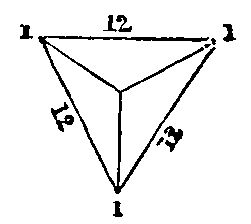
Parallel { 12
edges. { 1 12 ÷ 2 = 6
{ 1 12 + 1 = 13
Triangular face 78
3 ) 14 4⅔
4⅔ 312
52
Answer 364
Example.—To find the shot in a square pile, the bottom row consisting of 12 shot.
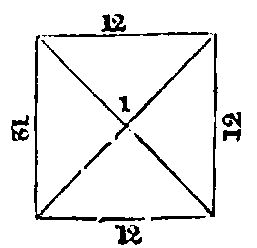
12
1 12 ÷ 2 = 6
1 12 + 1 = 13
78
3 ) 25 8⅓
8⅓ 624
26
Answer 650
Example.—To find the shot in an oblong pile, whose base consists of 18 shot in length, and 12 in breadth.
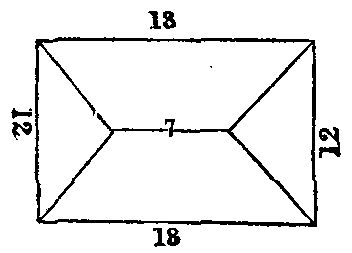
18 18 - 12 = 6
18 1
7 7
3 ) 43
14⅓ 12 ÷ 2 = 6
12 + 1 = 13
78
14⅓
312
78
26
Answer 1118
Triangular pile.
Rule.—Multiply the base by the base plus 1, this product by the base plus 2, and divide by 6.
Square pile.
Rule.—Multiply the bottom row by the bottom row plus 1, and this product by twice the bottom row plus 1, and divide by 6.
Rectangular, or oblong pile.
Rule.—Multiply the breadth of the base by itself plus 1; and this product by three times the length of the base plus 1, minus the breadth of the base, and divide by 6.
In the following formulæ let the letter (L) denote the number in the bottom row, or the length; and (B) the breadth of the lowest course.
Triangular pile L × (L + 1) × (L + 2)
6
Square pile L × (L + 1) × (2L + 1)
6
Oblong pile B × (B + 1) × (3L + 1 - B)
6
The number of shot in any pile,
(whose base does not exceed 21) may readily be ascertained by referring to the following Table, page 284.
For the square pile.—Look for the number of shot in the base, in the first vertical column on the left hand, and also in the diagonal column; and at their angle of meeting will be found the content required.
Thus 20 base gives 2870.
For the triangular pile.—Look for the number in the base row in the diagonal column, and opposite to it will be found the content.
Thus 18 base gives 1140.
For the oblong pile.—Look for the number in the length of the base in the vertical column, and the breadth of the base in the diagonal column, and at their angle of meeting will be found the content required.
Thus 17 length, and 12 breadth, gives 1040.
To find the number of balls in an incomplete pile.
Compute the number in the pile considered as complete; also the number in the upper pile, or part wanting; and the difference between the two piles thus found will be the number in the frustrum, or incomplete pile.
Table for computing the Content of any Pile, whose base row does not exceed 21 balls.
1 2 4
2 5 3 10
3 8 14 4 20
4 11 20 30 5 35
5 14 26 40 55 6 56
6 17 32 50 70 91 7 84
7 20 38 60 85 112 140 8 120
8 23 44 70 100 133 168 204 9 165
9 26 50 80 115 154 196 240 285 10 220
10 29 56 90 130 175 224 276 330 385 11 286
11 32 62 100 145 196 252 312 375 440 506 12 364
12 35 68 110 160 217 280 348 420 495 572 650 13 455
13 38 74 120 175 238 308 384 465 550 638 728 819 14 560
14 41 80 130 190 259 336 420 510 605 704 806 910 1015 15 680
15 44 86 140 205 280 364 456 555 660 770 884 1001 1120 1240 16 816
16 47 92 150 220 301 392 492 600 715 836 962 1092 1225 1360 1496 17 969
17 50 98 160 235 322 420 528 645 770 902 1040 1183 1330 1480 1632 1785 18 1140
18 53 104 170 250 343 448 564 690 825 968 1118 1274 1435 1600 1768 1938 2109 19 1330
19 56 110 180 265 364 476 600 735 880 1034 1196 1365 1540 1720 1904 2091 2280 2470 20 1540
20 59 116 190 280 385 504 636 780 935 1100 1274 1456 1645 1840 2040 2244 2451 2660 2870 21 1771
21 62 122 200 295 406 532 672 825 990 1166 1352 1547 1750 1960 2176 2397 2622 2850 3080 3311 22 2024
CORDAGE.
Ropes, cables, and all other descriptions of cordage are distinguished by their circumference, thus a two-inch rope means a rope two inches in circumference.
To find the weight of a rope.
First method.—Multiply the length in fathoms by the square of the circumference, and divide the product by 480 for the weight in cwts.
Example.—Required the weight of 110 fathoms of 3-inch rope.
3 × 3 × 110 = 990, which divided by 480, gives 2 cwt. 7 lb. Weight required.
Second method.—Divide the square of the circumference by 4, the quotient will give the weight, in pounds, per fathom.
Example.—What is the weight of a 3-inch rope per fathom?
32 ÷ 4 = 2¼ lb. Weight required.
To find the strength of a rope, or the weight it will support.
First method.—Square the circumference, and divide by 5, for the number of tons which it will bear suspended from it.[46]
Example.—What weight will 3-inch rope of the best description support?
(3 × 3) 5 = 9/5 = 1⅘ ton, or 4030 lb. Weight required.
Second method.—Multiply the square of the circumference by 2, the product will give the practical weight in cwts. that may be lifted by it, or about half the breaking weight.
Example.—What number of cwts. may be lifted by a 3-inch rope?
32 × 2 = 18 cwts. Weight required.
The strain, in pounds, a rope will bear safely = girt2 × 200} nearly.
” ” a cable ” ” = girt2 × 120}
CHAINS.
To find the weight of chains.
The square of the diameter of the link, measured in eighths of inches, will give the weight of the chain, per fathom, in pounds.
Example.—What is the weight per fathom of a ¾-inch chain?
¾-inch = 6 8 ; 62 = 36 lb. Weight per fathom.
Or, the weight per foot of the chain, multiplied by 24, will give the weight per fathom of the chain, nearly. A chain cable with a stay across the links will weigh about one-twelfth more than the foregoing examples.
To find the weight that may be safely lifted by a chain.
Divide the square of the diameter of the links, taken in eighths of an inch by 8, and the quotient will give the number of tons that may be lifted by the chain.
Example.—What number of tons will a chain made of ¾-inch iron carry with safety?
¾-inch = 6 8 62 = 36 36 8 = 4½ tons. Weight required.
The safe strain is equal to about 8 tons, per square inch, of the iron of which the chain is made.
The stay across the link of a chain increases its strength about one-sixth.
When the chain is of great length, a deduction, from the above rules, must be allowed for the weight of it.
IRON RODS.
To find the weight of round iron rods.
Divide the square of the diameter, in quarter inches, by 2, and the quotient will give the weight in pounds, per yard.
Example.—What is the weight of a yard of 1-inch round iron.
1 inch = 4 quarters 42 = 16 16 2 = 8 lb. Weight required.
To find the weight of square rods.
The weight of round rods, of similar diameter, divided by ·7854 will give the weight of the square rods.
To find the weight that may be sustained, or lifted by round iron rods.
Find the weight in pounds, per yard; two-thirds of which will give the safe load, in tons.
A round iron rod of average quality of iron, one inch in diameter, will be torn asunder by 16 tons; it will be perceptibly damaged by half this strain, or 8 tons; its safe load will be one-third, or 5·33 tons.
TIMBER.
To find the area, or superficial content of a plank.
Multiply the length by the mean breadth.[47]
Example.—Required the content of a board whose length is 11 feet 2 inches, and breadth 1 foot 10 inches
ft. in. ft. in. ft. in.
11 2 × 1 10 = 20 5. Content required.
To find the solid content of squared, or four-sided timber.
Multiply the mean breadth by the mean thickness, and the product by the length, for the content, nearly.
Note 1.—If the tree taper regularly from the one end to the other, either take the mean breadth, and thickness in the middle, or take the dimensions at the two ends, and half their sum will be the mean dimensions; which, multiplied as by the above rule, will give the content, nearly.
Note 2.—If the piece do not taper regularly, take several different dimensions, add them all together, and divide their sum by the number of them, for the mean dimensions.
Example.—Required the content of a piece of timber 16 feet long, and side of square 14 inches.
ft. in. ft. in. ft. ft. in.
1 2 × 1 2 × 16 = 21 9. Content required.
To find the solidity of round, or unsquared timber.
1. Multiply the square of the quarter girt (or the square of ¼ of the mean circumference), by the length, for the content.
Note.—When the tree is tapering, take the mean dimensions, either by girting it in the middle for the mean girt, or at the two ends, taking half the sum of the two; or by girting it in several places, then adding all the girts together, and dividing the sum by the number of them for the mean girt. But when the tree is very irregular, divide it into several lengths, and find the content of each part separately.
Example.—Required the content of a tree, whose mean girt is 3·15 feet, and length 14½ feet.
3.15 4 = ·7875 ·7875 × ·7875 = ·62015625.
·62015 × 14·5 = 8·9922 feet of solid timber. The content required.
2. Find the mean area of a round tree, and multiply it by the length for the content.
To find the weight of a tree.
Find its content in feet, and multiply that by the specific gravity of the wood.
(Vide Gravity, and Table of Specific Gravities. Page 318.)
Example.—Required the weight of an elm-tree; whose mean girt is 5 feet, and length 60 feet.
5 4 = 1·25 1·25 × 1·25 = 1·5625.
1·5625 × 60 = 93·75. Content in feet.
TONNAGE.
Table of Tonnage, and Weight of one of the following Carriages, Carts, Waggons, Gyns, &c., used in land service.
Carriages. Tonnage. Weight.
Tons. ft. Cwt.qrs.lb. With
{ 24 pounder 6 0 34 0 22 bullock
{ 8 inch 6 0 34 2 12 pole and
*For Iron { 18 pounder 4 39 27 2 9 chain,
Ordnance. { 12 ” 21 cwt. 4 7 18 3 24 weighing
{ Howitzer { 10 inch 6 17 39 0 9 2 qrs. 19 lb.
{ 8 ” 5 37 33 2 0
{ 12 pounder 5 33 22 0 10
{ 9 ” 5 1 20 2 14
*For Brass { 6 ” 4 21 17 3 5
Ordnance. { { 32 pr. 5 29 23 3 13
{ Howitzer { 24 ” 5 6 21 0 17
{ { 12 ” 4 21 18 3 14
*Ammunition waggon 5 36 20 0 3 For all natures.
*Forge 5 38 19 1 0
*Store-waggon (without spare wheel) 5 11 18 1 10
*Small arm ammunition waggon 4 36 14 2 16
*Rocket { 12 pounder 7 33 20 2 8
{ 6 ” 5 17 20 1 20
*Pontoon { Large 3 30 42 2 13
{ Small 22 2 5
Garrison, wood, common standing for 32 pounder of 25 cwt. 1 8 8 0 7
* Travelling complete.
Tons. ft. Cwt.qrs.lb.
Capstan, crab 0 31 3 3 26
{ Forge, cavalry 4 32 11 2 3
{ Hand 1 10 4 3 4
{ Hospital, conveyance 3 16 10 2 20
Carts { Sling 3 38 16 1 17
{ Store 3 16 9 1 0
{ French 1 32 5 2 13
Drugs { Large 2 7 17 1 24
{ Small 0 29 5 0 4
Gyns, { Large 1 23 9 2 22
Triangle { Small 1 2 7 3 3
{ Madras { For 32 pounder garrison carriage 0 26 6 0 12 Fir.
Platform. { Madras { For traversing carriage with tail-piece 1 23 14 2 0 Teak.
{ Mortar, Alderson’s pattern 0 30 8 1 4
Portable forge, and pack saddle, in wooden case 0 17 2 1 3
{ Flanders 5 0 16 1 25
Waggons { Platform 3 16 21 3 18
{ Sling 8 11 31 3 26
Waggons, hospital, Mr. Holmes’ {Large 9 10 21 0 0
pattern {Small. 6 30 18 0 4
The calculation of tonnage for baggage, stores, &c., is by measurement: a Ton, consisting of 40 cubic feet; but metals, and very heavy articles are estimated by actual weight, without reference to bulk.
To ascertain the tonnage of sailing vessels, the hold being clear.
Rule.—Divide the length of the upper deck between the afterpart of the stem, and the forepart of the stern-post, into six equal parts.
Depths.—At the foremost, the middle, and the aftermost of those points of division, measure in feet, and decimal parts of a foot, the depth from the under side of the upper deck to the ceiling at the limber strake. In the case of a break in the upper deck the depths are to be measured from a line stretched in a continuation of the deck.
Breadths.—Divide each of those three depths into five equal parts, and measure the inside breadths at the following points—viz., at one-fifth, and at four-fifths from the upper deck of the foremost, and aftermost depths, and at two-fifths, and four-fifths from the upper deck of the midship depth.
Length.—At half the midship depth measure the length of the vessel from the afterpart of the stem to the forepart of the stern-post; then to twice the midship depth add the foremost, and the aftermost depths for the sum of the depths; add together the upper, and lower breadths at the foremost division, three times the upper breadth, and the lower breadth at the midship division, and the upper, and twice the lower breadth at the after division, for the sum of the breadths: then multiply the sum of the depths by the sum of the breadths, and this product by the length, and divide the final product by 3500, which will give the number of tons for register.
If the vessel have a poop, or half deck, or a break in the upper deck, measure the inside mean length, breadth, and height of such part thereof as may be included within the bulkhead; multiply these three measurements together, and dividing the product by 92·4, the quotient will be the number of tons to be added to the result as above found.
In order to ascertain the tonnage of open vessels, the depths are to be measured from the upper edge of the upper strake.
To ascertain the tonnage of steam vessels.
Rule.—In addition to the foregoing rules, when applied for the purpose of ascertaining the tonnage of any ship or vessel propelled by steam, the tonnage due to the cubical content of the engine-room must be deducted from the total tonnage of the vessel, as determined by either of the rules aforesaid, and the remainder will be the true register tonnage of the said ship or vessel.
To determine the tonnage due to the cubical content of the engine-room.
Rule.—Measure the inside length of the engine-room in feet and decimal parts of a foot, from the foremost to the aftermost bulkhead, then multiply the said length by the depth of the ship or vessel at the midship division as aforesaid, and the product by the inside breadth of the same division at two-fifths of the depth from the deck, taken aforesaid, and divide the last product by 92·4, and the quotient will be the tonnage due to the cubical content of the engine-room.
To ascertain the tonnage of vessels when laden.
Rule.—Measure, first, the length on the upper deck between the afterpart of the stem, and the forepart of the stern-post; secondly, the inside breadth on the under side of the upper deck, at the middle point of the length; and, thirdly, the depth from the under side of the upper deck down the pump-well to the sink; multiply these three dimensions together, and divide the product by 130, and the quotient will be the amount of the register tonnage of such ships.
MECHANICS.
Mechanics is the science of forces, and the effects they produce when applied to machines in the motion of bodies.
Machine, or engine, is any mechanical instrument contrived to move bodies.
Equilibrium is an equality of action, or force, between two or more powers, or weights, acting against each other, by which they destroy each other’s effects, and remain at rest.
The centre of motion is the fixed point about which a body moves.
The axis of motion is the fixed line about which it moves.
The centre of gravity is a certain point on which a body (being freely suspended) will rest, in any position.
The whole momentum or quantity of force of a moving body, is the result of the quantity of matter multiplied by the velocity with which it is moved.
THE MECHANICAL POWERS.
Power is compounded of the weight, or expansive force of a moving body multiplied into its velocity.
The power of a body, which weighs 40 lb., and moves with the velocity of 50 feet in a second, is the same as that of another body which weighs 80 lb., and moves with the velocity of 25 feet in a second: for the products of the respective weights, and velocities are the same.
40 × 50 = 2000; and 80 × 25 = 2000.
Power cannot be increased by mechanical means.
Power is applied to mechanical purposes—
1. By the lever; 4. By the inclined plane;
2. By the wheel, and axle; 5. By the wedge;
3. By the pulley; 6. By the screw;
which are the simple elements of all machines.
The whole theory of these elements consists simply in causing the weight, which is to be raised, to pass through a greater or a less space than the power which raises it; for, as power is compounded of the weight, or mass of a moving body, multiplied into its velocity, a weight passing through a certain space may be made to raise, through a less space, a weight heavier than itself.
THE LEVER.
The lever is the most simple of all machines, being only a straight bar of iron, wood, &c., supported on, and moveable round a prop, called the fulcrum.
Case 1.—When the fulcrum of the lever is between the power, and the weight.
Rule.—Divide the weight to be raised by the power to be applied; the quotient will give the difference of leverage necessary to support the weight in equilibrio. Hence, a small addition either of leverage, or weight, will cause the power to preponderate.
Example 1.—A ball weighing 3 tons is to be raised by 4 men, who can exert a force of 12 cwt.; required the proportionate length of lever?
3 tons = 60 cwt.; and 60 12 = 5
In this example, the proportionate lengths of the lever to maintain the weight in equilibrio, are as 5 to 1. If, therefore, an additional pound be added to the power, the power side of the lever will preponderate, and the weight will be raised. But, although the ball is raised by a force of only one-fifth of its weight, no power is gained, for the weight passes through only one-fifth of the space. The products, therefore, arising from the multiplication of the respective weights, and velocities are the same.
Example 2.—A weight of 1 ton is to be raised with a lever 8 feet in length, by a man who can exert, for a short time, a force of rather more than 4 cwt.; required at what part of the lever the fulcrum must be placed?
20 cwt. 4 cwt. = 5; that is, the weight is to the power as 5 to 1, therefore, 8 5 + 1 = 1 foot and a third, from the weight.
Example 3.—A weight of 40 lb. is placed 1 foot from the fulcrum of a lever; required the power to raise the same, when the length of the lever on the other side of the fulcrum is 5 feet?
40 × 1 5 = 8 lb. Ans.
Case 2.—When the fulcrum is at one extremity of the lever, and the power at the other.
Rule.—As the distance between the power, and the fulcrum is to the distance between the weight, and the fulcrum, so is the effect to the power.
Example 1.—Required the power necessary to raise 120 lb., when the weight is placed 6 feet from the power, and 2 feet from the fulcrum?
As 8 : 2 :: 120 : 30 lb. Ans.
Example 2.—A beam, 20 feet in length, and supported at both ends, bears a weight of 2 tons at the distance of eight feet from one end; required the weight on each support?
40 cwt. × 8 feet 20 feet = 16 cwt. on the support that is furthest from the weight; and 40 × 12 20 feet = 24 cwt. on the support nearest to the weight.
Case 3.—When the weight to be raised is at one end of the lever, the fulcrum at the other, and the power is applied between them.
Rule.—As the distance between the power, and the fulcrum, is to the length of the lever, so is the weight, to the power.
Example.—The length of the lever being 8 feet, and the weight at its extremity 60 lb., required the power to be applied 6 feet from the fulcrum to raise it?
As 6 : 8 :: 60 : 80 lb. Ans.
Velocity is gained at the expense of power by the lever, and wheel, and axle.
Note 1.—When two men are carrying a load on a pole between them, the strongest man should have the weight placed nearer to him than the other man.
Note 2.—To carry guns, &c.—If the burden can be carried by four men; after having made it fast to the middle of a large lever, fix the extremities of this lever on two shorter levers, and place a man at each of the points, C, D, E, F. Vide plate, Mechanics, Fig. 1. In Fig. 2, the weight is equally divided between eight men, and in Fig. 3, between sixteen men.
THE WHEEL, AND AXLE.
The advantage gained is in proportion as the circumference of the wheel exceeds that of the axle; therefore, the larger the wheel, and the smaller the axle, the stronger is the power of this machine, but then the weight will rise proportionally slower. A winch may be used instead of a wheel, for in turning the winch the hand will describe a circle, and there is no difference in the result, whether an entire wheel be turned, or a single spoke which the winch as a lever represents.
Rule.—As the radius of the wheel is to the radius of the axle, so is the effect, to the power.
Example.—A weight of 50 lb. is exerted on the periphery of a wheel, whose radius is 10 feet; required the weight raised at the extremity of a cord wound round the axle, the radius being 20 inches.
50 lb. × 10 feet × 12 inches 20 inches = 300 lb. Ans.
THE PULLEY.
The pulley consists of a grooved wheel, called a sheave, moveable on an axis, or gudgeon, and enclosed in a frame, or case, called a block. By passing a cord over the pulley, a man will be enabled to draw up a weight equal to that which his own body supplies in pulling downwards.
By combining a number of pulleys, as many assistants are obtained as there are wheels: thus, two pulleys will have double the power of one, because half the weight is sustained by the frame to which one end of the cord is attached; but then it requires double the time to do the work. As the friction of the pulley is very great, particular attention must be paid that all the turns or kinks of a rope be taken out, before it is made use of, and it should enter easily into the grooves of the sheaves.
Rule.—Divide the weight to be raised by twice the number of pulleys in the lower block; the quotient will give the power necessary to raise the weight.
Example.—What power is required to raise 600 lb., when the lower block contains six pulleys?
600 6 × 2 = 50 lb. Ans.
TACKLES.
Tackles are indispensable in the service of the artillery.
The fall is the rope of which the tackle is composed; that end of it which is fixed to the block is called the standing part, or end; the other, which is pulled, or hauled on by the men, is called the running part, or end; and the parts which pass from one block to the other are called the returns of the fall.
In all operations with tackles, the following directions should be attended to:—
1st. Make fastenings stronger than appears actually necessary.
2nd. Examine the straps, and hooks of the blocks carefully.
3rd. Consider whether the cordage is new, half-worn, or almost worn out.
4th. Attend to the seizings of the clinches, the sheet bends, the proper stoppering of the fall, the belaying the fall with two half hitches.
5th. Be very distrustful of selvages applied on smooth worn rope.
6th. Do not allow ropes to be struck, or trampled on, when the weight is suspended.
7th. The men should stand as safe as the proper performance of the various duties will permit.
8th. In pulling a rope, the men ought to place themselves in a right line, and haul together. The most advantageous position for pulling is down a slope, or in a descending position.
COMBINATION OF PULLEYS.
A leading block is a fixed pulley, which alters the direction of the power, but does not increase it: Power = Weight. On account of friction the power must exceed the weight a little, in order to raise it.
Vide plate, Mechanics, Fig. 1.
A whip is one moveable pulley, which increases the power without altering the direction.
Power = ½ weight (or 2 to 1).—Vide Fig. 2.
A whip upon whip will afford the same purchase as a tackle having a single and double block, and with much less friction.
A gun tackle consists of two single blocks with fall fixed to the one, then rove through the other, and then through the first. Power = ½ weight (or 2 to 1): or Power = ⅓ weight (or 3 to 1). Vide Fig. 3, and 4.
Two double blocks are generally used for very heavy guns.
A luff tackle, or half watch tackle, consists of one double and one single block: the fall is fixed to the single, then rove through first sheave of the double, then through sheave of single, and lastly through second sheave of double block. Power = ⅓ weight (3 to 1): or Power = ¼ weight (4 to 1). Vide Fig. 5, and 6.
A runner tackle is the same as a luff tackle, applied to the end of a large rope, called a runner, which is rove through a single block attached to a fixed point, or to a body that is to be moved, or raised; the standing end of the runner being secured to another point.
Power is either 6 to 1, or 7 to 1, or 8 to 1.
A gyn tackle consists of one triple and one double block: the fall is fixed to the double, then rove through first sheave of triple, then through first sheave of double, then through second sheave of triple, then through second sheave of double, and lastly through third sheave of triple block.
Power = ⅕ weight (5 to 1): or Power = ⅙ weight (6 to 1). Vide Fig. 7.
If the moveable block of a tackle be strapped with a tail, it is called a tail, or jigger block: and the tackle a tail, or jigger tackle: a block with a hook strapped to it, and attached to a selvage, answers the same purpose.
Two double blocks, with fall fixed to one of them, and then rove through the sheaves of both blocks, will either give Power = ¼ weight (4 to 1): or Power = ⅕ weight (5 to 1). Fig. 8.
Two triple blocks, with fall fixed to one of them, then rove through sheaves of both blocks, will either give power = ⅙ weight (6 to 1): or Power = ⅐ weight (7 to 1). Fig. 9.
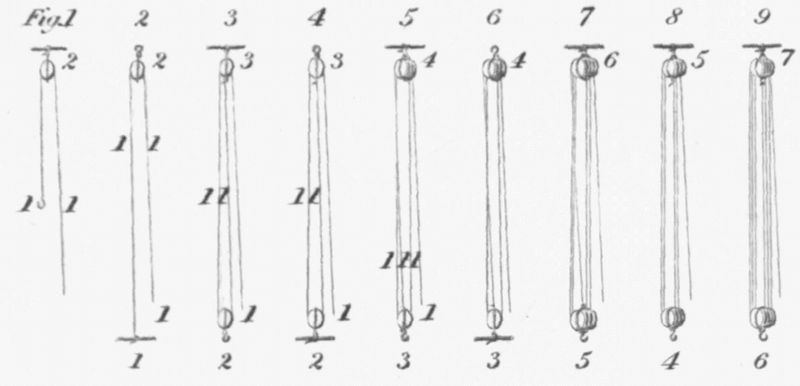
System of Pullies.
Fig. 1 2 3 4 5 6 7 8 9

To carry Guns &c.
Fig. 1 2 3
Heights and distances.
In the system of pulleys (vide plate, Mechanics) the Power is shown at the hooks of the moveable blocks, which are to be applied to the bodies, or weights, requiring to be moved or raised. The strain is also shown at the fixed blocks.
In Fig. 3, there are three parts of the rope engaged in supporting the weight—viz., the parts marked 1, 1, 1. Each of them, hence, sustains one-third of it, and the fall of the rope to which the power is to be attached requires the Power = 1, if weight = 3. The same principle of calculation is applicable to all systems of pulleys having one fixed block, any number of moveable wheels, and a single rope over all the wheels. Hence, in such a system of pulleys, gravity being applied, there will be an equilibrium, when the weight is as many times the power as there are portions of the rope employed in sustaining the weight. For example, in a system consisting of six moveable sheaves, the same rope going over them all, there will be 12 portions of the rope engaged; and to produce an equilibrium the power must be equivalent to 1/12 the weight, no allowance being made for friction.
From the foregoing observations, and by referring to the plate, it will be seen that each tackle has two applications, differing in power one from the other; for example, if the double block of a luff tackle is fixed to a weight to be moved, and the single block to a picket, or other fastening, Fig. 6, then, if one man haul on the fall, the power of four men will be applied to the weight (4 to 1), and the power of three men to the picket; but if the double block be fixed to the picket, Fig. 5, and the single, block to the weight, then the force of only three men will be applied to the weight (3 to 1), and a power of four men to the picket, or fastening.
When the moveable block of one tackle is fixed to the fall of another tackle, their respective powers are to be multiplied into each other for the power of the combination: thus, if one luff tackle is fixed to the fall of another luff tackle (the double blocks of both tackles being moveable), the power will be 4 × 4 = 16 (16 to 1): in this, the men haul through 16 feet to move the weight one foot; therefore if the combination be increased until the men haul through 100 feet to move the weight one foot, then the power would be 100 to 1.
The foregoing powers are, however, only true in theory, and are, therefore, called theoretical powers: for owing to the great friction of the pulleys, the stiffness of the ropes, &c., the actual practical powers are far less; so much so, that with a combination giving a power of 48 to 1, a 24-pr. (2½ tons weight) suspended, can scarcely overhaul the fall, the friction being so very great.
THE INCLINED PLANE.
The inclined plane forms simply a gradual and sloping instead of a sudden and perpendicular ascent, by which heavy bodies may be raised to certain heights. The power necessary for raising a weight depends on the difference between the length of the plane and the height to be ascended. If the height be one-third of the length, then one pound will lift three pounds. The force with which a rolling body descends on an inclined plane is to the force of its absolute gravity, as the height of the plane is to its length.
Parbuckling a gun on skids unites the advantage of one moveable pulley with that of the inclined plane.
Rule.—As the length of the plane is to its height, so is the weight to the power.
Example.—Required the power necessary to raise 540 lb. up an inclined plane, five feet long, and two feet high.
As 5 : 2 :: 540 : 216 lb. Ans.
THE WEDGE.
The wedge may be considered as two equally inclined planes joined together at their bases. It has a great advantage over all the other powers, arising from the force of percussion, or blow, with which the back is struck; which is a force incomparably greater than any dead weight, or pressure, such as is employed in other machines. The largest masses of timber may by this means be riven, and vessels of war, weighing many thousand tons, are lifted from their supports by the power of a few men, exerted by blows of mallets on wedges inserted for that purpose.
The power of the wedge increases in proportion as its angle is acute. In tools intended for cutting wood the angle is commonly about 30°; for iron from 50° to 60°; and for brass from 80° to 90°.
Case 1.—When two bodies are forced from one another, by means of a wedge, in a direction parallel to its back.
Rule.—As the length of the wedge is to half its back, or head, so is the resistance, to the power.
Example.—The breadth of the back, or head of the wedge, being three inches, and the length of either of its inclined sides 10 inches, required the power necessary to separate two substances, with a force of 150 lb.
As 10 : 1½ :: 150 : 22½ lb. Ans.
Case 2.—When only one of the bodies is moveable.
Rule.—As the length of the wedge, is to its back, or head, so is the resistance, to the power.
Example.—The breadth, length, and force, the same as in the last example.
As 10 : 3 :: 150 : 45 lb. Ans.
THE SCREW.
The screw is a spiral thread or groove cut round a cylinder, and everywhere making the same angle with the length of it. The force of a power applied to turn a screw round is to the force with which it presses upward, or downward, setting aside the friction, as the distance between two threads is to the circumference where the power is applied; or the advantage gained is as much as the circumference of a circle described by the handle of the winch exceeds the interval, or distance, between the spirals of the screw. Hence the force of any machine turned by a screw can readily be computed; for instance, in a press driven by a screw, whose threads are each a quarter of an inch asunder, and with a handle, to turn the screw, four feet long; then, if the natural force of a man, by which he can lift, pull, or draw, be 150 lb., and it is required to determine with what force the screw will press when the man turns the handle with his whole force; the diameter of the handle (power) being 4 feet, or 48 inches, its circumference is 48 × 3·1416, or 150⅘ nearly; and the distance of the threads being one-fourth of an inch, therefore the power is to the pressure as 1 to (150⅘ × 4) = 603⅕, but the power is equal to 150 lb., therefore as 1 : 603⅕ :: 150 : 90480, and consequently the pressure is equal to a weight of 90480 lb. independent of friction.
COMPOUND MACHINES.
Though each of the mechanical powers is capable of overcoming the greatest possible resistance in theory, yet in practice, if used singly for producing very great effects, they would frequently be so unwieldy and unmanageable as to render it impossible to apply them. For this reason it is generally found more advantageous to combine them together, by which means the power is more easily applied, and many other advantages are obtained. In all the mechanical powers, and their combinations, and in all machines, simple as well as compound, what is gained in power is lost in time or velocity; and vice versâ, or in other words, the product of the power, and the space through which it moves, is equal to the product of the weight, and the space through which it moves in the same plane. Suppose that a man, by means of a fixed pulley, raises a beam to the top of a house in two minutes, it is clear that he will be able to raise six beams in twelve minutes; but by means of a tackle with three lower pulleys, he will raise the six beams at once with the same ease as he before raised one, but then he will be six times as long about it, that is, twelve minutes; thus the work is performed in the same time whether the mechanical power is used, or not. But the convenience gained by the power is very great; for if the six beams are joined in one, they may be raised by the tackle, though it would be impossible to move them by the unassisted strength of one man. No real gain of force is obtained by mechanical contrivances; on the contrary, from friction and other causes, force is always lost; but by machines a more convenient direction can be given to the moving power, and so modify its energy as to obtain effects which it could not otherwise produce.
FRICTION.
Friction arises from the irregularities of the surfaces which move upon one another. The surfaces of bodies of the same nature are moved with more facility over each other than those of a dissimilar nature. In proportion as the surfaces which are to be moved upon one another are rough, a greater force is requisite to produce motion. The same surfaces when under a greater pressure, are subject to still further friction. A double pressure doubles the amount of friction, a treble pressure trebles, and so on in nearly the same proportion. When surfaces are moving along each other in the direction of their grains, the friction is greater than when the direction of the grains is at right angles. Friction is little influenced by the velocity with which bodies move upon one another. Friction may be diminished in various ways, as will appear by the result of the following experiment with a block of square stone weighing 1080 lb.:—
1. In order to drag this stone along the floor of a quarry roughly chiselled, it required a force equal to lb. 758
2. Over a floor of planks, ditto 652
3. Placed on a platform of wood, and dragged over a floor of planks 606
4. After soaping the two surfaces of wood, which slide over each other 182
5. Placed on rollers of three inches diameter, and moved along the floor of the quarry 34
6. To drag it on these rollers over a wooden floor 28
7. Mounted on a wooden platform, and the same rollers placed between the platform, and a plank floor 22
One of the most remarkable instances of the application of rollers is the transport of the rock which now serves as the pedestal of the equestrian statue of Peter the Great at St. Petersburg. This rock is a single block of granite weighing 1217 tons. A railway was formed, consisting of two lines of timber, furnished with hard metal grooves; similar, and corresponding metal grooves were fixed to the under side of the sledge, or frame, on which the stone was laid, and between these grooves were placed spheres of hard brass, about six inches in diameter. On these spheres the frame with its enormous load was easily moved by sixty men working at capstans with triple purchase blocks.
UNGUENTS.
Mr. G. Rennie found, from a mean of experiments, with different unguents, on axles in motion, and under different pressures, that, with the unguent tallow under a pressure of from 1 to 5 cwt., the friction did not exceed 1 39 th of the whole pressure; when soft soap was applied, it became 1 34 th; and with the softer unguents applied, such as oil, hogs’ lard, &c., the ratio of the friction to the pressure increased; but with the harder unguents, as soft soap, tallow, and anti-attrition composition, the friction considerably diminished; consequently, to render an unguent of proper efficiency, the nature of the unguent must be measured by the pressure, or weight, tending to force the surfaces together.
TRANSVERSE STRENGTH OF MATERIALS.
When a beam, of any material, is loaded, the surface in contact with the load is compressed, and the opposite surface extended; and there is a line between these, which is neither compressed, nor extended, called the neutral line.
If the depth of a beam be doubled, the breadth, and length between supports remaining the same, its strength will be increased four times.
If its breadth be doubled, the other dimensions being as above, its strength will be doubled.
By increasing the distance between the supports of any beam, its strength is decreased in the same ratio; twice the distance between the supports will weaken the beam one-half; half the distance between the supports will enable it to bear twice the load.[48]
The same beam will bear twice the load, if, instead of being concentrated in the middle, it be equally distributed over the whole length of the beam.
If the load on a beam be placed near to one of the supports, instead of in the middle, its effect will decrease in the ratio of its proximity to the support.
Let S s represent the beam, W the load or weight in the middle, w the weight near s; then the load which the beam will carry at the point where w is placed will be found by the following proportion:—
As S w × w s : S W × W s :: W : w.
A beam, fixed at one end, and loaded at the other, will bear half the weight of one of the same length supported at each end.
If the end of a beam, instead of being only supported, be fixed, its strength will be in the proportion of 3 to 2.
From the foregoing results it will be seen that the strength of a rectangular beam varies, as the breadth multiplied by the depth squared, divided by the length, b × d2 1 and if the breaking weight of any material, 1 inch square, and 1 foot long, be found, it will represent a constant multiplier for the above equation.
Thus the breaking weight of a beam of Riga fir, 1 inch square, and 1 foot long (vide following TABLE), is ·164 of a ton; and to find the breaking weight of a beam of any other dimensions, the rule is simply
W = b × d2 1 × ·164.
Example.—What will be the breaking weight of a beam of Riga fir, 8 inches broad, 12 inches deep, and 20 feet long?
8 × 122 20 = 57·6 57·6 × ·164 = 9·44 tons, breaking weight.
Table of constants, for beams of different materials, being the breaking weights of such beams, 1 inch square, and 1 foot long.
Riga fir ·164 of a ton. English oak ·248 of a ton.
Red pine ·199 ” Canadian do. ·261 ”
Pitch pine ·242 ” Dantzic do. ·219 ”
Beech ·231 ” Teak ·366 ”
Elm ·150 ” Cast iron, mean. 1·000 ”
Ash ·301 ” Wrought do. 1·083 ”
From the foregoing rules
Length = b d2 W × constant.
Breadth = 1 W d2 × constant.
Depth = √ 1 W b × constant.
The practical weight that a beam will carry with safety, permanently, should only be taken at one-fourth of the above computations.
ADHESION OF NAILS, AND SCREWS.
The percussive force required to drive the common sixpenny nail (73 to the pound) to the depth of an inch and a half into deal, with a weight of six pounds and a quarter, is four blows, or strokes, falling freely the space of one foot; and the steady pressure to produce the same effect is four hundred pounds. A sixpenny nail driven into dry elm to the depth of one inch across the grain requires a force of 327 pounds to extract it; and the same nail, driven into the same wood endways, or longitudinally, can be extracted with a force of 257 pounds.
To extract a sixpenny nail from a depth of one inch out of dry oak requires 507 pounds, and out of dry beech 667 pounds. A sixpenny nail driven two inches into dry oak would require a steady force of more than half a ton to extract it.
A common screw of one-fifth of an inch diameter has an adhesive force of about three times that of a sixpenny nail.
TRIGONOMETRY.
Plane trigonometry treats of the relations, and calculations of the sides, and angles of plane triangles.
The measure of an angle is an arc of any circle contained between the two lines which form that angle, the angular point being the centre; and it is estimated by the number of degrees contained in that arc. Hence a right angle being measured by a quadrant, or quarter of a circle, is an angle of 90 degrees. The sum of the three angles of every triangle is equal to 180 degrees, or two right angles; therefore, in a right-angled triangle, taking one of the acute angles from 90 degrees, leaves the other acute angle; and the sum of the two angles in any triangle, taken from 180 degrees, leaves the third angle; or one angle being taken from 180 degrees leaves the sum of the other two angles.
Definitions.
The sine of an arc is the line drawn from one extremity of the arc perpendicular to the diameter of the circle which passes through the other extremity.
The supplement of an arc is the difference, in degrees, between the arc, and a semicircle, or 180 degrees.
The complement of an arc is the difference, in degrees, between the arc, and a quadrant, or 90 degrees.
The tangent of an arc is a line touching the circle in one extremity of that arc, continued from thence to meet a line drawn from the centre through the other extremity; which last line is called the secant of the same arc.
The cosine, cotangent, and cosecant of an arc are the sine, tangent, and secant of the complement of that arc, the co being only a contraction of the word complement.
The sine, tangent, or secant of an angle is the sine, tangent, or secant of the arc by which the angle is measured, or of the degrees, &c., in the same arc, or angle. Vide also Definitions, Practical Geometry.
There are two Methods of resolving triangles, or the cases of trigonometry—viz., Construction, and Computation.
1st method.—The triangle is constructed by making the sides from a scale of equal parts, and laying down the angles from the protractor. Then, by measuring the unknown parts by the same scale, the solution will be obtained.
2nd method.—Having stated the terms of the proposition, resolve it like any other proportion, in which a fourth term is to be found from three given terms, by multiplying the second and third terms together, and dividing the product by the first.
Note.—Every triangle has six parts—viz., three sides, and three angles; and, in every case in trigonometry, there must be given three of these parts to find the other three. Also of the three parts that are given, one of them at least must be a side; because, with the same angles, the sides may be greater, or less, in any proportion.
Computation.
Case 1.—When a side and its opposite angle are two of the given parts.
The sides of any triangle having the same proportion to each other, as the sines of their opposite angles; then—
As any one side, is to the sine of its opposite angle; so is any other side, to the sine of its opposite angle.
To find an angle, begin the proportion with a side, opposite to a given angle; and, to find a side, begin with an angle opposite to a given side.
Case 2.—When the three sides of a triangle are given, to find the angles.
Let fall a perpendicular from the greatest angle, on the opposite side, or base, dividing it into two segments; and the whole triangle into two right-angled triangles: then the proportion will be—
As the base or sum of the segments, is to the sum of the other two sides; so is the difference of those sides, to the difference of the segment of the bases: then add half the difference of the segments to the half sum, or the half base, for the greater segment; and subtract the same for the less segment. Hence, in each of the two right-angled triangles, there will be known two sides, and the right angle opposite to one of them, consequently the other angle will be found by the method in Case 1.
USEFUL THEOREMS, AND COROLLARIES.
1. When one line meets another, the angles, which it makes on the same side of the other, are together equal to two right angles.
2. All the angles, which can be made at any point (by any number of lines), on the same side of a right line, are, when taken all together, equal to two right angles: and, as all the angles that can be made, on the other side of the line, are also equal to two right angles; therefore all the angles that can be made quite round a point, by any number of lines, are equal to four right angles. Hence also the whole circumference of a circle, being the sum of all the angles that can be made about the centre, is the measure of four right angles.
3. When two lines intersect each other, the opposite angles are equal.
4. When one side of a triangle is produced, or extended, the outward angle is equal to the sum of the two inward opposite angles.
5. In any triangle, the sum of all the three angles is equal to two right angles (180°). Hence, if one angle of a triangle be a right angle, the sum of the other two angles will be equal to a right angle (90°).
6. In any quadrilateral, the sum of all the four inward angles is equal to four right angles.
7. In any right-angled triangle, the square of the hypothenuse (or side opposite to the right angle) is equal to the sum of the squares of the other two sides. Therefore, to find the hypothenuse, add together the squares of the other two sides, and extract the square root of that sum: and to find one of the other sides, subtract from the square of the hypothenuse the square of the other given side, and extract the square root of the remainder for the side required.
Or hypothenuse = √base2 + perpendicular2
Base = √(hypoth. + perpend.) × (hypoth. - perpend.)
Perpendicular = √(hypoth. + base) × (hypoth. - base.)
TRIGONOMETRY, WITHOUT LOGARITHMS.[49]
“In all the more elaborate, and refined operations of trigonometry, it is not only desirable, but necessary to employ some of the larger logarithmic tables, both to save time, and to ensure the requisite accuracy in the results. But in the more ordinary operations, as in those of common surveying, ascertaining inaccessible heights, and distances, reconnoitring, &c., where it is not very usual to measure a distance nearer than within about its thousandth part, or to ascertain an angle nearer than within two or three minutes, it is quite a useless labour to aim at greater accuracy in a numerical result. Why compute the length of a line to the fourth, or fifth place of decimals, when it must depend upon another line, whose accuracy cannot be ensured beyond the unit’s place? Or, why compute an angle to seconds, when the instrument employed does not ensure the angles in the data beyond the nearest minute? In the following Table are brought together the natural sines, and cosines, to every degree in the quadrant, and this table will be found sufficiently extensive, and correct for the various practical purposes above alluded to. The requisite proportions must, it is true, be worked by multiplication, and division, instead of by logarithms. Yet this by no means involves such a disadvantage as might seem, at first sight. For when the measured lines are expressed by three, or at most, four figures, the multiplications, and divisions are performed nearly as quick, and in some cases quicker, than by logarithms. Then as to accuracy, even in cases where the computer will have to take proportional parts for the minutes of a degree, the result may usually, if not always, be relied upon to within about a minute.”
TRIGONOMETRIC RATIOS.
Natural sines, and cosines to every degree in the quadrant, radius being 1·000000.
Deg. Sines. Cosines. Deg. Sines. Cosines.
0 ·00000 1·00000 90
1 ·01745 ·99985 89 26 ·43837 ·89879 64
2 ·03490 ·99939 88 27 ·45399 ·89101 63
3 ·05234 ·99863 87 28 ·46947 ·88295 62
4 ·06976 ·99756 86 29 ·48481 ·87462 61
5 ·08716 ·99619 85 30 ·50000 ·86603 60
6 ·10453 ·99452 84 31 ·51504 ·85717 59
7 ·12187 ·99255 83 32 ·52992 ·84805 58
8 ·13917 ·99027 82 33 ·54464 ·83867 57
9 ·15643 ·98769 81 34 ·55919 ·82904 56
10 ·17365 ·98481 80 35 ·57358 ·81915 55
11 ·19081 ·98163 79 36 ·58778 ·80902 54
12 ·20791 ·97815 78 37 ·60181 ·79863 53
13 ·22495 ·97437 77 38 ·61566 ·78801 52
14 ·24192 ·97030 76 39 ·62932 ·77715 51
15 ·25882 ·96593 75 40 ·64279 ·76604 50
16 ·27564 ·96126 74 41 ·65606 ·75471 49
17 ·29237 ·95630 73 42 ·66913 ·74314 48
18 ·30902 ·95106 72 43 ·68200 ·73135 47
19 ·32557 ·94552 71 44 ·69466 ·71934 46
20 ·34202 ·93969 70 45 ·70711 ·70711 45
21 ·35837 ·93358 69
22 ·37461 ·92718 68
23 ·39073 ·92050 67
24 ·40674 ·91355 66
25 ·42262 ·90631 65
Cosines. Sines. Deg. Cosines. Sines. Deg.
“The preceding table is so arranged that for angles not exceeding 45 degrees, the sine, and cosine for any number of degrees will be found opposite to the proposed number in the left hand column, and in the column under the appropriate word. When the number of degrees in the arc, or angle, exceeds 45 degrees, that number must be found in the right hand column, and opposite to it in the column indicated by the appropriate word at the bottom of the table. Thus, the sine, and cosine of 36 degrees are ·58778 and ·80902 respectively, the radius of the table being unity, or 1. The taking of proportional parts for minutes can only be done correctly in those parts of the table where the differences between the successive sines, &c., run pretty uniformly. Suppose we want the natural sine of 20° 16′. The sine of 21 degrees is ·35837, that of 20 degrees is ·34202; their difference is ·1635. This divided by 60 gives 27·25 for the proportional part due to 1 minute, and that again multiplied by 16 gives 436 for the proportional part for 16 minutes. Hence the sum of ·34202 and 436, or ·34638, is very nearly the sine of 20° 16′. But the operation may often be contracted by recollecting that 10 minutes are ⅙, 15 minutes are ¼, 40 minutes are ⅔ of a degree, and so on. Observe, also, that for cosines the results of the operations for proportional parts are to be deducted from the value of the required trigonometrical quantity in the preceding degree.”
APPLICATION OF TRIGONOMETRY, WITHOUT LOGARITHMS, to the determination of Heights, and Distances.
Example 1.—Having measured a distance of 200 feet in a direct horizontal line from the bottom of a steeple, the angle of elevation of its top, taken at that distance, was found to be 47° 30′, from hence it is required to find the height of the steeple?
By deducting 47° 30′ from 90°, the angle opposite the given side will be found (42° 30′).
Then by Case 1. Trigonometry:—
As sine ∠ 42° 30′ : 200 :: sine ∠ 47° 30′:
Or ·67556 : 200 :: ·73723 : 208·2, &c., height required.
By construction—
The triangle is constructed by making the side from a scale of equal parts, and laying down the angles from the protractor. Then by measuring the unknown parts by the same scale, the solution will be obtained.
Example 2.—Being on the side of a river, and requiring the distance to a house on the other side, 200 yards were measured in a straight line by the side of the river, and at each end of this base line the angles with the house were 68° 2′, and 73° 15′—required the distance from each end of the base line to the house?
The sum of the given angles (68° 2′ + 73° 15′) subtracted from 180° will give the third angle (38° 43′).
Then by Case 1. Trigonometry:—
As sine ∠ 38° 43′ : 200 :: sine ∠ 68° 2′
·62544 : 200 :: ·92739 : 296·5 first distance required.
As sine ∠ 38° 43′ : 200 :: sine ∠ 73° 15′
·62544 : 200 :: ·95753 : 306·1 second distance required.
Similarly to the preceding examples, HEIGHTS, AND DISTANCES may be rapidly (and for military purposes, sufficiently accurately) computed in the field, by means of the foregoing trigonometrical table, if proper attention is paid to the principles by which the unknown angles of triangles may be ascertained: a base line, and requisite angle, or angles, having been given.
It will, however, be necessary to use advantageously the methods in Cases 1, 2 (vide Trigonometry), and also the properties in the subsequent theorems, and corollaries.[50]
Table,
Showing the reduction in feet, and decimals upon 100 feet, for the following angles of elevation, and depression.
Angle. Reduction. Angle. Reduction. Angle. Reduction.
° ′ ° ′ ° ′
3 0 ·14 9 0 1·22 15 0 3·40
9 30 1·38 15 30 3·64
4 0 ·25 10 0 1·52 16 0 3·88
10 30 1·68 16 30 4·12
5 0 ·38 11 0 1·84 17 0 4·37
11 30 2·01 17 30 4·63
6 0 ·55 12 0 2·19 18 0 4·90
6 30 ·65 12 30 2·37 18 30 5·17
7 0 ·76 13 0 2·56 19 0 5·44
7 30 ·86 13 30 2·77 19 30 5·74
8 0 .98 14 0 2·97 20 0 6·08
8 30 1·10 14 30 3·18 20 30 6·33
The reduction for 100 feet (from the above table) multiplied by the number of times 100 feet measured, will give the quantity to be subtracted from the measured length of an inclination, to reduce it to a horizontal position.
Table,
showing the rate of inclination of inclined planes, for the following angles of elevation.
Angle. One in Angle. One in Angle. One in
° ′ ° ′ ° ′
0 15 228 3 30 17 7 0 8
0 30 114 3 45 16 7 30 7¼
0 45 76 4 0 15 8 0 7
1 0 56 4 15 14 9 0 6½
1 15 46 4 30 13 10 0 6
1 30 38 4 45 12 11 0 5¾
1 45 32 5 0 11½ 12 0 5½
2 0 28 5 15 11 13 0 5
2 15 26 5 30 10½ 14 0 4½
2 30 23 5 45 10 15 0 4
2 45 21 6 0 9½ 16 0 3¾
3 0 19 6 30 9 17 0 3½
3 15 18 6 45 8½ 18 0 3¼
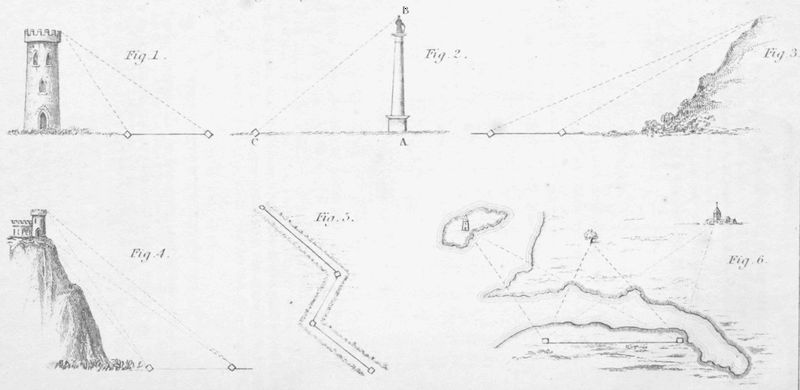
Surveying, and Reconnoitring.
J. W. Lowry, sc.
Fig. 1.
Fig. 2.
Fig. 3.
Fig. 4.
Fig. 5.
Fig. 6.
SURVEYING, AND RECONNOITRING.
HEIGHTS, AND DISTANCES.
The accurate determination of heights, and distances of objects being required in various military operations, especially for the position of batteries, the following methods for their attainment will be found useful when the requisite instruments are at hand; by frequent practice, the eye should, however, be enabled to determine, nearly, either the height of, or distance from any object.
HEIGHTS.
1.—BY MEANS OF A “POCKET SEXTANT,”
to ascertain the height of an object.
When the sextant is used for taking the height of objects, it is to be held vertically, and the quicksilvered part of the horizon glass will be on the left hand of the observer, or on the left part of the transparent glass. Altitudes are measured in the same manner as horizontal angles, for if we conceive the horizontal triangle A B C (vide Plate 2, Fig. 2), to be raised on its base A C with the angle C next to the observer, then the perpendicular A B becomes the height of the object B; and supposing the object to stand on a horizontal plane, then the ground and the object form the right angle at A; therefore, if the object is accessible, the sextant need only be set at any of the angles mentioned for distances (vide Art. Distances), and walking backward on the line A C until the top of the object is brought down to the height of the observer’s eye from the ground, then the distance from where the observer stands to the object will be in the same proportion to its height as the base was to the distance. Then add the height of the eye from the ground, and the height of the object will be ascertained. If the object is not accessible, the angle must be taken, and calculated by trigonometry.
2.—BY MEANS OF A PORTABLE BAROMETER, AND THERMOMETER,
to ascertain the height of an object.
Observe the altitude (B) of the mercurial column in inches, tenths, and hundredths, at the bottom of the hill, or other object, the height of which is required.
Observe, also, the altitude (b) of the mercurial column at the top of the object. Observe the temperature on Fahrenheit’s thermometer at the times of the two barometrical observations, and take the mean between them. Then 55000 × B - b B × b = the height of the hill in feet, for the temperature of 55 degrees on Fahrenheit. Add 1 440 of this result for every degree which the mean temperature exceeds 55 degrees, and subtract as much for every degree below 55 degrees. This will be a good approximation when the height of the hill is below 2000 feet.