Front matter
Reading edition
Falcons and Goshawk Weathering.
THE ART AND PRACTICE OF HAWKING
BY
E. B. MICHELL
WITH THREE PHOTOGRAVURES BY G. E. LODGE AND OTHER ILLUSTRATIONS
METHUEN & CO. 36 ESSEX STREET, W. C. LONDON 1900
TO THE
EARL AND COUNTESS OF WARWICK
AND ALL OTHER LOVERS OF HAWKING THIS BOOK IS DEDICATED BY THE AUTHOR
PREFACE
Notwithstanding the large number of books, both ancient and modern, which have been written on the art of Hawking, it cannot be said that the English-speaking people generally have more than a very vague idea of the character of the sport, or the mode in which it was, and still is, conducted.
Yet, in an experience of Hawking which extends over more than thirty years, the author has found that a great and increasing curiosity, and even a real interest in the subject, prevails, especially amongst sporting men, who are in many notable instances beginning to believe that hawks and their owners have been unduly disparaged, and that there is more to be said in their favour than has for the last two centuries been imagined.
There has not been space in this volume to discuss the much-vexed question how far the use of hawks is compatible with the preservation of game. But it may be said here, without any reservation, that wherever experiments have been actually tried, Hawking has been found not to spoil but to improve the shooting.
The object of the author has been to describe as briefly as was consistent with clearness the birds now chiefly used in the chase, and the manner of training and flying them. His hope is that some of the sportsmen who read these pages may, in spite of the difficulties which they will have to encounter, resolve to give this old and honourable sport a trial.
The use of technical terms has been avoided as far as possible; and those which could not be excluded have been explained in the text. When the reader is puzzled by any word, a reference to the Index will direct him to the page where the meaning of it is given.
CONTENTS
CHAPTER I
History and Literature
PAGES
Antiquity of hawking in China—Introduction into Europe—Royal and Imperial falconers—Decline of the sport—Survival and revivals—Modern falconers—Early writers—Leading authorities—Modern books 1-8
CHAPTER II
The Birds Used in Hawking
Three classes—Long-winged hawks: Ger-peregrine, and kindred varieties, shaheens, barbary, saker, lanner, and desert falcons, hobby, merlin, and kestrel—Short-winged hawks: goshawks and sparrow-hawks—Eagles, golden, Bonelli’s, etc., falconets 9-39
CHAPTER III
Furniture and Fittings
Jesses—Bells—Swivels—Leashes—The screen-perch—Blocks— Bow-perches—Hoods—Brails—The bath—The lure—Cadges— Gloves—Mews 40-54
CHAPTER IV
Eyesses and Hack Hawks
Taking from the eyrie—Feeding—Turning out to hack—The board system—Hacking to the lure, and to the hand—Learning to fly—Dangers and diversions of hack—Taking up—The bow-net 55-69
CHAPTER V
Passage Hawks
Valk enswaard—Hawk-catcher’s hut—The shrike sentinel— Handling the wild-caught hawk—The sock—The dark cell—Prison fare—Early discipline—Waking—Hooding—Carrying—Manning— Pegging out 70-86
CHAPTER VI
Training and Entering
Reclamation of wild-caught and hack hawks—Making to the lure— Calling off—The first quarry—Innocent deceptions—Making in— Waiting on—Stooping to the lure—Exercise 87-100
CHAPTER VII
Rook-Hawking
Good and bad country—Entering to rooks—Throwing off— Ringing flights—Shifting—Throwing up—Putting in—Riding to hawks 101-114
CHAPTER VIII
Game-Hawking
Eyesses and passagers—Teaching to mount and to wait on— Entering—Raking away—The pitch—The stoop—Pointers— Speed and cunning of grouse—Partridges, black-game—Some good bags 115-129
CHAPTER IX
Lark-Hawking
The hobby, ancient and modern—Daring larks—The merlin— Difficulties of training and flying—Making in—Fishing-rod trick—Good and bad larks—High flights—Double flights— Winter larks 130-141
CHAPTER X
Gulls, Heron, Kite, Duck, etc.
Double flights at gulls—The Loo Club—Kite-hawking—Wild ducks, magpies, plovers, woodcock, snipe, and other quarry 142-149
CHAPTER XI
The Goshawk
Hawks of the fist—Training—Rewards for good conduct—Yarak— Pheasants, partridges, rabbits, and hares—The goshawk in covert—Variety of quarry—Some good bags—A famous goshawk 150-159
CHAPTER XII
The Sparrow-Hawk
Vices and merits—A fine hawk for the bush—Partridge-hawking— Blackbirds, quail, and other quarry—How to manage a sparrow-hawk—A modern record 160-169
CHAPTER XIII
Home Life
The falconer’s establishment—Good and bad falconers— Hawk-houses—The falconer’s day—Bathing—Weathering— Exercise—Diet—Castings—Tirings—Rangle—Bedtime 170-191
CHAPTER XIV
Hawks in the Field
Hooding up—Accoutrements—Field tactics—Markers—Mounted men—Successful and unsuccessful flights—Putting in—Picking up—Consolation quarry—Disobedient hawks—A good quarry-book 192-212
CHAPTER XV
Lost Hawks
Carelessness and imprudence—A kill out of sight—A night out—Search and recapture—Chance witnesses—Decoy hawks— Winding up—Snaring—A fresh start 213-224
CHAPTER XVI
Accidents and Maladies
Broken feathers—Imping—Broken bones—Diagnosis—Croaks, cramp, ague, apoplexy, frounce, inflammation, and fever— Corns, broken talons, blain, craye, and other maladies 225-243
CHAPTER XVII
Moulting
Early and late moulting—Flying through the moult—Throwing into the mews—Diet and management—Bad moulters—Intermewed hawks—Physic and treatment 244-254
CHAPTER XVIII
Virtue and Vice
Good and bad hawks—Temper, shape, size, and colour—Style of flying—Carrying—Soaring—Raking away—Checking— Perching—Hood-shyness—Screaming—Refusing—Running cunning—Seven deadly sins—Four cardinal virtues 255-274
CHAPTER XIX
Anecdotes and Adventures
Lessons from the quarry-book—The old authors—Modern experiences—Peregrine and pigeon—A miraculous rabbit— Queer hiding-places—Wild v. tame hawks—Merlin-hawking with peregrines 275-284
LIST OF ILLUSTRATIONS
PHOTOGRAVURES
PAGES
Falcons and Goshawk Weathering Frontispiece
Death of the Rook 110
Sparrow-Hawk and Partridge 168
(From Drawings by G. E. Lodge)
OTHER ILLUSTRATIONS
Shape of Wings 11
(From a Drawing by Mrs. Sachs)
Trained Kestrel "Thunderbolt," owned by Mr. R. Gardner 30
(From a Photo by C. Reid, Wishaw, N.B.)
Hawk’s Furniture 40
(From a Drawing by the Author)
Blocks and Perches 46
(From a Drawing by the Author)
Hawk’s Furniture 48
(From a Drawing by the Author)
Cadge with Peregrines 52
(From a Photo by C. Reid, Wishaw, N.B.)
Falcon and Tiercel Weathering 86
(From a Photo by C. Reid, Wishaw, N.B.)
Pluming the Dead Grouse 127
(From a Photo by C. Reid, Wishaw, N.B.)
Trained Merlin 132
(From a Drawing by Mrs. Sachs)
Trained Goshawk, "Gaiety Gal," owned by Mr. A. Newall 159
(From a Photo by Herbert Bell, Ambleside)
THE ART AND PRACTICE OF HAWKING
CHAPTER I
History and Literature
IT would be easy to fill a large volume with dissertations on the antiquity of the art which is now called Falconry, and with records of its history in different countries during the many centuries that have elapsed since it was first practised. In a treatise on practical hawking, such as the present, there is no room for such matter; and the omission will be the more readily excused when it is explained that only a short time ago the antiquities of the art, and the literature in which its records are embodied, were most carefully and ably explored by Mr. J. E. Harting, the erudite Secretary of the Linnean Society, whose catalogue of books on hawking contains a reference to every known publication on the subject (Bibliotheca Accipitraria, London, 1891). The actual origin of hawking, as of other old sports, is naturally hidden in the obscurity of the far-away past. No one would suppose that it was practised as early in the world’s history as the sister sports of hunting and fishing. But Mr. Harting’s researches have resulted in convincing him that it was known at least as early as 400 B.C., although its introduction into Europe must clearly be placed at a much later date. It is remarkable enough that the Greeks, whose country abounds in wild hawks, should have known nothing of their use in the service of man. Homer, indeed, speaks of the mountain falcon as “the most nimble of birds,” (Il. xxii. 139); but Sophocles, in alluding to the triumphs of man in taming and using wild creatures, omits all mention of the training of hawks, which is certainly more worthy of notice than mere bird-catching or the breaking-in of oxen (Soph. Antig. 343). Even the later Roman authors refer to the use of trained hawks as an unfamiliar practice, in vogue only amongst some of the barbarian tribes.
Until at least some centuries after the Christian era, China and other countries in the Far East seem to have been the chief if not the only homes of falconry. But the Lombards, when they settled in North Italy, in the latter half of the sixth century, were acquainted with the art; and before the end of the ninth century it was familiar to the Saxons in England and throughout the West of Europe. Henry the Fowler, who became Emperor in 919, seems to have been so nicknamed on account of his devotion to this form of sport, which was already a favourite with princes and magnates. The Saxon King Ethelbert wrote to the Archbishop of Mayence for hawks able to take cranes. King Harold habitually carried a trained hawk on his fist; and from the time of the Norman Conquest hawking was a sport as highly honoured in the civilised world as hunting. The greatest impulse that was ever given to the sport in Western Europe was derived from the returning Crusaders, many of whom, in the course of their travels to the East, had become acquainted with the Oriental falconers and the Asiatic modes of training and flying hawks. Conspicuous amongst such Crusaders was the Emperor Frederick II., who brought back with him some Asiatic hawks and their trainers, and who not only was himself an enthusiastic and accomplished falconer, but even declared that falconry was the noblest of all arts. From that time—early in the thirteenth century—for more than four hundred years falconry flourished in Europe, as well as in the East, as a fashionable sport amongst almost all classes. As in the case of hunting and fishing, its attractions as a sport were supplemented by the very material merits it possessed as a means of procuring food. While the prince and the baron valued their falcon-gentle for its high pitch and lordly stoop, the yeoman and the burgher set almost equal store on the less aristocratic goshawk and the plebeian sparrow-hawk as purveyors of wholesome delicacies for the table. Even the serf or villein was not forgotten in the field, and was expected, or at least allowed, to train and carry on his fist the humble but well-bred and graceful kestrel.
During this long period the example of Henry the Fowler was followed freely by many of the most celebrated and powerful rulers in European countries. Hardly a prominent personage amongst the great conquerors and lawgivers in mediæval times was unacquainted with the art. Most of them were as enthusiastic in their devotion to it as they were to the more serious objects of their ambition. It would be wearisome to recount the long list of royal falconers; and it will suffice to merely mention a few of the most notable examples. Thus Edward III. was accompanied on his warlike expedition with a whole train of falconers. His father had been indulged in his imprisonment with liberty to go hawking. Shakespeare has familiarised his readers with the hawking parties of Henry VI. and his Queen (2 Hen. VI. ii. I); and few people have failed to read the story of the broken leaping-pole which precipitated Henry VIII. into a ditch as he was following a hawk. Louis XI. and a host of French kings, including Francis I., were ardent falconers, as were many of the kings of Castile and Arragon, Sardinia, and Hungary. Henry of Navarre was excelled by few men in his passion for this sport. James IV. of Scotland gave a jewelled hood to one of the Flemings, because the latter had won a match in which his hawk flew against the King’s. And James I. of England enjoyed nothing more keenly than a day’s hawking, declaring that if a man had only patience and good-temper enough to contend with the disappointments inseparable from it, the sport would be preferable to hunting. Catherine II. of Russia was as great at falconry as at most other things, and specially delighted in the flight with merlins. Ecclesiastics, both great and small, were not a whit behind the laity in their devotion to the sport of the air. It was thought no scorn for a holy-water clerk to carry a “musket” or male sparrow-hawk. Not only did Cardinal Beaufort fly his falcons with those of the great Duke of Gloucester, but no less a potentate than Pope Leo X. was constantly in the field at Ravenna, and even incurs the blame of the great D’Arcussia for being in the habit of too soundly rating his comrades during a flight. The hawking establishments of all the earlier Bourbons were kept up in more than royal style, and were supplied annually with rare falcons from many parts of the world.
It was the invention of shot-guns that struck the first and most deadly blow at the popularity of hawking. It was soon discovered that wild-fowl, rabbits, and most kinds of game could be captured much more easily and cheaply by the aid of “vile saltpetre” than by the laborious and costly processes involved in the reclaiming and moulting and conditioning of hawks. Economy, as well as novelty, pleaded in favour of the new sport of shooting. At the same time, the common use of fowling-pieces added a fresh and formidable danger for the owners of hawks, already exposed to a thousand unfair risks of losing their favourites. In the unsettled state to which Europe was reduced by the innumerable wars consequent on the Reformation, it was impossible for falconers to identify or punish those who recklessly or deliberately slaughtered a neighbour’s lost hawks; and although the offenders were still liable to serve penalties, they could snap their fingers at the protective laws. Finally, the more rapid subdivision of the land, and its enclosure with fences for agricultural purposes, spoilt, for the falconer’s purposes, large tracts of country which had formerly been the most suitable, and was especially hurtful to the flying of the long-winged hawks, for which an expanse of open ground is indispensable. On the Continent these various causes operated surely but slowly to displace falconry in the public estimation. But in England a special circumstance almost ruined it at one blow. The outbreak of the Great Civil War interrupted rudely all peaceful sports, and its disasters destroyed a vast number of those who were the best patrons of hawking. From the blow then struck English falconry never rallied in any general sense. Certainly it did revive, or rather survive, to a certain extent. It would be wrong to suppose that the sport has ever been extinct in the British Isles, as so many writers are fond of reiterating. But its devotees have kept it up without any of the pomp and show which once distinguished it, carrying on in comparative privacy, and in the retirement of rather remote spots, an amusement in which the difficulties always besetting the sport were aggravated by a thousand new dangers and annoyances.
The annals of falconry, since it was deposed from its fashionable place—in England by the Great Rebellion, and afterwards in France by the Revolution—are obscure, and for the most part buried in oblivion. Here and there the name of a notable falconer, professional or amateur, emerges from the mist, showing us that the sport was still carried on with vigour by a few. In the middle of the eighteenth century Lord Orford flew kites in the eastern counties, and this sport, as well as rook-hawking and heron-hawking, was successively carried on by the Falconers' Society, the Falconers’ Club, and the High Ash Club, which latter existed from about 1792 to later than 1830, and included amongst its members Lord Berners, Colonel Thornton, and other sporting celebrities. In Scotland falconry has always been kept up. The life of John Anderson covers the whole of the last half of the eighteenth century, as well as more than a quarter of the nineteenth. This accomplished trainer of hawks was for the first twenty years or so of the present century in charge of the Renfrewshire establishment kept by Fleming of Barochan, and flown chiefly at partridges and woodcocks. During the early years of the same century, until 1814, Colonel Thornton did a great deal of hawking on his own account, at first in Yorkshire, and afterwards at Spy Park, in Wiltshire. From 1823 to 1833 Mr. John Sinclair flew woodcocks with success in Ireland. In 1840 Lord O’Neill and Colonel Bonham took a moor in Ross-shire for hawking; and in the following year the Loo Club was started for heron-hawking in Holland, under the auspices of Mr. E. Clough Newcome. This influential club continued to flourish till 1853. Its place was taken, not many years after, by the Old Hawking Club, which, although it has never undertaken the flight at herons, continues to carry on an annual campaign against rooks and game with great credit and success. In France a hawking club was started in 1865, under the title of the Champagne Club, but was not long-lived; and several minor attempts at organising new clubs have been made in England during the last thirty years. There are at the present moment at least thirty private establishments in England alone where trained hawks are kept and flown, besides several in Scotland and Ireland. The names of several of the leading amateurs now living will be mentioned in this and following chapters.
Of professional falconers, the supply has sadly dwindled away since the time when the office of Grand Falconer was something more than the hereditary title of the Dukes of St. Albans. It was not, however, until quite recent years that the supply became quite unequal to the demand. At the death of John Anderson in 1832 there were able successors to keep alive the best traditions of the old Scotch school. Foremost among them was Peter Ballantine, of whom, as well as of Mr. Newcome, excellent likenesses are published in Mr. Harting’s fine work, Bibliotheca Accipitraria. This accomplished trainer survived until 1884. Nearly contemporary with him were the brothers Barr, whose names are frequently mentioned in these pages. While these and others upheld the sport in Scotland, England, Ireland, and France—for John Barr acted as the falconer of the Champagne Club—John Pells in Norfolk, once falconer to the Duke of Leeds, attained to great efficiency and repute; and the names of Bots and Möllen became celebrated in Holland as the successful hawk-catchers and servants of the Loo Club. Later still, John Frost acted for eighteen years as the energetic and skilful falconer of the Old Hawking Club. He was succeeded by George Oxer, who, with the Retfords (James and William) and the sons of John Frost, is still living. There are at the present moment several very young falconers who bid fair to attain distinction, though their training is derived mostly from lessons imparted to them by the amateurs who have brought them out. It is to be hoped that, now the facilities for travelling are so immensely increased, some modern imitator of Frederick II. will bring back from India a native falconer or two, whose experience in the tropics would be invaluable, and thus infuse new life into the professional world of Europe.
Of amateurs there has been for some years past no lack in England; and want of space alone prevents the enumeration of the distinguished falconers who still keep up in the British islands and dependencies the best traditions of their art. Amongst these it would be unfair to pass over the most conspicuous names, such as those of the late Lord Lilford and Captain Salvin and Mr. William Brodrick, the first named as justly famous for his acquaintance with hawks as for his knowledge of ornithology. Captain Salvin first familiarised the modern English people with the training of cormorants, and with the flight with peregrines at rooks. Mr. Brodrick illustrated with his own admirable coloured figures the handsome and useful book on falconry which he published jointly with Captain Salvin. Another joint-author with the latter was the Rev. Gage Earle Freeman, who for many years most successfully flew, in a far from perfect country, peregrines at grouse, merlins at larks, goshawks and sparrow-hawks at various quarry. The small book which owes its authorship to these two masters of the art has long been out of print. It is impossible to praise it too highly as a handbook for beginners. Of living falconers, no one can be compared in experience and general knowledge with Major Hawkins Fisher, of the Castle, Stroud, whose game-hawks have for more than fourteen years annually killed good bags of grouse at Riddlehamhope, in Northumberland, and whose favourite peregrines, such as “Lady Jane,” "Lundy," and “Band of Hope,” have been a terror to partridges in Wilts and Gloucestershire. Mr. St. Quintin, of Scampston Hall, Yorkshire, probably the most successful game-hawker of whom we have any record, has recently brought to a high degree of perfection the flight with peregrines at gulls. The fine sport shown at rooks every year in Wiltshire by the Old Hawking Club, is due chiefly to the ability and energy of their secretary, the Hon. Gerald Lascelles. In flights with short-winged hawk of both descriptions, Mr. John Riley, of Putley Court, Herefordshire, is facile princeps. The late Rev. W. Willemot did some good work with falcons at gulls before this branch of the sport was taken up by Mr. St. Quintin; and the late Mr. T. J. Mann, of Hyde Hall, Sawbridgeworth, was successful with rooks and partridges in Cambridgeshire. Probably the most splendid establishment of hawks in England during the last forty years was that of the late Maharajah Dhuleep Singh at Elvedon. Falconry in India has been extensively practised by many English officers quartered in that part of the world, and notably by General Griffiths, and more lately by Captain S. Biddulph, who has probably killed a greater variety of wild quarry than any European now living, and whose portraits of trained hawks are above all praise. Colonel Delmé Radcliffe, Colonel Brooksbank, Colonel Watson, Captain Crabbe, the late Sir Henry Boynton, Mr. A. W. Reed, Major Anne, and Mr. Arthur Newall, are all enthusiastic and successful falconers. Colonel Ayshford Sanford, Major C. W. Thompson, of the 7th Dragoon Guards, and the writer of these pages, have had considerable success with merlins.
In France, the names of MM. Barachin, Sourbets, Arbel, and Belvallette for the short-winged hawks, and MM. Pichot and Paul Gervais for other kinds, require honourable notice; and in Russia that of the late M. Constantine Haller will always be remembered. It is not many years since the latter originated and carried into effect the scheme of an International Hawking Congress, to be held near St. Petersburg. This was attended by many Asiatic falconers, and one from England. But the impossibility of finding suitable wild quarry in accessible places sadly interfered with the success of the meeting; and the result was not proportionate to the great trouble of organising it.
It will naturally be supposed that a sport so fashionable, so prevalent, and so difficult as falconry, has been discussed at length in many writings and in many languages. For the very extensive literature treating of its art and practice in different parts of the world, the reader is referred to Mr. Harting’s Bibliotheca Accipitraria, already mentioned, in which a full account is given of no less than three hundred and seventy-eight works on the subject. Of these, eighty-two are in English, and eighty-four in French. The German publications number forty-six, the Italian thirty-eight, the Japanese fourteen, and there are several in Spanish, Russian, Latin, Greek, and Chinese.
The most notable works, besides those already mentioned, are the Latin treatise written by the Emperor Frederick II.; The Boke of St. Albans, by Dame Juliana Berners, 1486; the volumes published by Turbervile in 1575, by Latham in 1615, and by Bert on the short-winged hawks in 1635. Still more interesting are the books written in French by Charles d’Arcussia, which date from 1598 to 1627. The nineteenth century has produced several important works, including the small treatise by Sir John Sebright, 1826, and the splendid illustrated volume by Schlegel and Wulverhorst, 1853. The Badminton Library contains half a volume on Falconry from the very able pen of Mr. Gerald Lascelles; and the Encyclopædia Britannica has an article on the subject by Colonel Delmé Radcliffe.
To look for any real revival of falconry in Europe would be altogether quixotic. Lucky indeed may the falconer of the future consider himself if the art even survives. Already the goshawk, the ger, and the golden eagle are almost extinct in England; sparrow-hawks have become so rare that constant advertisements offering to buy one remain without response; the harmless hobby and innocuous merlin are ferociously persecuted, and have been exterminated in most of their favourite haunts. A lost hawk has become almost a synonym for a murdered hawk. Owners are beset with enemies on every hand, besides being plagued and pestered by ignorant and impertinent intruders, if ever they venture with their hawks into a public place. The country becomes more and more unsuitable for hawking purposes. Upon many of the most open spaces bricks and mortar intrude; upon other parts the vexatious small plantations designed as shelters for game. Even when a suitable grouse-moor or partridge-ground is found in want of a tenant, obstacles may be raised. A baseless but deep-rooted prejudice deters many lessors from allowing trained hawks to be flown over their land, on the absurd plea that it will spoil it for subsequent tenants. In short, the impediments with which the modern falconer has to contend are too many and too great for any but a few very determined sportsmen. These, when they have once mastered the initial difficulties, usually persist in preferring the sport to any other. “Once a falconer, always a falconer,” is a maxim of universal truth. And the fraternal spirit which animates most English falconers—and, for that matter, most falconers throughout the world—is not the least agreeable feature presented by this ancient and honourable field sport.
CHAPTER II
The Birds used in Hawking
Of the numerous birds of prey which are found in various parts of the globe, a good many have been employed in the service of man as agents in the pursuit of other birds and of four-footed animals, partly for purposes of supplying him with food, and partly for sport. It is more than probable that others might be similarly trained and flown, especially some of the American and Australian hawks, which seem suitable for the purpose, but which have never yet, as far as we know, been thus taken in hand. It is not, however, proposed to describe at length any members of the large family of Raptores, except such as are known to have been used in hawking; and with regard to those which have been flown only in remote parts of the world, considerations of space necessitate a very brief reference.
It has usually been said that the list of birds used in hawking includes only two main divisions—the long-winged hawks, as falconers call them, known to naturalists under the name of “falcons”; and the short-winged hawks, to which the men of science apply specially the name of hawks. This ornithological classification of falcons on the one hand and hawks on the other, is not a very happy one; for in the general public estimation, as well as in falconers’ phraseology, every falcon is a hawk, although every hawk may not be properly called a falcon. The one term is of classic, and the other of Teutonic origin; and it was too late, when books about birds first began to be written scientifically, to attempt to establish a hard-and-fast difference between words which had already passed current for centuries as meaning pretty much the same thing. Moreover, hawking, which, if the naturalists’ view of the matter were accepted, ought to be concerned, like the French autourserie, with the short-winged hawks only, has long been considered in England a mere synonym for falconry, which also, if interpreted strictly according to the ornithological theory, ought to be regarded as dealing with the long-winged species.
The two-fold division, however, no matter whether it is into falcons and hawks, or into short-winged and long-winged hawks, seems to be insufficient and unsatisfactory. For eagles, which have been, and still are, extensively used in a sport for which the only English names are hawking and falconry, remain unincluded in the two usually accepted classes. No eagle can properly be called either a hawk or a falcon; and in order to find a place for them amongst the birds trained and flown at quarry, it seems necessary to institute a third class. What order of precedence should be taken by such new class is a matter of small consequence. In symmetry of shape, in its mode of flying, its character, and its tastes, the eagle is as inferior to the true hawk as the latter has always been deemed to be to the true falcon; and in this work, as in others on falconry, the first place has been retained for the long-winged hawks, and the second for the short-winged, leaving a third place for what little it seems necessary to say about such eagles as we know to have been flown at game.
The long-winged hawk is known by the following characteristics:—The second primary feather in the wing, reckoning from the outside, is the longest, or at least equal in length to any other, as in the merlin, which has the second and third feathers very nearly or quite of the same length. The upper mandible has on each of its sides, about a third part of the distance from the point to the cere, a projection somewhat resembling a very blunt tooth. The eye is dark brown. The wing is long enough in the outer joint to come down, when closed, considerably more than half-way between the end of the tail coverts and the end of the tail itself, and in some cases, as in the hobby, as far as the tail, or even farther.
In the short-winged hawks the wing is comparatively short in the outer joint, and, when expanded, presents a rounded appearance at the end, the fourth primary being the longest, and the first very short. That emargination, or narrowing in, of the feather near its end, which is observable in the first two primaries of the long-winged hawk, is still more pronounced in the short-winged, and is conspicuous in the third and fourth primaries also. The tail is long, and large when expanded. The iris is of some shade of yellow, light or dark. The upper mandible curves in a smooth line, without any projecting tooth.
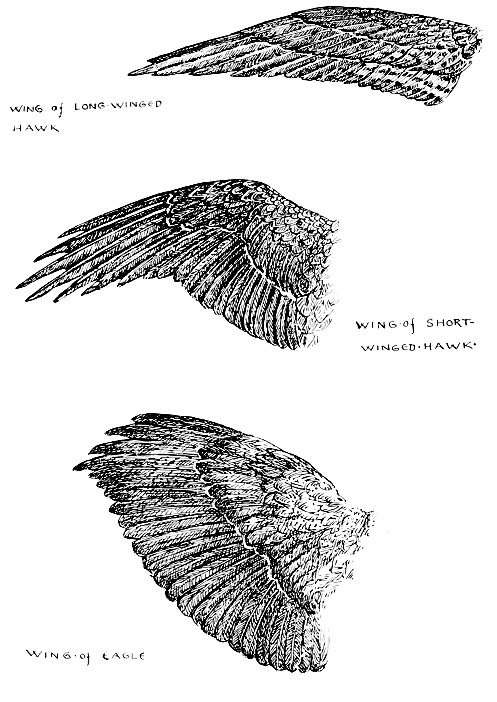
SHAPE OF WINGS
In the eagles the tail is shorter and stouter. The outer joint of the wing is shorter than in the falcons, the wing deriving its power from the feathers near the body rather than from the outer ones. The beak is longer in shape than that of the other two sorts, and the legs are proportionately stouter. The size of the smallest eagle is very much greater than that of the largest falcon or hawk.
The differences which exist in the shape of the wing between the three classes will perhaps be best appreciated by a glance at the accompanying illustration, in which a characteristic wing of each kind is figured.
The French have convenient terms (see Belvallette, Traité d’Autourserie, Paris, 1887) which express in themselves, with great perspicuity, though perhaps a little exaggeration, the different methods of flying employed by the short- and the long-winged hawks. The latter they describe as ramiers, or rowers, because their mode of progression through the air resembles that of an oarsman, or rather sculler, striking with repeated beats of his sculls; whilst they describe the short-winged hawks (with eagles and all birds that have rounded wings) as voiliers, or sailers, maintaining that their impulse is gained by the pressure of the air against the wing, upon which it acts as upon a sail. Many people may be inclined to call such a distinction rather fanciful, and even question its truth; but the mere fact that the two words have been accepted as correctly denoting the two separate styles of flying, shows what a marked difference between them has been generally admitted to exist. It will be seen that the mode of flying the “rowers” and the “sailers” at quarry is also very distinct.
In accordance with the three-fold classification above suggested, I now proceed to mention the various birds used in hawking under the successive headings of—(1) Long-winged hawks; (2) Short-winged hawks; and (3) Eagles.
I. THE LONG-WINGED HAWKS (Falcons)[1]
Perhaps the leading characteristic in the flying of this kind of hawk is that it habitually captures its prey, or, as falconers term it, “quarry,” by making a dash or shot at it, technically called a stoop, from some position where it can command an advantage in speed and force. In many cases the bird is itself so conscious of this natural aptitude for stooping in preference to mere following, that it habitually places itself, when on the look-out for food, at a considerable height, from which it can descend with great ease and velocity upon any victim which may happen to be passing beneath, using the principle of gravity to increase the force of its downward flight; and in several departments of the falconer’s art the trainer endeavours to encourage the tendency of his hawk to mount and make the most of the advantage so gained. The long-winged hawks are as a rule trained to come to the lure, and not to the fist, although for the sake of convenience it is sometimes found advisable to make them to both practices.
Greenland Falcon (Falco candicans)
Female—Length, about 23 inches; wing, 16.5; tail, 9. Male—Length, about 20 inches; wing, 14.5; tail, 8.
The general colour in the adult of both sexes is white, with more or less faint bars of light brownish grey on the upper plumage, and spots of the same colour underneath. The young birds of both sexes are considerably darker than their elders, with a much larger allowance of darker grey brown on the plumage both above and below. These dark patches and markings become fainter and less abundant at each moult, until in very old birds they almost vanish, leaving the hawk to appear at a distance merely white. The bars on the back, shoulders, and wings are often shaped like the two arms of an anchor; and the spots on the breast are mostly tear-shaped, especially after the first moult. The legs, feet, cere, and eyelids are bluish grey in the young birds, but after the first moult become yellow, strengthening in colour at each moult.
It will be seen by reference to the remarks on comparative merits of falcons (Chap. XVIII.), that in proportions this species excels all the other gers. It is also the most majestic in its appearance and attitudes, and the most noble in the expression of its eyes and, if the term may be permitted, of its countenance. It was not so much used in the Middle Ages as the other gers, by reason of the difficulty of obtaining it, but was probably the most highly valued of all. The late Lord Lilford, who in quite modern times had a good deal of experience with this species, opined that it was an excellent flier and stooper, but a poor “footer,” that it was the reverse of hardy, and difficult to keep in condition. When observed in the wild state in Scotland it was found to kill a great many rooks, and to be dreaded by the wild-fowl, but not to be partial to game, though it was seen to make an ineffectual stoop at a blackcock.
Iceland Falcon (Falco islandus)
Female—Length, about 24 inches; wing, about 17; tail, 9¼. Male—Length, about 21 inches; wing, 15; tail, 8¼.
In young birds the upper parts are dark greyish brown or brownish grey, each feather barred and tipped with a much lighter grey. The under plumage is dusky white, splashed more or less profusely, especially on the breast and flanks, with streaky spots and splashes of greyish brown. At the first moult the brown tinge begins to disappear, and the spots on the breast and flanks become more heart-shaped than longitudinal, and less profuse. In subsequent moults the spots become smaller and smaller, and the whole plumage fades to a lighter grey, the bars on the upper plumage often softening gradually to a greyish white. The sides of the head and lower nape are white, with brownish lead-coloured shaft marks in the immature plumage, fading and diminishing as the hawk moults. The moustachial streak is wanting in this variety.
This species of ger was very highly esteemed in antiquity; and individual falcons were occasionally presented by the kings of Denmark to foreign potentates as a high compliment. In modern times it has been found delicate, and difficult to keep in health. Mr. Newcome had some which flew well at herons, but did not find them so generally effective as peregrines. The late Maharajah Dhuleep Singh flew them with success at hares. Lord Lilford, however, was unable to get them to fly rabbits or hares, and found them liable to a troublesome affection of the feet.
Norway Falcon (Falco gyrfalco)
Female—Length, about 22 inches; wing, 16; tail, 9. Male—Length, 19½ inches; wing, 14; tail, 8¼.
In the young the general colour of the upper plumage is a lead-coloured brown, each feather tipped and margined with a somewhat lighter brown or buff. The flight feathers are also similarly margined. The lower back is sometimes tinged with grey. The tail is tipped with white, and barred rather closely with a speckly buff. The breast is profusely streaked with longitudinal blotches on a white ground, as in the peregrine; but these markings are of a rather duller brown. At the moult the markings on the under plumage diminish greatly in size and number, especially on and near the chin, and become more or less tear-shaped—this tendency to decrease continuing in subsequent moults. In the upper plumage the brown is replaced by slatey grey, barred with a lighter blue-grey, which in patches, especially upon parts of the feathers which are habitually hidden, are nearly white. The tail becomes slatey brown, with narrow bars of brownish grey. This species has a broad well-marked moustachial streak, which is dark brown in the immature and dark grey in the adult. The cere and eyelids are blue-grey, and the legs and feet bluish lead colour; but all become yellow in the adult.
This species is found not only in Norway, but also along the whole expanse of Northern Europe and Asia. It is the nearest in colouring and disposition to the peregrine, and the most remote from the Greenlander. Lord Lilford considered that it was not so fast as the Greenlander, and its shape is certainly not so indicative either of speed or of strength. John Barr was sent over by Captain Dugmore some few years ago to Norway, and brought back sixteen of these hawks. They flew beautifully to the lure, turning more quickly than a peregrine, and stooping with greater dash, but were of little use in the field, and mostly fell speedy victims to the croaks or other maladies.
Labrador Falcon (Falco labradorus)
This is another species of the ger family, found, as its name imports, in Labrador. It is of a much darker coloration than even the Norway falcon, but not very different in measurements. It has not, as far as I can learn, been trained for sporting purposes, though no doubt it very well might be.[2]
The difference of size between the two sexes in the case of these splendid birds is, as it will be seen, considerable. But both are so superior in speed and strength to any creatures at which they are at all likely to be flown in England, that the list of quarry suitable for the gerfalcon will, with a very few exceptions, serve for the ger tiercel also. This list includes gulls of all kinds, herons, rooks and crows, wood-pigeon, black-game, grouse, partridges, hares and rabbits, wild-duck of all descriptions, Norfolk plover, and all the sea-fowls found on the coasts of Great Britain and Ireland, except swans, and perhaps wild geese. The gerfalcon will also take these latter, as well as kites and cranes, peacocks, ptarmigan, and bustards, at which the best of them may be flown in countries where such birds are to be found in sufficiently open places. It is recorded of Henry, king of Navarre, that he had a gerfalcon which Scaliger declares to have struck down in his sight a buzzard, two wild geese, divers kites, a crane, and a swan (Sir Thomas Browne, cited by Harting, Bibliotheca Accipitraria, xxvii.). The flight of the ger is marked by an appearance of power suitable to its size and shape, and combines in an extraordinary degree swiftness and the power of turning readily. When taught to wait on, it does so in majestic style, often at a stupendous height; and its stoop from that direction is so “hard,” as the old falconers termed it, or in other words so swift and impetuous, that the quarry is less often clutched and held than struck down with a blow as the hawk passes, and is often found either killed or altogether disabled by the violence of the shock. So great, indeed, is the vehemence with which the ger flies and stoops, that the old masters warned their pupils not to work them long on any occasion, for fear of tiring them, and thus lowering their “pitch,” or impairing their powers of mounting.
Gers have not had a very fair trial in the hands of modern falconers. They have seldom come into their possession under favourable conditions. Greenlanders, especially, have for the most part been brought to European shores by ships, upon which they were caught at sea by men quite unacquainted with the proper mode of treating a wild-caught hawk. Almost always their plumage has suffered badly; and they themselves, having been kept alive on unsuitable or scanty food, have been reduced so low as to permanently lose some of their natural strength and vitality. The same thing may be said of several Icelanders and Norwegians which have reached the hands of the falconer in pitiable plight. Gers are very seldom taken on the passage in Holland, although one tiercel, captured by Adrian Möllen in 1878, was acquired and trained by the Old Hawking Club, and proved a fine performer at rooks. Reference has already been made to the gers brought by John Barr from Norway. Mr. Newcome, who in the treatment of peregrines was excelled by no falconer of modern times, was dissatisfied with the gers which he trained, and found them difficult to keep in condition.
D’Arcussia, who, of course, had many gers under his charge, declares that their principal excellence was in mounting, whereas in the downward stoop the peregrine might be awarded the palm. This opinion, however, can hardly be reconciled with the more forcible and striking words which he uses in another passage, where he tells us that having trained some gers for partridges he took them out before a company of experts, who, after seeing these hawks fly, were “disgusted with all other hawks.”
Peregrine (Falco peregrinus)
Female—Length, about 18 inches; wing, 14; tail, 7; tarsus, 2¼. Male—Length, about 16 inches; wing, 12; tail, 6; tarsus, 2.
In young birds of both sexes the upper plumage is a more or less dark brown, inclining in some individuals to chocolate colour, and in others to black, each feather of the back, wing, and tail coverts tipped with a lighter and more rufous brown. The chin, neck, breast, thighs, and whole under plumage is more or less dull creamy white, streaked plentifully with longitudinal blotches of dark brown, which are thin and small at the neck, but become broader and bigger as they approach the lower part of the breast, dying away again towards the vent. The tail is greyish brown on the upper surface, tipped with more or less rufous white, and barred with five or six rather irregular and rather faint bands of darker brown. The under part of the tail is very faint brownish grey, barred with a somewhat darker hue of the same colour. The sides of the head and neck are dull creamy white, streaked with very small dashes and markings of dark brown. On the under side of the eyebrow, passing round the eyelids, is a patch or streak of very dark brown, and a broad streak of the same colour or of black reaches like a moustache from near the back of the upper mandible backwards for an inch.
The legs, feet, cere, and eyelids vary from light blue-grey to greenish yellow and pale ochre; beak, light bluish grey, darkening to black at the tip; claws—called always by falconers “talons”—black, as in other hawks of all kinds. In the first moult the brown of the whole upper plumage is replaced by a slatey blue, each feather from the shoulders to the end of the tail barred transversely and tipped more or less distinctly with a lighter shade of blue-grey. The slate colour on the crown and side of the head, including the moustache, is of a dark hue. The under plumage, instead of being streaked longitudinally with brown, becomes at the first moult spotted and splashed with markings of dark grey, which are partly transverse and partly shaped like an arrow-head or tear-drop, especially on the throat and gorge. At each successive moult these spots and markings become more transverse and bar-like, and also narrower and more sparse on the parts nearest the chin, until in very old birds they disappear on the chin and throat, leaving a blank surface of pure creamy white. Even before the first moult the feet and legs begin to assume a yellow colour; and by the time the first moult is over, they and the cere and eyelids have changed to a more or less decided yellow, which as the bird grows old develops into a rich gold.
Both sexes undergo the same changes in plumage, but it should be said that these hawks at all ages vary considerably in size and shape, and still more in their colouring. It is not unusual to see an eyess which has the head and parts of the upper plumage nearly black, while the brown of others at the same age is as light as cocoa, with buff edgings. Some detailed remarks as to the size and shape of peregrines and other hawks will be found in Chapter XVIII. , where it will be seen that some are of much more prepossessing appearance than others.
Speaking generally, the peregrine may be regarded as the most perfect type of combined strength, speed, and destructive power in birds. The proportions are such as could not be altered with any advantage, and adapt the hawk to a greater variety of flight than any other. This reason, and the fact that it is to be found in almost all parts of the habitable world, have always made it a favourite with falconers; and at the present day it is more highly esteemed in Europe than any other, even including the nobler gers.
The female—to which sex alone falconers allow the application of the name of falcon—may be flown with success in this country at herons, gulls of all kinds, ducks of all kinds, crows, rooks, grouse, black-game, partridge, pheasant, woodcock, landrail, Norfolk plover, curlew, and other sea birds of about the same size, magpies, wood-pigeons, and doves. She may also generally, if desired, be taught to fly at hares, and no doubt at rabbits. Occasionally she may take plovers and snipe, jackdaws, kestrels, and smaller birds. In India her list includes wild geese, cranes, bitterns, ibis, and bustard.
The male peregrine—always called a tiercel (tassel, or tiercelet), because he is about a third smaller in size than his sister—may be flown at gulls, teal, widgeon, partridges, woodcock, landrail, starling, and the smaller sea birds, magpies, and doves; and when exceptionally strong and courageous, will succeed to a greater or less extent with rooks, crows, jackdaws, grouse, wood-pigeons, and kestrels. In India and Eastern countries the francolin and the florican, and several sorts of duck and plovers, may be added to the list.
The peregrine at different ages was described in old times by a great variety of names, some of which are now little used, or even understood. Thus, in the eyrie or nest, from the time when she was “disclosed,” or hatched, for a fortnight or three weeks she was called an eyess (or nyas, from the French niais). When able to move about on her legs she became a ramage hawk; and when she could jump or flit from branch to branch, a brancher. After leaving the nest and becoming fledged, as the term is for other birds, she was described as a soar-hawk or sore-hawk (French, sor, from the Latin saurus, reddish brown); and when her feathers were all fully grown down she was said to be summed, whereas before this time she remained unsummed. The period during which she could properly be called a soar-hawk lasted, according to some eminent writers, from June 15 to September 15, when the migrating time begins, and she came to be more properly spoken of as a passage-hawk (or true pélérin). This designation carried her down to the end of the year, when she assumed, according to the French falconers, the title of antennaire; that is to say, a hawk whose feathers, or whose whole self, belong to last year (antan). Many of the English falconers, however, gave her no new title until at or near the arrival of Lent, when they called her a Lantiner, Lentener, or Lent-hawk, for as long as Lent lasted, that is to say, till near moulting-time. The great similarity of the two names Lantiner and Antennaire, given as they were to the same hawk at the same time of her life in the two countries, suggests a strong doubt whether the former was not a mere corruption of the latter. During the whole of this time the unmoulted peregrine was known, from the colour of her plumage, as a red hawk; and this term is still constantly employed. Many writers also called her during the same period merely a soar-hawk, neglecting the finer distinctions. It seems also that for a hawk which had been taken in August or thereabouts, and kept in captivity, it was quite correct to continue the name soar until her first moult was over. Passage-hawks and lantiners were those only which had been caught in late autumn or late winter; and these words could never be used for such as had been caught before. As for the terms “gentle” and “slight,” they seem most properly to belong to peregrines which had been caught after they left the nest, but before they began to migrate.
In spring or early summer the young peregrine naturally begins to moult; and as soon as this tedious operation is concluded she becomes, if wild, a “haggard,” and if tame, an “intermewed” hawk. In any case she is described as “blue,” and not “red.” There is some doubt as to the meaning of the term haggard, many authorities, including the lexicographers, deriving it from the Saxon hag, meaning hedge. A more rational explanation seems to be that which traces it to the Hebrew word agar or hagar, meaning wild, as it is used in the Old Testament. Wildness, indeed, is always regarded by Shakespeare and other writers as the characteristic of the adult wild hawk, and not any liking for hedges, to which no peregrine is very partial.
The language, or jargon, of falconry appropriated to the falcon, and, by analogy, to other hawks, especially of the long-winged species, special terms for various parts of her body and various movements and conditions; much in the same way as several of the Oriental languages describe the actions of royalty by special names. Thus her wings are sails: the long feathers of them are flight feathers; and of these the outer are principals; and next to them are the flags. Her tail is her train; and the two central feathers of it are deck feathers. Her lower leg is an arm, and her foot a hand, with petty singles instead of toes, and talons instead of vulgar claws. Her nostrils are nares; her breast feathers are mails; her lower intestine is her pannel; and her crop her gorge.
A host of the commonest actions are dignified by more or less quaint appellations. When a hawk sleeps she “jowks”; when she sips water she “bowses.” When she seizes her quarry in the air she “binds” to it; and when her companion in the flight comes up and also takes hold, she or he is said to “join.” When she strips the feathers of the “pelt,” or dead body, of the quarry, she “deplumes”; and as she passes the food from her crop downwards she “puts over.” To “endue” is to digest; to “feak” is to wipe her beak after eating; to “rouse” is to shake herself; to “mantle” is to stretch out the leg in a sideways and backward direction, and afterwards stretch the wing over it; to “mute” is to evacuate; and to “cast” is to throw up the refuse feathers, bones, and other indigestible matter which remains in her crop after a meal has been digested. When a hawk is pushed or forcibly held down by the hands she is said to be “cast” (French, abattue); and when she is bound up in a wrapping, so as not to be able to move, she is “mailed.” When a silk thread is passed by means of a needle through the upper eyelids and made fast under the chin she is said to be “seeled,” and the process of undoing these fastenings is called “unseeling.” When she stretches her wings upwards over her head she “warbles.” When quarry is put up for her, she is “served” with it. When she drives a quarry to take refuge in covert she is said to “put in”; and when she rises in the air over the place where the quarry has gone into hiding she “makes her point.” If instead of doing this she goes and takes perch on a tree or other place of vantage, she “blocks.” When her digestive organs are brought into good condition she is said to be “enseamed.”
Most of these words can be used indifferently for both long-winged and short-winged hawks; but others are inappropriate for the latter. Thus it is wrong to call the claws of a short-winged hawk talons; and a goshawk or sparrow-hawk does not “mute,” but “slice.”
Black Shaheen (Falco peregrinator, or Falco atriceps)
This hawk is decidedly smaller than the true peregrine, the female hardly exceeding a big tiercel in length or weight. It is distinguished by the darker colour of its head, and especially of the sides and moustachial streak, which may be called black. The under parts of the body have a more or less pronounced rufous tinge; and the ends of the wings, when closed, approach more nearly to the end of the tail.
The black shaheen is docile, and more easily reclaimed than the peregrine; and is a great favourite with some of the Indian falconers, although the many distinguished Europeans who have flown hawks in that country express themselves less satisfied, and rather doubt the courage of peregrinator in the field. The quarry is the same as that of the peregrine, but it is only the strongest individuals which can be expected to cope with such heavy birds as the latter can tackle. Of the rapidity of its flight there can be no doubt; but Colonel Delmé Radcliffe says that it is inferior to the peregrine in “ringing” flights.
Red-naped Shaheen (Falco babylonicus)
Female—Length, about 17¼ inches; wing, 13; tail, 7¼. Male—Length, 15½ inches; wing, about 11¾; tail, 6¼.
This is another very near relation of the peregrine, also a favourite with the Indian falconers, both native and European. It is slightly smaller than the black shaheen, from which, as well as from F. peregrinus, it is readily distinguished by the reddish chestnut colour of the back of the head. The foot is smaller proportionately than that of the peregrine, and shaped rather more like that of the desert falcons. It is easily caught and reclaimed, and is said to develop a sort of affection for its trainer. When trained it is a most useful servant, and will fly with readiness and success at almost any of the innumerable Indian birds which are anywhere nearly of its own size. It excels particularly in the flight at wild ducks; and a specimen which was brought to England not many years ago proved a first-rate game-hawk. Latham asserts that it can be flown successfully at wild geese, but should be followed closely by well-mounted men, who should dismount quickly and secure the quarry, which may otherwise severely damage the hawk with its long and strong wings. He appears to have known a tiercel which flew rooks, and seldom missed as much as one in ten flights. It is a better moulter than the peregrine, and can sometimes be fully moulted by August.
Barbary Falcon (Falco barbarus)
Female—Length, about 13½ inches; wing, 11½; tail, 5½. Male—Length, about 12¾ inches; wing, 10¾; tail, 5.3.
This beautifully-shaped hawk is the smallest of those which have been commonly called miniature peregrines; and the resemblance is hardly so marked in either of the last-mentioned varieties. For the barbary is even more powerfully armed and feathered than her bigger cousins, having not only the wings conspicuously longer and more pointed than F. peregrinus, but also distinctly larger feet and talons, and a larger beak proportionately to her size. The colouring is the same as that of the peregrine, except that the young birds are generally lighter, especially about the head, which has a slightly ruddy tint; and the feet are more usually yellow than grey-blue. In adults the thighs are strongly marked with arrow-headed streaks. This hawk is sometimes called the Tartaret. It is found in the southern portion of the temperate zone, especially on the African and other shores of the Mediterranean.
The falcons and strong tiercels will fly well at partridges, pigeons, and doves. Quails, of course, are easily taken by them, as they are exceedingly fast on the wing. If a cast of haggards could be trained for peewit or snipe, and well entered, they would probably have as good a chance as any hawk which could be selected for these difficult flights.
Lesser Falcon (Falco minor)
This hawk very much resembles the last, but has longer legs, and a slight rufous tinge on the plumage. It is found chiefly in South Africa.
The Punic Falcon (F. punicus), the Javanese Falcon (F. melanogenys), and the Chilian Falcon (F. cassini), all more or less resemble the peregrine, but with variations in the colour of the plumage, and of smaller dimensions.
Saker (Falco sacer)
The measurements of this hawk, as of a great many others, are given in the so-called scientific books, even of highest repute, with hopeless inaccuracy. One of the authorities which is most often referred to gives the length of the female saker as 18½ inches, or the same as the peregrine, whereas every naturalist ought to know that the saker is a very much larger bird. On the other hand, the Royal Natural History (1895), coming much nearer the truth, says that “the female falls but little short of 25 inches, and the male measures more than 18½.” The proportions of this hawk, excepting the feet, do not differ greatly from those of the ger, although the colourings and general appearance are completely dissimilar. The weak point, from the falconer’s point of view, is the smallness of the feet and shortness of the middle toe, as well as the poor quality of the feathers, which have about them none of the glossy smartness so noticeable in the ger and the peregrine.
Young birds have the crown and nape buffy white, lighter on the forehead and over the eyebrows, and in other parts profusely streaked with dark brown. The upper plumage is a rather dull dark brown, with fulvous and rufous buff edgings. The tail, excepting the deck feathers, is marked with irregular oval spots, which range themselves into a sort of band. There is a distinct moustachial stripe. The under parts are buff-coloured, liberally streaked with splashes of dark brown, especially on the flanks; but the buff colour grows lighter on the upper parts, and at the chin becomes nearly white. The cere, legs, and feet are pale bluish or greenish grey.
In adults the head becomes much lighter, and sometimes dull white, but with a more or less rufous brown tint and streaks of darker colour. The upper parts are dull and rather pale brown, the feathers margined, and in some parts barred, with light fulvous buff. The flight feathers are faintly barred with a lighter brown, and all the tail feathers barred with light buff. The sides of the face, chin, throat, and breast are nearly white, the latter being spotted rather than streaked with brown, but not transversely barred. The moustachial streak fades away. The cere, feet, and legs assume a more or less pronounced yellow colour.
The saker is a tolerably common bird throughout almost the whole of Central and Southern Asia, and is there very highly valued for practical purposes. It was also largely imported into Western Europe in the Middle Ages, and later it was used even in France and England for the flight at kites. It is for this fine sport that it is now chiefly prized in India. The list of quarry taken by this very serviceable hawk is extremely large, and includes, besides the various kinds of tropical kites, hubara, or bustard, herons, black ibis, ducks, and a whole host of smaller birds. The flight at the short-eared owl is especially fine, and the quarry often rings, and attains to a very great height before the saker can get up. The female saker will take hares well, and also ravine deer.
The tiercel of the saker is more properly called a sakret, sakeret, or sackeret. This hawk is the largest of those called desert-hawks or desert-falcons.
Lanner (Falco lanarius)
Female—Length, 18 inches; wing, 13.3; tail, 7.2. Male or “Lanneret”—Length, 16½ inches; wing, 12; tail, 6½.
The dimensions of this desert-hawk do not differ widely from those of the peregrine, but the feet are much smaller, and the tail longer. The feathers are of an inferior quality, and the light colour of the head prevents all risk of confusion. The wings are slightly longer and heavier. Young birds have the whole back up to the nape of the neck and down to the tail coverts dark brown, each feather tipped with a lighter and more rufous brown. Wing and tail feathers darker brown, narrowly tipped with rufous buff. The deck feathers are plain, but the others are barred with lighter brown on the upper surface, and with dull brownish grey bands of two shades underneath. The crown of the head is light greyish buff, with narrow streaks of light brown. The lower plumage is more or less dull white, very variously marked in different individuals, but generally with longitudinal splashes of more or less dark brown. The change to the adult plumage is not very marked. The breast markings do not change to transverse bars; but some old birds have the brown markings so arranged as to appear like irregular bars. These markings, however, generally become very sparse, and often disappear entirely on the throat and upper breast. The upper plumage alters to a slatey brownish grey, most of the feathers being barred with a darker brown, and still tipped with a rufous line. The cere and feet change from a bluish to a yellowish grey.
The lanner is common in North Africa, as well as in Central and Southern Asia, and is very frequently trained and flown in all these parts of the world. It was also formerly very largely imported into England, and used chiefly for game-hawking. It enjoys, nevertheless, anything but a good character. The old English writers describe it as “slothful and hard mettled,” and of an “ungrateful disposition,” while the French characterise it as vilain and rebelle. The Indian and Afghan falconers get it, as well as the saker, into condition by frequent physicking; and the list of drugs formerly used for it in England is of portentous length. In modern times the dosing of this as well as other hawks is imperfectly understood by European falconers; and the lanner is consequently in most cases a disappointing bird. When thrown off, she flies in a heavy style, and only after considerable delay will begin to mount. Very often, too, she will not mount at all, but go to perch on a tree, or even on the ground. She is apt to rake away and check at pigeons, plovers, and what not, and to be dull and obstinately slow at coming to the lure. To ensure obedience she must be fed a good deal upon washed meat, and that in moderate quantities, her appetite, like that of all the desert-falcons, being apt to grow slack on the least overfeeding. The lanner is very partial to mice, and in the wild state appears to devour lizards and other reptiles. She is not, therefore, at all particular as to diet, and may be regaled with coarser food than the nobler falcons.
Once properly conditioned, however, and “on her day,” the lanner—or for that matter the lanneret, as the male is called—is a useful and deadly hawk. Both sexes will kill partridges freely, not waiting on so often when the quarry has put in as taking perch on a neighbouring tree, and waiting, like a sparrow-hawk, to start from there. The female has also been known to take wild-duck well, and will wait on, when she likes, at a stupendous height. For magpies the lanner would hardly be quick enough. Pheasants can usually be taken by the females at the first stoop. It is said that the Arabs fly the lanner at small gazelles and a kind of bustard, which it stoops at whenever it takes wing, and without actually striking it, frightens it on to its legs, so that it can be run down with hounds. This bird has the faculty of ejecting a slimy matter from its mouth and vent, which, if it reached the hawk, would incapacitate her from flying. Ringing flights are flown at a bird called the chakhah, resembling a golden plover; and the lanners which excel at this fetch a price equivalent to £50 or £60. The Arabs also fly the lanner at sand-grouse and francolin.
D’Arcussia declares that the sakers and lanners do better in stormy weather and high winds than the peregrine. Neither of them bear the heat well in temperate climates.
The South African Lanner (F. biarmicus) and the Tunisian Lanner, or Alphanet, are local species, having a more strongly rufous coloration than F. lanarius.
Lugger (Falco jugger)
Female—Length, 17 inches; wing, 13.6; tail, 8. Male—Length, 15 inches; wing, 12; tail, 7.
An Indian hawk, rarely found out of the peninsula. It is much used by the natives for a variety of quarry, and does a lot of useful work.
Eleonora Falcon (Falco eleonoræ)
Female—Length, about 15½ inches; wing, 13.3; tail, 7.5. Male—Length, about 13½ inches; wing, 11.8; tail, 6.5.
This is a hawk of the hobby type, much darker on the under parts, and with a good deal of black and rufous on the under surface of the wings. The feet are at first pale yellow, developing later into orange. The wings are long, but do not project, like the hobby’s, beyond the tail.
This hawk is common on the eastern shores of the Mediterranean. It was observed and reported upon by Brooke in Sardinia, and Kruper in Greece, which latter observes that it is “a noble falcon, and was in early ages used for falconry.” I have not discovered the chapter or verse in which this use is mentioned; but the hawk is obviously quite big enough to be flown at partridges, if willing to go. Both the above-named naturalists maintain that its food consists principally of birds, and Dr. Kruper declares that he found in its nests the remains of six different kinds of bird, including quail and hoopoe. A specimen was trained by Lord Lilford in 1868, who found it very obedient to the lure, but of no use in the field.
Hobby (Falco sabbuteo)
Female—Length, 13 to 13½ inches; wing, 11¼; tail, 6¼. Male—Length, 11 to 12 inches; wing, about 10½; tail, 5½.
This very beautiful and graceful little hawk may at once be identified by the exceeding length of its wings, which, when closed, extend a full half-inch beyond the end of the tail. It is conspicuous also by its very marked colouring, which is in young birds almost black on the upper parts, each feather, however, being tipped with fulvous brown. The lower plumage is creamy white, streaked profusely with dark brown splashes, and tinted on the throat and sides of the head with a warm buff. There is a broad black patch below the eye, and a black eyebrow, with a small streak of buff above it. The moustache is broad and strongly marked. The cere is greenish grey; and the feet, originally of the same hue, develop gradually into light yellow, and later into gamboge and bright orange. The deck feathers are plain, but all the others are barred both above and below by about ten cross-bands of lighter brown.
In adults the upper plumage changes to a uniform dark slate colour, nearly black towards the head. The flanks and thighs, especially in the male, assume a more and more distinct rufous colour. The feet are proportionately small, and the legs decidedly weak.
There are strong evidences that the hobby, when commonly bred in Western Europe, was used with success for taking larks, not only by the process of “daring” referred to later on in the chapter on lark-hawking, but in actual flight, and that the female was used for taking partridges in the same way. The failure of modern falconers to make any practical use of this elegant and prepossessing hawk, is noticed in detail in the same chapter. Owing to its natural tameness, the hobby is especially liable to fall a victim to persecution by gamekeepers and naturalists, and has as a result been nearly exterminated in England.
A wild hobby has been seen by credible witnesses to take a swift on the wing in Bulgaria. A trained female has been known in England to take house-pigeons.
Merlin (Falco æsalon)
Female—Length, 11½ to 12 inches; wing, 8½ to 9; tail, 5¼ to 5¾; weight, about 8 oz. Male—Length, 10½ to 11 inches; wing, 8 to 8¼; tail, 4¾ to 5; weight, 6¼ to 6¾ oz.
Females and young males have the whole upper plumage a rich chocolate brown, with reflections of purplish grey, each feather on the back and upper wing coverts tipped with a somewhat lighter brown, and crossed by a buff bar, which is usually not to be seen except when the plumage is disarranged or ruffled. Each feather also has a black shaft, which is conspicuous in strong lights on a close view. The primaries and all the principal feathers of the wing are very dark brown on the upper surface, barred with several patches of light brown or buff. The under surface of the wing is very light silvery grey, with numerous bars and spots of brownish grey, each feather having a dark grey shaft, which is white underneath. The tail feathers on the upper surface are of a slightly lighter brown than the back, and light grey underneath, barred with more or less oblique bands, which are buff-coloured above, and light grey-brown underneath, and are all tipped with white. The under plumage of the body is creamy white, more or less tinged with light buff, especially on the sides of the head and throat. It is liberally streaked with longitudinal splashes of dark brown, which on the upper throat are very small, but on the lower flanks are broad and large. There is a facial patch and a moustache of dark brown, but these are not so strongly marked as in the peregrine and hobby. The beak is light blue, darkening to indigo, and at the tip to black. The cere and eyelids, light bluish grey. The legs and feet vary from light greenish or blueish grey to light yellow. The toes are long, thin, and flexible.
Adult females do not change, except that they lose much or all of the purplish sheen of nestlings, and that the edging of the feathers is less marked. Adult males undergo a very striking transformation. The whole upper plumage changes from brown to a rich bluish slate colour, deepening in the long wing feathers to greyish black. Instead of the light bars on the tail, there is a single broad grey-black band nearly at the extreme end. The breast at the same time assumes a warmer tint, deepening from cream colour at the chin to a rich buff lower down, and deep russet at the flanks. The cere, eyelids, legs, and feet assume a deep golden or light orange colour. The wing and tail feathers have a stronger and stiffer appearance than before the moult, and those of the tail are generally somewhat shorter as well as stouter than they were. Very old females occasionally, but not often, put on the livery of the adult male; and this is the case sometimes also with old female kestrels. In merlins of both sexes the third feather of the wing is usually exactly equal in length to the second, and it is only exceptionally that it is even fractionally shorter.
The name merlin is in orthodox phraseology reserved to the female merlin only, the male being more properly spoken of as a jack. The former, when exceptionally strong and courageous, may be flown with some success at partridges, and will also take house-pigeons and probably doves. They have been known to capture and kill wood-pigeons. Both sexes may be flown at quails, and are more deadly at this business than sparrow-hawks. In the wild state they kill blackbirds, thrushes, starlings, and almost all kinds of small birds, and the trained birds may be kept with more or less success to any one of these birds of quarry. It has been thought that a good cast of merlins might take snipe, and it is said that such a feat has been in former times achieved. With tropical snipe in an overfed or moulting condition, it is possible that this might still be done; but it is to be greatly doubted whether any trained merlin or merlins could take fully-moulted English snipe. The flight, however, for which merlins are usually reserved, and for which they are renowned, is that at moulting skylarks, and in this sport the jacks are very nearly as successful as their sisters, as will be seen in the chapter on lark-hawking. The merlin will follow her quarry when she can into covert; and when her victim is larger than herself, kills it by strangulation, gripping it tightly round the neck.
Indian Merlin (Falco chicquera)
This hawk, a little larger than the European merlin, is flown at much the same quarry, but also at rollers and hoopoes, which latter afford a fine ringing flight.
The African Merlin (F. ruficollis) has the markings on the breast closer together.
Kestrel (Falco tinnunculus)
Female—Length, about 13 inches; wing, 9; tail, 7. Male—Length, about 12 inches; wing, 8¼; tail, 6½.
Females and young males have the upper plumage reddish brown, transversely barred on the shoulders, wing coverts, and tail with black; the flight feathers, blackish brown; the under plumage, very pale fawn colour, streaked on the breast, and splashed on the lower part with brown. Adult males have the head, lower part of the back, and upper surface of tail, light slatey grey. The tail with a broad black band near the end, and tipped with white; and the head with dark shaft-streaks; the shoulders, upper back, and upper wing coverts, pale chestnut, with small black spots of a triangular shape. The wings, dark horn colour, with lighter edging. The under plumage, pale fawn colour, becoming more rufous at the lower part and on the thighs; streaked with dark brown splashes on the breast, and spots on the abdomen. The cere, feet, and legs are pale greyish yellow in the young, and brighter in the adult.
This little hawk has, structurally, all the characteristics of what the naturalists call a true falcon—more so, in fact, than the more highly reputed merlin. Its shape, indeed, but for a want of size in the feet and a somewhat exaggerated length of tail, is very symmetrical, and indicative of fine flying powers. It is the least shy and most familiar of all European hawks, and survives in tolerably large numbers throughout England, where, together with the owls, it is a chief agent in keeping down the inordinate increase of mice. Its powers of flight are very considerable; and it remains on the wing generally for a considerable part of the day, not soaring so much as beating the ground at a height of two or three score feet, and hovering from time to time with its eye on any small creature that may be moving about or hiding in the grass below. But notwithstanding its fine proportions, its muscular power is not great, and its extreme pace is not to be compared with that of the merlin. If pursued by a fairly good peregrine in a pretty open place, it frequently succumbs.
In the field a kestrel is of no practical use. It will indeed generally take sparrows and other small birds thrown up from the hand when it is waiting on. And instances have been known where it has flown and taken a few wild birds. There is even a story extant of an eyess kestrel which was flown at a young partridge and took it. But these facts, if true, must have been entirely exceptional. As a rule the trained kestrel refuses all wild quarry, and it has never been known to persevere in killing any. I am not sure whether a fair attempt has been made to fly her at rats, which would probably afford the best chance. But kestrels can be reclaimed and taught to fly to the lure in exactly the same way as the proudest peregrine or the most majestic ger. They will wait on beautifully, and stoop very prettily at the lure. And while at hack their movements are exceedingly lively and graceful. Thus for a beginner the kestrel is, in my opinion, undoubtedly the most suitable hawk upon which he can try his hand. In the breeding season eyesses may be procured pretty easily, and at an insignificant cost; and throughout the year many of both sexes are captured in the nets of bird-catchers, who would part with them readily for a few shillings if they were notified beforehand that any amateur would give a fair price for the captives. In reclaiming and manning a kestrel, in learning how to keep her feathers unbroken and clean, how to hood her, bathe her, house her, and weather her, and how to diet her, the tyro can very easily and cheaply acquire all that elementary knowledge of the difficult art of falconry which it is advisable that he should possess before he attempts to succeed in training and flying a valuable hawk. Whereas if, without any preliminary experience, he begins, as so many writers advise him, with an eyess merlin, he is almost certain to meet with a more or less discouraging failure. Far better to observe the old maxim, “Fiat experimentum in corpore vili.” Let the young falconer not attempt to run before he can walk fairly well. When he has taught his kestrel to wait on and stoop to the lure, and has either by preventive care or by successful imping got her in perfect plumage, let him feed her up and “whistle her down the wind” to shift for herself, and then consider himself qualified to make a more serious attempt with a sparrow-hawk, merlin, or peregrine.
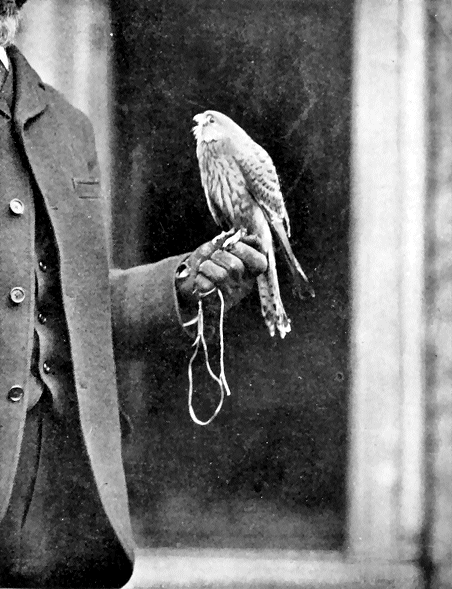
TRAINED KESTREL “THUNDERBOLT” OWNED BY MR. R. GARDNER
II. THE SHORT-WINGED HAWKS
Regarded from the falconer’s point of view, the short-winged hawk differs essentially from her more honourable cousin of the long wings in the following particulars. She cannot be taught to “wait on” in the air. Although she will on occasions stoop from above at her quarry, she does not habitually capture it by a downward stroke or blow, but by following it from behind and “trussing” or “binding” to it. She manifests her readiness to fly by a condition of body which is called by the quaint, and apparently Oriental, name of “yarak,” in which she shows evident signs of eagerness and excitement, and is obviously on the qui vive—attentive to every sight and sound which she may suppose to indicate the presence of quarry or the hope of a flight. She kills her quarry, when taken, by crushing it in her strong foot and piercing it with her long and sharp claws, or pounces. She follows her quarry, when it is possible, into covert; and when this is not possible she takes stand readily on some convenient resting-place, such as the branch of a tree, the top of a wall, or on her trainer’s fist. As a general rule she does not need to be kept to any one particular quarry, or flown at any particular time of day, but may be thrown off at anything, whether fur or feather, which she thinks she can take, and will do almost any amount of work at almost any hour.
It will thus be seen that though, from the purely artistic and sporting standpoint, the long-winged hawk deserves the more honourable place which has always been accorded to her in the most civilised countries, yet, taking the more material and matter-of-fact view of the matter, and regarded as a “pot-hunter,” the short-winged is at least equal to her in merit. There is, it is true, in the flight of the latter little of the grandeur and dramatic excitement which so often attend the efforts of the former. No silent pause while the pointer stands and the hawk mounts steadily to her lofty pride of place above him. No spiral climbing of quarry and hawk into the distant blue sky. No lightning descent, which in a second or two brings down the hawk from hundreds of yards high to within a few feet of her trainer’s head. But there is plenty of excitement of a different and not less healthy kind. The wary stalking of a shy quarry while the well-trained hawk on the fist trembles with eagerness for the chase. The rush and bustle of the start; the quick burst of riding or running to keep the chase in view; the hurry and scurry when the quarry has to be routed out from his place of refuge; the tussle for mastery when he has once been seized; and, last but not least, the abundance and variety of the bag which on a successful day is carried home.
One very great advantage attached to the short-winged hawk is that she can be flown in an enclosed country, or at least in places which are only very moderately open. Woods and forests are of course tabooed; and any land which is very undulating or very steep should be avoided. But the grass land and arable land which is commonly found in some four-fifths of the area of England, and especially that part of it which is not cut up into too small fields, is available, as well as the downs and commons, even though an occasional spinny or small plantation intrudes itself into the campaigning ground. Another merit of the short-winged hawk is that she is less likely to be lost. Trained as she is, or should be, upon missing her quarry, to come back to the falconer himself, and remain with him until her quarry is again actually on the wing, or, in the case of ground-game, on its legs, there is little temptation either to “rake away” or to “check.” Again, the length of the flights, counting each separate bout in the pursuit as a flight, is very much less; so that the falconer—or ostringer, to give him his correct name—has a far better chance of keeping in sight when the quarry is either taken or put in. Finally, neither of the species of short-winged hawks usually trained and flown is much addicted to the vice of “carrying”; and thus the risk of losing a hawk or wasting valuable time by reason of this vexatious habit is much less to be feared. It should perhaps be added that constant exercise is less necessary for a short-winged than for a long-winged hawk, as the former may be left idle for considerable periods, and when brought into yarak again seems to have lost little if any of her speed or her merits.
At the same time, the temper and disposition of the short-winged hawks are undeniably worse at the first than those of the long-winged. Both goshawks and sparrow-hawks, whether eyesses or wild caught, are naturally suspicious and mistrustful of mankind. They are easily alarmed, and very ready to take offence, and, once alienated or frightened, can with difficulty be conciliated. Savage and vindictive by nature and habit, they are subject to almost ungovernable fits of rage and sulkiness, which can only be subdued and guarded against by the exercise of much patience and good temper on the part of the trainer. They are jealous and cruel, and cannot, as a rule, be flown in company with other hawks, even of their own species and sex. Once lost for any considerable time they resort to their wild habits, and are difficult to recapture. Unless carefully dieted they are very subject to apoplectic fits. Their long tails, although flexible and elastic under moderate pressure, will not always stand a very severe strain, and are likely, in a serious struggle either with any big quarry or with an awkward trainer, to be broken. The short-winged hawks should generally be belled on the tail. They are apt sometimes to crouch down on their quarry when taken, in which case a bell on the leg is hardly sounded. Besides this, if flown when snow is on the ground, the snow will choke the bell and make it useless.
Taking the whole world over, the families of the goshawks and sparrow-hawks, which practically merge into one another, are very extensive, comprising more than thirty species, many of which could without doubt be pressed into the service of man. Only three of these have, however, commonly been trained.
Goshawk (Astur palumbarius)
Female—Length, 22 to 24 inches; wing, 12½ to 13½; tail, 10 to 12; tarsus, about 3.5. Male—Length, 19½ to 21½ inches; wing, 10¼ to 12½; tail, 9 to 10; tarsus, about 3.
Females and young males have the upper plumage a dull liver brown, broadly margined and barred with much lighter brown; the tail, barred with five broad bands, dark brown. The under surface of the tail is pale whitish grey, with five bands of dark brownish grey. The rest of the under plumage is pale or rusty cream colour, tinted more or less faintly with salmon pink, and streaked irregularly on the breast and flanks with longitudinal patches or splashes of dark brown. The cere and legs are greenish yellow. The eyes are very light, and clear yellowish grey, and so bright that the Greeks gave to this hawk the name of
Goshawks vary greatly in size and strength. Those which are imported from Norway are often exceptionally big and strong, while the specimens from Germany and Central Europe have a reputation for weakness. Although this hawk formerly bred commonly in England, it is now practically extinct; but some nests are still annually found in France.
The list of quarry at which the goshawk may be flown is very large, including, for the British islands, hares, rabbits, stoats, weasels, squirrels, and rats; herons and wild ducks—flown as they rise—pheasants, partridges, landrails, water-hens, jays, and an occasional magpie or wood-pigeon. In fact, any moderate-sized bird which gets up close in front of a goshawk must bustle himself if he intends to escape the first quick dash of this impetuous and greedy pursuer.
In India and other tropical countries the female “goss” will fly, with a good start, at crows, neophrons, minas, florikin, francolin, jungle-fowl, and even such big birds as kites, geese, cranes, and pea-fowl. Even in England she was formerly flown with success at cranes, wild geese, and other large water-fowl; and the old books contain elaborate directions as to stalking these birds “with grey goshawk on hand.” In some parts of Asia goshawks are said to have been flown at ravine deer and bustard; but this would probably be with some assistance from dogs.
The male goshawk, much smaller in size than his sisters, is less valuable to the sportsman, but is usually accounted rather swifter on the wing. The best specimens will catch a partridge in fair flight; and most of them, with a tolerably good start, will overtake a pheasant. A very strong male will sometimes catch and hold a full-grown rabbit, and the others may be expected to kill half-grown rabbits and leverets, if kept to such quarry. Landrails and water-hens make a more or less easy flight. Jays and magpies may sometimes be taken, as well as blackbirds. Rats, weasels, squirrels, and “such small deer” are, of course, available. Occasional specimens of the male goshawk are extraordinarily fast and strong. Colonel Delmé Radcliffe had one which actually killed grouse in Scotland, and another which took storks and geese in India, as well as partridges.
Sparrow-Hawk (Accipiter nisus)
Female—Length, 14 to 16 inches; wing, 8½ to 9½; tail, 7½ to 7¾; tarsus, 2.4. Male—Length, 11½ to 12½ inches; wing, 7½ to 8¼; tail, 6 to 6½; tarsus, 2.1.
The sparrow-hawk is remarkable for its very long and slender legs and middle toe, and its small head. Young females have the beak and upper plumage sepia brown, each feather edged with rufous brown; the nape varied with white or rufous white. The wing feathers are dark brown, with five bars of still darker brown on the outer primaries. The tail rather lighter brown, with five dark brown bars. The under plumage is dull white, more or less tinged with rufous, spotted with irregular patches, streaks, or bars of greyish brown. In the adult the brown of the upper plumage assumes a slatey grey hue, and the edgings of lighter colour vanish. The breast and under parts are barred with transverse markings of mixed fulvous and brown, and develop a rusty red colouring on the abdomen and inner thighs. The legs and feet become more distinctly yellow or gold colour, and the eye deepens in colour to light and ultimately to dark orange. Males in the immature plumage differ from females only in having a somewhat more rufous hue on the lighter part. But after the moult this rufous colouring becomes still more conspicuous, and spreads to the flanks and under surface of the wings, as well as to the upper throat. In both sexes the bars on the breast and thighs become narrower and of a fainter grey as the birds grow older; and the eyes deepen in colour.
Female sparrow-hawks—very much bigger and stronger than their brothers—may be flown at any bird of the size of a partridge, or smaller, which is not very swift or quick in shifting. In the wild state they undoubtedly kill a certain number of wood-pigeons, taking them at some disadvantage, as, for instance, when they pass under a tree in which the hawk is at perch. Probably the wild sparrow-hawk also picks up an occasional peewit, snipe, or woodcock. She is fond of young pheasants, which she will pick up from the ground when insufficiently guarded by the mother or foster-mother. Young chickens sometimes undergo the same fate under similar circumstances. The uses of the trained sparrow-hawk, both male and female, are described in the chapter devoted to this hawk.
Besra Sparrow-Hawk (Accipiter virgatus)
This species, considerably smaller than A. nisus, is very common in the tropics, both in the wild and in the trained state, and is thought by many to be quite equal, if not superior, to it in courage and ability.
Other sparrow-hawks which may be trained include the large species called the Levant sparrow-hawk (A. brevipes), A. minullus and A. tinus, from South America, A. cirrocephalus, from Australia, A. badius, and the miniature A. polyzonoides.
III. THE EAGLES
In Western Europe no great use seems to have been made by the old falconers of any kind of eagle. D’Arcussia in the early editions of his book makes no reference to them as objects of the trainer’s care, and some of the early English authors expressly speak of them as useless to the falconer by reason of their great weight, making it impossible, as they believed, to carry them on the fist, and also their powers of fasting, which, they supposed, precluded all chance of reducing them to proper obedience. In the East, however, they have from time immemorial been trained with success, and flown at a great variety of quarry suitable to their size and strength. For the far greater part of the knowledge which we now have about flights with eagles, we are indebted to Mr. J. E. Harting, who obtained much valuable information on this subject from the late Mr. Constantine Haller, an enthusiastic falconer, and president of a Russian falconry club which had its headquarters at St. Petersburg in 1884-85. Notwithstanding the efforts of these two very competent authorities, it is still exceedingly difficult to say with any certainty what sorts of eagles are now employed by the Kirghis and Turcomans and other Asiatic peoples, and what other sorts are regarded as unserviceable. As to the golden eagle and Bonelli’s eagle there is no doubt; but the evidence as to the others below-mentioned cannot be said to be at all conclusive.
The speed of the eagles in ordinary flying is inferior to that of the hawks, though superior to that of any quadruped at his best pace. Their usual mode of capturing their prey when in the wild state, is by soaring and scanning the ground below, and, when they see a good chance, dropping with a powerful stoop on to the back or head of the victim. In training they cannot be made to wait on, and must therefore be flown from the fist, so that winged game of all kinds is usually able to show them, if not “a clean pair of heels,” at least a clean set of tail feathers. Consequently their quarry consists almost entirely of four-legged creatures. Large birds of various descriptions might be flown at when they are on the ground, and might be taken before they had time to get fairly on the wing; but such masquerades of real hawking can hardly be called flights.
The golden eagle, and most other eagles, are naturally more or less ill-tempered, and require the exercise of considerable patience on the part of the man who undertakes to reclaim them; but the method employed differs in no material respect from that applied to the short-winged hawk. Only, when a goshawk or sparrow-hawk is once properly reclaimed and manned, she generally says good-bye to her bad temper. The eagle is said to be sometimes apt, even when fully trained, to become so enraged, either at missing her quarry or by some other contretemps, that she will attack the men of the party, and perhaps have a flight at a native just by way of a relief to her outraged feelings.