Front matter (continued 2)
Reading edition
Eagles are carried to and in the field on a crutch, which is formed of an upright pole with a cross-bar at the top, the lower end of the apparatus being fitted into the saddle, and the staff of it attached by a strap to the rider’s girdle. The lure, to which they are called when they do not come back to the crutch, consists of the stuffed skin of an animal made to resemble the quarry at which they are meant to fly.
The following are the eagles best fitted for training:—
Golden Eagle (Aquila chrysaetus)
Female—Length, about 35 inches; wing, about 27½; tail, about 14; tarsus, 3.8. Male—Length, about 32 inches; wing, 24½; tail, 13; tarsus, 3.7.
The plumage is generally of a ruddy brown or fawn, inclining in parts to dark brown, and in others to dull brownish gold. Adult females become very dark, and males also assume a more dusky hue as they grow older.
Of the fact that the golden eagle is now and has been for centuries commonly trained and flown in Central Asia there is no manner of doubt. Many excellent authorities maintain that it is the species used by the Kirghis and other tribes subject or tributary to Russia under the name of Kholsan. This was also the opinion of M. Paul Gervais, who became the owner of a veritable Kholsan, imported into France by M. Maichin, who purchased it from the Kirghis for £40 and a gun. This trained eagle, which was a female, would take foxes well, and after binding to them was accustomed to grip them by the fore part of the mask, thus obviating the chance of a dangerous bite. In Central Asia the Kholsan is flown at bustard, hare, fox, and antelope; and the females will tackle such heavy quarry as wild goat, wolf, and even wild boar.
Berkute (Aquila nobilis)
About the identity of this species there is even more doubt than about the Kholsan. Mr. Harting inclines to the view that it is no more than a golden eagle in a different phase of its plumage. Others suppose that it is the imperial eagle, and others again regard it as Bonelli’s eagle. It appears that in the Russian provinces of Asia it is still more commonly used than the Kholsan, and at much the same quarry, which would suggest the conclusion that it is not at any rate a larger bird than A. Bonellii.
White-Crowned Eagle (Haliætus leucoryphus)
A specimen was owned by a Russian falconer, who found it worth while to keep it over two moults, and must have taken a favourable view of its merits.
Spotted Eagle (Aquila clanga or nævia)
This large eagle is trained by the Kirghis, under the name of Kara Gush, i.e. black eagle.
Imperial Eagle (Aquila imperialis)
This is a smaller eagle than A. chrysaetus, the female measuring about 32 inches and the male about 31. It appears to be susceptible of training, and is thought by many to be included in the list of eagles commonly used in Turkestan. It is found throughout the greater part of Asia, and occasionally in South-Eastern Europe.
Steppe Eagle (Aquila nipalensis)
This bird is described by some naturalists as a hawk-eagle. It is of a taking and sportsmanlike appearance, the eyes of old specimens being of a fiery yellow, though in young birds they are dull grey. Colonel D. Radcliffe obtained several specimens in India, both eyess and wild caught. He says that in the wild state it takes pine martens and also the musk deer.
Bonelli’s Eagle (Aquila Bonellii)
Female—Length, 26½ inches; wing, 18¼; tail, 11½; tarsus, 4. Male—Length, 24½ inches; wing, 17½; tail, 11¼; tarsus, 3.9.
This small and rather long-legged eagle is probably the easiest to train, and the best for purposes of falconry in Europe, as it is of a more handy size than the bigger species, and strong enough for all practical purposes. A trained specimen was kept and flown by M. Barachin in France at hares and rabbits. It is described by Canon Tristram as a more dainty feeder than most of the eagles; and Mr. Hume says that in the wild state it kills many water-fowl. The tail is barred. The weight of the male hardly exceeds 4 lbs.
In concluding the list it must be observed that several birds which might have been comprised in it are omitted. The Chinese and Japanese falconers of bygone times undoubtedly trained hawks which are figured in their books, but cannot now be identified. Falconry is extinct in Japan, and nearly so in China. The hawks themselves, which were once highly honoured in their country, will probably before long be exterminated by the ever-increasing horde of skin-collectors.
Some readers may be surprised at the exclusion from this list of some such birds as vultures, buzzards, and even some owls. These I have designedly omitted. I find in a work called the Natural History Picture-Book a statement by Mr. Wood, that the kite (Milvus regalis) “has even been trained for purposes of falconry, and found to perform its task to the satisfaction of its owner.” Either the owner must have been very easily pleased, or the kite must have changed very greatly in disposition and habits within the last few centuries! With shrikes the case is different, for it appears that they were actually trained to fly at small birds. D’Arcussia tells us plainly that amongst the numerous hawking establishments kept up by Louis XIII. was one of shrikes, and relates a very quaint story of one of these little birds owned by the king, which would fly up to a heron on the wing and whisper in his ear!
Several of the falconets might certainly be utilised in the field, and amongst them especially Feilden’s falcon, which is very common, very bold, and very tame. Indeed, some of the Malays are said to train these little hawks. Davison says that he has seen the black-legged falconet (Hierax fringillarius) stoop at a rock-thrush, and killed one on a partly-plucked swallow. Other likely varieties are the white-legged and red-legged falconets (H. melanoleucus and H. cœrulescens).
There can be little doubt that such birds as fly-catchers could be trained and flown at butterflies; and possibly, when the naturalists and Cockney sportsmen and egg-collectors have succeeded by their united efforts in exterminating all hawks, our descendants may resort to this form of sport as their best substitute for falconry as we now know it.
CHAPTER III
Furniture and Fittings
Before the intending falconer takes any preliminary steps even towards becoming the owner of a hawk, he must make himself thoroughly familiar with the necessary appliances which he will have to use, and first of all with the hawk’s furniture, or articles of attire and daily use.
The “jess” (or jesse) by which the hawk’s feet are secured is a strip of leather fastened round the leg, just above the foot. It is, of course, of a different length, width, and stoutness, according to the size of the wearer. For a peregrine or ger the same stuff may be used as for strong riding or driving gloves; and the softer and more pliable it can be, consistently with strength, the better. For a gerfalcon 8 in. is not too long. For a peregrine tiercel 6½ in. is long enough, and for hawks of intermediate size the length may vary according to their proportions. In the case of the smaller hawks, from the female sparrow-hawk to the tiny jack-merlin, the length for ordinary purposes should be from 4½ in. to 6½ in. But when a jack-merlin is flying ringing larks late in the season, or indeed at any time, and it is important that he should carry the very smallest possible amount of extra luggage, his jesses may be made out of a thin kid glove, well stretched and greased, and need not be more than 3½ in. long, by ¼ in. wide, bulging out to ⅓ in. at the place where they encircle the leg, and at the other end, where they are hooked to the swivel. In all cases the jess is attached in the same way. After it has been well stretched and greased, a short slit is made near the broader end of the leather (see Fig. 1), and another a little farther down. The distance between the two slits should be about the same as the circumference of the hawk’s leg—not greater, nor much less. This part of the leather between the two slits is applied to the hawk’s leg, and the shorter end, being brought round the leg, is pushed through the second slit as far as it will go. Then the longer end is in its turn passed through the first slit and pulled tight. Some falconers pass the long end of the jess through both slits before pulling it tight; but the reason for this extra precaution has never been made plain. After the long end has been pulled through—or before, if preferred—a hole is punched in the leather at a short distance from the tip, and another and larger slit is made for the purpose of attaching the jess to the swivel. But if the hawk is destined, immediately after the jesses have been put on, to be turned out to hack, this end slit is not required, and should never be made, as it is possible that it might loop itself round some thorn or other peg-like object, and hang up the hawk, causing her death or some irreparable injury. Whenever a jess is released from the swivel, it is a good plan, when there is time, to twirl up the end, rolling it between the finger and thumb, so that the slit does not form a loop. It is then less likely, in case of the hawk being lost, to lead to a misfortune of the kind referred to.
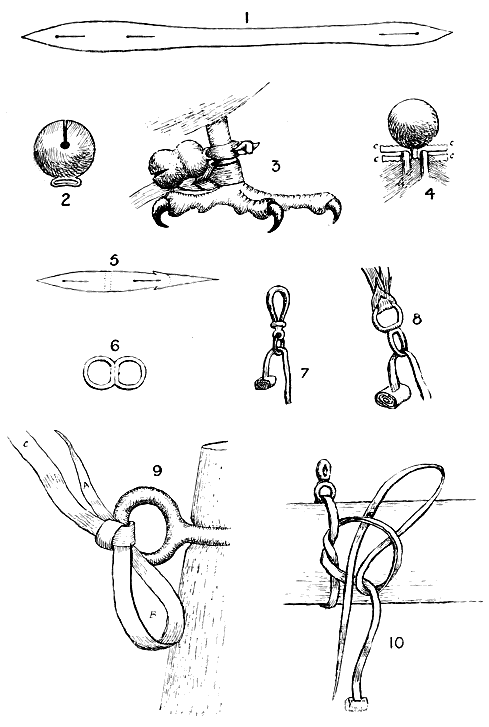
HAWK’S FURNITURE, I. 1. JESS 2. BELL 3. HAWK’S FOOT WITH BELL AND JESS ATTACHED 4. BELL FOR TAIL OF SHORT-WINGED HAWK 5. BEWIT 6. RING SWIVEL 7. SPRING SWIVEL 8. LEASH, SWIVEL AND JESSES 9. FALCONER’S KNOT 10. ATTACHMENT OF LEASH TO POLE, PERCH OR CADGE
Trained hawks always wear jesses. As soon as one pair is worn, and shows signs of weakness, another pair should be put on; and after they are attached, the old ones may be cut off with a sharp knife or scissors and thrown away. Valuable hawks have been lost by the owner’s neglect to renew the jesses. Of course it usually happens that one of a pair wears out before the other, and the breaking of the weakest gives warning before the other has given way. But when one jess has become so dilapidated as to be on the point of breaking, his fellow will not be in a much better case, and a jerk caused by suddenly bating at the block, especially when sitting there after a bath, may liberate the hawk when you feel least prepared for such a mishap. The old falconers seem to have almost always attached the ends of the jesses to “varvels,” which were small rings of silver, or other metal, upon which often the name and address of the owner were engraved. Possibly the jesses so used were very short, so that the risk of “hooking up” did not arise. But the practice has long been abandoned by European falconers.
Bells for trained hawks are of the greatest possible use. They betray the whereabouts of the wearer, and save an infinity of time and trouble when she has killed out of sight; and besides this, they proclaim to every stranger who sees a lost hawk on the wing that she is private property, and not wild. They are, practically, no impediment to the hawk’s flight, except in the case of the very smallest species; and their sound probably augments the terror inspired in the quarry by a stoop that has only just missed its mark. Bells have been used in all countries from time immemorial. The best are now made in India; but for the larger hawks, those supplied by Mr. Möllen, at Valkenswaard, in Holland, are good enough, and very cheap. The European bells are spherical, with a plain flat shank (Fig. 2), and those of Indian manufacture are of the shape shown in the illustration (Fig. 3). Anciently, silver was much used for bells for the more valuable hawks, but the metal now used is chiefly brass. A good bell should be capable of being heard distinctly on a still day more than a quarter of a mile, even if lightly moved. The bell is attached to the hawk’s leg by a “bewit,” which is fastened on in the same way as the jess. The bewit is a small strip of leather shaped as in Fig. 5. It is pulled through the shank of the bell until the latter is at the place indicated by the dotted line near the middle. The shank is applied to the hawk’s leg above the jess, and the end (A) is passed round the leg and pushed through the slit (B). Then the thicker end is pushed through the slit at the thin end, and pulled till the ears or jags at the side have come through the opening. These then act as barbs to prevent the end slipping back, and the thin part of it can be cut off. Hack bells are used not only to give notice where the hawk is, but also to serve as a weight to handicap her when, at the end of her time of liberty, she begins to chase chance quarry. They are therefore much bigger, in proportion to the size of the wearer, than the bells used in the field. A falcon’s or tiercel’s bell will not be too big for a merlin or jack. Sometimes hawks' bells are even loaded with lead. A merlin which is flying ringing larks does not wear bells, for it is impossible to get any which are sufficiently light, and at the same time loud enough to be of any use.
Short-winged hawks should generally be belled on the tail, and for this purpose the bewits should be of a different shape, as in Fig. 4. The aperture on each side of the bewit should be made to encircle the shaft of one of the “deck” feathers, that is, the central feathers of the tail, near to its base; and the double ends (C, C) should be lapped or tied together with waxed thread, so that the fastening cannot slip from its place.
Of course when it is intended to put on new jesses or bewits, the hawk must be “cast,” or held. And some considerable attention is required to cast a hawk properly. To seize an unhooded hawk, especially short-winged, and forcibly thrust her down on her breast would constitute, in her eyes, a deadly and perhaps unpardonable offence. To meddle with her when she has a full crop would be a great mistake. A time should be chosen when she has little or nothing in her crop. She should be hooded and held on the fist, while on the “operating table” is placed a cushion and the apparatus required, including tweezers and a sharp penknife. Then a silk handkerchief, once folded, can be thrown over the hawk’s shoulders, and the falconer’s assistant, standing behind the hawk with his hands over her back, the thumbs close to her back-bone, will, with a quick steady lowering of the palms, grasp her firmly round the body, with the fingers enclosing the sides of her wings and thighs. Lifting her off the fist, he must deposit her on the cushion, holding her down steadily on her breast. A man should be employed for this purpose who is not likely to be nervous or flurried.
The jesses are made fast to the swivel when the hawk is not intended to fly; and swivels are of two kinds. The safest (and the most troublesome to put on and take off) is the ring-swivel (Fig. 6), consisting of a double ring in the shape of a figure 8, each end working freely on a pivot which keeps the two rings close together. It is made of brass or iron, and very good and cheap ones are to be had from Mr. Möllen, of Valkenswaard, in North Brabant. To attach the ring-swivel to the jesses, pass the end of one jess from right to left through one of the rings, and, after it is through, pass both rings through the slit in the jess, and pull tight. When the first jess is fast, pass the end of the other jess through the same ring upon which the first jess is fastened, but in the opposite direction, from left to right, and then pass the two rings through the slit as before. The second jess will pull up tight over the first, and both will be fixed firmly at the outer end of the same ring.
To get the ring-swivel off, the extreme end of the jess which was last put on must be pulled until that jess becomes slack enough for the two rings to be passed through it, or, in other words, for the opening in the leather to be pulled over the rings, and, this being done, it will come away at once. After releasing one jess, take care to hold it tight between the fingers of the left hand while freeing the other jess. Otherwise, if the hawk is fidgety and jumps off, she may jerk the other jess out of your hand, and go off bodily, leash and all, into the next parish.
Spring-swivels (Fig. 7) are very handy contrivances for use in the field, but not so safe for a hawk when sitting unhooded on the perch or at the block. They are shaped like the swivel by which watches are usually attached to a watch-chain, and must be so made as to turn quite freely on the pivot. To attach them to the jesses, nothing more is required than to press the side with the thumb-nail, making the spring yield, and then hook the curved end through the slit in both jesses, after which the spring is released, and the jesses remain encircled by the metal. Only, if the spring is stiff or does not work properly, there will be disasters. The unhooking process is of course even more easily and quickly effected.
The leash can now be attached to the swivel. And leashes, again, may be of two kinds. The orthodox leash for peregrines and big hawks is a strip of tough leather, about half an inch wide, and a yard long, provided with a stout button at one end, which is made in the following way:—In cutting the leash, three inches or so at one end are cut rather broader than the rest of the strip. This broad end is then rolled up tightly by doubling it over and over upon itself. After the broad part has been rolled up, a hole is punched right through the roll, and the other end of the leash, which is tapered to a point, is pushed through and pulled tight. A sort of square button will thus be formed at the thick end of the leash (Fig. 8); and if the thin end of it is passed through the outer ring of the swivel—that ring to which the jesses are not attached—it will run right through until the ring encounters the button, which is too big to get past. The whole length of the leash is then available for the purpose of tying up the hawk to her block, or to a peg in the ground.
There is a right and a wrong way about even so simple a matter as tying up a hawk. Blocks and pegs ought always to be provided with a ring or staple, round which to tie the leash; and it should be tied in what is called a falconer’s knot, which can easily be negotiated with one hand. To begin with, pass the thin end of the leash through the ring. Then make a loop in the part which has gone through the ring, and pass the loop round that part of the leash which has not gone through the ring. Pull tight, and the leash will assume an appearance resembling that shown in Fig. 9. Next pass the end (A) through the loop (B), and again pull tight. It will be impossible for any strain upon the leash at C to undo the knot. And when it is desired to undo it, the end (A) can easily be picked out with the fingers through the tightened loop (B), and a simple pull upon A will then undo the whole fastening.
For attaching hawks to the screen-perch, a sort of double falconer’s knot is required for fastening the two ends of the leash round the pole. But it is learnt with the greatest ease. Nothing more is necessary than to take the two ends of the leash—the thick and the thin—and pass one over and one under the pole. Then tie them together, just as if you were tying a black necktie, except that you make only one bow instead of two. Let this one bow, when the knot is pulled tight, be about four inches long; and through the loop formed by it pass the two ends of the leash, which will naturally be found on the reverse side of the knot (Fig. 10). When the hawk is carried on the fist, the ends of the jesses, the swivel, and button of the leash will often lie in the palm of the left hand. The leash will hang down for some inches, perhaps a foot, and then, forming a loop, be gathered up to the little finger, round which the lower part, a few inches from the thin end, is wound for the sake of extra security.
Smaller leashes in the same style, but made of less stout leather, can very well be used for the smaller hawks, and usually are so. But when these hawks are doing a great deal of flying, as they should, and doing it twice a day, the trouble of constantly unfastening the ring-swivel from the jesses and fastening it on again becomes very tiresome, and even vexatious; and it is a common practice to use spring-swivels permanently. The outer ring of these (unless they are made specially) is too small to admit the passage of a flat leash; and it will be found more convenient to use thongs shaped like a porpoise-hide boot-lace. In fact a long leather boot-lace makes about as good a leash as can be wished for. The function of the button is fulfilled by a simple knot tied in the end of the lace. Or in order to save still more time, the lace may be permanently attached to the spring-swivel in the manner shown in the diagram (Fig. 25). By making the knot an inch or two away from the ring of the swivel, instead of close up to it, enough length of tether is left, when the leash is tied round the pole, to enable a merlin or sparrow-hawk in short “racing jesses” to shift about a bit on the perch.
The proper place for a hawk, when not out of doors, is the screen-perch (Fig. 23). The bar on which the hawk stands may run from wall to wall of the hawk-house, or, if this is not convenient, it may be supported on arms or brackets reaching out from the wall to a distance of not less than 30 in. for a big hawk, or 2 ft. for a little one. Where this arrangement is also impossible the bar may be supported at each end on a post or tressels so securely fastened or weighted that they cannot be upset or moved out of place. Round the bar, which should be of wood, is wrapped a padding of baize or other soft stuff, and over it a covering of canvas stretched very tight. The canvas may be nailed to the pole, or stitched together, on the under side. A screen, or curtain, of canvas must be attached to the under side of the perch, and hang down from it for more than two feet, to form a sort of ladder, by which any hawk may climb up again as often as she bates off and hangs by her leash and swivel. The ends of this screen may be kept down with weights attached to it, or stretched by a sort of guy ropes from the lower corners, so as to keep the whole flat and taut. In perches for small hawks, the same canvas which is rolled round the pole is often allowed to hang down and form the screen. In this case slits or holes are made in the canvas just below the pole, through which the leashes may be passed when fastening the hawks to the perch. A space of at least 2 ft. should be left between each big hawk and that which stands next her on the perch; and 18 in. between each of the small ones; and there should be rather more space between the end hawk and the wall or the bracket of the perch, whichever it is.
Underneath the perch must be spread a good thick layer of sand or sawdust, extending in the case of peregrines and gers for a good yard on each side of the perch, and about 18 in. in the case of the smaller long-winged hawks, to catch the mutes. As for short-winged hawks, the layer must be very much farther extended, and in the case of goshawks should reach at least three yards from the perch. And if the perch is near a wall, the wall itself must be protected by a shield of paper, or other cheap material which can be changed every other day, for these hawks “slice” to a very great distance almost horizontally. The sand or sawdust must either be removed daily, or at least freed from the mutes which have fallen into it. In or near it will also be found the “castings,” or pellets of refuse feathers and other indigestible matter thrown up by the hawks. These castings should be looked for every morning by the falconer, and each one should be examined before it is thrown away, as it is by the appearance of them, as will be seen later on, that the state of health of each hawk is to a large extent ascertained. Both castings and mutes, with the sand or sawdust adhering to them, should, when collected, be immediately removed from the hawk-house. A dirty or ill-smelling room is not only a disgrace to the falconer, but injurious to the inmates, which, though possessed of no sense of smell, require the purest possible air to breathe.
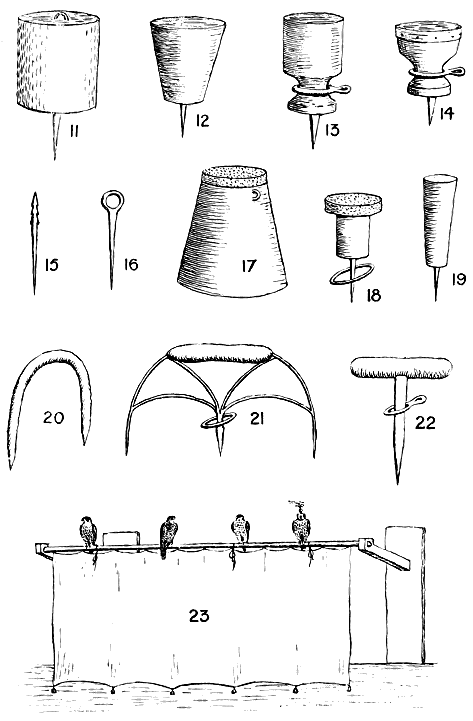
HAWK’S FURNITURE, II. BLOCKS AND PERCHES 11. PLAIN BLOCK FOR LONG-WINGED HAWK 12. BLOCK FOR SAKER, MERLIN, ETC. 13, 14. IMPROVED BLOCK FOR LARGE AND SMALL HAWK 15. SPIKE FOR BLOCK 16. RING PEG 17, 18. BLOCKS WITH CORK TOP 19. FIELD BLOCK 20, 21. BOW-PERCHES 22. CRUTCH-PERCH 23. SCREEN-PERCH
For out-door service, blocks are used for the long-winged hawks, and bow-perches for the short-winged. Blocks are of various shapes, as shown in the illustration. The simplest are made of mere chunks of tree or sapling sawn off level (Fig. 11), and having a staple of iron or brass driven into the top or at the side, to which to attach the leash. They should be from 8 inches to a foot in height for a peregrine or ger, and for all other hawks of such a height that when the hawk is standing on them her tail may just clear the tops of the blades of grass. A high block is not good; for then the leash, if it is not to catch in the shoulder, must be a long one, and when the hawk bates she will be brought up with a too sudden jerk as the leash tightens. For the smaller falcons—hobbies, merlins, and kestrels—as well as for sakers and lanners, the block should always be larger at the top than at the bottom, so that it may not be fouled on the sides with the mutes (see Figs. 12, 14). It is a very good plan to have a groove made round the body of the block, and to have a metal ring fitted round it, so that it will run freely in the groove. This hoop of metal may be looped out into a smaller ring on one side, to which the leash may be tied (see Figs. 13, 14). As the hawk jumps off to one side or the other the ring will run round; and thus all risk is avoided of the leash getting hitched up or wound round the block. A spike (Fig. 15) is firmly fixed into the middle of the base of the block to hold it fast in the ground. Of course a block which is larger at the base than on the top may be used without a spike, and without any ring or staple in it, if the leash is fastened to a ring-peg (Fig. 16) in the ground. But even if this peg is driven in on the windward side of the block, that is, on the side towards which the hawk is pretty sure to bate off, the risk of entanglement is not wholly avoided; and a hawk so attached should not be left alone for long. The top of the block should be covered with cork (Fig. 17), or it may be padded and covered with leather. But in the latter case it must not be left out in the rain. Wood is too hard for hawks to stand on for any length of time, and is apt to give them corns or sore feet. No hawk should be allowed to stand on a wet block. A simple and not a bad plan for making merlins’ blocks, is to saw off a chunk from a pole or tree branch, about 2½ in. in diameter and 5 or 6 in. long. Into one end insert a spike, and on to the other nail a 4-in. or 5-in. bung (Fig. 18). A 4-in. metal curtain-ring, measured from outside to outside, can be placed on the ground and the spike driven into the earth in the middle of the ring, which will run freely round the block when the leash is attached to it. Care must always be taken to drive the block well home to the ground, or the leash may get jammed under its lower edge, and cause a dire mishap. Fig. 19 is a little field block which I use for merlins. It can be carried in a side-pocket when out on the open downs. After one of these little hawks has done her day’s flying, or before her turn comes, instead of putting her, hooded, on the pole cadge, her leash is made fast to the looped creance, which comes from a ring in the top of the block. The spike is driven into the ground in a sheltered spot, and the hawk is deposited on the top of the pigmy post, where she will sit, if not exactly “like patience on a monument,” at least more comfortably than if merely pegged out on the prickly grass or still more uninviting stubble.
Bow-perches for goshawks and sparrow-hawks may be made by simply bending a length of yew or other tough wood into the shape of an arch, and sticking the two sharpened ends into the ground (Fig. 20). A more elaborate apparatus made of iron, with three spikes and a padded top, is shown in Fig. 21. In any case it is proper to pad the uppermost part of the arch. The ring for the leash runs loosely on the outer frame of the perch. The crutch-like perch shown in Fig. 22 is simple, and has its merits. Probably for an eagle it is the best resting-place that could be provided. When fixing up bow-perches or crutch-perches care should be taken that they are placed broadside on to the wind, so that the hawk as she takes perch on them may directly face the wind. It is perhaps needless to say that for an eagle the spike should be very long, and hammered deep into the ground.
The hood, or to speak more exactly, the hood proper, is an article of attire with which every educated person is vaguely familiar. The exact shape is shown in Fig. 24. It is made of stiffish leather, fashioned on a wooden block made of the size and shape of the hawk for which it is intended, and stitched together. Some amateurs have arrived at a certain proficiency in making their own hoods. Captain Salvin, for instance, could manufacture very good ones. But such excellent hoods can be obtained from Mr. Möllen, for all sorts of hawks, at so small a price, that it is scarcely worth while to be at the trouble of making them. The hooding of hawks is an art in itself, and will be referred to in a later chapter. When the hood is well on the hawk’s head and the beak well through the opening in front, the longer and thinner of the braces at the back (A, A) are pulled apart, and the back of the hood is thus drawn tight, so that it is impossible to remove it. The shorter and stouter ends are pulled when it is desired to slacken the fastening, so that the hood can be taken off by lifting the plume forwards. Usually each of these operations is performed with the aid of the right hand and the teeth. As the hawk stands on the falconer’s left fist with her tail outwards over his knuckles, he takes hold with his right finger and thumb of the brace which is on the hawk’s left side, and then catches hold with his front teeth of the brace which is on the hawk’s right side. A sharp pull brings the ends apart, and the hood is braced up or slackened, as the case may be. Before any hood is ever put on, the falconer should remember to look inside it to see that no dust or dirt or stray feathers or anything else has found its way in, and it is as well to blow a puff of air into it to clear it of any particle of dust.
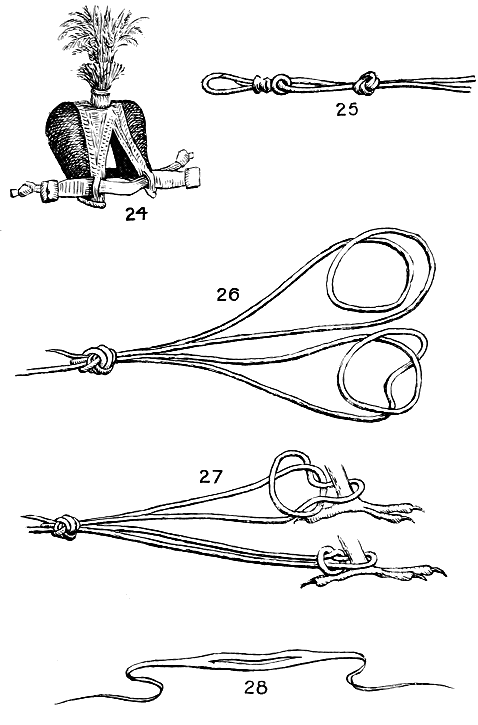
HAWK’S FURNITURE, III. 24. HOOD-PROPER 25. SPRING SWIVEL AND LEASH FOR SMALL HAWK 26, 27. DOUBLE RING LEASH 28. BRAIL
The rufter-hood is made of much softer leather, with no plume, and a simpler fastening. It is used for newly-caught hawks, and hardly need be described in detail, as before the beginner has occasion for it he will have learnt more about hoods than can be taught in any book. Indian hoods are also made of softer leather, with a different and smaller plume. They are fastened by braces which run round the lower side, passing in and out of the leather and working by friction.
This completes the list of ordinary hawk’s furniture. But there are a few other appliances with which the beginner must become familiar before he can undertake to train, or even to keep, a hawk.
A brail (Fig. 28) is a sort of manacle for an unmanageable hawk, which keeps on bating and fidgeting with her wings. It consists of a narrow strip of fine soft leather, having a slit two or three inches long down the middle. Into this slit is inserted the pinion joint of the hawk’s closed wing. The upper end of the brail will then of course extend upwards over her back, and the lower will hang downwards by her side. Now take the upper end and pass it down under the under part of her wing between it and her ribs. Pass the lower end in the contrary direction upwards under the under side of the same wing. The two ends will now be pointing in the opposite direction to that first described. Next bring them together on the outside of the wing, and tie in a plain bow-knot, making the bows very short and passing the single ends through them. The hawk will be unable to open the wing, which will be to all intents and purposes as useless to her, as long as the brail is on, as if all the flight feathers in it had been cut.
A bath must always be offered to a trained hawk at least twice a week, and oftener in fine and warm weather. And it is not a thing which can always be improvised very easily. The best baths are sunk in the ground, so that there are no upstanding sides round or under which a leash can get entangled. But of course, unless great care is taken, the ground round the edges of such a bath is apt to become slushy and dirty, if much used. Whenever it is impossible to sink the bath in the earth it is necessary that some person should be at hand when the hawks are bathing, so that if the leash gets entangled he may come to the rescue.
Many hawks have a tiresome way of jumping on and off the sides of the bath, and running round it—in fact, as Winchester boys say, “funking on the bank”—in complete oblivion of the fact that they are thereby hitching up their leashes. For such hawks it is best to take off the leash and substitute a creance three or four yards long, attaching the end of this to the block on which they are deposited at the side of the bath. All baths should be of a sufficient size. For gers they should be nearly a foot deep at least, and well over a yard in diameter. For the smallest jack-merlin they should be not less than four inches deep. A hawk will not fully enjoy her bath unless she can wade into it, if she chooses, up to her shoulders and over. In shallow water she is more or less uncomfortable. Like Alexander the Great, in the small world of antiquity, æstuat infelix angusto in limite; and her back and the nape of her neck are never properly wetted, however much she may splash about in the endeavour to throw the water over them. The bath should be tilted up, so that it is shallower at one end than the other, and the bather may get in, if she chooses, at the shallow end, and wade out as far as she likes towards the other. According to immemorial custom a few pebbles should be thrown in to lie on the floor of the bath. When the weather is very cold, a cup or two of hot water may be added, to take off the chill; and if the water used is taken from a deep and cool well it should be allowed to stand for some time in the sun before being put out for the hawks. Cemented basins in the ground make, of course, capital bathing-places. But they are troublesome to keep clean, and even to empty; and the surrounding edges are likely to become small quagmires. Perhaps the most serviceable bath is a common flat bedroom bath, sunk into a cavity in the ground, and removable at will. A pretty tall block or for short-winged hawks a bow-perch, should be placed near the bath, so that the bather, having finished her ablutions may at once jump on to it.
In some places it is possible to indulge the hawks with a natural bath. When there is in the neighbourhood a stream of clean water with a sandy or gravelly bottom and shelving banks, the hawk may be carried down to a suitable part of the bank, the block set up, and the creance attached. She may be left on the block while the falconer retires to a short distance, and will come back, when bathed, to her post. After the bath, every hawk should remain out, bareheaded, for about an hour, in the sun, if possible. She will busy herself first in spreading her feathers to the sun and wind, and then in pluming and arranging them—a work exceedingly agreeable to those hawks which are particular about their own appearance.
The lure will be more particularly referred to later on. It may suffice to say here that it is a rough imitation of some bird—or, if the hawk is to be trained to ground-game, of some beast—used as a bait to which the hawk is taught to come for food. It is attached to a strong cord or thong a yard or more long, and sometimes to a swivel. It is the invariable companion of the falconer in the field, though never allowed to be seen by the hawk, except when she is required to come to it. The lure should be a sort of magnet, operating to draw the hawk towards it as surely as iron will attract a magnetised needle.
A cadge is a most necessary apparatus when a man is the possessor of more than one hawk. The orthodox and historic cadge—such as one sees in representations of As You Like It on the stage, or, as once I remember, at a Lord Mayor’s Show—is a circular or square or oblong frame of wood, three or four feet across, having straps by which it can be suspended from the shoulders of a man, who in classic phrase is termed a “cadger,” and who stands or walks in the middle, with the frame surrounding him. At each corner of the frame is a small jointed leg, which can be hooked up when the cadge is being carried, and let down when it is to be deposited on the ground. The bars which form the body of the frame are padded on the top, and on these stand the hawks, hooded of course, and fastened by their leashes to the frame. The man with the cadge (whom in these days you will not address by his right title, unless you wish him to give you a month’s notice) will, if he is a sharp fellow, so carry the cadge that all or most of the hawks upon it face the wind. On windy days—and at rook-hawking time it is mostly pretty windy—the cadge should be rested as much as possible under the lee of some shelter, generally a rick. All hawks very much detest a wind; and should not be unnecessarily exposed to it. In fact, trained hawks must be, in this and in all other things, whether at home or in the field, subjected to as little vexation and annoyance as can be. Like other creatures, they have tempers of their own—sometimes very queer ones; and they have enough to put up with, as it is, when trained, without any extra trials that can fairly be spared them. A cadge is shown in the illustration.
A still greater luxury for the field, especially in rook-hawking, is the hawk-van, which is a sort of omnibus, fitted with screen-perches, and hung on very easy springs. In it are conveyed the hawks which are not for the time being in use, and also spare lures and other furniture and properties, not forgetting the luncheon-basket. Such a vehicle will be too pretentious, as well as too costly, for most private individuals, but it is used successfully by the Old Hawking Club, whose excellent arrangements and methods of training and managing hawks will be repeatedly noticed in these pages.
The box-cadge is a very simple apparatus used for the transport of hawks by train or other wheeled conveyance. It is nothing more than a frame resembling the body of a box—very often a box itself—without the lid. The four upper edges of the sides are padded to form perches. Holes are bored in the sides an inch or two below, through which the leashes can be passed and made fast. In the bottom of the box is sawdust to catch the mutes; and the hawks are put on, as naturally they would be, facing outwards, with their tails towards the inside of the box. You will be surprised, if you have never seen it tried, how small a box will accommodate six or eight great big hawks sitting in this simple fashion. By the bye, the box-cadge should be heavily weighted, to prevent upsetting or jolting, in case any hawk should unluckily bate off.
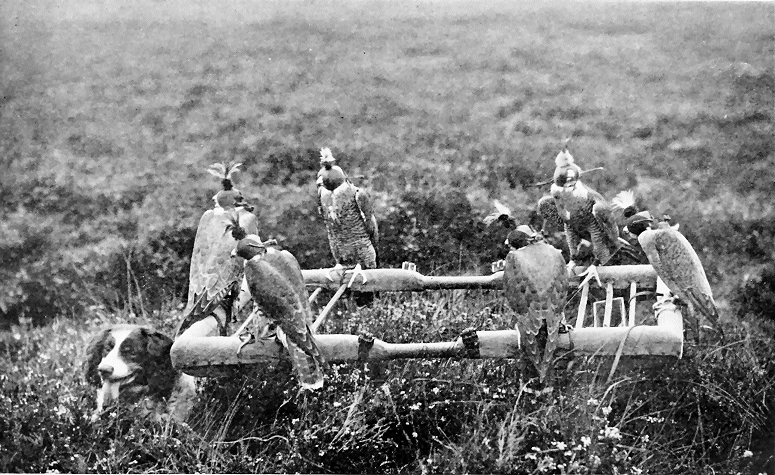
CADGE WITH PEREGRINES
The writer of these pages has invented an apparatus which may be called a pole-cadge, and will attempt to describe it, because in his own experience he has found it very useful and handy, especially for small hawks. It consists of a plain pole—a broom-handle does very well—over which a single or double fold of green baize is stretched and fastened. About nine inches from each end of the perch thus formed, stout wire is firmly twisted round it, and the ends of the wire are allowed to project at an angle of about 90, from one another downwards. When the perch is being carried, it is simply grasped by the middle in one hand; and when it is desired to put it down, the four ends of the wire are rested on the ground, or pushed into the earth if it is soft enough. The hawks are, of course, attached by leashes tied round the pole, as if they were on the screen-perch; and four can be accommodated with the greatest ease on a short stick—one near the bearer’s hand on each side of it, and one near each end of the pole. A long stick would hold six or eight hawks. There is no reason that I can see why a stouter pole should not be used for big hawks. The advantage of this over the ordinary and time-honoured cadge is that all the hawks, if properly placed, must necessarily face the wind, and need never stand sideways to it. The pole-cadge can also be picked up and set down much more quickly. And for carrying hawks when driving in a dogcart or riding on a bicycle—a not impossible feat in these days—this form of cadge is, I think, unsurpassable.
Hawking-gloves, for wearing when a big hawk is on the fist, are gauntleted half-way to the elbow, and made of buckskin or very strong leather. They should, of course, be kept clean and dry. For the smaller hawks a two-button dogskin glove is strong enough, and preferable. Some hawks, when they are very sharp-set, or fidgety and in a bad humour, will pick and tear at the glove or perch in a tiresome way, and even tear it to pieces after a while. A cure for this is to rub the exposed part of the glove or perch with onions or a solution of alum, the taste of which will generally soon disgust the offender with that bad habit. Very often, however, it is good to provide such a hawk with a very tough piece of “tiring,” such as the bare pinion of a goose or fowl, upon which to expend her superfluous energy. Worn gloves should not be patched or mended, but replaced by fresh ones. A glove which has once become thoroughly greasy or sodden should be regarded as spoilt.
Mews, or hawk-houses, are more particularly described in Chapter XIII. They should be absolutely free from draughts, and not liable to get too hot in summer or too cold in winter. The doors should fit well, and be kept locked as a rule; and the windows should all have well-fitting shutters. They should be ventilated at the top, and be kept bare of furniture and rubbish of all kinds, and scrupulously clean. The windows should by preference face towards east and north. And in hot climates there should be a verandah outside, and double roof above.
CHAPTER IV
Eyesses and Hack Hawks
Eyesses, or young hawks taken from the nest, should not be taken until the latest possible day. If the captor can defer the moment until they are able to fly a little, so much the better. He may then possibly snare them by some means or another. But this is an exceedingly difficult job, as the newly-fledged hawk is for a considerable time fed by her parents, and does not prey for herself. Consequently, she will not come to any live lure or baited trap, and, being very distrustful of men, cannot easily even be approached. Thus it is rarely that even an experienced falconer can lay hands on a wild hawk after it has once left the eyrie. The next best thing to be done is to catch the eyesses when they are branchers, that is to say, when they are able to run and jump about on the branches of a tree, though not yet able to rise on the wing from the ground. In short, the longer they can be left in the natural nursery under the care of their natural guardians, the better they are likely to turn out, not only in their bodily condition, but in temper and disposition. Very often, however, the young birds will come to their trainer when there is a good deal of the white down of their infancy still clothing their unwieldy bodies, and only partially replaced by the brown feathers of their first plumage. At any rate the flight feathers of the wing will not be nearly down to their full length. The outer ones will still have some inches to grow; and those of the tail will be short soft things, with flabby shafts, and not much shape or strength.
It is for many reasons desirable that the trainer should go personally to the place where the eyrie is, and either himself assist in taking the young birds, or at least be ready to receive them within a few hours, and give them their first feed. Unfortunately, most hawk-dealers and many gamekeepers have a rooted objection to this plan, and prefer to muddle about with the hawks themselves, not sending them off to the purchaser until they have already unwittingly done them more or less injury, in one way or another. They either are, or pretend to be, unable to understand or to believe that an eyess delivered immediately into the trainer’s hand is worth at least 25 per cent. more to him than one which has been messed about by unskilled hands, and racketed about in a train for several hours. This stupid prejudice of the captors and vendors is often productive of the deplorable blemish called hunger-streaks, which weakens every important feather in the hawk’s body, and to some extent checks and stunts her whole bodily growth and energy, just at the time when it is most desirable that they should be steadily maintained and developed. A hunger-streak is caused whenever a young hawk has been allowed to grow unreasonably hungry. The result is that that part of the whole web and shaft of each feather which is growing out of the body at the time is deformed through want of proper nourishment, and bears on it ever afterwards a cross line like a blight, so that the feather looks as if a sharp razor had been passed lightly across it. As the feather grows down this line comes down with it, and may be seen in all its hideousness, after the hawk is summed, if any big feather is examined carefully. A fast of more than fifteen hours—in the daytime—will generally cause a slight hunger-streak; but the night hours do not count for much; so that hawks which have to travel far before getting into the trainer’s hands should be taken late in the day and started at once, so that they may be met as soon as they arrive on the following day.
If the falconer cannot attend personally at the capture of the eyesses, he should at least send to the captor a suitable hamper in which to pack and send them. This should be roomy and round in shape, having its sides and top lined inside with sacking, matting, or other soft material. In the bottom of it a good thick layer of straw should be lightly strewed, for the hawks to rest upon; and the lining should fit well enough to exclude almost all light. Even with all these precautions there is some risk of breaking feathers, and still more of bending them and deforming them with dirt. On railways the guards may generally be cajoled into taking special care that the hamper is not turned upside down or banged about. But I have more than once known of valuable hawks arriving dead from a short sea voyage—killed by the evident ill-treatment to which the padded hamper has been subjected on the way.
Once arrived at the trainer’s quarters, the hamper should be opened in a darkened room, with doors and windows closed, in which has been got ready another straw-lined hamper, this time of an oblong or square shape. Each hawk in her turn will be gently taken out of the soiled travelling hamper, of which the lid can be shut down between the times of removing the several inmates. Unless these are very young, a rufter-hood can be slipped on the head of each one, and the jesses and bell at once attached to her. If they have come far, a few morsels of food may be given even before the new-comer has been deposited in the second hamper. But, if too young to be able to move about much, they can all be transferred directly to the new quarters, and the lids left open. In every case the operation of feeding should be at once undertaken. And a much more troublesome thing this operation is than the unlearned may suppose. In the first place, there must be in readiness a good store of fresh, tender beef or sheep’s heart, cut into small strips and slightly warmed. And of this the new-comers must by some means or other be induced to swallow at least a small quantity. If care has been taken from the very first not to alarm them, they may possibly take the morsels of meat quietly and naturally, when offered to them gently on the end of a small stick. If so, an important point will have been gained. But it is much more likely that at the sight of their new and awful-looking foster-parent—when a subdued light has been let into the room—they will draw back their heads, open their mouths, and hiss indignantly. Still, if the meat is very slowly and quietly obtruded towards the open mouths, there is always a good chance that one of them, bolder than the rest, will strike at it, half in anger, and half with the idea that it may be good to eat. And, if such a youngster should happen at the first shot to catch hold of the piece she aims at, she is quite likely to swallow it, in which case the rest of your task becomes easy. If things do not go quite so smoothly, and a hawk which has seized the meat flips it scornfully away, there is no need to give up the attempt. She may do this a dozen times, and at the thirteenth time of asking may swallow the food and begin feeding readily. Or, whilst pupil number one is thus making a fool of the teacher, number two may take heart and come up to the attack, with a more practical result. Even at the expense of much time and patience, it is worth while to get the youngsters to conform from the first, and take their rations willingly and amicably. As soon as one has done this the others will follow suit, some quickly and others grudgingly. If all such efforts fail, or if the hawks, being nearly grown up, bate and begin to dash about, you must, of course, use rougher measures. To starve them is worst of all. There is no harm, if all modes of persuasion fail, in “stuffing” a young hawk. Let her be held firmly, and as she opens her mouth in defiance at the meat offered, let the falconer push it inside her beak, and then, if she will not swallow it, push it down with the small stick into her throat. I have known an eyess hobby which had to be “stuffed” with all her meals for eight days! And afterwards she became a fine hawk and a very strong flier.
When all the hawks have taken a half-crop or so, they should be left in peace in the darkened room for two hours at least. It is a good thing, by the way, to put on each of them different-coloured jesses, so that from the first they may be easily known apart. Brown, yellow, white, orange, and black are perhaps the best colours—not red, or pink, or green. Notes may also be made from the first in a hawk-book or falconer’s diary. As, for instance, “June 10—Eyess peregrines arrived; No. 1: small falcon; fed readily, and had nearly a full crop; seems strong and active; outer wing feather about half down; brown jesses and hack bell. No. 2: big tiercel or small falcon (uncertain); fed with difficulty; half a crop; seems timid and rather dull; black jesses.” Of course, if the hawks are to be turned out as soon as they can fly, no slits will be made in the outer end of the jesses. Another thing which may very probably have to be done is to clean the hawk’s tail-feathers, and possibly the tips of the wings, if soiled during the journey. This is done with warm water, soap, and an old toothbrush. If the dirt is allowed to get hard on the feathers it will be almost impossible to get it off without fraying the web. The feet of each hawk should also be well washed and brushed with soap and warm water; and it is always as well to do the same with the nares, or else brush them and the beak with a brush dipped in a solution of tobacco. A fresh feed should be given at intervals of not more than five hours between sunrise and sunset, i.e. three at least in the day. In fact, young nestlings can hardly be fed too often or too much, when they seem ready to eat. But the food should not often be as heavy as beef. Young pigeons, young chickens, bullock’s heart, and rabbits may be given to the big hawks; small birds—fresh-killed always—and sheep’s heart to the small ones. Old pigeons are rather too heating, and old fowls are too tough. Whenever butcher’s meat is given, it should be slightly warmed first, but not dipped in water. The hawks must be kept quite dry, and in a moderately warm but airy place, away from all draughts. Very young sparrow-hawks must be kept in a specially warm and well-sheltered place, or they are pretty sure to develop a fatal attack of cramp. Whenever it may be necessary to move a young hawk or meddle with her, the room should be made as nearly dark as possible.
After a few feeds, administered quietly and patiently, the young hawks will begin to lose their distrust of their new surroundings; and first one and then the others will begin to take their meat eagerly, stretching their necks out, and perhaps pushing their way towards the feeder’s hand. When this is the case they may be indulged with a few tit-bits on the fist or on the lure. If the lure is used, the pieces of meat should be merely laid upon it, so that at first the hawk may pick them off quite easily; and by degrees they may be made to walk towards it from their artificial nest along a causeway roughly constructed for that purpose. If it is preferred to get them to feed on the fist, as it probably will in the case of short-winged hawks, they must first be made to pick pieces off the gloved hand. Then hold in the gloved fist, between the outer part of the thumb and the end of the forefinger, a very tender piece of meat or wing of a small bird. As the hawk takes hold of it, and finds that it cannot be taken up without a pull, she will, at once or after a while, give a tug at it, and afterwards probably put out a foot and seize the glove, using her foot as a leverage, just as an oarsman uses his stretcher. A little encouragement will make this easy for her; and by a little management it can be so arranged that she gets both feet upon the fist. Thus by degrees she will be induced to stand on the back of the hand, and in that position tear up her food. The next step is to raise her slowly up on the fist, while busy at her meal. In like manner, when pulling at the lure, she may be lifted bodily on it, and thence shifted adroitly on to the fist, while the garnished part of the lure is still kept under her.
With a little luck this stage of the young bird’s education may have been reached at almost the same time when the feathers are nearly down and they are ready to fly. In such case the sooner they are turned out to hack the better. When they have grown so accustomed to feeding on the lure or on hand that they will run to it as soon as they see it, they may be let loose in the hack field, with a man to watch them, having a lure with him to entice them if they stray away. Most of the popular books dealing with hawking complacently assume that here no difficulty arises. Unfortunately for the beginner, such difficulties will occur, even in the best-regulated establishments. For instance, the hawks may begin to fly the very day after they arrive, and before they will feed willingly. What is to be done in such a case? Well, each hawk must be made to the lure or the fist before she is turned out. She may be brailed and kept in a spare room, with or without her sisters and brothers. Or she may have slits cut in her jesses, and be attached by a leash to a block, for all the world like a trained hawk, and thence enticed by degrees to run to the lure for her food, until she is keen for it. She should at least know what the lure means before being let entirely loose. But it is generally sufficient that one of a lot which came from the same nest should be made to the lure. The rest, when turned out, will find their way, when hungry, after her to the feeding-place. Some special caution should be observed with hobbies. I know of two which would come to the lure in an outhouse, but only reluctantly. They were turned out one morning to hack in a quiet place, and, though they had never flown more than a yard high before, went up into tall fir-trees. And there they remained, staring at the well-garnished lures which were laid out underneath, declining to go down, taking short flights from tree to tree, and cruising about in the air. This state of affairs continued for about three days, after which it was discovered that the two youngsters—who had never been seen to chase anything, far less to kill it—had become wild hawks! Some falconers habitually carry their eyesses, break them to the hood, and partially reclaim them, before turning them out to hack. But the more natural and promising system is never to confine them at all until they are taken up at the end of the period of hack. The youngster, when thus treated, has become, by the time she has to be put in training, as like a wild hawk as a tame one can be. And, as the haggard is better than the red passager, and the passager than the soar-hawk, so by analogy it may be assumed as a rule that the hack hawk which has never been handled is superior to the eyess which has. Sir John Sebright’s plan of putting out the young hawks in a hamper hung against a tree-trunk, with the lid of the hamper turned down as a platform by day, and fastened up at night, will answer with orderly, well-behaved hawks. But it will be wise to keep a close watch upon the artificial nest, in case of a hawk jumping off when it can run but cannot fly. It might stray for ever so far, and hide in bushes, or be devoured by a cat or fox.
We suppose now that the eyesses are at hack. Even yet their outer wing feathers will not be fully down; and the sails, even of those which will ultimately be the longest winged, appear rounded at the ends, like those of a sparrow-hawk. But they will very soon learn to fly quite well, with a rather gliding movement, the tips of the feathers bending upwards as they strike the air. They will not go far from the spot where they are turned out. What sort of place should this be that is chosen for the hack ground? That depends upon the facilities which the trainer enjoys for selecting a country. None perhaps is better than a large park, with fir-trees in it, or an open moor with a few stone walls. If the falconer is nervous about turning out a whole nestful at once, he may tether one of the most backward at a block in the middle of the hack field, with a “tiring” to amuse her, and place some garnished lures on the ground near to her, to which the liberated hawks may come when they like. There should also be spare blocks put out in the field, upon which the hack hawks may jump if they like after feeding. Of course, if the weather is very wet, the commencement of hack should be deferred till it is more settled, and the hawks brailed and let loose in an empty room or loft. If they have been “manned” pretty well before they are turned out, and will allow themselves to be taken up when feeding on the lure, they may be taken in under shelter the first night or two. But if it is fairly warm and fine they will be better left out. They will generally at or soon after sunset go up into pretty tall trees to roost. If they stay too long on a block or a gate or post, it is as well to drive or take them off, and see that they are perched up somewhere aloft, out of harm’s way. By the bye, hawks, as a rule, should be turned loose in the early part of the day, after a light feed, so that they may be sure to get hungry again by the middle of the day. Jubilee, the best hack hawk I ever had, when he was let loose at 7 a.m., having never before flown two yards, spread his wings, and at the first start flew softly but steadily away across a small river, and, rising easily, took perch 300 yards off on the top branches of an elm 70 feet high. He afterwards flitted about from one high tree to another within a range of 500 yards, and only at midday came down to his sister, who was eating her luncheon at a block in the hack field. He spent that night in a tall elm, not far off, and did not go more than half a mile from the hack field until he was taken up nearly a fortnight later.
If the falconer can hack his own hawks, so much the better. He will learn during the process much about their individual characters and aptitudes. Often he will name them in accordance with their peculiarities or the adventures which each may meet with. It is, however, generally possible for him to get his hawks hacked by some other person, or to purchase fully-hacked hawks after they have been taken up. The worst of it is that unless you know a good deal about the deputy hawk-master, you have no guarantee that the month’s hack which they are supposed to have had is real or imaginary.
On the first or second day of hack the falconer should make up his mind whether he will hack his hawks to the lure, to the fist, or to the board. For short-winged hawks the fist or the board is preferable. For gers, peregrines, and hobbies, the board or the lure. For merlins, the lure and the fist, combined in such proportions as seems to be most suitable; generally more of the lure than of the fist. Each of the systems has its merits, and each its defects.
If the board is chosen, it must be substituted at once for the lure which was used on the first day. It consists of a plank or log of wood, the lower side of which rests on the ground, while to the top side is attached the food for the expected guests. One ration should be provided for each hawk out—at intervals of two feet or so all along the board. It is very important that the meat should be so attached that it cannot be pulled off and carried away, but must be, strictly speaking, consumed on the premises. When the feast consists of rabbits’ legs, fowls’ wings, or the like, it can be firmly tied by the bone. But, when meat is given, much care and ingenuity is required to make it fast. Perhaps the best plan is to tie the piece tightly by the two opposite corners. If it is possible for a hawk to bolt with a substantial piece, she is quite likely to do so. And, having done so once, she will try to do it again, especially if she happens to be a shy hawk, and afraid of her stronger sisters who are beside her at the board.
It must be confessed that hawks at hack exhibit a good deal of perversity in their dealings with the hack board. Theoretically, each of them ought to come down punctually at meal-time, and take her place at the al fresco table, where she can eat up in peace and quiet the portion set out for her, without interference by or with her neighbours. But, as a matter of fact, I regret to say that, instead of adopting this rational and orderly course, hack hawks are often no better behaved than an American traveller at a roadside feeding-place, or a dowager at a ball-supper. As soon as the first comer has settled down to that part of the board to which chance or choice has brought her, the next comer will make straight for the same spot, taking no notice whatever of the dainty morsels with which the rest of the board is bedecked. Thereupon, of course, squabblings and bickerings, and probably a scuffle, in which the weaker or less greedy of the rival gluttons is driven off. Sometimes there will be three hungry young ladies at the same piece, and a sort of battle ensues. Fortunately the quarrel does not end in blows, nor in broken feathers, unless the edges of the board have carelessly been left square and sharp at the upper edges. The disadvantages of the board-school system, as it may be called, are thus considerable. It leads to rivalries and jealousies, and sometimes to free fights, among the school-children. These are not birds which, in the words of Dr. Watts, “in their little nests agree.” Moreover, one bad habit at least is very likely to be learnt. It is impossible always to fix on the rations to the board so that they cannot be pulled off until finished. Suppose, now, that a tiercel, having eaten half his ration, finds that the remainder has come loose. And suppose that one of his sisters, having made a joint meal farther down the board with another falcon, happens to want some more. She may turn a covetous eye towards the tiercel’s portion. Upon which exit the latter, food in hand, closely followed by his big sister, who gives him a hot time of it, chasing him about the hack field, and probably catching him. Then follows a tooth-and-nail encounter, in which the male, or unworthier sex, as it is with hawks, gets the worst of it. Few things can be more conducive than this to the tiresome vice of carrying. It is for this reason that, in the case of merlins, which are especially addicted to this fault, I do not much believe in the board system. On the other hand, it has its advocates and its advantages. Hawks which are so hacked soon become much wilder than when treated in another way. And wildness, at this period of a hawk’s life, is a thing to be desired. Board-school hawks, when taken up, are found to more nearly resemble a wild-caught bird. They seldom or never scream. They have none of the namby-pamby, molly-coddle habits of the fist-fed or lure-fed eyess. They do not hang about round the trainer, or follow him like spaniels. On the contrary, they often will not come down to the board unless he retires to a respectful distance. They are unapproachable by any louts or strollers who may come in sight, and, being shy, take wing very readily, and generally get more flying, and at a better pace.
If the lure system is chosen, the trainer goes to the hack field at feeding-times with as many lures as there are hawks at hack. Each lure must be so heavy that the hawk cannot move it at all, and the food must be attached so that it cannot be pulled off while uneaten. To the first hawk which comes up the first lure will be thrown out; to the second comer another; and so on till the last is served. Fighting will occur, no doubt, as it is impossible to prevent two hawks from coming down to one lure. But, then, the master of the ceremonies is at hand to separate the combatants, and keep each to her own lure, whereas at the board they have to just fight it out.
It is much the same thing with the fist-feeding system. But this can hardly be attempted with success when many big hawks are at hack together. As the trainer comes to the hack field, the hack hawks will come up, taking perch on his hand, his head, his shoulder, or wherever they can find a place. Two or three may generally be accommodated on the left forearm and fist. From his meat-box or feeding-pouch the trainer will take out with his right hand the prepared mouthfuls of food, and distribute them impartially among the hungry claimants. But if there is more than one hawk out, it will be found almost necessary, and certainly convenient, to use lures as well. After a few morsels have been distributed, these lures can be thrown down for all the hawks except one, which may finish her meal on the fist. One day one hawk may thus be retained, and another day another may take her turn, so that all keep up their habit of feeding freely there. Sparrow-hawks which are to be hacked on this system may be coped a little before they are turned out, for they have a way of digging in their claws to any soft place. But a goshawk can only be hacked to the fist if she or he is the only one out. The spectacle of a falconer (or ostringer, to use the correct word) with a goshawk’s claws firmly fixed in his head or shoulder would be a rare subject for a serio-comic portrait!
Meal-times for the hack hawks should be pretty punctually observed. Otherwise the hawks will become irregular in their habits, and the falconer will be compelled rather to dance attendance on them than they on him. The food may be left out on the board for an hour each time, and then removed, before it has become fly-blown or soaked with rain or frizzled in the sun. 6 to 7 a.m., noon to 1, and 6 to 7 p.m., are very good hours. And each time when the board is garnished and the food in readiness, the trainer may blow a whistle, or ring a bell, or sound a gong, to give notice from afar. At each meal there must be “calling over”; and if there is any absentee a mark must be recorded against his or her name.
A bath or two must be set out in the hack field. From about 9 to 11 a.m. it should be kept pretty full of clean fresh water; but it should be removed or emptied before noon. Most hawks are very capricious about bathing; and hobbies, which want it most, will seldom bathe at all. The others should be accustomed to bathe early in the day, so that when they are old they will not depart from this godly habit. Plenty of blocks should stand around, on which the bathed hawks may stand to sun and air themselves.
The longer the period of hack can be safely protracted the better for the hack hawk and her trainer. All the while she is learning to fly. During the latter part she is also learning to chase and to stoop. Here it is that the danger comes in. For in that ardour of youthful chase what kills may come! At first the random shots made from tall tree-tops at passing swallows will be wide enough of the mark. Even the young missel-thrushes or wood-pigeons which have frequented the hack ground will make light of the clumsy efforts made to cut them down; and the house-pigeons from the nearest dovecot will treat with supreme contempt the well-meaning but awkward stoops made at them. But every day finds the young hawks more expert, as well as stronger on the wing. The long feathers are now all down. The shafts harden, and no longer bend perceptibly as the wing-tips strike the air. Presently the flights at wild birds are no longer mere child’s play. The fugitives have to exert themselves to save their skins. Very likely the young hunters of the air are not at first altogether in earnest. Secure of their food at the hack board or lure or fist, and trusting to it for their subsistence, they are merely “having a lark” with the intruders on what has begun to be their domain. But it is increasingly difficult to know how much of their endeavours is play and how much real business. Be sure, however, that when any stoop, whether playful or not, proves successful, and the unfortunate victim is in the pursuer’s clutch, there will be no more play; and on some lonely patch of ground not fifty miles from the hack field there will be left a litter of feathers, the mortal remains of the first quarry killed by hawks of the year.
Let me here quote from my hawk diary: “12 noon; out to hack field, and follow a blackbird down Butt’s orchard hedge. Nearing the corner, blackbird (young cock) takes across the orchard. Drop him, winged, as he goes over the front hedge; and he falls in the hack field. Jubilee [eyess male merlin] is on a block in the middle of it, 90 yards off. It is his third day out. As the blackbird falls, he starts, and, stooping at it as it runs, takes it, kills it, and begins to plume it like a wild hawk before I get up.” Pretty sharp work this for a little hawk that had never used his wings till the day before yesterday. But this capture of a winged bird was not counted as a “kill”; and Jubilee was left out for a good eight days more, and might probably have been left a few longer. Hack hawks know no sentimental scruples about taking their prey on the ground. Here is another extract from a hawk diary: “6.30 a.m., out and fed hack hawks on lure. ‘She’ not visible. At 7 saw her on wire fence, half-way across park. As I got near with lure she started, and, flying low over the ground away from me, turned suddenly, and dropped on some bird in the grass. Was pluming it, when heifers came right up to her. Then lifted, and carried into the lower belt. Quarry looked like a missel-thrush.” The same day “She” was taken up. It is a risky thing to leave hawks out after they have once begun serious and successful chasing. Yet it is a thousand pities to take them up too soon, just when they are improving most rapidly. Peregrines may be left out, with heavy hack-bells, for four weeks or occasionally more. Merlins seldom more than three weeks. If the hack place and its neighbourhood are very open, and the wild birds about are few, there is less danger, and less need for hurry. But when the trees and bushes are well stocked with wood-pigeons, thrushes, and small birds, beware.
It is now that the advantage will be seen of putting distinctive jesses on the hawks. The trainer must watch the board carefully. He may not be able to get within 80 yards of it. But from his hiding-place, be it far or near, he must tell over the number of his charges every morning, noon, and evening, so as to see that all have been down. A field-glass may be necessary to identify each visitant. Brown-jess may come down at 6 a.m., take a light breakfast, and be off. White-jess may not appear till 12; and even then no signs of Black-jess. The case begins to look serious. But at 12.50 at last a hawk comes down. Is this the truant? Or is it Brown-jess again, with her luncheon appetite come on? The glass will tell you quickly if the colour of the jesses worn corresponds to the one name or the other. But if both hawks wore the same coloured jesses, you could not say. If the last comer is Black-jess—only delayed till so late by mere want of appetite—she may be left out, perhaps for some days longer. And the extra days’ exercise will undoubtedly make her a faster and stronger hawk. But if you cannot tell one hawk from another, it will be impossible for you to know when one has missed two successive meals or not. If Black-jess absents herself all day until the evening repast, the inference is strong that in the morning she killed something for herself. If she keeps away for a whole day, that conclusion becomes almost a certainty. She must be taken up when the first chance occurs. Here, however, arises a fresh difficulty. If it is a tiercel who so absents himself—especially a small tiercel—the presumption that he has killed for himself is pretty well conclusive. But what if it is a falcon? Her brother may have chased and killed; and the sister—a slow hawk who could not catch anything for herself—may have seen the flight, or seen the tiercel pluming his dead quarry, and then come up, and by her superior strength driven him off, and pirated the spoil. You, wrongly inferring that it was she who killed the quarry, will take her up the next day, quite prematurely, and leave the real captor, who is much more worthy of bonds and imprisonment, to remain in dangerous liberty. The same doubt may arise when the absentee is an extra strong and extra greedy bird of either sex. That she or he has breakfasted or dined out is, of course, equally clear. But was it the captive of her own wings and talons that she devoured, or that of a weaker, but cleverer, hawk? These are questions impossible to answer, unless some person has actually seen what occurred. The safest plan, though not the most magnanimous, when such evidence cannot be got, is, when one hawk has clearly been killing, to take the whole lot up.
Hack hawks are as various in their habits at hack as they are at all other times. Some are lazy, some active, some both by fits and starts. One will be playful, and find a childish delight in chasing butterflies or falling leaves. Others, surly and ill-tempered, ready on slight provocation to make vicious stoops at their brethren or sisters. Some will sit for hours sullenly on a post; others will fly long distances for their own amusement, and soar aloft to a good height. These are the most promising. The falconer, if he keeps his eyes open, will have learnt before hack is over pretty well the relative speeds and particular dispositions of his wards. Rarely are these early indications falsified in after-life. But a backward hawk is not necessarily a bad hawk. During quite the last days of hack a hawk which had seemed rather dull and slow will sometimes wake up, and put on pace in an astonishing way, until from being a member of the awkward squad she comes to rival the leaders of the whole school in activity and speed. But a sulky and moping hawk seldom turns out first-rate.
Speed is the great desideratum in a hawk. It is like the “big battalions” in an army; like a good eye to a cricketer. When people complain about bad-tempered hawks, it is often the trainer who is to blame. But in the matter of speed, as shown at hack time, the trainer is hardly, if at all, responsible. Bad temper is a nuisance, no doubt, and a difficulty. But want of speed is worse. It is incurably destructive of good sport. And here, speaking of the relative speeds of hawks at hack, I will ask leave to relate two anecdotes. Queen, a powerful and speedy, but not very brilliant flier, went off with a rabbit’s head, pursued by her sister and two brothers. Winding about along the side of a long hedge, now one side and now the other, she evaded all their stoops, and, after reaching the end of the hedge, where there were some elms and oaks, dodged rapidly in and out among them, loaded as she was, throwing out all the pursuers, and finally conveying her booty to a safe corner, where she discussed it all by herself in peace.
On his eleventh day of hack, Jubilee, the male merlin already referred to, was sitting with his two sisters and one brother in the branches of a fallen tree in the hack field, under which I was seated, garnishing the lures for their delectation a little later on. Suddenly the little hawk started at his best pace right down the field. I supposed that he was after some blackbird in the far hedge. But before reaching it he turned, and began mounting as he came back towards me. I looked round, and for the first time saw that a wild kestrel had come over into the field, and was dodging the stoops made at him by the remaining merlins. Now this kestrel was one of a brood which had been flying at hack under their parents’ care in a neighbouring field. They were already strong on the wing before the merlins were turned out; and I had been rather fearing, when I discovered their near presence, that they might do the young merlins a bad turn. No encounter had, however, as yet occurred between the two families. The kestrel had at first little difficulty in eluding the stoops of the three merlins, who seemed not much in earnest. But when Jubilee came over, at some height in the air, there was a different tale to tell. With his first stoop he made the wild hawk cry out; at the second he almost feathered him, and made him shuffle off to the orchard near at hand, where, swirling round the tree-trunks, he threw out his assailant, and made off to a tall elm. Here, no doubt, he fancied he was safe, especially as the other hawks, on Jubilee’s appearance, tailed off. But not a bit of it. Throwing himself well up above the elm, the little jack dashed down at the enemy in the tree, dislodged him, and with a back-handed stoop drove him down to the ground, hunted him all across a meadow, grazing him at every shot he made, and lost him in a big orchard farther on. The pace of the wild hawk was very poor in comparison with that of this half-tame lure-hacked merlin. It seemed as if the latter could have given him ten yards in a hundred. In straight-ahead flying, in mounting, and in throwing up, the kestrel was completely outpaced. Yet before now trained merlins, as I have heard tell, have been outflown and chased by a wild kestrel. I should not like, and do not ever expect, to own such a trained merlin.
The day comes—all too soon—when the falconer dares to keep the hack hawks out no longer. The decree goes out for one to be taken up. If this one has been hacked to the fist the proceeding is simple enough. As she stands complacently breakfasting on the fist, the jesses are grasped in the fingers of the left hand. A couple of snips with a sharp pair of strong nail-scissors make a slit in the two jesses. And through these a spring swivel is deftly slipped. Attached to the swivel is a leash, the end of which is wound round the little finger, while the button of it is grasped in the palm of the left hand. As the hawk proceeds with her meal she is taken quietly to a darkened room, where a rufter hood is slipped on her head. Five minutes' carrying, and she is placed on a mound of turf, food and all, while the leash, unwound from the little finger, is fastened to a peg strongly planted in the ground. If the hawk has been hacked to the lure or to the board, the process is a little more complicated, but presents no real difficulty. A bow-net must then be used. This instrument is more fully described in the next chapter. It consists of a hoop of metal on which a light net is stitched. The ends are fixed down; and the hoop is so set that a pull on a long string will bring the rim up and over any object which may be near it on the near side. The object, of course, in this case will be the lure, or the piece of food with which the hack board is garnished. When the hawk is feeding, the string is pulled. The net swings over, encompassing both meat and hawk. Up runs the falconer, to secure the captive, who is made fast, hooded, and taken home.
Even if a hawk has begun to prey for herself, she can still often be captured with a live lure, that is, a live bird attached to a light cord. Once find the hawk, and let the live lure fly, and she is pretty sure to take it. Then she may be snared in one of the ways described in the chapter on Lost Hawks.
A hack hawk, once taken up, is treated in very much the same way as a wild-caught hawk. The process of reclamation begins at once. And this process will be found described at length in the succeeding chapter.
CHAPTER V
Passage Hawks
All big hawks captured after they have begun to prey for themselves are now commonly called passage hawks, although the name, strictly speaking, may not be at all correct. Wild-caught is a more inclusive term; and it is often used in the case of sparrow-hawks, merlins, and hobbies, when casually caught by bird-catchers or gamekeepers, and not killed in the process. We have seen that passage hawk means properly a hawk caught during the period of her first migration southwards. It is, however, of course, possible to capture her either in early autumn before the migration has commenced—in which case a peregrine is more properly called a slight falcon or slight tiercel—or late in the winter, when she has become a lantiner, or in the spring migration, when she is travelling north. But if she has begun to moult before she comes into man’s possession, she is correctly described as a haggard. If gamekeepers were a little more alive to their own interests they would often catch sparrow-hawks, and sometimes merlins and peregrines, alive, and dispose of them at a very remunerative price, instead of killing them, often in a most barbarous way, by means of pole-traps and other snares, which destroy or cripple them after hours of torture, and render them almost valueless. But for generations past no systematic attempts have been made in this country to snare wild hawks in an uninjured condition; and if a falconer should be able to obtain any hawk so taken he may consider himself exceptionally lucky. Several such hawks have indeed been caught in England, and, getting rather accidentally into good hands, have turned out very excellent performers. Occasionally a sparrow-hawk or merlin is saved alive out of the nets of a bird-catcher; and these, if heard of before their plumage is ruined, are prizes for which many a falconer will gladly give something like their weight in silver.
But, as a rule, the full-grown hawks which come into the market are captives which have been taken on the autumnal passage by the professional hawk-catchers of Valkenswaard, in North Brabant. The sons of Adrian Möllen, formerly falconer to the famous Loo Club, still carry on this business of snaring peregrines on the great open heath, which for many centuries has been resorted to for a like purpose, and which, of course, takes its name from its renown as a place over which the migrants must often pass. Anyone who wants a wild-caught peregrine should write beforehand to one of these gentlemen, who will probably not fail to send him what he requires. They go out every year, in the months of October and November, and lie in wait daily in their cunningly-constructed huts until they have secured as many captives as have been ordered in various places. A dozen or more are annually required for England, and sometimes a few for France. The variety most in demand is the red falcon, that is to say, the female peregrine in the nestling plumage, not yet moulted. But blue falcons are also sometimes wanted, and of late years there has been some considerable demand for tiercels, both red and blue. Merlins, sparrow-hawks, and an occasional goshawk may be taken, and, still more rarely, a ger. The price for a falcon is four to five pounds, and of a tiercel from three to four. But a special apparatus is required for catching the smaller hawks, which will not usually come to the same lure as a peregrine. If the captured hawk has to be kept for any length of time in the captor’s hands before being fetched or sent away, an extra charge is made for her maintenance.