Front matter (continued 5)
Reading edition
Larks, for hawking purposes, may be divided into three kinds. First there is the “ground” lark—generally deep in moult—who does not mount at all, but makes off as hard as he can fly towards the nearest place where he thinks he can save himself. These larks are sometimes pretty fast, and take a good deal of catching, dodging the stoops by shifting to right or left, and sometimes avoiding a good many. But more often, especially in an enclosed country, they are wretched creatures, taken easily by a fast hawk, either in the air or by being driven into insufficient cover. These are the sort of larks that beginners are sometimes very proud of killing. The true falconer detests them as a sad nuisance. It is true that when they are fast and clever, they improve the hawk’s footing powers, and give her a sharp burst of hard flying. Such a flight serves as a short gallop at full speed does to a horse in training. But from the sporting point of view it is objectionable. Fortunately, on the open down, it is not common.
Secondly, there are the “mounting” larks, which go up and try to keep the air. The original ambition of these larks is to fairly out-fly the hawk, and never let her get above them. But at moulting-time they can seldom hope to accomplish this if the hawk is a fast one in really good condition. Sometimes, going wide of them, and making an upper-cut, she will bind to them at the first shot. But this is rare. Generally there are several stoops; and the whole business very accurately resembles a coursing match. The stoops are made from all sorts of distances,—short and long, upwards and downwards, with the wind and against it. I have seen a stoop by a trained merlin—a jack, rather—which was 300 yds. long, measured along the ground, to which must be added something for the height. Very often, when the lark has escaped one stoop by a hair’s-breadth, and feels a conviction that next time he will not escape at all, he drops headlong towards a place of supposed shelter, with the hawk close at his heels. The harder he is pressed, the more indifferent will be the hiding-place with which he is fain to be content. Before a first-rate hawk he will go to a bare hurdle, a flat-sided rick, or a tuft of grass, whereas if he has less trouble in shifting, he will pass over all these attractions, and continue to throw out the pursuer—though with exhausting efforts—till he can get to a thick hedge or a substantial spinny. With this kind of lark you may have more flights, more running, and more excitement with a moderate merlin than with those of the very first quality. The latter are a bit too good for the work, and make the flight too short. Strangers who come out hawking and see a mounting lark so taken, are apt to say: “What a bad lark to be caught so soon!” It is often not the badness of the lark, but the goodness of the hawk, which makes short work of the flight. The mounting lark would always be a ringer if the hawk was not fast enough to get above him quickly.
The third sort of lark is the veritable “ringer.” With the start he has, he keeps ahead of the hawk, climbing up in spiral circles. Why not in a straight line? I believe no one can tell the reason. Possibly he finds that he can get on more pace by having the wind now in front, now at the back, and between whiles at the side. The curious thing is that the hawk adopts the same tactics. The one bird may be circling from right to left, and the other in the contrary direction. Neither seems to guide the direction of his rings by any reference to those which the other is making. It is now a struggle which can get up the fastest. And it is astonishing to what a height such flights will sometimes go. Not in a bad country; for there there will always be cover available after the quarry has gone up a little way. And he will not be such a fool as to stand the racket of a shot in the air, when by dropping into a stout hedge or plantation he can make sure of his escape. As soon as a lark is 800 ft. high, he can drop, almost like a stone, into any covert within a radius of 200 yds. from the spot just under him—allowance being made, of course, for the effect of wind. But 800 ft. is not high for a ringing flight. At least there is nothing at all unusual in it. A lark does not go out of sight until he is much above that height; and it is no extraordinary thing for him to do this. I have heard it said that merlins go up after larks till they are themselves lost to sight. But it is very seldom that any man is directly below the hawk at the time when she is highest. I know one case, however, in which a jack-merlin came right over the markers as they were running down-wind, more than half a mile from the start. He must have been very nearly over their heads when he went up out of their sight. But that hawk was never seen again. It is, of course, quite possible that such a thing should occur. But I have never seen any country in England where it is at all likely. For from such a height—nearly half a mile high—there would always be a safe place into which the quarry might drop. And if hard pressed, he would do so. When a lark keeps up as long as this, it is generally because he knows that he is the better man of the two. And before that time the hawk will also have found this out.
Larks are in moult from the beginning of August, which is the earliest time that an eyess merlin can fly, till the middle of September—in some years till nearly the end. During this time, easy ones will mostly be found in the stubbles from which the corn has just been carried. Stronger and older larks may be found on the open down, but not in any great numbers. In years of drought, many will get to the fields where roots are growing. At these moulting larks, a merlin may be flown six or eight times in an afternoon. But what was said in the chapter on “Game-Hawking” about leaving off with a hard flight and a kill, is still more applicable to merlins than peregrines. These little hawks can in addition be flown in the early morning. But though I have done this occasionally, I doubt its being a good practice, and should prefer, if the weather is settled, to give stooping at the lure before breakfast, and wait till past midday for the field. But when the weather is bad you must go out when you can. The biggest score that I know to have been made in a day, flying both morning and evening, is ten, which Colonel Sanford killed with one of his merlins. I have myself killed ten in a day with a single hawk; but one of them was taken by her in a double flight, and therefore counts only for a half. Each of these hawks was a specially good-tempered and well-mannered hawk. For any merlin to take six larks single-handed in one day is a decided feat. The most I have known to be killed in any one year by a merlin single-handed is 106, the score of Jubilee in 1897; and the highest average I have known made is fifty-nine out of sixty-five flights—a percentage of more than 90 per cent. This was achieved by the merlin Sis, which made the extraordinary score of forty-one out of forty-two successive flights, the one miss being a ringer at which she was thrown off when the head of another lark was hardly down her throat—before she had shaken herself, or had time to look round.
As soon as the larks have moulted, they become practically all ringers. Such larks have never yet been taken regularly. Usually the merlins begin to refuse them in the latter part of September. The latest lark I have killed was on a 7th of November. To take winter larks it would be necessary to have a cast of very first-rate merlins, which had never, upon any pretext, left a moulting lark. With these it is possible that a few might be taken; but after very long flights. And what of the unsuccessful flights? They would go so far that I fear the hawks must certainly be lost. A merlin which is good enough to take even one moulted lark is good enough to find her living anywhere; and I doubt if she would trouble to come back after a long unsuccessful flight for any reason, sentimental or otherwise!
Double flights at larks are very pretty, and also very deadly. If you throw off together one merlin which mounts quickly, and another which is a good footer, you will rarely be beaten during the moulting season; and when you do meet with a first-rate ringer, will see as real a bit of sport as man can imagine. Occasionally you may have a double flight without intending to do so. Eva had made two stoops at a very high ringer, and brought him down some yards, when a wild female merlin joined in. Stoop for stoop they alternatively played their strokes, as if they had been trained together. After some twenty of these alternative shots, the lark was taken, high in the air. But not until we picked up Eva on the dead lark, half a mile away, did anyone in the field know whether it was she or the wild hawk that had made the fatal stoop. In other years I have had many joint flights in the same way; and on one occasion two wild merlins joined forces with a trained one, and the lark ran the gauntlet for quite a long time of the three chance allies. I confess, however, that there are objections to the double flight with merlins. It may be from stupidity, but I have never been able to keep the peace between the partners. After the take, but before you can possibly get up, there is a scrimmage on the ground, even if there has not been a chevy in the air, which is not only undignified, but also most trying to the temper of the hawk which has footed the lark. Of course when you do come up you can separate the combatants, and reward the one which has been worsted in the squabble. But in the meantime, how much mischief may have been done to the feathers? In heron-hawking, where two falcons are always flown, the empty-handed one is taken down to the pigeon, and, with good management, she accepts the situation pretty cheerfully. But merlins in high condition are exceedingly hot-tempered, and often violent. No doubt the double flight can be accomplished with them by the aid of patience and tact. Mr. Freeman was able to fly his merlins well in casts. And it is only with a cast that winter larks could be attempted. Any falconer who could succeed in taking them right through the winter would have accomplished a greater feat than that of which Louis XIII. was so proud.
CHAPTER X
Gulls, Heron, Kite, Duck, etc.
The flight at gulls is so similar to that at rooks, although much more difficult, that I should be tempted to say no more concerning it, were it not that I have been favoured by Mr. St. Quintin, who is the great authority on the subject, with some most interesting details of this sport. There can be no doubt, I think, that of all flights in which peregrines can now be flown out of the hood in England, gull-hawking is the best. It requires a cast of hawks; and these must be of special excellence, and in the height of condition, if any success is hoped for. Tiercels may be used as well as falcons; eyesses as well as passagers; but of course the probabilities of success are less with the smaller and less-experienced hawks. In the case of the herring-gull, indeed, the quarry falls so heavily, when taken, that a small hawk is apt to be badly shaken, and may thus become disgusted with the whole business.
Of the three kinds of gull, the largest, the herring-gull, is also the least difficult to take. He makes something of a fight of it on the ground when taken, and can, of course, bite hard if the hawk gives him a chance. Next to him in order of difficulty comes the common gull; and last in order is the black-headed gull, which will hardly be vanquished except by a cast of very first-rate hawks, and then on a calm day. All gulls have a great advantage when the wind is high, and usually escape, so that it is best not to fly them at such times, for fear of discouraging the hawk. Peregrines must be entered at bagged gulls, and fed after a kill on pigeon, or some very palatable food. It is also very advisable to use a make-hawk when available. On a very still day it is possible that a single hawk in good practice might take a common gull at the first stoop, if she had a good start; but if that failed, the quarry would most likely escape.
The best idea of gull-hawking will be given from a few quotations from the diary of Mr. St. Quintin, who considers it a very good day’s work to kill two such quarry. On one occasion an old tiercel, Destiny (who was flown for no less than eight seasons), was taken out with a very fast eyess tiercel called Kismet. Thrown off at a gull “on passage,” that is to say, passing on the wing, the hawks rattled off high in pursuit, when a flock of starlings got up under them, and Destiny, turning over, picked up one, while Kismet, getting above the gull, killed him at the first stoop. Later on Kismet was flown single-handed at a flock of gulls with a long slip, and again managed to kill with his first stoop. Destiny was also slipped single at a gull, but, after putting in stoop after stoop for at least three-quarters of a mile, was fairly beaten, the quarry apparently reaching the river Derwent. As the party hurried after him he came back quite flown out, and was, of course, not flown again that day. These hawks were at the time in first-rate condition. Another year, Gulliver, a very fast eyess tiercel, belonging to the Old Hawking Club, was taken out to be flown with Starlight, who had more experience and was a very high flier. The gulls were spread along a long furrow, and the two hawks went for different ones. After Gulliver had fetched his quarry and put in two stoops, Starlight, leaving his gull, came to the assistance of the other hawk, and went at the quarry with a smashing stoop. This, however, the gull avoided; and a long bout of good stooping followed, the eyess sticking to the work pluckily, but showing signs of fatigue, while the other hawk mounted high for a decisive shot. This, however, also failed, and the gull, showing once more above both hawks, went off scathless, leaving them both with “bellows to mend.” Destiny and Kismet on another occasion were thrown off together at a mixed flock of gulls. They again divided, Kismet singling out a very large but immature herring-gull, which he hit hard several times, and finally brought down almost on his owner’s head, while Destiny took after a common gull, and killed him three-quarters of a mile down-wind. In the winter of 1889-90 Mr. St. Quintin was so successful as to take forty-three gulls in seventy-seven flights.
Heron-hawking is a subject which, as far as England is concerned, belongs rather to history than to practical falconry. A great deal of nonsense, as well as a good deal of truth, has been written about it, but those who feel interested must be referred to the excellent account given in the work, already referred to, by Schlegel and Wulverhorst, of the proceedings of the Loo Club in Holland.[3] I have talked with Mr. Adrian Möllen, the falconer of that club, and heard from him that the sport differed in no respect from rook-hawking, except that the heron was always flown “on passage,” when already high in the air, and that two passage falcons were flown together. He told me that he had very seldom found any real difficulty in entering a passage falcon, and never lost one of his own training by any accident except once, when the mischief arose in a strange way. The hawks were mounting, when the heron disgorged a good-sized fish. At this one of his falcons stooped as it fell, took it, and made off to an inaccessible place, where she devoured almost the whole of it, and afterwards died of indigestion. In India heron-hawking is still practised, but there is not the same enthusiasm about it as there was in Europe some centuries ago, or in the days of the Loo Club.
A much more favourite and exciting sport in India and other parts of Asia is the flight at kites. In England the fork-tailed kite was flown from very early times, and it is not a century ago since one afforded a flight six miles in length in the Eastern Counties. For this very fine flier gers were commonly used in the Middle Ages; and the kite was enticed within range by turning out an owl with a fox’s brush tied to its feet. In India the Brahminy kite and the brown kite are both very common, and are taken with sakers, as well as peregrines, and occasionally by shaheens. I hear that eyess sakers are preferred, and that they are never allowed to fly any other quarry until they are slipped first at bagged kites. It is also necessary to make sure that the hawk shall never taste the flesh of the kite when taken; as if once this has occurred the saker is useless ever afterwards for this quarry. It appears, however, that not many sakers are good enough to take the kite, even when physicked and flown two together; and when they have been made to it they command a very high price.
We must also now go to foreign countries, and especially to India, to see duck-hawking, which was formerly so favourite a sport in the British Islands. Duck are not now plentiful enough in England to induce one to keep a hawk for them alone, although occasionally one is taken by a game-hawk during the season. Hawking “at the brook,” as it was called, was conducted on very much the same principles as game-hawking in our own times. The hawk was thrown off and waited on at a high pitch, while the duck were put up by water-spaniels working in the water in concert with beaters on the bank. Much pains were taken to drive the quarry in the right direction. The first stoop would of course be the most dangerous to the rising duck, and if he avoided this, there would often be a fine chase, as the duck, when once fairly on the wing, is very swift, and severely taxes the powers of the best peregrine. Peregrines are very keen after this quarry, and indeed in some countries are commonly known by the local name of “duck-hawks.” In India the peregrine and the shaheens are both used for this flight, which is highly esteemed, and, no doubt, quite as good as grouse-hawking. It is certain that it was also a favourite sport in China and Japan, where it may still be had by any adventurous sportsman who travels so far.
A very lively and amusing flight is that at the magpie, which was largely practised in Ireland until the middle of the nineteenth century, and is still occasionally to be seen. It partakes of the two characters of sport described in Chapters VII. and VIII. In fact, just as the magpie is a parti-coloured bird, neither all black nor all white, so the pursuit of him is neither wholly by flying from the fist nor wholly from the pitch, but by a combination of the two. The magpie is seldom to be found in very open country. You must therefore get at him as you best can. A cast of hawks is flown; and often it is an even chance that their wide-awake quarry will get off to some shelter before either hawk has even had one shot at him. Then both hawks will wait on, when they have become au fait at the game, so as best to cut off his retreat to another covert. The falconer meanwhile has to use his best exertions to dislodge the fugitive from his place of rest. He should be assisted by a large field, which must hurry up with all speed to the spot, and by every imaginable device endeavour to rout out the quarry. Sticks and stones are discharged. Hunting-whips are cracked. Pistol-shots are even brought into requisition, and boys are deputed to climb the trees. The tiercels—for tiercels are most commonly used for this flight—wait on knowingly in advantageous places,—one sometimes close to the covert, ready for a sharp, quick stoop; and the other at a higher pitch, hoping for a long shot. The magpie is not a fast flier; but he uses his head as well as his wings, and is ready whenever a chance occurs to get back to covert. The beaters have often more to do than the hawks, with shouting, running, pelting, and contriving by their joint efforts to make the fugitive take to the open, where one of the hawks can get a fair shot at him. But the latter must be staunch at waiting on, good footers, and quick to take advantage of the efforts made by their friends below. There is not much in this business of what may be called the nobility of the noble sport,—none of the long dashing stoops out of the clouds which you see in grouse-hawking, or of the laborious mounting and ringing which you had with the gull or rook. It rather resembles the hedge-row driving described later on in the chapter on Sparrow-Hawks. But for those who like bustle and excitement, and hard exercise for the legs and voice, few things will beat magpie-hawking. And few things will demonstrate more clearly the marvellous adaptability of the peregrine to the exigencies of the case. A wild hawk would have no chance with a magpie, unless he caught him unawares, crossing from one bush or plantation to another. But the trained hawk, knowing that the men are working with him, joins his efforts with a good will to theirs, and does exactly that which you want him to do, and which it is best for him to do. As an example of co-operation between man and hawk, a magpie-worry is not to be excelled. Neither of the actors in the scene is any good without the other; and if either fails to do the right thing at the right moment, the whole play is spoiled, and both players disgusted. Tiercels, well assisted, and well worked at their quarry, make very good bags. Mr. St. Quintin and Colonel Brooksbank, with two tiercels, Meteor and Buccaneer, killed forty-five in one campaign; and several other capital scores have been made within recent years.
The green plover is such a common bird, and so easily found in open ground, that it is a pity, in one sense, that he cannot be flown. The unlearned may ask, Why not? The answer is, Because no hawk is good enough to take him. By which I do not mean that no peewit is ever taken by a peregrine. The wild peregrines take them not unfrequently; and trained ones have now and then succeeded in cutting one down. But the attempt to make trained hawks take them regularly, or even fly them for any length of time, has always failed. John Barr, amongst others, trained some picked tiercels specially for this quarry. When I saw him some time after he had made this experiment, he assured me that to kill peewits with trained hawks was impossible. Of course plovers of all kinds are not more exempt than other creatures from the ills that flesh is heir to. In fact, to judge from the tone of their cry, and considering the way they have of sitting in wet feet without changing their stockings, it may be supposed that they are often out of sorts. Sometimes, doubtless, like other birds, they are infirm and old. When labouring under any such disadvantage, even if it be only rheumatism or a cold in the head, a chance peewit may be cut off and reckoned in the hawk’s score. Otherwise these birds are too clever for even the best trained hawks. I have seen even bagged peewits make such a complete fool of a falcon that she was ashamed of herself. They did not exactly “fly round” the hawk, as the saying is, but they did almost as much. They made rings underneath her as she was ringing up, keeping in exactly that position where she could never get her head towards them at all. Then if the hawk did manage to put in a stoop they would face about so as to avoid the shot, and, with a great flop of one wing, start away like phantoms in an unexpected direction. If the hawk contrived to get at them from behind, they would take a sort of header downwards, and, making a kind of somersault in the air, come up behind the hawk with a manifest smile on their usually daft countenances.
On the downs in Wilts and Berks you will sometimes see a rook-hawk, or, for that matter, a game-hawk, when coming back from an unsuccessful flight, make a dash at a lapwing as he flounders about below. But the creature generally shifts from the stoop with almost contemptuous ease. Only in rare cases is he too slow. Mr. E. C. Pinckney once took a lapwing with a very young eyess tiercel; that is, the hawk put him in after a good flight, and he was picked up. But I do not think that tiercel ever took another. There is therefore a chance for anyone who wants to beat the record in the matter of plover-hawking. With two very first-rate passage tiercels, or perhaps, better still, two shaheens, the attempt might be made again. Whoever succeeded would thereby have carved for himself a prominent niche in the falconer’s temple of fame.
The Norfolk plover may be taken with a falcon or tiercel, generally without great difficulty. Golden plovers would, I think, always escape, unless they could be put up just under a hawk waiting on. Curlews and several of the common sea-fowl might also be taken, if found at a sufficient distance from the sea. The wild goose was formerly flown with success in England by gers. Landrails, if they can be got to rise, will, of course, fall an easy prey, and quail can also be taken, though the sparrow-hawk or the merlin is the right hawk for them. They are fast, but do not shift well. The jackdaw is faster than the rook, and a better shifter. He is sometimes killed by a rook-hawk, and may afford a very good flight. Pheasants, of course, will be caught by a falcon when they get up in open ground. Colonel Sanford knocked down a full-grown pheasant with a tiercel; but the little hawk could not hold him on the ground.
Woodcocks have been flown with a great deal of success in comparatively recent times, and have shown very excellent sport, requiring quite a first-rate peregrine to take them well, and that usually after a long and often high flight. Between 1823 and 1833 Mr. John Sinclair flew woodcocks regularly in Scotland, and captured in one season as many as fifty-seven with a falcon. Before this the Renfrewshire Subscription Club did good execution with the quarry, and Colonel Thornton also had some splendid flights. Sir Thomas Brown (cited by Harting, Bibl. Acc. p. 27) says that a hawk, probably a peregrine, made a flight at a woodcock nearly thirty miles in one hour. The mention of so long a time suggests the inference that the quarry “put in” several times, and was routed out. A famous account is extant in print of a woodcock very well killed after an unusually high flight by one of Major Fisher’s peregrines.
Snipe are occasionally taken by peregrines that happen to be waiting on when they rise. The first stoop is, of course, dangerous for the snipe, but if he eludes that, a cast of the best tiercels will hardly catch him. I have seen a female shaheen hawking at snipe for her own pleasure, and saw her knock one down very close to me in the long grass, but she could not find it. Waiting for me to serve her, she remained for a while very near over my head, and even took a dead snipe which I threw up for her, but finding it cold dropped it after a yard or two’s flying. Mr. St. Quintin once flew a snipe hard with a good game-tiercel of his, which bested it in the air, but it got off by means of continually putting in to a deep ditch.
Many other birds are taken occasionally by peregrines when they get up under the hawk, either while waiting on or coming back from an unsuccessful flight. I saw a male kestrel taken in this way—and very easily too—by an eyess game-tiercel of Major Fisher’s. Larks, too, are now and then taken when the dog stands to them, and they are put up. Major Fisher had a long flight once with a peregrine at a wild merlin, which was very hard pressed, and at last put in to a thick hedge.
In some Oriental countries peregrines are commonly flown at hares; but the sport is not one which would ever be popular in highly civilised countries, for the falcon, or falcons, do not bind to the animal like a goshawk. They deliver repeated stoops at the head of the unfortunate creature, which is, of course, no match for them in speed, and thereby in the long-run deprive it of what little wits it had to start with. In course of time this repeated buffeting reduces it to a state of utter bewilderment and exhaustion, so that it can be held by the falcons, or seized by the dogs which sometimes follow the flight as their allies. In England, of course, a hare may be put up by accident, and a falcon, waiting on, may stoop at it instinctively. Parachute, the very excellent eyess falcon already named, killed three hares in 1882. At one of these she was flown intentionally, to show what she could do with him. She kept striking him on the head till he was so exhausted that she thought she could safely catch hold. But when she did so a rough-and-tumble occurred, as it will in hawking with the goshawk; and before it was ended, the very steady setter which was out thought it time to run in and give the coup de grâce. These were all Scotch hares; and the last-mentioned of them weighed a full 6 lb.
CHAPTER XI
The Goshawk
No distinction was made when we were talking about hack and the manning of hawks between the different species to which they happen to belong. Nor is it necessary to insist much upon the distinction even down to the time when they have been reclaimed and are on the point of being entered. But whereas all those which we have been considering are “hawks of the lure,” we have seen that the short-winged hawks, which remain now to be dealt with, are “hawks of the fist.” Let us see what modifications must be made in the system of training when it is the latter that we are preparing for the field.
In the first place, some authorities question altogether the utility of hack for eyess goshawks or sparrow-hawks. Others maintain that it is quite sufficient to let them loose in a shed or empty room until their feathers are strong. This latter plan seems a very poor sort of compromise between hack and no hack. The eyesses so turned loose get no real liberty, and nothing at all like the amount of exercise which they would if they were in the open. Yet as compensation for what they thus lose they get no advantage that one can easily understand. Without pretending to decide the point in question, I may perhaps venture to say that any hawk’s muscles and eyes, as well as her general health, are more likely to be improved by a free life in the open air than in a sort of big cage. If they are not hacked at all they may of course be very early made to the fist and the hood, and will be manned and in flying order much quicker than hack hawks. Whether this will be of advantage or not, circumstances alone can decide; but a short-winged hawk can generally be allowed a fairly long hack, and yet be ready for her trainer’s use as soon as the latter requires her services. Of course it is not safe if there are other hawks out at hack to let goshawks out anywhere in the vicinity; and I should be very doubtful about the expediency of hacking sparrow-hawks in the same place as merlins or kestrels. In fact it is not safe even to peg out a goshawk in any place where hack merlins can come. I remember an unfortunate jack—the smallest I ever saw—to whom his owner had given the not very classical name of Jones. This hawk was out at hack in a rather promiscuous way, killing sparrows for himself occasionally, and at other times coming to the lure. I think he knew we laughed at him, and thought that life in general was a sort of joke. But one day the fancy seized him to go and fraternise with a big young goshawk which was out on her bow-perch, duly secured by the leash. The owner was absent at the time; and when he returned there was nothing left of poor Jones other than the feet and a sad litter of pretty brown and white feathers round about the bow-perch.
When your short-winged hawk has been taken up from hack, or at anyrate when she is to be taken in hand, her trainer must set to work very seriously and very promptly at the business of reclamation. This is not, it is true, different at first in character from that required for the long-winged hawks. But it is often different in degree; for personal attention and almost perpetual care are a necessity. Unless you can contrive to have her “waked,” you will have a tough job with her. Anyhow, she must be carried almost all day. Whether eyess or wild-caught, she should be treated very much like a haggard peregrine. Almost superhuman efforts will be required in some cases before she can be manned; yet manned she must be, and that more thoroughly than a long-winged hawk, before you can hope to do much with her. It required a Sir John Sebright to kill a partridge with a sparrow-hawk ten days after she was caught; and it would be still more difficult to kill a blackbird in that time. That is, at least, to first kill it, and then take up the hawk! For carrying is a vice to which the short-winged are naturally disposed, though they are not so bad in this respect as merlins or hobbies. In manning a short-winged hawk it will generally be found better to work very hard for a few days than to work only moderately hard for a much longer time. In fact, a less amount of attention, if concentrated upon the pupil at first, will do more than a much greater share applied to her in smaller doses.
It is not usual to hood sparrow-hawks much after the time when they are being reclaimed. But they should be kept, like all other hawks, accustomed to being hooded, and not by any means allowed to become hood-shy. And while the business of reclamation lasts it is a good plan to tie the tail. This is done by making a half-knot round the shaft of the outer feather, nearly half-way down, passing the ends over and under the tail, and making a double knot of them on the shaft of the outer feather on the other side. When the hawk bathes the thread is nearly sure to come off; and when she is dry you can put on another. If it stays on, no harm is done. This simple device ensures the tail feathers against any accident which might otherwise occur while she is being handled by the trainer, and perhaps by more or less incompetent assistants. Later on it will be tried hard enough! Some falconers—and good ones, too—despair of saving it for long; but you need not sacrifice it sooner than you have any real occasion. The tail is just as much—or as little—use to the hawk while she is being manned—or, for that matter, when she is flying to the fist—whether it is tied up or not; and in the former state it can come to no harm. Let the hawk at least take her first quarry with undamaged feathers. A moderate degree of coping will be found permissible for short-winged hawks, although it is hardly orthodox to say so. No doubt blunt claws would be detrimental to these hawks in the field; but between bluntness and the needle-like sharpness of the uncoped claw there is a world of difference. The uncoped goshawk not only ruins the best glove in double-quick time, but sometimes in starting from the fist does not completely disengage all eight needles immediately from the buckskin, and so is impeded, and flurried, and vexed in that short temper of her own.
The strength of a goshawk’s beak and feet is almost incredible; and, this being so, it is well to be provided with good store of useful tirings. Heads and necks of fowls will be acceptable; and the more elderly and bony these creatures are the better for the purpose. For during the long process of carrying you will want to give your goshawk plenty of hard morsels to pull at; and none but the toughest will withstand for long the attacks of her sharp-pointed beak. The frequent discussion of bony tirings will wear down that sharpness a little, but I think not quite enough. Goshawks should not be allowed to get at all thin, far less weak; on the other hand, they should not be too freely fed. Half a crop a day of beef or good fowl, or a little more of rabbit, is a very fair allowance, if she has once a week, or rather oftener, a good gorge, with plenty of castings, and the next day very short commons. As soon and as much as possible she must be made to work for her food. That is, she must earn it by showing every day some improvement in her behaviour. If yesterday she bated off twenty times in ten minutes, you may call it an improvement to-day if she bates off only ten times in the same space of time. So when she has walked even two inches for her food, it is an improvement when she will walk four or five. Step by step you must coax her to do more for you, rewarding her the moment she has given way. And all the time you must be making friends with her. Stroking with the stick or a feather is always to be recommended. But you must be able also to stroke her with your hand as you like without any remonstrance or fear on her part. It is a troublesome job, do what you will, the manning of a short-winged hawk. But the harder you work, and the more patience you can exhibit, the better and quicker you will succeed. It is best to be content at first if very slow progress is made. In the later stages, if you make no mistake, there will be days of much quicker improvement, such as may even sometimes surprise your too desponding mind. Thus though it may be days before you can get her to exchange her walk to the fist for a jump, yet this feat once accomplished, you may have quite a short time to wait before she flies to you the length of the room. On the other hand, a hawk which has come well to you indoors will perhaps not come a foot, or even look at you, when first called off in the open air. Of course for all the early out-door lessons the hawk will be secured by a creance. It is well even to be a little extra-cautious in dispensing with this safeguard, for if a goshawk when only half trained does once make off, it is rather a chance if you ever come up with her again.
In time your goshawk will be manned, and at least partly reclaimed. She will look gladly on you when you come near, and jump or fly to you on small encouragement for a small reward. If you tease her with a morsel of meat, she will perhaps make that quaint crowing sound which sounds like a mild protest against your hard-heartedness. When you hold out your fist temptingly with a nice piece of food in it, she will fly fifty yards to you at once. If now you have carried her sufficiently throughout the process of reclaiming, she will not need much to bring her into “yarak”; that is, into a state of eagerness for killing quarry. A small dose of purgative medicine may be given, and after twelve hours’ fast, a small feed of very good food, without any castings, and on the next day she may be entered.
Female goshawks are now usually trained chiefly for hares or rabbits. Males should always be tried first at partridges or pheasants; and if they are not good enough for such quarry, may be degraded to water-hens and the like. The bagged quarry for entering should, in the one case, be a rabbit, and in the other, a partridge or house-pigeon. When a rabbit is used, a short, tough cane may be attached crosswise to the end of a very short creance, which will serve to prevent the quarry from disappearing bodily down a burrow. The partridge or pigeon should not, of course, be a first-rate flier; or, at least, he may have a longer creance to carry. Let the hawk take her pleasure on the first live quarry killed; and next day give a very light feed, not later than noon. On the third day she may be flown either at a better bagged quarry or at a wild one. She should have a very good start for her first real flight, and in a country free from burrows or impenetrable covert. Then, if she only starts, she ought to kill in the case of a rabbit. Nothing is more bloodthirsty than a young goshawk in yarak; nor, in proportion to its size, has so much strength in its grasp. When once the four long daggers with which each of her feet is armed are imbedded in the head or neck of a rabbit or leveret, it is generally all up with that unlucky beast. He may jump and kick and roll over in his frantic efforts to escape. He may by the latter tactics force the hawk to let go for a time, though this is by no means always the result even of a complete somersault. But if the grip is thrown off, the respite is short. Before the quarry can make use of what wits are left to him, the pursuer is on him again—this time probably with a still firmer hold than before. Though a rabbit is fast for a quadruped, and the goshawk slow for a hawk, yet the advantage in pace is always with the latter; and though she may be thrown out again and again by the doubles of the quarry, yet in an open space speed must tell, if the pursuer is in condition.
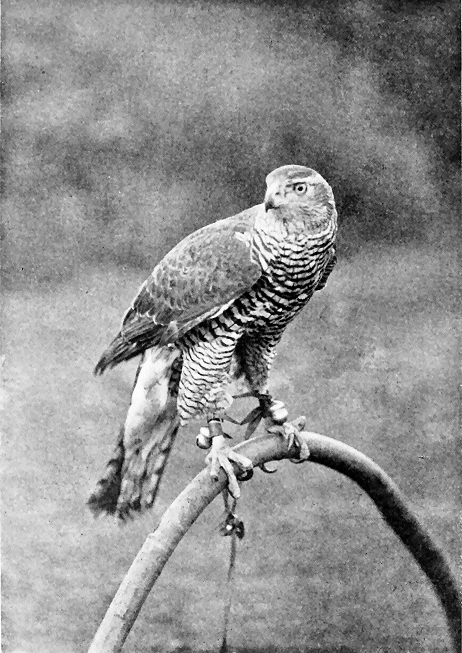
Nevertheless, as it is often difficult and sometimes impossible to find rabbits in open places, it is advisable to let the first flight for your beginner be as easy as you can. When she has taken an undersized rabbit or leveret, she may be advanced to a full-grown rabbit, and thence, after a few kills, to a full-grown hare, if your ambition is to fly hares. Very possibly it may be necessary to throw her off at the quarry and not expect her to start of her own accord. She may also refuse more than once, and yet be in the mind—that capricious and wayward mind of hers—to fly. I have seen a young goshawk, only just trained, taken out and thrown off at three or four hares in inviting places, and have seen her refuse them all; and yet, ten minutes later, I have seen her go at one like a whirlwind, and have it down and helpless within sixty yards from the start. The flight at hares rather overtaxes the powers of any except the strongest female goshawks; and many people think that the flight at rabbits is preferable, even in the quality of sport afforded. In fact, the difference between the two is not so much one of speed as of brute strength; and in quickness the rabbit will be found generally superior. A goshawk which will take hares is the more valuable; but it is doubtful if she shows any better sport. Gaiety Girl, whose portrait is given, changed hands at £20, and was well worth the money. This hawk, trained by Mr. A. Newall on Salisbury Plain, killed no less than fifty-five hares in one season, besides other quarry. Of course if goshawks are to be flown at hares, they must be left strictly to this quarry as far as possible, and not encouraged to ever look at a rabbit.
The goshawk has one great advantage over her nobler cousin, the peregrine; she need not necessarily stop when her quarry has gone into covert. Provided only that the covert is thin enough for her to see the quarry, and to get along, she will stick to him there as pertinaciously as in the open. She will naturally not be so likely to succeed; trees and bushes will impede her stoops, and give the quarry a far better chance of doubling out of the way. But it is astonishing how clever even an eyess goshawk can be in threading her way through covert, and choosing the moment when a dash can be made. The hare is not as well able to use her natural cunning in front of a hawk as in front of a hound. The whole affair is so rapid, and the danger behind is so pressing, that there is hardly time to devise, and still less to put in practice, those tricks which are so successful in hare-hunting. If one could only see it all, possibly the flight at a hare in a thin covert would be better worth seeing than a flight in the open. At any rate, the skill exhibited by the hawk must be greater. For she not only has to keep the quarry in view, and to make straight shots at him, but also in doing so to avoid breaking her wing tips, or even her neck, against an intervening tree.
The wild rush of the falconer—or ostringer—and his friends after a flight at a hare in covert is also a thing to be seen. It is unique of its kind. In magpie-hawking there is a lot of hurrying up, much tumbling about, much laughter, and any amount of shouting and noise; but there is not the same necessity for headlong racing through the thicket. If you want to be “in it” with a goshawk, you must go at a break-neck speed over or through all obstacles; you must be able to see through screens of interlacing boughs, and dash through almost impervious places. You must cut off corners by instinct and follow by inspiration. There is something in the impetuosity of a goshawk which is contagious; and the ostringer, who has perhaps not marched at the double for years farther than the length of a platform to catch a train, may sometimes be seen tearing along with his very best leg foremost, through bramble, thorn, and quagmire, in hope of being in at the death. The whole sight is certainly worth seeing. Artists are fond of depicting the goshawk as she stands with outspread wings and half-open mouth with the hare paralysed in her terrible foot. No better personification could, indeed, be found of the pride of victory. The hare weighs commonly three times as much as his captor; yet the victor hawk must not only vanquish the hare, but also hold him fast. It is almost as if a strong man were expected to hold a wild zebra in his clutches. But the strength of a goshawk’s grasp, like that of the eagle’s, must be tested by experience to be properly understood.
The female goshawk, besides being flown at ground game, may be trained to take many other quarry, both big and little. At pheasants she may be expected to do good execution. Partridges will sometimes be captured in fair flight when a good start is made. Herons may be caught before they have gone any distance on the wing. Wild geese, wild duck, and wild fowl of various kinds in the same way. Land and water rails are available; and water-hens are perhaps the favourite objects of pursuit by a hawk that is not quite first-rate. Stoats, weasels, and squirrels may be taken; and the harmful, unnecessary rats will be picked up almost as fast as they can be driven out. When ferrets are used there is a danger that one of them, emerging from below, may be nailed and finished off by his winged ally. In the old days goshawks were generally assisted by spaniels; and it was pretty to see how eagerly and cleverly the dogs backed up the chief actor in the play, while she in turn trusted to them to drive the quarry in the right direction. The conditions of modern game-preserving do not lend themselves much to the use of spaniels; and perhaps they are not so often of service to the gos, but they are frequently used. A good retriever is often useful, especially if you are flying pheasants, and the hawk should always be on the most amicable terms with him.
Male goshawks are thought by some to have more speed than their sisters. When they are good, they will take partridges, with a good start, but not otherwise; and many of them will tackle a pheasant. It is said that in some countries quails are taken with the male. Very strong males will sometimes hold a full-grown rabbit; but the effort is rather beyond their strength. The flight of a gos is very peculiar. After a few fast flaps of the wing she often spreads them a moment or two, and sails along, giving to the falconer, who is accustomed to long-winged hawks, the appearance of having left off. Almost immediately, however, she begins moving her wings with greater vigour than ever, and, gaining quickly this time on the quarry, comes at him, sometimes with an upper-cut, if it is a bird, before you think she can have had time to reach him.
Goshawks may be flown repeatedly the same day. In fact, it is almost difficult to say when they have had enough flying. But in this, as in all kinds of hawking, it is well to remember that an extra good flight with success means an extra good reward. If, therefore, after some indifferent or unsuccessful flights, the hawk has flown hard and killed cleverly, I should advise feeding her up, and not flying her again merely for the sake of making a bigger bag. Under this system she may go on improving indefinitely; and you will be rewarded for your pains and labour at the beginning by possessing a hawk which perhaps for years will give a good account of herself. I have said that a goshawk which is intended for hares should be kept to them alone. So, likewise, a male which is meant for partridges should not be thrown off at pheasants or anything else. But, as a general rule, there is no such necessity with the short-winged hawks, as there is with the long-winged, of keeping them from checking at odd quarry. The bag of a goshawk has often been known to include four or five very different items, such as a rabbit, a rat, a weasel, a pheasant, and a water-hen. These sanguinary creatures are not particular as to what they kill when they are in the humour for killing. They commit murder, as foxes do, for the mere pleasure of it; and this you may easily prove if you put out a number of fowls where a gos can get at them. If you keep one in the same room where other hawks are, and by any mischance her leash comes unfastened, she is as likely as not to go round and massacre the whole lot.
Live fowls should never be given on any account to a goshawk. If you can, you should prevent her from ever supposing that they are good to eat, otherwise she may take a liking to poultry, and seize every opportunity of helping herself to the hens and chickens of your neighbours. The attraction of poultry-yards is a great objection in places where there are many of them, and some very good falconers have actually felt themselves obliged on this account to discontinue keeping hawks.
I am indebted to Mr. John Riley, of Putley Court, Herefordshire, for the following most interesting records of scores with trained goshawks, and the notes which are annexed. They illustrate this department of hawking in the most vivid and practical way:—
Enid (eyess female goshawk)—
In 1888-89, took 82 rabbits. ” 1889-90, ” 59 rabbits, 1 pheasant, 1 water-hen. ” 1890-91, ” 67 rabbits, 1 water-hen, 1 partridge, 1 stoat, 1 mole. ” 1891-92, ” 52 rabbits, 1 mole.
Isolt (eyess female goshawk)—
In 1885-86, took 110 rabbits, 2 pheasants, 13 water-hens, 5 ducks, 1 rat. ” 1886-87, ” 130 rabbits, 1 pheasant, 4 ducks, 3 water-hens, 1 stoat. ” 1887-88 (to 26th Dec.), took 70 rabbits.
Sir Tristram (eyess male goshawk)—
In 1886-87, took 26 partridges, 10 pheasants, 16 rabbits, 5 landrails, 12 water-hens, 1 stoat.
Geraint (eyess male goshawk)—
In 1888 (to 4th Oct.), took 11 partridges, 5 pheasants, 2 landrails.
Tostin (haggard male goshawk), caught 15th July, flown 9th September—
In 1891 (to 17th Oct.), killed 21 partridges, 3 pheasants, 1 landrail, 1 leveret, 1 wood-pigeon, 1 water-hen = Total, 28 in 38 successive days.
TRAINED GOSHAWK “GAIETY GAL” OWNED BY MR. A. NEWALL
Mr. Riley trains his own hawks, and, for convenience and for saving time in an enclosed country, has sometimes used a lure. He keeps them as hard at work as he can. He has much difficulty in finding enough quarry for them, and is much troubled by poultry. But for these causes the bags made would have been even much larger than they were. He has a great preference for haggards, whose style of flying he considers very far superior to that of the eyesses. Tostin, especially, used to shoot up some feet when he left the fist; and this seemed to have a demoralising effect on the partridges. He hit them so hard that the blow could be heard a long way off. When he was unsuccessful, instead of coming straight back, he would throw up two or three hundred feet, moving his head from side to side as he flew. Sometimes he would come down upon partridges on the ground, so as to put them up all round him, and then, if there was no friendly hedge at hand, he was pretty sure to have one. It was no doubt a great feat to get him fully trained in so short a time after his capture as fifty-six days. Pity his brilliant career was so soon ended by death! Almost all the partridges taken, by one hawk or the other, were captured in fair flight, without any routing about in hedges or other covert.
To show what goshawks will do when well worked, I may mention that Mr. St. Quintin’s falconer (now the head falconer of the Old Hawking Club) took out his female goshawk in November 1885, and gave her seventeen chances at rabbits lying out in the grass. She caught them all, but being a bit blown, let the last one go. Sir Henry Boynton’s goshawk, Red Queen, on 2nd December 1895, killed as many as twenty-four rabbits in one day.
The illustration is a portrait of “Gaiety Gal,” the goshawk which, while she was owned by Mr. Arthur Newall and flown by him, killed in one season fifty-five hares, nineteen rabbits, two pheasants, one partridge, one wood-pigeon, one Norfolk plover, one landrail—total, eighty head. This fine hawk was afterwards sold for £20; and the vendor always considered that he had been a loser by the bargain.
CHAPTER XII
The Sparrow-Hawk
There is so little difference between the training of the goshawk and that of the sparrow-hawk, that it is unnecessary to give any special directions for the latter. But, just as the merlin is a more delicate feeder and a more delicate subject than the peregrine, so it must be remembered that the diet and treatment of the smaller short-winged hawk must be more recherché than that of the larger. This is more especially true of the musket, or male sparrow-hawk, which is very much smaller than his sister, and is in many respects a kind of miniature hawk. Nothing in the shape of hard or tough meat must ever be given to him. No long fasts, no hardships. He must be always something of a spoilt child. And after he has once been manned, the more he is petted and pampered the better in most cases he will become. As far as my experience goes, he has a better temper, and is more easily reclaimed than his bigger sisters; but I have heard other falconers express a contrary opinion. Both the ladies and gentlemen, however, excluding exceptional cases, are, for a time at least, about as troublesome creatures as ever wore a good pair of wings. For the first few days after they are captured, or taken up from hack, it seems quite impossible to make anything of them. The beginner, unless he is of a most sanguine temperament, may be excused for despairing of the prospect of ever reducing them to obedience, and far more of ever using them profitably in the field. And, to tell the truth, if he has had no previous experience with a more docile kind of hawk, he seldom does succeed.
Yet an old hand will tell you that, when taken properly in hand, the sparrow-hawk becomes as trusty and hard-working a servant as man can well wish to have. She will combine the tameness of a parrot with the courage, and even ferocity, of a tiger, and will learn to treat her master to the amiable side of her character, and the quarry to the other. She will go on flying almost as long as you like to fly her, and start at one sort of bird almost as readily as another. She will work in any kind of country to which you introduce her; and if she does not make a good bag it will not be for want of will on her part, or for not doing her best. It seems almost that in proportion as the difficulties of training are great, so is the result the more gratifying when they have once been overcome. Mr. Riley, who has flown both goshawks and sparrow-hawks with the greatest ardour and success, is of opinion that from the point of view of mere sport, the latter are even superior to the former.
In the good old days partridges seem to have been taken pretty commonly with the female sparrow-hawk. But when I say taken, I do not mean that many old birds were actually caught in the air by the hawks. This would imply that the old-fashioned sparrow-hawk was faster and stronger, as well as better trained, than those of our own time. What often occurred was no doubt that the partridge was pursued by the hawk, and taken by the men or dogs. For the sight of this hawk, when she really means business, is quite enough to take all the courage out of even a bold partridge, and induce him to lie close in the hedge or thicket into which he has been put, when he can be grabbed by a spaniel or retriever, or even sometimes picked up by hand. I make no question that the old-fashioned falconers, by the aid of their drugs and nostrums, kept their hawks of all kinds—and especially hobbies—in better condition than we do. But even then it would probably have been considered quite a feat to take old partridges on the wing with a sparrow-hawk. And now, when the stubbles can only be called covert by courtesy, and to get within fifteen yards of a bird is a rare thing, it is certainly more difficult for us than it was for them to get a fair start at one. But a time often comes in a day’s shooting when the birds, having been shot at a good deal, and scattered like sheep without a shepherd, lie very close in a patch of clover or thin roots. This would be the time for one of the guns, who had brought out his falconer with a sparrow-hawk in reserve, to call the latter forward. The rest of the guns—or some of them at least—would probably be glad enough to see so unusual a sight as a flight with a sparrow-hawk at a partridge. Anyhow, the interruption to the business of the day, while the little hawk was flown, would be very slight. Of course a sparrow-hawk which is intended to fly partridges should be kept, as Turbervile recommends, as much as possible to “big fowls.” And there would always be more or less a risk, unless the hawk was in first-rate condition,—in what is called “screaming yarak,”—that she would refuse at the critical moment the carefully marked bird, and put her owner to an everlasting shame. A falconer who is afraid of this, however, is not the sort of man who will ever do much good with any kind of hawk nowadays.
The quarry par excellence of the sparrow-hawk is a blackbird. Every female which is sound in wind and limb, and also most males, ought to be able to take blackbirds, whereas it must be an exceptionally strong and bold female which will be good enough for the much more difficult flight at partridges. The hawk referred to in the Merry Wives of Windsor seems to have been an eyess musket. Unless, therefore, the falconer is particularly ambitious and confident in himself and his hawks, he had better lay himself out for blackbirds as the pièce de résistance, with the chance of a few thrushes, starlings, water-hens, and small birds to make up the bag. Peter Gibbs the falconer told me that he had taken thirteen head of quarry, varying in size from a partridge to a wren, in one day with a female sparrow-hawk.
One advantage of the flight at blackbirds is that the quarry is easy to find. Few enclosed countries in England are without a good supply of them; and it is seldom that their haunts are so secure that they cannot be dislodged so as to afford a flight. Only a man must not go out blackbird-hawking all alone. He should rather get as many people to join in the business as he can. There is nothing unsociable or exclusive about a blackbird-hawking expedition. The gardener, and the gardener’s men, as well as the keepers, the boys home for the holidays, and in short everyone who is available, should all be encouraged to volunteer as beaters, and help in the campaign against the plunderers of the raspberry bushes. Formerly this sort of hedge-hunting was a very popular amusement. Although in the fantastic apportionment of hawks to different ranks and degrees, the sparrow-hawk and musket were appropriated to ecclesiastics, it was a common thing for yeomen and small landowners to keep and fly this familiar and serviceable little creature. When Mr. Page says that he has a “fine hawk for the bush” (Merry Wives of Windsor, Act iii. scene 3), he means that he has a sparrow-hawk which will afford sport for a whole company of country-folk; and when he and his friends go out the next morning after breakfast “birding,” they may safely be supposed to get a morning’s sport very much of the sort that is now to be described.
Ruby looks very murderous as she sits with her thin yellow fingers gripping the arch of yew which forms her bow-perch on the lawn. The warm autumnal sun lights up her feathers in their true colours of slatey brown on the back, and barred white on the breast. Very keen and pitiless is her yellow eye as it turns quickly towards each spot where the slightest unusual movement attracts her notice. Presently, however, all her attention is concentrated on one object, as her master steps across the lawn. In a moment she is on to the outstretched fist, where a well-known reward is almost always found. The leash is untied; we are beckoned to come on, and we start at once, accompanied by the terrier Sandy, with a knowing look on his shrewd face. It is a warm still day, and we go straight to the big meadow, where in the bottom hedge we put out a thrush. Ruby is off the fist like lightning, and gains fast on the quarry. Just as he turns to get into the hedge the hawk makes a dash, which very nearly succeeds, but the thrush has just managed to swerve out of the way, and, running along and through the hedge, escapes on the other side, while Ruby betakes herself to a tree hard by. Before she is called down a blackbird is sighted near the same tree, and we form a line so as to drive him towards the hawk. This, however, does not accord with the views of our black friend in the bush, who resists our well-meant endeavours, and tries to work his way past us away from the tree. Fortunately there are enough of us to frustrate his efforts, and prevent him from shirking along the hedge. He is obliged to take a line across the field, and as soon as he is well away from the fence Ruby is up to him. In shifting from the stoop he dashes himself against the ground, and even by this violent effort does not wholly escape, as the hawk hits him hard as she passes overhead. He picks himself up at once and makes for the hedge, but is just too late, as Ruby grabs him just as he is entering.
Passing on to another long hedge we soon get a flight at another blackbird, which puts in before the hawk gets up. Ruby will not wait, but goes on to an oak at the end of the hedge. We beat on, with a view to drive him towards the hawk, and find that there is more than one blackbird in front of us. One of these is driven out, and Ruby makes a fine stoop at him out of the tree, but fails to hit him, and he puts in. After several tries he is persuaded to fly out into the open, and make for some bushes that are not far off, but as he goes the hawk knocks him over with a severe cut, and though he gets up again and staggers on, she has him well before he can reach the bush. With the next blackbird we have no end of excitement under and round a tree in the fence, the fugitive several times baffling us as we are driving him along towards a bare place in the hedge, and compelling us to hark back and begin driving him up again. Once he comes out a yard, and whips back again instantly. The hawk goes again up into an oak-tree near the gate. Now we drive on furiously, hoping that at the gate, anyhow, he will take wing. Some time before we get there he loses patience and ventures a flight across the field. Ruby gets a poor start, but the blackbird makes a bad use of his chance, allowing the hawk to recover lost ground rapidly, and makes such a weak attempt to get inside a brake that he is taken on the top—perhaps dazed with all the noise and hustling in the fence.
The next is a very plucky young cock, found in a short piece of hedge by a wire fence. In and out of the wire fence he shifts very cleverly, and only just saves himself in a holly bush. Here he establishes himself in a nearly impregnable fortress, made up of an earth-bank, with some tangled roots, and an infinity of quickset, wild rose, and bramble. The yapping of Sandy, the shouts of the beaters, and the howls of an under-gardener, who in the ardour of pursuit has torn his cheek open with a briar—all are unavailing to storm the citadel until someone with a well-directed thrust nearly pins him by the tail. Then at last he is off in real earnest towards a thick brake. Before he can get there Ruby compels him with a knock on the back to drop down on the ground, and though he gets up and shuffles into the brake, he is evidently the worse for wear. It takes ten minutes’ hard work to dislodge him again, and even when dislodged he dodges back after going a few yards. At last, as it is getting dark, he happens to go out just under the spot where the hawk is sitting, and she collars him above the ditch, dropping into it with him. A flight of half an hour, “including stoppages,” and hard work all the time—for the men!
Another day we are out with Lady Macbeth, a young eyess with broad shoulders, large feet, and a very small head. The luck is against us at first. We are foiled by a blackbird and outflown by a thrush, and have failed to find any water-hens. At length a blackbird is marked down in a field of swedes in the open, and we adjourn there, full of hopes. The tactics adopted by this blackrobed gentleman are simple, but ingenious and effective. They consist of flopping down, as the hawk gets quite near, into a thick bunch of turnip leaves, and, when once on the ground, doubling round the stalks so as to elude the hawk, which, of course, dives into the damp covert at the same place where the quarry disappeared. Then when the hawk’s head is safe behind the leafy screen of verdure, the chance comes of jumping up and slipping off unseen. Twice does Lady Macbeth detect him in the act of thus slinking off; but she is thrown out again by the same stratagem, and on the third occasion the fugitive gets off unseen by his persecutor, though in full sight of us, and also of Sandy, who yelps demoniacally, either from pure vexation, or perhaps in the hope of attracting the attention of his friend and ally. Well, of course, we lose that fellow, who goes off joyously over the hedge and the next field, glorying, like Ulysses, in the success of his wiles. More valuable to magpie and blackbird than the rather limited allowance of wing-power with which Nature has provided them, is the considerable supply of brains by which the balance is made up.
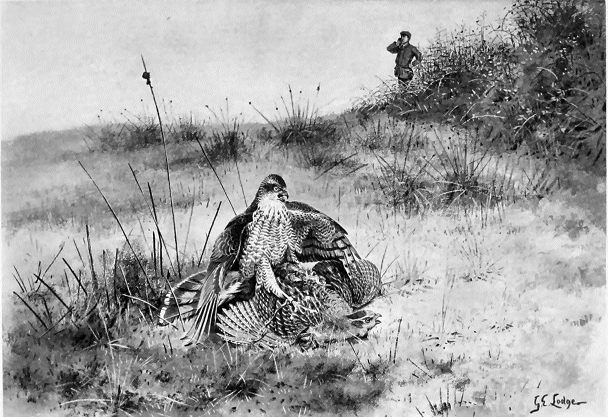
At last, however, we get a bit of luck, which indeed makes it rather a red-letter day for Lady Macbeth, for as we beat along one of the least likely-looking hedge-rows, more for the sake of doing the proper thing than with a hope of finding anything, there is a huge flurry and bustle almost under the feet of our falconer, and up gets a single partridge, beating the air noisily with broad, round wings as he gets clear of the overgrown ditch. When he is once fairly on the wing he will soon put on a pace nearly, if not quite, equal to any that our hawk can attain to. That is, he “would” rather than he “will,” for we have not been idle all this time. On the contrary, Lady Macbeth, somewhat startled at first, spreads her wings, and at once shoots upwards, as if with a view to see what is the matter. Then, pulling herself together as she takes in the situation, she makes a sort of half-turn in the air, comes down in a slanting course, half stooping and half flying, and before the partridge has gone forty yards, strikes him full on the back with both feet. One, at least, of the eight sharp claws hold, and down they come with a whack on the brown earth of the ploughed field, where they seem almost to roll over one another in the excitement of the fray which has still to be fought out. For a real set-to it is, of the rough-and-tumble order. The hawk’s claws, long and sharp as they are, do not penetrate to any vital part of the partridge as they do when a sparrow is the victim. Nor do her long spindle-like legs look as if they could do much service in a wrestling bout, when opposed to the short, stout, and very muscular understandings of the other. But Lady Macbeth makes play with her wings and tail as well as her feet and legs, otherwise she could be upset and shaken off in no time. Half a dozen long feathers pressed down into the ground on each side prevent her from being thrown to right or left; a dozen almost equally long and elastic feathers behind steady her still further, and act as a sort of drag if the struggling partridge tries to rush forward and so free itself. So, though the encounter is fierce, as the two feathered bodies sway about spasmodically over the rough surface of the furrow, the assailant keeps the upper hand; and soon the allied forces come up in support. The trainer, joyous at the tardy success which has crowned his afternoon, gets hold of one of the partridge’s wings and holds it down, so that the kicks and scratchings to which he now resorts are wasted on the insensible clods beneath. The hawk now shifts one foot from the shoulder to the head; two claws imbed themselves in the face and neck. A third, sad to say, pierces the falconer’s unguarded thumb; but though he moans with the pain, he does not withdraw his hand till he has cleared it from the hooked claw. Then, with sharp knife, he severs the partridge’s jugular vein, and, opening the skull, allows the hawk to pick out the brain. Lady Macbeth will now be fed up; she has had some work and some encouragement, and we shall next time try to find her another short start at a partridge.
One of the merits of “birding” with a sparrow-hawk is that everyone out is always busily engaged. Everyone thinks that he has marked the exact spot where the fugitive put in, and can lay his hand at once on the place where his cunning head is hiding under the ferns or leaves. And yet when the hedge is reached these boastings are all falsified, and the hiding-places seem all to be bare. “He never stopped in the hedge at all,” says one. “Yes he did. He doubled down to the right.” "He climbed up into the middle." “Hark, there! I heard him flutter.” "You make such a confounded row with your argumentation; no one can hear anything." “There he goes!” "No; that’s Sandy." “I see him now.” "To the left!" “Keep him back.” "Cut him off." And so the chase goes on. Lady Macbeth, or Ruby, sits quietest of all on the commanding bough, though her yellow eyes glitter with excitement, and her legs and wings are ready for a start the moment that a black feather shows itself. It is equally hard to grab an old cock blackbird in the hedge, or to drive him out of it far enough to give the hawk a chance of a fair shot. As for the thrushes, they seem to puzzle a sparrow-hawk more even than the wiliest of their black cousins. They have more wing-power, too, and are apt to distance her in fair flight. A starling is, I believe, not an easy bird to take if he has anything of a start. Wood-pigeons, when taken by wild sparrow-hawks, must probably be caught unawares.
A small wiry-haired dog which is not afraid of thorns will often be useful. Sandy is not without his honours in the hawking-field. Many a blackbird has he snapped up in his mouth within a yard of his formidable ally, in whose presence the quarry thinks that almost anything is preferable to a flight across the open. Then the victim is, of course, taken from him—often unhurt—for Sandy is too well bred and too well trained to injure it if he can help doing so; and with the orthodox cry of “Ware, hawk! ware!” is thrown out to the hawk. Water-hens are a rather favourite quarry for the female sparrow-hawk, as well as for the goshawk, when she is not a very distinguished performer. A water-spaniel which knows how to work with a hawk is in each case very useful. Landrails would afford a capital flight if they were plentiful enough, and could be induced to give themselves a fair start, instead of waiting to be kicked up when the hawk is close upon them.
But perhaps the best flight of all, next to partridges, is at the quail, and it is one in which the musket can be employed as well as his sister. The Italian authorities, upon whom Turbervile draws for the chief part of his treatise on falconry, speak of the quail as the special quarry of the sparrow-hawk, and give minute directions for this flight, which could, of course, be had in perfection in the Egyptian paddy-fields, and in other parts of the East. It is said that some of the tribes tributary to the Grand Turk, who had to pay their tribute in quails, used to provide themselves by means of sparrow-hawks alone with the necessary number of birds. The African falconers, when in pursuit of quails, take the sparrow-hawk round the body in their right hand, and as the quarry rises throw her at them like a round-hand bowler, thereby giving her an initial impetus, of which she seems fully to understand the advantage. In some places they surround the neck of the hawk with a halschband, or linen collar, which serves to steady the flight. The Besra sparrow-hawk, as has already been said, is used as well as the common species.
A quotation from the last-named author will here, perhaps, be found to the point. “Set your sparrow-hawke,” he says, “every morning abroade in the sunne two houres, or neare thereabouts, and set her to the water twice in a weeke at the least, and especially nyasses, for they covet the water more than the rest. Soar sparrow-hawks should not be flown withal too soone in a morning, for they soare willingly. Take your sparrow-hawke from the pearche alwayes with somewhat in your hand, to make her love you, and be fond of you, for that is a thing of no small importance and consideration. And also to make your sparrow-hawke foot great fowles, to the end that she may not learn nor be accustomed to carrion. And as touching mewing of a sparrow-hawke, some use to put her in the mew as soon as they leave fleeing with her, cutting off both her bewits, lines, and the knots of her jesses, and leave her in the mew until she be cleane mewed. But if you will have her to flee at partridge, quail, or the feazent poult, then you must draw her in the beginning of April, and have her on the fist till she be cleane and thoroughly enseamed. And they which delight in haggarts must take great heede that they offend them not, but rather coy them as much as they can, with all devices of favour and cherishing. For they will remember favor or injurie much better than any kind of hawke. And he which hath a haggart sparrow-hawke must above all thinges take paines in weyning her from that vile fault of carrying: and that shall he do by serving her often with greate pullets and other great traines, the which she cannot carry, and thereby she will learne to abide upon the quarry.”
Sparrow-Hawk and Partridge.
Mr. Riley has given me some extracts from his hawking diary, in which the following scores are recorded:—
Blanche (eyess female), 1885-86—44 blackbirds, 13 thrushes, 1 partridge, 2 small birds.
Lady Mabel (eyess female), 1887-88—56 blackbirds, 5 thrushes, 4 water-hens, 3 partridges, 1 pheasant, 2 small birds.
Faerie (eyess female), 1889-90—64 blackbirds, 3 thrushes, 4 water-hens, 1 partridge, 4 small birds.
Ruby (eyess female), 1894-95—106 blackbirds, 1 partridge, 1 starling, 1 small bird.
Princess (wild-caught female), 1895-96 (Nov. 11 to March 24)—39 blackbirds, 1 thrush.
Of these the wild-caught Princess, though injured in the leg by a trap, was very superior in her style. Ruby at the end of the season flew very like a wild hawk. This Ruby was wonderfully fast and clever, and an excellent footer. The number of blackbirds she killed stone dead by stoops out of trees was astonishing. In size she did not exceed the average. Speaking from an experience of a great many years, and with an authority which everyone must acknowledge, Mr. Riley declares that “no sport with a female goshawk can touch that to be got with a good female sparrow-hawk.”
CHAPTER XIII
Home Life
Probably the commonest fault in young falconers of the modern school is that of keeping too many hawks. Almost every writer on the subject has warned them over and over again against this rage for being “over-hawked”; and yet it is still the cause of endless failures, disappointments, and disasters. “Don’t you know, if I lose one I like to have another to fall back upon.” Such is the excuse, and a very bad one it is. If a beginner can manage to keep one hawk of any kind in flying order he may consider himself exceptionally clever; and the sole charge of a cast of hawks is quite as much as any amateur ought to undertake, unless he is blessed with a great deal more leisure time than is usually the case. An experienced professional falconer, with a boy to help him, and with nothing else to occupy his time, may manage an establishment of three short-winged hawks, or about five long-winged, or one of the former and three of the latter, short-winged hawks, when in flying condition, requiring about twice as much attention as their nobler cousins. But if it is desired to keep up a larger establishment, there should be, counting in the head falconer, one man, or at least one boy, to every two hawks.
A falconer who attends properly to his charges will find that they monopolise a very large portion of every day—at anyrate from the time when the eyesses arrive, in early summer, to the end of the rook-hawking season in spring. His duties may be divided into those which we may call normal or permanent, and which relate to the hawks which are already in flying order, and only require to be flown and kept in working condition, and exceptional or special duties, such as the hacking of eyesses, and the manning and reclaiming of hawks which are newly caught, newly taken up, or newly removed from the moulting-place. Thus, as in other professions, there are times of extra pressure, when every hour in a long day has its full complement of busy work, and times of comparative rest, when the labour is a good deal lighter. But at all times the falconer, if he is to excel, must be possessed of certain qualifications, either innate in him or carefully acquired, which will enable him to become a favourite amongst his winged pupils and servants.
Among such qualities the foremost is prudence. A moment of carelessness, or even inattention, may almost every day entail the loss of a valuable hawk. A knot insecurely fastened, a door inadvertently left open, a leash or jess that has become unsound,—all these are examples of small imprudences, some one of which many a falconer will bitterly remember to have been the cause of a catastrophe. Cleanliness and tidiness are virtues none the less desirable in a professional falconer because they were, and still are, a little rare. It is not so easy a matter as it may at first be supposed to keep a hawk-house clean and neat; and the very first aspect of many such places speaks volumes for the character of the owner or his servants. The person who has to manage hawks should be gentle in all his dealings with them. He should have the touch of an organist rather than of a pianist; the hands of a sculptor rather than of a wrestler or quoit-player. Any hurried or sudden movement is offensive and alarming to hawks; and rough treatment of any kind disgusts and makes enemies of them. Patience and a good temper are quite as necessary to a falconer as to an angler—probably more so, as the difficulties and injustices with which the falconer is confronted under modern conditions exceed those which are met with in any other kind of sport. He must be a good judge of the characters of animals, and of their moods and fancies, for there is as much difference in the dispositions of hawks as of human beings, and no two of them, except by a rare accident, can be treated successfully in exactly the same way. His sight and hearing must be good, for much depends upon his ability to keep a long flight in view, and to distinguish the sound of a hawk’s bell in a high wind, amidst the rustle of leaves and grass, the murmur of a stream, or the pattering of rain.
In the golden age of falconry great weight was attached to the possession of good lungs. The “falconer’s voice,” for which Juliet fondly wished, was used not only to lure the tassel-gentle back again, but to encourage him in his efforts, and to cheer his successful or brilliant strokes. A modern trainer is not so demonstrative. We have—wrongly, I think—almost abandoned the use of calls and cheers to animate our winged friends in the air. But even now a loud voice is a merit in a falconer, if only as enabling him from afar to warn the field and any chance intruders not to meddle with a flight or run in to a hawk that has killed. Those few who still make a practice of “giving their voice” to their hawks are, I think, well repaid for their trouble. For no one can doubt how attentive hawks are to sounds, especially of the human voice, or how thoroughly they become convinced, when well handled, that they and their followers on foot or horseback, and the dogs, when there are any, are all friends and comrades engaged, each in his different way, in the same campaign against the same quarry.
As the huntsman in his kennels, and the trainer in his stables, so the good falconer should take a pride in his mews, or in the place, whatever he calls it, where his hawks are lodged. We have abandoned for the most part the old name of mews—long ago degraded to a new signification—and with it the fashion of building proper quarters for the accommodation of our feathered friends. The modern hawk-house is often a poor substitute for the substantial buildings which our ancestors called mews. Nowadays almost any outhouse seems to be thought good enough for the purpose; and the trained hawks of several amateurs who are justly reputed good falconers are housed in what are little more than shanties, barely able to keep out the rain and wind, and not at all proof against that insidious enemy, the damp. There can be no doubt that the excessive prevalence in our times of the horrible disorder called “croaks” is largely due to the want of care with which our hawks are housed in winter.
A hawk-house should have solid walls, and a floor well raised above the ground, so as to be impervious to damp. It should have a loft or room above it, which will help to save it from extreme variations of temperature by day and by night. In such a place all hawks, except merlins and those which have come from any hot climate, may be kept through all ordinary weathers, care being taken, of course, that the ventilation is sufficient, but in winter not excessive. In times of severe frost or excessive damp a very moderate amount of artificial heat should be introduced. A very good arrangement, when it can be adopted, is for the back wall of the hawk-house to be also the back wall on the other side of a warm conservatory or well-heated room. In such cases it is unnecessary, unless in exceptional winters, to have any heating apparatus in the hawk-house itself. Merlins and the tropical hawks, such as shaheens, barbarys, and also the desert falcons, should, in cold or damp weather at least, be placed in a room which is over a very well-warmed apartment, and has the flue of one chimney at least running along one of its sides. A room immediately above a kitchen is pretty safe in all weathers for all hawks if the fire is kept up all night, but not otherwise. Where the room is unavoidably isolated, there must be a stove or some heating apparatus; but the heat thrown out must be very moderate indeed, or the hawks when taken out for weathering, or even when left stoveless by day, are nearly sure to catch cold. Changes of temperature in our islands are sudden and severe enough when due to natural causes only, but if they are produced by artificial means no hawk can be expected to endure them with impunity, and least of all gers, merlins, and the denizens of the sunny south. The hardiest hawks are peregrines and hobbies, but these, too, must be given a fair chance, even if it entail upon their owner some inconvenience and expense. Whenever the weather is very wet or damp, with penetrating fogs, opportunity should be taken, when the hawks are all out on their blocks or being carried, to warm the hawk-house thoroughly by artificial means, and purge it of all suspicion of damp.
Adjoining the hawks’ apartment should be another small room, where lures and spare “furniture” can be kept. Meat and food of all kinds should be rigorously excluded from the first-mentioned room, but may be kept, if it is quite fresh, on an emergency in the other, where blocks and bow-perches when taken in out of the rain can be deposited. On the walls in either room may be hung on small pegs or nails the hoods for each kind of hawk; but it is well to mark clearly above each peg a description of the sort of hood which is intended to be there hung, so that in a case of hurry one may not be mistaken for another, and a tiercel’s hood crammed on to a falcon, or a female hobby’s be found wobbling about on the head of a jack-merlin. Every falconer should have in his cupboard a tin box containing a supply of imping needles suitable for the hawks which he keeps, and some spare feathers ready for imping. The same box will hold other small paraphernalia and odds-and-ends, such as waxed thread, pincers for “coping” or blunting the beak and talons, tweezers for putting on jesses, punches for making holes in leashes, scissors, files, and a scrap of thin leather for making jesses and bewits. Or there may be a compartment where ready-made jesses, bells, swivels, and spare leashes are stored. The lures, well cleansed from all food that has been attached to them, and the hawking gloves, can have their proper place in the side-room.
If the building inhabited by the hawks is large, the upper part may be used as a loft wherein to moult them. If there are hawks of different kinds to be moulted, it must be divided into separate compartments, so that no two of very different size may be together. And each individual goshawk must have a room for itself. It would not be safe to turn falcons and tiercels loose together, nor a female with a male sparrow-hawk. Merlins and jacks may be left together, and in the same place with male hobbies; and probably peregrine tiercels with female shaheens, lanners with lannerets, and perhaps barbarys. But it is not very wise to risk the chumming together of any dissimilar hawks at a time when they are all kept in specially high condition, with no work to do, and ready for the mischief which Dr. Watts assures us is a natural concomitant of idleness. Of course if there is a living-room above the hawks, or above the furniture-room, it may serve most conveniently for a falconer’s or under-falconer’s bedroom, enabling him to be at hand by night as well as day in case there should be anything wrong, such as a hawk hanging by her jesses from the perch, or a scuffle amongst hawks moulting in the same compartment.