Front matter (continued 4)
Reading edition
A falconer on the look-out for rooks will often have to get over a good deal of ground in the day. Twenty miles—without counting in the flights—is probably rather under than over the average distance when any considerable number of hawks are to be flown. It is, of course, almost a necessity to be mounted; and it is well to have a horse under you which is not new to the business, especially if you are to carry a hawk yourself, or may be called upon to take one up. A horse which has never been out with the hawks before is likely to be very much put out by the ringing of the hawk’s bell, and still more if she also flutters her wings in a high wind. While following a ringing flight your eyes will naturally be directed more towards the realms above than to the ground over which you are galloping; and, as many of the downs on which this sport is most often pursued abound in ant-hills, if your animal stumbles over one of these obstacles you are likely to pay for your inattention by a severe cropper. If it falls to your lot to take up the hawk after she has killed, you must, of course, dismount. To enable you to do this and devote your whole attention to it, a special apparatus is provided. To the outside of your saddle will be attached a pocket, within which can be fitted a leaden weight secured by a leather, the other end of which can be attached to the horse’s head, so that by merely throwing the weight on the ground he is at once tethered. No one of course presumes to take up another man’s hawk unless it has been so arranged beforehand, or in case of urgent necessity, as for instance if the owner is not in sight, and there is danger that the hawk may be attacked on the ground by some deadly enemy. Of course rook-hawking may be attempted on foot. But unless markers are posted skilfully at the places where a hawk is likely to go out of sight, there is great risk of losing her. Moreover, it is impossible to see much of the best flights. A great deal of time will be wasted in moving about between each flight; and still more in shifting the markers from place to place, as well as in finding the hawk after a long flight which has ended in a kill. The rook-hawker on foot comes back footsore, and very weary. And he is lucky if these are the only ills of which he has to complain.
Rook-hawks which have been brought out to fly, but are not for the time actually engaged, either because their turn has not come, or because they have already flown and been fed up, are either carried about by a cadger on the cadge, or made fast to a field-block in a well-sheltered place, or consigned to perches rigged up in the inside of a van, which can be drawn by a cart-horse. The latter plan is adopted by the Old Hawking Club, by which more hawks are usually taken out than could be accommodated on one cadge. It has the great merit of serving to protect the inmates from the bitterly cold winds which often prevail in the rook-hawking season, and also from the rain. Such a van should be well provided with springs. Otherwise the jolting, while it passes over rough ground, as it needs must, would do almost more mischief than the wind or rain. In any case, whether you go singly with a single hawk on your fist or with a whole cadge full or van full of hungry peregrines, the hood will be worn. Nor will it be removed until the moment arrives when the wearer is to be thrown off. But when any hawk is being carried with a view to a flight the swivel will be detached from the jesses and the latter held tightly in the fingers of the left hand. Some falconers who use ring swivels in the field, take them off directly the hawk is taken on the fist for the purpose of being flown, and then slipping the leash through one ring of the swivel and afterwards through the loops in the two jesses, are ready to pull it out quickly when there is a rook in sight and it becomes possible that they may have to throw off at any moment. Some also, when a flight is pretty sure to begin shortly, loosen the hood’s braces without taking it off, so that there may be no delay in whipping it off at exactly the right moment. No one has ever been able to explain how it is that peregrines can emerge suddenly from utter darkness into the full glare of daylight, with eyesight as good as ever, ready in the very first moment to catch sight of a distant rook and to begin the chase. That they have this faculty everyone knows who has ever seen a rook flown by a trained peregrine. Fortunate for the falconer that it is so, as he can choose his own moment for the throw-off.
If you are intending to fly a hawk for the first time at a wild rook, get some other person who is out with a made hawk to be also ready with her. Then, if the first chance at a rook is not an easy one, let that other person throw off his hawk and keep yours for a less difficult flight. Wait, if possible, until you can find a quarry which is not too far off and not high in the air. If you can get up within a hundred yards or so of one on the ground to windward of you, so much the better. The moment he jumps up, off with the hood, and with a steady movement of the left arm forwards, something like that of a left-arm slow bowler, launch your hawk into the wind. Use whatever cry of encouragement you like, or use none at all; at anyrate, not any cry which you may have used in calling off. And if, in the excitement of the moment you should not throw away the hood, but stuff it into your pouch or pocket, that will also be satisfactory. If you drop it you are not likely to find it on the open down without some hours’ search, if at all. Such presence of mind is, however, I am aware, rather too great to expect.
A rook with any self-respect about him will begin to mount as soon as he is aware that he is being pursued. And of this fact he will not be long in ignorance. Seldom does a trained hawk make half a dozen strokes of her wing before the quarry espies her and knows exactly what she means. With this knowledge the black-a-moor of the air wakes up, and then, if never before, he is on his mettle. Few people know how a rook can fly until they have seen him in front of a peregrine which means business. His wings are broad and strong, and not much worse shaped than a hawk’s. His muscles are good; and by reason of much daily exercise in all weathers he is in good condition—better far, perhaps, than your passage hawk, which was cooped up inactive for weeks, and only during the last fortnight or so has had a modicum of exercise while flying to the lure. The two birds will breast the wind as they mount; but not necessarily taking the same line. Sometimes the two lines will diverge so much that from your point of view behind, the birds seem to be flying away from one another. Generally speaking, the better the hawk the less slavishly will she follow the course taken by the quarry. She flies “with her head,” and, trusting for victory to the long, powerful stoop, concentrates her efforts on attaining to a position from which she can deliver it to best advantage. Thus if, the wind being north, and the safest shelter west, the rook shapes his course to the north-west, the falcon may very probably steer due west. By doing so she makes sure that she will soon be almost between the quarry and that desirable place of refuge. To make it he must come right past her and under her. Or else he must keep away and make for another covert, and in that case he will have a long way to go; and there will be time to catch him up, and get between him and that other haven. To passage hawks, especially haggards, this finessing is the A B C of scientific flying. Moreover, an experienced hawk does not always choose to stoop exactly up-wind, but prefers, for some reason of her own, to come at her victim sideways. There are mysterious laws and principles of aërial steering, which no man understands, but which sometimes make a stoop more telling when made in a direction unexpected by the riders down below. Eyesses are generally some time before they learn the art of utilising the wind to increase the force of their stoop, and of using their heads to help their wings. Some, it is true, seem to be born good tacticians, or at least to have instinctively learnt to be so while flying at hack. But these are quite the exceptions. Not only do eyesses as a rule begin with an inferior style, but very few of them ever attain to the perfection of form which long practice in all weathers at all sorts of different quarry has taught the old wild hawk.
As the two birds mount, the hawk naturally gains on the rook. She is the quicker flier; sometimes, perhaps, by a hundred per cent., but generally much less than this. Going down-wind there is not so much difference between them, when both are at the same height. But the start at a rook should always be up-wind. To throw off at a down-wind rook is bad falconry. When a rook means to “keep the air,” or beat the hawk in fair flying, he will, after a while, begin to ring, that is, to ascend spirally in circles. Why he should do this, instead of continuing in a straight line, no one, I think, has properly explained. But the road upwards for most birds when they are exerting themselves—be they kites, herons, rooks, or larks—is in spiral circles more or less regular, a very obliging dispensation of nature for those who want to look on at a high flight! For while the ringing lasts the horsemen down below need not hurry themselves. Only, if there is anything of a wind they should always keep moving, so as to be well to leeward of the flight, shifting their ground to right or left according as the circles seem to tend in one or the other direction. The higher the quarry goes the faster and farther will be the headlong dash down-wind if he is beaten in the air. After a while, if the hawk perseveres, her superior flying powers will take her above the quarry. At what time and height this desirable result is brought about depends, of course, partly upon the speed of the one bird and partly on the speed of the other. There is a saying among falconers that a good hawk makes a bad quarry, meaning that a rook or other bird which might give a fine flight when only a moderate hawk was behind him very often makes quite a poor show against a first-rate performer. It may also be said with some truth that a good quarry makes a bad hawk, inasmuch as hawks which have flown many a good flight and killed many a fairly fast-flying rook may sometimes find themselves pitted against such exceptionally strong ones that they seem unable to get above them, and give to the stranger an appearance of being slow themselves.
A good and experienced falcon or other rook-hawk will not be content with merely getting above her quarry before she makes her first stoop. She will go on ringing until she is so far above that the first stoop will be a good one. That is to say, that she may be able to get such an impetus upon her in the dash downwards as to rush up to the rook hand over hand, or, as the racing men say, as if he were standing still. And, having so run up to him, that she may, if she misses him, utilise the remainder of her impetus in shooting up again in preparation for a second stoop. The rook, on his part, when he finds the falcon above him, has to choose between two courses. Either he will persevere in trying to keep the air—and in that case must trust to quick turns and twists to elude the foe—or he will adopt the less valiant but almost equally dangerous alternative of a race to the nearest covert, with the necessity of eluding a certain number of stoops on the way. In the first case the flight will become a sort of improved version of coursing. Improved, because a bird has so much more varied chances of throwing out his pursuer than the hare, which can turn only either to the right or the left. He must always be on what the mathematicians call the same plane. The rook, on the other hand, may, if he likes, double simply to right or left. But he may also, if he prefers it, duck downwards or shoot upwards, allowing the hawk to pass over him or under him. Or he may turn partly upwards or downwards, and partly to either side. Thus there are an unlimited number of angles at which he can swerve away to avoid the stroke.
The art and science of “shifting” is indeed one of the most elaborate that is possessed by the dumb creature. Almost all birds cultivate it to a certain degree. Instinct suggests it to them; but many birds improve upon their natural powers by frequent practice. Who has not seen one rook chasing another, either in sport or in a petulant humour, and the fugitive evidently enjoying the fun of throwing out his persecutor? In the tropics there is nothing that a crow likes better than stooping at kites; and nothing that the kite takes greater pride in than showing how easily he can elude the shots so made at him. I have seen pigeons, when a slow or lazy peregrine is in the air, deliberately hang about within reach of her for the express purpose of enjoying the amusement of successfully shifting when she makes a dash for them. Indeed, it will be seen in Chapter XIX. that I saw this game played rather too rashly by a house-pigeon with a trained ger-tiercel. It has been said that the rook in full plumage is no mean flier. He has also a good head on his glossy shoulders, and he shifts cleverly enough while his lungs and muscles hold out. He does not often lose his head, in the metaphysical sense. Sometimes, when particularly close shots graze him, or even feather him, he is frightened into wasting a little breath in an angry complaining croak. But this is almost the only piece of stupidity that can be alleged against him. Usually, however hard pressed, he keeps all his wits about him; and when he is beaten in the air, it is oftenest from sheer want of speed and want of wind. The violent effort required to escape by shifting a good stoop of a first-rate peregrine takes it out of him terribly. The whiz of the falcon as she rushes by is enough to make the stoutest heart quail. But cowardice is not the weak point of the rook, who, for the most part, has a determined and fair struggle for his life.
Of course the stoop takes it out of the hawk also. But then the hawk has two great advantages. She is the faster bird, and she is better at the “throw up.” This is the counter-move by which she responds to the shifts of the quarry. A good long-winged hawk, after an unsuccessful stoop, immediately shoots up to a great height above the place where the stoop was intended to take effect. She rebounds, as it were, from the rapid descent, glancing upwards with wide open wings to a new position of advantage. And herein she has the advantage of the greyhound. The farther the dog is thrown out, the more laborious is the work of getting into position for the next attack. But a falcon may come past her quarry with as much way on as ever she can command. That impetus need not carry her away to a disadvantageous position, but, on the contrary, to one where she is still admirably placed for a fresh stoop. By throwing up well and with good judgment, and sometimes a little luck, a good hawk after once getting well above her rook will keep the command of the air for the rest of the flight. The quarry may throw up too; but if his pursuer makes the most of her first advantage, he will always find her above him after he has done so. It may be that she will be very wide of him. But distance calculated in mere length counts for comparatively little. It is the distance in height from the earth below that makes all the difference.
Consequently, if the rook persists in trying to keep the air, and Lady Long-wing has the pluck and the condition to keep up the chase, the time comes sooner or later when the shift is not strong enough or not quick enough. Then as you watch the two birds—or the two little specks, as they may by that time have become—the lines along which they are moving will be seen to converge and not separate again. There will be a shout of jubilation from below. “Who-whoop”: it is the death-cry. One of those eight sharp talons which, half hid by feathers, arm the lower side of the hawk’s body has hooked itself into some bone, or at least some fleshy part, of the victim’s body. Then from the under side of the slim falcon, as she spreads her wings and sinks nearer into sight, will be seen hanging a confused mass of black shiny feathers. As the two birds—victor and vanquished—come down to earth, the former will sometimes be seen tightening her grasp or catching hold with the second foot. At anyrate, within less than a second after they have reached the ground, the deadly clutch of the conqueror will be on the head of the conquered. In another second or two the point of her beak will have broken the victim’s neck at the top of the vertebral column. No man can encompass the killing of a rook so speedily and neatly as can a peregrine. Within a marvellously short time after the last stoop was delivered, the head of the captured bird droops inert from the dislocated neck, and life is completely extinct.
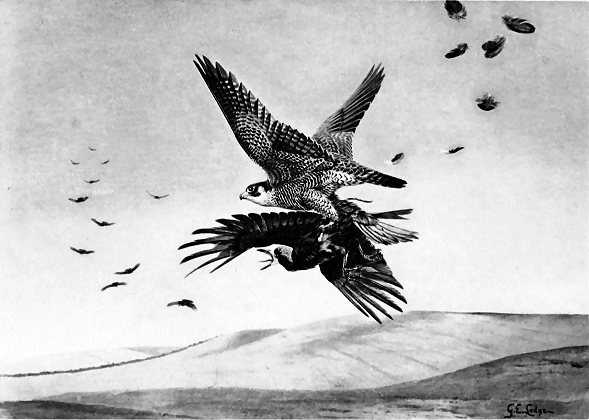
Death of a Rook
Such is the finish of a ringing flight flown out on both sides with unflagging courage—the sort of flight which every true sportsman would like to see often in the hawking-field. But much more often the rook, when getting the worst of it in the air, abandons the hope of beating his foe in fair mounting and fair manœuvring. Taking advantage of some moment—perhaps after an ineffectual stoop—when his foe is a trifle wide, and on the side farthest from a covert which he has marked as a possible place of refuge, he turns tail, and makes off—down-wind if possible, or if not, across the wind—to that seductive shelter. A wood or spinny is what he would prefer, but a tree of any kind will do—the taller the better. A farmyard or a flock of sheep, even a hedge or an empty sheep-fold, or a waggon—anything behind or around which he can save himself from the dreaded stoop. In any, even of the least effective refuges, there will be at least a respite. And if that very poor stronghold is found untenable, he can begin a fresh retreat to a more promising place, with recovered wind, and perhaps better luck. Often a rook will make for a rather distant plantation, with a nearer shelter of an inferior kind in view as a pis aller. The hawk, of course, knows as well as he what he is after, and follows at her best pace. Now is the time to ride hard. Even with a moderate wind the birds will be travelling over a mile a minute. Ride as you will, they will be over your head long before you are near the covert, if it is at all distant. Lucky if you are even in time to be near when the first down-wind stoop is delivered. The down-wind stoop of a peregrine is terrible. It is often avoided, no doubt, but the impetus, if she misses, carries her on right ahead of the rook, over the place where he must pass if he goes on. And there she is, blocking the way to the desired haven. She can poise herself steadily for the next shot, choosing her own time for it, and will have every possible advantage over the rook, which has to run the gauntlet of those eight dagger-like talons. The last stoop before reaching covert is very often fatal. The hawk knows that probably it is her last chance of catching hold, whereas in the open she is aware that a very fast stroke, though not quite accurately aimed, will do a great deal towards taking the nerve and strength out of her quarry, and make him easier to hit later on.
If the rook once makes a plantation of any size, he is safe. No human power can drive him out. Peregrines, of course, will not go into cover after their quarry. Now and then a young hawk at hack will try to do something vague in the way of cutting down or dislodging a bird which has put in; but such attempts are dismal failures, and are hardly ever even thought of by “grown-ups.” If the rook has put in to a very low tree or a tall hedge, he may often be dislodged by throwing sticks and stones at him, or sending a boy up. Sometimes snapping a cap on a pistol, or cracking a whip, or making any other sudden and loud noise, will put him on the wing again. But before going far, he is only too likely to put back to the same place, or to a neighbouring tree, if one is near, or to another part of the hedge. Even when the shelter is only a low line of hurdles, it is quite difficult to hustle out a rook so that the peregrine, waiting on above, may have a fair shot at him. A big tree is generally a safe refuge. If you send anyone up, the refugee will only shift his quarters to another branch. And all the time while you are trying to get him out, the hawk will be circling above—if, indeed, she does not get tired of waiting, and start after some other quarry. With a passage hawk which has not long been at work, you cannot risk keeping her long in the air on the chance of your routing out a rook that has put in. She may check at a passing pigeon, or at a quite distant flock of rooks, or any other bird which she was once wont to kill, and then, even if you are well mounted, you will have great difficulty in keeping her in sight. If, therefore, you are hawking with a passager, and cannot get your rook out quickly, take her down with the lure, and have a try later on at another rook in the open.
If the hawk kills, the falconer will get up at once, and “make in” in the manner described in the chapter on Entering. There is not much danger of any attempt to carry when the quarry is as big a bird as a rook. But caution should be observed, nevertheless, as, if you are rough or in a hurry, you may induce in the hawk a disposition to carry, which on some future occasion may cause no end of trouble. Do not even now let your hawk feed upon the rook, unless you are quite sure that she likes such food. Take care that from the first she shall be well pleased with having taken this quarry, which is not the one she is predisposed to fancy. If in doubt about her liking for rook’s flesh, substitute a pigeon. And it is as well to be contented with one kill on the first day. A fresh flight might not end so happily, and would then partly annul the good effect of the one that has succeeded. Besides, you want to reward your hawk for her victory by giving her a good feed at once, which of course you could not do if you intended to fly her again. Be well satisfied, therefore, that the first step has been made towards making a good rook-hawk. After a few more flights, if even a moderate percentage of them end well, your pupil will begin to take a delight in the business. Sometimes she will become so keen at it that you can freely let her feed upon the last rook she kills in the day. Only do not give her too much of this food. It would be a thousand pities if, after having acquired a liking for this flight, she should, for the sake of a small economy to her owner, be allowed to become disgusted with it.
Rooks may be flown as soon as the passage hawks are trained. Old peregrines can of course be flown at any time (except when there are young rooks in the nests). But the winter and early part of the year is the best time, as later on the young crops preclude the possibility of riding over arable land; and it is impossible to ensure that the area of a flight shall be confined to the open downs. It is on some broad expanse of turf, however, that the quarry should be found, if you are to enjoy a good gallop and a proper view of the flight; for if you have to jump fences, you must needs take your eyes off the birds, and it may then be difficult to catch sight of them quickly again. You should not fly at a rook if there is any tolerable covert within half a mile down-wind, or a third of a mile on either side. The distance up-wind to the nearest covert need not be so great. When a rook is just rising off the ground, you can of course give him more law than when he is already on the wing. For, as has been said, height in the air counts very much more than distance along the flat. Even the small elevation from which a hawk starts as you carry her on horseback gives her a certain advantage over the rook which is only just off the ground. Rook flights often end more than a mile in a straight line from the start. But generally this is equivalent to saying that the distance flown has been more than double as much, by reason of the doublings and up-and-down dashes which both birds have made. In following a flight, it is best to keep about a quarter of a mile to leeward, or as near this as you can get, while keeping a good view of the scene. As the rook gets higher, still keep well to leeward, until you are pretty sure what covert the rook will ultimately make for. A little practice will generally enable you to make a pretty good guess, although perhaps for a while the rook may be heading a different way. If you are wrong, and find yourself thrown out, perhaps the best plan is not to ride hard in the vain hope of getting nearer, but take out your field-glasses, and watch the flight from about where you are. Each man out who knows enough about hawking to be able to take up a hawk, should carry a spare lure, so that, in case of a lost hawk, he may try for her in his own direction, while others are engaged on the same task in theirs. Agree beforehand, however, with the owner of the hawk, that if you find her you may take her up.
Falcons are generally flown single at rooks, except at the time of entering them with a make-hawk. In a double flight I think that the rook is as a rule a bit overmatched, that is, if the hawks are in proper fettle. But for entering a backward hawk, or encouraging one which does not take kindly to this flight, it is very useful to use a make-hawk, that is to say, one which is already keen in the cause. Most hawks are very strongly influenced by example; and a young eyess particularly, recognising as she does the superior style of a haggard or passager, will readily imitate her, and join in a chase upon which she sees that the other has embarked. A double flight is very pretty, and very effective. The way in which the two hawks assist one another, waiting each for her turn to stoop, and making her plans so as to profit by the action of her comrade for increasing the force of her own strokes, is interesting even to the most careless observer of animal life. But the double flight is better reserved for such more arduous undertakings as the pursuit of kites, herons, and gulls. A few words will be said in a later chapter about these quarry and the sport they afford. But in all the main particulars it resembles that which has been here described. The rook flight is at once the commonest and the most typical form of sport when the hawks are flown out of the hood; and he who has successfully trained a peregrine to this business should have no great difficulty in making any other of the large long-winged hawks to such other quarry.
CHAPTER VIII
Game-Hawking
Partridges, pheasants, and other game birds may be killed with several kinds of hawks. In ancient times it seems that the former were taken in England with the jerkin, or male ger, and occasionally with the gerfalcon,—though this was mostly reserved for much bigger quarry,—with the peregrine falcon and tiercel, the lanner and lanneret, the barbary falcon and tiercel, the male goshawk, the female sparrow-hawk, and sometimes even the tiny merlin and almost equally diminutive hobby. In our times most of these varieties have been almost disused for the flight at game birds, for various reasons, the chief of which is that peregrines are found to be more useful at it than the other sorts. It is true that goshawks have been flown quite lately both at partridges and pheasants, and with some success; and it will be seen in treating of the sparrow-hawk that she has also done some execution amongst the denizens of the swedes and stubbles. Even merlins have been found occasionally to take a young partridge in September. But goshawks and sparrow-hawks are seldom speedy enough to catch many full-grown partridges, unless they can be approached nearer than is usually the case nowadays. Probably not more than one merlin in fifty could be induced to fly partridges with any zest; and not one in a hundred could hold a full-grown one on the ground without great difficulty and risk to the tail feathers. And, as merlins will not wait on, the flight with them at partridges, if it were to be accomplished, would lack the chief attraction of game-hawking, and not be much worth seeing. The lanner and the barbary, as well as the ger-tiercel, would still certainly show good sport with game; so would the two kinds of shaheen, and very possibly the saker. But the supply of these hawks is extremely limited; and the climate of England does not suit them so well as the peregrine. Moreover, the mode of training and flying them does not materially differ from that of the commoner and hardier bird. It may be assumed, therefore, for the purposes of the chapter, that game-hawking means, what falconers generally understand by it, the flight with peregrines at grouse, black-game, or partridges. Pheasants, snipe, hares, and woodcocks will be dealt with in another chapter.
Grouse and black-game hawking differ in no important particular from partridge-hawking; and, generally speaking, what is to be said about the latter may be said with equal truth of the other two. It should be mentioned, however, that falcons, from their superior strength, are much to be preferred for the flight at the bigger quarry. Although there have been cases where tiercels have done well at grouse, these are exceptional. Usually they are averse to tackling so heavy a quarry, and, of course, still more reluctant to take the field against blackcock. They are, however, perfectly equal to the flight at partridges. Some falconers have even professed to prefer them for this flight to their sisters. This, however, was not the view taken in the classic age of falconry; and if a fair comparison is made the falcon will be found to be at least as good for the stubble-fields, while vastly superior on the moors. Here again the method of training and working, whether the one sex or the other is used, is identically the same.
In game-hawking, the eyess is much more on even terms with the passager than in the flight out of the hood at rooks and larger quarry. In fact, some of the very best and deadliest grouse-hawks in modern times have come from the nest to the falconer’s hands. The records of the Old Hawking Club show a quite exceptionally brilliant score made by one of their eyesses, Parachute, who took no less than fifty-seven grouse in one season, heading the list of that year’s performances on the Club moor. In the same year, 1882, Vesta, an eyess of her first season, killed as many as forty-three grouse. Yet it must not be inferred from this that every nestling is as likely to kill grouse or partridges as well as a passage hawk. It is rarely that the latter does not fly at least creditably, when trained, whereas with eyesses the general rule is rather the other way. A really first-rate performer is amongst eyesses the exception, however well they have been hacked and trained. On the other hand, the making of the eyess to this flight is beset by few of the difficulties which trouble him who would train a wild-caught hawk to it. It has been said already that a passage hawk, waiting on at any height, must naturally be more apt to check at passing birds than an eyess. The latter has been, or ought to have been, reserved, from her youth up, for the one flight for which she was specially destined by her owner; whereas the other, from her youth up, until captured, has been accustomed to fly at whatever happened to be most ready to hand. There is, too, generally a special reason why the passage hawk should be apt, when expected to wait on for game, to check at any rook which may be in sight. As a rule she has come into the trainer’s hands in the late autumn, has been deliberately entered by him at rooks in early spring, and has flown them with his entire approbation for some weeks. No wonder, then, that if on the twelfth of August a rook comes past she should think it her duty to go for him.
Let us, however, speak of the eyess first, and we can see afterwards what modifications are to be made in the case of the older hawk. When your pupil will come well to the lure do not keep her long, if at all, at work in stooping at it. On the contrary, let the interval between the time when she is thrown off and the time when she is invited to come down on the lure be as long as possible. Keep her on the wing as long as you dare. But you must not at first go too far in this direction. If you wear out her patience she may go to perch, either on the ground or perhaps in a tree half a mile away. Take her down, therefore, if you can, before she is too much tired. But if you should make a mistake, and the inapt pupil goes to perch, do not hurry after her, unless there is any special reason for doing so. Stay where you are if she is well in sight; or, if not, move to a spot where she can easily see you, and do not have the air of pursuing her. Make her understand that, in this case, it is she who must come to you, and not you to her. When she finds after a long sojourn in the tree or on the ground, that after all, she has either to trouble herself to come or else go without her food, she will be less likely to be troublesome next time. She will think to herself, “What was the use of all that delay? I might as well have kept on the wing and had my dinner sooner.” Such reflections are very salutary. You do not want to be beat by your pupil, but your pupil to be beat by you, and to learn that your way of doing things is the best both for her and for you. She will learn it, too, if you go the right way to work and persevere. With an eyess you have the whip hand. She cannot easily feed herself without you; and she knows it. For weeks she has been indebted to you, directly or indirectly, for her daily rations. Even in her wildest days at the end of hack, when she would let no one come near her, she was often watching you with eager eyes as you put out her meat on the hack board, and since that, have you not always either given her her food on the lure, or at all events taken her to a place where she could fly and kill a quarry which you had put up for her?
Have patience with her, therefore, and induce her by slow degrees to go up higher and higher. You must use all imaginable devices to accomplish this main object. Try to make her understand that the higher she goes the more chance there is of your producing the lure. Thus, suppose she has made three or four circles without going more than forty feet high, and in the next goes to fifty or sixty feet, bring out the lure and let her have it. Here is another device. Two men go out, each having a lure. One stands on higher ground than the other. Then call off the hawk alternately, each man showing his lure in turn, and hiding it as the hawk comes up. But let the man on the upper ground never indulge her with any success. When she is gratified let it be when she comes from above. She is not unlikely to associate the idea of success with that of toiling upwards and then coming more swiftly down. This is, moreover, a view of the matter to which the minds of all hawks are naturally prone. The flesh is weak, particularly in eyesses, but the spirit knows that the proper way to earn a living is to mount and then stoop down.
It is not good to defer needlessly the moment when you give your hawk a flight. Flights at quarry, even if it is bagged quarry only, almost always improve the mounting of a hawk. Why? Because first nature and then experience teaches her that from a height she has more chance of catching a live bird. It is not a bad plan, if your hawk mounts badly, to start for her (from a place of concealment, of course) a fast house-pigeon at a distance of five or six hundred yards up-wind from a thick covert. She will have plenty of time to make a stoop or two in the open. But she will almost certainly fail, and the pigeon will get off easily into shelter. Then if your hawk comes back to you at a good height, give her a much worse pigeon, which she will have a good chance of taking. If she comes back low, take her down to the lure, and save the second pigeon. The next day you may take out two pigeons—a good and a bad. If your hawk mounts better give the bad pigeon; and if not, give her again the one which she will not be able to catch. These are not infallible methods; but they may succeed, and they are worth trying, when a hawk is averse to mounting naturally. In the lone hours of darkness, when her hood is on, such a hawk may fight her battles over again, and inquire seriously of herself what was the cause of her ill-success. And, reflecting on the experiences of hack, she may very likely conclude that she could have done better if she had started in pursuit from higher in the air.
The old falconers had a device which is not often adopted now, but which seems to have been effectual, at least, in some cases. They “seeled” (see Chap. V.) the bagged quarry,—usually a duck or a pigeon,—and the effect was that, when so blindfolded and let loose, it flew upwards, like a towering partridge, avoiding the risk of striking against obstacles which it could not see. The hawk flown at such quarry was naturally induced to keep high when waiting on. The objection to any such flight is that the quarry has not a fair chance of shifting from the stoop when it comes.
The giving of bagged quarry is not a thing to be encouraged or continued for any length of time. Bagged game never fly well, seldom passably even; and they demoralise a hawk. Bagged house-pigeons fly admirably; but then they are not the quarry you want your hawk to pursue. On the contrary, you are particularly anxious that as your hawk is waiting on for a covey to be put up she shall not start off in pursuit of a chance pigeon. Be very stingy, therefore, with your bagged pigeons; and if you give any at all, leave off directly your hawk has begun to mount at all decently.
Eyesses of all kinds are often given to raking away, i.e. wandering away from the falconer to inordinate distances, when they ought to be waiting on nearly over his head. And these aberrations are generally in a down-wind direction. It is fortunate, therefore, that in game-hawking the quarry is usually put up by walking down-wind. Otherwise many young hawks would have little chance of coming up with them. For it is a curious thing that, as compared with game birds, the speed of a peregrine is greater when going down-wind, whereas in rook-hawking she gains more rapidly when both are flying up-wind. On the troublesome habit of raking away, some observations will be found in the chapter on “Vices.” Practice is usually the best remedy. A hawk generally has gumption enough to see that by constantly waiting on down-wind she puts herself at a great disadvantage for killing her bird if it goes up-wind; and when she has come to understand that the bird is going to be put up by you, and not accidentally, she will begin to place herself willingly in such a position over you as to be ready for the stoop when the birds are flushed. “Why-loe!”—a cry with a rather Chinese sound about it—was the shout used for calling in a raking hawk. Of course, while flying her at the lure you may do something towards habituating your eyess to keep up-wind, by rewarding her when she stoops from there, and not from the other side. So also, in actual flying, keep still, and let the game lie, while she is wide; and move on when she is in her proper place. If she can get a kill or two from a pitch over the falconer’s head it will be better for her than any number of kills made when she was waiting on wide.
The glory of a falconer who goes in for game-hawking is “a falcon towering in her pride of place”; and her “place” is some hundreds of yards above her master’s head. A high pitch is the beauty of a game-hawk. It is what enables her to kill, and to kill well. The best game-hawks go up until they look quite small in the sky. A thousand feet is often attained. When a peregrine is as high as this, it matters comparatively little whereabouts the game gets up. She can come down upon them nearly as easily at an angle of 70° or 80°, as at an angle of 90°. Sometimes even more easily. The time occupied in coming down is a mere nothing compared with the time which would be occupied in flying along the level to the same spot. When once, therefore, you see your hawk at a good pitch, use every effort to get up the game. When she sees the men running she will very likely be all the more ready to keep in a good place. After a week or two’s practice she will know well enough what the whole show means, and will play her part in it con amore.
If your hawk will not mount properly, but potters about in a useless way at a mean height, you may try other plans. You may call her off half a mile or so from the lee side of an open moor, and, as she comes across it up-wind, let beaters from each side try to drive grouse inwards towards her line of flight. If you can once enable her to take a grouse there are hopes of her yet. You may even fly her from the fist at a grouse if you can get near enough to one to make it at all likely that she will catch it. I have seen this done with a backward young falcon, which would not wait on. There ensued a stern chase all along the ground for at least half a mile, both birds flying at almost exactly the same pace. The sight was ridiculous enough; but in the end the falcon managed to catch the grouse, and was allowed to take her pleasure on it. The success, small as it was, saved the hawk at anyrate from being disgusted with grouse-hawking, as she would otherwise very soon have been. It is wonderful what good is done to a young hawk by catching a difficult quarry by her own unaided efforts. The encouragement she derives from it is occasionally so great that she seems suddenly to develop her latent powers beyond all expectation.
You must not, however, expect that every young falcon will be a good grouse-hawk. Indeed, you must not expect many to be so. The quarry is a difficult one, and until you have trained a good many partridge-hawks you are not likely to make one for grouse. In partridge-hawking no very great speed is wanted, if only the hawk will mount well and throw up well. Partridges can be flushed much nearer, as a rule, to the hawk than grouse. Although they are fast, especially up-wind, they are not as fast as grouse, nor as wild. Nor perhaps, I may add, as perverse in getting up at the place and time you like least, though both are clever enough at choosing their time for making off. In an enclosed country, if you do not kill your partridge at the first shot, he will often put in at the next hedge, and there you may mark him and get him out. But on an open moor the grouse generally go so far before putting in that you cannot mark the place near enough to get them out quickly. Thus out of a hundred eyess peregrines, probably more than 70 per cent. will, in good hands, fly partridges very fairly, whereas out of a hundred eyess falcons—leaving tiercels out of the account—you will not find anything like fifty which are really good at the bigger quarry. Of tiercels it would be rash to say that even 1 per cent. would fly well at grouse. Of the falcons which fail some appear to be too lazy, and others too slow. A good deal depends on the first few flights. If a hawk has good luck on two or three occasions when she is first taken out, and a young grouse gets up well within reach, the young hawk will take heart, and, feeling assured that she can take the quarry, will try hard and will improve. Choose, therefore, for a hawk that is of doubtful courage the flights which seem likely to be the easiest. Remember that an immense deal depends upon the conditions under which you call upon your hawk to make her first flight at a grouse.
There are still some places where you can shoot grouse over dogs. If it be your good fortune to have access with your hawks to a moor where this can be done, you are in luck. As soon as there is a steady point (you are, of course, on open ground), unhood and throw off your hawk, which has already learnt to wait on. As long as she is moving upwards, making each circle a little higher than the last, stand still and let her go on, or, if the point is far off, walk steadily towards it. The grouse will have seen the hawk, and be in no hurry to move while she is mounting; but presently they will be aware also of your approach. Then there will be a small debate in their minds—or rather in that of their papa—whether it is best to keep still and eventually be shot at, or to start off at once and at once be stooped at. The nearer you approach, and the farther the hawk rakes away, the more does the decision incline towards making a bolt of it; but papa grouse is not going to make a fool of himself by bolting at the moment which you would prefer. Your programme, of course, is to wait till your falcon is heading in towards the dog, and then rush in upon the hesitating assembly. Unfortunately, this plan does not fit in with the views of the worthies in question. They have also been waiting till the hawk’s head was turned away, and now, as she is near the outer part of her circle which is farthest from the quarry, up they get, and off they go, whizzing along the top of the heather.
At this stage of the proceedings the modern falconer does, for once, find the use of his voice. He shouts loudly to call the hawk’s attention and to cheer her on. “Hey, gar, gar, gar!” or “Hoo, ha, ha!” are old-fashioned cries for encouraging a falcon to stoop from her pitch, and are still often used. There can be no doubt that a shout of some kind, or a blast on the horn, if you prefer it, has an inspiriting effect on hawks, and that not only when they start for their first descent, but at each successive stoop. I almost fancy that I have actually seen them cheer up as they heard a loud “Bravo” come from the field far beneath after a brilliant stoop or a masterly throw-up! It is with grouse and black-game, more than with any other quarry, that you see at once when they get up the immense advantage of a high pitch. When the falcon is some hundreds of feet high she commands a wide area below. At the height of a quarter of a mile it matters little whether the range of her circling flight takes her a hundred yards to one side or the other. She can come down with equal ease upon any one spot in an area of thirty acres.
No one knows how the speed and force of a falcon’s stoop are gained. All we can say is that it is the fastest movement made by any living thing in the world. It is not flying, and it is not falling, but a combination of the two, with some other impulse which we do not understand. Mere weight must be at least a most important element, for a heavy hawk seems always to come down quicker as well as far more forcibly than one of the same species which is lighter. But weight is only one factor in the agglomeration of influences which make the stoop of the peregrine and the ger so swift. It must be seen to be believed in. There is no conceivable way of measuring its speed, but it is such that the momentum of it alone carries the hawk with half-closed wings right past a grouse at his best pace, making that pace appear absolutely slow by comparison. The descent from above is often made so that the hawk is at the end of it a few feet or yards behind the grouse, and nearly on a level with him. Hence the course of the pursuer bends forwards horizontally, but with such deviation from the straight line as is necessary to correspond with the flight of the pursued. It is so regulated that it may pass through that part of the air where the quarry is expected to be. Of course the expectation may be falsified. The hawk may suppose that the grouse will swerve to the right, whereas he may swerve to the left. But, just as a fine fencer will divine by some subtle skill whether his adversary is going to parry in carte or tierce, or to make a single or double disengagement, so the good game-hawk judges from some slight movement or attitude where the grouse intends to be at the moment when she rushes past. This power is not so surprising in a haggard, but some eyesses seem to be instinctively gifted with a share of it. Others acquire it rapidly both in stooping at the lure and in their actual flights. But with eyesses it is rather the exception to be really good footers, whereas with haggards and many red passage hawks it is almost the rule.
Passage peregrines are, of course, much more likely to succeed with grouse and black-game than eyesses. Out of a dozen falcons skilfully taken in hand, and kept specially for game-hawking, it would not be unreasonable to expect that eight or nine would take their quarry well. By rights a passager which is intended to be flown principally at game should be captured in the spring. There is no use in keeping her all the while idle from November to the next August. If taken in April she would be well fit for flying on the twelfth of August. There would, it is true, be some trouble about the moult, but this might often be deferred till very much later than it can be with eyesses. According to modern practice, which is to catch no wild peregrines in spring, the passager has almost always been more or less flown at rooks in the early part of the year. She has accordingly to unlearn a good deal that she learnt then, and be introduced to the much more risky and artificial accomplishment of waiting on. That she should take kindly to this habit is not a thing to be anticipated. It would be going rather too far to expect her to moon about overhead humbly waiting till the falconer below pleases to throw out for her a morsel of cold and uninviting food. You will generally find it best to employ with her rather different tactics from those which served for the eyesses. Thus you may call her off to the lure from the other side of a wide moorside, and, as she comes across the heather, contrive that there shall get up out of it a very fast pigeon. On the first occasion it is ten to one that she will start at this from the very moderate height at which she was flying towards you; but whether she takes the pigeon or not, she will know very well that she ought, for her own advantage, to have been higher when he got up; and the next time you call her off at a similar place and in a similar way, the odds are that she comes to you higher in the air. A third trial will probably find her higher still, and you may let her make a circle or two before starting the pigeon. When she has once flown a grouse in a somewhat similar way the effect will be still more marked. Do not now dream of lowering her pitch by ever letting her stoop to the lure. Indeed, after the passager is once made to the dead lure, it need scarcely be used at all, except to call the hawk back after unsuccessful flights.
For the first twelve months you must still be mistrustful of your passager. Some of the old writers advise not to try her at waiting on until she is intermewed. But when once she can be trusted she will do better than almost any eyess. To begin with, she can kill from a much lower pitch than the latter. She is swifter on the wing; she is a better footer; and she knows much better how to play her cards. And one of the best cards of a game-hawk is a high pitch. Why should she not play it? Has she not already done so to perfection long before you had the honour of her acquaintance? How often, in far northern lands, has she from above the highest mountains come down like a thunderbolt upon the fast-flying ptarmigan or shifty rock-pigeon? Does she not know that it is this altitude which gives power and success? When she has begun killing grouse she will soon enter into the spirit of the thing. Every bird—and a hawk not least—knows that what has happened once or twice may happen again. She was thrown off; she saw no lure, no rook. (For we took care, did we not, that none was in sight?) After a while you put up a grouse for her. And now, on another occasion, to the same beginning will there not be the same end? She will almost certainly think it well to be prepared for such a contingency; and the only way to be prepared is to get up a bit, and to remain pretty near the falconer. As soon as her pains have been rewarded she is “made.” The mischief of it is that you cannot, with grouse, make sure of giving her these fair trials just when you wish. Grouse are such “contrairy” birds, that you cannot always find them when you have the best right to expect that you will. You must, however, do your best; and I, for one, verily believe that the hawk knows when you are doing your best. Otherwise, what is the moral of that pretty story, so well told by “Peregrine,” of the falcon which, finding the pointer rather slow in putting up the covey, made a stoop at him by way of a gentle hint, and then got up to her pitch again?
Black-game are still more difficult to take than grouse. An old cock will hardly be taken unless from a good pitch and under favourable circumstances. Grey-hens, however, have a way early in the season of sometimes lying very close; and when this happens, and the hawk happens to be waiting on near, she will cut the poor wretch down easily. With black-game the first stoop is generally the most deadly, but it must be made from a high pitch. A gerfalcon or tiercel stooping at an old blackcock in a really open place is the perfection of game-hawking, and from certain points of view—that of mere speed, for instance—the ne plus ultra of all hawking.
Partridges, on the other hand, are easier in all respects—easier to find, easier to approach, easier to kill. The modus operandi is exactly the same as for the larger game. If you can work with a pointer or setter, so much the better; the hawk will generally know after a while what the dog means and where the birds are likely to get up. An old game-hawk will often display marvellous intelligence in waiting on in the right position. When this is the case, and the country is good, the bag fills rapidly. No sooner is there a point than off goes the hood. After a short delay the hawk is at her pitch, and you can walk or ride in. Any partridge must be clever which avoids the first stoop of an old peregrine. Even if he does, except in a country where there are thick covers, the fatal blow is merely deferred. Putting in at a thin hedge is only a temporary escape, for you can mark the place. The hawk will mark it also, by making her point, i.e. throwing up into the air over the spot, and she will wait on while you beat. A spaniel or retriever will generally rout out the fugitive. The orthodox cry for encouraging the hawk when the game is so routed out is “Howit! howit!” Sometimes the partridge which has put in is, as an old author says, “so surcharged with fear” as to be caught by the dog or picked up by the hand. It should then generally be thrown out for the hawk to take, especially if she is a young one, and the dog admonished by the cry of “Ware, hawk! ware!”
If you use no dogs, mark down a bird or a covey, and put your hawk on the wing to windward of the place, then, as she waits on, walk or ride down-wind towards the spot. If the hawk flies wide make a halt till she is coming up, and then go on at full speed again. As long as she is facing the birds, and not down-wind of them, you have a good chance of a kill. When you are quite sure that there are birds on a ground you need not wait to mark any down, but beat the ground down-wind, keeping the men in line, with the hawk in the air. When the birds are wild this is often the only way in which you can get a flight. The worst of it is that the first bird which gets up may get up a quarter of a mile ahead, though there are plenty of nearer ones on the ground. Of course the hawk will go at the first which gets up, and there will be a long stern chase, with small chance of a kill, and perhaps a long delay before the hawk is got back. If you have to go down-wind after her—which ought not to be the case, but often is—you must make a dead beat in coming back so as to get up-wind again, and begin afresh to drive to leeward.
Such, as far as the aërial part of it is concerned, is game-hawking. A much more complicated affair than rook-hawking, as the hawk has to be trusted all alone to mount to her pitch, and stay there sometimes for many minutes without raking away, and, above all, without checking at other quarry. The hawk, moreover, is not the only actor in the play. You must arrange your beaters and markers properly, even for partridge-hawking, and much more for moor-game. If you intend to hawk over dogs, which you should certainly do if you have the chance, the hawk, while being manned and entered, must be induced to make friends with them and they with her. In the nature of things a hawk mistrusts a dog, even if she does not actively dislike him, and you must get rid of this mistrust. Your pointer or setter, and your retriever too, or whatever dog you intend to use for any purpose, must often be present while her ladyship is being fed and carried. First, of course, at a respectful distance, but by degrees nearer and nearer, until the pair of them are on quite good terms with one another. A few raps over the nose will teach Ponto not to be too familiar; and a nice wing of chicken offered to Stella within a foot of that same nose will do wonders in reconciling her to its proximity. A long step will have been gained when you can let the dogs play about on the lawn while the hawks sit still on their blocks, watching with contemptuous eye movements which are clownish and undignified as compared with their own in the air. But the real triumph will come when they have all been out for a day together; when, with Ponto standing at the point, Stella has glittered high above him in the sunshine, circling gracefully with expectant eye turned down; when Ponto, down-charging humbly, has seen the lightning-like stoop a hundred yards ahead; when the partridge, shifting cleverly, has put in to a hedge; and when Pompey the retriever, tugging at his leash, has been led up to the spot and has enjoyed the felicity of putting out that same partridge for Stella to finish off with another dash from the sky. Then it will be a pretty sight, if you have time to enjoy it, to see the hawk, with the pride of victory in her eyes, pluming the dead quarry on the ground, while the two dogs, stretched at length close by, look on contentedly, conscious that part of the credit for the whole performance is due to them.
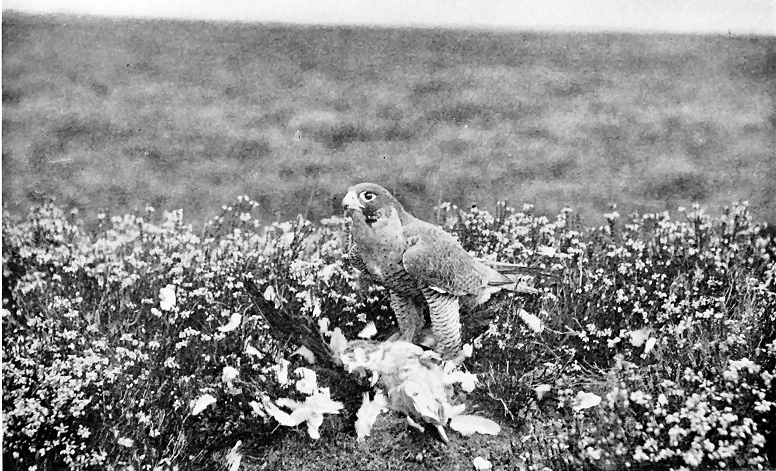
PLUMING THE DEAD GROUSE
Even if there are no dogs, the falconer must have a watchful eye on his company in the field, especially if it includes new hands at the now unfashionable sport. These must be warned mildly, or it may be reminded sharply, to maintain that repose of demeanour which befits the sport of kings. To keep still as the falcon mounts is quite as essential as to press on when she has got to her pitch. If a kill occurs it is lawful enough to join in the death-cry, but not to hurry up. Such ill-timed zeal might cause an infinity of mischief, and even, in the case of a falcon or ger, the loss of her then and there. Everyone present should stop fifty or more yards from the fatal spot, except the one man who is authorised to take her up; and while he makes in, no noise or violent movement should disturb the solemn scene. Cigars may be lighted, and the incidents of the flight may be discussed; but it is only when the falconer, rising from his knees with the victor on his glove, gives the signal to come on, that curiosity may be gratified by a good look at the vanquished.
There is some variety in the mode employed by hawks in taking game. In rook-hawking they all “bind” to the quarry, that is, they clutch it in the air, and retain their hold as they come down to earth. I think I am right in saying that when a hawk strikes and does not hold a rook, it is almost always either accidentally or because her talon has not held fast. Many peregrines—perhaps all eyesses—begin by binding to grouse and partridges. But the tremendous speed of the stoop in game-hawking often carries the stooper so fast up to her quarry, and onwards after it is struck, that the talon will not hold. Something in the body of the victim gives way—the skin, or maybe a bone or two. Moreover, the strain upon a falcon’s foot, if she dragged along with her a heavy bird flying only half as fast at the moment as herself, might be painful and even dangerous. Consequently a hawk which has a very “hard” stoop, as all passage gers have and many wild-caught peregrines, will sometimes not endeavour to catch hold or bind. They then “strike” in the truest sense of the word. They deal a blow, either downwards or forwards, using the two hind talons for it, and either break some bone or knock all the wind out of the victim struck. The jar of the blow as they rush by tells them that it has come home, and instead of throwing up high, as they would if they had missed, they check their flight quickly, and, swinging round in the air, descend rapidly on the panting or dazed foe. Instances have been known when a stoop has cut the head clean off from a grouse, and one of Mr. Freeman’s falcons cut through several ribs of a partridge as she hit it down. And yet the ger’s stoop is accounted much “harder” than the peregrine’s.
Game-peregrines, when well entered, may very well be flown four or five times a day. Some of them, when in good fettle, more. Six kills in one day is a decided feat for a peregrine; though it has been accomplished in modern times, and probably surpassed occasionally. But it is unwise to overdo the thing, and so tax the hawk too severely. If you have a very high-mounter, you may as well remember a piece of advice upon which D’Arcussia insists. This is to fly her not many times in any one day. Her high mounting is such a grand thing in itself, he says, that it is better to maintain it, even if your bag and your score suffer, than by letting her kill more—which she could undoubtedly do—to run the risk of lowering her pitch. If, however, a hawk has had bad luck, and still seems “full of flying,” you may go on after several unsuccessful flights in the hope of rewarding her at last. It is a very good thing in all sorts of hawking to “leave off with a kill.” Accordingly, if the third or fourth flight is successful, the wise falconer will often feed up and leave well alone. I should like to go a little further, and say that at any time after a very hard flight, in which the hawk has triumphed over exceptional difficulties and greatly exerted herself, it is a wise thing to feed up. “Oh, do fly her again,” is a seductive cry which some friend is likely to raise. But though next time she could not fly better, she might perhaps fly worse. I should be inclined to tell such enthusiastic friend that I would wait until the morrow. I would let that hawk go to rest with the memory of that one big flight in her mind. It will be a pleasant memory, embittered by no thought of subsequent failure. One really severe flight, after a good bout of waiting on, is a fair day’s work for any long-winged hawk, unless she is owned by a mere pot-hunter. It may be the first flight of the day, or it may be the fifth—perhaps the sixth or seventh; but I think it will be well to finish up with it.
I am glad to be able to give here some actual records of the performances of game-hawks, which have been most kindly given me by Mr. St. Quintin, whose skill in this department of falconry, as in many others, is second to none.
1881
September 24 September 30
Partridges Pheasant Partridges Rook
Belfry 2 ... Aide-de-camp 1 ...
Butcherboy 2 ... Belfry 1 ...
Parachute 3 1 Butcherboy 2 ...
Vanquisher 1 ... Heroine ... 1
Mosstrooper 1 ... Parachute 3 ...
Vanquisher 2 ...
Mosstrooper 1 ...
— — — —
9 1 10 1
1882
August 16 August 19 August 25
Grouse Hare Grouse Grouse
Parachute 1 1 Parachute 5 Parachute 4
Angela 2 ... Angela 2 Angela 1
Creole 3 ... Aide-de-camp 1 Aide-de-camp 3
Aide-de-camp 1 ... Amesbury 2 Amesbury 2
Amesbury 2 ... Vesta 2 Vesta 2
Vesta 1 ... Virginia 1
— — — —
10 1 12 13
In the season of 1882 Mr. St. Quintin and Colonel Brooksbank, on a moor which they took in Sutherland, took with the hawks 200 grouse, besides three blue hares, killed by the eyess Parachute, and one wild duck. After returning to England, Parachute killed no less than seventy-six partridges, besides five pheasants.
On the same moor, in 1884, the same gentlemen killed in one day (August 18) five grouse, four black-game (greyhens and young blackcock), and a hoodie crow; and on another day (August 20) eleven grouse.
CHAPTER IX
Lark-Hawking
The merlin, the lady’s hawk, has always been the hawk par excellence for larks. Hobbies, no doubt, have taken them in the old days, though they were used more often for “daring” them by waiting on above, which so terrified the larks that they could be picked up by hand. They take them now constantly in the wild state. But when reclaimed, they have for many years past proved complete failures in the hands of our modern amateurs. The late Lord Lilford made several attempts to get work out of them, but with hardly any success. Mr. George Symonds obtained a large number when he was in Italy, but out of the whole lot could only get one to fly wild quarry. The writer has twice attempted to train a male hobby for larks, and on the second occasion enjoyed the advantage of valuable assistance and advice from Colonel Sanford, who was at the same time training a brother of the same bird. Great pains were taken with both of these hawks, which were in perfect plumage and condition, and had been well hacked by no less able a falconer than Mr. Newall. They were well broken to the lure, and thought nothing of waiting on for a quarter of an hour or more at a vast height. Yet it was found impossible to induce either of them to make any serious attempts at a flight. I started mine on one occasion at least twenty times at various small birds, sometimes putting them up underneath the hawk as he was waiting on, and at other times throwing him from the fist at them. These were skylarks, woodlarks, pipits, and other small frequenters of the turnip-fields. When they were put up under the hobby, he seldom took the smallest notice. When thrown off at one, he would generally make a show of pursuing, but give up before he had gone fifty yards. One lark put in in front of him to a small heap of hurdles. But instead of being “surcharged with fear,” and allowing himself to be picked up, he seemed to have as much contempt for his pursuer as the latter deserved, and went up briskly again before there was any chance of even trying to pick him up.
The other hobby, which I trained some years before, did a little better. He once made two or three rings after a wild lark. The rings were very pretty, and the style of flying most correct. But there was one thing wanting, the pace was insufficient. To tell the truth, it was poor; and at the risk of being denounced by all ornithologists and most falconers, I venture to express a doubt whether the hobby is really a fast hawk. To support the common theory that he is exceptionally fast we have, no doubt, the fact that he kills swallows and swifts. But then he has the advantage of them, owing to his habit of constant soaring at a great height. From this vantage-point, if he killed one swallow out of a hundred aimed at, it would not be a conclusive proof of any great speed in flying. Much more difficult to explain are the passages in Latham and other old writers to the effect that hobbies, and especially female hobbies, have “plenty of courage,” and will well repay the trouble of training. Blome, in the Gentleman’s Recreation (1636), is especially loud in his praises of this hawk. After declaring that she is very amiable, bold, and daring, and will make a hawk of great delight, he adds that she may be left out in the field after being fed up, and will come back home to the place where she was hacked (except at migration times); and ends up by affirming that she is “in all respects, according to her capacity, as bold and hardy as any other hawk whatsoever.” Either the training of them has become a lost art, or the hobby has changed his nature entirely since he was thus eulogised.
Very different is the account to be rendered of the merlin, so inferior in external appearance, so vastly superior in courage and energy. This, the smallest of the true falcons, has not yet been persecuted out of existence in England with gun and snare, though the days of its disappearance are doubtless not far distant. Of this little hawk I speak perhaps with undue enthusiasm, having made them an object of special care. But the merlin has had admirers amongst some very illustrious persons. Louis XIII. kept hundreds of big hawks. He could have a good day’s hawking whenever he liked at cranes, kites, or herons. Yet he did not disdain, amidst all these temptations, to devote a whole morning to lark-hawking with merlins, and was overjoyed at killing one lark with a cast of them. It is true that this was a winter lark, but it was only a lark for a’ that! One of the greatest falconers that modern times have produced, Mr. E. C. Newcome, declared that after heron-hawking, already extinct in England in his day, the flight with the merlin at larks excelled all others in this country. Catherine II. of Russia was also an ardent admirer of this diminutive squire of dames.
The training and entering of the merlin, eyess or wild-caught, differs in no important particular from that of the peregrine which is to be flown at rooks. Only the reclamation is much more speedily effected. Often it can be completed, even in the case of an adult jack, in less than a fortnight—with the exercise of diligence, of course. An eyess, well hacked, can be manned in less than a week. This, however, does not mean that they can be trained to larks in that time. Writers on falconry sometimes inadvertently lead their readers astray by declaring that the merlin is easily trained. What the writer means is probably that they are easily manned and made to the lure. This is so; but the preparation for flying in the field, at least at larks, is quite a different matter. Merlins, like all other hawks, differ greatly in temperament. Occasionally you will find a whole nest of them quite free from vice. Such hawks are all easily trained for the field. But more often these little creatures are imbued from the first with a disposition to carry. And to fly a merlin at larks before she is cured of this weakness is to involve yourself in endless trouble. Eyesses are as bad as haggards—often worse. Consequently, when the hawk is manned and made to the lure, more than half your work is still before you. A non-carrying merlin can be trained in less than a week after being taken up from hack, whereas a determined carrier will hardly be safe to fly in double that time.
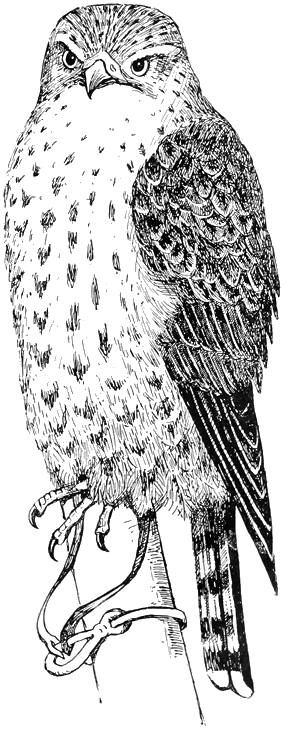
TRAINED MERLIN
There is another respect in which doubts may be entertained as to the truth of the opinion that merlins are easy to train. If by training is meant merely the qualifying them for driving moulting larks into covert, and killing them there, the saying is true enough. You may go to an enclosed country full of moulting larks. You may put one up and start the hawk. The lark, after a short flight, will go into a hedge; and there, if the merlin does not take him herself, you can either pick him up with the hand or drive him out for the hawk, which has taken perch on the fence; and he will be counted in the bag. But if by training you mean making the hawk fit to take ringing larks in open ground, the case is different. To do this a merlin must be in the pink of condition—quick, long-winded, persevering, and a good footer. How will you make her so? She will not wait on; no exercise is to be got that way to bring her into condition. If an eyess, she has had no practice at footing. How is she to learn that art? Then the dieting is a matter of extreme delicacy. If you give butcher’s meat, she will become dull and heavy; pigeon’s flesh will give her a sort of fever; in sheep’s heart, the food which most amateurs recommend, there is but poor nourishment; and she must be strong enough to go up half a mile, if required! Again, how are you to measure out the exact quantity that is good for her? If you give a peregrine or a goshawk an ounce too much or too little, the mischief done is slight. But give even half an ounce too much or too little to a jack-merlin, and he is straightway wrong in his condition. A big hawk is fed only once a day; there are about twenty-four hours on an average between each meal. If you fly the big hawk on a fast of twenty-two hours or of twenty-six, it matters little. But between the feeding-times of a merlin there is only an average of twelve hours. Therefore it matters a good deal whether you fly her early or late. She may be either too hungry or not hungry enough to do herself full justice.
The trainer who aspires to make a good score with ringing larks, and not to be content with mere hedge-row pot-hunting, must work pretty hard. He must not make many mistakes. He must observe very strictly the instructions already given for guarding against the besetting vice of carrying, never allowing a piece of food to be negligently fastened to the lure, or giving any bagged quarry that can be taken into a tree. He must find freshly-killed small birds almost daily for every merlin, so that her digestion and strength may be unimpaired. And in order to keep his hawk in wind, he must give her plenty of exercise. He can hardly do this without stooping her often to the lure. Ten minutes of this work, if the hawk is going all the time at her best pace, means a good many miles flying. Then the merlin must be taught to look principally to the fist for food. When feeding on the lure, whether it is garnished with a newly-killed sparrow or with a tiring, she must be provided with tit-bits from the hand, until, instead of fearing the approach of the falconer, she looks for it with pleasure. She must constantly be called to the fist. If there is a good-sized spare room available, she may be exercised there in coming often from one side of the room to your fist at the other. Some falconers advise keeping merlins loose in an empty room, where blocks and perches have been placed; and this is, no doubt, a very good plan when you have or can build for yourself the right kind of room. The sort of place recommended later on for moulting purposes will sometimes do well enough. I have found that the roof or ceiling is the great difficulty, as the hawks, constantly flying round just underneath, rub off the outer web of the long flight feathers. Of course the windows must be guarded with vertical bars, upon which the little hawks can find no foothold.
For the worst cases of carrying I must refer the reader to the chapter on “Vices.” But even with a well-behaved merlin the trainer must be constantly on his guard, at least for a fortnight after the hawk has begun work in the field. He must beware, when she has killed, of shepherds’ dogs, of wandering crows or rooks, and of the fowls which are now often found colonising the open fields, far away from a village or farmhouse. All or any of these may attack the hawk, and by inducing her to carry away the lark, sow the seeds of the vile habit. “Once a carrier, always a carrier,” is not an entirely true maxim, but it is not far from the truth. I have known merlins carry badly, and afterwards abandon the practice; but such cases are not common, and the trouble involved in effecting the cure is sometimes more than the merlin is worth. Prevention is many miles better than cure; good, honest miles, too, measured over the stony hillsides of Wilts! As you approach your merlin on the ground, remember not to stare at her, and to give her plenty of time. On the first few occasions you must exercise the patience of a veritable Job. She is now, after her victory, more apprehensive than ever that her hard-earned meal may be ravished from her. As you walk about, pretending to look at anything rather than her, she is all the time wondering whether your intentions are honourable or the reverse. Instinct tells her that they are base. Her previous experience, on the other hand, is reassuring to her. Your attitude, as you stroll about, is indicative of no sinister design. “When in doubt do nothing,” is a hawk’s maxim, as well as a diplomatist’s. Meanwhile there is the quarry to be plumed. So with many lookings round, and many pauses, and with a rather misdoubting mind, she falls to at the work of picking off the feathers. Not greedily—unless she is a greedy hawk, or too thin—but with a provoking deliberation, and with intervals that seem interminable. At last the feathers are off; and the warm food—the best she has ever had—begins to engross more of her real attention. Now she is ten times easier to approach. If, thinks she, you had been going to claim the quarry for yourself, surely you would have interfered before this. When she is fairly busy, you may by degrees get nearer, but keeping a keen look-out, and on the least show of alarm retreating quietly, but quickly. At length you will be able to get your hand, well garnished with a tempting morsel, within reach of her.
With a troublesome merlin you may employ, if you are sure of not bungling it, a very admirable device. You may resort to what may be called the “fishing-rod trick.” You will take with you into the field two joints of a fishing-rod, not including the top joint. On the thin end of the thinner of these joints, which must be stiff and stout, you will have fitted a brass hook or tooth, with its sharp point standing out an inch or so at right angles from the rod. This apparatus is sometimes invaluable. You may use one or both joints, as you find you can get nearer or less near. When you begin to be afraid to go any nearer, slide the thin end of the rod along the ground as you kneel until it is quite close to the dead quarry. If your hawk has had any decent manning at all, she will not be alarmed at it, even if she notices its stealthy approach. Having got the point on the lark’s body, steering clear of the hawk’s feet, turn the point downwards on it, and firmly but gently press it down and in. If you bungle, and the point slips, you are probably done; but if it holds you are safe. Proceed then with your making in, just as if there was no rod in the case. Always endeavour to take up the hawk with the hand alone, retaining your hold by the rod only as a last resort, in case of mischief. Each time that you can take her up without any trouble occurring, the easier the job will become. And even an attempt to bolt, which your firm hold with the rod renders unsuccessful, will tend to convince the evil-doer of the futility of her proceeding. Beware particularly of making in if a bagged lark is the victim. With bagged larks, easily taken, hawks are always inclined to bolt. On the other hand, if the lark has flown well, and the hawk is winded, there is less to fear.
When you have taken up your hawk, if you intend to fly her again, contrive that the body of the lark is held in the palm of your hand, and the neck alone protrudes between the forefinger and the base of the thumb. Then, when the brain has been eaten, and you have thrown away the beak and as much of the rest of the head as you conveniently can, let her think, or try to think, that there is no more to be had. If, on the other hand, you intend to feed her up, let her eat the rest of the lark, or almost all, and, as she finishes it, slip on the hood, and let her pull through the last few mouthfuls. Or, as the remains of the lark may be too bony to pull through easily, you may substitute a morsel of sheep’s heart, which she can more easily dispose of. A jack which has had half a lark in the morning, and three or four heads already in the afternoon, will be generally too much gorged if allowed to take the whole of his last lark. And some female merlins may, under like circumstances, be considered to have had enough before they have quite finished their lark. I have generally found that about a three-quarter crop in the evening is as much as it is wise to give.
Larks should always be flown up-wind; that is to say, when they get up to windward, and not to leeward of the hawk. A down-wind slip is very seldom satisfactory. If the lark is good you see nothing of the flight, and are dependent on your markers for finding the hawk, if she kills. The time lost is also often regrettable. It is not likely that with the first lark flown by any trained merlin you will have a kill. Only twice, I think, do I remember such a thing to have occurred. But the escape of several larks at first will do you no manner of harm. Even if your merlin refuses, you need not be at all discouraged. One of the most deadly merlins I ever had, when first taken out, refused seven larks in succession, and did not kill till her twelfth flight. But after that first kill she never refused again. If a trained hawk persists in refusing, or leaving the good larks, in hopes of getting a bad one, the case is serious. Possibly the reason may be that she is out of condition. But if it is her pluck that is wanting, you cannot expect to make much of her. In any case physic her, and give her two days’ rest. And the next time, if you can, fly her in company with a better merlin. If you should lose such a hawk for three or four days, and then take her up again, you may take her up cured. But you may take her up confirmed in her bad habit. When I took up Ruy Lopez, after three days out in a gale, he would not fly any but bad larks.
If, in the early days, your merlin puts in a lark, mark the place very exactly with your eye. You must consider whether you will drive him out for her or not. If the place is a thick hedge or big bush, I should be inclined not to attempt it. But if it is a place where you have a good chance of a second flight, as under the side of an isolated rick, or under a hurdle where there are no sheep, I should gratify the hawk by assisting her in the moment of need, when you can be so useful to her. If you can see the lark crouching and hiding himself, do not pick him up with the hand, but drive him out with your foot or the end of your rod. And do so when the hawk, from the top of the hurdle, or rick, or wherever she has taken perch, is looking the right way. A kill on such occasions will encourage her to wait on another occasion till you can help her in the same way. The form shown by a lark that has been put in and routed out is generally not so good as before he put in. But there are many exceptions. A lark got up in the open down before Eva, probably the best hawk I ever had. But before she could get to him, he fell without a blow, right in the open. Eva was then young, and rather fat, and wanted a hard flight, so I was in two minds whether I would not leave this weak-spirited lark, and go on and find a better one. Either the lark got up of his own accord before I had decided, or else I resolved to fly him; anyhow, when he started for the second time he went right up into the sky. There was a ringing flight of immense height; and after a great many stoops the lark was bested, and came down into a field where there were stooks of wheat. Eva sat on the top of a stook with her mouth open; the lark underneath, doubtless in no better plight. I might have walked miles and not found a lark which afforded me so much sport, and the hawk such a lung-opener.
The first time your merlin puts in a lark, do not take her on your fist, unless she goes away from the spot. Let her take perch close at hand. Be very careful indeed to drive out the fugitive towards her, so that she sees it go away. By this means she will see that there is no deception; that it is really the same lark; and that you have done her the service to rout it out. But on subsequent occasions it is best always to call the hawk to the fist before you put up the quarry. Otherwise he may very possibly go off when she is not looking, especially if the hawk is on the ground, as she will be if the lark has put in to a tuft of grass, or in clover, or, as they will when hard pressed, in stubbles. À propos of putting in, remember always that the country for lark-hawking must be, if you are to have good flights, even more open than that necessary for rooks. It requires so small a shelter to conceal a lark. Even the high grass which often fringes a road across the downs, a patch of nettles or thistles, an old stone wall, or a waggon, will tempt a faint-hearted ringer to come down. He comes down to almost certain death; for the man is there, in alliance with the hawk. But the ringing flight is spoilt; and that is what you do not want to occur. The better the hawk, the more ready the lark is to put in. So that the mere length of flight does not prove much as to the excellence either of pursuer or pursued, unless you know from experience what is the ability of the former.