Chapter III · THE POLAR SEAS: ICEBERGS—ICE-FLOES—THE SEAL—THE WALRUS THE NARWHAL—THE WHALE—SUNDRY FORMS OF MARINE LIFE. (continued 2)
Reading edition
The mode in which the whale feeds may be thus described:—
The broad waters of the Arctic seas teem with innumerable shoals of molluscous, radiate, and crustaceous animals, and these are frequently so numerous as absolutely to colour the wave-surface.
When a whale, therefore, desires food, it opens its colossal mouth, and a host of these organisms is, as it were, swept up by the great expanse of the lower jaw: as the mouth closes, the water is ejected, and the life it contained is imprisoned by the appliance we have attempted to describe.
If we consider the number of whales found in the Northern seas, and the mighty bulk of each individual, our imagination entirely fails to appreciate the countless myriads of minute organisms which must be sacrificed to their due nourishment.
One of the principal products of the Greenland whale is its baleen, or whalebone, with the domestic uses of which our readers will be familiar; but the large quantities of oil which it yields are still more valuable. A whale sixty feet in length will supply fully twenty tons of pure oil.
Besides the common whale, our hunters find in the seas of the North the razor-backed whale, or northern rorqual (Balænoptera physalis), characterized by the prominent ridge which extends along its mighty back. This monster of the deep attains a length, it is said, of one hundred feet, and measures from thirty to thirty-five feet in circumference. But its yield of oil and baleen is less than that of the right or Greenland whale, and as its capture is a task of difficulty and danger, the whalers seldom attack it. In its movements it is more rapid and restless, and when harpooned it frequently plunges downward with such force and velocity as to break the line. In several respects it differs from the Greenland species; and particularly in the nature of its food, for it feeds upon fishes of considerable size.
Some of our naturalists affirm that several species of rorquals exist in the Arctic seas; and the pike whale, so called from the resemblance of its mouth to that of a pike, is frequently described as an independent species. Others, however, are of opinion that the pike is simply the young of the monster we have been describing. The rorqual is very voracious, and preys extensively upon fishes; as many as six hundred cod, to say nothing of smaller “fry,” having been found in the stomach of a single individual.
While the Greenland whale is being rapidly driven back into the icy wildernesses beyond Behring Strait, on the west, and the creeks and gulfs beyond Baffin Bay, on the east, the rorquals, including the Balænoptera rostratus (or beaked whale), Balænoptera musculus, and Balænoptera boöps, still frequent the open waters,—their pursuit being, as we have shown, more difficult and less profitable. They are generally found in attendance on the herring-shoals, of which they are the assiduous and destructive enemies. Off Greenland, Spitzbergen, and Novaia Zemlaia they are found in considerable numbers.
Our whalers go forth every year in well-provided ships, and supplied with the best and most formidable weapons which scientific ingenuity can devise. Still they find the enterprise one of peril and hardship, and it is universally recognized as requiring in those who embark in it no ordinary powers of endurance, as well as courage, patience, and perseverance. Yet the Asiatic and American tribes do not fear to confront the ocean-leviathan with the simplest of arms. The Aleüt embarks in his little skiff, or baidar, and catching sight of his prey, stealthily approaches it from behind until he nearly reaches the monster’s head. Then he suddenly and dexterously drives his short spear into the huge flank, just under the fore fin, and retreats as swiftly as his well-plied oars can carry him. If the spear has sunk into the flesh, the whale is doomed; within the next two or three days it will perish, and the currents and the waves will hurl the vast bulk on the nearest shore, to be claimed by its gallant conqueror. And as each spear bears its owner’s peculiar mark, the claim is never disputed.
Occasionally the baidar does not escape in time, and the exasperated leviathan, furiously lashing the waters with its tail, hurls the frail boat high up into the air, as if it were a reed, or sinks it with one crushing blow. No wonder that those of their race who undertake so hazardous a calling are held in high repute among the Aleüts. To sally forth alone, and encounter the whale in the icy waters of the Polar Sea, is a task demanding the utmost intrepidity and the utmost tranquillity of nerve.
Many of the whales thus daringly harpooned are lost. It is on record that, in the summer of 1831, one hundred and eighteen whales were struck near Kadjack, and of these only forty-three were found. The others either drifted to far-off shores and lonely unknown isles, or became the prey of sharks and ocean-birds. Wrangell states that of late years the Russians have introduced the use of the harpoon, and engaged some English harpooneers to teach the Aleüts the secret of their craft; and, therefore, the older and more hazardous method, which the Aleüts had learned from their forefathers, will soon be a thing of the past.
The Eskimos devote the month of August to the whale-fishery, and for this purpose they assemble in companies, and plant a colony of huts on some bold headland of the Polar coast, where the water is of depth sufficient to float their destined victim.
As soon as a whale’s colossal bulk is seen outstretched on the water, a dozen kayaks or more cautiously paddle up in the rear, until one of them, shooting ahead, comes near enough on one side for the men to drive the spear into its flesh with all the force of both arms. To the spear are attached an inflated seal-skin and a long coil of thong. The whale dives immediately it is stricken. After awhile it reappears, and the signal being given by the floating seal-skin buoy, all the canoes again paddle towards their prey. Again the opportunity is seized for launching the fatal spears; and this process is repeated until the exhausted whale rises more and more frequently to the surface, is finally killed, and towed ashore.
Captain M’Clure fell in with an Eskimo tribe off Cape Bathurst which hunted the whale in this primitive fashion, but the females, as well as the men, engaged in the pursuit. An omaiak, or woman’s boat, he says, is “manned by ladies,” having as harpooneer a chosen man of the tribe; and a shoal of small fry, in the form of kayaks, or single-men canoes, are in attendance. The harpooneer singles out “a fish,” drives into its flesh his weapon, to which an inflated seal-skin is attached by means of a walrus-hide thong. The wounded fish is then incessantly harassed by the men in the kayacks with weapons of a similar description; and a number of these, driven into the unfortunate whale, baffle its efforts to escape, and wear out its strength, until, in the course of a day, it dies from exhaustion and loss of blood.
Sherard Osborn tells us that the harpooneer, when successful, becomes a very great personage indeed, and is invariably decorated with the Eskimo order of the Blue Ribbon; that is, a blue line is drawn across his face over the bridge of his nose. This is the highest honour known to the heroes of Cape Bathurst; but it carries along with it the privilege of the decorated individual being allowed to take unto himself a second wife!
In the waters of Novaia Zemlaia, Greenland, and Spitzbergen is found the narwhal, or sea unicorn (Monodon monoceros), which was at one time the theme of so many extravagant legends. It belongs to the Cetacea, but differs from the whale in having no teeth, properly so called, and in being armed with a formidable horn, projecting straight forward from the upper jaw, in a direct line with the body. This horn, or tusk, the use of which has not been satisfactorily ascertained, is harder and whiter than ivory, spirally striated from base to point, tapers throughout, and measures from six to ten feet in length. Mr. Bell remarks that it would be a strange anomaly if the apparent singleness of this weapon were real. In truth, both teeth are invariably found in the jaw, not only of the male, but of the female also; but in ordinary (though not in all) cases one only, and this in the male, is fully developed, the other remaining in a rudimentary condition—even as both do in the female.
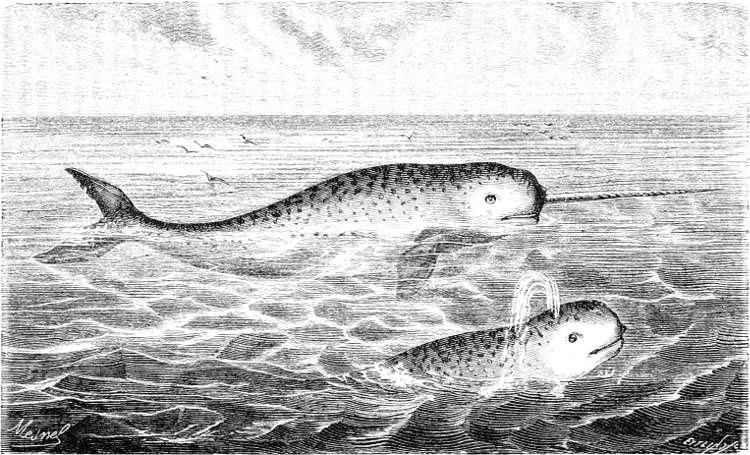
NARWHALS, MALE AND FEMALE.
The narwhal, from mouth to tail, is about twenty feet long, though individuals measuring thirty feet are sometimes met with. Its head is short, and the upper part convex; its mouth small; its spiracle, or respiratory vent, duplicate within; its tongue long; the pectoral fins small. The back, which is convex and rather wide, has no fins, and sharpens gradually towards the tail, which, as in other Cetacea, is horizontal. The food of the narwhal, whose habits are remarkably pacific, consists of medusæ, the smaller kinds of flat fish, and other marine animals.
A striking spectacle which frequently greets the eye of the voyager in the Arctic seas is that of a shoal of dolphins gambolling and leaping, as if in the very heyday of enjoyment. The beluga, sometimes called the white whale (Delphinus leucos), attracts attention by the dazzling whiteness of its body and the swiftness of its movements. It frequents the estuaries of the Obi and the Irtish, the Mackenzie and the Coppermine, which it sometimes ascends to a considerable distance in pursuit of the salmon. Its length varies from twelve to twenty feet; it has no dorsal fin; and its head is round, with a broad truncated snout.
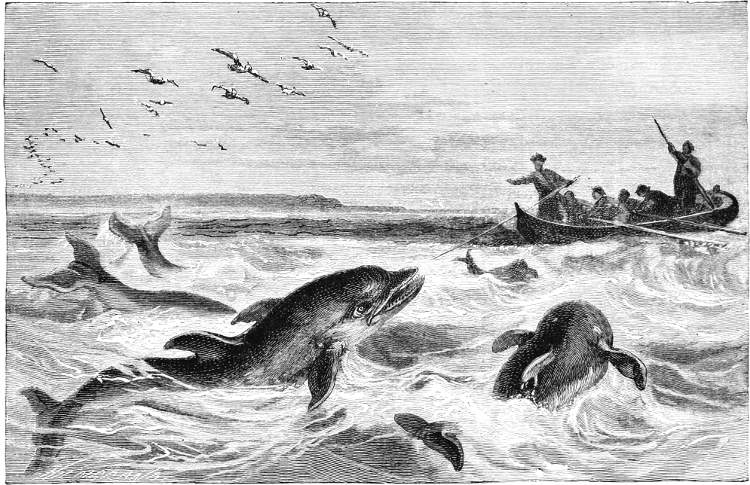
A SHOAL OF DOLPHINS.
The black dolphin (Globicephalus globiceps) is also an inhabitant of the Polar seas, both beyond Behring Strait, and between Greenland and Spitzbergen. It is, however, frequently met with in waters further south. Its length averages about twenty-four feet, and its circumference ten feet. Its smooth oily skin is bluish-black on the upper, and an obscure white on the lower, parts of the body. Twenty-two or twenty-four strong interlocking teeth in each jaw form its formidable apparatus of offence and defence; its dorsal fin is about fifteen inches high; its tail five feet broad; the pectoral fins are long and narrow, and well adapted to assist their owner in its rapid movements. It consorts with its kind in herds of several hundreds, under the guidance of some old and wary males, whom the rest follow as docilely as a flock of sheep their bell-wether; hence the Shetlanders term it the “ca’ing whale.” Large shoals are frequently stranded on the shores of Norway, Iceland, and the Orkney, Faroe, and Shetland Isles, furnishing the inhabitants with a welcome booty.
To the same latitudes belong the ferocious orc or grampus (Delphinus orca), the tiger of the seas, which not only attacks the porpoise and dolphin, but even the colossal whale. Its broad deep body is black above and white beneath; the sides are marbled with black and white. There are thirty teeth in each jaw, those in front being blunt, round, and slender, while those behind are sharp and thick; and between each is a space fitted to receive those of the opposite jaw when the mouth is closed. The back fin of the grampus is of great size; sometimes measuring as much as six feet in length, from the base to the tip. The grampus generally voyages in small squadrons of four or five individuals, following each other in single file, and alternately rising and sinking in such a manner as to resemble the undulatory motions of a huge kraken or sea-serpent.
Among the inhabitants of the Polar Ocean must certainly be included the Polar bear (Thalassarctos maritimus), since it swims and dives with great dexterity, and, moreover, is often found on the drifting ice-floes at a distance of eighty to one hundred miles from land. It is a creature of great strength, great fierceness, and great courage, though we may not accept the exaggerated accounts of it which enliven the narratives of the earlier voyagers.
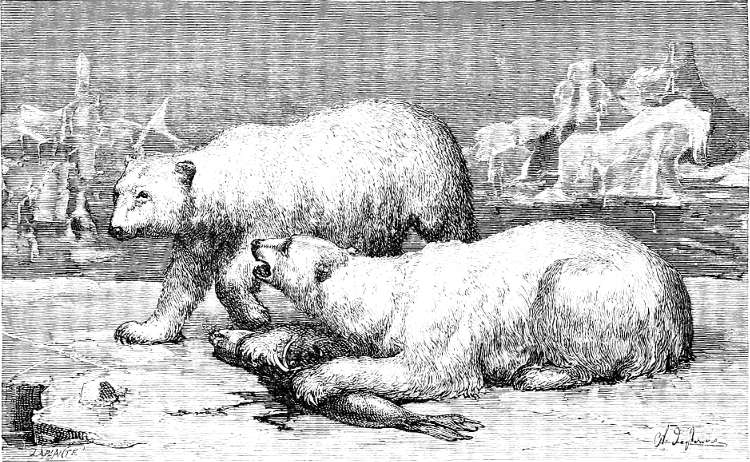
POLAR BEARS.
A noble creature is the Polar bear, says Sherard Osborn, whether we speak of him by the learned titles of “Ursus maritimus,” “Thalassarctos maritimus,” or the sailors’ more expressive nomenclature of “Jack Rough!” With all her many wonders, continues this lively writer, never did Nature create a creature more admirably adapted to the life it has to lead. Half flesh, half fish, the seaman wandering in the inhospitable regions of the North cannot but be struck with the appearance of latent energy and power its every action attests, as it rolls in a lithe and swaggering way over the rough surface of the frozen sea; or, during the brief Arctic summer, haunts the broken and treacherous “pack” in search of its prey.
When not too loaded with fat—and it seems to fatten readily—the pace of the bear is leisurely and easy, yet at its slowest it is equal to that of a good pedestrian; and when alarmed or irritated, its speed is surprising, though not graceful. On level ice, it flings itself ahead, as it were, by a violent jerking motion of the powerful fore paws, in what has been described as an “ungainly gallop;” but it always makes, when it can, for rough ice, where its strength and agility are best displayed, and where neither man nor dog can overtake it. In the Queen’s Channel, during Captain M’Clure’s expedition, more than one bear was seen making its way over broken-up ice, rugged and precipitous as the mind can picture, with a truly wonderful facility; their powerful fore paws and hind legs enabling them to spring from piece to piece, scaling one fragment and sliding down another with the activity of a huge quadrumane rather than that of a quadruped. Evidently it is conscious of its superiority in such rough and perilous ground, and is generally found at the edge of the belts of hummocks or broken ice which intersect most ice-fields, or else amongst the frozen pack-ice of channels such as Barrow’s and the Queen’s.
There is, however, another reason why bears keep among hummocks and pack-ice—namely, that near such spots water usually first makes its appearance in the summer. Seals, consequently, are most numerous there; while the inequalities of the floe afford shelter to the bears in approaching their prey. During summer the colour of the Polar bear is of a dull yellowish hue, closely resembling that of decaying snow or ice. The fur is then thin, and the hair on the soles of their feet almost wholly rubbed off, as with the other animals of Arctic climes; but in the autumn, when the body has recovered from the privations of the previous winter, and a thick coating of blubber overlays his carcass to meet the exigencies of another season of scanty fare, the feet, as the season advances, are beautifully incased and feathered with hair, and the animal’s colour usually turns to a very pale straw, which, from particular points of view, as the light strikes it, looks white, or nearly so. The nose and lips are of a jetty black; the eyes vary in colour. Brown is common, but some have been seen with eyes of a pale gray. Their sense of smell is peculiarly acute, facilitated no doubt by the peculiar manner in which the pure keen air of the North carries scent to very considerable distances.
Sherard Osborn states that bears have been seen to follow up a scent, exactly as dogs would do; and the floes about Lowther Island, in 1851, looked as if the bears had quartered there in search of seals, after the fashion of a pointer in the green fields of England. The snorting noise which they make as they approach near indicates how much more confidence they place in their scent than in their vision; though both, when the hunter is concerned, are apt to deceive them.
The Polar bear attains to very formidable proportions; but when seamen speak of monsters fifteen feet in length, their auditors may be excused for withholding their belief. Ten feet would seem to be a maximum; and the bear need be large, strong, and muscular to master the large Arctic seal, especially the saddle-back and bladder-nose species. For though it swims well and dives well, it neither swims nor dives as well as the seal, and would therefore have but little chance of obtaining a sufficient livelihood if it could not attack and capture its victim on the ice-floes.
The seal, on the other hand, fully aware of its danger, and of the only means of escaping from it, always keeps close to the water, whether it be the hole it has gnawed and broken through the ice, or the open sea at the floe edge.
And when it lies basking on the floating ice, and apparently apathetic and lethargic, nothing can exceed its vigilance. With its magnificent eyes it is able to sweep a wide range of the horizon, however slightly it turns its head; its keenness of hearing adds to its security. There is something peculiarly striking in its continuous watchfulness. Now it raises its head and looks around; now it is intent on the slightest sound that travels over the crisp surface of the ice; now it gazes and listens down its hole, a needful precaution against so subtle a hunter as old Bruin! It would seem impossible to surprise an animal so vigilant and so wary; and, indeed, in circumventing its prey the bear exhibits an astuteness and a skill which overpass the bounds of instinct, and approach closely to those of reason.
From its scent and by its quick strong vision the bear apprehends the position of the seal. Then it throws itself prone upon the ice, and profiting by inequalities which are invisible to human eyes, gradually steals upon its destined victim by a soft and scarcely perceptible movement of the hind feet. To hide its black muzzle, it constantly uses its fore feet; and thus, only the dingy white of its coat being visible, it is scarcely to be distinguished from the general mass of the floe. Patiently it draws nearer and nearer; the seal, mistaking it for one of its own congeners, or else yielding to a fatal curiosity, delaying until its assailant, with one spring, is upon it.
Yet, as the old adage says, there is many a slip; and even in these circumstances the bear does not always secure its feast. It is disappointed sometimes just as the prey seems within its grasp; and how keen the disappointment is can be appreciated only, we are told, by hapless Arctic travellers, “who have been hours crawling up, dreaming of delicious seal’s fry and overflowing fuel bags, and seen the prey pop down a hole when within a hundred yards of it.” The great muscular power of the seal frequently enables it to fling itself into the water in spite of the bear’s efforts to hold it on the floe; Bruin, however, retains his grip, for his diving powers are not much inferior to those of the seal, and down they go together! Sometimes the bear proves victorious, owing to mortal injuries inflicted upon the seal before it reaches the water; sometimes it may be seen reappearing at another hole in the floe, or clambering up another loose piece of ice, apparently much mortified by its want of success.
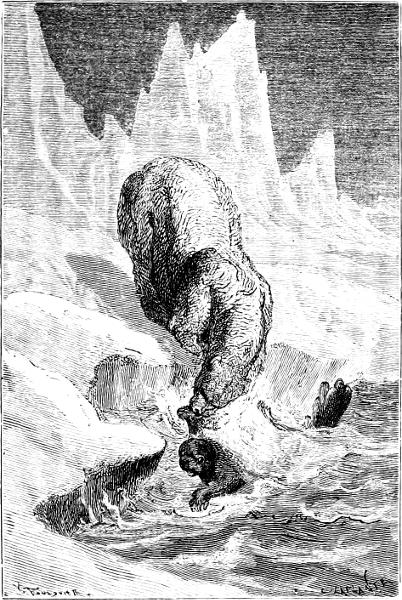
BEAR CATCHING A SEAL.
As we have said, the bear dives well, and is nearly as much at home in the water as upon the ice. If it catches sight of a seal upon a drifting floe, it will slide quietly into the sea, swim with only the tip of its nose above the water, and, diving under the floe, reach the very spot which the hapless seal has regarded as an oasis of safety. It is this stratagem of its enemy which has taught the seal to watch its hole so warily. Even on extensive ice-fields fast to the land, where the bear cannot conceal its approach by taking advantage of hummocks or other inequalities, the seal is not safe; for then Bruin drops down a hole, and swims along under the ice-crust until it reaches the one where the poor seal is all unwittingly enjoying its last rays of sunshine.
The bear’s season of plenty begins with the coming of the spring. In February and March the seal is giving birth to her young, who are born blind and helpless, and for ten days are unable to take to the water. The poor mothers use every effort to protect them, but, in spite of their affectionate exertions, a perfect massacre of the innocents takes place, in which, not improbably, the Arctic wolf is not less guilty than the Arctic bear.
Voracity, however, frequently proves its own Nemesis, and the bear, in its eager pursuit of prey, often involves itself in serious disaster. The seal instinctively breeds as close as possible to the open water. But the ice-floes, during the early equinoctial gales, will sometimes break up and drift away in the form of pack-ice; a matter of indifference, says Osborn, to the seal, but a question of life and death to the bear. Borne afar on their little islets of ice, rocked by tempestuous waters, buffeted by icy gales, numbers of these castaways are lost along the whole area of the Polar Sea. It is said that when the gales blow down from the north, bears are sometimes stranded in such numbers on the shores of Iceland as to endanger the safety of the flocks and herds of the Icelandic peasants; and they have been known to reach the coasts of Norway.
Bears drifting about at a considerable distance from the land are often enough seen by the whalers. They have been discovered fully sixty miles from shore, in Davis Strait, without any ice in sight, and utterly exhausted by long swimming. It is thus that Nature checks their too rapid increase; for beyond the possibility of the wolf hunting it in packs and destroying the cubs, there seems no other limitation of their numbers. The Eskimos are too few, and too badly provided with weapons, to slaughter them very extensively. Wherever seals abound, so do bears; in Barrow Strait and in the Queen’s Channel they have been seen in very numerous troops. The Danes assert that they are plentiful about the northern settlement of Upernavik in Greenland, for nine months in the year; and from the united testimony of the natives inhabiting the north-eastern portion of Baffin Bay, and that of Dr. Kane, who wintered in Smith Sound, it is evident that they are plentiful about the polynias, or open pools, formed there by the action of the tides.
In the summer months, when the bear is loaded with fat, it is easily hunted down, for then it can neither move swiftly nor run long; but in deep winter its voracity and its great strength render it a formidable enemy to uncivilized and unarmed man. Usually it avoids coming into contact with our British seamen, though instances are on record of fiercely contested engagements, in which Bruin has with difficulty been defeated.
It is folly, says Sherard Osborn, to talk of the Polar bear hibernating: whatever bears may do on the American continent, there is only one Arctic navigator who ever saw a bear’s nest! Bears were seen at all points visited by our sailors in the course of M’Clure’s expedition; at all times and in all temperatures; males or females, and sometimes females with their cubs. In mid-winter, as well as in midsummer, they evidently frequented spots where tides or currents occasioned either water to constantly exist, or only allowed such a thin coating of ice to form that the seal or walrus could easily break through.
That the Polar bear does not willingly attack man, except when hotly pursued or when suffering from extreme want, is asserted by several good authorities, and confirmed by an experience which Dr. Hayes relates. He was strolling one day along the shore, and observing with much interest the effect of the recent spring-tides upon the ice-foot, when, rounding a point of land, he suddenly found himself confronted in the full moonlight by an enormous bear. It had just sprung down from the land-ice, and met Dr. Hayes at full trot, so that they caught sight of each other, man and brute, at the same moment. Being without a rifle or other means of defence, Dr. Hayes suddenly wheeled towards his ship, with much the same reflections, probably, about discretion and valour as occurred to old Jack Falstaff when the Douglas set upon him; but discovering, after a few lengthy strides, that he was not “gobbled up,” he looked back over his shoulder, when, to his gratification as well as surprise, he saw the bear speeding towards the open water with a celerity which left no doubt as to the state of its mind. It would be difficult to determine which, on this occasion, was the more frightened, the bear or Dr. Hayes!
A curious illustration of the combined voracity and epicureanism of Bruin is recorded by Dr. Kane. A cache, or depôt of provisions, which had been constructed by one of his exploring parties with great care, and was intended to supply them with stores on their return journey, they found completely destroyed. It had been built, with every possible precaution, of rocks brought together by heavy labour, and adjusted in the most skilful manner. So far as the means of the builders permitted, the entire construction was most effective and resisting. Yet these “tigers of the ice” seemed to have scarcely encountered an obstacle. Not a morsel of pemmican (preserved meat) remained, except in the iron cases, which, being round, with conical ends, defied both claw and teeth. These they had rolled and pawed in every direction,—tossing them about like footballs, although upwards of eighty pounds in weight. An alcohol-case, strongly iron-bound, was dashed into small fragments; and a tin can of liquor twisted almost into a ball. The bears’ strong claws had perforated the metal, and torn it up as with a chisel.
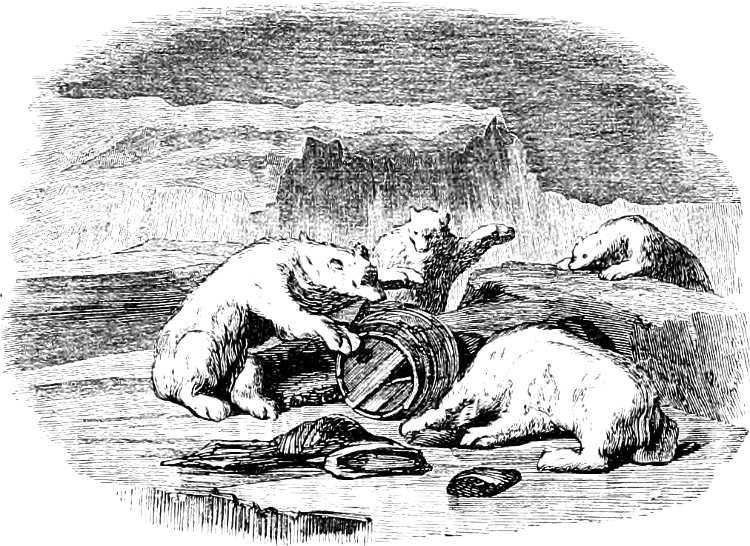
BEARS DESTROYING A CACHE.
But the burglars were too dainty for salt meats. For ground coffee they had evidently a relish; old canvas was also a favourite,—de gustibus non est disputandum; even the flag which had been reared “to take possession” of the icy wilderness, was gnawed down to the very staff. It seemed that the bears had enjoyed a regular frolic; rolling the bread-barrels over the ice-foot and into the broken outside ice; and finding themselves unable to masticate the heavy India-rubber cloth, they had amused themselves by tying it up in unimaginable hard knots.
The she-bear displays a strong affection for her young, which she will not desert even in the extremity of peril. The explorer already quoted furnishes an interesting narrative of a pursuit of mother and cub, in which the former’s maternal qualities were touchingly exhibited.
On the appearance of the hunting party and their dogs, the bear fled; but the little one being unable either to keep ahead of the dogs or to maintain the same rate of speed as its mother, the latter turned back, and, putting her head under its haunches, threw it some distance forward. The cub being thus safe for the moment, she would wheel round and face the dogs, so as to give it a chance to run away; but it always stopped where it had alighted, until its mother came up, and gave it another forward impulse; it seemed to expect her aid, and would not go forward without it. Sometimes the mother would run a few yards in advance, as if to coax her cub up to her, and when the dogs approached she would turn fiercely upon them, and drive them back. Then, as they dodged her blows, she would rejoin the cub, and push it on,—sometimes putting her head under it, sometimes seizing it in her mouth by the nape of its neck.
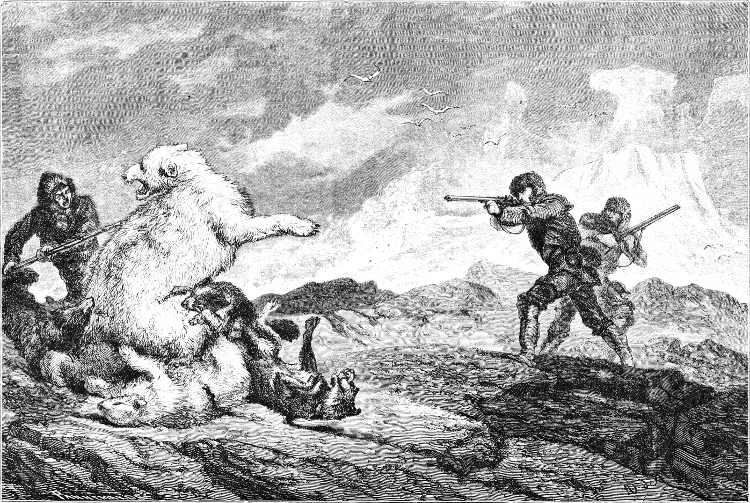
FIGHT WITH A WHITE BEAR.
For some time she conducted her retreat with equal skill and celerity, leaving the two hunters far in the rear. They had sighted her on the land-ice; but she led the dogs in-shore, up a small stony valley which penetrated into the interior. After going a mile and a half, however, her pace slackened, and, the little one being spent, she soon came to a halt, evidently determined not to desert it.
At this moment the men were only half a mile behind; and, running at full speed, they soon reached the spot where the dogs were holding her at bay. The fight then grew desperate. The mother never moved more than two yards ahead, constantly and affectionately looking at her cub. When the dogs drew near, she sat upon her haunches, and taking the little one between her hind legs, she fought her assailants with her paws, roaring so loudly that she could have been heard a mile off. She would stretch her neck and snap desperately at the nearest dog with her shining teeth, whirling her paws like the sails of a windmill. If she missed her aim, not daring to pursue one dog lest the others should pounce upon her cub, she uttered a deep howl of baffled rage, and on she went, pawing and snapping, and facing the ring, grinning at them with wide-opened jaws.
When the hunters came up, the little one apparently had recovered its strength a little, for it was able to turn round with its dam, however quickly she moved, so as always to keep in front of her belly. Meantime the dogs were actively jumping about the she-bear, tormenting her like so many gadflies; indeed, it was difficult to fire at her without running the risk of killing the dogs. But Hans, one of the hunters, resting on his elbow, took a quiet, steady aim, and shot her through the head. She dropped at once, and rolled over dead, without moving a muscle.
Immediately the dogs sprang towards her; but the cub jumped upon her body and reared up, for the first time growling hoarsely. They seemed quite afraid of the little creature, she fought so actively, and made so much noise; and, while tearing mouthfuls of hair from the dead mother, they would spring aside the minute the cub turned towards them. The men drove the dogs off for a time, but were compelled to shoot the cub at last, as she would not quit the body.
A still more stirring episode is recorded by Dr. Kane, which will fitly conclude our account of the Polar bear.
“Nannook! nannook!” (A bear! a bear!) With this welcome shout, Hans and Morton, two of his attendants, roused Dr. Kane one fine Saturday morning.
To the scandal of his domestic regulations, the guns were all impracticable. While the men were loading and capping anew, Dr. Kane seized his pillow-companion six-shooter, and ran on deck, to discover a medium-sized bear, with a four-months’ cub, in active warfare with the dogs. They were hanging on her skirts, and she, with remarkable alertness, was picking out one victim after another, snatching him by the nape of the neck, and flinging him many feet, or rather yards, by a scarcely perceptible movement of her head.
Tudea, the best dog, was already hors de combat; he had been tossed twice. Jenny, another of the pack, made an extraordinary somerset of nearly fifty feet, and alighted senseless. Old Whitey, a veteran combatant, stanch, but not “bear-wise,” had been foremost in the battle; soon he lay yelping, helplessly, on the snow.
It seemed as if the battle were at an end; and nannook certainly thought so, for she turned aside to the beef-barrels, and began with the utmost composure to turn them over, and nose out their fatness. A bear more innocent of fear does not figure in the old, old stories of Barents and the Spitzbergen explorers.
Dr. Kane now lodged a pistol-ball in the side of the cub. At once the mother placed her little one between her hind legs, and, shoving it along, made her way to the rear of the store or “beef-house.” As she went she received a rifle-shot, but scarcely seemed to notice it. By the unaided efforts of her fore arms she tore down the barrels of frozen beef which made the triple walls of the store-house, mounted the rubbish, and snatching up a half barrel of herrings, carried it down in her teeth, and prepared to slip away. It was obviously time to arrest her movements. Going up within half pistol-range, Dr. Kane gave her six buck-shot. She dropped, but instantly rose, and getting her cub into its former position, away she sped!
And this time she would undoubtedly have effected her escape, but for the admirable tactics of Dr. Kane’s canine Eskimo allies. The Smith Sound dogs, he says, are educated more thoroughly than any of their more southern brethren. Next to the seal and the walrus, the bear supplies the staple diet of the tribes of the North, and, except the fox, furnishes the most important element of their wardrobe. Unlike the dogs Dr. Kane had brought with him from Baffin Bay, the Smith Sound dogs were trained, not to attack, but to embarrass. They revolved in circles round the perplexed bear, and when pursued would keep ahead with regulated gait, their comrades accomplishing a diversion at the critical moment by a nip at the nannook’s hind-quarters. This was done in the most systematic manner possible, and with a truly wonderful composure. “I have seen bear-dogs elsewhere,” says Dr. Kane, “that had been drilled to relieve each other in the mêlée, and avoid the direct assault; but here, two dogs, without even a demonstration of attack, would put themselves before the path of the animal, and retreating right and left, lead him into a profitless pursuit that checked his advance completely.”
The unfortunate animal was still fighting, and still retreating, embarrassed by the dogs, yet affectionately carrying along her wounded cub, and though wounded, bleeding, and fatigued, gaining ground upon her pursuers, when Hans and Dr. Kane secured the victory, such as it was, for their own side, by delivering a couple of rifle-balls. She staggered in front of her young one, confronted her assailants in death-like defiance, and did not sink until pierced by six more bullets.
When her body was skinned, no fewer than nine balls were discovered. She proved to be of medium size, very lean, and without a particle of food in her stomach. Hunger, probably, had stimulated her courage to desperation. The net weight of the cleansed carcass was 300 pounds; that of the entire animal, 650 pounds; her length, only 7 feet 8 inches.
It is said that bears in this lean condition are more palatable and wholesome than when fat; and that the impregnation of fatty oil through the cellular tissues makes a well-fed bear nearly uneatable. The flesh of a famished beast, though less nutritious as body-fuel or as a stimulating diet, is rather sweet and tender than otherwise. Moral: starve your bear before you eat him!
The little cub was larger than the qualifying adjective would imply. She was taller than a dog, and her weight 114 lbs. She sprang upon the corpse of her slaughtered mother, and rent the air with woful lamentations. All efforts to noose her she repelled with singular ferocity; but at last, being completely muzzled with a line fastened by a running knot between her jaws and the back of her head, she was dragged off to the brig amid the uproar of the dogs.
Dr. Kane asserts that during this fight, and the compulsory somersets which it involved, not a dog suffered seriously. He expected, from his knowledge of the hugging propensity of the plantigrades, that the animal would rear, or it she did not rear, would at least use her fore arms; but she invariably seized the dogs with her teeth, and after disposing of them for a time, refrained from following up her advantage,—probably because she had her cub to take care of. The Eskimos state that this is the habit of the hunted bear. One of the Smith Sound dogs made no exertion whatever when he was seized, but allowed himself to be flung, with all his muscles relaxed, a really fearful distance; the next instant he rose and renewed the attack. According to the Eskimos, the dogs soon learn this “possum-playing” habit.
It would seem that the higher the latitude, the more ferocious the bear, or that he increases in ferocity as he recedes from the usual hunting-fields.
At Oominak, one winter day, an Eskimo and his son were nearly killed by a bear that had housed himself in an iceberg. They attacked him with the lance, but he boldly turned on them, and handled them severely before they could make their escape.
The continued hostility of man, however, has had, in Dr. Kane’s opinion, a modifying influence upon the ursine character in South Greenland; at all events, the bears of that region never attack, and even in self-defence seldom inflict injury upon, the hunters. Many instances have occurred where they have defended themselves, and even charged after having been wounded, but in none of them was life lost.
A stout Eskimo, an assistant to a Danish cooper of Upernavik, fired at a she-bear, and the animal closed at the instant of receiving the ball. The man had the presence of mind to fling himself prone on the ground, extending his arm to protect his head, and afterwards lying perfectly motionless. The beast was deceived. She gave the arm a bite or two, but finding her enemy did not stir, she retired a few paces, and sat upon her haunches to watch. But her watch was not as wary as it should have been, for the hunter dexterously reloaded his rifle, and slew her with the second shot.
It has been pointed out that in approaching the bear the hunters should take advantage of the cover afforded by the inequalities of the frozen surface, such as its ridges and hillocks. These vary in height, from ten feet to a hundred, and frequently are packed so closely together as to leave scarcely a yard of level surface. It is in such a region that the Polar bear exhibits his utmost speed, and in such a region his pursuit is attended with no slight difficulty.
And after the day’s labour comes the night’s rest; but what a night! We know what night is in these temperate climes, or in the genial southern lands; a night of stars, with a deep blue sky overspreading the happy earth like a dome of sapphire: a night of brightness and serene glory, when the moon is high in the heaven, and its soft radiance seems to touch tree and stream, hill and vale, with a tint of silver; a night of storm, when the clouds hang low and heavily, and the rain descends, and a wailing rushing wind loses itself in the recesses of the shuddering woods; we know what night is, in these temperate regions, under all its various aspects,—now mild and beautiful, now gloomy and sad, now grand and tempestuous; the long dark night of winter with its frosty airs, and its drooping shadows thrown back by the dead surface of the snow; the brief bright night of summer, which forms so short a pause between the evening of one day and the morning of another, that it seems intended only to afford the busy earth a breathing-time;—but we can form no idea of what an Arctic Night is, in all its mystery, magnificence, and wonder. Strange stars light up the heavens; the forms of earth are strange; all is unfamiliar, and almost unintelligible.
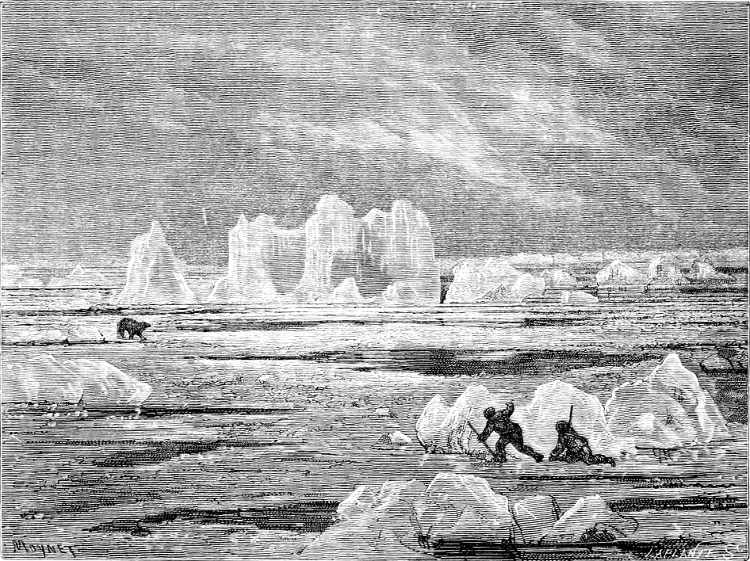
STALKING A BEAR.
It is not that the Arctic night makes a heavy demand on our physical faculties. Against its rigour man is able to defend himself; but it is less easy to provide against its strain on the moral and intellectual faculties. The darkness which clothes Nature for so long a period reveals to the senses of the European explorer what is virtually a new world, and the senses do not well adapt themselves to that world. The cheering influences of the rising sun, which invite to labour; the soothing influences of the evening twilight, which beguile to rest; that quick change from day to night, and night to day, which so lightens the burden of existence in our temperate clime to mind and soul and body, kindling the hope and renewing the courage,—all these are wanting in the Polar world, and man suffers and languishes accordingly. The grandeur of Nature, says Dr. Hayes, ceases to give delight to the dulled sympathies, and the heart longs continually for new associations, new hopes, new objects, new sources of interest and pleasure. The solitude is so dark and drear as to oppress the understanding; the imagination is haunted by the desolation which everywhere prevails; and the silence is so absolute as to become a terror.
The lover of Nature will, of course, find much that is attractive in the Arctic night; in the mysterious coruscations of the aurora, in the flow of the moonlight over the hills and icebergs, in the keen clearness of the starlight, in the sublimity of the mountains and the glaciers, in the awful wildness of the storms; but it must be owned that they speak a language which is rough, rugged, and severe.
All things seem built up on a colossal scale in the Arctic world. Colossal are those dark and tempest-beaten cliffs which oppose their grim rampart to the ceaseless roll and rush of the ice-clad waters. Colossal are those mountain-peaks which raise their crests, white with unnumbered winters, into the very heavens. Colossal are those huge ice-rivers, those glaciers, which, born long ago in the depths of the far-off valleys, have gradually moved their ponderous masses down to the ocean’s brink. Colossal are those floating islands of ice, which, outrivalling the puny architecture of man, his temples, palaces, and pyramids, drift away into the wide waste of waters, as if abandoned by the Hand that called them into existence. Colossal is that vast sheet of frozen, frosty snow, shimmering with a crystalline lustre, which covers the icy plains for countless leagues, and stretches away, perhaps, to the very border of the sea that is supposed to encircle the unattained Pole.
In Dr. Hayes’ account of his voyage of discovery towards the North Pole occurs a fine passage descriptive of the various phases of the Arctic night. “I have gone out often,” he says, “into its darkness, and viewed Nature under different aspects. I have rejoiced with her in her strength, and communed with her in her repose. I have seen the wild burst of her anger, have watched her sportive play, and have beheld her robed in silence. I have walked abroad in the darkness when the winds were roaring through the hills and crashing over the plain. I have strolled along the beach when the only sound that broke the stillness was the dull creaking of the ice-floes, as they rose and fell lazily with the tide. I have wandered far out upon the frozen sea, and listened to the voice of the icebergs bewailing their imprisonment; along the glacier, where forms and falls the avalanche; upon the hill-top, where the drifting snow, coursing over the rocks, sung its plaintive song; and again, I have wandered away to some distant valley where all these sounds were hushed, and the air was still and solemn as the tomb.”
Whoever has been overtaken by a winter night, when crossing some snowy plain, or making his way over the hills and through the valleys, in the deep drifts, and with the icicles pendent from the leafless boughs, and the white mantle overspreading every object dimly discernible in the darkness, will have felt the awe and mystery of the silence that then and there prevails. Both the sky above and the earth beneath reveal only an endless and unfathomable quiet. This, too, is the peculiar characteristic of the Arctic night. Evidence there is none of life or motion. No footfall of living thing breaks on the longing ear. No cry of bird enlivens the scene; there is no tree, among the branches of which the wind may sigh and moan. And hence it is that one who had travelled much, and seen many dangers, and witnessed Nature in many phases, was led to say that he had seen no expression on the face of Nature so filled with terror as the silence of the Arctic night.
But by degrees the darkness grows less intense, and the coming of the day is announced by the prevalence of a kind of twilight, which increases more and more rapidly as winter passes into spring. There are signs that Nature is awakening once more to life and motion. The foxes come out upon the hill side, both blue and white, and gallop hither and thither in search of food,—following in the track of the bear, to feed on the refuse which the “tiger of the ice” throws aside. The walrus and the seal come more frequently to land; and the latter begins to assemble on the ice-floes, and select its breeding-places. At length, early in February, broad daylight comes at noon, and then the weary explorer rejoices to know that the end is near. Flocks of speckled birds arrive, and shelter themselves under the lee of the shore; chiefly dove-kies, as they are called in Southern Greenland—the Uria grylle of the naturalist. At last, on the 18th or 19th of February, the sun once more makes its appearance above the southern horizon, and is welcomed as one welcomes a friend who has been long lost, and is found again. Upon the crests of the hills light clouds are floating lazily, and through these the glorious orb is pouring a stream of golden fire, and all the southern sky quivers, as it were, with the shooting, shifting splendours of the coming day. Presently a soft bright ray breaks through the vaporous haze, kindling it into a purple sea, and touches the silvery summits of the lofty icebergs until they seem like domes and pinnacles of flame. Nearer and nearer comes that auspicious ray, and widens as it comes; and that purple sea enlarges in every direction; and those domes and pinnacles of flame multiply in quick succession as they feel the passage of the quickening light; and the dark red cliffs are warmed with an indescribable glow; and a mysterious change passes over the face of the ocean; and all Nature acknowledges the presence of the sun!
“The parent of light and life everywhere,” says Dr. Hayes, “he is the same within these solitudes. The germ awaits him here as in the Orient; but there it rests only through the short hours of a summer night, while here it reposes for months under a sheet of snows. But after a while the bright sun will tear this sheet asunder, and will tumble it in gushing fountains to the sea, and will kiss the cold earth, and give it warmth and life; and the flowers will bud and bloom, and will turn their tiny faces smilingly and gratefully up to him, as he wanders over these ancient hills in the long summer. The very glaciers will weep tears of joy at his coming. The ice will loose its iron grip upon the waters, and will let the wild waves play in freedom. The reindeer will skip gleefully over the mountains to welcome his return, and will look longingly to him for the green pastures. The sea-fowls, knowing that he will give them a resting-place for their feet on the rocky islands, will come to seek the moss-beds which he spreads for their nests; and the sparrows will come on his life-giving rays, and will sing their love-songs through the endless day.”
With the sun return the Arctic birds, and before we quit the realm of waters we propose to glance at a few of those which frequent the cliffs and shores during the brief Polar summer.
Among the first-comers is the dove-kie or black guillemot (Uria grylle), which migrates to the temperate climates on the approach of winter, visiting Labrador, Norway, Scotland, and even descending as far south as Yorkshire. In fact, we know of no better place where to observe its habits than along the immense range of perpendicular cliffs stretching from Flamborough Head to Filey Bay. Here, on the bare ledges of this colossal ocean-wall, the guillemot lays its eggs, but without the protection of a nest; some of them parallel with the edge of the shelf, others nearly so, and others with their blunt and sharp ends indiscriminately pointing to the sea. They are not affixed to the rock by any glutinous matter, or any foreign substance whatever. You may see as many as nine or ten, or sometimes twelve, old guillemots in a line, so near to each other that their wings almost touch. The eggs vary greatly in size and shape and colour. Some are large, others small; some exceedingly sharp at one end, others rotund and globular. It is said that, if undisturbed, the guillemot never lays more than one egg; but if that be taken away, she will lay another, and so on. But Audubon asserts that he has seen these birds sitting on as many as three eggs at a time.
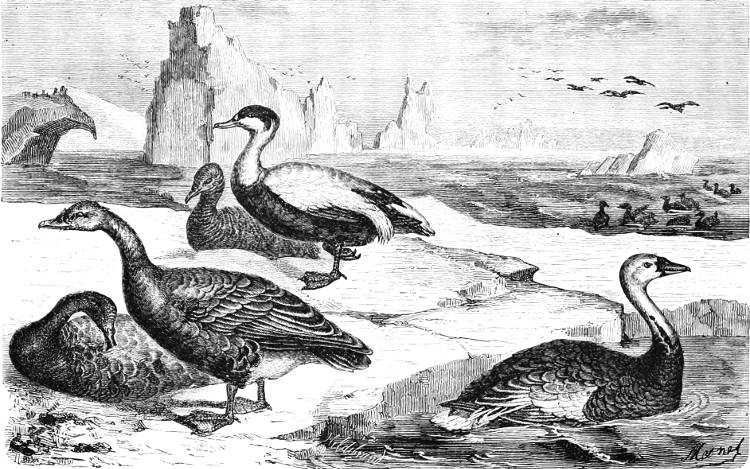
SEA-BIRDS IN THE POLAR REGIONS.
The black guillemot differs from the foolish guillemot (Uria troile) only in the colour of its plumage, which, with the exception of a large white patch on the coverts of each wing, is black, silky, and glossy; the feathers appearing to be all unwebbed, like silky filaments or fine hair. The bill, in all the species, is slender, strong, and pointed; the upper mandible bending slightly near the end, and the base covered with soft short feathers. The food of the guillemot consists of fish and other marine products.
The Alcidæ, or auks, are also included amongst the Arctic birds. The little auk (Arctica alca) frequents the countries stretching northwards from our latitudes to the regions of perpetual ice, and is found in the Polar Regions both of the Old World and the New. Here, indeed, they congregate in almost innumerable flocks. At early morn they sally forth to get their breakfast, which consists of different varieties of marine invertebrates, chiefly crustaceans, with which the Arctic waters teem. Then they return to the shore in immense swarms. It would be impossible, says an Arctic voyager, to convey an adequate idea of the numbers of these birds which swarmed around him. The slope on both sides of the valley in which he had pitched his camp rose at an angle of about forty-five degrees to a distance of from 300 to 500 feet, where it met the cliffs, which stood about 700 feet higher. These hill-sides are composed of the loose rocks detached from the cliffs by the action of the frost. The birds crawl among these rocks, winding far in through narrow places, and there deposit their eggs and hatch their young, secure from their great enemy, the Arctic fox.
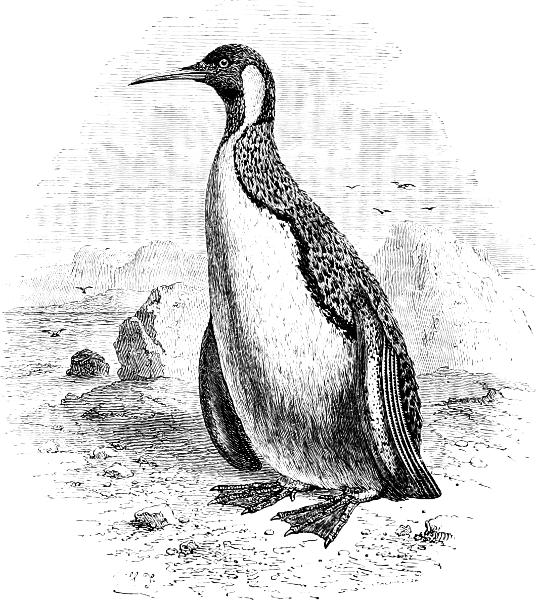
THE AUK.
On one occasion, they were congregated along a slope, fully a mile in length, and over this slope rushed a constant stream of birds, only a few feet above the stones; and, after making in their rapid flight the whole length of the hill, they returned higher in the air, performing over and over again the complete circuit. Occasionally a few hundreds or thousands of them would drop down, as if following some leader; and in an instant the rocks, for a space of several rods, would swarm all over with them, their black backs and pure white breasts speckling the hill very prettily.
Though quantities are destroyed by the crews of vessels as well as by the Eskimos, their numbers never seem to decrease. Their flesh is both wholesome and delicate, and affords a welcome change of diet to the mariner weary of salt meat and pemmican. They are very tame, and easily captured,—in some places being actually caught in hand-nets, like moths or butterflies; and they pass a great portion of their time on the ocean, where they disport themselves with equal grace and self-possession.
The starakis (Phaleridinæ) inhabit the archipelagoes which lie between China and North America. They assemble in small flocks, and swim about in quest of the crustaceans, molluscs, and other marine animals on which they feed. At nightfall they return to land, where they find shelter under the ledges of the rocks, or in burrows dug with their bill and feet, The female lays a solitary egg.
The auks abound in the high northern latitudes. They are all ocean-birds, and are never found, like the divers, in fresh-water streams and lakes. Those species which possess the power of flight nestle on the rocky cliffs and icebergs, where they lay a single egg, of conical form; a shape which prevents it from rolling away, or moving, except within a very narrow circle, on the bare rocky ledge where it is deposited.
The puffins (Fratercola), which in winter abound on our own shores, live chiefly on the water. They dive and swim with dexterity, but, owing to the shortness of their wings, are capable only of limited flight. Their plumage is thick, smooth, and dense, and so completely throws off the water that it is quite impervious to wet; while their deep, compressed, and pointed beak, resembling exactly a double keel, is admirably adapted as an instrument for cutting the waves when the bird wishes to dive.
The puffins live principally upon sprats and other small fishes; and the food intended for their young they retain until partially digested, when they disgorge it into their mouths. Like all the auks, the mother-bird lays but one egg.
The appearance of an island or iceberg frequented by these birds is very vividly sketched by Audubon, than whom no naturalist has ever more completely attained a thorough acquaintance with the Bird-World.
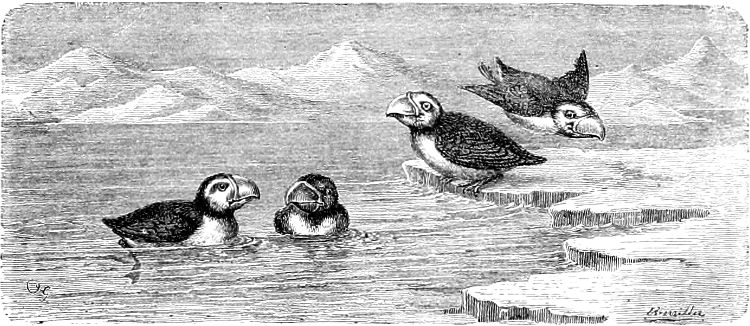
PUFFINS.
He tells us that on every crag or stone stood a puffin, at the entrance of every hole another, and yet the sea was covered and the air filled with them. The burrows were all inhabited by young birds, of different ages and sizes; and clouds of puffins flew over us, each individual holding a small fish by the head. The burrows all communicated with each other in various ways, so that the whole island seemed to be perforated by a multitude of subterranean labyrinths, over which it was impossible to run without the risk of falling at almost every step. The voices of the young sounded beneath the traveller’s foot like voices from the grave, and the stench was exceedingly disagreeable.
Something must next be said of the mergansers (Merginæ), a sub-family of the palmipeds, which also belong to the Polar world. Their principal characters may thus be stated: a straight bill, much compressed on the sides, and convex towards the tip, which is furnished with a broad and much-hooked nail; the wings are moderate, and pointed; the tail is short and rounded; the tarsi are short, and the toes moderate, the outer being as long as the middle, the three anterior ones united by a full web, while the hind toe is moderate, elevated, and provided with a broad web on its margin.
From these characters it is easy to infer that the bird is aquatic in its habits; that it can swim and dive well; that it is also capable of strong, swift flight; and that its food will consist chiefly of fishes.
The dun diver or goosander (Mergus merganser) is widely distributed throughout the Polar Regions both of the eastern and western continents. During its southern migration, it visits the United States, as well as France, Holland, and Germany; but on the approach of summer it retires to Siberia and Kamtschatka, Iceland, Greenland, and the Arctic shores of North America.
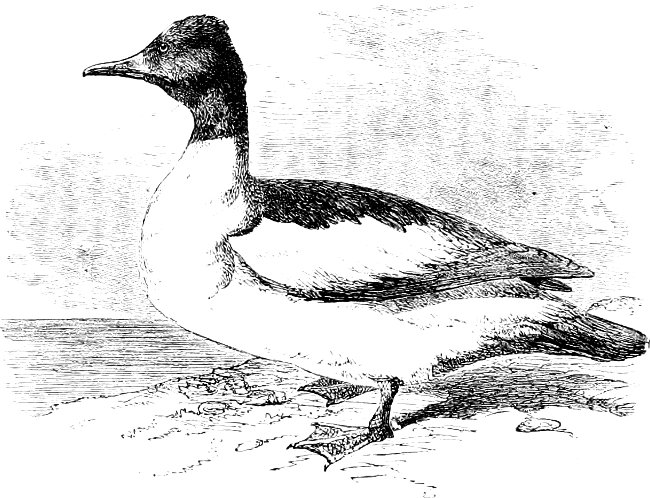
THE GOOSANDER.
In these localities it constructs its nest—always near the edge of the water; building it up of grass, roots, and similar materials, with little regard to symmetry, and lining it with down. It is placed sometimes among the mossy, weedy stones; and sometimes it is concealed in the long grass, or under the cover of bushes, or in the stumps or hollows of decayed trees. The female lays from twelve to fourteen eggs, of a cream-yellow colour; their form is a long oval, both ends being equally obtuse. The goosander may be said to spend its time in the air and on the water; and, in truth, on the land it moves but laboriously and awkwardly, owing to the backward position of its legs. It rises with difficulty from the ground; but when once on the wing, its course is swift, strong, and steady. As it lives mainly upon fish, its flesh is oily and ill-flavoured; a circumstance which goes far to compensate the sportsman for the frequent failure of his attempts to capture it. It is a wild and wary bird, and as it swims with rapidity and dives with ease, it generally effects its escape from all but the most experienced hunters.
Another species which abounds in northern latitudes is the smew (Mergus albellus), also known as the white nun or white merganser. This palmiped is about the size of a widgeon; is of elegant form; and its plumage beautifully coloured with black and white. Its bill is of a dusky blue, nearly two inches long, thickest at the base, and tapering into a slenderer and more narrow shape towards the point. An oval black patch, glossed with green, marks each side of the head; the under part of the crest is black; but all the rest of the head and neck, as well as the graceful breast and the belly, are white as snow, with the exception of a curved black line on each side of the upper part of the breast, and similar marks on the lower part; the back, the coverts on the ridge of the wings, and the primary quills are black; the secondaries and greater coverts are white-tipped; while the sides of the body, under the wings to the tail, exhibit a curious variegation of dark wavy lines. The legs and feet are of a leaden blue.
The range of the smew is very extensive, for it migrates as far southward as the Mediterranean, while it is found everywhere in the Arctic Regions.
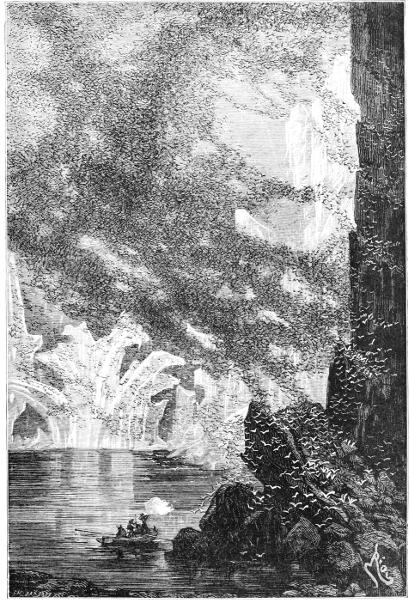
A BIRD “BAZAAR” IN NOVAIA ZEMLAIA.
On the shores of Novaia Zemlaia, as on those of Spitzbergen, the sea-birds arrive in countless hosts as soon as the summer sun has removed the long and dreary spell under which Nature labours through the winter months. The narrow rock-ledges on which they congregate, and where auks and guillemots assemble in thousands, the Russians call “a bazaar.” The large gray sea-mew (Larus glaucus), the “burgomaster” of the Dutch whalers, prefers the lonely summits of isolated cliffs, where it can reign the monarch of all it surveys. The ivory gull (Larus eburneus) is seldom found in high northern latitudes; but the common gull (Larus canus) and the black-backed gull (Larus marinus) are almost as abundant as guillemots.
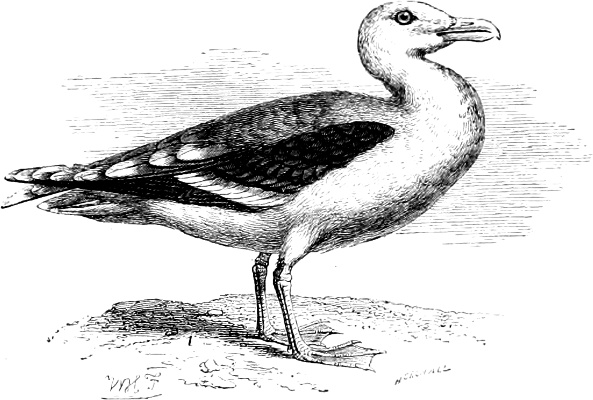
THE BLACK-BACKED GULL.
In Iceland one of the most useful, and certainly not the least beautiful, of the birds is the eider-duck (Somateria mollissima), which also frequents the shores of Baffin and Hudson Bays, Lapland, Greenland, and Spitzbergen. It loves to breed on the small flat islands which lie off the coast, such as Akeney, Flutry, and Videy, where it is secure from the attacks of the Arctic fox. Its breeding-places in Iceland are private property, and some of them have been for centuries in the possession of the same families, which owe to the birds all their wealth and prosperity. Hence they are very vigilantly guarded. Whoever kills one is fined thirty dollars; and to secrete an egg, or pocket a few downs, is an offence punishable by law. The chief occupation of some of the proprietors is to examine through their telescopes all the boats that approach, so as to be sure that there are no guns on board.
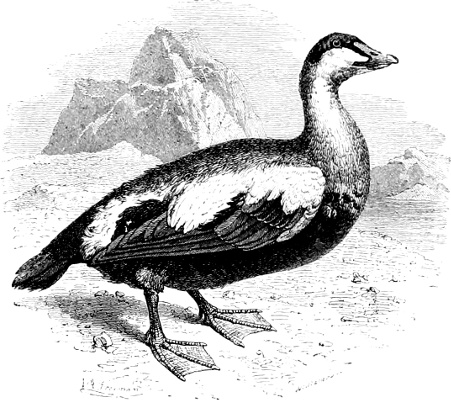
THE EIDER-DUCK.
As the birds on these islands are quite tame, the eider-down is easily collected. The female having laid five or six pale greenish-olive eggs, in a nest fashioned with marine plants, and thickly lined with down of the most exquisite delicacy, the collectors carefully remove her, rob the nest of its precious lining, and then replace the bird. Immediately she begins to lay afresh, and again has recourse to the down on her body to protect her eggs; and should her own stock be exhausted, as is not unfrequently the case, she is furnished with an auxiliary supply by the male. Even this second lining is often taken away, and the poor bird a third time repeats the process, both as regards the eggs and the down; but if the plunderers do not spare her now, she afterwards abandons the nest, and seeks a home in some more sequestered nook.
As it comes to the European markets, this down, which is highly valued on account of its lightness, elasticity, and warmth, occurs in balls about the size of a man’s fist, and weighing from three to four pounds. Such is its fineness and elastic quality, that when a ball is opened, and cautiously laid near the fire to expand, it will completely fill a quilt five feet square. It should be noted, however, that the down from dead birds is of comparatively little value, having lost its elasticity.
An interesting account of a visit to Vigr in the Isafjardardjufs, a favourite resort of the eider-duck in the north of Iceland, is furnished by Mr. Shepherd:—
As he approached the island, he says, he could see flocks upon flocks of the sacred birds, and could hear their cooings at a great distance. Landing on a rocky wave-worn shore, against which the waters scarcely rippled, he set off to survey the island. The shore he describes as “the most wonderful ornithological sight imaginable.” The ducks and their nests were everywhere. Great brown ducks started up under his feet at every step; and it was with difficulty that he avoided treading on some of the nests. As the island is but three-quarters of a mile across, the opposite shore is soon reached. On the coast was a wall built up of large stones, just above the high-water mark, about three feet high, and of considerable thickness. At the bottom, on both sides of it, alternate stones had been left out, forming a series of square compartments in which the ducks might make their nests. Almost every compartment was occupied; and as the human intruder walked along the shore, a long line of startled ducks flew out one after the other. The surface of the water also was white with ducks, who welcomed their “brown wives” with loud and clamorous cooing.
Mr. Shepherd, on arriving at the farm-house, was received in the most hospitable manner, hospitality being one of the special virtues of the Icelander. He was much impressed by the appearance of the house, which seemed to be converted into one large duckery. The earthen wall surrounding it, and the window-embrasures, were filled with ducks; on the ground, encircling the house, was a ring of ducks; on the sloping roof were seated ducks; and a duck was perched on the door-scraper!
A grassy bank close by had been cut into square patches like a chess-board (a square of turf of about eighteen inches being removed, and a hollow excavated), and all these squares were occupied by ducks. A windmill was infested with them, and so were all the out houses, mounds, rocks, and crevices. In fact, the ducks were everywhere. Many of them were so tame as to allow the stranger to stroke them on their nests; and their mistress said there was scarcely a duck on the island which would not allow her to take its eggs without flight or fear. When she first became possessor of the island, the produce of down from the ducks did not exceed fifteen pounds weight in the year, but under her careful nurture it had risen, in twenty years, to nearly one hundred pounds annually. About a pound and a half are required to make a coverlet for a single bed; and the down is worth from twelve to fifteen shillings per pound. Most of the eggs are taken and pickled for winter consumption, one or two only being left to hatch.
Eider-ducks congregate in numerous flocks, generally in deep water; they dive with wonderful force, and thus are enabled to capture the shell-fish which form their principal food. If a storm threatens, they retire to the rocky shores where they love to breed and rest. The Greenlanders kill them with darts, pursuing them in their little boats, watching their course by the air-bubbles that come floating upward when they dive, and dexterously aiming at them as soon as they rise to the surface wearied. Their flesh is eaten by the Greenlanders, but it is not well-flavoured; their eggs, however, are held in high esteem.
The king eider (Somateria spectabilis) belongs to the same genus as the former.
We suppose that every reader is acquainted with the beautiful lines in which Tennyson has embodied the fable of the dying swan singing its own dirge:—
“With an inner voice the river ran, Adown it floated a dying swan, And loudly did lament.... The wild swan’s death-hymn took the soul Of that waste place with joy Hidden in sorrow: at first, to the ear The warble was low, and full, and clear;... But anon her awful jubilant voice, With a music strange and manifold, Flowed forth on a carol free and bold.... And the creeping mosses and clambering weeds, And the willow-branches hoar and dank, And the wavy swell of the soughing reeds, And the wave-worn horns of the echoing bank, And the silvery marish-flowers that throng The desolate creeks and pools among, Were flooded over with eddying song.”
But the wild swan’s voice, even in its death-hour, has no such musical sweetness as the poet here sets forth. It is always harsh and dissonant, and when it breaks on the silence of the Arctic skies carries with it an almost painful impression.
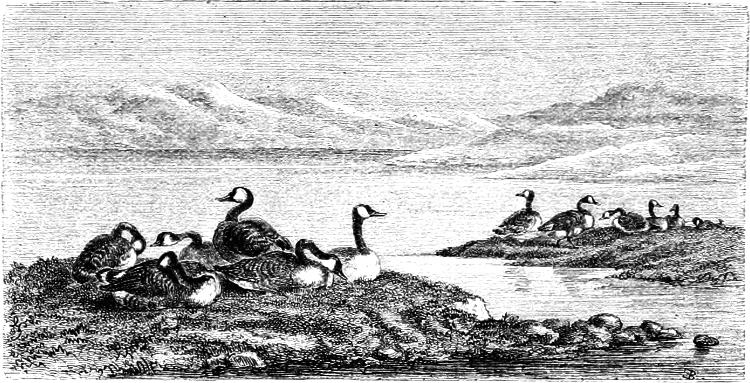
THE HAUNT OF THE WILD SWAN.
The lakes of Iceland, and its streams, abound with these beautiful birds. They are very numerous on the Myvatn, or Great Lake, as well as the wild duck, the scoter, the common goosander, the red-breasted merganser, the scaup duck, and other anserines. The wild swan is shot or caught for its feathers, which are highly prized for ornamental purposes. It is sometimes found in large flocks, sometimes in single pairs; and besides the lakes and streams, it frequents the salt and brackish waters along the coast. It is chiefly at the pairing season, or at the approach of winter, that it assembles in multitudes; and as the winter advances it mounts high in air, and shapes its course in search of milder climates.
The female builds her nest of the withered leaves and stalks of reeds and rushes, in lonely and sequestered places. She usually lays six or seven thick-shelled eggs, which are hatched in about six weeks, when both parents assiduously guard and feed the cygnets. When full-grown, this fine bird measures nearly five feet in length, and above seven in breadth across its extended wings; it weighs about fifteen pounds. The entire plumage is of a pure white, and next to the skin lies a coat of thick fine down.
The wealth of the Arctic and sub-Arctic seas is apparently inexhaustible. In many parts cod are plentiful, and supply the Greenlanders with a valuable article of food. The capelin (Mullotus vitlosus), which in May and June frequents the Greenland waters, is eaten both fresh and dried; in the latter case forming a useful winter provision. The halibut is found of a large size; and ocean also contributes the Norway haddock, the salmon-trout, the lump-fish, and the bull-head. Nor are the crustacea unrepresented: long-tailed crabs being abundant, while the common mussel may be gathered almost everywhere at ebb-tide. The seas, however, grow poorer as we advance towards the Pole, and many important species of fish do not penetrate further north than the Arctic Circle.
Yet even where these are wanting, the ocean-waters teem with life; and a recent writer is fully justified in remarking that the vast multitudes of animated beings which people them form a remarkable contrast to the nakedness of their bleak and desolate shores. The colder surface-waters are, as he says, almost perpetually exposed to a cold atmosphere, and being frequently covered, even in summer, with floating ice, they are not favourable to the development of organic life; but this adverse influence is modified by the higher temperature which constantly prevails at a greater depth. Contrary to the rule in the Equatorial seas, we find in the Polar-ocean an increase of temperature from the surface downwards, in consequence of the warmer under-currents, flowing from the south northwards, and passing beneath the cold waters of the superficial Arctic current.
Hence the awful rigour of the Arctic winter, which strikes the earth with a death-blight, is not perceptible in the ocean-depths, where myriads of organisms find a secure retreat from the frost, and whence they emerge during the long summer’s day, either to haunt the shores or ascend the broad rivers of the Polar world. Between the parallels of 74° and 80°, Dr. Scoresby observed that the colour of the Greenland sea varies from the purest ultramarine to olive-green, and from crystalline transparency to striking opacity; and these appearances are not transitory, but permanent.[8] The aspect of this green semi-opaque water, which varies in its locality with the currents,—often forming isolated stripes, and sometimes spreading over two or three degrees of latitude,—is mainly due to small medusæ and nudibranchiate molluscs. Many thousands of square miles must literally run riot with life, since the coloured waters we speak of are calculated to form one-fourth of the sea between the 74th and 80th parallels.
On the Greenland coast, where the transparency of the waters is so great that the bottom and every object upon it are clearly discernible, even at a depth of eighty fathoms, the ocean-bed is covered with gigantic tangles, so as to remind the spectator of the ocean-gardens of the Tropical Zone. Alcyonians, sertularians, ascidians, nullipores, mussels, and a variety of other sessile animals incrust every stone, or congregate in every fissure and hollow of the rocky ground. A dead seal or fish flung into the sea is soon converted into a skeleton, it is said, by the myriads of small crustaceans which infest these northern waters, and, like the ants in the equatorial forests, perform the part of scavengers of the deep.
It is evident, from the observations of Professor Forbes, that depth has a very considerable influence in the distribution of marine life. From the surface to the depth of 1380 feet eight distinct zones or regions have been mapped out in the sea, each of which has its own vegetation and inhabitants; and the number of these regions must now he increased, after the astonishing results of the deep-sea soundings of Dr. Carpenter and Professor Wyville Thomson. The changes in the different zones are not abrupt: some of the creatures of an under region always appear before those of the region above it vanish; and though there are a few species the same in some of the eight zones, only two are common to all. It is to be observed that those near the surface have forms and colours analogous to the inhabitants of southern latitudes, while those at a greater depth are analogous to the animals of northern waters. Hence, in the sea, depth corresponds with latitude, as height does on land. Mrs. Somerville adds, in language of much terseness, that the extent of the geographical distribution of any species is proportioned to the depth at which it lives. Consequently, those which live near the surface are less widely dispersed than those inhabiting deep water.
The larger and more active inhabitants of the seas obey the same laws with the rest of creation, though their provinces, or regions, are in some instances very extensive. Above the 44th parallel the Atlantic species frequently correspond with those of the Pacific. The salmon of America is identical with that of the British Isles, and the coasts of Sweden and Norway; the same is true of the Gadidæ, or cod. The Cottas, or bull-head tribe, are also the same on both sides of the Atlantic; increasing in numbers and specific differences on approaching the Arctic seas. The same law holds good in the North Pacific, but the generic forms differ from those in the Atlantic. From the propinquity of the coasts of America and Asia at Behring Strait, the fish on both sides are nearly alike, down to Admiralty Inlet on the one side, and the Sea of Okhotsk on the other.