Chapter X · HISTORICAL SKETCH OF ARCTIC DISCOVERY. (continued 2)
Reading edition
On the 24th, the weather was splendid. The sun shone in a cloudless sky, and wherever its genial radiance fell the thermometer marked + 28° 5’ R. This was an excellent opportunity for drying their clothes, which, as well as their linen, had been thoroughly soaked innumerable times. The coverings were removed from the boats, which, in the warm sunshine, exhaled great clouds of vapour. The cook endeavoured to add to his stores of provisions; but the seals churlishly refused to make their appearance, the fish disdained to nibble at the fat-baited hooks, and the stupid guillemots were cunning enough to escape the best directed shots.
M. Hildebrandt, with two seamen, made an attempt—in which they succeeded—to reach the island of Illiudlek, which lay about three miles off, and is from 450 to 500 feet in height. They found it a desert; not a trace of vegetation; its shores very steep, and at some points precipitous; its surface torn with crevasses and ravines. The only accessible part seemed on the north; but as the evening was drawing in, they had no time for exploration, and made haste to return to the boats.
The castaways now came to a resolution to seek a temporary refuge on this desolate isle. As the heat of the sun was sufficient to render their labour very painful, and they suffered much from the effects of the snow upon their eyes, they went to work at night, dragging their boats forward with many a weary effort, and rested during the daytime. In this way they reached the island on the 4th of June.
Here they moored their boats in a small bay sheltered by a wall of rocks from the north wind, which they named Hansa-Hafen. Next day they shot two-and-twenty divers, which provided them with a couple of good dinners. The supply was very valuable, as the stock of provisions on hand would not last above a fortnight.
After a brief rest, the adventurers resumed their voyage, keeping close in-shore, and struggling perseveringly amidst ice and stones—and further checked by an inaccurate chart, which led them into a deep fiord, instead of King Christian IV. Sound. On the 13th of June, however, they arrived at the Moravian missionary station of Friedrichstal, where their countrymen received them with a hearty welcome. For two hundred days they had sojourned upon a drifting ice-field, experiencing all the hardships of an Arctic winter, aggravated by an insufficiency of food.
They reached Julianshaab on the 21st of June; embarked on board the Danish brig Constance; and were landed at Copenhagen on the 1st of September.
We must now return to the Germania.
Captain Koldewey made several bold attempts to penetrate the pack-ice, but proved unsuccessful in all until, on the 1st of August, he reached lat. 74°, where he contrived to effect a passage; and though much delayed by a succession of fogs and calms, he made his way to Sabine Island,—and dropped anchor on its southern side, in lat. 74° 30’ N., and long. 29° W., on the 5th of August.
On the 10th he again passed towards the north, keeping along the Greenland shore until, in lat. 75° 31’ N., his advance was checked by a mass of closely-packed ice, which stretched from the coast of the mainland out to Shannon Island, a long unbroken line of fourteen miles. It presented a very formidable appearance, being edged in some places with a fringe of broken ice, boulders, and blocks, rising in heaps and hummocks forty feet high.
The Germania remained in this position for several days. As nothing but ice was visible to the northward, and no prospect opened up of further progress in that direction, Captain Koldewey moved his ship to the south side of the island on the 16th of August, and dropped anchor close to Cape Philip Broke.
Eleven days were spent in a careful exploration of Shannon Island, during which time a musk-ox was shot, and close watch was kept from an elevated point on the ice lying to the northward. But as it continued solid and immovable, and the end of the season was at hand, Captain Koldewey returned northward, and brought his vessel to anchor on the south side of Pendulum Island on the 27th of August.
When it became necessary to make preparations for facing the coming winter, Captain Koldewey moved his ship on the 13th of September into the little harbour he had occupied on the 5th of August. Their subsequent experience showed it to be the only secure one between the parallels of 74° and 77°. A few days later the ship was frozen in.
The first sledging-party was despatched on the 14th of September, and remained out for eight days. After reaching the mainland, they travelled for four days up a newly-discovered fiord, finding many petrifactions and much lignite. They also saw large herds of musk-oxen. Vegetation was abundant, but chiefly composed of species of Andromeda. In the course of this excursion, our explorers had one or two adventures with bears. First, a female, with her two cubs, paid them a visit, but being received with some volleys of musketry, quickly beat a retreat. On another occasion, a daring intruder found his way into their tent. His temerity, however, cost him his life; and the Germans banqueted gaily on the fat and flesh with which he incontinently supplied them.
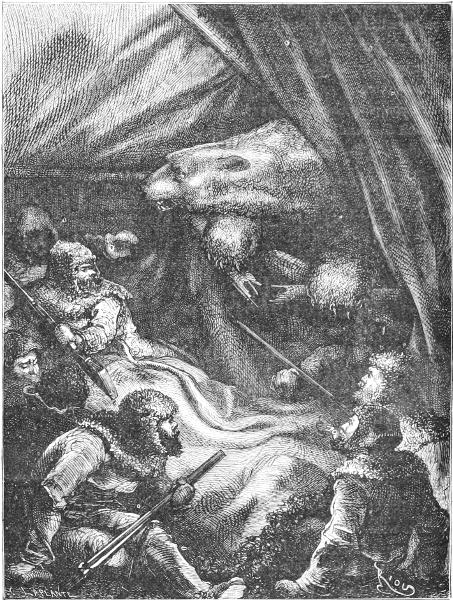
A RASH INTRUDER.
When the winter preparations were completed, Captain Koldewey organized several shooting parties, who made good booty of reindeer and musk-oxen and added most satisfactorily to the provision-supplies; no fewer than fifteen hundred pounds of good beef and venison attesting the skill and good fortune of the hunters. But after the beginning of November, neither musk-oxen, reindeer, nor bears were visible.
A second sledge journey was undertaken towards the end of October in a southerly direction. The party discovered another fiord, and returned on the 4th of November. On the following day the sun disappeared altogether, and the dreary Arctic night of three months’ duration overtook them.
The close of the year was marked by a succession of violent storms, and the temperature rose to 25° F. It soon fell again to zero, however; but it was not until 1870 that it indicated the maximum of cold experienced throughout the winter,—namely, -40° F. Of the December gales, the most furious broke out on the 16th, and lasted until the 20th. It set free the ice in the harbour, and even to within three hundred yards of the ship; but fortunately she had been anchored in the most sheltered part of the bay, and close to the shore, in only ten feet of water; otherwise the crushed-up ice, moving with the currents, would probably have carried her away to almost certain destruction.
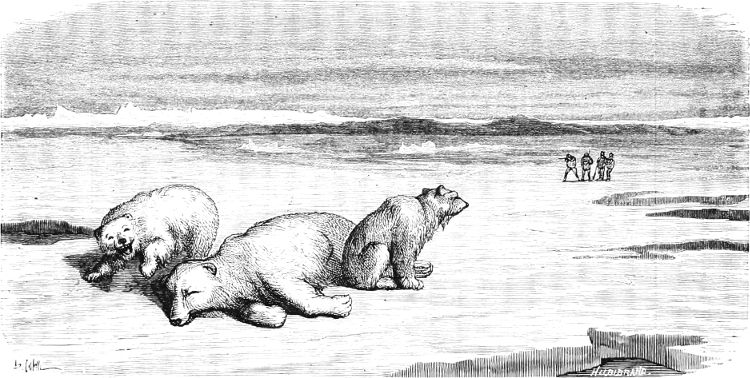
BEAR-HUNTING—GREENLAND.
The heroic little company, however, were nowise disheartened by the gloom and hardship of their situation. From Captain Koldewey’s account, they would seem to have spent a right merry Christmas, after the hearty German fashion. They danced by starlight upon the ice; they celebrated Christmas Eve with open doors, the temperature being 25° F.; with the evergreen Andromeda they made a famous Christmas-tree; they decorated the cabin with flags, and spread out upon their tables the gifts prepared for the occasion by kindly hands: each received his share, and each joined in and contributed to the general merriment.
The Yule-tide festivities over, they made ready the equipments for their sledging expeditions in the ensuing spring,—the object of the most important of these being to attain the highest possible degree of north latitude.
In February the sun returned, and with it the bears; and the daily excursions upon the island, undertaken by the scientific members of the expedition, were rendered dangerous by their audacity. Every one was required to go armed, yet some accidents occurred. One of the “scientists” was severely wounded in the head, and dragged upwards of four hundred paces before his comrades rescued him from the bear. After the lapse of a few weeks, however, he recovered from his wounds.
On the 24th of March, the first sledge-party left the ship, and travelled northward until, on the 15th of April, they reached 77° 1’ N. lat. Then the wild northerly gales compelled them to retrace their steps. On their return they were fortunate enough to shoot some bears, whose blubber supplied them with fuel to warm their food; and the wind filling the sails which they had hoisted on their sledges, they progressed with such rapidity as to reach the ship on the 27th of April.
At the northernmost point attained by this party,—lat. 77° 1’,—the belt of land-ice which skirted the shore seemed to the travellers to be four miles in width and several years old. They speak of it as a “bulwark built for eternity.” Out to seaward, the ice, which was very hummocky, stretched in an unbroken expanse.
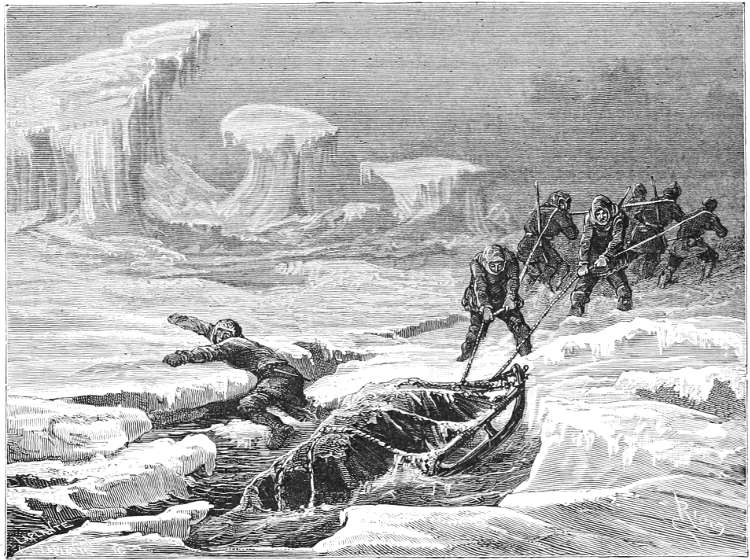
“INTO A WATER-GAP.”
Two other sledge-parties were sent out early in May: one of these was employed in making geographical and scientific explorations of the neighbouring coast of Greenland; the other in attempting the measurement of an arc of the meridian. Their journeys were difficult enough and troublesome enough, and made large demands on the energies of those who undertook them. Crossing hummocks and rugged ice was weary work, and sometimes the whole party plunged into deep drifts of snow. On one occasion, the sledge was precipitated into a water-gap, or crevasse; and before it could be recovered and hauled up on the ice-floe, they were compelled to unload it, and remove each article, one by one. Then again they would have to make their way through a storm of pitiless violence; the north wind driving the frozen snow into their faces with a fury that almost blinded them. Up to their knees in the new snow, they pressed forward with a dogged intrepidity; enduring hardships and triumphing over obstacles of which the “mob of gentlemen who stay at home at ease” can form no adequate conception.
The bears now increased in numbers and in boldness, as if they had determined to besiege the small company now left on board the ship. The greatest caution was necessary to prevent accidents; and though several were shot, their death did not appear to terrify the survivors.
The thaw began about the middle of May, and towards the close of the month the sledge-parties were forced to wade through the water which flooded the surface of the sea-ice.
In June, large portions of land-ice were continually breaking off, and much open water could be descried in the south-east. But it was not until the 10th of July that the ice around the ship broke up. Four days later, boating became practicable, and a voyage was made to the Eskimo village on Clavering Island. It ended in disappointment,—the village having been deserted, and the huts having fallen into ruin.
On the 22nd of July, the Germania once more steamed to the northward, to renew the attempt of the preceding year. Her boiler-tubes, however, leaked so seriously, that it was evident the boiler would speedily fail altogether. After some delay it was temporarily patched up; and by following a narrow channel between the loose pack-ice and the firm ice-belt of the coast, she contrived to push forward to the north-east cape of Shannon Island, in lat. 75° 29’ N. Here the ice barrier showed itself compact, solid, and insuperable. The Germania, therefore, on the 30th of July, made for the southward, and continued her explorations in that direction. The “Mackenzie Inlet,” which Captain Clavering discovered in 1823, was found to have disappeared; its place being occupied by a low, flat plain, on which herds of reindeer were pasturing. So unaccustomed were they to the sight of man, and so fearless of danger, that five of them were speedily shot.
On the 6th of August, the Germania discovered and entered a broad, deep fiord in lat. 73° 13’. It was perfectly free from ice; but a fleet of huge icebergs was sailing out of it with the current. It was soon noticed that the farther they ascended this picturesque sea-arm, the warmer became the temperature of the air and of the surface water. It threw off several branches, and these wound in and out among lofty mountains. Their declivities were washed by cascades, and their ravines filled with glaciers; so that the prospect thus unexpectedly opened up of the interior of Greenland was singularly romantic and impressive.
Some of the adventurers ascended a mountain 7000 feet in height; but even from this lofty watch-tower no limit could be discerned to the western or principal arm of the fiord. In about 32° W. long. the mountain-range rose, it was ascertained, to an elevation of 14,000 feet. The Germania penetrated for seventy-two miles into this remarkable inlet, and reached 26° W. long.; but her boiler acting irregularly, and Captain Koldewey being apprehensive of the consequences if it wholly failed, commenced his homeward voyage on the 17th of August. He re-entered the pack-ice at the mouth of the fiord, and was occupied until the 24th in forcing his way through it,—reaching the open, iceless sea in lat. 72° N. and long. 14° W.
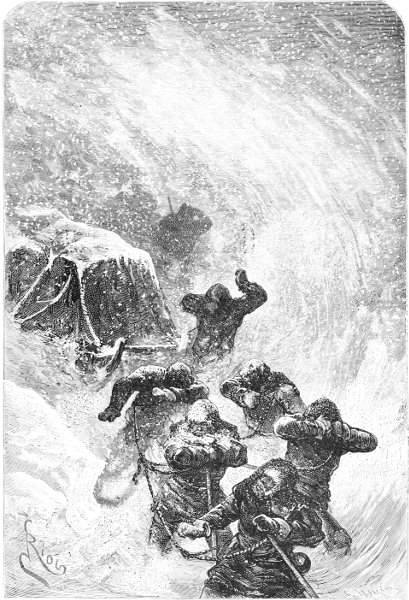
THE CREW OF THE “GERMANIA” IN A SNOW-STORM.
The Germania, owing to the uselessness of her boiler, made the rest of her voyage under sail, and arrived at Bremen in safety on the 11th of September, with all well on board. It is worth notice that, with the exception of two accidental wounds, this interesting expedition was accomplished without any kind of sickness,—a circumstance which speaks highly for the forethought and carefulness of those engaged in equipping and conducting it.
We have been indebted for our brief notice of the voyage of the Germania to a paper by Captain Sir Leopold M’Clintock, who sums up its results in a condensed and intelligible form; and to the narratives by Captain Koldewey and his officers, translated by Mr. Mercier, and published under the direction of Mr. H. W. Bates.
The Greenland shore, under the seventy-fifth parallel of latitude, is not the frozen desert which it has hitherto been supposed to be. It is frequented by large herds of reindeer, as many as fifty having been sighted at a time. Musk-oxen were by no means rare, but made their appearance in troops of fifteen or sixteen; while smaller animals, such as ermines and lemmings, were also met with. Birds were not numerous; shoals of walruses were noticed, but no whales.
Geographically speaking, the voyage was valuable from the observations obtained in reference to a region which previously was almost unknown.
The absence of natives, and of all recent traces of them, is a remarkable fact. In 1829, Captain Graab found the northern Greenlanders ranging as high as 64° 15’ N. lat.; but they knew nothing of any human beings living further north; nor could they themselves travel in that direction, the way being blocked up by huge impassable glaciers.
In 1822, when Scoresby partially explored the Greenland coast between the parallels of 70° and 72° 30’, he discovered many ruined habitations and graves, but no recent indications of human beings.
In the following year, Captain Clavering met with a party of Eskimos in 74°; but neither he nor Scoresby found reindeer or musk-oxen; and the fact ascertained by the Germania that, in 1869, these animals were numerous, and devoid of any fear of man, gives reason to suppose that few, if any, of this isolated tribe of Eskimos are now in existence. Now, as the musk-oxen, and also the reindeer, seem to have wandered hither from the northward, we may conjecture that the natives followed the same route.
“If it be true,” says M’Clintock, “that this migration of men and animals was effected from west to east along the northern shore of Greenland, we naturally assume that it does not extend far towards the Pole; that, probably, its most northern point is at the eastern outlet of Kennedy Channel, and that it turns from thence sharply towards the east and north-east,—the distance, in a straight line, to the most northern point reached by Koldewey, is not more than six hundred miles. It is not less strange than sad to find that a peaceable and once numerous tribe, inhabiting a coast-line of at least 7° of latitude in extent, has died out, or has almost died out, whilst at the same time we find, by the diminution of the glaciers and increase of animal life, that the terrible severity of the climate has undergone considerable modification. We feel this saddening interest with greater force when we reflect that the distance of Clavering’s village from the coast of Scotland is under one thousand miles! They were our nearest neighbours of the New World.”
Returning suddenly to the sixteenth century, we find the names of some Dutch seamen of eminence inscribed in the record of early Arctic Discovery, and amongst these the most illustrious is that of William Barents. We refer to him here, because he is connected with Carlsen’s voyage in 1869, which went over much the same ground as that which the Dutch explorer had surveyed nearly three hundred years before.
The merchants of Amsterdam having fitted out a ship—the Mercurius, of one hundred tons—to attempt a passage round the northern end of Novaia Zemlaia, the command was given to William Barents; who accordingly sailed from the Texel on the 4th of June 1594.
He sighted Novaia Zemlaia, in lat. 73° 25’ N., on the 4th of July, sailed along its grim, gaunt coast, doubled Cape Nassau on the 10th, and struck the edge of the northern ice on the 13th. For several days he skirted this formidable barrier, vainly seeking for an opening; and in quest of a channel into the further sea, he sailed perseveringly from Cape Nassau to the Orange Islands. He went over no fewer than seventeen hundred miles of ground in his assiduous search, and put his ship about one-and-eighty times. He discovered also the long line of coast between the two points we have named, laying it down with an exactness which has been acknowledged by later explorers. His men wearying of labour which seemed to yield no positive results, Barents was under the necessity of returning home.
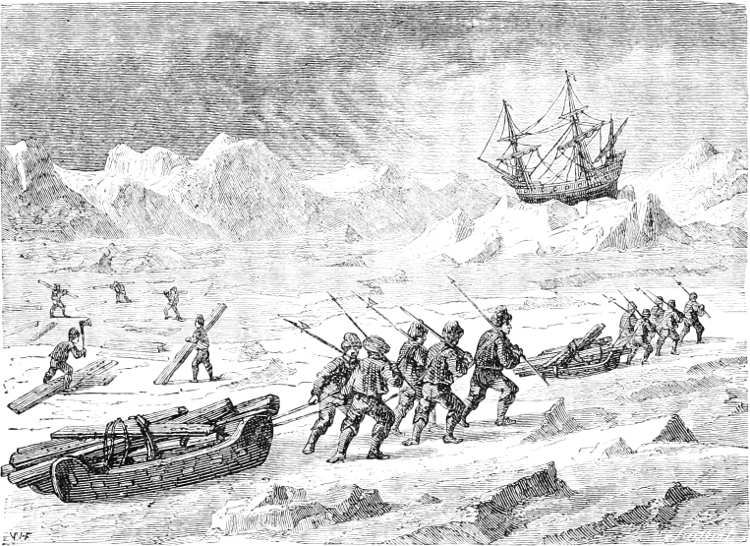
MATERIALS FOR THE HOUSE.
In 1596 the Amsterdammers fitted out another expedition, consisting of two strongly-built ships, under Jacob van Heemskerch and Jan Cornelizoon Rijp, with Barents as pilot, though really in command.
In this voyage the adventurers kept away from the land, in order to avoid the pack-ice, and sailing to the westward, discovered Bear Island on the 9th of June. Then they steered to the northward, and hove in sight of Spitzbergen exactly ten days later. They supposed, however, that it was only a part of Greenland, and were led to bear away to the north-west—a course which was speedily arrested by the eternal icy barrier. Barents then coasted along the western side of Spitzbergen; and the north-western headland being frequented by an immense number of birds, he called it Vogelsang.
On the 1st of July he again made Bear Island, and here he and Rijp agreed to separate. Of the latter we know only that he was unsuccessful in an attempt to find an opening in the ice on the east of Greenland, and that he returned to Holland in the same year. Of the former the narrative is painfully full and interesting.
Quitting Bear Island, he reached Novaia Zemlaia on the 17th of July, sighting the coast in lat. 74° 40’ N. Keeping along it with characteristic perseverance until the 7th of August, he passed Cape Comfort; but only to find himself once more face to face with the dreary spectacle of the far-reaching Polar ice. It so hemmed and fenced him in on every side, that he was unable to extricate his vessel from it; and being driven into a bay, which he named Ice Haven, “there they were forced, in great cold, poverty, misery, and griefe, to stay all the winter.” For the heavy pack-ice drifting into the bay closed it up, and closed around the ship until she was held fast as in iron bonds.
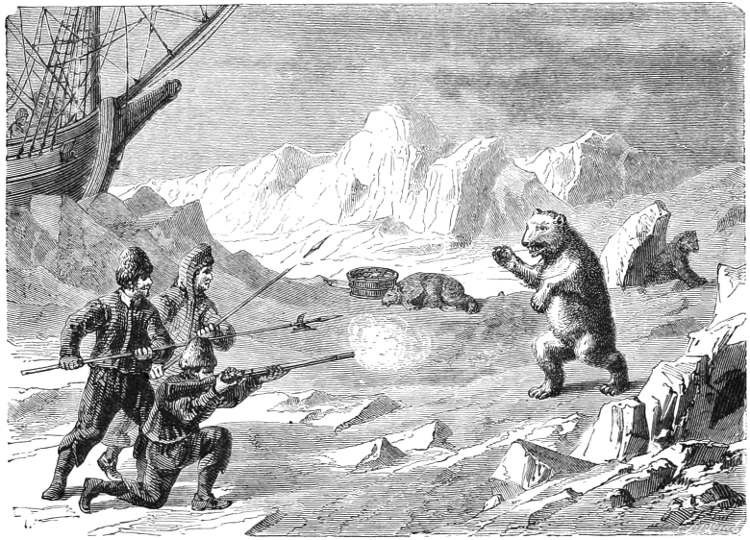
ATTACK ON A BEAR.
Barents and his sixteen followers now prepared to encounter with a good heart the trials of the long Arctic winter-night. They displayed, in truth, a courage, a patience, and a good fellowship which were heroic. Finding a large supply of drift-wood, they constructed, with the help of planks from the poop and forecastle of the vessel, a sufficiently commodious house, into which they removed all their stores and provisions. They fixed a chimney in the centre of the roof; a Dutch clock was set up and duly struck the weary hours; the sleeping-berths were ranged along the walls; a wine-cask was converted into a bath. All these ingenious devices, however, availed but little against the terrible feeling of depression which is induced by the continuance for so many weeks of a blank and cheerless darkness.
The sun disappeared on the 4th of November, and the cold thereafter increased until it was almost intolerable. Their wine and beer were frozen, and lost all their strength. By means of great fires, by applying heated stones to their feet, and by wrapping themselves up in double fox-skin coats, they barely contrived to keep off the deadly cold. In searching for drift-wood they endured the sharpest pain, and often braved imminent danger. To add to their troubles, they had much ado to defend themselves against the bears, which made frequent assaults on their hut. However, they contrived to slaughter some of the audacious animals, and their fat provided them with oil for their lamps. When the sun disappeared the bears departed, and then the white foxes came in great numbers. They were much more welcome visitors, and being caught in traps, set in the vicinity of the house, supplied the ice-bound voyagers with food and clothing.
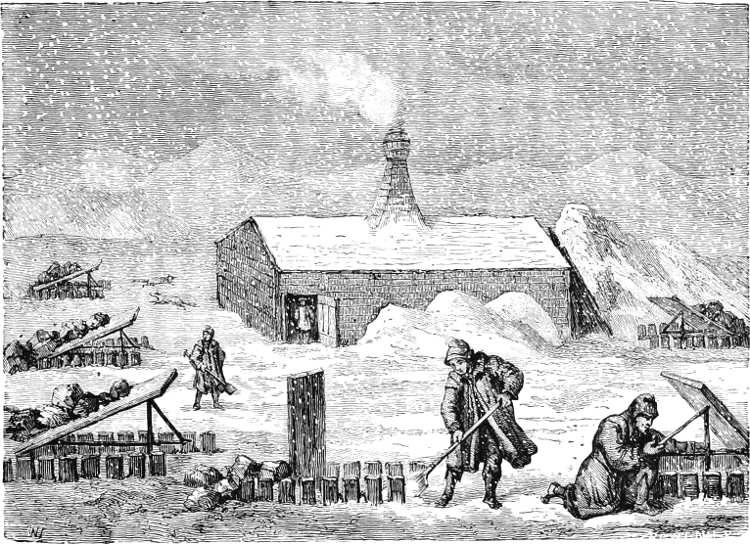
SETTING FOX-TRAPS.
When the 19th of December arrived, they found some comfort in the reflection that half the dreary season of darkness had passed away, and that they could now count every day as bringing them nearer to the joyful spring. They suffered much, but endured their sufferings bravely; and celebrated Twelfth Night with a little sack, two pounds of meat, and some merry games. The gunner drew the prize, and became King of Novaia Zemlaia, “which is at least two hundred miles long, and lyeth between two seas.”
On the 27th of January every heart rejoiced, for the glowing disc of the sun reappeared above the horizon. But it brought with it their old enemies the bears, against whom they found it necessary to exercise the greatest vigilance.
On the 22nd of February they again saw “much open water in the sea, which in long time they had not seene.” During the whole month violent storms broke out, and the snow fell in enormous quantities.
On the 12th of March a gale from the north-east brought back the ice, and the open water disappeared; the ice driving in with much fury and a mighty noise, the pieces crashing against each other, “fearful to hear.” Up to the 8th of May the ice was everywhere, and their sad eyes could look forth on no pleasant or hopeful scene. Then it began to break up, and the gaunt, weary explorers prepared to tempt the sea once more. They set to work to repair their two boats, for their ship was so crippled and strained by the ice that she was injured beyond their ability to repair.
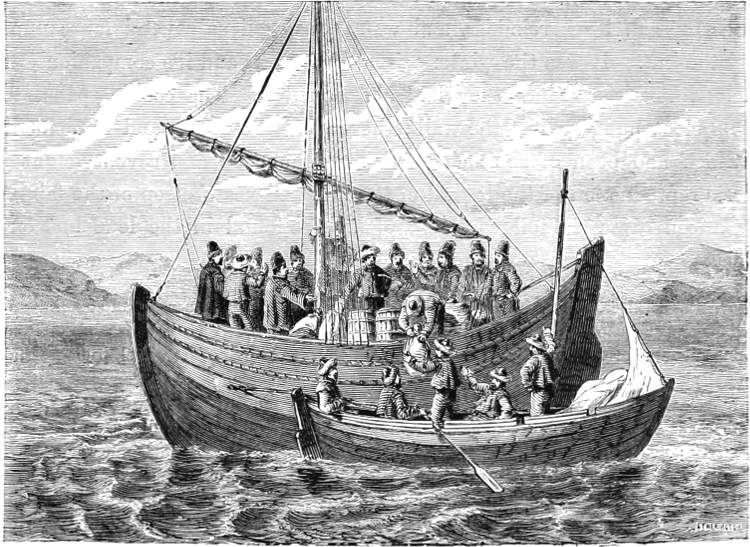
RELIEVED.
On the 14th of June they quitted the place of their long captivity; Barents, before they set out, drawing up in writing a list of their names, with a brief record of their experiences, and depositing it in the wooden hut. He himself was so reduced with sickness, want, and anxiety that he was unable to stand, and had to be carried into the boat. On the 16th, the captain, hailing from the other boat, inquired how the pilot fared. “Quite well, mate,” Barents replied; “I still hope to mend before we get to Wardhouse,”—Wardhouse being an island on the coast of Lapland. But he died on the 19th (or, as some authorities say, on the 20th), to the great grief of his comrades, who appreciated his manly character, and placed great reliance on his experience and skill.
The adventurers met with many difficulties from the ice,—sometimes being carried out far from the ice-belt, and at others being compelled to haul the boats for long distances over the rough surface of the floes to reach open water. It has been well observed that there are many instances on record of long ocean-voyages performed in open boats, but that, perhaps, not one is of so extraordinary a character as that which we are describing,—when two small and crazy craft ventured to cross the frozen seas for eleven hundred miles, continually endangered by huge floating ice-masses, threatened by bears, and exposed for forty days to the combined trials of sickness, famine, cold, and fatigue.
At length they arrived at Kola, in Lapland, towards the end of August; and, strangely enough, were taken on board a Dutch vessel commanded by the very Cornelizoon Rijp who had commanded the sister discovery-ship in the previous year. They reached the Maas in safety in October 1597.
No voyager appears to have sailed in the track of Barents, or, at all events, to have visited the place where he wintered, until 1871. No one but he had rounded the north-east point of bleak Novaia Zemlaia. In 1869, however, and on the 16th of May, Captain Carlsen, a Norwegian of much experience in the North Sea trade, sailed from Hammerfest in a sloop of sixty tons, called the Solid. On the 7th of September he reached Ice Haven, and on the 9th discovered a rude wooden house standing at the head of the bay. Its dimensions were 32 feet by 20, and it was constructed of planks measuring from 14 to 16 inches in breadth, and 1½ inches thick. These, it was evident, had belonged to a ship, and amongst them were several oak beams. Heaps of bones of seal, bear, reindeer, and walrus, as well as several large puncheons, were collected round the hut. It was the winter-prison of Barents and his companions, and had never been entered by human foot since they had abandoned it. The cooking-pans stood over the fireplace, the old clock hung against the wall; there were the books, and implements, and tools, and weapons which had been of so much service two hundred and seventy-eight years before. It was an Arctic reproduction of the legend of the hundred years’ sleep of the fairy princess.
Captain Carlsen gives the following list of articles found in the lone hut on the shore of Novaia Zemlaia:—
Iron frame over the fireplace, with shifting bar; two ship cooking-pans of copper, found standing on the iron frame, with the remains of a copper scoop; copper bands, probably at one time fastened round pails; bar of iron; iron crowbar; one long and two small gun-barrels; two bores or augers, each three feet in length; chisel, padlock, caulking-iron, three gouges, and six files; plate of zinc; earthenware jar; tankard, with zinc lid; lower half of another tankard; six fragments of pepper-pots; tin meat-strainer; pair of boots; sword; fragments of old engravings, with Latin couplets underneath them; three Dutch books; a small piece of metal; nineteen cartridge cases, some still full of powder; iron chest, with lid, and intricate lock-work; fragments of metal handle of same; grindstone; an eight-pound iron weight; small cannon-ball; gun-lock, with hammer and flint; clock, bell of clock, and striker; rasp; small auger; small narrow strips of copper band; two salt and pepper pots, about eight inches high; two pairs of compasses; fragment of iron-handled knife; three spoons; borer; hone; one wooden, and one bronze tap; two wooden stoppers for gun muzzles; two spear or ice-pole heads; four navigation instruments; a flute; lock and key; another lock; sledge-hammer head; clock weight; twenty-six pewter candlesticks and fragments, six in a complete state of preservation; pitcher of Etruscan shape, beautifully engraved; upper half of another pitcher; wooden trencher, coloured red; clock alarum; three scales; four medallions, circular, about eight inches in diameter, three of them mounted in oak frames; a string of buttons; hilt of sword, and a foot of its blade; halberd head; and two carved pieces of wood, one with the haft of a knife in it.
On the 14th of September Captain Carlsen sailed from the Ice Haven, and kept along the east coast of Novaia Zemlaia, encountering bad weather and contrary winds, but succeeding in his chief object, the circumnavigation of the island, which he accomplished on the 6th of October. He returned to Hammerfest early in November.
Our chronological summary now brings us to the Austrian Polar expedition of 1872. The command was intrusted to Lieutenant Payer, an accomplished seaman who had served under Captain Koldewey; Carlsen was engaged as pilot; and the steamer Tegethoff was carefully and abundantly equipped for the voyage. The plan laid down by Lieutenant Payer was well-conceived; namely, to round the north-eastern point of Novaia Zemlaia, and sail eastward until he made the extreme north of Siberia, where he proposed to winter. In the spring, travelling-parties would be sent out on exploring journeys; and the voyage, in summer, would be continued as far as Behring Strait.
The Tegethoff steamed out of Tromsö Harbour on the 13th of July; first fell in with the ice on the 25th, in lat. 74° 15’ N.; and on the 29th sighted the coast of Novaia Zemlaia. Here she was caught in the pack; but steam being got up, repeated charges were made at the enemy, and she was carried bravely into an open water-way, about twenty miles wide, to the north of the Matochkia Strait. On the 12th of August she was joined by the Isbyörn yacht, with Count Wilczck and some friends on board. The two vessels anchored close to the shore, in lat. 76° 30’ N., and on the 18th celebrated the Emperor of Austria’s birthday. Daily excursions were made by sledge-parties to the adjoining islands, resulting in an accumulation of botanical and geological specimens, besides slaughtered bears and foxes, and quantities of drift-wood. On the 23rd the vessels parted company,—the Tegethoff steaming to the northward, and the Isbyörn endeavouring to push southward along the coast. On reaching the mouth of the Petchora, Count Wilczck and his friends left her to proceed on the return voyage to Tromsö, while they ascended the Petchora in small boats to Perm, and returned to Vienna by way of Moscow.
The Tegethoff spent the winters of 1872 and 1873 in the Icy Sea, and made some discoveries of interest. It returned in safety in the summer of 1874.
In 1871 an American expedition was fitted out under the command of Captain Charles Francis Hall, who had already gained distinction by his explorations in the Polar regions and his long residence among the Eskimos. Through the liberality of Mr. Grinnell, assisted by the United States Government, he was provided with a stout and well-found steamer, the Polaris, which sailed from Brooklyn on the 29th of June. She carried a crew of seventeen officers and men,—Mr. Buddington being sailing and ice master, and Mr. Tyson assistant navigator,—besides six adult Eskimos and two children; and a scientific staff consisting of Dr. Emil Bessel, Mr. Bryan, and Mr. Frederick Meyers.
A few days previous to the sailing of the expedition, Mr. Grinnell presented Hall with the historic flag which Lieutenant Wilkes, in 1838, had borne nearer to the South Pole than any American flag had been before,—which Lieutenant De Haven, and afterwards Dr. Kane, and lastly Dr. Hayes, had carried further north than any other ensign. Captain Hall, in receiving it, expressed his conviction that, in the spring of 1872, “it would float over a new world, in which the North Pole Star is the crowning jewel.”
On the 3rd of July the Polaris entered the land-locked harbour of St. John’s, Newfoundland, where she remained a week while her machinery underwent some repairs. Then she proceeded north to Holsteinberg, in Greenland; but failed in procuring a supply of coal or a stock of reindeer furs, both of which were much desiderated. On the 4th of August she arrived at the Danish settlement of Godhaven, and happily found the United States steamer Congress, which had been despatched with extra stores and supplies. Thence she steamed northward to Upernavik, which was reached on the 18th. So far her progress seemed to have been peculiarly fortunate; but already dissensions had broken out among the officers, which augured ill for the eventual success of the expedition. In his despatches home, however, Captain Hall made no allusion to this discouraging circumstance; and his biographer explains this silence by “his idiosyncrasy, which enabled him to sink everything else in the one idea of pushing on to the far north.”
Upernavik, with its little colony of Danish officials and Eskimo natives, was left behind on the 21st of August, and the Polaris continued her adventurous course. Six days later, she arrived at Kane’s winter-quarters in 1853–55, and at the point where he abandoned his little vessel, the Advance. Next day her crew found a huge wall of ice in front of them, and doubled round it by steering to the west-north-west. Then again putting their vessel’s head to the northward, they made their way up Kennedy Channel, and gained the threshold of what Dr. Kane had supposed to be the Open Polar Sea. They discovered, however, that it was bounded by land on either side, with a vast expanse of ice stretching far beyond it. Careful observation showed that it was, in reality, a bay, which Kane had mistaken for the open sea when its land-boundaries were hidden by fog. It is about forty-five miles wide.
Thence they entered a channel similar to that of Kennedy, which measured about seventeen miles in breadth, and was obstructed by heavy ice. Their progress now was slow and difficult, and many of the crew wore rueful countenances, as if they were going “to sail off the edge of the world.” A more serious obstacle was the timidity of Captain Buddington, who showed himself opposed to pushing further northward. Hall, therefore, resolved to carry the steamer in-shore, land some of his stores, and prepare for wintering at this advanced point of “Ultima Thule.”
At midnight, on the 4th of September, Captain Hall raised an American flag on this land, the northernmost site on which any civilized flag had been planted. When it was waving in the breeze, he proclaimed that he took possession of the surrounding region of snow and ice “in the name of the Lord, and for the President of the United States.” He then returned on board the Polaris, and her anchor was let go. The place was only a bend in the coast, and afforded no protection as a harbour; they therefore steamed through the open water, and searched further to the southward; but finding no more sheltered quarters, they returned to their former anchorage, and began to land provisions,—the wind moaning sadly, and the snow falling in heavy showers.
On the 7th, they weighed anchor and steamed in nearer to the shore; bringing the ship round behind an iceberg, which lay aground in thirteen fathoms of water. This huge mass of ice proved to be about 450 feet in length, 300 feet in breadth, and 60 feet in height; lat 81° 38’ N., long. 61° 45’ W. The berg was named “Providence Berg,” and the cove in which they had established themselves, “Thank God Harbour.” On surveying the surrounding country they found nothing calculated to brighten the prospects of the coming winter. The coast-hills rose from nine to thirteen hundred feet in height, and were furrowed and scarred with great cracks and fissures, which bore witness to the rough usage of frost and ice, wind and weather. To the south lay a large glacier, which swept round in a wide circuit, and fell into the bay immediately north of their anchorage. Traces of Eskimos were discernible here and there; circles of stones, indicating where they had pitched their tents. The landscape was all of a dull neutral tint, a kind of cold gray; for, as yet, the winter snow had not clothed it with its mantle of dazzling whiteness. For this, however, the adventurers had not long to wait. A snow-storm began on the 27th of September, and lasted for six-and-thirty hours.
FUNERAL OF CAPTAIN HALL.
On the 10th of October Captain Hall organized a sledging expedition, as a preliminary to an extended journey in the spring. There were two sledges, each drawn by seven dogs; Captain Hall and Eskimo Joe in one sledge, and Mr. Chester and Eskimo Hans in the other. They were absent until the 24th, but owing to the roughness of the ice had accomplished only fifty miles, and had made no discovery.
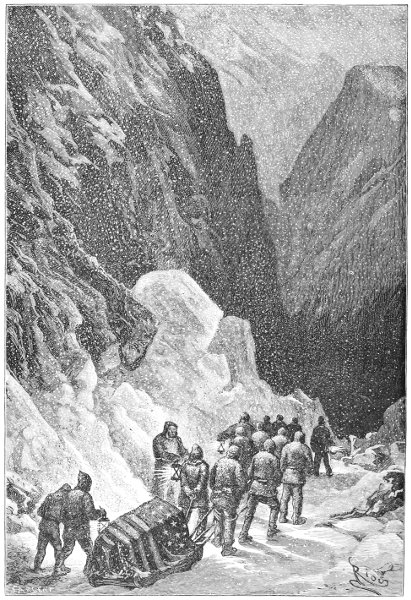
Meantime, the crew had been engaged in banking up the ice around the ship, in order to protect it from collision with drifting floes; the deck was partly roofed over, and covered with canvas; and other preparations were made to resist the terrible inclemency of an Arctic winter. These, however, were temporarily suspended by the sudden illness of Captain Hall. On the 1st of November he was a little better, but on the 3rd his malady, which appears to have been a form of paralysis, took a turn for the worse; and the end came so rapidly that the eager-hearted, enthusiastic explorer, who had braved so many harsh experiences in the Polar World, “fell asleep” early on the morning of the 8th. A grave was immediately prepared for the reception of his remains about half a mile inland; a shallow grave, for the ground was frozen so hard that it was scarcely possible to break it up, even with picks; and on the 11th, the funeral took place. The time chosen was half-past eleven in the morning; yet it was so dark that Mr. Bryan read prayers by the light “of a lantern dimly burning.” All the ship’s company were present. The coffin was hauled on a sledge, over which, by way of pall, was spread the American flag with its stars and stripes. The captain and officers, Dr. Bessel, and Mr. Meyers, followed as mourners; and strange and picturesque must the melancholy procession have appeared, as it wound its way through ice and snow, while a weird boreal light or gleam in the air revealed the outlines of the distant hills, rising like a rampart on the edge of the snow-covered plain, and flickered every now and then over the frozen expanse of the ice-bound bay.
Thus, says Captain Tyson, thus ended poor Hall’s ambitious projects; thus was stilled the effervescing enthusiasm of his ardent nature. “Wise he might not always have been, but his soul was in his work; and had he lived till spring, I think he would have gone as far as mortal man could go to accomplish his mission. But with his death, I fear that all hopes of further progress will have to be abandoned.” That Tyson was right in his conjecture, our narrative will show.
Captain Buddington succeeded to the command, and one of his first measures was to discontinue the Sunday service, for reasons which he does not seem to have explained, and we are unable to imagine. So far as we can gather from the published records of the expedition, he was a man unfitted to bear responsibility,—a man without enthusiasm in himself, and incapable, therefore, of stimulating it in others. Nor could he secure the obedience of his inferiors. Seamen are always prompt to detect the weakness of their officers; and the crew of the Polaris soon assured themselves that their new captain was deficient both in courage and resolution.
However, the winter gradually closed in upon the little ice-bound company of the Polaris, and they were called upon to endure, with such patience as was at their command, the severities of the long Arctic night. It was very dark, yet not totally dark. For an hour or two at noon it was possible to wander a short distance from the snow-roofed vessel; but, once away from it, the gloom and silence of everything around settled down on the wanderer like a pall. There were none of the usual sounds of Nature to relieve the deep oppression of the scene. “The other evening,” says Tyson, “I had wandered away from the ship, disgusted with the confusion and noise, and longing for a moment’s quiet. Once beyond range of the men’s voices, there was absolutely no other sound whatever. It was quite calm—no wind, no movement of any living creature; nothing but a leaden sky above, ice beneath my feet, and silence everywhere. It hung like a pall over everything. So painfully oppressive did it become at last, that I was frequently tempted to shout aloud, to break the spell. At last I did; but no response came, not even an echo.
‘The space was void; there I stood, And the sole spectre was the solitude.’”
AN ARCTIC SNOW-STORM.
On the 1st of January 1872, it is recorded that eighty days had elapsed since the adventurers had seen the sun. The internal economy of the Polaris, meantime, was pitiably disorganized. There was no discipline, no order, no method. The men did what they pleased, and consequently made night hideous by their prolonged carousals. The officers disagreed among themselves, and the object of the expedition appeared to have been lost sight of, or no longer to excite any deep or permanent interest. It was even discussed as a proper and probable course to abandon the proposed northward exploration, and, as soon as the ice broke up, to make all haste back to New York.
Early in February, the daylight began to gain upon the night a little, and the Eskimos hunted for seals, as they could be heard under the ice making their breathing holes. Storms were very frequent—storms which drove the snow afar in dense, blinding clouds; and false moons and other atmospheric phenomena attracted the attention of the curious observer. On the 28th, after an absence of one hundred and thirty-five days, the sun reappeared; and never was royal guest more eagerly welcomed by a loyal people. Its rays seemed to bring with them a promise of new life. Men’s hearts grew lighter in spite of themselves, and all felt as if they had been relieved from a heavy and intolerable burden. Not that the temperature showed any perceptible difference. The thermometer indicated 37° below zero on the 1st of March!
Passing over a couple of months which present no incidents of importance, we find that on the 9th of May the monotonous dulness of the expedition was broken by a sledge-journey to the north, undertaken by Captain Tyson, with Meyers, Joe, and Hans as companions. They were absent from the ship six days; striking inland, in an east-north-east direction, to Newman Bay, and thence keeping more to the north, until they reached lat. 82° 9’. Mr. Meyers surveyed the shores of Newman Bay, and Captain Tyson endeavoured to secure some game. One day they came on a large herd of musk-oxen. These animals act very curiously when an attack is made upon them. They form a circle, stern to stern, and await the assault of their enemies. The dogs surround them, and keep them at bay. Not unfrequently a dog gets tossed. Though Joe and the captain fired and reloaded as fast as they could, the poor brutes offered no resistance; but when eight had fallen, the remainder took to flight. The slaughtered oxen were then flayed, and the best pieces cut up for conveyance to the ship.
These cattle develop their great size and weight on what might be supposed to form a very slender diet. Their food is the mosses and lichens which grow on the rocks; and to obtain it, they must first scrape away the snow with their hoofs. At the first sign of danger, the calves shelter themselves under their parents’ body; and their hair is so long as to afford the young a very complete and satisfactory screen. The musk-ox is an animal of considerable bulk. Several of those shot by Tyson and the Eskimos weighed from 500 to 600 lbs. each. In proportion to their size and weight, their legs are very short.
Early in June, Captain Buddington resolved to despatch a couple of boats, for the purpose of exploring the neighbouring coast, and discovering, if possible, an open water channel to the north. One of these was placed under the command of Mr. Chester; the other, of Captain Tyson. Mr. Chester’s boat was nipped in an ice-floe, and crushed to pieces. The crew escaped with difficulty, but the historical flag was lost. Captain Tyson pushed forward to Newman Bay, where some eider-ducks, gulls, and dove-kies were shot. Joined by Mr. Chester—who had returned to the ship, and secured the safety-boat—he found his further progress arrested by that compact, insuperable field of ice which is the despair of Arctic navigators. All attempts to get further to the north proved in vain; and orders to return having arrived from Captain Buddington, there was nothing to be done but to rejoin the Polaris.
The summer passed away, and still the Polaris lay beset among the ice; or, rather, drifted slowly to the southward, along with the floe to which it was attached. No sledge-expeditions were organized; and Captain Buddington’s sole concern was to watch for an opportunity of getting out into the open channel, and returning to New York. Some slight progress southward was occasionally made; but towards the end of October it became evident that the explorers would have to spend a second winter in their frozen captivity. They had been carried beyond Rensselaer Harbour, where Dr. Kane wintered during 1853–55, and began the construction of a store-house for provisions, in case the ship should be endangered by the drifting ice.
This dreaded catastrophe did indeed occur, on the night of the 15th. The pressure of the floe was tremendous, but the Polaris bore it bravely, though groaning and creaking in every timber. After awhile, however, it was found that she had started a leak aft, and that the water was gaining on the pumps. The discovery seems to have startled Buddington out of all coolness or reflection. He threw up his arms, and cried out to “throw everything on the ice.” Immediately all was chaos. The men seized whatever lay near to their hands, and threw it overboard. A quantity of stores had been previously placed on the deck, in anticipation of such an event; but these were now hurled on the floe in indiscriminate confusion, and with considerable loss. Captain Tyson and some of the men got overboard, with the view of arranging things in, at least, a semblance of order; but while he was thus engaged, the ice commenced cracking. Shortly afterwards it exploded under his feet, and broke in many places; the ship drove away in the darkness, and Tyson and his companions immediately lost sight of her.
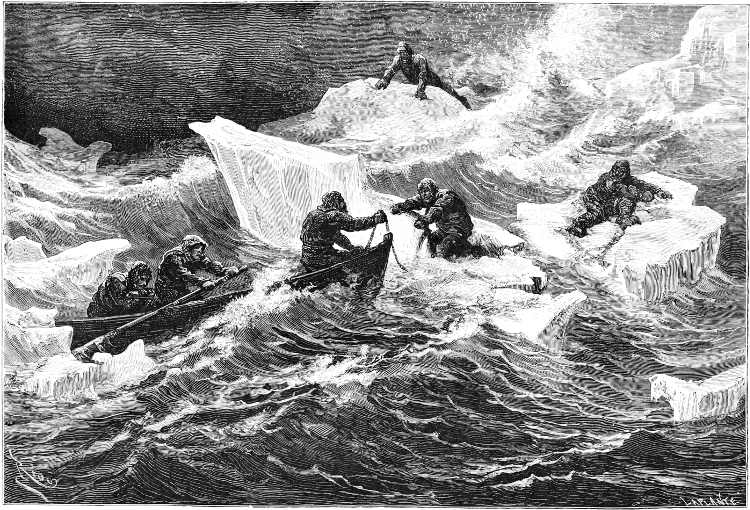
It was a terrible night. The wind blew a hurricane, and the snow fell heavily in drifting, whirling masses. “We did not know,” says Tyson, “who was on the ice, or who was on the ship;” but seeing some musk-ox skins lying across a wide crack in the ice, he pulled them towards him to save them—and behold, rolled up in one of them were two or three of the children of Hans the Eskimo! Some of the men were afloat on small pieces of ice, but by means of the whale-boat these were rescued; and when the gray light of morning dawned on the scene, Tyson ascertained that eighteen persons, besides himself, were castaways. These were—Mr. Meyers, meteorologist; Heron, steward; Jackson, cook; six seamen; Joe and Hans, the Eskimos, and their wives and children.
The piece of the floe on which they were cast was nearly circular, and about four miles in circumference. It was not level, but full of hillocks, and of ponds or small lakes, which had been formed by the melting of the ice during the short summer. The ice varied greatly in thickness. Some of the mounds, or hills, were probably thirty feet thick; the flat parts not more than ten or fifteen. The surface was exceedingly rugged, and the hummocks were white with snow.
Tyson’s first task was to inspect the stock of provisions that had been collected on the floe. It consisted of fourteen cans of pemmican, eleven and a half bags of bread, one can of dried apples, and fourteen hams; and if the ship did not return for them, they might have to support themselves upon this supply all through the dreary winter, or die of starvation. Fortunately, they had a couple of boats; and Tyson’s second care was to load these, embark his little company, and endeavour to reach the shore. In this attempt they were balked by the drifting ice; and before they could repeat it they caught sight of the Polaris. Immediately they ran up a rough and ready signal; but no one seemed to be keeping a look-out, and the castaways had the mortification of seeing her drop away behind Littleton Island, without undertaking any search for her missing crew.
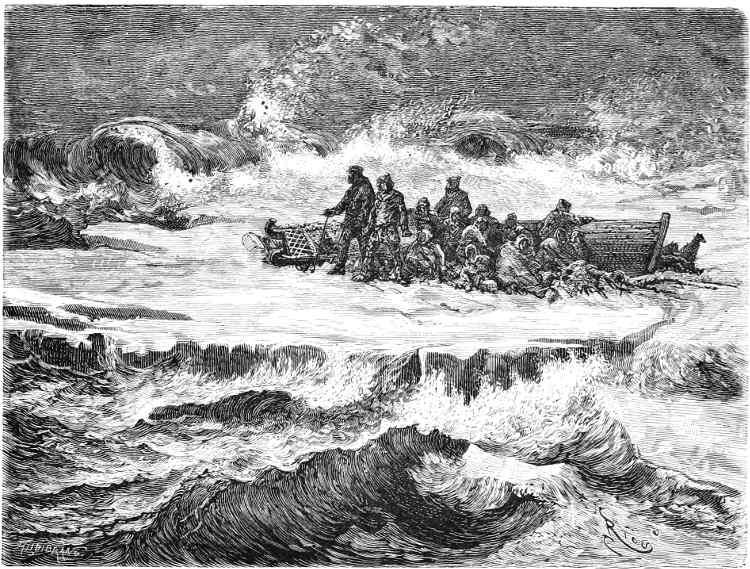
Tyson therefore resolved to cross to the other side of the floe, and make for the land, perhaps lower down than the Polaris was, so as to intercept her. Everything was thrown away, except two or three days’ provisions, and the boats were got ready. But the men were slow and reluctant; oars were wanting; a violent gale arose; and as night was coming on, Tyson found himself compelled to abandon his intention. On the following day, the ice again broke; and now the adventurers were drifting with one boat on one piece of ice, while the other boat, a part of their provisions, and an extemporized hut of poles, remained on the main part of the original floe. The ice-raft which carried Tyson and his companions measured about 150 yards each way.
THE CASTAWAYS ON THE ICE.
ADRIFT ON THE ICE-FLOE.
On the 21st, however, the boat and provisions were recovered. Joe, with the keen eye of an Eskimo, caught sight of the bow of the boat, projecting from a fragment of the broken ice. Followed by his faithful ally, Tyson went in search of it, leaping like a chamois-hunter from crag to crag. Six of the dogs had accompanied him. These were harnessed to the boat, and with the help of sturdy arms dragged it over the disrupted floe. The whole party then removed to the large floe, where some snow-houses were speedily erected. They formed quite an encampment: one hut, or rather a sort of half-hut, for Mr. Meyers and Captain Tyson; Joe’s hut for himself, his wife, and their adopted daughter; a hut for the men; a store-house for provisions, and a cook-house,—all united by arched galleries, built of consolidated snow, with one main entrance, and smaller ones branching off to the several apartments or huts. Hans built his igloë separately, but close by. All were constructed after the Eskimo fashion—that is, the ground being levelled off, one half of the floor toward the end furthest from the entrance was slightly raised above the other or front half. The raised part, as we have previously explained, serves as parlour and bedroom; the lower area, as workshop and kitchen. The walls and arched roof were built up of square blocks of hard snow, packed hard and close by the force of the wind. A square of about eighteen inches of this compressed snow or ice served for window.
This good work done, Tyson took stock. Successive expeditions had gathered together nearly all that was on the ice when the Polaris drifted from them, and he found that their stores included two boats—one of which, however, was being broken up for fuel—and one kayack, a good supply of powder and shot, eleven and a half bags of bread, fourteen cans of pemmican, fourteen hams, ten dozen cans of meats and soups, one can of dried apples, and about twenty pounds of chocolate and sugar mixed. The pemmican cases were large, each weighing forty-five pounds; the meats and soups were only one and two pound cans; the hams were small; the dried-apple can counted for twenty-two pounds. Evidently, when divided among nineteen people, this supply could not last many weeks; and unless they reached the land, or could catch seals, starvation seemed their probable ultimate fate. The allowance was reduced to eleven ounces for each adult, and half that amount for the children,—rations painfully inadequate to the proper support of the human frame in a Polar region and during an Arctic winter.
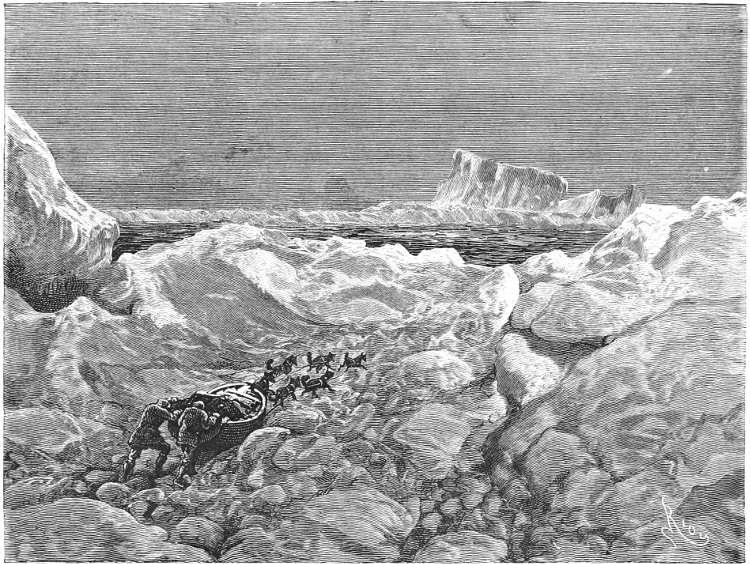
RECOVERY OF THE BOAT BY CAPTAIN TYSON.
On the 23rd of October they lost sight of the sun. At this time they were about eight or ten miles off-shore, and forty to fifty miles west of Northumberland Island, in lat. 77° 30’ nearly. The Eskimos were on the watch for seals day after day, but without success. In truth, it is not easy to find the seal in winter, as they live principally under the ice, and can be seen only when it cracks. A warm-blooded animal, it cannot always remain beneath the frozen surface without breathing, and for this purpose they make air-holes through the ice and snow. These, however, are so small at the surface, not exceeding two and a half inches across, that they are not easily distinguished, especially in the twilight-gloom of an Arctic winter day.
The floe, or ice-raft, on which the crew of the Polaris had found shelter, continued to drift slowly to the southward, impelled by wind and current. The weather was so severe that it was worse than useless to attempt to reach the shore. The castaways therefore huddled themselves together in their igloes, or huts of snow, or took such diversion as hunting for fox or seal afforded. Or when a gleam of fair weather afforded an opportunity, Tyson took a short drive in his sledge, and explored as much as he dared of the ice lying towards the shore. On the 1st of November an attempt was made to reach the land, the dogs being harnessed to the sledge, and the boat loaded with the most essential articles; but the state of the ice rendered all efforts of this kind fruitless.
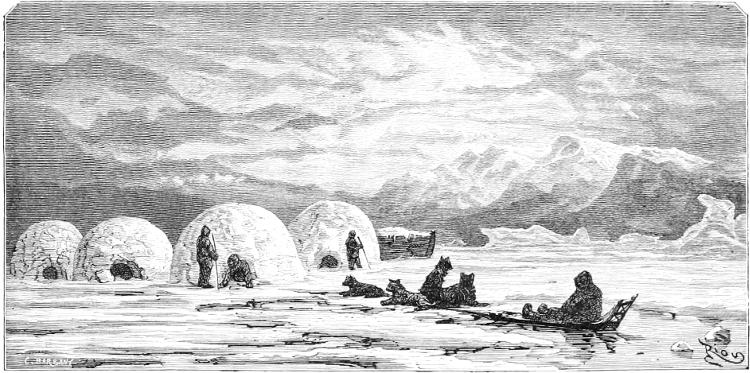
IGLOES CONSTRUCTED BY THE CASTAWAYS.
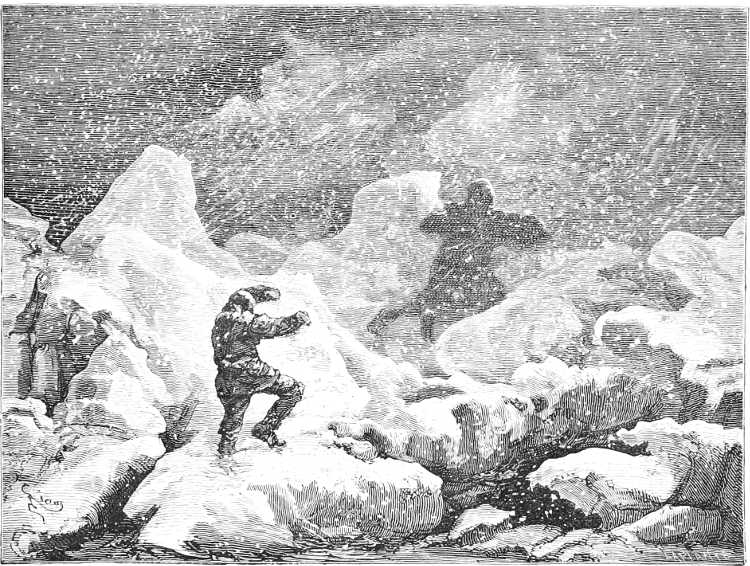
One day, Joe and Hans, the Eskimos, went out in quest of game. In wandering through the hummocks they lost one another, and Joe, after trying his luck alone, made his way back towards the hut before night came on; he fully anticipated to find that Hans had preceded him, and was much alarmed when he heard that he had not returned. Accompanied by Robert, he started in search of him. As they sped along through the rapidly-gathering darkness, they saw what appeared to be a Polar bear approaching them; loaded their pistols, and prepared to give him a warm reception, when, fortunately, the creature throwing up his arms, and standing erect, they perceived that it was their missing comrade. He had used both hands and feet in climbing the rough hummocks, and his fur clothing being covered with snow, the deception was tolerably complete.
On the 21st of November, Captain Tyson writes in his diary: “We are living now on as little as the human frame can endure without succumbing; some tremble with weakness when they try to walk. Mr. Meyers suffers much from this cause; he was not well when he came on the ice, and the regimen here has not improved him. He lives with the men now; they are mostly Germans, and so is he, and the affinity of blood draws them together, I suppose. Since he has housed with the men, I have lived in the hut with Joe, Hannah, and Puney. Puney, poor child, is often hungry; indeed, all the children often cry with hunger. We give them all that it is safe to use. I can do no more, however sorry I may feel for them.”
But it is unnecessary to trace the misfortunes and sufferings of Captain Tyson’s little company day by day. Their wretched condition—adrift on a raft of ice, insufficiently clothed, insufficiently fed, poorly housed, without any of the comforts that generally make an Arctic expedition endurable, buffeted by snow-storm and tempest, in constant apprehension lest their insecure raft should break up—requires no exaggeration of colouring to produce its full impression on the reader. In January 1873, it was found that the provisions were diminishing with terrible rapidity; and this was due not so much to the regular daily consumption as to the secret pilferings of the crew, who were not controlled by any bonds of discipline, and yielded Captain Tyson an imperfect and reluctant obedience. They were all Germans, except Heron, an Englishman, and the cook, a man of colour, and their conduct was a disgrace to their nationality. They seem to have thought that their raft was carrying them swiftly towards Disco in Greenland, where abundant supplies could easily be obtained; but, in truth, they were drifting in the direction of Labrador, and the safety of all demanded the sternest economy of their small stock of provisions.
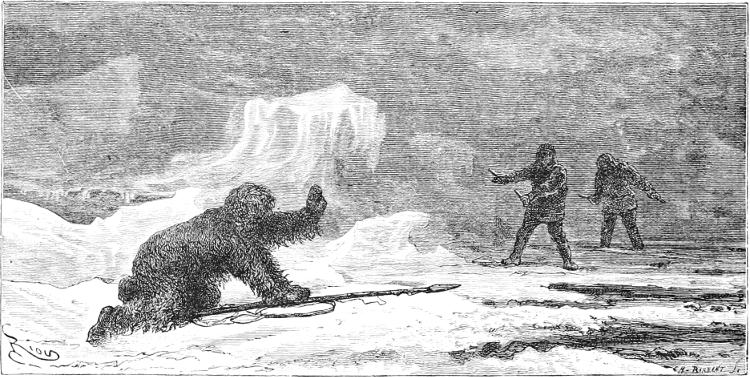
HANS MISTAKEN FOR A BEAR.
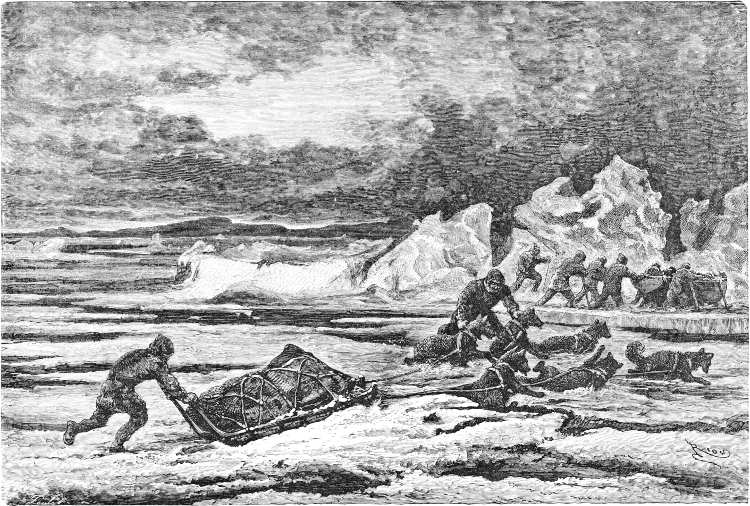
DIFFICULT TRAVELLING.
The cold was now excessive,—35° below zero at noon, and 37° at midnight. On the 13th, it sank below 40°. On the following day, however, a strong westerly gale blew up; the cold became more moderate—the temperature rose to -14°. Under the influence of the gale, the ice began to crack and grind and break up; the natives launched a kayack; a seal was hunted down, and the castaways feasted gloriously. This, however, was but a transient gleam of good fortune. On the 17th the glass again sank to 38°, and no more seals were visible. The men were now reduced to less than twelve ounces of food daily, which was not sufficient to furnish internal warmth, or to strengthen the system against the terrible effects of the Arctic climate.
The 19th was, to some extent, a day of hope; for, after an absence of eighty-three days, the sun once more rose above the misty horizon. Eskimo Joe took advantage of the burst of daylight to undertake a hunting expedition. About five miles from the hut he found open water, and shot two seals, but could land only one; the young ice carried the other away. Encouraged by the cheerful glow of the sun, he stayed out later than usual, and it was very dark before he returned. A light of burning blubber was kindled to guide him to the hut. It shone out upon the gloom of the night like a pharos.
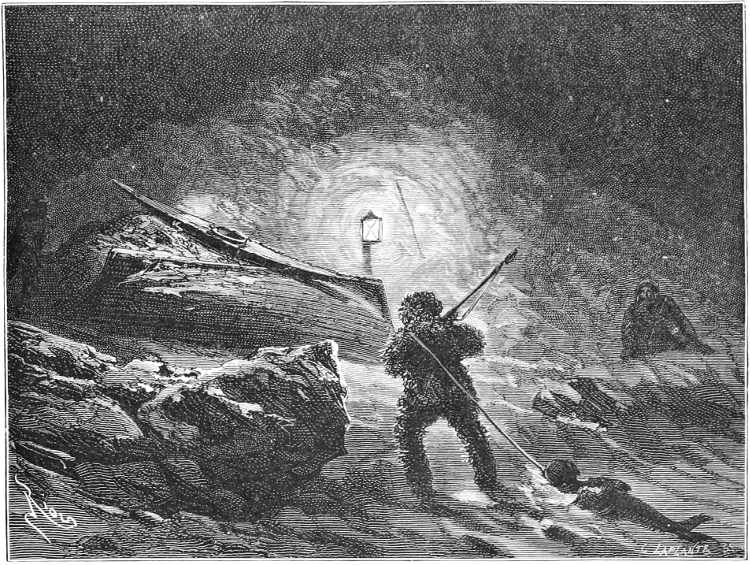
THE GUIDING LIGHT.
The 25th of January marked the one hundred and third day of the castaways’ voyage on the ice-raft, and they severely felt the monotonous wretchedness of their existence. It was a beautiful day, and perfectly calm; but the thermometer indicated 40° below zero. At midnight the heavens were illuminated with all the glories of a brilliant aurora. They seemed to be ablaze: from the south-west to the north-east, from the horizon to the zenith, the magnetic fires shot here and there, and wavered and undulated, like flame driven by a strong wind. At one time the splendour was almost overpowering, and the straining eye was fain to seek relief in darkness.
On the 1st of February a violent gale arose, blowing from the north-west, and the ice, rolling and rocking beneath its influence, split up into great cracks and fissures which threatened the safety of the castaways. Huge blocks fell off from the floe; and the vast bergs which had hitherto accompanied, and partly sheltered it, moved rapidly before the wind. Everything acknowledged the might of the storm; but as yet the adventurers had not been disturbed, though surrounded by mountains of ice heavy enough, if driven against their encampment, to have crushed them to atoms. Thus far they had floated safely, but the position was one to cause reflection: at some time or other the ice must break up, they knew; but whether they would survive the catastrophe was beyond conjecture. They could only wait and hope.
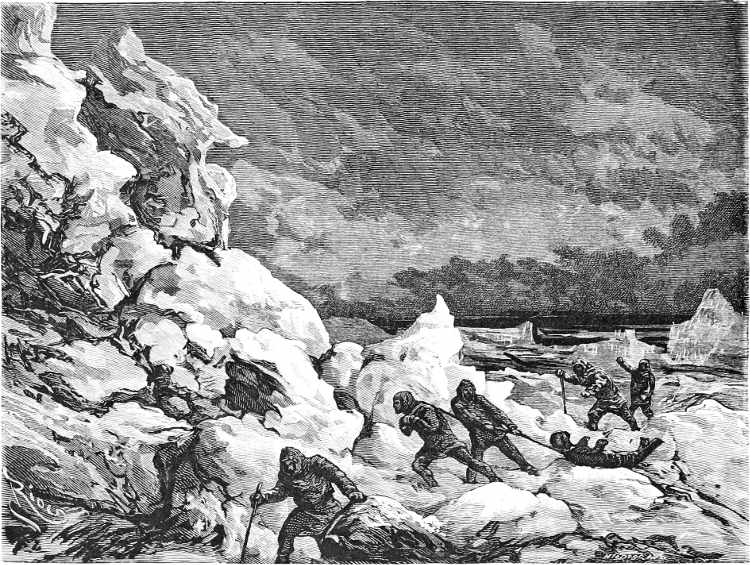
DRAGGING A SEAL.
Here is a picture of the interior of one of the igloes, or snow-huts:—
“Joe and Hannah are sitting in front of the lamp, playing checkers on an old piece of canvas, the squares being marked out with Tyson’s pencil. They use buttons for men, as they have nothing better. The natives easily learn any sort of game; some of them can even play a respectable game of chess; and cards they understand as well as the ‘heathen Chinee.’ Cards go wherever sailors go, and the first lessons that the natives of any uncivilized country get are usually from sailors.
“Little Puney, Joe and Hannah’s adopted child, a little girl, is sitting wrapped in a musk-ox skin; every few minutes she says to her mother, ‘I am so hungry!’ The children often cry with hunger. It makes one’s heart ache, but they are obliged to bear it with the rest.”
The gale continued on the 2nd, with blinding showers of snow—fine, penetrating, pungent. Next day the weather moderated, and the glass rose to 15° below zero. Dark clouds lowered in the horizon, preventing the land from being seen, if any shore were near. But the rapid rise in the temperature, after so strong a north-west gale, allowed Tyson to hope that the wind had mastered the current, and was forcing them towards the Greenland shore.
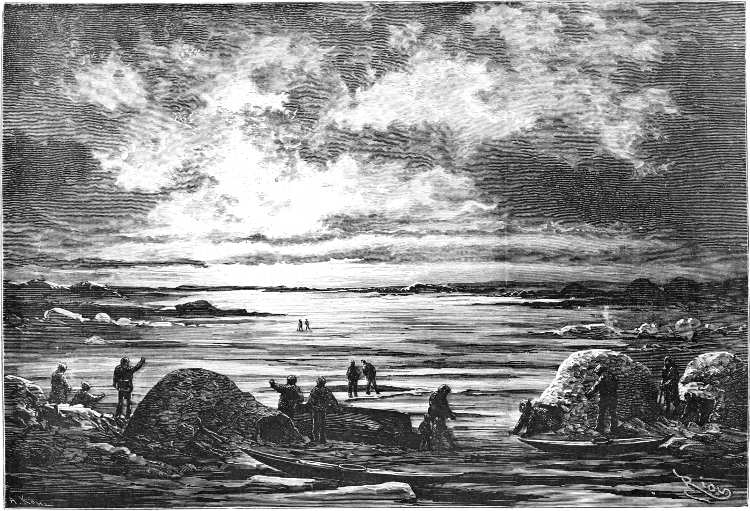
RETURN OF THE SUN.
Though all around nothing was visible but ice and icebergs, the scene had a certain beauty of its own—a strange weird beauty, like that of a dream-picture. When the sun shone on the bergs, and lighted up their massive or fantastic forms, all the prismatic colours of the rainbow flashed through the “crystal pendants” or “projecting peaks.” The interest of the scene was enhanced by the variety of its forms. Every berg appeared to have had its individual history, and its broken outline and furrowed surface bore witness to the experiences it had undergone—storm and rain, wind and water. Some rose up around the castaways like solid ramparts; others represented the spire of a Gothic cathedral, the pinnacle of a Turkish minaret, the glittering walls of a palace: all were beautiful, yet terrible in their beauty, conveying a profound feeling of might and destructive power.
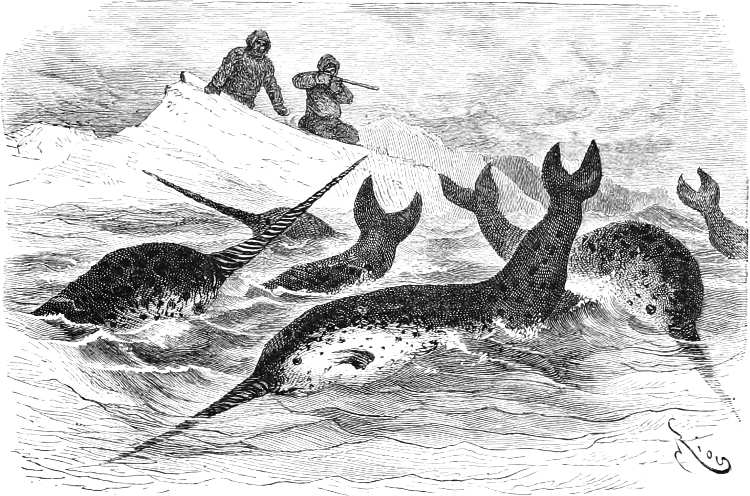
SHOOTING NARWHAL.
On the 5th, and again on the 7th, a seal was caught, and the little company enjoyed a plentiful meal. On the latter day a couple of narwhals were shot, but both sank before they could be reached. These narwhals are sometimes called sea-unicorns, or monodons, in allusion to the long horn, six to eight feet in measurement—or, rather, the elongated tooth—which projects from the upper jaw; a formidable weapon, tapering from base to point, with a spiral twist from left to right. Strange stories were told of these sea-unicorns by the early navigators; but science has made short work of legend and fable.
Day after day, the history of our navigators was the same; no stirring romance, but harsh reality:—wind and snow, snow and wind—a wind which almost froze the life-blood of those exposed to it, and snow which fell so fast and thick as to wrap the scene in the gloom of desolation. Still, the ice-raft drifted southward; slowly but surely drifted through the darkness of the night and the twilight obscurity of the day; while the little company it carried suffered much from increasing weakness, though better provided with food than formerly, owing to the frequent capture of narwhal and seal. Occasionally the mists cleared off, and the sun streamed out in meridian splendour, lighting up every feature of the “ice-scape”—may we coin the word?—around them. But, too frequently, “snow and blow, blow and snow,” was, as Tyson remarks, “the order of the day.”
Hope lives eternal in the human breast; and though it had sunk very low in the hearts of our adventurers, it suddenly rekindled on the 19th of February, when they caught sight of the west coast, at no greater distance than thirty-eight or forty miles. Its flame was kept alive on the 21st by the discovery that the thermometer had risen to 3° above zero. Next day it had risen to 20°, or within 12° of freezing-point; and men inured to the rigour of an Arctic winter spoke of such weather with cheeriness as “very comfortable.” The cloud upon the prospect now was the want of food, for the game had begun to fail. The hunters went forth every morning, but returned empty-handed. The feebleness of the party increased in an alarming degree. It took several men to carry a light Eskimo kayack, which for an ordinary man is not even a burden. What was to be done? The only chance of life seemed to lie in reaching the shore; but how were these gaunt, frail skeletons to convey their boat across the rugged ice until they reached the open water?
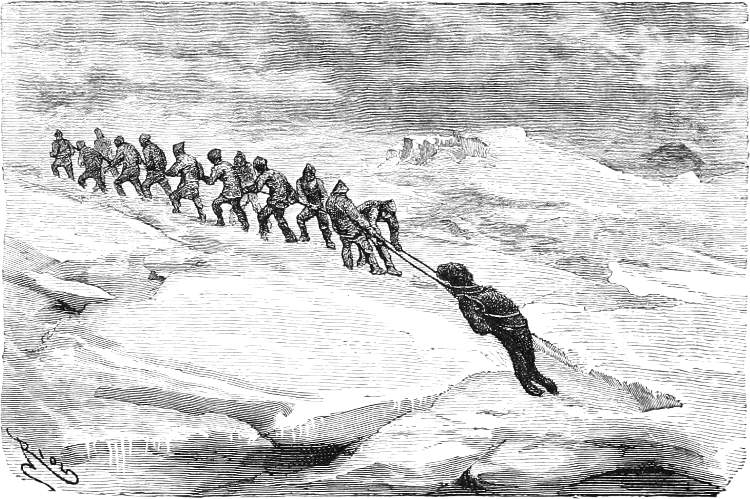
DRAGGING THE OOGJOOK (SEE PAGE 295).
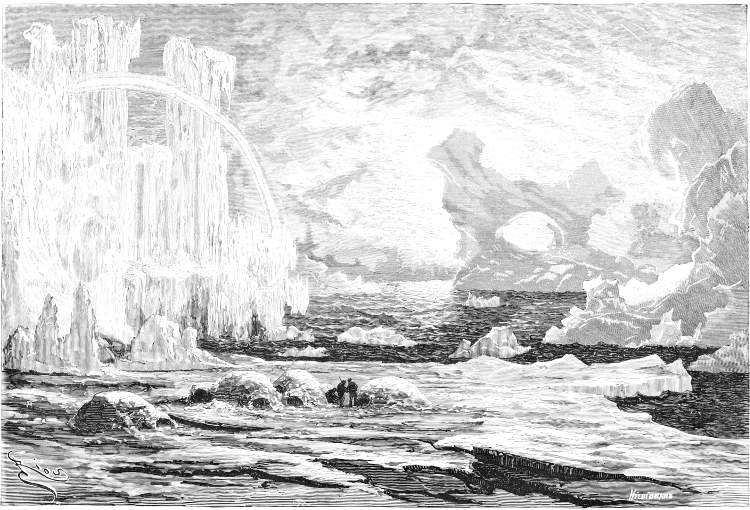
SUNLIGHT EFFECT IN THE ARCTIC REGION (SEE PAGE 291).
They decided, however, on making the attempt, in the hope of reaching a place called Shaumen, a little to the north of Cape Mercy, in lat. 65° N., where game, and sometimes Eskimos, were to be found. In spite of all their efforts, they were foiled by a succession of blinding, lashing, beating snow-storms. The mercury sank again to 24° below zero, and their position grew desperate. They were reduced to one meal—and such a meal!—per diem. Great was their joy on the 28th when the hunters brought in thirty-seven dove-kies, or two apiece. They were cooked without delay, and eaten up to the last morsel, except the feathers. Greater still was their joy on the 2nd (of March), when Eskimo Joe shot a monster oogjook (a large kind of seal), the largest they had ever seen—such a monster that it took all hands to drag its carcass to the huts. Peter danced and sung in the exuberance of his delight, and everybody felt that for a time they were saved from starvation. On measurement, this glorious oogjook proved to be seven feet nine inches in length, or fully nine feet including the tail.
The ice-raft was now approaching Cumberland Gulf, and Tyson calculated that they had reached lat. 65° N. They drifted more and more rapidly; and if they did not die of famine,—if the ice did not break up too suddenly,—there was a probability of their reaching the whaling ground, and falling in with some friendly ship. The gales, however, were frequent and severe; the thermometer continued very low—32° to 34° below zero; and the sufferings of the whole company were intense. Even the Eskimos were sorely afflicted; though without these bold and patient hunters, the white men must certainly have perished.
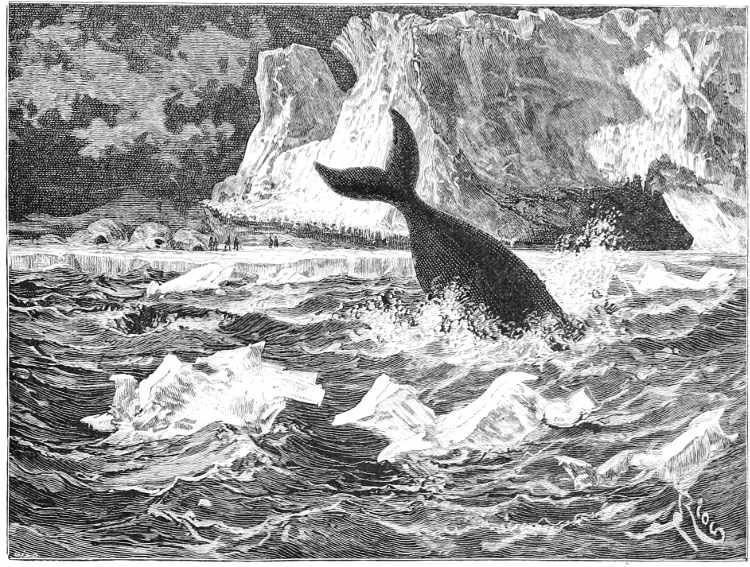
FIRST SIGHT OF A WHALE.
On the 7th of March there were indications of the breaking up of the floe. It cracked and snapped beneath them, with a sound like that of distant thunder. So far as the surface was concerned, however, no signs of fracture were visible; the eye, straining in every direction, saw nothing but an unbroken expanse of ice. And thus it continued until the 12th, when, during a terrible storm, the threatened catastrophe took place, the ice-raft being shattered suddenly into hundreds of pieces, on one of which, not more that one hundred yards by seventy-five, the adventurers found themselves adrift! Oh, what a night of dread anxiety they passed, expecting every moment that this piece too would give way, and plunge them into ruin! But it held together; and when the wind abated, and the snow ceased to fall, and the wild hurtling of the broken ice was hushed, they could look around them, and realize their position. The condition of the ice had undergone an absolute change; the “floes” were driven up into a “pack,” and huge blocks, of all shapes and sizes, were heaped up and jammed together in inextricable confusion.
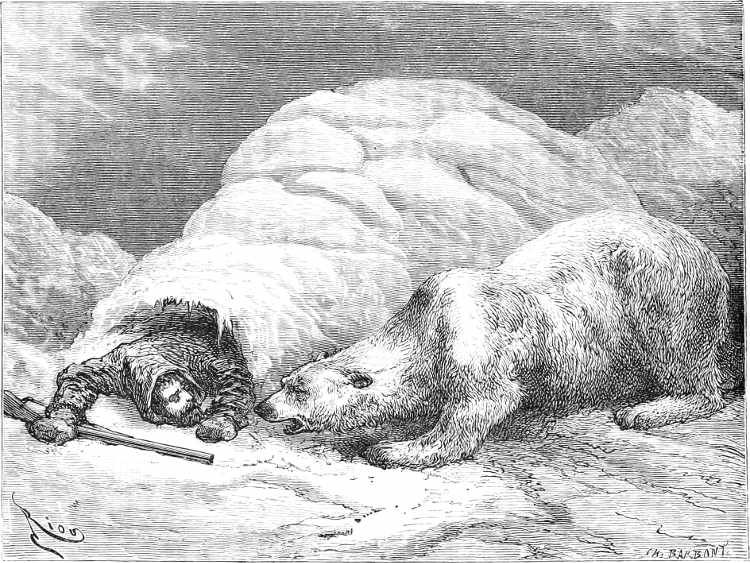
FACE TO FACE WITH A POLAR BEAR.
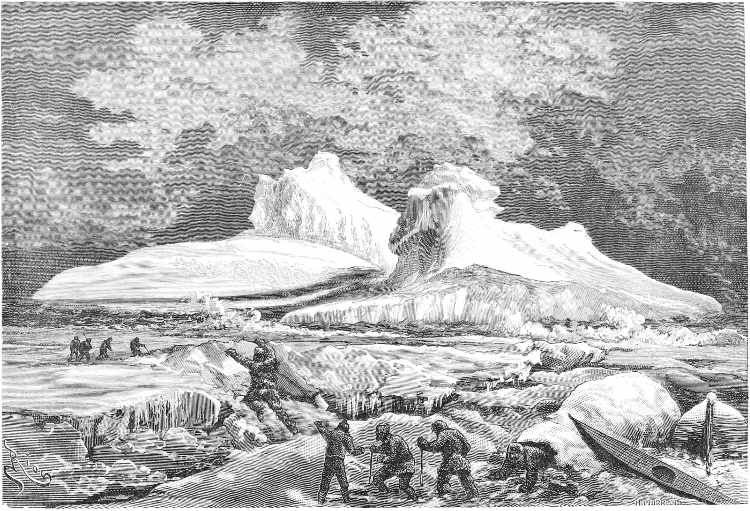
AN ARCTIC ICE-SCAPE (SEE PAGE 292).
Noting that on the 21st of March seven seals replenished the empty larder of our adventurers, and that on the 26th whales were visible for the first time,—a welcome sign, as indicating their approach to the fishing-grounds,—we pass on to the 29th, which was marked by a curious incident. Shortly after dark, Tyson heard a noise outside his hut; he had just taken off his boots, preparing for rest; Joe, too, was on the point of retiring, but thinking the ice was breaking up, he went out to view the “situation.” In a few seconds he hastily returned, pallid and frightened, and exclaiming, “There is a bear close to my kayack!” The kayack lay within ten feet of the entrance to the hut. Both Joe and Tyson’s rifles were outside; Joe’s within the kayack, and Tyson’s lying close to it; but Joe had his pistol in the hut. The captain put on his boots, and then both crept cautiously out. Seal-skins and lumps of blubber were lying about in all directions; and Bruin, having dragged some of these about thirty feet from the kayack, was banqueting at his ease. Joe crept into the sailors’ hut to alarm them. Meantime Tyson crawled stealthily to his rifle, but in taking it knocked down a shot-gun standing by. The bear heard it, but Tyson’s rifle already covered him; he growled; Tyson pulled the trigger, but the gun would not go off; a second, and a third time—it did not go; but Tyson did, for the bear now rushed full upon him. Retiring to the hut, he put another cartridge in, and then again crept out into the open, taking up a position where he could see the animal, although the night was dark. The bear, too, saw his assailant, and faced towards him; but this time the rifle-ball went straight to its mark; the bear ran about two rods, and fell dead.
The victim was a “sea-bear,” Ursus maritimus, and supplied the company on the ice-raft with a welcome change of diet.
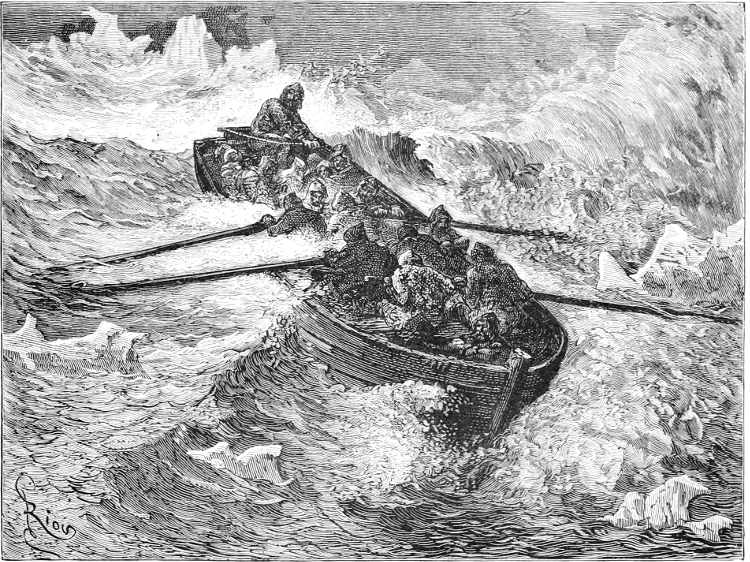
ON BOARD THE BOAT.
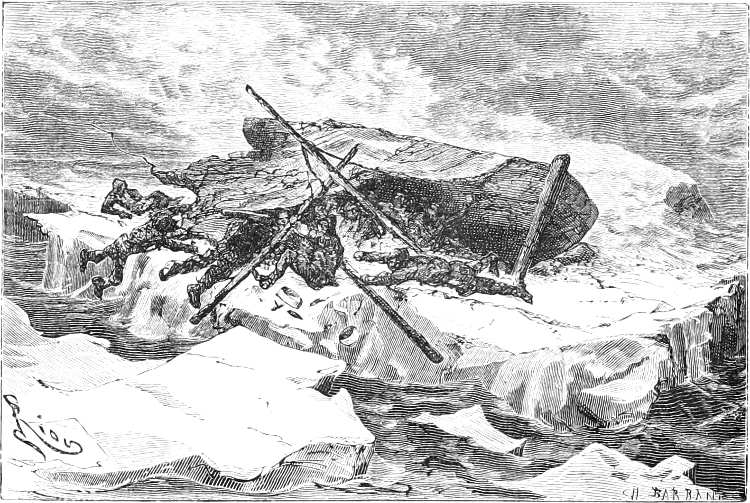
BREAKING UP OF THE ICE.
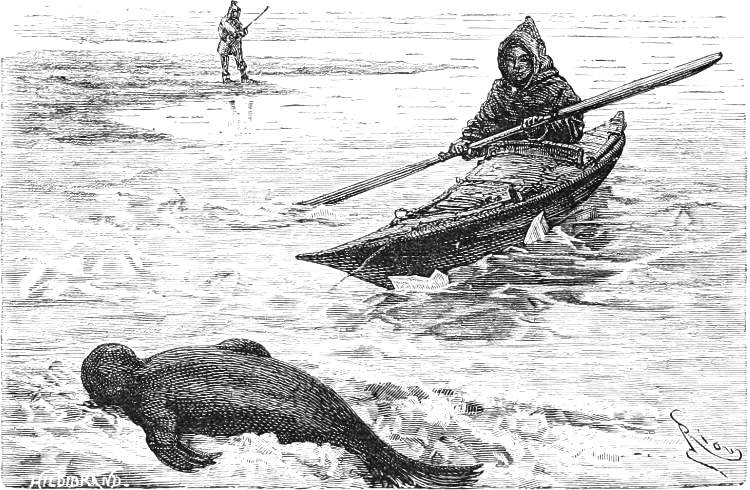
JOE CAPTURES A SEAL.
As the piece of ice was gradually wearing away, the adventurers of the Polaris resolved on an effort to regain the main pack, which would necessarily be safer. With their sleeping-gear, tent, and a supply of shot and powder, they embarked on board the boat, and stood to the westward; and on the 4th of April, after a succession of rough experiences, reached the “pack.” Here they were not much better off, for a violent gale blowing from the north-east, the ice began to break off in huge fragments; and soon the area at the command of the navigators was so small, that they were compelled to reload the boat, and prepare for a hurried departure. The wind, however, subsided, the pack closed up, and things returned to their normal condition.
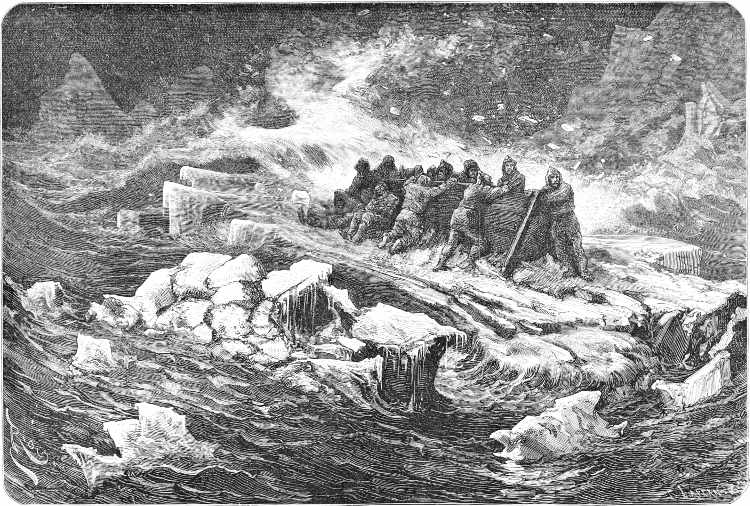
A NIGHT OF FEAR (SEE PAGE 296).
On the 18th of April the castaways were somewhat reinvigorated by the capture of a seal, which Joe brought ashore in his kayack, and by the appearance of land to the south-west. But in this wild Arctic region the weather in spring is subject to surprising changes, and on the 20th another gale began to blow. Such was its fury that it drove a heavy swell of sea across the ice-raft, which washed away every article that was loose. Billow after billow followed with ever-increasing violence; and tent, and skins, and nearly all the bed-gear, were swept into the boiling waters. Only a few articles were saved, which, along with the women and children, had been stowed in the boat. To save the boat tasked the energies of all the party, who had to hold on to it, with might and main, to prevent it from being carried out to sea. All through the dreadful night the men were on the watch against this crowning disaster; all through the dreary night, from 9 P.M. until 7 A.M., straining every nerve, calling into play every resource of energy. Ever and anon, one of the tremendous billows would plunge downward, and lift the boat bodily, and the men with it, and carry it and them forward on the ice, almost to the opposite edge of the floating raft; several times the boat heeled partly over, and was hauled back only by the more than human strength which the crew derived from a knowledge of their position. The boat gone, all was lost! Terrible was the work; had the waters been smooth, the task would not have been easy; but they were filled with loose ice, which rolled about in blocks of all shapes and sizes, and with almost every wave these came toppling and rolling and driving forward like an avalanche, and fell about the heads and limbs of the men as they clung desperately to the boat. But God mercifully supplied them with the strength they needed; and so, labouring to the uttermost, they waited and watched for the day. For twelve hours scarcely a sound was uttered except the crying of the children, and Tyson’s stern command to “Hold on,” or “Bear down,” with the responsive “Ay, ay, sir” of the men.
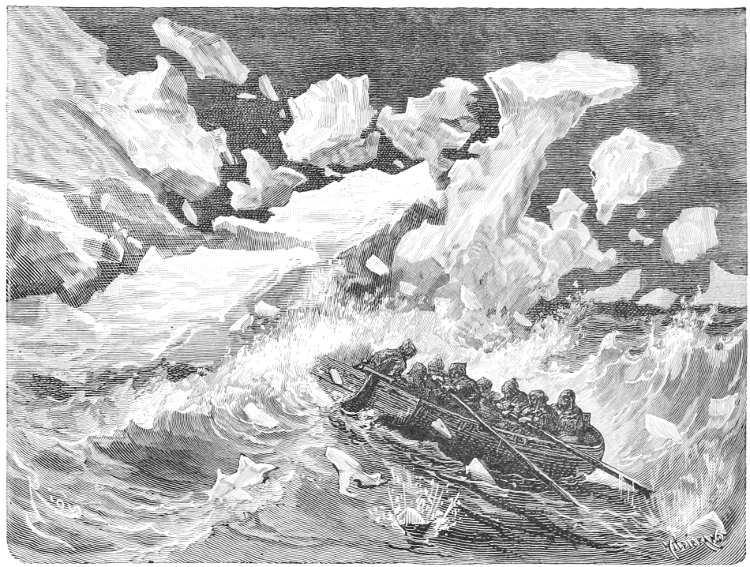
A “HELL OF WATERS.”
Day dawned at last, with a dull gray light over the restless sea, and Tyson saw with indescribable thankfulness a large raft of ice floating within reach. He determined to make for it, though the men hesitated to launch the boat into such a “hell of waters.” But it was done; the women and children were first got on board, and then all the men embarked in safety. By dint of hard pulling, they gained the ice, landed, refreshed themselves with a morsel of food, and then, on this new ice-raft, laid down to rest. The following morning found them “safe and sound,” after all their trials, with the exception of a few bruises and contusions.
On the 22nd of April another bear was killed; and just in time, for the whole party were without a morsel of food. This lasted them for three or four days; and then, on the 25th, as starvation once more stared them in the face, they resolved on a desperate effort to make the land. What else were they to do? The rain fell in torrents; the wind blew a hurricane; the ice-raft was constantly wasting away; they had no provisions. True, the boat was frail and leaky, and the sea ran high; but as the ice would not much longer afford them even a footing, a decision was forced upon them.
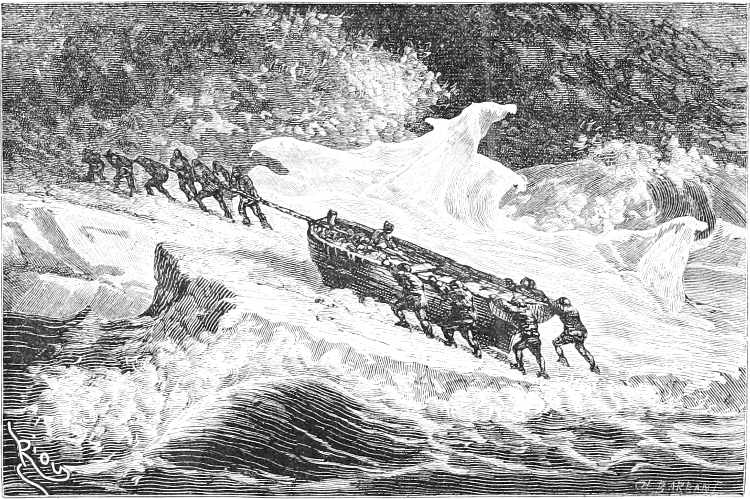
DRAGGING THE BOAT ON TO A FLOE.
So in their crippled, overloaded boat they set out, the wind blowing a gale, and a tremendous sea running, full of small knife-like blades of ice. After eight hours’ labour at the oars, they came to a piece of floe, and encamped upon it for the night. At daylight on the 28th they again launched their boat; and after much weary work in threading their way through a fleet of icebergs, they got into comparatively open water.
At half-past four, a joyful sight!—a steamer right ahead, and bearing north of them. The castaways hoisted their colours, and pulled towards her. She was a sealer, going south-west, and making her way through the floating ice. The hearts of the castaways beat with joy at the prospect of speedy relief; but, alas, they were doomed to disappointment! She did not see the miserable little company in the overloaded boat; and it was impossible for them to overtake her. Night gathered over the sea, and she disappeared.
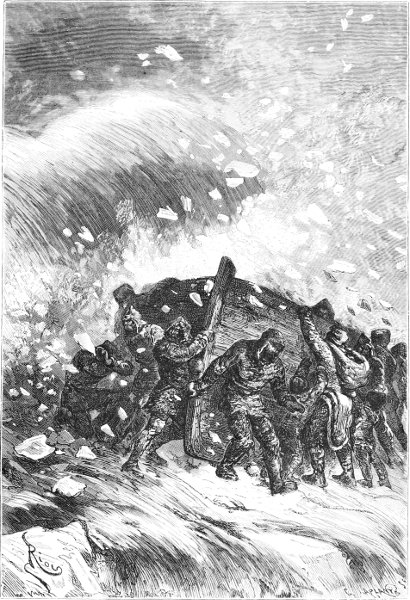
CLINGING TO THE BOAT (SEE PAGE 308).
Reaching a suitable piece of floe, they boarded it, and again encamped for the night, under a sky which was clear and calm, and shone with the glory of stars. The sea, too, was tranquil, and, notwithstanding their disappointment, they felt more hopeful than before; it was evident they had reached the borders of civilization, and might rely upon obtaining help. With seals’ blubber they kindled beacon-fires on the ice; and divided their men into two watches.
The next day they sighted another steamer, launched their boat, and pulled lustily towards her. In vain: she did not see them, and after a couple of hours’ hard work they were hemmed in by the ice, and could make no progress. They landed on a floe, and hoisted their colours; collected and loaded all their rifles and pistols, and filled the echoes with the ringing report of three simultaneous volleys. They heard three shots in reply, and—glorious sight!—saw the steamer directing her course towards them. They shouted with all their might; but in the keen air their voices seemed to pass away soundlessly. Presently the steamer changed her course, tacking south, then north, then west, as if she were vainly endeavouring to force a passage through the accumulated ice. Yet there seemed no insuperable obstacle in her path. The fugitives fired again, and again; but she came no nearer, and late in the afternoon steamed away to the south west.
At sunset they descried land in the same direction, about thirty-five miles distant.
On the following day, the 30th of April, Tyson was lying in the boat, his watch having just ended, when the look-out raised a sudden shout: “There’s a steamer! there’s a steamer!” As if fresh life had been poured into his veins, Tyson sprang to his feet, ordered all the guns to be fired, joined his companions in a loud simultaneous cry, and raised their colours to the head of the boat’s mast. Hans leaped into his kayack, and was despatched to intercept the ship, if possible, as there was some danger of losing sight of her in the fog which prevailed; but, happily, she bore down towards them. Hans paddled on, and in his broken English shouted, “American steamer.” He was not understood by those on board, but they kept their course, and in a few minutes lay alongside of the ice-isle which sheltered Tyson and his company. Oh, what three loud, hearty, joyful cheers acknowledged their deliverance! These were immediately returned by the crew of the steamer, which proved to be the sealer Tigress, of Conception Bay, Newfoundland.
We quote from Captain Tyson’s simply-worded narrative:—
“Two or three of their small seal-boats were instantly lowered. We, however, now that relief was certain, threw everything from our own boat, and in a minute’s time she was in the water; while the boats of the Tigress came on, and the crews got on our bit of ice, and peeped curiously into the dirty pans we had used over the oil-fires. We had been making soup out of the blood and entrails of the last little seal which Hans had shot. They soon saw enough to convince them that we were in sore need. No words were required to make that plain.
“Taking the women and children in their boats, we tumbled into our own, and were soon alongside of the Tigress. We left all we had behind, and our all was simply a few battered smoky tin pans and the débris of our last seal. It had already become offal in our eyes, though we had often been glad enough to get such fare.
“On stepping on board, I was at once surrounded by a curious lot of people—I mean men filled with curiosity to know our story, and all asking questions of me and the men. I told them who I was, and where we were from. But when they asked me, ‘How long have you been on the ice?’ and I answered, ‘Since the 15th of last October,’ they were so astonished that they fairly looked blank with wonder.
“One of the party, looking at me with open-eyed surprise, exclaimed,—
“‘And was you on it night and day?’
“The peculiar expression of the tone, with the absurdity of the question, was too much for my politeness. I laughed in spite of myself, and my long unexercised risibles thrilled with an unwonted sensation.”
Tyson and his party were picked up in lat. 53° 35’ N.; a fact which will give the reader some idea of the wonderful voyage they had accomplished on their various ice-rafts.
They were treated with thoughtful kindness on board the Tigress, which on the 7th of May turned her head towards Newfoundland. On the following day she put into Conception Bay, where the Americans landed, and remained until the 12th. They then started for St. John’s; and the news of their remarkable experiences having preceded them, found themselves on their arrival the objects of a very general and lively curiosity. After a short stay, they were conveyed to Washington on board the United States steamship Frolic. And here ends their strange, eventful history.
We must now return to the Polaris.
When she drifted away in the darkness of that stormy night, she had on board fourteen persons: Captain Buddington, Dr. Emil Bessel, Messrs. Bryan and Chester, and ten officers and seamen. What had become of them and their vessel? Such was the natural question which arose on the safe arrival at Washington of Tyson and his companions; and the American Government quickly came to the determination of organizing a relieving party to seek for and bring back the survivors and remains, if any, of the Polaris expedition. The steamship Juniata was immediately despatched to form a depôt of supplies on the coast of Greenland in advance. She reached Upernavik on the 31st of July, and there brought into use her steam-launch, the Little Juniata; which, manned by a gallant crew, pushed forward into the icy waters of Melville Bay, but without coming upon any traces of the missing explorers. Meantime, the American Government purchased the Tigress, and fitted her up for a thorough cruise in the Arctic seas. With Captain Greer in command, and Mr. Tyson as acting-lieutenant, and a crew of eleven officers and forty-two men, “all told,” the Tigress set sail on the evening of July 14th, and dropped anchor at St. John’s on the morning of the 23rd.
On the 11th of August we find her at Upernavik, where she took on board a supply of coal from the Juniata. She then proceeded northward, falling in with the heavy pack-ice near Cape York. The 14th saw her off the Eskimo settlement of Netlik. She was now approaching Northumberland Island, in the neighbourhood of which, or of Littleton Island, it was supposed the Polaris had parted from the ice-floe. Captain Greer carefully examined Northumberland Island, but without success. He then made for Littleton Island; and a boat was lowered to go on shore, carrying Lieutenant White, Captain Tyson, and other officers. What was their surprise, as they approached, to discover some human figures and a couple of tents on the mainland, near Littleton Island. The figures proved to be Eskimos; and through the agency of Eskimo Joe, who was on board the Tigress, it was soon ascertained that Captain Buddington had deserted the Polaris on the day after her separation from the floe; that he and his companions had erected a house on the mainland, and wintered therein; had fitted it up with sleeping-berths for fourteen men, the full number, and furnished it with stove, table, chairs, and other articles removed from the abandoned ship; that during the winter the party had built and equipped a couple of sailing-boats; and that “about the time when the ducks begin to hatch” they had departed for the south.
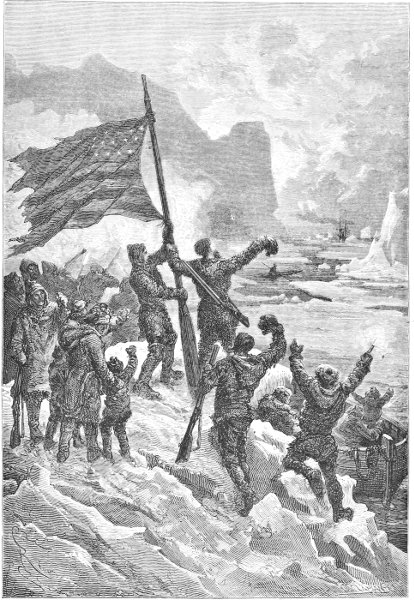
SAVED!
The Eskimo chief, or leader, added that Captain Buddington had made him a present of the Polaris; but that the gift proved of no effect, for in a violent gale she broke loose from the ice, drifted out into the channel, and foundered.
Further search brought the crew of the Tigress to the winter-camp of the Polaris crew. It was situated in lat. 78° 23’ N., and long. 73° 46’ W. Some manuscripts were found there, with the log-book, the medical stores, and remains of instruments; and these, with whatever else that seemed of intrinsic value, having been removed on board the Tigress, the expedition bore away to the southward, and on the 16th of October reached St. John’s, Newfoundland, where they received the welcome intelligence of the rescue of the Polaris party under the circumstances we shall now relate.
We return to the eventful night of the 15th of October 1872. During the tremendous gale that then raged along the Arctic coast, the bow-hawser of the Polaris snapped like a “pack-thread,” the anchors slipped, and the ship drifted away into the darkness. The wind forced her in a north-easterly direction; and next morning those on board found her “a little north of Littleton Island, in Smith Sound, having been exactly abreast of Sutherland Island during a portion of the night.”
As she was leaking rapidly the pumps were set to work; and the fires with much difficulty being lighted, the ship was got to obey her helm. It was then found that the following officers and men remained on board:—Captain Buddington; Mr. Chester, chief mate; William Merton, second mate; Emil Schuman, chief engineer; Odell, assistant-engineer; Campbell and Booth, firemen; Coffin, carpenter; Sieman, Hobby, Hays, and Manch, seamen; Dr. Emil Bessel, meteorologist; and Mr. Bryan, astronomer and chaplain.
A look-out was kept, it is said, for the nineteen who were missing, but no signs of them being discovered, Captain Buddington came to the comfortable conclusion that they had saved themselves in the boats. Doubting the feasibility of carrying the Polaris to the southward, he determined to abandon her, and winter on shore. With this view she was run in as near land as possible, and finally grounded in Kane’s Life-boat Cove, lat. 78° 23’ 30″ N., and long. 73° 21’ W. Here, on the 17th of October, Captain Buddington prepared to establish a winter-camp; and the next few days were occupied in removing from the stranded vessel all the food and fuel, and such articles as could conduce to the comfort and sustenance of the party through the ensuing winter.
With spars, bulk-heads, and canvas brought from the Polaris a commodious house was erected, measuring twenty-two feet in length, and fourteen feet in width. It was thoroughly water-tight; warmed inside by a stove; and banked outside with masses of compact snow. In the interior the sides were lined with fourteen sleeping-berths. A table and chairs and lamps added to the general comfort; so that our explorers were prepared to brave a Polar winter under more favourable conditions than those experienced by most Arctic navigators.
In the course of a few days a party of native Eskimos, with five sledges, made their appearance, and their friendly labours were found of no little value. They considered themselves amply repaid by a few presents of knives, needles, and the like, and after a short stay returned to their settlement at Etah. However, others soon took their place; and eventually two or three families built their igloes in the neighbourhood of the American camp. The Eskimo women made themselves very useful by making and repairing clothing, and rendering other feminine courtesies; while the men, when game became plentiful, supplied the little settlement with a welcome abundance of fresh meat. Nor was this the only advantage derived from the presence of the Eskimos; on the contrary, it had an excellent effect on the morale of the men, who did not feel that utter isolation, that sense of being cut off from human companionship, and separated from the rest of the world, which is one of the severest trials of wintering in the Arctic regions. The heavy pressure of the long, dark Polar night was wonderfully lightened by the kindly attentions and mirthful society of the Eskimos.
It is probable that some of the Polaris crew never spent a happier winter. There was no want of food, no suffering from cold; their quarters were warm, cheerful, and well-lighted. Time did not hang heavily on their hands; for when the house-work was done, when the fires were replenished, the lamps trimmed, and the day’s provisions cooked, they amused themselves with reading or writing, or played at chess, draughts, and cards. It is true they had no communication with the world without, and no intelligence could reach them from friends or kinsmen; but, surgit amari aliquid—in the cup of human happiness a bitter drop is always found!
When the worst of the winter was past, they began, under the direction of the carpenter, to construct a couple of boats, with the view of returning homeward as soon as the ice broke up. Each was twenty-five feet long, square fore and aft, and five feet beam; capable, that is, of carrying seven men, with provisions for about two months, in which time they might reasonably calculate on reaching the civilized settlements. It was the end of May before the condition of the ice enabled them to set out. Then they broke up their camp, rewarded their Eskimo friends, carried on board stores and provisions; and, finally, early on the morning of the 1st of June they bade farewell to their winter-home, and sailed out into the waters of Smith Sound.
Their voyage was unmarked by any disastrous incident, and presents a strange contrast to the dangerous experiences of Tyson and his companions. Wherever they landed, they obtained an abundant supply of aquatic birds, seal, and other game. They were all in good health, well-fed, well-clothed. Their boats were sound and strong. The winter had long passed away, and the glorious summer sun poured its full radiance on the calm surface of the Arctic sea. Sailing pleasantly along, they touched at Hakluyt Island, and subsequently landed on the west shore of Northumberland Island. The pack-ice detained them there until the 10th. They then entered a water-way toward Cape Parry, but were subsequently forced back by the ice to the place whence they had started. On the 12th the channel was clearer. They set sail again; crossed the southern part of Murchison Sound; doubled Cape Parry; and halted for rest and refreshment on Blackwood Point, near Fitz Clarence Rock. Thence they made, in due succession, for Wolstenholme Island, and Cape York,—names which recall the adventures of the earlier explorers.
Their course now assumed a more difficult character, as they had come face to face with the ice of Melville Bay,—that great expanse of Arctic waters which is surrounded by glacier-loaded shores, and has always been a favourite “whaling-ground.” Here they encountered some difficulty with the “pack;” the “leads,” or water-ways, curiously intersecting one another, and striking far into the ice, and so closing up that it was often necessary to haul their boats across a kind of promontory, or tongue, from one lead to another. Their troubles, however, were of brief duration. On the twentieth day after leaving Life-boat Cove, they sighted a steamer, beset in the ice, at a distance of thirty or thirty-five miles from Cape York. She could not come to them, it was true, but they could go to her; and this they prepared to do. They had not traversed half the distance, however, before they met a body of eighteen men from the ship; for they too had been seen, and recognized as white men, and relief immediately despatched. The friendly vessel proved to be the Ravenscraig of Dundee, Captain Allen, lying in lat. 75° 38’ N., and long. 65° 35’ W.
It was now found, according to the narrative of the expedition, that the relief did not come much too soon, for the boats had been considerably injured by contact with the rough hummocky ice. And the fatigue of hauling them over such a surface may be inferred from the fact that it took the Polaris crew, with their eighteen relief-men from the Ravenscraig, six hours to reach the latter vessel. The difficulty was increased by a deep slushy snow, which lay thick upon the ice, and which was not only heavy and disagreeable to the wayfarer, but exceedingly dangerous, as more than one found by sinking into the pitfalls it treacherously concealed.
But they reached the Ravenscraig at midnight, and received a hearty welcome from Captain Allen, who was able also to communicate the grateful intelligence that their comrades, the little company sent adrift on the ice-raft, were all in safety.
It has been well said that the Polaris expedition proved curiously prolific of startling and exciting incidents. From the time when Captain Bartlett of the Tigress rescued the “exhausted waifs” of the ice-floe, until the last scene in this romantic drama was enacted, the public mind had been kept in a condition of continual expectancy by the progress of events connected with the story of these Arctic explorers. The lamentable death of Captain Hall,—the long voyage on the ice-floe through the gloom of the Polar night,—the return of the nineteen castaways after so many hairbreadth escapes and wonderful adventures,—the departure of the Tigress,—the discovery of Buddington’s winter-camp,—and now the rescue of him and his crew by the Dundee whaler, formed a series of surprising and exciting events, which, if not of epical interest, would certainly seem to furnish matter for a poet’s song. Even the early annals of Arctic exploration, with their narratives of the achievements and sufferings of Hudson, Davis, Barentz, present no incidents of a more remarkable character. As men dwelt upon them, they came to acknowledge that the “age of romance” was not ended yet.
On the 18th of September 1873, the Arctic whaling-steamer arrived at Dundee with eleven of the Polaris survivors, who had been transferred to her from the Ravenscraig, as the latter was not homeward bound. Three others reached America in the Intrepid; and thus the expedition of the Polaris terminated without any loss of life, if we except the unfortunate death of her enthusiastic commander, Captain Hall.
It added nothing, it is true, to our geographical knowledge of the Arctic World; and yet it was not without some useful results. The Polaris, at all events, approached nearer to the North Pole than any one of her predecessors; and men of science were thenceforth justified in asserting that the hope of complete success was no longer chimerical. The distance to the pole from the point reached by the Polaris was comparatively so trivial, as to afford good reason for believing that it would not long baffle human resolution and enterprise. Then, again, it was established as a fact beyond doubt that Europeans could securely winter in a latitude of 81° 38’; that a ship well built and well equipped might push northward as far as 82° 16’; and that no insuperable obstacles to its further advance could then be detected. It was also shown that the temperature, even in lat. 82°, was not of a nature to overcome the energy and enthusiasm of men accustomed to life and adventure in the Arctic World. These data, so conclusively established by experience, constituted a source of great encouragement to future navigators, and permit the conclusion that the Polaris expedition, with all its disasters and mismanagement, helped forward the great work of discovering the North Pole.