Chapter X · HISTORICAL SKETCH OF ARCTIC DISCOVERY. (continued 3)
Reading edition
“We now know,” says Mr. Markham, “that the American vessel commanded by Captain Hall passed up the strait, in one working season, for a direct distance of two hundred and fifty miles, without a check of any kind, reaching lat. 82° 16’ N.; and that at her furthest point the sea was still navigable, with a water-sky to the northward.”
The Polaris, however, was nothing better than a river-steamer of small power, ill adapted for encountering the perils of Arctic navigation,—with a crew, all told, of thirty men, women, and children, including eight Eskimos. If she could accomplish such a voyage without difficulty, and could attain so high a latitude, it was reasonable to anticipate that a properly equipped English expedition, under equally favourable circumstances, would do, not only as much, but much more, and carry the British flag into the waters of the circumpolar sea, if such existed. With this view, the Admiralty fitted out the Alert and the Discovery, under Captains Nares and Stephenson. Every precaution that science could suggest was adopted to ensure the completeness of their equipment; and the two ships, accompanied as far as Disco by H.M.S. Valorous as a tender, left England on the 29th May 1875.
The British Expedition, consisting of the Alert and the Discovery, did not succeed in all it was intended to accomplish; and yet it can hardly be spoken of as a failure. It did not reach that conventional point of geographers, the North Pole, but it penetrated within four hundred miles of it; and it ascertained the exact nature of the obstacles which render access impossible, except under conditions not at present in existence. We agree with a thoughtful writer in the Spectator that this was a most important service rendered both to Science and the State. We now know that by the Smith Sound route a ship may attain to within 450 miles of the Pole; and that, afterwards, a journey about as long as from London to Edinburgh must be undertaken, in a rigorous climate, with the thermometer 50° below zero, over ice packed up into hillocks and hummocks which render sledge-travelling almost impracticable, or practicable only by hewing out a path with the pickaxe at the rate of a mile and a half a day. And further: the work would have to be begun and completed in four months, or, from lack of light and warmth, it could not be done at all. These are serious difficulties, and whether it is worth while for men to encounter them, where the gain would be problematical, we need not here inquire. Before any attempt can be made, some provision must be discovered for protecting those who make it against the excessive cold, and for a surer and swifter mode of conveyance than the sledge affords. The journalist to whom we have referred speculates that science may furnish future expeditions with undreamt-of resources,—with portable light and heat, for instance, from the newly-discovered mines at Disco; preventives against scurvy; electric lights; supplies of dynamite for blowing up the ice; and a traction-engine to traverse the road thus constructed; but, in the meantime, these appliances are not at our command. We must be content with the measure of success achieved by Captain Nares and his gallant followers.
And these well deserve the gratitude of all who think the fame and honour of a nation are precious possessions. They have shown clearly that the “race” has not degenerated; that Englishmen can do and suffer now as they did and suffered in the old time. They displayed a courage and a fortitude of truly heroic proportions. And the experiences of Arctic voyaging are always of a nature to require the highest courage and the sternest fortitude. The long Arctic night is in itself as severe a test of true manhood as can well be devised. The miner works under conditions for less laborious than those to which the Arctic explorer submits, for he enjoys an alternation of light and darkness; his underground toil lasts but for a few hours at a time. Yet we know that it tries a man’s manly qualities sorely! What, then, must it be to keep brave and cheerful and true throughout a prolonged night of one hundred and forty-two days—that apparently endless darkness, almost the darkness of a sunless world?
We know, too, that continuous work, without relaxation, for month after month, will break down the nerves and shatter the intellect of the strongest. Yet we read that the men of the Alert toiled like slaves, on one occasion, for seventy-two days, in cold so extreme that the reader can form no conception of its severity, and with the dread constantly hanging over them of that terrible and most depressing disease, scurvy. Owing to their inability to procure any fresh game, as most former expeditions had done, each of the extended sledge-parties, when at their farthest distance from any help, was attacked by it. The return-journeys were, therefore, a prolonged homeward struggle of men who grew weaker at every step, the available force to draw the sledge continually decreasing, and the weight to be dragged as steadily increasing, as, one after another, the men stricken down had to be carried by their enfeebled comrades.
It has been well said that in such exploits as these there is a sustained heroism which we cannot fully appreciate, because we cannot fully realize the terrible character of the sacrifices involved. But it is comparatively easy for us to understand, and therefore to admire, the courage of Lieutenant Parr, when he started alone on a journey of thirty-five miles, with no other guide for his adventurous steps than the fresh track of a wandering wolf over the ice and snow, in order to carry help and comfort to his failing comrades. It is easy to understand, and therefore to admire, the devotion of Mr. Egerton and Lieutenant Rawson, when, at the imminent risk of their own lives, they nursed Petersen, the interpreter, while travelling from the Alert to the Discovery, with the temperature 40° below zero. Petersen, who had accompanied them with the dog-sledge, fell ill; and with a noble unselfishness they succeeded in retaining heat in the poor fellow’s body by alternately lying one at a time alongside of him, while the other by exercise was recovering his own vital warmth. We can also acknowledge and admire the constancy of Captain Nares, who, in that horrible climate, lived thirty-six days in the “crow’s-nest,” while his ship laboured among the grinding, shivering, crushing ice, until exhaustion overcame him. And we can acknowledge and admire the bravery and faithfulness of the men of the sledge-parties who, for days and weeks, drew the sledges and their comrades, with gloom above and around them, ice and snow everywhere bounding the prospect, and in a temperature which seemed to freeze the blood and benumb the heart.
What a tale, says a writer in the Times, what a tale of unrequited suffering it is! Surely not “unrequited;” for those who suffered, suffered at the call of duty, and have been rewarded by the approval of their countrymen, and by the consciousness of having done something great, of not having lived in vain. “How lightly do all talk of glory; how little do they know what it means! The little army had to cut its way through the ice-barriers, dragging heavily-laden sledges, and going to and fro, the whole force being often required for each sledge, content to make a mile and a quarter a day, in pursuit of an object still four hundred miles off, through increasing difficulties, and with barely five months, or one hundred and fifty days, wherein to go and return. The labour is a dreadful reality; the scheme itself a nightmare, the phantasy of a disordered brain. Even the smaller and subsidiary expedition for planting a depôt last autumn cost three amputations. The cold was beyond all former experience for intensity and length, and the physical effect of a long winter spent in the ships under such conditions is particularized as one reason why the men were less able to endure cold, labour, and the want of proper food. Every one of the expeditions, whatever the direction, came back in the saddest plight,—some dragging the rest, and in one case only reaching the ship through the heroism of an officer pushing on many miles alone to announce his returning comrades, and to procure the aid by which alone they were saved from destruction. These are episodes, but they are the matter which redeems the story and makes its truest value. They tell us what Englishmen will do on occasions beyond our feeble home apprehensions, when once they have accepted a call, and are in duty bound.”
At the time we write no elaborate record of the expedition has been published, and the materials of the following sketch are collected therefore from various narratives which have appeared in the daily journals. We shall begin by endeavouring to place before the reader, with the assistance of Mr. Clements R. Markham, a rapid summary of what the expedition accomplished. And then we shall describe its more interesting incidents.
The object of Captain Nares and his followers was to discover and explore as considerable a portion of the unknown area in the Polar Regions as was possible with reference to the means at their disposal, and to the positions the vessels succeeded in reaching as starting-points. The theories about open Polar basins and navigable waters which once obtained have long been discarded by practical Arctic geographers. A coast-line, however, is needful as a means of progress to “the threshold of work;” and it is needful, too, in order to secure the desired results of Arctic discovery in the various departments of scientific inquiry.
The expedition, then, in the first place, had to force its way through the ice-encumbered channel which connects Baffin Bay with the Polar Ocean; a channel which successively bears the names of Smith Sound, Kane Basin, Kennedy Channel, Hall Basin, and Robeson Strait. Smith Sound opens out of Baffin Bay between Capes Alexander and Isabella. The Alert and the Discovery passed these famous headlands and entered the Sound on July 29, 1875; and from that date until September 1, when the Alert crossed the Threshold of the Unknown Region, they fought one continuous battle with the ice. The Polaris, it is true, had made a rapid passage on the occasion of its memorable voyage; but the circumstances were exceptional. Generally the Sound is blocked up by heavy floes, with winding waters caused by the action of wind and tide. With great difficulty our two ships forced the barrier; but their success was due in no small measure to the skill and vigilance of Captain Nares, who allowed himself no rest until they were out of danger. At length, after many hairbreadth escapes, and many laborious nights and days, and much energy and devotion on the part of the officers, and equal courage and industry on the part of the men, the expedition reached the north shore of Lady Franklin Inlet, and found a safe, commodious harbour in lat. 81° 44’ N. Here the Discovery took up her winter quarters, as had previously been arranged; and the Alert, after a brief interval of repose, continued her northward progress.
This she was enabled to do through the opportune opening up of a water-lane between the shore and the ice. Bravely she dashed ahead, rounded Cape Union, so named by the men of the Polaris expedition, and entered the open Polar Ocean. Then, in lat. 82° 20’ N., the white ensign was hoisted on board a British man-of-war in a latitude further north than the ship of any nation had reached before. Soon afterwards the solid masses of the Polar pack-ice began to close around the adventurous vessel; and on the 3rd of September 1875, the Alert was fast fixed in her winter quarters, on the ice-bound shore of the inhospitable Polar Sea in lat. 82° 27’ N.
This, says Mr. Markham,[11] was the first grand success; and it assured the eventual completion of the work. For, owing to the admirable seamanship of Captain Nares, and to the zeal and devotion of the officers and crew, the Alert had been carried across the Threshold, and was within the Unknown Region. A point of departure was thus obtained, which rendered certain the achievement of complete success; inasmuch as in whatever direction the sledge-parties travelled, valuable discoveries could not fail to be the result.
The autumnal excursions, during which depôts of provisions were established for use in the work of the coming spring, were not performed without a very considerable amount of suffering. Lieutenant May and two seamen were so severely frost-bitten, that, to save their lives, amputation was found necessary.
As will be seen from the latitude given, the ships wintered further north than any ships had ever previously wintered. The cold exceeded anything previously registered, and darkness extended over a dreary period. The winter, however, was not spent idly: observatories were erected, and a mass of valuable scientific data industriously accumulated.
“But the crowning glories of this ever-memorable campaign were,” as Mr. Markham exclaims, “achieved during the spring.” Three main sledge-expeditions were organized: one, under Commander Markham and Lieutenant Parr, instructed to keep due north, as far as possible, into the newly-discovered Polar Ocean; another, under Lieutenant Aldrich, to explore the American coast, westward; and the third, under Lieutenant Beaumont of the Discovery, to survey the north coast of Greenland, facing eastward. Each party consisted of two sledges; and the six, with their gallant crews, set out on the 3rd of April 1876, determined to vindicate and maintain the reputation of British seamen. They separated at Cape Joseph Henry; and before they again met, this was what they achieved:—
Commander Markham and Lieutenant Parr pushed northward as far as lat. 83° 20’ 26″ N.; being the most northerly point which any explorers have attained. They may therefore be fairly and justly regarded as “the Champions” of Arctic Discovery, until some successors, more fortunate than they, shall surpass their glorious feat.
Lieutenant Aldrich struck westward; rounded Cape Colombia in lat. 83° 7’ N.; and explored 220 miles of the American coast-line, previously not laid down on any map.
Lieutenant Beaumont crossed Robeson Strait, and surveyed the northern coast of Greenland for about seventy miles.
“In order,” it is said, “that these three main parties might do their work successfully, every soul in the two ships was actively employed. The depôt and relieving parties did most arduous work, and the officers vied with each other in promoting the objects of the expedition, while the most perfect harmony and unanimity prevailed. Captain Feilden and Mr. Hart were especially active in making natural history collections; and Lieutenants Giffard, Archer, Rawson, Egerton, and Conybeare did admirable work in exploring and keeping open communications.” When the sledge-parties returned to the ships, Captain Nares found that they had suffered terribly; but he also found that their success had been complete. They had solved a geographical problem; no open sea surrounded the Pole, as so many sanguine spirits had anticipated. The way northward was over a waste of ice—of ice broken up into hummocks and ponderous masses. And with the appliances they possessed further progress was impossible; the expedition had reached its ne plus ultra.
The work was done, and Captain Nares perceived that nothing more could be gained, while valuable lives might be lost by remaining longer in the Polar Ocean. He decided upon returning to England, with the following rich results to show as the reward of an heroic enterprise:—
First, the expedition had discovered a great Polar Ocean, a knowledge of which cannot fail to prove of exceeding value to the hydrographer. Next, the shores of this ocean had been explored along fifty degrees of longitude, and important collections formed of specimens of the Arctic fauna, flora, and geology. The channel connecting the Polar Ocean with Smith Sound had also been carefully surveyed, and an accurate delineation effected of either shore. Geological discoveries of high value had also been made; as, for example, that of the former existence of an evergreen forest in lat. 82° 44’ N.,—a fact significant of vast climatic changes. And, lastly, interesting observations in meteorology, magnetism, tidal and electric phenomena, and spectrum analysis had been carefully recorded. The expedition of 1875–76 must, therefore, in view of these results, be classed among the most successful which ever adventured into Arctic waters; though it failed, like its predecessors, to gain the North Pole.
The Alert and the Discovery left the shores of England in May 1875. After a voyage of five weeks’ duration they arrived at Lievely, the port of Disco Island, on the west coast of Greenland. This small settlement numbers about ninety-six inhabitants, Danes and Eskimos,—generally speaking, a mixed race. The Danish Inspector of North Greenland resides here, and he received the expedition with a salute from three brass cannon planted in front of his house. There is a well-conducted school, attended by about sixteen children; and a small church, where the schoolmaster reads the Lutheran service on Sundays,—the priest coming over from Upernavik occasionally, to perform marriages, christenings, and other religious services.
The Alert having taken on board thirty Eskimo dogs and a driver, the expedition left Disco at one o’clock on July 16th, and next morning reached Kiltenbunto, about thirty miles further north.
Kiltenbunto is a little island in the Strait of Weigattet, between Disco and the mainland. Here the Discovery took on board thirty dogs; and shooting-parties from both ships made a descent on a “loomery,” or “bird-bazaar,” frequented by guillemots, kittiwakes, and other ocean-birds. Two or three days later the expedition arrived at a settlement named Proven, where it was joined by the Eskimo dog-driver, Hans Christian, the attendant of Kane, Hayes, and Hall, in their several expeditions. At Proven the adventurers received and answered their last letters from “home.”
Striking northward through Baffin Bay, they reached Cape York on the 25th of July, and met with a company of the misnamed Arctic Highlanders, who traversed the ice-floes in their dog-sledges, and soon fraternized with the seamen. A narwhal having been harpooned, a quantity of the skin and blubber was given to these Eskimos. Mr. Hodson, the chaplain of the Discovery, describes them as exceedingly greedy and barbarous, eating whatever fell in their way, but living chiefly upon seals. They were not so far advanced in civilization as to be able to construct kayacks, and apparently they had never before seen Europeans. They wore trousers of bear-skin, and an upper garment of seal-skin.
Proceeding northward by Dr. Kane’s Crimson Cliffs, they soon reached that brave explorer’s celebrated winter quarters, Port Foulke, and took advantage of a day’s delay to visit the Brother John Glacier. They found Dr. Kane’s journal, but no relics; shot a reindeer, and a large number of birds.
Between Melville Bay and the entrance to Smith Sound no ice was met with; but on the 30th of July the “pack” was sighted, off Cape Sabine, in lat. 78° 41´ N. Here, at Port Payer, the ships were fast held by the ice for several days. An attempt to proceed further northward was made to the west of the islands in Hayes Sound; but the water-way not leading in the right direction, the ships returned. On the 6th of August they made a fresh start, and thenceforward maintained an uninterrupted struggle with the ice. The Alert led the way, with Captain Nares in her “crow’s-nest,” anxiously looking out for practicable channels. At Cape Frazer the huge solid mass again delayed them. Then they succeeded in crossing Kennedy Channel to the east side, and taking shelter in Petermann Fiord—so named after the great German geographer. After a few days they again pushed northward; and on the 25th of August, after many narrow escapes from being crushed in the ice, a well-sheltered harbour received them, on the west side of Hall Basin, north of Lady Franklin Sound, in lat. 81° 44´ N. This was at once selected as the winter quarters of the Discovery. Her sister-ship, continuing her course, rounded the north-east point of Grant Land; but instead of falling in with a continuous coast-line, stretching one hundred miles further towards the north, as all had anticipated, found herself on the border of what was evidently a very extensive sea, with impenetrable ice on every side. As no harbour could be found, the ship was secured as far north as possible, inside a kind of embankment of grounded ice close to the land. There she passed the winter; and during the eleven months of her detention no navigable water-way, through which she could move further to the north, presented itself.
Far from meeting with the “great Polar Sea” dreamed of by Kane and Hayes, our adventurers discovered that the ice-barrier before them was unusually thick and solid. It looked as if composed of floating icebergs which had gradually been jammed and welded together. Henceforth it will be known on our maps as the Palæocrystic Sea, or Sea of Ancient Ice; and a stranded mass of ice disrupted from an ice-floe is to be termed a floeberg.
Ordinary ice does not exceed ten feet in thickness; but in the Polar Sea, generation after generation, layer has been superimposed on layer, until the whole mass measures from eighty feet to one hundred and twenty feet; it floats with its surface nowhere less than fifteen feet above the water-line. It was this wonderful thickness which prevented the Alert from driving ashore. Owing to its great depth of flotation, sixty feet to one hundred feet, the mass grounded on coming into shallow water, and formed a breakwater within which the ship was comparatively secure. “When two pieces of ordinary ice are driven one against the other, and the edges broken up, the crushed pieces are raised by the pressure into a high, long, wall-like hedge of ice. When two of the ancient floes of the Polar Sea meet, the intermediate lighter broken-up ice which may happen to be floating about between them alone suffers; it is pressed up between the two closing masses to a great height, producing a chaotic wilderness of angular blocks of all shapes and sizes, varying in height up to fifty feet above water, and frequently covering an area upwards of a mile in diameter.”
We must now return to the Discovery. As soon as she had taken up her winter quarters, her crew began to unload her, landing the boats, stores, and spare spars, and otherwise preparing for the winter. The first day ashore they shot a herd of eleven musk-oxen. A few days afterwards the sea was frozen all round the ship, so that they could freely move to and fro about the ice. A week later they saw a large number of musk-oxen, and shot about forty—thus laying in a considerable supply of provisions.
Their winter port, which was surrounded by snow-clad hills, about two thousand feet high, they christened Discovery Harbour.
As soon as the sea was completely frozen over, the sledging-parties were organized and duly despatched; but as the autumn was rapidly passing, very little could be done in this direction. The usual preparations on the part of Arctic explorers were then made for “hybernating.” Houses were built; also a magnetic observatory and a theatre of ice—recalling the glittering edifice constructed by Catherine II. of Russia on the Neva, and celebrated by Cowper in the well-known lines,—
“No forest fell When thou wouldst build, no quarry sent its stores To enrich thy walls; but thou didst hew the floods, And make thy marble of the glassy wave.”
A smithy was erected on the 11th of November, being the first the Arctic ice had ever borne. Its roof was made of coal-bags, cemented with ice. The ship’s stoker reigned supreme in it as blacksmith; and when we consider the accessories,—the ice, the snow, the darkness,—we must admit that his blazing forge must have made a curious picture. The chaplain tells us, humorously, that the smith adorned the interior wall with a good many holes, as each time that his iron wanted cooling he simply thrust it into the ice!
As for the theatre, which, as we know, has always been a favourite source of amusement with Arctic explorers when winter-bound, it was sixty feet long and twenty-seven feet broad; and, in honour of the Princess of Wales, was named “The Alexandra.” Her birthday was selected as the day of opening—December 1st; and the opening piece was a popular farce—“My Turn Next.” As sailors are generally adepts at dramatic personations, we may conceive that the piece “went well,” and that the different actors received the applause they merited. It is recorded that foremost among them was the engineer, Mr. Miller, who appears to have been, emphatically, the Polar Star. Several of the men sung songs; and recitations, old and new, were occasionally introduced; the result of the whole being to divert the minds and keep up the spirits of the ship’s company during the long, long Arctic night.
The Fifth of November and its time-honoured associations were not forgotten. A huge bonfire blazed on the ice; a “Guy Fawkes” was manufactured and dressed in the most approved fashion; and the silence of the frozen solitudes was broken by the sounds of a grand display of fireworks and the cheering of the spectators.
A fine level promenade had been constructed on the ice, about a mile in length, by sweeping away the snow; and this served as a daily exercise ground. A skating-rink was also constructed. A free hole in the ice, for the sake of better ventilation, was carefully kept up. Whenever it closed, through a process of gradual congelation, the ice-saws were set in motion to open it up again, or it was blasted with gunpowder. The dogs lived on the ice-floe all the winter. It must not be thought that the cold was uniform day after day. Probably it is not the low temperature so much as the variable temperature that makes an Arctic winter so very trying to the European. In a few hours the change would be no less than 60°. The cold reached its height—or depth—in winter, when the thermometer marked 70½° below zero; the greatest cold ever experienced by any Polar expedition. It is difficult for the human frame to bear up against this excess of rigour, even with the help of good fires, good food, and good clothing. Not only the physical but the mental faculties are debilitated and depressed.
Our ice-bound seamen, however, managed to keep Christmas merrily. Early on the day so dear to Christian memories “the waits” went their usual rounds,—a sergeant of marines, the chief boatswain’s mates, and three other volunteers,—singing Christmas carols, and making “a special stay outside the captain’s cabin.” In the forenoon prayers were said on the lower deck; after which the captain and officers visited the men’s mess, tasting the Christmas pudding, and examining the tasteful decorations which had been improvised. Then the gifts which, in anticipation of the day, had been sent out by kindly English hearts, were distributed by the captain,—to each gift the name of the recipient having been previously attached. This was an affecting scene; and hearty, though not without a touch of pathos in them, were the cheers given as the distribution took place; a distribution recalling so many “old familiar faces,” and all the sweet associations and gentle thoughts of home! Cheers were also raised for the captain and men of the far-away Alert. Next, a choir was formed, and echo resounded with the strains of “O the Roast Beef of Old England!” of which, no doubt, many of the singers entertained a very affectionate remembrance. The men dined at twelve and the officers at five, and the day seems in every respect to have been most successful as a festival.
A few particulars of the “situation” may here be given in the chaplain’s own words:—“We had brought fish, beef, and mutton from England,” he says, “all of which we hung up on one of the masts, and it was soon as hard as a brick, and perfectly preserved. We had also brought some sheep from England with us, and they were killed from time to time. When we arrived in Discovery Bay, as we called it, six of them were alive; but on being landed they were worried by the dogs, and had to be slaughtered. During the winter the men had to fetch ice from a berg about half a mile distant from the ship, in order to melt it for fresh water.”
At last the long Arctic night came to an end. It was with emotions of hope and gratitude and joy that the explorers welcomed the first rays of the returning sun on the last day of February. For four months they had lived in obscurity and gloom, with the exception of such relief as the stars and the moon had occasionally afforded. On the day of the sun’s return to the Polar World, it was known that it would rise at about twelve o’clock, and everybody ascended the hills for the purpose of hailing the glorious spectacle. The mists and fogs, however, baffled their expectations; and though they felt its influence, they did not see it for some days after it had mounted above the horizon.
News was brought from the Alert by two officers and two men towards the end of March. They had accomplished the journey with the thermometer at 40° below zero, and had occupied six days in making it. The officers were Lieutenant Rawson and Mr. Egerton, who had started at first in company with Petersen, the interpreter, but had been compelled to return with him, as already narrated, because he was severely frost-bitten. Directly they returned to the Discovery, preparations were made for sending out the sledge-parties. Two officers and three men, with a dog-sledge, started across Robeson Channel to Hall’s Rest, the winter quarters of the Polaris, to report on the stores left by the American vessel, which the United States Government had placed at the disposal of the British expedition. They reappeared on the fifth day, with the information that they had found biscuit, pemmican, preserved meat, molasses, and other articles. They had lived in a wooden observatory that they found erected there. Captain Hall’s grave was in excellent preservation; and they set up a head-board, with an inscription on it, to mark its situation.
Lieutenant Beaumont and Mr. Coppinger, the surgeon, each with an eight-man sledge—or, rather, with seven men besides themselves—started for the Alert, in quest of the other sledge which had wintered with that vessel; their design being to cross Robeson Channel, and explore the North Greenland coast. In this journey, owing to the “hummocky” character of the ice, they spent twelve days.
Two days later, a third party, consisting of a twelve-man sledge and an eight-man sledge, with two officers, proceeded to survey the shores of Lady Franklin Sound. The captain accompanied them in the eight-man sledge, and was absent about a week; but the twelve-man sledge, which had gone merely to carry stores and provisions for the other, did not return for a fortnight, the sledge having been damaged, and one of the marines severely frost-bitten in the heel. The other sledge, after an absence of about four weeks, returned in safety,—having discovered that Lady Franklin Strait, as the Americans call it, was a sound or fiord about sixty miles long. They had fallen in with some musk-oxen, which were too wild to be got at; and had seen three or four glaciers, and hills three thousand feet in height.
About June the warm summer began to assert itself, and in the rays of the sun their icehouses melted away, like the baseless fabric of a vision. So the sledging-party last spoken of adventured across the ice to Polaris Bay, taking with them a life-boat as a precaution (for the ice might at any time have broken up), and a supply of provisions for the use of the North Greenland expedition. This work done, they returned to the ship, leaving behind them two officers and three men, who pushed up Petermann Fiord for about eight miles, until arrested by the impenetrable barrier of a huge glacier.
On returning from their explorations they found that Lieutenant Newsome, with four men, of whom one had died of scurvy on the way, had accidentally separated from the North Greenland party, and reached Petermann Fiord on the 3rd of June. All were seriously ill of scurvy, except Mr. Rawson and a marine. Under Dr. Coppinger’s skill and care, however, they recovered. As soon as possible, the doctor, with Mr. Newsome and the Eskimos, started in a dog-sledge to gather some information about the other members of the North Greenland party. In a day or two they fell in with them; and not too soon, for all were thoroughly exhausted. They had abandoned everything, and when the doctor arrived were without food. Four of them, who were accommodated on the sledge, were broken down with scurvy, and two others had been attacked slightly. What was to be done in this critical position of affairs? At first it was thought advisable to remain on the spot for a while, and see if the Eskimos could shoot a seal. But a day’s experience showed that this plan would not answer; and they then resolved to carry the two worst invalids on the dog-sledge to Hall’s Rest. This was accomplished, and the poor fellows seemed to grow better when nourished by seal-soup and proper food; but on the following morning one of them sank and died. The life of the other hung for some time in the balance. The whole company were now invalided; and Hall’s Rest might fitly have been termed Hall’s Hospital.
A few days—weary, melancholy days—having elapsed, an officer, with a couple of men, was sent across to the ship to report the serious condition of affairs. As it was the end of June, the ice had broken up in many places, and the traject of the strait was not accomplished without difficulty, and frequent immersions in the water. No sooner did Captain Stephenson learn how the party were situated, than he set out, with seven men, to carry a supply of medicines, provisions, and various comforts. They had with them a boat and a sledge on a four-wheeled car, and in this they crossed the land to the margin of the sea, a distance of about six miles. Sometimes the boat was called into requisition to carry themselves and the sledge from floe to floe. With half of the men they returned in a few days, leaving the rest in charge of Lieutenant Beaumont and Dr. Coppinger, until they had made more progress towards recovery.
Early in August an officer arrived from the Alert, to report that she had moved southward, and was only about ten miles distant; and that Captain Nares, considering the main objects of the expedition secured, had decided on returning to England. About the same time returned the North Greenland party, their provisions having failed them. A few days later, and, having made her way through the broken ice, the Alert joined the Discovery in Discovery Bay. Mr. Beaumont’s party next arrived; and both vessels prepared for the homeward voyage. They left Discovery Bay, as we shall see, on the 28th of August.
Let us now return to the Alert, which we left embedded in the ice of the North Polar Ocean.
Her crew made shift to spend a tolerably merry winter, availing themselves of the usual resources of Arctic explorers under similar conditions. The day’s order was much as follows:—At 6.45 A.M. the commander was called, and all hands were piped up on deck; and the hammocks having been previously stowed away and the decks cleansed, everybody sat down, with vigorous appetite, to breakfast. The steerage and lower deck were afterwards cleared up, and soon after 9 A.M. the men were told off for their respective daily duties. At 10 A.M. another general parade of the crew was summoned, and, as a preventive against scurvy, the day’s dose of lime juice was administered. Then the crew went to quarters; the usual careful inspection took place; and the chaplain read prayers. At one o’clock the deck was cleared, and “dinner smoked upon the board.” On days when the darkness was not too intense the crew turned out to work upon the ice, or took their turn at walking exercise and amusements. They were thus occupied until supper, which was served at about five o’clock; and followed by evening school, the duties of which proved equally agreeable to the officers who taught and the men who learned. Soon after nine the officers in charge inspected the ship to see that all was quiet for the night. At ten out went the lights of the chief petty officers, and at eleven those of the wardroom.
This daily routine was freely interrupted on festival occasions. Guy Fawkes’ Day was celebrated as hilariously as by the men of the Discovery; and it is a curious illustration of the strength of old English traditions, that the merry-making customs of the Fifth of November should be thus closely observed by both the ice-bound vessels. Due honours were also paid to Father Christmas; nor was New-Year’s Day forgotten. Dramatic talent existed among the men of the Alert in sufficient force to provide a regular dramatic company. The “Royal Arctic Theatre” was erected in Funnel Row, and entertainments given weekly. The programmes of the “Thursday Pops,” as they were commonly called, were thrown off at a printing-press established in Trap Lane by Messrs. Giffard and Simmons; and from one of these we gather that the Royal Arctic Theatre opened for the season “under the distinguished patronage of Captain Nares, the members of the Arctic Expedition, and all the nobility and gentry of the neighbourhood,” on the 18th of November 1875. The orchestra consisted of one eminent pianist, Signor Aldrichi (Lieutenant Aldrich); and the scenic artist was Dr. Moss. The performances commenced at 7.30; and “sledges” might be ordered at nine o’clock. They were by no means wholly dramatic. The bill of fare included scientific and historical lectures, readings and recitations, songs and instrumental music, ranging from grave to gay, from lively to severe; and now and then, to draw a bumper house, some such attraction as feats of legerdemain by “the real Wizard of the North, on his way to the Hyperborean Regions;” acrobatic feats by “the Bounding Brothers of the Frigid Zone;” or the vocal performances of the “Pale-o’-Christy Minstrels,” who “never sing in London.” The plays produced were an original burlesque operetta, “The Vulgar Little Boy; or, Weeping Bill” (founded on Barham’s popular “Misadventures at Margate”), written expressly by the ship’s chaplain, the Rev. W. H. Pullen, author of the well-known political squib, “Dame Europa’s School;” “Aladdin; or, The Wonderful Scamp;” “Boots at the Swan;” and “The Area Belle.” The last and grand night was March 2nd, 1876,—when Captain Nares lectured on “The Palæocrystic Sea, and Sledging Experiences;” and after a variety of songs and readings, the company and audience sang a grand choral strain, “The Palæocrystic Chorus,” which we borrow from the pages of the Graphic:—
“Not very long ago, On the six-foot floe Of the Palæocrystic Sea, Two ships did ride ’Mid the crushing of the tide, The Alert and the Discovery. “The sun never shone Their gallant crews upon For a hundred and forty-two days; But no darkness and no hummocks Their merry hearts could flummox, So they set to work and acted plays. “There was music and song To help the hours along, Brought forth from the good ship’s store; And each man did his best To amuse and cheer the rest, And ‘nobody can’t do more.’ “Here’s a health to Marco Polo; May he reach his northern goal oh! And advance the flag of England into realms unknown; May the Challenger be there All courses bold to dare, And Victoria be victorious in the Frozen Zone. “May our Poppie be in sight With her colours streaming bright; And the Bulldog tug on merrily from strand to strand; And the Alexandra brave See our banner proudly wave, O’er the highest cliffs and summits of the northernmost land. “Here’s a health to Hercules, Whom the autumn blast did freeze, And all our gallant fellows by the frost laid low. Just wait a little longer, Till they get a trifle stronger, And they’ll never pull the worse for having lost a toe. “Here’s a health with three times three To the brave Discovery, And our merry, merry guests so truly welcome here; And a brimming bumper yet To our gallant little pet, The lively Clements Markham with its bold charioteer. “Here’s a health to all true blue, To the officers and crew, Who man this expedition neat and handy oh! And may they ever prove, Both in Sledging and in Love, That the tars of old Britannia are the dandy oh!”
In explanation of some passages in the foregoing spirited effusion, we may state that the six sledges belonging to the Alert were named respectively, Marco Polo, Victoria, Challenger, Poppie, Bulldog, and Alexandra. “Hercules” appears to have been the nickname of one of the strong men of the ship.
The Alert wintered so far north, that its officers and men failed to meet with some of the usual accessories of a Polar expedition. There were no Polar bears; no Eskimos; even auroral displays were infrequent. On the other hand, the darkness is described as not having been particularly dense. The reflection of the snow, and the keen “light of stars,” considerably mitigated the “deep obscure;” and once in every fourteen days the splendour of the moon illuminated the weird outlines of the monotonous Arctic scenery.
Some sledging was done in the autumn, though spring is the season when it can best be undertaken. The Alert was no sooner made all snug in her winter quarters, than sledging-parties carried provisions and boats along the shore both northward and westward, ready for use by expeditions in the following spring; the depôt being planted within a mile of the farthest northern position hitherto attained by civilized man. After a terrible journey of twenty days’ duration, the travellers returned on the 14th of October, just two days after the disappearance of the sun. The snow fell heavily, and, by protecting the sloppy ice from the intense frost, rendered travelling difficult. The men’s shoes got thoroughly wet; hence several were frost-bitten, and one officer and two men, on their return, were compelled to undergo amputation. Beneath the cliffs lay great dense, deep snow-wreaths, and in many places a road had to be excavated to the depth of six feet. The men sunk to their waists. The sledge was often completely buried. It needed all Lieutenant Rawson’s resolution and patience to bring back his little company in safety.
The main sledging-party, under Commander Markham, with Lieutenants Parr and May, and twenty-five men, left the Alert on the 25th of September, for the purpose of establishing a depôt at Cape Joseph Henry. They advanced three miles beyond Sir Edward Parry’s northernmost point, and, from a mountain 2000 feet high, sighted land towards the west-north-west, as far as lat. 83° 7’ N., but saw none to the northward.
With the return of the sun on the 29th of February, Captain Nares began his preparations for the spring sledging-expeditions, organizing two main detachments: one, bound northward, under Commander Markham and Lieutenant Parr, with fifteen men, supported by Dr. Moss and Mr. White, with two seven-man sledges; and another, bound westward, consisting of two seven-man sledges, led by Lieutenants Aldrich and Giffard.
On the 12th of March, Lieutenant Rawson and Mr. Egerton, as already narrated, started off to open up communication with the Discovery, but were compelled to return by the illness of Petersen, whom they nursed on the way with womanlike tenderness and devotion. In the following week, accompanied by Simmons, of the Alert, and Regan, of the Discovery, they resumed their adventurous track across the hummocky ice, with the temperature 40° below zero, enduring much, but pushing forward undauntedly. When their comrades of the Discovery condoled with them on account of frost-bitten cheeks, and noses, and fingers, it was with the frank, blithe heroism of the true British seaman that Lieutenant Rawson replied,—“Well, at least we feel that the cheers from Southsea beach have been fairly earned.”
The sledging-expeditions began in earnest in the first week of April, only a few men being left on board each ship. Captain Stephenson, of the Discovery, paid a visit to the Alert, and also crossed Hall’s Basin twice to Greenland. Captain Nares, with Captain Feilden, was not less energetic; and for a considerable area round the two ships all was activity and motion. When at Polaris Bay, Captain Stephenson, in memory of the gallant and unfortunate Hall, hoisted the American ensign, and erected a brass tablet above the explorer’s lonely grave. It bears the following inscription:—
“Sacred to the memory of Captain C. F. Hall, of the U.S. ship Polaris, who sacrificed his life in the advancement of science on November 8, 1871. This tablet has been erected by the British Polar Expedition of 1875, who, following in his footsteps, have profited by his experience.”
It may be noted here, in illustration of the labour attendant on the equipment of an Arctic sledge-party, and the despatch of provisions for their sustenance, that, in order to support the expeditions on the north coast of Greenland and in Petermann Fiord, “Robeson Channel was crossed eleven times from the position of the Alert to a depôt established north of Cape Brevoort, and Hall’s Basin eleven times between Discovery Bay and Polaris Bay; making a total of twenty-two sledge-parties crossing the straits, including the transporting of two boats. The main depôt at Cape Joseph Henry, for the support of the northern and western divisions, thirty-seven miles from the Alert, was visited by sixteen different sledges.”
Our travellers did not fail to examine the various cairns erected by the seamen of the Polaris. At one place a box chronometer was found to be in excellent order, though it had undergone the test of four Arctic winters. And some wheat, which the Polaris had brought out in order to ascertain the effect upon it of exposure to extreme cold, was successfully cultivated under a glass shade by Dr. Ninnis—almost as interesting an experiment in its way as the sowing and successful harvesting of Mummy wheat, the grains found in ancient Egyptian sepulchres.
The British expedition had advanced so far north that it was beyond the life-limit of bears, birds, and even seals; and the sledging-parties, unable therefore to obtain any fresh game, were severely attacked by scurvy. This fell disease invariably broke out when its victims were farthest from any assistance. The journeys back to the ships were consequently undertaken, as we have already pointed out, by men whose strength decreased daily; and the burden became all the greater as man after man was smitten down, and, to save his life, placed upon the sledge. Great was the alarm on board the Alert, when, towards the close of the 8th of June, Lieutenant Parr suddenly presented himself. He was alone. Where were his comrades? What calamity had befallen them? He soon explained that he had undertaken a journey of thirty-five miles, toiling for twenty-two hours through mist and drift and snow, and guided only by the fresh track of a stray wolf, to convey the news of the prostrated condition of the members of the northern expedition. Preparations were immediately made for hastening to their assistance. With the help of the officers, who all volunteered to drag the sledges, Captain Nares was able by midnight to start with two strong relief-parties—Messrs. Egerton, Conybeare, Wootton, and White, the officers who could best be spared from the ship, taking their places at the drag-ropes; and Lieutenant May and Dr. Moss pushing forward with a supply of medicines in the dog-sledge.
Such was the alacrity and energy of the two latter, that they contrived to reach Commander Markham’s encampment within fifty hours of the departure of Lieutenant Parr; though, unfortunately, not in time to save the life of one of the marines, who but a few hours before had expired and been buried in the floe. On the remainder of the stricken company, their arrival, however, had a most beneficial influence; and when, early the next day, Captain Nares came up to their relief, their courage and resolution, which had never deserted them, were quickened to the utmost, and even the invalids threw off that dread depression an attack of scurvy invariably produces. On the morning of the 14th all were once more safe on board the ship, and offering up their heartfelt thanksgiving to God.
Captain Nares furnishes some particulars which illustrate very vividly the terrible experiences of the adventurous sledge-party, and also the ravages which scurvy never fails to commit. He says that of the seventeen officers and men who originally left the Alert, only five—namely, three officers and two men—were able to drag the sledges alongside. Three others—heroes as true as any of those whom Homer has made famous!—manfully kept on their feet to the last, enduring the extreme of pain and fatigue rather than, by riding on the sledges, increase the burden their weakened companions had to drag. They were just able to crawl on board ship without assistance. The remaining eight had struggled gallantly, but the disease had proved too much for them, and they were carried on the sledges. Out of the whole number, only two officers escaped the ravages of scurvy. After due rest and medical attention, the chief carpenter’s mate returned to his duty, and three others recovered so as to be able to wait on their sick comrades; but Jolliffe, a petty officer, who had nobly borne up against the disease while actively employed, when his legs became cramped from resting on board proved to be one of the most lingering cases.
Surely the nation will never begrudge the cost of expeditions which give such occasion for the display of the most generous unselfishness and the noblest devotion!
These sledge-journeys were performed in the face of tremendous difficulties. Beyond the mere coast-belt, there was little smooth ice; the tolerably level floes or fields, usually about six feet above the neighbouring ice, seldom measured a mile across. Their surfaces were thickly covered with rounded blue-topped ice-humps, averaging twenty feet high; which lay sometimes in ranges, and sometimes a hundred to two hundred yards apart, the intervening spaces being filled with wind-driven snow, and the whole resembling a gusty ocean suddenly stiffened into rest.[12] Between these floes, like an embankment of rude formation, extended a vast pile of the wreck and refuse of previous summers’ broken-up pack-ice, regelated during the winter into one rugged and confused mass of angular blocks of various heights up to forty and fifty feet, and of every imaginable variety of configuration, like the disrupted lava at the mouth of a crater. These were interspersed with a continuous series of “steep-sided snow-drifts,” which stretched downwards from the highest summit of the ice-chaos until lost in the general level at a distance of about one hundred yards. It may be conceived that it was not easy to find a passage for the sledges through these labyrinths of ice and snow. The snow-slopes were by no means an assistance, for the winter-winds coming chiefly from the west, and the course of the sledges being due north, they had to be encountered almost at right angles. Consequently, the journey was an incessant struggle with ever-recurring obstacles; as fast as one had been conquered, another presented itself. The pickaxes were in constant requisition, either to cut a way through the packed-up ice, or out of the perpendicular side of the high floes. Instead of a steady advance, the whole party were frequently detained half a day by the necessity of facing the sledge and hauling it forward a few feet at a time. These considerations will enable the reader to judge how great must have been the “pluck,” persistence, and energy which could accomplish a journey of seventy miles in such exceptional circumstances.
Captain Nares observes—and his eulogium will be endorsed by the reader—that no two officers could have accomplished this laborious enterprise with greater ability or courage than Commander Markham and Lieutenant Parr. And it is but just that the services of Rawlings and Lawrence, the captains of the two sledges, should be put on record. In addition to their general cheerfulness and good-humour,—qualities which always help to lighten difficult work,—to their care and skill were due the safe return of the sledges, on which the lives of all depended—safe, uninjured, and in as serviceable a state as when they left the ship, notwithstanding the terrible character of the road they had travelled. To such men as these, and to the brave, patient, resolute sledge-crews generally, we owe the tribute of our praise. However severe their privations, they never complained. During this memorable journey to penetrate to the north over the rugged Polar Oceanic ice, a journey in which the “pluck” and determination of the British seaman were most conspicuously displayed, day after day, against obstacles which might well have been regarded as insurmountable, the two officers and their brave followers succeeded in advancing the Union Jack to latitude 83° 20’ 26″ N.,—or within four hundred miles of the North Pole.
In order to attain this advanced post, the present boundary-mark of geographical research in that direction, the total distance travelled was two hundred and seventy-six miles on the outward, and two hundred and forty-five miles on the homeward journey, though the farthest direct distance from the ship did not exceed seventy-three miles. The result of labour so colossal and sufferings so severe would seem to be, that we must consider a long journey over the Polar pack-ice, with sledge and boat, to be impracticable at any season of the year. As the sledges were necessarily advanced each stage singly, we are able to calculate the exact rate of progression which may be expected, if it should be thought desirable to push forward with light sledges, without any additional means of returning later in the season in the event of a disruption of ice in the rear. The maximum attained by Commander Markham was two and three-quarter miles a day; the mean rate being one mile and a quarter.
The outbreak of scurvy rendered Captain Nares very anxious as to the welfare of Lieutenant Aldrich’s company on their return from the westward; and the more so, when it was found that the cairn erected over his depôt of provisions, thirty miles to the north-west, remained untouched on the day appointed for his arrival there. Lieutenant May, with the dog-sledge, and three robust men, were therefore sent to meet him. On the 20th of June the two parties met at the depôt, and signalled the welcome fact to Captain Nares. It was fortunate that Lieutenant Aldrich returned when he did, for on the following day a rapid thaw set in, with the wind from the southward, and the snow-valleys were rendered impassable for sledges for the rest of the season. His party, like Commander Markham’s, were stricken with scurvy, four of them lying helpless on the dog-sledge; and Lieutenant May’s arrival proved most opportune.
Having now assembled all his company on board the Alert, Captain Nares was called upon to decide whether it was possible to carry the work of exploration further, or whether the expedition should return to England. Owing to the absence of any land with a northward trend, and the innavigable character of the Polar pack-ice, he concluded that on neither side of Smith Sound could any ship advance further northward than the Alert had done; and also, that from no secure position in Smith Sound was it possible for sledges to advance nearer to the Pole. If the expedition remained in the vicinity for another season, the exploration of the shores of Grant Land might be pursued to the south-west, and of Greenland to the north-east, but not more than fifty miles beyond the points already attained. In the weakened condition of the crew, and for so small an additional gain, Captain Nares decided that it would be unwise to risk another winter. As soon as the ice broke up, “Ho for merry England!”
A regular thaw did not set in until the last week of June. Water flowed in the ravines on the 1st of July. After that date the thaw gradually extended, and increased in rapidity; and on the 23rd a strong south-west wind drove the pack a mile away from the shore. On the 26th a cairn was erected on the shore, and a record of the work of the expedition deposited in it; and on the 31st, a passage having been cleared through the winter-barrier of icebergs, the Alert, with a strong south-west wind filling her canvas, pushed out into Robeson Channel on her homeward voyage. After a run of two miles along-shore, through a fairly open way between the pack-ice and what Dr. Kane calls “the ice-foot,” she was checked in her course by a heavy floe one and a half mile in diameter, which almost touched the land; and no other shelter being available, she lay up in a small cove or creek, among a group of icebergs that had gone ashore in the shallows.
The obstructive floe showed signs of movement early on the morning of August 1st; and soon afterwards went away to the northward at the rate of a mile and a half an hour, grinding along the ice-foot somewhat alarmingly as it advanced towards the ship. Steam being up, however, the Alert cast off her moorings, and succeeded in edging between the land and the floe; while the latter swung round in-shore with a violent jerk, close to the position which the ship had previously occupied.
We may note here the difference which Captain Nares insists upon between an ordinary floe, such as is commonly met with in Arctic waters, and the ancient Polar Sea ice. The former seldom exceeds six feet in thickness, and breaks into fragments against an obstruction, or may be charged by a steamship; but the latter, being some eighty or one hundred feet thick, lifts all impediments out of its course,—or, so to speak, throws them disdainfully away. “Such was the case on this occasion: the Polar floe, which,” says Captain Nares, “we only escaped by a few yards, on nipping against the heavy breastwork of isolated floebergs lining the coast, some of them forty feet high and many thousand tons in weight, which had lately formed our protection from the smaller ice-pieces, tilted them over one after another, and forced them higher up the land-slope, like a giant at play, without receiving the slightest harm itself—not a piece breaking away. It was most providential that, by its twisting round, the Alert was enabled to escape out of the trap in which she was enclosed.”
The shore here presented a formidable line of ice-cliff, from twenty to forty feet in height, striking down into clear blue water ten to twenty fathoms deep. The Alert kept onward, so close to the cliff that the boats hung at her quarter frequently touched it, until again brought to a stop near Cape Union by the accumulation of the pack. Her captain, however, was able here to secure her abreast of a large stream, the current of which had undermined the ice-cliff for some fifty yards, and floated it off to sea, leaving a kind of cove or harbour where the ship could be laid alongside the beach in such a manner that, if the pack struck her, it could only force her on shore. The reader of Arctic voyages will remember that a somewhat similar position was once occupied by Sir Edward Parry’s ship, under somewhat similar circumstances.
When the tide had turned, and began to flow southward, it broke up the ice all around Cape Union, and formed a narrow water-way, which offered Captain Nares a chance of escape. Steam was got up immediately, but, owing to unavoidable delay in shipping the rudder, the ice closed in before the ship could be carried round. Her last stage was worse than her first; for she was now cut off from her safe little port, and no better shelter was available than a slight hollow or break in the ice-cliff. Here, however, she was brought-to, with the ice-blocks swirling past her at a distance of twenty yards. At low water Captain Nares cast off, and bored some way into the pack, so that the Alert might drift round the cape with the southern tide. At about a quarter of a mile from the land, she drove along with the ice; and when the tide slackened, steamed out of the pack before it began to set to the northward. Then, keeping close in to the ice-foot, she kept slowly on her course to the southward, the water-way broadening as she approached Lincoln Bay, which was crossed without difficulty. When within five miles of Cape Beechey, the tide turned; but after a short delay a channel opened, allowing the ship to round the cape. At this point the ice-cliff ends, and the land slopes gently to the shore—which is protected by a barrier of floebergs, similar to, but smaller than, those which line the shore of the Polar Sea. Here the ship was made fast in three fathoms water, within twenty yards of the shore, about a mile to the south of the cape.
We dwell on these particulars in order that our readers may form some idea of the difficulties of Arctic voyaging. The words, “She forced her way through the ice,” afford no conception whatever of the obstacles that have to be overcome, and the dangers that have to be avoided, by a ship navigating in the midst of pack-ice and ice-floes; or of the skill and vigilance and patience on the part of officers and men, by which only can the enterprise be brought to a successful issue.
We are told that on August the 4th snow-squalls blew from the south-west. As the ice had closed in around the ship, holding it in a vice, the sportsmen of the party landed, and visited some neighbouring lakes in search of game. They found a number of wild geese, and killed fifty-seven, which supplied a welcome addition to the ordinary bill of fare. Mr. Egerton and a seaman were sent off to the Discovery, then about twenty miles distant, with orders for her to prepare for the homeward voyage. We have already related how they reached the ship in safety.
While the Alert was thus imprisoned, the huge pack-ice in the offing was carried up and down the strait by the tidal movement, the wind having the effect of increasing the velocity of the current and the duration of its flow both northward and southward. The ice generally was of a lighter character than that in the Polar Sea; but many heavy Polar floes were driven southward by the gale, and set into Lady Franklin Sound and Archer Fiord rather than down Kennedy Channel. Lady Franklin Sound, indeed, seems to be the receptacle of all the heavy ice that comes south through Robeson Channel; retaining it until the prevailing westerly winds carry it once more to the northward, and empty the Sound, previous to its being refilled on the return of the northerly gales. It is only, says Captain Nares, in seasons when northerly winds occur more frequently than westerly ones, that any considerable quantities of the huge Polar ice are drifted into Smith Sound and Baffin Bay.
The gale of the 6th of August was very violent. The tide rushing southward, drove a succession of heavy floe-pieces against the small bergs that protected the ship, and capsized one of them completely. It was firmly aground when struck by the point of a large floe; but such was the force of the collision that it was reared erect in the air to its full height of at least sixty feet above water, when, turning a complete somersault, like a practised gymnast, it came down on its back with a shock that shattered it into pieces, and raised a wave sufficient to roll the ship considerably. Into the gap thus caused moved the ice, until at last it nipped the Alert, though not dangerously.
That same evening Lieutenant Rawson and two seamen arrived from the Discovery, with news of the ill-fortune that had overtaken the Greenland sledge-party.
It soon became apparent that there was no chance of releasing the ice-bound ship except by cutting down the heavy floe that held her prisoner; and accordingly all hands were set to work. After three days’ toil, so much of the floe was hewn away that at high water it floated and set the ship free; at the same time the main pack moved off, and the Alert steamed onward, rejoining her consort, the Discovery, on the 11th of August.
All the invalids on board the Alert were now removed to the Discovery, and Captain Nares remained at the entrance to the harbour, prepared to cross to Polaris Bay, as soon as the ice permitted, to relieve Lieutenant Beaumont. As before stated, however, he arrived on the 14th, and relieved the commander of the expedition of a serious anxiety. Both vessels were now ready to start, but the state of the ice detained them until the 20th, when, a “lead” offering through the pack, away they steamed, and arrived close to Cape Lawrence without encountering any serious obstacle. Here their old enemy, the ice, again opposed them; and Captain Nares found only the famous “three courses” of a well-known statesman open to him: either to return north, to drive ahead into the pack, or make fast the ships to some of the grounded floebergs. This last expedient was adopted, and in a land-locked inner basin the Alert and the Discovery were accordingly secured. But, unfortunately, at the fall of high water a piece of ice pressed against the Alert, and at the same time its protecting floeberg drove ashore. Result: the Alert was aground forward, but with deep water under the stern. And before she could be released, the tide had fallen fourteen feet, so that the ship lay over at an angle of 22°, with fore-foot and keel exposed as far aft as the fore-channels. Nothing could be done until the tide rose. Then the ship was lightened, and afterwards hauled off without having undergone any damage.
A passage again opened on the 22nd of August, and the two ships steamed as far southward as Cape Collinson, with no other troubles than dense snow-storms, mists, and strong head-winds. But off the cape, the Alert having to back to escape a nip, she fouled the Discovery for a moment; the latter escaping, however, with nothing worse than the loss of a boat’s davit.
The ice gradually breaking up before a strong south-west wind, the two ships crossed Scoresby Bay, which was perfectly clear, but rolled with a heavy sea. As they approached Cape Frazer, they were buffeted by a terrible gale, and put in to Maury Bay, anchoring among a quantity of grounded ice. Three days were spent in arduous efforts to double Cape Frazer,—one of the bêtes noires of Arctic navigators, because it is the meeting-point of the flood-tides, north and south, one from the Polar Ocean and the other from the Atlantic,—and Cape Hayes, the boundary-mark of the channel. Then the voyagers, with glad hearts, passed into Smith Sound; and hugging the shore as closely as was safe, arrived on the 29th at Prince Imperial Island, in Dobbin Bay, “every one heartily thankful to be out of the pack, clear of the straggling icebergs, and for the ships to be secured to fixed ice once more.”
The temperature now sunk again below freezing-point. The brief Arctic summer was over, and day and night the young sea-ice formed continuously. The mists that had hitherto accompanied the ships cleared away before a brisk northerly wind, and revealed a magnificent panorama of lofty mountains, white with shrouds of snow, and deep valleys filled with colossal glaciers. One of these stretched downwards to the shore, and threw off great icebergs which floated or stranded in Dobbin Bay. It was named after the Empress Eugénie, who had taken a lively personal interest in the expedition.
Crossing Dobbin Bay on the 1st of September, the voyagers came within a quarter of a mile of a depôt of provisions established near Cape Hawks in the previous autumn, and succeeded in removing a portion. A day or two later Captain Nares landed on Washington Island, and visited a cairn which he had raised there on the 12th of August 1865. He visited, also, two old cairns erected by former explorers; the lichens with which they were gray proved that they were of earlier date than Dr. Hayes’ expedition.
On the 3rd of September, by dint of steaming assiduously, the ships rammed their way through a lane of water to the westward of Cape Hawks, which was inconveniently obstructed by loose pieces of old ice. After rounding the cape, says the captain, the pack by drifting away from the land had left unfrozen water and numerous detached small floes, which forced them to make a very serpentine course, and occasionally to pass within thirty yards of the low ice-foot on the shore, fortunately always finding deep water. In this way they reached Allman Bay, half-way between Cape Hawks and Franklin Pierce Bay. Meeting here with a belt of new ice, the Discovery was sent ahead; and under full steam she forced a canal through the ice, which was from one to three inches thick. From the lofty hills in the interior a huge glacier leads down to Allman Bay; and it is a noticeable fact that always in the neighbourhood of a glacier-stream the water was found nearly fresh, and of the temperature of 32°.
On the 7th our homeward-bound ships reached Norman Lockyer Island, on the margin of Princess Marie Bay. The season was now far advanced, and as the slightest mistake might have led to the vessels being ice-bound for the winter, the two captains ascended to the highest point of the island to obtain some idea of the prospect before them. They were much relieved by seeing a large area of open water some twenty miles distant, which they conjectured would extend to the mouth of Smith Sound. No time was lost in getting under way; and the ships crossed two-thirds of the distance before they fell in with ice. By charging it under full steam, they cleared the obstacle, and then, through an open-water channel, ran on to Cape Sabine.
On the 9th of September they arrived off Cape Isabella, where they found a small packet of letters and newspapers which had been left at the depôt by the Pandora. The weather was now calm, and the wind favourable. Sail was hoisted, therefore, as the supply of coal began to run short, and on the evening of the 12th the expedition reached Bardin Bay. During the 13th and the 14th they worked southward into Wolstenholm Sound; and thence, with a south-easterly wind, crossed to Cape Byam Martin, which they reached on the 16th. Two days later they entered the well-known waters of Melville Bay; on the 25th they arrived at Disco, where, and afterwards at Egedesminde, they obtained some small supplies of coal.
Egedesminde was left behind on the 2nd of October, and on the 4th the two ships recrossed the Arctic Circle—exactly fifteen months from the time of crossing it on the outward voyage. Experiencing adverse winds, they made but slow progress to the southward; and as the weather became warmer and damper, a few of the men suffered from rheumatism and catarrhs. During a heavy gale on the 19th, the two ships separated; but both, as we have seen, reached the shores of England in safety, where their gallant officers and crews met with the hearty welcome so thoroughly merited by their courage, perseverance, and heroic industry.
Some notes on the general results obtained by the expedition in zoology, botany, and geology, have appeared in the Academy. The two naturalists under whose care these departments were placed,—Captain Feilden, in the Alert, and Mr. Hart, in the Discovery,—worked with unflagging energy and no small success.
Of mammals, the species found farthest north were the Arctic fox, the wolf, the ermine, the Polar hare, the lemming, and the musk-ox,—all of which were seen on the shores of the great Polar Basin or Palæocrystic Sea. No cetaceans were sighted north of Payer Harbour, near Cape Sabine; a fact which renders all the more serious the gradual process of extermination of the Greenland (or right) whale in more southern latitudes. The only seal found beyond Cape Union, in lat. 82° 15’ N., was the little ringed seal or “floe-rat” (Phoca hispida).
So far as the land extended, bird life prevailed; the species being the snowy owl, the snow-bunting, and the ptarmigan. Full collections were made of all the birds frequenting Smith Sound; and our naturalists had the satisfaction of discovering the long-sought-for breeding-haunts of the knott and sanderling.[13]
Few species of marine fish were obtained, but “an interesting small salmonoid” was met with in fresh-water lakes as far north as lat. 82° 35’. A fine collection of marine invertebrates was secured by dredging and trawling; and the character of the sea-bottom from Baffin Bay up to lat. 83° 19’ N. was accurately ascertained by a series of careful soundings.
In the department of botany our naturalists were rewarded by the discovery of between twenty and thirty species of phanerogamic plants between the parallels of 82° and 83°. Much richer and more varied results were obtained in the cryptogamic flora.
Geologically, the facts arrived at were of the utmost value. “The whole west coast of Smith Sound, from Cape Isabella to Cape Union, has been fully surveyed and mapped, and large collections have been made both of fossils and rock-specimens; while the sledge-parties which explored the shore of the Polar Basin, both to east and west, brought back sufficient material to determine the geological character of the country. Silurian limestones, richly fossiliferous, were the prevailing rocks along Smith Sound. Miocene deposits, including a twenty-foot seam of coal, were found as far north as lat. 81° 44’. From the shales and sandstones of this formation a beautiful series of leaf-impressions were collected, illustrating the characteristic flora of the epoch, and presenting a remarkable demonstration of the existence of a temperate climate within five hundred miles of the present Pole at a comparatively recent geological time. Not less important are the indications of great recent changes in the elevation of the land afforded by the discovery of thick post-pliocene deposits, lying at a considerable elevation above the sea-level, and containing fossils similar to the existing marine fauna. Lastly, very interesting and suggestive observations have been made on glaciation and ice-action in general.”
This, of course, is but a summary, and a very brief and condensed one, of researches which have evidently been of the highest importance. And it might almost be said of the late expedition, that even had its geographical discoveries been less valuable, its scientific results would have entitled it to a foremost place in the annals of Arctic Enterprise.
Our record of Arctic expeditions will fitly close with a sketch of the cruise of the Pandora, a screw-yacht commanded by Captain Allen Young, which left England in the summer of 1876, in order to open up communications with the Admiralty expedition.
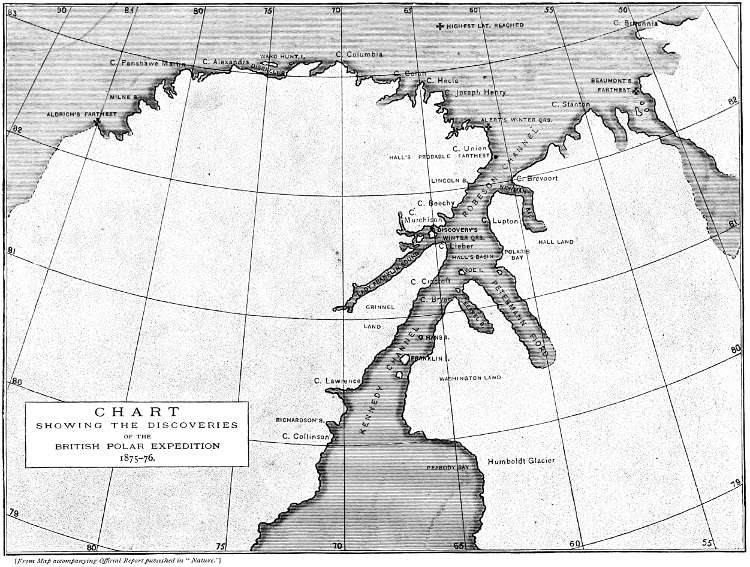
CHART SHOWING THE DISCOVERIES OF THE BRITISH POLAR EXPEDITION 1875–76.
[From Map accompanying Official Report published in “Nature.”]
Captain Young left Upernavik on the evening of the 19th of July, and stood away to the northward—in bad weather, and with the wind blowing a gale. Through vast fields of ice he threaded his way, sometimes under sail, sometimes under steam, until, on the morning of the 24th, he found his ship completely surrounded, in lat. 75° 10’ N.
No time was lost in endeavouring to effect an escape by charging the ice at full speed,—again and again returning to the onset; and a slow but steady progress was being made, when the field in which they were held fast, drifting before the gale, “collided” with a group of grounded bergs, and exposed the little vessel to such severe pressure, that preparations were made for abandoning her. Provisions, ammunition, camping and travelling gear, all were made ready, and the boats were lowered as far as possible at the davits. Meantime, heavy charges of gunpowder were used to blast the ice where it pressed the ship most severely; and the bergs taking a different direction, the Pandora began to recover herself, and before night settled down nearly to her usual level. In the darkness of the night, with the wind howling, and the snow and sleet driving in heavy showers, she moved ahead with the pack; and in this way continued her progress until the 27th, when the weather cleared, and Captain Young discovered that he had advanced right into the heart of Melville Bay, with no water in sight. Full in view were Capes Walker and Melville, the Peaked Hill, and huge glacier-streams embedded in the intervening valleys. All around was one vast monotonous sheet of rugged ice. It was not until the 29th that the Pandora, after many hairbreadth escapes, got into open water, in lat. 75° 50’ N., and long. 64° 55’ W. While thus imprisoned in the grasp of the floe, the explorers killed only one Polar bear, four seals, and a few little auks.
In a clear sea they now stood away to the westward, passing Capes Dudley, Digges, and Athol, and other headlands familiar in the records of Arctic adventure. At noon on the 31st, when off Wolstenholm Island, another gale overtook them, increasing rapidly to almost hurricane fury. This was an unpleasant experience; for the deck was washed by heavy seas, and it was with the greatest difficulty they avoided coming into collision with the icebergs which drifted rapidly through the snow and spray.
Reaching Cary Island, they landed to examine Captain Nares’ depôt of provisions, and found it in good preservation. The cairn had not been visited since Young’s call at the island on the 10th of September in the previous year. Afterwards they made for Sutherland Island, where they found a record of the American explorer, Captain Hartstene, dated August 16, 1855. It is with a curious feeling that, in these regions of almost perpetual winter, the voyager comes upon such faint memorials of men who, like him, have dared all the perils of ice-floes and icebergs, and adventured into seas far beyond the track of ordinary commercial enterprise.
On Littleton Island, a record of the expedition was found. The document was dated July 28, 1875, and signed by Captain Nares; and it indicated the course about to be taken by the ships under his orders. Owing to the ice-encumbered condition of the straits, however, Captain Young could not follow it up; and instead of crossing to Cape Isabella, he resolved to examine the coast in Hartstene Bay, in order to seek a harbour for the relief-ship which the Admiralty had intended to send out in 1877, in case of the non-return of the Polar Expedition. This was found on the 4th of August, not far from the Eskimo settlement of Etah, and named after the Pandora. It would seem to offer every advantage as winter quarters for Arctic discovery-ships; the surrounding hills are “dotted with Arctic hares, appearing like snow-balls on the luxurious vegetation.” The little auk breeds in thousands on the cliffs, eider fowl and guillemots haunt the waters, and the adjacent valleys and pastures are frequented by reindeer.
Captain Young next made for Cape Isabella, which he reached on the 6th of August. Watchful eyes soon discovered a large cairn on the summit of this headland. A boat was lowered, and the contents of the cairn soon obtained, while despatches and letters for Captain Nares’ expedition were left in their stead. Then the Pandora steamed to the northward; but, owing to the adverse winds and the accumulated ice, could make no way, and was forced back to Cape Isabella. Another attempt was made to the eastward, and for several days the gallant little ship crossed and recrossed the straits, through the pack, always beset with ice, and frequently enshrouded in impenetrable fogs. No fewer than three times was she compelled to take shelter in Pandora Harbour. On the 19th she was driven back to the northward of Littleton Island, and Captain Young and some of his officers took the opportunity of visiting the Polaris camp. Nothing remained of the house erected by Captain Buddington except a few broken boards. The rocks were strewn with pieces of metal, fragments of clothing, and other waifs and strays. The cache in which the retreating party had deposited their books and instruments was also examined; but the only relics were a brass bowl of a seven-inch compass, a tin tube, and parts of a telescope. Some cases and casks, containing records for the use of Captain Nares, were securely placed among the rocks on the western point of the island; and Captain Young then returned to Cape Isabella.
Finding nothing here of any interest, and convinced that no travelling or boat party had reached that position from the Polar ships, the Pandora bore away to the northward under canvas. “It was very dark and thick,” says Captain Young, “but sufficiently clear to enable us to avoid the heavy ice. By nine A.M. we were up to Lecomte Island, when we were stopped by a fog until eleven o’clock, when I could see from aloft that the main pack extended across the straits into Rosse Bay. We were in a lake of land water, with close-packed and heavy ice all round, from south to north, and again closing on the land from the eastward. Our only chance of moving seemed to be through a narrow lead or slack place, running first to the east-north-east, and then again apparently towards the east coast. We entered the pack, and succeeded by five P.M. in again escaping into the land water in Hartstene Bay.” Such are the experiences of twelve hours in the ice-clogged waters of the North! But we need not delay the reader with these minute particulars, notwithstanding their interest as illustrative of the nature of the struggle waged with so much persistency of purpose by the Arctic explorer. The sea was now covered everywhere with ice and bergs. Storms were of frequent occurrence; and the wind and wave beaten Pandora was forced back into Baffin Bay.
Here, on the 28th of August, her captain could see that the solid ice had filled the straits and the head of the bay right across to Cape Alexander. The way north being thus obstructed, Captain Young resolved on proceeding towards Upernavik, in North Greenland, hoping to find that the last ship had not already sailed for Denmark, and in that case to send an officer home with despatches, while the Pandora returned to Smith Strait.
On the 29th she was off Hakluyt Island, and steered for Bardin Bay in Whale Sound. On entering the bay, a summer tent could be seen, and some Eskimos, with their dogs, running to and fro, evidently with the view of attracting the attention of the visitors. Captain Young accordingly landed, with some of his officers, and accompanied by Christian, his Eskimo interpreter. The natives met them with the utmost confidence and fearlessness, assisting to haul their boat up on the shore. They were ten in number, and all members of one family. Food appeared to be plentiful with them, but they were profuse in their thanks for some walrus-flesh given by Captain Young. Their manners were frank and communicative, and they showed considerable vivacity, rejoicing over the results of a very good hunting season. Neither European ships nor white men had they seen for years; but they said that an old man, who, with his family, inhabited Northumberland Island, told of two ships which had passed to the northward “last summer.” How lonely must be the life led by these poor savages! Never gladdened by the sight of a sail; but, year after year, shut up in their frozen solitudes, and without any other object or purpose before them than to obtain just enough food to avoid a premature and miserable death!
Among their treasures Captain Young observed a ship’s bucket, half the top of a mahogany table, the paddle of a Greenlander’s kayack, much ice-worn, and a piece of packing-case marked “Lime juice—Leith;” all of which, they said, had drifted into the bay at different times from the southward. These people seemed to Captain Young of a kind and simple disposition, while they were evidently robust and healthy. All that they had—and it was little enough—they freely pressed upon their visitor; and when asked what present they would like, their chief selected only some gimlets and a fifteen-foot ash oar. The latter, he said, would split up into spear-shafts; the former he wanted for boring bone and ivory. Captain Young, however, gave them several other useful articles; accepting in return some narwhal horns, specimens of their pot-stone cooking-kettles, and of the iron pyrites which they used for striking fire. An exchange of dogs also took place; five of the dogs belonging to the Pandora being given for three of the finest bear-hunting and tame dogs of the Eskimos.
At Upernavik, the Pandora, after a stormy and dangerous passage, arrived on the evening of September the 7th, but found that the last ship had sailed for Europe. As there were no means, therefore, of communicating with England, and as, without such communication, Captain Young did not feel authorized to winter in the North, a supply of fresh water wars taken on board, and the ship steered for home. From the 15th to the 21st she tarried at Goodhav’n, in Disco Island. In Davis Strait she encountered large quantities of heavy Spitzbergen drift-ice, and weathered a severe south-easterly gale. On the 16th of October, in lat. 54° 38’ N., and long. 44° 30’ W., she sighted the Arctic ships, Alert and Discovery, and hastened to communicate with them. They kept together until the 19th. On the following day, the Pandora was buffeted by another hurricane; but the rest of her voyage was accomplished in safety, and was marked by no incidents of importance.
Here, for the present, terminates the record of British enterprise and adventure in the Arctic World. It is difficult to believe, however, that the nation will rest until the “heart of the mystery has been plucked out,” the Secret finally mastered, and the British flag hoisted on that remote point which is conventionally known as the North Pole.